From the FasterSkier archive — posts syndicated from athletes’ and coaches’ own blogs between 2004 and 2012, kept online as published. Current coverage is at fasterskier.com.
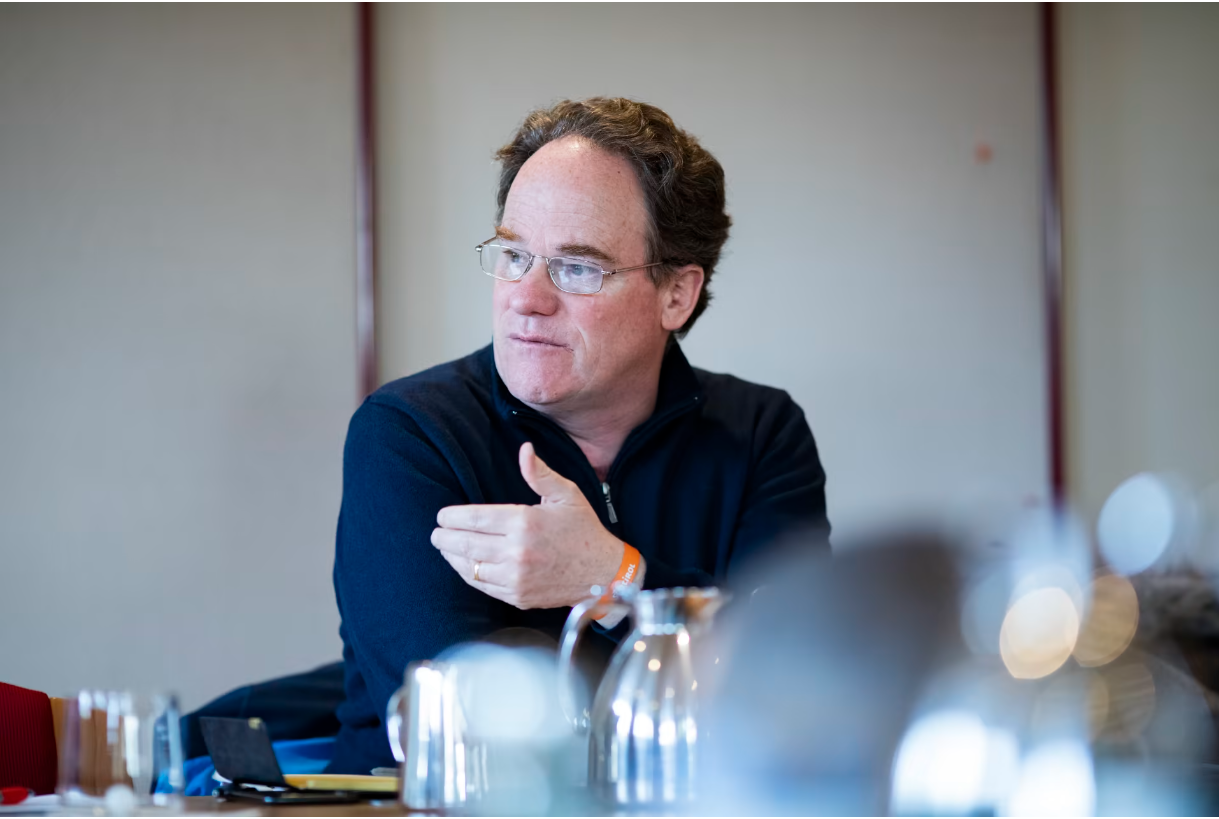
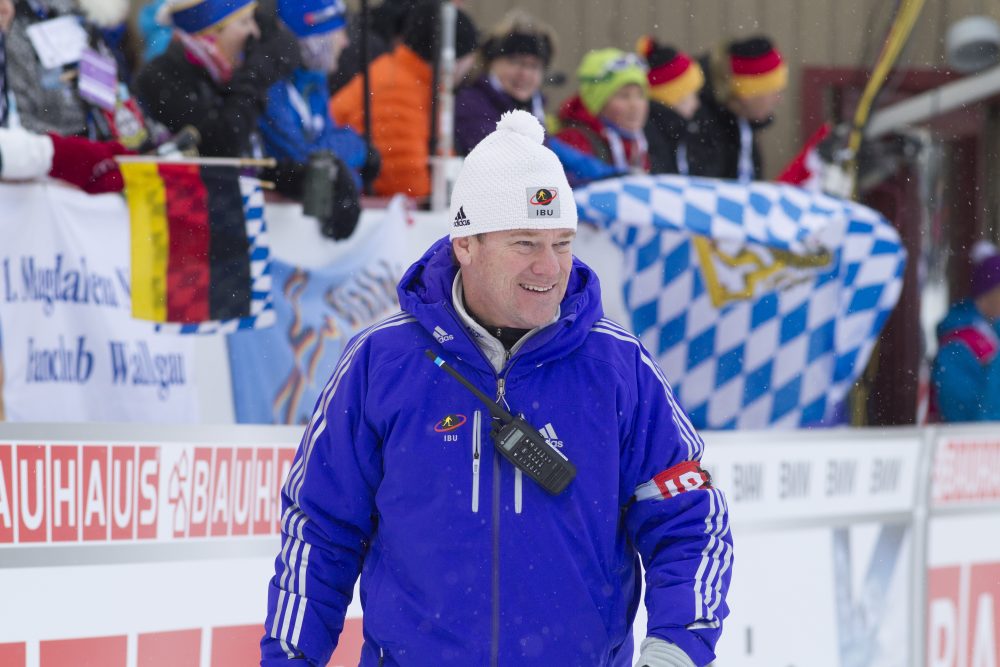
For the first time ever, an American will preside over international governance of a nordic sport. On Tuesday, the International Biathlon Union (IBU) announced that longtime U.S. Biathlon President and CEO Max Cobb has been named the IBU Secretary General. Cobb will finish up his second term on the IBU Executive Board and leave his post as at U.S. biathlon at the end of September, then begin his new role overseeing international competition, governance, and sport development this October.
The appointment of Cobb as IBU Secretary General marks the culmination of a long career in U.S. biathlon in which he has overseen the organization through stark growth in the sport, success on an international scale for U.S. biathletes, and through unique challenges like hosting the 2002 Salt Lake City Olympics, where Cobb served as the chief of competition.
On his new appointment, Cobb said in an email with FasterSkier that, “I am really honored to be selected for this position. The chance to serve the sport I love from a different position is really exciting. [Outgoing Secretary] Niklas Carlsson did a fantastic job and the IBU staff is well-structured and very capable.”
Cobb’s journey to overseeing biathlon is one marked by persistent and carefully thoughtful forward-thinking, along with an enduring connection to the nordic community in the United States. A New Englander through-and-through, Cobb competed at Dartmouth College while taking on leadership roles heading up the College’s Outing Club and Biathlon Club. It was the latter that translated into a career, accepting a job opportunity with the U.S. Biathlon Association in 1989. Founded in 1983, U.S. biathlon was still in its nascent, path-finding stages then, looking to build off the successes it had seen concurrently with U.S. skiing more broadly in the late 1970s and early 1980s. There were flashbulb glimpses that the U.S. could bring the popular discipline of biathlon to a new continent, a bronze in the women’s team relay event at the 1984 World Championships (Holly Beatie, Julie Newman, and Kari Swenson), and an individual silver for Josh Thompson in 1987 (20 k Individual). Without real infrastructure to develop the sport however, U.S. biathlon would have to reset towards the long-term goal of getting more talented athletes, in more places, into the sport before success would come again.
In 1992 Cobb took up that challenge as U.S. Biathlon’s Program Director, and since has been the steady hand guiding the sport between the punctuated successes that usually draw attention. First there was a gold medal at Junior World Championships in 1997 with Jay Hakkinen, then later the World Championship medals – first a silver with Tim Burke in 2013 (20 k Individual), then gold and silver with Lowell Bailey and Susan Dunklee, respectively, in 2017 (20 k Individual and 12.5 k Mass Start), and again a silver with Susan Dunklee in 2020 (7.5 k Sprint). In between, the development of training sites from Soldier Hollow (concurrent with the 2002 Salt Lake City Games) to Fort Kent, Maine (which, tucked away in the most rural corner of a rural state, improbably hosted a World Cup in 2004).
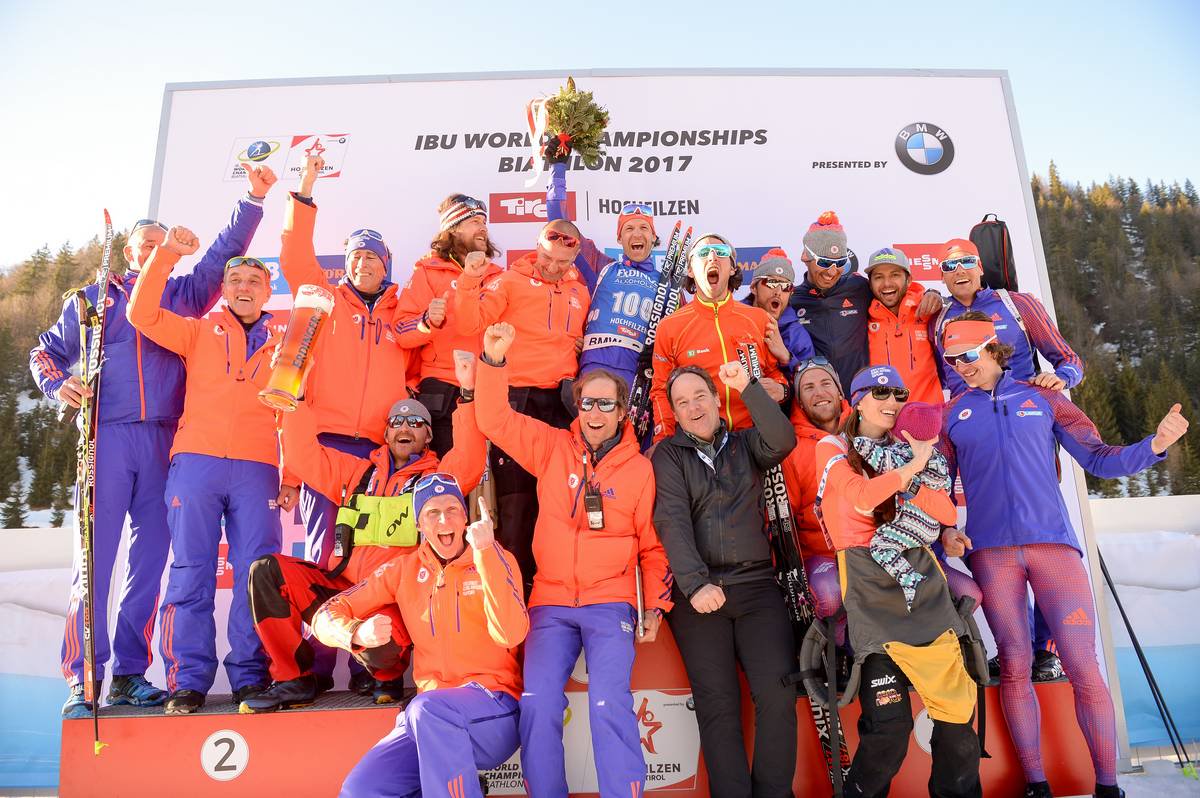
The U.S. Biathlon team and staff celebrate Lowell Bailey’s World Championship gold medal in Hochfilzen in 2017. (Photo: USBA/NordicFocus.com/Twitter)
Those highlights represent a consistent attitude and approach by biathletes across the United States put into sum by their consistent leader, as Cobb reflected, “The biggest take away is challenges can’t keep you from pursuing ambitious objectives. Collaboration, planning and determination to achieve a bold vision often overcomes more than we could ever imagine. Teamwork aligned around a common vision is powerful, but it takes time and constant tending. Today, Americans are regularly bringing home medals – something that seemed impossible three decades ago.”
Now tasked with scaling his approach to an international scale, Cobb sees a different set of challenges which stand in tandem, not separated, from the world’s geopolitics and concerns. “I think the most immediate challenge [this winter] will be the high cost of energy in Europe that will impact every part of international sport; from travel for the athletes to the energy needed to host major events,” said Cobb. His solution follows a pattern he’s already helped develop, with the IBU being on the forefront of sport sustainability – they were the first international winter sports governing body to meet the UN’s planning requirements to go carbon neutral by 2050 last year. “Our sport gives us a platform from which we can help influence millions to live lives that are climate friendly, we all have to act more sustainably in our daily lives and at our events.”
A 2016 photo of Max Cobb, the president and CEO of U.S. Biathlon and newly named IBU Secretary General. (Photo: Nordic Focus)
Cobb is also looking to prioritize confronting the challenge of resource disparity that is inhibiting parity in the sport – a persistent problem across the broader nordic disciplines. “[There’s a] big technology and training gap between the very biggest nations who have armies of ski tech and coaches and middle-sized teams with just a few hard-working staff. As this gap grows it could endanger the diverse set of nations that can win medals, [which] has been a hallmark of international biathlon for many decades.”
In confronting all of the challenges, Cobb said his hope is, “To serve the athletes well, both those in the sport today and those who need a chance to discover the wonderful challenge that [biathlon] is – two opposing disciplines with an unforgiving clock marking every second to the tenth.”
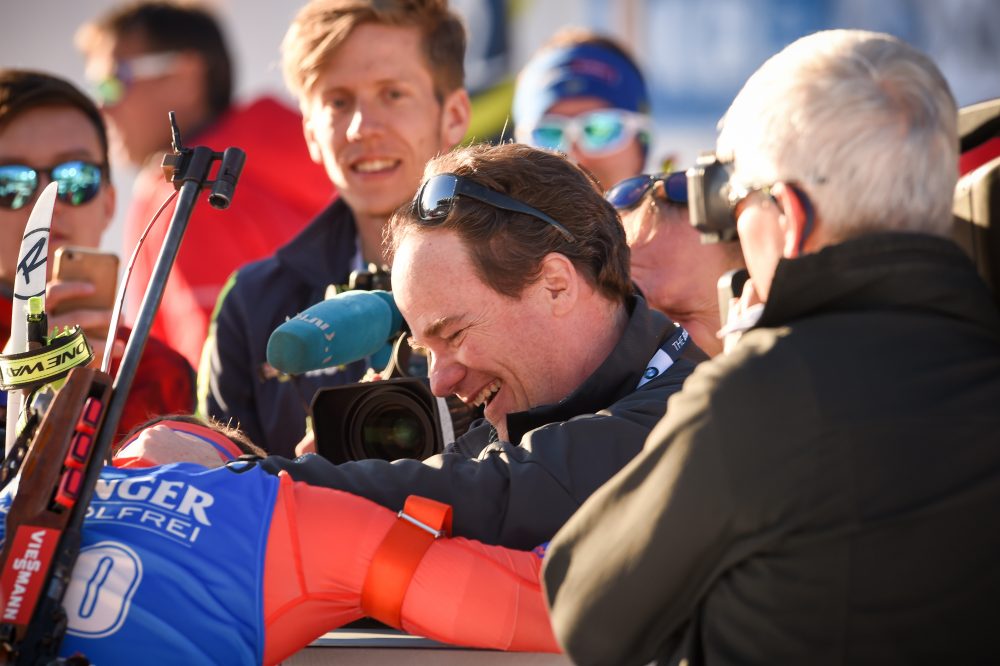
Lowell Bailey (USA) celebrates with Max Cobb after winning the gold in the 20 k indivudual at the 2017 IBU World Championships in Hochfilzen, Austria. (Photo:NordicFocus)
BOZEMAN, Mont. — On June 2, local non-profit Crosscut Mountain Sports Center (CMSC) announced closing on the long- awaited acquisition of Bohart Ranch in Bridger Canyon. This landmark deal represents a commitment to continuing the Nordic skiing legacy at Bohart Ranch that Bozeman residents have cherished since the 1980s.
“After nearly sixty years of skiing in Bridger Canyon, it’s really special to see this legacy of mountain recreation continue,” said Cliff Montagne, longtime Bozeman resident and CMSC Board member. “It’s an honor to have a role in this once-in-a-lifetime project.”
Bohart Ranch is one of two iconic Bridger Canyon properties that CMSC plans to assemble in 2017. When conjoined, this iconic property will comprise over 500 acres adjacent to the Bridger Bowl Ski Area, and will include a network of trails for non-motorized outdoor recreation and mountain sports.
Hal Stanley, CMSC Board member who grew up skiing at Bridger Bowl, sees this project as the Nordic equivalent. “CMSC has everything it takes to be as successful and as important to the Gallatin Valley as Bridger Bowl has been,” said Stanley. “I’m excited to give back to the community and look forward to working with other community members who want to help shape this vision.”
While CMSC has raised close to half of the funds necessary to acquire the two properties through cash donations and pledges, there remains the need for continued philanthropic support. CMSC plans to exercise on their remaining Crosscut Ranch purchase agreement by year-end, with the aim to start designing new facilities in 2018.
“It is the generous support of the Bozeman community that has allowed us to take this major first step, and this support is critical to ultimately see this project through. Investing in Bohart Ranch is an investment in outdoor recreation now and for future generations,” said Lowell Bailey, CMSC’s Executive Director. “Now that we own the land, we can truly begin to think about how to design a venue that will best serve the community for decades to come. We look forward to working closely with Bridger Bowl and other partners to create a mountain venue that serves all ages and abilities.”
In 2017, CMSC’s focus will be on maintaining Bohart Ranch’s Nordic ski trails and connecting this network to new trails on Crosscut Ranch. Together, these properties will encompass a total of over 50 kilometers of groomed, tracked trails for skate and classic skiing. Bohart Ranch will be the home-site for both the Bridger Biathlon Club (BBC) and U.S. Paralympic Nordic and Biathlon Teams.
“I grew up training at places like Lone Mountain Ranch where community members and Olympic hopefuls overlapped on the ski trails everyday,” said Kari Swenson, former U.S. Biathlon Team member and BBC Board member. “That’s unique, and it’s a valuable experience for novices and experts alike. I look forward to working to help deliver the Crosscut Mountain Sports Center vision on behalf of our community.”
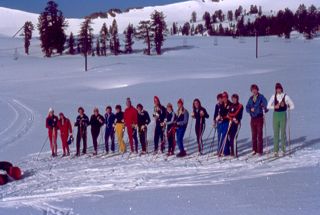
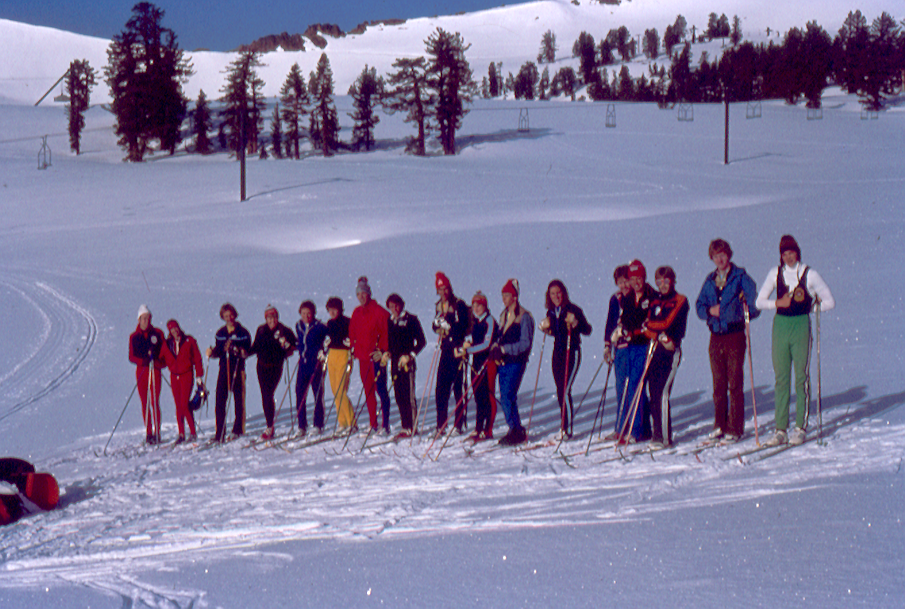
The U.S. biathlon team at a training camp in Squaw Valley, California, in the spring of 1981. Photo courtesy of Art Stegen.
This article is part of FasterSkier’s ‘Where Are They Now’ series, made possible through the generous support of Fischer Sports. Learn more about their products at www.fischersports.com.
It was originally posted in January 2014, but in light of Susan Dunklee’s silver medal in the mass start at 2017 World Championships, we thought we would revisit the last time the U.S. won a World Championships biathlon medal, back in 1984.
“I am so thrilled for Team USA,” Kari Swenson wrote in an email this week. “To have two individual world championship medals is historic. Susan Dunklee’s silver medal is inspiring and will create movement and motivation among young female biathletes in America. She’s in a position to elevate our development programs throughout the country to the next level. Her silver medal means that the USA will be taken seriously by international biathlon programs and fans. Susan and Lowell [Bailey] are now the faces of the USA Biathlon. They will be able to promote Biathlon nationally and in small local clubs. I hope that we can get both of them to travel the country to inspire up and coming biathletes. I am trilled to have Lowell committed to helping our local Bridger Biathlon program in Bozeman, Montana.
“I have cheered, watched and hoped for another medal for the American women since I helped win a relay bronze medal at the first Women’s World Championship in 1984 Chamonix Franc,” she continued. “The program has come a long way since that medal and I am so proud that Susan was able to have her personal best race at the World Championships.”
Going into the 2014 Winter Olympic Games in Sochi, Russia, the U.S. women’s ski team has a very real shot at a relay medal – either in the team sprint or the 4 x 5 k relay competition. That’s backed up by World Championships gold in the team sprint last season in Val di Fiemme, Italy, by Kikkan Randall and Jessie Diggins.
Before their win and Randall’s silver in the 2009 World Championships skate sprint, it had been nearly three decades since and American women’s team in the nordic sports world stood on a championship podium. In 1984, the biathlon team of Julie Newnam, Kari Swenson, and Holly Beattie won bronze in the relay at World Championships in Chamonix, France.
The results were comparable in many ways: it was a landmark moment, an astonishing accomplishment for a U.S. team that had never been expected to do much by the international establishment.
But both in Val di Fiemme and the upcoming Olympics, the favored U.S. women’s team might be a little more prepared for the big stage. After all, back in 1984, it was the very first World Championships female biathletes had ever had – and the first races in Europe for the members of the American team.
“We went over and that was our first-ever experience,” Swenson said in an interview last month. “We went into Chamonix cold, not knowing what our competition was. Maybe that was a good thing, not knowing. We had no idea where we would finish up.”
It had been a long road to Chamonix for Swenson, who started doing biathlon pretty much as soon as women were invited to join U.S. training camps back in 1977. You might not know it now, but biathlon was a male-only sport for far longer than many, in part because it was usually associated with the military.
Then a freshman in high school in Bozeman, Montana, Swenson had skied at U.S. junior nationals, where the biathlon team had set up a demonstration to try to attract interest from young skiers. The demo culminated in a fun race where biathlon team members helped the new skiers set up and shoot their rifles, aiming at balloons rather than targets. Swenson was hooked.
“They decided that they were thinking about starting a women’s development team, and would a couple of us be interested?” she recalled. “We were like, sure! We didn’t really know what that meant. So we started to get invited to the fall camp in West Yellowstone. All of us were skiers but we had to learn how to shoot, because none of us really knew how to handle a gun. It was an interesting time.”
For several years, Swenson and other women honed their shooting skills as they all also improved at skiing. There was no international circuit to speak of for women’s biathlon, so they competed domestically. Swenson finished high school and enrolled at Montana State University, where she also competed on the ski team.
Finally, in the 1983-1984 season, the women got their chance. The U.S. had been training women for seven years, and so, Swenson thought, had other countries. The problem had never been a lack of women interested in competing; it had been an unwillingness by others to allow them to do so.
“There was a lot of, I hate to say it, but male chauvinism, in this sport,” she said. “Because it involves shooting, and they didn’t think that women should be shooting rifles… I mean, Italy was way behind, just because of the male chauvinism aspect of it. Biathlon started way back in the military, so it was male-dominated because it was military based.”
But that season, a World Cup circuit was set up, although the Americans did not attend. They stayed home and trained until the end of February, when they headed to Chamonix for the World Championships.
“[The other teams] had been over there competing against each other all year, so they kind of knew each other,” Swenson said. “So we came in as dark horses. They had no idea who we were or how we would compete. I think we might have had a little bit of an edge there.”
The first race on the schedule was a 10 k individual competition with three shooting stages. With a single penalty, Swenson placed fifth out of the 35 competitors, landing just under a minute and a half behind the winner.
“Four Russians and then me,” Swenson laughed. “It was really quite interesting, exciting, and eye-opening to be over there and see how the athletes were actually involved. How many countries there were.”
After a 5 k sprint, where Swenson again led the U.S., this time placing 13th, it was time for the final event of the Championships: a relay. The Americans placed third, behind Russia and Norway.
Their experience was something akin to when the U.S. women’s ski team placed third in a World Cup relay in Gällivare, Sweden, in 2012. Those women will feel plenty familiar in Swenson’s description of what happened next.
“First of all, we couldn’t believe it that we actually won a medal, and nobody else could either!” she said. “All of the other competitors and coaches were coming up and saying congratulations and hugging us. It was a pretty big deal… To have the Russians come up and say ‘congratulations,’ it was just amazing because they were such a powerhouse.”
For Swenson, the World Championships opened up a whole new realm of sport. She was amazed at how popular biathlon was in Europe, and it energized her even more to keep racing.
“Competing in Europe was so different than competing here,” she marveled. “It’s an actual sport over there. Seeing all the people who would come out, it was an event. The grandstands were full of people cheering, and they’re all drinking their Schnapps or whatever, and it was just a festive atmosphere. And here you’re lucky just to have 15 or 20 people show up.”
Championships complete, the U.S. women’s biathlon team was born. Swenson and the other women went on to compete in not only World Championships, but the actual World Cup circuit as well during the next few seasons.
Swenson was temporarily derailed by tragedy as she was abducted by two men while out on a training run in Bozeman. She ultimately was escaped, but one of her rescuers was killed by her abductors during a rescue attempt, and Swenson herself had serious injuries after being shot through the lung. The event gained national media attention, although Swenson just wanted to put it behind her.
By that winter, she was back competing again, and soaking up more of the international competition experience. It was a heady time to be a woman in the world of biathlon.
Swenson remembers mostly positive things – like the community of women competing together on the international circuit.
“There was never any politics involved with biathlon,” she recalled. “It was almost like it wasn’t important. It was just an athletic event and we were all there to compete, trying to do our best and it wasn’t political. Everybody cheered for everybody, and nobody cared who won as long as everyone competed their best.”
Along the way, she chalked up the milestones that many World Cup racers keep track of: top tens, appearances in different foreign countries. As for many, one highlight was in Oslo, Norway.
“It’s this huge bowl for ski jumps,” she said, fondly recalling the atmosphere in the stadium. “The king was there! The king and queen were there, and I was just floored. I mean, talk about stress! How can I compete in front of all these people, and do halfway decent? I actually placed fourth, and I was just so excited to have placed so well at the Holmenkollen.”
On the other side of the spectrum, it was eye-opening to travel to East Germany after the Berlin Wall had fallen. Swenson remembers one very grey, depressing trip where she could still see fences and guard houses. She and her teammates were glad to head west when the races were over.
The main negative experience that Swenson and her teammates faced again and again was spectators who didn’t think that women should be doing the sport.
“The first year that we went over to Europe, we had a lot of older citizens that would come to our practices and our races and tell us that we should not be doing that,” she explained. “That it was just too hard on women. That women shouldn’t be skiing and carrying a rifle, that this was just too hard on women. And that it was not ladylike to be shooting rifles.”
That would be enough to get any athlete down – how hard is it to stay mentally focused and positive when you’re being told that you shouldn’t even be competing? But Swenson says that the U.S. women didn’t take it too seriously.
“It was hard, but at the same time, we just kind of laughed it off,” she said. “Like, ‘oh, women can have babies, and it’s okay to go through childbirth, but it’s not okay to put a rifle on your back and go skiing?’ We kind of thought it was funny. We nodded our head and skied on by. We were very nice to them, and they had their opinions, and it was okay.”
(When told that Magalena Neuner, a German woman, was the most popular athlete in biathlon for a number of years, Swenson practically cackled with glee: “Oh is that right! I love it!”)
It also helped that the men on her own team were considerably more open-minded. Because biathlon was a fringe sport in the U.S., the men’s team was quite small too, and all of the athletes banded together.
“They were very very supportive,” Swenson said of her male teammates. “They were a great help in getting it started. When we started we were very small, men and women, so we had a very close-knit and supportive group of people. We helped each other in all aspects, skiing, shooting, and just keeping a positive attitude no matter what.”
The two teams also trained together, which made everyone involved sharper and faster.
“The hardest part for the men, and I’m sure they would argue this point with me over and over, but that we could shoot as fast and as accurately as they could,” Swenson laughed. “Shooting is not a sport where you have to be big and strong. Shooting is all about accuracy, so the women’s team often outshot the men’s team. There was some contention there. We’d have shooting competitions, and often times we won.”
After a few years, though, Swenson decided to call it quits. She had graduated from Montana State and spent two years pursuing biathlon full-time. She still dreamed of going to the Olympics, but there was no Olympics in sight for women – after giving ladies their own World Championships, the biathlon establishment hadn’t taken any further steps towards equality.
Swenson had always wanted to go to veterinary school. She was afraid of waiting too long.
“I thought that I just couldn’t waste my time – I love biathlon, but I can’t just wait for the Olympics,” Swenson said. “So I retired in 1986 to go to veterinary school. The first Olympics for women’s biathlon wasn’t until 1992, so I thought it was good that I went on and did something with my life!”
She is now back in Bozeman, where she is a veterinarian and also owns horses. She says that she spend more time with her horses, often taking them to Yellowstone National Park, than she does with endurance sports.
“I’ve sort of lost touch,” she says of her current relationship with biathlon.
But she still exercises and stays in shape. She goes to the West Yellowstone Ski Festival, where it’s “like a reunion” with old friends and teammates. And she’s looking to be involved in a new biathlon club starting up in Bozeman.
“Here in Bozeman we had a very large number of skiers who went on to become skiers and biathletes on the national team,” she said. “But then it tapered off and we had this huge emergence of just nordic skiing here in Bozeman… We have a great range, a permanent range up at Bohart Ranch. I’m like, this is so silly we have a permanent range with metal targets, and we don’t use it! So we’re going to try to get a club started and get kids interested in the sport. It will be fun.”
Although Swenson hasn’t been involved in all of the planning meetings for the new club, she plans to be involved with coaching.
“I love to help kids,” she said. “I think it’s really fun because they have that inquisitiveness, and that energy. It’s really fun to watch a child enjoy something, and progress, and eventually reach their goals, whether it be shooting five out of five targets, or skiing a certain pace on a course. So I’m hoping to be involved in whatever capacity I can be.”
For young racers in Bozeman, that’s a lucky thing indeed. Although she has a different life now, Swenson remembers her days of competing at the very top of the sport with fond memories. The next generation of Montana biathletes might be able to look back on the sport with her same attitude. Hopefully, the current crop of U.S. Olympians will too.
“I still have my rifle,” Swenson says. “People laugh and ask why I still have it, and I say, ‘well it’s my baby! I can’t let it go!’ And I have my old skis with all the little stamps on them from my international competitions, and I have all my medals up. It’s still part of my life, definitely.”
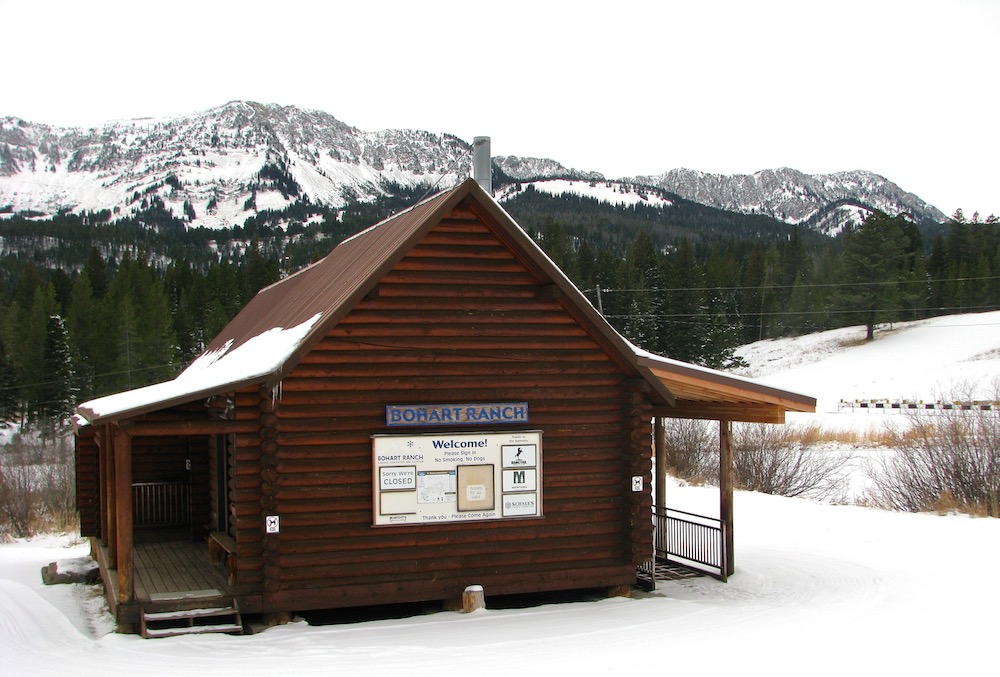
One of the trailside cabins at Bohart Ranch in Bozeman, Mont., as seen early last winter.
If the deals go down, two legendary ski areas in Bozeman, Mont., could merge into a single, state-of-the art nordic center that would also offer dryland recreation opportunities as soon as fall 2017. The Bridger Biathlon Club (BBC) has acquired exclusive options to purchase both the 276-acre Bohart Ranch and the adjacent, long-dormant 259-acre Crosscut Ranch.
All it takes is money — and a vision. Established in February 2014, the non-profit BBC will launch a fundraising campaign later this year with a goal of raising $10 million dollars over the next three years to buy the two properties. Once raised, a portion of the funds will go toward renovating existing facilities and upgrading infrastructure to make these historic ranches more accessible to the public, according to BBC Director Eric Love.
“This [would be] a legacy transaction,” Love said in a phone interview. “We’re aiming to unite those two properties into a single expanded recreational resource.”
BBC Marketing Director Katie Smith cited the 2014 Winter Olympics in Sochi, Russia, as a spur to interest in biathlon in Bozeman. Smith added that biathlon has deep roots in Bozeman, as it is the home of Kari Swenson, a bronze medalist with the U.S. women’s relay team at 1986 Biathlon World Championships.
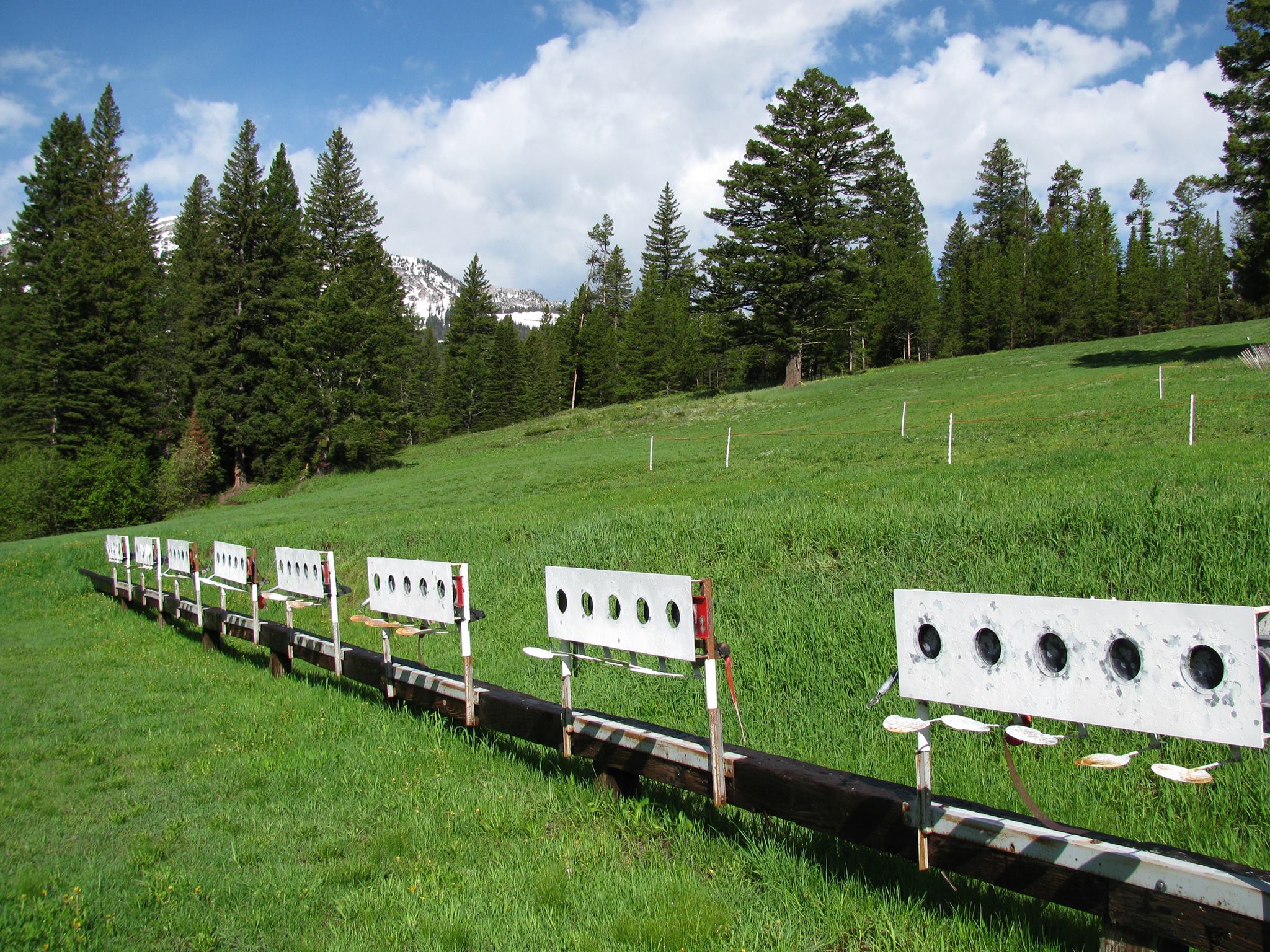
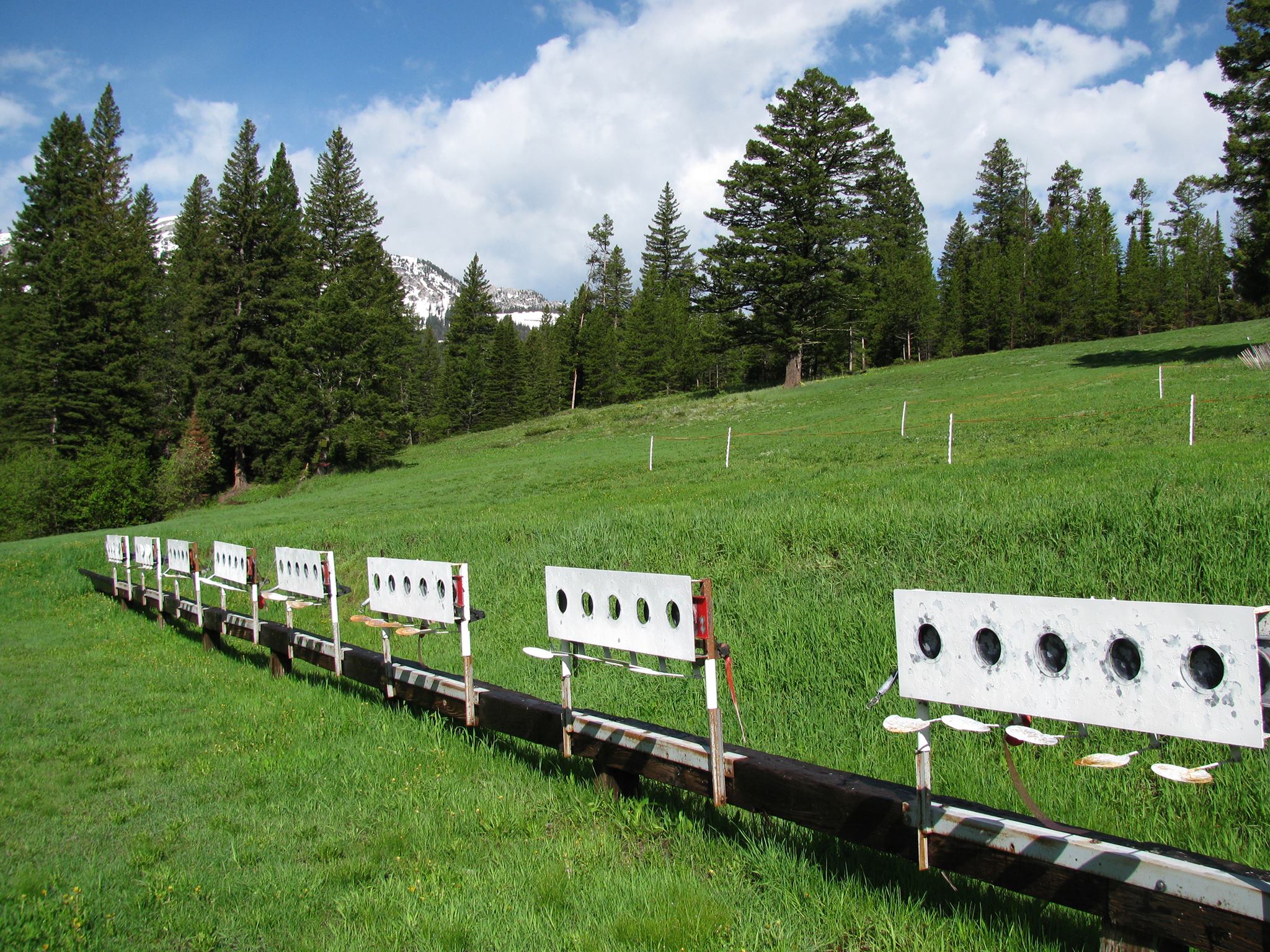
The biathlon range at Bohart Ranch in Bozeman, Mont. was installed in 1989 at the height of the sport in the small mountain town. In 2014, the Bridger Biathlon Club upgraded its 12-point range by installing new targets from Finland. (Photo: Bridger Biathlon Club)
In a year, Smith said the BBC was able to raise enough money to renovate its biathlon range at Bohart. According to Love, the new Kurvinen range, made and shipped from Finland, cost about $36,000 dollars.
Smith credited generous donors and volunteers who helped assemble the 12-station range when it arrived. BBC’s fundraising success got them thinking big. The club’s goal is to raise enough money to exercise the options on Bohart and Crosscut in three years.
If and when BBC buys the two ski centers, the purchase prices will remain confidential, Smith said.
Sixteen miles from Bozeman, Bohart Ranch has 30 kilometers of trails on 276 acres of fee-title land. Situated between Bohart and the Bridger Bowl alpine ski area, Crosscut Ranch is an additional 259 acres. The combination of the two could make for 50 to 60 kilometers of total trails.
Last December, Bohart was the scene for the second weekend of the U.S. SuperTour, hosting a classic sprint and distance race. Bohart has also hosted NCAA events and the 2002 U.S. nationals prior to the 2002 Winter Olympics in Salt Lake City, Utah.
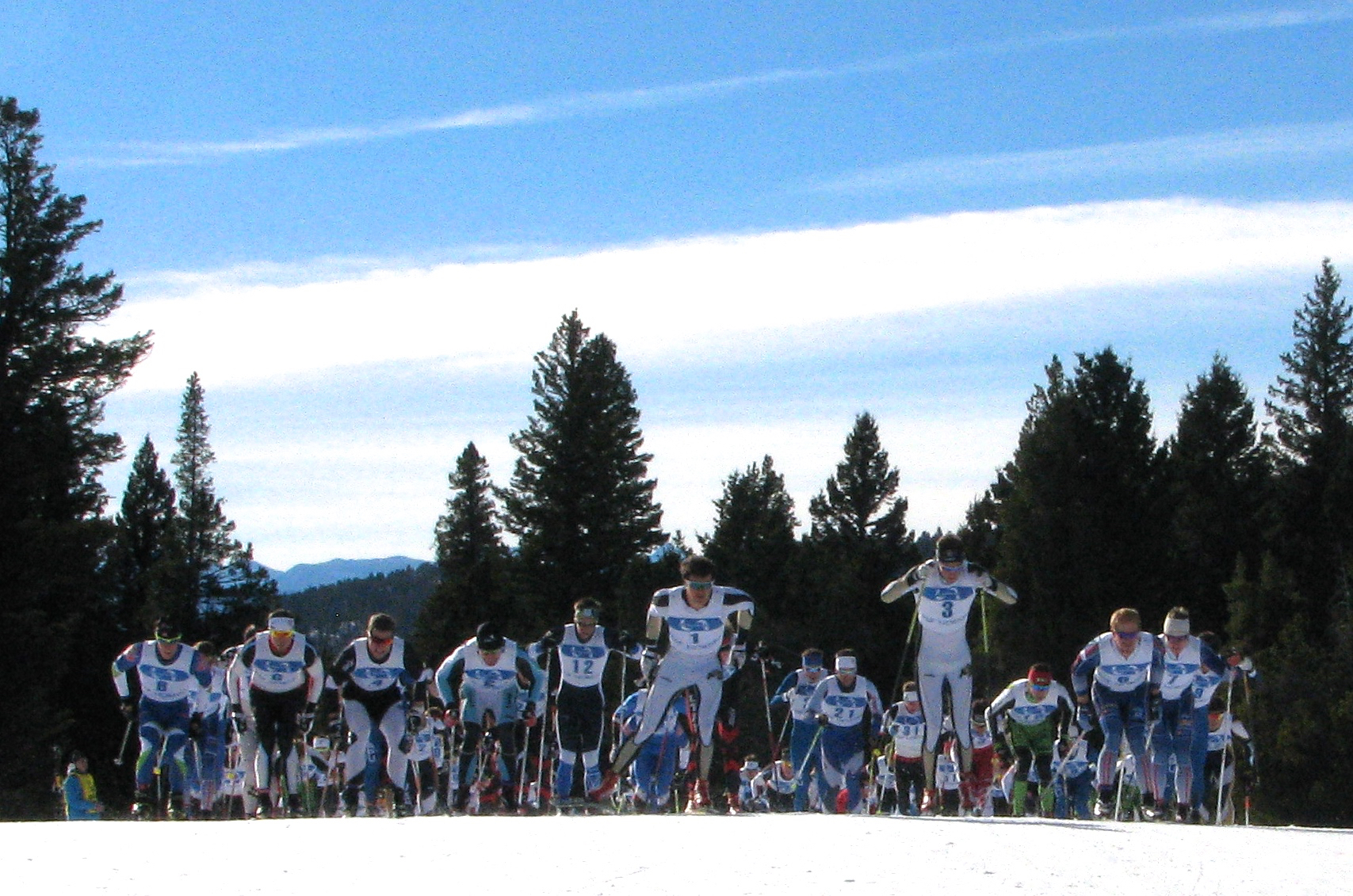
The start of the men’s SuperTour 15 k classic mass start at Bohart Ranch near Bozeman, Mont., last December.
“Various people approached us, but we were waiting to find the right person to carry on our vision and philosophy,” said Bohart co-owner Jean MacInnes. She and her son, Chris Myers, have co-owned and run Bohart Ranch for 27 years.
“It’s a community service,” she continued. “We have excellent trails here. We help the MSU [Montana State University] ski team, Bridger Ski Foundation. We have something called Eagle Mount that takes place here.”
According to Eagle Mount Executive Director Mary Peterson, Eagle Mount is a Bozeman-based nonprofit that “provides therapeutic recreation to people with disabilities and children with cancer.” Two seasons ago, 37 participants and 46 volunteers took part in cross-country skiing and snowshoe programs at Bohart.
MacInnes said that the original Crosscut Ranch ski center was about 80 acres and went out of business in 1987 after five years. What is now referred to as Crosscut Ranch is the original ski area packaged with additional land parcels to attract developers, she said.
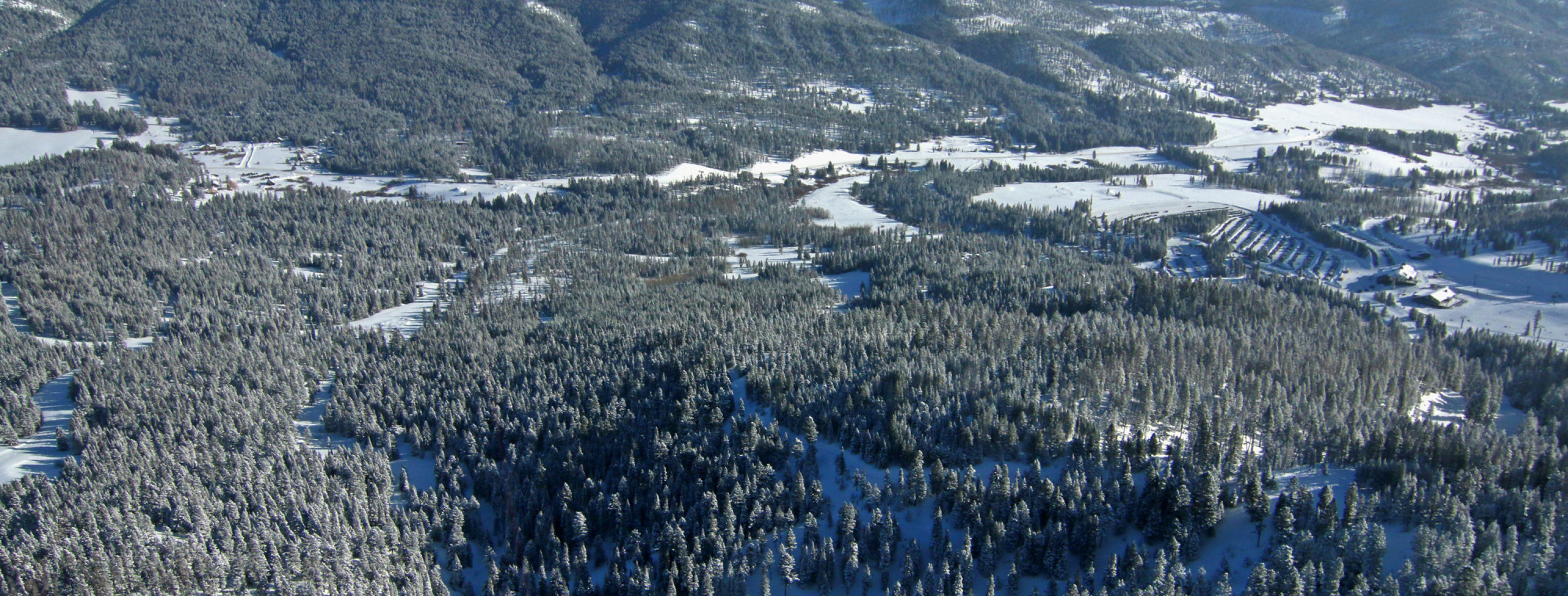
An aerial view of Crosscut Ranch in Bozeman, Mont. (Photo: Outlaw Partners/Concierge Auctions)
“It’s a bit of a misnomer,” she said of the Crosscut name that now includes the entire 259-acre tract.
Unsuccessfully marketed by a realtor with an asking price of $16 million, Crosscut was sold at auction to the Jackson Financial Group in March 2014. The Bozeman Daily Chronicle cited a local person who speculated that it sold for $4.1 million dollars. That figure is unconfirmed.
More Than a Nordic Center
In December 2014, Myers opened about 15 k of Crosscut’s trail system, which hadn’t seen grooming or maintenance in more than 20 years. While these trails were wide enough for skating, some needed additional work in order to accommodate a snow cat.
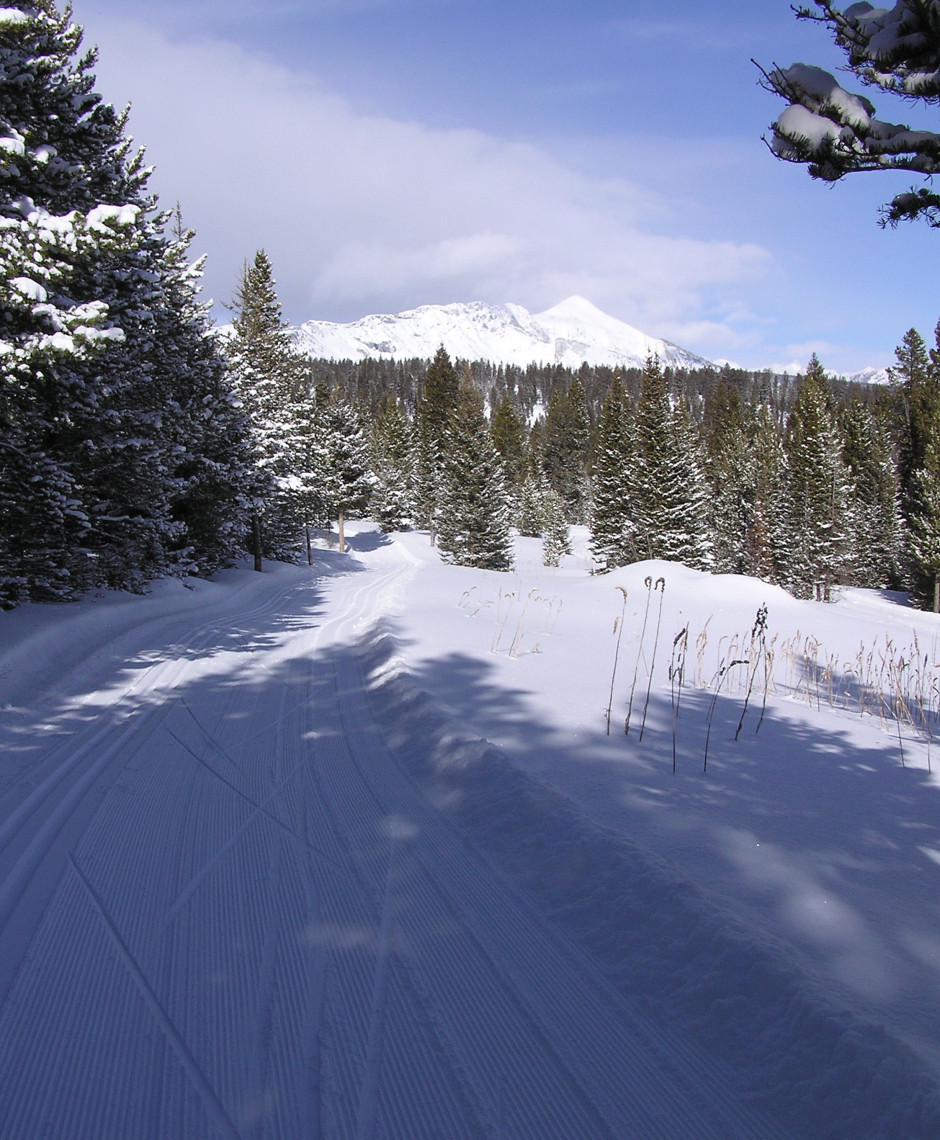
A groomed trail at Crosscut Ranch in Bozeman, Mont. (Photo: Outlaw Partners/Concierge Auctions)
For 2015/2016, BBC hopes to reopen additional Crosscut trails and establish connectors between the two networks. Last winter, it re-established and groomed about five kilometers of Crosscut trails, and is currently aiming to add at least another 5 k next season. According to Love, the trails will be open to the public for activities like mountain biking this summer.
“There’s really interesting terrain at Crosscut,” Smith said. “It’s perfect for beginners and for experienced skiers who want to train a specific skill.”
By contrast, Bohart is hilly. “Combined, the two ski centers will give a lot of terrain variation,” Smith said.
“Historically, this [Crosscut] area has been used as a nordic center,” Love said. “The bones are all there.”
Asked about possible improvements, Love explained that the stadiums could be expanded. “On the Crosscut property, there’s potential to put in a world-class stadium,” he said.
In a follow-up email, he wrote, “We recognize the potential of re-locating BBC’s current new 12-point range at Bohart to Crosscut and perhaps even expanding it to 24 or 30 points.”
At present, BBC is studying options for improving the combined ski centers. Its board, made up of Swenson, Carol Smith, Stuart Jennings, and Brian Wadsworth, assembled a design team to illustrate what a green venue would look like. The team consists of nationally renowned architect Jonathan Foote, sustainable-green-building designer Kath Williams, and Ben Lloyd and Trip Lewton of Comma-Q Architecture in Bozeman.
Love expects the design study to be complete in late May, after which BBC will reach out to the Bozeman outdoor community for input and finalize a fundraising plan.
The properties will be available for more than just skiing: BBC is looking to provide year-round recreation opportunities. Some of these are already in place: Bohart already offers Frisbee golf and mountain biking in the summer. Love was excited about the possibility of offering side-by-side cross-country and alpine venues within 30 minutes of a major airport.
While Smith acknowledged that $10 million is an ambitious number, she’s optimistic because of BBC’s success in raising money to purchase the biathlon range.
“We’re going to rely on more than the cross-country community,” she said. “People see a lot of value in preserving these two pieces of land that are so important to Bozeman’s culture.”
“Once assembled, this will be a nordic ski destination unlike anywhere else in the U.S.,” Love said.
The biathlon range at Bohart Ranch in Bozeman, Mont. was installed in 1989 at the height of the sport in the small mountain town. The Bridger Biathlon Club is attempting to bring biathlon back to Bozeman and is starting by installing new targets from Norway. (Photo: Bridger Biathlon Club)
If you’ve been to Bohart Ranch in recent years, you’ve likely seen the Biathlon range nestled on the doorstep of the Bozeman, Mont., ski area. If you looked closely it would become apparent that the targets have had little use in recent history. They are mostly used for summer competition, and serve as a reminder of what had been.
The targets weren’t always as weathered. Biathlon in Bozeman was booming in the in 1980s. With renowned Olympic-level athletes such as Kari Swenson training in the area and a club based at Bohart Ranch, it seemed as if Bozeman was becoming a U.S. biathlon hub in the west.
However, the biathlon surge in Montana did not last. Biathlon in Bozeman began to diminish in the final decade of the twentieth century as cross-country skiing became more popular. By the time the 2000’s hit there was hardly any support for biathletes in the small Montana town.
Alex Love and Ben Sites train in West Yellowstone with the founders of the Bridger Biathlon Club in 2013. They are two of 45 potential athletes for the new ski club. (Photo: Bridger Biathlon Club)
Fast-forward to 2014, where a group of locals is attempting to change the absence of biathlon in Bozeman. Starting with a fundraiser in the fall of 2013, the newly formed Bridger Biathlon Club has already made major ground in bringing biathlon back.
The club’s goal is to provide a top-tier training program for biathletes of all abilities that hosts national and regional races. The club also plans to sustain a biathlon culture in Bozeman by maintaining facilities and equipment in addition to creating enthusiasm within the community.
While their goals are lofty, the club is tackling on task at a time.
The first item on the agenda is replacing the ghosts-of-biathlon-past and installing new state-of-the-art targets from Norway. The new targets are set to be installed in the fall of 2014 will carry a plaque to commemorate the late Peter Hale with who passed away in 2013.
Once the new targets are in place, the next undertaking is to build a club from the ground up.
According to the Bridger Biathlon Club’s marketing and public relations director, Katie Smith, the task of finding future biathletes in Bozeman is already off to a good start.
Alex Love prepares his rifle while training in West Yellowstone, Mont. in 2013. Love is one of the junior athletes who will train with the Bridger Biathlon Club in the fall of 2014. (Photo: Bridger Biathlon Club)
“A total of 45 kids, ages 8 to 14 have reached out to the Bridger Biathlon Club to express their strong interest in participating in a training program this coming season,” Smith said in an interview.
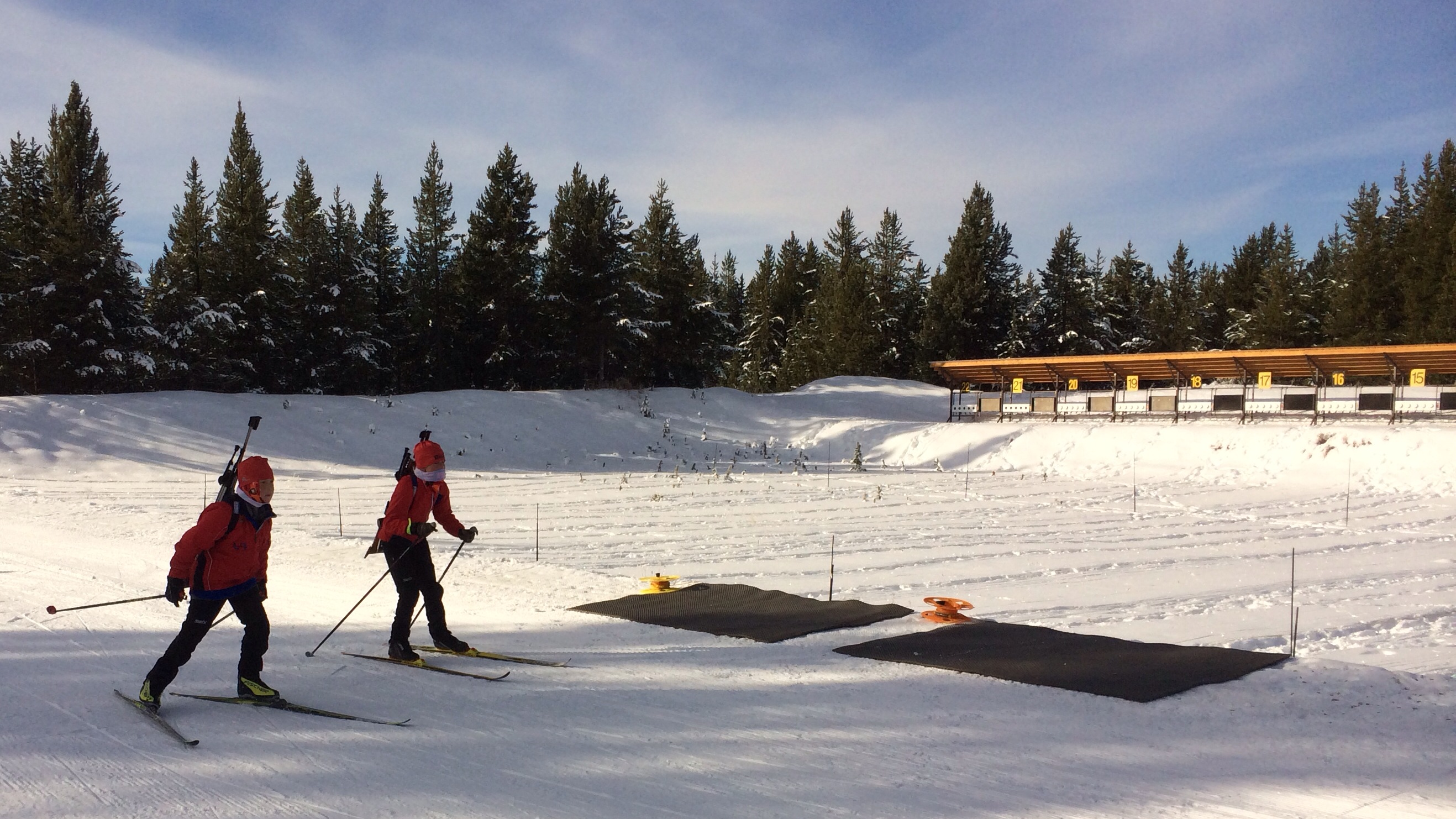
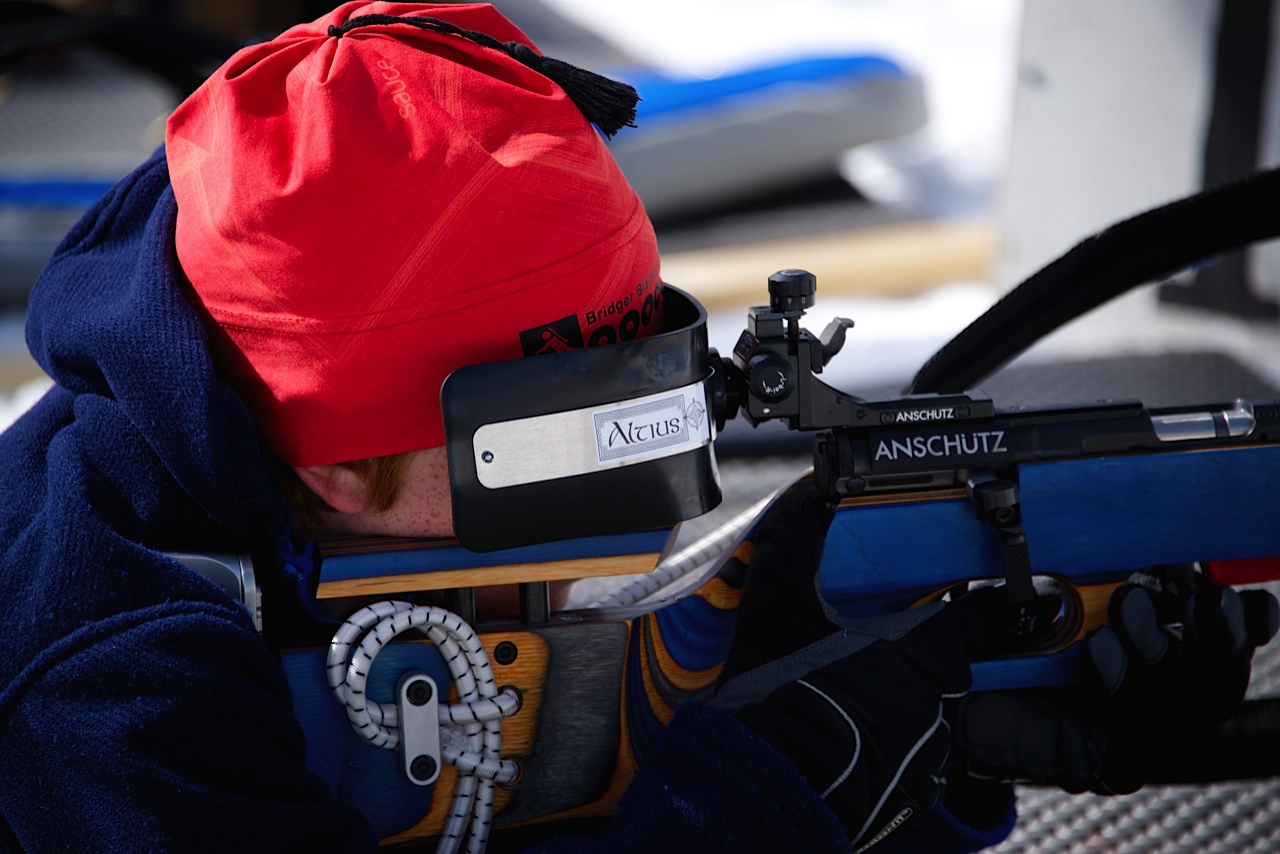
To ensure these skiers have no barriers of entry the sport, the Bridger Biathlon Club has already purchased rifles, ammo, and other equipment. As of this fall, the club will be without a head coach, but will be lead by those who started the club.
“BBC board members Stuart Jennings, Brain Wadsworth and Kari Swenson are leading the effort to establish BBC’s training program, and will be volunteering their time to coach BBC’s team,” said Smith.
Not only will the club be supporting new athletes in the upcoming season, it will also be hosting a series of U.S. Biathlon Association (USBA) races.
According to Smith the 2014/2015 national schedule has yet to be finalized, but the plan is to have two national races at Bohart during the season. The races will be held in conjunction with the USBA races in West Yellowstone, Mont.
The hope is to create a series of races in Montana, where athletes stay in Bozeman and travel between Bohart and West Yellowstone.
USBA President and CEO, Max Cobb, is excited with the prospects of a new club building in Bozeamn.
“It is great that biathlon is again blossoming in Bozeman,” Cobb wrote to FasterSkier. “For many years there were athletes coming out of the Bozeman area and making national teams. I hope that this rise in interest and the new facilities there will usher in a new generation of Bozeman biathletes and step by step we may once again see some on the national teams.”
Cobb said that he hoped the increased interest in biathlon would help spur an new wave of the sport in the Rocky Mountain region. Cobb sited efforts lead by the Casper Mountain Biathlon Club and it’s Board President Rob Rosser, as well as the recently upgraded facilities in West Yellowstone as signs that the region was ready for growth in the sport.
Once established at the local and national level the Bridger Biathlon Club hopes that it will continue to grow.
“We want to see the club grow exponentially. In the next five years we want to see a full training program where we have junior’s elite and masters,” Smith said.
For now, however, those in the club are excited that the sport they love is making an attempt to resurface in Bozeman.
“It’s time that biathlon came back to Bozeman. There is enough interest and there are a lot of kids out there who are excited about it. You can’t get more biathlon than Montana: Skiing and shooting at targets,” Smith said.
This article is part of FasterSkier’s ‘Where Are They Now’ series, made possible through the generous support of Fischer Sports. Learn more about their products at www.fischersports.com.
It’s easy to forget that women’s biathlon has only been a championship sport for 30 years.
And coming from the U.S., it’s also sometimes tough to remember that women’s sports were disadvantaged across almost the entire athletic spectrum until just 10 years before that, when Title IX was enacted.
But for the women who were among the first Americans to try biathlon, a pre-Title IX world was their reality growing up. Pam Weiss, who went on to have a long career in biathlon including several World Championships appearances, remembers being frustrated in her athletic endeavors as a kid.
“There were NO sports other than cheerleading at my high school,” Weiss wrote in an e-mail to FasterSkier last month. “I even tried to train with the boys’ track team, but was denied training there too.”
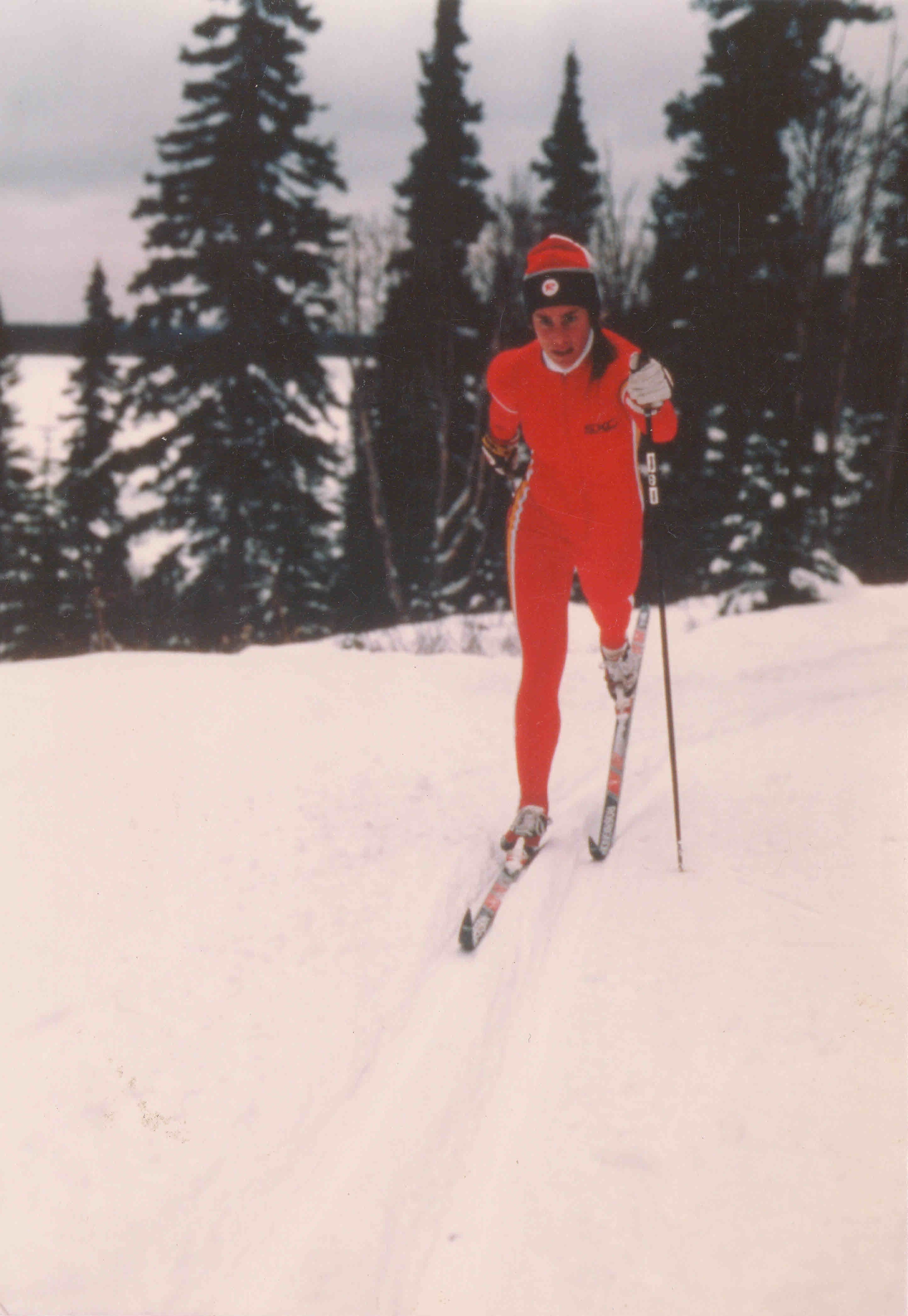
Her father was a ski patroller, so she got into alpine ski racing, one of the sports where she actually had a chance to train. Weiss enrolled at the University of Vermont and made the alpine team there, although she started as the lowest-ranking member of the team. One thing led to another, and her senior (1976) year she ran cross country. The idea was to be able to do both alpine and cross country races.
“But with all that training, I was suddenly the # 1 skier on the alpine team and never actually did any XC skiing on snow once the season began,” Weiss wrote.
She captained UVM to a third-place finish at NCAA’s instead, then moved to Jackson, Wyoming, where she started cross country skiing for real.
“During a poor snow winter I got into XC ski racing after I won the first race I ever entered by 6 minutes over kilometers,” Wiess wrote. “I was hooked!”
She dropped out of school, where she had been studying for her masters in botany, and decided to tackle ski racing full-time. She won the West Yellowstone 50 k the next year, and began getting help and coaching from the likes of Peter Ashley and Marty Hall.
Meanwhile, women’s biathlon was starting to be a thing in the United States – just barely. In 1977, Kari Swenson (whose story we told on Friday) joined a development team that the biathlon squad was setting up. Holly Beattie was among the first women to start training with the men’s team, and Julie Newnam soon joined as well. Up north in Canada, Karina Engelbrecht had also started doing biathlon.
“We had to move our 1980 Olympic trials to Valcartier, Quebec, and when we arrived the Canadians wanted to race in our trials, including Karina,” Art Stegen, the head coach of U.S. biathlon at the time, told FasterSkier. “At that point, we suggested to a few of the women that they could come to Valcartier… Holly Beattie came and the two raced in what might be considered the first race between U.S. and Canadian women.”
Weiss ran into the biathlon team when they were at a training camp in Jackson. As soon as she heard that women were starting to be included on the team, she asked if she could try it out.
Pam Weiss. During the 1980’s, biathlon switched to being only skating. Courtesy photo.
“I was fascinated by the sport and the mental aspect of shooting,” Weiss wrote. “I heard through the grapevine that there was a training camp in 1980 or 1981 summer that women were being invited to at Squaw Valley. I found out who to contact and begged my invitation. This training camp was the beginnings of a woman’s biathlon team.”
“Attending that camp were Julie Newnam, Pam Weiss, Holly Beattie and Karina Englebrecht,” Stegen remembers. “We also extended the invitation to our regional coaches in Minnesota and Montana, John Durban and Matt Montagne. A group from Minnesota included Pam Nordheim, Patrice Jankowski and Rae Hoisve and from Montana came Keri Swenson and Diana Tihart.
“At first we were worried that U.S. Olympic Committee would not approve of using the facilities for women since no Olympic program existed for them,” Stegen continued. “However they never questioned and it wasn’t a issue. We had a great camp with the women and men and that really got the ball rolling.”
Learning the Ropes & Gaining Speed
As Swenson said in her interview, Weiss emphasized how much of an “interesting time” those first few years were: some of the women had absolutely no shooting background, and they also had varying levels of endurance training under their belts, although all had some innate talent.
“Most of the women had very little shooting background so there was a fair amount of time helping us with shooting basics,” Weiss explained. “Marie Alkire was hired as the shooting coach and she was instrumental in our shooting progress and a rare female coaching presence. Overall physical coaching was kind of hit or miss (no pun intended) and generally we had male biathlon ex-racers who weren’t always aware or trained as coaches.”
Weiss worked with the biathlon team for part of the year, and then would race on the marathon circuit for cross country skiing, where she was a sponsored athlete. There were still few competitions for women at that time, and once the men left for the World Cup in Europe, the women had no more competitions until National Championships in March.
So Weiss took advantage of being named to the cross country national team as well. In 1984, she got her first taste of really professional training.
Pam Weiss shooting in the relay at 1985 World Championships in Egg am Etzel, Switzerland.
“The biggest breakthrough I had in physical training was when I was named to the woman’s XC training camp in Boulder, Colorado, during the summer of 1984 I believe,” Weiss wrote. “Peter Ashley and Torbjorn Karlson were the coaches and I had some real structured training and training plans for the physical part of my training.”
Through both skiing and biathlon, she began to learn about the science behind their training. Weiss hadn’t started endurance sports until she was 24, in Jackson after graduating from UVM. After testing at the Olympic Training Center in Colorado Springs, she was told that her VO2Max needed to go up, but that the scientists weren’t sure whether such a thing was possible for an athlete in her late 20’s.
A year later, Weiss had improved her VO2Max by 20 percent. (note: that’s really impressive!)
“In those days very few women competed past their mid-twenties and there were no role models to suggest it was possible,” Weiss wrote. “Instead you were supposed to give up and attend to a career or more importantly a family!”
Instead of doing those things, Weiss was living on the cheap. She waitressed constantly, and also worked as a raft guide on the Snake River. The only way to make biathlon profitable was to join the National Guard, but Weiss wasn’t interested. She started her own hat company, Mountain Woolies, and knit ski hats on a knitting machine. In the winters, she would put all of her belongings in a storage unit, move out of her housing, and thus avoid paying rent.
“I also did many other part-time jobs to save up for the winter traveling and had many very generous friends that helped me out with places to stay,” she wrote. “It was a dream to be able to just train, rest and eat and not have to work so many hours. Our counter-parts in Europe certainly weren’t working in addition to training.”
And finally, that was an idea that actually meant something: her counterparts in Europe. In 1980, that had seemed inconceivable to Art Stegen.
“At the Olympic Games in Lake Placid I learned that the Czechs were also introducing women to biathlon,” he recalled. “However when I discussed it with some of the other coaches many responded as the Germans: with a laugh they said, ‘we don’t have enough women skiers, so why should we even consider biathlon?’”
But four years later women’s biathlon had advanced to a point where the women would finally have their own World Championships. Weiss wrote that she had been one of the top U.S. women in biathlon for the last two seasons, and had also just won the 20 k at cross country trials. But she got sick before biathlon trials and had poor performances. The coaches had a policy against the use of discretion, so she didn’t make the trip to the first women’s World Championships.
Hitting the Stage
The next year, Weiss got a chance to finally compete outside of the U.S. At those first World Championships, Beattie, Newnam, and Swenson had won a bronze medal in the relay. Improbably, the U.S. women were a force to be reckoned with.
“At the time, none of us were aware of where the level of international competition stood and really had no idea of how well the women might do,” Stegen explained. “At the time, our men were not as competitive as today, and I felt like the women would be in the same situation. I thought that the Norwegians and Russians would be the strongest simply due to their better skiing results.”
The bronze medal had been highly symbolic and generated some excitement for women’s biathlon. The team was growing and more college skiers were showing interest in the sport, making training and racing more competitive.
Weiss stayed near the top, though, and raced the leadoff leg of the women’s relay at World Championships.
“I came in 3rd and was chasing the Norwegians and the Russians while battling the Finns and Swedes,” Weiss recalled. “I distinctly remember the standing shooting leg where three of us were shot for shot and I somehow held it together to get ahead. I can still remember the crowd behind me while we were shooting. I have a newspaper picture from that at home.”
Overall, the atmosphere was completely different than anything Weiss had ever experienced.
“My recollections were mostly surrounding the pageantry of the big event and just how big the sport was in Europe,” Weiss wrote. “Crowds attending and watching the events and the scale of the Opening Ceremonies.”
With their success in the early years, the U.S. racers became something of celebrities, at least when they were out abroad.
“I think it was in 1987 when I was in the first seed that I was mobbed after the race for autographs!” she wrote. “Over there I was considered a hero and yet on the plane coming home in the USA I had to explain to my seatmate what the sport of biathlon was about.”
Tough Times…
The women of biathlon were hoping strongly for an Olympics. It wasn’t happening.
“The women’s addition to the Olympic biathlon program was held up for some time by the Eastern block nations that didn’t want to have it until they felt confident that their athletes would have the best chances of winning,” Stegen opined.
So in 1988, instead of competing in a Games, Weiss and her competitors races in Canmore after the Olympics were over. It was bittersweet, but Weiss loved the course and won the race, calling it “her own personal Olympics.”
Weiss wanted to stick around and finally get to compete in the Olympics, but the next chance wouldn’t come until 1992. Feeling overtrained, she decided to step away from the national team and train on her own. During this time period, personal issues with the biathlon federation came to a head. Passionate about getting better opportunities and recognition for the women, she butted heads with some team leaders.
“Chauvinism was a whole different ballgame then,” Weiss wrote of the early days of women’s biathlon. “I was very involved in trying to open the doors for the women’s team. I was an athlete’s representative to the Board of Directors for a few years and probably created many future closed doors for myself for being an activist. Most of the board members were either former or still active military that were not quite prepared for women to be involved in this male-dominated sport.”
Weiss wrote that at age 33, some asked her to retire. She felt that this was unfair, as she still was improving athletically. But women’s biathlon was so young that there was no model for how long athletes should or should not stay in the sport. Swenson, for instance, had already retired so that she could go to veterinary school.
During her time training on her own, Weiss spent time with some female cross country skiers who provided a morale boost.
“There were two or three key skiers I got to know along my path and both of them were a big influence,” Weiss wrote. “The first was Alison Keisel (Spencer at the time) who spent a summer training in Jackson in the late 70’s. She was one of the first woman XC ski racers in the US and I was lucky to have her as a role model. Jennifer Caldwell lived with me one summer in Jackson and we trained together and also Kelly Milligan and I spent many a summer day doing long runs in the Tetons.”
She does not remember the biathlon coaching staff as being supportive after her break with the national team (“I’d be given a spot to zero at the edge of the range in some lumpy location, I was treated like an intruder and not someone who had contributed all they could to the sport”). Instead, she had Peter Ashley coach her from afar, and worked with Martin Hagen on shooting.
Things were going well in the fall of 1991 and Weiss seemed on track to make the Olympics.
“I placed top 3 in the races leading up to the try-outs,” Weiss wrote. “Then five days before the Olympic try-outs were to start, I was involved in a car crash when a car going out of control smashed into my car waiting at a light. My car was totalled and my body was left completely out of whack. There just wasn’t enough time unfortunately to recover.”
She finished out of the running and called it a career.
…. And happy times
But despite the politics, her uncanny ability to attract drama or just plain bad luck around the times of trials races, and her ultimate inability to get to the Olympics, Weiss has a lot of happy memories.
“[Swenson] had some nice comments on the team comaraderie which I would strongly echo for those early days,” Weiss wrote after reading the profile of Swenson. “The men’s team were extremely supportive for us and all of us early women helped each other out as it was attitude we all had.”
Women were extremely successful at that point; Pam Nordheim became the first woman to win a medal at the World Military Ski Championships while part of the National Guard, and Stegen returned to coaching after 1992, overseeing further success in military competitions. In the 1992 Games, Joan Smith Miller finished 14th, still the best result ever for a U.S. woman at the Olympics.
“In retrospect we were very naïve, but by not having much to base our expectations on we just were giving it all we had,” Weiss said.
And to Stegen, including women was a no-brainer of a way to better the sport as a whole in the United States.
“When the Chilean team was in the U.S. for some competition years later, they asked me how they might improve their program and I suggested to them that they recruit more women,” Stegen explained. “I told them that women had a better chance of success then their men and it would help grow their program and gain public support. For us, the growth and early success of the women was one of the most important things to have happened in the sport. They were also easily coachable and pleasant to have on the team.”
While Stegen was in many ways one of the military-type men that Weiss struggled with, she was quick to point out his enthusiasm for the women’s team and how far he brought the sport.
“I think he had a lot of energy towards managing the team,” Weiss wrote. “He put a lot of heart and soul into the team, which I’m not sure if it was always appreciated.”
So, Where Are They Now?
Stegen lives in upstate New York and has been on the U.S. Biathlon Association board of directors, although he plans to retire after this year.
Weiss now splits her time between Jackson Hole and New Zealand, where she runs the New Zealand Kayak School with her husband, Mick. Although she didn’t want to give up her sport to get a job and have kids, once she had retired on her own terms, she got an accounting degree. She also now has a son, Liam.
In 2002, she finally got to see women’s biathlon at the Olympics when she worked as a timer at the Salt Lake City Games.
“I enjoyed seeing many of the women who had just started the sport when I was retiring racing at the international level,” Weiss concluded. “The sport has obviously evolved but there were also some interesting discussions I had with women as to the continuing politics on the team. It was a joy to be around the sport again though… I often wish I had been able to give more from my experiences back to the athletes in the years after I retired. It was and probably still is one of the missing ingredients in the coaching for women in the sport.”