From the FasterSkier archive — posts syndicated from athletes’ and coaches’ own blogs between 2004 and 2012, kept online as published. Current coverage is at fasterskier.com.
Italy placed second in the mixed relay at the IBU World Cup in Canmore, Alberta, in 2016. Karin Oberhofer (second from l) is the 2014 Olympic bronze medalist in the sprint after the disqualification of Russia’s Olga Vilukhina for doping. (Photo: Daniel S. Guay)
And not only Italy – but specifically, Karin Oberhofer.
The then-28-year-old was part of the mixed relay team which won bronze, along with Lukas Hofer, Dominik Windisch, and Dorothea Wierer. Oberhofer will now receive her bronze medal in the sprint as well, where she finished 27.9 seconds behind gold medalist Anastasia Kuzmina of Slovakia with ten-for-ten shooting. Before 2014, she had never stood on an individual podium at the top level of competition.
“I would be very happy to belatedly receive the Olympic bronze medal,” Oberhofer – who was officially fourth at race time, while now-disqualified Vilukhina was officially second – wrote in an email. Her comments were made in German and translated into English.
Vilukhina, meanwhile, has said that she refuses to give back silver medals from the relay and the sprint.
“I won’t just give up the medals,” she told sports.ru, according to a translation. “I’m a two-time Olympic medalist.”
The International Olympic Committee, however, has ordered that her medals be returned, and notified the Italian Olympic Committee that Oberhofer will be getting bronze.
“Of course everything has a bitter aftertaste, but I would say: ‘better late than never’,” Oberhofer wrote. “It would be wonderful for me if my performance on that day would now be crowned with the bronze. It would also mean to me that justice has finally won.”
Since the Olympics, Oberhofer also won two bronze medals at 2015 World Championships, in the mass start and the women’s relay. The same season, she was second in a World Cup sprint.
Then, Oberhofer took a break last season to prepare her first child, Paul, who was born in August. She has continued training but has not raced yet this season.
“I am very happy with my little family and about my new challenge,” Oberhofer wrote. “Every day with my little son is unique and indescribably beautiful. It’s not always easy, but my family helps me a lot and I love doing sports. I do it because I like to do it, and little Paul allows me to do it and is very well-behaved. At the moment I am at home and prepare myself individually for the competitions. I have to qualify again for the international competitions first.”
Oberhofer has known for nearly a year that her Olympic sprint was likely medal-worthy. When the McLaren report released its evidence packet, the names of four Russian biathletes, including Vilukhina, were not redacted in one of the documents.
“11 months ago there were already these rumors, and several members of the media contacted me about that,” Oberhofer wrote. “[Recently] I was contacted by Giovanni Malagó, President of the Italian National Olympic Committee, who informed me that Vilukhina had been banned and removed from the list of results.”
Oberhofer isn’t sure whether there will be some medal ceremony arranged for the one she missed out on in Sochi.
“Honestly, I don’t really know what to say about that,” she wrote. “It would be a big surprise for me if it took place in public. But that’s not so important. The most beautiful thing for me would be to get the medal at all. But what I do know is that I would belatedly celebrate this medal with my family and friends in a small ceremony.”
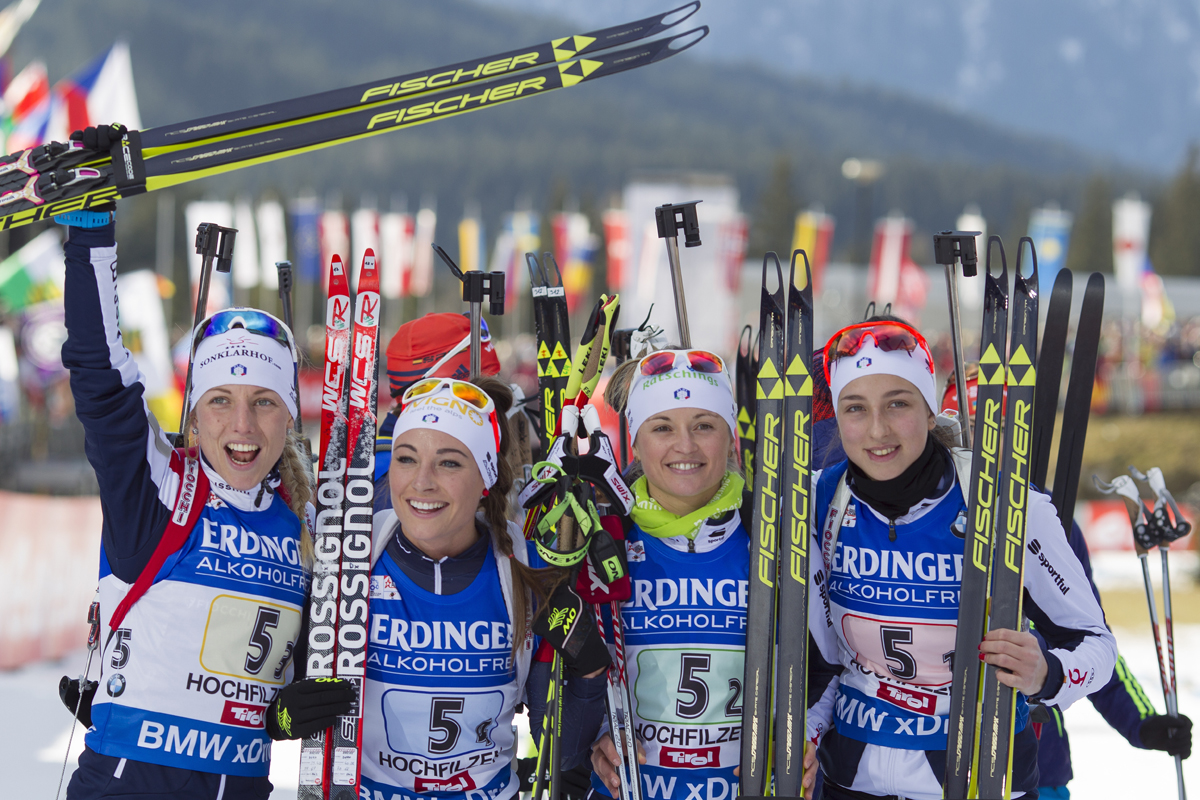
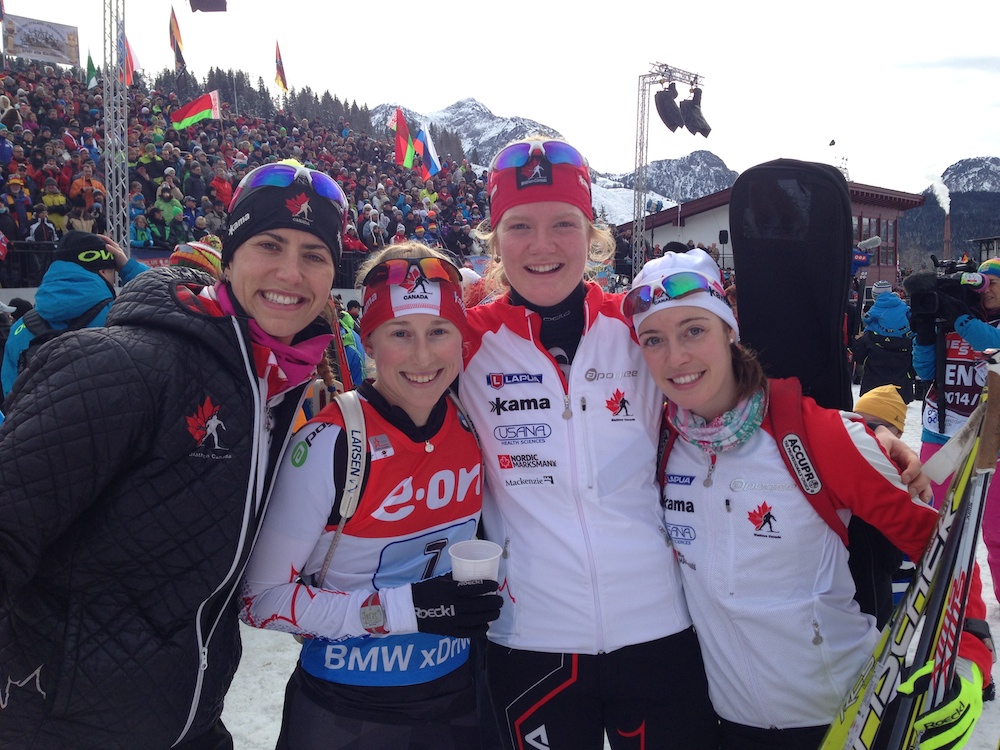
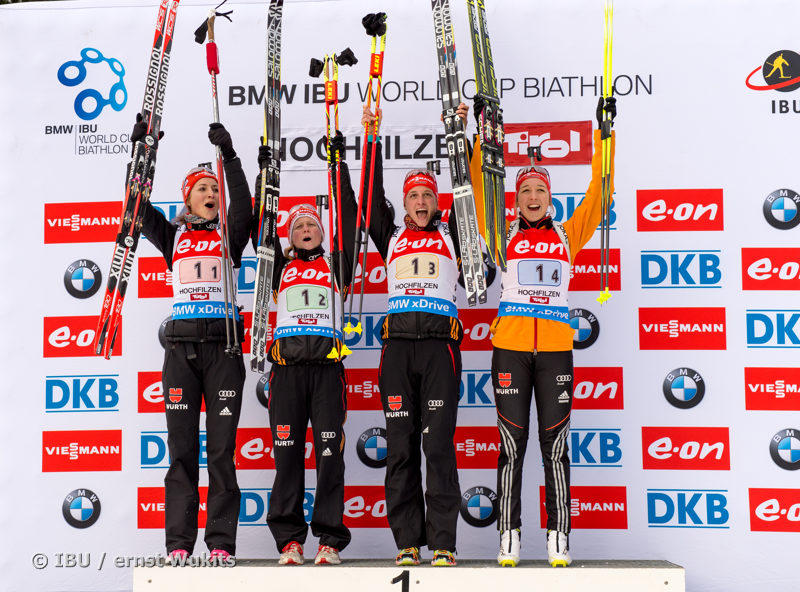
The victorious Italian women’s 4 x 6 k relay, with (from l to r) Federica Sanfilippo, Dorothea Wierer, Karin Oberhofer, and Lisa Vittozzi at the Hochfilzen World Cup on Sunday in Austria. (Photo: Fischer/NordicFocus)
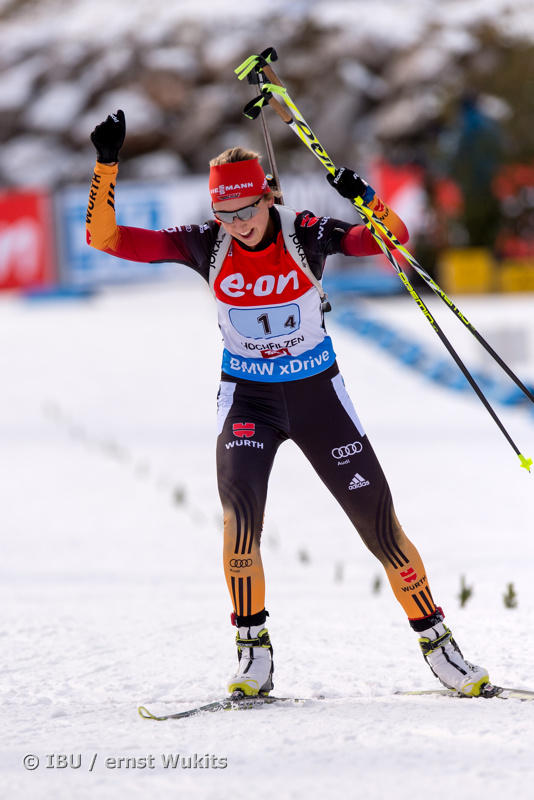
The women’s biathlon 4 x 6-kilometer relay, marked by good shooting performances, perfect weather, and several unusual lineup choices came down to the wire, with the race decided on the last lap in a sprint between Italy’s anchor Dorothea Wierer and Germany’s Franziska Preuss. Wierer lunged over the line first by less than a ski length, in a time of 1:05:32.6. This secured the first World Cup win for an Italian women’s relay in history, celebrated extensively by her teammates and coaches in the finish.
After a number of changes between several countries vying for the final spot on the podium, Ukraine prevailed in the end, taking third 13.1 seconds behind the Italians. None of the three teams on the podium suffered a penalty lap, with Italy having to use eight spare rounds, Germany seven, and Ukraine 10.
After sweeping the podium in the sprint and securing first and second place in the pursuit race this weekend, Germany’s women had to be considered the overwhelming favorites for the relay. But on Sunday, Germany opted for a lineup of Franziska Hildebrand, Maren Hammerschmidt, Vanessa Hinz and Franziska Preuss, a group of athletes who had never been in a relay team together.
They were not alone in trying something new, with teams such as the Czech Republic, Italy, France, Russia, Ukraine, the United States, and Canada also experimenting with new athletes or at least order changes.
Germany’s Laura Dahlmeier, the winner of the pursuit race on Saturday and anchor of the gold-medal-winning relay at the 2015 IBU World Championships, rested on Sunday.
“This was my own decision,” she explained in an interview with German broadcaster ARD before the race. “The season is long enough, and the World Championships are what matters. And I believe as strong as we are as a team right now, the other four girls can do well without me.”
The German coaches are happy that they still have an ace up their sleeve for the next relays. “We know that there still is a long and tough season ahead of us,” Women’s Head Coach Gerald Hönig said. “We are planning with an eye towards the [2016] World Championships in Oslo in March. So a deep team is a nice problem to have, in contrast to always having to use the same two or three top performers.”
Miriam Gössner, who achieved a third place in the sprint on Friday, also took a break from racing on Sunday.
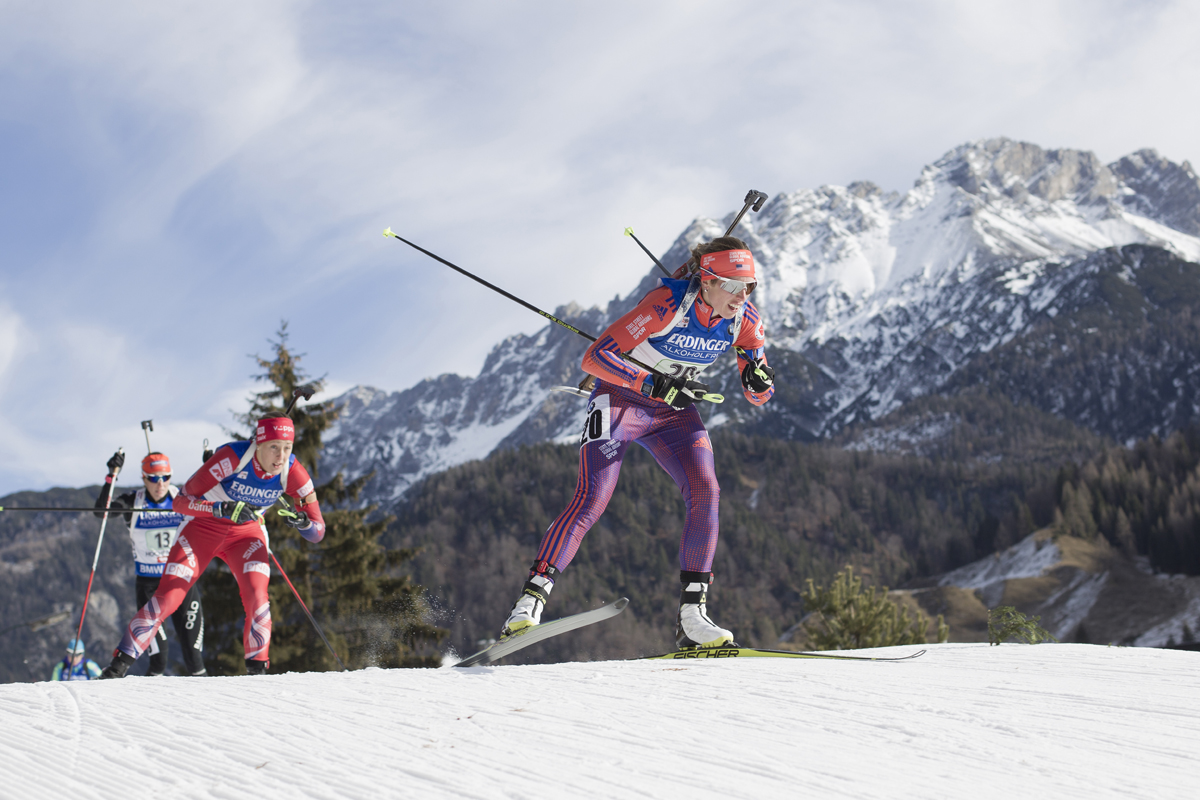
American Susan Dunklee racing the second leg of the IBU World Cup women’s relay on Sunday in Hochfilzen, Austria. (Photo: Fischer/NordicFocus)
With the Germans explicitly stating their goal to reach the podium, the day got off to a problematic start for Germany, with other teams charging ahead.
Hildebrand, the winner of the sprint race on Friday and fourth place in the pursuit on Saturday, skied a controlled race at first, and cleaned the prone stage with perfectly centered shooting. But then she required two spare rounds in the standing position and had trouble inserting them, setting her back to 14th position. After a good final round, she tagged off at the first exchange 11 seconds behind in eighth.
“Still in sight of the leaders,” Hildebrand recalled in the ARD interview. “And the other girls then turned it around.”
Italy’s first skier, Lisa Vittozzi, who also scrambled for Italy’s bronze-medal relay at World Championships last March, fared better, shooting perfectly (0+0, 0+0) and tagging off just 4.2 seconds behind the Czech Republic who was in first at that time. On the second leg, Karin Oberhofer kept Italy near the front, requiring only one spare round (0+0, 0+1), and tagged Italy just 1 second behind.
Throughout the race, Germany struggled a bit with technical details. Maren Hammerschmidt, the surprise second-place finisher in both of the previous races, had two misses (0+1, 0+1) and doubled the deficit she had been handed by Hildebrand. In slow-motion replays from the shooting range, she could be seen desperately trying to insert a spare round into her rifle, before it fumbled back out.
“That was a technical malfunction today, nothing I could do about it,” Hammerschmidt said an interview with ARD. “A shot hung up in the ammunition magazine. I did not expect this, and will have to check that clip again at home.”
She tagged 22.2 seconds behind the leaders in ninth place, one behind Canada’s Megan Tandy.
“I hope we can still secure a podium finish,” Hammerschmidt said in a mid-race interview.
It then fell to Vanessa Hinz, who placed 15th in the Hochfilzen sprint and 29th in the pursuit, to bring Germany back into contention. With two fast shooting performances (28 seconds prone) and requiring only one spare round, she steadily moved up through the ranks, and handed over to Franziska Preuss in first.
“I was really happy about the nomination [for the relay], and glad that it worked so well today,” Hinz later said.
On the third leg of the relay, Italy struggled a bit. Federica Sanfilippo, a surprising podium finisher during the first World Cup weekend in Östersund, Sweden, and not a member of Italy’s bronze-medal relay at World Championships, required five spares to clean her targets. She had the toughest time in standing (0+2, 0+3), but avoided the penalty and skied the fastest lap of the field, handing off to Wierer 21.6 seconds behind.
For Preuss, the 2014 Olympics ended in a minor drama during the relay, when she started for Germany at the age of 19 and crashed twice, getting snow into the sights of her rifle and costing her team their chance at a medal. Since then, Preuss has usually raced the second or third leg in relays.
But on Sunday, with her close friend Dahlmeier taking a break, she was called up to anchor the relay. Preuss headed out strong and required only one spare round to clean prone. But by the time she came back to the range for the final shooting, a group of athletes that included Wierer had caught up to her.
Preuss hit the first four targets, and was convinced that her fifth shot had also hit, closing the protective flap on the sights of her rifle, before realizing it was a miss. This forced her to load the spare and take aim again, hitting the target, and left the range with Wierer, who had also required one spare, right behind her.
On the last lap the lead changed back and forth. Preuss later told ARD she deliberately let Wierer overtake her. Then she accidentally stepped on the tails of Wierer’s skis near the top of the first climb, causing both to stop briefly, but neither Preuss nor Wierer fell or broke their poles. At the halfway checkpoint, they were just 0.3 seconds apart.
Preuss then decided to try and force a decision before the stadium by “slogging away on the last climb from the bottom to the top, 100 percent,” and managed to create a small gap. But Wierer refused to be dropped, and caught the end of Preuss’ skis again as they entered the arena. After a right turn into the closing stretch, Wierer double poled past her taking the middle lane, with Preuss on her right trying to hold on. But Wierer had more power left, and lunged over the line 0.2 seconds ahead, into the arms of her excited teammates.
“I know I’m not the best female sprinter. I have to work on that again,” Preuss confided to ARD during a group post-race interview. “The second place is a great result, I think we are all satisfied with that”.
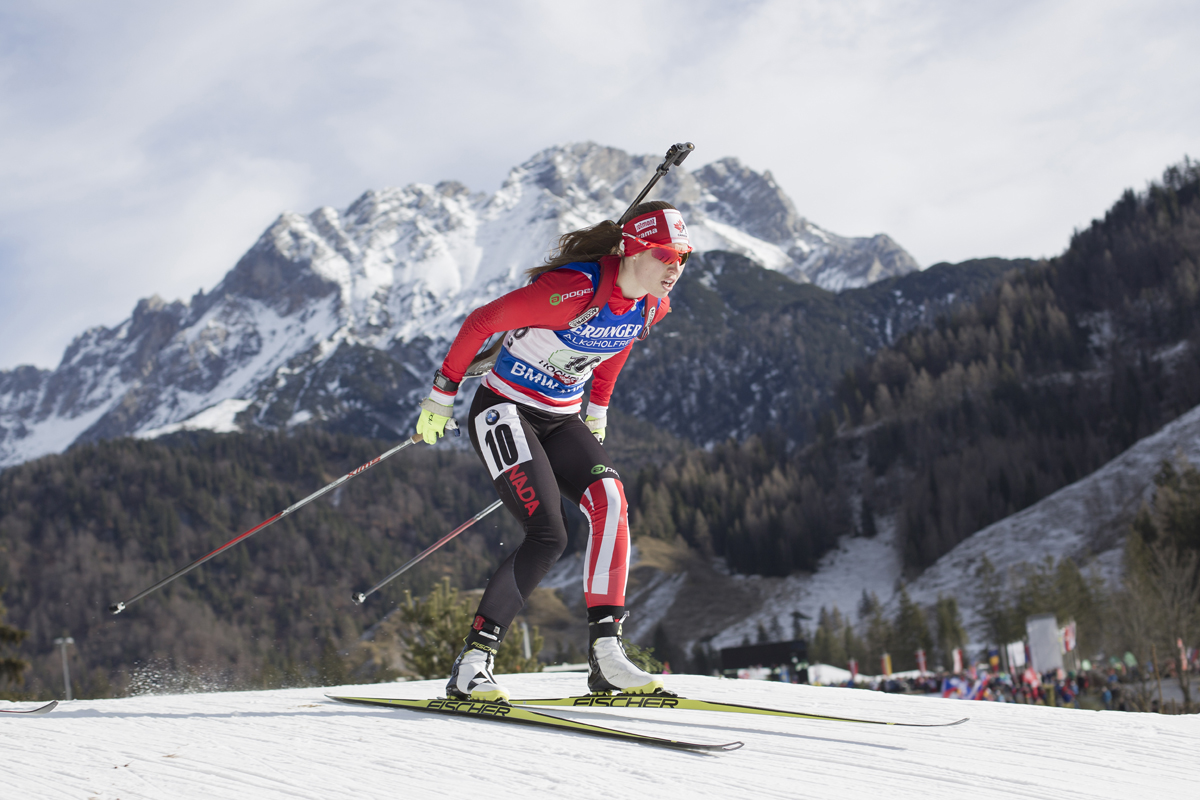
Canada’s Megan Tandy blasts through the second leg of the women’s relay at the IBU World Cup in Hochfilzen, Austria. Tandy’s clean shooting helped Canada move into eighth place at the end of her leg. (Photo: Fischer/NordicFocus)
Her teammates also agreed with her that the Hochfilzen arena poses a difficult challenge for a finishing sprint, with a noticeable incline the last 100 meters.
Wierer had already beaten Preuss and Hildebrand in a sprint to the line in Östersund this season, so she had every reason to be confident that she could do it again.
“I was only thinking that I should run as fast as you can. She was close in front of me. I was hoping I could win in the final sprint,” Wierer told the IBU.
Afterward, both teams seemed happy with their results, with the women all smiling and posing for pictures.
“You can hardly ask for a better selling point for biathlon [than this race],” German coach Hönig said with a laugh. “That’s why millions of people watch us on TV and the arenas are full.”
Asked later why the Italians didn’t seem even more jubliant about their first-ever victory in a women’s relay, Wierer tried to explain: “I think we are just all so tired.”
The Czech Republic, who frequently had the best relay performances last season, also had been in the lead early in this race, thanks to Eva Puskarcikova and Olympic silver medalist Gabriela Soukalova. But then team rookie, Lucie Charvatova – who was sixth in Friday’s sprint and replaced Jitka Landova on Sunday – could not clean her standing shooting with the three spare rounds and thus incurred a penalty lap. After another difficult shooting by anchor Veronika Vitkova, they finished the race in sixth place (1+12), 29.8 seconds back from Italy.
Chervatova only recently took up biathlon training when she failed to qualify for the Czech cross-country senior national team again, and her new teammates are expecting great things from her.
“Just watch, she is incredible, her body is all muscle. In a few years she will be frequently at the top,” veteran Soukalova told the media in Hochfilzen.
The podium was in hot contention with 22 countries at the start line, and with the Czech Republic, Sweden, Austria, France, Ukraine, and Belarus (this year having to race without defending World Cup champion Darya Domracheva) in the top three at various points of the relay.
In the end, Ukraine’s team claimed the third, with anchor Olga Pidrushna requiring three spares but skiing the second best time on the final round. Overall the team, usually known for their excellent shooting, required ten spare rounds to clean all the targets.
“I think there are some things we could improve, so we will work on them this season,” starter Yuliia Dzhyma said in the press conference.
Poland placed fourth, 27.5 seconds back, while France was fifth, (+28.8).
Canada 10th, U.S. 15th
For the relay in Hochfilzen, Biathlon Canada put up a different lineup and order than in the last World Championships in Kontiolahti, Finland. Canada advanced as high as eighth in split times during the race.
Starting in the fourth row in bib 10, Julia Ransom kept the leaders within viewing distance.
“I always like relays so was excited for today!” Ransom wrote in an email. “My legs weren’t as snappy as usual the past two races but things came together for today and I felt much better. I am new to starting relays but I have a background racing cross country and feel comfortable in a mass. This helps with navigating the more technical areas of the course with a group.”
The 22 year old needed two spares to clean the first shooting, then one more in the standing stage. Ransom tagged Tandy in 11th, 20.6 seconds back.
Tandy was able to keep her gap to the best athletes at the top of the field and even improved position, largely helped by two clean stages (0+0, 0+0) and the shortest range time on her leg. At the exchange, she handed off 21.5 seconds back in ninth place. At that time Canada was ahead of top teams like Germany, Norway and Russia.
Emma Lunder took over, and while the 24 year old lost about a minute to the leaders and required four spare rounds (0+1, 0+3), Lunder avoided a penalty lap in the standing shooting. She tagged Canadian anchor Rosanna Crawford 1:23 back in 12th place.
“The 2 k course here is quite easy and has a lot of rolling flat sections, which really plays to my strengths in two skate and one skate,” Crawford wrote in an email. “It’s also a really fast 6 k — the race was only taking 16-17min, which is super fast for a relay. Skiing felt a lot better than it has this year and we had some super fast skis, thanks to our techs.”
Crawford cleaned her prone shooting stage, and only required one spare round in the standing position (0+0, 0+1), making up ground to the top by skiing the fourth-fastest course time on her leg.
“Prone has been feeling really good all year, but I’ve been struggling with one miss standing far too often!”
She finished the relay for Canada in 10th, 1:08.7 behind Italy and just 4.3 seconds behind the Russian team.
“I think this will be a great learning experience for our younger girls on the team,” Crawford continued. “Feel that excitement of doing well in a relay and allow them to be better prepared for the next relay. Overall we are happy as a team, but know with a few less spares that top 8 is within reach!”
“Canada did great today!” Ransom wrote. “All of us had solid races and were in the mix for the most part. I think this was a great place to start from for the season.”
The US Biathlon women’s team also experimented with a new order. Susan Dunklee, who has been the starter for several years, moved to the second leg while Annelies Cook started.
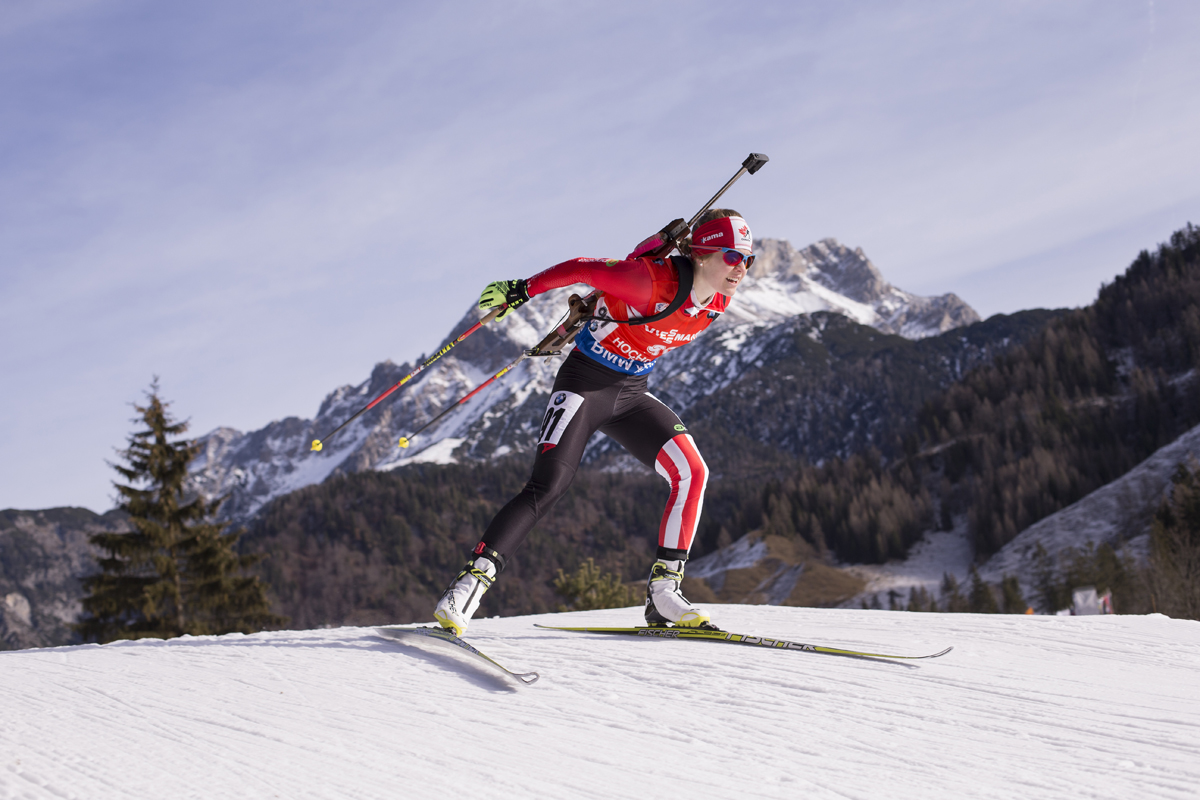
Canadian Emma Lunder racing the third leg of the women’s relay at the IBU World Cup in Hochfilzen, Austria. (Photo: Fischer/NordicFocus)
“We are experimenting [with our relay order] to see what combinations work best for the team as a whole,“ Dunklee wrote in an email. “Traditionally I have started off the first leg, which involves a lot of tactics and is exhilarating, but today Annelies tried it instead and did a fantastic job.”
In her first season starting on the World Cup circuit, Clare Egan, who anchored the team at World Championships and in the last relay of last season, was moved to the third position, with Hannah Dreissigacker closing out the race instead.
“My job today was to try the second leg and chase down the lead pack not far ahead,” Dunklee continued. ” Skiing feels strong and I had nearly regained contact with the leaders, then my extra rounds in standing set us back again. We didn’t have a perfect day and we look forward to improving on our 15th place in the future.”
Based on the U.S. relay performances last season, Cook started back in the seventh row in bib 20. She opened her race with two misses in prone, then one more in standing (0+2, 0+1), and tagged off to Dunklee 32.0 seconds behind the leader in 14th place.
Dunklee made up some positions, entering the prone stage in 13th place, then cleaned it. On the next lap she caught up with a few more athletes to move into seventh. But then she used all of her spare rounds in standing, narrowly avoiding a penalty lap but losing a lot of valuable time with the reloads. At the second exchange, she tagged Egan 41.8 seconds behind in 11th place.
On her standing stage, Egan struggled, missing four shots in a row and thus running out of spare rounds. In the end, she had to circle the 150-meter penalty lap twice (0+1, 2+3), and tagged off to Dreissigacker 3:08.6 minutes behind.
Dreissigacker fared better, cleaning her prone stage and using two spares in standing (0+0, 0+2). While the clean prone helped her catch a few teams ahead of her, Dreissigacker lost time on the final loop before the finish and ended up 15th (+4:10.9).
In the women’s Nation Cup rankings — important not only for prestige as an own end-of-season award, but also determining the number of starters a country can use in World Cup event — Germany is in the lead after this weekend’s races. Canada ranks 10th and the U.S. stands in 16th.
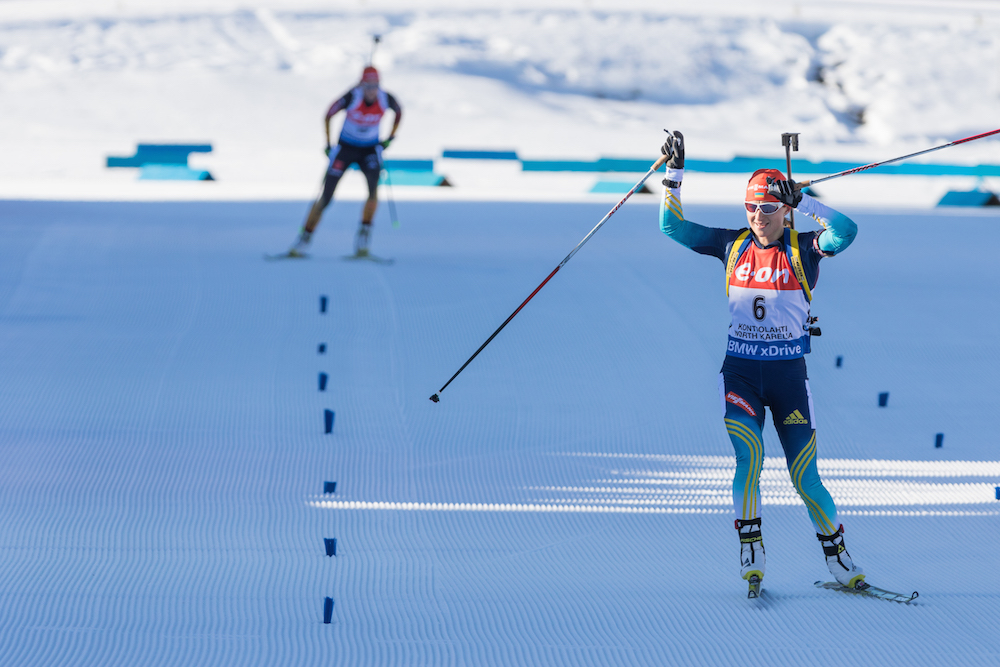
Ukraine’s Valj Semerenko (r) celebrates her first World Championships victory on Sunday in the women’s 12.5 k mass start at 2015 IBU World Championships in Kontiolahti, Finland. She beat Germany’s Franziska Preuss by 6.2 seconds. (Photo: Kontiolahden Urheilijat/Risto Kuittinen)
KONTIOLAHTI, Finland — Perfect shooting wins the race, at least that was the adage that summed up the women’s 12.5-kilometer mass start on the final day of 2015 IBU World Championships.
Valj Semerenko, a 28-year-old Ukrainian with an Olympic gold medal from last year’s relay and multiple World Cup podiums, sat quietly in the pack throughout most of Sunday’s mass start. She didn’t charge to the front on the first lap, like Darya Domracheva of Belarus did. Instead, she positioned herself in the top 20 of 30 starters and waited for natural opportunities to move up.
Opportunities like the first prone stage, where she and 17 others cleaned on a bluebird, windless afternoon. Semerenko moved into 11th, 15.3 seconds back from Domracheva in first.
While the Belarusian set off for another blistering lap, leaving the range 8 seconds ahead of Russia’s Ekaterina Yurlova in second, Semerenko squeezed into the top 10 before the second shooting.
There, she cleaned again, along with nine others, including Domracheva. As Domracheva set out again in the lead, 6.5 seconds ahead of Russia’s Daria Virolaynen, it seemed like the race could very well continue along the same lines — with Domracheva jetting off the front.
That is, until Domracheva missed two in the third stage and dropped to eighth.
Ukraine’s Valj Semerenko (r) leads a five-woman chase pack into the range during Sunday’s 12.5 k mass start at 2015 IBU World Championships while chasing Darya Domracheva of Belarus (not shown), with Gabriela Soukalova of the Czech Republic, Germany’s Franziska Hildebrand, Russia’s Daria Virolaynen, and Germany’s Franziska Preuss, respectively.
Behind her, Semerenko led a chase pack of five into the range, with the Czech Republic’s Gabriela Soukalova, Germany’s Franziska Hildebrand, Virolaynen, and Germany’s Franziska Preuss, respectively.
The Ukrainian cleaned the first standing stage the fastest, heading out on her fourth lap two seconds ahead of Hildebrand and Preuss, and three seconds ahead of Soukalova — all of which cleaned as well. Domracheva was left with two penalty loops, emerging 36 seconds behind them.
Soukalova, Preuss and Semerenko took turns leading over the penultimate lap, while Hildebrand fell off the pace. In the final standing, Semerenko hit the last of her targets to complete her perfect 20-for-20 day, sending a clear message to the 29 women behind her. She left the range 19.1 seconds ahead of Preuss, who had her first penalty of the race in that stage, and Hildebrand cleaned her fourth stage to move back into third.
“I left the shooting range with Franziska Hildebrand and I thought, ‘Oh god, it’s going to be a hard loop,’ because she’s really in shape at the moment,’ ” Preuss recalled in a post-race press conference. “When I had a look back, I thought, ‘There are much more athletes now.’ I just wanted to give everything.”
While Preuss pushed to close the gap on the last lap, she couldn’t quite reach Semerenko, who finished 6.2 seconds ahead of her for her first World Championships title in 34:32.9.
“I was thinking that when I win, I’m gonna take the Ukrainian flag,” Semerenko told the IBU through a translator. “But when I got to the end with all the people chasing me, I just forgot with all the stress.”
She added that she was grateful for the support of her sister, Vita Semerenko, who has been sidelined this season with an injury.
“I would like to thank her for her support here, and actually she was at the track at the last hundred meters to give me the flag, but I only noticed her when I passed her,” Semerenko said with a laugh.
“I’m the champion and I’m so happy about it,” she said in the press conference. “It is important not only for me but also for my country. I’m full of emotion.”
While IBU Overall World Cup leader Darya Domracheva (Belarus) led the first half of Sunday’s 12.5 k mass start, she missed two standing targets and placed fourth in her last chance to medal at 2015 IBU World Championships in Kontiolahti, Finland. (Photo: Kontiolahden Urheilijat/Kari Kuninkaanniemi)
On the final lap, Italy’s Karin Oberhofer, Domracheva and Soukalova all caught Hildebrand, overtaking her before 11.8 k.
By the finish, Oberhofer dug deep to hold off Domracheva for bronze, finishing 2.1 seconds ahead of her and 12.6 seconds behind Semerenko. The Italian had rebounded from two early penalties — one on each prone stage.
“I had wonderful skis, I tried to do my best and I’m very, very happy,” Oberhofer said through a translator.
While Domracheva took fourth (+14.7) with the fastest overall course time, Soukalova was another 11.5 seconds behind in fifth (+26.2). Hildebrand finished sixth, 5.5 seconds later, and Germany put three in the top eight with Laura Dahlmeier in eighth (+39.9).
For Preuss, the silver matched her World Cup career best, in which she placed second in the mass start in January in Ruhpolding, Germany. On Friday, she helped the German women’s team achieve gold in the relay.
“The week started really good for me with my [21st] birthday [on March 11], then the gold medal in the relay,” Preuss said. “It was absolutely amazing to stand on top of the podium and unbelievable, and today, the second individual medal in the mass start, it’s really amazing.”
Dunklee 20th, Heinicke 24th
Susan Dunklee (US Biathlon) en route to 20th in the women’s 12.5 k mass start at 2015 IBU World Championships on Sunday in Kontiolahti, Finland. (Photo: USBA/NordicFocus)
Susan Dunklee narrowly qualified for the mass start in the 30th and final spot available after winning a tiebreaker with Finland’s Mari Laukkanen (Dunklee had the single-best individual result between of the two of them in 12th at these World Championships).
Considering that, she was grateful to have made it.
“It was kind of like an icing-on-the-cake moment,” Dunklee said after the race. “I’ve done what I needed to do at these championships, now I can kind of relax and have fun and see what happens. Sometimes I have my best races when I’m in that position. That didn’t happen today, but it could have.”
Dunklee finished 20th, 2:01 behind Semerenko, with five penalties: one on each prone stage, two in the first standing and another in the final standing.
“I haven’t seen where my shots went yet, but I have a feeling I had a couple split-outs,” she explained. “I could’ve sworn one of the standing I had a paddle quiver, but not fall. … I had a couple that felt like good shots, but I don’t know what happened. You miss one, it puts you right away toward 20th place coming into the second shooting, and then if I keep missing one, that holds steady. I knew [I needed to] not miss one if I wanted to move up.”
While the 29-year-old Dunklee left the range in 23rd after the last stage, she skied the fifth-fastest course time overall to finish in the top 20. She ended World Championships with two individual top-20 results, eighth place in the mixed relay, and 12th in the women’s relay.
“I always set really high goals for myself,” Dunklee said of her season overall. “I got a few top 10’s this year. I was hoping for more for sure. I was hoping to get to them earlier in the season, too. I’ve made some huge improvements with my ski technique. My shooting percentage I think has been a little more consistent, and now I’ve got a lot of things I know I want to work on as soon as summer rolls around.”
There is still one more stop on the World Cup circuit, with a sprint, pursuit and mass start in Khanty-Mansiysk, Russia, this coming Thursday through Sunday.
Megan Heinicke (Biathlon Canada) on her way to 24th in the women’s 12.5 k mass start at 2015 IBU World Championships on Sunday in Kontiolahti, Finland. It was only the second mass start of the 26 year old’s career.
Canadian Megan Heinicke qualified for Sunday’s race as well in 26th, for the second mass start in her career. She competed in her first two months ago at the Ruhpolding World Cup, where she placed 23rd.
“When I was zeroing today, I had to look at my coaches like, ‘Um, prone, prone, standing, standing, right?’ ” she said of the shooting order.
Heinicke got that down, hitting 19 of 20 targets with a single prone miss. One of nine women who shot 95 percent or better, she finished 24th, 2:22.2 behind the winner.
“That was a pretty awesome end to the season,” Heinicke said. “That was my last race and I had really good shooting again with just one miss.”
In the last eight days of individual racing, Heinicke tallied four top-30 results (including the mass start), with 21st in the 15 k individual, 23rd in the sprint and 28th in the pursuit. In all of those races and the women’s relay on Friday, she hit at least 90 percent of her targets.
“I guess I had really high expectations shooting-wise because I’ve been shooting so well,” Heinicke said of the mass start. “Skiing, I know to expect it to feel hard. We had really great skis this week so I was kind of trusting the skis to be good, and I just wanted to try to ski smart … and not kill myself the first few runs up the hill and make sure I was kind of settled enough for good shooting.”
Heading into her last lap, after cleaning her third-straight stage, she glanced at the scoreboard and saw that she was 20th.
“I was like, top 20, is it possible?” the 26 year old said. “… Mostly I was like, ‘It’s your last race, be ready to fight. Just kill yourself if you have to.’ ”
Despite a long bout with illness leading up to World Championships, which derailed some of her skiing fitness, Heinicke explained she was excited about the gains she’d made in shooting.
“This year has been a really big step forward for me in terms of shooting and consistency, so every time this keeps happening, I’m just … super happy, super relieved, and really, really motivated for next year,” she said.“I feel like I’m at maybe 60 percent of my potential skiing, with health and training things, so I’m like, ‘Oh, if I have a healthy season next year, if I can maintain the shooting, then I’m just really motivated about the potential.’ ”
She was also inspired by performances she’d witnessed by her teammate, Rosanna Crawford, as well as Dunklee.
“I’m watching … what they’re able to achieve, and I’m just like, ‘OK, I want to fight to be there, too,’ ” Heinicke said.
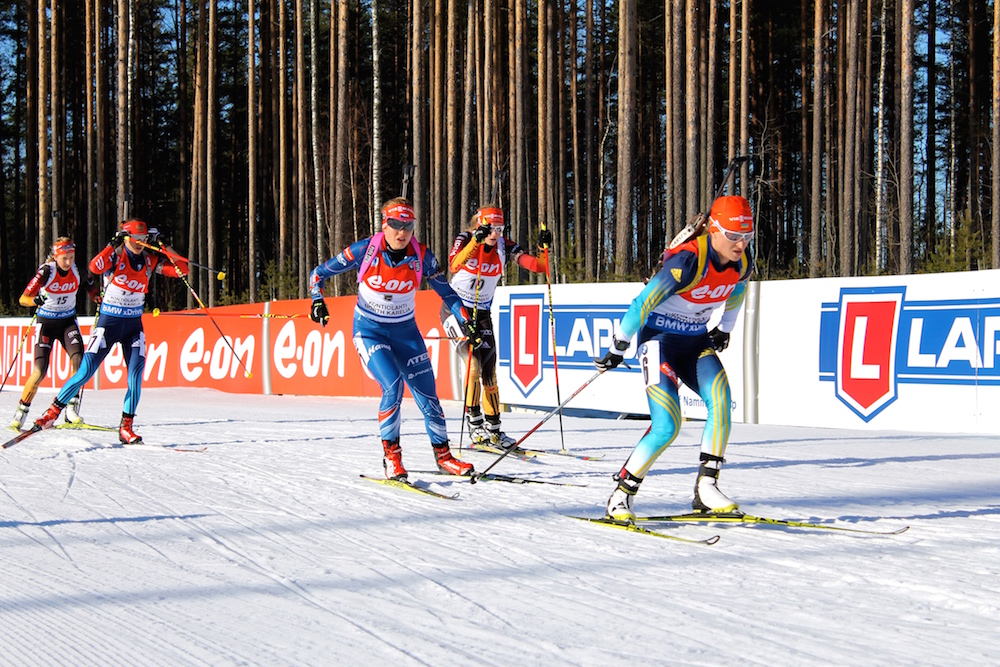
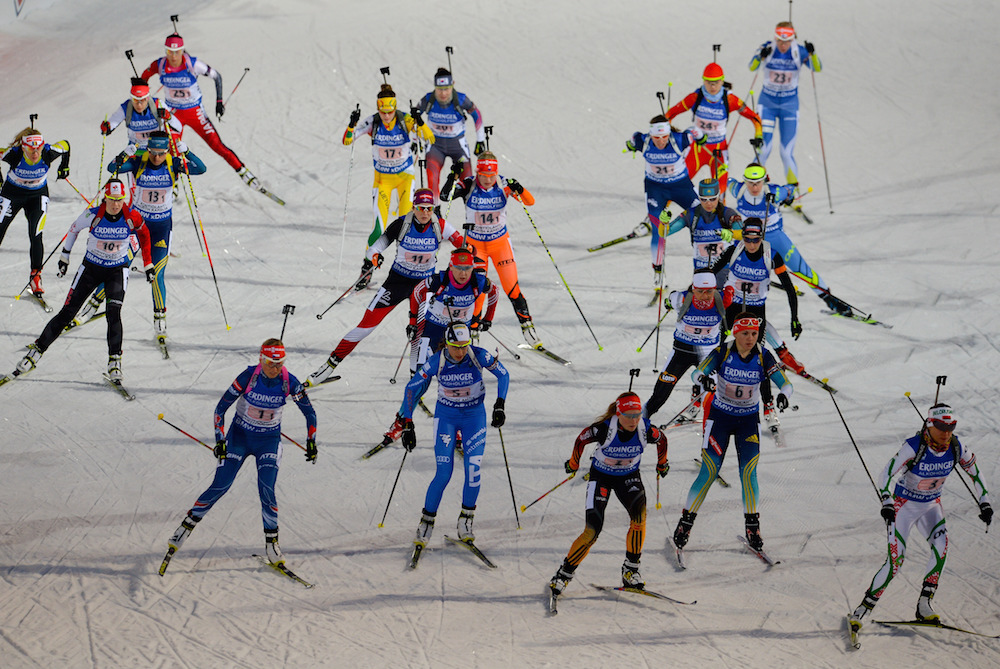
The start of the women’s 4 x 6 k relay at 2015 IBU World Championships on Friday in Kontiolahti, Finland, with Germany’s Franziska Hildebrand (4) near the front with Belarusian Nadezhda Skardino (3), Canada’s Megan Heinicke (10) at left, and American Susan Dunklee (21) near the back right. (Photo: USBA/NordicFocus)
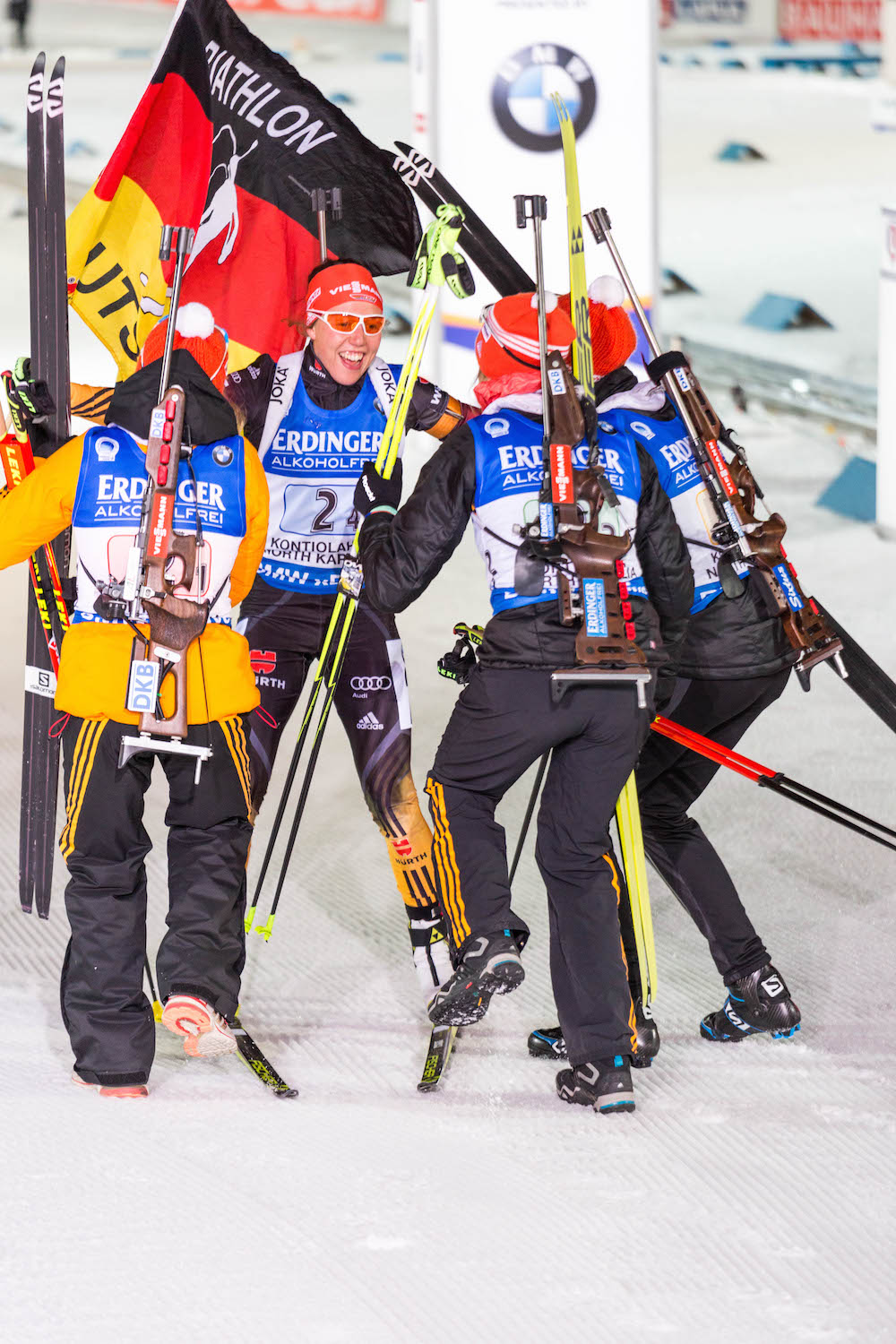
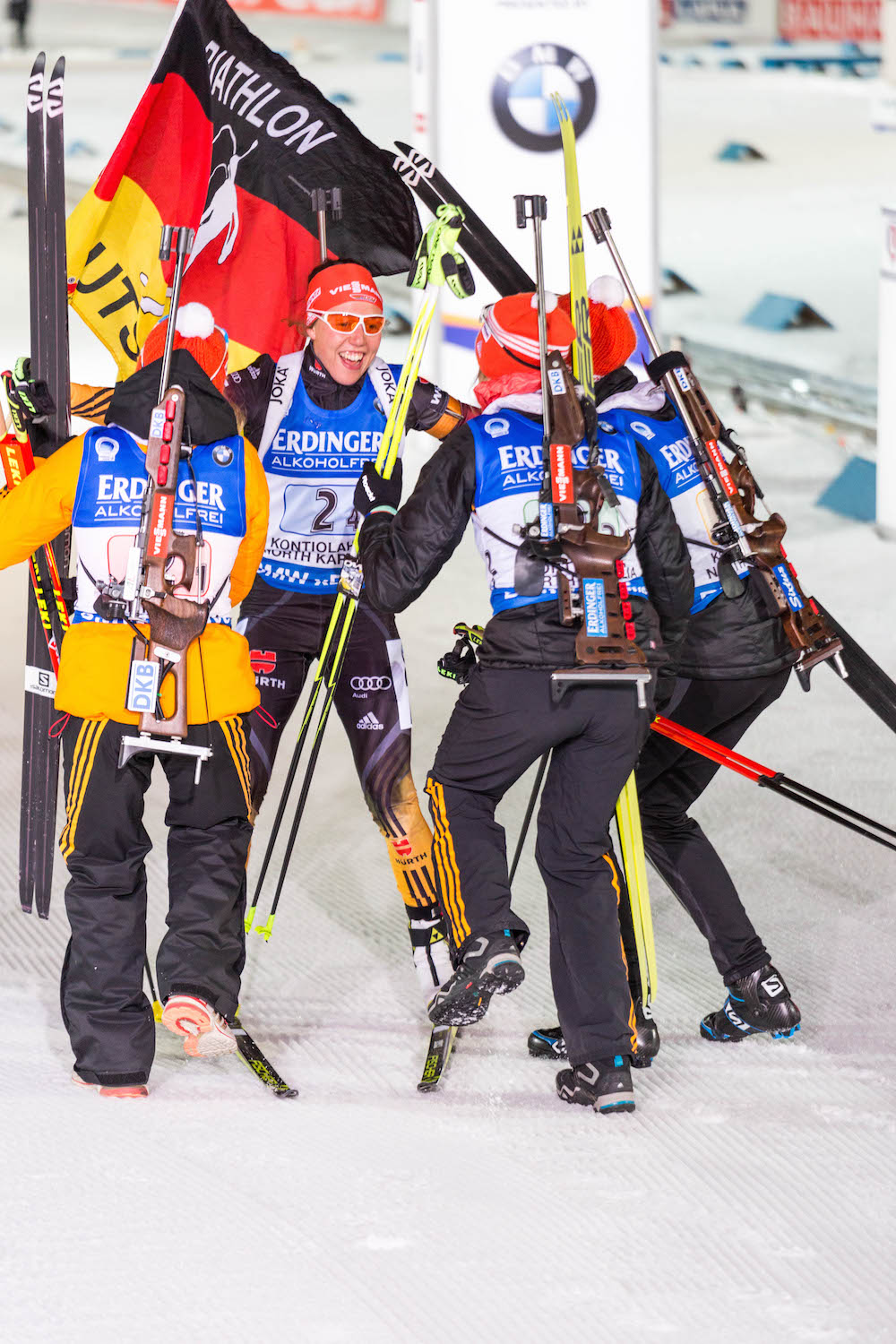
KONTIOLAHTI, Finland — Not long after finishing the women’s 4 x 6-kilometer relay at 2015 IBU World Championships, Laura Dahlmeier sprinted past reporters to jump into the arms of one of her teammates, her rifle still attached to her back.
A German sports broadcaster employee quickly ushered the 21-year-old Dahlmeier and her three teammates to the Sportschau platform overlooking the stadium where they had just destroyed the 25-team field.
In the minutes before, Dahlmeier built on a 30-second lead her teammate Vanessa Hinz established on the third leg to anchor Germany to a 1:00.3-minute win. Hinz had used just one spare in prone to clean both her stages and skied the second-fastest third leg to leap from third into first — and considerably ahead of anyone else.
The German women’s relay rushes the finish line to greet anchor Laura Dahlmeier, who secured their win by more than a minute over France in the 4 x 6 k relay at 2015 IBU World Championships in Kontiolahti, Finland. The German team included Franziska Hildebrand, Franziska Preuss and Vanessa Hinz. (Photo: Kontiolahden Urheilijat/Kari Kuninkaanniemi)
With Franziska Hildebrand and Franziska Preuss skiing first and second, respectively, the Germans combined to secure gold ahead of France in second and Italy another 5.8 seconds back in third.
“I think it was a dream of all of ours to be world champion and now the dream is true,” Dahlmeier said in a press conference after her team used six total spares and avoided any penalties for the win in 1:11.54.6.
France, with Anais Bescond, Enora Latuilliere, Justine Braisaz, and Marie Dorin Habert (the latter of which had already won two golds at these world championships), had nine spares and one penalty from Braisaz on the third leg. Habert lifted them from fourth and 1:18.8 behind Germany to silver — her fourth medal in as many races in Kontiolahti, including silver in the mixed relay — using two spares in prone and none to clean standing.
The Italians, with Lisa Vittozzi, Karin Oberhofer, Nicole Gontier, and Dorothea Wierer, led through the second exchange after Oberhofer elevated them from fourth to first with four total spares and the fastest course time of the second leg. Gontier started out 2.5 seconds ahead of Czech Republic, but slipped to third after using two spares on each of her stages.
“I’m not so in shape now and I have to thank my teammates, they are so strong,” Gontier said in the press conference.
She tagged Wierer in third, behind Germany and Russia, respectively. Habert and Wierer both overtook Russia’s anchor Ekaterina Shumilova in the final stage, where Shumilova used two spares, Habert cleaned, and Wierer used one. Wierer left the range in third, 0.6 seconds behind Habert and about 10 seconds ahead of Shumilova in fourth.
“I was so worried about the Russian girl and I thought, ‘I don’t want fourth position,’ ” Wierer said. “I really give all for the team, but I was really, really nervous.”
The team that didn’t lack confidence was Germany, with three women under the age of 23 (Hildebrand is the oldest at 27).
“We are a young team and a strong team and it’s a perfect day for us,” Dahlmeier said after cleaning both her stages to tally her second World Championships medal (following her individual silver in last weekend’s pursuit).
“We are the best team,” she told Sportschau.
Russia, with Ekaterina Glazyrina, Daria Virolaynen, 15 k individual gold medalist Ekaterina Yurlova, and Shumilova, finished 10.7 seconds off the podium in fourth. Norway placed sixth, Ukraine was sixth, Belarus took seventh, and the season-long relay favorites, the Czech Republic (which won the mixed relay) finished eighth, 3:11.7 behind the winners.
The Czechs came through the first exchange in 12th after Eva Puskarcikova’s first leg, 26.4 seconds out of first, and Gabriela Soukalova lifted them to second, 2.5 seconds back. They fell to eighth during Jitka Landova’s third leg, in which she had a standing penalty and six spares. Anchor Veronika Vitkova used three spares and had two penalty laps in prone, then went on to clean standing before finishing eighth.
Canada 10th, U.S. 12th
While the Germans drew a significant amount of attention with their win, two North American squads stood together near the finish, cheering their teammates on with each passing lap before waiting to congratulate their anchors as well.
Rosanna Crawford (Biathlon Canada) racing the second leg in the women’s 4 x 6 k relay at 2015 IBU World Championships in Kontiolahti, Finland. Despite a penalty, she brought her team from 14th to 11th, and the Canadians finished 10th. (Photo: Biathlon Canada/NordicFocus)
Canada’s second leg, Rosanna Crawford was one of them, standing near the finish and looking for her teammate Julia Ransom, who had anchored their team to 10th.
Audrey Vaillancourt had tagged Ransom in 10th, improving one place after Crawford put her in 11th at the second exchange. Ransom, a 22-year-old World Championships rookie, used two spares on each of her stages to help the team meet its personal goal: a top 10.
She held off Austria’s Katharina Innerhofer by 0.5 seconds to finish 10th, 3:39.5 behind Germany. In total, the Canadians used 10 spares and had one penalty (which came on Crawford’s standing stage).
“Megan [Heinicke] tagged me off into a great spot, [and I] came in prone … with the group,” Crawford explained.
She had entered her first stage around 12th after Heinicke tagged her in 14th, 33.8 seconds out of the lead. (The team’s first leg, Heinicke used a single prone spare and cleaned standing.) Crawford cleaned prone, then went on to use three spares in standing while trying avoid the penalty loop, which she ultimately had to ski around once.
“Standing, I came in and missed my middle shot and loaded my first spare quickly and missed,” Crawford explained. “As I loaded my last spare, I took my rifle down and shook my legs out and missed.”
Not only did the penalty loop cost her, but the three spares, which she estimated takes her six to 10 seconds to load apiece, set her back as well. Regardless, Crawford skied the sixth-fastest second leg to tag Vaillancourt in 11th, 1:08.6 behind the leader.
Audrey Vaillancourt (Biathlon Canada) during prone shooting earlier this week at 2015 IBU World Championships in Kontiolahti, Finland. She was the third leg of the Canadian women’s relay that finished 10th on Friday. (Photo: Biathlon Canada/NordicFocus)
Vaillancourt, 23, went on to use two prone spares and cleaned standing outright to bring the team to 10th, 1:45.3 out of first.
“I didn’t really know what place I was in at any time, it was just good to always have a pack of people [around me],” Vaillancourt said. “I passed people in the standing so that felt awesome. It’s always such a good feeling, like, ‘Yeah!’ … I was a little tired on the last lap, but I’m happy.”
Ransom used two spares in prone, rising to ninth, and then two more in standing to drop one spot to 10th.
“I saw eight and ninth ahead of me on the climbs,” she recalled. “You’re just gunning for those and didn’t look back.”
In her first World Championships relay, Ransom said she was “terrified” to anchor, “mainly because I saw the start list and saw a lot of medalists hanging out in the fourth [leg] with me.
“In zero I was pretty nervous, but you quickly fall back into race mode,” she added. “Even though you start with [Belarusian Darya] Domracheva, you put it aside. Once I was on the track and I could feel like I could ski like myself it was fun and I loved it.”
Rosanna Crawford (Biathlon Canada) trails Nadzeya Pisareva of Belarus during the second leg of the women’s 4 x 6 k relay at 2015 IBU World Championships in Kontiolahti, Finland. The Canadians went on to place 10th. (Photo: Biathlon Canada/NordicFocus)
Overall, the Canadians were pleased with their performance, with two relative newcomers on the team. While it’s Vaillancourt’s second World Championships, this season was her first full time on the World Cup.
“[Last night], we talked about that if we all bring our A-game, a top 10 is realistic and a top eight would be the perfect race,” Crawford said.
“I don’t think that we can say that we had a perfect performance as a team today, so I think that makes it even more awesome that we made our goal,” Heinicke said. “We have been mixing up our relays a ton this year. This is only the second time us four have raced together and we have never had this order. Lots of experiment; it’s been good.”
Dunklee Fastest First Leg
The Americans tied their season best in 12th, with Susan Dunklee, Hannah Dreissigacker, Annelies Cook, and Clare Egan. Despite starting in the seventh of nine rows at the start, Dunklee skied the fastest course time of all the first legs to put her team in third, 3.7 seconds behind Poland, which led through the first exchange.
“I almost prefer starting in one of the back rows,” Dunklee explained in an email after the race. “I love the rush of having to maneuver through the pack and chase people down. It just feels like a really fun game. It helps a lot that my fitness is in peak form right now, and the course suits my strengths with that big wall climb.”
Susan Dunklee (US Biathlon) follows Germany’s Franziska Hildebrand (r) into range for the first shooting in the women’s 4 x 6 k relay at 2015 IBU World Championships in Kontiolahti, Finland. Germany went on to win, and the Americans placed 12th to match their season best.
By the 1.3 k checkpoint, Dunklee had skied up to second behind Hildebrand.
“I don’t know how Susan just careened to the front of the pack like that,” Heinicke observed. “It was pretty impressive. I was in the second half and it was the most aggressive mass start I have ever been in, so much bumping and ski stepping and poles. It was a little bit chaotic and also exciting.”
Dunklee held her position in second entering the range for the first time, where she used two spares and had some trouble unhooking her sling from her arm. Dunklee left the range in 21st, 26.5 seconds behind Hildebrand, who cleaned without any spares.
The American spent the next lap skiing up to 12th before cleaning her standing stage to improve to seventh. Poland’s Monika Hojnisz cleaned her second-straight stage without any spares to take the lead, 2.4 seconds ahead of Russia.
Meanwhile, Dunklee left the range 14 seconds back in seventh. Over the next lap, she skied back up to third, tagging Dreissigacker 3.7 seconds out of the lead.
“I’m getting used to that; I expect Susan to hand off to me in the top five at least,” Dreissigacker said. “I should be getting better at it, and I still seem to be struggling with get being put in that position. I think I’ve always liked being one of the chasers not one of the chased.”
Coming into the range for the first time, Dreissigacker was fourth behind Poland, Italy and Russia, respectively. There, she had to use three spares to hit all of her targets.
“I kind of pulled off two shots accidentally, just way too fast with the trigger,” Dreissigacker explained. “I think I was a little excited, my fingers had gone a little bit number for some reason. … Using the third spare is always really bittersweet. You’re bummed that you had to use three, but you’re always so happy you hit that last one and didn’t do a penalty loop.”
Hannah Dreissigacker (US Biathlon) skied the second leg for the U.S. in the women’s 4 x 6 k relay at 2015 IBU World Championships in Kontiolahti, Finland. After receiving the tag from teammate Susan Dunklee in third, she came through the second exchange in 10th. The Americans finished 12th. (Photo: USBA/NordicFocus)
She left the range in 11th, 37 seconds behind Russia up front. In standing, Dreissigacker used two spares to head out for her final lap in 10th.
“Hoping that one of these days I can use not quite so many spares,” she said.
Dreissigacker tagged Cook in 10th, 1:06 out of the lead. Cook used two spares in each stage to hand off to Egan in 11th, 2:05.4 back.
“That is not like awesome shooting, but I think we all had a little bit of the nightmare of the last relay, where we had six penalty loops, in the back of our head,” Cook said, referring to the last World Cup relay in Oslo, Norway, where the Americans were in 18th before being lapped. “So we were all kind of like, ‘OK! I’m really happy that didn’t happen again!’ I felt really good skiing and it was fun. I felt like I was in the mix, which is exciting.”
In terms of team goals, she said they didn’t target a specific place.
“We didn’t do that many relays this year [and] we’ve got some new faces,” Cook said. “I think for us, it is just about getting experience … We have had a pretty steady relay team the last few years so now we are kind of rebuilding that up. Today we just wanted to have fun and to feel like after the race, we would all be in good moods and happy.”
In her first World Championships, Egan anchored the U.S. to 12th, 3:44.8 behind Germany and 0.8 seconds out of 11th. The 27-year-old US Biathlon development skier cleaned her first stage to move into eighth after prone, then used three standing spares, which put her back in 13th.
“I wish I had just used two [spares] because we would have been 10th instead of 12th,” Egan said, estimating it takes her about 20 seconds to load each spare. “That is my only regret. I got really close … I passed one person and I finished within a second [of 11th].
“This is my first relay that I have not had two penalty laps in standing. So big improvement for me,” she added. “I just tried to ski my own race and remember that I am always trying to gain experience.”
At the end of the day, Dunklee pointed out that 12th matched their best result of the season.
“It certainly wasn’t a perfect performance and there were several teams within reach ahead of us. I think it is good to be hungry for a higher place and know the possibility is there, but this was also result we can finish the season feeling proud of,” she wrote.
Rosanna Crawford with coach Roddy Ward after placing a career-best fifth in the IBU World Cup 10 k pursuit on Sunday in Hochfilzen, Austria. “Such a fun race today, I moved from 34th to 5th for a new personal best with 19-for-20 shooting,” Crawford wrote on Facebook. (Photo: Chris Lindsay)
Note: This article has been corrected to reflect the fact that American Annelies Cook caught skiers on her penultimate lap.
“You can’t expect to be fast all the time,” Biathlon Canada’s Rosanna Crawford stated just two days ago after placing 34th in the IBU World Cup 7.5-kilometer sprint in Hochfilzen, Austria.
But sometimes, you’re going to be very fast and extremely efficient when it comes to shooting, according Crawford’s coach Roddy Ward. And it’ll happen when you least expect it — like Sunday.
Ward explained in a phone interview on Sunday that Crawford was probably least confident in her pursuit racing compared to, say, sprints and relays, which she considers her strengths.
He joked that was going to have a talk with her about that after the women’s 10-kilometer pursuit on Sunday, after Crawford skied up from 34th and 1 minute, 34 seconds out of first to a career-best fifth, 53.4 seconds behind Finnish winner Kaisa Mäkäräinen.
Her previous individual World Cup best was eighth in a mass start last season in Holmenkollen, Norway. Sunday, however, marked her first individual flower ceremony.
“She’s got good accuracy, she’s got good speed, she likes to fight, she’s very competitive,” Ward said. “So it has always shocked me a little bit that [she thinks the pursuit is] not her best. I think her goal was just to move up and I was just like, ‘Way more is possible.’
“Today was a good moment for her to show just what she can do in a pursuit,” he continued. “She can be the best, she was the best today in the world, so that’s got to give her confidence. … This is big. This is huge.”
“I think her goal was just to move up and I was just like, ‘Way more is possible.’ ” — Roddy Ward, Biathlon Canada national-team coach and Crawford’s personal coach
Crawford, 26, was slightly reserved when it came to reflecting on what she had done.
“It’s pretty exciting; I definitely made things hard on myself by not having a good ski day Friday,” she said on the phone after Sunday’s race.
Canada’s Rosanna Crawford (at right) receiving her fifth-place award after achieving a career best in the IBU World Cup 10 k pursuit in Hochfilzen, Austria. (Photo: Chris Lindsay)
Two days ago, Crawford explained she lacked snap and her legs felt heavy. She hit 90 percent of her shots in the sprint, but felt her ski speed was lacking. She rebounded to post one of the fastest second legs of Saturday’s 4 x 6 k relay, where she lifted the team from 16th to sixth with fast, clean shooting.
With her form feeling like it was coming around in time for the Hochfilzen pursuit, Crawford explained that she tried not to get ahead of herself. With solid shooting, she knew she could pick off the places — and sure enough, after the third shooting stage, she was up to 10th.
“Shooting has been always good for me in Hochfilzen,” Crawford said after missing a single target in her first prone, then cleaning the next three stages.
A top-five result didn’t cross her mind before the start, but she thought with 90- to 100-percent shooting, she could finish in the top 15.
By the fourth stage, she found herself in ninth entering the range for the final standing. Meanwhile, Ward, who had been in the range watching her shots through the scope, had done some quick math in his head to determine that she could nab a top five if she cleaned that stage.
As he watched all five of her last shots hit her targets, he looked up at the scoreboard and realized she was in fourth.
He excitedly radioed his colleagues out on course, including Biathlon Canada’s head coach Mattias Ahrens and several of the team’s wax technicians. One woman yelled, “Go get her! Go get her, Rosanna, go get her!” which was picked up by the IBU television crews, as Crawford left the stadium 2.4 seconds behind France’s Anais Bescond in third.
After Mäkäräinen led into the range and cleaned the final stage, she left with a nearly 50-second gap to Russia’s Ekaterina Glazyrina, who also cleaned the last standing to stay in second.
Bescond moved to third with a clean bout as well after Ukraine’s Valj Semerenko and Germany’s Franziska Preuss both missed one and had to ski a penalty loop.
Bescond and Crawford were about a minute behind Mäkäräinen, and Crawford started the final 2 k lap less than six seconds ahead of Russia’s Olga Podchufarova in fifth. Italy’s Karin Oberhofer, who started second after placing second on Friday, was another two seconds back in seventh.
Crawford described that last lap as “so hard.”
“I went pretty hard the whole race and was running out of gas,” she said.
Podchufarova charged ahead on the last climb to pass her in fourth, and Crawford used every last ounce to hold off Oberhofer. She did so by 2 seconds and finished 6.9 seconds off the podium in fifth, collapsing immediately after crossing the line.
“She was fighting from 34th — she fought her way up the whole race and just at the end there was this last little bit the she just didn’t have,” Ward said. “Up to that point she was out-skiing those girls, but they could hold a little reserve [as earlier starters] … Otherwise, she was fighting for the podium.”
“I was happy to hold onto a top five because Oberhofer was coming on as well,” Crawford said. “I was really glad I had what little energy I had left.”
Mäkäräinen won her second individual race in Hochfilzen and third-straight World Cup race in 30:44.8, 34.4 seconds ahead of Glazyrina in second. Bescond and Podchufarova fought for third, with Bescond outlasting the Russian by 3.2 seconds. Crawford finished 3.7 after Podchufarova.
The way the Canadian pushed herself to the point of visible exhaustion didn’t surprise Ward.
“I see that kind of pain from Rosanna every intensity session; this is no different,” he said. “She definitely gives everything she has.”
“I see that kind of pain from Rosanna every intensity session … She definitely gives everything she has.” — Ward
After making up more places than anyone else to finish in the top five, Crawford ended the day with the sixth-fastest course time after Belarus’s Darya Domracheva (who missed five to end up 13th) as the fastest, and Veronika Vitkova of the Czech Republic (who was 25th with five penalties, and had to switch mats and restart one stage when another racer cross-fired, hitting her targets). Finland’s Mari Laukkenen’s course time ranked third, but she had seven misses, Semerenko was fourth fastest and finished 10th, and Poland’s Monica Hojnisz improved from 40th to 11th with the fifth-fastest course time.
“She definitely showed she was at the top of the field in shooting and skiing,” Ward said of Crawford. “I’m excited. I think she just has to be patient. Results like this don’t necessarily happen when you want them to happen … they happen when you least expect [it].”
This past spring, Ward said he and Crawford discussed her potential for a podium this season.
“I really felt this was possible for her,” he said. “If she’s not her biggest believer, I am. I’ve got to be second. I’m up there anyway.”
In an email, Ahrens wrote that Crawford’s race showed her potential, “combining great ski speed with good shooting efficiency. When all those components align she can be on the podium, she has made another step this season in her training, it shows in more efficient ski technique and in general aerobic capacity.”
Pulling Off a Near-Perfect Race, From Start to Finish
According to Crawford, the key to her success was not overthinking it. She knew the start could be her forte, and she immediately worked to chase 11 women who started within 10 seconds ahead of her. With her skis running well, especially on the downhills, she moved up to 31st by 1.2 k and 28th after the first stage.
Finland’s Kaisa Mäkäräinen after winning Sunday’s 10 k pursuit, her second individual race of the IBU World Cup weekend in Hochfilzen, Austria. It was her third-straight individual World Cup victory. (Photo: IBU/Ernst Wukits)
In the first shooting, Mäkäräinen cleaned with careful aim to head out on her second lap, 30 seconds ahead of Oberhofer, who missed one but remained in second. Germany’s Franziska Hildebrand cleaned to leave the range another three seconds back in third, and Domracheva improved from eighth to fourth by the first stage with clean shooting as well. She left three seconds after Hildebrand, who started fifth.
American Susan Dunklee, who started 29th, 1:29 behind Mäkäräinen, hit all her initial targets to improve to 18th and 1:25 back after the first prone.
Crawford said it was a little chaotic entering the range for the first time, especially with Hochfilzen’s uphill approach. The lane-designator got confused, she said, and told her to go in lane 30 for the first prone, but there was no one in lane 29.
“That might’ve affected me because there’s a bit of a berm there,” she said. She also felt slightly rushed getting settled and removing her sunglasses. Crawford missed her third target — but that was her only hiccup of the day.
“I worked really hard on just not having thoughts when I’m racing; you can’t get ahead of yourself and start thinking about the range,” she said.
One mantra she uses while racing is repeating to herself, “Just this.” That helps her focus on her technique and the moment, rather than what just happened or what lies ahead.
On the second lap, Domracheva surged to second and entered the range with Hildebrand, just as Mäkäräinen was leaving after cleaning her second-straight stage.
Both Domracheva and Hildebrand missed their first two shots, and the two dropped to 13th and 14th, respectively. Preuss cleaned her second-straight prone to jump to second, 38.7 seconds behind Mäkäräinen. Bescond cleaned her second straight as well to move into third, 51.4 seconds out of the lead. Oberhofer missed one target but hung in fourth, five seconds behind Bescond.
Just like the first two stages, Mäkäräinen came into the range alone for the third shooting, but this time, the calm-and-collected Finn missed her first standing shot. Just as she left the mat to head out on her penalty lap, about eight women entered the range.
The first of them, Preuss in second missed two of her targets to drop to fifth. Glazyrina cleaned to move into second, 42.6 seconds behind Mäkäräinen, and Bescond missed one but stuck in third, 56.2 seconds back.
Crawford cleaned her second-consecutive stage to start her fourth lap in 10th, 1:08.7 behind. After two clean prone stages, Dunklee missed two standing to slip from 14th to 20th and 1:53 out of the lead.
With about 10 women chasing Glazyrina, the Russian continued to push to maintain second — and be ready for the off-chance that she could move into first — with Mäkäräinen some 40 seconds ahead of her. Mäkäräinen cleaned her final standing to essentially lock up the win.
Glazyrina cleaned the fourth stage as well to hold her position, leaving the range 49 seconds behind Mäkäräinen. Bescond also hit her final standing targets to remain in third, just ahead of Crawford, who was happy to clean her last stage as well.
“I know it kind of sounds silly, but I’ve worked so hard on not paying attention to what’s going on around [me],” she said. “As soon as you look around to who’s shooting in lane four or five, you’re just throwing away shots there.”
That said, she was pleased to find herself in fourth at the beginning of her last lap.
“I have high expectations this season and I know that a podium is just around the corner,” she told the IBU in a post-race video interview.
“I’ve worked so hard on not paying attention to what’s going on around [me]. As soon as you look around to who’s shooting in lane four or five, you’re just throwing away shots.” — Rosanna Crawford (Biathlon Canada) after career-best fifth in Hochfilzen pursuit
Dunklee missed two in her last stage to fall farther back to 30th. On the last lap, she skied the seventh-fastest course time to finish 27th overall, 2:40.4 behind Mäkäräinen.
Susan Dunklee (US Biathlon) on her way from 29th to 27th in Sunday’s 10 k pursuit at the IBU World Cup in Hochfilzen, Austria. (Photo: USBA/NordicFocus)
“No matter whether I am in first or in fiftieth, I believe it is important to fight all the way to the finish,” Dunklee explained in an email. “The last loop, I gave everything I had to catch a French girl [Enora Latuilliere] in sight ahead of me, but this time she outsprinted me to the line. It was a fun battle.
“I am not entirely sure what went wrong in standing,” she wrote. “Missing so many was frustrating. I have a lot of faith in my prone shooting right now, so between that and the ski speed, I am able to create good opportunities almost every race. The next step will be to follow through on that trajectory by improving my standing percentages.
“I had a great race going for a while,” she added. “I dreamed of moving up 20 places like I did last week, which didn’t happen, but I was inspired to see Annelies move up 17 and Rosanna almost 30!”
Her US Biathlon teammate, Annelies Cook, started 50th and improved to 32nd with 80-percent shooting (1+0+0+1).
“Missing one in prone on the first stage left me pretty much in the same place,” Cook explained in an email. “So it was really cleaning the next prone and standing that jumped me up quite a lot and then keeping it together in the last standing. That was my best shooting in a long time! I just tried to be relaxed and I told myself that I had to do it.”
On Cook’s fourth lap, she caught up to some skiers and and was able to draft a few of them, giving her an uplifting confirmation that her skis were running well.
“Today was really good for me mentally. I was feeling quite stressed and bummed about my earlier performances and I needed today for a boost in confidence,” she added.
Germany’s anchor, Franziska Preuss celebrates a 21-second victory in the women’s 4 x 6 k relay at the IBU World Cup on Saturday in Hochfilzen, Austria. (Photo: IBU/Ernst Wukits)
For three out of the four legs in the IBU World Cup women’s 4 x 6-kilometer relay on Saturday in Hochfilzen, Austria, it could’ve been anyone’s game, especially Russia’s, Germany’s, Poland’s and the Czech Republic’s.
All four were within 40 seconds of one another behind Russia in first at the final exchange — and while it might have seemed like Russia with a 19-second lead was untouchable — any biathlete will tell you nothing in biathlon is ever a sure-thing.
Ekaterina Shumilova tagged off in first, upholding the position teammate Olga Podchufarova put her in during the second leg. However, by the final prone, Russia’s lead started to unravel. Ekaterina Glazyrina used all three spare rounds, then had to ski the team’s first penalty loop of the day.
She dropped from first to fifth, 44 seconds out of the lead.
Meanwhile, Germany’s anchor Franziska Preuss cleaned her first stage to take control — not knowing what happened to Glazyrina.
“I had no idea that she was on the loop,” Preuss told the IBU after the race. “I did not know it until the finish line.”
Veronika Vitkova of the Czech Republic used one spare to move to second after prone and trailed Preuss by 24.1 seconds leaving the range. Belarus was suddenly back in contention when Darya Domracheva cleaned prone to jump from sixth at the exchange to third, 37 seconds after Preuss.
For the final standing, the pressure was on for Preuss. She had to use one spare, but so did Vitkova and Domracheva in second and third.
The German left the range with a 29-second lead over Vitkova and remained 37.4 seconds ahead of Domracheva in third. With a huge smile, Preuss entered the stadium uncontested and waved to the Austrian crowd as she finished. Domracheva outsprinted Vitkova for second, giving Belarus the silver, 21.1 seconds behind Germany, and the Czech Republic took third another 1.1 seconds back.
The German women’s relay atop the podium on Saturday at the Hochfilzen World Cup: (from left to right) Luise Kummer, Franziska Hildebrand, Vanessa Hinz, and Franziska Preuss. (Photo: IBU/Ernst Wukits)
For Germany, the relay victory marked the first podium for two of its members: first-leg Luise Kummer and third-leg Vanessa Hinz, the latter of which lifted the team from fourth to second with two spares.
“It is very exciting being up there; it is such a great feeling!” Kummer said.
Second-leg Franziska Hildebrand, who brought Germany from 11th to fourth by the second exchange, said the team’s goal was to be on the podium.
“People should be happy, because we are a very young team and this shows how good we can be,” Hildebrand said.
The Czech Republic’s second skier who brought her team to third from seventh, Gabriela Soukalova was also pleased with the top-three finish.
“We realized at the beginning of the season that we can have a strong relay team I think this result will be a great motivation for our whole team,” she said. “For me, I have had some problems and I needed to have a great race.”
Germany finished the day with zero penalties and eight spares, Belarus had 10 spares and the Czech Republic had nine spares.
Italy (1+4) fell from an early lead set by first-leg Dorothea Wierer, to 13th when second-leg Nicole Gontier had a penalty loop on her second stage. Karin Oberhofer lifted the team from 11th at the final exchange to fourth overall (+39.9) with clean shooting.
Norway placed fifth with a penalty and 12 spares, five of which came from second-leg Synnøve Solemdal. Anchor Tiril Eckhoff skied the team up from 14th to fifth (+46.3).
Poland ended up sixth (0+8), Ukraine was seventh (1+11), Russia eighth (1+7), France ninth (1+10), and Slovenia 10th (0+7).
The Canadian women’s relay team after placing 11th on Saturday: (from left to right) Rosanna Crawford, Audrey Vaillancourt, Sarah Beaudry, and Megan Heinicke. (Photo: Rosanna Crawford)
The Canadians finished 11th overall (0+7), 2:11.1 behind Germany. They were 16th at the end of Megan Heinicke’s first leg, after she cleaned prone and missed three standing.
“I wasn’t feeling particularly snappy but I have been recovering from a cold since last Saturday so I am hoping for a bit more explosiveness next week,” Heinicke explained in an email.
While she was “happy and motivated” by her prone stage, which put her in seventh, Heinicke added that she was surprised by her standing.
“I didn’t feel like I had pushed very hard during the 2nd loop so I was pretty surprised when my left leg was shaky during standing,” she explained. “I have often struggled with standing in the last 2 seasons but rarely because of shaky legs! There was definitely that element of slight panic at needing to use all 3 spares and a fierce determination to hit then. I admit, I was relieved to bypass the penalty loop. My goal on the last loop was simply to giver and try to catch 1 or 2 of the girls ahead of me.”
She moved up one spot from 17th to 16th, tagging teammate Rosanna Crawford 52 seconds back from Italy in first.
“I knew that with some good quick shooting on the range that you can move up a lot in a relay,” Crawford explained, adding that she didn’t think about shooting right away. “You don’t want to start thinking about shooting as soon as you start a race or that’ll put too much pressure on yourself. So I focused on my skiing and switched to shooting when I was getting closer to the range. My skis were really good today, which always makes for a fun race, because you just feel like you’re flying!”
With clean shooting on both stages, she left the range in 12th after prone and sixth after standing. She recorded the fastest shooting for her leg.
“I just took it one shot at a time never getting ahead of myself,” Crawford wrote. “Things can go wrong quickly in a biathlon races if you start thinking about the 5th shot when you’re only on the 1st!”
She handed off to 20-year-old Sarah Beaudry, who was in her first World Cup relay and second-ever World Cup race, in sixth. In an email, Beaudry explained that she simply wanted to hit her targets and ski fast.
After cleaning prone, she was up to fourth.
“Moving up to fourth wasn’t really part of any plan, it was more just a result of my good prone shooting,” Beaudry wrote. “For my prone I just came in really relaxed and my focus was to watch wind. Sometimes I am a little forgetful about wind so I think having that focus helped me stay calm.”
Fortunately for the women’s and men’s races on Saturday, there wasn’t much wind to speak of.
Beaudry tried to stay calm as she approached her standing stage, but after hitting her first two targets, she got “a little too excited” and ended up missing the last three, she explained.
“Then I was just trying hard to avoid the penalty loop with my spares,” she added. She avoided it, tagging Audrey Vaillancourt in 12th, 1:09.4 back.
“Today I was going to give everything I had no matter what place I was tagged in, and this is exactly what I did,” Vaillancourt wrote.
With a single prone miss, Vaillancourt maintained her position in 12th. One lap later, she cleaned standing to improve to 11th.
“I kept focused on trying to get closer to the other team, but I also knew there were some very strong women out there in the last leg,” she wrote.
Slovenia’s Urska Poje was 15 seconds ahead of her in 10th heading into the final lap. Vaillancourt ended up finishing 18 seconds behind in 11th.
“Overall I am very happy with my race, both on the skiing and shooting side. I have had a cold all week which affected my training and preparation a lot, but today I felt a lot better so I think I’m back on track,” Vaillancourt wrote.
Crawford referred to her team’s 11th place, with zero penalties and seven spares, as a “decent result.”
“We had two legs with some scary standing, but no penalty loops is great!” she wrote. “A few less spares and we could have been top 10. We were trying a different order today and it seemed like it worked out pretty well. Megan did a great job at the start of the race.”
Later Saturday afternoon, the Canadian men tied a team-best sixth in the 4 x 7.5 k relay.
“So excited for men’s team,” Crawford wrote. “They’ve had a bit of a bumpy start and not performing like they were hoping for. A top 6 is a great way to build some confidence into the rest of the season.”
With three women on the World Cup circuit, the U.S. did not field a women’s relay.
American Susan Dunklee on her way to 29th in Friday’s 7.5 k sprint at the IBU World Cup in Hochfilzen, Austria. Dunklee missed one prone and one standing. (Photo: USBA/NordicFocus)
No skiing? No sweat, according to US Biathlon’s Susan Dunklee.
Earlier this week, after leaving the first IBU World Cup venue in Östersund, Sweden, Dunklee and her team found the skiing in conditions in Hochfilzen, Austria, well — non-existent. Organizers were working on transporting snow great distances to hold the race.
“Considering how uncertain we were last week about whether these races would happen, the organizers have done a fantastic job,” Dunklee wrote on Friday. “They brought in all the necessary snow for a nice clean 2.5 km loop.”
But before that, the U.S. skiers prepped with some trail running.
“We did some running when we first arrived since the ski loop wasn’t ready yet and it was beautiful up in the mountains,” Dunklee explained in an email. “The great thing about not having natural snow is that the hiking trails are all still open so we got to explore more than usual.”
Dunklee’s an avid hiker, so that worked for her. Come Friday, when a 2.5-kilometer loop was ready to go for the women’s and men’s 7.5- and 10-k sprints, so was she.
“I feel like I already have all the pieces I need to be earning top tens,” she explained. “I am starting the season with top-end ski speed, a huge improvement from last year. I’ve been consistently hitting higher percentages of targets in practice than ever before.”
On Friday, she missed one prone and one standing for 80-percent shooting: not perfect, but something she made up for with the 11th-fastest course time. Dunklee finished 29th overall, 1:29.3 behind Finnish winner Kaisa Mäkäräinen.
“So far I have had solid results but nothing big,” Dunklee wrote. “I am a little disappointed it hasn’t come together for me yet, but the season is young.”
“I feel like I already have all the pieces I need to be earning top tens. … So far I have had solid results but nothing big.” — Susan Dunklee (US Biathlon) after placing 29th in Friday’s 7.5 k sprint
Finland’s Kaisa Mäkäräinen after winning the IBU World Cup pursuit last Sunday in Östersund, Sweden. Five days later, she repeated with a sprint victory in Hochfilzen, Austria. (Photo: IBU/NordicFocus)
For Mäkäräinen, Friday’s victory was her second straight after she topped the Östersund pursuit last Sunday. The defending IBU World Cup champion started 23rd and missed one in prone, but cleaned standing and consistently posted the fastest loop times to take the win in 20:55.6. Italy’s Karin Oberhofer cleaned for second, 10.4 seconds back, and as the 15th starter, her time remained ahead of Mäkäräinen until the last lap. But it gave Mäkäräinen a time to beat.
“I felt good on the first loop and the second loop, but I do not know where I got that power on the last loop,” Mäkäräinen told the IBU, referring to her illness earlier in the week. “My legs were feeling really tired … The sickness this week did not affect me on the shooting range, but it did on the tracks. I was not able to do my normal training all week, just a lot of slow skiing.”
She was pleased with her shooting, even with a penalty.
“I am quite happy and a bit surprised to win. My level is quite high now, so that helped me,” she said.
Norway’s Tiril Eckhoff in bib 18 was primed to take the lead from Oberhofer heading into the last stage before missing one, her only penalty of the day. She fell off the pace to place third, almost 20 seconds after Oberhofer and 29.9 seconds behind Mäkäräinen.
For Oberhofer, 29, who was fourth in the sprint at the Sochi Olympics last winter, it was her first individual podium.
“I trained a lot, hoping that maybe I might get to the podium at least once,” Oberhofer told the IBU. “In the last loop, I just concentrated on the tracks, did my best and it turned out good.”
While Dunklee will start 1:29 back from Mäkäräinen in Sunday’s 10 k pursuit, she predicted she’d have opportunities to move up with seven women starting within seven seconds ahead of her.
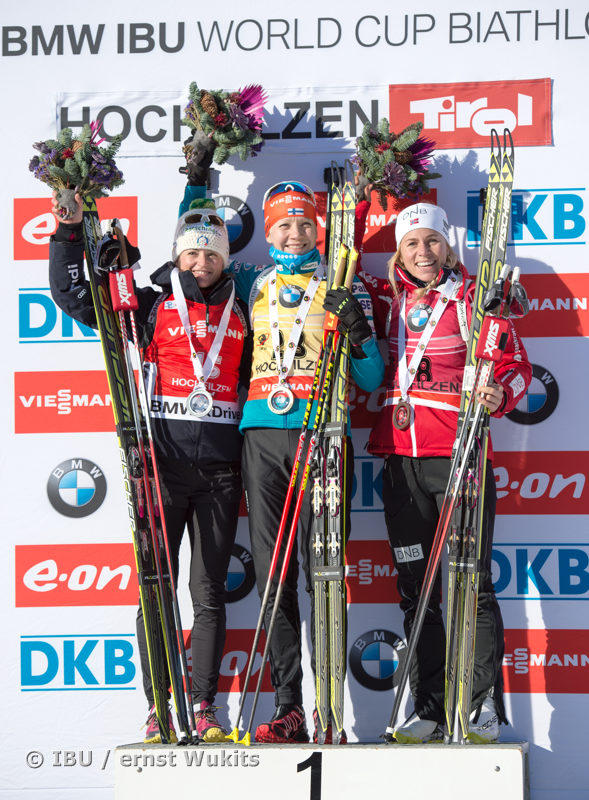
The women’s podium after the Hochfilzen World Cup 7.5 k sprint on Friday, with Finland’s Kaisa Mäkäräinen (c) in first, Italy ‘s Karin Oberhofer (l) in second, and Norway’s Tiril Eckhoff in third. (Photo: IBU/Ernst Wukits)
Five seconds behind her, Canada’s Rosanna Crawford will head out 34th, 1:34 behind Mäkäräinen, based on Friday’s result.
“Today was a tough day on the skis for me,” Crawford wrote in an email. “Right from the start I just didn’t feel I had that snap I needed and it warmed up quite a bit right before start which made for suction on the skis. On my last loop I just didn’t have the same energy I had last week. But you can’t expect to be fast all the time.”
The top Canadian in 34th, Crawford cleaned prone and missed one standing. She was pleased to shoot 90 percent — especially considering it was “blustery” during zero, then calm, then windy again during the race, she explained.
“I made a pretty big correction, so I was happy that I hit them all [on the first stage],” she said. “I seem to be having a lot of one misses so far this year, but 90% is still good.”
After fresh snow arrived Thursday, Crawford described the course as packed and fast — until the sun hit it on Friday afternoon. “[Then] things really slowed down,” she wrote.
The lone Canadian woman to advance to the pursuit in the top 60 (Megan Heinicke was 61st, Sarah Beaudry placed 63rd in her World Cup debut, Audrey Vaillancourt was 66th, and Zina Kocher finished 82nd), Crawford was hoping for a top 30 in the pursuit.
“For Sunday, hopefully I will be feeling better on the skis and able to move up some positions. The goal is to stay in the points,” she wrote.
Before that, she’ll race in the women’s 4×6 k relay on Saturday morning with Heinicke, Beaudry and Vaillancourt.
“I think if we each have a good leg that a top 10 is possible,” Crawford wrote. “Right now Audrey and Megan are just getting over a cold, I’m not skiing like I would like to be and it’s Sarah Beaudry’s first World Cup, so the focus will be some good shooting on all parts.”
“You can’t expect to be fast all the time.” — Rosanna Crawford (Biathlon Canada) after placing 34th on Friday
While Heinicke missed three (1+2) to finish 2:39.2 behind the winner, Beaudry, 20, who earned her World Cup starts last weekend in Canmore, Alberta, had a single standing penalty.
“Sarah had a great day on the range today, and I am sure things slowed down a lot by the time she hit the course [after starting 94th],” Crawford explained. “It’s always really exciting to be with someone who it’s their first World Cup, they bring so much energy to the team! Sarah is a blast to have around!”
Vaillancourt also missed one (1+0) and Kocher finished with five penalties (3+2).
American Annelies Cook qualified for the pursuit in 50th (+2:04.9) with a single prone miss.
“After a rough start in Östersund, I had to reevaluate my training a bit,” she explained in an email. “Clearly, I am lacking the high-end speed and lactate tolerance that I need to have to keep up on the World Cup. It’s easy to look back and try to figure out what went wrong, but it can be hard to let it go and just focus on what you can control. So that is what I am trying to do now.”
“It’s easy to look back and try to figure out what went wrong, but it can be hard to let it go and just focus on what you can control.” — Annelies Cook (US Biathlon), 50th on Friday
Cook added that she’s been working on speed, and since placing 79th in last weekend’s sprint and missing out on the following pursuit, she did some intervals and pushed as hard as she could on Friday.
“I am glad I can race in the pursuit and get one more hard session under my belt,” she wrote. “I have to say, I was actually pretty sore today … I must be getting old! But I felt good once I started to race. But I can’t hold on to that speed for the entire race yet, which is frustrating. I was really happy to clean standing after missing prone because that is one of my demons. I told myself I had to relax and I was going to clean, luckily it worked.”
While the Americans are one woman short for the relay, Cook and Dunklee will race on Sunday.
“It’s another opportunity to push hard, to ski with other girls and to challenge myself in the shooting range. Plus, it’s fun!” Cook wrote.
The third U.S. woman, Hannah Dreissigacker placed 78th on Friday (+3:12.7) with three penalties — one prone and two standing. Last weekend, she was 81st in the Östersund sprint.