Tag: Karl Nygren

  • The 12: Central Cross Country

    The 12: Central Cross Country

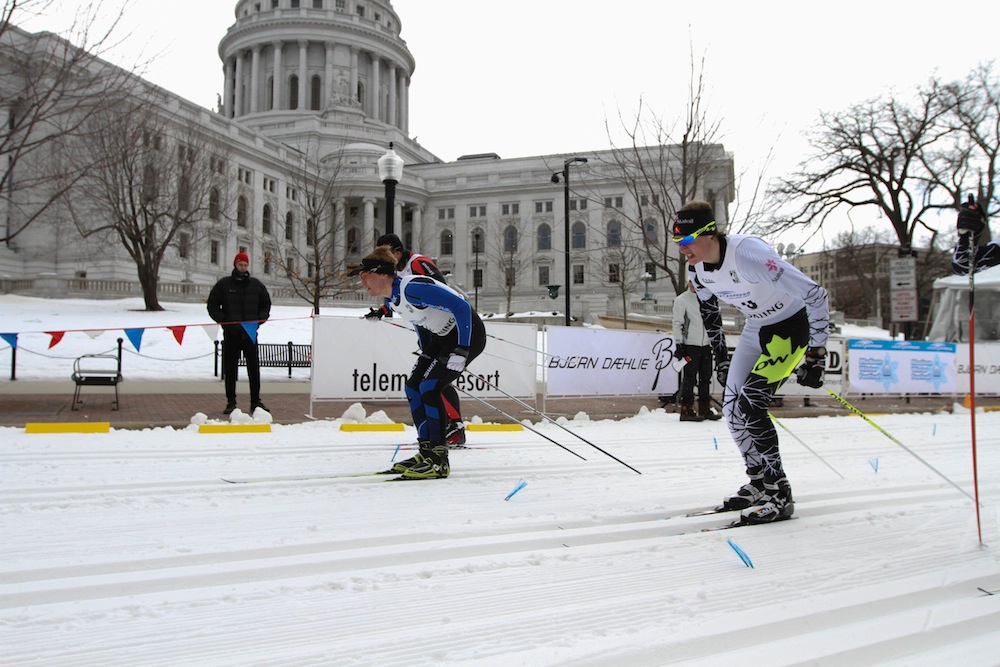
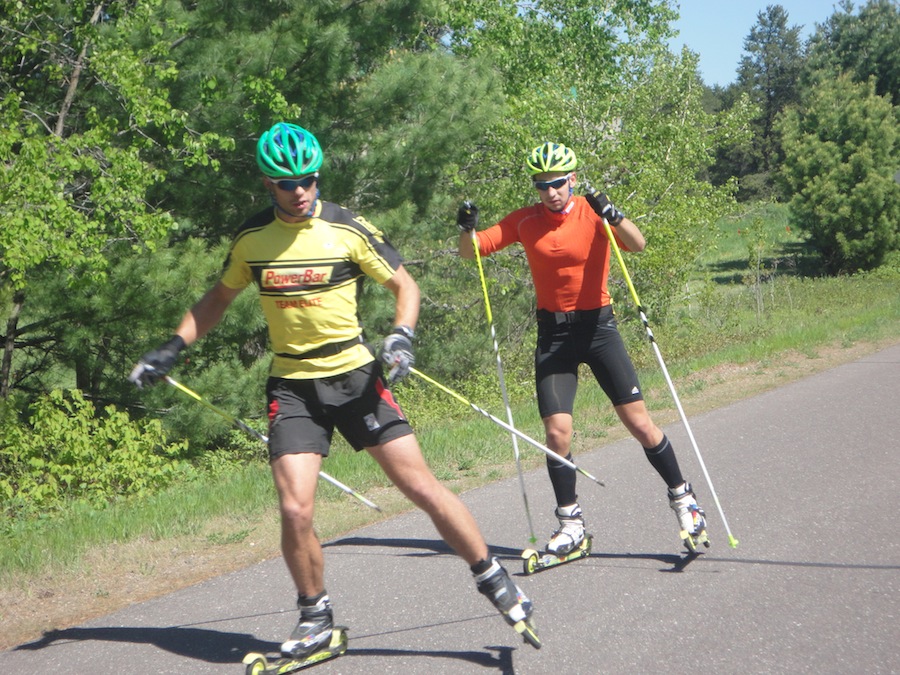
    Karl Nygren (l) and Dmitriy Ozerskiy working Level 3 skate intervals during a CXC elite camp earlier this summer. (Photo: Bill Pierce)
    Karl Nygren (l) and Dmitriy Ozerskiy working Level 3 skate intervals during one of three CXC elite camps this summer near Hayward, Wis. (Photo: Bill Pierce)

    Note: This is the 11th preview in our U.S. elite-team series, the “The 12.” We asked coaches to tell us what’s new and whom to look out for this season, and we’ll publish the final U.S. preview as well as Canadian training-centre profiles in the coming weeks.

    Team: CXC Team

    Coaches: Bill Pierce (elite head coach), Yuriy Gusev (executive and athletic director), Igor Badamshin (high-performance advisor, CXC Team head coach), Andrew Keller (development coach), Andrew Poffenberger (sports manager).

    Roster: Karl Nygren, Eric Wolcott, Tom Bye, Dmitriy Ozerski; Corrine Malcolm
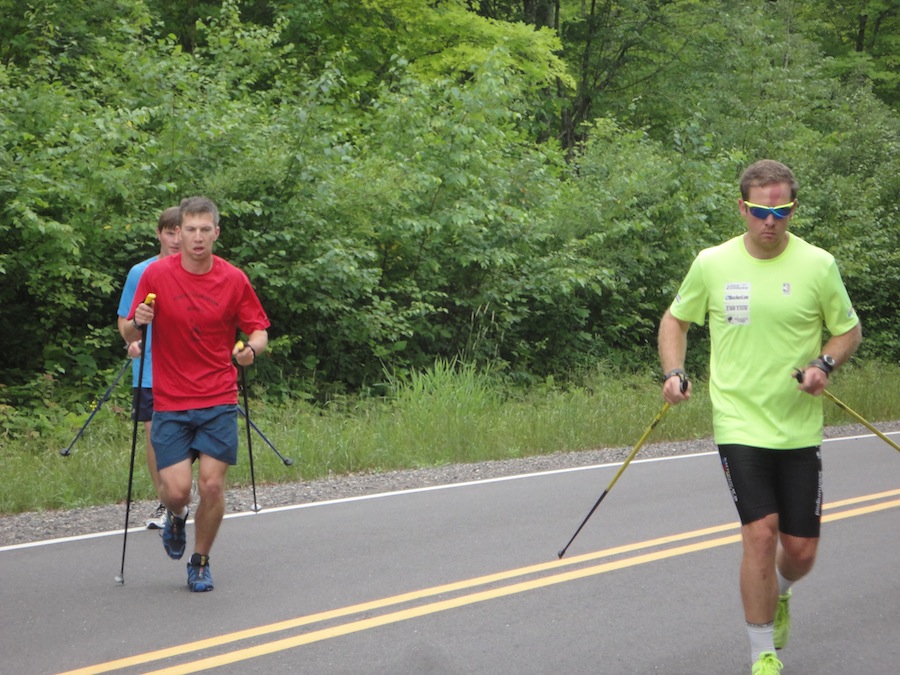
    Eric Wolcott, Scott Johanik and Andrew Nadler during Level 3 running/ski walking intervals at a CXC Team camp earlier this summer near Hayward, Wis. (Photo: Bill Pierce)
    Eric Wolcott, Scott Johanik and Andrew Nadler during Level 3 running/ski walking intervals at a CXC Team camp earlier this summer near Hayward, Wis. (Photo: Bill Pierce)

    Who’s new: Bye, who raced for Eden Prairie High School and is taking a post-grad year before skiing for the University of Utah, according to Pierce.

    Ozerski, a Russian, joins the team as a marathon skier and trained with CXC for nearly 2 1/2 months this summer in Cable and Hayward, Wis. He’s back in Russia now, but Pierce says he’ll return for the opening SuperTour races in November in West Yellowstone, Mont.

    Previously on the US Biathlon national team, Malcolm had to do some soul searching this spring when she was not renominated. She moved back to her college town of Bozeman, Mont., to finish her degree at Montana State University. Upon visiting her hometown of Hayward for the CXC Regional Elite Group (REG) camp earlier this summer, Malcolm signed on with CXC, but will continue to train in Bozeman.

    Who’s missing: Jennie Bender (now with the Bridger Ski Foundation in Bozeman), Brian and Caitlin Gregg ( joined the Methow Olympic Development team in Washington while continuing to live and train in the Twin Cities), Nichole Bathe (University of Alaska Fairbanks freshman), Adam Martin (Northern Michigan University freshman), Doug Debold, who “went on with life,” according to Pierce.

    Top results last season: In a phone interview, Pierce said the team’s in a rebuilding year and moving on after some less-than-stellar results in 2012/2013. Nygren, 26, went from second on the overall U.S. SuperTour standings in 2011/2012 to 19th last season, logging his best results in sprint qualifiers at the SuperTours in Minneapolis and Madison, Wis.

    A CXC junior development coach from 2007 to 2010 who went on to lead his own F.A.S.T. Performance Training team, Pierce became CXC’s elite coach in May and started off by meeting with his athletes, including returners Nygren and Wolcottt.

    “A lot of them are in flux and weren’t satisfied where they were, Karl especially,” Pierce said. “He has the gifts and the talents to do that, and we’ve already been making big steps in the first three months of training.”

    Wolcott, 26, “felt fatigued and not recovered from his workouts,” Pierce explained. “We’re in a rebuilding year with him, too.” He was sixth in the freestyle sprint qualifier at U.S. nationals in January in Midway, Utah, and went on to tie Nygren (and Ozerskiy) for second in the freestyle sprint qualifier in Madison.

    Coach’s comment: Coming into the CXC picture in May, Pierce said he didn’t have a chance to recruit, but that’s already on his radar. This season, he said each of his athletes have set realistic goals — not necessarily Olympics-oriented — because there are so many other races and objectives to focus on throughout the winter.

    “We’re looking at the top SuperTour spot,” he said. “Our goal is to get athletes to the top of the SuperTour, to get them to the World Cup, to get them to the OPA Cup, and as times goes on we hope [the unit] steps up.”

    According to Pierce, “Corrine was about to give up on biathlete and I didn’t think she should do that yet. …  She’s got to put in some training and we’ll see what happens when she does some cross-country racing.” He asked her to compete at the North American Biathlon Rollerski Championships (which doubled as US Biathlon overseas camp trials) last month, “just so she stays engaged in biathlon,” he said. After two days of racing in Jericho, Vt., she ended up 14th.

    This week, Nygren will join the U.S. Ski Team (USST) and National Training Group (NTG) in Lake Placid, N.Y., then meet CXC in Park City, Utah, for the beginning of another USST camp in late September. CXC will then travel north as a unit to Canmore, Alberta, for some on-snow training in October on Frozen Thunder.

    As for the transition, Pierce said he’s impressed with guys like Nygren, who have stuck with the team through several coaching changes in the last few years.

    “They’re resilient and they’re patient,” Pierce said. “Karl’s first year was [USST Development Coach Bryan] Fish’s last year and my last year at CXC. He’s seen four coaches in six years. Good or bad people have left for different reasons.

    “I look at Karl and I see what he’s got to tweak,” he added. “Physically he’s one of the biggest and strongest there is, but why isn’t he the fastest and why did he decline last year? I think at first, [the athletes] were skeptical to listen to me because they’ve heard this before and results have ebbed and flowed, but I think they’re willing to give it a chance.”

    ***

    Other previews: Alaska Pacific University | Bend Endurance Academy |Bridger Ski FoundationCraftsbury GRP | Maine Winter Sports Center | Methow ODSSCV/Team HomeGrown | Stratton Mountain School T2 | Sun Valley SEF Gold Team | XC Oregon

  • Tiuterev completes Russian Sweep in Madison, Bender bests Brennan

    Tiuterev completes Russian Sweep in Madison, Bender bests Brennan

    Rosie Brennan leads Jennie Bender in the women's final of the Madison SuperTour skate sprint. Bender would overtake Brennan for the win. (Photo: Renee Callaway)
    Rosie Brennan leads Jennie Bender in the women’s final of the Madison SuperTour skate sprint. Bender would overtake Brennan for the win. (Photo: Renee Callaway)

    Andrei Tiuterev (RUS) completed a Russian sweep of the Madison Square Capitol Sprints on Sunday in Madison, Wisconsin.  Tiuterev bested countryman Dmitry Ozerskiy (RUS), the winner of Saturday’s classic sprint.  Midwest native Karl Nygren (CXC) placed third.

    Tim Reynolds (CGRP) was the fastest qualifier on the day, narrowly edging out Ozerskiy by 0.1 seconds.

    Reynolds would go on to win his quarterfinal but fall in the semifinal, beaten to the line by Samuel Naney (MOD) and Karl Nygren.

    Eric Walcott, another CXC team member, qualified third and won his quarterfinal but was found wanting against the Russian duo of Tiuterev and Ozerskiy in the second semifinal, finishing fourth.

    Tiuterev, the eventual winner, appeared to pick up speed as the day wore on.

    He qualified in 7th position, made it through the quarterfinal with a second place finish behind Ozerskiy, before finding another gear and beating his teammate in both the semifinal and the final.

    According to Nygren, the third place finisher, tactics rather than speed prevailed on the narrow course in the final.

    “It was very tactical,” Nygren told Fasterskier. “Naney led it out and I sat towards the back. The two Russians went hard around the second to last corner and pushed the pace and moved to the front on the gradual down.”

    The Russians closed the door on the final turn into the finish, cutting off any chance for the the chasers.

    “They [the Russians] took it on the inside and drifted out to block a pass on the best line,” said Nygren. “I decided to cut way back into the inside lane and was unable to close down the gap. They played it smart and skied well.”

    In retrospect Nygren thought there may have been some team tactics, but on a short course with a narrow tracks it may have been as much a function of racing strategy as course profile.

    “Looking back it appears they worked together but who knows,” Nygren concluded.

    Beyond the racing the setting and crowd at the city sprints always makes this competition a highlight on racing circuit.

    “Conditions were excellent and the city sprint atmosphere was amazing,” Nygren said.

    Results

    Women’s Freestyle Capital Square Sprints

    Jennie Bender (CXC) got the better of Rosie Brennan (APU) on Sunday in the Madison Square freestyle sprints, a reversal of Saturday’s classic result.

    Bender dominated throughout the day, qualifying in first position in a time of 1:53.0, 0.5 seconds ahead of rival Brennan.

    She marched through the quarterfinals and seminfinals, winning both heats on her way to the final.

    “City sprints are a nice change, and it is good for the athletes to get used to a different atmosphere of a typical race day,” Bender wrote to FasterSkier in an email. ”

    Madison SuperTour - Skate Sprint Women's Podium - (l-r) Rosie Brennan, Jennie Bender, Caitlin Patterson (Photo: Renee Callaway)
    Madison SuperTour – Skate Sprint Women’s Podium – (l-r) Rosie Brennan, Jennie Bender, Caitlin Patterson (Photo: Renee Callaway)

    Although the women’s field was small, there were enough top women to make the semis and final heats competitive. I am alway impressed with the wonderful volunteers there, who are super supportive.”

    Eventual second placed finisher Brennan followed a similar trajectory to the final, winning both her quarterfinal and semifinal, before the exertions of Saturday’s classic sprint caught up with her.

    “Today was challenging because I was unbelievable sore from the double pole derby of yesterday,” Brennan told FasterSkier. “My muscles were not happy to be ski racing today, but it was fun to skate today.”

    Brennan eschewed tactics in favor of a more aggressive approach, saying “because of the way I felt, I thought my best chance was to just go for it from the gun and hope everyone else was tired.”

    Her path to the final was challenged by third place qualifier Claire Egan (CGRP), whom finished second to her in the semifinal.

    Egan would go on to finish fourth in the final.

    Third place finisher Caitlin Patterson (CGRP), qualified 4th and delivered a series of gritty performances, finishing second in both her quarterfinal and seminfinal heats, before finding another gear on in the final to better her teammate Egan for a podium spot.

    According to Brennan, the final wasn’t tactical, as the absence of a headwind muted the advantages of drafting.

    “There wasn’t a head wind on the downhill so drafting wasn’t quite as important,” she said.

    Despite a furious pace from the gun, her tempo wasn’t enough to unsettle Bender.

    “Unfortunately, Jennie was able to stay with me and did a killer job skating the downhill so she passed me before we went around the final corner and I didn’t have much to answer with,” Brennan said.

    Brennan echoed Nygren’s sentiments about the conditions and atmosphere of the Madison Square Sprints.

    “The skiing was actually quite nice,” she said. “It was cold all weekend so the snow set up well and was firm throughout all the races.”

    Results

    — Topher Sabot contributed reporting

  • In Downtown Madison, Brennan and Ozerskiy Lunge For Sprint Wins

    In Downtown Madison, Brennan and Ozerskiy Lunge For Sprint Wins

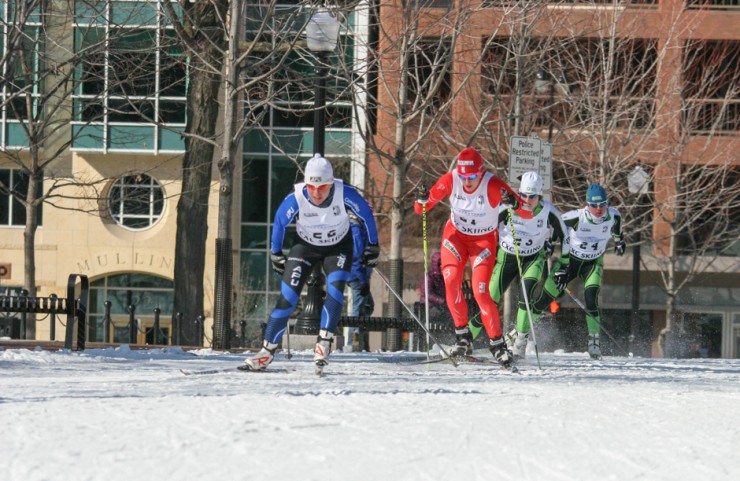
    Alaska Pacific University's Rosie Brennan (r) leaving the start in the quarterfinals of the classic sprint at the Madison, Wis., SuperTour on Saturday. Photo: Alexis Turgeon.
    Alaska Pacific University’s Rosie Brennan (r), Nichole Bathe, Caitlin Patterson and Maria Stuber  leaving the start in the classic sprint quarterfinals at the Madison, Wis., SuperTour on Saturday. Photo: Alexis Turgeon.

    City sprints are fast becoming a mainstay on the World Cup circuit, but elite domestic-level skiers don’t have many opportunities to experience the excitement racing on downtown streets. The SuperTour weekend in Madison, Wis., is the only one of its kind in the U.S. with two back-to-back sprints in the shadow of the downtown capital building, and it has the added bonus of additional hype from Winter Fest, the popular Madison outdoor festival that the sprints are a part of.

    “This is a fairly big event,” said Central Cross Country’s Jennie Bender. “Madison is kind of, but not technically, one of the CXC headquarters, so there’s tons of volunteers and CXC people around who were great cheering.”

    A 1 k classic sprint opened the elite cross-country competition schedule on Saturday. Rosie Brennan (Alaska Pacific University) won the women’s sprint in a tight photo finish with Bender. Two local favorites landed on the podium after her: Nichole Bathe, a high school senior from Madison, took third behind Bender.

    The course created on city streets from trucked-in snow was flat enough for both the women and the men’s field to double pole the entire race on skate skis — some also used skate poles. Brennan, in her first Madison SuperTour appearance, was happy with her debut city sprint experience.

    “That’s why I came here, because I wanted to practice domestically for city sprints,” Brennan said.

    She has her eye on the city sprints in Stockholm, Sweden, in period three of the World Cup. If she maintains her position as overall SuperTour leader Brennan will compete in them this spring. With her first run at the format in Madison under her belt, Brennan has learned a few things about skiing them well.

    “It was like drag racing in the rounds,” she said. “The Craftsbury Green Racing Project was able to wax for me today, which was awesome, so I had really fast skis. I sat behind Jennie and drafted off her while she double-poled, then when we turned the corner into the finish stretch I was just barely able to overtake her.”

    For Bender, Saturday marked the second year in a row she was out-lunged in a photo finish in Madison. It left her feeling frustrated, especially after qualifying in first.

    “Obviously I was not too pumped,” she said. “I led the whole final and I think there’s a strong headwind on the back. I just didn’t race it very smart… When Rosie came around at the finish I was like, ‘Oh, no!’ But she raced a smart race and that’s what it comes down to.”

    Bender’s bout with illness over the summer is still affecting the way she races. She says she has trouble knowing how hard to push in the qualifier since she doesn’t have same fitness base she’s used to. When Bender puts all her energy into winning the prologue, like she did on Saturday by 3.7 seconds on a fast course, she has less speed for the heats.

    “I’ve been going harder in the qualifiers lately, which I’ve been working on, but because I’m doing that as I go on in the heats I might be suffering a little bit,” she said. “I’ve got to work on it.”

    Though disappointed with how her own finished turned out, Bender was “super pumped” to see Bathe, her teammate and summer training partner, climb her first SuperTour podium. Bathe was pretty excited too, as she hails from Madison and knew many people in the crowd.

    “I really didn’t expect to make it into the A-final, even, so it was a fun surprise for sure,” Bathe said. “Especially being my hometown and having a lot of people I knew working the event, and the spectators, it was kind of indescribable how cool it was for me.”

    Women’s heat results

    Qualifier results

    * * *

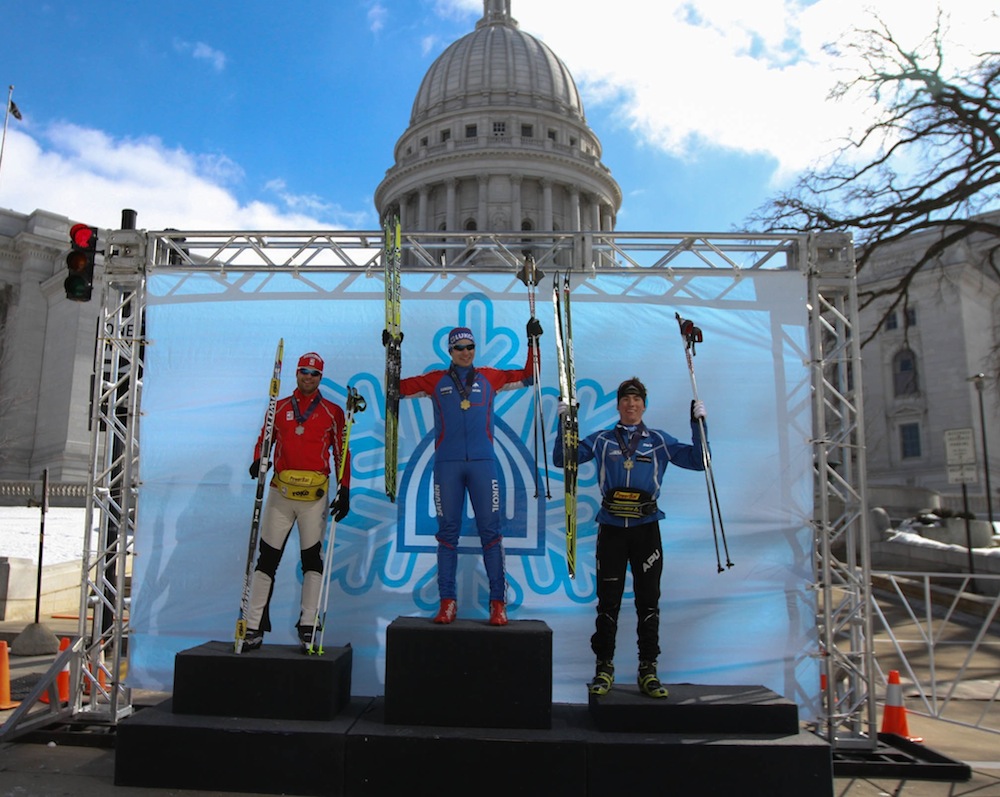
    The men's classic sprint podium from Saturday's SuperTour in Madison, Wis. 1. Dmitry Ozerskiy (RUS) 2. Karl Nygren (CXC) 3. Reese Hanneman. Photo: Renee Callaway.
    The men’s classic sprint podium from Saturday’s SuperTour in Madison, Wis. 1. Dmitry Ozerskiy (RUS) 2. Karl Nygren (CXC) 3. Reese Hanneman. Photo: Renee Callaway.

    In the men’s sprint, Russia’s Dmitry Ozerskiy blew the race open early in the final round only to be reeled back in at the end to win by a slim margin. Karl Nygren (CXC) took second and Reese Hanneman (APU) finished third.

    “Dmitry kind of took off from the gun and led pretty much from start to finish,” Nygren said.

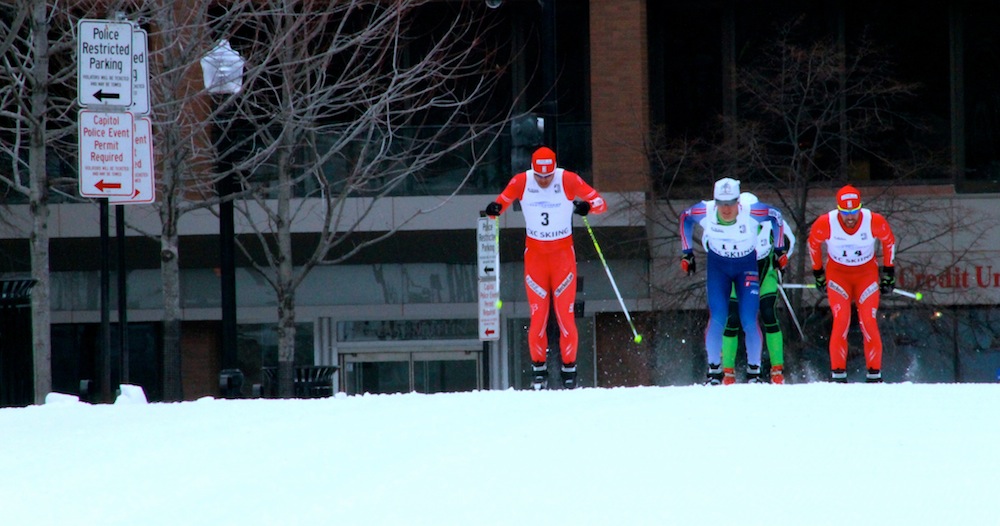
    Karl Nygren (CXC), Mike Sinnott (SVSEF) and Doug Debold (CXC) in the quarterfinals. Photo: Alexis Turgeon.
    Karl Nygren (CXC), Mike Sinnott (SVSEF) and Doug Debold (CXC) in the quarterfinals. Photo: Alexis Turgeon.

    It was a bold move on such a flat course, which surprised the rest of the men’s field.

    “I thought it would be really tactical but the guys were going really hard for the whole sprint,” Hanneman said. “People were just hammering all the straight double-pole sections… I was impressed.

    “When the Russian guy took off he was moving, and Karl and I were just trying to hang on for dear life. I was going maxed out the whole time.”

    The course followed a square pattern around a city block in front of the capitol building, and between each 90-degree corner Hanneman and Nygren eventually regained contact with Ozerskiy.

    “I was just about able to close on him towards the end and I lunged, but got beat by a couple inches,” Nygren said. “It was a fun race, really close.”

    He thought the pancake-flat course probably played to his strengths. Though the field was relatively sparse compared to other SuperTours on the calendar, Nygren was still pleased with his first podium of the season.

    “I’m feeling pretty good right now, so it was nice to get second,” Nygren said. “It’s a pretty accurate reflection of how I’m feeling. A lot of people weren’t here, so it’s hard to say, but it was good.”

    Reese Hanneman (APU) powering through the quarterfinals. Photo: Renee Callaway.
    Reese Hanneman (APU) powering through the quarterfinals. Photo: Renee Callaway.

    Hanneman was upbeat about his result. A close finish can frustrate competitors who wind up on the losing end of them, but he wouldn’t want to finish any other way.

    “It was tight; they always seem to come down right at the end. To make the final when the margins are that small was good,” Hanneman said. “I also want to thank [CXC coaches] Igor Badamshin and Andy Keller for waxing my skis, they took me in this weekend.”

    Close finishes are what city sprints are designed to produce in front of a downtown crowd, and in turn the spectators made the race more exciting for skiers.

    “It felt a lot like Quebec — just all the people watching, the other stuff going on, and you’re right there with these pretty cool capitol buildings,” Hanneman said.

    Men’s heat results

    Qualifier results


  • SuperTour Preview: Get ‘Em To the World Cups

    SuperTour Preview: Get ‘Em To the World Cups

    The major focal points for the SuperTour field this year are qualifying for the Canadian World Cups in December and World Championships in February. Photo: Flying Point Road.

    Ready or not, the 2013 SuperTour season is fast approaching. Here’s what you need to know about the domestic race scene this year.

    At this point, we’ve pretty much said everything we can about the twelve senior ski programs in the U.S. We ran a series throughout the summer highlighting each team’s past accomplishments and goals for the future. Read back through ‘em for comprehensive rosters and standalone previews (scroll down for links). Now that it’s November, it’s time to discuss who stands a shot at beating whom.

    First, there are a few unusual things about the race schedule to understand, as domestic results have an important role to play in qualifying athletes for bigger things this season. The U.S. can enter more athletes than usual in each World Cup race in Canada and can have eight athletes of each gender on its World Champs team, meaning that U.S. Ski Team (USST) members have a shot at top-end international competition this winter (those on the USST are not guaranteed World Championship slots, either).

    Not surprisingly, the big focus is a combination of Canadian World Cup starts and World Championships. The overall, sprint and distance SuperTour leader(s) at the end of each competition period get World Cup start rights no matter what year it is, but being consistently fast enough to be in one of those positions is hard.

    The five extra Nation’s Group spots afforded to the U.S. for each of the Quebec and Canmore World Cup races will be partially filled based on the SuperTour standings after the Bozeman races. With selection criteria theoretically reaching further into the field and requiring just two weekends of top results, the international stage suddenly seems much closer and more attainable. Who cares if SuperDario Cologna won’t be there, it’s still the World Cup!

    World Championship criteria are a slightly different story, but early SuperTour races could still help decide who gets to go. The U.S. will bring up to eight men and eight women, with the first spots going to athletes who reach a certain World Cup ranking by January 14. After that, USSA goes down the National Ranking List, which is created off of competitors’ best four USSA-scored races from the twelve months prior to the selection date.

    The road to Val di Fiemme, then, has already begun. The beginning of the current SuperTour and the week’s worth of racing at U.S. Nationals are further opportunities for athletes to turn in one of their four-best results and move up the ranking list.

    Consequently, there’s a lot potentially riding on the SuperTour this year, despite the continued absence of leader bonuses at the end of the season. It’s not that everyone wasn’t trying hard before, but with a handful of top-level start rights on the line that only come around every so often, things could get feisty. Dreams will come true and hearts will be broken.

    Now, the players: last year’s overall SuperTour leaders, Sylvan Ellefson (SSCV Team HomeGrown) and Jessie Diggins (SMS T2/USST), are already in Europe and out of the domestic picture for the next two weekends. Even so, the potential lineups for West Yellowstone and Bozeman are impressive.

    The Rookies

    Eric Packer (DAR). Photo: Flying Point Road.

    For the purposes of this preview, athletes can pretty much be divided into two groups: knowns and unknowns. Every spring a handful of top-tier college skiers graduate and the domestic circuit gets an injection of new blood. Most graduates have competed in SuperTours before, but not when it’s actually been their job to ski fast.

    So while the rookies aren’t joining the circuit as complete unknowns, their changed training circumstances can make the first results of the year a bit of a surprise. The 2012-2013 freshman class has generally never trained without academic demands competing for their time, and given the results they’ve been able to churn out even during school, count on them disrupting the status quo on the SuperTour this year.

    Take Eric Packer, who joins the SMS T2 team from Dartmouth College and already has a handful of SuperTour and national podiums to his name. Packer was probably the most consistent college performer, sprinting and distance-wise, on the circuit last year, and could be ready for a significant step forward in his transition to full-time racing.

    Reid Pletcher (CU) winning the skate sprint qualifier at West Yellowstone, 2011.

    There’s also Reid Pletcher, who has been described as a “sprint fiend” and returns to skiing for Sun Valley this winter after graduating from CU. Remember how he won the skate sprint in West Yellowstone last year, just six months after a climbing accident landed him in the ICU? Yeah, that was ridiculous. Imagine what he might do this winter with a strong summer of training behind him.

    Ryan Scott will be another sprinter to watch for. Regardless of the whole obstruction controversy, he was still in the classic finals at U.S. Nationals. At U23s he was the top American performer in the freestyle sprint. He didn’t race a whole lot after that, but his coaches at Ski & Snowboard Club Vail think he’s looking mighty fast in the run-up to the first race of the year.

    In the women’s field, newcomer Sophie Caldwell (SMS T2) presents the greatest threat to the usual SuperTour standbys. Amy Glen (Craftsbury Green Racing Project) did beat her by a toe-length at the biggest college race of 2012, but the name Caldwell regularly shows up at or near the top of the results sheet week after week — whether it’s Sophie or one of her equally fast relatives.

    The Upperclassmen

    Though they represent relatively known quantities, the more seasoned SuperTour athletes are no less intimidating for it. They’ve been around the block and they know what it takes to be at the top of the domestic field.

    Jennie Bender (CXC) was the second-ranked woman on the SuperTour last year, and stands a good chance at leading it in winter with Jessie Diggins now in Europe. Photo: Flying Point Road.

    Central Cross Country (CXC) was indisputably the best all-around team last year, and won the National Nordic Foundation’s team trophy in a landslide to prove it. The Midwest squad has lost a few athletes and coaches to other programs since last spring, but still claims four athletes ranked in the top five on the SuperTour in 2012: Jennie Bender, Karl Nygren and Caitlin and Brian Gregg. Look out for their fire engine-red spandex when the gun goes off.

    The next team to mention is undoubtedly Alaska Pacific University (APU). Sadie and Erik Bjornsen (APU/USST) are both racing stateside this November, and present a formidable threat when united with the rest of their teammates. Kate Fitzgerald, Becca Rorabough, Rosie Brennan, Reese Hanneman, Peter Kling — the Alaskans have a lot of returning talent. Thanks to Eagle Glacier, they’ll also be stepping onto their skis with more on-snow hours under their belts than anyone else.

    From the Bridger Ski Foundation, Torin Koos and Leif Zimmerman present solid all-around threats. Zimmerman has traditionally pulled off a distance win at West Yellowstone every year, and Koos will no doubt be looking for redemption for getting erased from the results the last time he raced in the U.S. When we spoke with him in June, Koos said that every day he thinks about the Canadian World Cups more than anything else.

    He’s probably not the only one. Mikey Sinnott (SVSEF), after finally earning his first World Cup starts in March, will be raring to get back. With two real, actual, sprints on the schedule in the first two weeks, Sinnott should be in contention to go to Canada. His teammate Matt Gelso is another name to watch in both sprint and distance. Representing Sun Valley’s women, Chelsea Holmes is coming off a strong finish to her 2012 season, where she was fifth in the 30 k at distance nationals.

    Matt Liebsch (Team Strong Heart/Team Birkie) skiing to the finish. Photo: Flying Point Road.

    Racing for Team StrongHeart/Team Birkie, Matt Liebsch is a perennial distance challenger. He took second in the 15 k freestyle at nationals and usually puts up solid distance results at the opening races. This year he’s been training in West Yellowstone longer than anyone getting ready to hit the ground running on November 23.

    In the east, the CGRP has another impressive lineup. Tim Reynolds and Pat O’Brien both finished the season strong at distance nationals and will want to continue the trajectory in 2013. To the north, Maine Winter Sports Center’s Welly Ramsey has been logging the hours with Kris Freeman and apparently been able to keep up at times, which can only be good for his skiing. Skyler Davis will be on the domestic circuit for the first period, at least, and could be a sprint contender for SMS T2 if he’s in full form.

    From Oregon, Dakota Blackhorse-von Jess (Bend Endurance Academy) proved last year he is not to be overlooked on a sprint day. And with more of those legitimately on the SuperTour schedule this year he’ll have plenty of opportunity to contend in the heats. XC Oregon added Santi and Carolyn Ocariz to its roster this year, and returning skiers Matt Briggs and Ollie Burruss will be looking to top their career-best SuperTour finishes from last season.

    That’s a lot of skiers entering the starting gate this week, and this list doesn’t even include everyone. At some level, each athlete is trying to do the same thing: ski better than they ever have before and hope that it’s enough to break through to the next level. The trouble is, they’ll have to get around each other first.

    * * *

    For more in-depth discussion of each team and its athletes, read FasterSkier’s features from this summer:

    Alaska Pacific University Nordic Ski Center | Bend Endurance Academy | Bridger Ski Foundation | Craftsbury GRP | CXC | Far West Farm Team | Maine Winter Sports Center | Methow OD | SMS T2 Team | SSCV Team HomeGrownSun Valley SEF | XC Oregon

  • Elite Team Preview: Central Cross Country

    Elite Team Preview: Central Cross Country

    CXC teammates Jennie Bender and Nichole Bathe pose in front of Telemark Resort during a workout on Friday in Cable, Wis. While Bathe is new to the senior team, Bender is a seasoned veteran with multiple SuperTour wins and podiums at U.S. and Canadian nationals last season. (CXC photo)

    Note: This is the fourth preview in a quick-and-dirty series on U.S. elite teams. We asked coaches to send their 2012/2013 rosters and tell us what’s new for the coming season. We will be publishing additional reports over the next few weeks. Teams are presented in no particular order.

    Team: Central Cross Country, known as CXC Team

    Coaches: Igor Badamshin (head coach), Andy Keller (assistant)

    Karl Nygren, Doug DeBold and Eric Wolcott of the CXC Team during a workout at Telemark Resort on Friday in Cable, Wis. (CXC photo)

    Roster: Karl Nygren, Brian Gregg, Doug Debold, Adam Martin, Eric Wolcott;

    Jennie Bender, Caitlin Gregg, Nichole Bathe

    Who’s new: Debold returns to the squad after placing third in classic sprint qualifier at 2012 U.S. nationals in Rumford, Maine, where he finished eighth overall. Bathe, 17, is moving up from CXC’s development ranks after being one of the leading Americans on the J1 Scando trip last season, placing eighth in a sprint in Estonia. Another 17-year-old former junior racer for CXC, Martin posted a 12th-place sprint finish on the J1 Scando trip.

    Who’s missing: “We have several athletes that are not back on the team,” CXC Executive Director Yuriy Gusev wrote in an email. Among them are Jessie Diggins, who was recently promoted to the U.S. Ski Team’s A-team and decided to join the new Stratton Mountain School (SMS) Elite Team. Santi and Carolyn Ocariz rollerskied across the country and moved west to join XC Oregon, and Canadian Sara Hewitt also left CXC.

    Former head coach Jason Cork also parted ways to accept the U.S. Ski Team men’s coach position. That followed the departure of CXC’s assistant coach Gus Kaeding, who is heading up the new SMS Elite Team.

    Gusev wrote that CXC has been transitioning this spring, making Badamshin head coach after three years with the junior development team. Anticipating the departure of certain athletes, CXC made sure to support juniors like Bathe and Martin last year similar to how they worked with Diggins over the last two years.

    Gusev added that they decreased the roster size to provide more athlete support, especially at international competitions.

    “The most notable [skier] we’ll miss this year is Jessie Diggins,” Gusev wrote. “Athletes have to do what is the best for them and we 100% support their decision. We had similar situations in the past with Matt Liebsch and Tad Elliott. It’s about athletes and we need to support what is the best for their performance. We are proud that we played important role in getting those athletes where they are right now.”

    Top results last season: 

    According to Gusev, CXC tallied:

    Bender working out during a CXC training camp on Friday at Telemark Resort in Cable, Wis. (CXC photo)

    • 80 top-three finishes in World Cup, US SuperTour and major marathon races

    • 31 wins in US SuperTour and major marathon races

    • 10 top-30 results in World Cup Races (by Jessie Diggins)

    • 5 top-10 ranked skiers ranked in U.S.

    • 5 skiers in the top-three of each gender in SuperTour final standings

    • 4 national championship titles

    • 3 skiers in the top three in the women’s freestyle sprint at US Nationals

    • 2 top-10 World Cup results (Diggins)

    • A silver medal in World Cup team sprint (Diggins with Alaska Pacific University’s Kikkan Randall)

    Coach’s comment: After two summer training camps at Telemark Resort in Cable, Wis., Gusev complimented the team’s working atmosphere.

    “There are few changes with training and workouts compared to the past, but the athletes are responding well to them and eager to try different ideas,” he wrote.

    ***

    Other previews: Bend Endurance Academy | Maine Winter Sports CenterXC Oregon

  • Amidst Coaching Turnover and Changing Structure at CXC, Athletes React to Uncertainty

    Amidst Coaching Turnover and Changing Structure at CXC, Athletes React to Uncertainty

    Jessie Diggins (r) and Jennie Bender of CXC racing at US Nationals in Rumford, Maine, 2012.

    With the news that Jason Cork will be joining the U.S. Ski Team staff as the new men’s coach comes the realization that Central Cross Country (CXC) has now lost two of its Elite Team coaches this spring (the other being Gus Kaeding to Stratton) on the heels of a hugely successful season.

    Under their combined leadership of the senior program, CXC collectively tallied the best domestic results over the course of the winter. That, and Jessie Diggins finished her debut World Cup season in the distance Red Group. What’s next for CXC now that both coaches are gone?

    Its junior development coach, Igor Badamshin, will move up to become the head coach of the entire program. Badamshin has worked with CXC in some capacity for several years, and before that was a World Championships medalist for Russia.

    In addition to new leadership, CXC’s Executive and Athletic Director Yuriy Gusev said that the structure of their elite team will be somewhat different than in years past, a change that was in the works even before Cork left. As the head coach of the entire athletic program, Badamshin will focus on the elites, but will also oversee what Gusev called a “seamless transition” from the junior level through senior racing. A junior development assistant will be brought on, but the structure is a departure from the one in which Cork and Kaeding were both dedicated elite-level coaches.

    The number of elite athletes on the team will also be smaller to focus “more resources on those fewer athletes” in addition to junior athletes, said Gusev.

    The changes, he explained, are in an effort to focus their resources on replicating Diggins’ model trajectory from the local high school level to CXC’s elite team to one of the top 30 skiers on the World Cup at the age of 20.

    “We are looking more at that model; at providing those opportunities,” to younger athletes, said Gusev. For the coming year that means that CXC, as a regional governing body, will focus more on developing identified talent in younger skiers while continuing to support a smaller group of older athletes on its elite team to be leaders and role models.

    Cork’s departure was not part of that original plan, for CXC or for Cork himself. The USST announced Pete Vordenberg would be leaving last Wednesday, and their call to Cork a few days before was the first he heard of the news.

    While excited for his new job, Cork acknowledged that the move changes things for CXC. He added that club coaches moving on to the national team was inevitable when the number of qualified coaches for the highest level in the US is essentially limited to those already in critical leadership positions at the regional level.

    “I think it’s tough. You need a certain level of competence to fill those roles, and for whatever reason in the US there’s not that many people at that level,” said Cork. “When you get down to it, how many people would be able to step into that job if someone left APU? Coaching-wise, funding-wise, logistically — not many people can do that.”

    CXC has now lost two of its elite coaches to the USST in three years — Bryan Fish became the USST development coach in 2010. Though not ideal for CXC, Gusev pointed out that this fact is indicative of the level of coaching that CXC offers, and presented a chance for someone new to step up.

    “It’s definitely not an ideal scenario, but it’s nice for Jason making that next important career step,” said Gusev. “It shows again for our program, now providing two coaches for the USST in three years, it’s a big thing for our program… It’s an opportunity for another coach to step into our program looking to develop.”

    Changes for Elite Team Athletes

    For the athletes themselves, whose contracts expired on May 1, the combination of a departing coach and an unclear shift in focus at CXC has created some uncertainty as to how next year’s team will operate and what the roster will look like. Gusev said they have to figure out “who is willing to be part of the program with a slightly different philosophy… It definitely set us back because Jason was involved in talking to athletes.”

    Gusev expects to know who will be on the roster by June 1.

    The most prominent question is Diggins, who as of Wednesday was uncertain as to her club affiliation or her home base for the coming season.

    “I don’t know as of right now where I’ll be based out of; I’m not sure I’ll continue to be with CXC,” said Diggins. “Things have been up in the air; I just got back from vacation and things are changing really fast.”

    She expected to choose her team for 2012-2013 by the end of next week.

    Though a move to a new club would be a big change for an athlete who has been based out of Minnesota for her entire career, from a coaching perspective not much will be new for Diggins next season. Cork was her coach at CXC, and will continue to be now that he is with the USST. She expected his presence on the World Cup throughout the winter to be an improvement over last season.

    “It’ll be nice to have him on the road; it makes it easier to adjust my training [in-season],” she said.

    Jennie Bender, who finished last season ranked second to Diggins in the overall SuperTour standings, had decided on Wednesday to remain at CXC after deliberating whether she wanted to find a new team.

    “There’s a lot of things that might be changing with the program, but I decided kind of for the sake of funding but also the support I’ve gathered around me here in the Midwest,” said Bender. “There’s a lot of awesome people who want to see me succeed, so I think it’s important to surround yourself with people who think you can do it. I already picked up and moved my whole life once.”

    Bender is from Vermont, and joined CXC after graduating from the University of Vermont in 2010. With the changes now taking place at CXC she considered moving to APU, but ultimately decided that sticking with her existing support network made the most sense.

    “APU is great, but I’m hoping to race in Europe next winter and I won’t be around then, and if I plan to go to USST camps, those are all down here so I’d have to fly to them… Sometimes it’s good to stick in one place for a little while,” Bender concluded.

    CXC also claimed the third-ranked woman on the SuperTour last season, Caitlin Gregg. Her status with the team was still undecided as of Wednesday evening, but overall her future plans have more to do with where she is in her career. She will train through 2014, the next Olympic year, but is in the process of planning for what comes next. This summer Gregg is taking prerequisite classes in preparation for eventually going back to school to become a physician’s assistant, and was uncertain as to whether she will ski for CXC next season.

    “At some point you have to you have to say, ‘It’s your future,’” said Gregg. “You can’t just say ‘I’ll ski race to the end and not worry about anything.’ People think it’s cool to go to the Olympics, but it’s not like, ‘Oh, here’s a good salary, boom.’”

    Because Gregg is at a different point in her career than her younger teammates, she recognized that her take on Cork’s departure might be different than theirs.

    “I guess because I’m older, I’ve fulfilled my goals and can say I feel pretty good about that. But I don’t think everyone does,” she said.

    “Jason getting a job with the USST, personally I think it’s awesome. He’s worked extremely hard…and when success happens like that, it should definitely be rewarded.”

    On the men’s side, Karl Nygren finished the season as the second-ranked domestic skier, and said he plans to continue working with CXC. But he also noted that at this point, “nothing is for sure…it’s a little unknown how the program will be,” he said.

    Brian Gregg, who finished third in the overall SuperTour this season, will not be racing in CXC’s red suit next year, and will instead be working with a new team. He plans to announce the details in the coming weeks, but the plan involves working with his high school coach Scott Johnston again, who has also coached the Methow Olympic Development Project in Washington. The plan began developing at the end of last season, when Gregg saw a need for something new after a winter where his results “felt flat.”

    “I’m trying something new for this coming year, before an Olympic year,” said Gregg. “Scott is a fantastic technique coach…and your body after a certain time gets used to that routine, so I’m trying to shock it with different types of training. Whether we were going to do that with CXC or independently, that’s something we’ve been trying to piece together this spring.”

    With regards to coaching turnover, Gregg was happy for Cork but also noted that any time a coach leaves, it’s hard for the athlete to begin working with a new one.

    “The benefits of working with a coach grows exponentially each year,” he said. “It takes a year to understand the coach and for the coach to understand you as an athlete and person.”

    On the other had, he also thought bringing Badamshin up from the junior to senior coaching level would benefit the CXC juniors about to make a similar transition. Cork made the same jump when he took over Fish’s position.

    “I think that’s actually a good structure. A lot of athletes [Badamshin] has been coaching were planning on stepping up to be part of the PG team to train with the elite team,” he said.

    There is also the fact that a number of CXC athletes finished at the top of the SuperTour rankings last season, stand a chance at earning World Cup start rights over the course of the upcoming one, and would work with Cork again.

    “That progression is good,” said Gregg.

    Gregg has decided on the independent route, and Caitlin may or may not follow suit. Diggins is unsure of her future at CXC, while Bender and Nygren have tentatively decided to stay on. One thing is for sure: in the span of a week the makeup of last winter’s most successful elite team is in flux, and will continue to change as its athletes decide how move forward.

  • Packer Wins Classic Sprint Against Stacked Field

    Packer Wins Classic Sprint Against Stacked Field

    Eric Packer (Dartmouth) celebrating his classic sprint win at SuperTour Finals.

    CRAFTSBURY, Vermont — If anyone can attest to the fact that feeling off during a qualifier is no reason to count oneself out for the heats, it’s Dartmouth senior Eric Packer. Despite having “blown up a bit” in the classic sprint prelim at SuperTour Finals on Tuesday, qualifying in 16th, he didn’t throw up his hands in defeat. Instead, he went on to win the thing outright, beating SuperTour regulars and US Ski Team members in the process.

    Packer (third from left) biding his time during the quarterfinals.

    After his rocky start, Packer focused on conserving energy as he made his way through the heats, skiing just as fast as necessary in order to advance automatically to each subsequent round. He was second in his quarterfinal and third in his semi, and let off the gas as soon as he knew he was safe.

    The same strategy applied to Packer’s progress through the A-final.

    “In the final I tried to wait as long as possible,” he said.

    The course featured a fairly quick descent right out of the start. The six tracks off the line disappeared within a few seconds and almost immediately skiers dropped into tucks around a sweeping right-hand downhill corner. From there, the course was mostly downhill until the low point, where it was steady climbing back to the stadium.

    Packer was positioned on the far left at the gun, but managed to cruise out of sight of the stadium in a decent position near the front.

    In the woods, Packer sat in the middle of the pack as the field began to climb back up to the finish. That was where eventual runner-up Reese Hanneman (APU) made his move.

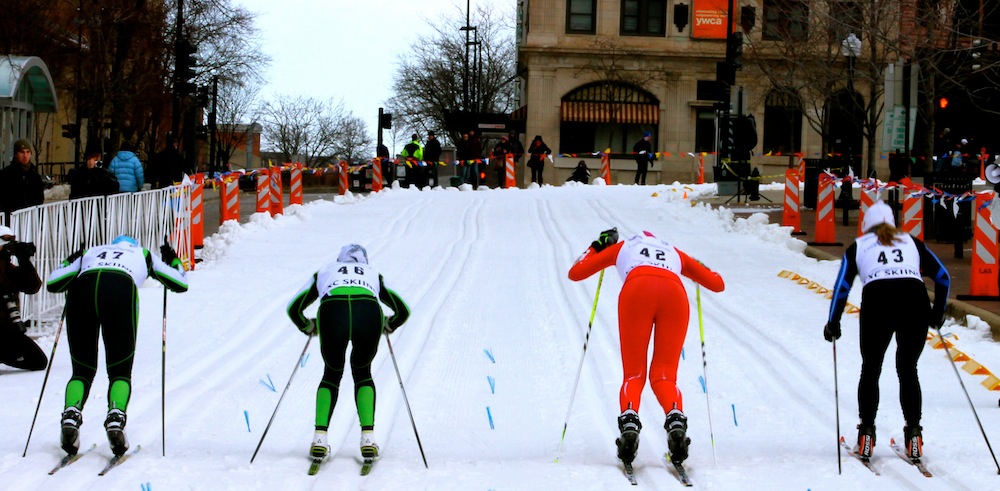
    The start of the men's A-final.

    “The second half of the course was where it was all made; it’s basically all uphill,” said Hanneman. “I focused on trying to throw it down right on the top of that big climb.”

    As Hanneman pushed the pace, Packer knew he had to go with him.

    “The key was to have something left in your legs for that last bit,” said Packer. “A lot of people were doing great at the top of the big hill and then started fading coming into the finish, so I just knew I had to go hard there to have a good shot.”

    Packer is no stranger to the top of the podium — he notched three individual collegiate carnival wins this season alone — but to do the same against the professionals at the end of a winter that included carnivals, World U23 Championships, NCAAs and Canadian Nationals?

    Hanneman leading Ellefson and Packer in the semifinals.

    “I was really happy; this is a good day for me,” said a smiling Packer.

    The sprint wasn’t just a good day for the winner. For Hanneman in second and Karl Nygren (CXC) in third, Tuesday’s results were some of their best all season, and came despite the return of the big guns from the World Cup.

    “I knew I could be [up there]; I’ve had some really good classic qualifiers and heats this year. It was just about putting four of them in a row,” said Hanneman. “It’s probably one of my better days so far this year. It’s nice to get that feeling, that positive reinforcement.”

    Nygren, like Packer, came on strong later in the day despite qualifying in a lukewarm position.

    “I felt pretty good,” said Nygren.

    Fast skis enabled him to maneuver around people on the down hills, which gave him extra speed as the course started to go back up.

    “I was able to…take it easy on the big hill and try to close at the end,” he said. “It worked out all right.”

    Nygren beating Bjornsen, Freeman and Hamilton across the line.

    He qualified in 13th, but went on to win his quarterfinal and semifinal. Nygren’s semifinal included the likes of Simi Hamilton (SVSEF/USST) and Erik Bjornsen (APU/USST), who were part of the closest finish of the entire day.

    When the field came into view of the finish, there were four men vying for three spots: Nygren, Bjornsen, Kris Freeman (SSCV/USST) and Hamilton.

    Nygren won the photo finish and Bjorsen taking the second spot. Freeman, who is more of a distance specialist, managed to get his toe in front of Hamilton’s and advance to the A-final, leaving Hamilton out.

    “I put everything I had into the semi, and getting a foot in front of Simi Hamilton is no easy feat,” said Freeman.

    If one key to the course was saving enough for the final climb, another was simply staying upright. Several big names were taken out by crashes throughout the day. Hamilton fell and broke a ski during the B-final, taking Tyler Kornfield (UAF) down with him, and crossed the line well after his competitors.

    “I was right behind Sim and it looked like his klister stuck — I don’t know, he basically went head over heals,” said Tim Reynolds (CGRP), who stayed upright but broke a pole in the tangle and also finished way off the heat leaders.

    Hamilton discussing his crash with stadium announcer Pete Davis.

    Erik Bjornsen (APU/USST) fell twice during the A-final: once in a tangle with Kris Freeman (SSCV/USST) and then immediately again due to resulting iced skis.

    “I got up pretty slowly, shaking my head, and then I realized out of the corner of my eye that there was still someone behind me,” said Bjornsen.

    That someone was Sylvan Ellefson (SSCV), who had run out of gas after posting the fastest qualifying time and blazing through the heats.

    “I lost energy today,” said Ellefson, who is still nursing a swollen ankle. “I felt good coming into the low part of he course and as soon as we started climbing, nothing was really moving as fast as it had been earlier this morning.”

    From the time the qualifiers began at 9:00 am to the end of the heats after noon, the once rock-hard snow had softened. The sun baked the final ascent that directly faced it, making the climb all the more challenging.

    Most notably absent from the results on Tuesday was USST sprinter Andy Newell, who arrived in Vermont on Monday after finishing off his European season at the Red Bull NordiX sprint in Oslo, Norway on Saturday. To recover from a sore throat contracted somewhere in between, Newell decided to sit out the races and cheer on his teammates.

    Also of note was Noah Hoffman’s (SSCV/USST) quarterfinal crash. After a promising eighth-place qualifier, Hoffman fell and dislocated the same shoulder that gave him repeated dislocation problems before his surgery last spring. He planned to have the shoulder x-rayed Tuesday afternoon to determine whether he should race on Wednesday.

    “The surgery was supposed to make sure this didn’t happen again, so I don’t know what this means,” said Hoffman.

    After a grueling day of sprinting, athletes have to rest up and recover in time for a 10:00 am start on Wednesday morning at the base of nearby Jay Peak for the 1.8 k, 1,079-foot hill climb up a blue square trail.

    Alex Matthews contributed reporting. 

    Heat results and qualifier results.

  • Nygren, Gelso Take Top Spots in Aspen Classic Races

    Nygren, Gelso Take Top Spots in Aspen Classic Races

    Karl Nygren (CXC) won the classic sprint qualifier on Saturday in Aspen.

    ASPEN, Colo. — On a bluebird morning in Colorado, the Aspen Nordic Festival kicked off on Saturday with a two-stage classic day; a sprint qualifier in the morning followed by a 10 k individual start for the men two hours later. Karl Nygren (CXC) started the weekend off by posting the fastest sprint time by 2.85 seconds, followed by Dylan McGuffin (CGRP) in second and Pat O’Brien (CGRP) in third (+3.21).

    The 1.4 k sprint course was set with firm tracks, and featured a few short, steep climbs and some descents that let skiers carry their speed. The brief uphill before the straightaway to the finish was positioned just where athletes really started to hurt.

    Twenty-four men contested the sprint, and the SuperTour regulars at the top of the results sheet were largely unused to the all-around pain of racing at altitude. Tucker McCrerey (Summit Nordic Ski Club) broke into fourth ahead of Nils Koons (Rossignol) in fifth and Tim Reynolds (CGRP) in sixth.

    For many elite skiers on the SuperTour circuit, Aspen was the first stop in a while that had any natural snow to speak of. Though the elite field was relatively thin, the sun and abundant snow had racers in a good mood.

    Even after feeling the full force of 8,000+ feet of elevation, Nygren was cheerful about the sprint.

    “That hurt a lot,” said Nygren with a laugh.

    He and teammate Jennie Bender were the only CXC athletes to make the trip to the Rockies, and rather than arrive a week beforehand to acclimate to the altitude, they decided to race before their bodies had a chance to completely protest to the thinner air.

    “You’ve just got to race into it a little bit,” said Nygren.

    With a distance race on the docket for the same day, athletes had little choice but to race into it.

    * * *

    After cooling down, elevating their feet, and warming back up, it was time to head back out for the 10 k classic. By the time the first men’s starter went off at 11:00 am, the temperature had warmed significantly.

    The men completed two 5 k loops that featured long gradual climbs and little rest. All three podium finishers were athletes who had decided, for various reasons, to skip the preliminary sprint.

    Matt Gelso (SVSEF) striding out of the start of the 10 k classic in Aspen. He won by 13.4 seconds.

    Matt Gelso (SVSEF), despite “exploding” at the top of the course and losing significant ground, rallied to beat Leif Zimmermann (BSF) by 13.4 seconds. Vegard Kjoelhamar (CU) took third (+34.7), and McCrerey (+50.6) was the first athlete across the line who had also skied the sprint two hours earlier.

    “I went out a little hard, which is something I almost never do,” said Gelso

    “I had a little explosion at the top of the course, for about a kilometer, but I brought it back together at the bottom.”

    As a CU alumnus, Gelso once competed at altitude comparable to Aspen’s every weekend. This year, Saturday marked the highest race he’d done all season. Couple the thin air with recovery from his recent head cold, and Gelso’s race made for a painful experience.

    Despite appearing to be on the way out of the running on the second lap, he managed to catch back up to the group in front of him that included Tim Reynolds (CGRP) and Kjoelhamar, and skied even with them in the final kilometers to regain the lead.

    Zimmermann, who skied a 10 k skate at the Teva Mountain Games in Vail on Friday, similarly characterized the experience as “awful,” but was nonetheless pleased with the outcome.

    “Racing at this altitude is always hard, and you kind of feel like you’re in slow motion all the time,” said Zimmermann.

    He added that he normally enjoys racing at high elevation, but “overall I just didn’t have that little snap on the hills.”

    With its gradual climbs and a track that got steadily greasier under the sun, Zimmermann said that snap was the key to having a good race on Saturday.

    Kjoelhamar, whose major focus will be NCAAs coming up in less than a month, remained in Colorado this weekend to recover from a recent illness while his CU teammates raced in Alaska.

    “I like the course here—not too steep, but long climbs,” said Kjoelhamar. “It fits me well.”

    Kjoelhamar returned to training after his illness on Tuesday, and like Zimmermann, entered the 10 k in Vail on Friday to begin racing his way back into shape.

    “[Vail] was horrible—today was quite a bit better, but there’s still a little bit before I’m in good shape.”

    Sunday’s Owl Creek Chase, a mass start 21 k freestyle, is the focal point of the Aspen Nordic Festival. The point-to-point course has Saturday’s competitors plenty wary.

    “When you’re feeling great, it’s a super fun course,” said Zimmermann.

    “But if you’re a little tired it can be painful. I think it’ll be fun; the snow’s good.”

    Unofficial sprint results

    Unofficial 10 k results

  • Liebsch Clinches Tour Title With Strong Finish in Pursuit

    Liebsch Clinches Tour Title With Strong Finish in Pursuit

    Matt Liebsch (Team Strong Heart/Team Birkie) on his way to winning the Tour de Twin Cities on Sunday. Photo: Alex Wain/Team Birkie.

    After five races over the course of nine days and never once relinquishing his lead, Matt Liebsch (Team StrongHeart/Team Birkie) took home the overall victory in the Tour de Twin Cities on Sunday after crossing the line first in the 20 k freestyle pursuit at Green Acres. Pat O’Brien (CGRP), with the help of Saturday’s bonus sprint, claimed second in the inaugural Tour. Karl Nygren (CXC) took third after a series of consistent performances.

    “I’ve had this [Tour] on my radar for a while because it’s in my hometown,” said Liebsch on Sunday. “I was really happy [to win].”

    Though he was first across the line, Liebsch’s was the second-fastest elapsed time of the day to Brenton Knight’s (APU), who climbed his way from the 10th starting position at 36 seconds back to end in second in the pursuit with an elapsed time of 49:46.1.

    Starters left the gate at intervals based on Saturday’s classic race; Liebsch trailed Dylan McGuffin a second, and a handful of other top skiers worked their way into the mix to make the race play out like a mass-start.

    McGuffin took off from the line and took a lap for Liebsch to reign in.

    “I wasn’t feeling super peppy after the mosh-pit crash from yesterday,” said Liebsch. “I wanted to take it easy, since I knew I didn’t need a lot of points. I just wanted to do what I needed to secure the overall.”

    With two wins and a second, Liebsch entered Sunday’s race with a considerable lead in the Tour standings, which were based off of SuperTour points.

    On lap two, the paced had slowed, and the lead pack gres to a group of about ten skiers, with more athletes gaining.

    “One of our coaches said we were going at a pedestrian pace on the third lap—I don’t know, it felt good to me!” said Liebsch.

    At the prompting of his coach on the sidelines, Liebsch said he began to turn up the heat on the fourth lap.

    “I hit the gas pretty hard, and I think those other guys who’d worked hard to catch back up hadn’t quite recovered, and they popped away off the back,” he said.

    Bryan Cook (CGRP), who was the third athlete over the line on Sunday, hung onto the quickened pace for a brief period.

    “Matt made a big move with around three and a half laps to go and I was the only one to stay with him,” Cook wrote in an email. “We skied together for about a lap and a half before I just couldn’t keep up with his pace.”

    Knight, a late starter, took advantage of being in the chase position and managed to make gains on the leaders as others began to fade. By the end of the second lap he had caught the back of the front pack.

    “Unfortunately that wasn’t a whole lot of rest time—that’s when Bryan Cook and Matt Liebsch took off,” said Knight.

    Knight felt like he still had enough gas in the tank to go with them, and moved around a few more people until he passed Cook to get in second, where he stayed for the remainder of the race.

    After crossing the line, Knight didn’t immediately know that he’d posted the fastest elapsed time of the day.

    “I didn’t even see [Liebsch] on the last long climb—I was like, ‘Okay well, I’ll go for the second-fastest time,’” Knight recalled. “Then [after the finish] Matt said he saw me coming down the hill.”

    The men's 20 k pursuit podium: 1. Liebsch 2. Knight 3. Cook. Photo: Bruce Wain/Team Birkie.

    With the extra five points for skiing the fastest 20 k, Knight ended fourth in the overall Tour, which came with an $800 payout.

    “I wouldn’t have been winning any money unless I won, basically. It’s what you’re shooting or, but I was more shooting for doing what I could do,” said Knight.

    The top-heavy points system, coupled with the intermediate preem on Saturday, put O’Brien in position for second in the Tour overall despite being sick over the weekend and finishing eighth in the 20 k. His second-place in the sprint prologue on Wednesday was his top result of the week.

    “It’s definitely different with points rather than time [-based scoring],” said O’Brien. “Whether you win by a minute or a second, it doesn’t matter, if you’re getting the same points for it. A timed tour values consistency more; if you’re way off in one race, you could be totally out of it.”

    With two back-to-back wins out of the gate last weekend, Liebsch set himself up well for the Tour title, but he knew he had to stay consistently near the top to come away with it.

    “It was kind of stressful trying to be on for an entire nine day period, and looking at points, saying, ‘Oh, I need to do this good, keep racing this fast,’” Liebsch said. “You don’t want your body to have an off day.”

    “I can’t imagine doing the Tour de Ski, that’s got to be crazy.”

    Tour de Twin Cities final standings

    20 k pursuit elapsed time results (from which points were awarded)

    Overall pursuit results

    The men's Tour podium: 1. Liebsch 2. O'Brien 3. Nygren. Photo: Bruce Wain/Team Birkie.
  • McGuffin Climbs Back From Early Fall to Take 10 k Classic at Green Acres


    Dylan McGuffin (CGRP) during the mass start classic at U.S. Nationals. He collected his first win on Saturday at Green Acres. Photo: Flying Point Road.

    At the beginning of every mass start classic race, there are several points when the number of available lanes diminishes, and racers must scramble to find a new spot in the tracks. Starting lines 10-plus lanes wide must funnel down to two in a matter of a few hundred meters. Sometimes, a field of 100 athletes can make it through each transition with minimal collision. The men’s SuperTour 10 k classic in Lake Elmo, Minn. on Saturday was not one of those races.

    Between 20 and 30 athletes went down in a pile-up within the first 100 meters, including eventual winner Dylan McGuffin (Craftsbury Green Racing Project) and runner-up Matt Liebsch (Team Strong Heart/Team Birkie). Karl Nygren (Central Cross Country), who ended in third, managed to escape the carnage and led the race for the first few kilometers.

    “Luckily I didn’t break anything, it just took me 3 k to catch back up,” said McGuffin said on Saturday afternoon.

    Though it happened too fast for him to know exactly how the pile-up began, Liebsch recalled somehow getting tripped up when he and the skier next to him moved to take the same lane at the first point that tracks disappeared.

    McGuffin escaped with his equipment intact, but at its epicenter, Liebsch took the full force of the ensuing pile-up.

    “I got hit from behind by about 30 kids,” said Liebsch. “I used my body as a shield, so when I finally felt confident I was in the clear, I put my pole down and someone shot their ski into it.”

    Matt Liebsch at U.S. Nationals. Photo: Flying Point Road.

    After finding a replacement pole, Liebsch began working his way back from the back of the pack. He was so far behind, he “treated it as an interval start at that point.”

    The tangle put all skiers who went down at a disadvantage, but McGuffin said he remained fairly confident he could weave his way back to the front.

    “After I’d started skiing a little bit, I knew I’d catch back up. The race went out fairly slow, and I just made sure I didn’t panic; didn’t get too excited,” he said.

    The pace may have started slow, but the bonus sprint 4.5 k into the race ensured that it would soon pick up. With additional Tour points on the line (15, 10 and 5 for first, second and third), Nygren said the pace got going heading into the climb to the bonus checkpoint.

    “It spiced things up—going for the [sprint] made it no man’s land,” said Nygren.

    Pat O’Brien (CGRP) took the 15-point bonus and Nygren took the extra 10. After the second lap, the pace cooled down as the leaders recovered from the intermediate surge, which may have been just what McGuffin and Liebsch needed to reel the race back in.

    “I caught the main pack just as people broke off the front to go for [the sprint],” said McGuffin.

    With a big gap between the top three and the rest of the field after the bonus, McGuffin passed the checkpoint in fourth, in the lead of the chase group.

    “I just went with it—I pushed off the front, and then caught and passed the three guys that had initially broken off,” he said.

    Back in contention, McGuffin said he essentially led the race for the final two laps.

    “It was kind of an interesting course, I don’t think I’ve ever done one quite like it—pretty punchy, short hills, and then the rest was just double poling,” said McGuffin. “So it was basically herring bone or double poling the whole time.”

    With 500 m to go, Liebsch finally climbed his way back to the front of the race on the last uphill into the finish. As the group crested the top, Liebsch decided to go for it and took the lead.

    McGuffin, left, lunging for the win. Photo: PT Timing.

    McGuffin didn’t let him get too far in front, however, and closed back the gap on the following downhill into the stadium. In a lunge for the line, he edged Liebsch by a tenth of a second.

    “I’m pretty psyched,” said McGuffin of his first win of the season. “It was sort of unexpected, so it felt good.”

    Liebsch, who had hoped for a top-20 in the immediate aftermath of his crash, was upbeat in light of the photo-finish.

    “I hoped there was enough in the tank—they said it was a tenth of a second, but it was more like two inches,” he said. “I made the mistake of looking over—you’re supposed to race to ten feet beyond the finish line!”

    The mass start classic race was the fourth event of the five-race Tour. Racing resumes again on Sunday with a freestyle pursuit based on skiers’ times from Saturday. The overall points leader after five races—not the best time composite, as in the Tour de Ski—takes the Tour win and a $3,000 purse.

    Note: This article has been updated.

    Men’s 10 k results.

    McGuffin poses on the podium, though no official ceremony on day one of the two-day pursuit. Photo: CGRP.
  • On Home Course, Liebsch Wins Stage 1 of Tour de Twin Cities

    On Home Course, Liebsch Wins Stage 1 of Tour de Twin Cities

    The men's podium on day one of the Tour de Twin Cities. 1. Matt Liebsch 2. Sylvan Ellefson 3. Karl Nygren. Photo: Brian Gregg.

    SuperTour racing resumed on Saturday at Wirth Park in Minneapolis, Minn. with a 10 k individual classic—the first of five events in the inaugural Tour de Twin Cities. Skiing in front of friends and family on his home course, Matt Liebsch (Team Strong Heart/Team Birkie) took his first win of the season by 0.4 seconds ahead of Sylvan Ellefson (SSCV/Team HomeGrown). Karl Nygren (CXC) finished third (+3.5).

    This was Liebsch’s first effort above threshold since his last race at U.S. Nationals two weeks ago. He had been barely recovered from a cold in Rumford, and racing sick put him in a hole leading up to Saturday’s 10 k.

    “I was curious how it would turn out, but I just willed myself into going fast today since it’s a home course,” said Liebsch. “I had tons of family and friends out there yelling for me the whole time.

    “I felt like my head was going to explode the last lap.”

    The course was three laps around a manmade loop in Wirth Park. A fresh dusting of natural snow made the park look more like winter, but created tricky waxing conditions.

    As for the course itself, Ellefson thought it skied well despite being a shorter loop than originally planned due to the lack of snow.

    Though a four-tenths loss to Liebsch has him contemplating bigger boots for a slightly longer lunge, “The fastest man still won,” said Ellefson.

    The effort took it out of him—“I puked for the first time this season during the race,” he continued. The current overall SuperTour leader, Ellefson won’t complete the Tour, as he joins the U.S. Ski Team in Europe on Thursday to prepare for the Moscow, Russia World Cup.

    Liebsch is looking forward to the rest of the Tour, which includes a 10/15 k freestyle on Sunday, a skate sprint prologue on Wednesday, and another set of distance races next weekend in St. Paul; a mass start skate and a long pursuit.

    “I think it’s a fun idea,” said Liebsch of the format. “It’s fun to do the tour-type [racing] that’s going on in Europe; that’s part of it, I think.”

    Brian Gregg (CXC) finished in fourth behind Nygren (+10.7), and Matt Gelso (SVSEF) was fifth.

    Men’s 10 k results.

  • Koos Claims Third-Straight National Sprint Title

    Koos Claims Third-Straight National Sprint Title

    The Men's A Final enters the stadium. Photo: James Doucett.

    RUMFORD, Maine — Torin Koos (Bridger Ski Foundation/Rossignol) made it three straight U.S. National sprint titles Tuesday at Black Mountain, using his veteran racing experience to navigate a fast, tactical day. In a tightly packed A-final, Bend Endurance Academy’s Dakota Blackhorse-von Jess was close behind in second, and in a fight for bronze that was close enough to protest, Tyler Kornfield (University of Alaska Fairbanks) completed the men’s podium in third mere millimeters ahead of Sylvan Ellefson (SSCV/Team Homegrown).

    “I felt really good — I’ve won here before, so that probably gives [me] confidence,” Koos said. “It’s all about you and your lane. You don’t think about that other stuff going on in the other four or five lanes around you.”

    The men’s racing began at 10 a.m., where Blackhorse-von Jess posted the fastest qualifying time and set himself up nicely for the rounds. Mike Sinnott (Sun Valley Ski Education Foundation) and Ellefson were both less than a second behind in 2nd and 3rd, respectively.

    Smart tactics, fast skis and a knack for avoiding crashes were the trick making it through the subsequent rounds. The trails at Black Mountain were hard-packed and slick, which favored athletes that could confidently balance on their skis. With the help of cold temperatures overnight and all of Tuesday, the crew at Black Mountain was able to repair the parts of the course made thin Sunday night’s rain. Meanwhile, the wind made positioning and drafting of the utmost importance for all but the gutsiest racer.

    The first men's semifinal entering the stadium. Reese Hanneman (APU) leads Tyler Kornfield (UAF) and Patrick O'Brien (GRP). Photo: James Doucett.

    Ten athletes — the top two finishers in each quarterfinal — automatically advanced to the semi-finals, along with lucky losers Ellefson and Dave Norris (Alaska Winter Stars), who had the fastest qualifying times of the all the 3rd-place quarterfinal finishers.

    The semifinals were hard fought. Tim Reynolds (Craftsbury Green Racing Project) entered the final few hundred meters of the first heat with a substantial gap over the rest of the field but lost his balance, ending his run for the podium. Reynolds chose not to start in the B-final, perhaps saving energy for the back-to-back races to be held later in the week.

    In the B-final, Patrick O’Brien (CGRP) showed that he still had plenty left in the tank. He skied well, outpacing the rest of the field, which consisted of Norris, Reese Hanneman (APU), Sinnott, and Ryan Scott (Montana State University). O’Brien ended the day seventh overall, adding another U.S. Cross Country Championship top 10 to his name.

    When it came time for the A-final, Koos proved he had a tactical expertise that only comes with race experience. The former U.S. Ski Team member made a risky move in deciding to lead for the majority of the race. In interviews afterwards, his competition said their early strategy was to let others — whoever makes the early move — do the work, and hope to slingshot out of his draft coming into the stadium.

    “I think everyone was kind of trying to figure out what everyone else was going to do,” Blackhorse-von Jess said about the final. “Everyone was going ‘let’s go, let’s go,” the whole race, and the first climb [Koos] was just skiing easy.”

    When Blackhorse-von Jess found himself still on Koos’ tail as the pack moved down the final hill, he thought he could end up winning. But it was not to be.

    “He’s a crafty old veteran, man,” he said afterwards. “Dude pinched me out … as soon as we stood up he just started sprinting to the finish. You could feel everybody coming.”

    The second men's semifinal enters the stadium, Torin Koos (BSF) leads Lars Flora (APU), David Norris (Alaska Winter Stars) and Karl Nygren (CXC). Photo: James Doucett.

    At that point, he said he knew he was fighting for second.

    Koos explained his ability to win from the front of the pack as a confluence of his experience and everything coming together at the right time.

    “It was a race more from the front in the final,” he said. “But I thought I had enough energy for that. I had rocket skis today too. When you have that it allows you to do a bit more.”

    Behind the top two men, the fight for bronze between Kornfield and Ellefson was too close to call with the naked eye, but upon film review, Kornfield was deemed the third-place finisher.

    Kornfield skied each of his heats conservatively, and in the final, came from fifth off the last downhill to swing into third in the last 50 meters.

    “I got a little lucky I think, but it was a good heat,” he said before he learned his unofficial third place withheld the protest. “I’m pretty excited with fourth or third — whatever I got.”

    Ellefson, who is less of a sprint specialist than his A-final competitiors, was right in the mix as the pack moved through the first part of the course. He felt he had a good position in the middle of the group as he passed under the bridge, but ended up having to swing wide into the icy and little-used far left lane, where it was more difficult to see the other racers.

    “I’m not sure what happened in the finish,” Ellefson said, “But I’m pretty excited on the day.”

    Veteran Lara Flora (APU) and CXC skier Karl Nygren rounded out the heat finishing fifth and sixth, respectively.

    Flora said he’s definitely more focused on the distance races this week, but felt good about his result.

    “It was really sprinting tactics out there,” he explained. “There were four true sprinters, and Sylvan and I were kind of the distance skiers in there, so there was a lot of yo-yoing.”

    Alex Matthews and Sam Evans-Brown contributed reporting.

    Men’s Heats

    Men’s Qualifier Results

  • Sandau Chases, Wins for First Time

    Kevin Sandau chases the field in the Haywood NorAm 15 k classic individual start on Sunday at Sovereign Lake in Vernon, British Columbia. (Photo by Jesse Winter/JesseWinterPhotography)

    VERNON, British Columbia — After five years on the NorAm Cup circuit, all Kevin Sandau needed was a little verification. Seeded first and the last to start in the men’s 15 k classic individual start on Sunday at Sovereign Lake, that meant something.

    The 23-year-old, who recently returned from several weeks of racing in World Cup and FIS races, had never started last in a Continental Cup race before. He had also never won one.

    “It was a pretty exciting way to start a race,” Sandau said after winning the first NorAm distance race on the schedule. “You just have to worry about the guys in front and no one’s going to be behind trying to catch you. It’s a pretty cool feeling.”

    With the simple task of looking ahead, the Alberta World Cup Academy (AWCA) skier kept his mind sharp with World Cup imagery. As he attacked the hilly course, which started on an incline and rose about 50 meters (164 feet) for the first 1 ½ kilometers, he thought about how the world’s best racers skied.

    “They look smooth and in control. They don’t freak out and run up hills,” Sandau said. “So it’s interesting to watch them race and notice what they do tactically.”

    He concentrated on skiing smooth and saving energy. That way, when he needed it most in the second and third loops, he was able to ski comfortably.

    The tactic worked as he closed in on Brent McMurtry (CNEPH), who finished second, 19.2 seconds off Sandau’s winning time of 41:32.8.

    “It’s nice to get back to Canada and get on the podium,” Sandau said, after flying back from Europe two weeks ago.

    McMurtry made the podium again on the second day of the NorAm opening weekend, after being the runner-up in the classic sprints.

    While he had hoped for a victory, McMurtry said he was “reasonably happy” considering he felt strange warming up. He guessed his lightheadedness stemmed from too much coffee, but he felt fine by race time.

    “I feel good these days, and I’m recovering well,” he said. “Looking forward to hopefully getting a win next weekend.”

    Karl Nygren (CXC) made a good weekend even better, placing third on Sunday. He notched a career-best fifth in Saturday’s sprint.

    While hilly courses weren’t usually his specialty, Nygren said he was happy to stay smooth and keep it together. Some changes to his summer training, such as more intervals, likely helped, he said.

    “It’s a really good way to start the season off,” he said. “I’m racing progressively better, so that’s nice.”

    Nygren and some of his Central Cross Country teammates next travel to Rossland, British Columbia, for the second set of NorAm races on Dec. 17-18.

    Just outside the podium on Sunday, Matt Gelso (SVSEF) placed fourth for the fifth time in the last six races. He was fourth in every distance race — by a combined nine seconds out of third — and fifth in a sprint.

    On one hand, Gelso was pleased with his consistency, but on the other, he wanted to get in the top three.

    “What goes around comes around so at some point I know I’ll be on the plus side of those two-second gaps,” Gelso said. “It’s still fairly early in the season, but I can definitely go up, which is a good feeling.”

    Leif Zimmerman (Bridger SF) followed Gelso in fifth. He said the longer distance played to his strength — or weakness — of taking a little while to get going in a race.

    “I don’t necessarily try to do that, but it’s just kind of the way my body works,”  Zimmerman said.  “So as long as I don’t lose too much in the first lap, then the second and third usually feel really good in a race like this.”

    A strong third lap gave him the edge over competitors like Brian Gregg (CXC), who finished seventh. Sylvan Ellefson (Team Homegrown) was sixth.

    “I started right behind Leif,” Gregg said. “He finished super strong. I was maybe 10 seconds down to him, catching him, and then he just took off that last lap. That last lap was hard.”

    Despite the course’s challenges, rising as high as 1,700 meters (5,577 feet), Gregg appreciated the terrain.

    “I think a lot of the other courses we’ve skied this year have been pretty flat,” he said. “It’s nice to ski a course that’s really hard and sort of tests your engine as well. I felt really good today.”

    Frederic Touchette (CNEPH) was eighth in his first December races in two years after injury caused him to miss the beginning of last season.

    “The start of the season is a bit hard,” Touchette said. “I need to get in a rhythm for some races, but it should be better in January or February.”

    Reese Hanneman pulled off his second top-10 performance of the weekend, placing ninth in the 15 k.  Like Saturday’s sprint, where he was seventh, he focused on transitions.

    “The hills were so big, there’s so much continuous striding, I just wanted to try to save my legs a little bit,” Hanneman said. “I just wanted to get top 10. I thought it would be pretty reasonable and it would be still by far my best result here.”

    Hanneman had not previously cracked the top 40 in a NorAm distance race. David Greer (CNEPH) was 10th.

    Complete 15 k results.

    Men’s photo gallery.

  • Toko: Eastern Snow in West Yellowstone

    Toko: Eastern Snow in West Yellowstone

    Karl Nygren Contesting the Skate Sprint

    I (Ian Harvey) have had some nasty injuries for 3 years now as a result of having taken some medication that didn’t agree with my tendons.  I have 5 chronically strained/torned tendons in my body which keeps me from testing skis (no skiing, hiking, swimming, running, strength work, etc).  This sure is frustrating especially after 3 years of patience, but life goes on.  So, I have Toko Tech Teamers testing for me as well as some teams giving me information that I can compare with our findings.  Yesterday while it was snowing the snow was acting predictably “cold” despite the warm temperatures.  Then after it stopped snowing, it got very wet and the warmer waxes were far better.  I had to make a recommendation although the weather was in question.  (The wax was the easy part if you knew the weather or conditions).  We went with HF Red with JS Red or Yellow as a top coat and for kick Red was working all day yesterday, so we were thinking it would be in there today.  I slept very uneasily as this is a crazy recommendation for West Yellowstone and especially when the forecast was for the skies to clear out (and stay warm).  During the night, temperatures stayed very warm (28f) which kept the snow very moist.  Then around 5:30 this morning it cleared up and dropped to 22f.  The surface of the snow dried out a lot, but there was still moisture underneath that affected the wax.  This is something that rarely happens out west in Dec, Jan, or Feb even.  (Basically the snow was acting like it was out east).  I was happy to learn from both a team and one of our testers that HF Red and JS Red was gliding best and that it looked like that by race time Nordic Red was going to be the kick wax of the day.  As the day progressed, the snow didn’t glaze as much as I would have thought, but it still “waxed” wet. Before the skate race, our tester said that he would then recommend JS Yellow instead of JS Red.  It is a very rare occurrence that you’d be using such warm waxes, but still stay with pretty fine structures as the snow was really not wet at all on the surface. I can also say that a few teams went with colder glide waxes (HF Blue and HF Red mix) and were very happy with their skis. Congratulations to Jessie Diggins, Jennie Bender, Torin Koos, Caitlin Gregg, and Kate Fitzgerald on their podium finishes (and to all of the athletes). Check out the rest of the images of Toko athletes at the TokoUS.com.

  • CXC Gears up for 2011

    Big changes to the team roster and the coaching staff are this spring’s news for the Central Cross-Country Ski Association (CXC). 18 athletes and three coaches will comprise the 2011 team for one of North America’s largest and fastest-growing clubs.

    Vacating the post of head coach that he held since the formation of CXC in 2006, Bryan Fish has accepted a position with the US Ski Team (USST) as Continental Cup coach. Jason Cork will be stepping in to fill this void, bringing his experience with Durango Nordic Ski Club, Michigan Tech University, and recent J1 and World Junior Championships coaching staffs to the job. Gus Kaeding, a former CXC athlete, will be stepping up as the team’s elite development coach this season.

    Under Bryan Fish, CXC sent its first athlete to the Olympics in Garrott Kuzzy

    Olympian and CXC athlete Garrott Kuzzy is optimistic about the changes in coaching staff, saying “I see the changes as positive, all the way around; we’ve now got three great coaches, four if you include Igor Badamshin, instead of just one.”

    Turnover among athletes is similarly high. A notable loss to the team comes with the departure of Rebecca Dussault, who along with her husband has taken an internship position at an organic farm in Colorado for the year and is pregnant with her third child, due January 19. Also leaving the team are decorated skiers Kristina Owen, Kelly Chaudoin and Audrey Weber.

    The men’s team will be headed by Kuzzy, who will continue to work with CXC after a parallel stint with the USST. Notable newcomers include Santiago Octariz, who represented University of Wisconsin-Green Bay last year as the lone NCAA All-American from the central region, and Tad Elliott, a National Champion and U23 World Championships team member. (Elliott raced for CXC’s marathon squad last year; this year he will be a full member.)

    Filling out the remaining spots on the men’s team are Brian Gregg, Karl Nygren, Eric Wolcott, Matt Liebsch, Bryan Cook, Andre Watt, Ben Lannin, and Doug DeBold.

    Caitlin Compton and Bryan Cook do a strength workout Photo: CXC

    There is an Olympian among the CXC women as well, as Minneapolis resident Caitlin Compton joins the roster. Other new additions are former University of Vermont standout Jennie Bender and Canadian Brooke Gosling. Maria Stuber, who had six top-5 SuperTour results in 2010, returns for another year with the squad, as will JoJo Winters and Melissa Schwartz. Jessie Diggins will be joining the squad full-time this year following her high school graduation.

    The roster is an impressive hybridization of veteran and newcomer. “It’s going to be an ideal mix of skiers. I can’t wait to start working with our ‘new additions’—some of the strongest skiers on the circuit,” says Kuzzy, “The vets will have more to learn from them than they will from us!”

    The CXC association has enjoyed rapid growth and huge success since it was founded only four short years ago. The program now encompasses not only the elite Vertical Limit team but juniors, masters, and educational opportunities.

    The team’s schedule is structured such that athletes participate in a ten- to fourteen-day camp every few weeks and train at home over the weeks between camps. CXC is currently in the midst of their first summer training camp of the season, located in the Saint Croix Valley of Minnesota.

  • General Strength

    General Strength

    Karl Nygren is a member of  CXC Team Vertical Limit.  His equipment sponsors are: Salomon skis/boots/bindings, Toko Wax, Polar Heart Rate Monitor, Swix Poles, Rudy Project Eyewear/Helmet, Marwe Rollerskis, Finn Sisu Stonegrinding  You can find out more about CXC Team Vertical Limit and CXC at www.cxcskiing.org.  You can follow CXC Team Vertical Limit on their blog at blogs.fasterskier.com/cxcelite.

    Skiing demands an interesting balance of cardiovascular fitness and strength.  Extremely lean runners, although fast on the track, often cannot keep pace on skies and weight lifter, although strong as a bull, get punished in the double pole.  Light yet strong muscles are therefore the answers and skiers tend to cut but not large.  It is debatable but often skiing alone is not sufficient to develop the strength required to race to one’s potential.  As a result, general strength is a weekly aspect of CXC Team Vertical Limit’s training.

    In general our team training is structured progressively.  This means general strength training builds on itself throughout the year and is race orientated.  The year is divided into strength blocks each with a slightly different focus so come race season strength is not a limiting factor.

    Yearly Progression Overview

    Technique Preparation– High rep, low weight with emphasis on proper technique

    Base Max Power– Increased weight and fewer reps.

    Power Velocity– Lower weight increased velocity of motions

    Max Power- A little more weight but keeping movement quick.

    Ski Specific Power Velocity (strength block just before races start)

    Maintenance Strength (during heavy racing/ important races)

    Max Power then Power Velocity (prior to final important races)

    Maintenance Strength (during heavy racing/ important races)

    Training is also periodic on a day-to-day and week-to-week basis so that hard efforts are followed by recovery.  General strength is taxing and in order to keep hard days hard and easy days easy we include strength on hard days.  With this being said general strength is never given priority.   Typically Tuesday and Thursday are intervals in the morning followed by general strength in the afternoon.   Intervals come first, optimizing their quality. Strength is important but fitness is far more crucial.  Strength therefore plays a supplemental role in our training.

    situps...
    situps…

    Strength and Coordination training are one and the same.  The ability to properly use muscles contributes drastically to your strength.  The first improvements from a strength regiment are the result of better coordination and concerted application of force.  Agility ladder and hurdles play a fundamental part of our team strength training. Steve Myrland, a highly experienced strength coach and inventor of the agility ladder helped us extensively at our September training camp.  Ladder drills provide are a great warm-up because they teach quickness, balance, and coordination. Fundamental jumping, hopping, and bounding mechanics are the basis for complicated movements and therefore very important.  The arms for example needed to be helping the legs and movements need to be one concerted motion.  A great warm-up, therefore, might include a series of ladder drills, two legged hurdle jumps, one legged hurdle hops, broad jumps, and lateral skate bounds.  This engages far more muscles then a simple jog and develops coordination and agility.  Task oriented drills are also great.   Letting athletes discover how to use their body is often a better way to learn then simply being told.

    Hypertrophy or the enlarging of muscles is generally something skiers try to avoid.  Light strong muscles are ideal because muscles require oxygen.  When effort is maximal lactic acid begins to accumulate as the oxygen supplied to muscles becomes insufficient. When completely tanked muscles super compensate and become larger to better handle future stress.  This usually occurs with high weight, medium rep when muscles are maximally fatigued.  To avoid hypertrophy do not continually lift to failure. Simply choose appropriate weight.

    Gus Kaeding ripping out some pushups
    Gus Kaeding ripping out some pushups

    It is often hard to lift smart.  The pressure always exists to put on more weight or try stupid lifts.  During an over distance roller ski a while back someone joked that real men can bench their body weight.  Of course this lead to a pointless competition where we all gave it a try.  Situations like this, although refreshing and entertaining, should be kept to a minimum and not become routine.  The goal is to develop strength that helps you ski faster.  For guys, this usually means avoiding what your buddy is doing to work on his beach body.  As much as general strength training can help your skiing it can also hurt it.  It is important that once a foundation is developed velocity and power also come into play as referred to in the yearly progression.  Both velocity and power are functions of time and therefore grunting and groaning to slowly lift too much weight is counterproductive.  Race results are not determined by how much you lift but the proper strength that is developed. This often means swallowing your pride and using less weight then other people in the weight room.  Lifting too much weight especially during race season will doubtlessly slow you down.

    General Strength Pointers

    -General strength twice a week

    -Develop two general strength routines for each strength block and spread them out in the week.

    -Begin with a good plyometric, ladder, hurdle based warm up.

    -Be mindful to incorporate ski appropriate lifts with the appropriate weight.

    -Keep sessions to around an hour while still allowing for sufficient rest between sets and exercises.

    -Technique and speed, when appropriate, have priority over weight.

    -Progression throughout the years is important.

    -Doing the same lifts with the same weight the entire year accomplishes little.

    -Incorporate a good core body routine

    -Visit www.cxcacademy.com to watch strength progressions

    Karl Nygren
    Karl Nygren