Tag: Karoline Simpson-Larsen

  • One Final Climb: Diggins Victorious in Tour de Ski

    One Final Climb: Diggins Victorious in Tour de Ski

    This coverage is made possible through the generous support of Marty and Kathy Hall and A Hall Mark of Excellence Award. To learn more about A Hall Mark of Excellence Award, or to learn how you can support FasterSkier’s coverage, please contact info@fasterskier.com.

    Jessie Diggins (USA) claimed her third Tour de Ski overall victory in Val di Fiemme (ITA). (Photo: Vanzetta/NordicFocus)

    The Tour de Ski does not end so much as it compresses. By the time the women turned onto the ribbon of snow climbing Alpe Cermis, the race had already been going on for a week—measured not only in kilometers and seconds, but in fatigue accumulated quietly overnight, in sore muscles, achy backs, and in confidence gained or lost one race at a time.

    The final climb has a way of making those invisible things visible. It is steep enough to strip racing of pretense, long enough to punish impatience, and familiar enough that every skier arrives with memories—good ones, bad ones, and some they would rather forget. On Sunday afternoon in Val di Fiemme, the climb again became what it always is: less a finish line than a reckoning.

    For Jessie Diggins, that reckoning ended in confirmation. Diggins finished second on the stage, protecting her margin with experience and restraint, and secured her third career Tour de Ski overall title. It was not the loudest way to win. It was, however, the truest.

    Jessie Diggins (USA) paced the final climb perfectly to finish second on the day. (Photo: Modica/NordicFocus)

    A Climb That Decides Everything

    Stage 6 of the women’s Tour de Ski—10.0 kilometers, mass start, freestyle—began with the tension that always precedes Alpe Cermis. Some skiers arrived still dreaming of a stage victory. Others were guarding seconds earned days earlier. Still others were simply hoping to make it to the top without the climb turning overly cruel.

    The early kilometers unfolded with relative calm. The pace was honest but controlled, the group compact as it flowed through the lower valley before turning uphill. On Alpe Cermis, there is no hiding, but there is strategy: when to let others go, when to follow, and—most importantly—when not to.

    The decisive moves came as the gradient steepened and the field stretched into a long, thin line. Norway’s Karoline Simpson-Larsen skied with precision and patience, gradually asserting herself as the strongest on the day. She crested the final meters alone to win the stage in 37:05.3, earning the biggest single-day victory of her World Cup career.

    Behind her, the race unfolded with quieter drama. Diggins, who entered the day with a commanding overall lead, skied with calculation. She resisted the temptation to respond immediately when others surged, choosing instead to manage the climb in segments. When the grade lessened and the gap narrowed late, she allowed herself to push hard enough to secure second place, but not so hard as to invite disaster.

    Diggins crossed the line 8.8 seconds behind Simpson-Larsen, followed by Norway’s Heidi Weng in third at +14.4. The stage podium reflected the day’s effort, but it was Diggins’ second place that carried the most weight.

    Jessie Diggins (USA), as always, left everything out on the course. (Photo: Modica/NordicFocus)

    “Dying at the Right Moment”

    Diggins’ approach to Alpe Cermis was shaped by experience—and memory.

    “I was trying to be smart and safe in terms of the overall Tour,” she said afterward. “And then when I realized we were close enough, I thought, okay, now I can empty the tank. But I’ve paced it badly before where I blow up, and that last 600 meters is the slowest of your life.”

    It is a detail only veterans tend to mention: not the steepest pitch, but the final few hundred meters, when legs that have already been pushed too far simply refuse to respond. Diggins has lived that mistake. On Sunday, she avoided it.

    “I was trying to ski it smart and make sure I was dying at the right moment,” she said.

    That restraint—so often invisible to spectators—was the difference between managing the Tour and risking it. The margin Diggins had built over five stages gave her room to think clearly. The climb rewarded that clarity.

    Julia Kern (USA) and Jessie Diggins (USA) celebrate with US Cross-Country Ski Team coaches and staff, as well as US Alpine Ski Team athletes who came to support them at the end of the 2025/26 Tour de Ski. (Photo: Vanzetta/NordicFocus)

    The Meaning of a Tour

    In the mixed zone at the top, Diggins spoke not with relief so much as appreciation—for the work, the people, and the endurance the Tour demands.

    “The Tour de Ski is one of the hardest things to win,” she said. “When you win the Olympics, it’s amazing—it’s really special. But that’s one race. The Tour is day after day after day. You have to put it together back-to-back, under cumulative pressure. That’s really hard. It’s hard on you, and it’s hard on the team.”

    Her emphasis, repeatedly, returned to the collective effort. She spoke of team energy, of support staff, of consistency rather than dominance. It was a reminder that Tour victories are not seized in moments, but constructed patiently across an entire week.

    Diggins finished the Tour with a total time of 2:11:26.1, winning the overall by more than two minutes over Austria’s Teresa Stadlober. It was not a victory defined by a single attack or a single stage, but by accumulation—time gained when others faltered, mistakes avoided when margins were thin.

    Julia Kern (USA) makes her way up Alpe Cermis to finish 14th on the day. (Photo: Vanzetta/NordicFocus)

    Kern’s Quiet Confirmation

    For Julia Kern, Alpe Cermis offered something different: clarity.

    Kern finished 14th on the stage, 2:01.0 back, after a Tour that reflected both progress and unfinished business. She described the climb as meeting—or exceeding—her expectations.

    “Every year it’s a little different with who’s still left in the Tour,” Kern said. “But I’m taking away from today that my fitness is there. I just need to fine-tune some of the sprinting gears. That’s very trainable at this point in the season.”

    Her assessment mirrored her results. Kern was consistently strong in the distance races throughout the Tour, finding rhythm and confidence as the days passed. The sprint stages, by contrast, left her frustrated.

    “I was a bit bummed with my sprint days for sure, and hungry for more,” she said. “But at the same time, I had consistently good, strong distance races. Halfway through the Tour, I started to find my race legs again.”

    It is a pattern Kern recognizes—slow starts, gradual momentum, strength revealed in longer efforts. In an Olympic season, that trajectory matters more than any single result.

    Maja Dahlqvist (SWE) attacked at the end of the valley trail leading to the Alpe Cermis in Val di Fiemme (ITA) to secure her silver sprinters’ bib. (Photo: Vanzetta/NordicFocus)

    The Bib Battles

    Beyond the overall, the final climb also settled two secondary competitions that added layers of tension to the Tour’s closing act.

    The climber’s bib—awarded for cumulative performance on the Tour’s toughest ascents—went to Teresa Stadlober, who accumulated 45 points across the week. Diggins finished second in the standings with 39, underscoring how consistently she handled the steepest terrain without ever needing to gamble on a single climb.

    The sprint standings, marked by the silver bib, remained unsettled until the final stage, where one final set of bonus points was awarded at the beginning of Alpe Cermis. Sweden’s Maja Dahlqvist emerged with the title at 53 points, ahead of Switzerland’s Nadine Fähndrich and Sweden’s Johanna Hagström. Diggins finished fourth in the sprint competition—another reflection of her Tour: competitive everywhere, decisive where it mattered most.

    Teresa Stadlober (AUT) fought hard to defend her climbers’ bib. (Photo: Vanzetta/NordicFocus)

    Pain, Reconsidered

    Late in the mixed zone, Diggins reflected on something more personal—how different this climb felt compared to recent years.

    “The last two years I’ve been so injured that I was in so much pain outside of racing,” she said. “So for it to be only painful during the race was like, wow—that’s kind of nice.”

    It was not a dramatic declaration, but it carried weight. The Tour de Ski magnifies everything: fatigue, doubt, confidence, pain. To arrive at Alpe Cermis feeling capable—rather than simply enduring—marked a shift.

    She laughed when she added that she told herself, mid-Tour, that she would “never do this again.” Then she smiled at the familiar uncertainty that defines the race.

    “You never know how you’re going to feel every day on a Tour,” she said. “And today I felt really good. One of the best I’ve ever felt on the final climb.”

    Julia Kern (USA), Jessie Diggins (USA), (l-r) at the top of Alpe Cermis in Val di Fiemme (ITA). (Photo: Modica/NordicFocus)

    The American Picture

    For the U.S. women, the Tour ended with a sense of coherence. Diggins’ overall victory provided the headline, but Kern’s steady distance form pointed toward depth and durability within the team.

    Kern’s immediate plans reflect that long view. She will return home to Richmond, Vermont, for two weeks—prioritizing recovery before resuming training on familiar snow.

    “I did this last year, and it worked really well,” she said. “Just getting off World Cup, getting a lot of recovery the first week, being in my own bed.”

    From there, she will rejoin training camps and racing with an eye toward sharpening for the Olympics. It is a plan built on patience rather than urgency—much like Diggins’ approach on Alpe Cermis.

    Teresa Stadlober (AUT), Jessie Diggins (USA), Heidi Weng (NOR), (l-r) take the Tour de Ski overall podium. (Photo: Vanzetta/NordicFocus)

    What the Climb Leaves Behind

    When the last skier crested the climb and the finish corral emptied, Alpe Cermis returned to stillness. The Tour de Ski had done what it always does: clarified things.

    It clarified that Jessie Diggins remains one of the sport’s great stage racers—capable not just of winning races, but of managing weeks. It clarified that Julia Kern’s fitness base is real and growing, even if some pieces still need refinement. And it clarified, once again, that the Tour is not about brilliance alone, but about survival, intelligence, and trust in process.

    Diggins did not win the final stage. She did something harder. She won the Tour by knowing exactly when not to.

    At the end of the longest climb of the week, that knowledge mattered most.

    Women’s Alpe Cermis Climb RESULTS

    Women’s 2026 Tour de Ski FINAL STANDINGS


    Love Stories Like This? Help Keep Them Coming.

    Feature stories like this one take time, access, and care to produce. If you value thoughtful storytelling and independent ski journalism, please consider becoming a Voluntary Subscriber. Your support directly fuels the work we do to cover the people, places, and moments that make our sport special.

    Join the FasterSkier community!


    Jessie Diggins (USA), Karoline Simpson Larsen (NOR), and Heidi Weng (NOR), (l-r) share the final climb podium at the top of Alpe Cermis in Val di Fiemme (ITA). (Photo: Vanzetta/NordicFocus)
  • Agony and Ecstasy—Norway’s Olympic Team Selections

    Agony and Ecstasy—Norway’s Olympic Team Selections

    XXIV. Olympic Winter Games Beijing 2022, cross-country, medals, Beijing (CHN)
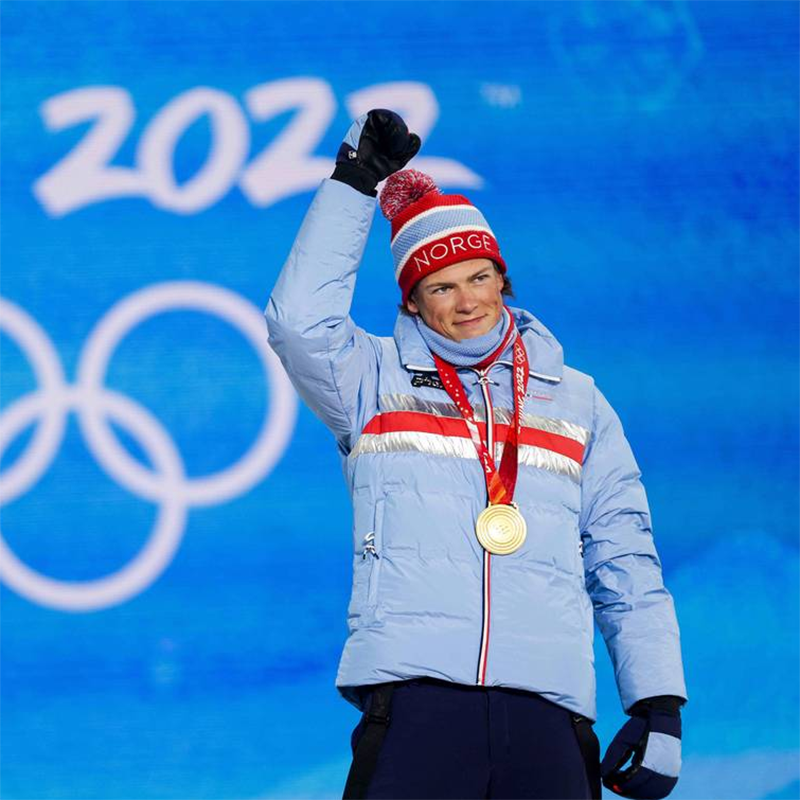
    He’ll be there . . . Norway’s Johannes Høsflot Klæbo. (Photo: NordicFocus)

    It’s like a Norwegian Hunger Games, like a Scandinavian Lord of the Flies, like Nordic skiing’s version of Survival of the Fittest. Norway just announced eight members (5 men, 3 women) of its Olympic Team for Milano-Cortina. Those eight are in, while the committee has the opportunity to choose eight more skiers (3 men, 5 women) in weeks to come. Those already chosen can relax a bit, get back to training, stop worrying about what they might need to prove in the Tour de Ski. For all the other would-be Norwegian Olympians, the highest pressure—and the hardest racing—starts now. Prove your worth in the exhausting Tour de Ski, and you might be chosen for the Olympics . . . though you might find yourself too physically exhausted and mentally spent to ski like a hero when Olympic events get going in Val di Fiemme. That’s the dilemma: it’s an old-school, winner-take-all qualification strategy that seems a bit strange to have been instituted by ski-dominant Norway. But Norway is a nation that’s likely to sweep many of the individual Olympic podiums in cross-country skiing—especially in the men’s field—regardless of which Norwegians are nominated to the Olympic Team. The selection committee can pretty much do whatever it wants, and things will still turn out just fine.

    In January, I’ll be attending the US Speedskating Olympic Trials in West Allis, Wisconsin. It’s like a family reunion for me, a bit of a walk down memory lane: I competed in those Trials numerous times (though never achieving the desired result) and coached numerous athletes to success on many other winner-take-all days. The holding of an actual Olympic Trials always seemed like a fair, but brutal, enterprise. Fair in that team selection processes were plain and simple—top four skaters in each distance earn the right to march into the Olympic stadium, to wear USA on their chest, to compete in an Olympic Games. Do well at the Trials, go to the Olympics. Pretty straightforward.

    Years later, Olympic selections have become more subjective—certain athletes must be protected in the process. The stars and potential medalists in Americn speedskating (Jordan Stoltz, Brittany Bowe, Erin Jackson, and members of USA’s world-record Team Pursuit team) will still be competing at the Olympic Trials, but their results will matter less since they’ll already have achieved protected status earned through last season’s performances and/or early season brilliance on the World Cup circuit. There are spots on the team that can still be won at the Trials, but those spots will be claimed by skaters who are less likely to contend for medals in Milano-Cortina. The potential medalists are protected in the process (I’m all for that), and there are opportunities for dreams to come true for others who skate the race of their lives at just the right moment on just the right day (and I love that). It’s an old-fashioned way of doing things . . . one that definitely limits the ultimate Olympic potential of athletes forced to run this qualification gauntlet. That’s why it seems so strange that Norway is utilizing a similar system to select the remaining spots on its Olympic cross-country roster.

    Kristine Stavaas Skistad (NOR) will be a medal favorite in the Olympic Classic Sprint in Val di Fiemme. (Photo:  Modica/NordicFocus)

    Eight athletes have already been named to the Norwegian Olympic Team:

    Men

    Harald Østberg Amundsen, Asker Ski Club
    Einar Hedegart, Inderøy IL
    Johannes Høsflot Klæbo, Byåsen IL
    Martin Løwstrøm Nyenget, Lillehammer Ski Club
    Erik Valnes, Bardufoss and the surrounding area IF

    Women

    Kristine Stavås Skistad, Konnerud IL
    Astrid Øyre Slind, Oppdal IL
    Heidi Weng, IL in BUL

    The winner of the last two Men’s World Cup individual races—Einar Hedegart—is in. The winner of the most recent Women’s World Cup individual race—Karoline Simpson-Larsen—not yet. That’s kind of crazy: she’s the only Norwegian woman with a win this season in a World Cup distance race, though the selection committee suggests she’s not yet proven enough to warrant a place on the Olympic Team. Norwegian Sprinter, Skistad, has stood on top of a World Cup Sprint podium this season, and she’s been given a spot on the team—granted, Skistad has been a dominant sprinter on the international scene for a couple of seasons, especially in Classic Sprints (which is the format in which the Olympic Sprint will be conducted). We understand making Skistad an early announcement for the Olympic Team. What we don’t understand is the early announcement that leaves Larsen off of it. Now Larsen will be forced to fight her way through the exhausting Tour de Ski in order to claim her spot. Unfortunately, she might leave her Olympic potential strewn along the course that climbs up Alpe Cermis.

    Karoline Simpson-Larsen (NOR) won the most recent Women’s World Cup event—Davos’ 10 k Freestyle Interval Start. Somehow, that wasn’t good enough to earn an early selection to Norway;s Olympic Team. (Photo: Modica/NordicFocus)

    How ironic is it that a team with the potential to secure medals from any individual member of their team has decided to protect only the top few, while forcing the remaining medal contenders to swim with sharks and battle to exhaustion through the often-debilitating Tour de Ski (which many fans continue to wish would not be staged during Olympic and World Championship seasons)? Team Norway has the ability to pick five more women, and three more men. The remaining contenders will be expected to race it out in the Tour de Ski. With that in mind, the Tour de Ski entries have been announced. Klaebo, Amundsen, and Valnes are set to compete. Evidently, either they’re each still coveting World Cup Crystal Globes (in addition to Olympic medals), or they just don’t think the Tour de Ski will be all that taxing. It seems like a heady roll of the dice, but they’re big boys: I hope they know what they’re doing. They’ll be joined in this multi-day endurance slugfest by Simen Hegstad Kruger, Mattis Stenshagen, Emil Iversen, Iver Tildheim Anderson, Oskar Opstad Vike, Lars Heggen, and Ansgar Evensen—all hoping to prove that they deserve one of the few remaining spots on Team Norway.

    Einar Hedegart (NOR) winning the World Cup 10 k Interval Start Freestyle in Davos. With two dominant wins in this World Cup season, he’s already been named to the Norwegian Olympic Team. (Photo: Vanzetta/NordicFocus)

    Having already been named to the Olympic Team, Nyenget and Hedegart won’t compete in the Tour de Ski—kicking back in their newly-distributed Olympic uniforms, comfortably watching while every else scrambles for the few remaining prizes. Such is the depth of Norwegian supremacy that a number of legitimate medal contenders weren’t even selected to compete for a spot on the team. The Tour de Ski offers limited entries: Even Northug and Andreas Fjorden Ree didn’t make the cut. They’ll sit at home where their World cup medals hang on the wall, wondering how circumstances transpired in such weird ways that they weren’t even allowed to compete.

    In the Women’s Tour de Ski field, all three Norwegians who were recently named to the Olympic Team are entered (including Skistad, who will likely drop out after the second Sprint day). With regard to selections affecting the women’s team, Norway will choose the remaining five Olympic spots from among Kristine Austgulen Fosnaes, Julie Myhre, Mathilde Myhrvold, Lotta Udnes Weng, Eva Ingebritsen, Ingrid Bergene Aabrekk, and Julie Bjervig Drivenes. Five Women’s Olympic Team spots are still to be named, meaning two of the ten Norwegians entered in the Tour de Ski will see their Olympic dreams end on Alpe Cermis. For other consistent World Cup performers, their Olympic quest is over: Nora Saness, Ane Appelkvist Stenseth, Anne Kjersti Kalvaa, and Tiril Udnes Weng have not even been offered spots in the Tour de Ski, as the committee underestimates their chances of performing at medal-winning levels in Olympic events in Val di Fiemme. They’ll stay home and watch.

    Norway’s selection process is a bit of a throwback. As a long-ago athlete who once chased Olympic dreams on the windswept backstretch of an ice oval in suburban Milwaukee, I kind of love that. But for the many Olympic medal contenders among Norway’s crop of cross-country skiers, it must be terrifying. One way or another, Norway is likely to collect many medals from the Olympic podiums of Milano-Cortina. It remains to be seen which Norwegian heroes will be wearing those medals on the flight home.

  • Understudies Steal Spotlight in 10 k Olympic Dress Rehearsal

    Understudies Steal Spotlight in 10 k Olympic Dress Rehearsal

    This coverage is made possible through the generous support of Marty and Kathy Hall and A Hall Mark of Excellence Award. To learn more about A Hall Mark of Excellence Award, or to learn how you can support FasterSkier’s coverage, please contact info@fasterskier.com.

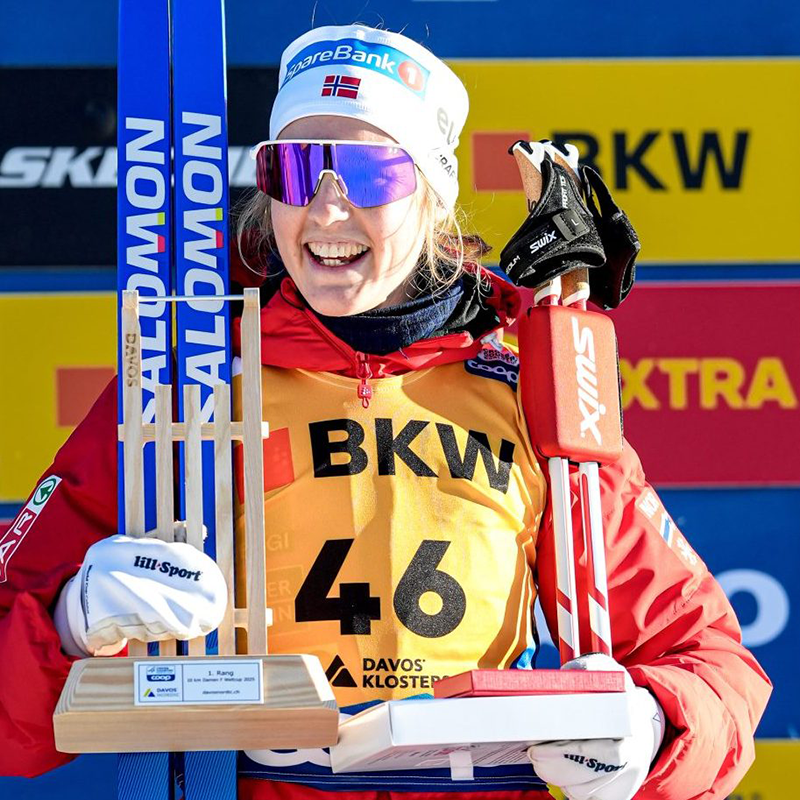
    Karoline Simpson-Larsen (NOR) took her first World Cup victory in Davos’ 10 k Freestyle, likely securing her spot on the Norwegian Olympic Team. (Photo: Vanzetta/NordicFocus)

    Many world-class athletes spend season after season diligently training, preparing, imagining, rehearsing for opportunities that never come. Advancing in World Cup standings is extraordinarily difficult: training is not enough, technical refinement is not enough, determination is not enough. Commentators and ski-pundits make much of the results of Junior World Championship medalists as though those podium performances are signs of future dominance in the senior ranks: they’re not. The senior level of the World Cup circuit is a talent show of the highest degree, and there is no “age category” for competitors to hide behind. All the best are here, all the best stay here for years at a time, and none of those winners willingly make room for newcomers. Success at this level must be wrestled from the stubborn grasp of strong-willed champions. Ultimately, hard work is vital to eventual success, but that eventual success also requires patience, and good fortune, and opportunity. Those who will succeed need to be ready when those opportunities arise. Today, in Davos, opportunity arose . . .

    It’s so important at this point in the World Cup season for skiing’s brightest stars to remain healthy and fresh, and Davos’ high-altitude venue is the sort that can steal both health and freshness from any skier. Racing these stressful events at elevations over 5500 feet definitely shuffles the results—those who hit the uphills too hard find themselves with insufficient time to recover on the downhills. Lots of blow-ups among skiers on Davos’ thin-aired race course. Not only is the racing difficult, but the post-race recovery is difficult as well with many racers going home exhausted or sick. And December is no time to be sick. With the Olympics less than two months away—and with this being a season in which the stars are mostly prioritizing Olympic results over World Cup standings—many stars elected to stay home from Davos, thus setting the stage for today’s 10 k race to shine a spotlight on the efforts of those who usually fill understudy roles. Today in Davos there was no Jonna Sundling (SWE), no Ebba Andersson (SWE), no Frida Karlsson (SWE), no Heidi Weng (NOR). Jessie Diggins (USA) doesn’t take many days off, and she would toe the starting line in Davos. But after skiing every single event in Period 1, she may have been at a little less than her best. Moa Ilar (SWE) has stood on the World Cup podium already this season, but her efforts are often overshadowed by her teammates Sundling, Anderson, and Karlsson. Likewise, Astrid Oeyre Slind (NOR) has delivered multiple podium performances in this young season, but she’s still recovering from an Achilles tendon injury. It’s not known if she is fully back to form. It was a day for understudies to grab the spotlight. And grab it they did, as Karoline Simpson-Larsen (NOR) skied away with the win, followed two seconds later by Ilar and Slind.

    With her fifth place finish in the 10 k Freestyle in Davos, Jessie Diggins (USA) continued to show that she will be a medal contender in every Olympic event. (Photo: Modica/NordicFocus)

    Diggins did not shy from the fight, delivering an impressive fifth place finish in the 10 k, and continuing to show that she’ll be a medal contender in all individual events in Milano-Cortina. She was followed in the standing by her Americn teammates: Lucinda Anderson was 25th, Julia Kern 30th, Alayna Sonnesyn 33rd, Kendall Kramer 44th, Kate Oldham 56th. Sophia Laukli announced last week that she is delaying the continuation of her World Cup season. Rosie Brennan has been forced to deal with health and performance issues of her own in recent months. She would start the 10 k in Davos, but would fail to finish. Canadian, Katherine Stewart-Jones, continued to be the sole Canadian representative in World Cup Period 1. She would finish 28th.

    Also notable in this week’s list of Davos’ understudies was the performance of Maia Dahlqvist (SWE). Her fourth place finish continues to show her abilities in both sprint and distance racing, and today’s performance likely established as the favorite to team with Jonna Sundling in the Olympic Team Sprint. If that’s the team that Sweden fields in Val di Fiemme, they’ll be hard to beat.

    Davos’ World Cup events were also notable for the return to competition of Individual Neutral Athletes (AINs) from Russia and Belarus. Clad in a very non-Russian purple and aqua race suit, Dariya Nepraeva—a Junior World Championship gold medalist in 2022, and the fast-skiing little sister of former World Cup champion, Natalya Nepraeva—had ranked an inauspicious (and nearly invisible) 39th after Saturday’s Freestyle Sprint qualifying. Russian athletes are back on the World Cup course, and Nepraeva would deliver a solid result, finishing the day in 20th.

    Karoline Simpson-Larsen (NOR) took advantage of the absence of some of skiing’s brightest stars to step into a spotlight of her own. Her victory in Davos’ 10 k Frestyle Interval start likely also secured her spot on Norway’s Olympic Team for Milano-Cortina. (Photo: Modica/NordicFocus)
    10 k Freestyle

    FIS World Cup Period 1 is quite a test: three straight weeks of three races/weekend. And the conclusion of each weekend has been a 10 k. Whether Freestyle or Classic, ten kilometers is a challenging distance over which to compete. Davos version offered two laps over a five kilometer course, the low-point of which sits at a breathtaking altitude of 5400 feet. The 10 k Freestyle Interval Start will be an Olympic event when those Winter Games take place in Val di Fiemme. Though not quite as high as Davos, Val di Fiemme will represent altitude challenges of its own. Davos would seem to be an excellent venue for this pre-Olympic dress rehearsal.

    Diggins came through early checkpoints even with Ilar, two seconds behind Slind, and in the company of the latest French revelation, Leonie Perry. Diggins would finish fifth on the day, maintaining her lead in the World Cup standings but leaving some question as to her ultimate desire to claim another Crystal Globe (as the season progresses, don’t be too surprised if Diggins skips some races—and eschews World Cup points—in favor of Olympic preparedness). Fans usually think of Diggins as the strongest contender in any 10 k event. Today, though, was one for fresh arms and rested legs, and Diggins (like many in the field) found herself feeling less sparkly than usual.

    It was Larsen who would put up the best intermediate times of the day, even extending her lead over Ilar in the closing kilometers. Seated in the sled-shaped leader’s chair in the finish area, Larsen fidgeted nervously, surrounded by teammates who smiled and giggled as they repeatedly checked the splits of other contenders, each of whom would fail to best Larsen’s time. In the end, none did, and Larsen found herself with the first World Cup win of her career, and a likely nod onto an Olympic Team of which she had dared not dream. Opportunity arisen, opportunity grabbed.

    Kristin Austgulen Fosnaes (NOR) delivered a great result in Davos (seventh place). It still may not be enough for her to keep her Olympic relay pot with Team Norway. (Photo: Vanzetta/NordicFocus)

    In a season often dominated by Team Sweden, Davos’ 10 k offered a chance for Team Norway to top the podium. But the Norwegian National Team is a cruel and unforgiving environment, especially when so many of the world’s best skiers are vying for spots on the team, but there’s so little room at the top for all of them. Less than a year ago, another notable understudy, Kristin Austgulen Fosnaes (NOR), found herself under the spotlight for the wrong reasons when she was dismantled by Team Sweden during her leg of the World Championship Relay in Trondheim. Today in Davos, Fosnaes found herself with the an entirely respectable finish (seventh place). Ironically, today’s race winner—Larsen—may end up taking Fosnaes’ place in Norway’s Relay roster  in Val di Fiemme during the Olympic Winter Games.

    How truly ironic that a skier like Fosnaes could earn a seventh place in a World Cup event, and still find herself staying home from the Olympics (or at least being left off the roster in the event—the Team Relay—where she has a chance to medal). Her own team may be quick to remind her, “Yes, you finished seventh, but none of the true contenders were even there.” While that may be true, the absence of the contenders is what served up the opportunity for Karoline Simpson-Larsen to step into the spotlight. And it’s the fast that she did step in that will probably see her name aded to the roster of Norwegian Olympians in Milano-Cortina.

    Women’s 10 k Individual Start Freestyle RESULTS
    Understudies in the spotlight—Moa Ilar (SWE), Karoline Simpson-Larsen (NOR), Astrid Oeyre Slind (NOR) on the World Cup podium in Davos. (Photo:  Vanzetta/NordicFocus)

    Love Stories Like This? Help Keep Them Coming.

    Feature stories like this one take time, access, and care to produce. If you value thoughtful storytelling and independent ski journalism, please consider becoming a Voluntary Subscriber. Your support directly fuels the work we do to cover the people, places, and moments that make our sport special.

    Join the FasterSkier community!