
From the FasterSkier archive — posts syndicated from athletes’ and coaches’ own blogs between 2004 and 2012, kept online as published. Current coverage is at fasterskier.com.

Tag: Kaspar Wirz

  • South Korea’s Medal Hope, Eui Hyun Sin Preps for Home Paralympics

    South Korea’s Medal Hope, Eui Hyun Sin Preps for Home Paralympics

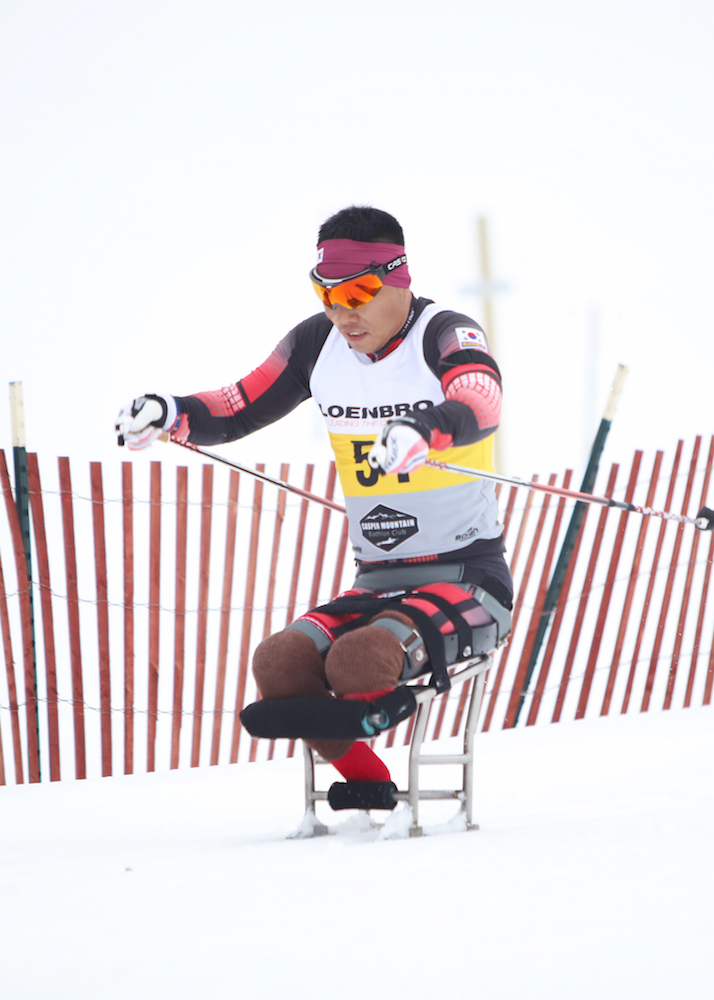
    South Korea’s Eui Hyun Sin won both biathlon races at 2017 U.S. Paralympics nationals and placed third in the cross-country sprint and short-distance races in Casper, Wyo. (Photo: Pearson Photography)

    For a few days at the end of January, a sea of stringed kites fills the skies of many cities in South Korea. The normally crowded streets of downtown Seoul — the country’s capital — empty and become almost devoid of people. Many of the residents are indoors with their families, or en route to the hometowns of relatives, all in order to celebrate Seollal, one of the nation’s greatest Korean holidays.

    Generally spanning a period of three to five days, Seollal is observed by many citizens as a time to feast, be with family, and pay tribute to ancestral figures. Shops and businesses close, and work is waitlisted until after the festivities’ culmination.

    While many enjoyed the extra days of leisure this year, one South Korean skier was itching to get back to work: Paralympian Eui Hyun Sin.

    Born in Gongju, South Korea, Sin became accustomed to the savory meats and spare time that are part of the holiday’s tradition. But now, Seollal — and many of the other Korean holidays he continues to observe — are as much a celebration as they are a symbol of something he must sacrifice: time spent training.

    As many of his competitors maintained a fairly consistent training plan in their preparation for this year’s 2017 World Para Nordic Skiing Championships, which took place Feb. 10-19 in Finsterau, Germany, Sin’s schedule forced him to skip a few training sessions. But that did not prevent him from medaling at the championships.

    Sin, a 37-year-old sit skier who lost both his legs following a car incident, raced to a bronze in the men’s 12.5-kilometer sitting biathlon race and a silver in the men’s 15 k sitting cross-country race in Finsterau (in the LW12 category). In doing so at his first World Championships, he became the most successful in para-nordic skier in South Korea’s history.

    “I was very happy, but I feel regretful at the same time, because I could not train enough because of the Korean holidays,” Sin wrote in an email, according to a team translator. “However, it means so much for me, because it was the first time for the history of Para Nordic ski of Korea.”

    Along with becoming the first South Korean to medal at World Championships, Sin also won three International Paralympic Committee (IPC) World Cup races, two in Ukraine and also in the 15 k cross-country race at home in PyeongChang, South Korea, where the 2018 Winter Olympics and Paralympics will be held.

    Nordic skiing is not the only realm of athletics in which Sin has made his mark. Prior to joining the Korean para-nordic ski team in 2015, he played internationally for the Korean para ice-hockey team and also competed in wheelchair basketball and para cycling at the national level. His involvement in these sports, as well as encouragement from friends, led him to turn to skiing for the past two years.

    “When I was playing Hockey and Cycling constantly, one of my friends suggested me to join the Para nordic ski club,” Sin wrote.

    He struggled with the decision as he had a solid job and needed to provide for his family.

    “However, I thought that I am not that young and it is very special chance to participate in the Paralympics held in my own country. So, I decided to start the nordic ski,” he wrote.

    He made the decision with a home Paralympics weighing heavily on his mind. And as he gears up for PyeongChang next March, he’s one of his nation’s best chances for a medal.

    “The 2016/17 was the season which made me confident for the Paralympic medal,” Sin wrote. “Since there will be Paralympic Games in this season, I want to win the gold medal by training hard.”

    Much of that training so far has taken place abroad. Following the last races of the season in April in Casper, Wyo., the South Korean para-nordic team planned to continue training in the U.S. until May 30.

    Then Sin and the crew will make their way to PyeongChang for the month of June, followed by travel to Finland in July. 

    “This year, we are training with the new head coach Kaspar Wirz who is from Canada,” Sin wrote. “He has much experience and knowledge to teach, so the training is very fun. I am focusing on the skiing positions and shooting for the biathlon.”

    With a full season ahead of him and a full one behind — he finished the 2016/2017 season ranked second in the overall cross-country IPC World Cup rankings — Sin is both excited about the opportunity to represent his country at home and the accomplishments he has already given to Korea.

    “The highlights were the moment I won the gold medals in cross country 7.5 K and 15 K in the World Cup held in Ukraine,” Sin wrote. “The win was a big moment for me.”
  • Post-Olympic Budget Cuts Hit Canada Para-Nordic Team

    Post-Olympic Budget Cuts Hit Canada Para-Nordic Team

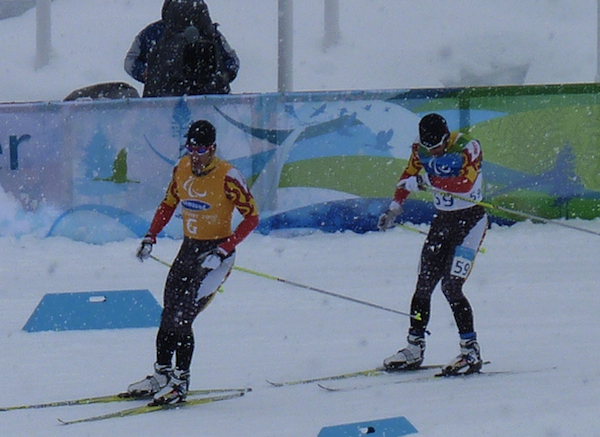
    Brian McKeever (r), a member of Canada's Para-Nordic Ski Team, racing with his brother and guide, Robin, at the 2010 Paralympic Games. Photo used under Creative Commons from Mafue – http://bit.ly/d3DeMX

    Four months after the conclusion of the Vancouver Paralympic Games, Canada’s Para-Nordic Ski Team has suffered cuts amounting to roughly one-third of its total budget.

    According to Cross-Country Canada Executive Director Davin Macintosh, the cuts represented 56 percent of the program’s funding from Own the Podium (OTP), the high-performance sports initiative that was set up to propel Canadian athletes to medals at the 2010 Olympic and Paralympic Games in Vancouver.

    The exact impacts of the cuts are still uncertain, as Cross-Country Canada (CCC) works to restructure its program in the next few weeks. But Macintosh said that the cuts, first reported by the CBC, will force the team to scale back its athlete support.

    “In the long term, we’ll have to run a more streamlined program, which probably means fewer staff who can do a wider variety of jobs,” he said.

    Over the past five years, Canada’s Para-Nordic program had enjoyed a large infusion of cash from OTP, which was founded in 2005 and has since poured more than $100 million into Olympic sports.

    Cross-Country Canada’s Able-Bodied program fared much better in its level of funding from Own the Podium (OTP).

    According to Cross Country Canada (CCC) Executive Director Davin Macintosh, the able-bodied ski team received a three percent decrease in support from OTP in its budget for the coming year. (CCC received roughly $1.2 million for its able-bodied cross-country program in 2009-2010.)

    While that number may look bad when juxtaposed with the 56 percent cut to Para-Nordic, Macintosh said that the cuts merely reflect the quality of the athletes on each team—not a prioritization of able-bodied skiers.

    “If they knew we had three Para-Nordic athletes who were on the cusp of winning all the international competitions, they’d give us more money there, and that’s what we have on the able-bodied side,” Macintosh said. “Our Olympic results showed that we have a strong team of people who will be around for the next Olympics, and have obvious and proven potential to reach the podium.”

    According to OTP Director of Winter Sport Ken Read, his organization conducts yearly reviews, in which each sport receiving OTP funding is categorized according to its recent and historical results, as well as its future potential. The higher the category, the more support a sport receives.

    Able-bodied cross-country is a category two sport, as is visually impaired cross-country, given Brian McKeever’s success at the 2010 Paralympics, where he won three gold medals. But the other Para-Nordic disciplines are rated one rung down on the ladder, as a category three.

    “Those that have earned it get the broader…support,” Read said, “and the deeper down it will go. So it’s into supporting camps, supporting coaches, supporting the integrated support teams.”

    “That’s where you have the able-bodied program,” he continued. “The hope is, going forward to 2014, that Devon [Kershaw] will find a couple hundredths of a second, and…we are working with them right now on a nordic consortium of trying to entrench some of those programs that worked well.” One example he cited was a project involving base grinding and ski technicians.

    Read said that the categorizations were evaluated on a year-to-year basis, and that the level of support for the Para-Nordic team would be reconsidered next spring, “based on results.”

    The initiative was designed to provide extra financing specifically earmarked for athletes with strong chances of winning Olympic and Paralympic medals. But over time, the money allotted to the Para-Nordic Ski Team—some $630,000 last year—had come to finance a large portion of its operations.

    “When OTP first came into being, they put a lot of money into the development side,” said Jeff Whiting, who recently retired from his job as a Para-Nordic development coordinator for CCC.

    “The program grew extremely rapidly over the past four years thanks to rapid increases in support from OTP, and that created a much larger budget,” Macintosh said.

    After the conclusion of the 2010 Games, though, OTP’s future was uncertain, since funding from the soon-to-be-dissolved Vancouver Organizing Committee had made up a large proportion of its bottom line.

    While the Canadian government doubled its share of OTP support in the federal budget this spring, the total amount of funding available for high-performance programs was still reduced—$20 million, instead of $23 million, according to OTP Director of Winter Sport Ken Read.

    And while OTP had targeted three athletes during the 2010 Paralympics—Brian McKeever, Jody Barber, and Colette Bourgonje—only McKeever will continue to receive money for the next four-year Paralympic cycle.

    Bourgonje has said that Vancouver was her last Paralympic Games, and “the remainder of the athletes in the program weren’t seeming to have gold medal potential,” Read said, referring to OTP’s standard for funding Paralympic athletes.

    “In Paralympic [sports], it’s gold medal potential, not deep athlete development,” Read said. “The sport is supposed to be taking on that role of upkeep.”

    An increase in funding to CCC from Sport Canada, a separate arm of the federal government, has softened the impact of the OTP reductions slightly, but not entirely, according to Macintosh.

    CCC was informed of the cuts roughly two weeks ago, Macintosh said, and he called a meeting with athletes immediately. The team has been forced to cancel a planned summer training trip to New Zealand, and while funding exists for a trip to World Championships in Norway next year, the extent of the team’s participation in World Cup races earlier in the winter remains unclear.

    “We will probably be able to finance fewer athletes to go on the general World Cup circuit, although we will ensure that our athletes are well-prepared for [World Championships],” Macintosh said.

    No staff members have been laid off, but job descriptions will probably have to change, Macintosh added.

    CCC is currently negotiating with Para-Nordic Head Coach Kaspar Wirz, who Macintosh said will likely continue in a “less-than-full-time capacity.” Technical Coach Robin McKeever—who also serves as a guide for his brother, Brian—would have to take on “a few more responsibilities” to remain with the team.

    “We don’t have signed contracts with them,” Macintosh said. “It’s up to them.”

    Wirz wasn’t surprised at the cuts—just their magnitude.

    “We were thinking maybe 20, 30 percent,” he said. Reductions after Olympic cycles are typical, Wirz added, especially for Paralympic sports.

    But Robbi Weldon, a 2010 Paralympian and a member of the Canadian Para-Nordic team, said that she didn’t blame OTP for the cuts.

    “If an organization has strict criteria, and that’s what they put our in their documentation, I’m not going to bash them—that’s their mandate,” she said. Nevertheless, she continued, “it’s a huge hit, and I think there’s definitely a lot of questions to CCC—how they’re going to support us, and support the team.”

    Macintosh said that he hoped to be able to make up for some of the cuts by finding new sponsors for the Para-Nordic team. CCC has been discussing options with potential backers, and the exposure gained by the athletes during the Vancouver Games should go a long way towards helping them find potential supporters, Wirz said.

    “I think now, the public is ready to support that,” he said.