From the FasterSkier archive — posts syndicated from athletes’ and coaches’ own blogs between 2004 and 2012, kept online as published. Current coverage is at fasterskier.com.
Kate Boyd was announced as the high-performance director for Canada’s para-nordic team on Monday. (Photo: Nordiq Canada)
“Looking at the critical year ahead, and the expectations placed on our Paralympic athletes to not only repeat our success from 2018, but to also ensure the tradition of excellence with this program continues well into the future, I believe it is important for me to shift and fully commit my time to ensuring this group has the leadership and resources required to deliver podium performances,” said Boyd to Nordiq Canada.
Before the recent announcement, Boyd had been the high-performance director for both the national cross-country team and the para squad. Boyd was part of a successful group that helped lead Canada’s para-nordic program in the recent past. Robin McKeever remains Canada’s national team coach for para-nordic.
“The scope of responsibility for the high-performance director leading both the Olympic and Paralympic streams is significant,” said Boyd. “With the new season just around the corner, I believe I can have the most impact by focusing my efforts on leading the Para-Nordic group to Beijing and laying the foundation for success in 2026 and beyond.”
The high-performance void on the cross-country side will be filled by Chris Jeffries. Jeffries is currently the head coach of the Alberta World Cup Academy. He will continue in that role while adding part-time duties for the 2021-2022 Olympic season as the national cross-country team’s high-performance director.
Chris Jeffries will lead the Alberta World Cup Academy cross-country team and take on the responsibilities of the high-performance director of the national cross-country team for the 20201-2022 season. (Photo: Alberta World Cup Academy)
Jeffries will be part of a management team that includes Joel Jaques as the high-performance manager. According to Nordiq Canada, Jaques will handle the team’s logistics among other duties. Also on the cross-country side of the equation, Cindy Chetley will continue as the team’s high-performance coordinator.
Nordiq Canada also noted that Jeffries and Julie Beaulieu will work to build a sustainable pipeline of athletes, coaches, and stakeholders to fulfill Nordiq Canada’s mission of winning championship medals.
Back in April, Nordiq Canada announced two job vacancies, one for a National Team NextGen Coach, the other for a National Team World Cup Coach. The NextGen Coach, responsible for the national junior/U23 team, remains unfilled.
Norway’s Erik Bråten had been the team’s World Cup coach for the past three seasons. He resigned from the job after the conclusion of the race season. However, Nordiq Canada noted Bråten will return as the team’s World Cup competition coach. “Erik will lead the majority of the National Ski Team racing trips and assist with supporting the program remotely for the remainder of the year while working from Europe,” stated Nordiq Canada. “With respect to the delivery of the National Ski Team training program, athletes’ daily training environment coaches across the country will work together to support all national team athletes by taking turns leading camps and supporting at competitions.”
Erik Bråten (right) is pictured here with Norway’s Haga Ragnhild (left). Bråten will return as Canada’s World Cup coach. He is also the coach of Ragnhild. (Photo: @ragnhildhaga Instagram)
Bråten has returned to Norway after residing in Canmore during his previous stint with the team. It did not take long for Norway’s ski talent to gravitate towards Bråten. Reigning Olympic 10 skate champion, Haga Ragnhild, has decided to work with Bråten as she attempts to earn World Cup starts and an Olympic birth. Ragnhild was not renominated to Norway’s national team for the 2021-2022 season. Along with her individual 2018 Olympic gold, she was part of Norway’s winning 4 x 5 k relay team at the 2018 Olympics.
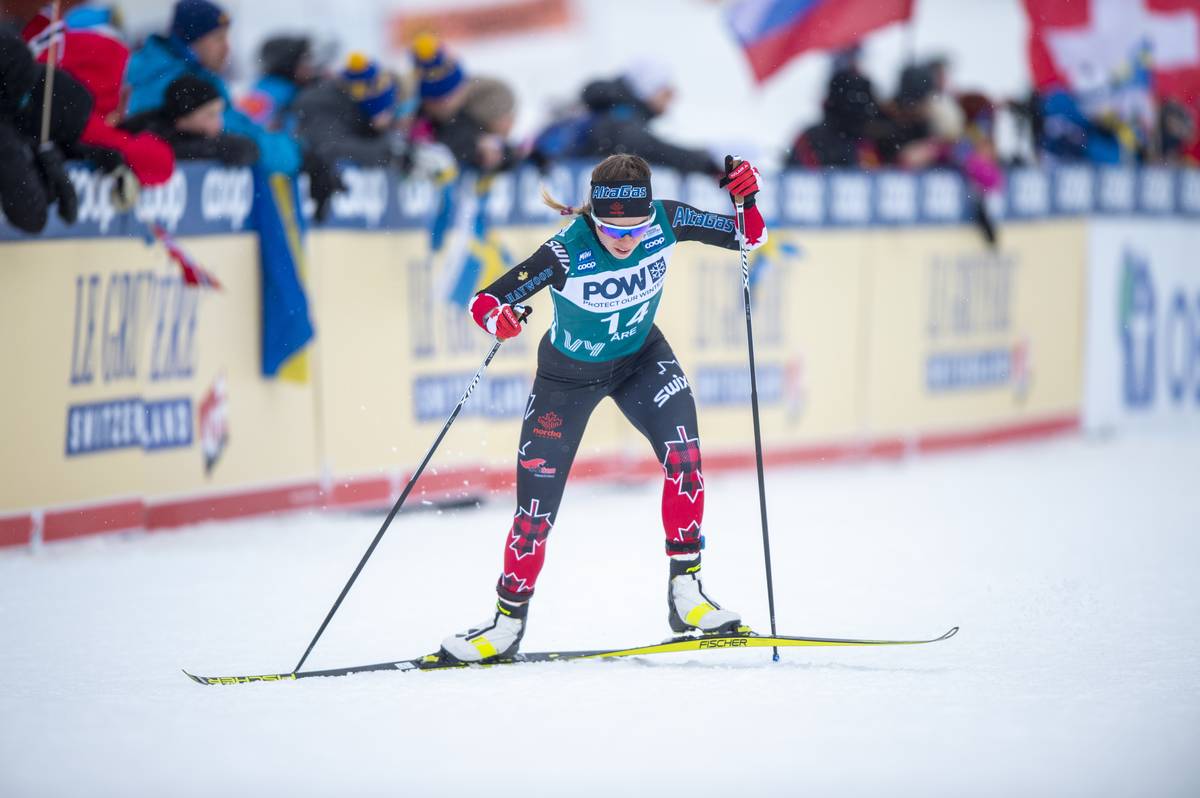
Katherine Stewart-Jones flying the flag during the Ski Tour 2020 in Åre (SWE). (Photo:NordicFocus)
Nordiq Canada’s first major change announcement on November 16th was the decision to cancel the Period I trip to Lillehammer, Dresden, and Davos. (The Lillehammer races have been postponed, and have not been officially rescheduled.)
“For us, it was chatting with our medical experts, assessing the situations here at home and what we were seeing happening overseas,” said Nordiq Canada’s High Performance Director Kate Boyd. “We had never planned to go to Ruka. And then when Lillehammer was postponed to a later time that left two race weekends, and we felt it better that we would stay home, train, get strong. And get a sense of how the protocols were rolling out overseas.”
Those World Cup Covid-19 prevention protocols got their first test in Ruka with varying reports as to the success level. While all the countries were originally satisfied with the plans, it seems that on-site rule interpretation was different than some countries expected. Pierre Mignerey (FIS race director, who is from France) and Norway’s cross-country manager, Espen Bjervig, expressed their differing viewpoints to Norwegian broadcaster NRK shortly after Norway decided to stay home for December.
Mignerey also explained to NRK that one reason some countries might feel more free to criticize FIS safety initiatives relates to business opportunities away from the World Cup for some.
“It is important to understand that for many nations, competing in the World Cup is the only way to do their job and promote their sponsors,” said Mignerey according to a translation. “Norway does not come to the World Cup, but can arrange national competitions that go on TV. They have no chance of that in countries other than Norway, Sweden and Finland.”
After Ruka, Norway, Sweden, and Finland withdrew from the December World Cups. The Norwegians held a national level competition this past weekend in Lillehammer, site of the aforementioned postponed World Cups. Consider that opportune exposure for Norwegian athletes and sponsors – the opportunity cost of missing a World Cup for some is cushioned when the domestic event is broadcast nationally.
Here in Canada, Jeff Ellis, the Partnership and Events Coordinator at Nordiq Canada, commented that the withdrawal of teams like Norway, comes close to a time when that team’s leadership had advocated for maintaining the Lillehammer World Cups as scheduled for December 4-6.
“What Norway has decided to do will be an interesting study on how it affects other teams’ decisions,” said Ellis. “It’s interesting that less than three weeks ago Norway was fighting hard to keep the Lillehammer World Cups with the Head Coach saying we must race as much as possible.”
Canadian reactions to the Period I modifications range from anger to relief. Norway’s, Sweden’s, and Finland’s race departures come on the heels of Nordiq Canada gutting their own race calendar on November 30. Below are the major announcements from the November 30 announcement.
All FIS-sanctioned domestic cross-country ski events scheduled across Canada for the 2020-21 season are cancelled (Divisions will continue to determine the relevance and possibility of hosting scaled-down local events that meet regional health and safety guidelines);
Canadian World Championship Trials scheduled for Whistler, B.C. (January 7-10) are cancelled;
2021 Canadian Ski Championships (March 14-20) planned at the Nakkertok Nordic Ski Centre in the Ottawa-Gatineau region are cancelled;
2021 World Para Snow Sport Championships scheduled for February 7-20 in Lillehammer, Norway have been postponed to January 2022;
When asked about feedback on the recent Canadian World Cup trip cancellation and the subsequent cancellation of FIS races in Canada, Boyd tactfully replied “We have a very passionate community.”
She sees the strong opinions as an opportunity.
“When you’ve got a community as passionate as ours, it can be an incredible force to move us forward, when we’re all moving in the same direction. So I’m hoping that with a good plan and strong communication with that group that we can turn that bus around.
“We’re going to try our best to get to Europe to compete, but we’ll be assessing regularly what we can and can’t do. Always with the athlete safety first and foremost.”
The loss of World Cup opportunities matters. Start spots for Canadian skiers at the Beijing Olympics depend on results from two seasons, including this current season.
“We recognize that we stand a better chance of securing more spots for Canada if we do get to Europe, and have good races and score well in the nation’s points,” added Boyd. “So that is certainly a deciding factor for us to get over to Europe when we can, when it’s safe to do so. We want to give our athletes about as many opportunities and the best opportunities to compete, especially at Games.”
As far as the cancellation of FIS sanctioned racing in Canada, Boyd suggested the move simplified an already complex pandemic-rattled season. “We figured we’d take the FIS heat off and allow the provinces to host events, when and how they can,” said Boyd. “And it also removes the need for athletes to have to travel outside of provinces to try to get the points.”
During the summer, Nordiq Canada decided to split the traditional NorAm (Continental Cup) series into East and West series, respectively, to reduce travel while increasing the probability that events could be held. This change was also part of a multi-year project to reduce the cost of race travel for Canadian skiers.
The season plans started shifting with the downgrading of the first four East/West NorAm races in December from FIS to regionally sanctioned events. This happened one by one in the first half of November as it became clear that inter-provincial travel for sports events would not restart before the new year. Each province has its own rules which change as the active COVID-19 case load changes.
In early November when Nakkertok was cancelled, it was illegal to drive across the bridge from Ottawa to ski, affecting roughly half of the host clubs’ members. The Canmore event, for example, scheduled for December 12th and 13th, could have proceeded with Alberta, Saskatchewan, and Manitoba skiers in attendance, but without BC and the Yukon athletes. Each of the named provinces has since tightened rules further.
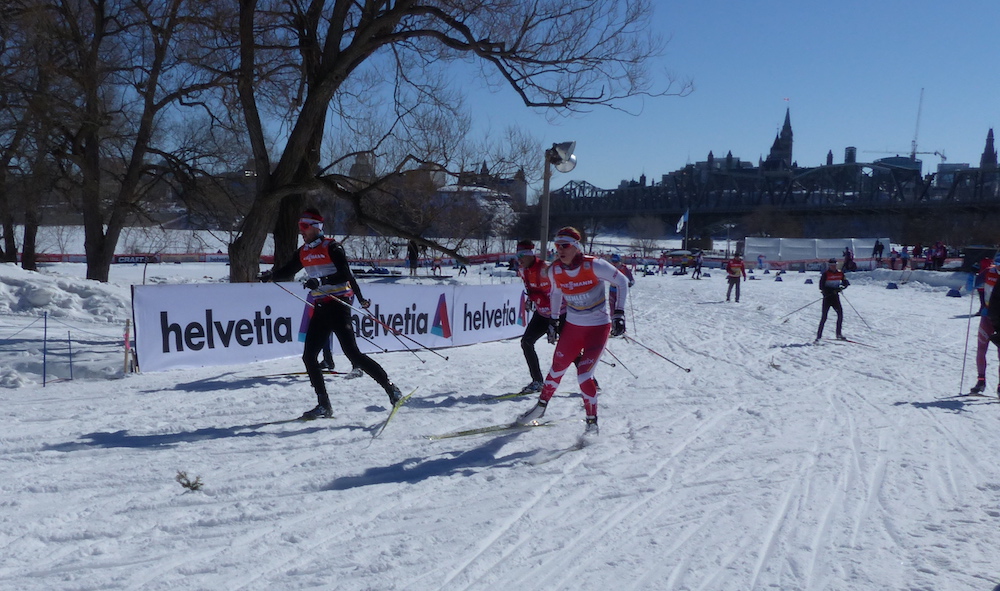
Ottawa (Ontario) is in the background as national team member Dahria Beatty skis beside an old teammate before the Gatineau (Québec) stage of Ski Tour Canada in 2016. (Photo: Peggy Hung)
By mid-November, it seemed unlikely that Whistler Olympic Park’s Organizing Committee would be allowed to host U23 and Junior World Trials in January. Cancelling now allows the High Performance Committee to start work on new selection criteria that doesn’t include any head to head races. This Trials event was also the test event for 2023 U23/JW World Championships; cancelling early should make it easier to move the test to 2022.
While this mass cancellation greatly helps with provincial rules compliance and simplifies application of the fluoro ban in Canada, it also comes with consequences. There will be no Continental Cup leaders to receive partially funded World Cup starts in Period I next season. It may have longer term effects on Canada’s status with FIS.
Team selection for international trips and next year’s national team will be different too.
“I know one of the questions that will likely come in is just how we’re going to be selecting the team,” Boyd said. “And we’re working on that right now with our high performance committee. Without Junior trials happening in Whistler, we’ll have to, to look at the information that we have available to us. And pick the fairest and most competitive team that we can send over to Europe to compete.”
For now, it appears regional races may skew in favour of interval starts to manage group size limits. According to Ellis, this format may have an upside.
“This is my personal opinion, but I think we [Canada] have traditionally been weak at Interval Start,” said Ellis. “We seem to need that push from others around us to see what we can do. Whether that be in sprint heats, mass start or pursuit start. Our successes usually begins there. A season of interval starts and learning how to really push oneself could be really valuable.”
National Team coach Erik Bråten told FasterSkier last May he felt many Canadians were relying on the group to pace training sessions.
“There are a lot more organized trainings here then I am used to, with programs having 4-6 sessions a week together in addition to camps,” said Bråten. “I think a lot of athletes will learn a lot about intensity control and focus in training these next few months. And when we are allowed to be in bigger groups again, let’s use that focus and self awareness to have even better group sessions then we did before.”
The NorAm series still carries the name from when it was truly a Continental Cup, with races in Canada and the USA. Once the SuperTour series started in the U.S., the NorAm series was left as a Canadian series with an outdated name.
“In terms of reducing travel there will always be the need to get our best skiers together a certain amount of times a year. Geography is our reality and we can’t avoid having to travel for top level events,” Ellis wrote. “The FIS Regional Cup series was an attempt this season to get away from the NorAm calendar but with the cancellation of FIS events we didn’t get a chance to see how that goes”
Ellis is bound at every turn by FIS rules but he doesn’t want to be limited by the past.
“In terms of what directions we are looking at, we will be looking at whether our NorAm (Continental Cup) series was achieving what it is designed to do. I’d like to see us stick with regional FIS events where teams could choose to race south of the border if financially and competition-wise that makes more sense. We would still need to get together a few times a year for Trials, Nationals etc. But maybe a NorAm series doesn’t need to dominate the calendar. In the end it’s just the Open category that is FIS sanctioned and it has the Continental Cup tag just like OPA or Scandinavian Cups.”
Boyd is open to new ideas in her role with the team.
“This is how Canada has done it in the past, but it’s a new era, right? And new opportunities to see where we can just…. How do we make the Canadian system exceptional, but also make it really clear and transparent. And so people know what it is going to take to be on the national team and to compete for Canada.”
Fluoro Wax Ban in tier 2 racing
Canada is moving forward with their fluoro ban this season
. It is a small change from last year’s LF-only racing below the Continental Cup and World Cup level (tier 1 aka FIS-sanctioned).
“This pause in FIS competitions gives everyone another season to prepare for the fluoro-free future of the sport,” added Ellis. “All signs point to us having a hand held fluoro tracker device for next season. We will be able to check at the start line for fluorinated wax products on skis and athletes will be not allowed to start that race. It should be noted that fluoros are a banned substance this season at all Nordiq Canada sanctioned events and will be at the FIS sanctioned ones next season. Putting them on skis is a banned performance enhancing substance. In general I am not worried about our competitive ski community trying to cheat the system but some will and I look forward to catching them.”
NC is also looking at virtual racing.
“We are looking at a number of options,” said Ellis. “Strava obviously plays well into very specific site competitions. We certainly have many skiers who are very familiar with that data tracking service and I think it plays well into running virtual events this season. Specifically, Loppets where we can’t have large groups starting together. Having the multiple segments over the course of a long distance event could engage more people that wouldn’t necessarily make a traditional podium. Best first lap, fastest final 100m or uphill and downhill challenges. Primes during a mid race segment. Lots of great options. The iSki tracking app is also something we are taking a look at. Could we have a Nordic Challenge that is over a 10 day period or the entire season where we see who can ski the most kms. Although it won’t be a normal year there are a lot of opportunities for us to try new things.”
COVID-19 Outbreaks
The Dawn of a New Frozen Thunder Classic Sprint Day in 2018. A trip back in time to when mass start racing was an everyday activity (Photo: Ivan Babikov)
The first widely publicized North America outbreak in cross-country skiing occurred in Canmore this November. A group that had travelled to Canmore for on-snow training at Frozen Thunder had a number of people test positive. Canada has fairly strict privacy laws on medical issues, which limits how much anyone can share about individual cases. As a result, Boyd was limited in what she could say and FasterSkier is limited in how much we can share.
“It was contained to one cohort,” said Boyd. “Which, I think, considering everybody that was out skiing at Frozen Thunder, I think it demonstrated that it’s not something that we saw evidence as transmitting [outdoors] in our sport.”
Many teams took the opportunity to train at Frozen Thunder. Canmore Nordic Centre’s policy during FT was only 100 skiers permitted on-trail at any single time.
“I think that the protocol that we have for our outdoor training for our team seems to be working well,” said Boyd about skiing at the centre. “Yeah, it was a group that did travel here to train and so not necessarily under the team’s purview.”
Kate Boyd Named High Performance Director of Nordiq Canada
High performance team focused on rebuilding Olympic pathway at all levels, maintaining Paralympic excellence
Press Release
CANMORE, Alta.—On the eve of the organization’s 2020 Annual General Meeting, Kate Boyd will be first-ever woman to take the reins of Nordiq Canada’s high-performance program.
A quiet, yet confident leader from Ottawa who is passionate and driven, Boyd’s goals as Nordiq Canada’s new high-performance director are completely clear – to get Canadian cross-country skiers back on the Olympic podium and continue the tradition of medal-winning performances in the national Para-Nordic program.
“I am absolutely thrilled to have the opportunity to make a positive impact on the future of our sport in Canada. I believe this position comes with a responsibility to lead our athletes, staff and community at large with integrity while developing a robust high-performance Nordic skiing system focused on excellence,” said Boyd, who is currently the lone female winter Para-sport coach at the national level in the country.
“I have been surrounded by strong female leaders throughout my entire career – and while working with the Canadian Paralympic Committee, Own the Podium, and Canadian Olympic Committee – who have greatly influenced the person and leader I am today. I never felt there wasn’t anything I could do because I was a woman and I am honoured to be the first female to take on the responsibility of Nordiq Canada’s high-performance director.”
Building on her success of fostering depth and driving medal-winning performances for Canada’s Para-Nordic program since 2015 as Nordiq Canada’s NextGen coach and program coordinator, Boyd stepped up in 2018 to share high-performance manager duties with Joel Jaques.
She brings more than two decades of leadership experience; sport development; and stakeholder engagement to her new position.
Throughout her career while serving a variety of leadership and program management positions for organizations including YMCA-YWCA in the National Capital Region, City of Kawartha Lakes Boys and Girls Club, Nakkertok Ski Club, and Kanata Nordic Ski Club prior to joining Nordiq Canada, Boyd has led critical change that resulted in renewed trust, credibility and sustained financial viability while working with administrators, athletes and coaches from the club and provincial levels to the nation’s best.
“Kate is a highly-motivated professional who knows what it takes for athletes and coaches to reach their full potential, and ultimately, win,” said Stephane Barrette, interim chief executive officer, Nordiq Canada. “She has a keen understanding of program management, our development pathway from the grassroots to elite level, and the sport system in Canada, which will provide a relatively seamless transition to this new role. Kate understands the patience and time investment required to build a medal-winning program. I am confident her experience will result in Canadian athletes and coaches excelling on the world stage at all levels.”
In an effort to regain the Canadian identity of cross-country skiing in Canada, Boyd is determined to develop a coach-driven, athlete-focused program in Canada that is accountable and reliable with a determination to excel at all levels.
“Working with our entire team of dedicated staff, my first priority is to get fully up to speed with our Olympic stream to gain as much clarity with that program as I currently have with the Para-Nordic stream,” said Boyd.
“With the global pandemic very much still a challenge for all of us in the world, I am also committed to ensuring our athletes and staff have the resources they require to train and have the opportunity to get on a start line, and race, while staying healthy.
“There is no doubt we have challenging days ahead of us, but I’m here for the long haul. Together with our sport partners, staff at Nordiq Canada and our coaches, we will be relentless in our collaborative pursuit of developing this program from the ground up, and making cross-country skiing in Canada a winner.”
A registered professional coach who has worked with cross-country skiers at all levels, Boyd has led teams while also providing coaching support at the 2018 Paralympic Winter Games, along with multiple World Championship and World Cup events.
Boyd was recently selected to participate on Canada’s 27-member COVID-19 Return To Sport Task Force led by Own the Podium. She currently lives in Canmore, Alta. where she will continue to work out of Nordiq Canada’s head office.
Nordiq Canada is the governing body of para-nordic and cross-country skiing in Canada, which is the nation’s optimal sport and recreational activity with more than one million Canadians participating annually. Its 60,000 members include athletes, coaches, officials and skiers of all ages and abilities. With the support of its valued corporate partners – Haywood Securities Inc., AltaGas, Swix and Lanctôt Sports– along with the Government of Canada, Canadian Olympic Committee, Canadian Paralympic Committee, Own the Podium and B2Ten, Nordiq Canada develops Olympic, Paralympic and World champions. For more information on Nordiq Canada, please visit us at www.nordiqcanada.ca.
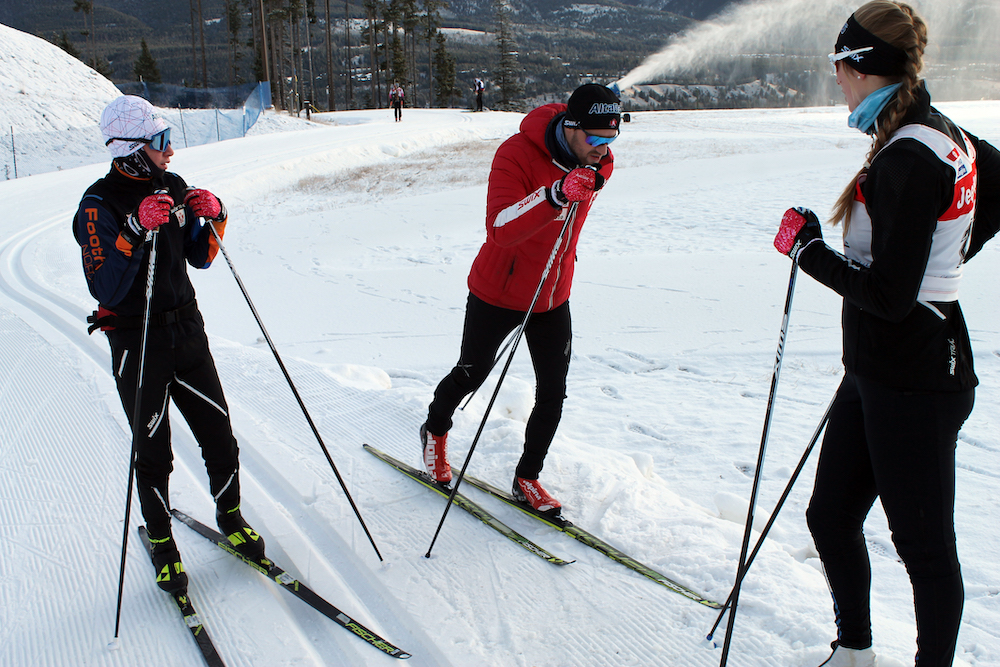
Erik Bråten talking technique with athletes at Frozen Thunder 2019. (Photo: Nordiq Canada)
When Cross Country Canada announced last March that they would be rebranding as Nordiq Canada, they were emphatic the new name was a symbol of their readiness to make changes. Those changes are starting to happen.
One holdover from last season is Erik Bråten, the young Norwegian brought in to shape the development pipeline. After one year on the job, Bråten is still enthusiastic and now the sole head coach.
Louis Bouchard has stepped down as National Team Coach, reverting to his preferred role at Centre National d’Entraînement Pierre Harvey (CNEPH). The role of training centres in Canada is shifting and there appears to be more change coming.
Nic Lemyre, who served as a part-time High Performance Director on a one year contract, has moved on. Joel Jacques — long time waxer, logistics manager, and long-ago racer — will take over as acting HP manager for the Olympic program while Kate Boyd has the same role for the Para program.
Dave Dyer, the long serving events lead and a perennial presence at Canadian races, is sharing that role with Jeff Ellis this year. Ellis will take over the travel and race jury duties this year before completing the transition to take over the Event Director position for next season.
For the first time ever, Canadian Championships will be combined with US SuperTour finals, a continuation of a trend towards hosting joint NorAm/SuperTour events and attemptig to raise the level of competition in North America.
The most visible changes are likely to be the Canadian presence on the World Cup. With the retirement of Alex Harvey and Lenny Valjas, Canada can no longer expect regular podiums and consistent top ten finishes. Harvey’s retirement announcement also resulted in a large change in funding for the national program, with Own The Podium dropping the sport and bringing an end to the richest period in national team history.
In the new world of financial scarcity and likely fewer podiums, the program is focused on bringing athletes up to the same performance level as the Para program.
For this and future years, the athletes nominated for World Cup period 1 will based based on the previous season’s results, allowing athletes to plan ahead and avoid peaking for qualification races in October. The selection criteria boils down to World Cup top 30’s and COC leaders. Period 2 selections will be based on results, with at least one top 30 required to stay in Europe for the next period.
For an athlete to stay on the World Cup for a full season, multiple top 12 results are required. The net effect will be more top athletes spending more time in Canada, where they can help lift the level locally and also have a better training environment.
“The vision is to integrate various performance levels and stages of athletes: World Cup, senior development, and junior development, into one cohesive high performing Team where each athlete is learning, mentoring and being pushed by their team mates to reach their peak performance,” Nordiq Canada’s CEO Shane Pearsall wrote to FasterSkier. “We want our NST athletes to continually improve and challenge themselves year over year to reach their maximum potential and ultimately the World Cup and Olympic podium.”
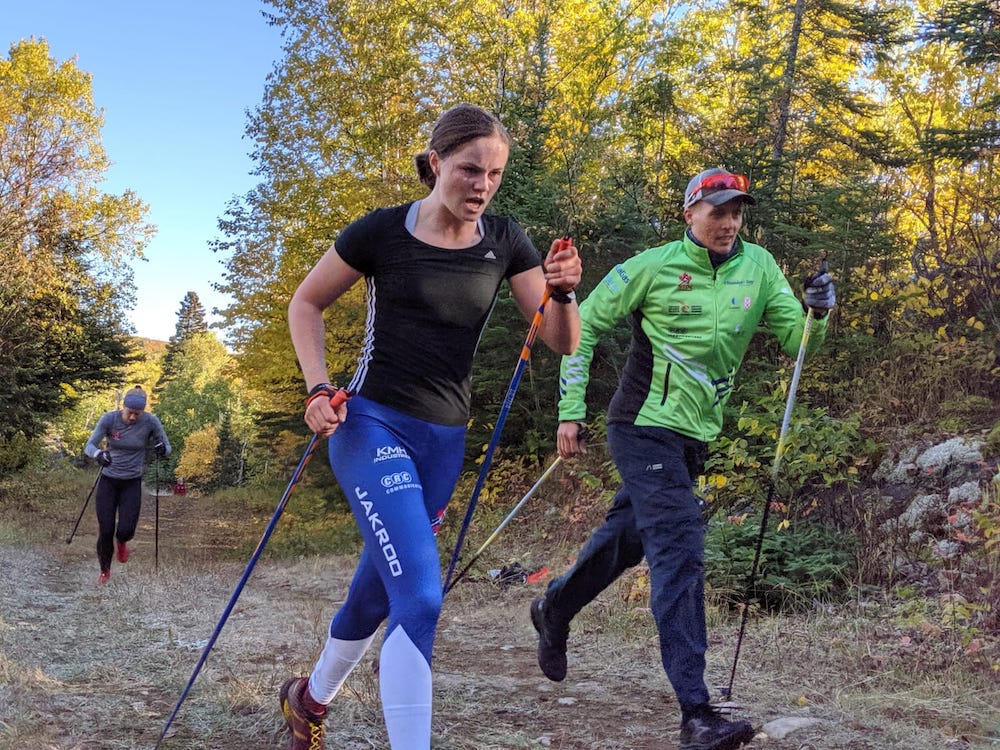
Shaylynn Loewen is supervised by NTDC TBay’s Timo Puiras at a combined NST camp. (Photo: NTDC TBay)
For period 1 this year, Dahria Beatty, Russell Kennedy, and Emily Nishikawa will be racing in Davos and Planica. Canada will skip the Kuusamo, Lillehammer, and the Tour de Ski. With the World Cup coming to Québec City, Minnesota, and Canmore in March, most athletes will get their World Cup opportunities closer to home.
“I’m not expecting anyone to be winning world cups this year, that would be a big step up,” Bråten said on the phone. “We still have Russell Kennedy doing 12th, even if it’s just one occasion, but it’s showing the level that he’s in on the best day. We’ve seen Dahria have plenty of World Cup points last year, and Lahti the year before. Katherine [Stewart-Jones] never did points, but she was top 30 at the World Championships. Of course, Emily was doing really well until she crashed in Cogne, she was top 20 with 1.5 km to go, before she fell and unfortunately had to go the hospital.”
Beatty scored World Cup points in Dresden and Lahti last season and added one more national title to her collection. Kennedy made the semi-final in the Cogne sprint last season. Nishikawa finished 25th overall in the Tour de Ski and was on her way to a best ever result in the Cogne 10km classic, moving up to 19th at the 8.1km time check.
The National Team is smaller this season, to match the smaller budget, with 8 seniors and 5 juniors. Add in Russell Kennedy, who is also a guide on the ParaNordic national team, and it is still a smaller and less experienced group.
Nishikawa is now the most experienced racer on the national team after nine seasons. Asked about her new role as a team leader at the end of a snow camp in May, she told FasterSkier “It’s been a natural progression. Just help the girls get the ski bags on the roof and make sure they’re strapped down well.”
Nishikawa is a quiet person, far more enthusiastic when talking about the upcoming Canmore World Cup than about her own successes. Asked about the season changing crash in Cogne, she said “It was bad, I couldn’t finish.” Behind all that quiet, she is the person the other athletes talk about when describing their transition into World Cup racing.
More detail on the staff, the structure, and the path ahead will follow.