From the FasterSkier archive — posts syndicated from athletes’ and coaches’ own blogs between 2004 and 2012, kept online as published. Current coverage is at fasterskier.com.
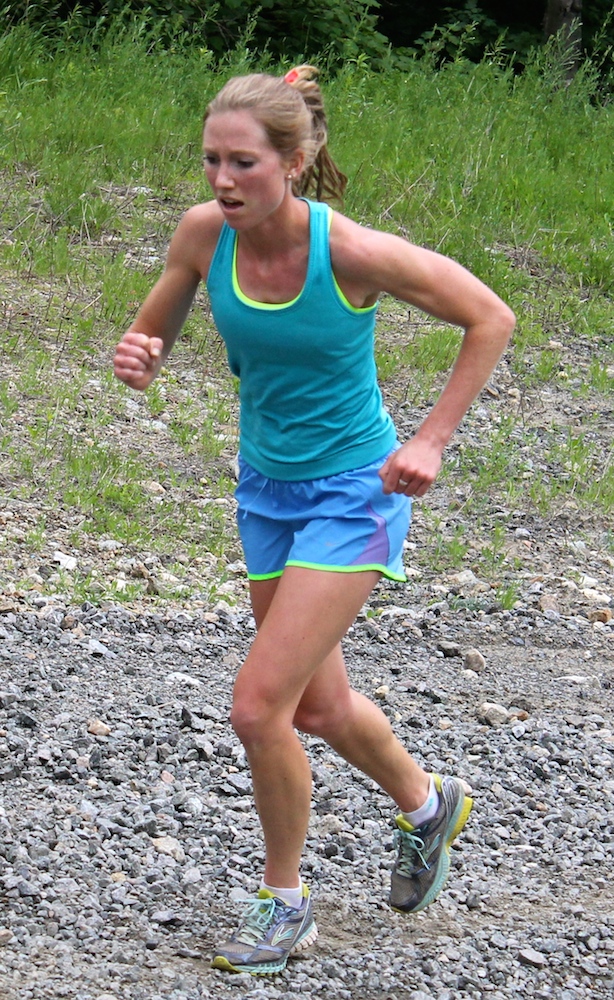
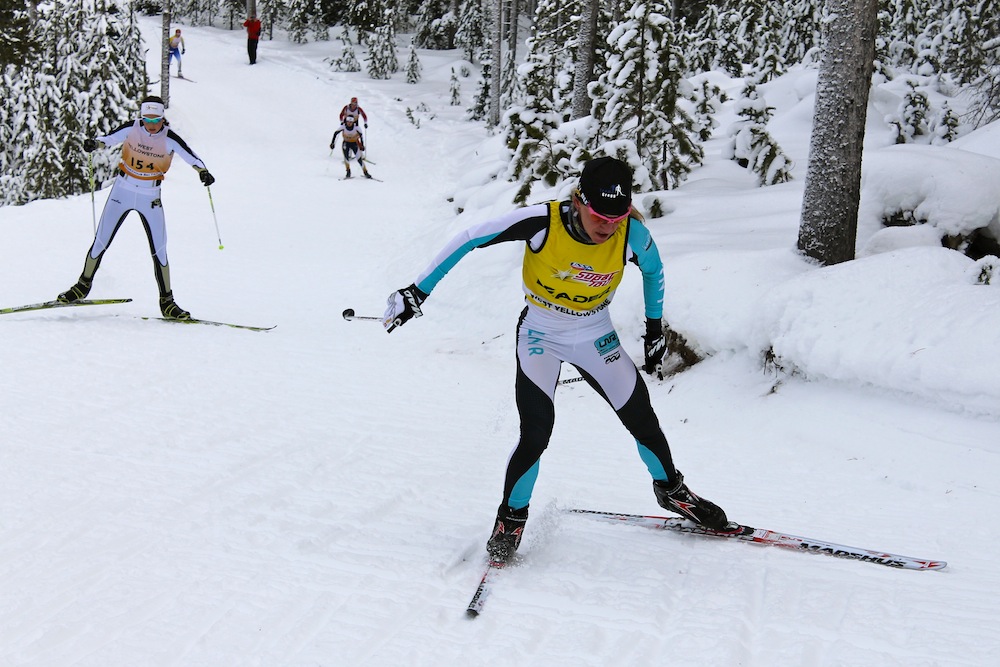
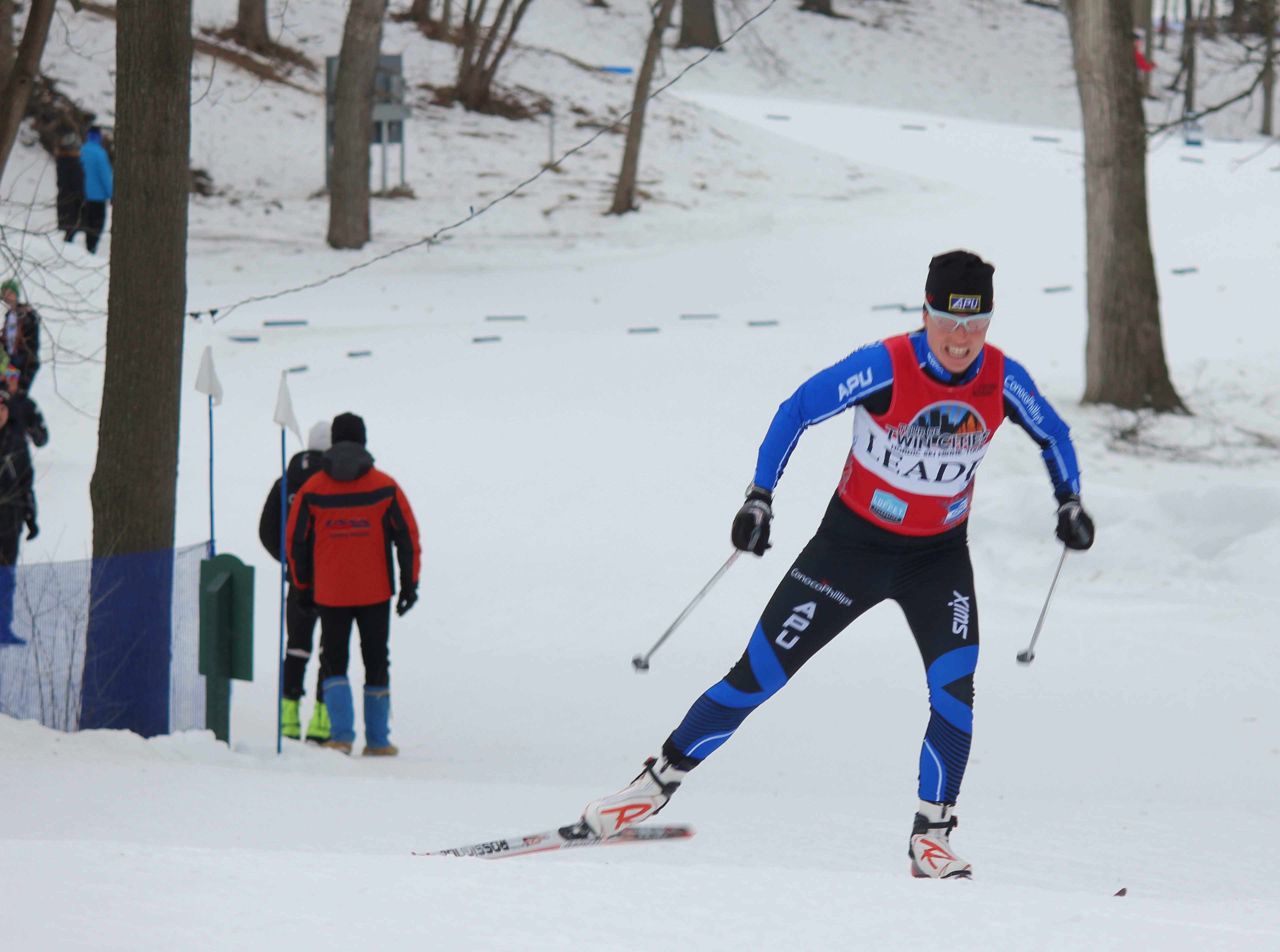
Kikkan Randall leading the 2017 Alaska Run for Women with a smile on June 10. (Photo: Scott Broadwell)A little U.S.-based news to get your Tuesday going:
— Watch out, World Cup, Kikkan Randall is feeling good. The longtime U.S. Ski Team (USST) and Alaska Pacific University (APU) skier took first place in the 25th annual Alaska Run for Women road race, held over Anchorage streets and bike trails this past Saturday. Randall led the field of several thousand women to the finish in 28:41, a pace of 5:44 per mile for the 5-mile, largely flat-road course.
Mid-5:40s for five miles (in June) is nothing to sneeze at on its own, but let’s let the 34-year-old Randall put it in context: “I’m in the best shape of my life now,” she told the Alaska Dispatch News. This is so even though Randall was a few seconds per mile off her previous best on this course, a 28:18 that she clocked while winning this race in 2012. That winter, she went on to win her second of three consecutive Sprint Crystal Globes.
“I’m in the best shape of my life now.” — Kikkan Randall in a recent interview with the Alaska Dispatch News
Finishing just over a minute back for second place on Saturday was recent local high-school graduate and multi-time state track champ Briahna Gerlach, who will race Division I track and cross-country running this fall in the Lower 48. “I didn’t even know it was Kikkan Randall,” Gerlach told the Dispatch News of her competition over the first mile before Randall pulled away. “When I found out I said, ‘OK, she can go.’ She’s crazy. She didn’t even look tired.”
Other skiers in the top 10 included Mandy Vincent-Lang (formerly University of New Hampshire) in third, Becca Rorabaugh (APU) in fourth, and Lauren Fritz (APU) in 10th.
https://www.instagram.com/p/BVLNwkqDp3i/
— If it’s summer, the rest of the APU Elite Team must be running up mountains. APU skiers took nearly every race in the seven-stage Alaska Mountain Runners Grand Prix last summer, highlighted by David Norrissetting the course record at Mt. Marathon, the insanely steep climb and descent outside the harbor town of Seward, Alaska, that was first run as an organized race in 1915 and is believed to be the oldest mountain race in the country. (Norris took the record back from Kilian Jornet, a man widely acclaimed as the world’s best mountain runner.)
This summer, they’re at it again. On the evening of Thursday, May 25, Norris took first place in Kal’s Knoya Ridge Run, ascending an uphill-only course in the Chugach foothills on the eastern edge of Anchorage. (Runners had to descend under their own power, but the clock stopped when they crossed the finish line.) Norris weathered an early-summer snowstorm to cover 8.5 kilometers, and 4,500 vertical feet of elevation gain, in 58:08 for a substantial margin of victory. First place among the women went to Jessica Yeaton (APU/Australian National Team).
In a shorter version of the race (5.6 k and 2,900′ of climbing), APU skier Forrest Mahlen was the first across the line. Marine Dusser (formerly University of Alaska Anchorage (UAA), currently affianced to USST skier Erik Bjornsen) was the first woman, less than 90 seconds behind him. Other top-10 skiers included APU junior Maggie Meeds in third, APU junior Aubrey LeClair in fourth, and Jaime Bronga (formerly UAA) in seventh. In the long race, Kate Fitzgerald (formerly APU) was fourth among the women, while Kenny Brewer (formerly University of Alaska Fairbanks) was third and Mark Iverson (formerly APU) was sixth.
— Nine days later, on the morning of Saturday, June 3, it was newly minted U.S. Ski Team memberScott Patterson edging out his APU teammate Erik Bjornsen (also of the USST) by the slimmest of margins, 0.3 seconds, after slightly more than 42 minutes of racing up 3 miles and 3,500′ of elevation gain in the uphill-only Government Peak Hill Climb outside of Palmer, Alaska. “I led the whole thing till maybe a minute to go, then we duked it out as I tried to come up with a little bit of a sprint,” Patterson told the Alaska Dispatch News after the race. “With three feet to go, Erik would have won. Even with two feet to go. He seemed to stumble a little when it was down to one step and I got him.”
APU junior Hamish Wolfe was 8th.
Dusser once again took the victory in the women’s division, in a time that would have placed her 12th among the 105 men in the field.
— So who’s still skiing? More people than you might think, thanks to an epic winter in the western U.S. that brought dozens of feet of snow to the High Sierra and has the Squaw Valley alpine area making noises about running at least one chairlift all summer long. For example, here’s fresh grooming (!) on the Auburn Ski Club trails on June 6 (!!):
https://www.instagram.com/p/BVBZo3GAt-A/
Here’s Paul Kovacs (Australian National Team) on the ASC trails on the morning of June 7:
Here’s FasterSkier contributor Jon Schafer with a Steamboat Springs Winter Sports Club junior camp, driving up to the nordic trails at Mt. Bachelor in Bend, Ore., in a June 10 snowstorm:
https://www.instagram.com/p/BVKdwcMhDYL/
Finally, farther north, the APU Elite Team arrived at Eagle Glacier earlier this week for their first Glacier Camp of the summer:
https://www.instagram.com/p/BVQYFY1lGOo/
– And earlier this month in Albuquerque, N.M., the University of New Mexico (UNM) announced that athletic director Paul Krebs will retire on June 30. The university’s press release did not indicate a reason for his departure, but the news came two days after the state auditor informed UNM Interim President Chaouki Abdallah that its athletic department would be the focus of a special audit, according to Deadspin.com. The Office of the State Auditor reportedly “received information raising concerns related to athletic fundraising activities and expenses of the University of New Mexico.” Krebs, who was UNM’s athletic director for 11 years, was criticized for spending nearly $65,000 dollars in taxpayer money on a 2015 golf trip to Scotland and was at the heart of the heated proposed discontinuation of the UNM ski team.
* * *
This article has been updated to reflect the correct historical status of the Mt. Marathon Race as believed to be the oldest mountain race in the country, not as “the second-oldest footrace in the country behind the Boston Marathon.”
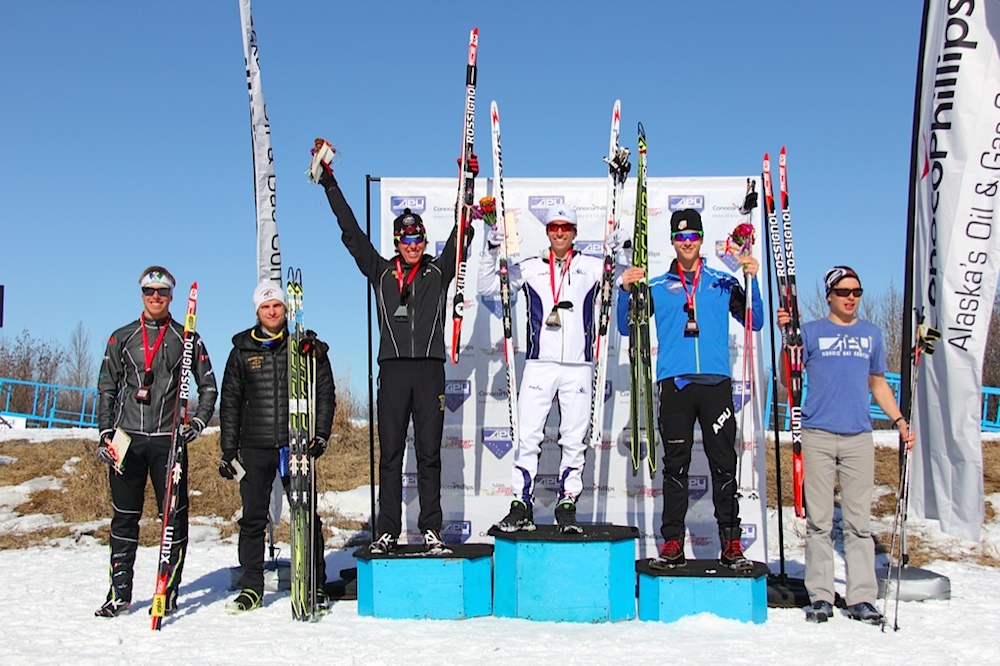
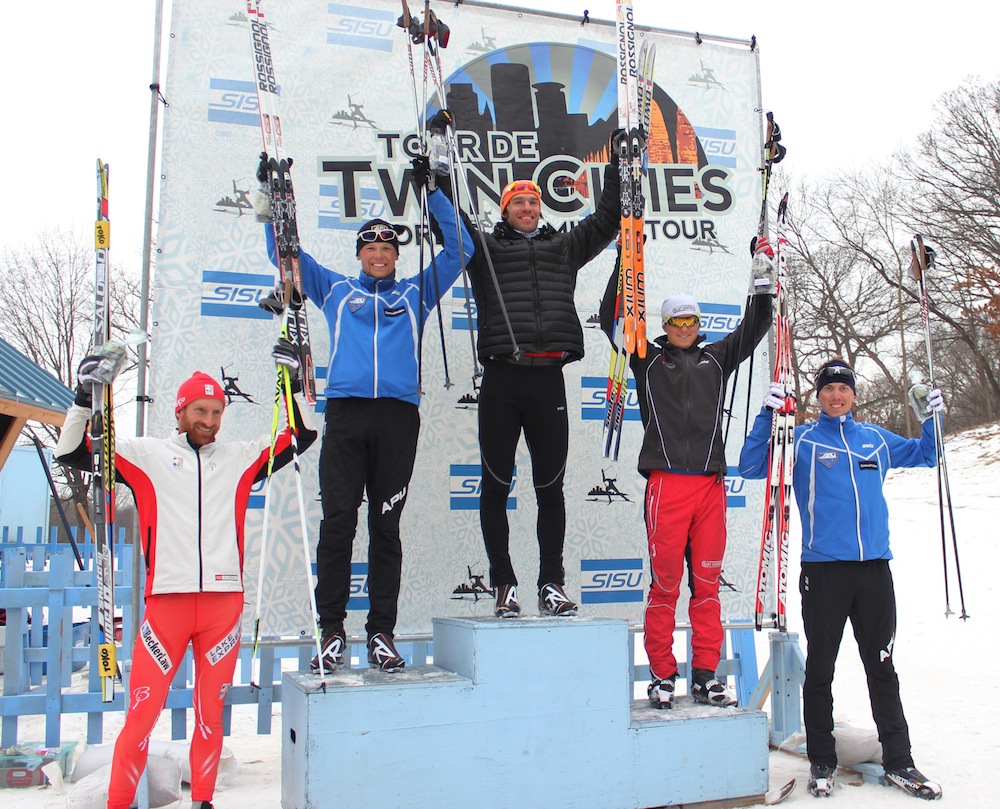
The men’s 15 k freestyle individual start podium at the 2014 SuperTour Finals in Anchorage, with (from l-r) Patrick Johnson (6th), David Norris (4th), Scott Patterson (2nd), winner Noah Hoffman, Erik Bjornsen (3rd), and Lex Treinen (5th). (Photo: Rob Whitney)
Note: This article has been corrected to describe the race women’s SuperTour leader Caitlin Gregg is shooting for at World Championships: the 10 k skate.
WEST YELLOWSTONE, Mont. — National racing begins Friday as the SuperTour kicks off in West Yellowstone, Mont., and the excitement on the Rendezvous trails couldn’t be higher. The best skiers from around the country have been training for at least a week in the little Montana town as they prepare to compete for American dominance and possible positions on World Cup and World Championship teams.
With several departures from the racing scene including, Olympian Torin Koos (BSF), Rose Kemp (SVSEF), and Kate Fitzgerald (APU), and a multitude of up-and-coming racers on the cusp of success, the 2015 SuperTour will be anyone’s game.
When the USST selected four men (Erik Bjorsen, Brian Gregg, Koos and Kris Freeman) and no women from outside the regular World Cup team, it left many skiers hungry to show that they could perform well on the international level.
This year they’ll have another shot with the 2014 Nordic World Championships in Falun, Sweden.
While the U.S. is allotted 12 spots for each gender in Falun, USST head coach Chris Grover explained that he and his staff would select eight skiers per gender at most.
World Championship team selection will be based on several criteria. Those skiers ranked in the top 50 in the World Cup sprint or distance standings as of January 18 will be named to the team. After that coaches’ discretion kicks in. If coaches feel that the World Championship team could benefit from additional skiers after their discretionary picks, they will then begin selections from the USSA points list.
The selection is identical to last year’s Olympic process, with the exception of the USSA points. When making selections for the Olympics, coaches picked three non-USST skiers from the FIS points list to fill in the gaps.
According to USST Head Coach Chris Grover, the reason for the switch to USSA points is to emphasize domestic racing so that potential candidates for the championships will be racing against each other, rather than chasing FIS points across the globe like many did last season.
Due to the emphasis on USSA points this season, the SuperTour will be where non-World Cup team athletes will have the chance to prove they have what it takes.
The Veterans
Brian Gregg (Team Gregg) will be a top competitor in 2015. Photo: flyingpointroad.com.
On the men’s side, 2014 overall SuperTour champion Reese Hanneman (APU) will be competing in the first period World Cup races and will return to the national circuit in Houghton, Mich. for the 2015 U.S. Cross Country Championships. While the benefits of early-season World Cup racing are considered mixed, Hanneman can expect his chances of racing in Falun to increase if he demonstrates that he can keep up with the Europeans and his fellow American teammates.
With Hanneman out of the picture in West Yellowstone and Bozeman, the men’s SuperTour favorites are the remaining two non-USST members to attend the 2014 Olympics – Brian Gregg and Kris Freeman.
Freeman, a 34-year-old former USST member, will be racing in West Yellowstone for the first time in nine years. Freeman, who lost his position on the USST in 2013, was one of three non-USST members to qualify for the 2014 Olympics. Despite high hopes of his best olympics yet, he struggled in Sochi. This season he is looking to turn around his skiing and earn a spot on the World Championship team. As one of most experienced skiers on the SuperTour circuit he will have an advantage over much of the competition.
Gregg, like Freeman, will also enter the 2015 SuperTour with a multitude of experience. The 2013/2014 season saw Gregg on the SuperTour podium several times, most notably with his two second place finishes in the 2013 West Yellowstone 15 k freestyle and in the 2014 U.S. Nationals 30 k freestyle. At the Olympics, he constantly finished in the 40s and 50s.
As he starts the season, Gregg acknowledged that the first races of the season would be challenging.
“Kris is in really good shape so I think there are going to be some very competitive races. I’m excited,” Gregg said from West Yellowstone Tuesday.
Joining Freeman and Gregg as veterans of the SuperTour are Matt Gelso of the Sun Valley Gold Team and Dakota Blackhorse-von Jess of the Bend Endurance Academy. Gelso will be looking to build on past results while Blackhorse-von Jess will pursue success in sprinting, especially since U.S. sprint champion Torin Koos retired from competition.
After disappointment in the freestyle sprint at the 2014 U.S. Cross Country Championships and a failure to qualify for the 2014 Olympics, Blackhorse von-Jess said that nothing has changed in his career trajectory.
“I’m re-energized after the disappointment of the Olympics with the reaffirmation that I still want this and believe I have what it takes… My career/goal trajectory hasn’t changed in the least: I’m focused on racing my best in the biggest international competitions and just need to make sure I do what is necessary to make those trips and come to the starting line in Falun prepared to light it up,” he wrote in an email.
Matt Liebsch of Team XC United will also be returning to racing after missing out on Olympic qualification. However, Liebsch, who works near full time for Gear West, has lightened his training load as is looking to “maximize fun and earning potential ” rather than qualify for international events.
“I’m not going to be chasing FIS points around the world or country necessarily. If they fall in my lap because I’m racing well, that’s great, but I’m not going to be stressing about it… It’s not really a change for me. I’m still going to try to race as fast as I can only I won’t be training as much,” he said in a phone interview.
Ryan Scott, living and training independently in Boulder, Colo., will also return to competition, but, like Liebsch, has cut back his training as a result of work.
For the women, one name has particularly dominated the domestic circuit for years – Caitlin Gregg.
Gregg, like Hanneman, will start her season on the World Cup after earning the women’s overall title at the SuperTour finals in Anchorage last season. Gregg said earlier this fall that she is as motivated as ever and has her sights set on a particular race: the 2015 World Championships 10 k skate. To get to Sweden, however, she’ll need to demonstrate that she’s on par with USST and dominate when she returns for the U.S. championships in January. In the meantime, she’s excited for the 5 k next weekend in Lillehammer and aims to earn a start in that race.
With the absence of Gregg, the West Yellowstone and Bozeman SuperTours are anyone’s for the taking.
Rosie Brennan (APU) leading her semifinal in the 2014 U.S. Cross Country Championships. (Photo: http://bertboyer.zenfolio.com).
Always a strong skier, APU’s Rosie Brennan will once again attempt to demonstrate her mettle as she makes a bid for World Championships. Last year Brennan started her season on the World Cup and returned to the U.S. exhausted, but earned a national title at U.S. Nationals in addition to several podiums. This year she will enter the season with fresh energy despite a turbulent fall after loosing her father in August.
Joining Brennan at the top of the SuperTour expectations are APU teammates Chelsea Holmes and Becca Rorabaugh.
Rorabaugh won the 10 k interval start classic at the 2014 U.S. Cross Country Championships for her first national title, and is looking to have even more time upon the podium as she continues through the season.
Last year Bridger Ski Foundation’s Jennie Bender repeated a national title in the freestyle sprint. While she’s dealt with illness and injury for the past two years, Bender told FasterSkier that her summer training this year was her best to date, and that she is looking to find success domestically and qualify for World Championships.
The Wild Cards
While the veterans of the 2015 SuperTour are names we’ve seen at the top of the result sheets for years, there are several skiers who have an excellent opportunity to shake up the status quo and make a name for themselves on the domestic circuit.
Sun Valley Ski Education Foundation’s Miles Havlick didn’t have the season he wanted in 2014, but has come back with a vengeance in 2015. While he has yet to face his competitors on-snow, Havlick has won a slew of time trials including the USST1o k freestyle rollerski time trial in Park City, Utah against the country’s best. He also broke a 25-year-old record in the Baldy Hill Climb this year.
According to Havlick, he has the all the ingredients for a breakout season. Now it’s only a matter of time.
“I think on any given day – when I am mentally competent, carrying confidence from previous races, focused, and my wax is good – I can be the best skier out there. The college skiing is when I was really able to prove that to myself. Last year was kind of tough because I felt like I was spinning my wheels by the end, but I think I’ve made some adjustments this year that can fix that,” he said in a phone interview in October.
Havlick also has gained the attention of Grover and the USST.
Erika Flowers racing to the fastest women’s time in the inaugural Tim Burke Uphill Run Test at Whiteface Mountain this fall.
“I’m excited to see how Miles Havlick is going to ski. He’s had a great fall. He won our US ski team time trial that we did in Soldier Hollow. He set a new course record on the Baldy Hill climb that stood for 26 years or something. There’s some new emerging faces to keep an eye on,” he said.
For the women, a possible 2015 wild card is a less well known. However, despite her lack of national attention Stratton Mountain School T2’s Erika Flowers has all the makings of an up and coming skier.
Flowers has always been a strong and consistent skier with the majority of her SuperTour results landing in the top-ten. However, when she traveled to Europe in the spring of 2014 she demonstrated her potential, wining a 10 k mass start in Silvapalana, Switzerland. Several weeks later she placed 14th in the Alpen Cup mini-tour. She finished the tour as the second American behind Holmes and had the fifth-fastest time in the final 10 k pursuit.
While Flowers has struggled with sprinting in the past, she demonstrated that she could stick with the best of them at the 2014 Frozen Thunder races in Canmore, Alberta ending the day in 7th.
The following day she finished 7th in the 7.2 k freestyle at Frozen Thunder. She was the 3rd American, and placed ahead of several notable Olympians including Jessie Diggins.
The Rest
In addition to Havlick, there are several other men who could make the domestic season anyone’s game.
Recent college graduates Ben Lustgarten of SVSEF, David Norris of APU, and David Sinclair of Green Mountain Valley School will be looking to take their success from NCAA racing to the SuperTour.
Scott Patterson (APU) is another notable graduate who had success on the SuperTour both at the 2014 Nationals and 2014 SuperTour finals. According to his family, Patterson will not be starting his season in West Yellowstone due to a skiing accident that occurred Oct. 31st in which he was impaled by a broken ski in his upper leg. While the leg wound healed, Patterson developed a pulmonary embolism (blood clots in his lungs) which has limited his exercise to walking. However, according to his family, Patterson is optimistic that he will return to racing at U.S. Nationals.
Ben Saxton (SMST2) and Paddy Caldwell (SMST2/Dartmouth) will be the sole USST members starting the season in West Yellowstone. Saxton who was second in the freestyle sprint at U.S. Nationals last year, is aiming perform well in Friday’s sprint. Caldwell, who has yet to decide whether or not he will ski for Dartmouth this year is a strong distance skier and will be vying for top results amongst the country’s best.
“They need to prove themselves and make those teams just like any other athlete that is on the domestic scene. Obviously those guys are younger guys and they’re still focused on the U23 World Champs,” Grover said of the two USST D-Team athletes.
Welley Ramsey (MWSC), Tad Elliott (SSCV), and a slew of other men from APU and Craftsbury will also look to challenge the national favorites as the season gets underway.
On the women’s side recent graduates Anne Hart (SMST2), Rosie Frankowski (APU), and Anja Gruber (Far West Elite) are new to full-time racing on the national circuit after having successful college careers. While the adjustment from college skiing to professional racing is often difficult, these women will still be a strong force to contend with.
Annie Pokorny (SMST2), Caitlin Patterson (CGRP), Liz Guiney (CGRP), and Mary Rose (SVSEF) are shaping up to be strong competitors in the 2014/2015 season after a productive summer and fall trainings with their respective teams.
Sylvan Ellefson (SSCV/Team HomeGrown) racing at U.S. Cross Country Championships earlier this month at Soldier Hollow in Midway, Utah. There, Ellefson claimed his first national title in the 30 k freestyle mass start. (Photo: Bert Boyer/bertboyer.zenfolio.com) All proceeds from photo sales will be directly donated to NNF.
“The most important thing in life is not the triumph but the struggle.” — Pierre de Coubertin, International Olympic Committee founder
Sylvan Ellefson loves that quote, part of The Olympic Creed. And he loves it to this day despite being on the wrong side of the U.S. Nordic Olympic Team naming, which was made official last week on Jan. 22.
For athletes like Ellefson, a 26-year-old Ski & Snowboard Club Vail (SSCV)/Team HomeGrown skier, the news came Tuesday following a U.S. Ski Team (USST) meeting over in Europe. Ellefson was home in Colorado with his wife, Sarah, anticipating, like a kid on “Christmas morning having to wait until everyone was up to open presents,” he wrote in an email.
Sylvan Ellefson and his wife, Sarah, after Ellefson won his first national title in the the men’s 30 k freestyle mass start at 2014 U.S. Cross Country Championships.
“Tuesday was probably the longest day of my life,” Ellefson continued. “I was trying not to build the day up in my mind, but it was literally impossible. I was stressed in the morning and didn’t sleep much the night before. All I was doing was thinking about it. I was thinking about the call I was going to get.”
He told Sarah how he was feeling and she recommended he go skiing to clear his head.
“Right now I’m going to go for a nordic ski because its what I love to do,” Ellefson wrote on Facebook Jan. 21. “I’ve spent the last 10 years of my life living a dream. For me it’s never been about the end result, it’s been about getting out and crust cruising for 4 hours and slogging though inches of slop at a SuperTour and laughing about it after. I had to remind myself of that … I would love to be a 2014 Winter Olympian, but no matter however this year, this day, turns out, I know that it’s been a long, fun road of hard work and it can only get better from here.”
That night, he went to work with Sarah, a physical therapist in the Denver area, and the USST email popped into his inbox. Sitting on a patient table, he read it and laid back on the table. He looked at Sarah, then shoot his head with what he described as a forced smile.
“It was really hard for me to take,” Ellefson continued. “Immediate emotion always takes over. Anger, disappointment, sadness… but this was something that I had never felt before. But again, just like that morning, Sarah helped me put everything back into perspective. She reminded me of all the amazing relationships I had developed in skiing, all the amazing places skiing has taken me and all the things I had already accomplished in my ski career.”
Two weeks earlier, Ellefson won the 30-kilometer freestyle mass start at U.S. Cross Country Championships for his first national title. That put him one gigantic step closer to making his first Olympics, but nationals had never been touted as trials. Making the team was instead a numbers game: rank in the overall World Cup top 50 — which required racing over in Europe — or rank above everyone else in the U.S. on the International Ski Federation (FIS) points lists.
Kris Freeman (Maine Winter Sports Center) leads Matt Liebsch (XC United/Team StrongHeart) and Sun Valley’s Miles Havlick (l) in a chase pack of the 30 k freestyle mass start at 2014 U.S. nationals. Freeman went on to place third, Liebsch was seventh and Havlick eighth.
In the fourth edition of the FIS points list, based on the last calendar year through Jan. 19, Ellefson was the fifth-ranked U.S. man in distance events — behind SSCV/Team HomeGrown teammate and USST member Noah Hoffman, who prequalified on the World Cup, former USST member Kris Freeman (Maine Winter Sports Center), Brian Gregg (Team Gregg/Madshus), and Matt Liebsch (XC United/Team StrongHeart). On the sprint list, Ellefson ranked seventh.
Ultimately, the USST picked seven men and seven women for an Olympic squad of 14. They chose not to fill their quota of 17, and U.S. Head Coach Chris Grover explained on a conference call that they told athletes and coaches “from the get-go” that they only intended to bring those they planned on starting.
“With seven women and seven men, we have our start positions filled,” Grover said. “Seven and seven was the magic number for us.”
“The cross country community has followed a vision that its athletes could, indeed, be Best in the World,” U.S. Ski & Snowboard Association (USSA) Vice President of Athletics Luke Bodensteiner wrote on the USSA blog.
“Cross Country Olympic Selection” by Luke Bodensteiner:
“The growing success of cross country ski racing in the USA has come through the passion by the American ski community, fueling the fire that has resulted in more and more skiers find success internationally. The cross country community has followed a vision that its athletes could, indeed, be Best in the World.Our 2014 Olympic selection criteria reflected that vision, challenging athletes to ski into the top 50 in distance or sprint on the FIS World Cup rankings – a challenging but attainable level. Seven women and three men stepped up and met that mark – the most ever to achieve the top criteria. We supplemented those ten qualifiers with four other talented athletes who achieved the highest rankings on the FIS points list.With those 14 athletes, we will have the ability to fill all Olympic start positions. Based on the principles of our selection criteria, we have confirmed a team size of 14 with FIS that we, and USOC, believe gives the USA the best opportunity to achieve medals in Sochi.
The USSA selected a strong and focused team, starting from the principle that it is our obligation, first and foremost, to support those athletes with a high potential for winning medals. We are also cognizant of the role that athletes play as ambassadors for their sports. Together with the USOC, we believe that achieving medals in the Olympics will have even greater longstanding positive impact.
Our success as a nation on the World Cup and at World Championships has come from providing very talented athletes with a high level of personal support. Every one of our 14 Olympians earned their spot on the starting line. As an organization, we will provide that same support to each one.
I know that every cross country skier in America will be tuning in to NBC to watch as these 14 Olympians seek not only their own personal goals, but to bring greater awareness to the sport we all have grown up to love.”
— Luke Bodensteiner, USSA EVP Athletics
“Our 2014 Olympic selection criteria reflected that vision, challenging athletes to ski into the top 50 in distance or sprint on the FIS World Cup rankings – a challenging but attainable level,” he wrote. “Seven women and three men stepped up and met that mark – the most ever to achieve the top criteria. We supplemented those ten qualifiers with four other talented athletes who achieved the highest rankings on the FIS points list.”
In an email, Grover elaborated, “The USA Team is headed to Sochi to not only participate, but to perform on the biggest stage in the World and to demonstrate the strength of US Cross-Country ski racing.”
The team size wasn’t preplanned, he said in a follow-up phone interview. They simply wanted to make sure each start position — four per gender per individual race — was filled.
“In terms of the exact team size, whether it was 13 athletes or 14 athletes et cetera, we really had to see how that last points list came out, so that we knew how many sprinters we had and how many distance skiers we had,” Grover continued. “That was especially true on the men’s side, where the FIS points and the final selection criteria really played into it. Athletes, particularly on the men’s side, had been asking us how many athletes we were planning on bringing to the Games, and we said that we would fill our spots, fill our start spots. So they knew that ahead of time.”
On the men’s side, the U.S. team selected Freeman as its second distance skier and Gregg as its third (after Hoffman). Torin Koos (Bridger Ski Foundation/Rossignol) make it with the third-best FIS sprint ranking, and Erik Bjornsen (APU/USST) was chosen as the fourth man on the sprint list. USST teammates Andy Newell and Simi Hamilton had prequalified on the World Cup. Liebsch was 0.04 points behind Gregg on the distance list, which Grover said they used as their third criteria (forgoing discretion) to make the final picks.
“We really tried to apply the selection criteria in the most fair way possible,” Grover said. “That becomes, for sure, a challenge, especially on the mens’ side when you get down to the sixth, seventh, eighth guys, you’re really splitting hairs because the FIS points are so close at that point. Because they were so close we opted not to use discretion. It really wasn’t a fair way to do it.”
In the end, the U.S. team drew a line at seven men and seven women. That left three spots to be redistributed to other nations, like Canada, which picked up two additional quota spots on Thursday and added two women on Friday.
For the U.S., the big question became: why not bring Liebsch and Ellefson, and a woman or two on the cusp like Kate Fitzgerald (Alaska Pacific University) and Caitlin Gregg (Team Gregg/Madshus)? Even if you couldn’t guarantee them all starts — what’s the risk of having a couple alternates?
“The challenge is that we don’t get extra credentials,” Grover explained. “The amount of credentials that we have is fixed, so whether we bring 14 athletes or whether we bring 17 athletes, our staff size remains the same. We couldn’t bring any additional staff.”
The Olympic Organizing Committee limited the number of visas granted to team staff members, one club coach explained. At one point, it was down to two coaches and four wax technicians per team. As a result, the quality of support for a given group of athletes becomes a deciding factor.
In terms of developing the sport, Grover said that doesn’t happen at the Olympics.
“The Olympics is the pinnacle of the performance or competition pipeline,” he said. “Development happens on the SuperTour. It happens at Europa Cups and Scandinavian Cups. It happens at World Juniors and U23s. Occasionally, it happens on the World Cup, in terms of giving young athletes a start at that level. It does not and should not come at the World Championships or the Olympics. … It’s not a development trip; it’s a competition trip at the very highest level.”
That said, Grover encourages young athletes to make the Olympics a long-term goal.
“But you don’t go from winning a race on the SuperTour to the Olympics in one step,” he said. “It takes many, many, many steps, many competition steps in between. It’s not always linear. There’s jumps and there’s times where you plateau and you fall back. But you have to have success at every level along the way.”
***
For those that spent the last decade of their lives or more working toward that Olympic goal, to come so close but fall a few points (or fractions of a point) short came as an incredibly tough blow. Grover said some of them took it with “great grace” and “real style,” and a couple were “extremely disappointed.”
Jennie Bender (Bridger Ski Foundation) on her way to her second national sprint title, which she achieved earlier this month at U.S. Cross Country Championships at Soldier Hollow in Midway, Utah. (Photo: bertboyer.zenfolio.com) All proceeds from photo sales will be directly donated to NNF.
Jennie Bender (Bridger Ski Foundation) was the eighth-ranked sprinter behind seven USST women who made the team: Kikkan Randall, Sadie Bjornsen, Sophie Caldwell, Jessie Diggins, Ida Sargent, Holly Brooks, and Liz Stephen.
“This is the year my peers, who I have raced against since I started nordic in eighth grade, are all going to the Olympics for the first time, I yearn to be there with them,” Bender, 26, wrote in an email. “I will never forget the roller coaster of emotion I rode while waiting for either an email or a phone call the night of the 21st. Next time, I will not be on that coaster.
“My support system has given me a big hug,” she added.” They have told me I am motivating to them, which in turn, reminds me to stay strong. I wish I hadn’t gotten mono and lyme [disease] two summers ago. I wish I hadn’t had a herniated disc this summer. But I don’t know what else I could have done that was in my power. I am not making excuses, but I will not forget them either.”
Bender won the skate sprint at 2014 U.S. nationals for her second sprint title, which she explained was a “giant relief.”
“Not repeating lasts year’s result in the classic sprint was immensely aggravating, and even if I had won two sprints, I don’t know if that would have changed anything,” she continued. “The only thing to do now is to look forward. My plan is to race the Boulder Mtn Tour, the upcoming Supertours, Birkie, and then head to Europe for March.”
Caitlin Gregg was next on the sprint list and eighth behind Fitzgerald (in seventh) and six prequalified USST women on the distance list. Gregg, 33, was aiming for her second Olympics after notching a historic U.S. women’s distance result at the 2010 Games. At U.S. nationals earlier this month, she won the 20 k freestyle mass start by an unprecedented 3:36 minutes.
After her husband, Brian, earned a trip to his first Olympics, Caitlin wrote in an email, “Team Gregg is all very fired up about having two Olympians on the roster now 🙂 So basically our roster is 100% Olympians!”
At the same time, it was bittersweet.
“I am bummed to ski so well this year and not make the Olympic Team but I am staying positive and using this opportunity to look at the big picture!” she wrote. “My work with under-privileged kids in North Minneapolis gives me incredible perspective! To have the opportunity to chase the Olympic dream at all is extremely wonderful. Once again I am forever grateful to the countless individuals, companies and organizations who have helped make my career possible! I will use the story of not being named to show the entire ski community that the triumph is not only in making the team but in the approach and almost more so, in the response and actions when you do not make it!!!”
Caitlin Gregg (Team Gregg/Madshus) on her way to a 3 1/2-minute win in the women’s 20 k freestyle mass start at 2014 U.S. nationals at Soldier Hollow in Midway, Utah. (Photo: bertboyer.zenfolio.com) All proceeds from photo sales will be directly donated to NNF.
After spending some time on snow with Brian in Toblach, Italy, she planned to fly home to Minneapolis on Wednesday.
“I will visit the Boys and Girls Club, I will ski with the Loppet Nordic Racing crew and I will compete in the entire weekend of events for he City of Lakes Loppet! My hometown race,” she wrote. “Of course I will also be focusing once again on the Birkie and sharing the love of skiing with the 10,000+ people who will also be racing that day!”
While Brian’s parents, twin brother and sister-in-law will be in Sochi to cheer him on, Caitlin explained she’ll race stateside (in the marathon circuit, SuperTour and other races) for financial reasons. She is the defending champion and a two-time winner of the American Birkebeiner, which dolls out $39,000 dollars in prize money, including $7,500 to the top male and female in the 50 k skate.
“What a great journey this has been,” Caitlin added. “[Brian] saw me off before Vancouver and now I will do the same for him before Sochi! We are psyched to be an Olympic Duo and look forward to being involved with skiing for a very, very long time!”
“She is the best partner in the world,” Brian wrote in an email. “She has been coaching me all winter. Writing my training plan, planning our diet, interrupting her own workouts to video, time or lactate test me. In 2011 she told me she would do everything to help me make the 2014 Olympic team. Next she wanted to make it herself too. The US women are so strong but we decided to go for it. Watching Caitlin win every skate distance this year was just amazing. I am so proud of her. It has been an emotional two weeks and we are just so happy to have each other.”
Fitzgerald, 26, explained in an email she was grateful for the love and support of her family and friends.
“It is sort of a bitter sweet experience — bitter because I didn’t make it but sweet that I was so close!” she wrote. “Especially with such an incredible team! US skiers have really upped their game and I am really proud of that. I can’t wait to watch our team kick butt and take names at the Olympics.”
Four of her APU teammates — Randall, Brooks and the Bjornsen siblings — are on the USST and Olympic team.
Liebsch declined to comment publicly just yet, but wrote on Facebook: “…The U.S. has decided not to fill all their quota spots and will only take 3 distance men (I was ranked 4th on the list). I have the best sponsors, family and friends and have been blessed in so many ways! Time to train for the Birkie!”
Ellefson summed up that he was “bummed to be honest. How could one so close not be? I wanted one more taste of being able to perform on the world’s stage. But now I get to watch some of my best friends do that and I’ll be cheering my [butt] off every single race during these games.
“I have always believed that happiness can be found down many different avenues so when something gets you down, you find something that reminds you of and brings you back to that warm, fuzzy, familiar place,” he wrote. “I can’t get stressed over missing an Olympic Team nomination. I won’t let it get me down. So now I’m busy getting back to the drawing board for the next adventure.”
— Chelsea Little contributed reporting
“The most important thing in the Olympic Games is not to win but to take part, just as the most important thing in life is not the triumph but the struggle. The essential thing is not to have conquered but to have fought well.” — The Olympic Creed, Pierre de Coubertin
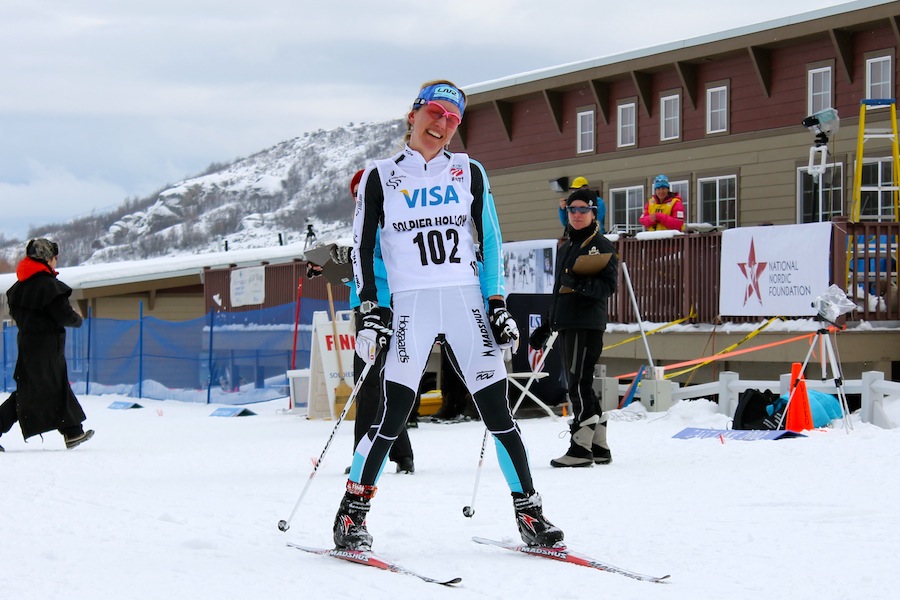
Caitlin Gregg (Team Gregg/Madshus) smiles with relief after winning the women’s 20 k freestyle mass start at U.S. Cross Country Championships on Wednesday in Midway, Utah. Gregg won by 3:36, the biggest margin at nationals in recent memory.
FasterSkier’s coverage of the 2014 U.S. Cross Country Championships is brought to you through the generous support of The Memory Clinic in Bennington, Vt.
MIDWAY, Utah — Caitlin Gregg didn’t waste any time getting out front and out of range on Wednesday, opening up an 11.5-second lead by the first of four laps in the women’s 20-kilometer freestyle mass start. The 33-year-old SuperTour leader went on to post the fastest lap each time around the Olympic 5 k course at Soldier Hollow en route to a 3:36.4-second victory in the penultimate race of the 2014 U.S. Cross Country Championships.
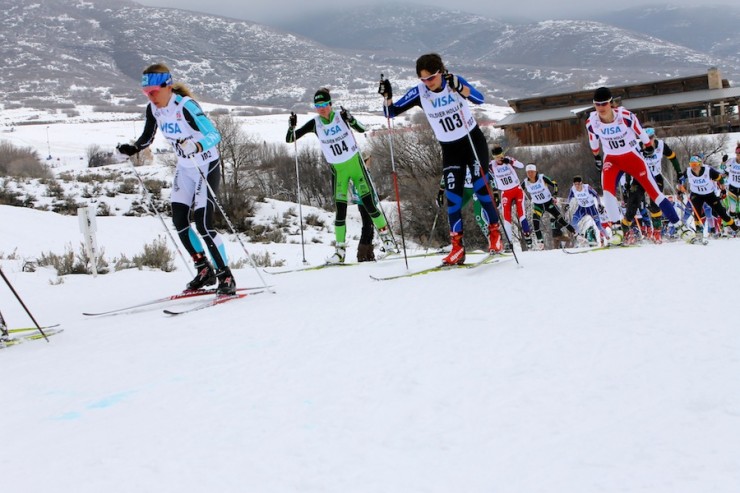
The last time U.S. Nationals were held at SoHo: Start of the women’s 20 k freestyle mass start at 2014 U.S. Cross Country Championships at Soldier Hollow in Midway, Utah. Caitlin Gregg went on to win going away.
Rosie Brennan (APU) leads Sun Valley’s Chelsea Holmes (106) after the first rise out of the start of the women’s 20 k freestyle at U.S. nationals at Soldier Hollow.
Women’s 20 k freestyle mass start at U.S. Cross Country Championships on Wednesday at Soldier Hollow in Midway, Utah.
Women’s 20 k freestyle mass start at U.S. Cross Country Championships on Wednesday at Soldier Hollow in Midway, Utah.
Women’s 20 k freestyle mass start at U.S. Cross Country Championships on Wednesday at Soldier Hollow in Midway, Utah.
Women’s 20 k freestyle mass start at U.S. Cross Country Championships on Wednesday at Soldier Hollow in Midway, Utah.
Women’s 20 k freestyle mass start at U.S. Cross Country Championships on Wednesday at Soldier Hollow in Midway, Utah.
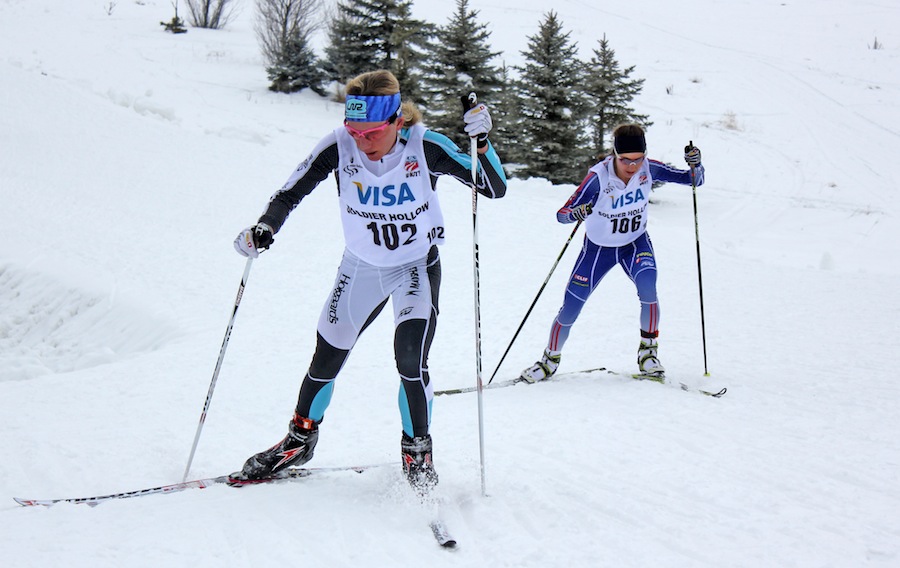
Caitlin Gregg (102) leads Chelsea Holmes up Hermod’s the first of four times during the women’s 20 k freestyle mass start at U.S. nationals at Soldier Hollow.
Rosie Brennan chases in third up Hermod’s the first of four times in the 20 k freestyle mass start at U.S. nationals.
(Photo: Bert Boyer – http://bertboyer.zenfolio.com) All proceeds from photo sales will be directly donated to NNF.
Marine Dusser (UAA) leads Kate Fitzgerald the first of four times up Hermod’s in the women’s 20 k freestyle mass start at U.S. nationals.
Women’s 20 k mass start up the first up Hermod’s at U.S. nationals in Soldier Hollow.
(Photo: Bert Boyer – http://bertboyer.zenfolio.com) All proceeds from photo sales will be directly donated to NNF.
(Photo: Bert Boyer – http://bertboyer.zenfolio.com) All proceeds from photo sales will be directly donated to NNF.
(Photo: Bert Boyer – http://bertboyer.zenfolio.com) All proceeds from photo sales will be directly donated to NNF.
Caitlin Patterson (Craftsbury Green Racing Project) glances back at Kate Fitzgerald (APU) and Marine Dusser (UVM) near the end of the first of four laps in the women’s 20 k freestyle mass start at U.S. nationals at Soldier Hollow on Wednesday.
(Photo: Bert Boyer – http://bertboyer.zenfolio.com) All proceeds from photo sales will be directly donated to NNF.
Caitlin Gregg (Team Gregg/Madshus) on her way to a 3 1/2-minute win in the women’s 20 k freestyle mass start at 2014 U.S. nationals at Soldier Hollow in Midway, Utah. (Photo: bertboyer.zenfolio.com) All proceeds from photo sales will be directly donated to NNF.
Caitlin Gregg dominating the 2014 20k skate race. (Photo: Toko)
Caitlin Gregg dominating the 20k freestyle at 2014 US National Championships.
Caitlin Gregg (Team Gregg/ Madshus) leading by more than 10 seconds early in the second of four laps in the 20 k freestyle mass start at U.S. nationals.
Chelsea Holmes (SVSEF) early in her second of four laps in the women’s 20 k freestyle mass start at U.S. nationals.
Rosie Brennan (APU) in third early in the second of four laps in the 20 k freestyle mass start at U.S. nationals at Soldier Hollow.
Kate Fitzgerald (APU) leads Caitlin Patterson (CGRP) up an early hill in lap 2 of 4 at the women’s 20 k freestyle mass start at U.S. nationals at Soldier Hollow.
Rosie Frankowski of Northern Michigan University in the 20 k freestyle mass start at U.S. Nationals at Soldier Hollow.
IMG_3684
Caitlin Gregg (Team Gregg/Madshus) gets a feed on the second lap of four in the 20 k freestyle mass start at U.S. nationals at Soldier Hollow.
Caitlin Gregg (Team Gregg/Madshus) gets a feed on the high point of the course in the 20 k freestyle mass start at U.S. nationals at Soldier Hollow, Utah, last January.
Caitlin Patterson (r) through the feed zone at the high point of the Olympic 5 k course at Soldier Hollow.
Frankowski (119) gets a feed during the women’s 20 k freestyle mass start at U.S. nationals at Soldier Hollow.
Chelsea Holmes (SVSEF) in second up Hermod’s the second of four times in the women’s 20 k freestyle mass start at U.S. nationals.
Caitlin Patterson (Craftsbury GRP) and Kate Fitzgerald (APU) work together in the 20 k freestyle mass start at the 2014 U.S. Cross Country Championships.
Holmes and Brennan (Photo: http://bertboyer.zenfolio.com) All proceeds from photo sales will be directly donated to NNF.
(Photo: Bert Boyer – http://bertboyer.zenfolio.com) All proceeds from photo sales will be directly donated to NNF.
(Photo: Bert Boyer – http://bertboyer.zenfolio.com) All proceeds from photo sales will be directly donated to NNF.
Rosie Frankowski up the last hill on the second of four laps in the women’s 20 k freestyle mass start at U.S. nationals.
Brennan leads Holmes early in lap three
Caitlin Gregg tucking down Whale’s Tale with 1 1/2 laps to go in the women’s 20 k freestyle mass start, which she won by more than 3 1/2 minutes.
Brennan leads Holmes down Whale’s Tale on the third of four laps.
Brennan leads Holmes up Hermod’s for the third of four times in the 20 k freestyle mass start at U.S. nationals.
Gregg up Hermod’s fourth lap.
On her fourth and final time up Hermod’s, Chelsea Holmes (SVSEF) distances herself from the chase pack to pursue Cailtin Gregg (not shown), who finished first, 3:36 minutes ahead of anyone else.
An APU coach cheers on Rosie Brennan up Hermod’s fourth lap
An APU coach cheers on Rosie Brennan up Hermod’s fourth lap
Rosie Frankowski in good position in fourth up Hermod’s on her first of fourth laps.
Caitlin Gregg (Team Gregg/Madshus) racing to a nearly four-minute victory in the 20 k freestyle mass start at U.S. Cross Country Championships on Jan. 8 at Soldier Hollow in Midway, Utah. (Photo: U.S. Ski Team/Sarah Brunson)
Caitlin Gregg (Team Gregg/Madshus) smiles with relief after winning the women’s 20 k freestyle mass start at U.S. Cross Country Championships on Wednesday in Midway, Utah. Gregg won by 3:36, the biggest margin at nationals in recent memory.
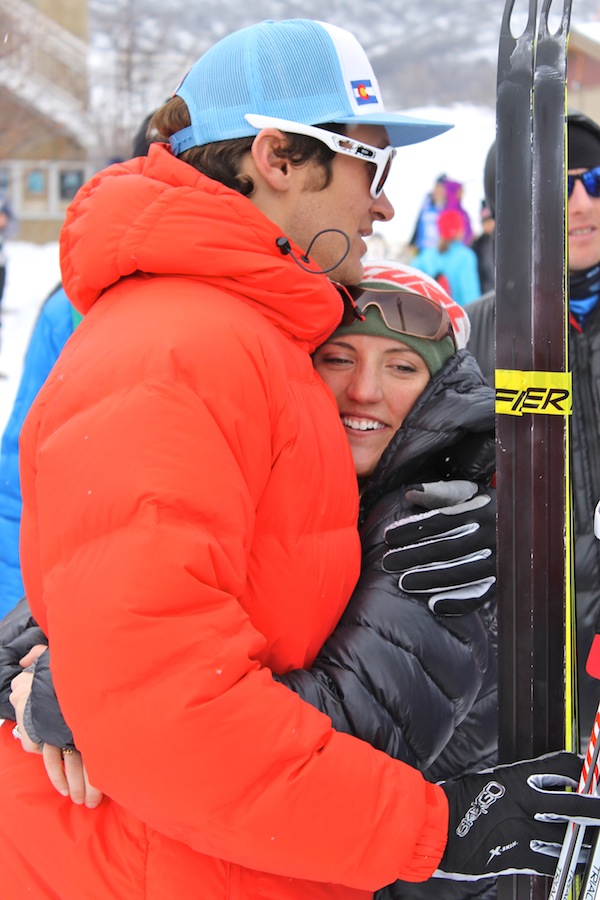
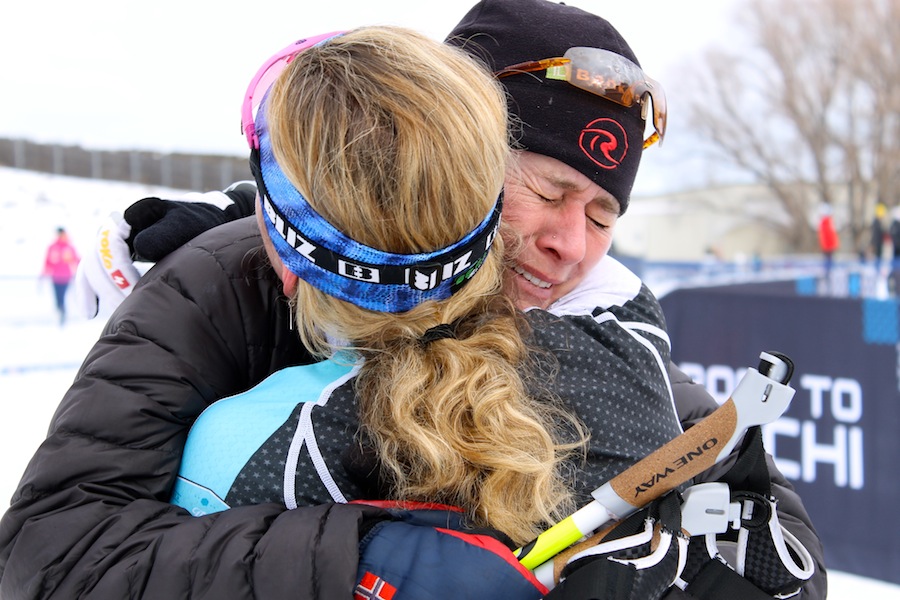
Laurie Humbert hugs Caitlin Gregg after Gregg claimed her fourth national title in the 20 k freestyle mass start. Laurie has been a large part of Gregg’s journey to nationals.
Caitlin Gregg (Team Gregg/Madshus) is nothing but smiles as she crosses the finish line 3:36 ahead of the second place finisher in the 20 k freestyle to claim her fourth national title. (Photo: U.S. Ski Team/Sarah Brunson)
FasterSkier’s coverage of the 2014 U.S. Cross Country Championships is brought to you through the generous support of The Memory Clinic in Bennington, Vt.
MIDWAY, Utah – At the 2014 U.S. Cross Country Championships, winning by any margin is enough to make most competitors’ day. Not so for Caitlin Gregg of Team Gregg and Madshus, who won Wednesday’s 20 k freestyle mass start with a time of 55:33 and a lead of over three and a half minutes, a gap that has not been seen at the national level in recent memory. Unsatisfied with a mere win, Gregg set a blistering pace that left her fellow racers in the dust after the first few kilometers, ultimately resulting in her fourth national title.
“I had a game plan. It was to try and see what kind of a gap I could create,” Gregg said in post-race interview.
Caitlin Gregg (Team Gregg/Madshus) leads Chelsea Holmes (SVSEF) up Hermod’s Hill in the first lap of the 20 k freestyle at the 2014 U.S. Cross Country Championships. Greg handily won the the race, with Holmes following in second.
The 20 k race started out like most. The gun went off and the 78 women fought to find the best place they could in the sea of brightly colored spandex. “We were all in front and then I let some people step in front of me thinking that I would relax,” said Rosie Brennan, eventual third place finisher and skier from Alaska Pacific University. “Then I looked up again and Caitlin [Gregg] was gone.”
With an extensive history of success in skate mass starts like the Birkie, Gregg knew to take the first few kilometers easy to see how she was feeling and to observe how well her skis were running. After the first few downhills, she realized that she had skis like rockets.
“I’m risking the rest of the field getting all tangled up and falling on each other, just siting around here and trying not to pull,” she said. “At the top of the second big climb I took the lead. Once I started going, I finally got into my groove. I couldn’t stop smiling.”
As Gregg took off, only one skier attempted to stick with her. Chelsea Holmes of the Sun Valley Ski Education Foundation, who eventually finished second, took what she thought would be a short ride to the front of the pack. Instead, she realized that Gregg wasn’t going to slow down, but it was too late.
“It was brutal. I felt like a child; a small, floundering child,” said Holmes. “I didn’t think [Gregg] was going to actually go that hard.”
Holmes did her best to stay with Gregg through the first lap, but a five meter gap turned into 10, which then turned into 20, and pretty soon she found herself alone on the course with the blue and white Team Gregg suit off in the distance and a hungry Brennan coming up from behind.
Rosie Brennan (APU) leads Chelsea Holmes (SVSEF) up Hermod’s Hill in the third lap of the 20 k at the 2014 U.S. Cross Country Championships at Soldier Hollow. Holmes finished second and Brennan finished third.
”That was one of the harder races I’ve done, knowing that there were people behind me, catching me,” said Holmes. “I was very deep in the pain cave the entire time.”
However once Brennan overcame her near the end of the second lap, she was able to rest a little while the two worked together. “I think that was a good thing,” she said of Brennan catching her.
After watching the men’s race, where initial breakaways were slowly reigned back in, Brennan assumed she would just relax and slowly catch up to Holmes. “Once I got there I thought we could work together, but this course is so hard,” said Brennan of the 5 k olympic course that the women completed four times. “There is no rest. Even when I was following [Holmes], it felt like I was maxed out.”
While the race for second was being waged between Holmes and Brennan, another pair was skiing behind them to keep their position on the challenging course. Kate Fitzgerald (APU) and Caitlin Patterson of the Craftsbury Green Racing Project used each other to try and close the gap between them and Holmes and Brennan
“We were switching leads out there, which made it a lot more fun; way more fun than skiing by yourself,” Fitzgerald said. “We were chasing Rosie and Chelsea. They were like a carrot over there.”
Caitlin Patterson (Craftsbury GRP) and Kate Fitzgerald (APU) work together in the 20 k freestyle mass start at the 2014 U.S. Cross Country Championships.
“It was fun to work together with her. I don’t think either of us would have been as strong without each other,” said Patterson. “For a while I thought maybe we could get them, it seemed like we were closing for a little bit. But they definitely didn’t die and they had a pretty strong push at the end.”
In the end, the pair was unable to reach the second and third place finishers. Fitzgerald skied across the finish line in fourth and Patterson followed in fifth.
While the two pairs were working behind her, Gregg was continuing to surmount an increasing lead. With each glide of her ski she gained more confidence as she made her way around the hilly course.
“The hills were so tough, and for some reason I’m silly and I love that,” she said with a laugh.
Even though it was apparent that nobody would be able to catch her, she never slowed down. “I wanted to see what I could do and I just felt too good. It was really fun, and I definitely skied relaxed and there’s definitely that point where skiing relaxed is faster.”
Testing her limits wasn’t the only motivating factor for Gregg in Wednesday’s 20 k. In an Olympic year where there are many strong women who have already met the criteria for the Olympics, she needed to prove that she was more than worthy of a spot in Sochi.
Caitlin Gregg (Team Gregg/Madshus) takes a feed at the top on the 5 k olympic course en route to her fourth national championship.
When asked about whether or not the Olympic Games were an influence in today’s race, she recalled something Pete Vordenberg, the former U.S. Ski Team Head Coach, said to her before she made the Olympic team in 2010.
“He said ‘when you’re on the bubble, the best place to be is not on the bubble.’ And if you’re not going to be on the bubble you’re going to have to make it pretty apparent,” she said.
She did her best to make it apparent, and skied the fastest time each lap. By the time the next competitor had crossed the line Gregg had already finished over 3:36 before.
With many strong American sprinters, Gregg knew she had to shine in another discipline. She also knew that there would be a 30 k skate race in Sochi. A smart and calculated move, she saw the chance to demonstrate that she could be a strong contender in that race.
“[The 20 k was] that opportunity to make it easy for them. Don’t leave any doubt in their minds. And so [today] was my attempt to do that.”
While the U.S. Ski Team coaches are waiting to announce the Olympic team until the 21-22 of January, Gregg and her husband, Brian, have plenty to do in the meantime. On the same day that Gregg was crowned national champion in the 20 k and her husband placed second in the 30 k, both were scheduled to fly to Europe to compete in the period II World Cup races taking place in the Czech Republic.
The couple qualified for the World Cup by taking the top spots in the SuperTour standings, and if all goes well, she’ll continue her quest to “get off the bubble,” while competing at the World Cup level. However, the most important thing is that she and her husband are on the journey together.
“I cannot express anything better than being able to share this with my husband,” said Gregg, who upon her husband’s second place finish broke out into a fit of emotional exuberance. “It’s a great way to end our nationals. We’re going to get on that plane and we are just going to have all sorts of war stories, and then crash something fierce on that flight.”
Laurie Humbert hugs Caitlin Gregg after Gregg claimed her fourth national title in the 20 k freestyle mass start. Laurie has been a large part of Gregg’s journey to nationals.
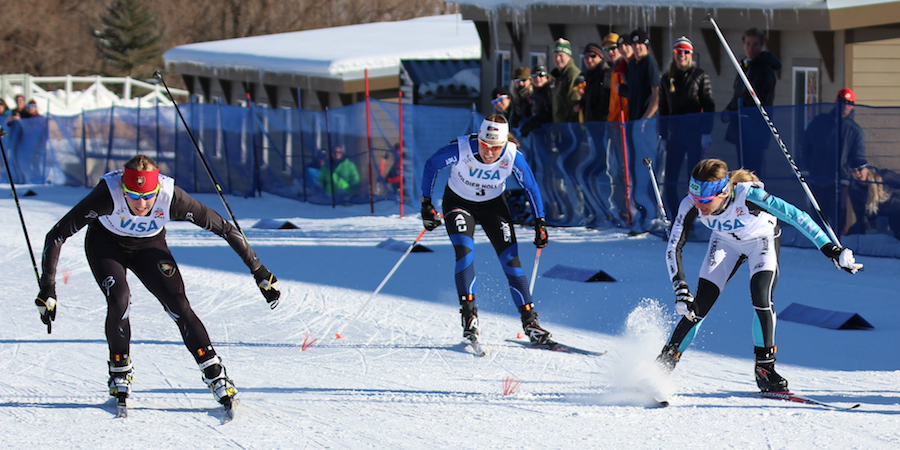
Jennie Bender of the Bridger Ski Foundation (l) edges Caitlin Gregg (r) of Team Gregg/Madshus for the skate-sprint victory at U.S. Cross Country Championships on Sunday at Soldier Hollow in Midway, Utah. APU’s Rosie Brennan (c) took third. (Photo: Tom Scrimgeour)
FasterSkier’s coverage of the 2014 U.S. Cross Country Championships is brought to you through the generous support of The Memory Clinic in Bennington, Vt.
MIDWAY, Utah — Jennie Bender was this close to being a non-factor in the women’s 1.5-kilometer freestyle sprint at U.S. Cross Country Championships on Sunday at Soldier Hollow. A decision to have back surgery in May could have derailed her ski-racing career indeterminably, and at 25, that would’ve been a tough pill to swallow.
Newly with the Bridger Ski Foundation in Bozeman, Mont., she instead opted for physical therapy for the herniated disc. Eight months later and seven days before her birthday, Bender was sprinting up and down Hermod’s Hill at Soldier Hollow on Sunday like nothing was or had ever been wrong — even as she continued to undergo regular treatment for her back.
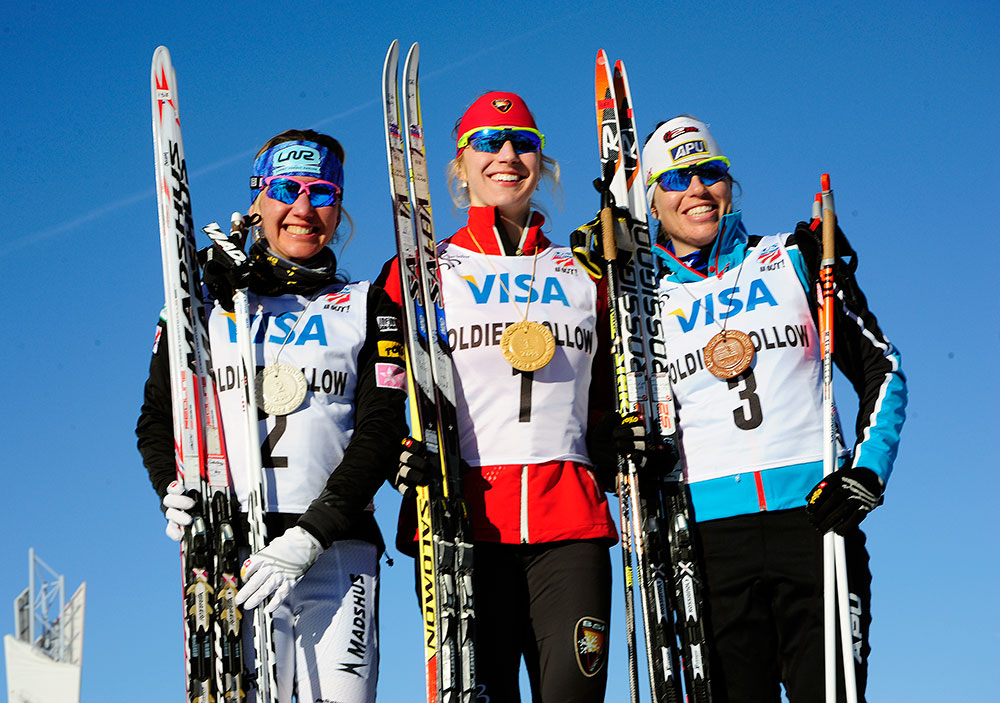
The women’s 1.5 k freestyle sprint podium, with winning Jennie Bender (c) of the Bridger Ski Foundation, Caitlin Gregg (l) of Team Gregg/Madshus in second, and Rosie Brennan (APU) in third. (Photo: Tom Kelly/USSA)
A year ago at U.S. nationals, she won her first national title in the classic sprint. Classic skiing was tougher on her body this season, so she put her hopes in Sunday’s skate sprint a day after placing 20th in the 10-kilometer classic.
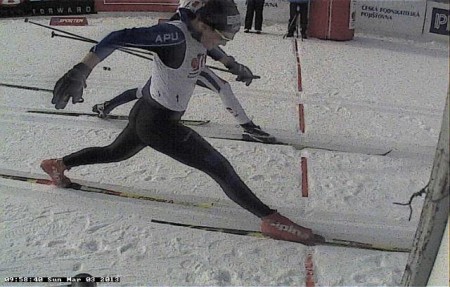
A finishing-straight comeback, from fifth with 200 meters to go, and last-ditch lunge gave Bender the victory she had been looking for as she edged Caitlin Gregg (Team Gregg/Madshus) in a photo finish for first.
Alaska Pacific University (APU) took third and fourth with Rosie Brennan and Kate Fitzgerald, respectively. Rose Kemp (Sun Valley Ski Education Foundation) was fifth for a personal best, and Caitlin Patterson (Craftsbury Green Racing Project) rounded out the A-final in sixth.
“I was really hoping to get on the podium, but I guess with the past two years of ups and downs I was never really sure what would happen here,” Bender said, after coping with mono and lyme disease simultaneously two summers ago.
“Sprints are kind of like war,” she added. “You have your own personal battle with the qualifier and then the hopefully next three heats are anything goes, it’s tactics, it’s saving energy and making sure you never truly ask yourself how you feel because you don’t want to know the answer.
Caitlin Gregg (Team Gregg/Madshus) on her way to winning the women’s 1.5 k freestyle sprint qualifier by more than 4 seconds. (Photo: bertboyer.zenfolio.com) All proceeds from photo sales will be directly donated to NNF.
The day started off with Gregg, Bender’s former Central Cross Country (CXC) teammate, sending a message in the qualifying round. Gregg beat nearly 130 women with a time of 3:09.97 on a sprint course that deviated from the traditional under-the-bridge-and-around-the-horseshoe loop.
Instead, racers shot out of the start and immediately curved around the timing building, built for the 2002 Olympic Games, before heading up the infamous Hermod’s Hill. They didn’t go all the way to the top, turning left and making their way down the less-intimidating parts of Whale’s Tail before cornering sharply, skiing over a bridge and back into the stadium.
Second in Saturday’s 10 k, Gregg attacked and accelerated at all the right times to win the qualifier by 4.34 seconds over Rose Kemp, a recent University of Utah graduate now with the Sun Valley Ski Education Foundation.
After crashing out of contention during her first of two times down Whale’s Tail on Saturday, Kemp rose to the second-fastest qualifying time on Sunday, 1.92 seconds ahead of Brennan in third. Fitzgerald followed another 2.18 seconds back in fourth (+8.44) and just one-hundredth of a second behind her, Bender qualified fifth. Patterson was another second back in sixth (+9.51).
From there, Gregg, Fitzgerald, Patterson, Kemp, and Brennan all won their quarterfinals, but not without a little excitement in Gregg’s first heat. Before the first turn a couple hundred meters out of the start, Gregg tangled with APU’s Sarah Cresap, fell, and came into Hermod’s at least five-seconds behind the pack.
“I don’t think it was anyone’s fault; it was just tight getting into position,” Gregg said. “So I got down and I was like, ‘Oh, wow, I’m in last place.’ ”
Fortunately, her poles were in tact. “I’m glad I had two poles for the rest of that,” Gregg said.
Moments later, Gregg picked off the five other women in her quarterfinal by the top of Hermod’s, then maintained her breakaway on the descent.
“My skis, in every heat, they were just so fast,” she said. “It almost caught me off guard. I kind of was like, ‘All right, I’m out of this. Maybe this day isn’t going to go so well,’ and then next thing I know I was in first and I was like, ‘Well I guess I’m right back here.’ ”
Gregg won the heat ahead of Erika Flowers (Stratton Mountain School T2 Team) and Marion Woods (University of Vermont), who placed second and third, respectively.
APU’s Kate Fitzgerald (l) leading her quarterfinal in the women’s 1.5 k skate sprint at U.S. nationals on Sunday at Soldier Hollow. (Photo: bertboyer.zenfolio.com) All proceeds from photo sales will be directly donated to NNF.
Fitzgerald got a lead on the downhill to top two other UVM skiers, Linda Danvind Malm and Stephanie Kirk, who ended up second and third in the quarterfinal.
A UVM grad, Patterson held off Bender in the third quarterfinal, with the two advancing in first and second. Kemp led Saturday’s champion, Becca Rorabaugh (APU), to the finish in the fourth quarterfinal, and Brennan cruised to a victory in the fifth quarterfinal ahead of Nichole Bathe (University of Alaska-Fairbanks).
Gregg decided to lead her semifinal, but realized on the hill that it wasn’t easy to string out the group there. Running out of steam into the final straight, Bender came from behind to overtake Gregg before the finish, and both advanced to the A-final along with Fitzgerald in third. Flowers placed fourth, Danvind-Malm was fifth and Kirk finished sixth to move onto the B-final.
Brennan held off Kemp and Patterson to win the second semifinal, leading them and APU’s Becca Rorabaugh, Craftsbury’s Liz Guiney and Bathe, respectively, from start to finish.
Rorabaugh went on to win the B-final for seventh overall, Danvind-Malm placed eighth, Guiney was ninth, Flowers 10th, Bathe 11th, and Kirk 12th.
“Sprints are kind of like war. … It’s tactics, it’s saving energy and making sure you never truly ask yourself how you feel because you don’t want to know the answer.” — Jennie Bender
Feeling good throughout her heats, Kemp led out the A-final toward and up Hermod’s with Brennan right behind.
“I felt like I had a lot of good energy going into each heat,” Kemp said. “I kind of just ended up going; that’s how it panned out each heat, but I wanted to ski as well as I could, and that hill was really fun.”
Gregg initially tried to go off the front from the start, but quickly realized that everyone else was trying to do the same.
“I couldn’t quite get to the front so I changed my tactics,” she said. “I kind of sat and waited and got to the top of the hill and again on the downhill my skis were just freakin’ fast.”
Leading Kemp, Brennan, Fitzgerald and Bender, in that order, over the bridge into the finish, Gregg said she couldn’t hear anyone around her. She thought she had it, then Bender suddenly outlunged her at the line.
Bender had been the queen of sitting back throughout the final, reasoning that she didn’t have to lead up the hill for fear of getting dropped. Instead she put herself in third or fourth, but coming around the final turn before the bridge, she said she nearly got boxed out.
The women’s A-final heads down the last hundred meters to the finish. (Photo: Tom Kelly/USSA)
“I was like, ‘Oh no, this cannot happen,’ ” she said. “Coming right on the crest of the hill I was just waiting, like, ‘I’m looking for my spot, looking for my spot … I’m either gonna bust through somewhere or try to go way on the outside if I have to.’ But a little spot just happened to open up and I gunned it.”
“I learned a good lesson today,” Gregg said. “She was just charging hard, and it was pretty impressive.”
A two-time runner-up in the last two days of nationals, Gregg said she was pleased with the results, especially Saturday’s 10 k classic.
“I think it’s solid and it bodes well,” she said. “Feeling good about my distance skiing, obviously skate skiing, love, and my qualifier today was super evident of that.”
Brennan thought she could’ve played the final better as well. After she followed Kemp down Whale’s Tail with a slight gap up front, Gregg and Bender caught them by the bottom.
“I don’t have much finishing speed so I kind of wish I tried to go a little harder over the top of the hill to get more distance,” Brennan said. “But it was OK; I held my own.
“Any time I can make the podium here it’s great because I have so many friends and family that came to watch,” the Park City native added. “My mom times here so the whole timing crew’s always cheering for me so I always feel like I let them down if I don’t do something good here.”
Expectations were iffy as Brennan hadn’t raced sprint heats this season since she spent most of the beginning of it on the World Cup. On Saturday, she was sixth in the 10 k after winning the skate version of the distance event at nationals last year.
“It made me more nervous to race here because I wasn’t sure what my shape actually was,” she said. “[Saturday] I had just a terrible day. I was struggling with my skis and then I kind of blew up a bit on top of that … then you start second guessing yourself. It was really nice to come out and have a sprint race because anything’s possible.”
The second BSF skier to top the podium after Torin Koos won the men’s final right before, Bender had similar feelings about the sprint.
“I’m kind of hoping for more good news in the classic sprint,” she said. “In general, a win at nationals is a big confidence booster, and after wading through a lot of sh*t, it’s kind of like a daisy that you find that helps the whole rest of the season.”
Alaska Pacific University’s Becca Rorabaugh (l) takes on Dartmouth’s Anne Hart (r) the first of two times up Hermod’s Hill on a challenging Olympic course at 2014 U.S. Cross Country Championships. Rorabaugh won the 10 k classic individual start on Saturday in Midway, Utah, by 14 seconds.
FasterSkier’s coverage of the 2014 U.S. Cross Country Championships is brought to you through the generous support of The Memory Clinic in Bennington, Vt.
MIDWAY, Utah — The seventh starter of 152 women in Saturday’s 10-kilometer classic individual start, Becca Rorabaugh had a few things to think about in the first race of U.S. Cross Country Championships.
Becca Rorabaugh (APU) racing to a national title in the 10 k classic individual start on Sunday at Soldier Hollow in Midway, Utah. (Photo: bertboyer.zenfolio.com) All proceeds from photo sales will be directly donated to NNF.
One, try to catch the seven A-seeds in front of her, and two, stay well ahead of the 13 other top-ranked skiers behind her.
But above all, don’t bonk out there. Racing at 5,500 to 5,900 feet above sea level is tough. Add two laps around a Soldier Hollow’s 5 k Olympic loop to that and you’re getting into dangerous territory.
An Alaska Pacific University (APU) skier based out of Anchorage, Alaska (and originally from Fairbanks), Rorabaugh mostly trains at sea level. But she and the APU Elite team know what hard efforts are all about, training at Eagle Glacier some 5,000 feet high throughout various summer camps. They also utilize Hatcher Pass about 1 1/2 hours from Anchorage — more accessible than a helicopter ride — at nearly 4,000 feet.
“The whole time I was just trying to keep it together, try to keep consistent skiing and good glide and good transitions and ski really smooth,” Rorabaugh said.
Starting a minute and 30 seconds behind Caitlin Gregg (Team Gregg/Madshus) in bib 1, Rorabaugh took advantage of the 15-second intervals and started picking people off — but with caution.
“I was just trying to make sure I didn’t really tank it over the top of any of the hills on the first lap,” she said. Her goal was to come on strong the second lap, but she ended up skiing the first one faster than anybody.
Rorabaugh led from start to finish, clocking the first lap 15.3 seconds faster than Gregg in second. Tucking down toward the stadium before the start of her second lap, Rorabaugh had already passed two people: Dartmouth’s Anne Hart and Erika Flowers (Stratton Mountain School T2), who ended up 17th and 11th, respectively.
While Rorabaugh’s second lap was one second slower than Gregg’s, it didn’t matter. The 24 year old had jumped out to an untouchable lead and ended up winning in 29:09.9, 14.2 seconds ahead of Gregg in second.
“I haven’t had a great classic race in a couple years so I wanted to feel like I could stride out like that again.” — Becca Rorabaugh, U.S. nationals 10 k classic winner
For Rorabaugh, it was her first national title in the first of four races over the next week.
“I have no idea what it’s gonna mean … I guess it means I get to go to OPA’s if I want to, so that’s good,” Rorabaugh said of the opportunity to race the OPA Cup Tour this season in Europe.
Doing well enough at U.S. nationals could prompt internal U.S. Ski Team discussion about whether she’s worthy of making the 2014 Olympic team, which will be named later this month. However, the spots remain tight with so many dominant U.S. Ski Team women currently competing or training in Europe.
“Mostly it’s a good little boost of confidence,” Rorabaugh said. “I haven’t had a great classic race in a couple years so I wanted to feel like I could stride out like that again.”
Caitlin Gregg (Team Gregg/Madshus) pushes up Hermod’s Hill in the 10 k classic individual start at Soldier Hollow on Saturday. She placed second for her best classic result at nationals.
Gregg joked about the odds of both her and her husband, Brian, being randomly selected to start first in both the women’s and men’s races. It a was 1-in-400 chance, and they ended up leading the A-seeds* on a clear-and-sunny morning with temperatures in the mid-20s.
“There was probably a higher probability of that than me winning U.S. nationals, although I did a dang good job of trying to get in there,” Gregg said after notching her best U.S. nationals classic result.
Third halfway through Saturday’s 10 k behind Caitlin Patterson (Craftsbury Green Racing Project) in second, Gregg posted the fastest second lap to finish 25.6 seconds ahead of Patterson, who placed third.
Gregg laughed about starting first at the first race of nationals, with her last race a week earlier on Dec. 28 at the Wasatch Citizens Series in nearby Park City, Utah. There at the White Pine Touring Center, she and Brian set course records on the 5.4 k loop.
“We did a time trial last weekend, but it was a lower-key citizens’ event,” she said. “Nothing like starting off with a hard 10 k at altitude. I think working into it was key.”
Without any splits to go off throughout much of the race, especially her first lap, Gregg had to rely on the cheers of spectators to indicate where she stood.
“During the first lap, I’d be skiing by and they’d be like, ‘Go Rosie!’ ” she said of Rosie Brennan (APU), who placed sixth (+1:30.8). “I was like, ‘Oh, that means she’s clearly right there.’ ”
Laughing as she visualized people softly clapping for her, Gregg said she reminded herself not to “freak out” on the first lap. “I swear I always magnify when I’m racing, and i can hear Rosie’s skis behind me, like ,’Oh gosh, she’s coming.’ I kind of just had a plan to really ski consistently.”
“I wish there was a couple more laps in there. I feel like I was just getting goin’.” — Caitlin Gregg, second
With her heart set on making the upcoming Winter Olympics and specifically racing the 30 k in Sochi, Russia, Gregg said she’s been looking forward to proving herself in longer races.
“Man, I wish there was a couple more laps in there,” she said. “I feel like I was just getting goin’. That second lap felt really good, which I think was key.”
Ski speed also made a difference on a morning (and afternoon) that turned warmer than expected, with sub-zero wind chills expected early. From what Rorabaugh could tell, her skis were solid on both the climbs and descents, and Gregg was grateful for the help University of New Mexico Head Coach Fredrik Landstedtleant both her and Brian with waxing.
“I had Fredrik doing my skis and I had Grethe [Hagensen] from MSU out on course and she gave me the best information ever,” Gregg said of the Montana State University head coach. “She said, ‘Now you’re doing it, your dropping those girls off and you’re moving up.’ That was exactly what I needed to hear.”
Caitlin Patterson (Craftsbury Green Racing Project) striding to third in the women’s 10 k classic individual start at 2014 U.S. nationals in Midway, Utah. (Photo: bertboyer.zenfolio.com) All proceeds from photo sales will be directly donated to NNF.
The 18th starter, Patterson said she tried to refine her pacing strategy to start a little faster than usual, but not too fast.
“I have a tendency to start slow so I wanted to not lose too much time at the beginning,” she said. “I did lose a little bit of time, but still … I felt pretty well in control.”
Fourth fastest after 5 k (trailing Rorabaugh, Gregg and Brennan) and getting splits that she was in fifth at one point thereafter, Patterson clawed back the time to place third.
“To move up during the second lap to third I’m really happy with that,” she said. “Obviously there’s room for improvement, but I think it’s a really good start.”
In her previous 10 k classic races this season, Patterson placed second in the SuperTour mass start in Bozeman, Mont., and seventh in the NorAm individual race in Rossland, B.C.
“I think this one was a lot more solid,” she said.
Forty-two seconds behind Patterson and 1:27.3 out of first, University of Vermont junior Anja Gruber placed fourth, improving from the sixth-fastest time at 5 k.
“I’m really happy,” Gruber said. “It’s kind of like the first real race for us and we just came out here on Monday, and I was home over Christmas training by myself.”
A member of the German national team in 2009, Gruber returned to Germany for the holidays, then picked up in her first race of the season before the Eastern Intercollegiate Ski Association (EISA) circuit starts Jan. 17**.
“It’s really nice for me because there’s really no pressure this week,” said Gruber, 22, after posting her first top 20 at U.S. nationals. “It’s more just fun and checking out the course in case I make NCAA’s here.”
Anja Gruber (University of Vermont) racing to fourth in Saturday’s 10 k classic mass start at Soldier Hollow for her best U.S. nationals result by more than 20 places. (Photo: bertboyer.zenfolio.com) All proceeds from photo sales will be directly donated to NNF.
After Rorabaugh, Kate Fitzgerald and Brennan helped APU put three women in the top six, with Fitzgerald finishing 5.4 seconds after Gruber and 1:27.3 back from first.
A fan of the 15-second intervals***, Fitzgerald said it helped to see people ahead of her to try to catch and ski with others at times. “You could get a bit of a pack going,” she said.
The eighth starter, she mostly heard that she was in eighth, but she took the splits with “a grain of salt” and aimed to ski consistently strong.
“[I was] stoked to hear Becca doing so well,” Fitzgerald said. “She started right ahead of me and she just took off. I was like, ‘Woo! She’s having a good one.’ ”
Third in the 10 k skate individual start at nationals last year (behind APU teammates Brennan in first and Sadie Bjornsen of the U.S. Ski Team in second), Fitzgerald was glad to get this one out of the way.
“I was super nervous this morning, like, ‘Oh man, nationals, here we go!’ but I’m excited for the rest of the week,” she said, with her focus on the 20 k freestyle mass start. “I think it’s gonna be awesome.”
—
*A-seeds started first to give them the most “advantageous” conditions, according to technical delegate John Estle. Snow was initially forecast in the morning, and organizers considered moving the A-seeds back behind the B’s, but the chance for snowfall became less likely so they kept the top women at the front of the pack.
**The western collegiate Rocky Mountain (RMISA) circuit starts a week from Saturday on Jan 11.
***Estle said race officials decided to cut the time between intervals in half from the usual 30-seconds to speed up the day and give the athletes several additional hours to recover before Sunday’s skate sprint. Had they been dealing with 80 athletes, they would’ve stuck with 30 seconds, but with nearly 360 skiers between the women’s and men’s races, starting them 15 seconds apart was more efficient.
Kate Fitzgerald looks up as she begins to climb up Hermod’s in the women’s 10 k classic individual start at 2014 U.S. Cross Country Championships in Midway, Utah. Fitzgerald placed fifth.
Amanda Ammar (Team Ninja) racing to third in the 10 k classic individual start on Dec. 15 in Rossland, B.C. (Photo: Shelley Peachell/Peachell Photography)
In the last big North American races before the holiday break, Kevin Sandau of the Alberta World Cup Academy (AWCA) and Canadian National Senior Development Team (NST) and American Kate Fitzgerald of Alaska Pacific University (APU) took top honors on Sunday in the Black Jack NorAm 15- and 10-kilometre classic individual starts in Rossland, B.C.
Kate Fitzgerald (APU) racing to third in the SuperTour 10 k freestyle individual start on Nov. 30 in West Yellowstone, Mont. She won the Black Jack NorAm 10 k classic individual start on Sunday in Rossland, B.C.
On a day marked by warmer temperatures, tough waxing conditions and even tougher race courses, racers had only positive things to say about the quality of the race course and the depth of talented racers in the combined Canadian-American field.
In the women’s 10 k, Fitzgerald gritted out the win in 31:53.7 after feeling “super strong.” In an email, she wrote that her coaches nailed the tricky waxing, and it helped to have a strong skier to race against.
“Caitlin Gregg [Team Gregg/Madshus] started right in front of me and I caught up to her and we skied together the whole race after that,” Fitzgerald wrote. “She was awesome! We pushed each other and it was so much fun to have someone to ski with and work together!”
The women’s SuperTour leader, Gregg ended up fourth, and Canadians Emily Nishikawa (AWCA/NST) and Amanda Ammar (Team Ninja) squeezed in for second and third, respectively. After leading the first of two laps by nearly seven seconds over Fitzgerald, Nishikawa finished 13.9 seconds back in second, and Ammar was another 9.9 seconds back in third. Gregg was 30.3 seconds back in fourth, and Zoe Roy finished 47.1 seconds off the winning pace in fifth.
“There was an extremely strong field of women here this weekend, all of which I highly respect, and who are also in great shape,” Ammar wrote in an email. “I have been consistently getting stronger and stronger in each race. I’m right where I want to be.”
Ammar added that the courses were hard, but doable. “These were the kind of trails I was brought up on,” she explained. “Hard steep climbs, and fun windy technical downhills. I had an absolute blast out there!”
Sandau Edges Ellefson
In the men’s 15 k, Sandau echoed the sentiments of the women, adding that it was nice to have warmer-racing temperatures compared to the frigidity of last weekend’s opening NorAm at Sovereign Lake. Although he dealt with some icing on his skis, Sandau did his best to maintain efficiency and came out on top in 42:08.4.
Kevin Sandau (AWCA/NST) racing to victory in the NorAm 15 k classic individual start on Dec. 15 in Rossland, B.C. (Photo: Shelley Peachell/Peachell Photography)
“I’m pretty happy with [Sunday’s] result,” he wrote. “It’s just how I wanted [to] end things going into the holiday break before Olympic trials.”
Sylvan Ellefson (Ski & Snowboard Club Vail/Team HomeGrown) ended up second, just 3.2 seconds behind Sandau, and Graham Nishikawa rounded out the podium in third (+33.2), for his third top-three in over just two NorAm weekends. US Ski Team member Erik Bjornsen (APU) placed fourth (+44.3) and Andy Shields (NDC Thunder Bay) was fifth (+56.0).
Ellefson was also satisfied with his race. In an email, he explained that despite feeling pretty tired midway through the race, he was able to dig deep to pull out a solid race.
“The last 2k had to be the fastest 2k of my life,” Ellefson wrote. “I’m very happy with my results from the weekend and these results definitely help the confidence going into US Nationals in 3 weeks.
“The courses here are amazing,” he added. “Amazingly hard, amazing beautiful. Whoever crafted them was a genius because any kids coming out of that Black Jack program can probably ski anywhere after running those courses. Technical and fun, almost seems like a downhill biker designed them. Up there with the hardest course I have ever skied without a doubt.”
He was right on.
Ethan Meginnes, co-owner of Joyride Bike Parks, wrote in an email that he helped construct the Black Jack course.
“We build the course for the Red Bull Joyride slope style comp at Whistler as well as many other downhill bike trails,” he explained. “Dave Wood, Al Fisher and myself were the primary volunteer supervising the course build with a local contractor, Ed Mayer.”
After this weekend, most of the racers on the circuit are dispersing for the holidays, quality time with friends and family, and local citizens’ races until the recommencement of racing January 8-12 in Canmore, Alberta.
Photos from the second set of SuperTour races at Bohart Ranch in Bozeman, Mont., with 10/15 k classic mass starts taking place in temperatures just above the legal limit of -4 degrees Fahrenheit last Sunday. All photos by Anya Caldwell Bean.
Caitlin Gregg (2) leads the women’s SuperTour 10 k classic mass start on Sunday in Bozeman, Mont. She went on to place third behind Chelsea Holmes (7), who won by 43.4 seconds, and Caitlin Patterson (3), who placed second.
Women’s 10 k classic mass start
Chelsea Holmes (SVSEF) leads Caitlin Patterson (CGRP) in the SuperTour 10 k classic mass start at Bohart Ranch. Holmes went on to win it in 34:23.5, nearly 44 seconds ahead of Patterson.
Holmes, Patterson and Gregg.
Chelsea Holmes with a significant lead in the women’s 10 k.
Caitlin Patterson (CGRP), racing to second 43.4 seconds behind winner Chelsea Holmes (not shown)
Erika Flowers (SMST2), racing to fifth,
Gordon Vermeer (47) and a packed men’s field in the 15 k classic mass start
Gordon Vermeer (47) and a packed men’s field in the 15 k classic mass start
Patrick Johnson (Far West) leads Brian Gregg in the 15 k classic mass start on Dec. 8 in Bozeman, Montana. (Photo: Anya Caldwell Bean)
SuperTour Distance Skate Photos on TokoUS Facebook Page
A photo album with selected photos from today’s SuperTour Distance Skate can be found on the TokoUS fb page (please “like” so you can follow such postings in the future). Please visit to see lots of great photos including run away winner Caitlin Gregg. The photo album can be found here. All athletes shown affiliated with Toko Wax/Tools and/or Toko Gloves.
Caitlin Gregg won the 5k by over 1:02! She was in a class of her own.
WEST YELLOWSTONE, Mont. — A look at the top 10 and some others in the women’s 10-kilometer freestyle individual start on Nov. 30 — the final race of the West Yellowstone SuperTour. Read more.
Stratton Mountain alumn Cambria McDermott (independent) on her way to sixth in the West Yellowstone SuperTour 10 k freestyle individual start on Nov. 30.
Cambria McDermott (independent), sixth
Jessica Yeaton (Montana State University), 10th
Caitlin Gregg (Madshus/Team Gregg) hammering up Tele Hill the first of two times in the West Yellowstone SuperTour 10 k freestyle individual start on Nov. 30. She won the race by more than a minute and 20 seconds.
Becca Rorabaugh (APU), ninth
Caitlin Patterson (CGRP), second
Eliska Hajkova (University of Colorado), seventh
Erika Flowers (SMST2), fifth
Kate Fitzgerald (APU), third
Annie Pokorny (SMST2), eighth
Sylvia Nordskar (University of Denver), fourth
Caitlin Gregg (Madshus/Team Gregg), first
Caitlin Gregg (Madshus/Team Gregg), first
Becca Rorabaugh (APU), ninth
Eliska Hajkova (University of Colorado), seventh
Caitlin Patterson (CGRP) leads Erika Flowers (SMST2) the second time up Tele Hill at the Rendezvous Ski Trails during the SuperTour 10 k freestyle.
Kate Fitzgerald (APU), third
Sylvia Nordskar (University of Denver) leads University of Utah skier Anna-Lena Heynen (l) the second time up Tele Hill in the West Yellowstone SuperTour 10 k freestyle on Nov. 30.
Caitlin Gregg (Madshus/Team Gregg) on her way to winning Saturday’s West Yellowstone SuperTour 10 k freestyle individual start by 1:21.4 minutes in 25:45.6. It was her second win of the weekend in as many races, and she did it after her husband, Brian, placed second in the men’s 15 k skate.
WEST YELLOWSTONE, Mont. – Watching her husband round the 5-kilometer race course at the Rendezvous Ski Trails three times on Saturday, Caitlin Gregg (Madshus/Team Gregg) had a sense it was going to be another good day.
Less than 24 hours after winning the qualifier and every heat of the women’s 1.3 k freestyle sprint – including the final – on Friday, Gregg was witnessing her hubby Brian make a run for SuperTour podium as well. He ended up second in the men’s 15 k freestyle individual start, 14.1 seconds behind Mads Strøm, a Norwegian freshman at the University of Colorado (CU).
Congratulating Brian afterward, Gregg maintained her focus for her 10 k freestyle race, and Brian didn’t waste time getting out on the course to cheer her on. She had played it cool all morning, not letting Friday’s victory take hold of her – or the cold symptoms she was fighting when she woke up Saturday.
“I pretty much used that mind over matter thing: I just said, let’s go with it,” Gregg said. “I was walking around this morning and I was super chill and super calm because I didn’t want to use up any extra energy before the race. … I told Brian, basically, ‘I want to kick my own butt today.’ ”
The second A-seed in a field of 83 women, Gregg knew her best gauge during the race would be her own intuition; back splits wouldn’t be available. So she pushed – hard on the first lap and even harder on the second at nearly 7,000 feet above sea level.
Having faith in her summer altitude training in places like Utah, Canada and Truckee, Calif., and results in unofficial races, such as the Frozen Thunder distance time trial on Nov. 1 in Canmore, Alberta (which she won), Gregg didn’t worry about red-lining or taking herself out of contention.
That all-or-nothing attitude resulted in her second straight victory in as many SuperTour races this season. Gregg won the 10 k by more than a minute and 20 seconds in 25:45.6.
After arriving in West Yellowstone about a week and a half before the races, Gregg said she mostly trained alone to practice the feeling of skiing hard in strategic parts of the course.
“I was able to work on some pacing tactics and different aspects of the terrain to know where to find the seconds,” she said. “I think that was a huge advantage … because when I did see the start list, I knew that it would be more of a time trial.”
Caitlin Patterson (Craftsbury Green Racing Project) races to second in Saturday’s 10 k freestyle individual start on the final day of the West Yellowstone SuperTour.
By the time she ascended the most significant climb on Saturday, Tele Hill, it was clear to coaches timing their own athletes that Gregg was way ahead of anyone else. Caitlin Patterson of the Craftsbury Green Racing Project (CGRP), who ultimately placed second, said Gregg was 25 seconds ahead of her around two kilometers in, when Patterson was in third.
“That was a little bit of a shock but I tried not to let it bother me too much,” Patterson said. “It’s good to hear splits, but to some extent you have to just keep trucking along, especially at altitude when weird things can happen.”
Bonking is a very plausible reality for most skiers in a distance race at high elevations – less oxygen makes it difficult to dig deeper and easy to slow down. And with choppy conditions on the uphills on a damp day in the mid-30s, the hardest parts of the course were even tougher.
But bonking wasn’t part of Gregg’s plan. She didn’t really consider it, and by her second and final time up Tele Hill, she was well over a minute ahead of anyone else.
“I’ve been joking with some people that this year is one of those years to just go big and see what happens, and to put it all out there,” Gregg said. “If I don’t do that, I’ll never know. I figure if I do and it doesn’t happen at least I gave it my all.”
Caitlin Gregg (Madshus/Team Gregg) gets ahead of the pack the second time up Tele Hill at the Rendezvous Ski Trails in West Yellowstone, Mont.
By it, Gregg means qualifying for the 2014 Olympics in Sochi, Russia, which would be her second Olympics since the 2010 Vancouver Games. She could do so by continuing to lead the SuperTour circuit through next weekend’s races: a classic 10 k and classic sprint in Bozeman, Mont. On Friday, Gregg said she was grateful the SuperTour opened in West Yellowstone with skate races to boost her confidence.
The male and female SuperTour leaders will earn World Cup starts in Europe in January, giving them an opportunity to show their capable of solid international results as well. From there, a U.S. Olympic team will be named.
For Team Gregg, Saturday’s results were a step in the right direction toward that goal; Brian was the top American in the 15 k.
“It’s incredible,” Gregg said. “It’s so fun when this stuff happens.”
All the preparation she and Brian did, especially through last winter with Methow Olympic Development Coach Scott Johnston, paid off. Since forming Team Gregg for this season, Caitlin said she’s been writing her own training plan.
“We are super grateful for the training [we did with him],” Gregg said of Johnston. “He has some really innovative ways for training and I think that’s been really helpful for Brian and I. … I’d say he one of the best technique coaches I’ve ever, ever worked with.”
In second place, Patterson was a little discouraged by finishing 1:21.4 minutes behind Gregg.
“I never like being beaten by so much, but Caitlin Gregg must’ve been really flying today, and I can see that she’s in really great shape,” Patterson said.
Kate Fitzgerald (APU) holds her own in third while ascending Tele Hill for the second time on Saturday. She went on to place third in the West Yellowstone SuperTour 10 k freestyle individual start.
After turning up her tempo after the first couple kilometers, Patterson heard she was in second for most of the race. She stayed there, finishing 24.4 seconds ahead of Kate Fitzgerald (Alaska Pacific University) in third.
For Patterson, the key was skiing conservatively to start, but making sure she wasn’t holding back too much. “I did a pretty good job pacing, not bonking at all,” she said.
“Podium was my goal [so] I’m happy with it, definitely,” she added. “I would’ve liked to have been closer to the lead, but there’s nothing I can do about that now except ski faster next race.”
Third most of the race, Fitzgerald kept her position with an 11-second margin over Sylvia Nordskar (University of Denver) in fourth. She had a sense it was going well, feeling “big and powerful” and remembering to stay in control.
“It was just steady work the whole time, just keeping it steady and not freaking out at any one certain part,” Fitzgerald said. “You couldn’t really kill the uphills. There’s not enough time to recover if you tap out.”
“I’m pretty stoked to have a podium,” she added. “It’s a big year and everyone is really excited about the Olympics. I think it’s pretty sweet.”
Following in fifth, Erika Flowers of the Stratton Mountain School T2 Team (SMST2) finished 2:02.6 back from Gregg. Independent skier Cambria McDermott was sixth, Eliska Hajkova (CU) placed seventh, Annie Pokorny (SMST2) was eighth, Jessica Yeaton (Montana State University) took ninth, and Mary Rose (Sun Valley Ski Education Foundation) was 10th.
Team Gregg: Caitlin and Brian (second from r) with their longest-running sponsor, Toko rep Ian Harvey (r), and a Midwest fan in West Yellowstone, Mont.
Sandra Ringwald (GER) and Sadie Bjornsen (USA) skied a closely-fought 10 k pursuit on Sunday to wrap up OPA Cup Finals in Toblach, Italy. Bjornsen took second place by 1.0 seconds. Photo: Bryan Fish.
At the final showdown of the OPA Cup circuit on Sunday in Toblach, Italy, Sadie Bjornsen closed out her European season in a close battle with Germany’s Sandra Ringwald in the 10 k freestyle pursuit. It was a tough way to round off six races in nine days — “my very own Tour de Ski,” Bjornsen called it — and after 10 k of close racing Ringwald just nipped the American in the final meters to take the OPA Cup Finals victory by exactly one second. Bjornsen claimed silver in 26:51.7 to lead the sizeable U.S. team in the results.
“I was happy with the result,” Bjornsen said. “I gave every last drop of energy, and it was a great way to the end the season feeling tired, happy and knowing I finished my season giving my best.”
Based on her accumulated times from the previous two races Bjornsen began the pursuit five seconds in front of Ringwald, a strong skier who competed at World Championships last month for Germany and reached the podium at U23s in January.
“Five seconds isn’t much, so Sandra caught me maybe 15 seconds in,” Bjornsen said. “I wanted this though, so that we could work together and stay ahead of the rest of the field. Sandra is in good shape right now, so I knew that I needed to stay with her and hope to outsprint her at the finish.”
Bjornsen and Ringwald switched leads on and off for most of the race, but at 3 k from the finish Bjornsen began to fatigue.
“My goal was to just hang on for dear life,” she said of the later kilometers. “I knew it would come down to a sprint finish and I didn’t have hardly any gas left. We both surged on the final climb and crested the top of the hill into the stadium even with each other. Her skis were very fast though, so I lost contact down the final hill into the finish. Again we sprinted for the finish, but I just wasn’t able to get back up to her. It was a hard effort though, and I gave every last ounce of energy left in my body.”
Caitlin Patterson (CGRP) skiing in a pack. Photo: Bryan Fish.
The pace that Ringwald and Bjornsen set together created a 16.2-second gap to the bronze medalist, Alenka Cebasek (SLO). After Bjornsen, Kate Fitzgerald (APU) finished 16th for the U.S., 1:08.7 back, Caitlin Patterson (CGRP) was 19th (+2:02.8), Erika Flowers (SMS T2) finished 25th (+2:32.4), Becca Rorabaugh (APU) was 30th (+3:03.8), Lauren Fritz (APU) took 33rd (+5:15.4) and Anna Van Der Rhee (MWSC) was 35th (+8:17.1).
With nothing but SuperTour Finals left on her schedule, Bjornsen will stay in Europe for a few more days to catch her breath before heading to Truckee, Calif.
“As I collapsed at the finish for maybe five minutes, I was laughing in my head thinking about all the hard efforts in the last week,” Bjornsen said. “I ended my season truly challenging myself. It is not often I have had to dig so deep as I did this weekend, but it was also a great feeling!”
Bjornsen could have raced in the Olso World Cup 30 k on Sunday, but chose the shorter distances of OPA Cup Finals instead thinking they would better suit her current strengths.
“I knew that my fitness was in a better place for some shorter quicker racing than a 30 k skate, so I wanted to challenge myself at the end of the season and test myself against the top OPA athletes,” she explained. “I have never even been close to winning an OPA race, so it was fun to compete this time.”
Bjornsen, left, on the podium with race-winner Sandra Ringwald and bronze-medalist Alenka Cebasek (SLO). Photo: Bryan Fish.
Tarling Leads U.S. Men in 15 k with 23rd-Place Finish
Thomas Bing, a 22-year-old German skier who podiumed at U23 Championships in January and has two complete Tour de Ski finishes under his belt, won the men’s OPA Cup Final by 0.1 seconds in a sprint finish with Sebastian Eisenlauer (GER) and Fabio Clementi (ITA). Bing began the 15 k pursuit with a one-second lead but held off a hungry group of seven to take the mini-tour title.
Sam Tarling (Dartmouth College) led the U.S. men on Sunday with a 23rd-place finish in the 15 k pursuit. Photo: Bryan Fish.
Sam Tarling (Dartmouth College) led the American men’s squad with a 23rd-place finish, 1:42.4 back from Bing. He entered the pursuit as the 26th starter with a 1:08.0 handicap, and in the process of picking up a few places he skied with two other Americans, Erik Bjornsen (APU/USST) and Matt Gelso (SVSEF).
“Today was a blast,” Tarling said. “I think all our guys were feeling pretty sore from the classic race but I feel like we all skied really well and managed to make some jumps in the overall standings.”
Bjornsen moved up from 31st after the classic race to 24th, 11.9 seconds behind Tarling, and Gelso climbed from 34th to 25th, 4.1 seconds behind Bjornsen.
“We had a pretty good group of us go all within maybe 10 seconds so we had some nice pack tactics to nip some guys ahead of us struggling alone,” Tarling said. “There really isn’t a ton of rest on that course, and you learn a few things skiing with these guys. It seemed like you could make or lose serious chunks of time just from really pushing it over the crests of hills, which has been something I can definitely improve on.”
Gelso had hoped for a top-ten overall finish prior to arriving in Toblach and was ultimately disappointed with his performances, but he managed to overcome some pre-race fatigue on Sunday to compete with the pack that eventually formed around him in the pursuit.
“Erik and I started about ten seconds behind Sam and skied hard early on to catch him,” Gelso said. “A sizeable group formed around us and provided some good skiing. The pace was fast but not outrageous. Being a little tired heading into the day it was very helpful to be skiing around people in that it kept you focused and pushed you harder.”
The three Americans all finished within fifteen seconds of each other to lead their compatiots in the final standings. Mike Sinnott (SVSEF) placed 32nd in a photo finish with Mario Roncador (ITA) 2:33.5 back from the leaders, Pat Johnson (SVSEF) finished 37th (+2:55.2) and David Norris (MSU) was 40th (+3:12.9).
In the junior men’s division, Paddy Caldwell (SMS) led the way for the U.S. in 12th place, 1:54.1 behind Clement Parisse’s (FRA) winning time. Caldwell skied the sixth-fastest freestyle time of the day after starting the pursuit in tenth with a 1:00.0 deficit. Kevin Bolger (SVSEF) maintained his starting position to finish 15th, 3:00.0 back from the leaders.
Sadie Bjornsen (USA), shown here competing at World Championships this February, won the 5 k classic at OPA Cup Finals on Saturday in Toblach, Italy.
After taking third in the prologue at OPA Cup Finals on Friday in Toblach, Italy, Sadie Bjornsen (USA) followed up on Saturday with an outright win in the second stage of the mini-tour, a 5 k individual classic. She completed the course in 14:37, 5.1 seconds ahead of runner-up Sandra Ringwald (GER).
“I just tried to ski right under sprint speed the entire time, because I knew it was going to be fast out there,” Bjornsen said of her race. “At about 3 k I started to get scared as my legs really began to flood, but I managed to hold on.”
With another day in Italy under her belt after a long day of travel from the Drammen World Cup, Bjornsen said she felt more adjusted to the new venue on Saturday.
“I felt a lot better today,” she said. “Much more like a racer in control of my feelings and effort.”
As the race-winner, Bjornsen leads OPA Finals going into Sunday’s pursuit and will start the 10 k freestyle being chased down by the rest of the field.
“We start the season chasing the Euros. Now I get to end running from the Euros,” she said. “It should be a good race. I have limited energy left I can feel, but I will give it all and see what happens. I am of course nervous. It is always nerve-racking when you are the rabbit.”
Bjornsen led six other American women in the 5 k classic. Kate Fitzgerald finished twelfth, 42.6 seconds back, Caitlin Patterson was 24th, Becca Rorabaugh placed 25th, Erika Flowers was 29th, Lauren Fritz finished 25th and Anna Van Der Rhee was 36th.
According to Fitzgerald, conditions were “perfect” for classic skiing in Toblach.
“It was pretty much some of the best snow conditions I have seen all season!” she said. “Cold hard track and fresh snow. The course had some really great gradual striding sections so my plan was to just ski big and strong.”
Though it’s late in the season and many athletes are starting to feel fatigued, Fitzgerald said she is still feeling good.
“It is a very long season but I am still excited to race!” she said.
Sam Tarling (Dartmouth College), pictured above competing in Friday’s prologue, led the Americans in the men’s 10 k classic at OPA Cup Finals. Photo: Bryan Fish.
The two collegiate athletes in Italy led the U.S. in the men’s 10 k; Sam Tarling (Dartmouth College) took 21st, 46.7 seconds behind Basen Poirrier’s (FRA) winning mark, and David Norris (Montana State University) was 28th (+57.1). Both athletes made their plans to race in Europe this weekend knowing OPA Finals fell just after NCAA Championships and also coincided with spring break.
Tarling, despite feeling “flat” in the prologue, felt recovered and more confident on Saturday.
“I went out to test classic skis in the afternoon and finally felt much better,” he said. “I was hoping mostly just to have good skis and good feeling and I felt confident if it all went well I’d be able to get in the top-30.”
Relative to the warm conditions the East has been experiencing lately, Tarling said the Toblach conditions were a welcome change.
“It was textbook classic skiing, perfect course with long skiable hills and bulletproof tracks,” he said. “We’ve been dealing with some pretty warm and variable conditions in the East lately and it was nice to get back to skiing real solid tracks.”
Norris, who says he’s struggled this season to put together good races, felt good about his 10 k.
“I was really conservative and then just tried to rock the last lap,” he said. “I’m happy today and would love to have a very good one tomorrow.”
Four other U.S. men competed on Saturday. Matt Gelso was 30th, Erik Bjornsen took 33rd, Pat Johnson finished 34th and Mike Sinnott tied a Spanish skier for 51st.
Tarling and Norris’ decision to race at OPA Finals was a deliberate one. Not many college skiers choose to keep racing after NCAAs, much less in Europe, but both ambitious student-athletes believe strongly in continuing their athletic development while demonstrating that international competition is possible while going to school.
“We looked at the schedule while we were at U23’s and thought it would fit really well,” Tarling explained. “It was great to get good feeling back today for both me and David, since we weren’t sure how we’d be able to adjust after NCAAs and traveling to Europe the next day. We both believe strongly in college skiing, so we want to help prove that international races and college races are not mutually exclusive, and more importantly that college skiers can compete at an international level.”
David Norris competing in Toblach on Friday. Photo: Bryan Fish.
Norris and Tarling both plan to compete at SuperTour Finals in April as well.
“My class load is a little easier this semester so I figured I would try to get over seas more this season,” Norris said. “It probably didn’t help my NCAA performance, but it motivates me to train harder and I think it’s important to work within the US Ski Team pipeline while doing NCAAs and pursuing an under grad.”
OPA Finals also features junior races, and the U.S. has two men competing. Paddy Caldwell and Kevin Bolger finished with 20 seconds of each other in 10th and 14th, respectively. For Caldwell, it was one of his best results of the season.
“I’m really excited about today’s race,” Caldwell said. “That was one of the best classic races I have had all year. Going into the race I was really focused on skiing techniquely well and trying to improve my start position for the pursuit on Sunday. I am feeling really good right now. This is my last race series for the year; it’s great to finish off the season on a high note here in Italy.”
Beginning with National Junior Championships in Lillehammer, Norway, in early February, Caldwell has been racing in Europe for five straight weeks now. The primary purpose of his stay has been to accumulate international experience.
“My main goals were to feel good racing and to try to mix it up with some international junior fields,” he said. “Another big focus of this trip was to get more comfortable racing in Europe. I have learned a lot about what works best for me for travel and on the road training. This has been an amazing trip and learning experience.”
OPA Finals concludes on Sunday with a 10/15 k freestyle pursuit.
Kate Fitzgerald, Sophie Caldwell, and Rosie Brennan standing on the podium that held biathlon World Champions in Nove Mesto just a few weeks ago; Becca Rorabaugh also made the top six in Sunday’s Slavic Cup. Photo: Bryan Fish courtesy of Kate Fitzgerald.
For some racers on last weekend’s trip to Nove Mesto, Czech Republic, the Slavic Cup races were a bit smaller than their previous competitions.
Take Sophie Caldwell, the Stratton Mountain School T2 skier who had just placed 20th in the sprint at World Championships.
Or consider her cousin Paddy, a Stratton PG who flew in from Norway where he had just competed at their junior national championships, finishing ninth in the 20 k skate.
“There were over 250 racers in the 19/20 year old men’s group!” Caldwell marveled after his trip to Lillehammer. “The fields were much smaller [in Nove Mesto] but the top guys are really fast.”
In contrast, 19-year-old Caldwell was the youngest of 66 other racers in the four-kilometer prologue on Saturday, where he finished fourth.
“Paddy Caldwell’s skate performance in the prologue was an excellent result,” SMS T2 coach Gus Kaeding told FasterSkier. “Though I didn’t recognize any of the top Czech names, some very accomplished skiers were there. They were younger (like us), but many of them had been in the top 30 at U23s and near the top 10 at World Juniors.”
Caldwell ultimately slipped back to ninth in the 15 k pursuit on Sunday, but still led the U.S. men; Eric Packer (SMS T2) and Peter Kling (APU) finished 10th and 12th in the prologue before also losing ground in the pursuit.
It was the U.S. women who truly shone, with Kate Fitzgerald sweeping both races. Most had known that podiums or wins were possible, and thought it was the perfect warmup for a European race trip.
“I wasn’t sure what countries participated in a Slavic Cup, but I had a feeling the races would be small as none of the countries around there I generally think about as nordic powerhouses, at least in terms of depth,” said Rosie Brennan, who finished fifth in the 3.3 k prologue and third in the 10 k pursuit. “I thought this would be a good way to start out because I had a feeling the Americans could be quite competitive and get on the podium. A little confidence goes a long ways racing in Europe so that was what I was looking for.”
Mission complete. Daniela Kotschova of Slovakia tied with Fitzgerald on day one, with Sophie Caldwell clocking in just 0.6 seconds behind. After that, it was all America. In the pursuit Fitzgerald and Caldwell quickly dropped Kotschova, and Brennan joined the party too.
Sophie Caldwell has seen this before: here’s her photo finish in Nove Mesto with Fitzgerald. Photo courtesy of Fitzgerald.
“I really wasn’t sure what to expect as far as competition,” Kaeding said. “Generally you can get a pretty good feel for how fast people are in the days prior to the races just by watching people ski around. Given this and the overall size of the women’s field, I had a feeling our women might sweep… There were a few impressive Czech juniors but in general, it was obvious our women were the strongest racers there.”
For Fitzgerald, who said that one reason she wanted to go to Europe was to get out of her “comfort zone” of “always racing the same people,” that could have been a disappointment – but it wasn’t. For one thing, Paddy Caldwell noted that the stadium was still set up from biathlon World Championships, which had been held there a few weekends before.
“It was really cool to race on trails that I had just watched on TV,” Caldwell said.
So when Fitzgerald and the women swept the podium, they were standing on the same steps that the very best biathletes in the world had been standing on, in front of cameras and television teams and 20,000 fans.
Besides that, they just had a good time.
“The pursuit was really fun – Sophie and I started almost at the same time and Rosie made up her 10 second deficit to us like we were standing still!” she wrote in an e-mail. “After that is was pretty much the three of us skiing together.”
New venue, familiar feel: it was a good way to adjust for the skiers who were coming from the States. While Packer had been on a family ski vacation in Switzerland, the APU crew came from the U.S., as did Stratton’s Erika Flowers. Fitzgerald said that she wasn’t expecting to feel great after the travel and jet lag, especially since she had come straight from the Birkie.
She was surprised to find that the marathon effort hadn’t exhausted her too much, and she was right in the thick of it with her American friends in the three-lap pursuit.
“On the last lap I knew Sophie and Rosie would be hard to beat in a sprint so I tried hammering the hills to try to buy myself some time,” Fitzgerald explained. “Bryan and Gus did a great job on my skis and they were super fast so I knew I would have a chance in the sprint. I was leading into the finish so I got the closest lane but Sophie was coming in hot- it was so close at the lunge neither of us knew who won. I was very excited to find out it was me!”
And the competition was no less cutthroat just because the women have spent years training and racing together.
“Racing with just Americans in the end, made it feel more like racing at home and was more comfortable for all us I think, but in the end it comes down to wanting to win regardless of who the other people are and what country they are from,” Brennan wrote.
Most of the crew will now head to Italy for OPA Cup finals. They expect to face slightly stiffer competition, but the mental boost from a solid weekend in the Czech Republic will be a valuable weapon.
“The competition was good but won’t be nearly as good (or deep) as it will be in the upcoming OPA Cup races,” Kaeding told FasterSkier. “The races were good confidence boosters for some and gave others a few things to work on before the next round of racing.”
While the women are clearly on a tear, Kaeding said he thought the men would actually be the ones to jump up their results in the next series, mostly because he knows that both Packer and Kling are capable of much more than they showed in Nove Mesto.
“Neither Eric or Pete looked quite 100% all weekend,” Kaeding said. “Both had moments but overall, just looked a little tired, Ppssibly due to a training block completed the week before. When either of those guys is at 100%, they can be near or at the top of that field.
“I should also note that the conditions changed very quickly between the women’s and men’s classic races,” he continued. “The men’s skis were fine during their testing but appeared a little slick during the race. That blame falls to me as I was heading up the kick effort.”
Brennan will not be making the trip to Italy, instead making use of the World Cup start rights she earned by being the SuperTour leader. But wherever they’re going and whatever level they’re racing at, Brennan said these results were an indication that U.S. women are ready to win.
“I think it’s pretty clear that the women in the U.S. have built some depth and there are a lot of us not only becoming motivated and inspired by the success at the top, but also a number of us knocking on the door so I suspect the results from the girls will continue hold strong,” she wrote. “
More on Norwegian Juniors
Paddy Caldwell had a frustrating U.S. Nationals this January and missed qualifying for the World Juniors team. After that, he did some searching to find a suitable focus for his season. Having had some strong international races in the past, getting to Europe was definitely a priority. Luckily, Pete Phillips of Burke was already putting together a trip to Norwegian junior nationals.
“After missing the World Junior qualification I took some time to figure out what other races were available for me to compete in for the rest of the season,” Caldwell said. “I really wanted to get over to Europe and this trip seemed like a perfect way to face a similar field of strong juniors… The Norwegian nationals races were a big focus of my season. I really wanted to see how I would stack up with some international racers and get a chance to ski with some Europeans.”
And that he did. The fields at the races were huge, and fast, including not only top junior skiers but also some biathletes (World Junior champion Johannes Thingnes Bø anchored the winning relay).
“I skied most of the race by myself but got to chase a world junior racer for the last kilometer of the race,” Caldwell said. “It was really cool to see so many people out there racing. These guys really aren’t doing anything differently, the fields are just much deeper. We ended up 18th overall in the relay, which we were all really happy with. 150 teams started for the guys.”
Phillips arranged the trip to be also an exchange, and confirmed that six Norwegian J1’s will be coming to U.S. junior nationals to compete as guests. The exchange, Caldwell said, was as valuable as the racing.
“We also had the unique opportunity to train with a Norwegian club team everyday,” he explained. “I was most impressed by their speed work. We got to do a bunch of starts with the team throughout the week and they were very high-intensity, competitive workouts… Overall one of the best trips I have ever been on. It was a great learning experience and an awesome group.”
Moving from that trip to the OPA Cup – Caldwell is now with the rest of the team in Madonna di Campiglio – didn’t pose a problem, and he thinks it will help him develop even further as an international racer.
“This trip has been a great opportunity to learn from some of the older athletes and see how they adapt to travel in Europe,” he said.
The 2013 Tour de Twin Cities men’s overall podium. 1. Torin Koos, 2. Mark Iverson, 3. Mike Sinnott, 4. Brian Gregg, 5. Brent Knight. Photo: Reese Hanneman.
Five stages and over a week has gone by since the 2013 Tour de Twin Cities began at Wirth Park in Minneapolis, Minnesota, and on Sunday the event concluded dramatically with a 10/15 k freestyle pursuit. After dozens of accumulated laps around the 3.3 k course, Torin Koos (Bridger Ski Foundation/Rossignol) and Rosie Brennan (Alaska Pacific University) each maintained starting leads and emerged victorious in the overall Tour standings. Husband-and-wife duo Brian and Caitlin Gregg (Central Cross Country) both posted the fastest times of the day for the stage five wins.
On a short, rolling course, the men’s 15 k unfolded in predictable fashion: the leaders played with a confortable pace until a final sprint to the finish. Koos began the 15 k pursuit with a 17-second lead on Mike Sinnott (Sun Valley Ski Education Foundation), and with such a small head start he expected the race would come down to the last stretch
“Even before the Tour began, I just knew it was going to come down to the final hunting-start 15 k freestyle,” Koos wrote in an email. “And after seeing how it was so hard for anyone to break away and hold a lead in the mass start 20 k classic, this became more apparent.”
Sinnott and Mark Iverson (APU) left the gate only nine seconds apart and skied together to close the gap on Koos, and by the end of lap three the trio was skiing together at an easy pace, with Iverson leading.
“We slowed down after that and played some little cat and mouse games for laps four and five, content to let it come down to a sprint,” Sinnott said.
Iverson attempted to drop the other two on the last few laps, but was unsuccessful. “On that course, fast with only one real working section, it didn’t work. So we all just settled down with me leading,” he said.
Koos surged ahead with a kilometer to go and held on to the lead through the finish, ultimately winning the Tour by a few seconds.
“In the end, I had an extra step on those two guys and was able to take the [Tour] title by a ski length,” Koos said. “I was pretty psyched to take the overall win. It’s a really great event, one I hope that becomes a staple for the U.S. ski racing circuit.”
Behind him, or rather almost next to him, the battle for second and third was less certain. A jockey between Sinnott and Iverson for the same finish lane generated some contact between them, which Sinnott considered to be the result of a questionable move from Iverson.
With a lead of a few meters Koos was able to chose the center finishing lane, forcing Iverson and Sinnott to go to the inside as they came out of a hard, downhill corner that spit into the finish stretch. The two skied neck-and-neck as they sought the same left-hand lane, causing their boots to briefly connect in the last 50 meters of a fast finish.
In Iverson’s words, he chose the left lane “just in front of Mike. I didn’t want to go wide. Mike and I bumped a bit fighting for the left lane and we both lunged together for the line. Torin was able to get the win and it was really close between Mike and I.”
Sinnott was more descriptive about how the sprint played out, and considered the “bump” with Iverson in the finishing lanes to be a definite infraction of the rules.
“In the finish, I took the inside line as Torin went wide and Mark skied between lanes,” Sinnott wrote in an email. “Mark then decided to shift over, making contact between his boots and mine. He knocked me into the V-boards and I was forced to double pole the remaining 50 m as my lane was no longer mine. The result left me in third and pretty peeved about the clear infractions.”
After the finish Sinnott found spectators who had taken photographs of the incident and brought them before the Technical Delegate, but to no effect.
“I found some photos and several witnesses but was told by the TD, ‘you can protest, but I’ve already made up my mind. So…’ He refused to look at the photos, and again dismissed me when I mentioned [Alexander] Legkov’s move in the Tour [de Ski], resulting in a 15 second penalty,” Sinnott said.
“Basically, I had a strong chance to win, it’s hard to say, but was unequivocally obstructed by Mark as he moved between lanes. As a result, I ended third. It was not how I’d like to see the hard fought five-day event end.”
FasterSkier was not present at Wirth Park, and at press time had only Sinnott’s and Iverson’s accounts of what happened. Besides the finish line incident, Tour competitors were generally happy with how organizers put together the event.
Regardless of how the last 100 m unfolded, Iverson’s run at the podium this week has been the best racing of his career. On Sunday he skied the second-fastest time of the day, 36:07.4.
The men’s stage five podium. 1. Brian Gregg, 2. Mark Iverson, 3. Mike Sinnott. Photo: Reese Hanneman.
“It has been really exciting, and satisfying to feel I’m in the race everyday and be confident in my skiing,” Iverson said. “I wasn’t sure that I could catch up and make it a race today after loosing some time to Koos and Sinnott yesterday, but I was patient and just tried to ski my race.”
Gregg, after starting stage five 1:36 down to the leaders in sixth place overall, skied the fastest time of the day to move up to fourth in the final standings.
“I went in to the day planning on skiing my own race against the clock today,” Gregg said. “I started 1:36 off of the lead, but I wanted to have the fastest time of the day.”
He made up the difference between himself and Karl Nygren (CXC) and Brent Knight (APU) by 4 k, and together the three skiers made up some of the time on the leaders by the final lap.
Everyone became intimately familiar with the Wirth Park course by the end of the week, but Gregg is especially at home on it as he lives only a few minutes away. He thought the proximity to the race venue played a big part in his success on Sunday.
“It is a huge advantage to be at home during the middle of the ski season and to be so close to the race venue,” Gregg said. “I think that played a large role in our success on this fifth day of racing. Not too many people are lucky enough to have a 3.3 k snow-making loop within jogging distance of their house.”
Women’s 10 k Pursuit
Rosie Brennan (APU) maintaining her lead to take the overall Tour win. Photo: Reese Hanneman.
As in the men’s race, the women’s 10 k pursuit was a closely-fought race. Rosie Brennan (APU) began with a small lead on her competition —Jennie Bender (CXC) started 17 seconds behind her, Kate Fitzgerald (APU) left the line 13 seconds after that, and Caitlin Gregg started at 1:05. With such formidable skaters hunting her down, Brennan knew the overall Tour victory would take everything she had.
“I had the whole field chasing me which certainly added to the nerves this morning!” Brennan said. “I went out hard hoping [to] make catching me harder, however, after racing the previous two days, my legs did not feel good so I ended up really fighting the whole way.”
On the relatively short loop Brennan could see her competitors as the course wound around twists and turns, which alerted her to the fact that Gregg was having an incredible race.
“I could see my chasers frequently and was doing my best to judge time, but man, that’s hard to do and really only led me to panic more seeing who was coming for me,” Brennan said. “By the end of the second lap I realized Caitlin was crushing it and not slowing down, so I did my best to hold it together and push hard on the last lap.”
Brennan was able to hold Gregg at bay and win the overall, which she was plenty happy with.
Caitlin Gregg (bib 104) gunning down Kate Fitzgerald (102). Photo: Reese Hanneman.
“It was really stressful and not much fun having to hammer out 10 k alone with a whole field chasing, so I am thankful to have been able to hold it together and stay tough,” she said.
“I don’t think there was anything I could have done to beat Caitlin on the day, though. She was just flying out there. I have always admired Caitlin’s incredible skating so I really can’t complain about taking second to her.”
Gregg ended posting the fastest time by 35.9 seconds. Taking a page out of Lindsay Vonn’s book, the 32-year-old decided right before the start to race on her husband’s winning skis from earlier that morning.
“He told me how fast they felt and I realized that with such a flat course I could probably get away with longer stiffer skis!” Gregg said. “So I tested them for a lap and confirmed I could ski them on the short steep climbs (without tripping) and went with them. The skis were actually Brian’s stiffest pair so he told me to ski like a big girl on them to make them work.”
With the goal of setting the day’s fastest course time, Gregg was pretty happy with how the choice turned out.
“I knew I had a lot of time to make up but I wanted to win the individual race, so I just went out gunning for a good time,” she said.
Brian and Caitlin have been racing together for years, but Sunday was the first time they both won the same race.
“I have always wanted to share the top step of the podium with Caitlin in a Super Tour and it was cool to have that happen,” Brian said.
Stage winners receive $450 for the win on top of the overall purse that goes six deep. Between the Greggs’ stage five victories, Caitlin’s second place finish overall and Brian’s fourth, the couple earned $2,700 on Sunday alone.
“Race winnings are the largest part of our income and it was great to have things come together today,” Brian said.
Kate Fitzgerald (APU), one of the most consistent skiers all week, finished third on the stage once again to take third in the Tour. She started just ahead of Gregg with full knowledge of the latter’s strength in skating, and sought to hold her off as long as she could.
“I know that she is a ridiculously strong skater, and sure enough she came storming past me and it was all I could to do hang on!” Fitzgerald said. “Caitlin, Jennie, and I were in a pack for a little while but then Caitlin’s speed started to break us up. She had an awesome race today.”
Bender finished fourth in the overall standings, Clare Egan (Craftsbury Green Racing Project) took fifth and Erika Flowers (SMS T2) was sixth.
The men’s 10 k classic podium at the Tour de Twin Cities. 1. Reese Hanneman (APU) 2. Mike Sinnott (SVSEF) 3. Torin Koos (BSF/Rossignol). Photo: Brent Knight.
The winner of the 10 k classic stage of the Tour de Twin Cities in Minneapolis, Minnesota, on Saturday is a name you’ve probably heard of, but is not one usually associated with distance podiums. Reese Hanneman (Alaska Pacific University), surprising even himself a bit, won the individual start classic race at Wirth Park for his first career SuperTour distance win. He beat Mike Sinnott (Sun Valley Ski Education Founation) and Torin Koos (Bridger Ski Foundation/Rossignol) in second and third, respectively.
When a sprinter makes that kind of jump in a distance race it’s reasonable to expect him to make a big deal out of it, but Hanneman seemed relatively calm about the result.
“I wasn’t expecting to win, I just kind of thought if I had a good race I could get on the podium,” he said. “And obviously on a course like this, when it’s so tight, then if you have a little bit better of a race then you can win. So when I started hearing I was doing that well I really pushed it hard. I have the speed to win on courses like this.”
The course at Wirth Park was relatively flat, with short and quick uphills that worked to Hanneman’s strengths. A teammate, Brent Knight, started 15 seconds ahead of him on Saturday, which gave Hanneman an indication he was skiing well before he got his first split. Knowing the course favored skiers who could go “full throttle” for the whole thing, Hanneman sought to work the course from the get-go.
“I knew that suits me pretty well, I have the speed, and if there’s no five-minute climbs I can usually do OK,” he said. “I went out pretty fast and tried to ski relaxed and also just working everything; trying to ski really fast because there’s no really sections that you have to pace.”
When Hanneman heard a split that had him leading the race, it only spurred him to work a little harder.
“I was a little surprised but I knew it wasn’t impossible, so obviously that got me pretty fired up, and from there it was basically a 5 k sprint to the finish line. I knew I needed to finish real fast because I knew Torin for sure would be finishing the last couple kilometers insanely fast.”
With the help of fast skis and tracks that held up well for striding, Hanneman made it to the finish line a full thirteen seconds ahead of Koos, who took third, and five seconds ahead of Sinnott in second.
“The tracks were pretty good all the way around,” Hanneman said. “Even the tracks on the two steep hills — yesterday they weren’t there, but today they stayed so it was possible to stride, which was really nice. They did a good job of setting the tracks; up to this point they’d been a little bit questionable.”
Hanneman’s skiing drew admiration from his competitors.
“I was really psyched to see Reece move so fast, it’s nice to see such a classy guy pull out the win,” Sinnott said.
As for his own race, Sinnott was pretty happy. He gave everything he had, and that’s always his first takeaway from a race effort.
“I raced hard and don’t feel like i could have done much more,” he said. “That’s the bottom line of weather I’m happy or not, did I give it my best… My goals going in were to win, same as every race. A tertiary goal was to put time into Torin and Mark, which I did, but I would have liked to see more. You can always want more.”
Koos had a similar thought: happy with a podium, but always going for the win.
“The podium is always nice, but I wouldn’t have minded being a step or two higher… but all in all, a decent competition and good day at the races,” he said.
Women’s 5 k
The women’s race was an incredibly close contest. Rosie Brennan (APU) just nipped Jennie Bender (Central Cross Country) by 0.6 seconds after 5 k of racing against the clock. Kate Fitzgerald (APU) took third, 10.3 seconds back.
Brennan, who began her 5 k in search of some redemption from Friday’s sprint, was pleased with her second win of the Tour.
“I was very happy to win today, even if only by 0.6,” she said. “I was disappointed with the way I skied yesterday so I was looking to turn things around today.”
Brennan noted that the racing atmosphere has been more relaxed this week with SuperTour athletes scattered all over the world at this point in the season.
“With a small field it was difficult to tell how the race was going because all the seeds were mixed in and we don’t have any coaches here giving splits,” she said. “I did get one split with less than a k to go and I was told I had six seconds on Jennie, but after seeing what she did to me in the last k of the mass start, I was afraid six seconds wasn’t enough. But I didn’t want to make the same mistakes as last time.
“It was just barely enough.”
Bender, though disappointed to lose by such a small margin, was satisfied with her race.
“Ahh, so close!” she wrote in an email. “As much as I would have been super pumped to capture all three classic titles, I was happy with my race. Individual starts are always interesting. Upfront they are less intense because you’re on your own, but afterwards they are more stressful compared to mass starts, because there is less feedback until you see the results.”
On the rolling course at Wirth Park, Bender knew every meter would be critical.
“It is a fairly roll-y course, so seconds were gained and lost quite easily if you turned your brain off even for a moment. I started out sixth, and I got a split off of Kate Fitzgerald, but had no idea what was going on behind me. I had a fast first lap, and tried to keep the pace my second but probably slowed a little.”
Fitzgerald took third, 10.3 seconds off Brennan’s winning time.
The fifth and final stage of the Tour de Twin Cities, a freestyle pursuit, takes place at Wirth Park on Sunday.
The men’s classic sprint podium from stage three of the Tour de Twin Cities. 1. Mike Sinnott (SVSEF) 2. Torin Koos (BSF/Rossignol) 3. Reese Hanneman (APU). Photo: Brent Knight.
After a cold-induced delay in competition the Tour de Twin Cities continued on Friday in Minneapolis, Minnesota, with a classic sprint at Wirth Park. In conditions more amenable to racing, Mike Sinnott (Sun Valley Ski Education Foundation) and Jennie Bender (Central Cross Country) took home the titles in stage three.
Sinnott edged out Torin Koos (Bridger Ski Foundation/Rossignol) and Reese Hanneman (Alaska Pacific University) in second and third, respectively, for the stage win.
Friday marks Sinnott’s first SuperTour win of the season. Most of the men’s field, when confronted with sugary snow and a course whose hills were either flat enough to double pole or too steep to stride, made the decision to use skate skis in the qualifier. Sinnott was second to Dakota Blackhorse-von Jess (Bend Enduracne Academy) in the prelim, and for the heats made the unique decision to remain on skate equipment while everyone else switched to striding.
“I was the only one to do it in the rounds and it paid off,” Sinnott said. “It gave me more speed at the finish line.”
The win, which comes just two days after Sinnott’s 29th birthday, gave him plenty to be happy about. Bad luck in the mass start last weekend tripped him up in the final stretch, so he was pleased to put the negative experience behind him.
“It was kind of nice, I’m happy with the way the race went,” he said. “I was a little bummed after the last stage where I tripped over myself in the last 100 m and lost out on the podium, so it’s nice to rebound and get some momentum.”
Koos, in second place, said he wavered on the edge of choosing skate skis but ended up going with, at the very least to avoid accidentally gliding in a herringbone.
“This turned the hills into deep sugar,” Koos said. “There was no way to ski through it — you just had to herringbone. I would have much preferred to stride. This negated any advantage a skier who used wax had today. So why use kick wax, you say? Well, it’s pretty hard to not get that extra little skate when you’re herringboning without wax, so I played it safe and went with wax.”
Though it ended up being the wrong call for the win, Koos was fairly satisfied with second place — “It probably wasn’t the best decision to win today, but second isn’t too bad a result, no?”
In third, Hanneman was happy with a podium. On the narrow Wirth Park course he said it was crucial to move around people before the bottlenecks in the trail, as it wasn’t possible to herringbone double wide up some of the hills.
“There were two short steep climbs that were pretty dang steep, but I had been able to run them in the distance race,” Hanneman said. “I thought that we would be running them today, but the tracks just got super blown out and it was total sugar, so we all had to herringbone… I had to get behind Mikey on the last climb because there wasn’t room to try and pass, so then that kind of set me up as just in third for the finish.”
Though he’d been gunning for the top of the podium, he was satisfied with third.
“My goal was to be on the podium, and I knew that I was capable of winning, so I was just hoping to play it right and be able to use my strengths,” Hanneman said. “I did that for the most part, so it was a fun day.
“I also want to say thanks to the volunteers for working out there all day and for giving us a chance to race heats.”
Pat O’Brien (Craftsbury Green Racing Project) finished fourth behind Hanneman, Karl Nygren (Central Cross Country) was fifth and Dakota Blackhorse-von Jess (BEA) took sixth.
The women’s classic sprint podium from stage three of the Tour de Twin Cities. 1. Jennie Bender (CXC) 2. Kate Fitzgerald (APU) 3. Lauren Fritz (APU). Photo: Brent Knight.
In the women’s race, Jennie Bender (Central Cross Country) kept on rolling with a win in an A-fanal filled with APU skiers. Kate Fitzgerald (APU) took second and Lauren Fritz (APU) was third.
The women’s field was too small to take on a full 30 athletes to the heats, so they contested only a semifinal and final round. Bender said this made for one of the most relaxed sprint days she’s ever been a part of.
“There were like 19 or 20 girls total,” she said (a close guess — there were 18). “From how crazy it was last weekend, it was just a shock to come in Friday and be like, ‘Wow, no one’s here.’ All the SuperTour athletes just hung out in a tent.”
Bender had been hoping to win the first classic sprint on the schedule since her U.S. Nationals victory earlier this month, but knew competition from the likes of Rosie Brennan and the rest of APU would be tough.
“It’s really anyone’s race, you never know what’s going to happen or how you’re going to feel,” Bender said. “I definitely was hoping to be on the podium today.”
For someone who has been gradually regaining fitness from an illness-plagued summer, another win was further confirmation that she’s headed back to full fitness.
“I still feel kind of out of shape, but I feel a heck of a lot healthier,” Bender said. “I can’t really say I’m not back at this point. I think I have a better mentality after this summer, that’s been helping me for sure. I don’t know what my body is doing; I’m hoping I can race myself into shape a bit more and that this continues.”
Bender won by skiing “way out in front,” in Fitzgerald’s words, so the race came down to a fight for second between a slew of APU women.
“The course had a lot of turns and transitions so it was easy to either sneak around people or get totally boxed out, and I ended up on the good side of that today,” Fitzerald said. “I feel very happy with today’s result. The conditions were a little tricky and icy and it was easy to get into panic mode and ski franticly so my goal for the day was to ski strong and relaxed.”
The race for third was also close. Fritz sat in fifth for most of the A-final behind Brennan, Caitlin Gregg and Fitzgerald and thought she wouldn’t have a shot at the podium, but managed to come by all but two skiers and out-lunge Brennan for third in the final meters.
“I thought I didn’t have a chance because I was getting blocked everywhere,” Fritz said. “But since Fitzgerald, Rosie, Caitlin and I were all still in a clump I managed to grab an empty lane on the far side and get by everyone except Fitz, and Rosie and I lunged for third.”
Though the sugary conditions made for difficult skiing for everybody, most athletes were grateful for the chance to race sprint heats at all.
“The [organizers] made a good call delaying the race until today because the beginning of the week was nasty cold, and today was in the upper-teens, although there was a brisk headwind in the stadium,” Fritz said. “Kudos to the race volunteers who were willing to help out today and the OC for letting us do full heats instead of just a qualifier.”
Rosie Brennan took fourth in the A-final, Caitlin Gregg (CXC) took fifth and Clare Egan (CGRP) finished sixth.
Rosie Brennan (APU) leading over the “wall” in Wirth Park during the 15 k classic mass start on day 2 of the Tour de Twin Cities on Sunday in Minneapolis. Brennan was second behind Jennie Bender (CXC), who won by 6.6 seconds. (Photo: Reese Hanneman/EngineRoomMedia.net)
With temperatures barely extending into the single digits Sunday, the second stage of the Tour de Twin Cities SuperTour circuit was already shaping up to be a tough one. Add to that the nature of classic mass starts – up to six times around a 3.3-kilometer track – and you’ve got quite a race.
Saturday’s 5 k freestyle winner, Rosie Brennan of Alaska Pacific University (APU) arrived to Wirth Park in Minneapolis on Sunday in time to check out the preceding men’s race on the second day of the Tour de Twin Cities.
“I went out to see how the boys were doing, only to witness many boys slipping on ice, falling, and many more yelling for poles causing me to panic a little for our own race,” Brennan wrote in an email. “It was really cold, fast, and icy in some parts.”
A little unsure of how to strategically approach five laps for the women’s 15 k classic, Brennan decided she’d set a high pace and hopefully wear others down.
“As a result, I probably led a fair amount,” she explained. “I had many laps to come up with a game plan after realizing I wouldn’t be able to just ski away from a pack on such a fast course. However, excitement and cheering got the best of me and I went for it on the last lap.”
Using some early hills to her advantage, Brennan built a small gap on the group. The final 1.5 kilometers, however, were flatter and “very twisty,” she wrote. “Both significant weaknesses of mine. I did all I could do to stay away, but Jennie [Bender] just ate me up on that stuff.”
Bender, the Central Cross Country (CXC) skier who skied in second for much of the race, wrote in an email that she found to stay with Brennan on the final lap.
“I thought she was gone, but due to sitting in 2nd my adrenaline kicked in, and I kept hammering,” Bender wrote. “Suddenly I was behind her, and was able to shift into high gear for the last hill.”
Bender nabbed the distance victory, her first on the SuperTour circuit this season, by 6.6 seconds over Brennan in 46.09.9. APU swept second through fourth with Kate Fitzgerald making the podium 8.1 seconds back from first and Becca Rorabaugh placing fourth (+18.4). Caitlin Gregg (CXC) was fifth after crashing just before the last lap when she, Fitzgerald and Rorabaugh tried to pass group of lapped skiers.
“On the big wall before the last lap started we ran into some skiers we were lapping and got tangled,” Gregg explained.
“At that point Caitlin was right in front of me and she fell and I had to stop because I was pinned against the side of the trail,” Fitzgerald wrote.
While those three tried to recover, Brennan started to go for it.
“I gunned it to try and catch back up to Rosie and Jennie,” Gregg continued. “I could see them playing cat and mouse up ahead and thought maybe I could catch them. … Kate, Becca and I tried to reel them in but couldn’t.”
After starting near the front, Bender was happy to stay out of trouble and ski a tactically smart race.
“Every race, I hope I will feel better than the last, and lately that hasn’t been hard since all my distance races thus far have sucked pretty bad,” she wrote. “There were definitely a few moments in the race, where I looked around and felt good that I could add to team red (CXC) once again. It’s a team of 3 this year, but having two in the top five is great. The APU girls are a force to be reckoned with, that’s for sure.”
Brennan took her hat off to Bender, but felt there were some areas she could improve.
“She skied that last section beautifully and overtook me with lots of momentum leaving me in the dust into the finish,” Brennan wrote. “I am happy with the result, but frustrated with my own weaknesses and certainly have made a list of things to keep working on.”
“It was definitely a fun race with some very fast conditions,” Fitzgerald added.
Men’s race
Torin Koos (c) atop the podium in the Tour de Twin Cities 20 k classic mass start on Sunday in Wirth Park, Minneapolis. Brian Gregg (r) was second and Canadian David Greer placed third. (Photo: Reese Hanneman/EngineRoomMedia.net)
In the men’s race, Torin Koos (Bridger Ski Foundation/Rossignol) foreshadowed his own victory – stating Saturday: “I just didn’t have that edge that I been needed to win. It wouldn’t be surprising, though, if today’s effort gives me that little bit I was missing for tomorrow.”
The runner-up in the 10 k freestyle, Koos went on to win Sunday’s 20 k classic mass start by 1.9 seconds over Brian Gregg (CXC) in 47:53.0.
“Today was a cold and icy one, though not as cold as I had prepared for,” Koos wrote. “The biggest name in the game today was staying out of trouble like crashes and broken poles, with so many turns. I raced much more at the front for this reason. Most all of the race I felt so very much in control aerobically.”
A Twin Cities native, Koos explained that he secured the win – his first this SuperTour season – by opening a small gap up “inner-tube hill” on the last lap and holding it to the finish.
“With such high speed snow, I felt skiing in the pack was much easier, though a riskier option,” he wrote. “The cheering section was out there in force again today. The cold weather was nothing for them!”
Gregg was glad to be back on the SuperTour podium for the first time this year. Living with his wife Caitlin just a few blocks away from Wirth Park, Gregg wrote it was great to be able to perform for so many supporters and friends.
“The home course advantage is pretty nice too,” he added. “I have logged many km on the 3.3k loop. It is pretty cool to train in the afternoons with about 300 other skiers. I think training with all the high school skiers last week was helpful in feeling comfortable in the big pack today.”
On the last lap, Dylan McGuffin (Craftsbury Green Racing Project) started to push the pace up front while Koos chased him down, Gregg explained. At the top of the hill, Koos was about 15 meters ahead of Mike Sinnott (Sun Valley Ski Education Foundation). Sinnott was about 15 meters ahead of his teammate, Matt Gelso, Gregg and Canadian David Greer (Yukon Elite Squad).
“About 500m from the finish Mikey went down on an icy corner,” Gregg wrote. “He had a gap and it is always a bummer to pass some one simple because they fell.”
Gregg, Greer, Gelso and Mark Iverson (Saturday’s winner from APU) passed by, and Sinnott ended up sixth (+8.3). Greer was third, 2.4 seconds back from Koos, Gelso was fourth (+5.3) and Iverson was fifth (+6.4).
Greer, who made the long trip down from the Yukon Territory with teammates Knute Johnsgaard and John Parry with some time to kill between NorAm races in Thunder Bay and Duntroon, Ontario, met his goal of the podium after being sick last week. After feeling like he was missing his top gear in Saturday’s race, he decided to go for it on Sunday.
Greer was around 12th when Koos attacked the last kilometer. He followed, picking off the places and moving to fifth and then third by the top of the last hill.
“I usually have a decent sprint finish, but unfortunately I wasn’t able to do anything today because the finish stretch was very short, no time to pass,” he wrote.
“It felt more like a criterium than a ski race. You needed to be really aggressive to stay near the front,” Greer explained. “I consider myself lucky not to have fallen or been taken out because racers were falling right, left and centre throughout the entire race! It was very chaotic.”
With temperatures forecast to remain below zero on Monday, it was unclear whether the third stage of the Tour, the classic sprints, would take place as scheduled.
MIDWAY, Utah – The 2013 U.S. Cross Country Ski Championship continued on the trails of Soldier Hollow in Midway, Utah with the senior women’s 20 k classic mass start. The lead pack was established early with just six women in contention for the national title throughout the majority of the race. On the course’s final major climb, Hermode’s Hill, it was Sadie Bjornsen (USST/APU) who attacked, opening up a sizable gap by the time she entered the stadium. Check out our footage of the action.