On a late-October morning, Julia Kern sat in San Diego, sunlight spilling through the window after cradling her infant nephew. “He’s a cutie for sure,” she laughed. In a few short weeks, she’ll trade baby giggles for the squeak of ski pole baskets on the cold Finnish snow, but the warmth in her voice already says a lot about where she is mentally this Olympic year: grounded, grateful, and still having fun.
“It’s been a really good lead-up this year,” Kern said. “I’ve been able to stay healthy. I’ve done a lot of physical therapy on my back from my injury last year, and that’s finally going well. So being able to link consistent training together without major disruptions has been the biggest difference this year. That makes me really excited to see what will happen this season.”
Cycling gives Julia Kern a place to turn her mental rhythm and flow into motion. (Courtesy Photo)
The Year of Steady Rhythm
After an injury-plagued 2024 season, Kern’s return to full health has been both physical and psychological. She’s worked closely with physical therapist Brie Beckwith and coaches Kristen Bourne and Colin Rogers to rebuild her movement patterns and ski technique. “A lot of what I’m doing from my back rehab is retraining movement patterns—learning to actually use my glutes, push through the right way, fully transfer weight,” she explained. “Part of it is having less pain, which lets me move more fluidly. But it’s also about translating that from the gym to skiing.”
For the first time, she spent a full three-week training block with Bourne in New Zealand, where daily feedback deepened their connection. “That was really cool because I’ve never had that before,” Kern said. “It’s one thing to text once a week; it’s another to work together every single day. We built a real rhythm.”
That word—rhythm—is perhaps the throughline of Kern’s 2025 Olympic campaign. Rhythm in training, in recovery, in how she manages a long World Cup season without burning out. Her “don’t reinvent the wheel” approach to the Olympic year reflects a maturity hard-won through injury and experience. “You do what’s working well,” she said. “Changing things is always a risk.”
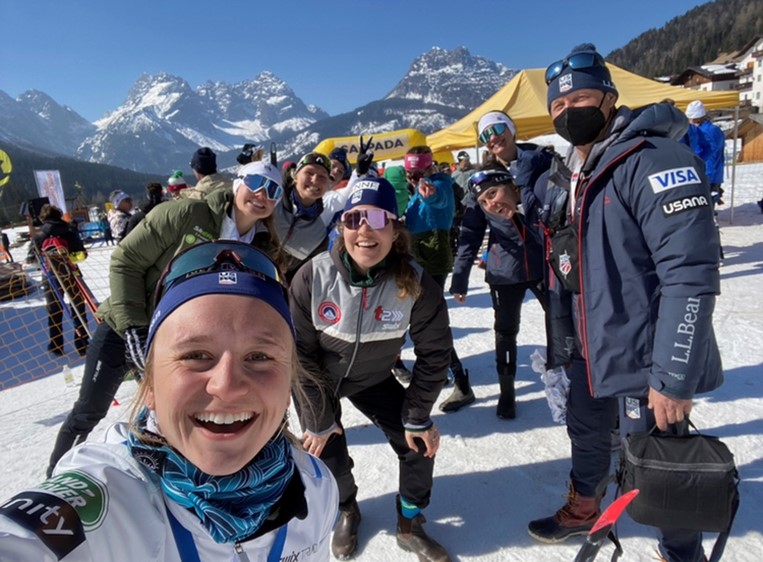
Jessie Diggins and Julia Kern flank their US Ski Team coaches Jason Cork (kneeling) and Kristen Bourne (standing) at their annual on-snow training camp in New Zealand. (Courtesy Photo)
Learning the Language of the Body
If Kern’s early career was marked by her ability to push, her recent evolution is defined by knowing when to pull back. “Recovery is a big one,” she said. “Not just lying in bed—but mental recovery, physical therapy, fueling, hydration. As I get older, I spend more time on that. I’ve learned what works and what doesn’t, and how to read cues—whether I’m ‘good tired‘ or ‘bad tired.’“
Her typical week includes two or three intensity sessions, distance training, and strength work, but with flexibility to fit around life: weddings, visits home, mountain-bike trips. “Working around the life schedule is what makes it rewarding,“ she said. “You’re excited to go do it, and you also feel like you can do all those fun life things too.”
That balance shows in how she approaches her mental game. Kern has worked with the same sports psychologist for over five years, meeting weekly or monthly. Together, they’ve developed what she calls a “good energy“ framework: a way to make decisions rooted in joy rather than obligation. “It doesn’t mean bouncing off the walls,“ she explained. “It means asking: What makes me feel good in skiing? If I’m dreading something because I’m missing an important life event, that probably isn’t bringing me good energy. So I make decisions based on that.”
Patience, she says, has been her greatest teacher. “Everyone has their bumps in the road,“ she said. “Taking those as learning experiences rather than failures is huge. Setbacks force you to approach things differently, and you can actually learn a lot about yourself that way.”
Spending time being active and relaxing with friends and family is a cornerstone to Julia Kern’s success. (Courtesy Photo)
A Culture of Team First
If there’s a single quality that defines Kern, according to U.S. Ski Team Head Coach Matt Whitcomb, it’s her blend of positivity and perseverance. “She’s had a hard road,“ Whitcomb said. “Even as a junior, she battled compartment syndrome, mono, back troubles, shoulder troubles, nerve issues—you name it. That would defeat most athletes. But despite it all, Julia goes on to win World Cup and World Championship podiums.”
Whitcomb sees her as both a survivor and a student. “She had incredible leaders to follow—Sophie, Liz, Kikkan, Sadie—and she was always listening, always learning,“ he said. “Julia’s a scholar. Her parents are scholars, her sister’s a scholar. She comes from a learning family. And now she’s the sum of all those experiences. She reminds me so much of Kikkan Randall—so driven individually, but without a team to celebrate it with, she’d quit skiing. Julia’s the same way: such a team-oriented person.”
That team ethos is something Kern now passes along to younger teammates, such as Kate Oldham. “I really appreciated when older athletes just showed by doing,“ Kern said. “Now I try to do the same. When we do race prep, anyone who wants can join. Like at World Champs—Kate, Jessie, Rosie, and I practiced that final corner together. It was so slushy and tricky, and Kate ended up being the best one out of all of us. So we said, ‘Okay, we’re learning from her here.‘ Everyone has value on this team.”
It’s a culture built not on hierarchy, but on collaboration—crafting beaded bracelets during camps, sharing meals, and creating ways to connect off the snow. “It’s easy to be isolated in hotel rooms,“ Kern said. “We make time for activities that bring us together. Everyone brings something.”
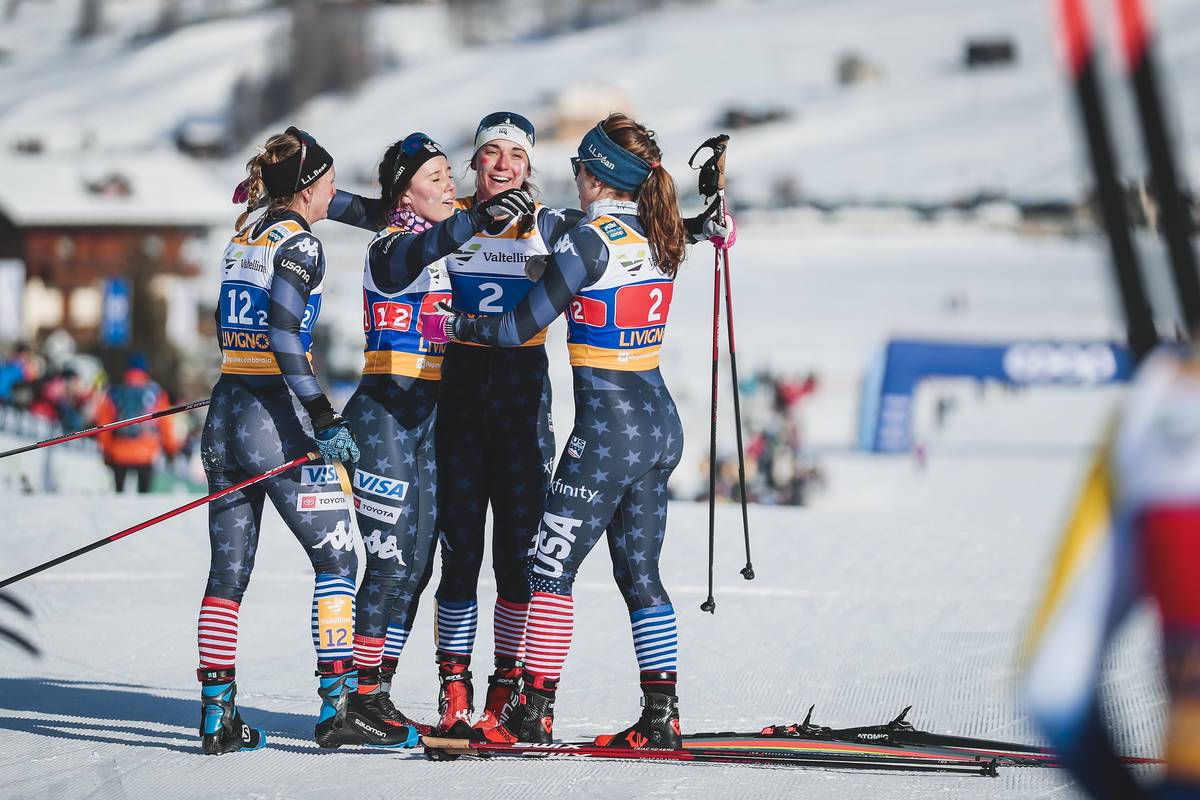
The American women celebrate after United States I – Rosie Brennan and Julia Kern – finished 3rd in a Team Sprint in 2023. (Photo: Nordic Focus).
Learning from Leaders, Leading by Example
When asked what she’s learned from her longtime teammates Rosie Brennan and Jessie Diggins, Kern doesn’t hesitate. “Rosie’s been such a great example of someone who’s had more adversity than maybe anyone I know and still shows up for the team,“ Kern said. “When I was first named to the team and had compartment-syndrome surgery, Rosie—who I didn’t even know—emailed me. She told me it would be tough but that I’d get through it. That stuck with me.”
From Diggins, Kern learned the art of curiosity. “Jessie never goes around thinking, ‘I’m the fastest in the world, I know everything,‘” she said. “She’s always got a growth mindset—always wanting to follow someone, to learn something. That’s really rare for someone at the top.”
Whitcomb has noticed the same instinct. “Julia’s evolved from someone who needed guidance into someone others now look to,“ he said. “She embodies that positive feedback loop of mentorship that defines this team.”
Mental Toughness in the Grind
On the World Cup circuit, there’s little room for reflection. Races pile up; travel blurs weeks together. Kern’s approach to a long season is both pragmatic and optimistic. “I love to race,“ she said. “The World Cup is part of the bigger plan. Early season, we’re still training on the road. You’re not trying to peak at Ruka. It’s about understanding where you are in the load of the season.”
She deliberately builds in breaks—two weeks at home after the Tour de Ski, Christmas with her boyfriend, family visiting during the Olympics. “Those resets make all the difference,“ she said. “They help you stay excited.”
You’re probably already following Kern on Instagram, but if you aren’t, you are missing out on a lot of delicious food inspiration. Cooking has become another activity for her to recover and connect with her friends and family. (Courtesy Photo)
Her outcome goals are clear: make sprint finals consistently, push into the top-10 in distance races, and—if everything lines up—fight for a team-sprint medal at the Olympics. “That’s what I think about during hard intervals,“ she admitted. “The team sprint is a big goal of mine.”
But Kern’s definition of success extends well beyond medals. “A successful season for me,“ she said, “is staying healthy, enjoying the process, and feeling good about how I carried myself. Pressure is a privilege. I want to soak up the experience and make it fun again.”
Beyond the Podium
For Kern, the sport’s meaning has broadened. As an athlete representative to FIS and an advocate with Protect Our Winters, she’s become a voice for climate responsibility and athlete well-being. During the 2025 World Championships, when environmental protests threatened to disrupt races, Kern helped mediate between activists and organizers. “We agreed that protesting during the race wasn’t the way to send a strong message,“ she said. “Now we have an open dialogue. These things take time, but they’re moving.”
Her motivation, she said, “is less about results and more about impact.“ She wants younger athletes to know that skiing fast can be both a platform and a privilege. “I feel grateful that I had such an active childhood and want that for the next generation,“ she said. “Clean air affects everyone. Being outside isn’t something we can take for granted anymore.”
Using her success as a platform to make a lasting impact on children has become a priority for Kern. (Courtesy Photo)
The Joy of Motion
Talk to Kern for long enough, and you realize skiing is just one part of her athletic identity. She’s an all-around mover—mountain biking, surfing, beach volleyball. “I’ve always loved doing every sport imaginable,“ she said. “Even as a kid, I just wanted to move. There’s so much value in being active and having fun. You don’t have to specialize too early. Playing lots of sports keeps it fresh and helps you avoid burnout.”
Cooking has become her creative outlet. “My boyfriend and I love to cook together,“ she said. “We have a CSA, so we get creative with whatever veggies we have. It’s like art—making the food look pretty, connecting with what we eat. It’s a kind of recovery, too.”
From the Gym to the World Stage
Whitcomb sees this blend of drive and joy as Kern’s secret strength. “Julia’s positivity isn’t surface-level,“ he said. “It’s a choice she makes every day despite setbacks. That’s what makes her such an anchor on this team.”
For her part, Kern sees the season ahead not as a culmination, but as another chapter in a long-term process. “Fourteen-year-old me would be surprised I’m still ski racing,“ she said, laughing. “Back then, I thought junior nationals were the pinnacle. I didn’t even know what the World Cup was. I think she’d be proud that I’m still doing this—and still having fun with it.”
Enjoyment is what keeps Kern chasing perfect rhythm through the snow, trusting that good energy leads to good skiing, and that joy and excellence can, in fact, coexist.
Kern seems fully ready to send it this season. (Courtesy Photo)
Love Stories Like This? Help Keep Them Coming.
Feature interviews like this one take time, access, and care to produce. If you value thoughtful storytelling and independent ski journalism, please consider becoming a Voluntary Subscriber. Your support directly fuels the work we do to cover the people, places, and moments that make our sport special.
At the World Championships last winter, a slushy, rutted corner near the finish line became a proving ground for precision and poise. The turn was taking down skiers all week — an icy edge here, a soft patch there — the kind of technical trap that can shake even the most seasoned racers.
On the U.S. team’s final course preview, Jessie Diggins, Julia Kern, Rosie Brennan, and newcomer Kate Oldham took turns testing different lines. It was part of their customary pre-race ritual — playful, low-stakes, but essential.
“And you know,” Kern recalls, “when we do race prep, we make sure anyone who wants can join. I think those moments are really cool. Like this year, Kate [Oldham] at World Champs — we did race prep together, Jessie, her, and I, and maybe Rosie too. We were practicing that final corner because it was so slushy and tricky, and Kate ended up being the best one out of all of us in that corner.”
Kate Oldham (USA) during the Individual Sprint at the FIS Cross-Country Ski Championships in Trondheim (NOR) last season. (Photo: Modica/NordicFocus)
It was a small moment, but it spoke volumes — the rookie demonstrating to her mentors not through bravado but through calm instinct and feel. For Oldham, it was proof that she belonged.
“Pre-race days are really fun,” she says. “It’s a time to try stuff out in a low-stakes way. You don’t necessarily want to be experimenting once the heats start, so we’ll trade off who goes in front and see how different approaches work. That corner was taking people down left and right — and none of them were Americans, so that was cool.”
For the team, it was just one corner on one course. For Oldham, it was the quiet confirmation that her precision and poise could stand alongside the best in the world — that she could carve her own line through the sport.
From Carbondale to the World
Oldham, who was recently named to the U.S. Ski Team, grew up in Carbondale, Colorado. In this mountain town, Nordic skiing runs through the community as naturally as snowmelt through the Roaring Fork Valley. “My parents just introduced me to it as a little kid,” she recalls. “We played sharks and minnows on skis.” She skied with the Aspen Valley Ski Club (AVSC) development team, more for fun than ambition—until a trip to West Yellowstone changed everything.
Her dad was helping the high-school team with meals, and Kate got to tag along. “I thought they were the coolest kids ever,” she laughs. “I got a little taste of what it was like to train more seriously—but in a really low-stress way. I could ski when I wanted to, hang out with my dad when I didn’t. I just started liking it more and more.”
By freshman year, she had joined AVSC’s National Comp Team, with coach August Teague guiding her progression. “He had a big hand in shaping my love for training and the structure that cross-country skiing brings to your life,” she says. “I love being able to map things out and plan.”
Teague’s wife, Kara LaPoint, became another key influence. “She’s a pro triathlete and just a really badass person,” Oldham says. “We love training together when I’m home.” From the AVSC coaches to her parents to the national-team staff she works with now, Oldham has always been surrounded by people who bring joy and perspective to the grind of elite sport. “The whole community fuels my fire,” she says.
Oldham recharging back home with good friend Kara LaPoint. (Photo: Courtesy Photo)
The College Shift
Oldham began her college career at Middlebury but transferred to Montana State after two semesters, drawn by the environment and energy of Bozeman. She completed a degree in environmental studies with a minor in sustainability. “I absolutely loved MSU,” she says. “Being in Bozeman just fit me.”
The NCAA circuit gave her a crash course in balancing intensity and independence. “It’s extremely competitive now—good skiers in every region,” she says. “You’re racing against Scandinavians, Europeans, all kinds of strong athletes. It’s a great way to get better.”
Equally valuable was learning to juggle priorities. “That balance between school, life, and skiing teaches you communication and time management,” she says. “It’s the same skill set you need later, navigating different coaches and support staff.”
Oldham’s affection for the Bobcats remains strong. “I’m still really close with the team. Sometimes I’ll text my old coach, Sam Benzing—’Hey, do you remember what we were doing at this time last year?‘ They’re always willing to help, and I’m super grateful for that.”
Oldham celebrates making First Team All-American at the 2024 NCAA Championship. (Photo: Courtesy Photo)
A Pro’s Life in Bozeman
When she graduated, Oldham decided to stay in Bozeman and train with Andy Newell and the Bridger Ski Foundation. “Andy’s a great mix of laid-back and professional,“she says. “He’s flexible with what I want to do but still really on top of things.”
Without classes or side jobs, Oldham has ramped up her training—but carefully. “We’ve been cognizant not to make big changes when what I’ve been doing has been working,“she says. “There’s already a lot of change in an Olympic year. I wanted to keep what I could the same.”
Her days follow a rhythm familiar to many full-time athletes: morning training, lunch, laptop chores, a second session, and quiet evenings. “I like to have a routine, but I also adjust based on life,“she says. “That’s a good skill, especially once you’re on the World Cup. Travel, fatigue, sickness—you have to be adaptable.”
This summer included a mix of Bozeman training and U.S. Ski Team camps. “It’s nice to get new perspectives, new venues, and then come home for family time,“she says. “I love riding my bike, hanging out with my family—just that balance.”
Oldham’s focus on recovery is equally pragmatic. “A lot of my body care happens in the gym—PT and strength work. Tschana [Schiller], our strength coach, does a great job keeping us balanced and mostly injury-free,“she says. “Then it’s good food, good sleep, and time to unwind. It’s simple, but it adds up.”
Oldham and BSF teammate Emma Albrecht. (Photo: Courtesy Photo)
Lessons from the Veterans
One of the most significant changes this past year was joining a national team full of skiers she grew up watching on TV. “It’s wild,“she admits. “They’re all so different in great ways. Seeing them up close, you realize—they’re real pros. It’s their job. But they’re also incredibly humble and welcoming.”
She has learned as much from how Diggins, Kern, and Brennan think about training as from what they do. “They all pay close attention to what they need on a given day,“Oldham says. “At a camp, they might all have slightly different plans. Not because they’re doing something special, but because they know what works for them. They balance that with the team sessions so everyone gets what they need.”
It’s a lesson she wishes she’d known earlier. “Even though it’s scary sometimes, it’s okay to be confident in yourself and your plan,“she says. “Doing what you need is a huge asset. Trusting yourself can be hard, but it’s worth it.”
That self-trust carries into her goals for the season. “Obviously, I’d love to make the Olympic team,“she says. “That would be an incredible experience. But I’d also be really happy with some top-30s on the World Cup.”
After spending time with Kate, it quickly becomes apparent that she is cooler than most of us. (Photo: Courtesy Photo)
More importantly, she wants to manage the grind. “I learned a lot last year, and I’m still figuring out what I need to stay happy and motivated through a long season of travel,“she says. “That’s a big process goal—dialing in what works for me.”
She’s also been working on how she handles the inevitable rough patches. “My tendency can be to isolate when something goes wrong,“she says. “But I’m learning to use my support team. There are people who want to help, and when I let them in, they always have a great perspective. Sometimes it’s just someone saying, ‘What did you learn today?‘That can shift the whole mindset.”
Looking Ahead
Oldham envisions a long career—but only if she keeps loving it. “I want to love skiing forever,“she says. “As long as my body’s healthy and I’m enjoying it, I’ll keep going. But not at the expense of that joy.”
Her advice to the younger version of herself, and to the next generation coming up through AVSC, is simple. “Don’t count yourself out,“she says. “So much can happen in a race that you don’t expect. Sticking with it is the only way to find out. Enjoy it, and pay attention to the relationships you build along the way—they’re what you take with you.”
Kate and her father, Nelson, out on a hike. (Photo: Courtesy Photo)
The Roots That Keep Her Grounded
When she’s not training or racing, Oldham gravitates back to Carbondale, where her family’s restaurant—Dos Gringos Burritos—is about to turn twenty-five. She’s been part of it since before she can remember. “I’ve been around it my whole life,“she says. “It’s a pretty important staple in our town, and my parents are huge role models for me.”
Working at the restaurant keeps her connected to real life. “The service industry teaches you a lot,“she says. “Everyone should do it once—how to deal with people, how to work hard behind the scenes. It grounds you.”
Her go-to order? “The summer salad wrap,“she says instantly. “But after twenty-three years of hanging around the place, you have to keep it fresh.”
Outside the restaurant, she finds calm in the same things that shaped her childhood: horses, bikes, and the Colorado mountains. “I grew up around horses and hope to return to that life after skiing,“she says. “Being outside, cooking, baking—it’s all part of keeping balance.”
That balance, she’s learning, is the fundamental foundation of confidence. It’s not just about speed through a corner or times on a results sheet—it’s about knowing where you came from and who you are when the racing stops.
Oldham loves getting outside, especially on horses. (Photo: Courtesy Photo)
Love Stories Like This? Help Keep Them Coming.
Feature interviews like this one take time, access, and care to produce. If you value thoughtful storytelling and independent ski journalism, please consider becoming a Voluntary Subscriber. Your support directly fuels the work we do to cover the people, places, and moments that make our sport special.
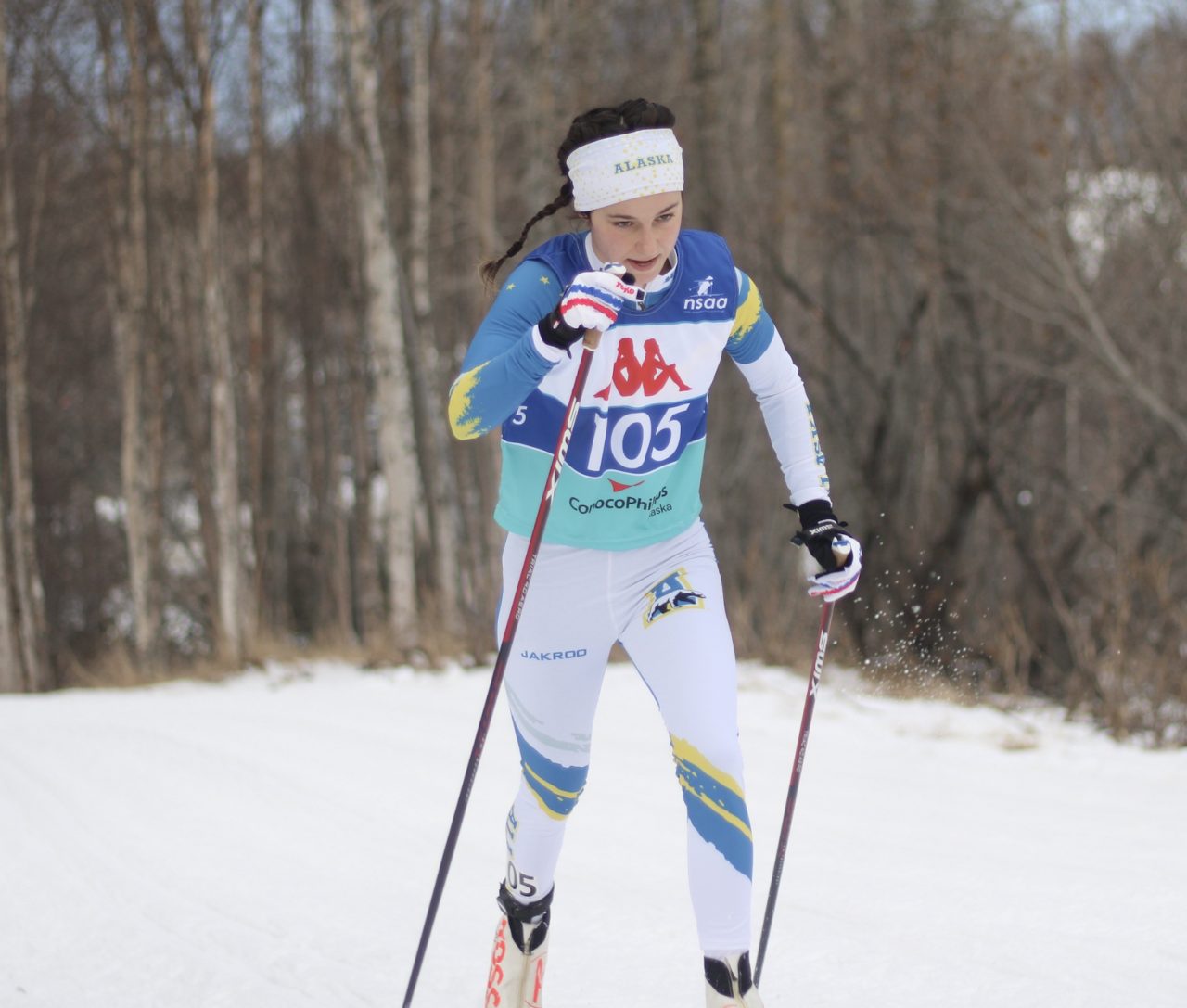
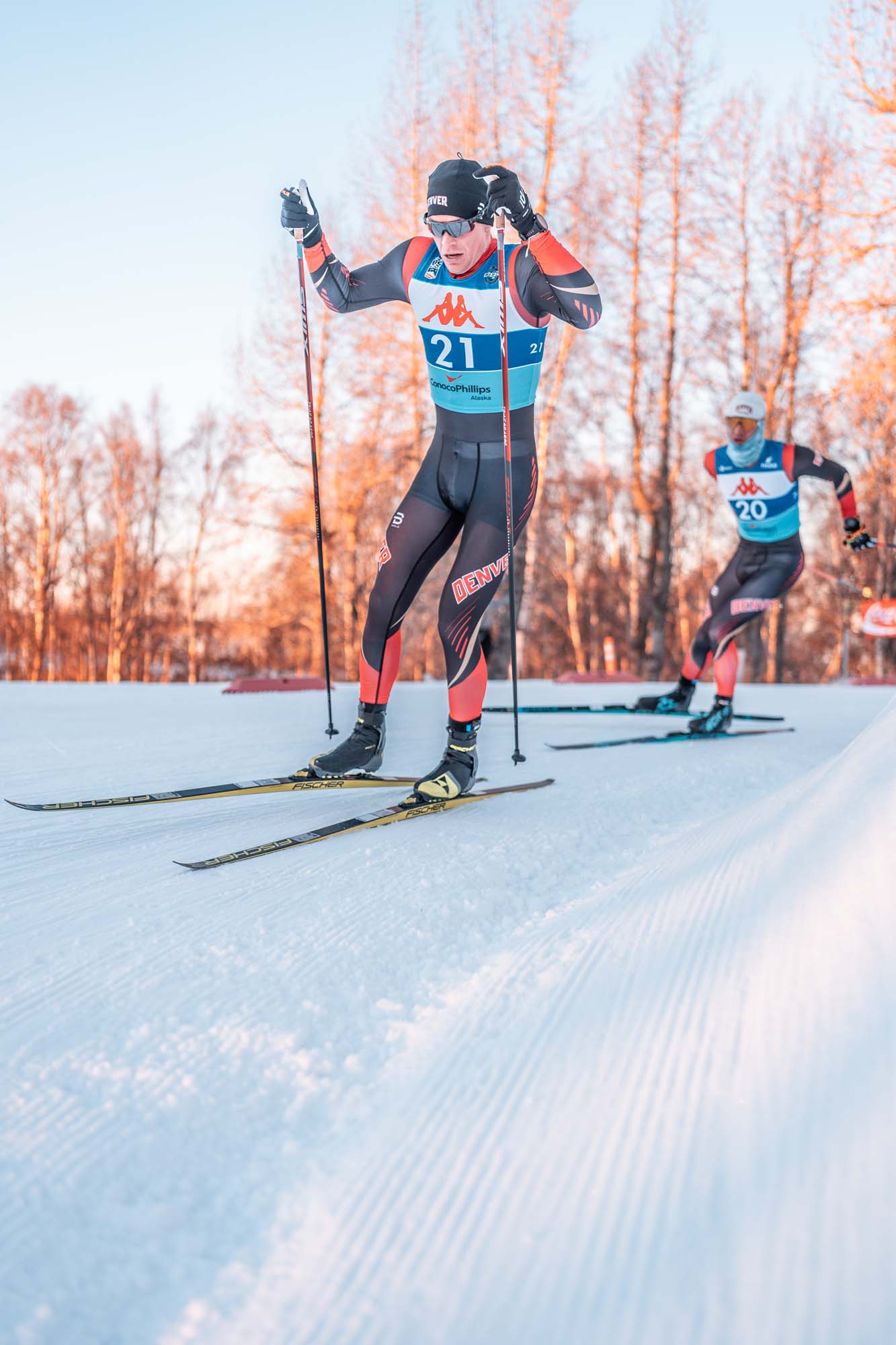
Kendall Kramer, racing Sunday at U.S. Nationals at Kincaid Park, is a multi-sport athlete at University of Alaska Fairbanks. She competes in both cross-country running and skiing. (Nathaniel Herz/FasterSkier)
ANCHORAGE — Alaskans like to think of their home state as the center of American cross-country skiing.
Minnesotans might quibble. But consider the more than 200 volunteers who turned out to help host the U.S. National Championships in Anchorage this week, and the dozens of local athletes who signed up to race.
There was just one problem: Through five of six of the championship events, athletes from Norway, Sweden, Colorado and Idaho had denied the Alaska crowd the pleasure of seeing one of their own cross the finish line first. (An Alaska man, Luke Jager, had technically claimed a U.S. championship Saturday, but crossed the finish line second to a Norwegian, who was ineligible to claim the title.)
Sunday’s 20-kilometer, classic-technique women’s race was the Alaskans’ last chance.
And Kendall Kramer came to the rescue.
The 22-year-old Fairbanks native won her first-ever national championship fashion in stirring fashion, breaking away from the pack early in the race with one other athlete and slipping away in the final meters before the finish.
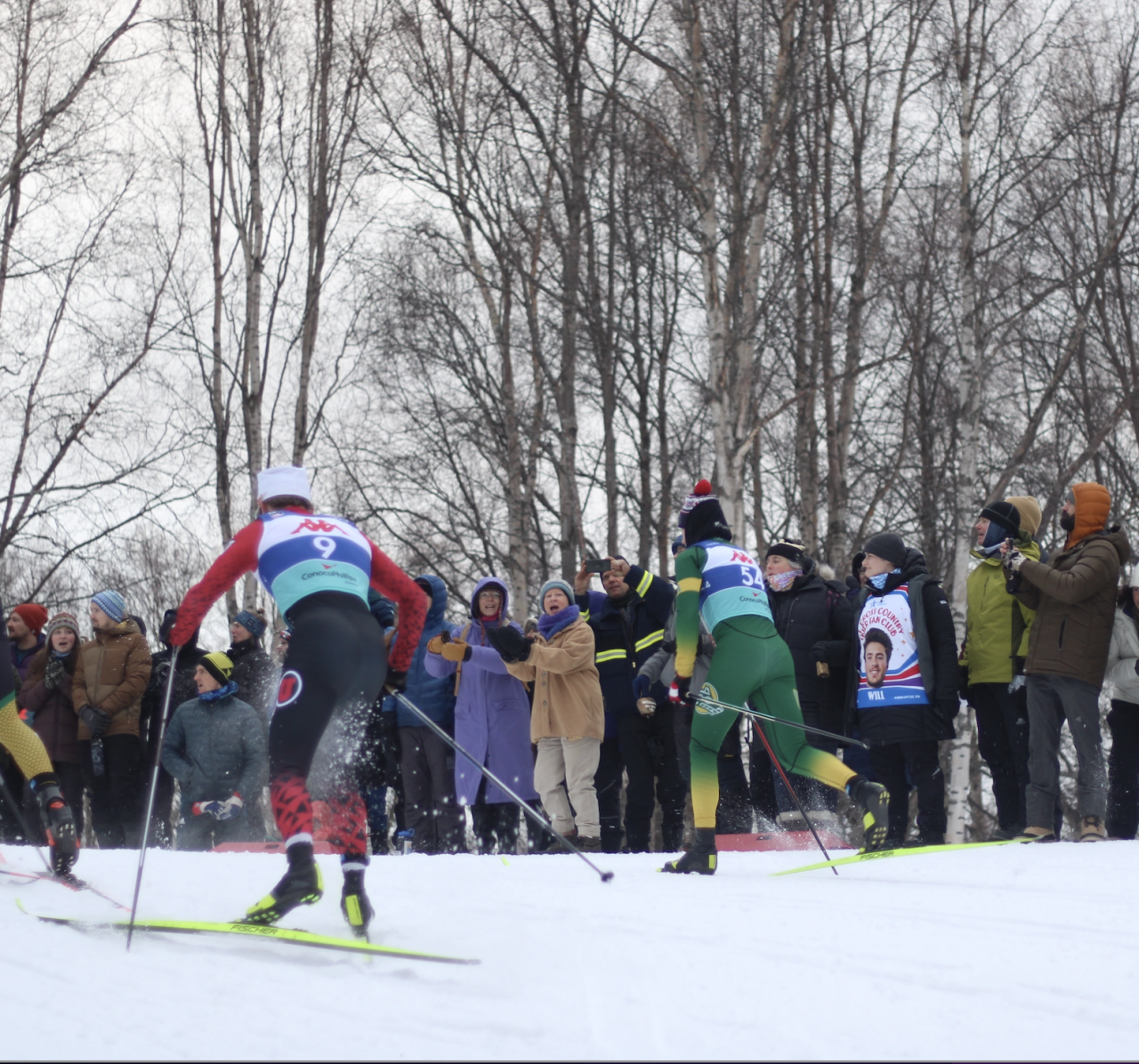
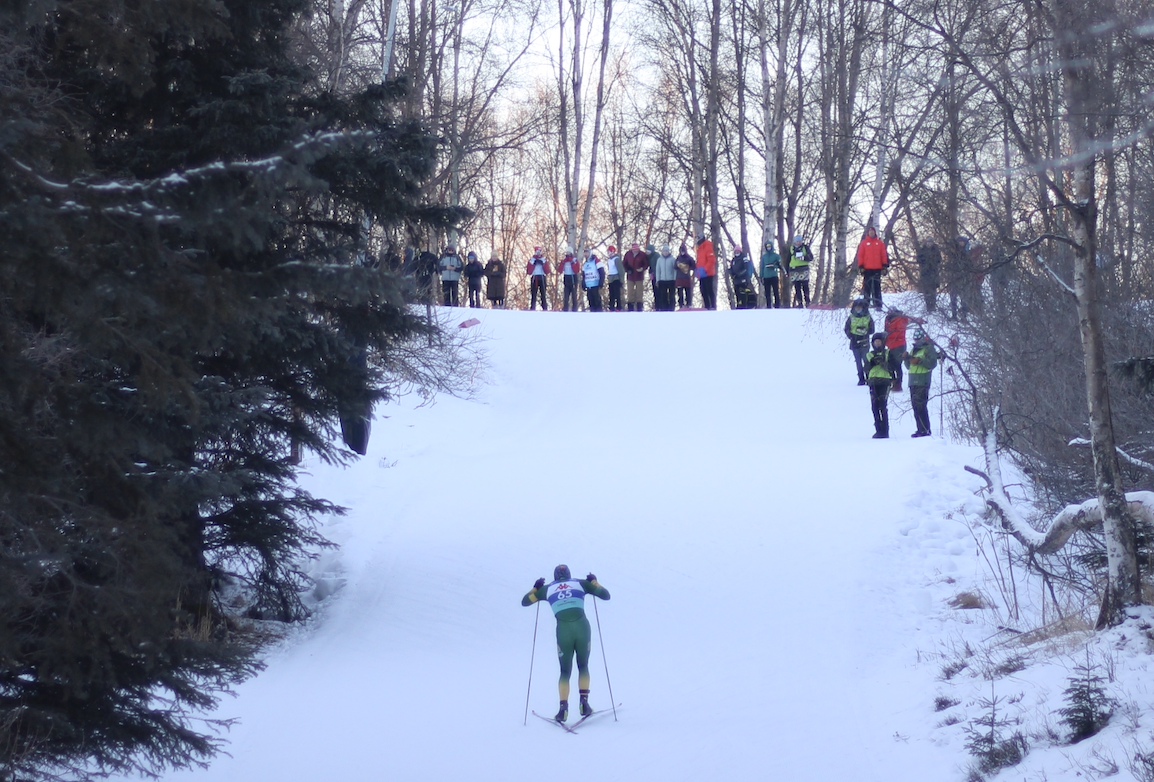
The crowd on one of the major hills cheers on U.S. Nationals competitors in Sunday’s men’s race. (Nathaniel Herz/FasterSkier)
“You can feel it in the energy,” said Kikkan Randall, the Olympic gold medalist who heads the Nordic Ski Association of Anchorage, which is co-hosting the event. “We have so many great volunteers out here, we really push to get spectators out here. And so when you see an Alaskan deliver, it’s just that sense of pride.”
Kramer’s final margin of victory was 2.4 seconds over Erica Laven, a Swedish skier competing for the University of Utah. The rest of the women’s pack crossed the finish line a minute-and-a-half later, led by Lauren Jortberg, who races for a Quebec club team.
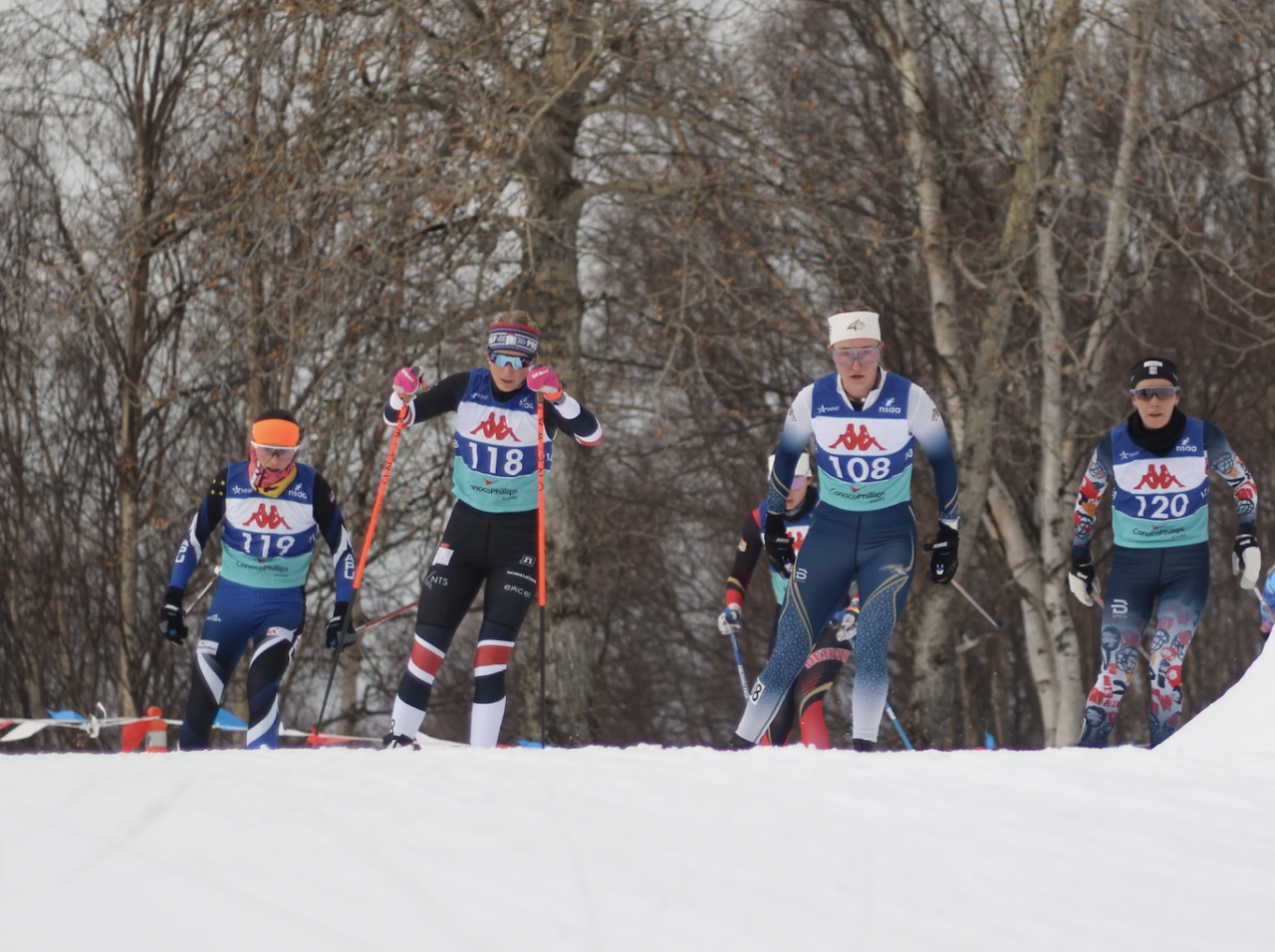
The women’s chase pack crests a hill in Sunday’s distance race. From left, Alaska Pacific University’s Renae Anderson, Bridger Ski Foundation Pro Team’s Erin Bianco, Montana State University’s Kate Oldham and CNEPH’s Lauren Jortberg. (Nathaniel Herz/FasterSkier)
Montana State University’s Kate Oldham was just behind Jortberg and rounded out the U.S. championship podium; Laven was ineligible due to her Swedish citizenship.
Kramer has been a standout since her years at West Valley High School in Fairbanks, where she won more than a dozen state titles between skiing, cross-country running and track and field. She was first named to the U.S. Ski Team while a junior in high school, then decided to stay in her home city for college, where she’s competed in both cross-country skiing and running.
She won a medal at the Youth Olympic Games in Switzerland in 2020, and has an array of junior national championships to her name. But two second places — including one Thursday to Oldham — were as close as Kramer had come to winning a U.S. title.
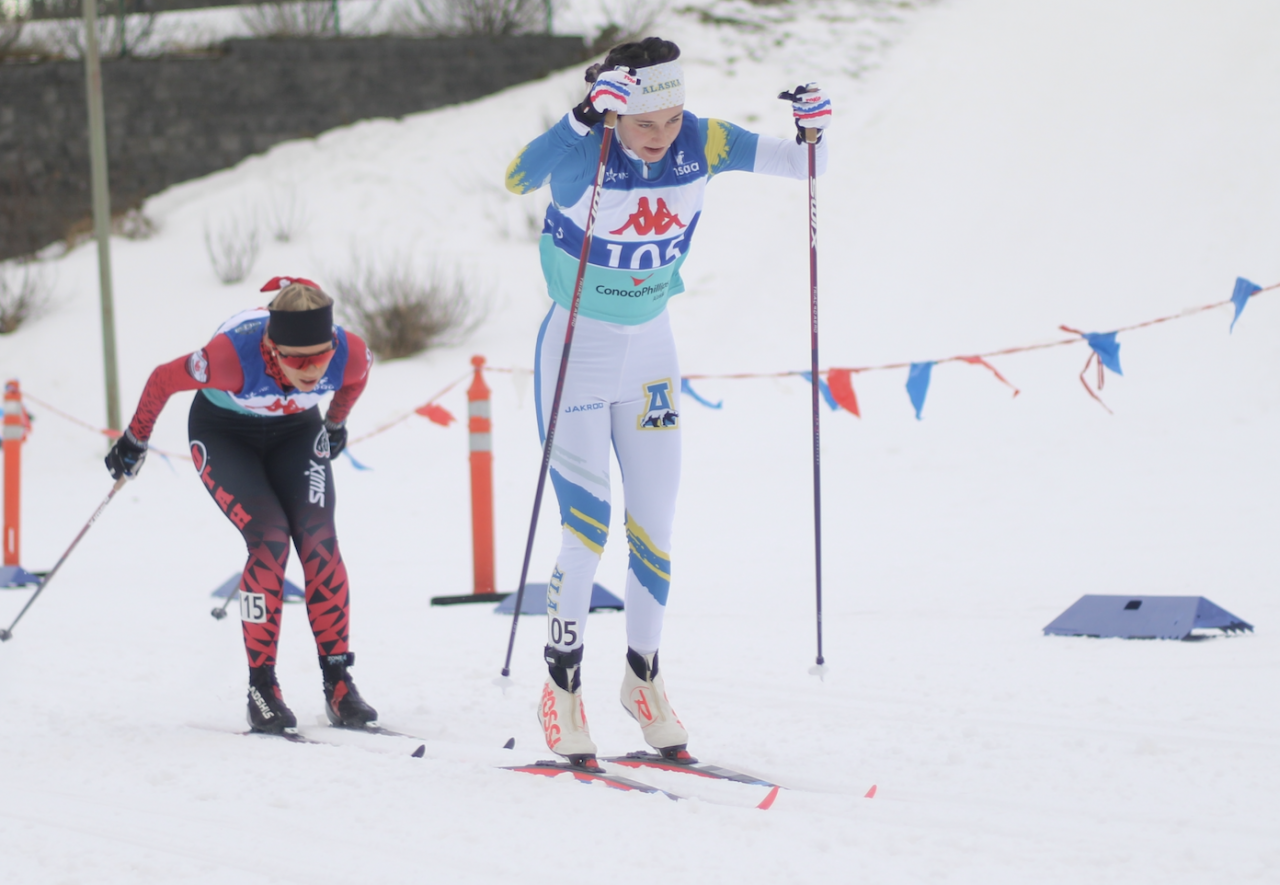
From the start of Sunday’s event, Kramer left little doubt about who would stand on the top of the American podium when she and Laven broke away from the pack on the first of four five-kilometer laps. The two skied the rest of the race together, with Kramer — who trains with Anchorage’s Alaska Pacific University club team during the summer — boosted by an energetic home crowd.
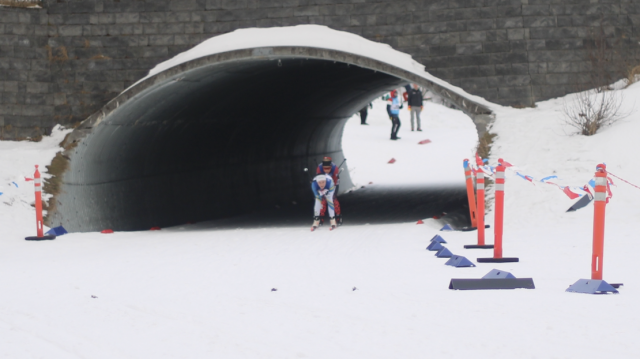
Kendall Kramer leads Erica Laven through the tunnel into the stadium at Kincaid Park. (Nathaniel Herz/FasterSkier)
“I really felt that — I was like, ‘This must be someone from here,’” Laven said, referring to Kramer. “Because it was a lot of people cheering for her.”
Among the fans at Kincaid were Kramer’s mother, Susan Schwartz, along with her grandmother, an aunt and innumerable teammates. Schwartz, who was working as a volunteer at the start line, described the race between Laven and her daughter as a “nail-biter.”
“They just kept on getting faster and faster and faster,” Schwartz said. “It was amazing to watch.”
Early on, Kramer said she realized that even if she lost the race to Laven, she’d still claim the U.S. title. But, she added, she didn’t necessarily want to settle for that. Laven was skiing stronger on uphills, but if Kramer could keep up in those segments, she said, she could “totally relax in the double pole.”
“She was expending a lot of energy on those. And I knew I had energy by the end,” Kramer said.
The closer Kramer got to the finish line, she said, the more confident she felt about her shot at winning the race outright. And on the home stretch, she pulled away.
Kramer elevates in her double pole to lead Laven toward the finish. (Nathaniel Herz/FasterSkier)
“She was really strong in the double pole today,” Laven said. “I really had to push hard.”
Kramer crossed the line without celebrating. But her mother, Schwartz, “could tell she was just thrilled” — particularly after Kramer finished a close second in Thursday’s race.
“I could tell she wanted it bad,” Schwartz said. “She was not going to let it get away from her today — that’s kind of the feeling I got watching her race.”
Kramer is in her last year competing for University of Alaska Fairbanks and expects to race professionally next season.
She said she doesn’t want to miss this spring’s collegiate championships. But she grimaced when a reporter pointed out that the event conflicts with the World Ski Championships in Norway, where finishes at the past week’s races in Anchorage are likely to inform which U.S. athletes are chosen for the team.
“I’m super grateful if I do get the spot, because I know how hard people work for it and how bad people want it,” she said. “But we’ll see.”
Erling Bjoernstad, a Norwegian freshman racing for University of Alaska Anchorage, climbs a hill toward the stadium at U.S. Nationals Thursday. (Nathaniel Herz/FasterSkier)
ANCHORAGE — Kate Oldham wasn’t expecting to win Thursday’s opening race of the U.S. National Championships.
It was her first competition of the season, after focusing on training in December, and she’d never placed better seventh at previous national championships.
Her coach at Montana State University, Adam St. Pierre, had other ideas about the 22-year-old senior — though he was keeping them to himself.
“I have been predicting Kate as a dark horse national champion for a couple of weeks now,” St. Pierre said. “But not talking about it with her, because she races best when expectations are low.”
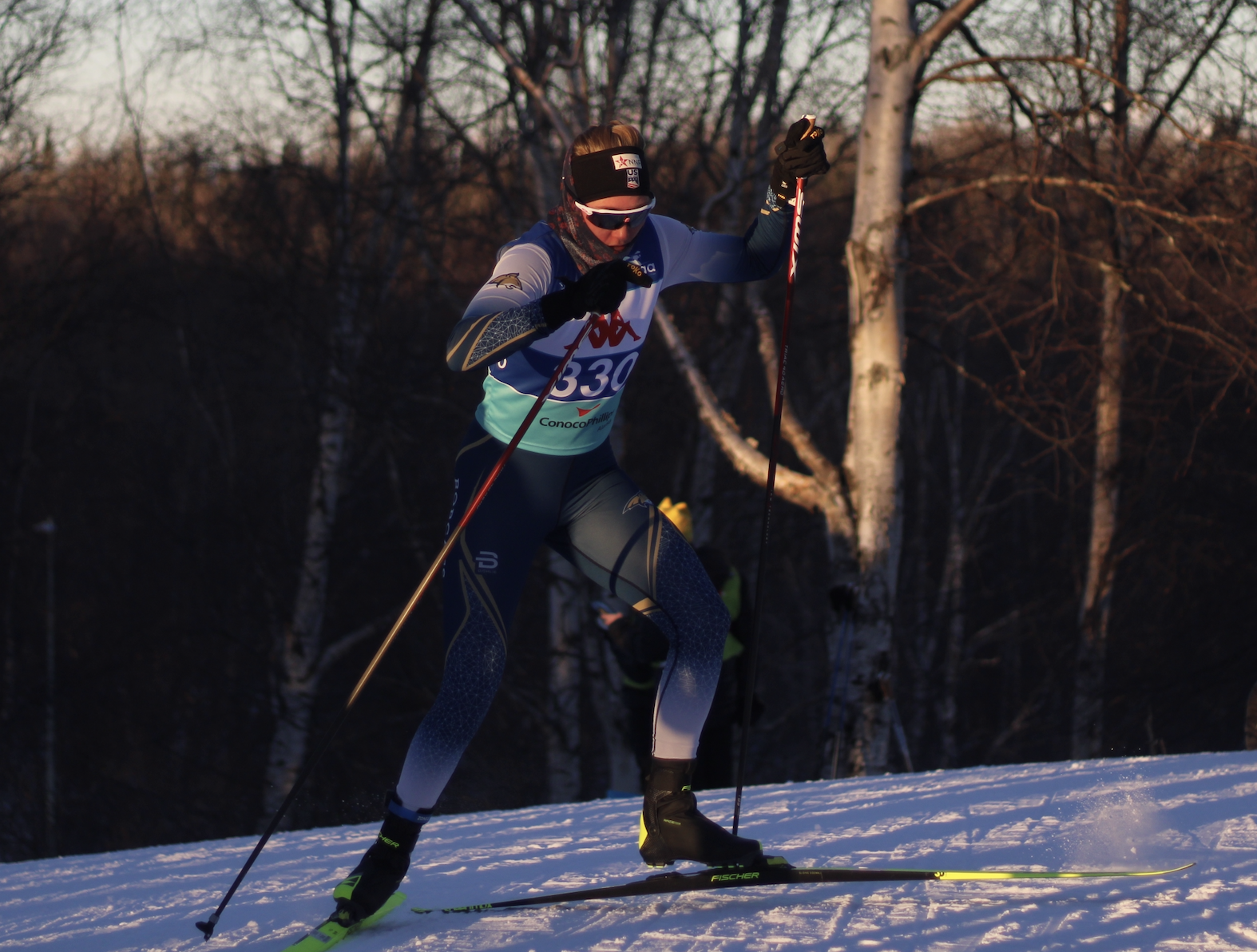
Kate Oldham racing at the U.S. National Championships in Anchorage on Thursday, January 2, 2025. (Nathaniel Herz/FasterSkier)
Oldham, St. Pierre said, is a superb glider on her skis, with a “killer instinct” — which apparently served her well Thursday on the rolling, blazing fast, 10-kilometer course at Anchorage’s Kincaid Park.
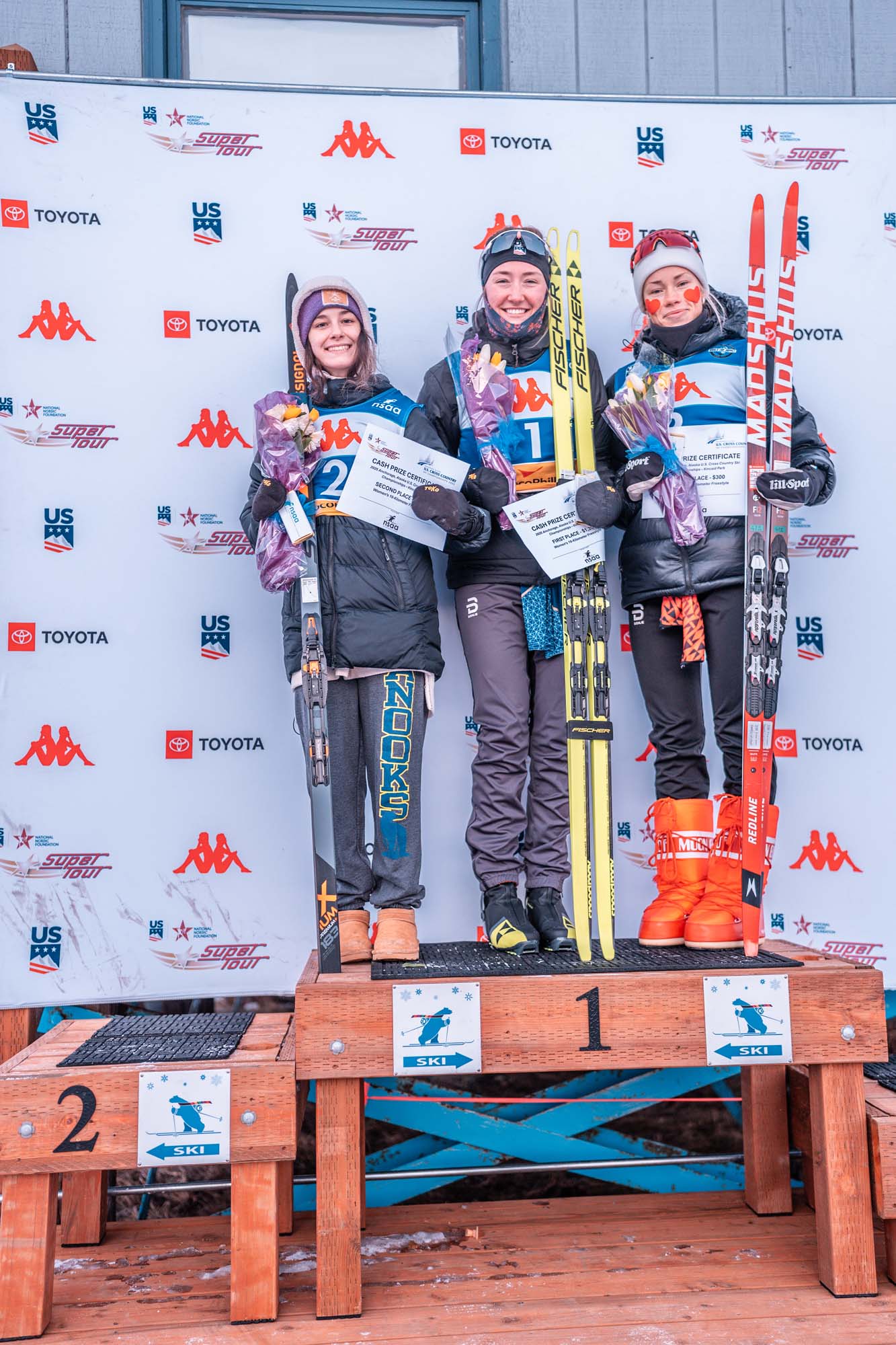
Oldham won her first-ever national championship, edging local favorite Kendall Kramer of University of Alaska Fairbanks to win the individual-start, time trial-style skate event by 11 seconds.
University of Utah’s Erica Laven was third, 28 seconds behind.
“I did not wake up thinking that was going to happen today,” Oldham said afterward, as she fended off bear hugs from teammates and rivals. “It’s surprising. But it’s also awesome, and makes me cry happy tears.”
Erica Laven on her way to third place. (Photo: Tobias Albrigtsen / @untraceableg)
If Oldham’s win fell somewhere between a surprise and a shock, John Steel Hagenbuch’s victory in the men’s race was hardly unexpected — though that event was much tighter.
Hagenbuch, a 23-year-old senior at Dartmouth College, already has several national titles to his name, along with solid results last season on the international World Cup circuit.
Hagenbuch held off Andreas Kirkeng, a Norwegian racing for the University of Denver, by a fraction of a second. Walker Hall, who races for the University of Utah, was third, 15 seconds behind.
Thursday’s races were the first of three national championship events at Kincaid Park, with two more to follow over the weekend — plus a non-championship race next week.
While temperatures in Anchorage have dipped recently, to single digits Thursday morning, a rainy, low-snow December required extra work from organizers to pull the races off. Kramer, in fact, was part of a battalion of volunteers, including numerous racers, who spent some of last weekend shoveling clean snow onto dirty patches along the course.
Kramer said she planned a long ski workout that day and kept her watch going while she pitched in on a little shoveling.
“It was kind of like playing in the snow,” she said. “I don’t want to take too much credit, because I wasn’t out there for the whole four hours people were doing it. But I am very grateful, and I was inspired by all of the people who were there.”
Kramer, 22, was in the hunt for the win Thursday, with coaches telling her at one point during the race that she was in the lead.
Kendall Kramer crests a hill in Thursday’s race. (Nathaniel Herz/FasterSkier)
But Oldham had the fastest times for each of her two five-kilometer laps, according to official splits. Laven was just one-tenth of a second behind her at the halfway point, though she faded on her second lap.
Oldham grew up in Colorado and spent her holiday break from school training at home, taking advantage of “incredible skiing” in Aspen instead of entering season-opening races, she said.
That plan is geared toward not peaking too soon, so she can notch her best results at the collegiate national championships toward the end of the season, in March. That plan made Thursday’s win even more of a “pleasant surprise,” Oldham said.
“I didn’t really sharpen for it,” she said. “It’s an intimidating way to start the season, because you kind of have no idea (what level) you are coming in. But it’s also really nice to go home and enjoy the holiday and just focus on training.”
Hagenbuch’s approach to the season has been sharply different: He began racing more than a month ago, on the World Cup circuit.
But after a breakout season last year — one in which he won a bronze medal at the World Under-23 Championships and also recorded a top-15 finish in a World Cup race — this year’s efforts have been uneven.
Hagenbuch started the season at World Cups in Finland and Norway, but failed to crack the top 30. Then, he returned to the U.S. and notched four straight podiums on the domestic circuit.
One challenge he faced in Europe, Hagenbuch said Thursday, was that he was having a breathing problem that appears to be a condition called exercise-induced laryngeal obstruction — where, he said, his larynx and vocal cords “seize up and close” during races.
John Steel Hagenbuch works his way up Elliott’s climb at the U.S. National Championships in Anchorage on Thursday, January 2, 2025. (Nathaniel Herz/FasterSkier)
The first time it happened, in Finland, was “definitely pretty scary — I couldn’t breath really at all, and I couldn’t speak for 15 minutes after the race. Couldn’t say a word.”
“It’s kind of multifaceted in what causes it, but I’ve been working through it and trying to figure it out and keep all those muscles relaxed, because it isn’t something you can really address by taking medication,” he said. “It’s something that has to do with controlling your muscles and reducing your stress.”
Hagenbuch said he had a little bit of breathing trouble Thursday, but managed to keep it under control.
He had the fastest first lap of the five-kilometer course, giving him a slight edge over Kirkeng.
But on the second lap, the Norwegian started creeping back.
A 24-year-old senior studying finance at the University of Denver, it’s unlikely Kirkeng would be in contention for a national championship in his home nation, the global cradle of cross-country skiing.
But in the U.S., it’s hardly unusual for European athletes to dethrone their American competitors at marquee races: In fact, Kirkeng won the 10-kilometer distance race at the U.S. National Championships in each of the past two years.
John Steel Hagenbuch on his way to winning the national title. (Photo: Tobias Albrigtsen / @untraceableg)
As Hagenbuch neared the finish line, coaches along the course were giving him split times that showed Kirkeng closing the gap — even though Hagenbuch had started the race conservatively.
“I underestimated how hard it was going to get,” Hagenbuch said. “I thought I was going to lose it — I was hearing the splits go from eight seconds up on Andreas, to six seconds to three seconds to even.”
Kirkeng skied his last lap four-and-a-half seconds faster than Hagenbuch. But in the end, that wasn’t quite enough: Hagenbuch’s first lap was five-and-a-half seconds faster than Kirkeng’s, and he held on to win by eight-tenths of a second.
“The margins were not on my side today. But that’s how racing is,” Kirkeng said afterward. “And it’s been the other way around a couple of times.”
Andreas Kirkeng on his way to second place on the day. (Photo: Tobias Albrigtsen / @untraceableg)
Kirkeng is likely in the twilight of his career — he said he expects to retire after this season and, hopefully, find a finance job on Wall Street or in Boston. If not, he’ll probably return to Norway and enjoy more time with his family.
Hagenbuch’s career, meanwhile, is still taking off.
He said he’s looking forward to the rest of the races in Anchorage, which he expects to follow with more competitions in the U.S. — domestic SuperTour events and the college circuit, culminating in the NCAA championships.
Going back to the international World Cup circuit, he added, probably doesn’t make sense this year, especially after he missed substantial stretches of school while he traveled to races last season.
But even if this year’s European campaign didn’t pan out, Hagenbuch said, he’s not disheartened.
“I know I’m in good shape, and I had a good season of training — the hay is in the barn, if you will,” Hagenbuch said. “It’s just going to take some time for that to show itself.”
While World Cup Finals were underway in mid-March in Falun, Sweden, a second contingent of top American skiers was lining up roughly 2,000 kilometers south to race in the OPA Cup Finals in Sappada, Italy. Located along the northern edge of Italy near the Austrian border, the small town is nestled among the spectacular, jagged massifs of the Italian Dolomites, roughly an hour’s drive east of Toblach, which typically hosts the final stages of the Tour de Ski. The team spent the week prior to competition training in Toblach, which features similarly spectacular views, along with the benefits of the delicious food and drink one might expect when traveling in Italy.
For those unfamiliar with the OPA Cup, it is an international race series featuring predominantly European athletes racing just below the World Cup level. The US Ski & Snowboard development program typically facilitates a trip to OPA Cup Finals to provide athletes who may not have earned World Cup starts the opportunity to experience high level competition overseas. Qualification is based on national rankings, beginning with those racing on the World Cup, and proceeding through the top domestic racers, depending on declines. Often, there is overlap between the teams for the FIS Junior/U23 World Ski Championship teams and the OPA Cup teams, which may conveniently allow some athletes to prolong their stay in Europe and attend both events.
“Generally the trip is geared toward athletes that are a bit older, who either have had World Cup starts or on track for that,” explained US Ski Team Development Team coach Greta Anderson.
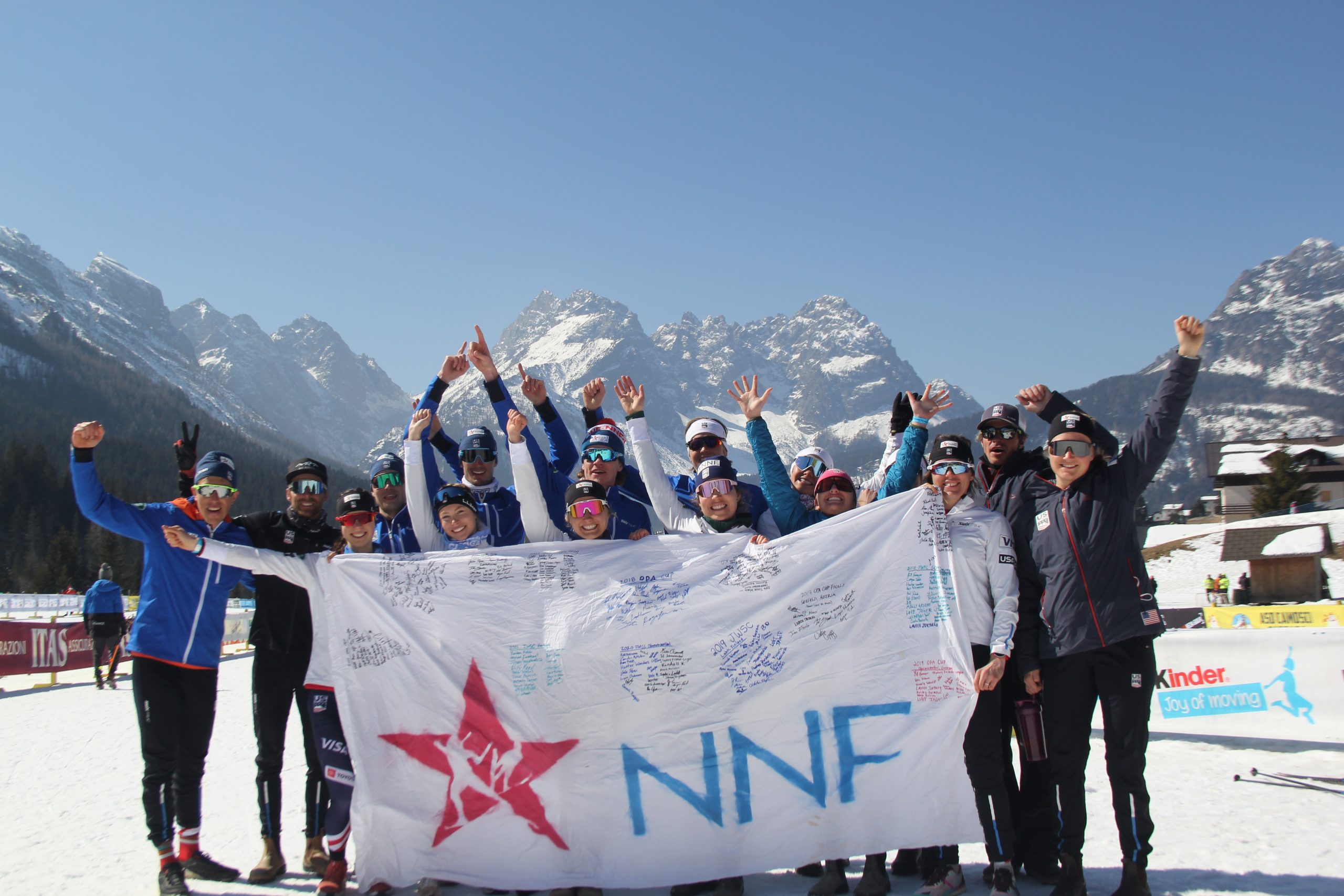
The American OPA Cup Finals team celebrates fast races and bluebird days in Sappada, Italy. (Photo: Bryan Fish/NNF)
Identifying it on its list of “Pillar Projects”, the National Nordic Foundation (NNF) helps subsidize the cost of the trip for the qualified athletes. The trip can accommodate up to 16 skiers, who are generally kept to an approximately even male to female ratio through the qualification criteria. This year, due to conflicting schedules and a number of declines, thirteen athletes attended, with nine women and four men.
In alphabetical order, the senior men included: Braden Becker (CGRP), Logan Diekmann (BSF Pro), Finn O’Connell (BSF Pro), Karl Schultz (SVSEF). Senior women included: Mariah Bredal (BSF Pro), Margie Freed (CGRP), Alex Lawson (CGRP), Hannah Rudd (BSF Pro), Becca Rorabaugh (APU), Lina Sutro (SMS T2), and Alayna Sonnesyn (SMS T2).
Finn O’Connell (2nd from L) alongside Braden Becker (L), Karl Shulz (2nd from R), and Logan Diekmann (R) at OPA Cup Finals
in March 2022. O’Connell was recently named to the US Ski Team for the 2022-23 season. (Photo: Alayna Sonnesyn)
SMS T2 teammates Alayna Sonnesyn and Lina Sutro show their love for Sappada during the Opa Cup Finals trip. (Photo courtesy of Alayna Sonnesyn)
This year, two U20 athletes headed from World Juniors in Lygna, NOR to Italy along with D-Team coaches Anderson and Bryan Fish: Kate Oldham (Aspen Valley Ski Club) and Annie McColgan (UVM).
“It’s pretty cool that we have more racers that are racing professionally or post collegiately than, I think, ever in the US, and they have more clubs and places to choose from,” said Anderson. “There were several athletes that, especially because racing was shut down on the East Coast last year and I happened to be in Alaska and wasn’t wasn’t traveling very much before I took this job, it was kind of the first time I’ve gotten to work with them, or the first time I’ve gotten to work with them in three or four years. So it was really cool to get to know Alayna Sonnesyn a little better and Lina Sutro a little better, and Margie Freed and Alex Lawson, who I’ve seen race many times, but it was the first time I’ve gotten to really work with them and get to know them. The same with Braden Becker and Karl Schultz… So it was a pleasure on the trip to get to work with some new athletes that have come through different development systems and are excited about and ready to make that next step. And this racing circuit is a really good opportunity for that.”
Anderson took the lead with organizing the trip and supporting athletes, working alongside US Ski & Snowboard Cross Country Sport Development Manager and long-time OPA Finals trip lead coach Bryan Fish. The wax support staff included BSF Pro Team head coach Andy Newell, former APU athlete and current staff member Peter Kling, and Jackson Hole comp team coach Jon Filardo.
US Ski & Snowboard Cross Country D-Team head coach Greta Anderson supports athletes during the Sun Valley SuperTour races in January. (Photo: Tobias Albrigtsen / @untraceableg)
Anderson identified the OPA Finals trip as a key development opportunity for a number of reasons: though perhaps lower pressure than World Cup, it’s a professional race circuit with small but competitively dense fields, athletes race aggressively and tactically in a style younger athletes who have not yet raced at this level may not have experienced, and it offers the opportunity for an athlete to dial in some of the small but significant factors details that support success adapting to a new and different environment following long international travel.
“Bryan’s been doing [the OPA Cup Finals] trip for a long time,” Anderson said. “So Peter Kling, who was on a coaching staff, and Becca Rorabaugh, they were like, ‘I’m pretty sure that we were on Bryan’s first ever OPA Cup trip.’ And it used to be that we started at the bottom of the results sheet and started looking upward for names. And right now we’re starting at the top and we don’t have to look very far down.”
In two days of racing, the US had seven top-10 finishes, with another set of athletes finishing well-within the top-20. Highlighting the US team was SMS T2’s Sonnesyn, who took third in the 10 k classic on Saturday the 12th, and won the 10 k skate the following day.
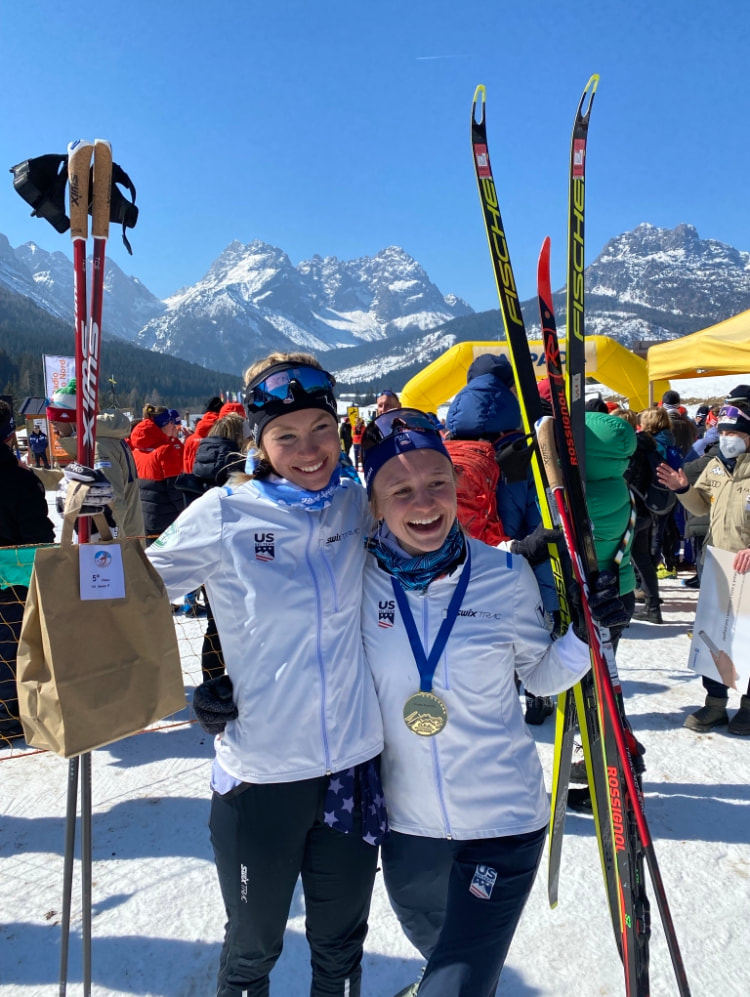
Alayna Sonnesyn (SMS T2) takes the win in the 10 k skate at Opa Cup Finals in Sappada, ITA, with Mariah Bredal (BSF Pro) finishing just behind in fifth. (Photo courtesy of Alayna Sonnesyn)
“It’s pretty special,” Anderson said of the performances in Sappada. “It’s awesome to get to see that. For Alayna to start a race and say like, ‘What’s my plan to try to win this?’ It’s not just, ‘Hey, we’re here to participate and learn,’ but ‘Hey, we’re here to participate and learn but also we’re going to try to win.’ And I think, with that comes — not only from staff but from racers — this level of professionalism. Okay, we’re going to select skis. We’re going to make sure we’re organized and in a good place. Where can we be? Where can we do feeds? How can we set you up to have the success you need to have?
“It just feels like a really good time to be an American ski racer.”
After winning two of the first five SuperTour races this season, and finishing on the podium in each of the others, Sonnesyn was offered starts at the Tour de Ski, where she hoped she could achieve strong enough international results to qualify for the Olympic Team. But these goals did not come to fruition; Sonnesyn struggled to find the same race sensations while on the World Cup and tap into the fitness she knew was still there, which was reflected in results below her expectations. She shared her disappointment openly on her blog and social media, providing a relatable and important example to her followers that the pro-skier journey is not immune to bumps in the road.
“My experience on the World Cup this year – it was quite demoralizing, to be honest,” said Sonnesyn in a call from the airport as she was on her way to SuperTour Finals in Whistler. “And then, after the Tour de Ski, I got COVID. And it just really put a damper on the whole winter for me. And I started questioning like, ‘Okay, am I fit? And I like, can I race? Well, like, what have I been training for? This is really bad timing with COVID, too.’ So I was just pretty down. But then I was able to have really great SuperTour races, back in January and February, and then to be able to race internationally again in Italy. It wasn’t a World Cup, but it was still very high level of racing. So to have it go so well kind of reaffirmed to me that I belong on the international stage. And I definitely needed that, a little bit, just to give myself more confidence moving forward and motivation as well. So I’m really excited about the races and how they went and what I did to prepare for them and kind of my mental attitude around them, too.”
A selfie in Sappada: the American team prepares for race day at Opa Cup Finals. (Photo: Alayna Sonnesyn)
As she reflected on the trip and her experiences racing internationally over the last few seasons, Sonnesyn echoed Anderson’s sentiments about the progression of the American team at the event.
“Compared to my first OPA Cup trip, which was in 2018, I think there were maybe two or three top 10 performances. And they were exciting, but for the most part, it was kind of like, ‘We’re just here to get the experience. We’re not really sure what we’re doing.’ And I think that the way the US is developing right now, the way that new courses are being built in Cable or Duluth, or wherever it is – they are preparing us better for racing internationally. And I think that was shown in the results that we had in Sappada. And it was just so exciting during that 10 k skate on Sunday to cross the finish line in first, and then turn around and see a ton of my other US teammates come in right behind me. That’s not something that was happening four years ago. So I think we are really developing and that is a huge thanks to so many different people and so many reasons, but it’s exciting to see.”
Sonnesyn also spoke to the importance these international opportunities have provided her specifically, speaking from the perspective of what she dubbed a “bubble athlete” who has oscillated between World Cup and domestic racing over the last four seasons. She got her first World Cup starts in Quebec in March, 2019, and has been offered starts beginning in Period 2 each season since. Though this is a key stepping stone in the process toward consistent World Cup racing, she expressed that bubble athletes can have a challenging time planning seasons in advance and need to be prepared to adapt quickly to more frequent overseas travel.
“I think that every single experience that an athlete has going and racing internationally, and traveling, and competing at that higher level, it all adds up to be super beneficial and a great learning experience. For example, I have gotten really great at overcoming jet lag, which the first couple of international trips I went on, I had no idea how to handle. I tried my best to do what I could, but it’s hard. And also to know what little things you want from home, like after being in Europe for four or five weeks, what do you really want from the US?
“And then also, how do you work in a new environment? A lot of times, if you’re going over to the World Cup, sometimes you’re provided a wax tech or sometimes not, or you have to bring your own, but you have to be willing to work with whoever you get.”
Sonnesyn explained that on the Sappada trip, she had worked with each of the techs before, but on her first trip in 2018, it was her first experience working with those wax staff members. Given the importance of ski choice and wax, working together effectively is imperative to an athlete’s success, but it requires dialogue and practice.
“Being ready to communicate effectively with the staff, what do you need? How do you want your skis prepared? What do you need from a hotel? All those things seem like such small little details, but they really add up with the more experiences you have.”
Alayna Sonnesyn races in Oberstdorf, Germany during the 2021/22 Tour de Ski. (Photo: NordicFocus)
She also spoke to the differences in the style of racing between the US and her international experiences, and how a trip like Sappada better athletes for what they might encounter should they be offered a World Cup start down the line.
“When it comes to racing: the courses in Europe are very challenging and very technical. Downhills, uphills, flats – whatever it is, there’s a lot of it, and you have to be ready to go for it. And then the competitors are fierce. They know how to be aggressive in a race, and you have to know how to hold your own. So it just helps to have that experience to understand how you approach the race. How aggressive are you going to be? How are you going to pace the race? How are you going to handle others around you?”
With the highest levels of competition for our sport happening across the pond, it is easy to understand why opportunities like the OPA Cup trip provide an essential bridge for developing athletes. But it is not simply the facilitation of this trip that has led to marked improvement for the American team.
“I think we’re open to change right now,” Anderson said as she reflected on her key takeaways from the experience in Italy and her first season coaching the D-Team. “I think the US, in a year with COVID, and lots of challenges logistically and politically in the world, we handle those changes better than almost any other country does. And I think that’s really shown here.”
Alex Lawson skates to 7th in the 10 k skate during OPA Cup Finals in Sappada, ITA. (Photo: Bryan Fish / NNF)
While the OPA Cup crew was putting together a very solid day in the 10/15 k skate, the team of Rosie Brennan, Zak Ketterson, Scott Patterson, and Jessie Diggins had taken the win in the thrilling 4 x 5 k mixed relay in Falun. As the team in Sappada mingled near the finish to support the final racers as they skied through, Anderson said that a Swiss national team coach walked over and showed them the World Cup result on the phone.
Layered on top of the broader success at the OPA Cup Finals, Anderson expressed that this opened her athletes’ eyes to what might be possible for them in the years to come also. In particular, the Falun results of Zak Ketterson, a newcomer to the World Cup who ended his debut season with a 15th place finish in the 15 k skate and a mixed relay win.
“[The guys racing at OPA Cup] are like, ‘Oh, man, I beat Zak sometimes’, or ‘I’m right with him’, ‘I trained with him in college.’ The level of confidence that brings… ‘Maybe maybe I can do that too.’”
Moreover, Anderson expressed that this relay gold medal speaks to the equity of skiing in the US. “That we have good female athletes, and we have good male athletes, and we have a good balance of the two, and teams that are mutually supportive of each other,” she said. “Not every country has that.”
Boiling down the experience and her feelings as the season wraps up, Anderson concluded, “I have nothing but good things to say about our athletes right now. I’m really impressed with them. They handle the change better than anyone, and I think as a staff and from an organizational perspective, we’re trying to keep up, remove barriers, make sure they’re supported. And we’re open to trying new things, and it seems that we’re excelling in places where we’re willing to experiment and get our feet wet.”
Kate Oldham (AVSC) races the 10k classic during Opa Cup Finals in Sappada, ITA. (Photo: Bryan Fish / NNF)
Providing additional insights from the perspective of an OPA Cup Finals first-timer, FasterSkier also heard from U20 athlete Kate Oldham, who trains with the Aspen Valley Ski & Snowboard Club (AVSC) and competes for Middlebury College. Oldham took 11th place in both the 10 k classic and skate in the junior women’s category.
“Sappada was incredible,” Oldham wrote. “In congruence with the pre-camp in Toblach, the OPA Cup trip was unforgettable… My favorite ski to-date was on a long ski over the pass from Cortina to Toblach, stopping midway for trail side pastries and cappuccinos! Being with a group of older athletes was a valuable change from the World Junior trip because each team member brought new energy and experience to the group. Between that and the gelato shop next door to our hotel, the trip couldn’t have gotten much better!
Enjoying a cappuchino and pastry fueling stop while skiing from Cortina to Toblach. (Photo: Kate Oldham)
BSF Pro Teammates Hannah Rudd (left) and Mariah Bredal (right) sip cappuchinos while skiing from Cortina to Toblach during the Opa Finals pre-camp. (Photo: Kate Oldham)
“One of the things I think are most valuable about training and racing camps is the exposure to coaches and athletes outside one’s home team. For years I have been seeking out opportunities to attend regional and national camps that would bring new perspectives, training groups, and social dynamics to push me and help me adapt my own training method while making friends from schools and clubs all over the country. This winter I was lucky enough to have both my club coach and a group of skilled and passionate wax technicians/trip leaders selected from all around the US to lead the trips to Junior World Championships and OPA Cup finals. I know that over the six years I’ve been skiing competitively I have developed the competence to independently navigate high-level skiing events, but having techs to guide me through the process at the international level was extremely helpful, particularly when one of them I had worked closely with for those six years of training and racing.
“With new coaches come new perspectives. Another set of eyes, a different experience, or a new phrase can be all it takes for the pieces of new advice to click into place. Or maybe a coach has a different perspective on the bigger picture of skiing that resonates with you unlike the philosophy you previously knew… which of the infinitely wide range of mindsets in ski racing works best for you? Which one reminds you why you love ski racing? Which one helps you stay motivated through the hardest parts of the season when the last thing you want to do is get out the door for training? Which one eases the heartbreak of coming so close to a goal but falling short despite your hardest effort? Without a doubt, cross country skiing is a delicate balance of internal and external factors, but having great teammates and coaches like the ones I got to know and work with in Europe this winter is certainly a key ingredient to the recipe for success in the lifelong pursuit of excellence on the race course and off.”
Coaches, support staff, and athletes celebrate a bronze medal in the men’s 4 x 5 k relay. Staff, left to right: Greta Anderson (front left), Bryan Fish (back left), Dr. Katie Eichten (partially obscured), Olof Hedberg, Pat O’Brien, Julia Hayes (middle row, blue NNF hat), Paul Smith, Anson Moxness, Lizzie Larkins, August Teague, Jack Novak. (Photo: flyingpointroad.com)
The 2022 FIS Junior/U23 World Ski Championships trip has been made possible through support from the National Nordic Foundation (NNF), which has identified this invaluable opportunity for developing athletes as one of its “Pillar Projects”. You can support the NNF and the next generations of America’s top skiers by making a donation here.
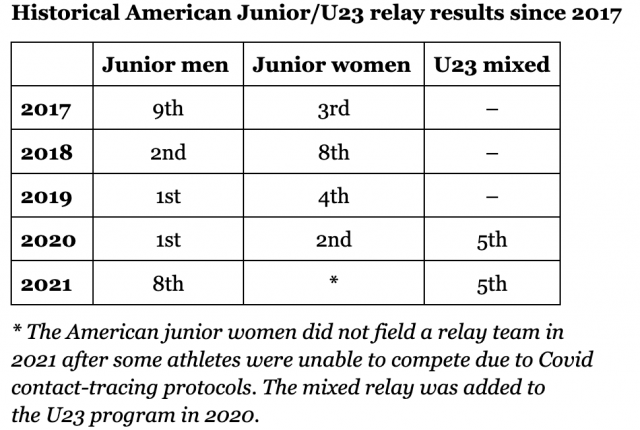
LYGNA, NOR — The second event of the week for 2022 FIS Junior World Ski Championships, and perhaps the most highly anticipated, was the men’s and women’s relays. It was in the relay in 2017 when the US women broke onto the podium on home turf at Soldier Hollow, Utah, starting a cascade of strong American performances in the World Juniors relay. The next year, in Goms, Switzerland, it was the men who landed on the podium with an historic second-place finish, which they then one-upped the next two years to bring home gold from Lahti in 2019 and Oberwiesenthal in 2020. The US women also finished on the podium in 2020, in second place.
After a little lapse in 2021, when the US junior women were not even able to field a team due to Covid contact-tracing protocols, both the men’s and women’s teams were ready to fight today.
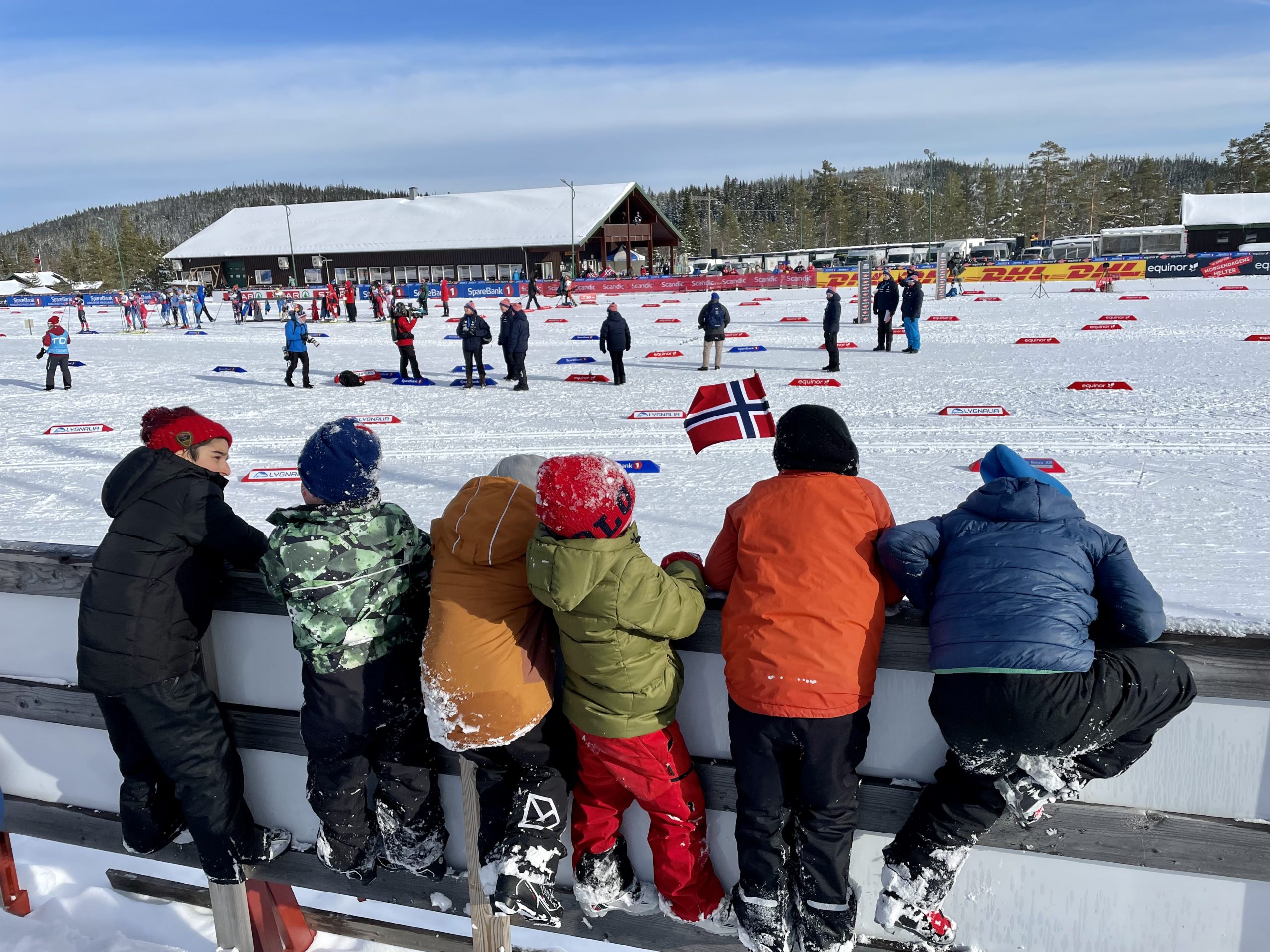
First up was the women’s 4 x 3.3 k, which featured separate courses for the classic and skate legs. As the women warmed up and made final preparations, the stadium filled with eager spectators in the form of young schoolchildren. As the announcer explained, one of the event sponsors had paid for the transportation of hundreds of local school kids to the venue each day. Thus as the start gun went off, it was to the chorus of many small voices shouting “heia, heia!” and many waving Norwegian flags.
Enthusiastic young fans prepare for the start of the women’s 4 x 3.3 k relay (photo: Ella Hall)
Skiing the scramble leg for the US team was Kate Oldham (Aspen Valley Ski Club/Carbondale, Colorado). “It was really fast,” she shared afterwards, “everyone went out really hot, it was fun just trying to ski with the best.” Oldham finished her 3.3 k in a time of 10:03.5 and tagged off to her teammate, Samatha Smith in eighth position.
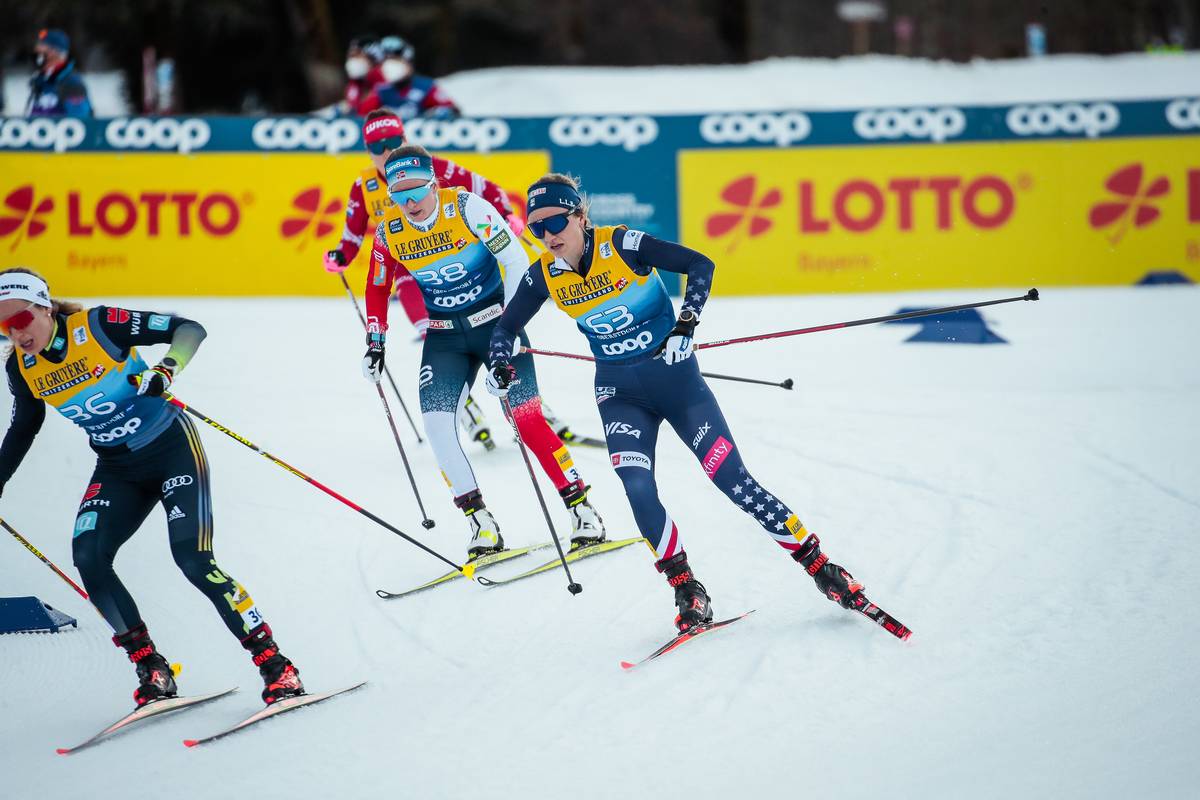
Kate Oldham skis the first leg of the women’s 4 x 3.3 k relay in Lygna, NOR. (Photo: flyingpointroad.com)
As Russia started to pull away at the front, Smith (Sun Valley Ski Education Foundation/Sun Valley, Idaho) worked to gain ground on the others, moving the team up to fifth place at the completion of her leg. From there, Nina Schamberger (Summit Nordic Ski Club/Leadville, Colorado) took over as the technique switched to skate. Schamberger closed on the Swiss team, who was sitting in fourth, just ahead.
As the skiers entered the final climb, dubbed “waffle hill,” a pack had formed with Russia still out front. “I definitely tried to pace it like a sprint and just really push myself and try to use the downhills to recover as best I could,” explained Schamberger, “but it was definitely very painful but short enough because you were able to push as hard as you could the whole time.”
Kate Oldham tags Samatha Smith during the junior women’s 4 x 3.3 k relay. (Photo: flyingpointroad.com)
For the final leg, Schamberger tagged Sydney Palmer-Leger (University of Utah/Park City, Utah), handing off in seventh place. Up front, Norwegian anchor Anna Heggen was closing the gap to the Russian, Elizaveta Bekisheva and the two entered the stadium together, leading to a sprint finish and lunge which ultimately went in favor of the host nation. The Germans were next in third, +35.4 behind. Palmer-Leger picked off two places on her leg to land the US women in fifth, +1:14.7.
“It was really windy out there and you just try to push every little part because there’s no rest until the end,” said Palmer-Leger.
For three of the four athletes on the US team, this was their first time competing in a relay. When asked if they practiced exchanges at all they said, “it was pretty much just winging it.” Palmer-Leger elaborated saying, “It was pretty smooth, it’s a really short course and just taking a few seconds in the tagging is not going to do much. You don’t want to crash or mess up the hand-off because then that’s 30 seconds so, yeah you kinda just look back and double-pole and then wait for them to tag you.”
The junior women’s 3 x 3 k relay team: Sydney Palmer-Nina Schamberger, Samantha Smith, and Kate Oldham (l – r). (Photo: flyingpointroad.com)
With the women’s race complete, it was time for the men to line up, the race for them a 4 x 5 k with each leg skiing two 2.5 k loops. For the US, Michael Earnhart (APU Nordic Ski Center/Eagle River, Alaska) took the scramble leg. After the first 2.5 k it seemed that Swedish skier Måns Skoglund had broken away but the pack hunted him down as they exited the stadium for the second time, Earnhart tucked in behind Team Norway. Entering the stadium for the second of their two laps, Skoglund (SWE) had again gained a slight lead, with teams Russia and Japan in second and third. Behind them, Earnhart was leading the chase to close them down.
Into the first exchange, the gaps had closed and Brian Bushey (University of Utah/Waitsfield, Vermont) took over for Team USA.
Brian Bushey skis the second leg of the junior men’s 4 x 5 k relay in Lygna, NOR. (Photo: flyingpointroad.com)
Heading out into a ripping headwind, it was Sweden, Japan, Russia, and the US, being chased by Norway. As they descended into the stadium for the first time, there were still four teams up front, though Japan had dropped and Norway had joined. This time with the wind blowing in their favor, the skiers all chose to stay outside the tracks. “The first lap, coming through, I saw everyone hop out of the tracks so that’s when I decided to,” explained Bushey. “It was definitely faster.”
As Russia started to pull away slightly, Norway and the US were slightly detached at the start of the second lap of leg two. Canada was closing in on them and by the time they entered the exchange zone, they were a group of four, behind Russia, the US tagging in second position with Team Canada on their tails.
Switching to skate, Walker Hall (University of Utah/Winthrop, Wash.) took over for the US and over the course of his first lap closed the gap to Russia, bringing the lead pack up to five nations. Letting the Russian break the wind, the others slotted in behind as Sweden began to fade.
Nikita Denisov (RUS), Elde Holmbœ (NOR), Walker Hall (USA) and Sasha Masson (CAN) head out for the final lap of leg three as Sweden starts to fade. (Photo: Ella Hall)
Canada too dropped off the pace, leaving Hall and Nikolai Elde Holmbœ of Norway skiing together. Up the steep “waffle hill,” Hall pulled away from the Norwegian, leaving the front three teams all separated by some seconds as they executed the final exchange.
Will Koch (University of Colorado/Peru, Vermont) took the anchor leg for the US. He was soon caught by Aleksander Elde Holmbœ of Norway, the two of them skiing together with Russia off the front. In a scene that brought to mind Rosie Brennan’s efforts in the Olympic 30 k, though admittedly lasting a much shorter duration, Koch tried to get the Norwegian to take on some of the lead work as they headed straight into a bracing wind.
“As soon as that Norwegian caught me, I almost tried to stop and let him by,” said Koch, “but he didn’t want to lead either so he kinda stopped with me, but we luckily didn’t get caught by anyone.”
At this point, they were well clear of Team Canada, who was in fourth position.
Will Koch races Norway’s Aleksander Elde Holmbœ during the anchor leg of the men’s 4 x 5 k relay. (Photo: flyingpointroad.com)
Passing through the stadium, with only the “waffle hill” remaining, Koch had the lead, though he was overtaken by Holmbœ (NOR). The Norwegian seemed to have pulled away, but Koch put in a surge. This move was answered by Norway, and when they came into view on the descent, Norway had maintained its lead. “It came down to just a final sprint over the last hill!” said Koch afterwards.
Team Russia took gold in a time of 49:16.4, followed +21.8 seconds later by Norway. The US was close behind in bronze-medal position, +22.4 back.
“I think we definitely wanted to get on the podium, that was a huge [goal], it would have been fun to win but we’re really stoked with bronze,” concluded Koch. Adding to that Hall said, “Yeah, I think just going out, and skiing the best we could.” Bushey echoed that sentiment saying, “Yeah, we all just had to ski our best.”
The bronze medal winning junior men’s relay team: Walker Hall, Brian Bushey, Will Koch and Michael Earnhart. (l-r) (Photo: flyingpointroad.com)
To the fans following along at home, the boys said “We love you guys, it would not be possible without all of you! Thanks for the support, thank you NNF, go USA!”
The program now switches to U23 competition for a day with a 10/15 k classic race on Thursday. The juniors will resume racing on Friday.
The 2022 FIS Junior/U23 World Ski Championships trip has been made possible through support from the National Nordic Foundation (NNF), which has identified this invaluable opportunity for developing athletes as one of its “Pillar Projects”. You can support the NNF and the next generations of America’s top skiers by making a donation here.
LYGNA, NOR — Originally scheduled to take place in Zakopane, Poland but moved to Lygna, Norway, the 2022 FIS Junior World Ski Championships kicked off a week of competition on Tuesday. Situated roughly an hour north of Oslo at around 2,000 ft, the Lygna stadium could be described crudely as the middle-of-nowhere. But that would be vastly underselling the venue that hosted the Norwegian National Championships in 2019, which features a stout race course and offers classic Norwegian countryside charm.
The first event on the schedule was the 15 k skate mass start for the women and a 30 k skate mass start for the men. The women went first, completing three laps of a 5 k loop. Toeing the line for the US were Sydney Palmer-Leger (University of Utah/Park City, Utah), Samantha Smith (Sun Valley Ski Education Foundation/Sun Valley, Idaho), Nina Schamberger (Summit Nordic Ski Club/Leadville, Colorado), and Kate Oldham (Aspen Valley Ski Club/Carbondale, Colorado).
“This is my third World Juniors,” said Palmer-Leger, “I was in Lahti, my first one. [It’s] definitely the best World Juniors I’ve been to right now, it’s kinda chill, the last couple years are intense. You know, the first World Juniors you don’t know what to expect and now I’m the one with the most experience, being over in Europe so it’s kind of fun to know what I’m doing a little bit.”
Sydney Palmer-Leger leads the women’s 15 k mass start skate during the 2022 Junior World Ski Championships in Lygna, NOR. (Photo: flyingpointroad.com)
Palmer-Leger spent the first part of the season racing Period I of the World Cup with the US Ski Team, including skiing the scramble leg for the second US relay team in Lillehammer. Speaking to the course here in Lygna, Palmer-Leger said, “It’s a pretty hard course, there’s not a whole lot of rest in the first part but, it’s fun, there’s a lot of V1 the first part.” Last year at World Juniors in Vuokatti, Finland, several of the junior US women were not able to compete due to Covid-contact tracing protocols. Palmer-Leger was one of those unlucky few and she explained, “This is my second mass start at World Juniors because last year Novie [McCabe] and I were quarantined. This is my last year as a junior, so that’s really fun.”
15 k later, Palmer-Leger was the first finisher for the US in sixth position, with Helen Hoffman of Germany, Lisa Eriksson of Sweden, and Tuva Brusveen-Jensen of Norway finishing first through third respectively. “It’s sort of difficult doing these races because girls are not very relaxed,” Palmer-Leger explained, “and you’re stepping on each others poles and skis, and [the course] is really tight [in some places], and it goes from a a gradual downhill into a pretty steep uphill and girls sometimes will just stop and it’s like the accordion effect and I got stuck in the middle a bunch of times and luckily I didn’t break any poles. A bunch of Russians broke poles and some of our girls broke poles. I went down once but didn’t break anything.”
After this strong start to the week, she concluded “I’m really excited. Being in Norway is amazing.”
The next US finisher was youngster Samantha Smith. Smith is just 16 years old and the 15 k was her first-ever World Juniors race. She finished in 11th (+1:11.3) behind race winner Hoffmann (GER). Kate Oldham was also competing for the first time at World Juniors and posted a top-thirty finish in 27th place (+3:09.5). Nina Schamberger is also 16 years old and the 15 k was her first World Juniors race. She finished in 41st, +4:04.1 back.
Michael Earnhart (left) and Walker Hall (right) race the 30 k skate during the 2022 Junior World Ski Championships in Lygna, NOR. (Photo: flyingpointroad.com)
Moving right along, the men were soon on the start-line, ready for their six laps. Starting at 3pm local time, the temperature was dropping as a slight wind picked up. Competing for the US was Michael Earnhart(APU Nordic Ski Center/Eagle River, Alaska), Walker Hall (University of Utah/Winthrop, Wash.), Brian Bushey (University of Utah/Waitsfield, Vermont), and Alexander Maurer (University of Colorado/Anchorage, Alaska).
“Last year was my first [World Juniors] but this year is the first year I felt like I had a chance to get top 10 and everything, last year I was like ‘well I’ll be happy if I get top 30’” said Earnhart, after the race. In a competition where Russians took the top four finish positions, Earnhart managed to achieve that goal in the first race of the week, finishing in 10th (+2:33.5).
Talking through his race he said, “ the first half of the race I was just trying not to break equipment, trying not to fall, kinda trying to have fun you know, it’s fun skiing in a pack so I was just trying to stay relaxed. I got pushed a little ways back, I think I was back to 20th or 30th at some points but I just stayed relaxed. Then, on the fourth lap it started to string out and I was like, ‘Ok, I’ve got to get in a better position, get up there.’ Going into the last lap, I think I was in 12th and I knew that top ten gets you on the US ski team and I really wanted that, so I was just looking at 10th. I was like, ‘He’s right there. I gotta keep going.’ He got a little tired and I was hungry so…”
Michael Earnhart leads the American junior men in the 30 k mass start skate during the 2022 Junior World Ski Championships in Lygna, NOR. (Photo: flyingpointroad.com)
Also pre-qualifying for World Juniors in the same event, Brian Bushey finished his day in 16th position, +3:46.5 behind the top Russian, Alexander Ivshin. This in spite of the fact that as Earnhart put it, “Bushey took a big tumble, it’s a learning experience for sure.”
Speaking of learning experiences, Walker Hall was having one out on the course as he made his first World Juniors appearance, racing his first-ever 30 k. “My legs were so tired after like 10 k,” he said at the finish. He landed just outside the top-thirty, coming 31st, +6:01.7 back. Rounding out the U.S. finishers, Alexander Maurer finished 36th, +6:48.9 out, also making his first World Juniors appearance.
Racing continued Wednesday with the women’s and men’s relay events. Coverage of that event to follow.
By Gavin Kentch, Ella Hall, and Rachel Bachman Perkins
Tuesday brought distance races to Soldier Hollow, in the second full day of racing at 2022 U.S. Cross Country Championships. The story at the front of the field was strong performances by athletes who had begun the year racing on the World Cup, as Rosie Brennan dominated the women’s field to win by over a minute, and Scott Patterson took the men’s race by roughly twelve seconds.
U.S. Ski & Snowboard Development Team Coach Greta Anderson encourages athletes during the men’s 30k distance race in Soldier Hollow. (Photo: Tobias Albrigtsen / @untraceableg)
Brennan was followed by Rosie Frankowski and Caitlin Patterson. Scott Patterson was followed by David Norris and Hunter Wonders, giving APU five out of six podium spots on the day. Craftsbury athletes went 3-4-5 in the women’s race. Notably, four out of six podium finishers were on the north side of 30, with a fifth gaining Master status later this month, underscoring the lengthy developmental curve often required to achieve success in distance racing.
Women’s Race: Rosie Brennan Solos to Victory
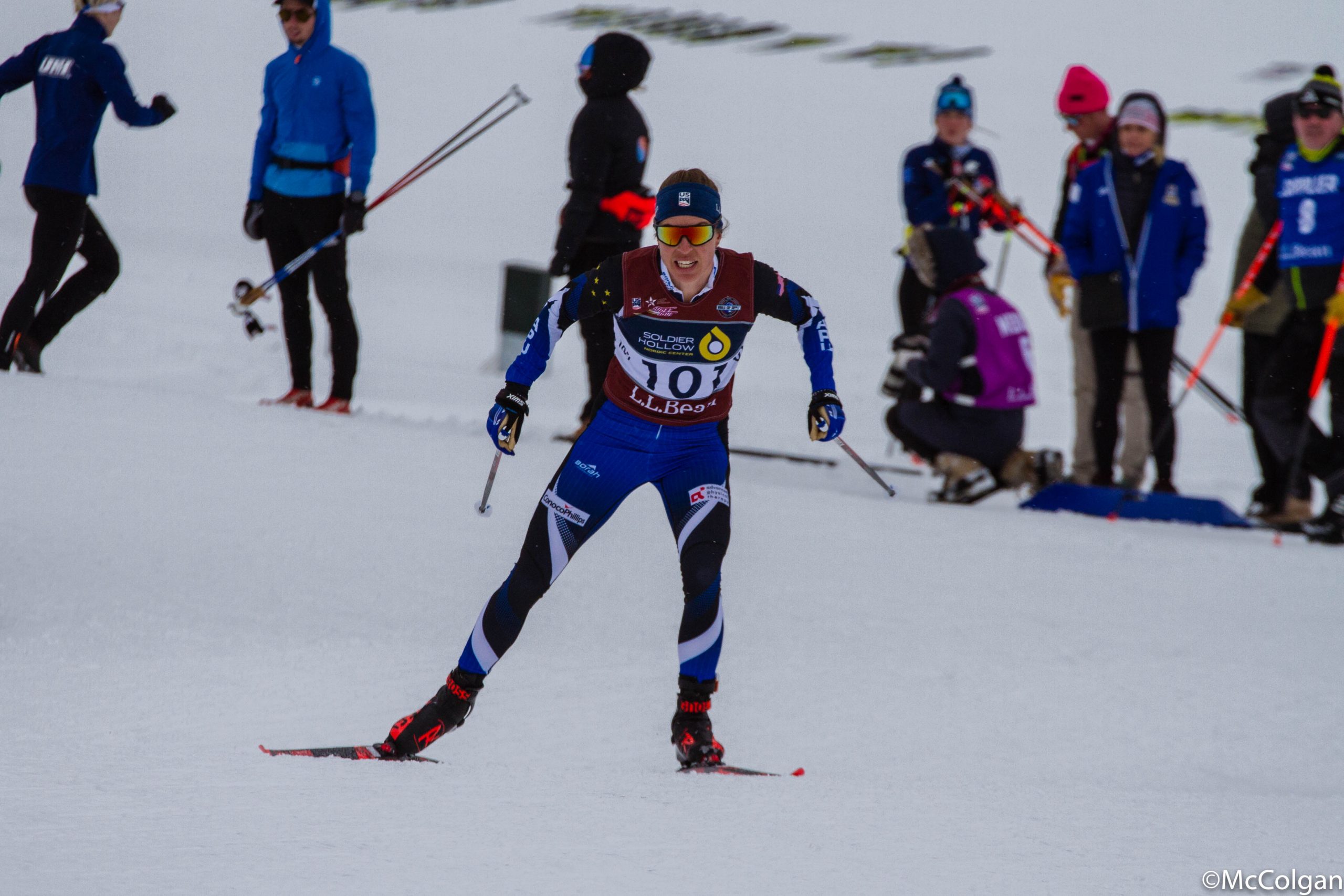
Tuesday’s race, the women’s 20-kilometer freestyle race at 2022 U.S. Cross Country Championships, was, technically speaking, a mass start – but for Rosie Brennan, it skied more like an interval-start race. Brennan wore bib 101, at the sharp end of the chevron start in a field of 55 athletes, and led every one of 20,000 meters of the 20 k, pushing the pace right from the start and never looking back all the way through the finish line. She covered the challenging course in a speedy 53:16.9 to take her seventh national title, and first since 2015, in a dominating performance.
The race began under overcast skies and moderate temperatures. By one second into the race, Brennan (USST/APU) was in the lead. By one minute into the race, she was notably off the front, with only three athletes, Rosie Frankowski (APU), Caitlin Patterson (CGRP), and Sydney Palmer-Leger (USST/Utah) even contemplating whether to follow.
By two minutes into the race, Brennan had a sizable gap, as athletes in the Frankowski-led chase pack had decided that discretion was the better part of valor, and opted to ski their own race and focus on chasing the remaining two spots on the podium. No athletes other than Brennan would appear on screen again in the free livestream until the six-minute mark, in a wide-angle shot of the main climb up the Cabin Loop most of the way through the first lap. This is nothing against the production values of the online broadcast, which were once again superb, just a statement about how quickly Brennan distanced herself from the rest of the field.
Rosie Brennan (USST/APU) skis away with the women’s 30k mass start freestyle national title. (Photo: John McColgan)
After the first of six 3.33-kilometer laps, Brennan’s lead over the chase pack was roughly 26 seconds. After two laps, this gap had nearly doubled, to 49 seconds. The chase pack was now led by Patterson, who collected her tenth national championship earlier this week, and Frankowski, who has a 21st at the Olympics and World Cup top-30s to her name. These were not bad skiers; Brennan was simply unmatched on the day.
Over the next four laps, as the wind increased and a light snow began to fall, Brennan put on a clinic. She V2ed where others V1ed, and added a slight hop at the end of V1 strokes where others adopted a more labored V1 reflecting the tough terrain and elevation. She slowed down through the coaching zone long enough to get a full drink from her feed. She skied the downhills aggressively and took the best lines throughout. It was a 53-minute demonstration of the form and fitness that have already brought her a World Cup podium this season behind Frida Karlsson and Therese Johaug, and an additional five top-six finishes.
Brennan lapped her first skier midway through lap 4. She would ultimately lap 26 athletes in a field of 52 finishers before the end of the race, precisely half the field. In a national championship.
Brennan actually slowed slightly, or the chase pack may have sped up, as the race went on. Her gap over the Frankowski/Patterson duo was “only” 1:02 at lap 3, 1:17 at lap 4, and 1:21 at lap 5. It may have even shrunk by a fraction of a second over the final lap, as Frankowski and Patterson raced for second behind her. But the outcome was never in doubt – and barring multiple broken skis, a devastating earthquake or meteor strike, or some other truly unforeseen occurrence, the outcome was never really in doubt after the first minute of the race.
A young Rosie Brennan prepares to race at Soldier Hollow in a vintage Team Utah Nordic Alliance suit. (photo: @rosiewbrennan Instagram screenshot)
Brennan grew up skiing in Park City, starting in eighth grade, first with Team Utah Nordic Alliance, then with coach Gordon Lange at Park City Nordic. She won her first ever ski race, a Wasatch Citizens race, albeit aided by the fact that “there was only one other girl in my age group,” she told the Park City Park Record for a 2017 profile. She’s come a long way since then.
“It was so great to race at home and have my family and friends cheering me on the whole way!” Brennan wrote in a post-race email. “With COVID, even my Mom has been unable to watch me race for years so it felt really special to be able to race with a hometown crowd before heading to Beijing.”
On her approach to the race, Brennan explained the role that she hoped her effort would play in her preparation for the upcoming Olympics, concluding with her feelings about sitting out the Tour to instead join her club teammates in SoHo.
“I was feeling quite inspired after watching some great performances by the APU men this morning and that gave me faith that our fitness was high and we could grind away,” Brennan wrote. “I wanted to do my best to simulate World Cup racing so I wanted to start hard and then reassess based on what others in the field did and then ultimately keep grinding to get a long hard effort in at altitude, which we haven’t had the opportunity to do on the World Cup this year. The course we raced played into my strengths with a long gradual climb right out of the start so I felt I had to use that every lap to keep building on my strengths and do my best to work on relaxed, powerful skiing the rest of the lap. I am really happy that I had the opportunity to come home and race a long race! I think I may have lost my voice screaming Frankie into the finish as well. It was really awesome to see her dig so deep today and to have APU put in such strong performances all around today.”
Caitlin Patterson (CGRP) and Rosie Frankowski (APU) race through 20k to round out the women’s podium. (Photo: John McColgan)
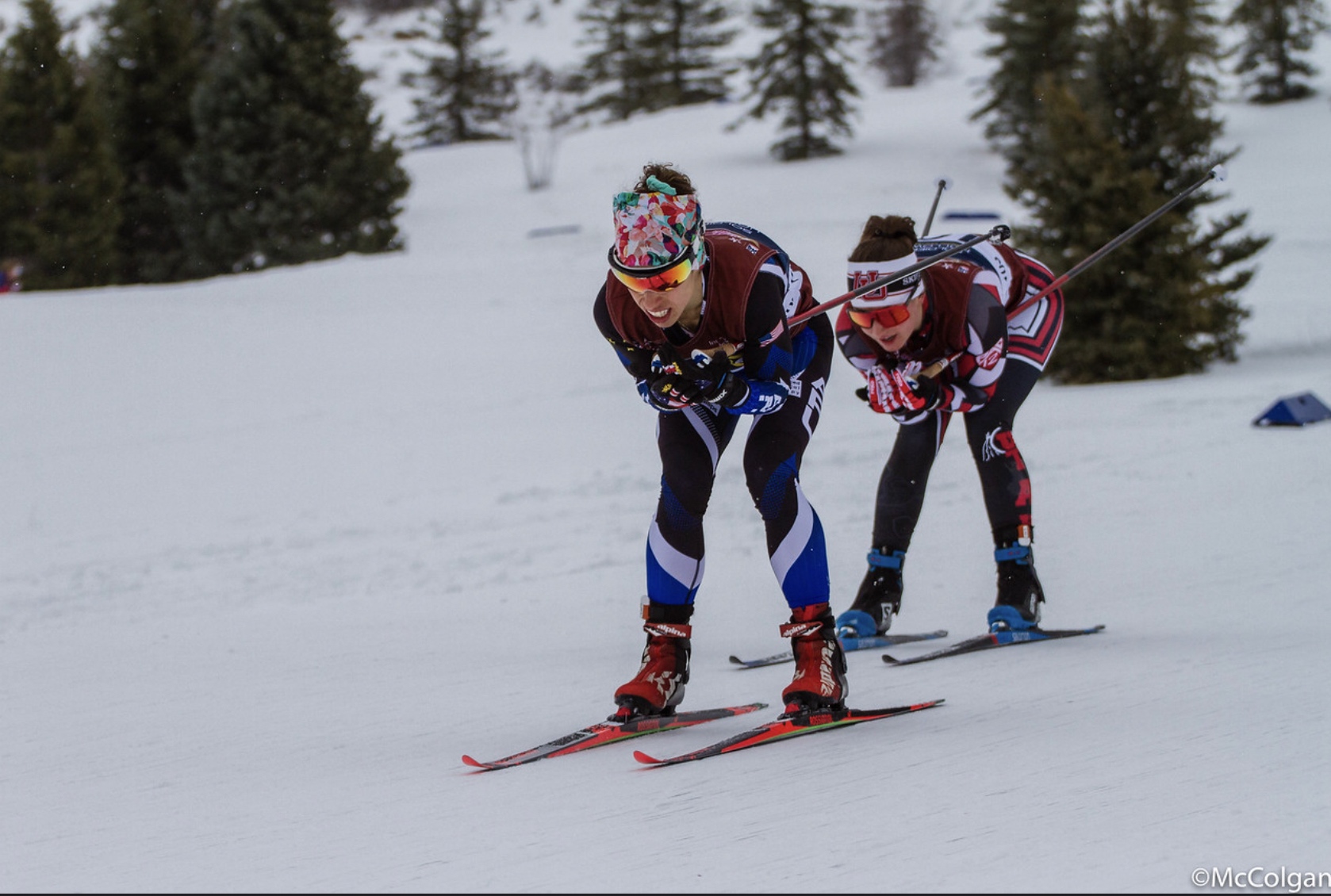
Behind Brennan, Frankowski and Patterson were locked in a dogfight for second and third. The two women, age 30 and 31, respectively, have raced head-to-head frequently over the years. They have spent much of their careers in that liminal space between being some of the fastest domestic skiers and some of the slower American World Cup skiers, competing for limited start spots on the World Cup or at global championships. In the last Olympic-year National Championships, in 2018 at Kincaid, Patterson was the first American in every race; Frankowski was the 2nd and 4th American in the two distance races; ultimately both women went to Pyeongchang.
Four years later, there the two athletes were again, holding down the chase pack with potential Olympic berths on the line. Patterson, from Anchorage but now skiing for Craftsbury, is taller, with a more upright skate stance and a tempo that looks nearly languid when skiing behind Frankowski. Frankowski, from Minneapolis but now skiing for APU, is shorter, with a somewhat more hunched-over approach to attacking an uphill, and with a higher tempo. (see photo above)
The two are a study in contrasts, but their differing approaches left them evenly matched throughout Tuesday’s race, as they literally occupied the space between the top American World Cup skiers and the top domestic skiers. At the start of lap two, they were separated from one another by 1.6 seconds, skiing in a larger pack that at the time included Alexandra Lawson, Palmer-Leger, and Lina Sutro. By the start of lap three, the chase pack was down to two, Patterson and Frankowski, 0.5 seconds apart. Start of lap four: 0.5 seconds. Start of lap five: 0.5 seconds. You may sense a theme. It was, once again, going to come down to two athletes with divergent strengths.
Writing in the FasterSkier Slack channel on Monday morning, 24 hours in advance of Tuesday’s race, this reporter foresaw Brennan skiing away with the win with relative ease, then one of two things happening behind her, as he jokingly drafted an article for a race that had not yet happened: “Behind Brennan, Rosie F. pushed the pace hard from the start, attempting to create a gap over the rest of the field. She [was ultimately able to do so, and took second slightly ahead of Caitlin Patterson et al.] [was unable to do so, and was swallowed up by Caitlin Patterson/someone else] in the final kilometers.”
This is not to claim any great powers of prognostication. This is rather to say that everyone in the venue, the two athletes on course notably included, knew what Frankowski’s strengths were, and what she would aim to do over the final three kilometers: open up enough of a gap over Patterson that it would not come down to a sprint, or bury herself in the attempt.
A few minutes later, this is precisely what occurred. The sixth and final time up the main hill on the Cabin Loop, Frankowski came into view in the distance at the bottom of the climb, V1ing with an explosiveness and tempo befitting a sprint heat more so than the final lap of a tough 20 k. Patterson was being dropped, but not definitively so, as she followed up the climb with a more human tempo, keeping Frankowski in view the whole time.
Rosie Frankowski (APU) pulls away from Caitlin Patterson (CGRP) to take second in the women’s 20k mass start freestyle in Soldier Hollow. (Photo: John McColgan)
Fast forward to the finish a few minutes later: Frankowski’s surge on the final uphill proved to be just enough. Patterson made up time on the downhill return to the stadium… closed to within a few meters… but was unable to shrink the gap any more.
Frankowski held her off with a progressively ragged V2, crossing the finish line and immediately collapsing into a heap on the snow just past the line. Brennan came over to take off her APU teammate’s skis and offer support. A few minutes later, Frankowski was upright, and giving Patterson a Covid-safe congratulatory hug.
Frankowski’s time was 54:37.5, 1:20.6 back of Brennan. She was 1.9 seconds ahead of Patterson in third.
The women’s 20k mass start freestyle podium: Rosie Brennan (USST/APU) won the national title ahead of Rosie Frankowski (APU) in second and Caitlin Patterson (CGRP) in third. (Photo: John McColgan)
“Today was something I am really proud of,” Frankowski wrote to FasterSkier after the race. “I have targeted this race for the last year and although I was excited, over the days leading up to the race, I was dreading the pain level Rosie B would inflict on the field. My initial plan was to try to stay with Rosie for any length of time, but that plan went out the window in the first kilometer when I thought I would literally pass out at 2k in if I tried her pace. I then had to recover for a lap in the chase pack, and the downhills were giving me real grief so I kept having to surge to get back on the pack or back with Caitlin P. After a few laps, Caitlin and I had a gap and we worked together using our individual strengths to make that gap larger, and that was super fun! Caitlin and I have raced together many times throughout the years so it was great to have the chance to relive some of that today. I knew I was feeling strong on the uphills, and the downhill finish was definitely on my mind, so on lap 5 I tried to push the pace on the ups a bit, and then on lap 6 going up the hollow I just went for it with total abandon. I created a gap that Caitlin narrowed over the rest of the course, but I managed to not fall on the last hermod’s downhill and take 2nd. I could see Rosie B in the finish stretch cheering me on so I was just full speed til that line.”
Frankowski also shared her thoughts on whether or not the race played out as anticipated.
“I’d say one of the surprises was how terrible the wind made the Hermod’s downhill. As someone who struggles with downhills anyways (but has made a lot of progress the last year), the wind drifts and the blowing snow were really dicey. And you couldn’t see the glazed icy spots under the snow so it was very stop-go. Otherwise, the race played out pretty much how I expected (or hoped) and one of the best parts of the day was having my APU teammates and coaches cheering out there, especially on the final lap.”
Rosie Frankowski (APU) leads Sydney Palmer-Leger (USST/Univ. of Utah) during the women’s 20k mass start freestyle. (Photo: John McColgan)
“It was quite the battle between Frankie and I,” Patterson wrote post-race. “However we also had a great time skiing and working together for the first 3/4 of the race or so. At the end certainly it was a furious battle to the finish, but earlier in the race we worked together to use each of our strengths and pull away from the chasers. Frankie and I have quite different styles, uphill vs downhill strengths, but it was really fun racing… Of course I would have been happier to be 2nd and I have slight regrets that I didn’t work my strengths a little better, but overall it was a strong race.”
Also commenting on the effect of wind, Patterson continued, “That was definitely a factor and annoyance on a few parts of the course. The Hollow had a notable head wind as we climbed up, which just added to the grinding nature of that climb. From lap 3 or 4 on, on both the back-side sprint downhill and the big downhill off of Hermod’s hill, there were small pockets of wind drifted snow forming. Especially on the Hermod’s downhill, the wind pockets were blowing across the course and making the downhill a little less predictable as the wind pockets felt much slower than the glazed path. Weather is just an aspect of racing, and while it was annoying, I think we as xc skiers have to learn to adapt to anything and everything, so it just became another variable to work around in the race.”
Patterson concluded with a nod to her brother, acknowledging the setbacks he has faced this season, which are elaborated upon in the men’s recap.
“I was quite nervous this morning watching the men’s race on the live feed, but I’m really proud of my brother Scott for skiing so smoothly and controlling the 30k. It’s awesome to see him showing a return to form and winning, after a tough start to the season attributable to his summertime broken wrist.”
Rosie Brennan (USST/APU) and Caitlin Patterson (CGRP) share congratulations at the finish of the women’s 20k mass start freestyle in Soldier Hollow. (Photo: John McColgan)
Craftsbury skier Alexandra Lawson took 4th (+2:49.2), in a brave effort after skiing solo for basically the entire race. Her teammate Margie Freed came in 18 seconds later for 5th (+3:07.2), giving the green-clad skiers from Vermont 3rd, 4th, and 5th overall on the day.
In the other close finish of the top-10, BSF skier Hannah Rudd (+4:13.5) came in a few seconds ahead of Palmer-Leger (+4:17.6) for sixth, after skiing substantially above the seeding suggested by her 125 bib number. (The start list ranked athletes according to their current USSS distance points.)
Palmer-Leger, in seventh, was notable as one of only four juniors in this senior women’s field.
Looking ahead to the rest of this week, Tuesday marked Brennan’s only planned race in this series. Her plan coming into today was to rejoin the World Cup soon, though those plans may have become somewhat more fluid with the recent cancellation of the Les Rousses World Cup stop set for mid-January. Regardless, even if Brennan were to compete in and win both distance races this week, the second-ranking domestic woman at these championships is still eligible for consideration for potential Olympic selection, due to the precise phrasing of selection criterion four of the USSS criteria document, which excepts athletes otherwise nominated to the team on other grounds. (Brennan has achieved nomination already via criterion one, multiple top-eight finishes in specified World Cup races.)
That is, that second-ranked domestic woman (Frankowski or Patterson, for example, or someone else who does well in the classic race if both these women do not perform as expected) is not guaranteed to be selected, but she certainly could be alongside Brennan.
Kate Oldham (Middlebury) leads the junior women’s 7.5k during the 2022 U.S. Cross Country Championships in Soldier Hollow. (Photo: Tobias Albrigtsen / @untraceableg)
In the junior women’s race, Middlebury’s Kate Oldham paced the 7.5k freestyle ahead of the Ninas, Nina Seeman (Dartmouth) and Nina Schamberger (Summit Nordic Ski Club). The threesome pushed the pace from the front, maintaining a small gap over the remaining women throughout the two-lap course.
In a three-way sprint to the finish, Oldham snagged the win in a time of 20:17.7, +0.7 ahead of Seeman in second place and +1.1 ahead of Schamberger in third.
The junior women’s 7.5k mass start freestyle podium: Kate Oldham (Middlebury) took the win in a tight race ahead of Nina Seeman (Dartmouth) in second and Nina Schamberger (SNSC) in third. (Photo: John McColgan)Ian Torchia (SMS T2) leads the charge at the start of the men’s 30k mass start freestyle in Soldier Hollow. (Photo: Tobias Albrigtsen / @untraceableg)
Men’s Race: Scott Patterson Leads APU Sweep
The first race of the day was the senior men’s 30 k, with 73 athletes completing eight 3.75 k loops. From the gun, the race was about bib number one, Scott Patterson representing APU. Patterson returned to the US after racing most of Period 1 of the World Cup.
Missing only the opening weekend in Ruka, Patterson competed in each of the distance stages despite having surgery on his wrist in late fall, roughly five weeks before he returned to World Cup racing, and still needing a brace to protect the healing injury. After his first race of the season in Lillehammer, Patterson explained that this made it harder for him to use his poles, shifting his energy use more to his legs and altering his technique, which likely impacted his ability to capitalize on the high level of fitness he had built through the summer.
Scott Patterson (USST/APU) leads the men’s 30k mass start freestyle in Soldier Hollow. (Photo: Tobias Albrigtsen / @untraceableg)
Through the first lap most of the field held together, though as the leaders departed for lap number two, a group of fourteen skiers at the front had separated, led by Patterson. Trading leads with Ian Torchia of SMS and Hunter Wonders of APU, the gap to the rest of the field had widened although the front group was still largely together. Among those front fourteen skiers were Johnny Hagenbuch skiing for Sun Valley Ski Education Foundation, David Norris of APU, Peter Wolter (SVSEF), Braden Becker (CGRP), Adam Martin (CGRP), Torchia (SMS T2), Zanden McMullen (APU), Wonders (APU), and the leader, Patterson (USST/APU).
Finishing the third lap in a total time of 27:01, the lead group was down to nine, having lost Hagenbuch and Wolter. Norris (APU) moved to the front for the first time, as the group headed up the Cabin Loop climb on the fourth lap, and upped the pace. This briefly created a gap with Norris, Patterson, and Wonders, though that gap was closed with the downhill draft and the group passed through the lap lane as a group of six, having lost Becker (CGRP).
The lead pack of men push through the 30k mass start freestyle at U.S Cross Country Championships. (Photo: John McColgan)
Climbing the hollow, Norris again put in an effort as he and Patterson created a small gap. Wonders worked to close it, bringing Torchia and Martin with him and once more, they closed on the front two on the sprint course downhill.
Ending lap five and departing for lap six, Patterson had gained a five-second advantage over his teammate, Norris. Through increasing lap traffic, Patterson continued to grow his lead. Despite the windy conditions, Patterson seemed to have no problem out on his own. Initially, Torchia was the sole chaser in second, with a gap to Wonders, Norris, and Martin.
Scott Patterson leads the men’s 30k mass start freestyle during the 2022 U.S. Cross Country Championships in Soldier Hollow. (Photo: Tobias Albrigtsen / @untraceableg)
Entering lap seven, Patterson was well clear of any competition, +24 seconds ahead of Torchia. Over the course of this penultimate lap, Torchia was caught by Wonders, Norris, and Martin and the chase group was once again a group of four.
Patterson held strong out front and entered the last lap after 1:03:58.2 of skiing. Norris and Wonders pulled away from Torchia and Martin, settling into second and third position respectively. Over the final 3.75 k, Norris gained steadily on Patterson, though Patterson had developed such a solid lead he was able to remain unchallenged to the line. Crossing the finish in 1:13:25.0, Patterson claimed his first national 30 k title.
“I went out today with the intention to win and establish myself as a top contender after some tough races early in the season,” Patterson wrote to FasterSkier after the race. “My intention from the start was to keep the pace fast even if I had to do most of the work. It was awesome on the early laps having APU teammates in the pack with the same intention. Although we strung things out earlier, lap 5 and 6 were really the key ones for eventually pulling away. On lap 5, David put a hard move up the cabin hill that gave the two of us a little gap. The front pack came back together in the stadium, but it was clear the next time up the hollow that many others in the pack were tiring. On lap 6 up the cabin hill, I put in a hard effort and found I had space behind me. At that point, I decided to go for it as I was still feeling strong. Climbing the hollow felt like my strength and I solidified my lead there. From that point it was a time trial to the finish while holding off David’s late charge. David and Hunter coming in to sweep the podium for APU and many of our younger skiers posting strong results were cherries on top of my personal success.”
In terms of how the races at U.S. Nationals fit into his season plan and goals, Patterson explained that his wrist injury has forced him to adjust on the fly, making it difficult to set objective goals.
“My grand plans for this season were a bit derailed from the start with my wrist injury and surgery. Mid summer, my intention was to race the full World Cup, but going into Period 1, I knew I had to take everything with a grain of salt. Every week would help my wrist, but also I was just lacking a bit of form following three months of training with one pole, a brace, or other modifications. I felt confident that my general fitness was still strong, but it was buried under a lack of race fitness early on in the season. Period 1 has always been a bit difficult for me and adding a few extra factors didn’t help. Following Davos I knew it was time to regroup a little. Nationals seemed like the best bet with a little more time. Also looking at the Tour [de Ski] races, I didn’t think they really suited my style, especially given my wrist.”
Providing additional insight into his rehabilitation, Patterson also gave an optimistic update on the status of his wrist and it’s lingering impact on his racing.
“Today marked 10 weeks post surgery for my wrist. While over on the world cup for period 1, I raced Lillehammer in a large plastic brace and Davos with it extensively taped. Neither of these were great solutions especially given where I was in the recovery process. Since then it has continued to improve and show signs of healing in all my follow up x-rays. I have also dialed in my taping since Davos. Only in the last week has my wrist really begun to feel that it’s ready for racing (with copious amounts of leukotape).”
Concluding on his plans moving forward, Patterson wrote, “At this point, I’ve got a little more confidence in racing and am looking forward to Thursday’s classic race. I’m not sure what my plans are after that, especially with the recent cancellation of the French World Cup, so I’m focusing on the remainder of races here for now.”
APU teammates Scott Patterson (left) and David Norris (right) head to the start of the men’s 30k mass start freestyle at the 2022 U.S. Cross Country Championships in Soldier Hollow, UT. (Photo: Tobias Albrigtsen / @untraceableg)
Norris, who skied the final lap 11.2 seconds faster than Patterson, finished in second place, +11.7 behind his teammate. Norris won the last 30k freestyle he contested at the 2019 National Championships, ahead of now-retired Kyle Bratrud (SMS T2) in second and Patterson in third.
“I’ve been skiing poorly this season without any explanation as to why,” Norris wrote in a post-race email. “This week I am enjoying being back with my team and seeing tons of friends on the course each day.”
In terms of his race, Norris continued, “Today I felt bad from the gun, but I tried to ignore those feelings and focus on making a race. Although I struggled quite a lot I am still proud to pull out a podium finish and to be part of a strong day for APU. Our coaches did a great job and gave me every opportunity to ski well.”
While Norris is perhaps facing an unlikely reality in terms of his selection for the currently five-man 2022 Olympic Team, his conclusion on the day was process focused.
“Every season I ski much stronger in February and March so I’m sure good form is on the horizon, but that doesn’t help me achieve my goals when I need to be skiing well right now. All I can do now is focus on the 15km classic coming up and then rest and prepare for the next races. After that – I don’t know yet what that will be.”
The men’s podium of the 2022 U.S Cross Country Championships 30k mass start freestyle: Scott Patterson took the win ahead of David Norris in second and Hunter Wonders in third. (Photo: Tobias Albrigtsen / @untraceableg )
Closing out the APU sweep was Wonders, finishing third +27.9 back. A sprint for fourth position went to Martin, while Torchia took fifth.
In the junior men’s 10k, the pace started easy as 121 racers headed out for the first of three 3.3 k loops. Initially Wally Magill (Dartmouth), Will Koch (Colo. Univ), and Walker Hall (Univ. of Utah) traded off in the lead. Up the Cabin Loop hill on the second lap Hall picked up the pace and pulled away with Magill. Koch worked hard to bridge the gap and join the leaders though the effort cost him and as the front two upped the pace once more, Koch dropped off.
The junior men’s podium of the 10k mass start freestyle: Walker Hall (Univ. of Utah) won the event ahead of Wally Magill (Dartmouth) in second and Brian Bushey (Univ. of Utah) third. (Photo: John McColgan)
Cresting the final hill in the last lap, Hall was in the lead though Magill drew even with the draft on the descent. In a sprint finish, Hall crossed the line first in a time of 24:29.4, his second junior championship title of the week. Magill finished second (+0.5), while Brian Bushey (Univ. of Utah) overtook Koch at the line for third (+18.9).
This article has been corrected to reflect the fact that Rosie Frankowski was the fourth American in the 10 k freestyle at 2018 U.S. Nationals, not the third.
Quick Recap:We’ll have a full race report up tomorrow, including athlete comments and plenty of photos, but here is a quick recap of the action in the men’s 30k and women’s 20k, which took place this morning at the 2022 U.S. Cross Country Championships in Soldier Hollow, Utah.
Perhaps becoming a theme of the 2022 U.S. Cross Country Championships, the 20/30-kilometer mass start freestyle distance races were both won by athletes who have spent the last six weeks racing in Europe on the World Cup.
In the men’s 30k, Scott Patterson (USST/APU) led the lead pack of men through an eight-lap course to take the win in 1:13.25. David Norris (APU) was next over the line for second (+11.7), with Hunter Wonders (USST/APU) rounding out the podium in third (+27.2) for an APU sweep. This is Patterson’s first national title in the 30k, though he won the 15k interval-start race in 2016 and 2018.
The men’s podium of the 2022 U.S Cross Country Championships 30k mass start freestyle: Scott Patterson took the win ahead of David Norris in second and Hunter Wonders in third. (Photo: Tobias Albrigtsen / @untraceableg)
Continuing the theme of APU dominance, Rosie Brennan (USST/APU) led from the start to win the women’s 20k free in 53:16.9. Her teammate, Rosie Frankowski (APU), won the race for second place, crossing the line 1:20.6 behind Brennan. Coming down to a final sprint, Caitlin Patterson (CGRP) finished 1.9 seconds behind Frankowski to take third.
In the junior men’s race, Walker Hall (Univ. of Utah) won the 10k in 24:29.4, edging out Wally Magill (Dartmouth) who finished second (+0.5), and Brian Bushey (Univ. of Utah) in third (+18.9). In the junior women’s 7.5k, Kate Oldham (Middlebury) took the win in 20:17.7, ahead of Nina Seeman (Dartmouth) in second (+0.7), and Nina Schamberger (Summit Nordic Ski Club) in third (+1.1).
Stay tuned tomorrow for detailed coverage, athlete interviews, and more photos from the action.
Results, including splits from live timing, can be found here.
The U18 Nations Cup team poses with the flag in Otepaa, Estonia. Bottom row (from left to right): Annie McColgan (Mt Bachelor SEF), Kate Oldham (AVSC), Charlotte Ogden (SMS), Abigail Streinz (Craftsbury), Adriana Proffitt (Alaska Nordic Racing), Nina Seeman (SMS); Top row: Lane Myshrall (PCSS), Will Koch (SMS), Brian Bushey (GMVS), Michael Earnhart (Alaska Nordic Racing), Joshua Valentine (GMVS), Kai Mittelsteadt (Bridger SF). (Photo: Jane Mittelsteadt)
Kate Oldham is a U18 athlete from Carbondale, CO who skis for the Aspen Valley Ski and Snowboard Club. After strong results at US Nationals, Kate was selected as one of the six female U18 skiers to travel to Otepää, Estonia from January 20th – 30th to race in the Nations’ Cup races, where she competed in a field of about 40 junior athletes from Norway, Sweden, Finland, and Estonia. Kate finished 24th in the 1.3-kilometer classic sprint, and 20th in the 5k skate. The top three members of the team also competed in a 3 x 3k relay.
Staying in peak form while traveling domestically or internationally is a challenge that takes trial and error to dial in, making it difficult for many junior athletes. In this week’s Wednesday Workout, Kate shares what she has learned about staying healthy and ready to race while traveling, and what a typical day in the life of a U18 skier looks like during the Nations’ Cup trip. Here’s Kate’s Write up.
Kate Oldham of Carbondale, CO was selected for the U18 Nation’s Cup Trip in Otepaa, Estonia. (Photo: Austin Colbert/Aspen Times Screenshot)
Being on the road makes recovering from training and preparing for races more challenging. Staying on top of nutrition and self-care are very important since it’s easy to get run down or sick from the added tax on your body. To ensure that I do not allow myself to become depleted, I always bring a snack with simple carbohydrates and lots of protein for right after training, and I make sure that I have a dry change of clothes for when we are done. The snack jumpstarts my recovery since I am replacing the glycogen that is depleted during training and making protein available for my body to begin repairing the muscles that get broken down. It also stabilizes my blood sugar levels so I don’t feel as much of a post-ski crash. The change of clothes keeps me from being chilled on the ride home.
Traveling overseas adds a whole different stress. Sitting during long plane or car rides makes for a stiff body, and the sleep disruption, jet lag, and exposure to new germs can make it easy to get sick. Wearing compression socks or tights, drinking lots of water, and bringing healthy snacks are all key for big travel days. It also helps a lot to get up and walk around whenever possible to keep circulation in the legs. An easy jog or light walk will usually help to flush out lactic acid once I arrive at my destination as well, and can help with adjusting to a time change.
Kate Oldham (AVSC) climbs a hill during the Nation’s Cup 5-kilometer freestyle race in Otepaa, Estonia (Photo: Jane Mittelsteadt)
Luckily, managing daily nutrition in Estonia was fairly easy. The hotel we stayed at was very accommodating and helpful and provided healthy food options. As a backup or to follow a training session, I brought along protein bars and my favorite shake mix so that I always had a really good portable protein source available. My go-to’s are Vega protein powder and Bobo’s peanut or almond butter bars. That way if there are any issues with the meals being served, I can substitute a protein shake in for another part of the meal and still get the nutrients I need. I also use the bars and other protein sources like beef jerky as a quick snack before bed, which helps to sustain glucose levels overnight since they are slower to digest so I’m not as depleted in the morning.
A Day in the Life
Kate Oldham (AVSC) striding forward in the Nation’s Cup 1.3-kilometer classic sprint qualifier in Otepaa, Estonia (Photo: Jane Mittelsteadt)
A day in Estonia begins with a short easy jog or walk to get my muscles moving for the day and to boost my metabolism. Then I eat breakfast, ideally three hours before the start of the day’s race. My usual breakfast before a sprint or 5k is cereal with almond milk, banana, and a scoop of peanut butter, though sometimes I eat something similar with oatmeal instead of the cereal before longer races where I want more sustained energy. After breakfast, I like to stretch before getting ready. Then glitter… very important!!
Around an hour and a half before my start, I head to the venue. I begin warming up an hour prior to the start, then it’s race time! After the race, my focus shifts to recovery again. I switch into my dry clothes and have a quick snack. I like to take a shower if possible to wash the bacteria from my skin and to warm up so I can avoid getting sick on the road. I also try to get in a larger meal within a couple hours post-race, preferably a burrito bowl with rice, beans, lots of veggies, some kind of meat, and all the toppings.
In the evening, we go for a second easy jog or walk to help flush the lactic acid that has built up from the day, followed by some stretching. Then it’s early to bed to rest up for the next day!
The U18 Nations’ Cup team celebrates their accomplishments in Otepaa, Estonia. Back row: (Photo: Jane Mittelsteadt)