From the FasterSkier archive — posts syndicated from athletes’ and coaches’ own blogs between 2004 and 2012, kept online as published. Current coverage is at fasterskier.com.
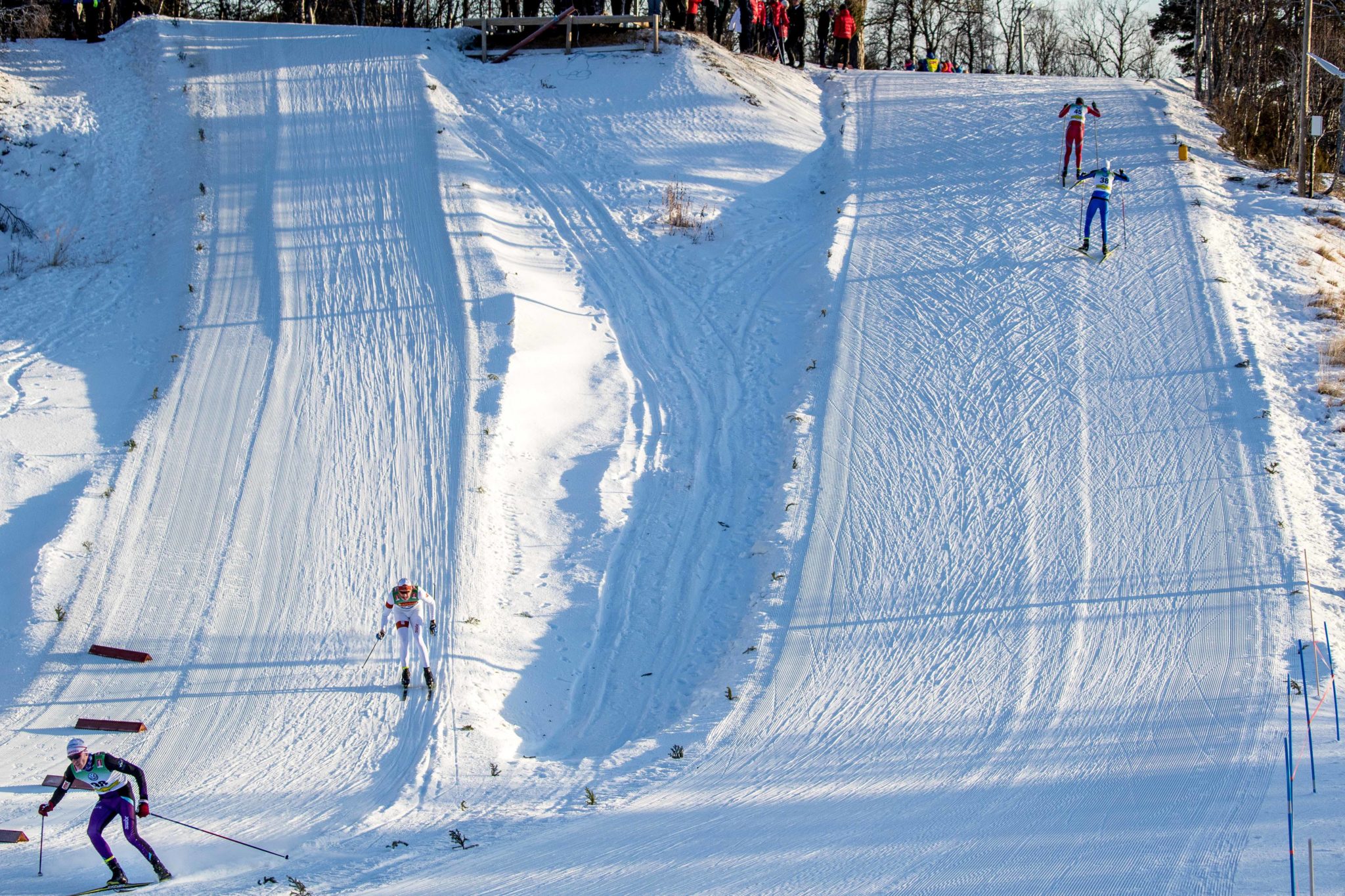
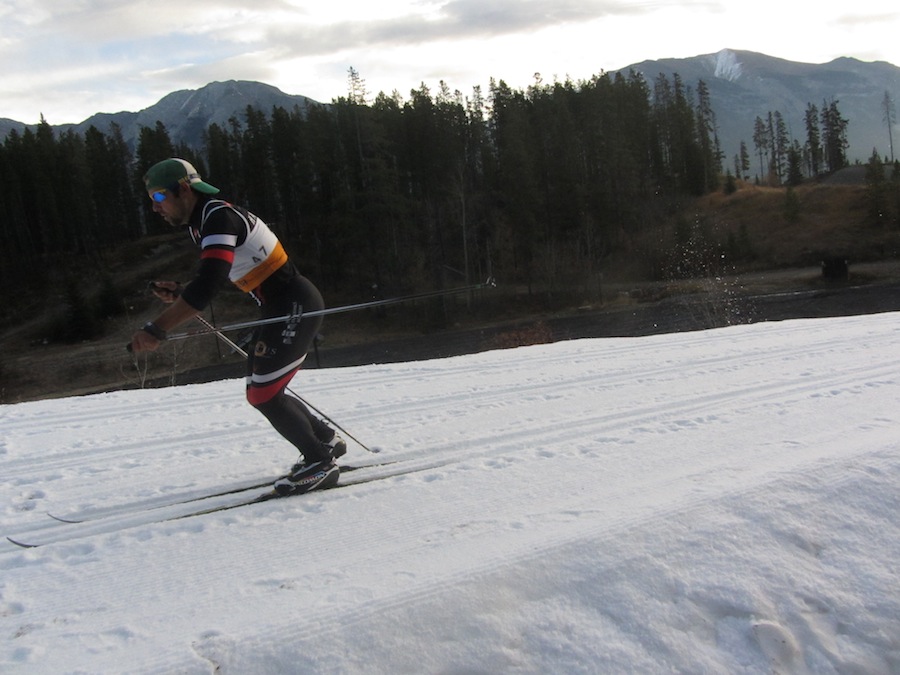
Racers navigate a steep climb and descent on the race loop at Bruksvallarna on Saturday. (Photo: Jocke Lagercrantz/Bruksvallsloppet.se)
The World Cup season draws ever-closer as season-opening races continued this weekend in Sweden, Finland, and Switzerland.
In Muonio, Finland, a long weekend of racing wrapped up with 10 and 15 k skate races. Finland’s Anne Kylloenen took the win in the women’s 10 k, besting Emilie Kristoffersen of Norway by 8.2 seconds. Kylloenen’s national-team teammates Laura Mononen and Aino-Kaisa Saarinen took third (+14.0) and fourth (+17.1), respectively. Merete Myrseth, a Norwegian skier who competed for the University of Utah on the NCAA circuit last season, finished 17th, +57.1.
In the men’s 15 k, Alexey Chervotkin of Russia took a 13.8-second win over Iivo Niskanen of Finland. Denis Spitzov of Russia was third, +17.5, and University of Utah alum Snorri Einarsson fourth, +21.2. Einarsson is competing for Iceland. Graham Nishikawa of Canada finished 19th, +1:14.4, and Brian McKeever 40th, + 2:05.3.
Finishing sixth (+37.0) was Maxim Vylegzhanin of Russia, who made his second flower ceremony of the weekend. The International Olympic Committee (IOC) decided on Thursdayto strip the Russian skier of three silver medals from the 2014 Olympics for doping violations and ban him from all future Olympic Games. However, the International Ski Federation (FIS) has not yet taken any action since he and five other skiers were banned from the IOC, meaning that all six athletes are currently free to take part in non-Olympic ski competitions. FIS has not yet responded to a request for comment about Vylegzhanin’s continued competition.
https://www.instagram.com/p/BbZO7VFFYpg/
In Bruksvallarna, Sweden, Sunday meant skate sprinting, and Norwegians took both the men’s and women’s wins. In the men’s race, Paal Troean Aune bested countryman Even Northug in the final, with Anton Persson the only Swede on the podium in third. None of the top sprinters from either country competed. Jack Carlyle of Canada finished 60th, 19.4 seconds behind Aune’s qualifying time.
In the women’s sprint, Wenche Aune Snildalsli took the win over four Swedes: Emma Thalin, Moa Olsson, Jackline Lockner, and Wilma Joensson were next across the line, and Latvia’s Patricija Eiduka finished sixth.
A large contingent of international racers has also been training in Davos, Switzerland, where organizers have a lengthy saved-snow loop covering some of the same terrain which will host the World Cup in mid-December. On Friday and Saturday, the Swiss competed with the German and Italian teams in sprint and distance races, with a few individual athletes from other countries attending as well.
In Friday’s sprints, Laurien Van Der Graaf came out on top for the home team, besting Germany’s Laura Gimmler and Steffi Boehler in the ‘A’ final after Gimmler had won beat her by 1.59 seconds in the qualifier. Fourth place went to Sandra Ringwald, also of Germany, and fifth to Ilaria Debertolis of Italy. In the men’s sprint Thomas Bing claimed the win for Germany, skiing away Switzerland’s Erwan Kaeser by more than two seconds. Giacomo Gabrielli and Stefan Zelger of Italy were third and fourth, and Janosch Brugger of Germany rounded out the ‘A’ final in fifth.
https://www.instagram.com/p/BbUYGpgl2V_/
In Saturday’s distance races, Katerina Smutna – racing for the Czech Republic after taking a break for several years to focus on a long-distance marathon career – won the three-lap, 10.5 k competition by just three seconds over Katharina Hennig of Germany, with Boehler another 12.2 seconds back in third. Van Der Graaf finished fourth, + 27.1, and Debertolis fifth, +39.6.
In the men’s four-lap race, covering 14 k, Swiss Olympic gold medalist Dario Cologna took a commanding 26.6-second win over Russia’s Ilia Chernousov. Jonas Dobler of Germany claimed third, +33.8, with Giandomenico Salvadori of Italy fourth (+59.2), narrowly beating out Livio Bieler of Switzerland (+1:00.9).
Chernousov could soon become an Olympic champion like Cologna. Vylegzhanin’s disqualification from the 2014 Olympics, along with that of Alexander Legkov, leaves Chernousov to inherit a gold medal in the 50 k freestyle, where he initially finished third. He has not been named in any of the doping investigations by the World Anti-Doping Agency or the International Olympic Committee. In fact, a Russian ski coach recently claimed that Chernousov had turned whistleblower and informed against his Russian teammate, but Chernousov has denied that allegation.
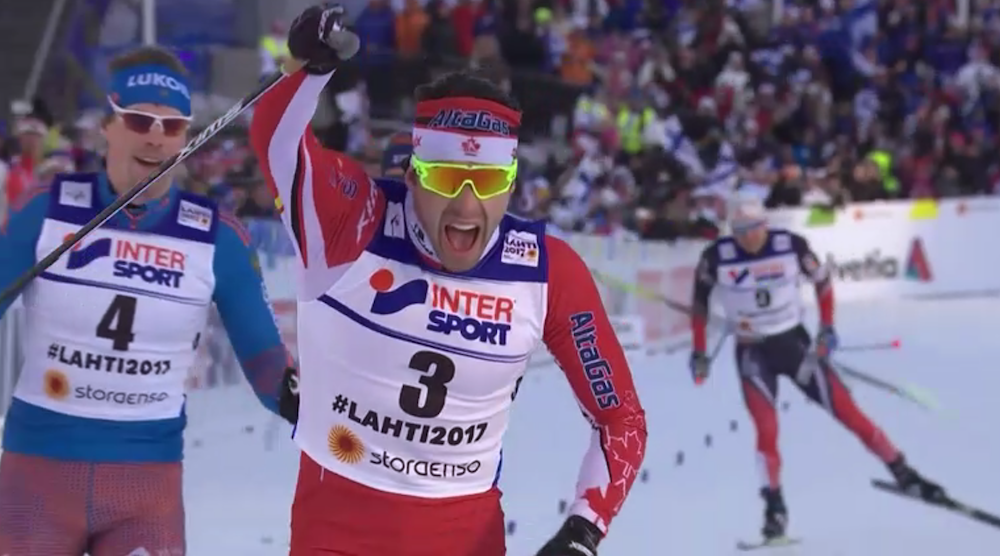
Canada’s Alex Harvey (3) celebrates his win in the men’s 50 k freestyle mass start, his first individual gold medal at a World Championships, on Sunday at 2017 Nordic World Championships in Lahti, Finland. He beat Russia’s Sergey Ustiugov (l) by 0.6 seconds while Norway’s Sjur Røthe (9) can be seen coming in for sixth place, behind (not pictured) Finland’s Matti Heikkinen, Great Britain’s Andrew Musgrave and Norway’s Martin Johnsurd Sundby, respectively. (Photo: NBC Sports screenshot)
FIS Nordic World Championships (Lahti, Finland): Men’s 50 k freestyle mass start
After a week of missing out on the medals at 2017 Nordic World Championships, Canada’s Alex Harvey, a four-time World Championships medalist from 2011, 2013 and 2015, achieved his first individual gold medal in the final race of this year’s World Championships in Lahti, Finland.
Harvey, 28, won the men’s 50-kilometer freestyle mass start in a drag race to the finish. Entering the final descent into the stadium with Norway’s Martin Johnsrud Sundby and Russia’s Sergey Ustiugov, Harvey rode his fast skis past both of them then had the most finishing kick in the final straightaway for a 0.6-second victory. He finished in 1:46.28.9 hours, while Ustiugov followed him across the line in second and Finland’s Matti Heikkinen from behind for third (+1.4), after passing Sundby around the outside of the last corner.
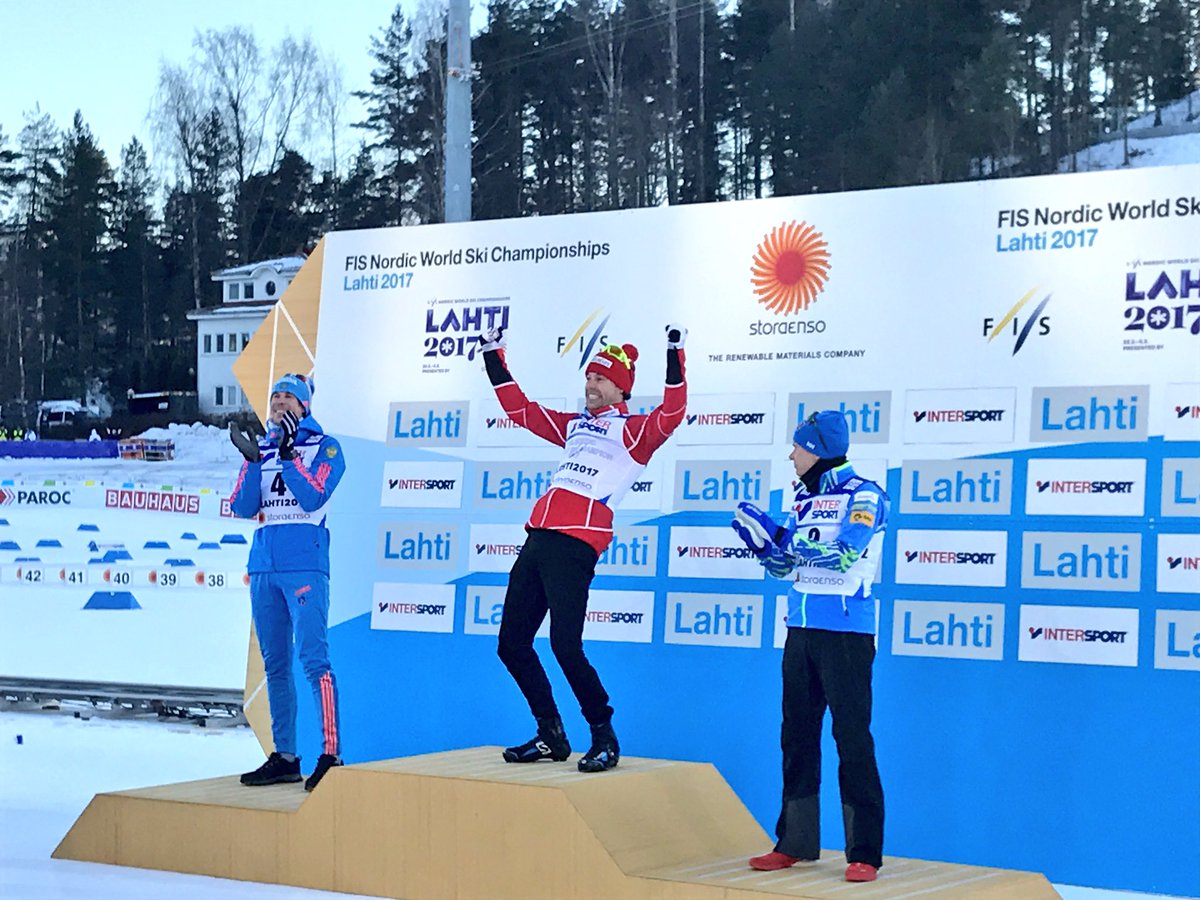
Canada’s Alex Harvey (c) celebrates gold in the men’s 50 k freestyle mass start on Sunday at 2017 Nordic World Championships in Lahti, Finland, with Russia’s Sergey Ustiugov (l) and Finland’ Matti Heikkinen (r) joining him on the podium in second and third, respectively. (Photo: Cross Country Canada/Twitter)
Sundby appeared to miss a pole plant soon after Heikkinen passed him and let off the pace a few meters before the finish. That’s where Great Britain’s Andrew Musgrave continued to accelerate and took fourth place, 2.9 seconds behind Harvey and 0.1 seconds ahead of Sundby in fifth. Norway’s Sjur Røthe followed another 0.4 seconds back in sixth, Switzerland’s Dario Cologna was seventh (+8.9), Norway’s Petter Northug eighth (+12.3), France’s Maurice Manificat ninth (+13.4), and Norway’s Hans Christer Holund 10th (+14.3).
“I had really good skis,” Harvey said in a post-race interview with FIS. “I knew if I came into the corner in second place, that was the optimal position. So I was able to fight hard and hit that last corner in second and slingshot by Martin along the flat and then that was good after that.”
“This is the best race of my life, for sure,” he added. “So I’m really happy.”
Tad Elliott (Ski Club Vail) led the Americans in 27th (+3:16.8). Noah Hoffman (U.S. Ski Team) finished 50th (+8:53.1) and Kyle Bratrud (CXC Team) did not finish.
Canada started four men, with Devon Kershaw finishing 38th (+5:45.5), Graeme Killick 43rd (+7:04), and Knute Johnsgaard in 55th (+12:03.3).
For Harvey, the medal is his fifth at three World Championships and his first individual gold after winning the classic team sprint with Kershaw in 2011.
IBU World Cup (PyeongChang, South Korea): Men’s and women’s relays
Between the men’s and women’s relays on Sunday at the International Biathlon Union (IBU) World Cup in PyeongChang, South Korea, Canada had two teams in the top eighth, with its men’s team finishing seventh in the 4 x 7.5 k and women’s team eighth in the 4 x 6 k. Behind them, the U.S. men finished 10th and U.S. women 14th.
France won the men’s relay by 33.8 seconds over Austria, using a total of 10 spare rounds but avoiding the penalty lap. Martin Fourcade anchored France to the win in 1:12:09.5 hours, after Jean-Guillaume Béatrix initially tagged them in first, his older brother Simon Fourcade raced them into second with near-perfect shooting (using just one spare to clean), and Simon Desthieux picked off one more place to give Fourcade a 16-second lead for the final leg.
Austria achieved second place with Lorenz Wäger, Simon Eder, Julian Eberhard, and Dominik Landertinger combining for zero penalties and nine spares.
Norway finished third (+45.4) with Vetle Sjåstad Christiansen, Ole Einar Bjørndalen, Vegard Gjermundshaug, and Henrik L’Abée-Lund. They had one penalty on Gjermundshaug’s third leg, and used a total of eight spares.
Canada’s Christian Gow, Scott Gow, Nathan Smith, and Brendan Green finished seventh (+3:03.1) with zero penalties and nine spares. After Christian tagged his older brother Scott in ninth, Scott raced them into sixth place before Smith slipped four places to 10th at the final exchange. On the final leg, Green raced them into seventh, requiring two spares to clean.
The Americans finished about nine seconds later in 10th (+3:12.8) with Lowell Bailey, Leif Nordgren, Paul Schommer, and Sean Doherty combining for zero penalties and nine spares, just like Canada. Bailey had originally put them in second at the first exchange, Nordgren dropped to seventh, then Schommer to 13th, before Doherty finally brought them back to 10th out of 24 teams.
In the women’s relay, Germany pulled off a 22.8-second win over Norway, with one penalty and eight spares. Nadine Horchler put Germany in third at the first exchange, then Maren Hammerschmidt raced them into first by the race’s halfway point. From there, Denise Herrmann, a former cross-country World Cup regular, had to ski a penalty lap and tagged off in second, 13.5 seconds out of first. With teammate Laura Dahlmeier sitting out the relay, Franziska Hildebrand anchored Germany to the win in 1:07:35.6 after she used just one spare to clean.
Norway placed second with Kaia Wøien Nicolaisen, Hilde Fenne, Tiril Eckhoff, and Marte Olsbu accumulating one penalty and 11 spares. Olsbu beat out the Czech Republic’s Gabriela Koukalová by one-tenth of a second at the finish, as the Czechs placed for third (+22.9), with Jessica Jislová, Eva Puskarčíková, Lucie Charvátová, and Koukalová (with a total of one penalty and nine spares).
Canada took eighth (+1:34) with Rosanna Crawford, Julia Ransom, Megan Tandy, and Emma Lunder. Crawford tagged in second at the first exchange, Ransom slipped one place to third, Tandy lost another place to tag in fourth, and Lunder ultimately anchored them to eighth.
The U.S., with Clare Egan, Susan Dunklee, Joanne Reid, and Maddie Phaneuf, finished 14th (+3:08.3) with one penalty and 10 spares. After Egan had a penalty on the first leg, Dunklee skied the fastest second leg to move the team from 19th to 14th, then Reid put them in 11th by the final exchange. Twenty-one teams competed in the women’s race.
Ski Classics 90 k Vasaloppet (Sälen to Mora, Sweden)
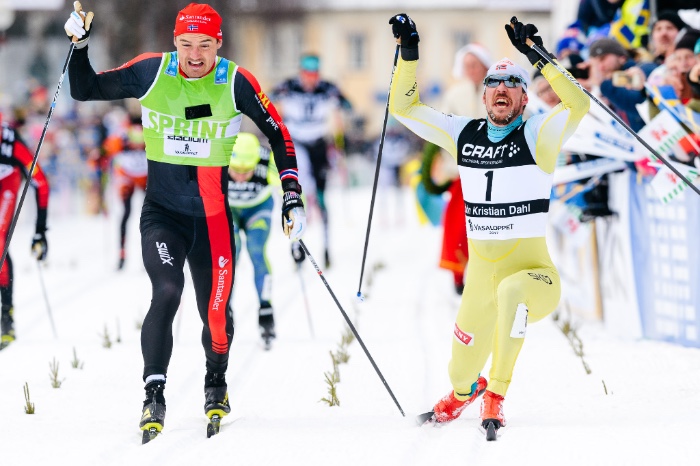
John Kristian Dahl (r) of Team United Bakeries outlunges Ski Classics sprint leader Andreas Nygaard (r) of Team Santander for the win in Sunday’s 90 k Vasaloppet in Mora, Sweden. (Photo: Visma Ski Classics)
[UPDATED] In Sunday’s 93rd annual 90-kilometer Vasaloppet from Sälen to Mora, Sweden, the ninth event of the Ski Classics series, John Kristian Dahl (Team United Bakeries) outlasted Andreas Nygaard (Team Santander) by one-tenth of a second for the win in 3:57:18.1 hours. The race came down to a five-way fight for first, with Stian Hoelgaard (Team Leaseplan) finishing 0.6 seconds back in third. The top 15 men were all within 21.7 seconds of the podium, and Brian McKeever, a member of Canada’s Para Nordic Ski Team, placed 20th (+2:31.1).
“It has been a fight all day,” Dahl said, according to a Ski Classics press release. Three days ago, he had been unsure about starting the Vasaloppet following a back injury. “I was tired already after 30 k and had to let go of the lead group, but I fought my way back taking it step by step and hill by hill.”
In the women’s race, Britta Johansson Norgren (Lager 157 Ski Team) broke away from the field to win by 1:37.9 minutes in 4:19.43.4.
Astrid Øyre Slind (Team United Bakeries) finished second, and Sara Lindborg (Team Serneke) placed third, 9 minutes and 4.2 seconds behind Norgren. Kateřina Smutná (Team Santander) dropped out of the race about halfway through.
“I am very tired but also so happy to win today,” Norgren said, according to the press release. “It felt pretty easy until Oxberg [Sweden] with 30 k to go, but then it got really tough and I had to fight all the way to the finish.”
It was Norgren’s first Vasaloppet win after placing second the last three years. She increased her lead in the overall Ski Classics to 215 points over Smutná, while Tord Asle Gjerdalen continues to lead the men’s overall standings ahead of his Santander teammate Nygaard, who is 349 points behind in second place. Gjerdalen did not race Sunday’s Vasaloppet.
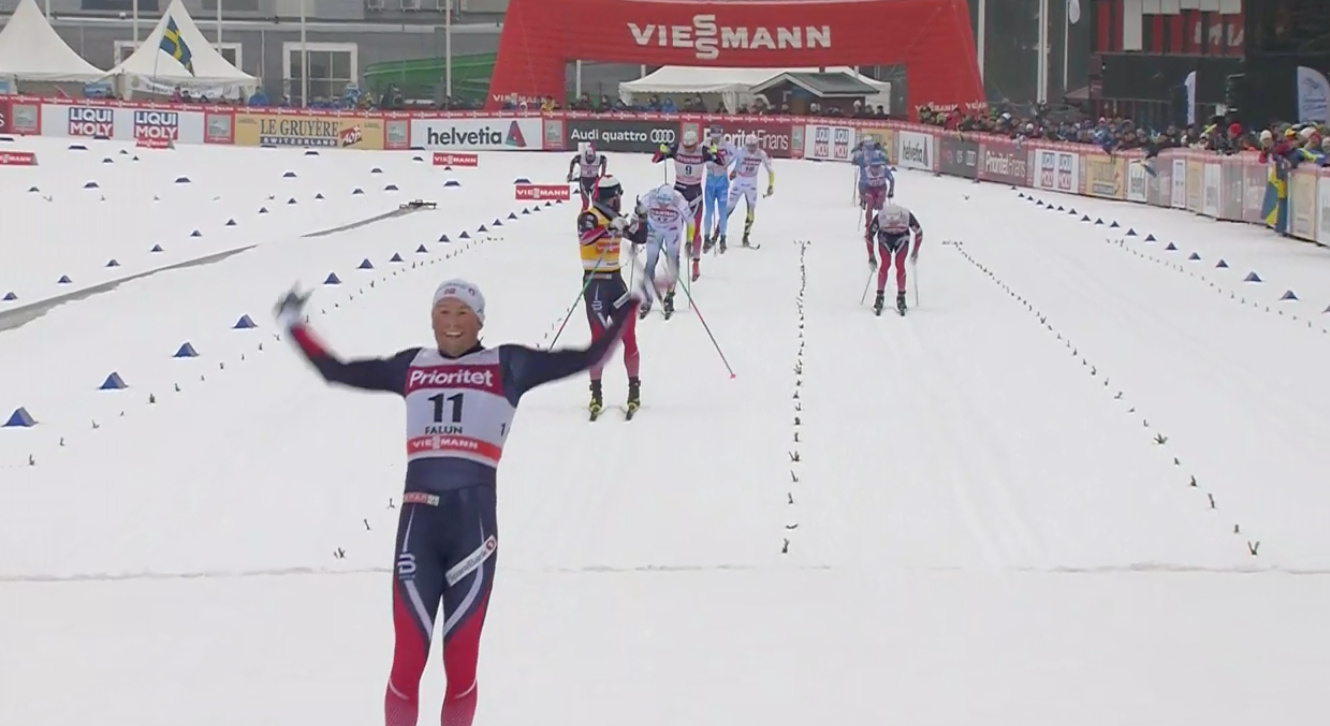
Emil Iversen celebrates his win in the 30 k classic mass start in Falun, Sweden, on Sunday. Norwegian teammate Martin Johnsrud Sundby finished second and Sweden’s Calle Halfvarsson third.
FIS Cross-Country World Cup (Falun, Sweden): 15 / 30 k classic mass start
In the women’s 15-kilometer classic mass start on Sunday, Norway swept the podium with Marit Bjørgen taking the win in a time of 41:28.8 in Falun, Sweden. Crossing just half a second behind her was her teammate, Ingvild Flugstad Østberg in second place. Rounding out the podium was Heidi Weng in third (+8.1).
American Jessie Diggins was the first to cross the line for the U.S. in 10th (+1:37.5). Three other U.S. women finished in the top 30, with Sadie Bjornsen finishing 21st (+2:43.6), Rosie Brennan 24th (+2:57.0), and Liz Stephen in 29th (+3:24.5).
Just outside of scoring World Cup points was American Caitlin Patterson in 32nd (+3:47.6) and Ida Sargent in 34th (+4:02.8). Canada’s Cendrine Browne finished 46th (+5:41.4) and American Liz Guiney 49th (+6:22.6).
After losing the skate sprint yesterday in a photo finish to Italy’s Federico Pellegrino, Emil Iversen ascended to the top step of the podium in the men’s 30 k classic mass start on Sunday in Falun.
The Norwegian was often near the front, but hadn’t tried to lead a breakaway like his teammates Martin Johnsrud Sundby and Sjur Røthe did earlier in the race. In the final two kilometers, Sundby – the overall World Cup leader – put in a sprint to try to drop the field. But Iversen caught up, drafting his veteran teammate into the stadium. In the final up-and-over before the finish line, Iversen made a pass and then accelerated down the finishing stretch to beat Sundby by 1.14 seconds.
“I got motivation from yesterday’s last 20 meters,” Iversen told FIS in a finish-line interview. “So today I fought all the way, and I was really stronger. It is amazing for me to be second yesterday and first today. I’m really proud of that.”
Calle Halfvarsson, who had been falling off the back of the lead pack just a few kilometers earlier, managed to get back to the front and claim third place for Sweden (+1.72 seconds) in a photo finish with Røthe (+1.76 seconds). Niklas Dyrhaug was next (+2.52 seconds) to give the Norwegian men’s team four in the top five.
In his return to the World Cup stage, Norway’s Petter Northug finished 31st (+3:10.6).
Alex Harvey was the lone Canadian on the start line. After skiing near the front of the field for the early part of the race he was dropped by the lead pack in the final kilometers, finishing 15th (+1:17.5).
Erik Bjornsen and Noah Hoffman took 35th and 37th places for the United States, finishing +3:30.8 and +3:59.8, respectively. SuperTour leader Matthew Gelso — familiar with the Falun course after competing in 2015 World Championships — finished 44th (+5:23.6), and Andy Newell placed 53rd (+7:45.3).
IBU Open European Championships (Duszniki-Zdrój, Poland): Single mixed & mixed relay
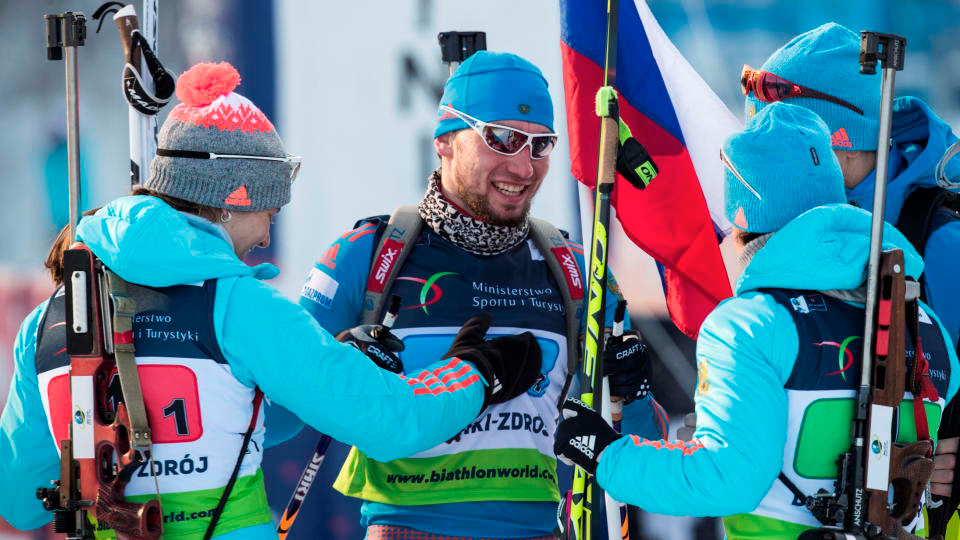
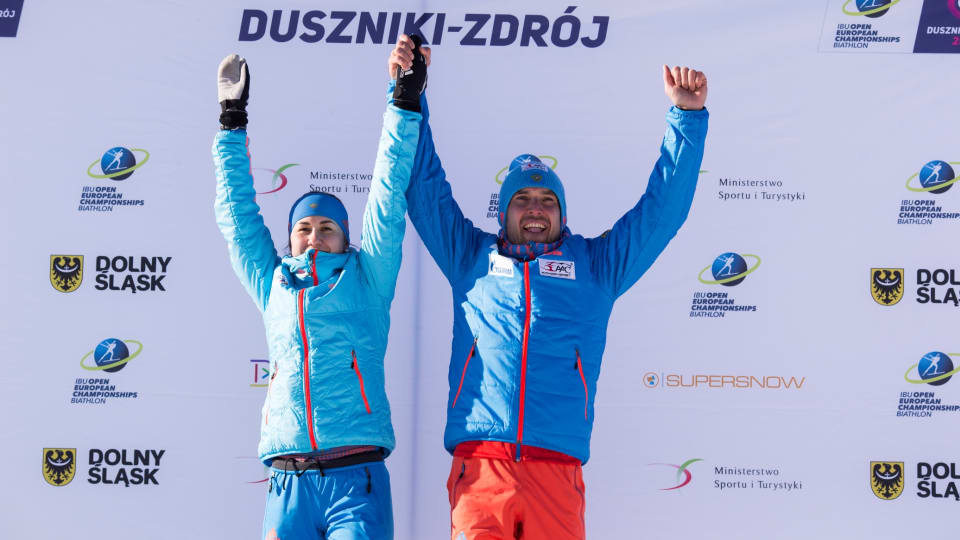
Russia’s Alexander Loginov (center) is greeted at the finish by his teammates Irina Starykh, Svetlana Sleptsova and Alexey Volkov after anchoring his team to the gold medal in the mixed relay at the 2017 IBU Open European Championships in Duszniki-Zdrój, Poland. (Photo: IBU)
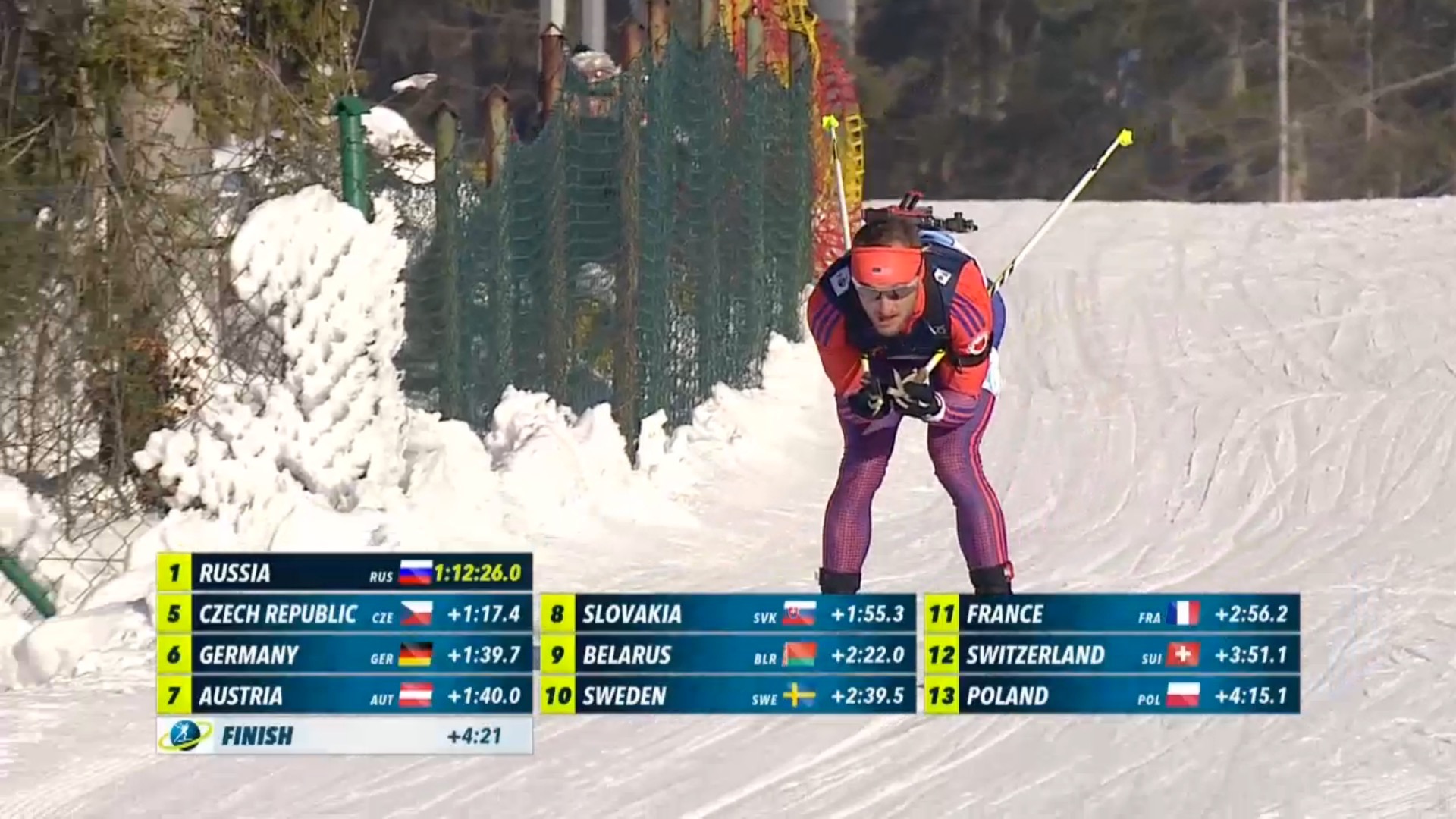
[UPDATED] The Russian victory in the final 2 x 6 + 2 x 7.5-kilometer mixed relay event of the 2017 International Biathlon Union (IBU) Open European Championships in Duszniki-Zdrój, Poland, was only briefly in doubt, when Alexander Loginov skiing the anchor leg required all spares in his prone shooting stage. But with his final shot he managed to also hit that target to avoid the penalty lap, leaving the range with a lead of more than 30 seconds.
Loginov then did not need any spares in the last standing stage, and could take his time on the final loop. Unlike Russia’s Evgeniy Garanichev earlier in the day during the single mixed relay, he also managed to pick up a flag for the final meters of the race, crossing the line in a time of 1:12:26.0 hours.
The Russian team with Irina Starykh, Svetlana Sleptsova, Alexey Volkov and Loginov led from the first exchange and required only six spares with zero penalties.
With this medal, the 28-year-old Volkov became the most successful athlete in history at European Championships, according to an IBU press release, surpassing the retired Polish biathlete Tomasz Sikora. Russia was the most successful team of the 2017 Open European Championships with six gold, four silver, and three bronze medals.
Behind them, a number of teams vied for the positions on the podium. Sweden initially looked like a strong contender exchanging in second place after the women, but fell back with three penalty laps to only finish 10th.
Still six seconds back after the final shooting, Norway’s Fredrik Gjesbakk caught up to and outsprinted Ukraine’s Ruslan Tkalenko in the finishing stretch to claim the silver medal (+36.4) with the bronze left for Ukraine (+37.1).
“I thought that I made sufficient gap to win silver,” Tkalenko told the IBU. “But in the end, on the final downhill before the finish, I was very surprised when the Norwegian guy passed me, I truly did not expect that.”
The Norwegian team with Karoline Erdal, Marion Rønning Huber, Erlend Bjøntegaard, and Gjesbakk needed nine spares and had no penalties.
Ukraine with Anastasiya Merkushina, Yulia Dhzyma, Oleksander Zhyrnyi (who originally started for Russia before making the switch in 2014) and Tkalenko required six spares, and Dhzyma had to ski a penalty lap only temporarily setting the team back.
Bulgaria finished fourth (+1:16.4), with its anchor Vladimir Iliev narrowly beating Czech Republic’s Lukas Kristejn (+1:17.4) in the finishing stretch. Both teams needed 11 spares and had no penalties.
Jakob Ellingson skiing the anchor leg for the U.S. mixed relay at the 2017 IBU Open European Championships in Duszniki-Zdrój, Poland. The U.S. team finished 14th. (Photo: IBU/Eurovisionsports.tv screenshot)
Starting at the back of the field in bib 20, US Biathlon’s Emily Dreissigacker got her team off to a strong start with a clean prone shooting and one spare round in standing, exchanging in 10th, a minute behind the leaders. Hallie Grossman needed one spare in each of her stages, tagging off to the men in 14th position and now 2:39 behind. Max Durtschi also had one miss each in prone and standing, coming into the last exchange still in 14th position, but another minute back. Jakob Ellingson required all three of his spares in his prone shooting stage narrowly avoiding the penalty lap, and one more in his final shooting stage. As the team from Finland was racing over a minute behind the Americans, he was able to keep the 14th position into the finish (+4:47.4), with a team total of nine spares and no penalties overall.
For Biathlon Canada, Erin Yungblut starting in bib 19 shot clean in her prone stage and required two spares in her standing shooting, tagging off in 18th position and more than two minutes back from first. Leilani Tam von Burg stayed clean in her prone shooting stage and needed one spare in standing, moving up two positions to exchange in 16th place, yet more than four minutes behind the leaders. After the exchange to the men, both Matthew Neumann and anchor Carsen Campbell managed to shoot clean in all of their stages, but lost additional time on the course to finish 16th (+6:39.9) ahead of four lapped teams.
Canada had the best shooting result of all 20 teams starting the relay, with just three spares and no penalty.
Russia’s Daria Virolaynen (l) and Evgeniy Garanichev after winning Sunday’s single mixed relay at the 2017 Open European Championships in Duszniki-Zdrój, Poland. (Photo: IBU)
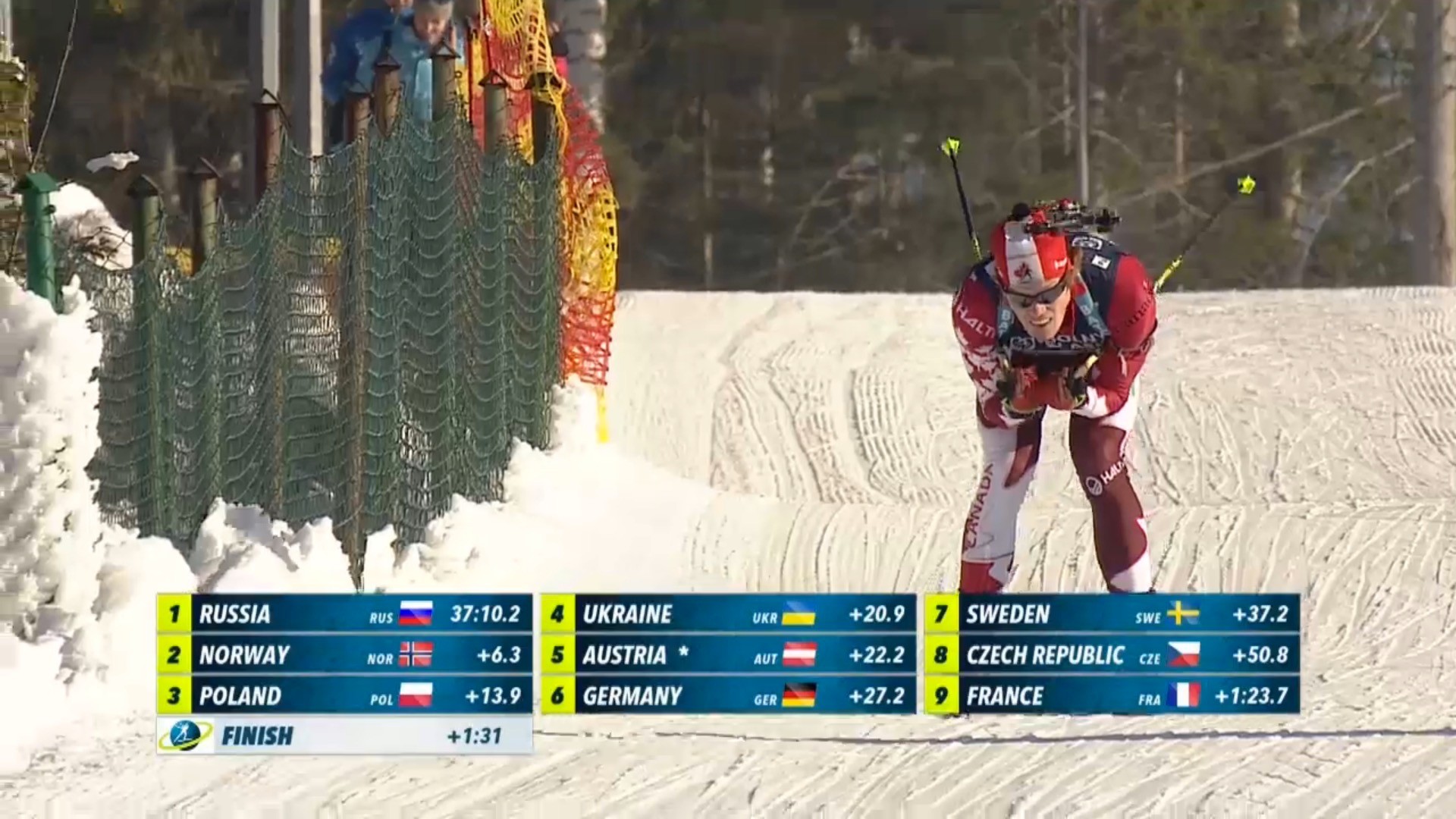
Earlier on Sunday, pretty much the only thing that went wrong for Russia’s Daria Virolaynen and Evgeniy Garanichev in the single mixed relay happened on the last meters of the finishing stretch, with Garanichev gesturing for a Russian flag he wanted to cross the line with. But the handoff was too short and the flag dropped past his outstretched hand to the snow. He glanced back, weighing if his lead was big enough to ski back, but decided it was not worth the risk, instead skiing into the arms of his partner waiting for him behind the line in a time of 37:10.2 minutes.
Russia needed seven spare rounds and incurred zero penalties. Garanichev secured the victory in the final shooting, when he only needed one spare – albeit fumbling a few seconds to insert it – while his direct opponents standing next to him required more time to hit their targets.
“Probably, I took some risk at the last standing,” Garanichev said, according to an IBU press release. “I wanted to shoot fast and clean, but missed with the last shot. But in general, I felt very comfortable; came and worked at the range in my rhythm.”
6.3 seconds behind, Norway with the team of Ingrid Landmark Tandrevold and Vetle Sjåstad Christiansen placed second, with seven spares and zero penalties.
“These are very short loops,” Christiansen commented on the fairly new, single mixed relay format. “You feel the pressure from the crowd and to shoot fast every time.”
The 20-year-old Tandrevold previously earned three bronze medals, including one in the single mixed relay, also with Christiansen, at last year’s Open European Championships in Tyumen, Russia.
To big cheers from their home crowd fans who had come out to the Duszniki Arena in beautiful but cold weather, the Polish husband-and-wife team of Krystyna Guzik and Grzegorz Guzik placed third with just five spares and zero penalties (+13.9), not quite able to keep up with Christiansen on the final loop after leaving the range together within a second.
“It is so nice to win a medal here in Poland,” Krystyna Guzik said. “We were both very disappointed with all of our mistakes in the other competitions. So today, we were relaxed and laughing before the competition, hoping not to have those mistakes again. We did not … and now have a medal.”
It was the first medal for Poland at these championships.
Ukraine with Iryna Varvynets and Andriy Dotsenko finished fourth, also with five spares and zero penalties (+20.9).
Biathlon Canada’s Aidan Millar skiing the final loop of the single mixed relay at the 2017 IBU Open European Championships in Duszniki-Zdrój, Poland. With teammate Sarah Beaudry, Canada finished 13th (Photo: IBU/Eurovisionsports.tv screenshot)
For Biathlon Canada, Sarah Beaudry and Aidan Millar required seven spares during their race and had no penalty, just like the winning Russians and Norwegians, but could not quite keep up with the best teams on the course in the fast-paced race format with short loops somewhat comparable to a team sprint in cross-country.
Beaudry cleaned her first shooting stage and then needed one spare to hit all targets in standing. At the first exchange Canada was 10th, 35.8 seconds behind the then leading team from Poland.
Millar missed one shot in his first prone stage, leaving the range again in ninth position. Then he needed two spares in his standing shooting on the way to exchanging back to Beaudry in 11th (+56.4).
On her second leg, Beaudry had one miss in prone and required two spares in standing, falling back a bit to exchange in 13th (+2:12.0).
On his final leg, Millar was able to shoot clean in both stages, reducing the time gap to the top but not able to make up another position, and finished in 13th place (+1:56.1).
US Biathlon is only represented with two women at the Open European Championships in Poland, and decided to forgo a start in the single mixed relay, instead entering a team in the mixed relay later on Sunday.
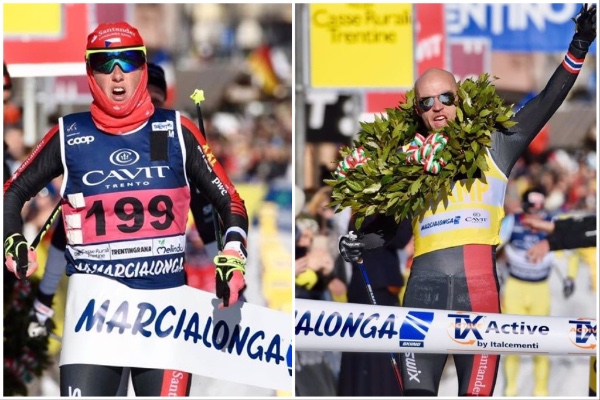
Katerina Smutna (left) and Tord Asle Gjerdalen (right) of Team Santander won the 2017 Marcialonga. (Photo: Visma Ski Classics)
Tord Asle Gjerdalen won the Marcialonga, a Worldloppet and Swix Ski Classics marathon for the third time – in a row. This year was on a shortened course, “just” 57 rather than the traditional 70 kilometers.
The Team Santander athlete finished in two hours, eight minutes, and 36 seconds, edging Johan Kjølstad (Team United Bakeries) and Morten Eide Pedersen (Team BN Bank) in a sprint finish by 2.6 and 2.9 seconds, respectively.
Tyler Kornfield and David Norris of Alaska Pacific University finished 43rd (+5:03.8) and 66th (+10:43.1). Canadian Paralympian Brian McKeever finished 57th (+9:13.5) and guide Graham Nishikawa 81st (+12:56.5), followed by Ian Murray in 85th (+13:37.5) and Erik Carleton in 111th (+17:50.2).
In the women’s competition, Katerina Smutna, also of Team Santander, won her third straight Ski Classics competition. She crossed the line in two hours, 22 minutes, and 46.4 seconds. Britta Norgren of Team Lager 157 was second by just 0.8 seconds, and Sara Lindborg (Team Serneke) third, +4:22.2. University of Utah alum Maria Graefnings was tenth, +10:35.8.
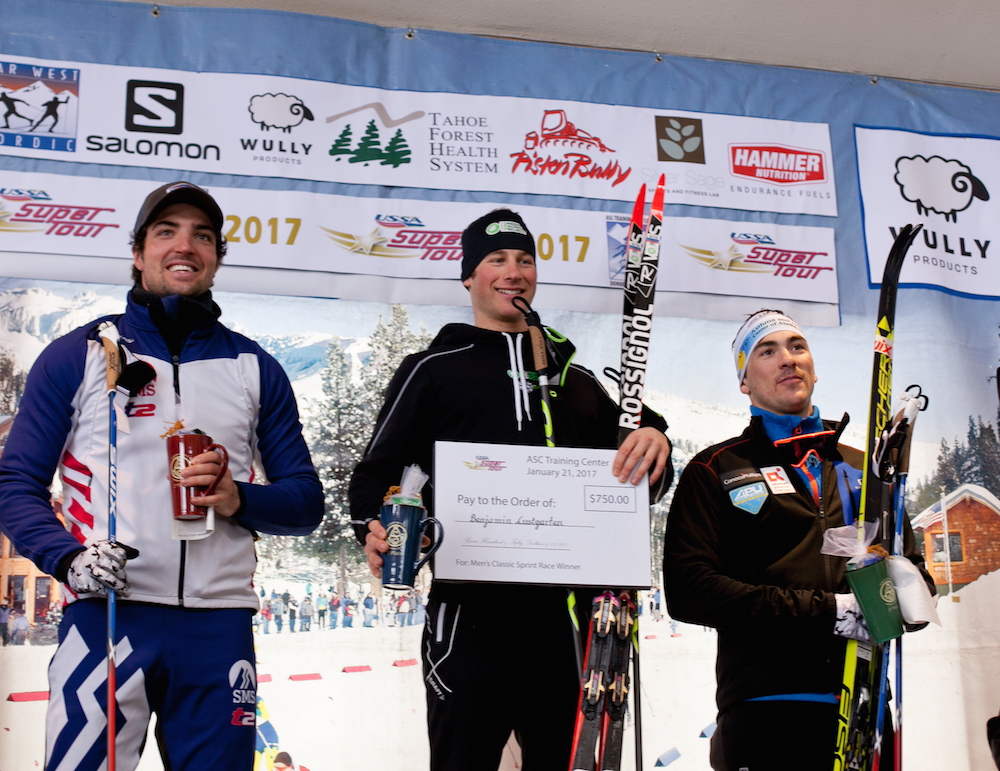
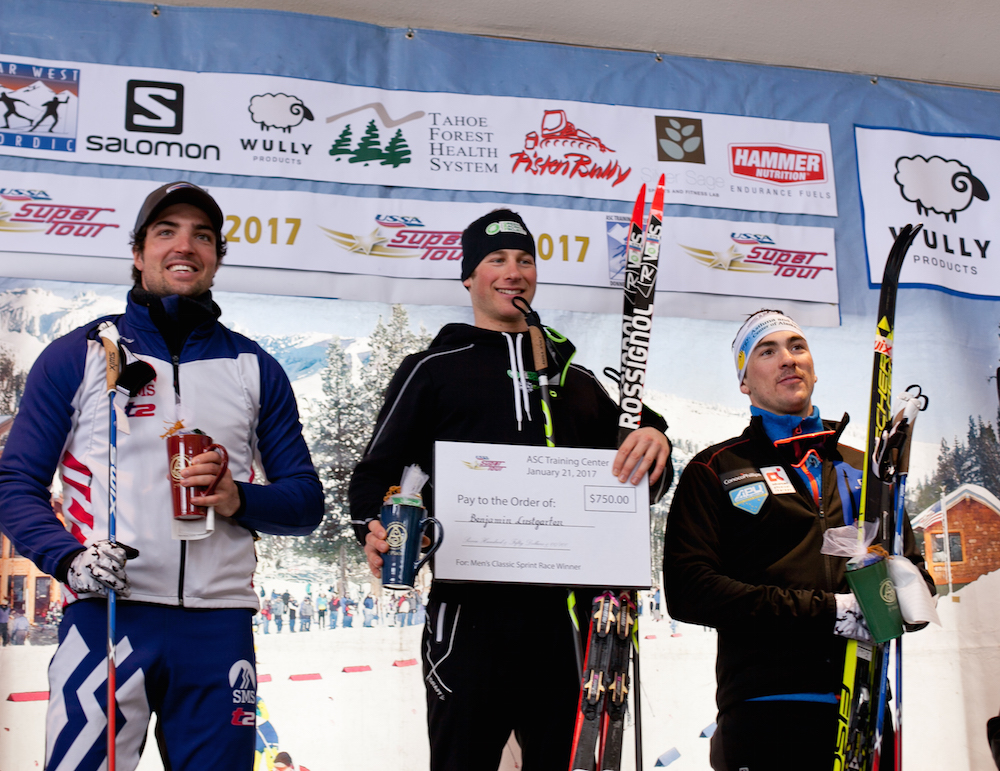
Ben Lustgarten (Craftsbury Green Racing Project) with his $750-dollar check for winning the men’s SuperTour classic sprint on Saturday near Truckee, Calif. Stratton’s Ben Saxton (l) placed second and APU’s Reese Hanneman (r) was third.
Lustgarten, of the Craftsbury Green Racing Project, raced to a 1.58-second victory in the men’s A-final at the Auburn Ski Club in Soda Springs, Calif., finishing in 3:03.4. Ben Saxton, of the Stratton Mountain School (SMS) Elite Team, placed second, and Reese Hanneman, of Alaska Pacific University (APU), was third (+2.77).
Hannenman’s younger brother Logan also reached the final and placed fourth (+4.5), Dakota Blackhorse-von Jess (Bend Endurance Academy) was fifth (+5.86), and the third APU skier in the final, Tyler Kornfield sixth (+18.69).
Blackhorse-von Jess started the day off as the fastest qualifier in 2:58.8. Saxton qualified second, 4.1 seconds back, Logan Hanneman qualified third (+4.2), and Lustgarten fourth (+6.5). Blackhorse-von Jess went on to win his quarterfinal and place second in his semifinal, while Lustgarten and Saxton both won their quarterfinals and semifinals.
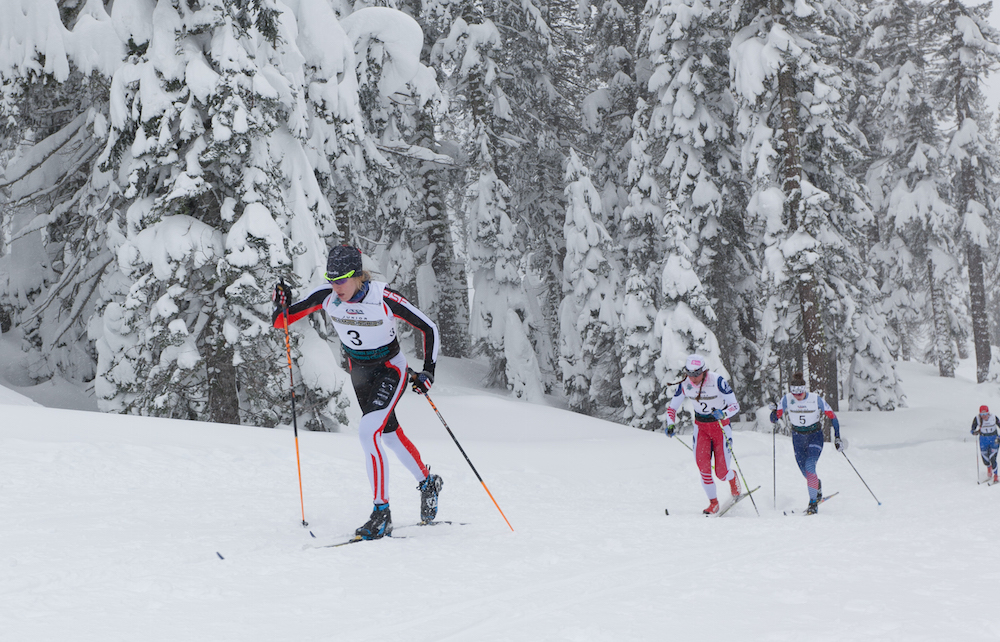
Jennie Bender (3) of the Bridger Ski Foundation leading Stratton’s Julia Kern (2) and Sun Valley’s Deedra Irwin (5) during the second women’s classic sprint semifinal at Saturday’s SuperTour near Truckee, Calif. Bender went on to win the semifinal, as well as the final.
In the women’s A-final, Jennie Bender of the Bridger Ski Foundation, coming off a classic sprint win at nationals, scored another victory in 3:29.07. She edged Craftsbury’s Kaitlynn Miller by just seven-hundredths of a second, and Stratton’s Julia Kern placed third (+3.42). Racing at home, Hannah Halvorsen (Sugar Bowl Academy) finished fourth (+3.88). Craftsbury had three in the women’s final with Caitlin Patterson in fifth (+3.93) and Heather Mooney in sixth (+27.35).
Miller proved to be the woman to beat throughout the day, winning the qualifier in 3:30.9, along with her quarterfinal and semifinal. Kern qualified second (+3.2) and Bender third (+4.6). Bender went on to win her quarterfinal and semifinal as well before facing off with Miller in the final.
NorAm Western Canadian Championships (Whistler, B.C.): 10/15 k classic
It was interval-starts day at Western Canadian Championships at Whistler Olympic Park and national-team veteran Emily Nishikawa completed the four laps of the women’s 10 k classic in 30:35.5 to win ahead of teammate Dahria Beatty, 16.5 seconds behind. Maya MacIsaac-Jones completed the national team and Alberta World Cup Academy (AWCA) sweep in third (+1:36.5).
Sovereign Lake’s Hannah Mehain, of the national junior team, was the top junior for the second-straight day in eighth overall (+3:22.1).
In the men’s 15 k, Lappe Nordic’s Andy Shields won the six-lap race in 40:34.2, showing some of the form that won him the NorAm overall last season. National-team member Jess Cockney collected his second-straight podium, finishing second, 4.3 seconds behind Shields. Evan Palmer-Charrette (NTDC Thunder Bay) completed the podium in third (+55.1).
FIS Cross-Country World Cup (Ulricehamn, Sweden): 10/15 k freestyle
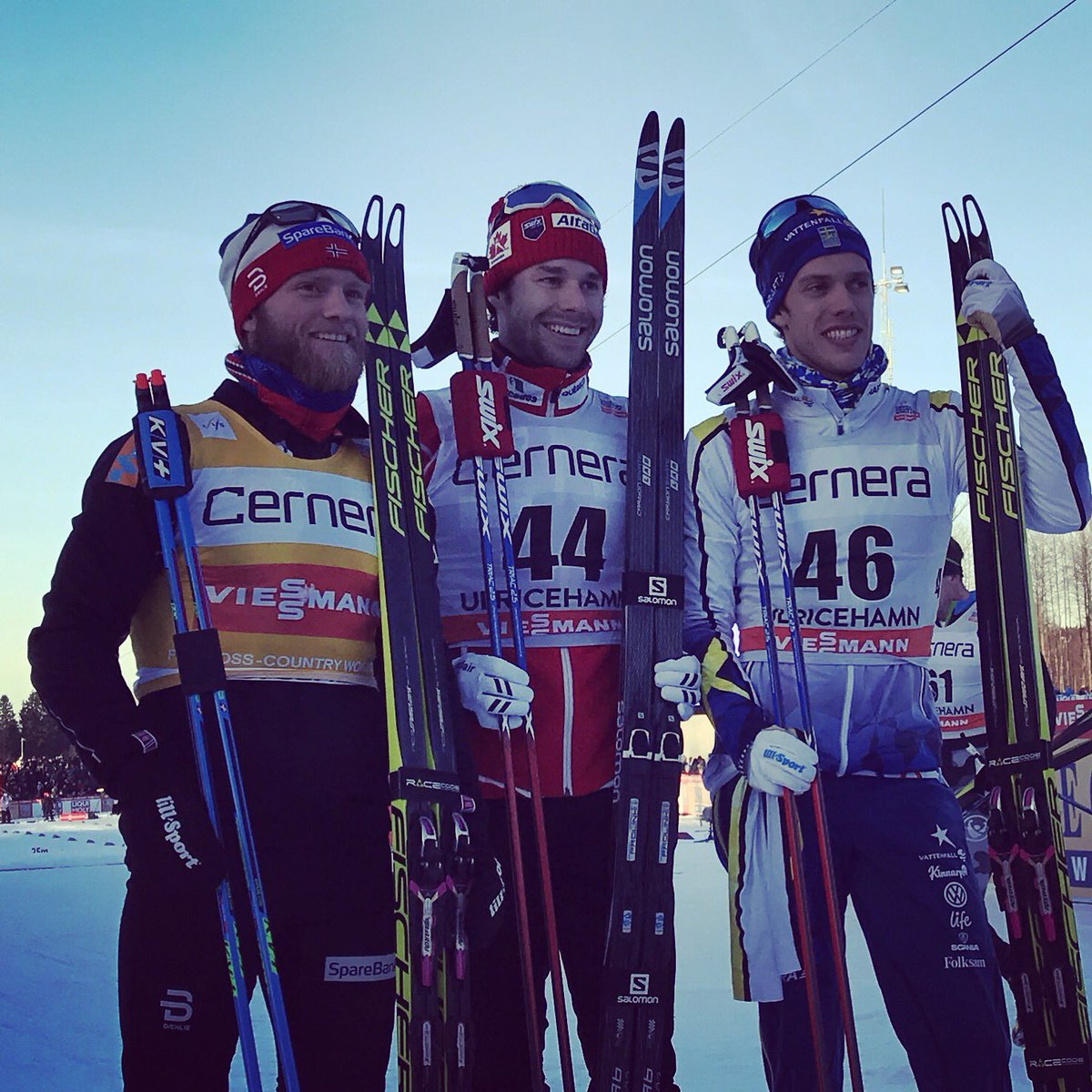
The men’s 15 k freestyle podium at Saturday’s World Cup in Ulricehamn, Sweden, with Canadian winner Alex Harvey (c), Norwegian runner-up Martin Johnsrud Sundby (l), and Sweden’s Marcus Hellner (r) in third. (Photo: FIS Cross Country/Twitter)
First individual win of the season (second straight, after winning last weekend’s team sprint), fifth individual victory of his career. That’s the latest news on Canada’s Alex Harvey, who won the World Cup men’s 15-kilometer freestyle individual start on Sunday in Ulricehamn, Sweden, for his first victory in a 15 k skate race and fourth individual podium of 2016/2017.
To say Harvey is on a roll is an understatement. On Saturday, he beat Norway’s Martin Johnsrud Sundby by 6 seconds after starting a minute behind the Norwegian defending World Cup champion. Harvey’s fastest time across the line in 32:46.2 held up through 76 finishers, with Sweden’s Marcus Hellner coming somewhat within range after starting a minute behind him. Hellner ended up 14.3 seconds back from Harvey at the finish for third place, behind Sundby.
Switzerland’s Dario Cologna missed the podium by 0.5 seconds in fourth (+14.7), and Norway’s 24-year-old Daniel Stock broke through in fifth (+16.2) for his first World Cup top 20.
Great Britain’s Andrew Musgrave placed sixth (+18.7), Sweden’s Daniel Rickardsson was seventh (+25.0), Norway’s Finn Hågen Krogh eighth (+32.2), Russia’s Petr Sedov ninth (+33.9), and Japan’s Keishin Yoshida 10th (+34.2).
American Erik Bjornsen landed in the points as he tied Norway’s Simen Andreas Sveen for 28th (+1:09.2), leading fellow U.S. Ski Team members Noah Hoffman, who placed 41st (+1:28.8), and Simi Hamilton in 53rd (+1:56.2). Also for the U.S., Matt Gelso, the Period 1 SuperTour leader from the Sun Valley Ski Education Foundation (SVSEF) Gold Team, finished 68th (+3:00.3).
Harvey’s Canadian World Cup teammates Len Valjas finished 35th (+1:17.7) and Devon Kershaw 38th (+1:22.2). Knute Johnsgaard (Canadian U25 Team) did not start.
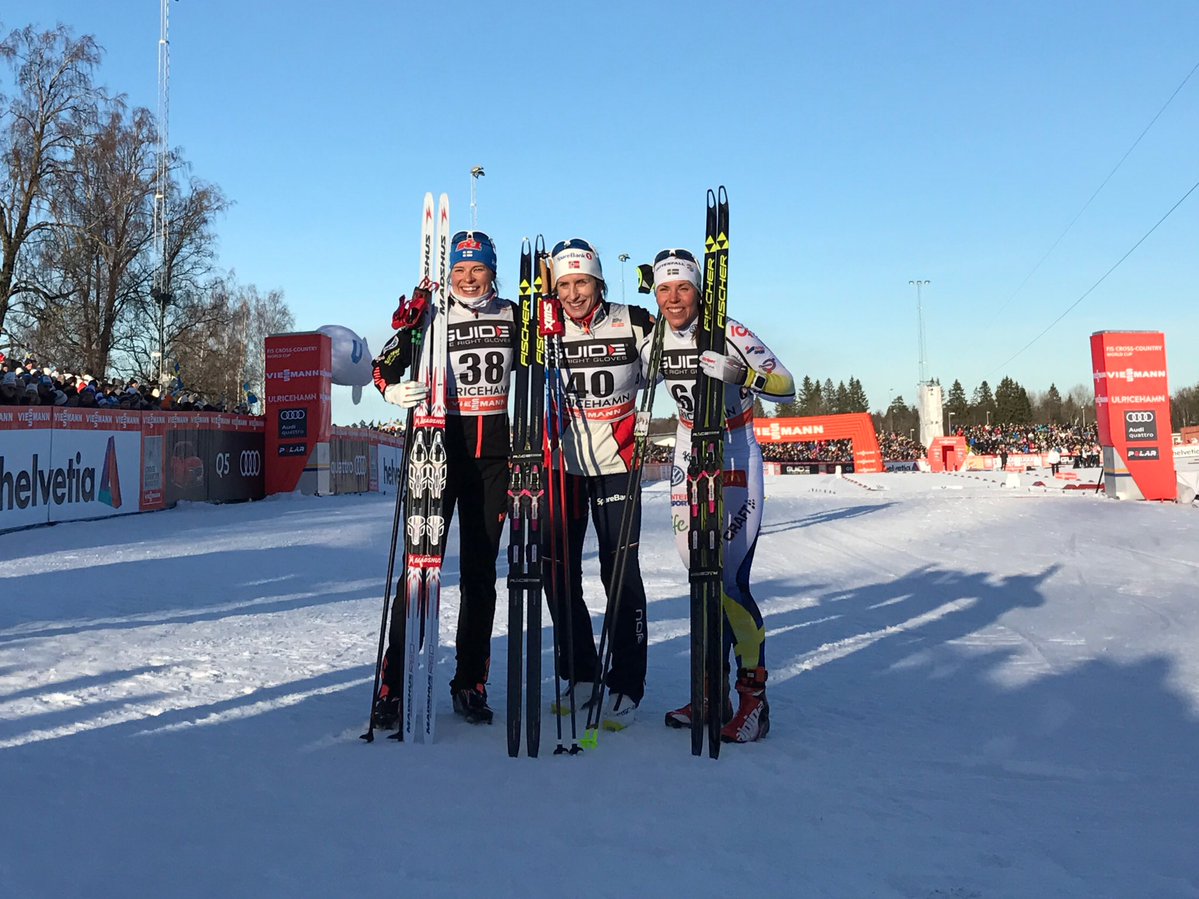
The women’s 10 k freestyle podium on Saturday in Ulricehamn, Sweden, with Norwegian winner Marit Bjørgen (c), Finland’s Krista Parmakoski (l) in second and Sweden’s Charlotte Kalla (r) in third. (Photo: FIS Cross Country/Twitter)
In her first World Cup race in over a month and at a brand-new World Cup venue, Norway’s 36-year-old Marit Bjørgen returned to her winning ways, topping the women’s 10 k freestyle on Saturday in Ulricehamn.
Bjørgen started 40th out of 61 finishers and took the lead from Finland’s Krista Parmakoski at the finish with a time of 23:46.3 minutes. Parmakoski, who started a minute ahead of her in bib 38, ended up second, 10.7 seconds back. Sweden’s Charlotte Kalla reached the podium for the second time this season in third (+24.9).
“It is always great to win,” Bjørgen said, according to an International Ski Federation (FIS) press release. “I stayed at home for five weeks and was training. It is great to come back with a victory. I know that the training I had done was good. It was an amazing atmosphere today by the course. There were people cheering everywhere.”
Norway swept fourth through sixth with Astrid Uhrenholdt Jacobsen in fourth (+25.7), Ragnhild Haga in fifth (+32.3) and Heidi Weng in sixth (+34.0).
American Jessie Diggins raced to seventh (+34.9), ahead of Sweden’s Hanna Falk, who recorded her best distance result in eighth (+36.4). Norway’s Ingvild Flugstad Østberg finished ninth (+44.8), and Germany’s Sandra Ringwald was 10th (+56.6).
“I didn’t have the snappy good feelings I was hoping to have in my body today, but it was a solid race,” Diggins wrote in a post-race email to FasterSkier. “It’s always hard when you know that on your best days you are capable of more, but at the same time we had great skis, and it was really fun for me to be able to ski with my teammates today!”
The U.S. had three in the top 20 and four in the top 30 with Sadie Bjornsen in 12th (+1:00.5), Liz Stephen in 16th (+1:07.3) and Rosie Brennan in 24th (+1:30.7).
Cendrine Browne as Canada’s lone woman in the race achieved 35th (+1:52.0) for her career best in an individual race. Also for the U.S., Kikkan Randall placed 40th (+1:59.6) and Liz Guiney of the Craftsbury Green Racing Project 52nd (+2:33.2).
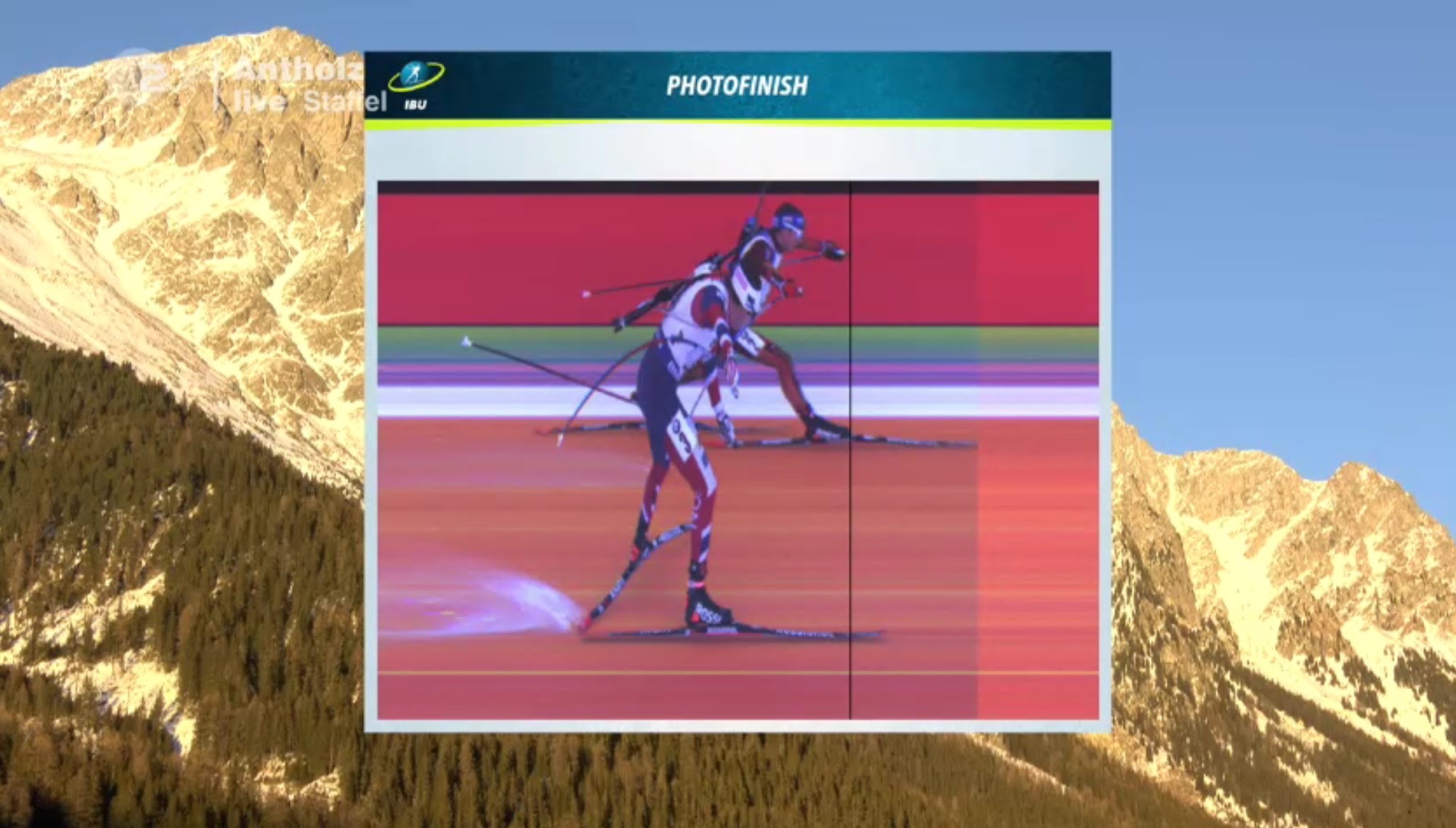
The photo finish of the men’s 4 x 7.5 k relay on Saturday at the IBU World Cup in Antholz, Italy, with Germany’s Simon Schempp outlunging Norway’s Emil Hegle Svendsen. (Photo: ZDF broadcast screenshot)
For the U.S. men, top six was a target for the 4 x 7.5 k relay on Sunday in Antholz, Italy, according to US Biathlon Men’s Coach Jonas Johansson.
Mission accomplished. In the final team event before 2017 World Championships, Lowell Bailey, Leif Nordgren, Tim Burke, and Sean Doherty combined for sixth, finishing 1:04.9 minutes behind the German winners. The Americans used a total of 10 spares but avoided the penalty loop, as did the Germans who used seven spares to clean the eight-stage race and won it in 1:13.57.2.
Germany’s Simon Schempp narrowly outlasted Norway’s Emil Hegle Svendsen in the finishing stretch to secure the victory for Germany (with teammates Erik Lesser, Benedikt Doll and Arnd Peiffer) by one-tenth of a second. Norway finished second with nine spares and no penalties (with Lars Helge Birkeland, Henrik L’Abee-Lund, Johannes Thingnes Bø, and Svendsen), and Russia secured third (+33.6) with nine spares and zero penalties as well (with Maxim Tsvetkov, Evgeniy Garanichev, Dmitry Malyshko, and Anton Babikov).
Ukraine used a total of just five spares and had zero penalties for fourth (+46.7), and Austria took fifth (+49.2) with eight spares and no penalties, after Austria’s Dominik Landertinger skied away from Doherty on the final loop and finished 6.9 seconds ahead of him for fifth place.
For the U.S. men, sixth was close to their team-best fifth with the same lineup in last year’s World Cup relay in Presque Isle, Maine. The same group also took sixth in Ruhpolding, Germany, last year as well.
With all four making US Biathlon’s World Championships team, announced Saturday, they will likely be aiming for a best championships result early next month in Hochfilzen, Austria.
Canada (Christian Gow, Scott Gow, Macx Davies, and Brendan Green) finished 16th (+4:13.8) on Saturday with two penalties and 11 spares. Scott Gow skied them up to 15th by the second exchange but they dropped to 18th after Davies had two penalties on the third leg. With Green anchoring and using just one spare, they recouped two places before the finish.
In the women’s race, Germany’s Nadine Horchler achieved a lifetime dream with her first World Cup win, after starting in bib 30 and earning her start as a reserve athlete. Germany took first and second with Laura Dahlmeier in second, and the Czech Republic’s Gabriela Koukalova placed third. Susan Dunklee of the U.S. was the lone North American starter and finished 24th after leading at the start of the second loop.
FIS Nordic Combined World Cup (Chaux-Neuve, France): Individual large hill/10 k
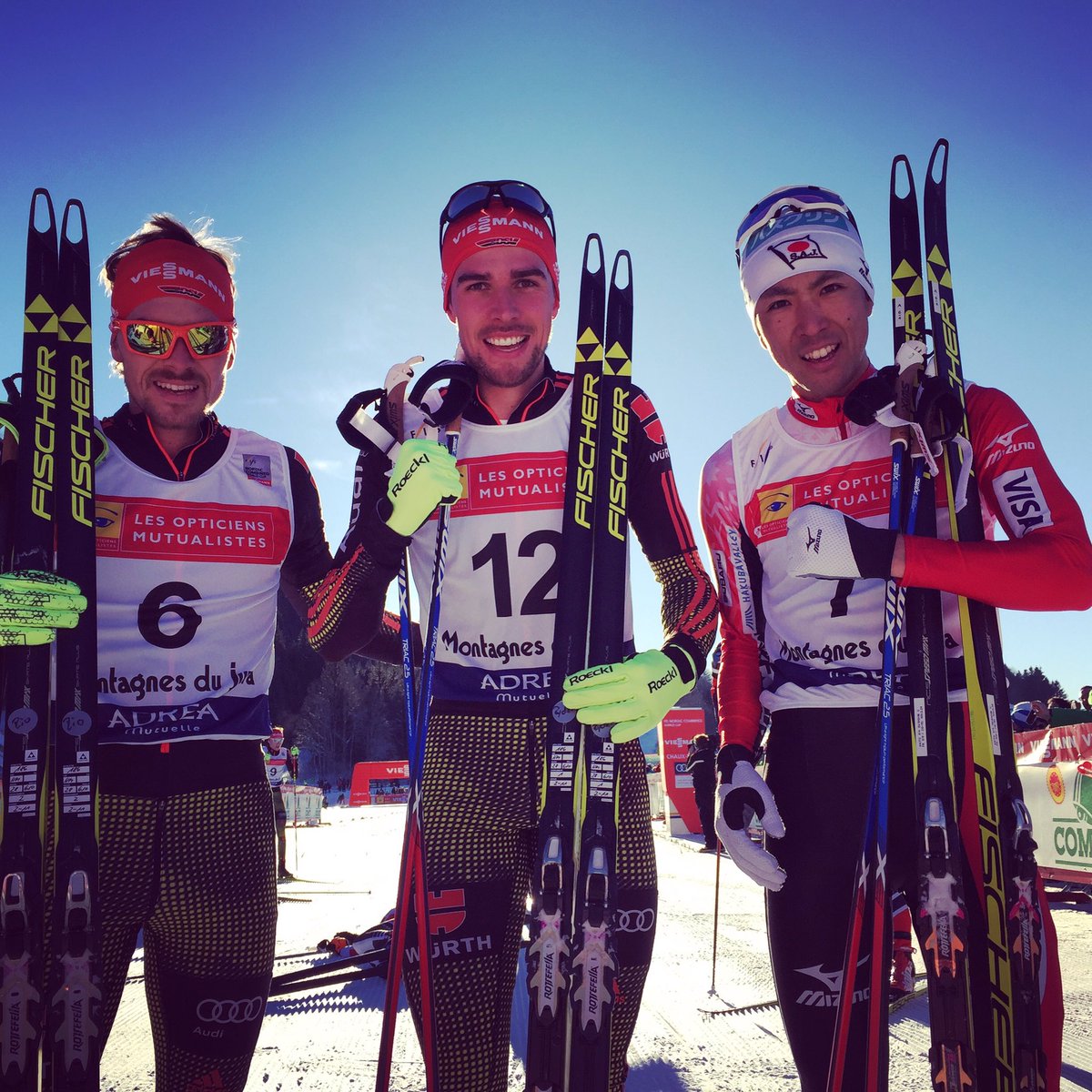
Saturday’s Nordic Combined World Cup podium in Chaux-Neuve, France, with German winner Johannes Rydzek (c), German runner-up Fabian Rießle (l) and Japan’s Akito Watabe (r) in third. (Photo: FIS Nordic Combined/Twitter)
The first part of Saturday’s Nordic Combined World Cup individual large hill/10 k competition was a shining moment for U.S. Nordic Combined skier Ben Berend, who jumped to second for a total of 127.5 points, trailing only Norway’s Jarl Magnus Riiber with 139 points in Chaux-Neuve, France.
Berend flew farther than Germany’s Eric Frenzel, who jumped to third on the Chaux-Neuve large hill.
Later in the day, they started the 10 k Gundersen in that order, with Riiber heading out first, followed by Berend 46 seconds later, then Frenzel 53 seconds back in third.
Germany’s Johannes Rydzek started 1:15 minutes back in 12th and skied the fastest 10 k to take the victory at the finish (in 23:01.7). He held off his German teammate Fabian Rießle by 2.8 seconds for the win, after Rießle started sixth and 1:01 back. Japan’s Akito Watabe reached the podium in third (+5.7) after jumping to seventh and starting the race 1 second behind Rießle.
Frenzel ended up fourth (+8.3), and the fourth German in the top five, Björn Kircheisen improved to fifth (+22.6) after starting 11th.
Riiber dropped to 15th (+54.0), and Berend fell outside the top 30 to end up 32nd (+2:26.0) with the 39th-ranked course time.
Berend finished 12.2 seconds ahead of his U.S. teammate Taylor Fletcher, who placed 34th (+2:38.2) after the jump put him in 48th.
Bryan Fletcher was 49th after the jump but did not start the 10 k.
The Nordic Combined World Cup continues Sunday in Chaux-Neuve with another large hill/10 k.
Ski Classics #5: La Diagonela (Zuoz, Switzerland): 50 k classic
[UPDATED] Under “blue skies, no wind and perfect track conditions” in the Swiss Engadin Valley on Saturday, according to a Ski Classics press release, Russia’s Ilya Chernousov and the Czech Republic’s Kateřina Smutná won the men’s and women’s La Diagonela, respectively, in Zuoz, Switzerland.
Chernousov, of Team Pioneer Investments, and Tord Asle Gjerdalen (Team Santander) led a large pack of men into the final major climb on the 50 k course. There, Gjerdalen attacked and Chernousov matched him, accelerating away from his competitors up the last steep pitch to the finish, according to the press release. He finished in 2:03:39.6 hours, holding off Gjerdalen by 1.5 seconds, while Øystein Pettersen (Team BN Bank) finished third (+3.0).
In the women’s race, Smutná (Team Santander) pushed to break up the field around the halfway point, where the men caught the women. Britta Johansson Norgren (Lager 157 Ski Team) hung with Smutná, but lost contact over the last 5 k. After finishing second in the last two Ski Classics races, Smutná took the win by 1:03.2 minutes in 2:20:49.2. Nordgren finished second, ahead of Sara Lindborg (Team Serneke) in third, who finished more than three minutes later (+4:17.4).
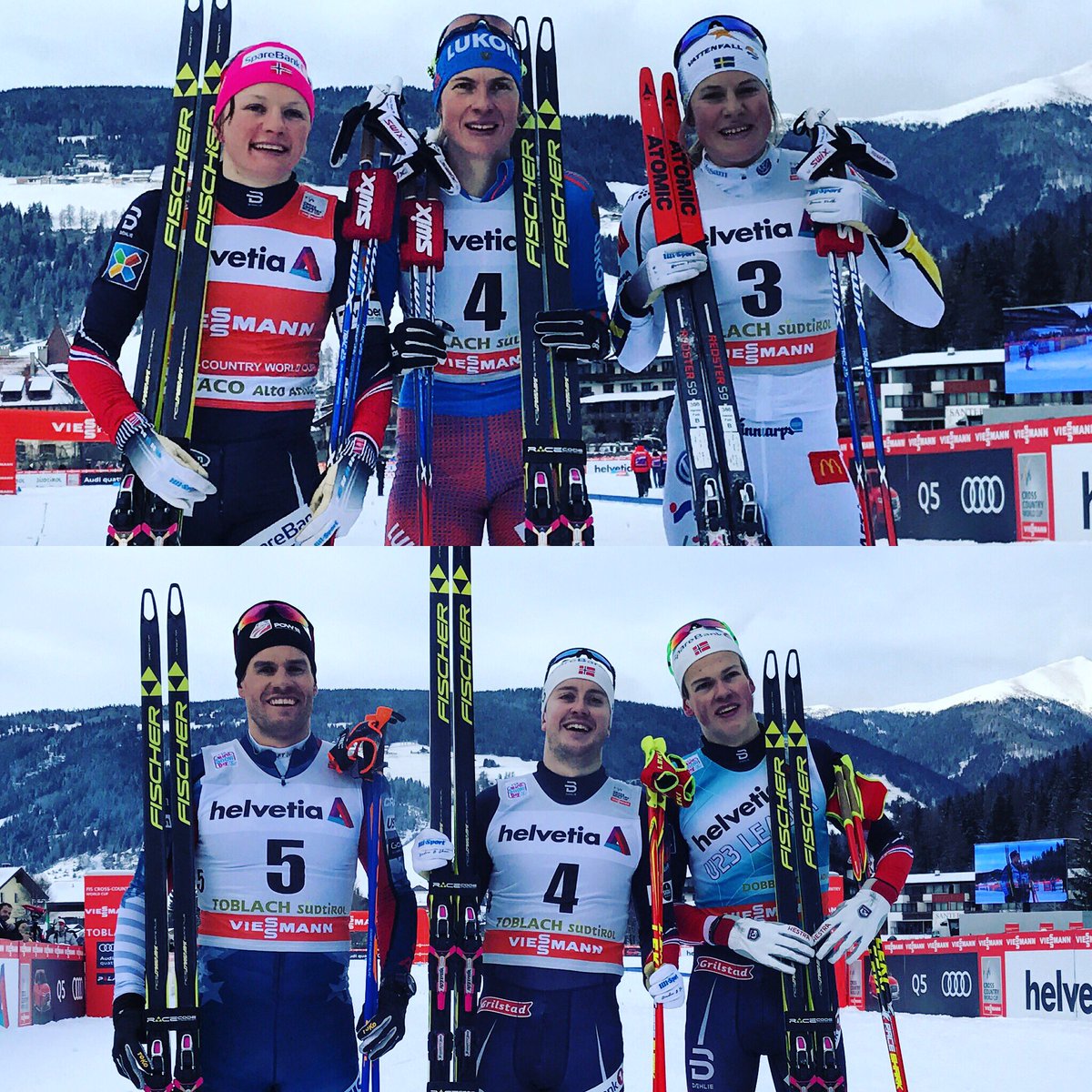
The women’s (top) and men’s (bottom) podiums at the World Cup 1.3 k freestyle sprints on Saturday in Toblach, Italy. Russia’s Natalia Matveeva (top center) won the women’s final, ahead of Norway’s Maiken Caspersen Falla (top left) and Hanna Falk (top right). American Simi Hamilton (bottom left) took second in the men’s final, behind Norway’s Sindre Bjørnestad Skar (bottom center) and ahead of Norway’s Johannes Høsflot Klæbo (bottom right) in third. (Photo: FIS Cross Country)
FIS Cross-Country World Cup (Toblach, Italy): Freestyle sprints
Simi Hamilton is back on the World Cup podium and was three-hundredths of a second away from the win on Saturday in the men’s 1.3-kilometer freestyle sprint in Toblach, Italy. The American qualified fifth and went on to win his quarterfinal then advance as a lucky loser in third out of him semifinal. In the men’s final, Hamilton waited until the last hill to strike and used his conserved energy in the two-lap race to outlast the likes of Italy’s Federico Pellegrino and Norway’s Johannes Høsflot Klæbo at the finish. Hamilton put it all on the line in a photo finish with Norway’s Sindre Bjørnestad Skar, with Skar taking his first individual World Cup victory in 2:47.91. Hamilton placed second for his first podium of the season and fourth of his career. It was also Hamilton’s first time in the final this season.
Klæbo was the second Norwegian on the podium in third, 0.66 seconds behind Skar, Pellegrino placed fourth (+1.27), Hediger was fifth (+1.84), and Norway’s Håvard Solås Taugbøl (who won the qualifier to start the day in 2:47.38) took sixth (+3.77).
“I just had a good feeling that I was a little bit before [Hamilton],” Skar said in a post-race interview with FIS of his immediate finish-line celebration before confirming that he won. “It was very, very tight.”
Skar, who turns 25 on Jan. 22, qualified fourth and won his quarterfinal and finished second in his semifinal, 0.05 seconds ahead of Hamilton.
Also for the U.S., Andy Newell qualified for the heats in sixth and took third in his quarterfinal for 13th overall. Canada’s Alex Harvey qualified eighth and finished fourth in his quarterfinal for 17th overall, and the second Canadian racing this weekend, Len Valjas, qualified 23rd and took fourth in his quarterfinal for 20th.
In the women’s race, Russia’s 30-year-old Natalia Matveeva notched the 12th individual podium of her career (all in sprints) and first victory since 2007. She challenged Norway’s Maiken Caspersen Falla on the last climb and overtook her in the finishing stretch of Saturday’s 1.3 k skate sprint final for the win in 3:04.13. Matveeva qualified fourth to start the day, then placed second in both her quarterfinal and semifinal en route to the victory. Falla won the qualifier in 3:10.89, and continued to dominate her quarterfinal and semifinal before ending up second on the day, just 0.08 seconds out of first.
“I’ve waited a lot of time to be [here],” Matveeva told FIS afterward. “I’m very happy and the Russian team is very happy. Thank you very much my service team. Good job today.”
Sweden’s Hanna Falk reached the podium in third (+2:41), Germany’s Sandra Ringwald placed fourth (+3.46), Sweden’s Ida Ingemarsdotter was fifth (+5.88), and Slovenia’s Vesna Fabjan sixth (+19.39).
Americans Kikkan Randall and Sophie Caldwell tangled in the first semifinal and ended up 10th and 11th, respectively, at the end of the day. Also for the U.S. Ski Team, Ida Sargent qualified for the heats in 16th (behind Caldwell in 15th while Randall qualified 27th), and reached the semifinals as well, placing sixth in the second semifinal after skiing in third into the finishing stretch. Sargent ended up 12th for her best result in over a year.
Finland’s Kaisa Mäkäräinen posts a 22-second win for her first victory of the season and first time shooting without a miss in an individual race since the Ruhpolding sprint almost exactly a year ago. Dunklee leads North Americans in 33rd and qualifies for the pursuit, along with Canada’s Rosanna Crawford (55th), Megan Tandy (56th) and Julia Ransom (60th).
Ski Classics Kaiser Maximilian Lauf (Seefeld, Austria): 60 k classic
[UPDATED] Imagine knee-deep snow drifts over the course of 60 k. That’s what faced racers in Saturday’s Kaiser Maximilian Lauf, the fourth stop in the 2016/2017 Ski Classics series, in Seefeld, Austria.
Team Santander’s Kateřina Smutná and Andreas Nygaard fared best in the conditions, racing to the women’s and men’s victories in 3:43:48.7 and 3:21:44.5, respectively.
Smutna won the women’s race by 10.8 seconds over Astrid Øyre Slind (Team United Bakeries), and Britta Johansson Norgren (Lager 157 Ski Team) finished more than three minutes later in third place (+3:35).
“It was the right decision to go with kick today,” Smutná said after, according to a Ski Classics press release. “It was hard for us to be in the lead and open the tracks for men. We waited for them to catch up and do the work on our behalf. I noticed it was tough for Britta because she was double poling. So, Astrid and I decided to work together in the final section of the course, and it worked perfectly.”
The men’s race was much closer with Nygaard holding off his Team Santander teammate Tord Asle Gjerdalen by 0.6 seconds. Stian Hoelgaard (Team Leaseplan) placed third, another 0.6 seconds back.
“It was a tough race because there was so much snow on the course,” Nygaard said, according to the press release. “At some point, we were knee-deep in soft snow. The pace was slow, but you get tired after a while because you have to work hard when it’s snowing like this. I just kept telling myself that I need to keep up with the guys and win the race in the end. This is something that I didn’t expect to happen when the season started. Let’s see how long I can keep the yellow [leaders] bib.”
The overall Ski Classics series leader, Nygaard is also the sprint leader as well. On the women’s side, Johansson Norgren possesses both the overall and sprint bibs as well.
FasterSkier Editor-at-Large Chelsea Little placed 17th.
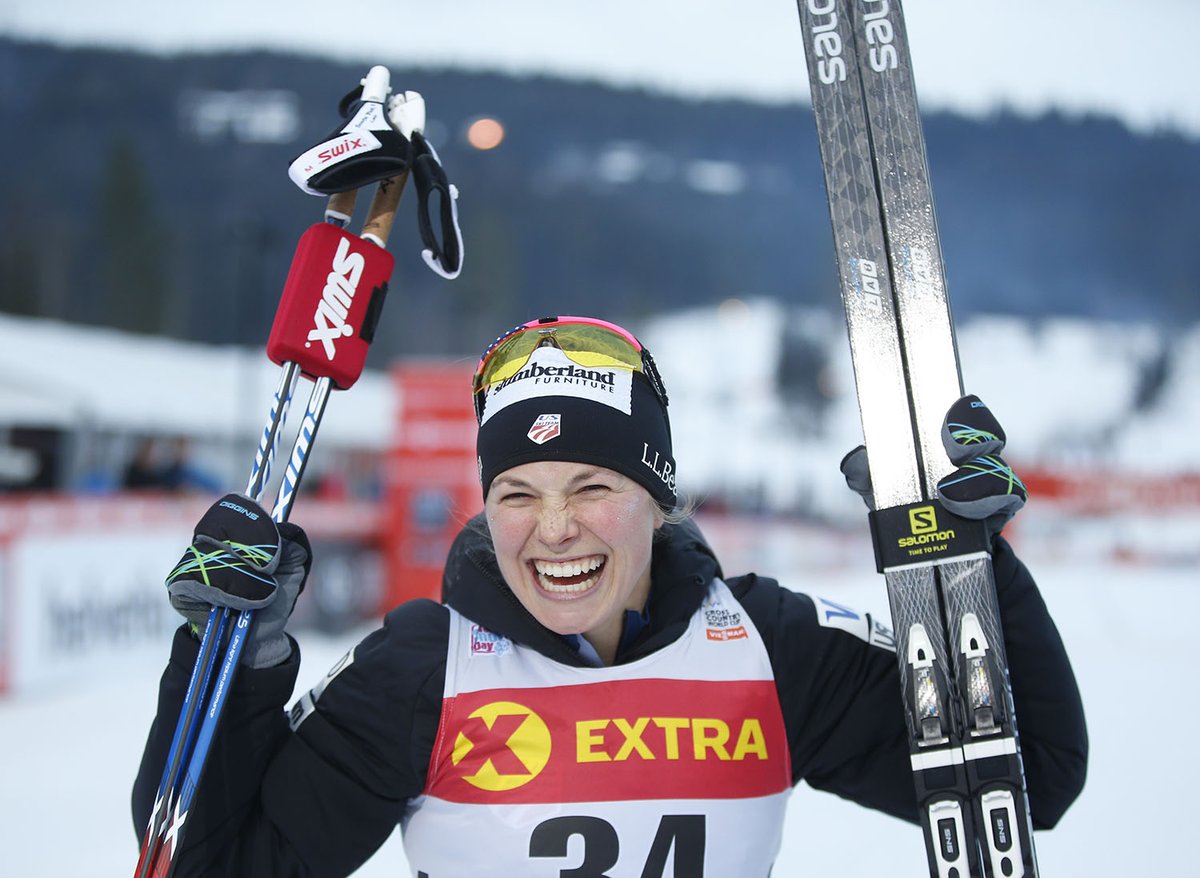
Jessie Diggins (U.S. Ski Team) won the second individual World Cup of her career on Saturday in the women’s 5 k freestyle in Lillehammer, Norway, beating four Norwegians by 4.8 seconds or more. (Photo: USSA Nordic/Twitter)
Welcome to The Rundown, your quick primer of need-to-know information about the day’s racing. We’ll be updating this digest as the day goes on with additional results, photos and quotes. The Rundown is NOT a race report; stay tuned for complete race reports later today with interviews from the day’s top racers.
***
U.S. SuperTour opener in West Yellowstone: Freestyle sprints
[UPDATE] The U.S. domestic season opened in West Yellowstone, Mont., with 1.3-kilometer freestyles on Saturday, and Matt Gelso and Jennie Bender emerged as the day’s winners.
Gelso, of the Sun Valley Ski Education Foundation (SVSEF) Gold Team, won the men’s final, and two Alaska Pacific University (APU) skiers, Tyler Kornfield and Reese Hanneman, joined him on the podium in second and third, respectively.
In the women’s final, Bender, of the Bridger Ski Foundation (BSF), held off Stratton Mountain School (SMS) T2 teammates Erika Flowers and Anne Hart, who placed second and third, respectively.
[UPDATE] Americans Lowell Bailey and Susan Dunklee led their teams in 13th and 27th, respectively, and five North American men and four women finished in the top 60 of Saturday’s sprint to qualify for Sunday’s pursuits in Östersund, Sweden. Oh, and France’s Martin Fourcade won his third-straight race (in as many races this season) and his second individual race for his 51st career victory. France made it a double with Marie Dorin Habert winning the women’s sprint.
There aren’t many 5-kilometer skate races on the World Cup schedule. But when they do come around, Jessie Diggins makes sure to capitalize.
The 25-year-old U.S. Ski Team member and Minnesota native rocketed to the second victory of her World Cup career on Saturday, winning the women’s 5 k freestyle in Lillehammer, Norway, in 12:40.3 minutes and by nearly 5 seconds ahead of anyone else.
After winning her first individual World Cup last season in a 5 k freestyle in Toblach, Italy (then reaching the podium three more times in individual races through March 2016), Diggins achieved her first podium of the season in the fourth race of 2016/2017.
She started 34th of 76 finishers, with top-dog Norwegians like Heidi Weng (who won Friday’s classic sprint) and Marit Bjørgen behind her. Diggins trailed slightly at the first 0.8 k checkpoint, but she drew the race’s attention at 2.2 k, where she overtook Norwegian Astrid Uhrenholdt Jacobsen’s time by 2.1 seconds. At the finish, Diggins bumped Jacobsen out of the leader’s chair by 16.4 seconds, and the American would sit in that seat for the rest of the day.
Except she didn’t sit much. Diggins chatted with teammates and team staff, smiled and waved at cameras, and bustled about the finishing area. After her closest challenging, Weng in bib 60, finished 4.8 seconds off her time in second place, Diggins knew she had done it. Bjørgen had already finished and was third (+15.8), Jacobsen fourth (+16.4), and yet another Norwegian, Ingvild Flugstad Østberg fifth (+17.2).
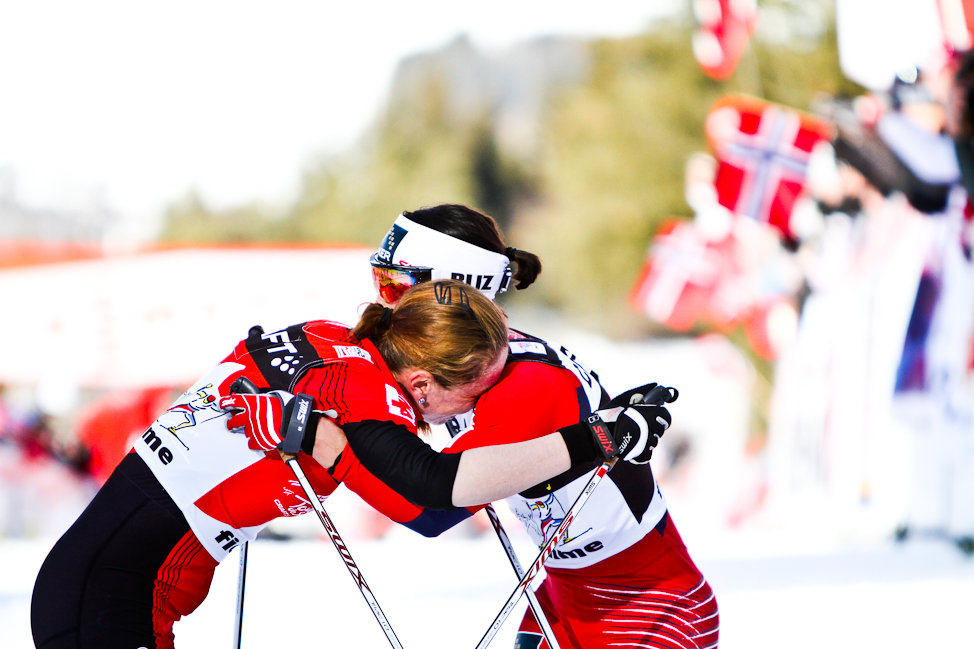
She hugged Weng and told her she had a great race at the finish.
“Before I started, I knew it!” Weng said to her of Diggins’s win.
Diggins smiled, and later stood on the podium between Weng and Bjørgen.
“I’m so happy with my day today. I’m so lucky to have the most amazing team,” Diggins said in a televised interview with FIS. “When you get to train with such cool people, that belief, that confidence, it opens up opportunities. And I had such a great opportunity.
“My coaches and staff work so hard. so when they gave me this opportunity I really had to take it,” she continued. “… It means a lot that when everything goes right you can ski with the best in the world. Hopefully this will mean a lot back home because I’m not special or different in any way. If I can do it, all the little kids back home, they can do it, too!”
While Norway occupied four of the top five, the team had six in the top 10, with Ragnhild Haga in eighth (+31.2) and Kari Øyre Slind in ninth (+32.0). Finland’s Krista Parmakoski placed sixth (+26.9) and Laura Mononen was 10th (+36.1), and Russia’s Yulia Tchekaleva placed seventh (+27.7).
The second U.S. woman in the top 15, Sadie Bjornsen broke through her pattern of 17th in the last three races and place 14th (+41.8). Liz Stephen (USST) scored points in 26th (+51.2) in her first “distance” race of the season.
Caitlin Patterson placed 38th for the U.S., Rosie Brennan (USST) was 48th, and Sophie Caldwell (USST) 59th, and Ida Sargent (USST) 67th.
Canada’s Cendrine Browne (NST U25 Team) 50th, Emily Nishikawa (World Cup B-team) 52nd, and Dahria Beatty (NST U25 Team) 62nd.
Diggins is now third in the mini-tour standings through two days of racing (21.6 seconds behind Weng in first and 0.9 seconds behind Østberg in second), with just Sunday’s 10 k classic pursuit to go, and Bjornsen improved to 12th.
Calle Halfvarsson (c) gets the win for the second day in a row, while teammate Marcus Hellner (l) is pleased to be on the podium for the first time this year. Russia’s Sergey Ustiugov third in the 10 k skate in Lillehammer. (Photo: FIS Cross Country/Twitter)
In the men’s 10 k classic to start the day, Calle Halfvarsson of Sweden made it two in a row, winning the first distance race of the mini tour by 0.8 seconds over teammate Marcus Hellner. The competition is the second day of the World Cup mini-tour, which will conclude on Sunday with a classic pursuit. Halfvarsson also won the classic sprint on the first day of racing. For Hellner, it’s a strong result for the former World Champion after two straight seasons where he only stood on the podium once a apiece.
Russia’s Sergey Ustiugov slotted into third with a hard closing kilometer, moving from fifth place and nearly nine seconds back at 8.3 k to the podium and only 6.7 seconds behind Halfvarsson at the finish.
That left Norway off the podium, but the home team swept the next three places with Finn Hagen Krogh (+7.4), Simen Hegsted Kruger (+13.2), and Martin Johnsrud Sundby (+13.5).
Alex Harvey was the top Canadian in 10th place (+23.5). Devon Kershaw and Lenny Valjas finished 40th (+1:16.7) and 42nd (+1:19.1), respectively, with Graeme Killick 64th (+1:46.6) and Knute Johnsgaard 73rd (+2:22.0). Bob Thompson and Andy Shields rounded out the Canadian roster in 88th and 89th.
Noah Hoffman led the way for the U.S. men, just outside the points in 33rd (+1:08.6). Erik Bjornsen was 45th (+1:22.2), followed by Simi Hamilton 69th (+1:55.8) and Eric Packer 78th (+2:28.7).
Visma Ski Classics: La Sgambeda 30 k Classic in Livigno
Tord Asle Gjerdalen (Team Santander) crosses the finish line first in Sgambeda in Livigno, Italy, on Dec. 3, 2016. (Photo: Visma Ski Classics)
The Visma Ski Classics series began last weekend in Pontresina, Switzerland, with 8 k time trials. Racing continued this weekend just down the road in Livigno, Italy, where racers competed in the second race in the series, La Sgambeda. Skiers encountered superb conditions and firm tracks following cold temperatures the night before.
In the women’s race, a mass start over five laps of a 6 k course, Britta Johansson Norgren of Team Lager 157 took the narrow victory over Katerina Smutná of Team Santander, reversing their finishing positions from Pontresina a week before. Norgren finished 1.3 seconds ahead of Smutná after the two of them broke away from the main pack on the course’s final hill. Sara Lindborg of Team Serneke secured third, 17.4 back of Norgren.
The men raced on the same five-lap, 30 k course as the women. The men’s race also came down to a breakaway on the final climb. Tord Asle Gjerdalen of Team Santander took the narrow victory, rebounding from his sixth-place finish in the Pontresina prologue. Ilya Chernousov of Team Pioneer Investments was 1.3 seconds back. Team Leaseplan’s Petter Eliassen was third (+2.7) after leading most of the race.
Norgren and Gjerdalen are now leading the individual standings, with Gjerdalen’s Team Santander the top team, as the Ski Classics series approaches a month-long holiday break. Racing resumes in early 2017.
Last year’s Team Tempo Prologue in Livigno, Italy, which Team Coop (in bib 1) won. This year, the team prologue will again open the Ski Classics series in Livigno on Saturday, followed by the shortened La Sgambeda classic race on Sunday. (Photo: Visma Ski Classics)
The 2016 Ski Classics kicks off with a doubleheader in Italy on Saturday and Sunday, and the marathon regulars are chomping at the bit to get started with the long-distance race series.
The 15-kilometer Proteam Prologue in Livigno, Italy, on Saturday opens the show for the marathon series, now called the Visma Ski Classics (with a new title sponsor in place of Swix), which has been extended to nine venues this season.
Seraina Boner of Team Coop (now called Team Exspirit) after winning the 2014 La Sgambeda in Italy last season. (Photo: Ski Classics)
On the women’s side, last season’s Ski Classics champion Katerina Smutna of the Czech Republic will be on the start line for the first races this weekend, but she will face plenty of competition. Team Exspirit’s Seraina Boner of Switzerland is eager to take back the overall title, which she has earned three times (2011, 2013 and 2014), beginning with La Sgambeda.
Poland’s World Cup star and the queen of the FIS Tour de Ski, Justyna Kowalczyk, will be doing several of the Ski Classics long-distance events this season with the Norwegian Team Santander headed by the Aukland brothers. And Britta Johansson Norgren of Sweden, who was on the podium at several of the Ski Classics events last season, is one to keep an eye on. Last season, she raced with the all women’s team Ski Pro Am, and this year she is a part of Sweden’s Lager 157 Ski Team, with teammates such as three-time Vasaloppet champion Jörgen Brink of Sweden.
Among the men, 2015 Ski Classics overall champion Petter Eliassen of Norway makes his season debut in Italy this weekend. He will have to fend off a large and deep field of competitors such as Norway’s 43-year-old marathon veteran Anders Aukland and his Santander teammates, including younger brother Jørgen Aukland, and former World Cup skiers Tord Asle Gjerdalen of Norway and Johan Olsson of Sweden.
Norwegian stayers such as Johan Kjölstad, Øystein Pettersen, Eldar Rønning, and John Kristian Dahl of Team United Bakeries, as well as Ski Classics veterans of Team Exspirit, including Daniel Richardsson, Anders Södergren and Jimmie Johnsson of Sweden and Norway’s Morten Eide Pedersen, will certainly do their best to make it a tough season opener from Day 1.
Two unique competitions in Livigno
The Prologue, in which the teams must field at least three racers to compete, was added last year, and is a team effort where the third person’s time determines the team result. The next day, on Sunday, the skiers embark on the first distance event, the now-24-kilometer classic technique La Sgambeda.
Team Santander’s Anders Aukland (c) after winning the 2014 La Sgambeda in Livigno, Italy. Johan Kjølstad (l) and Øystein Pettersen (r) both of Team United Bakeries, placed second and third, respectively. (Photo: Ski Classics)
Team Exspirit (previously known as Team Coop) won the prologue last year and is aiming to defend the title this year.
“We have had great preparations here in Livigno, skiing on the race course and acclimatizing to the high altitude,” team member Jimmie Johnsson said in a press release on Friday. “Of course, we’re aiming to defend our victory and we’re faster this season than ever before.”
Team Exspirit’s Seraina Boner won La Sgambeda last year after breaking away from the field on the hard climb at the turning point of the course. This year, the course is shortened to from 35 k to 24 k due to lack of snow and is also flatter. While Boner prefers more elevation gain, she was still optimistic before the race.
“The tougher course fits me better than the flatter one we have now,” she said. “But I will do my best, and I am really excited to finally start the long distance season together with my teammates.”
While the Team Prologue is only open to professional teams registered with the 2016 Ski Classics, La Sgambeda on Sunday is open to amateurs and pros alike.
Saturday’s Prologue will be held on the original course, but due to lack of snow in Livigno, the classic marathon on Sunday will be run on 6 k loops.
“Last season, seven of the nine Ski Classics events had to change their courses due to weather issues,” Ski Classics CEO David Nilsson in a press release earlier this week. “We can just cross our fingers that the political leaders at the environmental summit in Paris this week are able to make the right decision.”
For the 2016 season, there are 28 pro teams registered for the Ski Classics series.
After the season opener in Italy, the Ski Classics takes a break until the Jizerská Padesatka in Liberec, Czech Republic, on January 10, 2016. The race series concludes April 2 with Årefjällsloppet in Sweden as the season finale, as it has been for years. New this year is the Toblach/Dobbiaco Cortina, a 50 k classic race in Italy on Feb. 13.
Vasaloppet matters most
For Madshus racer John Kristian Dahl of Norway, who won the Vasaloppet two years ago, the 90 k race from Sälen to Mora in Sweden is the main goal for the 2016 season.
“It’s the longest and one of the oldest races in the circuit, and very special with the flats. That package makes it very unique, and difficult to win, too. In our world, it’s the championships in marathon skiing, and I’m happy that we have it every year,” Dahl said in an interview with Ski Classics earlier this fall.
Live streaming in English
In order for fans to follow the action live, Visma Ski Classics has launched the Live Streaming “Season Pass” available with English commentary on the app or the Tour Live Center at Visma skiclassics.com.
Therese Johaug of Norway said it had been a dream to compete in the Birkebeiner ever since she was a little girl. On Saturday her dream came true… and not only did she win, she set a five-minute course record. (Photo: Swix Ski Classics/Instagram)
The Birkebeiner, a legendary 54 k ski race from Rena to Lillehammer in Norway, has been running for 77 years. But that doesn’t mean that every year can’t bring something new.
Last year, the Birkebeiner was canceled due to extreme weather on the mountain summits in the middle of the race course. This year, weather was perfect and the snow was faster than ever, leading to course record times being set in both the men’s and women’s races.
The men’s race was won in 2:19:28 by Petter Eliassen, who also made history in another way: the Norwegian racer, representing team LeasPlanGo, also went without kickwax. It was the first time the race has ever been won on skis without grip, and probably among the first times such an attempt was even made.
“I was very unsure whether I would go without or with kick wax,” Eliassen told Norwegian broadcaster E24 after the finish. “But after talking with the guys on the team, we agreed that I would do it. It’s how I have been training all year.”
While other marathons such as the Vasaloppet in Sweden or the Marcialonga in Italy are routinely won on skate skis, or classic skis with only glidewax, the Birkebeiner is different. It gains 600 meters, or nearly 2000 feet, of altitude from the start to the high point at 34 k into the race, and the total climb is even greater than that because of a substantial descent from 19 to 27 kilometers which racers then must climb up from again.
Yet despite lacking kick wax and having to double pole the entire race, Eliassen still had the upper body strength at the end to beat out fellow Norwegian Martin Johnsrud Sundby by 10 seconds. John Kristian Dahl placed third, another five seconds back.
Eliassen built up a lead descending from Sjusjøen, but Sundby and Dahl caught back up to him and forced an exciting finish.
“It is quite special and very fun to win the Birken,” Eliassen told E24. “It’s a great, traditional race… It was a good race. We were a nice group that went along together the entire race.”
Sundby, who just finished up the World Cup season with the overall title, said he has a lot to learn for these long marathon races with such huge fields. He also said he’s still recovering, in some sense, from the illness that knocked him out of the first week of racing at World Championships back in February.
“I’m in good shape, but have not gotten myself up again,” he told Aftenposten. “I’ve tested a bit lately, and is quite far from where I am at my best.”
Beating the reigning World Cup champ does not tempt Eliassen to return to shorter distance racing, however. A former national team member, he finished World Cup Finals in Falun, Sweden, last year in eighth place. Then he shifted his focus, and it has paid off. He won the König Ludwig Lauf in Germany and the Vasaloppet in Sweden as well as the Birkebeiner this season.
“Now it’s long races that appeal to me,” he told Aftenposten. “That’s what I like and what suits me, and so I enjoy it very well with the team.”
In the women’s race, Therese Johaug competed in the Birkebeiner for her first time and won it handily; her time of 2:41:46 was also a course record. She broke the previous record by five minutes.
“It was a fantastic trip over the mountain,” she told NRK. “What a mood! It could not have been better with these surroundings. It was incredibly fun to dabble in Birken. It has been a dream since I was a little girl.”
Johaug is coming off of a successful World Cup season, including victories in both the 15 k skiathlon and the 30 k mass start classic competitions at World Championships. Like Sundby, she raced for Team United Bakeries at the Birkebeiner.
Austria’s Katerina Smutna was the runner-up in 2:44:27, and Seraina Boner of Switzerland placed third two seconds behind her.
Holly Brooks, an Alaskan racing for Team Santander, finished 11th in 02:58:25. Robyn Anderson of Stowe Vermont and VTXC finished in 3:16:00. Christina Turman, the interim head coach of the University of Alaska Fairbanks ski team, finished in 3:35:14.
The top Canadian result went to Brian McKeever, who finished in 2:34:39, good for 58th place in the elite wave. McKeever is a member of Canada’s Para-Nordic World Cup team and his guide, Erik Carleton, placed 110th in 2:41:11. Ian Murray of Rocky Mountain Racers crossed the line just over a minute later to place 121st in 2:42:27, while Philip Shaw of Club Ski Rosemère finished in 3:00:18.
Therese Johaug celebrates her dominant performance in Sunday’s 10 k classic in Kuusamo, Finland, which she won by more than 42 seconds over Norwegian teammate Marit Bjørgen.
In the opening distance race of the World Cup season, Therese Johaug of Norway dominated from the start and walked away with her first-ever World Cup win in a 10-kilometer classic.
From the moment Johaug, 26, set out on the course during Sunday’s race in Kuusamo, Finland, it was clear that the rest of the women’s field would be racing for second. Even the ever-dominant Marit Bjørgen of Norway, who was coming off a win in the 1.4 k classic sprint the day before, knew that Johaug was going to win.
“I knew after four kilometers that Therese was 25 seconds ahead and I understood I would be fighting for second place,” Bjørgen told FIS after finishing second, 42.2 seconds back from Johaug, who won in 25:47.2. “I was pushing as much as I could to take second place.”
The women’s 10 k classic podium on Sunday in Kuusamo, Finland: with winner Therese Johaug (l), runner-up Marit Bjørgen (c) and Charlotte Kalla in third. (Photo: FIS Cross Country/Twitter)
A two-time winner of the Kuusamo 10 k classic in 2005 and 2007 (the last time it was held was 2008), Bjørgen, who started last of 77 women, appeared to ski a very controlled-and-tactical race. She passed through the 3.1 k checkpoint in fourth behind Johaug in the lead, Poland’s Justyna Kowalczyk in second, and Sweden’s Charlotte Kalla in third.
At each subsequent time check, Bjørgen moved up in the rankings. She was in third at the halfway point and slid into second by 8.1 k, but only by a razor-thin margin of one-tenth of a second over eventual third-place finisher Kalla (+44.1).
Rounding the final bend, Bjørgen put in a hard kick and barely bested Kalla, finishing 1.9 seconds ahead of the her.
Bjørgen was the overall victor in last year’s “Ruka Triple” in Kuusamo. This year, there were just two races — both of which counted for full World Cup points. Bjørgen’s win on Saturday put her in the overall World Cup leader’s bib for 2014/2015, and she remained 70 points ahead of Johaug after Sunday.
Last year, a 5 k classic was held on Day 2, when Kowalczyk took the win, Bjørgen placed second and Johaug finished third.
On Sunday, Kowalczyk was consistently in second for the first half of the race. However, by 8.1 k, she had faded and slipped to fourth where she would ultimately finish.
“I thought that the gap will be more… It hurt, but it’s a good position [for the start of the season],” she wrote in on Facebook, according to a translation.
“I knew after four kilometers that … I would be fighting for second place.” — Marit Bjørgen, 2nd in Sunday’s 10 k classic after Norwegian teammate Therese Johaug
Knowing Johaug and how pumped she was about Sunday’s 10 k, Norwegian Woman’s Head Coach Egil Kristiansen worried she might start too hard.
“I noticed that she was very excited after Saturday’s sprint … I was almost afraid that she would open too hard,” Kristiansen told Langrenn.com, according to a translation. “The skis were good, technique set and everything was correct. I cannot remember the last [time] there was such a victory margin. A fantastic race.”
“I am really happy now because this is my first victory in [a 10 k] classic,” Johaug told FIS afterward. “I’ve never been to the top of the podium in this race [until] today.”
Approaching the finish, Johaug appeared fatigued, but continued to attack until the end. About a meter before the finish, she pumped her right fist into the air and let out a scream before collapsing her hands to her knees after the finish. She had essentially just won it — even with Bjørgen — still on course, she gave herself the liberty of a small celebration as her foot crossed the line.
“I think I’ve never been so good classical ever, especially in kick-double-pole,” Johaug told NRK. “I heard 20 seconds, then 30 and 40 … ‘This is your victory,’ I told myself.”
Bjørgen (l), Johaug (c) and Kalla get together after the women’s 10 k classic on Sunday, the first World Cup distance race of the season in Kuusamo, Finland.
Kalla, who did not compete in Saturday’s sprint race but swept three FIS races in Bruksvallarna the weekend before, had a stellar performance, nearly holding off Bjørgen. She told FIS after the race that she spent a lot of time working on her classic technique.
“I am very satisfied with the third place,” Kalla said. “I felt very good last week at the national opening and I’m glad I could keep the good shape to Ruka. I tried to do my very best today.”
Kristiansen had some praise for the 27-year-old Swede: “Charlotte’s strong and we knew in advance,” he told Espressen.se. “It’s good for us that we have two ahead of her.”
Norway took three of the top five, with Ingvild Flugstad Østberg in fifth, putting her third in the overall World Cup standings. Russia’s Yulia Tchekaleva finished sixth, Krista Parmakoski was the top Finnish woman in seventh, Norway’s Heidi Weng was eighth, Austria’s Katerina Smutna ninth, and Finland’s Kerttu Niskanen 10th.
With the opening weekend behind the World Cup athletes, they will move onto Lillehammer, Norway, for a three-day series next weekend, including freestyle sprints on Friday, 5/10 k freestyle races on Saturday, and 10/15 k classic pursuits on Sunday.
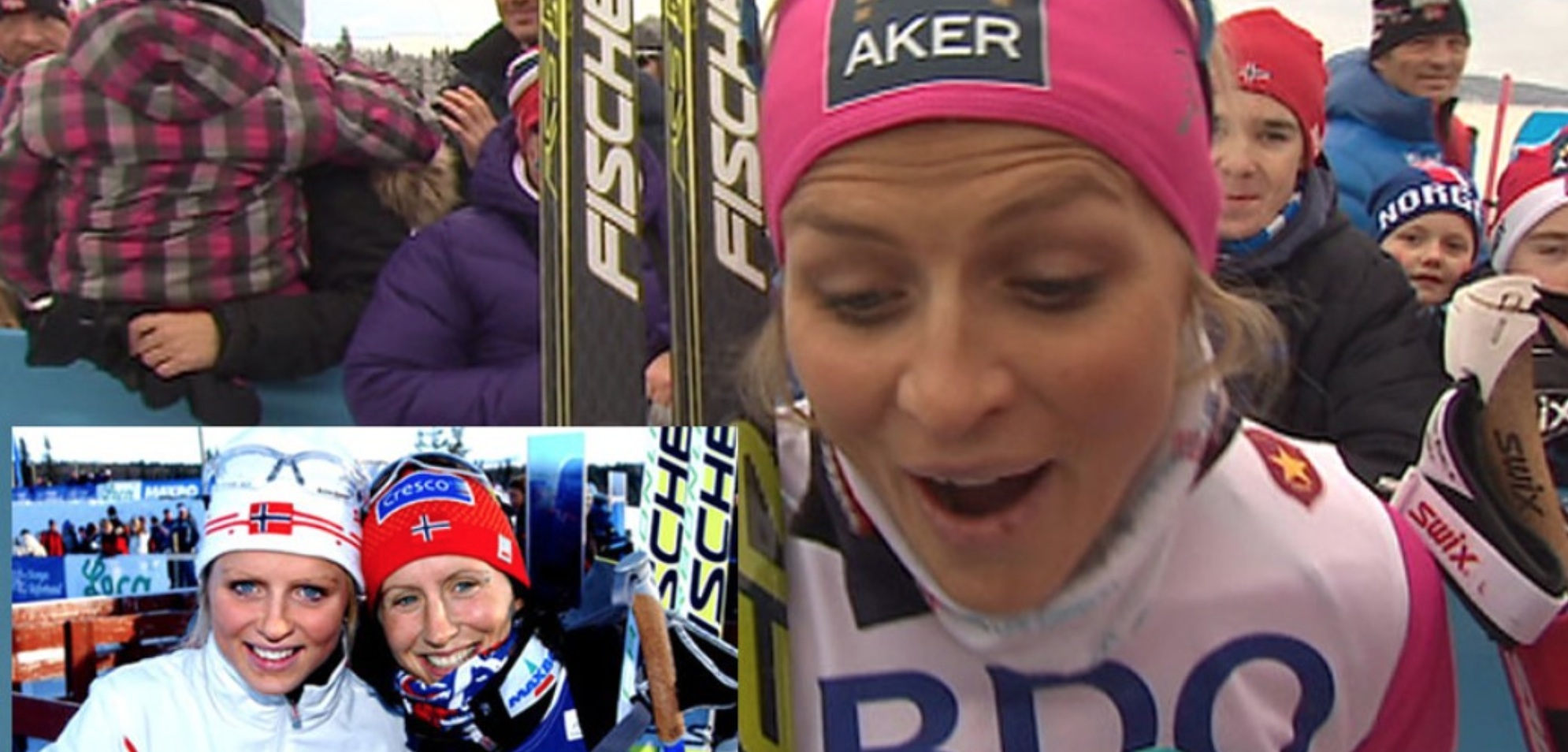
Therese Johaugs reacts when reporters show her a photo of herself and Marit Bjørgen from eight years ago in Beitostølen, the same place where Johaug won the opening race of the season on Friday. (Photo: NRK)
Therese Johaug started cracking up when reporters at Friday’s International Ski Federation (FIS) race in Beitostølen, Norway, showed her a photo of herself and Marit Bjørgen from eight years ago, also in Beitostølen.
The Norwegian national-team member was 18 at the time.
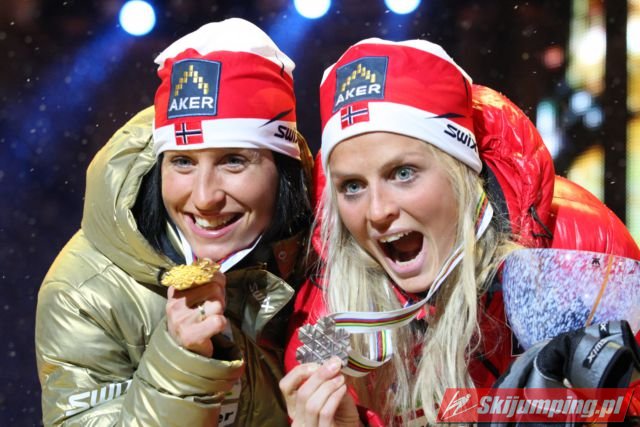
Marit Bjørgen (l) and Therese Johaug with their gold and silver medals from the 2011 World Championships 15 k in Oslo, Norway. (Photo: Wikimedia Commons)
“Oye … a lot has happened since then,” Johaug told NRK with a laugh. Now they’re not only best friends, they’re each other’s fiercest competitors.
On Friday, Johaug, 26, won the 10-kilometer classic in 26:36.1 minutes, 24.7 seconds ahead of Bjørgen in second. Like fellow Norwegian Martin Johnsrud Sundby, she won last season’s Tour de Ski as well as the overall World Cup title.
Six years ago, she was a junior competing in Beitostølen for the first time. She told reporters she had the same photo hanging on her wall at home.
Now she’s won the Beito distance opener for three consecutive years. Last year, Bjørgen didn’t compete; Johaug beat another teammate —Astrid Uhrenholdt Jacobsen — by more than 54 seconds for the win. In 2012, Johaug topped Bjørgen by 52.2 seconds. This was her fourth-straight time winning Beito’s 10 k classic, according to VG.
On Friday, Bjørgen led through 2 k, 2.7 seconds ahead of Johaug. By 6 k, Johaug took hold with a 5.3-second lead over Bjørgen and stayed in front to secure the first win of the season.
“It felt good; I managed to calm myself down and think, time and power,” Johaug told NRK, according to a translation. “It was fun to get it when I have worked so much this fall and along.”
“We have talked a lot about calming down … and trust that I’m fast enough, rather than skiing with my shoulders at the ear level and increasing the turnover. That doesn’t make you fast.” — Therese Johaug, after winning Friday’s 10 k classic FIS race in Beitostølen
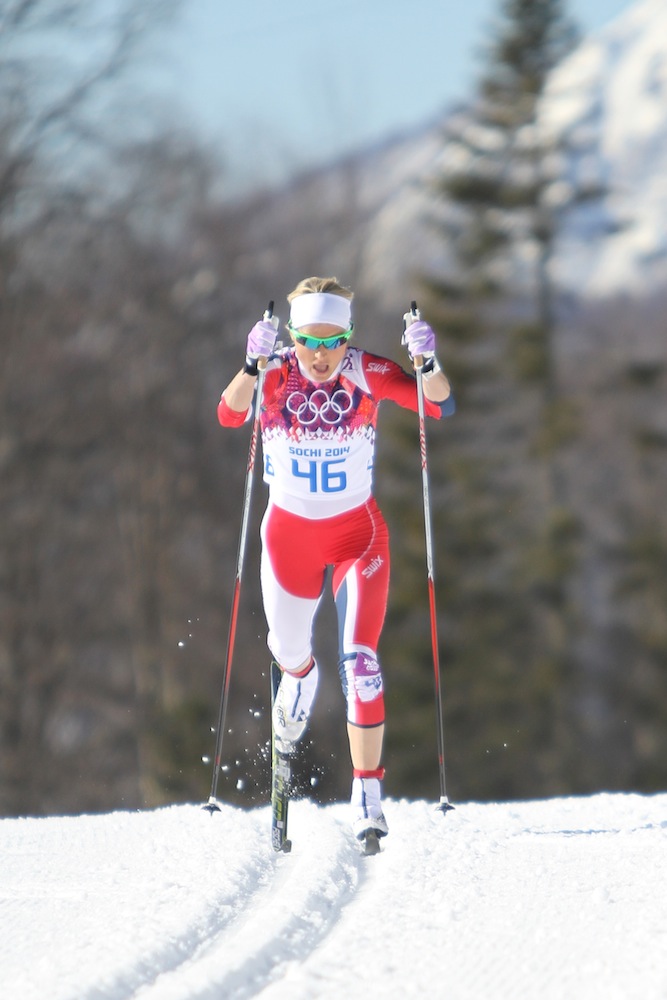
Johaug racing to bronze in the women’s 10 k classic at the 2014 Olympics in Sochi, Russia.
Since last season, she’s been working on her upper-body strength and spent long hours in the weight room and on the rollerski treadmill, she told VG. She also credited her psychologist, Britt Tajet-Foxell, for helping her progress.
“[The training] is paying off, and that’s really fun,” she said, according to a direct translation. “We have talked a lot about calming down and taking time to complete each kick and each pole plant, and trust that I’m fast enough, rather than skiing with my shoulders at the ear level and increasing the turnover. That doesn’t make you fast. Today I felt like I managed to do that, and that I was rewarded all the way.”
“Today, Therese was impossible to beat,” Bjørgen told VG.
As for how she felt: “It hurt, but that is somewhat expected,” Bjørgen said to NRK, adding that she felt normal, like in recent years.
“It’s not just anyone I measure myself against, so I know what I did today is good,” she told NRK.
“Next weekend it can be turned upside down,” Norwegian women’s coach Egil Kristiansen said. “Therese skied great today.”
Norway’s Heidi Weng took third, 44.8 seconds behind Johaug and 20 seconds back from Bjørgen. Germany’s Stefanie Böhler placed fourth and Martine Ek Hagen of Norway was fifth.
Rounding out the top 10, Katerina Smutna (Austria) was sixth, Claudia Nystad (Germany) finished seventh, Barbro Kvåle (Norway) emerged in eighth, Victoria Carl (Germany) was ninth, and Kari Vikhagen Gjeitnes (Norway) took 10th.
Jacobsen finished 14th.
“I’m not in good shape,” she told NRK. “It was hard all the way, and I feel half-empty. …There is a way to go forward; I know that it is there.”
Racing continues with 10/15 k freestyle races on Saturday and a classic sprint on Sunday.
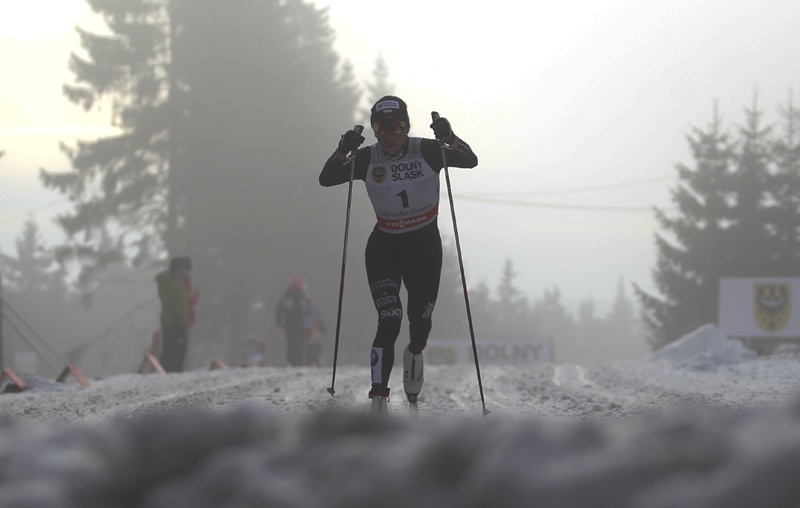
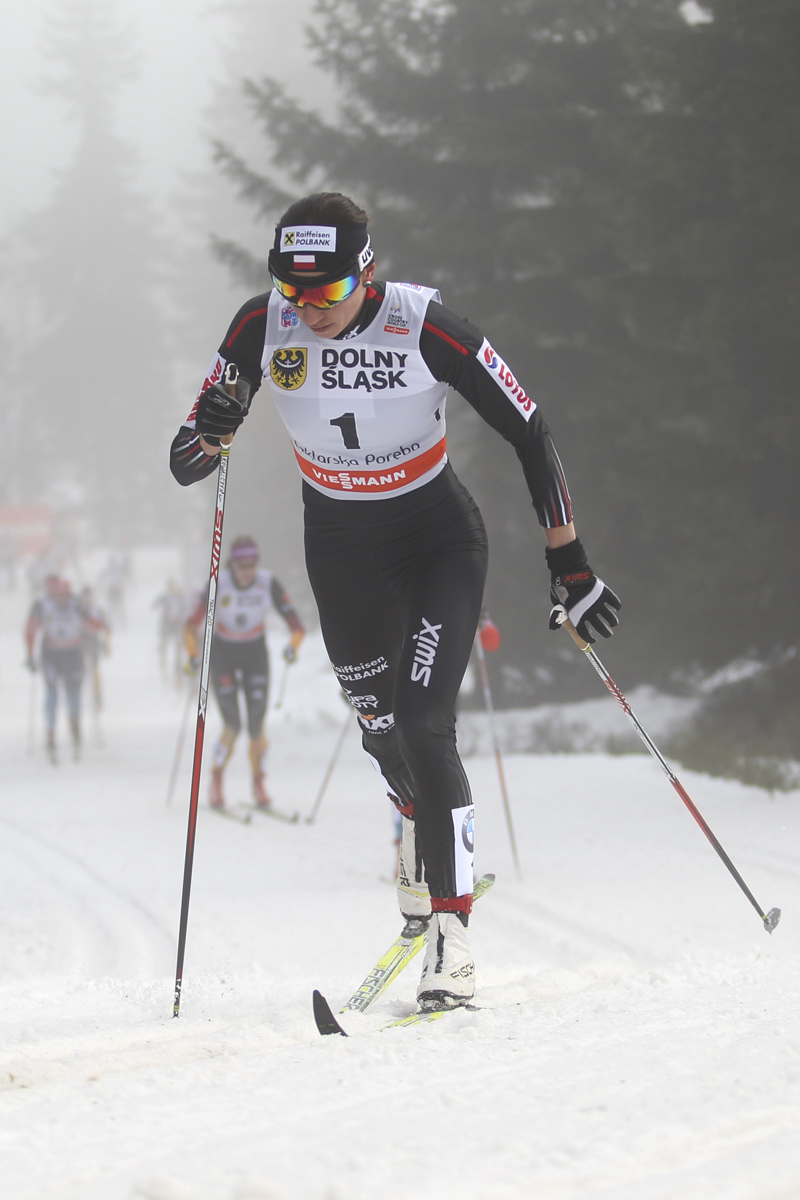
Poland’s Justyna Kowalczyk essentially led from start to finish of Sunday’s 10 k classic mass start at the World Cup in Szklarska Poreba, Poland. (Photo: Fischer/NordicFocus)
It’s not easy being Justyna Kowalczyk — always breaking trail, always having the weight of Poland on her, and in a classic distance race at home on her birthday without any Scandinavians in the field? Forget about it.
Kowalczyk was easily the favorite for Sunday’s World Cup 10-kilometer classic mass start in Szklarska Poręba, Poland, nearly two years after she won the same race there. That didn’t make winning any easier.
Poland’s Justyna Kowalczyk breaking away to a victory in Sunday’s 10 k classic mass start at the World Cup in Szklarska Poreba, Poland. Russia’s Yulia Tchekaleva (behind) and Germany’s Denise Herrmann (second from l) remained closest to her for most of the race. (Photo: Fischer/NordicFocus)
With noticeably slower skis, lacking glide on pea-soup, 35-plus degree afternoon, Kowalczyk relied on kick and her unmistakable stride on her 31st birthday. That didn’t help her on the long downhill on the last third of each 2.7 k loop, but she was able to nail the two climbs.
“The person who first blazes trail, it costs a lot of strength and speed,” Kowalczyk’s said in a post-race interview with WP Poland, according to a translation. “Therefore, at the beginning of the second and third [lap] athletes stuck to me.”
Lucky for her, Kowalczyk’s kick wore off as she continued through the four-lap race — just as she was warming up. After immediately taking control and skiing off the front of the mass start, Kowalczyk couldn’t get more than a few strides ahead of Russia’s Yulia Tchekaleva on the first lap. By the downhill, Tchekaleva quickly soared up alongside Kowalczyk, then past her to lap through the stadium 0.6 seconds ahead in first.
Tchekaleva’s lead was short-lived. By the 4.2 k checkpoint, Kowalczyk had gapped her and everyone else by nearly 12 seconds; Tchekaleva was skiing in second and Germany’s Denise Herrmann was 13.4 seconds back in third. American Liz Stephen led a chase pack in fourth, another 10 seconds behind.
“I have never started on the first line of a World Cup mass start before, so that was really fun, and the pace went out hot, but I never got swallowed up in the mass like I think I would have if I had started back in the pack,” Stephen wrote in an email. “Justyna was on a mission today and just never looked back.
“The fans were so loud and into it out there today,” Stephen added, after eventually placing sixth, her career best in an outright World Cup. “Especially as it was Justyna’s birthday today, too.”
Nearly 30 seconds ahead of Tchekaleva early in the first lap, and 41 seconds up on Herrmann in third, Kowalczyk looked back occasionally — giving a glance back as before picking up the maximum bonus points at 6.9 k. Unless something tragic happened, this race was in the bag, but she didn’t let off until striding blissfully into the stadium for the last time.
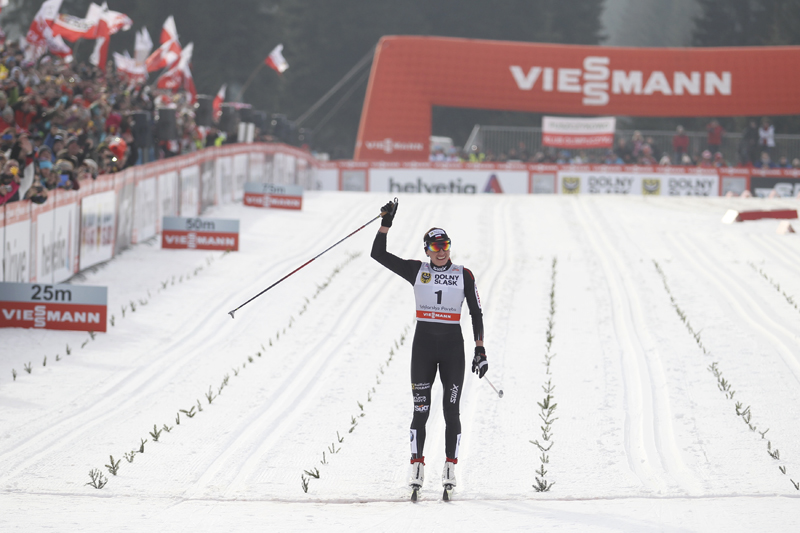
Upon finishing first in 34:43.2 without anyone contenders in sight, Kowalczyk waved her arms in the air. Then she stopped, bent over her poles for a millisecond to catch her breath and looked back on the course, waiting patiently for Tchekaleva to follow in second.
Tchekaleva came through uncontested 41.8 seconds later, and another Russian Julia Ivanova rounded out the podium in third, 1:15.2 seconds back from Kowalczyk.
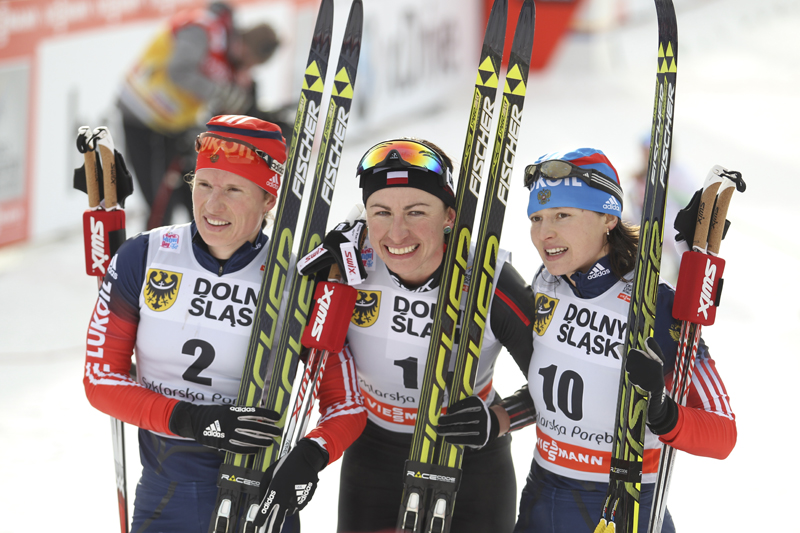
Women’s 10 k classic mass start podium at Sunday’s World Cup in Szklarska Poreba, Poland: winner Justyna Kowalczyk (c), and Russia’s Yulia Tchekaleva (l) in second and Julia Ivanova in third. (Photo: Fischer/NordicFocus)
Ivanova had caught and challenged Herrmann with Germany’s Claudia Nystad and Stephen on the last lap, then ended up dropping Herrmann before the finish. Herrmann placed fourth, four seconds later, and Nystad was another two seconds back in fifth. Stephen placed sixth, 1:26.4 after Kowalczyk, edging Germany’s Stefanie Boehler by 2 seconds.
Nystad originally led the chase, along with Stephen, up the final climb. After absorbing Herrmann as part of their group, they forged ahead with Stephen up front and Tchekaleva in their sights — but she was at least 25 seconds out of range.
“I was feeling really good for most of the race until the very top of the uphill on the last lap when Julia Ivanova went by me and as I tried to hang I just fell apart a bit,” Stephen explained. “[I] didn’t push over the top as much as I needed to to hold off the coming Germans.”
Welcoming Tchekaleva across the line, Kowalczyk gave her a hug. The birthday girl was excited, but not visibly ecstatic about her World Cup win in Poland. It was, after all, just another race before the Olympics — minus the Norwegians, Finns and Swedes.
“Maybe you cannot see it, but I am very touched,” Kowalczyk told WP. “I learned to have control emotions. I once cried today when I got the cake, the flowers, but the second time I will not cry. For such moments the training does it all.”
So she got a cake — but did she eat it, too?
“It’s not the best thing for me right after the race,” Kowalczyk said with a smile, adding she’ll, “eat a double portion for my mom.”
As for the victory, Kowalczyk said it was “nice,” but “Sochi is still far away.”
The victory elevated her to third in the overall World Cup standings behind Norway’s Therese Johaug and Astrid Uhrenholdt Jacobsen, respectively, and four points ahead of Marit Bjørgen. At least Johaug and Bjørgen aren’t expected to compete at the final World Cup Feb. 1-2 in Toblach, Italy, before the Olympics.
Also in the top 10, Russia’s Natalia Zhukova placed eighth (+1:47.8), American Ida Sargent notched a career-best distance result of ninth (+1:49.3), and Austria’s Katerina Smutna was 10th (+1:49.5).
Justyna Kowalczyk celebrates a 42-second victory in Sunday’s 10 k classic mass start on her 31st birthday at home in Szklarska Poreba, Poland. (Photo: Fischer/NordicFocus)
Eventual men’s winner, Dakota Blackhorse-von Jess (Bend Endurance Academy) qualified for the heats with the fourth-fastest qualifying time
CANMORE, Alberta — Frozen Thunder, the 2.2-kilometer snow-covered course at the Canmore Nordic Centre, has been buzzing with activity for the last week and headlined by a classic-sprint showdown between some of the top Canadian and U.S. nordic skiers on Thursday. Here’s what you may have missed:
Dakota Blackhorse-von Jess topped two U.S. Ski Team members en route to the men’s victory, winning the unofficial first race of the season by a bit of a landslide. Under warming skies, he stuck with his classic skis on the two-lap course, while eventual runner-up Andy Newell (who won the qualifier by 3 seconds) and third-place finisher Simi Hamilton slipped behind on skate skis.
“Andy made a great jump at the start of the second lap, but I was able to use the advantage of kick to accelerate away over the top of the big climb and again on the second hill to keep the advantage,” Blackhorse-von Jess, of the Bend Endurance Academy in Oregon, wrote in an email. “It may have helped that the sun came out and started NUKING right at the start of the A-final as it slowed the snow down and probably made it much more difficult to double pole up the first hill. And I had good skis, which is no small thing.”
“[Thursday] was a great tune-up,” he added. “We’ve really been focusing the last 4 years on systematically building my aerobic fitness. … Racing is so much fun, being back on the road and seeing all my friends and getting back in the wax room with Scott Johnston and Sam Naney of MOD, and for sure being in the mix with Andy and Sim who set the bar for the rest of us was awesome. And let’s be honest – winning a race against those two, even in a tune up event, even with a relatively small field, even in October, it still makes a good time even better.”
For more about the men’s and women’s sprints, check out our race recap and other photos.
The start area of Thursday’s classic sprint race between several members of the Canadian and U.S. nordic teams on Frozen Thunder, a manmade loop at the Canmore Nordic Centre in Canmore, Alberta.
Sophie Caldwell of the U.S. Ski Team (USST) and Stratton Mountain School T2 Team (SMST2) on her way to winning Thursday’s qualifier. The USST rookie placed third in the A-final.
Annie Pokorny (SMST2) in qualification at Thursday’s Frozen Thunder classic sprint in Canmore, Alberta.
Erika Flowers (SMST2) in qualification
U.S. Ski Team A-teamer Andy Newell on his way to winning Thursday’s classic sprint qualifier by 3 seconds over Stratton Mountain School T2 teammate Skyler Davis (not shown). Newell went on to place second in the A-final.
Skyler Davis (SMST2) in the qualifier
Eric Packer (SMST2) in qualification
Ida Sargent of the U.S. Ski Team and Craftsbury Green Racing Project, who qualified in third and went on to place second overall in Thursday’s classic sprint at Frozen Thunder.
Up the hill at Frozen Thunder
Simi Hamilton (USST/SMST2), who had the third fastest qualifying time and went on to place third overall.
Eventual men’s winner, Dakota Blackhorse-von Jess (Bend Endurance Academy) qualified for the heats with the fourth-fastest qualifying time
From left to right: Amanda Ammar (Team Ninja), Ida Sargent (USST/CGRP), Andrea Dupont (Rocky Mountain Racers), Marlis Kromm (AWCA) in the quarterfinals
From left to right: Andy Newell (USST/SMST2), Eric Packer (SMST2), and an AWCA skier in the quarterfinals
Sophie Caldwell (USST/SMS T2), Olivia Bouffard-Nesbitt, and Maya MacIsaac Jones in quarterfinals
Liz Stephen (USST) handily winning the women’s B-final
Finishing stretch of one of the men’s semifinals. From left to right: Simi Hamilton, Sam Naney (MOD), Skyler Davis, Michael Somppi (AWCA/NST).
Dakota Blackhorse-von Jess, who ultimately won the men’s A-final
With one lap to go, Dakota Blackhorse-von Jess (Bend Endurance Academy) leads the men’s A-final of the Frozen Thunder classic sprint at the Canmore Nordic Centre in Canmore, Alberta. U.S. Ski Team and Stratton Mountain T2 teammates Simi Hamilton and Andy Newell follow, along with Sam Naney (Methow Olympic Development). (Photo: Pavlina Sudrich)
Note: This article has been correct to recognize Sophie Caldwell (USST/SMST2) as the women’s qualifier winner.
CANMORE, Alberta – The 2013-14 ski season unofficially kicked off Thursday with a classic sprint on snow at Frozen Thunder in Canmore, Alberta. While a fairly low-key event overall, it served as a tune-up race for many of the skiers as they head into the World Cup races in Finland or U.S. SuperTour openers in West Yellowstone, Mont., in late November.
Racing two laps around a shortened version of the 2.2-kilometer Frozen Thunder loop, skiers completed the course in 4 to 5 minutes for the women, and roughly 30 seconds faster for the men, making for a long sprint course to start the season.
Katerina Smutna of Austria leading the women’s A-final at the Frozen Thunder classic sprint on Thursday in Canmore, Alberta. U.S. Ski Team members Ida Sargent and Sophie Caldwell chase to finish second and third, respectively. (Photo: Pavlina Sudrich)
As Caitlin Gregg of the Methow Olympic Development team in Washington explained, the variety of terrain on the course, with plenty of uphills, downhills and turns, made for a quality course. However, the two-loop experience made for a unique mental challenge of staying psyched for big hills the second time around.
To deal with possible crowding issues in the qualifiers, race organizers used a unique starting strategy. After the first five skiers, they left a larger time gap than usual before starting the next of five racers to space out the field.
The field of 34 women raced first. Sophie Caldwell of the U.S. Ski Team (USST) and Stratton Mountain School T2 Team (SMST2) won qualification by just over a second, followed by Austrian Katerina Smutna and Ida Sargent (USST/Craftsbury Green Racing Project) rounding out the top three.
The men’s field was somewhat larger with 54 racers, and like last year, saw a combination of skate and classic equipment used among the top racers. Andy Newell (USST/SMST2) won the qualifier on skate skis by more than 3 seconds. SMST2 teammates Skyler Davis and Simi Hamilton (USST) followed up in second and third.
Only 16 men and 16 women moved onto the heats. As a result, many of the less sprint-endowed racers came up with alternate plans for their workout that day. Some moved on to interval sessions, while others simply decided to save up energy for Friday’s classic-distance time trial. However, many skiers were impressed with the organization of the sprint.
Sargent appreciated the trademark low-key, high-organization style of an event run at the Canmore Nordic Centre. “The race this morning was very chill but also very well organized and well run,” she said. “They did a great job keeping the schedule rolling which can be tricky with a two-lap course.”
After leading much of the A-final, Smutna ended up with the win, while the Americans showed their strength, with Sargent finishing second, Caldwell placing third and Liz Stephen (USST) in fifth. Alysson Marshall of the Canadian National Senior Development Team and Alberta World Cup Academy was the top Canadian in fourth, with Olivia Bouffard-Nesbitt took sixth and 2013 World Championships team member Andrea Dupont was seventh. American Jessie Diggins (USST/SMST2) did not race due to a cold, and Canadian World Cup team member Perianne Jones did not start. Her Canmore-based teammates, Lenny Valjas and Ivan Babikov were not on the start list, and Dasha Gaiazova is in Quebec.
On the men’s side, several skiers were strong on Thursday. Dakota Blackhorse-von Jess (Bend Endurance Academy) looked especially strong in winning the A-final by a large margin on classic skis. He was the only one of the top three on classic skis. Both Newell and Simi Hamilton used skate skis for the qualification and final to end up second and third, respectively.
Across the board, U.S. and Canadian skiers appreciated the chance to mix it up on snow before the season starts in earnest.
“It was really great to have everybody in town with the US skiers and even some Austrian skiers in the race,” Dupont said.
On the significance of an October race, Sargent said, “I was less concerned with results than trying to go hard and get out some of those racing tweaks like remembering how to warm up, test wax, and stay fueled on between sprint heats.”
Finally, as a footnote to a race well run, several teams showed off their new season’s spandex. The U.S. team showcased their new uniforms with electric blue accents for men and pink accents for the women, while Team Ninja, the band of independent skiers based out of Canmore, showed up in suits adorned with pink and white snowflakes, and ninjas.
Alysson Marshall (l) of the Canadian national team and Alberta World Cup Academy and Jennie Bender of the Bridger Ski Foundation (r) lead their quarterfinal in the Frozen Thunder classic sprint on Thursday at the Canmore Nordic Centre in Canmore, Alberta. Chandra Crawford (second from l) and Annie Pokorny (SMST2) follow. (Photo: Pavlina Sudrich)
Sophie Caldwell (USST/SMST2) leads her semifinal in the classic sprint at Frozen Thunder on Thursday. Olivia Bouffard-Nesbitt chases, along with Canadian Senior Development Team member Alysson Marshall (AWCA) and Crawford (not pictured). (Photo: Pavlina Sudrich)
In the men’s quarterfinals on Thursday, Phil Widmer (CNST/AWCA) leads teammate Jesse Cockney (second from l), Dakota Blackhorse-von Jess (Bend Endurance Academy) and Canadian Para Nordic skier Brian McKeever (r). (Photo: Pavlina Sudrich)
In the men’s quarterfinals on Thursday, Phil Widmer (CNST/AWCA) leads teammate Jesse Cockney (second from l), Dakota Blackhorse-von Jess (Bend Endurance Academy) and Canadian Para Nordic skier Brian McKeever (r). (Photo: Pavlina Sudrich)
In another men’s quarterfinal, Andy Newell (USST/SMST2) leads Patrick Stewart-Jones (NST/AWCA), Eric Packer (SMST2), and Sebastian Townsend (AWCA). (Photo: Pavlina Sudrich)
Katie is a Canadian contributor at FasterSkier. Hailing from Minnesota, she raced for Dartmouth College and Sun Valley before turning her energies to climbing (and becoming the fastest known woman to ascend Mt. Rainier in Washington). Now based in Canmore, Alberta, she is an athlete ambassador for Millet and works as a mountain guide in Alaska, Washington and South America.
Justyna Kowalczyk (POL) (l) and Marit Bjoergen (NOR) (r) hugging it out after the 9 k freestyle pursuit final climb of this year's Tour de Ski at Alpe Cermis, Italy. Kowalczyk was second in the stage, and Bjorgen was third after teammate Therese Johaug, who won the climb.
Justyna Kowalczyk didn’t have to say a word. Marit Bjørgen knew it was on.
Kowalczyk, the three-time defending Tour de Ski champion from Poland, had spent the better part of the last two weeks recovering from her most recent Tour victory. Bjørgen, the Tour de Ski runner-up, had done the same, skipping last weekend’s races in Milan, Italy, to prepare for Otepää, Estonia.
While the two rivals didn’t face off until the final of Saturday’s 1.2-kilometer classic sprint – the first of two World Cup races in Otepää this weekend – they competed against each other from the start.
Bjørgen won the qualifier in 3:22.10. Kowalczyk clocked the second fastest time, 0.55 seconds back. In the end, Kowalczyk took the sprint victory by 0.1 seconds over Bjørgen in 3:18.4, but their road to the final built plenty of suspense.
The quarterfinals went as expected, with Bjørgen and Kowalczyk winning their respective heats. The semifinals were another story.
After Bjørgen placed third in the first semifinal, Kowalczyk saw an opportunity. Bjørgen needed her time to hold up to secure a lucky-loser spot in the final; Kowalczyk could put down a faster time to eliminate that possibility.
The soon-to-be-29-year-old from Poland (Kowalczyk’s birthday is on Monday) charged out of the gate in the second semifinal, setting a fast pace that Maiken Caspersen Falla (FIN) initially hung onto. By the end of mostly double-pole loop, Kowalczyk emerged as the winner with Katerina Smutna (AUT) and Aino-Kaisa Saarinen (FIN) 0.3 seconds behind.
All three advanced to the final, as did Bjørgen.
There, the Kowalczyk and Bjørgen met for an anticipated showdown with four others: Smutna, Saarinen, Natalia Matveeva (RUS) and Mona-Liisa Malvalehto (FIN).
From the starting gun, Matveeva initially set the pace. Kowalczyk caught up on the first climb and extended her lead over the top. Meanwhile, Bjørgen simply waited, hovering around third.
Before their final descent into the stadium, Bjørgen made sure she was in a position to get even with Kowalczyk and moved ahead to tie her lead. As the two entered the stadium, Kowalczyk led the tight pack of four once again, with Saarinen closing from behind.
But Kowalczyk wasn’t likely concerned about Saarinen or Matveeva, who were mostly contending for third. She had Bjørgen on her tail.
Staying ahead to the finish, Kowalczyk threw up her hands in victory. She had done it, even if by just a tenth of a second. Matveeva was third in a photo finish with Saarinen, both 0.9 seconds behind Kowalczyk. Smutna placed fifth (+1.9) and Malvalehto was sixth (+10.8).
In an interview with the International Ski Federation (FIS) after the race, Kowalczyk didn’t have many words. She was happy to win a sprint in Otepää after winning four distance races there before. As for ranking second to Bjørgen in the overall World Cup standings by 81 points, Kowalczyk simply stated that she would keep competing.
“To think about this now,” she began. “We will see.”
Kowalczyk added that the recovery did her well and her fitness was in tact.
“After [the] Tour de Ski, I was only resting in my bed,” she said. “Now I’m feeling better and better.”
Bjørgen told reporters she felt a little tired last week, but was pleased with winning the qualifier and skiing well in the heats. She said Kowalczyk was simply better on Saturday.
“I thought that I could take her, and then it’s annoying when it does not work,” Bjørgen said in a translated interview with NRK. “But there are small margins between us. Kowalczyk is very strong.”
As for Sunday’s 10 k classic individual start, Bjørgen said to expect a similar contest.
“I’m looking forward to tomorrow’s race. Last year it was very good for me,” Bjørgen told FIS, referring to the previous 10 k classic in Otepää, where she was second to Kowalczyk.
“I expect to be fighting again with Justyna. Let’s see who is stronger tomorrow,” she said.
In Bjørgen’s semifinal on Saturday, Malvalehto edged Matveeva at the line for the win, and Bjørgen finished 0.2 seconds later. American Kikkan Randall, the overall sprint leader by nearly 100 points, found herself in a tough position from the beginning of the same semifinal. She started in an outside lane and quickly skied from the back of the six-person pack.
Following Ingvild Flugstad Oestberg (NOR), who mostly sat in fourth, Randall moved up to fifth before the last climb. As the leaders skied into the stadium, Randall found the gap was too much to overcome despite a strong double-pole effort. She finished fifth (+2.5) behind Oestberg (+0.9), who also failed to advance.
“I felt decent; the qualifier was probably the best part of the day for me,” Randall told FasterSkier after the race, referring to her seventh-place qualifying result. “The quarters were pretty good, [but] in the semis, I ran out of gas.”
Ninety-three points ahead of Matveeva as the leading World Cup sprinter, Randall acknowledged that finishing ninth overall didn’t help her. In just her second time missing the finals all season, she also kept it in perspective.
“It’s a big focus of season to hold onto that jersey, so yeah … [it] could have gone a bit better,” she said. “Especially for classic, though, it’s still one of my better results.”
In just three classic sprints this season, Randall fared better once – with a fourth-place finish in Kuusamo, Finland. She was ninth in the classic sprint in Oberstdorf, Germany, which opened the Tour de Ski.
“It’s funny how quick your expectations change,” Randall said, referring to her stellar year on the World Cup this winter. “[You] get used to top results.”
Austria made modest gains on the World Cup scene last year due mostly to one man – Bernhard Tritscher. The speedy Austrian had style, rocking a fluorescent yellow headband in his breakout rookie World Cup season, collecting 85 World Cup points, all in skate sprints.
Similar to a lot of young sprinters, 23 year old Tritscher has serious qualifying speed, picking up five top 15 qualifying results, including a surprising qualifying win during the skate sprint in Toblach, Italy, on the Tour de Ski before dropping to 11th on the day.
Tritscher also paired up with Austrian A-Team member Harald Wurm to finish 4th in the Dusseldorf team sprint, out-gunning the Russians second team of Nikita Kruikov and Andrey Parfenov to the line.
As for the Austrian women, Katerina Smutna was the only game in town. She was fairly consistent in sprinting, but she took a step backwards in her results. Smutna regularly qualifies quickly, but last season she couldn’t seem to manage to turn her spot in the rounds into top 10 or even top 20 results.
Nevertheless, she is consistent, picking up points in 14 World Cup races, but never making the next step. She failed to record a single top 10 this season, which crushed any chance at doing much better than her 43rd place in the World Cup overall.
What You Need To Know for This Season
Tritscher has plenty of skate speed, but can’t really classic sprint – he failed to qualify in the kick-and-glide technique. He contested only one classic sprint, in Oberhof, Germany, during the Tour de Ski finishing 38th.
The Austrian men have nicknamed themselves ‘The Machines’ and have been releasing training videos on YouTube, as well as doing some solid mountain biking.
As well, Tritscher and Smutna won the ‘Sk8 the Ring’ rollerski race on an auto-racing track in Salzberg, Austria, in September against some solid competition. Tritscher’s finishing straight move was even compared to Petter Northug, no small complement (or insult, depending on your view of the Norwegian).
While the Austrian cross country ski program is by now so far removed from the scandal, it is worth mentioning that the ongoing Walter Mayer saga finally came to an end, with the dishonored coach being sentenced to a jail term of 15 months.
Who You Should Watch
Bernhard Tritscher could easily be a force this season. He’s part of the next wave of the sprint generation that includes rising stars such as Italian Federico Pellegrino and Canadian Len Valjas, and he has skate speed to burn.
While a sophomore slump isn’t out of the question for the classic-impaired Austrian, his earned experience on the World Cup last season should be a boost for the upcoming campaign, as well as his long-term prospects.
Oh, and Tritscher has been doing some light strength work in the off-season – other skiers might want to watch out.
Before it was all the rage to pile on the Russians for doping transgressions, the Austrians were the preferred whipping boys, and man, did they ever get whipped. This was mostly due to one Walter Mayer, who just couldn’t leave well enough alone, embroiling himself in scandal in the 2002 and 2006 Olympic Games. Although, in 2006 he at least made it exciting, in a way that cross-country skiers rarely do. If that wasn’t enough, good ol’ Christian Hoffmann is under suspicion yet again for his possible involvement in doping.
NOT the way you want your FIS profile to look…
However, one Austrian that needs to be mentioned for the right reasons (i.e. skiing fast and clean) is Katerina Smutna. She accounted for all 210 points the women scored, remains the only woman on the Austrian World Cup Team, and was a very strong sprinter for the full season. Basically, she was a pretty big bright spot on a team devoid of very much bright.
What You Should Know For This Season
Jurgen Pinter returned at the end of the season from – surprise, surprise – a doping ban. Even if he does help the boys make a relay team at World Championships, don’t expect them to get far without a quick trip to doping control.
Also, Smutna is back, with one more year of experience under her belt and an axe to grind after making only two A-finals last year, one in Canmore, and the other in Stockholm, at the World Cup Final.
Who You Should Watch
Without a doubt Katerina Smutna. She made some solid moves last year, and don’t be surprised if she comes out swinging in the first sprint race of the season. For an elite sprinter to really rack up the points, you have to be consistently in the top 10 – Smutna is close, and this season will show whether she is simply a solid top 30 skier or a true contender.