From the FasterSkier archive — posts syndicated from athletes’ and coaches’ own blogs between 2004 and 2012, kept online as published. Current coverage is at fasterskier.com.
Prince of Quebec Alex Harvey and his protege on the Canadian team, Tony Cyr, check in with us after a three-day weekend of racing in Germany. We went kinda long. Also: We have a first-of-its-kind waxing and service report from U.S. Ski Team technician Eli Brown.
Let us know what you think: We’re at devon@fasterskier.com and nat@fasterskier.com. We’ll be back after another weekend of racing in Switzerland before the World Cup circuit heads to North America.
They’ve reached the summit — the athletes, have, anyway. Devon certainly has not, thanks to frozen pipes in his Oslo apartment. He and Nat persevere to bring you the recap of this year’s final Tour de Ski stages, which featured some spicy and sloppy racing in Italy. Stay tuned til the end for an ode to Le Gruyère cheese.
Next week, during the break from the World Cup, we’ll have a mailbag episode. Send us your questions at nat@fasterskier.com and devon@fasterskier.com. Have a great week.
This is the end. Of the 2023 racing season. Devon and Nat go without guests and are here to take you through the last three events of the winter in Lahti, Finland. And we cover a couple of retirement announcements from U.S. skiers.
We’re taking a little break after this but, we promise: We won’t leave you hanging for the whole off-season. Stay tuned for more regular episodes over the course of the spring and summer, and we’ll be back in a few weeks for a 2023 season recap. Tell us your favorite memories from this year — get at us at devon@fasterskier.com and nat@fasterskier.com.
This World Cup coverage is made possible through the generous support of Marty and Kathy Hall and A Hall Mark of Excellence Award. To learn more about A Hall Mark of Excellence Award, or to learn how you can support FasterSkier’s coverage, please contact info@fasterskier.com.
Today marked the end: at the completion of today’s women’s 20 kilometer Classic mass start in Lahti, Finland, all unanswered questions would be resolved. There would not be any waiting until next week, any re-group and re-deploy, any revised strategies. It was now, or never for the 2022-2023 season. Hanging in the balance would be the standings in the overall World Cup Crystal Globe chase, and the Distance Crystal Globe.
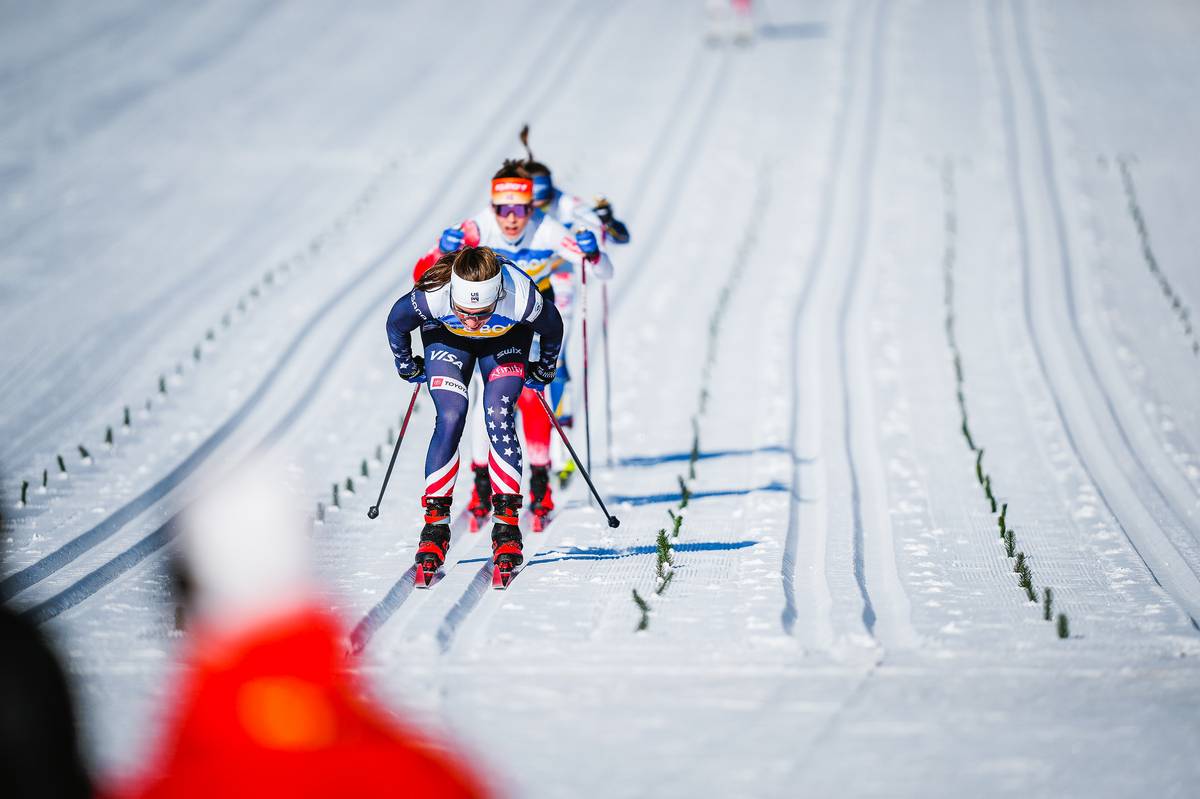
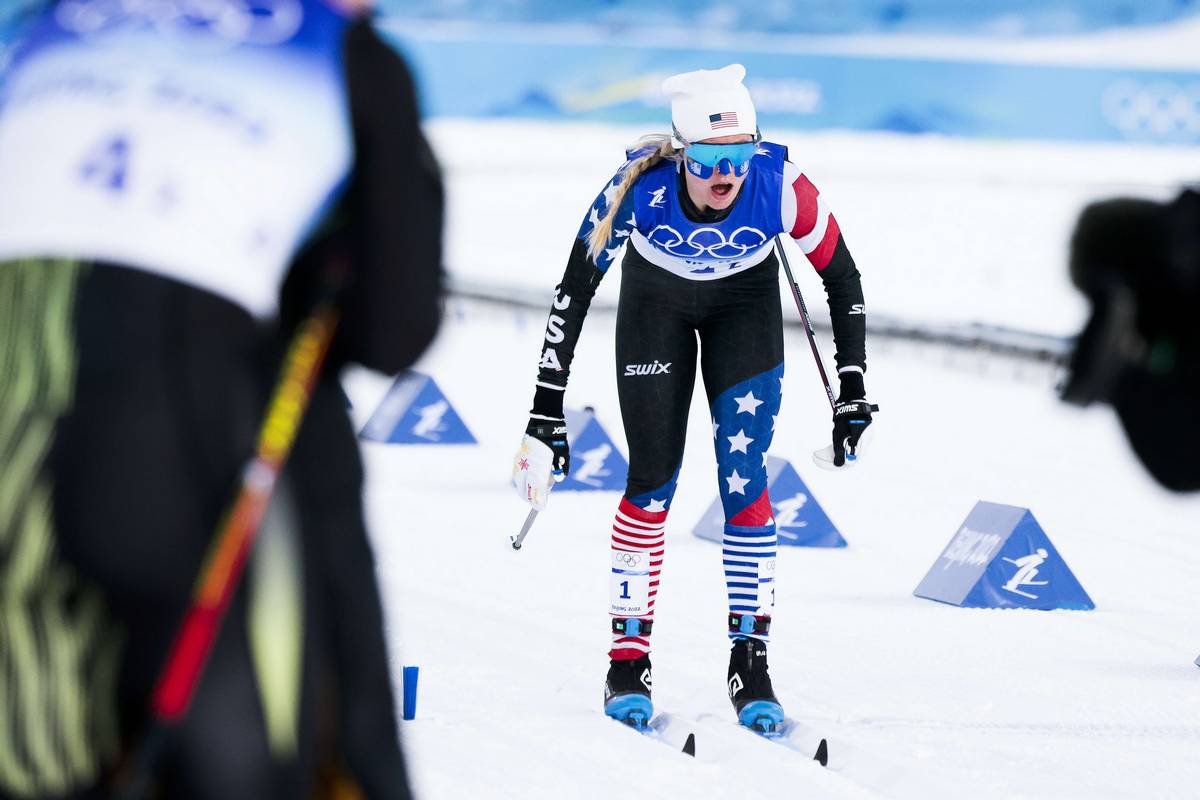
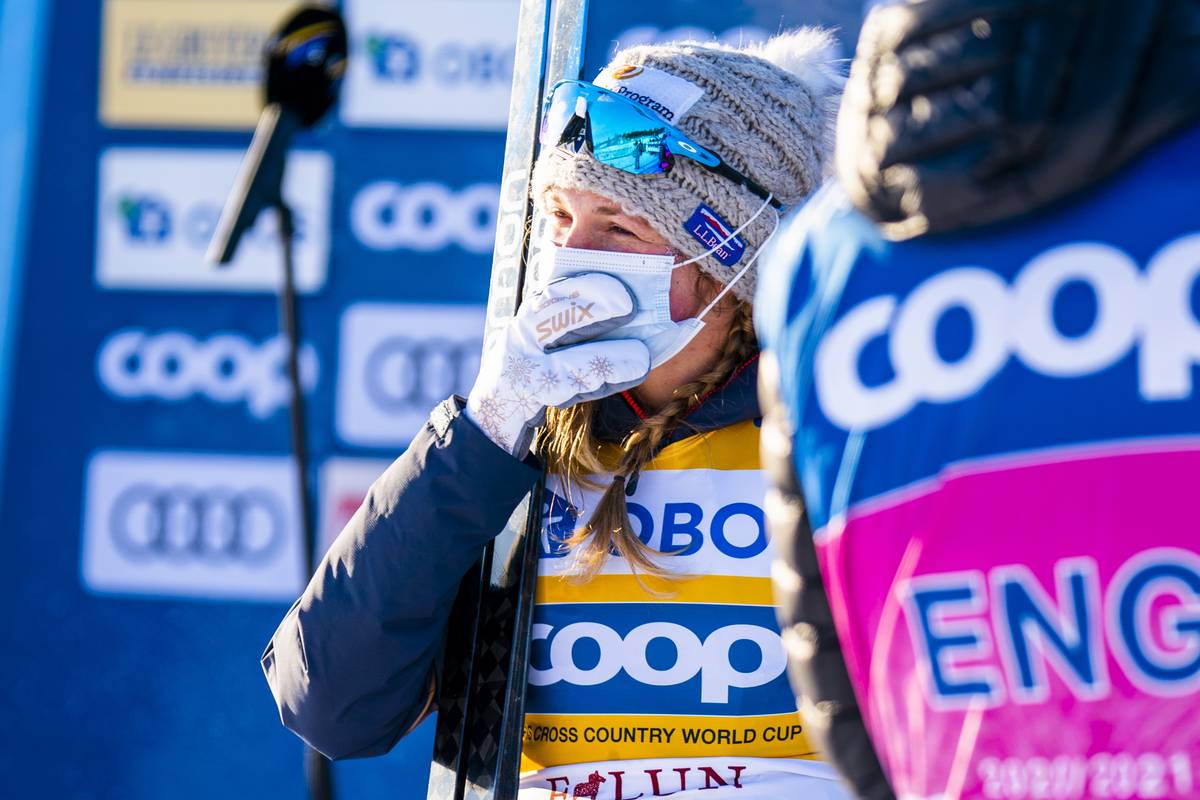
Jessie Diggins (USA) ended the day where she began in the hunt for the distance Crystal Globe, finishing second. (Photo: NordicFocus)
First place for the overall Crystal Globe was pre-determined. Tiril Udnes Weng (NOR) led Jessie Diggins (USA) by 154 points. With a maximum of 130 points going to the winner (assuming the winner takes all of the bonus points), Weng’s lead was mathematically unbeatable. However, overall standings placements were still up for grabs. Diggins led classic skiing standout Kerttu Niskanen (FIN) by 99 points, a sizeable but not insurmountable cushion given Niskanen’s classic abilities. Rosie Brennan (USA) sat in fourth place with a 108 point lead over Nadine Faehndrich (SUI). If Diggins and Brennan could hold their positions, it would put two Americans in the top five of the overall standings, potentially an historic finish for American skiing.
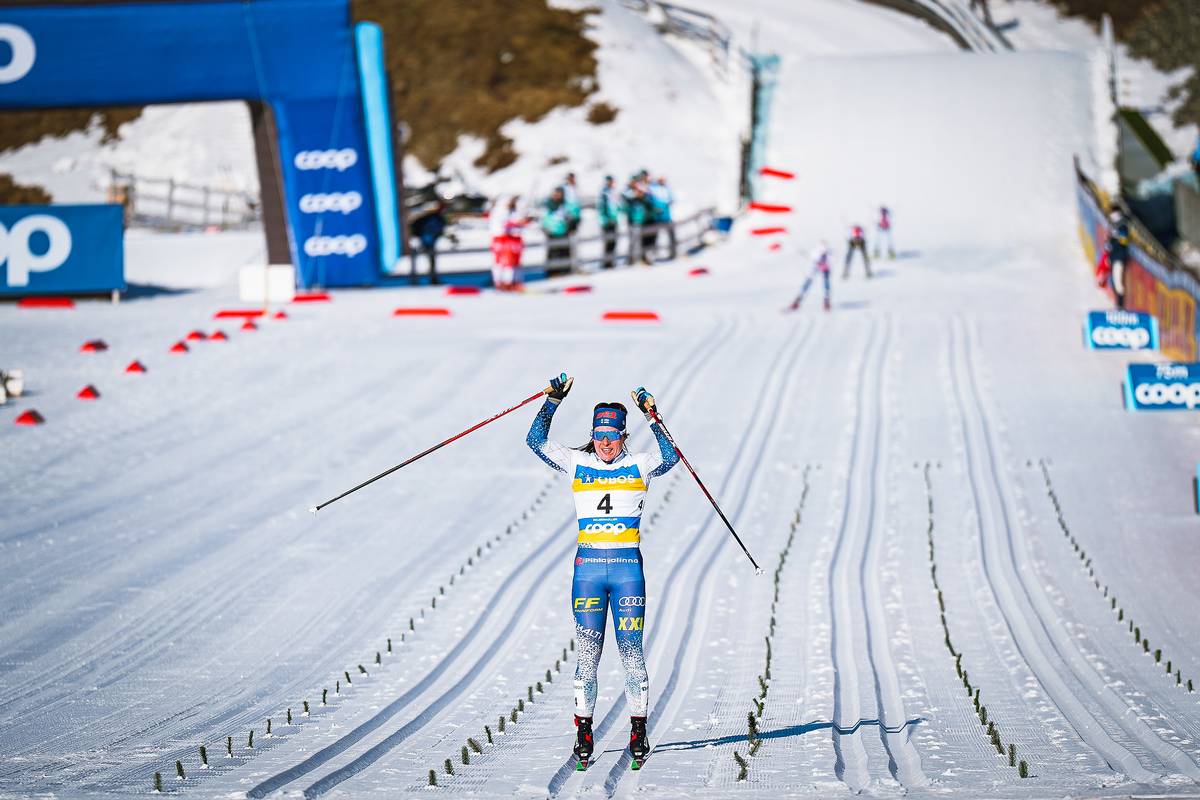
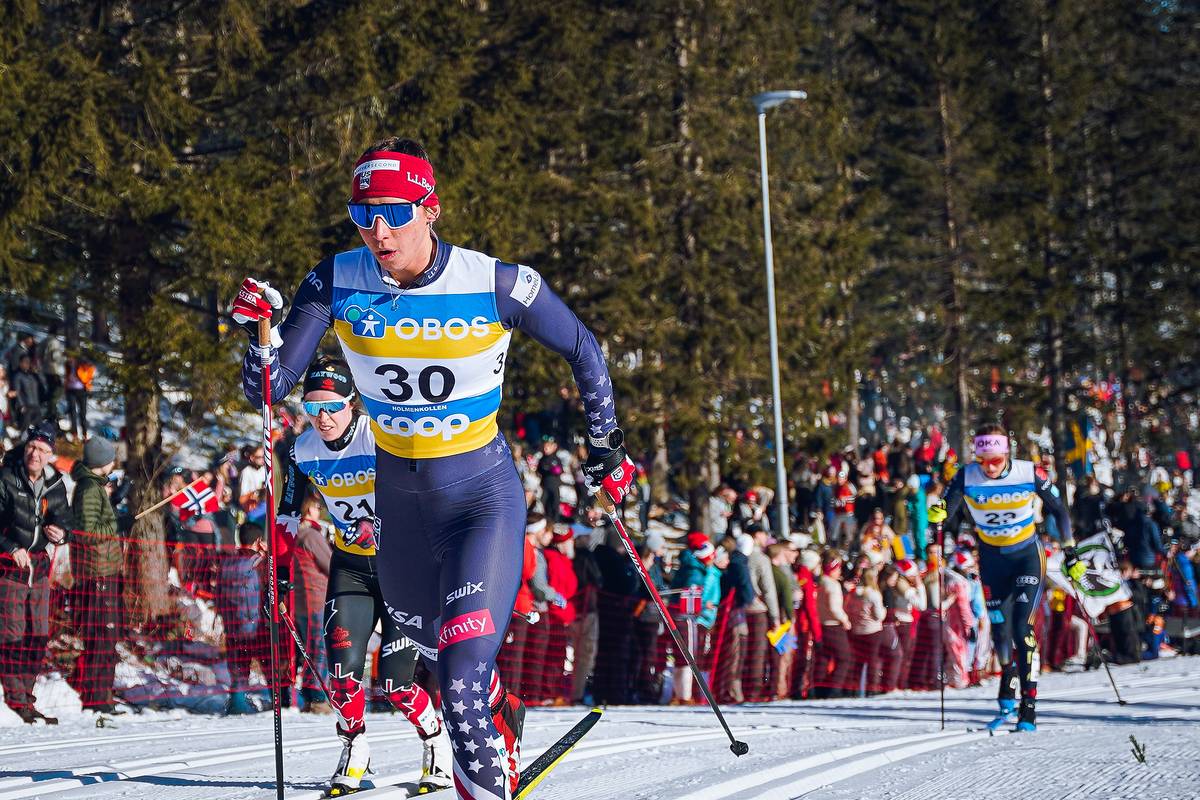
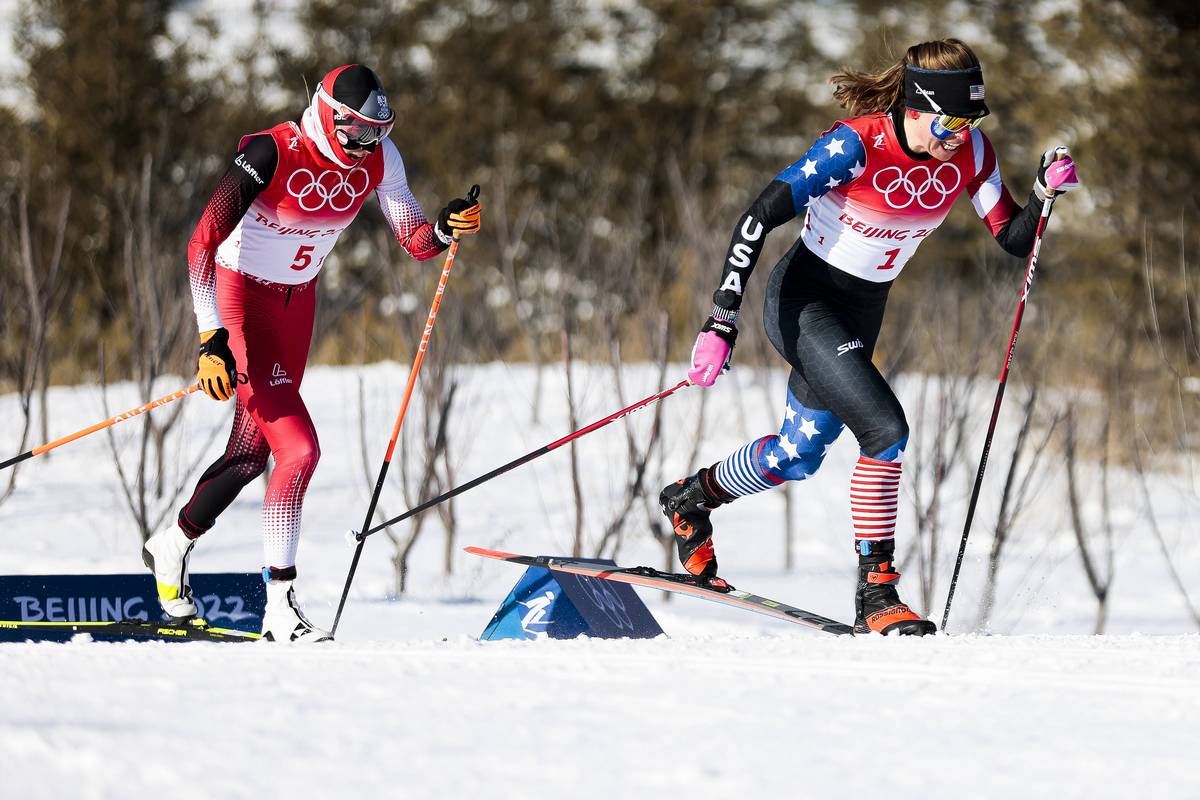
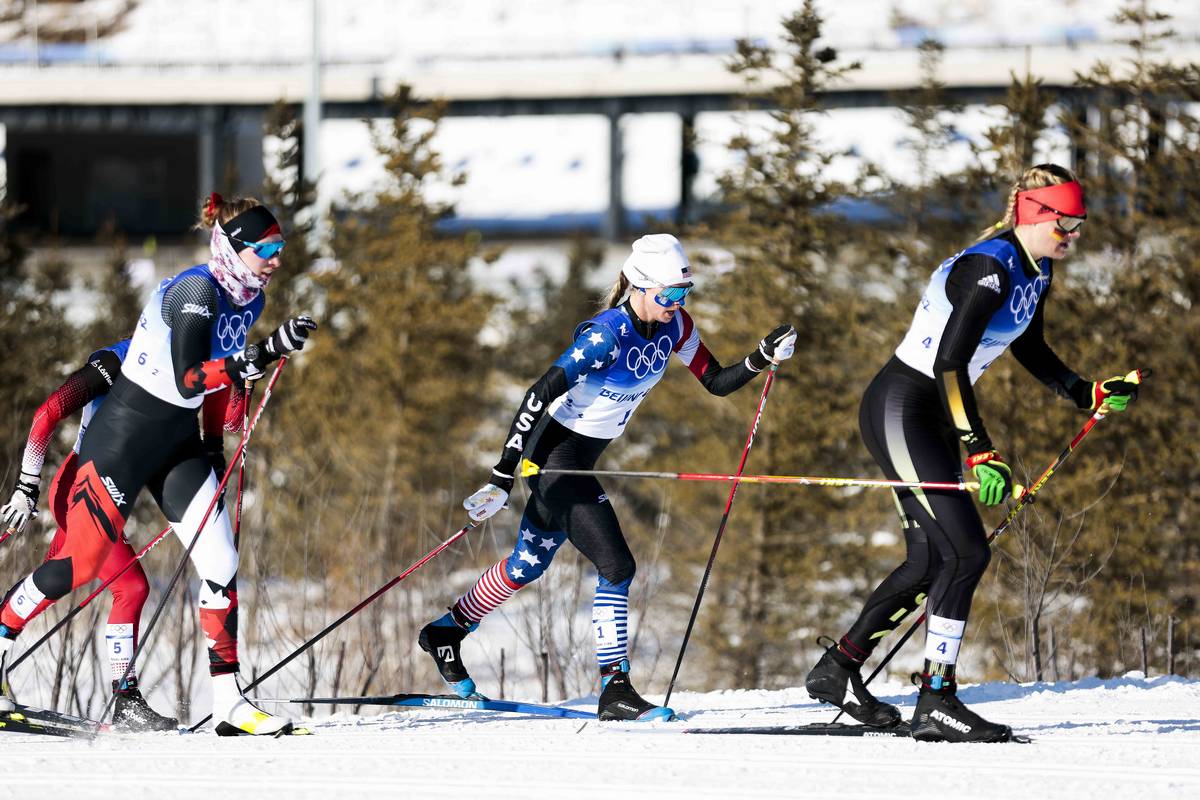
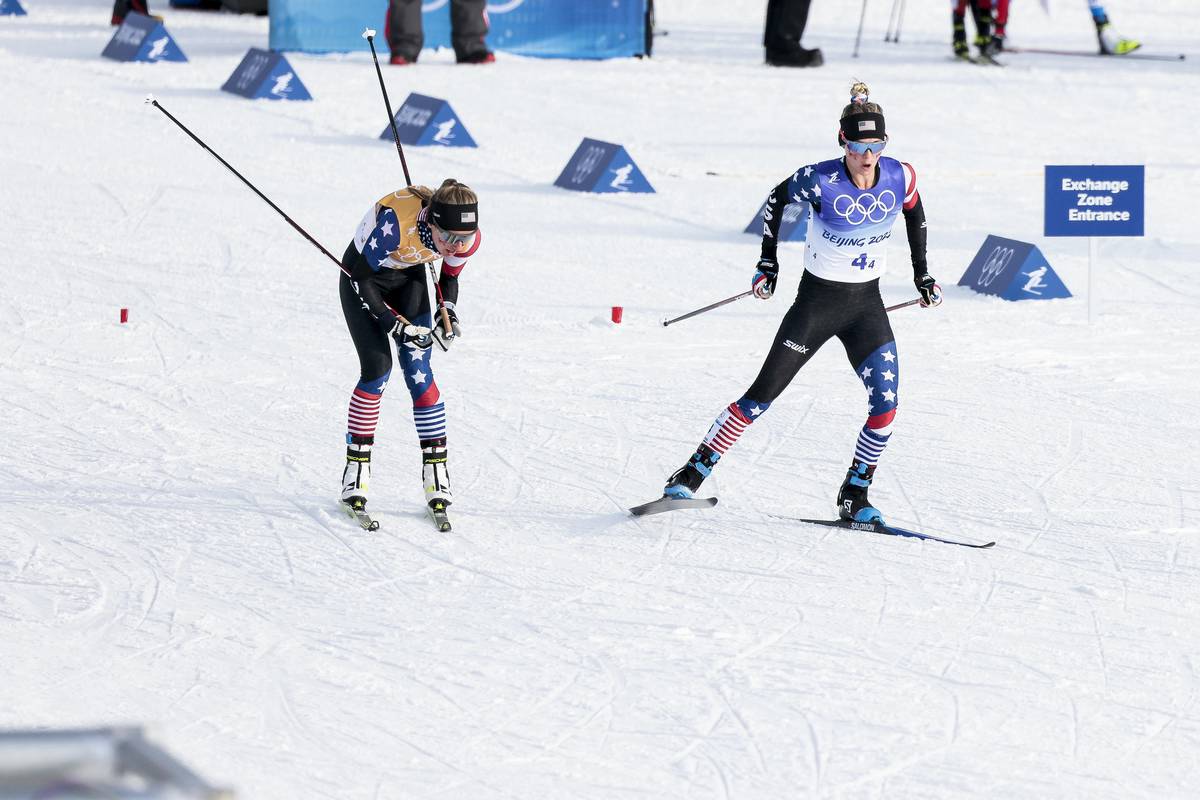
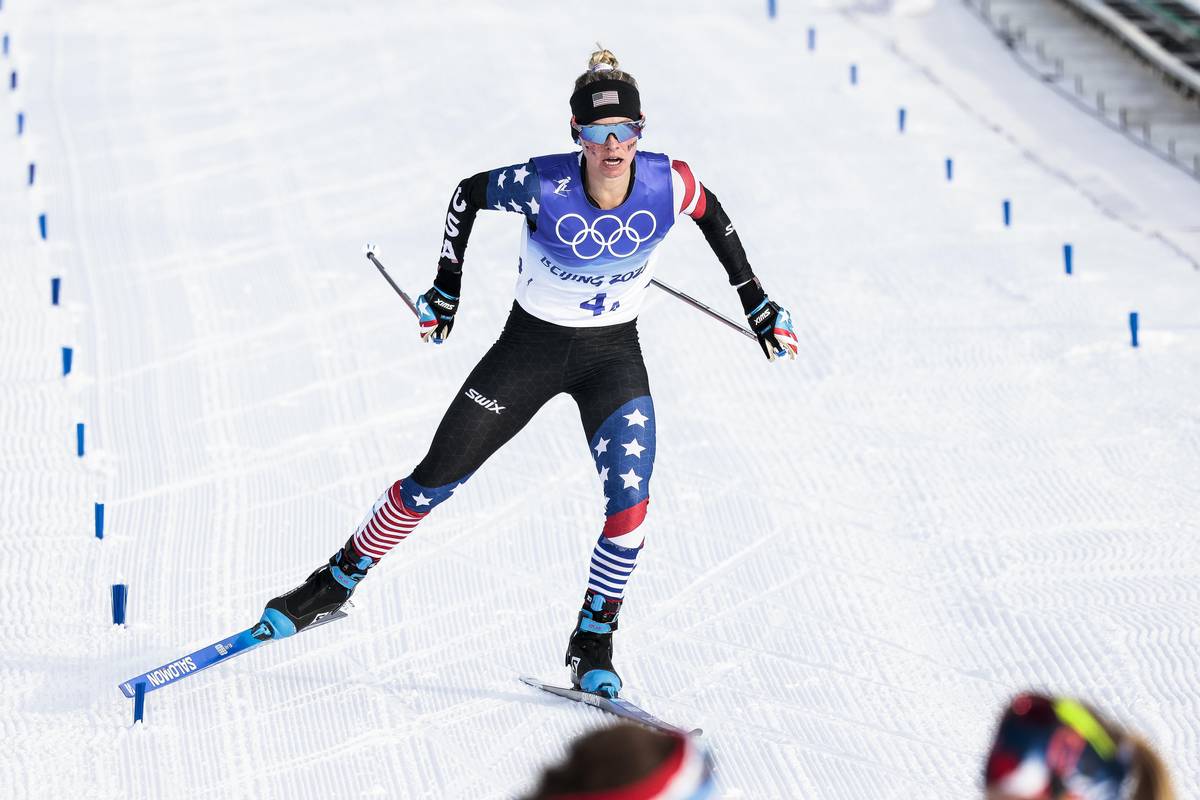
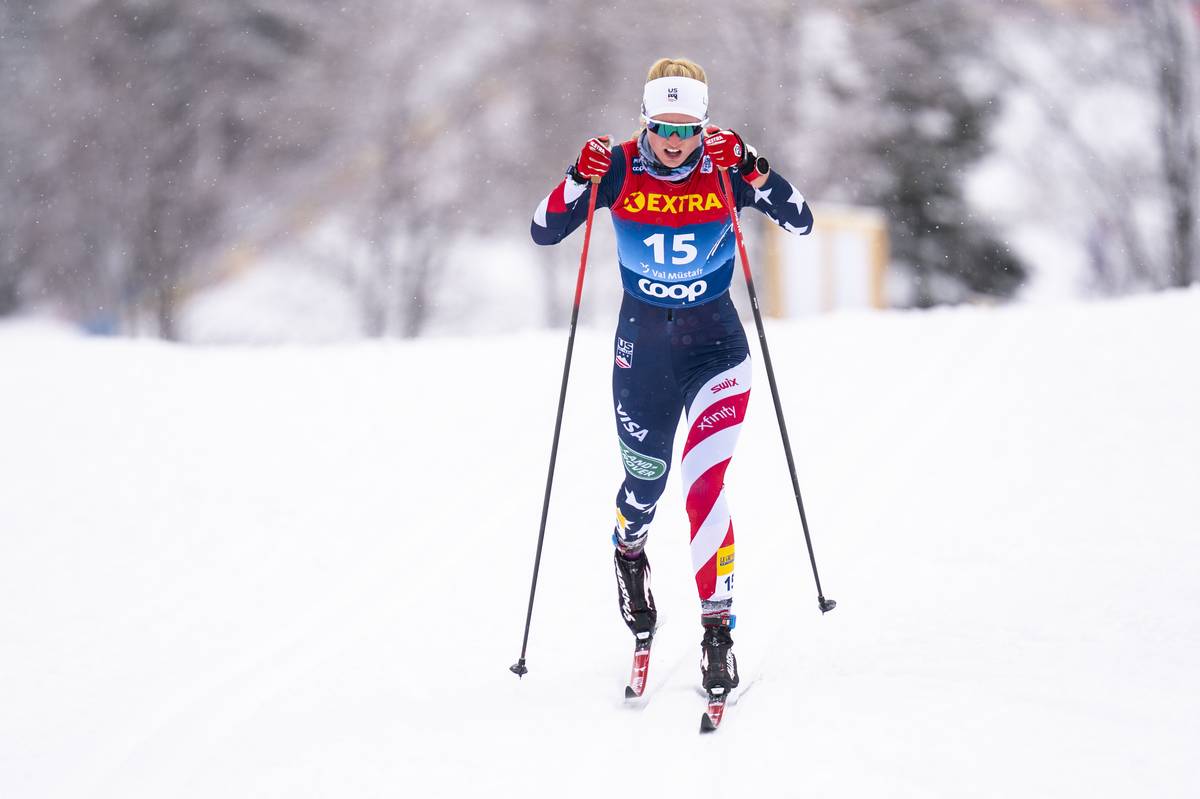
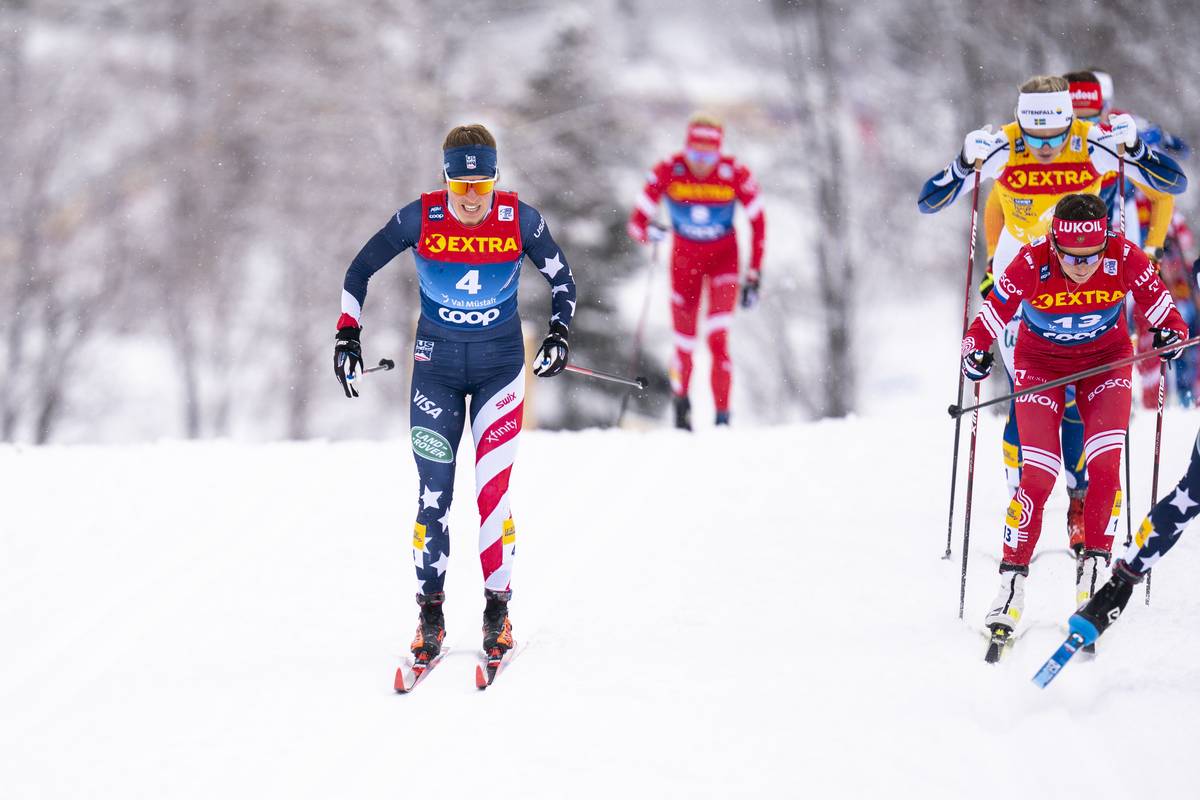
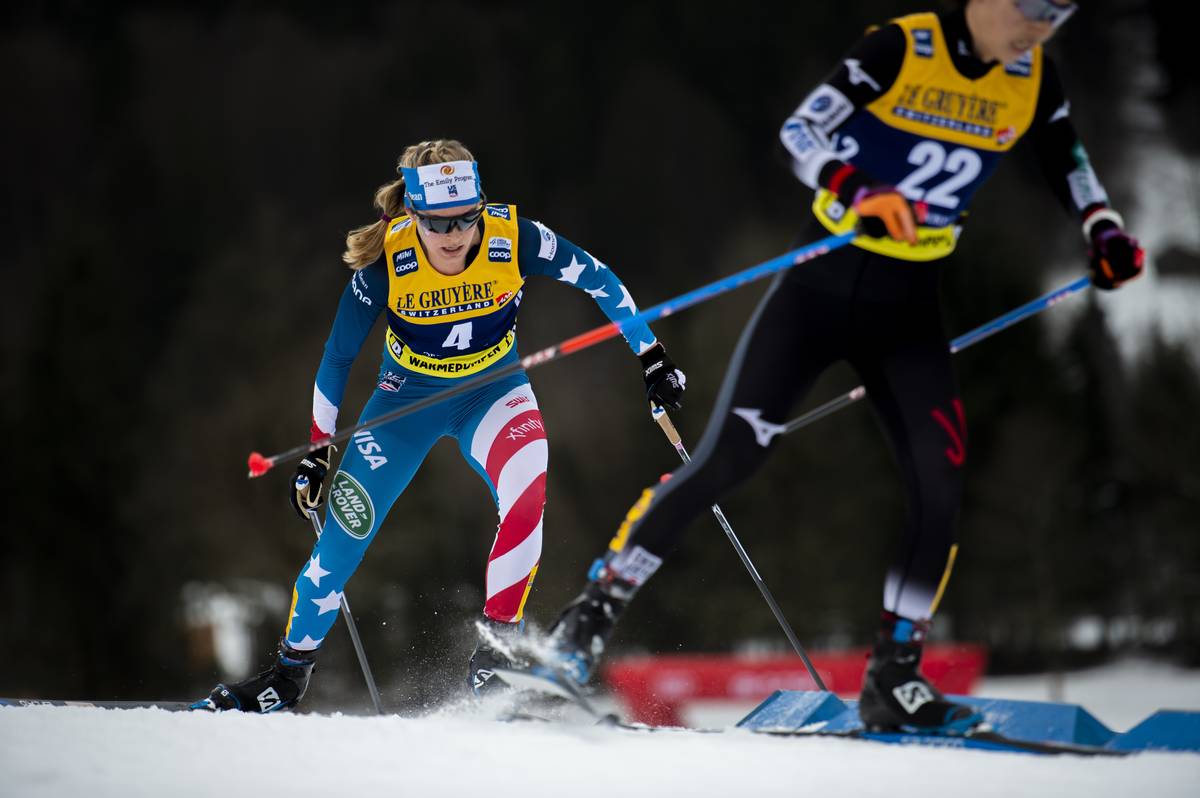
Rosie Brenan (USA-bib number 4) was able to maintain her fourth place standing in the overall World Cup position, but dropped to sixth in the distance competition. (Photo: NordicFocus)
Also at stake was the much closer chase for the distance Crystal Globe. Niskanen led with a 22 point advantage over Diggins, who would definitely be considered the underdog in a head to head classic skiing battle. But today’s race used the mass start format which would give Diggins help in staying with the field. Niskanen has never won an individual race on home soil; at 34 years of age, time is running out. Brennan was in fourth place for this Crystal Globe as well, a mere four points ahead of perennial favorite Heidi Weng (NOR), and only 26 points ahead of Anne Kjersti Kalvaa (NOR). The possibilities were almost too numerous to calculate.
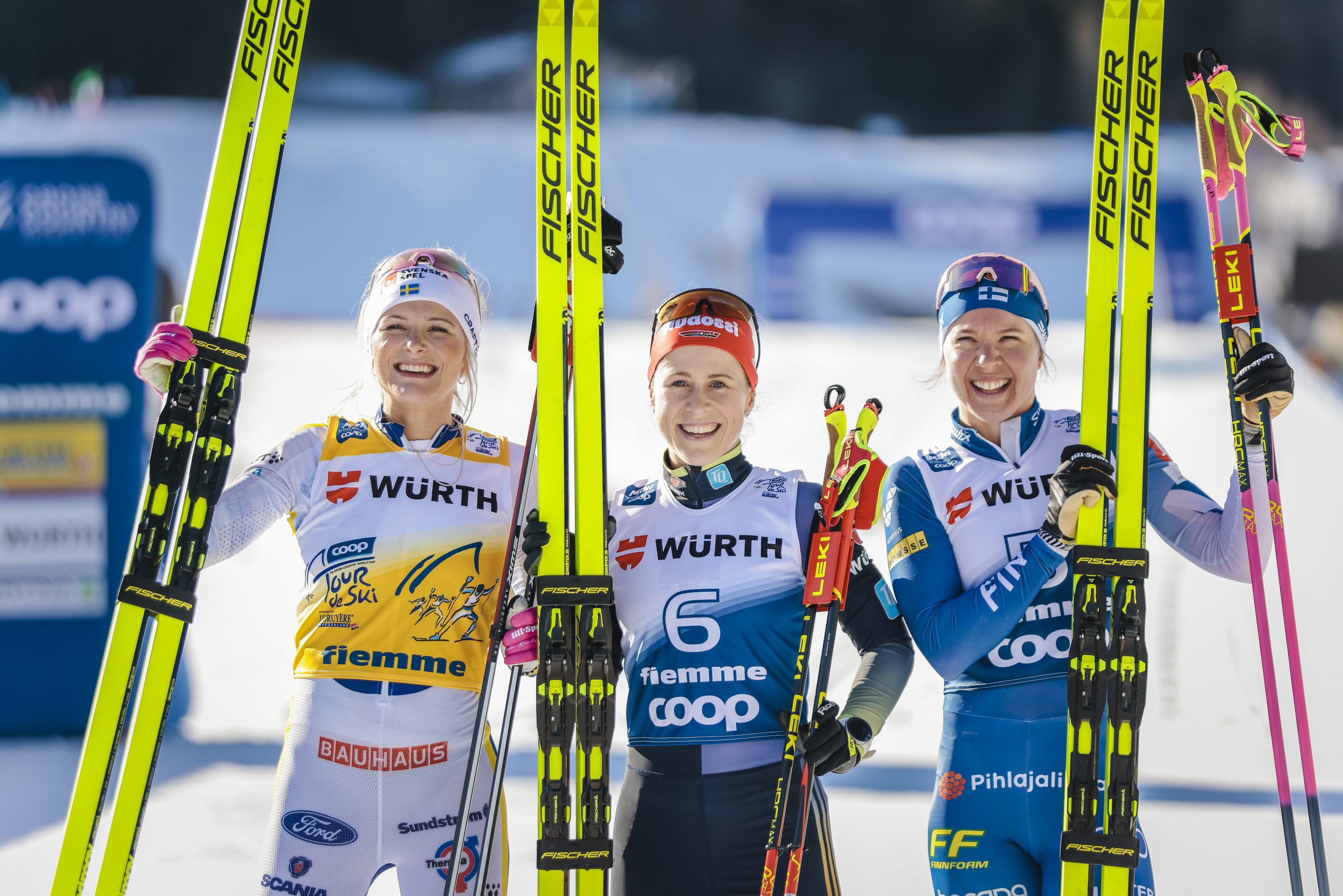
Kerttu Niskanen (FIN-center), was again thwarted in her attempt to win a World Cup race on home soil. (Photo: NordicFocus)
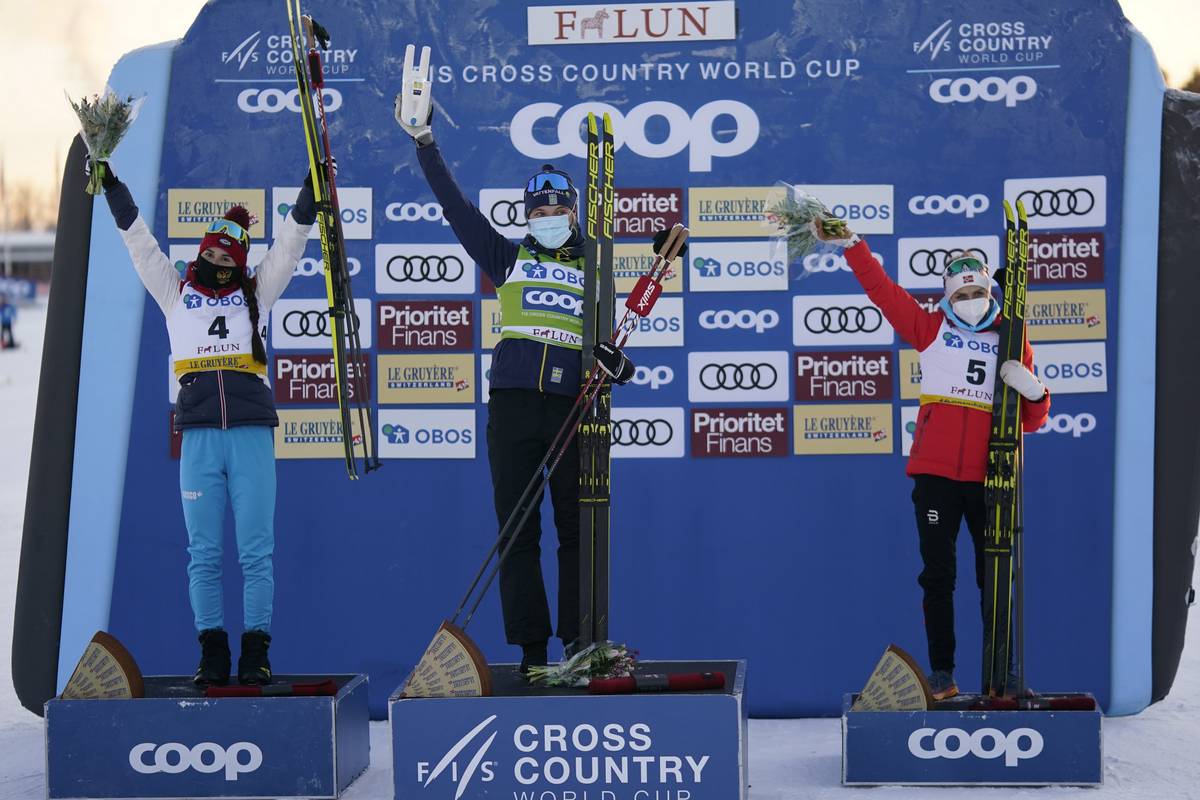
At the end of the road of World Cup racing for the season, Anne Kjersti Kalvaa took home the win for Norway. Jonna Sundling (SWE) was second, and Katharina Hennig finished third.
For the Americans, Jessie Diggins finished 22nd, 1:15 seconds out of the lead. Rosie Brennan was right behind her in 23rd. Other American finishers were Novie McCabe 25th, Hailey Swirbul 26th, Julia Kern 38th, and 17 year old Sammy Smith 48th.
For the Canadians, Katherine Stewart-Jones was the only finisher taking 37th. Liliane Gagnon did not finish.
The overall world cup Crystal Globe positions remained largely unchanged with Diggins remaining in second and Brennan remaining fourth. It was an unprecedented finish with two Americans in the top five of the overall standings and a landmark achievement which would lift the entire team.
The hunt for the distance Crystal Globe did not go quite as well. Diggins was able to hold onto her second place position, but lost ground to Niskanen who was the overall winner. But Brennan dropped down to sixth place eclipsed by Kalvaa and Heidi Weng. Still, a remarkably strong finish for the American squad.
The Women’s 20 Kilometer Mass Start
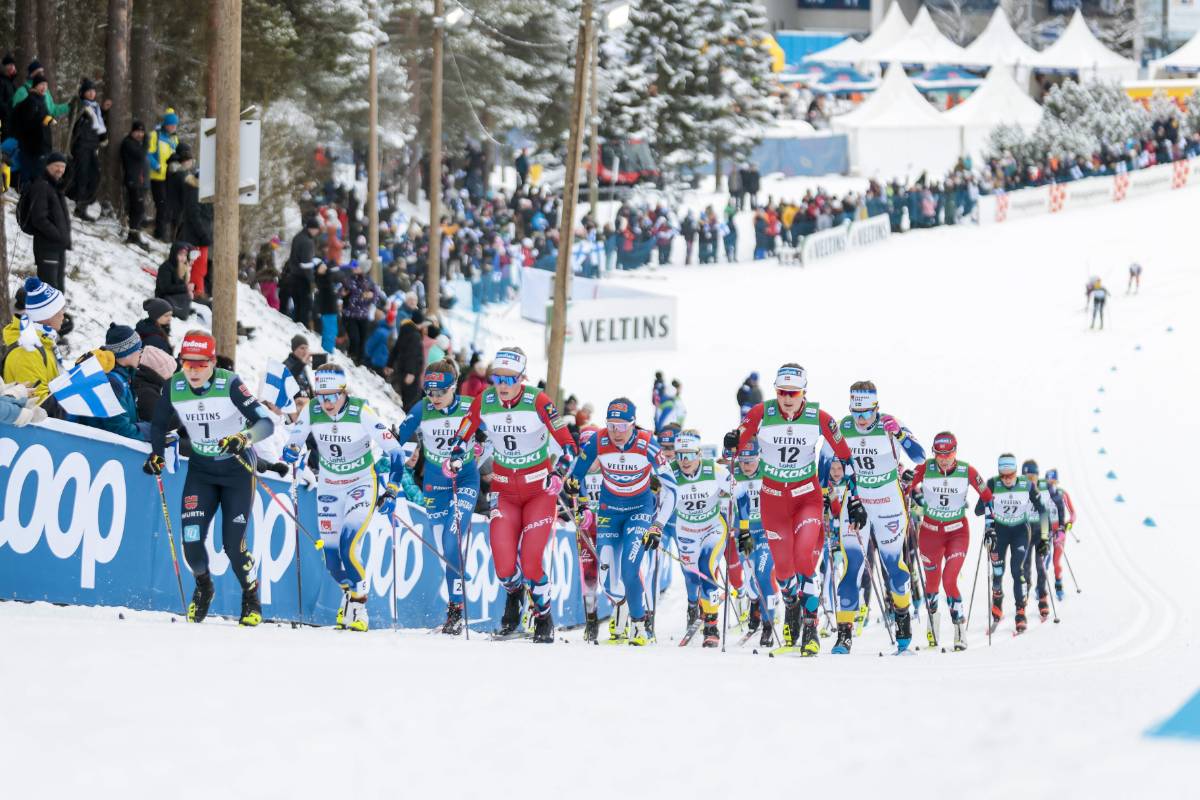
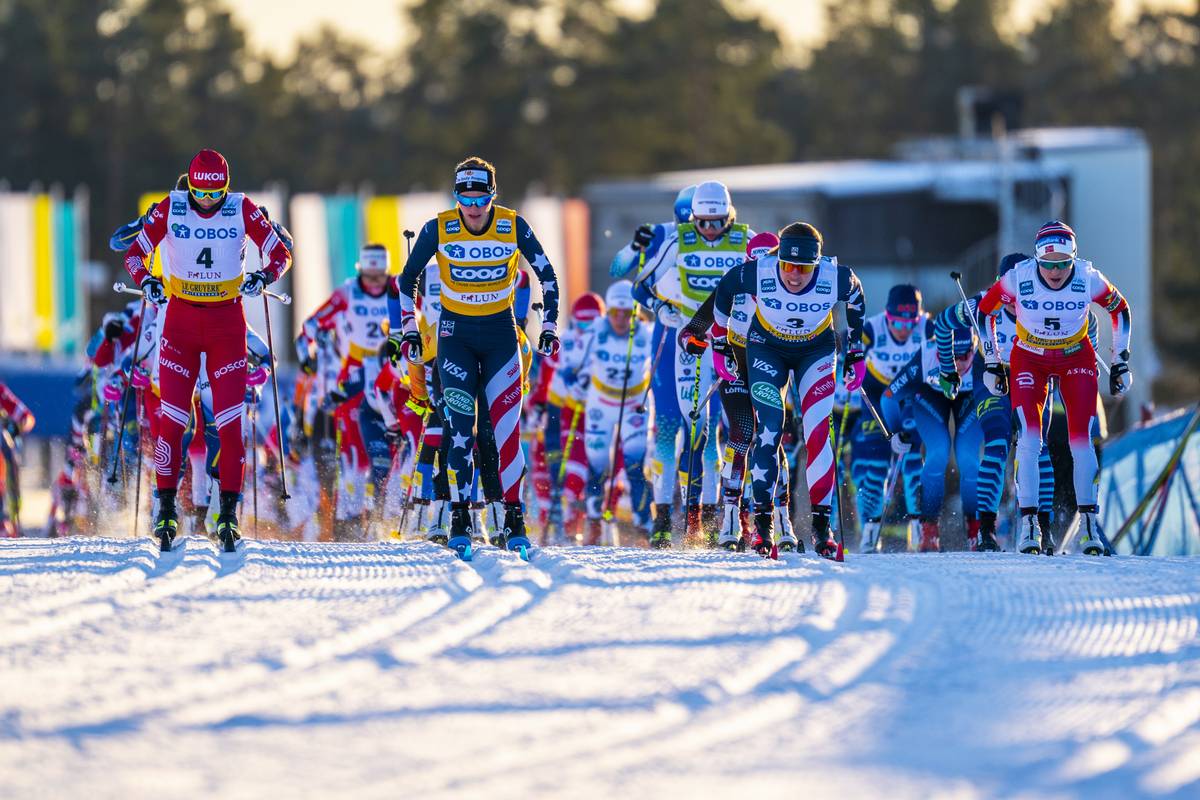
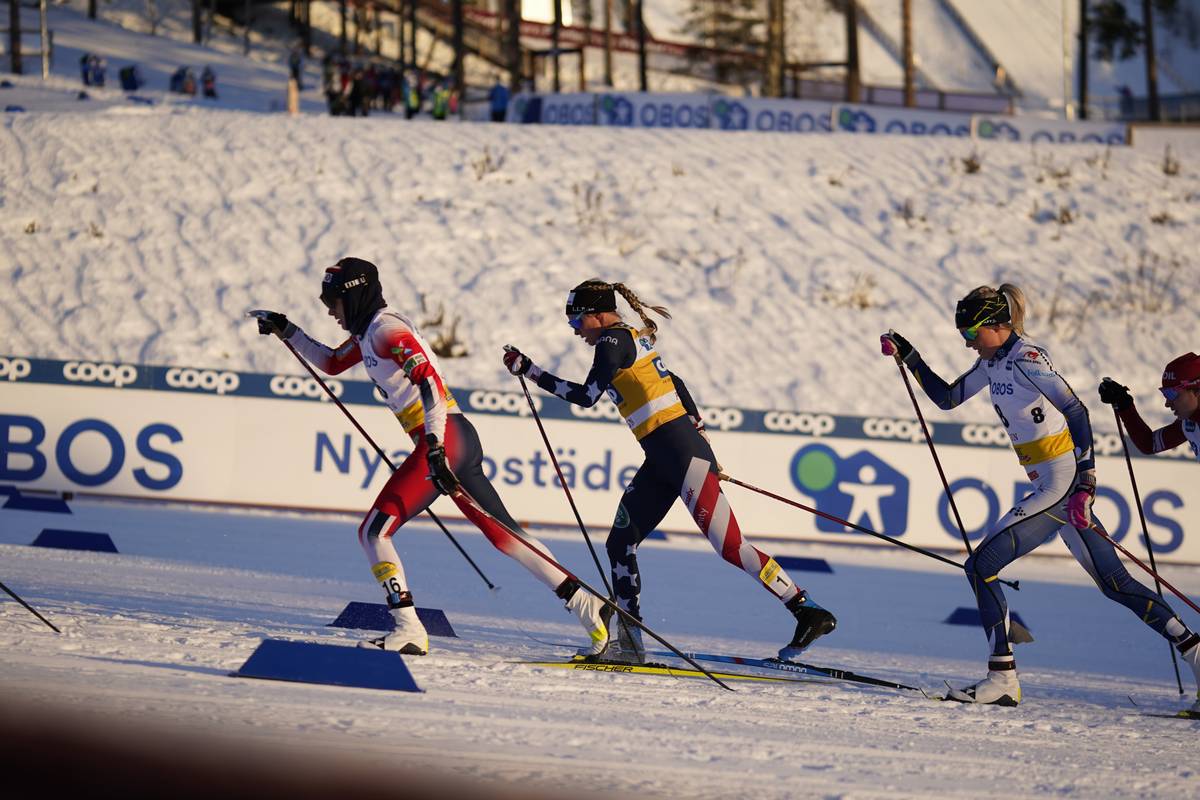
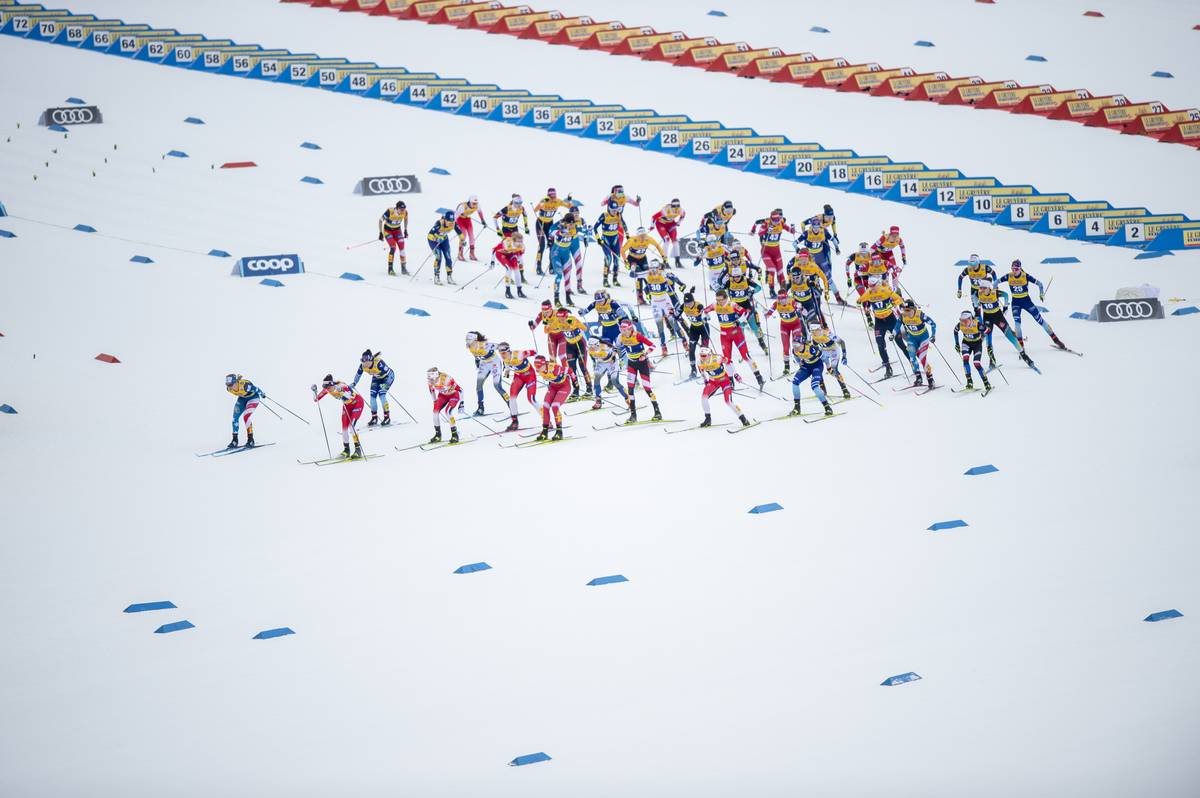
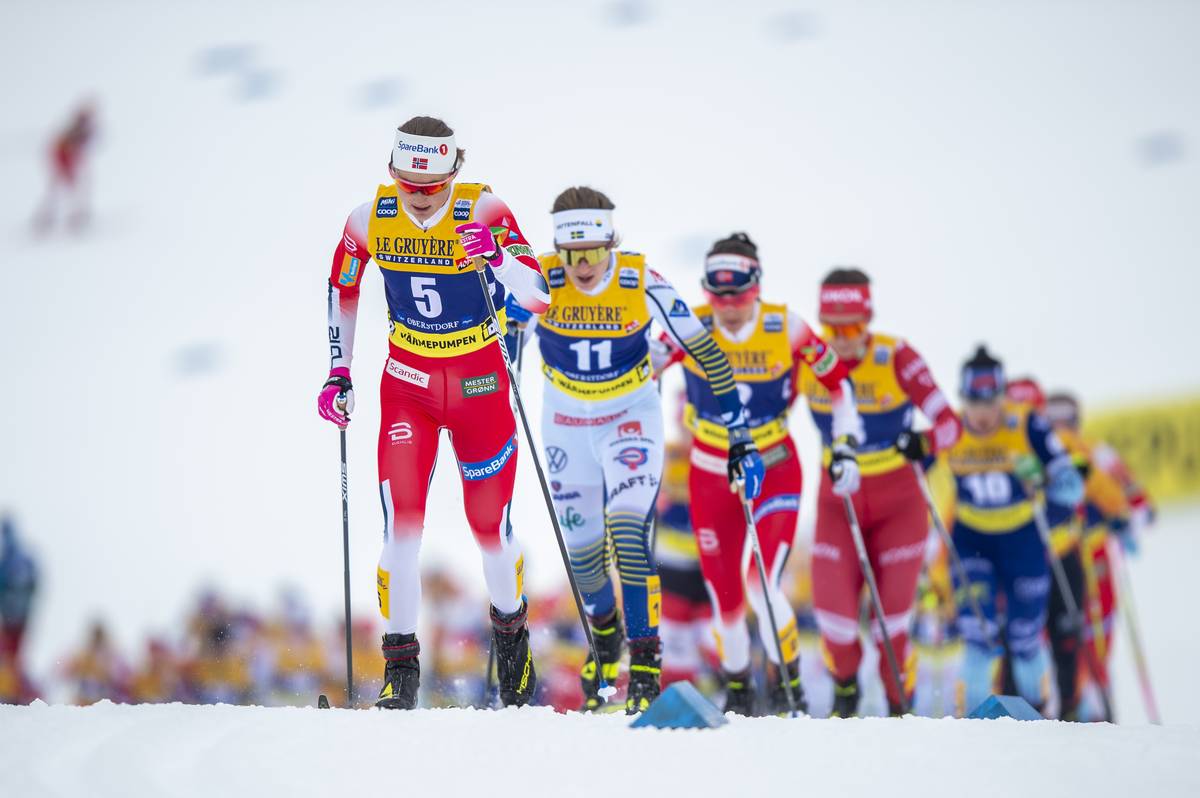
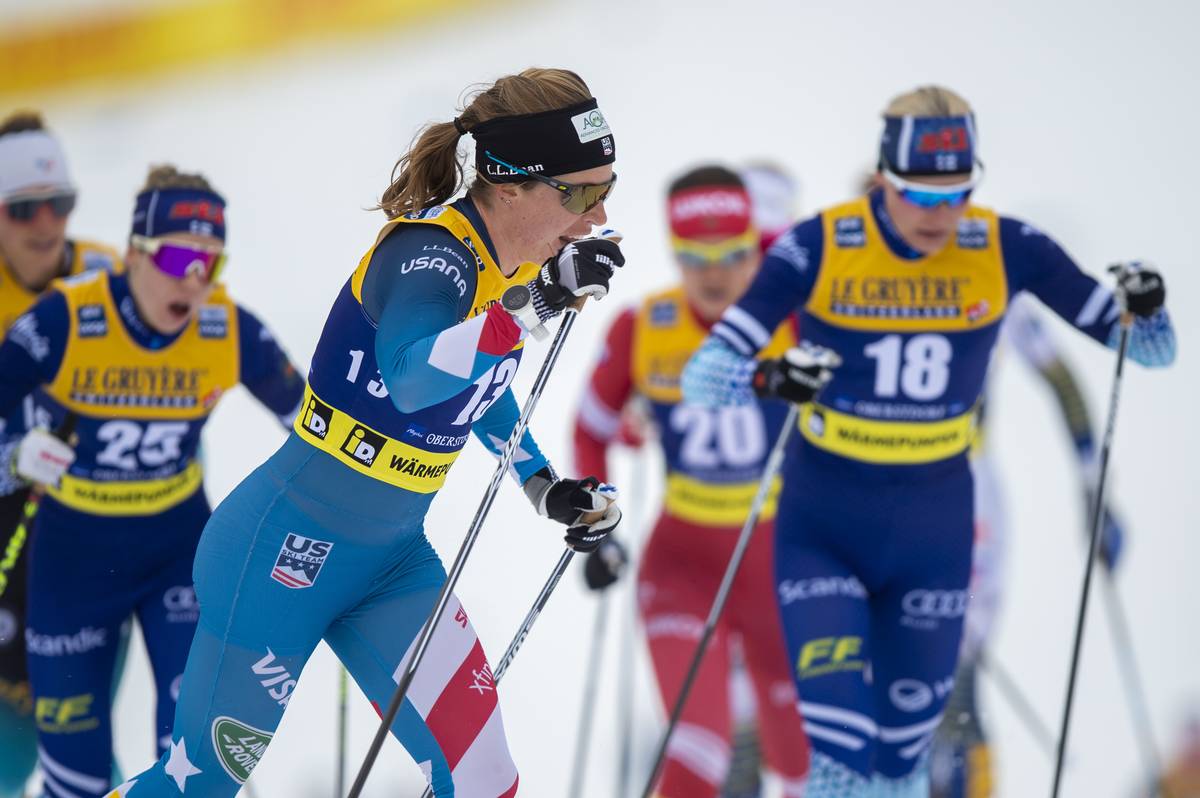
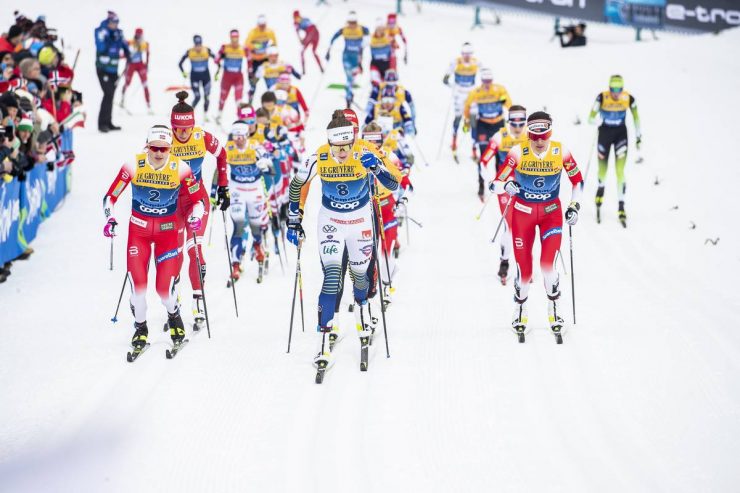
Not surprisingly, Niskanen pushed the pace early. For the first couple of kilometers, she was in a group with Kalvaa, Frida Karlsson (SWE) and T. Weng. Five kilometers into the race, there was still a large pack at the front which contained all top contenders. Diggins and Brennan were still in the lead group, but by the 7.5 kilometer mark, where the first bonus points were awarded, the balance changed. Niskanen revealed her strategy of going for the bonus points, and crossed the bonus line first, receiving 15 points and widening her lead for the distance Crystal Globe over Diggins. Heidi Weng crossed the bonus line sixth giving her five bonus points. Brennan crossed the bonus line 13th and Diggins 14th, both just missing bonus points. But the damage was done. Diggins was losing her opportunity to keep pace with Niskanen and Heidi Weng had surged past Brennan in the distance standings.
Jessie Diggins (USA) couldn’t match Kerttu Niskanen (FIN) in the chase for the distance Crystal Globe. (Photo: NordicFocus)
The next bonus point line came at the 12.5 kilometer mark. Diggins was still in the hunt a mere seven seconds off the lead as skiers passed the 11 kilometer mark. Brennan was now 14 seconds from the front of the race. As the skiers approached the bonus line, Niskanen again pushed to the front of a pack which contained Ebba Andersson (SWE), Katharina Hennig (GER), Krista Parmakoski (FIN), and Karlsson. Niskanen revisited her strategy from the previous bonus line and received 15 bonus points putting her lead for the Distance Globe out of reach. Heidi Weng took one point to extend her advantage over Brennan. Once again the Americans were shut out for the all important bonus points.
Heidi Weng (NOR) went bonus point hunting to pass Rosie Brennan (USA) in the Distance Crystal Globe chase. (Photo: NordicFocus)
While the race for the overall distance standings was being clarified by bonus points, the contest for winning the race was far from over. After 15 kilometers, a group of seven skiers dominated the front with Niskanen, Kalvaa, Andersson, Jonna Sundling (SWE), Hennig, Karlsson and Parmakoski all within seconds of each other. Diggins and Brennan had now fallen off the lead and were 30 and 38 seconds back respectively. Barring a miracle, all hope was lost for Diggins’ chances of taking the distance globe. Heidi Weng was still holding her lead over Brennan as well.
The lead pack continued with Parmakoski and Heidi Weng struggling to keep pace, as Andersson had moved to the front trying to break up the field. Andersson had picked up a yellow card earlier in the race and would have to be careful not to be disqualified with another violation.
Jonna Sundling (SWE-bib 26), was able to stay with the pack and use her sprint skills to finish second (Photo: NordicFocus)
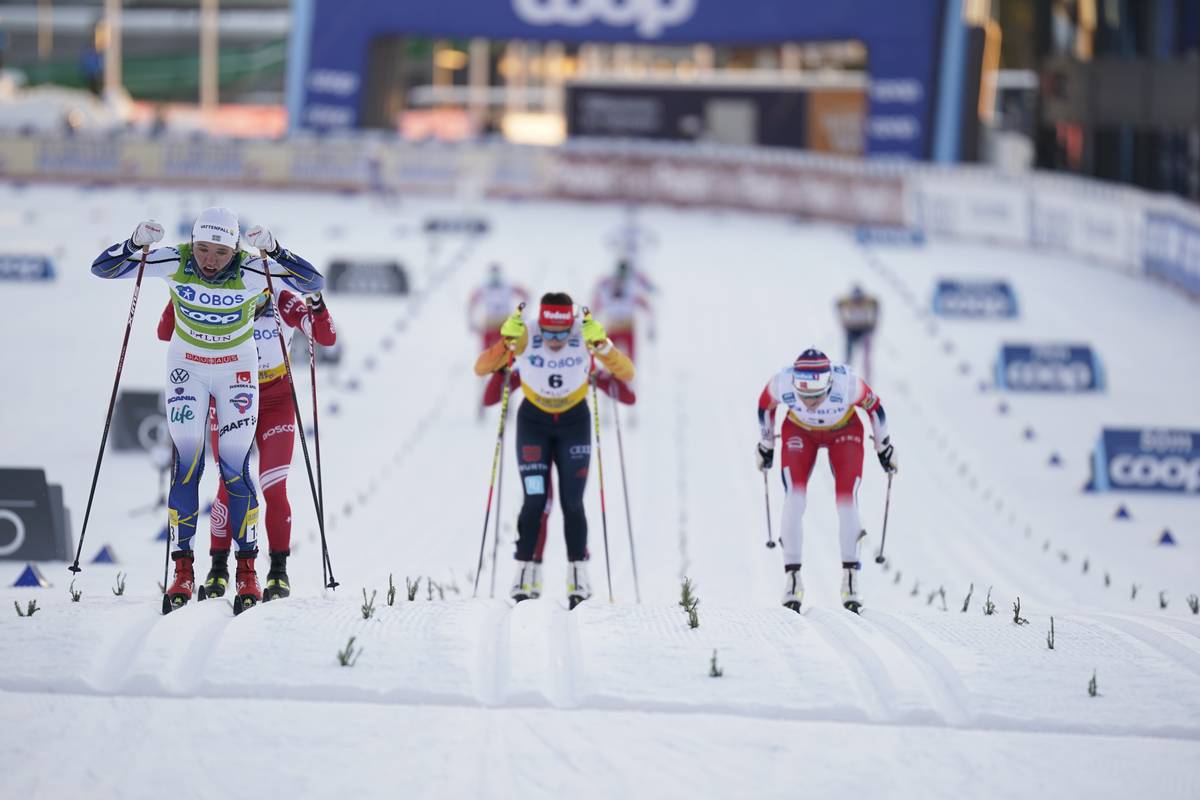
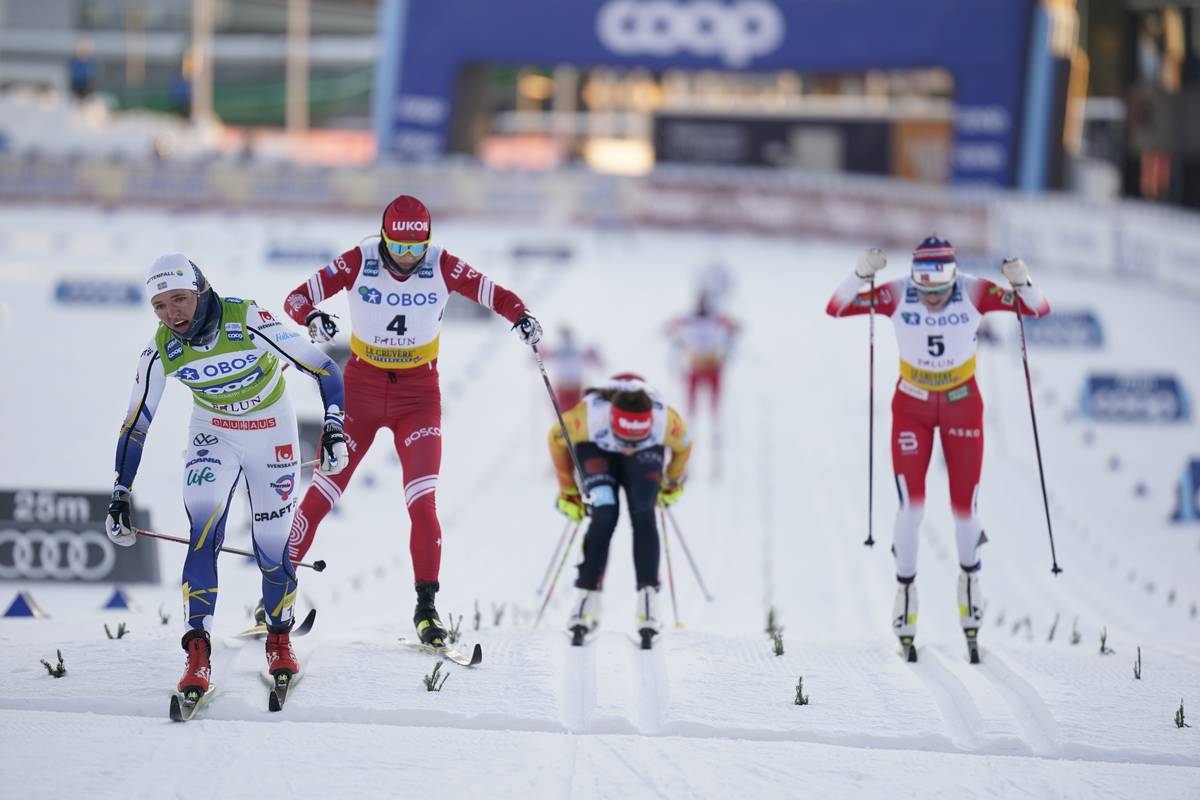
As the finish approached, the pack was still together with Andersson going to the front trying to take away the advantage Sundling would have in a sprint finish and setting up a dazzling drag race to the finish line. But, it was Kalvaa who was able to find the speed at the end with clearly faster skis than the field, surging to the front to hold off Sundling’s late charge and win by less than a second. Hennig finished just behind Sundling in a three way photo finish with Andersson coming in fourth. Niskanen ended up fifth and would have to wait in her pursuit to win at home.
For Kalvaa it was her first world cup win. After the race she commented about how fast her skis were and admitted that the fatigue of the season had taken its toll.
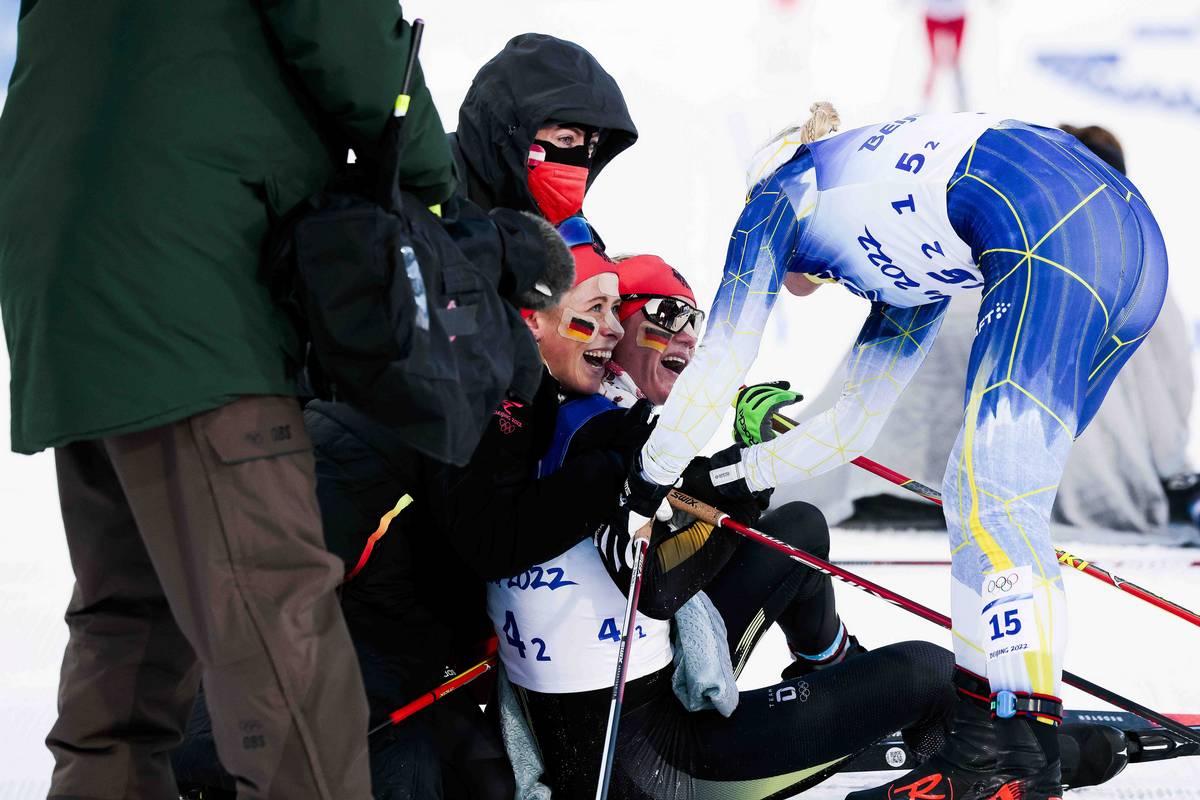
Jessie Diggins (USA-left) celebrates her second place finish in the distance world cup competition with the winner, Kerttu Niskanen (FIN). (Photo: NordicFocus)
It was a tricky day for waxing; clearly the Norwegians had hit the mark. U.S. coach Chris Grover commented on the difficulties of finding the right kick wax. “Some of the athletes today had decent skis,” he said. “Some were too slick, some were slow, it was kind of all over the map. It glazed [the tracks] as the race went on and you had to be kind of lucky.” Team USA knew that the deck was stacked against Diggins’ chances of claiming the distance championship. Grover said that “[Niskanen’s] won the last few Classic races…Jessie and Jason [Cork] approached the day that it would be a very tall order to overtake Kerttu, and unfortunately, Jessies’ skis just weren’t fast enough. We knew it would be a bit of a long shot.”
Anne Kjersti Kalvaa (NOR-bib 6), used her fast skis to surge past the pack at the end of the race. (Photo: NordicFocus)
When Diggins and Brennan reached the finish they were over a minute back in 22nd and 23rd respectively. It was a valiant effort, but they just couldn’t keep pace with the leaders.
It was an exciting way to end the season. But it was also filled with a tinge of disappointment for the Americans. Diggins had come painfully close to capturing the distance Globe, but ultimately finished second to Niskanen, which was still cause for celebration. Brennan dropped to sixth overall in the distance Globe chase.
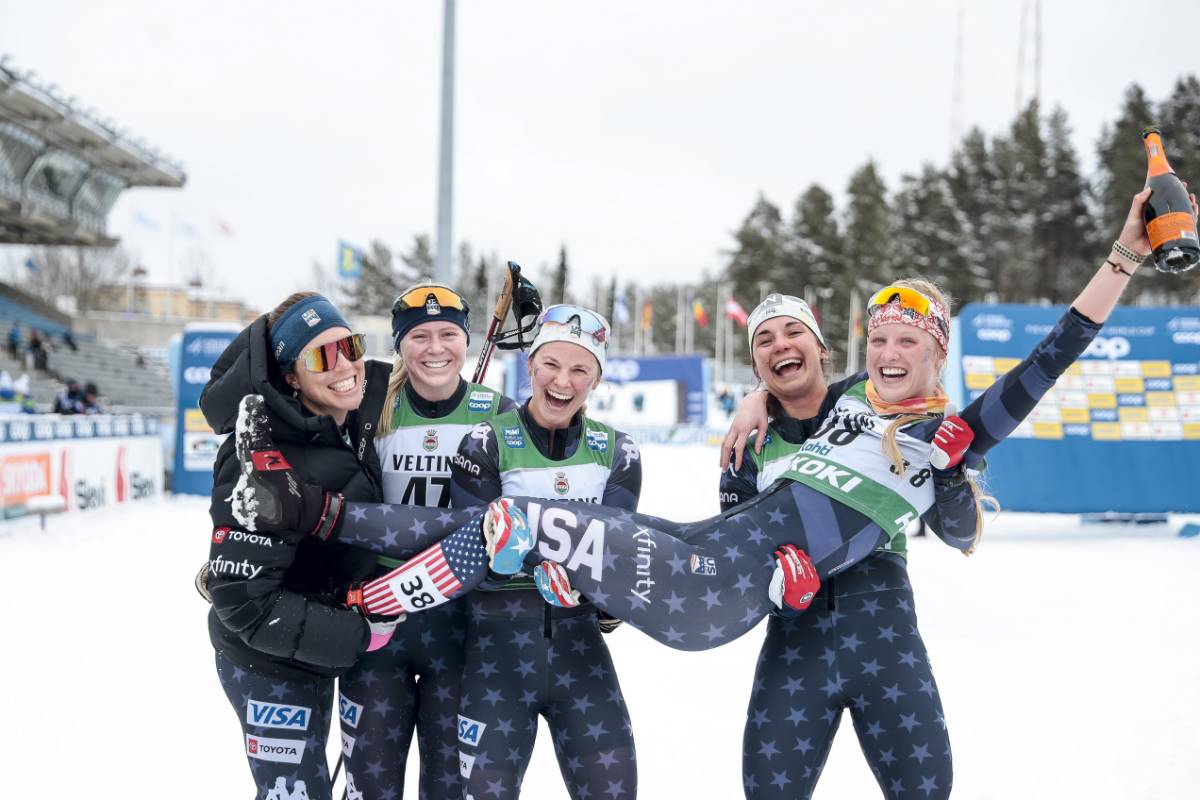
Team USA: Rosie Brennan, Samantha Smith, Jessie Diggins, Julia Kern, Hailey Swirbul (l-r) celebrate the end of the season and putting two racers into the top five of the World Cup standings (Photo: NordicFocus)
This World Cup coverage is made possible through the generous support of Marty and Kathy Hall and A Hall Mark of Excellence Award. To learn more about A Hall Mark of Excellence Award, or to learn how you can support Fasterskier’s coverage, please contact info@fasterskier.com.
Today, the leaders of the Tour de Ski went to the front, and the standings were put into stark perspective. This late in a long and challenging stage race, no one wanted to risk the daring move. There was too little to gain, and far too much to lose. With a very difficult (and potentially consequential) stage tomorrow, there was very little incentive to push the pace. The Tour de Ski will whittle down the contenders all by itself; the distances and the schedule and the elevation and the stress will see to that. The selection will just happen naturally . . . and those who benefit will be those who hang on. That was the nature of the racing in Val di Fiemme, Italy today in Stage 6 of the 2023 Tour de Ski.
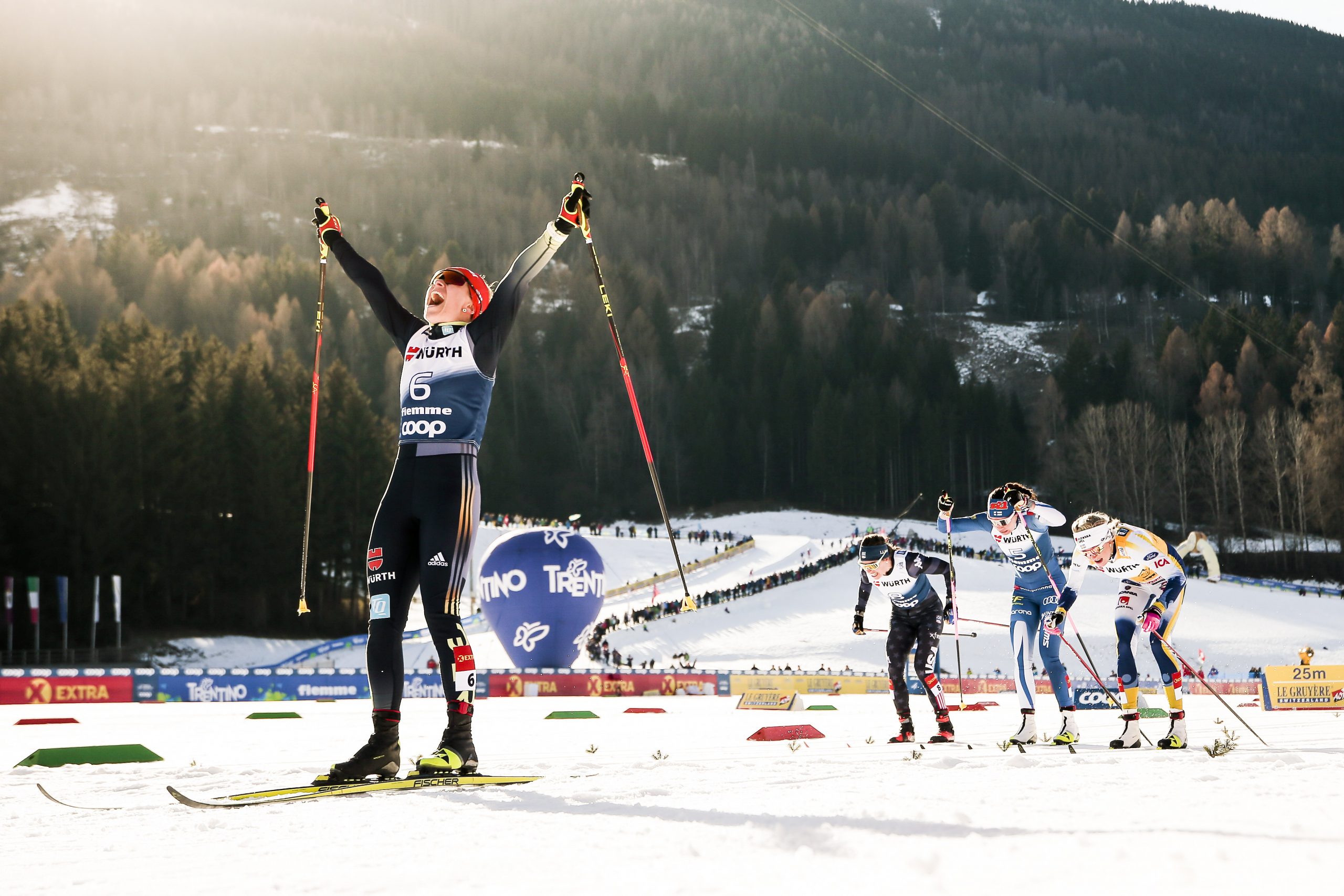
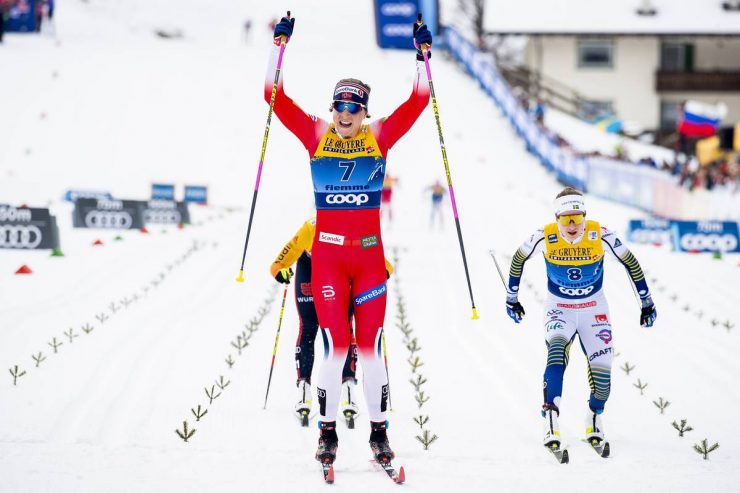
Katharina Hennig (GER) sprints to victory over Rosie Brennan (USA), Kerttu Niskanen (FIN), Frida Karlsson (SWE), (l-r) in Stage 6 of the Tour de Ski from Val di Fiemme (ITA). Brennan would finish fourth, with Niskanen and Karlsson second and third. (Photo: NordicFocus)
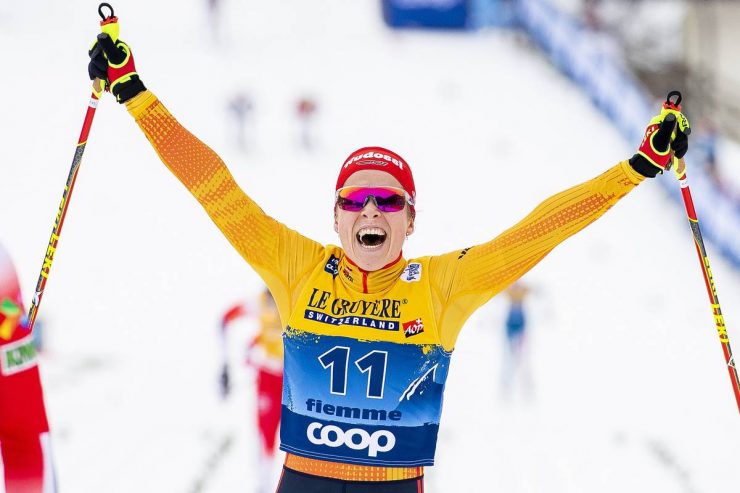
In the end, Katharina Hennig (GER) won the sprint finish, followed by current Tour de Ski leader, Frida Karlsson (SWE) and Kerttu Niskanen (FIN).
American Rosie Brennan finished a sensational fourth in Stage 6, one second behind the winner, and only .2 from the podium. Other American finishers included Diggins in 24th, Laukli 26th, Kern 31st, and Sonnesyn 36th.
Canadian finishers included Katharine Stewart-Jones who remained in contention among the chasers throughout the day, and skied to a very impressive 10th place finish, and Dahria Beatty who finished 37th after a mid-race fall.
“Today was a lot of fun!” said Stewart-Jones. “I have been close to the top 10 a couple of times so it is exciting to have finally cracked it. Being in the ‘mix’ and watching my teammates also have some great performances makes racing even more fun. For the rest of the season, I want to continue hunting down some PBs!”
Krista Parmakoski (FIN) who was third in the overall standings (1:05 behind the leader, Karlsson) withdrew before the race began, citing illness that had developed overnight. Parmakoski described stomach pains rather than Covid symptoms, which allows her to remain hopeful for maintaining her condition and being prepared for the FIS World Championships in a few weeks.
Women’s 15 k Classic Mass Start
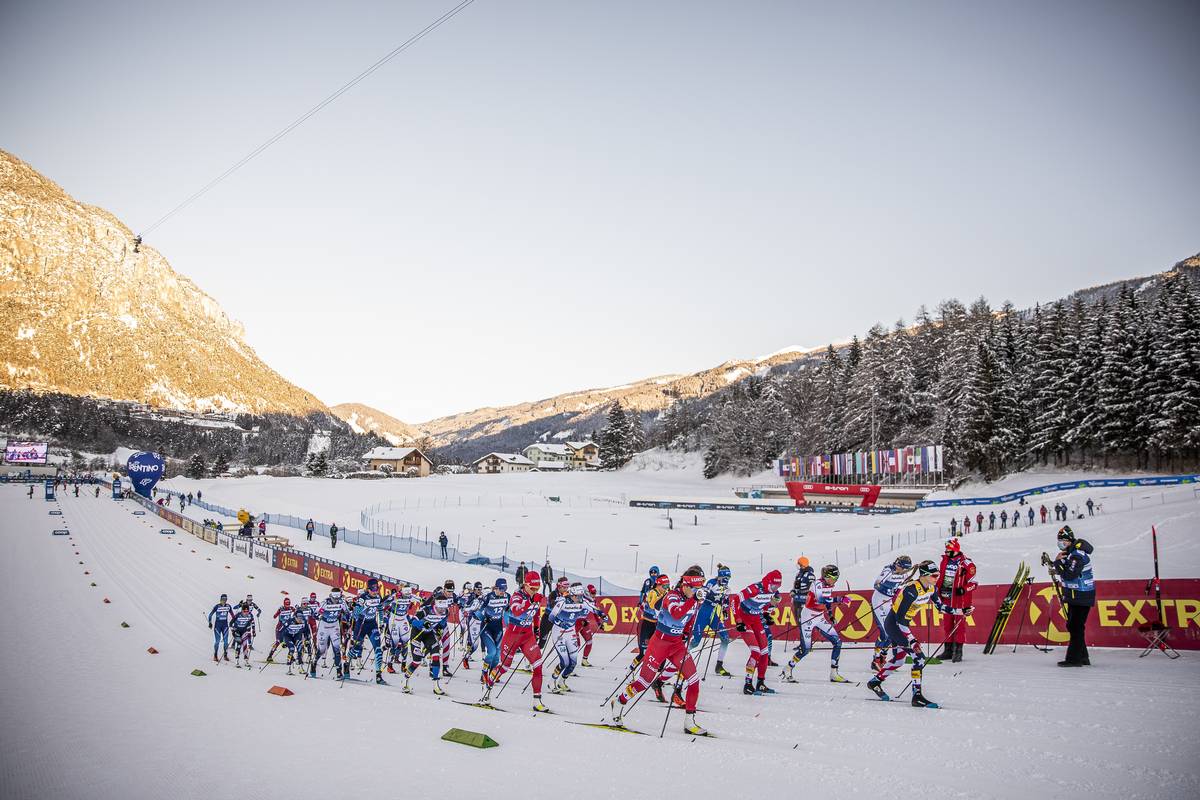
It was a warm and sunny day in Val di Fiemme, Italy with air temperatures of 7.7 degrees Celsius, and snow temperatures just below freezing. The grind of the Tour de Ski had taken its toll, and the starting field had been whittled down to just 37 starters.
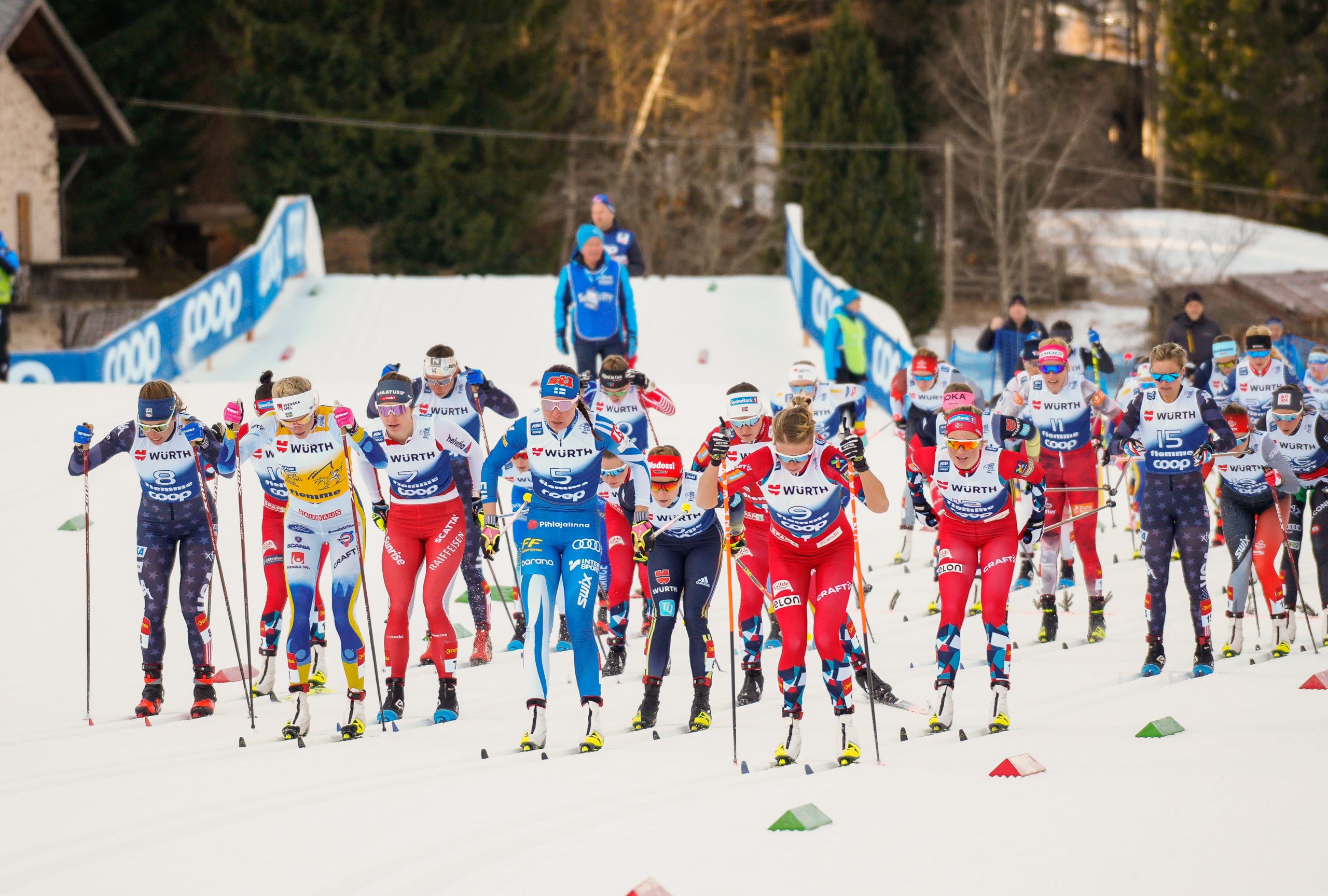
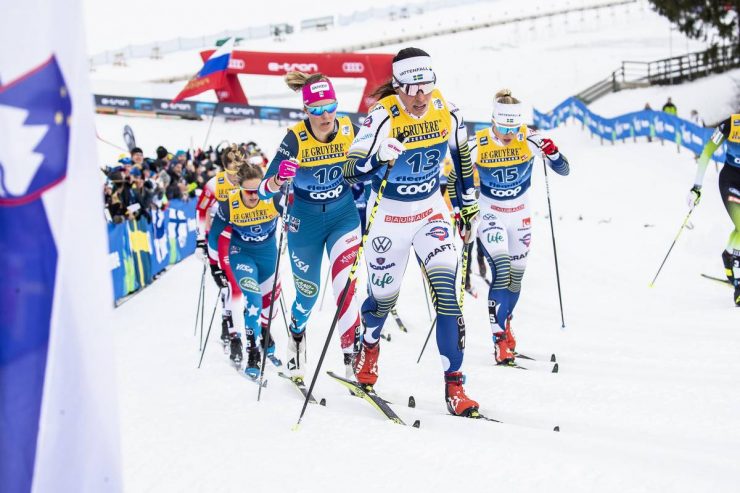
The Women’s 15 k Classic Mass Start followed six laps of the Val di Fiemme course. The early pace was dictated by a group of contenders—Karlsson, Niskanen, Hennig—though the pace was fairly moderate. Brennan moved to the front just before halfway point, (at 6 k), stringing out the field with her pace making. A lead group forms: Hennig, Niskanen, Karlsson, Tiril Udnes Weng (NOR), and Astrid Oyre Slind (NOR). Teresa Stadlober (AUT) managed to catch on before the significant gap formed.
Chasing them were Delphine Claudel (FRA), Lotta Udnes Weng (NOR), Anne Kyllonen (FIN), Katherine Stewart-Jones (CAN), and Heidi Weng (NOR). Diggins and Laukli settled into a third group as Kern began to be gapped.
Classic mass start racing can be a daunting challenge. What if the skis are too slow? What if the kick is too slippery? And descending on classic skis is a tricky prospect under even the friendliest of conditions. In the deep ruts and soft snow of the Val di Fiemme course, the high speed descent—a 45 kmh sweeping left turn—claimed a few unfortunate victims. Among them were Nadine Faehndrich (SUI) and Dahria Beatty (CAN) whose falls left them near the back of the pack.
Niskanen began pushing the pace in the fifth lap, while Karlsson began to show signs that her kick wax was beginning to fail, skiing out of the tracks early on each uphill, and cutting diagonally across each slope to gain some purchase with her edges. Brennan and Hennig also made the selection, and the lead group was established at four.
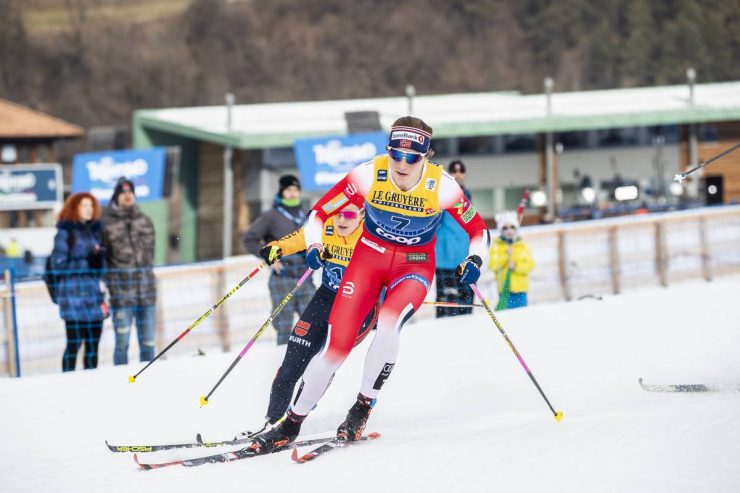
Rosie Brennan (USA) and Katharina Hennig (GER), (l-r) testing their limits on the Val di Fiemme downhills. (Phtoo: NordicFocus)
Brennan seems to excel during the toughest racing, and a classic mass start on an overly-warm day in the sixth stage of an exhausting Tour de Ski is particularly tough.
“I decided to go to the front and just ski my own pace for a lap. I don’t know if it really strung things out or not, but then the next lap was the sprint bonus and the speed got turned up really hot there . . . I did have a moment of ‘I don’t know if I’m gonna make it.’”
Niskanen continued to lead, pressing the pace through the final kilometers, knowing she would need to take the sprint out of Karlsson, Brennan, and Hennig. At 34 years of age, Niskanen seems to be experiencing a resurgence that goes well beyond her early-career specialization as a classic skier. Even so, she knew that if she failed to separate herself from her rivals that they would be likely to overtake her in the sprint. Ultimately, the strongest sprinter prevailed in a four-up finish, as Hennig charged across the line ahead of Karlsson and Niskanen. Only a second behind, Brennan was forced to settle for fourth.
Rosie Brennan (USA) raced to fourth in the 15 k Classic Mass start in the Tour de Ski Stage 6 at – FIS world cup cross-country, tour de ski, mass, Val di Fiemme (ITA). (Photo: NordicFocus)
“I felt really good, actually. I’ll be honest; I’ve never had a good race here, so I was sweating bullets about today. I was very nervous,” Brennan said. “I’ve made some really strong improvements in my classic over the last year, and I have a new wax tech that I really enjoy working with, and so I decide I just needed to believe today and see what was possible, and take a chance on myself. I’m really glad I did.”
When asked what she was looking for in tomorrow’s race up Alpe di Cermis, Brennan laughingly replied, “The top!”
After the race, American Jessie Diggins spoke of the many challenges that her team has been experiencing during the Tour de Ski, and the pride she feels at being part of this group: “We’ve had some serious staff shortages due to illness . . . I get choked up thinking about how everyone’s pulled together,” she said. “The Kern parents are out there running skis and doing feeds, Rosie’s boyfriend Tyler is out there testing kick . . . people have just banded together to make it work.”
Diggins finished 24th on the day, and sits 15th overall, 5:23 behind the leader.
Karlsson did all that was required to maintain her overall advantage, and enjoys a considerable lead as the Tour de Ski approaches the final stage on Alpe de Cermis. Her lead in the Tour de Ski is 1:12 to T. Weng, 1:37 to Niskanen, 2:00 to Hennig, and 2:28 to Brennan who sits in fifth place.
It doesn’t get much better than a weekend of full sun, epic skiing and meetings with the king of Norway. But that’s what we’ve got for you after another fun weekend of racing, at Oslo’s classic Holmenkollen venue. With help from Canadian retired Olympian Jess Cockney, we break down the 30 k and 50 k from Saturday and Sunday, touch on the COVID outbreak that’s hitting World Cup teams including the U.S. and take the International Ski Federation to task for canceling World Cup finals.
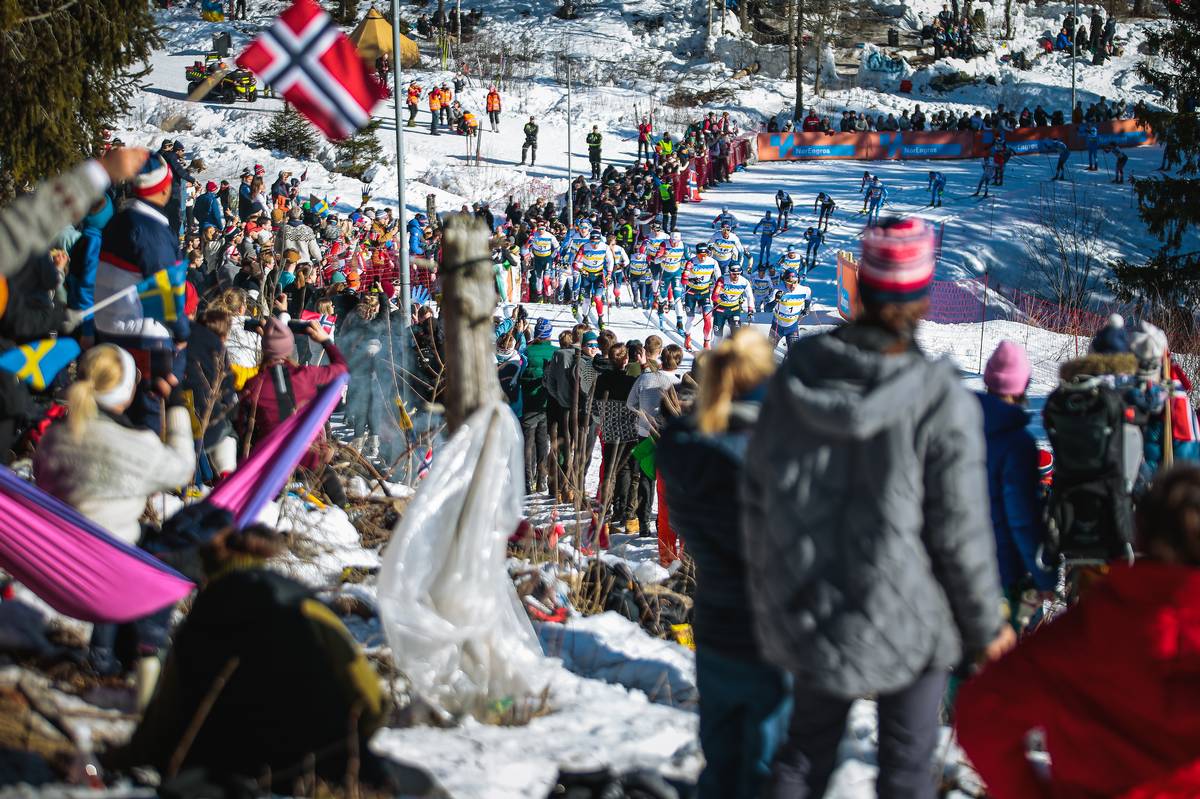
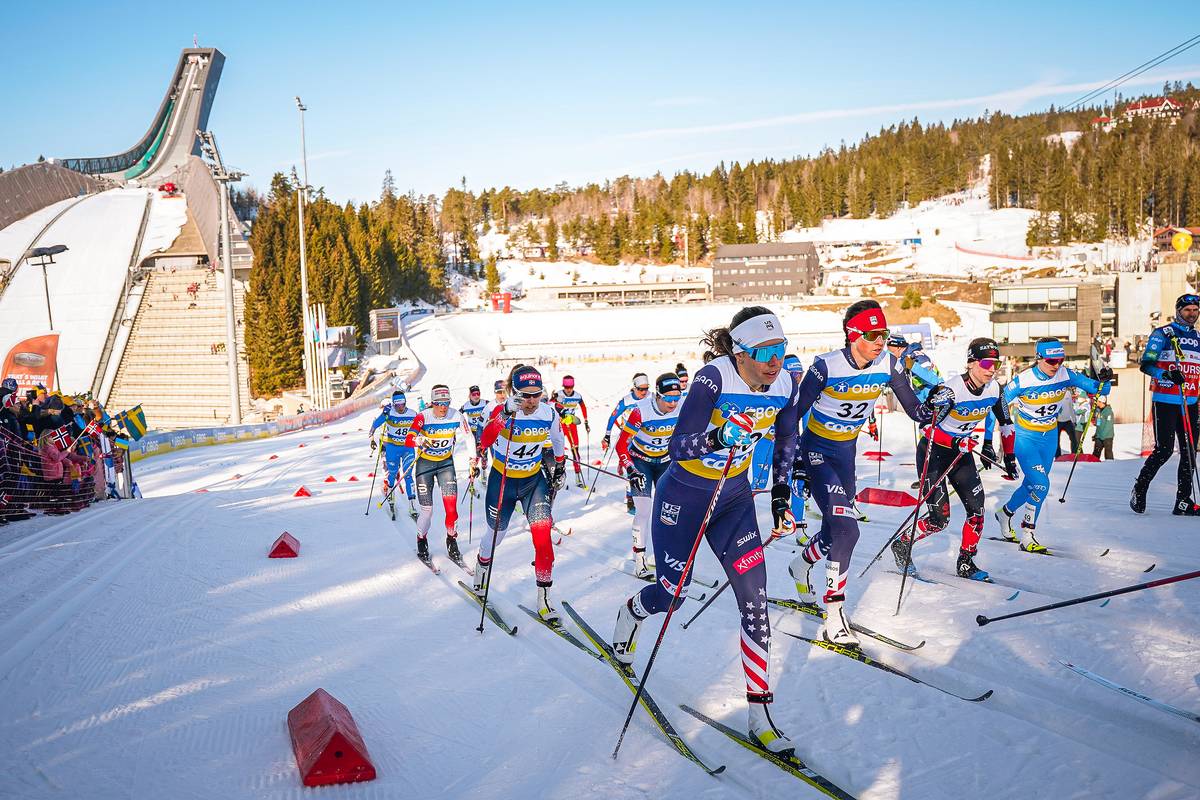
Crowds returned in droves to Holmenkollen for the men’s 50 k mass start classic. (Photo: NordicFocus)
Crowds line the storied tracks at Holmenkollen during the women’s 30 k classic. (Photo: NordicFocus)
This World Cup coverage is made possible through the generous support of Marty and Kathy Hall and the A Hall Mark of Excellence Award. To learn more about A Hall Mark of Excellence Award or to learn how you can support FasterSkier’s coverage please contact info@fasterskier.com.
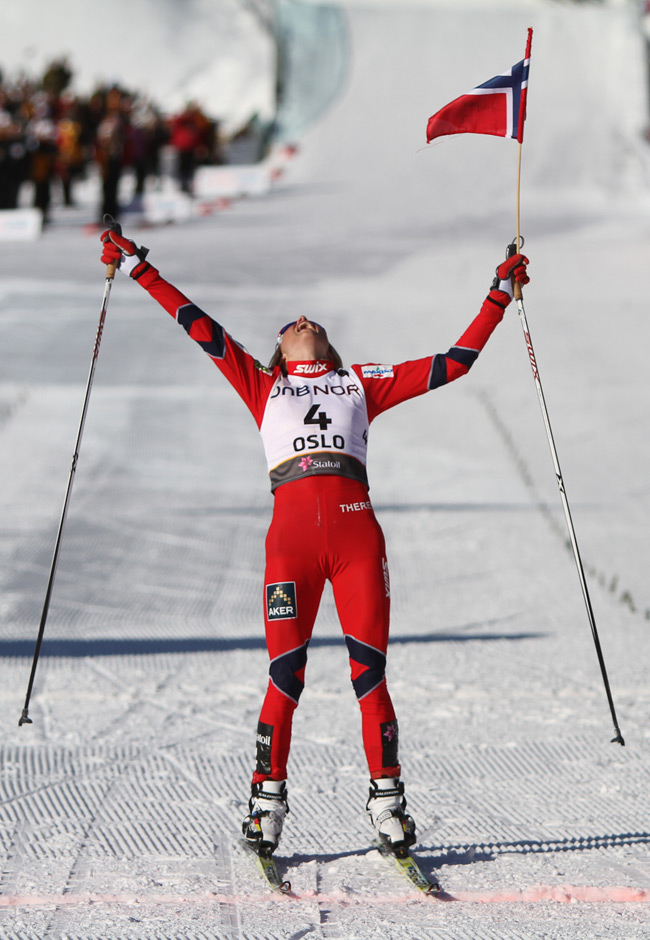
Terese Johaug wins her first individual World Championship gold medal in the 30 k mass start skate in Oslo, NOR. (Photo: FS Archives)
Eleven years ago to the day, racing the 30-kilometer mass start skate, a 22-year-old Therese Johaug won her first individual World Championship gold medal in a breakout performance at Holmenkollen near her home in Oslo, NOR. In doing so, she had broken apart a field of women considered legends of the sport on an equally legendary course known for long grinding climbs that require superior fitness and technique. Johaug won by nearly 45 seconds over one of the greatest cross country skiers of all time, her teammate Marit Bjørgen, and was 1:34 ahead of the Polish champion Justyna Kowalczyk.
“It was hard for me. It’s hard to see her go in front, and the gap [grow] bigger and bigger,” said Bjørgen that day. Then at the peak of her career, Bjørgen had gone four-for-four that week with gold medals in each of the previous World Championship races in Oslo, and the upset was a shock to those following along. “But I’m very happy for Therese. She is a young girl, and a girl for the future—and for Norway.”
Little did cross country ski fans know just how storied the athlete’s career would be.
Therese Johaug races in front of a home crowd during the 30 k classic at Holmenkollen. (Photo: NordicFocus)
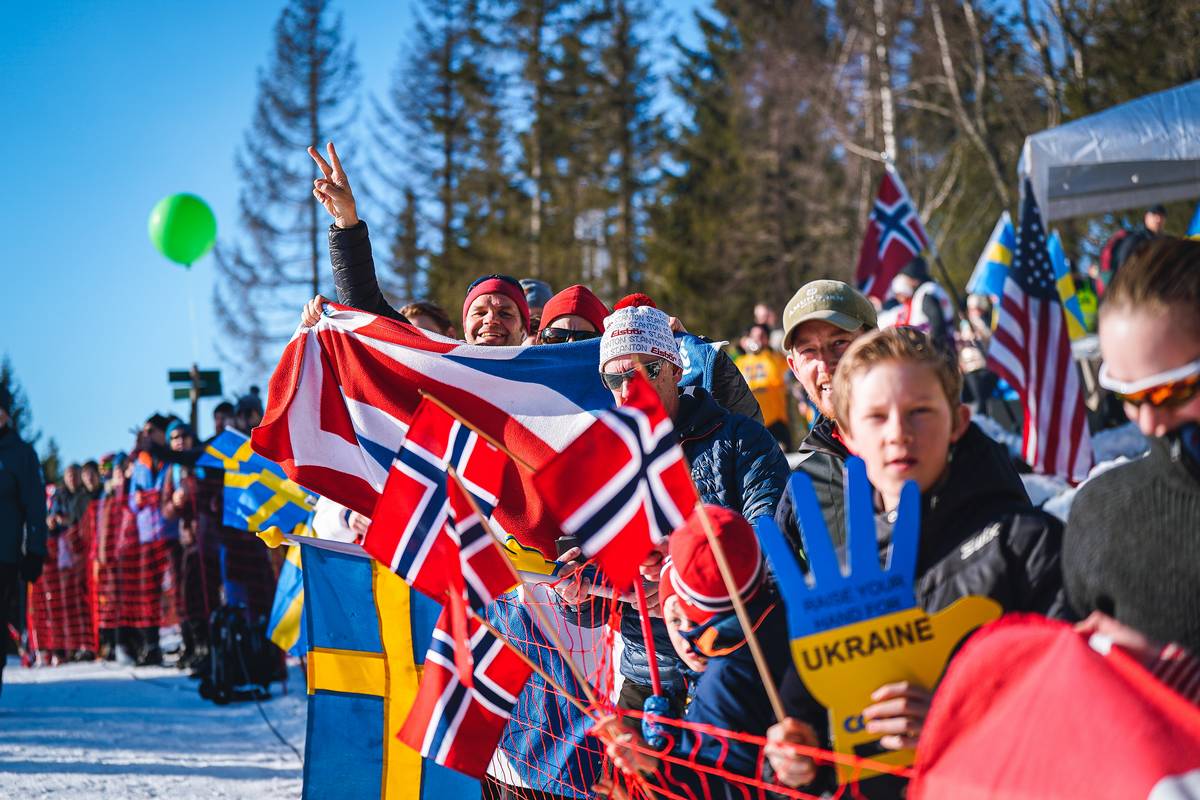
Today, under clear skies that allowed for views of the city skyline and Oslofjord, Norwegian flags flying, and fans returning to the crowded stadium and partying in the woods, she did it again, as one of her final performances after more than a decade as the top female distance skiers of all time.
And what’s more, Johaug won today’s 30 k classic in the same dominant fashion that she did eleven years ago, and has done many time since, stopping the clock at 1:19:22.8.
Though the final results show just 19.4 seconds as her winning margin, this only tells part of the story. By 10 k, Johaug held a margin of over 23 seconds, which she steadily grew over the subsequent laps. At 25 k, she led by nearly a minute and a half.
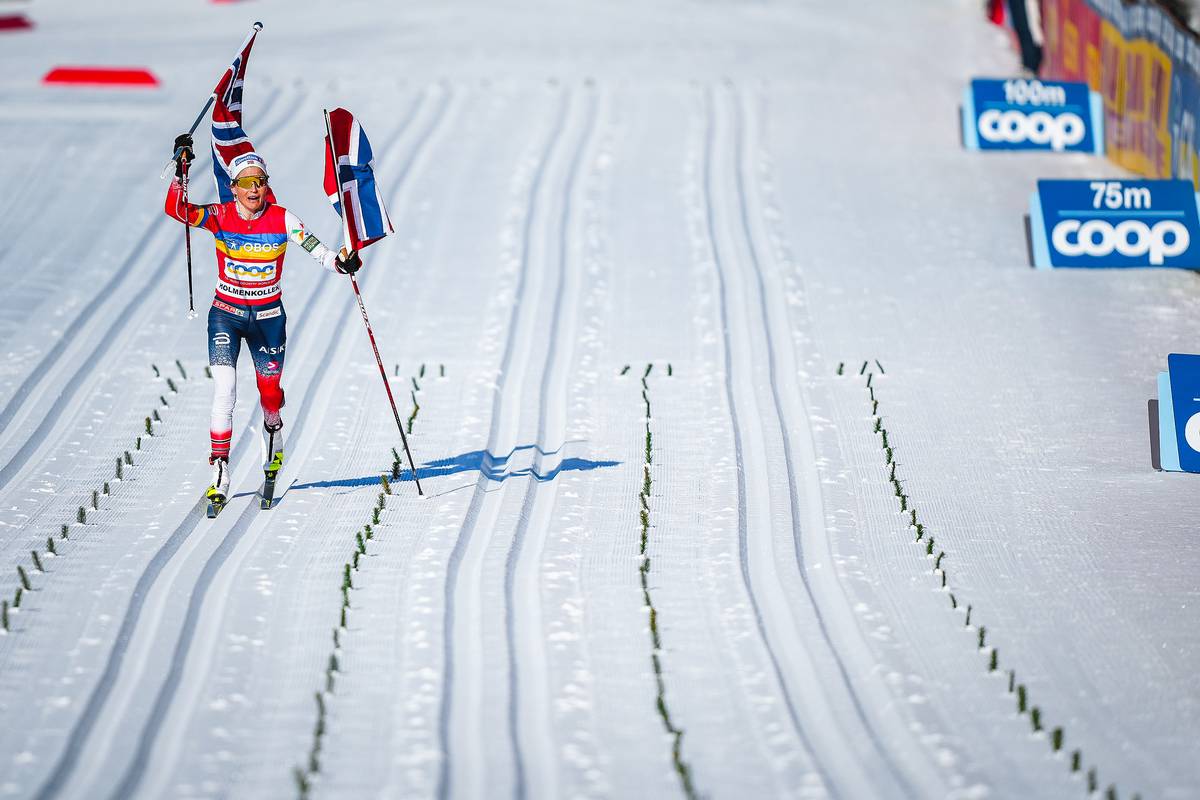
Therese Johaug waves Norwegian flags as she skis the final meters of 30 k classic at Holmenkollen. (Photo: NordicFocus)
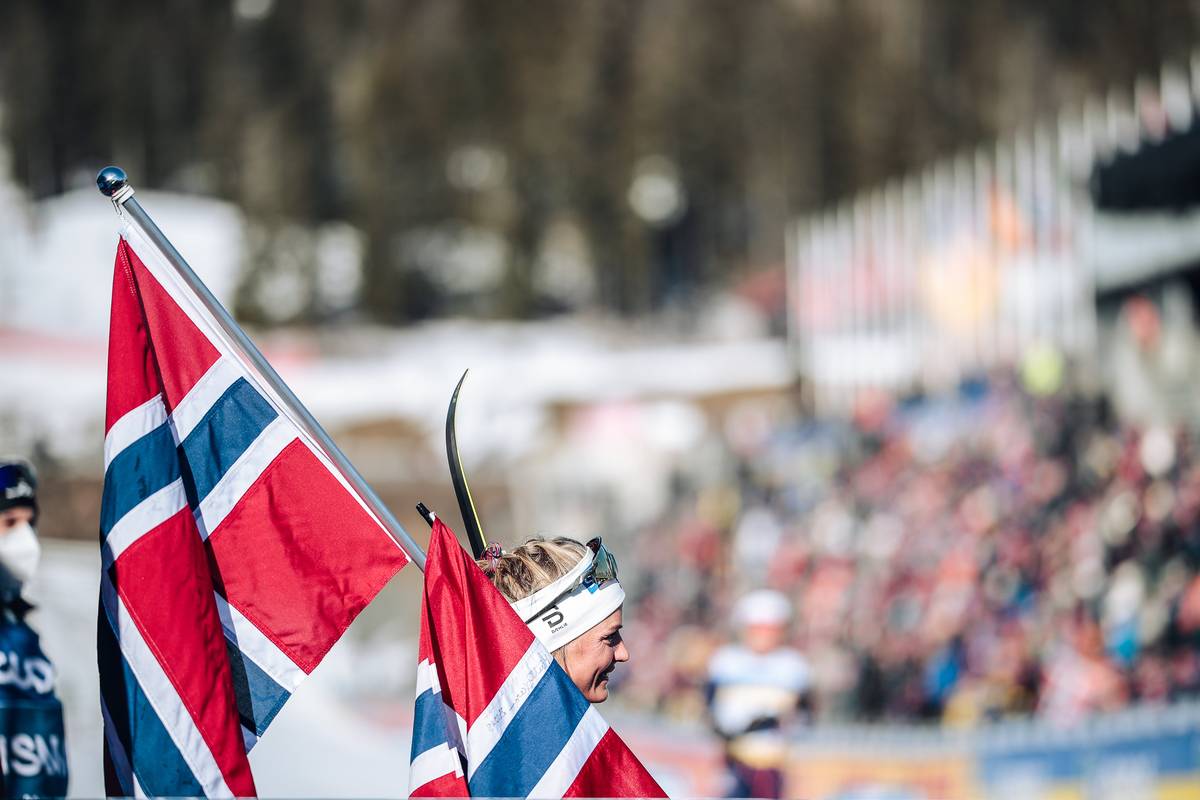
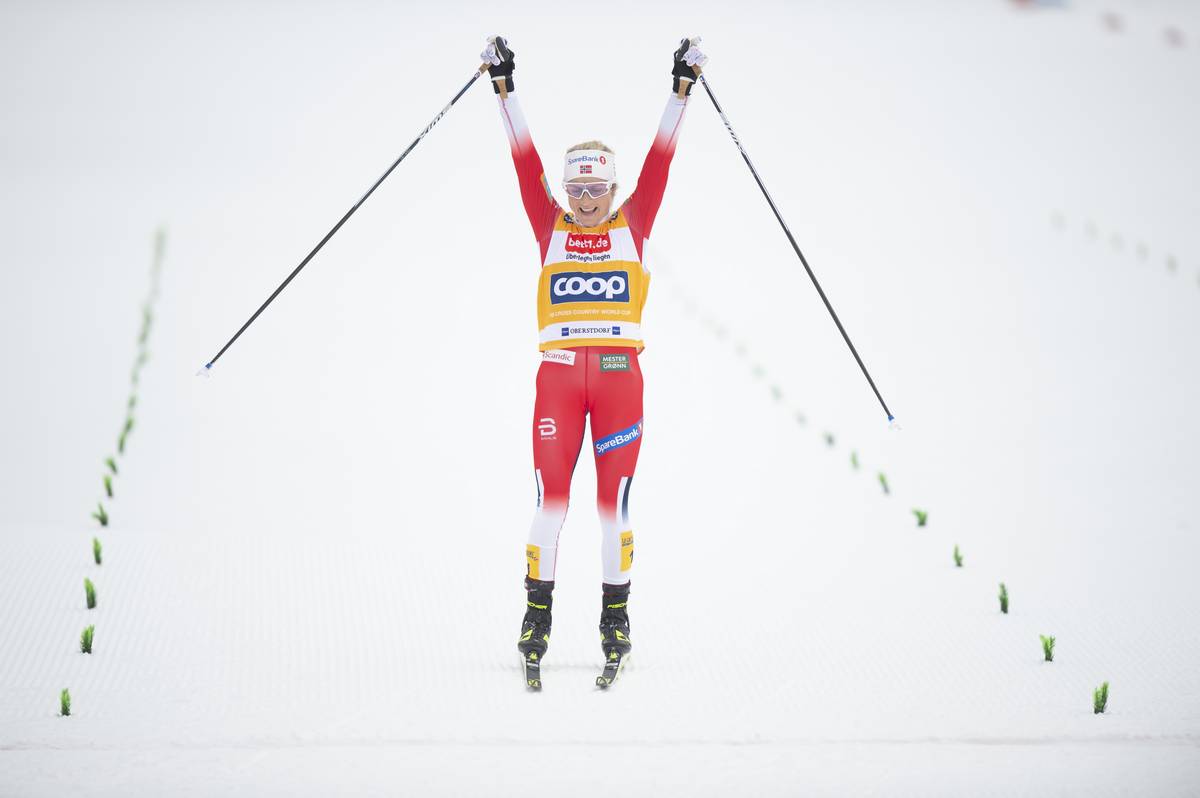
As she entered the stadium, Johaug was greeted by coaches and techs who handed her a flag for each hand, which she carried through the finish, waving, and stopping to take in the erupting cheers from the crowds.
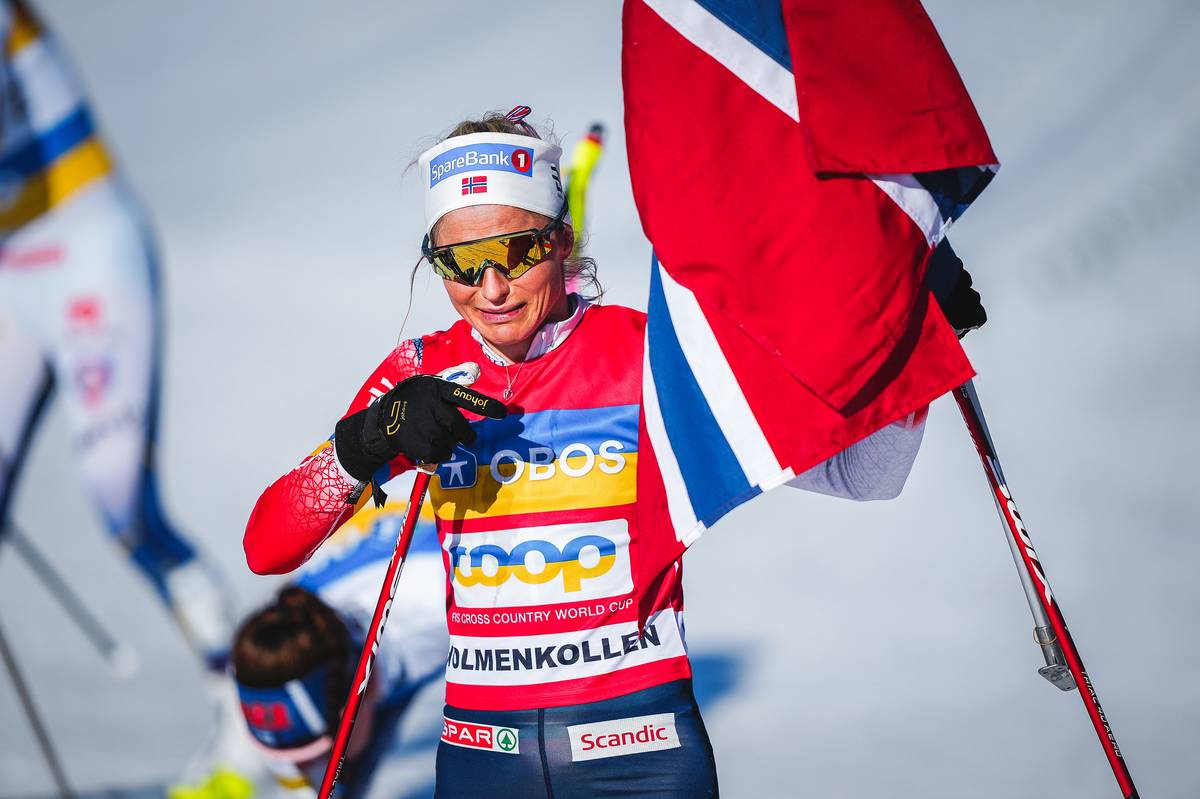
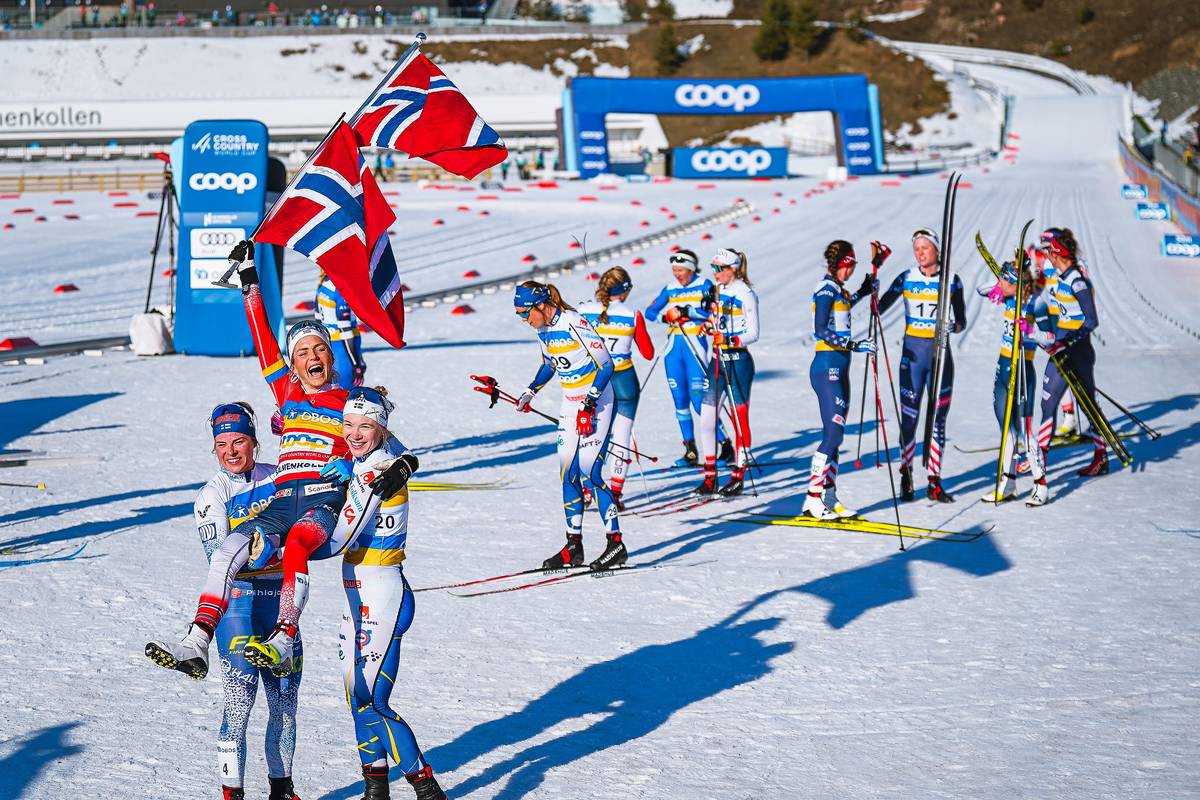
Laughing behind tears as the rest of the field began to trickle across the line, Johaug was hoisted onto shoulders, waving her flags for a loud Norwegian crowd who had supported and applauded her through fifteen years of racing on the World Cup.
“It’s a lot of emotion now,” Johaug said at the finish. “I start here in 2011 with my first individual victory, and today is my last race here. It was sun and blue sky, the same as in 2011, and there were a lot of people around the track cheering for me. I’m so happy now, but also so sad that this is the end of my career.”
Therese Johaug was emotional at the finish of today’s 30 k classic at Holmenkollen, the venue where she won her first individual World Championship gold in the 30 k skate eleven years prior. (Photo: NordicFocus)Norway’s legendary Therese Johaug wins the 30 k mass start classic, exactly 11 years after her first individual World Championship gold medal was won on the same tracks. (Photo: NordicFocus)
While she indicated during the Olympics that she would not compete another four years, it was not until yesterday that she officially announced that this would be her final race at Holmenkollen.
“In many ways, it feels as if the [story] ends when on Saturday, March 5, 2022, I stand on the starting line for another 30 k in Holmenkollen. I really do not want the journey to end, but it is a time for everything,” she wrote to NRK. “In light of this, I look forward to a final fight at home with the flag on my chest, and I am grateful for everything the sport has given me.”
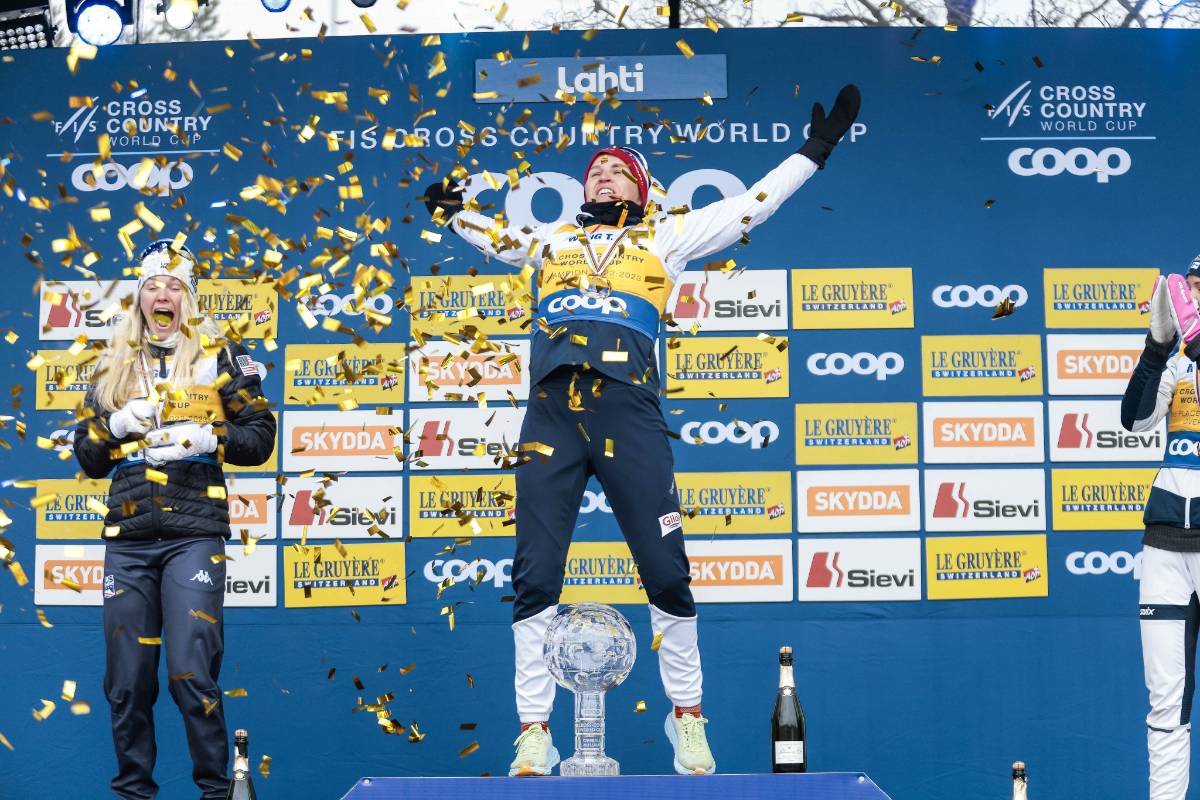
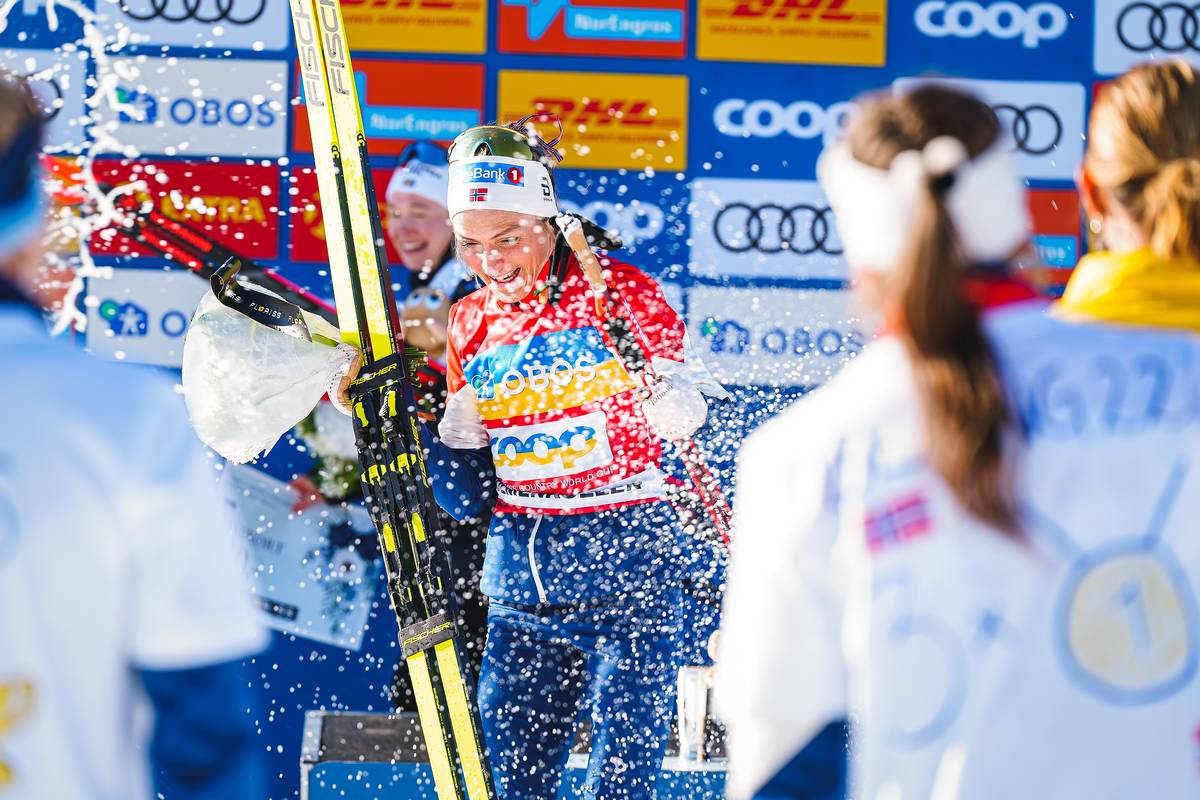
Therese Johaug is showered with champagne after winning the 30 k classic at Holmenkollen following her retirement announcement. (Photo: NordicFocus)Therese Johaug celebrates her final race race at Holmenkollen, winning the 30 k classic exactly eleven years after taking her first individual World Championship gold on these tracks. (Photo: NordicFocus)
As Queen’s “We are the Champions” blared through the stadium, Johaug stepped off the podium only to be soaked by champagne sprayed by a flock of teammates wearing shirts spelling her name, with “takk” – thank you – written with a heart at the end of the row. It was a joyous celebration fitting for the moment, and perhaps also a refreshing distraction from the times at large.
“There are a lot of strong moments, but I am moved when so many people come here and see my last race. I must thank the Norwegian people who stand here today,” Johaug later said to NRK.
While you can certainly expect a more in-depth look at her storied career on FasterSkier, for now, we’ll echo the crowds in congratulating Therese Johaug, and we look forward to following along for the next chapters.
Therese Johaug celebrates her final race race at Holmenkollen, winning the 30 k classic exactly eleven years after taking her first individual World Championship gold on these tracks. (Photo: NordicFocus)Krista Pärmäkoski (FIN) and Jonna Sundling (SWE) lift champion Therese Johaug (NOR) for a podium shot at the finish of the 30 k classic in Oslo. (Photo: NordicFocus)
Behind the celebration, the lineup of women in today’s top-10 was remarkably similar to the Olympic 10 k interval start classic, with a few name swaps, and of course, a few noteworthy athletes missing – namely, Natalia Nepryaeva and Tatiana Sorina of Russia, and Jessie Diggins, who had been fourth, seventh, and eighth, respectively.
The volume of the ringing cowbells swelled as Finland’s Krista Pärmäkoski skied through the stadium on her own for second place, after pulling away from the first chase pack with 5 k to go and maintaining a healthy 10-15 second gap through the finish. Coming back on form after a few rocky seasons, Pärmäkoski had been third in the 10 k classic in Zhangjiakou, behind her teammate Kerttu Niskanen, who was fourth today (+33.8).
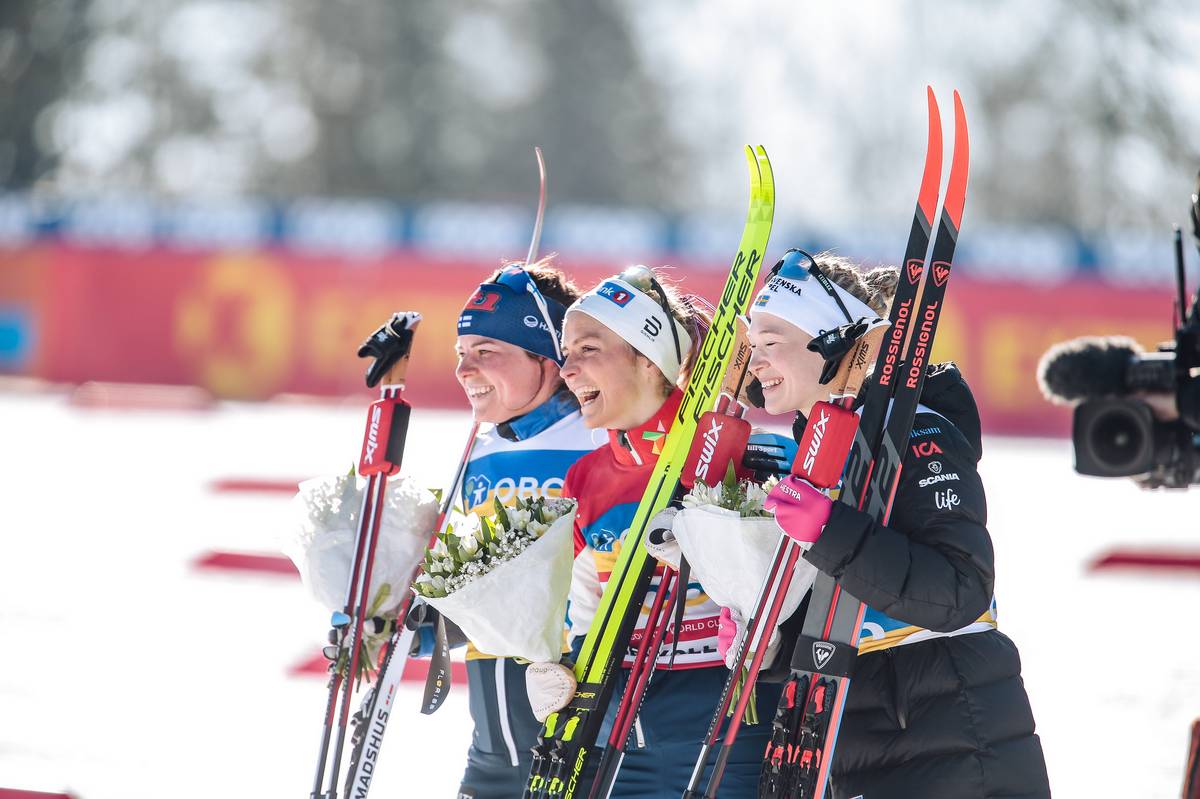
Finland’s Krista Pärmäkoski takes second in the 30 k mass start classic at Holmenkollen in Oslo, NOR. (Photo: NordicFocus)The women’s 30 k classic podium at Holmenkollen: Therese Johaug (NOR) took the win ahead of Krista Pärmäkoski (FIN) and Jonna Sundling (SWE). (Photo: NordicFocus)
Between the Finns, Sweden’s Jonna Sundling reaffirmed her talents across all distances, taking the third spot on the podium (+32.3) just two days after being second in Drammen’s classic sprint. Matching her fifth place result in the Olympic 10 k, Germany’s Katharina Hennig followed Niskanen to the line (+34.7) with Therese Stadlober, who was ninth at the Games, crossing after a gap in sixth (+46.7).
Leading the next chase group, and the American team, was Rosie Brennan in seventh (+1:12.3), bringing Norway’s Marte Skaanes and Sweden’s Ebba Andersson to the line just behind her for eighth (+1:13.1) and ninth (+1:13.8), respectively.
Rosie Brennan leads Norway’s Marte Skaanes and Sweden’s Ebba Andersson to the line. (Photo: NordicFocus)
“Today was huge for me,” Brennan wrote in a post-race email. “I have struggled here my entire career, and [though] it’s been a few years since I’ve raced here and I have improved a lot in the last few years, I still felt I lacked a lot of confidence and excitement coming here [today]. It’s also been a really stressful week for a variety of reasons, so I showed up today with an immense amount of anxiety that I needed to get a hold of before the race started.
“I am really proud of giving myself another chance to put together a good race here and to have managed the stress and anxiety well enough to do so. I wasn’t feeling in a place to shoot for the moon so I tried to start a bit a conservative the first 5 k and then reevaluate. I had a great ride with Ebba and really had an enjoyable time skiing out there today. The last lap, we had the chance to pick off a few from the lead pack and so I started to ramp things up to see what was possible. I felt strong on the last climb and felt I had a good shot at the sprint finish so I went on the last little bump before the [last 100 meters]. It felt great to finish strong and to put together a really solid race today.”
Rosie Brennan skis to seventh in the 30 k classic at Holmenkollen. (Photo: NordicFocus)
Following her classic sprint race in Drammen Thursday, Brennan joked post-race that she had lost out on yet-another boot slide. Today, the final sprint was hers. It was perhaps, also worth American fans celebrating that today that she won amongst her chase group, just under two weeks after a brave and gritty performance in the Olympic 30 k skate where she had pulled the chase group for much of the race, wearing herself out to break the wind, only to be dropped in the final 600 meters as Niskanen pulled away for a bronze medal. However, Brennan said she is not connecting any dots between the two.
“This race was nothing like Zhangjakou, really hard to even compare the two. 30 k’s are always an adventure and I am really happy to have put together two strong ones, in each technique.”
Rosie Brennan skis to seventh in the 30 k classic at Holmenkollen. (Photo: NordicFocus)
Commenting on how she is feeling, mentally and physically, with one final race weekend to go, Brennan concluded, “I am really bummed that the [World Cup] Finals were canceled. I haven’t raced a ton this season because of the earlier cancellations and while it has been a very high density block since the Olympics started, I am still feeling strong and wanted to see what I could do. But it will be really fun to end the season with the mixed relay event as that is a new one for us!”
Julia Kern was next for the US in 23rd (+3:37.2), followed by Hailey Swirbul in 26th (+3:57.8), and Caitlin Patterson – six days after taking second at the American Birkie – in 30th (+4:11.5).
Julia Kern skis to 23rd in the 30 k classic at Holmenkollen in Oslo, NOR. (Photo: NordicFocus)Hailey Swirbul skis to 26th in the 30 k classic at Holmenkollen in Oslo, NOR. (Photo: NordicFocus)
In a post-race call, head coach Matt Whitcomb shared that Kern’s result was perhaps especially noteworthy as she has been struggling throughout the season with nausea during distance races, making it difficult for her to keep down fluids taken in prior to the race, let alone receive feeds during. Whitcomb also explained that Diggins sat out today’s race as she was feeling lingering fatigue from the long, and successful, season of racing. He affirmed that she is healthy and will be ready to race for the final World Cup weekend in Falun, beginning next Friday. Listen to the full call with Whitcomb below.
Outside the top-30 for the US, Katharine Ogden was 37th (+5:54.1), followed by Rosie Frankowski, who has consistently landed on SuperTour podiums throughout the season, in 46th (+8:12.2).
Katharine Ogden (left) and Caitlin Patterson (right, bib 32) take to the course at the start of the women’s 30 k classic at Holmenkollen. (Photo: NordicFocus)Canada’s Cendrine Browne (bib 43) leads Katharine Ogden (bib 40) during the 30 k mass start classic at Holmenkollen. (Photo: NordicFocus)
Racing for Canada, Katherine Stewart-Jones led the way in 22nd (+3:25.0), with Cendrine Browne also inside the top-30 in 25th (+3:53.7). After a successful World Junior Championship in Lygna, NOR, Jasmine Drolet finished 42nd today (+6:53.2), with Olivia Bouffard-Nesbitt closing out the Canadian racers in 48th (+10:19.8).
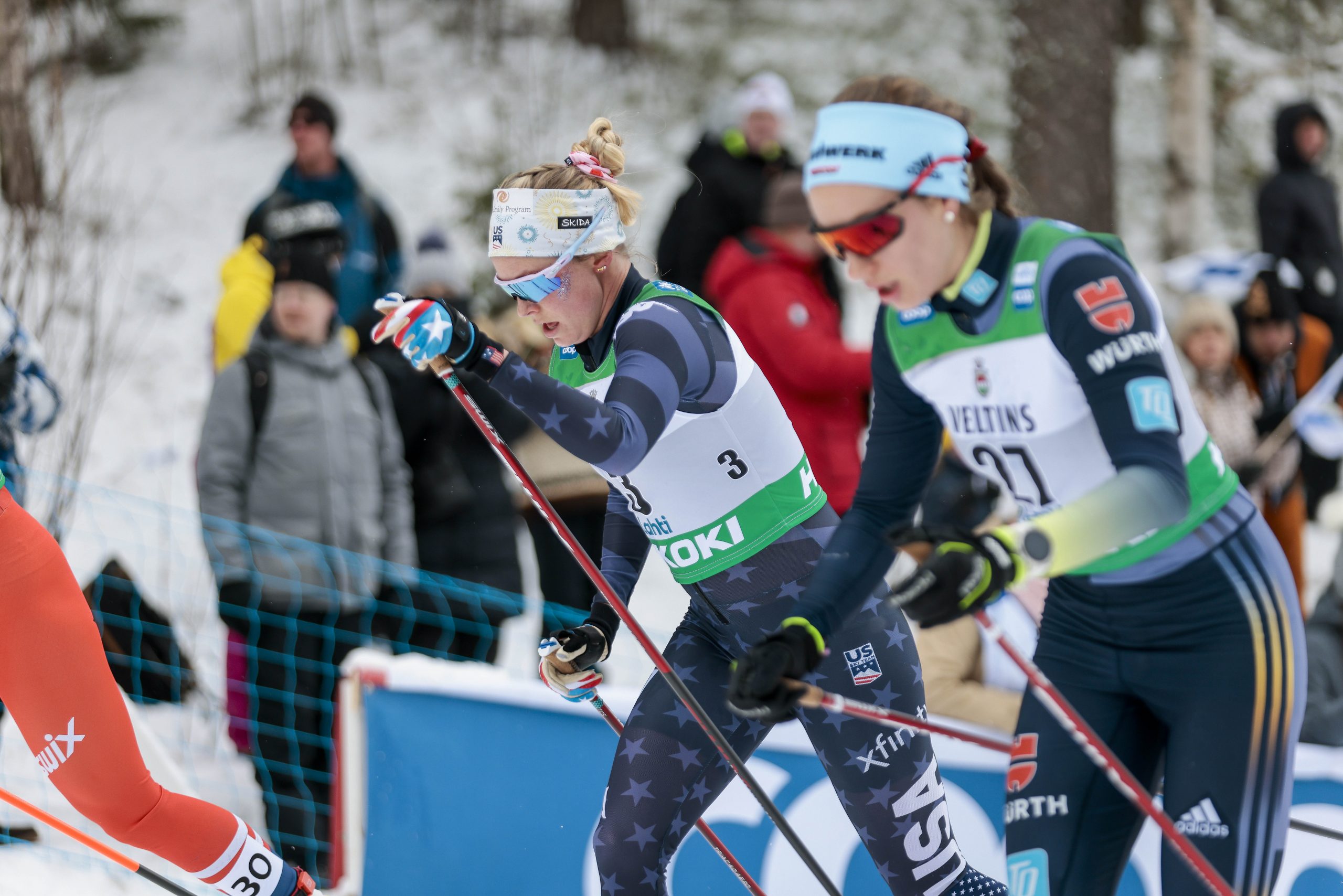
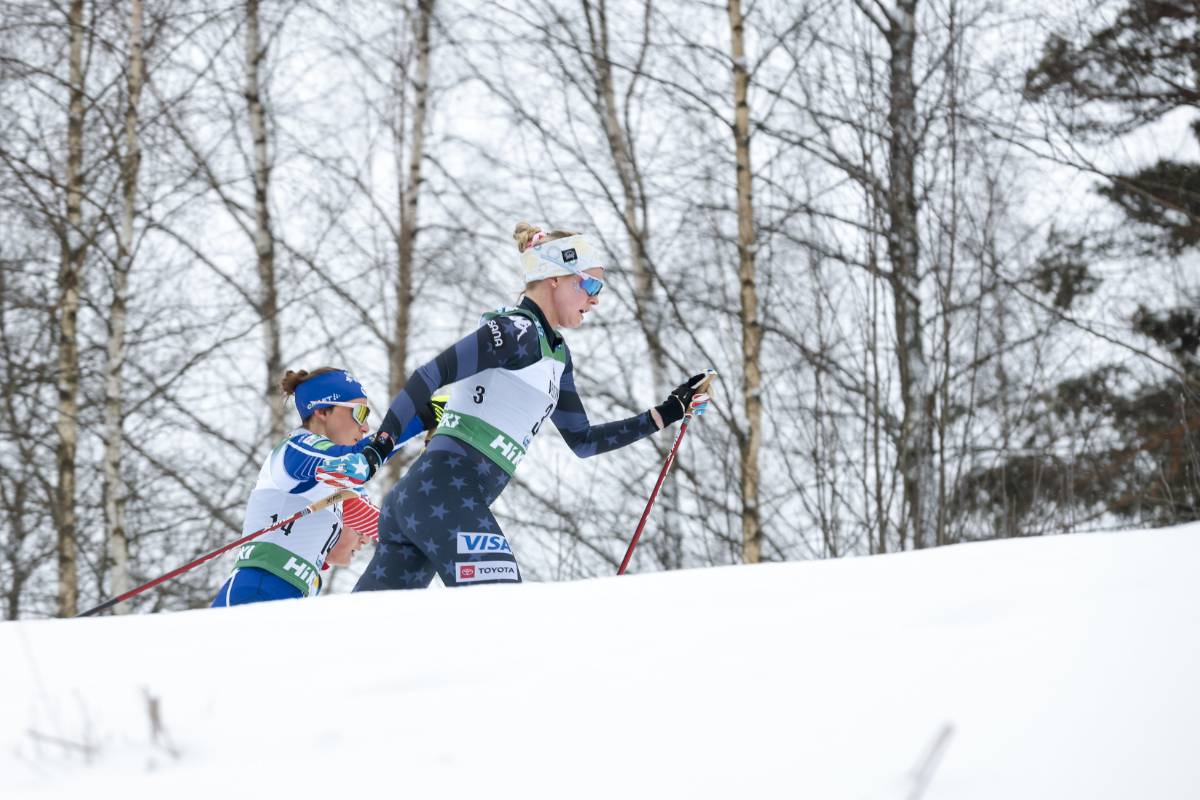
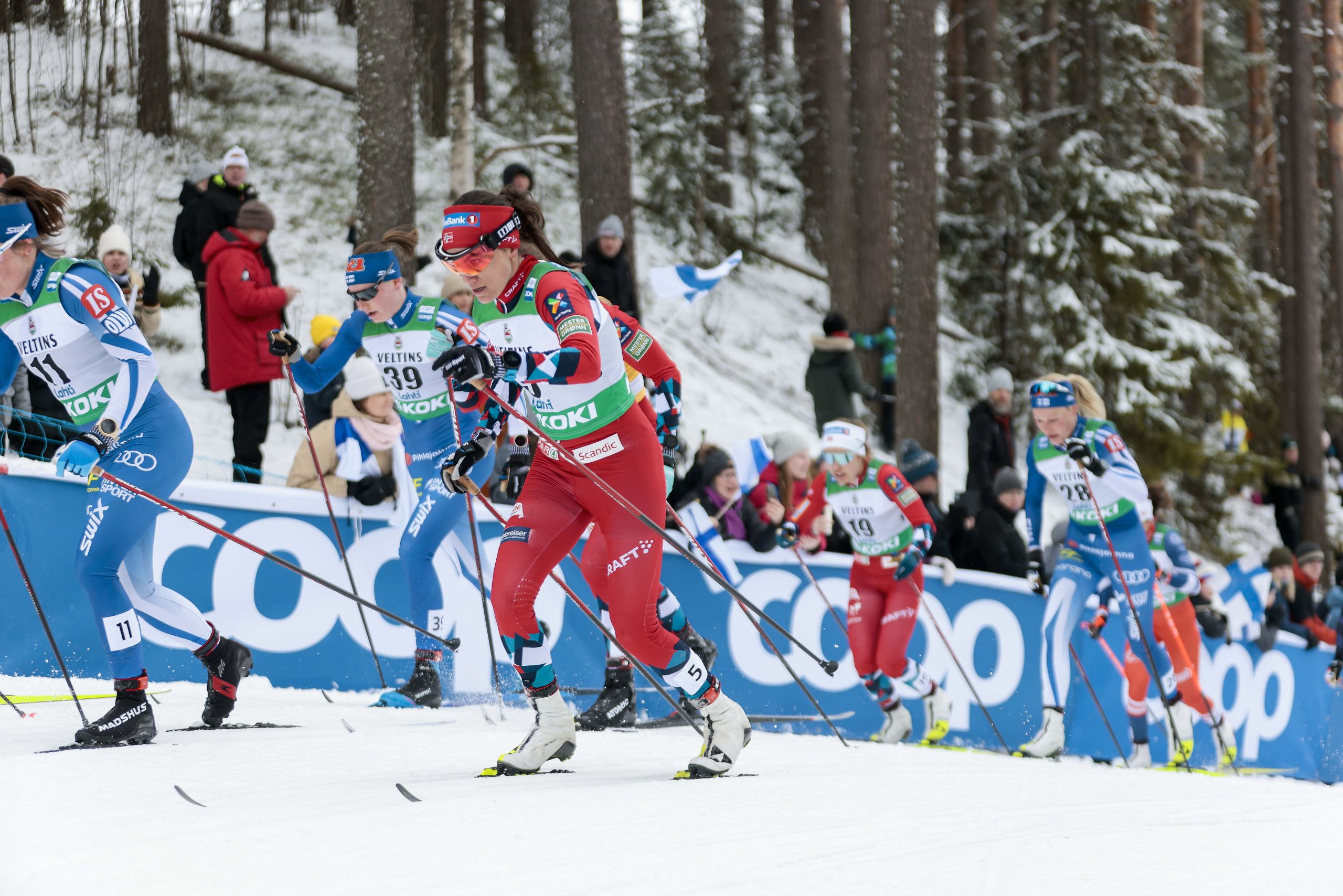
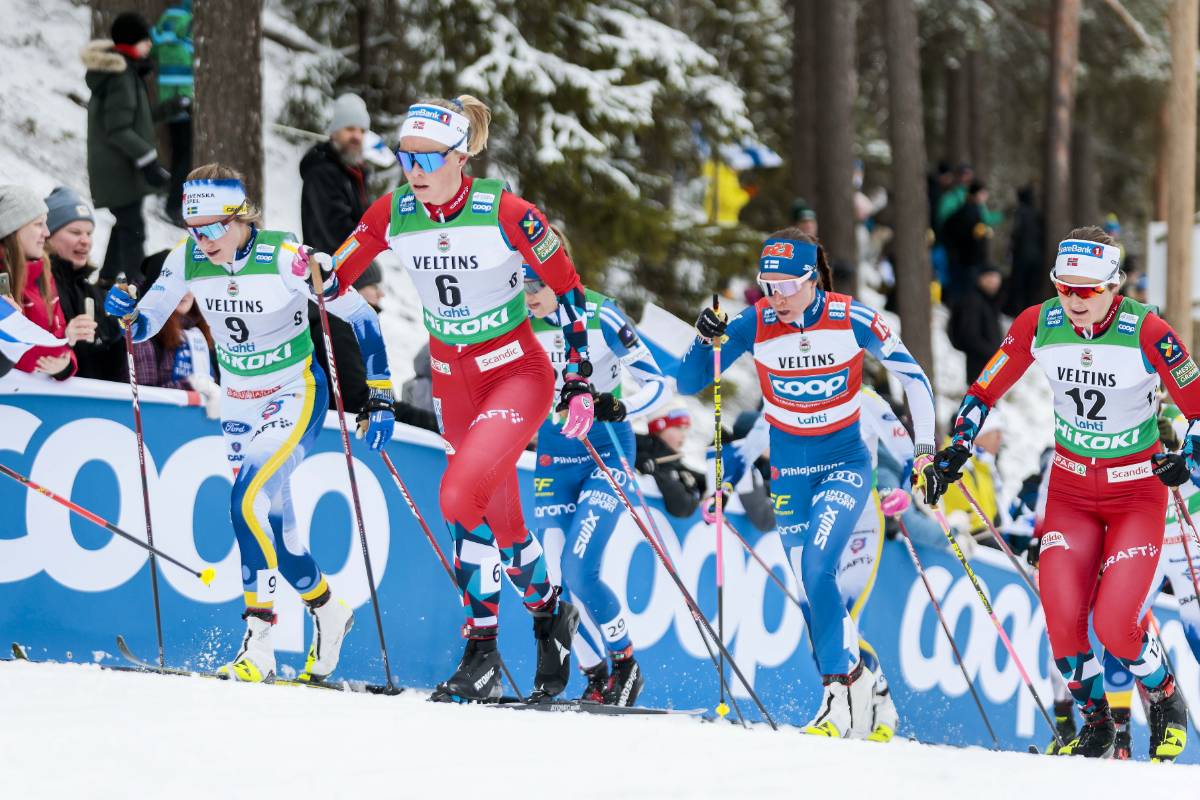
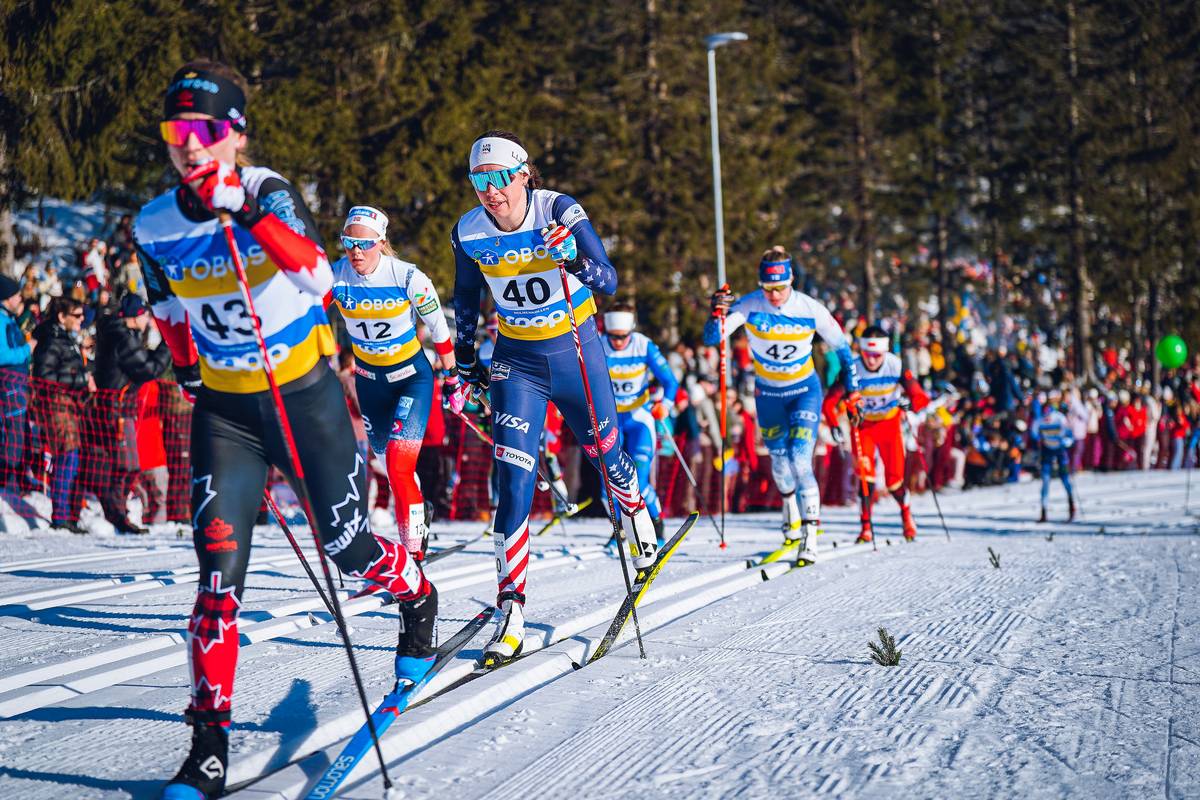
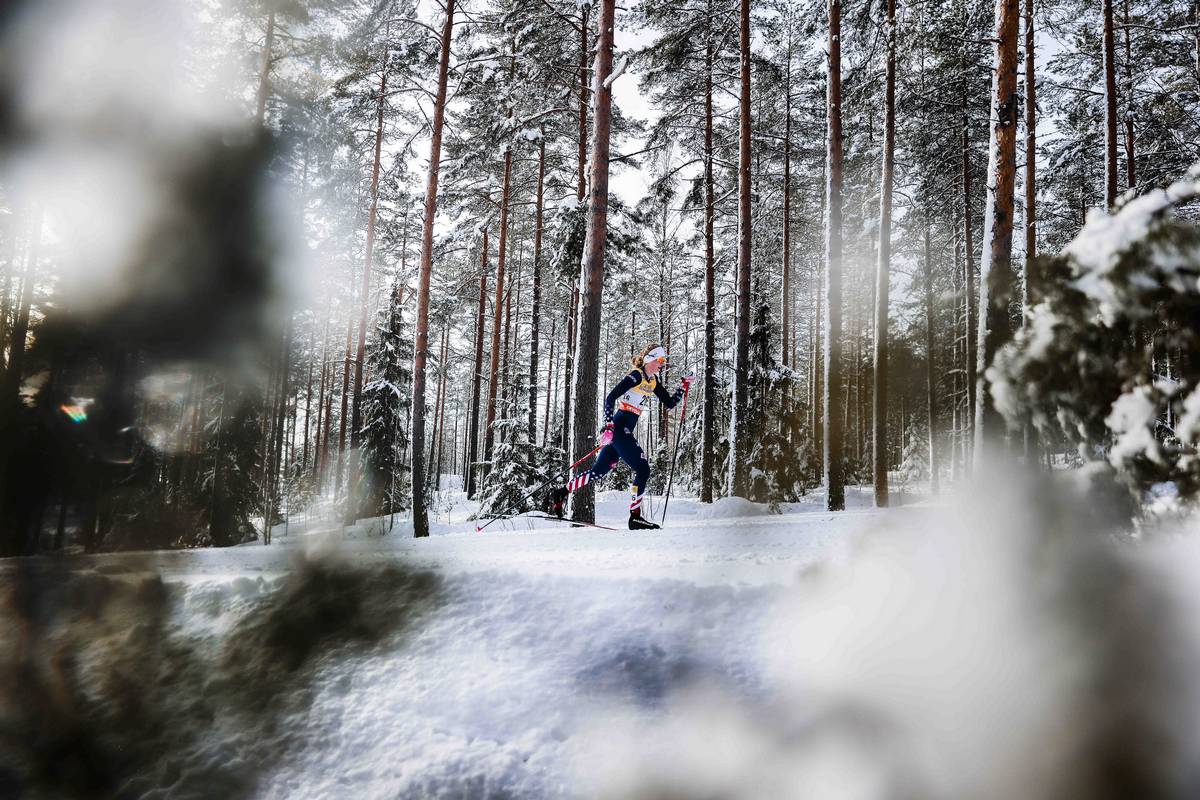
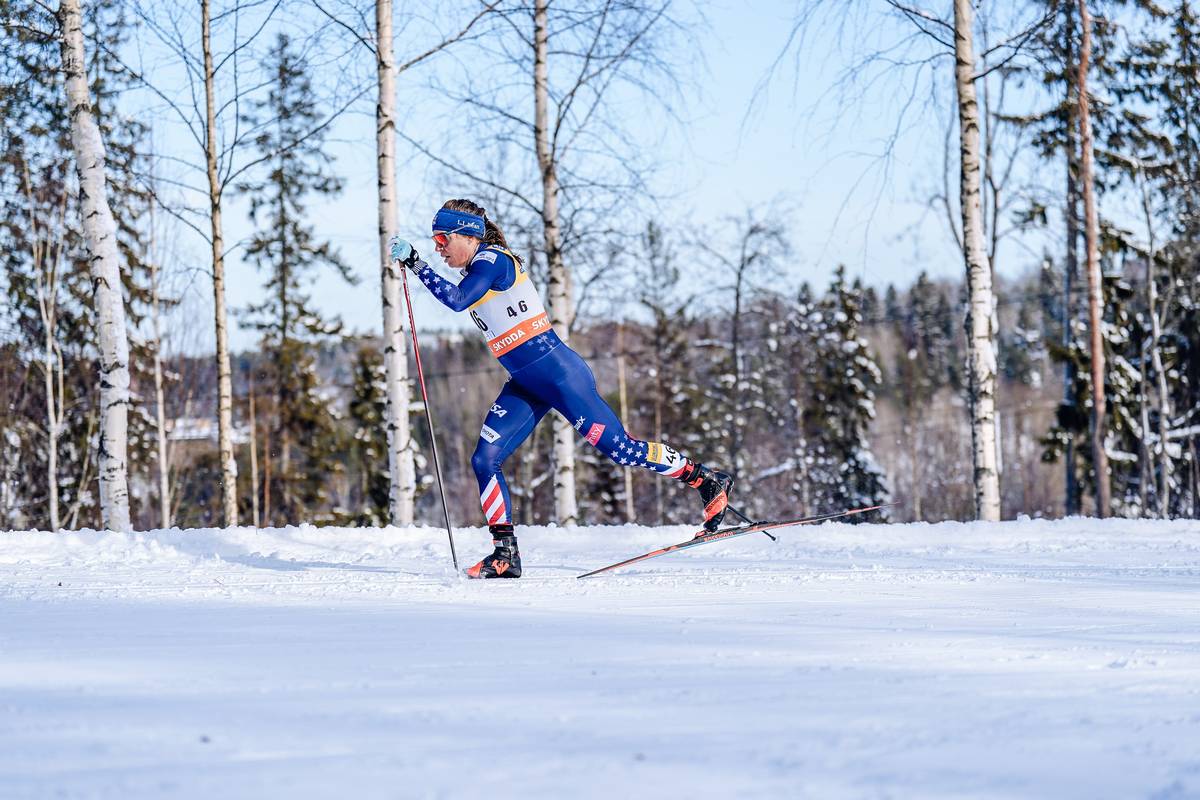
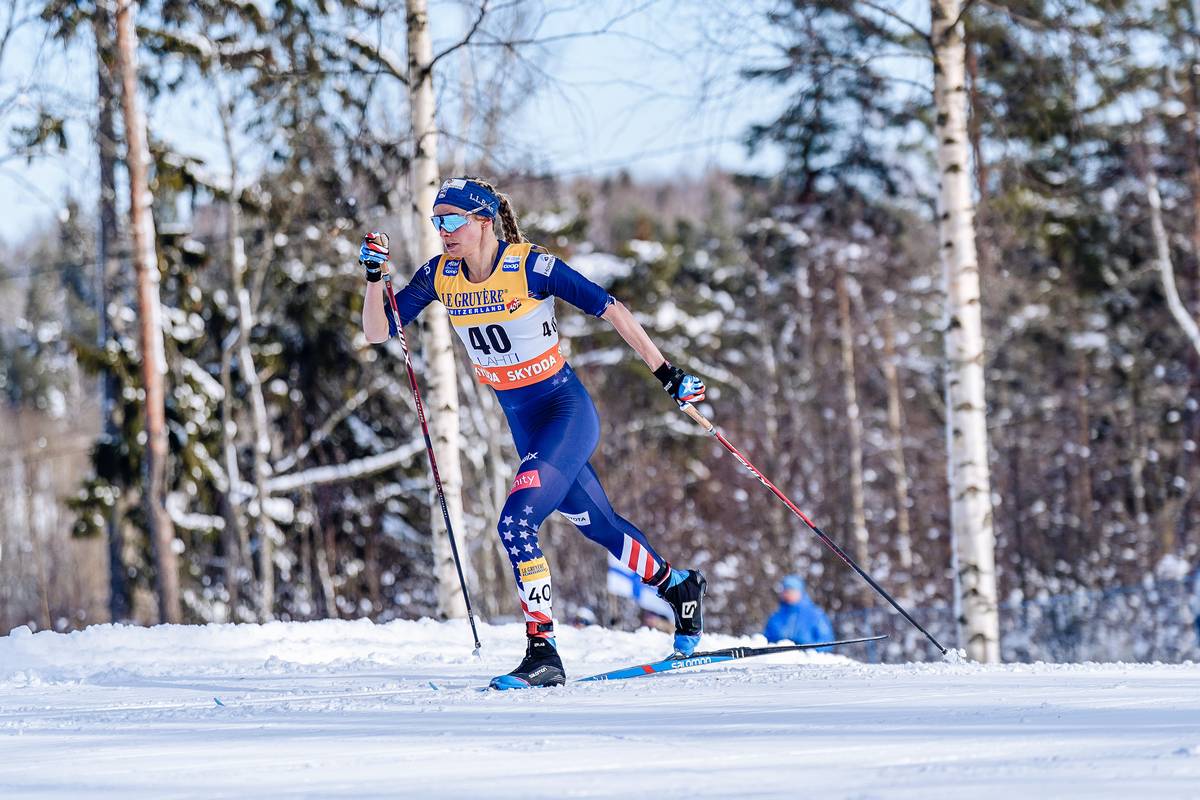
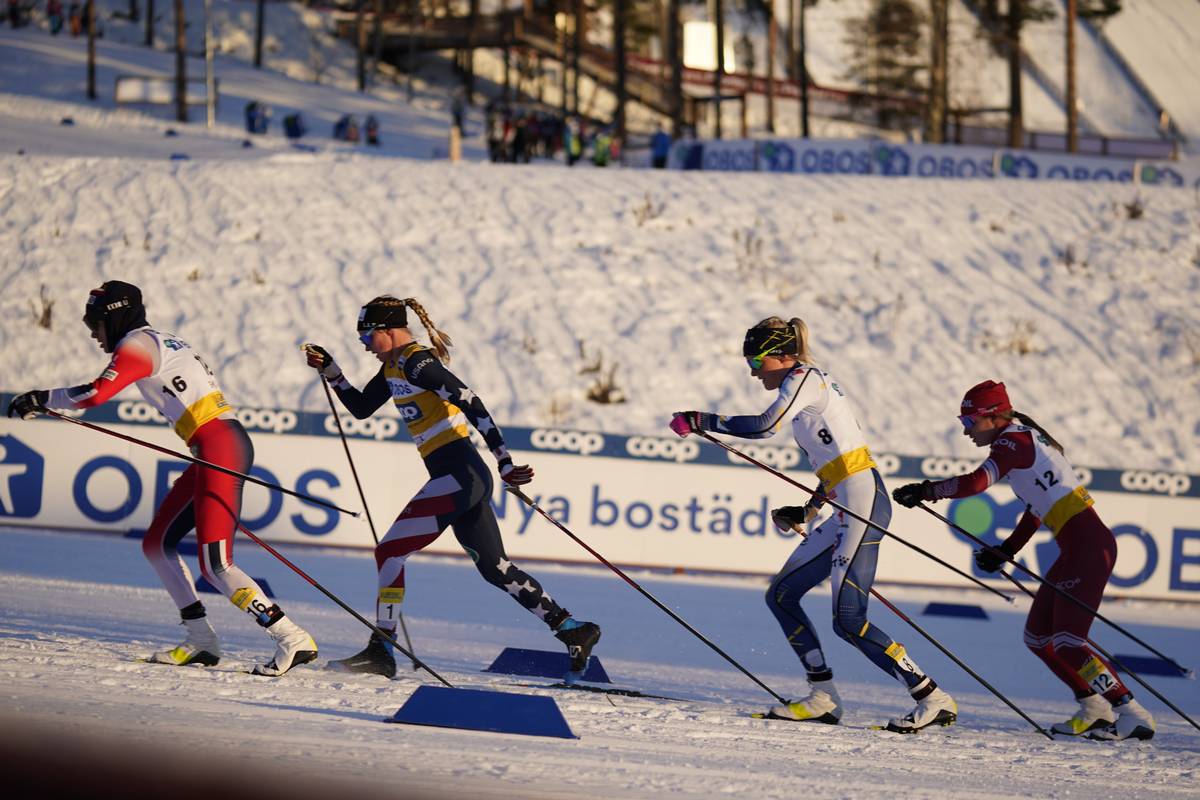
Hailey Swirbul races through the snow-capped pines of Lahti, FIN. (Photo: NordicFocus)
This World Cup coverage is made possible through the generous support of Marty and Kathy Hall and the A Hall Mark of Excellence Award. To learn more about A Hall Mark of Excellence Award or to learn how you can support FasterSkier’s coverage please contact info@fasterskier.com.
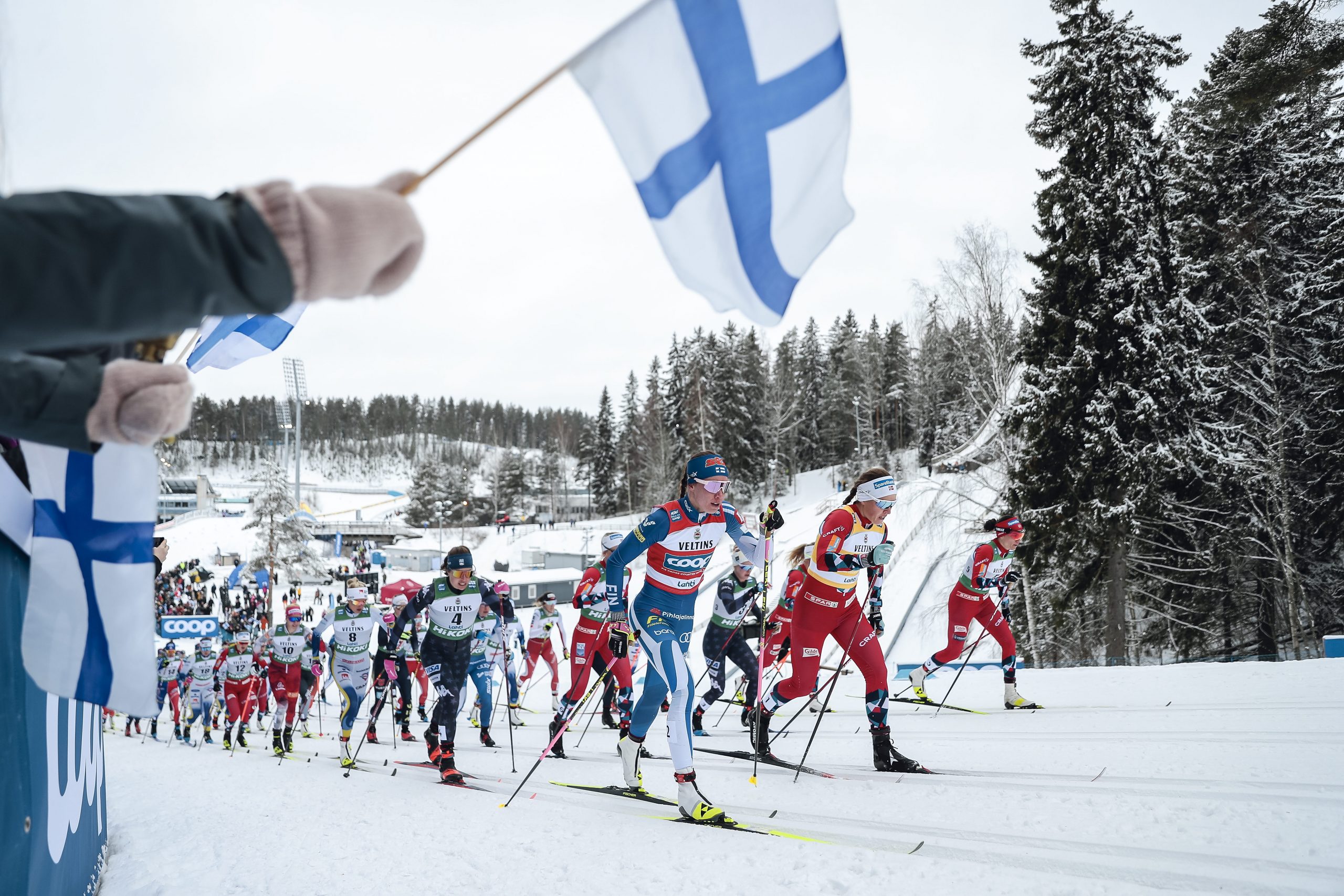
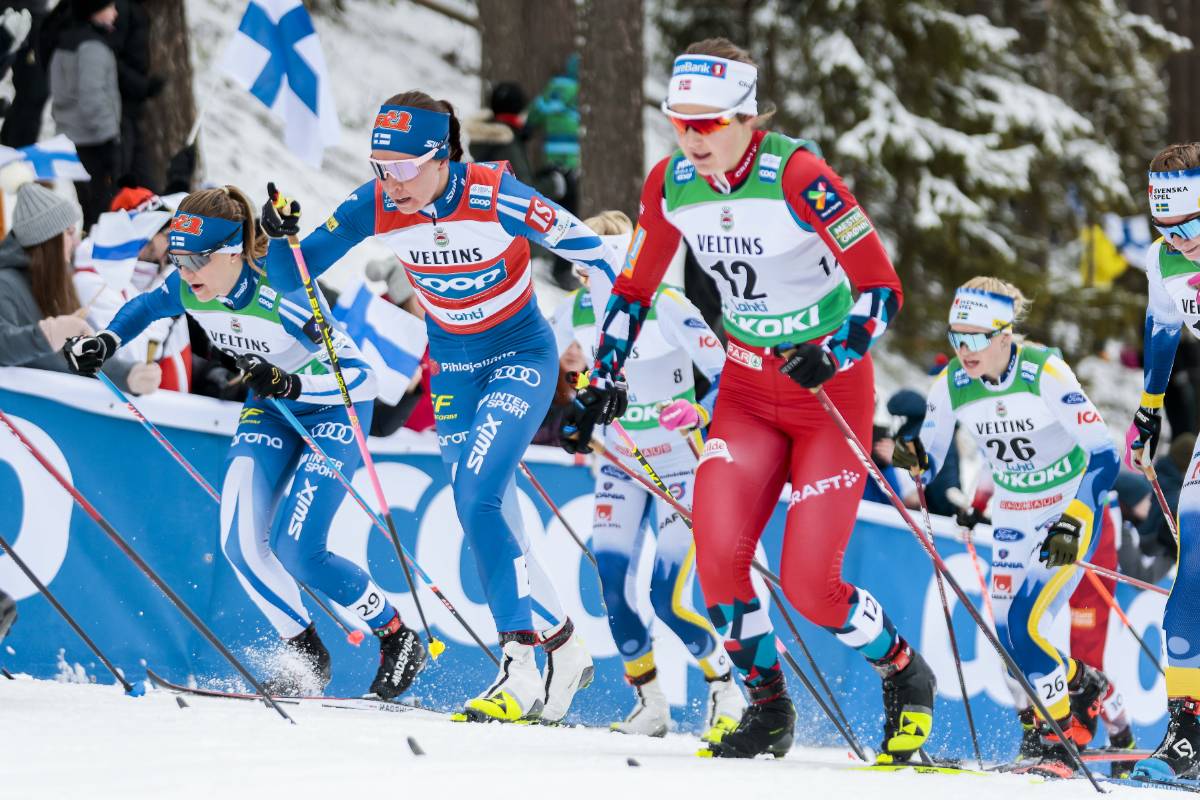
An iconic venue, Lahti’s ski jumps rise out of the pine forest from atop the rolling hills, tucked between the many lakes of the region in southern Finland. After two years of empty trails and stadiums, horns blazed, cowbells rang, and voices cheered during the women’s 10-kilometer individual start classic race as fans lined the hills and filled the stadium, memories of pre-pandemic racing flooded back into mind.
What has remained constant through the last two years is the presence of Norway’s Therese Johaug at the top of the results sheet in distance races, particularly classic. Johaug started as the final athlete in the seeded group wearing bib 60, meaning she would have information available to her from the start on how hard she would
A little over halfway through the first of two 5 k laps, it looked like Johaug would run away with yet another World Cup distance race. At the 3.7 time check, Johaug was 11.7 seconds up on Natalia Nepyraeva of Russia who had clocked the fastest prior split, with the Finnish Olympic bronze and silver medalists, Krista Pärmäkoski and Kerttu Niskanen, lurking just behind at 16.2 and 17.5 seconds back. And the Finns were racing on home soil with most of the aforementioned fans waving their country’s flag.
Norway’s Therese Johaug races the 10 k interval start classic in Lahti, FIN. (Photo: NordicFocus)
Sure enough, the margin of Johaug’s lead narrowed. At the lap, she was just under ten seconds ahead of Nepryaeva, who looked to have conserved her energy in the first lap to push the pace in the second. While the Finns became less of a threat to Johaug, the Norwegian’s margin over the Russian’s splits whittled down rapidly.
And ironically, the Russian’s fast second lap might have been partly Johaug’s own doing. As the Norwegian had headed out on course, Nepryaeva was lapping through the stadium, allowing her to match pace as she chased the high-tempo Norwegian through the woods for the second 5 k, perhaps pressuring Johaug to burn a few of her matches a bit earlier than she’d otherwise planned.
Regardless of what was going through each athlete’s mind, Nepryaeva finished her second lap to set the bar at 24:29.6.
Over the first kilometer of Johaug’s second lap, now racing on her own, the time difference between the two women was slashed in half, from 9.8 to 4.8 seconds, and at 8.7 k, it had essentially remained constant at 5.5 seconds. It would come down to the wire.
Looking back at the season, it might be easy to focus on the three Olympic gold medals Johaug won in Zhangjiakou, including in the 10 k classic event. But, she had been beaten in the only other 10 k classic she’s raced on the World Cup this year, which also took place in Finland, during the opening weekend of World Cup racing in Ruka. She might be the favorite, but she’s also beatable.
Natalia Nepryaeva puts together a strong performance in the 10 k classic in Lahti. (Photo: NordicFocus)
As Nepryaeva watched the clock eagerly from the leader’s chair, Johaug kicked, glided, and double poled through the final kilometer. Having over ten minutes prior, she had plenty of time to wait, watch, and be watched by the cameras.
Nepryaeva leaned forward, not taking her eyes off the leaderboard as Johaug made the tight right-hand turn down into the stadium without losing too much momentum, and began to charge as hard as she could toward the line.
With 15 seconds remaining to stay inside Nepryaeva’s mark, Johaug rounded the corner to the finish. With ten seconds to go, she hit the lanes. Nepryaeva watched the seconds tick by hoping Johaug’s time would change to red, while the Norwegian was just trying to keep it in the green.
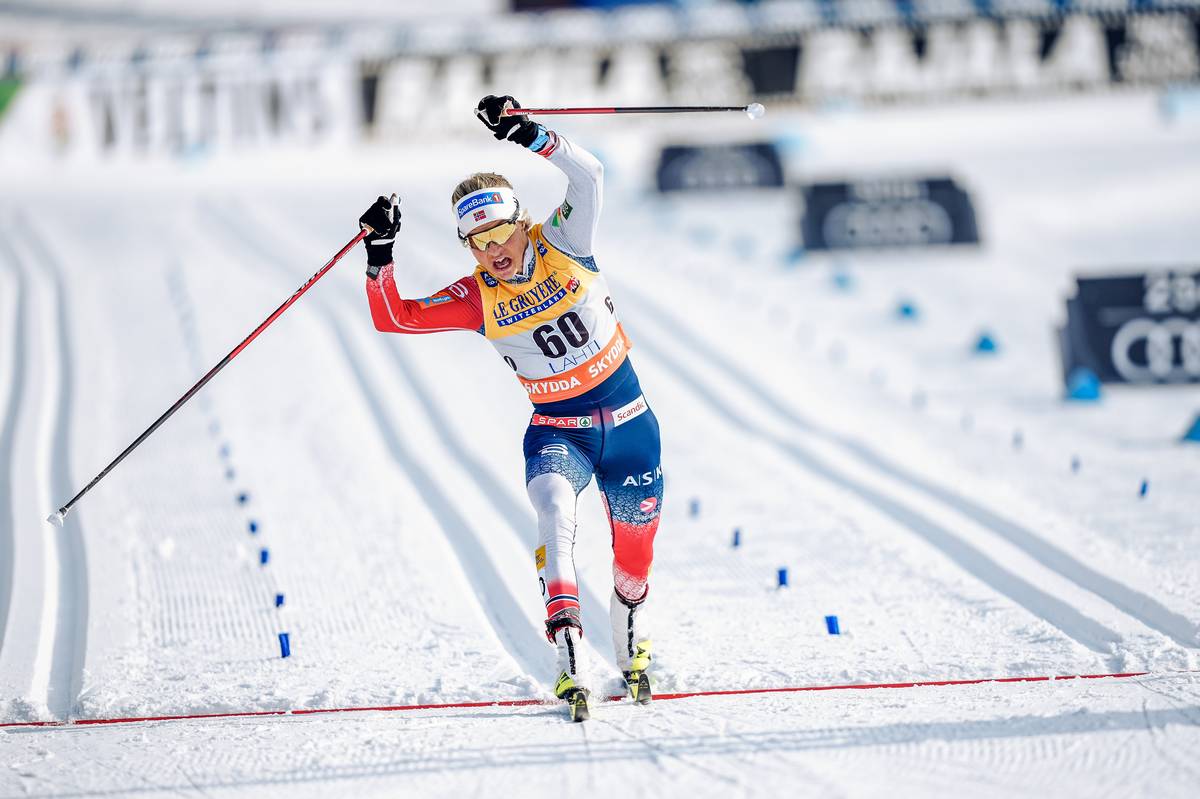
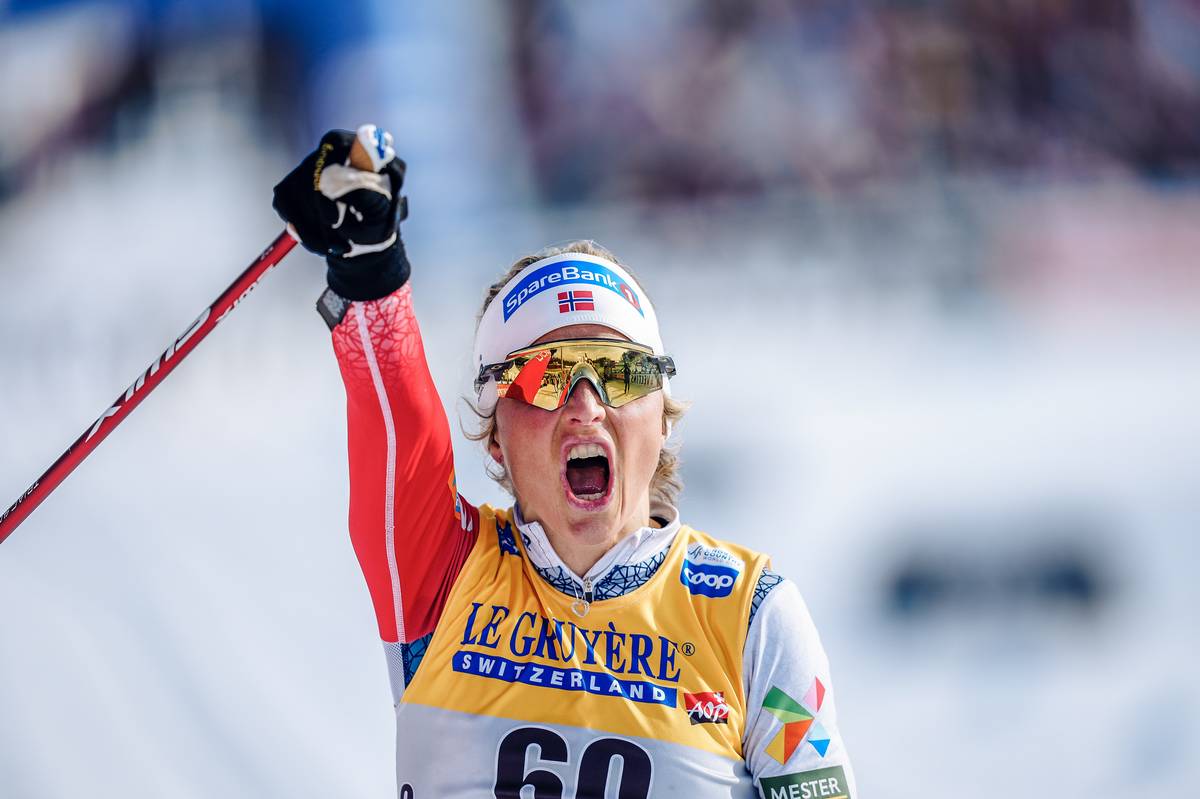
Therese Johaug (NOR) throws her boot to take the win just 1.2 seconds ahead of Russia’s Natalia Nepryaeva. (Photo: NordicFocus)Therese Johaug (NOR) celebrates her victory in Lahti’s 10 k individual start classic. (Photo: NordicFocus)
Until the actual finish line was crossed, it felt like the result could go either way. But with a final push from her poles and kick with her boot, Therese Johaug sealed the deal, just 1.2 seconds ahead of Natalia Nepryaeva. Johaug let out a victorious roar, just before cameras showed the Russian roll her eyes in exasperation, as if thinking, “Really? Not again.”
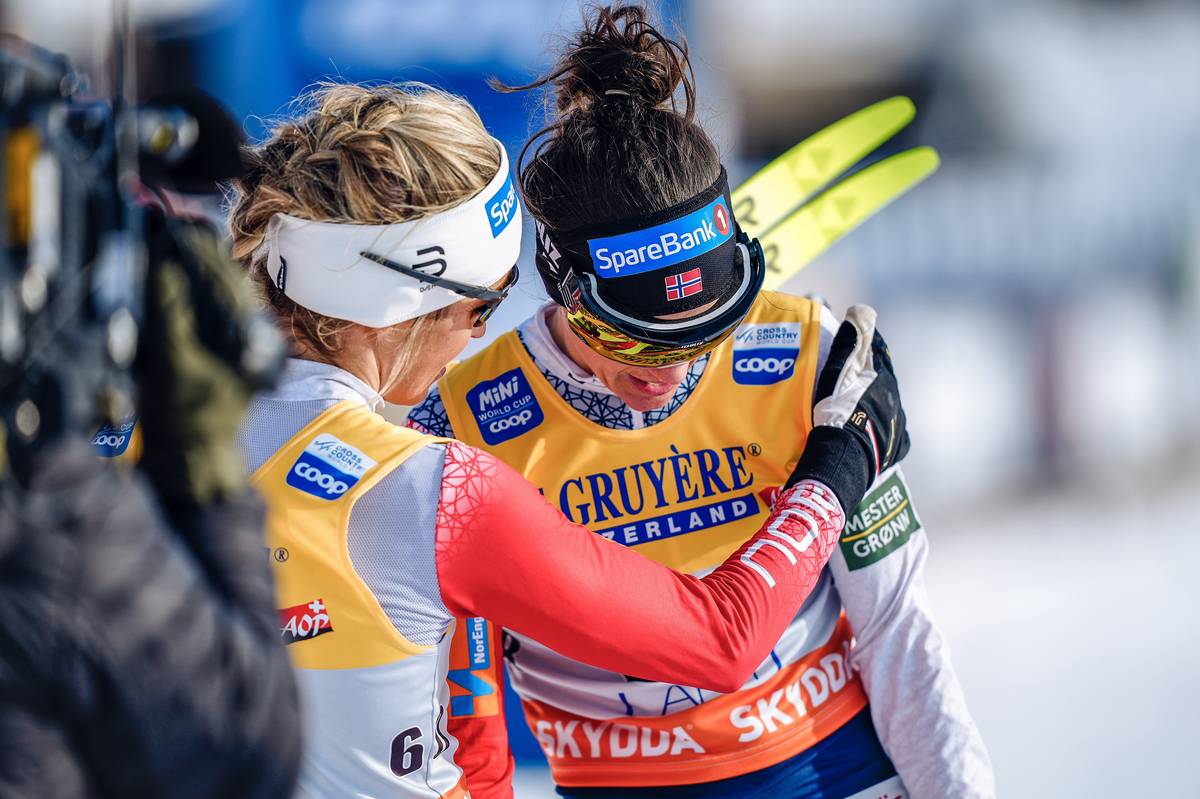
Cameras panning back to Johaug watched her shift away from her own celebration to comfort a very disappointed Heidi Weng, who had started a minute ahead of Johaug in bib 58, but finished 42 seconds behind her teammate in 19th place (+1:42.4). After promising results in the Tour de Ski, Weng had tested positive for COVID just prior to the Olympics, leaving her watching the event from afar. From Weng’s disappointment at the finish, it looked as though she had been looking for more in her return to racing on the World Cup.
Therese Johaug (NOR) comforts her disappointed teammate Heidi Weng at the finish of the 10 k individual start classic in Lahti. (Photo: NordicFocus)
Johaug spoke with FIS after the finish, speaking to what it means to win again today as she nears the end of a successful season, including the three gold medals earned in Zhangjiakou this month.
“It means a lot for me, and I am so happy that I have a second on my side,” Johaug said with a laugh. “After the Olympics, you’re coming home and it’s a little bit hard to motivate again, but when I come to Lahti and go on this beautiful track, I really enjoy it.”
Johaug was also asked whether she felt the benefits of having trained and raced at altitude surrounding the Games, which were held at roughly 5,500 feet above sea level.
“Yeah, I feel that,” Johaug said of the boost. “When you train a lot at altitude and then you go down, you feel like you have more energy in the hills. I think my shape right now is really good, so I’m excited to race at the Holmenkollen next weekend, and in Falun, then the rest of the season.”
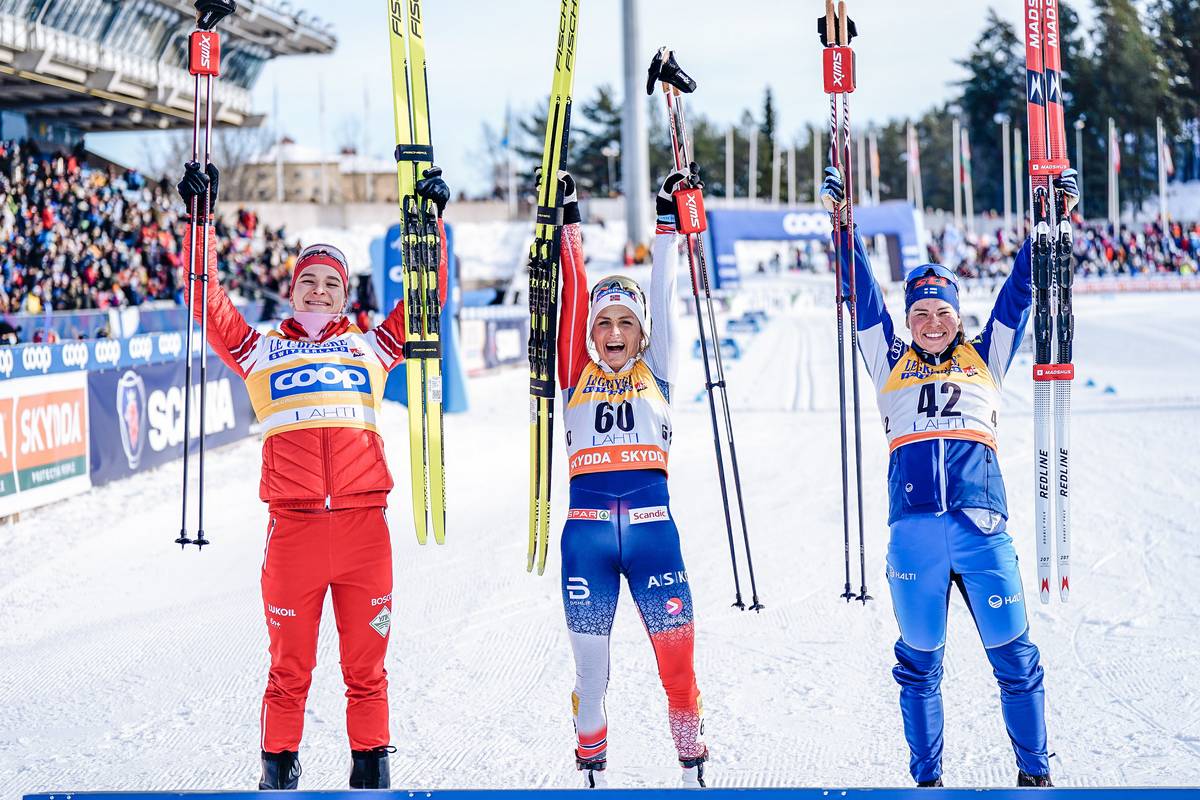
The women’s podium in Lahti: Therese Johaug (NOR) took the win ahead of Natalia Nepryaeva (RUS) and Krista Pärmäkoski (FIN). (Photo: NordicFocus)
Rounding out the women’s podium, Finland’s Pärmäkoski held her margin to 16.7 seconds at the finish for third place, followed after a gap by her teammate Niskanen in fourth (37.7). Sweden’s sprint champion Jonna Sundling was just behind in fifth (+40.7).
Leading the way for the American team, Rosie Brennan posted consistent splits to hover in sixth place through the first lap. Maintaining even tempo and effort, Brennan remained in this position until the last checkpoint, which showed a hard-charging Ebba Andersson of Sweden trade positions to bump Brennan back to 7th.
Rosie Brennan leads the American team during a 10 k individual start classic in Lahti, FIN. (Photo: NordicFocus)
Also posting a split Brennan was not quite able to match in the final kilometer, the American lost nearly eight seconds to Germany’s Katharina Hennig between the final time check at 8.7 k and the finish, leaving Brennan in eighth place overall (+1:02.8) at the finish.
“I am really happy with today.,” Brennan wrote in a post-race email. “I have always struggled post-championships, not so much in my body, but in my mind. It’s really difficult to live on the road and be sharp and push so hard all the time. It often feels like there is never a chance to let down the way someone who goes home every week might experience. I am always trying to figure this out and work towards finding ways to let down and then pull the fight back up for the weekend. It’s all part of the game and it’s a good challenge to try to figure everything out.
“Anyway, today, I felt much more like myself and was able to ski the way I wanted to. Lahti has been a tough venue for me in the past and today I really felt strong in my classic skiing and had some ability to push hard. I was definitely frustrated after yesterday and am really happy I was able to let it go and find myself out there today. We have had really great weather this weekend and a big crowd so that was a huge bonus. It was a joy to not be skiing in an arctic tornado!”
Rosie Brennan crosses the line for 8th place in Lahti’s 10 k interval start classic. (Photo: NordicFocus)Jessie Diggins skis to 20th place in the 10 k classic in Lahti, FIN. (Photo: NordicFocus)
Following a podium near-miss in yesterday’s sprint, Jessie Diggins was next for the U.S., just behind Heidi Weng in 20th (+1:43.4). Julia Kern and Hailey Swirbul also raced into the top-30 for the second day in a row, finishing 28th (+2:03.2) and 29th (+2:10.5), respectively.
Just off Swirbul’s split, Canada’s Katherine Stewart-Jones led her team in 30th place (+2:10.7), with her teammate Dahria Beatty just outside the top-30 in 33rd (+2:19.4). Cendrine Browne raced to 36th (+2:24.5), while Laura Leclair was the final Canadian woman in 58th (+4:29.7).
Canada’s Katherine Stewart-Jones leads her team in 30th during the 10 k individual start classic in Lahti, FIN. (Photo: NordicFocus)
Finishing 30 seconds outside the top-30, Katharine Ogden returned to the World Cup in 43rd (+2:40.8).
Following the races, US Ski Team head coach Matt Whitcomb provided insights into both the women’s and men’s races in Lahti, as well as sharing the news that Östersund, SWE may become the host to the initially cancelled World Cup Finals that had been scheduled for Tyumen, Russia. Whitcomb also speaks to the “Olympic hangover” that can make hard for athletes to perform at their best the weekend following the Games, and gave a shoutout to the athletes racing at World Juniors in nearby Lygna.
World Cup racing continues on Thursday, March 3rd with a classic sprint in Drammen, Norway, just prior to the storied 30/50 k mass start classic races at the Holmenkollen in Oslo.
Wednesday’s Olympic team sprint offered another thrilling set of races at the venue in Zhangjiakou — we’re back to break down an epic performance by the German women, a critic-silencing race from Norway in the men’s event and a U.S. women’s result that left a medal just out of reach.
Thanks to everyone for sending in questions and feedback — we’re trying to keep our heads above water on the homestretch here, but you can be sure Devon will still have plenty to say post-Games. In the meantime, you can get us at devon@fasterskier.com and nat@fasterskier.com.
Katharina Hennig and Victoria Carl win gold for Germany in the classic team sprint. (Photo: NordicFocus)
This World Cup coverage is made possible through the generous support of Marty and Kathy Hall and the A Hall Mark of Excellence Award. To learn more about A Hall Mark of Excellence Award or to learn how you can support FasterSkier’s coverage please contact info@fasterskier.com.
The team sprint: two skiers racing three laps each at roughly 1.5-kilometers a piece with a long climb thrown into the middle of the course and temperatures in the single digits Fahrenheit. It boils a sport that already requires both power and endurance down to its essence.
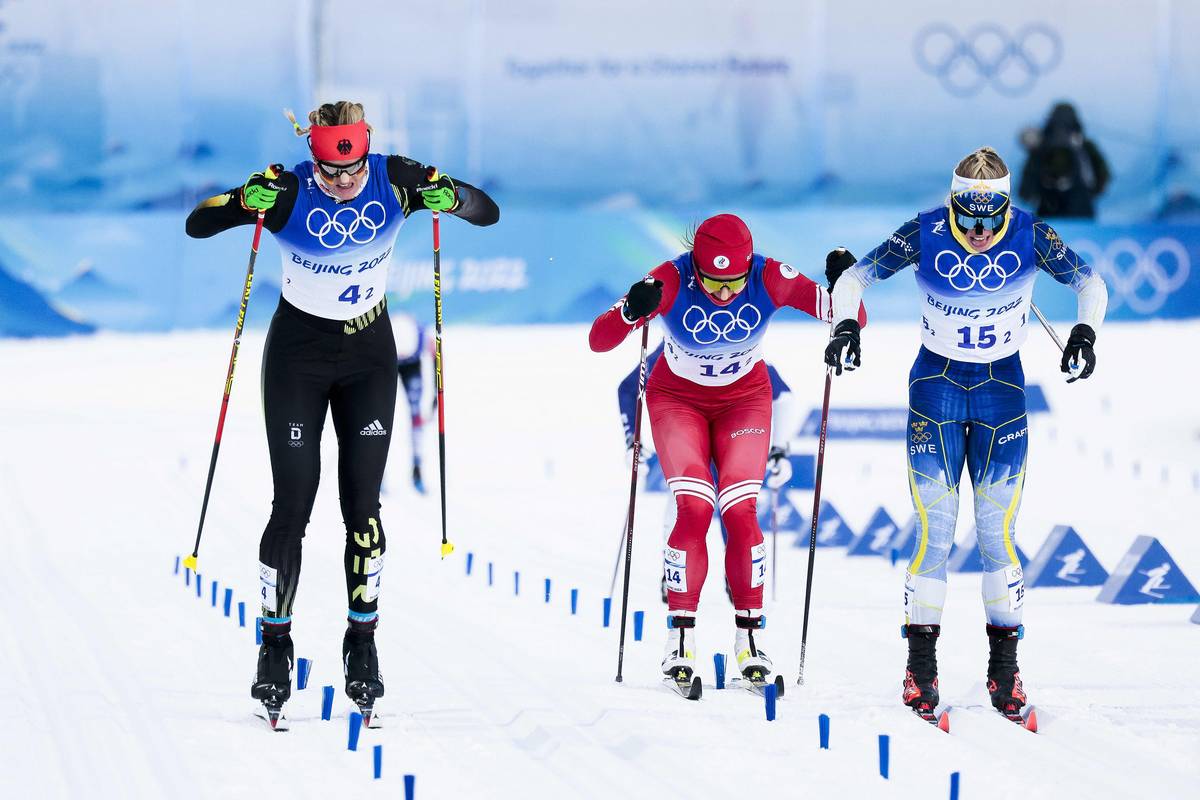
Riding the high of their silver medal in the women’s 4 x 5 k relay, the duo from Germany, Katharina Hennig and Victoria Carl, won a thrilling sprint finish to decide the medals, collecting gold in a time of 22:09.85. To take the stop spot, the anchor, Carl, out-sprinted the Swedish individual freestyle sprint gold medalist, Jonna Sundling, in the final meters to win by just 0.17 seconds, while the Russian Olympic Committee’s Natalia Nepryaeva crossed just behind in third (+0.71).
Sweden, Germany and Russia share the women’s classic team sprint podium. (Photo: NordicFocus)
After holding strong in medal contention throughout the first five of six laps, the American pair of Rosie Brennan and Jessie Diggins lost contact with the leaders in the final leg, crossing the line fifth (+12.93) behind Finland in fourth (+3.86).
Now, let’s take a step back.
There is, perhaps, no reminder needed that USA won the team sprint in 2018; Kikkan Randall and Jessie Diggins collected the first Olympic medal for the United States in cross country skiing – a gold, no less – since Bill Koch took silver in the 30 k classic in 1976. However, the team sprint in PyeongChang was raced freestyle, whereas today’s team sprint would be held in classic.
“I’m not trying to compare today to four years ago,” said Diggins in the mixed zone after the race. “It’s a different course, different altitude, different technique, like literally nothing is the same and, and that’s okay. I think today, I was going out there and skiing for Rosie and skiing as hard as I could and as best I could… but I’m really proud of this race and proud of giving it our best fight.”
Rosie Brennan helps the Americans finish second in the first team sprint semifinal, automatically advancing to the final. (Photo: NordicFocus)
We have to look back eight years for a classic team sprint at the Olympic Winter Games, to the 2014 Games in Sochi. Norway took the gold that day in dominant fashion ahead of Finland and Sweden, who were stretched behind by roughly ten seconds a piece. Only one of the six women on the podium returned to the Games in 2022, again making the team sprint roster: Finland’s Kerttu Niskanen. The American pairing of Sophie Caldwell (now Hamilton) and Kikkan Randall were sixth in Sochi, +35.06 back on the Norwegian winners.
In the intermediate FIS World Championships, the Americans finished fifth both years, racing Brennan and Sadie Bjornsen (now Maubet) in the freestyle competition in Oberstdorf, Germany in 2021, and pairing Bjornsen with Diggins for the classic team sprint in Seefeld, Austria in 2019. In Oberstdorf, the Americans missed the podium by roughly 2.2 seconds, finishing 2.8 seconds behind the winning team from Sweden. In 2021, they missed the podium by an equivalent margin, this time finishing 5.8 seconds back in the overall standings, again to Sweden. It’s a mark of consistency and depth across techniques for the American women.
Yulia Stupak (ROC), Kerttu Niskanen (FIN), and Katerina Janatova (CZE) lead the way early in the women’s classic team sprint semifinal. (Photo: NordicFocus)
To make the team sprint final, each team must finish in the top-two of semifinal A or B, or be within the next six fastest times from either heat. The U.S. was second to Germany (+4.03) in Semifinal A, while the ROC won the second semi in a close finish with Finland in second (+0.35) and Sweden third (+1.0). Austria and Switzerland also advanced from the first semi, with Sweden, Norway, France, and Poland filling the remaining spots from semifinal B.
With bursts of frozen mist released from their mouths, the athletes took to the course for the final round, with Yulia Stupak (ROC), Maja Dahlqvist (SWE), Kerttu Niskanen (FIN), Tiril Udnes Weng (NOR), and Katharina Hennig (GER) racing with Brennan at the front of the pack.
With a hooded parka draped over her, face tape obscuring her normally glittery cheekbones, and heated socks inside her boots, Diggins waited in the exchange for the tag. She would be facing Natalia Nepryaeva (ROC), Jonna Sundling (SWE), Krista Pärmäkoski (FIN), Maiken Caspersen Falla (NOR), and Victoria Carl (GER) in the even-numbered legs.
Racing comfortably near the front with skis that looked competitive for both kick and glide, Brennan tagged Diggins +1.1 second back on Finland in fourth, well within the lead group. In what would become a pattern for her first two legs, Diggins quickly moved to the front to control the race and ensure a fast pace, perhaps risking accumulating her own fatigue while also taking the sting out of the legs of the individual sprint gold and silver medalists of Sweden, who had also won the World Championship gold in 2021.
Diggins races at the front of the lead pack during the classic team sprint final. (Photo: NordicFocus)
Diggins tagged Brennan virtually even with Sweden and Finland after her first lap, a position Brennan was able to hold through her second leg. Near the bottom of the long, grinding climb to the high point of the course, Norway’s Weng wobbled slightly, placing her pole in front of Dahlqvist’s ski to catch her balance. Weng’s pole snapped, leaving her running up the sidelines of the climb with one pole, detaching her strap to grab another from a coach who stood along the fenceline. This lost Norway several seconds, which they were unable to regain in subsequent legs, leaving the team out of podium contention.
On the odd legs, Niskanen of Finland consistently controlled the race at the front, putting the powerful stride that earned her a silver medal in the 10 k last week on display as she led up the climb in each round. She tagged her teammate Pärmäkoski in the lead at the halfway mark, with Germany, the ROC, and USA within a second back.
Kerttu Niskanen (FIN) sets the pace in the first lap of the women’s classic team sprint final. (Photo: NordicFocus)
Diggins again charged to the front, her hands and legs pumping metronomically as she drove her skis up the climb. Diggins crested the hill in front, with Sundling and Pärmäkoski on her tails heading into the descent. A gap had opened to Germany and the ROC, but these teams had lightning fast glide and were able to regain contact in the descent.
At 6 k, with four of six legs complete, it was Sweden and Finland in the lead at the exchange, with Brennan receiving a tag 2.5 seconds back. Niskanen again set the pace at the front, still looking strong as she pushed the pace up the A-climb, with Dahlqvist matching pace behind. In a critical moment where loss of contact might have meant accepting a podium was not in the cards on the day, Brennan accelerated up the climb, steadily closing the gap to the Swede ahead of her.
Rosie Brennan (USA) awaits her turn during the women’s team sprint. (Photo: NordicFocus)
An aerial shot showed Brennan upping her tempo as she brought the U.S. back in contact with the leaders, bringing Hennig and Stupak along with her. All five women dropped into a tuck as they headed downhill together, rounding the sweeping right-hand bend and sprinting up a final climb before the last exchange. Throwing her hands up the hill in a run, Brennan challenged Sweden’s Dahlqvist on the final uphill, double poling around a left-hand bend into the exchange in third behind Germany and Finland.
In the last lap, Diggins went hunting. With Pärmäkoski and Carl leading the charge up the climb, Diggins would need to work the hill. Striding powerfully, Diggins did everything she could to keep her team in contact with the leaders, but it was not enough on the day. Doublepoling across the false flat before the descent, it was Pärmäkoski leading Carl, Nepryaeva, and Sundling.
The leaders were four abreast coming around the final bend, with Pärmäkoski and Sundling pushed into the outer two lanes, leaving them at a deficit as they headed up the final climb to the stadium.
Cresting the rise, Carl looked to be falling off the pace, while Nepryaeva and Sundling pulled to the front, the Swede leading around the final left-hand corner into the finish.
But Germany wasn’t done yet. Carl moved up along the outside of the bend, challenging Sundling as they headed into the finish lanes. Doublepoling powerfully, Carl began to slowly pull ahead of Sweden, with the ROC dropping back a few meters behind.
Coming to the line to decide the medals, it was Victoria Carl (GER), Natalia Nepryaeva (ROC), and Jonna Sundling (SWE) (l-r). (Photo: NordicFocus)
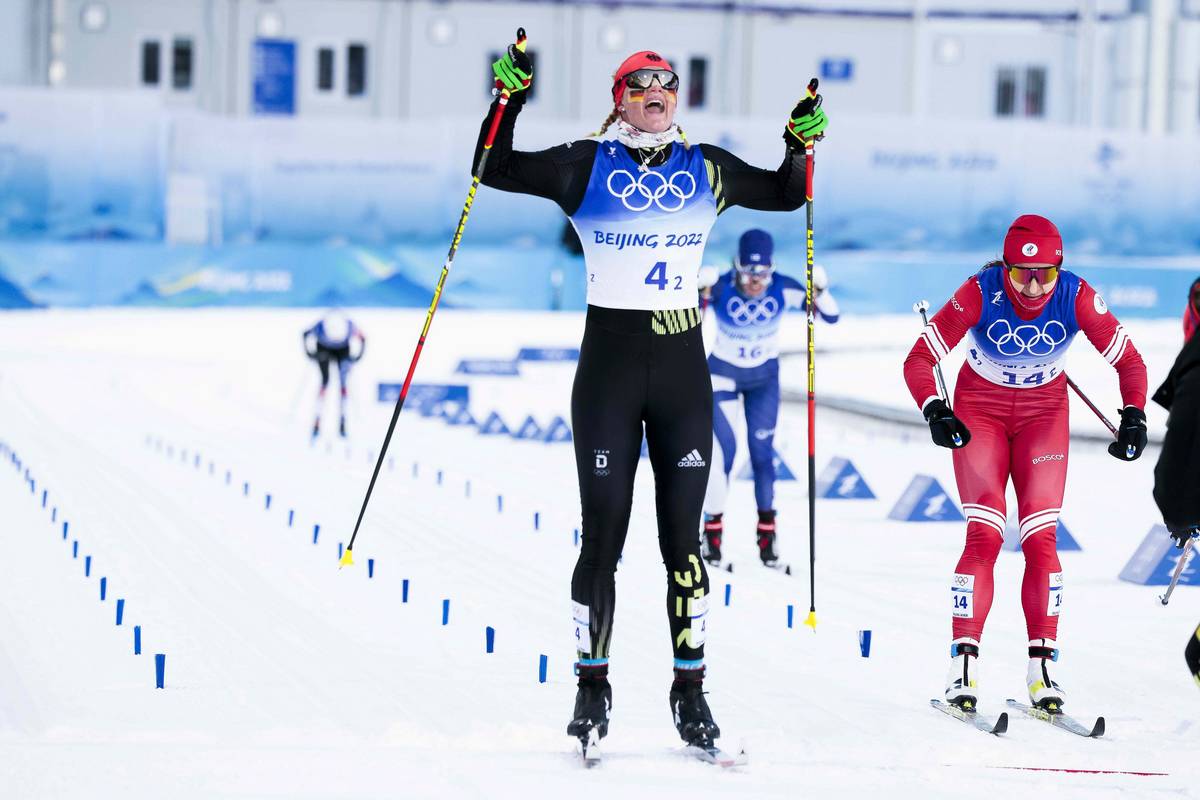
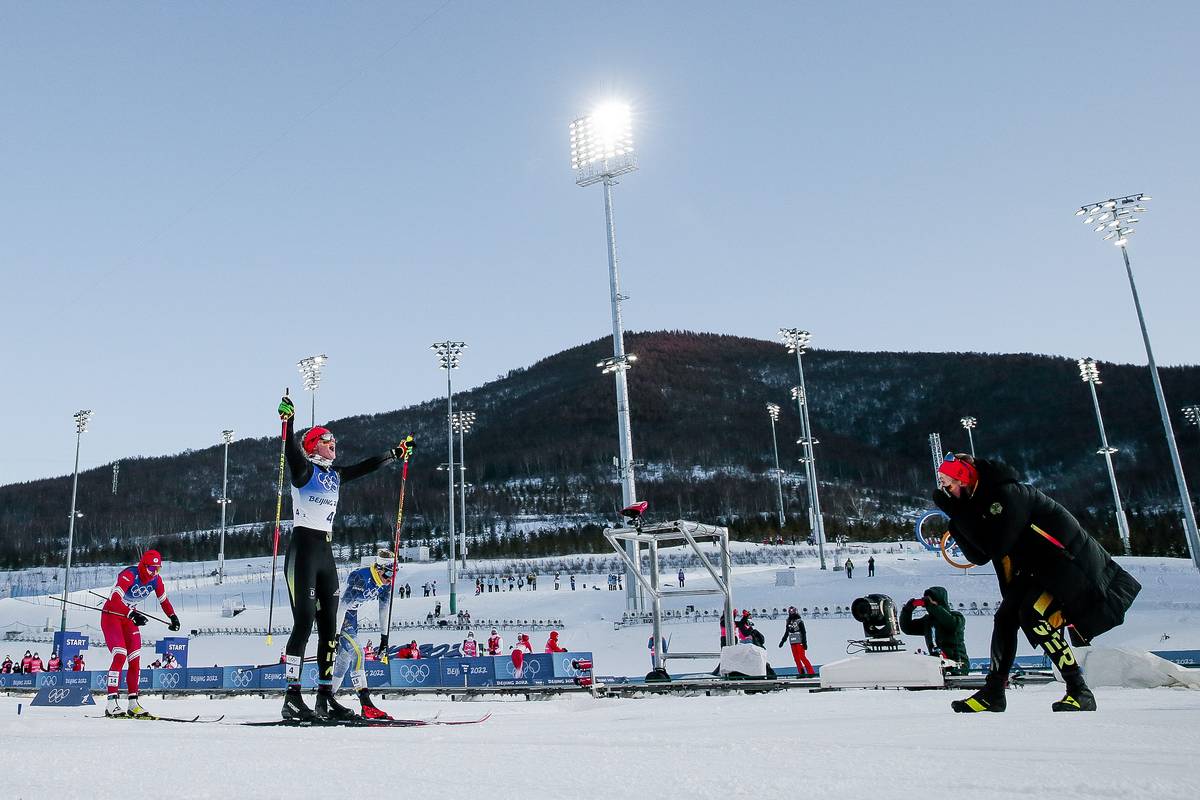
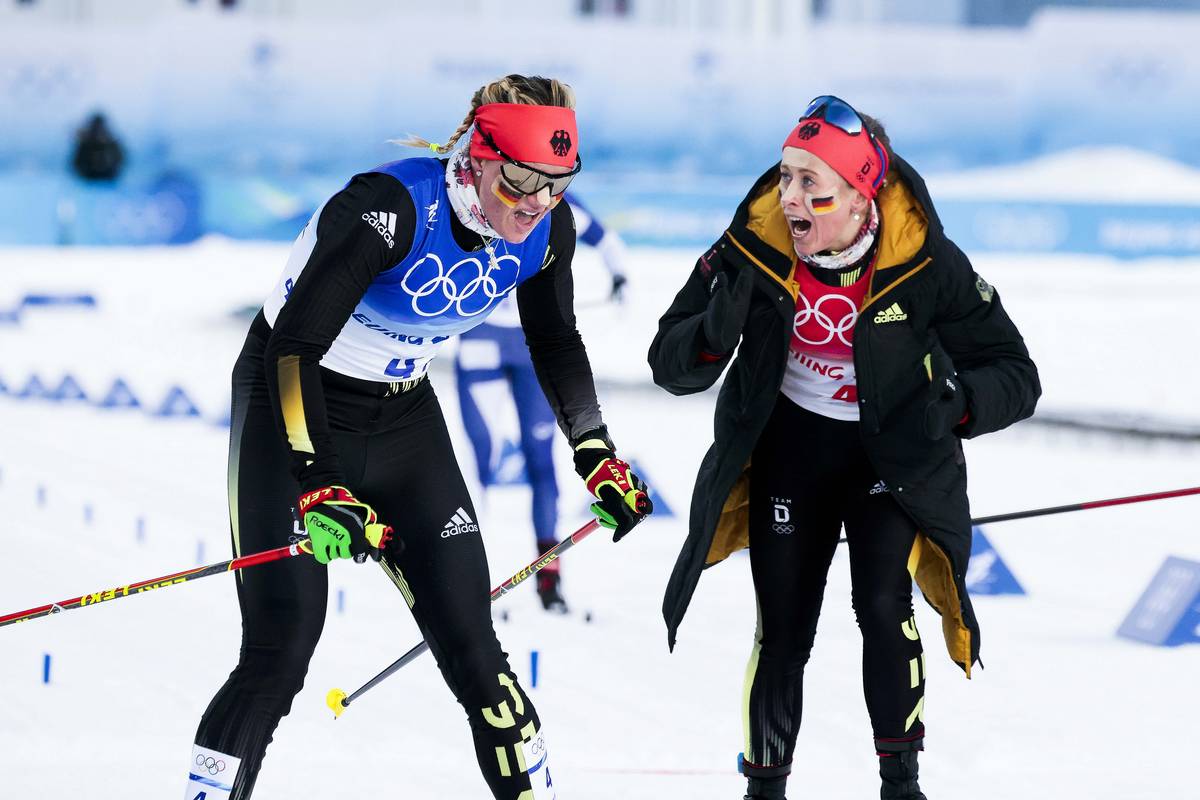
In a surprise upset of the Swedish favorites, Carl took it to the line, holding off Sundling as she crossed the line in 22:09.85, welcomed by her ecstatically screaming partner Hennig. Sundling was just 0.17 seconds back for silver, with Nepryaeva unopposed for bronze on their tails (+0.71).
Victoria Carl (GER) celebrates gold in the women’s team sprint while Natalia Nepryaeva brings the ROC across the line in third.(Photo: NordicFocus)VIctoria Carl takes gold in the classic team sprint, while partner Katharina Hennig awaits in disbelief. (Photo: NordicFocus)
After falling off the leaders in the final climb, Pärmäkoski brought Finland to the line in fourth (+3.86) with Diggins holding strong after a gap to cross fifth (+12.93).
“It means a lot for us,” Hennig told the media after her race. “Also the silver medal in relay and today the gold medal in team sprint. It means a lot and we are very thankful for the whole team. It’s very important for cross-country in Germany.”
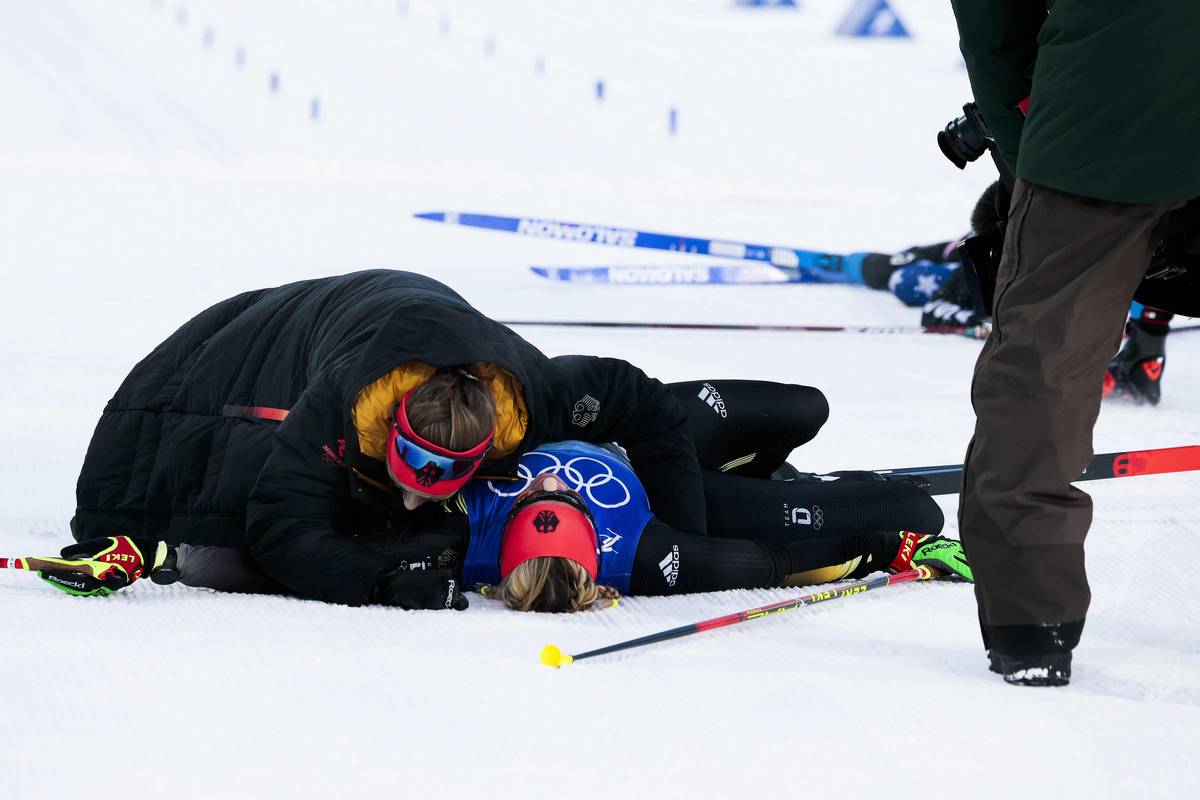
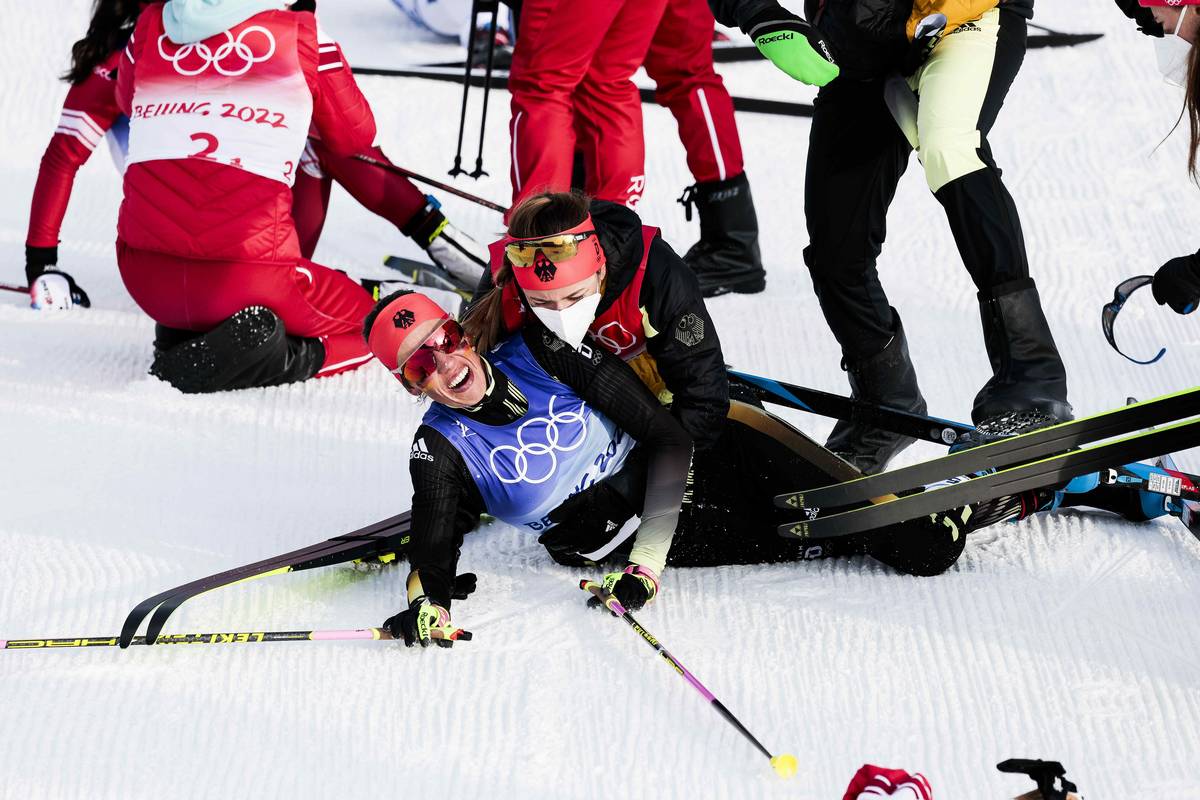
Excitement was high at the finish of the women’s team sprint, as Victoria Carl narrowly took the win for Germany, racing with partner Katharina Hennig. (Photo: NordicFocus)Katharina Hennig hugs her exhausted teammate Victoria Carl at the finish of the women’s classic team sprint. (Photo: NordicFocus)
Though she was the key player in the final lap, Carl was not originally on the start list. She was substituted for Katherine Sauerbrey, who had skied the first leg of the women’s relay on Saturday. German coach Peter Schlickenreider, who celebrated his 52nd birthday today, explained in the mixed zone that Saurbrey had made a “great decision” to let the team know that she was feeling fatigued and as though she may be getting sick.
From there, the calculus became: “Okay, you have a silver medal, you did a good race [in the relay], and we have prepared Victoria Carl, so she’s ready,” Schlickenreider explained. “So then let’s do the safe thing.”
He added that Germany had raced an athlete, Nicole Fessel, in the team sprint during the 2018 Games who was feeling sick, which proved to be a significant mistake as Fessel struggled with her health for the following three months, before ultimately ending her career. The coaches had vowed never to make this error again.
Jonna Sundling (SWE) congratulates Victoria Carl and Katharina Hennig on Germany’s gold medal in the classic team sprint. (Photo: NordicFocus)
On the performance of the German skis, which have allowed the team to excel throughout the Games, Schlickenreider explained that waxing has been a focus for the team over the last quadrennial.
“We worked really hard the last four years to get this good team. And I think that’s the main thing, that everybody’s working together so that the athlete and ski technicians were communicating quite well.”
Jessie Diggins (USA) comes to the line in fifth in the women’s team sprint. (Photo: NordicFocus)
After winning gold in the event, it’s easy to look at a fifth place finish as a disappointment for the American team. But observing the last five seasons, it remains a testament to the consistent strength of the American women’s program, the depth of the field racing at this level, and the fact that ultimately, an Olympic medal is viewed among the highest accomplishments an athlete can achieve purely because it requires the fortuitous coming together of infinitely many pieces to do so.
Both Brennan and Diggins stated with confidence that they were happy with their performances today, highlighting advances made in classic racing throughout the Games.
“I felt really good about my skiing today,” Brennan said. “I think it was one of my better classic races this week, so I’m really happy to put it together by the end of the Olympics. And I did what I could to stay in contact to give Jessie her best shot. And I’m happy with that.”
Rosie Brennan (USA) strides up the A-climb in the women’s team sprint semifinal. (Photo: NordicFocus)
“I’m really proud of how we skied,” Diggins affirmed. “It was so cool seeing Rosie just crushing, and I went as hard as I could. And there’s no doubt in my mind that I could not have possibly tried harder. I finished with zero sugars left and was dizzy and sick. And I’m currently wearing all the clothes of Team USA… I think we had great skis, or at least I definitely had the kick that I needed. I felt like, technically, this was some of my best classic skiing. And yeah, I’m just really proud of giving it our all because that’s all you can do.”
Jessie Diggins anchored the women’s classic team sprint to fifth. (Photo: NordicFocus)
In NBC’s broadcast, team sprint gold medalist turned analyst Kikkan Randall explained that the Americans knew that competitive skis would be a requirement to allow Brennan and Diggins to fight for a medal today.
Both athletes expressed that their skis were up to the task, particularly for A-climb, which is roughly 400 meters in length (a quarter mile) with nearly 100 feet of elevation gain. Ascending this three times each in the final, optimizing kick could be essential.
“I have to have enough kick, or else I really struggle,” Diggins explained. “So I definitely asked for an extra bump. In hindsight, maybe I shouldn’t have but also, that’s on me. And I know that that’s what I need. I need to be able to get up the hill. And that was my biggest priority. And so I think having not enough kick would have made me lose more time.”
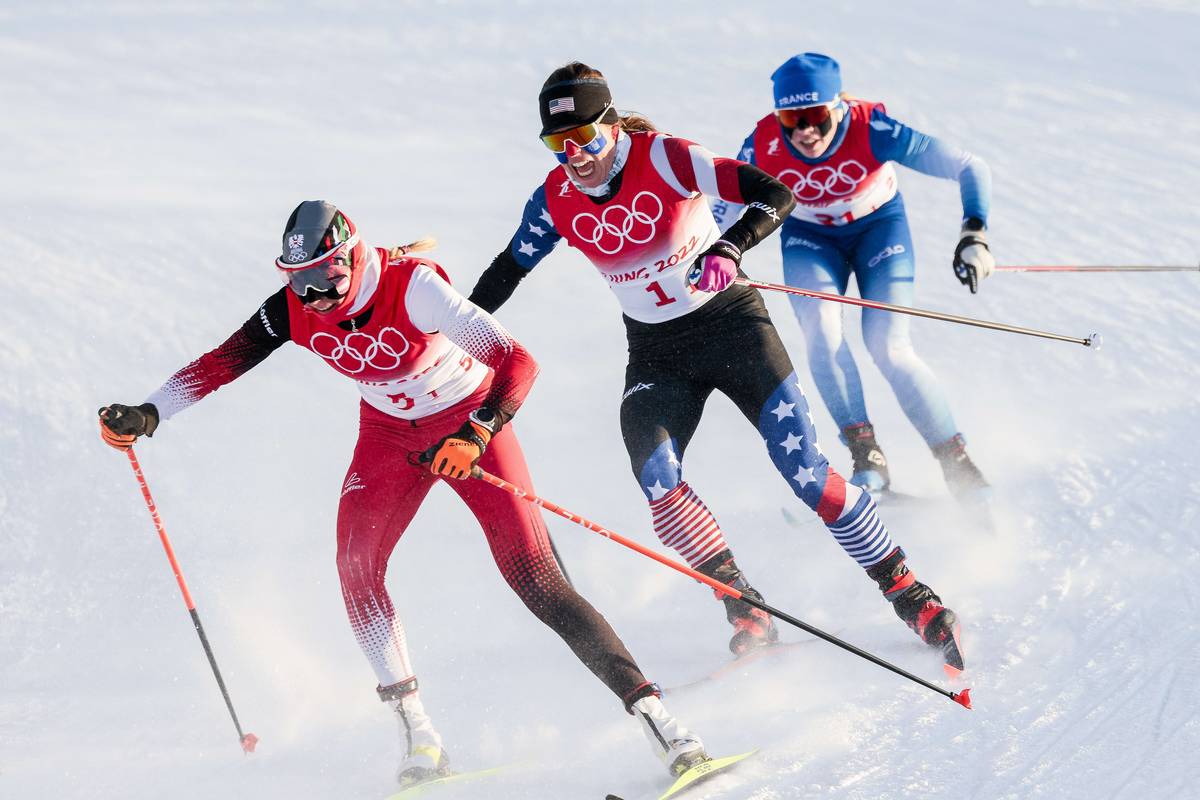
Jessie Diggins (USA) marks Victoria Carl (GER) during the women’s team sprint semifinal. (Photo: NordicFocus)
Both athletes confirmed that they would be racing the final event of the 2022 Olympic Winter Games on Sunday, the 30 k mass start freestyle, barring unforeseen changes. With one last opportunity to fight for medals, Brennan encapsulated the Americans’ outlook on the whirlwind of racing and Olympic hype.
“One thing that the US is really bad at is only caring about the Olympics,” Brennan said in the mixed zone. “But we’re racing and World Cups every weekend all winter long and World Championships on the [odd] years, so if you look at the results from all of those races, you know, this is in the ballpark. I wouldn’t say I had the world’s best races [here] and certainly not the world’s worst races. So it’s been a good experience and we will head straight back to the World Cup and keep fighting for more.”
Dahria Beatty (CAN) races in semifinal A during the women’s classic team sprint. (Photo: NordicFocus)
Racing for Canada, Katherine Stewart-Jones and Dahria Beatty took sixth in the first semifinal and did not advance. They ended the day in 12th overall.
This World Cup coverage is made possible through the generous support of Marty and Kathy Hall and the A Hall Mark of Excellence Award. To learn more about A Hall Mark of Excellence Award or to learn how you can support FasterSkier’s coverage please contact info@fasterskier.com.
A relay medal evaded the American women’s 4 x 5-kilometer team for another Olympic quadrennial today, as Hailey Swirbul, Rosie Brennan, Novie McCabe, and Jessie Diggins finished sixth, +1:28.2 behind the winners from the Russian Olympic Committee (ROC). Silver went to the German team, who finished +18.2 back on the ROC, while bronze went to Sweden (+19.7), who took Finland to the line, leaving them 0.5 shy of a medal in fourth.
The relay is seen as a testament to a program’s depth and breadth; with two classic and two skate legs, it’s not enough to have one or two podium-caliber skiers who are specialists in one technique or the other. A team needs to have four strong women who can compete at the top of the field, and the program must have the technical proficiency to maintain contact with the front as the race switches from classic to skate.
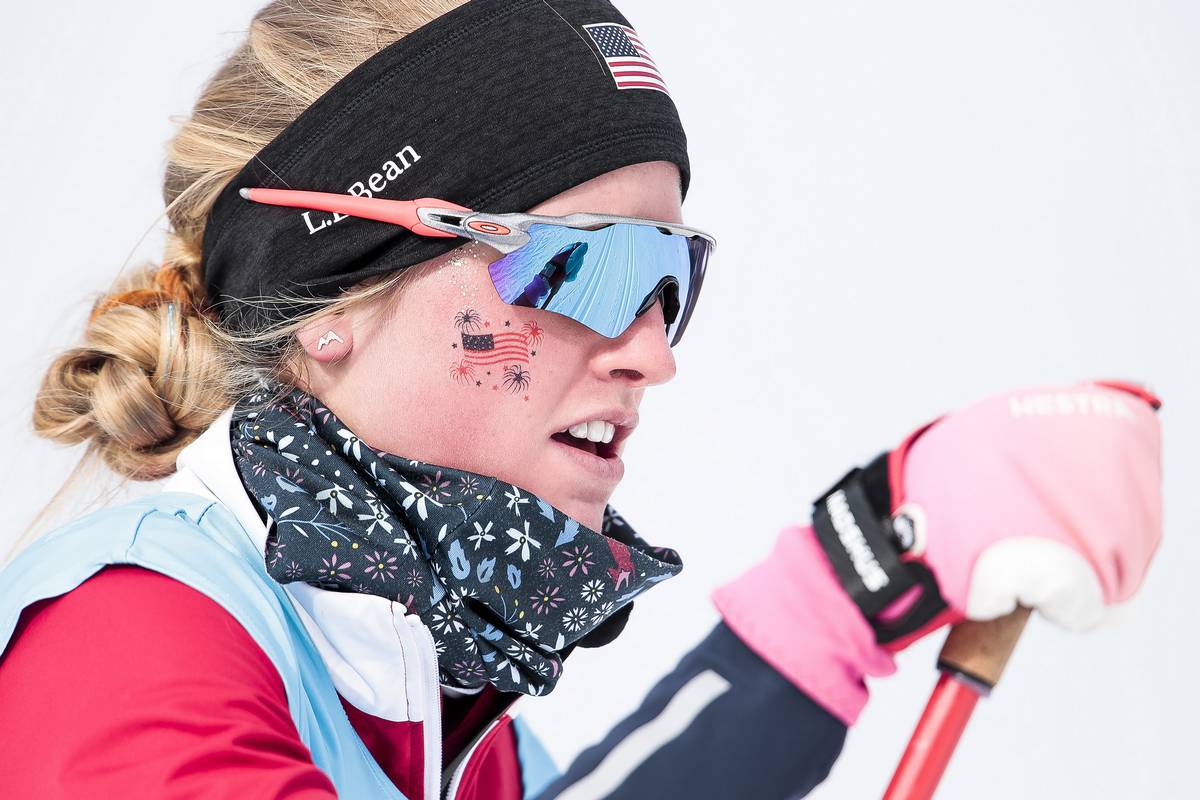
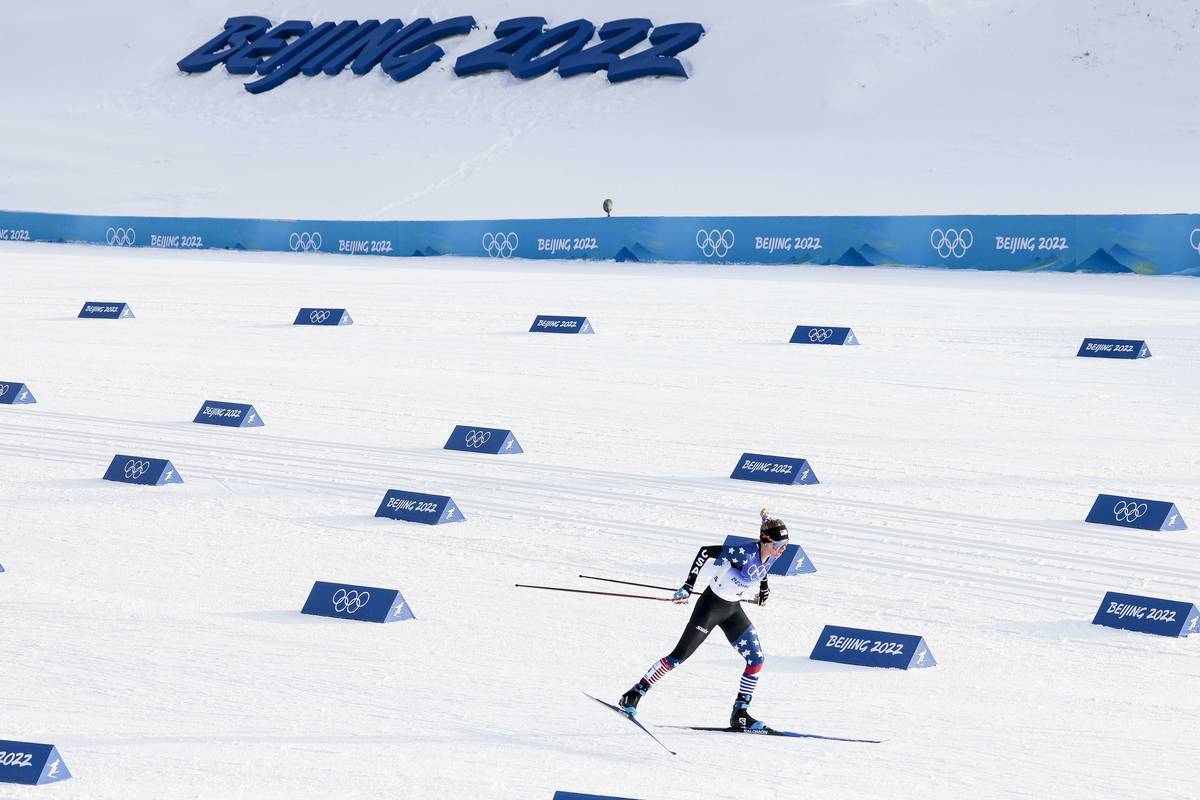
A glittery flag tattooed on her cheek, Hailey Swirbul warms up to lead the American 4 x 5 k relay team. (Photo: NordicFocus)
And, those four strong women need to have all the pieces come together on the day. “It’s really hard to have four people have an amazing day on the same day,” Brennan said after today’s race.
The American team has steadily become a medal contender in the event as the level of the program has continually elevated over the last four Olympic cycles.
In 2010, Kikkan Randall was the sole member of the relay team who was reaching the World Cup podium, as she raced alongside Caitlin Compton (now Gregg), Holly Brooks, and Morgan Arritola. The American women finished 11th in Vancouver, nearly +3:40 behind the Norwegian gold medal team, which was anchored by a young Therese Johaug.
Eight years ago in Sochi, a team of Jessie Diggins, Randall, Liz Stephen, and Sadie Bjornsen (now Maubet) pulled the team up to 7th, +2:30 behind the Swedish winners. Four years later in PyeongChang, Sophie Caldwell, Bjornsen, Randall, and Diggins again brought Team USA 70 seconds closer to the podium, finishing fifth, +1:20 behind Norway.
Over the last three World Championships, the Americans finished fourth in 2017, 30 seconds behind the Finnish bronze medal team, and fifth in 2019, one minute behind Russia in third.
At the 2021 World Ski Championships in Oberstdorf, Germany, the Americans were impossibly close to the podium. In a final sprint between anchors Krista Pärmäkoski (FIN) and Diggins, the Finn closed hard in the final kilometer to pull ahead of the Americans, taking bronze by just 0.8 seconds.
While only one of the four relay team members from the 2018 Olympic team remains on the team in 2022, three of the four members from last year’s World Championships made today’s list. That lineup was Swirbul, Bjornsen, Brennan, and Diggins.
Hailey Swirbul heads out to lead the American 4 x 5 k relay during the 2022 Beijing Olympic Winter Games. (Photo: NordicFocus)
Today, Swirbul would again lead the Americans skiing the first classic leg, this time followed by Brennan, who was 13th in the 10 k classic on Thursday. McCabe skated the third leg in her second Olympic appearance, tagging off to Diggins as the anchor.
Keeping with tradition, all four women – along with current NBC analyst Randall calling from a booth in Connecticut – wore knee-length striped “relay socks”, with beglittered cheekbones to feed their enthusiasm for the event. In a program that remains focused on team, even when standing on an individual podium, glitter and socks are merely symbols of the cohesion that has fostered the American’s rise to success.
The ROC’s Yulia Stupak pulls away in the first lap of the women’s 4 x 5 k relay. (Photo: NordicFocus)
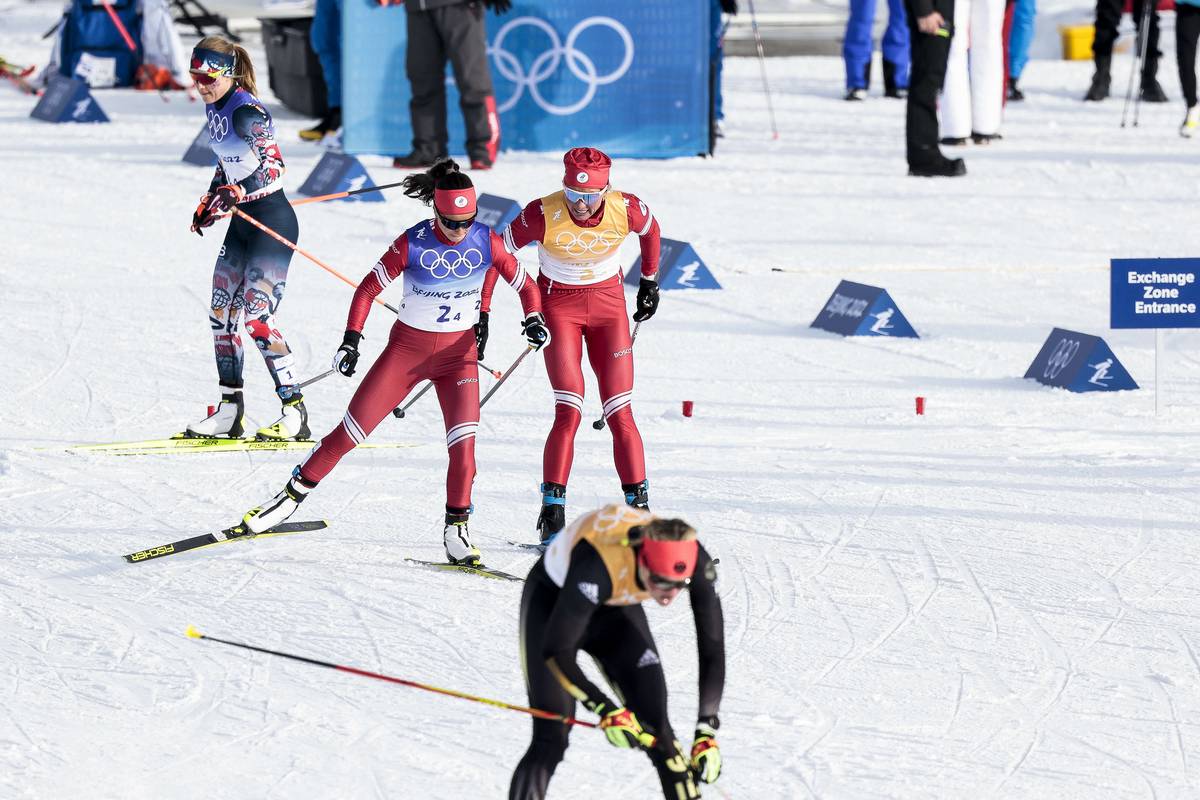
As the first two-lap 5 k classic leg took to the course, the ROC’s Yulia Stupak charged off the front, creating a 12 second gap by the end of the first lap while the next eight team remaining tightly spread, with less than three seconds of separation. In the final kilometer of the first leg, the German team dropped the chase pack to tag its second skier just 1.5 seconds behind the ROC. Masako Ishida tagged off in third for Japan, with Finland just behind in fourth, and Sweden a few seconds behind in fifth.
Swirbul tagged off for the Americans in seventh, +24.7 back on the ROC and Germany, and +12.4 seconds on the podium chase pack. The Canadian team, led by Katharine Stewart-Jones, tagged off in 10th (+43.2).
Katharine Stewart-Jones skis the opening leg of the women’s 4 x 5 k relay. (Photo: NordicFocus)
The Germans are often a dark horse in the relay, despite frequenting individual World Cup podiums less often than other countries like Norway, Russia, or Sweden. Germany won a silver medal in the women’s relay in the 2010 Games in Vancouver, followed by a bronze in Sochi. They were roughly 20 seconds behind the Americans in fifth at the 2021 World Championships, and 20 seconds ahead of the Americans in fourth place in 2019.
In this Games, two of the four members of the 2021 World Championships team were again in the lineup, Victoria Carl and Katharina Hennig, both of whom have seen top-10 finishes in the Games so far. Hennig, who would ski the second classic leg, was fifth in the 10 k classic on Thursday, while the third leg skater Carl was 10th in Tuesday’s freestyle sprint. Anchor Sofie Krehl was 8th in qualification and 11th in the final during the freestyle sprint, while classic opener Katharine Sauerbrey was 11th in the 10 k classic and 13th in the 15 k skiathlon. A deceptively stacked lineup.
Meanwhile, Norway’s Tiril Udnes Weng had tangled with a Latvian skier, causing a crash that robbed her momentum. Already at a deficit with two of their eight athletes, including Lillehammer World Cup relay team member Heidi Weng, waylaid due to positive COVID tests just prior to the Games, the team that would otherwise be a podium threat faced yet another setback.
Katharina Hennig (GER) follows Natalia Nepryaeva (ROC) during the second leg of the 4 x 5 k relay. (Photo: NordicFocus)
In the second classic leg, the ROC and Germany remained at the front, trading off in the lead at each checkpoint as they built their lead over third place to come through the exchange with nearly double the gap to third. This time, it was Germany’s Hennig in the lead, with the ROC’s Natalia Nepryaeva four seconds behind. Gold medalist in both distance events so far this Olympiad, Norway’s Therese Johaug brought her team back into podium contention, tagging Helene Marie Fossesholm in third (+22.8), just ahead of Sweden and Finland.
Norway’s Therese Johaug brings her team back into podium contention in the second leg of the 4 x 5 k relay. (Photo: NordicFocus)
The Americans lost an additional 12 seconds over the course of Brennan’s leg, but held their ground in seventh (+36.4). Canada’s Dahria Beatty tagged teammate Cendrine Browne in eighth after a sizable gap (+1:42.7).
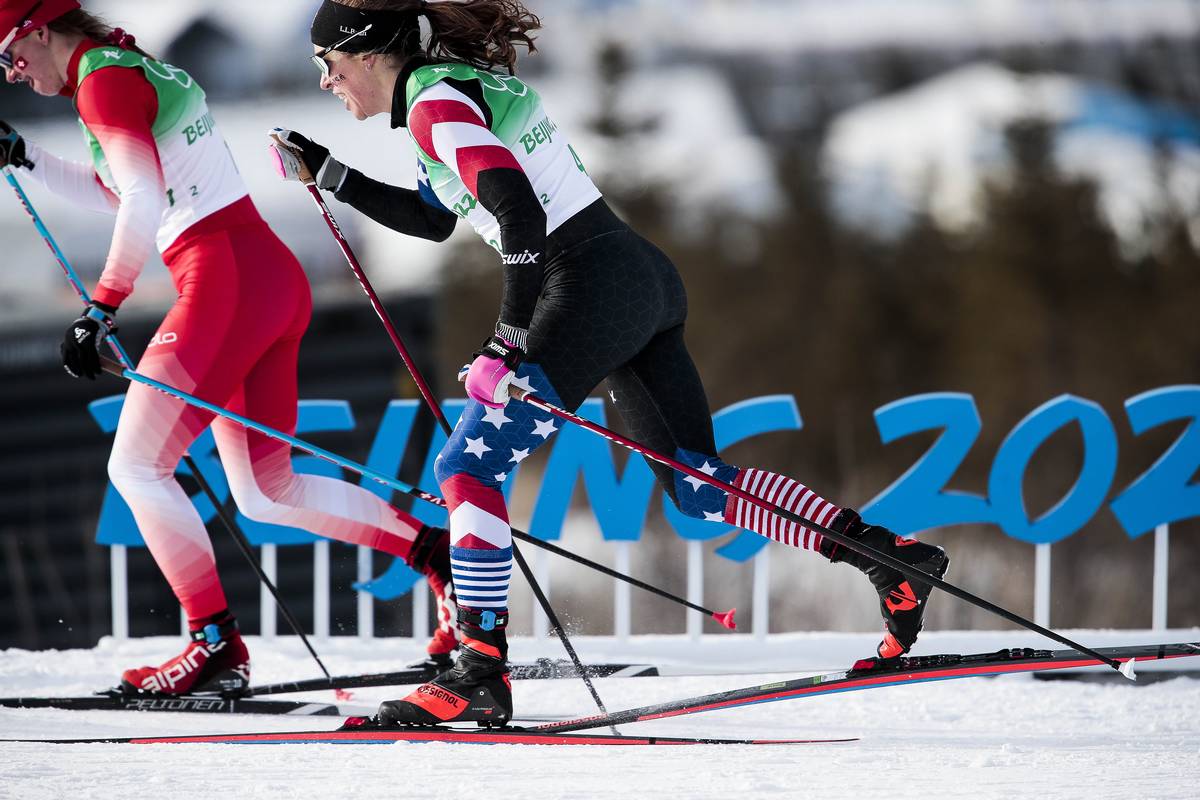
Rosie Brennan follows Sweden’s Ebba Andersson during the second leg of the women’s 4 x 5 k relay. (Photo: NordicFocus)
While Germany and the ROC continued the story at the front, Norway and Finland began making up time on the leaders, with Fossesholm and Thursday’s 10 k classic silver medalist Kerttu Niskanen gaining roughly 8 seconds during the first skate leg. Norway was less than 15 seconds back at the final exchange, with Finland an additional three seconds behind. Sweden was in fifth, exactly 35 seconds off the leaders and just over 20 seconds behind Norway, but they were about to prove they were not out of the running.
Novie McCabe skates a strong third leg for Team USA in the 4 x 5 k relay. (Photo: NordicFocus)
McCabe had brought the Americans into sixth (+1:34), in a dead zone with 30 seconds to the next racer on either side. The Canadian women tagged off in 8th, +2:21.2 back on the leaders.
In the final leg, the ROC’s Veronika Stepanova quickly began to reel in Germany’s Krehl.
Establishing herself as a strong closer at just 21 years of age, Stepanova also anchored Russia’s winning relay team in Lillehammer back in December to a thrilling finish, narrowly beating Norway and Sweden in a three-way sprint to the line.
In the lead at the final exchange, Germany’s Victoria Carl tags Sofie Krehl during the Olympic 4 x 5 k relay. (Photo: NordicFocus)Tatiana Sorina tags Veronika Stepanova as the ROC chases down Germany in the final lap of the 4 x 5 k relay. (Photo: NordicFocus)
This time, it did not look as if the ROC was looking for a climactic ending for its spectators. Stepanova had Krehl in her sights at the lap, and was now just 1.5 seconds behind. Stepanova kept the effort high, leaving the German five seconds back a kilometer later.
Then, Krehl began to fade rapidly.
As the ROC soon looked to have the gold medal on lock, the question became whether Germany could hold onto silver. Sweden’s sprint gold medalist Jonna Sundling was showing her stamina against Pärmäkoski, who looked to be repeating the approach that allowed her to take bronze for Finland in the 2021 World Championship where she was facing Diggins.
The pace stayed hot as the Finnish veteran steadily fatigued the legs of the sprint champion, and over the final lap, the pair brought Krehl into contact. Heading into the stadium, Krehl was hanging onto her lead by a thread.
Sofie Krehl hangs on to anchor the German team to silver in the 4 x 5 k relay. (Photo: NordicFocus)
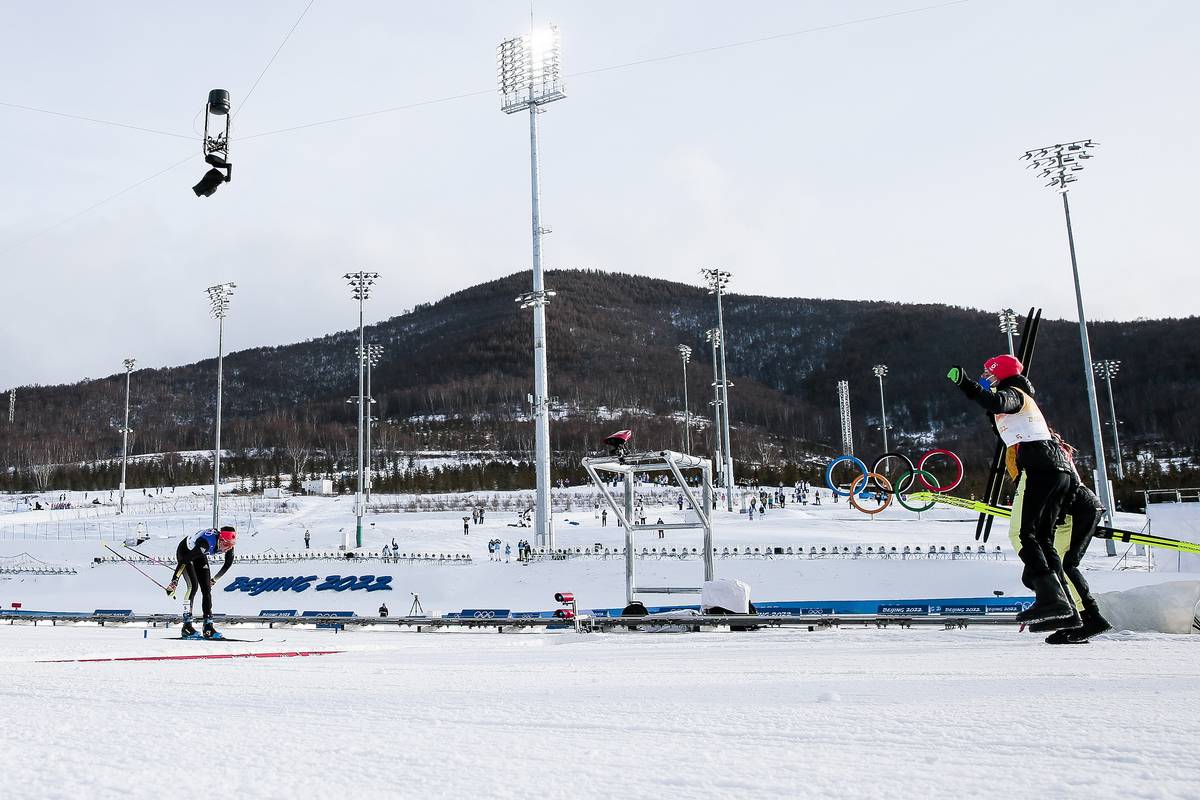
Cameras panned away as the German rounded the final bend into the stadium, returning just as she crossed the line, only ten meters ahead of Sundling and Pärmäkoski, who V2ed side by side through the lanes.
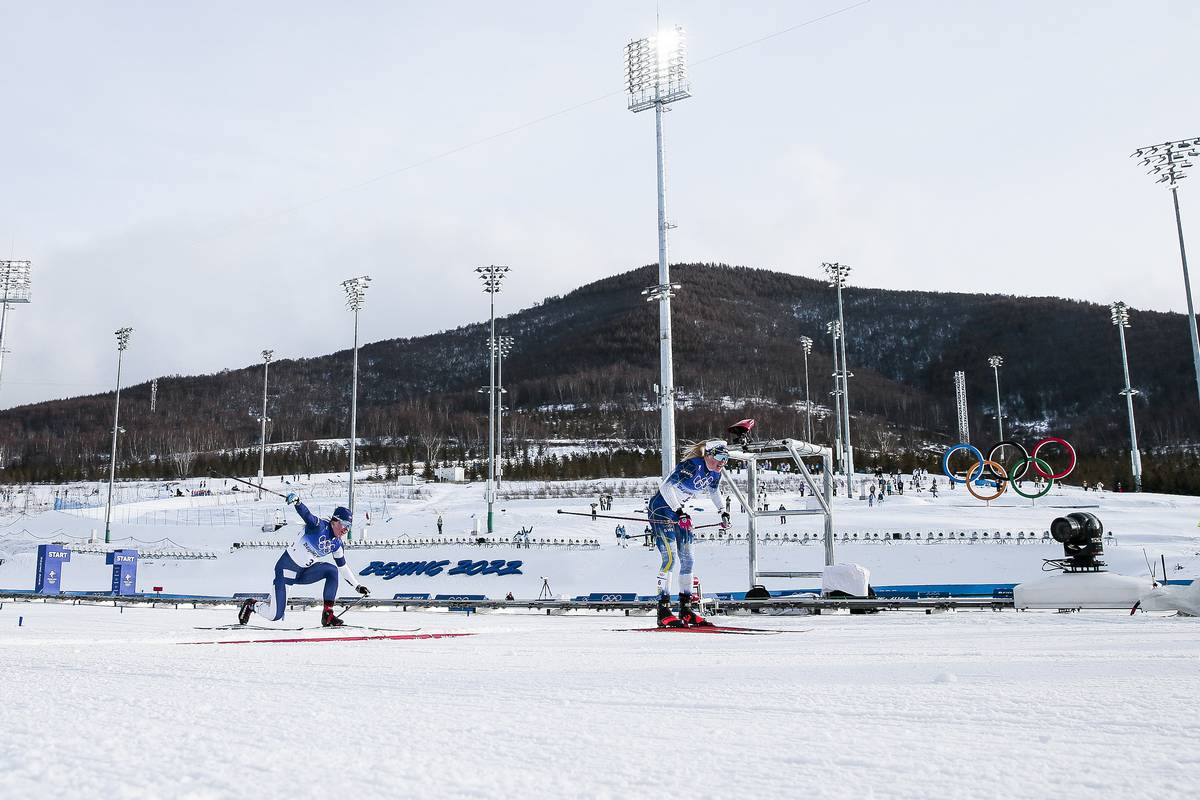
Ultimately, Sundlings sprint prowess gave Sweden the advantage, as she nipped Pärmäkoski by 0.5 seconds at the line for the bronze medal.
Jonna Sundling (SWE) takes bronze by 0.5 seconds ahead of Krista Pärmäkoski (FIN). (Photo: NordicFocus)
It was the ROC for gold in 53:41.0, with Germany in second (+18.2), and Sweden third (+20.7).
“Of course, it is a special day,” Stepanova told the media after the race. “It was really tough because we have a win in the World Cup, and a lot of people know we can win, so they say, ‘You must win, you must win.’ So I am like, ‘OK, we need a good result,’ and I do what I can do.”
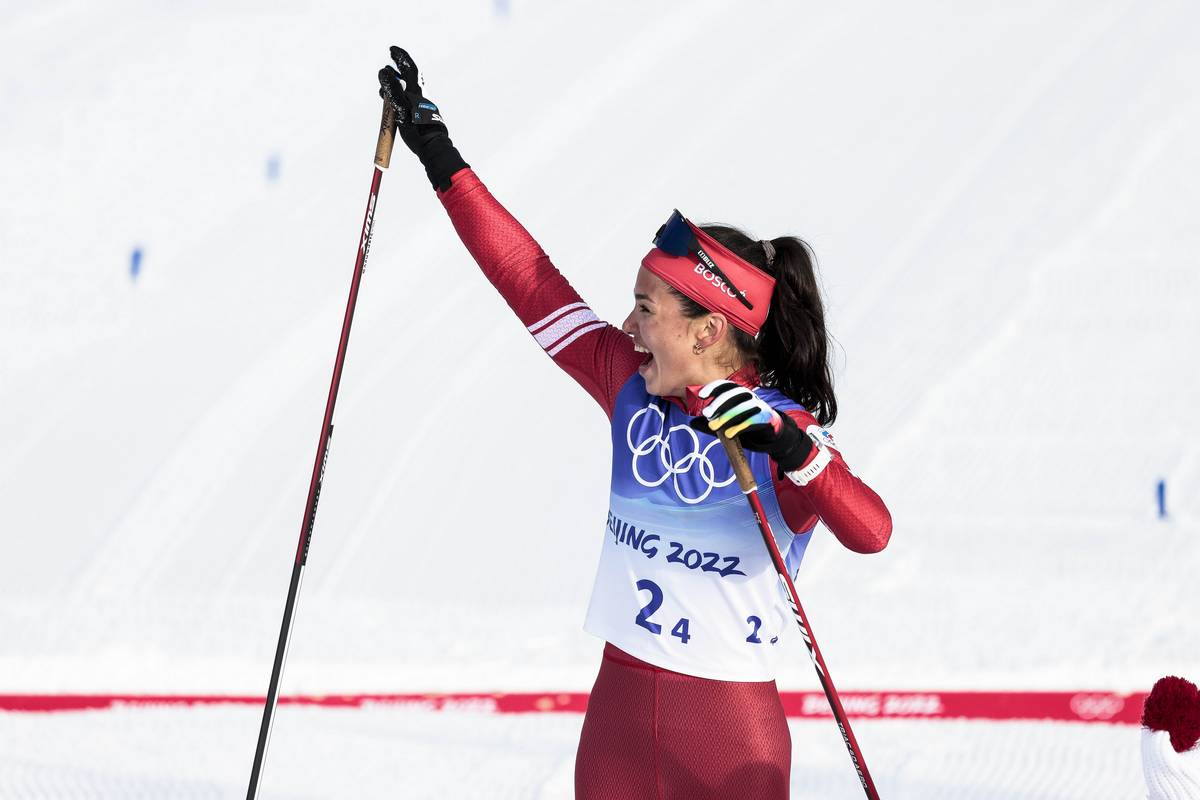
Veronika Stepanova anchors the ROC to gold in the women’s 4 x 5 k relay. (Photo: NordicFocus)The Russian Olympic Committee celebrates gold in the women’s 4 x 5 k relay as anchor Veronika Stepanova crosses the line with a solid lead. (Photo: NordicFocus)
While the depth of its women’s team made the ROC a good choice as a podium pick, Stupak made it clear in her post-race comment that the team had also been targeting the event, saying the result was “not a shock.”
“We prepared for this race the whole year,” she explained. “It’s a good result for everybody in our team. We were ready for this medal.”
On the ROC’s approach and early lead, Stupak continued, “We tried to push the limit. We had big motivation and good concentration before the start. It was a hard race but it was a good race for us.”
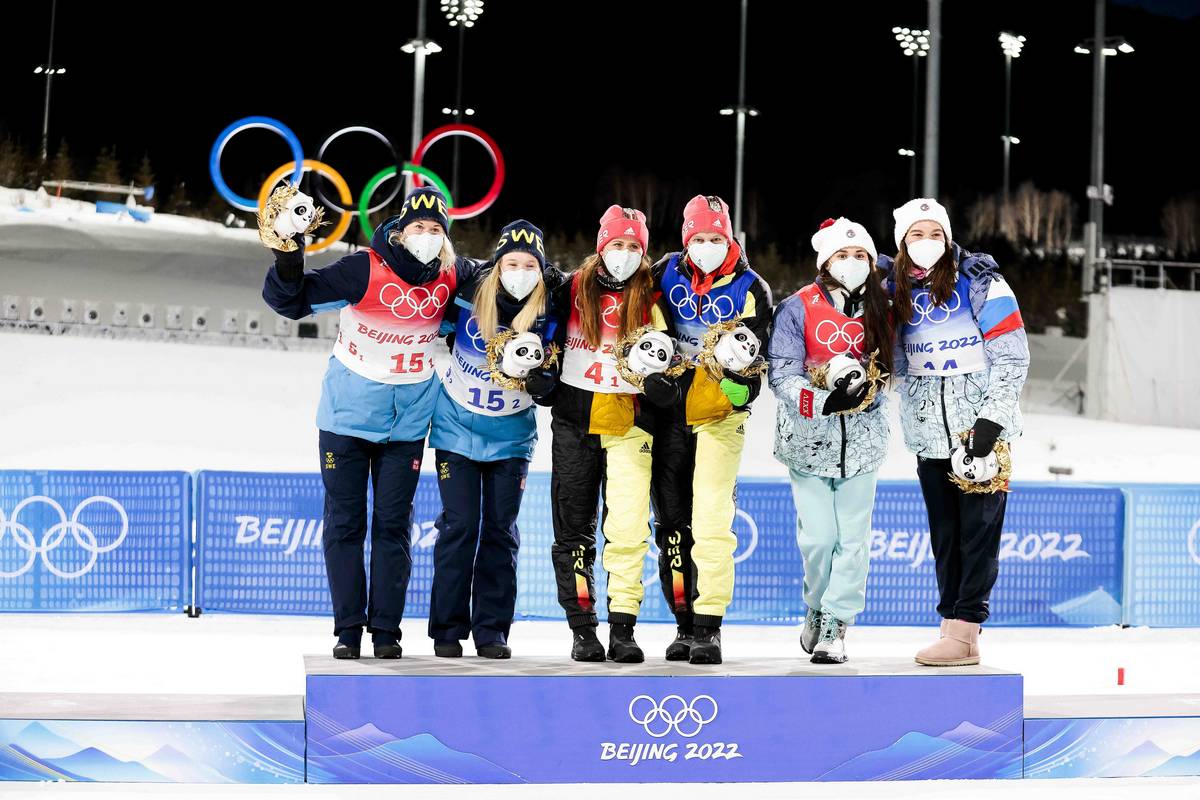
The 4 x 5 k relay gold medalists of the ROC: Yulia Stupak, Natalia Nepryaeva, Tatiana Sorina, and Veronika Stepanova (l-r). (Photo: NordicFocus)
For the Germans, the tone implied less certainty that a medal would be earned. Rather, it was the culmination of strategic pacing and hard work, leading to what Krehl called a “surprise” ending.
“We are so happy and excited,” Hennig said. “This is a special day for us and we are so thankful that all the hard work pays off now for the whole team and all of cross-country Germany. So we are very, very happy. We had a good plan and our plan worked. And we did our best, and so it was an exciting and amazing day.”
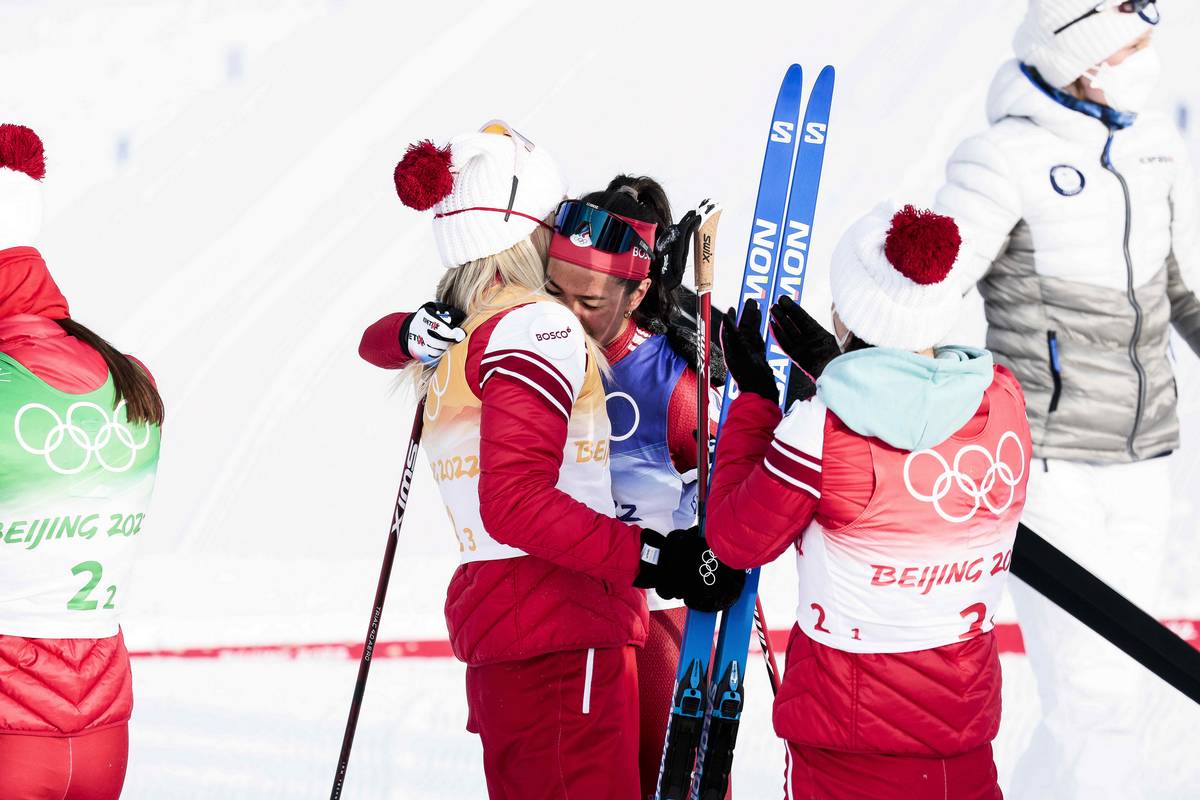
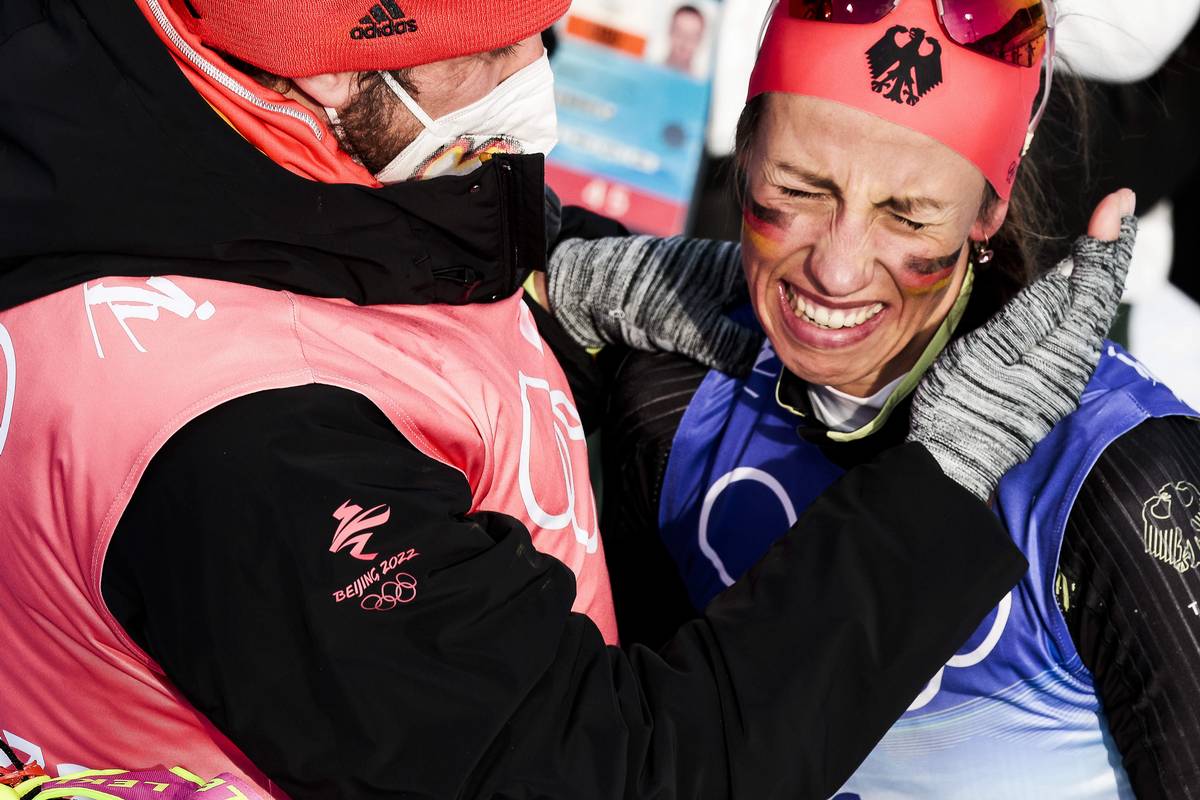
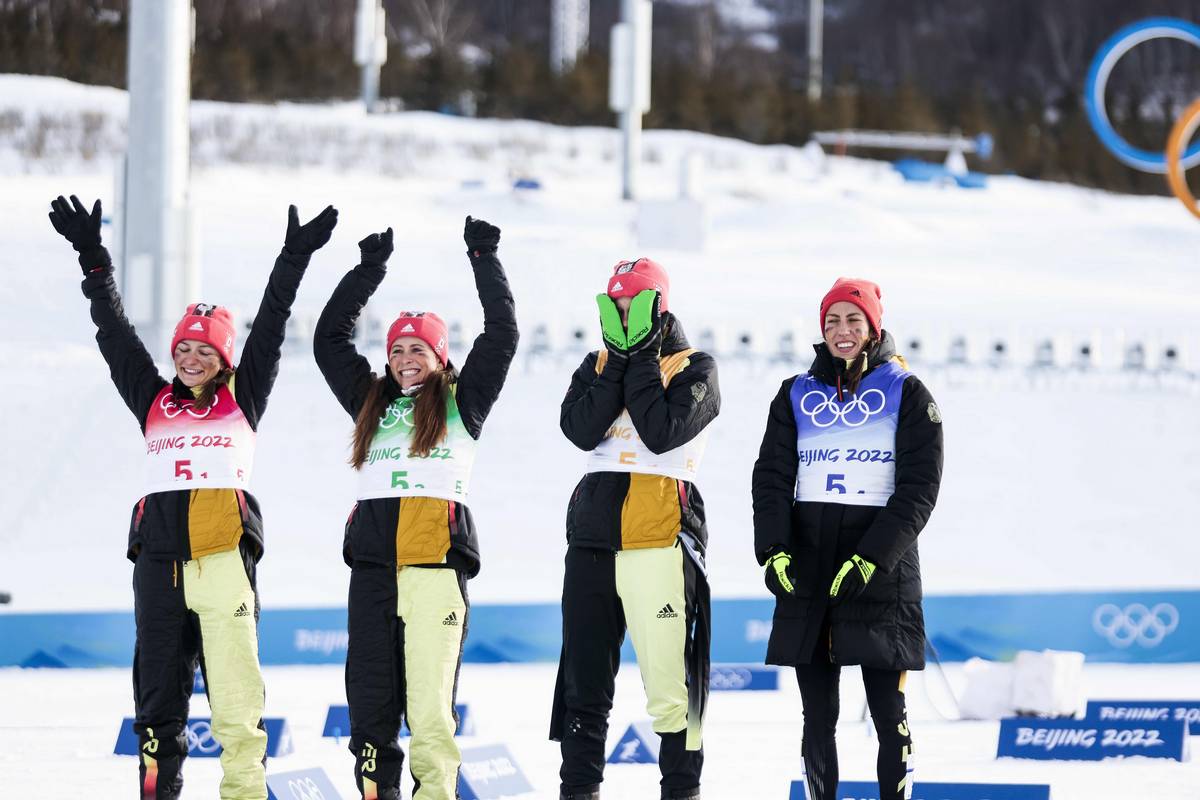
The German team welcomes anchor Sofie Krehl to the finish, earning a silver medal in the 4 x 5 k relay. (Photo: NordicFocus)Caught by the emotion of earning a silver medal for Germany, Sofie Krehl is embraced by her coach at the finish of the 4 x 5 k relay. (Photo: NordicFocus)
Krehl explained that she had skied her first lap defensively, expecting Stepanova to catch her sooner. In the second lap, she described the ROC athlete as “too good”, causing her to let go of gold. Though she was nervous when she began to feel Sweden and Finland closing on her, she was able to hold on for a result she described as “good for the whole team”, including the German coaches and wax technicians.
“It’s a lot of emotion,” Krehl said. “It feels like a dream. Maybe I need some time and then I can recognize what we have done.”
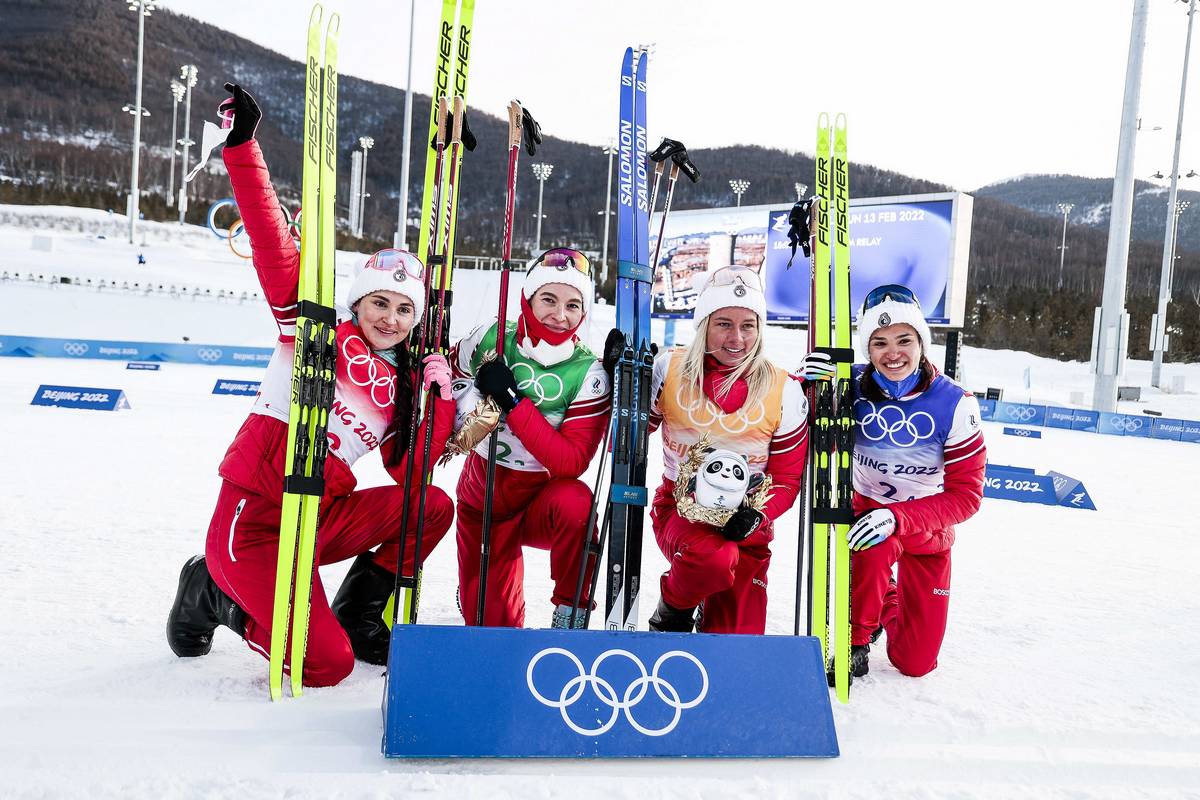
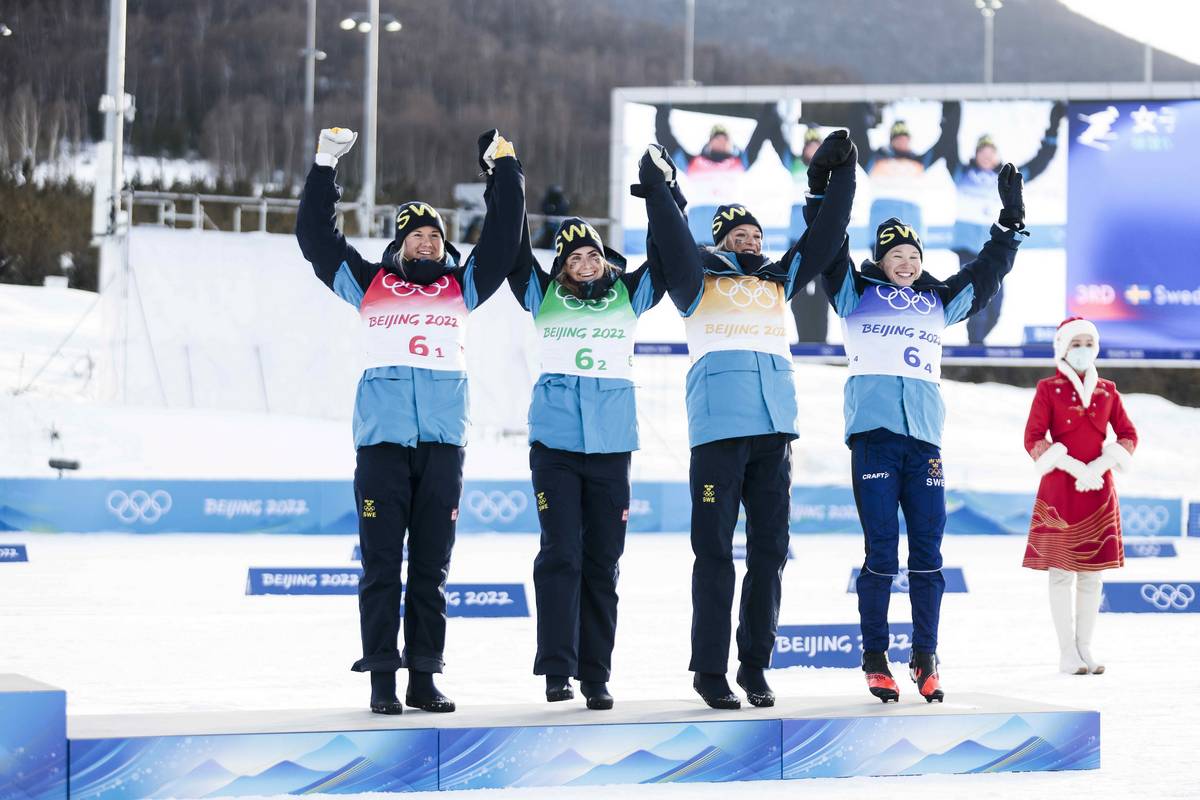
Putting together a gutsy performance, Katherine Sauerbrey, Katharina Hennig, Victoria Carl, and Sofie Krehl (l-r) earn silver for Germany. (Photo: NordicFocus)The Swedist team of Maja Dahlqvist, Ebba Andersson, Frida Karlsson, and Jonna Sundling (l-r) earn silver in the 4 x 5 k relay. (Photo: NordicFocus)
Behind the podium contenders, Norway had lost contact with the Swedes and the Finns over the final lap, fading to fifth (+28.8). Racing alone through her lap, Diggins crossed the line for Team USA a minute later in sixth (+1:28.2).
“Personally, I’m really, really proud of this team,” Diggins said in the mixed zone. “Every single one of these girls went out and skied so hard and skied gutsy races. And we gave it everything we have. And some days that ends up in the results of your life and some days it doesn’t. But either way, all you can control is going out there as hard and as smart as you can. And this team did that.”
Jessie Diggins brings the Americans home in sixth in the women’s 4 x 5 k relay. (Photo: NordicFocus)
Though they did not walk away with Olympic hardware, the energy and enthusiasm were high in the mixed zone, with laughter filling the gaps between the athletes’ comments.
On a team composed of two veteran Olympians, Brennan and Diggins, and two first-timers, Swirbul and McCabe, experience and insight helped unify the group and set the Americans up for their best chance at putting together a strong performance.
Leading the breakdown of the race, Swirbul shared, “It’s always important, I think, to try to ski my own race, even though you’re in the field. I definitely had advice from Rosie last night to make sure to pace it how I would face the race – and Jessie. We’re focusing on time, so the fastest time that we can get around that course [for] each person is the best, no matter what place you come in.”
Rosie Brennan races the second leg of the 4 x 5 k Olympic relay. (Photo: NordicFocus)
Brennan’s performance in the sprint demonstrated her impressive mental strength to overcome setbacks and not count herself – or in this case, her team – out of the running. A bad pole plant directly onto her ski in the sprint quarterfinal could have shaken her confidence, but she rebounded to ultimately finish just over a second off the podium in fourth place.
She approached today with a similar resolve.
“I knew it was full of a lot of the heavy hitters, so I knew I had a tough job ahead of me,” Brennan said. “So I tried to ski smart, but also find something extra to dig a little deeper, but I knew there was going to be some hard fighting at the end. I felt really good about my climbing. And I was a little disappointed with my inability to stick with [the other women] over the top of the hill in the double pole section, but it was all I had out there. So, I have to be happy with that. And I guess I know what I’ll be working on in the future.”
At 21-years-old, McCabe is the youngest member of the relay team.
“It’s so cool to be a part of a team with three legends and I had a lot of fun doing it, even though I was extremely nervous beforehand,” she said with a laugh.
Novie McCabe tags Jessie Diggins for the final leg of the 4 x 5 k relay. (Photo: NordicFocus)
Her mom, Laura McCabe, is a two-time Olympian who skied the third leg of the relay in both 1994 and 1998. However, Novie laughed that she had not talked to her mother in several days and thus had not received any advice heading into the relay. After much deliberation, the team had only been decided the afternoon prior.
“I tried on the first lap to just stay relaxed,” McCabe explained of her plan. “I knew that there was a chance I would blow up and end up losing a lot of time to that group ahead of me. So I was just trying to focus on [pacing] for the first lap, and on the second, I kind of tried to drop the hammer and do what I could to not lose time.”
In her lap, McCabe lost just 11 seconds to Sweden’s distance standout, Frida Karlsson. She had accomplished her goal.
Diggins explained she headed out for the final leg optimistically hoping things would shake out differently than they ultimately did.
“I basically just swung for the fences and thought, ‘Okay, I’m gonna go out as hard as I can. Because if there’s a chance that [the women ahead of me] monkey around and don’t want to lead, then I’ve got to go for it.’ I thought, ‘You know, if I get lucky and they’re messing around in tactics, there’s a chance I can glom on the back.’ Unfortunately, they did not, as much as I had hoped. And I definitely paid for it in the second lap. I could not feel my legs at all.”
Jessie Diggins anchors the Americans to 6th in the 4 x 5 k relay. (Photo: NordicFocus)
After a windy skiathlon and 10 k classic that left tracks blown in with loose snow, the women expressed that conditions today were the best they’ve experienced in racing so far. Though two inches of snow came down overnight, perhaps an unexpected twist in the weather patterns, the Americans each affirmed that their skis were competitive, with Swirbul and Brennan adding the change was especially favorable for their classic legs.
“I actually got to ski in the tracks today, which is so nice,” Brennan said.
On the camaraderie of the team, Brennan shared, “It’s an individual sport, but we also spend close to five months on the road a year together. So it would be pretty boring if you only ever care about yourself. [That’s] not very fun or fulfilling – it doesn’t mean that much. So when we get to actually, truly be out there together, and all of our times count for each other. I think that brings like a new level of meaning and purpose to what we’re doing. And it’s really special to get to share that with your teammates.”
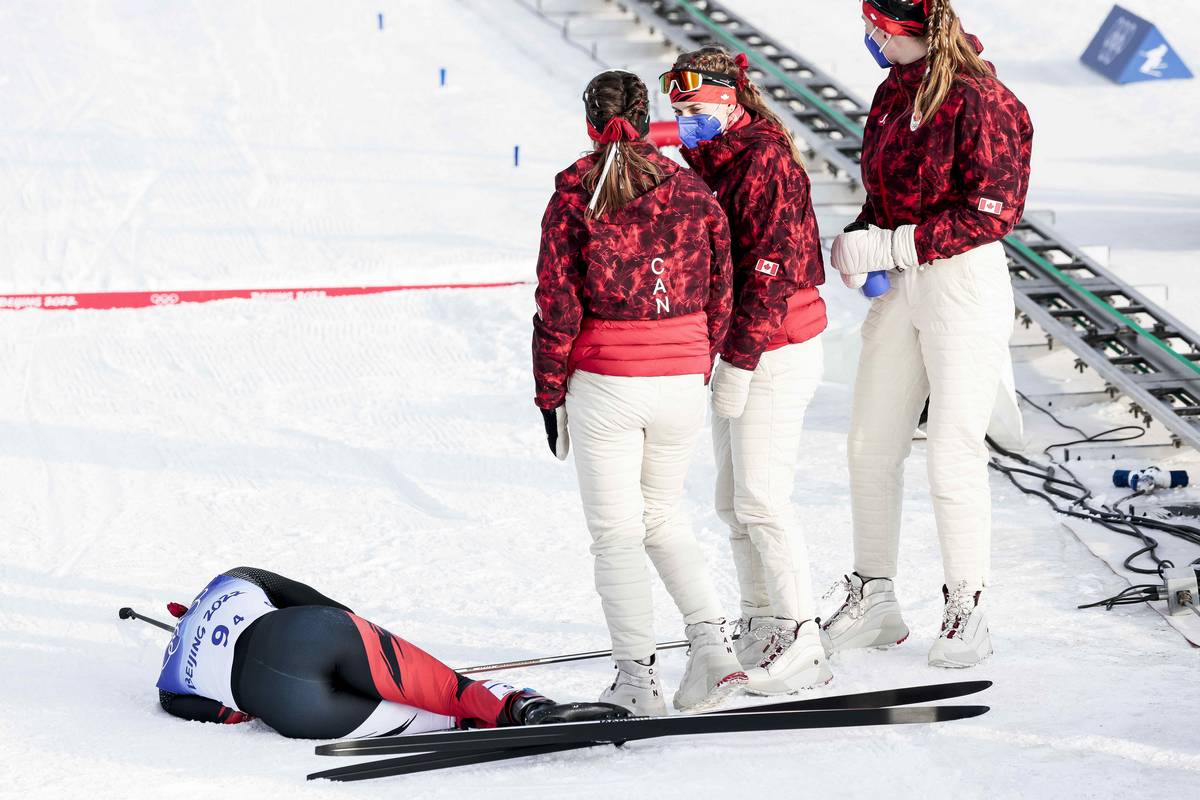
Olivia Bouffard-Nesbitt (CAN) collapses as she’s greeted by her team at the finish of the 4 x 5 k relay. (Photo: NordicFocus)
Closing for Canada, Olivia Bouffard Nesbitt lost one spot to the Italian team in the final leg. The Canadian women ended their day in 9th (+3:39.9).
This World Cup coverage is made possible through the generous support of Marty and Kathy Hall and the A Hall Mark of Excellence Award. To learn more about A Hall Mark of Excellence Award or to learn how you can support FasterSkier’s coverage please contact info@fasterskier.com.
Aerial views of Ruka, Finland showed a venue coated in thick rime, a visual representation of the temperatures and conditions on the course. At nearly 66 degrees North, Ruka currently sees just four and a half hours of daylight. Despite the women’s race happening at 1:30PM local time, shadows were long, the course was lit with supplemental beams, and little warmth could be absorbed from the trickle of fading sunlight that did find its way through the trees.
Before the women’s 10-kilometer individual start classic event kicked off, FIS spoke with technical delegate Pokikvar Uros of Slovenia to discuss the temperatures relative to the threshold which would delay or cancel the competition.
“We measure the temperature at the coldest point on the course, which happened to be down by the lake,” Uros explained.
In the morning, he said this temperature was -18.6 C, while temperatures in the stadium hovered closer to -14.
“If the temperature is below -20C, the jury must decide whether to postpone or cancel the competition.”
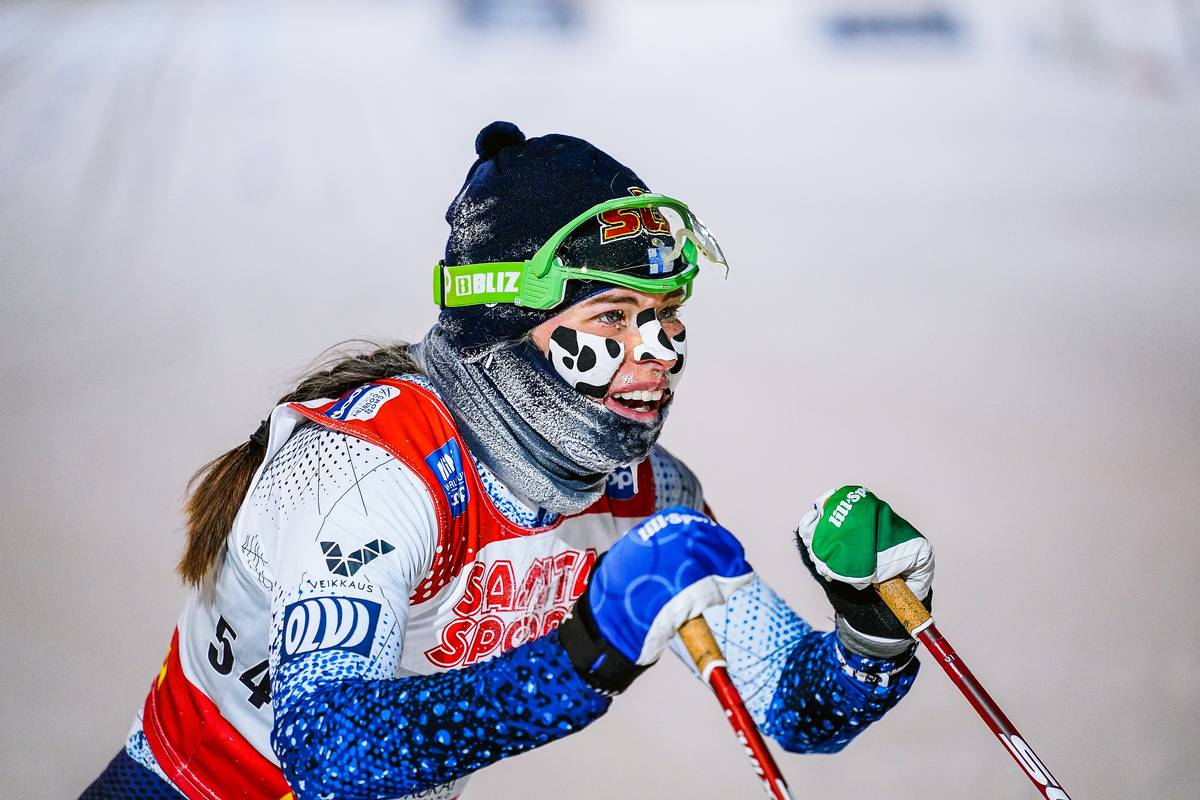
Ultimately, this did not impede the competition from taking place, but the temperatures were nonetheless apparent in the athletes’ appearance. They warmed up in hooded puffy coats and raced with face tape, helping minimize the surface area of exposed skin.
Local favorite, Krista Pärmäkoski (FIN), highlights the temperatures in Ruka with her frosted appearance after the race. Pärmäkoski was 5th on the day. (Photo: NordicFocus)
As we begin a new season, it’s natural to question whether narratives of seasons past will continue onward. Would this race report mirror that of last year, where Norway’s Therese Johaug won the individual start classic by a comfortable margin, her metronomic tempo and refined technique carrying her around the course seemingly unmatched?
Since 2018, when she returned from an 18-month ban following an anti-doping violation, this repetitive storyline has made race reporting both simple and boring on many occasions. If Johaug is in the race, the result seemed almost pre-written. However, this has, perhaps, made the occasions where women have interrupted the dominance even more exciting to witness.
Therese Johaug sets the bar during the 10k individual start in Ruka. (Photo: NordicFocus)
Among the women who seemed to be prime candidates for a plot twist are Johaug’s teammates, Heidi Weng, who finished second to Johaug in the FIS races in Beitostølen last weekend, and relative dark horse, Ingvild Flugstad Østberg, who made a long-awaited return to the World Cup in Ruka after an extended absence to address personal health issues. In seasons prior to her departure, Østberg was a podium regular and the winner of the 2019 Tour de Ski.
However, Østberg last raced on the World Cup in March, 2020. She began that season late after failing to meet national team health criteria; it was speculated that these criteria included body weight and bone density. In March, after jumping off a three-foot concrete step, she sustained a stress fracture in her heel, which ended her season. She did not race in the 2020-21 season.
Another contender was Sweden’s Frida Karlsson, who first turned the tables on Johaug on the Norwegian’s home course in the Holmenkollen 30k in March, 2020. The 22-year old won the FIS distance openers in Gällivare, Sweden, and showed her range yesterday with a 6th place finish in the classic sprint.
As splits from the seeded group began to roll in, this was the narrative that became the one to follow. Karlsson started in bib 52, six minutes behind Johaug in bib 40, receiving information from coaches on the sidelines about her time relative to Johaug throughout the day. Johaug could set the bar as high as she was able, but Karlsson would be the one with the information on the exact time needed to overtake her.
Chasing Johaug’s rabbit, Frida Karlsson lays down the fastest time on a cold day in Ruka. (Photo: NordicFocus)
As expected, Johaug did set the bar high, beating the times set by previous women by more than ten seconds at each checkpoint.
But, as Karlsson chased the imaginary rabbit past the 3.1k mark, she had 4.1 seconds on the Norwegian. This time decreased to 2.1 seconds at 5k. As she kicked and poled uphill past a section of spectators, the chant of “Free-Da! Free-Da! Free-Da!” could be heard, encouraging her onward as she powered toward the finish line.
Therese Johaug watches the clock after finishing the 10k individual start classic in Ruka. (Photo: NordicFocus)
By 8.1k, Karlsson had rebuilt her time gap to 5.6 seconds, and she fired on all cylinders over the final 2k over the course.
Wobbly legged, Karlsson collapsed after her final push over the finish line, her chest rising and falling as her lungs reoxygenated her blood. Sitting up to view her final standing, her arms rose into the air and the lungs expelled a celebratory shout. She had beaten Johaug by 13.7 seconds.
After knocking down each of Johaug’s benchmarks, Frida Karlsson crosses the line in Ruka as the winner of the 10k individual start classic. (Photo: NordicFocus)Sweden’s Frida Karlsson takes the win in the 10k individual start classic in Ruka. (Photo: NordicFocus)
Let that sink in for a second: Johaug did not win the first distance race of the year.
“I’m super happy,” a smiling Karlsson told FIS from the leader’s chair after the race. “Today I felt really strong. I was having the control from the start, and I think it was really fun to ski today.”
Commenting on how it feels to be at the top this early in the year, Karlsson continued, “This is an exciting season because of the Olympics, and I feel like I am having really good control over the situation.”
The women’s podium of the 10-kilometer individual start classic race in Ruka. Sweden’s Frida Karlsson had the fastest time on the day, ahead of Therese Johaug (NOR) and Katharina Hennig (GER). (Photo: NordicFocus)
Rounding out the podium, Germany’s Katharina Hennig was third (+15.2). Hennig moved into this position at the 5k mark, skiing a very strong second lap to decrease her time gap to Johaug from roughly ten seconds at her first lap through the stadium, to just 1.5 seconds at the finish.
Germany’s Katharina Hennig crosses the line for third place in the 10k individual start classic in Ruka. (Photo: NordicFocus)
This is Hennig’s third World Cup podium, each of which has been achieved in 10k classic events. Her other two podiums, a second and third, have both been in Val di Fiemme, ITA, during the Tour de Ski.
Ebba Anderson (SWE) was fourth today in Ruka (+31.8), with Krista Pärmäkoski (FIN) just behind in fifth (+35.1). The aforementioned Weng finished 10th (+55.7), while Østberg was outside the points in 33rd (+1:52.0).
Skiing strong and steady, Rosie Brennan finishes 6th in the 10k individual start classic race in Ruka. (Photo: NordicFocus)
On the American side, Rosie Brennan was the woman of the day, skiing back-to-back strong and steady laps to finish 6th (+38.6).
“We had a frigid and dark 10k today in Ruka,” Brennan wrote in a post-race email to multiple news sources. “We had a solid morning of worrying about what layers to wear and how dark it’s going to be. All worked out in the end and I stayed warm out there and only had a few moments where it was truly too dark to see where I was going. I had really good skis and tried to just dig in and see where my body was at. I didn’t quite have the extra push I needed in the end, but stayed consistent and strong to hold on for a good result. I am really happy to be in the mix and to have a strong group to go chasing with tomorrow. I feel good about where my body is at and where I need to go from here.”
Rosie Brennan charges over the line to finish 6th in a cold individual start classic race in Ruka. (Photo: NordicFocus)
As the 10k classic is one of the cross-country events in the Olympic schedule, Brennan’s Top-8 result meets the objective criteria for team selection, potentially punching her ticket to Beijing. Head coach Matt Whitcomb commended Brennan for her consistency on the day, recognizing the result as a positive indicator despite a focus on process on the day and longer-term goals of the season ahead.
This audio includes comments on both the men’s and women’s distance classic races in Ruka.
Jessie Diggins was next for the American team, finishing 18th (+1:13.7). In a press conference earlier this week, Diggins explained that she has been working with her coaches on a peaking plan for the Olympics. In general, Diggins, who was last year’s overall World Cup winner, builds into the season, with her best results coming much later than Period 1. She indicated that fans can expect the same this season, as she’ll use the Tour de Ski as a fitness booster, followed by an altitude camp to prepare for her goal races during the Olympics.
Jessie Diggins skied to 18th place on a cold afternoon in Ruka. (Photo: NordicFocus)
Outside the Top-30, Katharine Ogden finished 38th (+1:58.3), followed by Hailey Swirbul in 41st (+2:06.3), and Caitlin Patterson in 43rd (+2:16.0). Novie McCabe was 53rd in Ruka (+2:51.6), while Julia Kern took 55th (+2:54.2). Sophia Laukli rounded out the American squad in 61st (+3:21.1).
Hailey Swirbul on course on a cold afternoon in Ruka. (Photo: NordicFocus)
Racing for Nordiq Canada, Katharine Stewart-Jones was 35th (+1:54.0), followed by Cendrine Browne in 49th (+2:40.6).
Jessie Diggins (yellow bib) strides amidst a pack of contenders during the 10 k mass start classic in Falun, Sweden. (Photo: NordicFocus)
This World Cup coverage is made possible through the generous support of Marty and Kathy Hall and their A Hall Mark of Excellence Award. To learn more about A Hall Mark of Excellence Award or to learn how you can support FasterSkier’s coverage please contact info@fasterskier.com.
In case you missed it, yesterday’s 10-kilometer skate in Falun, Sweden was a standout day for the Americans, highlighted by a gutsy victory by Jessie Diggins. How deep into the well Diggins explored was evident in her writhing and occasionally dry heaving body at the finish as she regained enough oxygen and composure to stagger to the leader chair. She upset the prolific Norwegian distance champion Therese Johaug, whose 66 World Cup distance victories both garner immense respect and some frustrated “She won again…” comments from non-Norwegian followers.
But the story does not end there. Rosie Brennan skied to 8th and Sadie Maubet Bjornsen landed in 10th in her first World Cup race of the season. Three in the top 10 in a full field hungry to to prove their mettle before World Championship selections are solidified. Not a bad day in the office.
On the front lines, Jessie Diggins (left) and Rosie Brennan (right) take to the course during the 10 k mass start classic in Falun, Sweden. (Photo: NordicFocus)
In today’s 10 k mass start classic, the excitement builds a little differently. Versus a drawn out rise in excitement as the splits of the seeded group fly by the various checkpoints, today was head-to-head, with all eyes on what Johaug’s rebuttal would be and how the American’s (and Swedes and Russians and the remaining Norwegians, for that matter) would respond.
Mass start and classic technique, in which Johaug excels. Conversely, Diggins’ has struggled to achieve the same results in classic as skate, though she has displayed marked progress this season.
Jessie Diggins watches her finish time hold up against distance champion Therese Johaug in the 10 k skate in Falun, SWE. (Photo: NordicFocus)
In a pre-race interview, FIS phrased the question to Diggins as this. “What are you in for today?”
“Oh boy! [It’s] a very different race!” she laughed. “I’m very excited to give it my all. All you can give on race day is your own effort. I’m looking forward to crossing that finish line knowing I gave it everything I had. For me, if I can do that, then it was a good day.”
Awaiting the gun to send them off, the athletes quietly slid back and forth in the squeaky frozen tracks, keeping nerves at bay and blood flowing in the single digit Fahrenheit temps. Skiers familiar with an outing in such conditions understand the sounds that go along with these conditions. The cacophonous start sounded like a lightsaber battle.
Germany’s Katharina Hennig (center) chases Therese Johaug (NOR) with Ebba Andersson (SWE) in pursuit. (Photo: NordicFocus)
It was clear early that Johaug and her teammate Heidi Weng wanted to push the pace. They attempted to pull away from the group in the opening kilometers creating a small gap. But in the first downhill back toward the stadium, Diggins gave them something to worry about. Her skis like rockets, she overtook them in the descent, slingshotting around the curve and into the lead as they lapped through the stadium.
In fact, no one could break away. Not even the breakaway specialist Johaug. At the 5 k mark, the top-10 skiers were separated by less than two seconds, with Diggins sitting fifth, smack in the middle.
Left to right, Heidi Weng (NOR), Jessie Diggins, and Frida Karlsson (SWE) stride toward the finish of the 10 k classic in Falun, Sweden. (Photo: NordicFocus)
After a sprint bonus point opportunity at 5.8 k, which was narrowly snagged by Johaug over Sweden’s Ebba Andersson, the pace began to accelerate. At roughly the 6.5-kilometer mark, Johaug began her surge, creating a new gap of a couple seconds by the subsequent top of the climb. But the slinky phenomenon repeated itself, as Andersson, Linn Svahn, Katharina Hennig, and Weng closed the gap on the descent to the stadium. Diggins fought hard to maintain contact, tucked in behind Sweden’s Frida Karlsson just behind the leaders with a train of chasers close on their tails.
With 1 k of downhill and fast terrain to go, this pack was still tight, Svahn and Hennig pushing from the front. An ill-timed crash on a downhill curve took Anderson, who had been in 4th, out of contention, but one could not look away as five remaining women flew toward the finish.
Hammering the uphills, Johaug crested the final sustained climb in the lead, tucking as she pushed into the final sweeping downhill. Svahn stayed tight in the corner, hugging the v-board and capitalizing on her fast skis to sneak by Johaug on the inside. The Swede held herself less than a ski-length ahead of Johaug over the final rollers and into the finish lanes. At that point, it was all over; Johaug was no match for the sprint star’s closing speed.
Linn Svahn (SWE), Katharina Hennig (GER), Therese Johaug (NOR), (l-r) closing down on the finish line on Saturday. (Photo: NordicFocus)Linn Svahn (SWE), Yulia Stupak (RUS), Katharina Hennig (GER), Therese Johaug (NOR), (l-r) poling in for a tight finish. (Photo: NordicFocus)
Poles whipping in double pole fury, Svahn held her ground at the front to stop the clock at 25:57.1. Meanwhile, Russia’s Yulia Stupak sprinted past Johaug in the final meters to take second (+0.4), while Hennig forced the final podium position to be decided by photo. It was determined that Johaug held onto third (+0.9).
The women’s 10 k mass start classic podium: Yulia Stupak (RUS) second, Linn Svahn (SWE) first, and Therese Johaug (NOR) third (l-r). (Photo: NordicFocus)
“I was really looking forward to competing because I’ve been home since the Tour de Ski and I felt pretty strong the last week,” Svahn told FIS after the race. “I just tried to keep my focus on the course and do everything right. When they couldn’t get a gap on the last uphill, the hardest uphill, I thought, ‘Well, now it’s my turn to try to do my best to the finish line.’
“I felt strong and had really amazing skis,” Svahn continued. “It was a victory for the whole team, especially the waxers, because my skis were unbelievable.”
In a gutsy finish, Sweden’s Linn Svahn takes the win in the Falun 10-kilometer mass start classic. (Photo: NordicFocus)
Yana Kirpechenko (RUS) finished at the back of the tight lead group in 5th (1.9), with Norway’s Helene Fosseholm bringing in the chase pack in 6th (+7.7), Diggins 7th (+8.3), and Weng 8th (+8.8).
“Today was awesome,” wrote Diggins in an email. “We had really competitive skis, and I actually have been loving how cold it is because when it’s cold like this I feel like I can just keep pushing and pushing my body! This course had a lot of power striding, and I was just focused so hard on keeping my technique as together as I could with a flooding body. I was sending it as hard as I could the entire race, and I’m very proud of that effort. And fun to be so close to the front in a classic race!”
Jessie Diggins, filling the lungs after placing 7th on Saturday. (Photo: NordicFocus)
Sadie Maubet Bjornsen was next up for the Americans, finishing in a pack of chasers in 15th (+35.7).
“Another exciting day of racing in Falun here,” Maubet Bjornsen emailed. It is the first time in a while that I have started a ways back in a mass start, and boy, it is a different type of racing! Huge respect for all those who put together amazing races from that position! I kind of felt like I was burning matches more than I would have loved just trying to weave my way through.
“I was once again feeling encouraged by these first races. With five weeks away from hard intensity as I have worked through a back injury, my huge achievement was making it to the finish line. Classic has been particularly tough for it, so today was a real wild card. But I had some really encouraging feelings, and I look forward to working towards more exciting feelings in the weeks to come.”
Back on the World Cup, Sadie Maubet Bjornsen puts together solid back to back distance results with a 15th place finish in the 10 k classic mass start in Falun, Sweden. (Photo: NordicFocus)
Maubet Bjornsen took her first long-term absence from international skiing recently. During the pandemic, she has remained mostly in Anchorage, Alaska working and training.
“After spending 11 months away from [World Cup] racing, this weekend has been particularly fun to just kind of re-remember how this works. I haven’t yet raced without spectators, and I will say it is a different feeling. It almost feels like a super serious summer time trial. You hear your coaches cheering more than ever, which is kind of fun in a new way! It kind of takes racing back to the core, which is special.”
Outside the top-30, Rosie Brennan took 33rd (+1:15.6), followed by Katharine Ogden in 42nd (+1:49.1), Sophia Laukli 50th (+2:37.1), Caitlin Patterson in 51st (+2:41.2), and Alayna Sonnesyn in 56th (+3:33.2).
Post-Race Comments from U.S. Head Coach Matt Whitcomb.
Rosie Brennan finishes 33rd in the 10k mass start classic in Falun, Sweden. (Photo: NordicFocus)Face covered at the finish, Katharine Ogden skied to 42nd in the 10 k mass start classic in Falun, Sweden. (Photo: NordicFocus)
Leading the Canadian women with her second individual top-30 in two World Cup stops was Katharine Stewart-Jones in 17th (+36.2), her career best individual result at this level. Despite a string of wins and podiums last season, both domestically and in Opa Cup events, and a top-30 finish in the 2020 Scandinavian World Cup Ski Tour, a seemingly break-through season, Stewart-Jones was not named to the Canadian national team for 2020/2021. Another top-20 result will automatically qualify her to make the team next season.
“It was a super fun race,” Stewart-Jones wrote after the race. “The pace went out hot but I knew it was the type of course where gaps are hard to make but also hard to close so my goal was to get myself into a good position in the first lap and hold on. The techs did an awesome job with my skis which helped me relax both on the downhills and climbs.
“Overall I’m just extremely happy to be back racing and also very excited about how the team has been performing so far. Cendrine [Browne’s] result yesterday was really inspiring and I am confident that this is just the beginning for our team.”
Stride and glide: Canada’s Katharine Stewart-Jones (bib 35) and Sadie Maubet Bjornsen (bib 24) work their way toward the finish of the 10 k mass start classic in Falun, Sweden. (Photo: NordicFocus)
Cendrine Browne rounded out the Canadian finishers in 38th (+1:45.1). The race saw 60 finishers.
The women’s 10 k classic mass start gets underway in the 6th stage of Tour de Ski in Val di Fiemme, Italy. (Photo: Nordic Focus)
This World Cup coverage is made possible through the generous support of Marty and Kathy Hall and their A Hall Mark of Excellence Award. To learn more about A Hall Mark of Excellence Award or to learn how you can support FasterSkier’s coverage please contact info@fasterskier.com.
With just three more races remaining in the 2021 Tour de Ski, the women toed the start line for today’s 10 k classic mass start. The conditions were a gift of stable bluebird weather, sub-freezing temperatures, and tracks mostly in shade against a backdrop of sun on the opposite side of the valley. Jessie Diggins of the U.S. started at the head of the crowd, wearing the yellow leader’s bib, with a lead of twenty-two seconds over teammate Rosie Brennan in the overall standings.
Out of the start gate, in the 6th stage of Tour de Ski in Val di Fiemme, Italy. (Photo: Nordic Focus)
As the race unfolded, however, it was not the tour leaders who took center stage. The pack largely stayed together for the first two of the four laps, until Ebba Andersson of Sweden took charge. Pushing hard out of the stadium onto the third lap, Andersson splintered the group. The Val di Fiemme course is notoriously difficult to pull away on though Andersson gave it her best shot. At 7.5 k she kept pressing her advantage though Katherina Hennig of Germany was only +1.5 seconds behind.
Ebba Andersson (SWE) controls the pace on her way to a third-place finish in the 10 k classic mass start. (Photo: Nordic Focus)
Eventually, Andersson was caught by Hennig and Natalia Nepryaeva of Russia. Cresting the final climb, Napryaeva had the advantage and she crossed the finish line in first, making today a double Russian victory. “It was a tough battle,” said Nepraeva through a translator, “I am very happy with the result and hope the shape is getting better.” Hennig took silver, her second career World Cup podium after finishing third last year in this same event. Andersson placed third.
Natalia Nepryaeva (RUS) poses for the cameras following her win in the 10 k classic mass start. (Photo: Nordic Focus)
In a translated interview with the German broadcaster ZDF, Henning said, “I wanted to get back on the podium some time. But I really wouldn’t have expected that it works out like that today. I wanted to orient myself towards the front of the pack, but then in the beginning of the race briefly had a problem behind Rosie Brennan who tangled up. So I had to invest a lot of energy to get back in front. That it then worked out in the end… I can’t really grasp it yet.”
Katharina Hennig (GER) strides her way to second for the German squad. (Photo: Nordic Focus)
For the Americans, Diggins ended the day in 9th place twenty-four seconds back, after fading over the last lap.
“Today was a big day for me in terms of mental toughness,” emailed Diggins. “My body was numb from the waist down for the entire last lap but I just kept digging deep because I knew every second counted and I had a job to do! I managed to hold on to the leader bib and with a classic sprint and the hill climb coming up, I’m really excited for both these stages and focused on getting all the little details of recovery right! I was proud of the grit I had out there today, but way more proud of the amazing Salomon skis our techs made me! Wow, that was key in today’s race. … Also, so hyped up for Gus! Race of the day for sure.”
Jessie Diggins gives it everything she has down the homestretch of the sixth stage in the Tour de Ski in Val di Fiemme, Italy. (Photo: Nordic Focus)
Katharine Ogden notched her third top 20 finish of the tour (she placed 18th in the 10 k skate and 20th in the 10 k classic in Toblach) and finished in 19th (+1:12.3). Hailey Swirbul earned a few more points, finishing in 25th (+1:29.1) and Caitlin Patterson snuck into the top thirty with a 29th place (+1:51.8).
Following a tangle early on in the race, Brennan struggled to maintain her position going into the day, ultimately finishing in 31st place (+2:00.5). Julia Kern rounded out the U.S. women finishers in 42nd place (+4:08.3).
“Today was undeniably a tough day,” Brennan wrote post-race. “I was ready for a tough battle and had the confidence to do well today. However, I got tripped up on the second climb and got skied over by a lot of people before I could get up. Because it was so early, we were all still in a big pack and I worked really hard to try to pass people and get back to the front. I think I wasted a lot of energy doing that when my body didn’t have much extra left in the tank. I truly fought with all I had and I am very disappointed that I couldn’t do more out there. Tour racing always brings big up and big downs so I will do my best to pick up the pieces and continue to fight hard the next two days.”
Overall Standings:
Today’s Stage 6 results caused some ripples in the overall standings in the Tour. To recap, prior to Stage 6, Diggins had a 22 second lead over Brennan in second, a fifty-eight second buffer over Stupak in third, with Karlsson in fourth (+1:29).
After today’s day’s grind in Val di Fiemme, Diggins sits in first overall with a fifty-five second margin over Stupak in second. Karlsson moves up a position to third (+1:42). Brennan, who struggled on the stage, fell back to seventh overall (+2:11).
Racing continues tomorrow for the women with a classic sprint.
And they’re off! The women take to the course in Stage 2 of the 2021 Tour de Ski, a 10-kilometer mass start classic in Val Müstair, Switzerland. (Photo: NordicFocus)
This World Cup coverage is made possible through the generous support of Marty and Kathy Hall and their A Hall Mark of Excellence Award. To learn more about A Hall Mark of Excellence Award or to learn how you can support FasterSkier’s coverage please contact info@fasterskier.com.
Light snow continued to fall in the quaint Swiss village nestled in Val Müstair as the athletes took to the tracks for the first distance stage of the 2021 Tour de Ski, a 10-kilometer mass start classic race. As the first mass start of the season, the women kicked, glided, and poled over 10-kilometers broken into four challenging laps, seeing exactly where they stacked up relative to their competitors.
With four consecutive distance stages, the Tour quickly becomes part poker match, part ultramarathon. Standings and cumulative time are influenced not only by the final result from each day, but by the bonus points athletes can garner at checkpoints on course; in today’s case, an opportunity at the 3.3 kilometer mark.
The picturesque village and tracks of Val Müstair play host the first three stages of the 2021 Tour de Ski. (Photo: NordicFocus)
As position in the field is relatively clear in a mass start — versus chasing the splits of a “ghost” racer in an interval start — tactics, patience, and drafting become more significant.
Today, it was soon evident who intended to make a run at the dealer in the Stage 2 match. Wearing a bright green bib as overall U23 leader, Sweden’s Frida Karlsson skied at the front of the pack from the start. She out-sprinted teammate Ebba Anderson approaching the 3.3 k checkpoint to snag the maximum of 15 bonus points, and seemed to be comfortably kicking up each of the steady climbs. After her defeat of Norway’s powerhouse Therese Johaug at last year’s Holmenkollen 30k, albeit in part attributed to Johaug’s decision not to change skis, Karlsson solidified her position as a woman to watch in distance races.
Frida Karlsson sets the pace with Diggins marking from behind during Stage 2 of the 2021 TdS. (Photo: NordicFocus)
However, despite her seeming authority at the front, she was unable to create any true gap to the women behind her. At the midpoint of the last lap, six women sat on her tails including two women whose stars and stripes flashed on their legs as they matched the tempo of the other women striding alongside them.
One of these women, Jessie Diggins, comes off a second place finish in yesterday’s sprint. Diggins held her position in the top three throughout the race, at times challenging Karlsson at the front, leaving no room for weakness or error on the young Swede’s part.
Rosie Brennan tucks into the lead group during Stage 2 of the Tour de Ski, a 10-kilometer mass start classic. (Photo: NordicFocus)
Fellow American Rosie Brennan, who finished fourth in Stage 1 also sat comfortably in the lead group, matching the surges that were made to break away as the race progressed.
In the final two kilometers, the other women began their own runs for the win, challenging Karlsson who was faltering, but unwilling to fold. Up the final climb and down the same screaming S-turn descent featured in the sprint course, the women charged furiously toward the finish, Karlsson slowly being swallowed into the pack.
Rounding the final corner and thrashing her poles to accelerate toward the finish, a different woman in white lycra took the reins. 21-year-old Linn Svahn, the winner of yesterday’s skate sprint and of the 2019/2020 World Cup sprint globe, put her closing speed on display to stop the clock at 30:09.9. Though she has won FIS distance races on home soil, this is Svahn’s first distance win at the World Cup level.
The top women fight to the line during Stage 2 of the 2021 Tour de Ski. Sweden’s Linn Svahn took the win, with Yulia Stupak (RUS) and Jessie Diggins in 2nd and 3rd, respectively. (Photo: NordicFocus)Sweden’s Linn Svahn throws her boot to seal the deal on victory in Stage 2 of the TdS, a 10-kilometer mass start classic. (Photo: NordicFocus)
“It was really fun. I love going classic,” she told FIS after the race. “My plan was to just keep it as chill as I could, then watch the girls going strong on the uphill and try not to use so much energy. When I knew it was one lap left, I just kept thinking ‘I need to win this. I need to win this.’ So it was really good to race today.”
A champion in sprint and distance, Sweden’s Linn Svahn wins back-to-back stages of the 2021 Tour de Ski. (Photo: NordicFocus)
Just behind, a threesome including Diggins, Karlsson, and Yulia Stupak of Russia fought for the remaining spots on the podium. Stupak and Diggins crept ahead of the Swede, matching each other’s poling tempo before throwing their boots at the line. Stupak barely edged out Diggins, taking second (+0.7) with Diggins just behind in third (+0.8).
Airborne and on form, Diggins celebrates her third place finish in Stage 2 of the Tour de Ski. Sweden’s Linn Svahn (center) took the win, followed by Russia’s Yulia Stupak in 2nd. (Photo: NordicFocus)
“We had great skis out there!” wrote Diggins in an exuberant post race email. “Huge thanks to our service team and coaches for all their hard work, and the Salomon service team for their help picking my skis before the race!”
Diggins continued by commenting on today’s effort, and how this classic result represents years of focus on technique and collaboration with her coaches and teammates.
“My goals for today were to ski smooth and really work the downhills without letting them become a stress in a mass start environment, so I stayed near the front to keep out of trouble. This was a great course for me with all the long power-striding, and when I felt good on the last half of the last lap I just decided to push it! For someone previously labeled as a skater only, it was very exciting to find myself sprinting for the podium in a 10 km classic race, and confidence-boosting as well since I’ve been working so hard for so long on my classic striding! I think that improvement speaks to our coaches’ dedication and our positive team environment where we can learn from one another and push each other in our weaker areas. This summer I really benefitted from my SMST2 teammates helping me push the envelope in classic intervals and I’m extremely grateful to them!”
Coming on form in the 2021 Tour de Ski, Jessie Diggins takes third in Stage 2. (Photo: NordicFocus)
Despite spending over 8 kilometers at the front, Karlsson took the wooden medal in fourth (+1.4). She was followed closely by Katharina Hennig of Germany in fifth (+2.0), with Rosie Brennan on her tails for sixth (+4.5).
Evidence of the effort, the leaders of the Stage 2 of the 2021 TdS, a 10-kilometer mass start classic, gasp for air at the finish line. (Photo: NordicFocus)
“Today was the first mass start of the season, which is always a little nerve wracking for me as I prefer individual starts,” wrote Brennan in an email to multiple news outlets. “My goal was to keep things as close as possible and then see what I left in the end. I think I did this well as I skied in the front pack throughout the race. I was unhappy with my tactics on the long gradual downhill coming back towards the stadium. I took a gamble on lane choice that didn’t pan out and found myself out of contention for the sprint finish, but managed to minimize my time lost to the leaders and also get a career-best classic result so I am proud of that. I am in a great position for tomorrow’s pursuit start so I hope to find some good energy and take advantage of that!”
Outside the top-10 with noteworthy finishes were Hailey Swirbul in 17th (+40.5) and Katharine Ogden in 22nd (+1:21.2). Swirbul was among a larger lead group through the 5 k, dropping into a chase pack as the top 10 began to break away.
Hailey Swirbul on her way to a 17th place finish in Stage 2 of the 2021 Tour de Ski. (Photo: NordicFocus)Katharine Ogden on course in Stage 2 of the 2021 Tour de Ski. (Photo: NordicFocus)
Caitlin Patterson was the next American finisher in 38th (+2:10.4), followed by Julia Kern in 41st (+2:30.6), and Sophie Caldwell Hamilton in 46th (32.49.0). Caldwell Hamilton experienced a crash near the end of the first clustered lap; “You got it, Soph!” could be heard from a passing teammate.
Post-race comments on the women’s 10k mass start from U.S. Head Coach Matt Whitcomb.
Julia Kern on course in Stage 2 of the 2021 Tour de Ski. (Photo: NordicFocus)
Overall Tour de Ski and World Cup Standings
With back-to-back wins, Svahn leads the 2021 Tour de Ski by 13 seconds, with Diggins in 2nd, and Karlsson third (+0:18).
Because of snagging the bonus points in today’s stage, Karlsson sits at the top of the TdS point standings with Diggins one point behind in second, and Svahn three points back in third.
Brennan skis to 6th in Stage 2 of the 2021 Tour de Ski, adding to a string of outstanding performances. (Photo: NordicFocus)
Continuing her streak of outstanding races, Brennan remains in possession of the yellow bib as overall and distance World Cup points leader and sits 4th in the TdS standings for both time (+0:20) and FIS points.
The tour continues tomorrow with a 10-kilometer skate pursuit.
The start of the 56 skier deep field in the women;’s 115 k skiathlon in Oberstdorf, Germany. (Photo: NordicFocus)
Here at FasterSkier, we do not play the odds. Some contributors we know play Noah Hoffman’s Fantasy League – but we steer clear of rolling the dice on cross-country skiing. But the women’s skiathlon events on the World Cup may not be the biggest payouts since in recent history they have been a lock.
Oberstdorf in Oberstdorf, Germany — the site of next year’s Nordic Ski World Championships — required no crystal ball of an imagination to determine the top-spot for the women who raced a 7.5 k / 7.5 k skiathlon on a championship-caliber course.
Coming into the race, Norway’s Therese Johaug had won a total of seven World Cup skiathlon’s, including a win in the format this season in Lillehammer. With a win today she could match the record of eight skiathlon World Cup wins held by her former teammate, the now retired Marit Bjørgen.
This is about the most unspoiling of a spoiler alert: Johaug won today’s skiathlon in 40:05.2 to tie Bjørgen on the skiathlon win list. But her day was more tenuous than we would have imagined. Her gap on second place at the finish, Norway’s Ingvild Flugstad Østberg, was for Johaug somewhat meager, 15.5 seconds. Austria’s Therese Stadlober placed third (+15.6). According to FIS, this was Stadlober’s third career World Cup podium. Her two other podiums came in the 2018 Tour de Ski, one of which was a time of day podium up the Alpe Cermis.
Today, for Johaug, her race day concluded with arms raised in the air win.
A familiar pose for the World Cup distance leader: Therese Johaug winning the 15 k skiathlon in Oberstdorf, Germany. (Photo: NordicFocus)
She was able to slowly stretch away from a group of chasers during the 7.5 k classic leg. She inched ahead from the main chase group near 2.5 k as she charged up the course’s main climb, the Burgstall hill. The field was spread out, but not shattered. Joahaug came over the top and into a long glide out with a 100-meter lead.
At 3.8 k, Joahug had a 5.3-second buffer on Østberg in second, with eight other skiers within 15 seconds. Roughly two kilometers later, she added another three-second cushion. By the exchange to skate skis at 7.5 k, Johaug’s lead was 14.1 seconds to Østberg. But in close contact with Østberg were Finland’s Kerttu Niskanen and Krista Pärmäkoski, Norway’s Heidi Weng, Sweden’s Ebba Andersson, Stadlober, German Katharina Hennig, and Russia’s Natalia Nepryaeva who was 18.9 seconds back.
Churn as she may in her free-radical producing high octane tempo, Johaug essentially put no more time on the core chasers during the skate portion. For a time, up through 13.7 k, Johaug had a 20.1-second margin on the next closet skier, which winnowed by five seconds at the finish. This was not a Johaug walk-away as we have seen in the past. Østberg and Andersson took the primary responsibility of keeping the void to Johaug in check.
Therese Johaug charging during the 15 k skiathlon – Obertsdorf, Germany. (Photo: NordicFocus)
Johaug with a gap: 15 k skiathlon in Oberstdorf, Germany. (Photo: NordicFocus)
Østberg, Stadlober, and Andersson were able to sprint to the finish for their 2-3-4 order. (They came through +15.5, +15.6, +15.7, respectively.)
“It was a tough race out there,” Johaug told FIS after the race. “Especially the classic when I have a gap of five seconds, I know that I have to push myself all the way because if they attack me it will be a group. And it will be hard to go into skating and get a new gap again. I tried to focus on myself and work in my head all the way, but I am really happy with the first place today.”
Johaug has won 11 of 12 World Cup distance races this season and leads those standings with 896 points. Weng is in second with 595 points.
Ingvild Flugstad Østberg (bib 5) lading the chase during the classic portions of the Oberstdorf, Germany 15 k skiathlon. (Photo: FasterSkier)
It was not the day hoped for by the top American women. That reality became evident early in the classic portion of the race. By 3.8 k, Jessie Diggins had ceded 23.3 seconds, and Rosie Brennan 27.4. The time-bleeding trend never fully stabilized. Brennan was 18th through the exchange (+55.3), Diggins 24th (+1:04.1).
Brennan placed 17th overall (+1:46.6), while Diggins was 22nd (+1:55.0).
Rosie Brennan of the U.S., during the classic portion of the 15 k Oberstdorf, Germany skiathlon. (Photo: NordicFocus)
“Skiathlons are always a little unpredictable when we do so few in a year,” Brennan sent in a group email. “We were able to race on one of the new courses they have made for World Championships but due to lack of snow, we could only use one 3.75km course. The course is significantly hillier than the old course and skied quite well. However, doing a skiathlon on one course that’s split half classic half skate always causes some problems with not much room to pass. I felt very good today but struggled a lot moving through the field. I was frustrated with that but very happy about my feelings and skiing so I feel good that I am in a good place and have more good races to come.”
World Cup Coach Matt Whitcomb explained in a post-race interview that Diggins was feeling slightly off today with her sensations.
Jessie Diggins on the skate leg of the 15 k Oberstdorf, Germany Skiathlon. (Photo: NordicFocus)
Post-race interview with U.S. World Cup Coach Matt Whitcomb discussing the women’s race
Post-race interview with U.S. World Cup Coach Matt Whitcomb discussing the race course
Also for the U.S., Cailtin Patterson returned to the World Cup after contesting U.S. Nationals in early January to place 34th (+3:16.5). Patterson moved up in the skate portion to 34th, after transitioning to skate in 42nd. Alayna Sonnesyn raced to 51st (+5:45.1).
For Canada, Katherine Stewart-Jones just missed the points in 31st (+2:40.2). Dahria Beatty placed 47th (+4:54.0).
“It was a fun race, I knew that I would need to make up positions in the classic part of the race without using too much energy… but I also knew the pace would start out fast,” Stewart-Jones emailed. “I was able to move up little by little throughout the race. I felt better on the skate portion but wasn’t quite able to close the gap to top 30. I am for sure a bit disappointed to be so close but it is also motivating to know that I can ski like that on a day where I don’t feel at my best! As for the team, I am really excited about our progress. Dahria has been consistently in the top 30 in World Cup sprints this year which is really exciting and her and Emily were really close to top 30 in Davos. The best is definitely yet to come with most of the team focusing on the Scando tour and World Cup finals!”
Katherine Stewart-Jones of Canada (bib 45) skiing to 31st in the Oberstdorf, Germany 15 k skiathlon. (Photo: NordicFocus)
And with those concerned with the baggy bibs last week in Nové Město – it was a return to the form-fitting bibs we’ve come to know on the World Cup.
Racing continues tomorrow in Oberstdorf with a classic sprint.
The women’s podium after Stage 5 of the 2019/2020 Tour de Ski in Val di Fiemme, Italy. Astrid Uhrenholdt Jacobsen (NOR) took the win ahead of Ebba Andersson (SWE), and Katharina Hennig (GER). (Photo: NordicFocus)
The 100th Tour de Ski Stage in Val di Fiemme, Italy, featuring a four lap 10-kilometer mass start classic. Coupling the results in distance racing over the last 14 months since Therese Johaug returned to the world cup and those of Stage 4, it seemed like a safe bet to predict a rematch between Johaug and her teammate Ingvild Flugstad Østberg. Another opportunity to race head-to-head over every meter of the course, and for Johaug to make a statement that her loss was a fluke.
It quickly became clear that Østberg crossing the line 0.4 seconds ahead of Johaug was akin to Roger Bannister running 3:59.4 on a cinder track in Oxford. The barrier was broken, illuminating the potential for the host of men who followed. Johaug was no longer invincible. No longer in a class of her own.
Ebba Andersson (SWE), Ingvild Flugstad Oestberg (NOR), and Heidi Weng (NOR) lead the pack in a 10-kilometer mass start classic in Val di Fiemme. (Photo: NordicFocus)
Nearing the end of the first 2.5 k lap, seven athletes formed a tight group at the front of the pack. Putting in a surge for the point bonus at 2.3 k, Natalia Nepryeava of Russia was in the lead, stretching out the group slightly. The trailing women rebounded like a slinky, continuing to push as a group.
The elevation profile of the 2.5 k course in Val di Fiemme, Italy. (Photo: Screenshot FIS broadcast)
Rounding the fast winding turns of the steep descent halfway through the lap, the chink in Johaug’s armour widened. Temperature well above freezing and old manmade snow made for lightning fast conditions, and racers were likely kicking with a variation of klister, perhaps with a hardwax cover. In the first lap, Johaug lost her footing and crashed, rebounding quickly and keeping contact with the pack.
In each of the subsequent laps, she was seen scrubbing speed, doing what she could to stay on her feet at the risk of shearing off some of her grip.
Therese Johaug approaches the fateful horseshoe bend in Val di Fiemme with Ebba Andersson close on her tails. (Photo: NordicFocus)
Jessie Diggins tackles the fast icy corners in Val di Fiemme during Stage 5 of the 2019/2020 Tour de Sk. (Photo: NordicFocus)
Spending the majority of the race at the front, Ebba Andersson of Sweden made several attempts to reduce the size of the group, but each of her moves were matched. Johaug, Østberg, and their teammates Astrid Jacobsen held strong beside Nepryeava, and Katharina Hennig of Germany.
As the 6k checkpoint approach, providing the opportunity for the first ten athletes to earn up to 15 bonus seconds, the pace accelerated. Jacobsen emerged at the front, sprinting head to head against Andersson with the remainder of the women close on their tails. Jacobsen held off the Swede, earning the most time.
Tour leaders Østberg and Johaug were 4th and 6th at the bonus, respectively. As expected after a high-speed snowplow down the hill, Johaug appeared to be struggling with her kick and was forced to run alongside the pack of women outside the track.
Sadie Maubet Bjornsen, who initially fell off the lead pack with Jessie Diggins, pushed to reconnect with the lead group and hovered 2 seconds behind in 8th at the time bonus. Diggins began to fade and was not within the top ten skiers; she did not earn bonus seconds.
Charlotte Kalla (SWE, bib 13), Sadie Maubet Bjornsen, and Jonna Sundling (SWE) lead the chase group during Stage 5 of the 2019/2020 Tour de Ski. (Photo: NordicFocus)
As the final lap began, the pace heated up and the lead pack began to whittle down. Østberg led at each of the checkpoints. She too could no longer climb inside the tracks, but neither could her opponents. Heading into the fast and technical descent, Østberg motioned to the racers behind her as if to say, ‘Let’s chill out and give each other space here so we all stay on our feet.’
And so they did; each of the top five skiers stayed on their feet around the horseshoe bend. But as they headed up the final punchy climb with less than a kilometer to go, Østberg tangled with Johaug and went down and the tip of her pole snapped off. Running on her skis as she ripped off the strap and reached for a new one, she charged ahead, not pausing to put the strap of the replacement over her hand.
But her momentum was lost and she could not regain her contact with the three leaders who had taken off at the front: Jacobsen, Andersson, and Hennig.
Astrid Uhrenholdt Jacobsen (NOR) rounds the final turn toward the stadium with Katharina Hennig (GER) in hot pursuit. (Photo: NordicFocus)
Double poling in ferocious unison, the three women sprinted to the line with Jacobsen less than half a ski length ahead of Andersson who occupied the neighboring track. Hennig remained tucked in behind Jacobsen, who began to pull further ahead in the final meters.
Stopping the clock at 29:07.9, Jacobsen took the win and landed her first Tour de Ski podium since the final stages of the 2014 Tour, also in Val di Fiemme. Despite balancing the workload of a full-time medical school student, 2020 is shaping up to be one of Jacobsen’s career best seasons. She is currently ranked 4th in the overall World Cup standings.
Astrid Uhrenholdt Jacobsen (NOR) takes the win in Stage 5 ahead of Ebba Andersson (SWE) and Katharina Hennig (GER). (Photo: NordicFocus)
Andersson was next across the line (+0.4), followed closely by Hennig in third (+1.0). The Swede has the unfortunate statistic of having the most podium finishes in World Cup races (including tour stages and overall tour ranks) without ever landing on the top spot. With today’s result, she has 13 podium finishes, moving ahead of Maubet Bjornsen who has 12. At just 22 years of age, the time is nigh for her to happily surrender her title.
Also one of the younger athletes in the field, today was Hennig’s first podium racing with the bigs. The German took third in distance classic race at U23’s last year and has cracked the top 10 on the World Cup a handful of times in the event.
Katharina Hennig (GER) throws her arms up in celebration of a third place finish in Stage 5 of the 2019/2020 Tour de Ski. (Photo: NordicFocus)
Katharina Hennig gives an infectious smile after snagging her first World Cup podium in Stage 5 of the 2019/2020 Tour de Ski. (Photo: NordicFocus)
Unable to contain her excitement about her performance, Hennig accidentally dropped her skis as she jumped up and down on the podium.
Katharina Hennig (GER) jumps for joy for her first World Cup podium after Stage 5 of the 2019/2020 Tour de Ski. (Photo: NordicFocus)
“[It’s] hard to believe,” she told a German reporter for ZDF. “On the last loop I noticed I was still keeping in touch with the top, and then I somehow just put everything out that I had.”
The broadcaster explained that Hennig had stated that beating Johaug was not a goal the team had discussed, presuming that it was not possible. Yet the 23-year-old had stuck with Johaug throughout the race and beaten her by over five seconds.
“I really don’t know what to say,” Hennig said in response. “I just know that I want to say thank you to everyone supporting me on my journey, our team, our wax technicians, my parents, my boyfriend, my coach, everyone, without them this would not be possible.”
Johaug had ended the race in 4th (+6.2), followed by a frustrated Østberg who swatted her pole into the snow as she crossed the line in 6th (+6.8). Norwegian news outlet NRK reported that Østberg needed time to gather herself before she could listen Johaug’s apology and accept that there was no malicious intent.
Maubet Bjornsen held her position in the field, racing alongside Nepryeava throughout the second half of the race. She was the top American finisher in 7th (+17.2). Ceding time for her overall standing, Diggins fell back to 17th (+1:05.5). A few seconds behind, Rosie Brennan finished 20th (+1:07.7), and Katharine Ogden finished just inside the points in 28th (+1:56.9).
Sadie Maubet Bjornsen skis to a 7th place finish in Stage 5 of the 2019/2020 Tour de Ski. (Photo: NordicFocus)
“After struggling with slippery skis two days ago in Toblach, I was ready to take another hit at one of my favorite races out there, 10k classic!” Maubet Bjornsen wrote in an email to several news outlets. “My race plan today was to be patient, and race my own race. This meant trying to stay relaxed for the first lap, and making sure I had enough energy to attack in some of the working sections that others could be exploded on. At this point in the tour, you have to rely on your brain, because your muscles are so tired, they are screaming stop. The goal is to let your brain overpower that feeling, and just keep pushing.”
Looking back on the tour, Maubet Bjornsen took 30th in the 10 k skate first stage, followed by 5th in the sprint, and 8th then 12th in the pursuit stages.
“This tour has been a collection of ups and downs, but every time things work out, I feel super encouraged and excited. Tomorrow’s classic sprint will be really funny. When people are so tired, I am sure it will look different than a normal sprint, but that sounds so fun! I can’t wait. If I can find the same feelings I found today, I feel confident I can find my magic.”
“Two more days to go, time to rely on determination and mental power!” she concluded.
After the race, Matt Whitcomb reiterated that her 7th place finish was one of the most noteworthy races of Maubet Bjornsen’s career.
“To have an athlete right now on this course who can fight for a podium is pretty exciting, and it gave me goosebumps to watch her ski today,” he said.
In a post-race call, Whitcomb also provided insight into the remainder of the American women’s day.
Post-race interview with Matt Whitcomb on women’s performance.
Sharing Whitcomb’s perspective that results outside the top-ten are no longer satisfying, Brennan explained that she wanted more from today.
“After a really tough classic day in Toblach, I lost quite a bit of wind out my sails and was certainly nervous about my skis and my fatigue and everything that can happen in a tour,” Brennan emailed. “As a result, I chose to ski a little conservative and ski within myself. I am pleased with the result and some very steady skiing, but certainly think I was a bit too conservative. With two days left, it’s time to let it all out!”
Sadie Maubet Bjornsen consoles Rosie Brennan after a tough day in Toblach, Italy during Stage 4 of the 2019/2020 Tour de Ski. (Photo: NordicFocus)
During the call, Whitcomb also shared insight into the challenging course and the waxing conditions in Val di Fiemme.
Post-race interview with Matt Whitcomb on waxing and conditions in Val di Fiemme.
Overall Tour Standings
Despite back-to-back losses, Johaug remains in the lead in the overall standings by a margin of 16 seconds. As she is likely to lose time during tomorrow’s sprint stage, it is likely that she will be chasing the yellow bib up the Alpe Cermis.
Østberg also maintains her position in second. Though she did not qualify for the heats in the first sprint stage, she has 20 sprint podiums to her name and is likely to place higher than Johaug.
Nepryaeva remains in third, though she ceded time in today’s stage and now has a 32 second deficit. Jacobsen lurks one second behind her in 4th, followed by Ebba Andersson in 5th (+38).
Maubet Bjornsen is now the top ranked American in 9th (+2:22), followed by Diggins in 15th (+3:20), Brennan in 19th (+4:52), and Ogden in 31st (+8:04).
Therese Johaug (center) celebrates at the flower ceremony after winning the women’s 30 k classic race at the Holmenkollen. Russia’s Natalia Nepyreava (l) took second, and Sweden’s Ebba Andersson (r) finished third. (Photo: Screenshot FIS-Ski.com)
Skies cleared and the sun shined on the 30-kilometer mass start classic at the Holmenkollen. When not surrounded by tall pines, racers were offered beautiful vistas of Oslo and the cold blue fjord on which Norway’s capital is built. While the Sunday crowd pales in comparison to the masses who attended the men’s event on Saturday, plenty of tents still lined the course to house families of fans camped out for the weekend. The snowbanks lining the course continued to bear the scars of carved benches lined with pine boughs and snow pits dug around small fires. Norwegian flags flew in abundance as Therese Johaug ran away with yet another distance victory, stopping the clock at 1:18:54.5.
Unlike the men’s race which was decided in the final kilometer, Johaug made it clear that she would win her third race at the Holmenkollen, her second with classic technique. With her wins in 2013 and 2016, she is tied for second-most wins with Larissa Lazutina of Russia who retired in 2002 and her teammate Julija Tchepalova who retired in 2009. Only Marit Bjørgen has earned more wins in Oslo with seven victories.
The race unfolded as nearly every other distance race Johaug has entered this season, including the 30 k freestyle at the World Ski Championships in Seefeld just over one week prior. Johaug separated herself from the pack early and built a gap of nearly a minute by the halfway mark, then continued to expand that lead by the finish. She showed little sign of fatigue and her technique never faltered as she soared through the classically Norwegian track, weaving through the woods, passing by a statue of a troll, and looping around the chapel before rolling past the modernist yet historic ski jump through the stadium. She now joins Bjørgen in the exclusive club of women who have won the 30k at both the Holmenkollen and the World Championships within the same year; Bjørgen has done this twice.
Therese Johaug celebrates her victory in the final meters of the women’s 30 kilometer classic race at the Holmenkollen. (Photo: Screenshot Instagram @fiscrosscountry)
Johaug is a resident of Oslo, so her victory was won in front of her home crowd. The champion trained relentlessly on the tracks at the Holmenkollen and the surrounding trail system of Nordmarka during her suspension with the hope of returning with a season like she has had.
“It’s really special,” Johaug told the International Ski Federation (FIS). “The last two years I’m training so much on these tracks and have a lot of hard sensation out there. So I know the tracks really good, but it was amazing to ski here. There was a lot of people around the track and I love to ski the Holmenkollen.”
While she was aware of the gap that she had on the other women, she did not see that as a reason to slow her pace.
“The coaches give me some information that I have a lot of seconds in front of the rest, but I just have focus on myself and to just have fun out there,” she said. “And the last time in front of the stands I just look up and see all the people that are cheering at me. It means a lot in my heart.”
Natalia Nepryeava of Russia (bib 3) chases Therese Johaug (bib 2) in the opening kilometers of the women’s 30 kilometer classic race at the Holmenkollen. (Photo: Screenshot Instagram @russianskiteam)
Behind the peerless leader, the battle for the remainder of the podium spots was decided much later. Natalia Nepryava of Russia was the only skier who made an attempt to stay with Johaug in the first lap. But she fell off the pace and raced mostly alone in front off a group of Ebba Andersson and Charlotte Kalla of Sweden, Ingvild Flugstad Østberg and Astrid Jacobsen of Norway, and Katharina Hennig of Germany, with Krista Pärmäkoski of Finland chasing from behind.
While she was never able to make significant headway on the gap Johaug created, Nepryeava held her position in second steadily, never looking over her shoulder to the women in pursuit behind her.
In the final lap, Kalla led the chase pack with a small gap, but she was reeled in by Østberg and Andersson. Østberg was hungry for her second podium finish after placing second in 2016. Østberg and Andersson passed Kalla with less than five kilometers to go, and continued to surge, drawing ever closer to Nepryeava.
Though they continued to gain on the Russian, Andersson and Østberg were not able to close the gap to Nepryeava, who finished on her own in second (+1:45.9). The Norwegian and the Swede charged through the final kilometer, double poling fiercely to the finish neck in neck. With a throw of her boot, Andersson edged out Østberg at the line, taking third (+1:49.9) with Ostberg inches behind in fourth (+1:50.1).
Three Americans competed in the Holmenkollen, but none were able to crack the top-30. Rosie Brennan (APU) was the top American finisher in 33rd (+7:57.0), followed by her APU teammate Rosie Frankowski (+9:40.2). Kaitlin Miller (CGRP) finished 42nd (+13:43.7). No Canadian women entered the race.
Amidst a strong season during which she has cracked the top 10 twice, one of which was earned during the World Championships in the 15 k skiathlon and the other in the 10 k skate in Davos, and has skied inside the FIS points 13 times in individual events, this result was not what Brennan was looking for.
“I’m a little disappointed, that wasn’t really what I hoped for,” Brennan told FasterSkier in the mixed zone. “I just didn’t have much fight, and I didn’t think my skis were very good, and I’m a little tired from World Champs still. It was a lot of racing and we did a 30 k a week ago.”
Brennan kept her performance today in perspective as it was not her primary objective.
“My goal was World Champs so I had to give everything I had there and I’m happy with that,” Brennan shared. “I hoped I would have more energy but I didn’t, so onto the next.”
Frankowski, who finished 31st last year at the Holmenkollen, had a tougher time keeping this in perspective.
“It was hard. I just didn’t feel good,” she stated simply.
Today was Frankowski’s fourth World Cup start this season. Her best result, and only top-30, took place in the 15 k skiathlon at the World Championships. The 27-year-old Minneapolis native took 21st in the 30k classic race during the 2018 Olympics in PyeongChang.
“The climbing was good for me,” Frankowski commented on the highlights of a tough day. “I like the long climb better than the church loop, the church loop is always really hard. I wish it was skating.”
As the race strung out, Frankowski lost contact with the skier ahead of her, but remained several seconds ahead of the women behind. With the exception of passing a few competitors, she remained largely in no man’s land, a tough position to be in during a long race where drafting and working off of others can be so valuable.
“I didn’t ski with – literally no one,” expressed a frustrated Frankowski. “After the first 5 k, I couldn’t even – I saw like two girls the whole time in front of me…The crowd’s always good here, so at least you get a lot of cheers which is cool.”
She added that skiing alone is not always bad, but today it was not in her favor.
“Most of the time I like it, but today, I think I just was battling my own head, so it made it harder than if you could ski with someone and be distracted,” she explained. “Every person that I caught, which was only two, but they were going so slow that – I passed them on the long climbing section, so we weren’t skiing together at all.”
Both Brennan and Frankowski felt that their wax techs were not able to find the “magic balance”, as Brennan called it, when it came to kick and glide on the frozen tracks in Oslo. Both felt their skis were average and despite the ability to exchange for a new pair, never had an optimal pair that allowed sufficient kick up the long climbs without sacrificing glide on the equally long descents.
“30k is weird, especially classic,” Frankowski concluded. “I feel like sometimes you’re battling your skis, so you can’t go as hard as you want. I gave everything I had today, so that was good.”
While originally hailing from Perth, Australia, Jessica Yeaton has been primarily based in Alaska for the last 15 years. She is a teammate of Frankowski and Brennan at APU, but also skis for the Australian National Team. Yeaton has primarily raced in the Super Tour circuit this season, heading to Europe to race in Lahti in preparation for the World Championships. Yeaton raced in the individual sprint, the 15 k skiathlon, the 10 k classic, and the 30 k skate in Seefeld, with her best result taking place in the skiathlon where she placed 22nd, just behind Frankowski.
“My rest and recovery since Seefeld has gone well so I was really looking forward to racing today, and I am super happy to have made the top 30,” wrote Yeaton in an email. “My wax techs did a great job with the skis, and I was very fortunate that Madshus helped me with a second pair of skis for the exchange- so I had competitive skis for the whole race.
“It was a gorgeous, sunny day with tons of fans cheering out on course – this will definitely be a venue to remember!” she concluded.
Racing in Norway continues Tuesday on the streets of Drammen with a classic sprint.
Of the four Russian athletes starting the 15-kilometer classic mass start in Lahti, Finland three placed in the top four. Anna Zherebyateva won in 40:31.4 minutes as she was able to stretch her nine-second gap at 10 k to 23.5 seconds by the finish. Also from Russia, Lidia Durkina placed second (+23.5), Germany’s Katharina Hennig skied to third (+37.5).
“My tactic was to make a gap in the second loop,” Zherebyateva said during the post-race press conference. “So I did exactly what I wanted. It went really well. Tracks were exactly right for me. This gold medal is an important step for my sport career.”
Yana Kirpichenko was the third Russia in the top-five as she placed fourth (+41.6).
The best North American finisher was U.S. skier Hailey Swirbul who raced to 10th (+1:27.8). Swirbul was positioned 29th at the 5 k time check but steadily moved up in the field as the race progressed. By 10 k she had positioned herself in the top-15.
For the twenty-year-old Swirbul, this is her first go at U23 Worlds after participating in three Junior Worlds as an U20. Last season in Goms, Switzerland she placed second in the 5 k classic and third in the 10 k skiathlon.
Two other U.S. skiers raced into the top-30. Julia Kern placed 16th (+1:43.4), while Alayna Sonnesyn was 23rd (+2:24.9). Hannah Halvorsen, the fourth U.S. starter, placed 54th (+6:58.6).
Hannah Mehain was the top Canadian in 31st (+3:16.8), Sadie White placed 33rd (+3:18.6), and Natalia Hynes 51st (+3:40.9). Marie Corriveau did not start.
Similar to the U23 women’s race, Russian skiers dictated the pacing at the front of the pack — the four Russian starters swept first through fourth place.
Andrey Sobakarev won in 1:17:19.1 hours, Ivan Kirillov placed second (+3.5), Ivan Yakimushkin third (+4.9), and Anton Timashov fourth (+11.4).
Canada’s Antoine Cyr was the top North American in 27th (+2:26.8), while teammate Gareth Williams toed the line a fraction behind in 28th (+2:26.9). Also for Canada, Ritchie Graham was 41st (4:44.1), and Julian Smith 45th (+5:14.3).
Peter Holmes was the top U.S. finisher in 33rd (+3:15.7). Hunter Wonders placed 40th (+4:43.0), Braden Becker 53rd (+6:59.0), and Daniel Streinz 66th (+15:53.9).
Johannes Thingnes Bø scored his 10th IBU World Cup win of the season today in the 10 k sprint in Antholz, Italy. (Photo: biathlon world.com screenshot)
IBU World Cup Antholz, Italy 10 k sprint
In the groove is in the groove. Norway’s twenty-five-year-old Johannes Thingnes Bø scored his 10th IBU World Cup win of the season today in the 10 k sprint in Antholz, Italy. Bø won the race in 23:53.9 minutes with a single penalty in standing. The Norwegian leads the IBU World Cup overall and padded his lead with his fifth sprint win this year.
“It was quite difficult; the altitude here is quite heavy and with the new tracks, I felt dead from 5K so the last 5K was really tough,” Bø said to the IBU after the race. “I managed to have a good plan for the race. When I shoot nine targets, I was quite happy and then it was just to fight hard for the finish line. I like this year’s track; I liked last year’s too because it was not so painful.”
Bø’s season thus far has been a study in speedy skiing. His shooting stands at 87% for accuracy (82% standing, 91% prone) with his superior skiing speed carrying him to the World Cup overall lead. In Antholz today, his course time for each of his two 5 k laps were ranked first.
Norwegian teammate Erlend Bjøntegaard shot clean in both his shooting bouts to take second place, 17.5 seconds behind. France’s Antonin Guigonnat placed third (+20.2, 0+1).
Scott Gow of Canada was the top North American in 20th (+1:06.6, 0+0). Teammates Jules Burnotte raced to 48th (1:55.9, 1+1), Christian Gow 61st (+2:13.4), and Aidan Millar (+3:46.7, 2+2).
Jake Brown was the top American in 40th (1:42.4, 1+0). Sean Doherty finished in 55th (+2:06.2, 2+1), Max Durtschi 62nd (+2:13.8, 0+1), and Leif Nordgren 73rd (+2:43.1).
Racing continues tomorrow in Antholz for both the men and women with the 12.5k and 10 k pursuits.
Lake Placid SuperTour 5 k/10k Skate Individual Start
In the 5 k-freestyle individual start Jessica Yeaton (APU/Australian National Team) placed first with a winning time of 15:01.9 minutes. She was in a tight race for the top spot with U.S. Ski Team/SMS T2 athlete Sophie Caldwell who finished 3.0 seconds back. Caldwell is back home in Vermont training and preparing for the 2019 World Championships.
Katherine Ogden (Dartmouth Ski Team) placed third in a time of 15:17.8. Kelsey Phinney (SMS T2) placed fourth in 15:37.7.
“Today’s race went super well for me; I had awesome skis despite tricky conditions/weather leading into the race – our wax tech did a phenomenal job,” Yeaton wrote to FasterSkier. “The course here is really good for me with all the steady climbing in the first part- I just tried to push hard to the top of the course and then survive and carry my speed on the downhill, which turned out to be a good tactic.
“Between US Nationals and now I definitely feel like I am in a good place leading into Seefeld. I struggled with some injuries in the fall and was forced to do a lot of cross-training (especially on the bike) and skip the early season races in Nov/Dec. In retrospect I think this actually was a blessing in disguise, as I ended up putting in a super hard training block and gaining a lot of fitness. Looking ahead to Seefeld, my goal is to top 30 in one of the races, with my main focus being on the skate events (30k and sprint), and the 15km skiathlon. I am really excited for the rest of the races this weekend; they are my final prep before heading over to Europe to race on World Cup and in Seefeld.”
Kyle Bratrud (SMS T2) won the men’s 15 k skate in 25:27.1 minutes. Bratrud, who was recently selected to the 2019 U.S. World Championship Team, has been a top-performing distance skier this season on the SuperTour.
“Today went well,” Bratrud emailed. “After Nationals, I made the tough decision of turning down World Cup starts in Otepaa and Ulricehamn in order to get some quality training in for the World Champs. Today reflected that as I felt a little tired and pretty flat from not racing since Nationals. That being said, I expect to keep feeling better each race and I should be in a great place when I fly to Europe on the 4th!”
Bratrud recently won the NorAm/SuperTour 15 k classic in Sovereign Lake and the 15 k classic at U.S. Nationals. Bratrud placed second in West Yellowstone’s SuperTour 15 k skate, and the 30 k skate mass start at U.S. Nationals.
Akeo Maifeld-Carucci (CGRP) placed second in a time of 26:18.9. It was Carucci’s second SuperTour podium of the season and his best career SuperTour result. In West Yellowstone, he was third in the 15 k skate behind Ben Lustgarten (CGRP) and Bratrud.
Alexis Dumas (CNEPH) of Canada was third in 26:32.2. U.S. skier Adam Martin was fourth, 3.1 seconds behind Dumas.
American Jessie Diggins (c) celebrates her fourth-career individual World Cup win, and her first in a distance longer than 5 k, after winning the women’s 10 k freestyle mass start at Sunday’s World Cup in Seefeld, Austria. Norway’s Heidi Weng (l) placed second and Ragnhild Haga (r) was third. (Photo: Salomon/NordicFocus)
About seven minutes into the women’s 10-kilometer freestyle mass start on Sunday at the World Cup in Seefeld, Austria, Jessie Diggins made her intentions clear. She wasn’t in it for a free ride — she was willing to pull, and not just take her turn up front, but actually try to string out the field and win this thing.
As she led a group of 31 within 15 seconds of her at 3.3 k, Diggins, a 26-year-old U.S. Ski Team member who’s on a mission for medals at the upcoming Olympics in two weeks, never looked back. She didn’t ask for help from the Norwegians behind her; she just hammered.
American Jessie Diggins (4) leading Norway’s Ingvild Flugstad Østberg (2) and the rest of the women’s field in the 10 k freestyle mass start at the World Cup in Seefeld, Austria. (Photo: Garrott Kuzzy / LumiExperiences.com)
Meanwhile, Norwegian teammates Heidi Weng and Ingvild Flugstad Østberg kept her close, and at 4.6 k, Østberg moved into first. The group was down to 12, with another American hanging in there as well, as Sadie Bjornsen skied in 12th, 4.6 seconds back.
Two kilometers later, it appeared the Norwegians were working together, not just to keep themselves through the race, but to prevent Diggins from getting too close to the front. Diggins remained in third, less than a second behind Østberg and Weng, while a third Norwegian Ragnhild Haga skied just behind her. Switzerland’s Nathalie von Siebenthal and Germany’s Katharina Hennig remained in the mix in fifth and sixth, about two seconds back, as did Norway’s Kari Øyre Slind and Bjornsen another second behind.
With just over 2 k to go, Diggins attacked in earnest near the bottom of the last grueling (nearly 500-meter-long), multi-tiered climb on the women’s 3.3 k course. No one was able to match her pace, not Østberg, not Weng, not Haga, as she raced up the rest of the hill and over the top completely alone.
Behind her, the chase group split in two, with the three aforementioned Norwegians then approximately eight others skiing several meters behind. Bjornsen was in that second group, which continued to drop in numbers as they continued up the climb.
On the winding descent back toward the stadium, with just under a kilometer to go, Diggins put all of her faith into her skis.
“I felt awesome, my skis were amazing, the techs worked so hard,” she told FasterSkier in person after. “These Salomon skis I was on were just ripping down that corner.”
American Jessie Diggins (4) leads Norwegians Heidi Weng and Ragnhild Haga in the finishing stretch of the women’s 10 k freestyle mass start at the World Cup in Seefeld, Austria. (Photo: Salomon/NordicFocus)
But before the final hill, a relatively small rise about 200 meters before the finish, Weng and Haga were close, just a few strides and about a second behind. Again, Diggins didn’t look back; she simply used every ounce of everything she had left — energy and technique-wise — to get the maximum number of pushes in before the finish.
And she did it. Diggins held off the two Norwegians, crossing the line first in 23:08.5 and throwing her fists down in elation. Seven-tenths of a second behind her, Weng free-skated to second place, just 0.3 seconds ahead of Haga in third. Østberg finished 7.7 seconds later in fourth (+8.7), and the fourth Norwegian in the top five, Marit Bjørgen placed fifth (+16.7) just ahead of Austria’s Teresa Stadlober in sixth (+16.9), Slind in seventh (+19.1), and Bjornsen in eighth (+20.5). Von Siebenthal followed in ninth (+30.3) and Finland’s Kerttu Niskanen placed 10th (+31.8).
Notably, it was Bjørgen’s first World Cup race since mid-December. But even more notably, for the second-straight race in Seefeld — the site of next year’s 2019 World Championships — an American woman won. Sophie Caldwell tied for first in Saturday’s freestyle sprint, and on Sunday, it was all about Diggins.
For Diggins, the win was her first in over a year and her fourth-career individual World Cup victory. And she did so in the last race before the Winter Olympics start on Feb. 10 in PyeongChang, South Korea.
“It’s a really good time to figure out how to ski a 10 k race,” Diggins told FasterSkier after. “I am really excited. I’m so pumped for the Games, I’m feeling well, the peaking plan is working, and I’m just excited to get there and see what I can do.”
She apparently took mental notes on the men’s 15 k mass start that took place earlier on Sunday, as Switzerland’s Dario Cologna attacked on the same climb to secure the win ahead of Canada’s Alex Harvey and Norway’s Martin Johnsrud Sundby.
“I saw how well it worked for Dario, and I thought, ‘OK, I’m gonna go for it! I just have to ski gutsy and if they reel me in they reel me in, but maybe I can hold them off,’ ” she reflected.
“I just put my head down and it wasn’t pretty, but I just hammered,” she said in a post-race interview with the International Ski Federation (FIS).
Before that, Diggins said she had been trying to figure out where to ski in the pack.
“ ‘OK, if I’m in the front, how hard am I working? If I’m in the middle…’ You don’t want your poles to get stepped on so it’s easier for me to just be near the front the whole time,” she told FasterSkier.
Diggins’s three other wins have come in 5 k freestyle individual starts — all of which were stage World Cups. Sunday marked her first time getting 100 points, rather than 50, for the win, which counts toward overall World Cup standings. Heading into the Olympics, she ranks third in the Overall World Cup (379 points behind Weng in first and 180 behind Østberg in second) and third in the Distance World Cup (225 points behind Weng in first and 108 behind Østberg in second). Bjornsen is seventh in the overall standings and 11th in distance.
“I’m happy with how I raced,” Weng said after Sunday’s race, according to a FIS press release. “I made a mistake up the final climb and then couldn’t go with Diggins, but I pushed hard all the way to the finish, but Diggins was the better skier today.”
Bjornsen is seventh in the overall standings and 11th in distance.
“It was an exciting, and super fun final race before the Olympic Games!” Bjornsen wrote in an email to media outlets. “Today’s 10k skate was hot from the start, on a really fun course here in Seefeld. I think the nature of the course kind of held the pack together a bit more, which always makes for a fun race! I felt really good out there, and was super happy with the day.
“I feel like I made a bit of a tactical error being stuck behind some skiers that were dying a bit on the far part of that last lap, but it is one new step for me,” she continued. “I learned something out there, and I challenged myself, and I am feeling really good about the feelings I have in my legs leading into the games! It will be great to have two more weeks to rest, recover, and come in sharp for these exciting races to come. I am so excited to see our team on fire right now too. The vibe is great, the spirit is high, and we are so excited to take on the world in a few weeks here! Win or lose, I think this team is going to do something great!”
Eighth place is Bjornsen’s best result in distance skate race longer than 5 k, not counting pursuits. Earlier in the day, her brother Erik finished ninth in the men’s 15 k.
“ … I got my brother by one spot, which is a daily competition for the two of us,” Bjornsen wrote. “He set the bar high this morning. I am just so excited to see how well he did, and Simi [Hamilton, who placed 12th] as well. Those two have a bright future for the team sprint, I can’t even wait to watch!”
Three American women landed in the top 15 and five were in the top 30 on Sunday. Kikkan Randall finished 14th, 48.5 seconds behind Diggins and just over eight seconds outside of the top 10.
“I think it was a good race, I don’t think it was a great race,” Randall told FasterSkier on Sunday. “I made a bad tactical move on the first lap and missed that first group when they went, so then I spent some time chasing and I had a good energy left at the end so that was fun. … I think every race is going to get better and better so I am pretty happy with today.”
The result tied her previous best distance finish this season (a 10 k freestyle in Davos, Switzerland). Randall has been dealing with a stress reaction and tendonitis in her foot since that Davos World Cup in mid-December.
“Foot is hanging in there, its not great, but it’s good enough to race,” she said. “To make it through two skate races here and still holding together I am optimistic, so now we kind of just go to single races [at the Olympics], so I think I will be able to make it through the season. I also made it in the stadium today just in time to see Jessie win.”
Caitlin Patterson of the Craftsbury Green Racing Project (CGRP) finished 23rd (+1:00.7) for her second time in the World Cup points (top 30) in as many distance races she’s competed in this season. The U.S. SuperTour leader after Period 1, Patterson earned World Cup starts for Period 2 in January and is also headed to the PyeongChang Olympics.
On Sunday, she said she had to adjust to the stop-and-go pace near the back of the pack.
“I think I was still getting used to the pace swings, the way you go up and down and … accordion and stuff, but it was a good fun race,” Patterson said. “I think I had a few struggle moments on some of the bigger climbs … but I held it together, and the downhills were good and I was pretty happy with the finish, passing at least one person, catching up to the tail end of a pack in front of me. … Some good fun over here.”
Liz Stephen also finished in the top 30 in 29th (+1:18.2) after working her way up in the pack from 44th at 3.9 k. It was her sixth top 30 of the season. Also for the U.S., Rosie Brennan finished 53rd (+2:26.9).
Emily Nishikawa of the Canadian World Cup Team led three Canadian women in 35th (+1:36.5). Just one-tenth of a second later, Cendrine Browne (Canadian U25 Team) followed her across the line and placed 37th (+1:36.6) in a photo finish with France’s Coralie Bentz for 36th. Dahria Beatty (Canadian World Cup Team) finished about 22 seconds later in 45th (+1:58.9).
For the Canadian women, this weekend marked their first World Cup races in a month. While Nishikawa stayed in Europe to train during the Tour de Ski, Browne and Beatty returned to Canada for NorAm Olympic trials in early January. After that, they met up with Nishikawa and the rest of the team for a training block in Livigno, Italy.
“I think us three girls did really well today, considering we are just coming back from a training camp, so it’s really looking good for the Olympics,” Browne said.
“Just echoing what Cendrine said, coming off a training camp, you never really know what to expect for this weekend, but the goal is to be good at the Olympics,” Nishikawa said. “I was happy with the way I felt and the second half of the race. I need to work at starting a bit faster on the mass starts — somehow I end up at the back of the field and just work my way through it.”
“It was lots of fun,” Beatty said of her race. “I had a good start and then died a little bit in the middle, but it was nice to see some of [my teammates] up ahead and try to keep going. I actually had a really good last kilometer, I was able to finish strong and pick off some girls … I think it was one of my better distance races so far this year.”
While Beatty placed 20th in Saturday’s sprint for a season best, 45th marked her second best result of the World Cup season so far.
— Gabby Naranja, Ian Tovell and Harald Zimmer contributed
American Jessie Diggins (r) celebrates her win on Sunday in the World Cup women’s 10 k freestyle mass start in Seefeld, Austria, ahead of Norway’s Heidi Weng (c) in second and Ragnhild Haga (l) in third. (Screenshot: Eurosport broadcast)