Tag: Katherine Ogden

  • Sundling Dominates Final Sprint; Kern Finishes a Close Fourth

    Sundling Dominates Final Sprint; Kern Finishes a Close Fourth

    This World Cup coverage is made possible through the generous support of Marty and Kathy Hall and the A Hall Mark of Excellence Award.  To learn more about A Hall Mark of Excellence Award or to learn how you can support FasterSkier’s coverage please contact info@fasterskier.com.

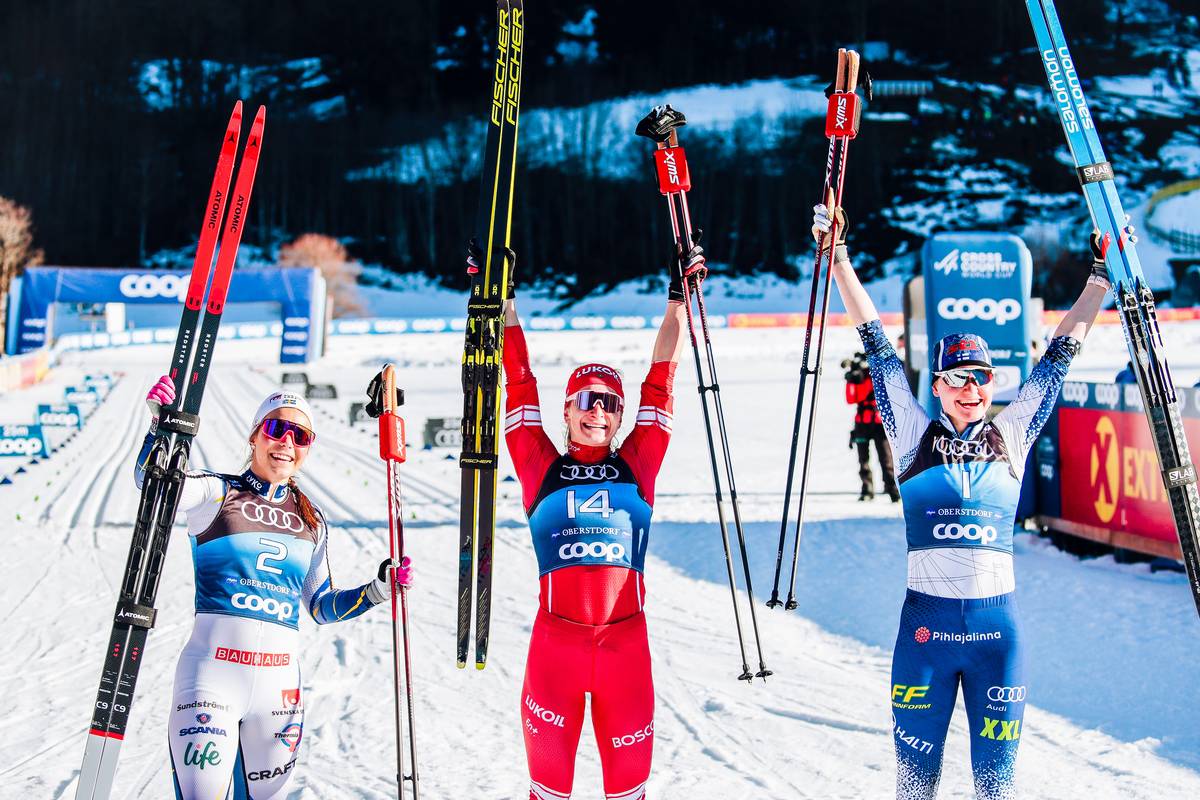
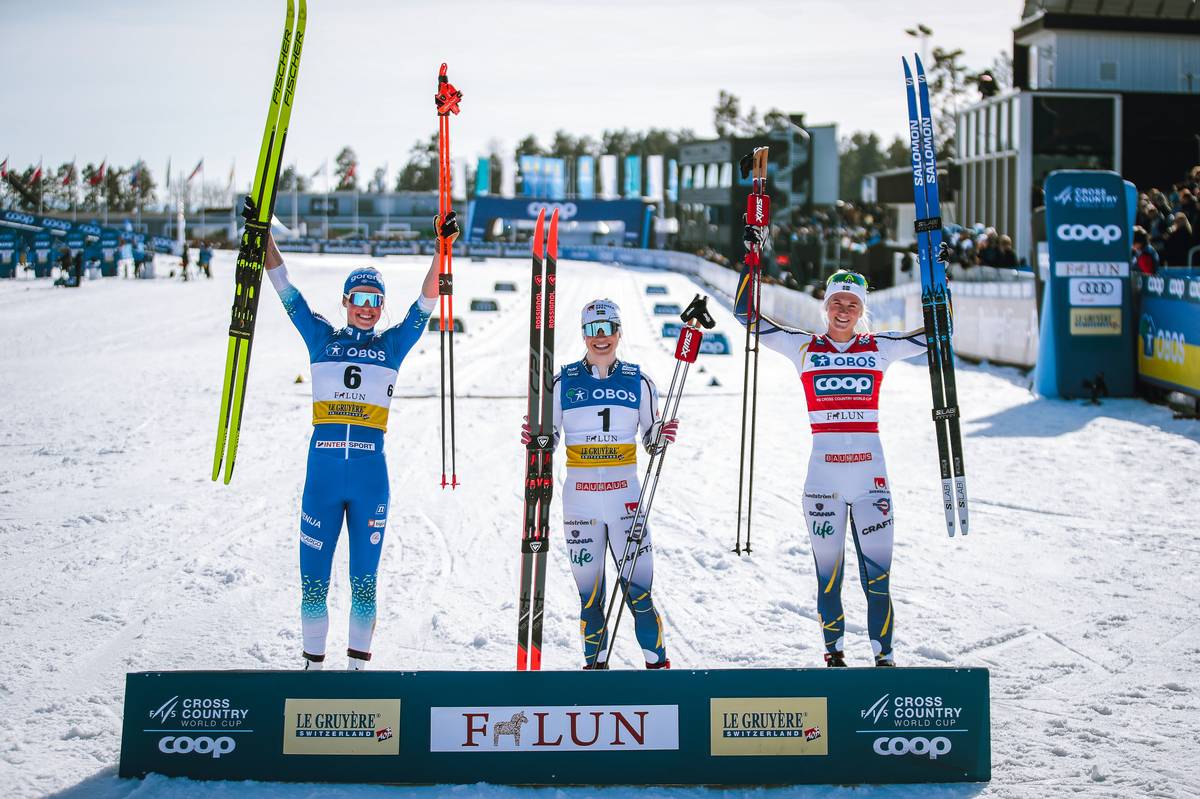
    Women’s 1.4 k classic sprint podium in Falun, Sweden: Jonna Sundling (SWE) took the win ahead of Anamarija Lampic (SLO) and Maja Dahlqvist (SWE). (Photo: NordicFocus)

    We’ve arrived at the final weekend of World Cup racing. After the cancellation of the finals scheduled to take place in Tyumen, Russia and the difficulty of finding a last-minute replacement, these three days of racing in Falun, Sweden will be the culmination of the 2021/22 World Cup season. On a warm sunny day, in full spring conditions, the women executed an exciting classic sprint on the familiar 1.4 k Falun sprint course. With this being the last sprint of the season, it was also a day to cement the places in the running for the overall women’s sprint globe (none of the team events happening Sunday will influence the rankings). 

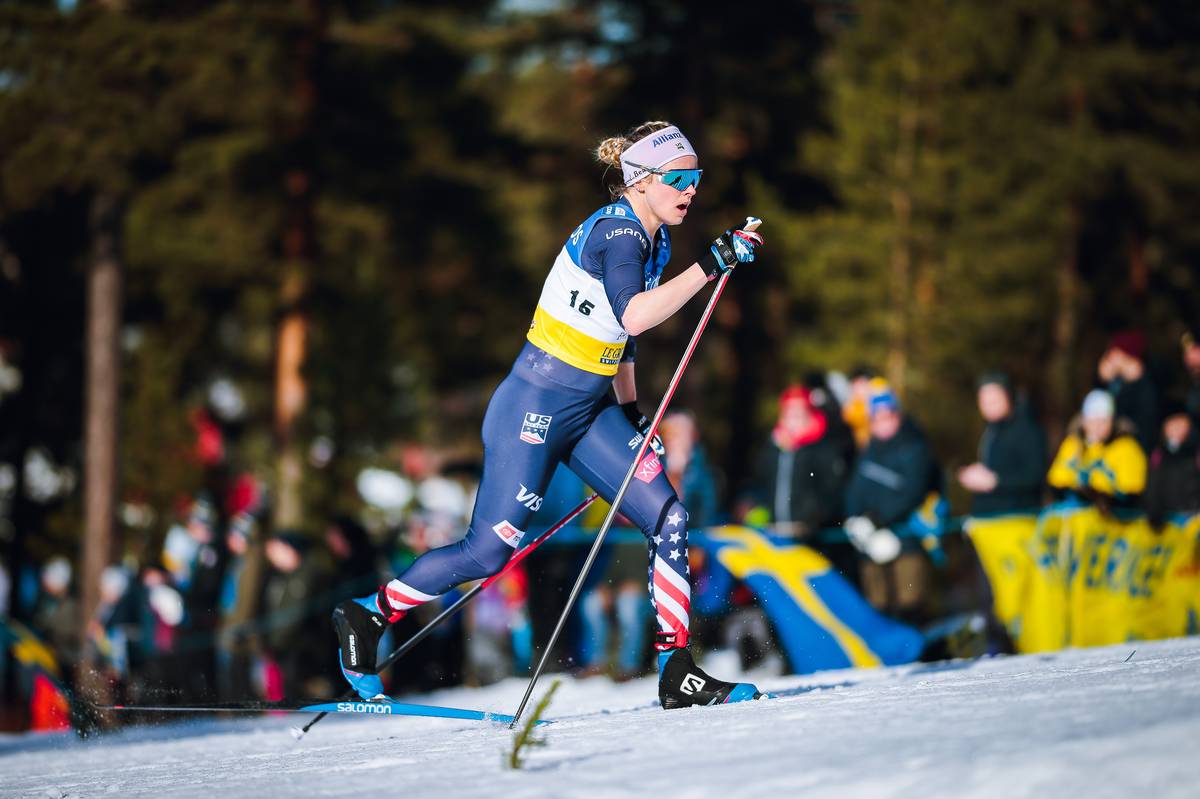
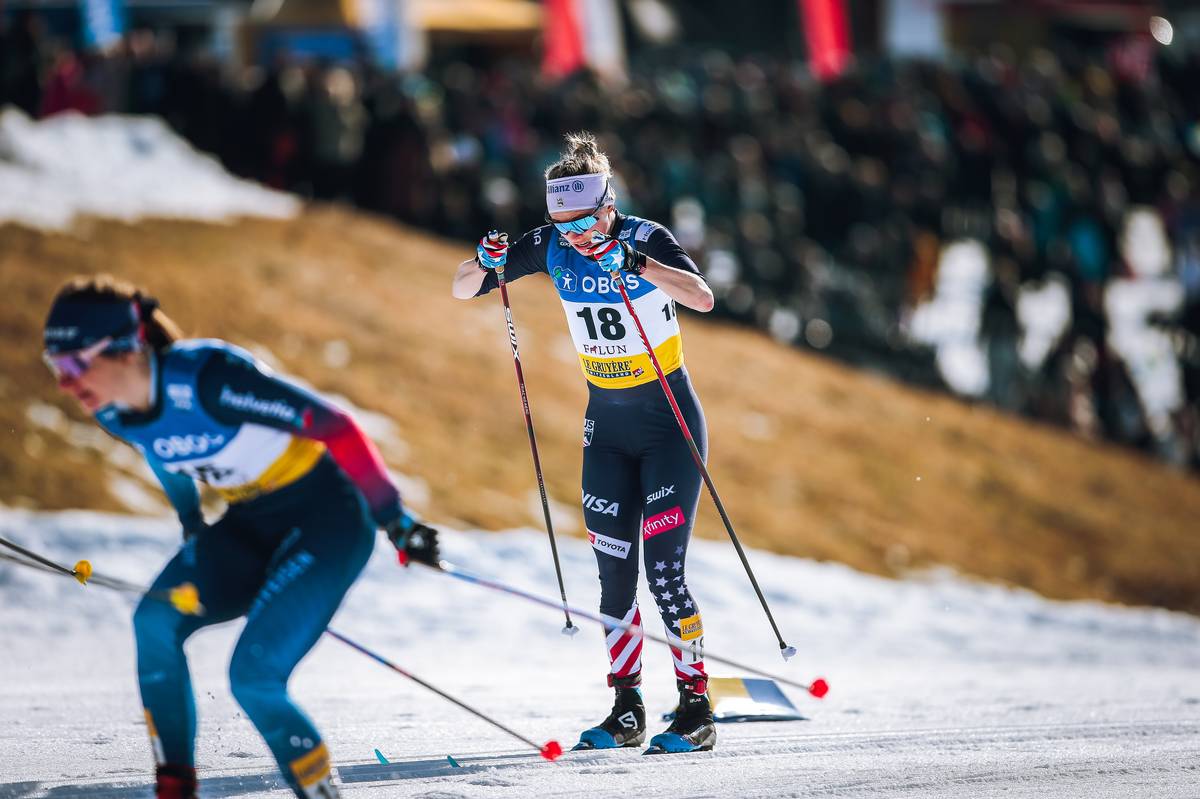
    Starting with a bang, Jonna Sundling of Sweden won the qualifier by an astonishing margin of +8.41 seconds, ahead of runner up Jasmi Joensuu of Finland. The American’s put three women into the quarter-finals, led by Rosie Brennan in 7th (+9.61). Julia Kern qualified in 17th position (+12.30), followed by her teammate and roommate, Jessie Diggins in 18th (+12.49). 

    Jessie Diggins on her way to 18th place in the qualifier. Diggins ultimately ended her day 19th. (Photo: NordicFocus)

    These were the only three American women competing today as unfortunately some late-stage positive covid tests barred the rest from competing. Having made it through a winter of international travel, living, and competing during the Omicron surge, Hailey Swirbul and Katherine Ogden announced on Monday that they had both tested positive in Norway. Lauren Jortberg, who had her World Cup debut in Lahti, Finland two weeks earlier, came directly to Falun to prepare for this weekend, only to test positive on Wednesday. 

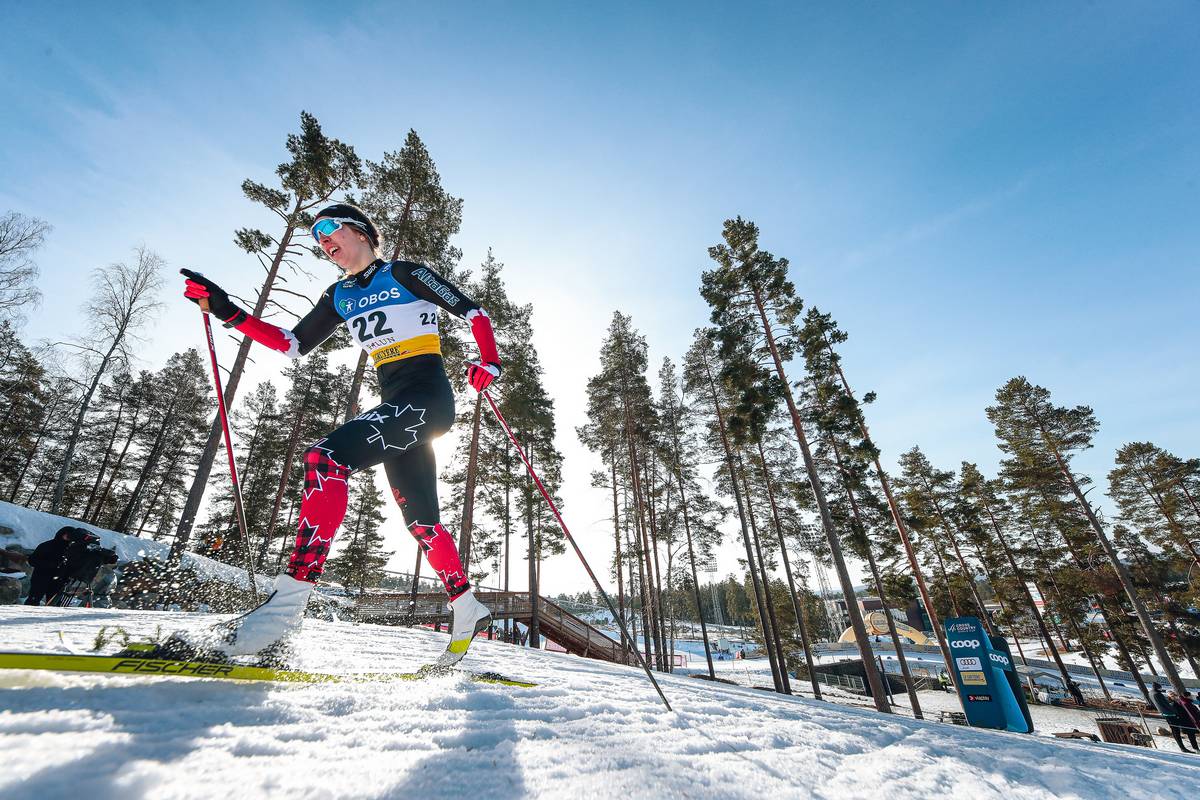
    No Canadian women made it into the top thirty, their first finisher was Olivia Bouffard-Nesbitt in 32nd (+17.54). Katherine Stewart-Jones led a string of fellow country-women, finishing 37th (+19.49), followed by Dahria Beatty in 38th (+19.75) and Jasmine Drolet in 39th (+20.08). After competing at World Juniors in Lygna, Norway, Drolet joined the senior women and made her first World Cup appearance in the Holmenkollen 30 k last weekend where she finished 42nd. 

    Dahria Beatty (CAN) racing to 38th in the classic sprint qualifier on Friday (Photo: NordicFocus)

    As crowds of fans gathered, the women’s quarterfinals kicked off at 12:15 local time. In the first heat, a fast pace bought three women tickets to the semi finals, led by Anna Svendsen of Norway. After winning the classic sprint qualifier in Drammen, Norway last week only to fall in the quarter finals, Johanna Hagström (SWE), skiing on a home course, made it safely through in second. Kerttu Niskanen of Finland took third but with a fast enough time to snag a lucky loser position.

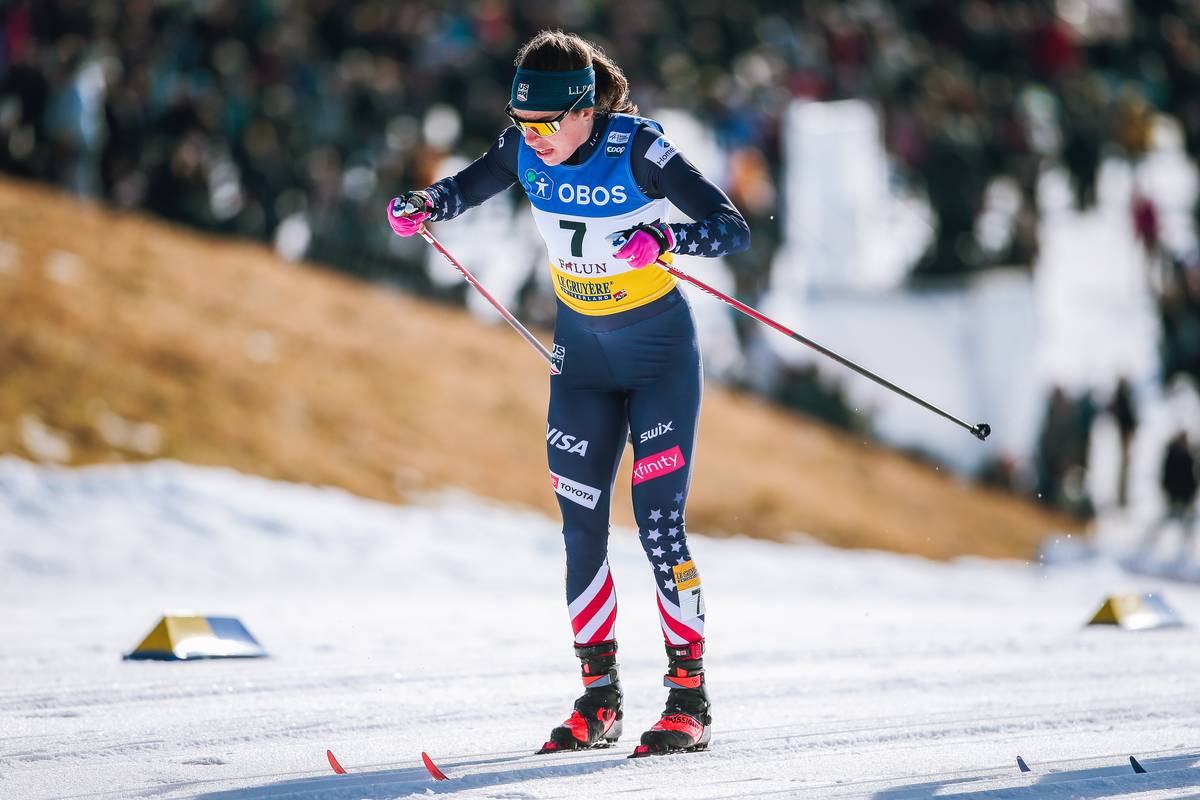
    Heat two was controlled entirely by Sundling as she skied easy out front, spreading the rest of the field. Behind her came Johanna Matintalo of Finland and Julie Myhre of Norway who made it to the semis as the second lucky loser. Brennan (USA) finished fourth, +3.39 behind Sundling, ending her day in 16th overall. 

    Rosie Brennan races the quarterfinal after qualifying 7th. (Photo: NordicFocus)

    “It was warm and wild out there today,” wrote Brennan after the race. “This course is quite technical and has some challenging downhills which has made it a tough course for me in the past so I was ready to make some progress today. I had a good qualifier and that gave me some confidence for the heats. I had a very stacked heat which can go either way for me. I struggled finding space to move on the uphills which is my strength and that ultimately cost me moving on to the semi-finals by less than a second. In the bigger picture, I do think I made some strong progress on some of my weak spots on this course and I am really excited about that. I am also still feeling good and excited to race which bodes well for the rest of the weekend.”

    In heat number three, Anamarija Lampic of Slovenia took on the lead, as Diggins and Moa Lundgren of Sweden chased. Entering the final straight Nadine Fähndrich of Switzerland employed her blistering finish speed to surpass both Diggins and Lundgren, and nearly overtake an unsuspecting Lampic. This left Diggins in fourth place in a heat that was not quick enough to make lucky loser. Diggins ends the sprint season in fourth place in the overall sprint standings with 351 points; having entered the day in third with 339 points, she was bumped off the podium by Sundling. 

    Jessie Diggins races in heat number three in the 1.4 k classic sprint in Falun. (Photo: NordicFocus)

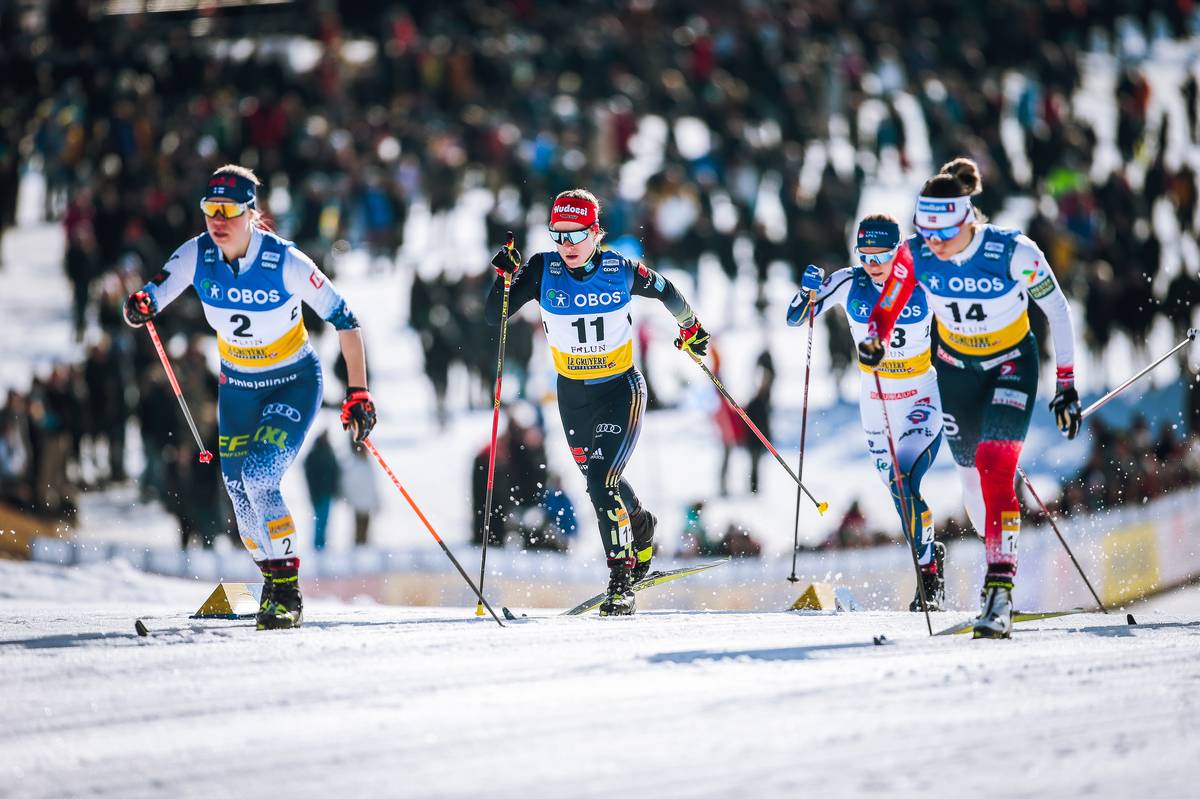
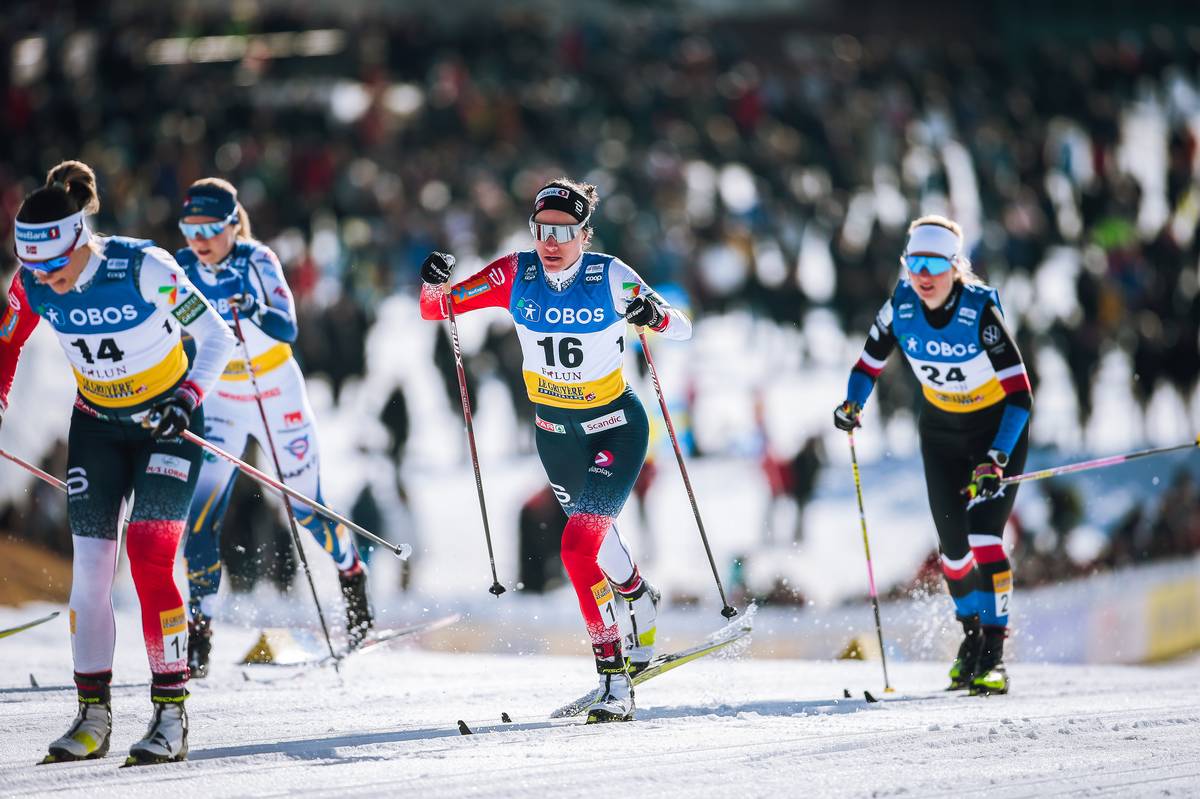
    Heat four saw an easy pace from the gun, with the pack largely staying together. With all six athletes still in touch as they crested the big climb, Kern navigated into third place on the ensuing tight downhill corner. An injection of speed from Maja Dahlqvist (SWE) over the next rise split the pack as Lotta Udnes Weng (NOR) shadowed, followed by Kern still in third. In the long downhill glide-out, Weng overtook the Swede, entering the final corner in first. Right with her were Kern, Dahlqvist and Laura Gimmler of Germany. A close finish saw Kern out double-pole Dahlqvist to take the win, with Weng coming second. However, a disqualification for Weng bumped Dahlqvist into second and thus have her a ticket to the semi-finals. 

    Jasmi Joensuu (FIN) and Maiken Caspersen Falla (NOR) duke it out in the quarter-final (Photo: NordicFocus)

    After a redeeming win in Drammen last week, Maiken Caspersen Falla of Norway charged off the startline for heat five. Joensuu (FIN) and Heidi Weng (NOR) took up the chase and eventually overtook Falla on the long descent back into the stadium. Together the two Norwegians pulled away from the Finn as Joensuu faded slightly. Falla finished first and Weng, with a scream of satisfaction, crossed in second. 

    Heidi Weng (NOR) racing in quarterfinal heat number five (Photo: NordicFocus)

    Echoing her moves from the quarter-final, Sundling (SWE) approached semi-final number one in the same manner, skiing smooth and easy out front. Lampic (SLO) followed with some occasional slips on a mushy course. Those front two continued to pull away, Sundling making it look easy as she found herself well clear of the rest of the competition. Lampic maintained second position and Matintalo (FIN) came in third, though was not quick enough to move onto the final. 

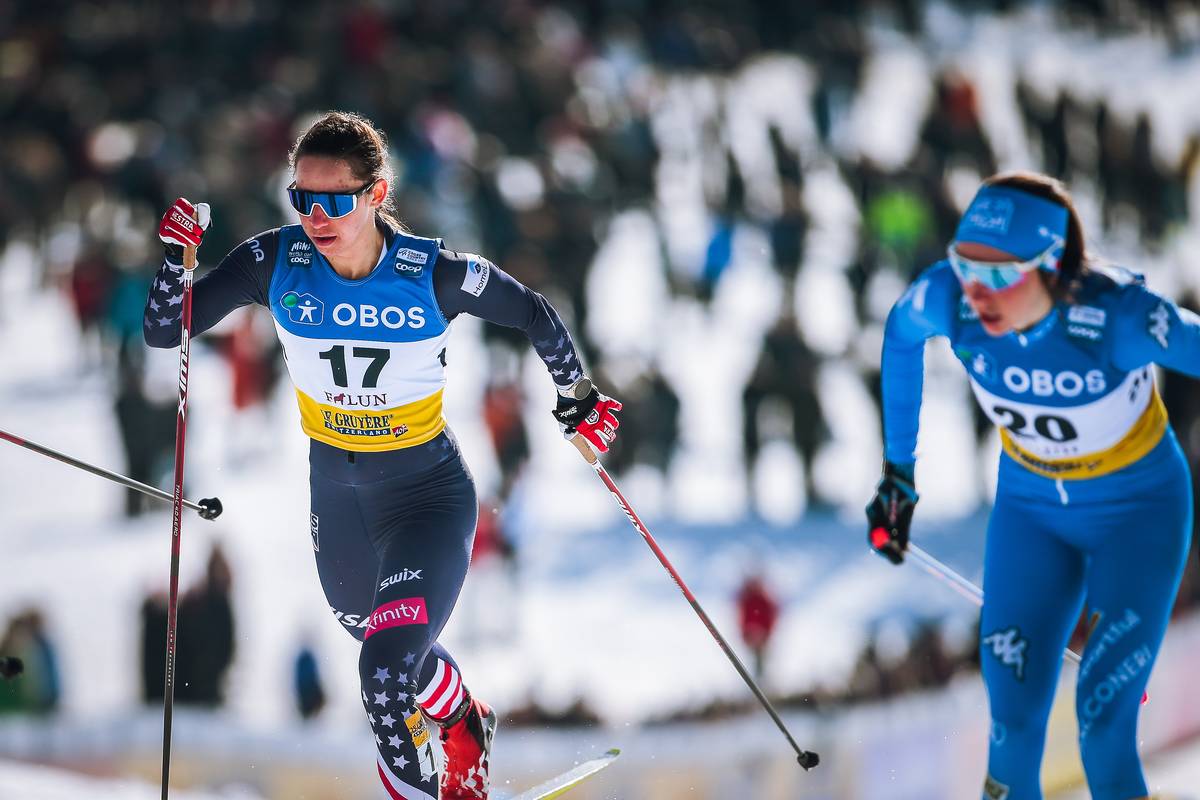
    In the second semi-final, Falla (NOR) took the lead, again trailed by Weng (NOR). Once again, Kern (USA) moved into third position on the tight middle downhill portion, setting herself up well. A fall from Weng on the next hill took her out of contention as Dahlqvist (SWE) moved into second position, Kern still in third. Switching tracks, Dahlqvist stumbled but managed to stay on her feet as Kern took the lead into the final corner. Kern held onto first position with some strong double poling and behind her Dahlqvist, Falla and Fähndrich all qualified for the final in second through fourth positions respectively. 

    Julia Kern, closing out fast (Photo: NordicFocus)

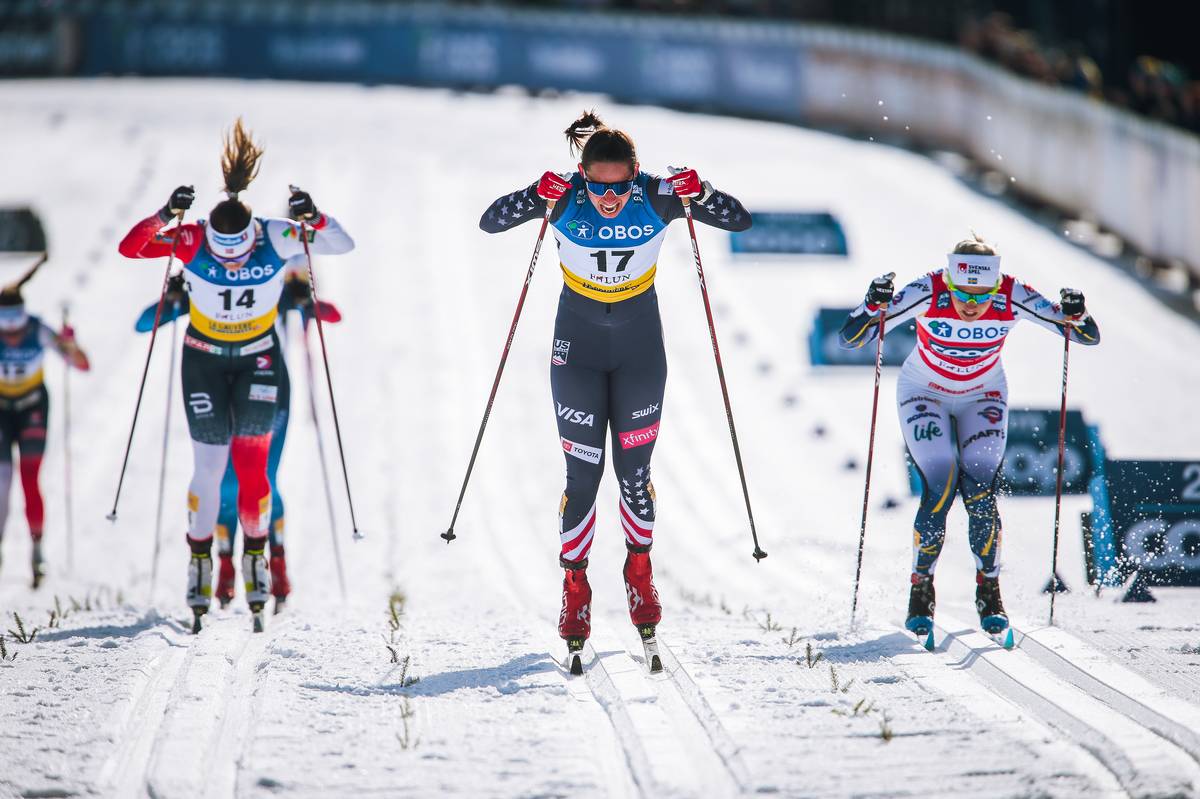
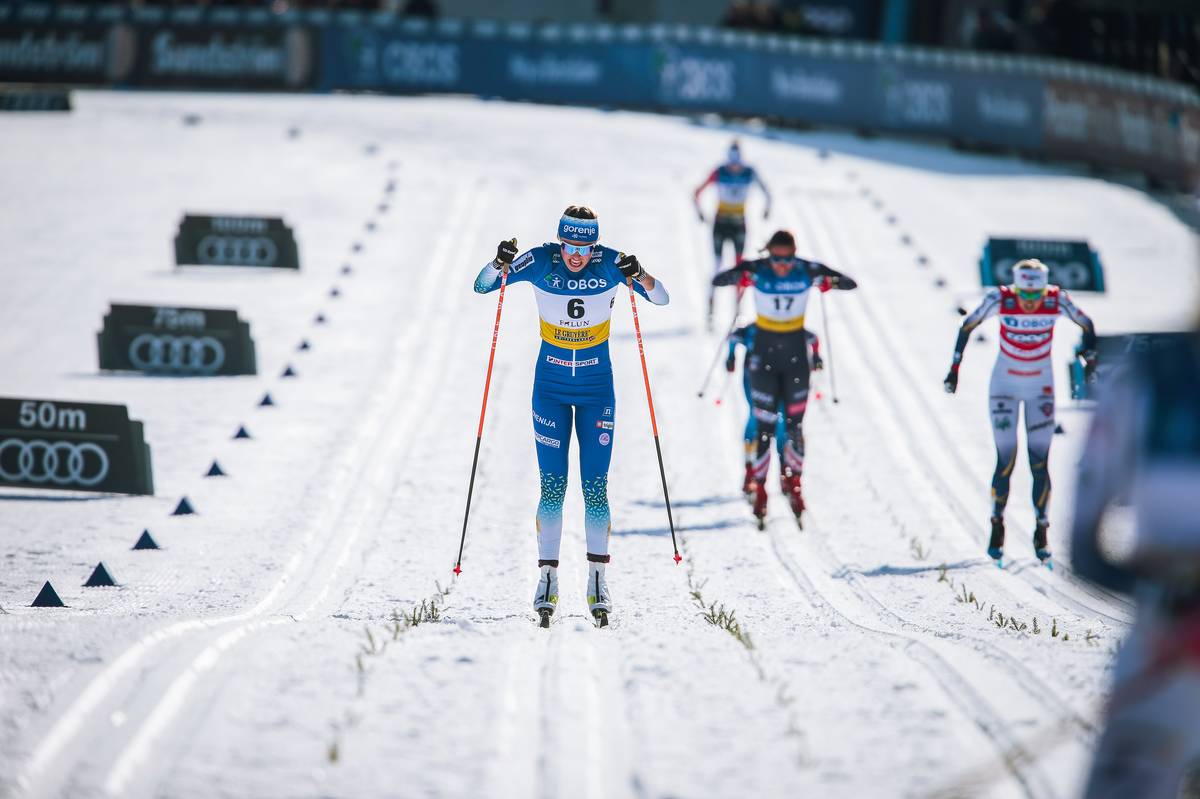
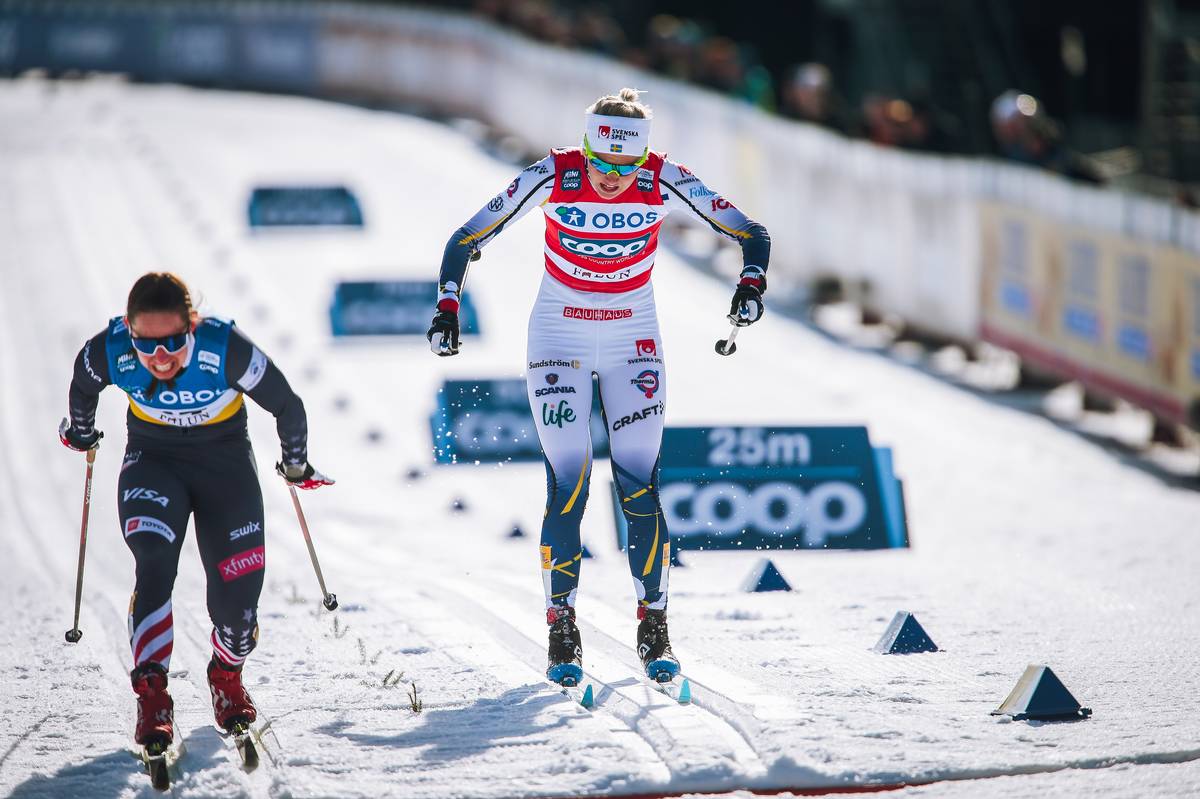
    Making her first sprint final since a stage race in Lenzerheide, Switzerland in December, Kern was all smiles on the start line as the athletes lined up for their final round. Right away, Sundling and Lampic began to pull away from the rest of the field. Up the A-climb, Sundling broke into a herringbone, clearly moving fast as she increased her lead. Dahlqvist who had been in third was overtaken by Kern who topped the hill in third. Lampic was holding strong in second, though being chased by Kern. Navigating the remaining corners and descents, Sundling cruised easily to the finish with enough of a lead to give a celebratory wave before crossing the line.

    No challengers around, Jonna Sundling cruises to victory. (Photo: NordicFocus)

    Coincidentally, Sundling won by the same margin over Lampic (+8.41 seconds) as she had on second-place qualifier Joensuu (FIN) earlier this morning. “I don’t know what is behind this result today, but the last weeks I’ve been feeling really good and it’s nice to keep the shape still,” said Sundling after her dominant victory. She added, “I didn’t compete so much in the beginning [of the season] because of injury but my motivation is on top and so is my shape, and it’s just fun to ski right now.”

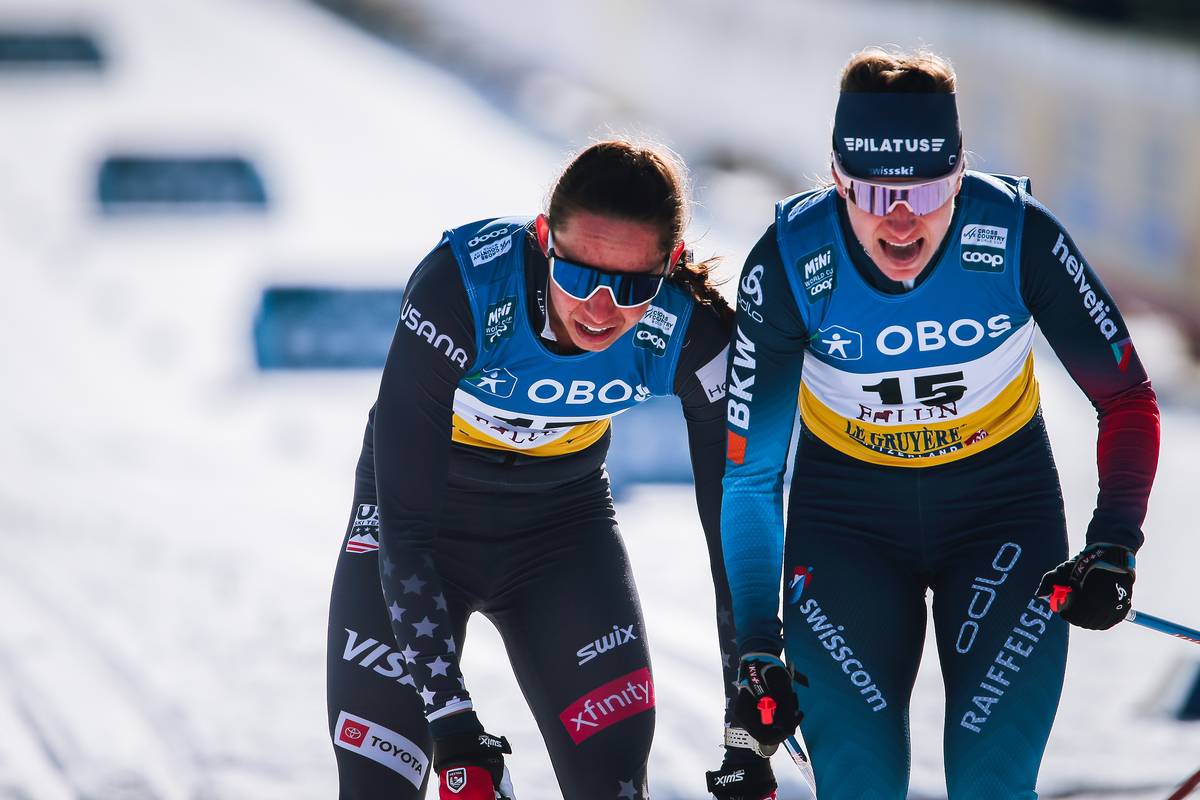
    Behind them, Dahlqvist was finding a second wind in the finish straight and overtook Kern to finish in third. Kern finished fourth, matching her season personal-best from Lenzerheide where she also finished fourth, in a skate sprint. 

    Anamarija Lampic (SLO) heads towards a silver medal as behind her Maja Dahlqvist (SWE) overtakes Kern (USA). (Photo: NordicFocus)

    “[Kern] was really smart through the quarters and semis,” reflected coach Matt Whitcomb, “where she would ski really smooth through the first climb, and position herself really well. And normally what was happening is she was both being smart tactically and feeling very good today and that just led to a break between positions 3 or 4 and allowed her to get away. And her doublenpole punch at the end was as good as I’ve ever seen her today.”

    Julia Kern after fending of Nadine Fähndrich (SUI) to finish fourth in the 1.4 k classic sprint. (Photo: NordicFocus)

    Regarding the final in which Kern seemed to have a lock on third but lost out in the closing stages Whitcomb said, “We talked about if there was a big mistake she made and we decided she could do the same thing 10 times and maybe land on the podium four or five times. She had some stumbles, had those things not happened, it would have been a little bit closer between her and Maja [Dahlqvist], but I don’t want to discredit Maja, she had all kinds of fire in the finish today.”

    He added, “It was cool, Julia’s parents are out here today, she has raced well when her parents are watching. It’s important to point out that she was fourth and not fifth, she fended off a hard-charging Fähndrich and we’re really happy with her performance today.”

    Listen to the full interview with U.S. Ski Team Head Coach Matt Whitcomb here.

    Julia Kern races through the heats in Falun. (Photo: NordicFocus)

    Kern has put together a string of strong performances in the final period of World Cup racing, placing in the top-10 in each of the last three sprints. These results come on the tails of a first Olympic appearance that left her wanting more, after having rebounded early-season from a 2020/21 season she had described as challenging.

    “It’s a bit of a bittersweet ending,” Kern said in a call. “We’ve been on the road for so long now that, after the Olympics, especially, I was feeling excited to go home. But now when things are going well and I’m feeling really good, I don’t want to go home and I don’t want the season to end. I’m happy to end on a high note and find my stride after a frustrating Games. It’s just kind of reminded me how important having some sense of normalcy is, and I’ve kind of embraced that more after the Games. I think that’s paid off, plus some hard work, and I’ve had a little extra fire from the frustration after the games. Happy to end the season this way, and [we have] another shot tomorrow, so I’m excited for that race.”

    Commenting on how these strong results and better energy feed momentum, Kern discussed a mid-week training session she felt primed her for today’s sprint.

    “Now that I’ve been having really good energy in training… I have to give a big shoutout to our staff. On Tuesday this week, I did an interval workout here on the courses. I had Matt, Kate [Barton], and [tech] Chris Hecker out there with me, racing me around the course doing speeds, throwing elbows, pulling tactical moves, practicing the slingshot. Those types of sessions are super valuable for me when I put the energy to put in a good interval session. I learned so much from that session, and it gave me the confidence here today to ski well in the heats and be ready for anything.”

    Kern continued with a laugh that her family is her fourth place good luck charm, as they also watched her race to fourth in Lenzerheide, SUI during the Tour de Ski, ending with a comment on the American team as the season draws to a close.

    “I think our team has done a really incredible job, working through all the different colleges this season has brought. When things get tough, we bring out humor and come together. I just feel more and more appreciation for the team. My wax tech Eli and I have worked really hard all season together to start linking together some classic performances. We’ve had four classic races in a row now, and pretty much all personal bests, so that’s been a really fun relationship to build and [I appreciate] all the hard work the wax team puts in.”

    Full post-race interview with Julia Kern. Apologies for the bad echo — working through the kinks as we work our way along the audio learning curve.

    Julia Kern edges out Maja Dahlqvist (SWE) in the classic sprint semifinal in Falun. (Photo: NordicFocus)

    Dahlqvist already had the sprint globe on lock, but her third place finish today only reinforced her strength in sprint racing this season as she racked up 638 points throughout the year. She began the season with four straight wins and earned a silver medal in the Olympic skate sprint last month. A fourth place finish in Drammen was the only time this season in which she did not finish on the podium in a sprint event.

    “It feels really really, super duper good,” said Dahlqvist about taking home the globe. “I’m super happy with that.” 

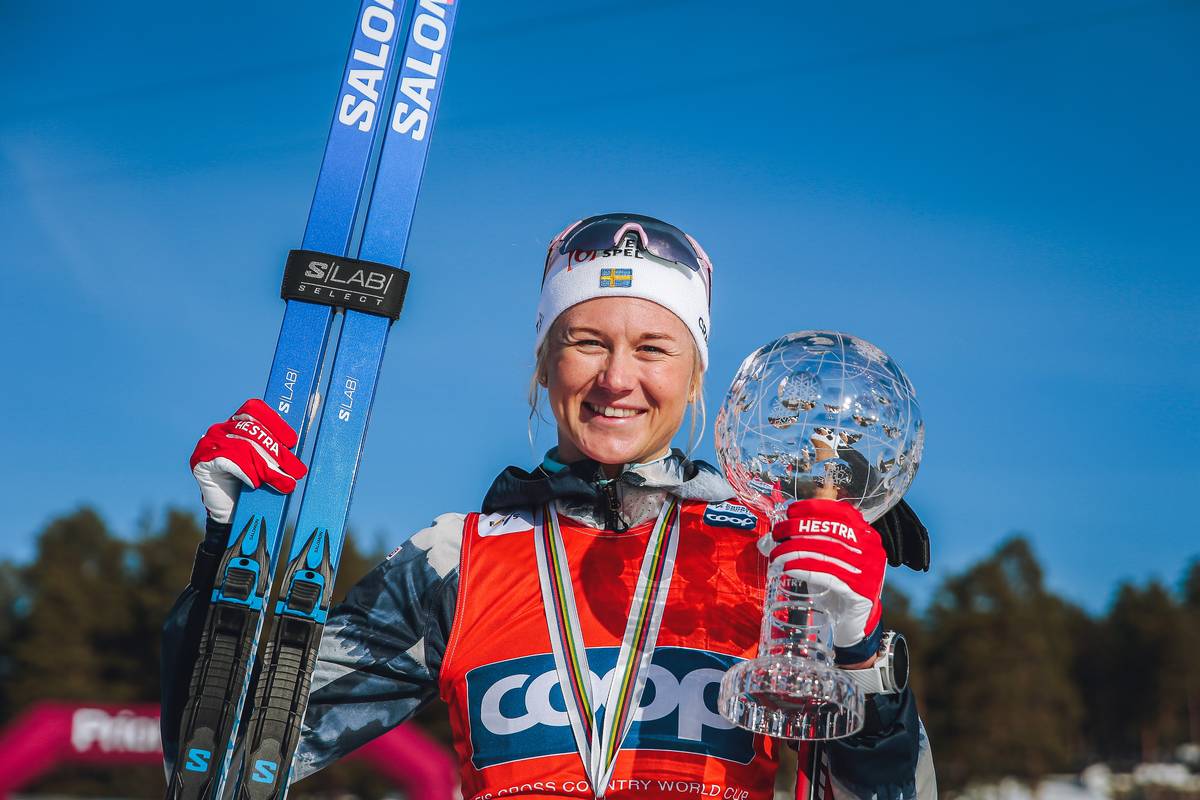
    Sweden’s Maja Dahlqvist is the 2022 World Cup sprint champion. (Photo: NordicFocus)

    Last year’s sprint globe winner, Anamaria Lampic (SLO) finished second this year with 506 points. After today’s victory, Sundling (SWE) overtook Diggins (USA) to move into third in the sprint standings with 442 points. Delaying her start to the season after sustaining an injury in an early-season FIS race, Sundling’s first World Cup start was Dresden in mid-December where she finished second in the individual skate sprint. She did not take part in the Tour de Ski, but returned to the World Cup circuit in dominant fashion, after collecting three Olympic medals, one of each color, and taking fourth place in the 30 k.

    In the final three weekends of World Cup racing, Sundling landing on the podium in four out of the five races she entered, including a third place finish in the legendary Holmenkollen 30 k classic last weekend. 

    Anamarija Lampic (SLO) congratulates the days winner, Jonna Sundling (SWE) (Photo: NordicFocus)

    Racing continues tomorrow with a 10 k skate interval start for the women. Sunday will feature two new team events, with a mixed relay happening in the morning followed by a mixed team sprint in the afternoon. 

    Results:

    Qualification | Final | Sprint Overall Standings

  • Nepryaeva Takes Stage 4 Win and Overall Lead; Diggins Tripped, Karlsson Penalized.

    Nepryaeva Takes Stage 4 Win and Overall Lead; Diggins Tripped, Karlsson Penalized.

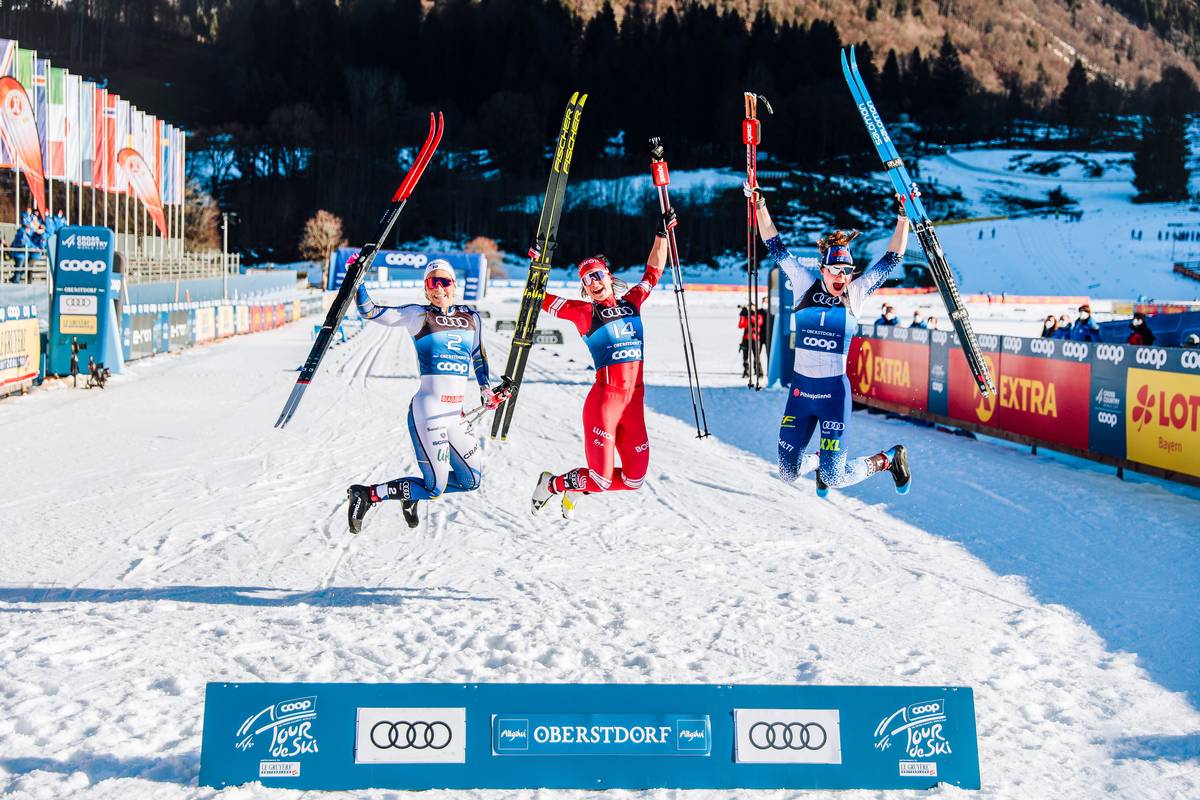
    The women’s podium after Stage 4: Natalia Nepryaeva (RUS) took the win ahead of Johanna Hagström (SWE) and Johanna Matintalo (FIN). (Photo: NordicFocus)

    This World Cup coverage is made possible through the generous support of Marty and Kathy Hall and the A Hall Mark of Excellence Award.  To learn more about A Hall Mark of Excellence Award or to learn how you can support FasterSkier’s coverage please contact info@fasterskier.com.
     

    Every Grand Tour must have a Queen Stage. Dreamt up by organizers, meant to stand at the crux of the race, animate its characters, and start the action towards resolution in the narrative that’s formed over its early stages.

    In cycling, these are the iconic places where grand settings meet grand drama – Alpe d’Huez, Mt. Ventoux, or the Angliru. The Queen Stage comes with pomp and circumstance, like a coronation or diamond jubilee.

    At this year’s Tour de Ski though, the Queen Stage in Oberstdorf — and this 1.2-kilometer Classic Sprint proved to be just that — was more like a queen’s address to parliament; an agenda laid out for how this Tour will go into its final stages in Val di Fiemme, Italy, negotiated through the tricky rules, regulations, and politics of ski racing on the World Cup.

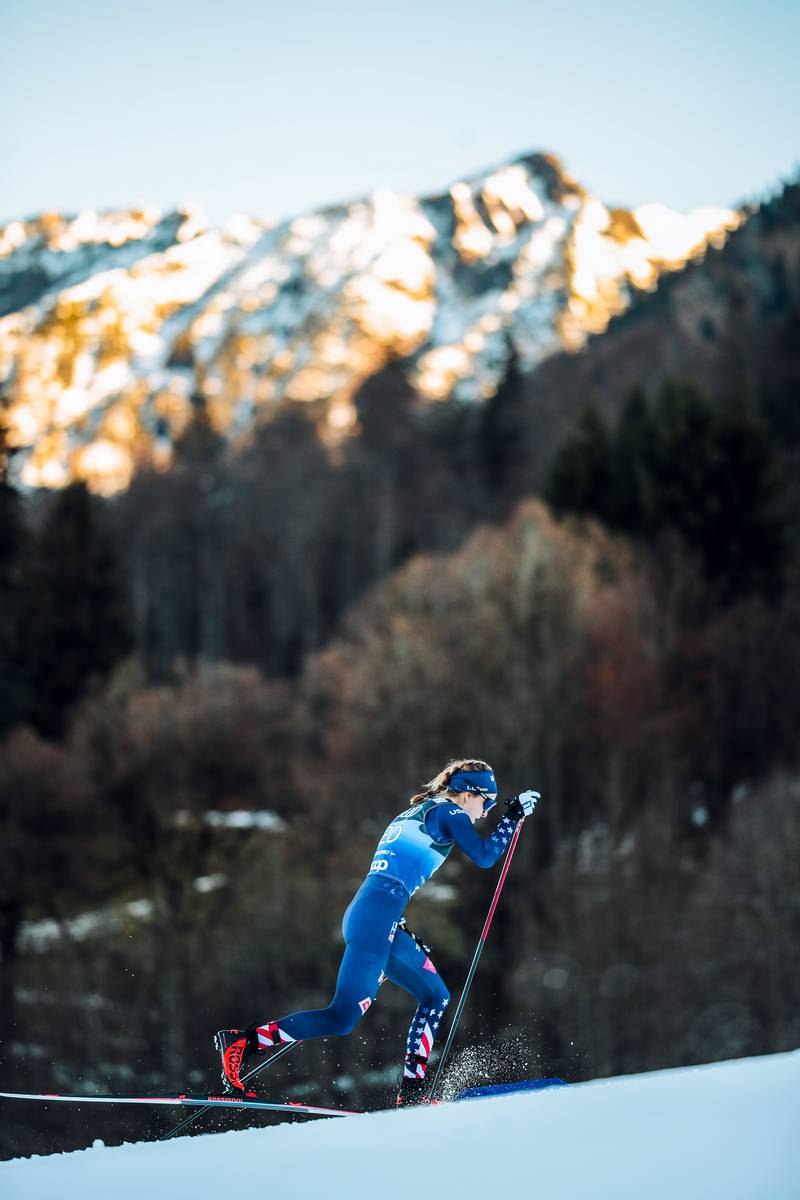
    Alayna Sonnesyn (USA) during qualifying in Oberstdorf at Stage 4 of the Tour de Ski. (Photo: NordicFocus)

    Coming into the day, there was a set order in this year’s Tour de Ski overall classification that matches what you would expect if you just watched the races individually. After a Stage 1 victory in the freestyle sprint, and an exciting 10k freestyle victory yesterday, Jessie Diggins (USA) wore the yellow leader’s bib. Below her was Stage 2 winner Kertuu Niskanen (FIN), and then Natalia Nepryaeva (RUS) in third. The time gap between the three, however, was relatively small. Diggins, despite her two wins, only had a 13 second advantage over Niskanen. With time bonuses for the finalists and semi-finalists in the Stage 4 Classic Sprint all well above that threshold — ranging from 60 sec for the winner to 22 sec for the last semi-finalist finisher — the 1.2k loop at Oberstdorf had the potential to animate and transform the overall classification in an instant. And that’s what happened. Call it a Queen Stage.

    Kerttu Niskanen (FIN), who started and finished the day in 2nd place in the overall classification. (Photo: NordicFocus)

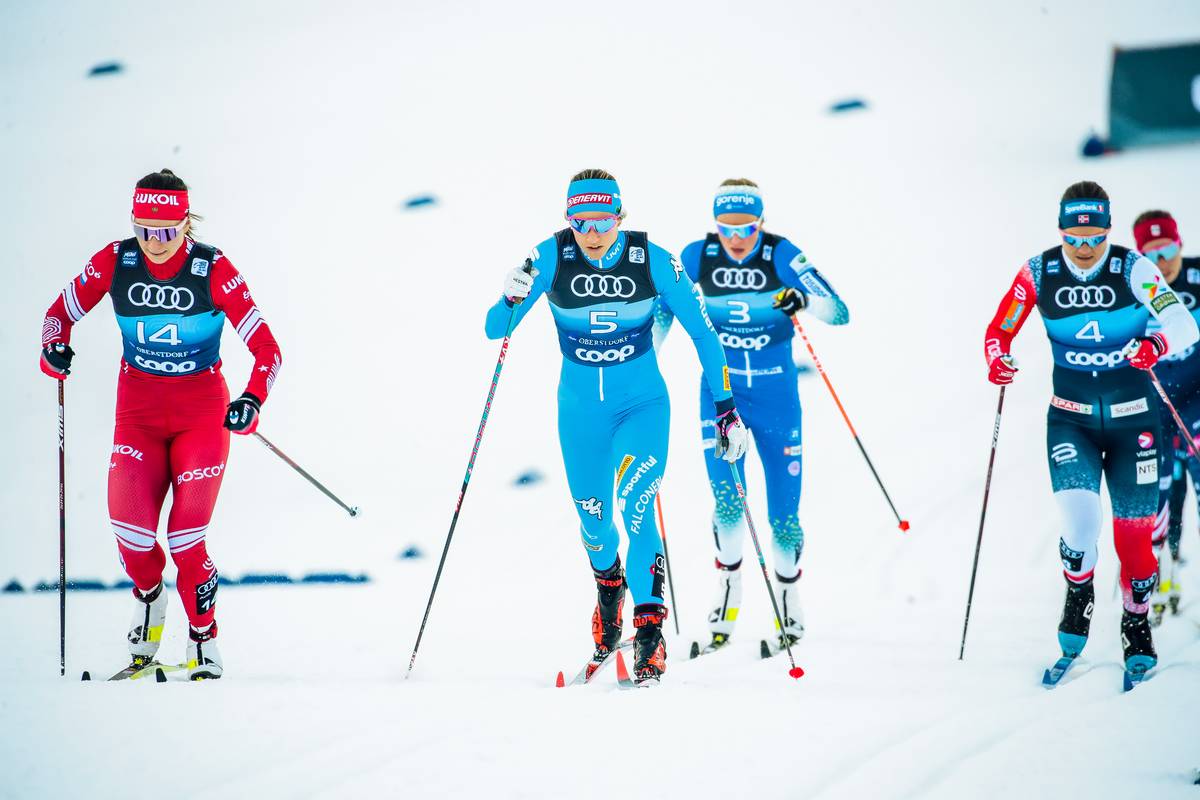
    The day started strong for the Americans, with Diggins qualifying 7th (+3.43) and Katharine Ogden joining her in heats after qualifying 26th (+7.94).  Diggins’ two closest rivals both qualified off her pace, with Nepryaeva in 13th (+5.08) and Niskanen in 18th place (+6.10).

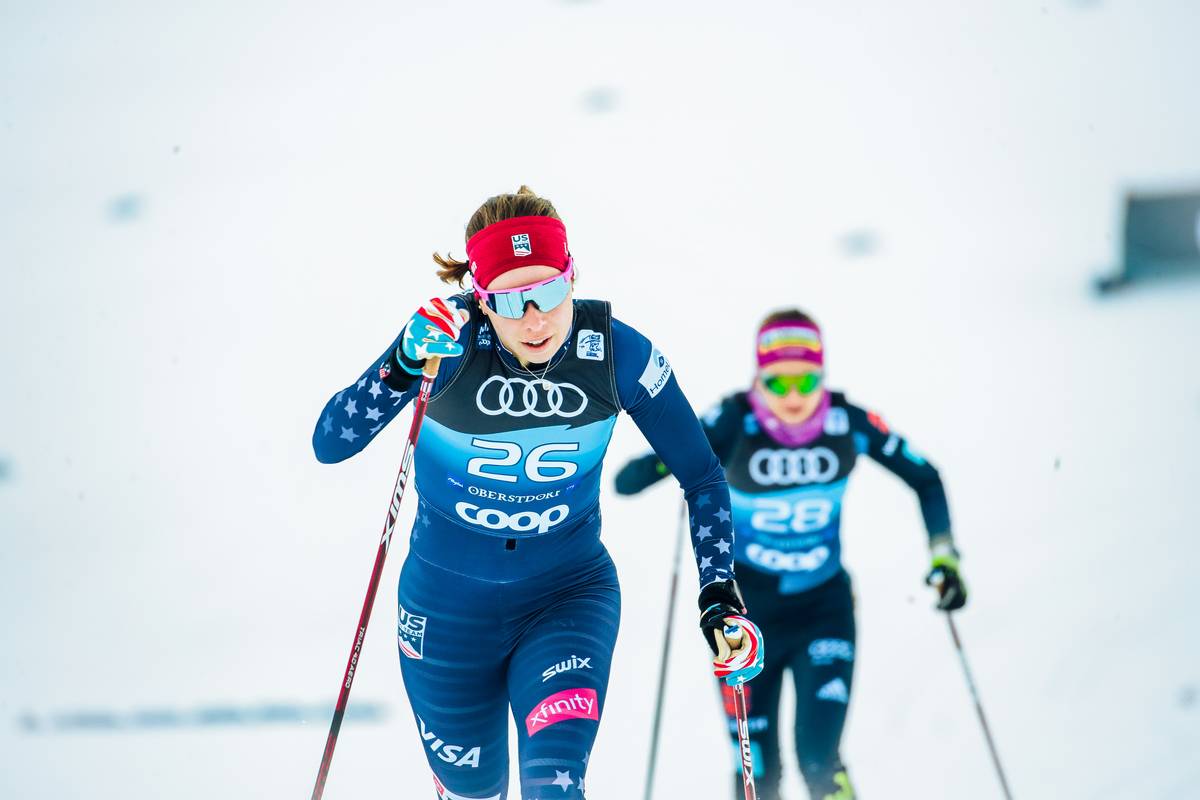
    Katharine Ogden (USA) powers up the first climb during quarterfinal action. Ogden qualified 26th on the day. (Photo: NordicFocus)

    Ogden would meet Nepryaeva in her quarterfinal, where they set out to race a 1.2k sprint course that featured two punctuated climbs, with a technical downhill sweeping to the right in between. Their heat was a fast one, with Ogden establishing herself in the field behind Anamarija Lampic (SLO), then coming off the top of the first climb in fourth place. As the field spread out across the second climb, Nepryaeva came off the top first, with Lampic in tow. When they came out of the downhill into the long, straight, finishing straight, Nepryaeva had the lead, but Lampic showed a fight to regain her 2nd place ahead of Greta Laurent (ITA). In the excitement, Ogden had been left out of the pack slightly, and came across the line in 5th place.

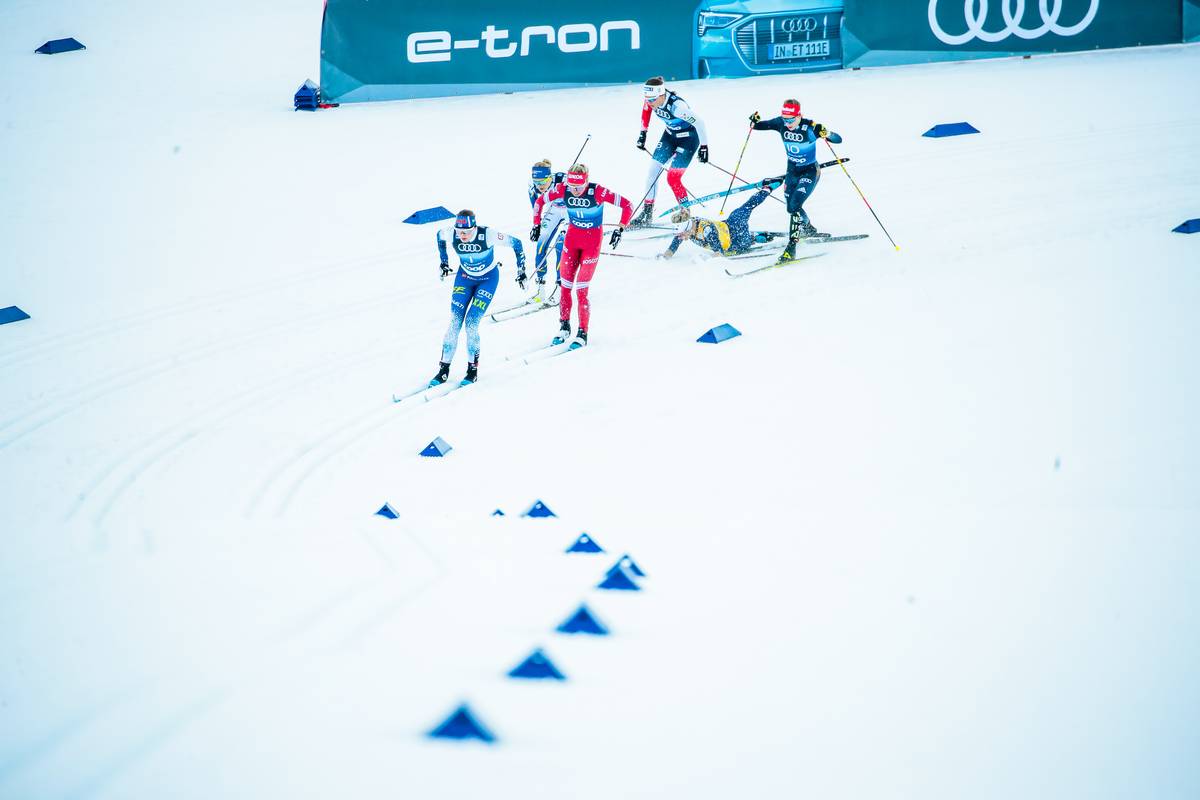
    Where this Tour really turned on its head though, was in Diggins’ quarterfinal heat. Lined up against a field that included qualifier winner Johanna Matintalo (FIN), Tatiana Sorina (RUS), and Frida Karlsson (SWE), the heat was a tense affair from the gun. Sorina led out over the first climb, and Diggins successfully jockeyed for position coming out of the first downhill. In the approach to the final climb, a slight left-hand turn became the setting for the defining moment of the day.

    As Diggins recounted in an interview with U.S. Ski & Snowboard cross country communications manager Tom Horrocks:

    “I was in the track, Frida [Karlsson] was double-poling outside the track, and then moved in on me, so I moved to switch lanes, she switched on top of me, and caused me to fall – which is a huge bummer… that severely impacts my tour.”

    Jessie Diggins goes down in her quarterfinal heat. Frida Karlsson (SWE) was penalized for obstruction, but the fall left Diggins in 3rd place overall in the Tour de Ski. (Photo: NordicFocus)

    It severely impacted the World Cup season too. Diggins crossed the line in 6th, but before the following heat had hit the first climb the FIS jury had already come back with a yellow-card and disqualification for Frida Karlsson. As a result of it being Karlsson’s second yellow-card of the season, her first arriving in the same event in Ruka back in November, she was also given a 3-minute time penalty in the overall classification for the Tour de Ski.

    That calls to question whether the World Cup’s best distance racer this season will continue to race the Stage 5 10k mass start classic in Val di Fiemme or forgo the end of the Tour altogether. While she started the day in 7th place and +45 sec off Diggins, the 3-minute penalty dropped her to 44th place (+4:30).

    Despite the penalties against Karlsson, Diggins’ quarterfinal time and placing were unaltered, leaving her out while both Niskanen and Nepryaeva advanced to the semi-finals, where the time bonuses for just finishing automatically exceeded the margin of Diggins’ lead in cumulative time standings. Diggins was awarded a 4 sec bonus for her quarterfinal finish, so a net 18 sec gain was at least guaranteed. In an instant then, two of the World Cup’s most compelling stories this season veered towards drastically off course. Diggins’ title-defense now faces steep odds (and a steep climb in Stage 6). Karlsson finds herself further down in the pack than she has been all year.

    The semi-finals then, marked a brave new Tour de Ski.

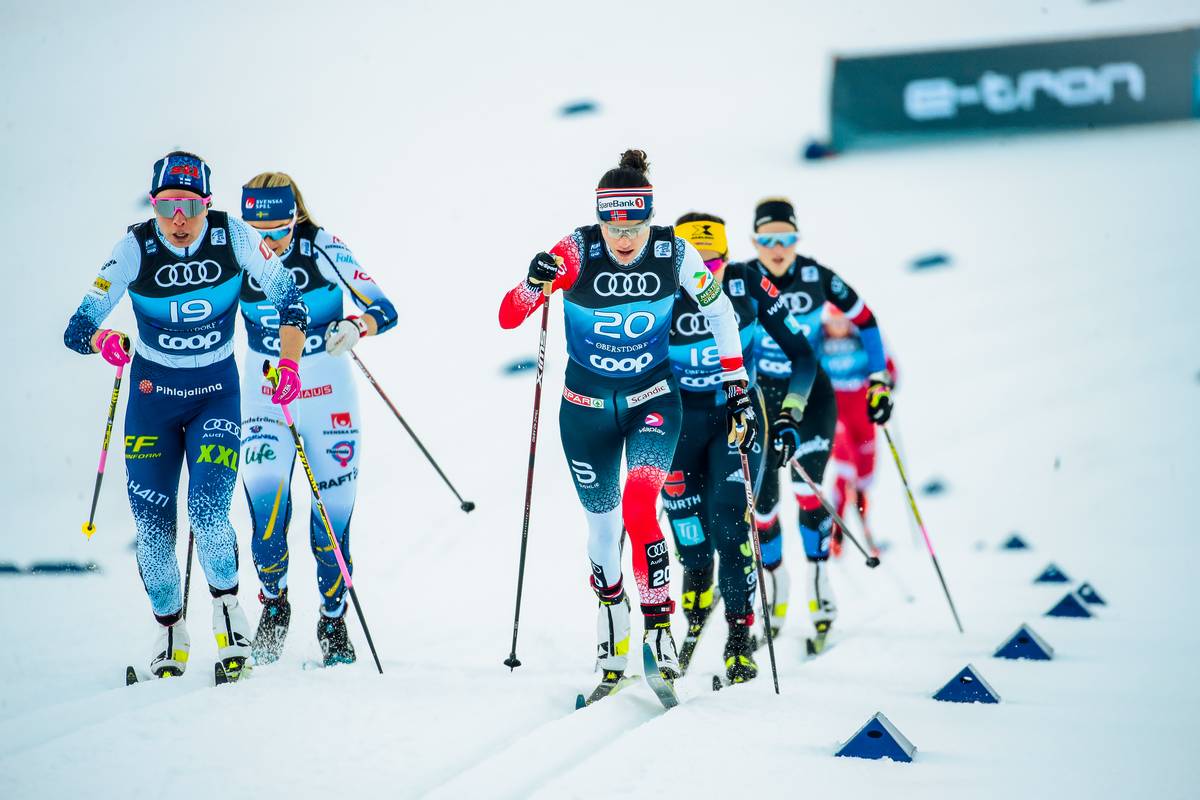
    Natalia Nepryaeva (RUS), Greta Laurent (ITA), Krista Pärmäkoski (FIN), and Ane Appelkvist Stenseth (NOR) (L-R) during their semi-final. (Photo: NordicFocus)

    Nepryaeva raced through her semi-final with a tactical approach carried over from the quarters, preferring to stay with the pack led out by Matintalo and Johanna Hagström (SWE), before pushing the last climb and setting herself up for the long double-pole finish – for which she looked stronger than anyone else in the field. She won a semi-final that stayed tight and stayed fast, sending both lucky losers to the final.

    Kerttu Niskanen (FIN) in 2nd semi-final. She would finish 5th in the heat, with Anamarija Lampic (SLO) winning to advance to the finals. (Photo: NordicFocus)

    Niskanen would line up in the second semi-final. She matched up against Lampic, Laurent and Mathilde Myhrvold (NOR), with the former two looking to lead the race from the gun. By the time they crested the final climb, Lampic had stretched out the field and Niskanen had been caught out the back. She finished fifth in the heat, and didn’t advance to finals. Lampic carried the heat, and Myhrvold came second.

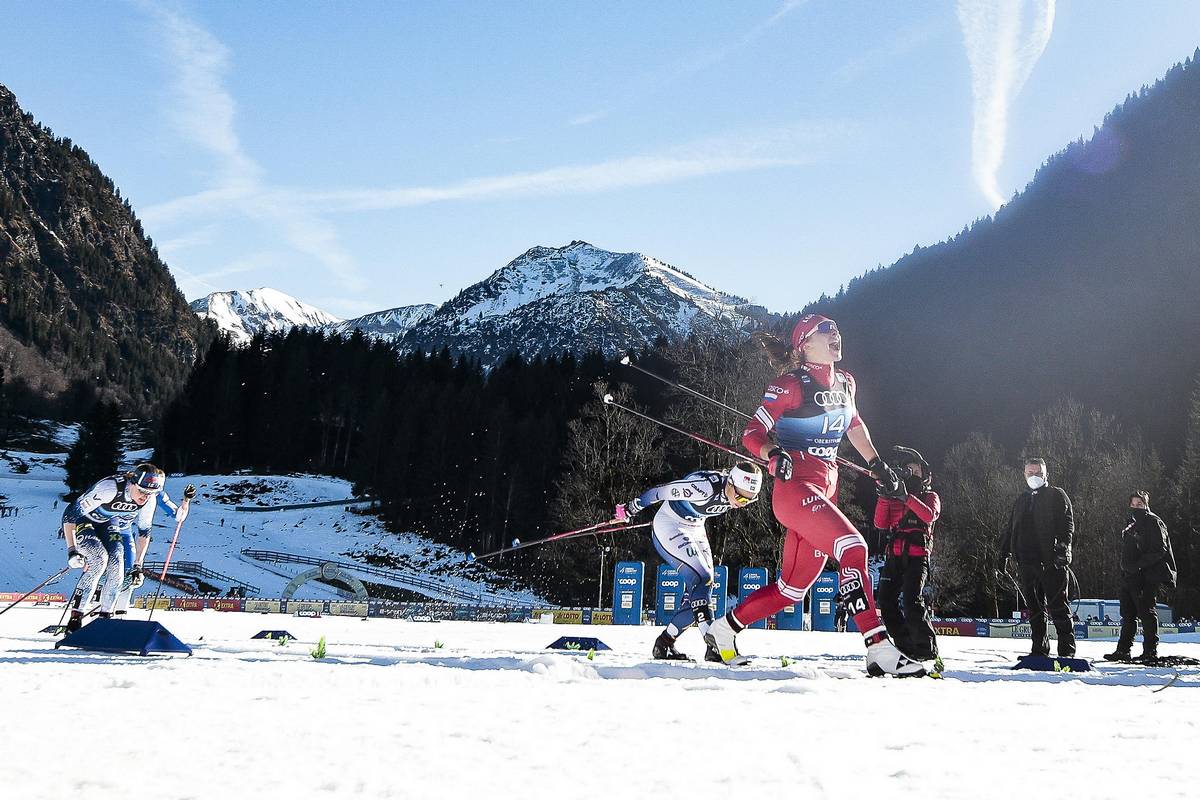
    Nepryaeva then, would be playing a game of seconds for the Tour lead. And she would be playing it, skiing the course, like she had all day. Lampic, Hagström and Matintalo formed the front of the pack, while Nepryaeva waited for the last climb to swing out and throw a burst of acceleration that saw her and Hagström come over the top together. As Nepryaeva came out of her tuck on the finishing stretch, the strength of her double pole was on full display. She crossed the finish line first, and with a scream that no doubt will echo all the way to Val di Fiemme to warn that there is a whole new dynamic coming to its courses when the Tour resumes after the rest day tomorrow.

    Natalia Nepryaeva (RUS) comes across the finish line to win Stage 4 and take the lead in the Overall Classification at the Tour de Ski. (Photo: NordicFocus)

    That new dynamic is a new order. Standings going into Italy: Natalia Nepryaeva in first (53:40.0), Kerttu Niskanen in second (+34.0), and Jessie Diggins third (+38.0).

    Johanna Hagstroem (SWE), Natalia Nepryaeva (RUS), Johanna Matintalo (FIN) on the podium in Oberstdorf. (Photo: NordicFocus)

    With two stages to ski though, the gaps in this year’s Tour de Ski are nowhere from definitive. When it was alluded that her misfortune may change her tactical approach to the last two stages in Italy, Diggins replied simply, “it’s still full throttle everyday. It has to be.”

    Full audio clip from post-race interview with Jessie Diggins, hosted by Tom Horrocks:


    The Queen Stage of Oberstdorf may have made its sound and fury, but ultimately this race and its story are far from their conclusion, and it still contains a character in Diggins who has proven so-often that she can make us throw out all of the books.

    Jessie Diggins during qualifying at Stage 4 of the Tour de Ski. (Photo: NordicFocus)

    After final results were decided, Diggins ended her day in 21st, with Ogden a few places behind in 24th.

    Outside the Top-30, the U.S. had strong results in the qualifier. Alayna Sonnesyn finished in 43rd (+14.93), Novie McCabe finished in 54th (+18.45), and Sophia Laukli finished in 61st (+26.87).

    Both Hailey Swirbul and Julia Kern have dropped from the Tour, each sharing on social media that they have a cold and are focused on recovery.

    Novie McCabe during qualifying at Stage 4 of the Tour de Ski. (Photo: NordicFocus)

    Results:
    Qualification | Final
    Tour Standings After Stage 4:
    Cumulative Time | Points

  • Season Preview: 21 Athletes in 22 Words for the 2021/2022 Season

    Season Preview: 21 Athletes in 22 Words for the 2021/2022 Season

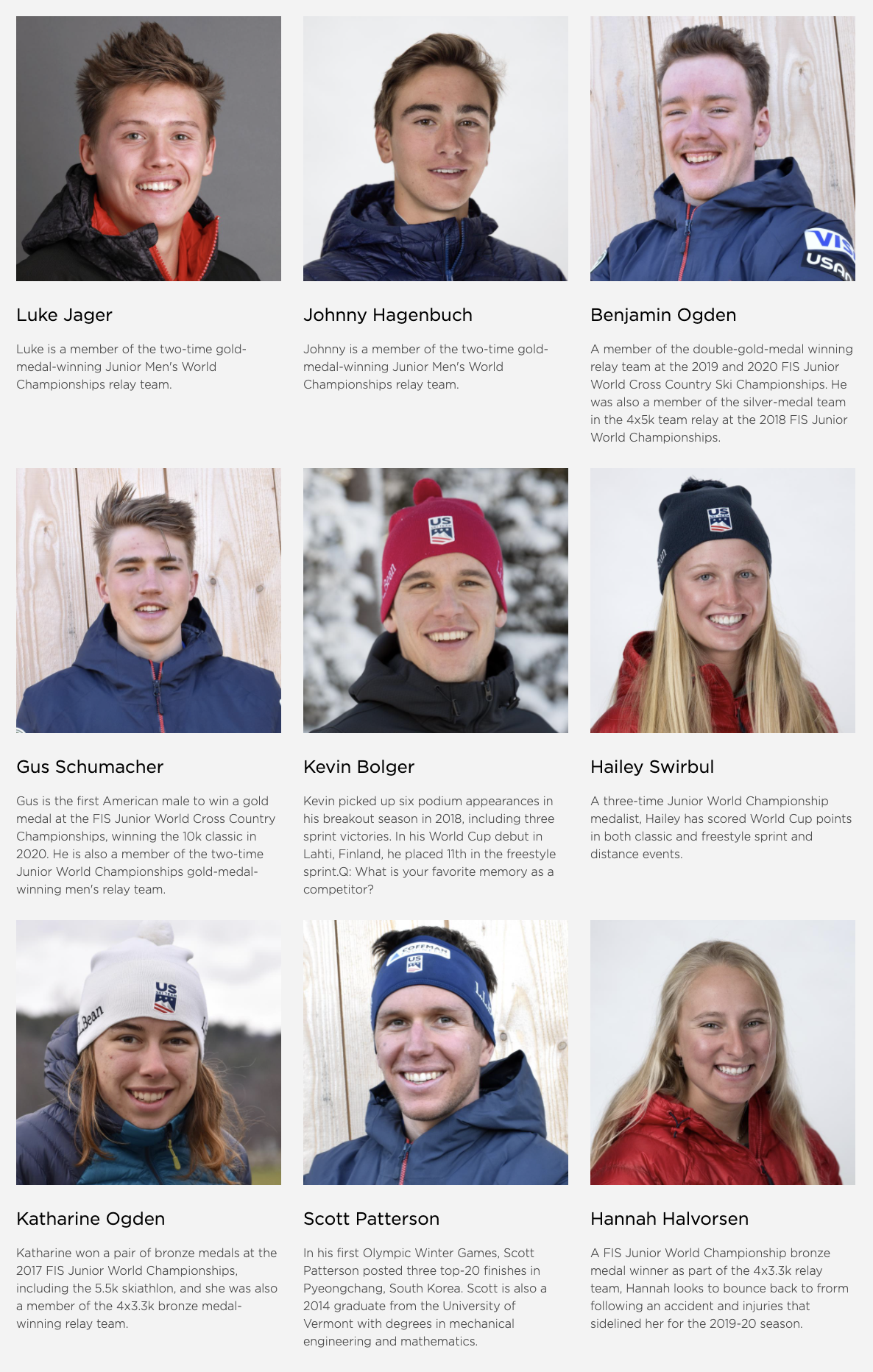
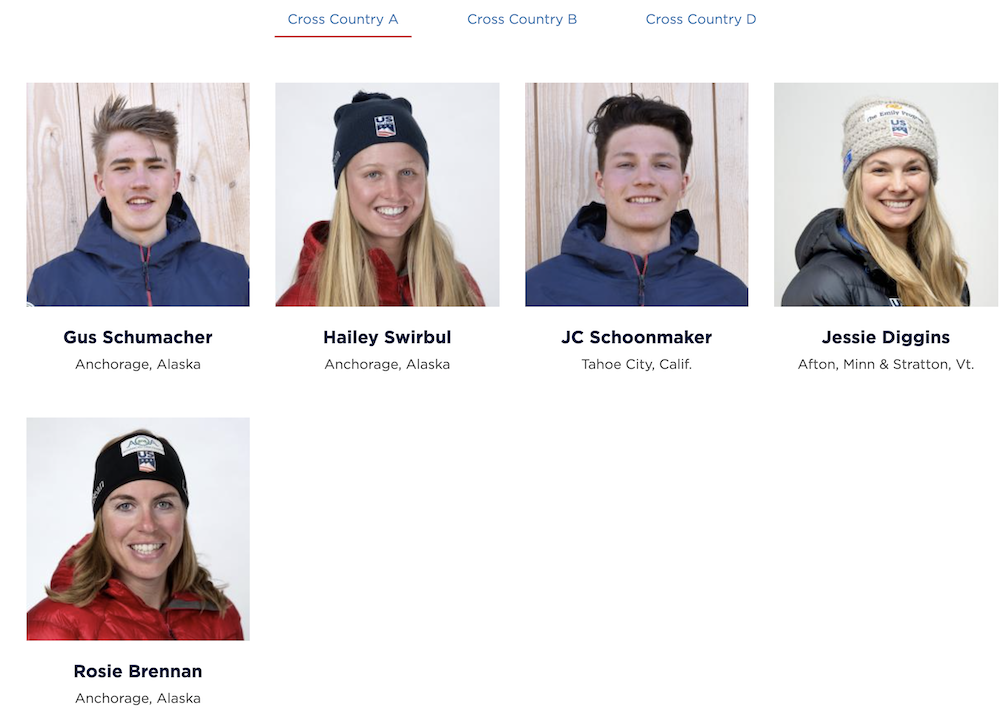
    FasterSkier often publishes long profiles of athletes. This is not that article. Instead, please enjoy precisely 22 words about each of the 21 athletes currently on the U.S. Ski Team in this extremely brief, but numerically pleasing, preview of the 2021/2022 season. Athletes are presented alphabetically within each team, with age as of this season’s first World Cup race. All photos are screenshots from the current USST roster site. Any evocation of a certain song by Taylor Swift is purely coincidental.

    A-Team

    Rosie Brennan, age 32

    In a year without Diggins, she’d be the headliner. Still improving in her thirties. Hoping for an upgrade over mono-afflicted PyeongChang experience.

    Jessie Diggins, age 30

    She’s won bunches: TdS, World Cup overall and distance. But Johaug, et al., were largely absent. Medals in Beijing against full fields?

    JC Schoonmaker, age 21

    Made four World Cup sprint heats last season, plus second American in Oberstdorf classic sprint. Starting Period 1 sprints. Just turned 21.

    Gus Schumacher, age 21

    In his first World Cup season, he only became the best American male skier since Kris Freeman. The world awaits the encore.

    Hailey Swirbul, age 23

    Third in a WC distance race. 0.8 seconds out of World Champs medal. A presumptive Olympian and relay stalwart if trends hold.

    B-Team

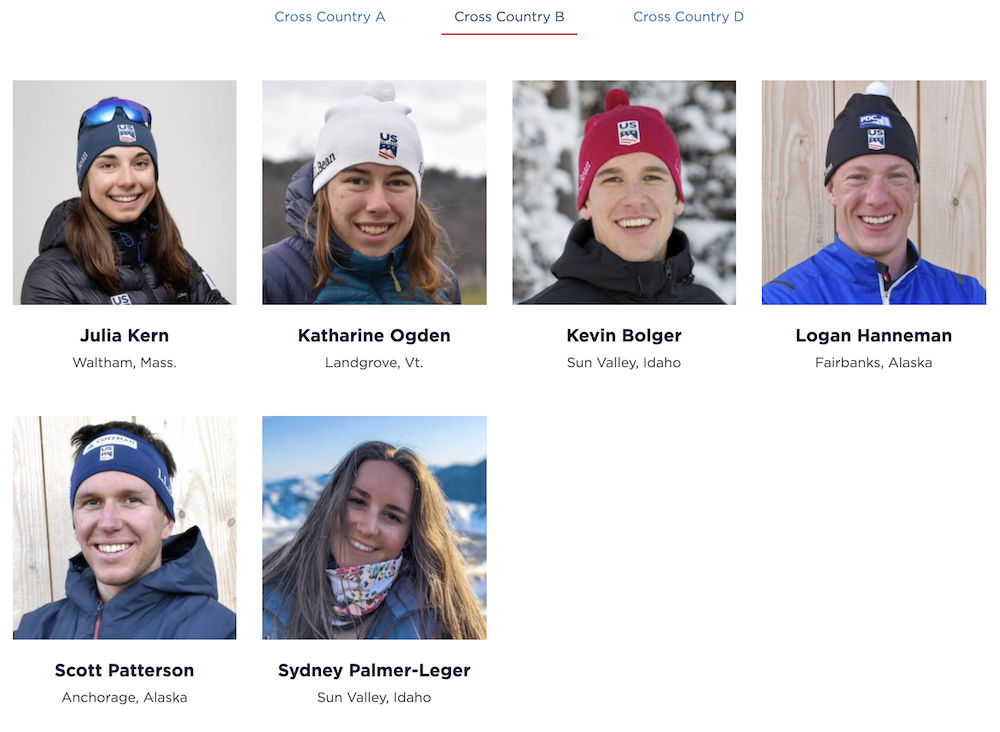
    Kevin Bolger, age 28

    The rangy sprinter made five heats last season, but was left wanting more after finishing 35th in Oberstdorf. Estival training in Sweden.

    Logan Hanneman, age 28

    The rangy sprinter made three heats last season, but was left wanting more after finishing 39th in Oberstdorf. Estival training in Alaska.

    Julia Kern, age 24

    Looking to stay healthy after some injuries and disappointments last season. Suddenly a veteran American woman sprinter after Sophie and Sadie’s retirements.

    Katharine Ogden, age 24

    Starting the season on the World Cup, where last season brought her seven top-30 finishes and 23rd in the Tour de Ski.

    Sydney Palmer-Leger, age 19

    Double 2021 NCAA champion, Covid-protocoled out of World Juniors, is set to make her first World Cup starts in Period 1 sprints.

    Scott Patterson, age 29

    Had American men’s best individual results in Oberstdorf. Looking to build on strong form going into Olympics after a few down seasons.

    Development Team

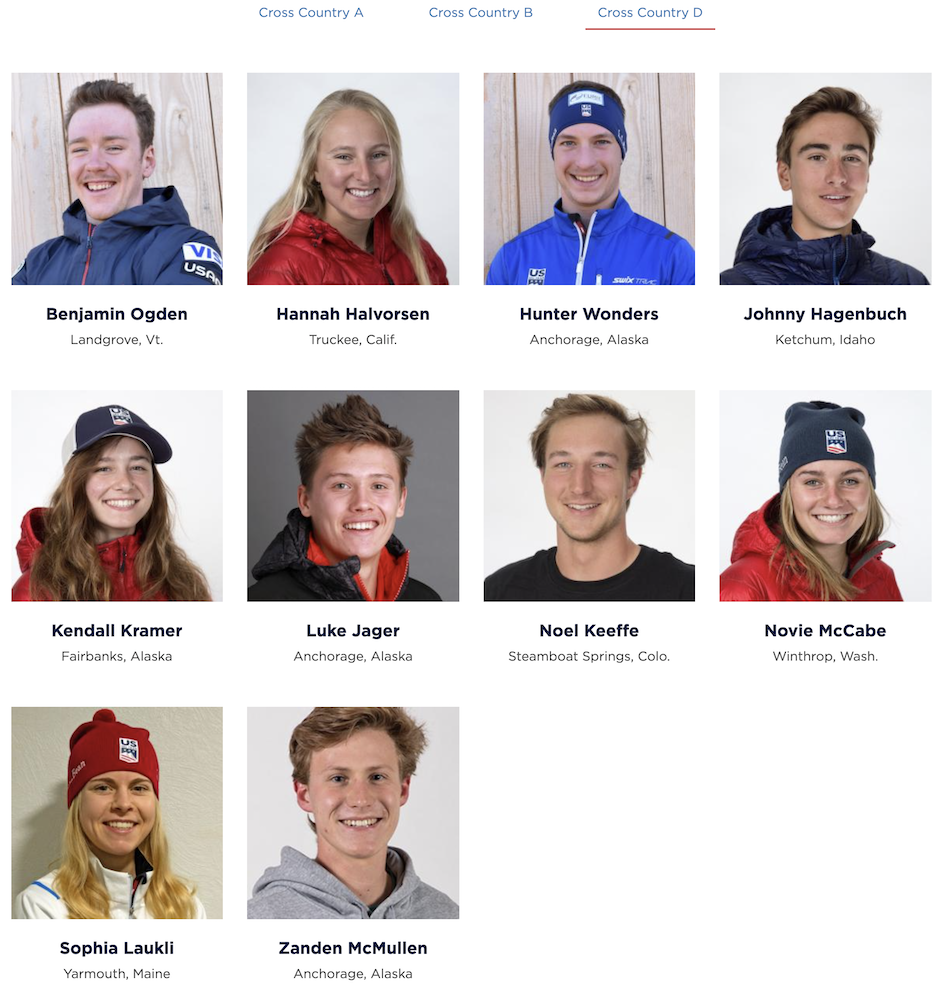
    Johnny Hagenbuch, age 20

    Made World Cup debut last season at 19. Sun Valley native and World Juniors relay medalist will start at Dartmouth this fall.

    Hannah Halvorsen, age 23

    Famously recovered from debilitating injuries to return to racing. Starting Period 1 skate and classic sprints based on last season’s WC results.

    Luke Jager, age 21

    A tantalizing 0.09 seconds out of the heats in World Cup debut. University of Utah junior will start all Period 1 sprints.

    Noel Keeffe, age 22

    University of Utah senior earned World Cup start in 2020, and was 12th in 2019 World Juniors. Will race domestically this fall.

    Kendall Kramer, age 19

    Skiing and running for University of Alaska Fairbanks. Looking to regain the form that brought her World Cup starts as a 16-year-old.

    Sophia Laukli, age 21

    Three Oberstdorf top-30s merit Period 1 distance starts for the University of Utah junior, who passed part of the pandemic in Norway.

    Novie McCabe, age 19

    Two third-place finishes at NCAAs for the University of Utah skier, starting all Period 1 WC races. All before her 20th birthday.

    Zanden McMullen, age 20

    20-year-old missed his World Cup debut when Covid travel restrictions cancelled race. Will get three more chances in Period 1 distance races.

    Ben Ogden, age 21

    2020 NCAA champion, top American man in Oberstdorf sprint. University of Vermont senior will start all Period 1 races as SuperTour leader.

    Hunter Wonders, age 23

    Final member of Alaskan men youth movement, 23-year-old with seven World Cup starts last season will contest all Period 1 distance races.

    This article has been updated to reflect the fact that Sophia Laukli now skis for the University of Utah, not for Middlebury College.

  • Craftsbury SuperTour Classic Sprint Rundown

    The US SuperTour kicked off the first races of the new year at the Craftsbury Outdoor Center with a classic sprint. The event, dubbed the 2020 Lost Nation Cup, brings together senior athletes, EISA carnival teams,  developing NENSA skiers, and citizen racers for a weekend of racing in the Northeast Kingdom of Vermont.

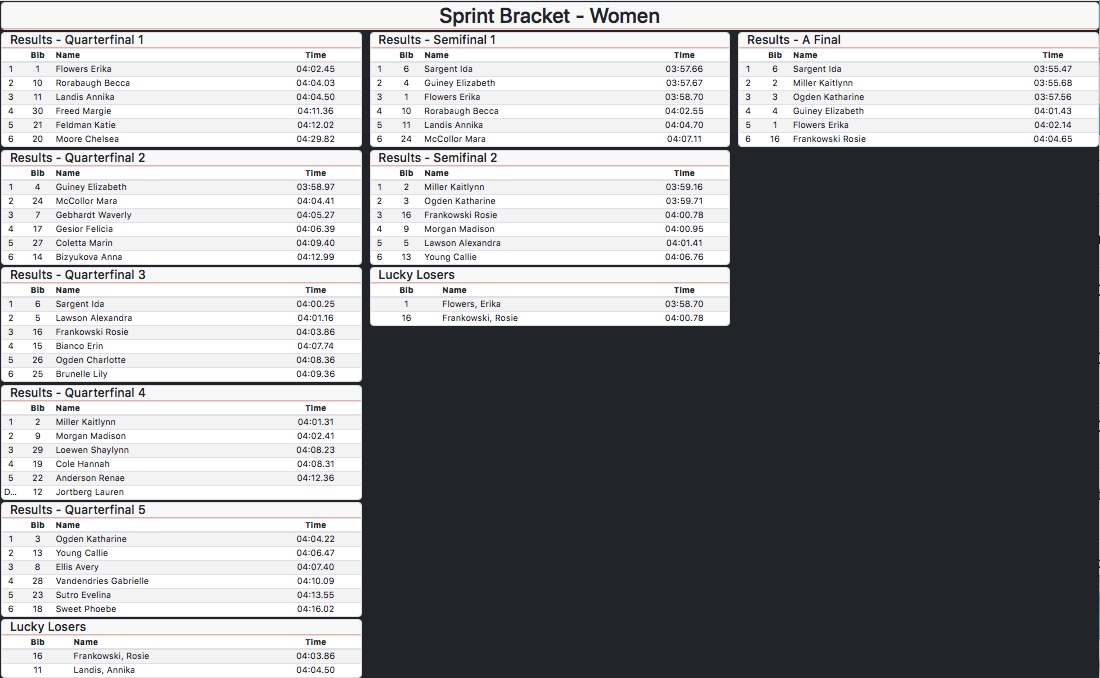
    “Retired” Craftsbury native Ida Sargent won the women’s race in a time of 3:55.47, followed by fellow CGRP athlete Kaitlynn Miller (+0.21), and Dartmouth Ski Team’s Katherine Ogden (+2.09). Erika Flowers posted the fastest qualifying time of 3:56.03; she finished fifth in the final (+6.67).

    Breaking down the heats in Craftsbury. (Photo: BullitTiming.com)

    On the mens’ side, Ben Saxton (SMST2) took the final in 3:19.0. He was followed by Canada’s Julien Smith of NTDC Thunderbay (+2.04) with Forrest Mahlen of APU in third (+2.25). University of Vermont athlete Ben Ogden was the fastest qualifier of the day in 3:18.62. Ogden was eliminated in the first heat of the semifinal, finishing 11th overall.

    Results from the men’s heats in Craftsbury. (Photo: BullitTiming.com)

    Racing continues tomorrow with interval start freestyle distance races Saturday and mass start classic distance races Sunday.


    Women’s Qualifier | Women’s Final Results

    Men’s Qualifier | Men’s Final Results

  • Unraveling the College Athlete Admission Process: Preparing for the Campus Visit with Dartmouth’s Cami Thompson-Graves

    Deciding how to handle the “college conflict”, as aptly phrased by Alayna Sonnesyn, is a daunting and somewhat mysterious prospect, particularly for athletes and families who are unfamiliar with the process. How does a junior athlete know that they are cut out for a collegiate program? NCAA or USCSA? What about a gap year? In this series, FasterSkier spoke with collegiate and junior coaches and athletes who have chosen different pathways to create a resource for the athlete or parent amidst this conundrum. In the first part of the series, Anna Schulz of Craftsbury shared a look into the early conversations between a junior coach and athlete. Next, FasterSkier spoke with Cami Thompson-Graves, head nordic coach at Dartmouth College to learn how to get the most out of the college visit to determine whether skiing NCAA and the school are a good fit. 


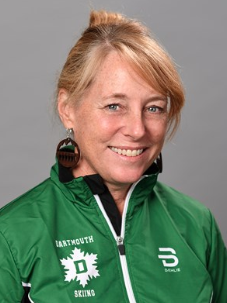
    Cami Thompson-Graves offers insight into the college process from her 30 years of experience coaching the Dartmouth Cross Country Ski Team. (Photo: dartmouthsports.com)

    After over 30 years of leading the program, Cami Thompson-Graves’ name has become synonymous with the Dartmouth Ski Team. During her tenure, she has fostered a thriving program capable of developing athletes whose goals extend far beyond the reaches of NCAA. Three out of the eleven members of the U.S. Ski Team A and B teams (Caldwell, Brennan, and Kern) raced for the Dartmouth Program and in total, ten of Thompson-Graves’ athletes have become Olympians. She also helped guide Katherine Ogden to become the first Dartmouth skier to earn double titles in both the classic and freestyle race at NCAA’s and has mentored numerous All-Americans over the years. 

    While not all athletes perusing their collegiate options are setting goals to race at Dartmouth, Thompson-Graves’ years of experience with the college application and acceptance process qualify her to offer insight to juniors applying to any NCAA program.

    Starting with the initial contact, because the legacy of the Dartmouth program is renowned, Thompson-Graves explained that her recruiting process does not involve a significant amount of reaching out to athletes, however, she is attentive to the results at key junior events throughout the year. 

    “I am generally paying attention to where people are in their junior winter,” Thompson-Graves said in a call. “I’m looking to see who’s doing well and who’s going to [REG and NTG] camps. I know a lot of people in a lot of places, so then I might reach out to their coach sometime later in the year and try to start a dialogue with [the athlete] spring of their Junior year. That’s for the top athletes.”

    She continued that she begins to hear from athletes expressing interest and asking questions about the Dartmouth program most frequently during their junior year and into the fall of their senior year. In total, she communicates with 20 to 30 prospective athletes each year and has two to three openings for each gender on her team. 

    For juniors committed to making an NCAA team, she recommends beginning the process of identifying schools of interest and initiating dialogue early.

    “I think to some degree, people need to be thinking ahead and thinking about what kinds of things are important to them in a program because we’re not all created equally even though we all compete against each other on some level.”

    Once an athlete has determined what colleges and universities are appealing in a broad sense, Thompson-Graves recommends scheduling a campus visit if possible. Typically, this should happen during the spring of junior year or the following summer to allow time to narrow focus on a subset of universities for applications. Thompson-Graves expressed that this visit can help a student decide whether a program suits them beyond the on-paper appeal. 

    “I’m a big believer in people finding the right fit because if they find the right fit, they’re going to be happier and more successful. So I don’t put on a hard sell, I just say ‘This is what we offer. This is what we have.’ And I try to guide people to be asking the right questions and finding a place that suits them.”

    What are the questions that will aptly inform a visiting athlete whether a program jives with their personal, academic, and athletic goals? Thompson-Graves recommends starting with a few key prompts. 

    “Get thinking: What is it I’m looking for? What’s important to me? Where do I see myself?”

    Focusing on the last question, she recommends widening the lens to look beyond the specific school or location an athlete is imagining. It is important to ensure that the program an athlete chooses is equipped to support the athlete’s trajectory and goals long-term. 

    Dartmouth freshman Katharine Ogden racing to her second-straight victory of the 2018 NCAA Skiing Championships in Steamboat Springs, Colorado. She won the 15 k freestyle mass start by more than 38 seconds. (Photo: Dartmouth Sports/Clarkson Creative)

    “It is important that people have some idea where they see themselves in skiing over the next four years. Are they someone who is coming in and just trying to make the carnival team? Are they someone who is coming in and hoping to go on and make a World Juniors or a U-23 Championships? What kind of races do they want to be racing in and what are the goals that they see for themselves? Because some programs are going to make sure that they get to all the races that they need to get to and that they’re supported, and other programs they are basically just going to the carnivals with six people.” 

    Though not all athletes entering college might be on track to make the race team during their time in college, particularly at a program like Dartmouth, Thompson-Graves encourages seeing the value of developing over four years of working with a team that challenges an athlete to reach. However, if a prospective athlete identifies traveling and racing weekly as one of the qualities that aligns with their goals, it might be wise to choose a program where that is more easily achievable.

    “I’m in a lucky position that I have been attracting some of the top athletes and we’ve had some success over time, so I think it’s somewhat easier to attract some of the top athletes, but I maybe scare away that next level because they are like, ‘Oh my god, I’ll never make the Carnival Team if I race there.’ Of course, if you ask someone who is on the team, they would say, ‘It’s worth it, I wouldn’t go anywhere else.’ But there are other people who would say, ‘I’d rather go somewhere where I know I will make the Carnival Team every week.’”

    Apart from the more whimsical questions about goals and opportunities, it is important for an athlete to ensure that the program is within the financial means of the family. While scholarships are available to help with the inherent costs of attending the school, being on a team incurs additional costs that need to be factored in. These costs include travel, equipment, and race entry. These real costs vary depending on the resources of the school and the goals of the athletes. 

    “What is the program supporting for athletes? What are the out of pocket costs? For some people, that’s really important. There are obviously some people that are hoping for a scholarship, but not all ski schools offer scholarship, so everyone is thrown into the pile of need-based financial aid. That aside, what are the other expenses that each individual athlete might have to be a skier? It’s not cheap and depending on where they are on a team or what level they’re skiing at, it might make a difference in how much they have to pay out of pocket.” 

    It is also important for an athlete to ask about the balance of academics and athletics. At some schools, students may be able to arrange their class schedule to keep the academic demands light during the winter race season or take classes over the summer to meet credit requirements. It can also be helpful to identify the support resources offered by academic institutions when athletes are missing classes due to racing or training camps.

    Thompson-Graves also encourages asking about the intangible aspects of a program that are highly impactful in creating a positive experience.

    “How does the team get along? What kind of group is it?”

    She also recommends asking the coach about their style and what their expectations are of athletes as part of the team. 

    “It should be a two-way interview and not a one-way interview.” 

    Per NCAA rules, a prospective athlete is not able to attend practice as part of the campus visit, however, it is possible to observe. Thompson-Graves explained that observation is not always a meaningful way to evaluate the intangibles of the team dynamic, but a coach can facilitate alternative opportunities to meet with the team. 

    “Generally, if they want to meet the team, I’m happy to set up a lunch or meet-up. They often reach out to friends they might have on campus if they know people. With social media, there’s a lot more of that going on than there used to.” 

    Meeting with the team is not an essential component of the campus visit, particularly in the primary stages of the college process. 

    Head coach Cami Thompson Graves sees her athletes off on a time trial in September, 2019. (Photo: Instagram @dartmouthskiing)
    “It also depends if it is a first-time visit versus someone who might be coming for an official visit or an overnight later on in the process. It also depends on where kids live, whether that is the first time they are coming to campus or whether they’ve been through another time then are coming back for an overnight. Sometimes they might just come into the office and I might show them a little bit of what we have for facilities to offer, then another time they might stay overnight with someone on the team, eat some meals in the dining hall, go to a few classes. Generally, those are all options, but if it’s your first time to campus and it’s still early in the process, I don’t think that it’s necessary.”

    Ultimately, a sound evaluation about the fit of the school is one of the key takeaways Thompson-Graves hopes that an athlete leaves the visit with.  

    “I hope they get an idea what the program is all about, what the expectations are, what we have to offer, and to some degree who I am. I have said to people at times in the past, ‘If talking to me makes your skin crawl, then you might want to think about whether you want to be here because you’re going to see a lot of me,’” she said with a laugh. “That’s part of that good fit aspect. I want them to get a sense of the school, the place, the team, me, and what it’s all about.” 

    It is also valuable to have a sense of the qualities and results that a coach looks for in the athletes they recruit. For the Dartmouth program specifically, Thompson-Graves explained how she evaluates whether the prospective athlete is in turn a good fit for her program. 

    “I’m looking for someone who has solid results, and that can be at the very least Junior National Championships. If someone is finishing in the top ten at Junior Nationals then I’m going to be even more interested. But mostly what I’m looking for is someone who is engaged and curious and thinks for themselves and is starting to get a handle on what they’re looking for and is starting to consider skiing for Dartmouth.”

    She shared that she recently had the experience of visiting and touring colleges with her daughter. Though her daughter was not interviewing as an athlete, Thompson-Graves recalled that this process was eye-opening. 

    “You can get a pretty good sense on those early campus visit. Does the place feel right? Do these people feel like my people? Do the programs that are offered here interest me? Can I see myself living here for four years, even if it’s raining some of the time or everything isn’t perfect? So I hope that when someone leaves after the campus visit that they are getting a sense of what it’s all about.”

    She continued that particularly in places like the Northeast where schools with NCAA skiing programs are relatively close together, these visits can offer a template to compare and contrast offerings.  

    “A lot of people visit a number of schools within a week or two, and I think you want to sort of compare the strengths and weaknesses of the different schools and the different programs and then come back and ask more questions. I often will ask someone, ‘Am I your first visit?’ because they often don’t know what to ask, particularly if they are the oldest child in the family. They don’t have any idea where to start or what to ask, so I can babble on for 20 minutes and they just listen and don’t even know where to start. So I think then, following up with questions is important too because the more schools you visit the more you see and the more questions you have.”

    Team USA Nordic athletes representing their alma mater at the PyeongChang Olympics in 2018. Left to right: Head coach Chris Grover, Rosie Brennan, Sophie Caldwell, Ida Sargent, and Patrick Caldwell. Unpictured: Annie Hart. (Photo: Instagram @dartmouthskiing / flyingpointroad.com)
    Though it can be tough for a parent to sit back, Thompson-Graves recommends that the athlete take the initiative in leading the dialogue during a visit rather than the parent. She explained that parents attend her meeting with prospective skiers about half the time depending on the preference of the family.

    I leave it up to them. The one thing I prefer not to have happen is the parent ask all the questions and the kid doesn’t say anything. I prefer to be talking to the kid and not the parent, but I’m happy to have parents along and if the student is happy to have them there then it works fine for me.”

    She continued that in her experience, there are times when younger athletes who are very early in the process come to the visit unsure of what to ask or what they are looking for. In these cases, she feels it is appropriate for a parent to attend and help facilitate the conversation. Once the athlete has determined that they are interested in her program, she expects the parents to step back and to pass the reins to be passed to the athlete.

    “Further down the road, my expectation is that all my communication will be with the student and not with the parents. I’m happy to answer questions that parents may have, but I’m not recruiting the parent, I’m recruiting the kid. At a certain point, if they can’t ask questions and reach out and follow through with things, then they aren’t going to be successful at Dartmouth, so that is kind of telling for me.”

    Thompson-Graves also noted that communication at all phases of the decision process is beneficial, regardless of how eagerly the athlete is pursuing the program. 

    “I would just encourage people to communicate because even the ones who come and do a tour and I meet with them, they may go home and they’re ready to apply early decision, but if I never hear from them again, I don’t know that. I even appreciate it when someone says, ‘Thank you for meeting with me. I’ve decided I’d rather go to UVM.’ It’s just nice to know what they are thinking, and they don’t have to make me happy.”

    A recent article in The Atlantic exposed the effect of meritocracy on the opportunity for college athletics. Though the cost of junior programs varies geographically, the article illuminates that lower-income families are being priced out of the hyper-specialized and competitive programs that are setting youth up to make a Division I team. 

    In line with this trend, not all families may have the financial means to schedule a visit at all of the programs of interest for a prospective athlete, particularly schools that require transcontinental travel. Thompson-Graves reassured that the inability to connect face-to-face is not a detriment to the admission process and does not impact which athletes she recruits. 

    “From my perspective, the in-person visit is going to be the most beneficial for them, more so than for us. So if they can’t make the visit, it is not by any means mandatory, it just gives people a better sense of what it’s like to be on that campus. Certainly now, there are all kinds of virtual tours and people can Skype and talk to people they know on campus. It’s a small world, so they are going to see someone who skis or has skied for Dartmouth at some race that they go to during the season. Our athletes aren’t recruiting for us, but they are a pretty open and friendly bunch, so they are more than happy to answer questions and talk to people when they’re traveling or at other races.”

  • NCAA Championships in Stowe, Vermont: K.O. and Izquierdo-Bernier Take the Wins…Utah Leads the Team Overall

    NCAA Championships in Stowe, Vermont: K.O. and Izquierdo-Bernier Take the Wins…Utah Leads the Team Overall

    On Friday, the third day of racing at the 2019 NCAA Skiing Championships featured another cross-country racing day with the women’s 15-kilometer mass start classic and the men’s 20 k mass start classic.

    After two days of racing and scores tallied from a single day of nordic racing on Wednesday and an alpine GS event on Thursday, Dartmouth was in the overall lead for the team championship. They had tallied 259 points to Utah’s 252.3 in second. Vermont sat in third overall with 245 points.

    Dartmouth’s Katherine Ogden won the women’s 15 k classic on Friday in a time of 46:25.7 minutes. Utah’s Julia Richter was second in 46:49.1, with Colorado’s Hedda Baangman third in 47:15.2.

    Utah’s Huro Jordheim skied to fourth in a time of 47:19.8, and Vermont’s Anna Bizyukova was fifth in 48:07.7.

    Women’s Results

    With 2 k to go in the men’s 20 k mass start classic in Stowe, seven skiers were in a train separated by roughly six seconds. One of those athletes, Ricardo Izquierdo-Bernier of the University of New Mexico, played his hardest effort in the closing k as he gapped University of Alaska’s Sigurd Roenning.

    Izquierdo-Bernier won in 55:50.6 minutes with Roenning skiing through to place second overall (+5.9).

    Utah’s Maximilian Bie placed third in 55:57.7. Colorado’s Alvar Johannes Alev was fourth in 56:01.2, and Utah’s Ola Jordheim fifth in 56:02.4.

    Men’s Results

    For the team overall results, heading into Friday evening, Utah has taken the lead with 426.5 points. Colorado sits in second place with 361 points, while Dartmouth fell to third with 359 points.

    In the women’s race, Utah took second, fourth and seventh places. Whereas in the men’s race, the Utes took third and fifth places.

    https://www.vteabp.org/vancomycin.php

    Racing continues tomorrow with the slalom event for the alpine skiers.

    Overall Scores/Standings After Day 3

  • NCAA Champs Day 1 Rundown from Stowe, Vermont

    NCAA Champs Day 1 Rundown from Stowe, Vermont

    NCAA Skiing Championships Stowe, Vermont 10k/5k Freestyle

    In Stowe, Vermont the men raced a 10-kilometer interval start skate race on Wednesday to open the cross-country portion of the NCAA championships. Erik Olsvik Dengerud from the University of Colorado won in a time of 24:25.5 minutes. Kornelius Groev from the University of New Mexico (UNM) placed second in 24:45.1, and Ian Torchia of Northern Michigan University was third in 24:45.4.

    https://www.vteabp.org

    Ricardo Izquierdo-Bernier from UNM was fourth, and Bill Harmeyer representing the University of Vermont (UVM) rounded out the top-five.

    Men’s Results

    In the women’s 5 k skate, Julia Richter of the University of Utah (UoU) won in 13:28.3 minutes. University of Denver’s Jasmi Joensuu skied to second in 13:29.3, and Evelina Sutro of UVM was third in 13:29.4.

    Katherine Ogden from Dartmouth placed fourth (13:34.5) and Guro Jordheim of the UoU fifth (13.37.6)

    Women’s Results

    After the first day of competition, during which only nordic races were held, the University of Utah leads the team competition with 142 points. They hold a one point buffer over the University of Vermont. Colorado sits in third with 120 points.

    Racing continues tomorrow with alpine athletes competing in giant slalom.

    Overall Team Results

  • Friday Race Rundown: World Juniors, IBU World Cup, and Super Tour (Updated 2x)

    Friday Race Rundown: World Juniors, IBU World Cup, and Super Tour (Updated 2x)

    Hailey Swirbul for the U.S., skiing to 10th overall in the U23 World Championship 15 k classic mass start in Lahti, Finland. (Photo: Doug Stephen)


    2019 U23 World Ski Championships in Lahti, Finland 15 k/30 k Classic Mass Start

    Link to Doug Stephen’s images from Lahti.

    Of the four Russian athletes starting the 15-kilometer classic mass start in Lahti, Finland three placed in the top four. Anna Zherebyateva won in 40:31.4 minutes as she was able to stretch her nine-second gap at 10 k to 23.5 seconds by the finish. Also from Russia, Lidia Durkina placed second (+23.5), Germany’s Katharina Hennig skied to third (+37.5).

    “My tactic was to make a gap in the second loop,” Zherebyateva said during the post-race press conference. “So I did exactly what I wanted. It went really well. Tracks were exactly right for me. This gold medal is an important step for my sport career.”

    Yana Kirpichenko was the third Russia in the top-five as she placed fourth (+41.6).

    The best North American finisher was U.S. skier Hailey Swirbul who raced to 10th (+1:27.8). Swirbul was positioned 29th at the 5 k time check but steadily moved up in the field as the race progressed. By 10 k she had positioned herself in the top-15.

    For the twenty-year-old Swirbul, this is her first go at U23 Worlds after participating in three Junior Worlds as an U20. Last season in Goms, Switzerland she placed second in the 5 k classic and third in the 10 k skiathlon.

    Two other U.S. skiers raced into the top-30. Julia Kern placed 16th (+1:43.4), while Alayna Sonnesyn was 23rd (+2:24.9). Hannah Halvorsen, the fourth U.S. starter, placed 54th (+6:58.6).

    Hannah Mehain was the top Canadian in 31st (+3:16.8), Sadie White placed 33rd (+3:18.6), and Natalia Hynes 51st (+3:40.9). Marie Corriveau did not start.

    Women’s Results

    Similar to the U23 women’s race, Russian skiers dictated the pacing at the front of the pack — the four Russian starters swept first through fourth place.

    Andrey Sobakarev won in 1:17:19.1 hours, Ivan Kirillov placed second (+3.5), Ivan Yakimushkin third (+4.9), and Anton Timashov fourth (+11.4).

    Canada’s Antoine Cyr was the top North American in 27th (+2:26.8), while teammate Gareth Williams toed the line a fraction behind in 28th (+2:26.9). Also for Canada, Ritchie Graham was 41st (4:44.1), and Julian Smith 45th (+5:14.3).

    Peter Holmes was the top U.S. finisher in 33rd (+3:15.7). Hunter Wonders placed 40th (+4:43.0), Braden Becker 53rd (+6:59.0), and Daniel Streinz 66th (+15:53.9).

    Men’s Results


    ***

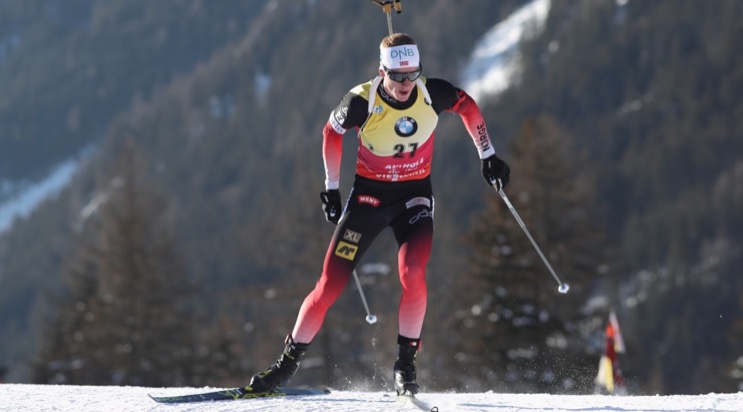
    Johannes Thingnes Bø scored his 10th IBU World Cup win of the season today in the 10 k sprint in Antholz, Italy. (Photo: biathlon world.com screenshot)

    IBU World Cup Antholz, Italy 10 k sprint

    In the groove is in the groove. Norway’s twenty-five-year-old Johannes Thingnes Bø scored his 10th IBU World Cup win of the season today in the 10 k sprint in Antholz, Italy. Bø won the race in 23:53.9 minutes with a single penalty in standing. The Norwegian leads the IBU World Cup overall and padded his lead with his fifth sprint win this year.

    “It was quite difficult; the altitude here is quite heavy and with the new tracks, I felt dead from 5K so the last 5K was really tough,” Bø said to the IBU after the race. “I managed to have a good plan for the race. When I shoot nine targets, I was quite happy and then it was just to fight hard for the finish line. I like this year’s track; I liked last year’s too because it was not so painful.”

    Bø’s season thus far has been a study in speedy skiing. His shooting stands at 87% for accuracy (82% standing, 91% prone) with his superior skiing speed carrying him to the World Cup overall lead. In Antholz today, his course time for each of his two 5 k laps were ranked first.

    Norwegian teammate Erlend Bjøntegaard shot clean in both his shooting bouts to take second place, 17.5 seconds behind. France’s Antonin Guigonnat placed third (+20.2, 0+1).

    Scott Gow of Canada was the top North American in 20th (+1:06.6, 0+0). Teammates Jules Burnotte raced to 48th (1:55.9, 1+1), Christian Gow 61st (+2:13.4), and Aidan Millar (+3:46.7, 2+2).

    Jake Brown was the top American in 40th (1:42.4, 1+0). Sean Doherty finished in 55th (+2:06.2, 2+1), Max Durtschi  62nd (+2:13.8, 0+1), and Leif Nordgren 73rd (+2:43.1).

    Racing continues tomorrow in Antholz for both the men and women with the 12.5k  and 10 k pursuits.

    Men’s Results

    ***

    Lake Placid SuperTour 5 k/10k Skate Individual Start

    In the 5 k-freestyle individual start Jessica Yeaton (APU/Australian National Team) placed first with a winning time of 15:01.9 minutes. She was in a tight race for the top spot with U.S. Ski Team/SMS T2 athlete Sophie Caldwell who finished 3.0 seconds back. Caldwell is back home in Vermont training and preparing for the 2019 World Championships.

    Katherine Ogden (Dartmouth Ski Team) placed third in a time of 15:17.8. Kelsey Phinney (SMS T2) placed fourth in 15:37.7.

    “Today’s race went super well for me; I had awesome skis despite tricky conditions/weather leading into the race – our wax tech did a phenomenal job,” Yeaton wrote to FasterSkier. “The course here is really good for me with all the steady climbing in the first part- I just tried to push hard to the top of the course and then survive and carry my speed on the downhill, which turned out to be a good tactic.
    “Between US Nationals and now I definitely feel like I am in a good place leading into Seefeld. I struggled with some injuries in the fall and was forced to do a lot of cross-training (especially on the bike) and skip the early season races in Nov/Dec. In retrospect I think this actually was a blessing in disguise, as I ended up putting in a super hard training block and gaining a lot of fitness. Looking ahead to Seefeld, my goal is to top 30 in one of the races, with my main focus being on the skate events (30k and sprint), and the 15km skiathlon. I am really excited for the rest of the races this weekend; they are my final prep before heading over to Europe to race on World Cup and in Seefeld.”

    Women’s Results

    Kyle Bratrud (SMS T2) won the men’s 15 k skate in 25:27.1 minutes. Bratrud, who was recently selected to the 2019 U.S. World Championship Team, has been a top-performing distance skier this season on the SuperTour.

    “Today went well,” Bratrud emailed. “After Nationals, I made the tough decision of turning down World Cup starts in Otepaa and Ulricehamn in order to get some quality training in for the World Champs. Today reflected that as I felt a little tired and pretty flat from not racing since Nationals. That being said, I expect to keep feeling better each race and I should be in a great place when I fly to Europe on the 4th!”

    Bratrud recently won the NorAm/SuperTour 15 k classic in Sovereign Lake and the 15 k classic at U.S. Nationals. Bratrud placed second in West Yellowstone’s SuperTour 15 k skate, and the 30 k skate mass start at U.S. Nationals.

    Akeo Maifeld-Carucci (CGRP) placed second in a time of 26:18.9. It was Carucci’s second SuperTour podium of the season and his best career SuperTour result. In West Yellowstone, he was third in the 15 k skate behind Ben Lustgarten (CGRP) and Bratrud.

    Alexis Dumas (CNEPH) of Canada was third in 26:32.2. U.S. skier Adam Martin was fourth, 3.1 seconds behind Dumas.

    Men’s Results


  • Sovereign NorAm/SuperTour Rewind: Craftsbury Women on Top; Thompson and Torchia Take Wins [Updated Photo Gallery]

    Sovereign NorAm/SuperTour Rewind: Craftsbury Women on Top; Thompson and Torchia Take Wins [Updated Photo Gallery]


    Classic sprint day at the Sovereign Lake Nordic Centre on Saturday, Dec. 9. The NorAm opening weekend also counted as SuperTour races. (Photo: SilverStar Mountain Resort)

    VERNON, British Columbia — For the second consecutive year, the Sovereign Lake NorAm was combined with the SuperTour for an expanded field of racers. The warm, sunny, and windless conditions on both days were a welcome change from the previous season’s cold weather and falling snow. What didn’t change was the ‘south of the border’ feel to the leaderboard.

    The race formats were similar to that of the Davos World Cup, just nine time zones later: Saturday was a classic sprint (Davos was a skate sprint) and Sunday included 10- and 15-kilometer freestyle interval starts.

    With temperatures around -2 degree Celsius and dry, untransformed snow, the waxing was straightforward both days with ski choice dominating the discussions. More than 400 racers competed, including 140 men and 84 women in the open categories.

    Classic Sprint

    Sophie Carrier-Laforte (Pierre-Harvey National Training Centre) leading the women’s classic sprint final at the Sovereign Lake NorAm/SuperTour on Dec. 9, ahead of Sun Valley’s Kelsey Phinney (second from l), Craftsbury’s Kaitlynn Miller (third from l) and APU’s Hannah Halvorsen (far r). (Photo: Peggy Hung)

    Sovereign’s 1.3-kilometer sprint course doesn’t feature large climbs, but it does reward good tactics. There were a few minor incidents off the start when the six tracks became four, and the final 270-degree turn off the bridge into the finishing straight punished tired legs and tight groups.

    American Kaitlynn Miller of the Craftsbury Green Racing Project (CGRP) dominated the open women’s sprint, winning the qualifier and all of her heats. In the A-final, Canadian Sophie Carrier-Laforte, of the Pierre-Harvey National Training Centre (CNEPH), pushed the pace from the start, using her double-poling power to stretch the field over the first three climbs. Miller was last into the hole and used the big climb to work her way to the front, where she was able to control the group through the tricky final turn and get first lane choice to take the win in 2:57.53 minutes. Miller’s teammate, Caitlin Patterson powered past Hannah Halvorsen, of Alaska Pacific University (APU) and the U.S. Ski Team (USST) D-team, to take second, 0.93 seconds behind Miller. Halvorsen claimed third (+2.59), Kelsey Phinney, of the Sun Valley Ski Education Foundation (SVSEF) took fourth (+2.59), and a third Craftsbury skier Liz Guiney placed fifth (+3.53). The lone Canadian in the women’s final, Carrier-Laforte, finished sixth (+4.38).

    Post-race video interviews: Miller (1st) | Patterson (2nd) | Halvorsen (3rd)

    The ‘technique zone’, where only diagonal stride or herringbone techniques are permitted, wasn’t a factor for the women. Finland’s Jasmi Joensuu, a junior at the University of Denver, had tested early in the week and decided to use grip wax for the one steep climb. Joensuu added some excitement the B-final, as she changed clothes and switched to skate skis for her planned cooldown before discovering that the NorAm series does B-finals. Luckily, her classic race skis were still in the start area and she was able to finish third in that heat for ninth overall. 

    Post-race interviews: Joensuu 9thDupont 10th

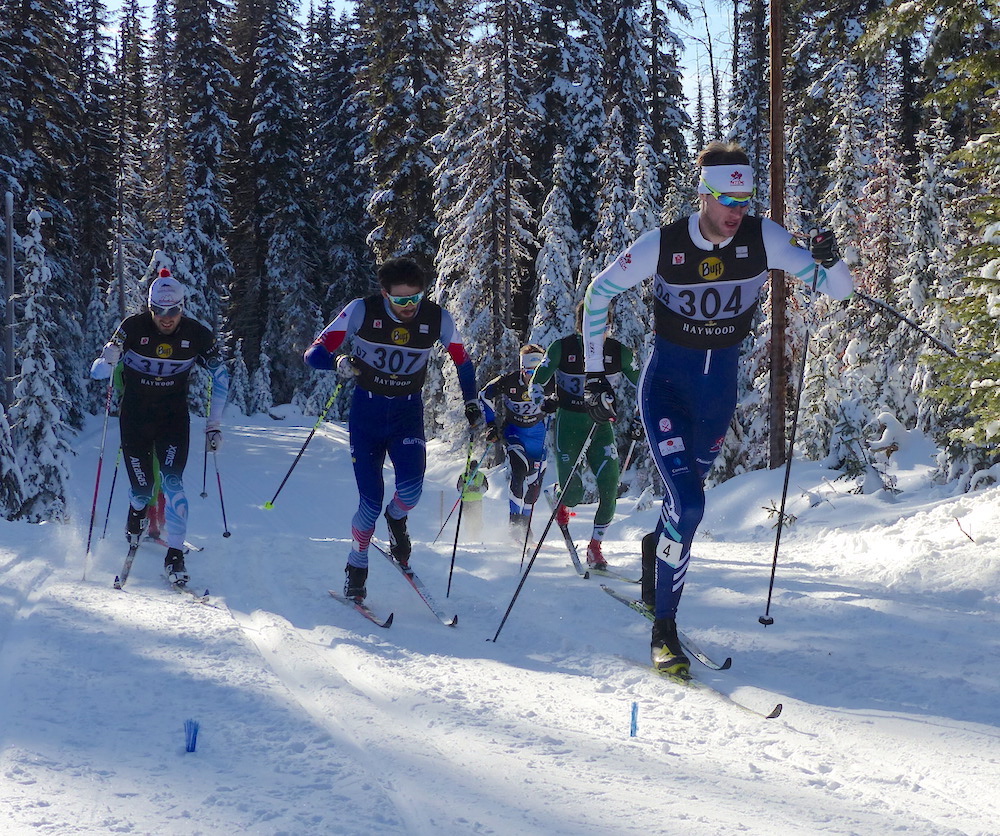
    Bob Thompson (304) of NTDC Thunder Bay leading Sun Valley’s Jack Hegman (307) and Patrick Stewart-Jones (317) of the AWCA during their quarterfinal of the NorAm men’s 1.3 k classic sprint on Saturday at Sovereign Lake near Vernon, B.C. (Photo: Peggy Hung)

    In the men’s race, Bob Thompson, of the National Team Development Centre (NTDC) Thunder Bay, salvaged Canadian pride with a win after qualifying fourth and placing second in his quarter and semi heats. Thompson was the only Canadian in the A-final, closing a gap to the leading three on the bridge turn and double poling from fourth to first to finish in 2:29.31. American Ben Saxton of the Stratton Mountain School (SMS) Elite Team finished just three-hundredths of a second back for second place, and Cole Morgan edged out his SVSEF teammate Jack Hegman by 0.03 seconds for third (+0.48). APU’s Reese Hanneman and Tyler Kornfield followed in fifth (+7.75) and sixth (+ 7.90), respectively, after being gapped early and losing the battle for the four lanes on the first hill.

    Post-race interviews: Thompson (1st) | Saxton (2nd)Morgan (3rd)

    In the B-final, the lone Canadian in that heat, Evan Palmer-Charrette (NTDC Thunder Bay) recovered from finishing sixth in his semifinal to take the win (for seventh overall) and earn some important series points.

    Post-race interviews: Palmer-Charrette (7th)| Julian Smith (11th)

    The technique zone was a larger challenge for the men as they carried more speed into the start of the zone, keeping the jury busy, although only one athlete was disqualified. Many of the top men used just enough grip wax to prevent ‘gliding herringbone’ and the resulting DQ. There were broken poles and one protest at the merge to four lanes off the start, resulting in one verbal warning from the jury, along with a few quarterfinal crashes on the final turn.

    Results: Heats | Qualifier

    ***

    Freestyle Distance Races

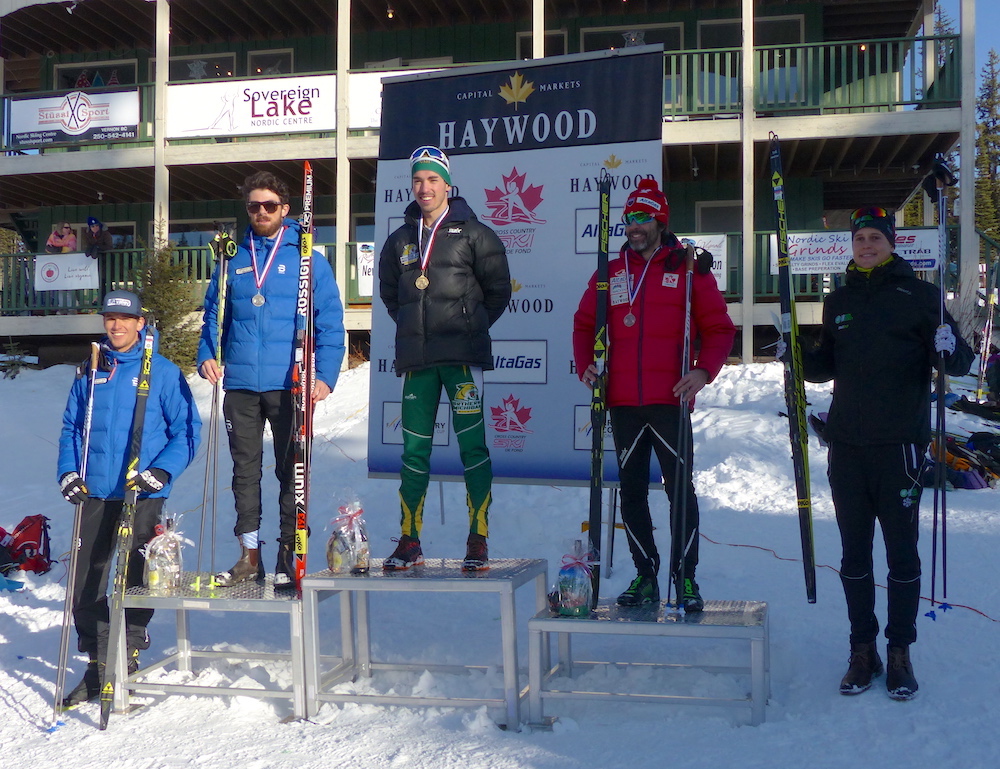
    The men’s 15 k freestyle podium on Day 2 of the NorAm opening weekend at Sovereign Lake near Vernon,B.C., with (pictured) Ian Torchia (NMU/USST D-Team) in first, Jack Hegman (SVSEF) in second, Brian McKeever (Canadian Para-Nordic Team) in third, Kevin Bolger (SVSEF) in fourth (far left), Adam Martin (CGRP) in fifth (far right). (Photo: Peggy Hung)

    The 5-kilometer ‘Upper World Cup’ course is not obviously difficult to someone casually skiing it in Zone 1; there is one mildly challenging corner, one steep climb (‘the wall’), and the total climb is at the lower limit of the International Ski Federation (FIS) homologation range. But racing it is another story, as evidenced by several top finishers after Sunday’s 10/15 k freestyle interval starts who used words like “nightmare”, “hardest”, and “most painful” in post-race interviews.

    In the men’s 15 k, Ian Torchia, a Northern Michigan University (NMU) junior and member of the USST D-team, was on fire, ranking fourth after two of three laps. He described suffering on the last lap and relying on a ride to keep his speed up, but still managed to ski the fastest final lap (in 12:15.7) to take the victory in 36:29.7.

    Hegman placed second, 19.0 seconds back, improving on his fourth place from the sprint. Canadian Para-Nordic skier Brian McKeever, who skipped the Canmore International Paralympic Committee (IPC) World Cup to race at Sovereign, notched third (+22.6). Sun Valley’s Kevin Bolger skied three very even laps (11-second variation from fastest to slowest) to finish fourth. Craftsbury’s Adam Martin took fifth (+28.3), just edging out Para-Nordic guide Graham Nishikawa, who led Torchia into the finish and placed sixth (+29.1).

    Post-race interviews: Torchia (1st) | Hegman (2nd) | McKeever (3rd) | Nishikawa (6th)

    A perennial podium threat at Sovereign and the previous weekend’s SuperTour distance winner, Brian Gregg, of Team Gregg, Central Cross Country (CXC) and Loppet Nordic Racing (LNR), took the lead after Lap 1 with a time of 11:49.8. But by the end of Lap 2, he was visibly losing power, clocking the 18th-fastest lap time, before his 13:10.4 final lap ranked 45th for 16th overall (+1:09).

    Thompson, wearing the NorAm leader’s bib after his victory on Saturday, finished 19th (+1:17.2). The combined NorAm and SuperTour fields made for a highly competitive event, with the top 40 men finishing within two minutes of first.

    Post-race interviews: Gregg (16th)Thompson (19th)

    Caitlin Patterson (Craftsbury Green Racing Project) racing to the win in the women’s 10 k freestyle on Dec. 10 at the Sovereign Lake NorAm/SuperTour. (Photo: XTS Photography)

    In the women’s 10 k, Patterson moved up from her sprint second place to notch her first win of the season in 27:13.0. She was 30.7 seconds clear of runner-up Rosie Frankowski (APU), and Frankowski claimed second by just one second over Caitlin Gregg (CXC/LNR/Team Gregg) in third. 

    Katherine Ogden, a Dartmouth College freshman and member of the Stratton Mountain School (SMS) and USST D-team, placed fourth (+50.1), just ahead of Becca Rorabaugh (APU) in fifth (+52.7) and Mary Rose (SVSEF) in sixth (+1:00.9).

    Retired biathlete Zina Kocher was the top Canadian in eighth (+1:31.2). Kocher (who raced at Frozen Thunder in November under her new married name of Lawson) will compete as Kocher this season as FIS requires a new passport to register a name change. Not surprisingly for a former biathlete, she enjoyed the skate distance race much more than the classic sprint.

    CNEPH’s distance specialist Frédérique Vézina was the second Canadian in 12th overall (+2:03.3).

    Post-race interviews: Patterson (1st) | Frankowski (2nd) | Gregg (3rd) | Kocher (8th)Vézina (12th)

    Results

    If you didn’t get your fill of video links above, the local tv station visited the day before the sprints and presciently chose Thompson for their first interview. They also talked to APU’s Erik Flora.

    Sprint Photos

    Distance Photos

    For more distance photos, find XTS Photography on FaceBook.

    Are there photos we are missing? Share with info@fasterskier.com and include photo credit information.

  • U.S. Ski Team Nomination Breakdown with Head Coach Grover

    U.S. Ski Team Nomination Breakdown with Head Coach Grover

    Jessie Diggins celebrates after anchoring her team to bronze in the women’s classic team sprint on Feb. 26 at 2017 World Championships in Lahti, Finland. (Photo: Dustin Satloff/dustinsatloff.com)

    Shortly after the U.S. Ski Team (USST) formally announced its 2017/2018 cross-country team, FasterSkier reached USST Head Coach Chris Grover on the phone for his comments. Grover is in Bend, Ore., for the team’s traditional on-snow camp.

    We have nine athletes who made the objective criteria to make the 2018 U.S. Ski Team,” Grover said. “Eight that are on the A-team, all of whom finished in the top 30 in the world in either sprint or distance. And then Katharine Ogden, who as a medalist at the World Junior Championships, made the objective criteria that way.”

    Below are the eight A-team athletes and Ogden, who was renominated to the development “D” team, that met the USST’s objective criteria for team selection.

    A Team

    Men

    • Simi Hamilton (Stratton Mountain School Elite Team)
    • Andy Newell (SMS Elite)

    Women

    • Sadie Bjornsen (Alaska Pacific University)
    • Sophie Caldwell (SMS Elite)
    • Jessie Diggins (SMS Elite)
    • Kikkan Randall (APU)
    • Ida Sargent (Craftsbury Green Racing Project)
    • Liz Stephen (Burke Mountain Academy)

    D Team

    • Katharine Ogden (SMS)

    The USST’s 2018 cross-country nomination criteria, as it relates and is applied to athletes meeting the objective criteria, remains straightforward.

    • Attain top-50 ranking in the 2017 final World Cup Overall ranking list.
    • Attain top-30 ranking in the 2017 final World Cup Sprint or Distance ranking list.
    • Attain top-20 ranking in the 2017 FIS final sprint or distance points list.
    • Attain a top-3 individual finish at the 2017 Junior World Championships or U-23 World Championships.

    Six women finished the season ranked in the top 50 in the World Cup Overall ranking list: Diggins (6th), Bjornsen (16th), Stephen (28th), Caldwell (33rd), Randall (36th), and Sargent (44th). Notably, Diggins, Caldwell, Sargent, Randall, and Bjornsen all ranked in the top 30 for the final World Cup Sprint list, too, and Diggins, Bjornsen and Stephen all finished in the top 30 on the final World Cup Distance list.

    Nineteen-year-old Ogden earned an individual bronze in the 10-kilometer skiathlon at the 2017 Junior Worlds.

    Hamilton and Newell were the two men that met the objective criteria, with Hamilton ranking 30th on the final World Cup Overall list and ninth in the World Cup Sprint standings and Newell 28th on the final World Cup Sprint list.

    The remainder of the USST were discretionary selections. The athletes nominated to the team under the discretionary guidelines are as follows:

    B TEAM

    Men

    • Erik Bjornsen (APU)
    • Paddy Caldwell (SMS Elite)
    • Scott Patterson (APU)

    Women

    • Rosie Brennan (APU)

    D TEAM

    • Ian Torchia (Northern Michigan University)
    • Hannah Halvorsen (Sugar Bowl Academy)
    • Julia Kern (SMS Elite)

    As Grover explained, the USST’s use of discretion should not perceived as murky. Built into the criteria are aspects of fulfilling “individual markers” or competition results, “attitude and commitment”, illness or injury, and the heavily weighted medal potential.

    “We are trying to incorporate athletes who we see are on a path to winning a medal at the highest level, at the Olympic level or at the World Championship level,” Grover said. “Can we make a strong case suggesting that an athlete is on the path to winning the medal? It’s really a difficult call. What are the metrics that we’ll be using: FIS points? Should we be using World Cup points? Should we be using placing at World Juniors or U23s, at NCAAs or SuperTours? There are so many different places where athletes are coming from, so many different places where they are competing. Are they all equal? No, of course not.”

    What often makes discretionary selections difficult is that USST coaches must make assessments about future potential using real-time accomplishments between skiers skiing on the World Cup and those skiers competing at the World Cup and Continental Cup (i.e. SuperTour).

    “You can’t really compare someone who has been competing on the World Cup to someone who has been competing at a Continental Cup level,” Grover explained. “So that’s a real challenge for us. Yes, you can look at FIS points – that’s one thing we have always done, for many years. We’ve taken that athlete and tracked FIS points and age in distance or sprint, whatever that athlete’s strongest discipline is, and we try to see where they are compared to the best skiers in the world, the top 10 athletes in sprint or distance of that sex in the world.”

    Grover knows the FIS point system is not necessarily the best indicator of a U.S. skier’s potential on the World Cup.

    “One of the big challenges that we had using that methodology is that our FIS points as a nation in the US are artificially low,” Grover said.

    Grover believes FIS points are “artificially low” because the U.S. collegiate system has numerous European athletes with low FIS points that compete nearly every weekend on the NCAA circuit or FIS-sanctioned races. As a result, those skiers bring some U.S. skiers’ FIS points down.

    “The same thing happens occasionally when the U.S. Ski Team comes back from Europe,” Grover said. “The U.S. women in particular but also some of the men, and they bring good points and then they are not perhaps at their sharpest at SuperTour Finals, and other athletes are able to improve their points by coming close to or beating these athletes. And so that really drives our points down. We’re just not in the European pool enough to have points that are directly compared to European counterparts. The isolation, the way that points come over and they get passed around, and then they stay isolated over here, it prevents us from our points being representative of where people are compared to their European peers.”

    Athlete by Athlete

    American Erik Bjornsen (33) racing to the 11th-fastest time of day in the men’s 15 k freestyle pursuit at World Cup Finals in Quebec City for his career-best World Cup result. He finished 25th overall. (Photo: Gretchen Powers)

    For the B-team, let’s go athlete by athlete, those nominated and those not, to get a better picture of the whys and hows of USST discretionary selection. (Note that all of the D-team members from last year were renominated and will accordingly be invited to team camps.)

    “About Erik Bjornsen for example, and why was he nominated to the team,” Grover said. “For a number of reasons, but one thing that we see is that he could contribute to a medal in the team sprint, which is an event where he and Simi were fifth at this World Championships. … [Erik is] a guy who is scoring points in sprints in the World Cup occasionally, some points in distance occasionally. He is a hybrid between aerobic and anaerobic capacities, and that lends itself rather well to team sprint. We feel like he has strong potential there.”

    Bjornsen also skied to an impressive 18th (+1:56.7 behind the winner) in the 15 k classic at the 2017 World Championships.

    Patterson is the lone new face nominated to the USST.  “[Scott] just keeps coming up in conversation and he’s a really really interesting skier,” Grover said. “He got sick before U.S. nationals and then was sick for part of U.S. nationals and did not ski particularly well, at least by his standards for national championships in Soldier Hollow.”

    The Anchorage-based skier did not make 2017 World Championships team. Yet at the start of the season, before his illness, he placed third in the 15 k classic in the West Yellowstone SuperTour and won the 15 k skate in the Sovereign Lake NorAm in mid-December.

    “So this past winter, we knew he’s definitely one of those next guys — can we find some opportunities on the World Cup to start him?” Grover said.

    Scott Patterson (APU) racing the anchor leg of the mixed relay at U.S. Distance Nationals in late March in Fairbanks, Alaska. (Photo: Lance Parrish, Fairbanks)

    Last season, Patterson was offered World Cup starts in PyeongChang, South Korea, and Oslo, Norway. In a thin PyeongChang World Cup field, he placed ninth in both the 30 k skiathlon and team sprint. At Holmenkollen in Oslo, Patterson was the top American man, skiing to a 28th in a loaded field. Patterson also qualified for World Cup Finals in Quebec.

    “And the cool thing was everywhere he went, he scored World Cup points as a 25-year-old athlete,” Grover said of Patterson’s potential. “So he’s a young guy who has got a big history of training. He’s training a lot and training really well and he’s also seizing these opportunities and showing in a very difficult men’s field that he’s a young guy who can grab some World Cup points.”

    Patterson went on to dominate U.S. SuperTour Finals and Distance Nationals at the end of the season, winning both the 20 k skiathlon and 50 k freestyle mass start in Fairbanks, Alaska.

    Addressing the question of why Patterson was given starts in PyeongChang and Oslo despite not leading the SuperTour at the time or qualifying for World Championships, Grover said Patterson had nearly fallen through the cracks. They needed to see he how he might perform on the World Cup.

    “Last year it was a challenging year for us as a national-team staff to look back at what was happening domestically and to make much sense of who was skiing well,” Grover said. “For example, in the first four distance races of the year, Yellowstone, Silver Star, and the two at Soldier Hollow, we had four different men win the four distance races. And of the four first sprint races, in those locations, I believe we had four different men win those four sprint races. And different athletes that were winning qualification in some cases versus those that were actually winning the day result for the sprint. So it was a very unclear picture in terms of who was skiing well … especially on the men’s side.”

    Of the skiers winning some of those races outright, Grover knew Patterson was promising, yet he wasn’t able to demonstrate it internationally on the World Cup or at World Championships.

    “So we wanted to find opportunities for Scott,” Grover said.

    Patrick “Paddy” Caldwell, 23, was bumped from the D-team to B-team status.

    “Paddy, he’s been on the D-team for a few years; he’s obviously been on the radar,” Grover said.

    Caldwell placed ninth in both the 15 k freestyle and 30 k skiathlon at the 2017 U23 World Championships. He also qualified for World Cup Finals in Quebec, where he skied the 25th-best time of day in the 15 k freestyle pursuit.

    “Just given where he is in terms of his ability and his age, we felt like it was the right move for him to move from the D-team to the B-team,” Grover said.

    Longtime USST member Noah Hoffman was not renominated to the team, but he has been offered World Cup Period 1 starts.

    “I think Noah would be the first to admit that last season was pretty disappointing, by his standards,” Grover said. “He and I were able to talk about expectations going into the season and Noah had struggled for a few years on the World Cup previous to this past season. …  And so we just talked that we need to make progress towards an eventual medal in the sport. So this year needs to be a step forward and unfortunately it wasn’t. It wasn’t the results Noah wanted to see and unfortunately it wasn’t the result that we were hoping to see from Noah.”

    Hoffman, 27, finished the season ranked 51st on the World Cup Overall list, a single point from the top 50 needed to meet the team’s objective criteria.

    “We hope that Noah gets back in there and starts skiing closer to his potential and starts making progress towards that medal,” Grover added. “Absolutely, the door for sure is never closed for Noah or any athlete.”

    On the women’s side, Rosie Brennan, 28, was renominated to the B-team. This past season on the World Cup, Brennan earned eight top 30s (the benchmark for scoring World Cup points). Her best finish, beyond her 23rd-best time of day in the Tour de Ski’s final climb, was a 22nd in La Clusaz, France, in the 10 k freestyle mass start.

    Rosie Brennan (43) racing to a season-best World Cup result of 22nd in the 10 k freestyle mass start on Dec. 17 in La Clusaz, France. (Photo: Toko/NordicFocus)

    “Rosie is another interesting case,” Grover said. “It’s very hard to differentiate right now between Rosie Brennan, the skiing that she is doing, versus Caitlin Patterson, for example, or Chelsea Holmes. Yes, Rosie has been a little bit stronger in some races, but she has also had some more opportunity. However, we are really looking towards Rosie as a potential leg in a 4 x 5 kilometer women’s relay at a World Championship event. She has contributed a 5 k classic leg to a podium in Lillehammer, and she also skied a terrific leg in Ulricehamn — I want to say 12 seconds from the fastest on that particular leg in that relay this year. So she’s someone we are really looking towards for a potential relay leg. So there are athletes like that where it’s hard to differentiate sometimes between some of the domestic athletes who are really starting to blossom, who we are starting to take a lot of notice of them, but Rosie is somebody who … is in shape and ready to go when we get to Korea this winter.”

    On the non-nomination side of the equation are Holmes and Patterson.

    “Chelsea, she is someone who we have discussed a ton this spring,” Grover said. “And this is a conversation I’ve had with Chelsea as well. Is she a 5 k skier right now? Maybe, maybe not. She has certainly shown her ability in longer events. Her one standout international result from this season is a longer event in skating.”

    The 30-year-old Homes placed 13th in the marquee 30 k freestyle mass start at 2017 World Championships.

    “Does that, at this particular moment, suggest that she might be able to provide a 5 k classic leg in the relay? Not at this particular moment,” he said. “We have a lot of skaters on the women’s side right now. Our skating ability is quite high. So at this moment it doesn’t pencil out, but does that prevent her from being considered in the future for anything? Absolutely not.”

    Scott Patterson’s older sister Caitlin, 27, remains on the USST radar as well.

    “Caitlin is somebody else that we’ve discussed quite a bit,” Grover said. “She’s made a big step forward in the last year she started to score World Cup points and really flirting with that edge of the top thirty on a regular basis. So we absolutely have our eye on her. … Of course Chelsea is Continental Cup leader for Period 1, so she will be skiing World Cup Period 1. And then we’ll assess where she is at that point. Anything can happen at that point. She might be someone that’s skiing really well and we want to keep on the World Cup.”

  • Nordic Nation: The Bronze-Medal Junior Worlds Relay Episode

    Nordic Nation: The Bronze-Medal Junior Worlds Relay Episode

    U.S. Ski Team Development Coach Bryan Fish celebrating with (from left to right) Hailey Swirbul, Julia Kern and Hannah Halvorsen after their bronze-medal performance with Katharine Ogden (not pictured) in the 4 x 3.3 k relay on Feb 5 at 2017 Junior World Championships at Soldier Hollow in Midway, Utah. (Photo: FlyingPointRoad.com)

    On Feb. 5, the U.S. women’s team of Hailey Swirbul, Julia Kern, Hannah Halvorsen, and Katherine Ogden placed third in the 4 x 3.3-kilometer relay at Junior World Championships at Soldier Hollow in Midway, Utah. The following week, Nordic Nation jumped through some scheduling hoops to reach all four skiers and their lead coach, U.S. Ski Team Development Coach Bryan Fish. (Swirbul was back at school in Anchorage, Alaska, Ogden home in Vermont, and Halvorsen, Kern and Fish reached in Park City, Utah.)  

    In this podcast episode, you’ll hear Fish describe how the team was selected as well as each athlete describe this career highlight. Scroll all the way to the bottom, below the photo gallery, to play.

    Relay splits and results

    (To subscribe to the Nordic Nation podcast channel, download the iTunes app. If you have iTunes, subscribe to Nordic Nation here.)

    Have a podcast idea? Please email nordicnation@fasterskier.com.

  • USST Turns Up the Intensity in Placid, Skipping Sunday’s Climb to Castle

    USST Turns Up the Intensity in Placid, Skipping Sunday’s Climb to Castle

    The women at the USST camp in Lake Placid push each other during some double pole. (photo: Reese Brown)
    The women at the USST camp in Lake Placid, N.Y.,  push each other during some double pole intervals on the rollerski track earlier this week. (Photo: Reese Brown)

    The fall season means many things to the cross-country skiing community. It means the temperatures decrease, the training intensity ramps up, and excitement for winter begins stirring in the soul.

    For well over a decade now, fall for the U.S. Ski Team (USST) has also meant a training camp in Lake Placid, N.Y. Although the team has had camps in New Zealand and Norway not long ago, it still manages to squeeze in a one-week intensity camp before heading to another dryland camp in October in Park City, Utah.

    The national team coaches were already in Lake Placid after hosting the National Coaches’ Education Symposium last weekend, and with half of the USST athletes training with the Stratton Mountain School T2 Team (SMST2) fewer than three hours away, it made sense to have a quick camp at the Olympic Training Center in Lake Placid.

    “We wanted to give them the chance to come to a different venue, get on the rollerski track, and kind of have a check in with them to make sure things are going well technically and recovery wise and everything else,” said USST head coach Chris Grover in a phone interview.

    But the eight national team athletes from the SMST2 Program, Jessie Diggins, Sophie Caldwell, Katherine Ogden, Julia Kern, Andy Newell, Simi Hamilton, Ben Saxton, and Patrick Caldwell, account for a small fraction of the nearly 30 athletes at the camp. Joining the USST is the rest of the SMST2 team, the Sun Valley Gold Team, the National Elite Group (NEG), and the National Training Group (NTG).

    The NEG is made up of the best junior athletes from each region (East, Central, West, Alaska) while the NTG consists of the best U24 and U20 athletes in the United States, based on domestic and international results from last season. The SMST2 domestic team and the Sun Valley Gold Team are made up of elite American skiers not on the national team.

    “The athletes in those clubs are the athletes that are just below the national-team level and aspiring to the national team level,” Grover said. “They are the ones that are knocking on the door and pushing everyone along. It’s really fantastic to have them all here.”

    For all of the non-USST athletes, the camp represents not only an opportunity to train at the Olympic Training Center (OTC), but also the chance to live along side some of the national-team members and see how they train, refuel, and recover. They also receive some technique and training feedback from the national team coaches.

    Andy Newell rollerskis in the colder weather at the USST camp in Lake Placid. (photo: Reese Brown)
    Andy Newell rollerskis through the colder weather. (photo: Reese Brown)

    Because the camp is one week long this year, the group is trying to fit in as much training as possible to get the most out of the venue and one another. On top of a good number of hours, the plan is to have five intensity sessions throughout the week.

    “Obviously if were having a longer camp, 10-day, 12-day, 14-day camp, we have to build in a little more recovery and here we’re just jamming through it and training all seven days. People are taking a break afterwards,” Grover explained.

    In order to fit everything in, the USST is skipping what usually is the highlight event of its camp, the Climb to the Castle rollerski race up Whiteface Mountain in Wilmington. The race goes five miles up the Whiteface Memorial Highway to a castle at the summit and has an average incline of 8 percent. However, this year, the USST coaches felt the race didn’t quite align with the goals of the camp.

    “The Climb to the Castle, as hard as it is to miss it because it is a fantastic event, it just didn’t play well athletically for the needs of the group,” Grover explained. “We wanted to do more sprint specific training and short intensity as opposed to giving up a whole workout or two to do the Climb to the Castle.”

    Also contributing to the decision is the fact that many of the national-team members on the SMST2 team are more sprint-oriented, so the potential benefits of an uphill time trial are not as pronounced for those athletes.

    Meanwhile, many US Biathlon team members will be racing the Climb.

    “Obviously it is unfortunate especially for the organizers that the [U.S. cross-country] ski team is not doing it this year,” US Biathlon women’s coach Jonne Kähkönen wrote in an email. “For us and our athletes; it is one hard session at the end of the test week and in the middle of a tough block of fall training and the goal is always to go all in for these types of sessions — so in terms of that it doesn’t really change anything. We would have liked to have the tough competition there, but understand that it didn’t fit in their plans this time.”
    “As for us; we will have all the athletes that are in 100% health in the race,” Kähkönen added.

    In terms of the differences between this week’s camp and the U.S Ski Team’s two-week camp in Norway, the Lake Placid camp has about three times as many athletes in attendance and the domestic venue really makes for a different approach. In Norway, the group was exploring a new area, but in Lake Placid, the group is back to an old standby.

    “This is obviously a very familiar place to us,” Grover said. “We know all the roads here and all the trails here and that sort of thing. So it’s really easy for us to plan where we are going.”

    So while they had a good time training on new roads and paths in Norway, the group is taking advantage of the more familiar territory in Lake Placid, at least for a week. Next week, the athletes will head home to recover. But for the USST members, the time at home will be short. They have less than a month until their next camp begins in Park City on Oct. 12.

  • Eastern Cup Opener Concludes with Snowy Mass Starts at Rikert

    (Dec. 21 press release)

    On day two of the NENSA Eastern Cup Opener, the courses at Rikert Nordic Center were fast and covered with a dusting of fresh snow. The day was chilly, with temperatures at 25, and flurries throughout the morning and into the afternoon, causing racers to whip out their glasses to see through the snow.

    The Bill Koch League racers got to lead the packs today and they competed in freestyle races, the first of the day. Highlighting the BKL events, and indeed the day, was Olympian and USST member Andy Newell of Stratton t2 handing out the BKL awards. The other racers participated in mass start freestyle races. First, the U16 girls, then the U16 boys competed in a 5-kilometer race, and then there was the 10-kilometer race for the women, and finally, the men, whose race was 15-kilometers, finished off the day.

    Mae Chalmers (14:23) of Stratton Mountain School set the pace for the U16 girls who raced first for the day, with Kirsten Miller (14:27) a close second, and Alia Sanger (14:49) bringing in the bronze.

    The U16 boys were again dominated by Stratton Mountain School, with Russell Boswell (12:22) in first and Adam Witkowski (12:24) in second, and Walker Bean (12:26) from Green Mountain Valley School in third.

    Katharine Ogden (25:43) from Stratton Mountain School again topped the podium for the women, with Erika Flowers (25:48) of the SMS t2 team in second and Jennie Bender (26:18) of NE Nordic finishing in third place.

    Finally, Patrick Caldwell (33:07) of Dartmouth cleared the way for the men’s race, with Gordon Vermeer (34:24) of Craftsbury Nordic and Jack Hegman (34:27) of UVM taking second and third, respectively.

    Although each mass start race tends to be a little hectic, it was definitely rather chaotic for the men’s and women’s races, with pile-ups in both as the racers headed down the first hill.

    Caldwell avoided these tussles, and ended up winning the men’s race by a long shot. “It was really fast skiing out there, the fresh snow didn’t slow it down at all, it was a fun race and a good crowd, and fun to have almost 200 people start at once!”

    “What a great weekend to kick off our 2014-15 EasternCup Series!” said NENSA executive director, Zach Stegeman. “We enjoyed two days of tremendous racing. We had deep an talented fields across the board, and Saturday’s exceptional men’s field boasted impressive points and the unque opportunity for our New England athletes to race with Olympian, Andy Newell. The Rikert Nordic Center crew did an outstanding job preparing the race courses. If you listened to Pete Davis interview Andy Newell this morning, Andy talked about Rikert having some of the best skiing anywhere right now – coming from the World Cup circuit, that is saying something! Frost Mountain Nordic were terrific hosts, putting on an event as sweet as those maple syrup prizes from Sunrise Orchards. All in all, this sets the stage for a great season of racing ahead.”

    Mike Hussey, the director of Rikert Nordic Center did a great job helping to put on the race at Rikert. “The race went great! Thank you Santa Claus for bringing a weekend of great weather and we might have even had a record number of racers for an Eastern Cup Opener, and everything went really smoothly thanks to the Frost Mountain crew, the NENSA crew, and the Rikert crew, and all the volunteers who helped put this on. It was a huge effort, and it was really well done, so thank you all!”

    — Article by: Sophie Hodges

    Links to full results here (scroll down page).

    ***

    (Day 1 press release)

    Rikert Nordic Center & Frost Mountain Nordic Host Successful Opening Day of Eastern Cup Racing

    Rikert Nordic Center and host club, Frost Mountain Nordic pulled out all the stops to put on an amazing race on a pristine day at the Breadloaf campus of Middlebury College. The trails were beautifully groomed, the conditions were impeccable, and the sun decided to show its face as well, making for a lovely day of skiing and a fun time for all.

    The races today started off with a 5-kilometer classic individual start for the U16 boys. Next up were the women, who skied a 5-kilometer classic individual start as well, and finally, the men, who did a 10-kilometer classic individual start. Stratton Mountain School and the SMSt2 Team combined for a Stratton sweep of the top step of the podium to kick off the 2014-15 Eastern Cup campaign.

    Adam Witkowski (14:28) and Russell Boswell (14:31) combined to open the EasternCup season with a one-two punch for Stratton Mountain School, edging third place, Adam Gluek (14:35) from Ford Sayer in the boys U16 race.

    Katherine Ogden (14:55) of Stratton Mountain School set the pace in the Women’s field, with Middlebury’s Heather Mooney (14:59) skiing to second on her home course ahead of Erika Flowers (15:18) of SMSt2.

    In the men’s race, U.S. Ski Team and Stratton t2 Team member Andy Newell (24:44), skied to the top of the podium ahead of Craftsbury Green Racing Project’s Gordon Vermeer (24:57) and David Sinclair (25:04), skiing for Green Mountain Valley School.

    It was a great day for racing, with blue skies, temperatures around 25 degrees, and the sun keeping everybody who was spectating nice and warm. Bill Rogers put it nicely. “How could anyone be disappointed in today, with sunshine all day, beautiful snow for late December skiing, and really first-class competition!”

    There were two racers who joined the ranks from the SMS t2 team, Andy Newell and Erika Flowers. Erika seemed pretty excited to have joined in on the race today. “The course today was pretty awesome, it was fast which made for a quick race, it was pretty speedy out there and sunny, there was definitely some ice around those corners, so you had to ride it on the outside, but it was good practice, and made for a fun day!”

    Ogden, the winner of the women’s 5k classic, had a great race. “My skis were awesome, thanks to and incredible crew of Stratton wax techs and it was just really awesome to ski on the beautiful Rikert trails on a perfect day!”

    Thanks to all the volunteers and race coordinators for a wonderful first day of races!

    — Article by Sophie Hodges

    Link to full results here (scroll down on this page to find results links).