From the FasterSkier archive — posts syndicated from athletes’ and coaches’ own blogs between 2004 and 2012, kept online as published. Current coverage is at fasterskier.com.

Tag: Katherine Stewart-Jones

  • Matintalo First, Diggins Second: A Classic 20 K Test Before the Olympics

    Matintalo First, Diggins Second: A Classic 20 K Test Before the Olympics

    This coverage is made possible through the generous support of Marty and Kathy Hall and A Hall Mark of Excellence A Hall Mark of Excellence Award. To learn more about A Hall Mark of Excellence Award, or to learn how you can support FasterSkier’s coverage, please contact info@fasterskier.com.

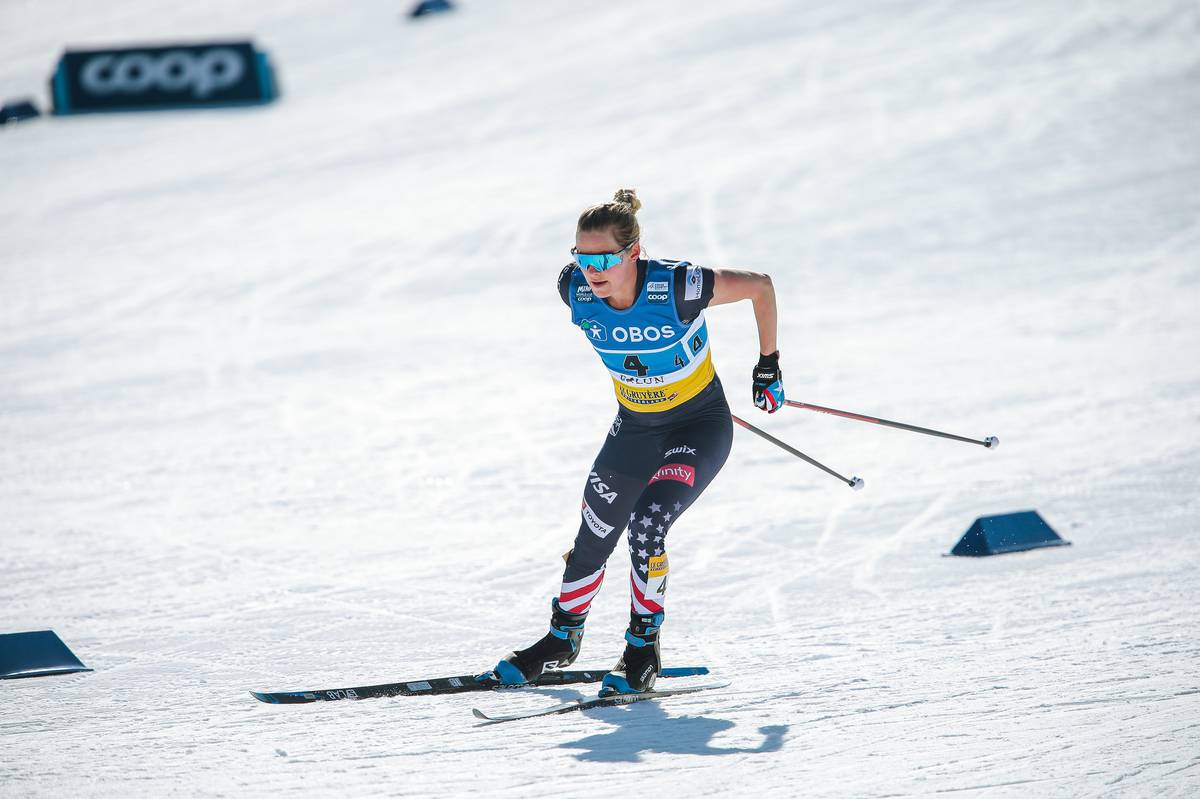
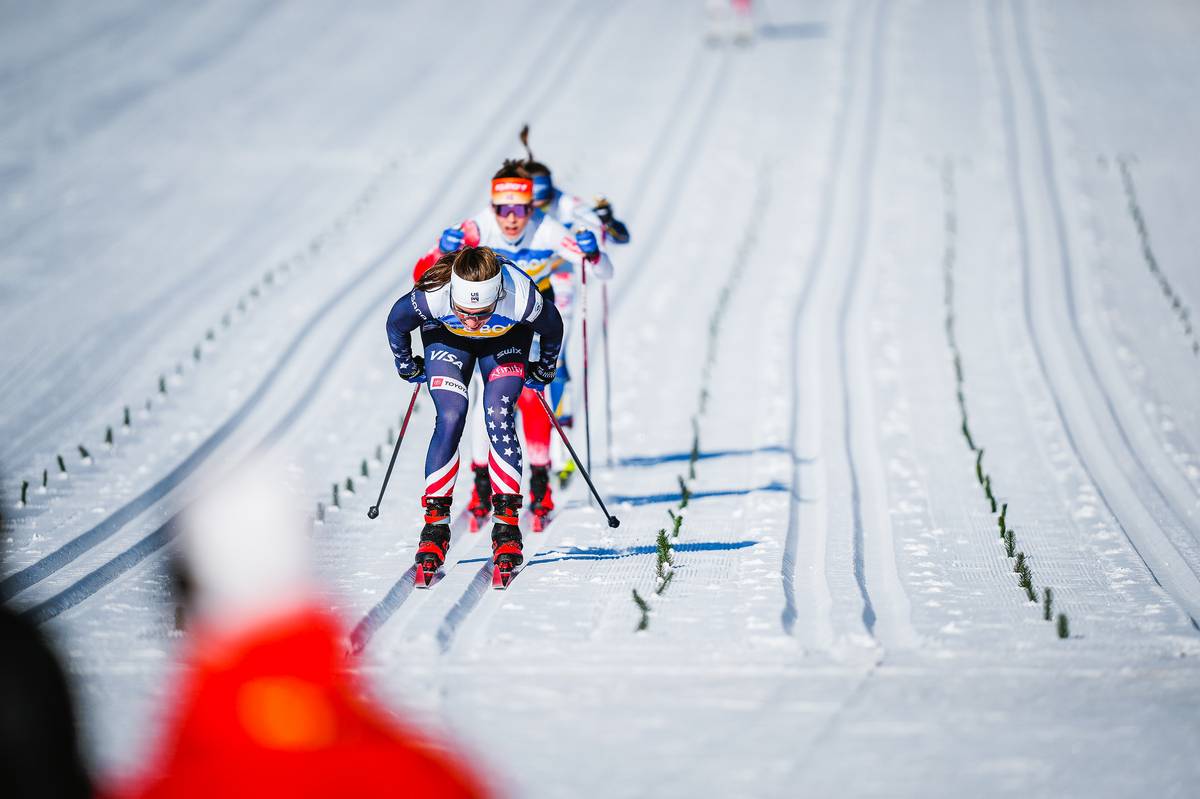
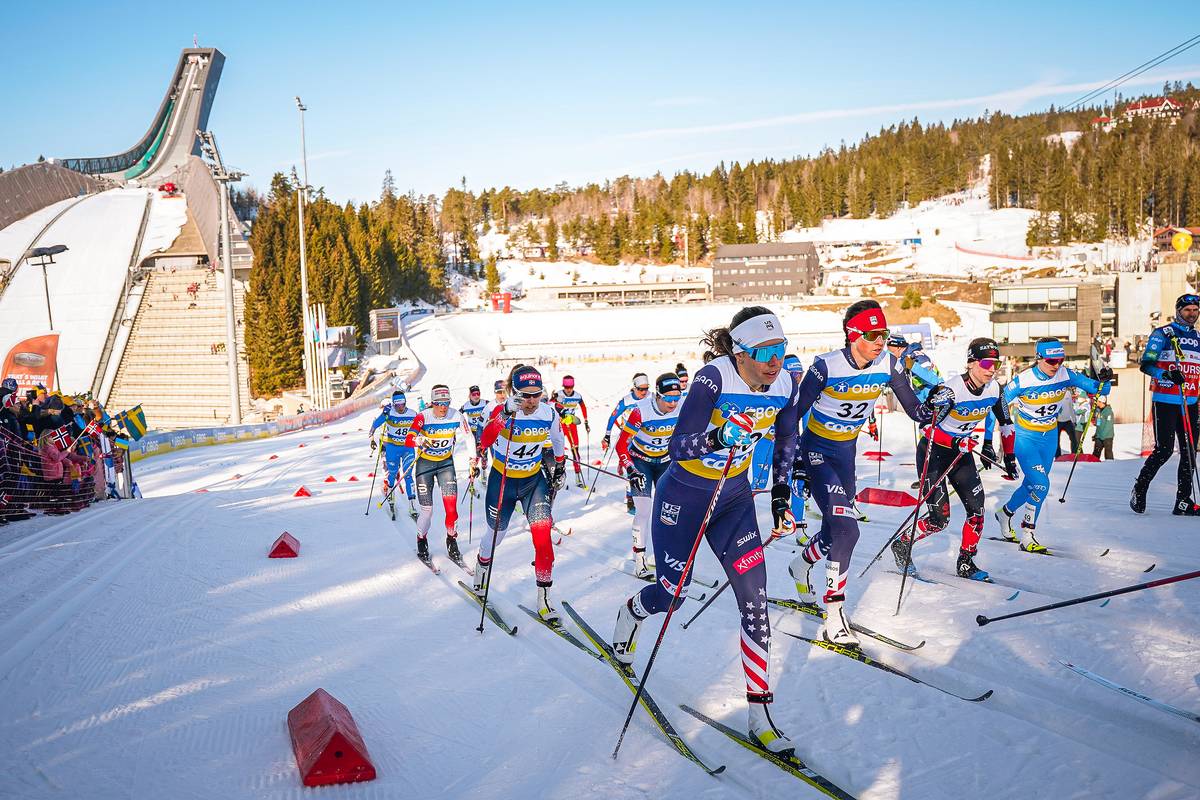
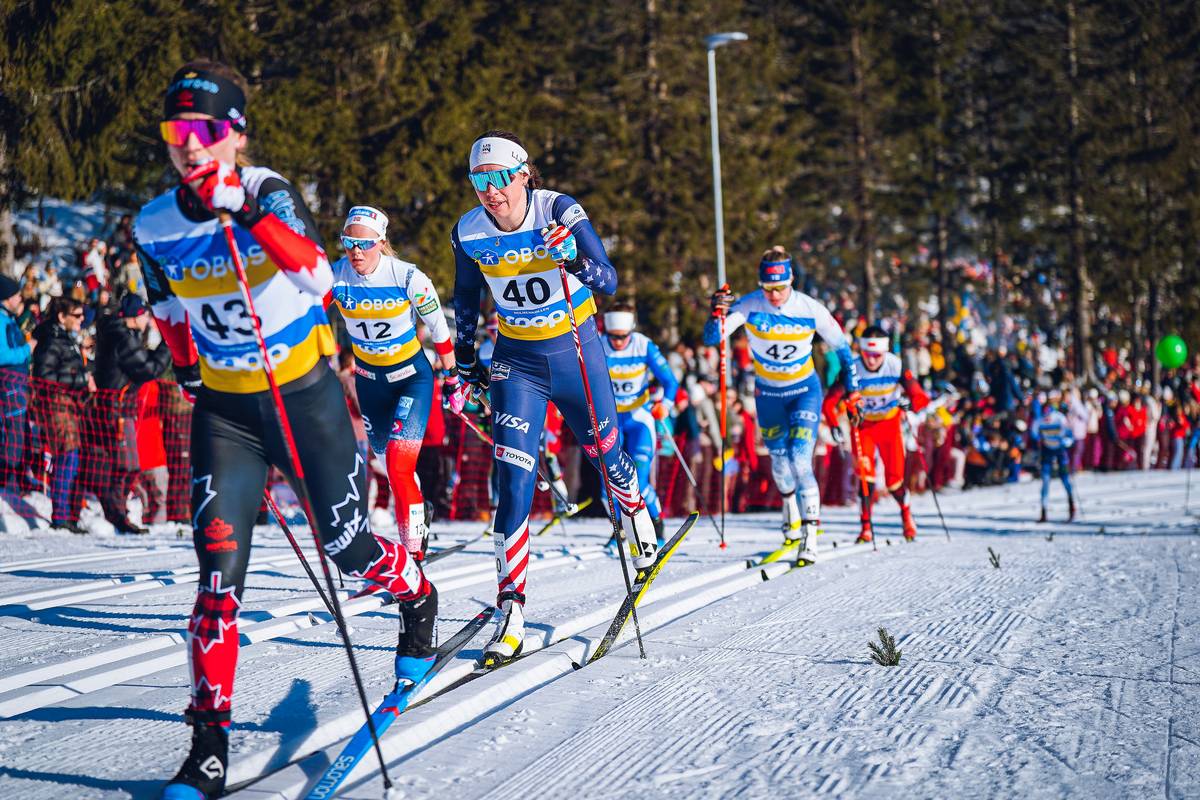
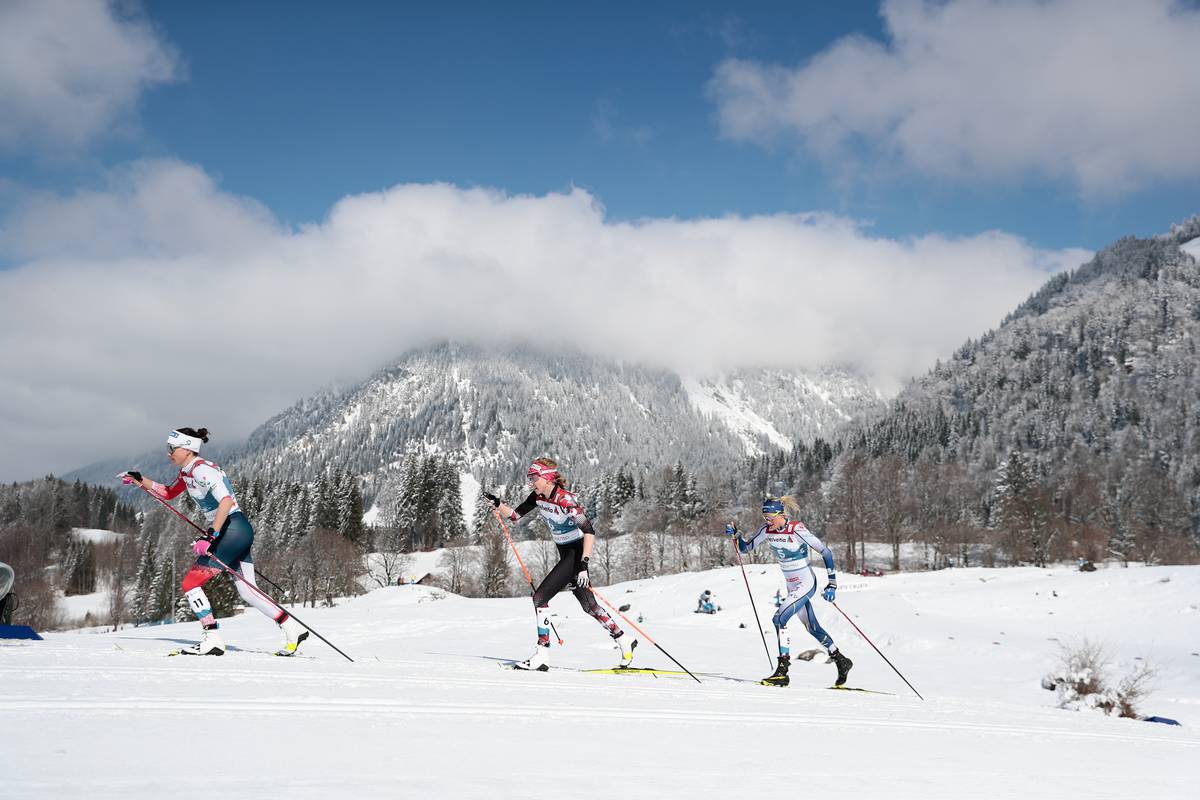
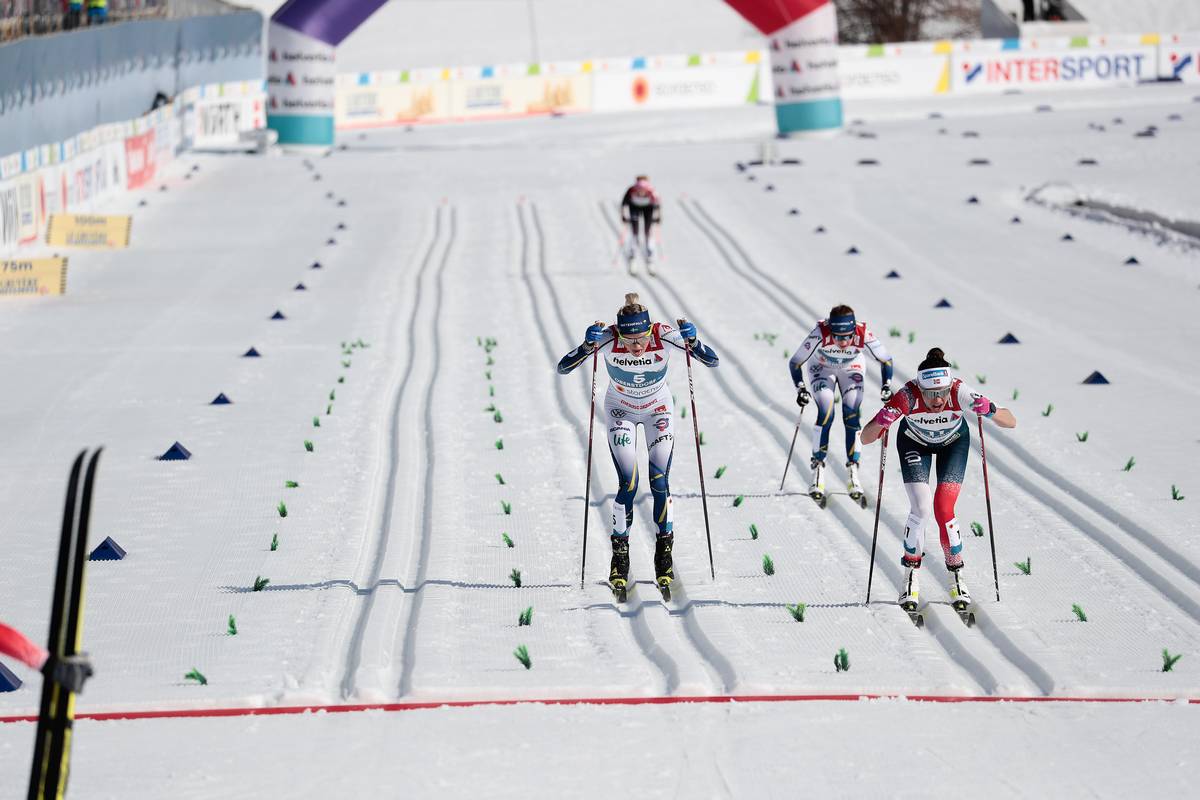
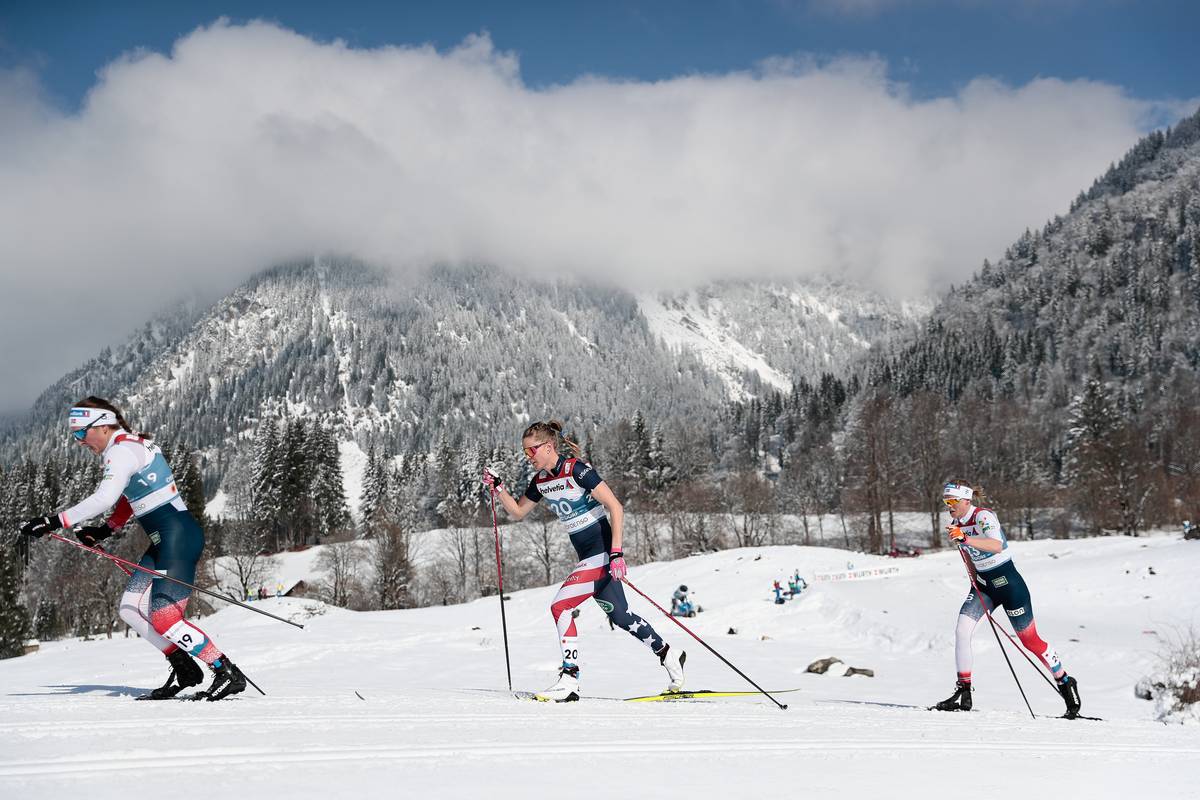
    Emma Ribom (SWE), Moa Ilar (SWE), Kerttu Niskanen (FIN), Karoline Simpson-Larsen (NOR), (l-r) lead early in the women’s 20 K Classic Mass Start in Goms, Switzerland. (Photo: Authamayou/NordicFocus)

    The sky above the Goms Nordic Centre on Sunday morning had the washed-out look of winter at altitude — pale and reflective. Snow had fallen overnight — not enough to transform the valley, but enough to affect ski behavior. The tracks were glazed in some places and soft in others, offering a surface that challenged kick, balance, and restraint.

    This was the third and final race of the last World Cup weekend before the Olympic Games. The final challenge came in the form of a 20-kilometer Classic Mass Start — a distance long enough to punish impatience, short enough to reward precision. In many ways, it felt like a rehearsal, a partial preview of the Olympic 50 k to come, even as two of the discipline’s defining figures — Sweden’s Ebba Andersson and Frida Karlsson — were notably absent.

    Fifty-six women started. Not all of them finished. None of them were anonymous by the time the race ended.

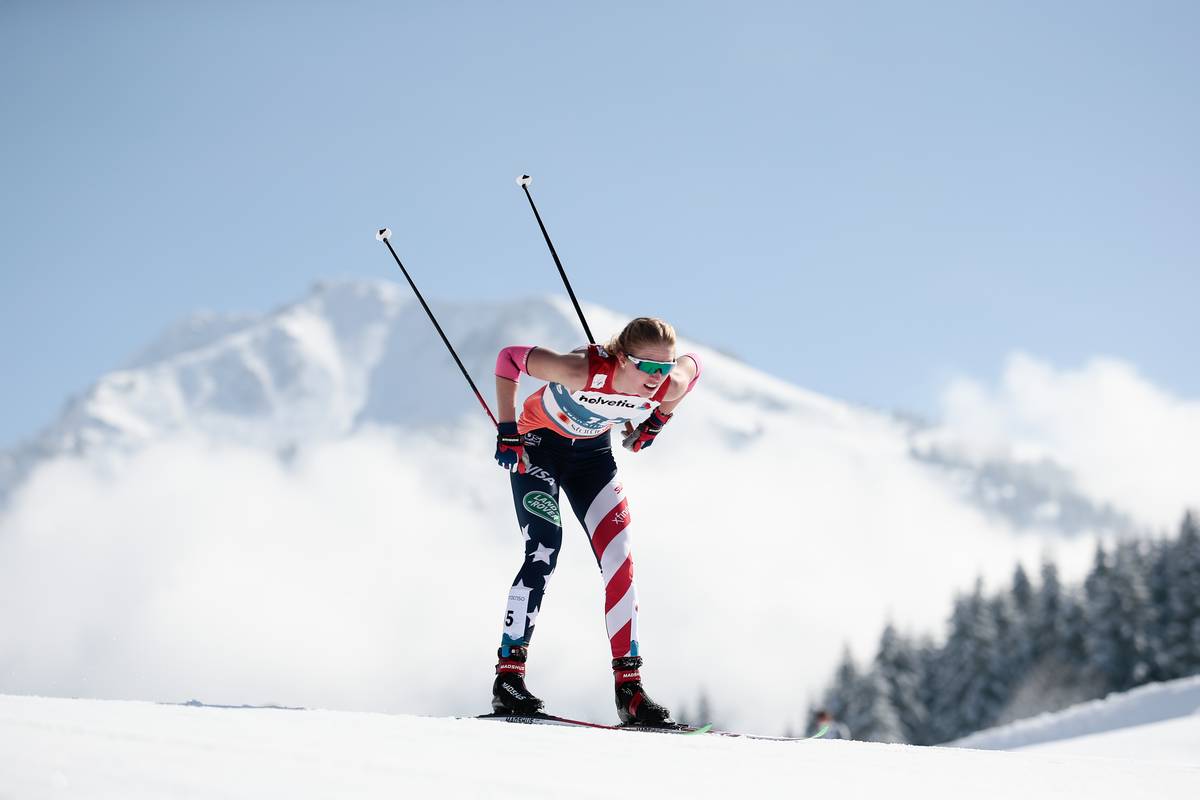
    Jessie Diggins (USA) and Astrid Oeyre Slind (NOR), (l-r) got away early in the first lap before being brought back by the chase pack around 6.5 K. (Photo: Authamayou/NordicFocus)
    An Early Question — and a Fast Answer

    From the opening kilometers, the field confirmed what the course profile had suggested: this would be a race shaped less by outright speed than by rhythm and positioning. Short climbs arrived in quick succession, descents offered only brief relief, and the peloton stretched and compressed like an accordion with every change in gradient.

    The first clear question of the day was posed early.

    On the opening lap, Norway’s Astrid Øyre Slind moved decisively off the front. Jessie Diggins, wearing bib one and leading both the overall and distance World Cup standings, responded immediately. For a moment, the two skied clear — a clean, purposeful break that suggested collaboration rather than desperation.

    The gap grew briefly, then stalled. By roughly 6.5 kilometers, the chase pack — patient, organized, and unwilling to let the race fracture too soon — closed the door. The break dissolved without drama, but not without meaning. The message was clear: separation would be earned later, not gifted early.

    Through the first full lap and into the second, the splits told a consistent story. No one was allowed to escape. The front group remained compact, with the top ten separated by only a few seconds at successive checkpoints. Every surge was answered. Every acceleration absorbed.

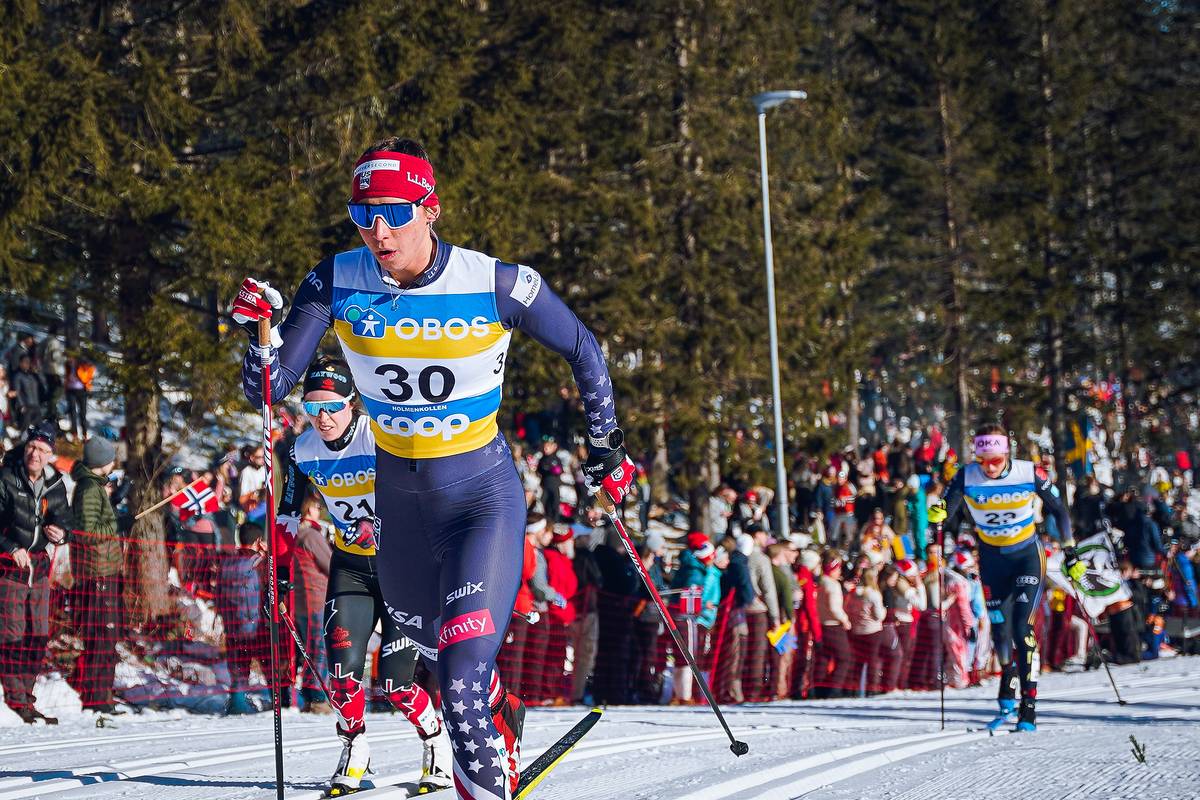
    Karoline Simpson-Larsen (NOR), Dariya Nepryaeva (AIN), Katharina Hennig Dotzler (GER), Johanna Matintalo (FIN), and Kerttu Niskanen (FIN), (l-r) work to bring back Diggins and Slind. (Photo: Authamayou/NordicFocus)
    The Long Middle: Where Races Are Actually Won

    What followed was the part of mass-start racing that rarely makes highlight reels but defines outcomes: the long middle.

    The snow conditions amplified this dynamic. The fresh layer over a firmer base rewarded good kick but punished over-striding. Downhills carried enough draft that working alone was inefficient. On climbs, being out of position meant burning matches simply to stay attached.

    Julia Kern spent much of this phase skiing in between packs — strong enough to feel underutilized, cautious enough to avoid overreaching.

    Julia Kern (USA) and Tiril Udnes Weng (NOR), (l-r) trying to maintain contact. (Photo: Authamayou/NordicFocus)

    “Today’s race was definitely a really hilly one, and not that fast, given the new snow,” Kern said afterward. “The tracks were a bit glazed, but also powder. The techs did a really good job giving us great kick, and I really needed that for how much climbing there was.”

    She described a race defined by indecision forced by circumstance rather than confidence.

    “I skied a lot of the race kind of stuck in between two packs,” she said. “In the second lap, I wasn’t sure if I should really go with the pack and risk it. I didn’t want to blow up, especially at semi-altitude. It was just hard to say with such a long, slow race.”

    When a small bridge attempt formed later in the race, Kern hesitated — not from fear, but from realism.

    “It was one of those days where I was feeling stronger than the pack I was skiing in, but not quite sure I could keep up with the pack in front,” she said. “They started to slow down, so it was a little bit of yo-yoing.”

    For Kern, the result — 16th — came with clarity rather than frustration. The margins were small, the lessons specific, and the work ahead clearly defined.

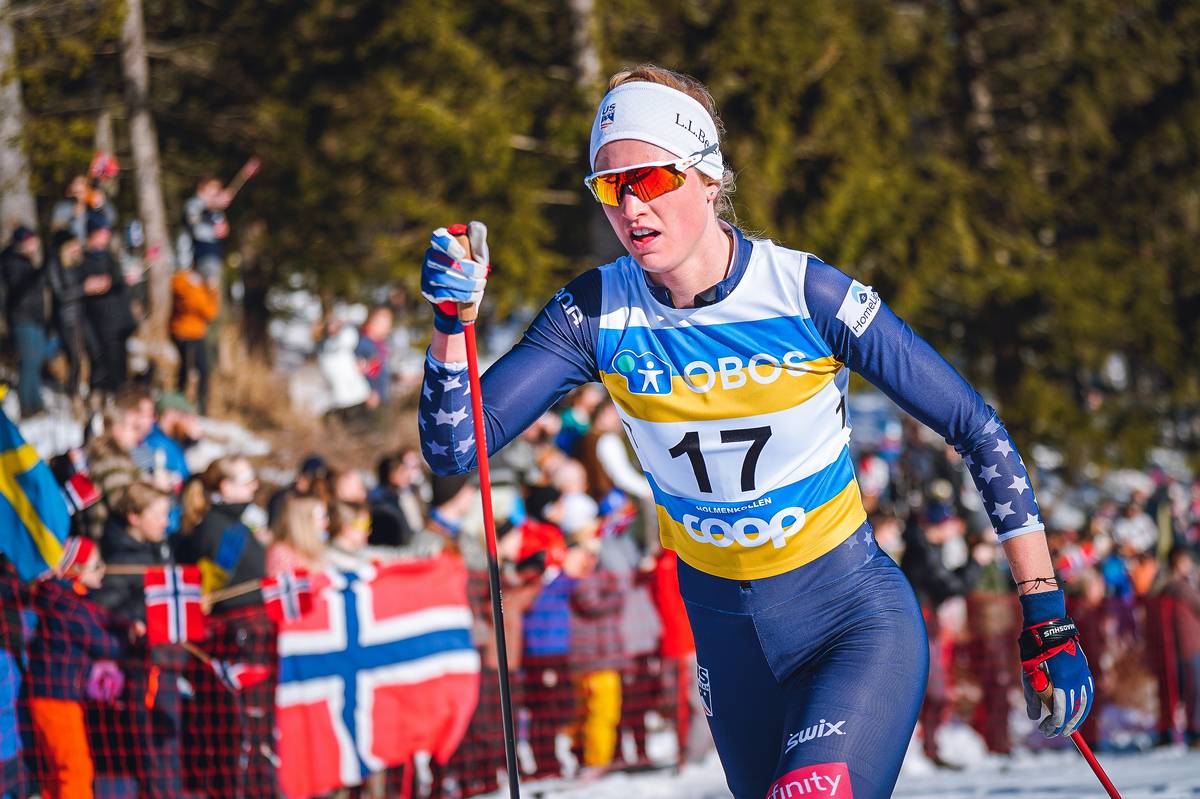
    Hailey Swirbul (USA) coming up the final climb with teammate Kendall Kramer (USA) slightly behind. (Photo: Authamayou/NordicFocus)
    Moving Forward from the Back

    If Kern’s race unfolded in the gray area between groups, Novie McCabe and Hailey Swirbul experienced the race from its deepest end.

    McCabe started with bib 57. Swirbul with 58. Both expected chaos early — and neither panicked when it arrived.

    “I kind of expected the accordion,” McCabe said. “I talked to my tech before the race, and he thought it would be a good idea to stay calm early. When it strung out, that’s when I should try to move up.”

    That patience paid dividends. As the field gradually fractured, McCabe began to advance — not in dramatic surges, but in deliberate steps.

    “I tried to push up to whoever was ahead, then tuck in and rest,” she said. “Eventually, I got into a good group with Catherine Stewart-Jones and some others. At that point, it was about hanging on a little more.”

    The effort came at a cost. McCabe admitted she was suffering late, but also recognized the value of the experience.

    “It was nice to have such a good classic skier to ski behind and try to relax in there,” she said.

    Swirbul’s approach mirrored that composure, shaped by perspective earned through time away from the sport.

    “The start of the race actually didn’t feel stressful to me,” she said. “There’s not much you can do to move up until it breaks up a little bit, so I took that as an opportunity to relax and work into the race.”

    She broke the race into manageable pieces.

    “I like trying to pick people off in a mass start,” she said. “It helps to focus on closing one gap at a time.”

    Swirbul finished 24th, McCabe 22nd — both having moved forward through nearly the entire field.

    Samantha Smith (USA), Hailey Swirbul (USA), and Rosie Brennan (USA), (l-r) early on in the women’s 20 K Classic Mass Start in Goms, Switzerland. (Photo: Authamayou/NordicFocus)
    Rosie Brennan: The Value of a Steady Day

    For Rosie Brennan, Goms was not a race defined by sharp inflection points or dramatic movement through the field. Instead, it was a professional, workmanlike effort — the kind that rarely demands attention but often proves essential when teams begin to think about Olympic lineups, relays, and durability.

    Brennan skied much of the race just outside the most active chase groups, navigating the same glazed tracks and punchy climbs that tested everyone else. On a course that punished inefficiency, her race was marked by steadiness rather than volatility. She did not chase moves that would cost more than they offered, nor did she allow the race’s elastic rhythm to pull her into repeated accelerations that would compound fatigue.

    In a season where results are scrutinized as much for how they are achieved as where they land, Brennan’s day in Goms served as a reminder of her role within the U.S. program: a veteran presence capable of managing long classic efforts even when conditions and dynamics do not invite heroics.

    These are the kinds of races that rarely make headlines — and yet, as part of Olympic preparation, they often matter most.

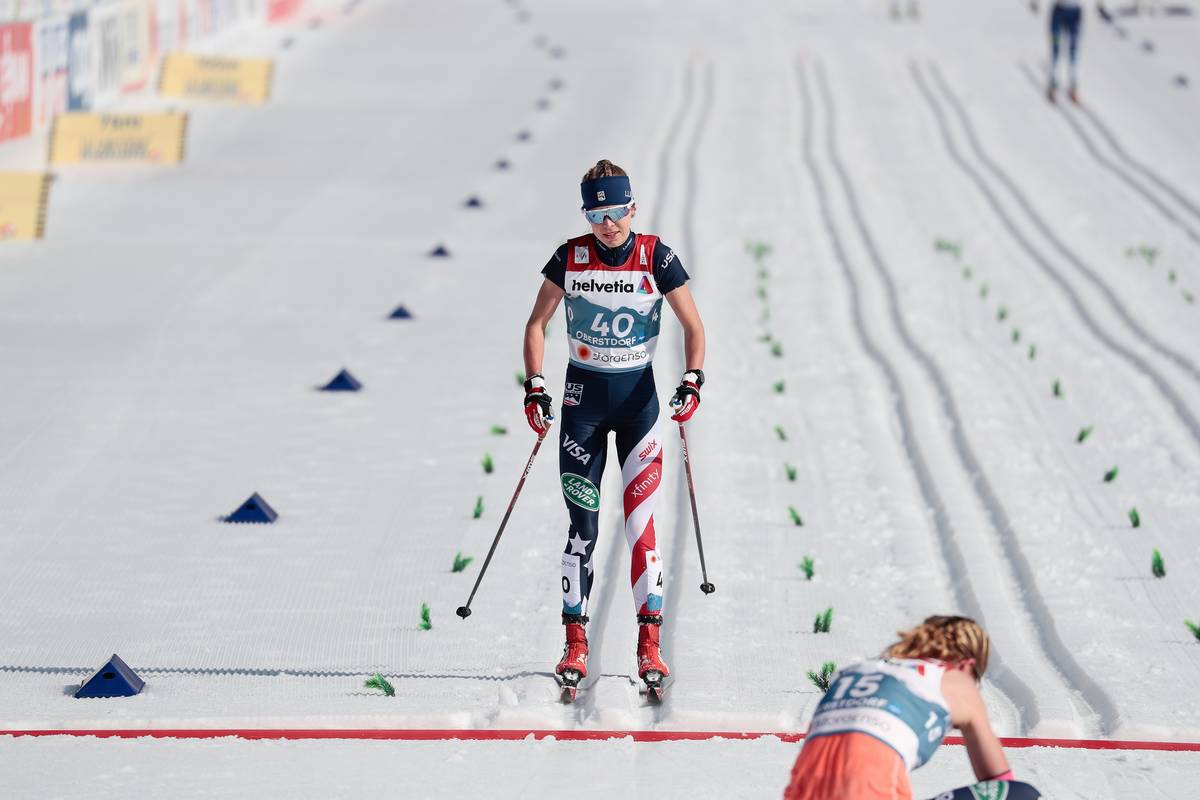
    Kendall Kramer (USA) comes to the line with a top 30. (Photo: Authamayou/NordicFocus)
    Kendall Kramer: Learning in Plain Sight

    Kendall Kramer’s race unfolded quietly, but not inconsequentially. Still early in her World Cup career and newly named to her first Olympic team, Kramer approached the 20 K Classic as both an examination and an education.

    She remained engaged with the race as it evolved, skiing within her limits while absorbing the tactical realities of a mass start at altitude: when the field compresses, when it stretches, and how much energy it costs simply to stay connected on repeated climbs. In a race where early overcommitment was punished and late positioning proved decisive, Kramer’s task was not to force relevance, but to understand it.

    Her finish inside the top 30 (27th) reflected a growing familiarity with World Cup distance racing — not yet a statement, but a step. For an athlete still building the physical and tactical base required for races of this length, Goms offered clarity about where the work remains, and confidence that she belongs in the conversation.

    Samantha Smith (USA) nears the end of the 20 K in Goms, Switzerland. (Photo: Authamayou/NordicFocus)
    Samantha Smith: Building the Long View

    For Samantha Smith, the 20 K Classic represented another piece in a longer developmental arc — one that continues to unfold quietly but deliberately.

    Smith skied the full distance with control, settling into the rhythm of the race rather than fighting it. In a field that included Olympic medalists, Crystal Globe contenders, and seasoned distance specialists, her goal was not to dictate the race but to measure herself against it. The result reflected that intention: steady pacing, minimal volatility, and a complete performance on a demanding course.

    At this stage of her career, races like Goms are less about immediate return and more about accumulation — learning how long classic efforts feel when contested at World Cup intensity, how fatigue presents itself late, and how small tactical decisions compound over 20 kilometers.

    Those lessons are not always visible on a results sheet. But they are foundational — and necessary — for what comes next.

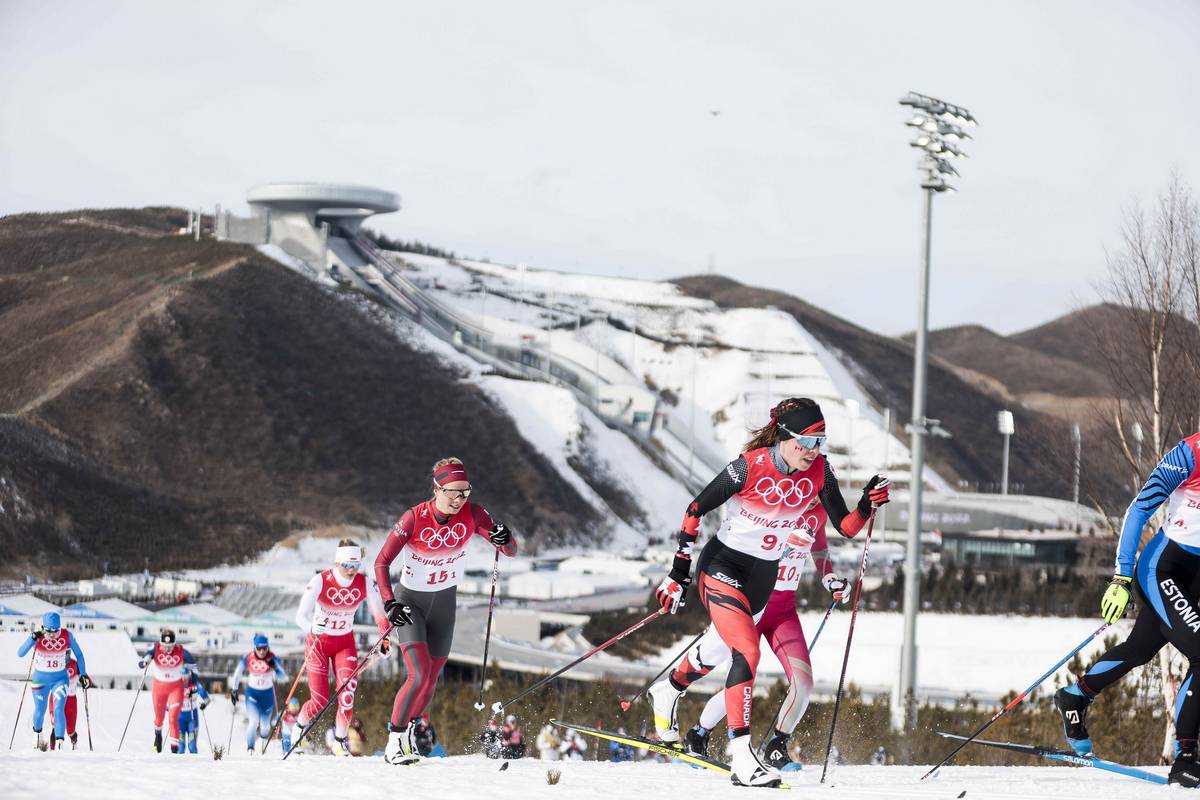
    Alison Mackie (CAN) continued her strong season as the U23 leader. (Photo: Authamayou/NordicFocus)
    The Canadian Women: Depth That Shapes the Race

    While the podium fight ultimately played out among familiar names, the Canadian women were far from passive participants in the race’s structure.

    Alison Mackie, wearing the under-23 leader’s green bib, skied assertively within the main chase group for much of the race. Starting deeper in the field, she navigated the accordion effect with composure, staying attached as the pace fluctuated and the snow conditions demanded constant adjustment. Her performance reinforced why she has emerged as one of the most promising young distance skiers in the World Cup field.

    Katherine Stewart-Jones, meanwhile, played a quieter but equally influential role. Her presence in the chase packs — particularly later in the race — provided both pace and stability. For athletes moving forward from the back, including Novie McCabe and Hailey Swirbul, Stewart-Jones’ classic proficiency offered a valuable reference point, a wheel worth following when the race began to exact its toll.

    Together, the Canadian performances underscored a broader truth about modern World Cup distance racing: influence is not limited to podium contenders. Nations with depth — even without a skier contesting the final sprint — shape how races unfold, how packs form, and how energy is spent.

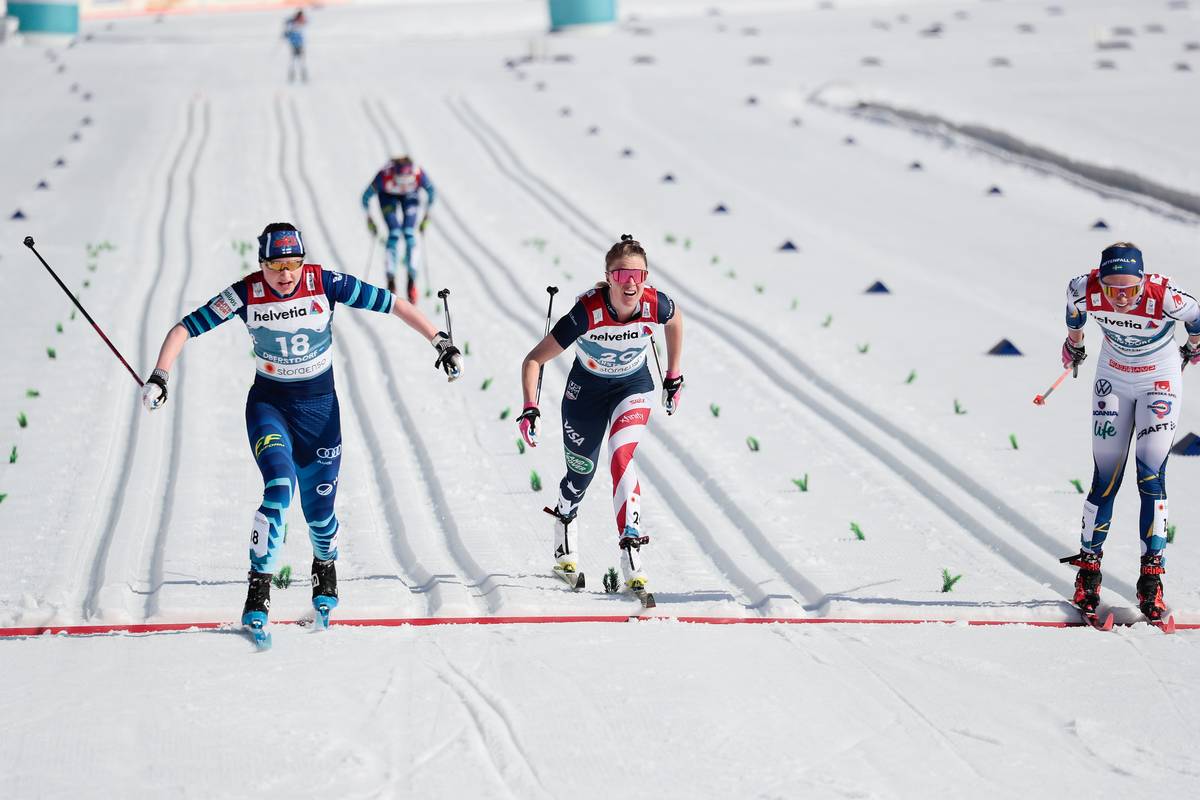
    Astrid Oeyre Slind (NOR), Johanna Matintalo (FIN), and Jessie Diggins (USA), (l-r) charge for the podium. (Photo: Authamayou/NordicFocus)
    The Final Selection

    By the final lap, the race had distilled itself down to a familiar truth: six women remained, and no one else was coming back.

    Diggins had conserved. Øyre Slind remained vigilant. Finland’s Johanna Matintalo had been quiet — almost invisible — in the way that often precedes a decisive move.

    Diggins knew exactly what she had left, and just as importantly, what she didn’t.

    “I knew I was going to need to ride the draft as much as possible and save my energy,” she said. “It’s been a really big training week for me, so I knew I kind of had one shot.”

    Her plan was precise.

    “I was going to need to launch that move as late as possible, probably on the hill,” she said. “I had amazing kick. Double-poling isn’t quite my strength right now.”

    On the final major climb, Diggins moved. So did Øyre Slind. But Matintalo matched them — and crested first.

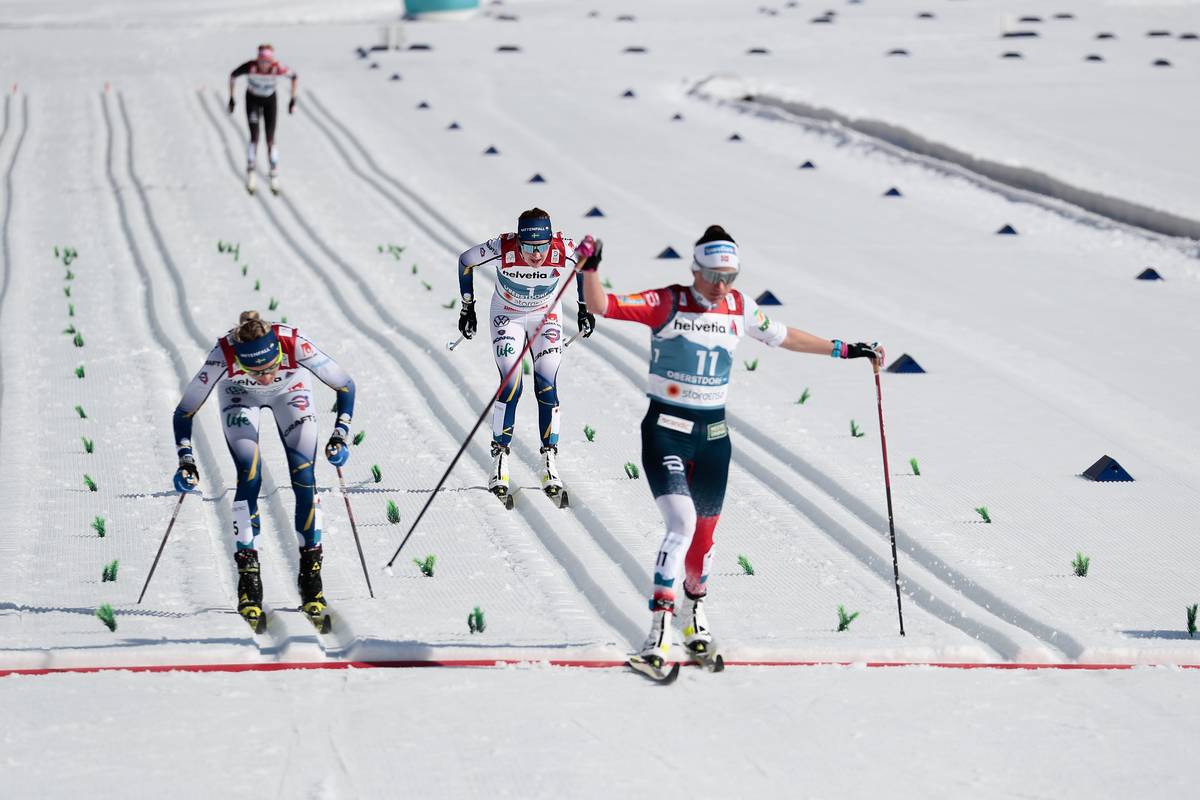
    From there, the race tipped irrevocably. Matintalo exited the climb with speed, controlled the final straight, and claimed her first World Cup victory. Diggins finished second, securing her 77th individual World Cup podium. Øyre Slind followed in third.

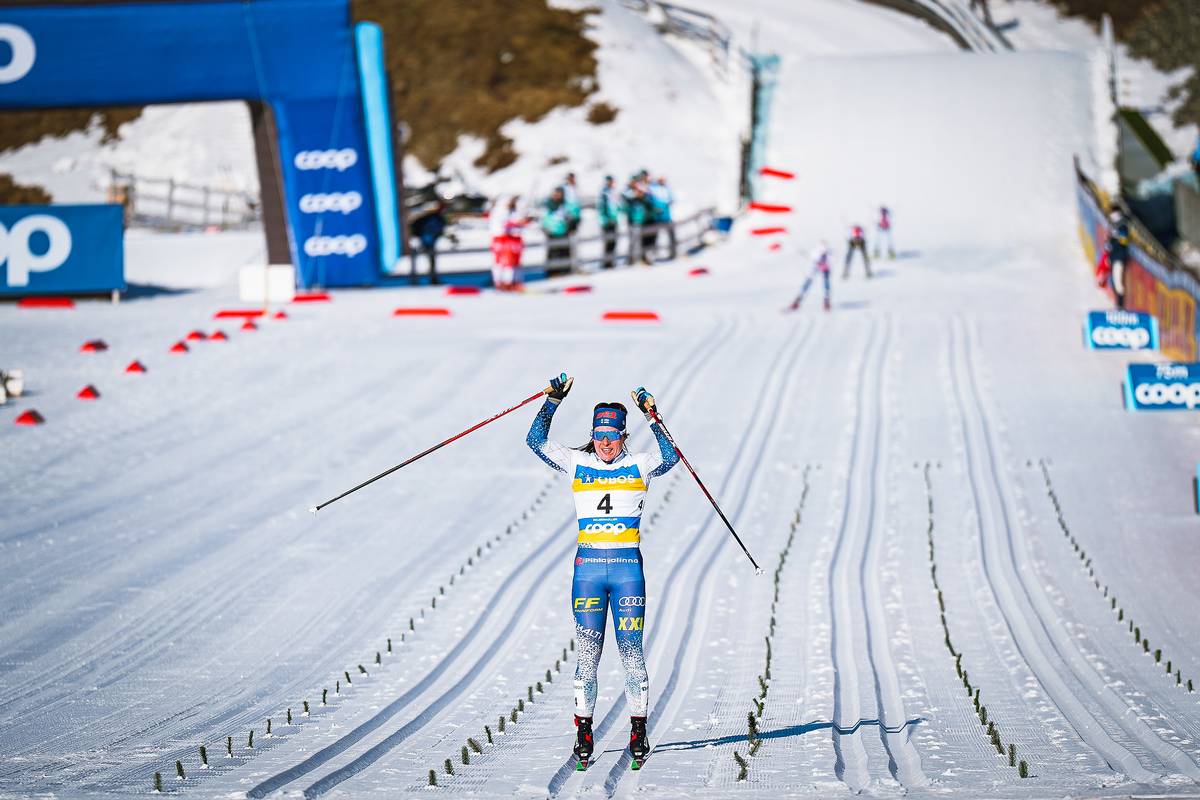
    Johanna Matintalo (FIN) claims the victory, with Jessie Diggins (USA) second, and Astrid Oeyre Slind (NOR) third. (Photo: Authamayou/NordicFocus) 


    What It Means Going Forward

    This was the final race before the Olympic Games. Diggins left Goms having extended her lead in both the overall and distance World Cup standings. More importantly, she leaves having confirmed — again — that her classic skiing is no longer something she manages, but something she trusts.

    “I try not to overthink it,” Diggins said of the looming 50 k. “All you can do is the best you can in the moment with the tools you have that day.”

    That sentiment echoed through the U.S. team’s performances — from podium contention to patient rebuilding.

    The race in Goms did not offer easy answers. But it did offer honest ones.

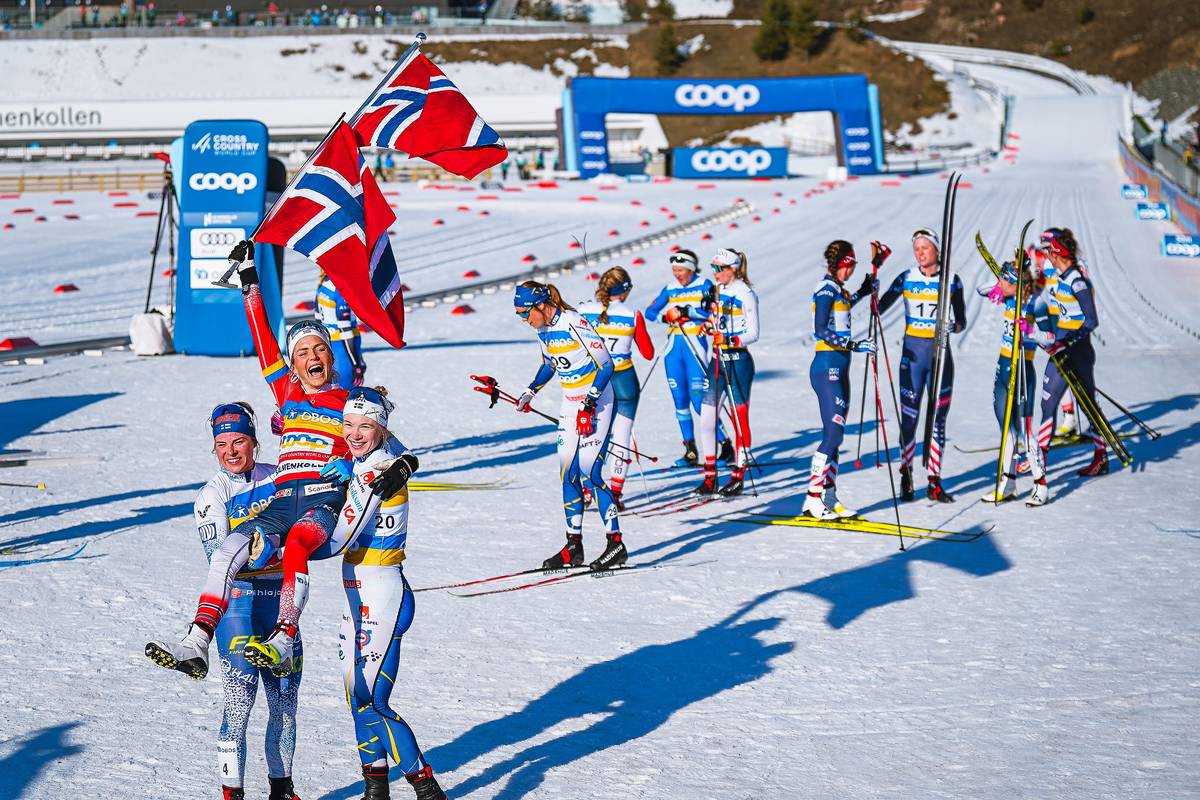
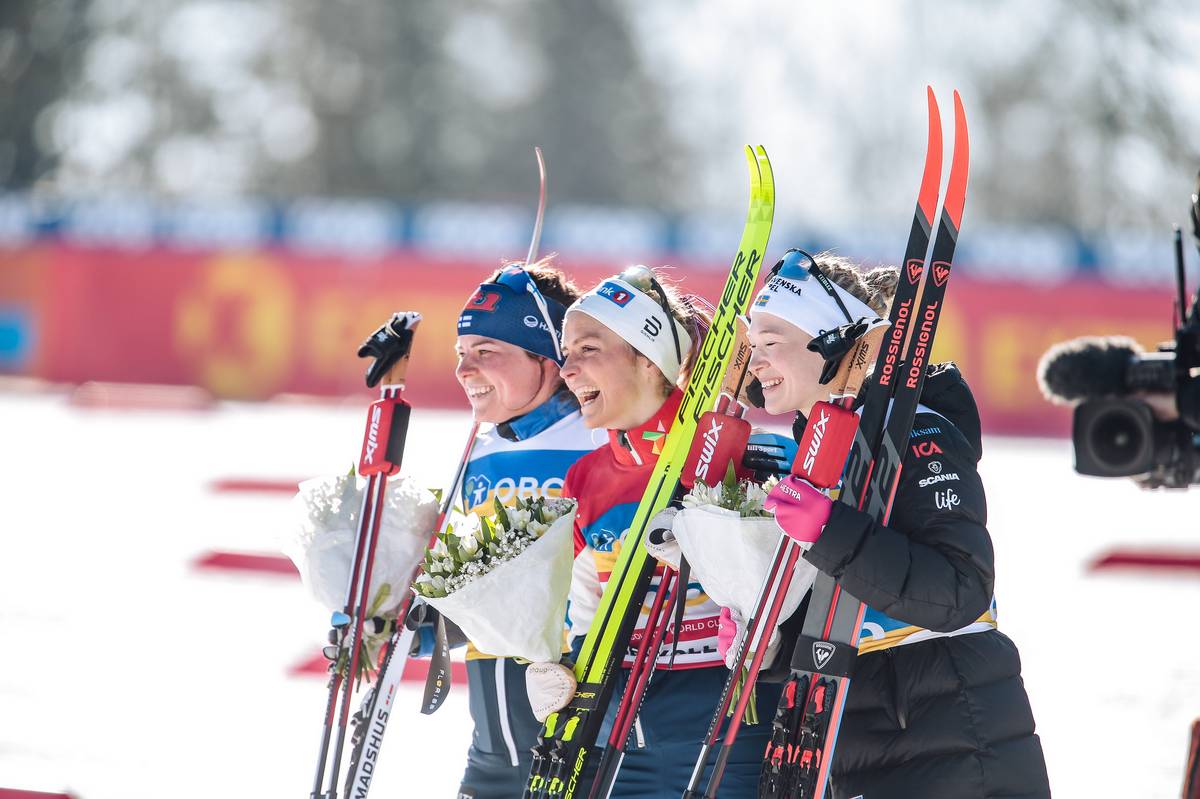
    Jessie Diggins (USA), Johanna Matintalo (FIN), and Astrid Oeyre Slind (NOR), (l-r) share the 20 K Classic Mass Start podium in Goms, Switzerland. (Photo: Authamayou/NordicFocus)
    A Quiet Confidence

    By the time the fog settled back into the valley and the stadium emptied, the course had revealed itself fully. It had rewarded patience. It had punished haste. And it had reminded everyone watching — and skiing — that distance racing rarely announces itself loudly.

    The Olympic 50 k will be longer. The stakes will be higher. The margins may be smaller still.

    But the questions asked in Goms were the right ones — and the answers, for those willing to listen, were already there.


    Goms World Cup Women’s 20 k Classic Mass Start RESULTS

    Women’s World Cup DISTANCE STANDINGS

    Women’s World Cup OVERALL STANDINGS


    Help Support Our Olympic Coverage!

    FasterSkier will have our own Nat Herz on the ground at the Olympics. If you value the thoughtful work FasterSkier provides at championships like this one, please consider becoming a Voluntary Subscriber.

    Join the FasterSkier community!


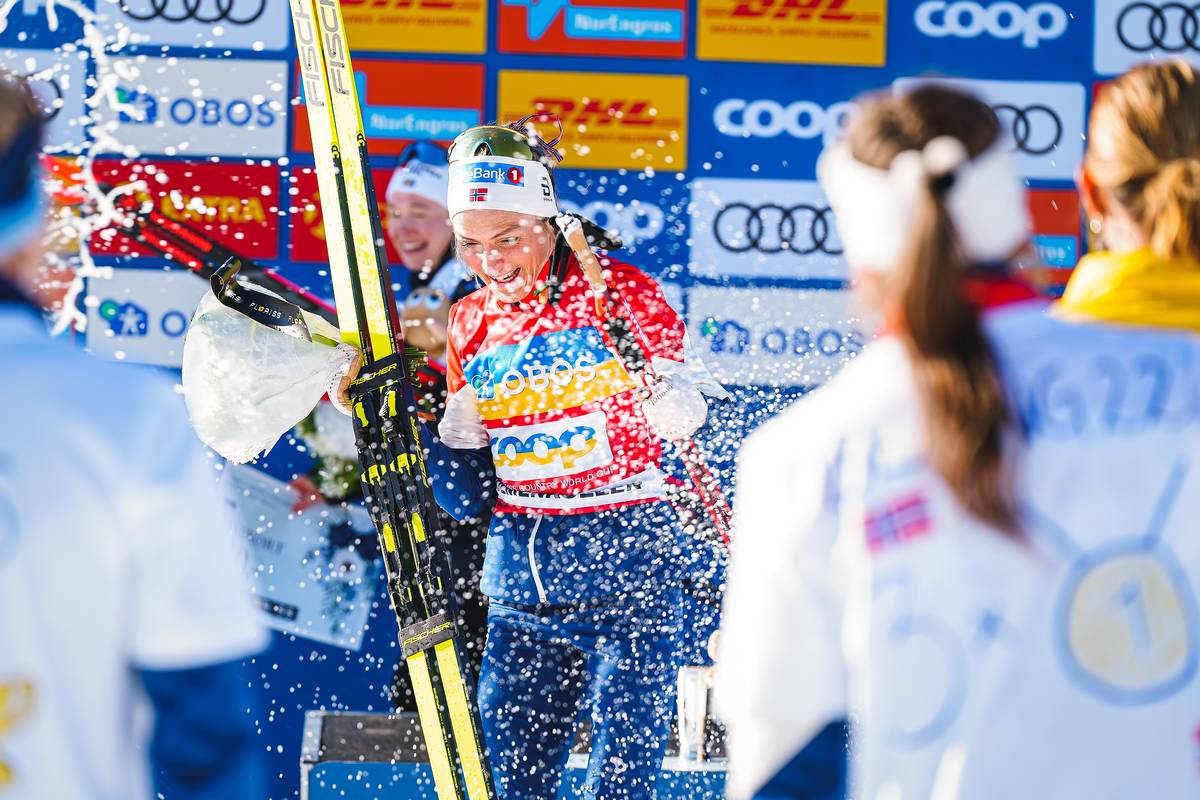
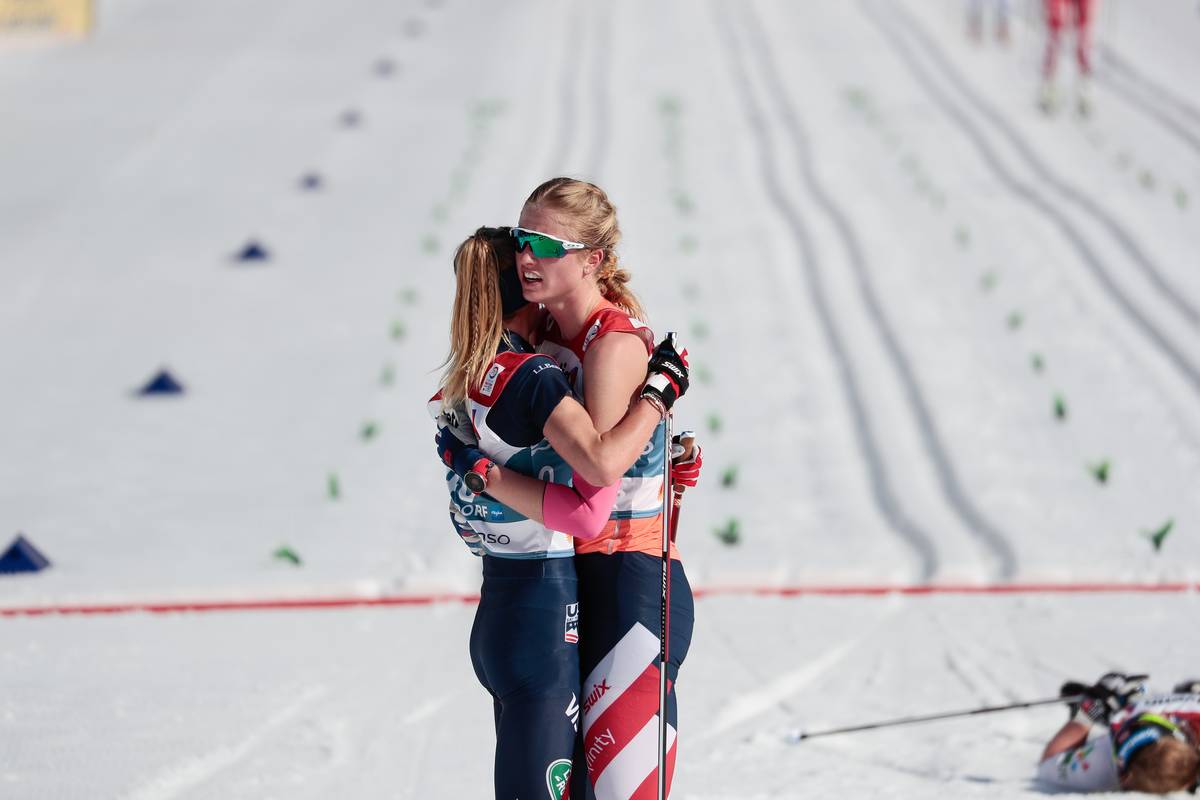
    Jessie Diggins (USA) and the US team celebrate another podium in Goms, Switzerland. (Photo: Authamayou/NordicFocus)
  • The Devon Kershaw Show: You Got One Shot, One Opportunity

    The Devon Kershaw Show: You Got One Shot, One Opportunity

    For some, the season opening races in Sweden and Norway, especially, are tuneups. For others, they’re effectively athletes’ ‘one shot’ to qualify for the World Cup races that also operate as qualifiers for Olympic teams.

    Devon and Nat are back with recaps from Beitostolen and Gallivare, plus notes on early season conditions and Devon’s lonely but filling med student dinner in Oslo. Reach us at devon[at]fasterskier.com and nat[at]fasterskier.com. We’re also looking for presenting sponsors for the season and for our on-site coverage of the Olympics — if you’re interested in exploring that, please contact matthew[at]fasterskier.com.

    Love Stories Like This? Help Keep Them Coming.

    Feature interviews like this one take time, access, and care to produce. If you value thoughtful storytelling and independent ski journalism, please consider becoming a Voluntary Subscriber. Your support directly fuels the work we do to cover the people, places, and moments that make our sport special.

    Join the FasterSkier community!

     

  • Fast Tracks: World Champs—Canadian Women following the relay

    Fast Tracks: World Champs—Canadian Women following the relay

    This reporting costs money. Please support this coverage with a voluntary subscription (below) so FasterSkier can provide this level of access to the sport we all love year-round.

  • Fast Tracks: World Champs—Not the Day Katherine Stewart-Jones Had Hoped to Have

    Fast Tracks: World Champs—Not the Day Katherine Stewart-Jones Had Hoped to Have

    This reporting costs money. Please support this coverage with a voluntary subscription (below) so FasterSkier can provide this level of access to the sport we all love year-round.

  • The Devon Kershaw Show: Recapping a soggy, fluoro-free weekend in Trondheim

    The Devon Kershaw Show: Recapping a soggy, fluoro-free weekend in Trondheim

    Eli Brown, a member of the U.S. Ski Team’s waxing and ski service staff, joins us this week to talk about his job and the new enforcement of the rules banning fluorocarbons on the World Cup circuit. We recap another strong weekend for American athletes, along with all the hijinks that happened in Trondheim, Norway at the test event for next season’s World Championships.

    The World Cup takes a break next weekend before the Tour de Ski, but we may try to squeeze in a mailbag episode. Send us questions if you’ve got ’em. Reach us at nat@fasterskier.com and devon@fasterskier.com.

  • Swinging through Sweden with Canada’s Katherine Stewart-Jones

    Swinging through Sweden with Canada’s Katherine Stewart-Jones

    The World Cup’s penultimate weekend of the year took us to Falun, Sweden for a trio of races, including two more fun 10 ks and a mixed relay. Canada’s Katherine Stewart-Jones joins us to recap her sensational season and what’s ahead for her next year.

    We’ll be back after Tuesday’s city sprint in Tallinn, Estonia. Get at us at devon@fasterskier.com and nat@fasterskier.com.


  • Diggins First, Brennan Third in Davos 20 K Freestyle

    Diggins First, Brennan Third in Davos 20 K Freestyle

    A_Hall_Mark_of_Excellence_Award-logo-300.png (300×244)

    This World Cup coverage is made possible through the generous support of Marty and Kathy Hall and A Hall Mark of Excellence Award.  To learn more about A Hall Mark of Excellence Award, or to learn how you can support FasterSkier’s coverage, please contact info@fasterskier.com.

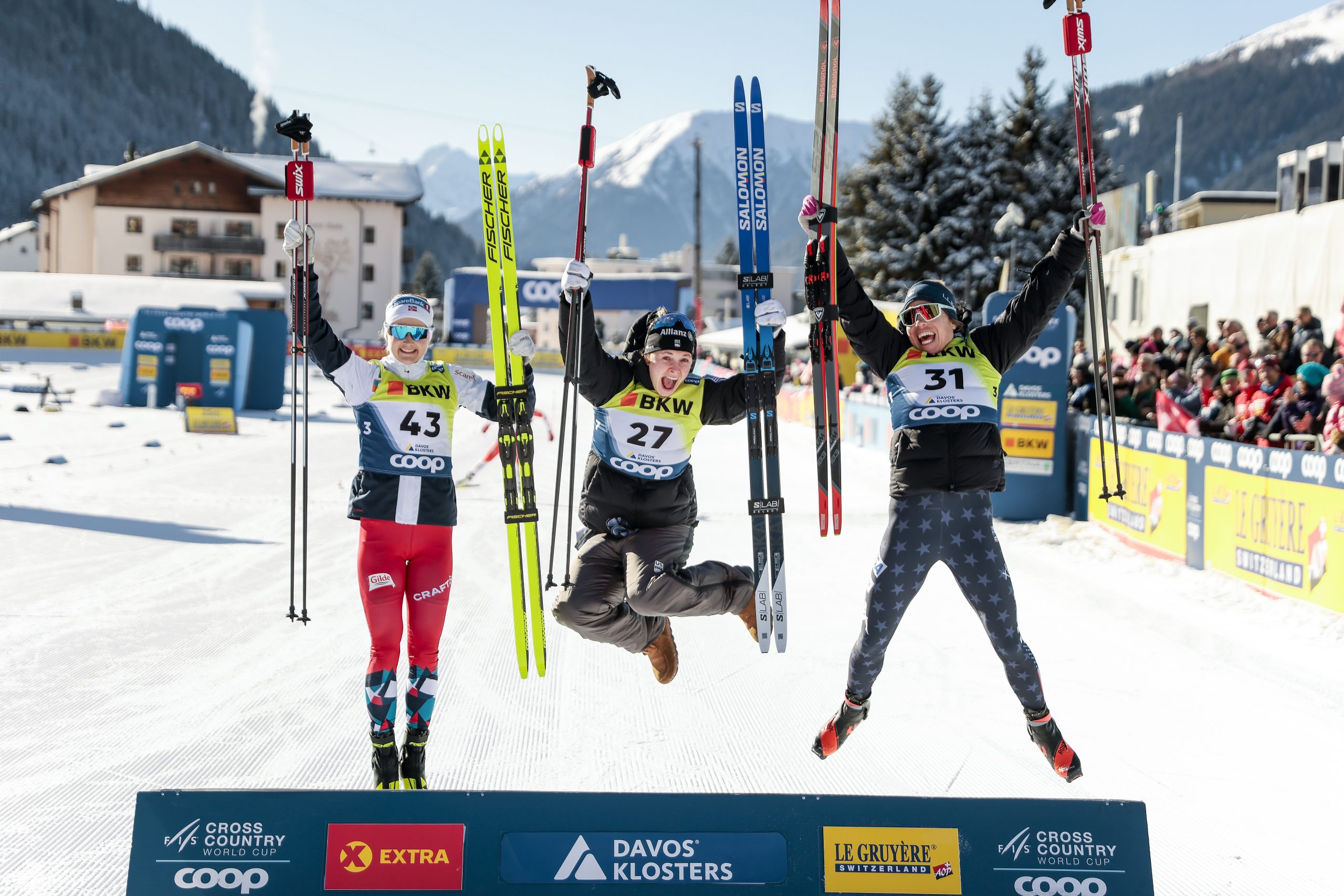
    An American celebration in Davos as Jessie Diggins and Rosie Brennan take first and third: l-r Ingvild Oestberg (NOR), Jessie Diggins (USA), Rosie Brennan (USA) (Photo NordicFocus)

    Today the World Cup returned to Davos, Switzerland where the women competed in the 20 k Individual Start Freestyle.  As has been the case for the last several weeks, much of the critical pre-race story was about who wouldn’t be present.  Absent from the field was Swedish long-distance heavy hitter Frida Karlsson and teammate Ebba Andersson.  Missing from the Norwegian squad was Heidi Weng.

    The U.S. hoped that Jessie Diggins could find her way back to the podium after yesterday’s second place sprint finish.  Diggins has the most wins of any active woman athlete in individual distance freestyle, having won 10.  She is also the most recent woman to have won consecutive individual World Cup distance events in the freestyle when she did so in January, 2021.  After yesterday’s sprint performance, Diggins moved into second place in the overall World Cup standings, behind Tiril Udnes Weng (NOR).

    Taking first place was Jessie Diggins (USA), in second was Ingvild Flugstad Oestberg (NOR), and in third Rosie Brennan (USA). Other American finishers were Sophia Laukli (17th), Alayna Sonnesyn (26th), and Lauren Jortberg (39th). Novie McCabe was scheduled to race but did not start due to illness.

    It was another standout day for the Canadians with Katherine Stewart-Jones finishing 11th, Olivia Bouffard-Nesbitt 30th,  Dahria Beatty 32nd, and Liliane Gagnon 40th.

    Jessie Diggins (USA) showing the hardware that comes with first place. (Photo: NordicFocus)

    In a pre-race interview Diggins said that she thought Davos was a fun course and really challenging. “It’s sneaky hard,” she said, reiterating her love for individual start skate races.  “Just give me a trail in woods by myself and my skis and my brain . . . and I’m just excited to see how hard I can go.”

    The skiers had another beautiful Davos day with full bright sun.

    Rosie Brennan with the decisive lunge at the finish.  It was enough to get her third place by half a second. (Photo: NordicFocus)
    20 K Individual Freestyle

    Diggins went out hard at the start. At the 2.2-kilometer time-check she had the fastest time by a slim margin over Claudel Delphine (FRA).  Brennan started at a controlled tempo and was fifth after the first time check.

    Diggins kept the hammer down for the first  seven kilometers, leading at every time check. But her lead was very small, ahead of Oestberg by only seven seconds. By the time the 7.2-kilometer mark was reached, Oestberg—who had a later start position than Diggins—had clawed her way into first, leading Diggins by just over a second. The see-saw between the two would continue for the rest of the day with Oestberg hanging onto a small lead for much of the race.

    Tactically, it appeared that Oestberg might have an advantage being the last of the top three skiers to start, so she would be fed the others’ times along the way. But Diggins has told Fasterskier in the past that she’s not always interested in hearing split times; she just skis as hard as she can. She also values having warmups conclude close to her starting time.

    U.S. coach Chris Grover confirmed with Fasterskier that, “[Diggins] likes to take an earlier draw in start position because she likes to not have the track closed for so long for warmup. She really doesn’t even think of splits out there. Jessie knew exactly how she wanted to ski that course and that was to not go quite as hard on all of the ups . . . you have to work all the transitions, all the corners, all of the downs.  The last 1.8 K are down . . . she had that strategy in mind for how she was going to ski it and she went out and skied it exactly the way she wanted to.”

    Jessie Diggins (USA) found another gear in the final 1.8 k to finish first. (Photo: NordicFocus)

    Grover continued that it was a different approach for Brennan. He said, “She’s prioritizing climbing on the uphills. Two opposite strategies and they both worked out pretty well for them.”

    Twenty kilometers is still a relatively new distance for the women, so proper pacing would be critical.  Grover indicated that the change to 20 k hasn’t been much of an issue. “It seems like it hasn’t been that hard of a transition,” Grover said. “They looked like they were at a high pace the whole time, the same kind of strategies they employed on this course in 10-K. We did a little bit of feeding, which we wouldn’t have done in a 10-kilometer event. Otherwise, it wasn’t so different.”

    “I really wanted to pace it like red-line pacing…go as hard as I could right before I felt like I was going to blow up, and then hold it there.”                                                  Jessie Diggins

    Diggins continued: “My strengths are the second half of the lap with all of these working sections, trying to find the extra seconds here and there,” she said. “We had some really awesome skis, and awesome energy from the fans.”

    Regarding pacing for today’s race, Brennan told Fasterskier that: “I have never done a 20k interval start which was probably true for the whole field today. That made it really tricky to know the pace or really what to expect. I love the course here and love skiing at altitude so I had some confidence that I could find a steady pace and hold it.”  

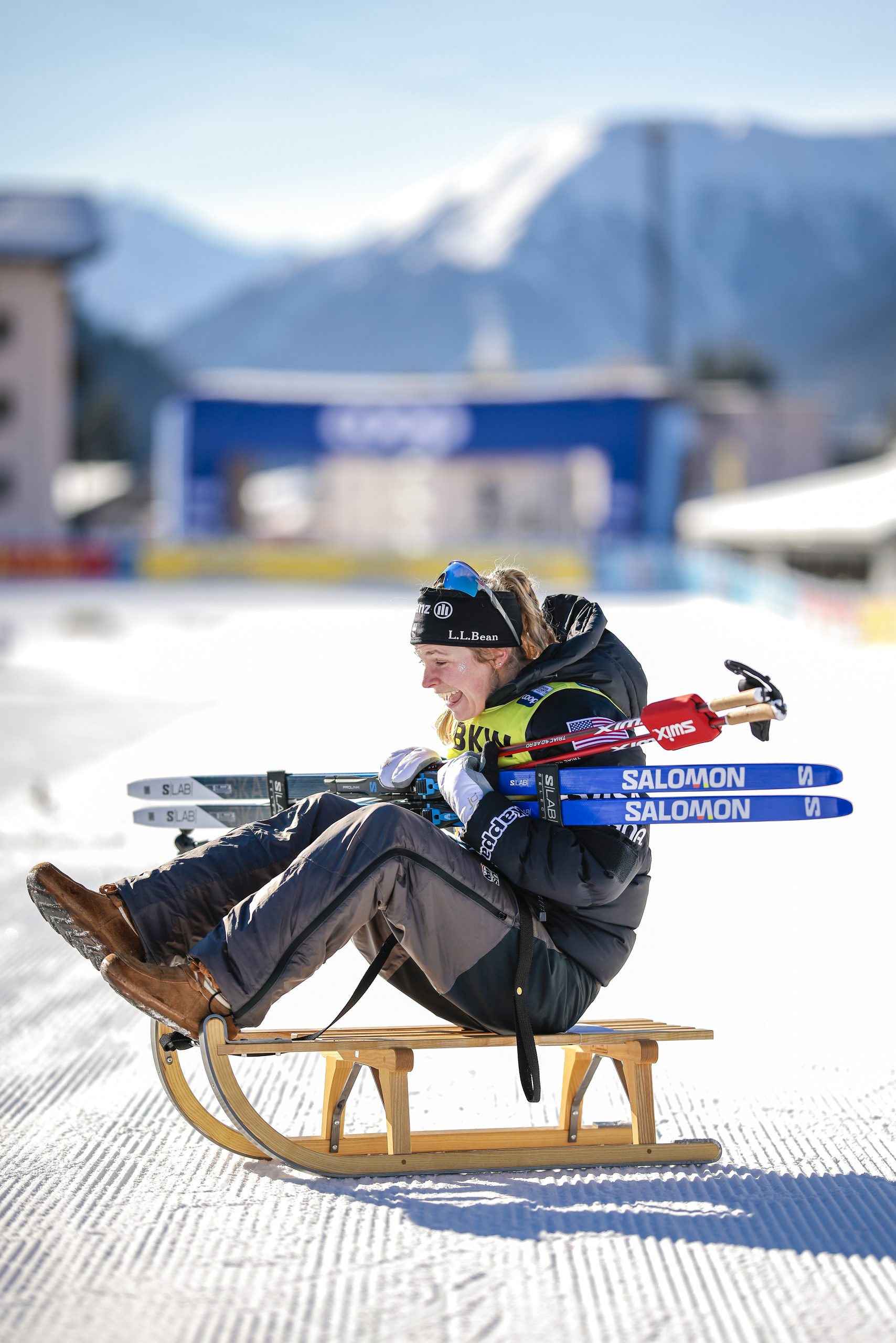
    Jessie Diggins (USA) enjoying her first place hardware in Davos.  The full-sized sled goes to the winner.  (Photo: NordicFocus).

    With only five kilometers to go, the race for first was almost a dead heat.  Oestberg had a scant three second lead over Diggins. Meanwhile, the fight for third was boiling down to Brennan and Tiril Udnes Weng (NOR). At the 15 kilometer mark, Weng held a one second lead over Brennan. Both those racers were over 13 seconds off first place.

    As the race wound down, the momentum for first place seemed to favor Oestberg as she continuously displaced Diggins from the lead with each time check she passed. But her lead was small enough that Diggins remained in the hunt for first place.

    With two kilometers to go the competition had boiled down to two distinct races: Oestberg and Diggins battling for first, and Brennan and T. Weng battling for second. The tension continued to mount as Oestberg approached the final time-check at 18.2-kilometers. Oestberg had moved past Diggins at every time split since the 7.2-kilometer mark, and that trend continued at the last time check with Oestberg going into first place, but by only 2.9 seconds. Brennan and T. Weng were even closer with less than two seconds separating them with Brennan holding the lead.

    With the race close—but momentum still in Oestberg’s favor—one couldn’t help but have the feeling that things would go Oestberg’s way.

    Rosie Brennan (USA) showing the grit needed to earn a spot on the podium. (Photo: NordicFocus)

    But as ski fans have seen so many times over the years, Diggins always has that little extra bit to put forth at the finish. Over the last 1.8-kilometers, Diggins reached for her well-known extra gear and ended up skiing the final stretch in 3:33.7. Oestberg skied the same stretch in 3:42.1. The 7.4 second advantage over the final 1.8-kilometers was enough to give Diggins the win by 5.5 seconds, dropping Oestberg to second.

    “I knew it was tight, I knew it was exciting. I was just trying to ski my own race and ski as smart, as powerful, and as smooth as I could.  My mental mantra was find the glide. Individual starts are my favorite way to race, it’s just you and your head out there.”                                                     Jessie Diggins

    Diggins commented that she was so focused over the final downhill that she didn’t blink and her contact lens froze which added to the normal post finish line stress. “My eyes were ok, they just needed some time to warm up . . . no lasting damage; it was just quite painful and a little bit scary.”

    T. Weng was nibbling away at Brennan’s lead by tenths of a second. Weng skied the final 2.8-kilometers faster than Brennan, but Brennan had established a three second lead at the 17.2 mark. It would be just enough to hold off T. Weng who finished half a second behind Brennan. Brennan told Fasterskier that, ” I had really good skis today and did all I could to push the downhill on the last lap which just barely snuck me on the podium.” Brennan said of the day’s events that, “Today was a great day for USA!!! I was pleased to turn around a disappointing day yesterday into a podium today. It was a tight race the whole way and I am thrilled to have just nipped the podium spot. It was great to share the podium with Diggs and is a great way to close out period 1 racing. Now it’s all eyes on the Tour!”

    A 20 kilometer race had turned into a game of inches with Diggins and Brennan skiing perfectly to claim the podium.  It was a glorious day in what turned out to be a fantastic weekend for team U.S.A. After the dust had settled from the day’s racing, Diggins would find herself firmly in second place in the overall World Cup points standings. Tiril Udnes Weng holds first place with 872 points. Diggins is in second with 738, and Krista Parmakoski (FIN) is in third with 625.

    The World Cup takes a weekend off and picks up December 31st in Val Mustair, Switzerland for the start of the Tour de Ski with the freestyle sprints leading off.

    Complete Results

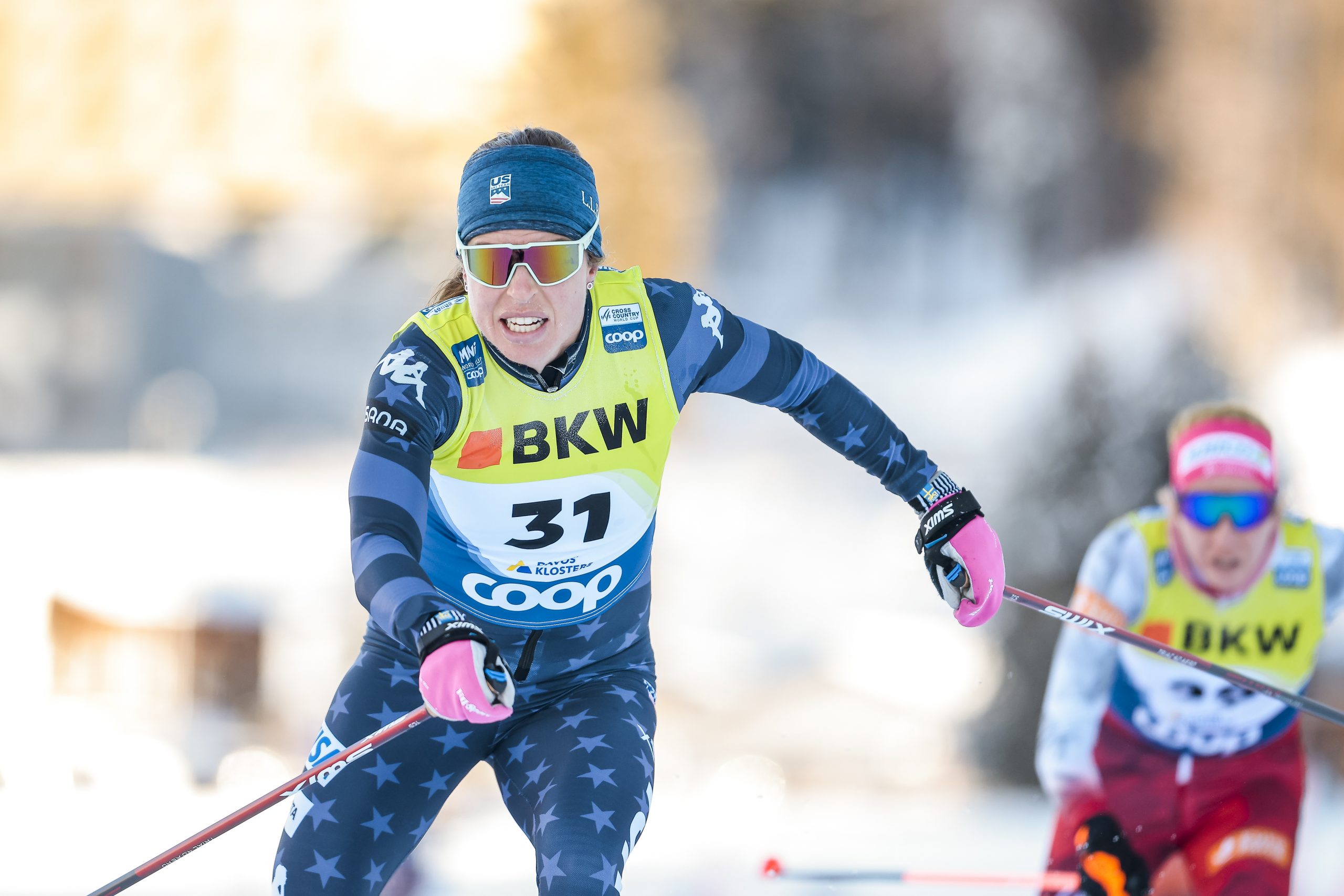
    Katherine Stewart-Jones (CAN) charging to 11th place for Canada (Photo: NordicFocus)


  • Sovereign2SilverStar Ski Marathon Part 1: A Successful First Year

    Sovereign2SilverStar Ski Marathon Part 1: A Successful First Year

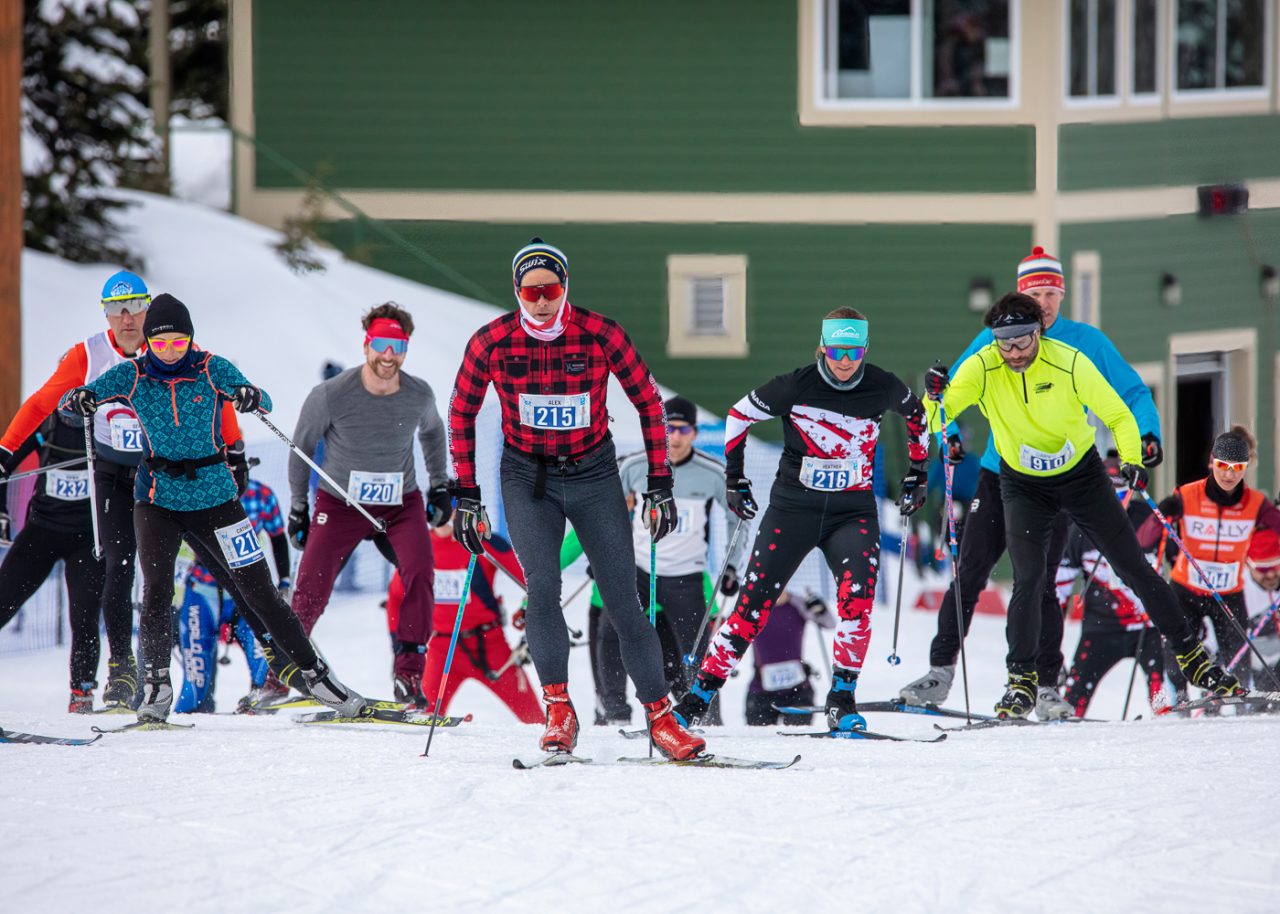
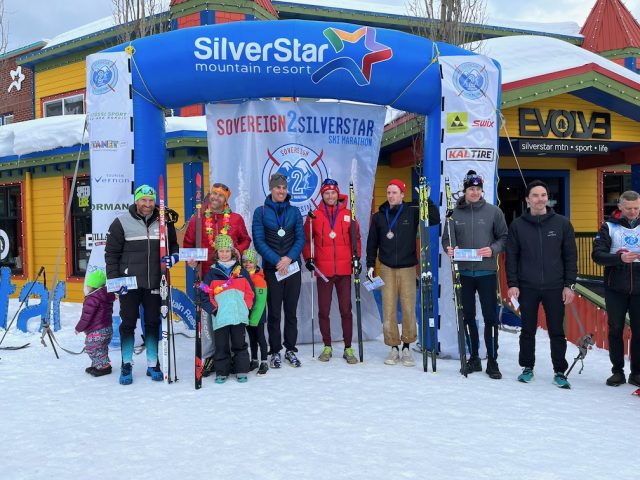
    The Sovereign2SilverStar Ski Marathon started with small waves. (photo: Robert Conchie)

    Disclaimer: The author skied both days and was one member of the large S2S organizing committee. This may seem like a conflict of interest, but also allows a more detailed look behind the curtain at how a new event was built.

    When the moment comes to create a new destination ski marathon, how would you compile all of your dreams and mould them into a single cohesive weekend?

    A group of Canadian skiers was faced with that question in the spring of 2021. And they found an answer.

    Start with twos. Two interconnected ski areas. Two days. Two techniques. Two distances. Two finish line parties.

    Using that model, the first annual Sovereign2SilverStar Ski Marathon was a success, at least as measured by smiles. 

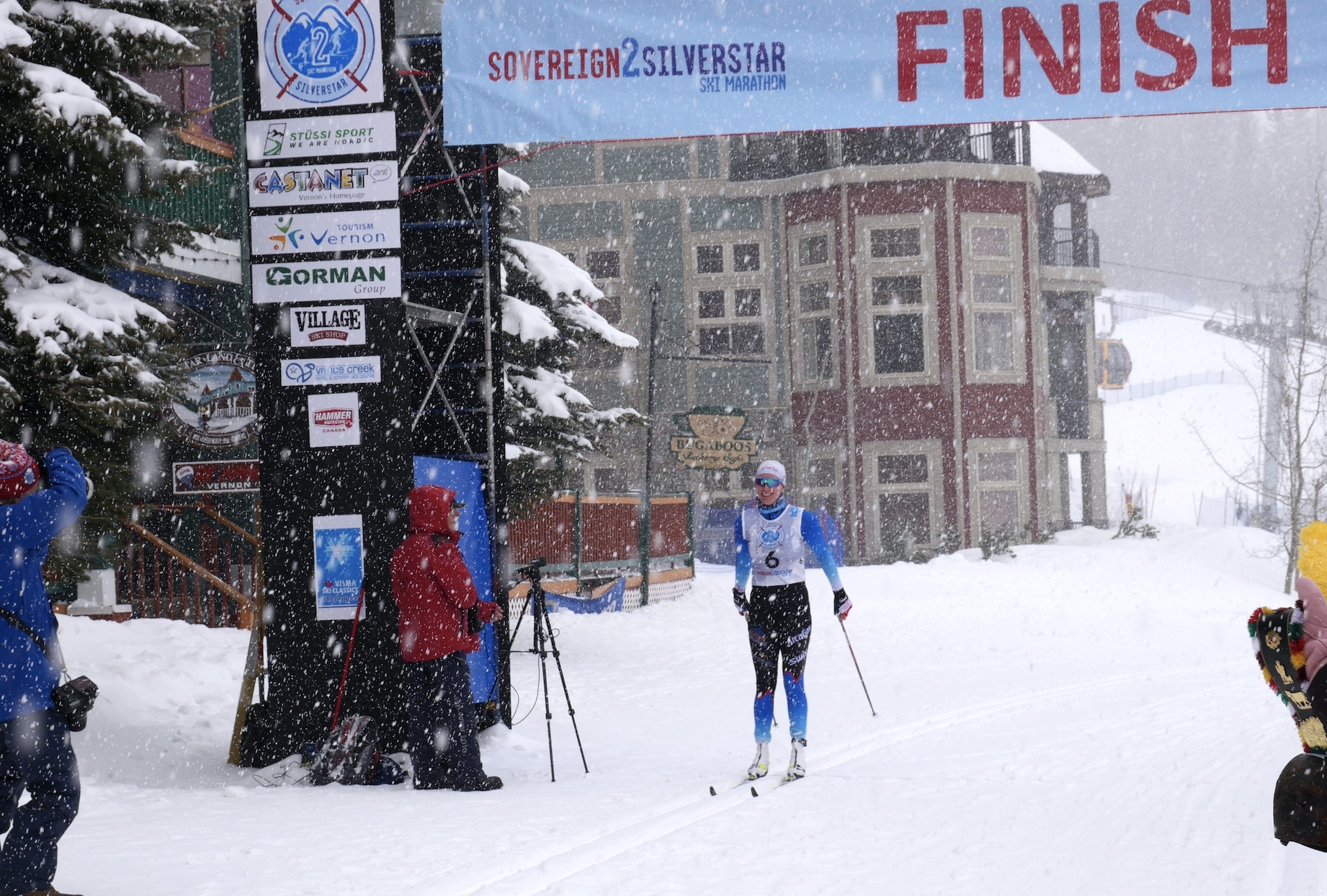
    Dahria Beatty crosses the line for the women’s win in classic during the Sovereign2Silverstar Ski Marathon. (Photo: Peggy Hung)
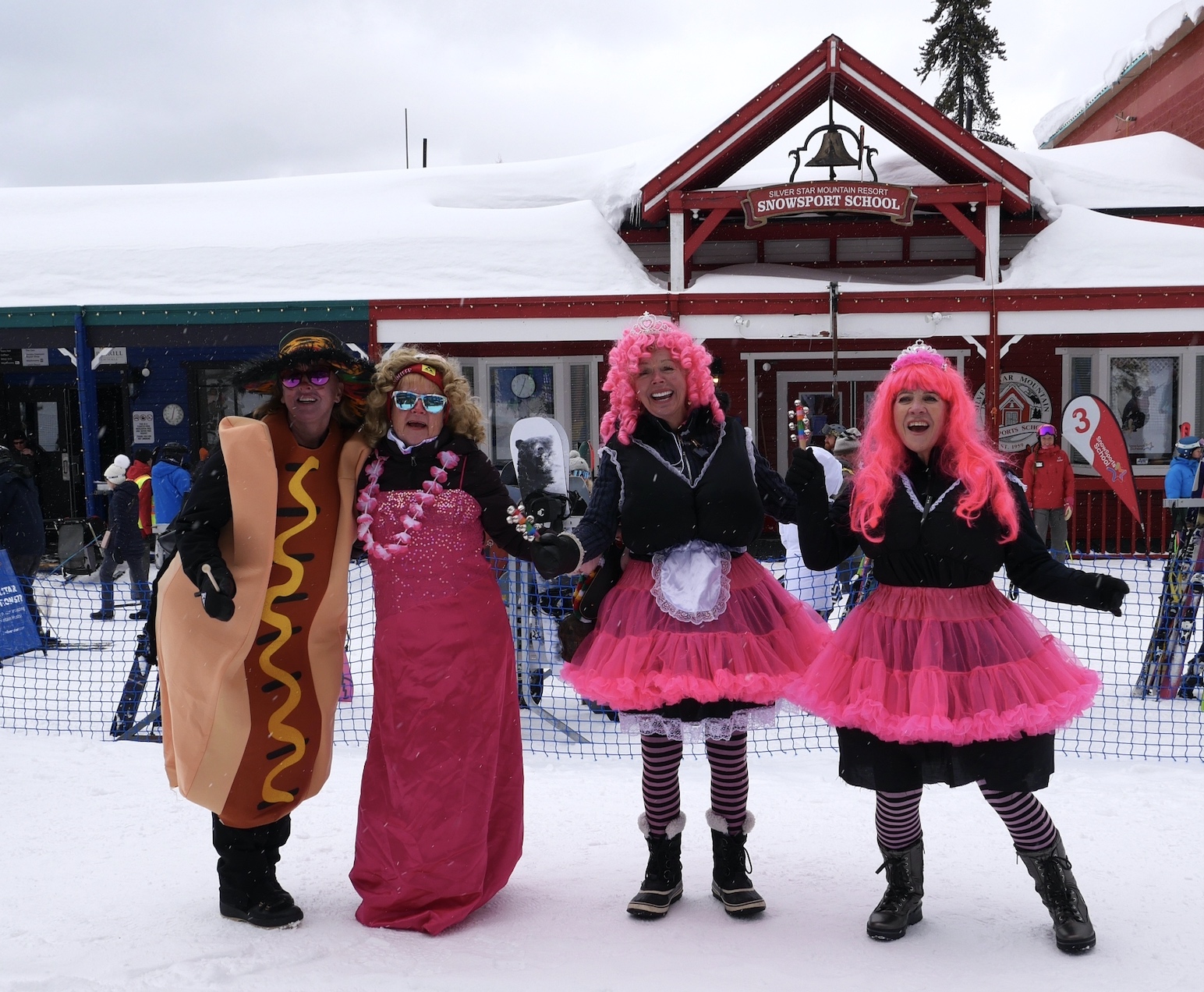
    Fun at the finish line of the 2022 Sovereign2Silverstar Ski Marathon. (Photo: Peggy Hung)

    The weekend kicked off with a classic day on Saturday, April 2nd. The first wave for the 21km course left at 8:30 am, followed by the 40km waves at 9:05. Predicted weather was cloudy with afternoon snow, but the first flurries hit about 8 am, setting the tone for the day.

    Of the 195 finishers on Saturday, the majority were on skin skis. Many of the skiers who chose grip wax were fooled by the race date into waxing for ‘typical’ spring skiing. However, when the groomed track is set at  -5C, with fresh, cold snow overnight and more dry snow falling, blue hard wax is a better choice. Three of the six athletes on the 40km podium chose VR45 covered with VR30. The Organizing Committee (OC) posted a recommendation of Swix VP45 or V45 (the event encouraged fluoro-free waxing) on Friday afternoon. Early Saturday morning, the wax recommendation was updated to VP45 covered by VP40, except that this update didn’t get shared. Oops! Add that to the list for next year.

    Benoit Chauvet last skied on the World Cup in 2010 and now coaches at Toby Creek, in BC. And he did place higher in the skate 40km.

    Skate day on Sunday was overcast without significant snowfall, resulting in faster conditions and a larger field of 255 finishers.

    As on Saturday, the 21km waves started first at 8:30, followed by the 40km waves at 9:05. This added a fun twist as the faster 40km skiers were passing the average 21km skiers coming into the finish. Despite the number of finishers, the largest of the nine waves had 42 skiers, which meant there was a lot of room to work with.

    The course crossed a number of alpine runs on the final long descent to the finish. The course marshals, who were tasked with preventing collisions, were also ringing cowbells to energize the passing skiers. Many alpine skiers and snowboarders stayed on to cheer when the marshals signalled they were free to move. It was a new experience for many participants to see spectators 4km away from the finish, cheering and recording phone videos.

    Participants who skied both days were prepared to be greeted at the finish by a dance team, lead by a hot dog. Some people were smiling because they were excited to have completed the distance, and some were smiling at the welcome.

    The pandemic has greatly reduced international travel, with many skiers choosing to defer trips. S2S had one Europe-based skier registered, a Norwegian-born Swede who happened to be in Canada for a vacation.

    “It’s a very fun course,” Asbjørn Grøvlen said after finishing the 40km classic. “I would recommend this one.” He went on to explain that many Ski Classics courses in Europe are just double poling and it was a nice change to stride more. Grøvlen, like a number of others, chose to do both 40km days.

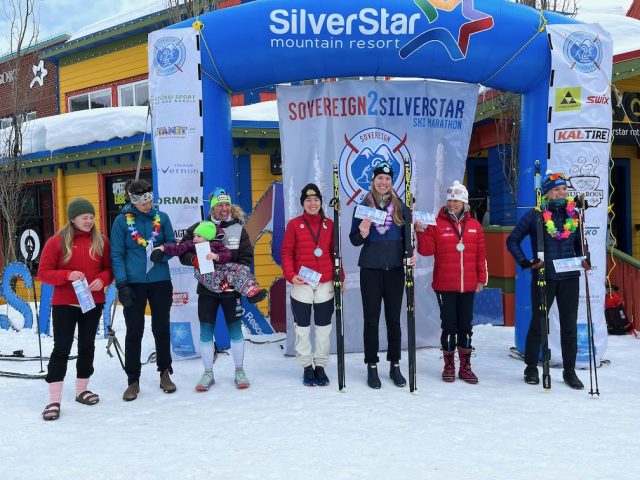
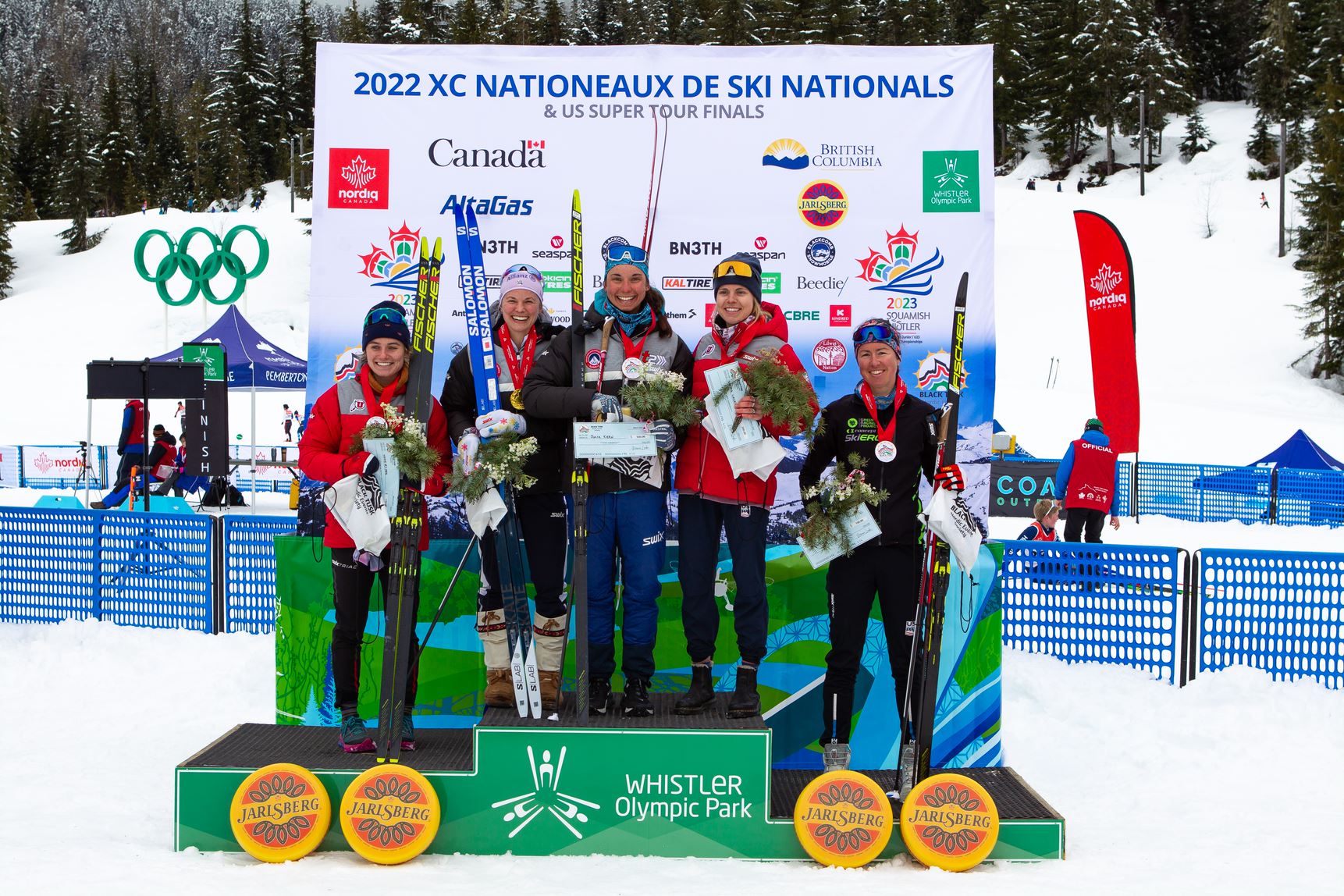
    The overall podium on Sunday. L to R: Annika Hicks, Julia Ransom, Caitlin Gregg, Katherine Stewart-Jones (2nd), Dahria Beatty (1st), Laura McCabe (3rd), Anna Sellers. That is 5 Olympians, 2 biathletes, and 2 mothers.

    The overall podiums went to elite skiers, many of whom volunteered to present medals to the age group podiums.

    Dahria Beatty was the first woman to the finish on the classic day, followed by Katherine Stewart-Jones, Novie McCabe, and Mariah Bredal. Bredal had registered late and started in the second wave, which left her 0.3 seconds behind Beatty for second place overall. Another learning moment for year two, save a few extra bibs in the elite wave for last day registrants.

    Sovereign2SilverStar overall podium. L to R: Brian Gregg, Benoit Chauvet, Scott Hill (2nd), Rémi Drolet (1st), Jack Carlyle (3rd), Julien Locke, Jess Cockney, S2S Event Director.

    There was a rumour on Saturday morning that Luke Jager would double pole on skate skis, as he “always does that on long classic courses.” Jager, found before the start while applying grip wax to his skis, disagreed.

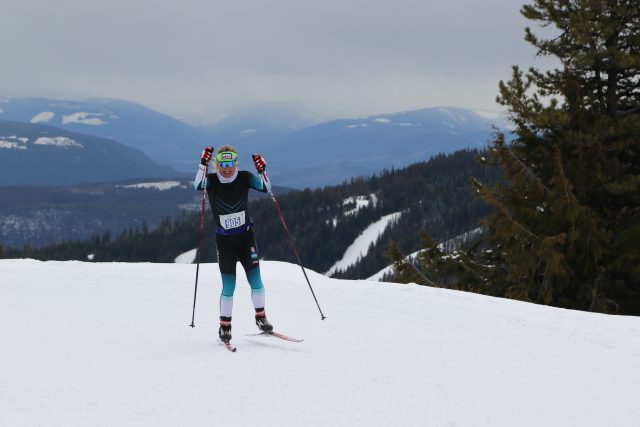
    Timing was essential to get the mountain views at Alder Point. (photo: Marshall Moleschi)

    In a world where ‘us versus them’ often creates divisions between similar communities, it was fun to watch alpine skiers and snowboarders stopping on Main Street to cheer on nordic finishers.

    “That is so cool,” one twenty-something snowboarder said to his friends. “We are doing this next year!”

    Mike Mandli, an American master who has travelled the world to ski, summed up the weekend: “This was a skier’s dream. One of the best dreams ever.”

    For results, more videos, Andy Newell’s waxing advice, and over 2,000 photos, visit the event page.

  • Martin and Kern Stride to the Top on Day Two in Whistler

    Martin and Kern Stride to the Top on Day Two in Whistler

    Carrying the momentum from the first day of racing into a second distance event, athletes lined up once more at the Whistler Olympic Park for a 10 / 15-kilometer interval start classic. Over 130 men and 90 women participated in the open categories, representing clubs across Canada and the United States. 

    Adding a springtime layer of complexity to remind us that we are officially past the equinox, temperatures in Whistler hovered above freezing while a mix of precipitation fell off and on throughout the day. Webcams of the venue showed the spectacular mountain backdrop hidden amongst dense clouds and conifers still laden with the week’s snow.

    It’s a humidity-temperature combo that makes classic waxing tricky. Consequently, many athlete chose to use “hairies”, which are known as “rub skis” in Canada, essentially foregoing kick wax and opting instead for a sandpapered kick zone. For those with strong striding technique, this achieves grip without as significant a risk of icing issues, as klisters can be known create in such conditions. 

    Top Canadian U20 racer Xavier McKeever (Foothills Nordic), who was 13th overall today, explained how this changes the game for those who haven’t had the experience: “You have to be a bit more careful with your kicks and a bit more gentle, because they can slip out really easily. That was the biggest focus for me [today], just to try and ski technically well.”

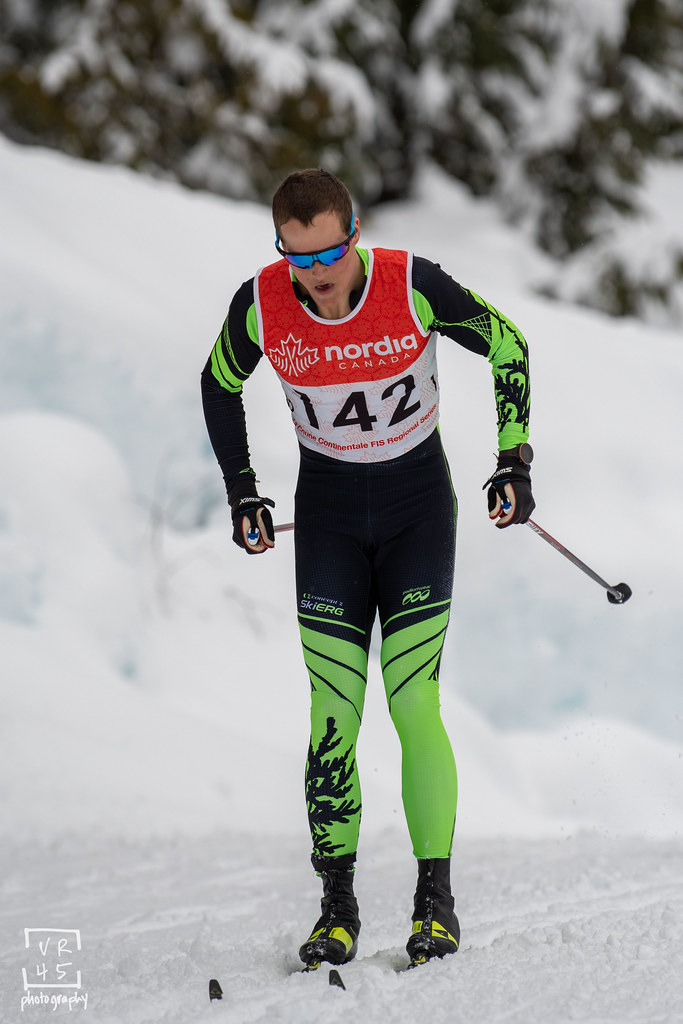
    Craftsbury’s Adam Martin takes the 15 k classic win in Whistler. (Photo: Doug Stephen / VR 45 Photography)

    Following 10 k sitting and standing events contested by Nordiq Canada’s Para Nordic athletes, the open men’s category headed out for the three 5 k loops. In a close race for the top podium spot, Craftsbury’s Adam Martin took the win with a time of 40:29.3. Martin was chased by today’s Canadian National Champion, Antoine Cyr (Skinouk) who hunted his times from 19 bibs behind.  

    Though Cyr led through the first 10 k, a strong closing lap from Martin moved the American to the lead in the splits, with Cyr skiing the third fastest final lap to take second (+1.3). Canmore’s Russell Kennedy was third overall (+13.1) for the second spot on the Canadian podium, while fellow Canmore athlete Sam Hendry, who now trains with the University of Utah, was third for Canada in fifth overall (+48.0). Both Cyr and Kennedy had also raced onto the podium in yesterday’s 10 k free. 

    “I felt really good today,” Martin wrote to FasterSkier after the race. “Particularly in the second half, I started to figure out how to best race this course and these conditions, and I found a good place mentally to push. I’m really happy with the outcome – that was a dream to win.”

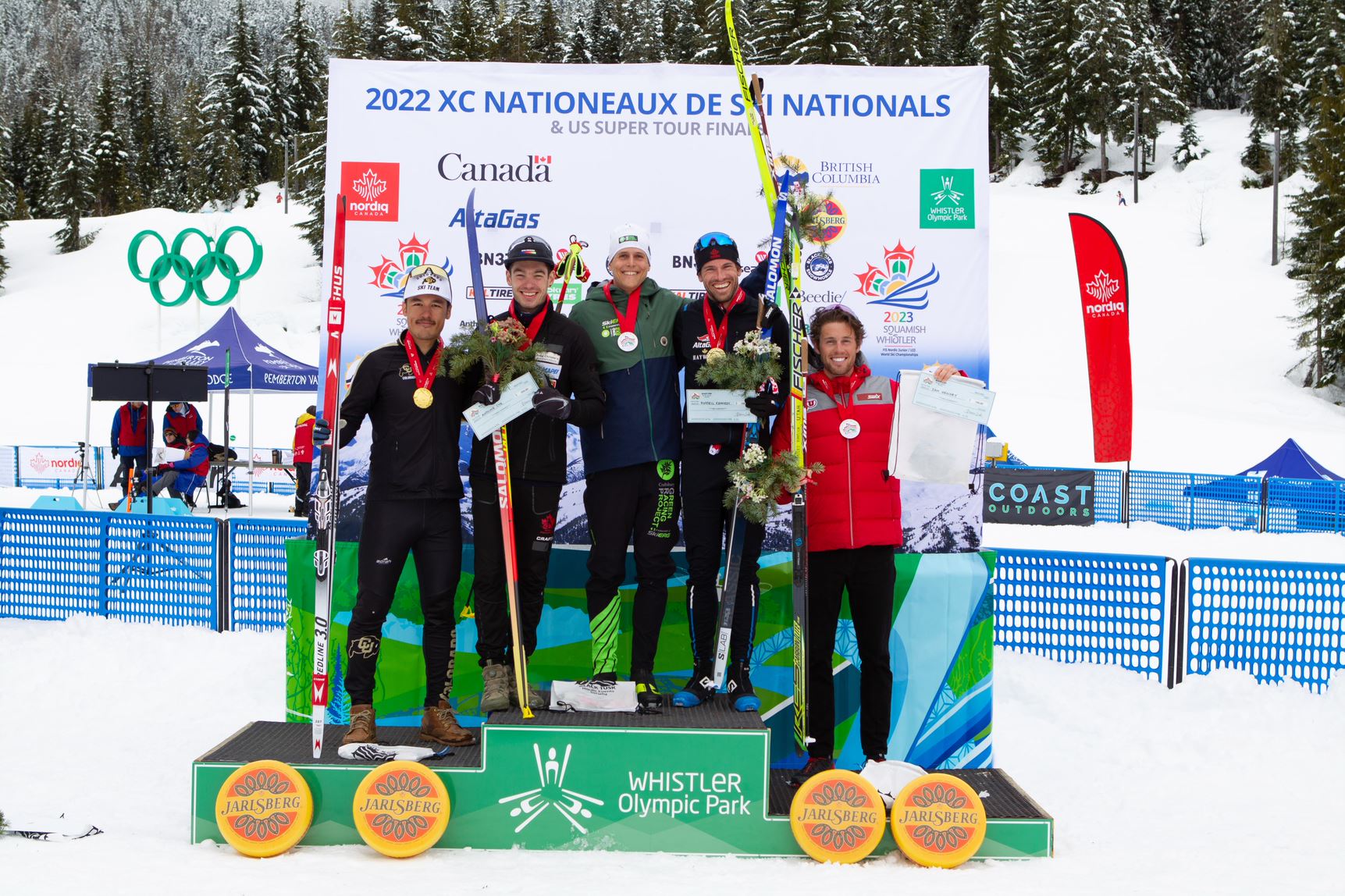
    The men’s 15 k classic podium in Whistler: Adam Martin (CGRP) took the win ahead of Antoine Cyr (Skinouk), and Russell Kennedy (Canmore Nordic). (Photo: Joern Rohde / Nordiq Canada)

    A successful season of SuperTour racing has Martin ranked at the top of the rankings, and earned him starts in post-Olympic World Cup events. After taking third at the American Birkie, Martin headed to Norway to race the 50 k classic at Holmenkollen, where he finished 26th. The following weekend, he skied to 44th in the 15 k free in Falun, Sweden. A week later, Martin is back with his Craftsbury team and standing atop the US SuperTour podium. 

    “It’s nice to return from the World Cup and still feel in good shape. After two 50 k’s, and travel, and a season that I’m really happy with, everything is a bonus at this point. I think it’s great that we are able to combine with Canada for these races. There are a lot of guys at a similar level, so it makes for some tight, fun racing.”

    A 23-year-old Quebec native, Cyr’s best results have been in classic this season, namely an 11th place finish in the opening World Cup 15 k classic in Ruka, Finland, and racing with Graham Ritchie to put the Canadian team in fifth during the Olympic classic team sprint in Zhangjiakou. After the team sprint, he was praised by both his teammate and coach Erik Bråten, along with armchair quarterback Devon Kershaw, for his classic technique.

    “Classic is always good for me and is a race I love,” Cyr said of today’s 15 k in a post-race interview with Nordiq Canada. “It was tough conditions this morning, and a good skier normally comes out on top in hard conditions. I was able to ski well, focus on the race, and came second overall, which is a little bittersweet because it was a really tight battle in the end. But it was really fun, the track is amazing. It’s an Olympic standard track, so it’s just really good.”

    Antoine Cyr races for the Canadian National Title in the 15 k classic in Whistler. (Photo: Nordiq Canada / Nathaniel Mah)

    In his second lap, Cyr had caught yesterday’s winner, Rémi Drolet (Team Black Jack), whom Cyr credited in supporting his strong result today.

    “When I saw was closing the gap on him on the first lap, I decided to go a little harder than I planned to catch up with him. [I then tried] to relax behind him for a lap or half of a lap.. In the end, I was missing a little bit on the last lap. I think that that helped for sure, skiing with someone strong like Rémi.”

    Finally, Cyr spoke to the importance of an international field featuring all age groups coming together this week, particularly on the heels of a two-year hiatus due to pandemic restrictions.

    “It is so good for the young kids — us older guys, we’ve been racing on the World Cup, but like the juvenile and junior, they almost have no races in Canada. To have a big event like this is just amazing and we’ve been looking at the younger guys’ results for an hour yesterday, seeing who’s in good form, and who’s coming up, and you are the next guys to be like taking over. So for them, it is awesome, and for us too, racing with the US is always — it should always be like this.”

    Joining Martin for the SuperTour podium, BSF Pro Team athlete Finn O’Connell was 7th overall (+1:06.4) and second American, with University of Utah’s Luke Jager half a second behind in 8th overall (+1:06.9).

    Julia Kern strides for the win in tricky conditions during the 10 k classic in Whistler. (Photo: Doug Stephen / VR 45 Photography)

    In the women’s 10 k, SMS T2’s Julia Kern skied a strong second lap to take the win in her second consecutive day on the podium, stopping the clock at 29:54.3. Her club and national teammate, Jessie Diggins, took the second step finishing +18.3 back, while University of Utah’s Sophia Laukli skied to third (+1:03.2).

    Looking at tough conditions, Kern explained she raced by trial and error today, exploring which techniques were most efficient on different sections.

    “I kind of had an open mindset going in today,” she told Nordiq Canada after the race. “I knew that the tracks might be a little bit punchy or washed out in sections, and so I was double pulling wide or double polling narrow or just like power striding on the flats if it was getting too punchy out there. So just trying it all.”

    She continued that she was looking to “have fun, send it from the start, and see if I could hold that pace the whole time,” which she ultimately proved able to do. It’s the time of year where the hay is in the barn training-wise, and athletes have had a long season, leaving them in varying states heading into the last hurrah. On whether she was looking to just have fun at these races, or whether it was a serious quest for the podium, Kern said “both”.

    “I think the end of the season is always really fun. It’s so cool to have this many athletes here. And I’ve been feeling really good the last few weeks and so enjoying racing when it does feel good and when I’m able to push really hard. We’re all really tired at the end of the season, but also, when the body’s in form you might as well take advantage of it and send it on the course.” 

    The women’s 10 k classic podium on day 2 in Whistler: Julia Kern (SMS T2) took the win ahead of Jessie Diggins (SMS T2) and Sophia Laukli (Univ. of Utah). (Photo: Joern Rohde / Nordiq Canada)

    Winning back-to-back Canadian National titles, Katherine Stewart-Jones (Nakkertok Nordique) was again on top for the Canucks, finishing sixth overall (+1:17.5). Finishing in the same order as yesterday, Dahria Beatty (Whitehorse Ski Club) was second for Canada in eighth overall (+1:55.0), while Cendrine Browne (Fondeurs-Laurentides) rounded out the podium in ninth overall (+2:14.5). 

    “I went out really hard knowing that that’s what I had to do if I wanted to make the podium,” Stewart-Jones said of her race. “I had a good first lap, and I definitely slowed down a lot on the first part of the second lap. I was just tired and was having a hard time staying in the zone and keeping the rhythm, but I was able to pull it together a bit for the second half of the second lap. So I was really happy with that. And I was happy with how hard I pushed. I just didn’t have it quite in me today, and sometimes that happens.”

    On the importance of focusing on her technique on this type of course with sub-optimal conditions, she continued, “It’s really important, especially on the climbs. The grip isn’t always perfect in these conditions, so you really have to make sure to stay on top of your skis. If you get tired and you start leaning forward, then it makes it even harder to kick… And then on the flatter sections, it was a bit awkward, and you had to expect that. Either you’re striding awkwardly or you’re doing a kick double pool, but your poles are sinking. You have to just really focus on committing to whatever you decide to do and not like trying to switch too much between.”

    Speaking to already standing atop two podiums, Stewart-Jones responded with pride, while also acknowledging that the overall win would be sweeter.

    “Oh, it’s definitely nice to be winning the national championship title… because we’re racing against the Americans, I obviously care about the overall too, so maybe it feels a little less exciting, but for sure, I’m proud of that.”

    Katherine Stewart-Jones (Nakkertok Nordique) takes back-to-back national titles in the women’s 10 k classic in Whistler. (Photo: Doug Stephen / VR 45 Photography)

    In order to get closer to the overall podium, she said he would focus on resting as much as possible and maintaining the head space to perform her best. “It’s been a long season and I haven’t raced this much in a long time. I think everyone’s pretty tired. But also just being able to also be mentally strong [over the next races]. And yeah, you never know what’s gonna happen.”

    Racing continues Wednesday with individual classic sprints, which will be live-streamed by the Black Tusk Nordic Events Society. If you’re looking for additional video updates, follow along on the Nordiq Canada and Black Tusk Instagram pages. 

    Full Results

  • Diggins and Drolet Top 5/10 k Skate Podium to Kick Off Combined Championships in Whistler

    Diggins and Drolet Top 5/10 k Skate Podium to Kick Off Combined Championships in Whistler

    The collaborative event featuring Canadian Nationals and SuperTour Finals kicked off Sunday March 20th in Whistler with 5 / 10-kilometer individual start freestyle races. (Photo: Nordiq Canada / Nathaniel Mah)

    Sunday kicked off a week of racing at the combined Canadian Cross-Country National Championship and U.S. Super Tour Finals event held in Whistler, British Columbia. Hosted by the Black Tusk Nordic Events Society (BTNES) on the Whistler Olympic Park courses, this event also offers junior and U23 skiers a preview of the courses for next year’s Junior and U23 World Championships. With Paranordic, Nordic Combined, and both junior and senior cross-country events, it looks to be a busy week of racing. 

    After a morning of Paranordic and junior events, the senior women got underway with a 5 k interval skate. This meant a single lap of the “Blue A” course, which features two major climbs, one almost right out of the start. Despite a wintery mix of precipitation forecasted throughout the week, and light snow accumulating on top of the corduroy, times were fast as athletes took to the course.

    The women’s 5 k individual start freestyle podium: Jessie Diggins (SMS T2) took the win ahead of teammate Julia Kern and Craftsbury’s Caitlin Patterson. Katherine Stewart-Jones (Nakkertok Nordique) was fourth, with Sophia Laukli fifth (University of Utah). (Photo: Nordiq Canada / Nathaniel Mah)

    Swapping stars and stripes for her red and blue SMS T2 team suit, Jessie Diggins won the women’s 5 k event in 11:47.9, with her club teammate Julia Kern in second (+7.7). Craftsbury’s Caitlin Patterson took third (+29.8), ahead of Katherine Stewart-Jones who was the top Canadian racer in fourth (+33.1). Dahria Beatty was second for the Canadian women in eighth overall (+56.1), with Cendrine Browne just behind as third for Canada and ninth overall (+1:00.6). 

    In an interview with Nordiq Canada after the race, Diggins first spoke to the experience of racing amongst a field of over 180 women and girls from across Canada and the U.S. 

    “This is super cool,” Diggins said emphatically. “I mean, I’m half-Canadian, so this is really very special for me any time I can come be in Canada. I really love it, and with COVID, it’s been a while.”

    She also spoke to the change of pace and pressure, in transitioning away from the high-stakes environment of the World Cup where the team operated under strict COVID precautions to ensure the season would not be derailed by an outbreak within the team.

    “The biggest draw for me was to be here with my club, to have fun. There’s all these really awesome kids racing. And, yeah, it’s really nice to have a little more relaxed, not quite as high pressure, [especially] after the Olympics. It’s nice to just get back to racing because it is super fun. So I’ve really enjoyed being here.”

    Diggins described watching the field of rising junior athletes race as “super cool” and spoke optimistically of what this means for the long term health and success of the sport at all levels.

    “It’s so fun to see how invested in the sport, overall, that they are — because they love it, and they want to work hard, and they’re having fun. It’s just really cool to see how our sport’s been growing and expanding, and how great this next generation is looking.”

    Sophia Laukli skates to fifth in the women’s 5 k interval start free, which kicked off Canadian Nationals and US SuperTour Finals in Whistler. (Photo: Doug Stephen / VR 45 Photography)

    Finally, on her own race, Diggins shared it was a “shock to the system.” Following the World Cup finals last weekend in Falun, Sweden, Diggins spent the week in Annecy, France, where she visited the Salomon design center, participated in a live Q&A with a Salomon representative, and even snuck in a guided mountaineering experience in nearby Chamonix.

    She then hopped aboard a flight to Western Canada, finding herself once more on a start line soon after. 

    “I got off the plane from France like 40 hours before the start,” Diggins laughed. “So it was one way to kick the jet lag, and it was highly effective. It was a bit of a bit of a shock, but it was really fun to just get out there and work hard, and really enjoy these — I mean, it’s fun. They’re Olympic courses. They’re really, really nice, they have great flow. So I really enjoyed being out there.”

    As the top Canadian woman, Katherine Stewart-Jones spoke with Nordiq Canada about the tough competition, “It was really exciting to race today and having the Americans here I knew it was going to be a competitive race, and I definitely wanted to perform because, you know, you want to show that Canadians are also competitive,” she said.

    Katherine Stewart-Jones, racing on behalf of her club, Nakkertok Nordique, is the top Canadian athlete in the women’s 5 k skate on day 1 of Canadian Nationals/SuperTour Finals in Whistler. (Photo: Nordiq Canada / Nathaniel Mah)

    “Overall, I was happy with my result. I didn’t think it was my best race. It was the type of race where the conditions are brutal, and nobody feels technically great, but you had to keep going. In warm-up I could tell it was hard conditions to ski in, so I gave myself a few technical cues during the race, making sure I reminded myself it was like this for everyone. I’m really happy with my effort.”

    Sydney Palmer-Leger (University of Utah) earned the top spot in the women’s U20 ranking with a time of 12:36.8. She finished seventh overall.

    Russell Kennedy (Canmore Nordic) skis to second place in the men’s 10 k interval start freestyle, which kicked off Canadian Nationals in Whistler. (Photo: Doug Stephen / VR 45 Photography)

    With the women’s race wrapped up, the competition turned to the men who skied 2 x 5 k. In a reverse of the women’s results, it was the Canadians who took the top three spots led by Rémi Drolet (Team Black Jack) in a time of 22:50.2. Russell Kennedy (Canmore Nordic) finished second, +19.8 behind Drolet, while Antoine Cyr (Skinouk QC) rounded out the podium in third (+29.7). 

    Luke Jager (University of Utah) was the first American of the day in fourth (+37.4). Jager was followed by two fellow collegiate athletes, Kjetil Bånerud of Northern Michigan University, and Sam Hendry of the University. Bånerud is a native of Norway, while Hendry was also racing on behalf of Canmore Nordic, his home club. This leaves BSF Pro Team athlete Finn O’Connell as the next on the US SuperTour podium in seventh overall (+49.7), with Craftsbury’s Adam Martin third for the US in eighth overall (+50.1).

    The top-six Canadians stand on the podium following a 10 k individual start skate. Rémi Drolet (Team Black Jack) took the top spot ahead of Russell Kennedy (Canmore Nordic) and Antoine Cyr (Skinouk). Sam Hendry (Canmore Nordic) was fourth, followed by Graham Ritchie (NTDC – Thunder Bay) and Philippe Boucher (Skibec). (Photo: Nordiq Canada / Nathaniel Mah)

    Like many of the top athletes, Drolet just recently returned from Europe after the conclusion of the World Cup circuit. He spoke with Nordiq Canada after the race saying, “I really went into the race today with zero expectations. I was thinking in my head that if I execute well and push hard, then I’ll be happy with the race, and the result just came so that was just a bonus for me.” 

    In soft and sloppy conditions there were a number of mishaps out on the race course and Drolet said, “I think with conditions like that it can be really easy to kind of sketch yourself out. I think a lot of people were doing that. But I think you can just kind of stay focused on skiing and not worry too much about the conditions, then everything will be okay.”

    “You need to stay focused on skiing and not on the conditions. When you overthink it, things happen. I was really happy I was able to put together a great race today. This is where I strive to be, and it feels really good.”

    Prior to traveling to Canada, Jager was competing at NCAAs in Soldier Hollow Utah where he and the rest of the Utes earned their third consecutive national victory. 

    University of Utah’s Luke Jager is the top American and fourth overall in the opening 10 k interval start skate in Whistler. (Photo: Doug Stephen / VR 45 Photography)

    The U20 men’s race was won by Tom Stephen (Foothills Nordic) in a time of 23:33.3. Stephen finished sixth overall. 

    Racing continues today, Monday March 21st, with a 10/15 k classic, followed on Wednesday March 23rd by an individual classic sprint. The sprint heats will be livestreamed; these be viewed here. 

    Full Results

  • With Diggins as Anchor, USA I Comes Out On Top in Falun’s Mixed Relay

    With Diggins as Anchor, USA I Comes Out On Top in Falun’s Mixed Relay

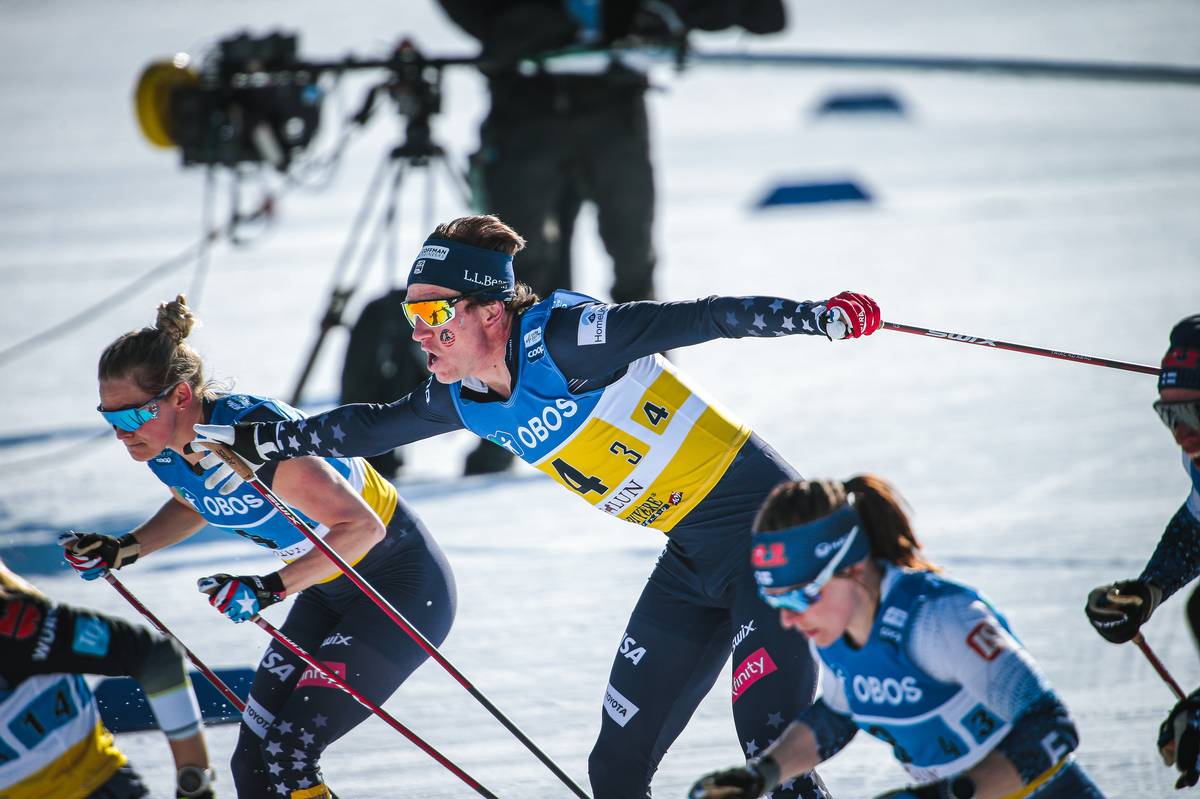
    Julia Kern and US Ski Team head coach Matt Whitcomb watch the 4 x 5 k relay from the stadium. (Photo: NordicFocus)

    This World Cup coverage is made possible through the generous support of Marty and Kathy Hall and the A Hall Mark of Excellence Award.  To learn more about A Hall Mark of Excellence Award or to learn how you can support FasterSkier’s coverage pleasecontact info@fasterskier.com.

    While it was perhaps not the final event originally planned for the season, today’s 4 x 5-kilometer freestyle mixed relay in Falun, Sweden shaped up to be quite a way to go out. Particularly for Team USA, who broke away in the final lap to take the win in 42:01.8. 

    With Rosie Brennan scrambling to tag Zak Ketterson for the second leg, Scott Patterson skating third, and Jessie Diggins anchor, it was a team composed of four skiers who had all raced into the top-15 in yesterday’s 10/15 k skate, three within the top-eight. Perhaps the only team more loaded was Norway 1, which featured Heidi Weng, Hans Christer Holund, Didrik Tønseth, and Therese Johaug, all of whom placed in the top-five yesterday, including both of the day’s winners in the final two relay spots. Also a force, Finland I consisted of three Olympic medalists, one of whom is the 2022 men’s World Cup distance champion with the lineup: Kerttu Niskanen, Perttu Hyvarinen, Iivo Niskanen, and Krista Pärmäkoski. 

    Each nation was allowed two teams, allowing the US to start a second lineup of Julia Kern, Logan Hanneman, Adam Martin, and Caitlin Patterson. Canada raced one team, which included Katherine Stewart-Jones, Antoine Cyr, Philippe Boucher, and Jasmine Drolet, racing in that order. 

    Stars and stripes at the front, as Julia Kern scrambles for USA II in Falun’s mixed relay. (Photo: NordicFocus)

    New to the World Cup, the mixed relay is modeled after the biathlon competition format, which debuted in 2005. It had originally been slotted onto the calendar for the Canmore World Cup events in March 2020, which were canceled as COVID-19 began to spread around the globe. It had been tested on the tracks in Falun during the 2021 Swedish senior national championships, with local club leader Johan Eriksson saying afterward, “Team cohesion was strengthened when ladies and gentlemen fought against the same goal line. At the same time, the entertainment was great with reversals in the result lists and tactical moves in team line-ups.”

    The entertainment value was certainly high today, particularly for American ski fans. Racing a distance now only seen in relays, it would be a painful blend of sprinting and distance. And the Americans would be lucky to have a woman anchoring the team who has previously been described as the “Queen of the 5 k skate”. 

    Rosie Brennan scrambles for USA I during the inaugural World Cup 4 x 5 k mixed relay in Falun. (Photo: NordicFocus)

    As expected, the pace was high from the start, as the Star Wars theme blared through the stadium loud-speakers. Up for the task at hand, Brennan went toe-to-toe with the other women at the front through two 2.5 k laps. Later describing the event as “fast and furious”, Brennan kept USA I within the lead group, Kern duking it out on USA II  alongside through the first lap.

    “I think our goal today was to stay out of trouble and stay in the pack, and then let Diggy do her thing that she does best,” Rosie told FIS post-race with a laugh. “And that worked out really well.”

    Brennan handed off to Ketterson at the first exchange, in line with Germany I, Norway I, and Sweden I, Finland I just behind. 

    Though new to the World Cup this season, Team Birkie’s Ketterson has consistently shown his range. Domestically, he won three SuperTour sprints, and stood on the podium in four distance races, one of which was also a win. He chiseled away at the World Cup puzzle, finishing just outside the top-30 during the Tour de Ski, and returning following the Olympic break to place 41st in Lahti’s distance classic race and at the 50 k classic at Holmenkollen. Smashing a 15th place finish in yesterday’s 15 k free, Falun has been a breakthrough weekend.

    Though 5 k is not a distance men traditionally race on the World Cup, Ketterson emailed post-race that the event felt familiar and reminiscent of his early days in the sport. 

    “I am a huge fan of the 5 k race distance as I spent four years in Minnesota high school races doing that distance multiple times a week in the winter. Today brought me back to those days! It was super chaotic pack skiing but I felt really strong the whole time and did my best to keep up with the leaders. Honestly, when Jessie is your anchor, you don’t really have to worry too much about the rest!”

    Zak Ketterson tags Scott Patterson during the 4 x 5 k mixed relay in Falun. (Photo: NordicFocus)

    On lightning fast tracks with matching skis, Ketterson skied smoothly within the large lead group, keeping USA I within contact of the leaders, while Sjur Røthe tried to crack open pack for Norway II. Tagging Patterson roughly four seconds back, USA I sat in 10th, alongside Canada, at the second exchange. USA II tagged in 14th, +34 seconds back. 

    Still a large and dense group of front runners, Patterson worked at the back of the lead group to minimize further time losses, keeping his team within reach of the podium. With both Norwegian teams at the front in the second lap, Patterson whittled down the American’s time back, tagging Diggins 2.2 seconds behind the leaders to “do her thing” over two 2.5 k laps. Canada had lost contact with the front group, sitting in 11th (+17.9), while USA II tagged following a gap in 15th (+1:14.5). 

    “My goal was to hang on with the pack early and get in the groove, then try to match accelerations later,” Patterson wrote after the race. “I knew I wasn’t going to be the one with super accelerations but could sprint the whole way. During the race I was thinking ‘Just hold on’, so Jessie could work her magic relay anchoring skills. There were a few moments where some gaps formed but I barely managed to cling on.”

    Scott Patterson races the third leg for USA I in Falun. (Photo: NordicFocus)
    Scott Patterson makes the final tag to Jessie Diggins during the 4 x 5 k mixed relay in Falun. (Photo: NordicFocus)

    Diggins quickly got to work. Halfway through the first lap, it was Diggins marking Johaug at the front, with Krista Pärmäkoski for Finland I and Victoria Carl for Germany I tucked into their wake. Recall that Carl had anchored the German relay team for an Olympic silver medal in Zhangjiakou just a few weeks ago.

    Skis ripping on the downhill, Diggins moved to the front to lap through the stadium 1.4 seconds ahead of Finland I and Norway I, Frida Karlsson for Sweden I challenging Germany’s Carl just behind. 

    Jessie Diggins brings USA 1 through the stadium in the lead after her first lap. (Photo: NordicFocus)

    Diggins worked patiently up the climb, once more tucking behind the rapid fire tempo of Johaug on the uphill, and tucking calmly into the draft of the Norwegian and Finn heading into the descent. Diggins hit the second climb hard as the three women hop-skated up and over. Among the best descenders on the World Cup, Diggins skis were only fueling the fire, allowing her to maintain her lead in the rolling last kilometer and into the stadium which erupted with noise from the packed sidelines. 

    Rounding the final bend with a clear shot to victory, Diggins took a few tuck skate pushes before powering in V2 across the line with a fist pump and loud cheer, and maybe an expletive, before collapsing onto all fours surrounded by her ecstatic teammates.

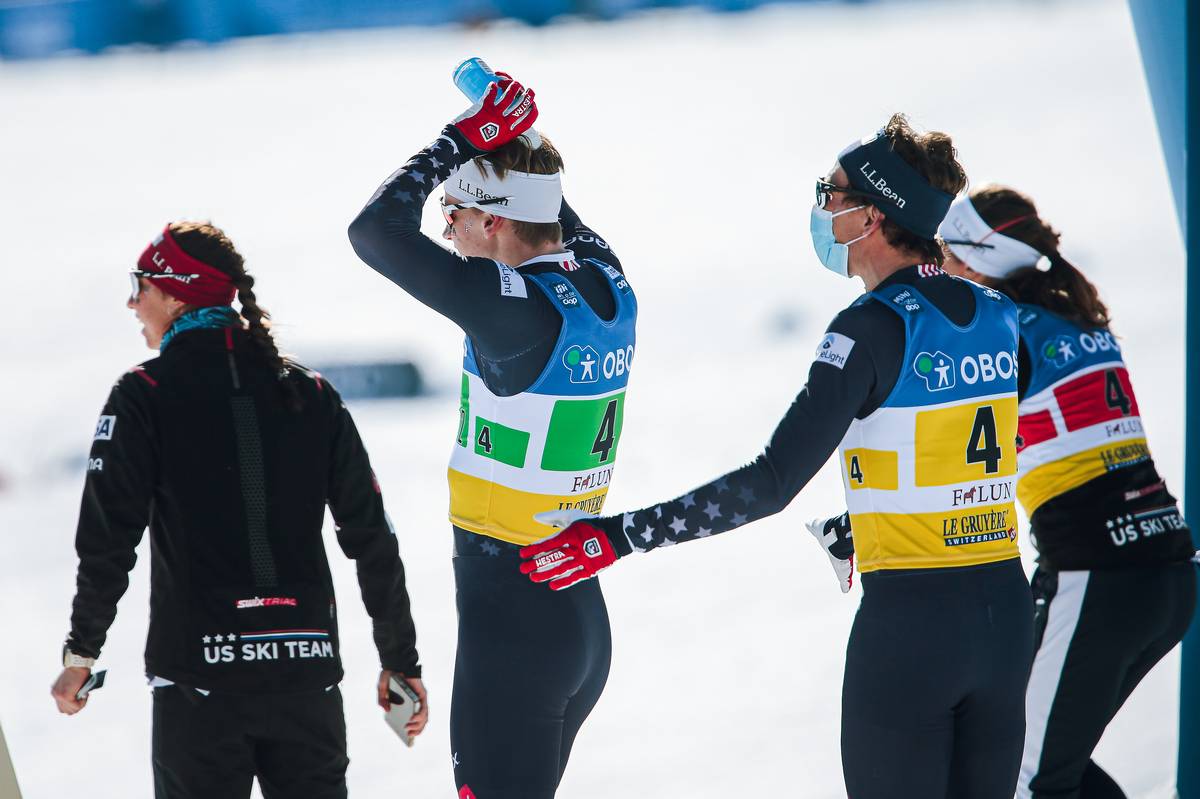
    Nerves run high as the American team waits for Jessie Diggins at the finish of the 4 x 5 k mixed relay in Falun. (Photo: NordicFocus)
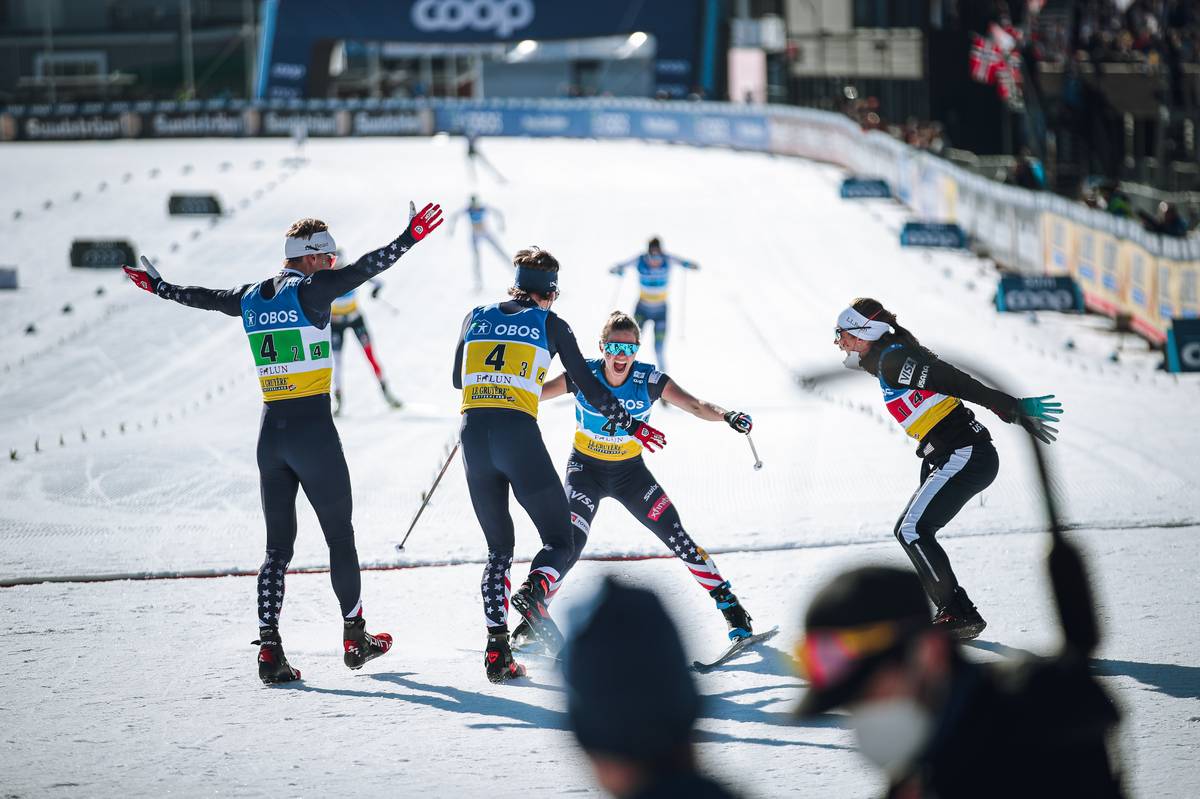
    USA I celebrates victory as Jessie Diggins crosses the finish of the 4 x 5 k mixed relay. (Photo: NordicFocus)

    Outsprinting the World Cup distance champion, Pärmäkoski edged out Johaug to bring Finland I to the line in second (+3.8), leaving Norway I just 0.5 seconds behind in third. Having strung out over the last lap, Sweden I took fourth (+9.1), with Germany I fifth following another gap (+16.2).

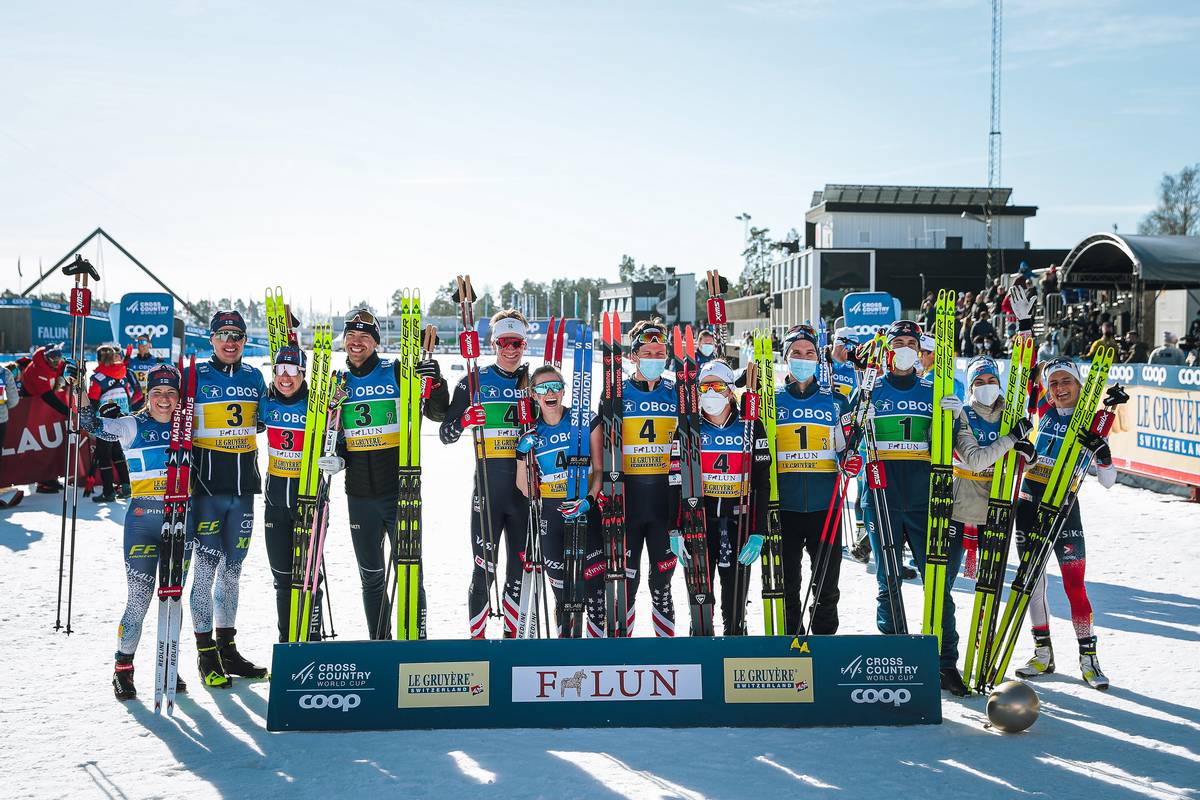
    A packed podium for the 4 x 5 k mixed relay in Falun. USA I took the win ahead of Finland I and Norway I. (Photo: NordicFocus)

    Describing the experience of winning the mixed relay on the final day of World Cup racing, Diggins told FIS with a laugh, “[It] feels like champagne getting sprayed on you.”

    Surrounded by her teammates, she continued, “That was so, so fun. We really pulled together as a team. We live together as a team for four months on the road, so it’s pretty cool to get to end the season racing for each other. I’m so proud of these guys, so I was feeling pretty inspired.”

    Jessie Diggins helps USA I to the mixed relay win in Falun. (Photo: NordicFocus)

    Later sharing her strategy in a post-race audio clip as the remainder of the team packed their bags to begin travel home tomorrow, Diggins discussed her strategy as anchor, adding how the rockets under her feet allowed the race to unfold somewhat differently than she anticipated.

    “I knew that those downhill working corners were one of my strengths, so I knew that if I got to the top of that big sprint climb first, then I could ski all the other downhills how I want and have a good shot at setting up a finishing sprint. As it turned out, we had such great skis that I didn’t need that finishing sprint, but it was so fun to go ski that as hard as I could. Again, I’m just so proud of the team. It was so special and fun to share that with everyone, and I can’t think of a more perfect way to end a really awesome year.”

    Full post-race audio clip from Jessie Diggins:

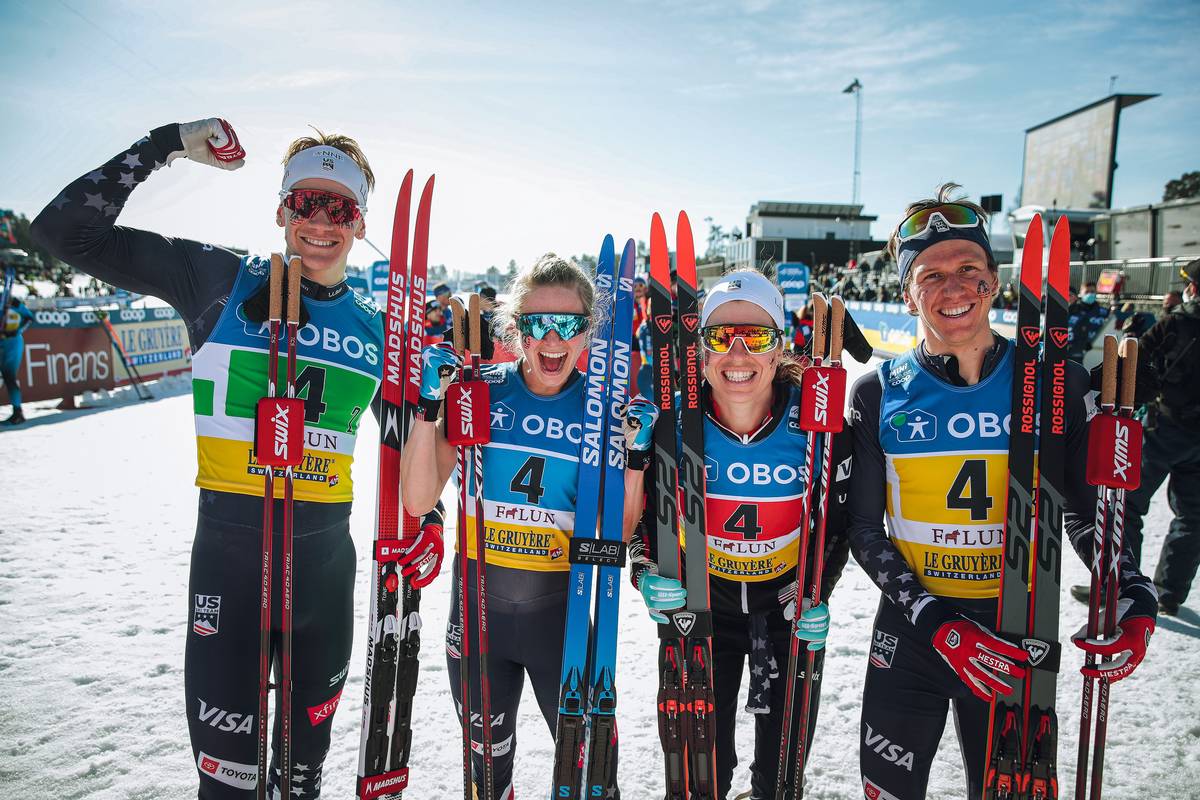
    USA I ends the season on top in the 4 x 5 k relay. From left to right, Zak Ketterson, Jessie Diggins, Rosie Brennan, and Scott Patterson. (Photo: NordicFocus)

    “What a way to close out the World Cup season!!!!!” Brennan emphasized in an email. “After Scott and Zak had great days yesterday, I felt that we definitely had a chance, but I was not expecting a victory like that! It was fast and tactical racing out there and in the scramble leg, I wanted to stay near the front of the pack and stay out of trouble. I found myself further back in the pack than I wanted on the 2nd lap, but also knew a fall or broken pole would cost us so I tried to be patient, calm and tag off in the pack. Zak, Scott and I had the same strategy and Scott made a great move to get ahead of a split in the pack to tag Jessie in a great place. Jessie skied an insane leg and I feel lucky to have her as a teammate!” 

    Echoing her sentiments to conclude his post-race email from the road, Patterson added, “It’s really cool to win the last World Cup and especially awesome to be part of the team. The mixed gender event was extra special as the guys were finally able to tap into the relay energy the women have cultivated over many years.”

    Canada’s anchor Jasmine Drolet receives a tag from Philippe Boucher during Falun’s mixed relay. (Photo: NordicFocus)
    Adam Martin tags his Craftsbury teammate Caitlin Patterson, who raced the anchor leg for USA II. (Photo: NordicFocus)

    Losing contact over the third and fourth legs, consequently racing alone, Canada ended the day in 12th (+1:45.2), while USA II pushed alongside Finland II through its final lap. Edged out in the final sprint, Katri Lylynpera (FIN) snuck her boot over the line ahead of Caitlin Patterson’s, leaving USA II in 14th (+2:10.9). 

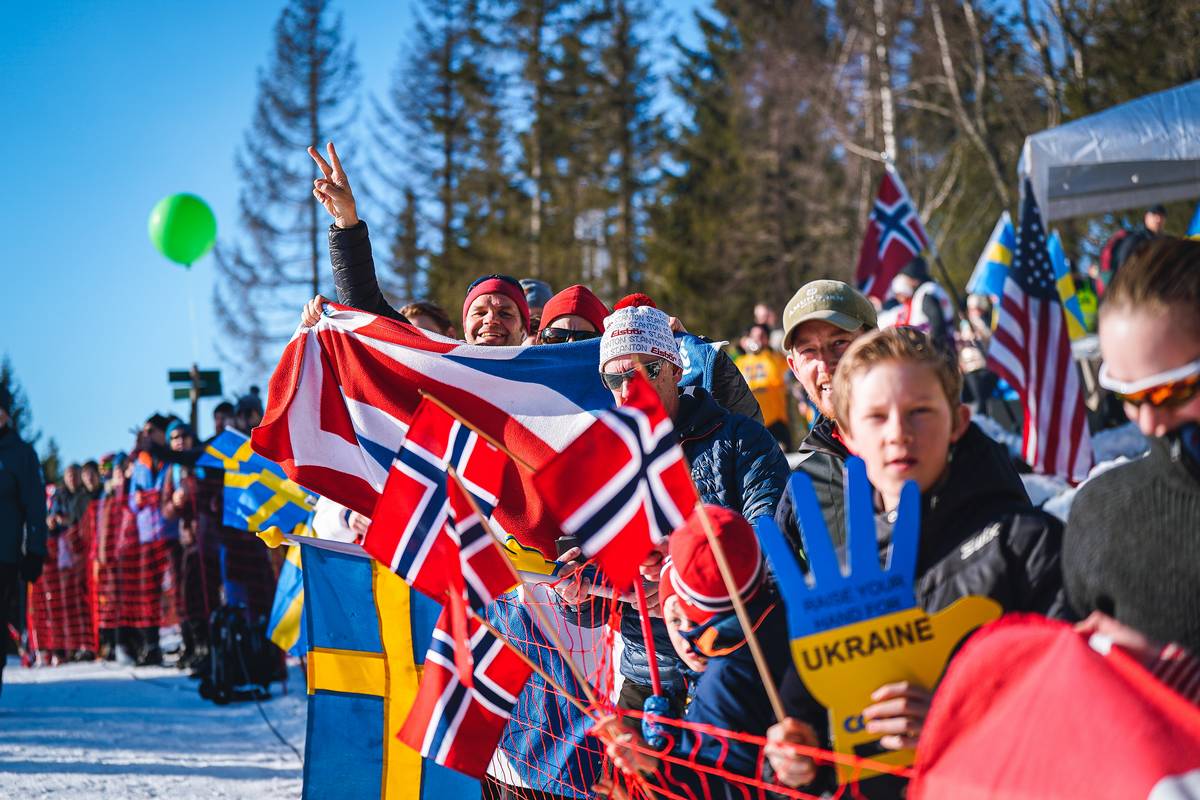
    Celebrations fed by cheering crowds, energy was high throughout the stadium. Regardless of finish order, acts of camaraderie and sportsmanship could be seen and heard as cameras meandered through the groups of athletes waiting for their relay teammates. We could hear a Frenchman congratulate Norway’s Tønseth on ending his season with an individual win, Ketterson and Kern anxiously trying to predict what might happen in the American’s final legs, along with a host of supportive cheers as teammates and coaches egged on the racers.

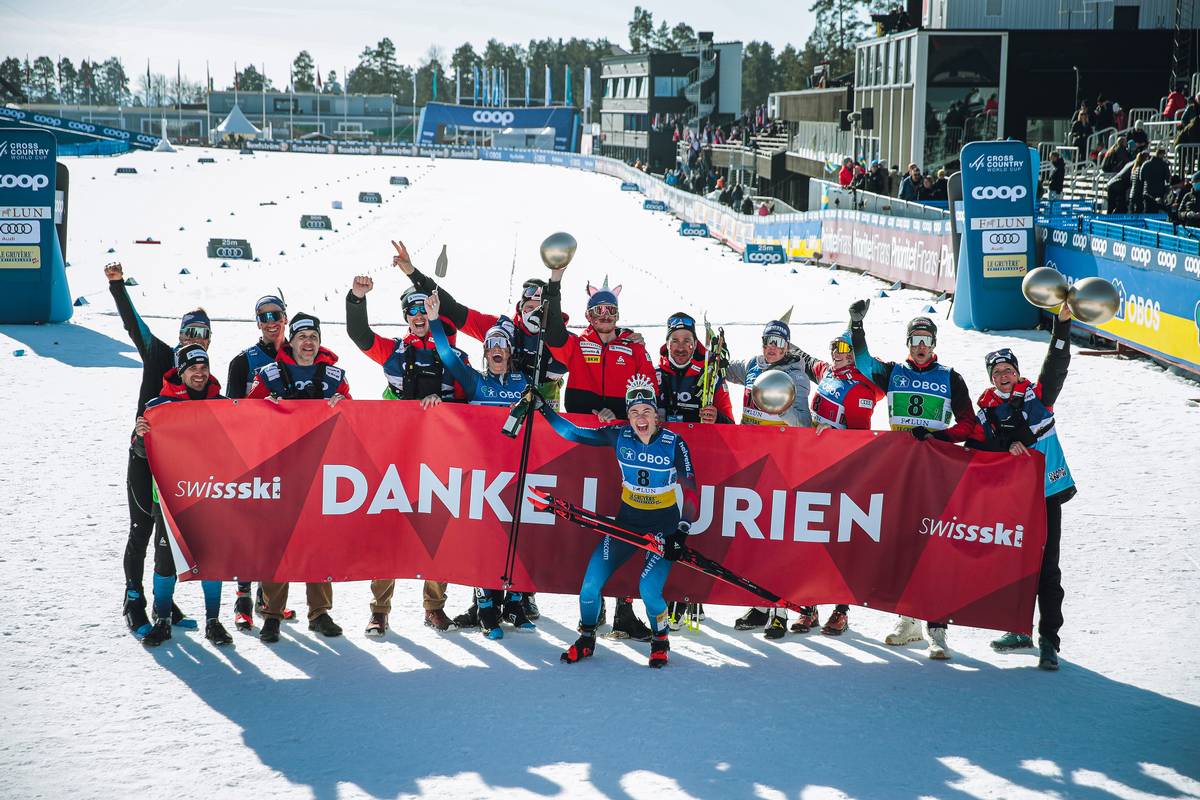
    Awaiting the Swiss anchor Laurien Van der Graaff was a princess tiara, teammates in golden unicorn horns, and a large banner that read “Danke Laurien”, in celebration of her retirement. The 34-year-old has long been a presence on the World Cup, collecting a slew of podiums and a World Championship team sprint silver medal along the way.  

    The Swiss program celebrates the retirement of Laurien Van der Graaff at the finish of the 4 x 5 k mixed relay in Falun. (Photo: NordicFocus)

    With revelry and thrill in the air, only the mixed team sprint remained on deck as the 2021/22 World Cup season drew to a close in Falun. The American program did not enter the team sprint competition, and will next compete as a team at the Whistler Olympic Park in British Columbia March 20th – 27th. The event will serve as both the Canadian National Championship and SuperTour Finals.

    Results

  • A full-circle moment, Johaug wins the 30 k classic at Holmenkollen, exactly 11 years after her first individual World Championship gold; Brennan leads the US in 7th

    A full-circle moment, Johaug wins the 30 k classic at Holmenkollen, exactly 11 years after her first individual World Championship gold; Brennan leads the US in 7th

    Crowds line the storied tracks at Holmenkollen during the women’s 30 k classic. (Photo: NordicFocus)

    This World Cup coverage is made possible through the generous support of Marty and Kathy Hall and the A Hall Mark of Excellence Award.  To learn more about A Hall Mark of Excellence Award or to learn how you can support FasterSkier’s coverage please contact info@fasterskier.com.


    Terese Johaug wins her first individual World Championship gold medal in the 30 k mass start skate in Oslo, NOR. (Photo: FS Archives)

    Eleven years ago to the day, racing the 30-kilometer mass start skate, a 22-year-old Therese Johaug won her first individual World Championship gold medal in a breakout performance at Holmenkollen near her home in Oslo, NOR. In doing so, she had broken apart a field of women considered legends of the sport on an equally legendary course known for long grinding climbs that require superior fitness and technique. Johaug won by nearly 45 seconds over one of the greatest cross country skiers of all time, her teammate Marit Bjørgen, and was 1:34 ahead of the Polish champion Justyna Kowalczyk. 

    “It was hard for me. It’s hard to see her go in front, and the gap [grow] bigger and bigger,” said Bjørgen that day. Then at the peak of her career, Bjørgen had gone four-for-four that week with gold medals in each of the previous World Championship races in Oslo, and the upset was a shock to those following along. “But I’m very happy for Therese. She is a young girl, and a girl for the future—and for Norway.”

    Little did cross country ski fans know just how storied the athlete’s career would be.

    Therese Johaug races in front of a home crowd during the 30 k classic at Holmenkollen. (Photo: NordicFocus)

    Today, under clear skies that allowed for views of the city skyline and Oslofjord, Norwegian flags flying, and fans returning to the crowded stadium and partying in the woods, she did it again, as one of her final performances after more than a decade as the top female distance skiers of all time. 

    And what’s more, Johaug won today’s 30 k classic in the same dominant fashion that she did eleven years ago, and has done many time since, stopping the clock at 1:19:22.8.

    Though the final results show just 19.4 seconds as her winning margin, this only tells part of the story. By 10 k, Johaug held a margin of over 23 seconds, which she steadily grew over the subsequent laps. At 25 k, she led by nearly a minute and a half.

    Therese Johaug waves Norwegian flags as she skis the final meters of 30 k classic at Holmenkollen. (Photo: NordicFocus)

    As she entered the stadium, Johaug was greeted by coaches and techs who handed her a flag for each hand, which she carried through the finish, waving, and stopping to take in the erupting cheers from the crowds. 

    Laughing behind tears as the rest of the field began to trickle across the line, Johaug was hoisted onto shoulders, waving her flags for a loud Norwegian crowd who had supported and applauded her through fifteen years of racing on the World Cup. 

    “It’s a lot of emotion now,” Johaug said at the finish. “I start here in 2011 with my first individual victory, and today is my last race here. It was sun and blue sky, the same as  in 2011, and there were a lot of people around the track cheering for me. I’m so happy now, but also so sad that this is the end of my career.”

    Therese Johaug was emotional at the finish of today’s 30 k classic at Holmenkollen, the venue where she won her first individual World Championship gold in the 30 k skate eleven years prior. (Photo: NordicFocus)
    Norway’s legendary Therese Johaug wins the 30 k mass start classic, exactly 11 years after her first individual World Championship gold medal was won on the same tracks. (Photo: NordicFocus)

    While she indicated during the Olympics that she would not compete another four years, it was not until yesterday that she officially announced that this would be her final race at Holmenkollen. 

    “In many ways, it feels as if the [story] ends when on Saturday, March 5, 2022, I stand on the starting line for another 30 k in Holmenkollen. I really do not want the journey to end, but it is a time for everything,” she wrote to NRK. “In light of this, I look forward to a final fight at home with the flag on my chest, and I am grateful for everything the sport has given me.”

    Therese Johaug is showered with champagne after winning the 30 k classic at Holmenkollen following her retirement announcement. (Photo: NordicFocus)
    Therese Johaug celebrates her final race race at Holmenkollen, winning the 30 k classic exactly eleven years after taking her first individual World Championship gold on these tracks. (Photo: NordicFocus)

    As Queen’s “We are the Champions” blared through the stadium, Johaug stepped off the podium only to be soaked by champagne sprayed by a flock of teammates wearing shirts spelling her name, with “takk” – thank you – written with a heart at the end of the row. It was a joyous celebration fitting for the moment, and perhaps also a refreshing distraction from the times at large.

    “There are a lot of strong moments, but I am moved when so many people come here and see my last race. I must thank the Norwegian people who stand here today,” Johaug later said to NRK.

    While you can certainly expect a more in-depth look at her storied career on FasterSkier, for now, we’ll echo the crowds in congratulating Therese Johaug, and we look forward to following along for the next chapters.

    Therese Johaug celebrates her final race race at Holmenkollen, winning the 30 k classic exactly eleven years after taking her first individual World Championship gold on these tracks. (Photo: NordicFocus)
    Krista Pärmäkoski (FIN) and Jonna Sundling (SWE) lift champion Therese Johaug (NOR) for a podium shot at the finish of the 30 k classic in Oslo. (Photo: NordicFocus)

    Behind the celebration, the lineup of women in today’s top-10 was remarkably similar to the Olympic 10 k interval start classic, with a few name swaps, and of course, a few noteworthy athletes missing – namely, Natalia Nepryaeva and Tatiana Sorina of Russia, and Jessie Diggins, who had been fourth, seventh, and eighth, respectively. 

    The volume of the ringing cowbells swelled as Finland’s Krista Pärmäkoski skied through the stadium on her own for second place, after pulling away from the first chase pack with 5 k to go and maintaining a healthy 10-15 second gap through the finish. Coming back on form after a few rocky seasons, Pärmäkoski had been third in the 10 k classic in Zhangjiakou, behind her teammate Kerttu Niskanen, who was fourth today (+33.8). 

    Finland’s Krista Pärmäkoski takes second in the 30 k mass start classic at Holmenkollen in Oslo, NOR. (Photo: NordicFocus)
    The women’s 30 k classic podium at Holmenkollen: Therese Johaug (NOR) took the win ahead of Krista Pärmäkoski (FIN) and Jonna Sundling (SWE). (Photo: NordicFocus)

    Between the Finns, Sweden’s Jonna Sundling reaffirmed her talents across all distances, taking the third spot on the podium (+32.3) just two days after being second in Drammen’s classic sprint. Matching her fifth place result in the Olympic 10 k, Germany’s Katharina Hennig followed Niskanen to the line (+34.7) with Therese Stadlober, who was ninth at the Games, crossing after a gap in sixth (+46.7). 

    Leading the next chase group, and the American team, was Rosie Brennan in seventh (+1:12.3), bringing Norway’s Marte Skaanes and Sweden’s Ebba Andersson to the line just behind her for eighth (+1:13.1) and ninth (+1:13.8), respectively.  

    Rosie Brennan leads Norway’s Marte Skaanes and Sweden’s Ebba Andersson to the line. (Photo: NordicFocus)

    “Today was huge for me,” Brennan wrote in a post-race email. “I have struggled here my entire career, and [though] it’s been a few years since I’ve raced here and I have improved a lot in the last few years, I still felt I lacked a lot of confidence and excitement coming here [today]. It’s also been a really stressful week for a variety of reasons, so I showed up today with an immense amount of anxiety that I needed to get a hold of before the race started. 

    “I am really proud of giving myself another chance to put together a good race here and to have managed the stress and anxiety well enough to do so. I wasn’t feeling in a place to shoot for the moon so I tried to start a bit a conservative the first 5 k and then reevaluate. I had a great ride with Ebba and really had an enjoyable time skiing out there today. The last lap, we had the chance to pick off a few from the lead pack and so I started to ramp things up to see what was possible. I felt strong on the last climb and felt I had a good shot at the sprint finish so I went on the last little bump before the [last 100 meters]. It felt great to finish strong and to put together a really solid race today.” 

    Rosie Brennan skis to seventh in the 30 k classic at Holmenkollen. (Photo: NordicFocus)

    Following her classic sprint race in Drammen Thursday, Brennan joked post-race that she had lost out on yet-another boot slide. Today, the final sprint was hers. It was perhaps, also worth American fans celebrating that today that she won amongst her chase group, just under two weeks after a brave and gritty performance in the Olympic 30 k skate where she had pulled the chase group for much of the race, wearing herself out to break the wind, only to be dropped in the final 600 meters as Niskanen pulled away for a bronze medal. However, Brennan said she is not connecting any dots between the two.

    “This race was nothing like Zhangjakou, really hard to even compare the two. 30 k’s are always an adventure and I am really happy to have put together two strong ones, in each technique.” 

    Rosie Brennan skis to seventh in the 30 k classic at Holmenkollen. (Photo: NordicFocus)

    Commenting on how she is feeling, mentally and physically, with one final race weekend to go, Brennan concluded, “I am really bummed that the [World Cup] Finals were canceled. I haven’t raced a ton this season because of the earlier cancellations and while it has been a very high density block since the Olympics started, I am still feeling strong and wanted to see what I could do. But it will be really fun to end the season with the mixed relay event as that is a new one for us!” 

    Julia Kern was next for the US in 23rd (+3:37.2), followed by Hailey Swirbul in 26th (+3:57.8), and Caitlin Patterson – six days after taking second at the American Birkie – in 30th (+4:11.5). 

    Julia Kern skis to 23rd in the 30 k classic at Holmenkollen in Oslo, NOR. (Photo: NordicFocus)
    Hailey Swirbul skis to 26th in the 30 k classic at Holmenkollen in Oslo, NOR. (Photo: NordicFocus)

    In a post-race call, head coach Matt Whitcomb shared that Kern’s result was perhaps especially noteworthy as she has been struggling throughout the season with nausea during distance races, making it difficult for her to keep down fluids taken in prior to the race, let alone receive feeds during. Whitcomb also explained that Diggins sat out today’s race as she was feeling lingering fatigue from the long, and successful, season of racing. He affirmed that she is healthy and will be ready to race for the final World Cup weekend in Falun, beginning next Friday. Listen to the full call with Whitcomb below.

    Outside the top-30 for the US, Katharine Ogden was 37th (+5:54.1), followed by Rosie Frankowski, who has consistently landed on SuperTour podiums throughout the season, in 46th (+8:12.2). 

    Katharine Ogden (left) and Caitlin Patterson (right, bib 32) take to the course at the start of the women’s 30 k classic at Holmenkollen. (Photo: NordicFocus)
    Canada’s Cendrine Browne (bib 43) leads Katharine Ogden (bib 40) during the 30 k mass start classic at Holmenkollen. (Photo: NordicFocus)

    Racing for Canada, Katherine Stewart-Jones led the way in 22nd (+3:25.0), with Cendrine Browne also inside the top-30 in 25th (+3:53.7). After a successful World Junior Championship in Lygna, NOR, Jasmine Drolet finished 42nd today (+6:53.2), with Olivia Bouffard-Nesbitt closing out the Canadian racers in 48th (+10:19.8). 

    Results

  • (Press Release) Canadian Women’s Relay Team Skis to Ninth in Beijing

    (Press Release) Canadian Women’s Relay Team Skis to Ninth in Beijing

    Canucks celebrate best Olympic relay result since 2002


    BEIJING, Chn—The Canadian women’s relay squad skied to its best result Olympic result in two decades, finishing ninth on Saturday at the Zhangjiakou National Cross-Country Ski Centre.

    Skiing on a mission for eighth spot, the women’s team of Katherine Stewart-Jones, Dahria Beatty, Cendrine Browne and Olivia Bouffard-Nesbitt mixed together their best relay result on the sport’s ultimate stage since the 2002 Games, skiing into the top-10 in the 4 x 5 kilometre race with a combined time of 57:20.9.

    Katharine Stewart-Jones skis the opening leg of the women’s 4 x 5 k relay. (Photo: NordicFocus)

    “I love relay days. There is no race more fun than a relay. The 5 k’s are brutal. They are really rough. We all went out together and gave it absolutely everything,” said Stewart-Jones. “I had a good time cheering the girls on when I was done, and I think we can be really proud of our effort.”

    The women’s relay consists of each athlete skiing one five-kilometre leg. The first two athletes ski classic-ski format followed by the final two members of the team taking on the skate-skiing legs.

    Stewart-Jones (Chelsea, Que.) was first out of the gate for the Canucks , skiing a steady 5km before passing off to Dahria Beatty (Whitehorse) in 10th spot.  Beatty, a two-time Olympian, continued her solid run in Beijing where she has rattled off a trio of career-best races, by grabbing two spots on the field before completing her five-kilometre charge around the challenging Nordic trails.

    “I just tried to empty the tank out there and give it all I had. I had China to catch at the beginning and saw Japan in the distance and tried to reel them in,” said Beatty. “There was a new pack well out in front of me that was a big group. I did a solo time trial out there and gave it all I had. It was a great result for the team.”

    Cendrine Browne races the 4 x 5 k relay during the 2022 Beijing Olympic Winter Games. (Photo: NordicFocus)

    Cendrine Browne (Prévost, Que.) – the only other two-time Olympian on Canada’s Nordic Ski Team in China – skied a steady third leg to hang onto the eighth spot before tagging Olivia Bouffard-Nesbitt for the anchor portion of the race.

    “Katherine got us in good position and Dahria skied really well. When she tagged me, my job was to keep the gap. I was able to do that,” said Browne. “We were aiming for top-eight. Olivia skied really strong. I’m so proud of our entire team.”

    Dahria Beatty races the third leg of the 4 x 5 k relay during the 2022 Olympic Winter Games. (Photo: NordicFocus)

    Bouffard-Nesbitt gutted out a solid skate-ski leg where she continued to hold eighth spot until the final kilometre of the race.  The Morin Heights, Que. resident battled the last Italian skier through to the finishing stretch but was edged out at the line.

    “It was such a privilege to be racing with this team. I was so impressed with my teammates. They did everything they could and I so badly wanted that eighth-place for the team,” said Bouffard-Nesbitt. “It was tough at the end. I could feel Italy on me. I tried to use whatever tactics I had left to play with in last 400 metres.

    “She was a little too strong for me in last 50 metres, but I think ninth by four-tenths shows eighth was a realistic goal and all of the girls did exactly what we needed to do.”

    Olivia Bouffard-Nesbitt (CAN) collapses as she’s greeted by her team at the finish of the 4 x 5 k relay. (Photo: NordicFocus)

    Canada’s women’s Olympic relay team of Beckie Scott, Milaine Theriault, Sara Renner and Amanda Fortier were eighth in 2002. The Canadian women also posted ninth at last year’s World Championships, which was also the best result at the premier event in a non-Olympic year in two decades.

    Athletes representing the Russian Olympic Committee won the women’s relay with a time oof 53:41.0. Germany was second at 53:59.2, while Sweden skied to the bronze medal with a time of 54:01.7.

    ***

    Complete Results: https://bit.ly/3GPLqU1

    For complete details on Team Canada at the 2022 Olympic Winter Games, please visit  https://olympic.ca/games/beijing-2022/

  • (Press Release) Dahria Beatty Beaming in 18th with Career Best Olympic Result

    (Press Release) Dahria Beatty Beaming in 18th with Career Best Olympic Result

    Canada’s Dahria Beatty was beaming after cracking the top-20 for the first time in her two trips to the Olympic Winter Games, finishing the women’s individual start 10-kilometre classic cross-country skiing event in 18th spot.

    Feeding off career-best Olympic performances in her first two starts, the 27-year-old put down a memorable performance, skiing twice around the demanding five-kilometre loop in a time of 30:00.2.

    “I definitely feel like I am in the best shape of my season now, so I knew there was potential for a strong race today,” said Beatty, who placed 28th in the skiathlon and 25th in the sprint races earlier this week.

    “I’ve been feeling good in the other two events and think that I’ve been building through each one. I had a strong result in this race at our Trials in Canmore and I feel like I’m in a lot better shape now. It was a happy surprise to be in the top-20.”

    The cagey veteran of the National Ski Team skied smart and aggressively while finding her groove while powering her way through the heavy winds and steadily working her way up the epic climbs at the Zhangjiakou National Cross-Country Ski Centre.

    “I was able to get into my own rhythm. I felt I was too conservative in the skiathlon (earlier in the week) on the climbs – especially in the classic part of the race. I had a better idea of how that would go today.

    “I really tried to push my limits on the climbs and trust that I’d be able to recover enough on the downhills to go into the next one.”

    Dahria Beatty (CAN) skiing to a personal best Olympic result of 18th in the 10 k classic. (Photo: NordicFocus)

    The Whitehorse resident was hanging tough with the sport’s elite, progressively gaining time on the field as the race went on.

    Norway’s Therese Johaug clocked the golden time at 28:06.3, edging out Finland’s Kerttu Niskanen by .4 seconds. Niskanen celebrated the silver medal at 28:06.7. Her teammate, Krista Parmakoski, finished 31.5 seconds off the leading mark to claim the bronze medal at 28:37.8.

    Beatty has only finished in the top-20 on the World Cup four times throughout her career. Three of those performances – two 15ths and a 16th place – have come in sprint races. Steadily making progress with her distance skiing, Beatty’s best World Cup distance race came last season when she was 15th in a 30-kilometre pursuit in Engadin, Switzerland.

    “If you go back to my teenage years, I was more of a distance skier, but I’ve had a lot more success sprinting internationally,” said Beatty. “It is definitely easier to break into sprinting if you are able to get that qualifying speed, but the last few years, I’ve been able to have good training seasons and that overall fitness has been caught back up with the tactical power I’ve had for sprinting.

    “I’ve never given up saying I’m an all-around skier so I’m happy that I am finally showing that again after all of these years.”

    Katharine Stewart-Jones (CAN) races the 10 k individual start classic during the 2022 Olympic Winter Games. (Photo: NordicFocus)

    Three other talented Canadian women also hit the start line on Thursday for the individual start race. Katherine Stewart-Jones (Chelsea, Que.) battled to 36th place with a time off 31:08.6. Cendrine Browne (Prévost, Que.) skied into 48th spot with a time of 31:47.9. Olivia Bouffard Nesbitt (Morin Heights, Que.) completed the 10-kilometre test in a time of 33:01.1 for 61st place.

    Additional Canadian Athlete Quotes

    Olivia Bouffard Nesbitt

    “I tried super hard, and I was able to make myself hurt. Some of those uphill’s were painful in the best way. That is how absolutely what you want in this race is to finish having hurt yourself a little bit. I’m pumped. I’m super grateful to be here and to have an Olympic bib on.”

    Cendrine Browne

    “Sadly, it was tougher today. I always have more difficulty with the 10 km classical event and the second part of the race today was a bit more difficult. I was on my own on the track for a while. I gave everything I had today even if it’s not the result I was looking for. It can only be better next time. I am looking forward to the relay event with the girls. I believe we are all in a good shape right now and the best is yet to come for us.”

    Katherine Stewart-Jones

    “Definitely pretty disappointed with my race. After the skiathlon I know that I’m in really good shape so I thought I could get a really good result today. I just fell short of that. I gave everything I had but it just wasn’t the feeling I wanted. I know I’m in shape and that’s nto the problem. I have other races to look forward to so I am excited for that.”

    Three Canadian men – Olivier Léveillé (Sherbrooke, Que.), Antoine Cyr (Gatineau, Que.) and Rémi Drolet (Rossland, B.C.) – will compete in Friday’s 15-kilometre individual start classic-ski race.

    *****

    Complete Results: https://bit.ly/3BdoBbG

    For complete details on Team Canada at the 2022 Olympic Winter Games, please visit  https://olympic.ca/games/beijing-2022/

  • (Press Release) Cendrine Browne Battles to 20th in Epic Olympic Skiathlon

    (Press Release) Cendrine Browne Battles to 20th in Epic Olympic Skiathlon

    Three Canadian women ski into elite group of 30 on grueling race day in Beijing

    By Chris Dornan on behalf of Nordiq Canada

    Katharine Stewart-Jones (bib 23) skis to 23rd in the women’s 15k skiathlon, which opened the 2022 Beijing Olympic Games. (Photo: NordicFocus)

    BEIJING, Chn — Cendrine Browne and her teammates set the tone for the Canada’s cross-country skiers at the 2022 Winter Games after putting down her best-ever Olympic performance, skiing to 20th place in the women’s 15-kilometre skiathlon race on Saturday in Beijing, China.

    Competing in her second Olympic Games, the 28-year-old from Prévost, Que. clocked a time of 47:58.1 after a gutsy effort that challenged the top women’s cross-country skiers who were faced with long punishing climbs and blustery winds on a frigid afternoon at the Zhangjiakou National Cross-Country skiing Centre.

    “That is a career-best result today! I’m really, really happy and proud of how I raced,” said Browne. “I worked very hard on my classic the last year and I think that really helped me today. It was definitely a tough race with tough conditions so I’m glad I was able to ski relaxed and be conservative with my energy. It was really fun being in the same pack as Katherine! I’m so proud of our team. This shows that we are in great shape!”

    Canada’s Browne, Katherine Stewart-Jones (Chelsea, Que.) and Dahria Beatty (Whitehorse) worked together in the chase pack for much of the race. Browne and Stewart-Jones exchanged positions as the top Canuck in each of the four laps. Skiing strong, the Canadian trio conserved their energy for a strong finish in the top-30.

    Dahria Beatty races the 15k skiathlon in Zhangjiakou, the opening event of the 2022 Beijing Winter Olympic Games. (Photo: NordicFocus)

    Skiing in and out of the top-20 on the wide-open course, Stewart-Jones (Chelsea, Que.) finished 23rd at 48:17.3 in her Olympic debut.

    “This is my first Olympic Games, so it was a really great experience. There was a lot of wind today, so it was important to stay in the tracks and conserve energy,” said Stewart-Jones. “It was a long 15 kms given how tough a course this is. I was happy with the way I felt out there despite it being so long since I had raced, and I didn’t really know what to expect. This will do a lot for my confidence for the rest of these Games.”

    Beatty also had a boost of confidence with her career best Olympic result, skiing steady in the middle of the pack en route to a 28th place finish at 48:52.0.

    “You had to be pretty strategic on the downhills today. With the wind, my goal was to be as small as possible on the downhills and then give everything I had on the climbs. I’m super happy with how it went for me. Being in the top-30 in a distance race is always something I’m happy with,” said Beatty.

    Olivia Bouffard Nesbitt (Morin Heights, Que.) scrapped her way to 44th in a time of 50:11.7.

    “It was super challenging conditions for everyone. It was windy, cold, the snow was slow, and this is a heck of a course,” said Bouffard Nesbitt. “It is one of the hardest courses if not the hardest. It was just epic today – my first Olympic race – getting blasted by the wind right off the start. You really could just feel the size of the event right away.”

    Battling for the first Nordic skiing medal of the Games, the field of 63 women set an electric pace from the start gun and held it throughout the challenging 15-kilometre test which combined 7.5 kilometres of classic cross-country skiing followed by 7.5 additional kilometres in the free technique. Athletes change equipment in a pit stop area between the two legs with the clock still running.

    Cendrine Browne (right) hugs teammate Katharine Stewart-Jones (left) after the pair finished 20th and 23rd, respectively, in the 15k Olympic skiathlon. (Photo: Nat Herz/FasterSkier-ADN)

    Norway’s Therese Johaug controlled the pack in both disciplines. A force from start-to-finish, Johaug led a group of approximately 15 athletes who strung out the field on the second hill in the first lap. Charging out onto the second half of the course after leading the pack into the exchange area, the Norwegian skied with a handful of athletes until surging with less than three kilometres to go en route to winning the gold medal with a time of 44:13.7.

    Natalia Nepryaeva, who is an athlete representing the Russian Olympic Committee, was the next best finisher 30.2 seconds off the golden pace. Nepryaeva claimed the silver with a time of 44:43.9, topping Austria’s Teresa Stadlober who grabbed the bronze medal at 44:44.2.

    The Canadian men will hit the Olympic start line for a 30-kilometre skiathlon race on Sunday.

    *****

    Complete Results: https://bit.ly/3B0mbxc

    For complete details on Team Canada at the 2022 Olympic Winter Games, please visit  https://olympic.ca/games/beijing-2022/

  • Canadian Journey to Beijing

    Canadian Journey to Beijing

    Katherine Stewart-Jones sprinting over the saddle at Sovereign Lake during the Beijing Prep Camp. (Photo: Peggy Hung)

    Canada was successful in delivering the team to Beijing and getting them on snow in Zhangjiakou. The decision to go above and beyond in isolating athletes before a carefully planned drive to a charter flight worked, although other countries also succeeded with a more laid-back approach.

    What can fans expect from the Canadian team in Beijing? It all comes down to qualifying and performing.

    Qualifying

    Canada had an Olympic quota of four women and three men, with a pretty high probability of gaining another woman and man in reallocation. The size of the quota depends on World Cup/World Championship performance and domestic FIS races; the top countries earned the maximum team size of 8 per gender. As Canada cancelled all races last season and only took a small team to Europe for a six week visit, the only path to a larger team would have been more athletes getting top 30 results in Europe last season.

    Three men (Tony Cyr, Olivier Léveillé, Graham Ritchie) and one woman (Katherine Stewart-Jones) met the world cup results standard for Olympic qualification during period 1. The Trials in Canmore (January 6th to 11th) would then select three women, and possibly one woman and one man who would have first dibs after reallocation.

    Dahria Beatty, an Olympic veteran from Pyeongchang, was one of the skiers who now had to qualify through a rigid qualification document at Canmore trials.

    “Yes, it was definitely different last time. I was qualified for the [2018] Games a season in advance, essentially,” Beatty explained at the Prep Camp at Sovereign Lake.

    At the Canmore sprint, Beatty qualified third and finished the heats in 4th, which meant Laura Leclair earned her first Olympic berth and Cendrine Browne her second.

    For Beatty, selection came down to Saturday’s 10km individual classic. If she won, or placed second to Stewart-Jones, she got the spot. The latter happened, with Beatty 0.5 seconds behind and 20 seconds clear of third.

    “Honestly, I don’t think I’ve had to qualify for a team specifically like that since U23 World Champs so it’s been a long time definitely.”

    Olivia Bouffard-Nesbitt was ranked 5th after trials, waiting on the reallocation process. Her journey has been longer than most, with injuries, training setbacks, car accidents, and bad luck. In 2014, she recovered from a back injury just in time to compete at Olympic trials. She won the qualifier on her first race day of the season. While lining up for the A-final heat with selection on the line, she was told that the jury had disqualified her for micro-skating during the quarter-final earlier. This year, the pieces came together.

    “​​It’s hard to find words. It’s something that I believed in, like my whole life, I believed that it was possible. But then throughout the setbacks, the doubt kind of built up. And, increased and I thought it wouldn’t happen, maybe and that I just had to grow up and face that reality. But there was still like, a little voice inside me that thought it was possible. And just to have– persisted, and trusted that with patience like things would line up for me. It means so much, it means so much for me but also for the people who helped me get here because it feels like I know that they would support me no matter what but it just feels like doing them justice as well. Like putting all the time into this project that is me trying to get to the Olympics was worth it.”

    Jasmine Drolet was next, with only the faint hope of moving up through a positive COVID test for an athlete above. Jasmine does have the consolation of earning a start at U20 World Championships.

    Russell Kennedy finished 27th in the Ruka 15km classic in November, enough to help Canada’s World Cup quota for next season. Kennedy would have needed to ski 15 seconds faster to take the 20th place from Federico Pellegrino and earn the 4th Olympic spot. The next day he moved up to 21st in the pursuit with the 24th fastest time of day, again just outside the criteria.

    The reallocation spot would be decided in the 15km individual start classic on January 8th. Whoever finished highest, after excluding the three already qualified men, would be on tenterhooks until the 17th and then be officially announced on the 19th.


    Rémi Drolet in a practice skiathlon at the Beijing Prep Camp at Sovereign Lake, Jan 23, 2022. (Photo: Peggy Hung)

    Cyr won, surprising no one, with Rémi Drolet edging out Kennedy by 10.8 seconds to take second. Every skier in the top ten had either a WC top 30 or a Canada Cup podium this season. Every one of those skiers could believe that their best effort would end in selection.

    Rémi is a second year senior who chose to take a gap year from Harvard to focus on getting faster on the World Cup and qualifying for Beijing. He didn’t get selected for Period 1, but did get some good results in early season Continental Cup races in Finland and Sweden.

    “For me, it was important to try really hard to make it this time around, because I think it’ll be an important stepping stone in my career,” he told FasterSkier during the prep camp. “To be able to, I guess, be a leader in the team, with so many strong guys coming up.”

    Rémi is getting good results for his age, but also looking over his shoulder at juniors like Tom Stephen and Xav McKeever, who are already collecting senior wins at Canada Cup races. These three teamed up with Léveillé to collect a relay silver at U20 Worlds two years ago.

    Kennedy is now 30. His ‘day job’ is with Canada’s Para National team, one of two guides for Brian McKeever. After PyeongChang, his goal was not just to qualify, but deliver at Beijing, and that dream ended with an invitation to train as a spare.

    “Well, I mean, for me, it’s been a rough two weeks. I spent three years working for this year. I was focused on the Olympics, and not really as much qualifying I guess.”

    Asked about sharing a bubble for two weeks with the four men who are living his dream, Kennedy didn’t shy away from truth.

    “And yeah, it’s been hard. But I’ve been trying to put on a good face around them. Because it’s sweet [for them]. They’ve done it, they’re going to the Olympics, it’s a huge goal and a huge achievement. But for me, it’s definitely hard. I’m really fast right now, which just makes it harder. But that’s part of sport.”

    Performing

    For some people, just reaching the Olympics is the pinnacle of their dreams. And it is a major achievement, even more so now with smaller quotas. In 2006, Canada had five women who earned Torino quota spots, in addition to the ten nations spots, allowing Canada to select 15 women. 

    What distinguishes the athletes who deliver results from those who participate?

    “Some people believe, and some people want to believe, but [it’s] the ones that really believe.” Dave Wood explained to FasterSkier in July of 2021.

    Going back to 2006, three Canadian women came home with medals: Chandra Crawford, Beckie Scott, and Sara Renner. Each of these women had individual World Cup podiums in the final two months of preparation and came into Torino with confidence. 

    The current team of nine Canadians has only two members with Olympic experience: Beatty and Browne. It will be much harder for this team to dream of podiums.

    Stewart-Jones, Cyr, Léveillé, and Ritchie can find confidence from their period 1 results. Drolet can find confidence in beating Léveillé and Kennedy at trials as both have World Cup top 30’s this season.

    The others? They will have to find confidence inside themselves.

    Expecting

    One of the common expectations of sports fans is that Olympians should produce their best performance of the season on the biggest stage. Athletes work their whole lives to get to an Olympics and it seems obvious that they should be peaking at precisely the right moment.

    “The results came from those that started their Olympics in May or April.” – Dave Wood, talking about Vancouver 2010.

    Wood was referring to athletes who qualified for the Olympics during the previous season, allowing them to build the entire training year around performing during a two week period. Athletes who have not qualified in advance have to focus their season plan on earning selection.

    Kennedy was one athlete who missed that balance.

    “Because sometimes I feel with sport, you have to choose if you want to go or if you want to do well. It’s the one thing that I’ve been struggling with. And also, it’s hard because like the people making the decisions don’t really have any repercussions for their choices. So the repercussions fall on athletes, and unfortunately, this year fell on me. Yeah. It sucks, but it’s part of it. I knew what I signed up for.”

    Once selected, each athlete can then reset their priorities. Four Canadians hit that point in December, three more on January 8th, and the last two on January 17th. With the first race on February 5th, which feels like the 4th after crossing the international date line, the one big thing athletes can do is not catch COVID-19.

    Back in 2010, Canada had four men performing on the world cup and when it came time to pick four men for the 50km on the final day, there were five names. Ivan Babikov, George Gray, and Alex Harvey had placed 5th, 8th, and 9th in the skiathlon and were obvious choices. The final place had to go to either Brian McKeever, who had qualified first at trials in Canmore, or Devon Kershaw, whose best individual result was a 16th. Unusually for Canada, there was outside pressure on this selection, as McKeever would have been the first person to compete at the Olympics and Paralympics in the same season.

    “The way the other four boys had been skiing, there was no decision, there was no discussion,” Wood explained. “Brian didn’t beat Kershaw and Alex and Ivan and George [at trials], he beat the others.”

    The coaches chose Kershaw, which paid off with a 5th place finish, 1.6 seconds from gold. In 2022, there will be no difficult decisions for the men, but there are five women and four starts per individual race.

    FasterSkier asked Beatty what races she was looking forward to.

    “Well, if I get a start in the team sprint, I love team sprints, I love team events. So I’m definitely hoping to be doing that race, I’m looking forward to that. I’m also really looking forward to the individual sprint and the 10k individual.”

    This may not be the Norwegian or Swedish level of choice, with eight skiers and four starts, but expect Canada to hold some time trials during the Olympics to inform the coaches’ choice.

    Beatty and Browne were in PyeongChang, and will have experience to share with the neophytes.

    “​​The races themselves, even though they will be the most stressful part, are also going to be the most fun because that’s what we dream of,” Bouffard-Nesbitt speculated three days before getting on the plane.

    “I’ve never been to an Olympic Games, and especially a COVID games. So I don’t know what the rest of the time will be like.”

    The Canadian women having (distanced) fun. Click the image to see the Instagram reel.

    Early evidence is athletes will be killing time in their rooms and finding virtual fun with your teammates.

    Dreaming

    FasterSkier asked a number of the athletes a simple question: when you first dreamed of the Olympics, what sport were you dreaming of?

    “I have to say, probably hockey with that one. For sure. I didn’t know I was gonna end up as a cross country skier.” — Ritchie

    “Cross country skiing. Yeah, it’s always been that.” — Stewart-Jones

    “I definitely think it was probably cross country skiing. That’s always been the sport I’ve been strongest at, even as a kid. I did a bunch of different sports. I always loved watching figure skating at the Olympics, but I knew that I was never going to pursue that long term, definitely was not flexible enough.” — Beatty

    “I don’t know. I guess when I first really thought about the Olympics was back when I was playing hockey. But at that time, it wasn’t really, it was kind of just like, whoa, it’d be cool to go to the Olympics. But I didn’t really think of what sport I might make it in. It’s only really four years ago, I started thinking, this is what I need to work towards, to make the Olympics in Beijing.” – Rémi Drolet

    “That is such a good question. Because around the time when I became really inspired by the Olympics was the 2000 Olympics in Sydney, and I think Simon Whitfield winning the triathlon was the really big moment at that Olympics. And at the time, in my youth, I was just obsessed with soccer, but also skiing, so I dreamt of either/or soccer or skiing.” — Bouffard-Nesbitt

    “Oh, man, I didn’t really have a sport I was dreaming of, exactly. But I thought maybe skiing because I was on skis at two years old. More downhill racing.” – Kennedy

    “I was the dreaming to go to the Olympics as a cross country skier. It didn’t happen as a cross country skier but as a technician.” — Simon Boisvert

    “Ah, to be honest, I’ve always been into cross country skiing with my dad and my sister, my older sister ahead of me, but always been into cross country skiing, and I thought that maybe mountain biking, but a few years ago, I knew I was not. I wasn’t going as an athlete, but I’m pretty pumped to go for my first time as a wax technician.” — Félix-Antoine Vezina

  • An Inside Look at the Canadian Olympic Prep Camp

    An Inside Look at the Canadian Olympic Prep Camp

    Katherine Stewart-Jones ready to start a skiathlon at the Olympic Prep Camp.

    The Canadian Prep Camp in Sovereign Lake and SilverStar, BC prior to the 2022 Beijing Olympics sounds like a nordic skier’s heaven.

    A two-week ski vacation with 100 kilometres of perfectly groomed snow. A private room above a great coffee shop (pain au chocolate!) and next door to some great beer. January weather just below freezing with enough falling snow to make every day a hardwax day. Two weeks of what locals call superhero snow. A whole lot of sunshine.

    The reality was a little different: COVID stress, travel uncertainty, and outside pressure combined to make this very much a work trip, not a vacation.

    The camp, which ran from January 12th to 25th, included nine athletes, the high-performance manager plus two coaches, two wax techs, a massage therapist, and a cook.

    The athletes included the majority of the 2022 Olympic Team: Katherine Stewart-Jones, Laura Leclair, Dahria Beatty, Tony Cyr, Olivier Léveillé, and Graham Ritchie. Alternates Olivia Bouffard-Nesbitt and Rémi Drolet would officially join the team after the quota reallocation during the second week. Second alternate Russell Kennedy will not add to his Olympic CV and will instead go to his third Paralympics as a guide, supporting the well-decorated visually impaired athlete, Brian McKeever. The only Olympic team member not in attendance was Cendrine Browne, who chose to train in Canmore, while second alternate Jasmine Drolet returned to school at Dartmouth and earned her first collegiate wins.

    World Cup coach Erik Bråten, Next Gen coach Eric de Nys, Team Lead and high performance manager Joel Jaques, techs Simon Boisvert and Félix-Antoine Vezina, massage therapist Stephen Waterreus, and Zoe the cook made up the support crew. Everyone except de Nys and Zoe are going to Beijing.

    When this writer asked for last names, the response was always, “Zoe? You know Zoe.” In the end, it was revealed that Zoe is Zoë Roy, who retired from racing in 2014 as a founding member of Team Ninja. Yup, we all know Zoë.

    All interviews were done on snow, from a distance, with FasterSkier wearing an N95 mask.

    On Snow Training

    The on-snow part of the camp was reported to have gone very well. The coaches were able to find times and trails that allowed training races that closely matched the Olympic course for profile and elevation while keeping distance from the local skiers. 

    The Zhangjiakou 5km course elevation range is 1639m to 1696m. The Sovereign Lake upper World Cup 5km is 1651m to 1708m, with the stadium at 1660m.

    The Friday sprint course worked fairly well, despite a layout that would give any technical delegate apoplexy. As Bråten explains above, the coaches chose to do four qualifiers instead of heats to manage risk.

    The Sunday skiathlon course ended up being 13km for the women and 17km for the men, with some flat sections removed from the 5km loop to better mimic the Olympic courses.

    Bråten was often seen working with athletes one-on-one.

    As the days counted down to departure, skiers were working on filling their bags with seconds gained: a tweak in one skate (V2) poling, free skating further on a fast flat section, experimenting with pacing on courses that simulate Zhangjiakou.

    The mood of the camp seemed slightly tense, at least to a journalist who was careful not to pierce the bubble. The change on Tuesday morning, 12 hours after everyone passed the final COVID test, was dramatic, with smiles everywhere.

    “It’s been fantastic conditions and just a really nice camp all around, it’s always nice when you get some sunshine,” Kennedy told FasterSkier. “So yeah, especially after a [World Cup] Period One in Finland in the dark.”

    First time Olympian Rémi Drolet is all smiles after passing the final pre-travel testing.

    COVID Management

    COVID protocols at the camp were strict, races were more relaxed.

    A positive test would be the end of one person’s Olympic dreams and a logistical nightmare for the support team. Any close contact of the infected person would not be able to travel. Any replacement person, athlete or not, would need to follow the same testing protocol. If that replacement wasn’t ready for the scheduled flight, the complexity of travel planning might be insurmountable.

    In order to travel to the Olympics, the athletes, coaches, and techs would all have to pass two PCR tests less than 24 hours apart in the final 96 hours before boarding. Once at the Calgary airport, there would be another PCR test, with a fourth upon arrival in China.

    Nordiq Canada chose a more restrictive plan than some other countries. Each person (athlete, coach, tech, cook, massage therapist) had their own room and didn’t enter other rooms. Meals were delivered. Grocery shopping was done by local resident, de Nys, scheduled for 7am to avoid crowds. No one entered coffee shops, bars, or restaurants. Each morning, everyone would do a rapid antigen test in their room. Athletes skied from their accommodation at SilverStar to the homologated trails at Sovereign Lake to avoid close contacts in vehicles. Only de Nys and Zoë the cook had contacts outside the bubble, and neither is going to Beijing.

    The goal behind this aggressive protocol was twofold. First, to prevent exposures. Second, if one person tested positive, there would be no close contacts forced into isolation or removed from the Olympics. The two wax techs (Simon Boisvert and Félix-Antoine Vezina) inevitably had a shared bubble as they shared a private waxing room.

    Was this the right answer? We got three answers to that.

    Drolet found the camp harder than usual: “We were still able to ski together a little bit, but it was definitely a little bit lonely at times.”

    Kennedy, entering with a mentally tough prospect of only making the team if disaster struck a friend, found the positive. “The guys have been playing, like hanging out online together… And we’ve been skiing together. So it’s separate, but at the same time, not too lonely.”

    “Ask me on Monday afternoon when we get all the results back,” Jaques told FasterSkier on Sunday morning. “We’ve taken the right precautions so we’ll just see. But I think it’s looking good.”

    A number of athletes mentioned feeling comfort in knowing they were doing everything possible to protect their Olympic dreams. 

    The system has worked. Everyone tested negative and the entire team is now on snow in Zhangjiakou.

  • Eight Canucks Ready to Head to Europe for Period 1 of World Cup Cross-Country Ski Racing Action (MEDIA RELEASE)

    Eight Canucks Ready to Head to Europe for Period 1 of World Cup Cross-Country Ski Racing Action (MEDIA RELEASE)

    CANMORE, Alta.—Eight Canadians are readying themselves to head to Europe in the coming weeks to open the highly-anticipated Olympic and Paralympic season while bringing the maple leaf to the World Cup cross-country skiing start line.

    Nordiq Canada will send a dynamic group of four women and four men who are determined to climb up the international rankings in the first three weeks of World Cup action before returning to Canada for the holiday break followed by the 2022 Olympic and Junior/U23 World Championship Ski Trials set for the Canmore Nordic Centre, January 6-11.

    Olympians Dahria Beatty (Whitehorse) and Cendrine Browne (Saint-Jérôme, Que.) will be joined by National Teammates Katherine Stewart-Jones (Chelsea, Que.) and Maya MacIsaac-Jones (Athabasca, Alta.) on the women’s start line. The four Canadian women have been making steady progression and regularly posting results in the top-25 over the last year.

    Russell Kennedy (Canmore, Alta.) who competed at the 2018 Olympics before guiding Brian McKeever at the Paralympic Games in PyeongChang will lead a young men’s team loaded with potential. Kennedy will be joined by Graham Ritchie (Parry Sound, Ont.) and Antoine Cyr (Gatineau, Que.) who were both seventh in the team sprint at the 2020 World Ski Championships. Olivier Léveillé (Sherbrooke, Que.), who was just the third Canadian ever to win an individual cross-country ski medal at the Junior World Championships last year when he finished third in the 10-kilometre skate-ski race, will take his first strides into the senior ranks.

    Selection announcement and synopsis can be found here.

    Katherine Stewart-Jones during the 10 k skate in Falun, Sweden. (Photo: NordicFocus)

    “This is a determined group of athletes who have earned the opportunity to represent Canada and compete on the elite stage of our sport through their impressive results over the last year,” said Joel Jaques, high-performance manager, Nordiq Canada.

    “This group has represented Canada at all levels of the sport internationally, and are now anxious to demonstrate their potential during this important season which will serve as the ultimate benchmark in their continued development. I have full confidence they will be fully prepared to achieve our team and their personal goals.”


    The majority of the Canadian Team will depart, November 18, to compete in the following races prior to the holiday break:

    November 26-28 – World Cup, Ruka, Finland

    November 26-28 – Norway Cup, Gålå, Norway (Graham Ritchie, Dahria Beatty, Maya MacIsaac-Jones)

    December 3-5 – World Cup, Lillehammer, Norway

    December 11-12 – World Cup, Davos, Switzerland

    December 18-19 – World Cup, Dresden, Germany


    Nordiq Canada will hold a media availability with Canadian Team athletes participating in the Frozen Thunder Training Camp at the Canmore Nordic Centre, November 2, in advance of their departure to Europe.

    Nordiq Canada is the governing body of para-nordic and cross-country skiing in Canada, which is the nation’s optimal sport and recreational activity with more than one million Canadians participating annually. Its 60,000 members include athletes, coaches, officials and skiers of all ages and abilities. With the support of its valued corporate partners – Haywood Securities Inc., AltaGas, Swix and Lanctôt Sports– along with the Government of Canada, Canadian Olympic Committee, Canadian Paralympic Committee, Own the Podium and B2Ten, Nordiq Canada develops Olympic, Paralympic and world champions. For more information on Nordiq Canada, please visit us at https://nordiqcanada.ca.

    Remi Drolet and Russell Kennedy racing for Canada in Oberstdorf, Germany. (Photo: NordicFocus)
  • Johaug Runs Away With Gold in the 30-kilometer Classic; Maubet Bjornsen 15th in Final Professional Race

    Johaug Runs Away With Gold in the 30-kilometer Classic; Maubet Bjornsen 15th in Final Professional Race

    A clear day after Friday’s snowstorm greeted the start of the women’s 30 k classic in Oberstdorf. (Photo: NordicFocus)

    This World Championship coverage is made possible through the generous support of Marty and Kathy Hall and their A Hall Mark of Excellence Award. To learn more about A Hall Mark of Excellence Award or to learn how you can support FasterSkier’s coverage please contact info@fasterskier.com.

    A blanket of fresh snow lay on the ground while the frozen rocky peaks of the Bavarian Alps peaked through the clouds. Finally, Oberstdorf, Germany looked like a wintery venue. 

    With temperatures that might feel brisk relative to the tropical heatwave earlier in the week, the women’s field took to the tracks for their final event of the 2021 World Championships: a 30-kilometer mass start classic. 

    The women’s 30 k closes out racing for the women at the 2021 World Champs. (Photo: NordicFocus)

    To set the stage for today’s race, one should first look back to the 2019 World Championships, which featured a 30 k freestyle, and the 30 k classic at last year’s Holmenkollen in Oslo, the last World Cup race to take place before the season was truncated due to the rise of the COVID-19 pandemic. 

    Let’s glance at the World Champs in Seefeld, Austria, where Norway’s Therese Johaug led the field through the first 5 k, then pulled away. She gapped the field by more than 30 seconds, holding her ground on her own at the front for the remainder of the race. Her teammate Ingvild Flugstad Østberg led the chasers to take second place, followed by, what was at the time a new name, Sweden’s 19-year-old Frida Karlsson, earning a bronze medal in her inaugural World Championships. 

    Johaug’s performance at the Holmenkollen looked to be an attempt to repeat this style of victory. She was off the front at the 20 k mark, but had not taken the opportunity to switch her skis. Working together on fresh boards were Karlsson and teammate Ebba Andersson, who steadily closed the gap to Johaug. With less than 2 k to go, Karlsson could be seen from the same camera angle, gaining ground with every kick and glide.

    Inside the last kilometer, Karlsson overtook Johaug on a long climb. Despite the Norwegian’s best efforts, she could not match the speed of the Swede’s skis on the downhill and Karlsson broke away to win by just under 2 seconds. 

    So what would it be today? 

    Therese Johaug on course during the World Championshp 30 k classic in Oberstdorf, Germany. (Photo: NordicFocus)

    Johaug’s pace from the start seemed impossible to sustain for the full duration of the event. While other women looked steady and controlled, Johaug was simply charging, her rapid breathing matched by her tempo. 

    By 10 k, Johaug had a lead of over 53 seconds to the first chase group, led by her teammate Heidi Weng, Andersson of Sweden, and Katharina Hennig of Germany. At the halfway mark, this lead ballooned to over 1:32. Even if impeded by subpar skis, it looked to be an insurmountable margin. Spoiler alert: it was. This left a race for silver and gold in her wake. 

    Ebba Andersson, Heidi Weng, Frida Karlsson, and Therese Stadlober – the main chasers – play for second and third place as Johaug skis off the front. (Photo: NordicFocus)

    A pack of five women seemed to be pulling ahead of the larger chase group that had been together from the start. At 15k it was: Andersson, Karlsson, Weng, Hennig, and Therese Stadlober of Austria. 

    After a 15 second gap, Krista Pärmäkoski skied alone in an effort to gap up, leaving behind a second chase group that included Sadie Maubet Bjornsen in 8th, in what she announced would be the final race of her professional career. 

    Sadie Maubet Bjornsen (USA) alongside Yana Kirpichenko (RSF), (l-r) in the 30 k classic. The race closes out Maubet Bjornsen’s international race career. (Photo: NordicFocus)

    At 18k Johaug smoothly switched into new boards, while the first chase pack worked their way toward the stadium in the background. Johaug’s gap was approaching two minutes. 

    A solo affair for the win: Therese Johuag of Norway during the 30 k classic. (Photo: NordicFocus)

    Inside the final 10k, a few women led by Pärmäkoski, had gapped up to the first chase group. After a crash took out the three women at the front — Andersson, Karlsson, and Weng — Stadlober snuck around the right side, increasing her tempo to kick and glide away from the women now 16 seconds behind her in pursuit. 

    Striding and poling in sync, Karlsson, Andersson, and Weng looked determined to regain contact with the Austrian. As they departed the stadium in the sun with 6k to go, the threesome had achieved this goal. They strided away up tracks that looked to be eroding in the sun, heading into the woods where the course looked much different. As more crashes had already happened behind them on sugary sweeping downhills, the task ahead looked to be as much about staying upright as skiing fast. 

    Heidi Weng (NOR) leads Therese Stadlober (AUT) and Frida Karlsson (SWE) during the mass start 30 k classic. (Photo: NordicFocus)

    Talking to a trailside coach on a climb with 2k to go, Johaug seemed to be basking in the confidence of her victory. Attacking through the final kilometer of the course nonetheless, Johaug alternated between a spicy double pole and throwing her arms up in celebration as she made her way down the finishing lanes to stop the clock in 1:24:56.3.

    Therese Johaug is a singular distance champ. (Photo: NordicFocus)

    Earning her 14th championship medal, ten of which are gold, Johaug has overtaken Norwegian ski legend Marit Bjørgen for the most World Championship medals. The first in her collection was a bronze in the 30k classic in Sapporo, Japan in 2007. Johaug struck out in 2009, but came into the 2011 World Championships on her home turf in Oslo ready to go, taking gold in the 30 k skate and relay, and bronze in the skiathlon. 

    Johaug is also the second woman to have won 30 k events in both freestyle and classic at the World Championship, following in the footsteps of Elena Välbe of Russia who retired after the Nagano Olympics in 1998. Johaug also joins Välbe and Bjørgen as the only women to have won successive 30 k events at a World Championships. 

    Therese Johaug takes a fourth gold medal in the 30 k mass start classic. (Photo: NordicFocus)

    “It’s amazing, actually,” said of her string of four gold medal performances in Oberstdorf in a post-race interview with FIS. “I work so hard for it, training so much to reach my goals. To come here to Oberstdorf and fight for four gold medals, I have no words. I know so many girls train really hard to reach their goals, and I know that I have a lot of pressure on me when I come here. I was a favorite to win the distance, but you have to do it, and it takes a lot of focus to reach your goals.”

    The FIS interviewer called it the “era of Therese Johaug”, to which the Norwegian gave an emotional response, her voice breaking tearfully with her final statement. 

    “I never have been in such good shape. I am so happy. I’m 33 years and I know I’m getting older and older and I know that this time ends soon, so I am just so happy.”

    Sun, glory, and another championship distance win. (Photo: NordicFocus)

    In the closing kilometers of the race for silver and bronze, Weng, Andersson, and Karlsson began to drop Stadlober. Finding a new gear as she surged up the last steep climb, Weng rounded the hairpin turn in the lead and dropped into a tuck. 

    With just a sugary right hand curve out of the downhill to navigate before the final straightaway, Weng was shooting her shot. However, Karlsson’s skis and double pole were superior as they headed down the lanes, gaining her centimeters on Weng with each strike. 

    In the end, the small gap Weng had created from her move was enough. By a margin of 0.6 seconds, Weng took silver (+2:34.2), leaving Karlsson with her second bronze medal in the event (+2:34.8). 

    Frida Karlsson, and Heidi Weng (NOR), (l-r) dual for silver and bronze. (Photo: NordicFocus)
    Heidi Weng (NOR) edges out Frida Karlsson (SWE) for a silver medal in the 30 k classic. (Photo: NordicFocus)

    Andersson held on for fourth (+2:36.3), followed by Stadlober in fifth (+2:59.4). 

    After the finish, Karlsson was seen rolling up the sleeve of her race suit and holding her forearm, which she proceeded to show the Swedish support staff. After icing and splinting the injury, she was reportedly taken away by medical staff and did not participate in the podium ceremony. In an interview with the Swedish news outlet Expressen, a team doctor explained that the injury occured in the crash with Andersson and Weng and that she is being taken to the hospital for x-rays. FasterSkier will share additional information as it becomes available. 

    Frida Karlsson was carted away for x-rays after a bronze medal performance in the 30 k classic. (Photo: Expressen.se)
    Only gold and silver represented at the podium ceremony after the 30 k classic. Therese Johaug (NOR) took the win ahead of Heidi Weng (NOR), with Frida Karlsson (SWE) earning bronze before being taken away for x-rays of her arm injury. (Photo: NordicFocus)

    Turning our focus to North America, Maubet Bjornsen skied her way to 15th. After falling off the pace with the second chase group as it broke apart, Maubet Bjornsen held her ground well inside the top-20 over the final two laps. Finishing in a tight finish with Johanna Matintalo of Finland and Emma Ribom of Sweden, who took 13th and 14th respectively, Maubet Bjornsen crossed the line 4:42.4 behind Johaug. 

    In a close finish, Sadie Maubet Bjornsen takes 15th in the 30 k classic. (Photo: NordicFocus)

    “I had many kilometers of celebrating and it was just the hardest 30 k I have ever done,” said Maubet Bjornsen after her race. “So you know, nothing like going out on that to remind you how hard this sport is.”

    Providing insight into her day, Maubet Bjornsen reflected positively on the first half of her racing, adding that her equipment could not quite match her effort after the ski change.

    “I felt totally incredible for the first three laps and then I switched onto some skis that were not quite good enough to stay with the pack I was skiing with. Then it was just like fighting to get to the finish. But I feel really stoked about my first 15 k and that is a good memory, just feeling like one of the strongest girls climbing that monster hill. That is a fun memory to go out with.”

    Sadie Maubet Bjornsen ends her professional career at the World Championship 30 k classic in Oberstdorf, Germany. (Photo: NordicFocus)

    Closing out her initial thoughts on her final race, Maubet Bjornsen added, “I definitely feel really grateful for my whole career and this last week was definitely really special and the relay was certainly the highlight of the week. It is good to finish on a really hard note too, pushing through 30 kilometers and yeah, I am thankful for my whole career.”

    Also inside the top-30 were Hailey Swirbul in 26th (+6:55.6) and Sophia Laukli in 28th (+8:00.7). The final American starter, Katharine Ogden, took 37th (+11:30.7). 

    “I think it went pretty well for me,” said Swirbul after her race. “I am happy with my day. I had a pretty fast start and I got to ski with my Sadie for a brief moment there in her last race as a professional, so that was really special.”

    Hailey Swirbul of the U.S., cresting a hill during the 30 k classic. (Photo: NordicFocus)

    “In the 30 k there are so many deaths, and so many revivals that you just have to keep going,” Swirbul continued. “And I went through a couple of those and was very relieved to see the finish line. I am proud out team today and some good fighting.”

    For Laukli, today was a first — her debut in the 30 k event. She explained after the race that was not sure how to pace, and felt she had good energy throughout, never on the cusp of a bonk despite skiing alone with no one to draft behind for much of the distance.

    “This is the type of race you want to ski with other people,” Laukli said regarding what she learned. “And also, you should switch skis — which I forgot to do. Definitely a learning experience and there’s a lot I can improve on, but I am overall happy with how it went.”

    Sophia Laukli crosses the line 28th in the 30 k classic. (Photo: NordicFocus)
    Sophia Laukli and Hailey Swirbul share a supportive hug after 30 kilometers of classic ski racing. (Photo: NordicFocus)

    Canada’s Katherine Stewart-Jones led the way for our neighbors to the North (or East, if you’re Alaskan), finishing 23rd (+6:05.7). Stewart-Jones went out at a fast pace, sitting at the back of Maubet Bjornsen’s chase group in 17th at the 10 k mark, fading into 21st by 20k, holding her ground in this range for the remainder of the day.

    Katherine Stewart-Jones (CAN) chases Tatiana Sorina (RUS) during the mass start 30 k classic. (Photo: NordicFocus)


    Sofie Krehl (GER), and Katherine Stewart-Jones (CAN), (l-r) finish strong. (Photo: NordicFocus)

    Cendrine Browne was next for Canada, finishing 27th (+7:57.6). Outside the top-30, Dahria Beatty took 34th (+10:01.0).

    Canada’s Cendrine Browne racing to 27th in the 30 k classic. (Photo: NordicFocus)

    Jessie Diggins and Rosie Brennan did not start today, reportedly conserving energy for the final World Cup stop in Engadin, Switzerland beginning March 13th. The weekend will include a 10 k classic and 30 k skate.

    Final Results

    Katharine Ogden on her 30 k classic journey. (Photo: NordicFocus)
  • Fine Tuning with Katherine Stewart-Jones and Erik Bråten: A Two Way Street

    Fine Tuning with Katherine Stewart-Jones and Erik Bråten: A Two Way Street


    Katherine Stewart-Jones racing in Ulricehamn, Sweden. (Photo: NordicFocus)

    Canada’s Katherine Stewart-Jones landed on the World Cup this season beginning in January – and late January at that. The Canadian National Team remained off the race circuit until then due to a variety of issues related to the pandemic. Domestically, Canada took a hard stance on running races. When Stewart-Jones and her teammates raced in Lahti on January 23, their only “race” experience since the end of last season were head-to-head efforts within a respective athlete’s bubble or comparable, yet solo effort, time trials.

    Talk about being thrown into the shark tank.

    Before this season, Stewart-Jones’ lone top-30 on the World Cup was a 29th overall place in the Ski Tour 2020 which she achieved by placing 29th on the Ski Tour’s final stage, a 15-kilometer classic pursuit.

    Last year, Stewart-Jones was not initially named to the National Team – she was named to the team at a later date after she appealed the decision. With the cancelation of the North American World Cups in March 2020, it was perhaps a missed opportunity for the skier to highlight her fitness close to home – which for the time being is Canmore, Alberta.

    Since joining the World Cup in 2021, Stewart-Jones has contested five individual races. She has earned points (a top-30) in three of those five events. There was a 24th in her first race this season, a World Cup no less, in the 15 k skiathlon in Lahti. She placed 17th – a career-best – in Falun, Sweden’s 10 k classic mass start, and 30th in Falun’s classic sprint (she qualified in 29th).

    As Stewart-Jones stated in the interview that follows, she has always been thought of as a motor. She could fly along the course despite what some would consider less than ideal technique. As she refined that motor, she suffered a serious concussion in 2017 – but she stuck with the goal of becoming her best self on the racecourse.

    Canada’s National Team coach Erik Bråten. (Photo: Nordiq Canada)

    A year after her concussion, Norway’s Erik Bråten arrived to help coach the National Team. Now in his third season as National Team coach, the athletes collaborating with him have been able to realize some of their goals. One main goal for Stewart-Jones, refined technique.

    Devon Kershaw, a keen-eyed observer of the sport, brought it to our attention in his podcast. He noticed subtle changes in Stewart-Jones’ skiing that warranted a conversation with the skier and coach. We spoke to them on a joint call on February 4, to discuss their two-way-street athlete-coach relationship.

    But let’s be clear, I want to underline that Katherine’s progress is her own doing. I for sure think that my input set up the framework for a beneficial process, but this is mostly all her. She has taken cues, tried everything I have given her, come back with feedback on what worked and what did not. Like Devon said in the podcast a few days ago, without the athlete a coach is just a weird person yelling at the ski track and treadmill – Erik Bråten


    Below are video clips provided by Stewart-Jones to cross-reference technique modifications in double poling, offset (V1), and one skate (V2). 


    Double poling


    Offset (V1)

    One skate (V2)


    ***


    This interview has been edited slightly for clarity.


    FasterSkier: The Canadians came over for the World Cup this season beginning after the Tour de Ski. Considering the pandemic, what were some of the challenges preparing for the World Cup this season? But also, what maybe were some upsides? Let’s face it, you folks have hit the ground running with several notable results. So maybe there is a big upside to the late arrival.

    Katherine Stewart-Jones: It is difficult when you haven’t raced people for such a long time. I mean I’ve raced teammates but that’s different. It was difficult to miss the early-season World Cups during Period I. But at the same time, we had what we had. I think it was a good opportunity to put in extra training hours and take advantage of that so we were prepared for January when we were racing on the circuit.

    I’ve found that for me if I’m racing consistently throughout December, it’s harder to put in training and build up that volume. And also, as an upside, I spent a lot of time on snow here in Canada. We had snow at the end of October here in Canmore. So, that was good too and I felt lucky especially looking at some places in the U.S. that had zero snow and some racers weren’t on-snow until they were racing World Cups. So, at least we had that on our side.

    As far as the World Cups, I think it’s more of a mental thing going into those races blindly- it’s scary because I’m pacing off my teammates during some training sessions and we are all trusting that we are fast enough. I’m just trusting the process and going for it.

    Katherine Stewart-Jones during the 10 k skate in Falun, Sweden. (Photo: NordicFocus)

    FasterSkier: Are you someone that from afar is glued to the results from each weekend and you are finding a way to watch those races? Or are you simply flipping through social media and observing and recognizing how things are/were looking without the Finns and the Norwegians and Swedes… how much attention are you paying to it and how fast people are racing?

    KSJ: I love watching the World Cup, so I pretty much wake up every morning they are held, and before looking at the results, I’ll watch it on YouTube. I’ll take screenshots of the videos and then compare their technique to my own.

    FasterSkier: Erik, you are from Norway, a pressure cooker when it comes to cross-country skiing. Now you are in a slightly different scene in Canada and establishing your own team culture. What were your thoughts about the positive sides to not being on the World Cup for the initial periods of racing, realizing now since arriving in Europe, that maybe this is playing out okay?

    Erik Bråten: It is tricky because there is a delicate balance between what is safe, what is smart, and what is ethically right and all these perspectives in top sports when it comes to competing this year and thinking there is a chance to race out there we should grab it. It is an ever-evolving kind of process to be a part of and you can even find yourself conflicted all day. I think it is quite energy-consuming for everyone involved. I think a good thing for athletes and certainly myself, I am not the one making the decisions in the end, even though I have my voice in there, is that you can be disappointed but you have to roll with whatever is decided.

    It comes to a place where I think the best athletes are quite good at adapting. They might be super disappointed or angry, or happy or whatever for a very short amount of time, but they adapt quite fast. A bad day or two and they are like, ‘OK this is what I have this is what I can work with, let’s make a plan.’

    We had good skiing from early on, like Katherine said, for her living in Canmore like me, we had good skiing from the 19th of October. And we were able to go with our plan. I think everyone else had to adapt to not going over to Europe, thinking about test results possibly being bad over there, travel over to Europe, certain hotels not working out, food issues.

    We have been able to go through with our planned training on snow continuously for months. We rarely do that. So I think our base that has been built is a strength that hopefully … well it has already shown and should show even more in the weeks to come. But I think of course as Katherine said, the obvious downfall is that you need to race fast.

    That is why I think some of the team, including Katherine and a couple of others, are extremely impressive because I was expecting it to take two weeks before really seeing what they are capable of. They just jumped straight into good results. So that is super fun.

    Canada’s Katherine Stewart-Jones skiing to a 28th overall in the 30 k skate at the 2019 World Championships. (Photo: John Lazenby/lazenbyphoto.com)

    FasterSkier: Specifically in terms of Katherine’s skiing, some folks keen on analyzing the sport are commenting on her improved technique. Erik, this is your third season with the team. When you first observed Katherine’s skiing what were you seeing and what did you think some of the biggest challenges would be in terms of improving her technique?

    EB: It was a process where I came into the first season, it was winter, that is the correct point, I first came meeting a big part of the team back then on a race day. It was straight into race season. Even after I had a full winter here and could observe, I had nothing to do with the training process that first winter. And I just tried to be as a good a coach as possible on the scene without having too much depth when it came to the process leading up to it.

    I observed Katherine for the first winter, before I actually started a full season with her. And Katherine was fit, she was relatively strong, she was hard-working, She had all these things and that doesn’t mean she was good enough on all these things, but one thing that I thought was a limiting factor in her performance was technique.

    I thought she wasn’t getting her entire amount of potential energy out on the course and into speed. She was leaking energy as I like to say and it was not going in the right direction.

    That was something ,when I started coaching her personally after half a year, the Spring of 2019, we sat down and I explained my perspective on what she could do to take the next step results wise.

    For me it was several things, the baseline started with Katherine’s posture which was not ideal in my opinion, there was a bit of an arch and a couple of other things and we took it back to the basics. I took her off the skis as she could not really handle the movements I was asking her to do. And so until she was able to do that without skis, I think, it is unfair to put her on skinny skis at 30 k an hour and ask her to do it.

    So we took it all the way back and connected with a great physio in Calgary. I was present at about one-third of the sessions because it was an interesting process for me as well. The physio also asked me about what kind of movements do I want to see in Katherine. We had a great system set up and she began to move differently. Her body was much more in control and she could do the movements without skis, then we were ready for me to bring my eye and knowledge to her movements on skis.

    Again, it is unfair to ask her to not arch on skis if she is arching when she is standing on two legs and fully balanced. That is not going to happen when she is exhausted on one leg at a time on skinny skis.

    FasterSkier: Katherine, what was your perception about what you needed to work on?

    KSJ: I’ve always been the girl with the engine and not really the best technique. So, I think that it’s been something that’s been difficult for me and difficult in every sport I’ve done. I’m not the best soccer player, my ball-handling skills were never any good – I just have a hard time with that type of thing.

    And I’ve worked with coaches in the past but it’s been really hard for me to make any improvement because, like I said, I’m missing those basic movement patterns and it’s years and years of bad habits that have built up.

    So if someone tells me to do something technique-wise, I can’t even do it because I don’t even know how to do it when I’m not on my skis. It’s been really difficult for me to change anything about my skiing.

    So since I’ve been working with Erik, he made it clear that it was possible to change. That was already huge — just having someone that dedicated to getting me better and more efficient. That’s why we went through the process and technique modifications for me to be more efficient. We started to work with a physio in Calgary and she’s incredible to work with and she completely changed my view on how movement works. Even just my day to day posture because I’m someone who has an arched back, generally. So, learning how to adjust my whole hip action was something that I needed to learn.

    I began a series of exercises every single day and it was actually to the point where I stopped going to the gym that entire year I worked on this — I didn’t go to the gym at all that season. My focus was completely on becoming strong in a different way.

    Katherine Stewart-Jones (CAN) during Stage 2 of the Ski Tour 2020. She was 29th overall in the si stage event. (Photo: NordicFocus)

    FasterSkier: You are 25 years old, and the brain becomes less “plastic” as we age. I mean it becomes more difficult to hard-wire new movements, new ways of using our body. Altering ski technique can be hard, especially for people who are already fast enough to be on the World Cup. Can you elaborate a bit more on how your were able to make those changes?

    KSJ: I think that I got lucky by watching the video with my physio. She totally understood how to communicate, and how to best express to me how to change my movement patterns. And so much of it was her telling me to try this or try that as she motivated me to change my patterns. And if something didn’t click, then she found a new way to explain it.

    It was also giving me physio exercises that I’ve repeated every single day until it stuck in my brain. It wasn’t easy and I think I get that. It probably does become harder to change body patterns when you get older, but at the same time, if you have the right resources and you’re also committed to continuing to find the right thing that works, then it’s totally possible.

    As Erik said, he went to appointments and was able to communicate with my physio and talk about what he wanted to see on skis, we could look at video past and present and work from there. He could articulate what he wanted to be seeing. That benefitted me on the treadmill.

    FasterSkier: One thing Devon Kershaw notices is your stronger double poling power and timing. Erik, What are you noticing about Katherine’s technique that is manifesting in the increased ski speed we are all seeing?

    EB: When your back is slightly arched you are leaking power out there somewhere versus if your back and your core can resist the force going through your body and then we hope it will go into the ski and into the ground.

    One of the things that is important to realize is that Katherine made 55% of the technique gains while I have been around, what I mean is that she made these gains last season, she had it already. But, we had done it in a very controlled format. We had done it without any strength, just movement patterns. And we had not tried to make these modifications when she was super fatigued.

    But she had it already last season. We have had an entire year to just tweak small things. This is the first season where we have had time as she already skis 85% then 90% then 95% of what she really needs to do technically and can train with that over time. We eventually incorporated those technique changes when she has done speeds, skied in zone 5, zone 4, three hours, short duration, with or without poles, just poles, different terrain, everything.

    And just establishing and having that base layer there for an entire year, I think that is what is coming out right now.

    If you look at Katherine at least in her best races last year, it is not that hard to see she had made gains – but maybe it was still too fresh to shine through in the way we are seeing right now. And there is probably a bit more of her pulling back to old patterns last season when she was very fatigued towards the end of races.

    So I think the biggest thing for her, that she is really establishing, is that now she knows her sustainable race pace while using her “rested” ideal technique. She can hold it almost when she is basically dying at the end of a race as well. That is a huge thing in technique.

    People do a lot of technique fully rested – which is important, that is where you learn how to move, you can train as much as you want there. But if your technique collapses after 1 k in a 10 k, it doesn’t really matter how great you are in zone 1 or zone 2 or even zone 3.

    Her double poling has been a huge focus because she felt that was where she was losing the most time. Even with her technique not being ideal back in the day, she still had the capacity to compensate. But in flatter terrain she could not keep up even it looked like she was almost sprinting.

    She just did not have the tools or the speed and we were working a lot on that. We believed that she was strong enough and powerful enough and she could eventually find that timing and tempo where she does not have to be super fast all the time. Now we see that sometimes just putting in just big powerful pushes with the poles has been a huge piece for her to find that breakthrough in her double poling.

    Katherine Stewart-Jones during the 2021 skiathlon in Lahti, Finland. (Photo: NordicFocus)

    FasterSkier: Okay, Katherine, are you noticing all this when you are out skiing? Like in the moment, you are feeling that you are truly more powerful and technically sound?

    KSJ: Yeah definitely. Last season, especially when I was classic racing and on the hills, I would have no problem keeping up. Well, not no problem, but I felt like that was not where I was losing time. But then, even when I was in a group, drafting on the flats, I felt like those were times when I could never keep up. And now I feel like I can relax so much more on those sections and that allows me to have a lot more energy for the climb.

    If we look at something and a piece looks off, I might say, ‘oh well I’ve watched this video and it looks like maybe I could have my hands a little wider’ and I could try it and then he’ll be like, ‘how did that feel, better or worse?’

    Then we can look at the video and see if it, in fact, looks better. It’s all about feedback from each other and that’s what really makes you better because I feel like so many people have told me in the past things like, ‘okay get your hips forward’. For me, that just doesn’t work because I can throw my hips forward and have no connection. It just doesn’t make my body any faster.

    One thing I want to mention is that this is has been a two-way street. If, for some reason, you are in a situation with no back and forth communication, you are probably not going to get better. It is a lot about the athlete giving feedback to the coach. If we look at a video and we can both see what is wrong and talk about it, then it is all about figuring out how to fix it. And communicating and the way you express how you want to see changes is really important. And also, Erik has really encouraged me to go and try different things.

    EB: We are in this project together. It is not a project where it is me telling her what ideal technique is and she trying to do what I am trying to tell her to do. It is very much a two-way street in communication and Katherine telling me this doesn’t work, I don’t understand that – I think this is extremely key. We have plenty of single pieces in this where Katherine might have been the leading person and I am just confirming or having input. And other things, I give a bit more guidance. This is a two-way street. She has been testing things out and we have been focusing on how does it feel and not what it looks like.

    Let’s use the example of someone who needs to flex their ankle more. Well, ok that is what needs to happen, a bigger angle or lower angle in your ankle. But maybe for Katherine that feels like she needs to have a really aggressive knee drive. If your knee goes forward, then the ankle angle will also change. But it doesn’t feel like that for her, maybe it feels like something is driven from the knee for her. You have to approach it the same way she said her physio approached it – if you want to see some changes in her hips or something and I try to correct that with different feedback, in the knee, for example, and nothing happens, then we scratch that. Maybe we can think about her shoulders being in this position, trying different angles, try a different way of communicating. If it doesn’t change with that feedback, it is not the athlete’s fault. You gave the wrong feedback to that athlete.

    But let’s be clear, I want to underline that Katherine’s progress is her own doing. I for sure think that my input set up the framework for a beneficial process, but this is mostly all her. She has taken cues, tried everything I have given her, she has come back with feedback on what worked and what did not. Like Devon said in the podcast a few days ago, without the athlete a coach is just a weird person yelling at the ski track and treadmill. So super flattered by all the kind words Devon said, that was the reason this interview came to life. But everyone should know that Katherine is the reason for her own success and I am super lucky to be coaching her.


    Linn Svahn During the 2021 qualification in Val Müstair, Switzerland. Both Stewart-Jones and Bråten used Svahn as an exemplar of good technique. (Photo: NordicFocus)

    FasterSkier: Name one athlete who exemplifies a powerful and efficient technique?

    KSJ: Linn Svahn

    EB: I agree, Linn Svahn.