From the FasterSkier archive — posts syndicated from athletes’ and coaches’ own blogs between 2004 and 2012, kept online as published. Current coverage is at fasterskier.com.
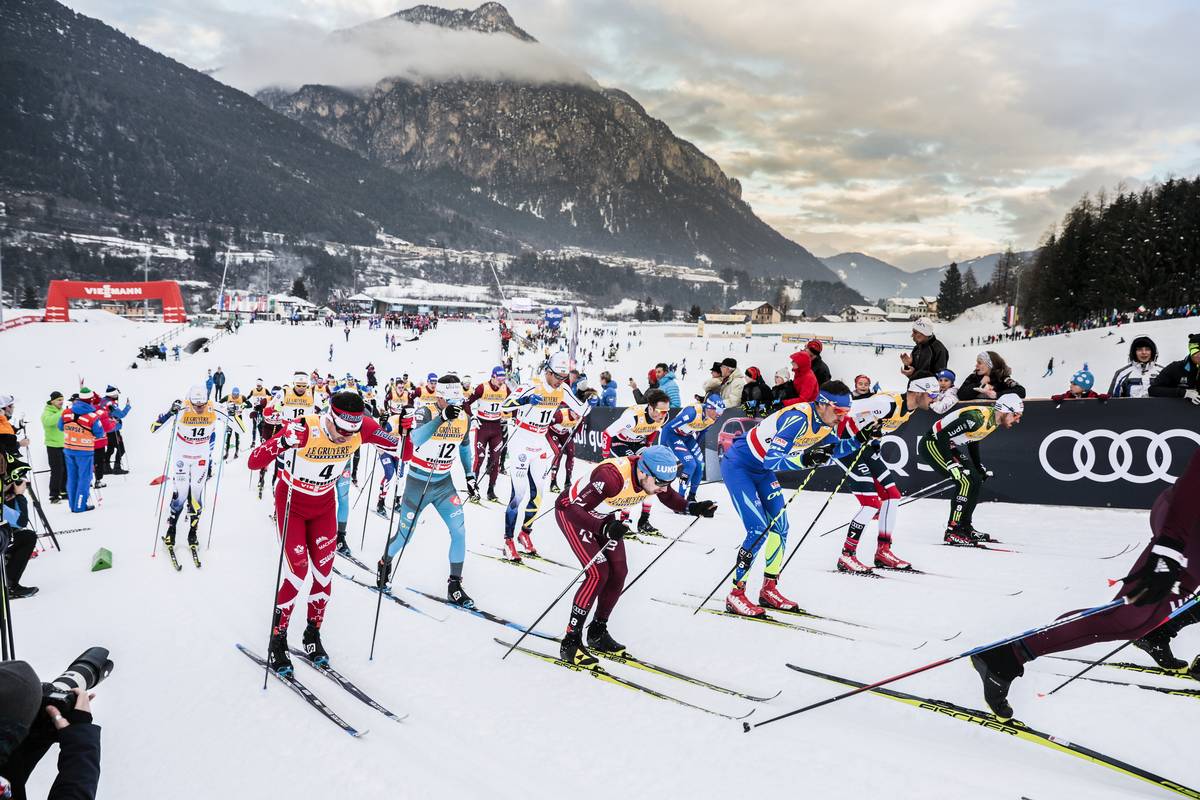
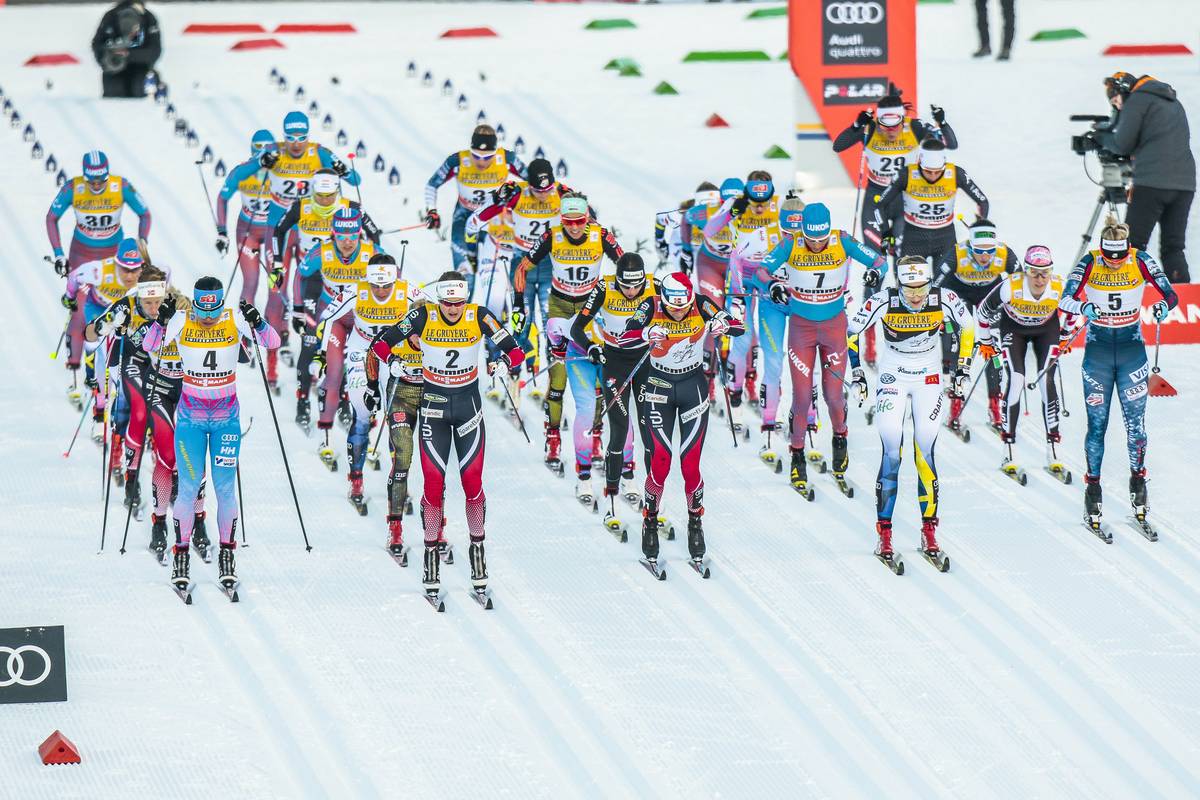
The start of the men’s 15 k classic mass start at Stage 6 of the 2018 Tour de Ski on Saturday in Val di Fiemme, Italy, with (front row, left to right) Canada’s Alex Harvey, Russia’s Sergey Ustiugov, Kazakhstan’s Alexey Poltoranin, Norway’s Martin Johnsrud Sundby, and Switzerland’s Dario Cologna. (Photo: Salomon/NordicFocus)
Beginning this Saturday in Toblach, Italy with a freestyle sprint is the 13th edition of the Tour de Ski (TdS). According to the International Ski Federation (FIS), over the course of seven stages the men will race 80.918 kilometers, the women 60.67 k.
The TdS has become both a staple and a spectacle of the annual World Cup calendar. With a jam-packed series of races primacy is placed on both the ability to recover well and wither less as the TdS transpires.
Prognostication can be tricky in a long-form template like the TdS. So much can go astray during seven races not to mention the travel and dicey germ-avoidance.
Last season’s winner on the women’s side, Heidi Weng of Norway, sits 18th overall in the World Cup standings (14th in distance). She has four top-20’s in the four distance events she’s contested with her best result an eighth in Lillehammer’s 10 k skate. Although featuring two sprints in the first three stages, the TdS remains a distance skier’s paradise.
Weng has skied solidly on the World Cup, but she has yet to show the form that made her a TdS overall winner in 2017 and 2018. Norway has won the last five iterations of the TdS: Marit Bjørgen won once in 2014/2015, Therese Johaug twice (2013/2014, 2015/2016), and Weng the last two years.
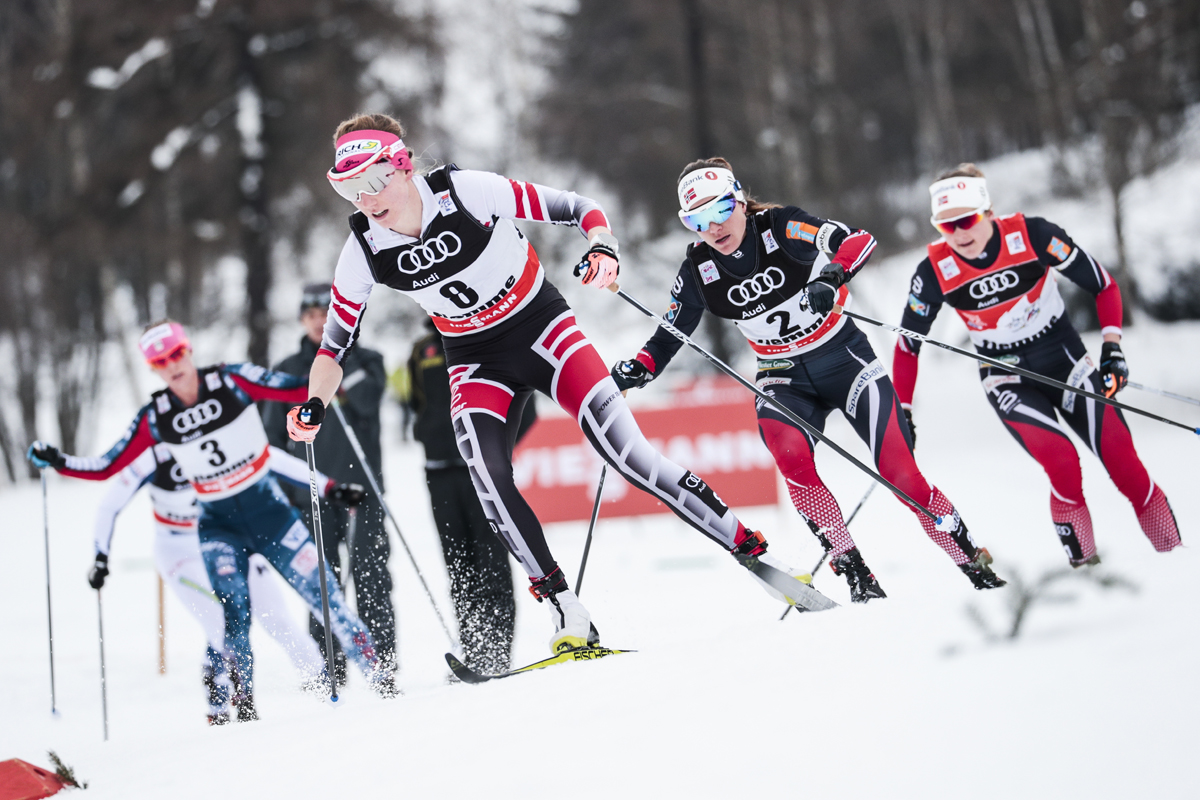
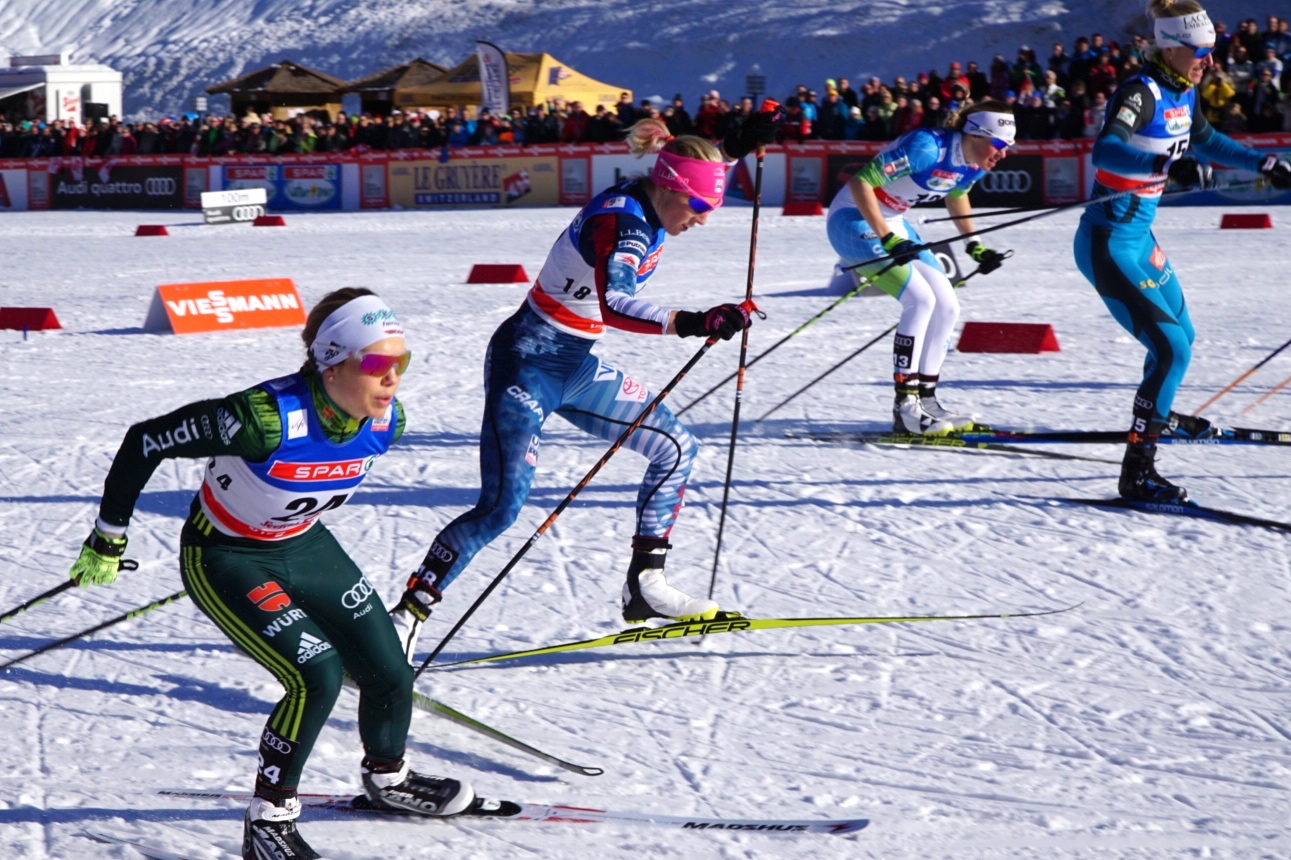
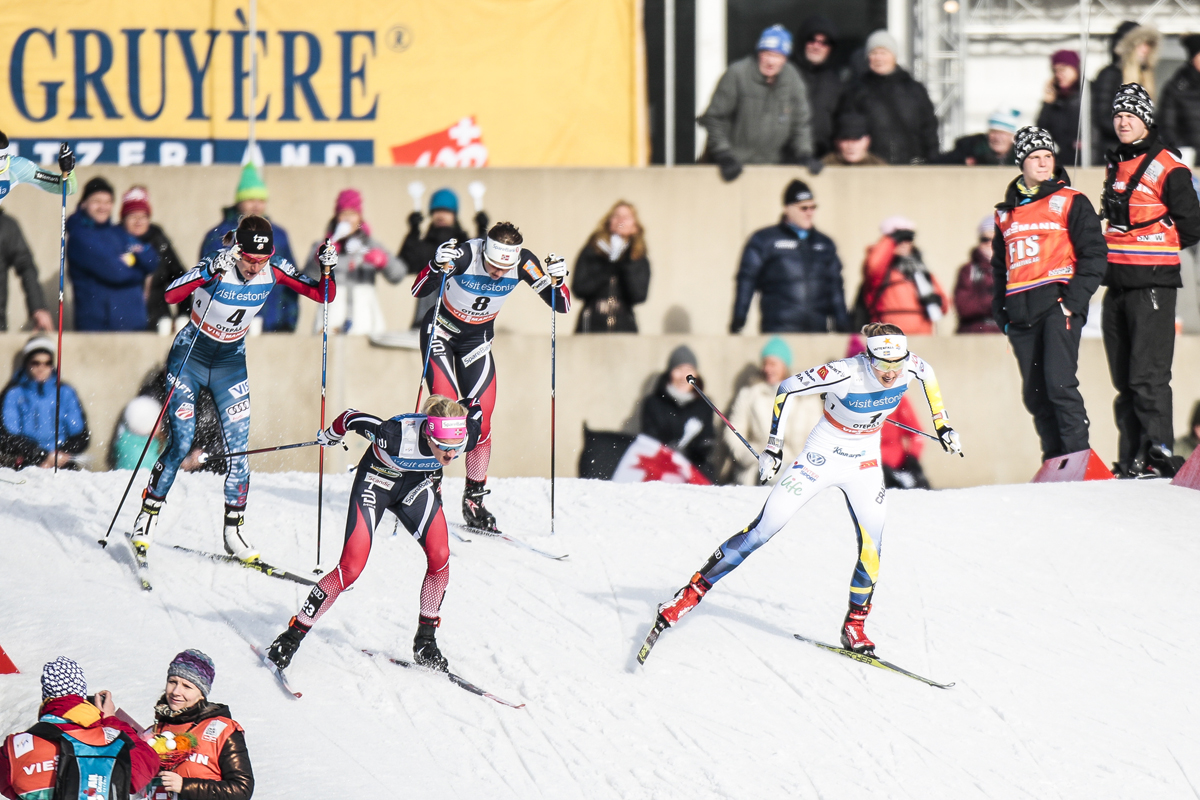
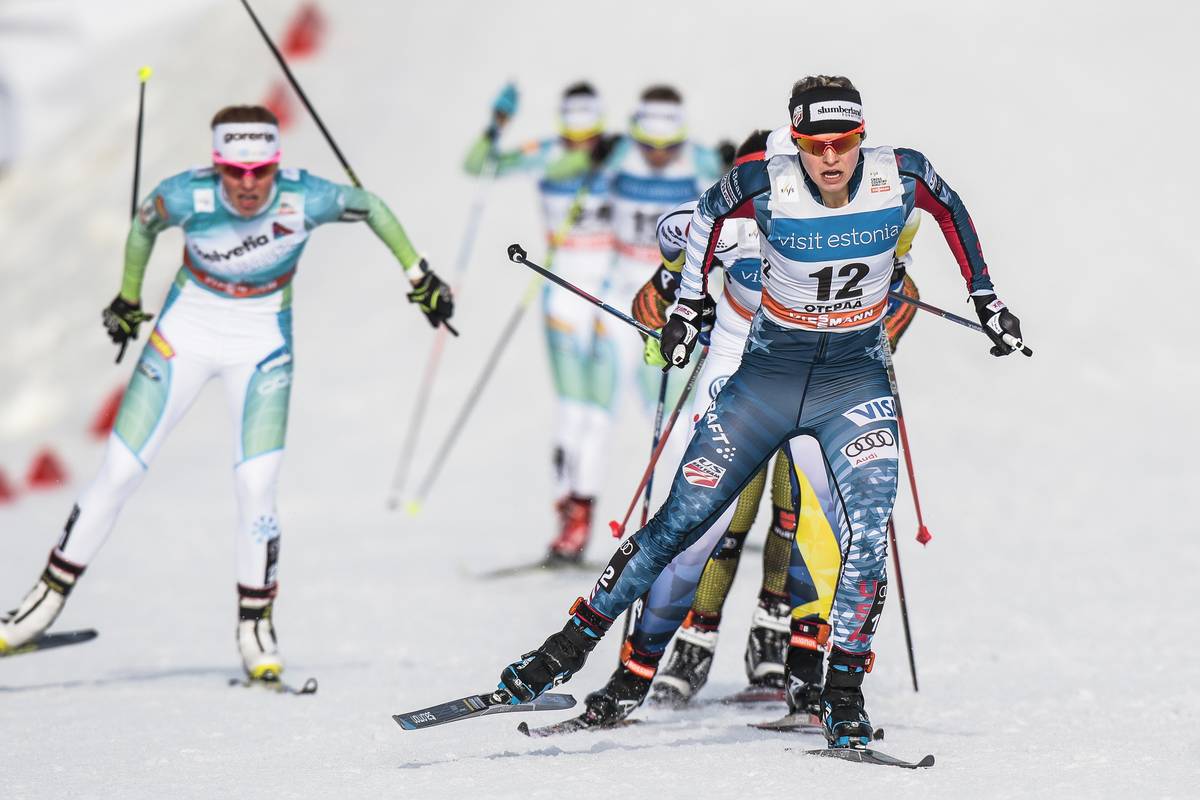
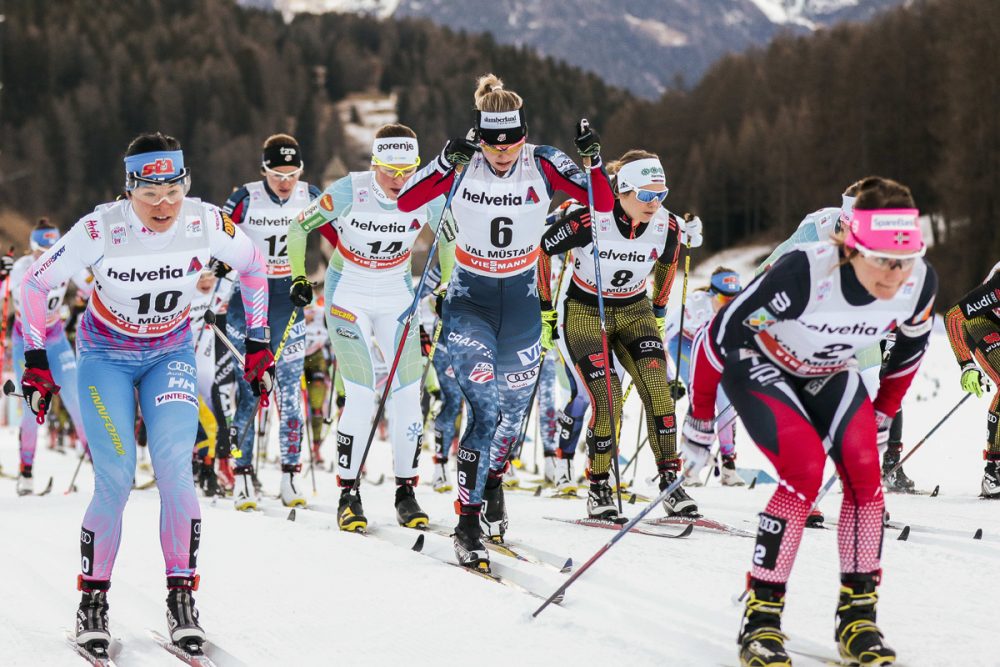
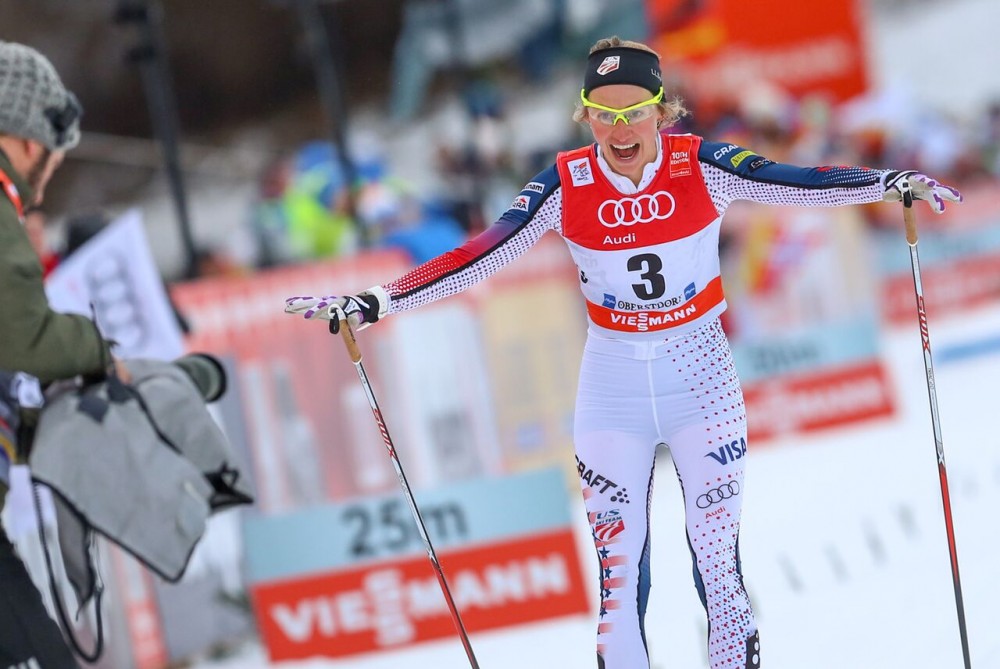
Austria’s Teresa Stadlober leads Norway’s Heidi Weng (2) and Ingvild Flugstad Østberg, American Jessie Diggins (3) and others around a downhill corner during the women’s 10 k classic mass start at Stage 6 of the 2018 Tour de Ski in Val di Fiemme, Italy. (Photo: Fischer/NordicFocus)
If Norway is to keep the streak alive, Ingvild Flugstad Østberg, last year’s TdS runner up, could be the heir apparent. She currently ranks second in the World Cup overall and 15th on the sprint list.
Johaug, having returned from an 18 month doping ban, has been on a distance race tear. She has won all five World Cup distance events this season. Johaug, however, will not be lining up for the TdS.
Only five different women have earned distance podiums this season — Johaug, Østberg, Sweden’s Charlotte Kalla and Ebba Andersson, and Finland’s Krista Pärmäkoski. Along with Johaug, Kalla and Andersson are skipping the TdS. (Andersson sits third overall on the World Cup, Kalla fifth.) With the TdS missing three of the five top ranked World Cup distance skiers, daily stages and the overall podium are up for grabs.
Last season’s third overall finisher, Jessie Diggins of the U.S. Ski Team (USST), often cites the TdS as a point in the season when her form trends towards podium performances. She sits eighth in the current distance standings and could very well have a stout TdS.
Russia’s Natalia Belorukova and Yulia Nepryaeva look strong as does Sadie Bjornsen (USST), and Austria’s Teresa Stadlober.
With less than predictable distance stage podiums for the women, it may simply come down to a drag race on the Alpe Cermis final climb Jan. 6.
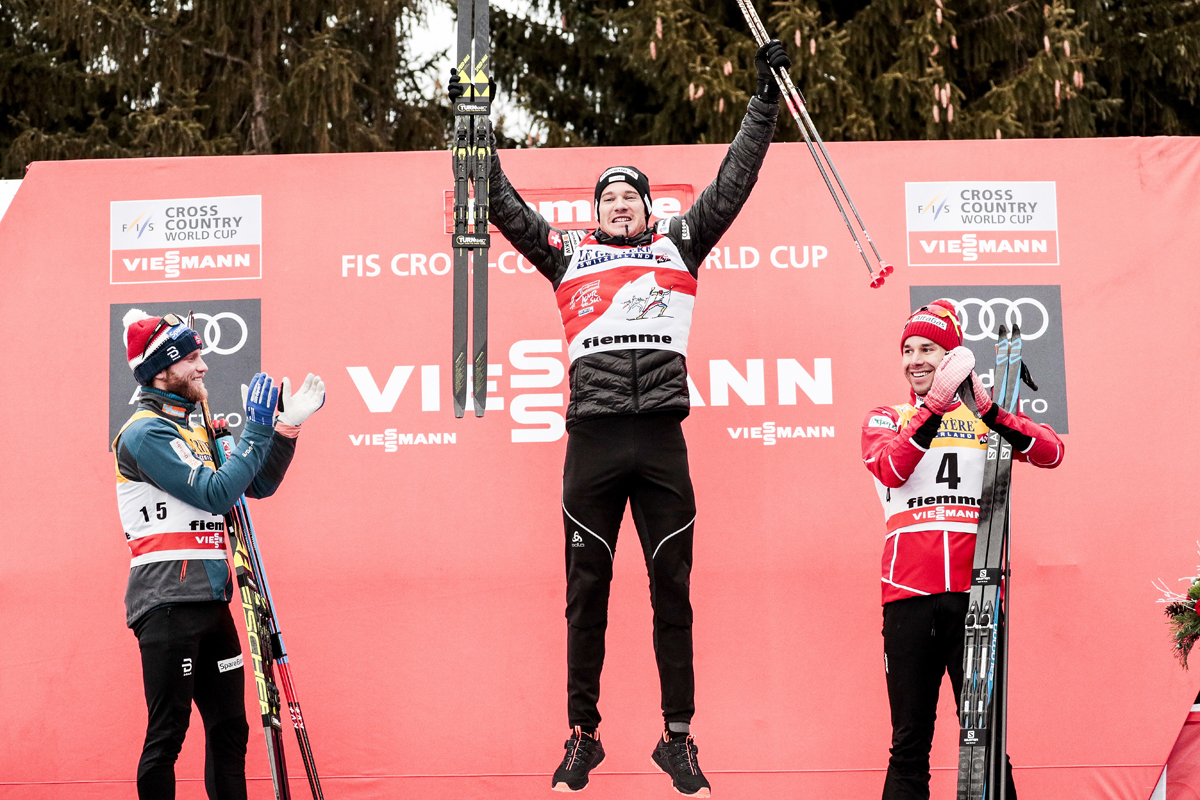
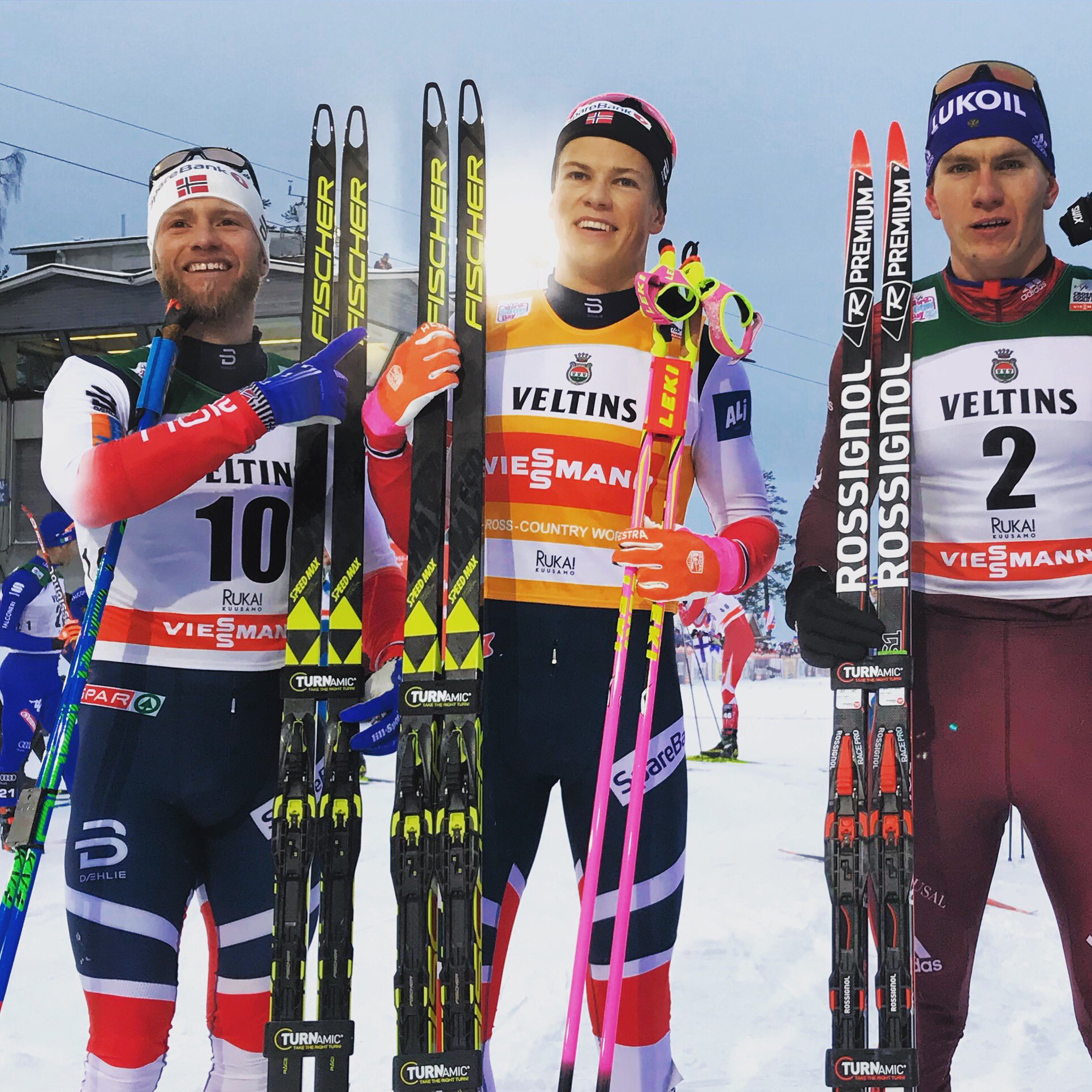
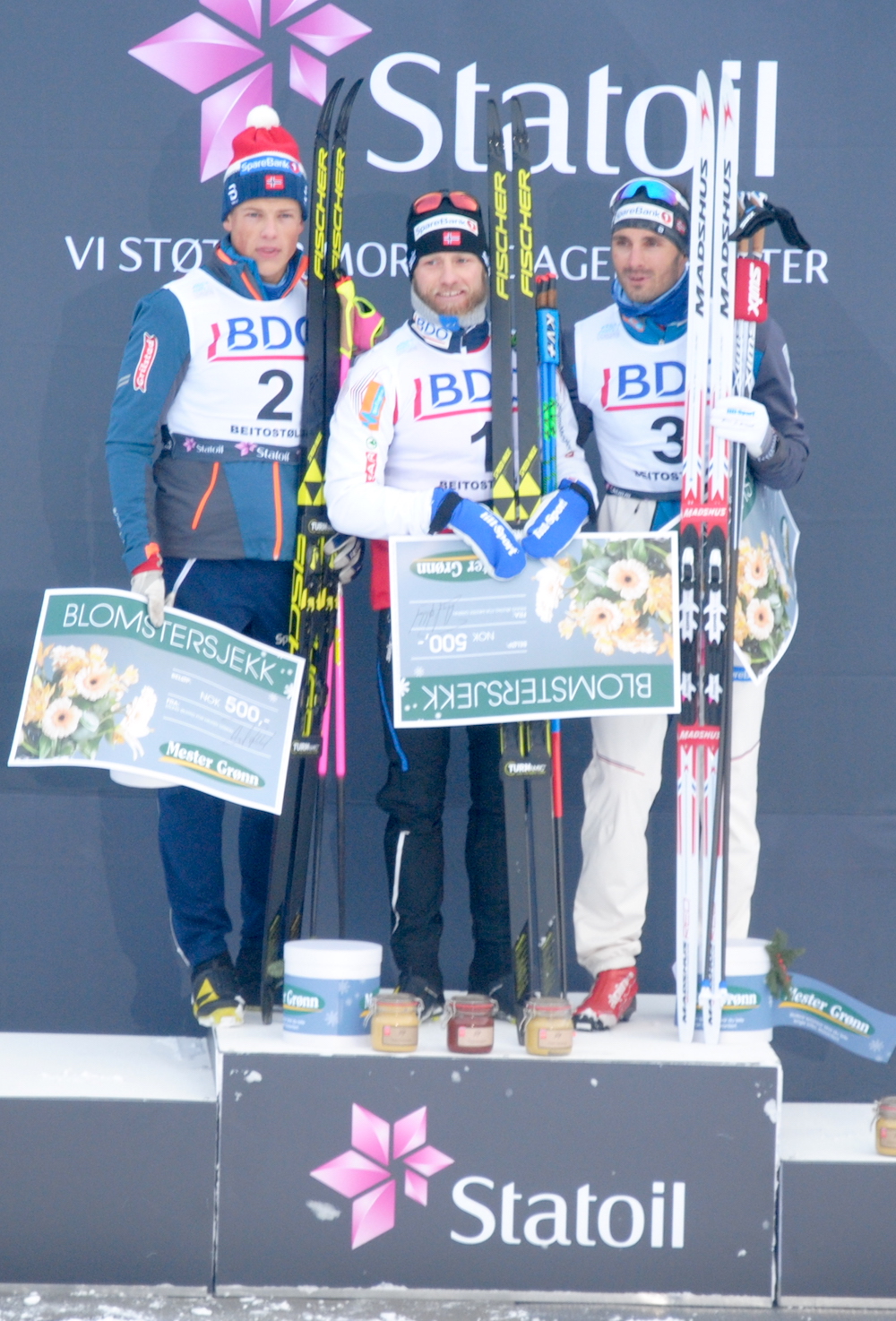
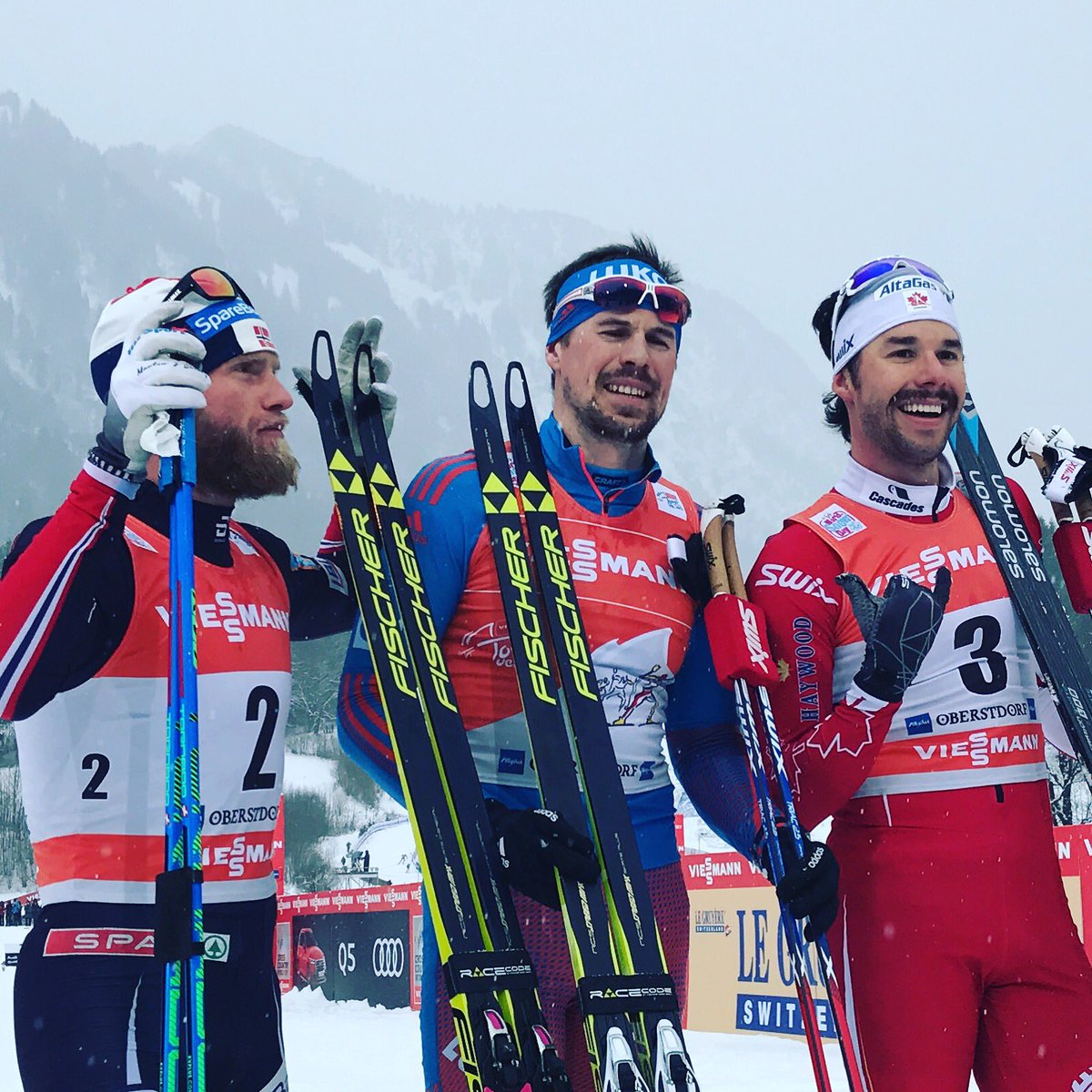
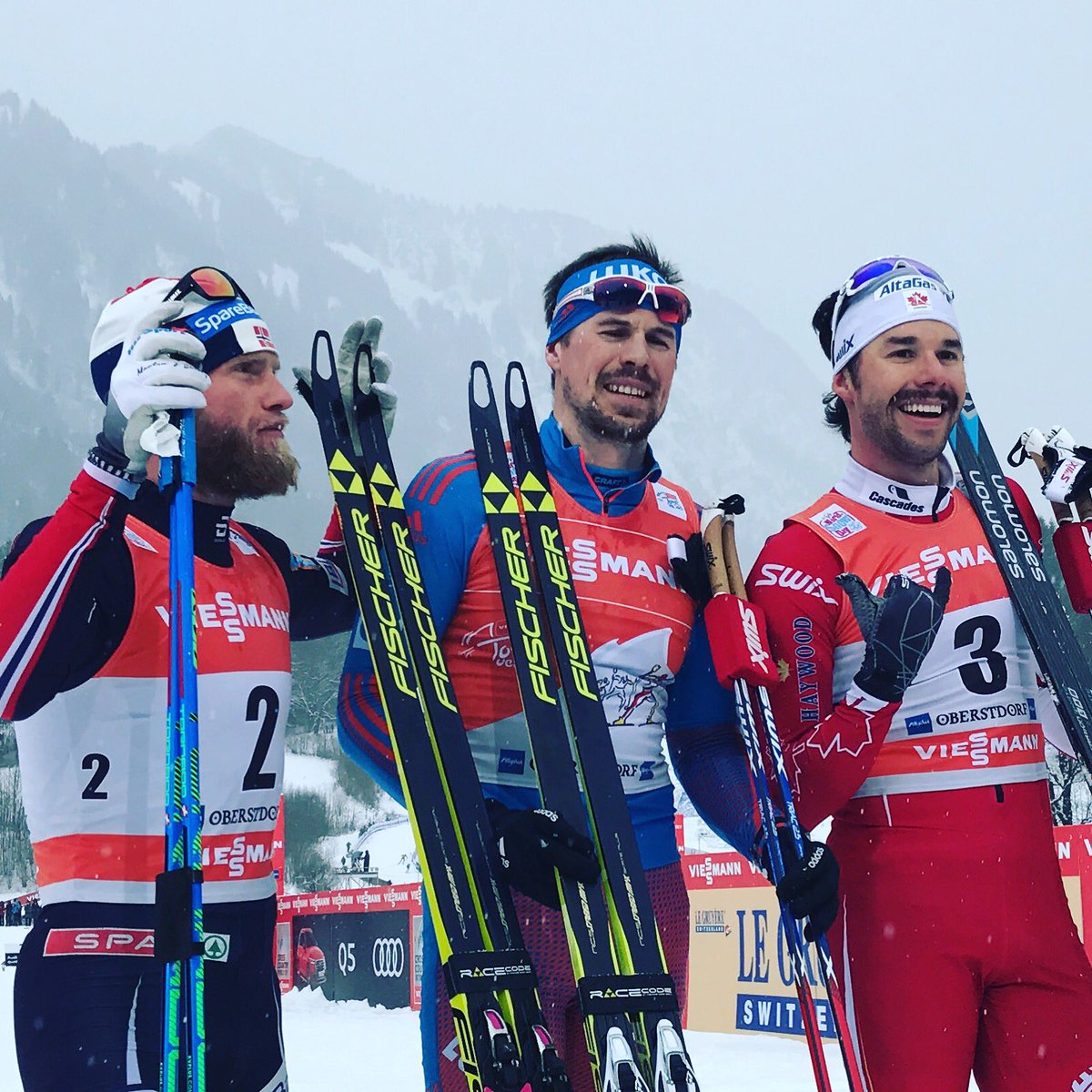
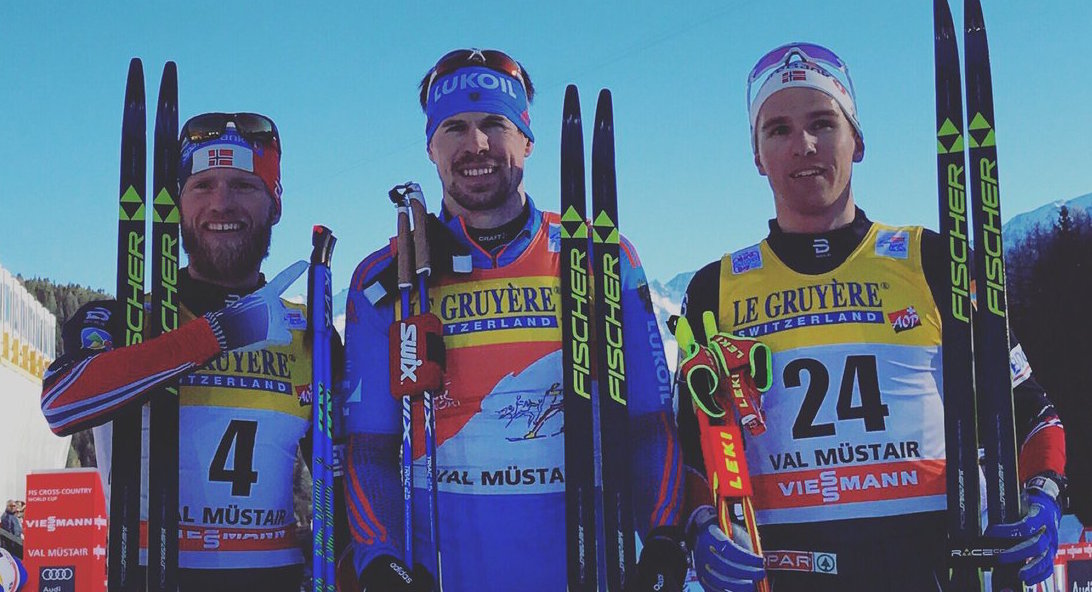
Switzerland’s Dario Cologna (c) celebrates his fourth Tour de Ski overall title. He was joined by Norway’s Martin Johnsrud Sundby (l) and Canada’s Alex Harvey (r) on the podium in second and third, respectively. (Photo: Fischer/NordicFocus)
The men’s scene is also open to interpretation. Last season’s TdS winner, Switzerland’s Dario Cologna, was in fact a surprise victor. Prior to Cologna’s stage two win in last year’s TdS, it had been nearly three years since the four time TdS overall winner had won a World Cup. Cologna sits 21st overall on the World Cup currently. Given last year’s resurgence, anything is possible for the Swiss skier.
Then there’s Martin Johnsrud Sundby form Norway. He finished on the TdS podium the last three years. At thirty-four-years-old, Sundby is ranked first on the distance list, with a second, a third, and a fourth place in distance races this season.
Sundby won the TdS on two occasions – in 2013/2014 and in 2016. His 2015 win was stripped after he tested positive for excessive levels of Salbutamol. He placed second in the past two Tours.
In a field rife with talent, Sundby’s ability to race and rebound and race and rebound will be tested. Sjur Røthe, Emil Iversen, and Didrik Tønseth— all from Norway— look in form. And there’s Norway’s Johannes Høsflot Klæbo. The winner of last season’s overall World Cup has had flashes of his past explosive self. He could be a TdS protagonist.
The men’s field is notably tight. Along with the Norwegians, several Russians could pop a podium, a stage win, and the overall. Russia comes with a loaded team ready to exploit. Alexander Bolshunov leads the overall World Cup – he’ll turn twenty two on Dec. 31st. He’s backed by teammates Evgeniy Belov, Andrey Melnichenko, and Denis Spitsov.
Canada’s Alex Harvey placed third overall last year and he looked stronger as the TdS progressed.
The Stages
Stage 1: Dec. 29, skate sprint in Toblach, Italy.
Stage 2: Dec. 30, 10 k/15 k skate in Toblach, Italy.
Stage 3: Jan. 1, skate sprint in Val Müstair, Switzerland.
Stage 4: Jan. 2, 10 k/15 k classic mass start in Oberstdorf, Germany.
Stage 5: Jan. 3, 10 k/15 k skate pursuit in Oberstdorf, Germany.
Stage 6: Jan. 5th, 10 k/15 k classic mass start in Val di Fiemme, Italy.
Stage 7: Jan 6th, 9 k final climb skate pursuit in Val di Fiemme, Italy.
Teams
United States
Women: Sophie Caldwell, Sadie Bjornsen, Jessie Diggins.
Men: Ben Lustgarten, Simi Hamilton, Erik Bjornsen, Kevin Bolger.
U.S. Ski Team Head Coach Chris Grover noted in a text that Caldwell, Hamilton, and Bolger will likely cease the TdS after the stage three sprint. Additionally, this is a small team for the U.S. at the TdS. Several athletes turned down TdS nominations including Scott Patterson (USST), Andy Newell (SMS T2/Salomon), Kyle Bratrud (SMS T2), Rosie Brennan (APU), Rosie Frankowski (APU), Caitlin Patterson (CGRP), and Julia Kern (SMS T2). These skiers plan on racing U.S. Nationals this January in Craftsbury, Vermont.
Canada
Women: Emily Nishikawa, Dahria Beatty
Men: Alex Harvey, Lenny Valjas, Bob Thompson
Norway
Women: Ingvild Flugstad Østberg, Maiken Caspersen Falla, Astrid Uhrenholdt Jacobsen, Kari Øyre Slind, Kathrine Rolsted Harsem, Heidi Weng, Lotta Udnes Weng, Tiril Udnes Weng Mari Eide, Anna Svendsen
Men: Martin Johnsrud Sundby, Hans Christer Holund, Emil Iversen, Didrik Tønseth, Simen Hegstad, Krüger, Sjur Røthe, Johannes Høsflot Klæbo, Martin Løwstrøm Nyenget, Eirik Brandsdal, Finn Hågen Krogh
Russia
Women: Yulia Belorukova, Lidia Durkina, Anna Zherebyateva, Mariya Istomina, Natalia Nepryaeva, Anna Nechaevskaya, Anastasia Sedova, Elena Soboleva
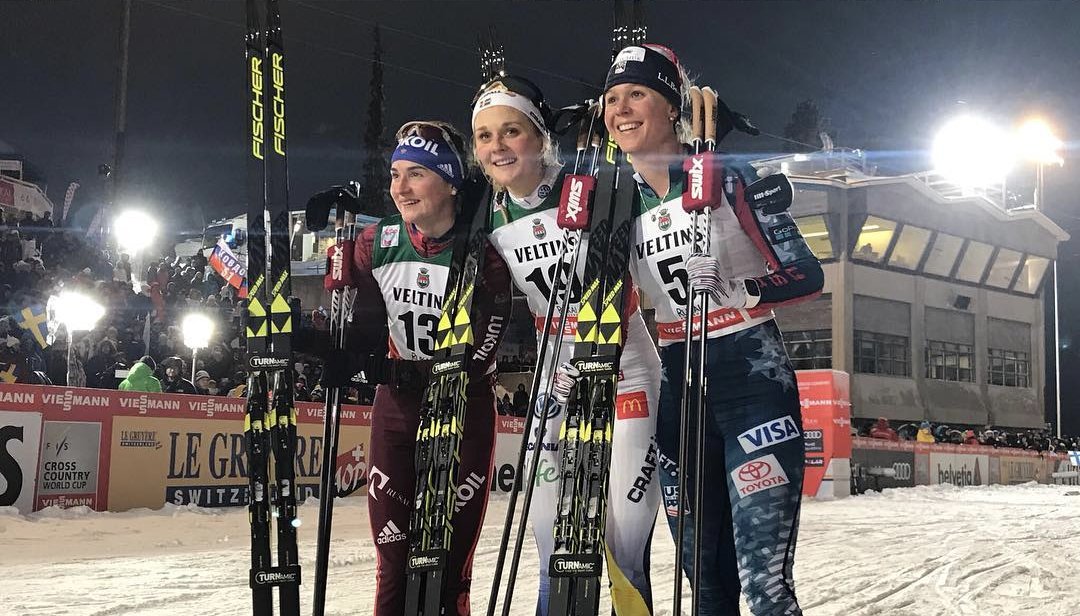
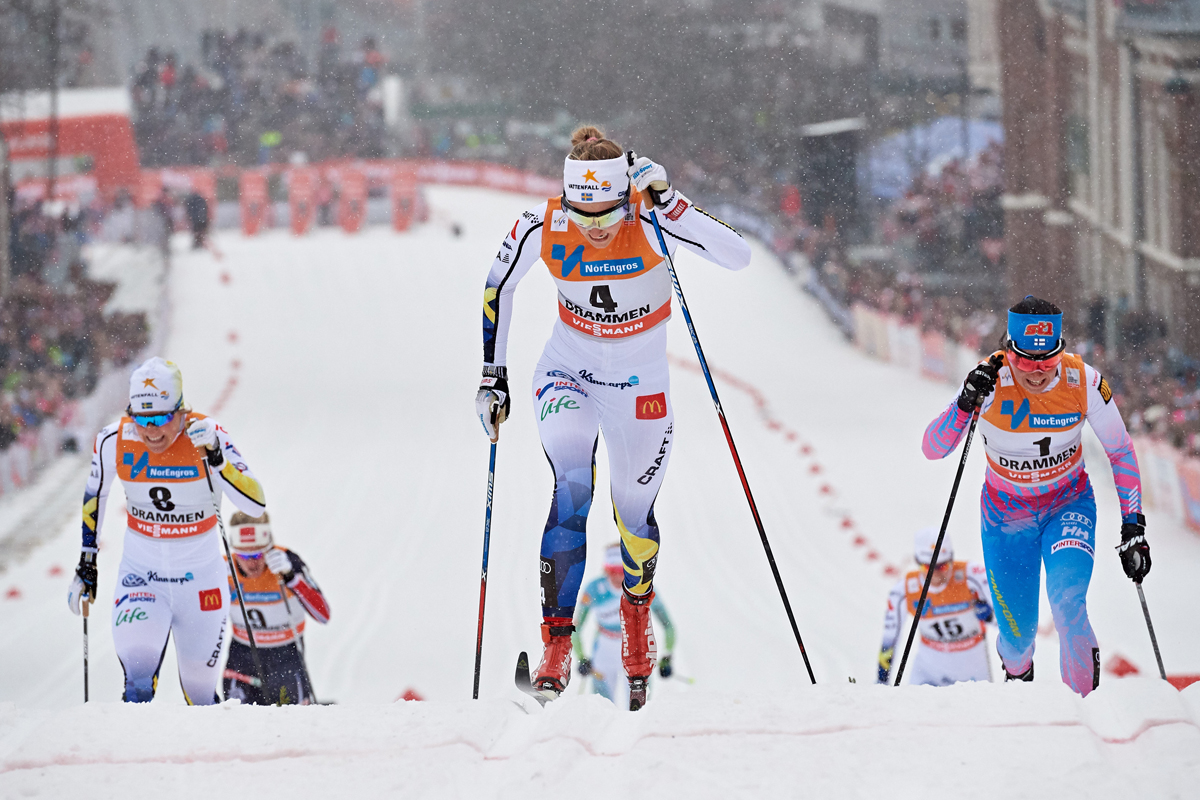
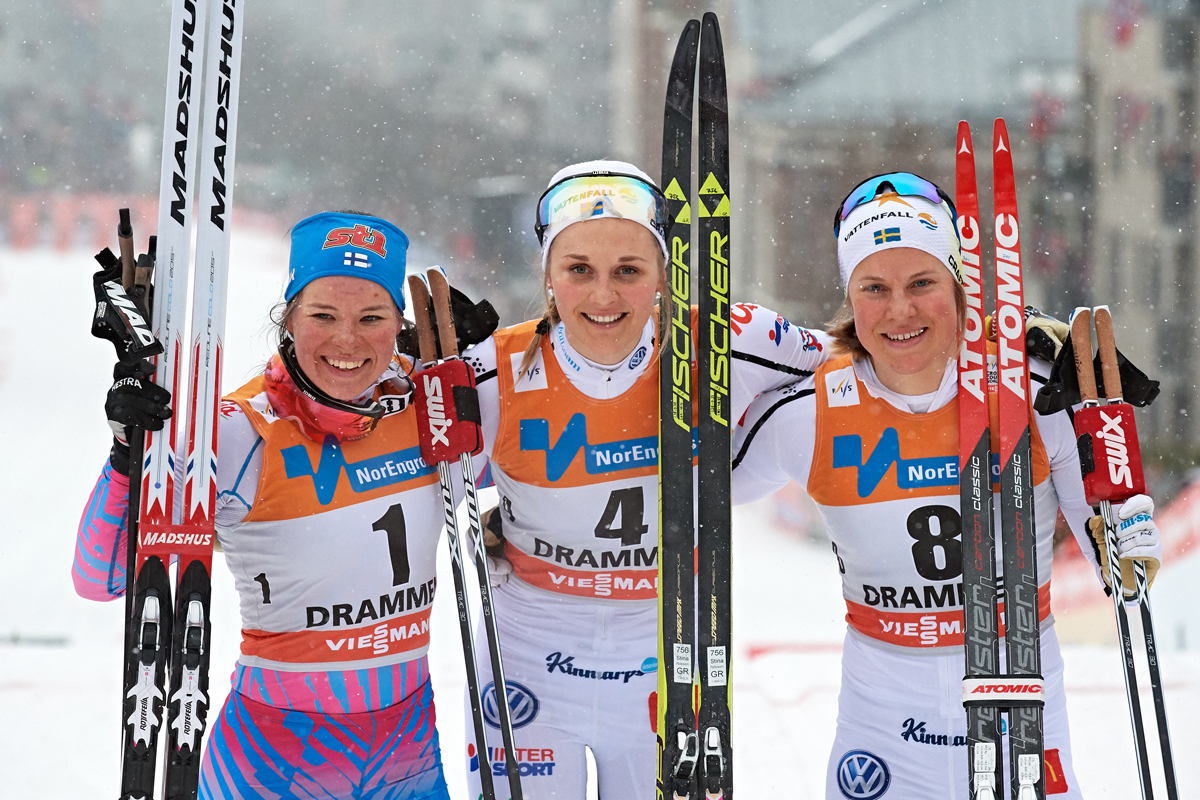
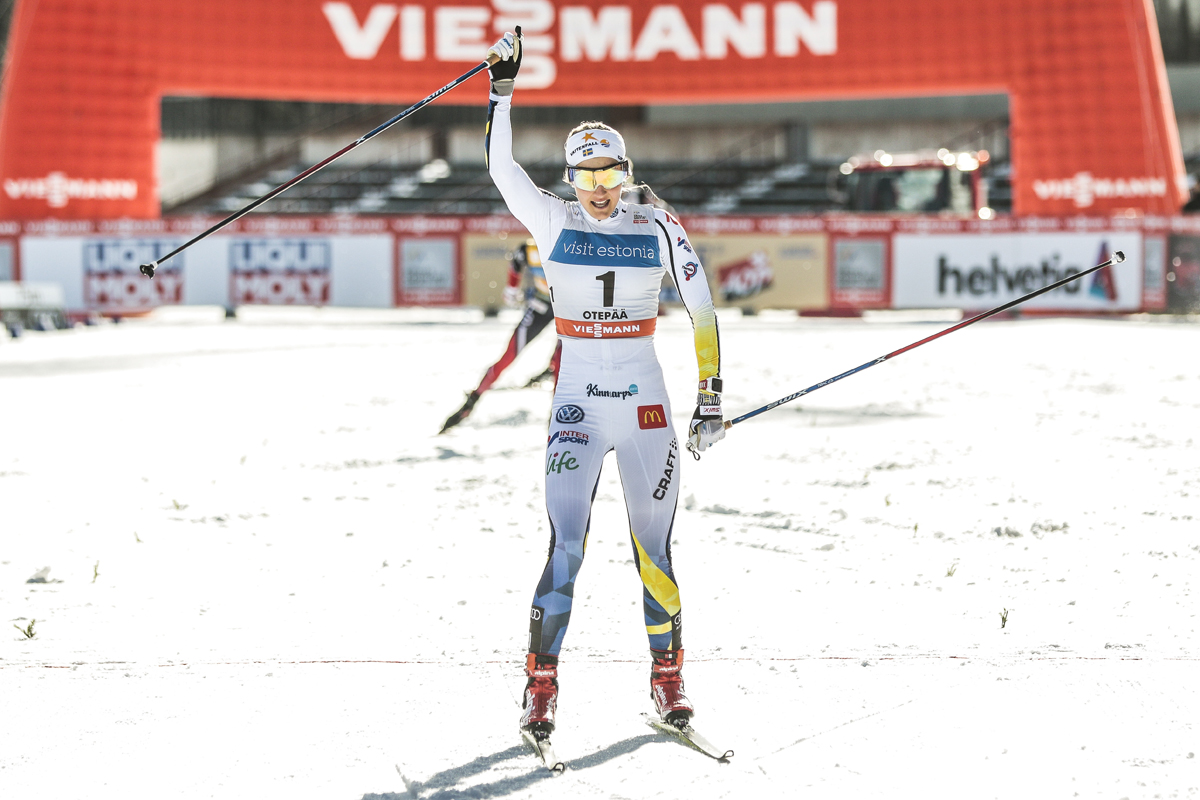
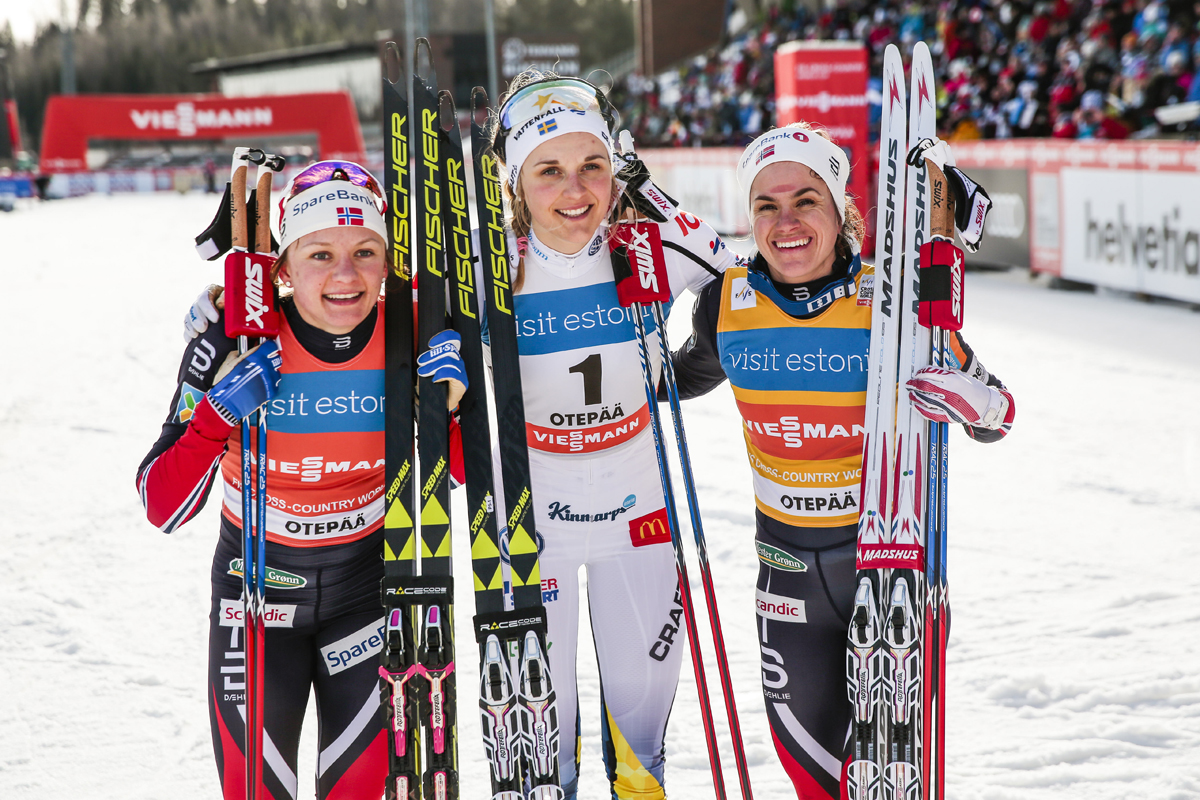
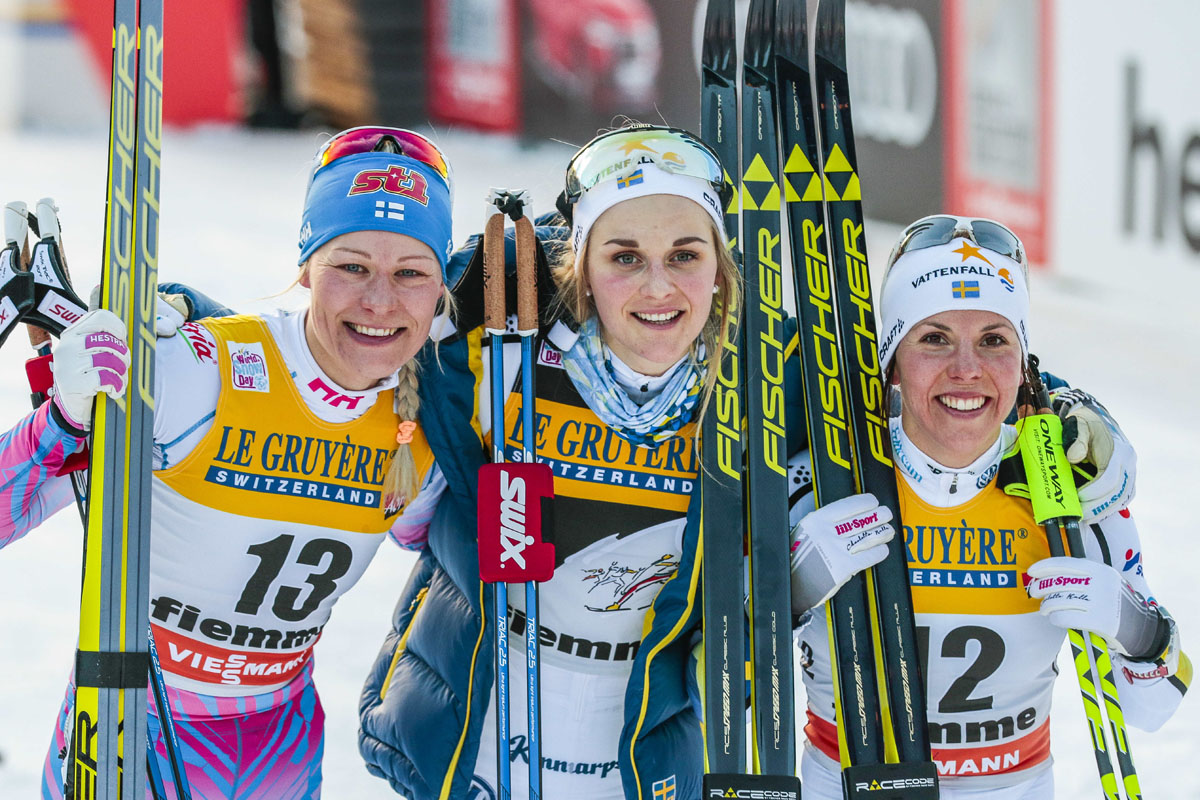
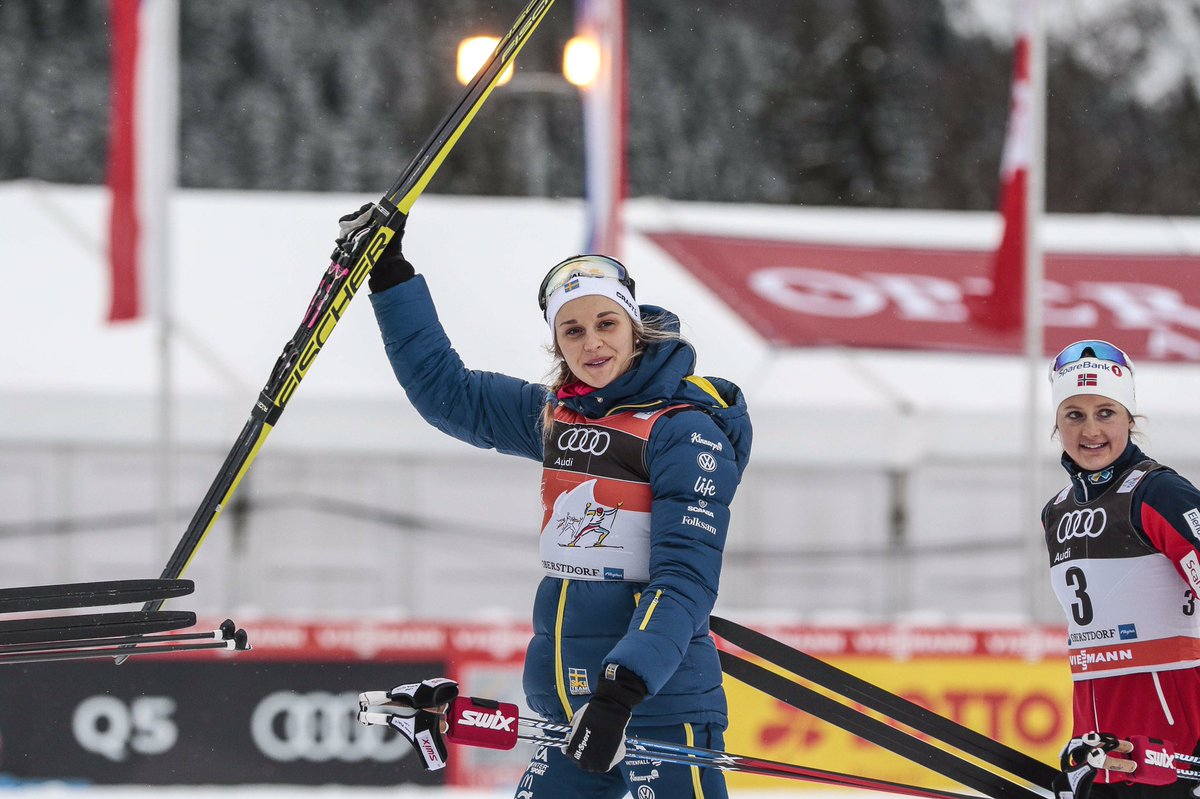
Sweden’s Stina Nilsson (center) won gold in the classic sprint at the 2018 Olympics on Tuesday in PyeongChang, South Korea, with Norway’s Maiken Caspersen Falla (left) taking silver and Russia’s Yulia Belorukova bronze. (Photo: FlyingPointRoad)
PYEONGCHANG, South Korea — Tuesday at PyeongChang’s Alpensia cross-country venue, the site of the Olympic Games women’s 1.25-kilometer classic sprint, Sweden’s Stina Nilsson took gold. On an evening when athletes were already challenged by an aerobic capacity testing course, shifting winds and falling snow, another factor made the challenge debilitating.
Nilsson came into the Games well-rested and well-primed to take her first individual Olympic medal. The 24 year old had come close before; at her first Olympics, the Swede placed 10th in the freestyle sprint in Sochi, Russia. There, she went on to claim bronze in the classic team sprint with teammate Ida Ingemarsdotter.
A year later in Falun, Sweden, at World Championships, Nilsson placed second in the individual classic sprint. When you are close, you begin to think more about achieving a singular goal and less about overall season-long outcomes.
Nilsson last raced a World Cup the weekend of Jan. 20-21 in Planica, Slovenia, where she raced to 13th place in the 10 k classic. The day before, on Jan. 20, Nilsson took a small prize: a World Cup classic-sprint win.
In her run up to PyeongChang, Nilsson explained she was able to focus on her training and block out distractions.
“Not so much pressure the last weeks, because I have not been on the Internet so much,” Nilsson said at the post-race press conference. “And not on Instagram. So the most pressure comes from myself, and that’s the pressure that I have to deal with. But today I managed to control those feelings and just ski so fast as I can.”
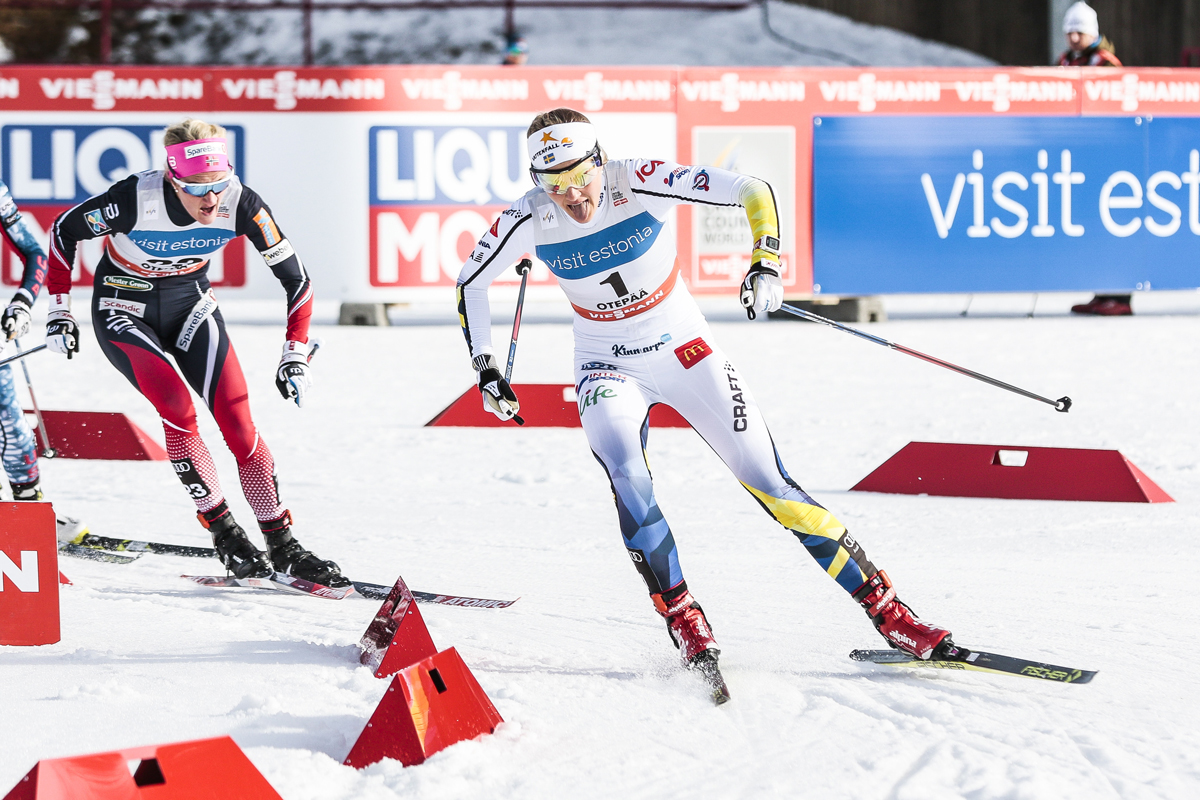
With temperatures hovering around 25 degrees on Tuesday evening, Nilsson was unstymied by the gusting winds or falling snow in formulating the answer to her success equation. Starting with Tuesday’s qualifier in PyeongChang, Nilsson marked the fastest time, stopping the clock in 3:08.74 minutes. With Nilsson pushing the pace, she also scored a win in the quarters. Again in her semifinal, Nilsson placed first after dualing with the 2014 Sochi skate-sprint champion, Norway’s Maiken Caspersen Falla (who also won the skate sprint at last year’s World Championships), in a photo finish.
“I had a really good day,” said Nilsson, a 2015 World Championships classic-sprint silver medalist. “I felt strong already in the prologue, and I felt also strong in the quarterfinal, and in the semifinal. I felt like I had some energy saved for the final.”
Sweden’s Stina Nilsson and teammate Hannah Falk (4) embrace after Nilsson won the classic sprint gold medal at the 2018 Olympics in PyeongChang, South Korea. (Photo: FlyingPointRoad)
Lining up in the final trying to prevent Nilsson’s clean sweep on the day were Falla, Nilsson’s Swedish teammate Hannah Falk, American Jessie Diggins, and Russians Natalia Nepryaeva and Yulia Belorukova.
The energy Nilsson stated she had saved for the final was more than sufficient. Off the line she set the pace up the course’s first climb — a climb not steep enough to create big gaps and string out the field. The group stayed together with two skiers in the inside lane, three in the adjacent lane, and Diggins skiing outside the tracks and closing on the outside.
Topping out on the hill and taking a sharp 180-degree turn, Nilsson led but no skier pulled away. Down the hill, the six skiers tucked and glided and double poled into the course’s decisive climb with Belorukova then Falla the closet skiers to challenge.
The final hill is where Nilsson seized the day.
“I just wanted to cross the finish line totally tired, so I just went for it in the last uphill,” Nilsson said about her race tactics in the final. She carried considerable speed over the final climb and the gap grew to the two closest chasers, Falla and Belorukova.
“My plan was to save the most of the power until the last part of the [final] climb,” Falla, 27, said at the press conference. “But when the two others got a little gap in the first downhill, I used too much power in the first part of the climb. So in the top where I was planning to use all my power, there wasn’t that much left.”
Nilsson still had power to spare. She soloed off the front to win the final in 3:03.84 minutes. Falla took silver (+3.03), Belorukova, a 23-year-old Olympic rookie, bronze (+3.37).
In the post-race press conference, Belorukova was asked about the tense relationship between the International Olympic Committee (IOC) and the Russian Ski Federation. The IOC banned numerous Russian skiers from PyeongChang for doping violations. Those Russian athletes competing at the 2018 Winter Olympics are not competing under the Russian flag, but as Olympic Athletes from Russia (OAR).
“Good question,” Belorukova said through an interpreter. “There is nothing that will break us, there is nothing that will instill fear into us, we are strong and we will fight until the end.”
Nepryaeva ended up fourth (+9.14), Falk fifth (+11.16), and Diggins sixth (+11.23). FasterSkier will post an additional report on the U.S. women’s results.
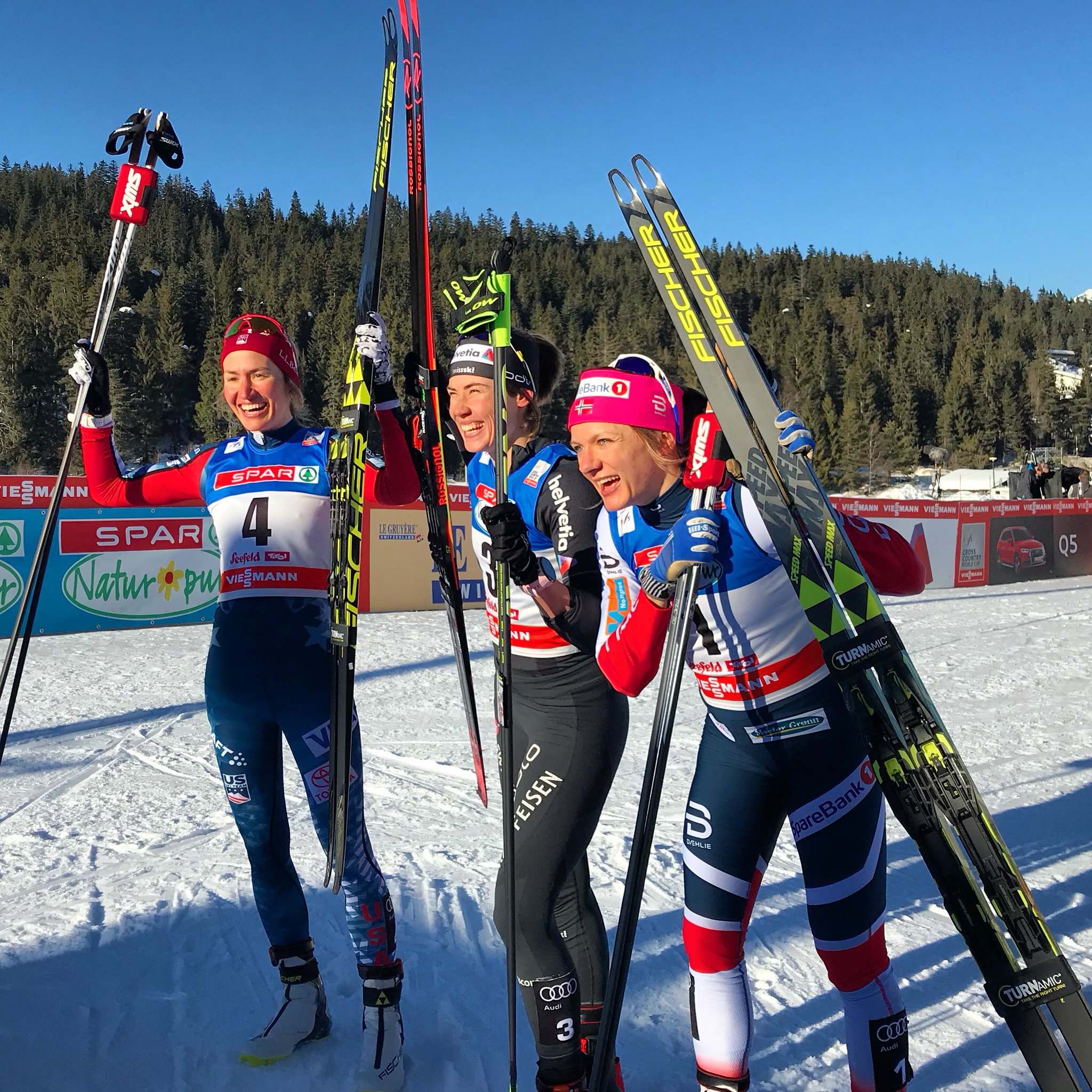
American Sophie Caldwell (c) and Switzerland’s Laurien van der Graaff high-five after tying for first in the women’s 1.3 k freestyle sprint on Saturday at the World Cup in Seefeld, Austria. Norway’s Maiken Caspersen Falla was next across the finish line for third place. (Photo: Garrott Kuzzy / LumiExperiences.com)
SEEFELD, Austria — By the time the women’s finalists toed the start line, fans lucky enough to find a spot directly against the fence lining the World Cup 1.3-kilometer freestyle sprint course on Saturday showed signs of sunburn on their cheeks. The Seefeld sun was high and bright, but not the only one radiating on the Tirol ski trails.
U.S. skier Sophie Caldwell found Seefeld treating her well. And she herself was on the strike.
She started the day by qualifying for the heats in fourth, 1.84 seconds behind top women’s qualifying time of 2:21.44 posted by Norwegian Maiken Caspersen Falla. Heat selection came next. Caldwell opted for Heat 1, knowing that she had a fair chance of running up against Falla in that quarterfinal.
The move was gutsy. Falla has 14 World Cup sprint victories. She was last year’s world champion in Lahti, Finland. Falla also has an Olympic gold medal from the 2014 Olympic Winter Games in Sochi, Russia. Both those events were in freestyle; Saturday’s discipline as well.
But Caldwell wanted to be in the fast heat, even if it had the potential of knocking her out.
“She kind of guessed when she selected quarterfinal 1 that Maiken would also go in quarterfinal one .. that was part of the strategy,” U.S. Ski Team Head Coach Chris Grover told FasterSkier in person after.
“Maiken and I chose the first quarterfinal,” Caldwell told FasterSkier. “I knew we were going to have fast times throughout the day and I had a good chance of being lucky loser.”
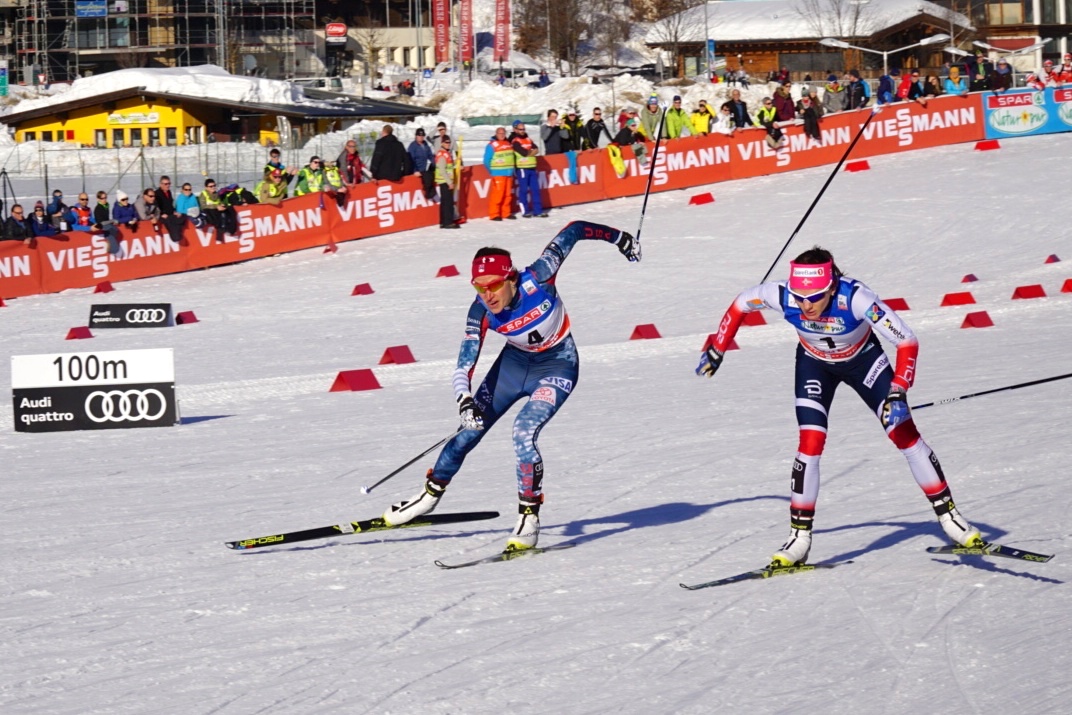
American Sophie Caldwell (l) and Norway’s Maiken Caspersen Falla (r) contested for the win in both their quarterfinal and semifinal. Falla won the quarterfinal while Caldwell won the semi. Ultimately, Caldwell placed first in the final, tying Switzerland’s Laurien van der Graaff (not shown) while Falla placed third overall. (Photo: Garrott Kuzzy / LumiExperiences.com)
From the start of their quarterfinal, the first of five, the American not only hung with Falla, she pressured her. Caldwell skied in second just behind the Norwegian as they approached the finish, where Falla outlunged Caldwell by 0.8 seconds to win the heat.
Both automatically advanced to the semifinal, and faced off once again in the first semi. This time through, the 27-year-old U.S. Ski Team member was even more ready.
After skiing in second behind Falla, also 27, into the final 100-meter stretch, Caldwell made her move around the Norwegian with 50 meters to go. The two once again lunged for the line. Caldwell emerged victorious, crossing the semifinal first in a time of 2:18.88, this time 0.16 seconds ahead of Falla.
“She’s an amazing skier and an amazing skier to follow,” Caldwell said of Falla. “My goal was to follow her all day long.”
The two were headed for the final together. Their fast semifinal also produced two lucky losers, Switzerland’s Laurien van der Graaff and Sweden’s Linn Sömskar.
From the second semifinal, another American had qualified for the final, Sadie Bjornsen, along with Norway’s Kathrine Rolsted Harsem. Until Saturday, Bjornsen had never qualified for a freestyle sprint. That hadn’t stopped the American from skiing aggressively to the win in her quarterfinal and then place second in her semifinal.
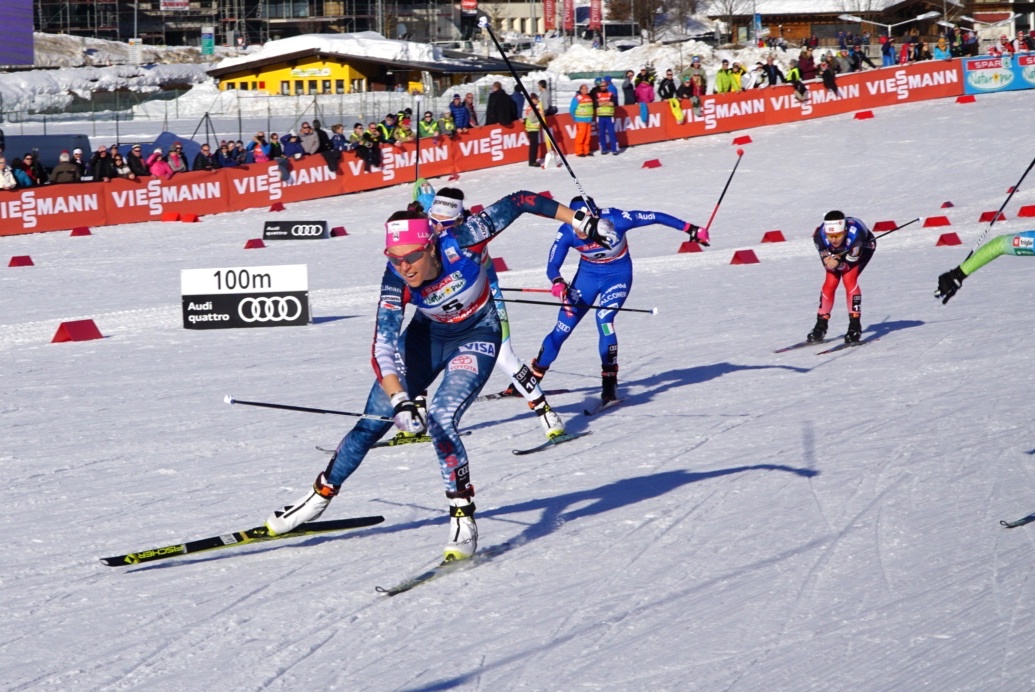
American Sadie Bjornsen racing toward the finish of her semifinal with 100 meters to go. She ended up second, 0.4 seconds behind Norway’s Kathrine Rolsted Harsem in first. Both advanced to the final, where Harsem placed fourth and Bjornsen sixth overall. (Photo: Garrott Kuzzy / LumiExperiences.com)
“My coach Erik Flora is here … we had a talk and basically he said, ‘Sadie, it never works when you try to do tactics, so just go as hard as you can and attack where you can and don’t try to play anything out there; just go,’ ” Bjornsen reflected. “So, that’s kinda what I was going with today.”
Two Norwegians, two Americans, one Swiss skier and one Swede then lined up for the women’s final on Saturday. At the sound of the gun, Falla surged to the front. Caldwell shadowed her in second, which was part of the plan.
“For the ladies, the course was so short that you wanted to stay in the front,” Grover said. “If you ended up towards back…you had to do a lot of work to get back up to the front.”
Just behind Caldwell and Falla was van der Graaff skiing just a bit to the outside. Harsem, Bjornsen and Sömskar were next in line through the course’s first uphill and corner back toward the stadium.
Tuck-skating the final section of the first downhill and powering into the next uphill, Falla seemed to see the spot as an opportunity to distance herself from the field. But Harsem and van der Graaff were now poling hard to her left. Caldwell was glued to the back of Falla’s skis, with Bjornsen and Sömskar right behind.
At the top of the final climb, however, Falla had once again put herself in the lead. Cornering into the final descent, it was Falla, Caldwell, van der Graaff, Harsem, Bjornsen, and Sömskar.
In the final 100 meters, Falla stayed in the center, Caldwell moved to her right and van der Graaff skate skied to the left. As the three sped toward the finish, Falla was just slightly ahead.
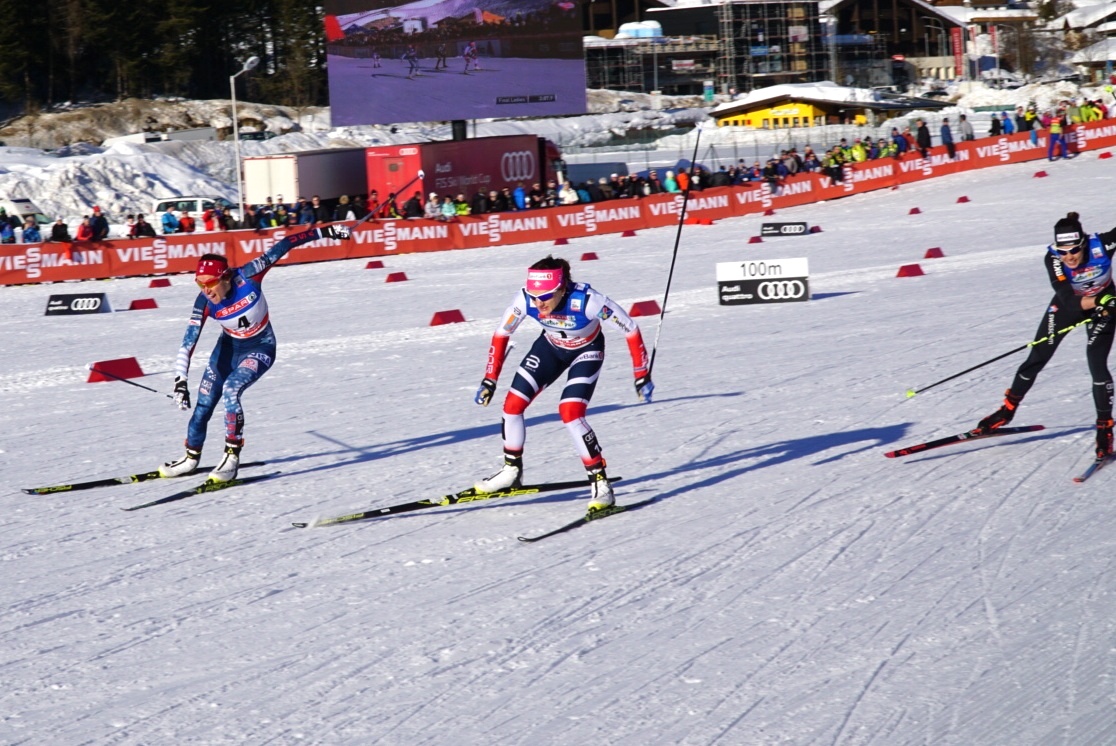
The three-way battle for first, with (from left to right) American Sophie Caldwell, Norway’s Maiken Caspersen Falla and Switzerland’s Laurien van der Graaff in the women’s 1.3 k freestyle sprint final at Saturday’s World Cup in Seefeld, Austria. Caldwell and van der Graaff ended up tying for the win. (Photo: Garrott Kuzzy / LumiExperiences.com)
The taste of a non-Norwegian victory, however, was too sweet to let go. Neither van der Graaff nor Caldwell slowed their pace to settle for anything but first place. The Swiss skier and the American crossed together in a photo finish, which was eventually ruled a tie for the win. Their time was 2:18.65. Falla crossed 0.21 seconds later for third place.
“It’s so great to win again,” said van der Graaff, 30, who earned her first World Cup win earlier this season at the opening stage of the Tour de Ski. “I have told myself to believe that it was possible and now I have two wins this season. I didn’t realize Sophie was so close at the finish. It’s kind of fun to share the podium with her. I have never heard of that happening before.
The camera at the finish focused on van der Graaff, who initially thought she won outright over Caldwell and Falla. She was televised as the day’s singular winner, and even Caldwell was unaware of her win until she was told ten minutes after the finish by Jeff Ellis, the FIS Cross Country Media Coordinator and Kikkan Randall’s husband.
“I thought he was messing with me at first,” Caldwell wrote in an email, explaining when she first heard the news.
After she learned the result was real, Caldwell described he response as “very surprised, but pleasantly so” at learning she and van der Graaf had identical lunge times to the line.
“I honestly don’t even remember lunging, but I’m glad I did,” she wrote. “It was really fun sharing the podium with Laurien. She’s a great competitor and it’s kind of cool that a tie for first place is possible!”
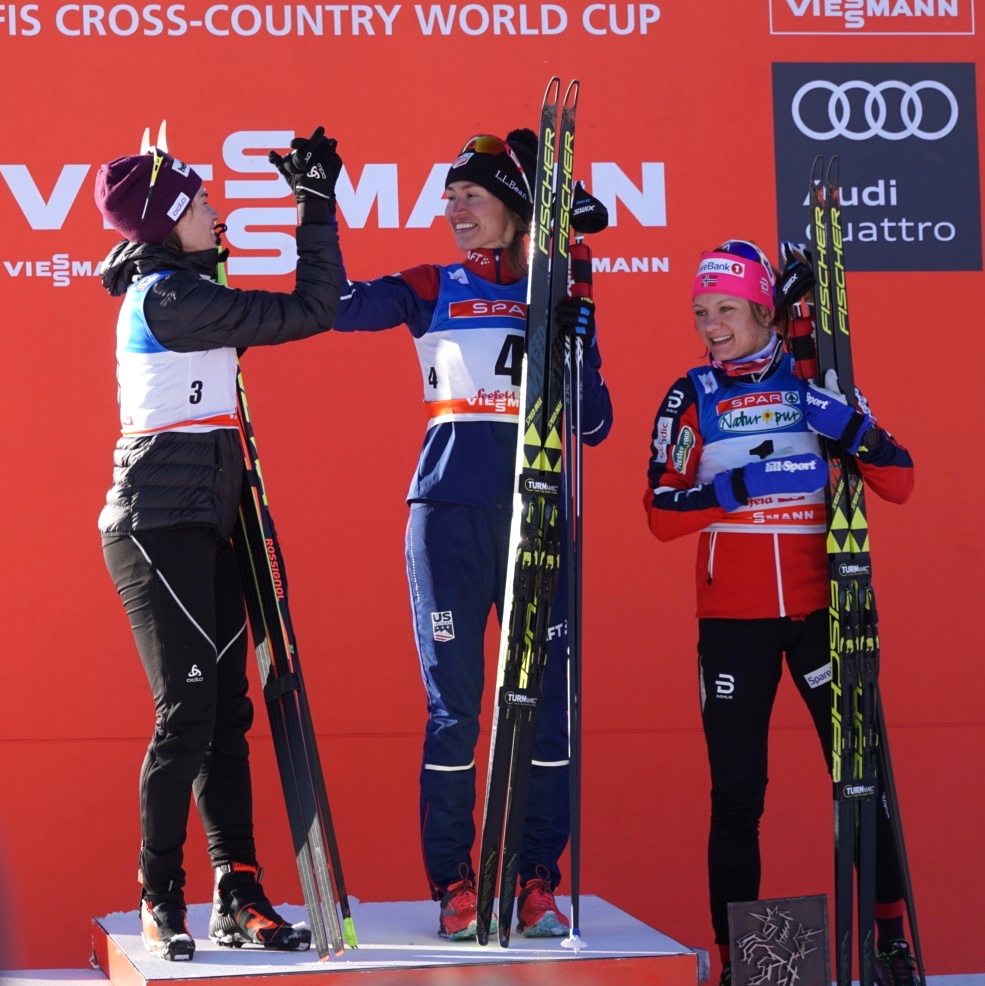
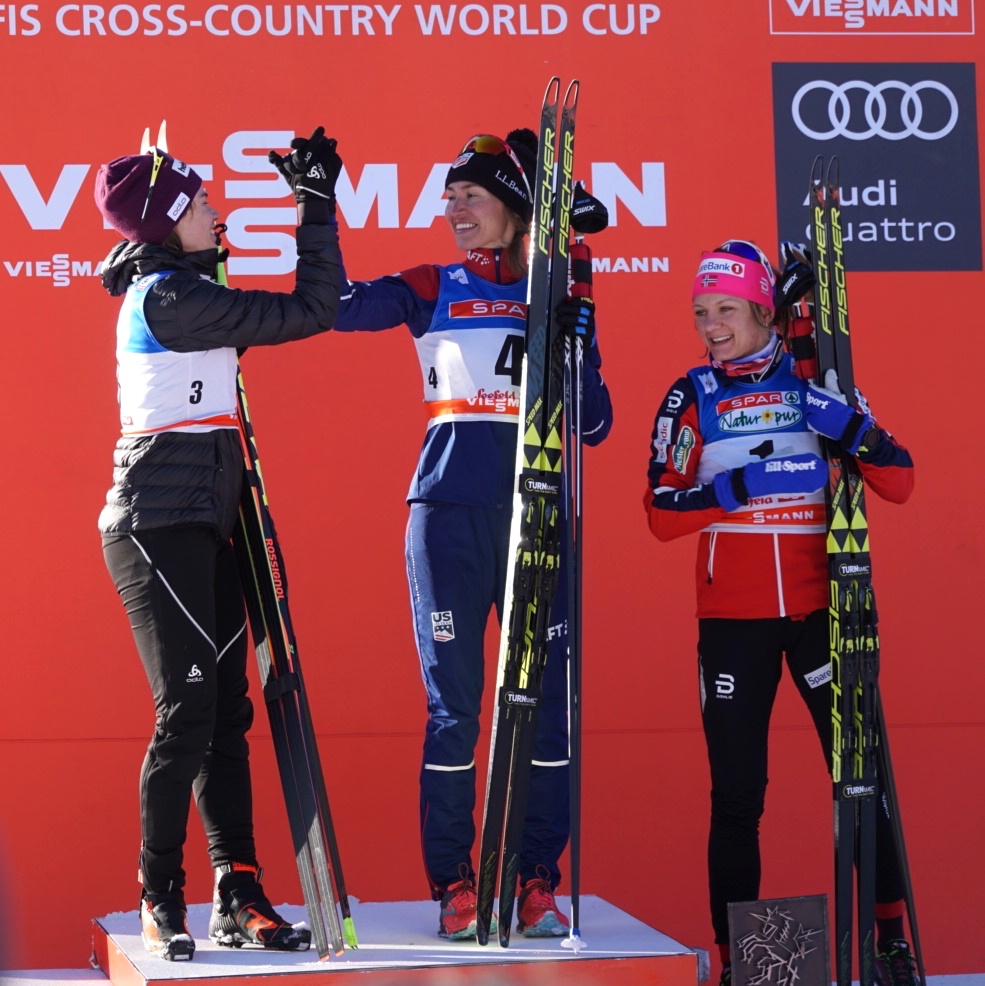
American Sophie Caldwell (c) shares the top step of the World Cup podium with Switzerland’s Laurien van der Graaff (l) on Saturday after they tied for first in the women’s 1.3 k freestyle sprint in Seefeld, Austria. Norway’s Maiken Caspersen Falla (r) placed third. (Photo: Garrott Kuzzy / LumiExperiences.com)
The win is the first one for the U.S. Ski Team this season. It is Caldwell’s third individual sprint podium this season, eighth-career World Cup podium and second individual win. Her first came in the 2016 classic sprint stage of the Tour de Ski in Oberstdorf, Germany.
While the sprint was the last until a classic sprint is contested at the 2018 Olympics next month, Seefeld is the site of next year’s World Championships.
Finishing out the women’s final were Harsem in fourth (+1.34), Sömskar in fifth (+1.83) and Bjornsen in sixth (+2.26).
“I felt really awesome in the quarters,” Bjornsen said. “In the semis, I definitely could feel some fatigue and by the finals. I tried to do what I could, but for sure could feel I was a bit tired, as is everybody, but I was missing that final push that I really needed on that last hill.
“I was out there learning,” Bjornsen continued. “It’s fun to see it the year before world champs and kind of what to expect.”
Slovenia had three in the top 10 with Vesna Fabjan in seventh, Katja Visnar in eighth and 22-year-old Anamarija Lampič in 10th. Italy’s Greta Laurent started the day by qualifying second, 1.43 seconds behind Falla, and ended up ninth overall.
American Kikkan Randall (second from l) racing with (from left to right) Germany’s Sandra Ringwald, Slovenia’s Anamarija Lampic and France’s Aurore Jean during their quarterfinal of the women’s 1.3 k freestyle sprint at the World Cup in Seefeld, Austria. (Photo: Garrott Kuzzy / LumiExperiences.com)
U.S. skier Kikkan Randall also qualified for Saturday’s heats with the 18th-ranked time, then finished third in her quarterfinal (1.33 seconds behind Sömskar in first) to finish the day in 14th.
“Good for Kikkan, descent qualification,” Grover said. “In the heats she kind of felt like she just didn’t ski it tactically super well and kind of got boxed out a bit. Little bit disappointing for her not to go through.”
After qualifying in 30th (+7.68), Canada’s Dahria Beatty advanced to the fifth quarterfinal, where she finished fourth (1.65 seconds behind Laurent in first). That put her 20th overall, which stood as a season best.
“I was feeling good today, and I really like this course,” Beatty, of the Canadian World Cup Team, said after. “It’s a good power course. … The heat was a bit frustrating. I felt like I was skiing well, but I just couldn’t make the right move to get around the girls in front of me. I got pushed into that wall, so that really allowed the gap to open up, which was unfortunate because I felt like I was skiing really well today and I could have — if I could have, tactically, been able to move up better and get into that final sprint.
“But I am happy with today,” she continued. “It’s a good feeling, and I am excited for tomorrow.”
Sunday features 10/15 k freestyle mass starts in Seefeld. While Diggins did not participate in Saturday’s sprint, she is slated to start Sunday’s 10 k freestyle mass start. After feeling a little fatigued from last weekend’s races in Planica, Slovenia, Diggins decided to take off one of Seefeld’s race days.
“She wanted to pick one race this weekend to focus on,” Grover explained. “She was feeling a little bit of fatigue from last weekend and chose to go in the 10 k simply because we have a 10 k at the Games and no skate sprint. So she would have been outstanding in there today.”
While three American women qualified for the heats on Saturday, Ida Sargent was 0.52 seconds outside the top in 37th. The U.S. Ski Team member fell just before the qualifier and sustained an injury, which Grover believed was to her thumb. Following the race, she was taken to the hospital in Innsbruck, located approximately 30 minutes from the venue, for further examination.
“It was a hard day for Ida. She had a crash right before the qualification and sounds like there is some injury to her thumb. So were still trying to figure that out,” Grover said.
Rosie Brennan (U.S. Ski Team) finished the qualifier in 42nd, Emily Nishikawa (Canadian World Cup Team) was 51st, Caitlin Patterson (Craftsbury Green Racing Project) 52nd and Cendrine Browne (Canadian U25 Team) 54th.
The Canadian women opted out of the past two weekends of World Cup racing and have been training in Livigno, Italy, for the week leading up to Seefeld.
“We did a training camp in altitude to prepare ourselves for the [Olympic] Games,” Browne explained. “We did the same formula last year for World Champs and it’s something that worked really well for me, so I am confident with my preparation and I am looking forward to tomorrow.”
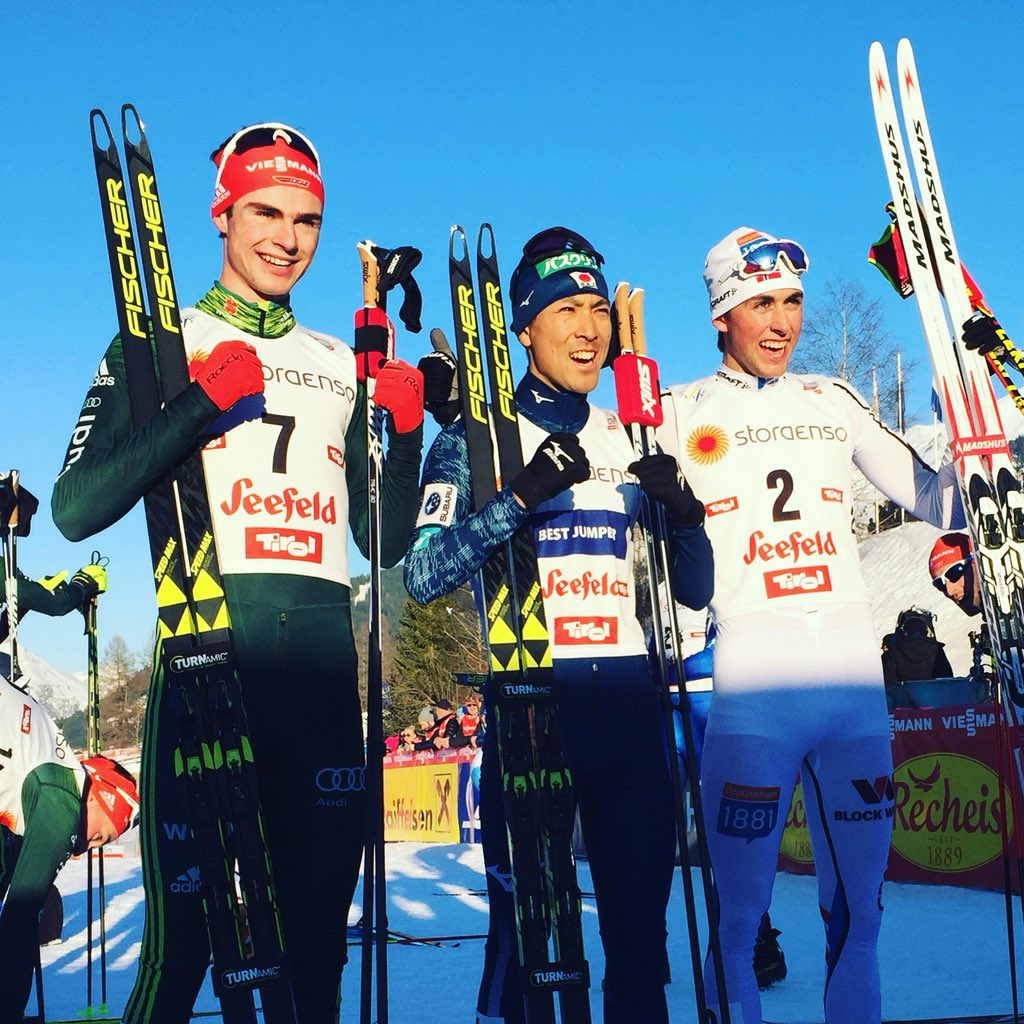
The podium for Day 2 of the Seefeld Triple Nordic Combined World Cup, with Japan’s Akito Watabe in first (c), Germany’s Vinzenz Geiger (l) in second and Norway’s Jarl Magnus Riiber (r) in third. (Photo: FIS Nordic Combined/Twitter)
FIS Nordic Combined World Cup (Seefeld, Austria): Normal hill/10 k
Two of the same men from Friday repeated on the podium on Day 2 of the Seefeld Triple Nordic Combined World Cup, with Japan’s Akito Watabe notching his second-straight win on Saturday.
Norway’s Jarl Magnus Riiber, who finished second on Friday, placed third in Saturday’s individual normal hill/10 k Gundersen, while Germany’s Vinzenz Geiger placed second, more than a minute behind Watabe.
Watabe jumped to first and started the 10 k with a 25-second head start on Riiber in second. Geiger started seventh, 1:45 minutes back, and rose to second at the finish, 1:05.5 behind Watabe (who won in 23:28.5) and 3.4 seconds ahead of Riiber in third (+1:08.9).
For the second day in a row, Norway’s Jan Schmid narrowly missed the podium in fourth (+1:14.1), up from fifth after the jump.
Taylor Fletcher was the lone American competing on Day 2, and he ended up 31st, up 10 places after jumping to 41st. Fletcher started the 10 k race 4:44 out of first then finished 3:52.9 behind Watabe.
The Seefeld Triple concludes Sunday with the individual normal hill/15 k Gundersen.
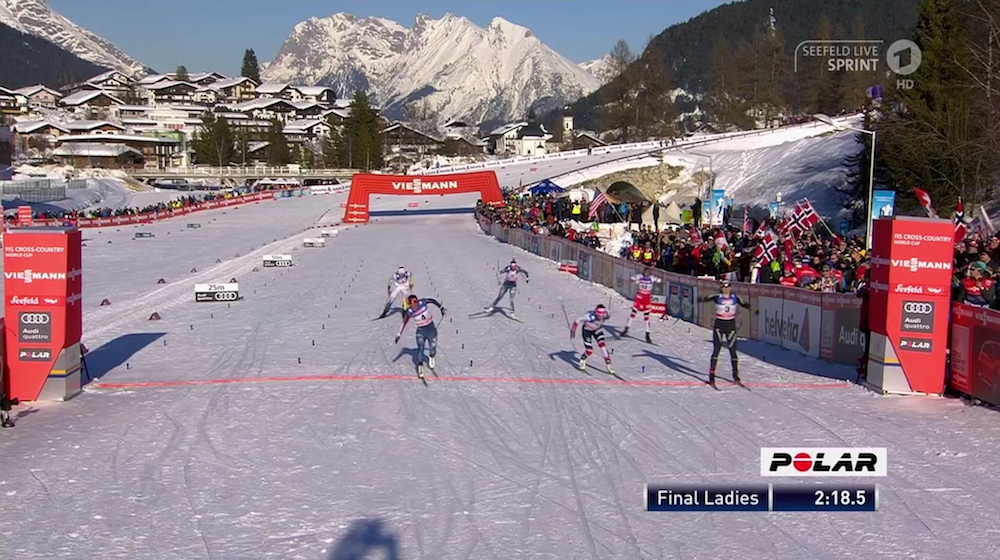
American Sophie Caldwell (l) and Switzerland’s Laurien van der Graaff (r) tied for first on Saturday in the women’s 1.1 k freestyle sprint final at the World Cup in Seefeld, Austria, while Norway’s Maiken Caspersen Falla placed third. (Screenshot: ARD broadcast)
FIS Cross Country World Cup (Seefeld, Austria): Freestyle sprints
It doesn’t get any closer than that. On Saturday, American Sophie Caldwell and Switzerland’s Laurien van der Graaff tied for first in the women’s 1.1-kilometer freestyle sprint final at the World Cup in Seefeld, Austria. They both finished within one-hundredth of a second of each other to take the victory — the last sprint before the Olympics — in 2:18.65 minutes.
Norway’s Maiken Caspersen Falla finished 0.21 seconds later for third place.
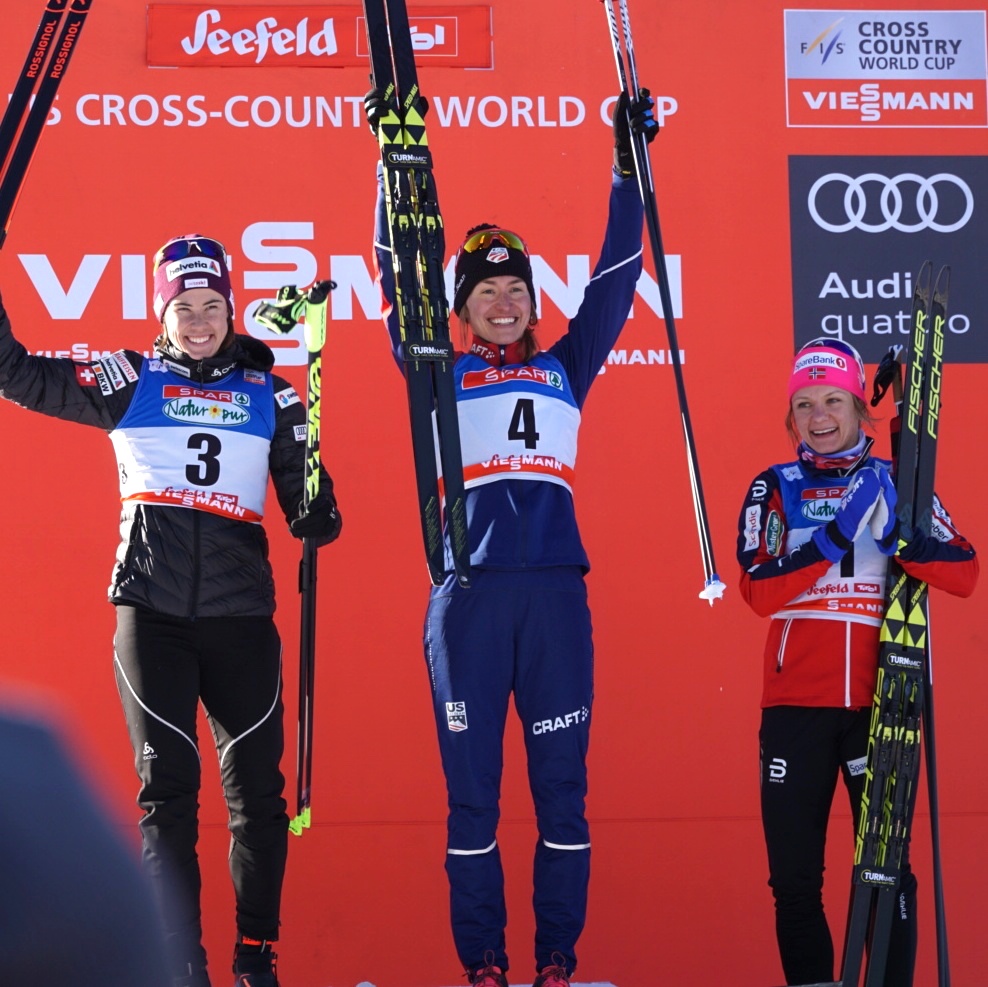
The women’s freestyle sprint podium at Saturday’s World Cup in Seefeld, Austria, with American Sophie Caldwell (l) and Switzerland’s Laurien van der Graaff (c) tying for first and Norway’s Maiken Caspersen Falla (r) placing third. (Photo: FIS Cross Country/Twitter)
“I broke my pole in the semifinal, then I got really tired,” van der Graaff said in a post-race interview with the International Ski Federation (FIS). “But I still believed I can be with Maiken and Sophie, and that I could catch them in the final was just great.”
Norway and the U.S. both had two in the final, with Kathrine Rolsted Harsem of Norway placing fourth (+1.34), Sweden’s Linn Sömskar finishing fifth (+1.83) and American Sadie Bjornsen taking sixth (+2.26).
Falla had raced to first in the qualifying round with a time of 2:21.44, Italy’s Greta Laurent qualified second (+1.43), van der Graaff third (+1.66), Caldwell fourth (+1.84), and Bjornsen fifth (+2.01).
Van der Graaff then won her quarterfinal and placed third in the first semifinal, 0.77 second behind Caldwell, who won it. Falla was second in that semifinal (+0.16) and van der Graaff advanced as a lucky loser.
Caldwell and Falla went head to head in every heat, with Falla winning their first quarterfinal by 0.08 seconds over Caldwell in second.
Bjornsen won her quarterfinal and finished second to Harsem in the second semifinal.
A third American, Kikkan Randall also qualified for the heats, placing 18th in the qualifier then finishing third in her quarterfinal (1.33 seconds behind Sömskar in first) to end up 14th overall.
Canada’s Dahria Beatty placed 30th in the qualifier to nab the last spot in the rounds, then finished fourth in her quarterfinal (1.65 seconds behind Laurent in first) for 20th overall.
For the U.S., Ida Sargent missed qualifying by about half a second in 37th (+8.20), Rosie Brennan finished 42nd (+9.86) and Caitlin Patterson was 52nd (+13.0).
Also for Canada, Emily Nishikawa finished 51st (+12.68) and Cendrine Browne was 54th (+13.34).
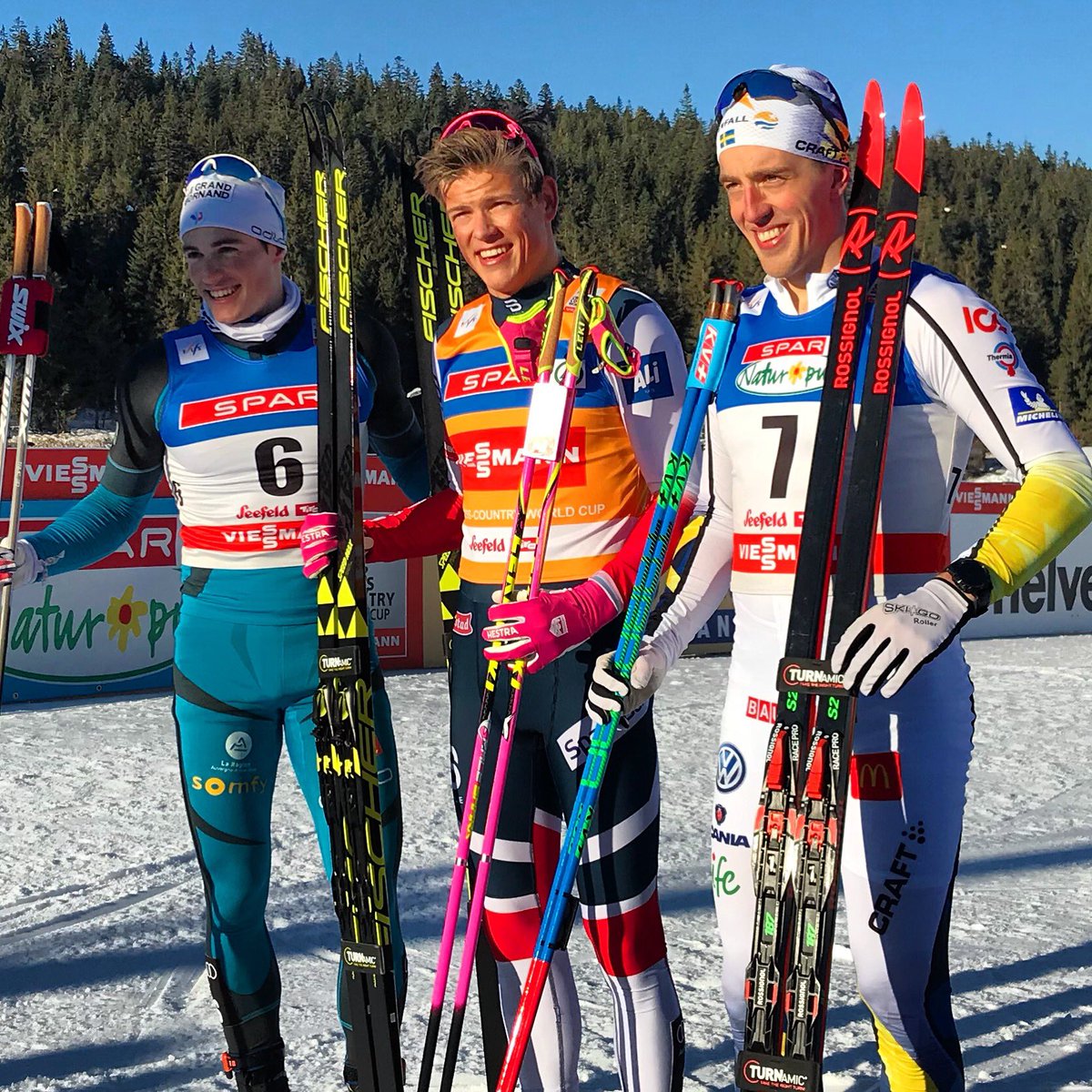
The men’s 1.4 k freestyle sprint podium at the World Cup in Seefeld, Austria, with Norway’s Johannes Høsflot Klæbo (c) in first, France’s Lucas Chanavat (l) in second and Sweden’s Calle Halfvarsson (r) in third. (Photo: FIS Cross Country/ Twitter)
The men raced 1.4 k, with Norway’s Johannes Høsflot Klæbo qualifying first in 2:46.89 then winning his quarterfinal and semifinal before putting the hammer down for one last time in the final, finishing first in 3:02.66.
France’s Lucas Chanavat placed second in the final, 0.48 seconds back, after qualifying sixth, winning his quarterfinal and placing second in the first semifinal (0.33 seconds behind Klæbo). Sweden’s Calle Halfvarsson took the third spot on the podium after finishing 0.97 seconds after Klæbo. Halfvarsson had previously qualified seventh, taken second in his quarterfinal and advanced as a lucky loser in third in the first semifinal (0.52 seconds behind Klæbo).
Italy’s Federico Pellegrino missed the podium in fourth (+1.06), Russia’s Gleb Retivykh placed fifth (+1.17), and Norway’s Emil Iversen was sixth (+5.57).
Canada’s Alex Harvey and American Simi Hamilton both made it to the semifinals, where they finished fourth and fifth, respectively, and did not advance to the finals. Harvey had qualified for the rounds in 22nd and won his quarterfinal, then raced in the second semifinal, where he finished fourth, 0.47 seconds behind Iversen in first. That put Harvey eighth overall on the day.
Hamilton clocked the fifth-fastest qualifying time, 6.46 seconds back from Klæbo’s top time. The U.S. Ski Team member then placed second to Pellegrino in his quarterfinal and was fifth in the first semifinal, 2.61 seconds behind Klæbo. Overall, Hamilton placed ninth.
Also for the U.S., Erik Bjornsen finished 37th in the qualifier, 0.89 seconds out of the top 30 and 11.99 second out of first, Logan Hanneman was 39th (+12.52), Andy Newell 42nd (+12.90), Reese Hanneman 65th (+17.91), and Ben Lustgarten 76th (+21.88).
Canada’s Len Valjas placed 40th (+12.72), Julien Locke 43rd (+13.31), Knute Johnsgaard 51st (+14.74), Bob Thompson 58th (+16.55), Graeme Killick 61st (+17.28), and Devon Kershaw 70th (+19.53).
France’s 22-year-old Chloé Chevalier racing to her second win and third podium of the week in as many individual races at 2018 IBU Open European Championships on Saturday in Ridnaun, Italy. (Photo: IBU/Biathlonworld)
IBU Open European Championships (Ridnaun-Val Ridanna, Italy): Men’s and women’s pursuits
France’s Chloé Chevalier picked up her second win and third podium of the week at the International Biathlon Union (IBU) Open European Championships on Saturday in Ridnaun, Italy, winning the women’s 10 k pursuit, while Russia’s Alexander Loginov rose to the top step of the podium in the men’s 12.5 k pursuit on Saturday.
Chevalier started the women’s pursuit in second, 13 seconds behind Ukraine’s Iryna Varvynets (who won Friday’s sprint and thus started first), and shot clean to take the lead after the third stage — where Varvynets missed one. Chevalier went on to clean the final stage for perfect 20-for-20 shooting and crossed the line first in 29:25.4. Varvynets finished second, 11.0 seconds back after missing a single target in the first standing (0+0+1+0), and France had two on the podium with Julia Simon in third (+43.2). Simon also shot 19-for-20, with her miss coming in the second prone stage (0+1+0+0).
“Three medals in three races is definitely more than I had expected,” Chevalier, 22, told the event’s organizers on Saturday. “Today I saw that Iryna shoots faster than I, and so I really gave my all in the track. Even if it might not look like it, after the many races in the last few days I am noticing that I am getting more and more tired.”
American Chloe Levins rose from 59th at the start to 42nd at the finish (+4:11.8), with three clean stages and two misses in the first standing (0+0+2+0). She had the 28th-fastest overall range time and 30th-ranked shooting time.
In the men’s pursuit, Loginov started first as Friday’s sprint winner Latvia’s Andrejs Rastorgujevs did not start. Loginov held the lead throughout the race despite two misses — one in the first stage and another in the last stage (1+0+0+1) — and secured the win in 32:22.1. Bulgaria’s Krasimir Anev started second, 19 seconds after Loginov, and held his place as well, shooting clean and finishing second, 27.6 second back.
“I am really happy here in Ridanna and the results reflect that,” Loginov, 25, told organizers. “Not to start in the individual event on Wednesday was the right decision because the last few days had been very demanding with six races in eight days. I am cross with my two errors in the shooting range, but very happy with my performance in the track.”
Russia had two on the podium with Evgeniy Garanichev in third (+1:10.7) after Garanichev started in bib 19 and overcame three penalties (1+0+2+0) with the fastest overall course time.
Canada’s Macx Davies started 27th and finished 35th (+4:33.9) with five misses (3+0+2+0), while American Alex Howe rose from 53rd at the start to 43rd (+5:53.5) with five penalties (2+2+1+0).
The 2018 Open European Championships conclude with the single mixed relay and mixed relay on Sunday. American Susan Dunklee and Lowell Bailey are on the start list for the single mixed relay, Canada’s Carsen Campbell and Sarah Beaudry. For the mixed relay, the U.S. has entered Levins, Maddie Phaneuf, Paul Schommer, and Alex Howe.
Finland’s Krista Pärmäkoski after winning her first non-stage World Cup on Sunday in the women’s 10 k classic in Planica, Slovenia. She bested Sweden’s Charlotte Kalla’s time by 3.6 seconds. (Screenshot: ARD broadcast)
FIS Cross Country World Cup (Planica, Slovenia): 10/15 k classic
Just when it looked like one of those Charlotte-Kalla days, Finland’s Krista Pärmäkoski swooped in and topped the Swede’s time by 3.6 seconds in the women’s 10-kilometer classic individual start on Sunday for her first-career outright World Cup win.
Outright meaning non-stage; Pärmäkoski has two World Cup wins to her name for setting the fastest time of day in 2016 pursuit races.
But Sunday’s 10 k in Slovenia saw her rising to the challenge and besting Charlotte Kalla’s time of 27:12.3, which was at least 39 seconds faster than the first 57 starters. Kalla had started 32nd and beat the previous top time set by Swedish U23 skier Ebba Andersson (bib 28) by 48.6 seconds.
Austria’s Teresa Stadlober started later in bib 56 and clocked the second-fastest time to Kalla, 39 seconds back.
But it was Pärmäkoski in bib 58 who beat them all. Even Norway’s Heidi Weng, who started 60th, couldn’t come close, as she finished 33.5 seconds off Pärmäkoski’s winning time for third place. That put Stadlober in fourth and Andersson in fifth at the end of the day.
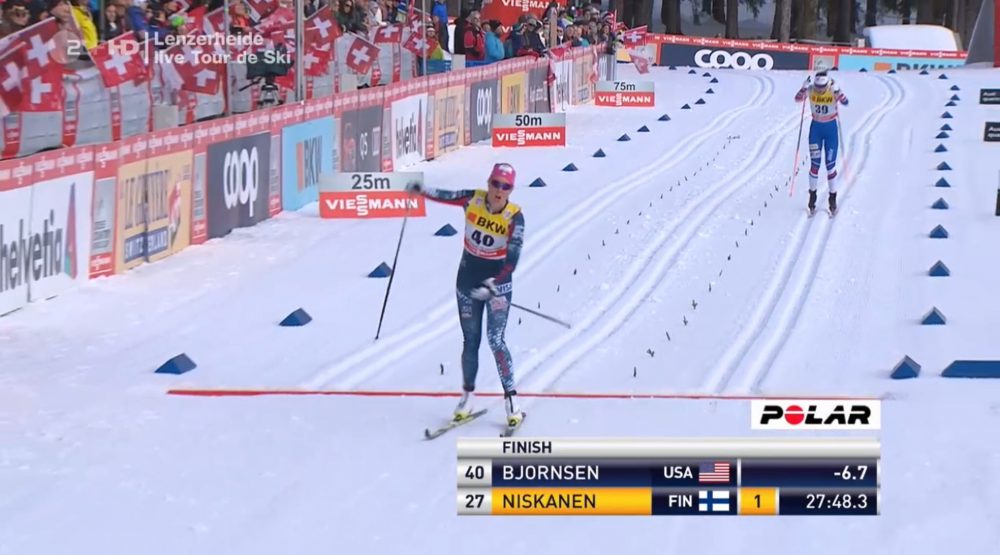
Finland’s Kerttu Niskanen placed sixth (+49.4), Norway’s Kari Øyre Slind took seventh (+49.5), Poland’s Justyna Kowalczyk (who’s more of a marathon skier these days) placed eighth (+1:02.1), Norway’s Kathrine Rolsted Harsem (who placed second in Saturday’s classic sprint) finished ninth (+1:03.2), and American Jessie Diggins was 10th (+1:05.4).
Another American, Caitlin Patterson, of the Craftsbury Green Racing Project (CGRP), broke through with her second-best individual World Cup result in 20th (+1:45.2). (Last year, she finished seventh in the pre-Olympic PyeongChang World Cup 15 k skiathlon in a notably small field.)
Kikkan Randall (U.S. Ski Team) followed in 23rd (+1:50.4), and her teammates Sophie Caldwell placed 31st (+2:17.2), Liz Stephen 35th (+2:34.9), and Ida Sargent 37th (+2:37.5).
For the second-straight weekend, no Canadian women competed.
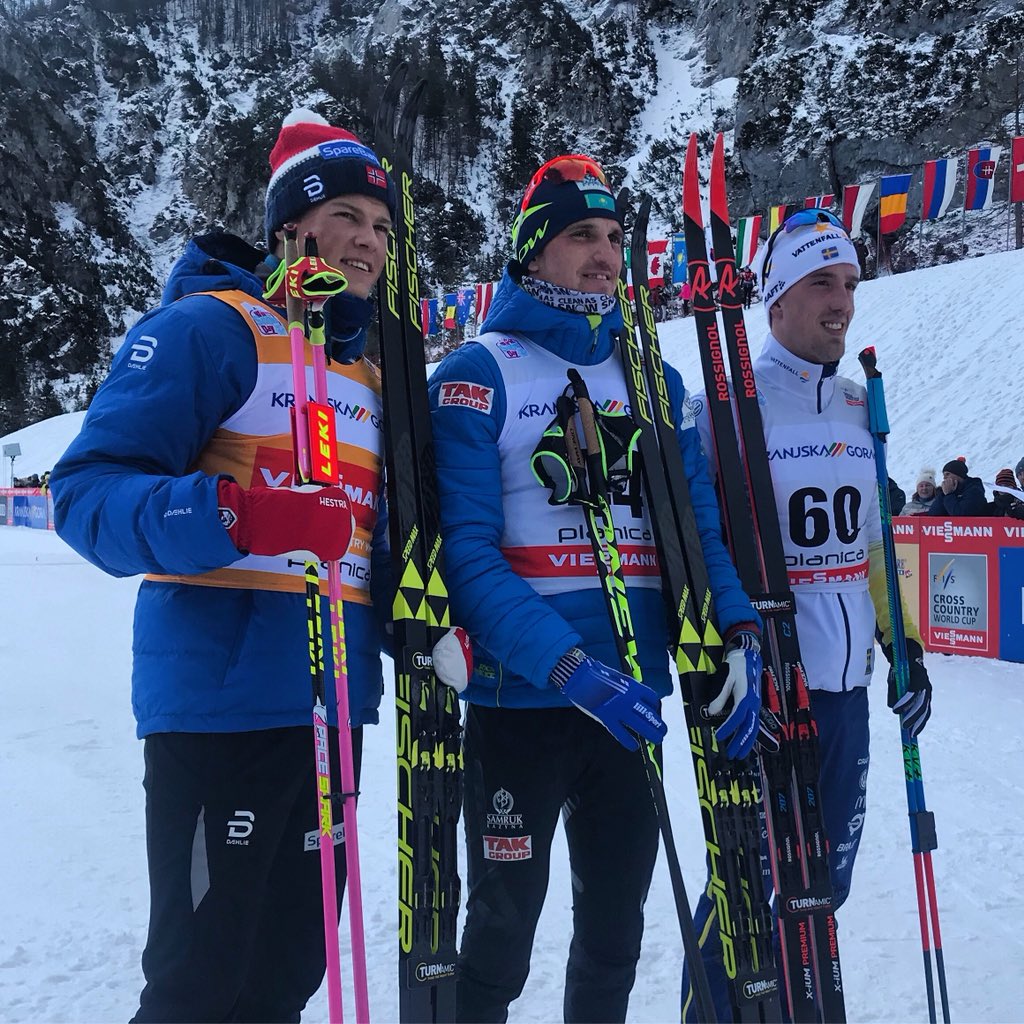
The World Cup men’s 15 k classic podium on Sunday in Planica, Slovenia, with Kazakhstan’s Alexey Poltoranin (c) in first, Norway’s Johannes Høsflot Klæbo (l) in second, and Sweden’s Calle Halfvarsson (r) in third. (Photo: FIS Cross Country/Twitter)
In the men’s 15 k classic, Kazakhstan’s Alexey Poltoranin tallied his second win of the season and first in a race against Norway’s Johannes Høsflot Klæbo on Sunday, winning by 13.2 seconds over Klæbo in 36:54.7.
Poltoranin, 30, started 44th and a minute behind the 21-year-old Klæbo. When Klæbo finished, he bumped Russia’s Ivan Kirillov, also 21, out of the leader’s chair by 43.3 seconds. Then Poltoranin finished 13.2 seconds faster, but Klæbo held onto second when Sweden’s 60th starter, Calle Halfvarsson, finished third (+42.8). It was Halfvarsson’s second podium of the season after placing third in the classic sprint at the November World Cup opener in Kuusamo, Finland. In Saturday’s classic sprint in Slovenia, Halfvarsson qualified second but crashed out of the quarterfinals to finish the day in 30th overall.
Norway’s Emil Iversen started 66th and ended up fourth (+54.7) and Kirillov scored his first World Cup top 10 in fifth (+56.5). Russia had four in the top 10 with Stanislav Volzhentsev in sixth (+57.8), Andrey Larkov in eighth (+1:02.2) and Andrey Sobakarev in ninth (+1:03.4). Norway’s Mattis Stenshagen finished seventh (+1:00.8) and Finland’s Iivo Niskanen took 10th (+1:10.1).
Scott Patterson (U.S. Ski Team) was the top North American in 43rd (+2:56.2), Ben Lustgarten (Craftsbury Green Racing Project) finished 46th (+3:04.9) and Tyler Kornfield (Alaska Pacific University) was 57th (+4:03.7). Andy Newell did not finish.
Canada’s Devon Kershaw returned to the circuit and placed 44th (+2:57.1), Bob Thompson (NTDC Thunder Bay) was 64th (+5:05.0), and Dominique Moncion-Groulx (Alberta World Cup Academy) was 70th (+6:11.7).
Russia’s Stefaniya Nadymova outsprinting Japan’s Ayane Miyazaki at the finish for the win at the inaugural women’s Nordic Combined Continental Cup competition on Saturday in Rena, Norway. (Photo: FIS/Romina Eggert)
FIS Nordic Combined Continental Cup (Rena, Norway): First-ever women’s competitions
Fourteen women, including American Gabriella Armstrong, made history this weekend by competing in the first women’s Nordic Combined Continental Cup in Rena, Norway (after the scheduled opener in Jan. 6-7 in Otepää, Estonia, was canceled), with back-to-back days of individual large hill/5-kilometer Gundersen start races.
On Saturday, Russia’s Stefaniya Nadymova took the win in 16:26.9, just 0.6 seconds ahead of Japan’s Ayane Miyazki in second. Germany’s Jenny Nowak joined them on the podium in third, 16.6 seconds out of first. Armstrong finished 12th (+6:24).
Nadymova, 23, had kicked off the event by jumping to first in the provisional round, which was used for the jumping results, and began the 5 k with a 10-second head start on Nowak in second place. Miyazaki jumped to third and started 14 seconds back. Armstrong jumped to 14th and started 4:08 out of first.
On Sunday, 15-year-old Miyazaki took the win in 16:23.2, swapping places with Nadymova, who finished second, 11.7 seconds back. Nowak, also 15, repeated in third, but finished over a minute and 21 seconds back out of first.
Miyazaki had jumped to first place earlier in the day and started the 5 k with a 20-second cushion to Nadymova in second. Nowak jumped to third and started 1:08 minutes back.
Armstrong, 19, of the New York Ski Education Foundation, jumped to 11th and finished 11th, 4:26.1 after Miyazaki.
Several U.S. Nordic Combined men also competed in Rena, with Taylor Fletcher placing fourth in Saturday’s individual large hill/10 k, 2.7 seconds behind Austria’s Thomas Joebstl in first. Fletcher had skied up from 25th and 2:17 back after the jump with the second-fastest course time.
Also for the U.S., Adam Loomis placed 33rd (+2:30.7) after jumping to 45th with the 12th-fastest course time. Grant Andrews finished 41st (+3:28.7), and Jared Schumate 43rd (+4:10.1).
Fletcher reached the podium in Sunday’s individual large hill/10 k in third behind two Austrians. After jumping to 19th, he skied the fourth-fastest course time to finish third, 3.7 seconds behind Dominik Terzer in first and 2.7 seconds behind Martin Fritz in second.
Loomis improved to 29th (+1:40.9), up from 35th in the jump, and Andrews finished 37th (+2:36.4) and Shumate 40th (+2:57.9).
The men’s large hill/4 x 5 k team event podium on Sunday at the Nordic Combined World Cup in Chaux-Neuve, France, with Norway (c) in first, Germany (l) in second, and Finland (r) in third. (Photo: FIS/NordicFocus)
FIS Nordic Combined World Cup (Chaux-Neuve, France): Saturday & Sunday
Four American men competed at the Nordic Combined World Cup this weekend in Chaux-Neuve, France, with three of them racing in Saturday’s individual large hill/10 k Gundersen and all four racing Sunday’s large hill/4 x 5 k team event.
Norway’s Jan Schmid was the big winner this weekend, racking up an individual win on Saturday and a team victory on Sunday. He won Saturday’s competition after jumping to fourth and starting 27 seconds behind jump leader Akito Watabe of Japan. Schmid worked his way up to first in the 10 k with the third-fastest course time, crossing the line 1.4 seconds ahead of Watabe in 23:32.7.
Watabe finished second and Finland’s Ilkka Herola placed third (+21.5), just ahead of Austria’s Lukas Klapfer in fourth (+21.8).
Ben Loomis led USA Nordic in 37th (+2:49), after jumping to 37th, Stephen Schumann finished 45th (+5:17.0) and Ben Berend 46th (+5:22.2).
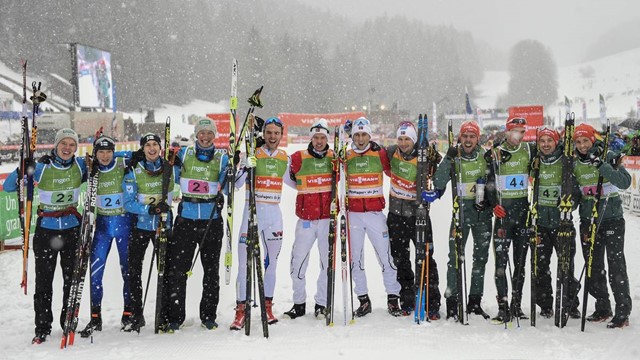
On Sunday, Schmid teamed up with Espen Andersen, Jarl Magnus Riiber and Jørgen Graabak to win the 4 x 5 k team event in 47:22.5 by 13.1 seconds. Germany followed in second, with Eric Frenzel, Fabian Rießle, Johannes Rydzek, and Vinzenz Geiger, and Finland placed third (+20.5) with Leevi Mutru, Arttu Maekiaho, Herola, and Eero Hirvonen.
Norway had led after the jump and started the relay 1:03 minutes ahead of Finland in second. France jumped to third and ended up fourth (+47.4), after being passed by Germany, which had started the relay in fourth.
Japan placed fifth (+2:50.9), Italy sixth (+3:59.9), Austria seventh (+4:06.8), Poland eighth (+5:22.1), Estonia ninth (+5:52.1), Russia 10th (+6:41.2), and the U.S. (with Schumann, Loomis, Berend, and Jasper Good) 11th (+6:52.4).
Western Canadian Championships (Red Deer, Alberta): Relays
Nine men’s teams and six women’s squads contested the open relays on the last day of the NorAm Western Canadian Championships on Sunday in Red Deer, with Ontario’s Team “O” (Scott Hill, Michael Somppi and Andy Shields) winning the men’s 3 x 5 k and Alberta 1 (Annika Hicks, Emma Camicioli and Zina Kocher) winning the women’s 3 x 5 k.
For Shields and Hicks, it was their second win of the weekend after they won their respective classic mass starts on Saturday.
Team “O” posted a 19.9-second win over B.C. Storm (Remi Drolet, Tallon Noble and Greg Kilroy), finishing first in 36:22.6. Alberta 5.1 (Sebastien Boehmler-Dandurand, Sam Hendry and Russell Kennedy) placed third (+52.3).
In the women’s relay, Alberta 1 beat out B.C. Fast, Furious & Freakin’ Awesome (Katie Weaver, Michaela McLean and Kaia Andal) by 2 minutes and 37.8 seconds, winning in 43:17.2. Alberta had two teams on the podium with the Kit Kats (Ember Large, Molly Jane Strum, and Sara McLean) in third (+4:25.8).
Sweden’s Stina Nilsson celebrates her third individual sprint victory of the season on Saturday in the World Cup classic sprint final in Planica, Slovenia. Behind her, Norway’s Kathrine Rolsted Harsem (third from l) placed second and Maiken Caspersen Falla (l) finished third and American Jessie Diggins (far r) placed fourth. (Photo: Fischer/NordicFocus)
PLANICA, Slovenia — With the Julian Alps and Mount Triglav, Slovenia’s highest peak, as a backdrop, it’s suitable to say the Planica Valley nordic course can be summed up in one word: burly.
A high mid-afternoon sun had illuminated the mountain range throughout the rounds for the World Cup women’s 1.4-kilometer classic sprint on Saturday, but by the time the six finalists lined up for the final heat, a few shadows were being recast onto the course.
At the sound of the gun, Sweden’s Stina Nilsson took the lead into the first downhill. Norway’s Kathrine Rolsted Harsem followed close behind. Maiken Caspersen Falla, also of Norway, dangled to the far right, while American Jessie Diggins hugged tightly to the inside left, just ahead of Sweden’s Anna Dyvik.
The third Norwegian in the final, Heidi Weng picked up the rear of the group through the corner that had seen at least one skier in the men’s quarterfinals fly into the blue net that fenced off the course. Diggins had also fallen on that corner during her warmup.
“It rattled my confidence,” Diggins said, referring to her warmup mishap. The American then took the corner more cautiously during her qualifier, which she felt was uncharacteristic of herself and and left her wanting more going into the day’s heats. (Diggins had qualified in 19th, 6.19 seconds behind Harsem’s winning qualifying time of 3:28.03.)
American Jessie Diggins leads Sweden’s Hanna Falk during their quarterfinal of the women’s classic sprint on Saturday at the World Cup in Planica, Slovenia. Diggins went on to place fourth overall in the final. (Photo: Salomon/NordicFocus)
“I am not a hesitant downhill skier at all,” Diggins explained. “So I was like, ‘All right, in the rounds I am not going to ski like a wimp,’ and I was really proud of myself for … taking something that had rattled me and put it away and then just ski the rest of the day.”
In the women’s final, Diggins maintained her position through the bottom of the sharp downhill corner and the brief double-pole section before the first uphill hiccup. As the pitch increased, Nilsson transitioned to striding and the rest of the field followed suit.
Pressure began mounting from the Norwegians as Harsem strode to Nilsson’s left and Caspersen Falla caught up to her right. A meter behind them were Diggins, Dyvik and Weng.
The group disappeared from the teleprompter for a moment as they moved under the wooden bridge spanning the course. When they reappeared, Harsem had overtaken the lead. Nilsson clung to the back of her skis.
Diggins, who had been skiing alone in the second inside track, switched lanes, maneuvering herself into second alongside Harsem and Nilsson. But as they descended into the second downhill, the Norwegian and Swede pulled slightly away.
Another corner and the six finalists were heading uphill again, Diggins was the only skier who chose the far outside track. The climb was the course’s most grueling uphill, and Harsem had used it to break away from her competition all afternoon.
In the final, it appeared Harsem would do the same as she strode powerfully to the front, looking to gap Nilsson and Falla. But the 28 year old had not factored in her teammate Falla’s own dig in the ups. Halfway up the hill, Falla, 27, changed tracks and was gunning for the lead.
By the time the group reached the hairpin turn that would lead them back down to the stadium, Falla was first, Harsem second, and Nilsson third. Chasing them around two meters away was Diggins, followed shortly by Dyvik and Weng.
As they descended, the Swede’s skis seemed to lose ground. A Norwegian battle for first looked to be in the cards. In the second group, Diggins continued to hold off Dyvik’s attempts to push past her for fourth.
With one final hill to go, Falla strode with a speedy turnover to the outside. But while the Norwegian’s legs swished through the tracks, the Swede was powering forward in a powerful double pole.
Three years younger than her Norwegian challenger, Nilsson, 24, had already won one of two classic sprints previously this season. On Saturday, she was looking to rack up another win (and her third individual victory of the season after winning a skate sprint in Davos, Switzerland).
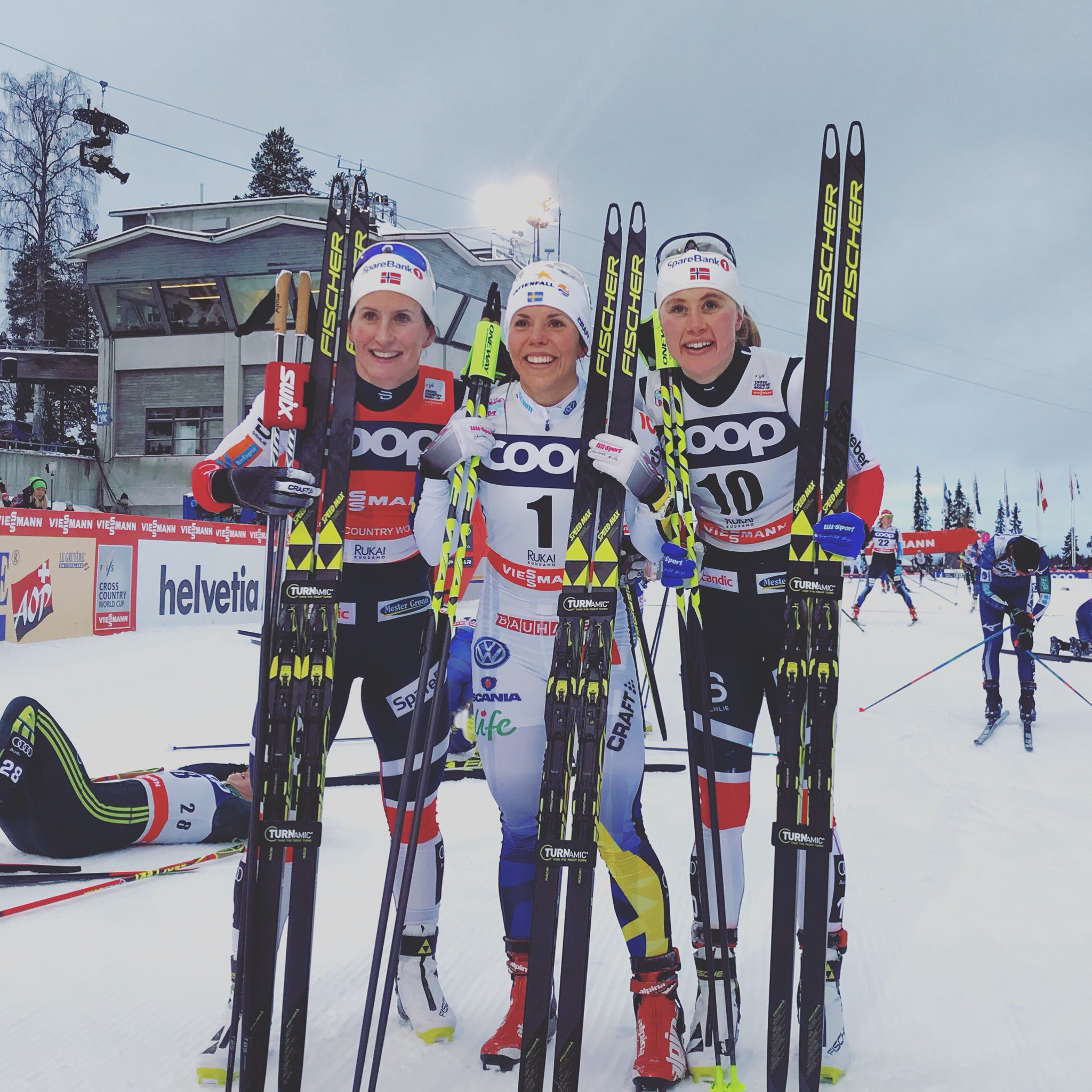
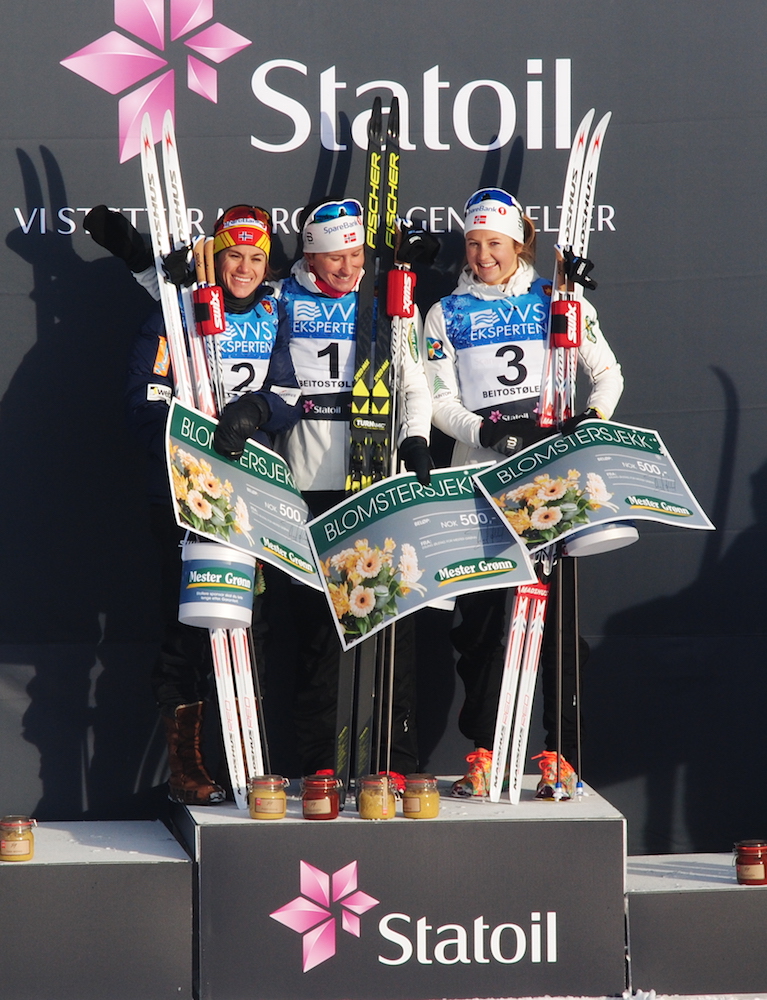
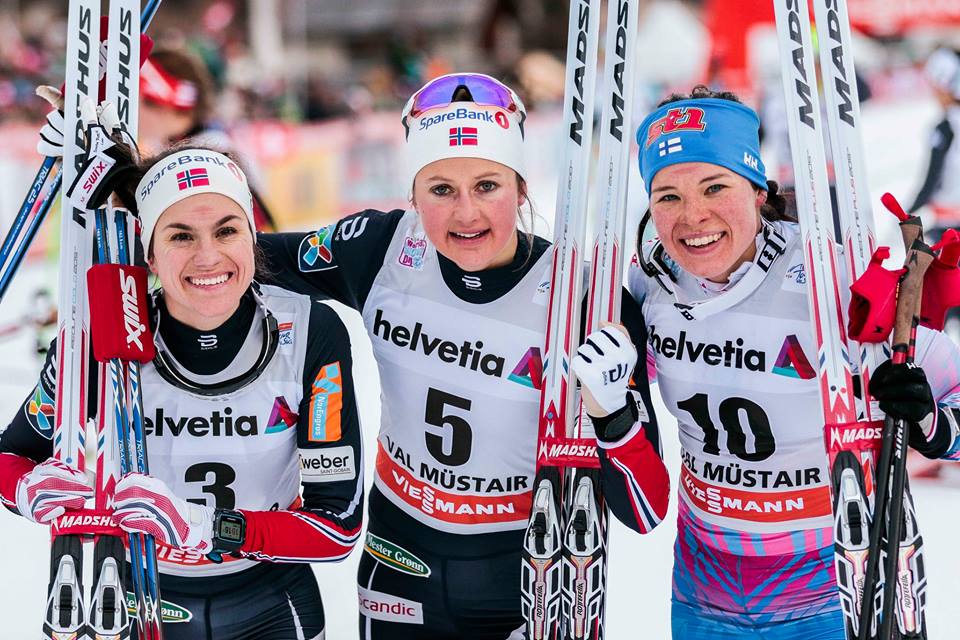
The women’s classic sprint podium on Saturday in Planica, Slovenia, with Sweden’s Stina Nilsson (c) in first, and Norway’s Kathrine Rolsted Harsem (l) in second and Maiken Caspersen Falla (r) in third.(Photo: Fischer/NordicFocus)
She and Falla strode over the top of the final climb together, but heading into the final double pole to the finish, the Swede had made up her mind. The red World Cup sprint leader’s bib she was wearing would stay with her.
She double poled away from Falla and Harsem in the final 100 meters, crossing first in a time of 3:26.28. The win marked her fourth-career victory in a World Cup classic sprint and her 12th World Cup sprint win.
“I saw an opening there and took the chance,” Nilsson told Längd.se, according to a translation. “I think it worked very well technically.”
Crossing second, 1.27 seconds behind Nilsson was Harsem. The second-place finish was the Norwegian’s first World Cup podium ever.
“It’s amazing to be finally on the World Cup podium,” Harsem said, according to an International Ski Federation (FIS) press release. “I have been fourth a couple of times and seventh 100 times. It is very emotional for me. There have been many ups and downs in my career. I feel just amazing.”
Falla placed third, 1.81 seconds behind Nilsson. The defending Sprint World Cup champion, with 14 individual World Cup titles to her name, Falla was more critical of her own result.
“I did not really have it today. It’s good to be third but I will be headed home now and try to find shape for the Olympic Games,” Falla told FIS.
Diggins ended the day just off the podium in fourth (+3.81), while Dyvik was fifth (+4.45) and Weng sixth (+14.89).
“I feel like I just did the hardest interval ever,” Diggins told FasterSkier after. “But I think that’s great because going into the Olympics, it’s fun knowing that I have qualified and I made it to the finals in three out of four classic sprints this year; it is a good confidence booster.”
Though tired by the end of the day after rounding the course four times at a hard effort, Diggins indicated she found ways to keep herself relaxed and have fun.
“They played my absolute favorite songs all day I was doing a little salsa dance getting ready,” Diggins said with a laugh. “You do have to have fun, this is your life you have to enjoy it.”
Two Americans in Top 10
Rounding out the the top 10 was Russia’s Yulia Belorukova in seventh, Sweden’s Hanna Falk in eighth, American Sophie Caldwell in ninth, and Norway’s Mari Eide in 10th.
Sophie Caldwell (U.S. Ski Team) racing to 13th in the women’s classic sprint qualifier at the World Cup in Planica, Slovenia. She went on to reach the semifinals and place ninth overall. (Photo: Fischer/NordicFocus)
After qualifying in 13th, 5.38 seconds out of first, Caldwell advanced to the first quarterfinal, going head-to-head with Nilsson, Belorukova and Finland’s Aino-Kaisa Saarinen.
Caldwell skied strong through the first portion of the major climb, pacing toward the front with Nilsson, Belorukova and Norway’s Anna Svendsen. Just before the final hairpin turn, however, Nilsson and Belorukova charged. Caldwell pushed to maintain contact, but was edged out just before the final straightaway.
Her quarterfinal time was fast enough for her to earn the day’s second lucky loser spot, after Diggins advanced as the first lucky loser in third in her heat, behind Falk and Harsem.
Caldwell then advanced to the first semifinal, up against Falla, Nilsson, Belorukova, Falk, and Finland’s Krista Pärmäkoski. Caldwell was in the mix until halfway through the mjor course climb, when Nilsson, Falla and Belorukova began to push the pace.
“I think a lot of the classic courses now kind of have big steep hills that you do more of a run shuffle up,” Caldwell said. “[Today’s] was more power striding, which for me personally is definitely one of my weaknesses and something I’m working on.”
Caldwell finished her semifinal in fifth, 4.34 seconds behind Falla in first.
“I felt good, but it was definitely one of the hardest sprints I’ve ever done,” Caldwell said. “I don’t know if it felt that way because we’ve been racing some shorter ones lately and this one was quite a bit longer … but I’m happy with today.”
Sadie Bjornsen (U.S. Ski Team) racing to seventh in the women’s classic sprint qualifier at the World Cup in Planica, Slovenia. She went on to finish fifth in her quarterfinal for 21st overall. (Photo: Fischer/NordicFocus)
Also for the U.S., Sadie Bjornsen placed 21st and Ida Sargent 23rd overall, after finishing fifth in their quarterfinals.
Reflecting on her qualifier, in which she qualified seventh (+4.10), Bjornsen said she finished “feeling like I had lost some time in the corners.”
“In my [quarterfinal] I felt like there was a lot of bouncing and trying to find a track and just trying to find a place to ski, so I was kind of depending on that final corner and climb into the finish,” Bjornsen said on the phone.
Her quarterfinal saw Falla and Pärmäkoski take the lead early on, but Bjornsen was positioned well within striking range as the group rounded the hairpin turn for the final descent.
The final descent and corner went smoothly for Bjornsen, but a tangle with Germany’s Sandra Ringwald caused her to crash out of contention. By the time Bjornsen reached the finishing stretch, Pärmäkoski and Falla had already locked up the top-two spots to automatically advance to the semifinals, and Bjornsen followed 8.81 seconds back in fifth.
“I had an awesome corner and then came into that final climb and unfortunately, Sandra just ended up falling on top of me, which was a bummer because I felt like I was really opening up there and finally had an opening,” Bjornsen said. “At the end of the day you just have to, for me, focus on what felt really good and channel that extra energy into some Olympic racing coming up here soon.”
Bjornsen did not race last weekend in Dresden, nor will she start Sunday’s 10 k classic in Planica.
“I just want to make sure I am fully recovered,” Bjornsen said of her decision to opt out of Sunday’s distance race.
“I actually think this going to work out really naturally well for me just to have one more week to absorb that enormous load and feel really fresh and quick and ready for next weekend,” she added.
The fourth American woman to qualify on Saturday was Sargent in 17th (+6.13).
“Warming up for the heats, I tried to do a little harder warm up to try to see if I could get my body going, but I was definitely feeling some fatigue,” Sargent said after. “It was a hard course to feel that way, so I’m looking forward to hopefully getting a little more energy for tomorrow.”
Three other American women’s also competed on Saturday, with Julia Kern finishing 43rd, Rosie Brennan 49th and Caitlin Patterson (Craftsbury Green Racing Project) 53rd.
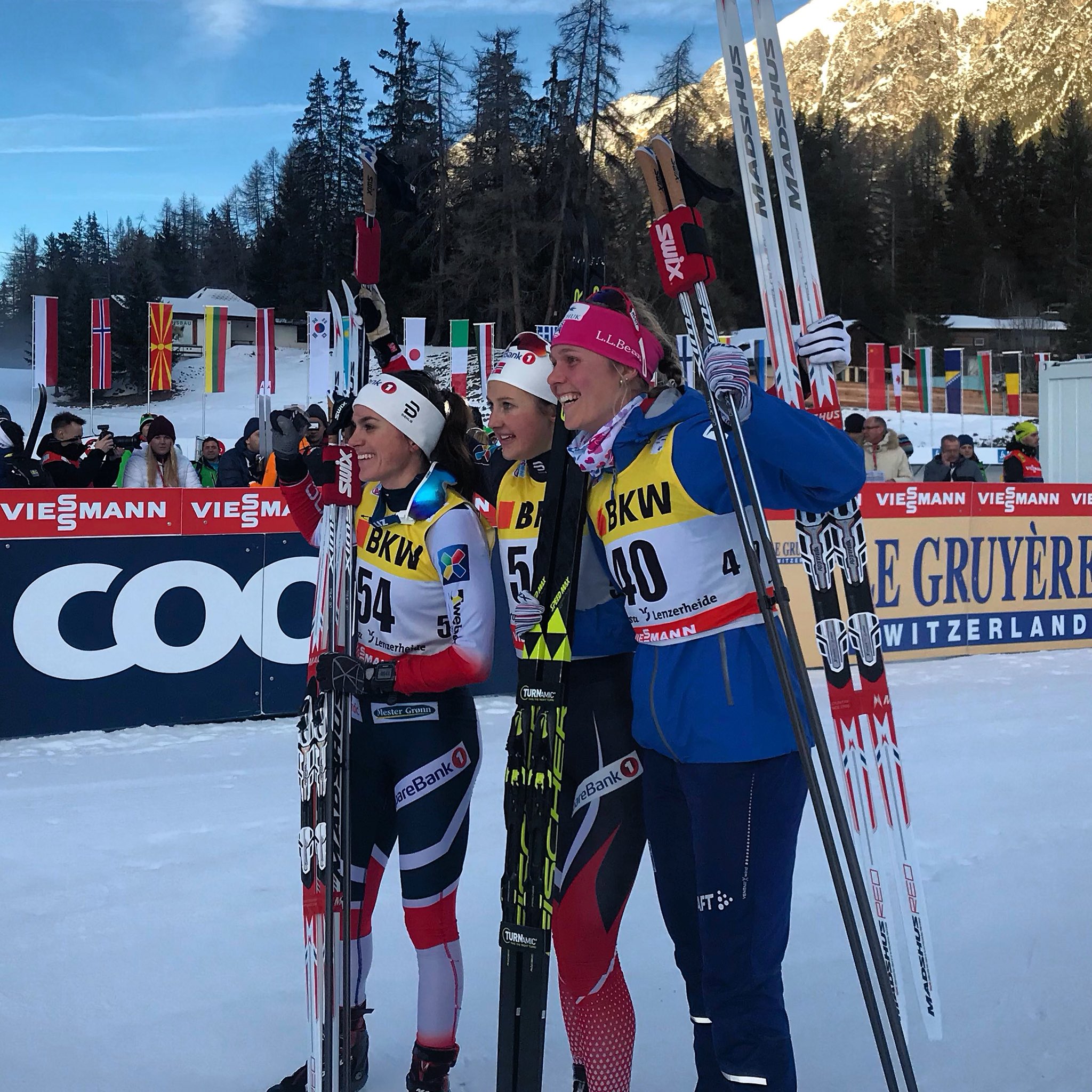
The women’s 10 k classic podium at Stage 2 of the 2018 Tour de Ski, with Norway’s Ingvild Flugstad Østberg (c) in first and Heidi Weng (l) in second, and American Sadie Bjornsen (r) in third in Lenzerheide, Switzerland. (Photo: FIS Cross Country/Twitter)
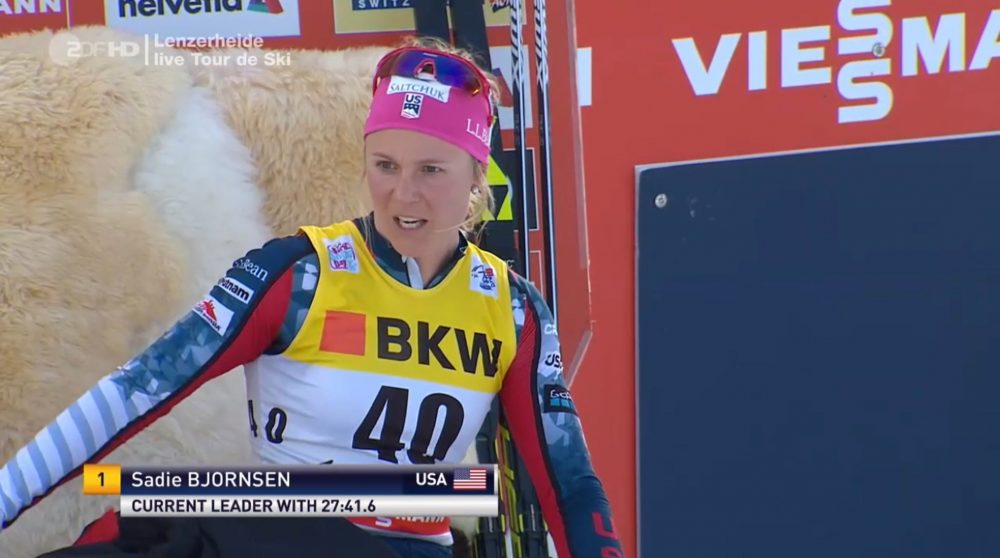
By the time Sadie Bjornsen sat down in the fur-lined leader’s chair on Sunday, the sunlight that had been shining brightly over sections of the women’s 10-kilometer classic course — blocked by trees and creating shade and temperature drops in some spots — was fading. Just an hour remained before sunset in Lenzerheide, Switzerland, and as she unclipped her bindings and walked out of the finishing pen, the current leader seat belonged to her.
With racers starting in 30-second interval increments and the final starter, Anastasia Kirillova of Belarus, having pushed past the start wand as Bjornsen strode past the halfway point, the 28-year-old American’s time of 27:41.6 would have to withstand 25 skiers — 23 to stay on the podium — if she were to retain her chilly, yet coveted chair.
That would mean staving off the likes of Norwegian powerhouses, Heidi Weng and Ingvild Flugstad Østberg, Finland’s Krista Pärmäkoski, as well as Saturday’s skate-sprint winner, Laurien van der Graaff of Switzerland, all of whom started behind Bjornsen.
The U.S. Ski Team (USST) seven-year veteran had already held off Finland’s Kerttu Niskanen and Laura Mononen, Norwegians Astrid Uhrenholdt Jacobsen and Kathrine Rolsted Harsem, Sweden’s Anna Haag, well as her own USST teammate, Jessie Diggins, who sat in fifth at the time off Bjornsen’s finish.
“I had no doubt that Sadie would crush it – she’s such a classic skiing machine and I couldn’t be prouder of her! She’s on fire!” Diggins, who started six bibs ahead of Bjornsen, wrote in an email.
As each racer finished, Bjornsen remained in the lead, the fog of her breath a reminder of the days falling temps and approaching hours of solar siesta.
Sadie Bjornsen sitting in the leader’s chair while waiting for the women’s 10 k classic Stage 2 of the 2018 Tour de Ski to finish. Bjornsen went on to finish third behind Norway’s Ingvild Flugstad Østberg in first and Heidi Weng in second (Screenshot: ZDF broadcast)
Live footage of skiers still on course, broadcasted on the large screen at the stadium’s epicenter kept her on guard. Two in particular were posing a challenge. Weng, who had started 14 bibs behind Bjornsen, was pacing on par with the American by the 3.5 k mark. Østberg, who departed the starting gate two bibs behind Weng, had put 14.7 seconds into Bjornsen by the time she was one-fifth of the way through the race.
By the halfway point, Weng had upped her tempo, and created a 13-second gap on Bjornsen’s time; at the same mark, Østberg had close to 22 seconds on the American.
When Bjornsen finished, Weng’s lead was still cushioned by close to eight seconds.
“I did not feel I was skiing fast but when I got the split times I heard I was gaining time on the other girls,” Weng said, according to an International Ski Federation (FIS) press release.
By the time Weng finished she had a 16.5-second lead over Bjornsen, moving the American into second place. However, Weng’s time in the chair was no more insular than Bjornsen’s. With two-thirds of the race complete, Østberg had 23 seconds on Weng and almost 40 seconds on Bjornsen.
With that kind of a lead, the final 2 k were Østberg’s to win and it appeared only a self-induced mistake would prevent her from taking it all. Perfection ruled the Norwegian’s skis. Østberg covered the final fifth of the race with precise certitude; as if she and the Lenzerheide course were confiding old friends (In fact, they were. In 2016 she won her first non-sprint distance World Cup in Lenzerheide during that season’s Tour de Ski (TdS)).
By the time Østberg finished, she had 25.7 seconds on Weng and 42.2 seconds on Bjornsen, claiming the win in a time of 26:59.4. Her first-place finish in Sunday’s 10 k, combined with her ninth place in Saturday’s sprint, puts her first in the overall TdS standings as racers head into Monday’s Stage 3 freestyle pursuit.
“I knew it was going to be a tough race in these conditions. My goal this season has been to get better each weekend. My shape is very good right now,” Østberg said, according to FIS. “Tomorrow I will be chased and it is going to be a tough race.”
American Sadie Bjornsen finishing the 2018 Tour de Ski Stage 2 women’s 10 k classic in first in Lenzerheide, Switzerland. She ultimately placed third behind two Norwegians, Ingvild Flugstad Østberg and Heidi Weng. (Screenshot: ZDF broadcast)
“Wow. What a dream day.” Bjornsen wrote in an email to media outlets. “A distance classic podium has been a dream of mine since I first started racing World Cup, so it was so fun to achieve that dream goal of mine today.”
“I had an awesome talk with my wax tech, JP, right before the start of the race, where he told me the most important thing that day was to trust what I do well, and never give up.. so I went with it,” Bjornsen continued. “I thought I was having a really tough race, and then I got my first split at 7.5k when Matt told me I was in second place and could win the race today. Suddenly, I had a fire lit under my butt, and I just gave every last bit for the last 2.5k. It was kinda fun not knowing what was happening, because it felt like a true surprise!”
Bjornsen finished yesterday’s sprint in 14th and with Sunday’s finish is now ranked fourth in the overall, just one place behind her teammate Diggins, who finished Sunday’s 10 k classic in seventh place (+1:04.4).
American Jessie Diggins during the women’s 10 k classic Stage 2 of the 2018 Tour de Ski in Lenzerheide, Switzerland. (Screenshot: ZDF broadcast)
“For me, I was really proud of how I held it together out there,” Diggins wrote in an email. “This is not my kind of condition and it was really hard to find kick out there – I felt like I was running, herringboning and bounding up the hills! But just a few years ago a day like today would have wrecked my overall tour time and now I’m able to hold my technique together and keep it flexible as conditions change, so I’m really happy about that!”
“Looking forward to tomorrow skate distance!” she added. “I’m starting in a little bit of no-mans land…but I love the chase and I’ll just put my head down and hammer!”
Rounding out the top 10 on Sunday was Niskanen in fourth (+48.9), Haag in fifth (+52.6), Germany’s Nicole Fessel in sixth (+58.2), Switzerland’s Nathalie von Siebenthal in eighth (+1:08.3), Germany’s Stefanie Böhler in ninth (+1:08.8) and Slovenia’s Anamarija Lampic in 10th (+1:10.9).
Also scoring in the points for the U.S. on Sunday was Sophie Caldwell in 21st (+1:40.6), Liz Stephen in 28th (+2:04.8) and Ida Sargent in 30th (+2:06.7).
Caldwell placed third in Saturday’s sprint and is now ranked seventh in the overall tour standings heading into Monday’s pursuit.
“My body felt surprisingly good after yesterday! When I woke up I was definitely a little tired, but my body felt good racing.” Caldwell wrote in an email. “The conditions were extremely tricky today, and our service team did an awesome job of making us the best skis possible.”
Though many sections on course were glazed over and the downhills iced over, Caldwell indicated the challenge was one she embraced.
“I enjoy tricky conditions like this where you really have to work to make the kick work because I think making skis kick is one of my strengths,” Caldwell wrote. “The downhills were icy and sketchy, so wax would inevitably wear off some, but I tried to really pace the first lap and be in control so I felt like I still had something to give on the second lap. I was really excited to see I ended up in the points! And of course seeing Sadie on the podium again put a huge smile on my face.
“Being in seventh in the tour right now is beyond any expectations I had,” she added. “10 km skates are generally the toughest discipline for me, but I will do my best and be running for dear life from everyone chasing me!”
After two stages out of seven in the TdS, Sargent ranks 30th and Stephen 37th.
Despite battling illness prior to the tour and feeling it worsen during Saturday’s sprint, Sargent started Sunday’s 10 k and was pleasantly surprised to see that her finish was within the points.
“I actually wasn’t sure if I was even going to race today but warmed up and decided to go for it. It felt really hard and I felt like I was struggling a lot so I have to admit I was very happily surprised to hear I was 30th,” Sargent wrote in an email. “I think this is the first time I have scored distance points at altitude. I’m looking forward to another race here tomorrow and then a day off and I have my fingers crossed that my body continues to come back around.”
Another USST member, Rosie Brennan skied to 38th (+2:20.5) on Sunday, putting her in 33rd overall.
The seventh USST member, Kikkan Randall did not start and withdrew from the Tour after experiencing pain in her left foot following the races in Davos three weeks ago,
“[I] have been trying to rehab the foot since with alternative training. Yesterday showed me I am making some progress with my foot and I didn’t want to set myself back with a classic race today. Classic seems to aggravate the injury more.,” Randall wrote in an email. “It was a tough decision but the Olympics are my big goal and I still have time to get my foot healthy if I am smart over the next couple weeks. I am looking forward to sharpening for the sprints in Dresden in two weeks.”
“Awesome to see the team take another podium today!” Randall added. “I’m so proud of our girls!”
In both Stage 1 and Stage 2, the U.S. has had five women in the top 30 and one on the podium. Four of the U.S.’s six starters for Monday’s skate pursuit will start in the top 30.
“It’s really motivating to have had two really strong days as a team,” Caldwell wrote. “I think the fact that we have a handful of people who could be on the podium or in the top ten on any given day says a lot about how strong our team is right now. I think we do a really good job of lifting each other up and pushing each other and it’s cool that there are so many people leading the team in so many ways.”
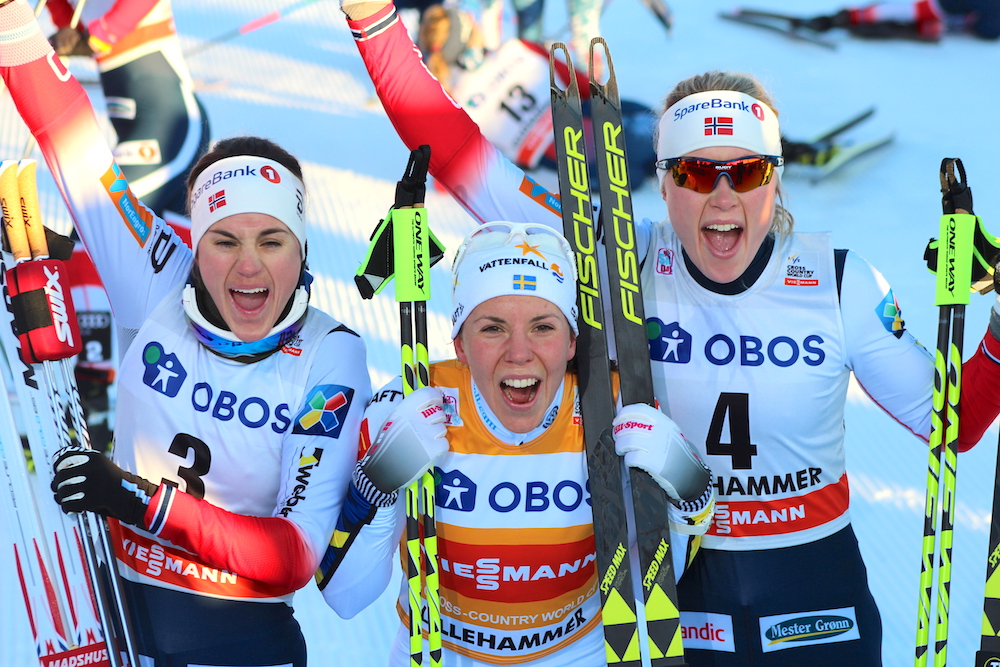
Charlotte Kalla (c) of Sweden with Norwegians Heidi Weng (l) and Ragnhild Haga after placing first, second and third, respectively, in the women’s 15-kilometer skiathlon on Sunday in Lillehammer, Norway. (Photo: Henrik Hunnes)
If it hadn’t been for the steady bob of her yellow leader’s bib and an intermittent shadow from the sun’s glare cast by the trail’s treeline, Charlotte Kalla might have blended right into the snow: her white suit symbolic of Sweden smooth across the Lillehammer race course in Norway.
As it were, the overall World Cup leader’s bib, her prize from winning last weekend’s battle against Norway’s Marit Bjørgen, could not be contested. Kalla crested the final climb of the women’s 15-kilometer skiathlon on Sunday with no Norwegians in sight, headed toward her second distance win in a row. Her closest competitor was Norway’s Heidi Weng, who finished 19.7 seconds after Kalla crossed the line in 42:24.7.
“It felt good, and when I was on that last climb I felt fine, but didn’t know that Heidi could not follow me,” Kalla said, according to a International Ski Federation (FIS) press release.
From the beginning Kalla commanded the lead, charging the classic portion out of the start. By the 2.5 k mark, the field had reached the course’s major climb, Weng pushing to the front and creating a small gap on the field, pulling Kalla and Austria’s Teresa Stadlober with her.
Leading the second group charge a little over seven seconds back was Finland’s Krista Pärmäkoski, followed by Norwegian’s Ragnhild Haga and Kathrine Rolsted Harsem,as well as the U.S. Ski Team’s Jessie Diggins.
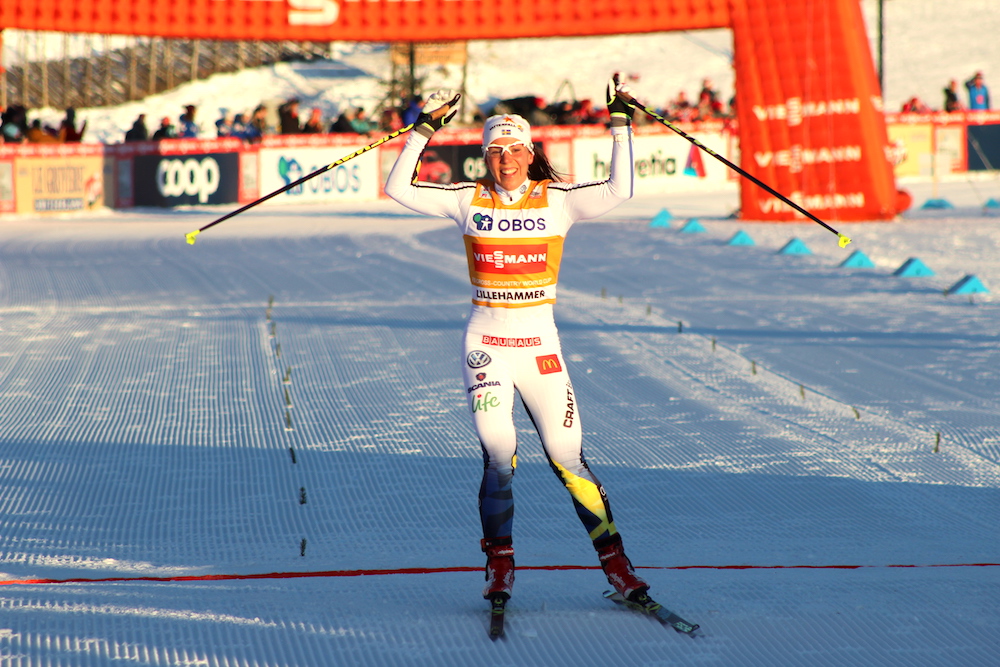
Sweden’s Charlotte Kalla winning the World Cup women’s 15 k skiathlon on Sunday at the Lillehammer World Cup in Norway. (Photo: Henrik Hunnes)
In just over a kilometer, Diggins had taken over the helm of the second group’s chase, closing the gap between herself and the leaders by three seconds. By the next kilometer, the crowd had swallowed Stadlober, while Diggins cruised into the third-place position.
“I think that was maybe the best I have classic skied in my entire life. I had amazing skis and I was just feeling really good,” Diggins said during a post-race interview with FasterSkier.
Diggins held onto third through the exchange, after Kalla and Weng had already passed through 21 seconds before.
“I knew that I need an easy classic, before the ski exchange [to] skate,” Kalla said. “Especially when I know how the uphills here are, it’s a very tough and long climb out of the stadium.”
For the first 5 k of the freestyle portion, Kalla trailed Weng by mere milliseconds, matching every two of Weng’s glides with a powerful one of her own.
As the two leaders approached the major climb for the final time, a sideways glance from both created a momentary pause: who wanted the lead?
In the end, it was Weng. She headed up the hill in front of Kalla, the taste of a Norwegian win on home turf in the back of her mouth. But Kalla’s momentary drop from the lead was no mistake; tactics as camouflage to her competitor as her suit in the snow.
Midway through the hill, the Swede made her move, using her powerful V2 to get around Weng and distancing herself from the Norwegian by 12 seconds as she cornered her way back toward the stadium.
“Skating was really tough,” Weng said, according to FIS. “I’m glad I held myself back a little, because Charlotte got really strong on the skating part, and on that last hill I knew she would go ahead. She was in another league. She is in a very good shape.”
Heading into the finishing stretch, Kalla had extended her lead by another seven seconds, waving to the crowd as she crossed first. Following Weng in second was Haga in third place (+43.6).
“I was not satisfied with the first round classic, but I got a bit better after that and I was able to stay in contact with the leader,” Haga said according to FIS. “I felt stronger when we started with freestyle, but then I broke my pole in the last hill and I thought it was over for me regarding a podium position, but then I got a new one from the one of our coaches, and he told me that it was still possible.”
In fourth, 54.3 seconds behind Kalla was Bjørgen, just ahead of Diggins in fifth (+57.0).
Norway’s Heidi Weng finishing second the World Cup women’s 15-kilometer skiathlon on Sunday in Lillehammer, Norway. Sweden’s Charlotte Kalla (not shown) finished 19.7 seconds ahead for the win. (Photo: Henrik Hunnes)
“She put herself right in the race to be a contender for the podium today,” USST Women’s Coach Matt Whitcomb said of Diggins during a post-race phone interview. “It got away from her … but it’s really encouraging, particularly on a course as challenging as this one is in Lillehammer, that Jessie can fight in the top five like that.”
“I think she’s coming out of yesterday with a lot of confidence in her classic skiing, having made the sprint final,” Whitcomb continued. “In the past it’s more been about damage control in the classic leg, and now it’s about doing damage to others.”
Rounding out the top 10 was Stadlober in sixth (+1:04.9), Pärmäkoski in seventh (+1:07.8), Norway’s Ingvild Flugstad Østberg in eighth (+1:26.0), Russia’s Natalia Nepryaeva in ninth (+1:27.8), and a second USST member, Sadie Bjornsen in 10th (+1:32.6).
“She’s just been turning heads, demonstrating such great fitness and composure as she races in some pretty high stress situations,” Whitcomb said of Bjornsen. “Really strong all weekend.”
After coming through the exchange in 23rd, Kikkan Randall (USST) worked her way up to 16th (+2:06.5) by the end of the freestyle portion of the race.
“Had a good start but lost some ground on the first time up the big climb,” Randall wrote in an email to media outlets. “Found a better groove in the second classic lap and felt much stronger in the skate. Underlying fitness feels strong but still searching for my full race gear. Great conditions, even saw a bit of sun out there!”
Also scoring World Cup points for the USST on Sunday was Rosie Brennan 29th (+3:07.7).
Canada’s Emily Nishikawa racing to 49th the women’s 15-kilometer skiathlon on Sunday at the World Cup in Lillehammer, Norway. (Photo: Henrik Hunnes)
“The harder the course, the more promising things get for Rosie,” Whitcomb said. “She’s just a worker out there. She can really drop it into low gear and pick off people on these big climbs. She’s been skiing the descents really aggressively; it makes sense that she hit the top 30 today.”
Also racing for the U.S., Liz Stephen finished 36th (+3:25.7), Chelsea Holmes 38th (+3:39.6) and Ida Sargent 55th (+6:41.1).
“Chelsea, in what is generally not her strong technique, was able to climb up into the top 30 in the classic portion of the skiathlon. That was really nice to see.” Whitcomb said. “She can certainly do really well in this event, particularly if she skis the way she did in parts of that classic race.”
Cendrine Browne led Canada in 45th (+4:37.3) while her teammate Emily Nishikawa followed in 49th (+5:00.1). Katherine Stewart-Jones did not finish.
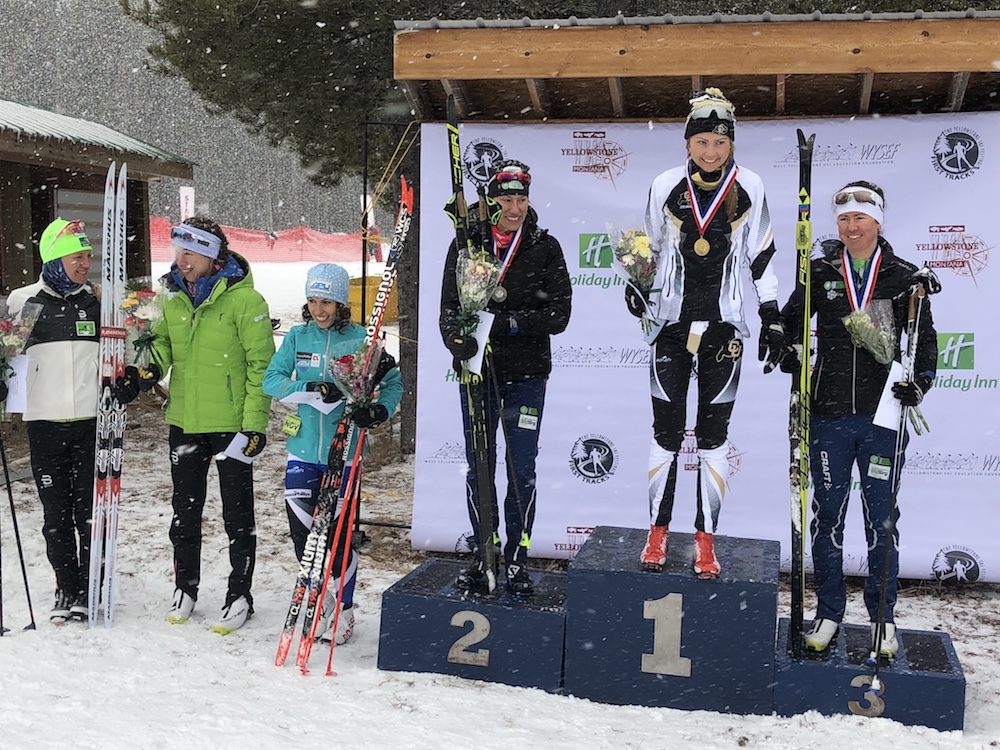
The SuperTour women’s 10 k classic mass start podium on Sunday in West Yellowstone, Montana, with Hedda Bångman (second from r) of the University of Colorado Boulder in first, and Craftsbury’s Kaitlynn Miller (third from r) and Caitlin Patterson (r) in second and third, respectively. From left: Caitlin Gregg in sixth, Katharine Ogden in fifth and Rosie Frankowski in fourth were also recognized at the flower ceremony. (Photo: FBD)
US SuperTour (West Yellowstone, Montana): 10/15 k classic mass starts
The second day of SuperTour racing took place as originally planned at the Rendezvous Ski Trails in West Yellowstone, with 22-year-old Hedda Bångman, of the University of Colorado Boulder (CU), and 33-year-old Brian Gregg (Team Gregg) winning the women’s 10-kilometer and men’s 15 k classic mass starts, respectively, on Sunday.
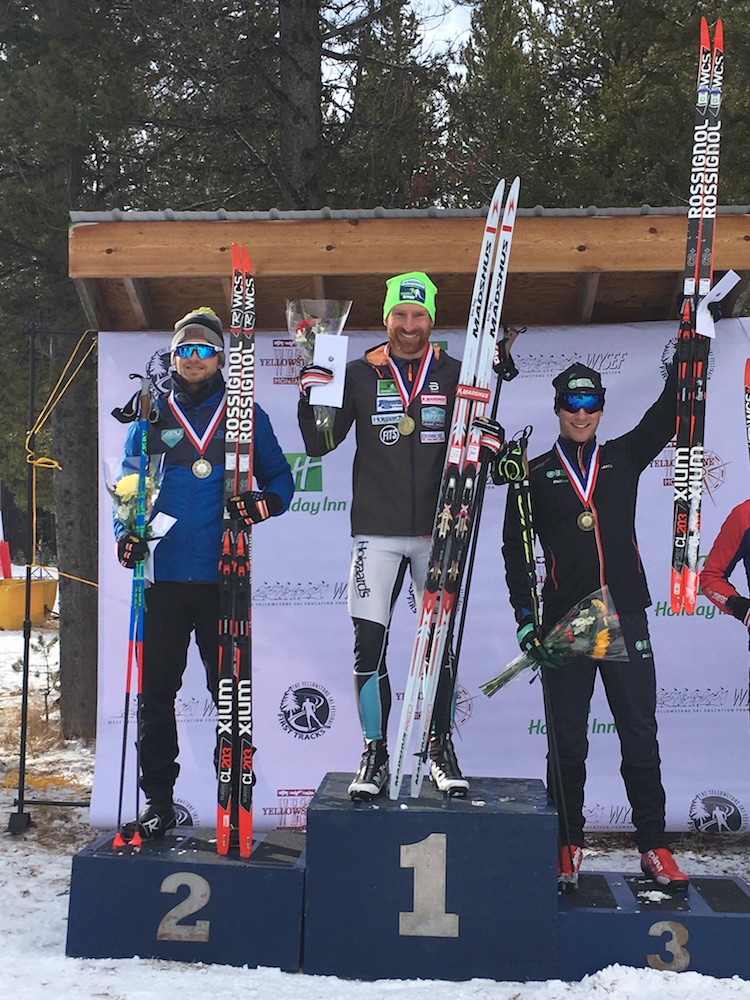
The men’s 15 k classic mass start SuperTour podium on Sunday in West Yellowstone, Montana,with Brian Gregg (c) of Team Gregg in first, David Norris (l) of APU in second, and Ben Lustgarten (CGRP) in third. (Photo: FBD)
Bångman, a Swedish freshman on the CU Ski Team, won the women’s race in 30:24.8, just ahead of two Craftsbury Green Racing Project (CGRP) skiers Kaitlynn Miller and Caitlin Patterson. While Miller placed second (+1.3) and Patterson was third (+3.4),
Rosie Frankowski of Alaska Pacific University (APU) finished another 10 seconds later in fourth (+13.5), and Katharine Ogden of the Stratton Mountain School (SMS) was fifth (+17.2). Caitlin Gregg (Team Gregg) followed in sixth, Felicia Gesior (CXC Team) was seventh, Anne Siri Lervik (CU) eighth, Erika Flowers (SMS Elite Team) ninth, and Corey Stock of the Bridger Ski Foundation (BSF) 10th.
In the men’s race, Brian Gregg pulled out a 1.9-second win over David Norris (APU), crossing the line first in 41:30.3. Ben Lustgarten (CGRP) reached the podium for the second-straight day (after placing second in Saturday’s skate sprint) in third (+4.6). Kyle Bratrud (CXC Team) finished fourth (+10.9) and Kris Freeman (Caldwell Sport) was fifth (+12.6). Tad Elliott (Ski & Snowboard Club Vail) followed in sixth, Eric Packer (APU) seventh, Ian Torchia (Northern Michigan University/U.S. Ski Team D-Team) eighth, Hunter Wonders (APU) ninth, and Martin Bergström (University of Utah Ski) 10th.
Sweden’s Charlotte Kalla winning the women’s 15 k skiathlon on Sunday at the Lillehammer World Cup in Norway. (Photo: Henrik Hunnes)
Sweden’s Charlotte Kalla pulled out another dominant distance performance on Week 2 of the World Cup, racing to a 19.7-second win in the women’s 15-kilometer skiathlon on Sunday, ahead of three Norwegians and American Jessie Diggins.
Kalla led at the halfway point of the skiathlon when skiers transitioned from classic to skate, just ahead of Norway’s Heidi Weng in second. The two had broken away around 4 k into the classic leg and put more than 20 seconds into the rest of the field by the transition, when Diggins came through 21.6 seconds back in third, leading a large chase group with Finland’s Krista Parmakoski, Norway’s Marit Bjørgen, Austria’s Teresa Stadlober, Norway’s Kathrine Rolsted Harsem, Finland’s Kerttu Niskanen, Norway’s Ragnhild Haga, and Switzerland’s Nathalie von Siebenthal, respectively.
While Kalla and Weng continued to trade the lead over the next 5 1/2 kilometers or so, by the 13.65 k marker, Kalla had dropped Weng, with 12 seconds between the two, while the chasers remained 29 seconds behind Kalla.
Over the next 1.2 k, that time gap grew to 20 seconds and 46 seconds, respectively, and Kalla skied off to her second win of the season in 42:24.7 minutes.
Weng placed second, 19.7 seconds back, and Haga claimed third (+43.6), after skiing alone for the last 4 k of the race. Bjørgen finished just ahead of Diggins for fourth (+54.3) and fifth (+57.0), respectively, and Stadlober was sixth (+1:04.9), Parmakoski seventh (+1:07.8), Norway’s Ingvild Flugstad Østberg eighth, Russia’s Natalia Nepryaeva ninth (+1:27.8), and Sadie Bjornsen 10th (+1:32.6).
Four Americans finished scored points in the top 30, with Kikkan Randall placing 16th (+2:06.5) and Rosie Brennan 29th (+3:07.7). Liz Stephen finished 36th (+3:25.7), Chelsea Holmes was 38th (+3:39.6) and Ida Sargent 55th (+6:41.1).
Cendrine Browne of the Canadian National U25 Team led Canada in 45th (+4:37.3), and Emily Nishikawa followed in 49th (+5:00.1). Katherine Stewart-Jones did not finish.
Klæbo Outlasts Sundby; Harvey 6th
A gassed Johannes Høsflot Klæbo (yellow bib) holding off fellow Norwegian Martin Johnsrud Sundby (r) for the win on Sunday in the men’s 30 k skiathlon at the Lillehammer World Cup in Norway. (Photo: Henrik Hunnes)
In the men’s 30 k skiathlon that followed, Norway’s Johannes Høsflot Klæbo made it a five-peat, proving himself once again unbeatable, this time in the first multi-discipline distance race of the season.
Klæbo outlasted [edit: rocketed past] teammate Martin Johnsrud Sundby to beat him by 1.3 seconds for his fifth-straight win in 1:16:47.1, and Norway swept the top four with Hans Christer Holund in third (+6.8) and Simen Hegstad Krüger in fourth (+10.9).
France’s Maurice Manificat followed closely in fifth (+11.3) and Canada’s Alex Harvey was next in sixth (+13.1), ahead of Finland’s Iivo Niskanen in seventh (+16.2), and Russia’s Alexey Chervotkin, Sergey Ustiugov and Alexander Bolshunov in eighth (+37.7), ninth (+42.2) and 10th (+59.6), respectively.
Klæbo skied patiently in the pack for essentially the entire race. For instance, at 11 k he sat back in 18th, just seven seconds from Canada’s Devon Kershaw in the lead.
One kilometer later, Klæbo remained 5 seconds back in 13th while Kershaw was 8 seconds back in 16th.
At the ski exchange at 15 k, Niskanen led Sundby and Italy’s Francesco de Fabiani and a total of 10 men within three seconds of first. Klæbo clocked through 5 seconds back in 13th, just ahead of Harvey in 14th (+5.3). Sixteen men remained within six seconds and striking distance of first. Kershaw in 18th had fallen off the pace and was 36 seconds back at the transition, just behind Russia’s Andrey Larkov.
While Harvey continued to ski around third place during the first 5 kilometers of the skate leg, Klæbo worked his way closer to the front and led at 22.5 k. By then, the lead group had dwindled to six within two seconds of first. Harvey remained in fourth.
Over the next 7.5 k, the lead changed several times, with Klæbo hovering near the tail end of the group. With about 200 meters to go, however, it was down to Sundby and Klæbo, with the former leading by 2 seconds (and Holund skiing seven seconds back in third). Klæbo ultimately had the most finishing kick to take the win by 1.3 seconds over Sundby, while Holund crossed 6.8 seconds later for third.
Canada had two in the top 20 with Kershaw in 19th (+2:59.7). Last year’s NorAm winner Russell Kennedy (Team R.A.D.) placed 53rd (+7:30.7), and Canadian World Cup Team members Graeme Killick and Knute Johnsgaard finished 54th (+7:41.3) and 60th (+9:49), respectively.
Two U.S. men landed in the points with Erik Bjornsen (U.S. Ski Team) in 20th (+2:59.9; just 0.2 seconds behind Kershaw) and Noah Hoffman in 28th (+3:37.8). Scott Patterson finished 36th (+4:56.1) and Paddy Caldwell was 56th (+7:43).
— International Biathlon Union (@biathlonworld) December 3, 2017
France’s Martin Fourcade overcame an early penalty and his No. 2 starting position to take the men’s 12.5 k pursuit win on Sunday, 40.8 seconds clear of anyone with 19-for-20 shooting (1+0+0+0).
Fourcade started 1 second behind Saturday’s sprint winner, Norway’s Tarjei Bø, and took control of the race after cleaning the second shooting stage. Bø missed one on the first prone stage then five more later in the race (1+0+3+2) to slip to 19th (+1:49.5) while Slovenia’s Jakov Fak raced up from 10th to second, 40.8 seconds behind Fourcade, with two penalties (1+0+0+1). Just behind him, France’s Quentin Fillon Maillet took third (+42.1) with identical shooting after Fillon Maillet started 12th and skied with Fak for most of the race.
France’s Martin Fourcade (l) and Quentin Fillon Maillet after placing first and third, respectively, in the IBU World Cup men’s 12.5 k pursuit on Sunday in Lillehammer, Norway. (Photo: IBU/biathlonworld)
None of the 58 finishers cleaned the four-stage race. American Lowell Bailey improved from 22nd to 17th (+1:40.2) with two misses (0+1+0+1). Canada’s Christian Gow achieved a career best in 21st (+2:04.6), up from starting 26th, after shooting 19-for-20 (0+0+1+0).
Also for Canada, Nathan Smith slipped from 24th at the start to 42nd (+3:19.2, three penalties), Scott Gow finished 50th (+4:10.9; six penalties) after starting 16th, and Brendan Green placed 51st (+4:18.6; five penalties).
One other American qualified in the sprint top 60 for the pursuit, with Tim Burke finishing 48th (+3:52.7; four misses).
In the women’s 10 k pursuit earlier in the day, Germany’s Denise Herrmann tallied her second-straight win (and the second win of her IBU World Cup career). She started first and successfully held of France’s Justine Braisaz, who started 15 seconds behind her in second place, by 25.8 seconds. While Herrmann missed two on her third shooting (0+0+2+0), Braisaz was one of three women in the field to clean (0+0+0+0).
Norway’s Marte Olsbu raced up from seventh to third place (+48.0) with two penalties (0+1+0+1).
Canada’s Julia Ransom placed 23rd (+2:48.1), up from 29th at the start, with two misses (0+0+1+1). Two of her teammates also qualified for the pursuit, with Rosanna Crawford finishing 52nd (+5:25.1) with six penalties (0+3+1+2). In her first World Cup pursuit, Megan Bankes completed three shooting stages before being lapped (3+1+1).
No American women qualified for the pursuit.
With the conclusion of the first IBU World Cup in Östersund, the circuit moves to Hochfilzen, Austria, where racing kicks off again Friday, Dec. 8, with men’s and women’s sprints.
Sweden’s Charlotte Kalla (c) after winning the 2017 Ruka Triple and her first World Cup race since 2015. She won Sunday’s World Cup 10 k freestyle pursuit by 9 seconds over Norway’s Marit Bjørgen (l) and was nearly 34 seconds ahead of Norway’s Ragnhild Haga (r), who placed third. (Photo: FIS Cross Country/Twitter)
FIS Cross Country World Cup (Kuusamo, Finland): 10/15 k freestyle pursuit
Sweden’s Charlotte Kalla took down the fiercest contender women’s cross-country skiing has ever seen, challenging Norway’s Marit Bjørgen on the final lap of the women’s 10-kilometer freestyle pursuit on Sunday then successfully holding her off to the finish.
Kalla entered the final day of the three-day Ruka Triple mini tour with a 2-second lead on Bjørgen out of the pursuit start. Bjørgen quickly caught her and led for much of the four-lap race — until the last lap. The two skied alone, at least 30 seconds ahead of their nearest chasers, with three other Norwegians, Ragnhild Haga, Ingvild Flugstad Østberg and Heidi Weng leading Austria’s Teresa Stadlober and Sweden’s Stina Nilsson at 8.6 k.
Before that marker, Kalla had already launched her attack and was 6 seconds ahead of Bjørgen with 1.4 k to go. The Swede continued to push the pace and extended her buffer to Bjørgen, entering the stadium alone and winning by 9.7 seconds. For Kalla, a 2015 World Champion in the 10 k freestyle, it was her first World Cup win since 2015.
Bjørgen took second and Haga outlasted her teammates for third place (+33.9). Weng finished fourth (+38.0) and Østberg fifth (+40.2), then Stadlober in sixth (+41.0) and Nilsson in seventh (+46.7). Russia’s Natalia Nepryaeva led in the next chase group for eighth place (+1:01.6), followed by Sweden’s Ida Ingemarsdotter in ninth (+1:10.1) and American Sadie Bjornsen in 10th (+1:18.0). Another U.S. Ski Team (USST) member Jessie Diggins was close behind in 12th (+1:35.7), about five seconds behind Norway’s Kathrine Rolsted Harsem in 11th (+1:30.3).
The USST had four in the top 30, with Kikkan Randall rising from 48th at the start to 25th (+2:41.1) and Rosie Brennan improving from 34th to 28th (+2:43.2).
While Haga’s time was the fastest of the day in 25:41.8 (compared to Kalla’s finishing time of 25:50.1, which was third-fastest of the day behind Weng in second), Randall’s time was eighth fastest, Diggins was 10th fastest and Bjornsen 11th fastest of 79 in the last women’s race of the opening World Cup weekend.
Also for the U.S., Ida Sargent finished out the tour in 38th, Sophie Caldwell was 39th, Liz Stephen 56th, Chelsea Holmes 60th, and Julia Kern 73rd.
Canada’s Emily Nishikawa placed 69th overall and Cendrine Browne moved up two places to finish 72nd, while Dahria Beatty was lapped.
Klæbo Sweeps Opening Weekend
The men’s 15 k freestyle pursuit podium on the last day of the Ruka Triple in Kuusamo, Finland, with Norway’s Johannes Høsflot Klæbo (c) in first, Norway’s Martin Johnsrud Sundby in second, and Russia’s Alexander Bolshunov in third. (Photo: FIS Cross Country/Twitter)
In the men’s 15 k freestyle pursuit later in the day in Kuusamo, Johannes Høsflot Klæbo lost his 38-second buffer to the men’s field, but won the race after outlasting fellow Norwegian Martin Johnsrud Sundby, Russia’s Alexander Bolshunov and Canada’s Alex Harvey, respectively.
While Klæbo started the pursuit 38 seconds ahead of Bolshunov in second place, Sundb started 1:05 minutes back in 10th and Harvey was 1:23 behind in 12th.
Klæbo remained 32 seconds ahead of Bolshunov at 5 k, at which point Sundby led a chase group in third, followed closely by Sweden’s Calle Halfvarsson, Norway’s Didrik Tønseth, Kazakhstan’s Alexey Poltoranin, Russia’s Evgeniy Belov, Norway’s Emil Iversen, Finland’s Iivo Niskanen, and Norway’s Pal Golberg, respectively.
Harvey skied in the next group back with Sweden’s Marcus Hellner, Norway’s Hans Christer Holund, France’s Maurice Manificat, and Russia’s Alexey Chervotkin, all of which were in the top 15 at 5 k.
Over the next 2.5 k, Bolshunov cut his distance to Klæbo to 20 seconds, and at 7.5 k, Sundby was skiing alone another five seconds back in third.
Sundby caught Bolshunov and the two reeled in Klæbo over the next kilometer, catching him around 8.6 k, while 11 seconds back, Harvey led a chase group with Chervotkin, Niskanen, Holund, Poltoranin, and Manificat at 8.6 k.
Harvey lapped through the stadium at 10 k right behind Bolshunov in first, while Tønseth followed in third and Klaebo in fourth. Sundby remained in seventh, less than 2 seconds back.
At 12.5 k, 12 skiers remained in 2.6 seconds of the lead, but 1 k later, that number had dwindled to four within 3 seconds of first: Sundby, Harvey, Tønseth, and Klæbo. Bolshunov kept himself in contention just 3.8 seconds behind, and on the final climb, it became evident the race was between Klæbo, Sundby, Bolshunov, and Harvey. They finished in that order, with Harvey dropping off the pace in the finishing stretch.
Klæbo took the win in 36:23.2, just 0.4 seconds ahead of Sundby in second, while Bolshunov took third, 1 second behind Klæbo. Harvey was another 0.6 seconds back in fourth, and the Canadian’s time stood up as the fifth fastest of the day, behind Manificat in first (34:50.9). Manificat tied Holund for placed eighth overall (+8.2), behind Chervotkin in fifth (+6.2), Niskanen in sixth (+7.2), and Tønseth in seventh (+8.1).
Erik Bjornsen led the U.S. men overall in the tour in 26th (+1:43.6) for his third-straight race in the World Cup points. Also for the U.S. Ski Team, Paddy Caldwell raced to 19th for time of day (after starting 70th and finishing 51st in the pursuit).
Canada’s Devon Kershaw also landed in the points for the second-consecutive day in 29th (+1:47.8).
American Noah Hoffman finished the Ruka Triple in 39th (up from 45th at the start), Scott Patterson was 55th and Andy Newell 75th for the U.S.
Canada’s Len Valjas placed 44th overall, Graeme Killick 68th, Knute Johnsgaard 81st, and Julien Locke 83rd.
While France came in the favorites in the single mixed relay, starting a team of Martin Fourcade and Marie Dorin Habert, it was Austria who put on a master class and skied to a comfortable win today.
Simon Eder tags off to Lisa Theresa Hauser for Austria during the single mixed relay World Cup in Ostersund, Sweden. The pair raced to a 16.5-second win. (Photo: IBU/biathlonworld)
The Austrian duo of Lisa Theresa Hauser and Simon Eder used only two spare rounds over the course of 40 shots, the best shooting in the field by a wide margin. They led nearly the whole race and ended up with a 16.5-second victory over Germany’s Vanessa Hinz and Erik Lesser. The Germans used nine spare rounds to clean all their targets, but Lesser was aggressive on the skis and made up ground on the trails to finish 16.2 seconds clear of the rest of the field.
There, drama ensued on the last loop. Kazakhstan’s Maxim Braun came through a crash caused by Italy’s Thomas Bormolini, who was skiing in third place on the penultimate downhill and also took out Ukraine’s Dmytro Pidruchnyi. That allowed Braun, along with teammate Galina Vishnevskaya, to just barely hold on to third place. Their shooting – with five spare rounds between them, the second-best in the field – allowed this, their best relay showing ever.
Fourcade, who had left the range in seventh, came through the fray to put France into fourth, followed by Sweden (Linn Persson and Sebastian Samuelsson), then Ukraine (Pidruchnyi and Vita Semerenko) and Italy (Bormolini and Alexia Runggaldier).
Both the U.S. team of Emily Dreissigacker and Leif Nordgren and the Canadian team of Rosanna Crawford and Christian Gow were lapped. Crawford was in second position more than halfway through the race when she fell on a downhill, losing a large amount of time and affecting the functioning of her rifle once she reached the shooting range.
Later in the day, countries sent four-athlete teams out for regular mixed relays. Despite an imperfect start on the shooting range, the Norwegian team of Ingrid Tandrevold, Tiril Eckhoff, Johannes Thingnes Bø, and Emil Hegle Svendsen came away with a 5.3-second win over Italy’s Lisa Vitozzi, Dorothea Wierer, Dominik Windisch, and Lukas Hofer.
The German team of Franziska Preuss, Maren Hammerschmidt, Benedikt Doll, and Arnd Peiffer was third, +6.4, and Slovakia close behind in fourth.
Canada’s Emma Lunder, Julia Ransom, Scott Gow, and Brendan Green finished 15th, +3:28.0, and the U.S. team of Susan Dunklee, Clare Egan, Paul Schommer, and Sean Doherty 21st, +4:47.6.
The women’s podium for the first race of the 2017/2018 World Cup season, the Ruka classic sprint in Kuusamo, Finland, with (from right to left) American Sadie Bjornsen in second, Sweden’s Stina Nilsson in first, and Russia’s Yulia Belorukova in third. (Photo: U.S. Ski Team/Twitter)
FIS Cross Country World Cup (Kuusamo, Finland): Classic sprints
In the first race of the 2017/2018 cross-country World Cup season, U.S. Ski Team (USST) member Sadie Bjornsen, who turned 28 on Tuesday, raced to the best result of her career, placing second to Sweden’s Stina Nilsson in Friday’s classic sprint in Kuusamo, Finland.
Last season, Bjornsen notched her first World Cup podium in third place in the 5-kilometer freestyle in Toblach, Italy, and teamed up with USST teammate Jessie Diggins to take third in the 2017World Championships classic team sprint. Friday’s 1.4-kilometer classic sprint — the first race of the Ruka Triple mini tour to kick of the 2017/2018 World Cup season — was Bjornsen’s first race of the season. She did not participate in any preseason International Ski Federation (FIS) races.
Bjornsen started out the day by clocking the fifth-fastest time in the qualifier, 1.98 seconds behind Sweden’s Ida Ingemarsdotter, who won the qualifier in 3:11.69 minutes. Bjornsen’s USST teammate Sophie Caldwell qualified third (+0.59) after another Swede, Hanna Falk in second (+0.19), and a total of four American women finished in the top 30 to qualify for the heats. Ida Sargent finished 22nd (+8.70) and Rosie Brennan was 26th (+9.51) to reach the quarterfinals.
There, Bjornsen won her quarterfinal by 0.39 seconds over Russia’s Yulia Belorukova. Caldwell also advanced to the semifinals by placing second in her quarterfinal, 0.7 seconds behind Sweden’s Charlotte Kalla in first.
Sargent finished third in her quarterfinal, 0.65 seconds behind the winner of that heat, Sweden’s Anna Haag. Brennan placed sixth in her quarterfinal, 4.3 seconds behind Sweden’s Nilsson in first. Neither Sargent nor Brennan advanced to the semifinals.
In the semifinals, Bjornsen again raced to first, and once again held off Belorukova — this time by just one-hundredth of a second. Caldwell followed in fourth in that semifinal, 0.5 seconds behind Bjornsen in first and 0.11 seconds behind Russia’s Evgenia Shapovalova in third (+0.39). Neither Caldwell nor Shapovalova advanced to the final.
In the final, Nilsson took the overall win in 3:17.62 and Bjornsen captured a career best in second place, 0.24 seconds out of first. Belorukova rounded out the podium in third (+0.91), while Ingemarsdotter placed fourth (+2.72), Norway’s Kathrine Rolsted Harsem was fifth (+3.54), and Finland’s Krista Parmakoski sixth (+18.62).
Overall, Caldwell placed eighth, Sargent 15th and Brennan 29th for the U.S. Diggins and Kikkan Randall missed out on qualifying in 34th and 36th, respectively. Julia Kern placed 57th, Liz Stephen 70th, and Chelsea Holmes 86th.
None of the Canadian women qualified, with Dahria Beatty in 64th, Emily Nishikawa in 74th and Cendrine Browne in 87th.
In the men’s 1.4 k classic sprint, Norway’s Johannes Høsflot Klæbo won out the day after winning the qualifier, quarterfinal and semifinal en route to another dominant performance in the final.
Klæbo started off by winning the qualifying round by 2.26 seconds in 2:46.53. Finland’s Anssi Pentsinen qualified second and another Finn, Ristomatti Hakola, qualified third (+2.35), ahead of Italy’s Federico Pellegrino in fourth (+2.66).
Cross Country Canada’s Alex Harvey was the top North American man in the qualifier, finishing 13th (+6.13), while Erik Bjornsen of the USST qualified in 26th (+8.71).
Both Harvey and Bjornsen finished fifth in their quarterfinals and did not reach the semifinals. Harvey ended up 21st on the day, after finishing 2.16 behind the winner of his heat, Finland’s Lauri Vuorinen. Bjornsen was 24th overall after finishing 5.12 seconds behind Klæbo, who won the first men’s quarterfinal.
Klæbo used the extra recovery time he had from racing an early quarterfinal to prime himself for another win in the semifinals, where he beat Sweden’s Calle Halfvarsson by 0.29 seconds. Another Norwegian, Pål Golberg, followed in third (+0.49), and Hakola placed fourth in that semi (+1.72). Both Golberg and Hakola had fast enough times to advance to the final, where they met Pellegrino — the winner of the second semifinal — and Norway’s Sondre Turvoll Fossli, who was second in the second semifinal (+0.1).
In the final, Klæbo once again won convincingly, this time by 1.35 seconds with a finishing time of 2:48.19. Golberg took second place and Halfvarsson reached the podium in third (+4.03), while Hakola placed fourth (+5.65), Pellegrino fifth (+8.87), and Fossli sixth (+17.31).
For the U.S., Andy Newell missed qualifying by 0.38 seconds in 34th and Simi Hamilton finished 60th. Scott Patterson was 84th, Paddy Caldwell was 103rd, and Noah Hoffman was 105th.
For Canada, Julien Locke, of the national U25 Team, finished 59th, Len Valjas was 63rd, Knute Johnsgaard 73rd, Devon Kershaw 74th, Graeme Killick 85th, and Jesse Cockney 95th. Last year’s NorAm winner Russell Kennedy did not start.
Norway’s Marit Bjørgen racing to a 29-second win in Friday’s 10 k classic FIS race in Beitostølen, Norway. (Photo: Aleks Tangen)
(Note: This article has been updated to include comments from Nichole Bathe.)
BEITOSTØLEN, Norway — The question of whether Bjørgen or Weng will be the bigger name this season went in the favor of the former on Friday at Norway’s first big matchup of the season. Marit Bjørgen, now 37 and in her 20th World Cup season, won the first race of the three-day International Ski Federation (FIS) weekend in Beitostølen, starting last out of 56 women and finishing first in the 10-kilometer classic individual start, with 29.4 seconds between her and Weng in second place.
On a morning that marked the start of the 2017/2018 season in Norway, with temperatures just below zero and a snow squall during the women’s pre-race warmup, the snow covering the course appeared loose but ample.
Weng, the 26-year-old reigning Overall World Cup and Distance World Cup champion who started 30 seconds behind fellow Norwegian national-team member Bjørgen, told reporters after the race that she was satisfied with her performance, but could have skied better and “could have had better grip”.
For the first 2 kilometers of the race, Bjørgen’s pace was comparable to that of another one of her teammates, Ingvild Flugstad Østberg, who started just ahead of Weng. But halfway through the race, Bjørgen was nearly 22 seconds up on Østberg and 28 seconds ahead of Weng.
While Bjørgen continued to put seconds into her teammates in the final 5 k — blowing through the 7 k checkpoint 28 seconds faster than anyone else — Weng and Østberg battled for second. Weng clocked through 6.1 k just 2.7 seconds faster than Østberg and skied 5.1 seconds faster than her over the next 900 meters. Despite crossing the finish 11.6 seconds faster than Østberg, Weng’s time in the leader’s chair was short-lived, as Bjørgen finished 29.4 seconds faster with a winning time of 29:30.9 minutes.
The women’s 10 k classic all-Norwegian podium at Friday’s FIS race in Beitostølen, Norway, with Marit Bjørgen (c) in first, Heidi Weng (l) in second and Ingvild Flugstad Østberg in third. (Photo: Aleks Tangen)
Østberg claimed third, 41 seconds back and 10 seconds ahead of another Norwegian national team member Ragnhild Haga in fourth (+51.0). Norway swept first through 13th place with Kathrine Rolsted Harsem in fifth (+1:08.1), Astrid Øyre Slind in sixth (+1:27.5) and notably, sprint specialist Maiken Caspersen Falla in ninth (+1:54.3).
“Marit is superior,” Weng said in a post-race interview with NRK. “This is top level and I have to step it up.”
She added, “29.4 and 41 seconds is a lot, but Marit is not invincible.”
But even Bjørgen has to tell herself to ski relaxed for the first race of the season.
“I tried to stay calm and ski my way up to Weng,” Bjørgen told NRK. “Considering that she held the yellow bib [as the World Cup leader] last year, I think that’s pretty good.”
Bjørgen reflected that she could have skied the flatter parts of the course better.
“Heidi did well there, and it was fun to ski behind here and learn from her,” she said.
Norwegian national-team member Ragnhild Haga racing to fourth in the women’s 10 k classic FIS race on Friday in Beitostølen, Norway. (Photo: Aleks Tangen)
Fourth-place finisher Haga told reporters that she was pleased with her technical improvements in classic, which she has been working on for three years.
“It was fun, and I’m glad I was able to race at such a high level,” Haga said.
Three Americans, two of which race for Great Britain, finished 29th, 30th and 31st: Annika Taylor (+3:48.2) Nichole Bathe (+3:51.3) and Anne Hart (+3:51.4), respectively. Taylor was born in California and is a member of Great Britain’s women’s team, as is Bathe, who hails from Wisconsin and is also a member of the CXC Team. Hart, originally from Minnesota, races for the Stratton Mountain School (SMS) Elite Team in Vermont.
Since mid-September, Bathe, a recent University of Alaska Fairbanks graduate, has been living in Lillehammer, Norway, while training with the British national team.
“It’s been quite the transition especially from college racing but it has been such a great learning experience and makes me really exited for the season!” Bathe wrote in an email. “That was my first race of the season and I thought it went okay. I went out pretty hard which caught up to me in the end but overall I think it was a good start to the season.
“Typically I am more of a sprinter but in general I like classic more than skate and 5k classic is my absolute favorite race,” she added. “This winter I am focusing on U23s [World Championships] and skiing fast there especially in the sprint. I will mainly be racing in Europe this year. I am racing the Kuusamo World Cups and then heading onto the OPA and Scando Cup races!”
In an in-person interview with FasterSkier, Hart explained that she made a point to get on snow earlier this season and spent the last two weeks training in Sjusjøen, Norway. After this weekend, she’ll return to the U.S. for the first SuperTour races in West Yellowstone, Montana, Dec. 2-3.
“I’ve been told by just about everyone that this is more competitive than a World Cup in part because these are [the Norwegians’] major qualifying races [for the World Cup], or their only ones I think,” Hart said of Beitostølen. “So I just went out hard. I had great kick on my skis so I just was really working on skiing well because last year that was an area I think I just got really frantic.”
During training on Thursday, Hart skied one lap with Bjørgen.
“Yesterday I actually skied with — stalked — Marit on an easy lap, and I was just trying to imitate her skiing,” Hart said. “So I was just trying to think of her out there and obviously not quite as fast, but I was really psyched with how I skied everything well. I felt a little tired on the last bit, but again, I didn’t fall apart and I’m really pleased with that.”
American Anne Hart (SMS Elite Team) racing to 31st in the women’s 10 k classic FIS race on Friday in Beitostølen, Norway. (Photo: Aleks Tangen)
For Hart, the biggest difference she noticed in this initial race of the season was the fact that she was having fun.
“Last year I was just struggling the whole season to find that ‘fun’ gear, I guess, and today I was really enjoying the whole time and really pushing and not looking forward to the end,” she said. “Instead of thinking, ‘I have to make it another kilometer,’ it was like, ‘Oh my god, I only have a kilometer to go. I’ve gotta really give it all I’ve got.’ ”
For Canada, Isabella Howden, of the newly formed Barrie Cross Country (BXC), finished 53rd (+7:18.2). Afterward, Howden, who started 16th, recalled being passed by the five fastest women on her second lap, which she said was beneficial.
“That was pretty cool, seeing them and getting to stay with them on the downhills and copy their technique for as long as I could see them,” she said.
For Howden and some of her Canadian teammates, Beitostølen is familiar territory; they raced there last year. Regardless, she was in awe of the atmosphere.
“It’s so cool … all the kids up there cheering and there’s a whole crew around the corner with all their cowbells, like 10 of them,” she said with a laugh.
Sundby Pulls It Together
The men’s 15 k classic all-Norwegian podium at Friday’s FIS race in Beitostølen, Norway, with Martin Johnsrud Sundby (c) in first, Johannes Høsflot Klæbo (l) in second and Hans Christer Holund in third. (Photo: Aleks Tangen)
In the men’s 15 k classic individual start that followed, defending World Cup champion Martin Johnsrud Sundby took the win by 18.2 seconds over Norwegian teammate Johannes Høsflot Klæbo, who won last season’s Sprint World Cup at the age of 20.
Now 21, Klæbo is recognized as more of an all-around force, and on Friday, he led the men’s race up until the 4.9 k checkpoint. Sundby started last out of 158 men and trailed Klæbo until 6 k. But from that point on, the race was Sundby’s; at 9.8 k, he was 12.3 seconds faster than Klæbo in second place.
“I had to pull myself together,” Sundby told reporters after the race, explaining that he felt tired around 6 k. While the rest of his race required some extra effort, Sundby expressed contentment with his performance.
“This was something positive that I will take with me going into the season,” he said. “This was the first race of the season and it could have gone both good and bad. … It was so-so, I felt goofy skiing today, but that was also the case for everyone else.”
He attributed that awkward feeling to challenging conditions, “but that is also good practice,” he said. “I didn’t feel all that well in the first 5 k, but after that I was able to speed up and I felt that was able to control the race.”
And he did so without going too far into the pain cave.
“I didn’t have to dig as deep as I have done sometimes in the past,” Sundby said.
Sundby’s winning time of 38:57.2 was 18.2 seconds faster than Klæbo in second and 37 seconds clear of Hans Christer Holund in third. The top-seven men — all Norwegian — finished within 59 seconds of first. The women were a bit more spread out, with the seventh-place woman, Silje Theodorsen (Kvaløysletta Skilag), finishing 1:36.3 behind Bjørgen.
Holund clawed his way into the race after his 4.9 k time ranked 11th. With about 5 k to go, the Norwegian national-team member was up to fifth, and by 11.9 k, he was within reach of the podium in fourth place.
Didrik Tønseth ended up just 1 second off the podium in fourth (+38.0), while Johan Hoel (Åsen IL/Team Veidekke Oslofjord) placed fifth (+42.2), ahead of Simen Hegstad Krüger in sixth (+44.1) and Emil Iversen in seventh (+59.0).
Noah Hoffman (r) passes Norway’s Torstein Bu during the men’s 15 k classic FIS race season opener on Friday in Beitostølen, Norway. Hoffman went on to place 29th, while Bu finished 75th. (Photo: Aleks Tangen)
The lone American in the race, Noah Hoffman placed 29th, 2:25 minutes behind Sundby. After a slow opening that put him in 47th at the 2.1 k mark, the former U.S. Ski Team member settled into a pace that put him within the top 30.
Afterward, he told FasterSkier that his performance was a good starting point. He started the race toward the back of the field in bib 145, just ahead of several top Norwegians.
“It was a little unfortunate that there was a big train that formed right behind me, and those guys didn’t catch me until less than a k to go,” Hoffman reflected. “I was hoping they’d get me a little sooner or not get me at all, but it was good.”
In terms of a race plan, he explained that he tried to ski with energy and build throughout the entire 15 k, which he felt he did.
“I got a little excited the second time up the big hill and maybe burned a little too much, but for the most part it was a good effort and I’m looking to build this for Sunday and then obviously into next weekend,” he said.
After Sunday’s second set of distance races in Beitostølen, the 10/15 k freestyle individual starts, Hoffman will race four weekends of World Cups as an invited member of the U.S. Ski Team (USST) for Period 1. He missed the objective qualifying criteria for renomination to the USST by one place (he ranked 51st in the World Cup at the end of last season) and is thus skiing independently this year, paying his own way (and paying his own wax technicians, Zach Caldwell and recently retired USST tech Peter Johansson) so that he can race in Europe.
“The early season is important for me this year because I don’t have guaranteed start rights for the whole winter, so I need to ski well,” Hoffman, 28, said. “And I believe I’ve done everything I can to prepare and I hope to see the results from that.”
Several Canadian juniors raced the men’s 15 k as well. Ryan Jackson led them in 97th (+5:16.8), followed by Scott Hill in 99th (+5:19.1), Joey Foster in 124th (+6:45.3), and Maks Zechel in 143rd (+8:25.5).
“It was hard out there today,” said Foster, a 21-year-old member of BXC, noting that he was still feeling the effects of travel after arriving in Europe a week ago. “Considering how I felt, the race was pretty good. … I started with what I thought was a pretty conservative pace and I got in with a good train of people, and I skied with them for almost the whole first lap, and from there I just kind of fell off pace. … I think my leadup to the race just wasn’t as good as it could’ve been, so I wasn’t feeling as crisp as I would’ve liked.”
The Beitostølen FIS races continue through the weekend with classic sprints on Saturday, which U.S. Ski Team member Andy Newell plans to race, and 10/15 k skate races on Sunday.
In the men’s classic sprint on Day 1 of the three-day 2017 Toppidrettsveka mini tour, Norway’s Aune Pål Trøan (1) crosses the line ahead of his countrymen Johannes Høsflot Klæbo (7) and Eirik Brandsdal (10) while Sweden’s Calle Halfvarsson (r) placed fourth. Halfvarsson went on to win the tour, ahead of Klaebo in second. (Screenshot: NRK broadcast)
This past weekend was once again the time of the year for the Toppidrettsveka ski festival, a three-day rollerski mini tour held annually since 2005 in the region of Trondheim, Norway. In addition to the individual stages, points for the top-30 finishers were awarded to compile an overall ranking similar to the Tour de Ski.
The elite field of athletes was mostly comprised of Norwegian and other Scandinavian skiers active on the International Ski Federation (FIS) World Cup and European Continental Cup level, as well as a handful of international starters, including two Americans: U.S. Ski Team member Andy Newell, who raced at last month’s Blink Ski Festival in Norway, and Kevin Bolger, who is coming off his senior season at the University of Utah.
Day 1: Aure Sprint
American Andy Newell (U.S. Ski Team) at the start of the men’s sprint in Aure, Norway, on Day 1 of the 2017 Toppidrettsveka rollerski mini tour. (Screenshot: NRK broadcast)
The festival started last Thursday with a classic sprint in the small town of Aure, on a fairly long course with a steep downhill and a roundabout at the bottom, after which the athletes had to ski up the same hill toward the finish.
In the men’s race, Norway’s Aune Pål Trøan took the win in the final with a time of 2:46.46, narrowly edging Norwegian World Cup skiers Johannes Høsflot Klæbo by 0.41 seconds and Eirik Brandsdal by 0.43 seconds. Just another tenth of a second back, Sweden’s Calle Halfvarsson placed fourth (+0.44).
Newell’s run ended in the quarterfinals, where he finished sixth in his heat, just half a second from advancing. His heat was a tight race that featured the eventual winner Trøan, who along with World Cup regular Emil Iversen, advanced as a lucky loser behind Brandsdal and his teammate Aleksander Ek. Bolger did not reach the quarterfinals.
In the women’s final, Sweden’s Linn Sömskar prevailed with a time of 3:03.94, edging out five Norwegians, including Kathrine Rolsted Harsem in second and 2016 Toppidrettsveka title-defender Heidi Weng in third. Earlier in the day, Sömskar also won her quarterfinal and semifinal heats decisively.
Two weeks ago, Sömskar won three races at the 2017 rollerski world championships in Solleftea, Sweden — the 18-kilometer freestyle, 16 k classic, and team sprint with Maja Dahlqvist.
Day 2: Brekka Mass Start and Trondheim Sprint
On Friday, athletes competed in two events: a mass start followed by a sprint later in the evening.
Switzerland’s Dario Cologna topped the men’s 24 k mass start, a point-to-point race from Aure to Brekka, finishing in 59:11.3 after breaking away on the long final climb. Halfvarsson claimed second (+10.8), followed by Finland’s Iivo Niskanen in third (+17.2) ahead of Norway’s Niklas Dyrhaug in fourth (+27.4).
“Great to win here,” Cologna told Norwegian broadcaster NRK in an interview in the finish. “Many good skiers, the best in the world, so it’s a good feeling. Good to see that everything is working well [in preparation] for this important season.”
Bolger finished 51st (+4:48.6) and Newell crossed 15 seconds later in 54th (+5:03.9) in the large field of 124 finishers.
In the women’s mass start over the same 24 k course, the race was even closer and came down to a finishing sprint. Weng took the win in 1:07.30.3, just 3.5 seconds ahead of her teammate Astrid Uhrenholdt Jacobsen, while Sweden’s Anna Haag finished 7.8 seconds back in third. Another Swede, Ebba Anderson placed fourth (+22.0), while the rest of the field crossed the line more than four minutes later. Haag and Anderson are just coming off a training camp in Sweden, where they were joined by U.S. Ski Team members Liz Stephen and Kikkan Randall.
For Stage 3 on the same day, athletes raced a 1 k sprint in the center of Trondheim, Norway’s third-largest city. There, Klæbo won the men’s final after a decisive attack on the finishing stretch in a time of 2:19.56 minutes, ahead of fellow Norwegian Ragnar-Kristoffer Braqvin Andresen in second (+0.23) and Even Northug in third (+2.85), the younger brother of 2016 Toppidrettsveka winner Petter Northug Jr. Halfvarsson finished fourth (+2.94), thereby taking the lead in the intermediate tour standings on Day 2, ahead of Klæbo, Cologna and Trøan.
Both Newell and Bolger missed qualifying for the sprint heats and did not score additional points.
In a true photo finish (left to right) Norway’s Barbro Kvaale won the women’s sprint on Day 2 of the 2017 Toppidrettsveka rollerski mini tour in Trondheim, Norway, ahead of Sweden’s Linn Sömskar in second, Norway’s Heidi Weng in third, Norway’s Kathrine Rolsted Harsem in fourth, and Switzerland’s Laurien Van Der Graaff in fifth. (Screenshot: NRK broadcast)
The women’s sprint final went to Norway’s Barbro Kvåle in a time of 2:46.04, who placed sixth in the final the day before. She edged Sömskar by just 0.08 seconds and Weng was another hundredth of a second back in third (+0.09). Harsem placed fourth (+0.25), and Switzerland’s Laurien Van Der Graaff, who led until the final meters of the race, finished fifth (+0.37). In the overall standings, Weng spent the night in the lead, ahead of Sömskar, Jacobsen and Harsem.
Day 3: Trondheim Pursuit/Mass Start
The mini tour concluded Saturday with classic races in Trondheim. However, with a smaller field of 37 athletes for the last women’s race, the points collected in the prior three events were not converted into time gaps before the final stage. Instead, athletes started together for a 12-kilometer mass start and the overall results and time back from the winner were computed after the race.
In rainy weather (with many of the spectators sporting ponchos), the short-sleeved athletes persistently circled their laps around the city course. The top group got smaller and smaller, and after 7.5 k, only 10 women remained within three seconds of the lead. That group dwindled to six by the finishing stretch, where Haag outlunged Jacobsen by 0.2 seconds for the win and Sömskar crossed another 0.4 seconds back in third (+0.6). Three Norwegians followed, with Harsem in fourth (+1.2), Weng in fifth (+1.5) and Lovise Hemdal in sixth (+2.0). Fifteen seconds later, Kvåle in seventh (+16.7) led the next four finishers across the line.
After computing the overall Toppidrettsveka standings, Weng was deemed the winner for the second-straight year. Sömskar placed second, 34.1 seconds back (she only had one weaker stage in the long mass start where she finished 11th, almost six minutes behind Weng), and Jacobsen was just another 1.6 seconds back in third (+35.7). Harsem finished the tour in fourth (+46.7), and Haag placed fifth (+59.5).
“I was impressed with myself actually,” Weng told NRK in a finish-line interview, according to a translation. “That I managed to keep up so well despite some very stiff arms … I don’t know if I am on a better way than last year, but yes, I feel really quite good.”
On the conditions, which Jacobsen called “dangerous“, Weng was pleased everyone played it safe.
“We took it very easy, and it was good that we all kept it a bit safe, there were some very slippery spots, but it went well,” Weng said.
With more in the men’s field, the men raced a 15 k pursuit, with Halfvarsson starting first, 12 seconds ahead of Klæbo in second, and 50 seconds ahead of Cologna in third. Trøan left the gate 1 minute back and Brandsdal started 2 seconds later.
Despite the heavy rain, which had worsened since the women’s race, Halfvarsson increased his lead on Klæbo. By 5.1 k, the Swede was more than 40 seconds clear of Klæbo, and Cologna came through the checkpoint 1:13 back. Having to ski through puddles of standing water at times, Halfvarsson extended his lead on Klæbo to over a minute by 11.2 k. Another 30 seconds behind Klæbo, Northug led a large chase group of about 20 racers after the pack had caught Cologna.
Halfvarsson held his comfortable lead through the finish, completing the final stage in a time of 34:08.4 for the overall victory. Klæbo had to fight a lot harder to hold onto second place, crossing the line 1:14.7 back and only a few meters ahead of the chase group. Northug outlasted the pack in a finishing sprint for third place (+1:18.5), while Bransdal missed the podium by half a second in fourth (+1:19.0), as did Niskanen in fifth (+1:19.0) and Trøan in sixth (+1:20.0).
“Today, it was pretty easy,” Halfvarsson told NRK, according to a translation. “I had the goal to go out hard, and knew I was going to get it when Johannes had problems to follow.”
“[My] days are over, there is a new kid in town,” 13-time world champion Northug said in English in a finish-line interview with NRK, referencing Klæbo standing next to him.
“He is the one who is absolutely the fastest of all of us,” Halfvarsson agreed in his interview with NRK when asked about the upcoming season. “Petter will be strong if he can find the shape for the winter, but it’s Johannes who I fear the most.”
“He is just saying that,” Klæbo told NRK. “I think there are many Norwegians that are going to go fast this winter.”
The best time of the final stage was posted by Great Britain’s Andrew Musgrave in 33:33.8, while Halfvarsson’s time ranked 25th. Musgrave finished eighth overall (+1:20.4).
For the stage, Newell placed 53rd and Bolger 64th. Overall, Newell finished the tour in 56th (+2:28.7) and Bolger placed 67th (+3:01.2).
Sweden’s Stina Nilsson charging to her eighth World Cup victory of the season in Wednesday’s 1.2 k classic sprint final in Drammen, Norway. She finished first, ahead of Finland’s Krista Pärmäkoski (r) in second and her Swedish teammate Hanna Falk (l) in third. (Photo: Fischer/NordicFocus)
Drammen is one of those staples on the World Cup, appearing on the circuit late each season and remembered for its trademark uphill finish in the middle of a city of 63,000 inhabitants, just 40 kilometers west of Oslo, Norway.
“It tends to be fairly predictable snow,” U.S. Ski Team Women’s Coach Matt Whitcomb told FasterSkier during an in-person interview in Drammen on Wednesday. “It’s generally clean [snow]. It’s generally some sort of klister.”
But that doesn’t make Drammen easy. Finding the ideal balance of kick and glide on the city’s 1.2-kilometer course, marked by a steady uphill out of the start, followed by a 60-second downhill, and finally, one last climb to the finish, is key and something even the most seasoned World Cup skiers can struggle with at this venue, Whitcomb explained.
“We tend to see athletes focusing a little bit too much on the climbs, getting those good sensations and not enough gliding … out on the downhills,” he said. “That’s where the heart of this course really lies.”
For instance, consider Maiken Caspersen Falla. Coming off an individual skate-sprint victory at 2017 Lahti World Championships, the Norwegian didn’t ski fast enough to qualify for the heats on Wednesday. She finished 31st, 0.34 seconds out of qualifying in 30th but 6.49 seconds off the top qualifying time set by Finland’s Krista Pärmäkoski. With Falla usually qualifying first or close to it in sprints (and Pärmäkoski better known for her distance skiing), it was a shakeup that confused even Falla — Drammen’s three-time defending classic-sprint winner.
“I think it is weird,” Falla told NRK, according to a translation. “I do not know what’s going on. I was thinking I was going pretty well. I’m not far behind [the top 30], but I have no idea. Maybe I didn’t have the best skis or maybe I left far too much time in a turn. I am very unsure of what’s going on; the body has worked great the last few days.”
American Kikkan Randall, who placed third in the world-champs freestyle sprint behind Falla, was in the same boat. She finished 52nd out of 56 women in Wednesday’s sprint qualifier, 12.76 seconds out of first.
Whitcomb said that was likely due to too much kick and too little glide. Drammen as a downtown sprint poses an additional challenge for athletes and wax techs, allowing just 20 minutes for testing on race day.
“Every athlete’s working out of one depot so you have basically 100 people, male athletes and female athletes, and just trying to control the chaos as much as possible,” he said. “But I feel like our athletes, I can trust them to ask for more kick and know that it’s not gonna compromise their glide. Sometimes it does, it’s just the risk that you have to make because on this course, you spend a fair amount of time gliding and if you’re not close to having enough grip, you’ll be too tired in the finish.”
U.S. teammates Sadie Bjornsen (l) and Jessie Diggins after placing third for bronze in the women’s classic team sprint at 2017 World Championships in Lahti, Finland. (Photo: John Lazenby/Lazenbyphoto.com)
One U.S. Ski Team member thrilled with her skis was Jessie Diggins, who qualified sixth (+2.12) behind her teammate Sadie Bjornsen in fifth (+1.63). Behind them, Sophie Caldwell was the third American to qualify in 11th (+2.95).
While Diggins and Bjornsen went on to finish sixth and fifth in their quarterfinals, respectively, and did not advance to the semifinals, Diggins said that in her case, it wasn’t for a lack of speed. After some physical contact at the top of the course got her fired up and surging into first on the long descent, Diggins slipped back to the middle of the pack coming out of the downhill draft and broke a pole around the last hairpin corner before the long, uphill finishing straight.
“Jessie came into the final corner with too much traffic and a pole broke somehow,” Whitcomb said. “If it had been made out of steel, it would’ve bent, but it was loud and unfortunately none of us could get to her because there were too many cameras and fences in the way.”
“I was just ready to fight on that final climb,” Diggins reflected. “I knew I was strong because even after skiing with a broken pole, I caught back up to [the group] at the end so I mean, I did everything I could.”
She finished 5.11 seconds behind the winner of that quarterfinal, Sweden’s Stina Nilsson, who would go on to win the day.
“I was so stoked with my skis,” Diggins added. “They were fast, they had good kick and I know they had good kick because I had one pole and I was like, ‘Wow! They really nailed it!’ ”
While Diggins raced in the second quarterfinal, Bjornsen was one of the guinea pigs, so to speak, in the first heat of the day. Whitcomb explained that coaches and athletes routinely watch the first women’s quarterfinal on sprint days to figure out the course and determine strategies for the remaining rounds.
While Bjornsen skied in third for much of her quarterfinal behind Norway’s Mari Eide, who led for most of it, the American bronze medalist in the world-champs classic team sprint (with Diggins) positioned herself closer to second entering the final climb to the finish.
While the last few hundred meters of the race were shaping into a four-way fight for first between Eide, Bjornsen, Sweden’s Hanna Falk, and Slovenia’s Anamarija Lampič, Bjornsen in the far right tracks suddenly found herself behind a V-board when the course narrowed from four tracks to three across, and her tracks ended. She jumped to the left, slotting in behind Eide, and ran out of room to make any more moves to end up fifth, 2.52 seconds behind Falk in first.
“I felt really strong in the qualifier, had some great skis, and was so excited for the heats,” Bjornsen said, according to a U.S. Ski Team press release. “Unfortunately in the final stretch, I chose a lane that didn’t go to the finish, so I had to stop and go in behind the others — which simply didn’t work. That was an expensive mistake, and cost a day full of great feelings. Fortunately I feel really good right now, and I am so excited to keep racing and get my chance.”
Sophie Caldwell (U.S. Ski Team) striding to 11th in the women’s 1.2 k classic sprint qualifier at Wednesday’s World Cup in Drammen, Norway. She went on to place ninth overall. (Photo: Fischer/NordicFocus)
Bjornsen and Diggins ended up 21st and 26th on the day, respectively. Leading their team, Caldwell reached the semifinals and ultimately placed ninth overall.
In an in-person interview after the race, she told FasterSkier that she was particularly pleased with her qualifier considering her past results in Drammen. Before Wednesday, had never cracked the top 10 there.
“The first three years I raced in Drammen, it was just a really hard course for me for some reason and I found myself not qualifying, but not even close to qualifying, like, back in the end of the pack,” Caldwell said. “Last year I figured out how to qualify and I was just thrilled to have qualified so this year it was one step further making the semis so I’m really happy with that.
“It’s still a tough course for me,” she added. “It’s so gradual that it’s a really good course for power skiers and that’s been something I’ve been working on a lot, but power skiing for classic for sure isn’t my strength. … I think that’s probably why it’s been so difficult for me in the past but I’m really happy with today.”
Third in her quarterfinal, just 0.79 seconds behind Norway’s Ingvild Flugstad Østberg, who won it, and half a second behind another Norwegian, Kathrine Rolsted Harsem, who automatically advanced in second, Caldwell reached the semifinals as a lucky loser — along with Finland’s Aino-Kaisa Saarinen in fourth (+0.95) in that heat.
Caldwell went on to place fifth in the second semifinal, 1.44 seconds behind Sweden’s Ida Ingemarsdotter in first. The American had put herself in third behind Pärmäkoski and Harsem before Ingemarsdotter hammered up the finishing straight to take the win.
“There was a little jostling around both on the downhill and up the final stretch,” Caldwell explained. “I kind of tried to cut inside Ida on the downhill and she moved in front of me so then I switched to the other side, then coming back up this way, Ida sort of hopped in the track in front of me so I went to move to the other one without knowing [Slovenia’s Katja Višnar] was coming up on the side so I had to bop back. There was a lot of bouncing around, but that’s part of the game. You want to be aggressive, but you want to be fair, and I think that’s something I’ve always tried to do.”
Also for the U.S., Rosie Brennan finished 37th in the qualifier and Ida Sargent was 42nd. Canada’s lone woman racing on Wednesday, Dahria Beatty, who turned 23 on Tuesday, finished 48th.
The women’s 1.2 k classic sprint podium at Wednesday’s World Cup in Drammen, Norway, with Sweden’s Stina Nilsson (c) in first, Finland’s Krista Pärmäkoski (l) in second and Sweden’s Hanna Falk (r) in third. (Photo: Fischer/NordicFocus)
As the day progressed, Sweden’s Nilsson continued to pick up steam. Coming off a World Championships in which she earned one medal (silver in the 4 x 5 k relay) and placed 12th in the freestyle sprint, the world’s second-ranked sprinter (behind Falla) had something to prove.
She started by posting the fourth-fastest qualifying time, 1.54 seconds behind Pärmäkoski, then won her quarterfinal and first semifinal before dusting her competition in the final. While Nilsson followed the lead of fellow Swede Linn Sömskar in the quarterfinal and drafted off Diggins on the downhill to slingshot to first before the finishing stretch, Nilsson took a backseat to Østberg in the semifinal. With energy to spare, Nilsson and her teammate Falk pounced on the long grind to the finish, placing first and second, respectively, while Østberg dropped to fourth behind Lampič in third.
In the final, Nilsson didn’t bother with games. She led out of the start, with Harsem following in second up the first double-pole section of the initial climb. While Nilsson continued to lead over the top, Falk and Pärmäkoski ended up duking it out for second place. Pärmäkoski double poled hard up the finishing straight to move into second, which she took by 0.84 seconds over Falk for her first World Cup sprint podium. Nilsson powered to the win in 3:07.57 minutes, 0.42 seconds clear of Pärmäkoski and 1.42 seconds ahead of Falk.
The remaining finalists, Harsem finished fourth (+3.27), Ingemarsdotter was fifth (+4.86), and Lampič, the U23 World Cup leader, placed sixth (+9.67).
The victory was Nilsson’s eighth of the season and puts her 42 points behind Falla with one sprint to go — a freestyle sprint in Quebec City next Friday, where 50 points for a win are on the line.
“I thought I could win and this feels really great,” Nilsson told the International Ski Federation (FIS), according to a press release. “I was sure Maiken would win the sprint globe today. I don’t think it’s possible still to win it, but there is still a chance and I will travel to Quebec and try my best.”
For Pärmäkoski, the podium showed her continued momentum after two World Championships medals (second in the 15 k skiathlon and third in the relay).
“I am really happy,” she told FIS. “I wasn’t sure how I would feel after the championships but I felt really strong today.”
Falk is third in the overall sprint standings, 154 points behind Nilsson and 29 points ahead of Norway’s Heidi Weng in fourth. At World Championships, Falk missed a medal in the skate sprint in fourth.
“This makes up a little bit for my fourth place finish at the World Championships, so it feels good to come here today and get a podium,” Falk said.
The last European World Cup races of the season will take place Saturday and Sunday with the famous Holmenkollen 30/50 k mass starts near Oslo. This year, those races are classic technique. The men race on Saturday at 12:45 p.m. Central European Time (6:45 a.m. Eastern Standard Time) and women start at noon CET (5 a.m. Eastern Daylight Time) on Sunday.
Kikkan Randall (U.S. Ski Team) during the women’s 1.2 k classic sprint qualifier on Wednesday at the World Cup in Drammen, Norway. (Photo: Fischer/NordicFocus)
Sweden’s Stina Nilsson celebrates her 10th World Cup victory in two seasons (and seventh one this year) in the women’s 1.3 k freestyle sprint on Saturday in Otepää, Estonia. (Photo: Fischer/NordicFocus)
At 23, Sweden’s Stina Nilsson has nailed a business-like approach to World Cup starts. Standing 5-foot-9, she appears to tower over most of her competitors, and before her signature races (sprints) she appears deep in contemplation, definitely in the zone. During those races, she’s usually the one setting the pace, and afterward, she’s almost always celebrating at the finish.
So far this season, Nilsson has won seven World Cup races — including today’s freestyle sprint in Otepää, Estonia. Four of those were sprints, three of them skate sprints. She also established herself as an all-around threat at last month’s Tour de Ski, winning the 10-kilometer skiathlon, 10 k freestyle pursuit and 10 k classic mass start — nearly half of the stages.
And on Saturday at the pre-World Championships World Cup in Otepää, Nilsson proved she’ll be tough to stop in her quest for World Championships gold next week in Lahti, Finland. She previously racked up three silver medals at 2015 World Championships at home in Falun, Sweden. Two of those were in team events, one was in the classic sprint.
This year’s World Championships begin in earnest on Thursday, Feb. 23, with a freestyle sprint. And considering Nilsson has won the last three World Cup skate sprints she’s competed in (and has a career total of six skate-sprint wins, putting her ahead of Norway’s Maiken Caspersen Falla with five), she couldn’t be more of a favorite.
It didn’t come easy on Saturday, with temperatures in the mid-30’s Fahrenheit on a brand-new sprint course in Otepää.
“Every year we go to Estonia we joke about what the course will look like,” U.S. Ski Team Women’s Coach Matt Whitcomb said on the phone Saturday. “It’s actually not making fun of them, it’s admiring how they are trying to adapt their terrain to the direction to sprinting has gone.”
The men’s 1.6 k and women’s 1.3 k courses are harder, he explained, “and what they are trying to do is have something that will stand up to a classic sprint, even though today was skating with world champs coming up.”
Pair that with increasingly mushy snow, and you have a day where the finals came down to a slog-fest.
“There was no glide in the final in that [last] hill,” American Jessie Diggins, the lone North American to reach the final on Saturday, explained on the phone after. “It was like Alpe Cermis for me.” (Alpe Cermis is the final climb of the Tour de Ski.)
The Otepää World Cup women’s freestyle sprint podium on Saturday in Estonia, with Swedish winner Stina Nilsson (c), Norway’s Maiken Caspersen Falla (l) in second and Heidi Weng (r) in third. (Photo: Fischer/NordicFocus)
Nilsson, who had put herself in a position at the front or very close to it to win her quarterfinal, semifinal and ultimately the final, even said it was hard.
“There were difficult snow conditions on the track and it was hard to beat Falla,” she said, according to an Otepää press release.
In just about every World Cup sprint this season, Falla has been the other woman to beat. And in the last four skate sprints, including today, she’s been second. Before that, Falla won a skate sprint in Davos, Switzerland, where Nilsson missed qualifying in an uncharacteristic 31st. And in the two classic sprints at the start of the season, Falla finished second (behind Nilsson in the first race and her Norwegian teammate Heidi Weng in the other).
Notably, the 5-foot-3 Falla has placed in the top two in 11 out of the last 12 World Cup skate sprints she’s contested. With seven individual podiums this season and all but one putting her on the second step, you can imagine how hungry Falla — the 2014 Olympic freestyle sprint gold medalist — is for another win.
She won her quarterfinal on Saturday and placed second in her semifinal, 0.42 seconds behind Nilsson, before chasing Nilsson once again in the final. The two broke away on the final downhill, and Falla tried to make a move on the last tight corner to get around the Swede, but alas — another second place. Nilsson racked up her 10th individual World Cup victory in 2:49.96 minutes, and Falla was 0.27 seconds shy in second.
“In the final I did not have as good start as I hoped,” Falla said, according to a FIS press release. “It was difficult to find a good position. On the last climb I could follow Stina. Today’s second place is a good sign that my shape is getting better.”
Four U.S. Women Qualify in Top 12
Nilsson started the day by qualifying in first on Otepää’s one-lap sprint course, 0.6 seconds ahead of Norway’s Weng in second and 2.55 seconds ahead of American Kikkan Randall in third. Four U.S. women qualified in the top 12, with Sophie Caldwell in fourth (+2.6), Ida Sargent 10th (+3.47) and Diggins 12th (+ 3.93). Falla qualified seventh (+3.21).
Sweden’s Stina Nilsson (1) leads Norway’s Kathrine Rolsted Harsem and American Sophie Caldwell (far left, not shown) around a tight corner in the stadium of the women’s 1.3 k freestyle sprint at the Otepää World Cup in Estonia. (Photo: Fischer/NordicFocus)
Wearing bib 1, Nilsson went on to win her quarterfinal by 0.62 seconds over Caldwell before doing more of the same in the first semifinal, where she beat Falla. Early in the first quarterfinal, Caldwell found herself in third behind Norway’s Kathrine Rolsted Harsem and Nilsson, which was exactly where she wanted to be.
“I didn’t want to be leading in my quarter, but I wanted a clean start and then to settle into the front/middle part of the pack,” Caldwell explained in an email. “I tried to stay calm and conserve energy where I could to be able to have a strong finish. I wanted to hang as tight as possible to the leaders up the steep hill and over the top because I knew the draft could come into play. I think I executed my quarter just how I wanted to and my legs felt good enough to have a strong final stretch and finish 2nd.”
Caldwell edged Harsem by 0.09 seconds in a photo finish for second, and both advanced to the semifinal when Harsem earned a lucky loser spot. Nilsson and Caldwell raced in the first semifinal, where Nilsson led into the first of the two major climbs. Once again skiing in the middle of the pack, Caldwell stumbled about halfway up and had to work to catch back up to the group.
“I think I poled between my legs or on my ski or something and took myself out,” Caldwell wrote. “I recovered pretty quickly and was able to close the gap over the top of the first hill.”
By the time they reached the second climb, Norway’s Astrid Uhrenholdt Jacobsen had moved into first. Nilsson followed her in second over the top while Falla hung close in third.
American Sophie Caldwell (4) and Norway’s Ingvild Flugstad Østberg (8) chasing Norway’s Kathrine Rolsted Harsem (second from l) and Sweden’s Stina Nilsson (r) in the quarterfinal of the women’s World Cup freestyle sprint in Otepää, Estonia. Caldwell edged Harsem in a photo finish for second, behind Nilsson in first, and all four advanced to the semifinals. (Photo: Fischer/NordicFocus)
“Going up the second hill, the top three opened up a little gap and I was behind Ingvild [Flugstad Østberg of Norway] and we were unfortunately just far enough back so that we didn’t benefit a ton from the draft,” Caldwell explained. “There are a few things I would do differently if I were to do it again (namely not to fall), but I was really encouraged by my energy out there today.”
Caldwell finished fifth in that semifinal, 1.83 seconds behind Nilsson, who had reclaimed the lead at the bottom of the long downhill into the stadium. Falla automatically advanced to the final in second, and Jacobsen advanced as a lucky loser in third (+0.75). Østberg took fourth (+1.64), just ahead of Caldwell, and neither advanced to the final. That put Østberg in seventh and Caldwell 10th overall on the day.
Diggins Wins Quarter + Semifinal
Meanwhile, Diggins — the winner of her quarterfinal — won the second semifinal as well, beating out Weng by 1.21 seconds. Sweden’s Hanna Falk placed third (+2.52) behind Diggins, Sweden’s Ida Ingemarsdotter was fourth (+3.8), Randall fifth (+13.3) after a late crash, and Harsem sixth (+21.37) after face planting on the last downhill in a separate incident from Randall.
Diggins automatically advanced to the final along with Weng, and Falk made it as a lucky loser.
In the final, Nilsson again took charge out of the start, while Weng clung closely to her in second. Jacobsen once again took the lead, this time up the first climb, but Nilsson made her move back into first by the final steep uphill. Falla chased Nilsson over the top, followed by Weng, Jacobsen and Diggins — in that order — on the descent. Having dropped everyone else on the last hill, Nilsson and Falla raced toward the finish line as a unit. Nilsson stayed ahead, Falla took second, Weng third (+3.75), Jacobsen fourth (+4.91), Diggins fifth (+6.82), and Falk sixth (+21.73).
“I could not have done it any better, so I’m very happy,” Nilsson told the Otepää organizers. “The course was very good and I would like to come back and race here again.”
Jessie Diggins (12) racing to first in her quarterfinal, ahead of Sweden’s Ida Ingemarsdotter (directly behind), who finished second in that heat, in the World Cup freestyle sprint in Otepää, Estonia. Slovenia’s U23 leader Anamarija Lampic (l) finished third in that heat. (Photo: Salomon/NordicFocus)
While Nilsson and Falla had tested their tactics against one another in the semifinal, Diggins didn’t meet either of them until the final. The 25-year-old American had previously won her quarterfinal by leading from start to finish, then her semifinal by capitalizing on a slingshot draft on the last downhill.
“In my quarter, I just wanted to stay out of trouble,” Diggins explained. “It’s a course where it’s hard to pass and with deep snow and icy spots, I saw a lot of potential for danger, so I wanted to stay way out anything that my happen. The best way to ensure that is to get way out in front. And it burns a lot of energy and I paid for it later in the final.”
She added that the biggest hill — the last, steep one that Diggins called the “headwall” — proved especially challenging because it required a different technique, namely jump skating.
In the semifinal, Diggins said she got stuck behind the wrong person on the way up that climband came out of it in fourth. Meanwhile, Randall had taken the lead by the top.
“I was actually proud of myself for mentally not counting myself out,” Diggins said. “Just saying, ‘OK, I’ll use the slingshot, downhill’s a big strength of mine, so I’m just going to get back in it.’ ”
That’s exactly what she did. Diggins shot wide around the last corner and surged into first, ahead of Randall, Weng, and Falk. Coming out of that corner and toward the finishing stretch, Randall lost her balance on the way up a small hill over a tunnel and fell out of contention.
“Right after Jessie passed me I was taking the inside line into the corner and then lost my balance on an ice patch and my weight went out the back,” Randall wrote in an email. “Thought I almost saved it for a split second and then my skis came out from under me. It was totally my fault but a real bummer. I was feeling strong and ready to be in the final.”
Meanwhile, Diggins gained some confidence with her semifinal win.
“It was a good moment for me realizing that I can execute good tactics. I don’t just have to put my head down,” she said.
In the final, Diggins wasn’t sure of the best move on the final uphill.
“I had this moment of hesitation at the bottom as to who do I follow? Do I follow her? It’s kind of like you are picking your security line at the airport, which line to I get in to go the fastest?” she said. “I think that moment of hesitation definitely cost me, but then when they went, it was really quick and I was not technically able to go. I was just like stepping as hard as I could, but I think I needed to be more like a hop skate in order to go. After that, I just worked on preserving my spot.”
After being gapped, she said it was tough mentally to finish the race in a solid position.
“I was just trying to work on pushing, I really need to practice for Lahti, so get in there,” she said.
Diggins said she has a “pretty ambitious race schedule” planned for Lahti World Championships, and while she couldn’t say which races she’ll do, she intended to sit out Sunday’s 10 k classic individual start to rest up for next week.
“To pull it off, I need to come into it quite rested,” Diggins, a 2013 freestyle team sprint champion and 2015 individual silver medalist, said of her World Championships goals.
Kikkan Randall (U.S. Ski Team) racing in the heats at the World Cup freestyle sprint in Otepää, Estonia. She reached the semifinals for ninth overall. (Photo: Fischer/NordicFocus)
While Diggins ended up fifth overall and Caldwell 10th on Saturday, Randall had her second-best individual result of the season in ninth, and it all started with her being the third-fastest qualifier.
“That qualification would have beat some of her performances from when she was at the top of her game,” Whitcomb said. “I can’t help to wonder if she is back at the top of her game.”
“To be able to lay down a fast qualifier like that gives me confidence that I’ve made it one step closer to the kind of race form I had when I was contending for wins and podiums in every skate sprint,” Randall wrote.
In her quarterfinal, Randall initially finished third, 0.3 seconds behind Jacobsen, who won that heat. Russia’s Natalia Matveeva finished second, but was relegated to last (and 30th overall) for obstructing Randall. According to Randall, she experienced two instances of obstruction in that heat.
“Coming into the stadium I tried to make a move on the outside and Matveeva abruptly moved over in front of me as I came up alongside her,” she wrote. “So I reset and tried to set myself up on the final turn. But then she cut across me again and I lost all my momentum.”
Randall asked her coaches to file a protest. After reviewing the video, the jury deemed Matveeva’s first cut-off grounds for a penalty. Thus, Randall advanced to the semifinals in second place.
In her semifinal, Randall resolved to be more aggressive to ensure better positioning.
“Even after a not-so-great start again, I made a push to get up closer to the front,” she wrote. “I skied the downhill 180 corner pretty well and got my own lane up the steep climb and was able to make a move over the top. Jessie followed me and came flying out of my draft as we came toward the stadium.
“I was definitely bummed have missed out on the chance to test myself against the best in the final today but I am really encouraged with how I felt all day,’ she added. “I learned some good tactical lessons and I am really looking forward to another chance in a few days!”
Randall was listed to start Sunday’s 10 k classic.
Also listed for Sunday’s race are Sargent and Bjornsen (among other U.S. women), who placed 13th and 20th overall, respectively, on Saturday. After qualifying in 10th, Sargent looked poised to win her quarterfinal before she ultimately finished third (0.35 seconds behind Falla) and did not advance.
“For the quarterfinal my strategy was to stay near the front and stay out of trouble and try to stay in contact going into the downhill,” Sargent wrote in an email, adding that she wanted to stick with Falla.
But feeling especially excited and strong, she decided to go for it and take the lead soon after the start. On the last climb, Falla attacked over the top and led into the downhill. Sargent followed, taking a few extra skate steps to rein Falla back in.
“Sometimes I don’t think I work the graduals enough so I made an effort to push a little longer going into the downhill and I think that gave me the power to pass Maiken on the downhill,” Sargent described. “I was proud of myself for holding my line and and skiing with confidence in the heat which is another thing that I’m working on But then unfortunately my legs were really flooded in the finish stretch and I lost the crucial time there. So I feel I’m really close but just need to keep working to have that extra couple tenths of a second.”
“10th in the qualifier is definitely one of my best if not my best qualifiers for a full World Cup field,” she acknowledged. “… We had insanely fast skis today so the techs did some magic work and that was a huge help making it such a great day for the team.”
In the same quarterfinal as Randall, Bjornsen finished fourth, 2.82 seconds behind Jacobsen. In an email, Bjornsen wrote that her qualifier was slower than usual, “I think due to searching for my sprint gears and seemingly making the wrong ski selection.
“I was looking forward to the heats, because I know my energy is feeling well, I just needed to find that speed,” she added. “I had a great start, and tried to stay light in those really deep snow conditions. As we rounded the far side of the course and headed back up the really steep climb there, I tripped over some snow, and really got bogged down. It was one of those ‘wall climbs’, and I seem to need some work on that particular grade. That is where I lost contact with the leaders, and then didn’t manage to find the steam to come back to them unfortunately.”
Bjornsen explained that Saturday’s race was her team’s qualifier for the World Championships sprint, “and I unfortunately wasn’t able to make it,” she wrote. “I haven’t quite found my groove that I know I am capable of with sprinting yet this year, but I keep looking forward to it every time I try, because I think it is a small adjustment that I am on a search for. On the other hand, I still feel really good about my energy and fitness right now, so I am looking forward to tomorrow with great excitement. An individual classic 10k is a great race for me, and I can’t wait to take on this challenging course!”
Canada’s Beatty 29th
Canada’s Dahria Beatty nabbed the last qualifying spot in 30th and went on to finish sixth in her quarterfinal, 9 seconds behind Weng (who won that heat) for 29th overall. Beatty last competed at U23 World Championships in Utah, where she recorded three top-20 results. In the two weeks since, the 22-year-old Canadian U25 Team member has been in Canmore, Davos, and Otepää since Thursday. After this weekend, Beatty will travel with the team to Lahti to compete at senior World Championships.
“The course was a really hard one, the snow was soft which made it even more challenging and the final climb is really steep,” she wrote of Saturday’s race. “I managed to survive the steep pitch in my qualification but in the heats it had softened a bunch and that’s where the pack really got away from me. Something else to add to the list of things to work on!
“I was really happy to be back in the top-30 my first race back in Europe,” Beatty added. “My legs have been feeling a bit heavy the past week with all the travel but this was a really solid place to start the next period of racing and I think my body will be feeling all ready to go by next Thursday. I am confident in my fitness right now and I am really looking forward to experiencing my first World Championships!”
Canada had two others in the women’s race, with Cendrine Browne placing 48th and Katherine Stewart-Jones 49th.
The U.S. had a total of seven women compete on Saturday, with Chelsea Holmes and Rosie Brennan finishing 58th and 60th, respectively. Of those seven, four qualified in the top 12 and five finished the day in the top 20.
“It is incredibly competitive out there…,” Whitcomb said. “I think it means that we have a team that is operating at peak form and is ready for the championships.”
Stina Nilsson of Sweden (center) celebrates another win in the Tour de Ski, which puts her atop the overall standings; Anne Kyllönen of Finland (left) was second in the 10 k classic mass start and Charlotte Kalla of Sweden third. (Photo: Fischer/Nordic Focus)
As the Tour de Ski drags on, the World Cup field is tiring. Nobody – except maybe Sergey Ustuigov – has managed six good days in a row.
Everyone else has had at least subpar race. But sometimes a good day follows a bad one. Just ask Sweden’s Stina Nilsson.
23-year-old Nilsson had been leading the Tour after winning three out of the first four stages. But she finished 20th in the 5 kilometer freestyle on Friday – 40.5 seconds behind the time set by Jessie Diggins, and far from seeing any bonus seconds. So she lost the lead.
Saturday was a brand new day: the 10 k classic mass start in Val di Fiemme. As Nilsson noticed her rivals in the overall Tour standings slipping – quite literally, as some struggled with slick skis – she pounced.
First she won the bonus sprint at 3.6 k. It wasn’t something that she had planned ahead of time, but the opportunity seemed ripe for the picking.
And then as the race went on, Nilsson stayed always near the front. By the final 2.5 k lap she decided to push up the hills. The rest of the pack fell away, all except for Anne Kylloenen of Finland.
Coming down the hill to the finish she was able to pull away from Kylloenen, too. That gave her a 3.0-second win — and 30 total bonus seconds, 15 for the first sprint and 15 for the win. Voila – now she is back in the Tour lead.
“It is amazing,” Nilsson marveled to FIS. “You never know how the body bounces back. Yesterday was a difficult day. I am really happy with today’s result.”
Charlotte Kalla of Sweden racing to third place in the 10 k classic in Val di Fiemme, Italy. (Photo: Fischer/Nordic Focus)
It was the first individual podium of the season for Kylloenen, and a strong day for Finland. Krista Parmakoski placed fourth (+9.4) and Kerttu Niskanen ninth (+19.8). The team is traditionally strong in classic skiing, and Kylloenen also credited their ski techs.
“It is great to be on the podium again, especially after I crashed today,” she told FIS. “I had to fight my way back in the race but in the end I felt very strong.”
While Kylloenen had praised her skis, one team wasn’t doing so. The Norwegians failed to reach the podium for a second straight day. Heidi Weng was their top finisher, in seventh (+17.5). She had been leading the Tour, but now sits 19.2 seconds behind Nilsson going into the final stage.
Kathrine Harsem finished 12th (+35.3) and Ingvild Flugstad Østberg 18th (+1:08.5). All three blamed their skis, which they said were too slippery and the worst in the field.
“It should be f–ing possible to wax properly, goddammit,” Harsem told NRK. “We have to try and put this behind us.”
For Østberg, it was a disaster in terms of the overall Tour standings, as she slipped from second place down to fourth, 1:23.3 behind Nilsson and 39.7 seconds behind third-place Parmakoski.
“It’s a lot to take in when you see your chances in the final standing go away,” she told NRK. “I am terrible at waxing myself so I’m not blaming anyone. They do all that they can and we do all that we can. You can’t always hit the bullseye, but of course it is even more frustrating when it’s a Tour.”
Stina Nilsson double-poling to the win in Val di Fiemme. (Photo: Fischer/Nordic Focus)
As for Weng’s chances of winning the Tour de Ski, they are still decent. She is currently 19.2 seconds behind Nilsson overall.
The final stage is a grueling 9 k climb up the Alpe Cermis, a stage where Weng has excelled in the past.
“It’s fun to still be in the race, “ Nilsson told Expressen. “It’s Heidi Weng and it’s Alpe Cermis… I see myself absolutely not as the favorite. But it’s fun to still be in the game a little bit.”
Nilsson hasn’t excelled in the climb – but she is also a much stronger skier than she was last season.
“Stina is in better shape than ever,” Weng told Expressen. “I don’t know if I will take her on the slopes in the morning.”
Diggins Eighth, Holds Tour Position
With her recent flurry of podiums and wins, eighth place might seem like a standard day for the U.S. Ski Team’s Jessie Diggins.
But in the 10 k classic? Not so much. Sure, she was eighth in the 10.5 k classic Ski Tour Canada stage in Montreal last season, but there she was 1:43.5 behind the winner, Therese Johaug (and 43.2 seconds behind second-place Weng).
The women’s field, including Jessie Diggins in bib 5, takes off in the 10 k classic. (Photo: Salomon/Nordic Focus)
In Val di Fiemme, Diggins was eighth and only 19.5 seconds behind the day’s winner, Nilsson.
“I was psyched,” Diggins said in a phone interview. “I don’t know that I’ve ever been within 19 seconds of the leader in a 10 k classic.”
The result came from a combination of attitude and strategy, Diggins said.
Attitude: “I was channeling my classic-loving teammates today, thinking, ‘Okay, what would they do? They would not fall down, they would stay upright on the climbs. So I’m going to try to do that too.’ And basically, I raced today thinking only positive things to myself.”
Positive thinking can get you far – Diggins knows that as well as anyone. But she also knew she had to race smart. In order to have the best possible final Tour de Ski position, she was racing for time back from the winner, not necessarily place. So she picked her battles.
“I was trying to stay within sight of the leaders for absolutely as long as possible,” she said. “That meant that when everyone was kind of sprinting for the bonus sprint, I didn’t do that because I didn’t want to implode. So then I was able to reel my way right back in afterwards, and I was really psyched about that.”
For much of the race she held on to the back of the lead group, never falling off, but rarely part of the mêlée.
“People are switching lanes, cutting each other off, stepping on each other, and I was like, ‘Okay. I’m just going to do my thing in the back, and ski as smooth as I can’,” Diggins explained. “And then I knew the pace was going to go up on the last lap. I wanted to be able to respond to that attack as well as I could, so I just kind of stayed out of trouble. And that tactic worked out well for me today.”
A number of racers, including Kalla and Parmakoski, fell on a sharp corner coming into one of the course’s steep downhills. That, too, was a reason for Diggins to use caution.
“The worst thing I could do for myself in this race is to have some accident happen and lose a ton of time,” she said. “There was a little bit of a hairy corner there. I watched a girl half jump over another skier to avoid a crash. I remember thinking, ‘Wow, I’m so impressed. It’s the middle of the race, but I’m just so impressed right now.’ So I stood up [to avoid it]. I just wanted to stay out of trouble.”
Jessie Diggins (U.S. Ski Team) racing to first for her third-straight 5 k freestyle victory on Friday at Stage 5 of the Tour de Ski in Toblach, Italy. Diggins won her first World Cup race in the Toblach 5 k one year ago. (Photo: Salomon/NordicFocus)
As Nilsson upped the pace on the final lap, Diggins found it harder to stay with the leaders. She put her head down and dug, and knew that she had one trick card up her sleeve: the course’s downhill finish.
If the Tour de Ski has demonstrated anything, it’s that Diggins loves downhills.
“I knew that I had a chance of catching the girl in front of me if I really skied the downhill perfectly, and then hopped out of her draft at the right time,” she said. “It was really fun to actually execute a long-distance slingshot. [Niskanen] gapped me over the top of the hill. Kerttu’s a really good skier. But it was really fun to be able to actually pull it off.”
All in all, Diggins wanted to be there for the final sprint, to be close to the winner – but being 20 seconds back, she’d take it. She credited Niskanen with helping her not lose more time on Nilsson.
“We helped each other give everything we had,” she said. “When you’re duking it out with someone, you both move faster, which was cool… 10 k classic has never been my marquee event, I guess you could say. But I was really proud of myself for giving it my best shot. And not giving up, and really just going after it.”
More Points for Stephen and Brennan
By the end of the first lap, American Liz Stephen – starting from bib 21 – was holding her position and within ten seconds of the leaders.
But within a kilometer, Stephen found tat she couldn’t hang on.
“Classic is just a continuous work in progress for me, and I was hoping to feel a little more energetic out there than I did,” she admitted in a phone call. “But it’s my favorite course on the World Cup, so I was having fun out there, for sure. There seems to be this gap that I can’t quite close in classic. It happened again today. Right off the back of the leaders, and right off the back is just not close enough. Then the gaps open and I’m not there to cover the gaps, and they just get bigger and bigger.”
She finished 19th – 1:11.2 behind Nilsson, just one spot behind Østberg.
“Hell, I almost beat Ingvild today, and that doesn’t quite feel right,” Stephen said. “I certainly got to ski right behind her, which I haven’t done for five or six years. There were some highlights… I really do enjoy skiing with Steffie [Boehler, of Germany]. I was skiing the downhills well today. There’s a lot of positives for sure, but I was hoping to be just a little closer to the lead pack today.”
Teammate Rosie Brennan also had a strong start, immediately moving up eight or so places from her bib number. But then she got tangled on an uphill and it was the straw that broke the camel’s back, in terms of keeping the pace.
“We got to the top of the course and it’s a short steep pitch, like a herringbone, and I got stepped on and face planted there,” she explained in an interview. “I just lost my steam. So I had to reset then. I felt really beat, and didn’t have much there, and just tried to keep a steady pace, keep chugging along. I figured if I kept steady I would pick off a few people who had exploded. So that’s how the rest of the race went.”
By the finish Brennan had moved up to 28th (+2:06.1). She scored a few more World Cup points and is now in 30th in the Tour overall.
“I didn’t lose that much time, so it’s hardly an excuse,” she said. “But I was just tired enough that it threw me off a little bit. It was much easier to follow today than to chase, so I would have preferred to have been following. But that said, I didn’t lose that much time, so it’s not much of an excuse, just a bummer.”
It’s vanishingly unlikely that an American will win the Tour de Ski.
But one, Liz Stephen, is intent on winning the climb. Three times — 2013, 2014, 2016 – she has had the second-fastest time up the Alpe Cermis. Tomorrow she hopes to do one better.
“I’m certainly going to go out and try to catch some people, but my goal tomorrow is to win this big climb,” she said. “That’s certainly the goal, and it’s been on my radar all year. With [Therese] Johaug out of the mix [for a doping violation], I think it’s a possibility if I have a really good race. That’s the goal… I feel really ready for tomorrow. I know that everybody is tired. I’m tired too. But I’ve been looking forward to this for 364 days, so it’s go time!.”
For Diggins, who has held onto fifth place for several stages now, the climb represents another chance to simply push really, really hard.
“My whole strategy to the Tour this year, and every year, has just been day by day,” she said. So tomorrow, I think it’s the exact same approach: just go out there and it’s gonna be hard, of course, I mean, we’re climbing a mountain. But I’m just going to go out there and ski it as well as I can, and be as mentally tough as I possibly can. And I know that’s my strength, is I can dig really deep and I can deal with a lot of pain, and I can grind it out. So I’m just going to take confidence in that and go for it.”
All of the Americans said the same thing: you know what you’re signing up for when you decide to do the Tour de Ski. You’re signing up to climb a mountain after you already have half a dozen races in your legs in just one week’s time.
Brennan was philosophical about it.
“I’m quite tired. But I think sometimes when you’re tired the hill is easier than doing a race, because there’s a lot less thinking,” she said. “You’re just putting one foot in front of the other, and you don’t have to think about how to make speed, or skiing around a corner. From that aspect I feel like it will be OK. I’ll make it.”
The men’s 15 k freestyle pursuit podium at Stage 4 of the Tour de Ski in Oberstdorf, Germany, with Russian winner Sergey Ustiugov (c), Norway’s Martin Johnsrud Sundby (l) in second, and Canada’s Alex Harvey (r) in third. (Photo: FIS Cross Country/Twitter)
FIS Cross-Country Tour de Ski Stage 4 (Oberstdorf): 10/15 k freestyle pursuits
[UPDATED] Another win for Russia’s Sergey Ustiugov (that’s four in four stage races at the 2016/2017 Tour de Ski), another second place for Norway’s Martin Johnsrud Sundby, and another third place for Canada’s Alex Harvey.
That was how the podium shook out on Wednesday in the Stage 4 men’s 15-kilometer freestyle pursuit, with Ustiugov winning by 37.2 seconds after starting 30 seconds ahead of Sundby, and the Norwegian skiing alone throughout the six-lap race as well, despite seeing Ustiugov ahead of him for most of it.
Harvey ended up 1:08.8 seconds back in third after starting 1:09 back in that position, but he had to shake Switzerland’s Dario Cologna in order to keep himself on the podium.
Cologna started 1:26 back and caught Harvey on the second lap. The two skied together for the rest of the race, with Cologna leading for most of it.
On the final lap, Cologna led into the final descent down toward the stadium, where Harvey “pulled a Nilsson”, repeating the winning tactics from the previous women’s race (see below), and used the slingshot-draft tactic to surge past Cologna on the last little climb over a bridge before the finish. Harvey skated ahead of Cologna and led into the finishing straight, where he edged the Swiss skier by 0.8 seconds.
Cologna ended up 1:09.6 back in fourth, while Finland’s Matti Heikkinen led Sweden’s Marcus Hellner and Norway’s Didrik Tønseth across the line in fifth (+1:45). (Hellner edged Tønseth in a photo finish for sixth, +1:47.6).
Ustiugov gained a few seconds in his overall lead, now 42.2 seconds ahead of Sundby in second. Harvey is 1:18.8 back in third and Cologna 1:24.6 behind in fourth. Heikkinen is another 35 seconds back in fifth overall, with Hellner and Tønseth just 2.6 seconds behind him in sixth and seventh, respectively. Fewer than 7 seconds behind Tønseth are Norway’s Simen Hegstad Krüger in eighth and France’s Maurice Manificat in ninth overall.
Canada’s Devon Kershaw started 20th and ended up 21st (+4:20.2), which puts him 4:35.2 behind overall. Graeme Killick improved to 43rd (+8:01.4) after starting 46th, and is currently 8:16.4 back overall. Len Valjas did not start.
Noah Hoffman led two U.S. men in the Tour in 37th (+6:49) after starting in that position, and is even with Germany’s Valentin Mättig at 7:04 back overall. American Erik Bjornsen placed 46th (+8:39.0) after starting 50th, and is 8:54 back overall.
Sweden’s Stina Nilsson celebrates her 10 k freestyle pursuit victory in Stage 4 of the Tour de Ski in Oberstdorf, Germany, which she won by 1.7 seconds ahead of Norway’s Heidi Weng (not pictured in second) and 1.8 seconds ahead of Norway’s Ingvild Flugstad Østberg (r) in third. (Photo: FIS Cross Country/NordicFocus via Twitter)
On the women’s side, the top Norwegians have been complaining about the course, but for Sweden’s Stina Nilsson, it’s been all about tactics in the most crucial final meters of the last two races with her second-straight win on Wednesday.
Despite starting first, Nilsson hung in third for much of the women’s 10 k freestyle pursuit at Stage 4 in Oberstdorf, Germany.
With Norway’s Heidi Wengstarting 4 seconds back and catching Nilsson early, and Ingvild Flugstad Østberg (who started 12 seconds back) forming a three-woman lead pack by 2.5 k, the three skied together for the rest of the four-lap race. Notably, Nilsson hung at the back while Weng and Østberg set the pace.
Then, on the final roller climb over a bridge, Nilsson made her move, powering past both Norwegians and leading them by several strides into the finish. A day after notching her first distance win, Nilsson won her first 10 k pursuit in 27:42.7 by 1.7 seconds over Weng in second and 1.8 ahead of Østberg in third.
With the victory, Nilsson’s third in four stages, the Swede retains first in the overall standings by 6.7 seconds with three stages to go. Weng is still second and Østberg third (+11.8).
Finland’s Krista Parmakoski hung onto her fourth-place in the overall standings with a fourth place on Wednesday, 42.4 seconds behind Nilsson. She started 39 seconds back and is now 57.4 seconds out of first overall.
American Jessie Diggins held onto fifth overall as well, skiing alone throughout the race for fifth (+1:47.5) at the finish. She started 51 seconds back and is now 2:02.5 back overall.
A chase pack formed on Wednesday with Germany’s Nicole Fessel leading two others across the line in sixth (+2:39.1), with Switzerland’s Nathalie von Siebenthal following in seventh (+2:40.2) and Russia’s Yulia Tchekaleva in eighth (+2:40.3). American Sadie Bjornsen hung with that group for the first three laps before dropping 30 seconds behind those three at 7.5 k.
Meanwhile, another U.S. Ski Team member Kikkan Randall moved into 10th and about 14 seconds behind Norway’s Kathrine Rolsted Harsem in ninth at 9.4 k. After starting 19th, Randall finished 10th (+3:15.5) behind Harsem (who started sixth) in ninth (+3:08.8).
Bjornsen ended up 12th (after starting 11th), 3:17.7 out of first and 0.6 seconds behind Finland’s Kerttu Niskanen in 11th (+3:17.1).
Also for the U.S., Liz Stephen improved from 35th to 26th (+4:21.1) at the finish, and Rosie Brennan started 42nd and ended up 42nd (+7:32.9).
In the Tour standings, Randall is up to 10th (+3:30.5), less than seven seconds out of ninth, and Bjornsen is 12th (+3:32.7), right behind Niskanen in 11th (+3:32.1). Stephen is 26th (+4:36.2) and Brennan 42nd (+7:47.9) overall.
The men’s 15 k freestyle pursuit starts at 6:45 a.m. Eastern. Follow FasterSkier’s live race updates on Twitter.
The Tour de Ski Stage 2 women’s podium on Sunday with (from left to right) Norway’s runner-up Heidi Weng and winner Ingvild Flugstad Østberg, and Finland’s third-place finisher Krista Pärmäkoski in the 5-kilometer classic mass start in Val Müstair, Switzerland. (Photo: Fischer/NordicFocus)
Maybe it was because she wanted redress. Maybe it was because there was less pressure to perform. Or maybe it was because the yellow Tour de Ski (TDS) leader’s bib was with Sweden, calling her Norwegian name.
Whatever it was, when Ingvild Flugstad Østberg lined up for the women’s 5-kilometer classic mass start on Sunday in Val Müstair, Switzerland, she was ready to race for the win.
After being eliminated in the semifinal of Saturday’s freestyle sprint, the 26-year-old turned the lost chance at a podium into an opportunity to prove her place as a top contender.
“I was irritated with myself after yesterday,” Østberg told NRK.
“Such a result sometimes makes you give your best,” she added, according to a International Ski Federation (FIS) press release.
American Jessie Diggins (6) chases down Norway’s Maiken Caspersen Falla (2) at the start of the the women’s 5-kilometer classic mass start on Sunday in Val Müstair, Switzerland. (Photo: Fischer/NordicFocus)
Wearing bib 5, Østberg had her Norwegian teammates, Maiken Caspersen Falla in bib 2, Heidi Weng in bib 3, and Kathrine Rolsted Harsem in bib 4, as well as the Stage 1 TDS leader, Stina Nilsson to chase down.
That didn’t stop Østberg from rallying to the front off the gun, leading the mass of skiers through the first lap, with Weng just behind. As the women started their second lap of the 2.5 k course, a gap began forming between the Norwegians and a second front group, Nilsson and Finland’s Krista Pärmäkoski.
Moving up through the pack into the top 10 by lap one was Finland’s Anne Kyllönen, who started in bib 29, as well as her Finnish teammate Laura Mononen, who started in bib 19.
Switzerland’s Nadine Fähndrich, who started in bib 15, had also joined the front chase group, along with her Swiss teammate Laurien van der Graaff (bib 7). Just behind the Swiss duo was American Jessie Diggins (bib 6) positioned in eighth. Diggins’s U.S. Ski Team (USST) teammate Sadie Bjornsen, who had started in bib 21, had burned her way up to ninth.
Bjornsen’s hot start, however, didn’t last. The American began to fade, falling back into the low 20’s and eventually just outside of the points in 35th, where she ended the day.
“I was behind Nadine [Fähndrich] and Laurien [van der Graaff] and picked the innermost track, so in principle the best lane, and exactly on that lane Bjornsen bonked, totally, she couldn’t move anymore,” Switzerland’s Natalie von Siebenthal said during a television interview. “And I couldn’t get past left or right. Then the other athletes started to go by on my left.”
USST Women’s Coach Matt Whitcomb explained that hard start was part of Bjornsen’s plan. The way her body reacted was not.
“She took it out aggressively, which we told her to do and is always encouraged to do and just didn’t feel good today,” Whitcomb said on the phone after Sunday’s race.
Bjornsen explained that while the result was not what she hoped for, she is ready to move forward with no weight on her shoulders.
“Today was a day to forget and refocus,” Bjornsen wrote in an email. “I had a strong start, and felt great, but felt like I was working extra hard with some potentially slow skis. As soon as I crossed the red line, I wasn’t able to recover as I was hoping, and suffered a pretty bad explosion … Now I am focused on the next two events in Germany, and will hopefully find the good shape I know I am capable of!”
Maintaining position was the name of game for the remainder of the race for those still in the top 10, with Diggins sticking to her spot in eighth and Østberg holding off any attack attempts from Weng.
“I’ve been struggling a bit with the high altitude here,” Weng said according to a FIS press release. “Before the race I was afraid about the downhills but I’m happy I did not fall.”
While Weng was able to avoid any crashes, American Kikkan Randall was not so lucky. Though she had been skiing around 15th for most of the first lap, after starting in bib 17, she fell and had to make her way back into the top 20.
American Kikkan Randall after a crash just over halfway through the women’s 5-kilometer classic mass start on Sunday in Val Müstair, Switzerland. (Photo: Fischer/NordicFocus)
“My shape feels a lot better and sharper than it did in period one of World Cup,” Randall wrote in an email to several media outlets. “Really pumped to feel my race gears coming around and loving the chance to race, race, race!”
“It was so cool to watch an athlete have a breakthrough like that,” Whitcomb said of Randall’s performance. “To start off the Tour with two good races in the points, we all feel really good about that and the team is really proud of her.”
Eventually, with a close to 20-meter gap, Østberg finished first for the win in 13:21.2 minutes. Weng claimed second place, seven seconds back, while third went to Pärmäkoski who finished 11.4 seconds after Østberg.
Diggins crossed 32.6 seconds after Østberg for eighth.
“It was tricky to pace and if I could do it again I would have paced it slightly differently, but I was happy with my skis and I’m chipping away at that striding technique!” Diggins wrote in an email. “Overall I think I’m in a solid place for the tour and I’m really looking forward to the next set of races!”
Randall was the second American after Diggins in 15th (+42.4) followed by Bjornsen, who placed 35th (+1:02.6) in a photo finish with Slovenia’s Petra Novakova. Also racing for the U.S., Sophie Caldwell placed 38th (+1:09.4), Rosie Brennan 39th (+1:10.5), and Liz Stephen 44th (+1:21.2).
“There’s not a whole lot of movement that’s possible in a 5 k classic mass start … when you’re starting out of the top 20,” Whitcomb said. “Rosie and Liz were fighting from the back. … For their position in the start, I thought they skied phenomenally.”
As the USST makes its way to Oberstdorf, Germany, for the third and fourth stages of the Tour — a 10 k skiathlon and 10 k freestyle pursuit — Whitcomb remains positive of where the U.S. women are currently positioned. Diggins currently sits in sixth in the overall Tour standings, 1:01 minutes behind Østberg, Randall 15th (+1:45.9) and Bjornsen 25th (+2:05.4). Caldwell, who is ranked 22nd overall (+2:03.3), planned to withdraw from the Tour after Sunday. Brennan in is 41st (+2:33.1) and Stephen 46th (+2:49.9).
“We don’t put any specific goals or demands for any athlete on any one particular race,” Whitcomb explained. “What we try and do is link together as many quality races in a row as we can. If you can string together a bunch of decent days, and then pop one great one, it can move you way up in the tour.”
Østberg now leads the Tour followed by Weng 10.3 seconds back in second and Nilsson in third (+23.8).
The men’s 10 k classic mass start podium at Stage 2 of the 2017 Tour de Ski in Val Müstair, Switzerland, with Russia’s Sergey Ustiugov (c) in first, Norway’s Martin Johnsrud Sundby (l) in second, and Norway’s Didrik Tønseth (r) in third. (Photo: FIS Cross Country/Twitter)
FIS Cross-Country Tour de Ski Stage 2 (Val Müstair): 5/10 k classic mass starts
There was a lot of jostling between Russia’s Sergey Ustiugov and Norway’s Martin Johnsrud Sundby, with the latter leading early and the Russian not letting him get too complacent up front, but ultimately, Ustiugov was the first across the line in the men’s 10-kilometer classic mass start, the second stage of the Tour de Ski in Val Müstair, Switzerland.
Ustiugov put himself back ahead of Sundby with fewer than 2 k to go and held a sizable lead to the finish, crossing in 24:50, while Sundby finished second, 1.9 seconds back.
Norway took second through fourth with Didrik Tønseth in third (+2.3) and Sjur Røthe in fourth (+3.3), while home-crowd favorite Dario Cologna of Switzerland settled for fifth (+5.5) after racing in the top three for much of the race.
The top 13 finishers all ended up within 10 seconds of Ustiugov at the finish, with Finland’s Matti Heikkinen in sixth (+5.6), Sweden’s Marcus Hellner in seventh (+6.0), and Canada’s Alex Harvey in eighth (+7.0).
With a six place on Saturday and eighth on Sunday, Harvey is currently third overall in the Tour, 59.6 seconds behind Ustiugov in first and 40.7 seconds behind Sundby in second (Sundby trails Ustiugov in the overall by 18.9 seconds.)
Finland’s Iivo Niskanen made it into the top 10 on Sunday in ninth (+7.0), as did the fourth Norwegian, Simen Hegstad Krüger in 10th (+7.3).
Devon Kershaw made big strides in moving up to 27th (+42.9) for 32nd overall in the Tour (+2:22.5), Graeme Killick placed 33rd (+49.3) and Len Valjas 38th (+54.3) for Canada. Valjas is currently 26th overall (+2:13.5) and Killick 36th (+2:29.5) in the Tour.
Erik Bjornsen led the U.S. men in 42nd (+59.9) for 42nd overall (+2:41.2). Noah Hoffman placed 46th (+1:13) and is currently 48th in the Tour (+2:57.4) and Simi Hamilton (+3:14.8) was 75th out of 78 finishers. A sprinter, Hamilton planned to withdraw from the Tour after this stage for a training block.
Norway’s Ingvild Flugstad Østberg (top and bottom center) celebrates her win in Stage 2 of the 2017 Tour de Ski, the women’s 5 k classic mass start, which she won over teammate Heidi Weng (l) and Finland’s Krista Parmakoski (r). Østberg currently leads the overall Tour by more than 10 seconds over Weng with seven stages to go. (Photo: FIS Cross Country/Twitter)
[UPDATED] In the women’s 5 k classic mass start, Ingvild Flugstad Østberg rebounded from Saturday, in which she was eliminated in the semifinals for seventh place in the freestyle sprint, with a seven-second victory over Norwegian teammate Heidi Weng.
Østberg finished first in 13:21.2, Weng took second for her second-straight podium of the Tour, and Finland’s Krista Parmakoski finished third (+11.4).
American Jessie Diggins raced to eighth (+32.6) to maintain her position in sixth overall in the Tour. Østberg took the Tour lead after two stages by 10.3 seconds over Weng. Sweden’s Stina Nilsson, who won Saturday’s sprint, is third, 23.8 seconds back from Østberg, while Parmakoski improved to fourth (+42.0). Norway’s Kathrine Rolsted Harsem placed seventh on Sunday for fifth overall (+51.6), and Diggins 1:01 back in sixth.
The second American in the top 20, Kikkan Randall raced to 19th (+42.4). Also for the U.S., Sadie Bjornsen finished outside the points for the first time this season in 35th (+1:02.6), Sophie Caldwell was 38th (+1:09.4), Rosie Brennan 39th (+1:10.5), and Liz Stephen improved to 44th (+1:21.2).
Overall, Randall is currently 15th (+1:45.9), Caldwell 22nd (+2:03.3) — although Caldwell planned to withdraw from the Tour after Stage 2. Bjornsen is 25th (+2:05.4), Brennan 41st (+2:33.1) and Stephen 46th (+2:49.9).
Jessie Diggins (U.S. Ski Team) racing to ninth in Saturday’s 1.5 k freestyle sprint qualifier in Val Müstair, Switzerland. Diggins went on to place sixth in the final. (Photo: Salomon/NordicFocus)
As the women’s sprint finalists promenaded through the stadium toward the starting pen, the demeanors caught on camera varied, seemingly a reflection of their differing personalities or emotions at that moment.
On one hand, there was Stina Nilsson, Sweden’s sprint queen, walking through the athlete’s chute at the first stage of the Tour de Ski with the body language of a prizefighter.
Then there was Norway’s Maiken Caspersen Falla, more smiley and cheery than Nilsson, her fiercest sprint rival on the World Cup circuit. Heading into Saturday’s freestyle sprint, the last eight sprint wins had gone to either Nilsson or Falla. According to the International Ski Federation (FIS), that’s the longest streak ever between two athletes in a sprint.
Next came Switzerland’s Laurien van der Graaff, more reserved in front of her home crowd in Val Müstair, Switzerland, and Norway’s Kathrine Rolsted Harsem, who looked simply happy to be there in her first World Cup of the season.
And then there was Jessie Diggins, the well-known, fun-loving American, exuding the most energy of anyone heading to the start with her head held high as she looked out at the arena.
Finally, Norway’s Heidi Weng shuffled down the line, looking down and avoiding eye contact as she passed the TV camera. But she should get a pass on her body language; she suffered food poisoning before the race, according to Norwegian reports.
As all six women lined up at the start for their formal introductions, Diggins waved with bare hands. On an afternoon with temperatures hovering around freezing, she wasn’t trying to be tougher than everyone else, Diggins later explained.
“That was actually a mistake,” she said in a phone interview. “I was so excited and ready to go, and they were like, ‘All right, march in for the final,’ and I was like, ‘Great, I’m ready.’ ”
With her skis in hand, Diggins began her entrance before realizing she was still wearing her lobster mitts. It had been getting colder as the day entered the evening, and she had switched to the quasi-mitten before the final.
“I got over there, and realized I was still wearing my lobster gloves, and I was like, ‘Oh crap! I don’t want to race with these on!’ ” she said.
She decided she’d be better off racing with bare hands.
“I love my race gloves. I wish I had remembered them, but I didn’t,” Diggins said.
Two laps, 1.5 kilometers and nearly 3 1/2 minutes later, Diggins crossed the line in sixth, but it wasn’t so much an issue of no gloves as it was her positioning.
“I needed a better start to get in a good position from the gun, but that’s fine,” she reflected. “It’s a long tour, and I would just like to be in the final.”
Diggins finished 7.64 seconds behind Nilsson, who won in 3:26.27 to rebound from 31st place in the last skate sprint three weeks ago in Davos, Switzerland, for her second win of the season.
The women’s and men’s podiums at Stage 1 of the Tour de Ski, with (top) women’s winner Stina Nilsson (c) of Sweden, Norway’s Maiken Caspersen Falla (l) in second, and Norway’s Heidi Weng (r) in third. (Bottom) Russia’s Sergey Ustiugov (c) won the men’s final, ahead of Italy’s Federico Pellegrino (l) in second and Norway’s Finn Hågen Krogh (r) in third. (Photo: FIS Cross Country/Twitter)
“This was really important to me since Davos didn’t go so well,” the 23-year-old Nilsson said in a televised interview with TV2. “I am really happy. I felt strong through the entire day.”
“She was in a league of her own,” Swedish women’s coach Ole Morten Iversen told Expressen.
“I’m not surprised that she won, but I am a little surprised by how strong she was compared to the Norwegians. She was on a different level the entire day.”
Nilsson won the qualifier by 1.28 seconds (in 3:28.28) then proceeded to pull away from her competition in the quarterfinal and semifinal, which she won by roughly half a second and one second, respectively. (Diggins finished second behind her in the quarterfinal, after Diggins led the early in the heat. Nilsson passed her the course’s biggest climb on the first lap, while Diggins chased in second all the way to the finish.)
In the semifinal, Diggins and Nilsson met again, with Nilsson leading out of the start and Diggins following in second into the first climb. Falla eventually passed Diggins to move into second while Nilsson continued to lead, then the two built a small gap on Diggins in third. They finished in that order, with Nilsson holding off Falla by 1.04 seconds and Diggins by 1.36 seconds, in first, second and third, respectively.
In the final, Nilsson once again set the tone out of the start, leading Weng and Falla into the stadium at the end of the first lap. Diggins slipped to the back of the field on the first climb then fought to pass van der Graaff on the final descent.
Meanwhile, Nilsson and Falla distanced themselves from Weng in third place, who was just ahead of her Norwegian teammate Harsem in fourth.
Nilsson led into the finishing straight, several strides ahead of Falla, while Falla chased her across the line for second place, about 2 1/2 seconds back. Weng held off Harsem and van der Graaff by half a second for the third spot on the podium, 6.47 seconds out of first, Harsem placed fourth, and the Swiss skier outlasted Diggins by 0.68 seconds for fifth (+6.96).
“This is the worst thing I’ve ever been part of,” Weng said of racing after her food-poisoning episode in an interview with NRK. “… I just had to get it together. The prologue felt heavy, the quarter was heavy, the semi was heavy and the final was heavy. I had to try think positive, that everyone else was tired, but it was hard.”
For Harsem, 27, she was emotional about making it to the final after considering retiring before the start of this season.
“.. There were a lot of emotions in system and it was just so incredibly fun to be successful,” she told NRK. “I tried to wipe my tears and mobilize all that I had. I realized that I could. I had planned to go easy on the first lap, and then Heidi and I weren’t attentive enough to follow Stina and Maiken.”
Even Falla called it a long, hard race, and told FIS she had expected Weng to keep up with Nilsson.
“In the second lap of the final Heidi got little bit tired and I tried to close the gap on Stina myself,” Falla said. “I did not have enough power to do that. Stina was in a great shape.”
While Nilsson has a 10.7-second lead on Falla heading into the second stage of the Tour, it’s worth noting that this is the only sprint on the seven-stage schedule.
“I’m proud to say that I have the lead in the Tour de Ski, I’m going to enjoy this,” Nilsson told Expressen.
Diggins was also onboard with living in the moment.
“My goal for the Tour is have more fun than anyone else, because when I’m having fun that’s when I’m the most dangerous on the race course, and that’s when I’m going fast,” she said. “Yeah, it’s my job, and you always want to win, but it’s also my life, and I want to enjoy the Tour because it’s a really exciting and fun event.
“Going into the final already had my strategy worked out,” she added. “… I’m going to go out there and ski as hard as I can. I’m going to focus on what I need to do, but I’m going to enjoy myself. My game face is not an intimidating one.”
“My goal for the Tour is have more fun than anyone else, because when I’m having fun that’s when I’m the most dangerous on the race course, and that’s when I’m going fast.” — Jessie Diggins, U.S. Ski Team
Sunday’s race is a 5 k classic mass start, so the top women in the Tour so far will line up alongside one another at the front of the pack. That’s a good thing for someone like Diggins, who is currently sixth in the Tour and 23.7 seconds out of first. But she didn’t think it was necessarily fair and noted that it will be tough to pass on the Val Müstair course, just as it was on Saturday’s technical sprint course.
“I think it’s mildly hilarious that we’re doing a 5 k classic mass start,” Diggins said. “I think it’s so stupid that the women have to do exactly half the distance the men do all the time. I think that it’s silly. I think we can handle more.
“That said, I love 5 k’s, I just think a 5 k mass start isn’t entirely fair to the people who are starting in the back; that sucks for them,” she continued. “It will be a fun course tomorrow; it’s a grind of a climb up, and then there’s a lot of 90-degree corners and sharp downhills. There’s one that’s like an elevator shaft. It’s going to be really exciting.”
Sophie Caldwell (U.S. Ski Team) after winning the 1.2 k classic sprint final at Stage 4 of last year’s Tour de Ski in Oberstdorf, Germany. (Photo: Marcel Hilger)
Diggins led four U.S. women in the top 30 on Saturday, more specifically in the top 23. Sophie Caldwell qualified fifth, 3.15 seconds behind Nilsson, for her best qualifier in nearly a year (since qualifying third in last year’s Tour de Ski classic sprint in Oberstdorf, Germany, which Caldwell went on to win).
Sadie Bjornsen qualified eighth (+5.08), and Diggins was the third U.S. woman qualifying in the top 10 in ninth (+5.64).
“We expected big things today, and I think we had certainly a good day to prove that that was in fact the case, and that the tour should go well for us,” U.S. Ski Team Women’s Coach Matt Whitcomb said on the phone.
Kikkan Randall also qualified in 29th (+10.77) on her 34th birthday for her first individual top 30 of the season.
“It was a very difficult course, aerobically as well as technically,” Whitcomb explained. “At 1,600 meters [above sea level], there’s a lot of climbing. To have our women do as well as they did, including Kikkan on her birthday getting into the heats, just said straight up that we’ve got fast women. They’re in good shape, they’re ready for big results, whether or not that happens individually today, or not, that’s just sprint racing.”
Caldwell went on to place 13th after finishing third in her quarterfinal, 0.72 seconds behind Finland’s Krista Parmakoski in first. Slovenia’s Vesna Fabjan automatically advanced to the semifinals in second, 0.71 seconds back, just one-hundredth of a second ahead of Caldwell.
“I was happy with the qualifier and feel so-so about the overall result,” Caldwell wrote in an email. “It was not my best race, but it was not my worst, it was solid.”
She plans to race the second stage on Sunday then withdraw from the Tour for a training block before the next set of regular-season World Cup sprints in Toblach, Italy.
“I got hit hard with the cold that was going around our team as soon as I started Christmas break, so I had to take some time off and do some walking pace training,” Caldwell explained. “I did a little threshold yesterday, but that was my first intensity since La Clusaz [two weeks ago], so I wasn’t sure what to expect going into today. I’m happy to be feeling healthy again, though.
“It’s a long season and while I haven’t had the races I want to have yet, I’m confident that with some consistent training and resting, I can keep getting faster,” she added.
Randall finished third in her quarterfinal, 1.42 seconds behind Falla in first and 0.46 seconds after Germany’s Hanna Kolb in second.
“Today definitely felt like another step forward toward getting my race sharpness back,” Randall wrote in an email to members of the press. “My qualifier was decent and I felt like I had more punch in my quarterfinal. Tough to just miss the lucky loser spot because I was feeling stronger as I went and actually felt competitive for the first time this season. Still lots of racing ahead though so I am satisfied with today as a good start and am feeling good about the races ahead.”
As for how she’d celebrate her birthday and the new year, Randall wrote that it would be a tame night.
“Pop some confetti for us this evening, we’ll probably be in bed early for tomorrow’s race,” she wrote.
Bjornsen explained in an email that she was also hit with the bug and hadn’t skied at sprint pace since Davos three weekends ago. Like Diggins, she did not race in La Clusaz.
“I didn’t know what to expect,” she said of the qualifier. “I felt like I paced it well, but I was an early starter, so I didn’t know what to expect. I was really pleased to see how it had gone.”
Like Caldwell, Bjornsen pushed to get in front early in her quarterfinal on Saturday, but while Caldwell came from behind for third place at the finish, Bjornsen managed to hold the lead into the finishing straight. But in the final meters, something happened. Bjornsen lost her momentum and slipped to fifth.
“I noticed that someone was skiing over my pole almost the entire race,” Bjornsen wrote of the possibility of someone stepping on her pole before the finish. “I don’t recall much from the finish zone other than the fact that I really wanted to get to that line. At one point I bobbled and lost my balance… not sure why… but that was real game changer.”
She ended up 0.78 seconds out of first, which went to van der Graaff.
“I have began to realize this fall that my strength is over the whole course,” Bjornsen explained. “I have made a mistake in the last couple sprint races to sit in the pack, and expect a sprint finish, but I haven’t had so much luck with that. The best I ski is when I am in control a bit. I had a plan to try to be in the front, and it worked out as I was hoping. Of course you run the risk of working harder, but I think that is ok for me. I wasn’t strong enough in the finish zone, and I bobbled, which really was a bummer.
“There are glimmers in today, and I think that I learned that I am strong enough to ski in command,” she added. “I just need to figure out that finish stretch … but fortunately I have seven more races rather quickly in a row to get some redemption with.”
“There were a number of thirds and fourths out there for us today in heats,” Whitcomb noted. “In stand-alone races, we can kind of just look at those and say, ah, I wish that lunge had gone a little better, but in a tour we really have to be glass half-full. We had three girls in the top 15, four people total in the top 20. It’s a really positive start to the team, it’s just a great, solid day.”
Also for the U.S., Rosie Brennan finished 35th, 2.66 seconds outside the top 30, and Liz Stephen placed 57th in the qualifier.
“Liz was sick for a couple days coming into the tour, and just today she was feeling better and she was actually our last person to kind of have this illness,” Whitcomb explained. “As long as today was accepted by her body, we are operating with a completely healthy team going into tomorrow.”
“The tour has always been a fun event for us,” Diggins said. “We see it as you have a chance today and a chance tomorrow, you have all these chances to go out and kick some butt, and I think people are really embracing that. If you had the race you wanted today; awesome, and if you didn’t, you’ll have it tomorrow.”