From the FasterSkier archive — posts syndicated from athletes’ and coaches’ own blogs between 2004 and 2012, kept online as published. Current coverage is at fasterskier.com.

Tag: katie bono

  • To the Top and Back Again, Bono Sets Denali Speed Record

    To the Top and Back Again, Bono Sets Denali Speed Record

    Katie Bono after setting the fastest female rountrip speed ascent of Denali in mid June. (Photo: Savannah Cummins/savannahcummins.com)

    Editor’s Note: The subject of the following article, Katie Bono, spent one season as a FasterSkier reporter in 2013/2014. She also skied at Dartmouth and with the Sun Valley Ski Education Foundation, and in June, became the fastest woman to ascend and descend Denali, North America’s highest peak at 20,310 feet.

    ***

    For close to a week, a wet nylon tent and freezing rain were Katie Bono’s world. Unzipping the door flap spared her nothing but sleet and the faint shadow of North America’s highest mountain, Denali. If it weren’t the 29-year-old Minneapolis native’s third round trip to the Alaska Range, its apex might have been indistinguishable; a distant blinking mirage emerging now and again through swirling snow.

    Along with her toes, Bono’s mind had gone numb. For an alpinist climber, waiting at basecamp to summit is akin to waiting in an airport when the outgoing flight’s been delayed: When will the weather let up?

    For Bono, that when came in roughly eight days. Prior to that, she had spent almost all of June acclimatizing to Denali’s elevation via the Kahiltna Glacier route. She had attempted her first summit on June 7, making it to 18,100 feet, only to be turned around due to bad weather.

    Back at base camp, less than four days of food remained from her 28-day pre-planned supply. The opportunity to get what she came for — to set the fastest female roundtrip ascent record on Denali’s 20,310 foot summit — was wearing thin. When would time run out?

    Luckily for her, it didn’t.

    The Makings of a Mountaineer

    Home of the White Mountains, New Hampshire boasts both rugged terrain and dense forest area. Nestled in its northwestern-most region, where the Appalachian Trail and Hanover’s main street become one, the state is also the home of Dartmouth College, Bono’s alma mater.

    Though originally recruited for cross-country skiing (she was the 2006 Minnesota state skiing champion), within two years of attending the Ivy League university, she had learned to love what many of her Big Green comrades adored: climbing. Introduced to the sport by the Dartmouth Mountaineering Club the summer before her junior year, it took just one trip to Canning Cliff for the nordic skier to discover her new niche.

    “It was just a day trip, but my first multi-pitch climb,” Bono, also a former FasterSkier reporter, said during a phone interview in July. “I forgot my headlamp and we finished in the dark. I was scared for most of the day. But after that I was pretty much hooked.”

    Katie Bono checking her skis at base camp during her three-and-a-half weeks on Denali. (Photo: Savannah Cummins/savannahcummins.com)

    After receiving her undergraduate degree from Dartmouth in 2010, Bono headed west to ski and train with the Sun Valley Ski Education Foundation (SVSEF) in Sun Valley, Idaho. By the turn of the year, however, Bono no longer wanted to pursue skiing professionally. Her interests were elsewhere.

    “I decided I wasn’t super happy with the full-time skier lifestyle and started guiding more in Sun Valley,” Bono explained of why she stopped skiing. “Then I went out to Washington to guide a little bit more full time there.”

    Bono began working as a guide for Rainier Mountaineering Inc. (RMI), but she missed the feeling of racing and soon thoughts about a speed attempt of Rainier crossed her mind. In July of 2012, she made it a reality and completed a roundtrip climb of Rainier in 4 hours and 58 minutes, setting a new female speed record (reportedly in trail-running shoes and crampons).

    In terms of hours put into alpine climbing, Bono was a sport rookie, but her background in cross-country skiing gave her an edge.

    “Skiing makes you pretty good at suffering and that’s a lot of what mountaineering and alpine climbing is, learning how to function and keep yourself warm, and not be terrified by just being in cold weather all the time,” said Bono, who currently lives in Boulder, Colo.

    “As a skier, you are introduced to managing your layers so you don’t get super sweaty and stay warmer,” she continued. “It’s really a learning curve for people who grew up doing indoor sports or have grown up in warmer places besides Minnesota to learn how their body produces heat.”

    Following her speed ascent of Rainier, while working as a guide for RMI, Bono made her first trip to Denali in 2013. Though her first time on the mountain was shrouded in rain clouds and inclement weather, she departed Denali with a speed ascent in mind. However, it wouldn’t be until four years later, after guiding a second summit in 2014 and climbing the mountain’s Cassin Ridge in 2015, that Bono would get her chance.

    While finishing up prerequisites, taking the MCAT and applying to medical schools kept her from getting much training in, Bono managed to squeeze in four months of training this past winter and spring in preparation for her trip.

    “I would try to do a long ski tour or two ski tours per week, like three to ten hours on the weekend,” Bono said. “During the week I would try to do several easy distance workouts a week, like one to two hours. Then fill in with one to two usually threshold interval workouts, sometimes like harder VO2-max workouts.”

    By mid-May, whether her training deemed her ready or not, the mountain was calling.

    The Ascent

    Katie Bono acclimatizing to Denali’s elevation in late May. (Photo: Savannah Cummins/savannahcummins.com)

    For a total of 26 days, the Kahiltna Glacier was Bono’s home. The first two and half weeks were spent treading up and down Denali in a ladder-like style, a process she hoped would help her body become better at breathing less-oxygenated air.

    “After I worked my way up to 14,000 feet … I then took a day where I’d go up to 17,000 feet and then come down and sleep at 14,000 feet. Then the next day I’d go up to 19,000 feet and then come back to 14,000 feet,” she explained.

    She never saw the top of the summit during her acclimatization process. She did see temperatures dip below -30 degrees Fahrenheit and recurring snowstorms. She also witnessed an emergency evacuation after one of her team members came down with appendicitis. A few days prior to that Bono had seriously cut her hand while “trying to cut butter while cooking.”

    “Classic ‘bagel slicing’ maneuver,” Bono wrote in an email about the incident. “It was a pretty deep cut! I could see some gross white stuff but quickly covered it and applied pressure.”

    Katie Bono getting some fuel inside her tent while attempting the fastest ascent and descent of Denali in June. (Photo: Katie Bono Instagram/Savannah Cummins)

    Undeterred, Bono returned to base camp and attempted her first speed ascent. But a snow squall that Bono assessed as too risky, forced her back down.

    “I think I wanted to actually keep the risk margins on this trip relatively wide,” she said. “I think that risk tolerance varies a lot among climbers … sometimes you can also go for it in bad weather and it will work and sometimes you go for it in bad weather and you get a lot of frostbite. So I think risk tolerances can vary a lot and really make your own experience in the mountains based on that.”

    Tent-ridden for eight days with a food supply soon to run out, Bono began to wonder whether she’d get what she came for. Finally, on June 13, she did. Bono climbed to the top of Denali and back down — using lightweight ski-mountaineering race skis until 14,000 feet — in time of 21 hours and 6 minutes, successfully setting the women’s speed record and third-fastest time ever on the mountain.

    Long-distance runner and professional ski mountaineer, Kílian Jornet currently holds the overall roundtrip speed record at 11 hours 48 minutes. Though professional photographer, Savannah Cummins accompanied Bono to photo-document the trip, Bono completed the actual ascent and descent solo.

    “Doing it solo, there’s alway a risk, but I feel like I’d spent enough time on Denali that I had a good idea of how to gauge the hazards, like crossing the crevices and the snow bridges lower down,” Bono said. “I tried to time my ascent so that I would be crossing the lower glacier, which has the most crevasces, when the snow conditions were at their most firm and most stable.”

    “After a month of solid callus-building, it all felt pretty amazing,” Bono wrote on her blog following the trip.

    https://www.instagram.com/p/BVqPDyiBols/?taken-by=katie__bono

  • Adventures in Birkie Land: A First-Timer’s Experience at the American Birkebeiner

    Adventures in Birkie Land: A First-Timer’s Experience at the American Birkebeiner

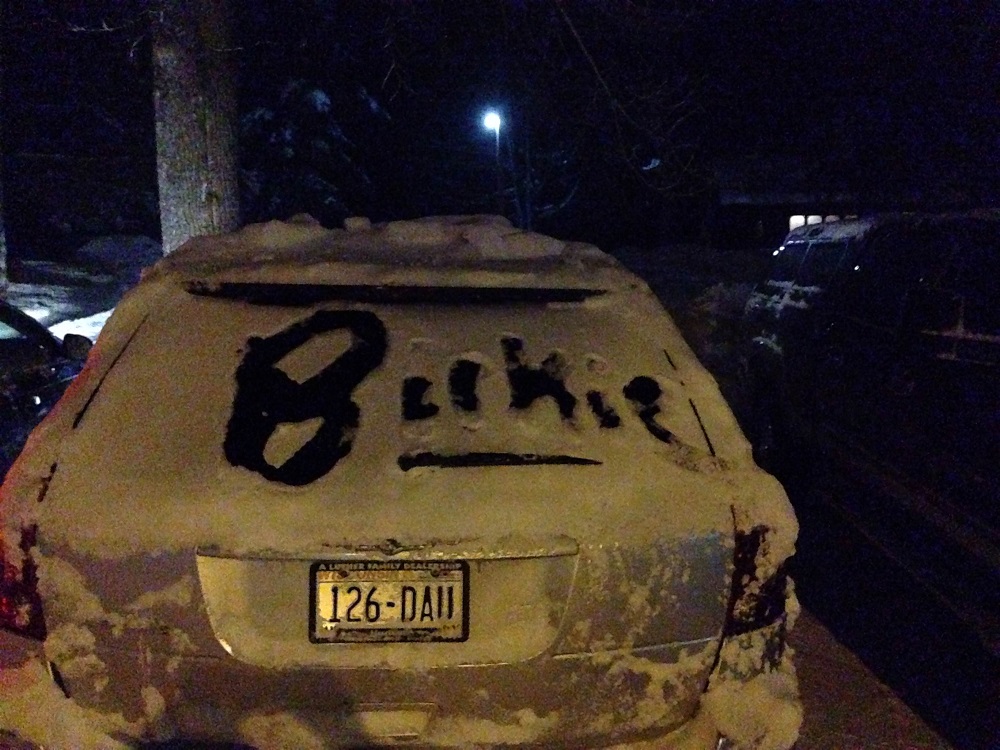
    Birkie Fever, incarnate.
    Birkie Fever.

    HAYWARD, Wis. — This past weekend, nearly the entirety of the adult population of Midwestern skiers made their way to Hayward for the annual get-together of the ski community: The Birkie. The American Birkebeiner (or Birkie, for short), is the biggest ski race in North America. For many skiers, the race represents their culmination of training for the whole year.

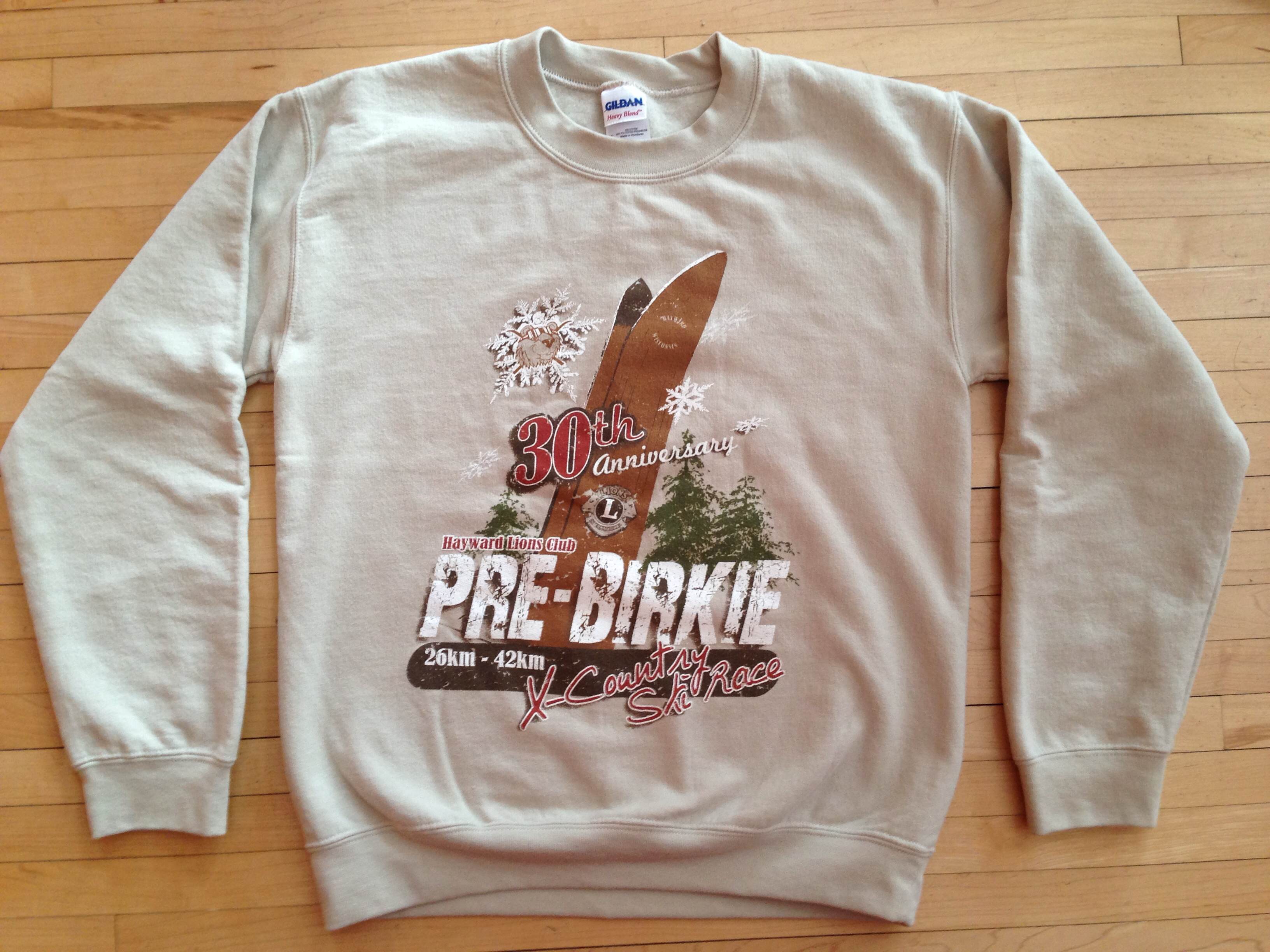
    The commemorative sweatshirt for the Pre-Birkie, circa 2012.
    The commemorative sweatshirt for the Pre-Birkie, circa 2012.

    Accordingly, the level of excitement and attention towards this race is high enough that there is actually a term for it — Birkie Fever.  There is even a fairly large race dedicated to preparation for the Birkie itself, logically named the Pre-Birkie, which races on the Birkie trails two weeks prior to the big race.

    Growing up in the Midwest, I had been fully aware of the Fever, but as a junior and collegiate skier, this time of year was often filled by preparation for Junior Nationals or other races. This year, I finally decided to make the trek to Hayward from Canmore, Alberta (my current residence), for my first-ever Birkie. My plan was to meet up with my family and my friend Julie, who lives on the East Coast.

    T-minus 6 weeks: I decide to start mixing some interval sessions into my usual workout schedule, which generally consists of easy skiing and lots of mixed and ice climbing. I also discover some amazingly colorful workout spandex online and have an in-depth discussion on race day wear with Julie on whether we should start our own team and wear said spandex.

    T-minus 4 weeks: A last-minute three-week climbing trip is organized, and I leave for the climbing trip. The trip is fantastic, but with temperatures dropping to -20F, I sustain moderate frostbite in my feet.

    T-minus 7 days: I start noticing in-depth wax discussions for the Birkie popping up on major ski shop websites based on the 10-day forecasts. Info emails from the Birkie, which had previously been arriving several times a month in my inbox, start arriving every other day. I also learn that there are no less than three songs that have been written about the Birkie (available for listening here).

    T-minus 4 to 5 days: Comments start popping up on Facebook about the Birkie. Focus is centered on the weather forecast, which has changed significantly. A mega-snowstorm predicted to arrive Thursday afternoon is dubbed “Birknado” and spawns the hashtag #BirkiePanic.

    Commemorative Birkie Merchandise
    Commemorative Birkie Merchandise.

    T-minus 2 days: I travel to Minneapolis, arriving just before all of the flights are canceled coming into town, due to the mega-snowstorm that’s about to hit. Julie’s flights are all canceled, and now she’s not scheduled to arrive until late Friday night. My dad and I travel to Hayward. Bib pickup is the most elaborate set up I’ve ever seen. I have to show photo ID twice. Wandering around the vendor booths afterward, we notice the Birkie memorabilia stand, where one can choose from hundreds of items with which to display one’s Birkie pride.

    T-minus 1 day: I head back into Hayward, armed with a hat, a Buff, and a photo of a photo ID of Julie. The goal is to pick up Julie’s bib via impersonation, and it is a stunning success at first. At the second ID check, however, I’m asked what my birthday is, and in a worst-friend-ever maneuver, I totally blank. I tell my story to the bib lady, and she lets me take the bib anyway.

    I am also informed by a seasoned Birkie skier that the road “00,” which marks the rough midway point of the race, is actually pronounced “double-oh,” and not “double-zero,” as I had been calling it. This is a serious faux-pas. #BirkieFail.

    Race Day: After at least five Birkie emails in the past 24 hours, we arrive at the Birkie start. There has been so much snow that the start area warm-up tent is partially collapsed, but the bitter cold has driven many people inside the tent anyway.  It’s 1F at 8 a.m., and there’s a strong headwind. There’s a helicopter shooting video circling above us.  The cost basis of helicopter filming is absurdly high, so I know that this is serious business.

    I move into the start area and file into my wave zone. I’m lucky enough to be in Wave 1, but I notice that as the start countdown for the wave ahead of us (Classic Wave 2) begins, all of the people around me start to shift into a crouching position. Confused at first, I realize that they are setting up to run to the start line once our wave moves up.  Classic Wave 2 goes off, and my wave starts a full-on sprint to the start line. Realizing that this is how stampedes begin, I, too, break into a sprint and score a great starting spot.

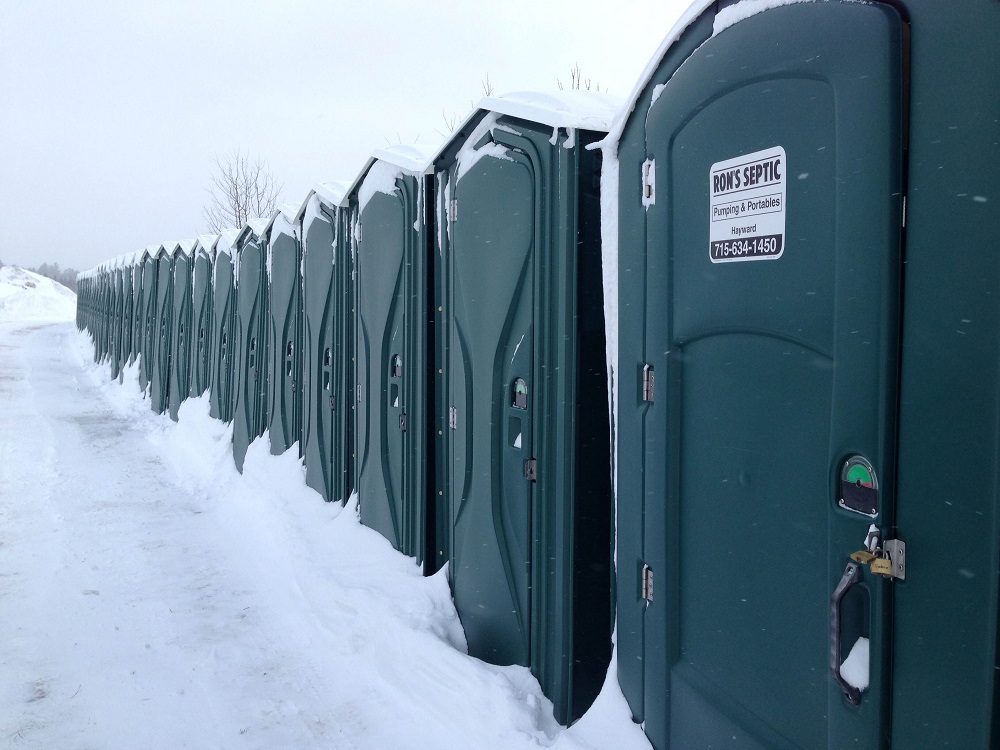
    Lots of restrooms at the Birkie start.
    Lots of restrooms at the Birkie start.

    The start itself is pretty standard, but I’m impressed to see bins of poles on the side of the trail after the chaos has settled out. Replacement poles, sorted by length, are available to all. I later find out that this is standard at the aid stations, as well.

    As my wave settles in a rhythm, all goes smoothly. There is great cheering from supporters on the sides of the trail, and there are sometimes massive slowdowns on the uphills as skiers bog up in the very soft, very cold snow, but otherwise, the race is fairly normal.

    At 00, I end up dropping out due to cold feet (a carryover from the cold injuries sustained on the climbing trip), but Julie, also in her first Birkie, finishes the race. She is stoked about the shot-ski at the top of Bitch Hill and, like the Dartmouth alum that she is, fully indulges. Later on, she is not so stoked about the ski across the lake to the finish (due to the headwind, not the shot), but finishes strong.

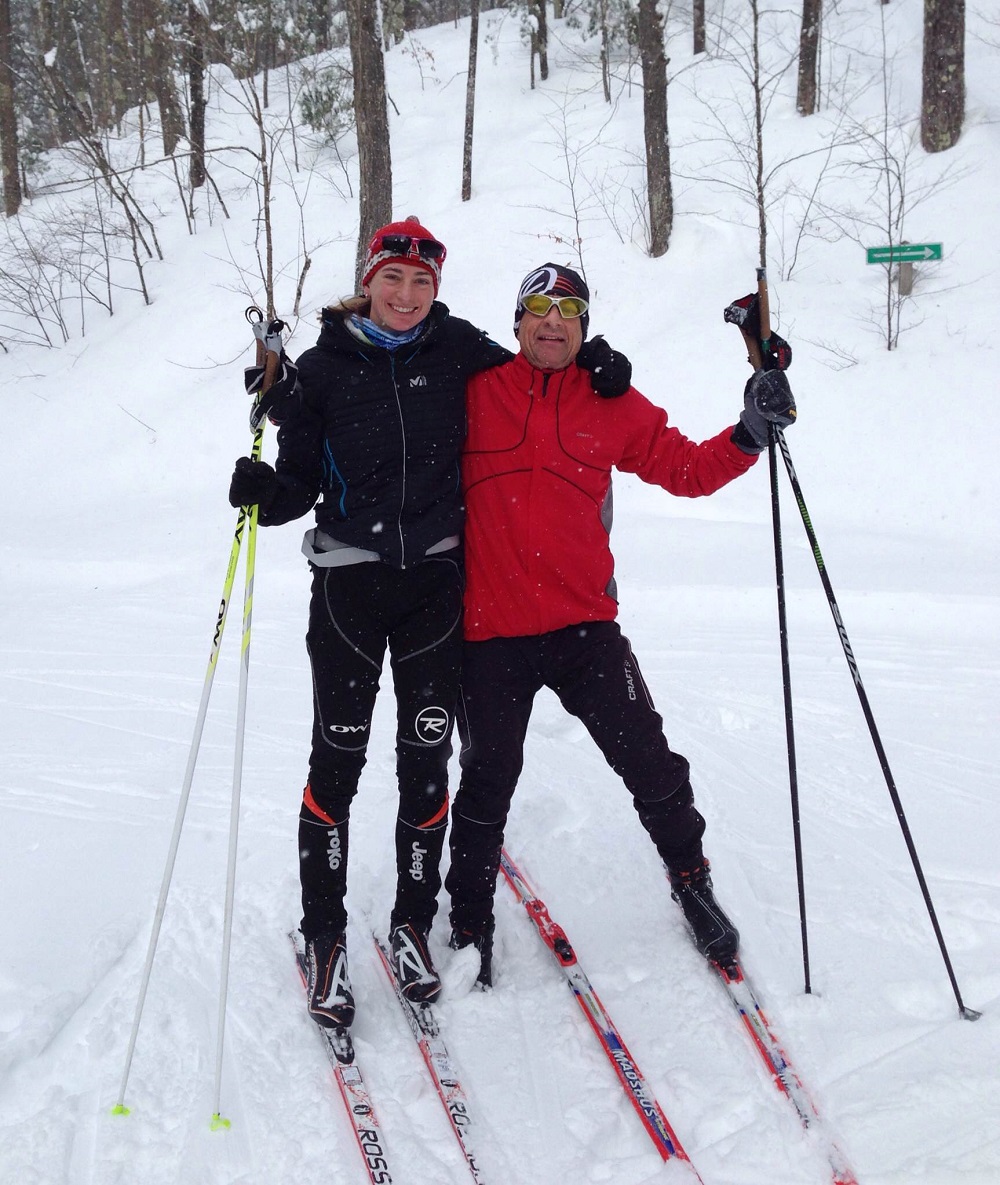
    The author and her dad out for a ski before the Birkie.
    The author and her dad out for a ski before the Birkie.

    I hitch a ride to the finish area. I find my clothes bag in the meticulously organized and enormous bag area just as Julie finishes the race. She’s tired, but mostly extremely impressed at how nice Midwestern skiers are. The streets are packed with people. Everyone is exhausted, but the sun is just warm enough to make the cold manageable. There is serious revelry going on, and even though I’m a little disappointed about my race, the atmosphere is so fun that it more than makes up for it.

    Overall, the Birkie was a great experience. It’s pretty amazing to see how many people are excited enough about skiing to want to ski a hard, cold, 50 k skate race hours away from any population center. I was stoked to finally experience “The Fever,” and I will definitely be back next year.

  • Wednesday Workout: Ring Training for Your Inner Gymnast

    Wednesday Workout: Ring Training for Your Inner Gymnast

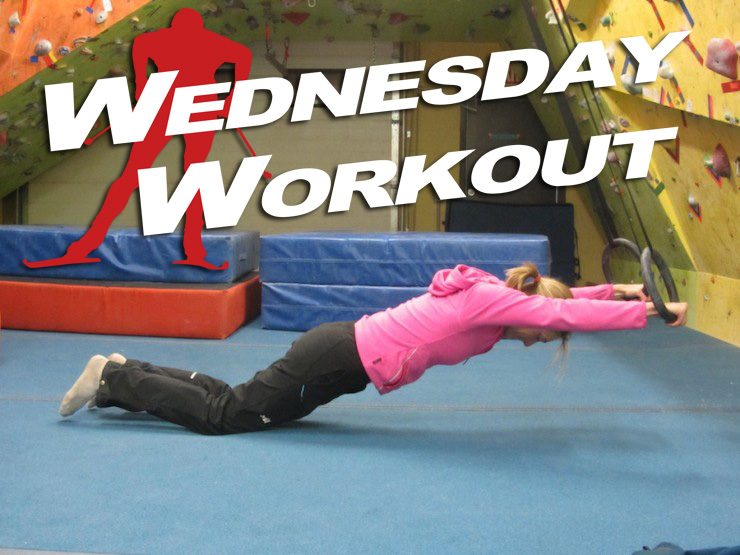
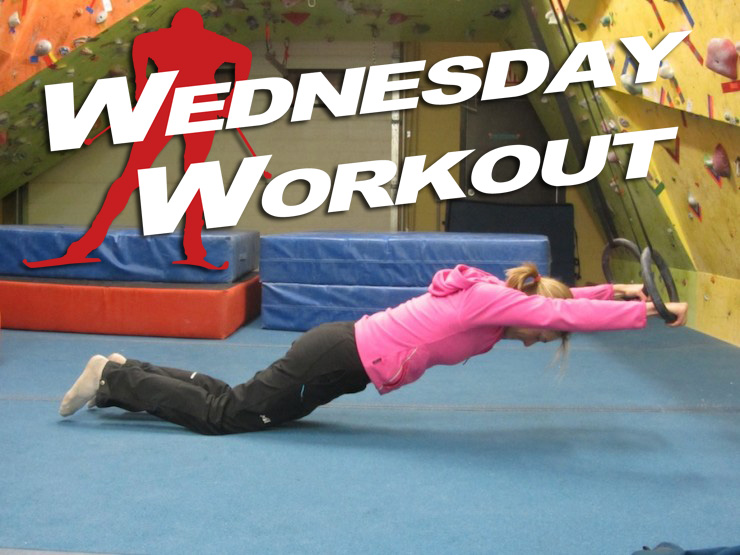
    Katie Bono demonstrating the kneeling ring rollout.
    Katie Bono demonstrating the kneeling ring rollout.

    Cross-country skiers are a pretty fit lot. We tend to pride ourselves on overall fitness, and indeed it’s true that ski training does a great job of developing Crossfit-like versatility. Even in strength workouts, the nemesis of many upper-body-challenged athletes, skiers tend to do pretty well. Look at photos of Kikkan Randall, Andy Newell, and other top-level skiers doing weighted pullups and you’ll realize this.

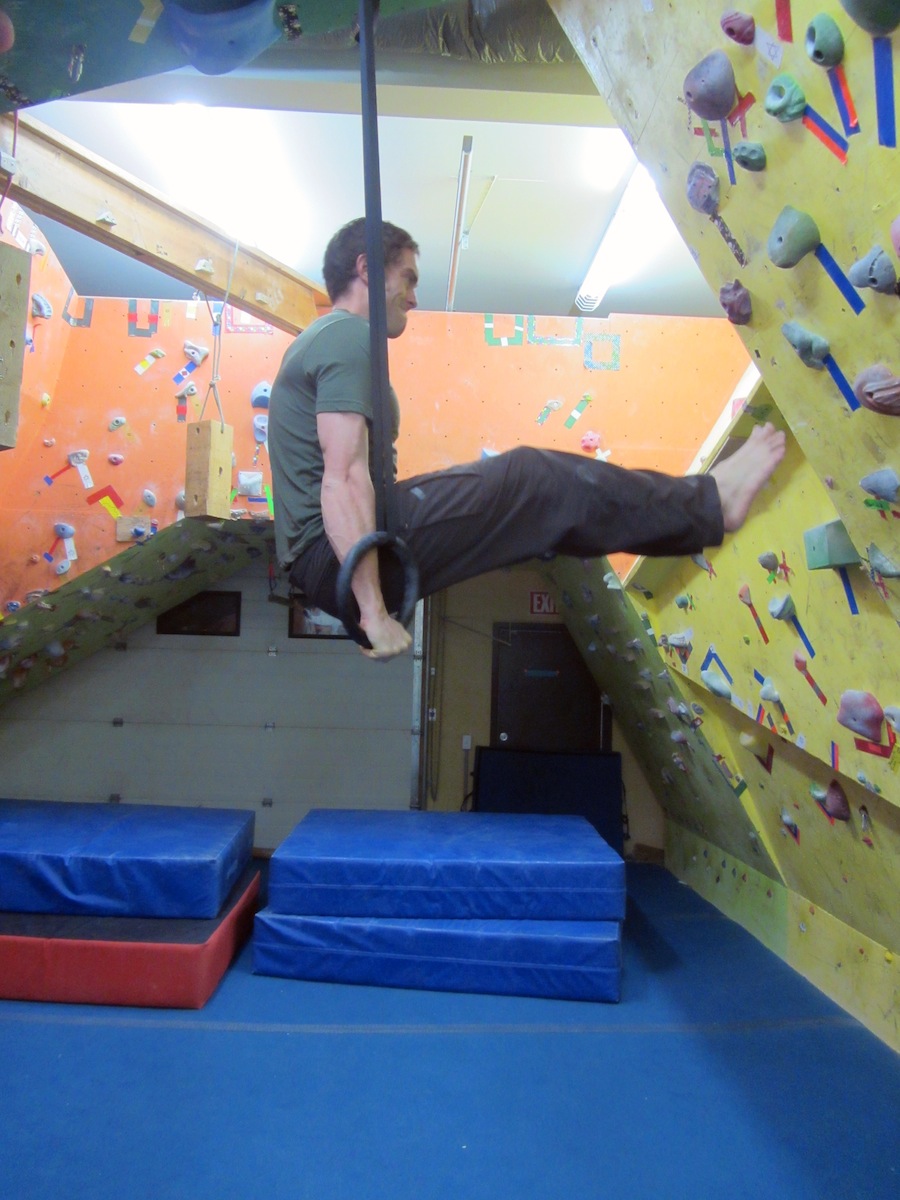
    Cody Doolan in an L-sit
    Cody Doolan in an L-sit

    Clearly, skiers need some new exercises to bump up the difficulty level in the weight room. If you find yourself maxing out the difficulty level of your current weight-room exercises, or if you are simply bored with all of them, give strength training with rings a try.

    Gymnastic ring training isn’t anything new. Although it and it’s trendier cousin, TRX suspension training, are making some waves in the fitness world right now, rings have been around for ages. However, if you’d like to make significant gains in upper-body and core strength and stability, take a new look at ring training.

    Training on rings has a plethora of benefits: it’s fun, the rings are extremely portable and versatile, and the exercises develop strength, coordination, and stability. However, the main benefit is that ring training is HARD. Like REALLY HARD. Ring training is the most difficult training I’ve ever done in a gym.

    I started doing ring workouts as training for skiing and all-around fitness at a point when my strength fitness was relatively high, and was amazed at the difficulty in performing relatively benign exercises like dips. Although my ego was somewhat shattered, I quickly discovered that the intense difficulty of ring training paid off mightily in my fitness. If you’d like to experiment with ring training, start off with intro exercises and work up.

    A big plus to ring training is that, for all intents and purposes, you can never get too strong for them. As a frame of reference, Olympic gymnastic exercises are rated on a scale from A to E, with A being the easiest. A muscle-up on rings, a fairly difficult exercise for the layman or laywoman, is an A-. Check your local gym to see if they have rings to use or buy your own and bring ’em along!

    Exercises

    Here are some exercises to get you started, but be creative and do some googling! Many traditional upper body and core exercises can be done (albeit at a harder grade) on rings.

    Ring Pushups: Adjust the rings so they are low to the floor. Place your feet on the floor, your hands in the rings, and do pushups. The lower to the floor the rings are, the harder it will be. If you perfect these, prop your feet up on a weight bench level with the rings.

    Ring Pullup and Dips: Pullups and dips on rings. Make sure to not let your arms rest on the straps as you do dips. If you want to make the dips harder, let your body come in front of the rings and turn your hands out (see photo).

    Ring Rollouts: Similar to rollouts done with a squat bar. Adjust the rings so they are just above the ground. Put your feet close to the rings and bend over to grasp the rings. Slowly move your hands and the rings away from you until you are stretched out and suspended by the rings. Then pull your body back to the starting position using only your core. An easier version of this is to start in a kneeling position instead of standing.

    L-sits: Adjust the rings to just above your waist, and support yourself on the rings (as if you were at the top position of a dip). Then lift your legs up to the level of your waist.

    Full and Half Levers: Adjust the rings to just above your head. Hang from the rings, and keeping your body rigid in a plank position, raise your body until it is parallel to the ground. An easier version is to bend one leg so your knee is up by your chest (half lever). Don’t let your butt sag!

    The Iron Cross: Perhaps not as ski specific as the other exercises, this is a good one to impress your friends. Save it for off-season tomfoolery. Rated a B on the Olympic gymnastic exercise scale, the way to do this one is to start in the support position (the starting position for dips). Lower your body by moving your arms out to the side until your hands are almost level with your shoulders. Yikes!

  • Heidi Widmer Rebounding After Third Concussion

    Heidi Widmer Rebounding After Third Concussion

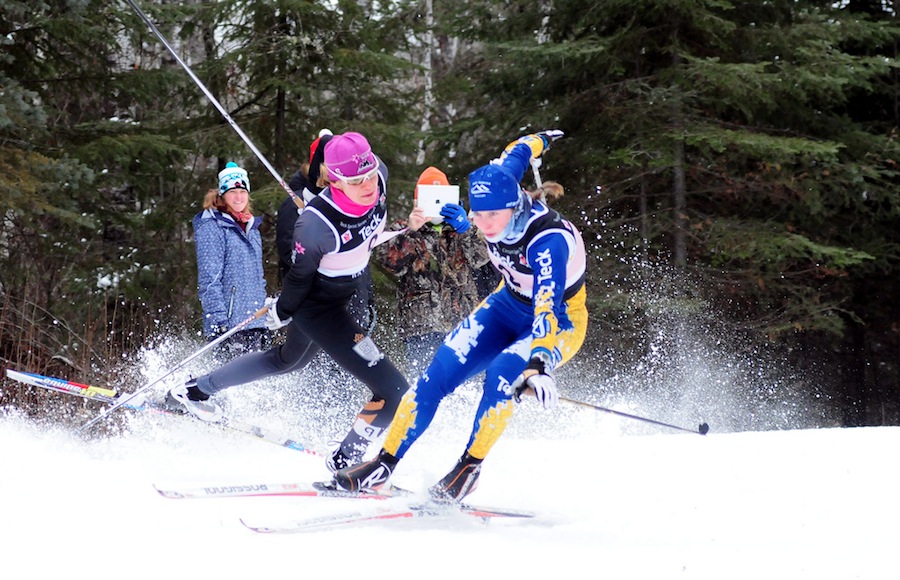
    Heidi Widmer (l) and Andrea Dupont after colliding at a NorAm sprint last January in Thunder Bay, Ontario. Widmer suffered a mild concussion, but qualified for the U23 World Championships as a discretionary pick and was fully recovered in five days. (Photo: John Sims)
    Heidi Widmer (l) and Andrea Dupont after colliding at a NorAm sprint last January in Thunder Bay, Ontario. Widmer suffered a mild concussion, but qualified for the U23 World Championships as a discretionary pick and was fully recovered in five days. (Photo: John Sims)

    Heidi Widmer is no stranger to head injuries. One of the newest members of Canada’s Senior Development Team, the 22 year old suffered her first as a teenager in the fall of 2009. The culprit? Rollerskiing – downhill, to be specific.

    Part of the Alberta World Cup Academy in Canmore, Widmer crashed during a classic rollerski, and the next thing she remembers is the hospital. Four years later, the cause of the accident is still a mystery to her, as she has amnesia surrounding the event, but the effect was a head injury serious enough to send her to the Calgary hospital as a precautionary measure.

    “That crash took me by surprise,” Widmer said on the phone last week. “I didn’t really plan on that happening. So that was my one really bad concussion and since then I’ve had to be more cautious with my head. I haven’t had any problems recovering from that. I made a full recovery. I didn’t have any spinal or internal bleeding; I was super lucky with that.”

    Heidi Widmer (Courtesy photo)
    Heidi Widmer looks out at the 3,100-metre Mount Lougheed during a summer hike up Wind Ridge near Canmore, Alberta. (Courtesy photo)

    Fast-forward to Sept. 7, 2013, Widmer found herself in an eerily similar situation.

    “This past fall I was classic rollerskiing again and fell on a downhill pitch,” she said. “I slipped on some mud at the bottom; I was going down with a teammate. [There was] a nasty little grime layer at the bottom of the hill that neither of us saw. And that took us both out … I superman-ed into a ditch.”

    Fortunately, she didn’t hit her head and there were no major acute injuries. However, Widmer noticed a pressure in her head that didn’t feel right, so she cut her workout short to get some rest. After taking another day off, she started back into training and felt great, winning a skate sprint time trial with the women’s national team that week.

    Shortly after, her symptoms returned along with a bad headache. After consulting with doctors, Widmer agreed to take several weeks off, then gradually return to full-intensity training.

    “[The pressure] is not extreme and it’s not like I’m in blinding pain, but it’s enough for [the doctors] to want to take the right precautions,” Widmer explained.

    Despite these mild symptoms, she resumed full-time training and is more excited than ever to be back.

    “I’m super lucky in so many ways that it’s not a serious head injury,” she said. “There’s no internal bleeding, I’m functioning, I’m fine, but I just have to be able to take care of this and come out of it with some lessons learned for sure.”

    Widmer had another concussion last winter, when she crashed in a skate sprint during the selection races for U23 World Championships.  She had to take five days off to recover, and as a result, missed one of the qualifying races. She still made the team as a discretionary selection and said she recovered completely after five days.

    “I haven’t reached the point of the doctors being like ‘one more and you may never be able to ski again’ type extreme,” she explained. “I know that every time it does happen, it adds up in my brain, but I don’t have a specific medical answer for that.

    “Being afraid to fall is probably more dangerous than accepting the risk,” she added. “Falling happens to be part of skiing and after all we’re talking about cross country skiing. I’m not an alpine skier pushing 130 km/hour and crashing with my face on ice!”

    In addition to maintaining a healthy perspective on her concussions, Widmer has also started doing a fair amount of physio work to maintain and improve her balance — something that took a hit from her first concussion.  The trauma caused her damage in her inner ear, which governs balance.  She’s working on restoring that balance via physio exercises, while also getting back into shape for race season.

    “I think that the rest of this fall is something that will play to my advantage,” Widmer said. “It’s something that I’ve come to view as an advantage for me, because the fall that I had [my previous head injury], [taking time off] paid off in my season. I ended up having one of my best seasons. I think it says a lot to be able to absorb the summer of training and come into the fall with a new perspective and motivation to train. It’s really reignited in me my motivation. Sometimes in the fall it’s super common for people to get super run down with the changing seasons and the ski racing season approaching. So I’m looking at it in as positive a light as possible.”

    As for whether she’s feeling the positive effects of her time off yet, Widmer said she’s a little behind with her fitness, but is confident she’ll get back up to speed soon.

    “I’ve already seen huge gains in the last week of returning back to intensity,” she said. “The summer [training] is absorbed, and more than anything, I’ve learned to be more patient over the past month.”

    Widmer’s first races for the season are the Alberta Cup races the first weekend of December. “I’m ready to get after the winter,” she said.

    ***

    About the Author:

    Katie Bono is a Canadian contributor at FasterSkier. Hailing from Minnesota, she raced for Dartmouth College and Sun Valley before turning her energies to climbing (and becoming the fastest known woman to ascend Mt. Rainier in Washington). Now based in Canmore, Alberta, she is an athlete ambassador for Millet and works as a mountain guide in Alaska, Washington and South America.

  • Skiers Flock to Frozen Thunder for Pre-Season Tune-Up (Photo Gallery)

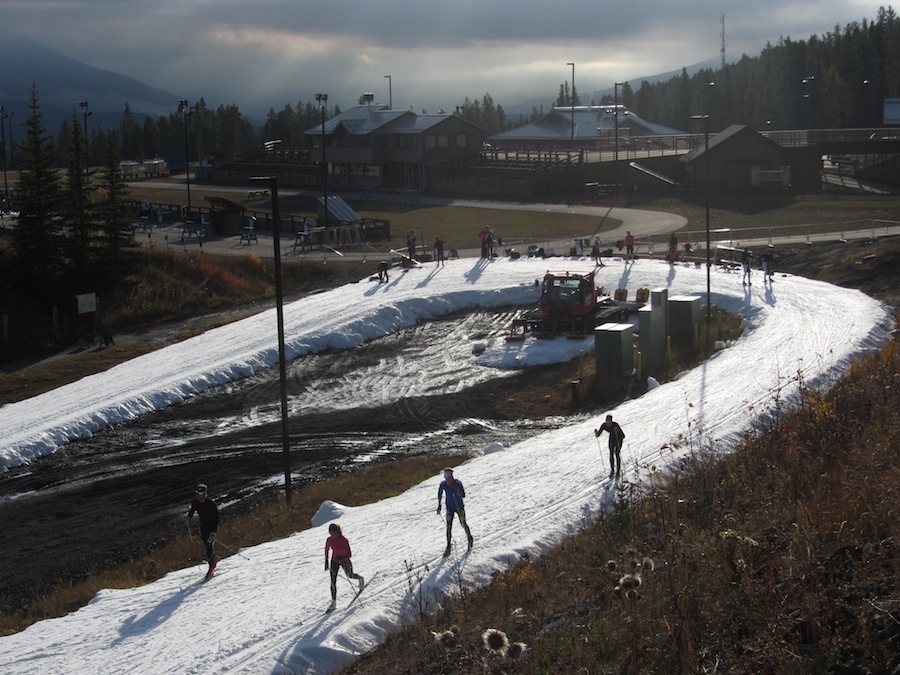
    The start area of the 2.2-kilometer loop at Frozen Thunder at the Canmore Nordic Centre, with the Bow Valley in the background in Canmore, Alberta.
    The start area of the 2.2-kilometer loop at Frozen Thunder at the Canmore Nordic Centre, with the Bow Valley in the background in Canmore, Alberta.

    By Katie Bono 

    CANMORE, Alberta — The days are getting shorter and shorter in Canmore, and if you’re an elite Nordic skier in North America, you know what that means. It’s Frozen Thunder time!

    Skiers from across the U.S. and Canada recently converged upon Canmore to ski the seasonal anomaly that is Frozen Thunder: a 2.2-kilometer loop of real snow skiing, harvested from last winter and saved over the brief Canadian summer under a thick coat of sawdust.

    According to a Cross Country Canada press release, Frozen Thunder’s first incarnation was in 2009 as a 400-metre loop of snow. However, if you know anything about the Canmore Nordic Centre, you know that settling for an ‘adequate’ trail experience is not in their nature.  Accordingly, the loop has been expanding ever since.  This year’s loop is the longest yet, and even includes a bridge crossing.

    Conditions on the loop thus far have been surprisingly good. Despite temperatures in the mid-teens (Celsius, around 50 degrees Fahrenheit) since opening day on Oct. 19, the trail has stayed thick, white and fairly firm, and skiers who were on the loop last year say that this year’s loop is substantially better than last year’s version.

    The list of skiers already getting their training on at Frozen Thunder is long: All of the Canmore-based Canadian teams are here, and many of the farther afield Canadian and U.S. teams are, as well. The Wisconsin-based Central Cross Country (CXC) was in town for the first four days of skiing and has since departed, while members of the U.S. Ski Team, Stratton Mountain School T2 Team, XC Oregon, Maine Winter Sports Center, and the Methow Olympic Development, among others, will be in town for a while longer.

    Skiers were out in full force on Wednesday and there was almost a palpable stoke in the air. Many looked to be gearing up for tomorrow’s classic sprint race while others were simply getting a solid interval session in.  Tomorrow’s race will be hosted by Winsport, and many of the top U.S. and Canadian skiers are expected to participate as their preliminary warmup for the season.  Qualification starts at 9 a.m. Mountain time, and only the top 16 in each gender will move on to heats.