From the FasterSkier archive — posts syndicated from athletes’ and coaches’ own blogs between 2004 and 2012, kept online as published. Current coverage is at fasterskier.com.
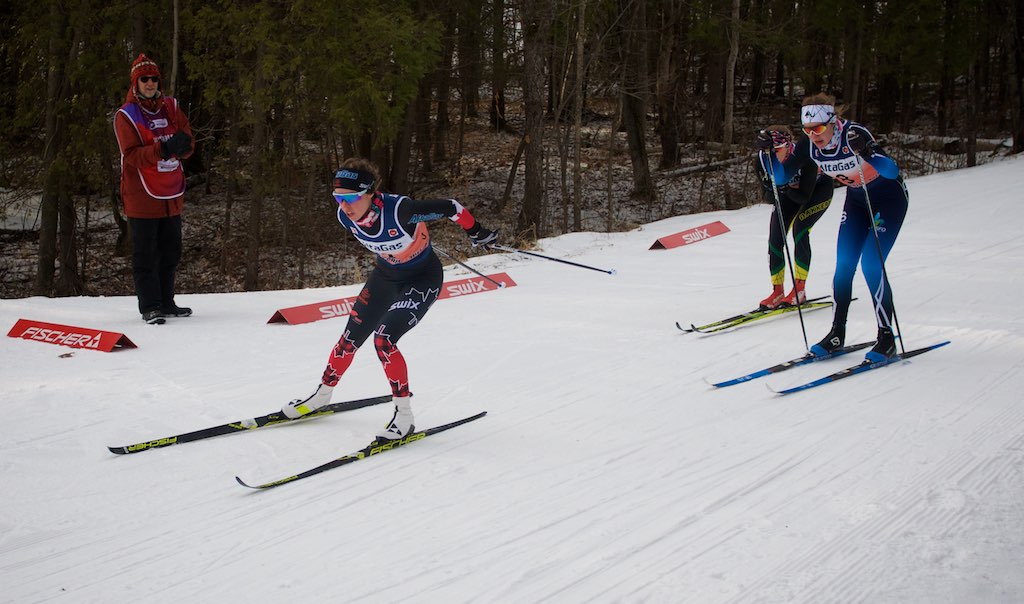
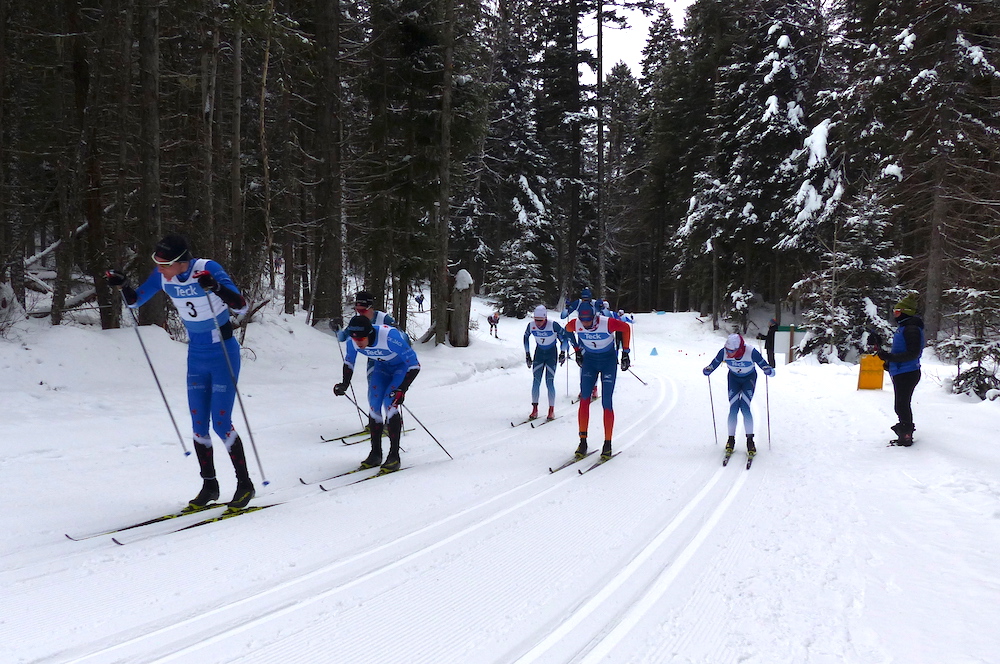
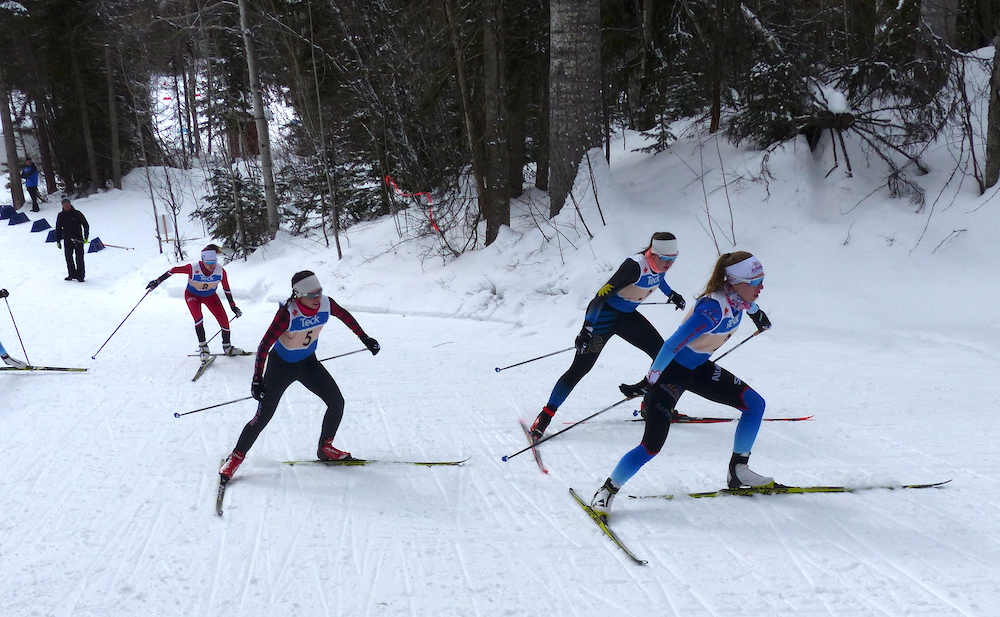
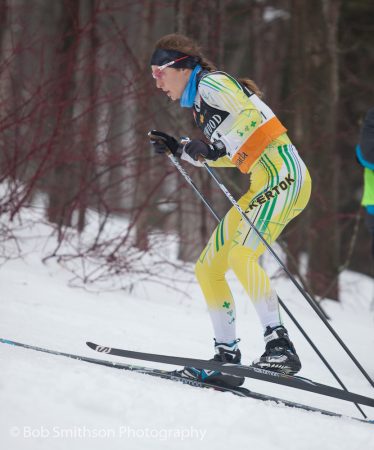
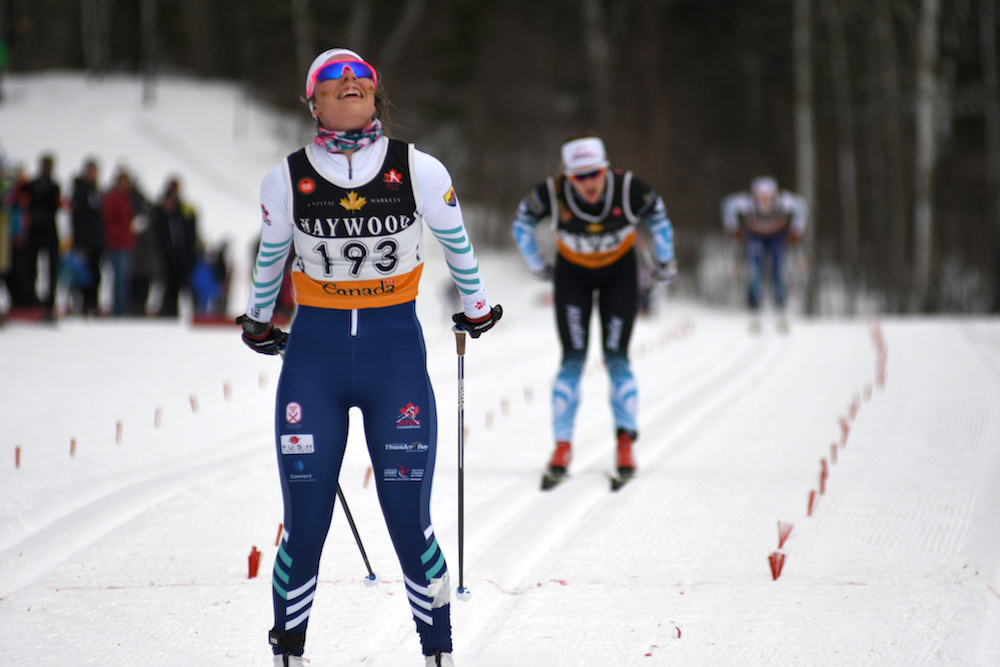
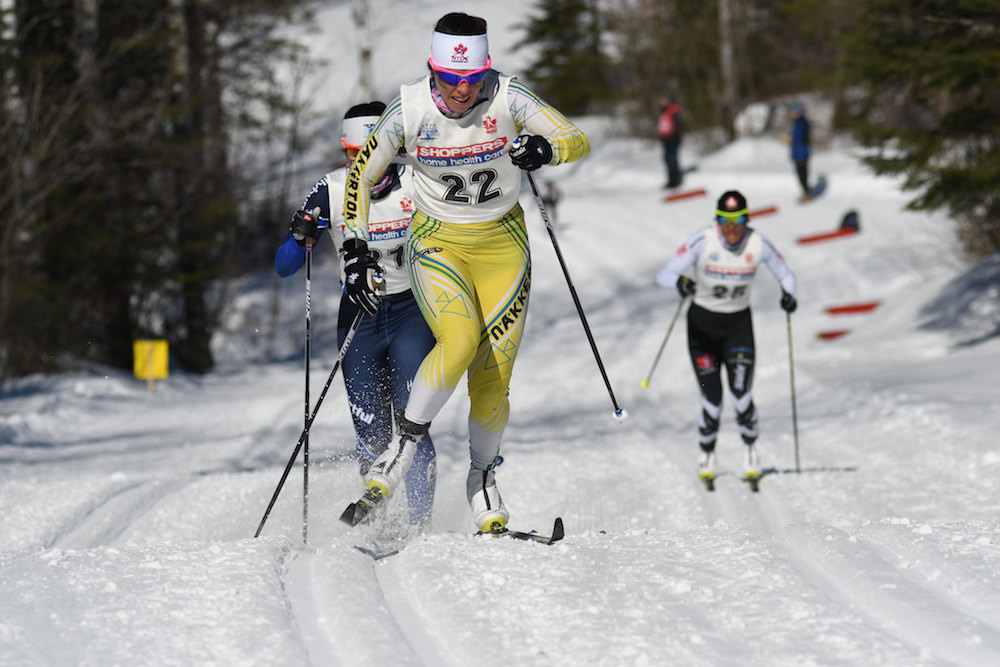
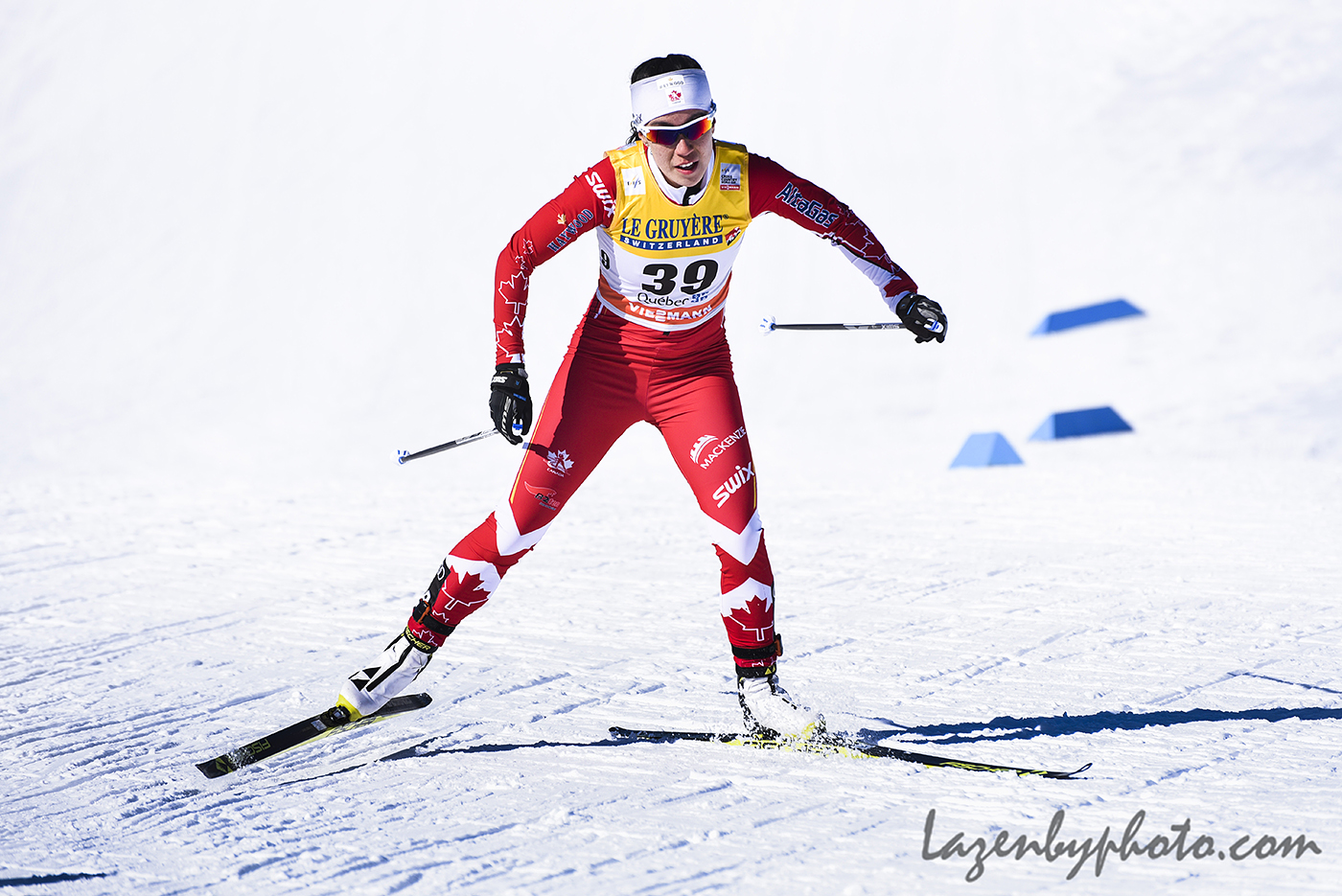
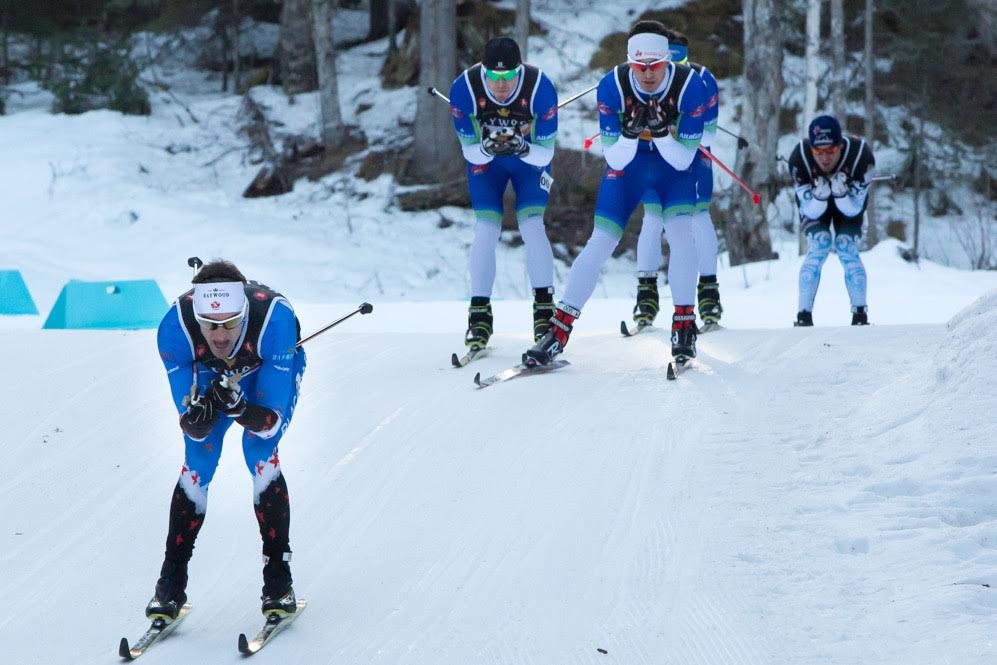
Katherine Stewart-Jones leads a sprint heat on her way to domination. (Photo: Robert Smith)
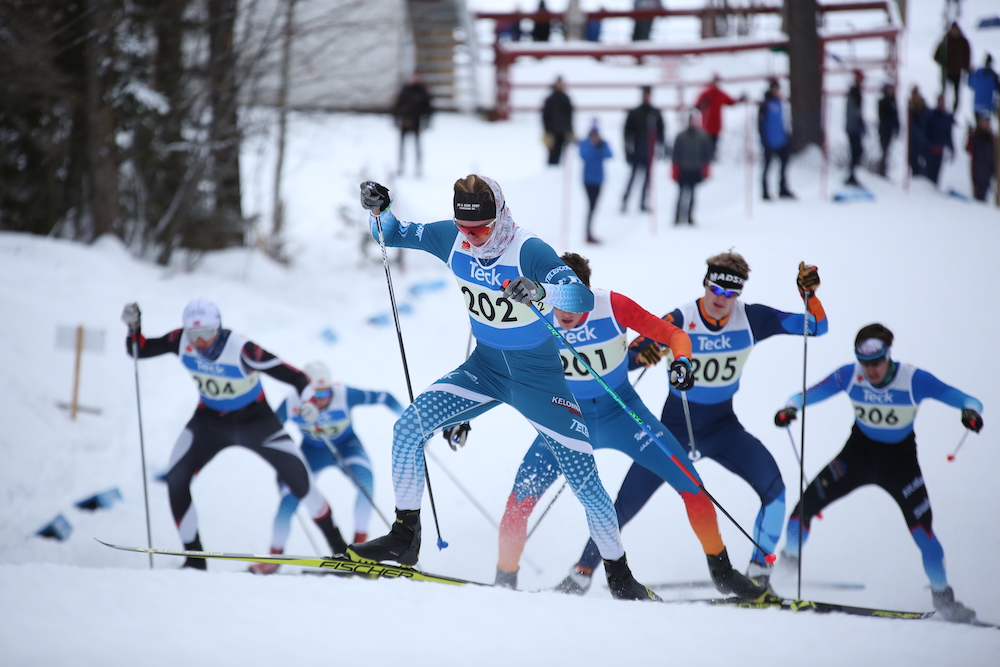
The NorAm circuit moved east to the Nakkertok trails for three days of racing jointly hosted by Nakkertok Nordic, Club Skinouk, Chelsea Nordiq, and Kanata Nordic. Friday featured classic sprints, Saturday interval start free, and Sunday interval start classic.
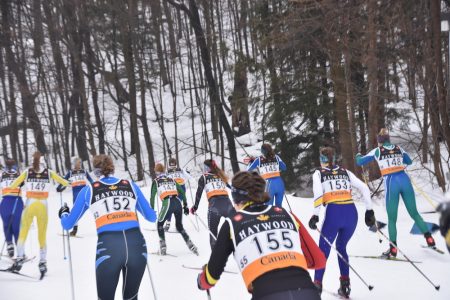
The event was also the Candy Cane Cup for the younger categories, as well as Ontario Cup 1 and Coupe Québec 1. 374 athletes in the U16, U18, and Open categories competed on Friday with many more younger athletes racing Saturday and Sunday.
Nordiq Canada’s Jeff Ellis was there and has once again shared the full-length post-race interviews. Photographer Robert Smith has galleries for each day, so keep scrolling.
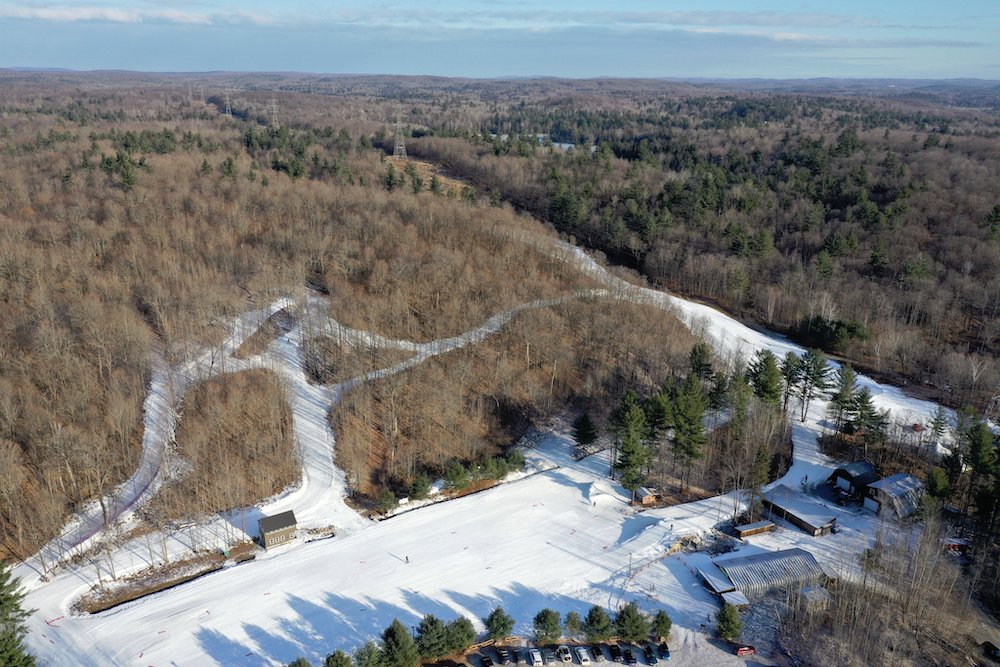
Nakkertok had over 3km of trail open thanks to their snowmaking, with a 2.5km loop used for the distance races.
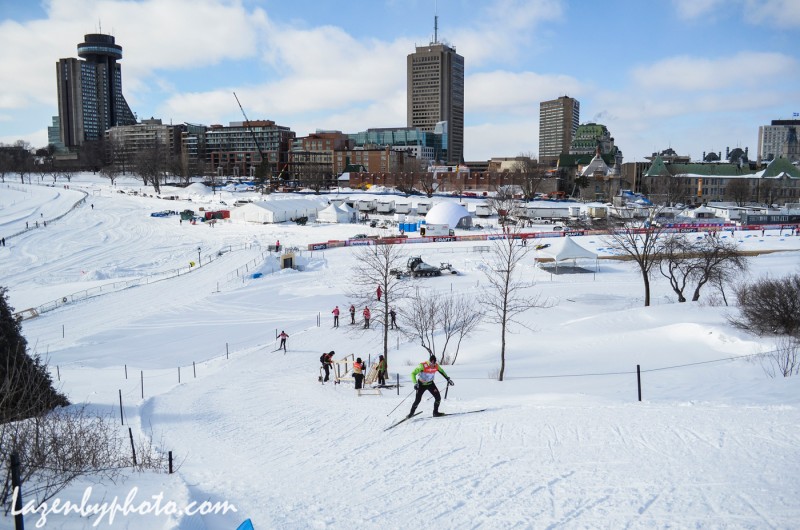
The ‘NakkerTrak’ at Nakkertok before the 2019 NorAm weekend. (Photo: Natural Fitness Labs)
On the women’s side, it was the KSJ show, with home-grown national team member Katherine Stewart-Jones winning all three days.
In the sprint, Stewart-Jones finished in 3:19.96, comfortably ahead of AWCA’s Maya MacIsaac-Jones and RMR’s Katie Weaver at 2.43 and 3.93 seconds back respectively. The podium trio were the top three qualifiers, but in reverse order.
Stewart-Jones steamrolled the field in the free 5km, 36.8 seconds ahead of Laura Leclair in second and 39.9 seconds before Cendrine Browne, both of CNEPH.
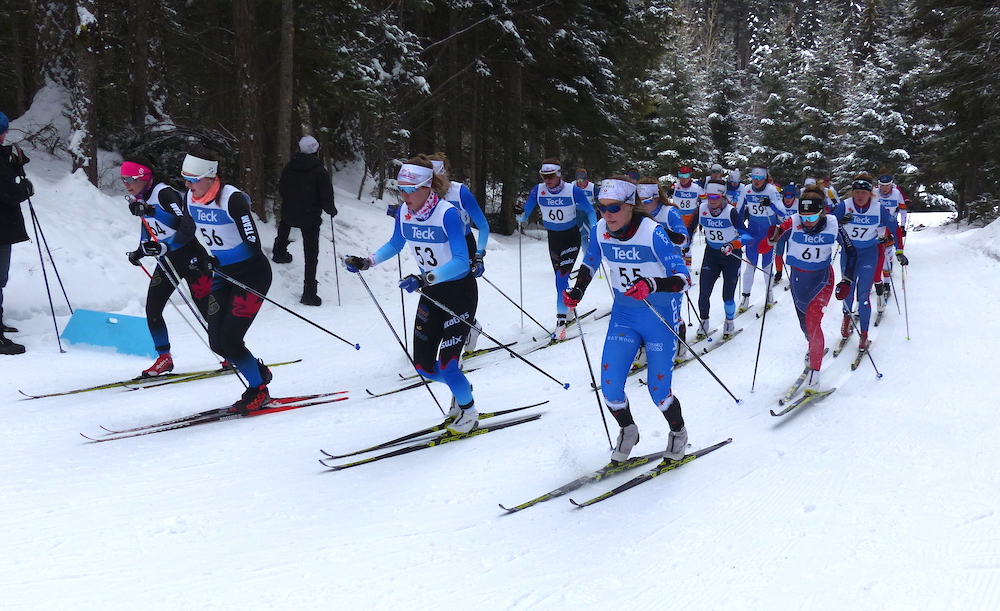
The trend continued on Sunday, with Stewart-Jones finishing the classic 10km in 28:52.1, 1:18.1 ahead of Skibec’s Andrée-Anne Théberge and 1:29.8 ahead of AWCA’s Annika Richardson.
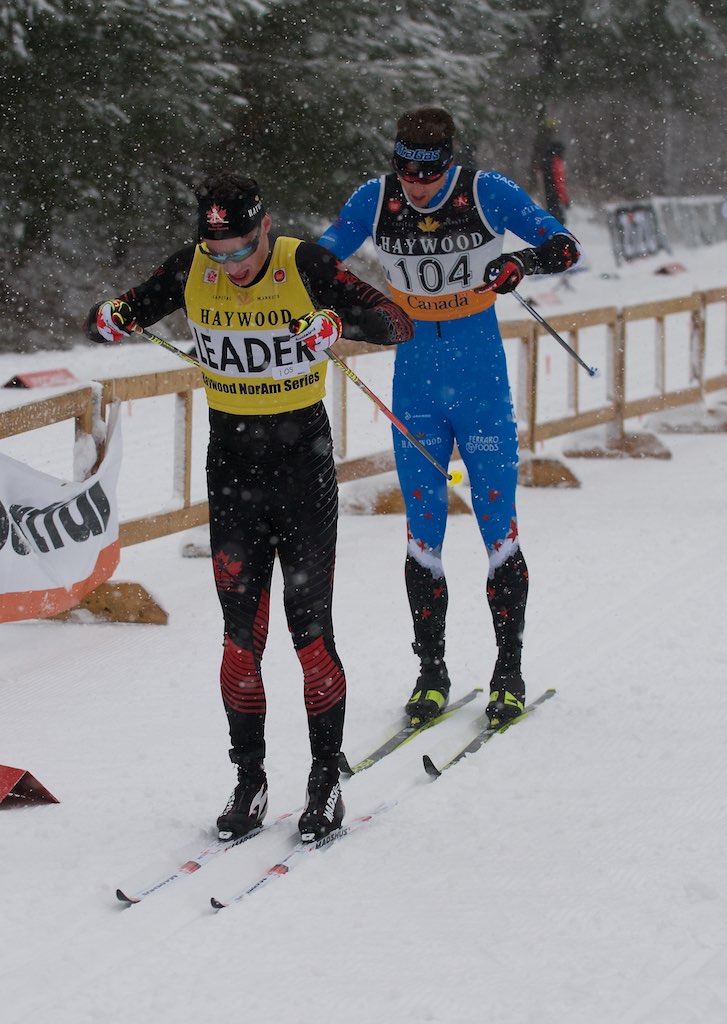
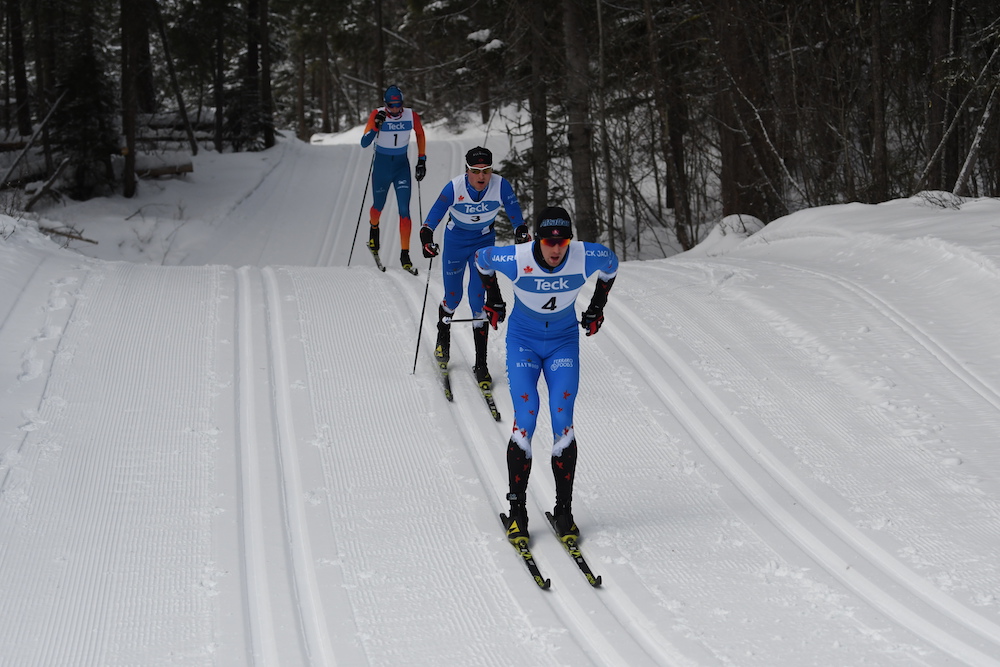
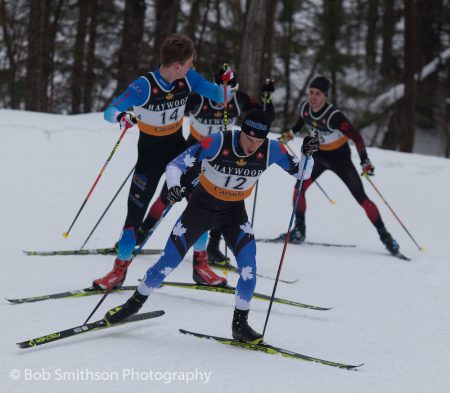
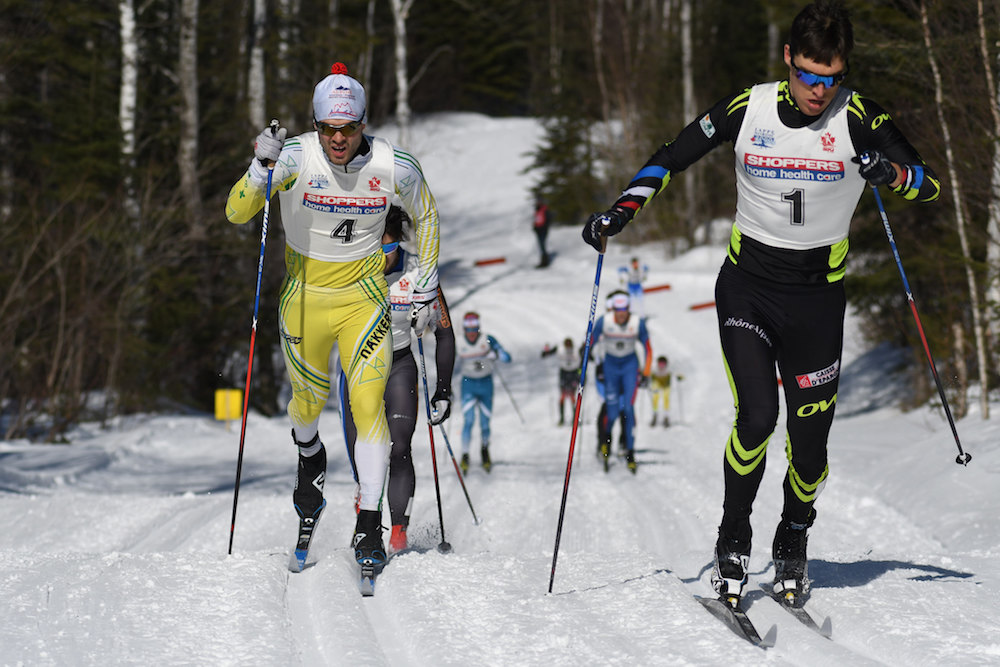
Antoine Cyr leads Julien Locke in the interval start classic. (Photo: Robert Smith)
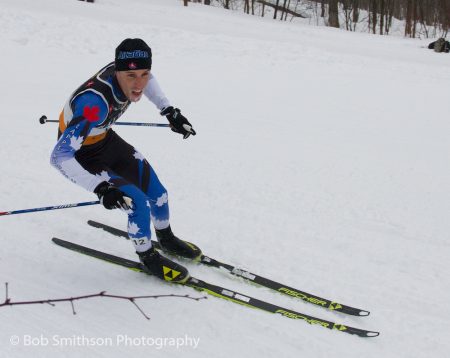
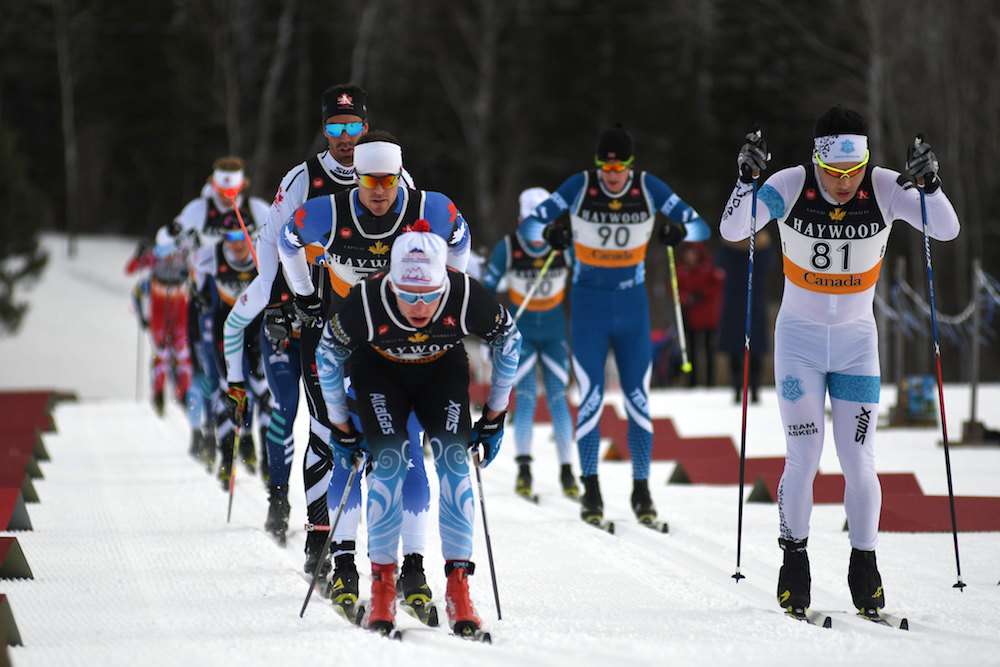
For the men, Hardwood’s Bob Thompson kicked the weekend off with a sprint victory in 3:12.71, followed by national team member Antoine Cyr at 0.36 seconds and his CNEPH teammate Antoine Briand at 0.63.
On Saturday, Cyr won the free 10km in 22:10.4, 20.9 seconds ahead of Fondeurs Laurentide’s Ricardo Izquierdo-Bernier and 32.8 seconds clear of Team R.A.D.’s Evan Palmer-Charrette.
Palmer-Charrette stepped up to finish the weekend on top of the podium, winning the 10km classic in 24:43.8. National team member Julian Smith was second at 6.2 seconds followed by Cyr at 14.4 seconds.
For many Canadians this season, the big focus is on the Mt. Sainte Anne (MSA) NorAm in January, which is the Junior and U23 World Championship trials. That series is also a path to World Cup starts. As a result, a number of athletes chose the nearer of the two December NorAm races and skipped the other to reduce travel. Over 30 western Canadians drove to Sun Valley for the SuperTour event instead of flying to Nakkertok.
“I think that it’s good for younger athletes to chase high competition for development,” Stewart-Jones wrote in response. “It makes more sense for them to travel less too. This year, for most of the younger athletes and even a lot of the older ones, the focus is on trials in MSA in January so there is a lot of time to prepare for their optimal race performance.”
Stewart-Jones moved from Nakkertok to Canmore this training year, resulting in new training partners and a new personal coach, national team head coach Erik Bråten. That also meant returning to Nakkertok required two extra flying days and the associated illness risk.
“If I hadn’t been trying to get the COC spot locked up for the rest of the season I would have most likely gone to Sun Valley too.”
There is a complicated calculus to getting World Cup starts in Canada. The COC leader gets FIS-guaranteed starts and financial support from the host organization for each race weekend. Keeping the COC leader bib for the season would mean more and cheaper time on the World Cup for Stewart-Jones. Dahria Beatty and Emily Nishikawa chose to race period 1 in Europe instead, with Beatty qualifying for the next WC trip selection by placing 25th in the Davos sprint on Saturday.
Julien Locke leads Rémi Drolet and Sam Hendry during the second lap at Westerns 2019. (Photo: Doug Stephen)
KELOWNA, B.C —
One week after Easterns, it was time for Westerns, and the Polar Vortex made the trip for both weekends.
At Easterns, the air was cold enough to keep the organizing committee on edge at the start of the weekend, and freezing rain complicated driving plans. At Westerns, the cold weather held off to Sunday, but falling snow on dry, salted roads created a sheet ice for Friday’s commute. Both championships had less athletes than expected, with driving conditions and weather predictions having an effect.
Photo albums and result links follow the daily summaries.
Friday, Skate Sprint
Tallon Noble leads Sam Hendry in the junior men’s A final. (Photo: Greg Redman)
The action kicked off Friday with skate sprints at the Telemark Nordic trails near Kelowna, B.C., in sunshine and -11C.
Benita Peiffer (Whistler) won the 1.3km A final in 3:02.79, 0.10 seconds ahead of top qualifier Katie Weaver (RMR). Elizabeth Elliot (AWCA) took third, 2.77 back after qualifying second.
“I felt really confident going into the final,” Weaver told FasterSkier. “I led all of the race, right until the finishing stretch and Benita came up, and I think she got me right at the end.”
Despite placing second, Weaver was happy with her tactics: “I wasn’t super confident with my hop offset on those tough hills, so my goal was to get out into the lead and control the race. Kinda position myself well so I could have a good finish.”
Peiffer and Elliot grew up racing together before Elliot moved to Canmore, and were clearly enjoying racing together again, completing each other’s sentences during the post-race interview.
Elliot: “It was really fun, we had all the BC skiers that we grew up skiing with. It was super-fun to all be with each other in the same heats and…”
Peiffer: “…Back to the good old days of racing together.”
Tactics were also a shared vision.
Peiffer: “You stay with the pack going up the big hill, and then it’s really easy to draft because you have a really long downhill.”
Elliot: “If your skis work for you.”
The open men raced the same course and Julien Locke (CNST) was in dominant form, winning the qualifier and each heat by over 3 seconds, taking the A final in 2:28.23.
“I’m just here to race hard,” Locke said after his cool down ski, “so I just raced hard every round.” Locke has been fast in 2019, winning the sprints at US Nationals, Easterns, and Westerns, but he would probably trade any one of those to improve on his second place at the World Championships qualification sprint at Bishop’s University.
Junior national team member Rémi Drolet (Black Jack) outreached Telemark’s own Gareth Williams (CNST) to take second, 3.42 behind Locke and 0.03 ahead of Williams.
“Tactics were tough for me,” Drolet said. “I was slow off the start, so I was behind a little bit. Basically, I had to catch up so I was really focusing on pushing over the tops of hills really hard. In the end, it was a sprint to the finish between Gareth and I. Julien was a bit ahead [laughs at the understatement]. It was fun.”
Williams was bouncing back after getting ill on the trip home from U23’s in Lahti and leaving Easterns without starting a single race.
“I started to feel better round after round, because I hadn’t done any intensity at all, so the feelings were coming back, but I kind of lost it there on the last hill,” he said. “My legs felt really heavy and I pushed really hard but it wasn’t quite enough to out sprint Rémi, and not enough to keep up to Julien Locke either.”
312 athletes raced in good conditions on a day where the driving conditions were anything but good.
Xavier McKeever won the junior boys qualifier and every heat at Westerns 2019. (Photo: Greg Redman)
Saturday, Classic Mass Start
The new 5km loop at Telemark received a homologation certificate less than a week before the event, but it was immediately put to use with the men doing three classic laps and the women doing two in -11C air and intermittent light snow.
The men raced first, with Locke, Drolet, Williams, and Sam Hendry (Team R.A.D.) taking an early lead.
Williams dropped out early in a race he probably shouldn’t have started. It is hard to miss a race for illness, and harder still when the local tv station is there to see their hometown star, and your mum is the race secretary.
Black Jack teammates Locke and Drolet put the hurt on Hendry early, before Drolet broke clear to win alone in 42:18.4, 4.8 seconds ahead of Locke. Hendry hung on for third, losing 42.2 seconds on the final lap.
“I tried my best to hang on to the pace, but Rémi’s in great shape right now, coming off his big results at world juniors, so [it was] hard to stick on,” Hendry said after. “My skis weren’t quite as fast as the others. On all the downhills, they’d open up a little gap and I’d have to try to bring it back on the climbs and the flats.”
“Rémi and Sam were skiing fast, it was fun to battle with them,” Locke said. “I’m a little bit stronger on the flats, [Rémi’s] a bit of a stronger climber. We were pushing each other and just trying to ski fast and work together.”
“It was a really fun race today,” Drolet said after doping control “It was a decent pace off the start, skiing with my teammate Julien, Gareth for a bit until he unfortunately dropped out, and then Sam Hendry. It’s a pretty hilly course, so there’s not a tonne of double poling, but I think the parts of it that are double pole are important to ski well and conserve energy for the uphills.”
Drolet and Locke worked well together, up to a point. “Once Sam started to fade a little bit, we attacked and dropped him off,” Drolet explained. “Then we skied together for the rest of the race until the final climb, where I managed to pull away from him.”
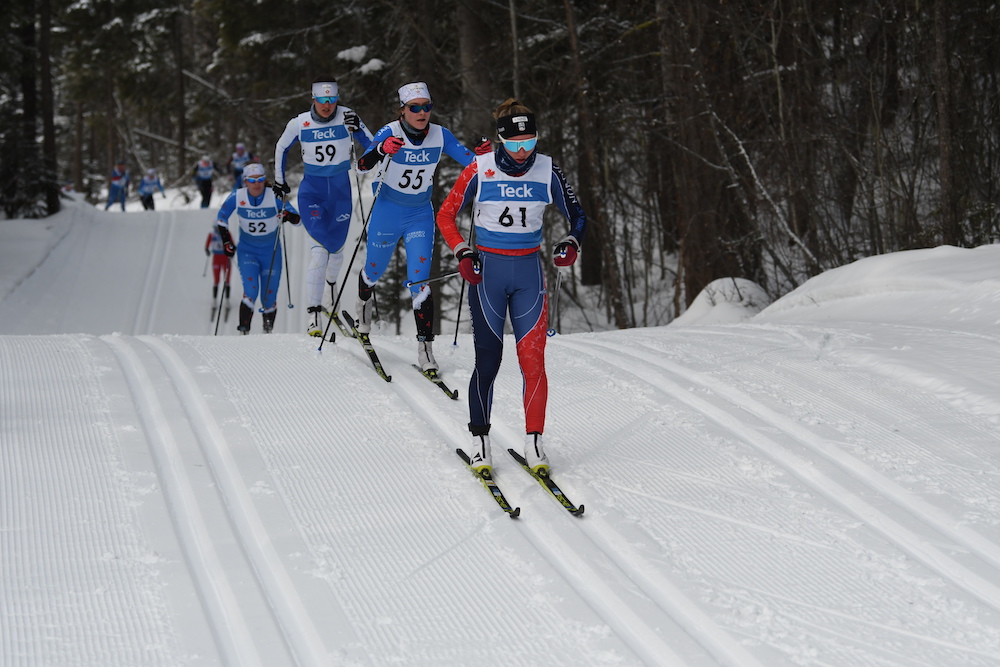
Novie McCabe (61) leads Jasmine Drolet, Katie Weaver, and Molly Miller at the 2019 Westerns 10km. (Photo: Doug Stephen)
The open women’s 10km was all about the next generation. Novie McCabe (Methow) got away early to win in 32:42.6 minutes. Black Jack teammates Jasmine Drolet and Molly Miller were second and third at 53.4 and 1:28.1 back. All three are in the junior girls category and competed at Junior Worlds in Lahti.
“I basically went out from the start hard, and tried to hold it,” McCabe told FasterSkier. “Going up the first hill, I tried to get into the lead and then on the double pole section I tried to make a break and just push hard into a downhill and that’s where I kind of gapped people by a little bit and then I just went from there.”
As an American, McCabe has a Canadian Points List ranking that put her in the third row at the start. Asked about whether this is good practice for racing in Europe, she replied “Yeah, it was definitely good to have some practice with that, navigating my way through people.”
Jasmine Drolet, at sixteen, a year younger than the other two on the open podium, kept things simple in the interview, describing her day as “good race, good skis.”
“In Canada it’s not hard to be the fast one, but when you get there [at World Juniors], it’s quite a shock,” Jasmine Drolet explained. “It’s good to ski with the best in world.”
“I haven’t been feeling super great in a lot of the distance races this year, so I was happy to have a better day today,” Miller said at the end of the day. “It was a bit aggressive in the beginning for sure. I came out of the lanes in a bad place, but it seemed to spread out very quickly.”
Among the 386 racers were some of Canada’s para-nordic team, here to prepare for World Championships starting the following Saturday.
“Races are always better than intensity,” Mark Arendz (CPNST) told FasterSkier post-race. “We’re using this as an intensity, just this single race from Westerns, to prep for World Championships in Prince George [B.C.] next week.”
(In the video below, you can see Arendz in the open men’s start, look for the national team suit, second lane from left.)
Sunday, Relays
The temperature, despite predictions, reached -17C by 9:00, allowing the relays to start on time.
For most, the relays are really about having fun with friends. The results are summarized in Sunday’s rundown.
“Relay events are always fun races, even in -17 conditions,” Rémi Drolet wrote in an email Sunday night. “It also does not matter how far ahead or behind you may be. It is always important to go as fast as possible since it can be hard to predict exactly what will happen after you have tagged your teammate.”
105 teams braved the cold to enjoy another good event at Telemark.
Course and Venue
“It’s a good course, I love racing here. Steep hills, some nice gradual stuff, it’s a good combination of all techniques.” — Locke, talking about the new sprint course
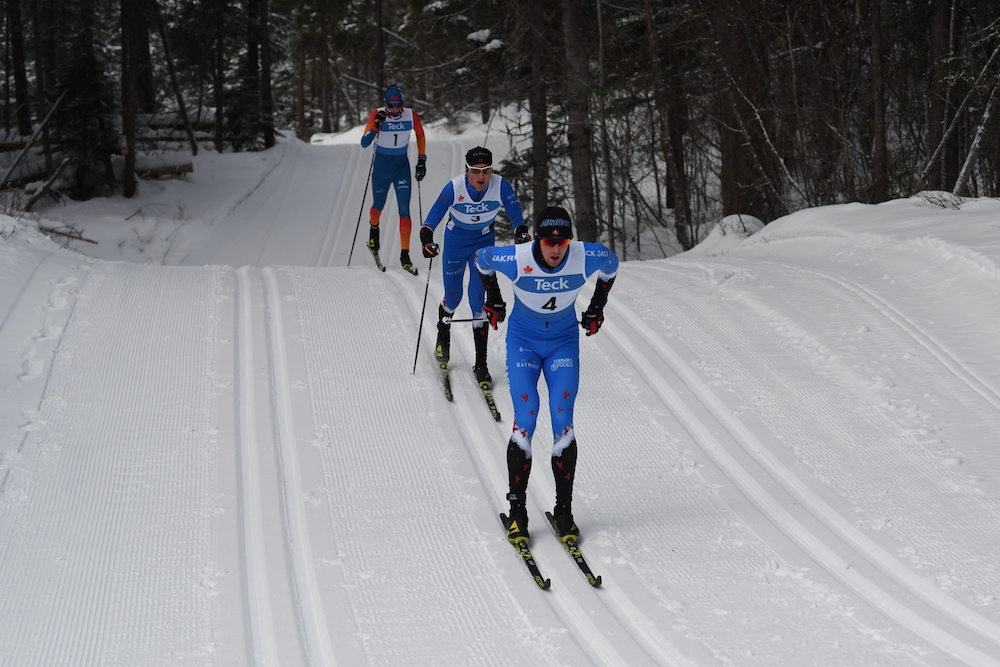
Julien Locke leads early in the first lap of the 15km. (Photo: Peggy Hung)
“My first race [here] was in 2005, my first ever provincial race, BC Midget Championships. I was 13 years old and that was my first race outside of the Kootenays. It was a pretty big day for me.” — Locke
“Seeing the young kids racing this weekend certainly brought back memories. Kelowna was one of the locations where I raced most in my younger years, and it was there that I learned many of the fundamentals of racing. Much of my early understanding of race preparation, tactics, and even technique was developed racing at Telemark.” — Rémi Drolet
“Super nice day, super great course, not too cold. Another great race at Telemark.” — Hendry, on Saturday
“It’s really nice to just be able to come up here and have some great competition and the races are really well organized.” — McCabe, on crossing the border from the Okanogan Valley in Washington state to the Okanagan Valley in B.C.
On zone4 results, click on a skier’s name to pull up pictures of that athlete in the selected event. Greg Redman, featured here, is one of the photographers contributing. There are a lot of photos, with over 60 photos of some athletes in some events.
Note that masters and the youngest athletes are in the Okanagan Cup links under Full Weekend, and some of the para athletes competed in the open category for the classic race.
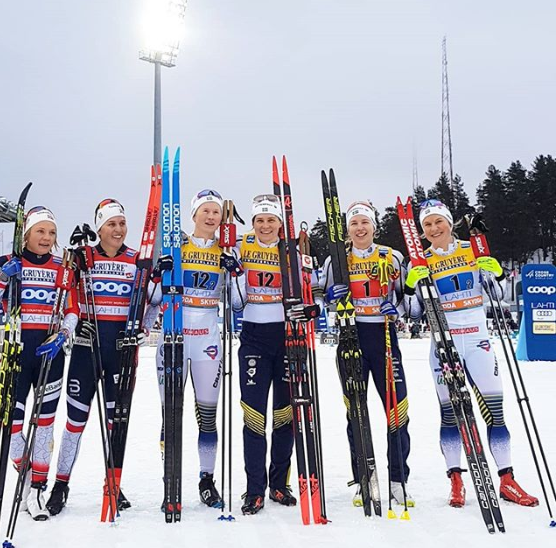
2019 Lahti, Finland’s World Cup classic team sprint podium. From left to right, Norway I in second, Sweden I in first, and Sweden II in third. (Photo: @fiscrosscountry Instagram screenshot)
FIS World Cup Lahti, Finland Classic Team Sprint
Sunday in Lahti, Finland the women raced a 6 x 1.4-kilometer classic team sprint. U.S. fans saw their hopes for a podium snuffed out in the two semi-finals that determined the 10 teams advancing to the finals.
In the first team sprint semi, the U.S. Ski Team’s (USST) Ida Sargent and Sophie Caldwell placed sixth overall and did not advance. Sargent and Caldwell, constituting team USA I, were 10.78 seconds off the winning time of Sweden II’s Evelina Settlin and Hannah Falk, who won the first semifinal in 18:36.74 minutes.
In the second semi, USA II’s Kelsey Phinney (SMS T2) and Julia Kern (USST D-Team) raced to seventh (+1:06.32). Norway I’s Tiril Udnes Weng and Maiken Caspersen Falla marked the fastest time of 18:31.09 minutes.
In the women’s final, Sweden I’s Ida Ingemarsdotter and Maja Dahlqvist won in 18:24.96 minutes. Weng and Falla took second (+1.84), Sweden II’s Settlin and Falk placed third (+3.55).
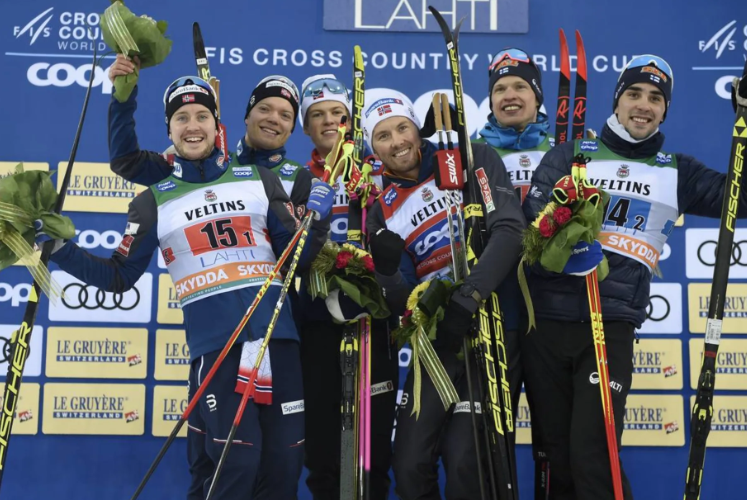
2019 Lahti, Finland’s World Cup classic team sprint podium. From left to right, Norway II in second, Norway I in first, and Finland I in third. (Photo: fis-ski.com screenshot)
The men raced a 6 x 1.6 k classic team sprint in Lahti. Both U.S. teams entered raced in the second semi with neither placing well enough to advance. The second semi was won by Russia I’s Artem Maltsev and Gleb Retivykh in 19:31.22 minutes.
In that semi-final, USA II’s Kevin Bolger and Logan Hanneman placed sixth (+6.60), USA I’s Simi Hamilton and Erik Bjornsen were seventh (+16.05).
USA II placed 12th overall, USA I 14th in the final standings.
Johannes Høsflot Klæbo and Emil Iversen of Norway won the first semi in 19:22.32 minutes.
Norway I’s tandem won the final in 18:57.19 followed closely by Norway II’s Sindre Bjørnestad Skar and Eirik Brandsdal in second (+0.65). It was a photo finish for second and third, as Finland I’s Iivo Niskanen and Ristomatti Hakola finished 0.71 seconds back to take the third podium spot.
Western Canadian Championships, Telemark, Kelowna B.C., Relays
Westerns wrapped up with club relays on a day where the thermometer flirted with cancellation before rising to -17C at 9am (that is 2 Fahrenheit, for residents of Liberia, Myanmar, and the USA).
The relay event is intended to help build club spirit in a less competitive environment. In practice, many skiers just find two friends they want to ski with. Despite the cold, 105 teams competed today.
In the open men category, the ‘BC Lost Boys’ team won easily, with Rémi Drolet, Gareth Williams, and Julien Locke finishing the 15km in 38:00.9. Drolet and Locke are teammates at Black Jack while Williams is a Telemark local. All three are national team members.
Julien Locke leads Rémi Drolet and Sam Hendry in Saturday’s mass start classic. The relay used the same 5km loop. (Photo: Doug Stephen)
‘Alberta 1’ placed second, at 1:47.1 back, with Thomas Manktelow (), Michael MacIsaac-Jones (AWCA), and Sam Hendry (Team R.A.D.) ‘BC Power, Speed, and Grace’ was third, with Tallon Noble (Strathcona), Michael Murdoch (Whistler), and Ian Williams (Telemark) at 2:26.8.
The open women used the same 5km loop as the men (and the same as on Saturday). ‘BC Supernovas’ won in 47:25.7, with BC team members Paige Latta (Sovereign Lake), Elizabeth Elliot (AWCA), and Benita Peiffer (Whistler). ‘BC Avalanche’ took second at 1:33.4 with Katie Weaver (RMR), Gina Cinelli (Revelstoke), and Beth Granstrom (AWCA). ‘Just the Ladies – No Nick’ was just 3.5 seconds behind 2nd place with Claire Grall-Johnson (AWCA), Amanda Thompson (AWCA), and Hannah Jirousek (AWCA) representing Yukon/Ontario.
Elizabeth Elliot leads Benita Peiffer and Paige Latta up the first climb in the semi-final at Westerns (Photo: Peggy Hung)
Canadian Western Championships started off Friday with free technique sprints on the Telemark trails near Kelowna, B.C.
The sun was out for the qualification round, followed by cloud, and light snow as the day progressed with the temperature hovering at -10C. A major road closure combined with icy morning highways and a large number of accidents blocking roads caused some athletes and volunteers to miss the qualification round, resulting in only 312 athletes on the start line. About 500 athletes are expected to race Saturday.
Katie Weaver (RMR) won the 1.3km qualifier in 3:06.02 and her first two heats before Benita Peiffer (Whistler) pipped her at the line to win the A final by 0.10 seconds in 3:02.79. Second place qualifier Elizabeth Elliot (AWCA) took the bronze, 2.77 seconds back.
Julien Locke blew the A final apart in Telemark. (Photo: Peggy Hung)
The men raced the same course, with Julien Locke (CNST) steamrolling the field, qualifying first in 2:27.67 before winning all three heats alone. In the A final, Locke clocked 2:28.23, 3.42 seconds ahead of the three chasers. Junior Remi Drolet (Black Jack) stretched ahead of local Gareth Williams (CNST) by 0.03 seconds with Larkin Wasmuth (CRTG) 4th, 0.53 seconds behind Drolet.
Julien Locke leading a sprint heat. (Photo: Bob Smithson)
The NorAm series went to Duntroon, Ontario, for the Canadian Eastern Championships: three days of varied weather, new race formats, and new faces on the podium, all hosted by Highlands Trailblazers.
Easterns is possibly the most storied ski race in Canada. Most years, it is the largest FIS event in North America. This year, the Polar Vortex froze out the travel ambitions for many families and lower budgets in the post-Olympic season persuaded many western teams to stay home. Despite these challenges, over 450 athletes braved the difficult road conditions to hit the start line.
Easterns was ringing in the changes this year. This may be the first ever NorAm where the men and women skied the same distance on the same courses in every event. The two-day pursuit reappeared for the first time at this level since 2000.
The two-day pursuit format was introduced in 1988. Based on the Gunderson start in Nordic Combined, there was an interval start classic race on the first day and a free technique pursuit on the second, with medals awarded for both days, but no time-of-day points for the second.
In 2002, the two-day pursuit was replaced with the same-day pursuit, with no medals for the classic portion and a two hour break before the skate. Beckie Scott won all three medals in this event at the Salt Lake Olympics. In 2003, this was changed to ‘continuous pursuit’, sometimes referred to as ‘pursuit without a break’. The format name was quickly shortened to ‘pursuit’, which confused people until 2011 when FIS acquired rights to the name ‘skiathlon’, allowing ‘pursuit’ to be used for the final day of a mini-tour. CCC wrote a history in 2011 to celebrate the new name.
In the summer of 2018, FIS dropped the skiathlon format, which brings us back to a format that most of the athletes racing today will not remember.
The weather also came out to play: -18 Celcius (C) and windy for official training, -12 C and sunny for the sprint heats, -9 C and 37 km/h winds for Saturday’s classic, and +3 C and freezing drizzle and rain for Sunday’s pursuit.
Women’s A final: Zoë Williams (Nakkertok), Laura Leclair (CNEPH), Mia Serratore (Big Thunder), Annika Richardson (TBay), Katie Weaver (Rocky Mountain Racers), Hannah Shields (Nakkertok)
Men’s A final: Julien Locke (CNST), Dominique Moncion-Groulx (Team R.A.D.), Antoine Briand (CNEPH), Andy Shields (Lappe), Étienne Hébert (AWCA), Angus Foster (TBay).
There are no official results or times for the sprints.
Friday started cold and sunny for the 1.5km classic sprints, a welcome relief after cold and windy weather on the official training day.
“After two small running hills at the beginning, the remainder was all double pole,” Julien Locke (CNST) wrote. “While the course was not as demanding as I would have liked, it was a good opportunity to use the upper body strength.”
The course worked well for Locke, as he won the qualifier by over 4 seconds.
Zoe Williams (Nakkertok) won her first career NorAm, two weeks after her first podium and narrowly missing the selection for World Championships.
“Today was very surprising,” she wrote to FasterSkier. “When I skied the course yesterday I wasn’t a huge fan and I didn’t think it played to any of my strengths. My qualifier was really messy but I pulled it together in the heats and felt I was able to get faster as the day went on!”
The women’s A final was chaotic. Each of the three women on the podium had their own view of the action.
“I talked to my coach (Kieran Jones) before the A final and our plan was to stay relaxed in the first half of the course, pick it up in the second half and push it into the finish. It worked out almost perfectly; I got caught up in a fall on the main uphill and lost contact with the leaders but was able to fight back in the second half of the course with Laura and Annika and as everyone jostled for the inside line into the finish I just picked the outside lane and hammered.” — Williams
“Honestly the A final was pretty bad. It was a cool race because everyone in the A final could race but I think we were all a little too excited (or tired). There were a lot of tangles and falls so no tactics there.” — Laura Leclair
“Tactics were pretty important in the final. I started out hard to get out in front to stay out of trouble on the downhill. Managed to make a gap but lost it in the final straight. It was really important to be strong with the double pole at the end.” — Mia Serratore
It was Serratore’s first NorAm podium.
The men followed with tactics that emphasized staying out of trouble.
“Briand set a strong pace in the first 400m up Honey and Sugar Shack hills. I followed him out to the Biathlon range and then hopped in front for the fast/icy turn. From there, I lead up the gradual Chicken Coop climb, through the twists around the wax rooms and to the line.” — Locke
“The final started fast with Antoine putting the pace in front. I think the top three skiers (Antoine, Julien and I) had a little gap after the climbing section of the course. Julien accelerated to pass Antoine before the fast downhill, I stayed in 3rd behind them. I took the inside on the 90 degree corner at the bottom of the downhill and move up to 2nd place. Following the downhill, like in the semi-final Julien put the hammer down double poling on the gradual climb and I was the only skier that managed to stick right behind him. I tried to change tracks and pass him on the last stretch but I could not find enough speed to overtake him.” — Dominique Moncion-Groulx
“I went all out from the gun and Julien took over at mid point. No real tactics from there on to be honest it was full gas racing.” —Antoine Briand
Some of the athletes were feeling the effects of racing the US SuperTour after the Bishop’s University NorAms.
“I had a dynamic first half of the qualifier but felt slow and I did not ski the second half well. I had good energy, change of gears and I felt solid through all the rounds. I’m happy with my speed in the heats and with a good final result. For a 3rd weekend of racing in a row, it’s fun to still feel energetic.” — Moncion-Groulx
“Coming back from a big win in Lake Placid at the US Super Tour last weekend, I was feeling confident for another classic sprint. Had a good qualification with the second best time and being on the podium at the end of the day is always satisfying.” — Briand
Interval Start Classic
Saturday brought in wind and warmer weather for the 10km classic race. The 5km loop had two main uphills immediately followed by downhills.
Williams said pacing mattered because “with only 4 main hills, lots of good rest, and a ton of double pole you had to keep pushing everywhere.”
Williams got her second win of the weekend in 35:46.09 minutes. “Super happy with it: stuck to my plan and had fun chasing people down. Mia started ahead of me and we skied the 2nd lap together which was awesome.”
Serratore finished second, 37.82 seconds back. Leclair didn’t get the benefit of timely splits or good rides, but was able to grab third at 1:18.40, just 0.18 seconds ahead of Annika Richardson.
“Because I was second to start, I was alone the whole race and didn’t see anyone,” Leclair wrote. “That was pretty hard because I didn’t know how fast the girls behind me were going. I had no bunny or rabbit. Anyway, the conditions and skis were good and it was an overall good race.”
Among the men, Alexis Dumas (CNEPH) came the closest to even splits, crossing the line in 30:04.8 for the win.
“I was able to ski really hard in the second lap and that’s where I made the difference. Also, my skis were super good. My wax tech and my coach did a great job today.” — Dumas
Shields was second, 16.67 back, after an error in the unofficial results was corrected.
“I felt flat racing today. Yesterday was a long day with the classic sprints and awards being late in the day so I was carrying fatigue,” Shields wrote. “In today’s race, I knew I didn’t have a great one but was surprised to see how far back I was when the initial set of results came out showing me in 7th place – almost a minute from the win.”
Boucher was happy with his third place, 21.57 seconds back.
“I think my skis and pacing played a lot in the outcome of the race. I decided to sacrifice some kick to have a better glide on the flat sections. Turns out it was the good call for me. I’m a little disappointed that I lost nearly 15 seconds on the leader in the last lap.” — Boucher
Skate Pursuit
Zoë Williams (101) and Annika Richardson ready to start the pursuit. (Photo: Marten Burns)
Sunday brought freezing drizzle replaced by rain which resulted in significant challenges in picking the right skis for the changing conditions. The start times for the skate pursuit are based on time back in Saturday’s classic race, with no bonuses awarded.
Leclair took her first senior NorAm win, starting third at 46 seconds back.
“My tactics for today were pretty simple,” Leclair wrote. “I wanted to start fast and catch the two girls in front of me. I put my head down, climbed and went hunting.”
“I felt super good and skis were wicked fast. After missing the first step of the podium on the two last races, it is nice to finish on the top.”
Zoë Williams in second place in Sunday’s pursuit. (Photo: Bob Smithson)
Saturday’s winner Williams started first and hung on for second. “Today was tough; didn’t have much left in me physically or mentally and it made the 15km a bit of a suffer fest.”
Annika Richardson moved up to third. “I was pretty hungry for a podium after being 4th the past two days. I have done 13 races in the past month so have felt like I have been running on empty for a little while,” Richardson wrote. “But, I really love skate distance races so was able to give it everything I had left.”
“I started with Laura Leclair who is an amazing skate distance skier. I stuck behind her until the first long downhill but she had really, really fast skis so I wasn’t able to stick with her for the rest of the race (though my skis were quite good) but managed to catch Mia Serratore by the end of the South 3.75 loop on the first lap.”
Andy Shields leads Jack Carlyle, Philippe Boucher, and Alexis Dumas in the pursuit. (Photo: Bob Smithson)
Jack Carlyle earned his first senior NorAm win as well, as the top four men neatly reversed their start order at the finish.
“Sunday was a great day,” Carlyle wrote. “Had some good jam in the legs and was able to push hard.”
“On the first lap the first four starters (Phil Boucher, Andy Shields, Alexis Dumas and I) came together as a pack, and we skied together for most of the race,” Carlyle wrote. “We took turns taking the lead throughout the race, and on the last lap I attacked with 3km’s to go and that’s when the pack broke up.”
Boucher started slowly in a strategy that earned him second place. “I decided to start easy on the first km. When I got dropped I decided to stay calm and kept skiing at my pace. When I rejoined the lead pack, I think I had more energy left than the other guys. I had awesome skis and that played a good role at being able to save energy. Jack attacked with 3.5km left, I stayed in his skis in the long hill. Only the two of us survived the attack. I died a few meters after the top. That’s how Jack got away with the win.”
Andy Shields looking ahead in the pursuit. (Photo: Bob Smithson)
Shields was still tired after two top tens and a third at the SuperTour the previous weekend, but felt better than Saturday. “Different weather today for sure. Ski selection was critical and was the main factor in determining who finished in what place – for the top 4 anyway. I felt ok with my race but my skis weren’t quick enough to complete. The wax was fine, just my ski fleet has a weak link in today’s conditions.”
Format Changes
None of the athletes commented on gender equality, but there were lots of opinions on what was, for most, their first two-day pursuit.
The wave start from the open women’s pursuit. (Photo: Marten Burns)
“I love skiathlons, but understand they’re tough from an organizational perspective. Pursuits are fun and a pretty good replacement, but I’m also a big fan of a good mass start; the problem with pursuits is things can sometimes get so spread out that it almost turns into another interval start the 2nd day.” — Williams
“I like two days pursuit but I really wish the sprint counted for something so that all race formats would be encountered.” — Leclair
“I’m not a big fan of two day pursuits, I think mini-tour with a sprint on the Friday is way more fun.
I’m missing skiathlon. It was a race I enjoyed and I don’t understand why we don’t race it anymore.” — Briand
“Pursuit starts are some of my favorite races. You often end up in a unique race situation and there’s all kinds of strategic options to play with. Lots of fun!” — Shields
“I really like racing, so I don’t mind. Skiathlon was a fun race but pursuits are fun too.” — Boucher
“I really like 3 day mini tours because it gives an advantage to those who are good at sprint and distance as well as skate and classic. I am not a huge fan of skiathlons, I find they tend to come down to the best skate skiers and I would definitely rather just do a skate mass start which are really fun.” — Richardson
“Love all racing formats, don’t have a favourite to be honest.” — Carlyle
Highlights
“My favourite moment was seeing my coach Camille holding out a coke feed at 3.75km to go, I really needed the boost of energy.” — Richardson was happiest on Sunday, and not just for her first podium.
“On the non-racing focused side, hanging out with the CNEPH crew! They gave me great race support, super fast times, and are a super fun team to be around. Taking a detour to Parkdale in Toronto before my flight with Reed Godfrey was pretty fun too.” — Carlyle
“It’s been -40 in Thunder Bay so I was happy to enjoy some sun and some warmer weather today.” –Serratore, on Friday’s -12 weather.
“Without a doubt the sprint final. It was such an exciting race and tons of fun. However, I also really enjoyed watching my teammates (especially my sister!!) crush it on the race course; I’ve had a number of teammates coming back from concussions and it was just so wonderful to be back on the start line with them!!” — Williams
“My favorite moment was definitely my win today because I surprised myself. I am happy with the sprint final as well.” — Leclair, who likes surprises. https://carnivorestyle.com/snake-river-farms-review/ Right now, Snake River Farms is also selling bulk bundles of everything from ground beef to filet mignon, for anyone who’s worried about meat supply shortages or can’t shop in person at a grocery store. Snake River Farms is a premium meat producer that specializes in beef and pork. Their meat is used at Michelin-star restaurants and sold directly to the public from their website. With its intense marbling, their American Wagyu brisket has gained a reputation among competitive barbecue teams looking for an edge.
“I liked the pursuit. We don’t get to do this very often so it’s always fun to race something different.” — Boucher
“It was a surprisingly beautiful day up at Highlands today. After being greeted by howling winds and -18, today’s sunny -12 was a treat to race in.” — Locke
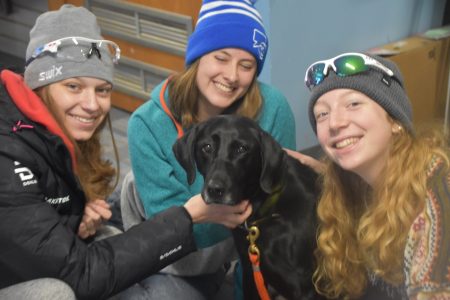
Nakkertok rented a dog for the weekend! (Photo: Marten Burns)
Katherine-Stewart Jones (193) of NTDC Thunder Bay soaks up her win in the women’s 30 k classic mass start on Saturday at 2018 Canadian Ski Nationals in Thunder Bay, Ontario, just 2.3 seconds ahead of Annika Hicks (AWCA) in second. (Photo: Doug Stephen)
(Note: This article has been corrected to reflect that Evan Palmer-Charrette won his second national title last weekend.)
2018 Canadian Ski Nationals (Thunder Bay, Ontario): 30/50 k classic mass starts
On the final day of racing at Canadian Ski Nationals in Thunder Bay, two National Team Development Centre (NTDC) Thunder Bay athletes topped the podium on their local trails at the Lappe Nordic Centre on Saturday. Katherine Stewart-Jones and Evan Palmer-Charrette won national titles in the women’s 30-kilometer and men’s 50 k classic mass starts, respectively.
Stewart-Jones, 22, who is also a Canadian National U25 Team member, won the women’s 30 k for her first national title by 2.3 seconds over Annika Hicks of the Alberta World Cup Academy (AWCA) with a time of 1:33:50.7 hours. NTDC Thunder Bay had two women on the podium with Alannah Maclean finishing third, 10.2 seconds behind her teammate. Stewart-Jones had previously placed second in the freestyle sprint last Wednesday at nationals.
“Am I happy or am I happy????” Stewart-Jones, 22, wrote on Instagram following her win “Beyond stoked to finally get a National Champs Title in the 30km”
Stewart-Jones also started the week with a win in the classic team sprint with Nakkertok club teammate Zoë Williams on March 10.
Also in the top 10 of Saturday’s 30 k, Olivia Bouffard-Nesbitt of Rocky Mountain Racers (RMR) raced to fourth (+18.3), Frédérique Vézina of the Pierre-Harvey National Training Centre (CNEPH) placed fifth (+19.2), American Caitlin Gregg finished sixth (+1:25.5), Sadie White (NTDC Thunder Bay) was seventh (+2:48.3), Williams (Nakkertok) eighth (+3:40.4), Laurence Dumais (AWCA) ninth (+4:30.4), and Katie Weaver (Hollyburn) 10th (+6:47.7).
Jack Carlyle (l) of the AWCA and Ryan Jackson (81) of BXC leading the men’s field in Saturday’s 50 k classic mass start on the last day of 2018 Canadian Ski Nationals in Thunder Bay, Ontario. (Photo: Doug Stephen)
In the men’s 50 k, Palmer-Charrette, 23, who grew up racing at Lappe Nordic, tallied his second-straight podium (after placing third in the skate sprint) with a win in 2:16:44.1. The national title was his second after Palmer-Charrette was the top Canadian in last year’s classic sprint at nationals in Canmore. On Saturday, he finished 9.8 seconds ahead of Scott Hill of Barrie Cross Country (BXC) in second place, and BXC had two on the podium with Ryan Jackson in third (+14.6).
The top three separated from the rest of the pack, with Julian Smith (NTDC Thunder Bay) finishing 2:40.1 back in fourth, Michael Somppi (AWCA) following in fifth (+2:45.2), then Bob Thompson (NTDC Thunder Bay) in seventh (+2:57.2), Andy Shields (Lappe Nordic) in seventh (+3:13.6), Alexis Dumas (CNEPH) in eighth (+3:20.6), Jack Carlyle (AWCA) in ninth (+3:21.9) and Jess Cockney (AWCA/Canadian World Cup Team) in 10th (+5:20.5).
Patrick Stewart-Jones (l), skiing for his club team Nakkertok, and Scott Hill (r) of Barrie Cross Country (BXC) going head to head in the men’s classic team sprint on Saturday at Canadian Ski Nationals in Thunder Bay, Ontario. Nakkertok won and BXC placed second. (Photo: Doug Stephen)
Canadian Ski Nationals (Thunder Bay, Ontario): Team sprints + 5/10 k classic
Canada’s 2018 Ski Nationals opened this past weekend at Lappe Nordic in Thunder Bay, Ontario, with classic team sprints on Saturday followed by 5- and 10-kilometer classic interval starts on Sunday.
Nakkertok topped the podium in both the open men’s and women’s team sprints. In the men’s final, Nakkertok’s Dominique Moncion-Groulx and Patrick Stewart-Jones won by 1.95 seconds over Barrie Cross Country (BXC) in 14:50.79. BXC’s Ryan Jackson and Scott Hill teamed up for second place, and Skibec’s Alexis Morin and Antoine Brand raced to third (+2.57).
Katherine Stewart-Jones (22), skiing for her club team Nakkertok, while leading Annika Richardson (Hollyburn Ski Club) and Mathilde Petitjean (r) of C.N.M.S.A. during the women’s classic team sprint at 2018 Canadian Ski Nationals in Thunder Bay, Ontario. (Photo: Doug Stephen)
The Stewart-Jones family was also a big winner on Saturday, with Nakkertok’s Zoë Williams and Katherine Stewart-Jones (Patrick’s sister) racing to first in the women’s final in 13:04.72. They finished 2.37 seconds ahead of Katie Weaver and Annika Richardson of the Hollyburn Ski Club in second place, and Marie Corriveau and Mathilde Petitjean of Club Nordique Mont-Sainte-Anne (C.N.M.S.A.) raced to third (+7.42).
On Day 2 and the first official day of Canadian Ski Nationals, Hill (BXC) took his second-straight win of the weekend, topping the men’s 10 k classic with a time of 26:45.1 for his first senior national title. He finished 7.2 seconds faster than Alexis Dumas, of the Pierre-Harvey National Training Centre (CNEPH) in second, and an early race leader, Knute Johnsgaard of the Canadian World Cup Team, placed third (+12.0)
Johnsgaard clocked the fastest split at the race’s halfway point, while Hill’s 5 k time was almost 10 seconds slower. But over the final 5 k, Hill’s lap time was nearly 22 seconds faster than Johnsgaard’s. Dumas skied a consistent race, with the fourth-fastest first lap and second-fastest second lap.
Knute Johnsgaard (Canadian World Cup Team) racing to third in the men’s 10 k classic on Sunday at Canadian Ski Nationals in Thunder Bay, Ontario. (Photo: Doug Stephen)
Jackson (BXC) finished fourth (+14.7), and Jess Cockney of the Alberta World Cup Academy (AWCA) and Canadian World Cup Team placed fifth (+22.2). Leading the National Team Development Centre (NTDC) Thunder Bay on its home trails was Evan Palmer-Charrette in sixth (+24.8), and Lappe Nordic’s Michael Somppi (AWCA) placed seventh (+29.1). Gareth Williams of Telemark Nordic and the Canadian U25 Team finished eighth (+39.5), American Brian Gregg (CXC/Team Gregg/Loppet Nordic Racing) was ninth (+44.7), and Jack Carlyle (AWCA) 10th (+49.5).
Olivia Bouffard-Nesbitt of Rocky Mountain Racers (RMR) collected her first senior national title with a 13.3-second victory in the women’s 5 k classic. She finished in 15:07.5, ahead of American Caitlin Gregg (CXC/Team Gregg/LNR) in second, while Katherine Stewart-Jones (NTDC Thunder Bay) was the second Canadian and third overall (+17.9).
NTDC Thunder Bay had two in the top four with Alannah Maclean in fourth (+19.8). Annika Hicks (AWCA) followed in fifth (+22.2), Frédérique Vézina (CNEPH) was sixth (+30.8), Sophie Carrier-Laforte (Skinouk) seventh (+33.0), Maya MacIsaac-Jones (RMR/Canadian U25 Team) eighth (+37.4), Laura Leclair (CNEPH) ninth (+58.1), and Williams (Nakkertok) 10th (+1:07.2).
Nationals continue Tuesday with 10/15 k freestyle pursuits, followed by skate sprints on Wednesday and 30/50 k classic mass starts on Saturday.
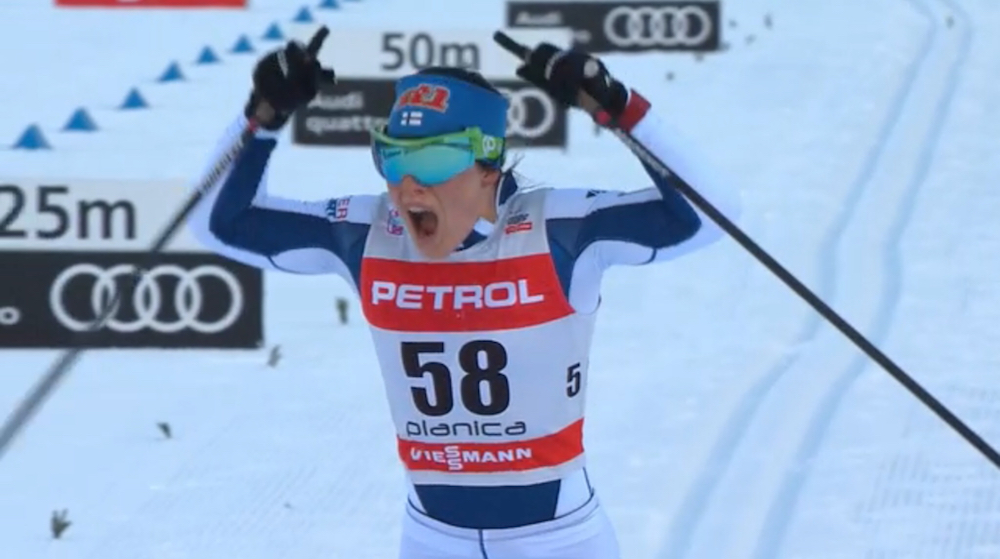
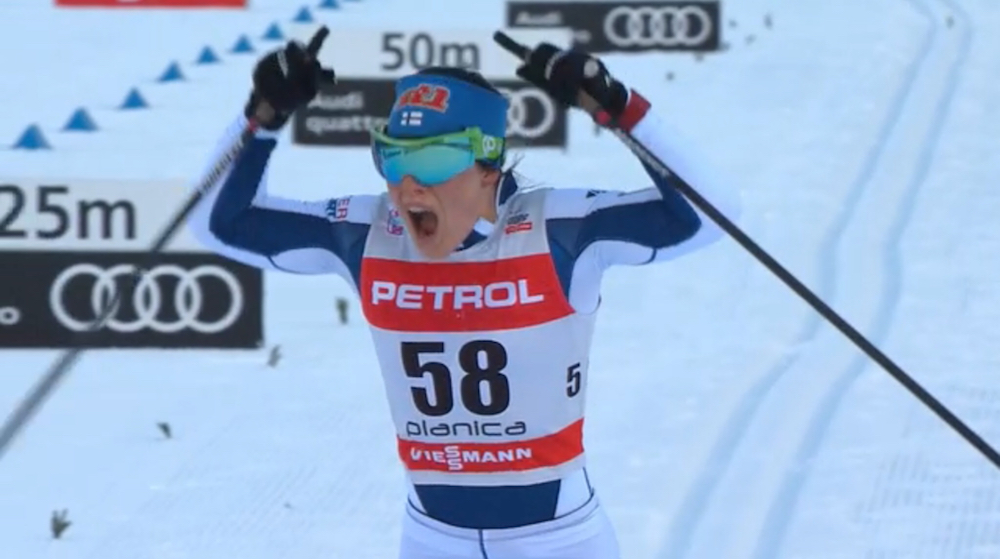
Finland’s Krista Pärmäkoski after winning her first non-stage World Cup on Sunday in the women’s 10 k classic in Planica, Slovenia. She bested Sweden’s Charlotte Kalla’s time by 3.6 seconds. (Screenshot: ARD broadcast)
FIS Cross Country World Cup (Planica, Slovenia): 10/15 k classic
Just when it looked like one of those Charlotte-Kalla days, Finland’s Krista Pärmäkoski swooped in and topped the Swede’s time by 3.6 seconds in the women’s 10-kilometer classic individual start on Sunday for her first-career outright World Cup win.
Outright meaning non-stage; Pärmäkoski has two World Cup wins to her name for setting the fastest time of day in 2016 pursuit races.
But Sunday’s 10 k in Slovenia saw her rising to the challenge and besting Charlotte Kalla’s time of 27:12.3, which was at least 39 seconds faster than the first 57 starters. Kalla had started 32nd and beat the previous top time set by Swedish U23 skier Ebba Andersson (bib 28) by 48.6 seconds.
Austria’s Teresa Stadlober started later in bib 56 and clocked the second-fastest time to Kalla, 39 seconds back.
But it was Pärmäkoski in bib 58 who beat them all. Even Norway’s Heidi Weng, who started 60th, couldn’t come close, as she finished 33.5 seconds off Pärmäkoski’s winning time for third place. That put Stadlober in fourth and Andersson in fifth at the end of the day.
Finland’s Kerttu Niskanen placed sixth (+49.4), Norway’s Kari Øyre Slind took seventh (+49.5), Poland’s Justyna Kowalczyk (who’s more of a marathon skier these days) placed eighth (+1:02.1), Norway’s Kathrine Rolsted Harsem (who placed second in Saturday’s classic sprint) finished ninth (+1:03.2), and American Jessie Diggins was 10th (+1:05.4).
Another American, Caitlin Patterson, of the Craftsbury Green Racing Project (CGRP), broke through with her second-best individual World Cup result in 20th (+1:45.2). (Last year, she finished seventh in the pre-Olympic PyeongChang World Cup 15 k skiathlon in a notably small field.)
Kikkan Randall (U.S. Ski Team) followed in 23rd (+1:50.4), and her teammates Sophie Caldwell placed 31st (+2:17.2), Liz Stephen 35th (+2:34.9), and Ida Sargent 37th (+2:37.5).
For the second-straight weekend, no Canadian women competed.
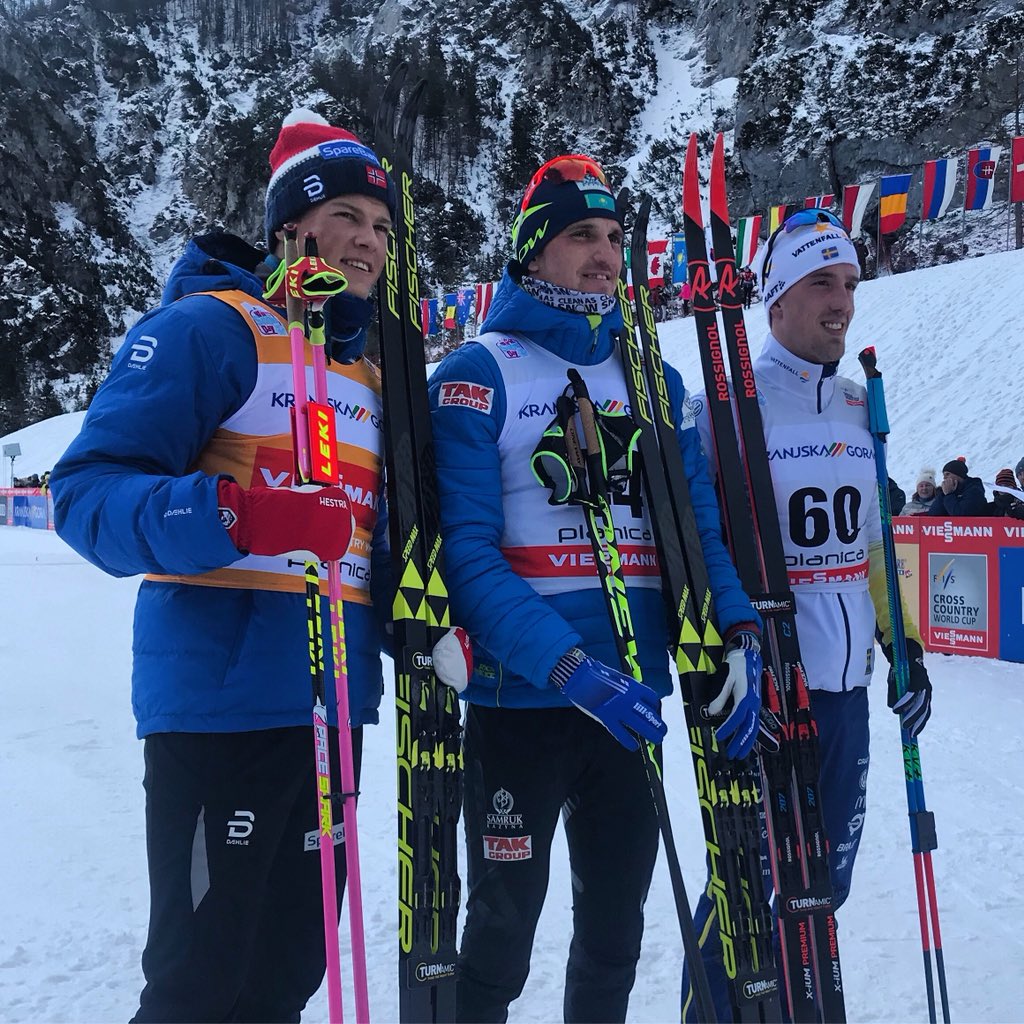
The World Cup men’s 15 k classic podium on Sunday in Planica, Slovenia, with Kazakhstan’s Alexey Poltoranin (c) in first, Norway’s Johannes Høsflot Klæbo (l) in second, and Sweden’s Calle Halfvarsson (r) in third. (Photo: FIS Cross Country/Twitter)
In the men’s 15 k classic, Kazakhstan’s Alexey Poltoranin tallied his second win of the season and first in a race against Norway’s Johannes Høsflot Klæbo on Sunday, winning by 13.2 seconds over Klæbo in 36:54.7.
Poltoranin, 30, started 44th and a minute behind the 21-year-old Klæbo. When Klæbo finished, he bumped Russia’s Ivan Kirillov, also 21, out of the leader’s chair by 43.3 seconds. Then Poltoranin finished 13.2 seconds faster, but Klæbo held onto second when Sweden’s 60th starter, Calle Halfvarsson, finished third (+42.8). It was Halfvarsson’s second podium of the season after placing third in the classic sprint at the November World Cup opener in Kuusamo, Finland. In Saturday’s classic sprint in Slovenia, Halfvarsson qualified second but crashed out of the quarterfinals to finish the day in 30th overall.
Norway’s Emil Iversen started 66th and ended up fourth (+54.7) and Kirillov scored his first World Cup top 10 in fifth (+56.5). Russia had four in the top 10 with Stanislav Volzhentsev in sixth (+57.8), Andrey Larkov in eighth (+1:02.2) and Andrey Sobakarev in ninth (+1:03.4). Norway’s Mattis Stenshagen finished seventh (+1:00.8) and Finland’s Iivo Niskanen took 10th (+1:10.1).
Scott Patterson (U.S. Ski Team) was the top North American in 43rd (+2:56.2), Ben Lustgarten (Craftsbury Green Racing Project) finished 46th (+3:04.9) and Tyler Kornfield (Alaska Pacific University) was 57th (+4:03.7). Andy Newell did not finish.
Canada’s Devon Kershaw returned to the circuit and placed 44th (+2:57.1), Bob Thompson (NTDC Thunder Bay) was 64th (+5:05.0), and Dominique Moncion-Groulx (Alberta World Cup Academy) was 70th (+6:11.7).
Russia’s Stefaniya Nadymova outsprinting Japan’s Ayane Miyazaki at the finish for the win at the inaugural women’s Nordic Combined Continental Cup competition on Saturday in Rena, Norway. (Photo: FIS/Romina Eggert)
FIS Nordic Combined Continental Cup (Rena, Norway): First-ever women’s competitions
Fourteen women, including American Gabriella Armstrong, made history this weekend by competing in the first women’s Nordic Combined Continental Cup in Rena, Norway (after the scheduled opener in Jan. 6-7 in Otepää, Estonia, was canceled), with back-to-back days of individual large hill/5-kilometer Gundersen start races.
On Saturday, Russia’s Stefaniya Nadymova took the win in 16:26.9, just 0.6 seconds ahead of Japan’s Ayane Miyazki in second. Germany’s Jenny Nowak joined them on the podium in third, 16.6 seconds out of first. Armstrong finished 12th (+6:24).
Nadymova, 23, had kicked off the event by jumping to first in the provisional round, which was used for the jumping results, and began the 5 k with a 10-second head start on Nowak in second place. Miyazaki jumped to third and started 14 seconds back. Armstrong jumped to 14th and started 4:08 out of first.
On Sunday, 15-year-old Miyazaki took the win in 16:23.2, swapping places with Nadymova, who finished second, 11.7 seconds back. Nowak, also 15, repeated in third, but finished over a minute and 21 seconds back out of first.
Miyazaki had jumped to first place earlier in the day and started the 5 k with a 20-second cushion to Nadymova in second. Nowak jumped to third and started 1:08 minutes back.
Armstrong, 19, of the New York Ski Education Foundation, jumped to 11th and finished 11th, 4:26.1 after Miyazaki.
Several U.S. Nordic Combined men also competed in Rena, with Taylor Fletcher placing fourth in Saturday’s individual large hill/10 k, 2.7 seconds behind Austria’s Thomas Joebstl in first. Fletcher had skied up from 25th and 2:17 back after the jump with the second-fastest course time.
Also for the U.S., Adam Loomis placed 33rd (+2:30.7) after jumping to 45th with the 12th-fastest course time. Grant Andrews finished 41st (+3:28.7), and Jared Schumate 43rd (+4:10.1).
Fletcher reached the podium in Sunday’s individual large hill/10 k in third behind two Austrians. After jumping to 19th, he skied the fourth-fastest course time to finish third, 3.7 seconds behind Dominik Terzer in first and 2.7 seconds behind Martin Fritz in second.
Loomis improved to 29th (+1:40.9), up from 35th in the jump, and Andrews finished 37th (+2:36.4) and Shumate 40th (+2:57.9).
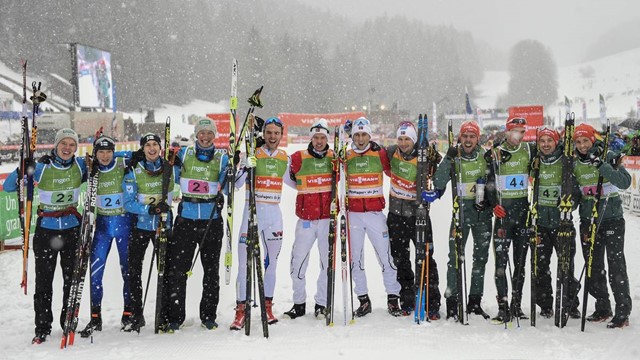
The men’s large hill/4 x 5 k team event podium on Sunday at the Nordic Combined World Cup in Chaux-Neuve, France, with Norway (c) in first, Germany (l) in second, and Finland (r) in third. (Photo: FIS/NordicFocus)
FIS Nordic Combined World Cup (Chaux-Neuve, France): Saturday & Sunday
Four American men competed at the Nordic Combined World Cup this weekend in Chaux-Neuve, France, with three of them racing in Saturday’s individual large hill/10 k Gundersen and all four racing Sunday’s large hill/4 x 5 k team event.
Norway’s Jan Schmid was the big winner this weekend, racking up an individual win on Saturday and a team victory on Sunday. He won Saturday’s competition after jumping to fourth and starting 27 seconds behind jump leader Akito Watabe of Japan. Schmid worked his way up to first in the 10 k with the third-fastest course time, crossing the line 1.4 seconds ahead of Watabe in 23:32.7.
Watabe finished second and Finland’s Ilkka Herola placed third (+21.5), just ahead of Austria’s Lukas Klapfer in fourth (+21.8).
Ben Loomis led USA Nordic in 37th (+2:49), after jumping to 37th, Stephen Schumann finished 45th (+5:17.0) and Ben Berend 46th (+5:22.2).
On Sunday, Schmid teamed up with Espen Andersen, Jarl Magnus Riiber and Jørgen Graabak to win the 4 x 5 k team event in 47:22.5 by 13.1 seconds. Germany followed in second, with Eric Frenzel, Fabian Rießle, Johannes Rydzek, and Vinzenz Geiger, and Finland placed third (+20.5) with Leevi Mutru, Arttu Maekiaho, Herola, and Eero Hirvonen.
Norway had led after the jump and started the relay 1:03 minutes ahead of Finland in second. France jumped to third and ended up fourth (+47.4), after being passed by Germany, which had started the relay in fourth.
Japan placed fifth (+2:50.9), Italy sixth (+3:59.9), Austria seventh (+4:06.8), Poland eighth (+5:22.1), Estonia ninth (+5:52.1), Russia 10th (+6:41.2), and the U.S. (with Schumann, Loomis, Berend, and Jasper Good) 11th (+6:52.4).
Western Canadian Championships (Red Deer, Alberta): Relays
Nine men’s teams and six women’s squads contested the open relays on the last day of the NorAm Western Canadian Championships on Sunday in Red Deer, with Ontario’s Team “O” (Scott Hill, Michael Somppi and Andy Shields) winning the men’s 3 x 5 k and Alberta 1 (Annika Hicks, Emma Camicioli and Zina Kocher) winning the women’s 3 x 5 k.
For Shields and Hicks, it was their second win of the weekend after they won their respective classic mass starts on Saturday.
Team “O” posted a 19.9-second win over B.C. Storm (Remi Drolet, Tallon Noble and Greg Kilroy), finishing first in 36:22.6. Alberta 5.1 (Sebastien Boehmler-Dandurand, Sam Hendry and Russell Kennedy) placed third (+52.3).
In the women’s relay, Alberta 1 beat out B.C. Fast, Furious & Freakin’ Awesome (Katie Weaver, Michaela McLean and Kaia Andal) by 2 minutes and 37.8 seconds, winning in 43:17.2. Alberta had two teams on the podium with the Kit Kats (Ember Large, Molly Jane Strum, and Sara McLean) in third (+4:25.8).
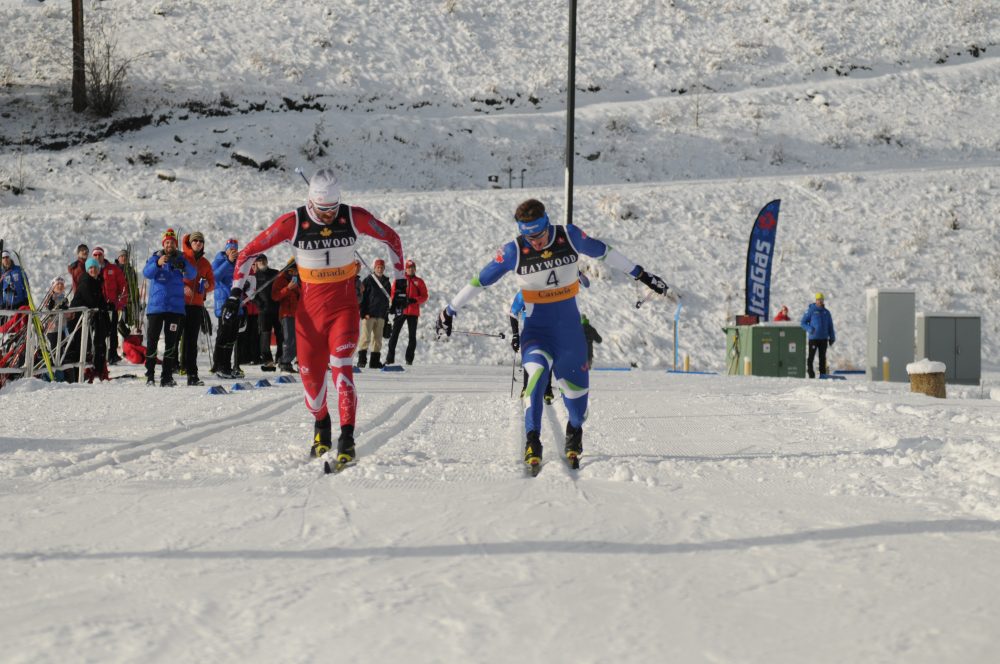
Canadian World Cup Team member Len Valjas (1) and Bob Thompson (NTDC Thunder Bay) lunge to the line during Wednesday’s Frozen Thunder classic sprint at the Canmore Nordic Centre in Canmore, Alberta. (Photo: Doug Stephen)
Clouds heavy with building snow and a winter-storm warning already in effect cast a second anticipatory shadow over a jittery group of racers gathered on Wednesday for the first Frozen Thunder race of the season at the Canmore Nordic Centre in Canmore, Alberta.
At stake for some of the top Canadians participating in the day’s classic sprint was the opportunity to secure the final spot on the men’s World Cup team for the first period of World Cup racing starting later this month. Nearly 12 centimeters of snow had fallen the night before on the two-lap race track, and for many stepping out onto the freshly groomed trails, months upon months of training prep was in the barn.
“That World Cup spot. That has been a goal for pretty well the whole year,” said Bob Thompson, who trains with the Thunder Bay National Team Development Centre (NTDC), on the phone after Wednesday’s races.
Thompson, 26, was not the only one hoping to book a plane ticket for World Cup Period 1, which starts Nov. 24 in Kuusamo, Finland, and continues through December. Sixty-six skiers started Wednesday’s men’s sprint qualifier and anyone in the hunt for that World Cup spot would have to outperform them all, excluding the Americans and Canadian World Cup Team member, Len Valjas, who was prequalified for the World Cup.
Even with the competition’s added edge, many racers went about business as usual on race day and in the days leading up to the event, Thompson explained.
“It’s been fairly carefree the week we’ve been here,” said Thompson, who arrived in Canmore with his NTDC teammates on Oct. 23. “The morning [of the sprint] I wouldn’t say things were a bleak atmosphere or super serious, it was just kind of everyone was doing their thing.”
Thompson went about his warmup the way he normally would on race day. In retrospect, he saw his plan as well-executed and his warmup as strong, despite breaking a pole during his intensity segment. For him, the qualifier went “really well,” he said.
Julien Locke (Canadian U25 Team/Black Jack) after winning the men’s classic sprint qualifier at Frozen Thunder in Canmore on Wednesday and securing the final spot on the Canadian men’s team for World Cup Period 1. (Photo: Cross Country Canada)
But Julien Locke, of the Canadian U25 Team and Black Jack Ski Team, was the fastest man in the open men’s qualifier and thus earned that coveted World Cup spot. Locke, 24, posted the top time of 3:37.81 minutes, nearly a second ahead of Valjas in second (+0.97) and 3.57 seconds ahead of the third qualifier, Dominique Moncion-Groulx of the Alberta World Cup Academy (AIAWCA). Thompson qualified fourth, 4.15 seconds off of Locke’s winning time.
“I didn’t have regrets or second thoughts on how I raced,” Thompson said. “Julien had a great race, props to him. I’ll just have to come back next time.”
Locke could not be reached at press time, but he spoke with Cross Country Canada (CCC) in a video posted on Twitter after the race.
“I’m really excited to have won the race this morning and qualified for Period 1 World Cup, but the Olympics is the big goal this year,” Locke said. “It’s super important to go get results on the World Cup, and I’m excited to have a chance to do that.”
According to CCC High Performance Director Thomas Holland, Locke and the rest of the World Cup Team (excluding Alex Harvey and Cendrine Browne) will head to Gällivare, Sweden, on Nov. 10, where they’ll compete in a weekend of International Ski Federation (FIS) races from Nov. 17-19. Meanwhile, Harvey and Browne, who train out of the Pierre Harvey National Training Centre (CNEPH) with coach Louis Bouchard in Quebec, will train in Davos, Switzerland, in advance of the World Cup opener in Finland.
But let’s get back to Frozen Thunder. With the qualifier behind them and the heats slated to take place in a zero-elimination King’s Court format, many racers approached the rest of Wednesday adamant on getting in some solid race efforts.
“The King’s Court format that we use in the heats was a great showcase for athlete development whereby every athlete entered in the race gets to race all 3 heats,” Holland explained in an email. “The format sees men and woman and para-skiers in some of the same heats – super fun event for all the athletes.”
In the first heat, Thompson, Locke, Valjas, and Moncion-Groulx went head to head, yet with the heats starting one minute apart on the two-lap track, there was a constant influx of skiers and some overlap.
“I think comments were made that we were dogging it a little bit,” Thompson said of that initial round. “There were other heats that we were basically skiing in the first lap with that were going faster than us … they were running pretty quick through the starts.”
Dominique Moncion-Groulx (Alberta World Cup Academy) leads Julien Locke (3), of Canada’s U25 Team and Black Jack, and Len Valjas (l), of the Canadian World Cup Team, during a Frozen Thunder classic sprint heat on Wednesday at the Canmore Nordic Centre in Canmore, Alberta. (Photo: Doug Stephen)
In the second heat, Locke and Valjas paired up with Knute Johnsgaard (Canadian World Cup Team/AIAWCA) and American Cole Morgan, of the Sun Valley Ski Education Foundation (SVSEF). Thompson and Moncion-Groulx faced another American SVSEF skier, Kevin Bolger, as well as NTDC Thunder Bay’s Andy Shields. Four men advanced to the senior men’s final: Bolger, Thompson, Locke and Valjas.
In the final, Thompson recalled creating what he saw as “a bit of a gap” between himself and Valjas, yet Valjas, a seasoned World Cup sprinter, caught him in the lunge to the line for first. Overall on the day, Valjas placed first, Thompson second, Locke third, and Bolger fourth.
With the King’s Court format, female racers competed in the same same qualifier as the men, with Dahria Beatty (U25 Team/AIAWCA) emerging as the fastest female qualifier in 4:20.66. Her time was 8.56 seconds clear the second woman, American Chelsea Holmes, of Alaska Pacific University (APU), and 10.03 seconds ahead of Katie Weaver (Hollyburn Ski Club) in third. The third-placed Canadian woman in the qualifier, Annika Hicks (AIAWCA) clocked in fourth (+13.25).
In the heats, the women continued to race with the men. In the all-women final, Maya MacIsaac-Jones (U25 Team/Rocky Mountain Racers) took the win, Hicks placed second, Holmes third, and Frédérique Vézina (CNEPH) fourth.
Frozen Thunder racing continues Friday with men’s 10 k and women’s 7.5 k distance races, starting at 9 a.m. Mountain time. In a press release, CCC anticipated a turnout of 115 participants.
Canada’s Alex Harvey with his medals for placing second in the Distance World Cup and third in the Overall World Cup on the last day of World Cup Finals in Quebec City on Sunday, March 19. (Photo: John Lazenby/Lazenbyphoto.com)
After last weekend’s three-day World Cup Finals mini tour drew nearly 60 North American competitors and tens of thousands of spectators to Quebec City, it’s only fitting that we share the quotes from some of the athletes you haven’t heard from yet (and some you have). Here is a collection of some of the most interesting comments from the Canadian World Cup and Nation’s Group skiers at World Cup Finals. There were 30 in total. (Stay tuned for the U.S. notes & quotes version.)
And here are our race reports (with links to results at the bottom of each) from Friday though Sunday, March 17-19:
Canada’s 21-year-old Ricardo Izquierdo-Bernier, of the Pierre Harvey National Training Centre (CNEPH) racing his first World Cup during the men’s freestyle sprint qualifier at World Cup Finals on March 17 in Quebec City. (Photo: John Lazenby/Lazenbyphoto.com)
“I was surprised when I was selected, but I am very happy to be here.” — Ricardo Izquierdo-Bernier (CNEPH)
“I was stressing when they announced that, ‘The national group, maybe you will have the opportunity to qualify for your first World Cup.’ [My coach and I] just kind of put that to the back of our minds and decided that if it happened, it was going to be an incredible icing on the cake part of my race season, and it happened and it was super exciting. I was really just focusing on the process so I am super excited to be here, a little overwhelmed but really excited.” — Annika Richardson (Junior NST/NTDC Thunder Bay)
“I was just happy to be here. Last year I got my concussion in Montreal [during the Ski Tour Canada] so I didn’t actually get to race here so it’s a great place to come and race. I’ve raced here just a couple of times and it’s an incredible feeling to have the crowd behind you. … It’s really great because you don’t get that in Europe. You get lots of fans, but not people who know your name so it’s pretty cool.” — Andrea Dupont (Rocky Mountain Racers)
“I am really really excited to be here. I did the [Ski Tour Canada] last year and this is probably my favourite venue to race at in Canada, being in the city and it’s a beautiful day. Can’t really ask for anything more.” — Annika Hicks (AWCA)
“I didn’t reach my goal of qualifying for the World Championships, but to race at this level this weekend far exceeds all my expectations. I was a forerunner for the Tour of Ski last year, but now I’m actually racing. That makes me really happy!” — Laura Leclair (Junior NST/Chelsea Nordiq)
“It’s the cherry on the sundae. It’s good to go up against the best in the world, and it’s an opportunity to see what you have to work on for the next year, and try your hardest.” — Frédérique Vézina (CNEPH)
On racing in Canada:
“I thought last year was going to be my last chance to race internationally in Canada so I am really thrilled to be here.” — Devon Kershaw (Canadian World Cup Team)
“We are pretty lucky to have the end of the World Cup here in our own house, and it’s really exciting to be able to finish of the season here in Canada and it’s definitely convenient to be able to relax here after we are finished. We have Canadian nationals still, so I guess not complete relaxation … but it’s really fun to be back in Canada.” — Len Valjas (Canadian World Cup Team)
“It’s nice to be back here in Canada racing a World Cup. I think we are pretty lucky to have the opportunity as a group of Canadians, developing skiers, young guys, old guys like me just trying to get up there, but also seeing Alex skiing so well, world champion. I mean, what can you say? It’s awesome. It’s good for our sport right now.” — Brian McKeever (Canadian Para-Nordic Ski Team)
“The atmosphere here is really on par, today especially, with the races we do overseas, and especially being in a city center that we know so well like Quebec, it’s a really good energy.” — Jess Cockney (Canadian World Cup Team), after Saturday’s 15 k classic mass start
“It’s absolute incredible to come back to Quebec after last year and race something that’s familiar to us already, but slightly different because the race course, they change out the race course, which is always exciting. It’s amazing to race in front of Canadians and to have people cheering your name all around the course that actually personally know you, so it’s a pretty incredible experience to come out here and do that. “ — Alannah MacLean (NTDC Thunder Bay)
“It’s been great to finish the season at home. It’s been a really long season, though. I have been overseas way more than I ever have in my life so I think it’s taking a little bit of a toll on the energy, but I am just so excited to be able to race at home here and enjoy this amazing atmosphere.” — Dahria Beatty (National U25 Team/AWCA)
“I was pretty tired after such a long season, and I was really happy to be here and to able to finish the season on such a fun note, to ski a World Cup at home. It’s happened the last two years, but it doesn’t really happen that often, so it’s a unique opportunity. I gave it everything that was left in the tank, and I had a lot of fun.” — Katherine Stewart-Jones (NST U25 Team/NTDC Thunder Bay)
“This is huge for Canada, and I hope FIS can see that it’s really amazing to have races here, and I think the athletes like it, too, so I hope this becomes a staple even after our generation. There’s enough North American skiers that we should have this here every year. We’re winning medals too and Alex is up there in the overall, we deserve to make them travel a little bit. I’d love to see more races here.” — Valjas
On being cheered on by tens of thousands of fans:
“It started in warmup where you kind of would be skiing around and people recognized the National Development team jacket and yell, ‘Go Canada!’ and I was like, OK, just smile and keep going and trying to keep my focus, but it felt incredible to ski around and have everyone cheering for you and rooting for you because you’re Canadian. Definitely had to nail my focus today a bit more than usual because of that, but good practice.” — Richardson
Alex Harvey (Canadian World Cup Team) racing to fourth in the men’s freestyle sprint qualifier on the first day of World Cup Finals, last Friday, March 17, in Quebec City. He went on to win the final. (Photo: John Lazenby/Lazenbyphoto.com)
“Sometimes they’re cheering really loud and you know it’s actually not for you, it’s just the commentator mentioned Alex but then you’re just like, I’ll take it. I’ll pretend they’re cheering for me.” — Valjas
“It’s a beautiful day in Quebec and the crowds are pretty amazing. It just kind of keeps the intensity high the whole time so it’s a fun place to race.” — Dupont, after Sunday’s 10 k freestyle pursuit
“It was another absolutely beautiful day out here, lots of home crowd cheering us on, so it was a really perfect day at the races.” — Knute Johnsgaard (NST U25 Team/AWCA), after Sunday’s 15 k freestyle pursuit
“Today was not the greatest day in my skiing career, however, it was pretty amazing because the crowd was cheering me on the whole way.” — Julien Locke (NST U25 Team/AWCA), after Saturday’s 15 k classic mass start
“It’s funny that people recognize me and know my name. It’s heart warming to have all the public support me and the Canadian team. … It was really an amazing weekend, the atmosphere, the crowd, the conditions, everything was on point. I couldn’t of hoped for a better way to end the season.” — Cendrine Browne (NST U25 Team/CNEPH)
On making the jump to the World Cup:
“It was amazing. The first day it was a lot to take in with the crowd and such a high-level race and having such high-level skiers around, but then Saturday I was more used to it and I was able to really focus on my race and put in a good effort.” — Katie Weaver (Junior NST/Hollyburn)
“You’ve got a lot of fast guys, and you’re kind of going from being one of the faster guys to obviously to one of the slowest guys around, and that’s a cool feeling, actually.” — Gareth Williams (Junior NST/Telemark)
“It’s always intimidating, but once you’re on the starting line, it’s mostly exciting. I’m not expecting to lead the pack anytime soon, so all I can do is try giving my max effort.” — Sophie Carrier-Laforte (CNEPH)
“This was my first. I qualified for a couple in the winter but because of U23 [World Championships] I wasn’t able to take advantage of it.” — Evan Palmer-Charrette (NTDC Thunder Bay)
“This was my fifth [World Cup race]. I still feel like there’s a lot of work I can do to be more competitive in this field, but I think I’m getting more and more comfortable with it in general.” — Sadie White (NTDC Thunder Bay)
“I don’t think I’m at this level of competition yet, but I think it’s so fun to be here and see how the fastest people in the world race.” — Mia Serratore (NTDC Thunder Bay), at the end of her first World Cup weekend
“I mean, they’re so fast out there, but I love it because I get to see what level I need to get to. Racing in Quebec, it’s so fun. The crowd’s just crazy. It’s so good.” — Joey Foster (Team Hardwood), at the end of his first World Cup weekend
Russell Kennedy (Canmore Nordic/Team R.A.D.) racing to 36th in the men’s skate sprint qualifier at World Cup Finals in Quebec City on March 17. (Photo: John Lazenby/Lazenbyphoto.com)
On five Canadian men qualifying for the sprint heats in the top 30 (a first for Canada in a World Cup):
“I am really pumped for everyone and I think it’s really good for the sport to see that many people up there. We have been sprinting really well in a lot of races and have a lot of good sprinters so it’s good to see everyone get up there and do well. Hopefully they can carry it out in the heats and get a couple of those closer to the podiums.” — Russell Kennedy (Canmore Nordic/Team R.A.D.)
On sprinting:
“It’s about 89.5 k too short for me these days.” — Brian McKeever (Canadian Para-Nordic Ski Team), who also specializes in marathons
On conditions:
“The snow is perfect conditions. The snow is cold, but the sun is warm, and the track is holding up great, so good Canadian conditions.” — Beatty, after Friday’s sprint
“I guess it’s pretty tricky to get grip with hard wax in this stuff, and I think klister would’ve been too slow so I had a lot of speed on my skis but my grip was definitely lacking a bit in the sun. In the shade it was pretty good, but it was a lot of upper body today, which I think was the way to go anyways.” — Andy Shields (Lappe Nordic), after Saturday’s 15 k classic mass start
“The skis showed good grip. The technicians delivered today. The issue was more the skier!” — Carrier-Laforte, after Saturday’s 10 k classic mass start
“The snow was fine. It didn’t really even get that mushy on the course and the downhills were pretty glazed actually. It stayed nice and firm. My skis were just amazing today. I was drafting people and shooting by them no problem. It was really good, really competitive skis.” — Foster, after Sunday’s 15 k freestyle pursuit
On the course:
“It’s tough because there’s a lot of flats, so you’re always working, whether it’s gradually downhill or gradually uphill. It’s good. It’s a challenging course in its own way. It’s not your typical World Cup where you have a huge climb and then a big rest after that, you’re just working stead, so it hurts. It’s a different kind of tough.” — Valjas
On sunscreen:
“Today is the first day that warranted the sunscreen, but I put the zinc on every day. Gotta protect yourself.” — Cockney
On goals for World Cup Finals:
“My goals were just to ski relaxed and push my body as hard as I can. I’ve really been injured this entire season so I haven’t done really that much racing at all. I was able to get enough racing in to qualify for this World Cup, which was something that I didn’t think was going to be possible at the beginning fo the season when I got injured, but to be here and not be 100 percent, but to be able to race in this environment is something that keeps me in the sport.” — MacLean (who herniated a disk)
“I really want to push as hard as I can for each race. I think that is something that sometimes it is difficult to do in Canada on the NorAm circuit because maybe if you’re not having a good race, you could pull back a little bit and save yourself for the next day and come in seventh instead of fifth, but here, I will still probably be in the back of the field, but I really want to push and feel good every time I cross the finish line that I gave it my all and kept pushing.” –– Richardson
Cendrine Browne, of the Canadian U25 Team and CNEPH, after finishing 41st in the women’s 10 k classic mass start on Saturday at World Cup Finals in Québec City. (Photo: John Lazenby/Lazenbyphoto.com)
On digging deep:
“Somehow I found a bit of fight. I didn’t really do much of a warmup today. I opted for a conserving energy strategy and I think it worked well. We’ve done so much racing that my body didn’t really need a warmup to get going so I did as little as possible before the racing to save everything I had for this last effort.” — Beatty
“It’s been a lot of racing this week. I was down in Lake Placid doing U.S. Junior Nationals and then I came here and now we’re off to Canadian Nationals for another three races. It’ll be a lot of racing, but that’s what I love to do.” — Weaver
“[After] yesterday’s race, I wasn’t going to start today and then the physio said, ‘If I’m treating you, you’re going to start.’ And I was like, ‘OK, Let’s do this!’ And she actually fixed me and today was much better.” — Valjas, on his upper-back injury, after Sunday’s 15 k freestyle pursuit
“I felt really really good, but I’m just having so many problems with my shins and my calves this season so it just makes it really difficult to ski properly.” — Serratore
On Quebec City:
“Quebec City, as far as Canada goes, is probably the closest thing to Europe, but it’s still the same country, same food.” — Palmer-Charrette
On their season overall:
Devon Kershaw leads Canadian teammate Graeme Killick in the men’s 15 k classic mass start at World Cup Finals on March 18 in Quebec City. (Photo: John Lazenby/Lazenbyphoto.com)
“It has been a really good season. It has been my most consistent season to date, so I have been really happy with it, have had some really good races and I just think especially in sprinting, my bad races are way better than they have been in the past. The fluctuation is smaller so I am showing good signs for next year.” — Beatty
“I think the season for me was a little disappointing. I had some signs of the training paying off, but I think overall I might have overdone it through the summer in sections and from that I struggled with some sickness through a lot of the season. I think some races were OK for me and I’ll take that and try to fix some things for next year over the summer and see what I can do. I mean, today was a good reminder that skate is not there and I really need to work on it for next year.” — Graeme Killick (Canadian World Cup Team), after 15 k skate pursuit
On season highlights:
“It’s got to be those two relay medals, especially the 4 x 7.5 k, that was so cool because my whole career we’ve tried to get a medal there and I was honored to be the anchor and that was a huge moment in my career to be able to pull that off and secure a medal for the men’s relay was just awesome. And of course, the first win for me with Alex was also just as special. It’s been a good year. Lots of highs, some lows, and I’m ready for next year.” — Valjas, on historic third-place finish with men’s relay at World Cup in Ulricehamn, Sweden, and World Cup freestyle team sprint win with teammate Alex Harvey in Toblach, Italy
Emily Nishikawa (Canadian World Cup Team) racing to 38th on the final day of 2017 World Cup Finals on Sunday in Quebec City, the women’s 10 k freestyle pursuit. (Photo: John Lazenby/Lazenbyphoto.com)
“I think the relay in Lahti for us, it was one of our best women’s results since 2001 or something like that, so 16 years.” — Emily Nishikawa (Canadian World Cup Team), on the Canadian women’s team’s 10th place in the 4 x 5 k relay at 2017 Nordic World Championships
“For me, it would be Davos. I was really happy with my form there, and I think I never felt that good in a skate race. I like altitude, too, so that course kind of suits me. That was my best individual start ever so it’s good to have one of those. I was really happy with that day.” — Killick, referring to his 21st place in the World Cup 30 k freestyle individual start on Dec. 10 in Davos, Switzerland
“That’s hard to call. Probably the highlight of my season was my 26th was La Clusaz, getting my first distance top 30. That was something I wasn’t really sure I’d be able to bridge this season and to be able to ski into the top 30 in distance as well as sprint this year wasp pretty amazing so that was a big step for me forward in coming years.” — Beatty, on her 26th place in the World Cup 10 k freestyle mass start on Dec. 17 in La Clusaz, France
“Maybe this, watching Harv do well. The Holmenkollen was an amazing experience. It was hard and not my best finish ever, but it was a really, really cool experience and I can’t say enough how awesome it was.” — Kennedy, who placed 47th in the 50 k classic mass start at Holmenkollen in Oslo, Norway, on March 11
On the upcoming training season:
“I’m pretty relieved that this season’s over and really excited to kind of get a fresh start on next year and just take some time to reflect on this past season and look at the things that went well and things that I could improve on and hopefully use those as building blocks for next year’s training.” — Johnsgaard
“This summer, I’ll put in practice what I learned from my World cup experience. I’ll really focus on technique and work on my tempo. The only way to improve is to keep racing against the best.” — Browne
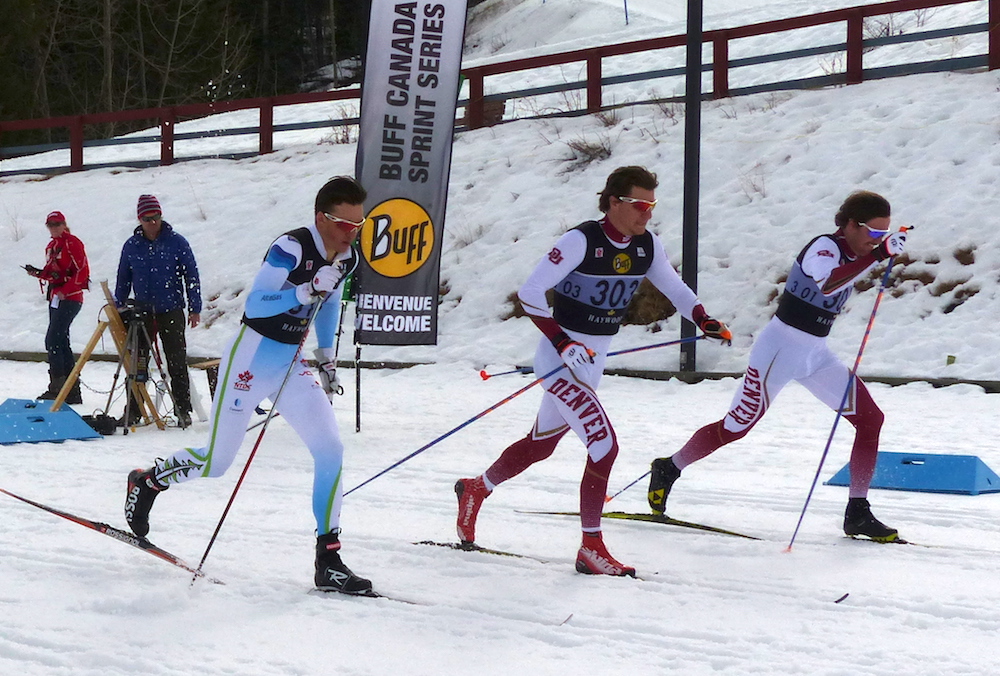
The start of the men’s 1.3 k classic sprint A-final at 2017 Canadian Ski Nationals on Wednesday in Canmore, Alberta, with Evan Palmer-Charrette (l) with the University of Denver’s Moritz Madlener (303) and Dag Frode Trollebø (301). Madlener went on to win, Trollebø placed second and Palmer-Charrette third. (Photo: Peggy Hung)
2017 Canadian Ski Nationals (Canmore, Alberta): Classic sprints
Emily Nishikawawon her second-straight race at Canadian Ski Nationals in Canmore on Wednesday, topping the women’s 1.3-kilometer classic sprint in slushy conditions for her second national title in as many days.
Emily Nishikawa (Canadian World Cup Team) racing to 38th on the final day of 2017 World Cup Finals on Sunday in Quebec City, the women’s 10 k freestyle pursuit. Wednesday at Canadian nationals marked her fifth race in six days. (Photo: John Lazenby/Lazenbyphoto.com)
Nishikawa, of the Canadian World Cup Team, initially posted the third-fastest qualifying time, 2.92 seconds behind qualifying winner Andrea Dupont (Rocky Mountain Racers), while junior Katie Weaver (Hollyburn Ski Club/NST Junior Team) qualified second (+0.43).
Nishikawa went on to win both her quarterfinal and semifinal before besting five others in the women’s A-final in 4:00.86 minutes. Dahria Beatty, of the Alberta World Cup Academy (AWCA) and Canadian U25 Team, finished 2.79 seconds later in second place and Katherine Stewart-Jones (NTDC Thunder Bay/NST U25 Team) followed in third (+3.14). Also reaching the A-final, Annika Hicks (AWCA) finished fourth (+21.37), and Sophie Carrier-Laforte, of the Pierre Harvey Training Centre (CNEPH) placed fifth (+45.63) and Alannah MacLean (NTDC Thunder Bay) did not start.
“Today with these soft, slushy conditions, it kind of played into my favour,” Nishikawa told FasterSkier in person on Wednesday. “I love classic sprinting, I always have. To pull enough energy together today was really great.
“It’s my fifth race in six days, so I’m really tired, but I couldn’t be happier right now,” she said. “To win two back to back national titles yesterday and today is really cool.”
In the junior women’s A-final, Annika Richardson (NTDC Thunder Bay/NST Junior Team) took the win in 4:05. Her Hollyburn club teammate, Weaver placed second (+4.48) and NTDC Thunder Bay teammate Lisle Compton finished third (+7.4). Also in the A-final, Zoë Williams (Nakkertok/NST Junior Team) placed fourth (+11.37), Hannah Mehain (Sovereign Lake Nordic/NST Junior Team) fifth (+25.75) and Catherine Reed-Métayer (Skibec/Quebec Ski Team) sixth (+1:05.44).
In the senior men’s 1.3 k sprint, Moritz Madlener beat his University of Denver teammate Dag Frode Trollebø by 0.5 seconds for the A-final win in 3:12.56. Madlener started the day by qualifying in third, 1.6 seconds behind Trollebø, the fastest qualifier, while Joey Foster (Team Hardwood) qualified second (+0.88).
Madlener went on to win both his quarterfinal and semifinal. So did Evan Palmer-Charrette (NTDC Thunder Bay), who qualified 14th and ended up third in the final, 3.76 seconds behind Madlener. With Madlener hailing from Germany and Trollebø from Norway, Palmer-Charrette was the top Canadian, ahead of Antoine Briand (CNEPH) in fourth (+10.53), Knute Johnsgaard (AWCA/NST U25 Team) in fifth (+12.65), and Michael Somppi (NTDC Thunder Bay) in sixth (+13.4).
“I tucked in behind the two guys from Denver,” Palmer-Charrette explained of his tactics in the final. “I knew they were going to put in a surge on the climb. I went inside to try and go past them, but they were smart, took the two outside tracks, which were still there; inside was really soft. I cut over to get behind them, but I lost a couple metres and just wasn’t able to get that back.”
Despite finishing behind them, Palmer-Charrette as the first Canadian earned his first national title at the age of 22, after rebounding from compartment-syndrome surgery last summer.
“[I] trained really hard after that,” he said. “It’s been a great year. … Awesome to be Canadian champion, surprise for sure in a classic sprint for me. Definitely not quite the Canadian field you’d see at a lot of Canadian nationals, a lot of guys sick and injured after World Cups on the weekend, but awesome nonetheless.”
Most notably, Canadian World Cup sprinter Len Valjas did not race.
Étienne Hébert (Quebec Ski Team/NST Junior Team) won the junior men’s A-final in 3:22.09, edging Nicolas Beaulieu (Orford/Quebec Ski team) by 0.55 seconds, and third-place finisher Larkin Wasmuth (Fort Saskatchewan Nordic Ski Club) by 0.68 seconds. Michael MacIsaac-Jones (AWCA) was in contention for a podium before crashing in the soft snow just before the finish. He ended up fifth (+11.63), behind American Nick Matelich (Bridger Ski Foundation) in fourth (+10.55) and ahead of Antoine Blais (Quebec Ski Team/NST Junior team) in sixth (+16.77).
The next senior races will be the long-distance freestyle mass starts on Saturday.
Alex Harvey racing in the men’s 15 k freestyle pursuit at Stage 4 of the Ski Tour Canada last year in Quebec City. (Photo: FlyingPointRoad.com/NNF)
For the second-straight year, the World Cup’s season-ending races will be held in Canada, with Québec City hosting 2017 World Cup Finals, this Friday through Sunday. Canada initially announced a roster of 30 (15 women, 15 men) for the three-day mini tour, and the U.S. selected 27 (15 women and 12 men), with both countries maximizing their Nation’s Group “home” quota for the event in downtown Québec City.
Note: On Tuesday, Cross Country Canada (CCC) announced it would be releasing a revised roster “due to some CPL points errors in calculations,” according to a press release. On Thursday, FasterSkier confirmed that the list included the same 15 women and 15 men that were originally published on FasterSkier.
And on Wednesday, Quebec organizers announced that the times of each race would be moved back an hour “upon FIS recommendation” to satisfy international broadcast schedules. The updated times are listed below.
2017 World Cup Finals race schedule (updated Wednesday):
(All times Eastern Daylight Time)
Friday, March 17: Freestyle sprint (qualifier starts at 11:45 a.m.; heats at 2:15 p.m.)
(Note: Jenn Jackson of Lappe Nordic declined her spot)
Men:
Alex Harvey (World Cup A-team)
Devon Kershaw (World Cup A-team)
Len Valjas (World Cup A-team)
Jess Cockney (World Cup B-team)
Graeme Killick (World Cup B-team)
Knute Johnsgaard (NST U25 Team/AWCA)
Russell Kennedy (Canmore Nordic/Team R.A.D.)
Gareth Williams (Junior NST/Telemark)
Andy Shields (Lappe Nordic)
Bob Thompson (NTDC Thunder Bay)
Joey Foster (Team Hardwood)
Julien Locke (NST U25 Team/AWCA)
Evan Palmer-Charrette (NTDC Thunder Bay)
Brian McKeever (Canadian Para-Nordic Ski Team)
Ricardo Izquierdo-Bernier (CNEPH)
USA
Women:
Kikkan Randall (U.S. Ski Team A-team/APU)
Sadie Bjornsen (USST A-team/APU)
Liz Stephen (USST A-team)
Caitlin Patterson (CGRP)
Rosie Brennan (USST B-team/APU)
Erika Flowers (SMS Elite)
Jennie Bender (BSF)
Julia Kern (USST D-team/SMS Elite)
Liz Guiney (CGRP)
Kaitlynn Miller (CGRP)
Chelsea Holmes (APU)
Becca Rorabaugh (APU)
Jessie Diggins (USST A-team/SMS Elite)
Sophie Caldwell (USST A-team/SMS Elite)
Ida Sargent (USST A-team/CGRP)
(Note: Katharine Ogden, of the SMS Elite Team and U.S. Ski Team D-team, declined her spot due to “ongoing stomach issues,” according to U.S. head coach Chris Grover. Guiney was the first alternate as she was next on the SuperTour list.)
Men:
Andy Newell (USST A-team/SMS Elite)
Noah Hoffman (USST B-team/Ski Club Vail)
Erik Bjornsen (USST B-team/APU)
Matt Gelso (SVSEF)
David Norris (APU)
Ben Lustgarten (CGRP)
Cole Morgan (SVSEF)
Patrick Caldwell (USST D-team/SMS Elite)
Jack Hegman (SVSEF)
Brian Gregg (Team Gregg/Loppet Nordic Racing)
Scott Patterson (APU)
Simi Hamilton (USST A-team/SMS Elite)
A view from the steep hill on the sprint course with the stadium area in background, as seen during training last year in Quebec City, one day before the third stage of the 2016 Ski Tour Canada. (Photo: John Lazenby/Lazenbyphoto.com)
Canmore’s Annika Hicks (54) finished second in the women’s 15 k classic mass start on the final day of Western Canadian Championships on Feb. 21, just ahead of Katherine Stewart-Jones (NDC Thunder Bay) in third. (Photo: Sally Connon)
Western Canadian Championships, the final NorAm weekend of the season took place Feb. 19-21 at the Otway Nordic Center in Prince George, B.C., with three races determining the final Ski Tour Canada (STC) roster for Canada.
Dahria Beatty and Kevin Sandau left British Columbia as the overall NorAm leaders, granting them starts at the STC eight-stage World Cup.
Beatty won the women’s 7.5-kilometre freestyle individual start on Friday, Feb. 19, by nearly 11 seconds in 19:02.7 to retake the NorAm lead from fellow U23 Development Team skier, Cendrine Browne, of the Pierre-Harvey National Training Centre (CNEPH).
“I went out as if I was only racing 5km,” Beatty recalled in an email. “I felt really good on the first lap and then started to fade on the second lap as my legs filled with lactate. The downhills on the second lap were the hardest part as I struggled to stay on my feet I was so tired. I managed to regain a bit of composure for the final climb and hold onto the lead I had fortified on the first lap. This was my first time racing in Prince George and I really enjoyed the trails. Lots of fun and very technical!”
U23+ Development Team skier Olivia Bouffard-Nesbitt finished second (+10.9), while Maya MacIsaac-Jones, of Rocky Mountain Racers (RMR) was 45.8 seconds behind in third, edging Annika Hicks (Canmore) by 2.1 seconds, for her first NorAm distance podium of the season.
“I’m definitely happy with the upward trend I’ve been experiencing,” Bouffard-Nesbitt wrote. “The only thing lacking is some power, but that is a result of my (lack of) summer training, so there’s nothing I can do about that now. I’m super excited to race some World Cups though!”
Browne, citing fatigue after an altitude training block, finished fifth, 52.1 seconds behind Beatty.
“I already knew in my warm up that something was wrong. I wasn’t feeling good,” Browne wrote in an email. “In the race, everything was confirmed. I felt awful. I couldn’t push my body was tired.”
“When my coach called me on the phone and asked how my race went and when I said it was awful, he just said: Perfect, the altitude camp is working,” Browne added. “I was surprised by his answer but it cheered me up a little. He also said it would be hard doing the sprints too.”
***
Day 2 brought another win for Beatty at Saturday’s 1.4 k classic sprint, as she beat out Bouffard-Nesbitt in the finishing straight to win by half a second in 3:44.2.
“I felt good in my semi and was able to carry that feeling into the final,” Beatty wrote. “Olivia led the entire race, she was skiing well and had a faster start than me to get out in front early. I just sat in behind her on both climbs as the middle track was a lot better than the two outside ones. You come into the finish off a downhill so I used her draft to step out beside and sprinted to the finish. I had a comfortable advantage by halfway down the finish shoot and carried that to the finish.”
“I raced the final how I wanted to,” Bouffard-Nesbitt explained. “I led the whole race and unfortunately got out-sprinted at the finish. It was a good wake up call, because now I can hit the gym and do some biceps curl reps to have me ready for the tour.”
“It was a good wake up call, because now I can hit the gym and do some biceps curl reps to have me ready for the tour.” — Olivia Bouffard-Nesbitt on finishing second in the Westerns classic sprint
MacIsaac-Jones again snatched the final podium spot, 4.55 seconds behind Beatty, ahead of Katherine Stewart-Jones (NDC Thunder Bay) in fourth. Beatty’s second win of the weekend locked up her hold of the overall NorAm. MacIsaac-Jones took the NorAm sprint lead, displacing teammate Andrea Dupont, who skipped Westerns while racing Period 3 on the World Cup in Europe.
“I went in today wanting to win, but I’m satisfied with a bronze medal,” MacIsaac-Jones wrote. “The race was good redemption for me from the Canada Winter Games race on this course last year, where I didn’t make the A Final. It was also a big improvement from my classic sprint at the Canmore NorAm in december, where I also didn’t make the A Final.
“I knew that Dahria and Olivia would go for it once we hit the big climb so I just tried to hang on, but they were too fast for me and I wasn’t able to stick with them,” she added. “Katherine moved up beside me on the final climb, but I managed to hold her off and hang on to 3rd which I was really happy with.”
As planned, Beatty headed home Sunday morning to start her final STC preparations.
***
In Sunday’s 15 k classic mass start, Browne skied away to a 52-second victory in 46:00.1, while Hicks took second, 0.6 seconds ahead of Stewart-Jones in third.
“I felt very good! The shape is back,” Browne wrote on Sunday. “Annika, Katherine and I stayed together for 2 and a half laps (we had 4 laps of 3.75km to do). I was feeling good today so I started going a little harder on the 3rd lap and starting the 4th lap, I knew I was by myself. I had really good kick so climbing the big climbs was where I knew I could break away. I went even harder on the last lap just to make sure the girls couldn’t catch up to me.”
Junior Katie Weaver (Hollyburn) continued her steady rise, skiing with the lead three for the first lap before falling off the pace and finishing 2:48.1 back in fourth.
Many of the STC-bound skiers skipped the distance race on Sunday.
***
Black Jack’s David Palmer (l) leading early in the men’s 20 k classic mass start on the final day of Western Canadian Championships in Prince George, B.C., with Michael Somppi, Evan Palmer-Charrette, Andy Shields, and Patrick Stewart-Jones (r) chasing. (Photo: Sally Connon)
On the men’s side, Andy Shields (NDC Thunder Bay) was within striking distance of Sandau’s overall lead before the weekend. With the third-ranked man, Knute Johnsgaard (AWCA/NDST) focussing on a training block before STC, it was a two-way fight for the title.
In Friday’s 10 k freestyle individual start, Russell Kennedy (Canmore) snatched the victory in 22:19.1, edging Sandau by 0.4 seconds and Michael Somppi (NDC Thunder Bay) by 2.5 seconds, for his first NorAm win of the season.
“I was super pumped in my race today feeling was amazing conditions were really good and the downhills were fast and technical,” Kennedy wrote in an email.
“There wasn’t much of a pacing strategy as it was 10k so really just had to start fast and hold on to as hard a pace as possible,” he added. “The splits were close so I knew I had to push it. I was feeling confident when we were close at the top of the last hill as I love downhills and have a good sprint. I didn’t really realize just how close it was until the after I finished though.”
Sandau wrote in an email that he was happy to finishing in the top four considering how close it was, but always wants the win, especially considering how close he was behind Kennedy.
“I’ve been teasing him all winter about nicking him in the distance races so he served up a nice rebuttal today,” Sandau wrote. “… I went off the line hard knowing there wasn’t room for mistakes and a lot of places to give up time. I was getting splits off Russell near the end that he was leading so I tried to claw back some time in the last few climbing sections but was just shy of enough.”
“It’s a really good course for [Russell] and I knew with his consistency in skate races he was going to be one of the bigger threats out there,” Sandau added. “Plus he’s pretty good when he clips into a pair of alpine skis so the downhills were probably pretty easy for him, compared to me who felt like a tourist out for the first ski of the year at times.”
Somppi in third described his race as “solid.”
“The fitness is as good as it’s going to get at this point,” he wrote. “Now, it is all about finding the right mix of recovery and intensity to be primed and full of energy when the Tour starts.”
Shields finished fourth, 9.7 seconds back, to stay in mathematical contention. To take the title, Shields would need at least a win and a second in the final two races.
“I started pretty hard, got tired and had a rough middle section,” Shields wrote. “I was still getting good splits going into the last 4km so I was able to find some juice to finish off and still have a respectable split for the last lap.”
***
Bob Thompson (NDC Thunder Bay) racing to second in the men’s classic sprint qualifier at Western Canadian Championships in Prince George, B.C. He went on to win the men’s final. (Photo: Sally Connon)
Bob Thompson (NDC Thunder Bay) won the men’s 1.4 k classic sprint on Saturday, retaking the sprint series lead and the automatic STC start from Julien Locke (Black Jack), who was in Romania for U23 World Championships this week. Thompson needed the win to eclipse Locke in the sprint standings, taking the series 250 points to Locke’s 245.
Also in the sprint final, Patrick Stewart-Jones (AWCA) placed second and Shields finished third. Sandau went out in the quarterfinals, having achieved his training goals.
“Very happy that I was able to win when I needed to,” Thompson wrote in an email. “To win the NorAm sprint spot for the Tour of Canada I had to win to get enough points. Patrick was in the same position so I knew we would both be giving our all to lock the spot down. Was great that I was feeling really strong and had my best qualifier of the year as well.”
Thompson qualified second behind Skinouk’s Simon Lapointe, who went on to place sixth in the final.
***
Evan Palmer-Charrette (NDC Thunder Bay) outlasted teammate Andy Shields (l) and Patrick Stewart-Jones (AWCA) for the win in the men’s 20 k classic mass start on Sunday, Feb. 21, at Western Canadian Championships in Prince George, B.C. (Photo: Sally Connon)
On Sunday, Evan Palmer-Charrette (NDC Thunder Bay) won a four-way race for first in the 20 k classic mass start. Shields finished second, 0.111 seconds back, and Stewart-Jones was third (+0.525). Somppi lost his balance in the final straight and finished fourth, 1.24 seconds behind Palmer-Charrette. David Palmer (Black Jack) was dropped during the final lap to take fifth, 13.9 seconds out of first.
“I am quite happy with my race Sunday but overall the weekend was a bit disappointing,” Palmer-Charrette wrote. “The 10km skate on Friday is what I would pick as my strongest event and I really struggled that day. I had the race I wanted to on Sunday and am looking forward to next season!”
“The race on Sunday was a lot of fun, skiing at the front with my team-mates…,” Somppi wrote. “Tactically, I put myself in a great position to win. I led the final climbs, pushing the pace, and crested the final downhill in second, right behind Evan. Unfortunately I hit a patch of ice on the final downhill corner and stumbled, nearly crashing. Instead of using the draft and coming up beside Evan in the finish to contend for the win, I was double poling early in the finish stretch, trying to regain my speed.
“I feel a little gypped after this weekend, to finish 3rd and 4th when I was only 2.5 seconds from winning one day and 1 second from winning the other day,” Somppi, last year’s NorAm winner, added. “I’m hoping my luck will turn in the Tour.”