From the FasterSkier archive — posts syndicated from athletes’ and coaches’ own blogs between 2004 and 2012, kept online as published. Current coverage is at fasterskier.com.
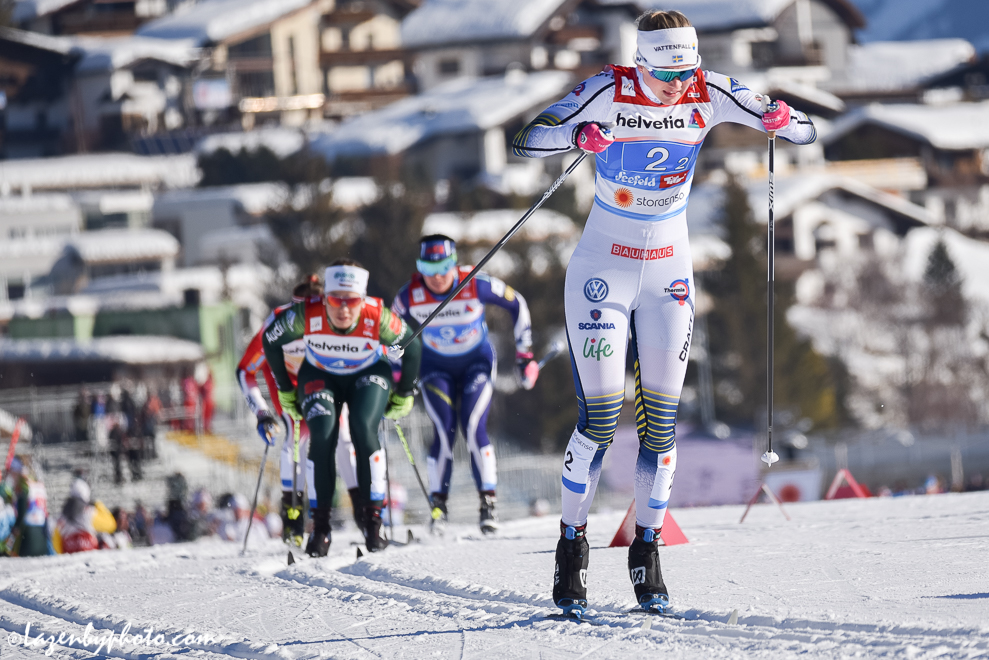
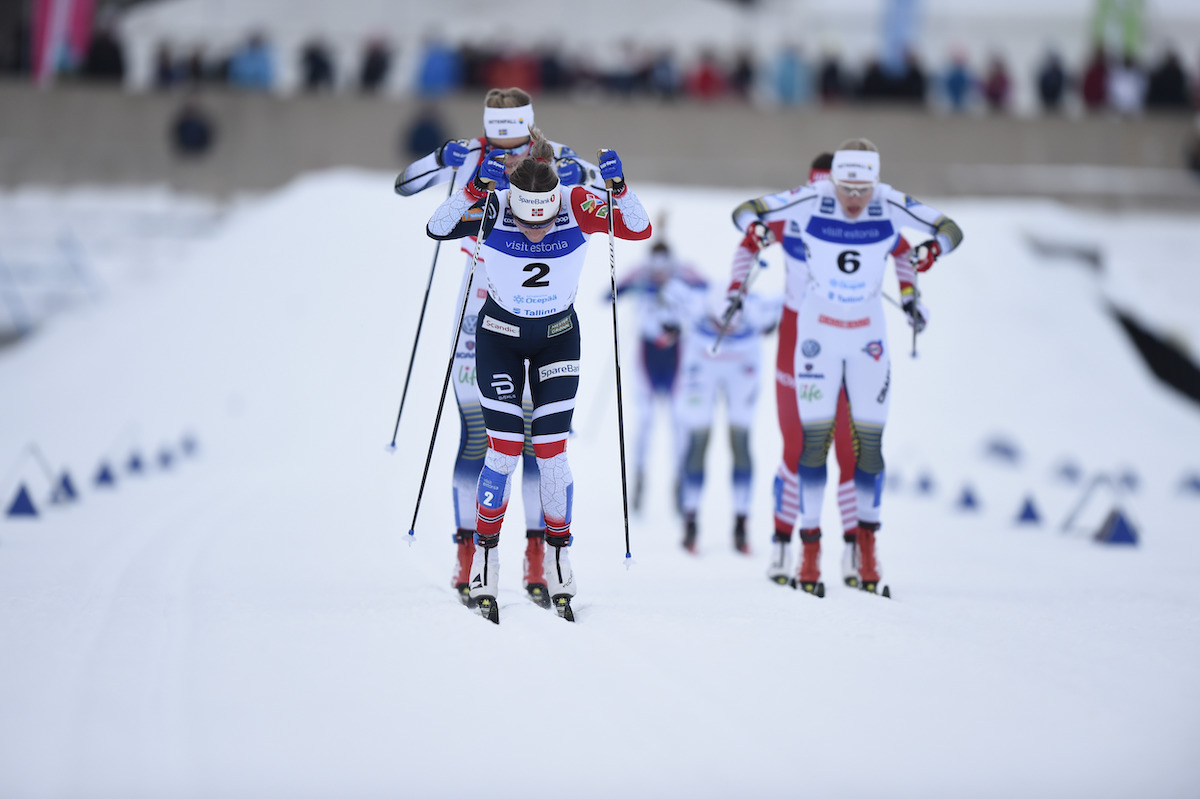
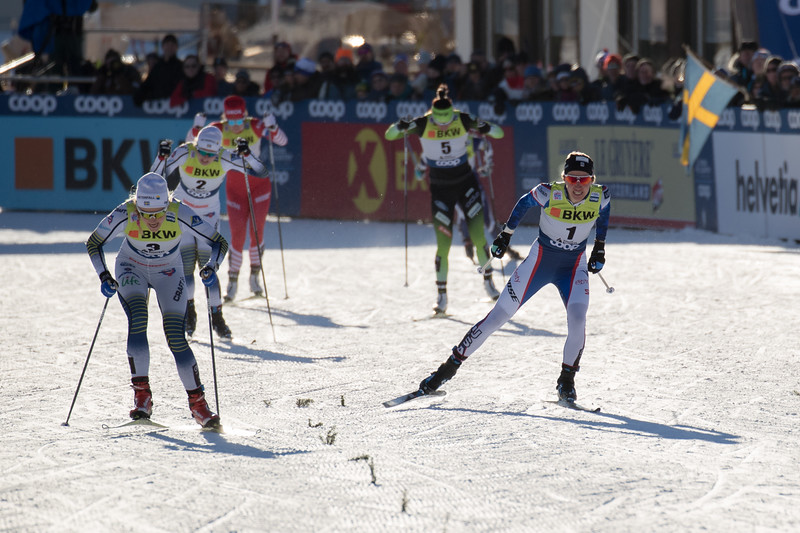
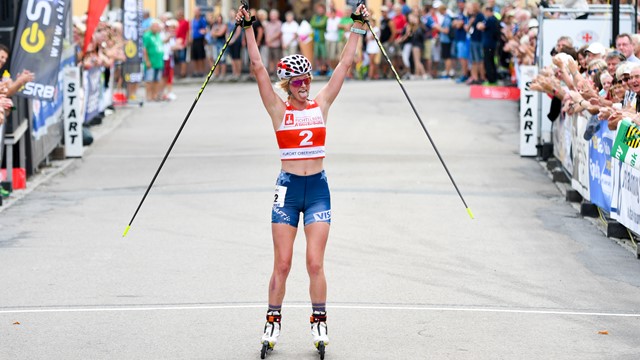
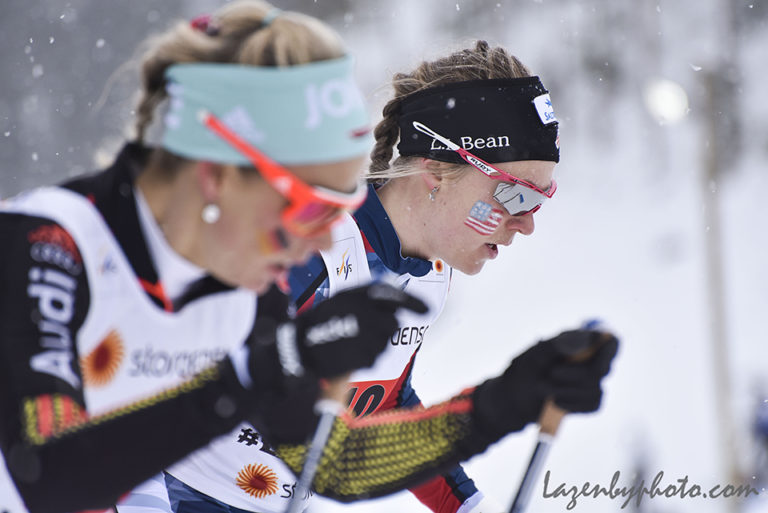
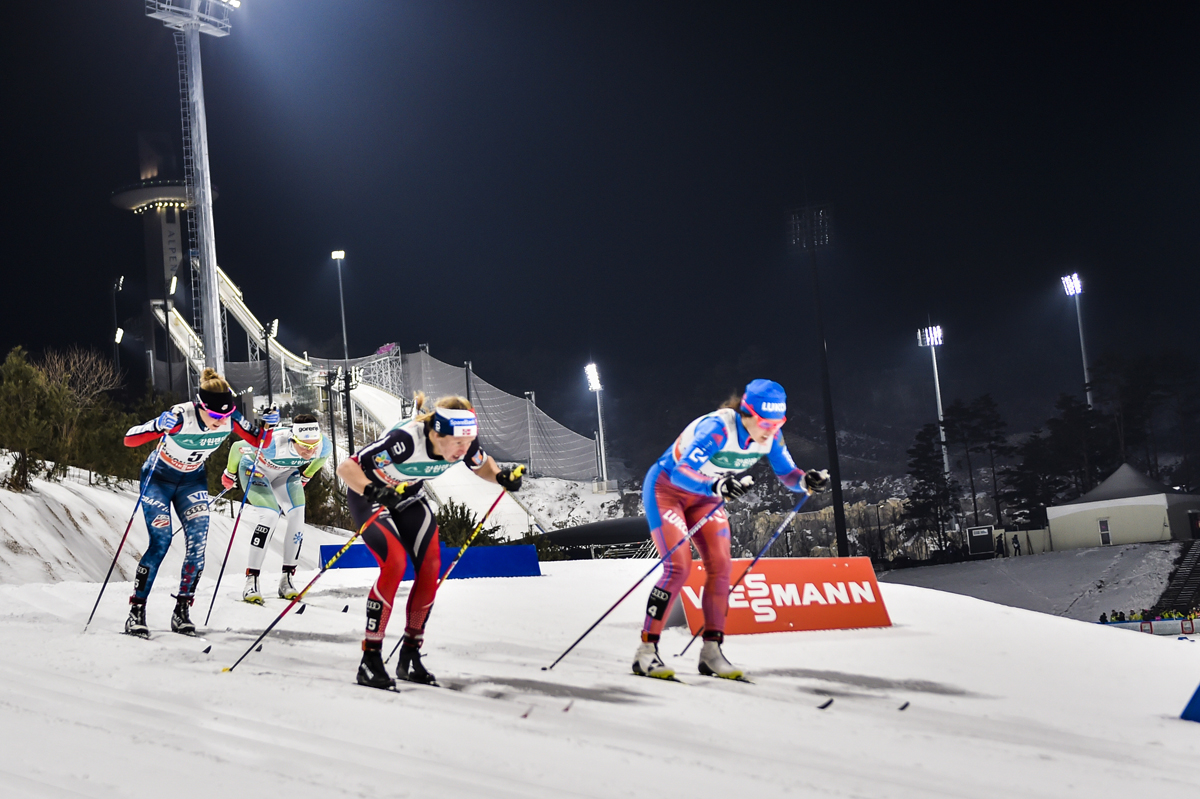
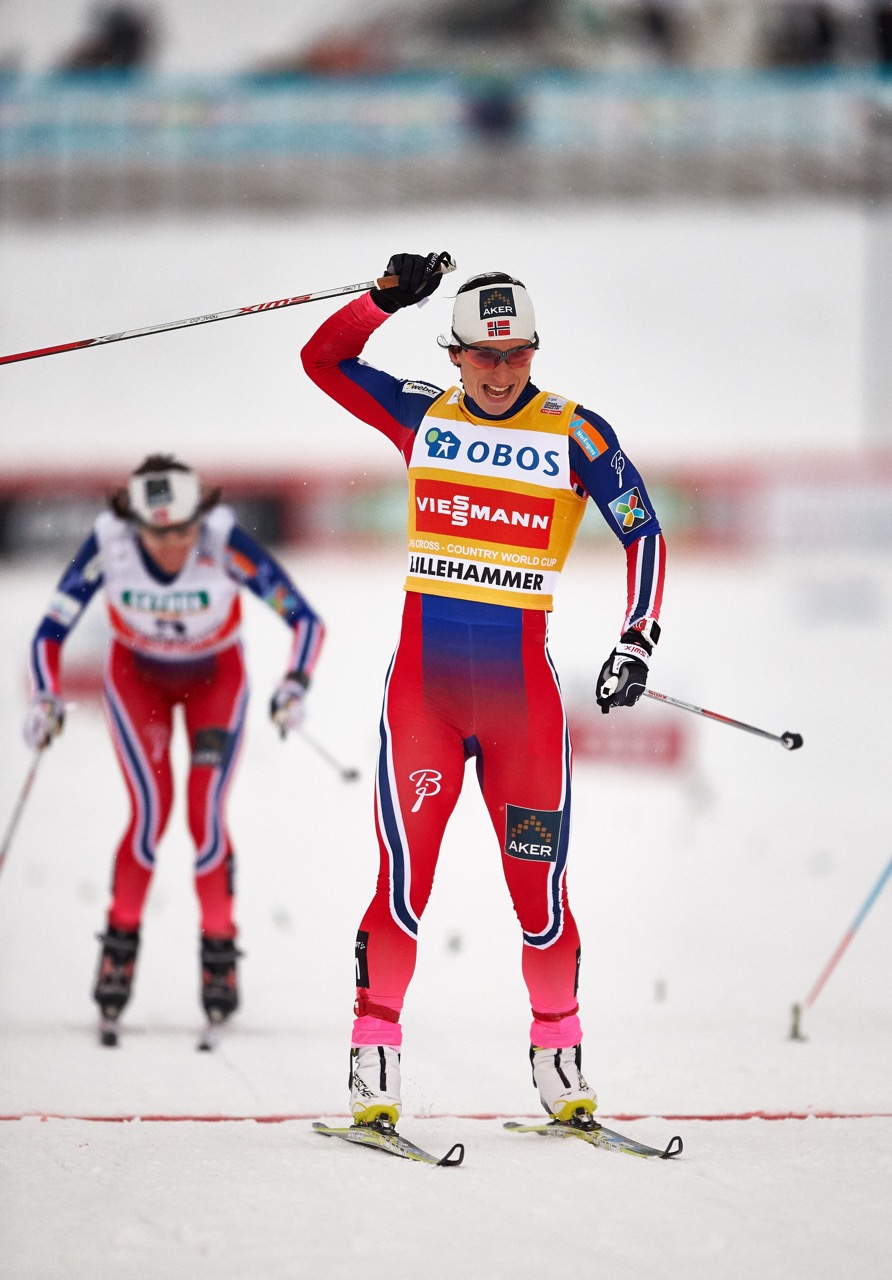
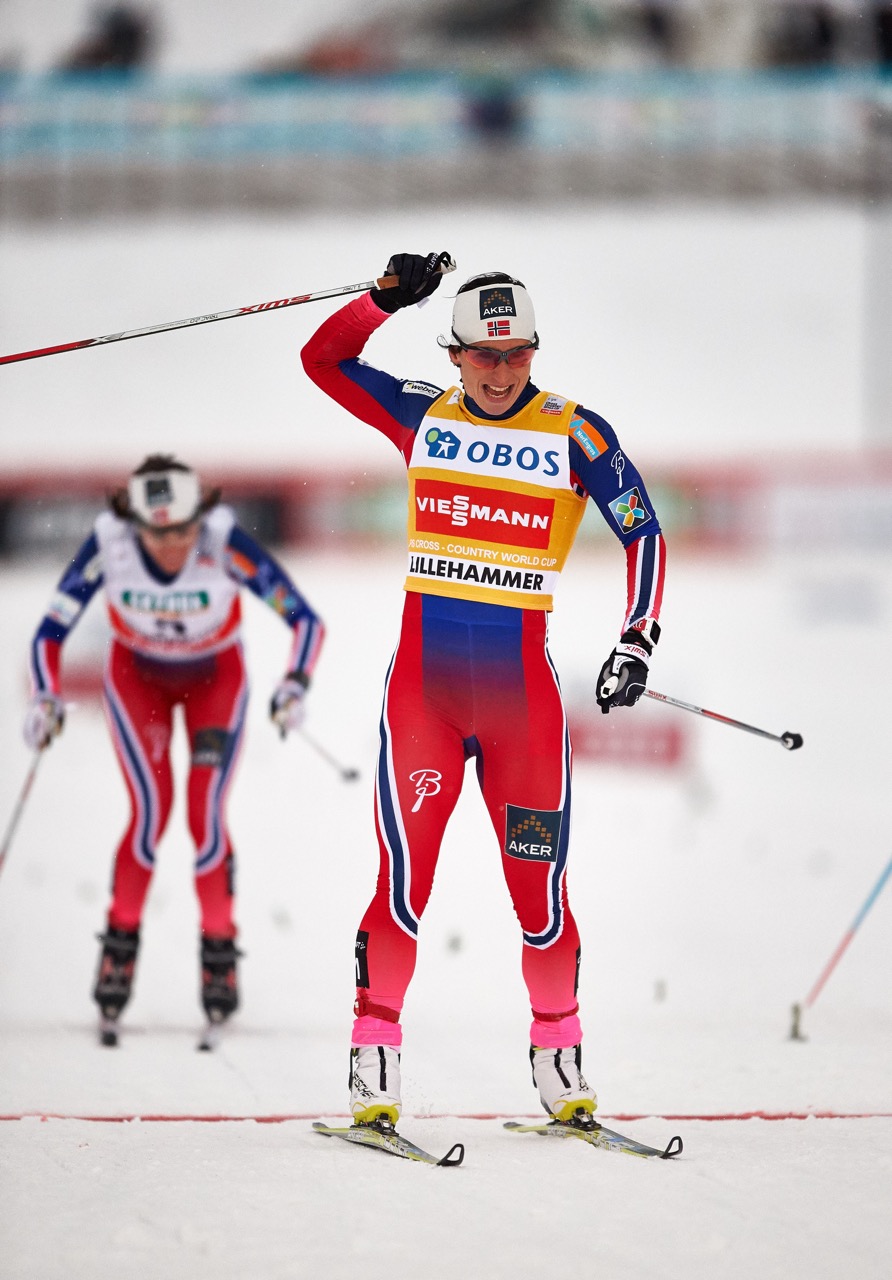
Hips forward and drive…As clutch as they come – Sweden’s formidable Maja Dahlqvist (bib 2) during the women’s 6 x 1.2 k classic team sprint at the 2019 World Championship in Seefeld, Austria. (Photo: John Lazenby/lazenbyphoto.com)
Icy tracks and a relatively flat course made for a tight race in Seefeld, Austria for the women’s 6 x 1.2-kilometer classic team sprint. Even in the final meters as the women charged up the last climb and double poled to the finish, the winner was not clear. In fact, the three fastest teams were within one second of one another. The resulting time difference between first and fifth place was less than the difference between the gold and silver medalist teams in Lahti, Finland in the 2017 World Ski Championships.
A team sprint can often play out like a jack-in-the-box; in the first four legs, the women look calm and controlled, steadily winding up the tempo as the race progresses. The final two legs are explosive.
This was the case today as Norway’s Maiken Caspersen Falla tagged her teammateIngvild Flugstad Østberg for the last time amidst a pack of seven nations all within three seconds. Østberg powered through the course with a fiery purpose, trying to create a gap that would allow her and her teammate to repeat their victory in the event during the 2015 championship. Her move was matched by the teams from Sweden, Slovenia, and Russia, with Sadie Bjornsen of the United States just behind their tails.
Russia’s Natalia Nepryeava challenged Østberg and took the lead before rounding a hairpin turn and descending in a tuck toward the stadium, but as she tagged her teammate, Yulia Belorukova, the Norwegians, Swedes, and Slovenes all remained less than 1.5 seconds back. Bjornsen tagged her partner Jessie Diggins in fifth only 2.7 behind.
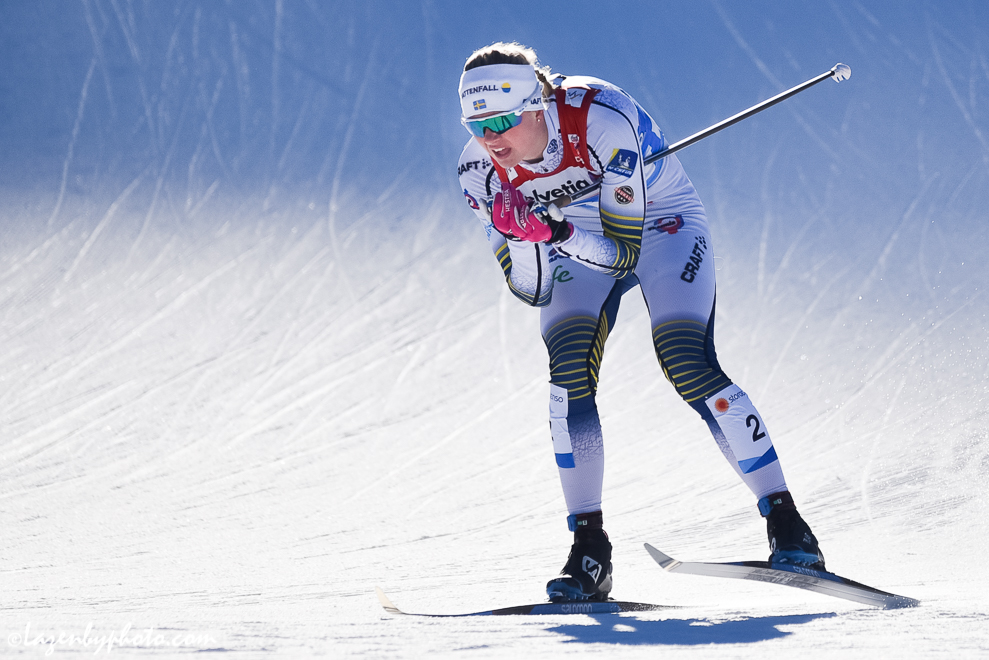
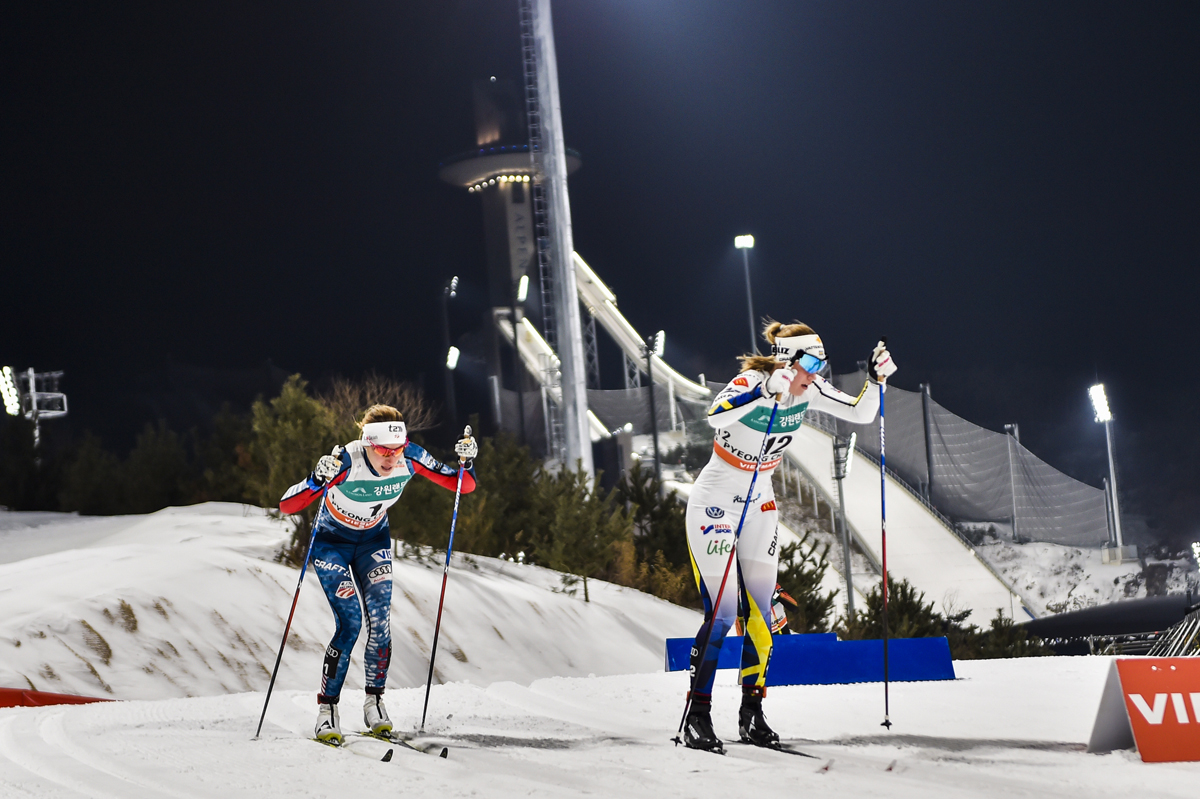
Sweden’s Maja Dahlqvist during the women’s 6 x 1.2 k classic team sprint at the 2019 World Championship in Seefeld, Austria. (Photo: John Lazenby/lazenbyphoto.com)
In the final lap, Falla charged to the front to take the lead for Norway. Maja Dahlqvist of Sweden and Anamarija Lampic of Slovenia went with her, as Belorukova began to fade a few meters behind. The lap seemed to dissolve in a heartbeat, as the four women found themselves rounding the last turn. Dahlqvist, who had been tucked in behind Falla, slingshot around her and into the lanes and began double poling rapidly to the finish. Falla could not match her pace, and as she lost touch with the Swede in the final meters, Lampic surged to seize silver.
The gold medal team of Nilsson and Dahlqvist stopped the clock in a time of 15:14.93, with Slovenia’s Katja Visnar and Lampic just 0.37 seconds behind. Østberg and Falla took bronze (+0.60), followed by the Russians in fourth (+0.93), and the Americans in fifth (+2.79).
“Really really good,” added Dahlqvist as the two laughed. “It was really tight today, but I felt strong in the end, so it was good.”
The duo could not contain their excitement as they reflected on their narrow victory. They had already demonstrated their ability to excel on the course in Thursday’s individual skate sprint, but in the final Nilsson was unable to match Falla and a crash took Dahlqvist out of contention.
“I felt really powerful today,” said Nilsson. “I like the course – it’s very fast and you have to be very focused and not let anyone pass you in the wrong places. When Maya crossed the finish line first it was like euphoria.”
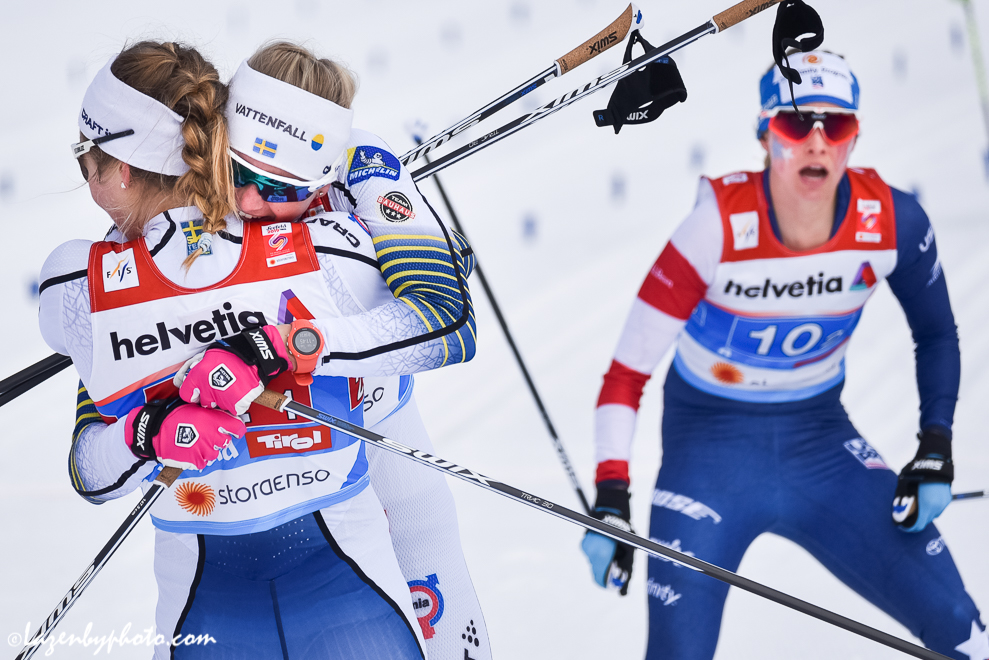
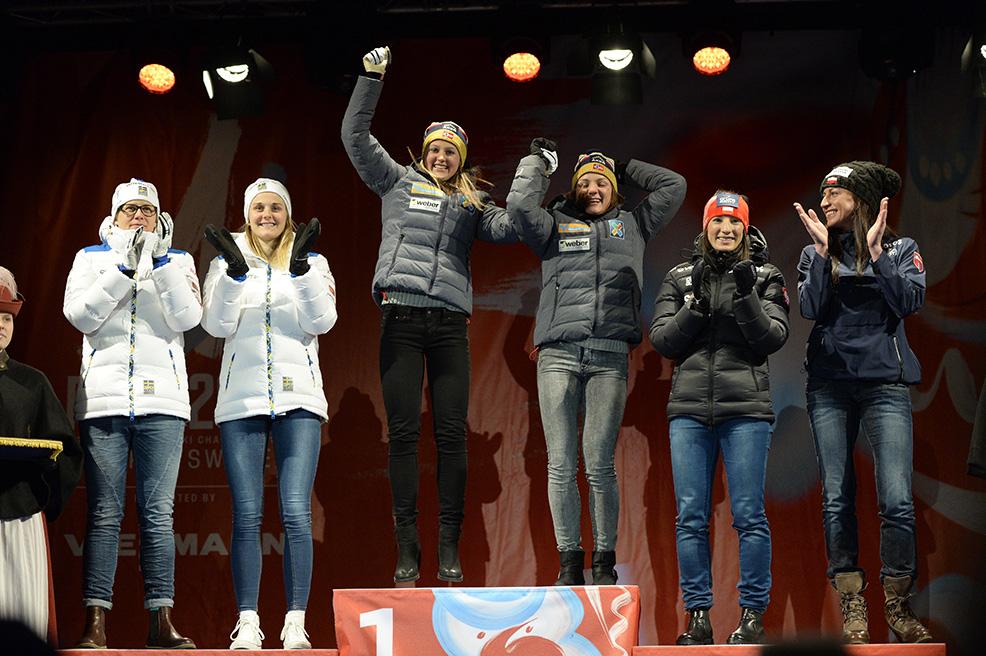
Sweden’s winning duo –Maja Dahlqvist embracing teammate Stina Nilsson at the 2019 World Championships in Seefeld, Austria. (Photo: John Lazenby/lazenbyphoto.com)
Today’s medals are the fifth in this World Championships for Sweden and the sixth for Norway. While Falla certainly hoped to add a third gold to her collection of team sprint medals, her bronze is her fourth medal in the event, making her the most decorated woman in the team sprint.
For Slovenia, earning a silver medal is a leap from their last two results in World Championships and their best result overall in a World Championship event. Visnar was part of both sprint teams, contributing to a 9th place finish in 2015 and an 8th in 2017. During the 2018 Olympics, Lampic and her partner took sixth.
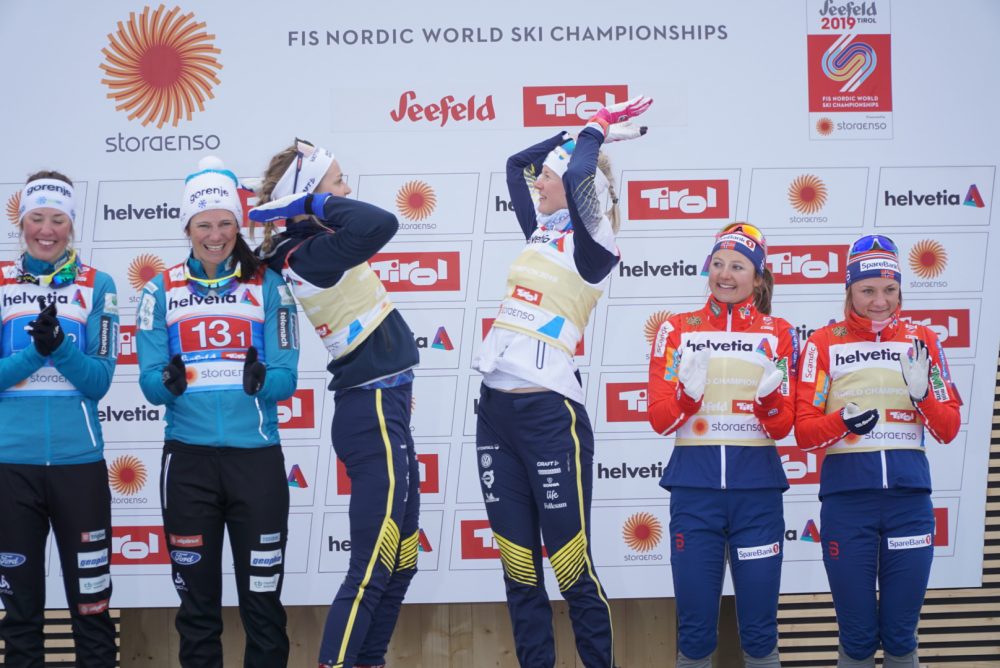
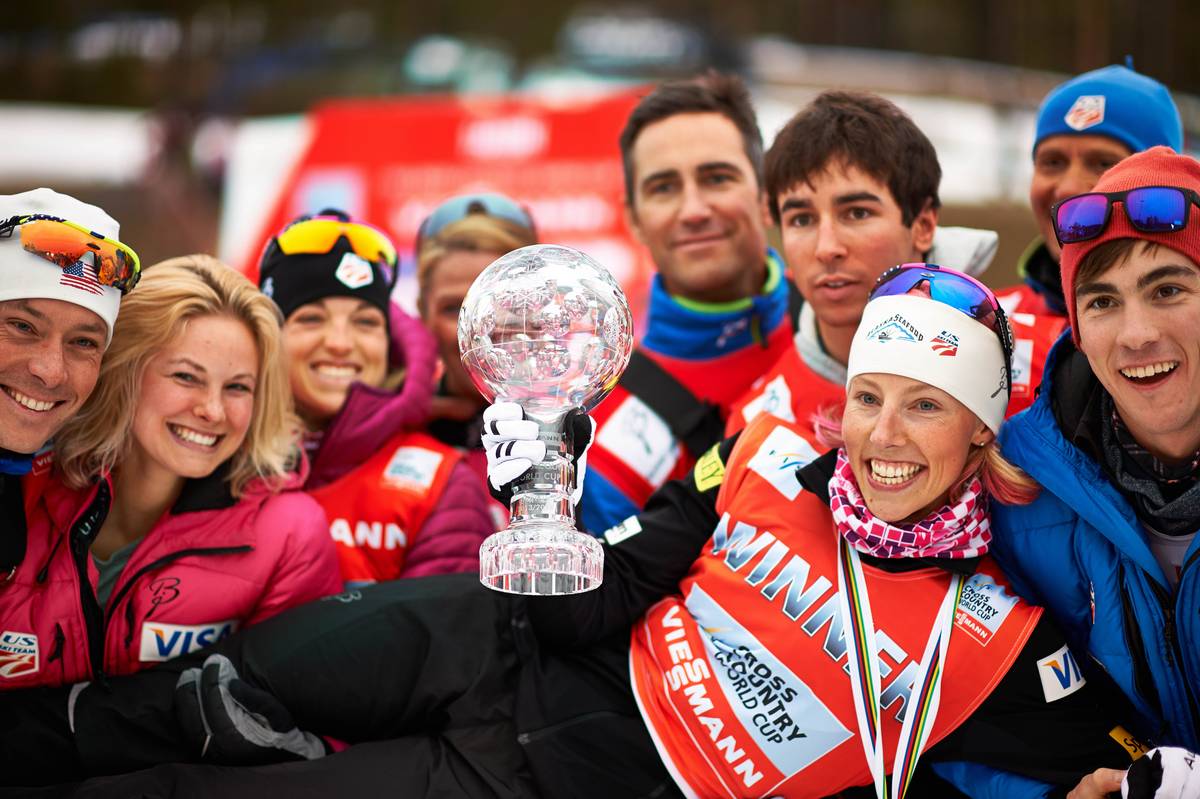
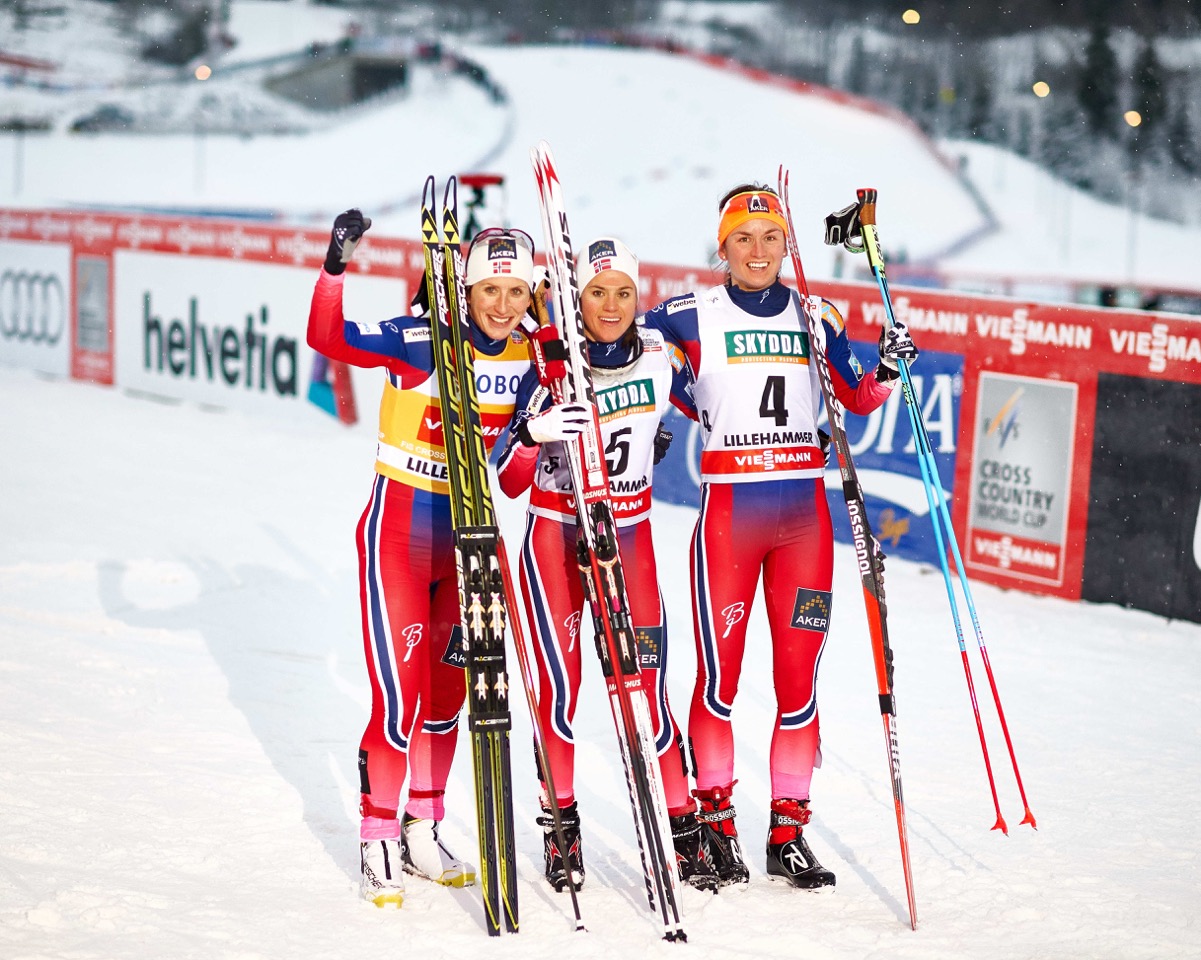
Sweden (c) wins the women’s 6 x 1.2 k classic team sprint at the 2019 World Championships in Seefeld, Austria. Slovenia (l) took second place, with Norway (r) in third. (Photo: John Lazenby/lazenbyphoto.com)
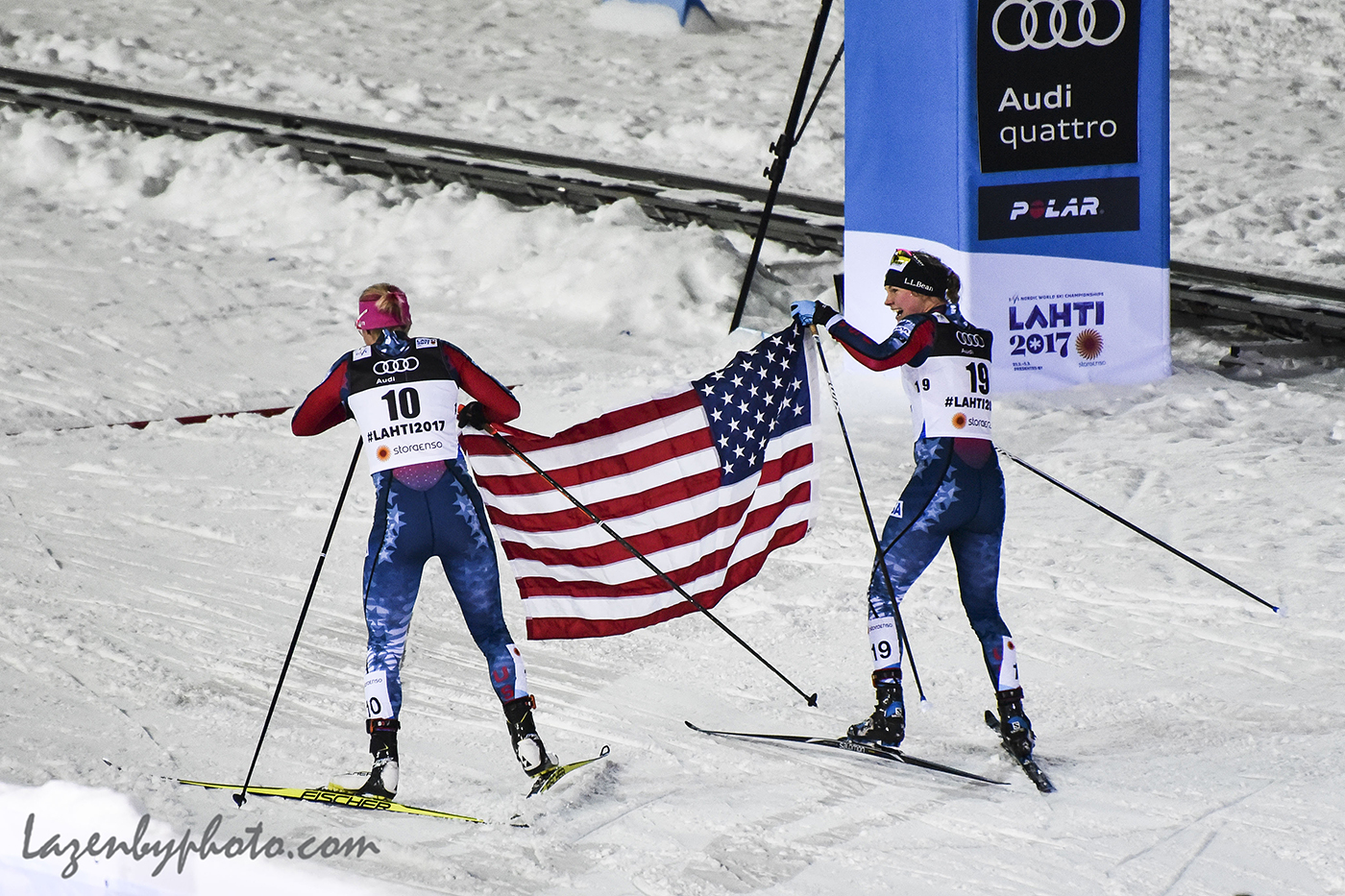
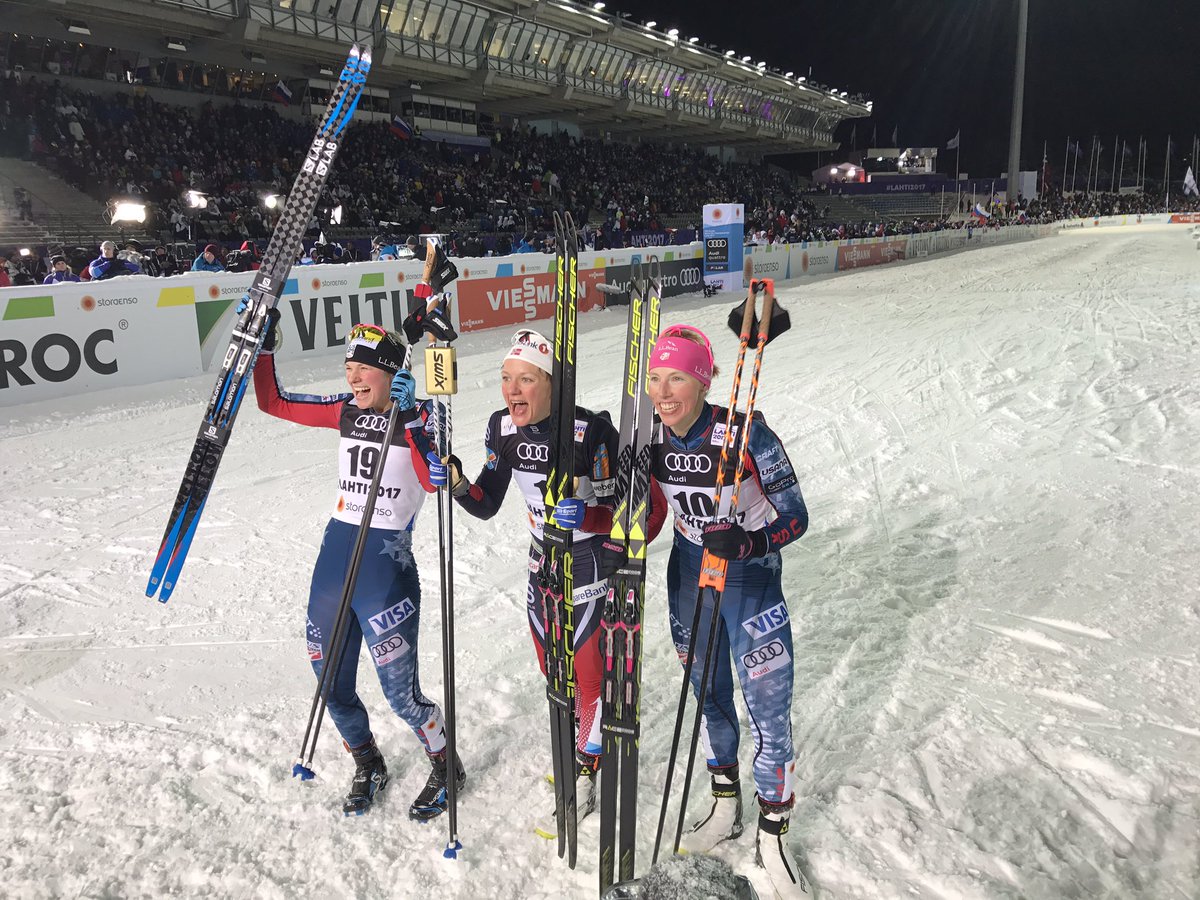
After the team of Bjornsen and Diggins finished third in the classic team sprint in Lahti in 2017, and Diggins won gold with Kikkan Randall in the skate sprint during the 2018 Olympics in PyeongChang, the United States was looking for more from today. Though both women can excel in both distance and sprint events, the short course in Seefeld was not their forte.
“It was a little frustrating for me just because – you can never pick the course, but it didn’t suit our strengths in particular,” explained Diggins in a call. “It’s situationally frustrating simply because I know that we are in good shape and we have more than we were able to show today because it ended up being about your fast-twitch sprinting at the end, and we both felt like we were a little bit stuck. We couldn’t get out to push the pace earlier in the race.”
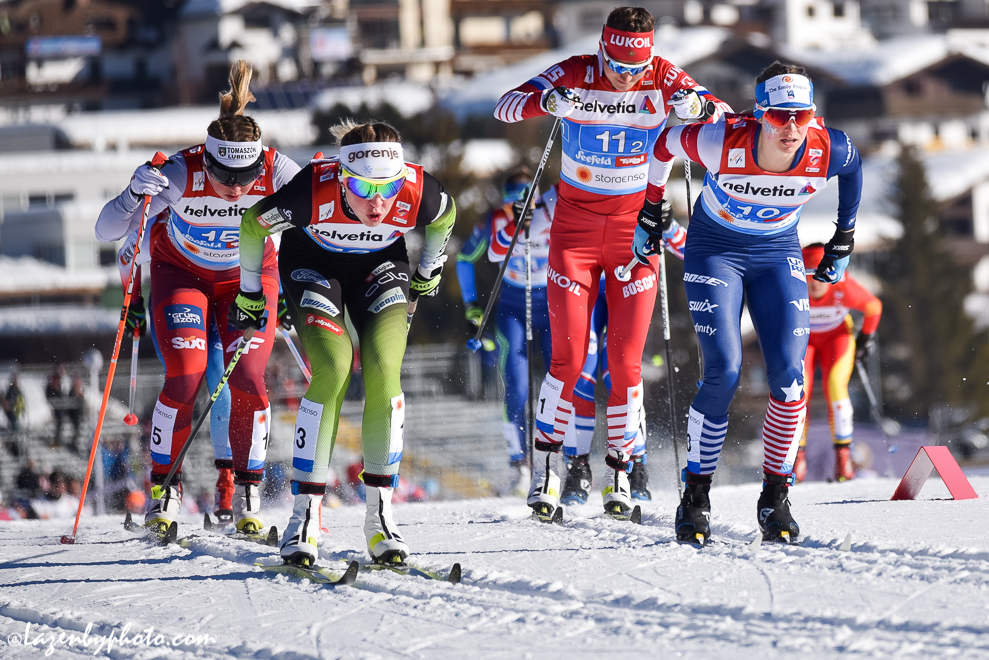
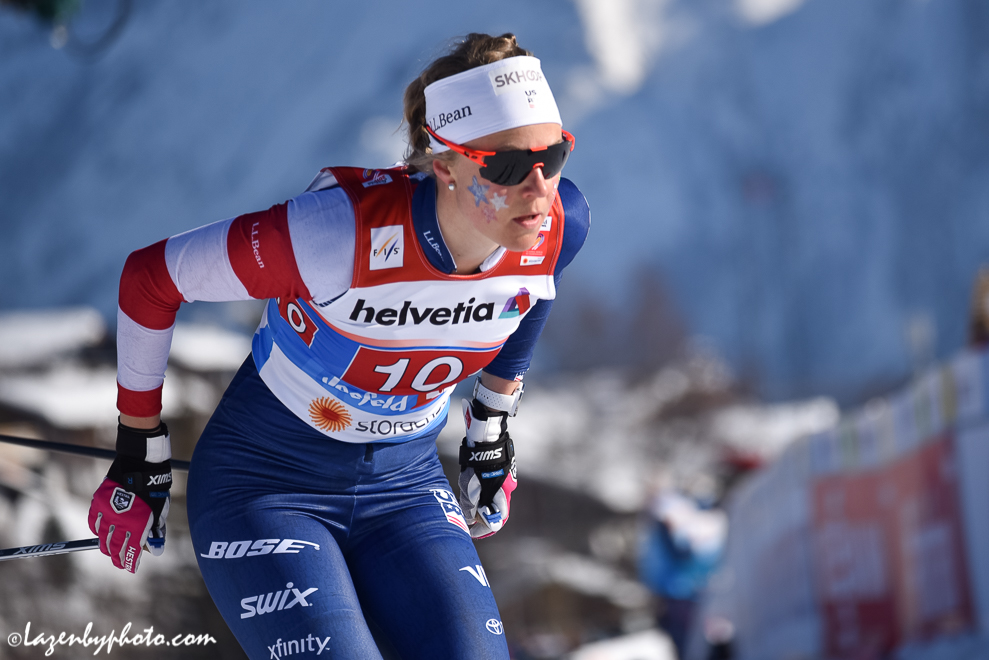
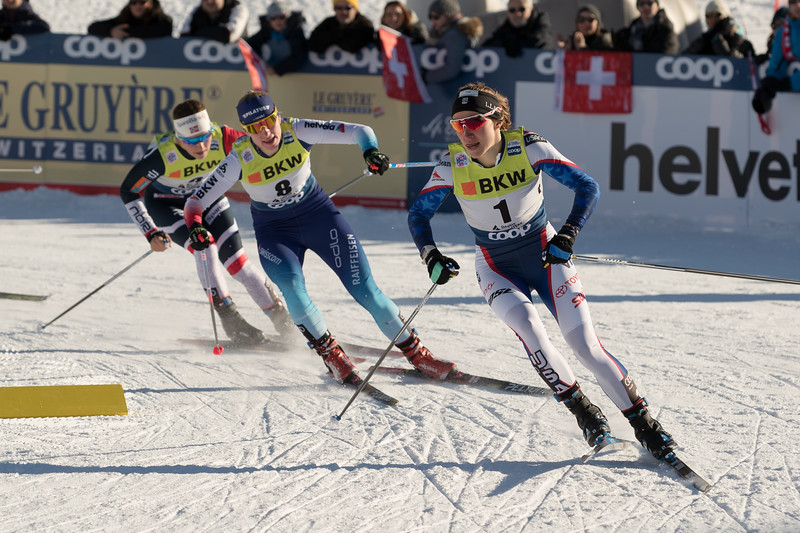
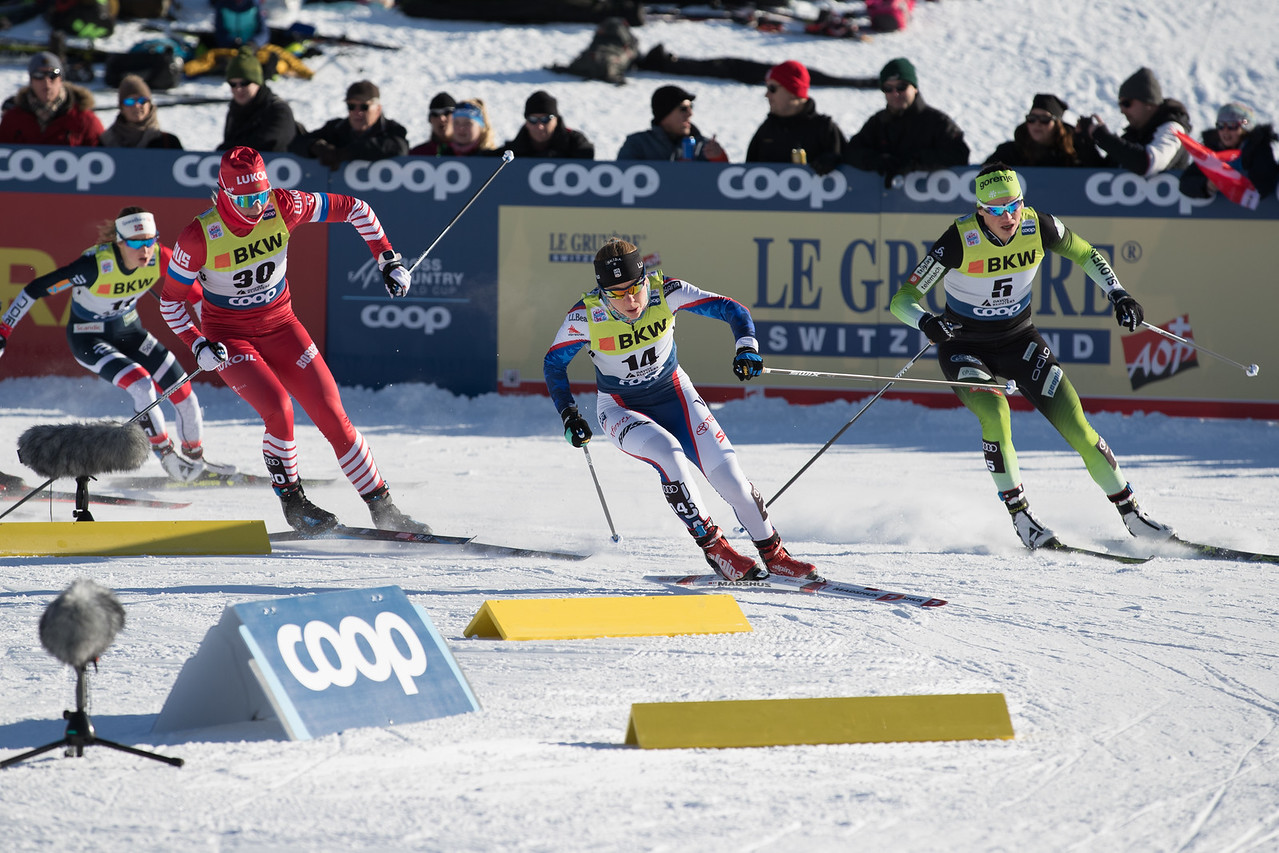
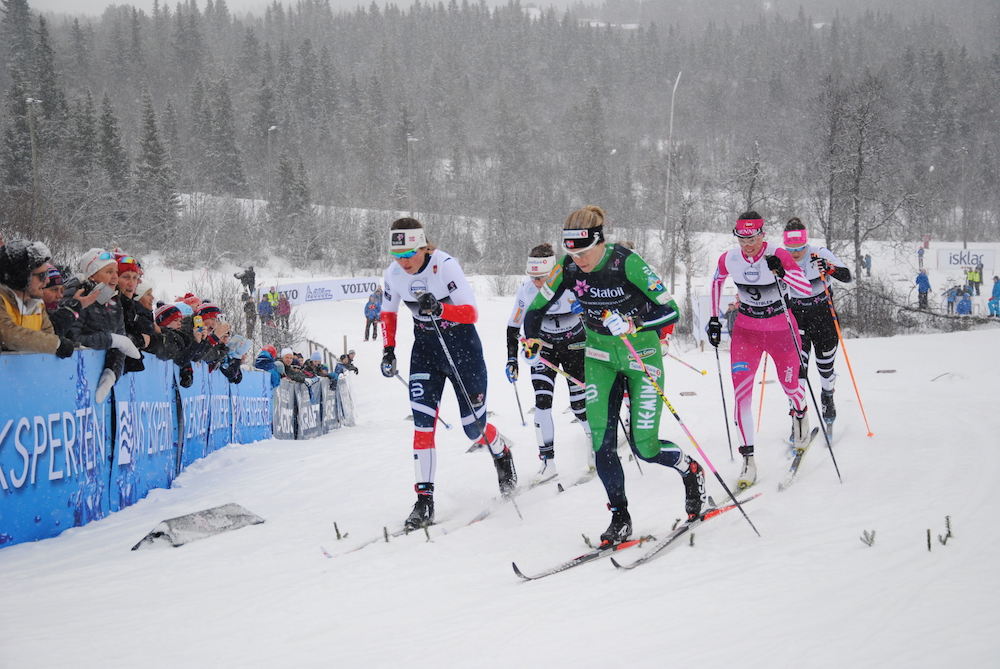
In bib 10, the U.S. Ski Team’s Jessie Diggins pulls a string of skiers along on the inside track during the women’s 6 x 1.2 k classic team sprint at the 2019 World Championship in Seefeld, Austria. (Photo: John Lazenby/lazenbyphoto.com)
Without the long climbs of the courses in Korea or Finland, racers could not spread themselves out, making the race more about tactics and raw speed, versus endurance and climbing strength.
“So, it was just a different kind of course, it was a different kind of team sprint, and it was more tactical and fast twitch than grinding it out,” Diggins concluded.
In the semi-finals, the US team finished fourth, advancing to the final as lucky losers.
“I think that after the semi’s we were all kind of like, ‘Whoa! Okay! It’s really hard to drop people and even if you’re in the front, you’re going to get sucked up in the draft,’” said Diggins. “So if you want to push the pace, you’re going to burn so many matches while other people draft off you, so it’s a really hard course if you’re not someone who has a lot of fast-twitch because it leaves you with fewer options of what to do.”
The course used in the team event was the same as in the individual race where Diggins finished 8th and Bjornsen 18th.
“It’s cool that we got to do the sprint race on this course the other day because I learned a little bit, in a frustrating way, that it’s relatively fast and tactical,” said Bjornsen. “When I was sprinting [individually] I was trying to do the smart thing, so today I was like, ‘I’m fit enough to do the stupid thing that might include doing more work, but could put us in a good place.’ And so today, I was just trying to stay in the front and stay in contact with those front girls, and I found myself getting stuck behind a few people – behind Germany and Slovenia, I guess – and I was trying to make my way to the Scandinavian girls.”
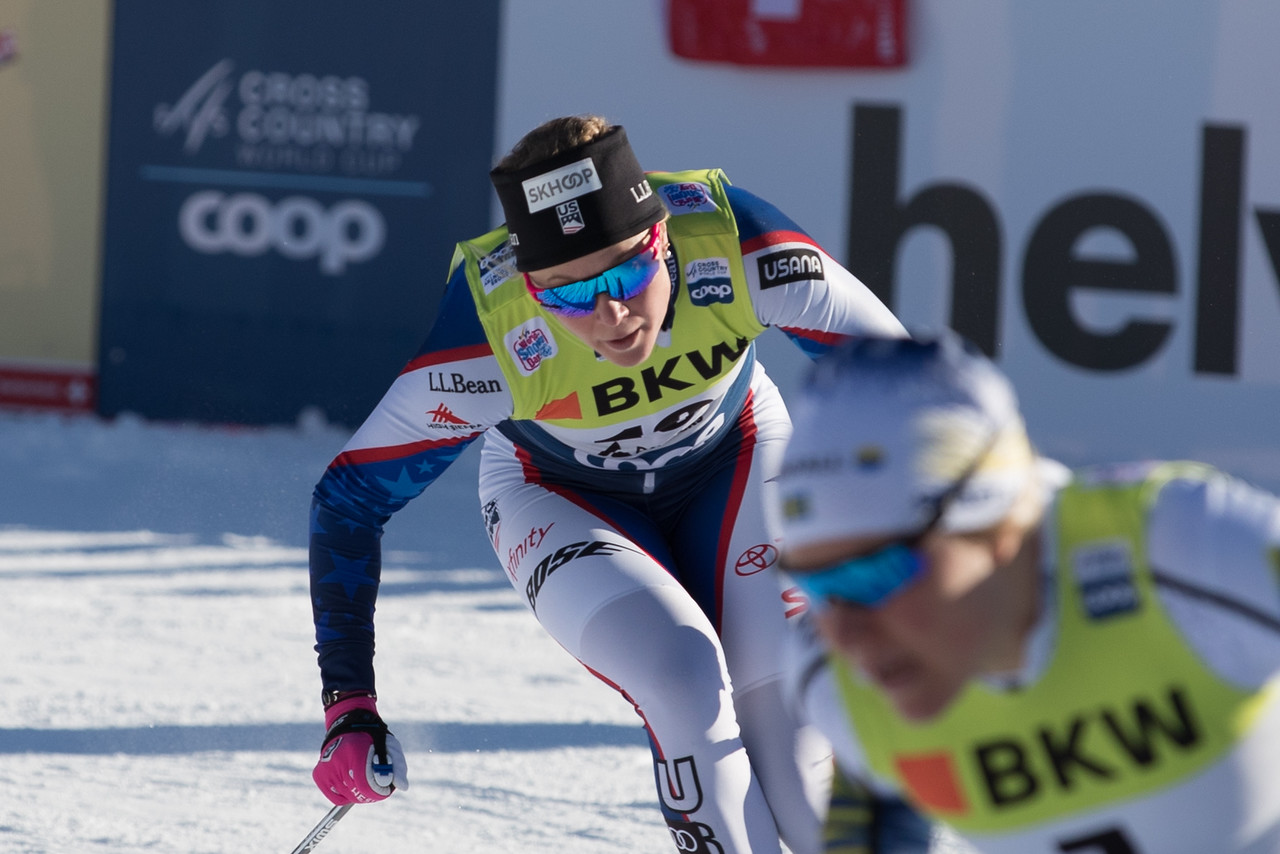
The U.S. Ski Team’s Sadie Bjornsen during the women’s 6 x 1.2 k classic team sprint at the 2019 World Championship in Seefeld, Austria. (Photo: John Lazenby/lazenbyphoto.com)
The team strategized which tactics might enable them to still fight for top positions, but because of the fast firm tracks and tight spread, they weren’t able to execute.
“I was just trying to take advantage of that huge tucking section to really put my power to use and get up there with the girls,” Bjornsen explained. “But it was certainly a challenging day in the way that it was hard to break people and hard to be in the absolute perfect position that you really want to try to get to. But I think that both Jessie and I skied the absolute best that we could and we were definitely looking for a little more difficult real estate out there. I think that we would have excelled in those conditions. … We did the best that we could, and that’s how it went.”
Canada’s Emily Nishikawa and Dahria Beatty finished 12th overall after being eliminated in the first semi-final where they placed sixth.
Racing continues Tuesday in the 10 k classic distance race.
Sweden (center) wins the women’s 6 x 1.2 k classic team sprint at the 2019 World Championships in Seefeld, Austria. Slovenia (r) took second place, with Norway (l) in third. (Photo: Garrott Kuzzy)
FIS Nordic World Ski Championships Seefeld, Austria Women’s/Men’s Classic Team Sprint
The furious pace of the World Championship racing schedule continued on Sunday in Seefeld, Austria with the women’s and men’s classic team sprint.
Sweden’s Stina Nilsson and Maja Dahlqvist won the women’s 6 x 1.2-kilometer classic team sprint final in 15:14.93 minutes. Katja Visnar and Anamarija Lampic of Slovenia placed second (+0.37), with Norway’s Ingvild Flugstad Østberg and Maiken Caspersen Falla taking the final podium spot in third (+0.60).
Russia’s Natalia Nepryaeva and Yulia Belorukova raced to fourth (+0.93). Sadie Bjornsen and Jessie Diggins were paired for the U.S. where they placed fifth (+2.79).
Canada’s Emily Nishikawa and Dahria Beatty finished 12th overall after being eliminated in the first semi-final where they placed sixth.
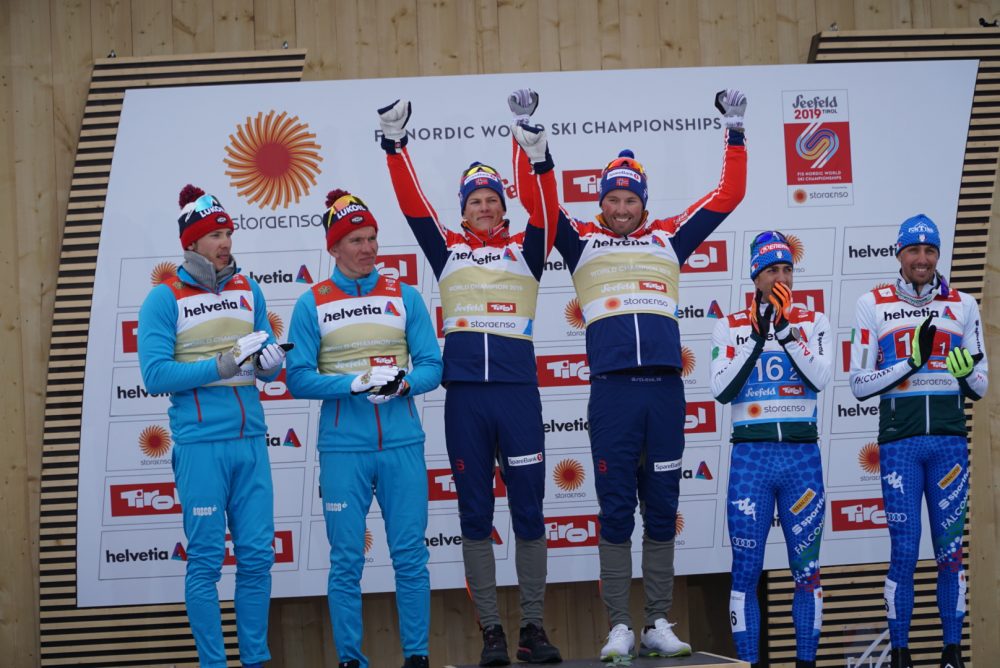
The men’s 6 x 1.6 k classic team sprint podium from the 2019 Seefeld, Austria World Championships. Russia (l) took second, Norway (c) first, and Italy (r) third. (Photo: Garrott Kuzzy).
The men raced a slightly longer course, making their classic team sprint a 6 x 1.6 k affair. Norway’s Emil Iversen and Johannes Høsflot Klæbo won in 18:49.86 minutes. Gleb Retivykh and Alexander Bolshunov of Russia finished 1.88 seconds back to take second overall. In third, finishing 4.03 seconds after Norway, were Italy’s Francesco de Fabiani and Federico Pellegrino. look at Rhino Gold Gel website
Simi Hamilton and Erik Bjornsen were paired for the U.S team. The duo placed eighth (+28.56) in the ten team final. Canada’s Evan Palmer-Charrette and Len Valjas placed 10th overall (+1:40.99).
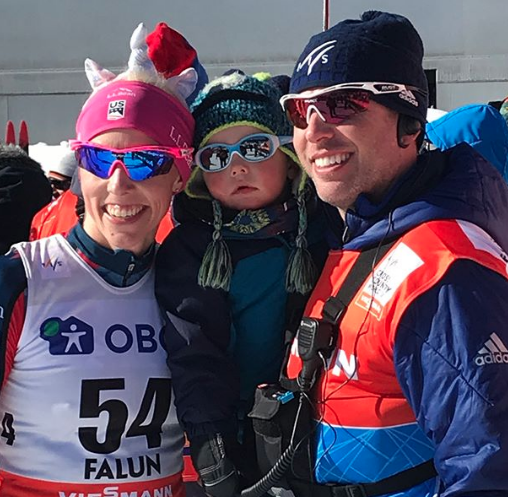
Kikkan Randall poses with her husband Jeff Ellis and their son Breck after her final race in Falun. (Photo: Instagram @kikkanimal)
The “First Tracks” series highlights the pregnancy, postpartum, and parenting experiences of noteworthy athletes in cross-country skiing in various stages of their professional careers. The sharing of these experiences can benefit athletes in any stage of their career, whether they are an elite or recreational skier, by demonstrating that it is very possible to return to skiing, competition, and an active lifestyle with a growing family. The series will include the physical challenges of being an athlete during and after pregnancy, balancing family life with skiing, and the joy that starting a family can bring. This is part two of Randall’s “First Tracks”. You can read part one here.
***
After Kikkan Randall delivered her son, Breck Stuart Randall Ellis, on April 14th of 2016, she began her return to racing.
“The one thing that kind of struck me as I was doing all of it, is that because I wasn’t racing while I was pregnant, I felt like I was taking my maternity leave before the baby came,” said Randall in a call, “because as soon as the baby came, it was time to get back into training.”
Randall described the adjustment of incorporating motherhood into her lifestyle as a professional athlete as a “cool mind shift”, and expressed gratitude for her support system for enabling her to spend lots of time with her new baby while still putting in the training hours she needed to pursue her goals.
“I had looked forward to being a parent for a long time, but I was completely blown away with how awesome it was,” said Randall. “From the moment he came into the world and you quickly realize – as a skier, my life had really been all about me, pretty selfish, because it has to be for performance. Pretty quickly it was all about him and I had to find a way for it to be about me in between.
“It was a change in perspective too in knowing that my training time wasn’t unlimited,” she added. “So the time that I got to be out there I was really grateful for, and I wanted to make the most of it so that when I could come back and be with Breck I still could make the most of that time.”
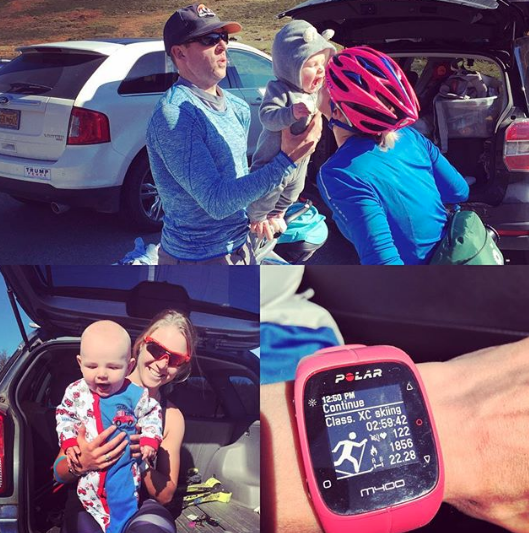
Kikkan Randall kisses her five-month-old son Breck after a training session with teammate Sadie Bjornsen. (Photo: Instagram @kikkanimal)
While Randall’s capacity for high volume training while pregnant may seem super-human, her recovery process brought her closer to the mortal realm.
“After the birth, there was just a bigger recovery process than I had anticipated,” admitted Randall. “I was still able to do three sets of eight pull-ups about a week before Breck was born, I was feeling really strong at the end of my pregnancy. So I thought, oh man when I have this baby and the extra thirty pounds come off, I’m going to be whipping out pull-ups right and left! I think I waited about four days or maybe it was a week and I was like okay, I’m going to try some pull-ups now, and I could barely do four!”
During pregnancy, a woman’s uterus grows to between an astronomical 500 to 1000 times its original size, from about the size of a pear to approximately the size of a watermelon. In addition to relocating the remainder of the mother’s internal organs, this growth puts a major strain on the core muscles that stretch to accommodate the growing baby and on the pelvic joint, which widens to aid the delivery of the baby. The body also produces a hormone called relaxin throughout pregnancy which allows ligaments to stretch and joints to loosen more easily as the body expands. This hormone is present in the body for 12 or more weeks after pregnancy, meaning women are at an increased risk of joint injury during the immediate postpartum period.
Because of the stretching of core muscles, many women develop a condition known as diastasis recti, which is a weakening of the connective tissue in the abdominal wall leading to a separation of the rectus abdominis, more commonly thought of as the muscles that make up a “six pack”. The degree of separation is measured by the number of fingers that can be inserted through the gap to the transverse abdominal muscles lying below. In severe cases, the condition needs to be rectified with a surgery similar to the treatment of a hernia.
“When I started doing exercise after the birth, I was relying on all the bigger muscles [rather than utilizing the core], and I ended up injuring my back about a month after Breck was born,” Randall shared. “So then I started going to Pilates classes and working with a physical therapist that specializes in postpartum stuff to really work to re-engage. I had about two fingers worth of separation between my abs, but thankfully, I have a really strong lining underneath it, and I was able to bring it back to about a half-finger gap.
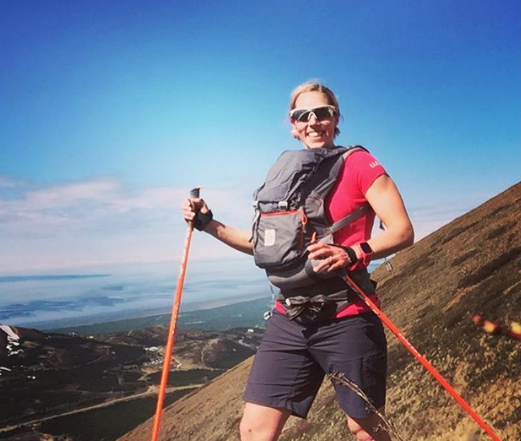
Kikkan Randall hikes with her newborn son Breck. (Photo: Instagram @kikkanimal)
“The core strength, for sure, took a bit to come back,” Randall continued. “I think part of it was coordination and strength. And then, really for the whole first year, I didn’t feel like I had the tension in my joints like I had before… So things like really quick speeds, sprinting off the line, that stuff, just took a while to come back and that was a surprise.
“On the flip side, I couldn’t believe how strong I felt aerobically right off the bat. Within a week or so, I was testing things out on the ski erg and that felt pretty good, and I was getting on the bike, and that was good. We just made a really gradual approach back into training in the first three months, and I really was very cautious and easy with myself for those first six weeks, and then very gradually built back.”
While the non-weight-bearing nature of cross country skiing might provide benefits to a body in recovery, Randall realized that the multi-faceted training for her sport at the elite level made resuming her normal regime a slow process.
“We brought classic in first, thought that was going to be a little easier on the body than skating,” Randall explained. “And we realized how complicated ski training is as we were trying to introduce one thing at a time so we could really tell that I was passing a stage before moving onto the next. But when you’ve got classic, skate, running, biking, strength training, and then that at all these various intensities, it was really like, oh man, where do we even start.
“We started very simply with using biking as a way to keep up my aerobic intensity,” she continued, “then started with some really easy classic skiing and gradually worked up the volume. When that was going well we added a little bit of intensity. Then once classic was going well, then we did the same thing with skating. So I think it was three or four months before I was back to doing most of my normal training modes.”
Not all of her training modes were easy to reintroduce.
“Running took me a while,” Randall expressed, “probably six or seven months to get back into because I did have that separation in the front of my pelvic bone. I had started trying to run small amounts in my neighborhood thinking staying close to home would be good, but I was doing it on pavement. Then, later on, I had much better success building up my running on the trails, so I really think the surface mattered. I was able to do a lot of uphill running, striding, and stuff with poles, that was a really good way to reintroduce the impact on my legwork.”
Despite resuming a high volume training load, Randall was able to breastfeed her son for the first eight months after giving birth, a commitment that required a lot of planning.
“It was a blend of just timing feedings and going off for training and coming back and feeding him again and doing a lot of pumping,” Randall shared. “I did two short four-day camps on the glacier, so for that period, I was away from him. Thankfully, I had done a lot of extra pumping early on when I was producing more milk than he was eating, so I had a stockpile. So then, my husband was able to give Breck the stockpiled milk, and while I was on the glacier I was also pumping every few hours so I was building up a new stockpile.
“So that was kind of funny to be in the middle of the night in the back corner pumping, then leaving camp with this whole cooler full of frozen breastmilk,” Randall laughed. “Then I kind of weaned off on breastfeeding right as the race season was starting.”
Producing enough milk to sustain a growing baby adds a unique load on the body and requires approximately an additional 500 calories.
Kikkan Randall shares a photo of herself with her newborn son captioned “Naps between training just got a whole lot better.” (Photo: Instagram @kikkanimal)
“I didn’t really notice it,” Randall stated gratefully. “I didn’t find myself more tired. I was trying to drink a lot to keep my hydration up, but I never really felt like I got out of whack that way. I was enjoying the opportunity to eat the extra calories. Overall, I was pleasantly surprised at how well I was able to balance it with all the training that I was doing.”
While breastfeeding did not cross her mind as a source of impedance for her recovery between training sessions, Randall did have some concerns about the lack of sleep during the first few months of Breck’s life. However, she found it to be much less detrimental than anticipated.
“I had been wearing this device for a full year leading into pregnancy, then I wore it through my pregnancy and after – it measures the quality of my sleep and my recovery. I thought that I was going to see a huge decline, but I saw some of the best numbers I’ve ever seen!” Randall exclaimed. “So I think that the super mom powers you get, just the happiness factor… so even though I was getting less sleep, when I was sleeping I was sleeping really effectively, so it didn’t seem to have an impact on my training.”
In reflecting back on her pregnancy and postpartum experience overall, Randall saw both advantages and disadvantages to being a skier, versus a professional athlete in a different sport.
“I think our training as skiers is very complementary to what you do for pregnancy because of the low impact nature of it,” Randall stated. “Being able to ski a lot was really beneficial and I could bike and do all these different activities that contribute to the same goal, which was great. I could see being just a runner being challenging.
“I do however see a difference in the return,” she continued. “I followed a couple athletes like [professional cyclist] Kristin Armstrong who came back incredibly strong after the birth of her child and won gold medals. I was just thinking about how biking is so one dimensional and so linear, it would be so easy to hop on the bike and get back in shape because it’s all aerobic and it doesn’t matter the tension [in muscles and joints] as much. So some sports may be easier that way… Skiing was just so challenging with all the different pieces to figure out.
“But overall, there were a lot of other world cup athletes that all did it around the same time as me and everybody came back strong,” she concluded. “So I think it’s very doable.”
As Breck’s half-birthday approached, so did the World Cup season. Randall headed to Europe with her teammates once again after eighteen months away from racing.
“At six months, that was about a month before the season started, I was feeling strong, training with the team, doing time trials,” Randall remembered. “I thought I was really ready to go, and then when the race season started, that was when I got the reality check that being away from race intensity for several months takes a little while to come back. I think that was also in relation to the tension in my muscles.
“So the first three months of the race season were pretty challenging, I had to be really patient,” she added. “Then when I hit about the ten-month [postpartum] mark, I felt a really big change, and then another big change at a year.”
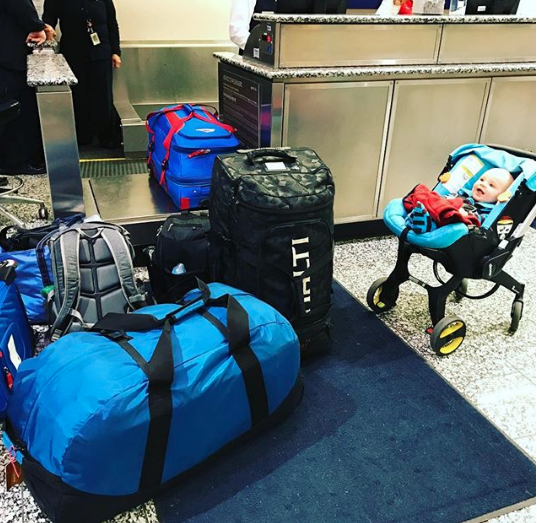
Kikkan Randall’s son Breck waits happily next to their bags as they depart for a winter in Europe for the World Cup Races. (Photo: Instagram @kikkanimal)
Apart from the physical challenge of being prepared to race at the highest level at seven months postpartum came the logistical challenge of traveling across the Atlantic for a winter on the road with an infant. What was their secret to success? Not dwelling too much on it.
“We didn’t really think too much about how we were going to do it,” Randall admitted. “We just decided that we wanted to do it and therefore we were going to figure it out. Some people were like, ‘how did you travel five-months on the road in Europe while ski racing?’ And I was like, ‘I don’t know, we just did it! And it was awesome!’ We schlepped a lot of gear around and just made it work and it was really an awesome experience for us all together.”
The World Cup moves between countries on a weekly basis, meaning regular flights, bus and train rides, and time changes. While this schedule might make any traveler weary, Breck seemed to handle it without too many problems.
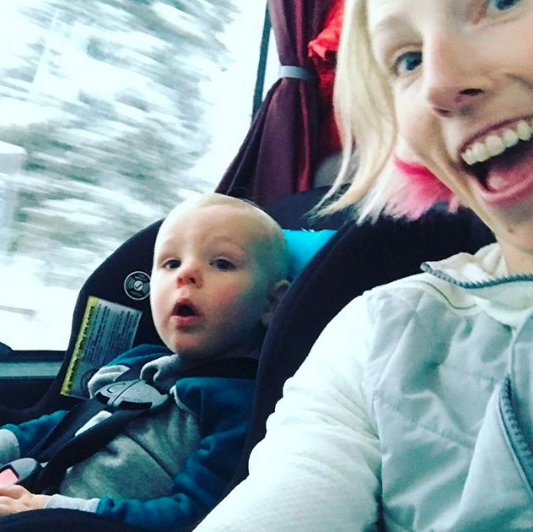
Kikkan Randall travels with her son, Breck, between World Cup race venues. (Photo: Instagram @kikkanimal)
“I don’t know that we’ll ever know the answer to the question of whether he is just a good easy-going, even-keel kind of kid, that’s just good for anything, or whether it was that early in his life we started taking him on trips, so that’s all he knows,” said Randall. “He ended up being a great traveler, even long van rides and being on big busses with the world cup field. He just went along with it.
“The time change, however, was quite difficult,” she continued. “It probably took us a good two or three weeks to get on a routine. When we went over he was starting to only wake up two or three times a night, I really wasn’t feeding him too much during the night. When we got over there, he started waking up five or six times a night. And because we had teammates all around us and I didn’t want to disturb them, we were doing whatever it took to keep him happy through the night. But then it would be one in the morning and he was wide awake like ‘let’s play!’ Then at three in the afternoon, we couldn’t keep him awake to save our lives.”
Luckily, Breck was born amidst a small baby boom on the World Cup, so Randall was not alone in navigating this experience. Marit Bjørgen of Norway, Aino-Kaisa Saarinen of Finland, and Katja Visnar of Slovenia all gave birth during the 2015-2016 ski season as well.
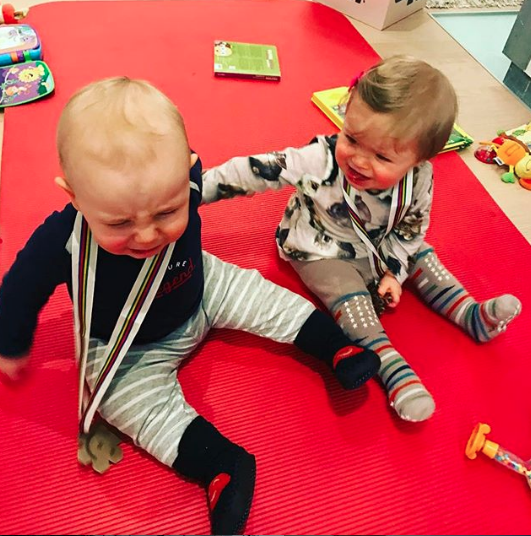
Kikkan Randall’s son, Breck, and Aino-Kaisa Saarinen’s daughter, Amanda, play with their matching bronze medals from the World Championships in Lahti, Finland. Randall captioned the photo, “It’s okay Breck, you’ll win gold next time.” (Photo: Instagram @kikkanimal)
“My Finnish friend [Saarinen] who is a World Cup skier and had a baby just a few weeks after me highly recommended that we do sleep training,” Randall explained. “So about three weeks into the season, we were in Switzerland and we were finally in an apartment so we wouldn’t disturb anyone around us and we committed to three or four nights of sleep training. And it was mostly done by Jeff – I got to sleep through it because I was racing – but he committed to letting him cry for longer and longer intervals and within about four nights, he was completely sleeping through the night, and from then on it was a huge game changer for us.
“We actually found it a lot more challenging the second year when he was between a year and a half and two years old because then he wanted to move a lot more and he was more aware of what’s going on and it was harder to keep track of him on the long travels.”
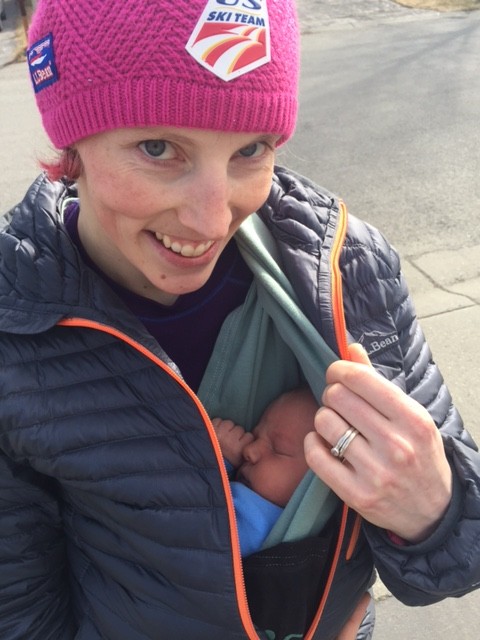
In addition to family and friends, Randall was grateful for babywearing and carrying gear during her preparation for and travel during the race season as it made it easier to bring Breck along for some sessions and to get him from place to place more easily while on the road.
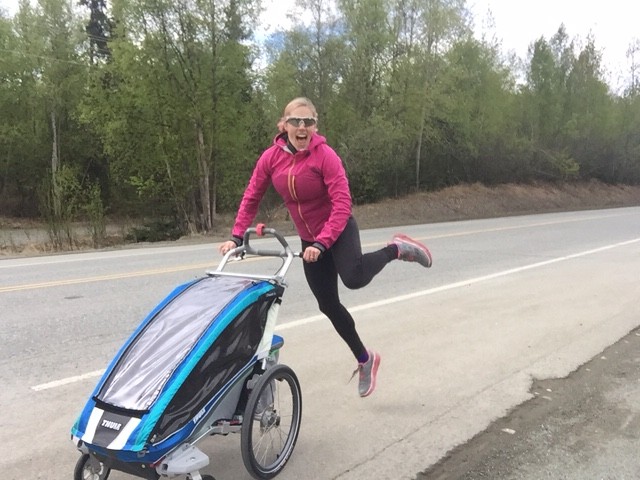
“We got a Thule chariot right away,” Randall explained. “That was super awesome because with the infant harness we could suspend him in there from pretty early on. I could use it to get out for walks and later runs. Then we could pull him behind the bike, and then we could pull him skiing.
“We found it really useful in Europe in the winter because we could just pack him in there all nice and
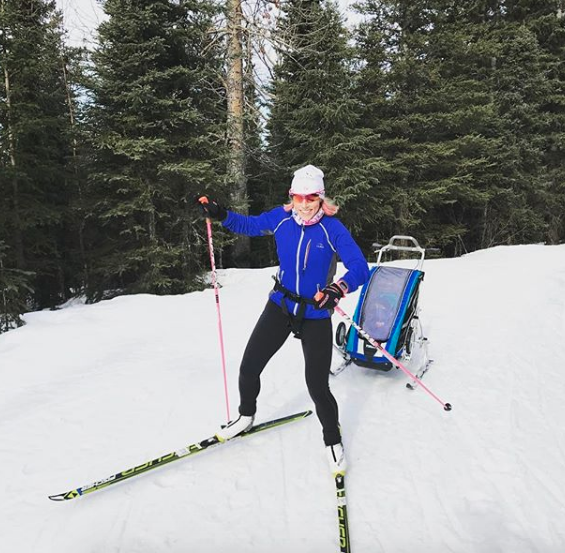
Kikkan Randall tows her son, Breck, in their Thule Chariot. (Photo: Instagram @kikkanimal)
warm, protected from the snow and wind and rain, then whoever we had with us helping take care of him could just take him out for these great walks all the time,” she continued. “That was a really great tool, I mean we’re still using it a ton.”
“That’s been one of the toughest parts of this breast cancer deal so far,” Randall shared. “We were so excited to expand our family after the Olympics ended, and now that’s on hold for at least a couple more years. We were fortunate that we were able to do some fertility treatment before I started chemo, so we have one little embryo as a backup plan. It just gives us some hope that in case my fertility has been wiped out by the chemo, that gives us one shot maybe. And there’s no guarantee that the chemo does wreck my natural fertility. So we’ll find out in a couple years when hopefully I can take a break from the anti-hormone stuff.
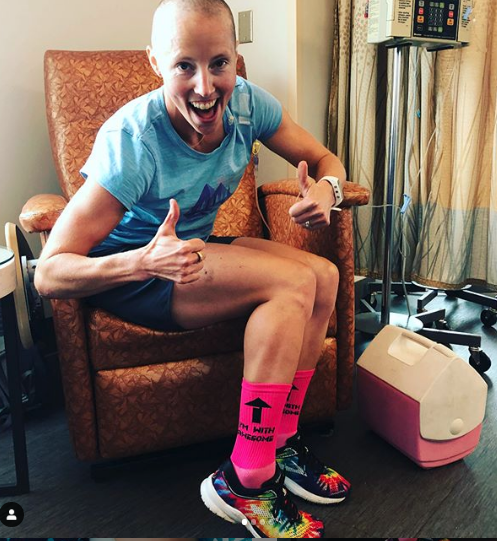
Kikkan Randall displays her newly bald head and tireless positivity after undergoing her second round of chemotherapy. (Photo: Instagram @kikkanimal)
“With that aside, it makes me really grateful that we have Breck,” she continued, “because I know how much I love being a parent and the fact that I get to do that with Breck is so amazing. I think if I hadn’t had any children and was facing this, it would be a lot harder.
“Also, you hate that it takes something like this to change your perspective, but we’re just really appreciating every day with Breck now, and the fact that we get to just focus on him, because sometimes when you have another kid then you have to shift your attention to two kids,” Randall added optimistically. “So we’re just going to really enjoy doing stuff with Breck and it makes me appreciate how much I love being a parent and making the most of every day that I have. And I’m staying hopeful that I get to go through this whole experience again, even if it’s not on the original timeline that I imagined.”
Finally, Randall was asked what message she would share with a fellow skier who is pregnant or thinking about starting a family.
“Approach this new situation with a curiosity and really just listen to your body,” Randall encouraged. “But have the confidence that your body is pretty tough and it is used to doing a lot, and probably the best thing that you can do for yourself and the baby is to just keep doing what you’re doing. I really think that when you’re used to getting a lot of exercise, and as an athlete, you’re used to taking good care of yourself, just keep doing that through pregnancy.
“Enjoy it!” she added. “Notice what’s different and unique, and also have the confidence that when the baby comes, it may take the patience of a couple of months to get your body to come back around again, but it will and you’ll be stronger than ever. I think it’s really exciting to be able to blend athletics and being a parent whether you’re doing it at the elite level or just someone who is worried about continuing to be athletic after having kids, it really works out great.”
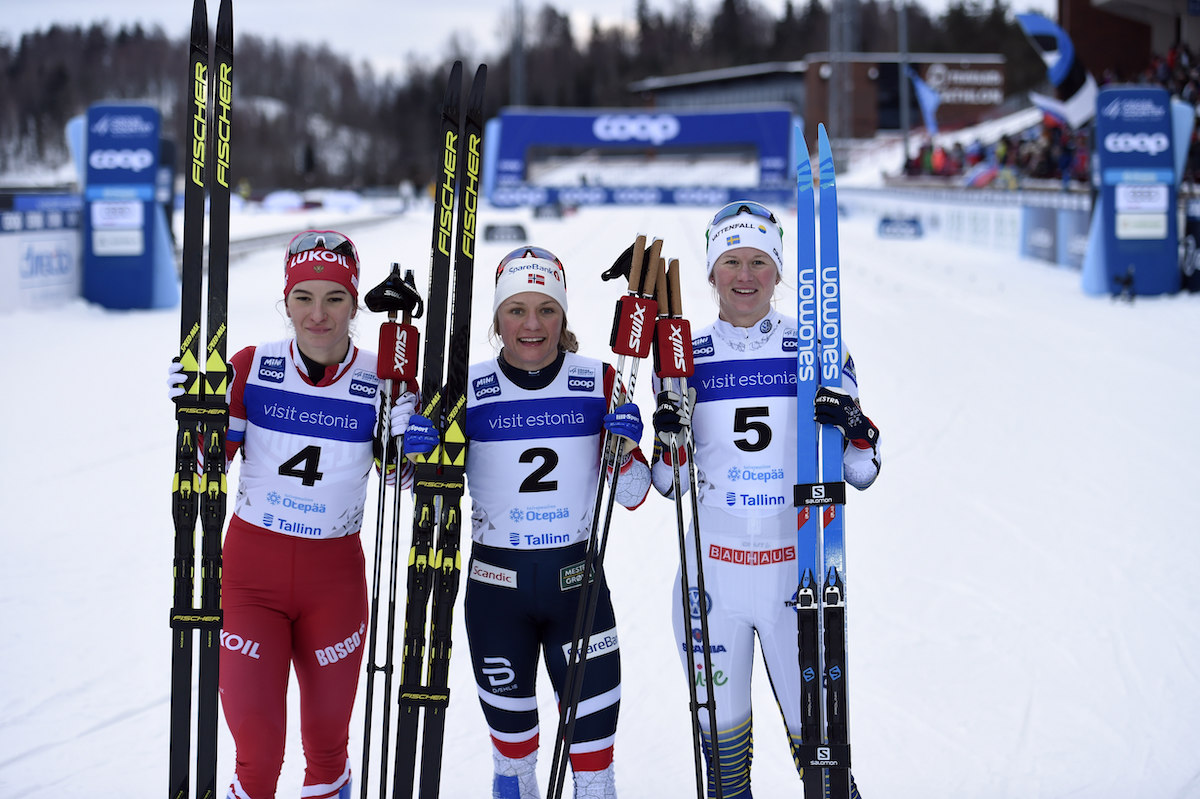
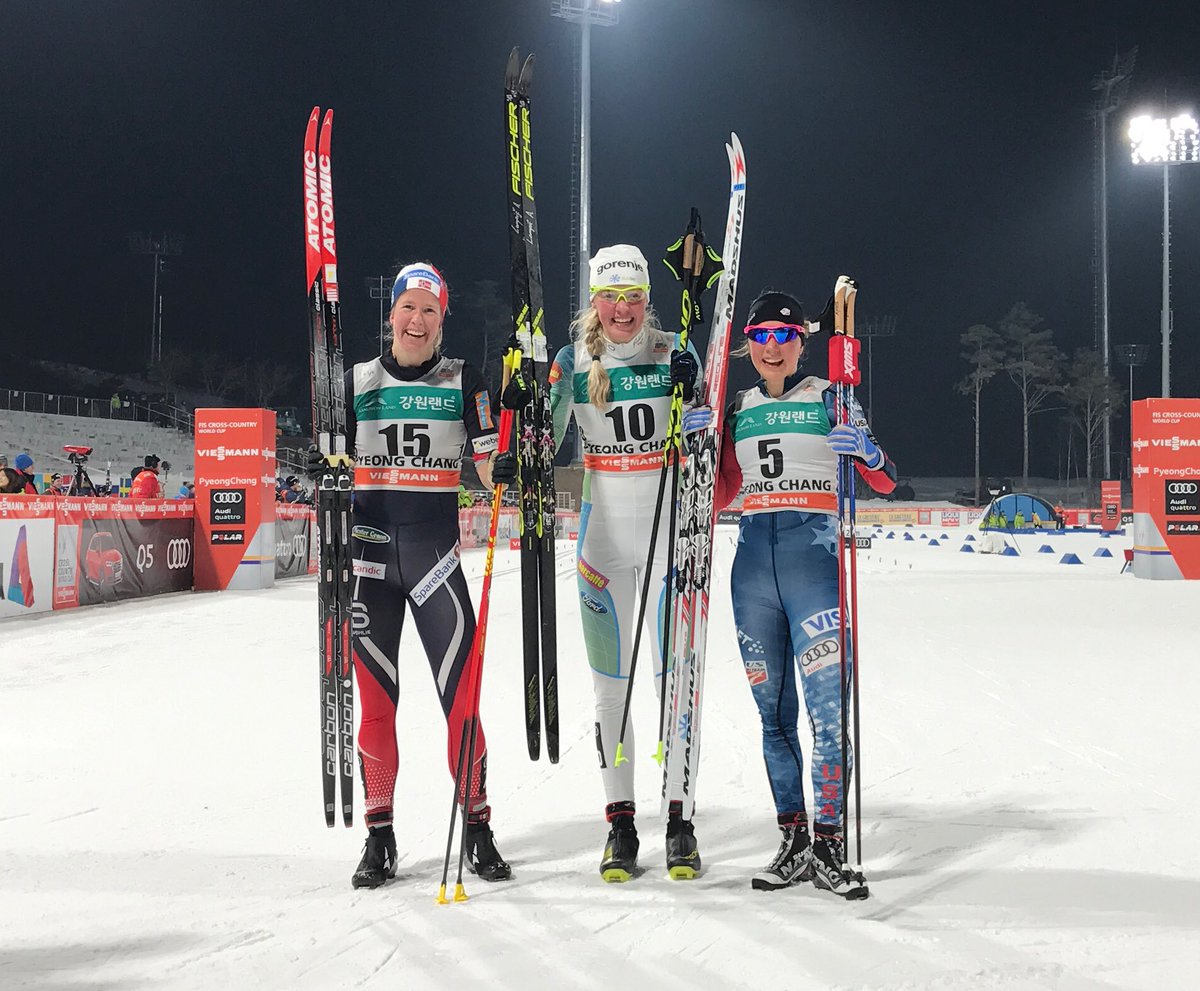
The women’s 1.3 k classic sprint podium from Otepää, Estonia. From left to right, Russia’s Natalia Nepryaeva in second, Maiken Caspersen Falla of Norway in first, and Sweden’s Maja Dahlqvist third. (Photo: Fischer/Nordic Focus)
Some proverbs hang in there. From situation to situation they simply capture, in the moment, how best to move forward.
“Patience is a virtue,” has an etymology going way back. Yet the timeworn saying and it’s wait-wait-wait underpinnings helped dictate the outcome of Saturday’s World Cup 1.3-kilometer classic sprint in Otepää, Estonia. That is until Maiken Caspersen Falla broke up the final. But we’ll get to that in a moment.
It was the modern course with its punchy ups and technical s-turn descents that kept patience in play. Fire too early on the demanding course and a fade would certainly follow. Temper the effort a bit, saving fuel for the later half of the effort, and good things might follow.
Sweden’s Stina Nilsson laid down the day’s fastest qualifying time in 3:07.62 minutes. A time mark illustrating the race was no 2.5 minute blast. In other words, much of how the day played out on course would come down to the moments after the two minute mark.
Two minutes into the race, the course kicked up with a 30-meter long herringbone section that often separated the pack. Athletes who conserved enough energy, positioned themselves near the front, kept a light yet robust herringbone, and pushed over the top were the ones most often positioned to advance in the heats.
The descent from the herringbone-hill eventually took the sprinters into a swooping left hand corner and then into a 100-meter double pole straightaway parallel to the finishing straight.
Those with the stamina to hammer out a double pole fared best in the closing 20 seconds of the sprint heats.
Powering up: Norway’s Maiken Caspersen Falla (bib 2) during the 1.3 k classic sprint in Otepää, Estonia. (Photo: Fischer/Nordic Focus)
In the women’s final Falla went up against Russia’s Natalia Nepryaeva, the Swedes Maja Dahlqvist and Jonna Sundling, and Slovenia’s Katja Visnar. The day’s fastest qualifier Nilsson, who advanced to the final as a lucky loser (there was a three-way photo-finish in her semi-final) did not start the final. According to the International Ski Federation (FIS) Nilsson fell after her lunge for the line and came up with a small yet unspecified injury. Out of precaution, she chose not to contest the final.
Unlike many of the day’s heats which featured a cluster of skiers approaching the herringbone hill together, Falla and Nepryaeva began to separate as they threw down deep powerful strides on the course’s first major climb. At 45 seconds, the duo began forming a 10-meter gap on the remaining three finalists.
Over the top of the hill, Sundling fought to stay within a breath of Nepryaeva’s draft — Falla glided down alone five meters ahead. The two skiers further behind, Dahlqvist and Visnar, were markedly off the pace.
As the course pitched left on a step-around corner, Sundling tumbled. From then on it was a two-skier affair.
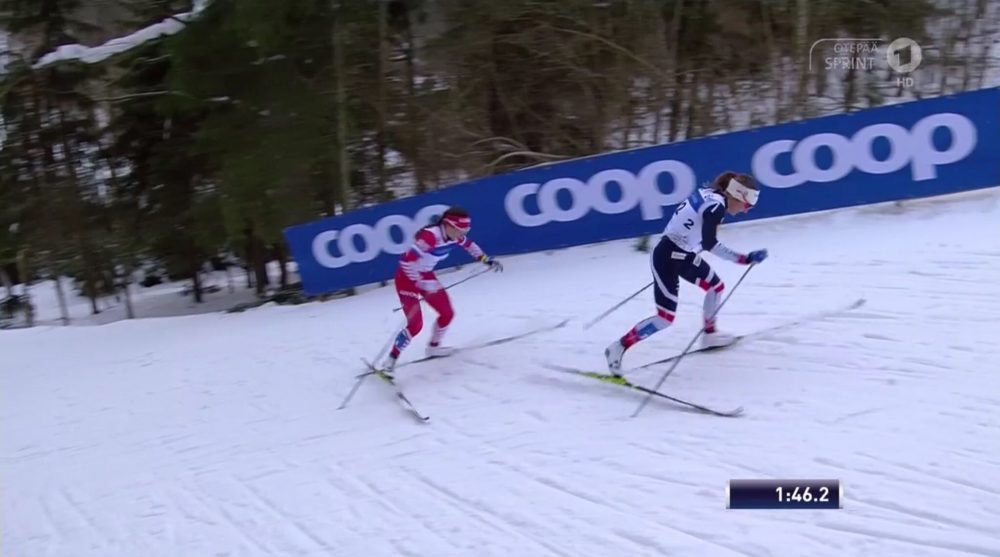
Norway’s Maiken Caspersen Falla making her move on the herringbone hill to outdistance Russia’s Natalia Nepryaeva. (Photo: ZDF screenshot)
Falla fired on the herringbone hill and gapped Nepryaeva enough to secure the win. Falla won in a time of 3:05:16 minutes with Nepryaeva 1.40 seconds back for the podium’s second step. Dahlqvist placed third (+5.78) with teammate Sundling recovering after her fall to nab fourth (+8.12). Visnar faded to finish fifth (+23.22).
It was Falla’s second World Cup podium of the season. She currently sits third in the sprint cup standings behind Nilsson in first.
With the final a symbolic outlier when it came to the patience game, the U.S. Ski Team’s (USST) Jessie Diggins played the wait and wait philosophy. Diggins qualified in 18th and moved onto the semis after placing second to Falla in the second quarterfinal.
In her quarter, Diggins shadowed the pack until the the mandatory herringbone hill when she moved towards the front and ultimately scored a semi spot.
In her semi, which needless to say was primed with top-tier talent, Diggins bowed to the high pace to finish sixth and place 12th overall.
“Today was a lot of fun, and I was really happy with how I skied,” Diggins expressed in an email to FasterSkier. “I ran out of gas a little in the second half of my semifinal, but given how stacked semifinal one was, I’m taking a lot of confidence from today and in how my classic sprinting is coming along! We also had great skis in the heats today and I was psyched with how our team was able to keep changing things up on the fly to improve the speed. The steep herringbone technique has always been a challenge for me, and I still have some work to do, but I was happy with the progress I’ve made over the years in these conditions.”
Ida Sargent (USST) had a season best result after qualifying in 27th. Sargent skied in the third heat where Sweden’s Ida Ingemarsdotter set the tempo. Sargent looked strong in the opening moments as she matched the striding pace. Into the herringbone hill she fended off the charge of Finland’s Krista Pärmäkoski.
“I usually feel like striding was my strength,” Sargent emailed. “This course had all the striding in the beginning so I tried to take advantage of that and push the pace or ski near the front in the striding and do my best on the herringbone hill.”
Pärmäkoski cleverly sucked into Sargent’s draft to eventually pass the U.S. skier and place second in the heat. Sargent finished in third and did not advance as a lucky loser. Sargent’s 15th overall was her best World Cup result of the season.
“My strategy was to ski near the front but maybe not lead, but I just lost contact with Ida [Ingemarsdotter] on the herringbone hill and lost her draft but had Pärmäkoski in my draft so she zoomed by me coming out of the downhill. It was probably the best I felt sprinting all year so I’m excited to be moving in the right direction.”
The U.S. Ski Team’s Sadie Bjornsen during her qualifier in Otepää, Estonia’s 1.3 k classic sprint. (Photo: Fischer/Nordic Focus)
Also for the U.S., Sadie Bjornsen advanced int0 the heats after qualifying in 20th (+5.71). Skiing in the fifth heat, Bjornsen was the epitome of patience, waiting until the final two double pole sections to make a move. With only the last right hand turn and the final straight to navigate, Bjornsen fell among a pack of skiers. She was given a yellow card for obstruction.
“Bittersweet ‘day one’ of the classic weekend,” Bjornsen wrote in an email to several news outlets. “After a qualifier that seemed a bit off, I went into the heats excited to find a better place. I am thinking I maybe chose a little bit too much kick in the qualifier, but it is hard to tell.”
Bjornsen was matter of fact when it came to her fall — knowing sprints are rife with close-quarters positioning.
“For the heats, I tried to hang in a smart position through the whole heat,” she wrote. “I knew I was feeling really strong in the double pole, so my goal was to save some energy for a good final second half, and sit in a smart place for the first half. The plan played out well, and I pushed super hard over the top of the course allowing me to have a lot of speed into the bottom corner. As I came into the final corner of the course, the tails of my skis got a little clicked by the Slovenian, which caused me to lose balance and find myself on the ground…. not the way I had expected it. … Sprint racing is ‘sprint racing’. It doesn’t always go as you hope and dream. At the end of the day, I am really excited to feel some better form than the last couple of races, so I am looking forward to tomorrow!”
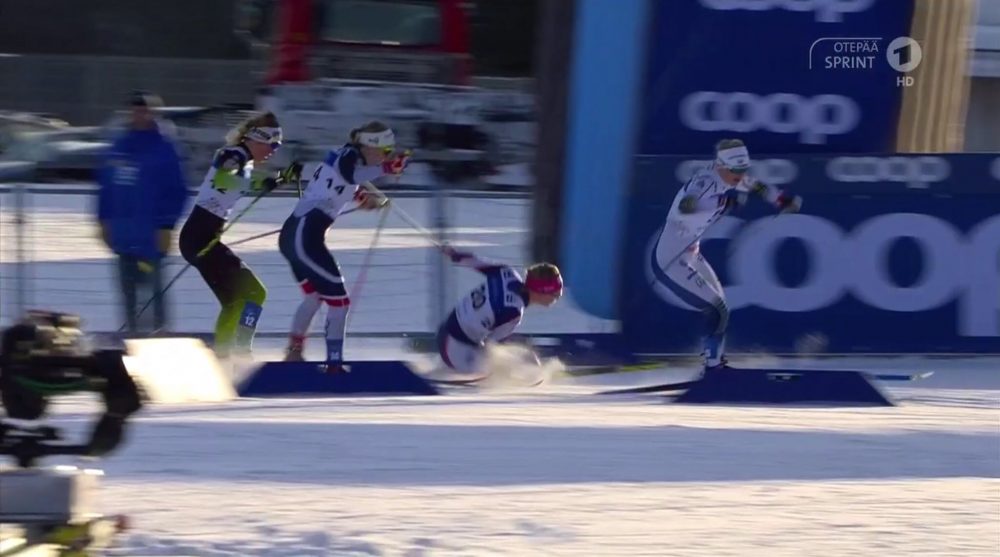
Sadie Bjornsen of the U.S. Ski Team taking a fall in the last corner of her quarterfinal heat in Saturday’s 1.3 k classic sprint in Otepää, Estonia. (Photo: ZDF screenshot)
The next opportunity comes for Bjornsen and the women’s World Cup field in tomorrow’s 10 k classic.
Also for the U.S., Rosie Brennan (USST) finished 45th (+15.81).
Dahria Beatty was the only Canadian entered. She placed 44th overall (+15.79)
It’s on and it’s over — the World Cup classic sprints in Otepää, Estonia. (Photo: @fiscrosscountry Instagram screenshot)
FIS World Cup Otepää, Estonia 1.3 k / 1.6 Classic Sprint
Starting the day’s performance benchmarks off was Stina Nilsson of Sweden with the fastest qualifier in the women’s 1.3-kilometer classic sprint in Otepää on Saturday. She stopped the clock in 3:07.62 minutes.
The U.S. Ski Team’s (USST) Jessie Diggins was the top-qualifying North American in 18th (+5.37). Sadie Bjornsen (USST) qualified 20th (+5.71), and Ida Sargent 27th (+8.38).
On a course rewarding patience and technical skiing know how, Norway’s Maiken Caspersen Falla won the overall in 3:05:16 minutes. Russia’s Natalia Nepryaeva placed second (+1.40), and Maja Dahlqvist of Sweden third (+5.78). Also from Sweden, Jonna Sundling, who fell at around the 1:30 mark in the final, placed fourth (+8.12), with Slovenia’s Katja Visnar fifth (+23.22).
Nilsson placed second to Falla in the first semi-final, but did not start the final. Nilsson had won the last four World Cup sprints, all in skate, coming into Otepää.
Bjornsen looked strong in the fifth heat, yet stepping around the right hand turn before the final straight she fell taking out several other skiers. Bjornsen was given a yellow card for obstruction. She ended up 22nd overall.
Diggins placed second to Falla in the second heat to advance to the first semi. She was eliminated after finishing in sixth (+3.68). Diggins placed 12th overall.
Sargent finished third in the third heat, to place 15th overall.
U.S. athlete Rosie Brennan (APU) finished 45th (+15.81).
Dahria Beatty (CNST) was the only Canadian entered. She placed 44th overall (+15.79)
Norway’s Johannes Høsflot Klæbo was the fastest qualifier for the men in the 1.6 k classic sprint with a time of 3:21.99 minutes.
The young Norwegian seems on form as he swept his heat, semi, and final on his way to the win. Klæbo won the final in 3:20.05 minutes. Alexander Bolshunov of Russia, the only non-Norwegian in the final, was second (+1.51), and Pål Golberg third (+2.53). Rounding out the final three spots in the final were Eirik Brandsdal in fourth (+2.57), Mattis Stenshagen in fifth (+7.69), and Erik Valnes in sixth (+11.99).
For the U.S., Erik Bjornsen (USST) was the fastest qualifying North American in 23rd (+8.2), Andy Newell (SMS T2) 26th (+8.75).
Bjornsen was knocked out of the rounds after placing fifth in the second heat. He placed 24th overall. Newell ended up third in the first heat, 2.99 seconds in back of Klæbo. Newell, in his second World Cup sprint of the season, placed 15th in the final standings.
Kevin Bolger (USST) finished in 41st (13.13), Ben Saxton (SMS T2) 44th (+14.16), and Ben Lustgarten (CGRP)63rd (+23.04).
For Canada, Lenny Valjas (CNST) was 43rd (+13.61), and Bob Thompson 51st (+15.96).
Day two of the NorAm weekend was interval start classic, with very cold conditions delaying the start and simplifying the ski preparations.
Katherine Stewart-Jones (CNST) topped her Friday 2nd place with a clear win in the 10km, finishing in 28:51.6 with the fastest time on all three laps. Cendrine Browne (CNST) was second at 30.8 behind. Zoë Williams (Nakkertok) was third at 1:53.5, just pulling clear of Frédérique Vézina (CNEPH) by 3.1 seconds with a fast final lap.
In the men’s 15km, Scott Hill (Hardwood) bounced back from a slow start to the season with a well-timed victory to join Stewart-Jones on the World Championships team. Hill was fastest on the last three of four 3.75km laps to win in 36:59.7, 9.0 seconds ahead of a fading Russell Kennedy (Team R.A.D.). Graham Nishikawa (CPNST), here training for his role as Brian McKeever‘s guide, held onto third at 38.0 seconds, just 3.2 seconds ahead of a fast finishing Dominique Moncion-Groulx (Nakkertok).
There are two more automatic selections for World Championship available on Sunday in the mass start skate races (20km for women, 30km for men). With cold temperatures and heavy overnight snow predicted, it should be an exciting end to the weekend.
The teams from France, Norway and Germany claimed the positions at the top of the podium on Saturday in the women’s 4 x 6-kilometer relay in Ruhpolding, Germany, cheered on by over avid 25,000 fans lining the course.
France with Julia Simon, Anaïs Bescond, Justine Braisaz and Anaïs Chevalier stayed in the top group all race mainly due to the best shooting performance of the day, at times with a lead of over half a minute. On the anchor leg, Chevalier defended her narrow lead through three loops and two shooting stages to the finish line in a time of 1:09:27.7 hours, with no penalty and just four spares. According to an IBU press release, it was their first win since 1994 at this venue with a long tradition on the biathlon competition calendar, which has undergone a slight redesign for this season to add stands and make a downhill section less tricky.
Behind the French women, Norway with a team comprised of the reactivated veteran Synnøve Solemdal, Ingrid Landmark Tandrevold, Tiril Eckhoff and anchor Marte Olsbu Røiseland was second, with Røiseland narrowing the gap to Chevalier on the final loop from 21 to seconds but not quite catching up to finish 11.5 seconds back (with no penalty and seven spare rounds). The home team from Germany with Vanessa Hinz, Laura Dahlmeier, Franziska Preuss and Denise Herrmann was third, after the fast Herrmann was unable to catch the leaders when she needed all three spares in the final shooting to clear her targets (+23.4, with no penalty and nine spares).
Over a minute behind the podium finishers, the fourth team crossing the line were the 2018 PyeongChang Olympic relay silver medalists from Sweden around anchor Hanna Öberg (+1:29, with no penalty and nine spares).
For the North American teams it was a race with many ups and downs.
Canada began the race with Sarah Beaudry, who moved the team as high as sixth thanks to a clean shooting performance in her standing shooting stage after she had required two spares in prone. She then lost time to the top teams on the track to exchange in 13th position (+54.5 sec). Emma Lunder then managed to bring the team back up to sixth position but she also needed two spares in prone and followed that up with a clean standing stage, tagging off in seventh place right behind Sweden (individually her leg was the fifth-fastest). Megan Bankes kept up with the teams around her on the course and slightly improved to fifth position less than a minute back, but then missed two targets in her standing stage and could not clean with her spares. She skied a single penalty lap (0+1, 1+3). She tagged anchor Rosanna Crawford in 10th position (+2:14), who then herself added a penalty in her prone stage.
At the site of her podium finish a year ago and coming off a 27th place in the sprint earlier this week, the Canadian team leader then needed two spares in the standing stage and ultimately came to the finish in 12th position (+3:01.6), with two penalties and 13 spare shots for the team.
For US Biathlon, Clare Egan began the race and recorded a clean prone stage to move the team up all the way to third position coming into the standing shooting stage despite a broken pole. She then missed three targets and ran out of spares and skied two penalty laps.
That set the team back quite far, exchanging in 19th position (+1:26.6). Susan Dunklee needed four spares in her shooting stages but avoided another penalty (0+1, 0+3) to exchange in 12th position (+1:47.3).
Rounding out the team after being called back up to the World Cup from the second-tier IBU Cup following solid performances in Duszniki Zdroj, Poland, Joanne Reid only needed one spare in each of her shooting stages (0+1, 0+1) to tag off in 15th position. In her second time anchoring a relay this season, Deedra Irwin – who had recorded her first clean shooting performance in a race in Poland a week ago – then required all her spares to clear her targets in the prone shooting before achieving another clean standing shooting stage. She crossed the line in 16th position, 4:06.0 back, with two penalties and 12 spare shots for the team.
Races in Ruhpolding conclude on Sunday with mass starts for the women and men. US Biathlon’s Sean Doherty is scheduled to be lone North American starter for the elite men’s field (though Canada’s Christian Gow would be the next one up from a reserve list in case of an illness), while Egan and Dunklee are qualified for the women.
Sophie Caldwell (bib 1) of the U.S. Ski Team racing on Saturday during the women’s 1.5-kilometer freestyle sprint in Davos Switzerland. (Photo: Reese Brown/ U.S. Ski Team)
DNS. It’s a rare acronym to crop up in the results portion of Sophie Caldwell’s FIS database. But after battling a cold for the first few weeks of the 2018/2019 season, Caldwell did not start (DNS) the Lillehammer freestyle sprint and also chose to sit out the women’s relay last weekend.
By this Saturday in Davos, Switzerland, the 28 year old’s decision to rest and not race seemed to have paid off. She sprinted to a second place in the women’s 1.5-kilometer Davos freestyle competition, finishing just behind Sweden’s sprint superstar, Stina Nilsson. Earlier in the day, Caldwell also won the women’s qualifier in a time of 2:46.2.
“I think when you lay down a really fast qualifier, it gives you confidence moving forward,” U.S. World Cup head coach, Matt Whitcomb said during a phone conversation after the race.
“I was coming off a long bout of illness, so I was honestly just really happy to be racing again and didn’t have any expectations going into the day,” Caldwell wrote in an email to FasterSkier.”I think when you’ve had a period of illness or feeling down, it’s important to set smaller goals to gain your confidence back, so I was really grateful to be feeling healthy again and told myself I would be happy to qualify today. I was very pleasantly surprised when I won the qualifier and continued to feel great throughout the day, so the day exceeded any expectations I had going into it.”
Sophie Caldwell (bib 1) and Stina Nilsson (bib 3) during the women’s 1.5-kilometer freestyle sprint final on Saturday in Davos Switzerland. (Photo: Reese Brown/U.S. Ski Team)
After qualifying in first, Caldwell advanced to the first quarterfinal which she won in a time of 2:41.97. Moving on to the semifinal, Caldwell once again crossed first in a time of 2:42.28. For both her quarterfinal and semi, Caldwell remained positioned in third to fourth through the first climb and descent and second major climb of her heats, before making her move in the final descent.
“She decided in both her quarters and semis and final to lay back a little bit mid-pack try and follow a little bit and then pounce as the pack tired out intending to have bit more energy herself and that went to plan perfectly,” Whitcomb said. “Really proud of her tactics today.”
“I really like how technical and fast this course is, so after I had a good qualifier, I knew I could be really confident in my ski speed and finishing stretch, so I just tried to ski smart the rest of the time, conserving energy when I could and moving into a good position up the hill the second time,” Caldwell said.
In the final, it was Nilsson along with Slovenia’s Katja Visnar setting the pace from the gun. Caldwell, who had started in lane two, slotted herself to the inside of the final group in third through the first climb.
As the field approached the crest of the course’s first major uphill, Finland’s Krista Pärmäkoski made a decisive move to the front. She maneuvered to the left of the group, jetting from fourth to first. Caldwell continued to click away, cornering to the inside to maintain a draft off Visnar and Pärmäkoski. Just to Caldwell’s left, was Nilsson.
As the group swept into the course’s first descent, the skis of the U.S. and Sweden seemed to outpace the rest. Heading into the following course’s flatter V2 section, Nilsson had snuck around Visnar and Pärmäkoski to take the lead. Caldwell shadowed her move and the two began to push the pace. It was Sweden’s top sprinter being chased down by Caldwell; the remainder of the sprint final’s field chasing down the U.S.
Neither Caldwell or Nilsson let up. The two pulled away in the final climb, with Nilsson holding a slight gap over Caldwell. As the racers began the final descent on course, almost two meters separated Caldwell from the next closest skier, Sweden’s Maja Dahlqvist.
Rounding into the final 100-meters, Nilsson maintained her lead on Caldwell and crossed ahead of the American for first in a time of 2:41.34. Caldwell finished 0.72 seconds behind for second place.
“I was feeling pretty good on the climb, but I knew I had fast skis and felt really good in the finishing stretch, so my goal was to position myself in 2nd or 3rd at the top of the last hill to take advantage of the draft, corner, and finish stretch,” Caldwell wrote in an email. “Unfortunately, Stina got away from me a bit on the climb, but I tried to push as hard as possible to close the gap and am of course thrilled with 2nd!”
The win is the first of the season for Nilsson. She won the Davos freestyle sprint in December last year, besting American Kikkan Randall (now retired) and Norwegian Maiken Caspersen Falla. Falla placed fourth in her quarterfinal and did not advance to the semis. Nilsson now has 13 individual World Cup sprint victories and is currently ranked first in the sprint standings with 186 points, ahead of Dahlqvist in second with 140 points and Russia’s Yulia Belorukova in third with 119 points.
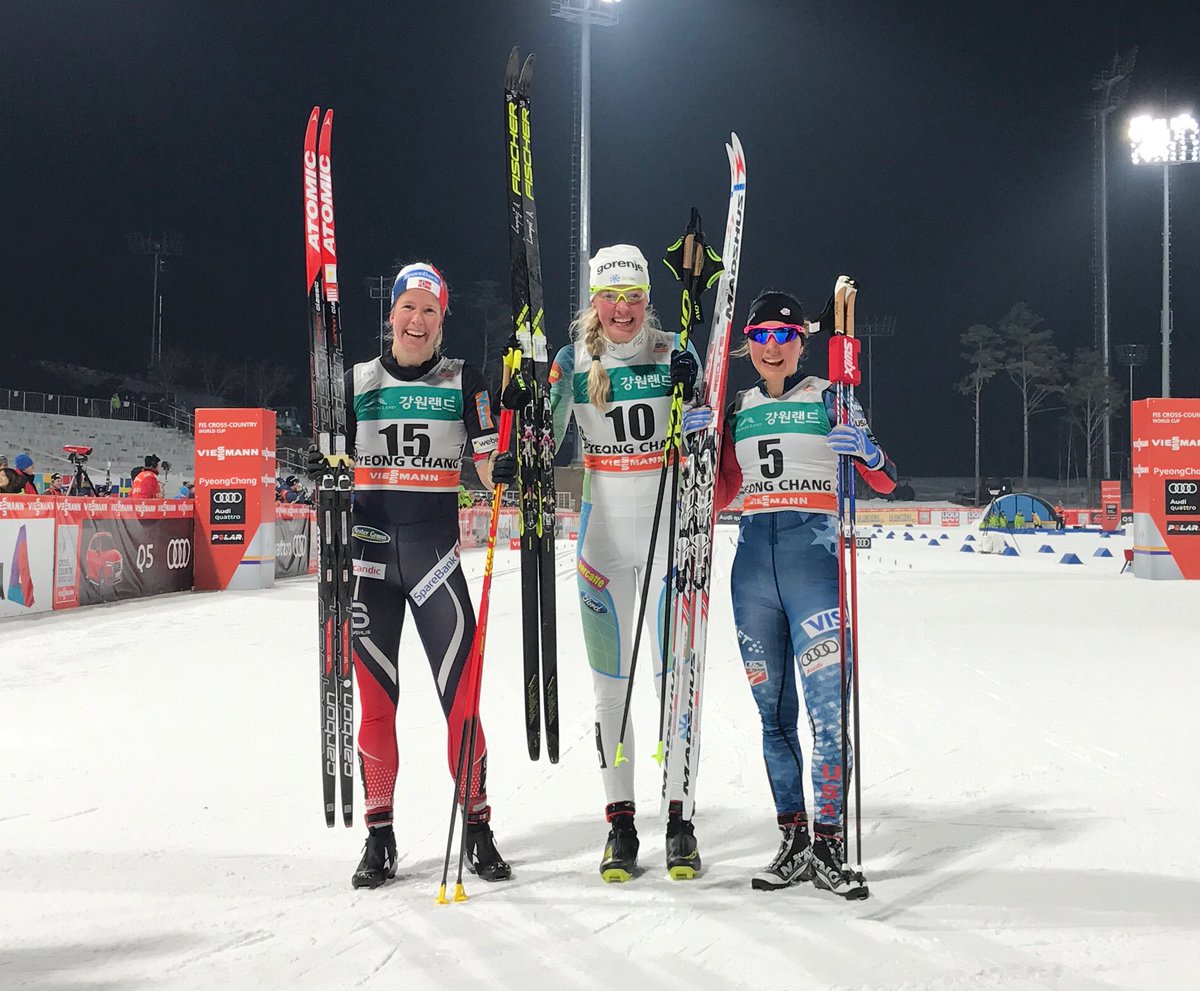
2018 Davos, Switzerland women’s sprint podium. Sweden’s Stina Nilsson (center) placed first, Sophie Caldwell (left) of the U.S. was second, and Maja Dahlqvist (right) also of Sweden was third. (Reese Brown/U.S. Ski Team)
Claiming Saturday’s third and final podium position was Dahlqvist, who crossed 2.60 seconds behind Nilsson. The podium is Dahlqvist’s second World Cup podium this season. She placed second in the FIS classic sprint opener in Kuusamo, Finland. Prior to this year, Dahlqvist has had one other individual World Cup top three performance, that being her second place finish in last season’s Dresden freestyle sprint.
Finishing in fourth on Saturday was Russia’s Natalia Nepryaeva (+3.98). Following Nepryaeva was Visnar in fifth (+4.34) and Pärmäkoski in sixth (+11.16).
Rounding out the top-ten was Swiss skier Nadine Fähndrich in seventh, Evelina Settlin in eighth, Lotta Udnes Weng in ninth and Ingvild Flugstad Østberg in tenth.
The U.S. placed four women total in the top-30, with Caldwell’s second place performance followed by Sadie Bjornsen in 14th, Ida Sargent 21st, Jessie Diggins 26th, and Rosie Brennan 29th.
Sadie Bjornsen of the U.S. Ski Team during the third quarterfinal of the women’s skate sprint in Davos, Switzerland. (Photo: Reese Brown/U.S. Ski Team)
Both Bjornsen and Brennan advanced to the third quarterfinal, with Bjornsen having qualified in 10th and Brennan 28th. Bjornsen had led the first climb and descent of her quarterfinal before Sweden’s Hanna Falk took over the pace as they headed into the course’s second climb.
Bjornsen held onto second through the descent before getting passed by Nepryaeva in the finishing stretch. She finished the quarterfinal in third behind Falk and Nepryaeva. Bjornsen missed advancing by 0.13 seconds. Brennan crossed in sixth.
In the first quarterfinal along with Nilsson, Sargent led the group through the first uphill. However, by the second climb on course, Sargent had dropped back to sixth and eventually crossed her quarterfinal in fifth.
Ida Sargent locked in during her World Cup quarterfinal in Davos, Switzerland. of the U.S. Ski team during the qualifier of the women’s skate sprint in Davos, Switzerland. (Photo: Reese Brown/U.S. Ski Team)
In the fourth quarterfinal, an early fall put Diggins out of contention for advancement to the semis. In the first straightaway, the American’s left ski collided with the pole of Russian ski racer, Natalia Matveeva, causing Diggins to crash.
“Traffic just sort of closed in on her,” Whitcomb said. “Just a race incident, the kind of the thing you saw happen in some of the other heats.”
In the second semifinal, a collision between Pärmäkoski and Norway’s Tiril Udnes Weng caused the Norwegian’s left ski to fall off midway through the race.
“Unfortunately in Davos, even Jessie can’t recover the 30-meters required to catch back up to the group,” Whitcomb added. “It’s too delicate a venue at altitude.”
Sophie Caldwell (l) and U.S. Ski Team teammate/boyfriend Simi Hamilton after Caldwell placed second in Saturday’s 1.5-kilometer freestyle sprint on Saturday in Davos, Switzerland. (Photo: Reese Brown/U.S. Ski Team)
Tara Geraghty-Moats winning Sunday’s normal hill/5 k Gundersen at the 2018 Women’s Nordic Combined Summer Grand Prix in Oberwiesenthal, Germany. (Photo: Romina Eggert/FIS)
Two North Americans posted impressive results at nordic events in Germany and Norway over the last week, with Vermont native Tara Geraghty-Moats racing to first overall in the first-ever Women’s Nordic Combined Summer Grand Prix and Quebec’s Alex Harvey placing second, fifth and 10th in three races at the Toppidrettsveka rollerski series.
Geraghty-Moats 1st and 2nd at Inaugural Women’s NoCo Grand Prix
Brand new to nordic combined as well as the jump hill in Oberwiesenthal, Germany, Geraghty-Moats took the inaugural women’s Nordic Combined Summer Grand Prix by storm this past weekend, placing first and second in two competitions. That tied her for first place in the overall Grand Prix standings, alongside Russia’s Stefaniya Nadymova — the defending champion of last winter’s inaugural women’s Nordic Combined Continental Cup.
On Sunday, Geraghty-Moats, 25, of USA Nordic and the New York Ski Education Foundation (NYSEF), handily beat Nadymova and the rest of the 10-woman field after starting the 5-kilometer Gundersen rollerski race in second, four seconds behind Germany’s Jenny Nowak. While Nowak had posted the best jump of 96 meters on Oberwiesenthal’s 106-meter “normal” hill, Geraghty-Moats tied for the second-best-scoring jump (94.5 meters), with Austria’s Lisa Hirner (95 meters). From there, Geraghty-Moats dropped Hirner, Nadymova and Nowak on the first of three laps in the rollerski race and went on to finish in 11:04.8. Nowak ultimately placed third, 1:29.2 behind Geraghty-Moats.
“I was really satisfied by how my first weekend of being a nordic combined-er went, and I think the patience of waiting to be a nordic combined-er really paid off,” Geraghty-Moats told the International Ski Federation (FIS) after. “I struggled with the jump a little bit the first couple days. I had never jumped this hill before, and I sort of figured it out today so I got to ski a little bit easier than yesterday, but I was also happy that yesterday I was able to have a good fight and ski fast to my potential and end up on the podium.”
The women’s individual normal hill/5 k Gundersen podium on Saturday at the 2018 Women’s Nordic Combined Summer Grand Prix, with Russia’s Russia’s Stefaniya Nadymova (c) in first, American Tara Geraghty-Moats (r) in second, and Germany’s Jenny Nowak (l) in third in Oberwiesenthal, Germany. (Photo: FIS/Silke Tegethof)
“It was a dream come true to finally be able to compete in women’s Nordic Combined on an international level,” Geraghty-Moats told FIS on Saturday. “I’m using this weekend to learn the level I have to be at to have success in Nordic Combined. I made some mistakes today and learned a lot but I came away with a good result and having had a huge amount of fun competing with small but strong field.”
Eleven women competed in Saturday’s normal hill/5 k.
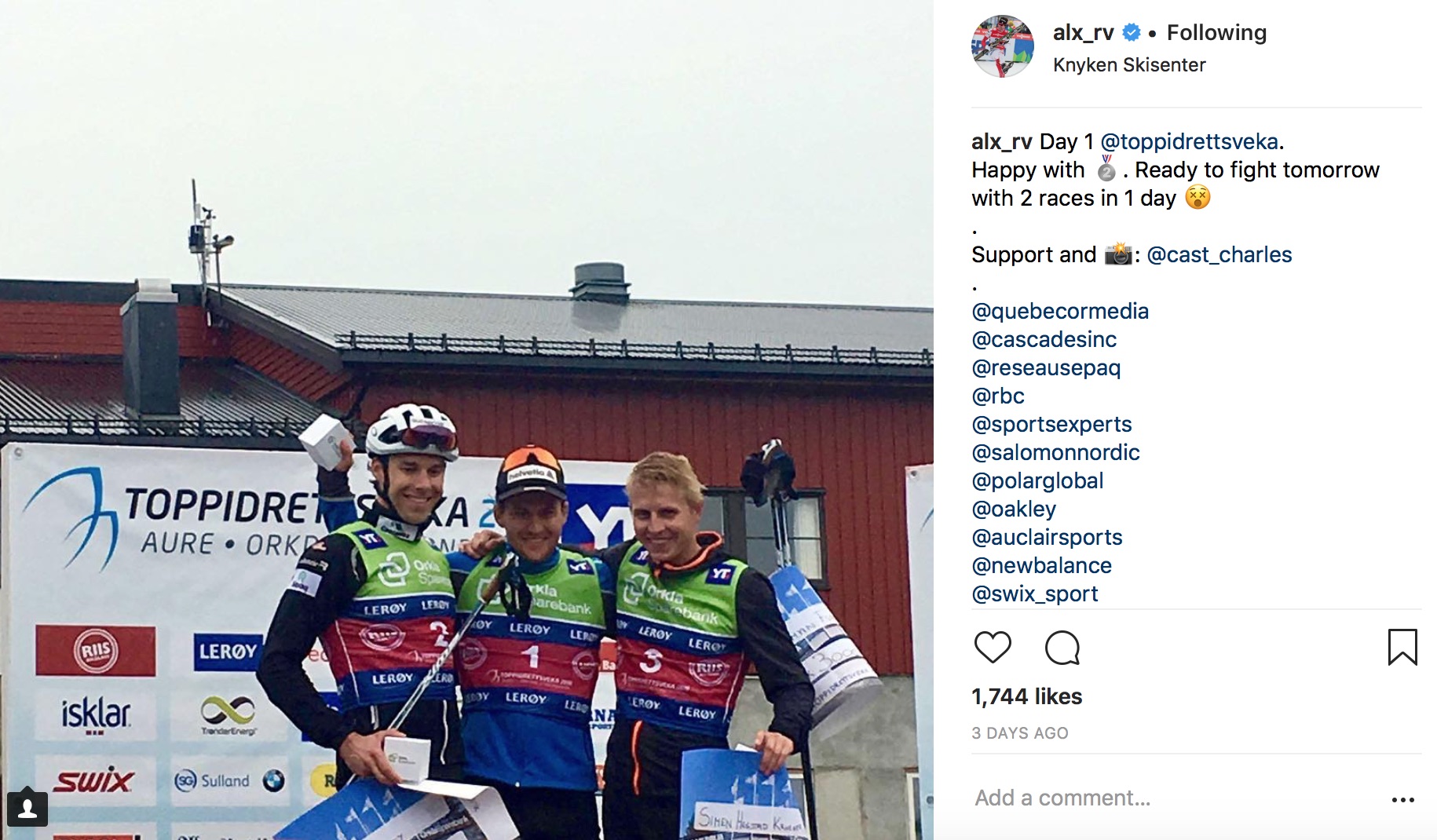
Alex Harvey (l) on the podium with Roman Furger (c) and Simen Hegstad Krüger (r) at the 2018 Toppidrettsveka rollerski festival in Norway last Thursday, Aug. 16. (Photo: Alex Harvey/Instagram)
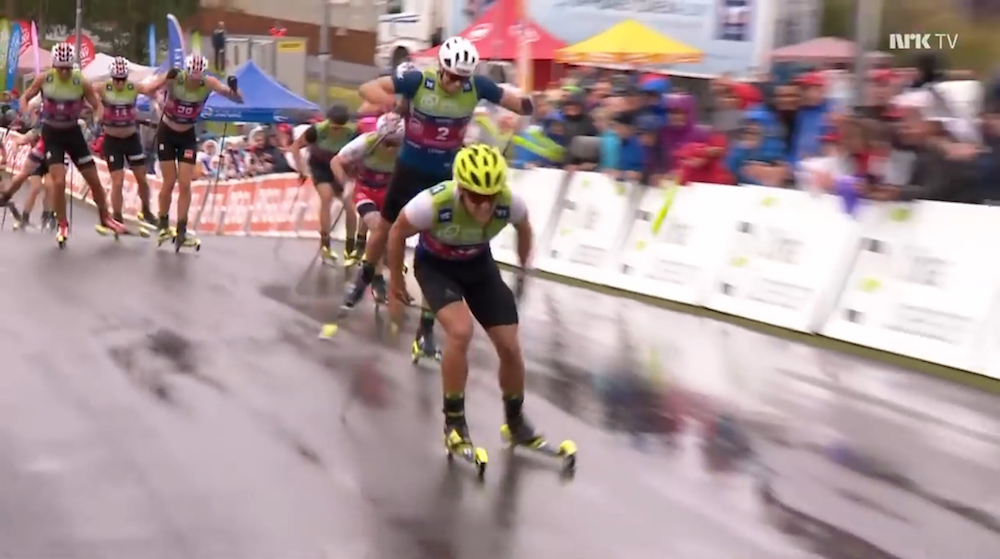
At the Toppidrettsveka rollerski festival in Norway, Canada’s Alex Harvey raced to second in the 15 k skiathlon last Thursday in Orkdal, missing out on first by just 0.6 seconds to Switzerland’s Roman Furger, who won in 30:43.3. Norway’s Simen Hegstad Krüger, the reigning Olympic skiathlon champion, finished third, 1.5 seconds back. In a stacked international field of 125 men, Canada’s Evan Palmer-Charrette placed 75th in that race (+2:14.4), Bob Thompson was 84th (+2:32.7), and Scott Hill 89th (+2:52.5).
Canada’s Alex Harvey (2) gunning for first in the men’s 15 k skiathlon on Aug. 16 at the Toppidrettsveka rollerski festival in Orkdal, Norway. (Screenshot: NRK broadcast)
Heidi Weng beat her cousin Tiril Udnes Weng by 0.7 seconds in the women’s 10 k skiathlon that day, finishing in 22:52.1. Norway swept the top five of the women’s race, with Anne Kjersti Kalvå reaching the podium in third (+1.3), and national-team members Kathrine Harsem and Astrid Uhrenholdt Jacobsen placing fourth (+1.4) and fifth (+1.5), respectively, out of 43 women.
In the men’s 24 k classic mass start aroundAure/Brekka on Friday, Harvey finished fifth, 19 seconds after Krüger, who won in 59:57.5. Norway’s Hans Christer Holund placed second in that race (+2.6), Norway’s Magnus Stensås was third (+13.0), and Switzerland’s Dario Cologna fourth (+17.1). Also for Canada, Palmer-Charrette finished 61sth (+2:30.9), Hill 78th (+4:02.3), Thompson 86th (+5:40.3), and Maks Zechel 88th (+7:01.4) out of 125.
Heidi Weng repeated in first in the women’s 24 k mass start, finishing in 1:10:02.4 hours, while Tiril Udnes Weng again placed second, 25.4 seconds back, and Jacobsen reached the podium in third (+27.7).
Later on Friday in Aure, Norway’s Sondre Turvoll Fossli topped the men’s freestyle sprint final ahead of four other Norwegians, including Pål Trøan Aune in second and Jan Thomas Jenssen in third, and Switzerland’s Furger in fifth, while Harvey did not qualify for the heats and ended up 37th overall. Palmer-Charrette was once again 61st in qualification, Hill 107th and Thompson 109th out of 121.
In the women’s sprint, Norway’s Mathilde Myhrvold won the final in 2:56.54, 1.05 seconds ahead of Slovenia’s Katja Visnar in second. Heidi Weng placed third in the final (+1.97), ahead of Tiril Weng (+2.64) in fourth, another Norwegian Anna Svendsen in fifth (+2.76), and another Slovenian Alenka Cebasek in sixth (+3.73).
In the final race of the series, the classic pursuit on Saturday, Harvey started second, 10 seconds behind Furger in first. The Canadian went on to place 10th, 4.2 seconds out of first, in the 15 k race, while Stensås took the win in 37:45.5 after starting seventh. (Furger slipped to 55th and 1:55.5 behind at the finish.) Norway’s Mikael Gunnulfsen rose from eighth to second (+0.7) and France’s Jean-Marc Gaillard made it all the way up to third (+1.7) after starting 15th.
Palmer-Charrette finished the pursuit in 59th (+2:04.2), Thompson placed 80th (+2:55.2), Hill 87th (+3:41.5), and Zechel 93rd (+3:48.9) out of 105.
Jacobsen ended the weekend as the women’s 12 k mass start winner, after the entire women’s field (of 33) started at the same time. She crossed the line first in 34:20.8, 0.4 seconds ahead of Heidi Weng in second and 1.2 seconds ahead of Kalvaa in third.
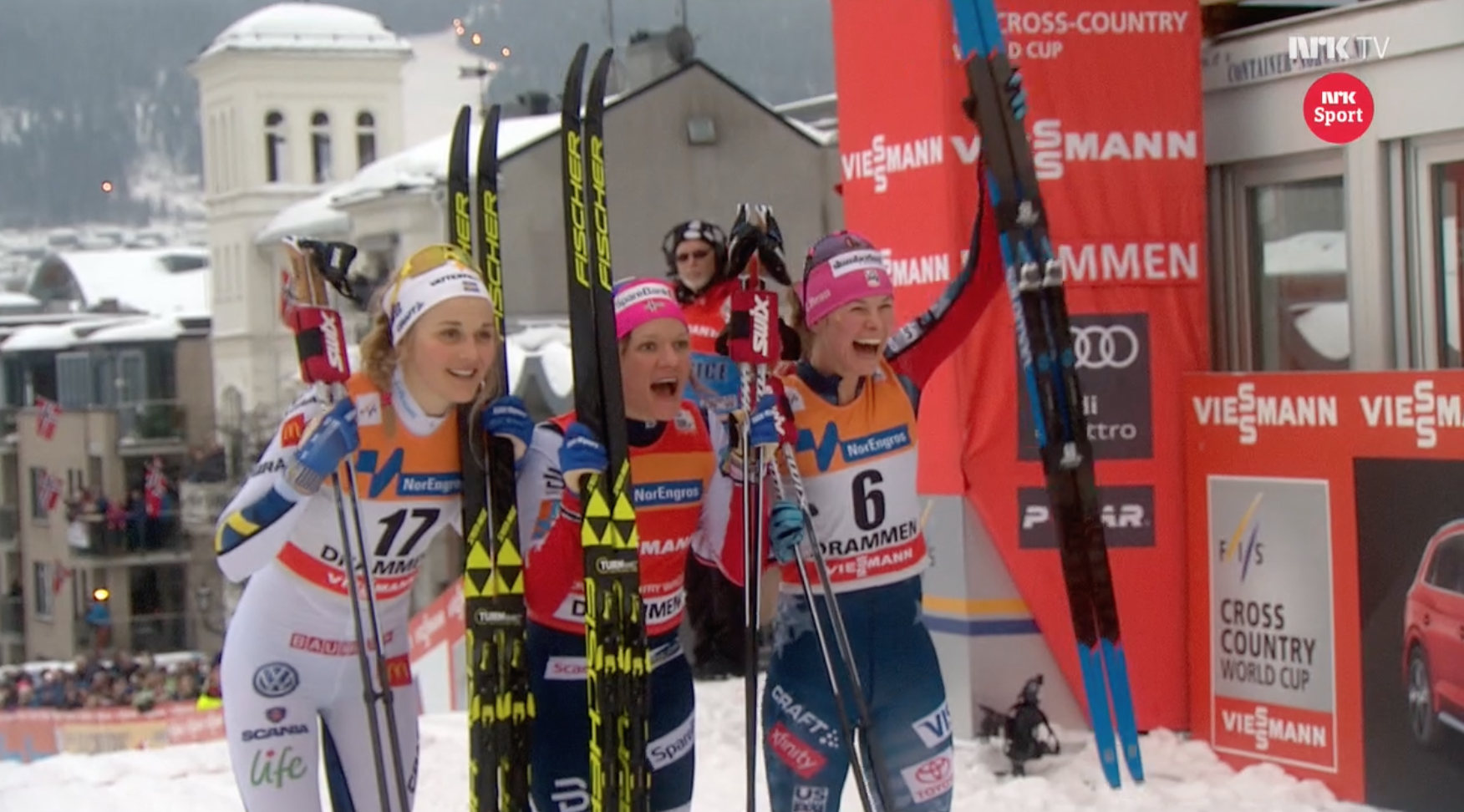
Maiken Caspersen Falla of Norway (center) won the classic sprint in Drammen and all but wrapped up the Sprint Cup. Stina Nilsson of Sweden (left) was second and Jessie Diggins of the United States third. (NRK screencap)
FIS Cross Country World Cup (Drammen, Norway): Classic sprints
The cross-country World Cup hit the city on Wednesday, with classic sprints contested in the Oslo suburb of Drammen on snow which had been trucked onto the streets. And the crowd was rewarded with wins by two Norwegian favorites: Maiken Caspersen Falla in the women’s sprint and Johannes Høsflot Klæbo in the men’s race.
In the women’s final, Falla and Natalia Nepryaeva of Russia battled at the lead for much of the race, but Falla pulled away from the field on the last climb to the finish. Stina Nilsson of Sweden and Jessie Diggins of the United States pulled past Nepryaeva in the final few hundred meters to claim spots on the podium; Krista Parmakoski of Finland was fifth and Katja Visnar of Slovenia sixth.
With the win, Falla all but wrapped up the World Cup’s Sprint Cup crystal globe: she is just two points from having it clinched, with one sprint remaining on the calendar. In Falun, Sweden, in ten days, she more or less just has to make the heats to earn her third Sprint Cup in a row.
Also racing for the United States, Sadie Bjornsen and Sophie Caldwell made the quarterfinals, but did not advance past that round. Bjornsen ended the day in 21st and Caldwell in 27th.
Ida Sargent and Rosie Brennan were 47th and 48th in qualifying, followed by Kikkan Randall in 50th and Kaitlynn Miller in 53rd.
For Canada, Emily Nishikawa finished 52nd and Dahria Beatty 55th.
Great Britain’s Nichole Bathe, who raced for the University of Alaska Fairbanks, finished 58th.
In the men’s final, Russia’s Alexander Bolshunov set the pace for most of the heat. Klæbowas on his ski tails, and drew even on the course’s on downhill, where Norwegian teammate Eirik Brandsdal also caught up to them. Skiing back up to the finish, Klæbo ramped up to a furious tempo and was uncatchable. Brandsdal passed Bolshunov to claim second by a healthy margin. Sindre Bjørnestad Skar finished fourth, Kasper Stadaas fifth, and Emil Iversen sixth, all for Norway.
The lone North American to make the heats, Erik Bjornsen, qualified in 26th and finished the day in 18th. Teammate Andy Newell just missed the quarterfinals after finishing 33rd in qualification. Logan Hanneman and Kevin Bolger finished 49th and 50th, and Reese Hanneman 56th.
For Canada, Julien Locke placed 51st in qualifying, Alex Harvey 54th, and Andy Shields 58th.
Norway’s Ragnhild Haga leads Switzerland’s Nathalie von Siebenthal during the 4 x 5-kilometer team sprint on Saturday at the 2018 Olympics in PyeongChang, South Korea. (Photo: FlyingPointRoad)
PYEONGCHANG, South Korea — Three days before the 4 x 5-kilometer women’s relay event, Norway’s Marit Bjørgen sat in the PyeongChang Olympic press-conference room. A table and a black mic served as the only separation between the five-time Olympian, and a group of reporters eagerly awaiting to pick her brain.
She had just tied for third in the women’s 10 k freestyle and had been fielding questions about her bronze-medal performance when the conversation took a momentary turn.
The inquiry on the table prodded Bjørgen for her thoughts about the upcoming team relay. The Norwegian’s response seemed simple, yet seasoned with wisdom: “The relay is the relay,” she said with a laugh.
Going into Saturday’s team competition, many may have assumed that the relay was Norway’s race to lose. But Bjørgen’s remark hinted at the broader felicitousness of predictability on the stage of events like the Winter Games. In the last five Olympic cycles, Norway has taken first only once. That gold came at the Vancouver Games in 2010.
All but two of those Olympic relay teams have featured Bjørgen. Her comment in the PyeongChang press conference may be a tacit reminder that a relay podium, even for a powerhouse cross-country nation like Norway, is never secure until every racer crosses the line.
On Saturday it seemed she and her team would relive their more frequent results of the past. Racing the first leg, Norwegian Ingvild Flugstad Østberg kept the team in the mix. She chased down Russia’s Natalia Nepryaeva throughout the blistering first-classic leg pace and the two came into the exchange together along with Slovenia’s Anamarija Lampic.
Almost 20 seconds behind the lead group was Finland’s Aino-Kaisa Saarinen and another 5 seconds behind the Finn was Sweden’s Anna Haag. In the lead group’s exchange, Østberg tagged off to Astrid Uhrenholdt Jacobsen, Nepryaeva to Yulia Belorukova, and Lampic to Katja Visnar for the second classic leg.
As the those three began striding the initial climb, Saarinen came into the exchange to tag off to Finland’s Kerttu Niskanen, while Haag handed off to Sweden’s Charlotte Kalla.
“I did what I could to keep up with them, just trying to not lose that [many] seconds,” Haag said during a press conference. “I really did what I could, but then I was so tired on the top of the last uphill that I could barely ski downhill.”
Sweden’s Charlotte Kalla racing the second leg of the 4 x 5-kilometer team sprint on Saturday at the 2018 Olympics in PyeongChang, South Korea. (Photo: FlyingPointRoad)
If Kalla wanted to put Sweden in the mix for a medal, she would need to make up 25.5 seconds over the course of 5 k.
It didn’t take long for the Swede to silence any doubt as to whether she could. She raced the fastest second classic leg, catching not only Niskanen in her first 2.5 k lap, but later swallowing Jacobsen and Visnar during her second lap. The Swede found even more seconds in the final climb and Team Sweden was in second by the time Kalla rounded the course’s final turn back toward the stadium.
“It was a very inspiring position to go out hunting,” Kalla said at Saturday’s post-race press conference. “And I know that it’s important for me to take some time to get in the right mode and not stress too much. I had really good skis, so it was just to relax in my shoulders and try to have a good position in the double poling. I knew that every second that I could catch up for Ebba and Stina would be important.”
Team Russia was number one through the second exchange, with Belorukova tagging off to Anastasia Sedova for the first freestyle leg. Hot on the Russian’s heels was Sweden’s Ebba Andersson, spurred by Kalla’s strong classic leg.
Yulia Belorukova (5) skiing the second leg for the Olympic Athletes from Russia in the women’s 4 x 5-kilometer team sprint on Saturday at the 2018 Olympics in PyeongChang, South Korea. (Photo: FlyingPointRoad)
Niskanen was the next skier through in third, skiing just 8.4 seconds away from the silver medal. She tagged off to Riitta-Liisa Roponen for Finland’s first skate leg.
After having bled even more time, Jacobsen came through the exchange in fourth. Almost 30 seconds now separated Norway from the win and even a shot at the bronze was 19.7 seconds away.
Jacobsen tagged off to Norwegian Ragnhild Haga, a good pick if Norway wanted to return to the top three. Haga earned her first Olympic gold medal in Thursday’s 10 k freestyle, and on Saturday she appeared to be searching to add one more.
Within the first 2.5 k, Haga reeled Roponen in and left her in the dust as she headed out for her second lap. She continued to push the pace and by the end of her 5 k leg, Haga put her team back into contention for gold. As Team Norway came through the exchange, their time back from Sweden and Russia was no longer 30 seconds, but down to three.
Andersson tagged off to Sweden’s Stina Nilsson, while Sedova handed off to Russia’s Anna Nechaevskaya. Taking the anchor leg for Norway was Bjørgen.
The Norwegian quickly chased down the three second gap to Nilsson. Their red and white Scandinavian suits soon broke free of Russia in maroon.
At this point, the safest way for Bjørgen to secure gold would be to avoid a sprint between herself and the Swede. However, the two raced in tandem throughout the first 2.5 k, Nilsson shadowing the Norwegian’s every move. As they started their second lap, Bjørgen still couldn’t shake her from the back of her skis. Heading into the final climb it was Norway and Sweden together, Bjørgen leading by just half an inch.
The Norwegian women’s celebrates after taking gold in the 4 x 5-kilometer relay on Saturday at the 2018 Olympics in PyeongChang, South Korea. (Photo: FlyingPointRoad)
Halfway through, Bjørgen put in a surge. The gap was not much, but perhaps just enough. She crested the hill ahead of the Swede and led the final descent. The two cornered to the final 100 meters, Bjørgen barely poling ahead. The Norwegian managed to hold off any attack from the Swede and crossed first with a team time of 51:24.3 for gold.
“Stina looked really strong. We all know how strong she is in the last 100 meters,” Østberg said during a press conference. “But Marit, she is one hell of a skier … I was so nervous and extremely happy when she managed to beat [Nilsson] in the last 100 meters.”
Nilsson crossed 2 seconds later bring Sweden silver, and Nechaevskaya crossed third (+43.3) to earn Russia bronze.
“First of all I am extremely happy I must say, that’s number one. And secondly it’s true that we are going exactly in the right direction,” Belorukova said at the press conference. “We are getting stronger year on year and more powerful, and I should say given the current situation maybe we are also getting more [tough] as we fight our way along. And this is not going to be the last medal.”
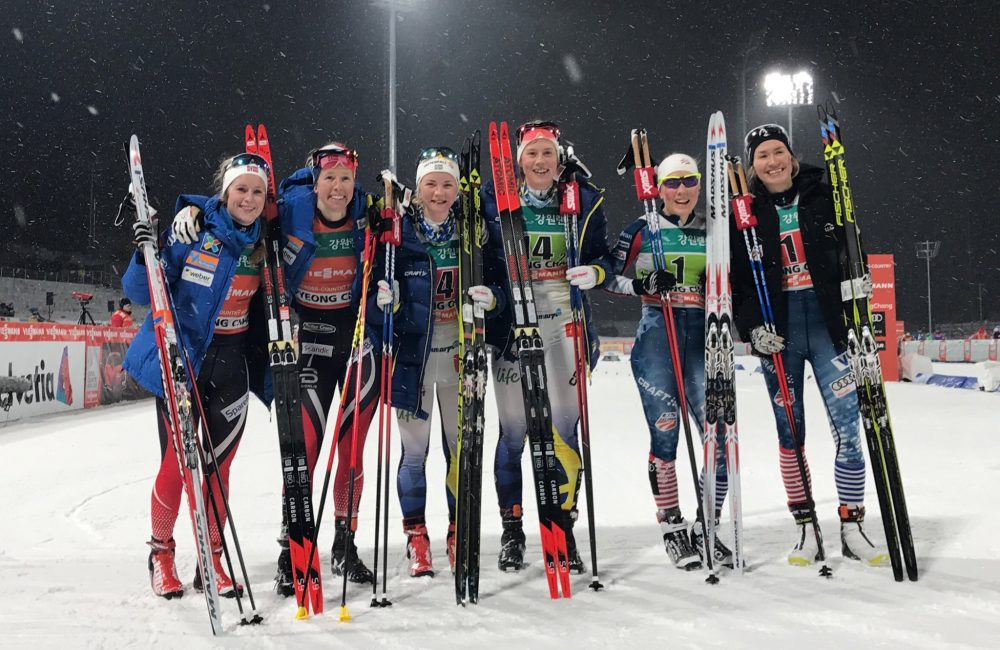
Just outside the medals, Finland placed fourth (+1:02.6) and the U.S. finished fifth (+1:20.5) for its best Olympic result. Germany was sixth (+1:49.4), Switzerland seventh (+1:51.5), Slovenia eighth (+2:31.4), Italy ninth (+2:57.7), and Poland 10th (+3:06.6). Canada finished 13th (+4:50.3) of 14 teams.
— Jason Albert, Harald Zimmer and Alex Kochon contributed
The Norwegian women’s celebrates after taking gold in the 4 x 5-kilometer relay on Saturday at the 2018 Olympics in PyeongChang, South Korea. (Photo: FlyingPointRoad)
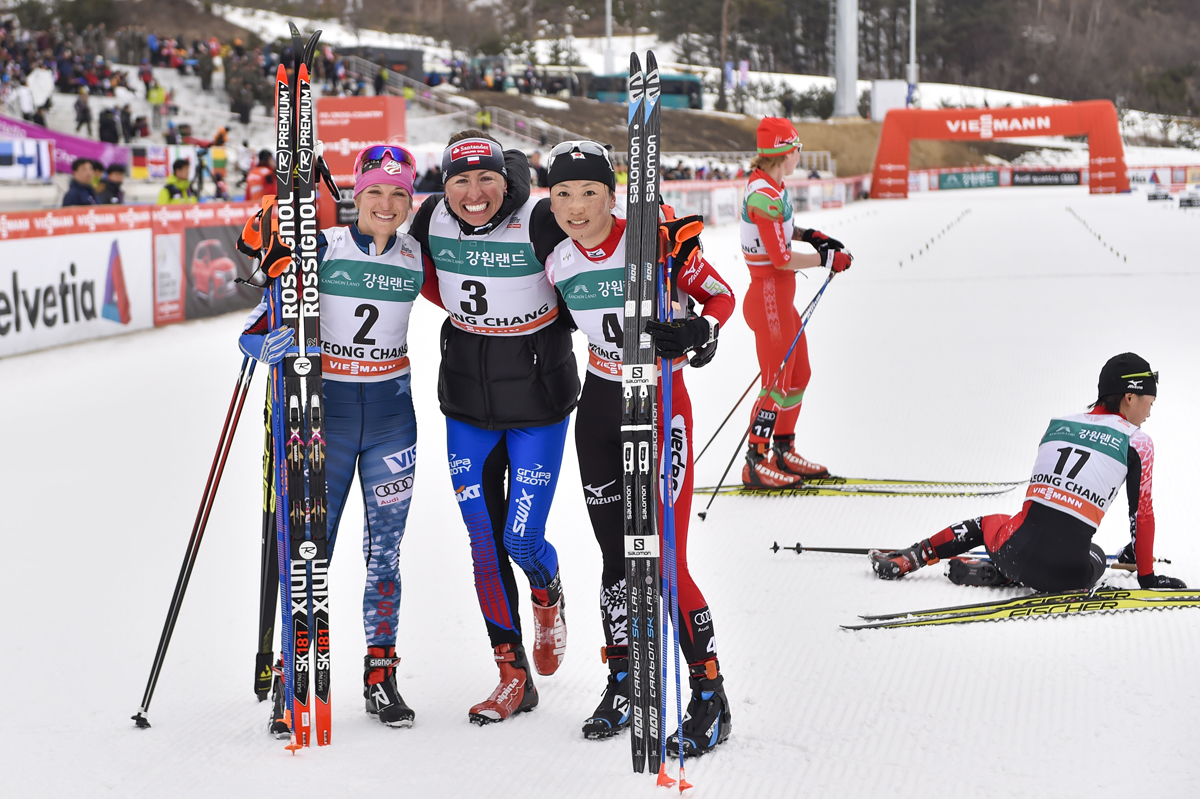
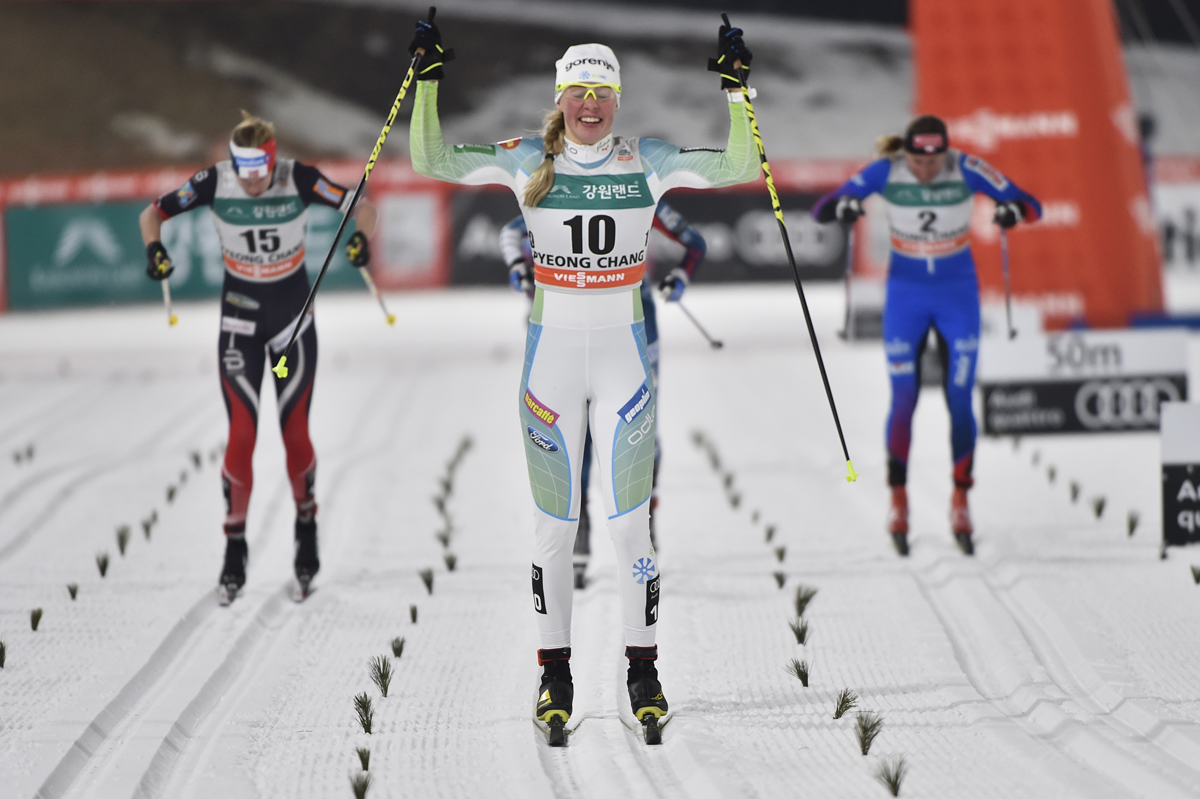
Sweden’s Stina Nilsson (center) won gold in the classic sprint at the 2018 Olympics, with Norway’s Maiken Caspersen Falla (left) taking silver and Russia’s Yulia Belorukova bronze. (Photo: FlyingPointRoad)
After winning the sprint qualifier by 0.39 seconds over defending gold medalist Maiken Caspersen Falla and then besting the Norwegian by 0.03 seconds in her semifinal, Sweden’s Stina Nilsson captured Olympic gold in a dominating performance in the classic sprint final, ultimately besting Falla by 3.03 seconds.
Falla had to fight to even keep silver, as Olympic Athlete of Russia Yulia Belorukova pushed the pace on the final uphill and came close to outsprinting Falla in the finishing straight. However, the 23-year-old Russian couldn’t quite sneak past and settled for bronze, 0.34 seconds behind Falla.
Jessie Diggins of the United States after finishing sixth in the classic sprint in PyeongChang. (Photo: FlyingPointRoad)
Her teammate Natalia Nepryaeva finished fourth (+9.14 in the final), Sweden’s Hanna Falk fifth (+11.16), and the United States’ Jessie Diggins sixth (+11.23).
Diggins’s teammate Sophie Caldwell finished unlucky number eight, and based on time was the last woman not to make the final after finishing a close fourth behind Nilsson, Falla, and Falk in her semifinal. Both semifinal heats were fast, with one lucky loser coming from each, and Caldwell was 0.18 seconds off that time.
Also for the United States, Sadie Bjornsen finished third in her quarterfinal heat, 2.46 seconds behind Belorukova and also behind Norway’s Heidi Weng. That put her 14th on the day.
In the men’s final, it was a fight to the final uphill when 21-year-old Norwegian phenom Johannes Høsflot Klæbo ran away from the field over the top of the climb and sailed to the finish to become the youngest ever gold medalist in cross-country skiing at the Olympics. Alexander Bolshunov of Russia had matched Klæbo for most of the race but ran out of steam at the top, allowing Italy’s Federico Pellegrino to catch onto his tails before the downhill. While Klæbo widened his lead, Bolshunov and Pellegrino battled to the finish line and Pellegrino ultimately won in a photo finish, securing silver (+1.34) while Bolshunov took bronze (+1.36).
Johannes Høsflot Klæbo won the men’s Olympic sprint in dominating fashion while Federico Pellegrino just edged Alexander Bolshunov for silver. (Photo: FlyingPointRoad)
Norway’s Pål Golberg finished fourth (+3.81 in the final) and Sweden’s Oskar Svensson fifth (+7.73). Top qualifier Ristomatti Hakola of Finland didn’t have it in the final, finishing sixth (+20.72).
Canada’s Len Valjas finished third in his semifinal, but well off the pace (3.98 seconds behind Hakola) and did not advance as a lucky loser to the final. That put him seventh overall, Canada’s best result in two Olympic cycles.
Both American men, Erik Bjornsen and Simi Hamilton, were eliminated in the quarterfinals. Hamilton’s quarterfinal was marred by a crash involving nearly the entire group, and he ended up fourth with a slow time as a result, and landed 20th on the day. Bjornsen finished fifth in his heat, 1.63 seconds behind Klæbo in one of the tightest quarterfinals of the day, good for 25th overall.
Norway has now won both men’s gold medals in cross-country skiing, while Sweden has swept the women’s gold medals.
Sprint racing at the PyeongChang Olympics kicked off on Tuesday, with Sweden’s Stina Nilsson setting the pace in the women’s qualifier just 0.39 seconds ahead of defending Olympic champion Maiken Caspersen Falla of Norway.
The rest of the field couldn’t touch those two. Krista Parmakoski of Finland, the bronze medalist in the 30 k skiathlon, came closest, notching a time 3.56 seconds slower. Sweden’s Hanna Falk qualified fourth (+3.80), Slovenia’s KatjaVisnar fifth (+6.50), Olympic Athlete of Russia Natalia Nepryaeva sixth (+6.91), American Jessie Diggins seventh (+7.02), Sweden’s Ida Ingemarsdotter eighth (+7.32), American Sadie Bjornsen ninth (+7.38), and Norway’s Heidi Weng tenth (+7.54).
For the United States, Sophie Caldwell also qualified for the quarterfinals in 12th position (+8.32). Ida Sargent, who recently had surgery on her thumb, did not, notching the 33rd-best time of the day – 17.06 seconds off the pace and 1.78 seconds out of the heats.
For Canada, Emily Nishikawa led the team in 34th, 2.73 seconds out of quarterfinals. Dahria Beatty finished 42nd (+21.03) and Cendrine Browne 51st (+25.56).
CU student Petra Hyncicova of the Czech Republic finished 45th (+23.29). APU’s Jessica Yeaton, racing for Australia, finished 48th (+24.27), and Aussie teammate Casey Wright (University of Alaska Anchorage) 63rd (+41.06). Canada-based Mathilde Petitjean of Togo finished 59th (+37.19).
In the men’s sprint qualifier, Ristomatti Hakola of Finland turned heads by posting a time that last year’s Sprint Cup champion Johannes Høsflot Klæbo of Norway could not beat. The Norwegian posted a time 0.19 seconds slower than the Finn.
The men’s field was much closer than the women’s, with just 9.51 seconds separating the top 30 finishers who would move on to the quarterfinals. The third qualifier was young Olympic Athlete of Russia AlexanderBolshunov (+1.66), with Italy’s MaicolRastelli a surprise fourth-place finisher (+2.78). Sweden’s Teodor Peterson qualified fifth (+3.01), Olympic Athlete of Russia Alexander Panzhinsky sixth (+3.09), Sweden’s OskarSvensson and Viktor Thorn seventh (+3.48) and eighth (+3.65), and Italy’s FedericoPellegrino ninth +4.64. Calle Halfvarsson notched the tenth-best time (+4.73) and gave Sweden four qualifiers in the top ten, while Klæbo was the lone Norwegian in the top ten.
For the United States, Simi Hamilton and Erik Bjornsen made the quarterfinals, qualifying in 19th (+7.59) and 29th (+9.15) respectively. Bjornsen actually tied for 29th with France’s Richard Jouve, making him the last man to make the cut, so to speak. Canada’s Len Valjas will be the lone representative of his country in either the men’s or women’s heats after qualifying 26th (+8.57).
Alex Harvey just missed the quarterfinals in a tie for 32nd (+9.41), with Canadian teammate Jesse Cockney close behind in 35th (+10.00). Russell Kennedy rounded out the Canadian team in 54th (+14.83).
For the U.S., Andy Newell was also on the outside looking in, placing 37th in the qualifier (+10.82). So was Logan Hanneman in 42nd (+12.20).
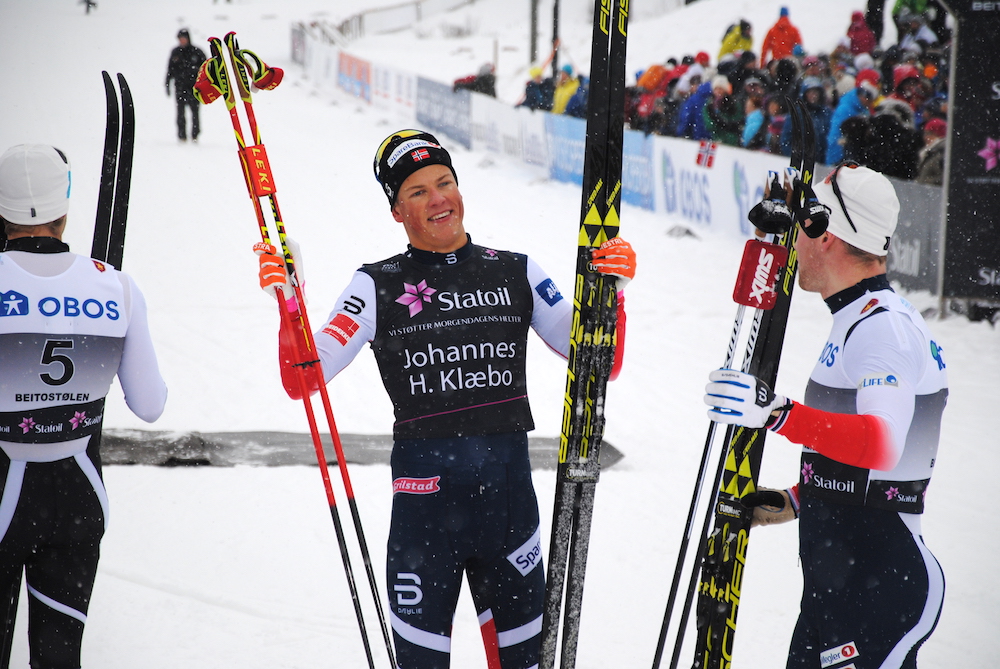
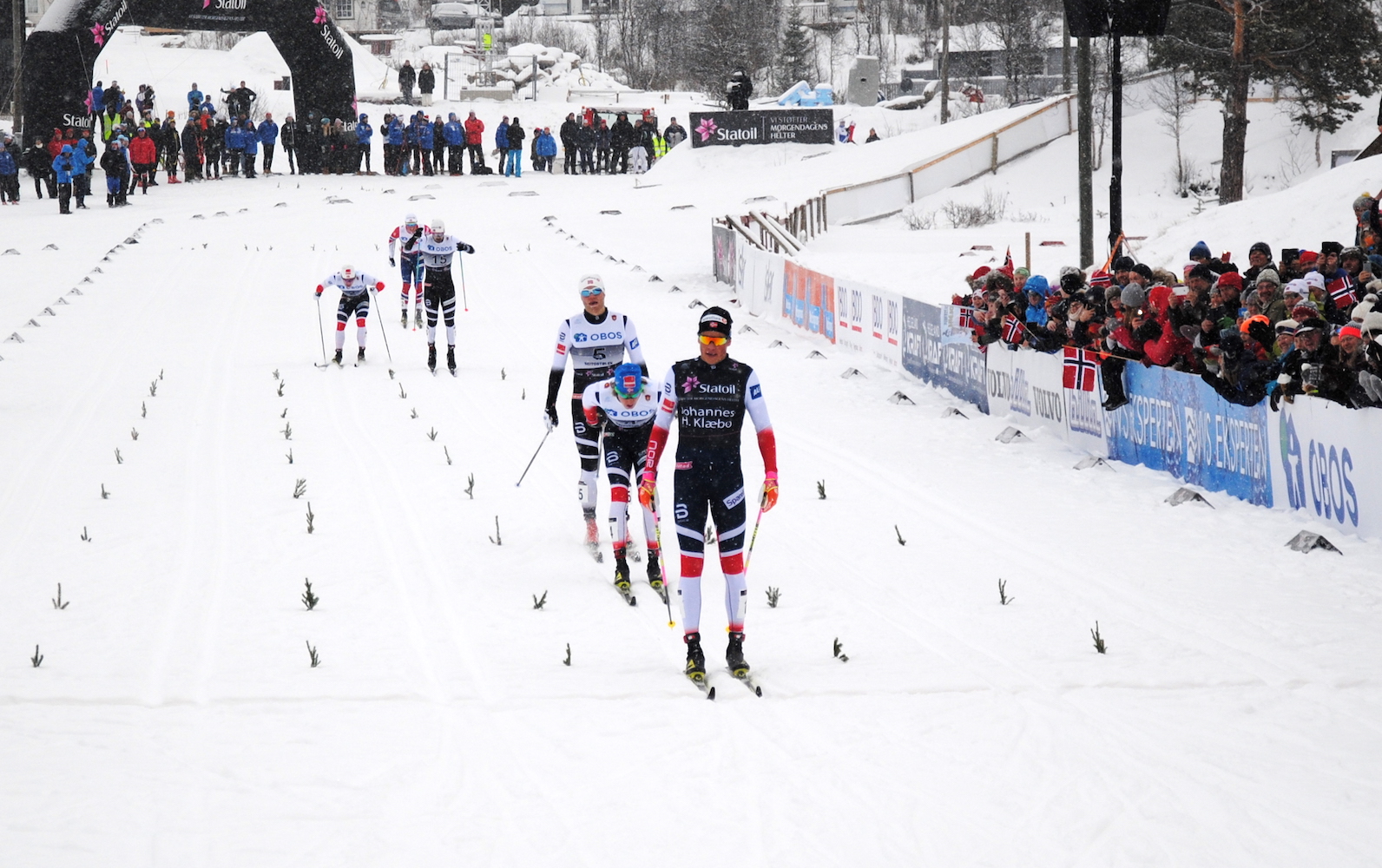
Norway’s Johannes Høsflot Klæbo celebrates his first win of the season on Saturday in the men’s 1.5 k classic sprint FIS race in Beitostølen, Norway. (Photo: Aleks Tangen)
BEITOSTØLEN, Norway — A year ago, 20-year-old Johannes Høsflot Klæbo leapt onto the scene with a season-opening skate-sprint win in Beitostølen. Before that, he made waves at 2016 U23 World Championships, winning gold in the skate sprint, 10-kilometer classic and 4 x 5 k relay. But until last season, Klæbo, a member of Norway’s national U23 team, was hardly a household name to those outside of Norwegian skiing circles.
That all ended in Beito. Klæbo landed on the podium in the first World Cup sprint of the 2016/2017 season, placing third in the classic sprint in Kuusamo, Finland, and accumulated half a dozen podium finishes throughout last winter. He capped the season as the men’s U23 World Cup champion as well as the Sprint World Cup winner.
Now a full-fledged member of the Norwegian Sprint World Cup Team, Klæbo, who turned 21 last month, returned to Beitostølen to post a second- and first-place finish so far in two International Ski Federation (FIS) races there. He started his season off by taking second in Friday’s 15 k classic, 18 seconds behind reigning Overall World Cup champion Martin Johnsrud Sundby.
On Saturday, Klæbo won the 1.5 k classic sprint in Beitostølen without so much as a blemish, winning the qualifier to start the day then topping each of his heats en route to the final.
Norway’s Johannes Høsflot Klæbo crossing the line first for the win in the men’s classic sprint final on Saturday at the FIS season-opener in Beitostølen, Norway. (Photo: Aleks Tangen)
Up against five other Norwegians in the final, Klæbo raced to first once more in 3:50.4 minutes, finishing 1.1 seconds ahead of runner-up Kasper Stadaas. World Cup sprinter Eirik Brandsdal followed in third (+1.8), Fredrik Riseth was fourth (+6.4), Sondre Turvoll Fossli crossed in fifth (+6.7), and Emil Iversen was sixth (+9.2).
“My goal was to ski a good race,” Klæbo told a group of reporters after. “I wanted to get away from the pack towards the end and luckily the gap remained until the end.”
Iversen called attention to the young Norwegian while speaking with reporters after the race. “There has never been a talent like him,” Iversen said.
With snow starting to fall just before the men’s qualifier, Klæbo fared best on the course, racing to a 3.07-second qualifying win over Riseth with a time of 3:39.76.
Norwegian sprint coach Arild Monsen emphasized Klæbo’s ability to accelerate in and out of turns.
“Cross-country skiing has seen some development in recent years with specific techniques in specific zones, and Johannes has developed an ability to take advantage of that,” Monsen told a group of reporters. “We saw that very clearly today. The trick is to technically skilled when you’re tired and he’s able to do that almost to point where we don’t understand how.”
Klæbo went on to win his quarterfinal by 0.5 seconds over Norway’s Gjøran Tefre, then his semifinal by 0.2 seconds over Brandsdal. U.S. Ski Team member Andy Newell faced him in the quarterfinal, where Newell finished fourth in the heat, 3.7 seconds behind Klæbo and 2.6 seconds behind Norway’s Emil Nyeng in third. Newell missed advancing to the semifinals and finished the day in 16th overall.
“I knew we were going to have a fast heat because Klæbo had set a pretty strong pace from the first hill on, so we were really close to lucky losers,” Newell told FasterSkier in a post-race interview. “The second heat was just barely faster.”
With his second Beitostølen sprint victory, Klæbo told NRK that he was glad to get this race under his belt.
“This felt good, and I’m glad that sprint is up and running,” he said. “This was a good race considering what will happen next weekend.”
The World Cup kicks off next weekend in Kuusamo with a classic sprint on Nov. 24, followed by 15 k classic and 15 k freestyle races for the men on Nov. 25 and 26.
The lone American man in Saturday’s race, Newell qualified in 11th, 10.86 seconds off Klæbo’s time.
“Felt good in qualification, skis weren’t perfect because it started snowing just before,” Newell told FasterSkier after. “Skis were fast, but not quite enough grip, so we did a little re-wax for the heats.”
He noted that he’s been working with Fischer in Beitostølen as he’s there without his team (the rest of the U.S. Ski Team is currently training in Rovaniemi, Finland).
For the first 300 meters of his quarterfinal, six skiers started at a relaxed pace with Klæbo and Newell at the back of the pack leading into the the first downhill. While both were able to work their way to the front on the first climb, Newell lost steam on the second-to-last hill, “Danskebakken” (Danish hill).
“I was stuck in the back up the first hill, so I had to burn a match to get to the front, which probably made me a little tired for the last hill,” Newell reflected.
With what he called “great grip” up the big climb, he felt like he was dragging a bit over the top.
“I was definitely getting a little tired on the flat part over the top,” he said. “Because it’s the first sprint, maybe I wasn’t aggressive enough in the transitions, maybe it’s because the skis were a little draggy, but it seemed like I would get passed by somebody or two people going into each hill.”
With enough grip on the climbs, he would pass those racers back.
“So tried to finish strong but not quite there, but it’s a long season and hopefully the body will feel a little better in Kuusamo,” Newell said. “It’s all good, just training so looking forward to the World Cup.”
Out of the 30 men who qualified for Saturday’s sprint heats, only two were not Norwegian: Newell and Great Britain’s Andrew Young (who qualified 22nd). Young went on to finish the day in 23rd overall after finishing fifth in his quarterfinal.
Falla Stuns with Late Attack
Maiken Caspersen Falla (l) leading the women’s final up a climb, along with fellow Norwegian national team member Astrid Uhrenholdt Jacobsen (in green) during the women’s 1.5 k classic sprint FIS race on Saturday in Beitostølen, Norway. (Photo: Aleks Tangen)
In the women’s race, Maiken Caspersen Falla controlled the women’s race in a similar fashion to Klæbo, winning the qualifier, quarter, semi, and ultimately, the final.
In the final, Falla, who won last year’s Beitostølen skate sprint as well as her second-straight Sprint World Cup Crystal Globe, skied with the pack until the final climb where she made her move before entering the final stretch alone. Falla, 27, finished 3.7 seconds clear of anybody in 3:01.1. In another all-Norwegian final, Mari Eide placed second and Astrid Uhrenholdt Jacobsen claimed third (+4.8). Tiril Udnes Weng placed fourth (+6.7), Kari Vikhagen Gjeitnes was fifth (+11.1) and Ane Appelkvist Stenseth was sixth (+18.5).
Falla started the morning with a qualifying win in 2:54.86, 1.77 seconds ahead of Slovenia’s Katja Visnar in second. She didn’t slow down much for the heats, racing to first in each in 3:01.7, 3:02.3 and 3:01.1, respectively.
“I felt that it went better and better and it’s wonderful to have that feeling when you’re sprinting,” Falla told NRK after.
After watching her attack and pass three women on the final hill, NRK commentator Fredrik Aukland called her “the best sprinter in the world”.
When asked if this performance was good enough to win any race in the future, she told a group of reporters, “I hope so, of course. There is finishing hill already next weekend that is kind of similar to this one and I have practiced running up hills a lot so it’s obviously fun to test it in a race.”
Teammates with Newell on the Stratton Mountain School (SMS) Elite Team, Anne Hart raced to 31st for the second day in a row, missing qualifying in the top 30 by 0.28 seconds.
“I am happy about my qualification,” she told FasterSkier immediately after her race, before she knew whether her time was fast enough for the heats. “The course is a lot faster than yesterday, good condition.”
Hart started the qualifier third out of 58 women, just ahead of Visnar in bib 4. Her time was 17.55 seconds back from Falla’s.
“I skied with Katja Visnar and she is really good classic sprinter,” Hart said. “… It feels really good to be able to ski with all these World Cup skiers.”
Nichole Bathe, who was born in the U.S. but is racing for Great Britain, finished 33rd (+19.26), about 2 seconds out of the top 30.
Canada’s Isabella Howden of Barrie Cross Country (BXC) finished 58th (+57.28) in the qualifier. In the men’s qualifier, her teammates Joey Foster and Scott James Hill finished 74th (+32.45) and 84th (+36.64), respectively, and fellow Canadians Ryan Jackson and Maks Zechel (who are training in Norway with Team Asker) finished 97th (+43.99) and 102nd (+48.48), respectively, out of 109.
The Beitostølen weekend concludes with 10/15 k freestyle individual starts on Sunday.
American Sadie Bjornsen (r) during the women’s 6 x 1.3-kilometer classic team sprint on Sunday at the 2017 Nordic World Championships in Lahti, Finland. (Photo: John Lazenby/Lazenbyphoto.com)
LAHTI, Finland — While Monday marked a rest day for skiers competing in the 2017 Nordic World Championships, FasterSkier took the opportunity to sit down and chat with Sadie Bjornsen of the U.S. Ski Team, one day after she earned bronze with teammate Jessie Diggins in the women’s 1.3-kilometer classic team sprint. Not only was it Bjornsen’s first-career World Championships medal, it was the first for the U.S. women’s program in a World Championships classic race.
Bjornsen, 27, who lives and trains in Anchorage, Alaska, claimed the third spot on the podium with Diggins after a nail-biting sprint finish. With Bjornsen racing the first leg for the U.S., two of the three times she posted were the fastest first leg splits. No small feat with names like Norway’s Heidi Weng, Sweden’s Ida Ingemarsdotter, and Finland’s Aino-Kaisa Saarinen, Slovenia’s Katja Visnar, Russia’s Yulia Belorukova, Switzerland’s Nadine Fähndrich, Germany’s Stefanie Böhler among others all on the list for the first leg.
In the interview, Bjornsen explains what the bronze medal means to her and how racing the team sprint has been a goal of hers for quite some time. She outlines some of the challenges she’s faced throughout her career up to this point and highlights the importance of her club coach, Erik Flora, of Alaska Pacific University.
(Note: the interviews were conducted in a non-studio environment and are best listened to without headphones.)
Bjornsen is entered in the women’s 10 k classic race slated to take place Tuesday, Diggins is not. The men will race a 15 k classic on Wednesday. Men’s start lists were not available at the time of publication.
Kikkan Randall (l) and Jessie Diggins celebrate their bronze and silver medals, respectively, in the women’s individual freestyle sprint on Thursday, the first day of 2017 Nordic World Championships in Lahti, Finland. (Photo: John Lazenby/Lazenbyphoto.com)
FIS Nordic World Championships (Lahti, Finland): Freestyle sprints
[UPDATED] Two medals for the U.S. on Day 1. That’s exactly what happened Thursday in the first medals race of 2017 Nordic World Championships in Lahti, Finland, where American Jessie Diggins raced to second and her U.S. teammate Kikkan Randall third in the women’s 1.4-kilometer freestyle sprint final, right behind Norway’s Maiken Caspersen Falla, who took gold.
Two Americans reached the podium in the women’s freestyle sprint on the first day of 2017 Nordic World Championships in Lahti, Finland, with Jessie Diggins (l) placing second and Kikkan Randall (r) third, behind Norway’s Maiken Caspersen Falla (c) in first. (Photo: FIS Cross-Country/Twitter)
While Falla crossed the finish line first in in 3:02.34 minutes, Diggins finished 1.66 seconds back in second and Randall 3.76 seconds behind in third. Three U.S. Ski Team members reached the six-woman final, with Sophie Caldwell placing sixth (+5.37), behind Sweden’s Hanna Falk (fourth) and Ida Ingemarsdotter (fifth).
Race favorite Stina Nilsson of Sweden ended the day in 12th overall after being relegated to last in her semifinal.
Diggins won her quarterfinal and semifinal before finishing second for her second individual World Championships silver medal (she previously earned silver in the 10 k freestyle at the 2015 World Championships in Falun, Sweden, and before that, gold in the freestyle team sprint with Randall at 2013 World Championships in Val di Fiemme, Italy).
It’s the second-straight championships that the U.S. has had individual medalists in the same race. Caitlin Gregg captured bronze in the 10 k freestyle, just behind Diggins. Four U.S. women qualified for the heats, with Ida Sargent finishing fifth in her quarterfinal for 24th overall.
U.S. Ski Team head coach Chris Grover was universal in his praise when asked about the personal significance of Thursday’s two-medal night. “I am just really proud of the athletes — all of the athletes that were competing today,” Grover said after the women’s final. “All the athletes in the US program that were not competing today that were cheering in front of the television I’m sure this evening and are getting ready for races coming up. I am really proud of the team that we have collected here in terms of service team, and coaching team, and medical and support team … And everybody that is surrounding the event for the U.S.A. It’s just been a team over the last few World Championships that yes there has been a few people that have come off and come on, but there has really been a core group that provide this kind of stability on which we can have these kind of results.”
In the men’s 1.6 k freestyle sprint final, Italy’s Federico Pellegrino outlasted three others within 0.7 seconds of the win, crossing the finish line first in 3:13.76.
Russia’s Sergey Ustiugov missed out on the gold by 0.15 seconds and Norway’s Johannes Høsflot Klæbo took bronze (+0.44). Three Norwegians reached the final, with Finn Hågen Krogh placing fourth (+0.67), Petter Northug fifth (+12.13), ahead of Finland’s Ristomatti Hakola in sixth (+12.28).
Canada’s Alex Harvey was the lone North American to reach the semifinals, where he was relegated to last in his heat for 12th overall.
For the U.S., Andy Newell placed 21st on the day after finishing fifth in his quarterfinal and Simi Hamilton was 28th after taking sixth in his quarterfinal.
All four of the U.S. women’s starters qualified for the heats to start the day, with Randall leading them in 10th, followed by Caldwell in 13th, Diggins in 19th, and Sargent in 27th.
Norway’s Falla put down the fastest time in the women’s sprint qualifier in 3:03.14, Finland’s Mari Laukkanen was 2.37 seconds back in second, and Slovenia’s Katja Visnar 2.42 behind in third.
Randall’s time was 4.45 seconds off Falla’s mark, Caldwell +5.66, Diggins +7.97, and Sargent +9.37.
Canada’s Dahria Beatty missed the top 30 necessary to qualify by 3.67 seconds in 37th, 13.66 seconds behind Falla. Canada started three women with Cendrine Browne finishing 48th (+20.42) and Katherine Stewart-Jones 58th (+26.29) out of 107 women.
In the men’s 1.6 k freestyle sprint qualifier that followed,Hamilton qualified 11th andNewell 20th for the U.S., and Canada’sHarvey qualified 13th.
Russia’sUstiugov topped the men’s qualifier in 3:11.72, while Norway qualified second and third with Norway’sKrogh (+2.71) and Sindre Bjørnestad Skar (+3.39), respectively.
Hamilton clocked in 7.6 seconds back in 11th, Harvey +7.85, and Newell +8.9.
Also for the U.S., Erik Bjornsen missed qualifying by 2.22 seconds in 36th (+12.59), and Cole Morgan, in his first World Championships race, placed 54th (+18.41).
Canada’s three other men entered in the sprint, Jess Cockney, Len Valjas and Knute Johnsgaard finished 47th (+16.82), 48th (+17.16) and 53rd (+18.39), respectively, to miss advancing to the heats.
The junior women’s 12.5 k individual podium on Thursday at IBU Junior World Championships in Osrblie, Slovakia, with Canada’s gold medalist Megan Bankes (c), Austria’s Julia Schwaiger (l) in second and Germany’s Anna Weidel (r) in third. (Photo: IBU Junior Cup/Twitter)
IBU Youth/Junior World Championships (Osrblie, Slovakia): Junior individual races
[UPDATED] To say Canada is on a roll at the International Biathlon Union (IBU) Youth/Junior World Championships would be a massive understatement. On Thursday in Osrblie, Slovakia, Megan Bankes raced to a world title in the junior women’s 12.5-kilometer individual, hitting all 20 targets and finishing first in 37:22.0 minutes. After starting 19th, her time held up through 67 finishers, with Austria’s Julia Schwaiger coming closest for second place, 47.9 seconds back.
Bankes was one of five women to clean the four-stage race on Thursday. Her teammate Leo Grandbois did the same in the youth men’s 12.5 k individual race the day before and won by nearly a minute and 15 seconds to become the third Canadian to win at Youth/Junior Worlds. Bankes is the fourth (second at Junior Worlds).
Joining Bankes and Schwaiger on the podium was Germany’s Anna Weidel in third (+1:20.0). Like Schwaiger, Weidel shot 19-for-20. Schwaiger’s miss came in the last standing stage; Weidel’s in the first standing.
Also for Canada, Emily Dickson placed 28th (+4:21.3) with one miss (0+1+0+0), and Nadia Moser was just outside the points (top 40) in 41st (+5:55.8) with four penalties (2+0+0+2). Charlotte Hamel did not finish.
Americans Siena Ellingson placed 50th (+7:11.5) with four penalties (0+1+2+1) and Nina Armstrong 65th (+14:15.3) with eight misses (4+1+2+1).
In the junior men’s 15 k individual earlier in the day, Norway’s Sindre Pettersen won by 51.2 seconds, after cleaning the first three stages then missing two on his final standing stage (0+0+0+2). After starting 68th, he finished in 40:17.2 minutes, knocking Germany’s David Zobel out of the lead. Zobel had started 26th and shot three penalties (0+2+1+0) but held the fastest time until Pettersen crossed the line. Zobel’s time held up for silver despite a challenge from Russia’s late starter Nikita Lobastov (bib 84), who shot 19-for-20 (0+1+0+0) and finished just four seconds short of Zobel for third place (+55.2).
Canada’s Zachari Bolduc led the North Americans in 34th (+3:44.7) with two penalties (1+0+0+1).
Cody Johnson finished 50th for the U.S. (+5:08.3) with two misses, both of which came in the last stage (0+0+0+2).
Canada’s Trevor Kiers and Jules Brunette placed 54th (+5:21.6) and 55th (+5:27.4), respectively, each with five penalties. The fourth Canadian, Pearce Hanna finished 65th (+6:38) with seven misses.
For the U.S., Cameron Christiansen placed 72nd (+8:10.6) with six penalties, and Peter Carroll was 79th (+10:36.4) with four misses. Travis Cooper did not start.
The women’s freestyle team sprint podium at the PyeongChang World Cup on Sunday in South Korea, with Sweden’s Elin Mohlin and Maria Nordström (c) in first, Norway’s Anna Svensen and Silje Øyre Slind (l) in second, and USA I’s Ida Sargent and Sophie Caldwell (r) in third. (Photo: FIS Cross Country/Twitter)
It was a sprint course that catered to climbers. For those tuning into the televised event, it might have even been mistaken as a final-stage climb, with two back-to-back, 20-meter-long uphills taking most of the competition screen time.
Maybe that’s why during all three of her legs in Sunday’s 6 x 1.4-kilometer freestyle team sprint, American distance specialist Liz Stephen stole the front-runner spotlight.
Liz Stephen (l) of the U.S. Ski Team reached the World Cup podium on Saturday in the women’s 15 k skiathlon podium in PyeongChang, South Korea, after placing second behind Poland’s winner Justyna Kowalczyk (c) and ahead of Japan’s Masako Ishida (r) in third. (Photo: Fischer/NordicFocus)
Even with the shallower World Cup field competing in PyeongChang, South Korea, the U.S. Ski Team (USST) distance skier was having a weekend. For the first time in three years, Stephen advanced to the World Cup sprint heats on Friday and earned her seventh individual World Cup podium on Saturday.
Teaming up with Caitlin Patterson on the second U.S. team on Sunday, Stephen was leading the likes of USST sprinter Ida Sargent, Norway’s Silje Øyre Slind, Sweden’s Maria Nordström, and Slovenia’s Anamarija Lampič (the winner of Friday’s classic sprint).
“If it would have been a flat course today there would have been no chance,” Stephen said on the phone after. “I need a course like this, for sure.”
With the 1.4 k course housing a pair of hard-hitting hills, Patterson and Stephen were causing the field — including their compatriots Sophie Caldwell and Sargent skiing for the U.S. first team — to scramble throughout the final’s six laps.
After skiing in the back of the pack for most her first leg, the 27-year-old Patterson had taken over the lead from Caldwell, Norway’s Anna Svendsen, and Russia’s Anna Medvedeva by the end of Lap 1.
Stephen took charge in the second leg, leaving Slind, Sargent and Nordström fighting to keep up with her high tempo on the hills.
The women’s 1.4 k individual classic sprint podium on Friday at the pre-Olympic PyeongChang World Cup in South Korea, with Slovenia’s Anamarija Lampič (c) in first, Norway’s Silje Øyre Slind (l) in second, and American Ida Sargent (r) in third. It was the first time on the World Cup podium for all three skiers. (Photo: FIS Cross-Country/Twitter)
“I was skiing with Liz all day … and I was just trying to hold on for dear life,” Sargent, who placed third in the classic sprint to start the long weekend, said on the phone. “[This was] probably by far the hardest course I’ve ever done. It felt more like a distance race than a sprint. Normally in a sprint race I hop skate up the hills and I don’t think I hop skated at all today.”
With Nordström maneuvering around Stephen just before the exchange zone, it was Sweden’s Elin Mohlin out first for the third leg, followed by Patterson and Caldwell. A fall had forced Slind to from a second place positioning to last by her hand off to Svendsen.
“On my first leg I managed to fall in the curve before the stadium,” Slind said according to a International Ski Federation (FIS) press release. “Afterwards I spent a lot of energy to get in contention with the leading group. There was no space for resting on the course.”
As Caldwell explained, her tactic for the final was to spend as much time in the draft as possible.
“This sprint course is one of the hardest ones we’ve ever encountered and we knew doing it three times in a row was going to be really tough,” Caldwell wrote in an email. “In the final I wanted to do more following and try to hang when moves were made.”
Patterson continued to pace the field from the front, putting Stephen once again in the lead for the fourth leg.
As Stephen approached the second hill, both Sargent and Nordström surged to her left. By the top, it appeared as if Sargent would make her way to the front.
Neither Sargent or Nordström, however, managed to take the lead before the exchange to the fifth leg.
With the lead back to Patterson, Caldwell followed closely in second, Mohlin in third, Slovenia’s Katja Visnar in fourth and Svendsen in fifth.
“I’m really proud of how both of our teams skied today,” Caldwell wrote. “Liz and Caitlin proved that distance skiers can also rock on this course and in team sprints in general, and it was so cool to have two teams fighting for the podium.”
On the second climb, Visnar made her move, sweeping around Patterson’s right. Caldwell and Patterson held on for the chase along with Mohlin and Svendsen.
Yet, in the exchange for the final leg, it was Stephen once again who emerged first from the crowd charging. By the end of the first climb, she had put close to a seven-meter gap on the rest of the field, Slind, Sargent, Nordström in hot pursuit.
Midway through the second climb, however, Slind and Nordström had regained contact with Stephen, moving around her at the top.
“My strategy the whole day was to go hard and hope that I could kill people before the last lap, and it almost worked, but not quite,” Stephen said.
A battle for first began between Sweden and Norway, while a second battle between the two U.S. teams began for third. Sweden outskied Norway, with Nordström crossing in a time of 20:37.11 for the win. Slind crossed 1.71 seconds later for second place.
“I was nervous when Maria Nordström raced at the end, but I know she is strong and I hoped she would make it,” Mohlin told Langd.se, according to a Norwegian translation.
Still head to head closing in on the final 100-meter stretch were the Americans, neither willing to budge, until the finish line, where Sargent outlunged Stephen by 0.35 seconds for third, 6.11 seconds out of first.
“I was trying to stick with Liz going up the hill, cause I knew if I could hold on on the hill, the downhill, and the sprint to the finish would be my strength,” Sargent said. “It was really fun to be on the podium with [Sophie], and to race with Liz and Caitlin in the final.”
Despite just barely missing the podium, Stephen was pleased with the performance, it being her first time competing in a team sprint in nearly eight years.
“There was a moment when I thought it was possible that both of our teams could be on the podium,” Stephen said. “I skied the day the best that I could and I’m really happy with the result.”
The women’s 4 x 3.3 k relay podium on the final day of 2017 Junior World Championships at Soldier Hollow in Midway, Utah, with Russia (c) in first, Italy (l) in second, and the U.S. (with Hailey Swirbul, Julia Kern, Hannah Halvorsen, and Katharine Ogden) in third. (Photo: FlyingPointRoad.com)
FIS Nordic Junior World Championships (Midway, Utah): Junior relays
Hailey Swirbul, Julia Kern, Hannah Halvorsen, and Katharine Ogden on the podium. That’s right. Two days after Ogden became the first American to earn an individual medal at Junior World Championships, those four U.S. junior women listed above did the same, placing third in the 4 x 3.3-kilometer relay on the last day of 2017 Junior World Championships at Soldier Hollow in Midway, Utah.
The team credited their lucky socks, similar to the red-white-and-blue striped socks the U.S. women’s World Cup team wears for relays and team events.
“We gave everything we got,” Kern said in a televised post-race interview.
“It’s the dream,” Ogden said.
In fourth at the last exchange, Ogden anchored the team to third, 25.8 seconds behind Russia, which won in 34:45.3 minutes with Polina Nekrasova, Lidia Durkina, Anna Zherebyateva, and Mariya Istomina.
Italy placed second (+20.6) with Martina Bellini, Anna Comarella, Francesca Franchi, and Christina Pittin.
Canada finished 12th (+4:41.3) with Natalie Hynes, Lisle Compton, India McIsaac, and Annika Richardson.
[UPDATED] In the junior men’s 4 x 5 k relay that followed, Norway’s Thomas Helland Larsen outlasted Russia’s Vladislav Vechkanov by 0.4 seconds for the team win in 49:36.1.
Norway’s gold-medal team included Herman Martens Meyer, Jon Rolf Skamo Hope, Harald Østberg Amundsen, and Larsen, while Russia took silver with Egor Kazarinov, Kirill Kilivnyuk, Yaroslav Rybochkin, and Vechkanov.
France rounded out the podium in third (+1:05), with Martin Collet, Camille Laude, Hugo Lapels, and Arnaud Chautemps.
The U.S. finished ninth (+4:28.8) with Bill Harmeyer, Kam Husain, Wyatt Gebhardt, and Hunter Wonders, and Canada followed in 10th (+5:21.6) with Antoine Blais, Ryan Jackson, Philippe Boucher, and Gareth Williams. Twelve teams finished the men’s relay, the final race of 2017 Junior World Championships.
FIS Cross-Country World Cup (PyeongChang, South Korea): Freestyle team sprint
The women’s freestyle team sprint podium at the PyeongChang World Cup on Sunday in South Korea, with Sweden’s Elin Mohlin and Maria Nordström (c) in first, Norway’s Anna Svensen and Silje Øyre Slind (l) in second, and USA I’s Ida Sargent and Sophie Caldwell (r) in third. (Photo: FIS Cross Country/Twitter)
The U.S. women had one team on the podium and one just 0.35 seconds off of it on Sunday in the World Cup 6 x 1.4-kilometer freestyle team sprint in PyeongChang, South Korea.
USA I, with Sophie Caldwell and Ida Sargent, skied in third for most of the race and ultimately finished third, 6.11 seconds behind Sweden’s Elin Mohlin and Maria Nordström in first (in 20:37.11 minutes). Norway took second, 1.71 seconds back, with Anna Svensen and Silje Øyre Slind, while USA I edged USA II, with Caitlin Patterson and Liz Stephen for third. Patterson and Stephen ended up fourth (+6.46), ahead of Slovenia’s Katja Visnar and Anamarija Lampic in fifth (+14.46).
Fifteen women’s teams competed on Sunday, with 10 of them reaching the final. Canada placed 14th overall with Annika Hicks and Sadie White.
In the men’s 6 x 1.5 k freestyle team sprint, Russia’s Gleb Retivykh picked up his second win in in PyeongChang, after winning Friday’s classic sprint. He teamed up with Andrey Parfenov for the victory in 19:34.11, beating France (Baptiste Gros/Lucas Chanavat) by 0.03 seconds in a photo finish.
Russia had two teams on the podium with Russia II’s Artem Maltsev and Nikita Kriukov in third (+5.52). Andy Newell and Simi Hamilton (USA I) fell off the leaders’ pace to finish fourth (+24.23), 18.71 seconds off the podium.
USA II, with Scott Patterson and Matt Gelso, finished ninth (+54.85) in the final, and Canada’s Jess Cockney and Len Valjas placed 13th of 14 teams.
NorAm Eastern Canadian Championships (Cantley, Quebec): 15/20 k freestyle pursuits
SMS Elite’s Anne Hart catching Nakkertok’s Zoe Williams in the interval start classic, day two of Eastern Championships. (Photo: Ian Austen)
The NorAm mini tour at the Nakkertok Nordic Centre wrapped up with freestyle pursuits.
In the men’s 20 k, AWCA’s Russell Kennedy posted the fastest time of 53:42.68 to move up from third to take the overall victory in 1:33.22. Lappe Nordic’s Andy Shields started first but couldn’t hold off Kennedy, finishing 36 seconds behind with a 6th best time, 1:01.46 slower. AWCA’s Dominique Moncion-Groulx wrapped up a strong weekend with the fourth best time of day, 37.92 back, to take third overall, 58.53 behind Kennedy.
SMS Elite’s Anne Hart won the women’s 15 k pursuit in dominant style, starting first and winning time of day in 47:36.10 for an overall time of 1:17:39. AWCA’s Maya MacIsaac-Jones started third and finished second with the second best time of day, 31.36 seconds back for a combined deficit of 51.39 seconds. CNEPH’s Sophie Carrier-Laforte started second and ended third, 2:14.81 down after a sixth best time of day 2:05.47 back.
The women’s 1.4 k classic sprint podium on Friday at the pre-Olympic PyeongChang World Cup in South Korea, with Slovenia’s Anamarija Lampič (c) in first, Norway’s Silje Øyre Slind (l) in second, and American Ida Sargent (r) in third. It was the first time on the World Cup podium for all three athletes. (Photo: FIS Cross-Country/Twitter)
(Note: This article has been updated to include comments from Liz Guiney, Caitlin Patterson and Jessica Yeaton.)
Sometimes just being there is half the battle, as the saying goes.
No Maiken Caspersen Falla. No Stina Nilsson. On Friday at the site of next year’s Olympic Winter Games in PyeongChang, South Korea, three athletes who had never made it to a World Cup podium before prevailed in the women’s 1.4-kilometer classic sprint.
And right there was Ida Sargent of the U.S. Ski Team (USST) in third place, smiling together with Slovenia’s Anamarija Lampič, who won her first sprint final in a time of 3:41.97 minutes (just 1.79 seconds ahead of Sargent), and Norway’s Silje Øyre Slind rounding out the picture in second place (+1.60).
“I’m really excited about the podium and it hasn’t really set in yet,” Sargent commented on the best result of her career in an email to FasterSkier, instantly thinking of those who helped her get there. “I feel so grateful to have such an awesome team behind me both on the USST and at home in Craftsbury.”
Ida Sargent racing earlier this season at the World Cup in Lillehammer, Norway. (Photo: Toko/NordicFocus)
Sargent has started in over 100 individual World Cup races, three International Ski Federation (FIS) World Championships, and the 2014 Winter Olympics. But this was the first podium finish for the 29-year-old Vermont native, and it had been a long time in the making.
Sure, not all of the best skiers made the long trip to South Korea. In fact, while a number of the best sprinters still packed their ski bags, none of the top-25 ranked athletes in the women’s overall World Cup standings before this weekend did, including Norway’s Falla and Sweden’s Nilsson, who combined have also won 13 out of the last 15 sprint races.
Those athletes opted to prepare for the upcoming World Championships in Lahti, Finland, by taking a training break or starting at the Norwegian and Swedish national championships also going on this week. But that was their choice, while the women smiling atop of the podium in PyeongChang had decided differently.
As any professional in a regular job can relate to, “showing up is 80 percent of life” – a quote commonly attributed to filmmaker Woody Allen.
And the shrunken field should not distract from the exciting heats and convincing fashion in which Sargent, along with her teammate Sophie Caldwell, qualified and advanced through the rounds in the night race under floodlights, in a beautiful and brand-new arena for the first cross-country World Cup event ever hosted by South Korea.
Both have proven before that they can hang with the best, even when all World Cup regulars stand at the start line. Sargent has achieved five top-10 sprint finishes in her career, including a fifth place in Kuusamo, Finland, for the 2014 season opening. Caldwell won a classic sprint during the Tour de Ski last season in Oberstdorf, Germany. (The other athlete to break the streak of Falla and Nilsson was Norway’s Heidi Weng, who in December 2016 won the classic sprint in Lillehammer, Norway.)
Earlier in the day, Caldwell had the fastest qualifying time around the 1.4 k course, which features a steady climb out of the arena soon followed by a tricky right downhill turn into the next steep climb that later gave a number of athletes problems during the heats, and another downhill back into the stadium with a sharp corner that caused some athletes to ski wide left out of the V-boards marking the course.
“It’s probably the hardest sprint course for women that maybe we’ve ever encountered,” U.S. Ski Team (USST) Head Coach Chris Grover said in a phone interview from Korea with FasterSkier. “It almost has no flat on it except for some double poling out of the start and some double poling into the finish. You really just are spending all your time climbing. And such a small difference between the women’s course and the men’s course.”
Sargent qualified in fifth, 4.76 seconds back from Caldwell. She had to put up a bit of a fight in her quarterfinal, coming onto the finishing stretch with three other athletes still close by and spreading out into the lanes. Sargent poled hard and prevailed to win the heat in a photo finish by 0.03 seconds against Russia’s Elena Soboleva, keeping Slind and Slovenia’s Katja Višnar at bay all within less than half a second.
Russia’s Elena Soboleva leads Norway’s Silje Øyre Slind (second from r), American Ida Sargent (second from l) and Slovenia’s Katja Visnar during their quarterfinal of the women’s classic sprint at the World Cup in PyeongChang, South Korea. (Photo: Fischer/NordicFocus)
Then, Sargent placed second in her semifinal behind Lampič, edging Russia’s Alisa Zhambalova in third with both timed at 0.5 seconds back, though the third place would also have been sufficient to advance.
“Both of the lucky losers came out of my quarterfinal and then the semifinal so the heats were really fast from the start, but I was able to learn a little with each one and tweak my strategy,” Sargent wrote of her progression through the heats.
“Ida just kept herself toward the front, and had some good double-pole finishes to keep advancing through the rounds,” Grover said. “And yeah, it was just the right course, the right day, good skis, great kick, great glide, it was just the right combo.”
Caldwell had even fewer problems than Sargent in her quarterfinal, quickly gapping the rest of the pack with Sweden’s Maria Nordström up the first climb out of the arena and finishing the heat in first place.
But then things did not fall her way in the semifinal.
“I’m really frustrated with how I skied the last corner of my semi,” Caldwell wrote in an email. “I was determined to make the final and was pretty mad with myself for giving it up on that last corner.”
Her main obstacle: Justyna Kowalczyk. The 34-year-old Polish ski star certainly carries a big name on the international scene with two Olympic gold medals, but due to persistent back problems, she has had to reduce her World Cup appearances in the last seasons, mostly focusing on a few classic races and ski marathons starting for the Norwegian professional team Santander.
But on Friday she was at the start in PyeongChang, qualifying in second position just 1.84 seconds behind Caldwell before winning her quarterfinal. In the semifinal, the two raced head to head. Initially Caldwell skied with Kowalczyk, but then lost all momentum when Sweden’s Nordström in front of her stumbled a bit and the rest of the pack caught up to them.
American Sophie Caldwell chasing Sweden’s Maria Nordström in Friday’s 1.4 k classic sprint at the PyeongChang World Cup in South Korea. Caldwell finished the day in eighth overall, behind Nordström in seventh. (Photo: Fischer/NordicFocus)
“There was a moment of panic coming off the downhill into that second hill when the Swede and Kowalczyk almost fell and I was right behind them,” Caldwell explained. “I got bumped into a pretty far track on the outside and we had lost most of our speed at that point.”
But Caldwell kept fighting and managed to catch back up to Kowalczyk on the final downhill into the arena with the best curve technique and good skis, but ran onto her when they both took the same lane into the finish, not able to speed up as much as she had wanted to. She got passed outside by Slind who advanced in second place as well as by Nordström, who like Caldwell also missed out on the best two lucky loser times.
“I pushed well over the top and carried my speed through the corners, positioning myself exactly where I wanted to be in the inside track,” Caldwell wrote. “Going up and over the little bump in the stadium, I let Kowalczyk get just enough ahead of me so that she was able to cut in front of me before the finish lanes and then two other people whipped by. I wish I could do it again and realize that’s part of ski racing, but it’s a bummer to screw it up tactically on a day I was feeling good and skiing well.”
“For Sophie to win the qualifier was cool,” Grover said. “I believe that was the first time she has won the qualifier.”
The Final
Lampič was already smiling broadly in the start gate of her quarterfinal and semifinal, where she advanced in second and first, respectively. But back then she couldn’t yet know that her day would turn out even better.
Slovenia’s Anamarija Lampic (10) celebrating her first World Cup victory and podium on Friday in the as she wins the women’s 1.4 k classic sprint final in PyeongChang, South Korea, while Ida Sargent (directly behind Lampic) races for a career-best third. (Photo: Fischer/Nordic Focus)
In the final, initially the others let Sargent set the tempo out of the arena, but Lampič passed her by on the penultimate hill, with Slind and Kowalczyk also pushing hard to create a small gap.
“She skied powerful over the top of the second big climb and set herself up for the downhill,” Grover said. “There’s a really tough downhill corner coming into the stadium, and she skied that great. She really carried her momentum well through that … Other people crashed, other people went outside the V-boards because they couldn’t control the corner there.”
“I had figured out a good line on that last downhill and I also had very fast skis so I used it as a chance to move up each time,” Sargent wrote of the race situation. “I think I was behind Kowalczyk in the final at that part but I was hoping if I skied it well I could gain back some time.”
Turning the last corner into the finishing stretch, Lampič was several meters ahead with none of her competitors able to challenge her anymore.
“It is unbelievable I won today,” Lampič said, according to a FIS press release. “I hoped to make it to the final but to win, it’s a dream. I skied well in the downhill. I managed to get a gap on the other girls. After the curve in the stadium I knew I had a lead and I could enjoy the home stretch.”
With her win, Lampič currently also leads the U23 standings in the World Cup.
As they double poled hard the finish, Slind passed Sargent on the lane to her right on the last meters, but Sargent held off the final charge from Kowalczyk by half a second to claim the third place and her first World Cup podium.
“It was tough today, the course was hard but it was hard for everybody,” the 28-year-old Slind, who is not a regular member of Norway’s senior national team on the World Cup, told FIS. “I got tired in the big climb but managed to ski the downhill well. I had some power left and was pushing hard on the homestretch.”
Kowalczyk finished fourth (+2:35), Russia’s Alisa Zhambalova placed fifth (+4.24), and Lampic’s teammate Višnar was sixth (+17.10).
A jubilant Sargent raised her arms as she crossed the finish line, and on the small victory lap of the podium finishers she skied to the side fence to hug with Caldwell and her other teammates, who had waited in the arena to watch her final heat.
“It was pretty incredible to watch Ides get her first podium,” Caldwell wrote. “We were all lining the finish stretch cheering for her and of course I had to go congratulate her. Your first podium is something you remember forever and Ida is a hard worker who deserved that and I was happy I could be there to see it!”
In recent years, the U.S. Ski Team has put a number of female athletes onto the podium. Kikkan Randall. Jessie Diggins. Sophie Caldwell. Liz Stephen posted some of the best hill-climb times in several editions of the Tour de Ski. And a month ago, Sadie Bjornsen also reached a third place. Now, Sargent joined their ranks.
“It has been a goal of mine for a long time to be on the podium so it was a very special day!” Sargent wrote. “I’ve been inspired by so many fast teammates, so happy to follow in their footsteps!”
All five U.S. women in the heats
But it was not just a good race day for Sargent and Caldwell, with the U.S. team managing to put all of its starters into the heats.
“It was a really small women’s field,” Grover noted, “so it was not a huge surprise that all of those five [women] made it in. But there were some massive spreads in times. You saw right away in the quarterfinals that they were getting pretty spaced out.”
Sargent’s Craftsbury Green Racing Project teammate Liz Guiney qualified in 25th (+20.74 to Caldwell). She then went on to place fifth in her quarterfinal (+2:18), keeping Finland’s Mona Liisa Nousiainen behind her to finish the day in 24th place overall. It was the best individual result in her first season of World Cup races so far.
“It’s really exciting to score World Cup points for the first time!” Guiney wrote in an email. “I recognize that this field is not the same as a normal World Cup field, but I guess you have to show up to score the points. … My season has been a bit up and down this year, so I’m hoping that this race was a good sign that things are headed in the up direction!”
In terms of the sprint course, she described it as both fun and hard.
“The climbs on the sprint course are pretty steep and sustained, which I think is great for a classic sprint, to discourage double poling without kick wax,” Guiney wrote. “The first downhill is fine since it’s banked, but conditions were fast on the second downhill and it definitely felt different (faster) than skiing it the previous days. I actually skidded, and a few people fell, but the most successful skiers in the rounds were picking a good line and stepping it to carry momentum.”
Liz Stephen of the USST was the highest-ranked athlete in the overall World Cup standings, male or female, who made the trip to Korea (but with Slind’s second place, she surpassed Stephen).
Stephen, a distance specialist, will focus on Saturday’s skiathlon, but took the opportunity for a sprint race on Friday and qualified in 29th (+23.59). It was the first time she managed to qualify for the heats in three seasons. Smiling and waving to the fans at the start of her fast quarterfinal heat together with the eventual finalists Sargent, Slind and Visnar, she quickly fell to the back of the pack and eventually finished fifth (+19.10) for the 25th place overall.
The third Craftsbury member, Caitlin Patterson qualified in 20th (+17.90) and placed sixth in her quarterfinal (+21.81), which included the eventual winner Lampič as well as the finalist Zhambalova. With that, she achieved 27th place overall and the fourth top-30 result of her career, though her race day could have gone even better.
“I am a notorious slow starter, and I was determined to start quickly, but I still ended up in 6th place by the bottom of the first hill,” Patterson wrote in an email. “I was frustrated near the top of that hill, as I was boxed in behind the 4th and 5th place women, who were moving a little slowly, as the top 3 gapped us. After taking a bad line on the first downhill, I got stuck behind the same two girls on the 2nd hill, then jumped to an outer track and moved around them, accelerating to the top of the course and building a gap behind me.
“The 3 women leading the heat were a ways in front of me, but I was determined to do everything I could to close the gap, so I took the curvy downhill into the stadium really fast with no speed checking. I swung wide at the bottom, I think caught some grabby corduroy there, and before I knew it, crashed right at the bottom of the corner,” she continued. “I consider myself fairly good at downhills, but I think I was too focused on the women I was trying to catch, and not quite focused enough on the snow under my own feet. … It was a great experience to be in a heat on this level, but I was very frustrated with the fact that I took myself out, not to mention the poor positioning from earlier in the heat prior to the crash.”
Her goal to start the day had been to qualify and make the most of an opportunity to race in World Cup heats.
“I can’t say I expected that it would be easy to make the heats, even with the reduced field there are still lots of fast people here,” Patterson wrote. “I did believe that it would be possible though, and I met the goal of qualifying with a solid 22nd place.
“It’s fun to be in the top 30, but I don’t think it means a whole lot here at this Korean World Cup,” she wrote of her overall result. “The field is undoubtedly weak, and just top 30 doesn’t really make a splash compared to the many fantastic results of the strong US women’s team right now.”
Also racing in the heats was Jessica Yeaton of Alaska Pacific University, who internationally skis for Australia. She qualified in 30th (+26.29) and also finished 30th after placing sixth behind Stephen in the first quarterfinal (+20.1).
“Going into the race it was my goal to make the heats once I saw that the start list was smaller than usual,” Yeaton wrote in an email. “I thought it would be an awesome opportunity to practice skiing heats, and thought I might actually have a shot at it given the size of the field.
“My quarterfinal was fast, and I struggled to stay with the group over the top of the first hill,” she explained, “Although I am happy with my effort overall. Skiing head to head with some of the fastest qualifiers helped me realize my weaknesses with striding, and I am inspired to work on these as the Olympics approach.
“This result is very special for me, as skiing in the heats has always been a goal of mine that I have worked hard towards achieving,” she added.
Canada’s Annika Hicks (Alberta World Cup Academy) in 32nd (+32.96 to Caldwell’s time in the qualifier) and Sadie White (NTDC Thunder Bay) in 34th (+38.96) missed qualifying for the heats.
Due to the time difference, the athletes aside from Sargent and Caldwell could not be reached for comment before press time.
Racing continues on Saturday with the women’s and men’s 15/30 k skiathlons, followed by freestyle team sprints on Sunday.
“I’m not racing tomorrow and will rest up to race the team sprint on Sunday with Sophie,” Sargent wrote regarding her plans for the weekend.
Katharine Ogden (SMS/USST) finishing third for bronze in the women’s 10 k skiathlon on Friday at 2017 Junior World Championships at Soldier Hollow in Midway, Utah. She is the first American to reach the podium in a Junior World Championships. (Photo: FlyingPointRoad.com)
FIS Nordic Junior World Championships (Midway, Utah): 10/20 k skiathlon
A Junior World Championships medal has been on Katharine Ogden’s mind for some time — two years, to be exact.
“Every day in training, it’s kind of something that I think about. It’s the little thing that helps me push myself,” Ogden, a 19-year-old member of the Stratton Mountain School and U.S. Ski Team D-team, said in a post-race interview with the U.S. Ski Team on Friday. “Even in the middle of June, I’ll be like, ‘You know what I want to be? On the podium at World Juniors.’ ”
She did just that on Friday, racing to third in the women’s 10-kilometer skiathlon at 2017 Junior World Championships at Soldier Hollow in Midway, Utah. In doing so, she became the most successful American at World Juniors, surpassing Lindsey Williams’s previous best of fourth place in 2003.
Ogden finished 10.4 seconds behind the winner, Norway’s Marte Mæhlum Johansen, who finished first in 27:17.3 minutes. Sweden’s Ebba Andersson took second, 6.6 seconds back. Behind Ogden, Italy’s Anna Comarella placed fourth (+51.6) ahead of Finland’s Eveliina Piippo in fifth (+58.7).
Hailey Swirbul (University of Alaska Anchorage) was the second U.S. woman in 24th (+2:21.0), while Natalie Hynes (Whitehorse) led Canada in 28th (+3:11.3).
Also for Canada, India McIsaac (Rocky Mountain Racers) finished 30th (+3:13.8), Lisle Compton (NTDC Thunder Bay) was 33rd (+3:45.5) and Annika Richardson (NTDC Thunder Bay) 41st (+4:49.3).
Also for the U.S., Lauren Jortberg (Dartmouth) finished 37th (+4:04.5) and Taeler McCrerey (University of Denver) 38th (+4:07.5).
[UPDATED] In the men’s 20 k skiathlon that followed, Russia’s Vladislav Vechkanov notched his second gold of the week in 49:40.5, outlasting Norway’s Thomas Helland Larsen by 1.9 seconds. Norway had two on the podium with Harald Østberg Amundsen in third (+2.2).
Canada’s Gareth Williams (Telemark Race Team) was the top North American in 11th (+1:24.0) for his best result at his first Junior Worlds.
American Wyatt Gebhardt (Steamboat Springs WSC) followed in 12th (+1:42.7) for his second-straight top 20 and Hunter Wonders (Alaska Pacific University) also finished in the top 20 for the second-straight race in 18th (+1:57.9).
Canada’s Philippe Boucher (CNEPH) was 22nd (+3:15.7), Ryan Jackson (Team Hardwood) 31st (+3:52.5), and Remi Drolet (Black Jack) 49th (+6:57.3).
Also for the U.S., Kam Husain (SMS) placed 50th (+6:59), and Logan Diekmann (University of Utah) was 53rd (+7:47.3).
NorAm Eastern Canadian Championships (Cantley, Quebec): Classic sprint
The NorAm series resumed at the Nakkertok Nordic Centre on Friday with Eastern Canadian Championships with classic technique sprints.
Alberta World Cup Academy’s Maya MacIsaac-Jones returned from U23s in time to win the 1.3 k A-final in 3:42.06, after qualifying sixth. Top qualifier Sophie Carrier-Laforte was second for CNEPH at her home event, 0.66 seconds behind. SMS Elite’s Anne Hart rounded out the podium at 3.40 seconds back.
On the men’s side, AWCA’s Dominique Moncion-Groulx qualified first before winning every heat on his way to victory in 3:14.84 on a slightly longer 1.4 k course. NTDC Thunder Bay’s Angus Foster was a close second, 0.09 seconds behind. Team R.A.D.’s Russell Kennedy was a comfortable third, 2.75 seconds back, on a day marked by some surprising eliminations.
The elite field is slightly smaller than usual with some athletes away in Soldier Hollow and PyeongChang. As many younger racers were stuck in school for the day, there are only about 500 starters for what is usually the largest FIS event in Canada.
FIS Cross-Country World Cup (PyeongChang, South Korea): Classic sprint
The women’s 1.4 k classic sprint podium on Friday at the pre-Olympic PyeongChang World Cup in South Korea, with Slovenia’s Anamarija Lampič (c) in first, Norway’s Silje Øyre Slind (l) in second, and American Ida Sargent (r) in third. It was the first time on the World Cup podium for all three athletes. (Photo: FIS Cross-Country/Twitter)
In the last month, we’ve seen two U.S. Ski Team members — Jessie Diggins and Sadie Bjornsen — on the World Cup podium. Add Ida Sargent to that list.
On Friday, the Vermont native raced to third in the women’s 1.4-kilometer classic sprint at the first-ever World Cup in PyeongChang, South Korea. It was the first of three days of racing in PyeongChang, which will host the 2018 Winter Olympics next season.
Sargent qualified fifth (4.76 seconds behind her teammate Sophie Caldwell, who won the qualifier in 3:40.89 minutes) and went on to win her quarterfinal in a photo finish, then placed second her semifinal (also in a photo finish), edging Russia’s Alisa Zhambalova in third by less than 0.01 seconds.
Both advanced to the final, where Sargent ultimately finished third, 1.79 seconds behind Slovenia’s Anamarija Lampič, who won in 3:41.97. Norway’s Silje Øyre Slind took second (+1.6), just 0.19 seconds ahead of Sargent. For all three women, it was their first time on a World Cup podium.
Sargent beat out Poland’s Justyna Kowalczyk for third by 0.56 seconds. Zhambalova finished fifth and Slovenia’s Katja Visnar was sixth (+17.1).
“I’m really excited about the podium and it hasn’t really set in yet,” Sargent wrote in an email on Friday. “It has been a goal of mine for a long time to be on the podium so it was a very special day! I’ve been inspired by so many fast teammates so happy to follow in their footsteps!”
All five U.S. women racing on Friday finished in the top 30 to qualify for the heats. Caldwell won the qualifier by 1.84 seconds over Kowalczyk, Caitlin Patterson qualified 22nd, Liz Guiney 25th and Liz Stephen 29th (Stephen’s first time making the heats in three years).
Jessica Yeaton, who races for Australia but trains with Alaska Pacific University, took the last qualifying spot in 30th (+26.29).
Canada’s Annika Hicks and Sadie White missed qualifying in 32nd (+32.96) and 34th (+38.96), respectively, out of 36 women.
Caldwell won her quarterfinal but finished fourth in her semifinal (behind Slind, Kowalczyk, and Sweden’s Maria Nordström, respectively) to miss advancing to the final. She placed eighth overall.
Guiney placed 24th overall after finishing fifth in her quarterfinal, Stephen was 25th after taking fifth in the same quarterfinal as Sargent (where Yeaton finished sixth for 30th overall), and Patterson was 27th after finishing sixth in her quarterfinal.
***
Both Canada’s Len Valjas and American Andy Newell reached the final in the men’s 1.5 k classic sprint on Friday, where they raced to fourth and sixth, respectively.
Valjas started the day by qualifying in second, 1.97 seconds behind Russia’s Alexander Panzhinskiy, who topped the qualifier in 3:26.78. The Canadian went on to advance in second from his quarterfinal and fourth as a lucky loser from the first semifinal. In the final, he missed out on the podium in a photo finish with Russia’s Andrey Parfenov, who took third, 0.01 seconds ahead of him.
Meanwhile, Newell qualified seventh (+5.18) and took second in both his quarterfinal and semifinal (finishing the second semifinal 0.34 seconds behind Panzhinskiy in first).
In the final, Russia’s 25-year-old Gleb Retivykh pulled off his first World Cup victory and podium with a 0.3-second win over Norway’s Sondre Turvoll Fossli in 3:30.79. Retivykh qualified sixth (+4.53) then won his quarterfinal and placed third in the same semifinal as Valjas, advancing as the other lucky loser.
“I had wait six years for my first victory and it is great,” Retivykh said, according to an International Ski Federation (FIS) press release.
Russia had two on the podium with Parfenov in third (+0.73), just ahead of Valjas. The third Russian in the final, Panzhinsky ended up fifth (+1.49), ahead of Newell in sixth (+17.19)
Three Canadian men qualified for the heats, with Jess Cockney in 16th (+10.24) and Simon Lapointe in 25th (+14.15). Bob Thompson missed 30th by one-hundredth of a second in 31st (+16.95), and Julien Locke was 36th (+17.9).
Three Americans qualified as well, with Simi Hamilton in 12th (+8.26) and Matt Gelso in 29th (+16.66). Distance skiers Scott Patterson and Noah Hoffman finished 44th (+24.21) and 48th (+25.28) out of 55.
Cockney reached the semifinals after winning his quarterfinal. In the second semifinal with Newell, he placed fifth, 5.44 seconds behind Panzhinskiy, for 10th overall.
In Cockney’s quarterfinal, Hamilton crashed and finished fourth (+41.9) for 17th overall.
Canada’s 23-year-old Lapointe finished sixth in his quarterfinal to place 27th, besting his previous World Cup best by 43 places. Gelso took 29th for his first-ever World Cup points after placing sixth in his quarterfinal.
“We’ve really lucked out and had an early warm spring,” she said in early May. “All the trails have dried out already … the leaves are green and the air temperatures has been great so wonderful time of year to get out for lots of walks, which I’m so grateful for.” (Courtesy photo)
“I feel so light and happy these days,” she posted on Instagram, with the hashtag, “#Breckreation” (Courtesy photo)
(Courtesy photo)
(Courtesy photo)
“Breck is an official Healthy Futures ambassadors with me now, helping inspire kids to ‘Get out and Play. Everyday!’ ” Randall wrote. (Courtesy photo)
June 1. That’s the date Kikkan Randall’s had in her head for a while now, and it has nothing to do with a milestone or a checkup involving her first child.
That’s when she’s getting back at it.
“I know I’m not going to be able to jump right in cold turkey to what I’ve been doing in the past so it’s going to be a gradual build,” Randall said on the phone from Anchorage, Alaska, earlier this month, about three and a half weeks after baby Breck was born.
“Just talking with Erik [Flora], my coach, we’ve been trying to set it up so there’s different little stages to clear before moving onto the next thing,” she explained. “First building up the volume and then adding the intensity as each intensity feels good and then hopefully be a kind of normal training rhythm by the end of July into August.”
Normally when she’s home for the summer, Randall, a four-time Olympian and three-time overall Sprint World Cup champion, trains with her team, Alaska Pacific University (APU), about four times a week. The rest of the week she trains solo or in small groups, and this summer, she plans to do a little of all of the above.
With her coach, Randall has formulated a plan that works for her, her husband, Jeff Ellis, and most of all, Breck.
“This first time at home has been so wonderful, just to have no schedule and spend some time getting to know Breck and be here for him,” she said. “That’s been great, but I also know that I miss training so it’ll be nice to have a blend where, it’s not like I have to disappear off to work for 8 to 10 hours and then miss him all day. I can go out and do my work and come back and be with him and then go out and do it again.”
For the coming 2016/2017 race season, the 33-year-old Randall, who has been competing at the sport’s highest level since she was 19, plans to spend the entire winter in Europe on the World Cup circuit. That will involve traveling with Breck, her parents and in-laws at times, and eventually an au pair. Jeff will be there, too, as he works for the International Ski Federation (FIS) Cross Country marketing support.
“We’re going to rely on our parents a little bit, they’re going to come over in intervals on certain weekends and periods and then there’s going to be a point in the middle of the season where we’d like to find a European-based nanny to help out,” Randall said.
Kikkan Randall and her U.S. Ski Team teammates and coaches after she won her third-straight Sprint World Cup Crystal Globe at the end of the 2013/2014 season. (Photo: Fischer/Nordic Focus)
With the challenges of coordinating caregivers comes the cost of traveling with at least one extra person, like a nanny, on the circuit. While Randall retained her spot on the U.S. Ski Team’s A-team based on her FIS world ranking and Red Group status from two seasons ago and could potentially have much of her room-and-board costs covered by FIS, she anticipated the need to make different arrangements.
“While I want to be as much a part of the team as I can, I don’t want to be disruptive and I think living in a hotel room with a baby for a whole year would be challenging,” she said.
For the holiday break in late December, Randall and her husband reserved a condo in Davos, Switzerland, for a more-homey alternative and they are hoping to find a similar setup in Sweden before World Championships in Lahti, Finland.
“We’ve started to formulate a plan, but we have a lot to learn, but we’re excited we get to bring [Breck] on this journey,” she said. “And our parents, we’re lucky that they’re able to assist and that’ll get us going, and we’ll learn the ropes as we go.”
It’s a Boy!
On April 14, after 13 1/2 hours of labor, Randall gave birth to her son, Breck Stuart Randall Ellis. The gender was a surprise, but they had a boy name ready.
A few years ago, Jeff did a mountain-bike race called the Breck Epic in Breckenridge, Colo.
“He came back with all this stuff, a T-shirt, a belt buckle and it said the name of the race on it and I thought, ‘Oh Breck, that sounds really cool! That could be a good name,’ ” Randall said. “So we just kind of had it tossed around for a while and when it came time to narrow it down, we just liked the sound of it. It’s kind of unique, but still simple.”
Breck’s middle name, Stuart, is his grandfather’s first name, dad’s middle name and great grandmother’s maiden name.
“It relates back to a royal clan in Scotland, apparently, so that’s got some fun family history,” Randall said.
His second middle name is Randall, and Ellis is his last name.
“The whole process has been so fun,” Randall reflected. “The pregnancy went great and toward the end, the anticipation was building and building, and we ended up inducing my labor so things progressed pretty quickly that day, so it was kind of fun to get to the point that we were pushing him out…”
(Ed. note: Fun and childbirth aren’t usually part of the same sentence, but we digress.)
“When he came out and he got put on my chest, that’s such a strong emotion at that point, it’s hard to put into words…,” she continued. “I kind of felt like it was the end of a ski race, particularly something like the Tour de Ski where it’s so hard and so painful and you’re pushing, but you just want to get to that finish line and then when you do it’s just like that bliss of laying in the snow, of course one hundred times greater, but kind of that similar feeling.”
So what’s harder — the hardest ski race she’s ever done or giving birth?
“It was a different kind of pain than I’ve ever experienced before,” Randall said of the latter. “I was curious to see how it would feel to the toughest race or VO2max test or tough intervals or something like that, but instead of being like a lactic-acid burning pain, it was almost like a flu, crampy kind of pain and I think the hardest part was just not knowing when it was going to end.”
It eventually did end and Breck, 8 pounds, 11 ounces, was born. Within two weeks he was back up and slightly heavier than his birthweight — thriving in his new world — and in the 90th percentile for length and 60th for weight.
“He’s a little string bean; he has big feet,” Randall said with a laugh. “He’s got a really good temperament, doesn’t get too fussy …He loves to be in the front carrier or the Chariot, that instantly puts him to sleep. I think he was used to riding along with me for the nine months.”
Now a month-and-a-half old, he’s up to 11 pounds and out of the newborn outfits and diapers.
“He’s awake a lot of the day now and even giving us some involuntary smiles,” she wrote in an email. “Can’t wait until the real ones start!!”
Six-Week Marker
This week, Randall goes in for her six-week checkup, at which point she’s hoping the doctor will give her the “all-clear.”
So far, she’s done some easy rollerskiing and biking the last three weeks, in addition to walking and “testing the waters” with the SkiErg.
“I feel like I’m healing up pretty well. I’ve been pleasantly surprised with how intact my abs feel and everything still feels like it has good tensions so I’m happy about that,” she explained. “… I’m trying to really keep this first six weeks as just an opportunity to heal and get my body ready to train, but just being careful so I don’t risk getting injured.”
Regardless of how anxious she is, Randall asked the doctor to give it to her straight and what the most conservative approach is to returning to physical activity.
“I have definitely been antsy and wanted to test things a little bit so it’s nice to have that voice in the back of my head that says, ‘No, just go on six weeks, be careful,’ ” she said. “I also have been in touch with Marit a little bit and she said to be cautious about coming back. She maybe feels like she pushed it a little bit.”
Three months after having her first child, Norwegian legend Marit Bjørgen injured her hip while jogging in March, having previously completed a 42-kilometer ski race. She and Randall have exchanged some text messages in the time since.
“I think you need to be cautious for caution’s sake,” Randall said. “But it’s so hard because you’ve essentially taken off a weight vest and you feel light.”
In terms of goals, Randall’s focused on getting in shape for the U.S. Ski Team (USST) camp in Anchorage in mid-July. She figured that would give her six weeks of training beforehand. That Eagle Glacier camp will likely be her first time on snow.
Randall with Breck in the front pack during a spring walk in Anchorage, Alaska. (Courtesy photo)
Beyond that, she plans to spend most of her summer and fall at home, with the exception of the USST October camp in Park City, Utah, and a trip north of Toronto to visit Jeff’s parents. Asked if she’ll take Breck along for some workouts (i.e. in one of her two Thule jogging strollers or in a front or back pack), Randall said she’d like to.
“I could get in some good workouts with him, which would be fun, and Jeff will be along as well so we can do it as a family, and then there will be some times when I can just get out the door and do a workout and get right back. I think it’ll be a nice balance,” she said. “I have a lot of really good training opportunities right out my door for times where I just really need to go get in a workout and be right back and hopefully I’ll be able to join in some team sessions with APU as well, but that will really depend on how [Breck] is adapting to the schedule. Hopefully I can get it in that way, but we’ll have to just wait and see.”
Come fall, she plans to start the season in Europe with the rest of the team on the World Cup in late November. Her goal is to be in top shape by February for World Championships.
“Other than that it’s going to be a lot of playing it by ear and seeing how my body responds to things,” she said.
After a year off and now a mother, will she be the same racer? Randall said she’s not sure.
“This is a big question mark right now. There were certainly days where I was training while pregnant and as we got toward the end it was getting harder and harder and I felt a little more disconnected from those days when I was in peak shape. I just started to feel like, ‘Woah, getting back to that level is going to be challenging and racing every weekend and every discipline is going to be hard,’ ” she reflected. “Then on the other hand, I hear these amazing stories of women who say they only got stronger when they came back, training with that weight vest for at least six months of the pregnancy, and those nice physiological adaptations that you have throughout the pregnancy and then of course the change of focus, the fact that you don’t take your training time for granted any more, you maximize the time you have and you have this other thing in your life that is so important that you don’t sweat the small stuff.”
Her friend and fellow Olympian James Southam told her that having a child gave him new motivation to do his best and set a good example.
“I’m really curious to see how it feels,” Randall said of racing. “I know there’s parts that are going to be really challenging, just getting back into shape and trying to still be able to handle that high load with this new lifestyle, but on the other hand, I feel refreshed. My body is refreshed from a little break, my mind is refreshed and that could open totally new doors.”
Randall’s not alone. Several other top World Cup women have also had their first children in the last year, including Finland’s Aino-Kaisa Saarinen (in early May), Slovenia’s Katja Višnar (last November) and Bjørgen (in December). FIS has taken notice and is initiating new rules that give caregivers (i.e. a nanny) World Cup accommodation travel rates and access to venues, according to Randall.
FIS Cross-Country Event Coordinator Sandra Spitz said she could not comment on the changes until after the FIS Congress in early June.
“I’m not really sure how to explain why this kind of [baby] boom hasn’t happened in the past,” Randall said. “This [past] year, it’s probably no coincidence that there was no major championship, if anyone had to miss a season this was the one to do it and you still have two years now leading into the Olympics. But we certainly had years like this in the past, so why now? I don’t really know how to explain that, but I think it is really cool, but I think it’s maybe becoming a little bit more acceptable. Maybe teams and sponsors are being a little bit more supportive so it’s not this scary unknown … There’s a support system for that.”
She’s hoping this group of women, all of which plan to continue competing, can prompt change and show that one can continue with their career after starting a family, rather than have to chose one over the other.
“I think [FIS is] recognizing, too, that it’s worth their while to keep the top athletes in the sport versus them leaving to have a family,” she added. “Any way you can encourage that is good for everybody.”
As she held Breck in her arms, he cooed and grunted; she laughed and reviewed the last few weeks.
“I don’t think I could’ve imagined just how happy and content I would be,” she said of motherhood. “When he’s just as cute as can be cuddled up, sleeping on my shoulder or when he’s just spit up for the third time and we’ve had to change his outfit and he’s spit up all over me, I seem to just really love every moment of it. And also how relaxed I’ve been able to be through it. I feel like I enjoy every moment and I’m just loving it.
“It’s so crazy how your life really does change in an instant,” she continued. “You go from being completely independent to now always having this responsibility, but suddenly I can’t imagine that that life would be satisfying anymore because it’s so fun.”
Ingvild Flugstad Østberg (in red bib) awaits her longtime friend and Norwegian teammate Maiken Caspersen Falla at the finish of the women’s 6 x 1.2 k classic sprint on Sunday at 2015 World Championships in Falun, Sweden. The two took gold by more than eight seconds over Sweden. (Photo: FlyingPointRoad)
FasterSkier’s coverage of the 2015 FIS Nordic World Ski Championships in Falun, Sweden, is brought to you by the generous support of L.L. Bean, now featuring a complete line of Kikkan Randall training wear.
FALUN, Sweden — With Marit Bjørgen out of the freestyle team sprint on Sunday after what she considered a disappointing sixth-place finish in Saturday’s skiathlon at 2015 FIS Nordic World Ski Championships, that left someone to step up in her absence.
The Norwegian national-team staff decided one of their best bets was Ingvild Flugstad Østberg, a longtime friend of their other athlete in the race, Maiken Caspersen Falla.
Teammates for the last decade, the two wouldn’t have wanted it any other way.
“If there is anyone who makes me better, it’s Ingvild,” Falla, the 2014 Olympic classic-sprint champion told NRK, according to a translation, after Sunday’s race.
“We’ve known each other a long time and push each other on countless sessions,” Østberg added.
Both 24, the two are nearly three months apart in age, with Falla being the elder. Partners in the World Cup freestyle team sprint last month in Otepää, Estonia, Falla and Østberg placed second, 0.85 seconds behind Sweden’s Ida Ingemarsdotter and Stina Nilsson in first.
While the Swedes stuck with their winning order, the Norwegians switched it up on Sunday, with Østberg leading out and Falla anchoring the 6 x 1.2-kilometer freestyle team sprint. The combination worked, as the two won the first semifinal of the day ahead of Poland’s Justyna Kowalczyk and Sylwia Jaśkowiec. The two teams automatically advanced to the final, and Sweden in third earned a spot as one of six teams with fast-enough times to move on as well.
Germany’s Nicole Fessel and Denise Herrmann won the second semifinal, and the Americans, with Sophie Caldwell and Jessie Diggins, placed second in that heat. Finland, Russia and Slovenia advanced as well, along with France and Switzerland from the first semifinal.
Poland’s Justyna Kowalczyk leads Norway’s Ingvild Flugstad Østberg on the second lap of the women’s 6 x 1.2 k freestyle team sprint on Sunday at 2015 World Championships in Falun, Sweden. Østberg reclaimed the lead for good for Norway. (Photo: FlyingPointRoad)
In the final, Norway got down to business from the start, with Østberg leading out of the stadium and into the first-and-only climb of the women’s 1.2 k course. Fessel and Ingemarsdotter followed, while the U.S. positioned itself in fourth with lead-out skier Sophie Caldwell.
By the time the pack returned to the stadium, Kowalczyk put herself in third for Poland, less than half a second behind Østberg in first and Fessel in second. Ingemarsdotter came through the exchange in fourth (+0.88), Slovenia’s Katja Visnar tagged Nika Razinger in sixth (+1.47) while the U.S. was 2.01 seconds back in sixth.
One lap later, Germany was up to first with Herrmann, and Jaśkowiec was 0.55 seconds back in second and Falla 0.57 seconds behind in third. The silver medalist from Thursday’s classic sprint, Nilsson came through in fourth (+1.01) for Sweden, with Diggins three-tenths of a second behind her in fifth. Flying into the exchange and prohibited from snowplowing to stop, Diggins ran into one of the Germans and nearly caused Ingemarsdotter to crash before the Swede headed out on her second loop.
“The U.S. was falling in front of me so I had to go around them,” Ingemarsdotter said in a press conference. “It was a little bit scary for a while, I think, ‘Oh I hope, I don’t fall.”
She didn’t.
With two of six laps completed, the race for gold appeared wide open — until Østberg launched an attack on the steep climb.
Fessel went with her, as did Kowalczyk, while Ingemarsdotter started to fall off the pace and Caldwell drifted farther back in fifth. Østberg led Fessel into the exchange, where they tagged in first and second, respectively, 0.43 seconds apart. Kowalczyk tagged her teammate some 3 seconds out of first, while Ingemarsdotter was another second back in fourth and Visnar 10.17 seconds behind in fifth. Behind Russia in sixth (+10.41), the U.S. slipped to seventh (+11.21).
Heading out on her second lap, Falla made a point to stay up front and push the pace, leading Herrmann up the steep climb while Jaśkowiec and Nilsson clung tightly to them. Diggins moved up into fifth several seconds behind the leaders, while Falla widened the space between her and everyone else on her way back down into the stadium.
By the time she reached the tag zone, Falla put Norway 1.07 seconds ahead in first, followed by Herrmann, Jaśkowiec (+1.67), Nilsson (+2.56), and Diggins (+16.28).
Her final time around, Østberg went for it once more on the sprint hill, this time dropping Fessel. Kowalczyk took advantage of the fading German and moved into second over the top, while Østberg led by a significant margin on the way down. Meanwhile, Kowalczyk, Fessel and Ingemarsdotter pushed to take hold of second.
“I had a little gap to Poland and Germany so I just tried to push everything I had to get Stina in as good a position as possible for the last lap,” Ingemarsdotter recalled. “I know if Stina has a little bit feeling that she is with them, then no one will beat her.”
While she put Sweden in fourth, Østberg gave Falla a 6.11-second head-start for their final lap. Kowalczyk tagged Jaśkowiec in second, six-tenths of a second ahead of Germany in third and nine-tenths of a second ahead of Sweden.
Falla continued to plug away alone up front, while Jaśkowiec, Herrmann and Nilsson jockeyed for position in the chase pack. On a tight turn before a final descent into the stadium, Nilsson came from behind and nearly collided with Herrmann. The two stayed upright, but Herrmann dropped to fourth while Jaśkowiec led Nilsson into the finishing stretch.
The women’s freestyle team sprint podium at the medals ceremony on Sunday night at 2015 World Championships in Falun, Sweden. Norway’s Ingvild Flugstad Østberg (third from l) and Maiken Caspersen Falla (third from r) teamed up for gold, Sweden’s Ida Ingemarsdotter (l) and Stina Nilsson (second from l) took silver, and Poland’s Sylwia Jaskowiec (second from r) and Justyna Kowalczyk (r) tallied bronze. (Photo: Falun2015/Twitter)
There, Falla, the 2015 World Championships classic-sprint bronze medalist, crossed the line uncontested for the Norwegian victory in 14:29.57.
“We were planning to start a little bit easy in the first round and speed up in the second and give it all in the last round, and we did as planned,” Østberg explained in the conference. “It was amazing to give Maiken some seconds and she was really strong in the last lap, and then we could cross the finish line first. That was amazing.”
Nilsson outsprinted Jaśkowiec to clinch second for Sweden, 8.17 seconds after Norway and 0.31 seconds ahead of Poland.
“I was very inspired by Ida’s amazing last lap so I felt that the medals were really close,” Nilsson said after her second-straight silver. “I gave it everything I had on the last lap and I’m very happy it worked out well.”
“I saw only the back of Falla,” Jaśkowiec recalled in the conference. “I was going [for] second place in the finish area, but I felt in my back that somebody push very fast and I tried to focus on only to get the final line. Stina was amazing with amazing finish and I could just only watch how she passed, but bronze medal is for us. I am really happy we could even be a part of this today.”
Her teammate, Kowalczyk was just as thrilled after missing out on a medal when she placed fourth in the classic sprint on the first day of World Championships.
“Before the race, I was sure that we’ll be good because Sylwia has really good skating, but there was five or seven really strong teams,” Kowalczyk told FasterSkier. “I am so happy because this is the first medal for Poland [at these World Championships], and I’m so happy for me and of course for Sylwia because she’s ranking number two in Poland now, who have the medals in cross-country skiing. … It’s not only Justyna now.”
Jaśkowiec reveled in her first World Championships medal after coming back from a rollerski accident in 2010.
“Four years ago, I had a very bad accident and I spent one year on rehabilitation so comeback was very tough,” she said in the conference. “I have a lot of thought if I could come back in skiing — the level is so high that I felt that the top athletes just run away from me so today it’s a huge satisfaction and my dream has come true. I know that the tough time was worth so much pain and fighting, and I hope that my courage just now start to be faster and faster and it will be the beginning of the show.”
Herrmann anchored Germany to fourth, 11.57 seconds back from the winners and three seconds off the podium. Russia’s Anastasia Dotsenko and Natalia Matveeva improved to fifth (+29.19) after ranking ninth at the second-to-last exchange. France was sixth (+30.26) with Coraline Thomas Hugue and Celia Aymonier, and Switzerland was seventh (+33.98) with Seraina Boner and Laurien van der Graaff.
The U.S. finished eighth (+34.06) after slipping from fifth to eighth on Caldwell’s last lap. Slovenia placed ninth (+42.39) and Finland — which reached the team-sprint podium in the last three World Championships — was 10th (+42.9) with Riikka Sarasoja-Lilja and Anne Kyllönen,
At the last World Championships in Val di Fiemme, Italy, the U.S. won the freestyle team sprint with Diggins and Kikkan Randall in 2013. Sweden took silver with Charlotte Kalla and Ingemarsdotter, and Finland earned bronze with Sarasoja-Lilja and Krista Lahteenmaki (now Pärmäkoski).
Østberg and Falla placed fourth in that race, some 20 seconds after the U.S. and 10 seconds off the podium. After that showing, Østberg viewed Sunday as an opportunity.
“When Marit said she wasn’t supposed to go [in the team sprint] then I’m really happy that I could show that I also could do a really good job,” she said in the conference. “In 2013, we were the same team and the same distance and then I ruined it, and today we could do this for the team and to do this with Maiken is amazing. We’ve been teammates for several years and good friends so that’s an awesome feeling.”
“In 2013, we were the same team … and then I ruined it, and today we could do this for the team and to do this with Maiken is amazing.” — Norway’s Ingvild Flugstad Østberg, who won gold with teammate Maiken Caspersen Falla on Sunday in the 2015 World Championships freestyle team sprint
“We were a proper gold team today,” Falla told NRK, according to a translation. “It means so much to stand here with Ingvild — we’ve been through so much together.”
The two set the tone for back-to-back Norwegian victories on Sunday, as Finn Hågen Krogh and Petter Northug teamed up for gold in the men’s 6 x 1.4 k team sprint later that afternoon. They beat Russia’s Alexey Petukhov and Nikita Kriukov by 5.64 seconds.
Norway’s Marit Bjørgen (yellow bib) leads teammates Maiken Caspersen Falla (l), Heidi Weng (behind) and Celine Brun-Lie (r) into the finish of the women’s 1.3 k freestyle sprint final on Friday at the Lillehammer World Cup mini tour in Norway. Bjørgen dominated every heat from the qualifier on to win the final by 0.76 seconds. (Photo: Fischer/NordicFocus)
Change happens. After four-consecutive seasons of the World Cup opening with the Ruka Triple in Kuusamo, Finland — all of which Marit Bjørgen won outright — Lillehammer, Norway, became the new host of the first mini tour of 2014/2015. And it opened with freestyle sprints on Friday.
Luckily for Bjørgen, skiing on home snow wasn’t a problem. It actually worked out for her quite nicely in the women’s 1.3-kilometer skate sprint. The overall World Cup leader since last weekend, Bjørgen (who won the opening classic sprint in Kuusamo) steamrolled the competition for her second-straight World Cup sprint victory on Friday afternoon.
Overall World Cup leader Marit Bjørgen (Norway) celebrates her second-straight sprint win in the first freestyle sprint of the season on Friday in Lillehammer, Norway. (Photo: Fischer/Nordic Focus)
“It is always fun to win. That’s what you train for,” she told NRK after the race. It’s a good thing it doesn’t get old.
To say she was a favorite would be an understatement — but there are never sure-things in racing. Most would put American Kikkan Randall right up there with her, after Randall’s won seven of the last 13 World Cup skate sprints, but it became apparent early on that showdown wasn’t going to play out in Lillehammer, at least not today.
Randall failed to qualify for the rounds after placing 43rd in the morning prelim. She was 12.48 seconds behind Bjørgen, the fastest woman’s qualifier, and 1.63 seconds outside the top 20.
The last time Randall missed out on the heats in a World Cup sprint was four years ago in Kuusamo— and that was a classic sprint. In 2009 in Lahti, Finland, she placed 47th in a freestyle sprint.
“My race shape is not quite 100% yet, and, in combination with battling a cold this week and possibly some tough skis for our team today, I missed advancing to the quarterfinals for the first time since spring of 2009,” Randall wrote in an email. “While this is not what we were all hoping for today, the good news is we get right back at it tomorrow with an individual start skate race. … I always love another chance to get out there and fight again!”
With Randall out of the picture (and Poland’s Justyna Kowalczyk out of qualifying in 37th), the next question to be answered was which Norwegian would win the day and by how much. After the morning qualifier, Bjørgen appeared primed for the heats, yet eight of the top 10 women were her teammates, or at least skiing for Norway. In total, 13 of the top 30 qualifying spots went to Norwegian women.
The quarterfinals started off with Bjørgen setting the early pace in the first heat, winning in 3:01.38. Of the five quarterfinal heats, her winning time was fourth-slowest. The fastest quarterfinal belonged to Norway’s Heidi Weng, who won the third heat in 2:59:55, 0.35 seconds ahead of Germany’s Denise Herrmann. In the fourth quarterfinal, Norway’s Therese Johaug pushed the pace up the final long climb back up to the stadium, but didn’t have quite the sprint kick in the finishing stretch and placed third, about half a second behind teammate Ingvild Flugstad Østberg in first (3:02.94) and 0.3 seconds back from Sweden’s Ida Ingemarsdotter in second.
The first women’s semifinal was stacked with three strong Norwegians: Bjørgen, Weng and Celine Brun-Lie, who took second in the second quarterfinal to Norway’s Mari Eide.
Bjørgen set a blistering pace in her semi, treating it more like a final than a qualifying round. She had skied similarly in the quarterfinal, controlling the pace and leading out of the start, but this time, she was out for a definitive win and the fastest time as well. She lead from start to finish and held off Weng by 0.14 seconds in 2:56.42.
Brun-Lie finished third in that semifinal, but moved on a lucky loser with a fast-enough time, along with Slovenia’s Katja Visnar in fourth.
The second heat showcased Norway’s Maiken Caspersen Falla, the winner of the fifth quarterfinal, and Herrmann. Falla beat out Herrmann in the photo finish in 3:01.51. Leading the race with Falla into the stadium, Østberg narrowly missed out on the final in third (+0.33). Ingemarsdotter dropped off the pace late to finish outside the top three, but nipped Norway’s Ragnhild Haga in a another photo finish for fourth (+2.12).
Of the six women in the final, four were Norwegian: Bjørgen, Weng, Brun-Lie, and Falla. Visnar and Herrmann toed the start line with them.
Now the question was how much energy Bjørgen had left after her rocket-fast semifinal. That was easily answered immediately after the start. She flew out of the gate and never looked back, as Weng led the initial chase, followed by Falla and Brun-Lie. Not far behind them on the first hill, Herrmann and Visnar appeared to conserve at the back.
Halfway through the final, it became clear that the two non-Norwegians simply couldn’t catch the four-woman train ahead of them. Bjørgen continued to lead the charge, with Falla, Weng, and Brun-Lie in tow at the bottom of the last grueling hill. By the top, Bjørgen remained in front, letting the teammates behind her duke it out for the remaining podium spots.
The all-Norwegian women’s skate-sprint podium on Friday in Lillehammer, Norway: winner Marit Bjørgen (l), runner-up Celine Brun-Lie (r) and Heidi Weng (c) in third. (Photo: Fischer/NordicFocus)
Bjørgen won it in 2:55.71 by 0.76 seconds over Brun-Lie, who edged Weng in a photo finish for second. Four-hundredths of a second separated the two, and Falla completed Norway’s top-four sweep in fourth, 1.43 seconds behind Bjørgen. Visnar took fifth (+4.43) and Herrmann finished sixth (+7.57).
Shortly after, FIS Media Coordinator Jeff Ellis was at a loss for words interviewing Bjørgen on camera. “We’ve done this many times. What would you like to answer today?” he said.
“I am very happy today. I was good in the prologue and also in the heats,” she responded. “Thanks to our men in the waxing cabin, it’s amazing how our skis have been in the last week and also this weekend. The shape is very good and today I feel very fast also.”
It was her 84th World Cup win (including stages), according to FIS, and Brun-Lie’s first World Cup podium since two seasons ago in Sochi, Russia.
“It’s been a long time since my last podium,” Brun-Lie told FIS. “I am very grateful for the support I got from the people around me.”
“I’ve had so many downs in recent years,” she told NRK while tearing up, according to a translation. “Now I am very happy.”
Weng said she had fun in the final with Bjørgen and Brun-Lie, despite being a little irked by Bjørgen’s repeated success.
“She’s a machine,” Weng told NRK. “That’s a bit irritating. I was thinking that if I could only hang on over the crest, I should be able to beat her. But she just puts a gap on you right away.”
“She’s a machine and difficult to beat. That’s a bit irritating.” — Heidi Weng, third in Lillehammer skate sprint on Friday, to NRK
“I tried to follow Marit so that she did not ski away too far, but she was very strong,” she told FIS. “I am very happy for the third place. I will try to have a good performance tomorrow and beat Marit.”
Bjørgen is currently first in the Lillehammer “triple” standings with a time of 2:27.5, 6.3 seconds ahead of Brun-Lie and 9.3 second in front of Weng.
Johaug, who didn’t advance past the quarterfinals, currently trails Bjørgen by 32.4 seconds. Sweden’s Charlotte Kalla is 36 seconds back and Kowalczyk 41 seconds behind.