Tag: Katja Visnar

  • Bjørgen Racks Up Win No. 1 in First Race of Season: Kuusamo Classic Sprint

    Bjørgen Racks Up Win No. 1 in First Race of Season: Kuusamo Classic Sprint

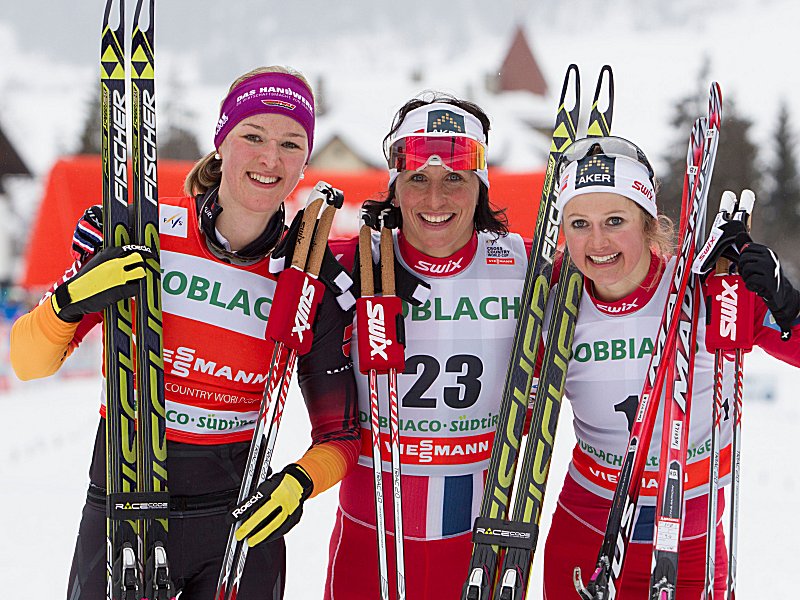
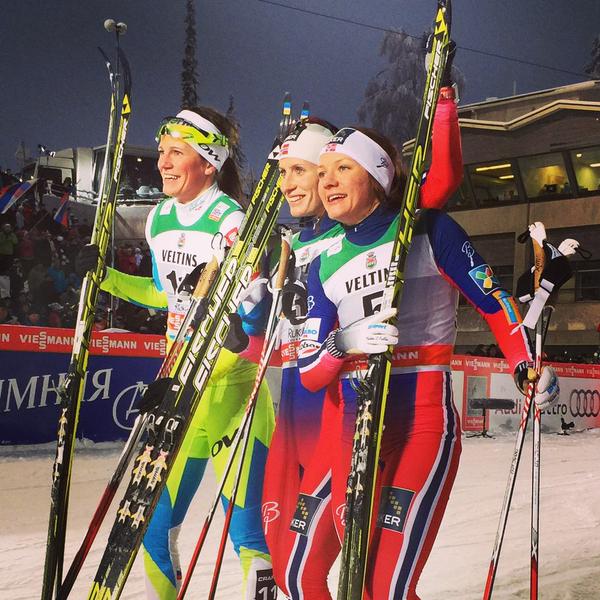
    The women's classic sprint podium on Saturday in Kuusamo, Finland: with winner Marit Bjørgen (c), runner-up Katja Visnar (l) and Maiken Caspersen Falla in third. (Photo: FIS Cross Country/Twitter)
    The women’s classic sprint podium on Saturday in Kuusamo, Finland: with winner Marit Bjørgen (c), runner-up Katja Visnar (l) and Maiken Caspersen Falla in third. (Photo: FIS Cross Country/Twitter)

    Marit Bjørgen appeared a little surprised with herself at the finish of Saturday’s World Cup opener. A classic-sprint win in the first race of the season? Sure, she was the 2010 Olympic champ in that event, but the 34-year-old Norwegian had barely warmed up into racing, and last year, she placed 13th in the Kuusamo classic sprint after qualifying first. Either way, she’d take it.

    “I am grateful to win today,” she told FIS after the race. “It’s still a sprint and to take the victory, I’m really happy for that. We had very good skis today, the Norwegian girls.”

    That was a bit of an understatement. The Norwegians across the board had rocket skis on a just-below-freezing morning and afternoon: “Norway hit the wax out of the park,” U.S. Ski Team Women’s Coach Matt Whitcomb said. “But we saw every team have everything from great kick to really slippery to icing a ton to just damage control in all three of those categories.”

    Case in point: the 1.4-kilometer women’s final, in which three Norwegians — Bjørgen, Ingvild Flugstad Østberg, and Maiken Caspersen Falla — led the charge early on.

    Slovenia’s Katja Visnar kept herself in the mix up front, but she was the exception.

    Østberg, the fastest qualifier by 2.9 seconds over teammate Celine Brun-Lie and four more Norwegians (Bjørgen, Kari Vikhagen Gjeitnes, Falla, and Heidi Weng) in third through sixth, led both her quarterfinal and semifinal aggressively out of the start and held her own in first through the finish.

    The 24-year-old Østberg tried it once more for the final, with Visnar sticking close and Bjørgen just a couple meters back in third, ahead of Falla. Meanwhile, American Ida Sargent in her first classic-sprint final kept in contact at the back with Russia’s Natalia Matveeva.

    Bjørgen squeezed in front of Visnar on the lefthand turn at the top of the first major hill (one of two), and Sargent moved to fifth.
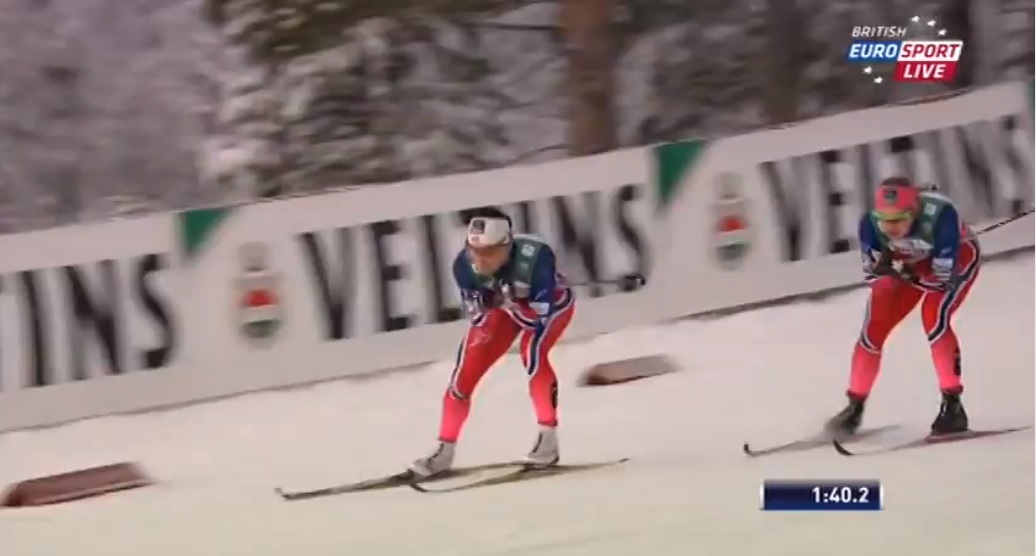
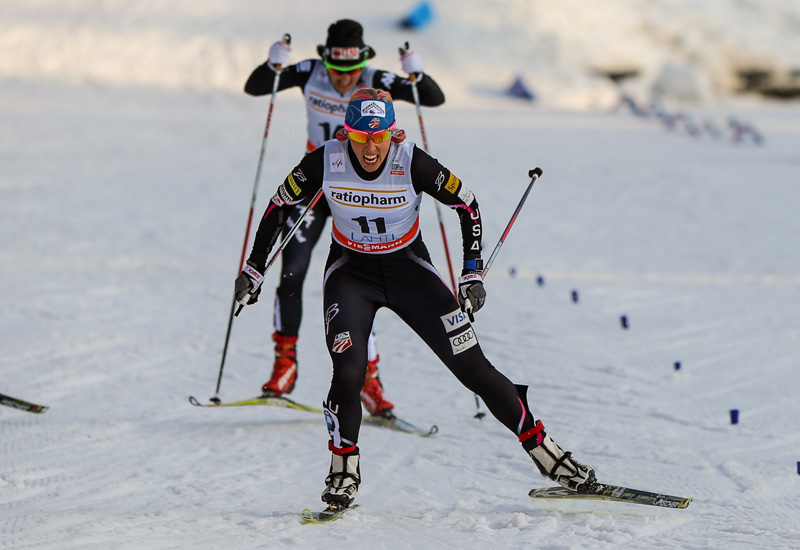
    Norway's Bjørgen (l) and Østberg (r) flying down the long descent of Kuusamo's 1.4 k classic-sprint course while leading the final before the last, grinding climb to the finish.
    Norway’s Bjørgen (l) and Østberg (r) flying down the long descent of Kuusamo’s 1.4 k classic-sprint course while leading the final before the last, grinding climb to the finish.

    By the end of the 25-second downhill on the other side, Bjørgen was up to first several meters ahead of Østberg. Visnar began to close on the second Norwegian, challenging both Østberg and Bjørgen into the long, final climb — one of the steepest on the circuit — back up to the stadium.

    Østberg found the grip she needed and came back even with Bjørgen over the top, but got hung up on her iced-over skis shortly after, allowing Bjørgen, Visnar and Falla to overtake her.

    It looked like Bjørgen never glanced back. She continued to keep a ski length between her and Visnar and double poled powerfully around the final turn toward the finish. With Visnar inching closer with each push, Bjørgen held her off until the finish, throwing up her arms immediately upon crossing the red line.

    “I am really happy that I kept the young girls behind me,” she told FIS. “I am in good shape at the beginning of the season after the hard training I have done. I was training a lot in November.”
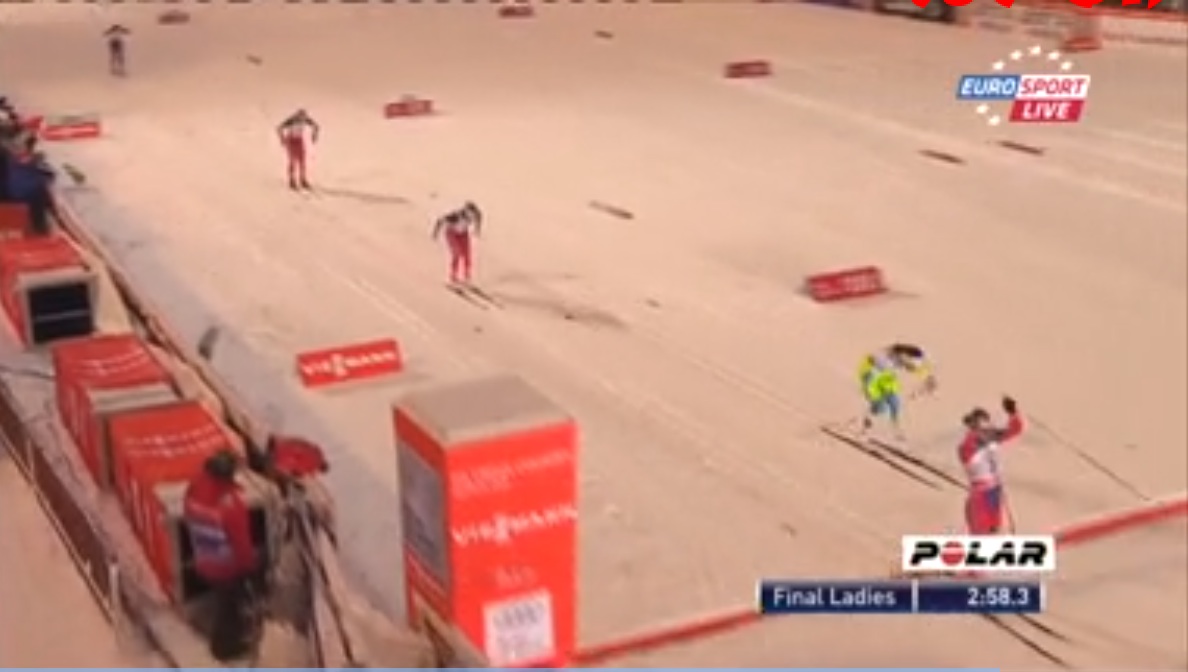
    Marit Bjørgen (r) celebrates her win in Saturday's women's sprint final in Kuusamo, ahead of Katja Visnar (Slovenia) in second, Falla (Norway) in third, Østberg (Norway) in fourth, and American Sargent (l) in fifth, ahead of Russia's Matveeva (not shown).
    Marit Bjørgen (r) celebrates her win in Saturday’s sprint final in Kuusamo, ahead of Katja Visnar (Slovenia) in second, Falla (Norway) in third, Østberg (Norway) in fourth, and American Sargent (l) in fifth, ahead of Russia’s Matveeva (not shown).

    Bjørgen edged Visnar by 0.46 seconds in 2:58.33. Falla took third, 1.7 seconds after Bjørgen, and Østberg settled for fourth, another 1.3 seconds back. Sargent finished fifth (+5.95) for a World Cup career best, and Matveeva was sixth (+12.37).

    It was Bjørgen’s fifth podium in the Ruka classic sprint, putting her on par with Slovenian legend Petra Majdič.

    Interestingly, Visnar has placed second in four World Cup races — all of which took place in either Finland or Russia, according to FIS.

    Eurosport announcers observed that Bjørgen was gasping for air on the final climb — two meters longer than last year because of the way it was tracked.

    “It was a difficult race, but we had very good skiing,” Bjørgen said after her 67th World Cup win (83 if you include stages).

    This year, the Kuusamo classic sprint was not a stage because the venue is hosting two races Saturday and Sunday as opposed to three (known as the Ruka Triple). Therefore, the race counted toward full World Cup points.

    That was good news for Bjørgen, who’s won the overall World Cup three times (in 2012, 2006, and 2005).

    In addition to ideal skis, Bjørgen paced her quarterfinal and semi to near-perfection on Kuusamo’s notoriously challenging course. She won her quarterfinal by 0.23 seconds over Matveeva and 0.45 seconds ahead of another Russian, Anastasia Dotsenko. In her semifinal, she topped Matveeva once again (this time by 1.14 seconds) and bumped Polish rival Justyna Kowalczyk to third, 1.51 seconds behind.

    Their semifinal was three seconds slower than the first (in which Østberg beat Visnar by one-tenth of a second and Falla by 1 second), which kept Kowalczyk from advancing to the final as a lucky loser.

    Sargent, who was fourth in Østberg’s semi (3.23 seconds back), moved on instead along with Falla, the 2014 skate-sprint Olympic gold medalist.

    “I was pretty excited because I have only been in one final before and haven’t ever been in a classic final,” Sargent said. “I was just psyched to have one opportunity and see what I could do.”

    Østberg was slightly disappointed with her result after never having lost the lead all day until the final.

    “It was really a very good day, but what happened at the end was dull,” she told NRK, according to a translation. “I got a little icing under the skis and it’s a shame when you feel so good.”
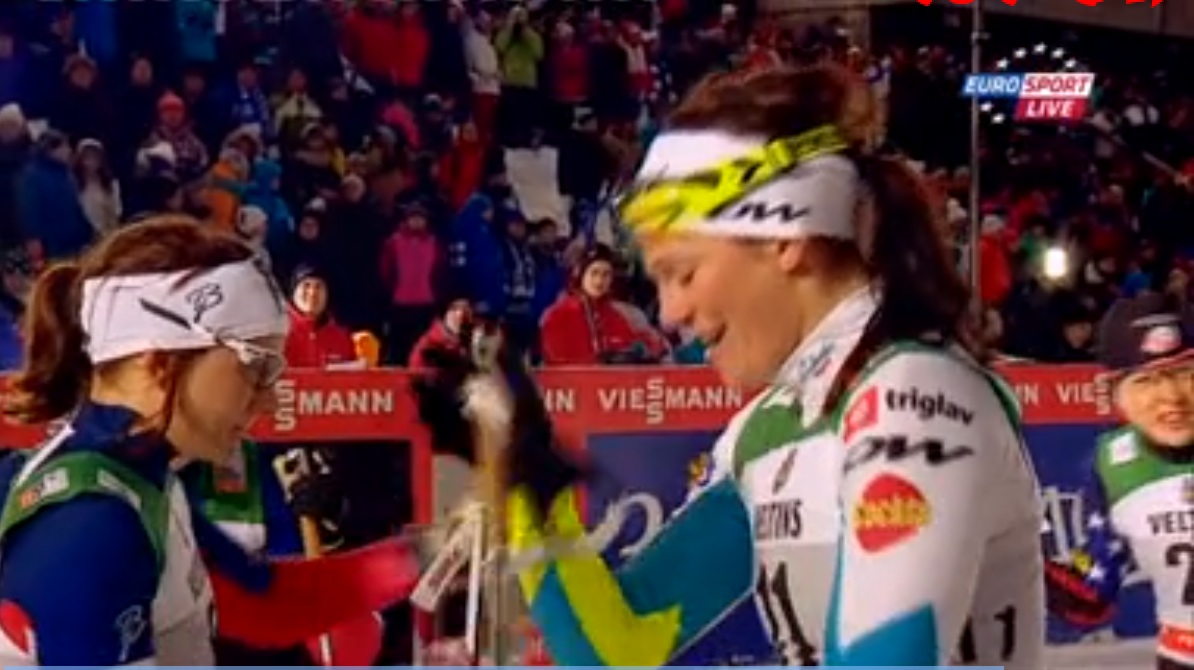
    Slovenia's Katja Visnar, who finished second in Saturday's classic sprint, after getting hugs from the three Norwegians, including Maiken Caspersen Falla (l), in the final in Kuusamo, Finland.
    Slovenia’s Katja Visnar, who finished second in Saturday’s classic sprint, after getting hugs from the three Norwegians, including Maiken Caspersen Falla (l), in the final in Kuusamo, Finland.

    Visnar, who advanced in second in both her quarterfinal and semi, was just as excited at Bjørgen at the finish — also pumping her arms and joining her on the victory lap in front of Kuusamo’s filled stadium.

    “My training works, and it has brought me to where I am,” Visnar told FIS. “I have been training distance more and I am not so tired in the heats as I was before. Now when I have a good day I believe I can make it to the final. The final was fast. I had great skis and grip in the uphill. I felt strong in double poling to the finish line.”

    The three Norwegian women all congratulated her afterward.

    Falla won her quarterfinal with the fastest quarterfinal time of the day in 2:58.48.

    “I am happy about third place today,” she told FIS after achieving her 16th World Cup podium. “It is a good start to the season.”
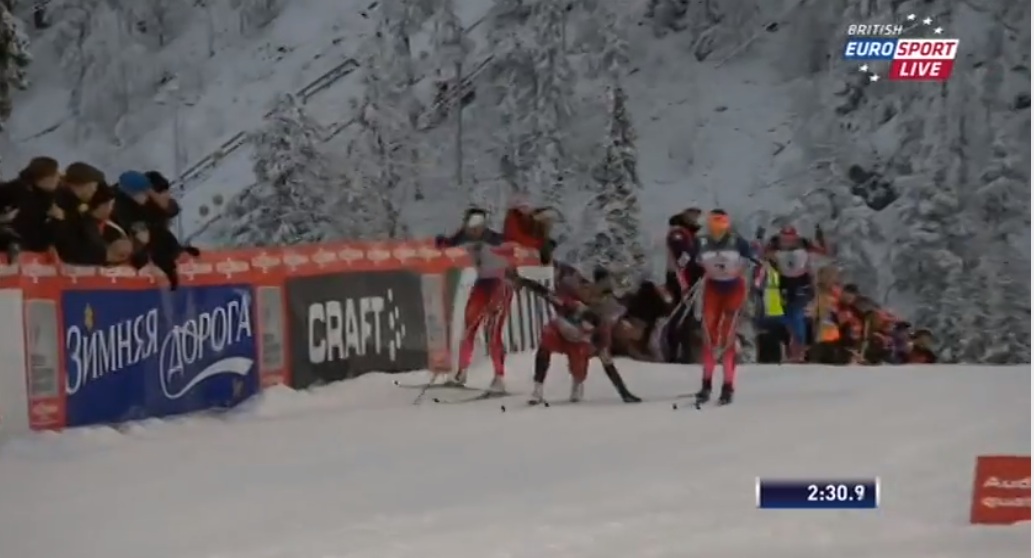
    Kowalczyk (c) stumbles over her snow-packed skis just after topping the final climb in her semifinal, while Bjørgen (l) and Brun-Lie (r) go around her.
    Justyna Kowalczyk (c) stumbles over her snow-jammed skis just after topping the final climb in her semifinal, while Norway’s Marit Bjørgen (l) and Celine Brun-Lie (r) go around either side of her.

    The biggest shakeup was the absence of Kowalczyk in the final. She was second in her quarterfinal behind Falla, and third in her semifinal. Opting for more kick than most, Kowalczyk had no problem running up the last hill and holding off Bjørgen and Brun-Lie initially for first in their semi — until she tripped over the top.

    Brun-Lie lost second around the final corner and Kowalczyk made up as much as she could, double poling to third behind Bjørgen and Matveeva.

    According to Infostrada Sports, 15 of the last 17 classic sprints in the World Cup or World Championships belong to either Bjørgen or Kowalczyk.

    Kowalczyk ended up seventh on the day after winning the Kuusamo classic sprint last year (when Kikkan Randall was second and Bjørgen was 13th). On Saturday, Randall missed out on the semifinals and settled for 16th overall.

    Already in the first race of the season, reporters asked Bjørgen about her prospects for 2015 World Championships in February.

    “As long as the trails are like here it’ll go well,” Bjørgen told Aftenposten. “I like trails of length, and I think that there may be opportunities in the sprint course in Falun.”
    Results | Heats

  • Barbro Kvåle, 22, Breaks Through in Beitostølen Classic Sprint

    Barbro Kvåle, 22, Breaks Through in Beitostølen Classic Sprint

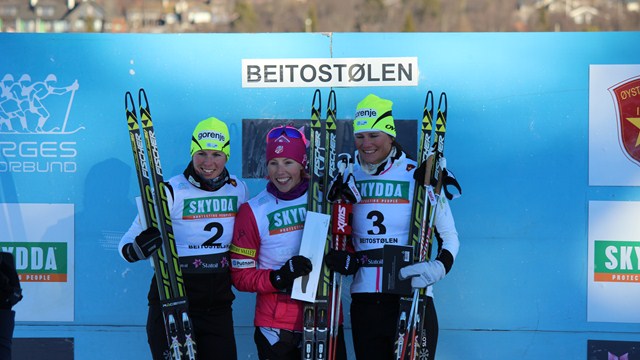
    A stunned Barbro Kvåle after winning Sunday's FIS classic sprint by 0.3 seconds in Beitostølen, Norway.  (Photo: Photo NTG Lillehammer)
    A stunned Barbro Kvåle after winning Sunday’s FIS classic sprint by 0.3 seconds in Beitostølen, Norway. (Photo: Photo NTG Lillehammer)

    Barbro Kvåle, a 22-year-old Norwegian junior world champion in ski orienteering, joined the ranks of national-team stars Therese Johaug and Marit Bjørgen, who won the Beitostølen distances races this weekend. On Sunday, Kvåle, now on Norway’s U23 cross-country team, came from behind to win the women’s 1.2-kilometer classic sprint by three-tenths of a second.

    With meters to go in the final, she passed Norway’s Kari Vikhagen Gjeitnes to seize the early season International Ski Federation (FIS) victory in 2:56.8. Gjeitnes, 29, took second and Kvåle’s best friend Kathrine Harsem was third just 0.2 seconds later.

    She’s a really laid-back personality,” Harsem said of Kvåle to NRK. “She’s a really good friend, and we can talk about everything, or nothing at all. As a skier, she’s just amazing on the mental level.”

    Norwegian Olympic gold-and-silver medalist Ingvild Flugstad Østberg finished fourth, 0.9 seconds after Kvåle. A previous winner of Beitostølen’s classic sprint (in treacherous conditions), Slovenia’s World Cup sprinter Katja Visnar placed fifth (+4.9), 1 second ahead of Germany’s Victoria Carl.

    Kvåle, who qualified 15th out of 42 women — nearly 6 seconds behind Visnar as the qualifier winner (in  2:48.91) — had never been in a sprint final before, and certainly not with an Olympic champion or World Cup favorite.

    “This was insanely fun. I just wanted to go for it,” Kvåle told NRK. “I know I have a strong sprint finish, but I never imagined that I would actually win.”

    When asked if she could describe the feeling, she simply said, “No.”

    “I know I have a strong sprint finish, but I never imagined that I would actually win.” — Barbro Kvåle, 22-year-old Norwegian U23 team member, after winning Sunday’s classic sprint in Beitostølen

    In her last season as a U23, her larger goals this season involve U23 World Championships in Kazakhstan.

    A member of Norway’s rookie team, she said she’s always playing catchup with the veterans.

    “In all the hard sessions, I’ve gotten beaten,” she told NRK. “But I have come closer and closer in autumn..”

    Asked if this was her biggest win so far, she said: “Yes! Are you crazy?”

    One of Barbro Kvåle's Instagram selfies from last week. (Photo: Instagram/barbrokvale)
    One of Barbro Kvåle’s Instagram selfies from last week. (Photo: Instagram/barbrokvale)

    Harsem said Kvåle likes putting herself out there on social media.

    “She posts a lot of self-promoting stuff on Instagram and Twitter, which people in general thinks is really stupid. But I kind of like it, because she dares to be herself,” Harsem said. “She’s honest and loyal, not your typical girly-girl. She’s a bit tomboy-ish, and I like that.

    Østberg, who dominated all the heats and looked like she had the victory in the bag leading the final six women into the stadium, was outsprinted on the final meters. She was less than a second behind Kvåle, but ended up fourth and couldn’t disguise her disappointment.

    “I have to admit that I’m a bit disappointed,” Østberg said. ‘The three other girls were stronger than me. I guess I’m not meant to be on the podium at Beitostølen.”

    She placed fifth in Saturday’s 10 k freestyle — her first FIS race of the season.

    “I haven’t usually been in perfect sprint shape early in the season, so I have to look forward,” Østberg added. “There are new races next week. I will have to try to dig deeper and find that little extra as the season progresses.”

    Results | Complete results

  • Blink Festival Concludes with Mass Starts and Sprints; Bailey and Burke Deliver for U.S.

    Blink Festival Concludes with Mass Starts and Sprints; Bailey and Burke Deliver for U.S.

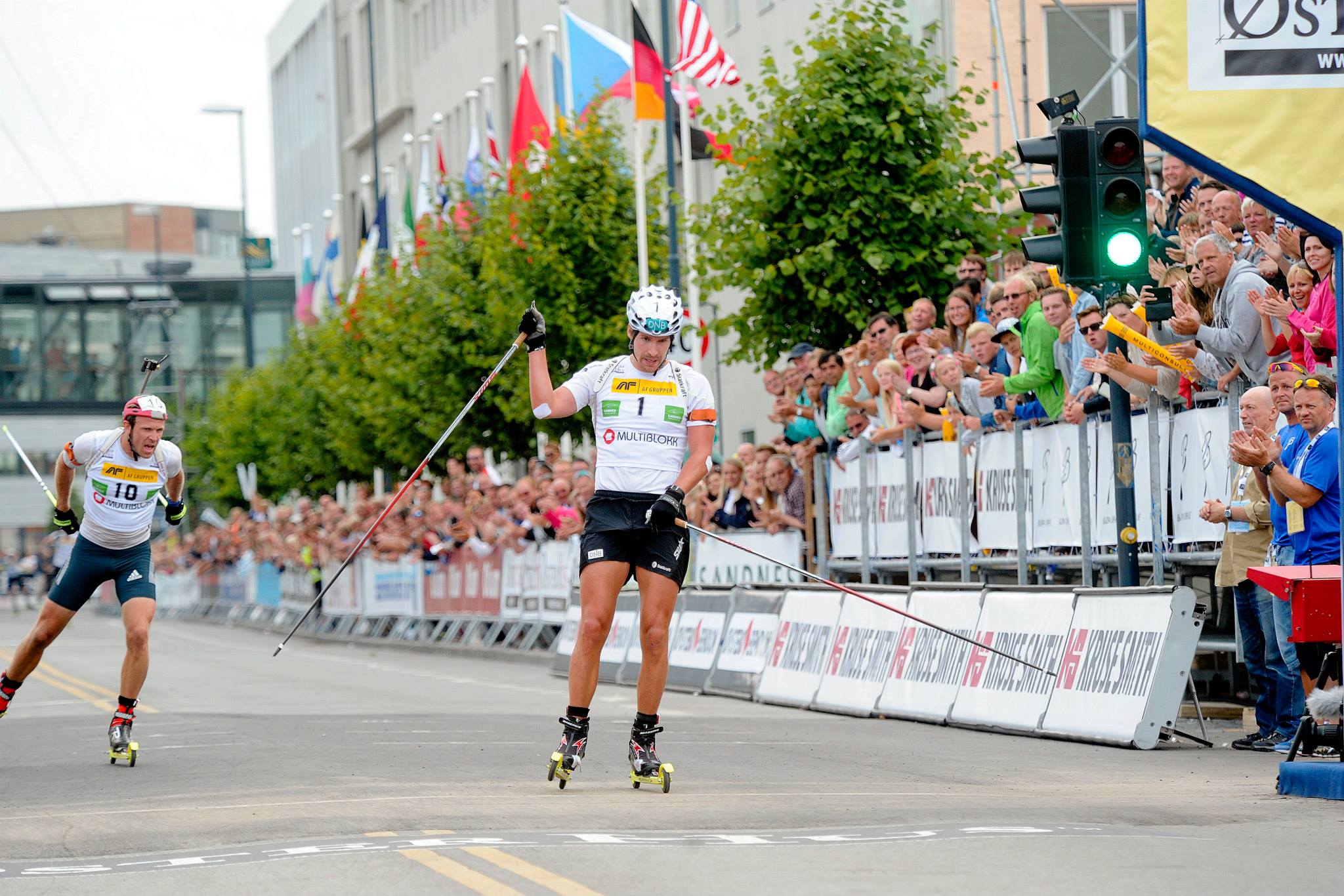
    Lowell Bailey (r) pushes himself across the finish line in Friday's biathlon 6.3 k mass start as part of the 2014 Blink Festival. Bailey finished second behind Emil Hegle Svedson (l) of Norway. (Photo: Skifestivalen Blink/Facebook)
    U.S. Biathlon’s Lowell Bailey (l) pushes himself across the finish line in Friday’s biathlon 6.3 k mass start as part of the 2014 Blink Festival. Bailey finished second to Emil Hegle Svedsen (r) of Norway. (Photo: Skifestivalen Blink/Facebook)

    When Lowell Bailey raced in the 2014 Blink Festival 7-kilometer hill climb just days after arriving in Norway, he was jolted by a “shock to the system,” he wrote in an email.

    Apparently the shock was what he needed to deliver a top-notch performance, as the U.S. biathlete finished second in the biathlon mass start the next day in the city of Sandnes.

    The road to the podium wasn’t an easy one. To participate in the mass start, competitors who were not already pre-qualified needed to place in the top six in the qualification round. The round consisted of five laps of 800 meters with prone shooting following the second lap and standing following the fourth.

    In a tough field, Bailey and U.S. teammate Tim Burke claimed the last two spots in the mass start by taking fifth and sixth.

    Once in the mass start, Bailey knew he had to focus on his shooting if he wanted to have any hopes of placing on the podium.

    “I told myself before the race that I was going to race my own race and try not to get caught up in the hurried shooting situations that always happen in this type of race,” Bailey wrote.

    Throughout the race, which consisted of nine laps on a 700-meter loop, and two prone and two standing stages, Bailey often took longer to shoot but maintained contact with the lead group.

    When he exited the final shooting he was the last of the four competitors he had arrived with to leave the mats.

    However, his fellow competitors had rushed through their shots and had penalty loops to compete. Bailey had shot perfectly and left the range with a five-second lead over Norway’s Emil Hegle Svedsen.

    Svedsen ultimately caught the American in the final stretches of the race, overcoming him by just 0.7 seconds.

    Bailey was followed by Norwegian Tarjei Bø, who finished 12.9 seconds behind Svedsen.

    Burke finished eighth in the mass start, 1:09.9 back.

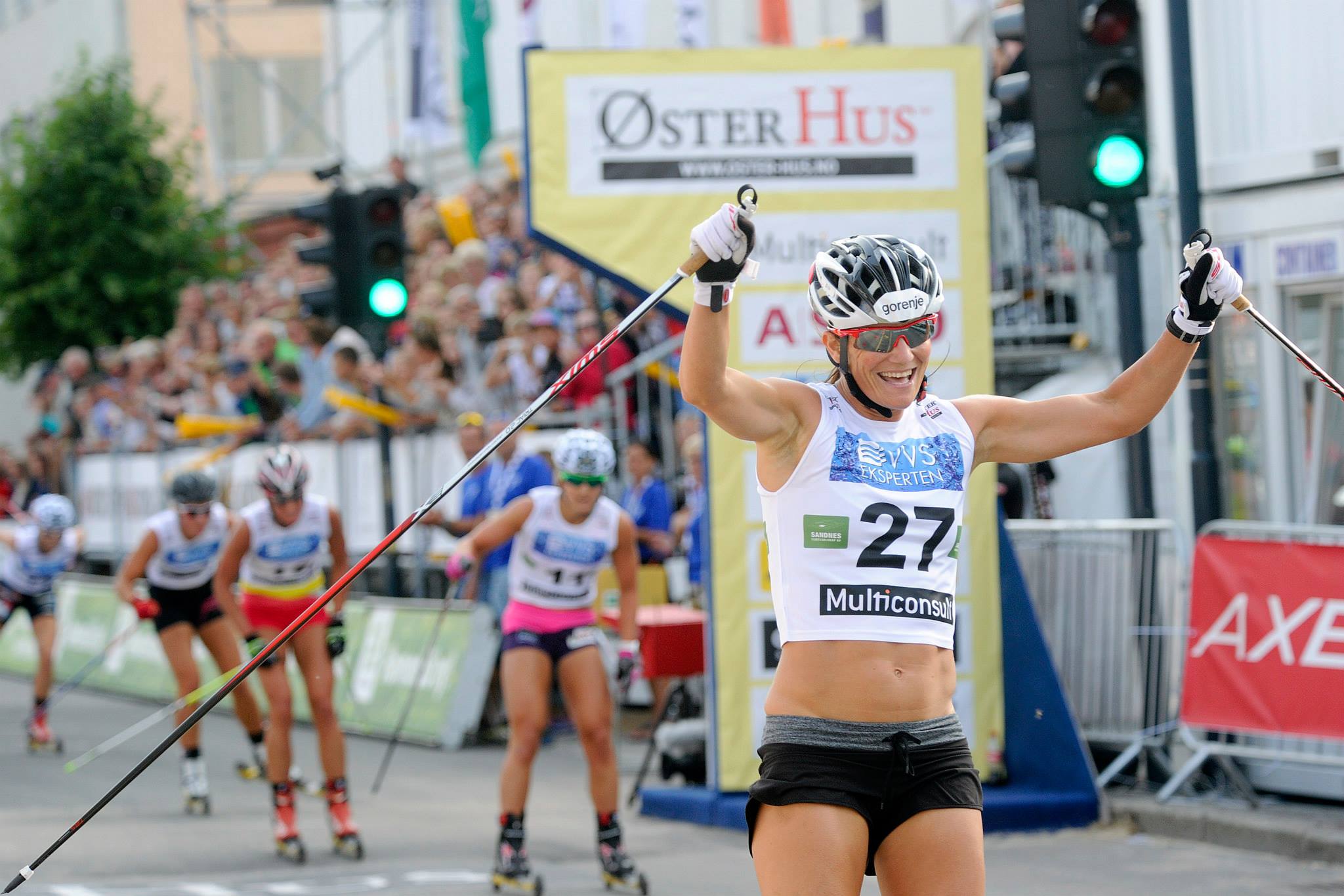
    Katja Visnar (SLO) celebrates her victory in the women's 10 k mass start in the 2014 Blink Festival. (Photo: Skifestivalen Blink/Facebook)
    Slovenia’s Katja Visnar celebrates her victory in the women’s 10 k mass start in the 2014 Blink Festival. (Photo: Skifestivalen Blink/Facebook)

    In the women’s 6.3 k mass start Fanny Wele-Strand Horn of Norway was victorious with a time of 14:10.8. She was followed by Kaisa Makarainen of Finland and Marine Bolliet of France in second and third.

    American Susan Dunklee finished in eighth, 41.8 seconds behind Horn. Dunklee was one of five athletes who had pre-qualified for the mass start, but struggled with her shooting in the final.

    “Unfortunately I missed a lot of prone targets early in the final and despite passing a few people on skis, I never regained contact with the main pack,” Dunklee wrote in an email.

    The cross-country mass start races that took place later that day consisted of women’s 10 k and a men’s 15 k.

    In the men’s race, Teodor Peterson of Sweden claimed victory for the second day in a row on the rollerski course that consisted of 18 laps around an 800-meter loop. The sprint specialist finished with a time of 28:07.3. He was followed by Norwegian Øystein Pettersen in second and Cyril Gaillard in third.

    The men’s field was incredibly close with the top-23 finishers crossing the line within ten seconds of Peterson.

    Canadian Devon Kershaw was one such finisher. He placed seventh, just 3.7 seconds behind the Swede and 1.4 seconds off the podium.

    In an email, Kershaw explained that the curvy course and the 30 aggressive racers that populated it made for conditions he was not used to, but he was happy with how the day ended.

    “I was out of position near the end and with all the curves there was nothing I could do,” Kershaw wrote. “It was a fun evening though!”

    In the women’s 10 mass start, another sprint-specialist took the win. Slovena’s Katja Visnar finished with a time of 20:36.0. She was followed by German sprinter Denise Herrmann in second and Norway’s Ingvild Flugstad Østberg in third.

    American Liz Stephen finished 18th. In an email, she declared the race a success in that there were no major crashes.

    “It was good for my head in that I need to be less nervous about skiing in a pack close to other skiers, and after today snow seems like it should be no problem at all,” she wrote.

    Tim Burke (l) stands on the podium of the men's biathlon sprint Saturday at the 2014 Blink Festival. Burke finished third, completing a successful weekend for the Americans in attendance at the festival. (Photo: Skifestivalen Blink/Facebook)
    Tim Burke (r) stands on the podium of the men’s biathlon sprint Saturday at the 2014 Blink Festival. Burke finished third, completing a successful weekend for the Americans in attendance at the festival. (Photo: Skifestivalen Blink/Facebook)

    Sprint Day

    U.S. biathletes also shined in the final day of the Blink Festival with Burke and Bailey claiming third and sixth, respectively, in the biathlon sprint.

    Burke finished 8.7 seconds behind race winner Johannes Thingness Bø of Norway, who won the final in 12:25.8. Second place went to fellow Norwegian Marius Hol who crossed the line 7.4 seconds behind Bø.

    After struggling with his shooting in the mass start competition, Burke was pleased to have a strong result.
    “This was a good confirmation for me that I am headed in the right direction for the winter season,” he wrote.
    It was the first time the 32-year-old American had ever competed in heats for a biathlon race, which he found both unique and challenging.
    “I would say the shooting in this type of race is actually harder than a normal biathlon race because you are basically sprinting all out for 1 k before each shooting stage,” he wrote.

    Bailey finished sixth, 22.7 seconds behind the winner.

    In the women’s biathlon sprint, Dunklee placed sixth in her semifinal and did not advance to the final. The women’s biathlon final was won by was won by Bolliet, who was followed by French teammates Enora Latuilliere and Anais Chevalier in second and third, respectively.

    In the cross-country sprints, Norway’s Marit Bjørgen topped the women’s final. She edged teammate Maiken Caspersen Falla for the win by just 0.1 seconds. Visnar placed third, 1.1 seconds behind Bjørgen.

    Stephen was unable to advance from the quarterfinals.

    Sondre Turvoll Fossli of Norway won the men’s final in 3:08.1. He was followed by another Norwegian Martin Hammer in second and Sweden’s Peterson in third.

    2014 Blink Festival Results

    Friday’s mass starts: Men’s biathlon | women’s biathlon | men’s cross-country | women’s cross-country

    Saturday’s sprints: Men’s biathlon | women’s biathlon | men’s cross-country | women’s cross-country 

  • Weekend Roundup: Back on Track

    Weekend Roundup: Back on Track

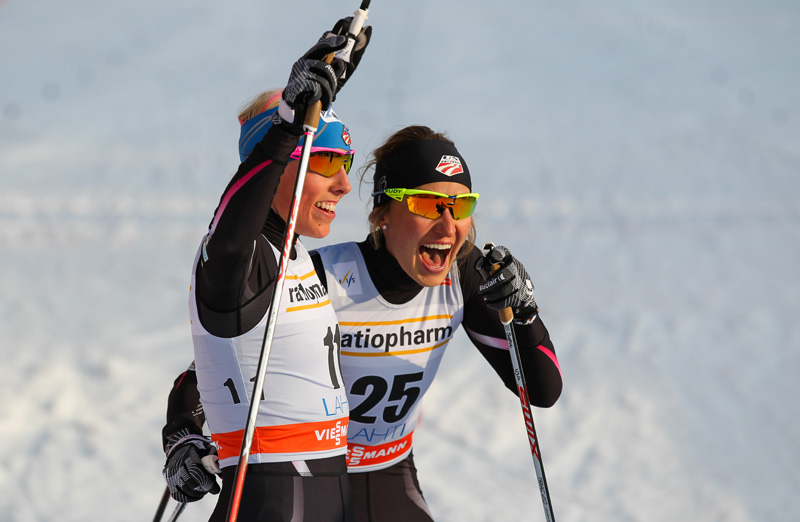
    U.S. teammate Kikkan Randall (l) and Sophie Caldwell celebrate the first U.S. double podium in Saturday's World Cup skate sprint in Lahti, Finland. (Photo: Fischer/Nordic Focus)
    U.S. teammate Kikkan Randall (l) and Sophie Caldwell celebrate the first U.S. double podium in Saturday’s World Cup skate sprint in Lahti, Finland. (Photo: Fischer/Nordic Focus)

    Were the Olympics just a dream? After a whirlwind couple of weeks on the ground in Sochi, Russia, it certainly feels so for us. However, just because the Olympics are over doesn’t mean the season has ended, and as this past weekend proved, we may have some of the most exciting skiing of the season ahead of us.

    World Cup action kicked off with Saturday’s freestyle sprint in Lahti, Finland, where the women of the U.S. Ski team made history. For the first time two American women sat upon the podium, with Kikkan Randall in first and Sophie Caldwell in third.

    For Randall, the win was redemption for a disappointing two weeks in Sochi where she finished 18th in the freestyle sprint, an event she was favored to win.

    Fellow U.S. Ski Team members Kikkan Randall (l) and Sophie Caldwell after finishing an unprecedented first and third, respectively, in the Lahti World Cup freestyle sprint on Saturday in Finland. (Photo: Fischer/Nordic Focus)
    Fellow U.S. Ski Team members Kikkan Randall (l) and Sophie Caldwell after finishing an unprecedented first and third, respectively, in the Lahti World Cup freestyle sprint on Saturday in Finland. (Photo: Fischer/Nordic Focus)

    For Caldwell, it was her first World Cup podium. The podium adds to what has been a momentous season for the 23-year-old, who placed sixth in the Olympic sprint. In doing so she achieved the top result for an American woman at an Olympic Games.

    Completing the podium was Slovenian Katja Visnar, who finished second, placing her in the middle of an American sandwich.

    On the men’s side, Canadian Alex Harvey pushed through his post-Olympic 50 k exhaustion to place seventh. American’s Simi Hamilton and Andy Newell also placed in the top 30 in 20th and 28th. Hamilton, who suffering from illness, and Newell, who lost both a pole and a ski in his heat, were unable to advance from the quarterfinals.

    The race was eventually won by Norwegian Paal Golberg. He was followed by Russian Alexey Petukhov and Norwegian teammate Eirik Brandsdal.

    Sunday’s World Cup races were dominated by Norwegians fighting to become the overall World Cup Champions. For the women, Marit Bjørgen skied a smart and controlled race to finish first in the 10 k freestyle by a whopping 26.9 seconds. Behind her was Charlotte Kalla in second and a frustrated Therese Johaug in third. While Johaug still holds the overall World Cup lead, Bjørgen is closing in with every race.

    Randall was the top North American in 21st followed by teammate Liz Stephen in 32nd.

    In the 15 k individual freestyle, overall World Cup leader Martin Sundby of Norway extended his lead by outpacing second place finisher Daniel Richardsson of Sweden by over ten seconds. On the podium for the second day in a row, Petukhov placed third.

    Harvey took 8th place, proving that he’s still on form and hungry for results in the final weeks of the World Cup season. The Canadian said it was the result he was most proud of in the season so far. 

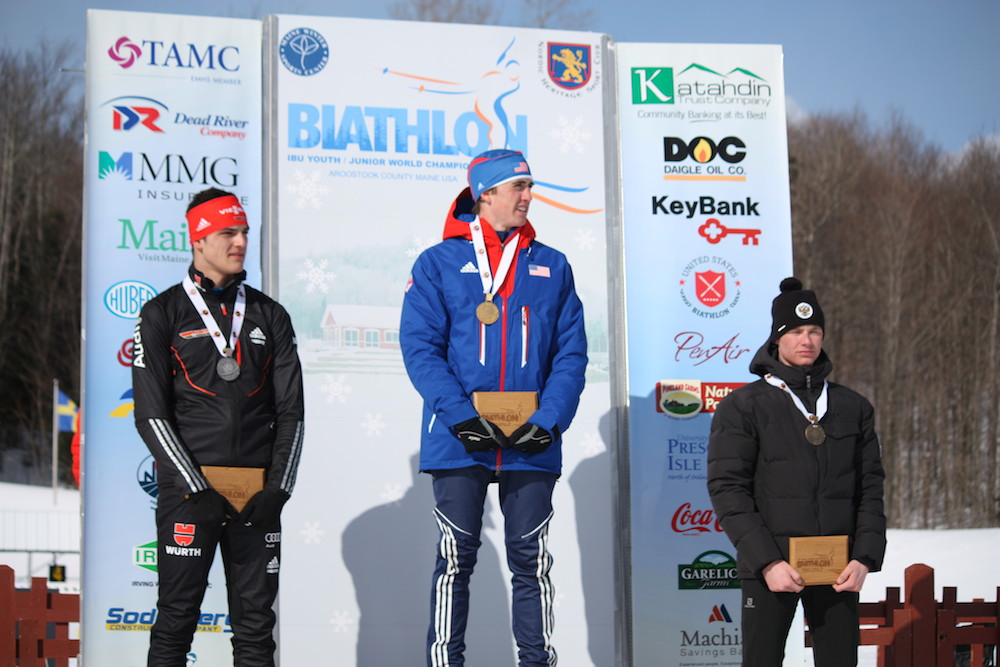
    U.S. Olympian Sean Doherty (c) tops the podium in the first race of the 2014 IBU Youth World Championships in Presque Isle, Maine. Doherty won Friday's 7.5 k sprint ahead of Germany's Marco Gross (l) in second, and Russia's Dmitri Shamaev in third. (Photo: Craig Cormier)
    U.S. Olympian Sean Doherty (c) tops the podium in the first race of the 2014 IBU Youth World Championships in Presque Isle, Maine. Doherty won Friday’s 7.5 k sprint ahead of Germany’s Marco Gross (l) in second, and Russia’s Dmitri Shamaev in third. (Photo: Craig Cormier)

    This weekend also marked the start of the IBU Youth World Championships in Presque Isle, Maine where American Sean Doherty claimed gold in both the 7.5 k sprint and 10 k sprint. This marks the third Youth World gold medal for the 18-year-old, who was fresh off his first Olympic start in the 4 X 7.5 k in Sochi.

    American Maddie Phaneuf placed fourth in the women’s 5 k sprint and finished 24th in the 7.5 k pursuit. Canada’s Danielle Vrielink was the top North American in the pursuit with a 15th place finish.

    The Vasaloppet also took place this weekend in Sweden. John Kristian Dahl waited to the last minute to make his move, chasing down fellow Norwegian Laugaland to win his first Vasaloppet. Laila Kveli of Norway won the women’s race in an impressive of display of double poling strength to become the first women to win the race without kick wax.

    FIS Cross Country World Cup, Lahti, Finland

    Saturday’s 1.5 k freestyle sprint women’s report | men’s report | North American men’s report | newcomers report

    Sunday’s 10 k and 15 k individual freestyle women’s report | men’s report | American report | Canadian report 

    IBU Youth World Championships, Presque Isle, Maine

    Saturday’s 5 k and 7.5 k sprint report

    Sunday’s 7.5 k and 10 k pursuit report

    Vasaloppet, Mora, Sweden Report

  • U.S. Women Get Their Swagger Back with Randall, Caldwell on First Double Podium

    U.S. Women Get Their Swagger Back with Randall, Caldwell on First Double Podium

    Fellow U.S. Ski Team members Kikkan Randall (l) and Sophie Caldwell after finishing an unprecedented first and third, respectively, in the Lahti World Cup freestyle sprint on Saturday in Finland. (Photo: Fischer/Nordic Focus)
    Fellow U.S. Ski Team members Kikkan Randall (l) and Sophie Caldwell after finishing an unprecedented first and third, respectively, in the Lahti World Cup freestyle sprint on Saturday in Finland. (Photo: Fischer/Nordic Focus)

    Perched over her poles before the start of Saturday’s freestyle sprint in Lahti, Finland, Kikkan Randall smiled from ear to ear for the cameras, with the same pink-haired, cheery persona that she’s displayed before essentially every race this season — and over the last several years.

    It was the look that’s landed Randall, the 31-year-old U.S. Ski Team leader, sponsorships with major sandwich and cereal chains, and was reminiscent of how she appeared before the start of her last freestyle sprint at the Olympics.

    After flashing her ever-excited grin, she shot out of the gates in the Olympic quarterfinal and attacked the first climb on an unforgiving course in Krasnaya Polyana, Russia. After that, Randall struggled to hold on to an automatic top-two qualifying spot down the finishing stretch, and ended up bounced in fourth.

    Kikkan Randall (U.S. Ski Team) racing to a World Cup win in Saturday's freestyle sprint in Lahti, Finland. (Photo: Fischer/Nordic Focus)
    Kikkan Randall (U.S. Ski Team) racing to a World Cup win in Saturday’s freestyle sprint in Lahti, Finland. (Photo: Fischer/Nordic Focus)

    It was the first time she hadn’t advanced to the semifinals in a skate sprint in three years.

    Three Olympic races and two and a half weeks later, Randall was back at the World Cup on Saturday in the last freestyle sprint of the season. After qualifying in 11th, she appeared relaxed throughout her heats, and just as eager as ever at the start of the final.

    Randall had executed as expected on a tactical course in Lahti, one that was relatively narrow and getting more chewed up as the afternoon lingered in temperatures above 40 degrees Fahrenheit.

    After following the qualifier winner, Norway’s Ingvild Flugstad Østberg, around the rolling 1.55-kilometer course for most of the quarterfinal, Randall went from second to first by threading her way through the inside lane around a final hairpin corner then surging ahead of Østberg over one of the final bumps in the stadium. Randall won the heat by 0.25 seconds over Østberg in 2:50.92, nearly five seconds faster than what Randall had qualified in.

    The time proved to be the fastest of any of the quarterfinals by almost three seconds, which enabled the third- and fourth-place finishers in that quarterfinal — Sweden’s Charlotte Kalla and Russia’s Anastasia Dotsenko — to advance as well.

    Meanwhile, Sophie Caldwell, who achieved the Americans’ top result in sixth at the Olympics (and a best-ever Olympic showing by a U.S. woman) qualified in 25th and later said she made a point to relax for the rounds.

    This course wasn’t going to favor anyone who tensed up in the squirrelly snow, and Caldwell, 23, did her best to focus on the openings, seek out the firmer parts of the track, and basically float over it.

    “It was skiing in like a foot of sugar,” Caldwell said. “Maybe that’s an exaggeration, but it was really soft and really sugary.”

    Her attention to detail worked as she skied in third early in her quarterfinal, moved up to second, then challenged Sweden’s Hanna Falk for the win. Falk stayed ahead to finish first by 0.23 seconds over Caldwell, and both advanced to the semifinals.

    There, Randall and Caldwell faced off against Slovenia’s Vesna Fabjan, Italy’s Gaia Vuerich, Østberg and Kalla.

    Fabjan took the lead over the most significant climb in the middle of the course, after a misstep by Kalla over the top dropped the Swede back to third. As all six women converged on the hairpin corner, Kalla lost her balance again, this time, falling face down into the mashed-potato snow. Caldwell and Randall narrowly dodged the crash on the inside of the corner, as did Vuerich, who followed the Americans, but Østberg directly behind had no time to react and toppled over Kalla.

    With four women still standing and racing away to the finish, Caldwell didn’t rule out that Kalla and Østberg could potentially catch up. While Randall accelerated after Fabjan to the finish, Caldwell skied behind them, trying to close the gap hold off Vuerich and anyone else to the line. Fabjan won the heat by 0.45 seconds over Randall, and Caldwell was another 0.45 back in third.

    Vuerich finished fourth, 0.49 seconds after Caldwell, and Østberg and Kalla were 9 and 16 seconds back, respectively, in fifth and sixth.

    The second women’s semifinal was 2.65 seconds slower. Norway’s Maiken Caspersen Falla won it after hovering in third before the final rolling stretch to the finish. Slovenia’s Katja Visnar took second, 0.17 seconds back, and two Swedes, Marika Sundin and Falk contended in a photo finish for third. Sundin got it by one-hundredth of a second, but the heat’s time was not fast enough to advance her to the final.

    Boxed out early and in last place for much of the race, Norway’s Marit Bjørgen ended up fifth, 0.76 seconds behind Falla, after finally getting past Dotsenko. The most successful Norwegian nordic skier’s run would end there — much like it did for Bjørgen in the Olympic skate-sprint semifinals.

    However, Caldwell did move on, along with Vuerich.

    In the final, Falla took charge early, leading over the first rise. Fabjan challenged up the inside lane of the climb, but tripped up in the soft snow, putting her behind her teammate, Visnar, as well as Vuerich and Randall. Caldwell moved into fourth before the infamous corner and emerged out of it in the same position — just as Randall was starting to turn it up.

    Attacking before the final bump in the stadium, Randall surged ahead of Visnar. While the Slovenian chased her in second, Vuerich raced for a podium in third. It appeared the she wasn’t entirely aware of Caldwell’s whereabouts, as the American pushed down the finishing stretch and outlunged her by three-hundredths of a second.

    U.S. teammate Kikkan Randall (l) and Sophie Caldwell celebrate the first U.S. double podium in Saturday's World Cup skate sprint in Lahti, Finland. (Photo: Fischer/Nordic Focus)
    U.S. teammate Kikkan Randall (l) and Sophie Caldwell celebrate the first U.S. double podium in Saturday’s World Cup skate sprint in Lahti, Finland. (Photo: Fischer/Nordic Focus)

    Randall locked up the win in 2:56.53, half a second ahead of Visnar, who achieved her first World Cup podium since 2011.

    Caldwell was 0.9 seconds back in third for another historic day for the U.S. — two women on the podium. No other U.S. woman except Randall had ever achieved an outright individual (non-stage) World Cup top three.

    Lying on the ground trying to catch her breath, Caldwell wasn’t sure where she ended up. She didn’t even know where to look to find out.

    Then she heard Randall.

    “Kik just screamed, ‘You just caught a podium!’ ” Caldwell recalled.

    It was her first World Cup podium in her rookie year on the U.S. Ski Team, less than two years after graduating Dartmouth College.

    Randall had scored her third World Cup victory of the season and fourth individual podium — all of which came in skate sprints — which put her at the top of the World Cup sprint standings, 36 points ahead of Germany’s Denise Herrmann, with two classic races left on the circuit.

    A year ago, Randall won the same sprint in Lahti.

    “I am glad the good race feelings are back and I’m hoping to find the strong classic form I had at the beginning of the season,” Randall wrote in an email. “I knew I needed a big race today so it’s great to have a chance to defend the globe now!

    “It’s of course a big bummer that I had that lull in my shape during the Olympics,” she added. “I’m still not quite sure what went wrong. But at least I’m coming back into form so I can hopefully end the season on a good note.”

    Caldwell said her entire season has exceeded her expectations since going pro last season. In terms of peaking, she never really had a plan until this year. In college, it was all about skiing as fast as possible over a few months, and last year, she was trying to earn World Cup starts with top early season SuperTour results.

    This season, she and her Stratton Mountain School T2 Team coach, Gus Kaeding, planned something similar since it worked the year before.

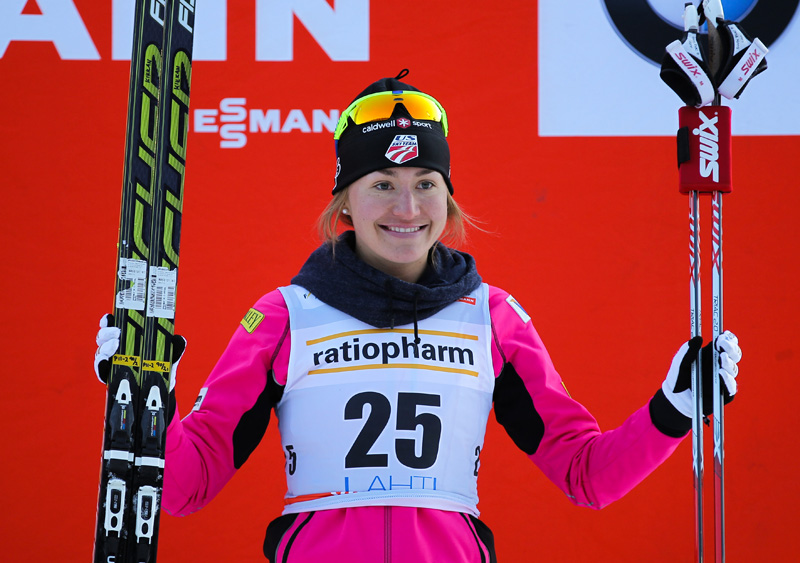
    Sophie Caldwell (U.S. Ski Team) after placing third on Saturday for her first World Cup podium at the Lahti World Cup skate sprint. (Photo: Fischer/Nordic Focus)
    Sophie Caldwell (U.S. Ski Team) after placing third on Saturday for her first World Cup podium at the Lahti World Cup skate sprint. (Photo: Fischer/Nordic Focus)

    “It definitely wasn’t rocket science,” Caldwell said. “It worked out well because it wasn’t complicated.”

    The key to her success on Saturday stemmed from her ability to learn as she progressed through the heats — about where the snow was more skiable and where she’d find opportunities to pass.

    U.S. women’s coach Matt Whitcomb said that Caldwell can find success on any given day in any conditions, but “the more difficult it becomes, the better Sophie can do.”

    “She was the only one out there today that she’d be in sixth then she’d be in second, then she’d be in fourth,” Whitcomb recalled. “She can move through a pack so incredibly well. Sophie can have a bad start and with one decisive move through a corner or through a slushy section… move [up]. … It was fun to watch her today.”

    Caldwell’s shining moment came with her last-ditch lunge past Vuerich. She recalled how many of those she’s lost in the past — at NCAA Championships, at last year’s Slavic Cup — and how she’s been working on them in most of her interval and speed workouts since.

    “[I’d] look at pictures of myself like, ‘What am I doing?’ and I’m basically lunging with my nose,” she said. “Today I put my weight back, pushed my ski forward and somehow managed to time it perfectly.”

    Caldwell saw the replay of her lunge — it looked good, she said with a laugh.

    “I’ve always dreamed of getting a World Cup podium, but I definitely didn’t think it was going to happen this year,” she said. “I was surprised to find myself in any sprint final this year.”

    She made four sprint finals, including Saturday’s and the Olympics.

    “I couldn’t imagine a better way to get my first podium with a teammate, especially Kikkan, someone I’ve looked up to so long,” she said. “I basically was asking her some questions [after the race about where to go, etc.] … and I was like, ‘Is it OK, if i just follow you everywhere?’ ”

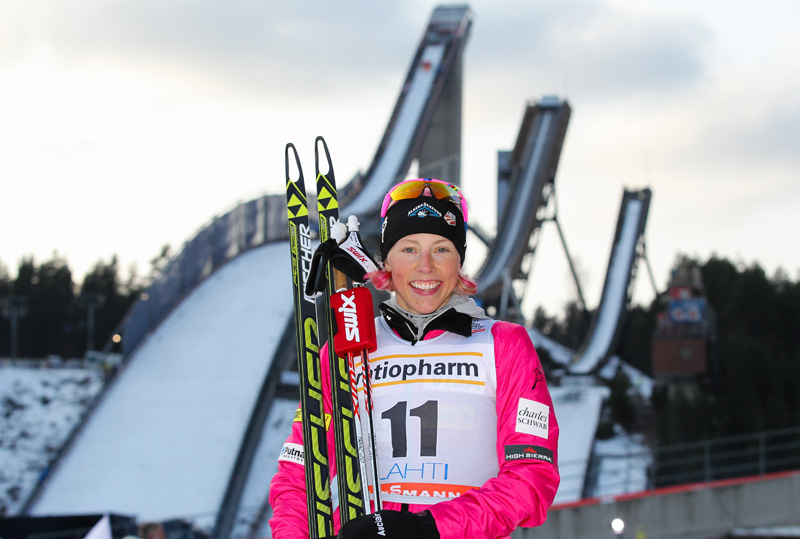
    Kikkan Randall (U.S. Ski Team) after winning Saturday's skate sprint in Lahti, Finland, at the first World Cup since the Olympics last week. (Photo: Fischer/Nordic Focus)
    Kikkan Randall (U.S. Ski Team) after winning Saturday’s skate sprint in Lahti, Finland, at the first World Cup since the Olympics last week. (Photo: Fischer/Nordic Focus)

    Randall said absolutely.

    “It was super fun to share the podium with my teammate today,” Randall wrote. “Sophie is having an incredible breakthrough season and it’s so fun to head to the start with your teammate. I’m super impressed with her trajectory and I’m looking forward to pushing each other and the other girls to the next level!”

    Whitcomb explained their first World Cup race back was exactly what the team needed after an Olympics that, for most, left something to be desired.

    “In some ways it’s unfortunate timing and in other ways it’s perfect timing,” he said. “I’m really proud of the team, not just for today’s result, but kind of what led to the result.”

    Sochi was a test of resilience, he explained. Mental state or preparation was never an issue, especially at the start of each race, Whitcomb said. That’s what impressed him most. When his athletes’ performances didn’t match their expectations, “Everyone [held] their heads proud … always ready to take that next swing.”

    “We were ready again today; we weren’t tired, we were ready to see the opening and jump through it,” he said. “Two girls on the podium was a result of our Olympic team never getting beaten down.”

    Mostly, he was extremely happy for Randall and Caldwell. Randall had managed to stay healthy and find energy in the last week, despite being on a team stricken with illness since (and during) Sochi. Caldwell rallied while battling a cold she came down with halfway through the Olympics.

    “Kikkan’s feeling like herself again,” Whitcomb said. “Getting a little bit of her Kikkan stride back again in the start pen.”

    Results

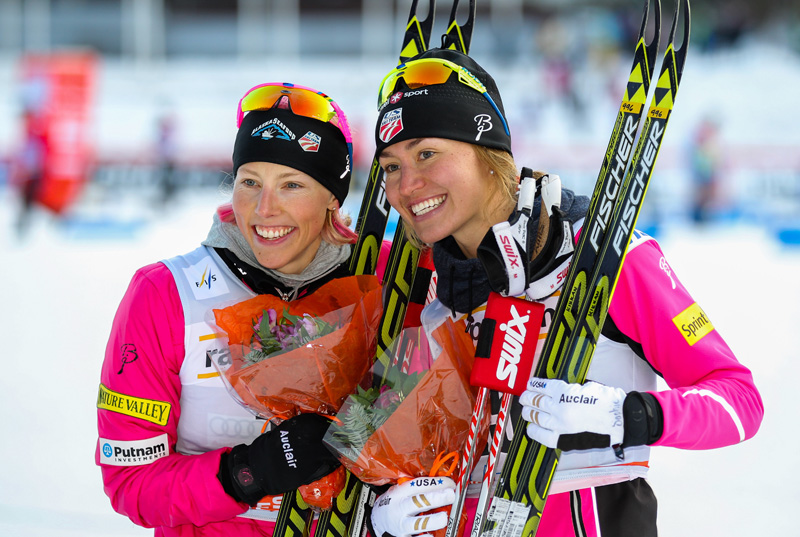
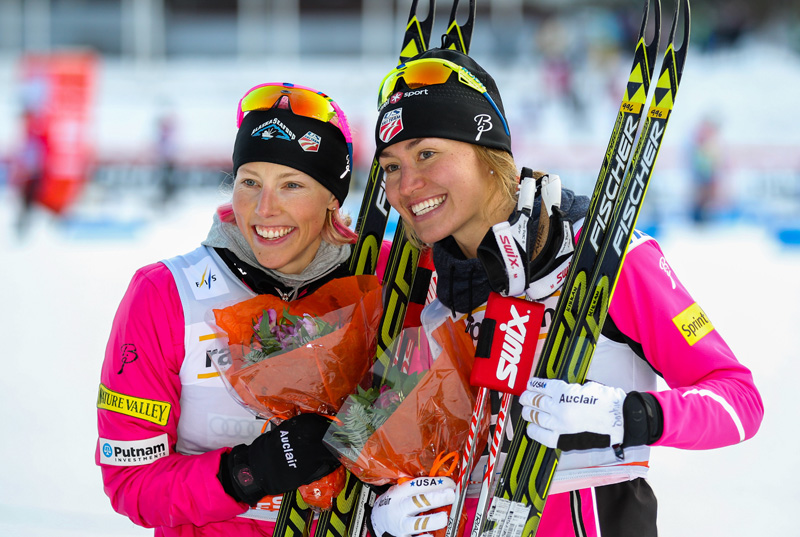
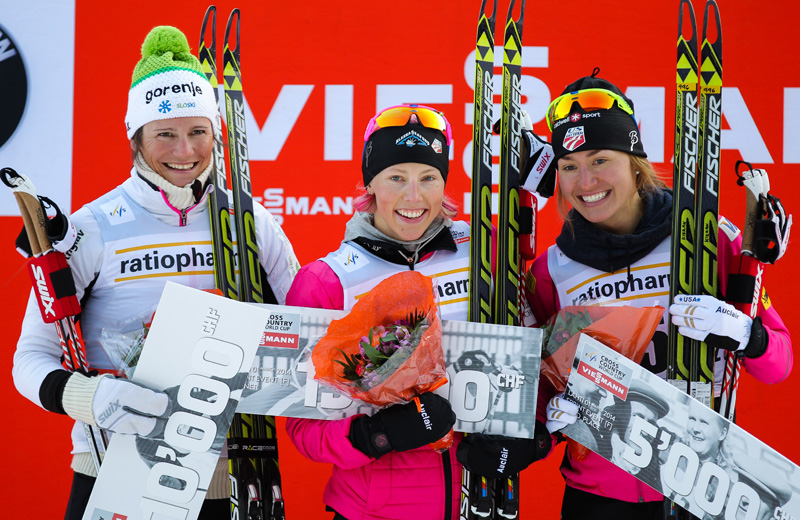
    The women's World Cup freestyle sprint podium in Lahti, Finland, with winner Kikkan Randall (c) and Sophie Caldwell (r) in third for the U.S., and Slovenia's Katja Visnar in second (l). (Photo: Fischer/Nordic Focus)
    The women’s World Cup freestyle sprint podium in Lahti, Finland, with winner Kikkan Randall (c) and Sophie Caldwell (r) in third for the U.S., and Slovenia’s Katja Visnar in second (l). (Photo: Fischer/Nordic Focus)
  • Bjørgen Sits Tight, Seizes Toblach Skate Sprint Win; Randall Fifth in Last Race Before Olympics

    Bjørgen Sits Tight, Seizes Toblach Skate Sprint Win; Randall Fifth in Last Race Before Olympics

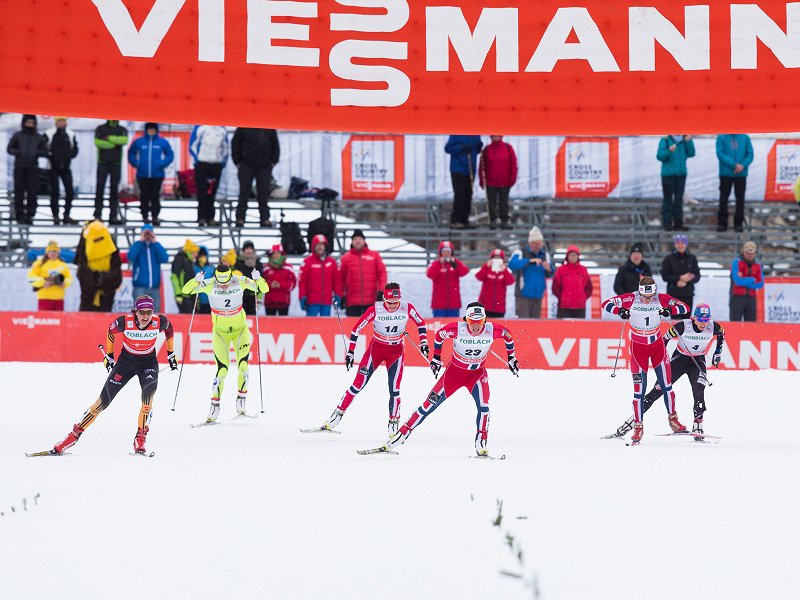
    Norway's Marit Bjørgen powers to the finish while trying to hold off Germany's Denise Herrmann (l) and two Norwegian teammates, Ingvild Flugstad Østberg (1) and Maiken Caspersen Falla (14). Bjørgen ended up winning by 0.43 seconds, Herrmann was second, Østberg third, and Falla fourth. American Kikkan Randall (r) placed fifth and Slovenia's Katja Visnar (2) took sixth. (Photo: Fischer/NordicFocus)
    Norway’s Marit Bjørgen (23) powers to the finish while trying to hold off Germany’s Denise Herrmann (l) and two Norwegian teammates, Ingvild Flugstad Østberg (1) and Maiken Caspersen Falla (14). Bjørgen ended up winning by 0.43 seconds, Herrmann was second, Østberg third, and Falla fourth. American Kikkan Randall (r) placed fifth and Slovenia’s Katja Visnar (2) took sixth. (Photo: Fischer/NordicFocus)

    If anyone was going to deny Kikkan Randall of her third-straight skate sprint victory, a feat that hasn’t been achieved on the World Cup since Marit Bjørgen’s similar sprint-winning streak in 2006, it was most likely going to be Bjørgen.

    Everyone else had too much respect for Randall: if she decided to lead, they’d let her go and try to hang with her to the finish. If she took the inside lane around a tight corner, like she did in Sunday’s semifinal around Norway’s Ingvild Flugstad Østberg, her competitors would try to hold their own — but also do their best not to take Randall down.

    Randall emerged out of that predicament before the last straightaway in the 1.3-kilometer freestyle sprint semifinal at Sunday’s World Cup in Toblach, Italy. She had nudged her way ahead of Østberg to win the heat, after the Norwegian led most of the semifinal. The two had come in slight contact with extended arms around the turn, but it was clear neither wanted to take each other out of the running.

    Bjørgen wasn’t out for blood, either, but she was looking for a victorious sendoff to her fourth Olympics.

    Marit Bjørgen celebrates her second victory of the weekend at the Toblach World Cup, winning Sunday's freestyle sprint -- the final race before the 2014 Olympics. (Photo: FlyingPointRoad.com/NNF)
    Marit Bjørgen celebrates her second victory of the weekend at the Toblach World Cup, winning Sunday’s freestyle sprint — the final race before the 2014 Olympics. (Photo: FlyingPointRoad.com/NNF)

    “I was good at keeping the peace, and I knew I had good skis and I had the opportunity to settle in the sprint,” Bjørgen told NRK, according to a translation.

    A day after winning her first World Cup back on the circuit by 36 seconds in the 10 k classic, Bjørgen qualified 23rd then won her quarterfinal and semifinal to advance to the final.

    The 2-1 favorite from the start (Randall was given 4-5 odds, or an 80 percent chance, of winning), Bjørgen said she felt a little tired earlier in the day — probably a result of Saturday’s effort and her team’s preceding training camp at Seiser Alm, Italy.

    “Today I feel a bit slow in the beginning and feel better and better in each heat,” she told FIS in a post-race interview. “I just had to calm down and have as much power in the end.”

    For Bjørgen, that meant letting others do the work early then take control by the final descent. She relied on superior glide throughout her heats to get her where she needed to be on the downhills before the stadium. In the final, she followed one of two teammates in the heat, Østberg, up the first of three hills as the other Norwegian, Maiken Caspersen Falla, led the pack with Randall.

    Over the top of the second short-but-steep climb, Randall, who had qualified fourth behind Østberg and two Slovenians: Katja Visnar and Vesna Fabjan, respectively, passed Falla to take control. Germany’s Denise Herrmann quietly moved to third, then challenged Falla and Randall up the outside of the last hill.

    Falla got to the top first, Randall tucked behind her on the way down. Bjørgen soared to the front in another track with the skis and energy-saving tactics that had carried her all day. Herrmann went with her, as did Bjørgen’s teammates, and Randall was left chasing the four coming into the final stretch.

    “While I’m definitely bummed not to have been in the fight for the win in the final stretch I am happy with the way I felt today and I probably learned more from the way the race played out,” Randall wrote in an email. “With such a long straight downhill before the finish, this was a very tactical course and a very different course from Sochi.

    “I am looking forward to heading to Sochi in a couple days and getting in some good training on the sprint course there,” she added.

    Similar to her semifinal, in which Bjørgen looked over both her shoulders before the finish to make sure she had won it, then edged Herrmann by four-hundredths of a second, Bjørgen pulled out another victory in 2:59.8. This time, she was four-tenths of a second faster than Herrmann in second, cheering at the finish with a big smile that showed how much the win meant to her.

    The Toblach World Cup women's 1.3 k freestyle podium on Sunday, with Norwegian winner Marit Bjørgen (c), German runner-up Denise Herrmann (l) and Norway's Ingvild Flugstad Østberg in third. (Photo: Fischer/NordicFocus)
    The Toblach World Cup women’s 1.3 k freestyle podium on Sunday, with Norwegian winner Marit Bjørgen (c), German runner-up Denise Herrmann (l) and Norway’s Ingvild Flugstad Østberg in third. (Photo: Fischer/NordicFocus)

    “The answer I got this weekend means a lot,” Bjørgen told NRK.

    Østberg pushed for third (+1.46) and Falla placed fourth (+2.13) to help Norway put three in the top four.

    The winner of both her quarterfinal and semifinal, Randall ended up fifth (+2.66), her first time off the podium in the last nine World Cup skate sprints, and Visnar was sixth (+3.01).

    “Today was another solid day,” Randall wrote. “Performance was strong through all the rounds just didn’t employ the right tactics in the final. I was really happy with 4th in the qualification and pumped to see 3 of my teammates [Sophie Caldwell, Jessie Diggins and Holly Brooks] advance as well.”

    The three other Americans did not reach the semifinals and finished 19th, 28th and 29th, respectively.

    Already second to Herrmann in the World Cup sprint standings, Randall retained her position but Herrmann extended her lead to 60 points ahead of her.

    “It has become one of my goals now to win the overall World Cup sprint title, but I know it will be tough against Kikkan and Ingvild,” Herrmann told FIS.

    Østberg racing to third in the Toblach World Cup freestyle sprint on Sunday in Italy.  (Photo: FlyingPointRoad.com/NNF)
    Østberg racing to third in the Toblach World Cup freestyle sprint on Sunday in Italy. (Photo: FlyingPointRoad.com/NNF)

    Østberg is currently 81 points behind Randall in third.

    “It was really great today to be on the podium again,” Herrmann added.

    After qualifying in ninth, Herrmann won her quarterfinal ahead of Visnar in second. One of Herrmann’s training partners, 22-year-old Elisabeth Schicho, won her first title at U23 World Championships in the freestyle sprint on Jan. 29, then qualified in Sunday’s World Cup in 22nd before finishing fifth in Herrmann’s quarterfinal.

    “It is really great to see her ski so well,” Herrmann said.

    “Marit and Denise were really smart in the finals and were in the right place coming into the homestretch,” Østberg told FIS. “I was a little bit caught on the inside and fought as hard as I could to be on the podium today. It was great racing. I am happy with my result and excited for Sochi.”

    With Olympic races starting in six days in Sochi’s mountain village of Krasnaya Polyana, Russia, Bjørgen is considering competing in all six events, but doesn’t expect to win gold in every one. Asked if she could medal in each, she acknowledged she’s a favorite in most.

    “It’s not impossible,” she told NRK, according to a translation. “But there is plenty to be done before that.”

    Results

  • Randall Times Strike to Win Beitostølen Skate Sprint

    Randall Times Strike to Win Beitostølen Skate Sprint

    Kikkan Randall lived up to the hype on Sunday, winning the U.S. Ski Team's first sprint of the season in Beitostølen, Norway. Randall topped Slovenians Vesna Fabjan (l) in second and Katja Visnar in third in the 1.2 k freestyle FIS sprint after qualifying in seventh and placing second in both her quarterfinal and semifinal. http://www.fis-ski.com/cross-country/news-multimedia/news/article=randall-and-fossli-win-free-technique-sprints-beitostølen.html
    Kikkan Randall lived up to the hype on Sunday, winning the U.S. Ski Team’s first sprint of the season in Beitostølen, Norway. Randall topped Slovenians Vesna Fabjan (l) in second and Katja Visnar in third in the 1.2 k freestyle FIS sprint after qualifying in seventh and placing second in both her quarterfinal and semifinal. (Photo: FIS Cross Country)

    The U.S. Women’s Nordic Ski Team finished off their weekend opener in Beitostølen, Norway, with a bang on Sunday, as reigning World Cup sprint champion Kikkan Randall claimed a win in the 1.2-kilometer freestyle sprint FIS race.

    Seventh in the qualifier then second in the her quarterfinal and semifinal, Randall won the final in 2:17 minutes, 0.8 seconds ahead of runner-up Vesna Fabjan of Slovenia. Coming in third, Slovenian Katja Visnar followed her teammate by 1 ½ seconds.

    In an email, Randall explained Brun-Lie, who won the qualifier along with her quarterfinal and semifinal (beating Randall by 0.4 seconds in the semi), led out the final, but lost her balance halfway through. According to Randall, that opened up the race. Randall ended up trailing Fabjan until midway up the final climb, then decided to make a move over the top.

    “I thought I might get challenged on the homestretch but the shadows never came,” Randall wrote.

    Following the top three, three Norwegians – Marit Bjørgen, Celine Brun-Lie and Ingvild Østberg – took fourth through sixth respectively, all within less than a second and a half of each other, but more than three seconds behind Randall.

    When it came to Randall’s game plan, the 30-year-old Alaska Pacific University (APU) skier explained it was simple.

    “Pretty much ski hard, play with some different tactics and get a hard workout!” she wrote. “In both the quarter and semis I was always following someone off the final turn and then making sure I was strong on the homestretch to guarantee moving on each time.”

    All she needed to do was make the top two in each heat. Easier said than done, but the world champion did it. On Friday, Randall placed 10th in the 10 k classic race – her first of the season.

    “ I am happy to have two solid races under my belt,” Randall wrote. “This weekend was mostly about waking up the body before the World Cup opener [in Kuusamo, Finland] next week.  It’s a good confidence boost to stack up well against a strong field. But the real tests begin next week!”

    Four other U.S. Ski Team (USST) women advanced to the heats and ended up in the top 20, failing to make the semifinals.

    Ida Sargent (Craftsbury Green Racing Project) tallied 13th – an improvement from finishing 29th in Friday’s 10 k. She qualified in 13th and went on to place third in her quarterfinal, 1.8 seconds behind Norwegian quarterfinal winner Maiken Caspersen Falla (who ended up seventh) and 0.5 seconds behind Mari Eide (who placed 10th).

    “It was a short fast sprint and the qualifier was over before I knew it,” Sargent wrote in an email. “In the quarterfinal I wanted to get out fast but I got pushed outside on the first corner and ended up in 4th going down the downhill. I moved up to second on the uphill where I was feeling strong but I skied the finishing stretch really poorly.”

    In retrospect, Sargent felt she chose the wrong technique.

    “[I] should have been using V2 alternate instead of V2 on the fast snow,” she wrote. “I was just skiing really awkward and bobbled and almost fell and then I lost ground.”

    On the whole, her experience was positive. “I’m just excited to be back racing again and finding improvements with each race,” she wrote.  “It was still really fun to race a heat against lots of really fast ladies. The Norwegian women are so strong and the Slovenians are also skiing really fast so it was great to race them.”

    In the women's freestyle sprint quarterfinals in Beitostølen, Norway, U.S. Ski Team rookie Sophie Caldwell keeps contact with Marit Bjørgen (second from left) and Slovenia's Vesna Fabjan (c), who ended up second overall. Bjørgen ultimately placed fourth in the final, and Caldwell did not advance to the semis, placing 18th overall. (Photo: Noah Hoffman/noahhoffman.com)
    In the women’s freestyle sprint quarterfinals in Beitostølen, Norway, U.S. Ski Team rookie Sophie Caldwell keeps contact with Marit Bjørgen (second from left) and Slovenia’s Vesna Fabjan (c), who ended up second overall. Bjørgen ultimately placed fourth in the final, and Caldwell did not advance to the semis, placing 18th overall. (Photo: Noah Hoffman/noahhoffman.com)

    The rest of the U.S. women came in 17th through 19th, with Jessie Diggins, Sophie Caldwell and Sadie Bjornsen, respectively.

    Fourth in her quarterfinal and just a tenth of a second behind Sargent, Diggins explained in an email it hadn’t been an easy training week leading into Beitostølen, leaving her a little sore and tired before Sunday’s race. But that was part of the plan.

    “It’s a long season ahead!” Diggins wrote. “I was psyched that the two races this weekend went as well as they did, especially since it’s the plan to work into the season.”

    She qualified in eighth, but ran out of room in the quarterfinals, she explained.

    “This sprint was wicked short — like 2:15 in the qualifier,” she wrote. “I like much longer sprints, because it takes me longer to work into it. … I felt better and better in the finishing lanes and was picking up speed, but needed a longer course to do some damage. But it was a great way to get back into the feel of sprinting, get used to the warming up and testing ski process again.”

    Teammate Sophie Caldwell got a little too cold during the prelim and felt a bit stiff in her legs, but was happy to qualify in ninth. From there, she said her quarterfinal was “fun,” going up against top women like Fabjan, Bjørgen, and Norway’s Heidi Weng, who took first through third in the heat, respectively.

    “I didn’t realize I had Marit in my heat until I toed the start line and then I just tried my best to tuck in behind her,” Caldwell wrote. “I had a good start and was able to stay in 2nd for the first half of the race before moving back to 4th. It was exciting to have all five girls qualify, so hopefully that means we’re in a good place!”

    Additionally, she was excited to watch one of her teammates win outright and teammates Andy Newell and Simi Hamilton place sixth and 27th, respectively.

    Bjornsen, who notched fifth in Friday’s 10 k classic, qualified in 14th and went on to place fourth in her quarterfinal. She was 0.8 seconds out of first, with Visnar, Randall and Norway’s Hilde Landheim taking first through third.

    “It was fun to sprint again,” Bjornsen wrote. “… [And] a good warm up for next weekends world cups which I am looking forward to! This weekend was about getting back into the grove of racing. Warm-up, ski selection, nerves, pacing. It was a practice race before it really counts.”

    The last time she started her season in Europe – two years ago – the team didn’t do that, Bjornsen explained.

    “So now I am really looking forward to Finland and a fun season ahead!!” she added.

    — Alex Matthews contributed reporting

    ***

    Results | Brackets

  • Brandsdal, Van der Graaf Speed to Victory at Bysprinten

    Brandsdal, Van der Graaf Speed to Victory at Bysprinten

    Laurien Van der Graaf (SUI), shown here in the Milan, Italy World Cup, won both women's events at Bysprinten on Saturday.

    No snow-speed records were broken at the sixth edition of Bysprinten, but the annual two-day ski festival on the streets of Mosjøen, Norway provided plenty of excitement for the 3,000 spectators who came out to see their favorite national team members ski as fast as possible. On Saturday, Eirik Brandsdal (NOR) prevailed in the men’s final sprint, and Laurien Van der Graaf (SUI) topped the women’s field.

    “I am very fond of Bysprinten. I often do it well and it’s fun to go with so many people in the streets,” said Brandsdal.

    Petter Northug, whose presence at the event was the most highly anticipated, provided a bit of drama in the semifinals when he tangled with Øystein Pettersen (NOR) and appeared to be out for the final. The jury ruled that Pettersen had blocked Northug, however, and sent him through. Northug ended up finishing fourth.

    The Norwegian celebrity made no excuses — “I’ve relaxed on the couch for three months, so my ass is getting a little wide. I am not quite in top shape today,” he told the NRK.

    In addition to the 1.5 k, the day’s program included a youth sprint, an elite 100 m individual sprint, and a “brothers relay” that set the Petter and Tomas Northug against Renato and Fabio Pasini (ITA) and Anders and Kristian Tettli Rennemo (NOR).

    The Northugs lived up to their promise to “defend the family honor,” and defeated the Pasinis in second and the Rennemos in third.

    In the 100 m dash, organizers had a radar gun on hand in anticipation of witnessing a new world record, but it was not to be — local newspapers reported that the direction of the straightaway was into the wind. Ola Vigen Hattestad (NOR) clocked in at 12.39 for the win over Petter Northug in second (12.60) and Anders Gløersen (NOR) in third (12.63).

    “It was really fun to go today. I was not as good technically, but I did everything I could,” said Hattestad to the NRK.

    Van der Graaf dominated the day from the get-go, taking the women’s 100 m in 13:48. Slovenia’s Katja Visnar took second (13.83) followed by Mari Eide (NOR) in third (13.96).

    “It has been really fun and I enjoyed myself,” said Van der Graaf.

    Men’s 1.5 k results

    Women’s 1.5 k results

    100 m results

  • Team 11: Slovenia

    Slovenia

    2009-2010 Nations Cup Ranking: 10th (1161 pts)

    2010-2011 Nations Cup Ranking: 11th (1880 pts)

    Men: N/A (0 pts)

    Women: 6th (1880 pts)

    2011/2012 World Cup Team

    Men

    N/A

    Women

    Katja Visnar

    Vesna Fabjan

    Barbara Jezersek

    Alena Cebasek

    Anja Erzen


    Petra Majdic chatting with FasterSkier at the Canmore World Cup, 2010.

    What You May Have Missed Last Season

    Majdic was her dominant self on the sprint course last season, winning four sprints to become the Sprint Cup victor for the third time in her eleven-year World Cup career.

    However, in a season where she proclaimed that she returned with her eye on the Crystal Globe, Majdic was a tad disappointing during distance racing in her final year, picking up a single medal, a bronze in the 5 k classic during the Kuusamo mini-tour.

    We know, it’s crazy that someone who won the Sprint Cup, finished 13th in the distance rankings, and sixth in the overall could be called ‘disappointing’, but that’s the standard her rabid fans, and she herself sets.

    While it’s clear that Majdic knows how to sprint, the Slovenian women coming up behind her have learned a thing or two about speed as well. Following closely in Majdic’s sprinting footsteps are Vesna Fabjan and Katja Visnar, who actually recorded the exact same number of World Cup points – 266 each – this season.

    In particular, the two Slovenians put on quite the show during the skate sprint in Rybinsk, Russia. After qualifying first and second, they cruised through the rounds, and topped off their day by dominating an Italian-packed final, Fabjan taking the win, and Visnar holding off Justyna Kowalczyk for second.

    Fabjan also brought her A-game when it mattered most, making the sprint final at World Championships in Oslo, and finishing fourth to Majdic.

    What You Need To Know for This Season

    Slovenia's Petra Majdic after her win in the classic sprint in Otepaa, Estonia.

    Majdic has retired, leaving a massive hole on the team, and on the World Cup in general. She was a permanent fixture, earning 33 World Cup podiums in her career. She also seemed to have a knack for generating big headlines, big excitement, and without a doubt put Slovenia on the map in terms of cross country skiing. Whether you’re a fan of the exuberant Slovenian or not, you have to appreciate her success in the sport.

    While Majdic is walking away, it’s pretty clear that Visnar and Fabjan are more than ready to take over and carry the load – at least on the sprinting front, as they finished eighth and ninth on the Sprint Cup respectively. While Fabjan is primarily a skate specialist, she can still qualify in classic, and Visnar can do both. As well, at 26 and 27 years of age, have plenty of prime years ahead of them.

    Unfortunately, distance skiing is going to be tough for the Slovenians this year. Fabjan picked up a grand total of 2 points, while Barbara Jezersek added 26 in the limited World Cup action she saw.

    Visnar seems to be in great shape, as she managed to win a car in a rollerski race, and she is now gunning for success on the Tour de Ski and the Sprint Cup.

    Canadians should get excited about the 27 year old Slovenian – while Visnar is still dating Ola Vigen Hattestad, she knows how to skate and hold a hockey stick.

    The Slovenian men continue to be pretty much nonexistent, at least in the points scoring department, failing to notch any for another year, a status that is unlikely to change immediately.

    Look! A Slovenian male skier hiding behind Torin Koos!

    Also, for those concerned, there is no word yet on whether the Slovenians will be dazzling the World Cup with their – let’s call them ‘distinct’ – suits.

    Who You Should Watch

    Rok Trsan is the Slovenian of the future. He has a disgustingly awesome name, finished 4th and 13th at World Junior Championships in Otepaa, and still has another year of junior skiing to make some noise. While the women are doing the damage now on the World Cup, it won’t be long before Trsan will be mixing it up.

  • Petukhov Wins on World Cup Sprint on Home Soil, Slovenian Women 1-2

    It took four tries, but Russian sprint specialist Alexei Petukhov finally got a World Cup victory on home soil, breaking away from the pack to win the men’s freestyle sprint in Rybinsk, Russia.

    In the women’s event, a Petra Majdic-less Slovenia claimed the top two spots with Vesna Fabjan and Katja Visnar beating out Justyna Kowalczyk (POL).

    As in Friday’s pursuit, many of the top skiers were missing – including the entire Swedish team and any representation from North America. But the men’s race still featured plenty of firepower, and with final spots on the Norwegian World Championship team at stake, there was more than World Cup points and cash on the line.

    Petukhov won the qualification round by .74 seconds over Anders Gloeersen (NOR) and easily advanced through the first two rounds. In the final he employed what has become the tactic of choice for Russian sprinters – go out hard, and open a gap early.

    With teammate Nikolay Morilov in tow, Petukhov did just that. The strategy does not always work, but today, in front of thousands of fans at the Demino stadium, Petukhov opened an insurmountable gap, creating enough space to celebrate in the final meters.

    “I am so glad,” Petukhov said. “I took second place here twice already, and of course wished to win. This time I decided to escape, not looking back.”

    Morilov, along with the other four skiers in the heat, was unable to maintain the pace. Norwegian sprinter Ola Vigen Hattestad, after determining he could not match Petukhov, settled in to race for second. He bided his time before staging an impressive late attack with Gloeersen, giving the duo the final two podium spots.

    “I’m satisfied with my second place,” Hattestad said following the race. “Alexei was very strong, and made such a gap that I could not reach him. But I chose good tactics staying behind the other athletes and was able to control the race.”

    Martin Jaeger (SUI), in his first World Cup sprint finals appearance, just missed out on the podium when the two Norwegians overtook him. He still ended up a career-best fourth, topping his ninth in the same event one year ago.

    The women’s race, despite strong Italian and Slovenian contingents, lacked depth – just 34 women started the qualification round, and there were clear gaps in ability level throughout the quarterfinals.

    Qualification times accentuated these differences. Visnar set the pace, gapping the field by an impressive 2.49 seconds. Fabjan qualified second, and Magda Genuin (ITA) placed third, over four seconds off Visnar’s time.

    Alenka Cebasek, a relatively unknown Slovenian participating in just her seventh World Cup race, was seven seconds back as the tenth qualifier – an eternity in sprint racing.

    With the exception of Finnish skiers Aino Kaisa Saarinen and Riita Liisa Roponen, all of the top women advanced to the semifinals.

    Fabjan, despite being a step slower in qualification than her teammate, was clearly in top form today. She and Visnar controlled the final, leading from wire to wire. Kowalczyk, participating in her weakest event – the freestyle sprint, managed to come back with a fierce attack on the last hill. She closed the gap, and was in position for the final sprint.

    Fabjan was clearly the fastest, and Visnar secured second with a lunge. Kowalczyk settled for third – her first time on the podium in skate sprint this year.

    For Fabjan, Rybinsk is quickly becoming a favorite venue. She won the individual sprint last year and teamed with Visnar to claim victory in the team sprint.

    “It is just amazing,” Fabjan said. “I like the course in Rybinsk and I have good tactics for it – that is maybe the key of the success.”

    Visnar was thrilled with her result – the first time she has stood on the World Cup podium in an individual event.

    “Satisified” is the word Kowalczyk used to describe her feelings on the day, but she went on to express some disappointment.

    “I am not normally often on the podium in free technique sprints, but on the other hand I felt I could do more today,” Kowalczyk said. She spent the first part of the final stuck behind the Italian trio of Genuin, Arianna Follis, and Marianna Longa.

    In the battle for the last two spots on the men’s Norwegian World Championship team, Gloeersen easily came out on top. His coach informed him that his third place result earned him a trip to Oslo.

    The last spot would go to Oystein Pettersen if today’s results are the final criteria. Pettersen placed seventh – the fastest man to miss the finals, while his competition, John Kristian Dahl and Johan Kjoelstad suffered significant misfortune.

    Kjoelstad placed last in qualification, almost certainly due to a crash. Dahl, who was left of the 2010 Olympic squad despite a World Cup victory earlier that season, advanced to the heats, but crashed out in the quarterfinals, ending the day in 26th.

    World Cup racing continues on Sunday with a 4×5/10km relay, before going on break until the pre-World Championship races in Drammen, Norway.

    Men’s Freestyle Sprint – Results

    Women’s Freestyle Sprint – Results

  • Team 10: Slovenia

    Team 10: Slovenia

    Slovenia

    Nations Cup Ranking: 10th (1890 pts)

    Men: N/A

    Women: 7th (1890 pts)

    2010/2011 A Team

    Men

    N/A

    Women

    Petra Majdic

    Vesna Fabjan

    Katja Visnar

    What you may have missed last season:

    The Slovenians managed to ski their way into the top 10 on the Nations Cup with only three skiers – all female – contributing to their points total. Embarrassing for other countries? Slightly, but when the three athletes you’re facing are Petra Majdic, Vesna Fabjan and Katja Visnar, it’s not so bad. All three finished in the top 11 in the sprint cup standings, no small feat.

    In what could be the understatement of the year, you probably have heard of Petra Majdic. After the Olympics, she needs no introduction, although if you really need a reminder, there are plenty of places that recount her Olympic experience.

    Fabjan and Visnar are not quite as well known, but rest assured, if you watched a World Cup this winter, you would have seen them. Mostly because of  Slovenia’s choice of the highlighter-yellow racing suit (which they tragically eschewed in Vancouver), but also because they sprint really fast.

    Vesna Fabjan rocking the highlighter-yellow

    Fabjan tore up the sprint circuit, failing to qualify just once and finishing on the individual podium twice. Her best weekend of the year was in Rybinsk, Russia, where Fabjan took her first World Cup victory in the individual, then won team sprint silver with Visnar. Fabjan and Majdic were a lock to make the Olympic team sprint an event to remember for Slovenia, until Majdic’s injuries forced her to bow out.

    What You Should Know For This Season

    Petra Majdic is back! More importantly, she’s healthy! She also specifies that finishing second  in the sprint cup last year – despite not racing a single event after the Olympics – just isn’t good enough. She wants the Crystal Globe.

    If Majdic can regain her form – and when she’s in top shape she is one of the absolute best on the circuit – things will go well for Slovenia. If not, Fabjan and Visnar will be able to pick up the slack sprinting – though the distance results will be non-existent.

    Oh, right, and just in case you thought FasterSkier was being sexist, there are literally no males on the radar for Slovenian skiing. The odds are good, boys!

    Who You Should Watch

    Katja Visnar was good last year – she went 11 for 11 in qualifying for the heats in the sprints she started, including the Olympics. While she never stood on the podium as an individual (she did get that second in the team sprint in Rybinsk), the kind of consistency she displayed in classic and skate sprinting means that it’s only a matter of time – especially with Majdic there to guide her.

    If you’re playing Call of Duty on your Xbox, and you’re a terrible teammate, look out: Visnar likes her video games, but only when her teammates are good. Visnar is also dating Ola Vigen Hattestad, so if FIS ever introduces the family mixed team sprint event, which seems like it could be a possibility with all the new formats being rolled out, watch out for them.