
Tag: Kein Einaste

  • Team 15: Estonia

    Estonia

    2009-2010 Nations Cup Ranking: 14th (971 pts)

    2010-2011 Nations Cup Ranking: 15th (636 pts)

    Men: 11th (633 pts)

    Women: 21st (3 pts)

    2011/2012 World Cup Team

    Men

    Peter Kummel

    Kein Einaste

    Timo Simonlatser

    Women

    N/A


    What You May Have Missed Last Season

    The legendary, needs-no-introduction Andrus Veerpalu was poised to go out on top, as the greatest male Estonian skier ever, and one of the all-time best big-race performeres of Nordic skiing – until an injury forced him to sit out of his final World Championships, and call it a career. The Estonian strong-man was feted, celebrated, patted on the back, and given rounds of applause – until he tested positive for human growth hormone.

    Instead, he went out on the bottom, as it emerged that he tested positive for growth hormone (or did he? The lawyers are still battling it out) and opted to retire before World Championships. This created  a not-insignificant amount of outrage both pro and con-Veerpalu, but Odd-Bjorn Hjelmset was clear on his opinion of the Olympic and World Championship medalist.

    Peeter Kummel (left).

    On course, the Estonian men were quite good, but not outstanding. While Veerpalu’s points are invalid, 13 other Estonian skiers scored World Cup points, however none of them cracked 100.

    The best of the bunch were Timo Simonlatser and Peeter Kummel, both very talented sprinters. Kummel had a strong World Championships, where he qualified 17th in the sprint before battling his way through to the final to finish 6th in the Petter Northug – Marcus Hellner dominated event.

    In most countries, as sixth-place result at World Championships would be cause for at least a little celebration – but the Estonians demand more.

    What You Need To Know for This Season

    The hurricane that is the Veerpalu doping controversy has become a massive sideshow, and the fall-out has just begun – it is extremely unclear how the Estonian distance team and skiers will shake out this season.

    Mati Alaver, who coached Veerpalu as well as recently retired Jaak Mae, has been suspended as Head Coach of the National Team, and the head of the Estonian Ski Association Juri Jarv has resigned, while sprint coach Bjorn Kristianson has quit outright in protest over the Federations handling of the incident – he found out about Veerpalu’s case from the paper.

    In the past, Alaver has said that he will resign if Veerpalu is not cleared of all charges, but seeing as FIS has stiffened the penalty against the Estonian legend, to a three-year barn, that seems unlikely.

    Mati Alaver, currently suspended Estonian cross-country ski coach

    While Estonia has never been known for having a deep womens’ team, the retirement of Kristina Smigun-Vaehi at the end of the 2009-2010 season highlighted just how little depth exists, as just two women scored World Cup points. And neither Piret Pormeister or Triin Ojaste are prepared to step up to the level that the Estonian public demands of their skiers, at least this season, as is evidenced by their lack of inclusion on the World Cup team.

    If you’re looking to understand more of Estonia as a country, look to FasterSkier’s own Nat Herz who spent time in Estonia this past winter, and wrote an excellent piece on the countries’ development as a ski power.

    And if there is one bright spot left in Estonia, it’s their sprint squad. A tightly-knit group of guys who have some top tier skills, and judging from their website, seem to have at least as much fun as the vaunted Norwegian Sprintgutta.

    Estonian words and names are awesome – in just a short sample size, skiing in Estonian is ‘suusk’, while ski websites such as FasterSkier are ‘suusaportals’; finally, they have a ski club named ‘suusahullud’, which roughly translates to ‘ski crazy’ or ‘skier freaks’.

    Who You Should Watch

    Kein Einaste is a 26 year old sprinter poised on the edge of big things. He can really only classic sprint – he failed to qualify on skate skis this past winter, but went three-for-three in classic. He also seems to have some terrible luck. One Estonian newspaper headline even called out a higher power, in a story entitled “Why Does God Hate Einaste?” after the unlucky Estonian broke a pole in his semi-final during the sprint at the Otepaa World Cup.
  • Estonians Sweep Munio Sprint; Sargent Qualifies Second, Finishes Fourth

    Estonians Sweep Munio Sprint; Sargent Qualifies Second, Finishes Fourth

    Ida Sargent (Craftsbury Green Racing Project/Dartmouth College) leads her quarterfinal heat.

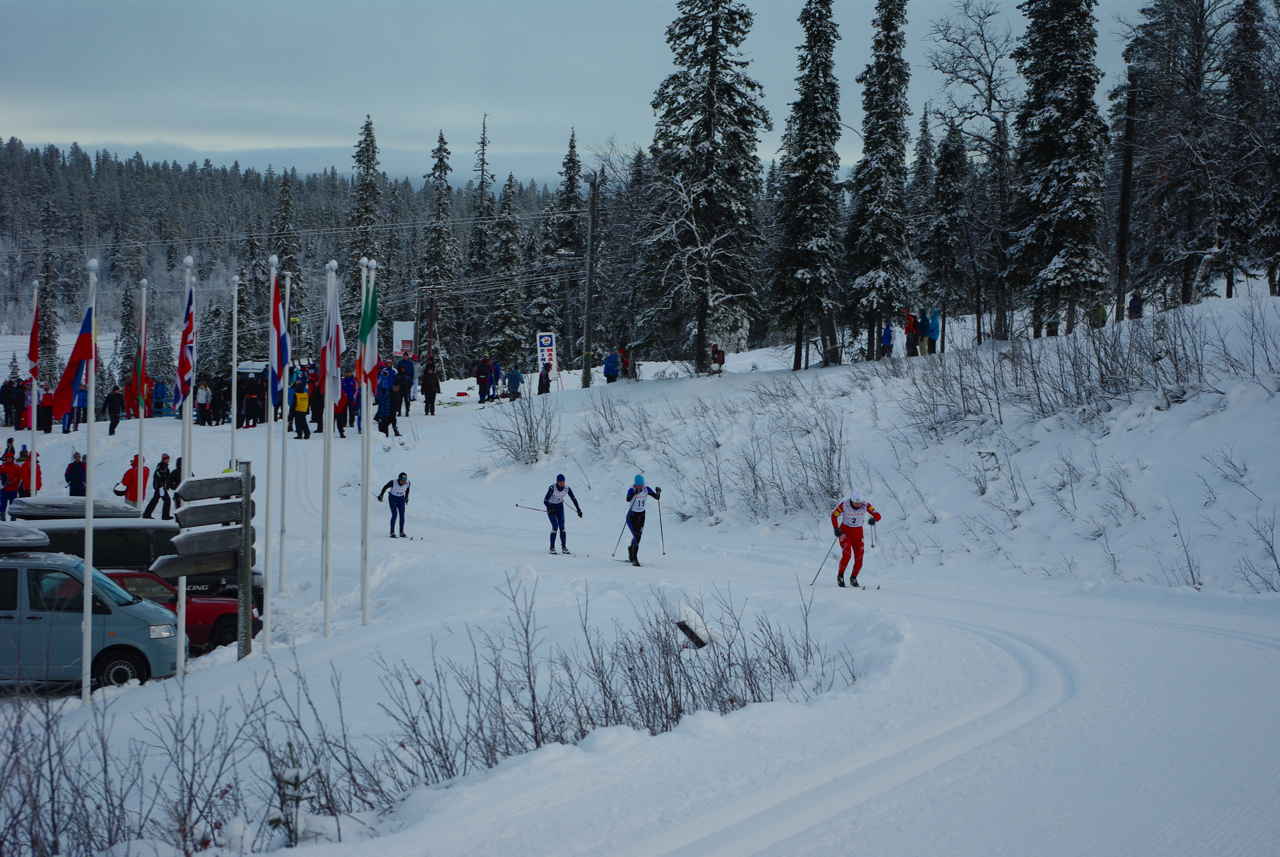
    FIS kicked off its winter race season in Munio, Finland and Rybinsk, Russia this weekend. In Muonio, the first race of the year was a classic sprint, contested Sunday morning in frigid temperatures, which drew a variety of athletes from around northern Europe. The Craftsbury Green Racing Project was the only American team in attendance, but they turned heads as Ida Sargent, racing in her U.S. Ski Team suit to avoid an NCAA violation, qualified second and skied through to the final. Sargent is enrolled at Dartmouth College, where she has been training this fall.

    The course was unusual in several ways. It started at the base of the alpine area at the Olos Hotel, and finished further up one of the alpine trails in a different location. Both the men’s and women’s courses were short – 780 and 1,100 meters respectively – and featured sharp turns, with the women’s race climbing up an untracked cutoff culminating in a sharper-than-right-angle turn and the men’s field negotiating a hairpin turn around a branch in the snow.

    One of the technical delegates asked the American women if they approved of the shortened courses. While Sargent would have said yes, Lauren Jacobs and Chelsea Little responded that the course was a bit short for their liking.

    “Yes, I think this too,” the T.D. replied. “I asked them last night why they had to make the women’s race shorter. There is no reason to make the two races different, if even the men’s race isn’t so long.”

    In the morning, the women’s qualifier was won by Estonia’s Triin Ojaste, who only edged Sargent by 0.05 seconds. They were followed by Russia’s Svetlana Bochkareva a mere half second back.

    In the men’s qualifier, another Estonian took the win: Kein Einaste, who beat teammate Peeter Kummel by nearly two seconds. Behind them were Kazakhs Alexey Poltoranin and Nikolay Chebotko.

    Eventual winner Kein Einaste of Estonia (101) leads Kalle Lassela of Finland (108), the fastest man on Karhu skis, Estonian legend Andrus Veerpalu (109), and Modestas Vaiciulis of Lithuania (116) up the first hill in their quarterfinal heat.

    The real excitement started after lunch with the heats. Because of the cold conditions and sharp turns on the course, the organizing committee opted to reduce the number of heats to four quarterfinals, each of which included only four competitors. As such, Sargent was the only American to advance. Had the race been run with a full schedule of heats, Hannah Dreissigacker and Patrick O’Brien also would have contested the quarterfinals after finishing 20th and 30th in their respective races.

    As it was, though, only Sargent faced an afternoon of competition. It was something she wasn’t exactly looking forward to, after having arrived in Finland late on Friday night. “Today I increased the amount of time I spent on snow by about four,” she said.

    Sargent led her quarterfinal from start to finish, turning a few heads in the process. In her semifinal, she was in third place coming into the final downhill corner, when the Kazakh in front of her, Tatyana Rochshina, snowplowed to the outside. Seeing her chance, Sargent took the inside line and ultimately finished an easy second, advancing to the final.

    Sargent is silhouetted against an Arctic sky as she skis to a quarterfinal victory.

    In the final, Sargent was up against Ojaste, Slovakia’s Alena Prochazkova, and Kazakhstan’s Elena Kolomina – Olympians all of them. She trailed from the start, the jet lag and lack of on-snow training finally catching up with her. Nonetheless, making the final was a big accomplishment, and an encouraging start to her season.

    At the finish, Ojaste and Prochazkova battled right to the line, finishing with a toe-slide. In the end it was Ojaste who ended up first, just like in the qualifier and every other heat she had contested. Kolomina was a distant third.

    Ojaste edges Prochazkova for the win in the women's final.

    In the men’s rounds, more Olympians packed the heats, among them World Champions Andrus Veerpalu of Estonia and Vassili Rotchev of Russia. In the end, as in the women’s race, the winner of the qualifier also won the final: Einaste led Kummel into the finishing chute, followed again by the same two Kazakhs in the same order. But unlike in the women’s final, where the competitors gave it their all from start to finish, the men’s race was tactical. From the start, all four men paused to merge single-file into one set of tracks, and at the finish, they were still scarcely five meters apart – but it appeared that the race had already been decided, and three men were in the same finishing lane without a sprint to the line.

    The Estonian men celebrate after finishing first and second in the final.

    Muonio will host more FIS races next weekend, which will probably draw even more competitors, including athletes from the U.S. Ski Team and a trip run by the Maine Winter Sports Center.

  • Team 14: Estonia

    Estonia

    Nations Cup Ranking: 14th (971 pts)

    Men: 11th (648 pts)

    Women: 12th (323 pts)

    2010/2011 A Team

    Men

    Andrus Veerpalu

    Jaak Mae

    Kein Einaste

    Women

    Kaija Udras

    Kaili Sirge

    What you may have missed last season:

    After a three-year retirement, Estonian legend Kristina Smigun-Vaehi came back for the Olympics and had an incredibly strong year. Despite starting few World Cups, she was competitive in every one she started, knocking down four top-10 finishes. In the 15 k at the Vancouver Games, she finished second and earned her third career medal, tying her with Andrus Veerpalu as the most decorated Estonian Olympian in history.

    Also, according to her Vancouver Olympic website bio, a lab testing one of her urine samples in 2001 didn’t know she was female. Whoops…

    What You Should Know For This Season

    The Estonian big guns – Andrus Veerpalu, Jaak Mae – are both aging, which has taken a toll on their ability to be competitive for a full season, and even each race. The 38-year-old Mae had his lowest World Cup point total in the last eleven years; Veerpalu is 39. There was even some suspicion raised in a recent podcast about how they are able to ski as well as they have, for as long as they have.

    In addition, rumors are swirling about the head coach of the Estonian National Ski Team, Mati Alaver, leaving Estonia to work for their biggest rivals: Russia.

    With the retirement of Smigun-Vaehi, the women’s team is thin – Kaija Udras is a quality talent, but nowhere near Smigun-Vaehi’s level.

    The Estonians are very invested in their sprinting, even when losing to their countrymen, as Veerpalu demonstrates in this throw down with his teammate Mae.

    The Estonians also seem to have some sort of law which requires parents to give their children awesome names. Triin Ojaste? Kaspar Kokk? Algo Karp? Announcer Kjell-Erik Kristiansen has his work cut out for him at the Otepaa World Cup.

    Who You Should Watch

    Timo Simonlatser. This 24 year old sprinter skied well last season, cracking the heats at the Olympics. Due to the advanced age and declining sprint ability of the Estonian old guard, he should be given a chance to succeed on the World Cup.