From the FasterSkier archive — posts syndicated from athletes’ and coaches’ own blogs between 2004 and 2012, kept online as published. Current coverage is at fasterskier.com.

Tag: Kelly Kjorlien

  • Elena Ankudinova, the Russian Nobody Expected, Picks Up First World Juniors Win in Kontiolahti Sprint

    Elena Ankudinova, the Russian Nobody Expected, Picks Up First World Juniors Win in Kontiolahti Sprint

    Canada's Emma Lodge and U.S. biathlete Kimberly Del Frate on course in Kontiolahti. Photo: Judy Geer.

    Despite the presence of several former champions in the field, a new gold medalist rose to the top at biathlon’s World Youth and Junior Championships in Kontiolahti, Finland on Saturday: Elena Ankudinova.

    The diminutive Russian was perfect on the range and collected an eight-second victory in the junior women’s 7.5 k sprint. She bested, among others, Tuesday’s individual champion, Chardine Sloof of the Netherlands; last year’s youth individual champion, Thekla Brun-Lie of Norway; and teammates Elena Badanina, who won both the youth sprint and pursuit in 2010, and Olga Galich, that year’s youth individual champion, who also tied for the youth sprint title in 2009.

    It may not have had quite the story of Sloof’s first-ever Dutch victory earlier this week, but Ankudinova’s dominance was definitely a surprise. This is her first trip to the Championships, and after finishing 17th in the individual race she hadn’t even been selected for Russia’s relay team on Thursday.

    Ankudinova told the IBU that her win was a relief to the whole team. The Russian women had previously received only one medal in these Championships, a third-place finish by Badanina in the individual, and both their youth and women’s teams placed fourth in the relays.

    The team tripled their medal count on Saturday, with Margarita Phillipova taking home bronze 16 seconds behind Ankudinova. The teammates were separated by Anais Chevalier of France, who told the IBU after the race that she has gold in her sights on Sunday’s pursuit.

    And looking back? Perhaps the Russians wish they’d put Ankodinova on the relay team, after all.

    Vaillancourt 16th for Canada

    Keely MacCulloch en route to 40th place. Photo: Judy Geer.

    For the second time this week, Audrey Vaillancourt led the Canadian contingent with a result in the mid-teens. After finishing 15th in the individual race, the Quebec City native almost repeated her performance in the sprint, placing one spot down the ladder in 16th. Vaillancourt had a single penalty and finished a minute and a half behind Ankudinova.

    “I indeed had a very good race today,” Vaillancourt wrote in an e-mail. “My plan was to have a strong start and try to keep that pace all the way through the race, so I had a very fast first lap. Unfortunately in my last lap I couldn’t push the pace any faster, so I just made my way to the finish line with the very little energy I had left! It was worth going as fast as possible from the beginning though; every second counts in a sprint.”

    Vaillancourt’s penalty came in her prone stage, but she said the error did not affect her confidence, and that she was pleased with only a single penalty.

    Emma Lunder and Keely MacCulloch placed 39th and 40th, just over three minutes out of the win. Canadian coach Richard Boruta said that “the current ski speed is not quite where it needs to be for this level of competition.”

    But the result was actually a strong showing for MacCulloch, for whom this is the first international race trip.

    “It has been such an exciting experience,” MacCulloch told FasterSkier. “Honestly I didn’t have a clear goal set up for World Juniors because I was just thrilled that I even made the team. Finishing in 40th place today was exhilarating especially since I wasn’t able to race the relay, not to mention I moved up ten places from the individual.”

    After the individual race, where she placed 50th, MacCulloch did have a tiny bit of experience to draw on, and used it to stay focused. Like Vaillancourt, she ran out of gas on the last loop.

    “I left the penalty loop ahead of several of my competitors and tried to ski as fast as I could for the last lap… I think most of those I’d left in the range caught up to me on the downhill,” MacCulloch said. “The course has one long, steep hill that competitors must go down and then back up. Going up that hill the final lap as fast as I could was extremely tiring, and I do wish I could have pushed myself a bit harder.

    “However it was still a terrific experience and I’m so glad it went as well as it did.”

    Emma Lodge will join the team in the pursuit after placing 56th.

    Tough Day for U.S. Women

    Kimberly Del Frate racing down the finishing stretch. Photo: Judy Geer.

    The Americans were dismayed that, Kelly Kjorlien, who had placed 39th in the individual race, encountered major equipment problems and had to drop out of the sprint.

    “Our top athlete Kelly Kjorlien’s rifle started malfunctioning for prone shooting, and then stopped firing during standing,” said U.S. coach Algis Shalna. “Kelly had to stop the race. The biggest disappointment for Kelly and us was that she is not in the pursuit now, and competition is over for our top junior woman.”

    The other U.S. entrants were Alaskan twins Kimberly and Amanda Del Frate, who missed four and five shots to place 55th and 60th.

    “We do not consider it a big success to just to make pursuit, but for them being their first time at Worlds, it’s a respectable performance,” Shalna said.

    Kimberly Del Frate told FasterSkier that her experience so far had been “eye-opening.”

    “I guess for today’s race you could say I’m not unhappy with my shooting because it could have been worse, but it also could have been better,” she said. “I try to take each race as it comes and not stress the small things too much. Biathlon being what it is, you can’t really focus too much on what has happened or what you want to happen. You just have to trust your training, be confident, and focus only on what you can control. That’s really all you can do.”

    Full results

    Vaillancourt leading Amanda Del Frate. Photo: Judy Geer.
  • Norway Sweeps World Junior Biathlon Relays; Canada’s Junior Men Are Best Shots in Field, Race to Sixth Place

    Norway Sweeps World Junior Biathlon Relays; Canada’s Junior Men Are Best Shots in Field, Race to Sixth Place

    Marion Rønning Huber crosses the finish line for Norway's 16-second victory in the junior women's relay carrying her nation's flag. Photo: Judy Geer.

    In the opening junior men’s race of biathlon’s World Youth and Junior Championships in Kontiolahti, Finland, Canada’s Kurtis Wenzel used near-perfect shooting to demolish the field and collect his second world championship title. His teammates, however, were less successful, shooting 80%, 60%, and 40%.

    “After the individual race I was a little bit down,” said Maxc Davies, who had missed 12 shots and placed 72nd.

    How things change. In Thursday’s junior 4 x 7.5 k relay, the team came together on the range and turned in the best performance in the field, using a total of four spare rounds in 80 shots and completely avoiding the penalty loop. Wenzel missed two of those four shots, while Davies and Jasper Mackenzie missed one apiece and Aaron Gilmor stayed perfect.

    Wenzel starting out the anchor leg of the relay. Photo: Judy Geer.

    The Canadians’ sharpshooting, matched with solid performances on skis, netted them sixth place in the relay and put them three and a half minutes behind the winning Norwegian team. Surprisingly, the victory was something of a landmark for Norway; despite their several overall World Cup champions in the last several years, they hadn’t won a junior men’s relay since 1977.

    The sixth-place finish was not quite as historic for Canada, although coach Richard Boruta still believed it was significant, saying “It seems that this was one of the best relay performances in a long time in this category for Canada.”

    The finish was the best for a Canadian men’s squad since Wenzel, Gillmor and Scott Gow teamed up for second place in the youth division in Canmore in 2009. The last time a junior relay team did as well was when Marc-Andre Bedard, Yannick Letailleur, Maxime Leboeuf, and Brendan Green placed third in 2007.

    “It was a very good race for the junior men,” Boruta wrote in an e-mail. “They all did their very best and there wasn’t much more that they could have done.”

    The Canadian team gives the thumbs-up at the podium ceremony. Photo: Richard Boruta.

    The hero of the day was Davies, who told FasterSkier that his scramble leg was “one of the best races I have put together on the international stage.”

    After cleaning his first stage effortlessly and then using a single spare round in standing, Davies was sitting in fourth place. A charge on the final 2.5 k loop moved him up to third, just 33 seconds behind the Russians, who were leading at the time (and ultimately finished third).

    “I was very excited to be starting the relay,” Davies said. “I’ve always loved mass starts, working through the chaotic first few kilometers and getting to shoot with all the other athletes. I was a bit nervous for the standing shooting, but to only use one spare is still a good result and I could not stop smiling after tagging Jasper Mckenzie in third position.

    “At that point I knew I had done the most that I could have, and now it was up to my teammates.”

    They didn’t let him down. First-time World Juniors competitor Mackenzie dropped the team to eighth, but was skiing in a group of other racers.

    “Jasper tried his best and it was probably one of his best races in his life,” Boruta said. He has never had before the opportunity to compete in such a strong field, and he was handling it well.”

    Ethan Dreissigacker, scramble leg for the 14th-place U.S. team. Photo: Judy Geer.

    Perfect shooting from Gillmor moved the Canadians up to sixth, a position that Wenzel was able to maintain as the anchor leg.

    Gillmor said that Davies’ success as the leadoff skier gave him an added boost.

    “I felt confident seeing how Macx had improved his position, and that also told me that the skis were running very well,” he wrote in an e-mail. “As for the podium (and even tagging off in the podium) I try to stay focused on what I can do, however it is nice knowing that if everything goes well we can fight for a podium.”

    Davies and Gillmor both said that they had spent time working with coach Martin Tremblay to improve their shooting after the individual races; Gillmor worked not only on his accuracy but also on his shooting speed, which he said had held him back in the opening race.

    For Davies, a good relay result was the perfect cure for a case of the blues after Tuesday’s frustrations.

    “I managed to regain confidence in my shooting at training on Wednesday,” he explained. With a few wise words from my coaches and some time spent pondering myself, I got around the poor first performance to bring my best out for the team event. luckily all our team managed to put together good performances to land us in sixth.”

    * * *

    Kelly Kjorlien kicking things off for the U.S. women. Photo: Judy Geer.

    The Canadian junior women didn’t have as much success on the range, using 11 spare rounds and skiing three penalty loops en route to 14th place in their 3 x 6 k relay. The finished 6:47 behind the winning Norwegian team.

    “Today was a frustrating race for our team,” anchor leg Emma Lunder wrote in an e-mail.

    But despite the poor shooting, she said that the team actually skied well, and that the performance gave made them optimistic for the upcoming sprint and pursuit races.

    “During my leg of the race I was really able to relax and let my skis glide, and at the same time found myself able to push a lot harder than during the individual,” Lunder explained. “Our wax techs did an extremely great job with the skis, and all three of us were flying on course. The relay was definitely disappointing for our team, because we knew that if we had all had regular races we could have a good result, but it was beneficial for us to do another race on this course to work out the kinks, and I think it will allow us to make some small adjustments that will help us in the races to come.”

    The U.S. men and women finished 14th and 18th.

    Results: junior men’s relay / junior women’s relay

    Canada's Emma Lodge (number eight) fighting it out in the mass start. Photo: Judy Geer.
  • Behind Wenzel’s Victory, Canadians Place Two More in Top 20 at World Junior Biathlon Championships

    Behind Wenzel’s Victory, Canadians Place Two More in Top 20 at World Junior Biathlon Championships

    Aaron Gillmor on the way to 19th place in the junior men's 15 k individual race. Photo: Judy Geer.

    With Canada’s Kurtis Wenzel winning gold in the junior men’s 15 k individual, it was easy to overlook the other North American performances at biathlon World Junior Championships on Tuesday. But there were several other notable finishes in Kontiolahti, Finland, including top-20’s from Wenzel’s teammates Aaron Gillmor and Audrey Vaillancourt.

    Biathlon Canada, it appears, is on its way up.

    “It was certainly a welcome surprise to hear that Kurtis was in the lead after his third shooting,” Gillmor told FasterSkier. “The whole team is extremely happy for Kurtis and we will all continue to push each other to find similar results; however it is business as usual and all the athletes are staying very focused on improving and repeating. The reason I think Canada is improving across the board on all levels of biathlon is we are getting more experience at the IBU Cup, World Cup and the Youth and Junior World Championships.”

    Vaillancourt was the best of the rest of the North Americans, placing 15th in the junior women’s 12.5 k individual with four penalties. Her effort put her 4:50 behind winner Chardine Sloof of the Netherlands; the time gaps were large due to the format, where each missed shot is penalized by a minute of added time. Fourth place was already over a minute behind Sloof.

    “Today I had four misses, which was actually among the best shooting scores of the day,” Vaillancourt said, noting the strong and shifting winds at the venue. “In Kontiolahti not only the wind is difficult, but the course is very hard as well! Skiing today didn’t feel as good as I would have wanted to, but since shooting is the most important part in an individual, I’m still very satisfied with my performance.”

    Vaillancourt, who won a bronze medal at 2009 World Junior Championships, was actually hoping for a top-ten finish, but came up short. A stronger shooter than skier, she sees the individual as one of her best disciplines.

    “I hope to get back in better physical shape before the sprint and the pursuit next week-end,” Vaillancourt said.

    Gillmor almost matched her performance, placing 19th in the junior men’s 15 k individual. This is Gillmor’s third trip to the championships, and today he produced his best result ever.

    “I think better races this year have come mainly from being consistently dedicated over the years and always trying my best to get faster,” Gillmor said of his performance in the individual.

    “Honestly, this season I have been sick for most of the competition season and was unable to race during my first IBU Cup tour,” he continued. “I am focusing on making these races the best I can with the health I have at the moment. So the most definitive thing that I can say has helped my year is keeping myself honest and just stay focused on having good races and not worry about what place I might come.”

    Like Vaillancourt, Gillmor had four penalties; his 22nd-fastest ski time of the day plus the four added minutes of time put him 4:43 behind Wenzel.

    “I was able to focus on my shooting for the most part,” Gillmor explained. “The shooting is very interesting here as it really depends on when you arrive in the range, as sometimes are near your zero and other times it is a full blown gust. I am more confident that with this race under my belt I will be able to ski harder coming up and I will also be able to trust my shooting more in the races to come.”

    For Canada, Macx Davies and Jasper Mackenzie placed 72nd and 75th in the men’s race while Emma Lodge finished 30th, Emma Lunder 47th, and Keeley Macculloch 50th in the women’s race.

    The Americans didn’t have such strong results, and universally struggled on the range. Casey Smith led the men in 31st with six penalties. Smith is actually the least experienced of the American junior men, but after competing in the junior races at Under-26 Open European Championships in January he was ready for this competition.

    “I think that the field here is a little bit stronger than at U26’s,” Smith wrote in an e-mail. “There are more nations and that always brings better competition. But I think that already having international racing this year helped me out – I feel like I have a better idea of what I have to do in order to place well.”

    Half of Smith’s penalties came in the last stage, and until then he was well within the top thirty. Still, he wasn’t disappointed.

    “I felt good about my race today,” he told FasterSkier. “Of course I could have always placed better, but I felt like I was skiing well and the shooting was also going well until the last stage where I missed three shots. But thats biathlon and what makes it so exciting.”

    Raleigh Goessling and Ethan Dreissigacker, each in their fifth and final year of World Junior competition, placed 53rd and 74th.

    Kelly Kjorlien was the top U.S. woman, placing 39th with six penalties.

    “I think my misses were not due to the wind, they were just bad shots,” she lamented. “I was hoping for some better shooting in the individual, but I’m looking forward to the rest of the week.”

    Kjorlien, like Smith, is in her first year as a junior competitor after representing the U.S. in years past as a youth. She’s also now a college student, which she said made her biathlon career less predictable.

    “Being a full time student at Montana State University has made training more difficult than I expected,” she said. “I came into the season knowing that I hadn’t put in nearly enough hours to get any sort of results. Now that I’ve experienced being a student, I have huge amounts of respect for successful student athletes!”

    The final two Americans, sisters Kimberly and Amanda Del Frate, placed 54th and 55th with ten and eleven penalties.

    Full results: men / women

  • Top-Ten Performances from American Women in Last Days of U26 Biathlon

    Top-Ten Performances from American Women in Last Days of U26 Biathlon

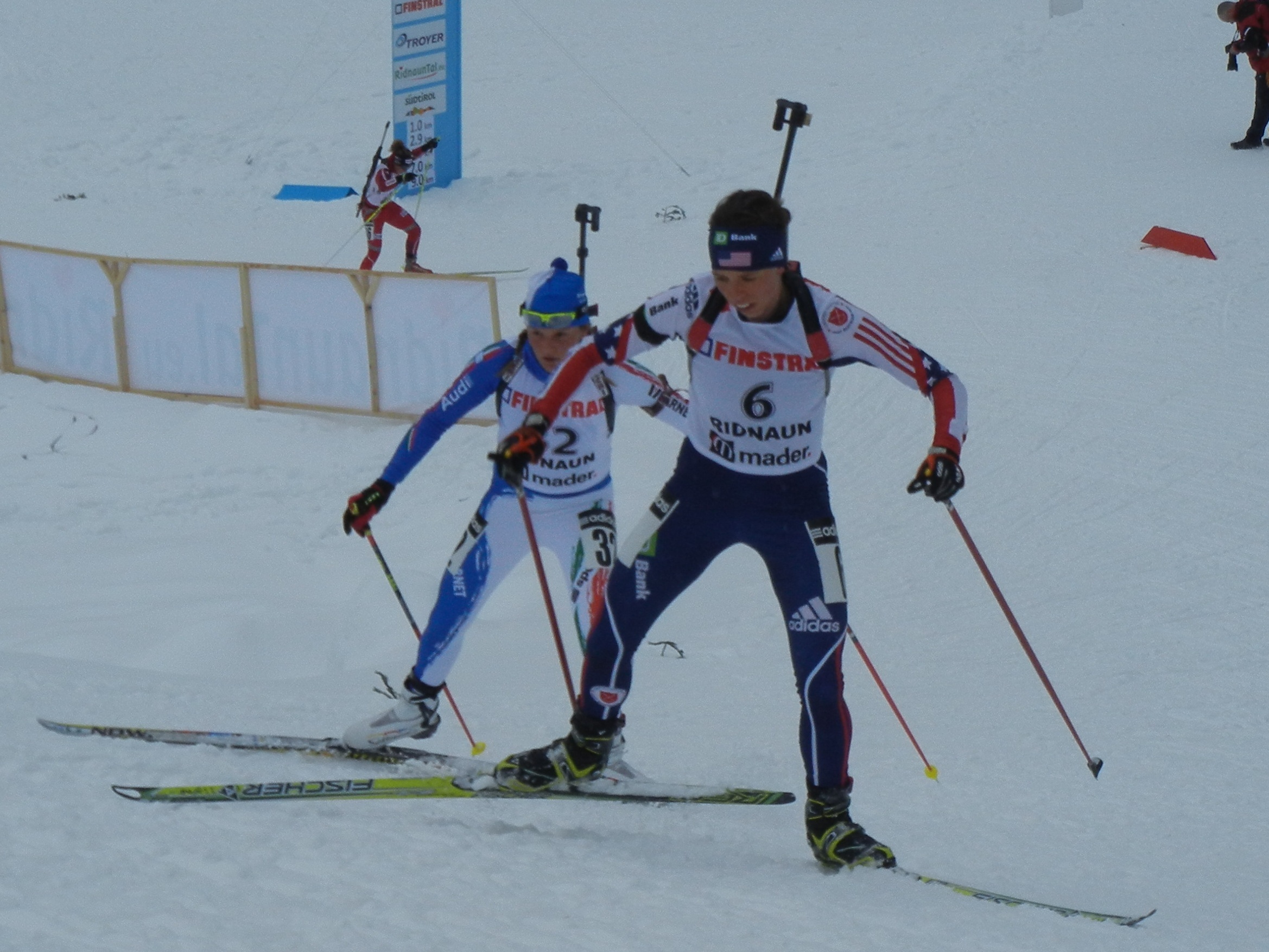
    Corrine Malcolm (USA) in the junior pursuit at U26 Championships, Ridnaun, Italy. Photo: Susan Dunklee.

    Last year, Susan Dunklee’s top finish at U26 Open European Biathlon Championships was 17th place in the sprint. At the time, she was pleased with the performance, but this year, she’s eclipsed that success – twice.

    In the open individual race at this year’s U26 event, which took place in Ridnaun, Italy last week, Dunklee finished 15th – an auspicious start to the week for the only senior U.S. woman nominated for the races. Then in the sprint, she upped the ante, finishing ninth. She only missed two shots, skied the sixth-fastest course time of the day, and finished under a minute behind the winner, Juliane Doll of Germany.

    How big is this step for Dunklee?

    “Last year, my best result of the season was a 17th place at U26’s with 90% shooting and that felt like a huge achievement at the time,” she told FasterSkier in an e-mail. “This year, I progressed to the top ten with only 80% shooting, and I know that when I shoot clean, I can be a contender to win at this level.”

    In the pursuit, Dunklee missed eight shots and lost a few places, but still finished 19th. With three top-20 finishes in three starts, and quite a few ski laps that were among the ten fastest on the day, Dunklee was “psyched”.

    “The pursuit was a lot of fun, especially the first lap,” she said. “There were three girls that started within two seconds ahead of me, so I tucked in behind them and focused on skiing smooth and efficiently- it felt easy. Unfortunately I lost ground doing penalty loops.”

    U.S. women’s head coach Jonne Kahkonen was impressed with Dunklee’s performances at the Championships.

    “I’ve seen Susan’s training and racing now for about half a year and it seems like she has some good potential and she has also proven that on international competitions – more than once,” he said.

    But he also warned that she still had a lot of work to do.

    “There are a lot of things, very basic biathlon skills that Susan can still improve, which means that there’s quite a lot of room for improvement in general,” Kahkonen said. “To be able to take the next step, Susan will have to commit to the hard work even better and work even more. Taking the next step will be tougher, and the next one after that even tougher and so on.”

    Dunklee’s success bodes well for the chances of other U.S. biathletes who were left behind on this trip. Katrina Howe of the Maine Winter Sports Center (MWSC) and Hannah Dreissigacker of the Craftsbury Green Racing Project both attended trials races, where they finished behind Dunklee. Dreissigacker and Howe had competed at the U26 Championships and maintained the same time differences, they would have finished in the high twenties or low thirties.

    A trio of U.S. junior women made the trip to Ridnaun as well, and their finishes were just as encouraging as Dunklee’s. Corrine Malcolm (MWSC) had the top result, racing to an impressive sixth place in the junior women’s sprint.

    “This whole past week was pretty incredible,” Malcolm said. “After having the second-fastest ski time in the individual I knew that I could have good races later in the week. Sprints are the best format for me right now because there are less shooting stages.

    “My standing shooting has been pretty horrendous all season and so going into these races the coaches and I decided it would be best for me to ski more conservatively before my standing stages,” she explained. “It has to be one of the strangest pacing strategies ever- when I think of racing I don’t commonly think of having to hold yourself back. But it paid off on Saturday when I only missed two targets! I had to work really hard to earn time back during my final loop but it makes me really excited for when I don’t have to be so cautious.”

    Malcolm is just finishing her first season as a biathlete, and the switch has clearly been successful – and beneficial for the team.

    “Corrine proved that she is a serious contender in the junior races,” Dunklee said of her younger teammate. “We’ve taken some large steps forward as a team this year and I’m fired up to see where it will take us in the future.”

    In the pursuit, Malcolm suffered from cramping and had to drop out. She said that it was the first time she had ever dropped out of a race, and she hoped not to repeat the experience.

    Grace Boutot, a MWSC teammate of Malcolm’s who has been one of the top U.S. juniors for several years, had finishes of 22nd and 34th this week.

    The last member of the junior women’s squad, Kelly Kjorlien, has been in the U.S. junior pipeline for a few years now, like Boutot. But unlike Boutot, she is still technically a youth – so for her, competing in the junior races at the U26 event represented a jump in the level of competition.

    “I was definitely a little overwhelmed going in to the races in Ridnaun because I’m younger than most of the field,” Kjorlien said. “But once I started racing I was much more comfortable. I just had to remind myself that it was just like any other race or training day, just skiing and shooting.

    “I was really glad to have the opportunity to do some more big races this season,” she continued. “I learn something new with every race which is really valuable, because it’s not something that can be recreated in training. The trip really accelerated my excitement about my future in biathlon.”

    The senior men’s squad – which unlike the women consisted of four men until Leif Nordgren left for senior World Championships – had some strong finishes of its own in the concluding sprint and pursuit races.

    Russell Currier led the team in the sprint, finishing 25th. While it was a solid result, Currier was still frustrated- he missed five shots, or fifty percent.

    “The goal was a top ten,” he told FasterSkier in an e-mail. “I could have done that with almost three misses in the sprint. The podium was within reach all things considered! But since biathlon is such an inconsistent sport I probably shouldn’t be making any excuses. Over all I’m kind of disappointed with U26s.”

    He was frank about his difficulty shooting.

    “My shooting still wasn’t up to potential. I felt comfortable with it leading up to the race and was shooting well during intervals and time trials, but wasn’t able to demonstrate the same when it mattered. Most of my struggle in shooting has nothing to do with the mechanics, but more so just head case issues.”

    Nevertheless, there were definite bright spots for Currier, who had the second-fastest ski time on one of his laps in Ridnaun.

    “I was pleased to see my ski speed come back around,” he said. “I did some peaking work the week prior at sea level and I responded well enough to hold my own at altitude.”

    Currier’s teammates Bill Bowler and Wynn Roberts finished in the 40s in both the sprint and pursuit.

    American junior men Raleigh Goessling and Ethan Dreissigacker finished 43rd and 48th in the sprint, and in the pursuit Dreissigacker moved up to 39th and Goessling to 42nd.

    Full results are available at the IBU Datacenter.

  • Canadian Stuart Harden 18th in Youth Individual at Biathlon World Juniors – Updated

    Canadian Stuart Harden 18th in Youth Individual at Biathlon World Juniors – Updated

    Sam Dougherty (USA) shoots during the youth men's individual race on Tuesday. All photos by Judy Geer.

    How poor was the shooting on the third day of biathlon World Junior Championships in Nove Mesto, Czech Republic?

    In two races on Tuesday – the youth men’s and women’s individual – only a single athlete, Pavel Hancharou of Belarus, shot clean for the four stages of the race. He was rewarded with a 48-second victory in the 12.5 k race and his first World Juniors gold medal.

    Second-place Steffen Bartscher of Germany was so impressed with Hancharou’s shooting that he told IBU News, “You never wish a miss on anybody and he deserves the win today, with this performance!”

    Casey Smith (USA).

    Further down in the field, Stuart Harden of Canada had another exceptional race, finishing 18th with three penalties. Harden is actually 16 years old, one year younger than the technical definition of a youth, and is skiing up an age category, making his performances particularly impressive.

    “I’m really pleased with my race and I’ve exceeded my hopes and goals,” he told FasterSkier. “I was disappointed in my prone shooting- I missed two total and I usually don’t have to worry about any errors in the prone position. [But] my standing was super with only one miss.

    “I started out a little sluggish, but as my shooting improved at the end I increased the pace on the course. I received some good splits off of my teammate Macx Davies on my last loop so I knew my time was competitive. I was able to pick up some time on the more technical parts of the course and had an advantage on the downhills thanks to the team wax techs Tom, Pavel and Patrick.”

    Harden began racing when he was 11 years old with Biathlon Canada’s Biathlon Bears program, which since the ’90s has been introducing 9- to 13-year-olds to the sport of biathlon.

    “From there I joined the Rocky Mountain Racers and I’ve had John Jaques as a coach since then,” Harden said. “I owe a lot to my coach and parents who have helped me improve so much each year that I’ve been in the sport, the most recent season giving the most opportunities and results. I hope to grow as much as I have the last several years in the coming ones, and I hope to be competitive in my own age group at World Championships for the next few seasons.”

    Davies was the next Canadian finisher, notching a 34th-place result. Davies, too, has had a successful race series so far: Tuesday’s race was his worst result to date, with the high point being a 19th-place finish in the opening sprint on Saturday. Unlike Harden, however, Davies is in his last year of eligibility as a youth and will have to move up to the more competitive junior division next season.

    Sean Doherty (USA).

    Christian Gow and Albert Bouchard rounded out the Canadian squad by finishing 53rd and 63rd.

    For the U.S., Casey Smith finally hit his stride and led the team in 30th place. It was his best race in two years of World Juniors starts. Smith had four penalties and secured his spot by charging hard in the last lap of racing, finishing with the 12th-fastest fifth-loop time.

    Sam Dougherty was the next U.S. finisher, like Smith notching the best result of his career. He finished 54th with five penalties. Normally, such shooting would be more disappointing; but in Tueday’s race, with only seven athletes having two or fewer penalties and twenty of them shooting 50% or worse, it was good enough.

    “Unless you’re at the top of the podium, there’s always room for improvement, but I am really satisfied,” Dougherty said in an e-mail. “As long as I know I left it all out on the trail, I accept my results happily, regardless of contention… I really enjoy the individual discipline, although it’s becoming a rare event in American biathlon competition.

    “I was disappointed in my Sprint result, and unfortunately didn’t qualify for the Pursuit competition the next day, which I felt was to be my strongest event. In saying that, I’m happy to prove to myself in the individual competition that if I shoot consistently and keep my skis pointed straight I can improve upon past results.”

    Dougherty said that the talent of his competitors had impressed him so far, and that he thought the U.S. had a long way to go in order to be competitive on the world stage.

    “It is becoming very obvious to me that ski ability plays a huge part in the contention of these races. After the race today I was hypothetically skeptical if a U.S. Junior National Champion could be anywhere close to some of these biathletes in a regular nordic competition. Biathletes are friendly people the world round though, and it’s hard to stay intimidated by people who are nice to you.”

    Kelly Kjorlien (USA).

    Sean Doherty and Ray Wonders finished 65th and 69th.

    In the youth women’s 10 k individual, Norwegian Thekla Brun-Lie won by 11 seconds over Russia’s Elena Badanina. The top four finishers all had two penalties, and no women shot clean.

    Brun-Lie, whose sister Celine represented Norway in skiing at the Vancouver Olympics, was contesting her first race of the series.

    “I was sick before the sprint and the pursuit and simply not fit,” she told IBU News. “I knew this was my only chance today to do well so I was very nervous. I thought I could win only on the last lap.”

    Galina Vishnevskaya of Kazakhstan finished third.

    Sarah Beaudry of Canada, Kelly Kjorline of the United States, and Beaudry’s teammate Julia Ransom made the best of a handful of penalties and finished 33rd, 34th, and 36th.

    “I was really looking forward to the individual and I felt like it went pretty well,” Kjorlien said in an e-mail. “I was slightly disappointed that I didn’t shoot a little better, but I’ve come to the conclusion that I’m never completely satisfied. Having a rest day on Monday was very helpful. I felt fairly fresh this morning and was comfortable on the course.”

    Ransom was less satisfied with her results.

    “It has definitely been an interesting tour,” she told FasterSkier. “I went into it expecting top ten results, just based on my performances last year. Unfortunately, it didn’t work out as planned. Saturday’s sprint and Sunday’s Pursuit were really disappointing for me as I felt as though I was severely underperforming. Nothing more frustrating than knowing that you can do better.

    “I went into the Individual excited and focused knowing that I was starting with a ‘clean slate’. Skiing felt better than it had all week and prone shooting was great. Standing however, was not so nice. I couldn’t settle into it and my rhythm just wasn’t there. As disappointed as I was with my results, I am so happy with my experience. I have learnt a tremendous amount of valuable lessons and feel as though I have grown as an athlete.”

    Rose-Marie Cote and Danielle Vrielink finished 44th and 47th. For Cote, a World Juniors medalist from 2010, the result wasn’t what she was hoping for. But for Vrielink, who is at her fist World Junior Championships, it was the best finish of her career.

    Carly Wynn (USA).

    “I started the race with really cold hands so it was very hard for me to shoot,” Vrielink told FasterSkier. “I think I really pulled the shooting together on my second prone and then continued to be very pleased with my second standing. 17/20 is very good for an individual, although I wish that I could have skied just a little bit harder. But all and all I was very happy to have been able to race here.

    Vrielink is at 15 years of age one of the youngest competitors in the field, and she said that the races made her realize that she needed to up her game.

    “It has been quite the opportunity to race in Nove Mesto for team Canada at my age. The competitions has been quite eye-opening in regards to just how fast my competition can ski and how well they can shoot. I guess in Canada, you can get away with just being able to shoot well, but out here, it’s a whole new playing field and you’ve got to ski fast if you want to win. Despite my results, I have really enjoyed this opportunity to race and look forward to next years Youth and Junior World Championships.”

    Carly Wynn was the second U.S. finisher, missing eight targets and skiing to 43rd place. She was followed by a pair with opposite problems: Silke Hynes had only five penalties, but the 62nd-fastest ski time of the day, which left her in 57th place. Tara Garaghty-Moates was the 20th-fastest skier, but missed an excruciating 16 targets and finished 66th.

    Racing continues on Wednesday with the junior men’s and women’s individual races.

    Full results: youth men / youth women

  • Kjorlien Leads North American Ladies Again at Biathlon World Juniors

    Kjorlien Leads North American Ladies Again at Biathlon World Juniors

    Kelly Kjorlien (USA) starting the youth women's pursuit. All photos by Judy Geer.

    When American biathlete Kelly Kjorlien arrived in the Czech Republic for IBU Youth/Junior World Championships, she was confident – but she also came down with a cough.

    Has that slowed her down so far?

    No, not at all. After finishing 27th in Saturday’s youth women’s 6 k sprint, Kjorlien told FasterSkier that she was excited going into the pursuit, because shooting was her “strong point” and there were four shooting stages in which to best the competition.

    Wynn.

    And that is how it turned out: with only three penalties, Kjorlien moved into 26th place on Sunday. With no women shooting clean, and only one with one penalty and two with two, Kjorlien had some of the best shooting of anybody in the race. Besides being extremely accurate – she cleaned the third stage and missed one in each of the other three – she was one of the fastest shooters in the race as well. After the last shooting stage, Kjorlien was in 24th place, but a slow last loop dropped her back to 26th.

    Not that 26th is a disappointing finish: in just her second year of World Juniors competition, Kjorlien now owns two top-30 finishes and is proving to be a consistent, talented racer.

    Kjorlien also embodied a trend for the U.S. youth women: both the other starters also gained a single spot in the pursuit. Carly Wynn moved up from 53rd to 52nd. Her race was dominated by the opposing forces of poor shooting – she missed ten targets, or 50% – and extremely fast skiing. Wynn’s time on course was the 12th fastest of the day.

    Teammate Tara Garaghty-Moates was in a similar situation. She started with bib 58, and her 20th-fastest ski time of the day should have gained her a lot of ground. But she missed 13 shots, which dropped her back to 57th – just one spot better than where she started.

    But Garaghty-Moates has been training for biathlon for less than a year, so being in the pursuit at all was an accomplishment, especially considering that her ski training has been compromised this year: after she crashed while ski jumping, she had knee surgery in late April, was stuck on crutches for eight weeks, and then had a full-length leg brace for three more.

    “I feel like I’m learning a lot of things that will contribute to my future biathlon career,” Garaghty-Moates said in an e-mail. “I’m pretty satisfied about where my skiing is stacking up against the Euro girls, especially given that fact that because of my knee surgery I really wasn’t able to skate until November. In the sprint race I was able to qualify for the pursuit only because of my fast skiing.

    Cote.

    “My shooting is inconsistent,” she continued. “It’s tough because I’m at Junior Worlds and it goes without saying that I want to clean all my stages and ski fast, but given my lack of shooting experience that’s just not a feasible goal. By time I leave here I will only ever have competed in ten biathlon races, so I’m still making rookie mistakes like taking the wrong amount of wind clicks and throwing my zero way off- that’s what happened Sunday in prone.

    “Overall I’m just trying to do my best and enjoy being here. So far this trip has been the best experience of my skiing career.”

    The Canadians were led by Rose-Marie Cote, who won a sprint finish with teammate Sarah Beaudry. The two finished 39th and 40th, moving up from bibs 44 and 52. Cote had four penalties and Beaudry five. Beaudry had skied all the way up to 32nd place before the final shooting stage, where she missed three shots.

    Canadians Julia Ransom and Danielle Vrielink finished 51st and 55th.

    In both the youth and junior women’s races, the winners from the Saturday’s sprints prevailed again. In the youth race, Ekaterina Zubova of Russia took her second gold medal, and the rest of the podium was identical to Saturday’s as well: Anais Chevalier of France finished second and Elena Badanina of Russia third. In the junior 10 k pursuit, Dorothea Wierer of Italy and Aleksandra Alkina of Russia repeated as the gold and silver medalists.

    The surprise finish of the day came from Laura Dahlmeier of Germany, who started in 14th place, two minutes and 16 seconds behind Wierer and over a minute off the podium. But Dahlmeier was one of only two women in the race to shoot clean, and as a result she finished third and collected the first World Juniors medal of her career.

    “This is crazy, I never thought I would make it on the podium today,” she told IBU News. “I saw on the big screen [during the last stage] that the others missed and I also heard it. I tried to not notice it and focus on my own race but it’s not possible to completely shut that out.”

    Even if she didn’t shut it out, she cleaned yet another stage and was able to finish a comfortable 13 seconds ahead of fourth-place Olga Galich of Russia.

    Audrey Vaillancourt of Canada led the North American contingent in the junior race, finishing 32nd after starting 44th. She only had two penalties, which represented the best shooting of any North American woman all day.

    “I knew that my chances to move up in the pursuit were very good, not only because I was starting 44th, but also because we shoot four times in that race and I have shot very well since the beginning of the season,” Vaillancourt told FasterSkier. “I started very aggressively because I wanted to keep up with the girls that were starting almost at the same time as I did. I knew that if I wanted to gain spots, I had to shoot very well- I felt very confident about it, and it worked. I cleaned my two first stages, which made me ski much faster!”

    Boutot.

    Her teammates Emma Lunder and Yolaine Oddou finished 38th and 39th, just four seconds apart despite being on opposite trajectories. Lunder started 31st but missed six shots, which led to her tumble through the rankings. Oddou started 48th and missed five shots, but fast skiing allowed her to gain nine spots.

    Grace Boutot was the top American, finishing 42nd. She gained five places from her starting position of 47th.

    “The race [on Sunday] still wasn’t great for me,” she said in an e-mail. “I did what I could do, and even though I haven’t had the results that I hoped for in the past two days, I can’t make any excuses or change the results. So I am really looking forward to the individual, since it’s usually my strongest race. We are only half way through [the championships], and there are still two opportunities to have some good results.

    “The team has had a good dynamic so far, and everyone has been really positive even if they’ve struggled in their races,” she added.

    Corrine Malcolm missed eight shots and was unable to capitalize on her 33rd-place start position. Instead, she slipped to 46th place.

    Races continue on Wednesday with the youth individual competitions.

    Full results: Youth women / Junior women

    Vaillancourt starting.
    Malcolm.
    Cote.
    Beaudry.
    Garaghty-Moates.
  • Kjorlien’s 27th Leads North American Women in World Junior Biathlon Sprints

    Kjorlien’s 27th Leads North American Women in World Junior Biathlon Sprints

    Grace Boutot (USA) competing in the junior women's 7.5 k sprint. All photos by Judy Geer.

    The single most dominating performance on the first day of Biathlon World Youth and Junior Championships came in the second race on Saturday, the junior women’s 7.5 k sprint. Dorothea Wierer of Italy shot clean to win the race by over a minute.

    It wasn’t an entirely surprising result: Wierer has contested every Junior Worlds series since 2007, and won a gold medal in Ruhpolding in 2008 and one in Canmore in 2009. And of all the starters in the junior women’s field, she has the most and best World Cup experience, including a 24th place finish in Ruhpolding this year.

    Malcolm.

    Still, the size of her victory was impressive.

    “This was a perfect competition,” Wierer told IBU News. “The tracks are prepared well and the wind was no problem for me. At the beginning, I had a strange feeling because I am used to the very high level at the World Cup. So I was surprised.”

    Behind her, Canadian Emma Lunder and American Corrine Malcolm each missed two shots and finished six seconds apart in 31st and 33rd places.

    For Malcolm, it was the first World Juniors race of her career, and this is also the first year she has trained as a biathlete. Usually, skiing is her stronger suit, but two penalties was an impressive accomplishment for her.

    “For the first time ever my shooting saved my butt,” she told FasterSkier. “It’s kind of an odd sensation to have my best shooting race ever at World Junior Championships! Skiing felt pretty terrible today, I didn’t feel like I could be very aggressive out on course. I like to feel that I can attack sections of trail and today the trail was attacking me and I was along for the ride. I felt strong on the bigger climbs out on course but the transitional sections are crucial and I just didn’t have it in me this morning.”

    But to finish 33rd with tired legs is a huge accomplishment.

    Kjorlien.

    “A little disappointing for sure, but all in all, 33 is not a bad place to be at my first big European show. I’d like to be top 30 and came close today, and I’m happy about where I sit going into the pursuit tomorrow. It will be my first true pursuit format race in biathlon and should be really exciting!”

    The top 60 athletes from each race will contest the pursuit on Sunday. Joining Lunder and Malcolm will be American Grace Boutot, who finished 47th with two penalties, and both other Canadian starters: Audrey Vaillancourt, who finished 44th, and Yolaine Oddou, who was 48th. While none of the women had the best days, all five still made the pursuit, and have the chance to improve tomorrow.

    In the youth women’s 6 k, Kelly Kjorlien of the United States brought home the best women’s result of the day, finishing 27th with a single penalty.

    “I felt pretty good today,” Kjorlien said in an e-mail. “We had perfect conditions. I am really happy about having early races because that means the course is in flawless shape and hasn’t been trampled by all of the boys yet. My race went well, after missing the first shot I was able to calm down enough to hit the rest. I’m proud of my teammates for some nice racing today and am looking forward to the pursuit tomorrow since shooting is my strong point. It should be a fun race.”

    Ransom.

    Her teammates Carly Wynn and Tara Garaghty-Moates also qualified for the pursuit with 53rd- and 58th-place finishes. Unlike Kjorlein, shooting is not their strong point: in two shooting stages, Wynn missed six shots and Garaghty-Moates seven. However, they had the 14th- and 23rd-fastest ski times of the day, which enabled them make up some ground.

    The last American racer, Silke Hynes, just barely missed the pursuit. She finished 62nd with three penalties. Although she was only two places out, her time was twenty-three seconds away from the magic 60th place.

    Rose-Marie Cote led the Canadians with a 44th-place finish, thanks to three penalties. Julia Ransom was next in 51st, followed by Sarah Beaudry in 52nd and Danielle Vrielink in 55th. Their teammate Scott Gow indicated that the women were not pleased with their races, but with all four earning a start in the pursuit, they were optimistic about moving up in the rankings.

    Full results: junior women / youth women