From the FasterSkier archive — posts syndicated from athletes’ and coaches’ own blogs between 2004 and 2012, kept online as published. Current coverage is at fasterskier.com.
When reaching out to Sun Valley’s Annie Pokorny to learn more about her decision to become a technical delegate and her experience so far, it was also on the radar that Pokorny’s friend and former teammate Kelsey Phinney was also engaged in the process. As it turned out, Pokorny had been a leading influence in Phinney’s decision to become a TD herself.
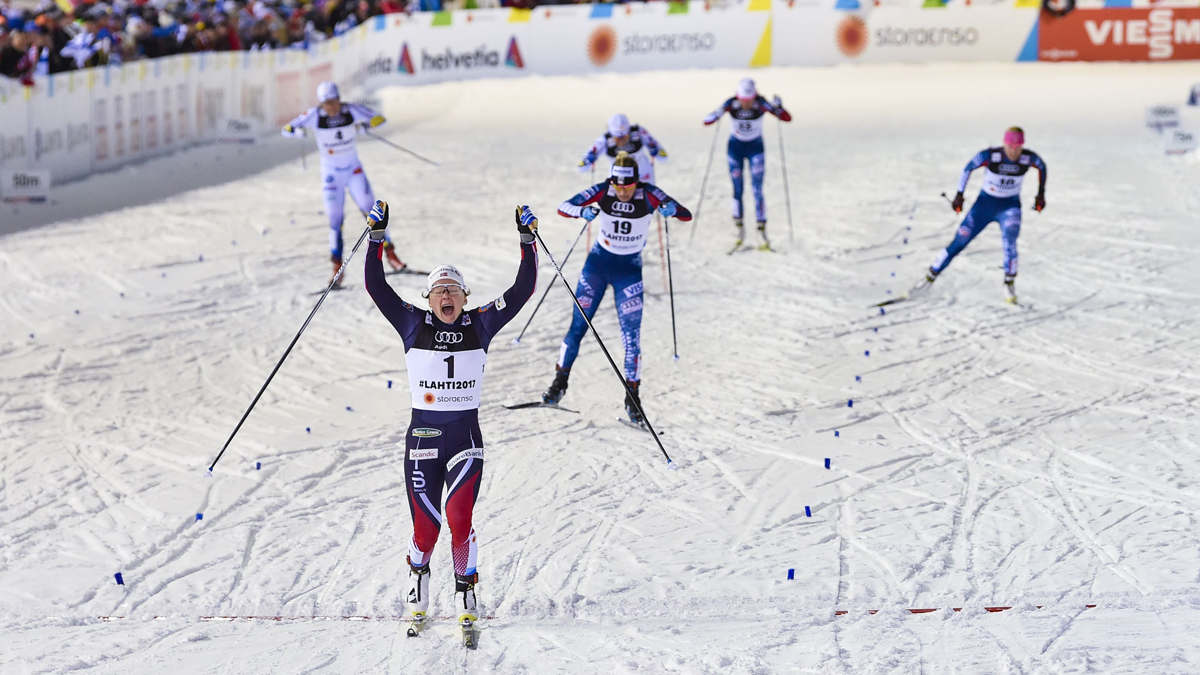
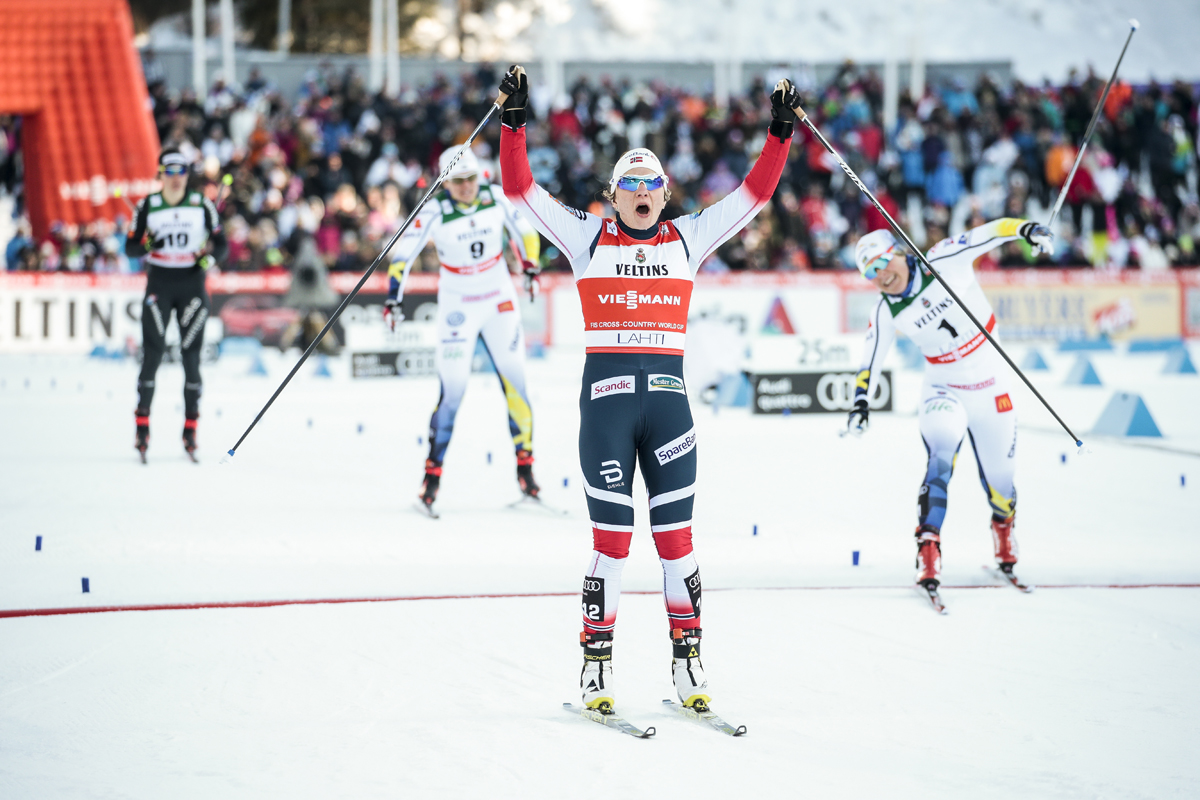
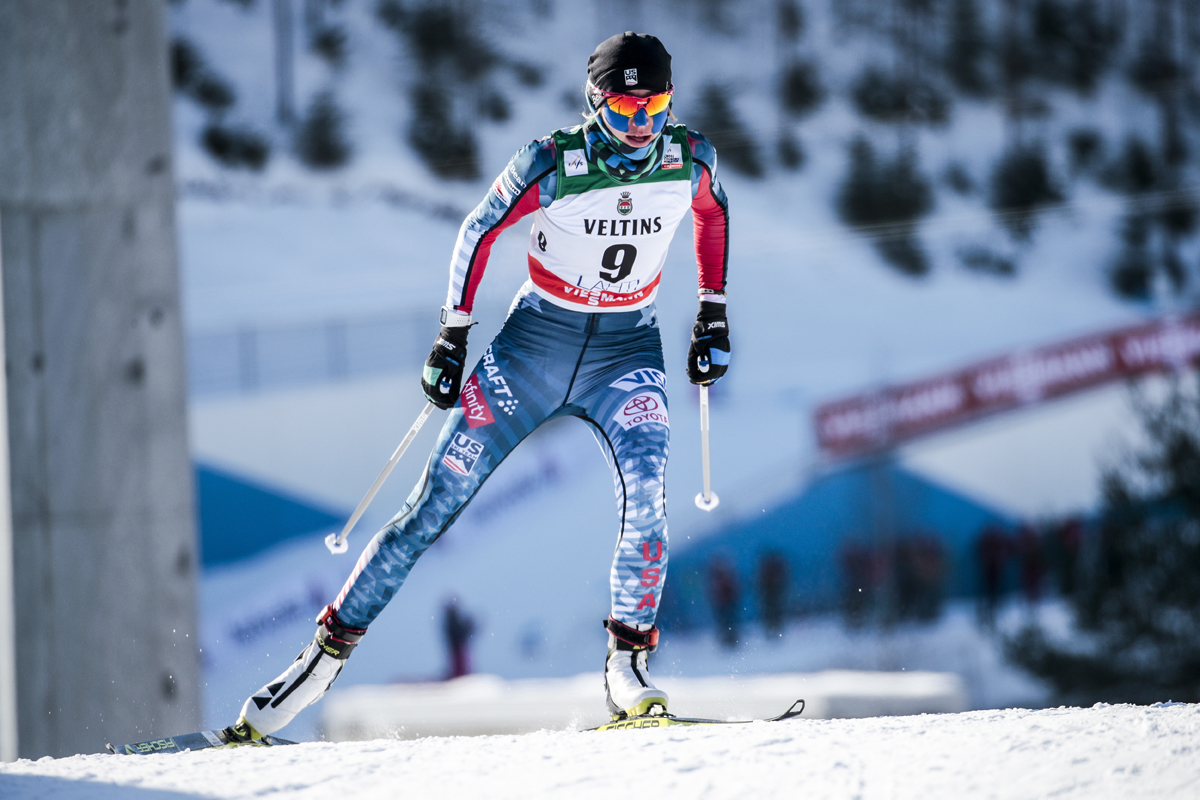
Like Pokorny, Phinney is a 2016 graduate of Middlebury College, before continuing with her ski career, first with the SVSEF Gold Team and then the SMS T2 team until 2020. The 2019-2019 season was perhaps her peak year from a performance perspective; spending ample time in Europe racing World Cups, Phinney popped a top-20 during a skate sprint in Lahti, after having taken third at U.S. Nationals a month prior, behind Julia Kern and Hannah Halvorsen. At the end of the season, a crash during Spring Series left Phinney with a torn labrum in her shoulder, for which she underwent surgery later that year and rehabbed, before eventually stepping away from professional skiing.
Phinney is currently in her final semester of graduate school where she’d pursuing a Master’s Degree in Health Systems, Management, and Policy through the Colorado School of Public Health. She now lives in her hometown of Boulder, CO with her partner, fellow retired SMS T2 skier Kyle Bratrud.
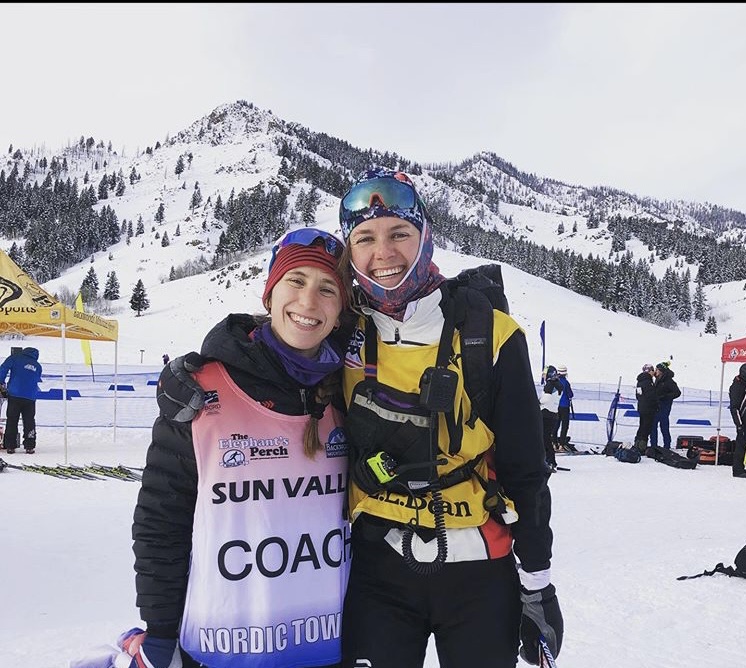
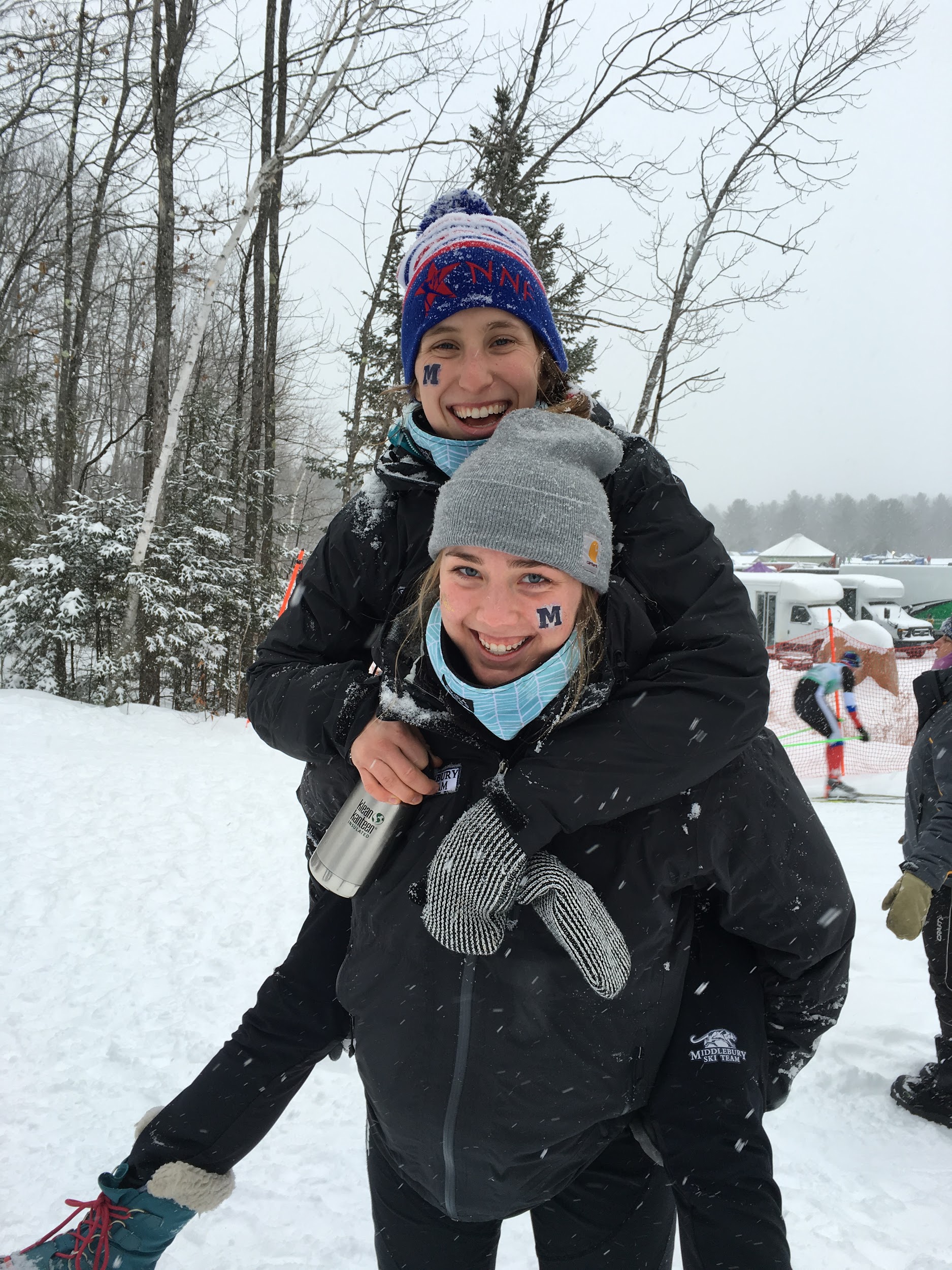
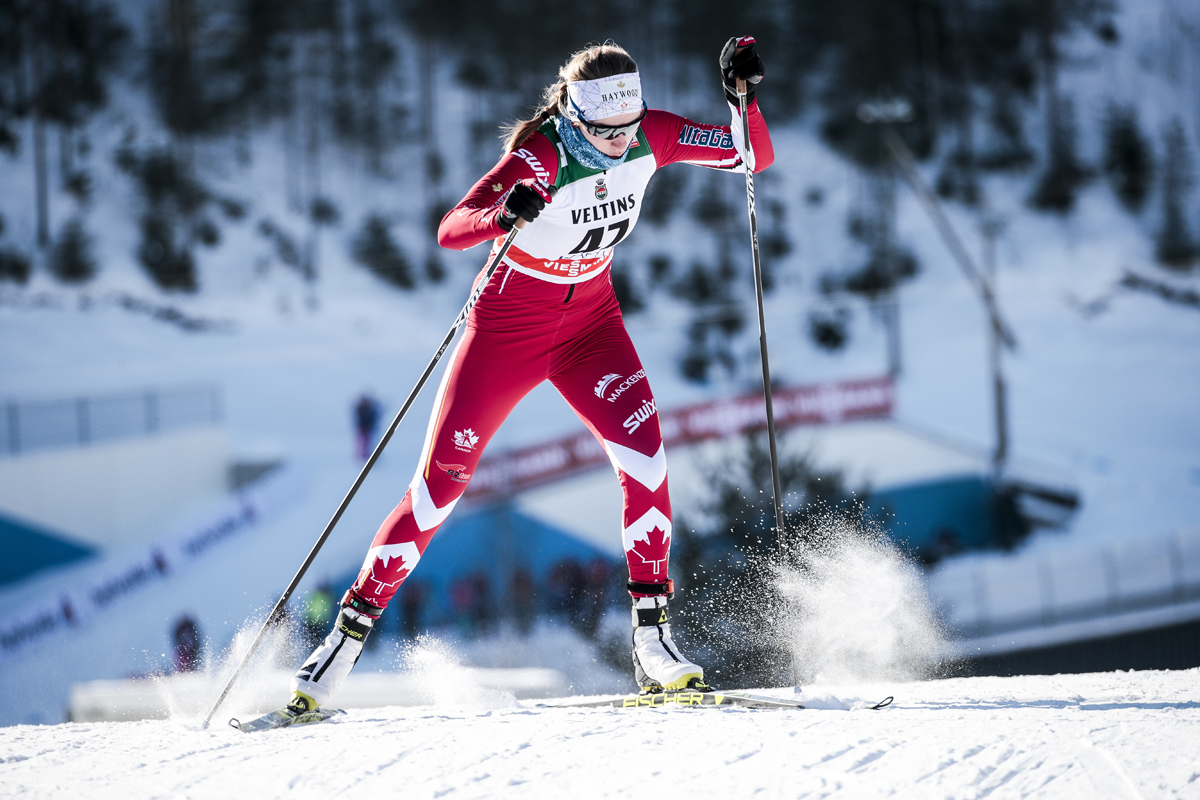
Kelsey Phinney and friend Annie Pokorny snap a picture at a 2019 SuperTour in Sun Valley, where Pokorny was working as a technical delegate and Phinney was assisting SMS T2 coach Pat O’Brien with waxing while rehabbing from shoulder surgery. (Courtesy photo)
FasterSkier (FS): When did you begin the process of becoming certified as a TD? What was your experience like with the certification process? Were you able to “fast-track” given your experience as an athlete and has your experience as a high level racer been an asset?
Kelsey Phinney (KP): I began the process of becoming a TD this past fall after a conversation with Annie Pokorny about ways to stay involved with the sport. My experience as a former racer has certainly been an asset. While I have learned much more about the specific rules than I knew when I was racing, I hope my ability to bring a racer’s perspective to decisions – like where to start and end turning zones in a classic race – helps make races safer and more fair.
FS: You mentioned Annie helped get you involved. Can you say more about what those conversations were like? What/who were some of the other factors/people that motivated you to become a TD?
KP: The primary reason I looked into becoming a TD was to give back to the sport within my current time constraints as a full-time graduate student. There is also a shortage of TDs in Colorado, which motivated me to follow through with the training and certification process following my conversation with Annie.
Since I’m currently living in Boulder, the races hosted in Colorado are all within driving distance for me. This year, I was the assistant TD at a junior race in Aspen the weekend after my fall semester wrapped up, as well as at a college race in Steamboat a couple of weeks ago.
FS: There is an overall need for TDs in the U.S., and while there are some noteworthy female TDs who have or will be jury members at the World Cup, World Championship, and Olympic level, there are few women in the role domestically. We ran an article about the need for TDs in 2017 and at the time, there were only 10 women listed in the U.S. Is this something that you considered prior to becoming a TD?
KP: To be honest, I didn’t think much about the lack of female representation of officials when I decided to work towards becoming a TD, but I do think representation matters and it is important to have diverse voices and perspectives included in the decision-making process. I’m happy to contribute to increased representation of women among the officials domestically. I think my racing experience and age are other important qualities I bring to the table.
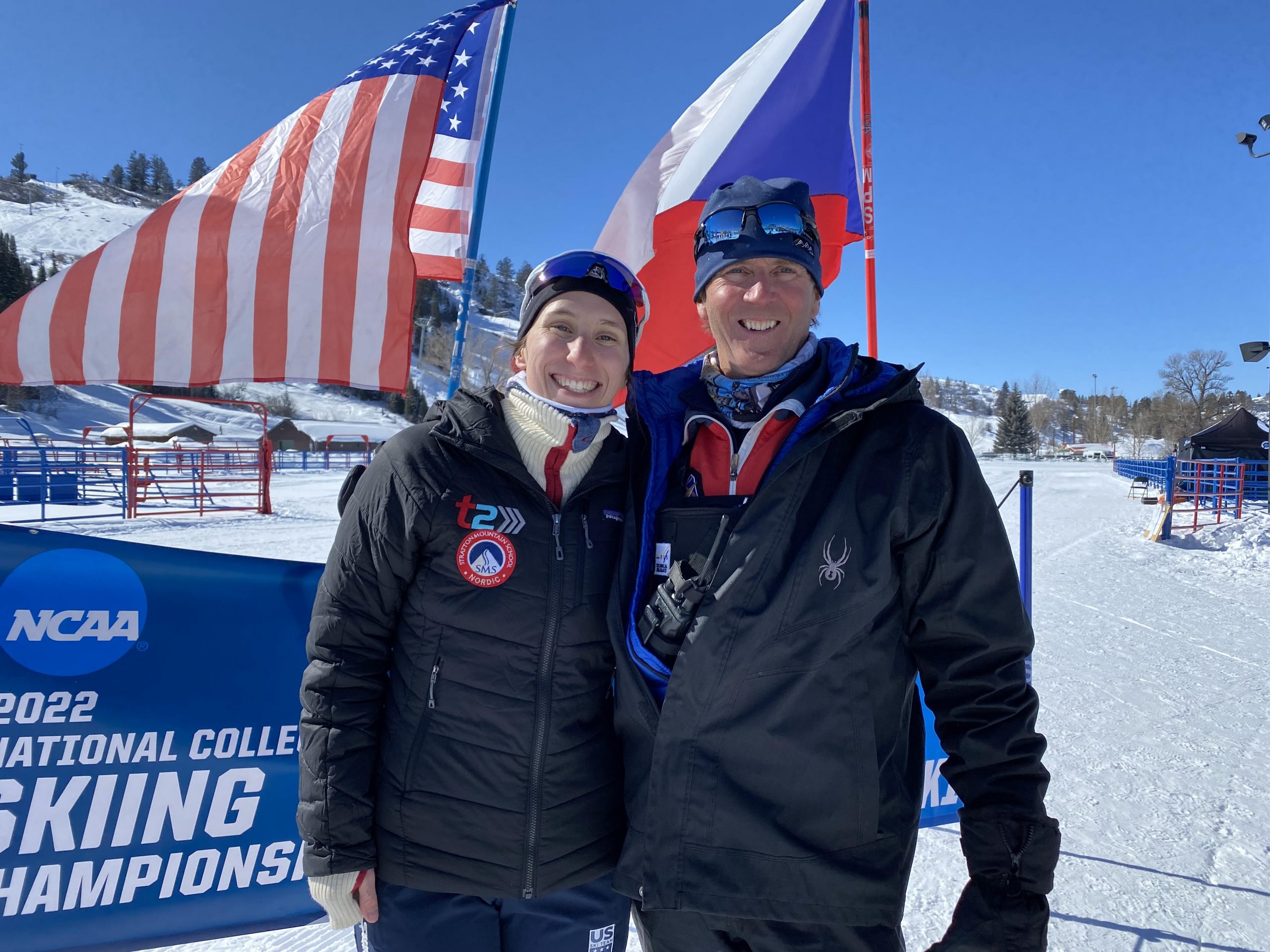
Kelsey Phinney and Al Pokorny (father of Annie) work as technical delegates at the RMISA Regionals race in Steamboat Springs, CO. (Courtesy photo)
Kelsey Phinney brings to the sport of cross-country skiing a big-world view as she has rolled with challenges and fine-tuned her athletic performances.
First things first: Phinney has become a voice for Parkinson’s Disease advocacy and education. She produced this great podcast episode for the Davis Phinney Foundation titled The Neuroscience of Parkinson’s — it’s part of a broader series from Phinney called The Parkinson’s Podcast.
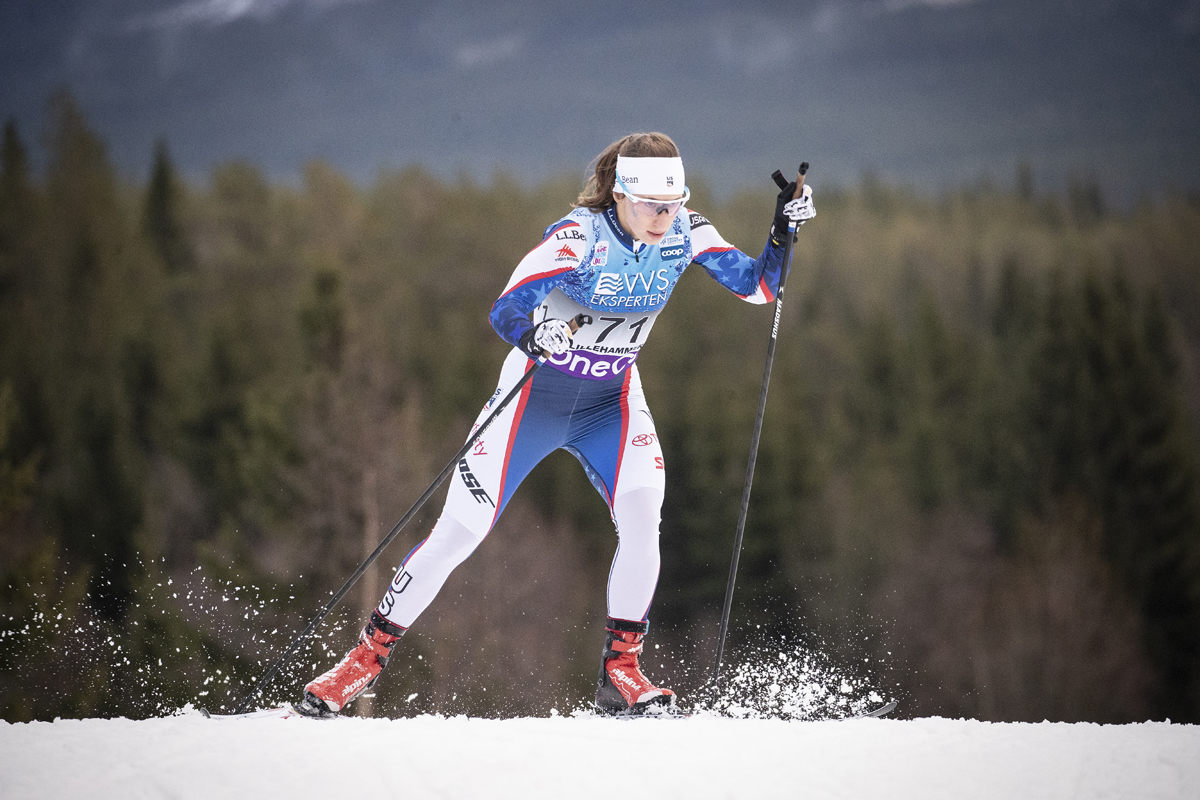
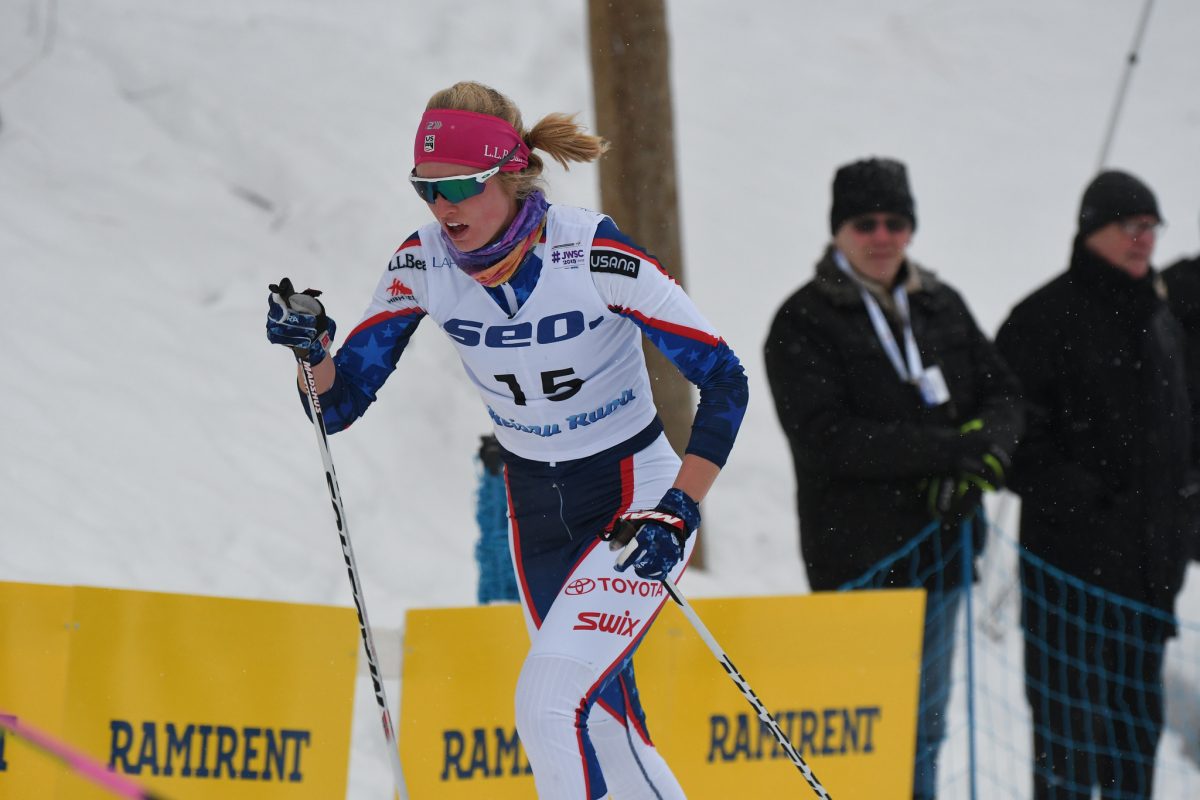
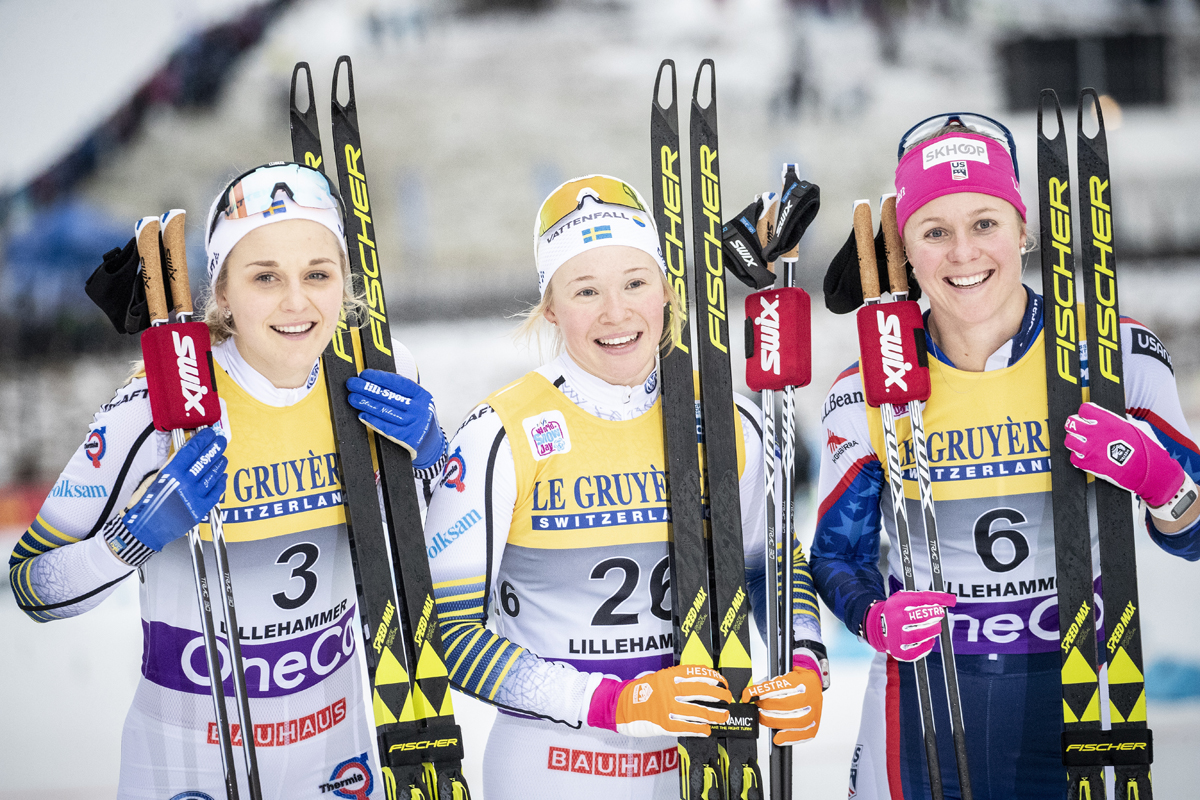
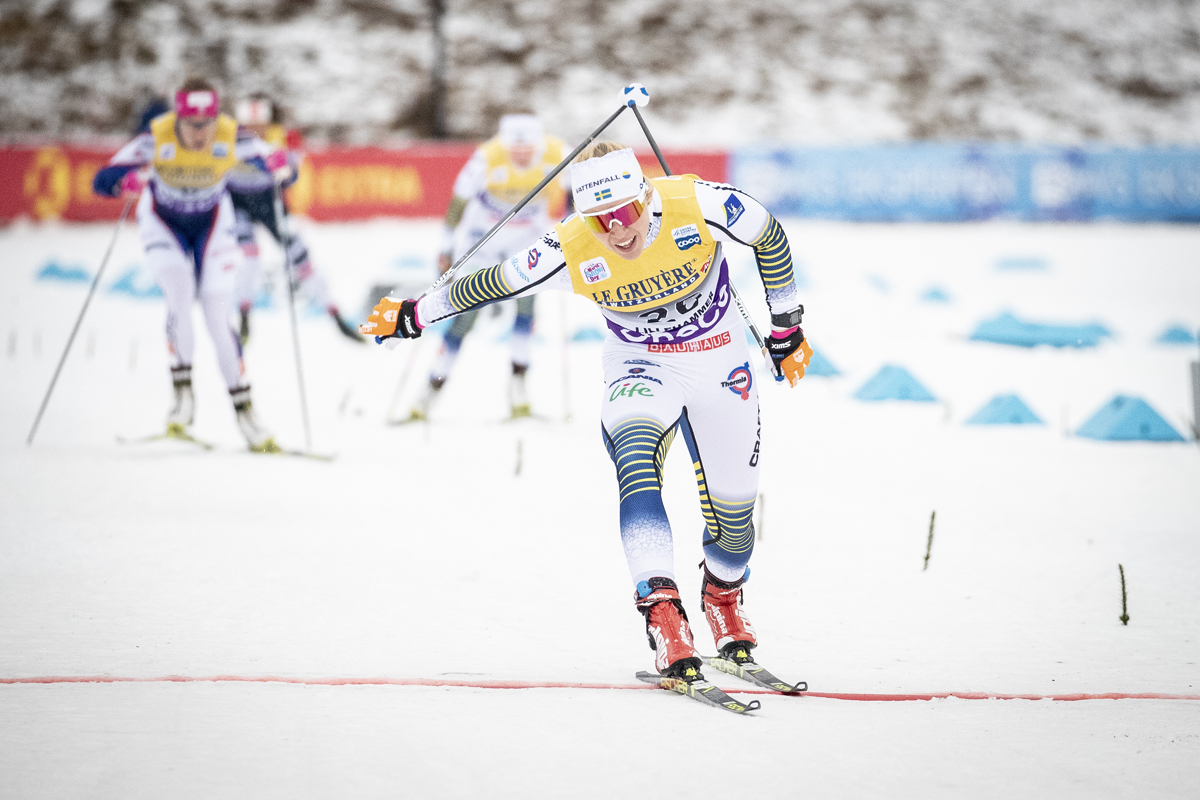
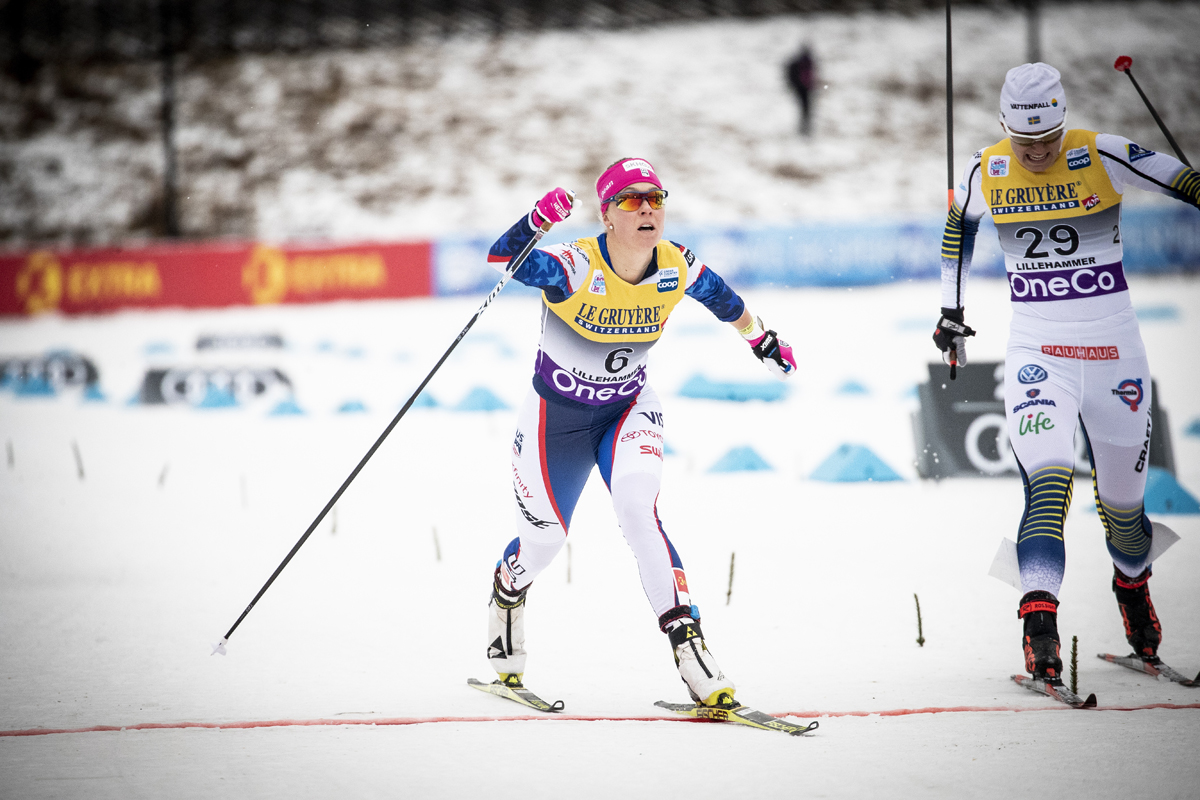
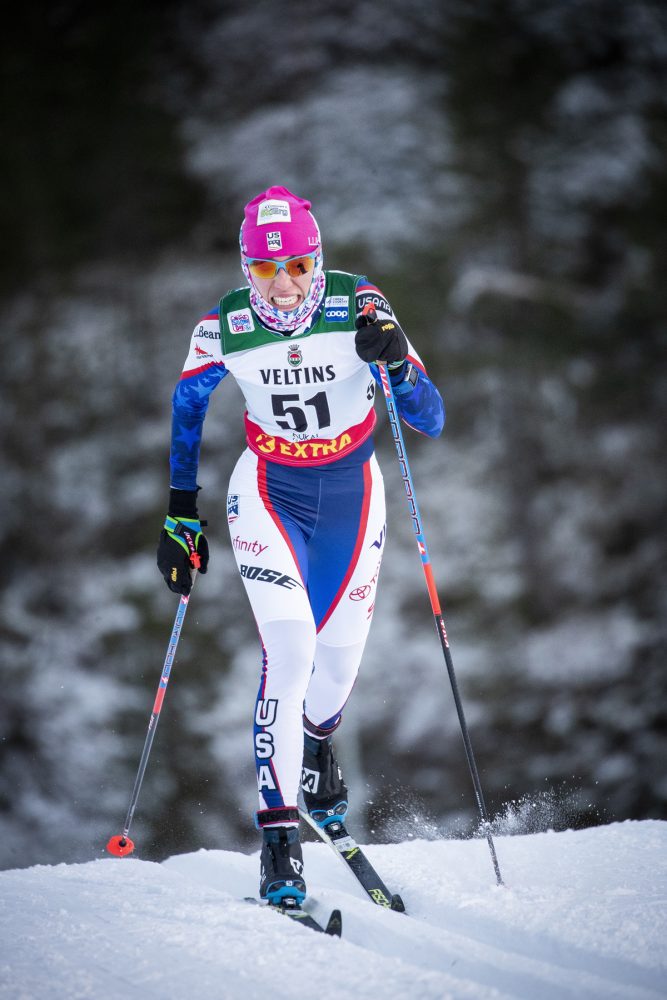
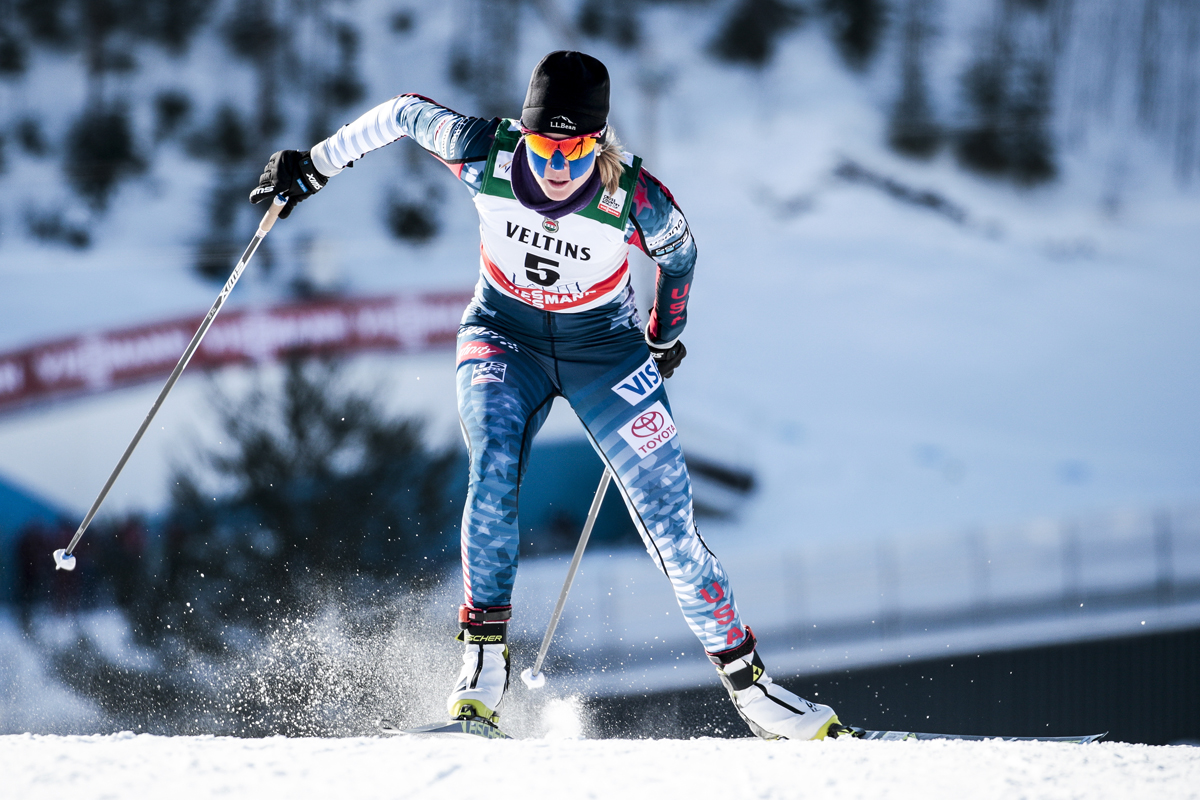
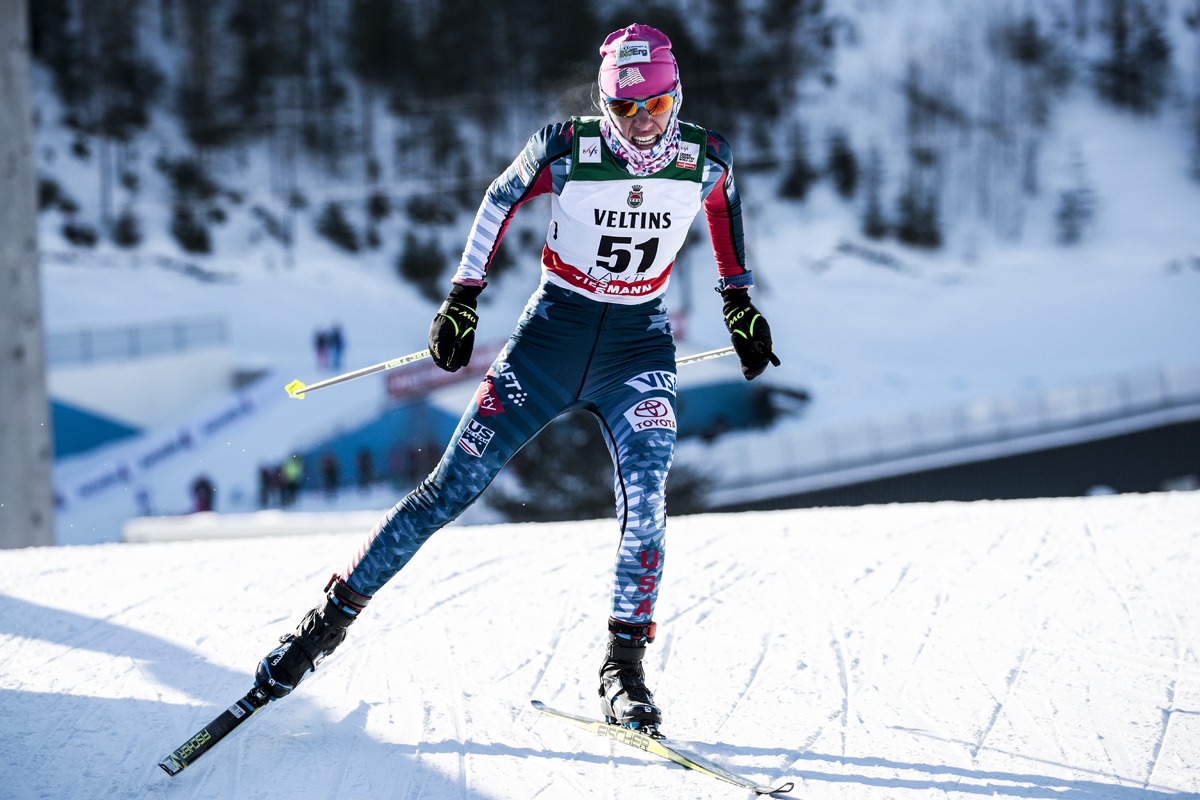
Kelsey Phinney earlier this season in Lillehammer, Norway’s World Cup skate sprint. (Photo: Fischer/Nordic Focus)
Phinney’s father, himself a former professional cyclist who was diagnosed with Young Onset Parkinson’s Disease in 2000, founded the Davis Phinney Foundation with his wife Connie Carpenter-Phinney.
So there is the high-quality high-impact work Kelsey Phinney has been engaged with. Then there’s the force she’s been on cross-country skis for many years. After graduating from Middlebury College, she spent two years with the SVSEF Gold Team. She then transferred to the SMS T2 group in the spring of 2018. She raced several World Cups this season with her best result a 19th in Lahti, Finland’s skate sprint. Phinney also placed third in the 2019 National Championship skate sprint in Craftsbury, Vermont.
Falla in first for her fifth Drammen sprint. (Photo: NRK screenshot)
The World Cup entourage gathered Tuesday at the head of the Drammensfjord in Norway. The 1.2-kilometer classic sprint in Drammen, Norway — the post-Holmenkollen sprint stop on the calendar — was held under overcast skies and within a city center jammed with fans.
Coming into Tuesday’s classic sprint, Norway’s Maiken Caspersen Falla had claimed two individual World Cup sprint victories this season and a World Championship sprint win in Seefeld, Austria. Falla remains consistent, having won three of the last four sprint globes. And she’s a lock in Drammen. She has won four of the last five Drammen city sprints — 2014, 2015, 2016, and 2018.
As we bring the Americans into the story, the benchmark for qualification time was again set by Falla. Sadie Bjornsen of the U.S. Ski Team (USST) was the fastest American qualifier in eighth place. She was 3.32 seconds behind Falla, who completed the course in 2:49.90 minutes. Jessie Diggins (USST) qualified in 18th (+4.65), and Sophie Caldwell (USST) was 20th (+4.99).
With the heats progressing, Diggins moved to the finals after placing second in the fifth heat and winning the second semi-final. Her semi-final lunge at the finish was a blur along with the three other skiers she was synced with across the line. There was a four way photo finish won by Diggins as she advanced to the finals.
“That was really fun today,” Diggins emailed, “I’m so grateful and appreciative of the techs for giving me very competitive skis. Drammen is kind of a funny course, and this year they took away the iconic uphill pitch at the finish, so it was even harder to determine the right moment to transition from double poling to power striding on the gradual uphill! It’s not a secret that I love workable downhills so my strategy each heat was to ski smooth and smart and get myself into an open lane heading into the finishing straight.”
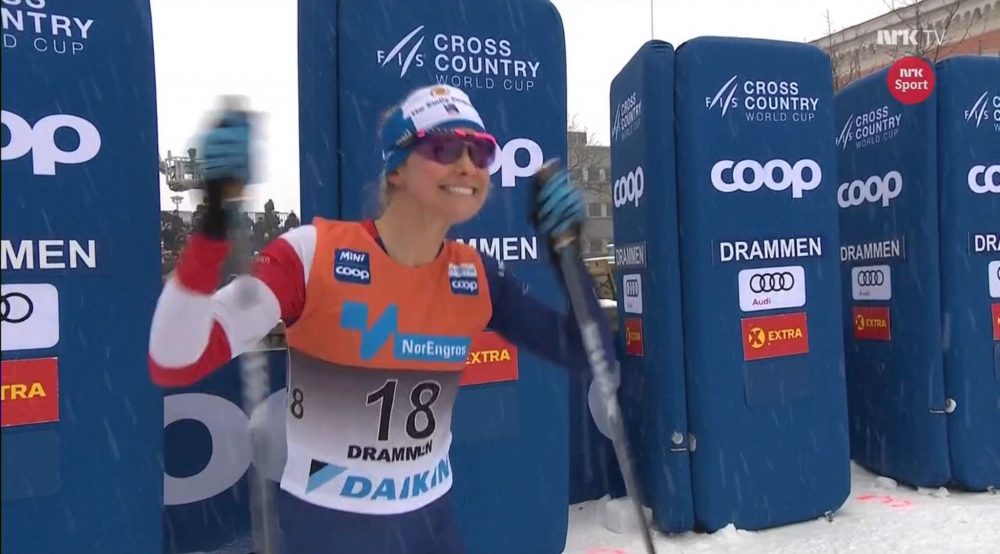
Jessie Diggins of the U.S. Ski Team lining up for the finals in the Drammen , Norway classic sprint. (Photo: NRK screenshot)
The six-across in the start gates for the finals were Diggins, Stina Nilsson of Sweden, Falla, Natalia Nepryaeva of Russia, and Norwegians Astrid Uhrenholdt Jacobsen and Anna Svendsen.
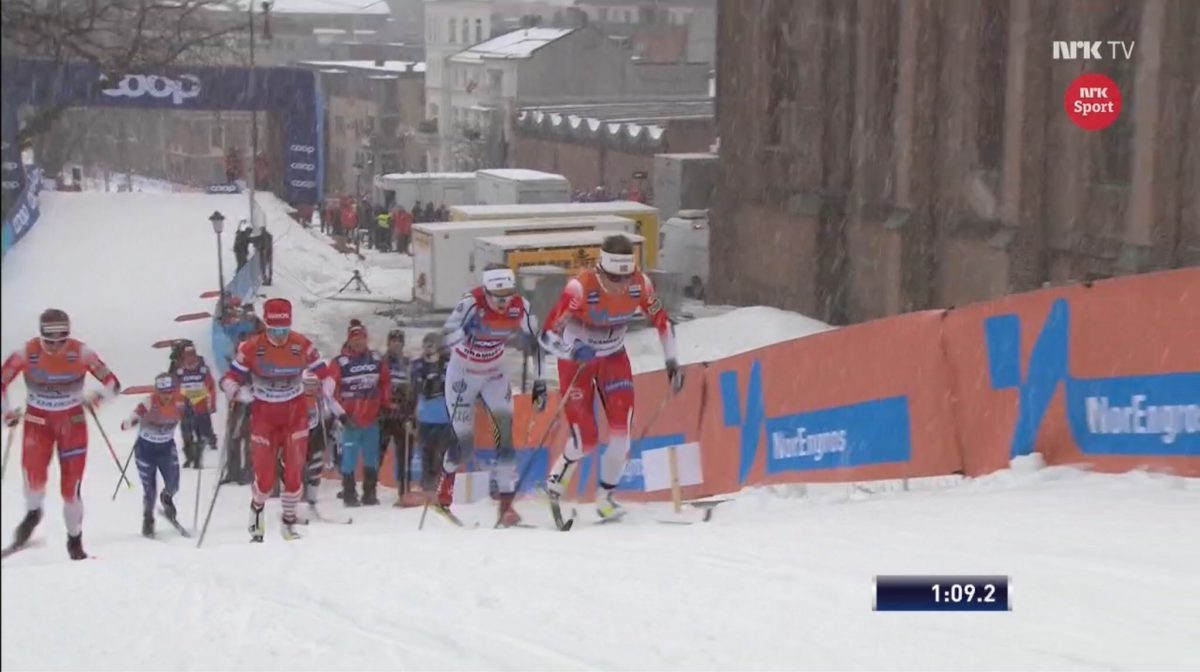
With steady snowfall, Falla set the follow-me-if-you-can pace as the course ascends and then drops in a series of tight and sinuous turns back to the course low point. Falla led throughout. Driving on the ups and leading a four skier line snaking through the downhill. As she descended, Falla kept a small gap on those trying to draft behind which included Nilsson, Jacobsen, and Nepryaeva.
A tight left-hander at the low-point is where Nilsson strategically slotted in and step-turned ahead of Falla, as she took the initial lead on the long incline to the finish. By then, Diggins and Svendsen had fallen off the pace.
Nilsson double poled and then strode on the right, with Jacobsen on her tails. In the adjacent lane to the left, Falla notched into her double pole gear and began moving ahead. Her power maxing out, Falla gained centimeters then a bit of breathing room that became a few meters. Jacobsen, sensing her moment and a Nilsson power lapse, moved to her own lane and surged into second. As Nilsson faded, Nepryaeva kept enough reserves for the end as she barely took Nilsson at the line.
Maiken Caspersen Falla of Norway getting a small gap on Sweden’s Stina Nilsson in Drammen, Norway (Photo: NRK screenshot)
Falla crossed the line in 2:56.12 for the top podium step. Make it five out of six in Drammen for headlines like “Falla Wins!”
“I think my technique is good for the climb before the finish line, my upper body is strong that is why this course fits me so well,” Falla told the International Ski Federation (FIS) after the race. “It is definitely one of the highlights of the season. It is such a great atmosphere. You can really feel the energy and the cross-country spirit. Yah, it is very good.”
Jacobsen placed second (+0.80) after qualifying in fifth, with Nepryaeva in third (+1.06). Nilsson was fourth (+1.28), Diggins fifth (+5.38), and Svendsen sixth (+7.59).
It was Jacobsen’s second podium of the season, the other coming in the 10 k freestyle in Ulricehamn, Sweden. She earned Her last World Cup sprint podium in March of 2016, in Canmore, Canada.
For Nepryaeva, it was her second sprint podium this World Cup campaign with ramifications in the overall World Cup standings. Leading the overall is Norway’s Ingvild Flugstad Østberg with 1329 points. She did qualify for the heats but did not advance to the semis, finishing 19th overall. With her third place today, Nepryaeva now sits two points behind Østberg 1327 points with five races remaining.
While racing to a fifth place on Tuesday, Diggins currently sits fifth in the overall World Cup. This was her first race after the conclusion of the World Championships in Seefeld, Austria. Both Diggins and Bjornsen sat out the Holmenkollen 30 k classic on Saturday to recover.
“In the final I simply got tired from the short turnaround time you get from the second semifinal, but overall I was really happy with the whole day and how I executed my process-oriented goals of efficient and decisive ski testing in the short course opening window, a powerful double pole and ripping downhills, and just having fun and enjoying the atmosphere,” Diggins wrote. “As it turns out, the reminder to actually have fun IS a necessary goal this year with increased pressure, but I’ve decided that if I don’t let outside pressures dictate the joy I feel for the sport and in racing, then I can just relax and enjoy doing what I love best!”
Bjornsen was eliminated in the second heat. Nilsson won the heat in 2:54.37, with Bjornsen placing fifth (+2.69). Bjornsen finished 21st overall.
“Exciting, and frustrating sprint here in Drammen,” Bjornsen explained in an email. “I sat out Holmekollen last weekend in hopes of saving some energy for the final push of the season. My body is feeling good, I just wanted to make sure I didn’t try to do too much and end up sick or tired.”
The course’s uphill finish requires stout double pole capacity. Bjornsen felt that was a positive asset in Drammen.
“I have been feeling really good in double pole this season, which helped me have a good qualifier here to start the day out,” she continued. “Unfortunately, I kind of struggled to find position over the top of the climb, and then really struggled with that super gradual striding in sprint speed right there at the finish. I was trying to push the DP as far as possible because I know that is my strength, but I just couldn’t keep up in that unique striding. That is something I have been ‘re-reminded’ every season I come here, but this time I am writing it down, and getting it done! So many of our courses now are running or DP, so I forget it is a gear I need until I come here to sprint every year. … I was excited to have great skis out there today, and look forward to putting these great feelings to use the next two weekends! I wish we had more classic sprints coming, but we will have to wait until next year now. Off to Falun for a weekend of skating!
Caldwell ended her racing after placing fifth in her heat and 24th overall.
“Drammen has always been a tough nut to crack,” U.S. Ski Team Head Chris Grover wrote in an email. “The finals appearances we’ve had here over the years with Andy, Kikkan, and Jessie have been very special. Even with diagonal technique control zones, the race remains a double-pole fest. If an athlete is not one of the best double-polers in the world, they have little hope in Drammen; the race is simply too short, too fast, and too specific in its demands. The shortening of the course this season, taking out the final steeper classic striding pitch at the finish, placed even more emphasis on double-poling.”
Those Americans missing the top-30 cut to advance were Ida Sargent (USST) in 34th, Kelsey Phinney (SMS T2) 49th, Julia Kern (USST) 50th, and Kaitlynn Miller (CGRP) 55th.
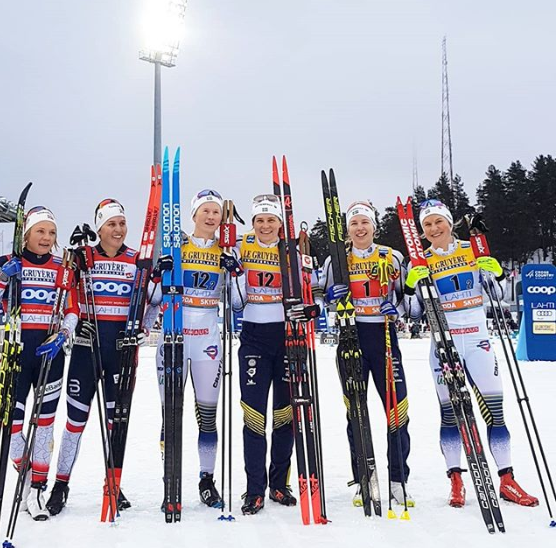
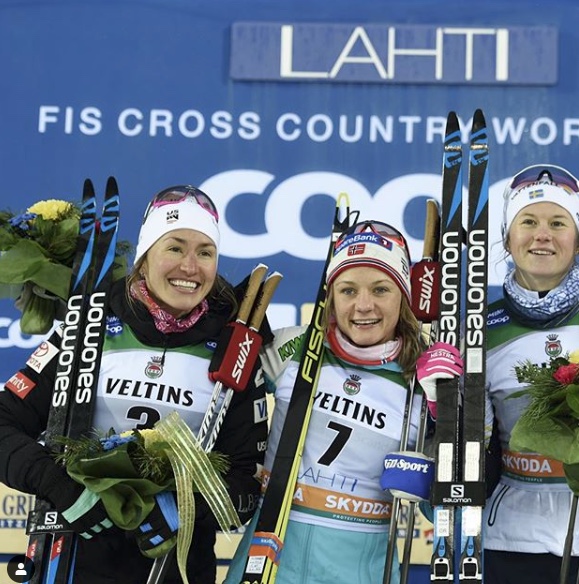
2019 Lahti, Finland’s World Cup classic team sprint podium. From left to right, Norway I in second, Sweden I in first, and Sweden II in third. (Photo: @fiscrosscountry Instagram screenshot)
FIS World Cup Lahti, Finland Classic Team Sprint
Sunday in Lahti, Finland the women raced a 6 x 1.4-kilometer classic team sprint. U.S. fans saw their hopes for a podium snuffed out in the two semi-finals that determined the 10 teams advancing to the finals.
In the first team sprint semi, the U.S. Ski Team’s (USST) Ida Sargent and Sophie Caldwell placed sixth overall and did not advance. Sargent and Caldwell, constituting team USA I, were 10.78 seconds off the winning time of Sweden II’s Evelina Settlin and Hannah Falk, who won the first semifinal in 18:36.74 minutes.
In the second semi, USA II’s Kelsey Phinney (SMS T2) and Julia Kern (USST D-Team) raced to seventh (+1:06.32). Norway I’s Tiril Udnes Weng and Maiken Caspersen Falla marked the fastest time of 18:31.09 minutes.
In the women’s final, Sweden I’s Ida Ingemarsdotter and Maja Dahlqvist won in 18:24.96 minutes. Weng and Falla took second (+1.84), Sweden II’s Settlin and Falk placed third (+3.55).
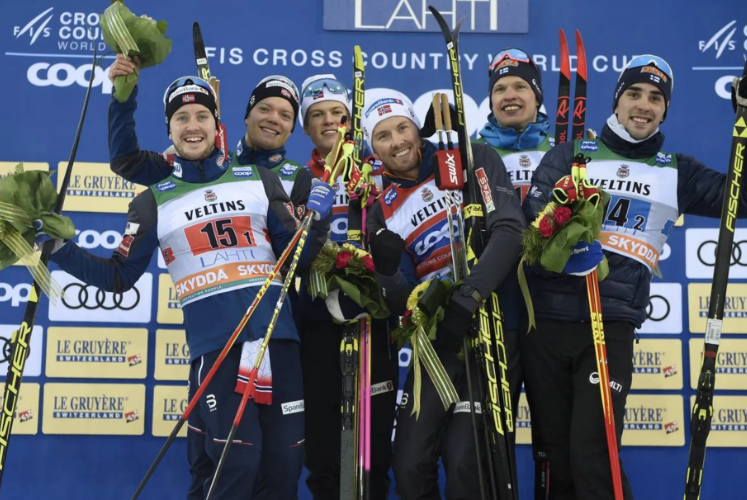
2019 Lahti, Finland’s World Cup classic team sprint podium. From left to right, Norway II in second, Norway I in first, and Finland I in third. (Photo: fis-ski.com screenshot)
The men raced a 6 x 1.6 k classic team sprint in Lahti. Both U.S. teams entered raced in the second semi with neither placing well enough to advance. The second semi was won by Russia I’s Artem Maltsev and Gleb Retivykh in 19:31.22 minutes.
In that semi-final, USA II’s Kevin Bolger and Logan Hanneman placed sixth (+6.60), USA I’s Simi Hamilton and Erik Bjornsen were seventh (+16.05).
USA II placed 12th overall, USA I 14th in the final standings.
Johannes Høsflot Klæbo and Emil Iversen of Norway won the first semi in 19:22.32 minutes.
Norway I’s tandem won the final in 18:57.19 followed closely by Norway II’s Sindre Bjørnestad Skar and Eirik Brandsdal in second (+0.65). It was a photo finish for second and third, as Finland I’s Iivo Niskanen and Ristomatti Hakola finished 0.71 seconds back to take the third podium spot.
Western Canadian Championships, Telemark, Kelowna B.C., Relays
Westerns wrapped up with club relays on a day where the thermometer flirted with cancellation before rising to -17C at 9am (that is 2 Fahrenheit, for residents of Liberia, Myanmar, and the USA).
The relay event is intended to help build club spirit in a less competitive environment. In practice, many skiers just find two friends they want to ski with. Despite the cold, 105 teams competed today.
In the open men category, the ‘BC Lost Boys’ team won easily, with Rémi Drolet, Gareth Williams, and Julien Locke finishing the 15km in 38:00.9. Drolet and Locke are teammates at Black Jack while Williams is a Telemark local. All three are national team members.
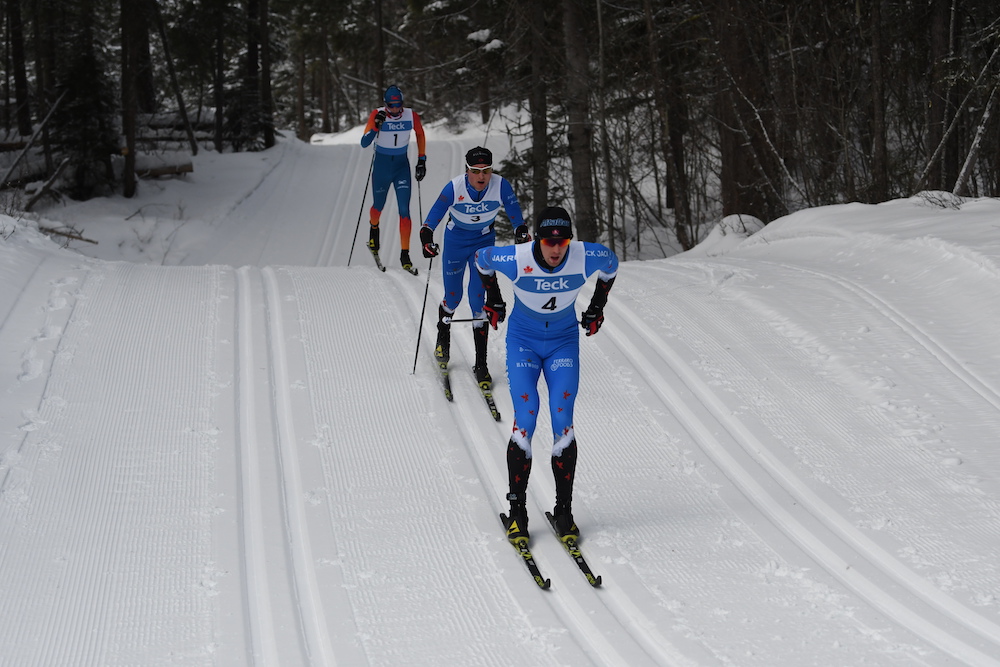
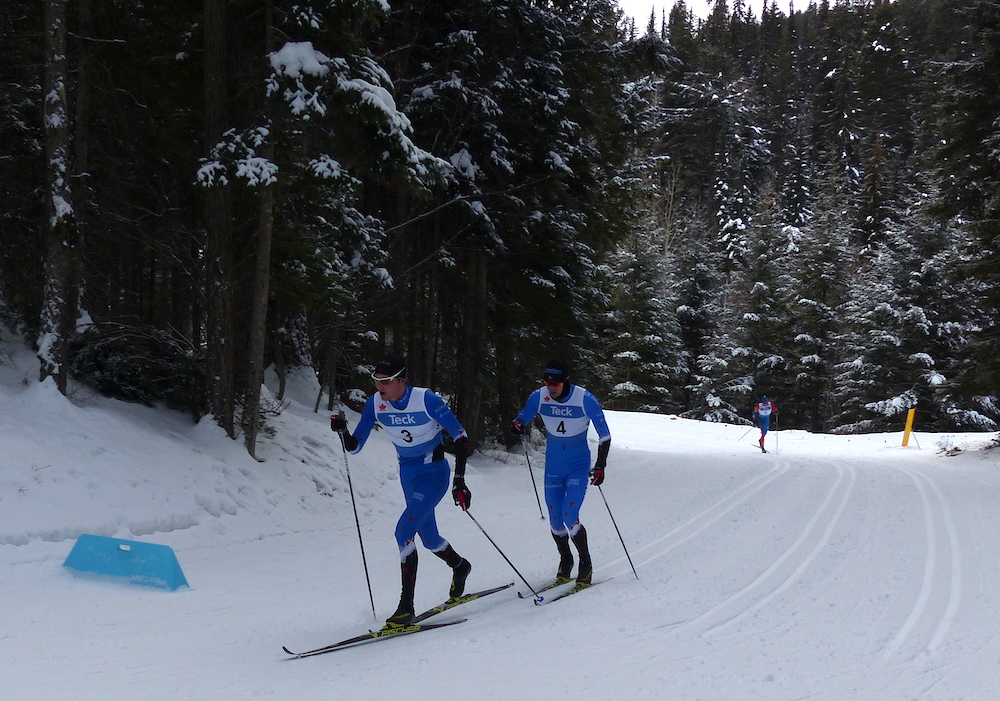
Julien Locke leads Rémi Drolet and Sam Hendry in Saturday’s mass start classic. The relay used the same 5km loop. (Photo: Doug Stephen)
‘Alberta 1’ placed second, at 1:47.1 back, with Thomas Manktelow (), Michael MacIsaac-Jones (AWCA), and Sam Hendry (Team R.A.D.) ‘BC Power, Speed, and Grace’ was third, with Tallon Noble (Strathcona), Michael Murdoch (Whistler), and Ian Williams (Telemark) at 2:26.8.
The open women used the same 5km loop as the men (and the same as on Saturday). ‘BC Supernovas’ won in 47:25.7, with BC team members Paige Latta (Sovereign Lake), Elizabeth Elliot (AWCA), and Benita Peiffer (Whistler). ‘BC Avalanche’ took second at 1:33.4 with Katie Weaver (RMR), Gina Cinelli (Revelstoke), and Beth Granstrom (AWCA). ‘Just the Ladies – No Nick’ was just 3.5 seconds behind 2nd place with Claire Grall-Johnson (AWCA), Amanda Thompson (AWCA), and Hannah Jirousek (AWCA) representing Yukon/Ontario.
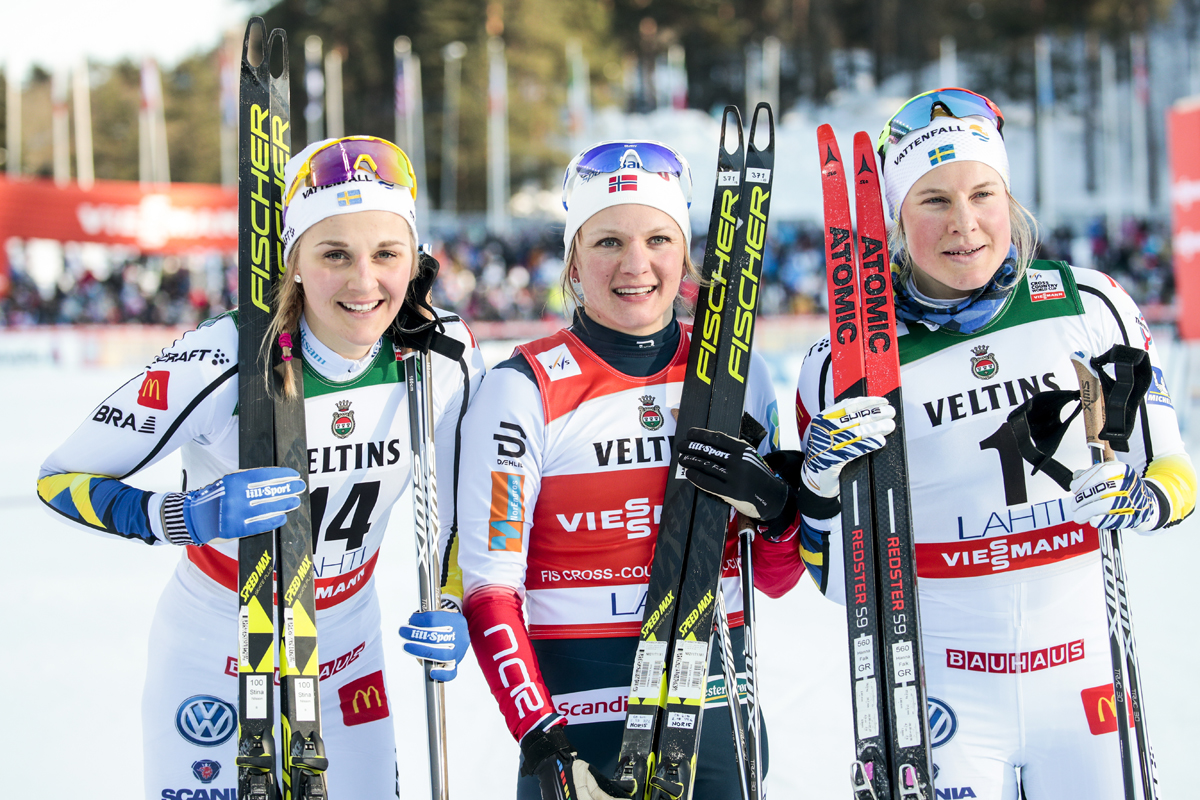
The women’s podium from the World Cup skate sprint in Lahti, Finland. From left to right, Sophie Caldwell (USST) in second, Maiken Caspersen Falla of Norway first, and Maja Dahlqvist of Sweden third. (Photo: @salomonnordic Instagram screenshot)
Out of the famed Lahti, Finland ski stadium and up and over the initial punchy climb, Norway’s Maiken Caspersen Falla, 40 seconds into the final of the women’s 1.4-kilometer sprint, charged ahead. In her draft, and sitting in fourth place around the hairpin that slung skiers back towards the stadium was the U.S. Ski Team’s Sophie Caldwell.
Descending back past the stadium and into the next decisive hill at 1:35 into the race, Caldwell made a powerful V2 move past Falla and her teammate Tiril Udnes Weng. Falla, noting the Caldwell surge matched the pace.
Atop the hill, at the course’s highpoint, Caldwell’s right side position gave her the lead as she rounded the horseshoe corner that brought skier’s descending into the main stadium. And from 2:00 minutes until 2:21 Caldwell was zooming and in charge. Sitting in her draft and sliding on Norwegian-wax-truck slick skis, Falla came around Caldwell on the outside of the long-curving lefthander into the finish straight.
Falla and Caldwell sped into the final meters. Falla took the win at the line in 2:43.64 minutes. Caldwell was second (+0.11), and Sweden’s Maja Dahlqvistsprinted to third overall (+0.37).
This was Caldwell’s third second place of the season. And as is the case most often when scanning race results or goggling a World Cup stream on the Internet, what we see is half the truth.
Caldwell landed in Finland on Thursday after a three-week stay at her home in Vermont. In a telephone call, Caldwell said it had been six years since she had last visited her family back home during the World Cup season. She returned home to be with her mother who has been ill.
“That family time was special and really nice,” said Caldwell. “The snow at home was amazing and I could ski from home. I pretty much could hang out with my family and go for skis from my house when I wanted to and not really have to leave home.”
While in Vermont, Caldwell trained, raced the Lake Placid SuperTour, and took time for herself and family. However, the decision was made to bring back a sense of normalcy and travel back to Europe for the World Cup.
Caldwell booked a ticket. Jetted six hours ahead to Finland. She went through her warm-up yesterday testing skis. She did what she does on Saturday; she qualified third; she won her semi-final in a four-way photo finish; she skied with her Caldwell smarts to place second. No pizazz. No look-at-me social media posts. It was a steady state Sophie Caldwell on the podium.
“It was really nice to be back and even though there is a lot going on in the back of my head, on race day it is nice to be out there and go through the motions that I know and still do what works well for me. And that is staying calm and staying focused and just taking things one step at a time,” reflected Caldwell when asked about her day.
With Near-freezing temperatures and saturated snowpack that by all accounts was Formula One fast, the racing was tight and tactical. In her quarter and semi-final, Caldwell played coy, sitting back in the draft on the long final descent into the stadium.
“But in my semi, I was feeling pretty strong on the final uphill,” Caldwell said. “And in my final, I decided to take the lead there and in hindsight, I don’t know if it was the smartest thing because of course then people can draft off of you. I am not someone who usually likes to lead. And I saw it as an opportunity to give that a try and I was feeling good there. I pushed it and took the lead and then I think Maiken was in my draft because she came around me on the downhill. But I don’t know. I think it is good to try. Skiing tactically really well is, of course, important but it is also riskier when you are not in the front.”
Those comments are in the moment reflections of an athlete in their prime. Her blinders on for 2:32.75 seconds – a blip really – and Caldwell continued perhaps the most understated run this season on the World Cup with her second place.
Today, she did this all with a new rock on her finger as she and longtime partner Simi Hamilton were engaged while back in Vermont.
For twenty-four-year-old Kelsey Phinney (SMS T2) Saturday was a first. She earned her career first World Cup points by placing 19th overall. Phinney’s race day began by qualifying in 27th. According to the International Ski Federation (FIS), this was Phinney’s seventh World Cup race and her first time qualifying for the heats. Last season, in March, in her first career World Cup race, also a skate sprint in Lahti, Phinney posted a 36th overall. Until today, that had been her best World Cup result.
After the SuperTour in Lake Placid, Phinney joined the U.S. Ski Team sprinters in Vålådalen, Sweden where she trained for 10 days.
“It feels serendipitous to qualify for my first heats in Lahti as my first World Cup was here last year,” Phinney wrote in an email. “I had a good feeling going into today for sure! Last year, I just went the pace I saw the top girls going and it worked for half of the course (I was top 5 at the half way point), but I blew up on the big climb and lost a lot of time. It was nice to race on a course I’ve raced before, as my other world cups have all been firsts for me. I knew for this course that I had the speed but also from my experience during period 1, I had more confidence in my pacing this time around. I knew I was making up time on the big hill this year, skiing smarter than last year and then to see I had qualified was one of those great moments you have to cherish in sport. I really enjoy the mix of hop skate, big V2 and big downhills on this course. Plus, my SMST2 coach Pat O’Brien is over here providing wax support and I had great skis today, and it was so special to have him here today!”
Kelsey Phinney earlier this season in Lillehammer, Norway’s World Cup skate sprint. (Photo: Fischer/Nordic Focus)
Phinney, who has been on the national radar for several years, earned her first U.S. National’s podium this season. She placed third in the skate sprint. However, Phinney did race the early season World Cups in Ruka, Lillehammer, and Davos. That experience, according to Phinney, helped her push through into the heats on Saturday.
“It feels so good to make it in the heats, that’s my favorite part of sprint racing is the head to head tactics,” explained Phinney. “But you have to figure out how to ski fast and smart enough in the qualifier to get there, and it is not easy to do that by any means! I feel so lucky to have been over in Europe for all of period 1 with the rest of the U.S. women’s team providing so much insight, advice, perspective, and inspiration. There’s really nothing that compares to just getting more experience over here. It takes time to figure out how to deal with the nerves, ski testing, and confidence over here.”
Julia Kern (USST D-Team) came into the day in recovery mode. Having fallen ill during the recently concluded U23 World Championships in Lahti, Kern has lacked on-snow time and elevated heart rate exercise to tune her motor.
“Definitely feeling flat given that I didn’t train for eight days straight and have not been moving much,” Kern said. “I think mentally I wasn’t quite into it because I was making the call in the morning and twenty minutes before the start I was torn fifty-fifty with whether I should even start. .. I am not feeling fully one hundred percent healthy. But in the race itself, the conditions were really fast. I have been skiing in -10 to -15 Celsius temps the last few weeks and the fast track felt really good. It went by way faster than I expected so it felt pretty good but I didn’t really feel like I was firing on all cylinders. But I didn’t expect that either. It was a plan to be a wake-up call for my body for next weekend’s World Cup races.”
Kern has been nominated to the 2019 U.S. Team for the upcoming World Championships in Seefeld, Austria. Kern said she is not guaranteed a start at World Championships as only four U.S. athletes will contend the individual sprint in Seefeld. Sprint results on the World Cup prior to Seefeld will help determine which athlete’s will race Seefeld’s individual sprint.
“Still a little congested and still coughing a bit but my energy is really good and I think that is what made me decide to race this weekend,” said Kern. “As of right now I am in the team sprint tomorrow but we can change up until two hours before the race and I am going to wait and see how my body reacts for the rest of the day and into the morning tomorrow and make the call.”
Ida Sargent (USST) raced in the heats after qualifying in 26th. She was eliminated in the first heat when she placed sixth in a photo finish. Sargent ended up 30th overall.
Canada’s Dahria Beatty qualified in 25th and placed 24th overall after placing fifth in her heat.
“I was happy with how my body felt skiing in my heat today, but I kept putting myself in positions where I got a bit boxed out,” Beatty said according to a Cross Country Canada press release. “The final corner at the top of the big climb is always a decisive spot on this course. I tried to stay in contact there for the finish, but it ended up a bit strung out over the top. … It maybe wasn’t the best tactics today, but I feel like my fitness is good again after our training camp in Davos and that gives me confidence heading into World Championships.”
Racing continues tomorrow for the men and women with a classic team sprint.
Norway’s Maiken Caspersen Falla taking the World Cup win in the 1.4 k skate sprint in Lahti, Finland. Sophie Caldwell of the U.S. Ski Team placed second. (Photo: fis-ski.com screenshot)
FIS World Cup Lahti, Finland 1.4 k/ 1.6 k Freestyle Sprint
In the women’s skate sprint qualifier in Lahti, Finland Slovenia’s Eva Urevc laid down the fastest time in 2:40.67 minutes. Swiss skier Nadine Faehndrich was the second fastest qualifier, 4.21 seconds back, with the U.S. Ski Team’s (USST) Sophie Caldwell third (+4.36).
Canada’s Dahria Beatty qualified 25th (+10.21). Also making the heats for the U.S. were Ida Sargent (USST) in 26th (+10.36), and Kelsey Phinney (SMS T2) in 27th (+10.54).
Of the top three qualifiers, only Caldwell advanced to the finals. The final was won by Norway’s Maiken Caspersen Falla in 2:43.64. Falla advanced to the finals as a lucky loser from the first semifinal. That semi was won by Caldwell who ended up placing second (+0.11) in the final. Sweden’s Maja Dahlqvist sprinted to third overall (+0.37).
Germany’s Sandra Ringwald placed fourth (+0.46), Norway’s Mari Eide fifth (+0.75), and Tiril Udnes Weng of Norway sixth (+0.94).
Phinney placed 19th overall, Sargent 30th. Canada’s Beatty was 24th in the final standings.
Also for the U.S., Julia Kern (USST D-Team) coming off of illness ended her day 38th overall. Hannah Halvorsen (USST D-Team) placed 41st.
Johannes Høsflot Klæbo won the men’s 1.6 k skate qualifier in 2:47.01 minutes. He was followed by teammate Haavard Solaas Taugboel in second (+4.15). Qualifying in third was Finland’s Joni Maeki who clocked a time of 2:51.36.
Klæbo won the final in 2:52.06 while Italy’s Federico Pellegrino raced to second (+0.30). Norway’s Finn Hågen Krogh was third (+0.61). Also from Norway, Eirik Brandsdal took fourth (+1.31) and Emil Iversen fifth (+1.75). Gleb Retivykh of Russia was sixth (+2.08).
No North American men qualified for the heats.
Logan Hanneman (APU) for the U.S. placed 32nd overall after missing the heats by .22 seconds. Simi Hamilton (USST) finished 36th overall, and Erik Bjornsen (USST) 42nd.
Evan Palmer-Charette was the lone Canadian entered; he placed 67th.
Rémi Drolet leads Julien Locke and Sam Hendry at the start of lap three. (Photo: Peggy Hung)
Canadian Western Championships, Telemark, Classic Mass Start
Day two of Westerns dawned with low clouds and intermittent light snow at -11C for the classic mass starts.
The men raced first, completing three laps of the new (and freshly homologated) 5km loop. Rémi Drolet (Black Jack) won in 42:18.4, getting from Julien Locke (CNST) on the last climb to earn a 4.8 second gap. Sam Hendry (Team R.A.D.) stayed with leaders until late in the second lap, finishing 42.2 seconds back. Rémi Drolet and Hendry are juniors who represented Canada at Junior Worlds in Lahti last month. Crystal Lust
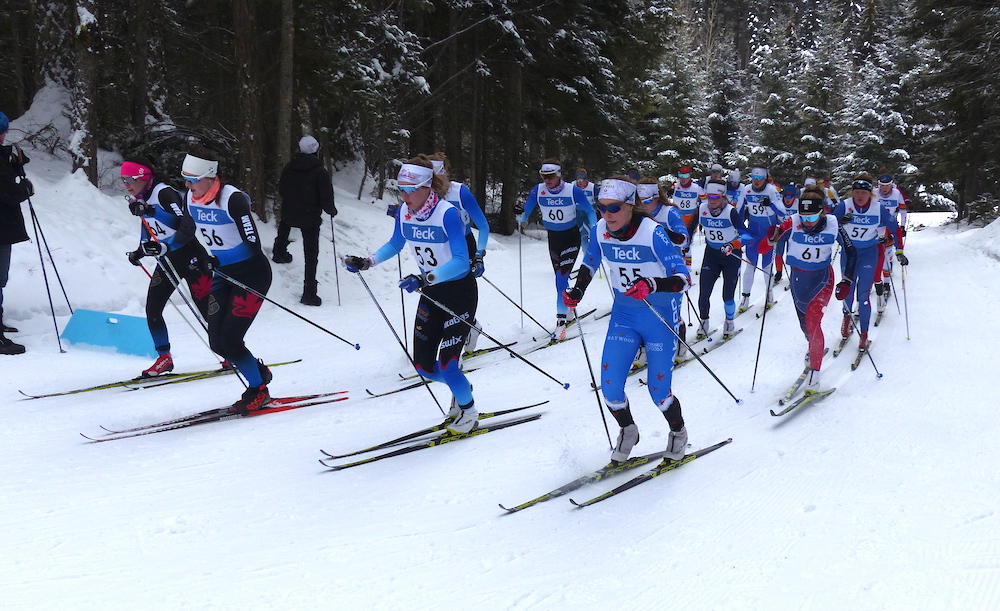
The first small climb of the Westerns 10km classic. Jasmine Drolet (#55) leads Novie McCabe (#61) in the left track. (Photo: Peggy Hung)
The open women skied two laps of the same course, with Novie McCabe (Methow) breaking clear on the first lap to win alone in 32:46.6. Jasmine Drolet (Black Jack) was second at 53.4 seconds followed by teammate Molly Miller at 1:28.1. All three raced at World Juniors in Lahti: Jasmine Drolet is 16 and the other two are 17.
There were 386 finishers on Saturday. Racing continues Sunday with relays.
Of the four Russian athletes starting the 15-kilometer classic mass start in Lahti, Finland three placed in the top four. Anna Zherebyateva won in 40:31.4 minutes as she was able to stretch her nine-second gap at 10 k to 23.5 seconds by the finish. Also from Russia, Lidia Durkina placed second (+23.5), Germany’s Katharina Hennig skied to third (+37.5).
“My tactic was to make a gap in the second loop,” Zherebyateva said during the post-race press conference. “So I did exactly what I wanted. It went really well. Tracks were exactly right for me. This gold medal is an important step for my sport career.”
Yana Kirpichenko was the third Russia in the top-five as she placed fourth (+41.6).
The best North American finisher was U.S. skier Hailey Swirbul who raced to 10th (+1:27.8). Swirbul was positioned 29th at the 5 k time check but steadily moved up in the field as the race progressed. By 10 k she had positioned herself in the top-15.
For the twenty-year-old Swirbul, this is her first go at U23 Worlds after participating in three Junior Worlds as an U20. Last season in Goms, Switzerland she placed second in the 5 k classic and third in the 10 k skiathlon.
Two other U.S. skiers raced into the top-30. Julia Kern placed 16th (+1:43.4), while Alayna Sonnesyn was 23rd (+2:24.9). Hannah Halvorsen, the fourth U.S. starter, placed 54th (+6:58.6).
Hannah Mehain was the top Canadian in 31st (+3:16.8), Sadie White placed 33rd (+3:18.6), and Natalia Hynes 51st (+3:40.9). Marie Corriveau did not start.
Similar to the U23 women’s race, Russian skiers dictated the pacing at the front of the pack — the four Russian starters swept first through fourth place.
Andrey Sobakarev won in 1:17:19.1 hours, Ivan Kirillov placed second (+3.5), Ivan Yakimushkin third (+4.9), and Anton Timashov fourth (+11.4).
Canada’s Antoine Cyr was the top North American in 27th (+2:26.8), while teammate Gareth Williams toed the line a fraction behind in 28th (+2:26.9). Also for Canada, Ritchie Graham was 41st (4:44.1), and Julian Smith 45th (+5:14.3).
Peter Holmes was the top U.S. finisher in 33rd (+3:15.7). Hunter Wonders placed 40th (+4:43.0), Braden Becker 53rd (+6:59.0), and Daniel Streinz 66th (+15:53.9).
Johannes Thingnes Bø scored his 10th IBU World Cup win of the season today in the 10 k sprint in Antholz, Italy. (Photo: biathlon world.com screenshot)
IBU World Cup Antholz, Italy 10 k sprint
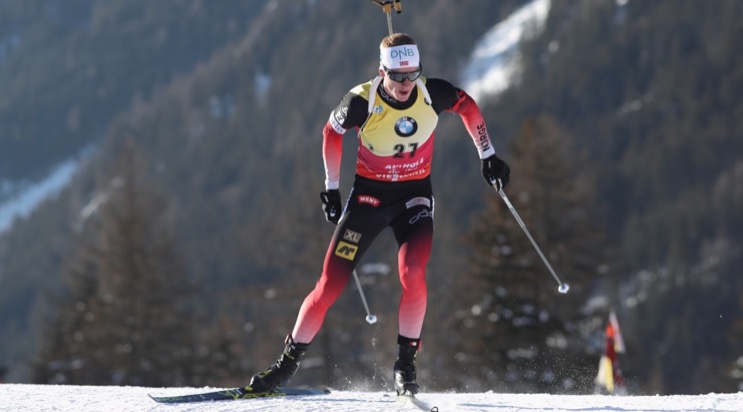
In the groove is in the groove. Norway’s twenty-five-year-old Johannes Thingnes Bø scored his 10th IBU World Cup win of the season today in the 10 k sprint in Antholz, Italy. Bø won the race in 23:53.9 minutes with a single penalty in standing. The Norwegian leads the IBU World Cup overall and padded his lead with his fifth sprint win this year.
“It was quite difficult; the altitude here is quite heavy and with the new tracks, I felt dead from 5K so the last 5K was really tough,” Bø said to the IBU after the race. “I managed to have a good plan for the race. When I shoot nine targets, I was quite happy and then it was just to fight hard for the finish line. I like this year’s track; I liked last year’s too because it was not so painful.”
Bø’s season thus far has been a study in speedy skiing. His shooting stands at 87% for accuracy (82% standing, 91% prone) with his superior skiing speed carrying him to the World Cup overall lead. In Antholz today, his course time for each of his two 5 k laps were ranked first.
Norwegian teammate Erlend Bjøntegaard shot clean in both his shooting bouts to take second place, 17.5 seconds behind. France’s Antonin Guigonnat placed third (+20.2, 0+1).
Scott Gow of Canada was the top North American in 20th (+1:06.6, 0+0). Teammates Jules Burnotte raced to 48th (1:55.9, 1+1), Christian Gow 61st (+2:13.4), and Aidan Millar (+3:46.7, 2+2).
Jake Brown was the top American in 40th (1:42.4, 1+0). Sean Doherty finished in 55th (+2:06.2, 2+1), Max Durtschi 62nd (+2:13.8, 0+1), and Leif Nordgren 73rd (+2:43.1).
Racing continues tomorrow in Antholz for both the men and women with the 12.5k and 10 k pursuits.
Lake Placid SuperTour 5 k/10k Skate Individual Start
In the 5 k-freestyle individual start Jessica Yeaton (APU/Australian National Team) placed first with a winning time of 15:01.9 minutes. She was in a tight race for the top spot with U.S. Ski Team/SMS T2 athlete Sophie Caldwell who finished 3.0 seconds back. Caldwell is back home in Vermont training and preparing for the 2019 World Championships.
Katherine Ogden (Dartmouth Ski Team) placed third in a time of 15:17.8. Kelsey Phinney (SMS T2) placed fourth in 15:37.7.
“Today’s race went super well for me; I had awesome skis despite tricky conditions/weather leading into the race – our wax tech did a phenomenal job,” Yeaton wrote to FasterSkier. “The course here is really good for me with all the steady climbing in the first part- I just tried to push hard to the top of the course and then survive and carry my speed on the downhill, which turned out to be a good tactic.
“Between US Nationals and now I definitely feel like I am in a good place leading into Seefeld. I struggled with some injuries in the fall and was forced to do a lot of cross-training (especially on the bike) and skip the early season races in Nov/Dec. In retrospect I think this actually was a blessing in disguise, as I ended up putting in a super hard training block and gaining a lot of fitness. Looking ahead to Seefeld, my goal is to top 30 in one of the races, with my main focus being on the skate events (30k and sprint), and the 15km skiathlon. I am really excited for the rest of the races this weekend; they are my final prep before heading over to Europe to race on World Cup and in Seefeld.”
Kyle Bratrud (SMS T2) won the men’s 15 k skate in 25:27.1 minutes. Bratrud, who was recently selected to the 2019 U.S. World Championship Team, has been a top-performing distance skier this season on the SuperTour.
“Today went well,” Bratrud emailed. “After Nationals, I made the tough decision of turning down World Cup starts in Otepaa and Ulricehamn in order to get some quality training in for the World Champs. Today reflected that as I felt a little tired and pretty flat from not racing since Nationals. That being said, I expect to keep feeling better each race and I should be in a great place when I fly to Europe on the 4th!”
Bratrud recently won the NorAm/SuperTour 15 k classic in Sovereign Lake and the 15 k classic at U.S. Nationals. Bratrud placed second in West Yellowstone’s SuperTour 15 k skate, and the 30 k skate mass start at U.S. Nationals.
Akeo Maifeld-Carucci (CGRP) placed second in a time of 26:18.9. It was Carucci’s second SuperTour podium of the season and his best career SuperTour result. In West Yellowstone, he was third in the 15 k skate behind Ben Lustgarten (CGRP) and Bratrud.
Alexis Dumas (CNEPH) of Canada was third in 26:32.2. U.S. skier Adam Martin was fourth, 3.1 seconds behind Dumas.
The women’s podium from the 2019 U.S. Cross-Country Nationals skate sprint. From left to right, Hannah Halvorsen (APU/USST D-Team) in second, Julia Kern (USST D-Team/SMS T2) first, and Kelsey Phinney (SMS T2) third. (Photo: John Lazenby).
Julia Kern’s young season has been rife with success. Two SuperTour sprint wins, and a second place in this Craftsbury nationals in the classic sprint are among the twenty-one-year-old Kern’s peaks since 2018/2019 elite level domestic racing began in West Yellowstone days after Thanksgiving.
As much as her season so far has been without pitfalls, her pathway to the women’s 1.5-kilometer finals was, for Kern, a test of her patience and will. As the second fastest qualifier, Kern was a marked skier.
In the fourth quarterfinal, she placed second behind Canada’s Katherine Stewart-Jones.
In the second semi, Kern placed third, advancing to the finals as the first lucky loser. Kelsey Phinney (SMS T2) placed first, while Maya MacIsaac-Jones was second.
“I learned that a lot happens the second half of a race,” Kern told FasterSkier in Craftsbury about how her strategy evolved while she advanced. “I was in sixth, dropped at the top of the hill [in the final] and then I just got my mind back into it. And put it all out and I realized I had the finishing speed. I just need to be able to hang on and then get into that zone of just going for it in the finish. I think there is a lot in the last quarter of the race to be had.”
The final was stacked with day’s four fastest qualifiers, which included Hannah Halvorsen (APU/USST D-Team) the fastest qualifier, Kern, Phinney who qualified third, and Caitlin Patterson (CGRP) the fourth fastest qualifier.
Kern won the final in 3:16.73 minutes, 0.21 seconds ahead of Halvorsen in second. Phinney placed third for the final podium spot. Patterson finished fourth overall, MacIsaac-Jones fifth, and Jessica Yeaton (APU/Australia National Team) sixth.
“The final was really hard,” said Kern. “I think everyone was really tired from a fast and hard week of racing. Things really spread out on the uphill and then it was just kind of a fight for what you have left. And on the last hill I just got into a zone and just put my head down and hammered.”
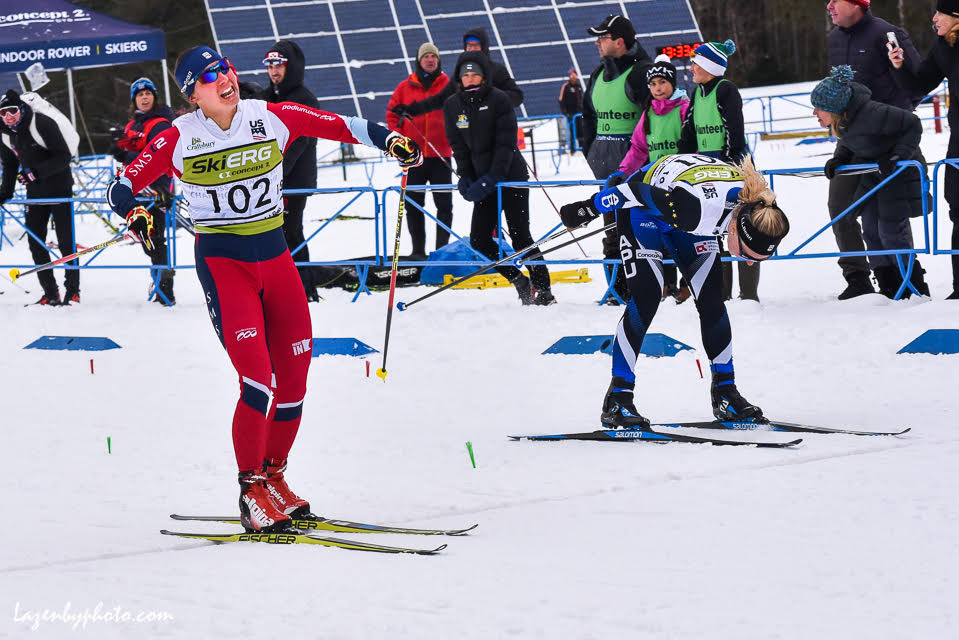
Julia Kern (bib 102) takes the win in the women’s skate sprint final at the 2019 U.S. Nationals. Hannah Halvorsen (right) was a close second. (Photo: John Lazenby)
Like in Thursday’s classic sprint when the two were in a photo finish, Kern and Halvorsen were side by side coming into the line during the final.
“I think I had been smiling a little bit because it is so fun to go head to head,” said Kern. “I was almost laughing in my head and was like ‘oh, is this going to come down to another lunge?’ that would be pretty funny. I think we are going to make each other faster. Competition is the best to make you better and it makes it really fun to see us both on top of our game and duking it out head to head at the finish.”
It was Kern’s first U.S national championship. She secured her first career U.S. nationals podium in the classic sprint last Thursday, in which she placed second to the winner Ida Sargent (CGRP/USST). Halvorsen, in that race, place third also for her first career podium at nationals.
“I have been learning a lot from Julia actually in quite a few of these races,” Halvorsen said when asked about her thoughts on the day. “I had a good quarters and semis and I was able to take control and feel confident. And in the final I tried to take the lead and tried to win it but Julia came in from behind and she was stronger. She definitely pushes me and she took it today.”
For Phinney, the day brought her first career podium at a nationals.
“In the quarterfinal I was hoping to just rest as much as possible,” Phinney said about the start of her heats. “I was in the fifth quarter and then the second semi, so I had the disadvantage of less rest throughout the day. I had fallen in the classic sprint so it was a little dicey in the quarter and I took the lead at the climb just to stay safe. I think the biggest thing I learned was just that I was skiing with good energy and was felt really good in the second half of the course so that gave me a lot of confidence going into the final. But I think anything could have worked as long as you skied safe. It was a long enough course so that there were some opportunities to either do really well or blow up.”
In the final, Patterson made the initial move to break the group and gain an advantage.
“So it was a little exciting,” Phinney said of Patterson’s move. “I worked really hard to get back up to her on the big climb. And then I maybe burned myself a little bit and wasn’t able to hold the finishing pace of Hannah and Julia when they came around. It is my first national podium. So I am happy with that. But I would have loved to fight for that win.”
U.S. Cross-Country Ski Nationals at Craftsbury, Vermont 1.5 k Freestyle Sprint
In the men’s 1.5-kilometer freestyle sprint on Tuesday, the final day of racing at U.S. nationals, Ben Saxton (SMS T2) won the final in a time of 2:58.51 minutes.
Saxton was fifth in qualification behind fastest qualifier on the day Logan Hanneman (APU). Hanneman went on to place second in the final, crossing the finish line .32 seconds after Saxton. Noel Keeffe (University of Utah), the day’s second fastest qualifier, placed third.
Rounding out places fourth through sixth in the men’s final were Daniel Streinz (NMU), then Gus Schumacher (AWS), and Zak Ketterson (NMU) respectively.
For the women’s 1.5 k skate sprint, Julia Kern won the final in a time of 3:16.73 minutes after sending the second fastest time in qualification. The women’s fastest qualifier, Hannah Halvorsen (APU/USST D-Team) placed second in the final .21 seconds after Kern.
Kelsey Phinney (SMS T2) placed third in the final (+2.01). Caitlin Patterson (CGRP) was forth, Canada’s Maya MacIsaac-Jones (CNST) fifth, and Jessica Yeaton (APU/Australian National Team) sixth.
U.S. Cross-Country Ski Championships Craftsbury, Vermont 1.5 k Classic Sprint
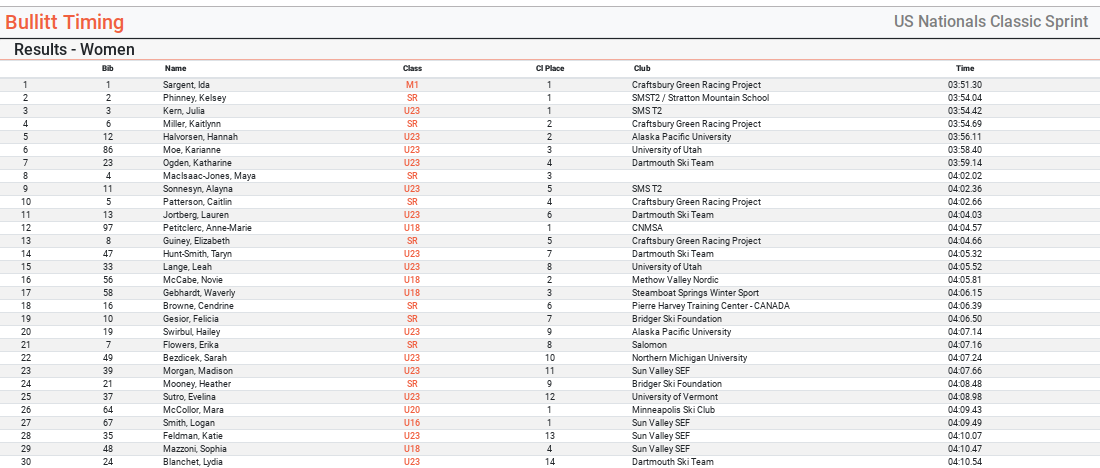
Friday at U.S. nationals, the women were up first with the 1.5 k classic sprint. In the qualification round, racing for the U.S. Ski Team (USST) and the Craftsbury Green Racing Project (CGRP), Ida Sargent marked the fastest time in 3:51.30 minutes. Kelsey Phinney (SMS T2) was second fastest in 3:54.04, and Julia Kern (SMS T2/USST D-Team) in third with a time of 3:54.42.
Live Timing screenshot of the top-30 qualifiers from the morning’s 1.5 k classic sprint qualifier at U.S nationals.
Sargent advanced to the finals by winning the first quarterfinal and semi-final. In the A final, she placed first in 3:43.55 to win the classic sprint national championship. Kern was second in 3:44.31, and Hannah Halvorsen (APU)third in 3:44.33.
Caitlin Patterson (CGRP) was fourth, Kaitlynn Miller (CGRP)fifth, and Hailey Swirbul (APU) sixth.
This post will be updated throughout the day as results come in.
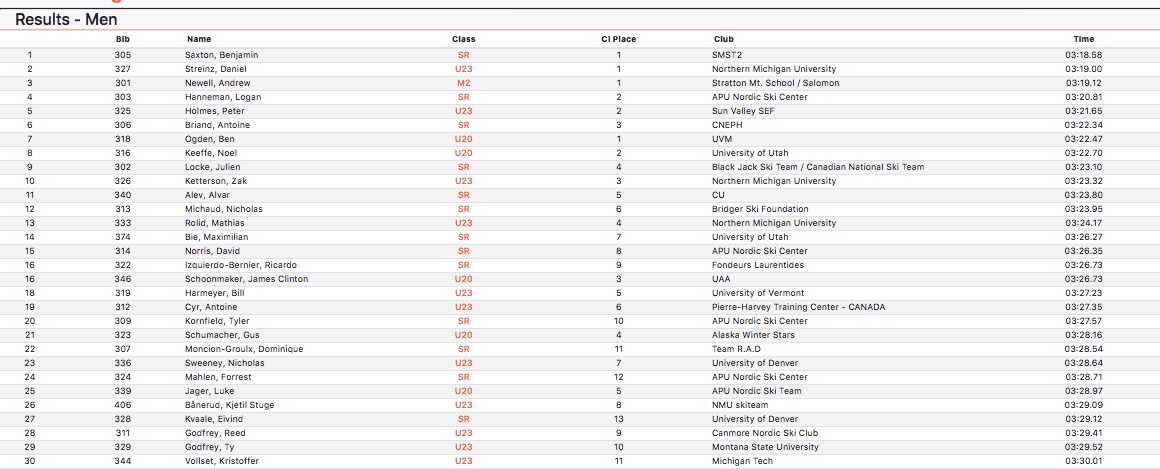
Men’s top-30 qualifiers from the 1.5 k classic sprint a tU.S. nationals.
In the men’s qualifier, Ben Saxton (SMS T2) was first placed qualifier with a time of 3:18.58 minutes. Daniel Streinz (NMU) was second with a time of 3:19.00. Andy Newell (SMS T2/Salomon) was third fastest with a time of 3:19.12.
In the men’s A final, Canada’s Julien locke placed first in 3:15.46. Saxton placed second, but was the first American, crossing the line in 3:16.30. Logan Hanneman (APU) was third overall in 3:16.51.
Peter Holmes (SVSEF Gold Team) placed fourth, Canada’s Dominique Moncion-Groulx (Team R.A.D.) was fifth, and Zak Ketterson (NMU) sixth.
(For the U.S. podium determining the national title, Saxton was first, Hanneman second, and Holmes third.)
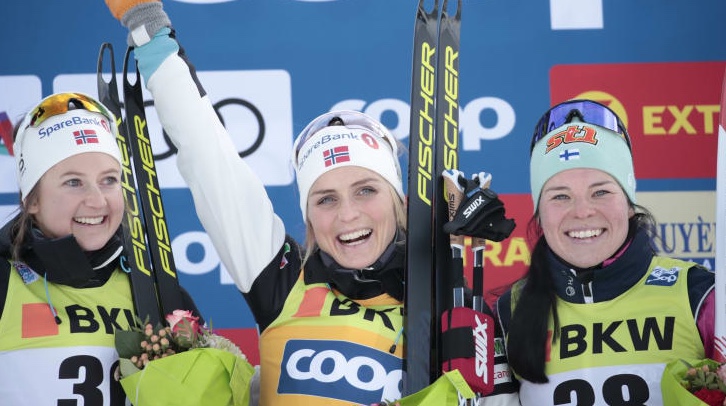
The women’s podium from the 2018 World Cup 10 k freestyle individual start in Davos, Switzerland. Therese Johaug (center) of Norway won, teammate Ingvild Flugstad Østberg (left) was second, and Krista Pärmäkoski (right) of Finland was third. (Photo: Fis-Ski.com screenshot)
Coming off a two-season hiatus from the World Cup for having a banned steroid in her system, Norway’s Therese Johaug has come back onto the distance race stage with time checks and results showing no remorse. This is not to say that Johaug’s reentry to the sport comes with arrogance. But it is to highlight that, on course, her level of control in the early season World Cup distance events has been dominant. Johaug has won all five World Cup distance events thus far. Her string of first places is a way of saying she’ll let the results speak for themselves and her dominance seep into the minds of those who want to fight for second and third place.
Sunday was yet another win for Johaug. The up-tempo skier won the 10-kilometer freestyle individual start in Davos in a time of 26:06.9 minutes. She led the race at every intermediate time checkpoint.
It was Johaug’s 81st World Cup podium. She trails only Norway’s legend Marit Bjørgen who won 99 World Cup podiums during her career.
The second place finisher on Sunday, Johaug’s teammate Ingvild Flugstad Østberg, had the benefit of starting two places behind the eventual race winner: Johaug started in bib 36, Østberg in bib 38.
Through the 5 k lap mark, Østberg was able to keep Johaug’s gap no bigger than 10 seconds. On the second lap’s long climb, Østberg only lost a handful of seconds. Her finishing time of 26:19.0 minutes was 12.1 seconds behind Johaug.
For Østberg, it was her third distance podium in succession after placing second in Lillehammer’s 10 k classic pursuit, and third in Beitostølen’s 15 k freestyle individual start race.
Johaug leads the World Cup overall with a perfect score of 600 points. Østberg sits in second, with a 149 point deficit.
Finland’s Krista Pärmäkoski placed third on Sunday, 19.2 seconds back. It was Pärmäkoski’s first podium of the season. She currently is ranked fourth overall on the World Cup.
Jessie Diggins during the 2018 10 k skate in Davos, Switzerland. Diggins placed fifth for her best result for the season. (Photo: Reese Brown/U.S. Ski Team)
The U.S. placed two skiers in the top-10. Jessie Diggins placed fifth and Rosie Brennan sixth.
For Diggins, it was her best result of the season after her eighth place in Beitostølen’s 15 k skate.
“For me period 1 is a building phase, and it’s a really long season, and every single year I always build into period 1,” Diggins said in a phone call. “And I have to remind myself that I do this for me and that I follow a plan that has worked every other year, so I just have to remember that I will be in the right shape when it’s time. And for me, period 1 is not that time. So I’m really happy that it’s been trending positive.”
The building phase of her season set up a solid foundation on Sunday. Her pace was consistent and only placed her 15.8 seconds out of third at the halfway point. She ended up 1:01.1 minutes behind Johaug at the finish.
“I think that technically, I was really proud of my race today because of the way I skied,” Diggins said of her on course sensations. “It’s hard on a course like this to not go out guns blazing and just charge and then totally flood. Because that’s when I think you can lose so much time. For me, I was just so focused on trying to ski with a strong core and efficient, long-gliding v2 and I was just happy with it because it’s a really hard course to pace, and of course, you’re never sure if you nailed it or not.”
With a two week break from racing, Diggins will be training in Seefeld, Austria during the race respite. Next up on the Diggins race schedule is the Tour de Ski (TdS). She placed third overall in the TdS last season, a historic mark for an American. Although she has ambitions at the TdS, Diggins also clarified that it remains a piece in the building-form puzzle. In-form or trending towards the sharp end of fitness, Diggins understands the possibility for more positive outcomes on the result sheet are more palpable as the season progresses.
“For me, I feel like period 1 and the Tour are really crucial building blocks for the season ahead, so I’m looking to take really good care of myself and just like get after it in the Tour. I do think that parts of a season are building blocks where you recognize that maybe you’re not in top form, and that’s on purpose because of the training load you’re carrying in. So you want to do the best you can with what you have. You’re not setting unrealistic expectations that might set you up to be bummed out. For me being like ‘I want to win Kuusamo 10k Classic’ would be an unrealistic expectation from myself. So I think that the Tour, yes, I would like to get a podium in the Tour, obviously, like I think that’s a good event for me, for my strengths, I really, really like it.”
Rosie Brennan (bib 48) on her way to an individual career best on the World Cup with a sixth place in the 2018 Davos, Switzerland 10 k skate. (Photo: Reese Brown/U.S. Ski Team)
Seeing Diggins steadily improve this season is no surprise. That has been her blueprint for success in the past. Arguably the biggest surprise in total on the women’s World Cup is Brennan’s success.
Brennan placed sixth (+1:04.9) on Sunday for her best career individual World Cup result.
“I just really wanted to feel good racing again and to enjoy it again,” Brennan said in a call. “I was just so miserable last year, and it was it hard decision to know if it was even worth it to continue on if I could find not only fun in racing again but also good form and just good race feelings.”
Brennan’s struggle with fatigue and recovery soured her 2017-2018 season. Her down season resulted in her not being renominated to the U.S. Ski Team. What is clear now is that Brennan has found herself in an unprecedented place. Ranked 11th in the World Cup distance standings, Brennan was able to savor her Sunday in Davos.
“Today was definitely the most fun race I’ve had all period, so I’m leaving period 1 on a high note, there’s not much more I could ask for, so it’s been great,” Brennan said.
Her current high note has not allowed her to lose sight of managing her long-term energy and goals. Brennan will not race the TdS and will return to the U.S. for a training block.
“I had made that plan before the season started, and obviously with good results, it became a very difficult decision,” Brennan said of deciding to forgo the TdS. “But given how late World Champs is in the season this year, I really wanted to make sure that I had enough training under my belt to make it to World Champs, so I’ve decided to stick with the plan.”
Currently, Brennan has not automatically qualified for World Championship team selection. She’ll have to remain in the top-50 of the distance standings before the selection period for the team ends.
“The selection ends the second-to-last day of the Tour, and the Tour is only half points,” Brenna explained. “So I feel confident that I will remain in the top-50. So that helped make the decision easier. I have no pressure to race anything, so I’m just going to focus on training and keeping good fitness through the rest of the season.”
Also for the U.S., Caitlin Patterson placed 38th (+2:22.5) and Kelsey Phinney 65th (+4:02.1). Sadie Bjornsen did not start and according to U.S. coach Matt Whitcomb, that decision was part of her pre-determined race schedule.
Canada’s Emily Nishikawa stormed into the top-30 in only her second World Cup start of the season to place 23rd (+1:47.6). Cendrine Browne(CNST) was 44th (+2:28.8).
For Nishikawa, the result ties her career best on the World Cup. She placed 23rd in a 2015 10 k classic in Lahti, Finland. In an email, Nishikawa explained that living in and training in Canmore mitigated some of the altitude effects of racing in Davos. During her race, she was caught by Diggins around 7 k.
“I hung on as long as I could with [Diggins] and tried to follow her fast pace through top section,” Nishikawa wrote “Other than that I skied alone for the race.”
Racing continues on the World Cup on December 29, for the TdS’s opening stage skate sprint.
The women’s podium from the 2018 World Cup 10 k freestyle individual start in Davos, Switzerland. Therese Johaug (center) of Norway won, teammate Ingvild Flugstad Østberg (left) was second, and Krista Pärmäkoski (right) of Finland was third. (Photo: Fis-Ski.com screenshot)
FIS World Cup Davos, Switzerland 10k/15k Freestyle Individual Start
On Sunday, the final day of racing on the World Cup before a two-week break prior to the start of the Tour de Ski, the early season trend for women’s distance skiing continues. Norway’s Therese Johaug won the 10-kilometer freestyle individual start in Davos in a time of 26:06.9 minutes. She led the race at every intermediate time checkpoint.
The only difference with Sunday’s distance narrative was Johaug’s margin of victory. Teammate Ingvild Flugstad Østberg placed second 12.1 seconds back. Krista Pärmäkoski of Finland placed third (+19.2).
The U.S. Ski Team’s Jessie Diggins popped a season-best fifth place, crossing the line 1:01.1 minutes back. Also for the U.S. and posting a career-best World Cup finish was Rosie Brennan in sixth (+1:04.9).
Also for the U.S., Caitlin Patterson placed 38th (+2:22.5) and Kelsey Phinney 65th (+4:02.1).
Canada’s Emily Nishikawa stormed into the top-30 in only her second World Cup start of the season to place 23rd (+1:47.6). Cendrine Browne (CNST) was 44th (+2:28.8).
In the men’s 15 k skate, Russia’s Evgeniy Belov won in 35:52.5 minutes. It was the Russian’s first career individual World Cup win.
Over the duration of three laps on the up and then down 5 k loop, Belov only outdistanced second-place skier Maurice Manificat of France by a meager 0.9 seconds. Third place went to Norway’s Martin Johnsrud Sundby who finished 4.5 seconds back.
In another tight men’s race, only 10.6 seconds differentiated first from fifth place. Russia’s Denis Spitsov was fourth (+7.5), and Norway’s Chris André Jespersen fifth (+10.6). Only 1:07.7 minutes separated 30th place from first.
Alex Harvey of Canada was the best placed North American in 26th (+1:00.9). Teammate Len Valjas (CNST) was 62nd (+2:13.2), and Andy Shields 76th (+2:52.0).
David Norris (APU) was the best placed American in 61st (+2:12.6). Adam Martin (CGRP) finished in 67th (+2:20.5), Scott Patterson of the U.S. Ski Team (USST) 72nd (+2:49.0), Simi Hamilton 77th (+2:54.3), and Kevin Bolger 92nd (+3:55.3).
The third day of the Canmore NorAm weekend featured mass start classic racing.
In the men’s race, NorAm leader Bob Thompson (TBay) emerged the winner of the 30km in 1:18.40.2 hours after beginning the 8th and final lap in a group of four. Jack Carlyle (AWCA) placed second, 0.3 seconds behind. It had been almost two years to the day since his last podium at this level.
Russell Kennedy (Team R.A.D.) placed third, 8.6 seconds back, after winning the 15km skate individual start race on Saturday.
In the junior ranks, Samuel Hendry (Team R.A.D.) was dropped on the final lap, finishing 22.0 seconds in back of the day’s winner as the top junior. Antoine Cyr (CNST) fell back on the 7th lap but held on for 5th overall and top U23 at 1:24.7 back. Remi Drolet (Black Jack) was the second junior in 6th, 0.3 seconds behind Cyr.
Thompson is the COC leader for Period 1, which should qualify him for the Tour de Ski and World Cup period 3.
Cyr should be automatically to the U23 team for the Lahti, Finland World Juniors when the High Performance committee meets Sunday afternoon to confirm final selections. As both Hendry and Drolet had already qualified, the committee will be interpreting rules to determine the remaining junior men going to Lahti. Team ULLR’s Tom Stephen (14th today, 3:29 behind) and Xavier McKeever (16th at 5:07.4) will be among the athletes considered for the final junior spots.
In the women’s 15km, national team members Dahria Beatty and Katherine Stewart-Jones gained a gap on the shorter first lap of the race and were never reeled in. Beatty won the sprint for first crossing the finish in 42:55.8 minutes, with Stewart-Jones 1.8 seconds back.
Beatty has already met the criteria for World Cup period 2 and 3 starts as COC leader, which means a Canadian woman could possibly be racing the Tour de Ski.
First year senior Hannah Mehain (Telemark) finished alone in third, 1:55.6 minutes back, after dropping the original chasing pack to take the top U23 spot on the day. Frédérique Vézina (CNEPH) started slower but finished strong to take 4th overall, 2:26.7 behind. Sadie White was 5th at 2:29.7 minutes for the second U23 place.
Jasmine Drolet was 6th overall at 2:38.0 behind to take the top junior position and join her brother Remi on the Lahti trip.
IBU World Cup Hochfilzen, Austria women’s 4 x 6 k relay / men’s 4 x 7.5 k relay
In the women’s 4 x 6 k relay on Sunday, Italy won in a time of 1:10:58.7 hours after using three spares. Italy’s team consisted of Lisa Vittozzi, Alexia Runggaldier, Dorothea Wierer, and Federica Sanfilippo.
Sweden placed second (+8.4) using eight spares. Linn Persson, Mona Brorsson, Emma Nilsson, and Hanna Öberg raced the four legs.
Anais Chevalier, Julia Simon, Celia Aymonier, and Anaïs Bescond placed third for France finishing 11.8 seconds back while using nine spares.
The U.S. team of Joanne Reid, Susan Dunklee, Clare Egan, and Deedra Irwin placed 13th (+3:39.1) using nine spares and skiing one penalty loop.
Canada’s women’s team of Megan Tandy, Megan Bankes, Nadia Moser, and Rosanna Crawford placed 16th (+5:19.3) with two penalties and using 13 spares.
The men’s 4 x 7.5 k relay was won by Sweden’s Peppe Femling, Martin Ponsiluoma, Torstein Stenersen, and Sebastian Samuelsson in 1:16:10.6 hours using five spares.
Lars Helge Birkeland, Henrik L’Abee-Lund,Tarjei Bø, and Vetle Sjåstad Christiansen of Norway placed second (+3.6) using seven spares. For Germany, Simon Schempp, Johannes Kuehn, Arnd Peiffer, and Doll Benedikt were third (+28.8) with a single penalty and using six spares.
The U.S. team of Leif Nordgren, Sean Doherty, Travis Cooper, and Jake Brown placed 12th (+2:33.6) using 10 spares.
Canada’s Scott Gow, Brendan Green, Jules Burnotte, and Nathan Smith placed 20th (+5:13.0) with three penalties and using 14 spares.
On Saturday, the second day of World Cup cross-country racing ensued in Lillehammer, Norway with a 10-kilometer freestyle individual start race for the women.
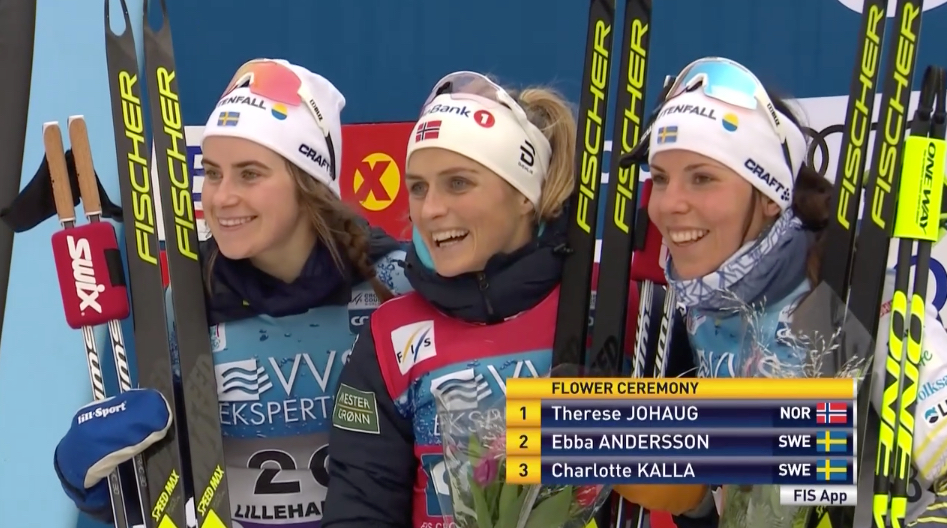
On a track of snow surrounded by green fir trees and a soggy landscape, the women skied two laps of 5 k course. Norway’s Therese Johaug was the fastest skier at every checkpoint to win in a time of 26:22.4 minutes. Ebba Andersson, the upstart Swede skied to second (+9.2), and teammate Charlotte Kalla was third (+15.7).
Collectively, it was a strong day for the U.S. women with four skiers in the top-30.
Sadie Bjornsen of the U.S. Ski Team (USST) finished in ninth (+1:17.0) after placing third in yesterday’s skate sprint. Rosie Brennan (APU) skied to 11th (+1:29.3), the USST’s Jessie Diggins 12th (+1:29.9), Caitlin Paterson (CGRP) 30th (+2:28.2), Kaitlynn Miller (CGRP) 60th (+4:10.4), and Ida Sargent of the USST 63rd (+4:18.4), and Kelsey Phinney (SMS T2) 65th (+4:22.5).
The men raced three times around the 5 k loop for 15 k total and three times up the course’s big climb. In this early season, many of the perceived pre-race favorites finished further back in the field.
Norway’s Sjur Røthe won in a time of 36:34.0 minutes. By the 8.3 k time check, Røthe took control of the race. Teammate Didrik Tønseth placed second (+6.0), while Russia’s Denis Spitsov was third (+28.6).
Canada’s Alex Harvey was the best placed North American in 17th (+1:20.5). Also for Canada, Andy Shields was 61st (+3:08.4), and Russell Kennedy (TEAM R.A.D.)64th (+3:17.0)
For the U.S., Erik Bjornsen of the U.S. Ski Team (USST) finished 43rd (+2:24.5), David Norris (APU) 54th (+2:44.5), Simi Hamilton (USST) 56th (+2:59.4), Paddy Caldwell (USST) 67th (+3:33.1), Kevin Bolger (USST) 68th (+3:38.7), Scott Patterson (USST) 73rd (+3:52.3), and Adam Martin (CGRP) 75th (+4:05.0).
SuperTour (West Yellowstone, Mont.): 1.3 k Freestyle sprints
The fastest qualifier for the men on Saturday in West Yellowstone was SMS T2 athlete Andy Newell. The Vermont native, now residing in Bozeman, Mont., won in a time of 2:35.53 minutes. His margin of victory was 7.26 seconds over second fastest qualifier, Alaska Pacific University (APU) skier Logan Hannenman. Newell’s teammate, Ben Saxton qualified in third (+7.79).
Newell advanced to the finals by winning the first heat and first semifinal.
In the finals, Newell controlled the pace and made clear that at thirty five years old, he can still light up the domestic ranks. Newell won in a time of 2:41.66 minutes. Craftsbury Green Racing Project’s Ben Lustgarten placed second in 2:43.55 minutes, and University of New Mexico skier Ricardo Izquierdo-Bernier was third in 2:45.66 minutes.
Adam Luban of the Sun Valley Ski Education Foundation Gold Team finished in fourth, Forrest Mahlen of Alaska Pacific University (APU) was fifth, and Ben Saxton (SMS T2) placed sixth in the men’s final.
Julia Kern, a member of the U.S. Ski Development Team (UUSDT) and SMS T2 , won the women’s qualifier in 3:08.58 minutes. Second in the qualifier, also from SS T2, was Erika Flowers who finished 2.5 seconds behind Kern. University of Utah skier, Julia Richter qualified in third (+3.22).
Like Newell, Kern won both her quarterfinal and semi to make the finals.
Kern won the women’s final in 3:09.85 minutes. APU’s RosieFrankowski, the day’s fourth fastest qualifier, was second in a time of 3:11.37 minutes. Teammate Hannah Halvorsen (APU/USSDT) placed third, stopping the clock in 3:12.51 minutes. Halvorsen placed sixth in the qualifier.
Flowers ended up fourth in the finals, while Richter and Utah teammate Karianne Moe, placed fifth and sixth, respectively.
The women’s podium from the 2018 1.3 k World Cup freestyle sprint in Lillehammer, Norway. Sweden’s Jonna Sundling (center) won, teammate Stina Nilsson (left) was second, and U.S. skier Sadie Bjornsen (right) third. (Photo: Fischer/Nordic Focus)
With the two big climbs over 1.3-kilometer freestyle sprint course, the women’s World Cup freestyle sprint course in Lillehammer, Norway packs a quad-burning punch. With lungs then legs poaching any extra oxygen, the women’s final, which featured four of six athletes from Sweden, was a primetime show.
Jonna Sundling of Sweden crossing the line first in the final of the women’s 1.3 k sprint in Lillehammer, Norway. (Photo: Fischer/Nordic Focus)
Nilsson is a finisher, known for her closeout efforts in the finishing straight. But as she and twenty-three-year-old Sundling glided into the S-turns before the final 100 meters, Sundling’s skis looked to have a glide-advantage.
It didn’t take long down the stretch for Sundling to pass Nilsson for her first career World Cup victory. She won in a time of 2:52.74 minutes. This was Sundling’s 29th World Cup start, and her second podium. She placed second last season in Falun’s skate sprint.
Sundling qualified for the heats in 26th (+5.74). She advanced to the semis by winning the first heat. However, she was a lucky loser in the first semi-final to advance to the six-skier final.
Nilsson placed second (+.34), the U.S. Ski Team’s (USST) Sadie Bjornsen was third (+3.03).
Sadie Bjornsen of the US (bib 6) out lunges Sweden’s Ida Ingemarsdotter in the second semifinal during the 2018 Lillehammer, Norway World Cup skate sprints. (Photo: Fischer/Nordic Focus)
For Bjornsen, she showed the early season form reminiscent of last season. During the 2017-2018 World Cup, Bjornsen posted a second place during the first weekend’s classic sprint, and a third place in the Lillehammer classic sprint the following weekend.
It was Bjonrsen’s sixth career podium on the World Cup circuit.
“I think sometimes I get easily pushed around a bit, it’s harder when your skis are not just going straight like classic,” Bjornsen said in the post-race press conference about her need to ski for position. “I was just focusing on trying to be in a position to really be in the front of the pack at the top of that climb. I kept finding some openings on the right side of the track to pass some people.”
Bjornsen displayed keen instincts on the final climb. Even more impressive was her display of horsepower as she took a seam up the right-hand side, and began gapping fourth, fifth, and sixth place behind her.
“Then coming into the finish, I tried to start free skating like three seconds before I wanted to because I knew that that speed would carry me across the finish,” Bjornsen said.
Bjornsen was the fastest North American qualifier in sixth, 1.88 seconds behind the speediest qualifier, Sweden’s Hannah Falk, who stopped the clock in 2:56.43 minutes.
Bjornsen advanced to the semis by placing second to Falk in the third heat. It was déjà vu in the second semi-final, where Bjornsen again placed second to Falk to secure a spot in the final.
Bjornsen enters Saturday’s 10 k individual start classic in third overall for the Lillehammer three-day tour.
The U.S. Ski Team’s Jessie Diggins skiing next to Russia’s Yulia Belorukova in the second heat during Lillehammer, Norway’s 1.3 k World Cup freestyle sprint. Diggins placed 17th overall.
After qualifying ninth and 12th respectively, U.S. skiers Rosie Brennan (APU) and Jessie Diggins (USST) did not advance to the semi-finals. Diggins and Brennan raced in the second heat. Diggins placed fourth, Brennan fifth.
Diggins finished the day in 17th, Brennan 21st.
Also for the U.S., Ida Sargent (USST) qualified 34th (+7.28), Kelsey Phinney (SMS T2) in 38th (+8.76), Caitlin Patterson (CGRP) 59th (+13.18), and Kaitlynn Miller (CGRP) 73rd (+20.78).
USST athlete Sophie Caldwell did not start as she is fighting a cold.
No Canadian women were entered.
Racing continues tomorrow for the women with a 10 k interval start classic race.
The women’s podium from the 2018 1.3 k World Cup freestyle sprint in Lillehammer, Norway. Sweden’s Jonna Sundling (center) won, teammate Stina Nilsson (left) was second, and U.S. skier Sadie Bjornsen (right) third.
FIS Cross-Country World Cup in Lillehammer Norway: Freestyle Sprint
In Friday’s women’s 1.3-kilometer freestyle sprint in Lillehammer, Norway, the first day of three successive days of World Cup racing, the women’s sprint final was stacked with Swedes, with four of six athletes sporting the yellow, blue, and white.
In the final, Jonna Sundling of Sweden passed teammate Stina Nilsson meters before the finish line to take the win in 2:52.74 minutes. It was Sundling’s first career individual World Cup win. Nilsson placed second (+.34), the U.S. Ski Team’s (USST) Sadie Bjornsen was third (+3.03).
Evelina Settlin, also of Sweden, placed fourth (+3.82), Kristine Stavås Skistad from Norway was fifth (+6.65), while the day’s fastest qualifier, Hannah Falk, finished sixth (+9.81).
American’s Jessie Diggins and Rosie Brennan were knocked out when they placed fourth and fifth respectively in the second heat. The top-four spots in the second heat were separated by 0.42 seconds. Diggins finished the day in 17th, Brennan in 21st.
Sweden’s Falk won the qualifier in 2:56.43 minutes.
The U.S. Ski Team’s (USST) Bjornsen was the fastest North American qualifier in sixth (+1.88). Brennan qualified in ninth (+3.11), Diggins 12th (+3.66).
Ida Sargent (USST) qualified 34th (+7.28), Kelsey Phinney (SMS T2) in 38th (+8.76), Caitlin Patterson (CGRP) 59th (+13.18), and Kaitlynn Miller (CGRP) 73rd (+20.78).
USST athlete Sophie Caldwell did not start as she is fighting a cold.
No Canadian women were entered
The men raced on a slightly longer 1.6 k course. Italy’s Federico Pellegrino, known for his skate sprint flash, won the men’s final in 3:19.17 minutes. On-form Norwegian Emil Iversen was second (+0.44), while Canada’s Alex Harvey, took third (+0.68).
Norway’s Sindre Bjørnestad Skar placed fourth overall (+0.91), with Finn Hågen Krogh racing to fifth (+1:07). Finland’s Ristomatti Juhani Hakola crossed the line in sixth (+2.43).
Norway’s Johannes Høsflot Klæbo won the qualifier in a time of 3:07.63. Klæbo placed sixth in the first semifinal finishing over thirty seconds back after breaking a pole.
Canada’s Alex Harvey and USST skier Simi Hamilton were the only North American men to qualify for the heats. Harvey qualified 17th (+7.59), Hamilton 22nd (+8.72). While Harvey eventually moved onto the final, placing third, Hamilton bowed out in the third heat. Hamilton placed fourth and was unable to advance as a lucky loser. Hamilton finished 19th overall in Friday’s sprint.
For Canada, Andy Shields placed 60th (+14.59), Russell Kennedy (Team R.A.D.) 64th (+15.21), Julien Locke (CNST) did not start.
The USST’s Kevin Bolger was the next best placed American in 61st (+14.63). Also for the USST, Erik Bjornsen was 63rd (+15.04), Paddy Caldwell 82nd (+19.34). David Norris (APU) placed 90th (+20.71), Scott Patterson of the USST finished in 92nd (+22.21), and Adam Martin (CGRP) 108th (+32.72).
The women’s 1.4-kilometer classic sprint podium (l to r): Sweden’s Maja Dahlqvist, Russia’s Yulia Belorukova and Ida Ingemarsdotter of Sweden. (Photo: Fischer/Nordic Focus)
FIS Cross-Country World Cup in Kussamo, Finland: Classic sprint
On Saturday in Kussamo, Finland the 2018/2019 World Cup season began with a 1.4-kilometer classic sprint.
Twenty-three-year-old Yulia Belorukova from Russia won the final in 2:52.62 minutes. It was Belorukova’s first World Cup win. Second place went to Sweden’s twenty-four-year-old Maja Dahlqvist who crossed the line 1.12 seconds back. Also from Sweden, Ida Ingemarsdotter was third (+1.51), Norway’s Maiken Caspersen Falla fourth (+1.52), Krista Pärmäkoski of Finland fifth (+4.71), and Stina Nilsson of Sweden, sixth (+12.33). Nilsson crashed in the final.
In the women’s qualifier, Russia’s Natalia Nepryaeva set the fastest time in 2:56.50 minutes. Seventy-three skiers started the qualifier.
Three U.S. Ski Team (USST) women advanced to the heats by qualifying in the top-30. Sadie Bjornsen in 5th (+3.01), Sophie Caldwell in 22nd (+6.97), and Ida Sargent 24th (+7.23).
Caldwell and Sargent did not advance out of the heats. Caldwell was third in the first heat, won by second fastest qualifier, Falla. Caldwell finished 0.36 seconds behind Falla and ultimately did not secure a lucky loser spot. Sargent raced in the third heat where she placed sixth (+4.50).
Four U.S. women bowed out in the qualifier, with last season’s second overall skier in the World Cup standings, Jessie Diggins, placing 33rd (+9.05). Rosie Brennan (APU) skied to 38th (+10.74), Kelsey Phinney (SMS-T2) 46th (+13.49), and last season’s overall SuperTour leader, Kaitlynn Miller (CGRP), was 58th (+18.06).
Kaitlynn Miller racing for the U.S. in the women’s 1.4-kilometer classic qualifier on Saturday in Kussamo, Finland. (Photo: Fischer/Nordic Focus)
No Canadian women entered the race.
In the men’s race, last season’s World Cup overall and sprint cup winner, Johannes Høsflot Klæbo, scorched the qualifier in 2:28.95, winning by 3.21 seconds over he next fastest qualifier, teammate Eirik Brandsdal.
Klæbo won his heat and his semifinal. But the semi was tight: Klæbo won by 0.1 seconds over Russia’s Alexander Bolshunov.
In the final, Bolshunov won in 2:29.35 minutes, Klæbo was second (+0.31), Brandsdal third (+1;35). Also of Norway, Emil Iversen placed fourth (+3:04), Russia’s Gleb Retivykh fifth (+3.86), and Norwegian Sondre Turvoll Fossli sixth (+4.85).
The only North American to advance to the heats was Canada’s Alex Harvey, who qualified in 25th (+9.40) and ended the day in eighth. Harvey advance out of the heats by placing second to Russia’s Gleb Retivykh in the fourth quarterfinal. In the second semifinal, Harvey placed fourth (+2.30) and did not advance as a lucky loser.
Also for Canada, Julien Locke (CNST)finished 69th (+15.43), Andy Shields 75th (+18.59), and Russell Kennedy (Team R.A.D.) 76th (+18.61).
For the U.S., Erik Bjornsen (USST) placed 42nd (+11.41), Kevin Bolger (USST) 55th (+13.19), Ben Saxton (SMS-T2) 70th (+15.68), David Norris (APU) 78th (+19.05), and Simi Hamilton (USST) 82nd (+1:11).
Jessie Diggins (U.S. Ski Team) racing to 10th in the 2018 World Cup women’s 10 k classic in Planica, Slovenia. (Photo: Salomon/NordicFocus)
Welcome to FasterSkier’s World Cup Preview, where we check in with the top-10 teams from last year’s FIS Cross Country World Cup tour before the season starts. The World Cup begins with a classic sprint in Ruka, Finland on Nov. 24th.
***
United States
Overall in Nations Cup Last Year: 5th
Women’s Ranking 2017/2018:3rd
Men’s Ranking 2017/2018:11th
U.S. Skiers to Watch:
The high note last season was the gold medal team sprint performance by Jessie Diggins and Kikkan Randall. That pinnacle proved U.S. Ski Team (USST) coaches, wax techs, support staff, and of course athletes, could position themselves to succeed on the quadrennial winter sport prime-time stage. Time to exhale.
On both the men’s and women’s side, countless standout performances are vivid. Yet the collective success on the U.S. women’s team will remain a generational benchmark. It’s a good hunch, with the imminent 2018-2019 season, the women’s team has not hit it’s apogee.
This much is for certain: despite the retirements ofRandall and Liz Stephen, the U.S. women’s team remains loaded. Sophie Caldwell was the third ranked sprinter in the world last season. Sadie Bjornsen was top-10 in both the distance and sprint rankings, and sixth in the overall. Ida Sargent, despite breaking her thumb prior to the Olympics, finished 23rd in the sprint cup.
Although Rosie Brennan was not renamed to the 2018-2019 USST, she appears fully recovered from mono and will be starting the season on the World Cup as a discretionary selection.
Each World Cup weekend last year was time to check results and determine not if any of the women’s team had shined but who. The individual milestones were many.
Diggins’ season was a non-stop stream of highlights. In a post-Marit Bjørgen landscape, the Norwegian legend has retired, Diggins is poised to become even more of a force.
Not that anyone ever doubted Diggins, but watching Diggins charge and string out the field on January 28, during the 10-kilometer mass start freestyle in Seefeld, Austria was pure aerobic theater. She set the pace. She dictated the narrative. The move didn’t resemble an athlete taking a chance, but an athlete shifting into their top race gear and accelerating to the line. Pure confidence. For the remainder of Diggins’ season, there was no doubt.
Even with a skipped World Cup weekend in Lahti, Finland to manage media obligations back in the U.S. after the Olympic Gold, Diggins finished second overall on the World Cup.
Simi Hamilton (U.S. Ski Team) racing to 13th in the men’s freestyle sprint qualifier at 2018 World Cup Finals in Falun, Sweden. He went on to finish the day in 14th overall. (Photo: Fischer/NordicFocus)
On the U.S. men’s team, Andy Newellstepped down from full-time World Cup racing with a goal of making the 2019 World Championship team. Noah Hoffman retired and attends university. Simi Hamilton, the 17th ranked sprinter on the World Cup last season, is the veteran. Deep into his international career, Hamilton brings poise and power to the sprint roster. Paired with Erik Bjornsen, Hamilton co-leads a team sprint contender. After the duo placed sixth in the Olympic team sprint, Hamilton and Bjornsen are a possible breakthrough team for the Seefeld, World Championships.
Erik Bjornsen posted 13 top-30’s with an individual best of ninth place in the Seefeld 15 k mass start.
Scott Patterson comes off an Olympics and Holmenkollen 50 k where his ability to perform under pressure cemented him as a premier male long-distance skier. He placed 18th in the Olympic 30 k skiathlon and 11th in the marquee 50 k classic — a best U.S. men’s result since 1976. Patterson reinforced that performance with a 16th in the Holmenkollen 50 k skate.
New to the USST is Kevin Bolger. This season will be his first full-time European based campaign. Bolger more than impressed when he placed an astounding 11th overall in Lahti’s skate sprint last March. It was Bolger’s first career World Cup.
Paddy Caldwell will begin the season on the World Cup. He had several standout time of day performances in skate races last season.
Non-USST skiers starting on the World Cup will include overall SuperTour leaders David Norris and Kaitlynn Miller.
Caitlin Patterson (CGRP) and Kelsey Phinney (SMS T2) were discretioned as distance and sprint athletes respectively for early season World Cups. Adam Martin (CGRP) was a discretionary selection for the men’s distance races, his start rights begin in Lillehammer, Norway. Ben Saxton is scheduled to race only the classic sprint in Ruka, Finland.
News of Note from USST Head Coach Chris Grover:
On the men’s team: “The men have been in great shape this summer and fall,” Grover emailed FasterSkier. “Look for great results right away from Simi and Erik; both have had very productive preparation periods. Kevin Bolger has also had a great summer of training and looked very good in our October Park City camp. Scott Patterson had a broken toe to deal with for much of the summer but is doing well now. As you suggest, he’ll bring more experience to his WC campaign this season. You’ll see him in action first at the FIS opener in Beitostølen on Sunday, Nov. 18 (15 km F). Paddy Caldwell has been wrestling with occasional elbow tendonitis ever since New Zealand camp, so there is a decent chance that he has a slower start to the World Cup.”
Season goals: “The women’s team is a veteran squad that all now understand what it takes for them individually to be in top fitness in February. Our goal for Seefeld (women and men) is 3 medals and we have targeted 5-6 race days where we have good chances to win those medals. And I believe this World Cup season will be one of our best, if not the best. It’s going to be a great season to be a fan of USA cross country ski racing.”
On leadership: “Although we are missing Kikkan, Andy and Liz, and their strong leadership, we’ve had an excellent team atmosphere this preparation season, and we’ve had a lot of fun. Multiple athletes are stepping up to fill the leadership vacuum left by our retiring veterans. I’m really looking forward to getting on the road with this team (both USST and invited discretionary athletes) and watching this new squad in action.”
2018 U.S. Ski Team camp at the Snow Farm in New Zealand, with author Alayna Sonnesyn (teal jacket) in the middle of the group shot. (Photo: Matt Whitcomb)
The following was written by Alayna Sonnesyn, a new member of the Stratton Mountain School (SMS) T2 Team who graduated from the University of Vermont (UVM) this past spring.
Originally from Plymouth, Minnesota, Sonnesyn, 22, raced on the UVM Ski Team for four years and qualified for four NCAA Skiing Championships teams. She placed second and third in two races at 2017 NCAA Championships, and in her senior season, won the first five Eastern Intercollegiate Ski Association (EISA) races and went on to reach the podium in 10 out of 11 EISA races. Sonnesyn expressed an interest in exploring the dilemma many of the nation’s top skiing talents face out of high school: whether to attend college or get an early jump on a pro-racing career. She plans to post this two-part series on her blog as well.
***
For the first time in 17 years I will not be going back to school this fall. Saying that out loud is more daunting than I had anticipated. For the most part, the classmates that I graduated with can say that they are “going to grad school,” “starting a new job,” or “taking a year off to travel,” but I still don’t know where I lie. I am not taking any classes this year, I am not working anywhere consistently, and I am doing more than just traveling to explore, I’m traveling to race!
I am wrapping up a three-week training camp in New Zealand with the SMS, Craftsbury, and US Ski Team. When I walked through customs I had to write down my reason for visiting New Zealand: Was I a student? Was I visiting a family or friend? Was I working? What was my job? In the rush of the moment and due to habit, I wrote that I was still a student and continued on my way. I later had a few reflections; I still haven’t reached the point yet where I can say I have a job. I don’t have a salary and there are no company benefits. Yet, I work 24/7 toward my job — my job is ski racing. But why is this so hard for me to admit to myself? Is it because, for my entire life, I’ve been a student? What if I hadn’t taken this route? How do others make this decision?
National Training Group (NTG), summer 2013, in Park City, Utah.
Racing throughout high school, I was given a number of perspectives about picking skiing versus school. My friends were all preparing to go to college and I always assumed I would go to college, too. My parents and older sister went to school, why wouldn’t I go as well? But then I thought about skiing. I never had the most outstanding results in high school (never qualified to race internationally), but I was good enough to qualify for regional and national level camps like REG, NEG and NTG. I traveled to these camps and trained with other high-level athletes, getting more and more motivated by each skier or coach that I met. Then the thought came to me… what if I didn’t go to college? I could focus on training, make those vital steps toward international racing, and continue along the “pipeline” that so many Olympians had followed. Maybe I would make bigger jumps and improve my skiing exponentially? I was entering the unknown and I was unsure how to pick the right choice for me. Looking back on this four years later, I realize that I was far from alone in this predicament.
I have since had the opportunity to talk to a wide variety of skiers and competitors and have learned so much that I wish I knew in high school. It’s OK to be confused. It’s OK to make your own path. Every athlete is in a different situation, comes from diverse athletic and academic backgrounds, and has various goals that they hope to achieve post-high school.
“I’ve always believed that the most important thing to remember when discussing the decision to go to school or not (or when to go to school) is that is it a completely individual decision and the right decision for one person might not be the right decision for the next.” — Sophie Caldwell
Personally, I finally decided that taking a gap year might be too big of a jump for me. I wasn’t ready to focus on skiing and I had a lot of goals for myself academically. I decided to attend the University of Vermont and upon reflection, can admit that this was one of the best decisions of my life. Similarly, SMS teammate, Kelsey Phinney, went from high school in Boulder, Colorado, directly to Middlebury College.
“The reason I chose Middlebury College was simple: I went to visit and I was ready to unpack and stay for good. I loved the people, the area, the ski team, and the classes I sat in on.” — Kelsey Phinney
Carnival love, with Kelsey Phinney (top) and Katie Feldman.
Kelsey and I both fell in love with our schools from the start and knew we were where we belonged. We took these college experiences as learning opportunities; maybe we wouldn’t have been ready to jump right into the professional circuit but we both determined this was the right path for us.
“I loved the experiences I had on the Carnival circuit. Both good and bad times taught me a lot about life and skiing, and I felt like the balance of school and sport made me better at both,” Kelsey reflects.
Similarly, Sophie Caldwell had her mind made up without the need to hesitate over a gap year or jumping into full-time skiing.
“I chose to go to college right out of high school, and it was something I had always known I wanted to do. I knew there was a good chance I wanted to ski professionally at some point in my life, but when I was 18, I wasn’t ready to 100% commit to skiing,” Sophie, a Dartmouth graduate, explains.
With academic goals in mind and the confidence to pursue skiing in the long run, sometimes there’s no need to question it. Going directly to college might challenge you more than you think and it might make you question what you’re doing. The balance of school and skiing is great, but it’s TOUGH! At least you worked through those challenges and figured out where you want to be though.
“I definitely had my ups and downs throughout college and at times I considered not pursuing skiing after college, but by the time I entered my senior spring, I knew I wanted to give skiing professionally a shot and knew it was because it was what I wanted to do, not what I had to do,” Sophie notes.
Over the course of four years, we were able to say goodbye to our homes, grow into adults and develop as skiers, allowing a much smoother transition into the professional racing circuit post-college. This decision to go right to college made sense for Kelsey, Sophie and me — it was simple; but I recognize that this choice isn’t as straightforward for everyone.
***
“I loved my time at Burke and wasn’t quite ready to leave. I also didn’t know where I wanted to go to college as part of me wanted to go out west while part of me wanted to stay closer to home.” — Ida Sargent
The conflict of picking a school, a place we are willing to spend at least four years of our lives at, can be intimidating to anyone. Taking a year off to think and explore what motivates you once the structure of school is taken out of the picture can be extremely vital to one’s skiing longevity. Other times, this year off can be done to test out what skiing professionally is actually like.
“I wanted to test out whether I could do only professional skiing.” — Katharine Ogden
A feat that might sound easy to accomplish — ski, eat, sleep, repeat — can’t be THAT hard! But what happens when you suddenly put all of your time and energy into one goal?
“Ironically, my gap year did not turn out even close to how I had planned or imagined!” reflects Julia Kern.
Julia Kern with swollen legs after surgery, requiring A LOT of physical therapy during the summer.
After facing an early summer surgery for compartment syndrome and then an untimely back injury in the fall, Julia notes that her gap year was extremely tough with plenty of lows and setbacks.
Ida Sargent offers, “My PG year was a bit of a disappointment as I wasn’t as happy as I was expecting and I also didn’t feel like I made as big of a jump with my results as I had hoped.”
“I think in hindsight it was a good philosophy but I think I approached it wrong. I didn’t do a good job securing other things to do besides training and was thus pretty bored, which led to me putting a lot of stress on skiing and racing,” says Katharine Ogden.
Maybe taking a gap year isn’t as easy as it sounds? Coming face-to-face with this type of ski-focused intensity as an 18 year old can be challenging.
“It showed me how much I really wanted to go to college,” offers Katharine.
It can also be validating, as it can prove to oneself where they really belong at that point in their life.
“It made me realize that I wasn’t ready to ski full time and I still needed balance in my life,” reflects Ida.
What might be the most beneficial aspect of taking a gap year are the lessons you learn throughout. How to deal with the pressure, free time, potential obstacles, and how to respond when you’re suddenly put in an unfamiliar situation.
“My gap year turned out to be far from ideal from a training/fitness standpoint, but I became very in tune with my body, learned how my body responds to training, became mentally tougher, and learned that I love the skiing lifestyle (even if it is tough sometimes) and that I want to ski at the highest level possible,” says Julia.
Some things you just can’t learn in a classroom.
Julia Kern (on table) still smiling!Julia Kern taking the time to think about something other than skiing during her gap year. (Photo: Julia Kern) How to pass the time away, when you have so much of it. (Photo: Julia Kern)
After taking a gap year to figure out what skiing was like full-time; Ida, Katharine, and Julia attended Dartmouth College (via various routes):
Ida states, “I started by going to school full time and I raced for Dartmouth for three years and then made the National team so I took my senior winter off to race for the USST and then I went back for a spring term my fifth year.”
“One year in [as a traditional student], I am very happy at Dartmouth and racing the collegiate circuit last year reignited my love for the sport,” adds Katharine.
While Julia contributes, “I chose Dartmouth because I wasn’t sure what skiing and school balance I wanted to have, but I did know that I wanted to be able to take terms off to race internationally.”
Regardless of which Dartmouth plan they followed, all three skiers seem to have enjoyed the choices they made. Whether taking a gap year is or isn’t part of your plan, the most important takeaway is that you should TAKE SOMETHING AWAY! Learn something new about yourself, about skiing, or about classes you want to study.
So what about other options for pursuing a ski career? Jessie Diggins and Andy Newell both chose to skip college and go straight into skiing. Stay tuned for my next post when I’ll include input from both of them as well as what U.S. Ski Team coach Matt Whitcomb has to say on this topic.
Julia Kern leads Katharine Ogden, her fellow Stratton Mountain School (SMS) and U.S. Ski Team development team member, during the Snow Farm’s 21 k Snow Rake at the 2018 Merino Muster in Wanaka, New Zealand. (Photo: Garrick Cameron)
Note: This article has been updated to include comments from Simi Hamilton of the U.S. Ski Team (USST) and Stratton Mountain School (SMS) T2 Team, and Kevin Bolger of the USST and Sun Valley Ski Education Foundation.
***
It’s that time of year again where several members of the U.S. Ski Team, along with top-level skiers from the Craftsbury Green Racing Project (CGRP) and Stratton Mountain School (SMS) T2 Team are training at the Snow Farm above the town of Wanaka, New Zealand.
The on-snow volume camp, which featured multiple days of racing, started Aug. 20 and continues through Sept. 10, and includes U.S. Ski Team (USST) athletes Jessie Diggins, Ida Sargent, Sophie Caldwell, Katharine Ogden, Julia Kern, Simi Hamilton, Kevin Bolger, and Paddy Caldwell, and coaches Matt Whitcomb, Jason Cork and Gus Kaeding.
According to Sophie Caldwell, conditions have been “amazing” for the duration of camp so far. “New Zealand had a great snow year and we’ve been lucky to have sunny days almost every day,” she wrote in an email to FasterSkier.
Japan’s Tomoka Satou (446) leads American Jessie Diggins (428) and others up a climb during the Merino Muster 42 k skate race on Sept. 1 at the Snow Farm in Wanaka, New Zealand. (Photo: Garrick Cameron)
Diggins called it the annual trip one of her “all-time favorite camps because the living at the Snow Farm is great, the food is outstanding, and you can step out the door right onto the 65+ km of trails!” she wrote in an email.
“I love having the chance to work on my on-snow technique for three solid weeks because that’s when I get to really see progress and make some changes in my striding,” Diggins wrote.
Apart from logging kilometers on snow and soaking up the vitamin D, the team has also spent time trail running in Wanaka.
“The highlight [of the camp] will probably be a crust cruise we go on in the next few days, but since we haven’t done that yet, some highlights so far are an awesome distance run down in Wanaka, and pretty much every day of bluebird skiing we’ve had up here!” Caldwell wrote.
The camp also coincided with the Merino Muster, a 42 k freestyle marathon that is part of the Worldloppet series, and the Winter Games NZ, which doubled as the Australia/New Zealand Cup FIS races and included three days of nordic racing this year at the Snow Farm: a 5/10 k freestyle individual start, a freestyle sprint, and a 10/15 k classic mass start..
Diggins finished a minute and 21 seconds faster than the second-place woman, Aurelie Dabudyk of France, while Hamilton edged Craftsbury skier Adam Martin by 3 seconds for the overall win.
“The day of the Merino Muster was gorgeous and sunny, with fast conditions,” Diggins wrote. “I loved getting the chance to race a long race, and starting with the men as one big field is really exciting! I hope to get to race the 42km race every year. Huge thanks to the volunteers and organizers for making it such a fun day.”
Crossing the finish line in 1:52:34 hours, Diggins placed sixth overall. Dabudyk was eighth overall and Alayna Sonnesyn (SMST2) was the third woman, 11th overall, 5:30 behind Diggins.
Meanwhile, Hamilton finished in 1:39:46, beating his time of 1:40:33 from last year’s race. Martin followed 3 seconds later, while Kyle Bratrud (SMST2) finished 24 seconds after from Hamilton in third, followed by Tomoka Satou of Japan in fourth (+45.0).
“The Merino Muster is always an awesome race,” Hamilton wrote in an email. “It actually lends itself to the type of intensity we are still mostly focused on in August/late September because the terrain and snow conditions usually make for a really good chance to get in about 1.5 hours of level 3 effort followed by a few minutes of really hard skiing in the last km before the finish. It’s a very rolling course and if you ski it in a pack with people switching leads it’s basically impossible to go much harder than level 3.”
Also on Saturday, Americans also took the top spots in the 21 k Snow Rake. Ben Saxton (SMST2) ran away with the overall win by more than 12 minutes in 47:48, while Paralympic sit skier Dan Cnossen placed second (+1:12:13) nine seconds ahead of Petr Sykora of the Czech Republic in third (+1:12:22).
Ogden was the fastest woman and second overall with a time of 50:29. Her SMS and USST teammate Kern finished 56 seconds later as the second woman, and Elizabeth Martin of the University of New Hampshire (UNH) followed in third, 7 minutes and 30 seconds behind Ogden.
With about 300 participants between three different races at the Merino Muster, Hamilton described the atmosphere as “super fun and light.”
“But the grooming always rocks and it’s just a really fun course to ski,” he added. “I think that in this day and age of social media being so huge and cross-country skiing gaining more attention in the US and world-wide, we’ll start to see more and more people showing up for the marathon. I feel like in the last few years alone their has been noticeably more attention and attendance each year. The quality of skiing is a small part of the race atmosphere here… New Zealand’s south island is one of the most beautiful parts of the world and the culture is so welcoming and comfortable.”
Many of the American skiers in New Zealand also competed in the Winter Games NZ races this week.
“The New Zealand Winter Games are also a huge opportunity to get back into racing mode and test out all the technique work we’ve been putting in so far!” Diggins wrote. “And if you know me, you know how much I adore 5km individual skate races, and we no longer get to do those on the World Cup. So I’m so grateful to the Snow Farm and race organizers for keeping such a fun and hard, fast race alive! I forgot how much it can hurt to go so hard for 5km, but it was fun to really get that lung burn back for the first time since last winter.”
Three days after her marathon win, Diggins won the 5 k skate at the Snow Farm in 15:02.6. The U.S. swept the top five with Sophie Caldwell finishing 10.5 seconds back in second place, Caitlin Patterson (CGRP) in third (+16.7), Sargent (USST/CGRP) in fourth (+1:02.6), and Kelsey Phinney (SMST2) in fifth (+1:16.6) out of eight women.
Kyle Bratrud (SMST2) gets a feed from U.S. Ski Team coach Jason Cork during the 2018 Merino Muster 42 k skate race at the Snow Farm in Wanaka, New Zealand. He finished third behind two other Americans. (Photo: Garrick Cameron)
In the men’s 10 k skate on Tuesday, Bratrud took the win in 27:48.1, 21 seconds clear of Kaichi Naruse of Japan in second, while Craftsbury’s Ben Lustgarten and Martin (CGRP) followed in fourth (+23.0) and fifth (+44.0), respectively. Eight men competed.
Wednesday featured 1.1 k skate sprints, which saw Sophie Caldwell take the win in a field of 10 women, ahead of Sargent in second and Phinney in third.
“The sprint was a short and tactical race that was awesome practice for what’s to come this winter,” Caldwell wrote. “It was really fun toeing the line with my USST and SMS training partners. On one hand, that final could have been any day of summer training, but it also could be a World Cup heat! It’s pretty cool to be pushed by so many strong training partners and friends and we were psyched to throw on a bib and put in a race effort.”
In the men’s final, Bolger landed the top spot on the podium, ahead of Saxton in second and Satou in third. Eleven men competed in the sprint.
“I really enjoy these early session races it gives us as races a chance to get in the mindset and practice real race strategy,” Bolger wrote in an email. “I wanted to go out there test myself, I approached every round like a final and attacked from the start getting out in front and leading into the finish, and was very happy to end the day on top, especially after a long camp down here with the US crew.
“… Coming down here and having a good result in the sprint is of course a huge confidence booster heading into the September/ October training months, but there is still a ton of preparation to be done,” he added.
On the final day of Winter Games NZ racing, Diggins continued her undefeated streak (after skipping the sprint), winning the 10 k classic mass start, while Patterson placed second and Sargent placed third. Saxton picked up his second win of the week, while Martin took second and Lustgarten third.
Complete results will be posted once they’re available.
“We have been incredibly lucky with weather and conditions this year,” Hamilton noted. “Usually, when you’re here at the Snow Farm for 3 weeks in the winter, you’re bound to get an extended period of really nasty weather and wind. But this year we’ve basically had sunshine and cold night time temps every single day, making for amazing skiing for pretty much 3 weeks straight. There is about 40-50 km of trails to ski when everything is groomed, so it’s essentially impossible to get bored. The highlight of our camp every year is a big crust ski up to and around Mt. Pisa. We are planning on getting out tomorrow [Friday, Sept. 7] because the crust hasn’t been great yet while we’ve been here, but conditions for tomorrow look promising. But even when we can’t get out for a huge adventure like that, it’s just one of the best and most fun places in the world to train.”
The women’s 1.4 k freestyle sprint podium at Saturday’s World Cup in Lahti, Finland, with Norway’s Maiken Caspersen Falla (c) in first, and Sweden’s Stina Nilsson (l) and Hanna Falk (r) in second and third, respectively. (Photo: Fischer/NordicFocus)
Eight points. That’s the number that separated Norway’s Maiken Caspersen Falla and Sweden’s Stina Nilsson in the Sprint World Cup standings before Saturday’s freestyle sprint in Lahti, Finland.
Three sprints. That’s the number of World Cup sprint races that remained in the 2017/2018 calendar, one of which took place on Saturday.
With one down and a classic sprint and skate sprint to go, Falla’s lead has grown to 28 points. It’s not much, with 150 sprint points remaining in the two remaining races (100 for winning the Drammen classic sprint and 50 for winning the skate sprint at World Cup Finals in Falun), but she’s getting there. Let’s just say neither of these two women can afford to skip a sprint.
Coming off her last race of the Olympics, the team sprint (where Norway took bronze behind the U.S. and Sweden), Falla had 10 days to recover before Lahti. Nilsson had six days after notably racing to third in the 30-kilometer classic mass start on the last day of the 2018 Winter Games in PyeongChang, South Korea.
Six time zones away from Korea in Finland, Falla and Nilsson faced off once again, but instead of racing for gold (which Nilsson had claimed in the Olympic classic sprint), they’re in a race for the Sprint Crystal Globe (of which Falla is the two-time defending champion).
Norway’s Maiken Caspersen Falla celebrates her gold medal in the 2017 World Championships freestyle sprint in Lahti, Finland, ahead of Americans Jessie Diggins (19) and Kikkan Randall (r), who placed second and third, respectively. The third U.S. woman in the final, Sophie Caldwell (second from r) finished sixth. (Photo: Fischer/NordicFocus)
As alluded to, Falla had the edge on Saturday, winning the women’s 1.4 k skate sprint by 0.36 seconds over Nilsson in 2:54.83 minutes. She did it by leading from start to finish — a tactic she hadn’t necessarily planned nor desired —on the same course that she won on at World Championships last year. In that skate sprint, Falla bested Americans Jessie Diggins and Kikkan Randall for gold. Diggins and Randall placed second and third in that race, respectively, but the two did not contest Saturday’s sprint in Lahti. Instead, they were coming off a New York City media tour that involved several appearances with major TV networks.
But back to Falla. The 27-year-old left her competition chasing on Saturday, advancing to the final after placing second in her quarterfinal (0.71 seconds behind Nilsson) and first in the first semifinal (just 0.04 seconds ahead of Nilsson in second place).
She had qualified for the heats in 12th, 7.96 seconds off of the top time of 2:54.72 set by Sweden’s Hanna Falk.
“I was really stressed in the prologue,” Falla said afterward, according to an International Ski Federation (FIS) press release. “In the heats I had a better feeling.”
She had to fend off three Swedish heavy hitters in the final: Nilsson, Falk and Ida Ingemarsdotter.
But Falla never let any of them get ahead of her — an impressive feat on Lahti’s sprint course with two major climbs. The lone Norwegian in the final, Falla jetted out of the gate and into the lead, with Falk quick to challenge her before the first uphill. But Falla stayed ahead.
“I didn’t want the first position, but I just got it in the start,” Falla told FIS in a televised post-race interview. “So I just had to lie in front and do the best I could.”
While Falla continued to drive the pace, Sweden’s Falk took a breather near the back while Ingemarsdotter and Nilsson slotted into second and third. Germany’s Sandra Ringwald, in her first World Cup sprint final since the Tour de Ski in late December, skied in fourth, ahead of Falk and Switzerland’s Laurien van der Graaff.
Norway’s Maiken Caspersen Falla celebrates her win in the women’s 1.4 k freestyle sprint on Saturday at the World Cup in Lahti, Finland. (Photo: Fischer/NordicFocus)
Falla led the downhill then into last long, multi-tiered climb, while the three Swedes assembled hungrily behind her. Nilsson began her attack when they hit the steepest section near the top, but Falla was at least a step or two ahead as they rounded the 180-degree turn and began to descend down the other side.
Tucking into the stadium, Falla got low and used her fast skis to gain a few more meters on Nilsson. She then took a couple of strides to keep her momentum and finally launched her final V2 push toward the finish.
No one could match her; not Nilsson skiing closest to her, nor Falk or Ringwald just behind. She didn’t even have to lunge to secure the victory over Nilsson, but Falk and Ringwald did as they placed third (+0.78) and fourth (+0.88), respectively. For Ringwald, fourth place marked her best individual World Cup result in a little over a year (after she placed fourth in a 2017 skate sprint in Toblach, Italy).
For Falla, it was her second individual World Cup win of the season and first victory since Dec. 2 in Lillehammer, Norway, where she won the classic sprint. Falla was the 2014 Olympic champion in the individual skate sprint. And let’s not forget, she won the World Championships sprint in Lahti last year as well as the 2016 Lahti World Cup skate sprint.
“Last year here and also two years ago I was in front down the last downhill, and I succeeded there for the last three years so I knew it is very possible to lie in front as well,” Falla told FIS. “In the final I had Stina and Hanna behind me and I knew both of them are really fast. I have a big respect for them and I am very happy I could win today.”
Nilsson, who bested Falla for the classic-sprint gold medal in PyeongChang, had qualified for Saturday’s heats in 14th, 8.26 seconds out of first.
“I felt pretty good in the prologue, but in the end I was missing some seconds, which I probably lost after the start,” she told FIS. “In the heats I found my pace and I could keep all the way through to the final. In the final, I was not so fast after the start but I am happy to be on the podium again. It is very good for the sport that the battle for the Sprint Crystal Globe is still going.”
Falk also said she was satisfied with her end result, after winning her quarterfinal and advancing as a lucky loser in third in the semifinal with Falla and Nilsson.
“I had a very good qualification,” Falk told FIS. “I tried to fight in every heat. The final was hard but I am happy to be third today. I had a good speed before the last corner but it was always tight there. It was a tough fight between me and Sandra [Ringwald]. I’m happy to be third.”
Sadie Bjornsen (U.S. Ski Team) qualified fifth in the women’s 1.4 k skate sprint at the World Cup in Lahti, Finland, and went on to finish 17th overall. (Photo: Fischer/NordicFocus)
Four Americans in Top 30
Leading the Americans in the qualifying round was Sadie Bjornsen in fifth, 3.88 seconds off Falk’s fastest time. Sophie Caldwell qualified in 17th, Ida Sargent advanced in 21st and Rosie Brennan followed in 29th.
For Brennan, it was her first time back in the heats in about two months after she qualified in 21st in the Tour de Ski classic sprint on Oberstdorf, Germany. While the heats were canceled that day due to a storm, Brennan went on to finish the Tour in 24th overall. Since then, however, the U.S. Ski Team (USST) member has finished outside the top 40 in four World Cup races and one Olympic event (the 15 k skiathlon).
Despite finishing sixth in her quarterfinal on Saturday, 4.91 seconds behind Ingemarsdotter in first, Brennan’s overall result of 29th indicated she was back on track.
“I have been struggling with health and recovery since the tour,” Brennan wrote in an email to FasterSkier. “I’ve just been taking things day by day and trying to work through whatever issue I am facing. The Olympics was a huge disappointment for me. I did what I thought was best to prepare for the games, but have struggled with my health and my body and as a result was far from where I wanted to be at that time.”
In PyeongChang, she raced one event — the skiathlon — and placed 58th. She stayed with the team for the duration of the Games, hoping to have the opportunity to race the 30 k. But that wasn’t in the cards.
“It’s very challenging to be at the games and not be participating in the events that you have trained for over so many years,” Brennan reflected. “I have had some good races this year and have made some improvements so I am doing my best to remember that and try to see each day as a new opportunity. My goals moving forward are more about my feelings, my body, and my health than any results. I am very happy to have made a step forward today and am hoping my distance skiing will see the same results. I wasn’t able to ski my quarterfinal as well as I would have liked, but it’s been awhile since I’ve raced now so to just get another stab at it was a great step forward.”
Sophie Caldwell (U.S. Ski Team) racing to 17th in the Lahti skate sprint qualifier. She went on to reach the semifinals and place eighth overall. (Photo: Fischer/NordicFocus)
Out of the four Americans in the quarterfinals, Caldwell was the lone U.S. woman in the semifinals. She had raced to second in her quarterfinal, finishing 0.25 seconds behind Ringwald, who won that heat. But her road there wasn’t an easy one, as Caldwell skied up from near the back of the pack into second coming out of the final downhill. There, she scooted ahead of Norway’s Heidi Weng, who had been second at the time, while Weng dropped to last in the heat.
“… I had the ambition to do well, and it’s incredibly annoying when something like that happens,” Weng said, according to a loose translation.
She added that she didn’t discuss it with Caldwell after.
“I can’t do anything about it now,” Weng said. “Things like that happen in a sprint…”
Caldwell reflected that it might’ve been worth conserving less energy and using more to get in a better position before that last downhill.
“I found myself in the back there with no room to pass or respond to a move,” Caldwell wrote in an email to FasterSkier. “… There is a big draft on the final downhill and if you’re leading, you need to send it and have a good bullet tuck, and if you’re within contact of the leader, you can try to work the draft and in my quarter I was able to do that. I don’t remember there being contact with Heidi, but we both definitely bobbled a bit on the final corner.”
Caldwell’s first World Cup podium came in Lahti four years ago. Last year at World Championships, she reached the skate-sprint final and placed sixth overall.
On Saturday, she made it to the semifinals and finished fourth in the second semi, 1.46 seconds behind Ringwald in first.
“I have had some success in Lahti before and I’ve also had some disappointing results, and I think today was somewhere in between,” Caldwell wrote. “I enjoy how tactical this course can be with all the corners and transitions. I was feeling quite good today, but I struggled to find that extra punch and didn’t ski with the confidence or control I know I’m capable of, so even though the result is by no means a bad one, I was just disappointed in how I skied mentally in the semi final.”
She was pleased with her recovery after the Olympics, where she placed eighth in the classic sprint and fifth with the women’s 4 x 5 k relay.
“The Olympics can be physically and emotionally exhausting, so I made sure I took some time to take it easy and get my feet under me again,” Caldwell wrote. “I was really looking forward to getting back in the World Cup routine in Europe. We had a very long travel day, so we were feeling a little rugged the first day here, but some good sleep, food, and training had me feeling quite good a couple days later. I did some light intervals on Thursday that felt quite good and was psyched for today.”
Bjornsen described having some trouble transitioning from the Olympics back to the World Cup. She raced four events in PyeongChang, with a top individual result of 14th in the classic sprint.
“It was an interesting step back to the World Cup today,” Bjornsen wrote in an email to several media outlets. “It has been a real ‘homesick’ week here coming back from the Olympics, and sometimes hard to feel how your actual muscles are feeling instead of your head. Fortunately, my muscles felt surprisingly good in the qualifier and I felt really excited to see what I could do today!”
In her quarterfinal, she recalled getting “tangled” and losing her positioning on the first turn, leaving her chasing the rest of the group.
“I finally caught them on the very top of the course, but just narrowly missed getting into their draft down the hill, and missed moving with those top three,” Bjornsen wrote. “Sprinting has been everywhere from amazing to frustrating this year, and what I have learned is that you can never think too hard about it. Often for me, the difference between a fantastic day, and a frustrating day is some super move that I either find, or I miss.”
She ended up fourth in her quarterfinal, 2.84 seconds behind Falk in first, which put Bjornsen 17th overall.
“I am just looking forward to heading into tomorrow with a head that is back excited again, and some muscles feeling good!” Bjornsen wrote of Sunday’s 10 k classic. “I put a lot of focus into my form at the Olympics without much thought about afterwards. Fortunately, the majority of the World Cup field is in the same state, so now we are all just racing with what sort of energy and excitement we have left. I always kind of like that. It is raw and fun.”
Sargent finished the day in 27th overall after placing sixth in her quarterfinal, 1.07 seconds behind Sweden’s Anna Dyvik in first. After skiing in fourth in the middle of the race, Sargent moved up to second on the final downhill toward the finish. But on the tight lefthand corner before the finishing straight, she lost her position and momentum and slipped to sixth.
“Today wasn’t great but it was a huge step forward for me,” Sargent wrote to FasterSkier. “I haven’t raced much recently and was struggling with injury so I’m just super happy to be racing again and very excited to have a bunch more racing in the next few weeks.”
“I’m excited to feel like my fitness is still there after so much travel and not much racing,” Sargent wrote.
Canada’s Dahria Beatty just missed making the rounds in 34th place on Saturday in the Lahti World Cup skate sprint. (Photo: Fischer/NordicFocus)
Beatty 34th for Canada; Phinney 36th in First World Cup
Canada’s Dahria Beatty missed qualifying for the heats in 34th, 0.9 seconds out of 30th place. While she was the lone Canadian woman competing on Saturday, three other American women started, with Kelsey Phinney of the Sun Valley Ski Education Foundation (SVSEF) racing to 36th, 1.25 seconds out of qualifying, in her World Cup debut.
“I was pretty happy with my effort, definitely a little bummed to miss out on the heats, but cool to know that I’m pretty close to that level!” Phinney wrote in an email to FasterSkier. “I’m psyched to be here and getting a World Cup start was one of my main goals of the season. Being a second out of qualifying will for sure help stoke the fire for next year and I learnt a lot today from things that went right and things that didn’t.
“This was my first World Cup start and everyone has been so welcoming,” she continued. “I’ve been having a lot of fun and just trying to take it all in. … It’s hard to put the feeling of being at the start line of a World Cup into words, it’s something I’m hoping to get to experience a lot more of!”
(Her Sun Valley teammate Kevin Bolger, also in his first World Cup, placed 11th overall after reaching the semifinals in the men’s 1.6 k sprint. “I am so proud of Kevin, it was so special to get to watch him holding his own with the best in the world in the heats today! Really cool to see your teammate crush it in his first World Cup.”)
Phinney explained that Saturday was a one-time opportunity since she’ll be joining the OPA Cup trip on Monday before flying back to the U.S. for SuperTour Finals in Craftsbury, Vermont, later this month. She’s spent the better part of the last month racing in Norway, placing sixth in a FIS skate sprint in Åsen and 13th in a Scando Cup skate sprint last weekend in Trondheim.
“She had a really impressive Scando Cup Sprint last weekend, and has shown she can skate sprint with the best of them,” SVSEF Head Coach Chris Mallory wrote in an email to FasterSkier. “I thought she might squeak into the top 30 with a good day. She skied the first half of the sprint today very fast, so the pacing was just a touch off. But still, very solid effort for her first WC. She’s shown the speed is there, so she’ll be back.”
Kaitlynn Miller (Craftsbury Green Racing Project) on her way to 61st in the World Cup skate sprint qualifier in Lahti, Finland. (Photo: Fischer/NordicFocus)
Also for the U.S., two Craftsbury Green Racing Project (CGRP) skiers, Caitlin Patterson and Kaitlynn Miller, placed 56th (+20.12) and 61st (+21.70), respectively.
***
Notes: In the first women’s quarterfinal, Germany’s Victoria Carl skied up on the ski tails of Finland’s Krista Pärmäkoski, which caused both women to crash out of contention on the final downhill. Pärmäkoski had been skiing in second at the time, behind Nilsson in first. She finished fifth in that heat (+12.11) and Carl, who appeared to hit her head, took a long time to stand back up and crossed the line in sixth (+49.5). Carl was relegated to last (30th place) for obstruction.
German coach Janko Neuber told reporters after that, “She crashed, fell on the head and bruised the back of her neck. As a precaution she is being taken to the hospital for evaluations, but we are optimistic that it isn’t anything serious.”
Pärmäkoski, who finished the day in 21st overall, wrote in Instagram: “This was a bit tough but today, with the fall, shorts [sprints] were short. Fortunately tomorrow is another chance.”