From the FasterSkier archive — posts syndicated from athletes’ and coaches’ own blogs between 2004 and 2012, kept online as published. Current coverage is at fasterskier.com.
We’re done and dusted at the Olympics after a rockin’ women’s 50 k — the first-ever at the Games. Devon and Nat smash out a recap of the epic breakaway and the knock-down-drag-out battle for bronze.
We’ll be back next week. Reach us in the mean time at devon[at]fasterskier.com and nat[at]fasterskier.com. We’re really grateful for all the support during the Olympics — thanks for notes and encouragement.
A reminder: This is a homegrown podcast done by two guys working long hours and late nights. We’re also paying real money to be here in Italy. If you can, support the show and FasterSkier’s ongoing coverage with a voluntary membership.
Help Support Our Olympic Coverage!
FasterSkier will have our own Nat Herz on the ground at the Olympics, which, to be honest, is a very big financial lift for us. If you value the thoughtful work and access FasterSkier provides at championships like this one, please consider becoming a Voluntary Subscriber. Your support directly fuels the work we do to cover the people, places, and moments that make our sport special.
This article was made possible through the generous support of our voluntary subscribers who have helped put our Nat Herz on the ground at the Olympics. If you value coverage like this, please support FasterSkier with a voluntary subscription.
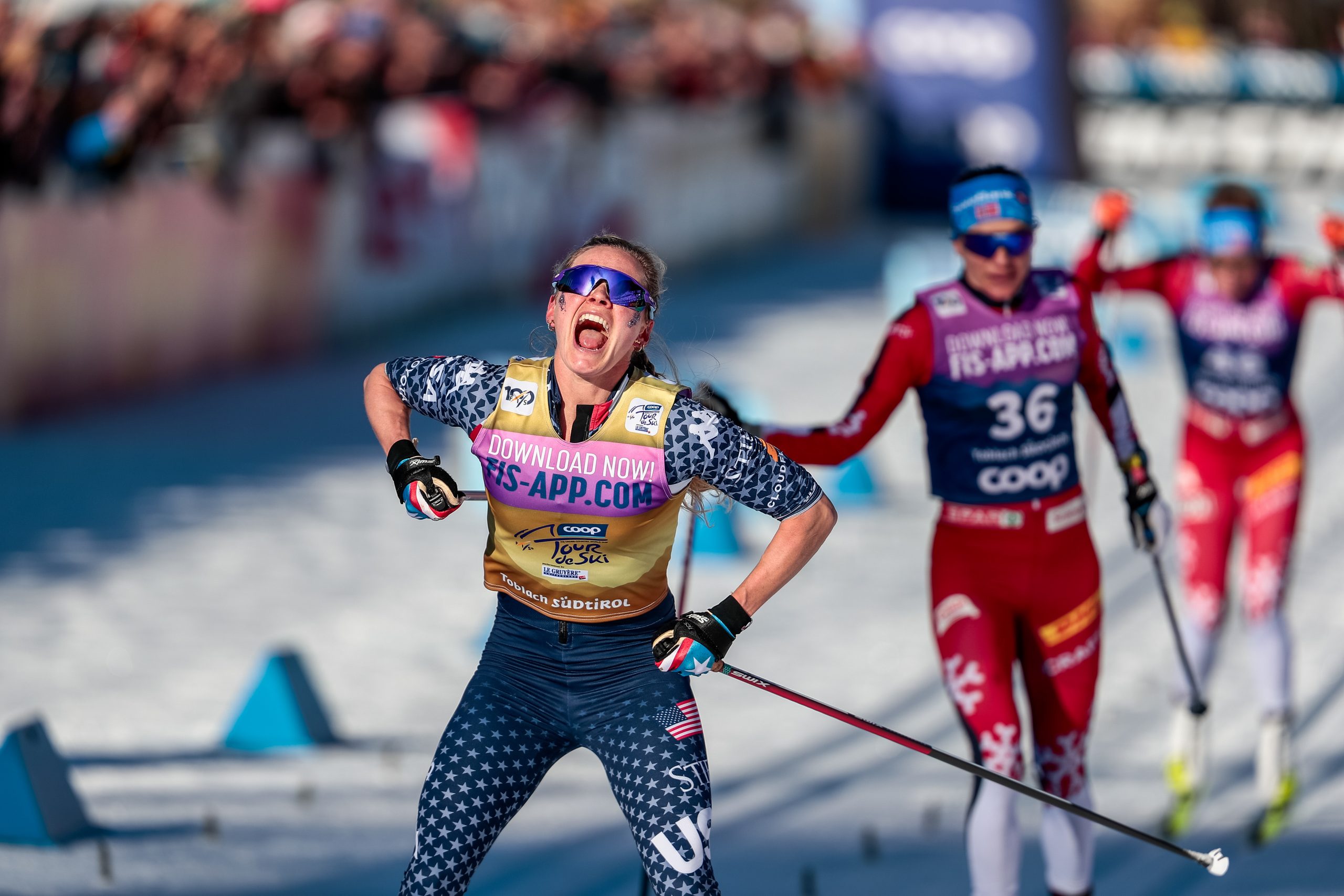
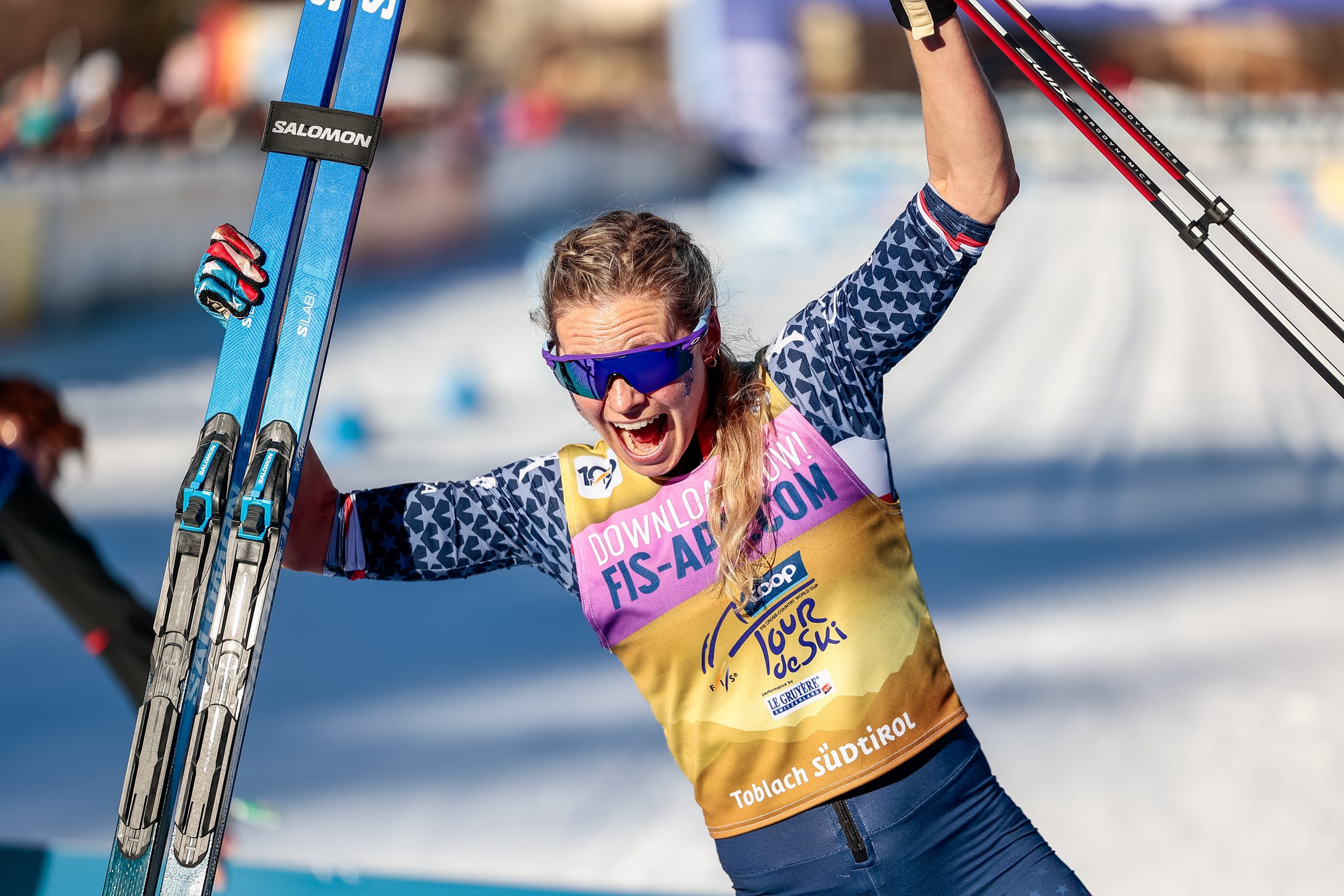
Joy at the end of a trying Olympiad: Ebba Andersson (SWE) celebrates her victory in the Olympic 50 k Classic. (Photo: Vanzetta/NordicFocus)
TESERO, ITALY — Two weeks of Olympic cross-country ski racing all comes down to this . . . fifty grueling kilometers of this, to be precise; a distance that women have raced only a few times on the World Cup and/or World Championship schedule, but a distance at which they are able to truly show their skills, their tenacity, and their ability as cross-country skiers.
These Olympics began with lofty expectations—in some cases, outrageously lofty—placed upon many skiers: Karlsson was seen as likely to win four golds: she started strong (winning gold in both the Skiathon and the 10 k Freestyle), but found herself benched by illness in the 50 k. Ebba Andersson was seen as a threat to topple her Swedish teammate, Karlsson, only to find herself toppled in a famously awkward and memorably catastrophic fall that cost Sweden the gold medal in the Team Relay. Jonna Sundling was billed as the best sprinter in the world (and was seen as likely to steal a medal in the Skiathlon, as well). Her moment in the Sprint spotlight was stolen by her own teammate, the rejuvenated Linn Svahn. And numerous mainstream reporters myopically favored Jessie Diggins to medal in all six events. After all, she’s the defending World Cup Overall Champion, right? And she’s currently leading the World Cup standings in both Overall and Distance, isn’t she? Reading those stats would seem to suggest that she’s the best skier in the world . . . and she may actually be that best skier, but the only skier who consistently lives up to such superlative headline predictions is the unmatchable Johannes Hoesflot Klaebo (who won all six of the men’s events here in the Olympic Winter Games of Milano-Cortina).
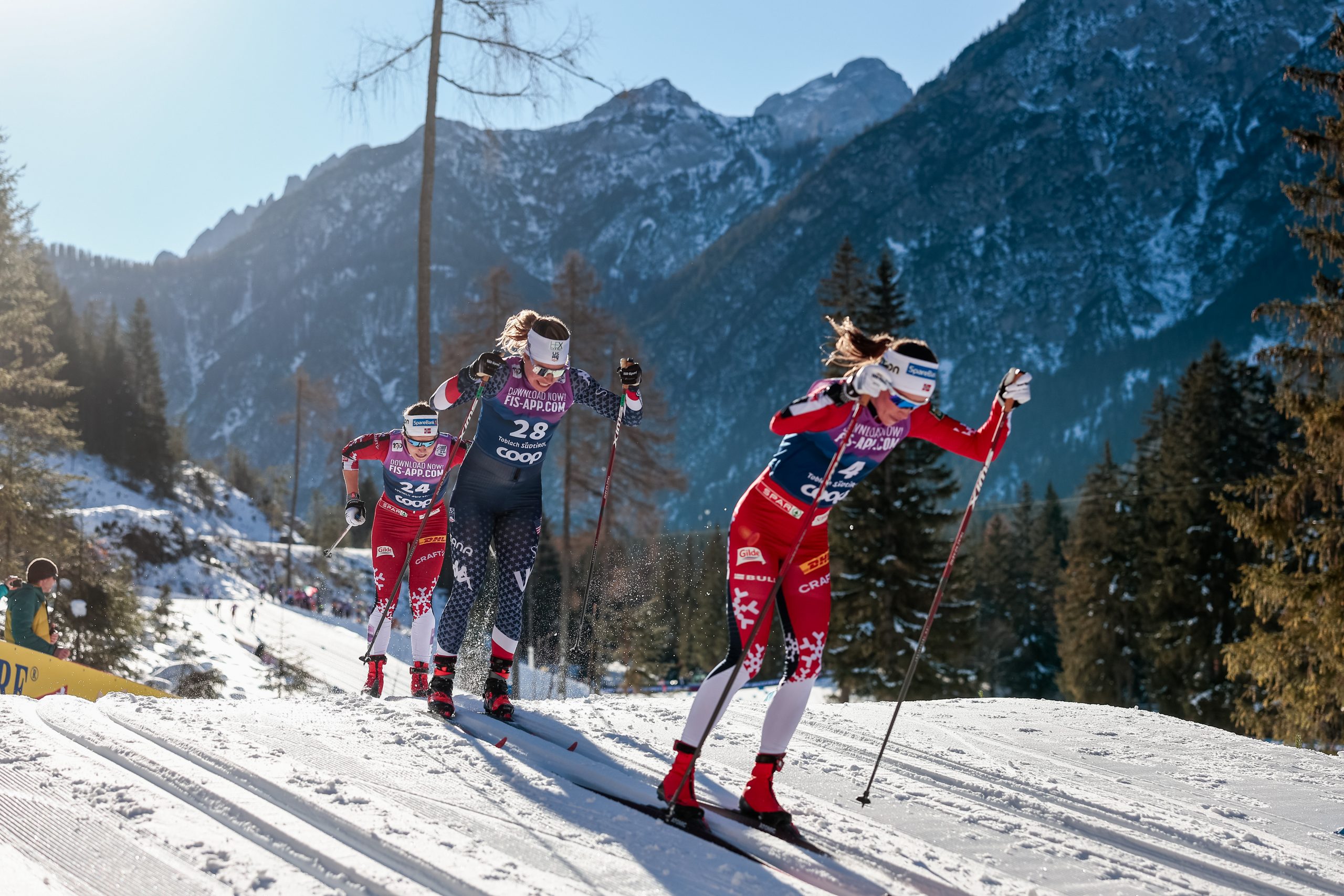
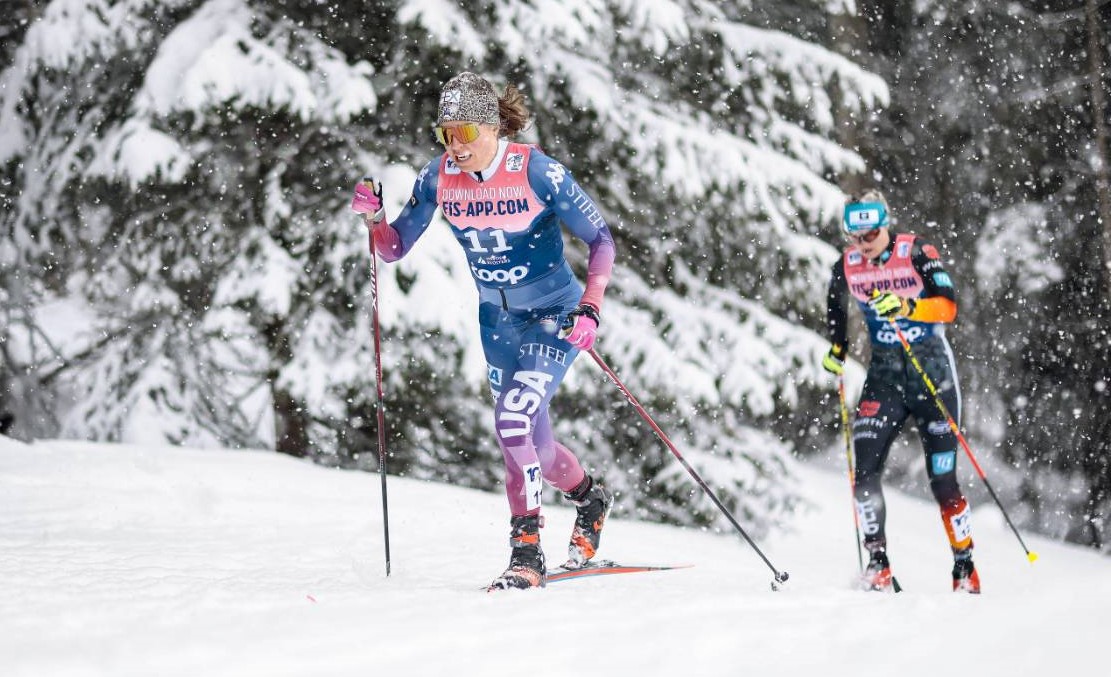
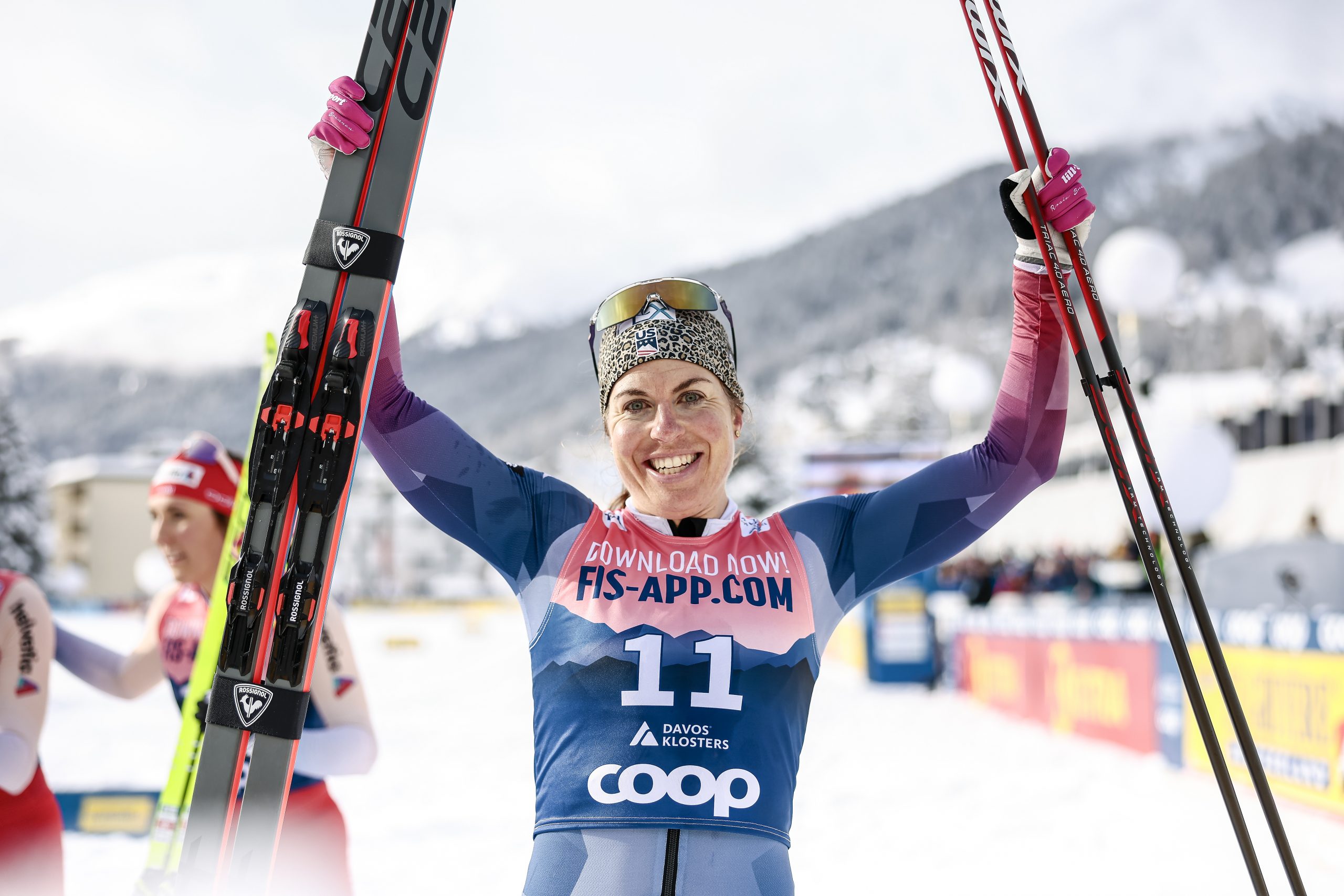
Jessie Diggins (USA) showed the sort of resilience and courage fans have come to expect, overcoming a disastrous ski exchange to race her way back into medal contention. (Photo: Barbieri/NordicFocus)
Diggins would fight through an unfortunate ski change, and endure a long struggle in returning to the group of bronze medal contenders, only to find herself gapped on the final uphill. Diggins would finish fifth behind fourth place, Kristin Austgulen Fosnaes. Ahead of them, Andersson would ski brilliantly and tirelessly to claim gold, well ahead of of Weng, and minutes clear of the third place performance from an elated Nadja Kaelin (SUI).
“If you had told me even a year ago, I’d be in the fight for a bronze medal in a 50k classic, I would not have believed you,” said Diggins. “It’s taken so much work from so many people for so many years to get here, and I’m just really proud of it.”
Among other Americans, Rosie Brennan would finish 16th. Hailey Swirbul would cross the line in her comeback Olympics to finish 20th while Kendall Kramer would finish 27th. Canadians would place all their finishers in the top 30: Jasmine Drolet 18th, Sonjaa Schmidt 26th, Katherine Stewart-Jones 28th, and Amelia Wells 29th.
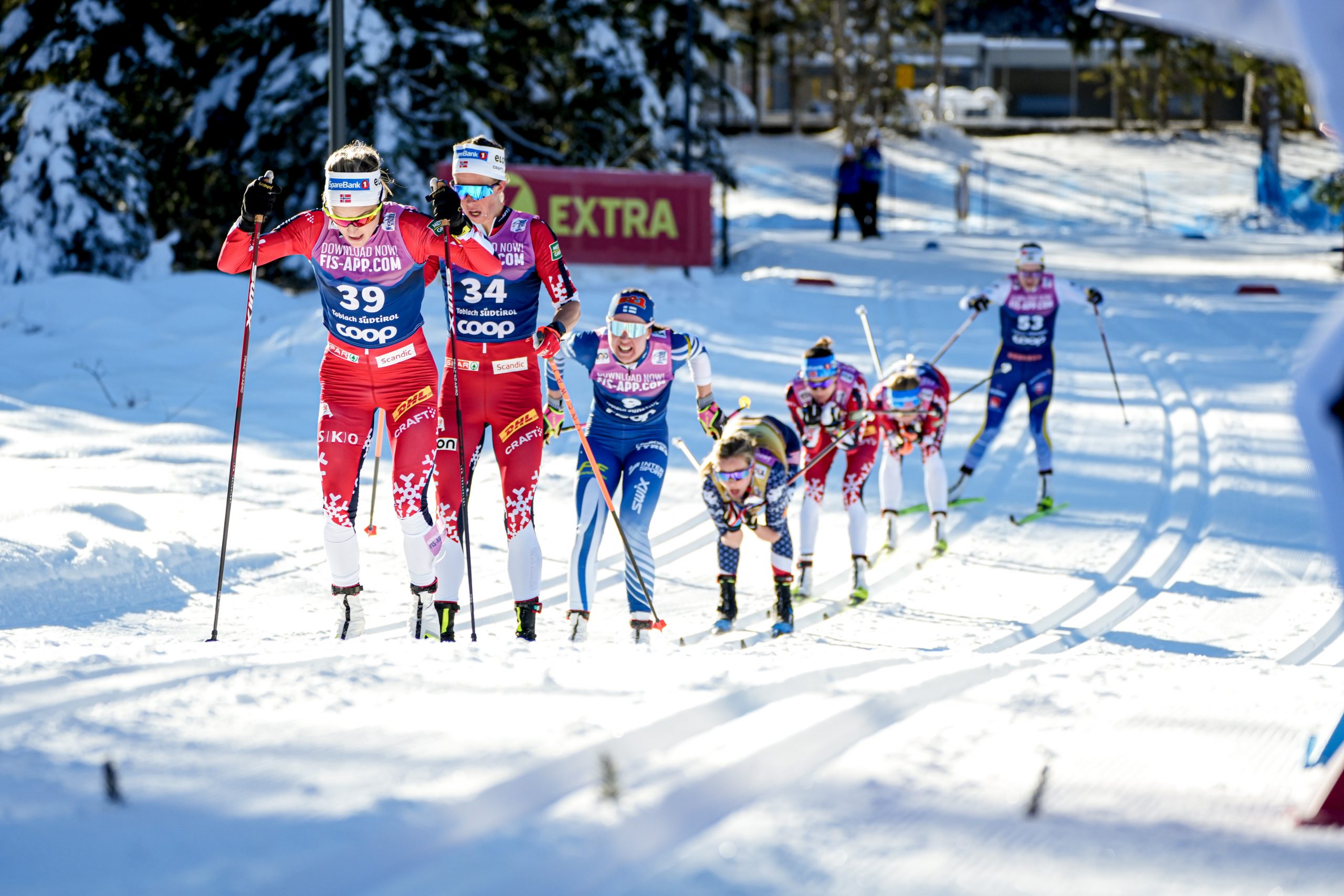
Olympic 50 k: Heidi Weng (NOR), and Ebba Andersson (SWE), set the pace from the beginning. (Photo: Vanzetta/NordicFocus)
Women’s 50 k Classic
Pre-race intel reported that Sweden’s Frida Karlsson had taken ill, and was choosing not to race in today’s 50 k. Without Karlsson’s singular presence to push the pace (as she did during her dominant victory in last season’s World Championship 50 k in Trondheim), the race was left without a known direction or strategy. Like Karlsson, Sundling was a DNS, reducing the chances that the medals would be decided in flat-out sprints. Weng hoped to duel it out with Diggins and Andersson down the final kilometers.
The Olympic 50 k is conducted in a mass start format, seven laps of 7+ kilometers/lap raced in the Classic technique. On an unseasonably warm day—40 degrees (Fahrenheit) and sunny skies—waxing and base prep were likely to play outsize roles in the results. Within the first three kilometers, a lead group of a dozen skiers—containing all the prime contenders—began to ease off the front. The early pace was made by Andersson, followed by Weng, Diggins, Teresa Stadlober (AUT), and Astrid Oeyre Slind (NOR). Val di Fiemme’s challenging hills quickly began whittling away at the lead group as Andersson continued driving the pace, stringing out Weng and Diggins in her wake. Slind inexplicably pulled up on a challenging climb, stalling other contenders behind her including Kerttu Niskanen (FIN), Johanna Matintalo (FIN), and Dariya Nepryaeva (AIN). Slind would drop out of the race only a few kilometers later, a frustrating result for a skier who had entered these Games with such high hopes..
Jessie Diggins (USA) was an early animator in the Olympic 50 k. After a troublesome ski exchange, she’d come back to be part of the battle for the bronze medal (ultimately won by Switzerland’s Nadia Kaelin). (Photo: Barbieri/NordicFocus)
By 8.5 kilometers, a solid chase group would form involving Fosnaes, Niskanen, Matintalo, and Karoline Simpson-Larsen (NOR). At the front, the lead group had been reduced to three—Andersson, Weng, and Stadlober—as Diggins began to show the strain of he early pace. Even Stadlober had begun to wobble as the chasers continued to concentrate their pursuit.
Diggins was the first of the contenders to switch skis (at the 14.4 kilometer mark at the end of the Lap 2). She immediately regretted her decision as her klister-waxed skis tripped her dramatically on her way out of the exchange zone. Stumbling along the track—gasping and yelping audibly—Diggins lost considerable time, finding herself dropping to ninth place, 1:11 behind the leaders. Diggins would need to rely on her new skis working their way into the conditions, in the hope that they would ultimately provide an advantage. But even more time had been lost to the leaders who, themselves, had not shown any dissatisfaction with their own skis.
“I knew I had to switch early,” said Diggins. “I’m so glad I did. It was just a really gritty race. Literally every muscle in my body started cramping with three laps to go. So I can confidently say I could not possibly have tried harder or gotten more out of my body.”
“After that first pair of skis, she switched pretty early,” said US coach, Kristen Bourne. “But we also had a lot of confidence in that second pair . . . so we also had a lot of confidence giving her the the go-ahead to switch.”
The race settled into a few slow-developing stories:
Weng and Andersson were off the front, deciding gold between them.
Stadlober raced on alone in bronze medal position, but she found the gap behind her being eaten into by Niskanen and Fosnaes.
Diggins had fallen from contention, though her fortitude and pride were likely to prevent her from dropping out of her final Olympic event.
And then Diggins began coming back . . . maybe she began overhearing all of us commentators wondering if she might drop out of this race. That may be just the sort of motivation that Jessie Diggins needs. Diggins drove to the tails of Fosnaes and Niskanen. Together, they closed the gap to Stadlober who was pursuing better traction in the the snow outside the Classic tracks. While Diggins’ skis may have been a disaster in the first few meters after the exchange, it’s possible they were proving to have been a shrewd decision.
Andersson and Weng changed skis at the end of the fourth lap, where Andersson was pitched over her ski tips by her own sticky kick wax. At the end of lap four, Diggins had moved into bronze medal position as the chase group entered the stadium. Fosnaes was the only skier who opted to exchange skis. Stadlober, Kaelin, and Niskanen continued in pursuit of Diggins.
Soon after 30 kilometers, Andersson found her skis to be an advantage over Weng’s. By 34.2 kilometers, Andersson had opened a 20 second gap. She was still 45 minutes from the finish line, but Andersson was beginning to stretch her advantage.
Now in a group with Niskanen, Fosnaes, Kaelin, and Stadlober, Diggins may have sensed that her best chance to claim the bronze medal was not to be found in breaking away (thereby risking blowing up, herself) but to sit with this group in anticipation of a bunch sprint that would favor her own abilities. With two laps remaining, the chase group had decisions to make. Among those racers, only Diggins had already changed skis. Among this group, it was likely that someone would stop to make the change. If they did, they could find a late-race advantage, or they might find themselves giving up an advantage (in the time spent changing skis) that would be impossible to overcome. Kaelin, Stadober, and Niskanen all chose to change skis. Ultimately, all the chasing skiers would regroup, and immediately start considering their strategies. Diggins was the sprinter in the group; her advantage would be realized if the group came to the finish line together. Stadlober, Niskanen, Fosnaes—those are not sprinters—their only chance would be to drop Diggins and Kaelin before the finish line approached. Two laps to go . . .
And who the heck is Eliza Rucka-Michalek? The young Polish skier had been chasing all by herself for the last 40 kilometers. She finally connected with the chase group midway through he final lap, but would find that the efforts expendeded in reahing this group would be too costly to allow her to attack again. Rucka-Machalek would cross the line eighth.
The final kilometers were led out by Kaelin who was followed by an exhausted, but game, Fosnaes. Diggins shadowed them both, but the final climb would be excruciating for all. Kaelin had the best traction on the Zorzi climb; Fosnaes slipped a bit, as did Diggins who lost momentum when she stepped out of the tracks behind Fosnaes. Kaelin would maintain her advantage over the top of the climb, holding on for bronze, followed by Fosnaes and Diggins.
“I’m so grateful for our entire staff behind the scenes,” said Diggins. “They have been like, putting my body back together so that I could be out there today fighting. And I just, I wanted to do that for them. I wanted them to know like, ‘Hey, I am so grateful. Like, I’m gonna finish this. I’m gonna leave it all out there.’ And honestly, the most special thing was that I got to hug my mom on the side of the course before the race, and it’s just so cool to know that they were here for my last Olympics, and I got to end it on a beautiful day in a venue that I love so much. I’m just really proud of this last Olympics and really grateful and really happy, and I’m leaving here just full of joy and probably needing a new body.”
“I mean, we’re super proud of this team,” said Bourne. “And to walk away from this Olympics being like our most successful ever by having a variety of people—three different people—getting Olympic medals is, excuse my language, but #%&!@ insane! And I mean, man, we’re just super proud and stoked to keep the season going after a little bit of rest.”
Friends and rivals: Heidi Weng (NOR) and Ebba Andersson (SWE). (Photo: Vanzetta/NordicFocus)
Weng raced bravely and strategically in what may have been her final Olympics. She would claim silver, falling just short in her own quest for individual Olympic gold.
Andersson would continue extending her lead—20 seconds, 40, 60, 90—to claim a gold medal to go along with her three silvers earned at these Games. Here at the end of an Olympic campaign that found her hitting the deck again and again—including that spectacular somersault and subsequent one-ski scooter-pushing during the disastrous (though ultimately silver-medal-winning) Swedish relay—Andersson raced across 50 grueling kilometers to find glory at the finish line. Individual Olympic gold was finally hers, as well as respect and redemption after days of trials and tribulations.
FasterSkier will have our own Nat Herz on the ground at the Olympics, which, to be honest, is a very big financial lift for us. If you value the thoughtful work and access FasterSkier provides at championships like this one, please consider becoming a Voluntary Subscriber. Your support directly fuels the work we do to cover the people, places, and moments that make our sport special.
Heidi Weng (NOR), Ebba Andersson (SWE), Nadja Kaelin (SUI), on the podium of the Women’s 50 k Classic Mass start, the final cross-country event of the 2026 Olympic Winter Games in Milano-Cortina. (Photo: Barbieri/NordicFocus)
This coverage is made possible through the generous support of Marty and Kathy Hall and A Hall Mark of Excellence Award. To learn more about A Hall Mark of Excellence Award, or to learn how you can support FasterSkier’s coverage, please contact info@fasterskier.com.
Jessie Diggins (USA) won her first Classic race today and stretched her Tour lead. (Photo: NordicFocus)
Watching the Tour de Ski is like looking at a giant pendulum swinging back and forth. Yesterday, on day one, the pendulum swung to the favor of skiers with sprinting talent. Jessie Diggins (USA) made the most of that swing by gaining the maximum number of bonus seconds winning the Freestyle Sprint. She came into today’s 15 kilometer Classic Mass Start race with over a minute lead on Therese Johaug (NOR) and Heidi Weng (NOR). Today, those skiers without Sprinting legs would try to ride the pendulum back as it swings to Distance racing.
Jasmi Joensuu (FIN) and Nadine Faehndrich (SUI) also made the most of yesterday’s Sprint. At the start of the day, they sat in second and third respectively, seven and 15 seconds behind Diggins. Whether Joensuu and Faehndrich could hang with the Distance skiers remained a big question mark. But there was no question about what Johaug and Heidi Weng had in mind going into the day. Their mission would be to do whatever it took to eat into Diggins minute plus lead. That was the only certainty heading into the day. Already this season we’ve seen the two work together in Distance races, and that was a distinct possibility going into today’s race.
But the Distance skiers’ plans to gain time on Diggins today imploded when in a shocking turn of events Diggins was the one grinding down the Classic skiers and took her first World Cup Classic victory outdueling all of the big Scandinavian names. Johaug and Astrid Oeyre Slind (NOR) tried to punish the field throughout the race, but every time they made a move, Diggins answered closing any gaps they created with her world best downhill technique.
Jessie Diggins’ (USA) persistence was rewarded when after 340 World Cup starts she took her first Classic victory. (Photo: NordicFocus)
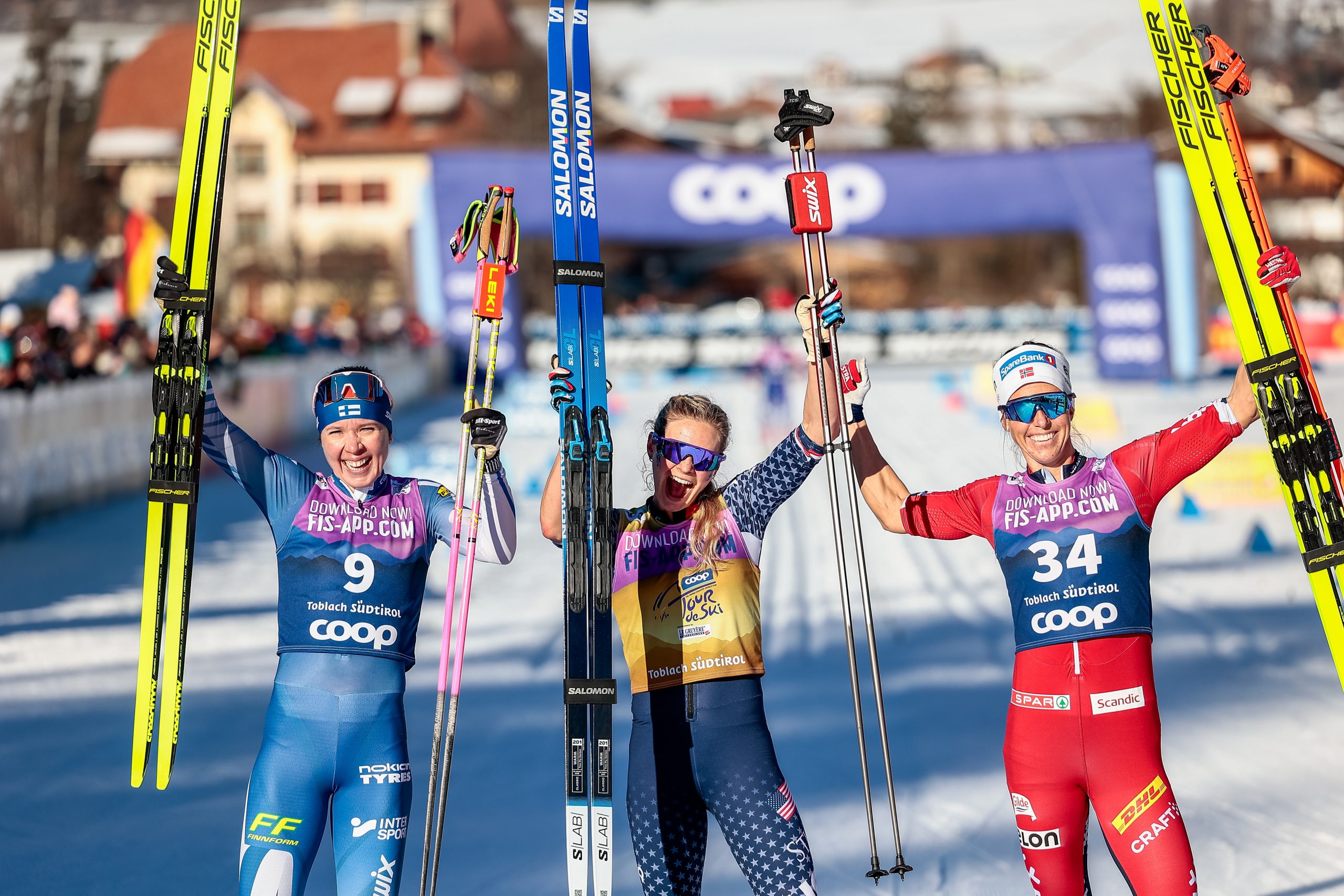
When the pendulum had swung back towards the Classic Distance skiers, it was shockingly Diggins who was at the top having not only withstood the pendulum swing but actually managed to come out on top. Classic phenom Kerttu Niskanen (FIN) took second place with Slind finishing third. H. Weng held on for fourth, and in another shocking turn of events, Johaug ended up sixth, clearly defeated at the end of the race.
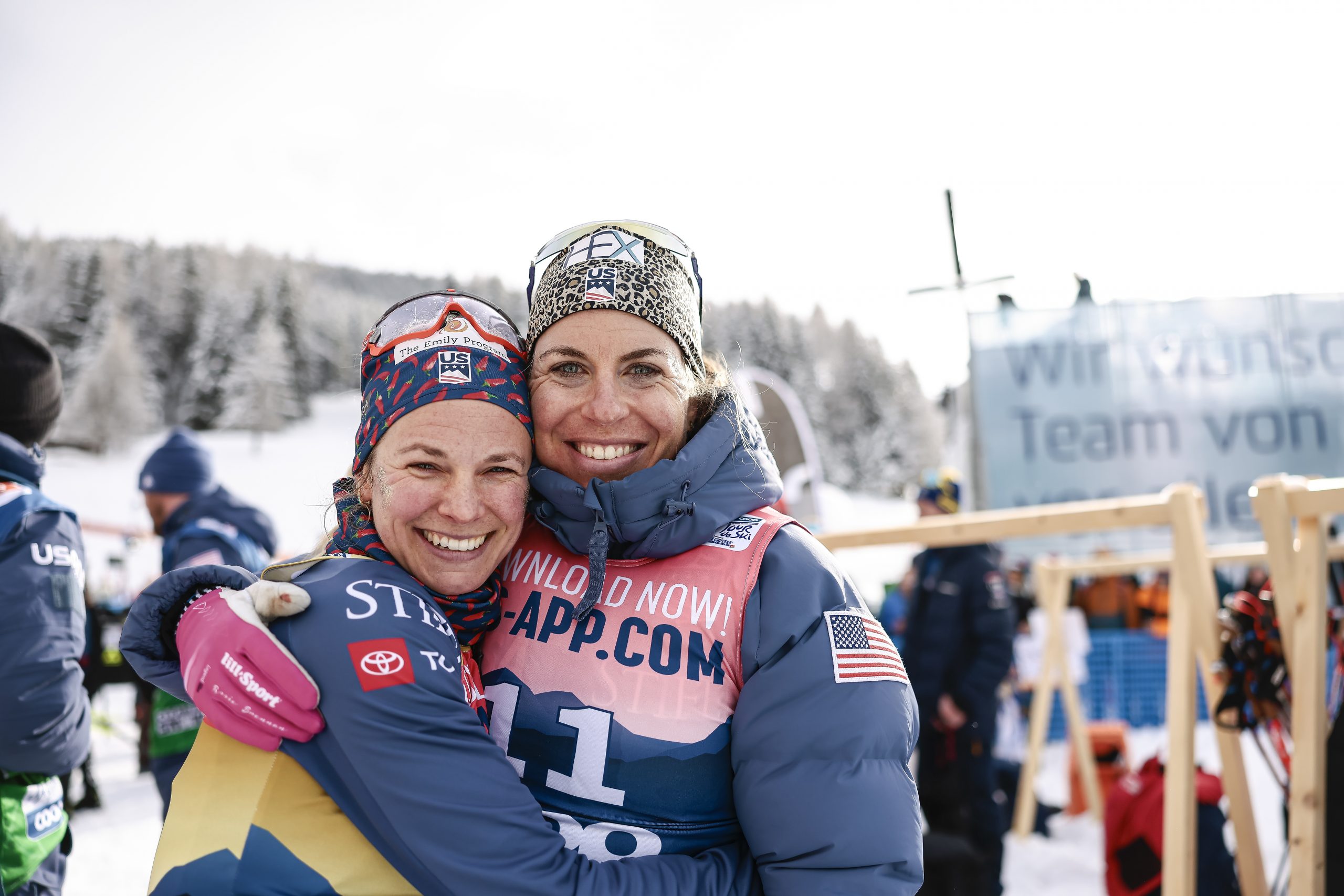
After the race Diggins was ecstatic. “It’s really cool. It took me 340 World Cups to get here. This is why you never give up. I’ve been working so hard on Classic skiing my whole life, and it’s really emotional to finally do it. It took a lot of tries. I’m so thankful to my team because they gave me perfect skis. They were fast and I had the grip, so on the last hill I could go. It was just pure magic. It was really cool. I came into this in a really good head space. I’m healthy, I’m happy, loving what I’m doing, it’s an amazing team atmosphere. It’s going to be a big party in the truck today.” Diggins added that, “this summer I put in so much work on my double pole, so much work trying to improve my power and my strength. I feel like being able to sprint like that yesterday and finish like that today … I didn’t know if I had that in me, and I had to work really-really hard to get there, and I had a lot of help from a lot of people. I had perfect skis, and I feel like this victory is as much for the wax techs as it is for me.”
Other American finishers were Rosie Brennan in 14th, Julia Kern 31st, Sophia Laukli 46th, and Alayna Sonnesyn 50th.
It was a good day for Brennan but, “I’m definitely still far from where I want to be,” Brennan said after the race. “At this point, I’m just putting my best foot forward every day and doing the best I can to keep finding myself and you’ll know when I’m back, and I’ll leave it at that.”
The top Canadian finisher was Katherine Stewart-Jones in 34th. She was followed by Liliane Gagnon in 35th.
Today was the day for Therese Johaug (NOR) (number 39) to close the gap on Jessie Diggins, but it turned out to be Diggins’ day. (Photo: NordicFocus)
Women’s 15 kilometer Classic Mass Start
Conditions were described as perfect for the start of the women’s 15 kilometer Classic mass start with firm deep tracks. By virtue of winning yesterday’s race, a hatless Diggins was in the front row of starters alongside Joensuu and Faehndrich. Almost immediately at the start Classic expert Niskanen went to the front. One of the Tour favorites Johaug—because of her poor sprinting performance—started toward the back of the pack in bib 39 and spent the first kilometers double poling outside the track on the edge of the course to move toward the front. After only six minutes into the race at the 2.3 kilometer mark Johaug had pushed at a frenzied pace and worked herself to the front of the pack to take the lead.
Today was also an excellent day for Rosie Brennan (USA) (number 28) who finished 14th. (Photo: NordicFocus)
At the 3.3 kilometer mark there was a bonus Sprint where Joensuu went to the front to take the maximum Sprint points. Johaug and Faehndrich were with her with Diggins sitting calmly in 10th only a couple of seconds off the lead.
At the start of the second lap Johaug had pushed back to the front with Niskanen and Diggins trailing right behind her. Also having moved to the front was another Tour favorite H. Weng. At 5.2 kilometers there was another bonus section— this one was a bonus section for climbers. Johaug went through first, but Diggins was right by her side, now followed closely by Norwegian Distance standout Slind.
At the 6.1 kilometer mark Slind and Johaug decided to make their first serious break and established a gap on the group. Diggins quickly went to the front of the chase group as the two Norwegians in a matter of a couple of seconds were able to develop a measurable gap. But as she so often does, Diggins was able to close the gap on the downhills. It was a theme which was repeated several times throughout the race.
But even though Johaug and Slind hadn’t gained ground on Diggins, they had broken up the pack and there was now a defined lead group of about a dozen skiers. While the pack pulled away Slind and Johaug continued to throw in a burst of speed to try and pull away. And amazingly at the bottom of downhills Diggins would glide up onto the backs of the Norwegians. It had to have been incredibly frustrating for the lead pair to see their hard work evaporate at the bottom of every downhill as Diggins magically appeared right beside them.
At the 7.5 kilometer halfway mark Johaug was still out front with a pack of proven Classic performers around her. Niskanen, Slind, and Weng joined Diggins at the lead pack along with Teresa Stadlober (AUT), Krista Parmakoski (FIN), and Linn Svahn (SWE). At this point, the lead pack looked like a Scandinavian Classic all-star team with Diggins somehow hanging with them.
At 8.6 kilometers Niskanen took the lead with Johaug right behind her. But the big news at this point was that Johaug had not been able to blow open the race. She had used a lot of energy at the beginning of the race to scratch her way from the back of the pack to take the lead and it looked like she was paying the price.
As the racers hit the 11.2 kilometer mark the pattern which had been established throughout the race repeated itself again. Johaug and Slind led a group of nine skiers at the front pushing the pace on the uphills creating a gap, with Diggins then closing the gap on the downhills. Several times it looked like the lead duo were going to pull away, and each time Diggins closed on them on the downhills.
With only 1.4 kilometers left the lead field was down to seven skiers with Slind still pushing the pace. But try as they might the leaders couldn’t drop Diggins who tenaciously hung with the lead group as they entered the final downhill leading into the stadium.
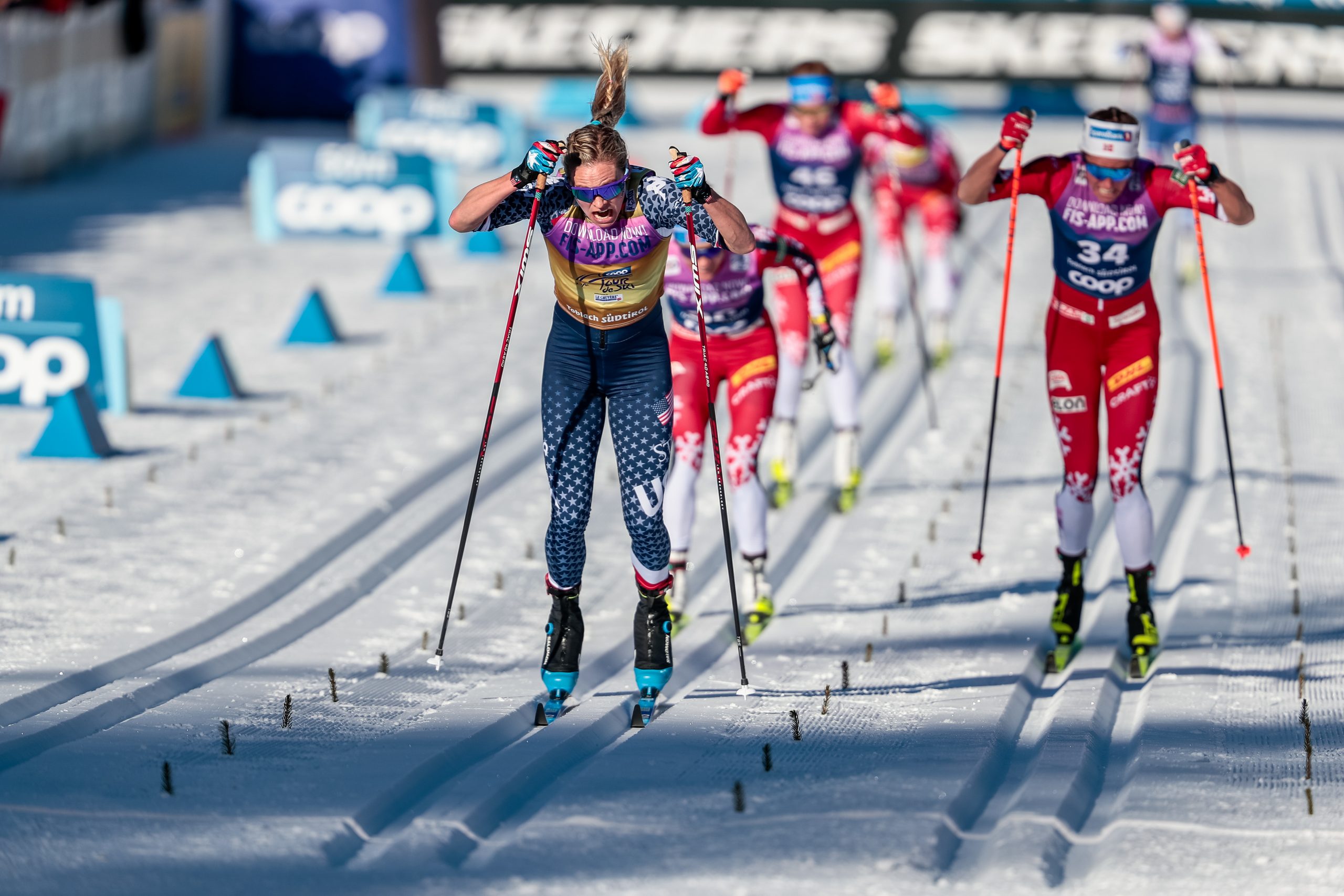
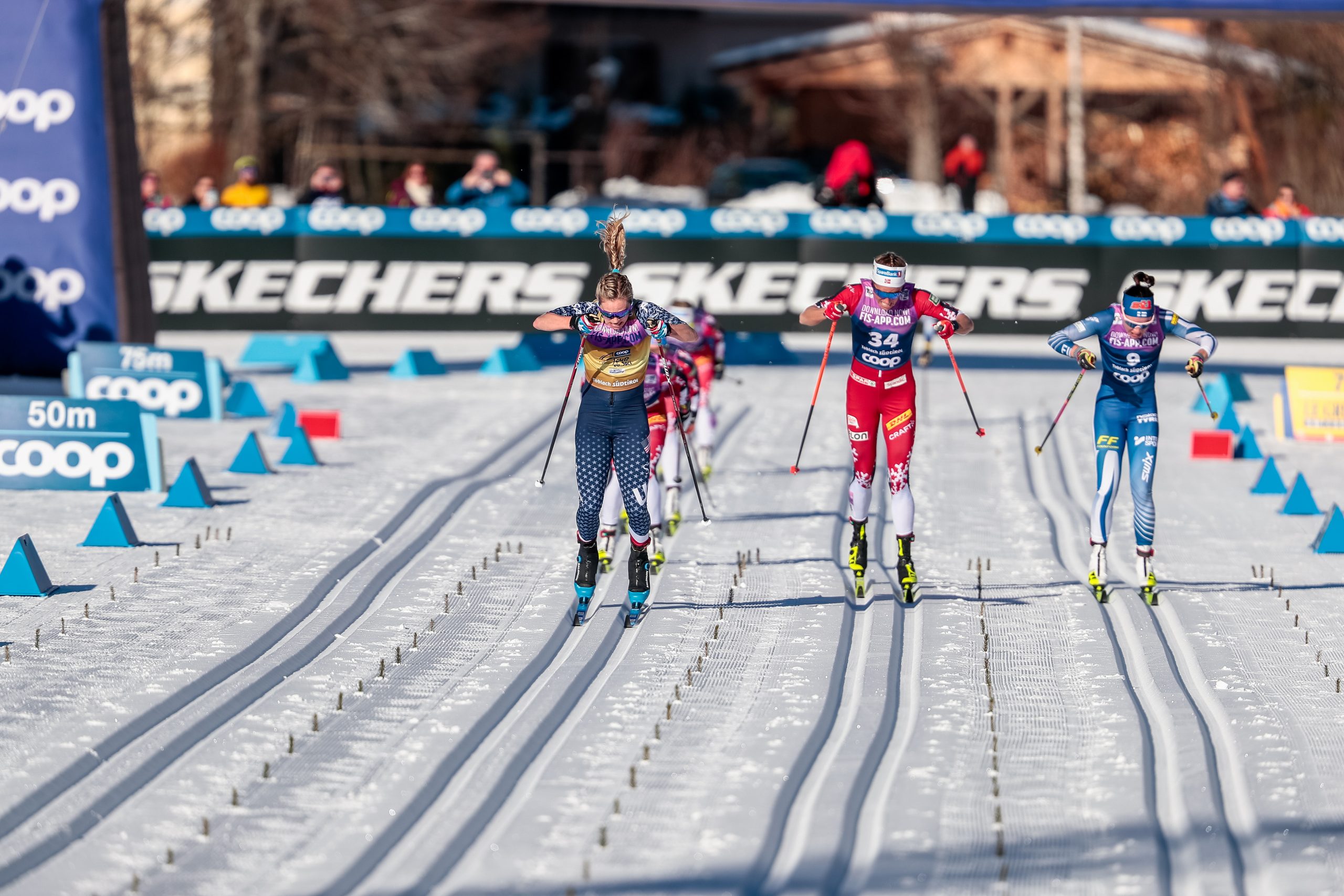
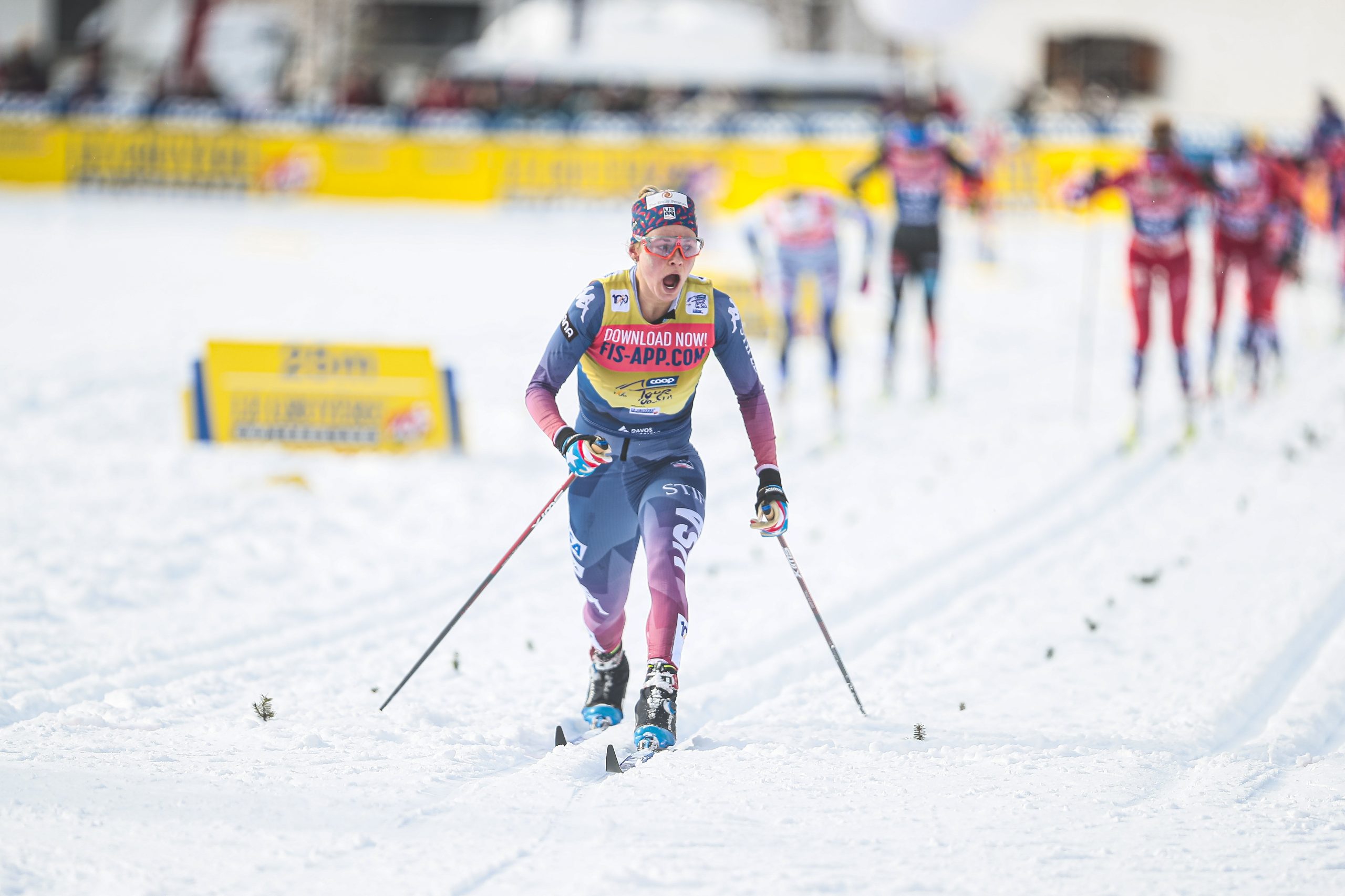
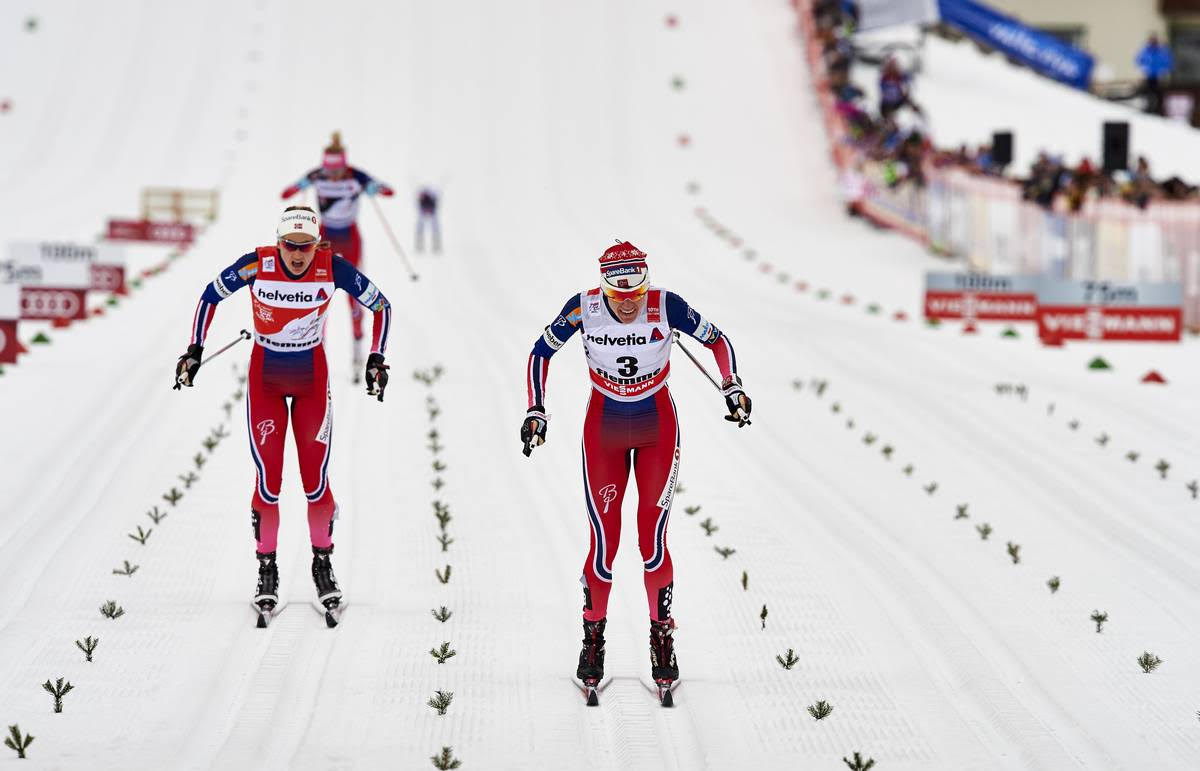
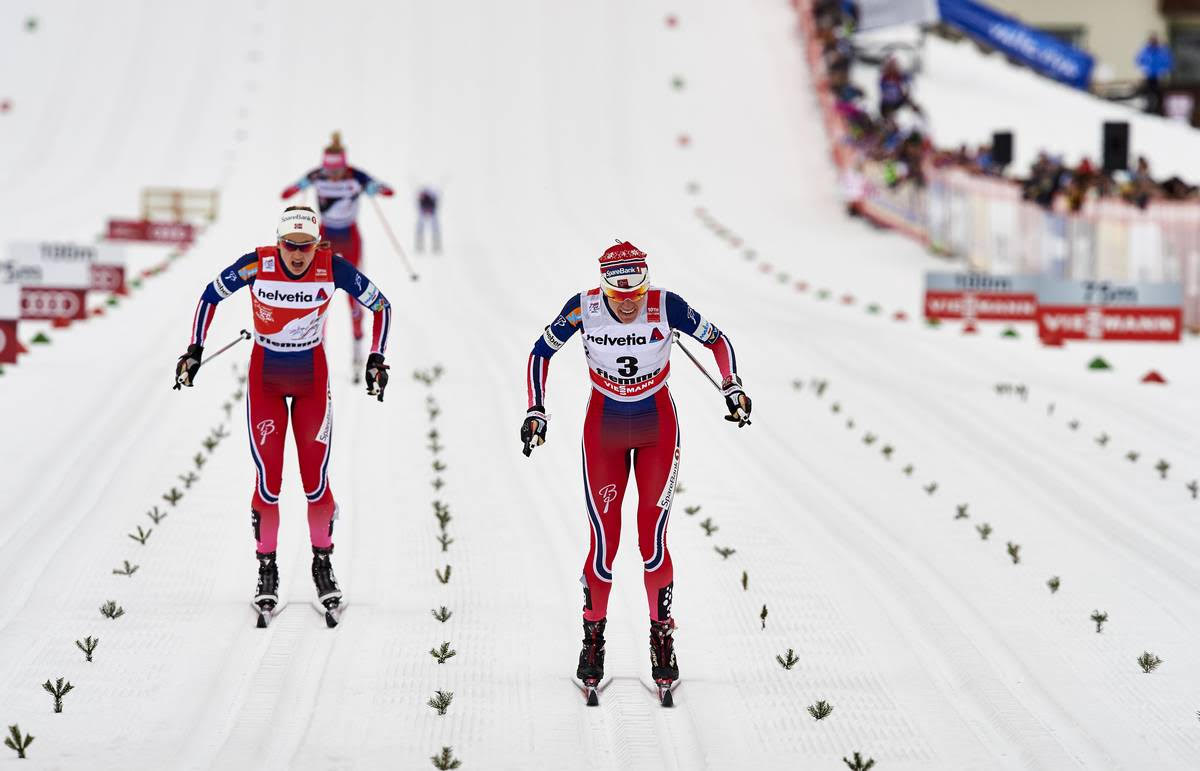
Jessie Diggins (USA) (left) put in a furious double pole at the finish to take the win. (Photo: NordicFocus)
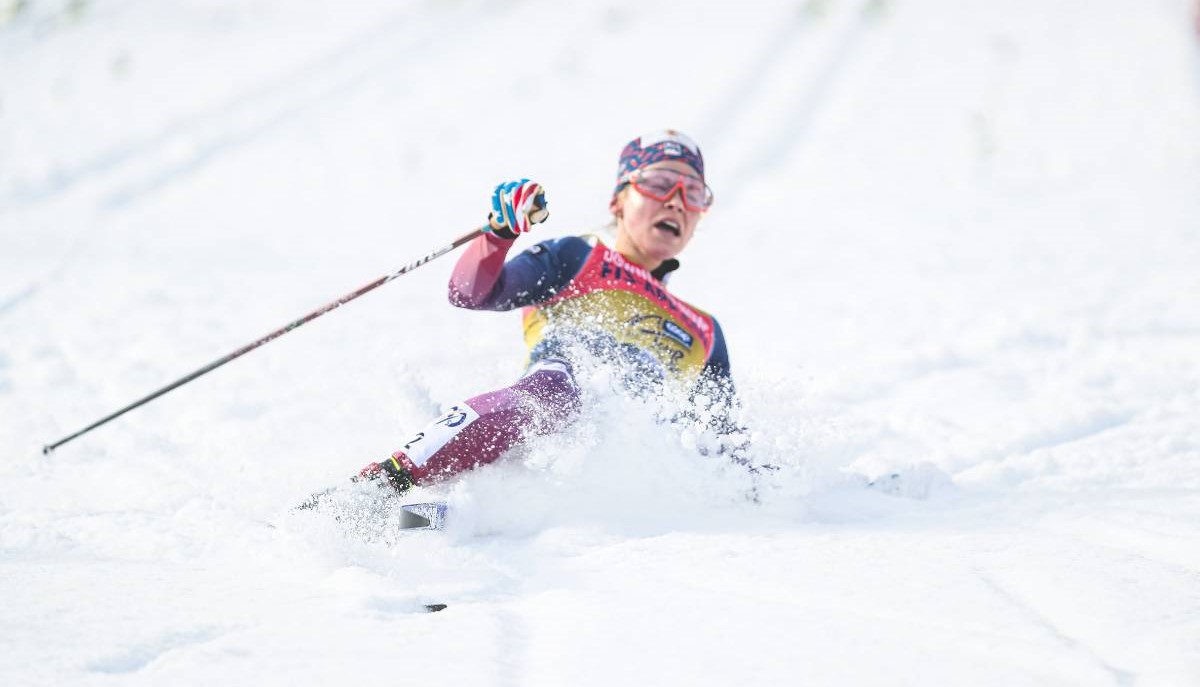
At this point, it was already mission accomplished for Diggins. As long as she stayed upright until the finish, she would have preserved her Tour lead, which was at the start of the race really all the American team was hoping for. But Diggins wasn’t satisfied with just maintaining her Tour lead. She could sense that she had the opportunity to make personal history. On the final climb she put in a massive turn of speed and took the lead over the field. Shockingly none of the other leaders could respond to Diggins’ burst. The first to crumple was Johaug who couldn’t take the pace and dropped off the field. Diggins frenetically double poled to the finish as Niskanen and Slind tried to stick with her, but they couldn’t and Diggins dropped the rest of the field. She crossed the finish line first, exhausted, laying on the snow with the knowledge that not only had she defended her Tour lead, but that she had just won her first World Cup Classic race! It was a shocking and incredibly satisfying victory.
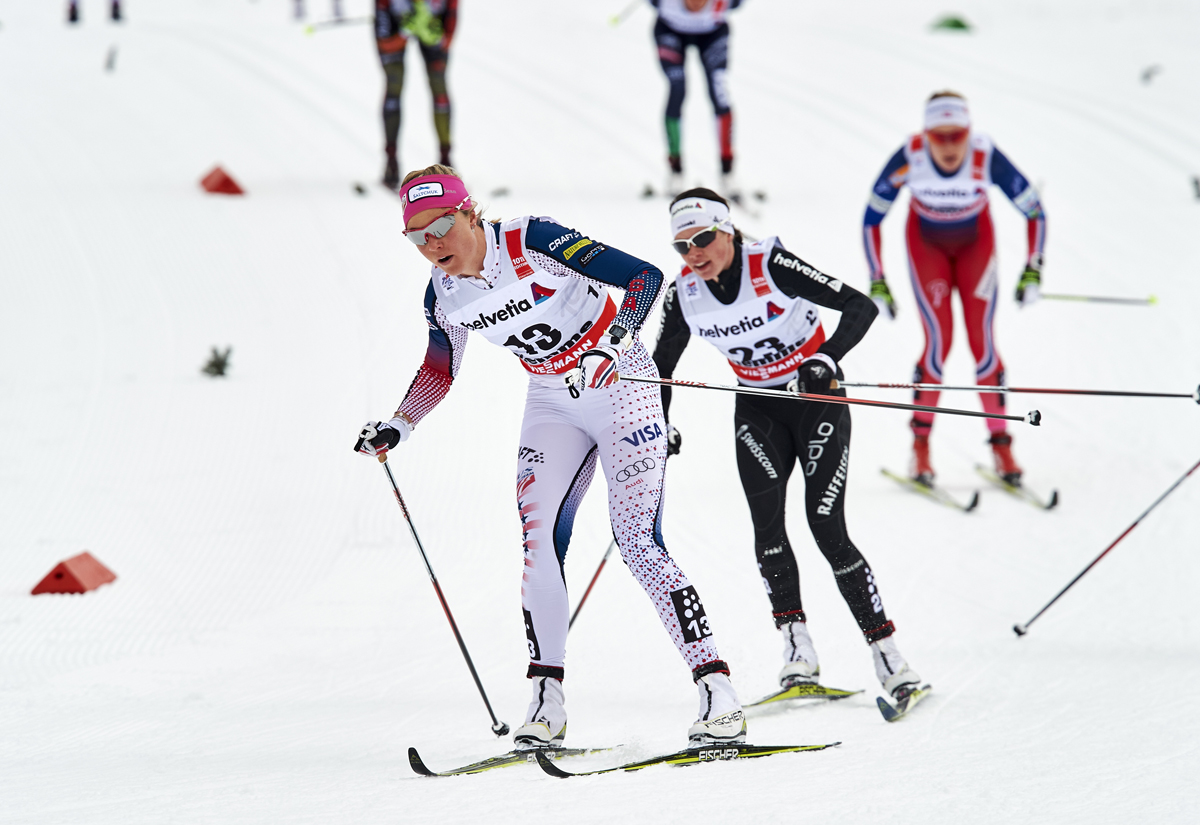
Jessie Diggins (USA) (far left) outdueled two skiers known for their Classic prowess, Astrid Slind (NOR) (number 34) and Kerttu Niskanen (FIN) (number 9), to take the win. (Photo: NordicFocus)
Not only had Diggins defended her lead, but she had beaten the Scandinavians at their own game, Classic skiing. It had to be a dagger through the heart of the Distance skiers chasing her as they were doubtlessly counting on gaining time on their rival today only to end up losing more time to Diggins. It was a monumental achievement for Diggins and the entire American team, and a crushing blow to the rest of the field.
After today’s heroics, Diggins had expanded her lead in the Tour. She now holds a 38 second advantage of Niskanen, and is over a minute ahead of Slind, H. Weng and Johaug.
This coverage is made possible through the generous support of Marty and Kathy Hall and A Hall Mark of Excellence Award. To learn more about A Hall Mark of Excellence Award, or to learn how you can support FasterSkier’s coverage, please contact info@fasterskier.com.
Two Americans in the top three! Jessie Diggins (USA) claimed third behind Rosie Brennan (USA) who sprinted for second in the 20 k Classic Pursuit in Davos, Switzerland. Both Americans overcame early problems to fight for podium finishes. (Photo: NordicFocus)
The Tour de Ski (TDS) continued in Davos, Switzerland, with the 20 kilometer Classic Pursuit. Jessie Diggins (USA) entered the women’s race with a 33 second lead in the overall standings over yesterday’s Sprint winner Linn Svahn (SWE), and a 1:22 lead over Jonna Sundling (SWE).
A 20 kilometer Classic race is a long way; a lot can happen. Just a little too much kick wax, and 33 seconds can vanish in a flash. Svahn has a lengthy resume of top ten distance Classic race finishes, so putting over 30 seconds into Diggins was definitely a possibility. With another Classic race coming on Saturday, Diggins didn’t have much of a margin to work with and would need every bit of the starting cushion she had. A potential wildcard was that Svahn carried a yellow card for a technique violation with her into the race. If she received another violation, her day—and her Tour—could be done.
Entering the race, Rosie Brennan (USA) was in 12th in overall standings, 2:44 behind Diggins. Sophia Laukli was in 20th, and now that she has survived the Sprints, the long distance specialist would have a chance to move up the standings.
The 20 k Classic Pursuit format featured a little different setup: according to TDS rules, the start order was assigned according to the prior stage’s Sprint results instead of the traditional method of using the overall standings. This meant Linn Svahn (SWE) would be the first racer to start. She would be followed by Diggins even though Diggins finished third yesterday. Diggins went second because yesterday’s second place finisher Kristine Stavaas Skistad (NOR)—a sprint specialist—opted to withdraw from the TDS.
To make formatting matters even more confusing, the International Ski Federation (FIS) initially published a start list that included wave starts for the pursuit, something allowed for in TDS rules. But, shortly after issuing the start list, they rescinded it after they realized that it would be a nightmare for television viewers trying to follow along at home.
Another point of confusion was the race length. The race was billed as 20 kilometers and in fact was 22 k.
After officials decided how the race would start, it was left to the skiers on the course to decide their fates in the TDS. It turned out to be a wild day full of ups and downs for everyone. After all of the excitement, it was Kerttu Niskanen (FIN) who edged out Rosie Brennan (USA) for first place in a thrilling finish. Jessie Diggins (USA) overcame an early fall and took third place.
Other Americans also had excellent performances today. Novie McCabe finished 19th, only 27 seconds off the lead (and beating Tour contender, Svahn). Sophia Laukli finished 25th, 41 seconds back. Sammy Smith had another good day finishing 28th. Julia Kern did not start today as she is continuing to recover from health issues and wanted to focus on being rested for the remainder of the World Cup season.
Rosie Brennan (USA) chose the right tactic by going with kick and glide instead of double poling. (Photo: NordicFocus)
20 Kilometer Classic Pursuit
The Davos Pursuit course race consisted of two ten kilometer laps; another unusual format for World Cup racing. But the biggest factor was that it was snowing heavily, with temperatures close to freezing; always a Classic waxing nightmare. Bad decisions—or bad luck—in the waxing process could ruin a racer’s day. Because of this, several of the Swedish women decided to double pole the course and herringbone up the hills through the restricted technique zones. It was a choice Brennan eschewed, “I honestly didn’t consider double poling,” said Brennan. “[I didn’t] consider using anything other than the skis that my tech put in front of me today. I was just focused on making those skis the best skis that I could.”
The unusual starting pursuit format turned out to work to Diggins advantage since at least one skier ahead of her would be breaking the track.
Jessie Diggins (USA) took a hard fall early on and it looked like it could be a catastrophic day for the American. But Diggins fought her way back all the way to the podium. (Photo: NordicFocus)
Early on, Diggins was passed by Maja Dahlqvist (SWE) and Johanna Hagstroem (SWE). Then, only 6:30 into the race, Diggins tripped and fell hard on a flat section of the course. She was only down for a second, but the damage was done. She immediately was separated from the leaders, dropping eight seconds behind them, now working on her own and trying to gather herself after a hard dramatic fall. It was definitely not the start to the day that Diggins wanted. After the race, Diggins acknowledged it was a hard fall. “It hurts, a lot actually”, said Diggins. “I’m glad I have a day to rest, but it will be ok.” When asked about the mechanics of the fall, “I caught my kick wax on the freshly shoveled snow on the first road crossing, which is why I fell,” Diggins observed. ” I was careful to stagger my skis on the crossings after that!”
After the fall, a group of chasers caught Diggins; at least she was no longer skiing alone. This was a huge, fortuitous, piece of good luck for Diggins since the group was closing in quickly on the leaders. The group helped Diggins regain contact with the front of the race without having to expend as much energy as she would have on her own. An additional piece of help came when after the gap was closed, the pace slowed considerably, and pack racing tactics took over for a while.
The race continued to slow into one giant pack. But then Rosie Brennan (USA) shot to the front to push the pace along with Tour contender Victoria Carl (GER). Diggins had been swallowed up by the group and dropped all the way to 17th; ominous signs for the Tour-leading American.
At 5.7 kilometers, long distance expert Astrid Oeyre Slind (NOR) made her presence felt when she went to the front with Linn Svahn. Svahn would repeatedly test the pace knowing that today was her chance to gain time on Diggins. It was clear that Svahn had made a choice to go with little or no kick wax as she was double poling the entire time. At this point, Brennan had dropped back significantly, to 16th, and Diggins was 22nd, The placings sounded bad, but the time gap wasn’t terrible. Diggins was only 11 seconds off the lead.
Meanwhile, Sophia Laukli (USA) was making a big charge. She started 44th, and had now pushed herself up to 20th; at that point, ahead of Diggins.
At 8.6 kilometer Svahn made it back to the lead and was alternating pulling at the front with her teammates. The race had turned into a contest between those double poling and racers who were striding. Skiers lacking kick wax gained an advantage on every downhill, but those racers paid a high price when the groups hit big climbs. As the competitors neared the stadium, those without kick wax had to herringbone up the entire length of big hills, losing large chunks of time.
As the skiers continued on a long climb at 9.5 kilometers, most of the pack severely bogged down as many of the leaders were forced to herringbone. It clogged up the race and closed the pack considerably.
Whenever a Classic race is contested, Niskanen’s name comes up. Not surprisingly, at this point Niskanen joined the leaders. Brennan was out front again and Diggins had tenaciously clawed her way back up to ninth, only 18 seconds off the lead. More importantly, Svahn had fallen back and was now trailing Diggins. It was a dramatic change of events in a short amount of time, and was beginning to show a flaw in the Swede’s plan of not relying on kick wax. When asked about her own waxing situation, “my kick came and went during the race,” Diggins said. “But luckily I had just enough when I needed it to be able to make my way up that big last climb. Hats off to our amazing tech team for giving us such amazing skis in a crazy snowstorm!”
Simultaneously, Brennan made another bid for the lead and went to the front with Niskanen right behind her. Just past the halfway mark, there was one more significant downhill; again, those with better glide went to the front. Diggins continued to gain on the race leaders, and she was only 5.6 seconds off the lead with Svahn right with her. But the most significant thing was that Diggins had seemed to regain her momentum and was no longer in emergency mode. She had remarkably found her rhythm again and looked strong.
At this point Svahn received a verbal warning for a technique violation. It was not a yellow card which would have disqualified her. It was an interesting decision to issue the warning instead of a yellow card. But for this generous officiating decision, Svahn’s day could have ended.
With only 4.3 kilometers to go, Svahn was at the front again. Racers still had one more big climb ahead of them before they would have the finish in sight. At this point Slind went back to the front taking Svahn with her. But, as had happened in prior climbs, the skiers lacking kick struggled. Diggins took the opportunity, striking like lightning and passing Svahn. It was shocking to see Diggins who had encountered so many struggles throughout the day fighting to overtake Svahn who had seemed determined to stay at the front.
Jessie Diggins (USA) made a remarkable comeback from an early fall, not only extending her overall lead in the Tour de Ski, but also taking a podium spot in the 20 k Classic Pursuit. (Photo: NordicFocus)
As the climb continued Brennan took advantage and went to the front. The hill continued to take its toll, and skiers who had gone without kick wax paid a huge penalty as they struggled to double pole or herringbone up the hill. It was a scenario Brennan had anticipated, “that climb at the end, that’s my strength.” she said. “I felt I could use that to my advantage if I had kick wax on, that was my goal, I just wanted to push the climbs and make the double poling skiers hurt and sit in on the downhills and flats, and try to save for the climbs. That last climb is really big so having kick wax really helps there.” It was a cagey smart veteran move which helped to put her onto the podium.
Brennan was now being chased by Niskanen. Remarkably, Diggins was up to fifth. She too, was herringboning up the final steepest section of the last hill, but she was able to make additional gains and moved to fourth. Brennan and Niskanen battled at the front, establishing a little bit of a gap on the field. With two kilometers, left they had a ten second gap on the field when Niskanen went to the front to try and separate herself from Brennan. At the same time Diggins was locked in a battle with Margrethe Bergane (NOR) for the final podium spot. It was hard to believe that not long ago, Diggins was lying flat on the ground, seemingly out of the race and maybe out of the Tour lead.
Rosie Brennan (USA) dueled all the way to the finish with Kerttu Niskanen (FIN), but the Finn had just a bit more to give as they crossed the line. (Photo: NordicFocus)
Niskanen and Brennan entered the stadium entrance together where additional tracks were now available. Brennan stepped onto her own track and briefly passed Niskanen as the two jockeyed for position. Niskanen passed Brennan back as Brennan desperately clung to the Finn’s ski tails. But as they entered the final straightaway Niskanen pulled away slightly. Brennan’s fate was sealed; she didn’t have enough time to close on Niskanen, and finished second. Right behind her, amazingly, was Jessie Diggins. It was a remarkable finish for both Americans.
It was a great day for Brennan, and a redeeming podium finish in what has been a challenging Tour. For Diggins … she had just given a master’s class in race management and Tour strategy.
Second place in the 20 k pursuit: a great day for Rosie Brennan (USA). (Photo: NordicFocus)
Tour de Ski Standings
It was all a bit surreal for Diggins. Early on, her lead in the Tour was evaporating, and it looked like she could lose her first place position. But somehow, she found another level to keep her Tour lead. Diggins had fought back. Svahn—who put in an all or nothing strategy—dropped to seventh place, over a minute behind Diggins. Niskanen took over second place , 44 seconds behind Diggins. Jonna Sundling (SWE) was in third place, 52 seconds back. Victoria Carl, dropped all the way to eighth, 1:39 off the lead, and it looked like her podium chances were gone.
Rosie Brennan helped her cause significantly, moving into tenth place 1:56 behind Diggins, but only 1:04 off a podium spot. With two stages left, Diggins is in control of her own destiny. Next, the Tour de Ski moves to Val Di Fiemme, Italy, for a 15 kilometer Classic mass start, followed by the lung-busting climb up Alpe Cermis.
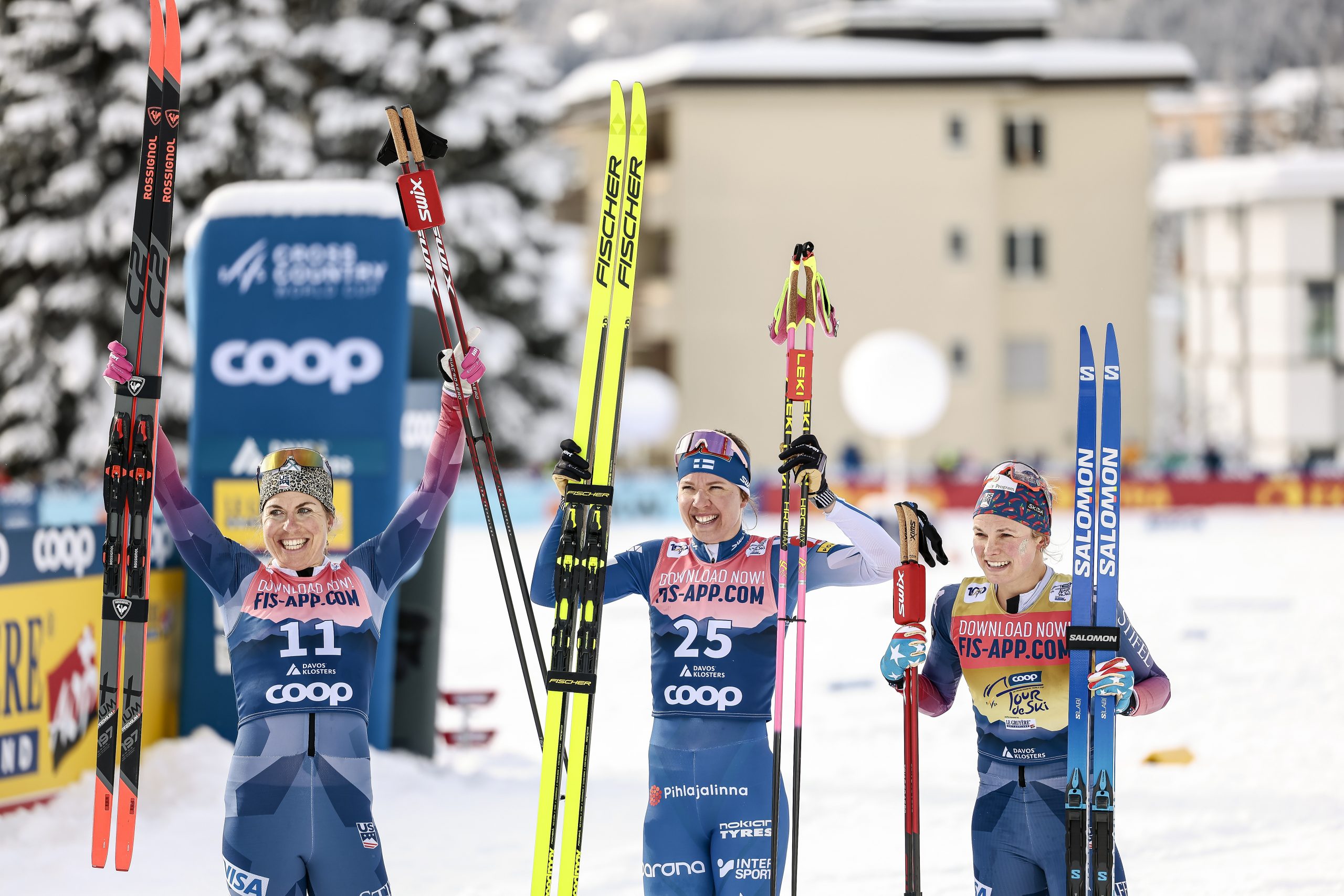
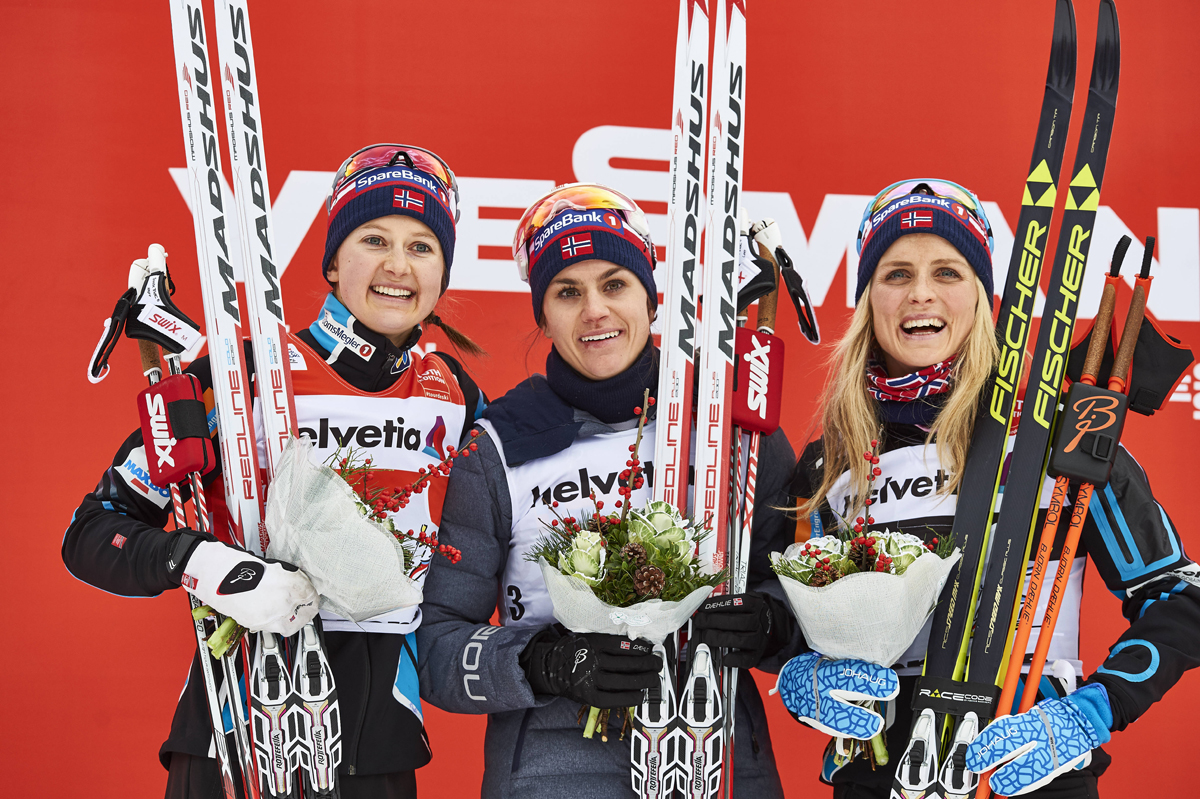
It was a great day for the American women. Their love affair with Davos continues as they take two podium spots. Rosie Brennan (USA), Kerttu Niskanen (FIN), Jessie Diggins (USA), (l-r) (Photo: NordicFocus)
This World Cup coverage is made possible through the generous support of Marty and Kathy Hall and A Hall Mark of Excellence Award. To learn more about A Hall Mark of Excellence Award, or to learn how you can support Fasterskier’s coverage, please contact info@fasterskier.com.
On Sunday, Val Mustair, Switzerland played host to Stage 2 of the 2023 Tour de Ski: a 10 k Classic Pursuit.
The Pursuit isn’t just a distance race. It’s a combined result—an event that is inextricably linked (and combined in value) with the prior day’s sprint. Pursuit racing is a funny event, one that doesn’t sit entirely well with our sense of fairness: an advantage is given to the skier who proved the fastest on the previous day, with additional World Cup points being awarded to the one who crosses the line first. It’s a regular occurrence that the “winner” on the day may not be the fastest finisher on the day (and such was the case on Sunday in Val Mustair). One way or another, the overall standings of the Women’s Tour de Ski were definitely re-shuffled in Sunday’s 10 k Classic Pursuit.
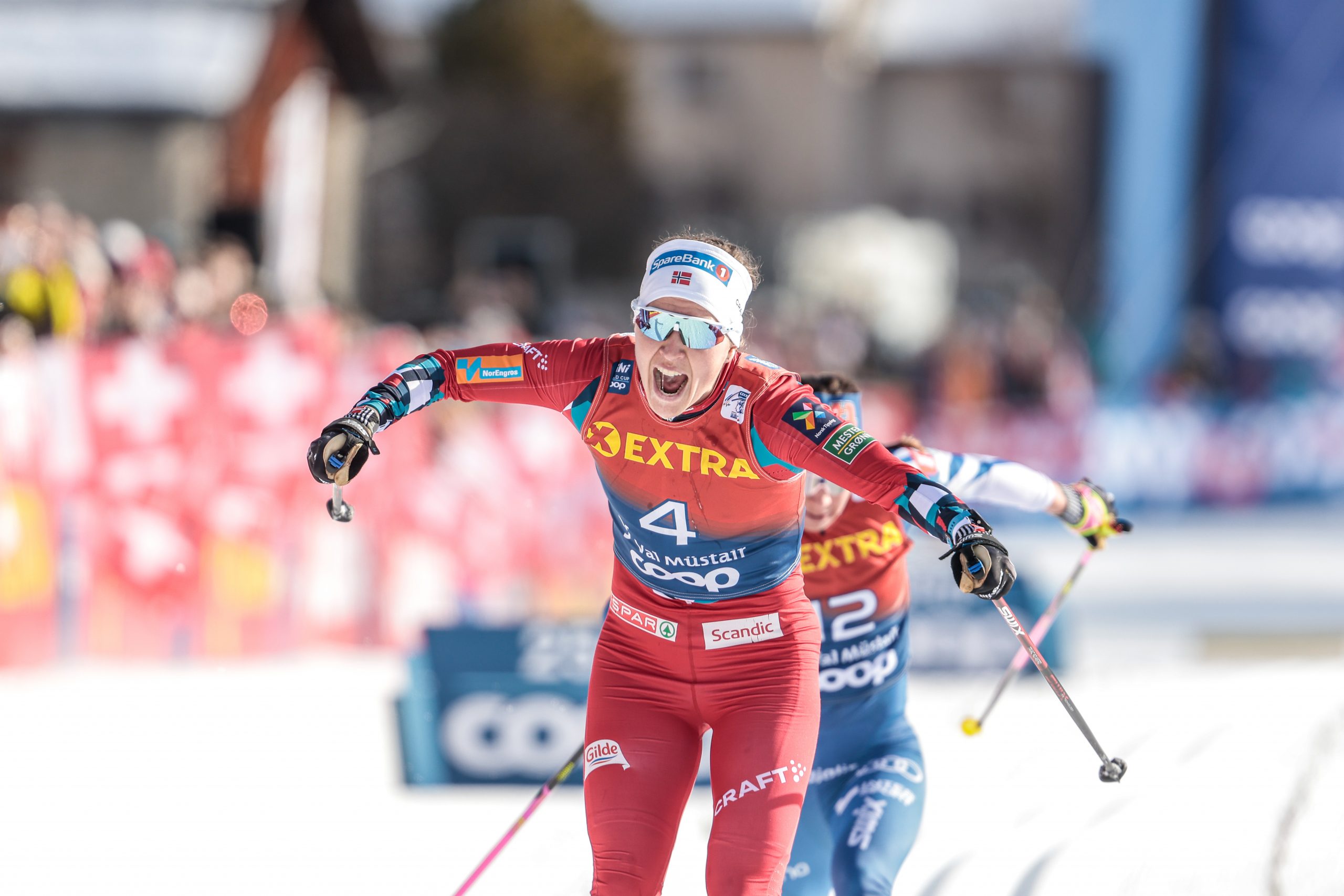
Tiril Udnes Weng (NOR) outsprints Kerttu Niskanen (FIN) in Tour de Ski Stage 2. Weng claimed the overall lead, while Niskanen posted the fastest time of the day. (Photo: NordicFocus)
In any pursuit event, there’s far more to the race-story than simply counting a skier’s finishing place. The most accurate way to judge a skier’s success may be to assess whether they moved up or down within the field (relative to their own starting place), and whether they gained or lost time to the leaders (regardless of their finishing place). In Stage 2 of the Tour de Ski, there were a number of exceptional performances: The fastest skier on the day was Kerttu Niskanen (FIN) who moved from 12th to 2nd, making up nearly 44 seconds. Second fastest skier on the day was Katherina Hennig (GER) moving from 26th to 6th, making up 22 seconds. And third fastest was Anne Kjersti Kalvaa (NOR) moving from 6th to 4th, and making up 19 seconds. Behind them, Frida Karlsson (SWE) moved from 5th to 3rd, making up 18 seconds. The day’s Pursuit winner, Tiril Udnes Weng (NOR), moved from 4th to 1st, making up 17 seconds. Heidi Weng (NOR) leaped from 51st to 8th, making up nearly 12 seconds. Rosie Brennan (USA) moved from 14th to 7th, making up 11 seconds. Astrid Oeyre Slind (NOR) moved from 35th to 10th, making up 6 seconds.
After Stage 2, Overall TDS leaders are as follows:
T. Weng
Niskanen
Karlsson
In addition to Brennan (whose finishing time was 7th fastest on the day), American finishers included Jessie Diggins (moving from 39th to 30th, but losing nearly a minute to the leaders), Julia Kern (started 10th, and skied well to finish 12th), Sophia Laukli (jumping from 67th to 50th), and Alayna Sonnesyn (falling from 37th to 53rd).
Canadian finishers all improved their standings: Katherine Stewart-Jones (rising from 46th to 25th), Dahria Beatty (skiing from 54th to 45th), and Liliane Gagnon (rising from 64th to 60th).
Women’s 10 k Pursuit
Stage 1 Sprint winner, Nadine Faehndrich (SUI), began the day with a 17 second advantage over the field, one she was able to maintain through the first of four 2.5 kilometer laps. Soon after passing through the stadium, however, she was joined by the group that had formed behind her, led by Karlsson and containing T. Weng, L. Weng, and Kalvaa. By the five kilometer mark, the lead group had been reduced to Karlsson and the three Norwegians, with a hard-charging Niskanen whittling away at their lead with each passing kilometer.
Rosie Brennan (USA) and Krista Parmakoski (FIN) racing the Tour de Ski 10 k pursuit in Val Mustair, Switzerland. (Photo: NordicFocus)
Rosie Brennan moved steadily up in the field throughout day. Before the race, Brennan had spoken of her expectations—and hopes—for the Pursuit: “I hope I can make up some time in the distance races moving forward,” she said. “Tomorrow will certainly be a bit of a wild day with a short course and fast conditions so we’ll see what happens out there.” Her optimism was rewarded, as her finishing time proved seventh fastest on the day.
Diggins started the Pursuit in 39th position, 1:11 behind the leader. She began making up places right away, but was never able to make considerable gains on the deficit to the leaders.
“I did feel like I went out a little bit aggressively, kind of going for broke,” Diggins said. “Honestly, I was really proud of how I skied. I kept fighting the whole time. Bigger picture: there’s a lot of things that need to come together in order for it to be a stellar result; those things didn’t come together today or yesterday. That’s okay, and we’re working on it. I have faith that it’s just going to keep getting better and better.”
Julia Kern (USA) skied strongly and consistently, claiming 12th in the 10 k Classic Pursuit in Val Mustair. (Photo: NordicFocus)
Julia Kern raced bravely throughout the day, and may have benefitted from the pace of skiers around her. Early in the race she was in contact with Brennan. Later, she kept pace with the Germans—Laura Gimmler and the resurgent Hennig—just as Heidi Weng also began making a move through the field. Kern described her race in a post-event interview: “I’ve had a few weeks off from distance racing so I wasn’t sure how it would go,” she said. “[Today] was really hard, and really good. It was a game of send it, die, and come back to life.”
With one lap to go, Niskanen had joined the leaders, pulling L. Weng back into contact to create a lead group of five. Karlsson continued to lead through the stadium at the beginning of the final lap, but with 1.5 k to go it was Niskanen who moved forward to push the pace. Only Niskanen was able to stay in the tracks on the final uphill, and she pressed the issue in hopes of shedding the stronger sprinters around her. In the end, though, it was T. Weng who sprinted down the homestretch to take the win, followed by Niskanen, Karlsson, and Kalvaa (the first four finishers all finished within two seconds of each other). Niskanen was by far the fastest on the day, a masterful performance that has pulled her into a virtual tie atop the Tour de Ski standings with T. Weng and Karlsson.
There will be a day off for the racers on Monday, before the Tour de Ski moves to Oberstdorf, Germany.
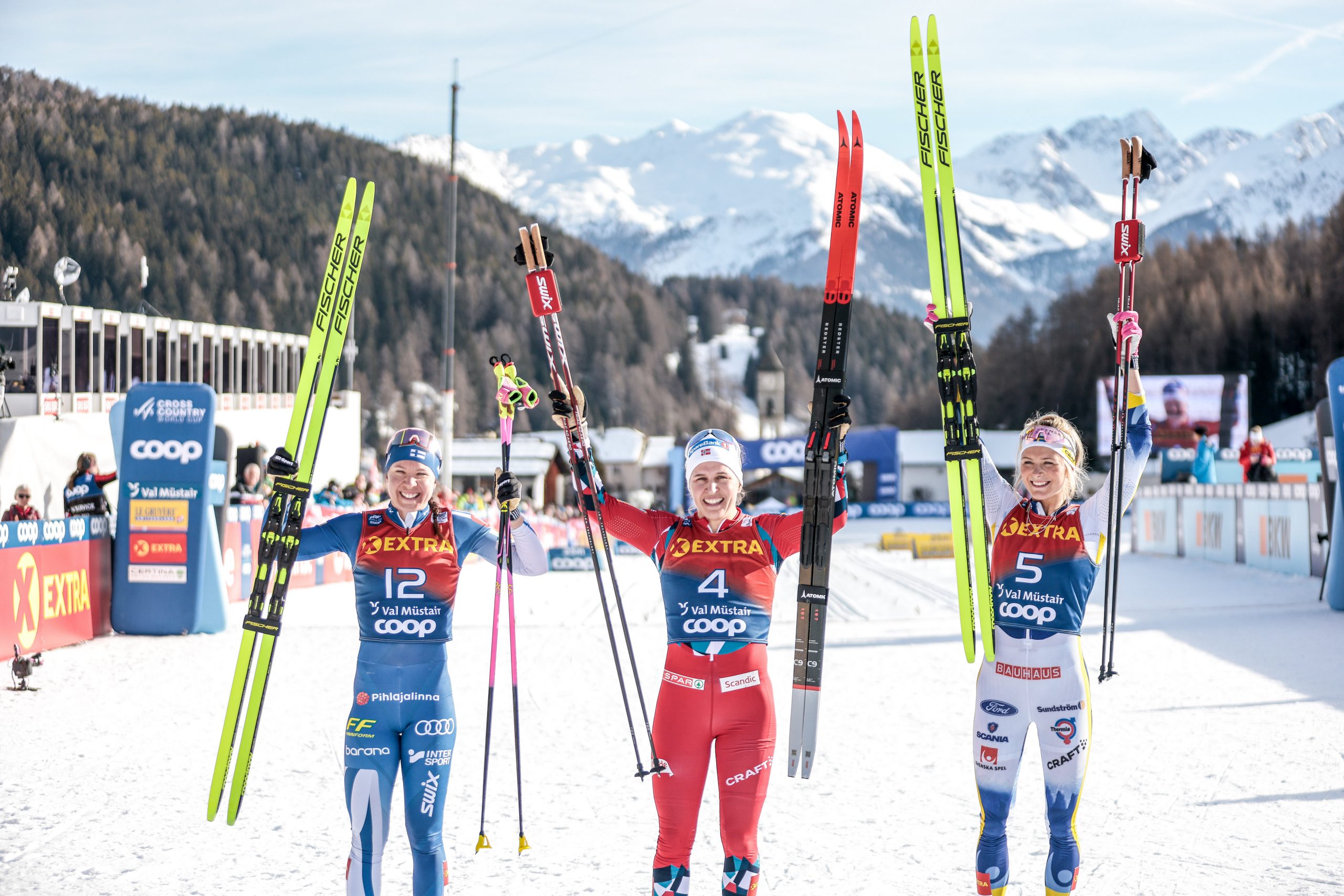
Kerttu Niskanen (FIN), Tiril Udnes Weng (NOR), Frida Karlsson (SWE), (l-r) – FIS world cup cross-country, tour de ski, pursuit, Val Mustair (SUI). (Photo: NordicFocus)
This World Cup coverage is made possible through the generous support of Marty and Kathy Hall and A Hall Mark of Excellence Award. To learn more about A Hall Mark of Excellence Award, or to learn how you can support FasterSkier’s coverage, please contact info@fasterskier.com.
The women’s 10 kilometer individual classic race was held on the second day of the FIS World Cup stop in Beitostolen, Norway. So far this season, distance racing has been dominated by Swedish women with Ebba Andersson and Frida Karlsson winning at the 10 and 20-kilometer distances, respectively. With Andersson sidelined with Covid this week, Swedish hopes rested upon Karlsson’s shoulders.
The home country—Norway—would look to Tiril Udnes Weng who finished second a week earlier in the Lillehammer 20 kilometer mass start classic, having been barely beaten out by Karlsson by 0.6 seconds. Katharina Hennig (GER) was hoping to continue her excellent long-distance form this season, having finished third in the 10-kilometer classic individual start two weeks ago in Ruka, and second in the 10-kilometer freestyle in Lillehammer.
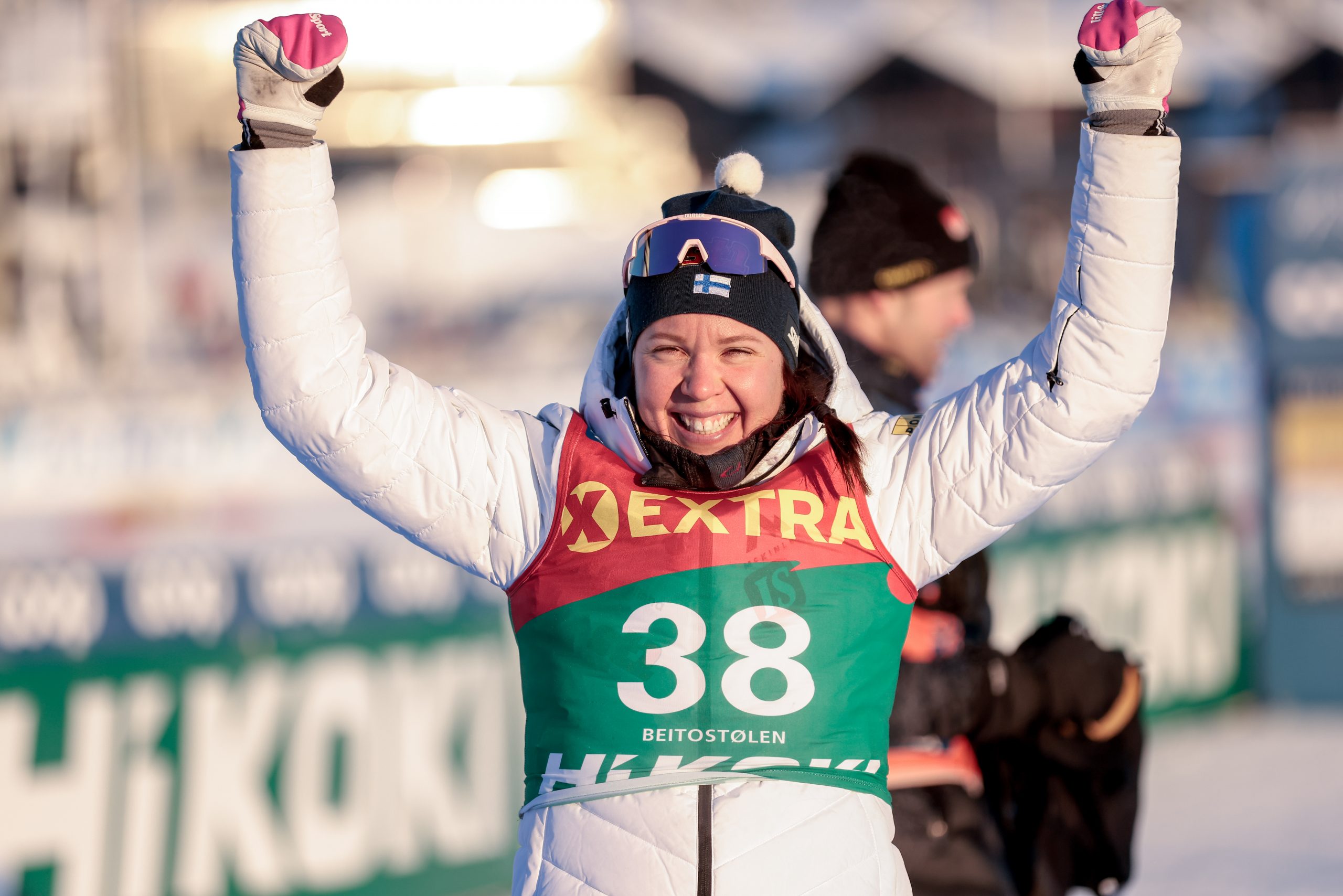
Kerttu Niskanen (FIN) celebrates her victory in Beitostolen, Norway. (Photo: NordicFocus)
At the finish line, though, it was classic phenom Kerttu Niskanen earning the victory for Finland. Anne Kjersti Kalvaa (NOR) continued her breakout season in second, followed by Frida Karlsson (SWE) in third.
Jessie Diggins (USA) was in the mix the entire day, finishing only 33.8 seconds back in 6th. Rosie Brennan was just behind her in 8th, 39.8 seconds behind. The rest of the American finishers were Sophia Laukli (29th), Novie McCabe (32nd), Alayna Sonnesyn (47th), and Lauren Jortberg (53rd). Top Canadian finisher was Katherine Stewart-Jones, 19th—continuing her impressive string of top-twenty finishes. Dahria Beatty was 36th, followed by Olivia Bouffard-Nesbitt in 46th.
Women’s 10-Kilometer Classic Individual
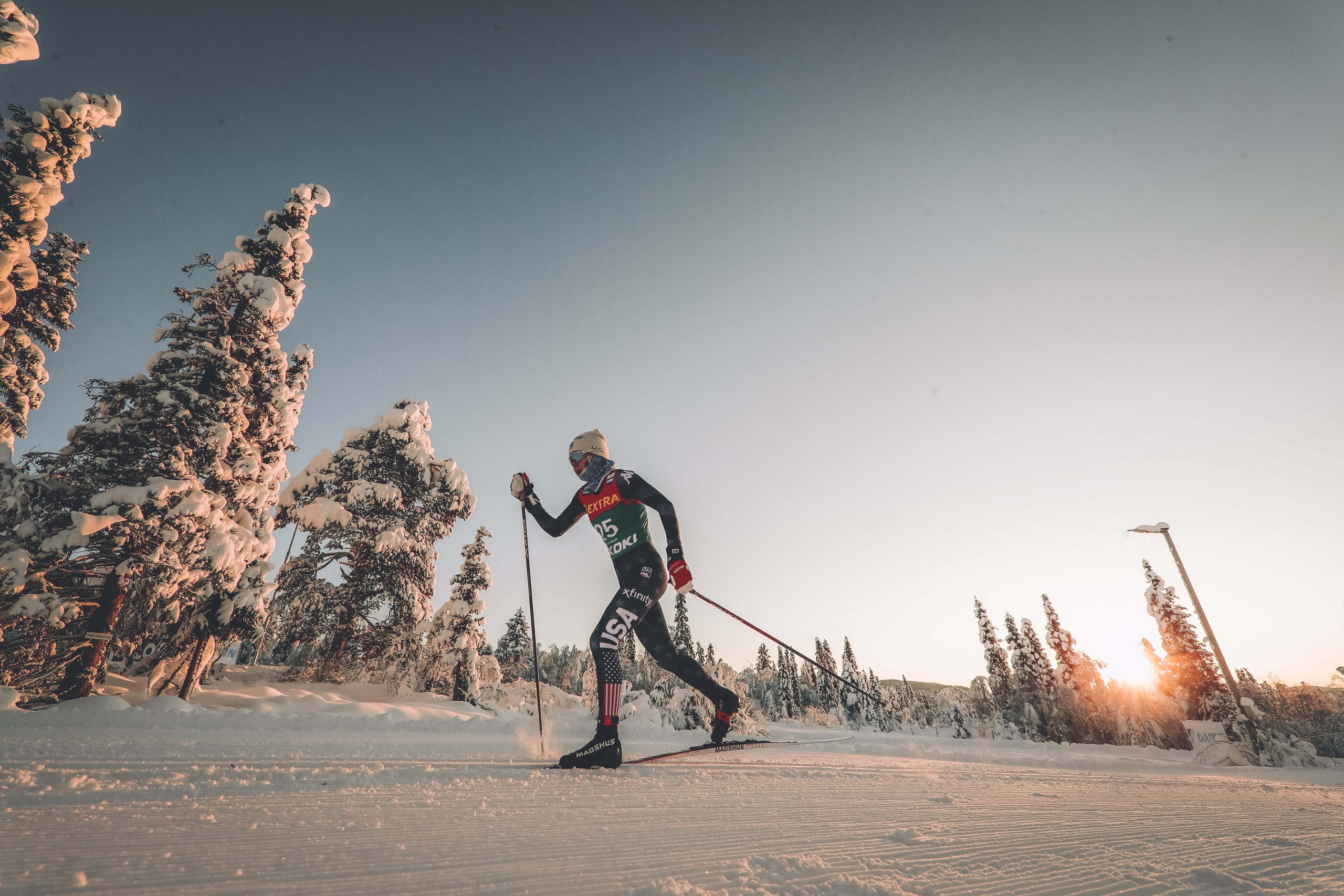
At the start, the racers had to warmup in cold but sunny Beitostolen weather: gorgeous if you like clear and cold with temperatures around 0 Fahrenheit (-18.3 Centigrade). The snow was loud and squeaky cold. In other words, it was a perfect day for classic skiing. The racers competed on a five-kilometer course which had a number of climbs with a steep long climb towards the end of the lap.
Many of the racers wore protective face tape, including Jessie Diggins and Rosie Brennan. With downhill speeds reaching 30 mph, precautions were in order.
“It was VERY cold today! I think the temperature actually dropped from when we woke up to when we started, and the course sits in a bit of a cold sink too. I am normally not bothered by the cold, but I was admittedly not as prepared as I could have been.” Rosie Brennan
Head Coach Matt Whitcomb said the team was ready for the cold. “We have heated vests, blankets, face tape, and incredibly warm clothing from our sponsors,” he said. “I didn’t talk to any athletes who really froze up.”
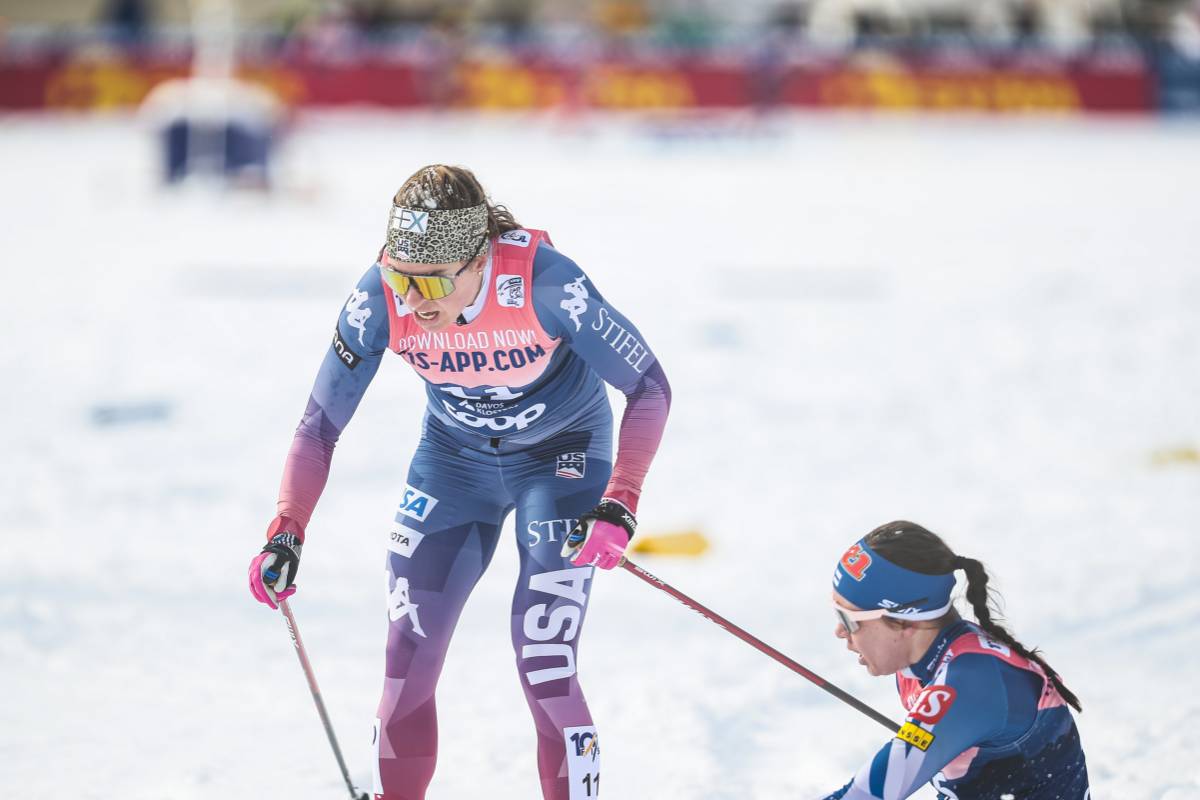
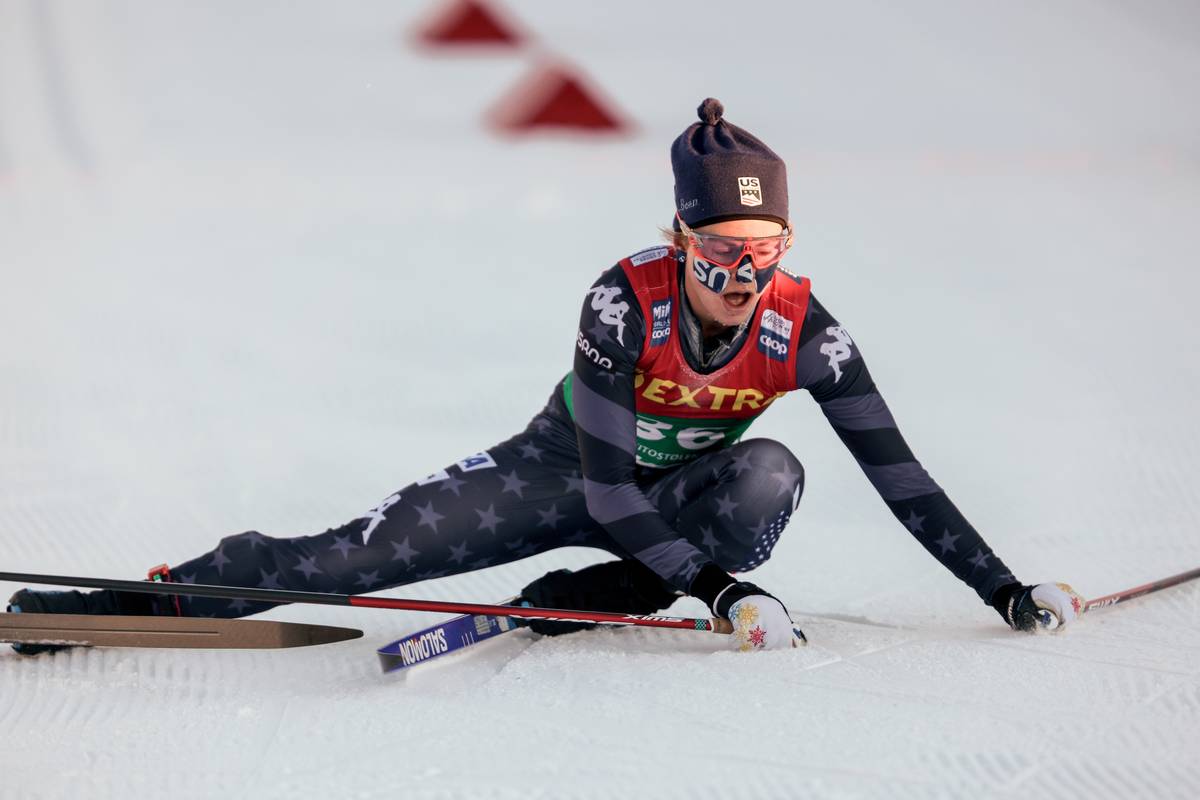
Jessie Diggins (USA) battled through the cold in Beitostolen, collapsing at the end of her 10 k effort. She would finish the day in 6th, yet another impressive classic skiing performance. (Photo: NordicFocus)
The Race
The racers started in thirty second intervals. Diggins crossed the first time check as the leader on course, but most of the competitors for the podium were still behind her. After all racers had cleared the first time check at 1.3-kilometers, Karlsson led Niskanen by 5.5 seconds, a lead she would extend to 7.9 seconds by the 2.6-kilometer mark. Diggins was in the hunt for the podium crossing the second time check in fourth, only 8.3 seconds off the lead. Brennan was holding steady in 5th place only 11.5 seconds off the lead.
By the halfway point, Niskanen had asserted herself and led by 1.1 seconds over Kalvaa, a lead that Niskanen would extend to 6.4 seconds by the 6.3 kilometer split. After this mark Niskanen never looked back. By the time skiers reached the 7.6-kilometer checkpoint the race had settled into a battle between Niskanen, Kalvaa, and Karlsson. Americans stayed close with Diggins and Brennan off the podium by only 11 seconds and 18 seconds, respectively; however, with three great classic skiers ahead of them, the Americans would not get the break they needed. Niskanen continued her relentless pursuit, displaying the textbook classic technique for which she is known. At the finish, she led comfortably by 12.7 seconds. Kalvaa held onto second by four seconds over Karlsson.
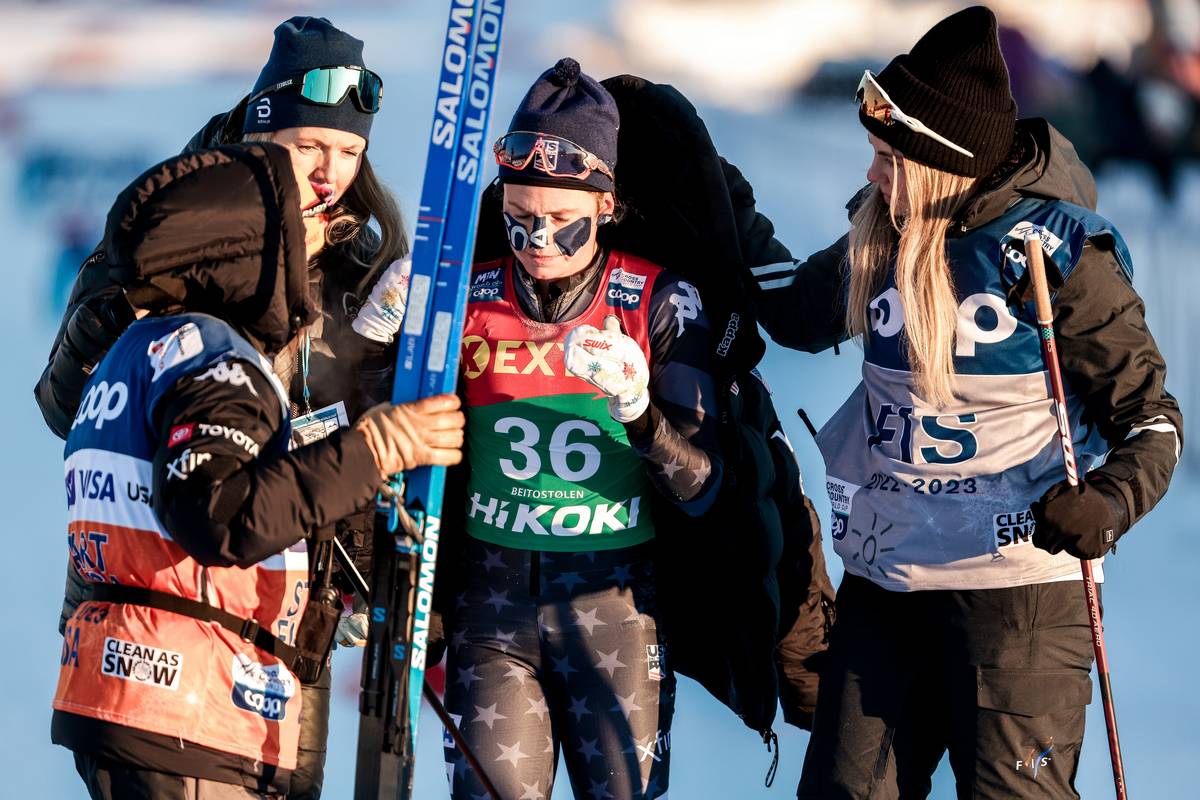
Diggins told Fasterskier that she had trouble with the cold. “It was so cold that I raced with heated socks and boot covers and struggled to keep myself warm,” she said, adding that she didn’t feel great throughout the race. “I felt kind of mentally detached during the race and was not ok at the finish. It took a definite toll. Our skis were on fire, and I was proud of how my classic technique has progressed. ”
Diggins being helped by teammates after paying the price for fighting in the cold of Beitostolen (Photo: NordicFocus)
Brennan reflected upon her day by saying that, “I was really happy with my skiing, especially coming off illness. My skis were great as well. I did what I could with the body I had, and it was definitely missing a gear that I wanted, but it was a very solid effort with some improved technical skiing.”
Whitcomb stressed the success of today’s outcome. “We had phenomenal skis today. It was one of those classic days you hope for. Our skis were exceptional, we’re very proud of that.” He added that, “We don’t take top ten or even top 30 finishes for granted.”
Whitcomb also highlighted the accomplishment of Sophia Laukli who is better known as a skate racer, and who finished in the top thirty today in Beitostolen.
Sohia Laukli having a top 30 day in the 10 k Classic Individual at Beitostolen. (Photo: NordicFocus)
“It’s easy to forget that just 15 years ago it was often that we would have zero people in the top 30 in distance, so this is a natural progression and an important thing to remember.” Matt Whitcomb
It was a great day for classic skiing and a great day for the American women.
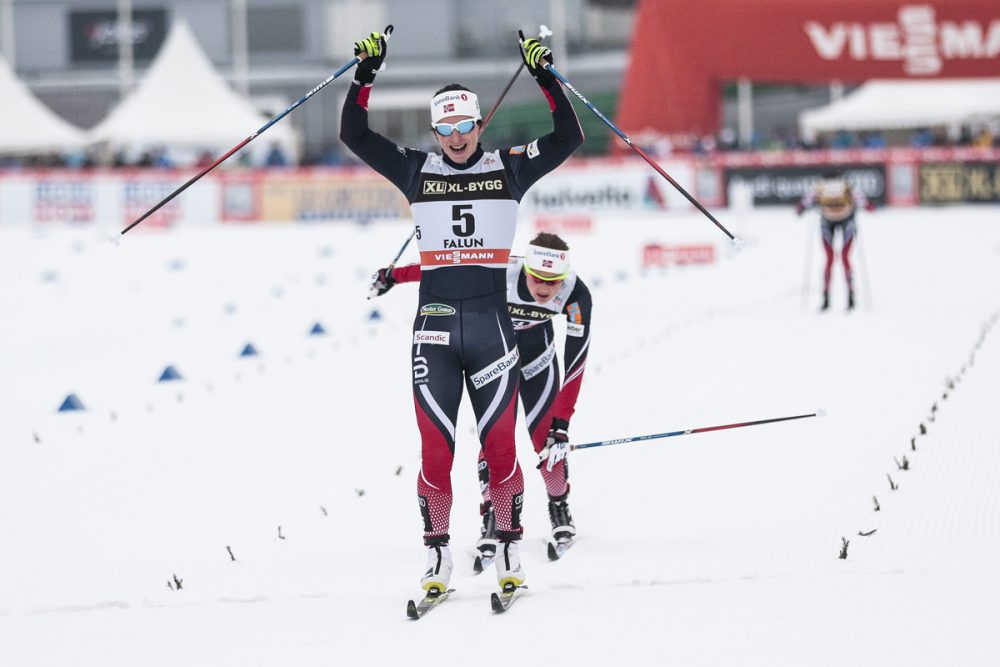
Norway’s Marit Bjørgen celebrates her 105th individual World Cup win on Sunday after finishing first, ahead of teammate Ingvild Flugstad Østberg, in the women’s 15-kilometer classic mass start in Falun, Sweden. (Photo: Fischer/NordicFocus)
*Note: this article has been updated to include comments from U.S. women’s head coach Matt Whitcomb as of Monday, Jan. 30.
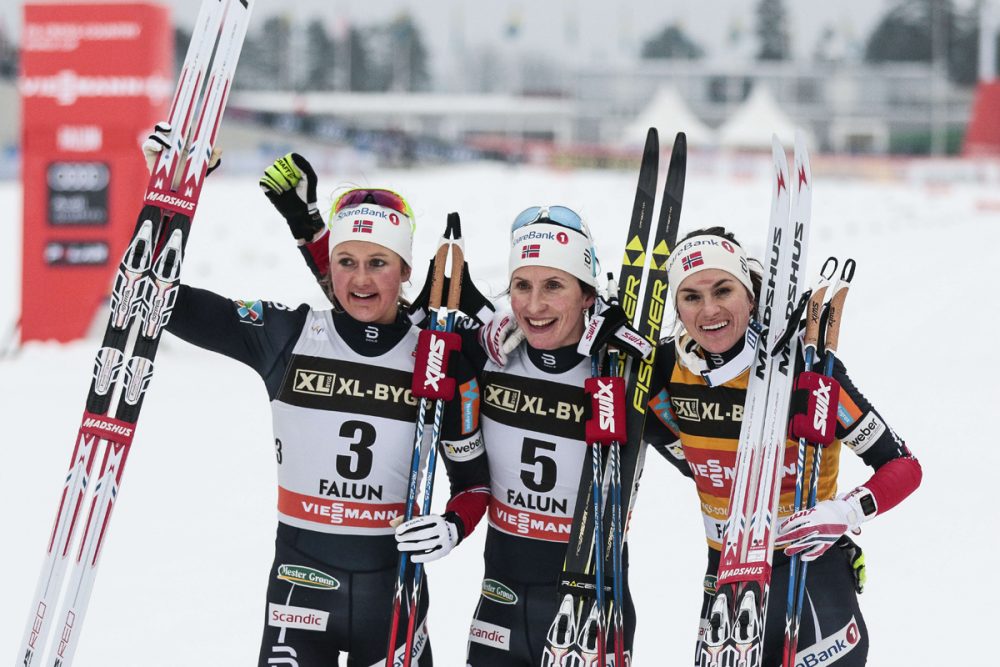
After sealing her 105th individual World Cup victory on Sunday, and her second distance win in a row, Marit Bjørgen is shutting out any doubt. The 36-year-old Norwegian was the first across the line in the women’s 15-kilometer classic mass start in Falun, Sweden, besting her teammate Ingvild Flugstad Østberg by half of a second, as well as the current overall World Cup leader, Heidi Weng, also of Norway.
“It’s great to be able to win World Cups still,” Bjørgen said according to an International Ski Federation (FIS) press release. “The young girls are strong, so it feels good to be able to come out with a win.
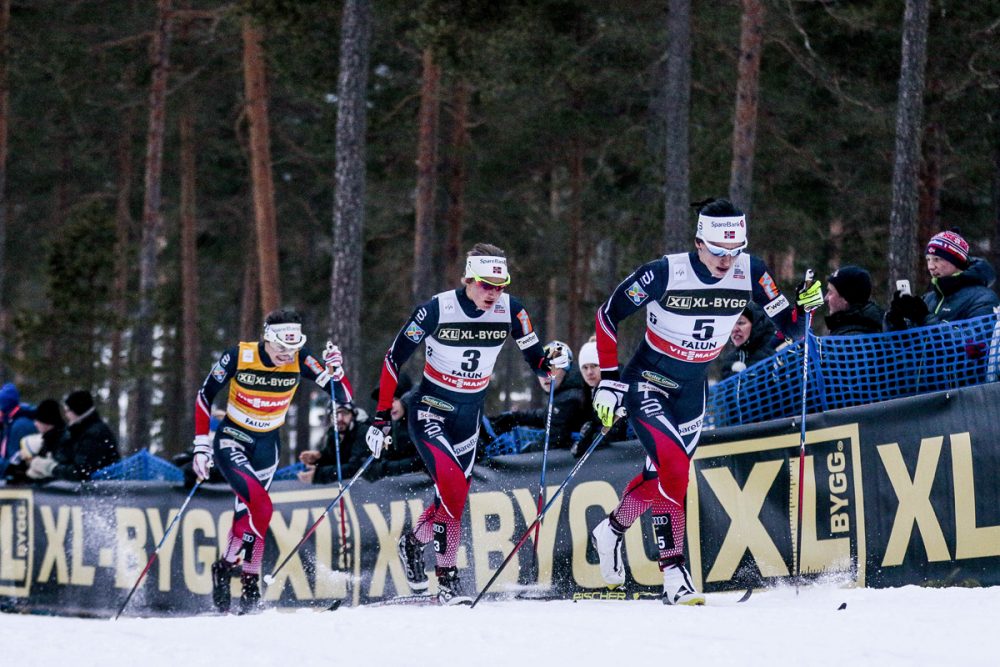
Starting in bib 5, Bjørgen wasted no time putting her teammates and the field to work. By 1.5 k she was in the lead, pulling Østberg and Weng, as well as Sweden’s Stina Nilsson — yesterday’s sprint winner — and Finland’s Krista Pärmäkoski.
Norway’s Marit Bjørgen (5) leads her teammates Ingvild Flugstad Østberg (3) and Heidi Weng during the World Cup women’s 15 k classic mass start on Sunday in Falun, Sweden. (Photo: Fischer/NordicFocus)
Also within firing range was American Jessie Diggins, skiing in seventh, along with Norway’s Astrid Uhrenholdt Jacobsen and Maiken Caspersen Falla, and Sweden’s Charlotte Kalla.
However, within another four kilometers, the Norwegians had broken away, a close to seven-second gap forming from them to Nilsson and Pärmäkoski.
While Bjørgen led for the first third of the race, Østberg took over by 10 k and Weng continued to follow in third.
With 1.8 k to go, Bjørgen was back to the front, Nilsson the closest challenger to the Norwegians just over 30 seconds behind.
“I thought Stina might catch me, so I am very happy to make the podium today,” Weng said, according to a FIS press release.
As the three headed into the second-to-last major climb, Østberg pushed to the front, Bjørgen trailing back. But coming into the final climb, Bjørgen moved back into first as she herringboned to the far outside right of Østberg, almost departing the marked course.
“I didn’t ski the final climb well … Marit got a gap and I wasn’t able to close it,” Østberg said according to FIS. “I wasn’t satisfied with yesterday’s sprint result, so it’s good to be back on the podium today.”
Left to right: Norway’s Ingvild Flugstad Østberg, Marit Bjørgen and Heidi Weng celebrate an all-Norwegian podium in the women’s 15-kilometer classic mass start on Sunday at the World Cup in Falun, Sweden. (Photo: Fischer/NordicFocus)
In a double-pole sprint to the finish, Bjørgen held off Østberg for the win in a time of 41:28.8. Østberg finished half a second later for second place, followed by Weng in third (+8.1).
The first American across the line was Diggins in 10th (+1:37.5) wearing bib 4. While the Afton, Minn., native explained that Sunday’s sugary conditions are some of her least favorite, the opportunity to put her classic striding to the test was something she welcomed.
After losing the leaders, the 25-year-old Diggins skied with a mix of Finnish skiers, including Laura Mononen, Anne Kyllönen, and Kerttu Niskanen, as well as Norway’s Falla.
“Early on I tried to go with the leaders but then settled into a great pack of girls to ski with and it came down to an exciting sprint out,” Diggins wrote in an email. “I’m really looking forward to some rest and then a quality training camp with some family time in Valadalen [Sweden] for the next few weeks! My boyfriend is here cheering me on and coming to camp with me, and then my parents come next week so I have so many great things to look forward to!”
The second U.S. woman across the line was Sadie Bjornsen in 21st (+2:43.6). A known lover of all-things-classic, Bjornsen was disappointed when she found herself tired during Sunday’s race. The 27 year old, however, was happy that she made it through the mental and physical challenge.
“Today I literally gave everything I had, and while I am not stoked on the number or result, I am really proud that I kept fighting through that wall in front of my face,” Bjornsen wrote. “It was really challenging classic skiing out there, which I love, so I am sad to have missed an opportunity to fight in those tricky conditions. Big shoutout to our team for giving me good skis! I am looking forward to some rest and recovery to rebuild for a big and important block of racing to come!”
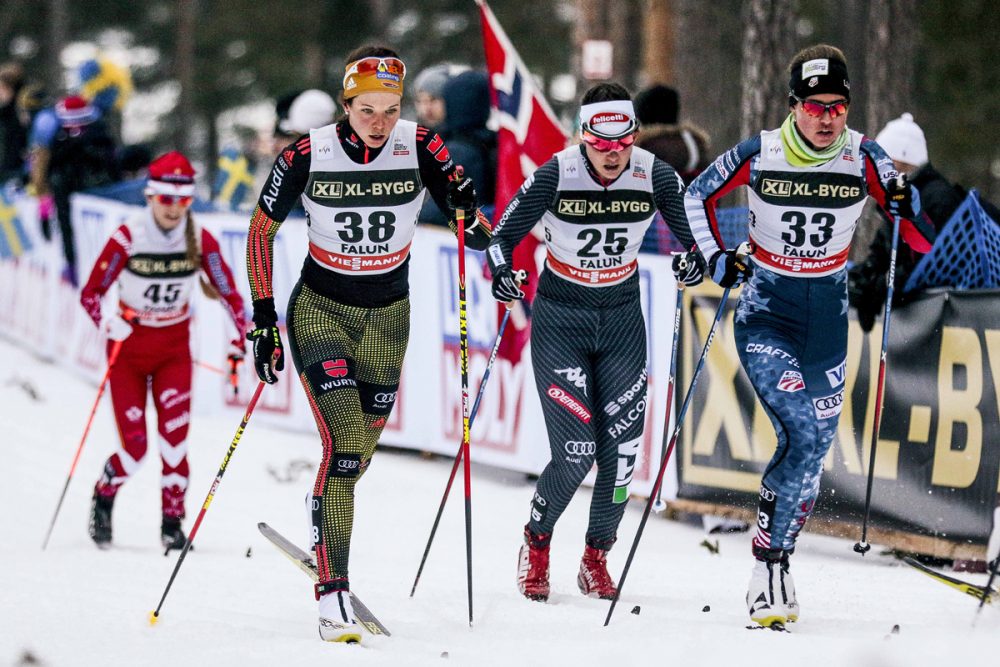
American Caitlin Patterson (33) and Canadian Cendrine Browne (45) racing the women’s 15-kilometer classic mass start on Sunday in Falun, Sweden, along with Germany’s Elisabeth Schicho (38) and Italy’s Giulia Stuerz (25). (Photo: Fischer/NordicFocus)
Two other American women also scored World Cup points, including Rosie Brennan in 24th (+2:57.0) and Liz Stephen in 29th (+3:24.5).
Despite the sugary conditions and deteriorated tracks due to the men’s race, Brennan explained that Sunday’s snow was what she was looking for coming into the 15 k.
“I actually really enjoy skiing in this kind of condition so I was optimistic about today’s race,” the 28-year-old Brennan wrote in an email. “I felt that I was fighting a bit of fatigue out there and only really had one speed, luckily it was a decent speed and I was able to hold consistent throughout the race.”
Also competing for the U.S. finishing just outside the points was Caitlin Patterson in 32nd (+3:47.6) and Ida Sargent in 34th (+4:02.8).
“Today was a solid day for the team,” U.S. women’s head coach, Matt Whitcomb wrote in an email. “We fought hard, and nearly accomplished what I will consider to be a huge achievement for the women, and that will be when we regularly can score our full national quota (6) in the points. Today we had 4, with a close 32nd and 34th. That’s close to where I know we can be.”
Canada’s lone competitor in the women’s race, Cendrine Browne crossed in 46th (+5:41.4) and American Liz Guiney finished 49th (+6:22.6).
Heidi Weng (r) outlasts Norwegian teammate Ingvild Flugstad Østberg (l) in the final meters of the 10 k classic mass start to win Stage 7 of the Tour de Ski in Val di Fiemme, Italy. It was Weng’s first-career World Cup victory after 37 World Cup podiums. Norway swept the podium with Therese Johaug (behind) finishing 6.2 seconds back in third. (Photo: Madshus/NordicFocus)
In the aftermath and celebration of the U.S. women crashing the Norwegian podium party this week at the Tour de Ski, it’s easy to miss the continual second-fiddle performance of Norway’s Heidi Weng. A perennial-podium finisher on the World Cup, she’s landed on the second and third steps 37 times in her career, according to an International Ski Federation (FIS) press release (including five times in six stages before Saturday). However, it’s her inability to the reach the top that’s been a head scratcher.
Saturday in Val de Fiemme, Italy, at the seventh of eight stages in the Tour, she ended that streak, holding off Norwegian teammate and Tour leader, Ingvild Flugstad Østberg, in the final stretch of the 10-kilometer classic mass start to eke out a 0.8-second victory in 29:16.3.
From the start, the lead pack consisted of three Norwegians — Weng, Østberg and Therese Johaug — and Finland’s Krista Parmakoski. Johaug led early at 1 k, and Østberg came through the timing point first at 2.5 k. There, the four had already started to create a small gap on Sweden’s Charlotte Kalla and Switzerland’s Nathalie von Siebenthal, 1.4 and 1.9 seconds back, respectively, while another Finn, Kerttu Niskanen, skied another second back in seventh.
Heidi Weng (c) topped the podium for the first time in her career on Saturday at Stage 7 of the Tour de Ski in Val di Fiemme, Italy. She beat Norwegian teammates Ingvild Flugstad Østberg (l) in second and Therese Johaug (r) in third in the 10 k classic mass start. (Photo: Fischer/NordicFocus)
One kilometer later in the four-lap race, the lead four had put nearly six seconds between themselves and the three-woman chase group, with American Sadie Bjornsen close behind them in eighth.
At the halfway point, Parmakoski led a train with Weng, Østberg and Johaug, respectively, while Niskanen trailed by 12 seconds in fourth. Kalla was 16.4 seconds back in fifth and Bjornsen 17.4 seconds behind in sixth.
The frontrunners’ gap to Niskanen grew to nearly 40 seconds by 8.5 k, while Kalla skied another 10 seconds back in fifth, just ahead of Italy’s Virginia De Martin Topranin. Austria’s Teresa Stadlober followed another 2 seconds back in eighth while Bjornsen hung in ninth, 3.3 seconds later.
“I felt amazing for 7k out there today, at which point I just pushed a little too hard on the uphill, and took the next 2k to recover,” Bjornsen explained in a post-race email.
Parmakoski faded over the next kilometer and a half before the finish and left the three Norwegians to battle for the podium. With about 1 k to go, Johaug’s skis slipped on a small uphill, leaving Østberg and Weng to fight for first. Coming down the final stretch into the stadium, Weng used a draft to slingshot around Østberg and out-double pole her in the final 100 meters to the finish, with Johaug settling for third, 6.2 seconds after Weng.
“I cannot believe it, it is so crazy and hard to describe it. I was the best today and I still cannot believe it,” Weng said in a post-race interview with FIS. “I followed Ingvild’s track in the last uphill. I had stiff legs in the downhills. I was just focused on the finish.”
Parmakoski finished the race alone in fourth (+17.4), Kalla took fifth (+55.1) and Niskanen was sixth (+59.0). Topranin took seventh (+1:03.8), Stadlober was eighth (+1:06.7), and Bjornsen finished ninth (+1:12.6), 4.3 seconds ahead of Finland’s Laura Mononen in 10th.
“Conditions were incredibly tricky out there with icing skis on the uphill, but we all managed,” Bjornsen recalled. “Sometimes you just have to accept the challenge and find a way to make it work. It made a world of difference to have some skis that were fast enough to keep up, so the minor challenges became small! I have to give you a huge thanks to the service team for giving me skis to compete today!”
Bjornsen 12th Overall, Diggins Still 10th
Sadie Bjornsen (U.S. Ski Team) leads Switzerland’s Nathalie von Siebenthal during the 10 k classic mass start at Stage 7 of the Tour de Ski in Val di Fiemme, Italy. (Photo: Fischer/NordicFocus)
On this day, U.S. Ski Team Women’s Coach Matt Whitcomb observed, “Every team had their skiers clearing their skis at the top of each hill,” he said on the phone. Dry tracks and klister conditions made for continual icing and skiers seeking to free their skis up before the descents.
In spite of the challenges, Bjornsen clinched her third top-10 of the Tour (after placing seventh in the skate sprint and ninth in the 5 k freestyle pursuit) and improved from 13th to 12th in the overall standings, 9:32.6 behind Østberg.
“I struggled with classic in the middle of this tour, with a fall in the classic qualifier and then slow and slick skis in the classic mass start in Obersdorf … so it feels nice to be back where I feel like I belong,” Bjornsen wrote.
As for her last lap, “She said on the final lap she went a little bit too hard and got a little too fired up and paid the price, and had to back it off a little bit,” Whitcomb explained.
He viewed that much energy at Stage 7 as “a great sign. To be fired up in any way after seven stages bodes well for how your body is absorbing things,” he said. “She’s still mentally engaged, so she’s probably still physically engaged, too.”
Looking ahead to Sunday’s climb, Whitcomb expects Bjornsen to turn some heads.
“We’re excited to see what she can do in the climb. She’s in great shape and she’s a great skier so I think she can do really well tomorrow,” he said.
“The only other year I have done the TDS is last year, and I dropped out after 4 stages,” Bjornsen explained. “I can’t wait to make it to the top and celebrate the achievement, but also take the energy to celebrate Sophie and Jessie’s huge achievements these last few days!”
Jessie Diggins cooling down after the classic sprint at Stage 4 of the Tour de Ski in Oberstdorf, Germany. (Photo: Harald Zimmer)
Coming off her first World Cup victory — the second for the U.S. in this Tour — Jessie Diggins placed 17th in Saturday’s mass start to maintain her hold on 10th in the Tour, 9 minutes back.
“She is in a great place, very confident, and feeling good in the races,” Whitcomb said.
In an email, she started by focusing on the positives: “I’m super proud of Sadie for hanging up there and especially proud of Rosie’s first WC point of the year!” Diggins wrote, referring to teammate Rosie Brennan finishing 30th on Saturday.
“My wax was not the wax I was hoping for today and made for a very challenging race, but I’m so excited for tomorrow!” Diggins continued.
Liz Stephen placed 21st (+2:01.7) on Saturday, and Tour rookies Brennan and Caitlin Gregg followed in 30th (+3:05.6) and 41st (+5:03.9) for the U.S.
Like Diggins’ victory from the previous day, the elation of finally finding the top podium spot clearly brought out a whirlwind of emotions for Weng, telling NRK, “I thought it was not possible. I’m so used to being 2-3-4. It is so big.”
Stepping away from the race as the fastest person that day posed a difficult reality for Weng to comprehend.
“Seeing ‘Heidi Weng’ at the top of the list is very unusual,” she continued. “That has not happened before, and I never thought it would happen.”
With her victory, Weng maintains a firm grasp on third in the Tour standings and will start the final climb 2:27 behind Østberg.
The Tour leader since Stage 3, Østberg padded her lead by not only finishing five seconds ahead of Johaug, the current World Cup leader and overall runner-up in the Tour with one stage to go, but also by collecting the mid-race bonus seconds. Johaug will start 39 seconds after Østberg in the final climb.
On Saturday, both Østberg and Johaug were happy for their teammate, and proud to be in their current positions as the end of 10 days of racing draws to a close.
“I am really happy for Heidi to win her first World Cup,” Østberg told FIS. “I am very proud to be on the podium on all of the Tour de Ski stages. I would not believe before the Tour I could lead before the last stage by almost 40 seconds.”
Final-Stage Hill Climb
Sunday’s final stage, a 9 k freestyle pursuit-style hill climb up Alpe Cermis includes gradients as high as 26.5 percent and over 1,600 feet of total climbing, with the majority of that coming in the final 3 k.
Another one of the top finishers in the final stage, Stephen skied the fourth-fastest time up Alpe Cermis last year to place fifth overall in the Tour. After placing 21st on Saturday, she’ll start the final climb 25th, about 12 1/2 minutes after Østberg.
“She hasn’t had a great tour; the format [this year] is tricky for her, but she just hasn’t put together races she’s satisfied with,” Whitcomb said, adding that on Sunday, “She’s poised to ski very well, and I would be surprised if her goal wasn’t to win.”
If all goes according to plan, the U.S. will have seven skiers, five women and two men, finish the tour this year — the most yet.
“It’s a cool thing that we’ve got so many athletes ready to start tomorrow’s stage,” Whitcomb said. “That’s a great thing for the team.”