From the FasterSkier archive — posts syndicated from athletes’ and coaches’ own blogs between 2004 and 2012, kept online as published. Current coverage is at fasterskier.com.
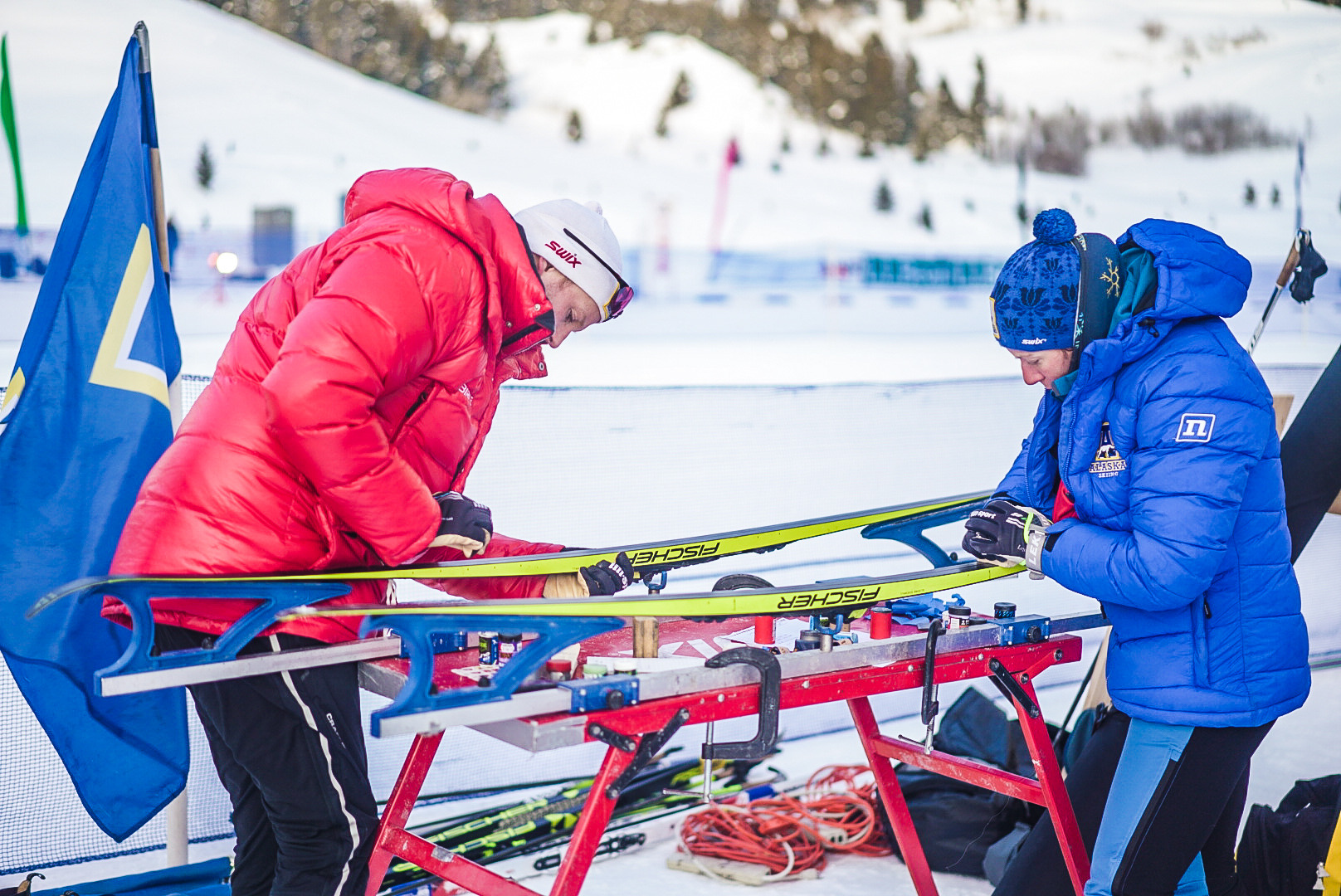
The prepping of the boards: University of Alaska Fairbanks coaches prepare skis for their athletes at the 10/15k mass start classic races in Sun Valley. (Photo: Tobias Albrigtsen / @untraceableg)
Quick Recap: We’ll have a full race report up tomorrow, including athlete comments and photos, but here is a quick recap of the action in the men’s 15k and women’s 10k mass start classic, which took place this morning in Ketchum, Idaho.
The 2022 Sun Valley Nordic Invitational continued this morning with 10/15-kilometer classic races at the Lake Creek Ski Center in Ketchum, Idaho. While temperatures were warmer than at the start of yesterday’s skate races, it was still a brisk morning in Sun Valley, making for excellent classic racing conditions in the dry high-altitude natural snow.
The men kicked off the morning’s races, taking off in a mass start at 9:30am. Rebounding from sixth place in yesterday’s skate, David Norris (APU) took the win in 35:50.5, leading a train of teammates for an APU podium sweep. Hunter Wonders doubled up on his second place performance, finishing 8 seconds behind Norris. Wonders edged out Scott Patterson (USST/APU) at the line by 0.5 seconds, leaving Patterson in third. Ian Torchia (SMS T2) was next for his second fourth place finish of the weekend (+28.1), finishing in a three-way sprint with APU’s Zanden McMullen who took fifth (+28.2) and University of Denver’s Bernhard Flaschberger in sixth (+28.4).
Flaschberger was again the top RMISA collegiate racer, with Sam Hendry of the University of Utah in second place (8th overall), and fellow Denver athlete Andreas Kirkeng in third (10th overall).
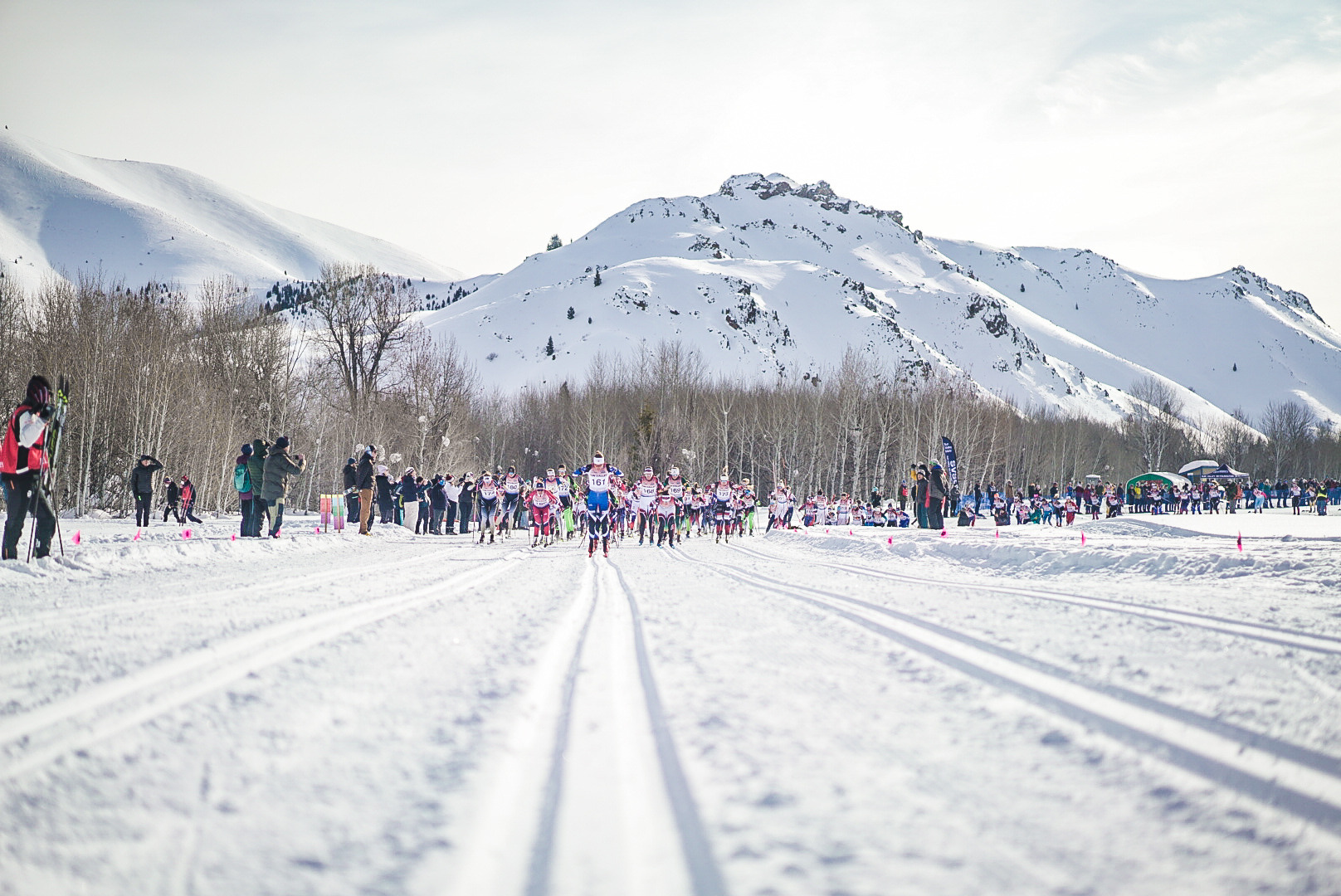
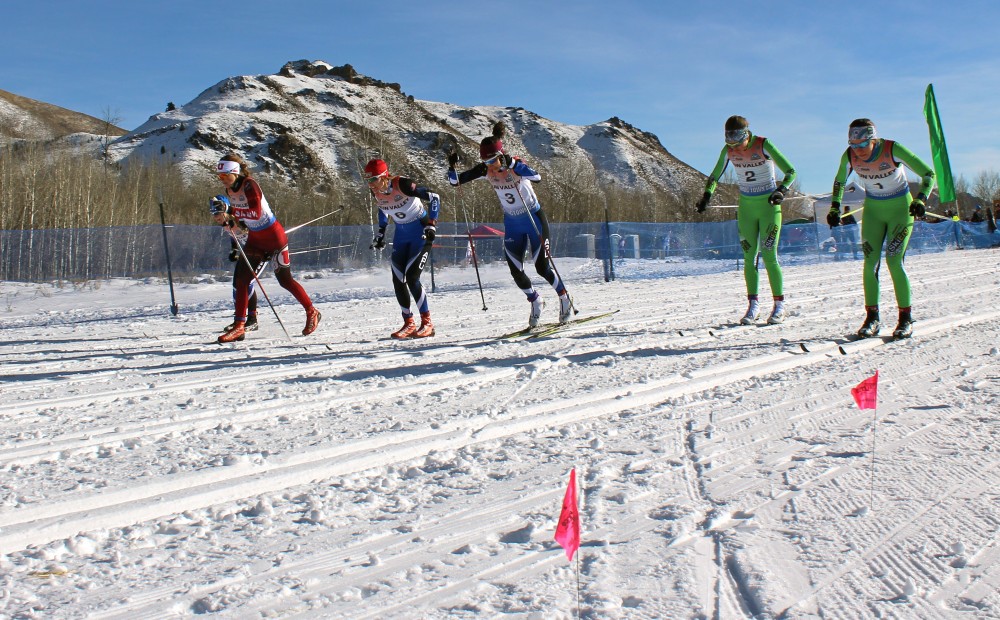
The opening meters of the women’s 10k mass start classic, with Rosie Brennan setting the pace in her blue APU race suit. (Photo: Tobias Albrigtsen / @untraceableg)
From the looks of an SVSEF Gold Team Instagram story, Rosie Brennan (USST/APU) took the women’s race out hot. Following the theme of her domestic racing over the last two weeks, Brennan steadily grew her lead over the field, crossing the finish line in 29:35.3, nearly a minute ahead of her chasers. Katharine Ogden (USST/SMS T2) led the chase back to the finish to take second place (+55.4), with Novie McCabe (USST/U of Utah) close behind, again in third (+1:07.6). Rosie Frankowski (APU) was fourth for the women (+1:17.1), with Sydney Palmer Leger (USST/U of Utah) behind in fifth (+1:26.4), leading her teammate Sophia Laukli who finished roughly a second behind her in sixth (+1:27.2).
This time with McCabe on the top-step, these three University of Utah women again swept the RMISA collegiate podium for the second day in a row.
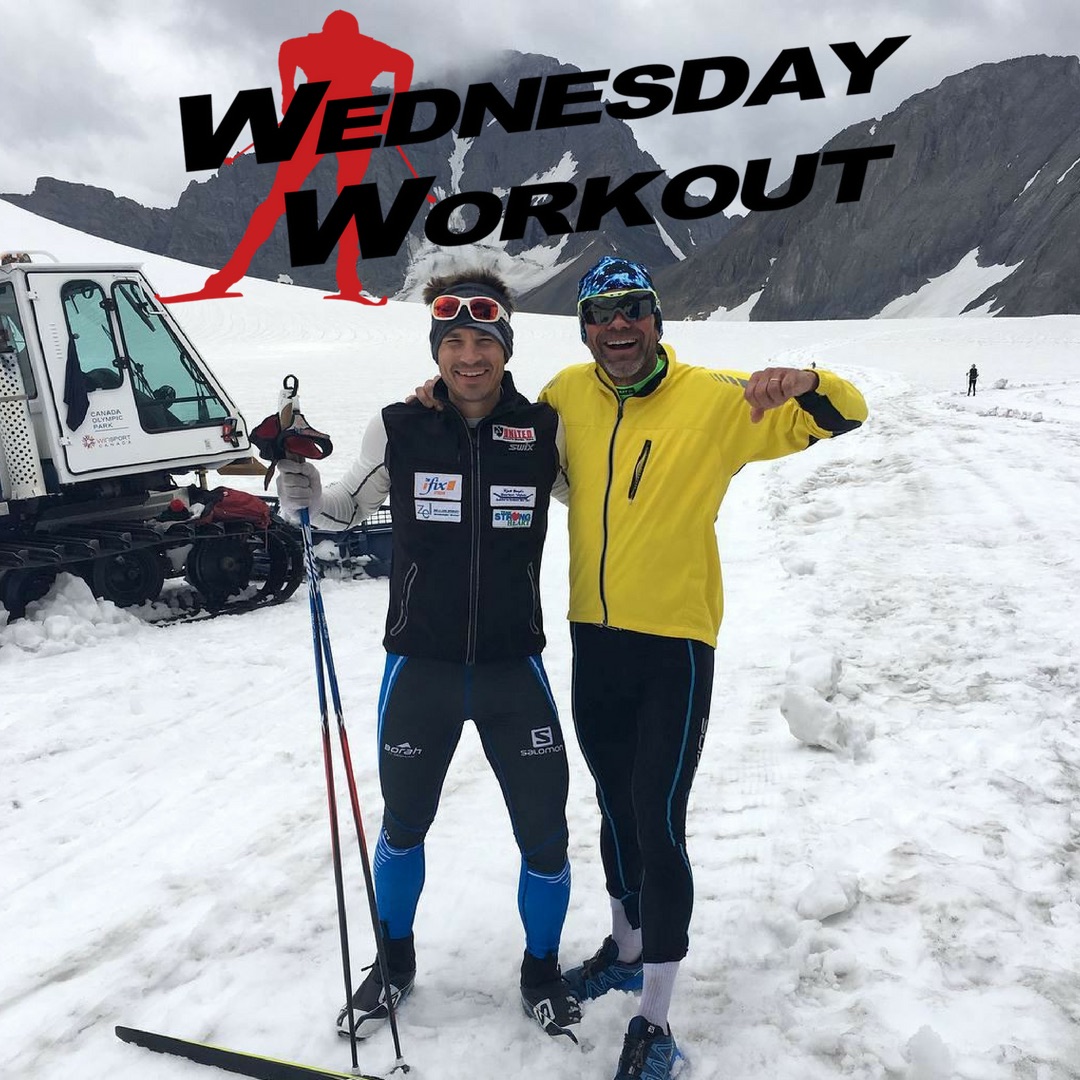
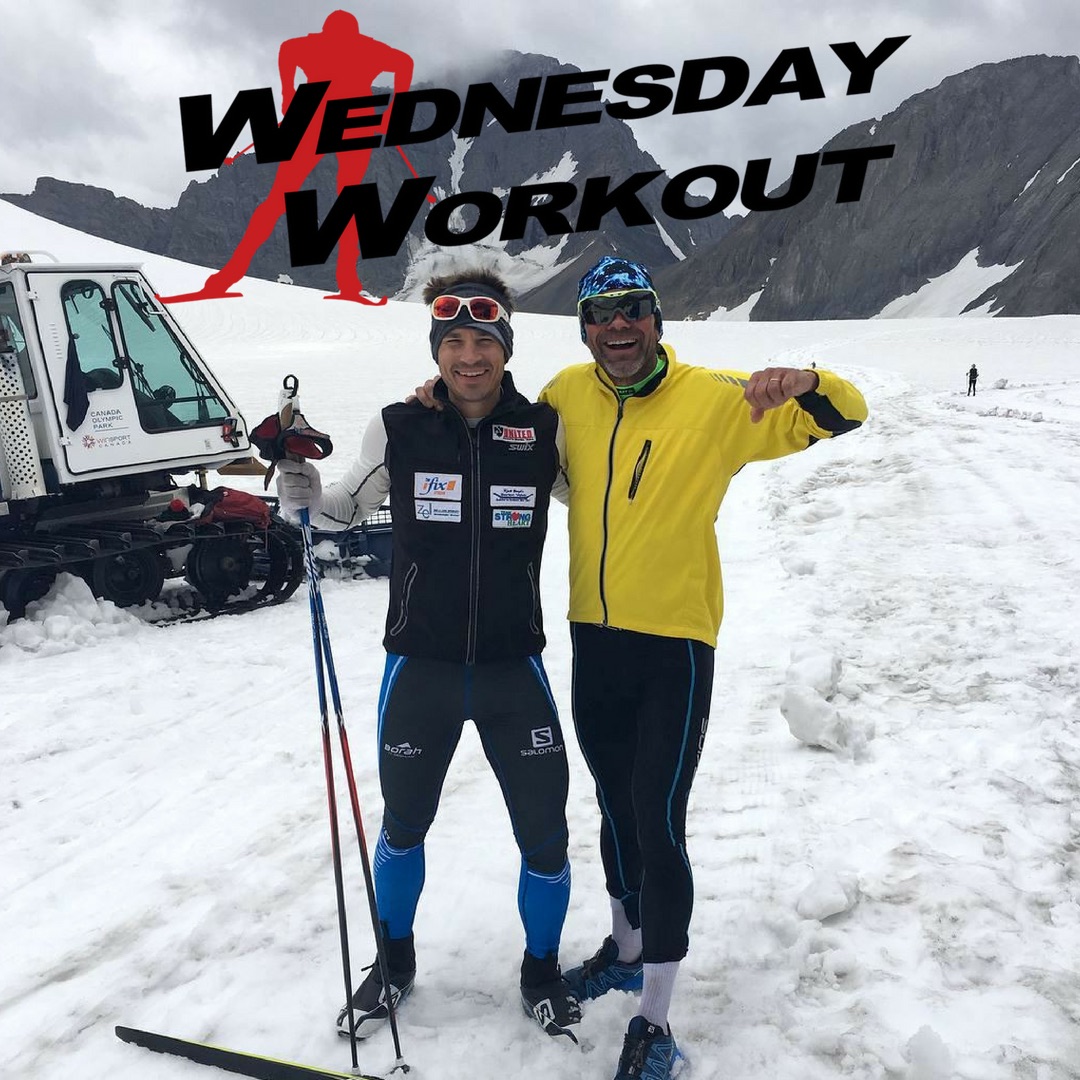
Author Bill Nurge and Matt Liebsch (l) on the Haig Glacier near Canmore, Alberta, last August. (All photos: Bill Nurge)
This week’s workout comes from Bill Nurge, head coach and owner of the HardCore Training Center in Ketchum, Idaho, who has a master’s degree in exercise physiology. Starting July 28, Nurge and Matt Liebsch will be serving up a week of nordic-specific fitness training and technique work at the Sun Valley Nordic Fitness Academy. With a maximum of only 12 participants, they recommend signing up early. Click on this link for more information.
***
You can blame Matt Liebsch for this workout … and for making me a better skier!
Last August, my wife and I joined Coach Matt, and 25 other nordic tribe-mates, on the Haig Glacier for what turned out to be a bucket-list topper in every regard. One of the biggest takeaways from skating a dozen hours behind the terminally affable Birkie winner and World Cup skier was how annoyingly powerful and stable he is on one ski. Whether he was single-ski double poling up a hill, or gliding effortlessly on a long descent, he was always solid and skilled while perched atop a single Salomon S/Lab skate ski. As much as I’d like to blame the fact that I didn’t start skiing until I was almost 30, and my equipment wasn’t as good (Matt promptly set me up with shorter poles, better boots, and hand-picked stable skis), the stark reality was simple: Matt possessed more power, greater dynamic stability, and better balance than I did.
So once my 56-year-old brain got over being tweaked by my body’s inability to match his single-ski prowess, I set to work on developing a program to take my balance, core stability and functional power to a higher level. And the best part is that it worked! Prior to consistently performing the workout I’m about to share with you, my posture, balance, and power output would predictably spiral downward halfway into a 50k skate race. But this past March, I was able to string together two of my best back to back 50 k’s (10th overall at the West Yellowstone Rendezvous; 4th overall at the Cascade Crest Marathon) with no appreciable diminution in performance.
It’s no secret that nordic skiing — particularly skating — is a single-leg sport. Unless you’re double poling or flying downhill in a tuck, the vast majority of time is spent balancing and producing “ground force” with one ski, and one or two poles. This is why single-leg power, core stability, and balance play such major roles in sustainable speed. Every powerful stride must be accompanied by a dynamic, and sometimes high-speed balancing act requiring huge amounts of stabilization at the hip, knee and ankle joints. In the 2 hours and 15 minutes — of mostly single-leg Pain Cave time — it took me to complete the relatively flat Cascade Crest 50 k in Bend, Oregon, I ended up doing roughly 4,000 V2 strokes on each leg. That’s a lot of time performing single-leg squats with hip abduction and balancing and repeating every second!
So here’s the deal, most nordic athletes do a great job of cranking out lots of cardio hours, weighted pullups, dips, box jumps, and heavy squats. The problem is that some of the hard-earned endurance and strength will be squandered unless it’s matched with equal amounts of balance and stability training. With regard to function, the muscles of the hip can be separated into two groups: movers and stabilizers. Though they all technically perform both, it’s easier to think of them in these two distinct categories. Because strength and stability are two sides of the same coin, having strong “movers” (lats and glutes) and weak “stabilizers” not only compromises performance, but may contribute to shoulder, lower-back, knee, and ankle injuries. Bottom line: nordic skiers are only as “strong” as their weakest stabilizers. Just like their big-brother primary movers, the myriad behind-the-scenes stabilizer muscles need strength, stamina, power, AND intelligence to do their “balancing act” effectively. No stability, no balance, no fun.
Here are five pairs of exercises you can add to your existing program to help improve single-leg balance and functional power (with links to demo videos):
The Workout: Nordic-specific exercises to improve balance, core stability and functional power
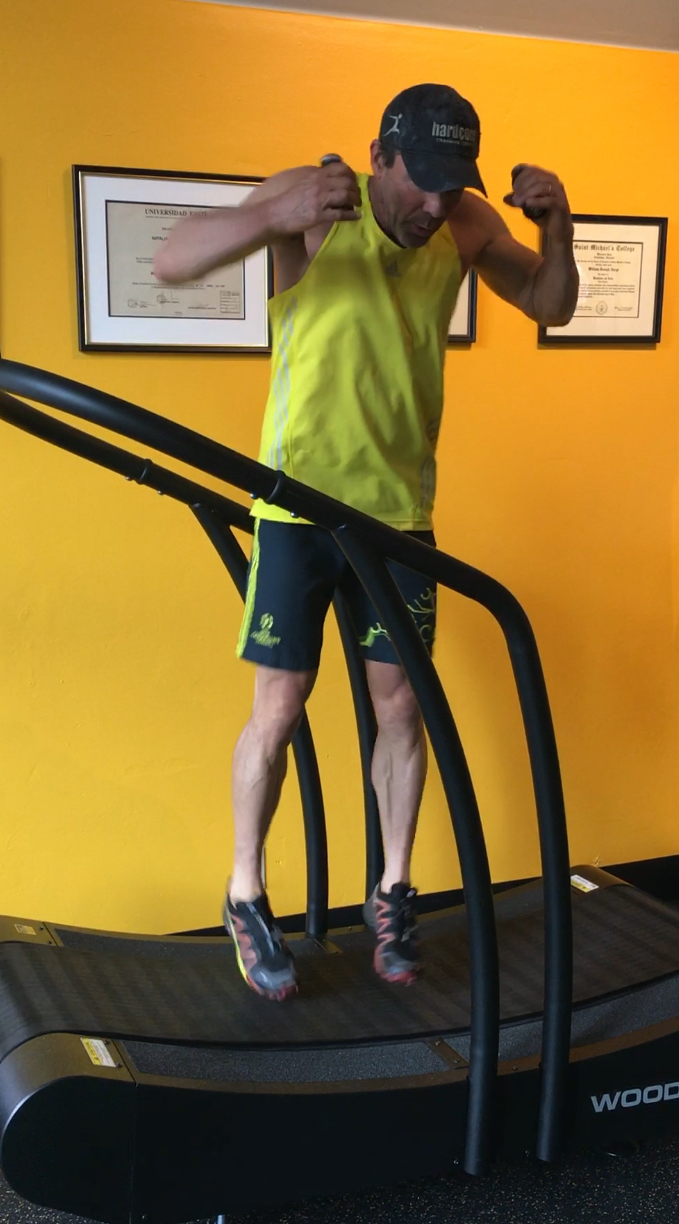
Then do a second set of 2 minutes of Level 2 cardio standing on the AirDyne, all directions on treadmill, and V2 on the SkiErg. Follow this up with 80 seconds of alternating dips, side-skip slams, and lateral skip rope pulls.
Finally, a third set of 2 minutes alternating 10 seconds easy/10 seconds “harder” on AirDyne (hands on rings pulsing up and down), treadmill (forward only), and SkiErg V2 with jump, followed up by 90 seconds of tuck-jump dips, single-leg BOSU hop rope pulls, and side-skip slams.
Side-skip on the treadmill with pulsersSide-skip slams
Paired Exercises: About 25 minutes for one set of each
For each of the paired exercises, I would recommend starting with a medium-hard 60-second first set with 30 seconds rest between each leg, and no rest between pairs. Note that on all but the first set you will be performing each of the paired exercises on the dominant leg first (left leg for most right handers), and then the non-dominant leg. I like to have the less coordinated/“weaker” leg follow the lead and learn from the smarter/stronger leg.
So for example you would do (#2a) left-leg inverted SkiErg step ups, immediately followed by (#2b) left-leg single-leg slideboard double pole. After 30 seconds of rest, switch to the right leg of the same exercises. Then move on immediately to the next (#3) set. Try to build into each set and maintain form as you get fatigued. The demo videos are very helpful in showing proper form and body position.
Performing one set of the 5 pairs equals 8 minutes (not counting the first pair which alternates legs) of total time-under-tension for each leg: roughly a hilly 10 k’s worth of single-leg balance for an elite skate-skier. After several weeks of this twice-weekly regimen you can add a second, more aggressive 75-second set of each exercise. This would amount to about 18 minutes of overload on each leg plus up to about 4 minutes of sandbag push and hip bridge swings. Total workout time (including 20 minute warmup) is approximately 1 hour.
1) a. Sandbag Push: The key on this brutally effective, anterior-core exercise is to push the bag — or something heavy that slides — with your body, not your arm. Use your legs and side-flexion muscles to “shove” the bag forward. It should be heavy enough that you can’t push it with your arm alone. If you have a strong core you can do this exercise for two minutes alternating arms and directions. Make sure your push arm is on the same side as your lead leg.
b. Hip Bridge Monkey Swings: This is essentially a dynamic hip bridge with isometric abduction, and posterior chain muscle tension. Keep the hips up, knees pushing “out” against the rubber band, and arms bent at 90 degrees. This can also be done — without the swinging — on a single TRX strap in single-handle mode walking your feet forward and backward. This exercise can be performed for up to two minutes.
2) a. Inverted SkiErg Step Ups: The flywheel resistance provides a uniquely effective eccentric overload to the quads, hip extensors and lower back. This can also be done with weights or a heavy rubber band. The key is to use only the upper/loaded leg to pulse aggressively out of the bottom position. Use a cadence of about 60 strokes/minute and pause/glide for half a second at the top of each rep.
Single-leg step ups with flywheel resistance
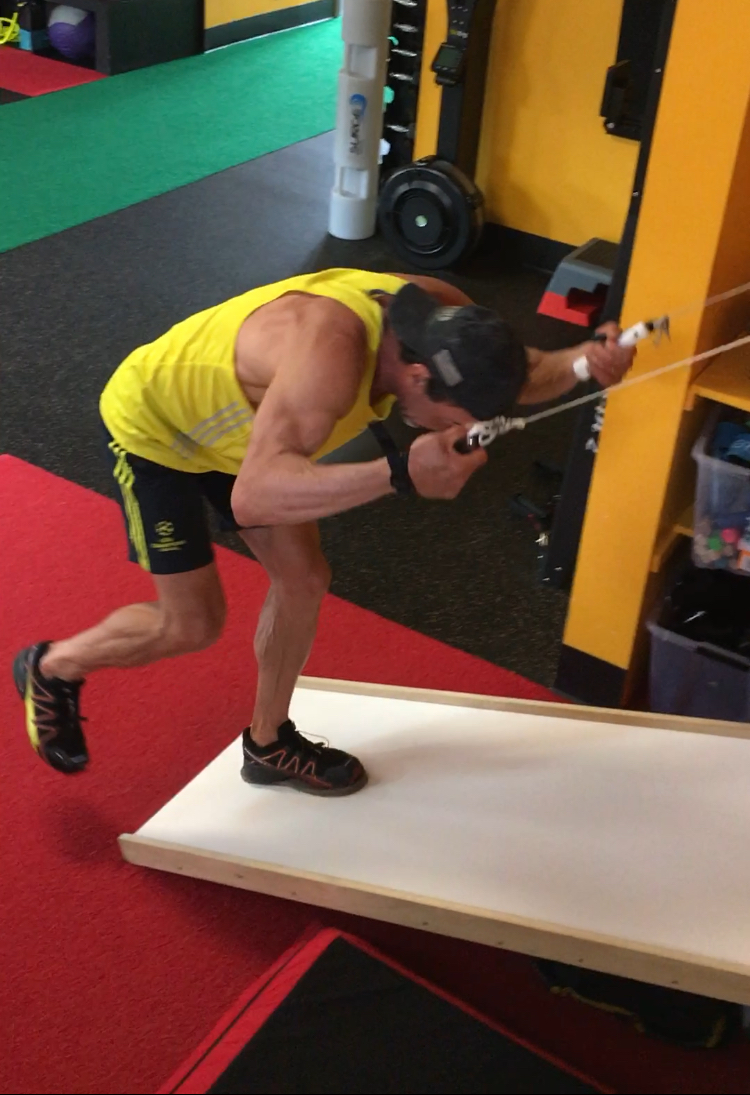
b. Single-leg slideboard double-pole hops: Your primary hip-and-knee movers — quad and glute — should feel like they just did a breakaway on a big climb, but you still need your stabilizers to negotiate the technical downhill to the finish! While maintaining constant tension on the poling muscles you can hop or pull yourself up the slideboard and then allow yourself to glide backwards resulting in a big eccentric hit on the double-pole initiators. This can also be done using a TRX strap and performing partial pistol-squat pull-ups; although it’s not as intense on the balance muscles.
Single-leg double-pole on sideboard
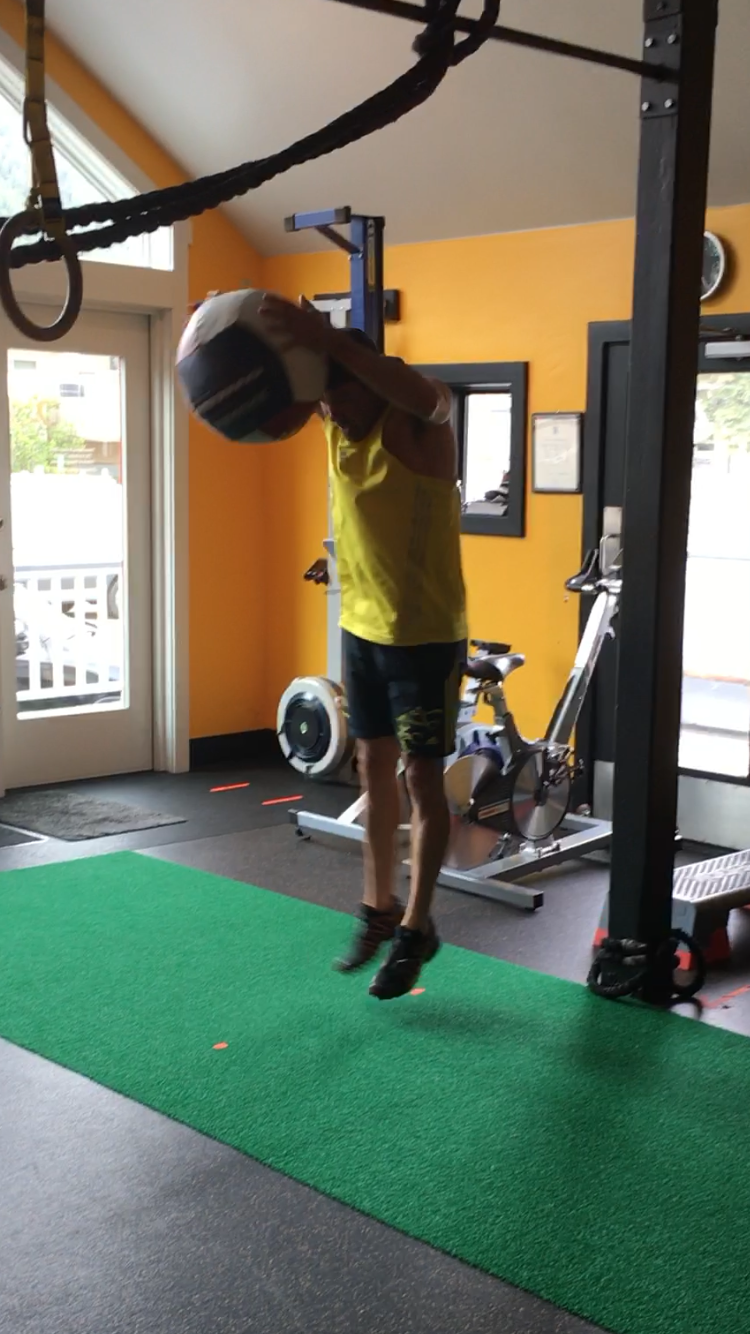
3) a. Single-leg squat jump double pullup: The key on this exercise is start with a 90-degree knee-angle and no countermovement. Explode up and do one pullup while touching foot to bar, and then as quickly as possible do a halfway down pullup and repeat as quickly as possible. High-tempo partial range of motion/upper-half pullups are more nordic-specific because of the shoulder-joint angle and eccentric loading.
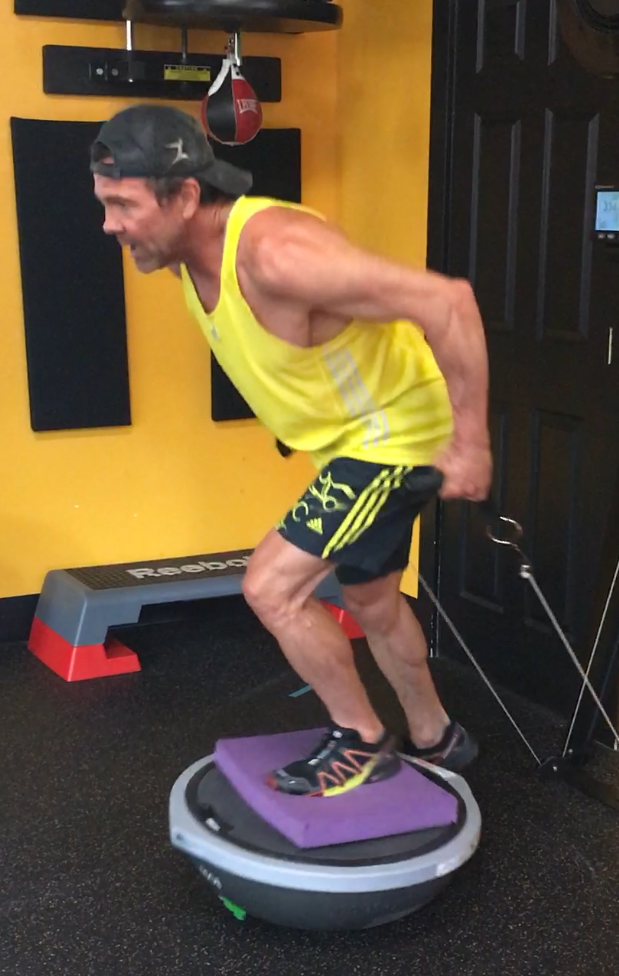
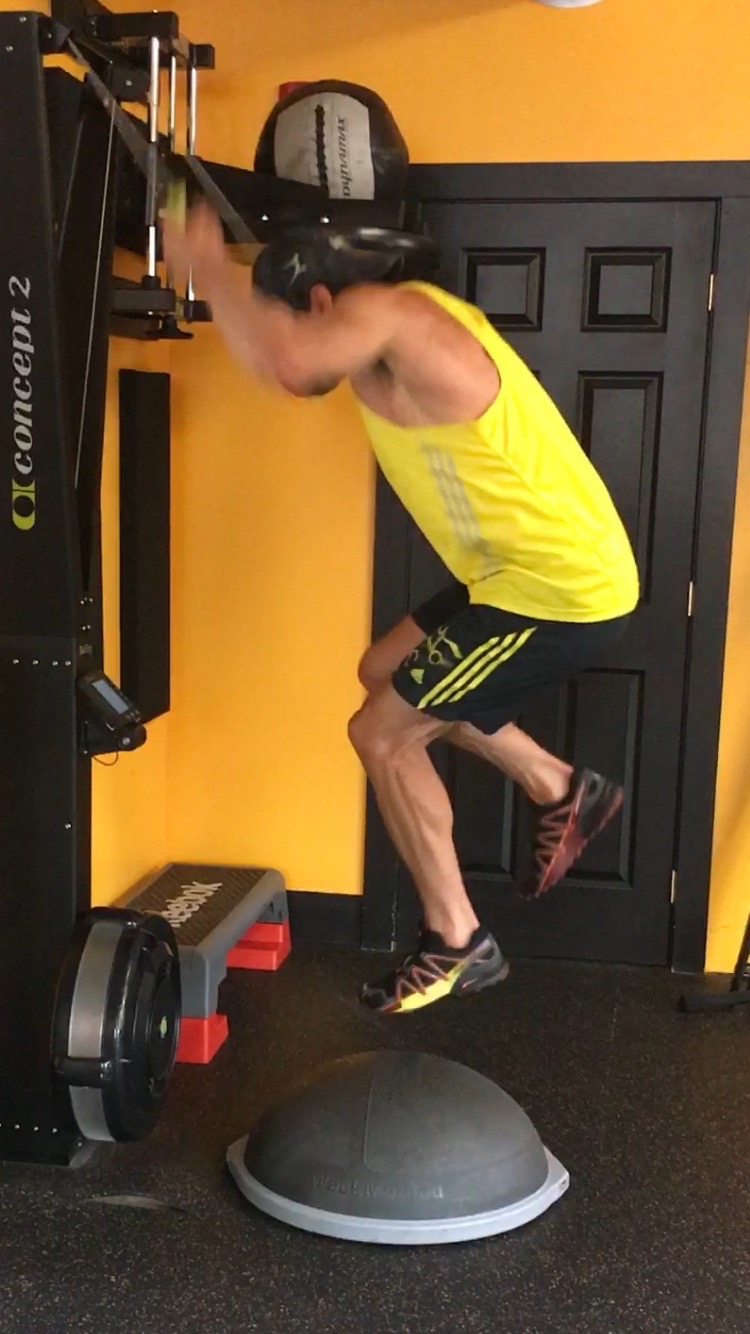
b. Single-leg stomps on BOSU with high-tempo SkiErg double pole: Now that your big primary poling and leg muscles are hammered, similar to the end or a race, you have to sprint and produce lots of “ground force” with the tired arms and leg. Keep the cadence high (80-90 spm), stomp your foot on the BOSU, and sprint for the finish!
Single-leg stomps on Bosu with SkiErg double-pole
4) a. Single-leg TRX squats with arm extensions: Get in a position where you’re maximally dorsi-flexed at the ankle and the triceps are loaded. Perform about 1 rep per second with the arms extending only two-thirds of the way out (just like most of your V2 poling strokes). Make sure your hands go fully behind your head on every rep and you’ve got heavy tension on your triceps.
b. Single-leg BOSU squats holding front-plank on slideboard: With your triceps dynamically fatigued this exercise will take them even deeper isometrically and help build integrity at the “bottom” of their functional range of motion. Maintain anterior core and tricep tension the entire time you’re single-leg squatting and pulling yourself backwards with the hip flexors. This can also be performed on the floor with sliders.
5) a. Single-leg ball bounce on Slackline: Having the slack line inclined simulates an uphill ski and forces more pressure on the ball of the foot resulting in ankle flexion. Hold off on actually throwing the balls until your able to balance for at least 30 seconds without falling. You want to get to the point where you can get 20-30 ball tosses in a minute without tipping over. This exercise can also be done on a balance disc; but it doesn’t feel the same as a skinny ski.
b. Single-leg push and slide on zipline TRX strap: With your stabilizers statically fatigued, now it’s time to see how they perform dynamically … Pushing and gliding in a forward-leaning, front-plank position simulates the start position of most nordic strokes. Make sure you have vertical-hip displacement and are head over foot on every rep. This can also be done without the “zipline” (a ceiling-mounted track with a chain hanging down from it and a Core Flyte Dynamic Stability Trainer under your foot) but it’s not as FUNctional 🙂
So there you have it … Try to hit the unilateral balance work 1-2 times/week and you should find yourself feeling significantly more solid and confident in your ability to powerfully push, and effortlessly glide!
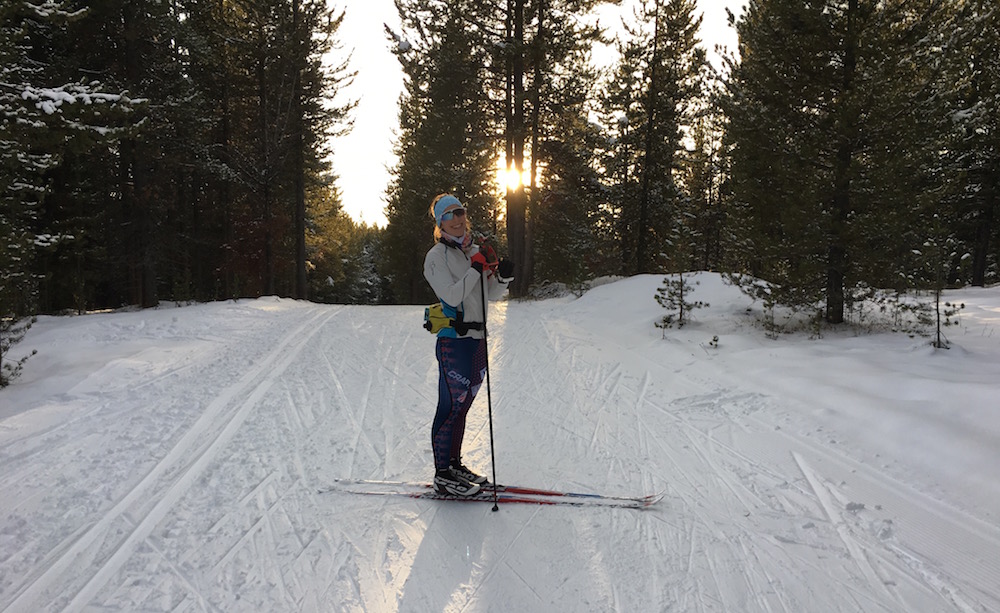
Kelsey Phinney, of the Sun Valley Ski Education Foundation (SVSEF) Gold Team, during an easy ski in West Yellowstone, Mont., in November. (Photo: Annie Pokorny)
In an effort to showcase the North Americans competing at this week’s International Ski Federation (FIS) 2017 USANA Nordic Junior World Championships and U23 Cross Country World Championships at Soldier Hollow in Midway, Utah, we asked those qualifying athletes several questions about themselves — actually, we had them fill in the blanks. Here we have 22-year-old Kelsey Phinney, of the Sun Valley Ski Education Foundation (SVSEF) Gold Team, who’s representing the U.S. at her second U23 Worlds. On Tuesday, the U23 championships begin with classic sprints.
***
“My full name is Kelsey Phinney, but you can call me Kelsey. I was born in Boulder, Colo., raised in Boulder, and one thing you should know about my hometown is that even though it’s basically a city, you still can run into bears and mountain lions on the trails.
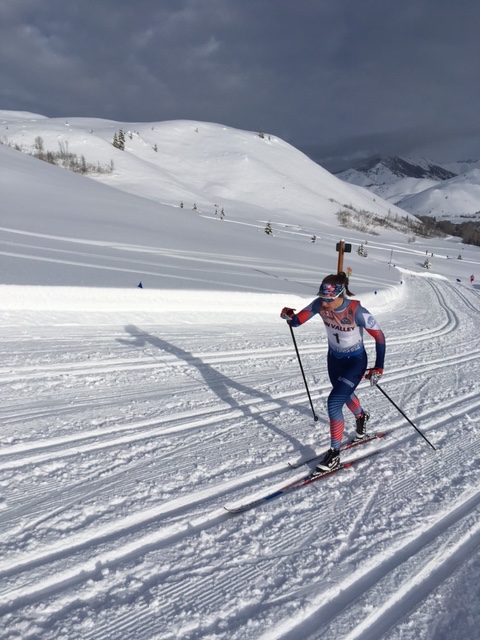
Kelsey Phinney (SVSEF) racing a freestyle sprint qualifier at a FIS race on Jan. 21 at Lake Creek in Sun Valley, Idaho. Phinney won both the qualifier and the final. (Photo: Connie Carpenter)
I started cross-country skiing when I was eight, thanks to my dad bribing me with snickers and hot chocolate. I currently train in Ketchum, Idaho, with SVSEF Gold Team.
If I’m not skiing, you might find me working on my pen and ink drawings and listening to the ‘Hamilton’ soundtrack. If I had to pick a favorite book, it would be ‘The Alchemist’ by Paulo Coelho.
One of the things I’m most excited about for U23/Junior Worlds at Soldier Hollow is that it’s in America!! One race I’m especially targeting there is the classic sprint.
The best advice anyone ever gave me about skiing or racing was that a happy skier is a fast skier. One of the best race memories I have is doing the Superwoman pose with the other girls at the start of the A-final at Spring Series in Sun Valley (and then subsequently getting my first Supertour podium).
If I could meet one World Cup skier, it would be Stina Nilsson.
I currently am a professional skier, but I’ll probably go back to school after to keep studying something related to neuroscience.
I graduated from school last May so I finally don’t have to worry about what my professors think about my extended absences!
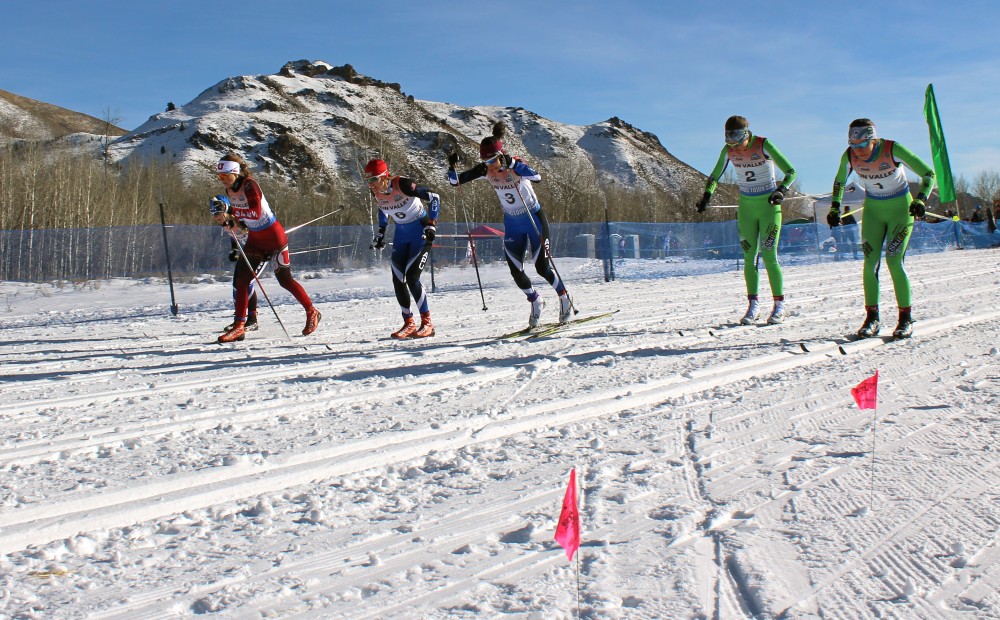
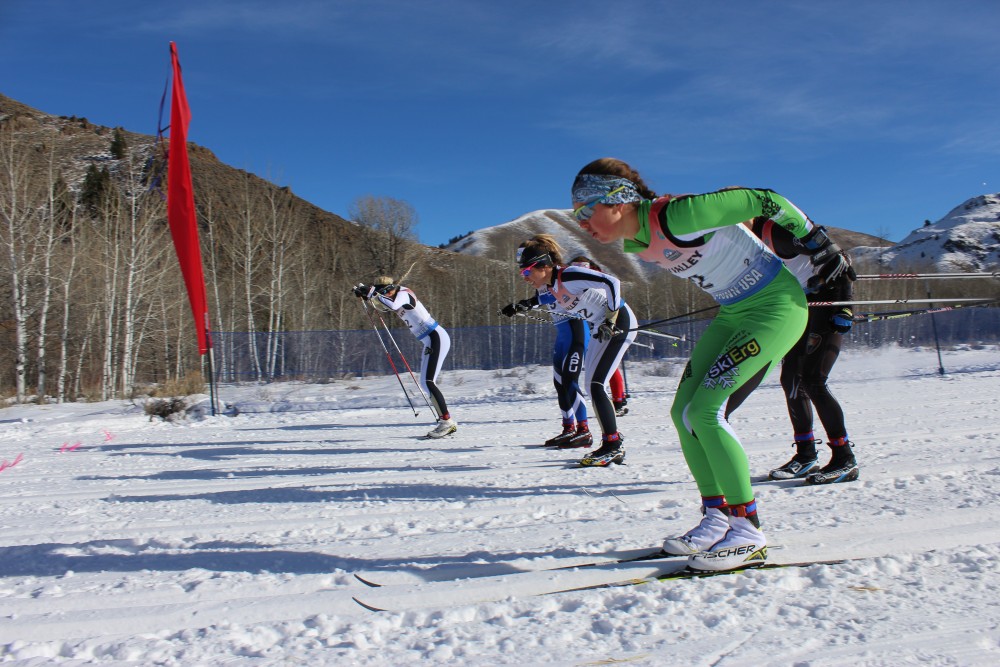
Racers power onto the course at the start of the women’s SuperTour classic sprint final on Saturday in Sun Valley, Idaho. From left to right: Hannah Halvorsen, Veronika Mayerhofer, Becca Rorabaugh, Chelsea Holmes, Caitlin Patterson, and Kaitlynn Miller.
SUN VALLEY, Idaho — The opening day of the second SuperTour on the season brought a welcome change from last weekend: warmer weather. After enduring start delays and colder temperatures in West Yellowstone, Mont., racers enjoyed relative warmth and sunshine while sprinting in an open field at the Trail Creek venue in Sun Valley.
The 1.3-kilometer course set up for the classic sprint was ready to go thanks to the work of many coaches and volunteers throughout the week. Though the course started and finished in a flat stadium, it featured two climbs, a small one out of the start, and a larger one that reached the high point before dropping into the stadium. Both climbs represented an opportunity for the athletes to show off their striding ability.
This was something that the women’s race winner, Becca Rorabaugh of Alaska Pacific University (APU), was able to take full advantage of.
“I just love big striding and I knew that was going to be a sweet spot for me,” she said in a post-race interview. “I was really looking forward to that second hill.”
After placing sixth in the qualifier, Rorabaugh skied to a win in her quarterfinal before being narrowly bested by Kaitlynn Miller of the Craftsbury Green Racing Project (CGRP) in their semifinal. However, Rorabaugh, 26, was able to carry more energy into the final, where she won in 3:38.46, almost exactly one second ahead of Miller and 1.3 seconds ahead of Caitlin Patterson, also of the CGRP.
“I was slowly getting my motor going throughout the day and it turned out that I was able to last perfectly through the final,” Rorabaugh said. “It was just taking me a while to get going. I felt like I was really on it in time for the last heat, so it just worked out.”
Caitlin Patterson (in green) racing head-to-head with CU’s Christina Rolandsen (l) and Petra Hyncicova (center, in white) in their SuperTour classic-sprint quarterfinal in Sun Valley, Idaho.
Miller, meanwhile, skied strong throughout the day, but was unable to stay with Rorabaugh in the final. The 24-year-old CGRP skier won the qualifier in 3:35.73 before dominating her quarterfinal, winning it by over six seconds.
Her strategy of setting a fast pace from the start worked well in her semifinal, too, as she was able to edge Rorabaugh to the line. While Miller didn’t have quite enough energy in the final to stay ahead of the day’s winner, she had just enough to claim the second spot on the podium.
“[It felt] really good. The conditions are great, our skis were working really well, and it’s just a beautiful day,” Miller said after the final.
Miller’s teammate, Patterson was also pleased with how the day went, both for her and her teammates. It started with Craftsbury biathlete Clare Egan notching a career-best 16th in the IBU World Cup sprint in Östersund, Sweden, and Patterson said their team built upon that. She finished second in the qualifier and kept that speed throughout the rounds, winning her quarterfinal and semifinal before placing third in the final.
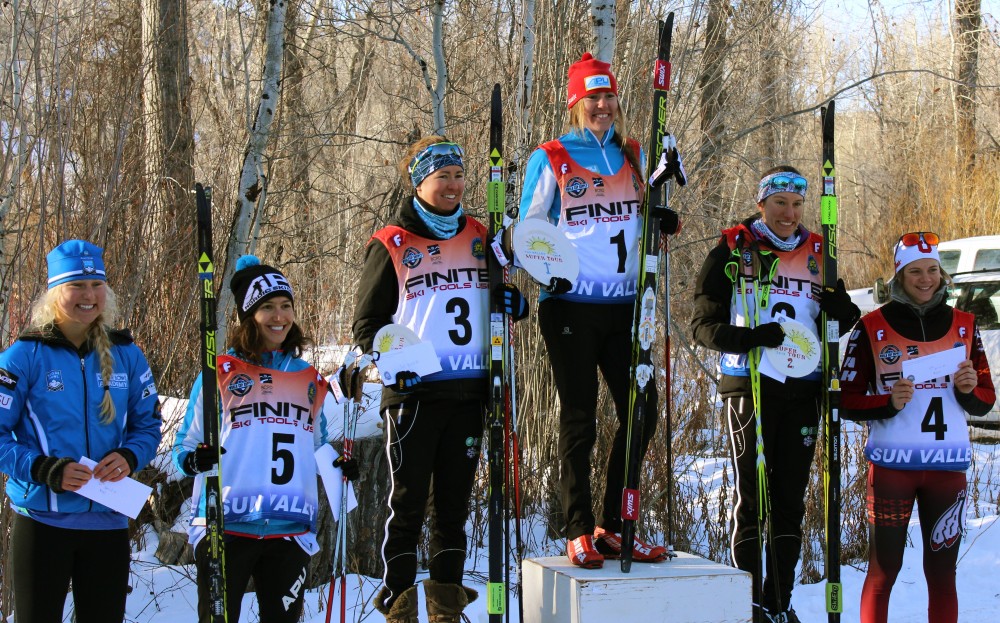
The women’s Sun Valley Super Tour 1.3 k classic sprint podium: (from l to r) Junior Hannah Halvorsen in sixth, Chelsea Holmes in fifth, Caitlin Patterson in third, Becca Rorabaugh in first, Kaitlynn Miller in second, and Veronika Mayerhofer in fourth.
“We just went for it, especially Kait. I don’t know if you saw her quarterfinal and semifinal, she just took off with it!” Patterson explained. “I felt like I had to fight a little more, but I think all around, a good day for both of us.”
Interestingly, none of the top three women in Saturday’s sprint placed in the top 10 in the skate sprint a week ago in West Yellowstone. Having another week to acclimate certainly helped the women from lower elevations, but the simple fact that this week’s sprint was classic made a big difference, too. Rorabaugh said she enjoys the striding while Miller feels classic skiing at altitude is just a bit easier than skating at some 5,750 feet above sea level.
The trio hopes to build upon their success in the sprint during Sunday’s 10 k classic. For Rorabaugh, a 10 k might just be the perfect race for where she is at right now.
“I’m looking forward to it because I feel like I have pretty good distance fitness. If it took me a whole day to get going today, odds are a 10 k could go alright,” she said.
As for the second- and third-place finishers, they said they were both feeling confident heading into Sunday.
“Watch out for us,” Patterson said of her team in Sun Valley. “All four, in green, watch out. We will be there.”
In fourth, Veronika Mayerhofer of the University of Utah, who won her quarterfinal and placed third in the semi, finished 3.76 seconds after Rorabaugh and 2.46 seconds off the podium. Just 0.25 seconds back, Chelsea Holmes (APU) placed fifth in the final, 4 seconds after Rorabaugh. Last week in West Yellowstone, Holmes placed fourth in the skate sprint, and last weekend’s sprint runner-up 17-year-old Hannah Halvorsen (Sugar Bowl Academy) reached the final again and placed sixth (+19.19).
***
Olivia Ekblad of Montana State University crests the second hill before dropping back into the stadium.
In the junior women’s heats, meanwhile, a pair of Montana State University (MSU) skiers took first and second. Freshman Olivia Ekblad from Winthrop, Wash., won with sophomore Gretchen Burkholder from Steamboat Springs, Colo., following close behind in second. Rounding out the podium in the junior heats was Sun Valley’s own Annika Landis.
These spots were good enough for ninth, 10th and 11th junior women overall, as eight others qualified for the open heats. Halvorsen led those top juniors, finishing sixth in the overall standings. Still, the duo from MSU feels the sprint was a great way to start off their season.
“We have a really good group of girls at MSU to train with so its fun,” Ekblad explained. “Awesome coaches too. We’re definitely going to throw down this year, it’s going to be fun.”