From the FasterSkier archive — posts syndicated from athletes’ and coaches’ own blogs between 2004 and 2012, kept online as published. Current coverage is at fasterskier.com.

Tag: Kevin Bolger

  • Hedegart Emerges From the Fog to Win Holmenkollen 50 k as Klæbo’s Absence Reshuffles the Distance Globe

    Hedegart Emerges From the Fog to Win Holmenkollen 50 k as Klæbo’s Absence Reshuffles the Distance Globe

    This coverage is made possible through the generous support of Marty and Kathy Hall and A Hall Mark of Excellence Award. To learn more about A Hall Mark of Excellence Award, or to learn how you can support FasterSkier’s coverage, please contact info@fasterskier.com.

    The start of the Holmenkollen Men’s 50 k Freestyle in Oslo, Norway. (Photo: Authamayou/NordicFocus)

    For nearly two hours on Saturday, 77 men disappeared into a stubborn curtain of fog that clung to the hillsides above Oslo, their figures swallowed by the mist somewhere between the stadium and the high point at Frognerseteren. When it was over, only one emerged with his arms in the air, and it was the one freestyle specialist who had been topping shorter freestyle distance races most of the season.

    Einar Hedegart, the 24-year-old former biathlete who only committed fully to cross-country skiing in November, surged past Harald Oestberg Amundsen in the final meters to win the Holmenkollen 50 k Freestyle in 1:51:38.2 — his first victory on cross-country skiing’s most storied stage, in just his seventh World Cup start.

    “This is the greatest feeling I’ve ever had,” Hedegart said after the finish. “This is just a nostalgia stadium. [A] legendary race, almost all my heroes have won this race, and especially Petter Northug. This might be the reason why I’ve been so motivated my whole life to be a cross-country skier.”

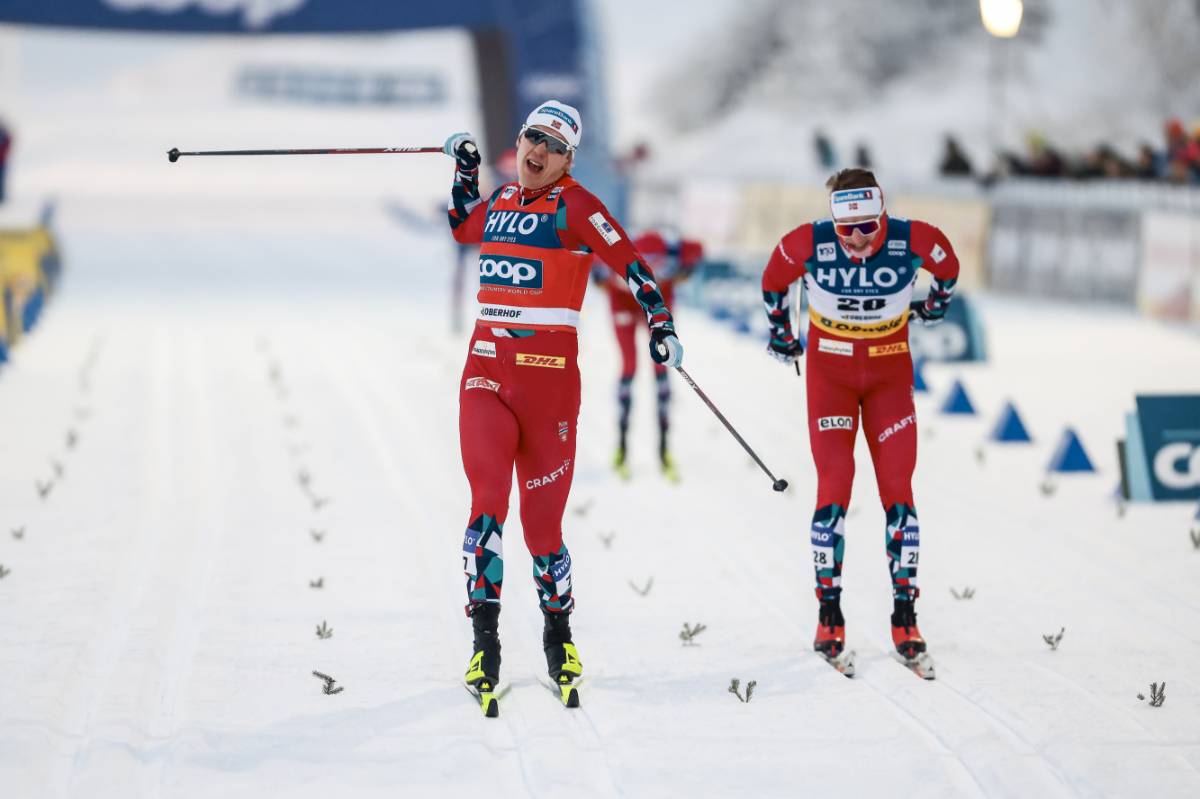
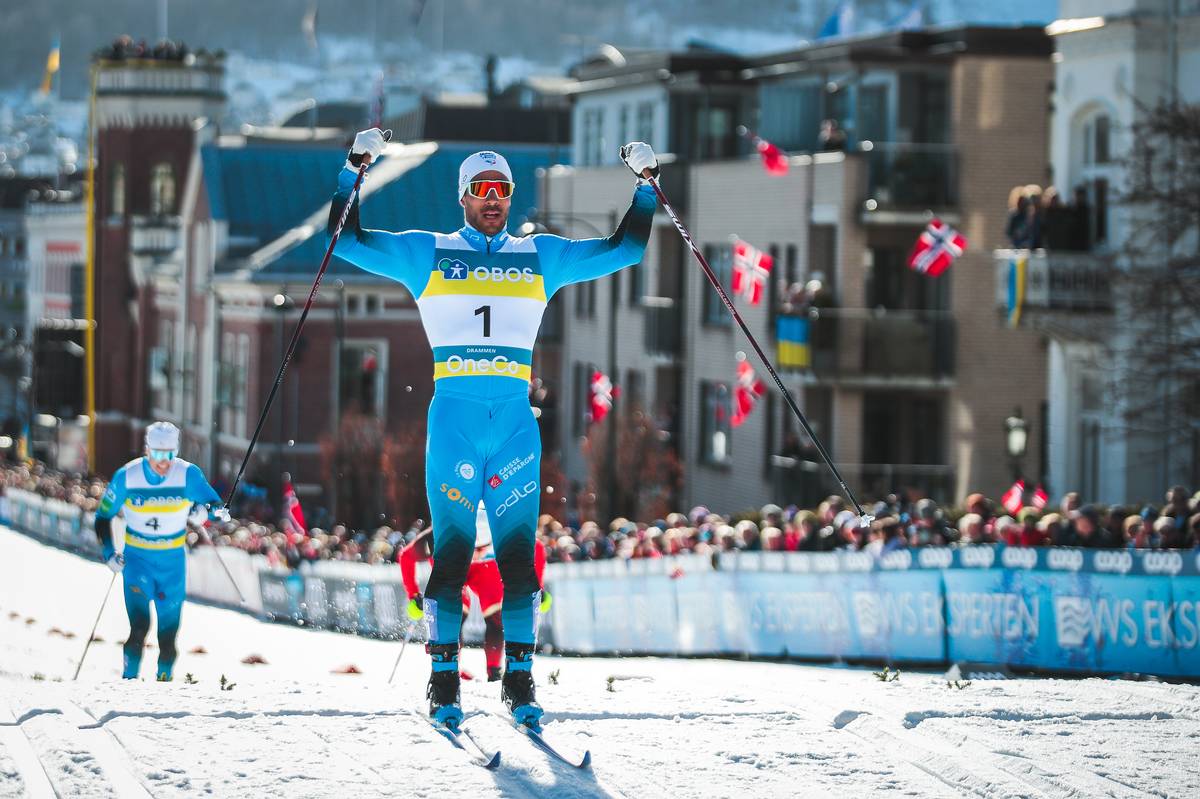
    Einar Hedegart (NOR) celebrates winning Norway’s most iconic race. www.nordicfocus.com. (Photo: Authamayou/NordicFocus)

    But the result that will echo loudest across the sport happened away from Oslo. Johannes Hoesflot Klaebo, the overall World Cup leader, was home nursing a mild concussion from a hard crash in the Drammen sprint two days earlier. Klaebo, who has already compiled a nearly perfect season, winning the Tour de Ski, all six Olympic races, secured the FIS Overall Crystal Globe, the FIS Sprint Crystal Globe, and only needed to keep racing the remaining distance races to take the clean sweep of the season with the FIS Distance Crystal Globe. BUT his absence from the start line meant zero points scored in the distance standing today. And with Amundsen’s second-place finish today, the distance crystal globe race was blown wide open: Amundsen now leads the distance standings by three points, 939 to 936, with two distance races remaining at the World Cup Finals in Lake Placid.

    Klaebo posted to Instagram yesterday: “Took a fall yesterday and hit my head pretty hard, but luckily everything is all good in the hood. Ended up with a concussion, so I’ll take some days off from both training and the internet just to make sure everything settles properly. Only got one head, so have to take good care of it.”

    He had been scheduled to fly to the United States on Sunday, but will now stay in Norway for a few extra days, hoping to recover in time for Lake Placid.

    Einar Hedegart (NOR) emerges from the fog to take the win. (Photo: Nordnes/NordicFocus)
    A Race Defined by Fog

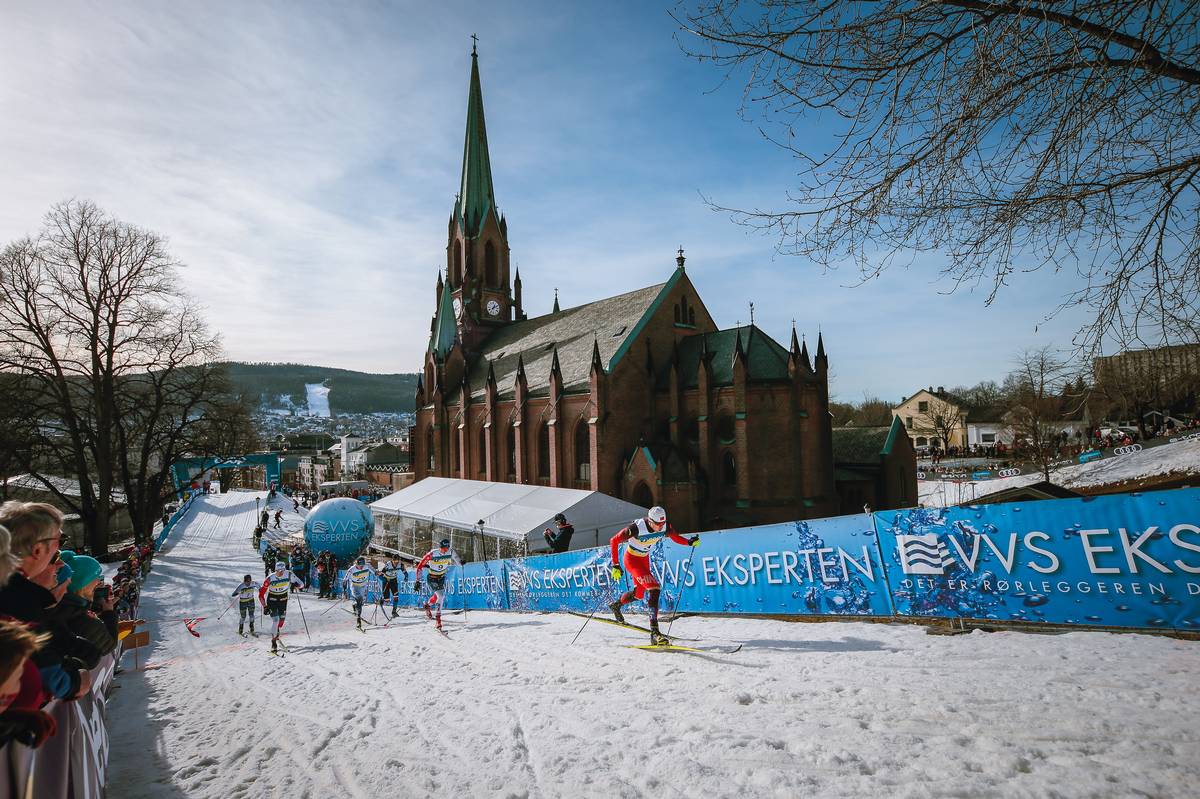
    The Holmenkollen 50 k — first raced in 1888, a fixture of the World Cup since 1982, and a race that draws an estimated 100,000 fans to the forested hills above Oslo — returned to the calendar Saturday after a one-year absence. For the first time, the men’s and women’s 50 k races were held on the same day, the women starting 45 minutes behind the men in a format designed to create an all-day spectacle. The fog, however, had other ideas. Conditions were so thick that spectators along the course could hear the racers before they could see them.

    The course — six laps of 8.3 km with 334 meters of climbing per lap — was firm and fast after overnight salting despite an air temperature of 5.0°C. The salted, compact surface was ideal for skating, and the winning time of 1:51:38 came in roughly four minutes faster than the last time the Holmenkollen 50 k was contested in freestyle.

    Harald Oestberg Amundsen (NOR) on his way to second place. (Photo: Authamayou/NordicFocus)

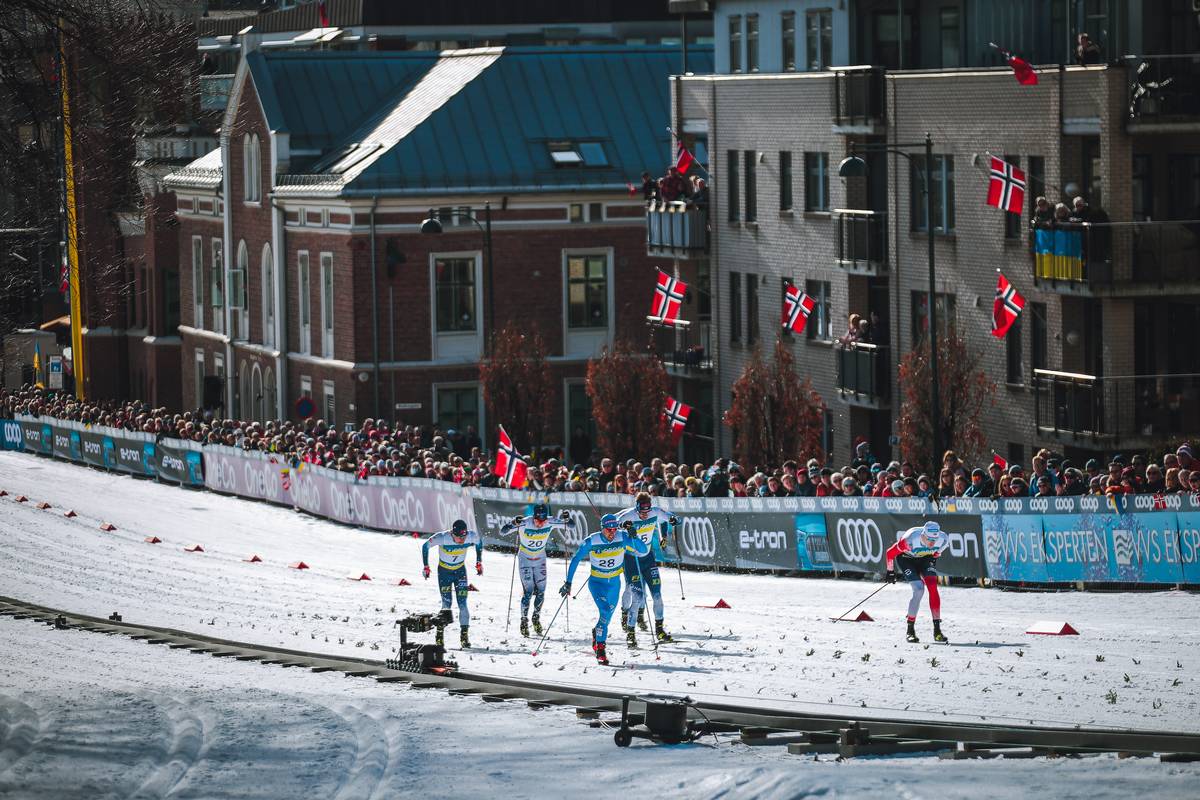
    Through the first three laps, the race unfolded as a cautious tactical affair. A large pack of roughly 40 skiers stayed together, with Martin Loewstroem Nyenget, Mattis Stenshagen, and Federico Pellegrino taking turns at the front. The first athlete to make a decisive tactical move was Iver Tildheim Andersen, who changed skis early at the stadium after the third lap while the rest of the pack continued through. The fresh skis gave Andersen a burst, and when the lead group stopped for their own ski exchange one lap later, he suddenly found himself alone at the front with a roughly 15-second advantage.

    “Just stick with the field as long as possible and then hopefully be in position when the group starts swarming,” Hedegart said of his plan. “But today I was really offside, like 70 percent of the race. So I was lucky that no one took a gap.”

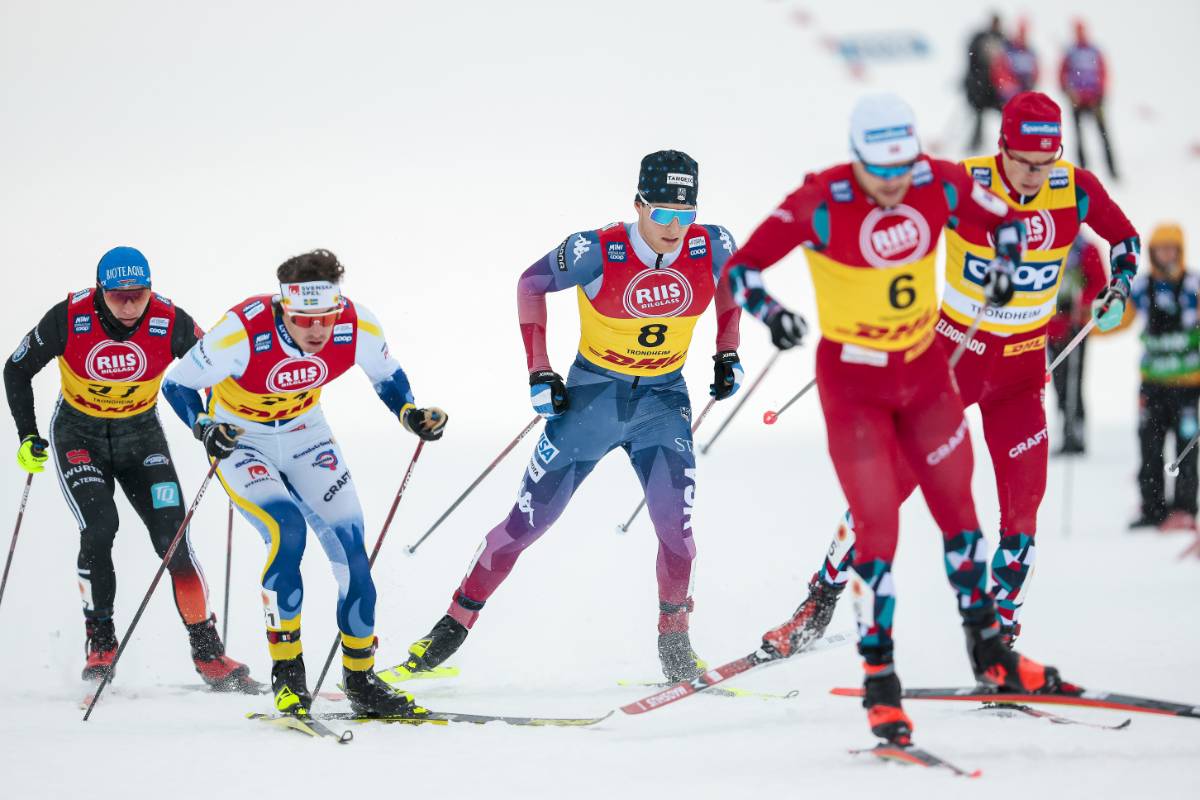
    The chase group — reduced to roughly eight athletes, all Norwegian once France’s Victor Lovera fell off the pace — gradually closed on Andersen through the fifth lap, with Hedegart, Simen Hegstad Krueger, Amundsen, Nyenget, Andreas Fjorden Ree, and Kasper Andersson Herland trading pulls at the front. By the time the group reached the final lap, they had swallowed Andersen, and the race became a question of who had saved enough for the final kilometers.

    Simen Hegstad Krueger (NOR) tried his best to get away for the win. (Photo: Authamayou/NordicFocus)
    Krueger’s Late Charge and Hedegart’s Final Kick

    Krueger, who was celebrating his 33rd birthday the day before, was omitted from the Norwegian Olympic team despite multiple Olympic medals in his career and was the winner of the last freestyle Holmenkollen 50 k. He drove the pace through the final lap. He pushed hard over the climbs near the iconic Holmenkollen church, stringing out the group and shedding Andersen off the back. But Krueger couldn’t sustain the pressure all the way to the finish, and as the group of seven came around the final corner and up the short, steep ramp before the descent into the home stretch, the sprint was on.

    Amundsen launched first, throwing everything he had at the final few hundred meters. But Hedegart, who had looked labored at points earlier in the race, found a gear no one could match. He came alongside Amundsen, took the lead in front of the grandstand crowd, and raised his fist in celebration as he skied across the line.

    “I felt, like, better,” Hedegart said of his position in the back of the pack through much of the race. “So I was just laying in the field, and I had to remind myself he did the same,” he added, referring to his idol Northug, whose trademark move was stalking from behind before unleashing a devastating sprint.

    Harald Oestberg Amundsen (NOR), Mattis Stenshagen (NOR), and Martin Loewstroem Nyenget (NOR), (l-r) stayed in the lead pack. (Photo: Authamayou/NordicFocus)

    Hedegart crossed in 1:51:38.2. Amundsen finished four-tenths of a second behind. Nyenget was third at +1.1. Ree took fourth (+1.5), followed by Herland (+2.1), Krueger (+3.0), Moseby (+4.8), and Andersen (+16.8) after his brave solo effort. Norway swept the top eight positions.

    France’s Lovera was the first non-Norwegian in ninth (+48.1), followed by AIN athlete Savelii Korostelev in 10th (+1:24.2).

    Zak Ketterson (USA) led the way for the Americans in the chase pack racing for 11th place; he ultimately finished 18th. (Photo: Authamayou/NordicFocus)
    Ketterson Fights for 11th in His Adopted Home

    Zak Ketterson, who spent the summer and fall living and training in Oslo, found himself in the thick of a battle for 11th place, a fight he learned about from coaches stationed along the fog-shrouded course.

    “I had heard from coaches on the side of the trail that our pack was fighting for 11th, and that was super cool,” Ketterson said. “I actually felt pretty fresh at the end and thought my finishing sprint would be pretty good, but I didn’t time it well and got really boxed in on the last couple turns into the finish.”

    Ketterson ultimately finished 18th (+1:54.2), part of a chase pack that came across the line within seconds of each other. He said everyone in the group knew a sprint was coming on the final lap.

    The fog made the tactical picture nearly impossible to read. “I couldn’t see more than 10 meters in front of me,” Ketterson said. “It definitely made it difficult to assess where I was relative to the leaders in the later laps. It also made some of the corners feel way sketchier because you couldn’t really choose an optimal line with such limited visibility.”

    For Ketterson, the race carried personal significance beyond the result. Having trained on the Holmenkollen course through the Norwegian summer and fall, he knew every climb and descent intimately. “This is definitely one of the most iconic and cool races we get to do,” he said. “It was especially special for me this year since I trained on this course all summer and fall living in Oslo. The highlight was definitely having my wife Julie and her family out there cheering me on.”

    What made the performance all the more impressive was the state of his body coming in. “I honestly feel like I am really running on fumes,” Ketterson said. “To be honest, I was not sure if I would even start this race in the morning. I felt so bad, and honestly, my body has felt super up and down in the last few weeks. I’m really curious to see how my body responds to this race. I was pleasantly surprised by how decent it felt, but I feel like the next week could go either way. Especially with the international travel tomorrow.”

    Brian Bushey (USA) gaining experience on his way to 59th place. (Photo: Authamayou/NordicFocus)
    The Rest of the North Americans

    Hunter Wonders was 45th (+5:46.9), Kevin Bolger was 48th (+6:51.3), and Brian Bushey was 59th (+12:24.9).

    Canada’s Xavier McKeever finished 41st (+5:11.4), while Thomas Stephen was 43rd (+5:18.1).

    Harald Oestberg Amundsen (NOR) takes over the FIS Distance Globe lead with just two distance races remaining. (Photo: Authamayou/NordicFocus)
    Distance Globe: Three Points

    The ramifications of Saturday’s race land squarely on the crystal globe picture. Before the race, Klaebo held a 128-point lead over Amundsen in the distance standings and a 636-point lead in the overall. With Klaebo watching from home, Amundsen’s 131-point haul (including bonus points) vaulted him into the distance lead: Amundsen now sits at 939 points, three ahead of Klaebo’s 936. Nyenget climbed to 914 in third.

    Klaebo’s overall World Cup lead, at 2,071 points to Amundsen’s 1,566, remains secure with a 505-point cushion. But the distance globe — awarded to the season’s best across distance events only — will come down to the final two races: a 10 k Classic Interval Start and a 20 k Freestyle Mass Start in Lake Placid, March 20-22.

    If Klaebo can travel to Lake Placid and race, he’ll have every opportunity to reclaim the lead. If the concussion keeps him out, the distance globe is likely to belong to Amundsen.

    Kasper Andersson Herland (NOR), who finished fifth, celebrates with Einar Hedegart (NOR), (l-r) at the finish of the Holmenkollen. (Photo: Authamayou/NordicFocus)
    A Star Made for This Stage

    Hedegart’s career trajectory is one of the season’s best stories. A junior biathlon world champion who struggled with his shooting, he drifted toward cross-country skiing after a surprising second-place finish at the Holmenkollen World Cup last season. He spent the summer training with a cross-country team while bringing his rifle to every camp, undecided. In November, after winning the popular pre-World Cup cross-country race in Beitostoelen, Norway, by a wide margin and missing eight of 20 shots in a biathlon event, he committed to leaving the rifle at home.

    Since then: an Olympic bronze in the 10 k Freestyle behind Klaebo, a team sprint gold partnered with Klaebo, victories in the Engadin Marathon, and now the Holmenkollen 50 k — a distance he had never raced at the World Cup level. He was asked whether his approach of sitting back resembled Northug’s famous stalking tactics.

    “Yeah, I felt like Petter,” Hedegart said. “So I was just lying in the field, and I had to remind myself he did the same.”

    For a race that dates to 1888, that has been won by the sport’s mythical stars, and that is contested before the King of Norway in a stadium surrounded by 100,000 fans, there is no small amount of weight to what happened Saturday at the Holmenkollen. Hedegart is, by every measure, now a cross-country skier.

    The season concludes with the World Cup Finals in Lake Placid, New York, March 20-22. Three races remain. The distance globe is separated by three points. And the world waits to see whether Klaebo can make it to the start line.


    Holmenkollen Men’s 50 k Freestyle FINAL RESULTS

    FIS Men’s Crystal Globe SPRINT STANDINGS
    FIS Men’s Crystal Globe DISTANCE STANDINGS
    FIS Men’s Crystal Globe OVERALL STANDINGS


    Love Stories Like This? Help Keep Them Coming.

    Feature stories like this one take time, access, and care to produce. If you value thoughtful storytelling and independent ski journalism, please consider becoming a Voluntary Subscriber. Your support directly fuels the work we do to cover the people, places, and moments that make our sport special.

    Join the FasterSkier community!


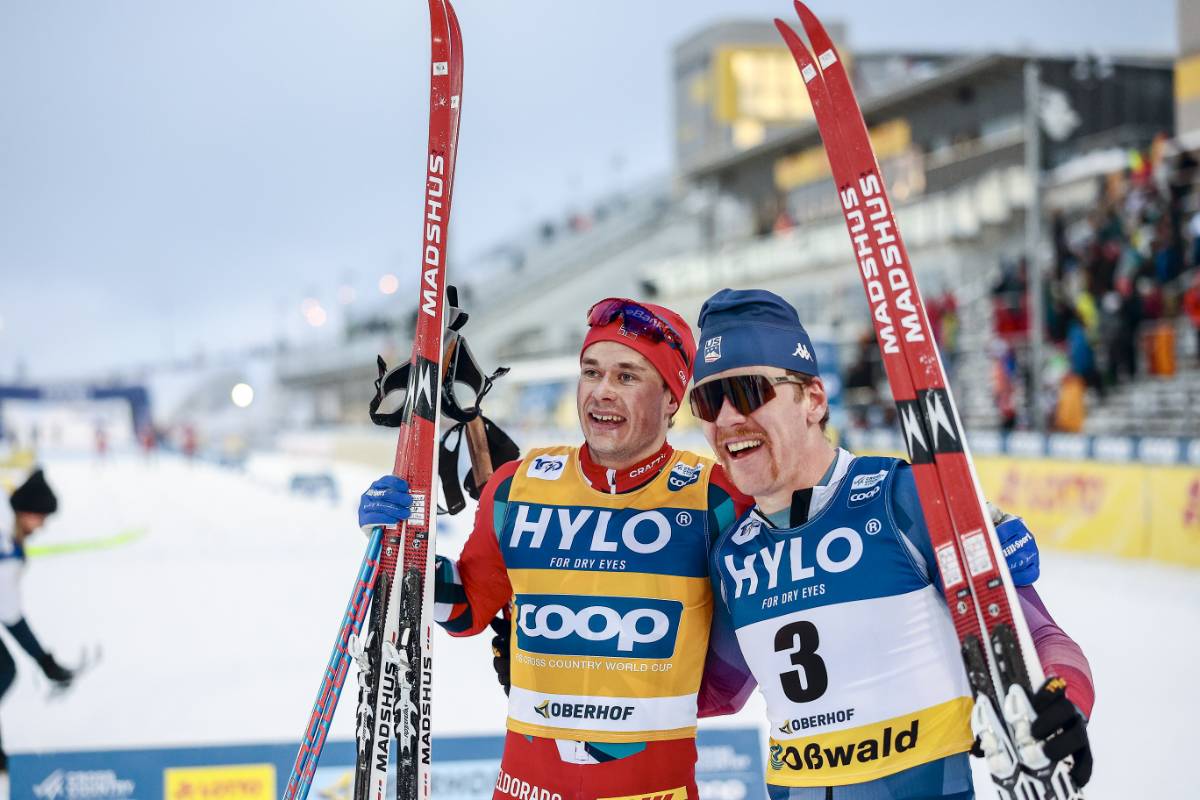
    Harald Oestberg Amundsen (NOR), Andreas Fjorden Ree (NOR), and Martin Loewstroem Nyenget (NOR), (l-r) share the Holmenkollen 50 k Freestyle in Oslo, Norway. (Photo: Authamayou/NordicFocus)
  • Klaebo Extends Historic Run with Falun Skiathlon Victory

    Klaebo Extends Historic Run with Falun Skiathlon Victory

    This coverage is made possible through the generous support of Marty and Kathy Hall and A Hall Mark of Excellence A Hall Mark of Excellence Award. To learn more about A Hall Mark of Excellence Award, or to learn how you can support FasterSkier’s coverage, please contact info@fasterskier.com.

    The Men’s 20 k Skiathlon gets underway in Falun, Sweden. (Photo: Authamayou/NordicFocus)

    With fresh snow overnight and temperatures hovering just above freezing, it was the kind of conditions that keep ski technicians guessing and athletes second-guessing. A week removed from the Olympics in Italy, the World Cup resumed for the second day with a 20-kilometer Skiathlon on a course that rewards patience and punishes weakness.

    And while viewers looked on, whether to witness something historic or something new, Johannes Hoesflot Klaebo won again.

    Klaebo covered the 10 k classic and 10 k freestyle in 48:41.8, edging teammate Harald Oestberg Amundsen by 0.7 seconds and Martin Loewstroem Nyenget by 0.8 seconds in a Norwegian podium sweep. The victory extended one of the most remarkable streaks in modern cross-country skiing and tightened his grip on the overall standings and, maybe more importantly for the remaining season-long narrative, extended his lead in the FIS distance ranking for the Distance Crystal Globe.

    The race was familiar and predictable, with Nyenget driving much of the pace, Amundsen staying close, and Klaebo remaining measured in the pack. When the decisive move came in the final sprint, Klaebo, once again, not only had the answer, but made it look easy.

    “This was a tough one,” Klaebo graciously said on the FIS broadcast after the race. “I think Martin was very strong today. I think he was in the front almost for 20 k.”

    Martin Loewstroem Nyenget (NOR) leads, Andreas Fjorden Ree (NOR), Johannes Hoesflot Klaebo (NOR), Harald Oestberg Amundsen (NOR), and the rest of the field at a frenzied pace at the beginning of the Men’s 20 k Skiathlon in Falun, Sweden. (Photo: Thibaut/NordicFocus)
    Classic Leg: Bonus points that created a breakaway

    The men opened with three laps of the 3.4-kilometer red course, climbing the Mini Mördarbacken each time. Conditions sat just above freezing, with fresh snow complicating the classic wax call. Athletes chose between traditional kick wax and zero-skis, the latter relying on a texture sanded into a softer base material underfoot.

    The pace was honest from the gun. At 5.4 kilometers, where bonus World Cup points were on offer, Nyenget and Klaebo pushed hard, with Klaebo claiming the maximum 15 bonus points, followed by Nyenget and Amundsen. That acceleration fractured the field.

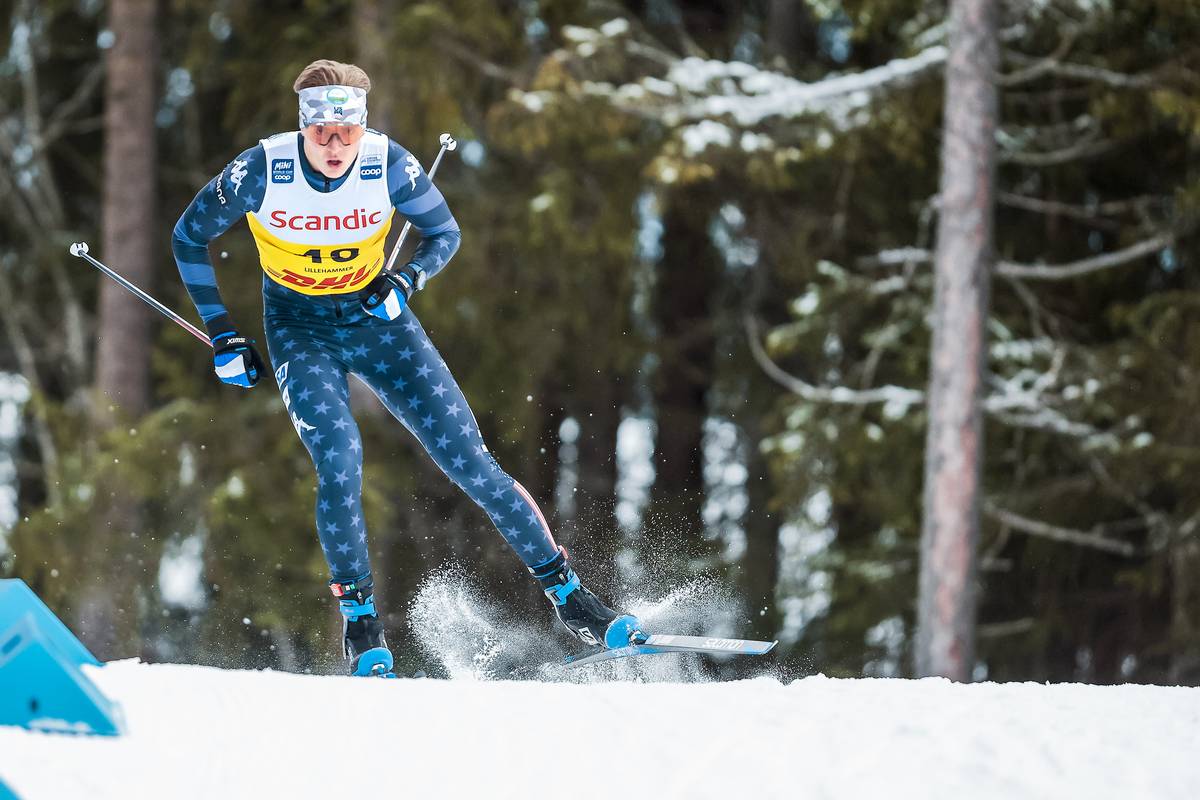
    A lead group of Norwegians formed with Nyenget, Amundsen, Klaebo, and Andreas Fjorden Ree. Arsi Ruuskanen of Finland and Savelii Korostelew, competing as a neutral athlete, also managed to maintain contact. Behind them, a gap had opened to a chase pack led by American Gus Schumacher.

    By the end of the classic leg, the leaders had established a gap that would prove decisive.

    Martin Loewstroem Nyenget (NOR) continued to set a fast pace at the front of the Men’s Skiathlon. (Photo: Authamayou/NordicFocus)
    The Exchange and the Mördarbacken

    Transitions in a Skiathlon are rarely glamorous or decisive, but a skier can lose contact with the lead if they don’t stay calm. Amundsen executed a clean ski exchange and briefly looked poised to dictate terms once the field switched to the blue 5-kilometer skate loop.

    That loop includes the full Mördarbacken, a long, layered climb that television struggles to do justice. The ascent, which parallels the ski jumping landing hill, builds in segments, steepening before easing slightly when it cuts across the slope, then rising again one last time. It is not just a memorable climb in name, but once you have skied it, you will never forget the ‘Murder Hill.’

    Nyenget continued to press the pace up front. Klaebo, as he often does, sat tucked in, attentive and measured.

    On the first lap of the skate course, the lead group remained six, with the four Norwegians, Ruuskanen, and Korostelew. By the second ascent of Mördarbacken, it was effectively a three-Norwegian affair with Korostelew, Ree, and Ruuskanen fading slightly and fighting to limit losses and eventually finishing fourth, fifth, and sixth, respectively.

    Behind them, the chase pack raced for seventh.

    Martin Loewstroem Nyenget (NOR), Johannes Hoesflot Klaebo (NOR), and Harald Oestberg Amundsen (NOR), (l-r) crest the second to last climb. (Photo: Thibaut/NordicFocus)
    The Finish

    With less than a kilometer remaining, the three Norwegians — Klaebo, Amundsen, and Nyenget — remained locked together. Nyenget, who historically has the least sprint speed, had done the bulk of the visible work, setting the tempo on both classic and skate sections.

    At the top of the final climb before descending into the stadium, the trio jockeyed for position, no one wanting to lead only to be overtaken by those in the draft. Nyenget took the lead, but was predictably passed by Klaebo on the far side of the stadium, and at the line, it unfolded as it so often does, Klaebo easing up to wave to the crowd with Amundsen outsprinting Nyenget behind him.

    “It was very hard,” Klaebo said during his post-race interview with FIS on the broadcast. “But at the end, I managed to keep up with [Nyenget] and managed to do a good last sprint at the end.”

    The margins were small. The pattern was not.

    Klaebo now has 12 consecutive victories across World Cup and Olympic competition. The last race he entered without winning was the final climb of the Tour de Ski, where he managed his effort to secure the overall title rather than contest the stage.

    “To be honest, I don’t think I have a goal anymore for this season,” he said. “I think the main goal is completed, and now I’m just going to enjoy the last races and see how it goes.”

    Gus Schumacher (USA) seemed to do the majority of the work at the front of the chase pack. (Photo: Authamayou/NordicFocus)
    Schumacher: Fast Skis, Hard Hills

    Gus Schumacher finished seventh in 49:38.6, 56.8 seconds behind Klaebo and spent much of the day managing a gap that opened during the classic leg and never fully came back.

    The decisive acceleration came when the Norwegians lifted the tempo in pursuit of bonus points. Schumacher felt it immediately.

    “In the classic, when it got fast, my kick was not great, so it was hard to fight for anything,” he said. “I was kind of just getting up the hills, but the pace was fast the whole time.”

    He believed the separation was coming regardless.

    “I think that gap was going to open at some point, no matter what,” he said. “Just because of how they were skiing from the start, mostly Nyenget, I think.”

    Schumacher was on zero skis for the classic portion.

    “I was on zeros. I think most people were on zeros,” he said. “Some people looked good, and I don’t know, there’s some variation there for sure.”

    On the flats, he felt competitive.

    “The gliding sections were great for me. My skis were really fast,” he said. “But the hills were tough.”

    After the exchange, Schumacher exited the stadium aggressively and led the chase group for stretches on the first lap of the skate course. The leaders, however, continued to gain time on the full ascent of Mördarbacken.

    Asked to describe the climb, Schumacher was more measured than dramatic.

    “Honestly, compared to a lot of the other climbs they do, I feel like it’s not horrible,” he said. “I enjoy it partly because it’s not insanely long and it’s got some steps to it.”

    That does not mean it is easy.

    “It definitely climbs pretty far and has some steep parts,” he said. “But as far as big climbs go, that’s one of my faves.”

    What does it demand?

    “Same as other climbs,” he said. “Just fitness, technique, poise… the whole deal.”

    Kevin Bolger (USA) during the classic leg, on his way to 36th place on the day. (Photo: Authamayou/NordicFocus)
    Bolger: Boxed In Early, Fighting Back Late

    Kevin Bolger finished 36th in 51:12.8, but his race was shaped early.

    “It’s always hard to feel the pace when you start mid to back of the field,” Bolger wrote in an email afterward. “I’ve always tried to just relax, let the stringing out happen, and take the gaps where they form and make some jumps.”

    He later learned from Gus Schumacher that the leaders had opened aggressively from the gun.

    “I heard they started quite hard,” Bolger said. “So I think it was just a hot pace from the start and things just naturally spread out.”

    For Bolger, the defining moment came within the first lap of the classic leg.

    “Unfortunately, I got stuck behind Andrew Musgrave and went from mid pack to last after the first lap,” he said. “So it was a lot of work to catch back up after that.”

    In a Skiathlon, that kind of early compression can cost dearly. Once the field stretches, passing becomes energy-intensive, and the leaders ease the pace.

    The waxing decision, at least, felt clear.

    “Waking up and seeing the fresh snow and the temperature around zero, it was clear it was going to be zeros,” Bolger said. “But you never know what the techs are mixing up in the truck. As you run out to the start, you look around to see what other people have under their skis.”

    Bolger chose zero skis and was confident in the call.

    “I went with zeros, and I was very happy with that decision,” he said. “Tim Baucom and I did some good testing and landed on zeros because they were running the best for me, and I was super happy with that.”

    By the time the race shifted to the skate leg, the front group was already out of reach. Still, Bolger felt he had something left.

    “I was really happy with my classic leg,” he said. “Even with getting stuck early and having to work to catch back up, finishing that classic leg with the energy I had, I knew I could put together a good skate.”

    The full Mördarbacken climb on the blue loop remained the critical point.

    “I think everyone knows when that massive climb is in the mix, that’s a very critical part of the course and a tipping point for a lot of people,” Bolger said. “If I can get up that hill with the group, I’m in. Once there’s separation, the chances of that coming back are small.”

    He described the climb bluntly.

    “She starts pretty gradually, and you feel confident at the bottom,” he wrote. “But she turns boys into men real quick, or men into boys quick at the top.”

    In soft conditions, with lactate building, the final pitch can expose anyone.

    “It’s hard to keep the legs moving when the lactate’s flowing,” he said. “It’s really hard to describe it, but that’s the best way to say it.”

    JC Schoonmaker (USA) finding joy in the distance racing as he builds fitness and experience with the longer races.  (Photo: Thibaut/NordicFocus)
    Schoonmaker: Finding Value in the Distance

    JC Schoonmaker finished 58th in 52:40.4, but the placement did not tell the full story of his day.

    “The longer distance was pretty tough, but also fun to do that kind of race again,” Schoonmaker wrote afterward. “Even though it was a tough day and not my best race, I find a lot more enjoyment in a 20 k like that, where I’m 60th or whatever, than a sprint qualifier where I’m 35th. Cool to push yourself and ski in a pack.”

    Falun’s Skiathlon rewards positioning and sustained pace more than sharp accelerations. For Schoonmaker, the takeaway was direct.

    “Today shows me that I probably need to have a bit more pace to be competitive in these longer races,” he said. “Just overall need to be fitter and stronger than I am right now.”

    He felt competitive through the classic leg, especially in tricky waxing conditions hovering around freezing.

    “The conditions were a bit tricky for sure,” he said. “Whenever zeroes are in the mix as well as wax, it can be a little stressful.”

    Schoonmaker chose kick wax rather than zero skis, a minority decision in the field.

    “I ended up going on wax, and I think I was probably one of the only guys in the field to do that, so I was a bit nervous at the start,” he said. “But they worked great for me, and I think I made the right call.”

    The transition to skate proved costly.

    “I felt more competitive in the classic leg, had a bit of a blow up as soon as we switched to skating, and found my flow after a bit, but just lost too much time right after the transition there,” he said.

    Then came the full Mördarbacken climb, twice.

    “The Mördarbacken is a tough one, I think mostly because it’s just so long,” Schoonmaker said. “It has a lot of grade fluctuations, which I think is cool in a hill and a bit of a grind, but I like the way it skis.”

    Other American Finishers:

    Hunter Wonders – 47th place

    Zanden McMullen – 61st place

    Antoine Cyr (CAN) on his way to a top ten.  (Photo: Authamayou/NordicFocus)
    Canada: Cyr Inside the Top Ten

    Antoine Cyr led the Canadian contingent, finishing 10th. It was a controlled race from Cyr, who held position through the classic leg and limited losses on the climbs during the skate.

    Other Canadian Finishers:

    Olivier Leveille – 53rd place

    Remi Drolet – 54th place

    Max Hollmann – 55th place

    Sasha Masson – 66th place

    Johannes Hoesflot Klaebo (NOR) charges for the win once again at the end of the Men’s Skiathlon in Falun, Sweden. (Photo: Authamayou/NordicFocus)
    The Larger Arc

    Falun is more than just another stop as it will host the 2027 World Championships. It is also a venue that rewards discipline. The gradual terrain away from the stadium invites packs, and the big climbs around the ski jumping hill expose any fitness weaknesses.

    For Klaebo, it was another example of restraint followed by precision.

    He leads the overall standings. He leads the sprint standings. The distance standings remain mathematically contested, but days like this narrow the space for drama as we move towards the final races.

    After sweeping the Olympics, one might have expected a pause, yet there has not been one.

    In Falun, the snow was fresh, the wax calls uncertain, and the climbs unforgiving. The result, however, was familiar.

    And with three weeks remaining before the World Cup finale in Lake Placid, what now remains is not a question of whether Klaebo has delivered a historic season, but how complete it might become.


    Falun World Cup Men’s 20 k Skiathlon – RESULTS

    Men’s World Cup – OVERALL STANDINGS

    Men’s World Cup – DISTANCE STANDINGS


    Love Stories Like This? Help Keep Them Coming.

    Feature stories like this one take time, access, and care to produce. If you value thoughtful storytelling and independent ski journalism, please consider becoming a Voluntary Subscriber. Your support directly fuels the work we do to cover the people, places, and moments that make our sport special.

    Join the FasterSkier community!


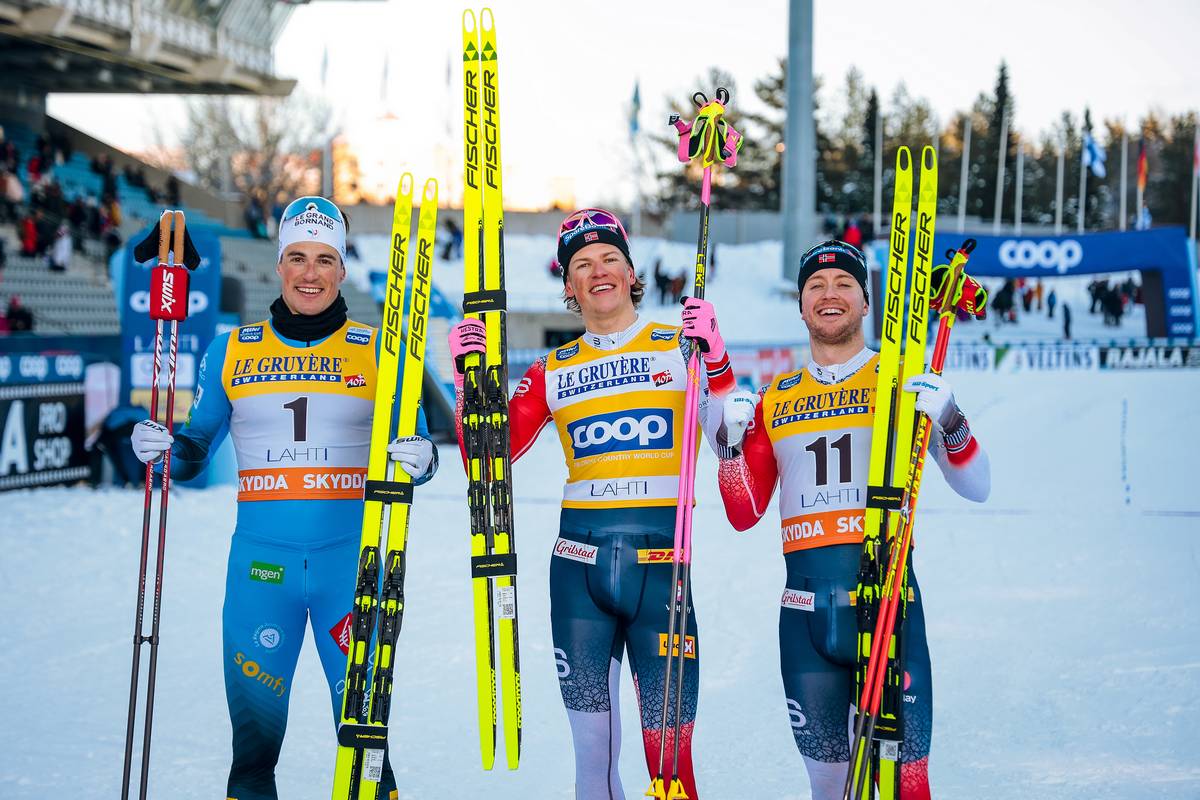
    Norwegians Harald Oestberg Amundsen, Johannes Hoesflot Klaebo, and Martin Loewstroem Nyenget (l-r) share the Men’s 20 k Skiathlon podium in Falun, Sweden. (Photo: Authamayou/NordicFocus)
  • Klaebo Edges Closer to a Season for the Ages in Falun

    Klaebo Edges Closer to a Season for the Ages in Falun

    This coverage is made possible through the generous support of Marty and Kathy Hall and A Hall Mark of Excellence A Hall Mark of Excellence Award. To learn more about A Hall Mark of Excellence Award, or to learn how you can support FasterSkier’s coverage, please contact info@fasterskier.com.

    Johannes Hoesflot Klaebo (NOR) continues his march on a most historic season in Falun, Sweden. (Photo: Authamayou/NordicFocus)

    Six days after the Olympic flame dimmed in Italy, the World Cup caravan reassembled in Falun, Sweden, at the Lugnet cross-country ski center. The Mördarbacken — the famed “murder hill” — still looms over the stadium, waiting to torture the athletes tomorrow. The snow was fast, and the sport’s most dominant man arrived with something bordering on the unthinkable within reach.

    Johannes Hoesflot Klaebo had already swept the Olympic program: six races, six gold medals. He had already conquered the Tour de Ski. He leads the sprint standings. He leads the distance standings. He leads the overall.

    In Falun’s Freestyle Sprint, he resumed his campaign as if nothing had interrupted it.

    And to no one’s surprise, Klaebo won again.

    The victory — tactical, controlled, clinical — pushed his streak forward and kept alive the possibility of something the sport has never seen: a season in which one athlete claims the Olympic sweep, the Tour de Ski title, and all three FIS World Cup Crystal Globes.

    “So interesting watching Klaebo,” FasterSkier’s John Teaford observed. “In the semi, he had Chanavat in front, so Klaebo went wide to force him into the lead. In the final, Chanavat was already there, so Klaebo took the inside to shut down Heggen. He’s racing, everyone else is just reacting.”

    On a course where lane choice and downhill drafting often matter more than raw power, Klaebo once again skied as if he had solved the puzzle in advance.

    Johannes Hoesflot Klaebo (NOR) gets his quarterfinal started. (Photo: Thibaut/NordicFocus)
    The Course That Punishes Hesitation

    Lugnet’s sprint track is deceptively compact — Klaebo won the qualification in 2:33.9 — but it rewards patience and punishes impatience. The downhill into the stadium is long enough to generate devastating draft effects; even if a skier has what seems like a wide enough margin out front, they often get swallowed up.

    Lars Heggen, left off Norway’s Olympic team in favor of Oskar Opstad Vike, skied with visible urgency all afternoon. He had qualified 26th but surged through the rounds, eventually finishing second behind Klaebo in the final. Vike, the Olympic bronze medalist in the Classic Sprint, failed to advance to the finals.

    In a Norwegian program that might be the deepest in skiing history, the margins remain ruthless, and the storyline between Vike and Heggen will continue throughout the rest of the season.

    Gus Schumacher (USA) during qualification. (Photo: Thibaut/NordicFocus)
    Schumacher: Six Olympic Races, Then a Movie Theater

    If Klaebo’s season has been relentless, Gus Schumacher’s has seen both uncertainty and excellence. Schumacher was the only Olympic racer besides Klaebo to start all six events in Italy, culminating in the 50-kilometer classic last weekend.

    His recovery plan for Falun?

    “I was just chilling,” Schumacher said afterward. “I didn’t ski Sunday or Monday. Tuesday, I went skiing for a little bit, but I wasn’t too stressed about the training. The biggest thing was just not doing too much.”

    He went to a movie theater on Tuesday night.

    “Just kind of like doing sort of normal life things,” he said. “Helped with recovery for me.”

    There was no urgency in his tone, no sense of chasing something lost. Instead, he described an emotional decompression that many Olympians quietly experience.

    “All week it’s been a little low,” he admitted. “Today was just nice to go out and race.”

    Schumacher advanced cleanly from his quarterfinal, but the semifinal unfolded differently. His start, he acknowledged, hasn’t been historically a strength.

    “My start has never been that fast,” he said. “So for me to get into a top-four spot early on is hard. I was kind of relying on gaps to open up.”

    But they didn’t.

    “The pace was kind of too high, or it was too wide or both,” he said. “I really should have just pulled up a little bit, embrace sixth until the finish, and then gone fast there.”

    He missed a lucky loser qualification by three-tenths of a second.

    “I’m not super happy with it,” he said. “But the quarterfinal was nice.”

    After the emotional volatility of the Games, including a crash in his opening race, a silver medal in the team sprint with Ben Ogden, Schumacher’s energy felt steadier in Falun.

    “I wouldn’t say I’m digging deep,” he said. “I think I’m just enjoying the ride.”

    After an Olympic training block, Jack Young (USA) is back racing on the World Cup in Falun, Sweden. (Photo: Thibaut/NordicFocus)
    Young’s Gamble

    Jack Young arrived in Sweden with a different story.

    He made the Olympic team but did not earn one of the four U.S. sprint starts in Val di Fiemme. Rather than chase race sharpness, he chose volume.

    “I trained very hard for the two weeks leading up to Falun,” Young wrote us in an email after the race. “The theory was that my speed was really good and I needed a fitness boost to finish out the season well.”

    This may have been a bit of a risk, but one Young was willing to take.

    “I’ve never trained even close to this much volume this close to a World Cup sprint,” he said. “But it seems to have paid off.”

    He did not miss race intensity.

    “In fact, the two weeks of training were some of my favorite weeks of the winter.”

    Young benefited from Filip Skari’s disqualification after he received a second yellow card of the season in the quarterfinals, advancing to the semifinals. There, the course’s tactical nuance intervened.

    “I wanted to ski the corner really well, exit with speed, and hopefully overtake Vike and Ersson right before the course kicks up again,” he said. “I had too much speed out of the corner and passed Vike too early and lost the draft.”

    The mistake was microscopic, but the consequence decisive.

    “Today was hectic but fun,” Young said. “Really cool sprint racing.”

    If there was a change in him, it was mental.

    “This was probably the most locked in I’ve been for a World Cup semifinal,” he said. “I was ready to really race with those guys and try to beat them.”

    For a 23-year-old navigating the narrowest margins in sprint racing, that shift may matter as much as fitness.

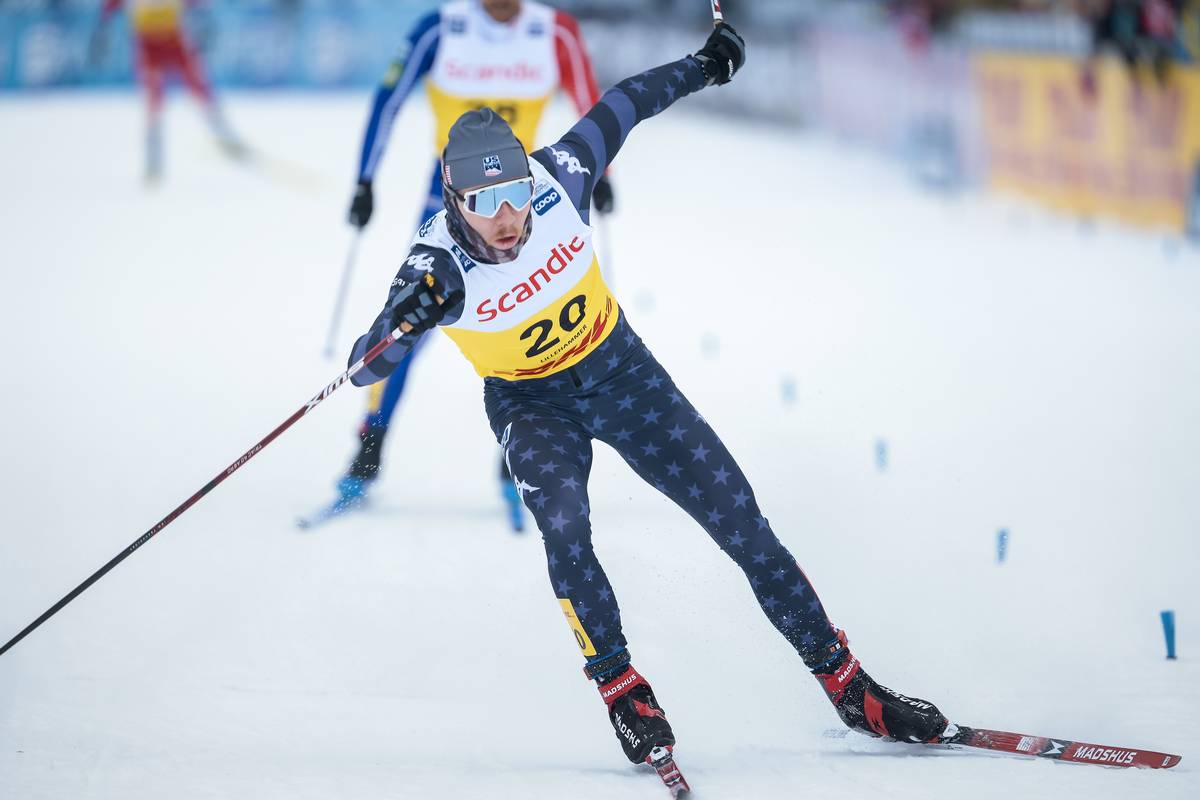
    Kevin Bolger, who narrowly missed Olympic selection, qualified for the heats but was eliminated in a stacked quarterfinal that included Klaebo. (Photo: Thibaut/NordicFocus)
    Bolger’s Return

    For Kevin Bolger, the weeks surrounding the Olympics were heavier. Bolger narrowly missed selection for Milan-Cortina, and the emotional toll was real.

    “I mean — at the beginning, life sucked,” he said. “It feels like everything is against you and that I was wronged.”

    He had been to the Olympics before — in Beijing — and that perspective helped, but it did not soften the blow.

    “It still really sucked and hurt a lot,” he said.

    Bolger’s response was simple: train.

    “My motivation was training through that period and hopefully be able to attack these last World Cup weekends. And of course pour my energy into Maja and do what I could to help her get some medals.”

    By the time Falun arrived and the World Cup season got restarted, Bolger felt ready. He knew his quarterfinal would be stacked — Johannes Klæbo among those in the heat — and expected the pace to be high.

    “I was prepared for that,” he said. “I felt great and was mentally ready for the pace.”

    But on a course like Falun — fast, tactical, draft-dependent — ski speed can decide everything.

    “I don’t think I had the most competitive skis in my heat,” Bolger said. “So on a fast tactical course, it’s a bit of an uphill battle. I was hoping to catch the draft coming back to the stadium, but the skis didn’t seem to be running as I’d hoped. But that’s life, and we move on.”

    Bolger did not struggle to keep pace with the athletes racing in Val di Fiemme.

    “It’s not that hard,” he said. “I had a few weekends of racing to help keep the sharpness going and the shape. It always seems to get better when you can actually just get back into a good training routine. And right now I feel like I’m in a great place and just happy to be racing back in the heats.”

    Johannes Hoesflot Klaebo (NOR) climbs  one of the sprint course hills in front of the Swedish fans in Falun, Sweden. (Photo: Authamayou/NordicFocus)
    The Stakes Beyond Saturday

    Klaebo’s victory further tightened his grip on the sprint and overall standings.

    The distance globe remains mathematically alive, though narrowing. The sprint globe appears close to decided, and the overall lead, barring collapse, is substantial.

    What remains compelling is not merely whether Klaebo will win, but whether he will complete something approaching total seasonal dominance.

    Johannes Hoesflot Klaebo (NOR) once again makes it look easy during his win in Falun, Sweden. (Photo: Authamayou/NordicFocus)

    After the Olympics, and the understandable fatigue that would be a result of winning gold in all six races, you might expect Klaebo to take some time off from the World Cup… he did not.

    Klaebo moves forward, and what awaits in Lake Placid, where fans will gather to celebrate the close of the season and Jessie Diggins’ final World Cup start, is the possibility of witnessing something the sport has never seen: a Tour de Ski title, an Olympic sweep, and three Crystal Globes claimed in a single winter.

    In a season already defined by dominance, Klaebo is now skiing toward something that would endure long after the snow melts.


    Falun World Cup Men’s Freestyle Sprint – QUALIFICATION RESULTS

    Falun World Cup Men’s Freestyle Sprint – FINAL RESULTS

    Men’s World Cup – OVERALL STANDINGS

    Men’s World Cup – SPRINT STANDINGS


    Love Stories Like This? Help Keep Them Coming.

    Feature stories like this one take time, access, and care to produce. If you value thoughtful storytelling and independent ski journalism, please consider becoming a Voluntary Subscriber. Your support directly fuels the work we do to cover the people, places, and moments that make our sport special.

    Join the FasterSkier community!


    Lars Heggen (NOR), Johannes Hoesflot Klaebo (NOR), and Benjamin Moser (AUT), (l-r) share the Freestyle Sprint podium in Falun, Sweden. (Photo: Authamayou/NordicFocus)
  • Klaebo Controls Toblach as Schumacher Anchors the Chase in Men’s 20 k Classic Pursuit

    Klaebo Controls Toblach as Schumacher Anchors the Chase in Men’s 20 k Classic Pursuit

    This coverage is made possible through the generous support of Marty and Kathy Hall and A Hall Mark of Excellence Award. To learn more about A Hall Mark of Excellence Award, or to learn how you can support FasterSkier’s coverage, please contact info@fasterskier.com.

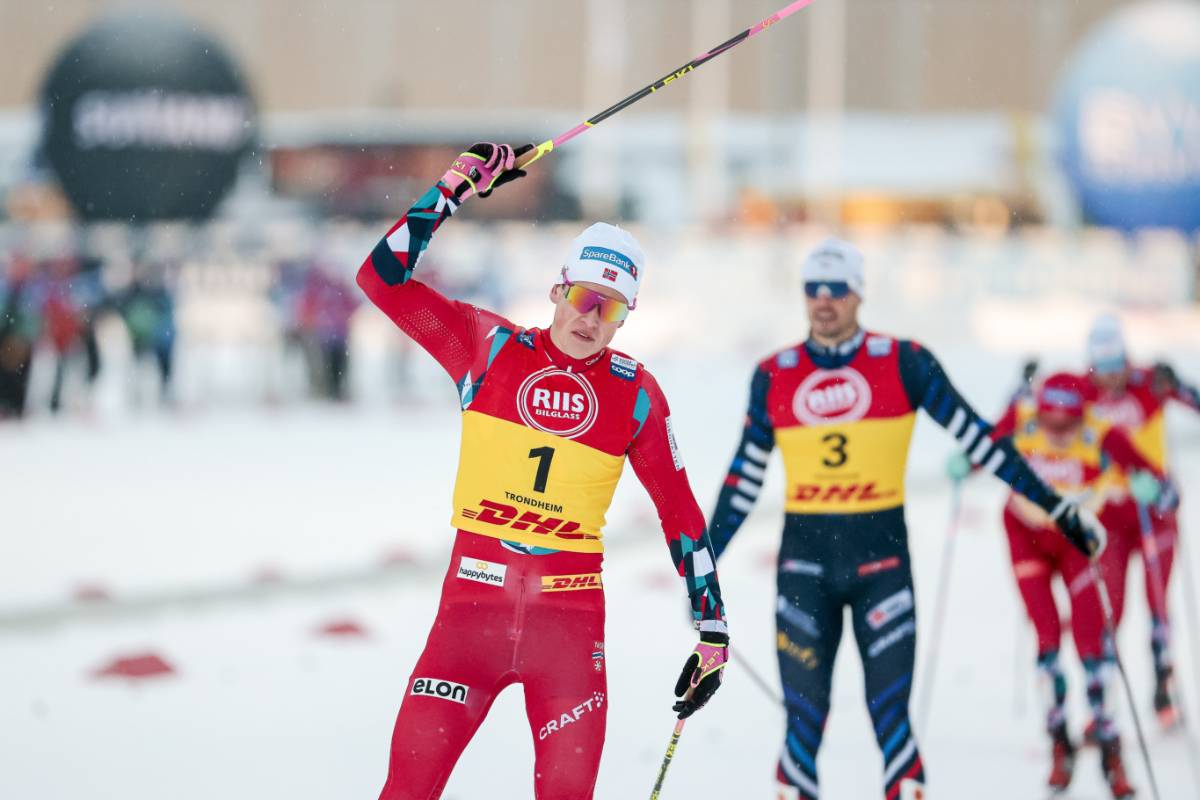
    Johannes Hoesflot Klaebo (NOR) paced the Tour de Ski 20 K Classic in Toblach (ITA) to perfection. (Photo: Vanzetta/NordicFocus)

    By mid-morning in Toblach, the cold had settled into the valley in that particular Dolomite way—dry, bright, and unforgiving. The stadium clock read 10:30 a.m., the tracks were hard-packed, and the Tour de Ski—never gentle, always exacting—had reached a moment where patience mattered as much as power. Stage 4’s men’s 20-kilometer classic pursuit would not be decided by theatrics. It would be decided by discipline.

    From the first push out of the starting line, Johannes Høsflot Klæbo made that clear.

    The Norwegian leader skied as if tethered to an internal metronome, clicking off splits that barely wavered across five laps of the 4-kilometer loop. Behind him, the race congealed into a dense, minute-long chase—ambitious but realistic, orderly but never comfortable. Inside that group, Gus Schumacher did what pursuit racing rewards: work when it mattered, wait when it didn’t, and finish inside the race rather than on its margins.

    Johannes Hoesflot Klaebo (NOR) on his way to first place on the 20 K Classic Pursuit. (Photo: Vanzetta/NordicFocus)

    Klæbo’s Quiet Authority

    Klæbo entered the day with the yellow bib and skied as though intent on keeping it uncontested. At 4 kilometers, he led in 9:11.8; at 8 kilometers, 18:23.4; at 12, 27:34.6; and at 16, 36:53.3—the first three splits almost exact to the tenth. He crossed the line in 46:01.7, never once letting the chase compress to a threatening distance.

    Second place belonged to Mattis Stenshagen (+51.1), who skied the most assertive race of those behind Klæbo and briefly tested the cohesion of the chase on the fourth lap’s long climb. Third went to Edvin Anger (+59.8), tied on time with Italy’s Federico Pellegrino, whose classic form looked as efficient as it did economical. Emil Iversen finished fifth (+1:00.2), matching Schumacher stride for stride to the line.

    That minute—barely more than a breath in Tour de Ski terms—defined the race.

    Gus Schumacher (USA) did much of the work early to bring the chase into one pack behind Klaebo. (Photo: Vanzetta/NordicFocus)

    Schumacher in the Middle of It

    Schumacher finished sixth, also +1:00.2, part of the decisive chase that refused to fracture even as the course repeatedly asked for answers. The result came less than 24 hours after his 5 k freestyle win in Toblach, and the transition—emotionally and physically—was not trivial.

    “It was a little bit tough, honestly,” Schumacher said. “This pursuit started at 10:30 a.m., and I haven’t woken up before eight in probably a month because all our races have been so late. … I definitely enjoyed the win, but the focus was to refocus right away. It’s another new day, and this race was really important for the Tour.”

    Inside the race, Schumacher was not hiding. He described closing the gap to Iversen after the early climbs and doing much of the work that consolidated the group—an effort he acknowledged with pride. “I did most of that work, which I’m actually pretty proud of,” he said. What he didn’t do was overreach. “I wasn’t trying to catch Klæbo or anything,” Schumacher added. “Even though some of the guys might have been thinking that.”

    The fourth lap told the story. Stenshagen pressed hard on the long climb out of the stadium, stretching the elastic just enough to test resolve. Schumacher bent but didn’t break. Over the top, the group exhaled. The fifth lap came fast—but not frantic—and Schumacher found himself boxed in late, a tactical note he filed away rather than lamented.

    “With the overall standings so tight, I don’t think it’s worth thinking about it too much,” he said. “I’m sitting in third right now, and top ten is definitely still the goal. … Everyone from second through ninth is so close that it really comes down to focusing day by day.”

    That may be the most Tour de Ski answer of all.

    Gus Schumacher (USA), Emil Iversen (NOR), Edvin Anger (SWE), and Lars Heggen (NOR) worked together to prevent Klaebo from extending his lead. (Photo: Vanzetta/NordicFocus)

    A Chase by Committee

    Behind Schumacher, the chase’s cohesion owed as much to restraint as to strength. Lars Heggen (seventh, +1:00.3) and Benjamin Moser (eighth, +1:00.8) rounded out a group that included Harald Østberg Amundsen (ninth, +1:03.1). No one bridged to Klæbo; no one detonated the pack behind. The race’s geometry stayed intact.

    That stability mattered in a Norwegian context. With Olympic selection pressure already humming and only a few men’s spots still unsettled, Toblach functioned as both race and audition. Stenshagen’s second place was emphatic. The Tour does not reward one-off brilliance. It rewards survivability.

    Ben Ogden (USA) finding his classic distance form. (Photo: Vanzetta/NordicFocus)

    The Americans: Process Over Panic

    Further back, the pursuit revealed its less visible truths. Ben Ogden finished 29th (+3:03.3), a result that reads well on paper and even better when you hear how he raced it.

    “The biggest challenge is always the start,” Ogden said. “For me, it was about trying to pace the race properly, even when people were moving ahead of me early. … I started with a pack, then a bunch of them dropped me, and I just kind of let that happen, knowing I’d be able to catch some of them later—which I did.”

    That in-and-out rhythm—sometimes lonely, sometimes crowded—is pursuit racing in the middle of the field. Ogden framed it honestly. “Racing in a tight group is obviously more fun,” he said, “but you really have to pace yourself and try not to lose unnecessary time in a Tour, especially when you’re already a little tired.”

    For Zak Ketterson, who started deep in the order, the early kilometers were chaos by design. He finished 42nd (+3:55.1), but the route there mattered.

    “The wave is really challenging, especially starting in bib 70,” Ketterson said. “Five or six seconds have already passed before I even reach the start line. The first two laps were chaos, and I was just trying to stay relaxed and avoid trouble.”

    He did move forward—damage control after a Stage 2 crash that had already cost him minutes. “It was nice to move up a lot today,” Ketterson said, “but the classic sprint on Stage 5 is definitely the main focus now.”

    Ketterson also addressed the jury’s written reprimand for use of a banned technique in a marked stride zone—a penalty that did not disqualify him but appears in the official record. “The technique violation came from double poling in a stride zone,” he explained. “I changed tracks to pass someone, and the motion of doing that ended up being a double pole.”

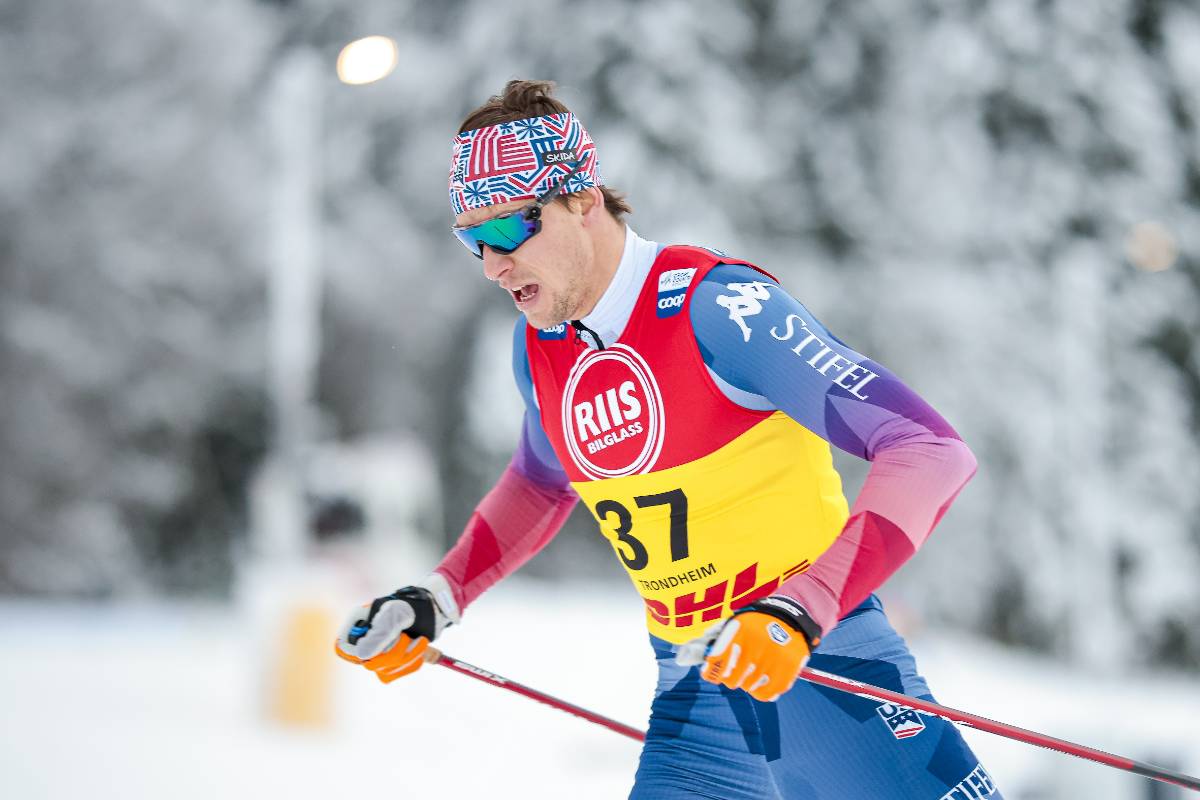
    For Zak Ketterson (USA), the Tour de Ski hasn’t exactly gone as he had hoped, but today in the pursuit, he showed his form from earlier in the season. (Photo: Vanzetta/NordicFocus)

    When the Day Turns on a Ski

    Kevin Bolger finished 51st (+4:18.6), a result shaped by circumstance rather than strategy. Bolger had been patient by design, content to let early red-lining pass him by before advancing after lap two. Then a ski broke.

    “I like to settle in, and then after lap two start working my way up the field,” Bolger said. “I was just about to do that today when someone merged into my track and broke my ski, which cost me close to a minute. That was pretty disappointing.”

    Before that moment, his choices had been sound. Toblach’s two main climbs invite early commitment to kick wax, and Bolger leaned into it. “It was an easy choice to really feel the kick wax early,” he said. “The skis were feeling great, and I was really excited about how I was going to start moving up the field.”

    Bolger’s broader view was measured, almost cheerful in its realism. “This Tour isn’t quite as massive as some of the past ones,” he said. “It’s about gaining confidence and fitness, as long as you’re able to absorb it after the Tour.” Olympic energy is present, he acknowledged, but not consuming. “At the end of the day, I’m just trying to race fast.”

    J.C. Schoonmaker placed 56th (+4:42.7), while Jack Young finished 80th (+8:07.2), both navigating a day where patience was mandatory, and opportunities were earned in inches rather than meters.

    Andrew Musgrave (GBR) and Antoine Cyr (CAN), (l-r) moving up through the field together. (Photo: Vanzetta/NordicFocus)

    Canada: Trials Done, Work Ongoing

    Canada’s men arrived in Toblach with their Olympic trials already behind them and the Tour serving a different purpose. Antoine Cyr led the way in 13th (+1:54.5), with Thomas Stephen 28th (+3:02.6) and Xavier McKeever 30th (+3:08.1). The emphasis now is accumulation—fitness, familiarity, resilience—rather than immediate results.

    Context at the Margins

    The Tour de Ski has a way of narrowing options without warning. On Thursday morning, one Norwegian men’s Olympic hopeful, Oskar Opstad Vike, withdrew close to start time, a reminder that the margins between readiness and retreat are thin, especially in an Olympic year. Toblach did not create that pressure; it merely revealed it.

    Mattis Stenshagen (NOR) was excited when he crossed the finish line as if he knew he had shown the Norwegian Olympic selectors enough to make the team. (Photo: Modica/NordicFocus)

    What the Splits Say

    A look at the time checks explains why the race felt so controlled. Klæbo’s advantage barely fluctuated. The chase group’s gaps among themselves were measured in seconds—Schumacher, Iversen, Anger, and Pellegrino trading fractional advantages without a decisive rupture. Further back, time losses accrued not in dramatic collapses but in quiet inefficiencies: a missed pack, a broken ski, a moment of over-enthusiasm.

    The course profile—five laps, 137 meters of total climb—rewards restraint. Toblach does not forgive impatience.

    A broken ski for Kevin Bolger (USA) didn’t prevent him from showing his form in Toblach (ITA). (Photo: Vanzetta/NordicFocus)

    Looking Ahead

    Stage 4 did not reshuffle the Tour so much as clarify it. Klæbo remains the reference. The men chasing him know exactly how much ground they have—and how little room there is to gamble it away. Schumacher’s position near the top of the standings is real, earned through effort and discretion. Behind him, athletes like Ogden, Ketterson, and Bolger are racing a Tour that asks for perspective as much as speed.

    Val di Fiemme awaits with its own demands and, this year, Olympic resonance. But Toblach offered a simpler lesson. In a pursuit, the clock is visible; the choices are not. The best skiers make the hard ones look easy—and the easy ones count.

    Men’s 20 K Classic Pursuit Start RESULTS

    Men’s 2026 Tour de Ski OVERALL STANDINGS

    Fastest Skiers on the Day – Men (Top 15, Net Time Only)

    This ranking removes pursuit start gaps and shows who skied the fastest 20 km classic on Stage 4.

    Day Rank Athlete Nation Net Time
    1 Edvin Anger SWE 45:39.5
    2 Simen Hegstad Krüger NOR 45:44.0
    3 Federico Pellegrino ITA 45:45.5
    4 Mattis Stenshagen NOR 45:51.8
    5 Emil Iversen NOR 45:51.9
    6 Gus Schumacher USA 45:52.9
    7 Truls Gisselman SWE 45:58.5
    8 Antoine Cyr CAN 45:59.2
    9 Hugo Lapalus FRA 46:00.5
    10 Johannes Høsflot Klæbo NOR 46:01.7
    11 Benjamin Moser AUT 46:03.5
    12 Savelii Korostelev AIN 46:04.5
    13 Harald Østberg Amundsen NOR 46:07.8
    14 Andrew Musgrave GBR 46:13.6
    15 Lars Heggen NOR 46:17.0

    Net time calculated as finish time minus individual pursuit start offset.

    Places 3-7 where this close for Federico Pellegrino (ITA), Edvin Anger (SWE), Gus Schumacher (USA), Emil Iversen (NOR), (l-r) after 20 K in Toblach (ITA). (Photo: Modica/NordicFocus)

    Love Stories Like This? Help Keep Them Coming.

    Feature stories like this one take time, access, and care to produce. If you value thoughtful storytelling and independent ski journalism, please consider becoming a Voluntary Subscriber. Your support directly fuels the work we do to cover the people, places, and moments that make our sport special.

    Join the FasterSkier community!


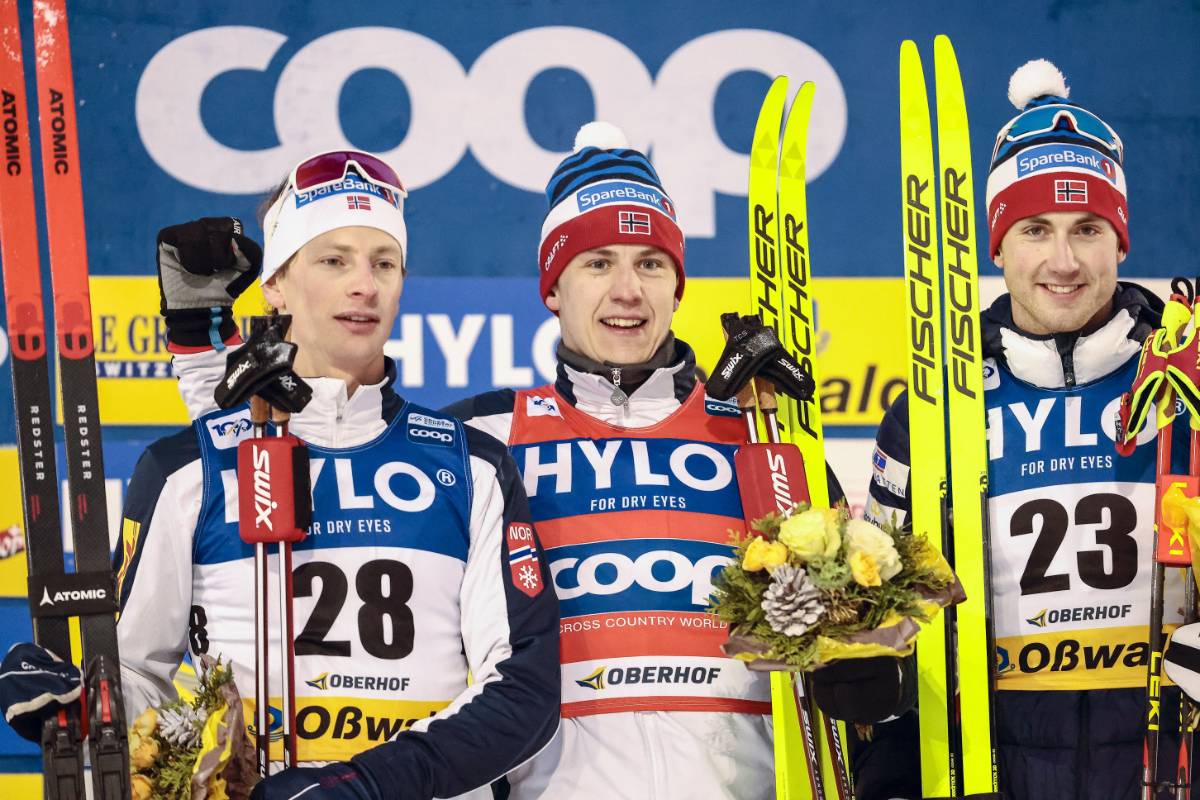
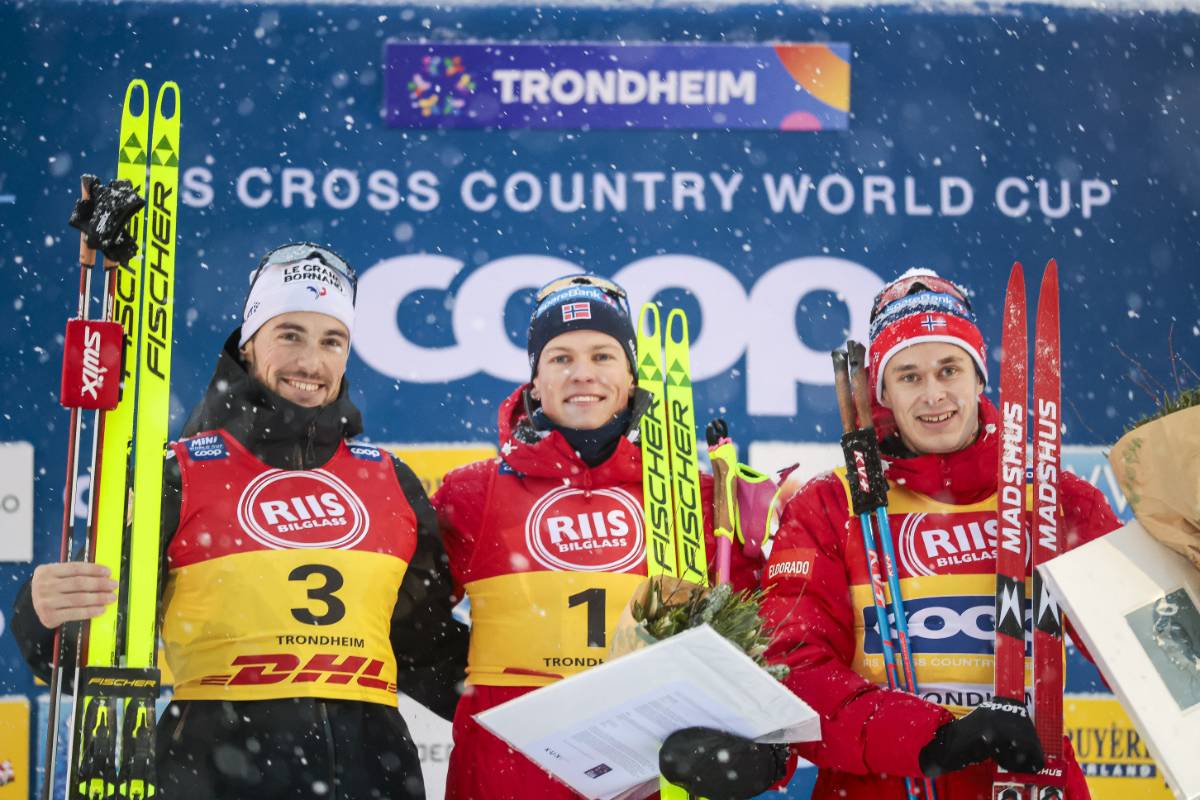
    Mattis Stenshagen (NOR), Johannes Hoesflot Klaebo (NOR), and Edvin Anger (SWE), (l-r) shared the pursuit podium in Toblach (ITA). (Photo: Modica/NordicFocus)


  • Schumacher Wins in Toblach as New Four-Heat 5K Format Turns the Race into a Clock-Chasing Puzzle

    Schumacher Wins in Toblach as New Four-Heat 5K Format Turns the Race into a Clock-Chasing Puzzle

    This coverage is made possible through the generous support of Marty and Kathy Hall and A Hall Mark of Excellence Award. To learn more about A Hall Mark of Excellence Award, or to learn how you can support FasterSkier’s coverage, please contact info@fasterskier.com.

    Gus Schumacher (USA) and the rest of Heat 2 climb over Toblach’s iconic feature during the 5 K Freestyle. (Photo: Modica/NordicFocus)

    The Tour de Ski has always asked skiers to live with imperfect information. You race hard when you’re tired. You make decisions based on feelings and instincts, while coaches are screaming ‘splits.’ You tell yourself the only honest thing in a stage race: don’t do anything you can’t recover from tomorrow.

    On Wednesday, the Tour leaned fully into that uncertainty — and then amplified it.

    Stage 3, a 5-kilometer freestyle, arrived with a new wrapper: four separate mass-start heats, each sent off at a different time, with final standings determined only after all heats were complete and all times were combined. The spectacle was real — a small parade of high-speed skating races rather than one long pageant — but the competitive implications were sharper than the format’s novelty suggested. Skiers weren’t simply racing the men next to them. They were racing an invisible standard set by athletes they couldn’t see, in heats that could be slower or faster for reasons that had nothing to do with any one skier’s fitness.

    If that sounds like chaos, it wasn’t. Not for Gus Schumacher.

    Schumacher (USA) didn’t treat the new format as a novelty or a gamble. He treated it like a solvable problem — and in doing so, he won the stage in 9:35.4, claiming the second World Cup victory of his career and stamping his authority on a Tour de Ski day that felt, at times, like a controlled experiment.

    Behind Schumacher, Austria’s Benjamin Moser was second (+0.2), and Norway’s Lars Heggen — the U23 skier who helped turn Schumacher’s heat into a metronome — was third (+0.6).

    And here is the detail that will define how this stage is remembered: the top seven overall finishers all started in the same second heat, the heat that began at 11:48:45. In a race decided on aggregate time, that start time became a kind of gravitational center — the heat where cooperation, pace, and intention converged into the day’s fastest runway.

    Ben Ogden (USA), JC Schoonmaker (USA), Remi Drolet (CAN), and others follow Johannes Hoesflot Klaebo (NOR) during the third heat of the 5 K Freestyle. (Photo: Modica/NordicFocus)

    The Format: Four Races, One Result — and a Quiet Incentive to Collaborate

    The four start times — 11:30:00, 11:48:45, 12:07:30, and 12:26:15 — didn’t just separate the field. They separated narratives. In one heat, the pace would be relentless and communal; in another, it might be cagey, tactical, or simply a touch less urgent. In a normal mass start, you can afford to be patient. In a normal 5K interval start, you can measure yourself against the clock. On this day, you had to do both — without complete visibility into either.

    U.S. head coach Matt Whitcomb framed it simply: the 5K has been absent from the World Cup menu for long enough that today was “unknown territory,” and athletes had to be ready to adapt. “Nobody really knew what to expect,” he said — not because the course was mysterious, but because the format forced a different kind of decision-making.

    Whitcomb also emphasized that heat assignments weren’t random theater. They were determined by overall Tour standings after two stages, via a snake-draw system written into the rules — in other words, the groups were structured, and the group you landed in mattered.

    That mattered most in the heat Schumacher found himself in — and, crucially, in the way he decided to race it.

    Gus Schumacher (USA) leads Heat 2 during Stage 3 of the Tour de Ski in Toblach (ITA). (Photo: Vanzetta/NordicFocus)

    Heat 2 Becomes the Day’s Engine

    By the time Schumacher’s heat went off at 11:48:45, the day already had shape: one race had happened, a set of times had been posted, and the Tour’s new experiment had revealed its first truth — you could win your heat and still lose the stage.

    Schumacher and his heat-mates didn’t merely acknowledge that truth. They embraced it.

    “I think my heat-mates and I realized that having a fast heat was the biggest picture,” Schumacher said afterward. “I was prepared to be 10th in the heat if it meant we were fast.”

    That sentence — prepared to be 10th if it meant we were fast — is the kind of thing athletes say when they’re not racing for ego. It’s what they say when they’re racing for an outcome.

    Schumacher described how the plan became practical: “We were able to trade leads also with Ben Moser’s help and keep the pace fast without too much effort before the hills, then actually continued to work together even better than I thought we would from there into the finish.”

    Whitcomb confirmed the same dynamic from the outside: Schumacher “reached out to Lars Hagen and Ben Moser and came up with a plan,” and the result was “well orchestrated trading off of the lead,” the kind of collaboration you don’t often hear described so plainly in a World Cup race. In a typical mass start, you hide. In a typical interval start, you suffer alone. In this format, the fastest solution was neither — it was to share the work early and arrive at the decisive sections with enough fuel to race, not just survive.

    And the split data makes the story legible.

    At 1.7 km, Schumacher hit 2:54.2. Moser was 2:54.4. Heggen was even quicker at 2:53.5. The heat was not strolling into the race; it was setting terms.

    At 2.7 km, Schumacher reached 4:59.6, and the heat’s front remained dense and alive. By 3.1 km, Schumacher was at 6:16.4 — still close enough to the line that the stage would be won in the last two kilometers, but far enough out that the wrong decision on the climb would show up in the final time like a bruise.

    Schumacher’s last 1.9 km — from 3.1 km to the finish — was the sharpest of the podium trio, and among the best in the field. He closed in 3:19.0, a finish that wasn’t just a sprint, but a controlled acceleration from a high baseline.

    This is what it looked like in practice: a heat that refused to turn into a chess match. A group that made the race fast enough to matter. And a skier — Schumacher — who could do the work and still finish.

    Gus Schumacher (USA) and Benjamin Moser (AUT) lead other Stage 3 top finishers to the line in Toblach (ITA). (Photo: Modica/NordicFocus)

    The Podium: Schumacher Leads, Moser Hangs, Heggen Announces Himself

    Schumacher’s stage win — 9:35.4 — put him at the center of the day’s story, but the day’s podium also revealed how perfectly the format could reward the right combination of collaboration and individual capacity.

    Moser (AUT), second at 9:35.6, was integral to the heat’s pace-making. Heggen (NOR), third at 9:36.0, wasn’t a passenger either — he was part of the mechanism.

    Schumacher was explicit about what the format rewarded him for. “Sometimes I feel like a jack of all trades and a master of none,” he said, “but high-speed skating with an element of required distance capacity is a place where I can excel. I think Minneapolis had that too.”

    It’s the kind of description that links two very different wins — one on home snow in Minneapolis in a 10K Freestyle Interval Start, the other here, in a four-heat 5K puzzle — without pretending they are the same. What connects them, Schumacher suggested, is the ability to ski fast in a way that isn’t fragile: pace you can sustain, not just ignite.

    “I’ve been feeling good, but I’m still building momentum,” he said. “Today definitely helped.”

    Benjamin Moser (AUT), Gus Schumacher (USA), Mattis Stenshagen (NOR), (l-r) worked together to claim the podium of the 5 K Freestyle. (Photo: Vanzetta/NordicFocus)

    Where the Race Was Won: The Climb, the Urge to Go Early, and the Last Kilometer

    If Heat 2 was the engine, the course still demanded decisions — and it punished some of them.

    J.C. Schoonmaker (USA), who would finish 29th, described the mental load of the format in a way that felt honest rather than polished. “The new format just changed the way I thought about things because I felt I needed to be prepared for lots of different scenarios,” he said. “I probably haven’t done a 5K since high school… I was just trying to be ready for whatever came and be ready to react to it.”

    Schoonmaker pinpointed the moment that mattered: “On the big climb, I sensed that things were starting to stretch out a bit, so that was where I decided I needed to make a move. It was a bit early in hindsight because our heat ended up staying together, and I got pretty tired in the very end and lost some positions.”

    That’s the stage’s second truth: in a format like this, you can race aggressively and still end up punished by the math. An early move that might win you your heat can also drain the last 400 meters you need to protect your time — the thing that actually counts.

    Ben Ogden (USA), 20th, offered the same theme from a different angle. He admitted he didn’t dictate his heat’s tempo — and that, in hindsight, he wished he had done more when he felt capable.

    “I didn’t really dictate the pacing in my heat,” Ogden said. “I let Klaebo and Stenshagen really dictate the pacing, and I just held on as best I could.”

    Then the key sentence — the one that tells you how easy it was, in this format, to race the wrong race: “It’s hard to remember that it’s sort of us versus them a little bit in that race format rather than just trying to win your group.”

    Ogden noted that his heat’s final kilometer became a bit of a one-man chore: “Pellegrino led for most of the last K… down through the corners and stuff. I think it would have been better if we’d been trading off leads.”

    In other words, the format quietly rewards heats that turn into rotating pacelines and punishes heats that turn into sprints for pride.

    Schumacher’s heat was a paceline that never forgot the clock.

    Ben Ogden (USA) and Johannes Hoesflot Klaebo (NOR), (l-r) leading Heat 3 of the 5 K Freestyle in Toblach, Italy. (Photo: Vanzetta/NordicFocus)

    The Americans: A Day of Depth Under a Day of Headlines

    Schumacher’s win was the headline, but the U.S. team’s men didn’t only deliver a winner. They delivered a set of performances that made the result feel like something sturdier than a single bright point.

    Here’s where the Americans landed on the day:

    • 1st: Gus Schumacher (USA) — 9:35.4
    • 20th: Ben Ogden (USA) — 9:45.4
    • 29th: J.C. Schoonmaker (USA) — 9:46.2
    • 41st: Zak Ketterson (USA) — 9:48.9
    • 42nd: Jack Young (USA) — 9:49.1
    • 79th: Kevin Bolger (USA) — 10:08.9

    Whitcomb framed the broader men’s story as an execution day — athletes moving up within their heats and carrying out their plans — and in a stage race, that matters. You can’t win a Tour de Ski on one beautiful moment if you give it away everywhere else. You win it by repeatedly doing things that don’t make headlines: staying attached, eating enough, recovering enough, skiing smoothly when you’re cooked.

    Schoonmaker, in particular, gave a clear explanation of how the heat system changed the burden of responsibility. “For someone like me, the group I was in played a big part in my result,” he said. “As someone with not a ton of distance prowess, I didn’t have much responsibility to lead, so I was able to sit in the back and wait.”

    Then, without making excuses, he told the truth about the dependency built into the format: “That basically made it so my overall time was in the hands of the top guys — but with that being said, it also does take fitness to stay with them.”

    It’s a nuanced defense of the format — and also a subtle admission that it can be cruel. It can make your best decision feel like passivity. It can make your best fitness feel like waiting.

    Schoonmaker ended with the line the sport’s decision-makers will want to hear: “It’s a cool balance of tactics and fitness, sprinting and distance, and I hope they keep this format around.”

    Johannes Hoesflot Klaebo (NOR) was the fastest in Heat 3, but that was only good enough for 12th place overall on the day. (Photo: Modica/NordicFocus)

    Norway: The Pressure Cooker Is Always On

    Norway, as ever, arrived in Toblach with depth so thick it looks almost unfair from the outside — and with selection pressure that turns every race into a referendum.

    Johannes Høsflot Klæbo (NOR) finished 12th in 9:44.0, a day when his 12th place looked strange even when the format explained it. Emil Iversen (NOR) was 8th in 9:42.5. Harald Østberg Amundsen (NOR) finished 17th in 9:44.7. Andreas Fjorden Ree (NOR) was 9th in 9:42.6.

    But the real Norwegian story at the sharp end was Heggen — third — and the way his podium was tied to a heat that chose to cooperate rather than conserve. In the Olympic year, Norway’s selection picture isn’t just about who can win on a given day. It’s about who can be trusted to perform across formats, courses, and chaos — and this format delivered chaos with a stopwatch.

    If you are a coach trying to build a roster for Milano-Cortina, you probably liked what you saw from athletes who could do the work and still finish — athletes who could be generous early and ruthless late. That’s not a ski cliché. It’s a trait.

    Antoine Cyr (CAN) led the way for the Canadian men on a strong day in Toblach (ITA). (Photo: Vanzetta/NordicFocus)

    Canada: After Trials, Into the Fire — and Right on the Doorstep of the Top 10

    Canada came into the Tour de Ski after holding Olympic trials at home — a different rhythm than many of their European rivals — and Stage 3 gave the Canadian men a tidy set of results that will matter both psychologically and practically.

    Antoine Cyr (CAN) led the Canadians in 11th (9:43.8), with Xavier McKeever (CAN) 13th (9:44.2) and Max Hollmann (CAN) 14th (9:44.3).

    In a race where the top seven all came from one heat, those placements have extra weight: they suggest Canada wasn’t simply lucky with a draw. They were close enough to the best to make the math uncomfortable. They were within seconds — the kind of seconds that, in a Tour, can turn into minutes if you don’t recover, and can turn into opportunity if you do.

    And because this format was so dependent on heat tempo, these results also reinforce a quieter Canadian strength: the ability to race within a fast-moving group and stay composed enough to cash it in at the end.

    Benjamin Moser (AUT), Gus Schumacher (USA), Lars Heggen (NOR), (l-r) celebrate the podium in Toblach (ITA). (Photo: Modica/NordicFocus)

    A Stage That Felt Like a Debate About the Sport — and a Race That Still Had to Be Won

    The Tour de Ski has always been, in some sense, a referendum. It’s a referendum on endurance. On recovery. On whether your season has enough structure to survive a week of high heart rates and thin margins.

    This stage was something else too: a referendum on presentation. On whether cross-country skiing can be made to feel urgent to people who don’t already love it.

    FIS itself framed Stage 3 as a premiere — the first Heat Mass Start event of its kind at the World Cup level — and pointed directly to fan engagement as a key motivation for the format shift.

    Whitcomb put it less diplomatically in his own way: in his view, whether the format stays should be determined by what fans think, because “what the fans think dictates whether or not the sport survives in some regards.” He described traditional, interval starts as difficult for casual viewers — not because the racing isn’t real, but because it can be hard to feel the tension without context.

    Wednesday’s format was designed to create tension. You could see the effort. You could see the decisions. You could see the finish. And then you had to wait — which is its own kind of tension — to learn what it meant.

    But none of that changes the simplest truth of Stage 3: Schumacher still had to win it.

    He had to be strong enough to take pulls. Smart enough to strategize and invest in cooperation. Calm enough to accept a plan that might have left him “10th in the heat” if the math demanded it. And then, at the end, he had to be fast in the most old-fashioned way — a finish that doesn’t care about format innovation, that doesn’t care about start times, that doesn’t care about how clever you were at 1.7 kilometers.

    It cares only about what you have left when the line is close enough to hurt.

    Three nations working together, one shared podium for Benjamin Moser (AUT), Gus Schumacher (USA), Lars Heggen (NOR), (l-r) in Toblach (ITA). (Photo: Modica/NordicFocus)

    The Tour Moves On — and the Final ‘Hill’ Looms

    Schumacher, already looking forward, kept his gaze where Tour de Ski veterans always keep it: on what the next stage demands.

    “Those time gaps are tight,” he said. “I’ll keep taking it day by day and especially try to ski well tomorrow and keep in mind how important that hill climb will be.”

    That’s the Tour in one sentence: tight gaps, day by day, and a hill that doesn’t care how good you felt yesterday.

    The new 5K heat format gave the Tour a jolt of spectacle, yes — but it also gave us something more interesting: a day that rewarded not only fitness, but the willingness to race in a way that made sense for the structure of the event.

    Schumacher understood it. His heat executed it. The numbers validated it.

    And now the Tour moves on with the usual debts: tired legs, shifting standings, and the knowledge that in a stage race, the best days are never purely celebrations. They are also investments — and the bill always comes due tomorrow.


    Men’s 5 K Mass Start Freestyle RESULTS

    Men’s 2026 Tour de Ski OVERALL STANDINGS


    Love Stories Like This? Help Keep Them Coming.

    Feature stories like this one take time, access, and care to produce. If you value thoughtful storytelling and independent ski journalism, please consider becoming a Voluntary Subscriber. Your support directly fuels the work we do to cover the people, places, and moments that make our sport special.

    Join the FasterSkier community!


    The taste of victory for Gus Schumacher (USA) on the FIS World Cup. (Photo: Vanzetta/NordicFocus)
  • Fast Tracks: World Champs—Kevin Bolger had great day on his home trails in the Men’s 50 k

    Fast Tracks: World Champs—Kevin Bolger had great day on his home trails in the Men’s 50 k

    Reporting by: Nat Herz and Stuart Harden

    This reporting costs money. Please support this coverage with a voluntary subscription (below) so FasterSkier can provide this level of access to the sport we all love year-round.

  • Davos Team Sprint: Could It Be Anyone But Norway?

    Davos Team Sprint: Could It Be Anyone But Norway?

    This coverage is made possible through the generous support of Marty and Kathy Hall and A Hall Mark of Excellence Award. To learn more about A Hall Mark of Excellence Award, or to learn how you can support FasterSkier’s coverage, please contact info@fasterskier.com.

    Friday night in Davos: A fast course, fireballs, and a remarkably flexible field for the Men’s Team Sprint Finals.

    After qualifying, the evening’s would-be winner was uncharacteristically unclear, with four nations represented in the top five qualifying times. Ben Ogden (USA I) started his second weekend of sprinting in pole position, having put a full 1.67 seconds on the individual favorite, Johannes Høsflot Klæbo (Norway 1). Edvin Anger (Sweden 1) qualified third; teammates and host-nation heroes Valerio Grond and Riebli Janik (Switzerland 1) were fourth and fifth, respectively. The Swiss duo’s combined times put Switzerland 1 at the front of the starting gate; USA 1 started in second position (with Zanden McMullen qualifying 26th), followed by Norway 1 (J.H. Klæbo and Paal Golberg) in third. USA 2 (J.C. Schoonmaker and Kevin Bolger, qualifying ninth and 24th) started the race in eighth, putting both American teams in the final. Further down the starting list, although hardly out of contention, were Sweden 1 (E. Anger and Johan Haggstroem) in fourth; and France 1 (Jules Chappaz and Richard Jouve) and France 2 (Remi Bourdin and Renaud Jay) in fifth.

    Ben Ogden (USA 1), top qualifier in the Men’s Team Sprint. (Photo: Modica/NordicFocus)

    Breathless after qualifying, Ogden panted a comment to FIS, expressing high hopes for the final ahead. “Last week was a good start but a bad finish. Today I’m turning it around: A good start and a good finish!” His race strategy was simple: “Ski fast in the first lap. Ski fast in the second lap. And then ski really fast in the third lap.” As for conditions, Ogden echoed the sentiment expressed across numerous athletes’ social media posts in the previous days, stating that the team is “Happy to be racing in beautiful Switzerland.” With thorough snow coverage, superb grooming, and no shortage of pyrotechnics (athletes were expressly warned to swing wide of the flamethrowers on the final corner), things appeared favorable for left-field performances: Notably absent from the grid were more Norwegians and Swedes (each nation qualified only a single team each); the French are benching Chanavat until tomorrow, and if the Germans or the Finns (other than Lauri Vuorinen, third in Ruka) have a solid Sprint team they haven’t bothered to tell anyone yet.

    Switzerland 1: Courageous Performances from the Crowd Favorites

    For optimistic viewers, the race was an exercise in suspending disbelief. Far from the self-assured Swedish dominance in the Women’s Team Sprint, the lead of the Men’s pack was repeatedly contested over the course of twelve laps, with a hard-out-of-the-gate start from Janik Riebli putting the Switzerland 1 at the forefront of the evening’s action. Norway’s Paal Golberg made an early challenge descending into the first exchange, but Valerio Grond fended off a few probing jump-skates from Klæbo to reclaim the lead on Lap 3. By Lap 4, the key contests of the evening had already been sketched: the Swiss Men were determined to fight for the front of the pack; the Norwegians wanted–and frequently got–control of the race, and Frederico Pelligrino, returned from a weekend of rest, was practically Klæbo’s shadow each time the two ascended the course’s singular climb–a blue specter locked as closely as possible behind the Norwegian’s white hat.

    To more cynical fans, however, the outcome–which always seemed to favor Norway I, despite Golberg’s lackluster qualifying lap (he was 19th, over six seconds behind Ogden)–was clear by the start of Lap 6. Despite repeated challenges, an unflappable Klæbo danced over the hill-crest and around the slick downhill corner as the mass of Men around him appeared lunging (and occasionally stumbling) by comparison. Elia Barp (ITA I)–the young gun to “Daddy Chico’s” elder statesman–had maneuvered the Italians into second; Schoonmaker handed off to Kevin Bolger in third, with Ogden tagging McMullen in sixth, so there was still ample fighting ahead for podium finishes, but Golberg was pulling his weight and keeping the race where Klæbo needed it to be (which, realistically, was anywhere within ten seconds of the lead).

    Paal Golberg (NOR) leads Janik Riebli (SUI) and Jules Chappaz (FRA). (Photo: Vanzetta/NordicFocus)

    This was not to say that there weren’t a few fireworks in store. Beginning in Lap 8, Valerio Grond saw the writing on the wall and attempted to unnerve the Norwegians with a huge surge over the climb; he managed to open a ski-length against Klæbo and handed off to Riebli, who held onto first position through Lap 9. Golberg moved to reel in the Swiss, but his fatigue was becoming evident on the Lap 10 climb as Riebli initiated a furious jump-skate; dropping his shoulder, the Norwegian was losing turnover and power, but managed to stay in second through the final exchange. Elia Barp handed off to Pellegrino hot on Golberg’s heels, and the Frenchmen occupied fourth and fifth, just ahead of USA 1 and 2.

    Swinging in to slice across the apex of the first corner, Pellegrino led into the penultimate climb; Grond marked him on the inside, while Klæbo moved to the far left shoulder of the course to challenge the Italian. Appearing to stumble–perhaps catching a ski on Grond–over the crest, Pellegrino descended in third; now it was Grond to the front, with Klæbo adhered to his tails in second. Rounding the downhill corner, nine skiers jockeyed for prime positioning into the long, wide, and flat straightaway into the final lap, but Klæbo could smell the Gruyere (or perhaps the singed spandex) and unfurled himself into a fluid, ground-eating V2. Ben Ogden observed that, although today was an important exercise in “energy management,” this section was undoubtedly “the deciding point of today’s race.” Grond was pumping like mad, but by the base of the last climb, Klæbo had four ski-lengths on the field, and offered his competitors no slipstream on the descent.

    With Grond and Pellegrino battling for the podium, and two Frenchmen, Bolger, and Ogden battling for fifth and sixth, the Swedes finally decided to start racing: Edwin Anger, largely absent from the evening’s excitement, leapt up the hill and into second. With a glance over his shoulder, Klæbo powered around the final corner and opened his arms in victory across the line, while the three men behind him–Anger, Grond, and Pellegrino–roared down the finishing stretch. With meters to go, Grond stepped to the outside to clinch second for the Swiss, and Pellegrino–appearing to cross the line in third–ultimately took fourth thanks to a tremendous lunge from Anger, who snuck his toe 0.02 seconds ahead of the Italian’s. France 1’s Richard Jouve was fifth; Ogden for USA 1 and Bolger for USA 2 were sixth and seventh.

    Grond secures second place for Switzerland 1, ahead of Edvin Anger (SWE, not pictured) and Frederico Pellegrino (ITA, left), and in front of a raucous home crowd. (Photo: Modica/NordicFocus)

    Golberg & Klæbo Steady to the Podium; More Sprinting Ahead

    In retrospect, today was Paal Golberg’s race to lose, and the Norwegian showed no intention of doing so. In his post-race interview, Golberg noted he has historically struggled in Davos (his previous personal best was an eighth-place Sprint finish in December, 2011), and was gratified to secure tonight’s podium with Klæbo. For his part, the Norwegian anchor was gracious as always (well, at least since 2018), complimenting the venue and the night-racing format, and modestly stating that he will “come back tomorrow, and try to compete one more time, and see how it goes.” Today marked Klæbo’s 93rd World Cup victory; Saturday could well be his 94th.

    Johannes Hoesflot Klaebo (NOR) crosses the line in the Men’s Team Sprint, his 93rd World Cup victory. (Photo: Modica/NordicFocus)

    The Swiss Men appeared ecstatic to secure a podium in front of a home crowd, and Pellegrino–doubtless disappointed–will certainly have another bite at the cheese tomorrow. While the Americans may have had their sights set on a more competitive finish, both Men’s teams finishing in the top eight is a marked improvement from their performance in the single Team Sprint of 2023-24 (Lahti, where no Americans made the final) and from 2022-23 (when USA 1 was 12th in Livigno). Reached for comment, Ben Ogden admitted that he “wanted to better in the actual race and not just the pointless pre-race race.” While frustrated, he feels the American Men “learned a lot and were very close to [their] goals, so [they] are not disappointed.”

    Kevin Bolger wrote that it’s “always fun battling between [USA] Team 1 and 2. We joke that at the end of the day, that’s the most important team to beat.” Bolger and J.C. Schoonmaker, ahead of USA 1 for most of the race, “wanted to stay in front and keep out of trouble,” and enjoyed being in the mix with Ogden and McMullen alongside them. While tomorrow will be a “tight turnaround” for the USA sprinters, the “only thing to do is eat, sleep, and try to be horizontal.” Today, “pretty much from the start of Lap 2 the throttle went down,” so there will be no shortage of lactate to flush out over the course of Saturday afternoon as the athletes head to another round of night sprinting.

    The US Men are now in sixth in the Nations Cup, 20 points behind Germany.

    Davos Men’s Team Sprint RESULTS

    Davos Women’s Team Sprint QUALIFYING


    Men’s Team Sprint podium: Switzerland (SUI): Janik Riebli (SUI), Valerio Grond (SUI), Paal Golberg (NOR), Johannes Hoesflot Klaebo (NOR), Edvin Anger (SWE), Johan Haeggstroem (SWE), (l-r). (Photo: Modica/NordicFocus)


  • The Devon Kershaw Show: fast and furious in Canmore, Day 2

    The Devon Kershaw Show: fast and furious in Canmore, Day 2

    We’re back, in less than 24 hours since hour last pod. Devon is burning the midnight oil in Norway to bring you this new episode recapping the excellent sprint races in Canmore today. Stay tuned for another episode after tomorrow’s race and a bonus episode where Nat will interview Sweden’s William Poromaa.

    Email us at devon@fasterskier.com and nat@fasterskier.com with questions, comments and race predictions. We’ll be back.

  • Norwegian Sweep—Minus Klaebo—in Oberhof Classic Sprint

    Norwegian Sweep—Minus Klaebo—in Oberhof Classic Sprint


    This coverage is made possible through the generous support of Marty and Kathy Hall and A Hall Mark of Excellence Award. To learn more about A Hall Mark of Excellence Award, or to learn how you can support FasterSkier’s coverage, please contact info@fasterskier.com.

    Erik Valnes (NOR), Lucas Chanavat (FRA), Johannes Hoesflot Klaebo (NOR), and Ansgar Evensen (NOR) (L-R) sprint for the line during semifinals in Oberhof. Klaebo would finish in third in the heat, and miss out on a World Cup sprint final for the first time in six years. (Photo: Nordic Focus)

    It was a rare day on the World Cup, but patterns, established and emerging, were apparent too. The rare part: Friday in Oberhof marked the first time in six years that Johannes Hoesflot Klaebo (NOR) was eliminated before the Finals in a World Cup Sprint race. In the first semifinal, Ansgar Evensen (NOR) carried out a defiant move on the steep Oberhof climb that gave way to a long final sprint, a pack of three including Klaebo, World Cup Sprint Leader, Erik Valnes (NOR), and Tour de Ski points champion Lucas Chanavat (FRA) vied for the second spot into the Final. Valnes would end up taking it. Klaebo pulled up in third in the heat, momentarily in a lucky loser spot until the second semifinal bested his time. With Klaebo’s day having ended, so too did a streak of 39 straight sprint podium finishes. There were notable circumstances in the post-mortem on that streak. Klaebo was back in the start list following a bout of flu over the holiday break, but also just barely arrived in Germany ahead of Oberhof, as most of the Norwegian national team was delayed in travels late into Germany last night. During the first semifinal, the resulting conditions got translated to a notable result.

    That precedent meant the possibility for something new in the Sprint Final. Even there, deviation from the usual World cup script was minimal; Norwegians dominated the field at the start line, and the race at the finish. Four Norwegians—Valnes, Evensen, Even Northug, and Harlad Oestberg Amundsen—were joined by Ben Ogden (USA), and Swiss skier, Valerio Grond. As he had in the semifinal with Klaebo, Evensen waited through the twists and turns of the first kilometer on the Oberhof course, and then pushed a final, steep, climb to create a lead pack that included all his countrymen into the final sprint. At that point, Valnes had a plan. “I saw Ansgar [Evensen]’s climb in the quarterfinal and semifinal,” he said to FIS media post-race. “So I was aiming for the back of his ski on the final climb.” Valnes would shoot off with Evensen, with Valnes getting the win in a closely-contended double-pole finish. Evensen took second, while Northug sprinted to round out the podium in a Norwegian sweep. 

    Erik Valnes (NOR) celebrates as he crosses the finish-line in the Oberhof. Ansgar Evensen (NOR) behind him, and Even Northug (NOR), would complete a first Norwegian sprint podium sweep of the season. (Photo: Nordic Focus)

    The final result put irony at the heart of the day; in the first race in six years where the most dominant individual Norwegian skier missed the Final, the Norwegians had their most dominant sprint day as a team, sweeping the podium for the first time this season.

    Amid the established precedent of Norwegians topping the men’s results, there was a more auspicious, emerging one too, to note for the Americans. Ogden made it through to the Finals for the third time this season, making it the fourth time in six World Cup sprints that an American has stood on the line in the Finals. Ogden confidently controlled his quarterfinal, then completed a resilient final punch over the last climb in his semi-final to take second in the heat ahead of World Cup Overall leader, Amundsen, and French sprinter Richard Jouve. In the Final, the definitive surge of speed from Evensen and Valnes proved to break the pack and leave Ogden near the back, where he would finish sixth. “During the Finals, Valnes was definitely looking at that [final] hill too,” said Ogden after the race. “And that’s where it felt like the pace lifted until all the way over the finish line.” 

    Like Klaebo’s individual result, Ogden’s sixth place finish was put into context by how his countrymen did on the day. All four American men made the heats in Oberhof: an upward trend for the Team USA. Kevin Bolger skied into the semifinals to take 12th place, while JC Schoonmaker took 24th. Zak Ketterson, meanwhile, overcame being caught up in the Norwegian team travel woes out of Olso to make his first sprint heats of the season, and finish 16th.

    Ogden saw the day as a steady progression of his ability in sprint races. “I’m psyched to get a few [sprint] final opportunities this season,” he said. “I am starting to feel more comfortable moving through the quarterfinals and semi-finals, but it’s still a challenge, and I have to be careful with heat selection. A goal going forward is going to be figuring out how to conserve energy in those so I reach the Final ready to push.”

    All four American men who started the Classic Sprint in Oberhof made the heats, with Ben Ogden taking sixth, Kevin Bolger in 12th, Zak Ketterson in 16th, and JC Schoonmaker in 24th. (Photo: Courtesy Image/Chris Grover).
    Americans Show Poise, Confidence, in Heats

    Of the four Americans that qualified for the heats, Ketterson was the first to take to the line, skiing out of a first heat that included Klaebo and Valnes. Ketterson showed confidence throughout the heat, accelerating along with the field as German skier, Jan Stoelben, launched an attack on the final climb. Into the final run-in, the two Norwegians formed a line in front of the pack to take first and second, but Ketterson had pulled into the ensuing sprint for third and fourth. As Klaebo eased up crossing the line in first, Ketterson’s skis crossed the tails of his skis, sending the Minnesotan falling in the finish pen, but falling into third place in the heat. Ketterson would hold onto the lucky loser spot through the next heat, but faster times throughout the quarterfinals eventually left him in 16th place.

    Zak Ketterson (USA) skied into his first heats of the World Cup season in Oberhof, eventually finishing 16th in a closely contested quarterfinal. (Photo: Nordic Focus).

    Schoonmaker featured in the next quarterfinal, alongside Chanavat, Marcus Grate (SWE), and the only Canadian qualifier on the day, Antoine Cyr. The North Americans remained in the fast-moving quarterfinal until the very last climb when Chanavat and Grate both emphasized the control they had showed throughout the first kilometer, and subsequently eased into the semifinals in first and second. Schoonmaker and Cyr would round out an otherwise-tight pack, finishing fifth and sixth in the heat, respectively.

    The final quarterfinal heat featured Ogden an Bolger lining up alongside each other, alongside Jouve and Grond. “It’s never a plan to take a heat as a teammate-but the way heats played out it made sense for me,” said Bolger post-race. Ogden and Bolger stuck together through the early part of the course, rounding the twists and turns in Oberhof with stars and stripes leading. “I thought we controlled the heat really well!” added Bolger. “Ben is a seasoned classic heats skier and I’m not, so I was just trying to stay as close to him as I could.” The pace was pronounced, and even as Bolger started to fall into the pack while Ogden shot up the final steep climb to mark Grond, he kept with the pace. Ogden would take control of the heat in the final sprint, advancing to the semifinals in first. Bolger surged to finish in fourth place, and, in the fast heat, move into the semifinals as a lucky loser. 

    Ben Ogden and Kevin Bolger head out on course during quarterfinal action in Oberhof. Ogden would win the heat, and finish sixth on the day, as Kevin Bolger secured a lucky loser spot in fourth, and finished 12th on the day. (Photo: Nordic Focus).

    “There is no better feeling than to be able to move onto the semis from a heat with a teammate,” said Kevin Bolger on the quarterfinal performance.

    Bolger would run into a pack of Norwegians, with Klaebo, Evensen and Valnes in semifinal 1. Bolger showed similar poise in the early part of the heat, but the surge that came on the final climb turned out to be just one push beyond what the Wisconsinite could manage on the day, and he would finish the semi-final in sixth, earning a 12th place on the day. The result was Bolger’s best ever in a classic sprint on the World Cup, which he is taking both as a great singular performance, and one that he can build off of. “It was a sick day!” he said. “I have confidence in my classic skiing and sprinting, but qualifying had always been the hill to get over for me- I knew if I could break that barrier, I’d be competitive in the heats, and it showed today. [Still,] the ultimate goal [for me] is to get back on the US Ski Team, and it won’t happen unless I get into a sprint final, so that’s the goal moving forward and the only focus I have.”

    Ben Ogden (USA) smiles alongside World Cup Overall leader Harald Oestberg Amundsen (NOR) after Ogden made his third World Cup sprint final of the season. (Photo: Nordic Focus).

    Ogden took a similar approach to his quarterfinal in his semi-final 2, going out front to control the pack early, and then holding on as Valerio Grond (SUI) and Even Northug (NOR) pushed the middle part of the Oberhof course. Ogden, though, could match the surge that came on the final climb, launching to the outside to go over the top in third place, and then showing his ability to put out a powerful double-pole finish to take second place behind Northug.

    When the Final came, Ogden found himself in a similar position to Bolger in his semifinal. The final surge came on the final hill, and Ogden, this time, couldn’t quite match the pace exhibited by his Norwegian rivals. He would finish the heat in sixth place, and sixth place overall on the day.

    The Americans follow up today’s classic sprint with tomorrow’s 20 k Classic Mass Start. The marked depth that was present in the sprints today will no doubt be what they are after tomorrow, as the same crew of sprinters—Ogden, Schoonmaker, Ketterson—gets augmented by the distance prowess of Gus Schumacher and Scott Patterson. For a team that is heading home to North America in a month, things are trending up; the depth of the results from Team USA confirm the consistency that the men’s half of the Stifel US Ski Team is starting to gain this season.

    Full Oberhof Classic Sprint RESULTS

    Norwegian Sweep: Erik Valnes first, Ansgar Evensen second, and Even Northug third. The first day in six years that  Johannes Hoesflot Klaebo didn’t finish on a World Cup Sprint podium would still be colored in Norwegian red, white, and blue. (Photo: Nordic Focus).
  • Klaebo Ignites Hometown Trondheim With Sprint Victory

    Klaebo Ignites Hometown Trondheim With Sprint Victory

    This coverage is made possible through the generous support of Marty and Kathy Hall and A Hall Mark of Excellence Award. To learn more about A Hall Mark of Excellence Award, or to learn how you can support FasterSkier’s coverage, please contact info@fasterskier.com.

    Johannes Hoesflot Klaebo (NOR) spins his pole in celebration as he crosses the finish line to win the Men’s Freestyle Sprint in his hometown of Trondheim, Norway. (Photo: Nordic Focus)

    The World Cup’s all-time winningest sprint racer probably didn’t need a home-field advantage, but Trondheim native, Johannes Hoesflot Klaebo, got one as the World Cup pulled into the warm, wet, sea-side city on the Norwegian coast. Klaebo’s smile greeted his home crowd after a dominant win, as fans saw a course that rewards careful tactics raced perfectly by the master of this particular craft. Klaebo earned his 70th World Cup win ahead of Lucas Chanavat (FRA) and Harald Oestberg Amundsen (NOR); but the joy Klaebo showed as he headed away from the finish line seemed to mark this win as unique. Understanding why may be a pretty simple prospect. Twenty years ago in the Trondheim ski stadium, there was a boy who crossed that finish line dreaming of doing so at the front of the World Cup. Even after having cruised victorious across so many World Cup finish lines, it seems that Trondheim’s finish line is the one that Klaebo values most. His dreams in skiing have come true many times over; in Trondheim, we saw how important it is for Klaebo to live out those dreams in front of his hometown crowd.

    Americans followed up last week’s Classic Sprint podium (third place for JC Schoonmaker) by qualifying three skiers into the heats in Trondheim: Schoonmaker qualified eighth, finishing the day in 21st. Ben Ogden qualified 18th and ultimately finished 19th. Kevin Bolger qualified 13th, but proved to be the top American finisher on the day, winning his quarterfinal heat and finishing 12th. Other American finishers included Gus Schumacher 37th, Zanden McMullen 44th, Will Koch 47th, Luke Jager 57th. Canadians Antoine Cyr and Leo Grandbois qualified 43rd and 53rd, respectively.

    Kevin Bolger (USA) qualified 13th in Friday’s Freestyle Sprint before winning his quarterfinal. Sixth in his semifinal, he would finish the day in 12th. (Photo: Nordic Focus)
    Men’s Freestyle Sprint

    Throughout the day, Chanavat would be the skier Klaebo marked as the pair followed each other from the first quarterfinal through to the semifinal, and then from the semifinal through to the final. In pushing the Trondheim hills at exactly the right moments—over the top of the first hill that led away from the start, and then again over the much longer climb that led to the final sprint—Chanavat was able to stick with Klaebo, and was rewarded with a second place finish. 

    Ogden featured in the first quarterfinal alongside Klaebo and Chanavat where the careful maneuvering of Klaebo and Chanavat left the heat relatively slow on the day. Ogden briefly held a lucky loser spot after a late kick saw the American cross the line in fourth, but his time would not prove fast enough to see him advance to the semifinal. He finished the day in 19th.

    In what would prove to be the fastest heat of the day, Schoonmaker joined with Haavard Solaas Taugboel (NOR) and Amundsen in the fourth quarterfinal. Taugboel set a hard-charging pace from the start, with Schoonmaker marking the pace. As the terrain kicked up, so did Schoonmaker, but his up-tick was matched on the same line by Amundsen who launched to the front of the pack. Forced inside, Schoonmaker cut through the pack as it shot towards the finishing straight, coming into the stadium in fourth place. In the final sprint, he would take fifth behind Sweden’s Johan Haeggstrom by a boot’s throw;  Schoonmaker missed out on a lucky loser’s spot by 0.05 seconds.

    Schoonmaker shared his race experience with FasterSkier: “I felt OK about it,” he said. “Not my best racing but I did what I could. I just felt like I didn’t ski super smart and wasted energy with lots of attacks that didn’t pay off. It was tight in the end so I feel like I can do better just got to learn from this one.”

    JC Schoonmaker (USA) featured in the fastest quarterfinal of the day, missing out on a lucky loser spot by 0.05 seconds behind eventual silver medalist, Harald Oestberg Amundsen (NOR). (Photo: Nordic Focus)

    The fifth quarterfinal featured Kevin Bolger in a heat led out by Swiss skier, Valerio Grond. Bolger was careful in the early goings before Sweden’s Emil Danielsson started to push the pace up the long Trondheim climb. Instead of answering on his own, Bolger held his line behind Grond, and the duo eventually created a small gap over the top of the hill that led to the finishing stretch. Around the final stadium u-turn, Grond shot wide—briefly losing his balance—allowing Bolger to take a clean inside line and make a final push to win the quarterfinal.

    Sprint Semifinals

    Bolger would land as the lone American in the second semifinal, a heat filled with Norwegians. Taugboel again employed his aggressive pace-setting tactics, leading from the start. Bolger followed Taugboel in the early part of the heat, and the pair shot over the first hill towards the course’s main climb in first and second. That was when Bolger made his bid for a finals spot, moving to the outside and putting in a burst up the climb; however, he was overtaken by Taugboel, Amundsen, and fellow Norwegian Erik Valnes. By the time that trio shot into the stadium, Bolger was off the back and wouldn’t factor into the final sprint. Taugboel would win the heat with Valnes second and Amundsen taking a lucky loser spot.

    Kevin Bolger (USA) during his quarterfinal on Friday. Bolger followed Valerio Grond (SUI) before sprinting his way to a semi-finals bid and a 12th place finish Friday. (Photo: Nordic Focus)
    Sprint Final

    Klaebo was simply not going to be beaten on this day—not in a freestyle sprint, not in front of a Trondheim crowd. He continues to be capable of altering his heat-strategy at will according to the predictive strategies of his rivals. Chanavat had led each of his heats throughout the day. In the final, Chanavat again surged to the front; Klaebo followed. Together they exhausted the field, creating a gap at the top of the final downhill. Klaebo’s skis are consistently faster than any of his rivals, and today proved no exception. Applying a few perfectly timed free-skating strokes at the belly of the final downhill, he propelled himself easily past a visibly-surprised Chanavat. Klaebo entered the final tight turn with the lead, and extended it all the way to the finish line where he spun his pole overhead in jaunty celebration.

    In the finishing area, Chanavat was overheard to say, “Where did he come from?” even as he smiled at his own podium performance. The answer to Chanavat’s question is a simple one: “He comes from Trondheim . . .”

    The results of Trondheim’s Freestyle Sprint reiterated the Norwegian dominance of the Men’s World Cup field; however, the result in Trondheim came with an extra bit of intrigue. With the World Championships slated to return to this same Trondheim venue in 2025, there’s now a result to base on which to base speculation for next year. With Klaebo out in front—and a final featuring so many of his countrymen—there is plenty for this hometown crowd to look forward to when the FIS World Championships arrives in Trondheim in 2025.

    American Progress in Perspective

    Kevin Bolger’s 12th place finish on the day—matching his best result from last year—added to an auspicious start to the season for American men. For the American team, Bolger’s result showed that there is added depth to go along with the new highs achieved during Period I. The duo of JC Schoonmaker and Ben Ogden capped Period I with a podium finish and sprint finals appearance, and Bolger’s result today ensured that the American men have put a skier through to at least the semifinals in each of the first three World Cup sprints this season. They’ll have a chance to resume that sprint-streak when the World Cup returns to action in the first stage of this year’s Tour de Ski, a Freestyle Sprint in Toblach, Italy.

    Men’s Freestyle Sprint RESULTS

    Johannes Hoesflot Klaebo (NOR) stands atop his hometown podium in Tronheim, Norway. He was joined by  Lucas Chanavat (FRA) in second, and Harald Oestberg Amundsen (NOR) in third. (Photo: Nordic Focus)
  • The Devon Kershaw Show: cross-country skiing’s most famous international couple

    The Devon Kershaw Show: cross-country skiing’s most famous international couple

    A couple of years ago, Swedish Olympic medalist cross-country skier Maja Dahlqvist matched with U.S. sprinter Kevin Bolger on Tinder. They’ve since become one of their sport’s highest-profile couples.

    The two of them, during an altitude camp in Utah last month, joined Nat for a joint interview.

    We’ll be back as the World Cup season kicks off in a few weeks. Send your questions, comments and hate mail to devon@fasterskier.com and nat@fasterskier.com.

    Johannes Klæbo, Kevin Bolger and Maja Dahlqvist rollerski through downtown Park City together during their respective altitude camps last month. (Nathaniel Herz/FasterSkier)
  • Scott Patterson 14th in Toblach 10 k Freestyle, Norwegians Sweep the Podium

    Scott Patterson 14th in Toblach 10 k Freestyle, Norwegians Sweep the Podium

    This World Cup coverage is made possible through the generous support of Marty and Kathy Hall and A Hall Mark of Excellence Award. To learn more about A Hall Mark of Excellence Award, or to learn how you can support FasterSkier’s coverage, please contact info@fasterskier.com.

    Racing in Toblach, Italy continued today with the Men’s 10-kilometer freestyle. Coming into the race Johannes Hosflot Klaebo (NOR) had won 13 men’s events and was only one victory away from tying countryman Martin Sundby for the most individual victories in a World Cup season. If Klaebo’s winning ways continued, he could threaten Therese Johaug’s record of 20 wins in a season; a record which many thought was unbreakable. It’s been all Norway in men’s distance racing this year; they have won every individual distance event. The last time a non-Norwegian man won a distance race was in February, 2022, when Iivo Niskanen (FIN) won the 15-kilometer classic in Lahti, Finland.

    Klaebo leads the overall World Cup points standings over Paal Golberg (NOR) by 181 points. If Golberg wished to stay in the overall championship hunt, he would have to have a good performance today. Golberg is the overall distance points leader so he was definitely a threat to win or keep pace with Klaebo. Hans Christer Holund (NOR) sits second in the distance rankings; he would also be a threat to be at the top.

    It was warm for the start of the race, about 40 Fahrenheit. The warm temperatures didn’t negatively affect the racing, and at the end of the day Golberg was able to finish first, 0.3 seconds ahead of countryman Simen Krueger (NOR). Klaebo ended up third, 2.8 seconds back. Norway took the first seven positions.

    At the end of the day it was all Norway on the podium: Simen Hegstad Krueger (NOR), Paal Golberg (NOR), Johannes Hoesflot Klaebo. (NOR) (Photo: NordicFocus)

    American Scott Patterson had an excellent day, finishing 14th, only 34.5 seconds off the lead. Other American finishers were Finn O’Connell 41st, Kevin Bolger 54th, Hunter Wonders 55th, and Logan Diekmann 71st.  No Canadians raced today.

    Scott Patterson masterfully navigated ski choice and pacing to place 14th. (Photo: NordicFocus)
    The Race

    Today’s warm weather meant that ski choice would play a large factor. Clear bases were definitely in the mix. Toward the start of the race, the sun had moved off the course and the snow firmed providing fast and challenging conditions, especially for the later starters. This made for a tough ski choice. Scott Patterson told FasterSkier that, “Ski choice was definitely about thinking ahead for the refreeze. We tested skis in the stadium initially and recognized that the really warm skis that performed well in the stadium would probably be a risky choice by race time.” Patterson continued that, “Overnight we got a bit of rain and relatively high winds. This combined to deposit an ice layer on the ski track and some pine needles and sticks from the trees. As we were starting at 3 pm, part of the course had baked in the sun during the day and gotten quite slushy. However, by the start of the men’s race the whole course was refreezing and the sun was gone. This resulted in some fast firm sections that hadn’t seen sun as well as glazed rutted parts that were quite funky to ski in.”

    Finn O’Connell (USA) had a personal best World Cup day, finishing 41st. (Photo: NordicFocus)

    U.S. coach Kristen Bourne confirmed the tricky conditions. “The track was pretty ripping fast for the women and sort of the same for the men. All of the divots and ruts from the women’s race [froze] and started to become bumpy and firm for the men. It was a weird fluctuation but was super-fast.”

    As has been the pattern most of the season, today’s race would be a back-and-forth affair between the top Norwegians with Klaebo, Golberg and Simen Hegstad Krueger (NOR) trading punches and fighting for the lead all day.

    Klaebo was one of the earlier starters among the pre-race favorites. Golberg and Krueger started several spots behind Klaebo, so they would have the advantage of marking their teammate. At the 1.7-kilometer mark Klaebo had taken the lead and established the early time to beat. When Golberg and Krueger reached the 1.7-kilometer mark, they were already a couple of seconds behind Klaebo.

    Paal Golberg’s (NOR) finishing lunge put him on top of the podium. (Photo: NordicFocus)

    At  2.1 kilometers, Hugo Lapalus (FRA) decided he would take a shot at the lead and moved into first over all the skiers  who had already reached this mark. His pace would only be eclipsed later by Krueger who had a later start than Lapalus. But, Lapalus’ glory was short lived, at 3.0-kilometers he had dropped back to fourth. Klaebo and Krueger were virtually tied and had retaken the lead.  Golberg was now 3.2 seconds back.

    Between three and five kilometers, Klaebo put in a strong burst of speed to regain his lead outright at the five kilometer time checkpoint. Golberg and Krueger trailed Klaebo by about two seconds.

    As the raced played out and skiers hit the 7.1- kilometer mark, Krueger had surged into the lead with Golberg now 1.9 seconds back.  Klaebo had dropped off the pace considerably and was now 9.8 seconds off the lead. This trend held up over the next kilometer as Krueger increased his lead to 5.4 seconds over Golberg.  Klaebo was now a whopping 11.4 seconds off the lead.

    Johannes Hoesflot Klaebo (NOR) was in the hunt for the victory all day, but couldn’t overcome a mid-race deficit. (Photo: NordicFocus)

    Pacing on the course was difficult, and not just for Klaebo.  Patterson told FasterSkier that, “I had a few short opportunities to ski with people but mostly it was about finding my own pace and enduring through the muscular burn while keeping the tempo high.” He continued that, “It’s crucial to V2 almost all [of] the more gradual hills. Thus, I was focused on skiing smooth through the first 2km to build into the race a bit, then really turn it on and work the rest of the course as hard as I could.”

    The U.S. team received advice on pacing the five kilometer loop course from veteran Jessie Diggins (USA) at their team meeting the night before the race. Bourne said that Diggins advised her teammates to “Go out as hard as you can, because once you get to 3 k, it’s pretty much all downhill from there.”

    Kevin Bolger (USA) representing team USA in the Toblach 10 k. Bolger would finish 54th. (Photo: NordicFocus)

    Klaebo also made adjustments and was able to turn up the speed in the last two kilometers, and coming into the finish, he put in one of his patented sprints, crossing the finish first among the racers who had finished. At this point Klaebo was in the leader’s chair, 2.4 seconds over Harald Amundsen (NOR).

    But Golberg and Krueger were still lurking on the course, taking advantage of their later start. As he finished, Golberg was able to meet Klaebo’s finishing speed and went into first ahead of Klaebo by 2.8 seconds.

    The only question now was whether Krueger would be able to match his teammates speed over the last two-kilometers. As Krueger came into the finish he was moving very smoothly and put in a ferocious finishing sprint but fell short of Golberg by 0.3 seconds. As it turned out, Golberg’s lunge at the finish was the difference between first and second.

    Klaebo had put in an amazing final two-kilometers skiing it nine seconds faster than Krueger and three seconds faster than Golberg. But Klaebo’s slower speed in the middle of the race had given Golberg and Krueger the opening they needed to pull past him.

    At the end of the day, Norwegian domination in men’s distance racing continued, Sundby’s record was intact, for the time being, and a young American continued to show great promise.

    Men’s Freestyle 10-kilometer Individual RESULTS

  • The Devon Kershaw Show: Getting high in Livigno

    The Devon Kershaw Show: Getting high in Livigno

    It’s been a couple weeks since you last heard from us. The World Cup and the Devon Kershaw Show are back from a hiatus with a recap of the high altitude sprint weekend in Livigno.

    Devon and Nat break down the individual and team sprints from the Italian Alps, including some strong American performances. We’re still planning a mailbag episode in the not-too-distant future, so keep those questions coming: devon@fasterskier.com and nat@fasterskier.com. We’ll be back soon.

    Americans Julia Kern and Rosie Brennan celebrate after a 3rd place finish in Sunday’s team sprint. (Photo: Nordic Focus).


  • Ogden and Schoonmaker Miss Skate Sprint Final by Narrowest of Margins as Klaebo Wins Again

    Ogden and Schoonmaker Miss Skate Sprint Final by Narrowest of Margins as Klaebo Wins Again

    This World Cup coverage is made possible through the generous support of Marty and Kathy Hall and A Hall Mark of Excellence Award.  To learn more about A Hall Mark of Excellence Award or to learn how you can support FasterSkier’s coverage please contact info@fasterskier.com.

    Ben Ogden (USA) raced boldly on Saturday, finishing less than a boot’s-length away from the World Cup Sprint Final. (Photo: NordicFocus)

    Lillehammer, Norway—that most timeless of ski venues—provided viewers with a familiar scene on Saturday: Johannes Hoesflot Klaebo exiting the final turn in the lead, gliding away from the field en route to an easy win in an individual skate sprint. It was the 32nd win of his career in the event—exactly double the number of any other skier in history. The man behind him on that list—Federico Pellegrino (ITA)—was also 2nd behind him on the day. Even the name of the skier in 3rd place—Northug—fit the scene, though in this iteration the Northug was Even, not Petter. 

    So it was that the first skate sprint of the 2022-2023 season ended with a podium that could have been plucked from any skate sprint in the past half-decade. Partially because of that fact—and because Johannes Hoesflot Klaebo first staked his ground in the event before moving on to also dominating every other discipline of skiing—the skate sprint has become the archetypal stand-in for this current era of cross-country skiing.

    Johannes Hoesflot Klaebo (NOR) celebrates down the finishing stretch during Saturday’s World Cup Sprint Final. (Photo: NordicFocus)

    Anyone looking for winds of change in the sport would probably want to watch for little changes in the landscape of a World Cup skate sprint. On Saturday in Lillehammer, those little changes came clad in Stars and Stripes, as Americans Ben Ogden and JC Schoonmaker finished the day in 7th and 8th, respectively. Luke Jager also qualified for the heats, finishing in 27th. Three Americans in the heats, two contending in the semifinals; a year ago, that would’ve been cause for hopeful surprise, as the young potential of this current generation of young men began to peak through onto the sport’s highest level. At the beginning of this season, however, today’s qualifying crop marked more of a hopeful progression, as that group of American men looked to expand on a newfound comfort in World Cup sprinting that they’ve gained over the course of last season.

    That progression was on full display once the heats started rolling. Ogden would ski out of the fourth quarterfinal heat, taking the inside lane alongside seasoned veterans Erik Valnes (NOR) and James Clugnet (GBR). Ogden marked moves by Valnes and Clugnet as they charged the uphill. Around the sharp-left that marked the beginning of lap two into the downhill again, Ogden moved to the outside, swept around the corner into the hill, and this time led the charge rather than marking it. By the time the field hit the long flat of the Lillehammer stadium, Ogden was clear in front, allowing him to avoid a tangle-up involving Valnes and Clugnet. Clugnet broke a pole and lost the chance to advance to the semifinal.

    Ogden’s strategic success may be indicative of big things to come:  the skier who last spring in an interview with FasterSkier claimed that he “[is] not known for my detailed race plans” had out-witted and out-skied competitors who are fixtures in World Cup sprint fields. In an interview with FasterSkier  US Ski Team Head Coach, Matt Whitcomb, said that Ogden’s patience was a noticeable difference between this week’s sprint and last week in Ruka. “When Ben was leading in the heats today, he wasn’t spazzing like he was in Ruka, he was controlled. [That meant] that when he did go—he hit the gas pedal—the vehicle went a lot faster.”

    Those same patient-minded tactics were the hallmark of the American’s approach throughout the day. In the next quarterfinal heat after Ogden’s, Luke Jager followed JC Schoonmaker as the latter executed the same plan. Jager fell off the pace just at the end, but Schoonmaker held off all-comers, including Richard Jouve (FRA), to win the heat and advance to the semi-finals.

    Luke Jager (USA) during qualification on Saturday. He would advance to the quarterfinals, and finish the day in 27th. (Photo: NordicFocus)

    On this nuanced approach to the day’s heats, US Ski Team Head Coach Matt Whitcomb pointed to Schoonmaker, Ogden, and Jager’s experience gained over the past year. “When you struggle through a season and qualify once or twice, you don’t get very much sprint experience,” Whitcomb said. “Once you get to a point where you are getting through the quarterfinals, your experience starts to double each day. And that’s what we are seeing: a year of skiing into heats and skiing them aggressively.”

    Whitcomb also stressed that the key lesson learned for the talented American sprinters was patience. “For athletes that have that natural…[what I’d call] Tesla power, the key is to not use too many matches early in the heat,” Whitcomb said.

    The American pair of Ogden and Schoonmaker held steady on that patience while starting together in the second semi-final of the day. In that heat, they were outnumbered by a Norwegian contingent that included World Cup Overall leader Paal Golberg, Ansgar Evensen, and Erik Valnes. The Norwegians also appeared to approach the heat with a preference for patience. A furious pace from the gun quickly gave way to a kind of stalemate in which Ogden found himself at the front of the pack, leading the first climb alongside Evensen. Paal Golberg tucked comfortably behind Ogden (indicating that Norway and USA were attempting to utilize similar tactics) as they went into the second turn around the downhill. Ogden moved to the outside; Golberg, Jouve, Evensen and Schoonmaker followed; and the five came into the stadium together. That was the crystallizing moment for the Americans on the day. Ogden and Schoonmaker, in a semi-final, fending off the World Cup Overall leader and Richard Jouve, the only other skier in the world than Klaebo to have won a skate sprint this calendar year.

    Ben Ogden (USA) stretches for the line in his semifinal. Ogden finished 3rd in the heat, with JC Schoonmaker (USA) 4th. (Photo: NordicFocus)

    The Americans came up just short. Golberg won the heat, besting Evensen by a boot throw. The patience of Ogden and Schoonmaker in the beginning of this relatively slow heat likely cost them a shot at the lucky loser times, as they finished 3rd and 4th, respectively. Thus, the American’s maturity was met with some decidedly bitter irony. Still, it was mature racing, and will surely be marked by a mature analysis.

    In the opposite semi-final, four Norwegians matched up against Federico Pellegrino and a twenty year-old Swede named Edvin Anger making only his 3rd World Cup start. The Swede’s second start was last weekend in the Ruka Classic Sprint, where he showed a propensity for racing at full gas from the beginning of each and every heat. That crashed spectacularly in Ruka, as he was spit out the back of the pack in the semi-final, but it didn’t change his approach this week. 

    Anger went hard from the gun, the Norwegians filed in, Klaebo moved out from the back and moved to the front, and everyone else sprint for 2nd. This time though, Anger kept the pace. He advanced to his first sprint final, and in the process animated the pace to the degree that 3rd place Pellegrino and 4th place Even Northug advanced to the final with the lucky loser times.

    Federico Pellegrino (ITA), who finished 2nd on the day after earning a lucky loser spot into the Final. (Photo: NordicFocus)

    The final began as a near-replay of this semi-final: Anger went out hard, the Norwegians filed in, Klaebo moved out from the back and moved to the front, and everyone else sprint for 2nd. There was a change to the script, though: the old veteran, Federico Pellegrino, had seen Anger’s move in the semi-final, and decided to follow him this time. Result: the old veteran passed up the new kid on the block, and solidified second place on the day. Klaebo 1st place, Pellegrino 2nd place, Northug 3rd place.

    The established champions still had their way, for now.

    On his day progressing to the cusp of the final, Ben Ogden said in an email to FasterSkier that:

    “today is a massive step for me in my [sprint progression from last year]. My goals this year are to feel more control and composure in the quarterfinal and advance regularly. Today was huge for that confidence and I’m really happy with how things turned out. Always hungry for more, but [today] was satisfying.”

    JC Schoonmaker also emphasized that experience was the most important quality to his sprint success, saying in an email with FasterSkier that:

    “It is tough to be so close to making it to the final, but with better tactics I know it is possible. A lot of heat skiing for me has been gaining experience and making sure that I’m learning from every race I compete in.”

    Schoonmaker added that the highlight of the day was lining up next to his teammate Luke Jager in the quarterfinal, “Racing that with Luke was more fun than anything really.”

    Tune in next Friday in Beitostolen to see where the boys sprint from here…


    Full Results

    Qualifying | Heats

    Federico Pellegrino (ITA), Johannes Hoesflot Klaebo (NOR) and Even Northug (NOR), (l-r) take the freestyle sprint podium in Lillehammer, Norway.
    (Photo: NordicFocus)
  • Men at Work: U.S. Ski Team Takes on Torsby Ski Tunnel

    Men at Work: U.S. Ski Team Takes on Torsby Ski Tunnel

    USST athletes and coaches in the Torsby Ski Tunnel, August 2022. Back row, from left: athletes Johnny Hagenbuch, Kevin Bolger, Finn O’Connell, JC Schoonmaker, Ben Ogden, and Walker Hall. Kneeling, from left: coaches Greta Anderson, Kristen Bourne, and Matt Whitcomb. (photo: François Faivre)

    If it’s August, it must be time to ski.

    Head Coach Matt Whitcomb and roughly half the men on the U.S. Ski Team, accompanied by a couple of well-known distaff guests, have spent the last week on snow in the Torsby Ski Tunnel in southwest Sweden. They raced in the nearby Inge Bråten Memorial rollerski race earlier today, and will compete in the Toppidrettsveka rollerski series in Norway starting on Thursday. It’s a multi-stage Scandinavian adventure to help prepare for next year’s race season.

    American World Cup skiers have pursued a variety of options for summer snow over the years, depending on budget, logistics, travel time, and team size. The Alaskans historically gravitate to Eagle Glacier, spending three one-week camps on snow in the Chugach Mountains between June and August. Athletes from the rest of the country have traveled to one or more of the Snow Farm (New Zealand), Falls Creek (Australia), Sognefjellet (Norway), Dachstein Glacier (Austria), Passo dello Stelvio (Italy), Oberhof ski tunnel (Germany), Torsby ski tunnel (Sweden), or Planica ski tunnel (Slovenia), typically toward the end of the northern-hemisphere summer.

    (Elsewhere this summer, Jessie Diggins and Julia Kern are currently midway through a three-week stay in Falls Creek, while several other SMS women are in Oberhof. The Alaskans are generally staying put, hoping for groomed trails at Hatcher Pass in as little as seven weeks from now.)

    Early-season skiing at Hatcher Pass, October 6, 2019. (photo: Gavin Kentch)

    This year, for Whitcomb and six national-team men, the answer is Torsby. Whitcomb flew across the Atlantic on August 12, joined by athletes Johnny Hagenbuch, Kevin Bolger, Finn O’Connell, JC Schoonmaker, Ben Ogden, and Walker Hall, as well as USST coaches Greta Anderson and Kristen Bourne. Their two-week trip includes a week-plus on snow in Torsby, a rollerski race in nearby Sunne, and rollerski races in the Trondheim region.

    This year’s trip roster has “just six men,” Whitcomb said in a phone call while driving to the airport last Friday.

    Johnny Hagenbuch, Torsby Ski Tunnel, August 2022. (photo: Greta Anderson)

    “We’ve been whittled down after Covid,” he said, which among public names claimed Sophia Laukli after her recent brace of wins in the Stranda Fjord trail race and Lysebotn Opp rollerski race. That said, the American men were joined by well-known Swedish guests Maja Dahlqvist and Frida Karlsson, as well as much of the German team. (Dahlqvist and Bolger are dating.)

    So why Torsby? In part because it presents a strong training option on the merits, in part because of money.

    As for the training facility, it’s not just the ski tunnel. In addition to the roughly two-kilometer-long ski track inside a refrigerated tunnel, the area also contains “a rollerskiing track, biathlon stadium (outside and in the tunnel), extensive running trails through the surrounding hills and forests, and a fully equipped gym attached to the tunnel,” as Norway-based Canadian athlete Maks Zechel wrote on this site in 2017.

    And as for money, Torsby is closer and cheaper than the southern hemisphere. “We weren’t able to fit it into the budget to have a bunch of people go down to New Zealand or Australia, and the Eagle Glacier facility is closed still,” Whitcomb said. “So we wanted to have an option for those that were maybe already on the East Coast or willing to travel. So we’re pretty excited.”

    Kevin Bolger leads Ben Ogden, Torsby Ski Tunnel, August 2022. (photo: Greta Anderson)

    “It’s been about 10 years since I’ve been to Torsby,” Whitcomb continued. “We brought the women’s team there in 2012 in a joint camp with the Swedes.”

    Whitcomb also noted the relative ease of travel within Scandinavia: “In terms of itinerary, it’s a two-hour drive from Oslo [to Torsby]. When we get back to Oslo on the 21st to fly to Trondheim, that’s a 55-minute flight in the middle of the day, so it’s all fairly simple travel once we’re over there. It’s like traveling around New England.”

    Another thing in common with New England: klister-cover skiing. Whitcomb described the snow inside the tunnel as manmade – snow guns are visible near the entrance – but as infrequently refreshed. “And so depending on when you’re there, it can be varying degrees of aged snow, but it tends to be fairly stable,” he said. “A variety of classic skis will work, and a variety of waxes will work. Generally a bit of a violet or some sort of 45 base covered tends to work, and some sort of medium grind.”

    JC Schoonmaker, left, and Ben Ogden near the entrance of the Torsby Ski Tunnel, August 2022. (photo: Greta Anderson)

    The tunnel is a valuable resource, but its terrain is “by no means ideal” as a direct replica of a World Cup course, Whitcomb acknowledged. The tunnel has two hills per lap, Zechel wrote, “which are steeper in one direction and more gradual in the other, making for a great place to work on striding. Most senior men would one-skate the hills at race pace, but they are still steep enough for offset technique work at lower speeds.”

    But what does the tunnel have? Snow. Which is, to state the obvious, “a slippery surface,” per Whitcomb. This is specifically opposed to the “surefire kick” of the rollerskis that are most athletes’ go-to summer training modality.

    Conditions in the tunnel can sometimes be “mealy,” Whitcomb observes, “even if you’re skating. It requires you to not just set the ski down, but to be able to ride it and negotiate the unpredictable nature of snow. Having a dose of that in the middle of summer has always been, we feel, a beneficial addition to the overall [training] plan.”

    Whitcomb drills down on these dynamics when asked about the specific appeal of estival snow, especially what he’s learned over the last two years following no time on snow in summer 2020. Here’s his answer, quoted in full because it’s intriguing:

    “One of the things that I have come to believe more and more over the last several years is that all great technique starts with the ability to use our feet well. You have to be able to stand well in your boots. Your boots have to be really comfortable, and that might mean you have to have insoles, or maybe it doesn’t; it might mean you have to have custom boots, maybe it doesn’t.

    “And then you have to have a ski that you’re comfortable standing on. And all of that has to do with how comfortable you are with standing on a slippery surface below all of that. It’s like this four-layer deal where you have the body, the boot, the ski, and then the snow. And for anyone that has a hard time being stable on their feet, it’s going to be very difficult to ski well in the rest of the body. And so I think snow definitely allows us to focus by simply dropping our poles and learning to use the feet, just skiing easy for 20 or 30 minutes every session without poles, skating or classic.

    “Because for those of us that don’t naturally use our feet well we often tend to use our poles as crutches, and it sort of masks the stiffnesses and the instabilities that we all have, myself included. But you take those poles away and you’re exposed to nothing but your balance, your ability to gain traction by kicking properly. And so that’s something that snow can do for you.”

    *   *   *

    The plan was to spend 20–25 hours on snow in the tunnel this past week, with secondary workouts on hillier outdoor terrain when necessary. Intensity in the tunnel was focused on speed; “we want to be a little bit mindful of breathing too hard,” Whitcomb noted.

    He explained, “The Swedes are often talking about the challenges of coming from outdoor temperatures into the tunnel, which is quite humid – or at least cold, I don’t know if it’s humid – but they feel like it can irritate the lungs. So any intensity that we’ll do in the tunnel will be more along the lines of controlled threshold, and we’ll be masked up for those that have sensitive airways.”

    After all that work on snow, it was time to race. The men competed in the Inge Bråten Memorial sprint race in Sunne earlier today, with Ogden and Schoonmaker taking 4th and 6th in the final, respectively, in a stacked field.

    (Whitcomb calls Bråten, who died in 2012 at age 63, “an old friend of the team, somebody I knew.” A full article on the rollerski races is forthcoming on FasterSkier later this week, but you can find results from Sunne here now, and results from Toppidrettsveka here starting on August 25.)

    JC Schoonmaker, Torsby Ski Tunnel, August 2022. (photo: Greta Anderson)

    Tomorrow the team flies from Oslo to Trondheim, where “we’ll live out near Aure on an oil facility,” Whitcomb notes. “And we’ll train there and sort of prepare for Toppidrettsveka, which is a four-stage event over three days. And then we’ll fly home on that Sunday,” August 28.

    The men will have logged 20+ hours of on-snow time at almost precisely the midpoint between Bend Camp (late May) and the start of the World Cup season (late November). They will have explored the difference between rollerski kick and setting the wax on slippery surfaces. And they will have gotten to engage in high-level rollerski races with other top athletes. They’re all small pieces of the puzzle as the athletes build toward the season-opening races three months from now, be that in Ruka or closer to home.

    Related reading:

    A summer without snow: Athletes and coaches on a year with no summer skiing (October 2020)

    Closing the gap: Summer skiing (August 2017)

    Pro Workout: Ski Tunnel race prep time trial with Noah Hoffman (November 2011)

  • The Devon Kershaw Show: Distract yourself with Drammen

    The Devon Kershaw Show: Distract yourself with Drammen

    There’s a war going on in Ukraine, and we touch on its impacts on the World Cup. But ski racing is also continuing, so we’re forging on, with respect for and acknowledgment of the tragedy that’s unfolding in Europe. For a few hours at least, on Thursday, the classic Drammen city sprint provided one heck of a distraction, and Devon and Nat are back to break down some performances for the ages by Norway’s Maiken Caspersen Falla, the French men and China’s Wang Qiang.

    You can email us at devon@fasterskier.com and nat@fasterskier.com. We’re still hoping to catch up with an Olympic mailbag episode soon once things settle down.

    Rosie Brennan leads her quarterfinal during Drammen’s classic sprint. (Photo: NordicFocus)
  • After a week of upheavals, the World Cup sprint show goes on in Drammen; France’s Jouve wins, while China gets its first podium

    After a week of upheavals, the World Cup sprint show goes on in Drammen; France’s Jouve wins, while China gets its first podium

    This World Cup coverage is made possible through the generous support of Marty and Kathy Hall and the A Hall Mark of Excellence Award.  To learn more about A Hall Mark of Excellence Award or to learn how you can support FasterSkier’s coverage please contact info@fasterskier.com.


    Cross country skiing’s most ancient, classic, weekend of racing in Norway (the Holmenkollen ski festival) began with a sprint through the center of Drammen, about 45-kilometers (30 mi) south of Oslo, and despite its best efforts, got caught up in these confounding and confusing times.

    If you didn’t focus in completely, the scenes in Drammen looked pleasantly familiar in a way that could keep you in the timeless state of mind associated with Holmenkollen. It was reassuringly nice to see sprint racing return, after two years, to the type of venue that led to its exciting, spectator-friendly, rise in the first place. A genuine town-center sprint, trucked in artificial snow and all, with a genuine (and very enthusiastic) crowd.

    Graham Ritchie (CAN) races in the second heat of the classic sprint quarterfinals in Drammen, NOR. (Photo: NordicFocus)

    Bring some focus into the racing though, particularly who was in the men’s field day, and you couldn’t help but see the upheaving forces of the moment doing their upheaving. COVID still had a heavy-hand in the field today, with the entire Norwegian men’s sprint team (who had raced in Lahti last weekend), including Johannes Høsflot Klæbo, having recently tested positive. Then, there was the FIS imposed ban on Russian and Belarusian athletes, which also went into effect this week in response to their government’s invasion of Ukraine. In all, 7 of the top 10 in the FIS Sprint Points Classification were absent from the field in Drammen. There was a spectral quality, something eerie, to just how much world events have managed to find and catch the quiet corner of nordic skiing in the past couple of weeks.

    For their part, the FIS decked out Drammen in blue and yellow in a sign of solidarity with Ukraine. From bibs, to fencing boards, to the souvenir flags held in the crowd. Idealists will note the poignant gesture, especially in a country where, in a friendlier geopolitical sense, blue and yellow are the colors of neighbor and rival, Sweden. Regardless, it was a stunning way for the FIS to symbolize the implied meaning surrounding the policies they implemented surrounding Russia this week. Cynics, on the other hand, could also read it as the FIS trying to stave off some of the pointed criticism that’s been directed at larger international sport’s governing bodies like UEFA, FIFA, and the IOC surrounding their handling of Russia.

    Logan Hanneman skis to 50th during the classic sprint qualifier in Drammen, NOR. (Photo: NordicFocus)

    No matter the forces affecting skiing, the fact remained that there was skiing to be had. And without Norway’s top squad and Russia, it brought out the interesting prospect of watching racers who have navigated tactically around them to podium finishes all season – Richard Jouve (FRA), Lucas Chanavat (FRA), Federico Pellegrino (ITA), and Joni Mæki (FIN) among them – now represent the top of the field themselves.

    In the qualifier, it was Jouve who took first place by an impressive margin, finishing in a time of 2:26.35, -2.07 sec over second place Ondrej Cerny (CZE). Following up on an impressive Olympic sprint in his home country, Chinese skier Wang Qiang took 3rd place (+2.66). Among North American athletes, the Canadian men had an impressive showing, sending three to the heats with Graham Ritchie qualifying 13th (+5.91), Antoine Cyr in 19th (+6.42), and Pierre Grall-Johnson 23rd (+6.85).

    Antoine Cyr (CAN) races to 19th in qualification in Drammen. (Photo: NordicFocus)
    Sun Valley’s Peter Holmes races the classic sprint qualifier in Drammen, NOR. (Photo: NordicFocus)

    The American men were just outside the top-30 mark necessary to race the quarterfinals, with Kevin Bolger just +0.7 off the last spot in 35th (+8.90), Logan Diekmann 39th (+9.40), Logan Hanneman in 50th (+11.19), Peter Holmes in 53rd (+12.05), and Zak Ketterson in 54th (+12.26).

    The heats then, were filled with a motley mix of familiar sprint stars and younger talent from the home country Norway.

    The course they raced was a classic town center sprint – a long gradual stretch going out from the start that narrowed as they hit two technique-zoned uphills leading into a hairpin. From there, it was a gradual downhill into another tight hairpin that opened up to a 4-track wide sprint finishing straight that allowed the best sprinters to open up and hit top speed.

    Despite his absence, Klæbo’s tactical maneuvering and push-and-pull with pace was still felt throughout the race. Richard Jouve raced out of the first quarterfinal, and the typically aggressive Frenchmen held steady at the front of the pack, before shooting around the first hairpin turn that returned to the stadium. From there, he held control of the race to advance comfortably to the semi-finals and win the heat (2:32.98). He was followed by Sivert Wiig (NOR) in 2nd (+0.61), who would escape a tangle earlier in the race that saw Canadian Pierre Grall-Johnson fall and break a pole.

    Canada’s Pierre Grall-Johnson (CAN) races the quarterfinal of Drammen’s classic sprint. (Photo: NordicFocus)

    The exception to the relative care in pacing that many of the racers showed in the quarterfinals came in the third heat, where Wang Qiang from China shot out of the gate and went full bore throughout the race. By the time they hit the first technique zone, he had a comfortable gap on his competitors, who wouldn’t come back to him. In the process of taking the field out fast, Qiang had also made it by far the fastest quarterfinal at a winning time of 2:30.94. Second place Lauri Vuorinen (FIN) (+0.72), third place Pål Trøan Aune (NOR) (+0.99), and fourth place Harlad Østberg Amundsen (NOR) (+1.08) all advanced to the semi-final with two lucky losers coming out of the heat.

    Wang Qiang (CHN) is off the front during the men’s quarterfinals in Drammen. (Photo: NordicFocus)

    The 4th heat saw Joni Mæki (FIN) and Federico Pellegrino (ITA) follow early moves from Renaud Jay (FRA) and Ludek Seller (CZE) before reminding observers of their well-earned reputations as two of the best top-end speed racers in a finishing straight. Mæki advanced in first place (2:34.44), with Pellegrino in second (+0.62).

    The semi-finals brought a similar field to the one that had advanced to the quarterfinals, with the familiar names of Richard Jouve and Lucas Chanavat joined by the young Norwegian pairing of Wiig and Amundsen, Swiss skier Jovian Hediger, and Wang Qiang.

    Qiang again attacked from the start, with a lesser, but still commanding, gap established by the time he hit the first corner to head back towards the stadium. Jouve was the only skier that covered the gap off of that corner, and was able to pull along his countryman and Wiig with him before they all came together for the final sprint. There, the Frenchmen both showed their sprinting prowess, with Jouve winning the heat in 2:31.94 and Chanavat in 2nd (+0.74). Qiang’s early attack again proved to shape the field beyond his own racing, again making sure that both lucky losers, he and Wiig, came from the first semi-final.

    Qiang’s attempts to force a semi-final with two lucky losers was aided by the way that the second semi-final raced, starting out at a steady pace before halting to a crawl around the first corner. George Ersson (SWE) got caught in front before Federico Pellegrino took charge on the downhill going into the stadium. By the time he rounded the corner into the finishing straight, he was in control of an otherwise tight pack. Pellegrino crossed the line in first (2:42.16) to advance to the finals, along with Norway’s Aune, who finished second (+0.16).

    Federico Pellegrino (ITA) and Pål Trøan Aune (NOR) lead in the final stretch during the men’s semifinal in Drammen, NOR. (Photo: NordicFocus)

    That set up a final with French pairing of Richard Jouve and Lucas Chanavat, the Norwegian pairing of Sivert Wiig and Pål Trøan Aune, Italian Federico Pellegrino, and Chinese Wang Qianq.

    Qiang was subdued in the final compared to his previous heats, but then again, Richard Jouve had also stepped up the pace earlier in the final. The result was a tight pack with Jouve and Qiang at the front, with a quick but controlled pace through the early two climbs on course. Jouve took the pack into the first corner, and it was there, again emulating the absent Klæbo, where he chose to shoot around, concealing his burst of speed from the back part of the pack so that by the time they knew they needed to respond Jouve was already well on his way down the long descent.

    Men’s final led out by the French pairing of Richard Jouve and Lucas Chanavat in Drammen on Thursday. (Photo: NordicFocus)

    Their positioning in second and third, respectively, allowed Wang Qiang and Lucas Chanavat to try and match Jouve’s move, but as the pack hit the final stretch it became clear that Jouve hadn’t just made a move, he had made a move and followed it up with a burst of speed that left him peerless on the day.

    Jouve crossed the line comfortably in first (2:32.84), with a lightly-packed sprint for the podium behind him.

    Richard Jouve takes the win in Drammen. (Photo: NordicFocus)
    Wang Qiang became the first Chinese athlete to podium in a World Cup, finishing 2nd in the classic sprint in Drammen. (Photo: NordicFocus)

    Leading that, after having shown tenacity and panache all day, was the Chinese skier Qiang Wang, who crossed the line in second (+1.59), with poles raised and a shout that stood at the end of a half-decade journey for his country. China, weeks off of having hosted the Olympic games, has earned a World Cup podium in nordic skiing, with Wang showing real promise for what may come from that country’s program.

    Lucas Chanavat crossed the line in third (+2.32) to round out the top 3, while Sivert Wiig finished in fourth (+3.14), Federico Pellegrino in fifth (+5.34) and Pål Trøan Aune in sixth (+11.25).

    Richard Jouve (FRA) takes the win in Drammen, NOR, with a first podium for China’s Wang Qiang, who took second ahead of Lucas Chanavat (FRA) in third. (Photo: NordicFocus)

    It was an appropriate podium for a particular moment in skiing where the world’s motion on all scales has upended the familiar rituals that come with the final stretch of the World Cup that Holmenkollen traditionally marks the beginning of. The world’s best skier out in quarantine, his closest competitors removed from the competition, and the schedule for the last month of the season in flux as we enter it.

    At once, we saw something familiar – Richard Jouve with a commanding performance alongside his countrymen – and something wholly new – a Chinese skier not only at a European World Cup race, but at the front. A strange, but moving race, for a strange and moving time.

    Once the final results were determined, Antoine Cyr led the Canadians in 19th after finishing fourth in quarterfinal four. His Olympic team sprint partner, Graham Ritchie, was next for Canada in 21st, with Pierre Grall-Johnson 27th.

    Full Results

    Qualifiers | Finals

    French Team celebrates a podium fronted (Richard Jouve- 1st) and backed (Lucas Chanavat – 3rd) by their countrymen. (Photo: NordicFocus)
  • “So close, yet so far”: This international Olympic Covid romance is a story for our times

    “So close, yet so far”: This international Olympic Covid romance is a story for our times

    U.S. cross-country skier Kevin Bolger and Swedish racer Maja Dahlqvist met during the COVID-19 pandemic. The virus kept them six feet apart during the Olympics — except one celebratory hug.

    ZHANGJIAKOU, CHINA — American Olympic cross-country skier Kevin Bolger grew up in Wisconsin. His girlfriend, Olympian Maja Dahlqvist, is from Sweden.

    During the Olympics, in China, they got to spend a couple of weeks in the same place. Among their options for dates:

    • Go cross-country skiing together, but stay side-by-side, six feet apart.

    • Eat meals at the Olympic Village dining hall, separated by head-high plastic dividers.

    • Socially distant walks.

    Welcome to the coronavirus Games, where parents and fans were banned, masks were mandatory indoors and out, and even couples like Dahlqvist and Bolger had to stay at respiratory droplet-safe distances.

    Kevin Bolger and Maja Dahlqvist enjoy a masked moment together following Dahlqvist’s second place finish in the skate sprint. (Courtesy photo)

    Okay: There was one moment of weakness — but only after Dahlqvist won silver in the individual freestyle sprint event, where she was heavily favored to take a medal. Afterward, there was a very satisfying hug.

    “My team didn’t care. And his team didn’t care. It was just, like, to celebrate then,” Dahlqvist said in an interview later. “But I don’t think we should do that every day.”

    Dahlqvist’s and Bolger’s Olympic romance is a neat kind of encapsulation of China’s Covid Olympics: It was making a decent time out of a difficult situation, but nowhere close to the real thing.

    Matt Whitcomb, the U.S. team’s head coach, described their relationship like this.

    “You still get to go for a walk, you get to go for a ski with each other. You still get 90% of the companionship,” he said. Asked to reconsider that figure, he added: “Yeah. I would actually say, 30%.”

    Nobody on the American or Swedish ski teams got Covid during the Olympics, so we can chuckle now about what Bolger, 28, and Dahlqvist, 27, endured. 

    But the protocols were no joke, and the stakes were about as high as they get for Olympic athletes.

    China’s strict coronavirus protocols meant that an infection during the Olympics, or in the lead-up to the Games, could cost athletes a shot at medals.

    Six feet – or three Olympic rings – apart: Maja Dahlqvist and Kevin Bolger remain careful through the 2022 Olympics. (Courtesy photo)

    Just before the Olympics began, several members of Norway’s team tested positive after an altitude camp in Italy. 

    The cases sidelined a star woman, Heidi Weng, even though she’d been quarantining from her own boyfriend and had other people shopping for her groceries in the weeks before the Games. 

    One of Norway’s star men, Simen Hegstad Krüger, spent the first days of the Olympics pacing his hotel room in Italy after his own positive test.

    Krüger recovered in time to get to China and win a bronze medal in the Olympics’ last men’s cross-country event. But Weng missed the Games altogether — underscoring what was at stake for Bolger, Dahlqvist and the teammates whose medal chances could also be jeopardized by a positive test.

    “I think we both understood the risks — personally, for each other, and then, bigger scale, for the team,” Bolger said.

    He and Dahlqvist, who both specialize in sprint races, started seeing each other last season, while their teams followed the elite-level World Cup circuit around Europe. 

    Bolger got to spend two months with Dahlqvist in Sweden over the summer. And during the early part of this winter, they could spend time together without too much coronavirus stress.

    “Everyone had the vaccine. Omicron wasn’t a thing,” said Bolger. “We were still being smart about things. But it wasn’t a big deal.”

    But the situation changed as the Olympics approached and omicron took off. 

    The Swedish and U.S. teams had simultaneous pre-Games altitude camps in Italy; Bolger’s and Dahlqvist’s accommodations were within shouting distance. But there was no canoodling.

    “She’s like, ‘Come on, give me a hug!’” Bolger said. “I was like, ‘No — don’t even get near me until, like, maybe after the (Olympic) sprint.’”

    Sweden’s Maja Dahlqvist earns her first Olympic silver medal in the individual freestyle sprint. (Photo: NordicFocus)

    Even on walks, the couple wore KN95 masks and stayed at least two meters apart. They’ve taken similar precautions during the Games. 

    “God knows what was happening on those walks,” quipped Bolger’s teammate Luke Jager, before adding: “We really trusted them. We were never concerned about it. We knew they hadn’t been sneaking off and smooching in the woods.”

    Bolger and Dahlqvist were by no means the only couples contending with Covid-related relationship complications in the lead-up to Beijing. And athletes and coaches said that the steps the coronavirus forced them to take were painful.

    Erik Flora, who coaches several Olympic cross-country skiers at Alaska Pacific University’s elite team, said one of his athletes wore masks around and slept in a different room from their partner.

    Jessie Diggins, the star U.S. skier who won two medals in Beijing, has described skipping weddings and celebrations and spending four months on the road last year without any time with her family or fiancé, Wade Poplawski. That kind of emotional support can be especially important at high pressure events like the Olympics, she noted.

    “You really want your family and your loved ones around you, right?” Diggins said in an interview. “I don’t have a choice. I don’t get to see Wade. But (Bolger and Dahlqvist) are right there, and they made the choice to protect the team. And that is so cool, and I can’t say thanks enough.”

    To state the obvious: Going through the Olympics while socially distancing from your partner is hard. “Super hard,” said Dahlqvist.

    “It was, like, so close, yet so far away,” Dahlqvist said. “It was just so annoying.”

    The hug she got from Bolger, after winning her first of three medals, was such a relief, after facing intense pressure beforehand.

    “I just cried,” she said. “It was so nice to have him there.”

    Dating from a COVID-safe distance: Kevin Bolger and Sweden’s Maja Dahlqvist take careful measures to keep each other, and their teams, safe during the 2022 Olympics. (Photo: NordicFocus)

    As the Games ended, Dahlqvist left Beijing before Bolger, who remained with the U.S. team through the closing ceremonies and then flew to Finland to continue the World Cup season. Dahlqvist is competing in Finland this weekend, as well.

    Bolger said he thinks they can start relaxing their precautions now that the Olympics are over, if not entirely. But the couple will be able to truly let their guards down in a couple of weeks, when the World Cup circuit heads to Sweden and Bolger will get to stay with Dahlqvist — forming their own bubble of two. And then she may travel with him, back to the U.S.

  • In Front of a Long-Awaited Crowd, Klæbo and Chanavat Take It to the Line in Lahti Freestyle Sprint

    In Front of a Long-Awaited Crowd, Klæbo and Chanavat Take It to the Line in Lahti Freestyle Sprint

    This World Cup coverage is made possible through the generous support of Marty and Kathy Hall and the A Hall Mark of Excellence Award.  To learn more about A Hall Mark of Excellence Award or to learn how you can support FasterSkier’s coverage please contact info@fasterskier.com.


    By Rachel Bachman Perkins and Ian Tovell

    During a brief reprieve from racing, the top tier of international racing made its way from the high desert of Zhangjiakou, China to a venue tucked into snow-capped pines and nestled amongst the lakes of southern Finland. With more start spots per country than during the Games and some athletes choosing a weekend away from the World Cup, a number of new faces appeared on the start lists in Lahti for the 1.6-kiilometer freestyle sprint. 

    Logan Diekmann (BSF Pro) makes his first World Cup appearance in the 1.6 k freestyle sprint qualifier in Lahti, FIN. (Photo: NordicFocus)

    For the U.S., these names included Logan Diekmann (BSF Pro Team) and Bill Harmeyer (SMS T2), both of whom earned their first World Cup starts this weekend via their performance on the SuperTour circuit this season. These athletes joined Kevin Bolger, Logan Hanneman, and Zak Ketterson; the Team Birkie athlete also earned his first World Cup starts earlier this year at the Tour de Ski.

    Diekmann currently leads the SuperTour sprint standings with 119 points. He was second in the freestyle sprint during the U.S. Cross Country Championships in Soldier Hollow in January and skied to 5th in the sprint in both Duluth and Lake Placid. 

    Harmeyer was ranked third in the sprint standings with 83 points, behind Noel Keeffe who is currently racing at the 2022 U23 World Ski Championships in Lygna, NOR. Harmeyer has consistently posted top-five times in qualification during the SuperTour sprint races, and has raced into the final in three out of six SuperTour sprints. A fall in the quarterfinal during US Nationals left him in 24th after qualifying in fifth. 

    Bill Harmeyer (SMS T2) makes his first World Cup appearance in the 1.6 k freestyle sprint qualifier in Lahti, FIN. (Photo: NordicFocus)

    Lucas Chanavat (FRA) was the top qualifier finishing the course in a time of 2:57.85. All five of the Americans finished outside the top-30 in qualification, but Canadian Graham Ritchie cracked into the heats for North America in 27th (+7.73). 

    The quarterfinal rounds played out mostly as expected, with Chanavat and Johannes Høsflot Klæbo (NOR) advancing from the first round after a close finish. Norway’s Håvard Solås Taugbøl and Olympic silver medalist Federico Pellegrino of Italy crossed the line first and second in heat two, spread by just 0.06 seconds. Winning the third heat, Andrew Young (GBR) crossed the line in 3:04.32, just ahead of Russia’s Gleb Retivykh (+.20). 

    The fourth quarterfinal heat saw a close finish, as Sindre Bjørnestad Skar (NOR) took the race to the line alongside Richard Jouve of France and Alexander Bolshunov of Russia were right at his heels. Skar won the closing sprint with Jouve +0.01 behind and Bolshunov in third (+0.07). Michal Novak (+.49) of the Czech Republic finished in fourth, with both Novak and Bolshunov narrowly missing out on lucky losers.  

    Fast racing in the fifth heat saw four competitors advance to the next round. Janik Riebli (SUI) won the heat in a time of 2:59.56, while China’s Qiang Wang finished second (+.10) to move onto the semis. A top prospect for the Chinese ski program, this is Wang’s first World Cup appearance since the pandemic began. Wang was fifth in qualification during the Olympic freestyle sprint in Zhangjiakou, where he took second in his heat to Norway’s Erik Valnes before being issued a disqualification for obstruction and being relegated last in the heat.

    Qiang Wang (CHN) leads at the start of the fifth quarterfinal heat in Lahti. (Photo: NordicFocus)

    Following the pace of the leaders, Maciej Starega (+.64) of Poland and Arnaud Chautemps (+1.61) of France crossed the line third and fourth to advance into the semis as lucky losers.

    In the first semifinal, five skiers all remained close coming into the finish to vie for the two automatic spots. Pellegrino was able to hold the field off and win the semi with a time of 2:59.57, however, he was later disqualified, pushing him to sixth place.  Klæbo crossed in second  (+.07), guaranteeing his spot in the final, while Chanavant and Taugbøl were third (+.21) and fourth (+.37), respectively. Due to Pellegrino’s disqualification, Taugbøl was able to make it through to the final as a lucky loser. 

    In the second semi, Retivykh held off a push from Skar to win in 2:59.67, with the Norwegian 0.02 behind. Wang crossed third (+.34) with a time fast enough to earn the second lucky loser spot in the final.

    Sindre Bjørnestad Skar leads his heat during the freestyle sprint in Lahti, FIN. (Photo: NordicFocus)

    In the final, an early tangle between Wang and Retivykh as the two rounded a corner sent the Chinese athlete to the ground, losing contact with the pack. 

    The remaining five men stayed close as they powered through the course. Rounding the bend into the final 100 meters, four skiers remained in contention for the podium, but it was Klæbo who slingshot from the outside, putting his closing speed on display as he threw his boot to win a photo finish with Chanavat in 2:58.34, Skar and Taugbøl on their tails. 

    Johannes Høsflot Klæbo with a look before taking the win in the freestyle sprint in Lahti, FIN. (Photo: NordicFocus)

    The Norwegian had advantage at the finish, with Chanavat just 0.04 seconds back in second place. Skar held off his teammate for the final podium spot in third (+.23), while Taugbøl took fourth (+0.58). Retivykh crossed a few meters back in fifth (+0.90), while Wang rebounded from his crash to finish 7.77 seconds behind in sixth.

    A close race for second and third heads into the final 25 meters in Lahti. (Photo: NordicFocus)

    “It was amazing,” Klæbo told FIS after the race. “It isn’t so many days since we competed in the Olympics, but still, it’s always fun to race.” 

    Klæbo commented on the excitement of racing in Lahti, which has hosted many championship events including the 2019 World Championships. He added that the racing on these tracks is often tight, which keeps it exciting for spectators – of which there were many today. When asked about racing in front of a crowd after nearly two years of empty stadiums, Klæbo smiled.

    “It was amazing. I think what they have done, and finally seeing the end of the COVID situation – I think it’s amazing. It’s always great to compete against a big crowd, and it was amazing today as well.” 

    Johannes Høsflot Klæbo (NOR) takes the win in Lahti’s freestyle sprint ahead of Lucas Chanavat (FRA) and Sindre Bjørnestad Skar (NOR). (Photo: NordicFocus)
    Graham Ritchie races in the quarterfinal of the freestyle sprint in Lahti, FIN. (Photo: NordicFocus)

    After finishing fifth in a tightly spread third quarterfinal heat, Graham Ritchie bumped up from his bib rank to finish 24th.

    Kevin Bolger was the top American qualifier in Lahti in 33rd (+8.90), just 0.41 seconds off the mark needed for the top-30. On his tails was Diekmann in 34th (+9.14), with Hanneman close behind in 39th (+9.79). Ketterson was next for the U.S. in 49th (+12.13), with Harmeyer next in 50th (+12.28).

    Kevin Bolger leads the American men in 33rd during the freestyle sprint qualifier in Lahti, FIN. (Photo: NordicFocus)
    Antoine Cyr (CAN) races the qualifier of Lahti’s freestyle sprint. (Photo: NordicFocus)

    Outside the top-30 for Canada, Antoine Cyr was 40th in qualification (+9.99), with Olivier Léveillé next in 46th (+11.79), followed by Phillippe Boucher in 55th (+14.02) and Rémi Drolet in 58th (+15.87). 

    Racing continues tomorrow with a 15 k individual start classic.

    Results:

    Qualification | Final

  • Klæbo Defends Olympic Gold as Americans Soar to New Heights in the Freestyle Sprint

    Klæbo Defends Olympic Gold as Americans Soar to New Heights in the Freestyle Sprint

    This World Cup coverage is made possible through the generous support of Marty and Kathy Hall and the A Hall Mark of Excellence Award.  To learn more about A Hall Mark of Excellence Award or to learn how you can support FasterSkier’s coverage please contact info@fasterskier.com.


    During the American broadcast of the 30-kilometer Skiathlon on Sunday, NBC Analyst Chad Salmela made the comment that race represented the “old-school” of long-burn, grind-it-out ski racing. That length of ski race, updated only for the introduction of skating, has been a feature of Olympic competition since the 12th Olympiad held in 1956.

    In contrast, each one of the American skiers starting today was already born when the 1.5 km freestyle sprint became an Olympic event at the 2002 Salt Lake City games. In fact, only Kevin Bolger (born in 1993) can claim to have a living memory of that event. The other three – JC Schoonmaker, Ben Ogden, and Luke Jager – were all two years old when Tor Arne Hetland won gold at Soldier Hollow.  

    Luke Jager (USA) on his way to qualifying 30th in the Individual Sprint Qualifier in Beijing. (Photo: NordicFocus)

    In the intervening twenty years, those latter three were part of an American generation that came of age sprinting on the 2002 Soldier Hollow course, contesting junior and senior U.S. Nationals as they climbed through the ranks and quietly holding tight to their Olympic dreams. Meanwhile, the generation of skiers they looked up to were trailblazers, with sprinting their preferred in-road for American skiing on the Olympic stage. At the 2006 Torino games, Andrew Newell came through qualifiers in 2nd. Then Simi Hamilton became a consistent presence on the World Cup circuit, and qualified for heats in the last freestyle the Olympic sprint at the 2014 Sochi games. Eight years later in 2022, the kids had grown, and from Vermont hollows, Wisconsin Northwoods, the California snowfields, and the Alaskan frontier, had converged on a start-line in Beijing, ready to push for something new.

    After qualifying, they had already done it. The American men started four skiers for the individual sprint, and for the first time in Olympic history, each one of them made the heats. Leading the way was recently crowned U.S. sprint champion JC Schoonmaker, who finished in 13th, +6.12 seconds off of winner Lucas Chanavat (FRA), who clocked a 2:45.03 on the 1.5 k course. Ben Ogden finished in 19th (+7.18), Kevin Bolger was 22nd (+7.47), and Luke Jager rounded out the quarterfinal field in 30th (+9.41).

    Jager, in 30th, found himself right away in the unique challenges the Olympics can bring then, saying in an interview with FasterSkier that “There were seeded guys behind me and I knew I was right on the bubble [for qualifying]. I was getting interviewed by NBC and the whole time just wanting to reach down and check my phone.”

    In the end, he was through with his American teammates.

    Ben Ogden skis to 19th in qualification in the men’s individual freestyle sprint. (Photo: NordicFocus)

    They joined the established field that’s become familiar to those who follow the World Cup week-to-week, and for whom the individual sprint was a priority at these Games. That included defending individual sprint gold medalist Johannes Høsflot Klæbo (NOR), who qualified in 3rd (+1.71), defending silver medalist Federico Pellegrino (ITA) in 6th (+4.52), and the Russian Olympic Committee’s (ROC) own young star Alexander Terentev in 14th (+5.89). 

    The whole field would converge in the quarterfinals to race a 1.5 k course that raced as a “true sprint” as NBC Analyst and American gold medalist Kikkan Randall remarked on the American broadcast. Her remarks were apt; the course raced as a single-lap, taking three minutes for the majority of the field, on fully artificial snow. If you were looking for an archetype for what the “sprint-course” has developed into since the inception of the event at the 2002 Olympics, you’d have the one in Beijing. A first climb gave way to a downhill, which led to a long final climb, before skier’s took a sharp left turn into the final stadium stretch. The tactical pressure-point was the turn to go into the descent following the first-climb. If you went over with speed, the transition into the final hill could prove to be a decisive factor in a long-burn attack. If you followed, the draft could be just as important to launch a punchy sprint to move up the field on the last climb.

    That racers would see both approaches became apparent straight from the first quarterfinal, which featured Klæbo, Sergey Ustiugov (ROC), and Ben Ogden. Klæbo seemed to take the tactic of a long-burn attack on this course, which was helped along by a field that seemed set at every level today to try and force him out in front so as to catch his draft. He used the corner off of the first uphill to delay his burst of speed into the downhill just enough to surprise the field, and by the time he hit the final climb, he was in a comfortable position to win the heat.

    Ben Ogden crosses the finish-line in sprint heat action. Ogden would finish 12th, the best men’s individual sprint finish in US Olympic history. (Photo: NordicFocus)

    His burst of speed, though, had blown open the field behind him. Ben Ogden was caught out in 5th place going into the final corner. It turned out, in this particular case, to be a blessing. In front of him, Renaud Jay (FRA) stumbled over Anton Persson (SWE) (who was given a yellow-card for obstruction)  and caused a split-second hang up in the field with Oskar Svensson (SWE) that allowed Ogden to come into the finishing straight with a chance. He ended up taking it, finishing fourth place. Klæbo (2:51.57) had animated the quarterfinal, and the chase behind him yielded a fast heat. Ogden finished with a time of 2:53:00, good enough to warrant hope for a lucky loser spot into the semi-finals, but he would have to wait through four more heats to find out for certain.

    The third quarterfinal saw the next American action, with Kevin Bolger and JC Schoonmaker lining up against sprint stalwarts Richard Jouve (FRA) and Håvard Solås Taugbøl (NOR). Bolger, who is eight years senior to his fellow teammates, took a tactic in this race that suggested he understood the gravitas of the Olympics and how you race to stay in it. He led the pack out with gusto, trying to take the heat along with him.

    The field, however, seemed to have other ideas. Bolger said in an interview with FasterSkier that he “started V1-ing on the hill and I went ‘nope, not getting lucky loser, this is a different pace than the qualifier.” With those lucky loser spots most likely gone, the heat became a race for 1st and 2nd. Jouve and Taugbøl turned out to have the burst of speed needed in the end, with Bolger in 3rd. For the bleary-eyed among us back in the U.S., he provided the first glimmer of the American’s intrepidness on the day. For his part, Jager followed his older teammate, and his presence in 5th across the line was another reminder that that American spirit was found in spades on the day.

    Kevin Bolger (USA) and Luke Jager (USA) in quarterfinal action. Photo: NordicFocus.

    Jager pointed to how the Olympic experience was a unique one that he’ll hope to build on in an interview with FasterSkier, saying, “maybe it was the novelty, [but] to be perfectly honest my head wasn’t maybe in a great place to look towards advancing, but I think it’s one step at a time and I’m figuring out the right mindset to qualify consistently now and to advance. It was unlike anything else… it’s dark out and you need sunglasses, that’s awesome!”

    The fourth heat fleshed out the idea that Bolger had in the previous heat. The skiers went hard from the gun, knowing that if they could race a faster heat than the first quarterfinal, a 3rd or 4th in this heat could still keep their Olympic dreams alive. This was all complicated as Erik Valnes (NOR) pulled away to win the heat and a long sprint for second ensued. Pål Golberg (NOR) and Raimo Vignants (LAT) went down, and the sprint seemed to end up going for Chinese skier Qiang Wang, who hadn’t raced in the World Cup field since before the pandemic in 2019.

    Unofficial results showed that Valnes and Wang were through in 1st and 2nd, respectively. Results also showed that the quarterfinal had been the fastest heat of the day. Valnes finished in 2:49.31, with 3rd place Artem Maltsev (ROC) at 2:50.37 getting a lucky loser nod. The race jury quickly deliberated and disqualified (or officially, “ranked as last”) Wang, which meant that Maltsev was through to the semifinals on an automatic bid. That opened up one more lucky loser spot, and the next time on the list would prove to be a 2:53:00; belonging to Ben Ogden. He was through to the semifinals of the Olympic games.

    JC Schoonmaker (USA) races in the final quarterfinal on Tuesday in Beijing. Photo: NordicFocus.

    The last quarterfinal saw JC Schoonmaker narrowly lose out on a sprint to Alexander Terentev and Joni Mäki (FIN), after Schoonmaker led out the pack for the first part of the race.

    The men’s semifinals then, for the first time ever in an Olympic games, featured an American. And that American found himself in a who’s-who of heavyweights. The first semi-final lineup; Klæbo , Pellegrino, Jouve, Ustiugov, Chanavat, and Ben Ogden.

    Ben Ogden races the quarterfinal of the men’s freestyle sprint during the 2022 Beijing Olympic Winter Games. (Photo: NordicFocus)

    As the field climbed up the first hill, the skiers seemed set on fighting Klæbo tactics with Klæbo tactics. The race to get over the top was on.

    Richard Jouve ended up winning the fight to go into the downhill first, while Klæbo got caught at the back-end of a pack that remained tight. That included Ogden, who had weathered the storm to come into the final hill with the group. The transition into the final climb was furious, with Klæbo moving through the pack and bringing his rivals along with him. When they came into the final stretch, the field spread four wide and Klæbo, in shades of race nightmares past, looked to have eased up early, producing a four-way photo finish. Pellegrino and Klæbo ended up getting the nod to the finals in first and second, respectively.

    Ogden finished just off the sprint in 6th place (+1.24). His final placing of 12th is the best for an American man in an Olympic sprint. More than that though, he loomed in the background of a sprint of the world’s biggest names, appearing not as a straggler but as a shadow. The youngest in his semi-final field by 5 years, as he crossed the line, it seemed to be a reminder that the Americans are the ascendent force in sprint racing, with much more to learn, and to come, as they continue to gain experience at the Olympics.

    The second semi-final saw Artem Maltsev race with the same purpose he had struck out with in the quarterfinal. He seemed set on making sure that luck, in the lucky losers, would be with the second semi-final. After the first climb he had a gap that his teammate Alexander Terentev and Joni Mäki would claw back successfully in the lead-up to the stadium sprint, finishing 1st and 2nd, respectively. Maltsev and Oskar Svensson (SWE) were successful in their project of creating a fast heat though, and claimed the two lucky loser bids to the finals.

    The final then, had a field filled with shades of the last Olympic individual sprint. Klæbo had his chance to defend his medal. Pellegrino had his chance to one-up himself and claim gold in his stronger technique. Terentev, Mäki, Svensson, and Maltsev were all racing for their first Olympic medal of any sort.

    Sergey Ustiugov (ROC), Richard Jouve (FRA), Johannes Høsflot Klæbo (NOR), and Ben Ogden (USA) in semi-final heat 1. Klæbo and Ustiugov advanced to the final. (Photo: NordicFocus).

    There was again then, a guarantee for something new. A new medalist at the Olympic games. This was, though, still a sprint race of the world’s best. That meant the field knew who they didn’t want to have a positional advantage – Johannes Høsflot Klæbo. They skied wide, without much depth, to try and force him to the front. Through the first climb, they were successful. Klæbo though, one-upped them, again sneaking a move into the later part of the corner leading into the downhill, and catching the field just off-guard enough to give himself an advantage going into the final climb.

    Johannes Høsflot Klæbo (NOR) crosses in 1st to win gold in the men’s 1.5 k individual sprint. Federico Pellegrino (ITA) follows in 2nd place to claim silver. Photo: NordicFocus.

    There was no reeling him back. He came across the finish line an Olympic champion once again, defending his individual sprint medal and further building his case as one of the sport’s greats. Pellegrino pulled into the final climb and let out a final sprint that proved he is still Klæbo’s chief sprint competitor, four years on from establishing that fact in PyeongChang. The final step on the podium was occupied by Alexander Terentev, who, after a season in which he opened with a win, got to see his potential as an Olympic skier converted into kinetic possibility. He has one medal, and it would be a good bet that it won’t be long before he starts dreaming of the 1.5 k course that will be dreamt up for Milano-Cortina in 2026.

    Which, on the men’s side as a whole, is where many of us Americans are too. Even in these first few moments after their arrival on the Olympic stage, there is an err of possibility, energy, and optimism in the air about where this crop of skiers goes from here. We could get carried away and let that excitement uproot us from the source of that optimism in the first place. So before we look forward, let’s remember that the act of converting optimism into action is tenacity, and we can cherish Kevin Bolger, JC Schoonmaker, Luke Jager, and Ben Ogden giving us an image clad in stars and stripes of that here, today, in Beijing 2022.

    Men’s podium of the Olympic 1.5 k Individual Sprint in Beijing. Johannes Høsflot Klæbo (NOR) in 1st, Federico Pellegrino (ITA) in 2nd, Alexander Terentev (ROC) in 3rd. Photo: NordicFocus.

    The Canadians also put up a set of strong performances in the sprint qualifier. Graham Ritchie finished 34th (+10.01), just 0.6 seconds out of qualifying for heats. The results continued with Olivier Léveillé in 54th (+17.23), and Antoine Cyr in 56th (+17.56).

    Final Results:

    Qualifying | Finals