From the FasterSkier archive — posts syndicated from athletes’ and coaches’ own blogs between 2004 and 2012, kept online as published. Current coverage is at fasterskier.com.
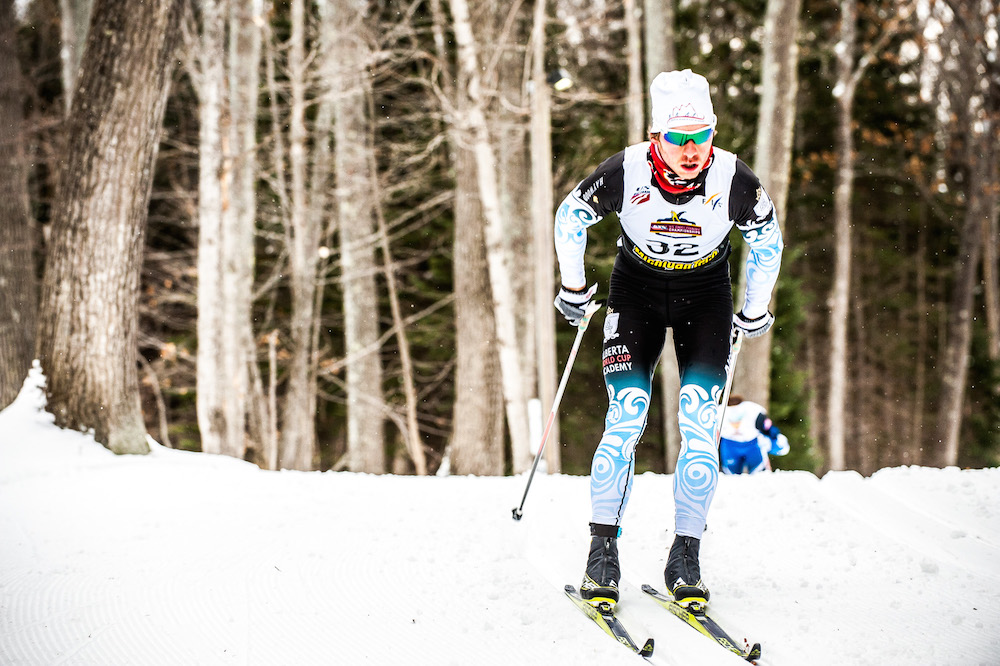
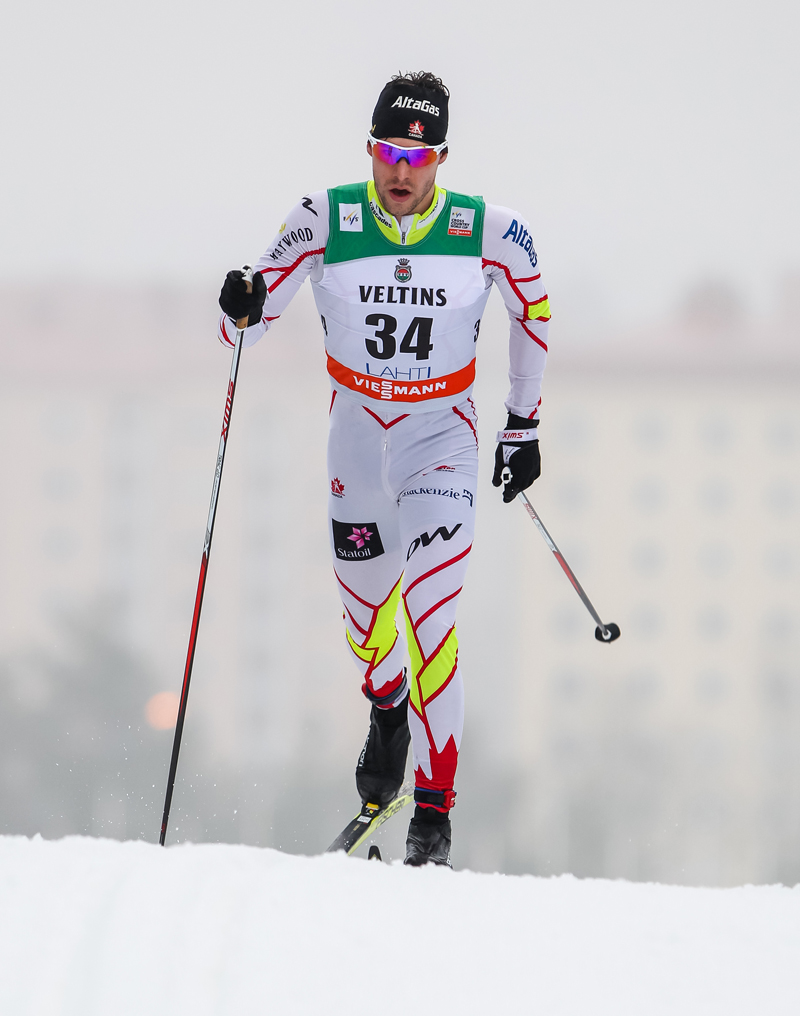
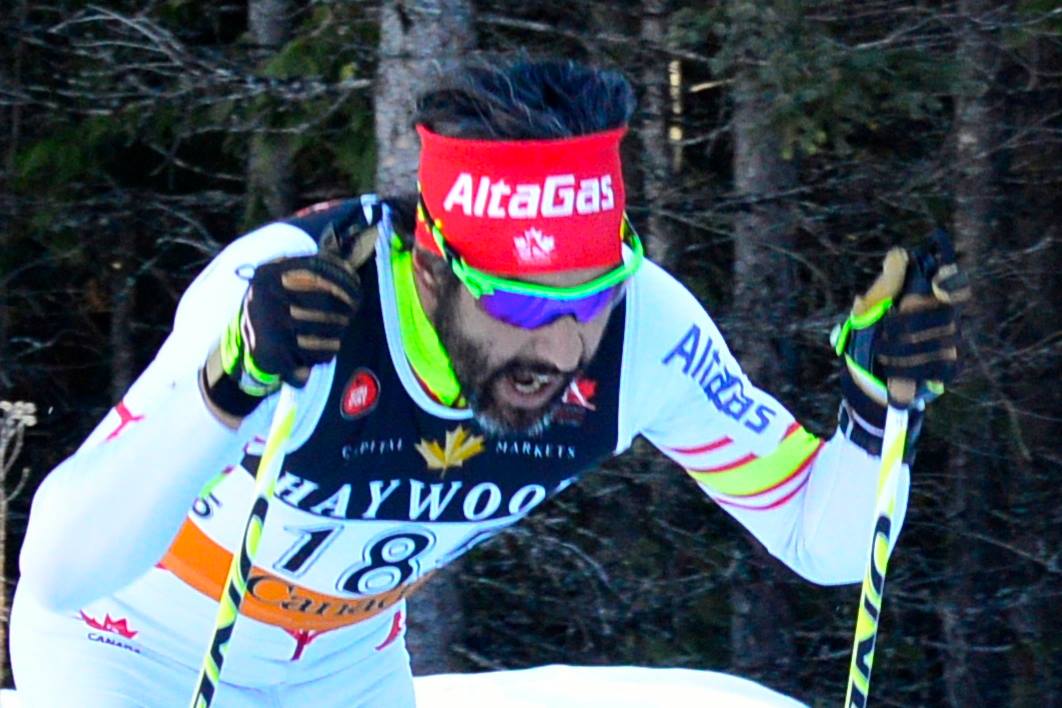
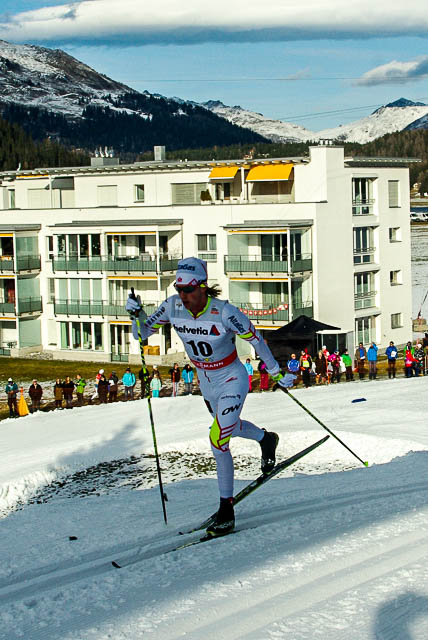
Canadian Andy Shields competing in the men’s 10-kilometer freestyle earlier this month in Lillehammer, Norway. (Photo: Fischer/Nordic Focus)
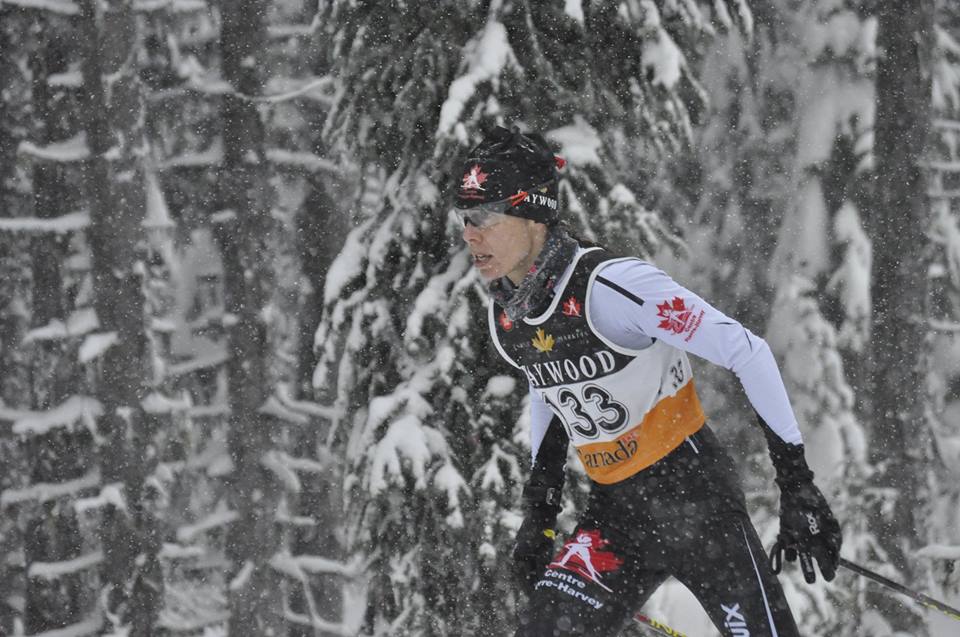
At the start of last season, Canadian cross-country skier Andy Shields specified two goals on his personal blog: 1.) to be the NorAm leader and earn World Cup starts by 2016, and 2.) to race the Ski Tour Canada.
Though several of his fellow Canadian competitors may have had similar ambitions, Shields was one of the few who lived them out. He emerged the 2015/2016 NorAm overall men’s winner, besting runner-up Kevin Sandau of the Alberta World Cup Academy (AWCA) by just one point.
Canada’s Andy Shields competing in a 2016 World Cup men’s team sprint last season in Planica, Slovenia (Photo: Fischer/NordicFocus)
With some of his early season results –including a first place finish in last year’s NorAm skate sprint at Sovereign Lake, B.C. –Shields earned the opportunity to compete for Canada in two World Cup races in Planica, Slovenia. They were his first.
A little less than a month later, Shields returned to Canada to compete in more domestic racing, and before he knew it, he found himself living out his second goal of racing in his native country’s Ski Tour.
While last year marked his debut appearance on the international World Cup, this season is the first time the 25-year-old Shields has joined Cross Country Canada (CCC) for Period 1 of the World Cup.
“I’ve know I have had these World Cups starts for several months now, so I am really prepared for the day to day racing weekend after weekend,” Shields told FasterSkier after the men’s freestyle sprint last Sunday in Davos, Switzerland. “I am just not as recovered as I would like to be to actually compete against the best in the world … it’s not like Ski Tour Canada last year where they were on their last legs, and I was in top form.”
Shields is also venturing into new territory after leaving his national training centre and returning to his original coach — his dad. For the last six years, Shields was a member of the Thunder Bay National Development Centre (now the National Team Development Center). Before that, he skied for Waterloo Region Nordic Ski Club.
“I joined my club where my dad is the coach,” Shields said of his father, Kevin Shields, who coaches at Lappe Nordic, north of Thunder Bay. “I kind of am … focusing on some of the things I felt like I needed to improve, rather than what the team was doing. I had been [with] the training centre for six years, so it was time for a change for sure.”
Though no longer affiliated with NTDC Thunder Bay, Shields indicated that he maintained a good relationship with Thunder Bay’s head coach Timo Puiras. Throughout the summer and fall, he jumped into team training sessions, which he said Puiras had “no problem with.”
Former NDC Thunder Bay skier Andy Shields racing a NorAm skate sprint qualifier last season at Sovereign Lake in Vernon, British Columbia. (Photo: BUFF Canada/M-Eve Bilodeau.C.)
After making the switch, Shields does not feel he has lost any opportunities, but rather gained some.
“It was what I needed,” Shields said. “[I’m] starting to get into the last half of my career now so I kind of have an idea of what I want to be doing.”
A change for Shields this season was not just starting the season on the World Cup, but doing so after having worked with his dad as his club coach. With a few weekends of World Cup racing behind him, Shields sees himself as headed in the right direction.
“I am always a little slow for the first couple races of the season so you know [Saturday’s 30 k], even though it wasn’t that great it was still a big improvement over how I was racing in Ruka and Lillehammer,” Shields said on Sunday, referring to the first two weekends of World Cup racing in Finland and Norway leading up to last weekend in Switzerland.
His next stop will be France for the men’s skiathlon and relays. Following those races, he will fly back to Canada for the holidays and then to Utah for the 2017 U.S. nationals race series at Soldier Hollow.
With goals of competing at 2017 World Championships in Lahti, Finland, Shields is simply focused on racing fast, unconcerned at this point with any criteria qualifications.
“I don’t even know what the criteria exactly is or if there [will] even going to be spots up for grabs at trials down there,” Shields said, referring to U.S. nationals. “I just want to race fast and see what happens, I don’t really need to see the criteria.”
— Chelsea Little and Ian Tovell contributed
Canada’s Andy Shields (Lappe Nordic) racing to 83rd in the 15 k classic pursuit at the 2016/2017 World Cup opener in Kuusamo, Finland. (Photo: Fischer/NordicFocus)
CALGARY — While Canada’s summer Olympians take the podium, young cross-country and biathlon development athletes clamber for a Calgary training facility for the upcoming winter. WinSport Canada’s June 2016 announcement to install a tube park through the cross-country ski trails at Canada Olympic Park has left Foothills Nordic Ski Club and other local clubs scrambling to find an alternate venue for their 2016/17 winter programming.
Without suitable training facilities within the city, the training and competition goals of young biathlon and cross-country athletes are hindered, as precious hours are spent traveling outside of the city for regular training sessions. According to Alberta Development Team athletes, Anna and Ben Pryce, “Terrain loss in Calgary could mean driving to Canmore four times a week,” which the Pryce’s feel is, “simply impractical” for reaching their goals and taking their skiing to the next level.
Sustaining a healthy population of Nordic development athletes, who themselves have opportunities to take the podium, means providing access to suitable facilities for all ages and development stages within the city of Calgary (1988 winter Olympic host).
Foothills Nordic Ski Club is taking decisive action to ensure its members and all Calgarians have access to cross-country skiing in Calgary this winter by launching its Snow Making at Confederation Park crowdfunding campaign (www.gofundme.com/foothillsnordic) that kicks off on August 15. A successful campaign will see Foothills implement innovative, hydrant-based snowmaking along with snow farming and harvesting techniques – maximizing the longevity of natural snow.
Committed to the community, the non-profit Foothills Nordic has volunteer groomed ski trails at the City of Calgary’s Confederation Park Golf Course for over 20 years, to the benefit of its over 700 club members and all Calgarians, but Calgary’s chinook-influenced winters make snowmaking a necessity for delivering reliable programming and continuous ski days.
Former Canadian Cross Country Ski Team member and Foothills Jackrabbit Kevin Sandau says of growing up in Calgary, “I was fortunate enough to have accessible skiing within the city. Skiing and racing my entire life has shaped who I am, the people I’ve met, and my desire to live a healthy lifestyle. Now with the uncertainty of reliable, safe and consistent ski facilities within Calgary, we will lose out on grassroots programs that would create the next generation of Nordic enthusiasts.”
ABOUT FOOTHILLS NORDIC SKI CLUB
Foothills Nordic Ski Club (FNSC) is a not-for-profit, full service ski club based in Calgary, Alberta. Incorporated in 1964, FNSC has a long history of organizing and delivering programs geared towards cross-country skiers and biathletes of all ages and performance levels. The Club has an annual active membership of 720, ranging from Jackrabbits and Biathlon Bears to High Performance athletes, Masters level recreational skiers and para-Nordic skiers. With a 9-member Executive, approximately 70 cross-country and biathlon coaches (both paid and volunteer) and over 200 active volunteers, the Club’s initiatives also include the staging of major events and races in Calgary and the Bow Valley. Foothills is an 8-time Canadian national cross-country aggregate club champion, and is a member of Cross-Country Canada, Cross-Country Alberta, Biathlon Canada and Biathlon Alberta.
The 2015/2016 aggregate NorAm leaders Andy Shields (l) and Dahria Beatty are FasterSkier’s Continental Skiers of the Year for Canada. (Photos: Fischer/NordicFocus and W. James MacLean)
The 2015/2016 awards continue, chosen by the FasterSkier staff based on performances from last season. While not scientific, these points of recognition are intended to reflect a broader sense of the season in review.
Andy Shields, Thunder Bay National Development Centre
One point. That was the difference between the men’s overall NorAm winner and the runner-up of Canada’s Continental Cup circuit this season, and emerging skier Andy Shields came out on top.
The 25-year-old Thunder Bay National Development Centre member — who broke through at the World Cup level with the 30th-fastest time in the men’s 15 k freestyle pursuit at the Ski Tour Canada (STC) in Quebec City — made his international World Cup debut this season. In all, he tallied eight World Cup starts in 2016 (including six stages of the Tour), but it’s what he did on the NorAm that makes him our choice for Continental Cup Skier of the Year.
“It was a pretty good race,” Shields told FasterSkier after the Quebec City pursuit, his second World Cup distance race, in which he placed 65th with the 30th-best time. “The wave start I was in was pretty quick, so I was able to get in the front group with them, and they pulled me along to a really good time on the day. Pretty happy that I’m able to manage that pace.”
Shields started 2015/2016 modestly, with an 11th-place finish in the freestyle sprint at the U.S. SuperTour opener in West Yellowstone, Mont., followed by a 37th place in the 15 k skate the next day.
In the first NorAm of the season in Canmore, Alberta, Shields reached the podium in the classic sprint, placing third behind his NDC teammate Bob Thompson and Patrick Stewart-Jones, of the Alberta World Cup Academy (AWCA), respectively. From there, Shields continued to gain momentum, winning the skate sprint at the next NorAm in Sovereign Lake, B.C., and placing fourth in the 15 k skate race before leaving for nearly a month of World Cup racing in Europe.
Upon returning to Canada in late January, Shields didn’t waste any time jetting to first and second in two NorAm distance races in Mont Sainte-Anne, Quebec. He went on to win the 20 k classic mass start at Eastern Canadian Championships, and at Western Championships, he finished in the top six in all four races: placing second in the 20 k classic mass start and third in the classic sprint. After that, Shields packed his bags for the STC, raced six World Cups in nine days, then finished his season at Canadian Ski Nationals in Whitehorse, Yukon. There, he missed the podium in four individual races, but reached the skate sprint final and placed sixth.
Between the men’s NorAm distance and sprint races this past season, Shields was the most consistent — besting Kevin Sandau (AWCA) by the slimmest of margins (1 point) in the men’s overall. Shields was fourth in the overall sprint standings, behind Julien Locke (Black Jack), Bob Thompson (NDC Thunder Bay), and Patrick Stewart-Jones (AWCA), respectively.
Dahria Beatty, Alberta World Cup Academy/Canadian U23 Development Team
The winner of the both the women’s NorAm overall and sprint series, Dahria Beatty dominated from start to finish last season, winning both a distance skate race and classic sprint at the Canmore NorAm opener, then winning four more NorAms before taking part in the STC.
During her first-ever World Cup tour, in which she notched 15th in the Canmore classic sprint, Beatty turned 22. The national U23 development team skier went on to win two out of three individual races she competed in at nationals in her hometown of Whitehorse (winning the 10 k skate and skate sprint, and placing second in the 5 k classic).
For her 15th place — her first individual World Cup top 30 — FasterSkier dubbed her Breakthrough Skier of the Year. For her performances at home in Canada on the NorAm circuit, finishing in the top eight of every race she competed in this season, Beatty is Continental Skier of the Year.
“My ideal goal for this season would be able to crack the top 30 on the World Cup,” Beatty said in December before leaving for Canada’s U25 B-Tour trip in Europe. “That’s a big goal…”
Honorable mentions
Kevin Sandau, Alberta World Cup Academy
Kevin Sandau (AWCA) in the NorAm leader’s bib leads Bob Thompson (r) during the men’s NorAm 15 k freestyle individual start at Sovereign Lake, B.C. Sandau went on to win by 37 seconds over Knute Johnsgaard (not shown). (Photo: XTS Photography)
Kevin Sandau’s only 27, but it feels like he’s been at the forefront of Canadian cross-country skiing for a long time. After debating whether he would compete in 2015/2016, Sandau started the winter on a tear, winning back-to-back Canmore distance races in December and remaining undefeated in NorAm distance races until Easterns in early February (where NDC Thunder Bay’s Michael Somppi dethroned him in the 15 k skate).
After that, Sandau never reached the top of the podium again, but he came close in second in the 10 k skate at Westerns (behind Russell Kennedy of Canmore Nordic). At the end of the season, he finished second in the NorAm overall with 724 points, one short of Shields.
On March 26, after placing fifth in his final race of the season (the 50 k classic mass start at nationals), Sandau announced his retirement on Facebook.
“Today marks the end of my racing career. The memories are countless and the experiences beyond amazing. I can’t think of a better way to have spent the past 10+ years,” he wrote. “Thanks so much to all the volunteers, coaches, teammates, skiers, parents, fans and role models for the journey. I’m looking forward to the next chapter and hope it’s as good as the last. KevOut.”
Sandau previously stated that his season-long goal was to qualify and focus on the STC. He did so, placing 43rd overall in the Tour. In his career, he raced 29 World Cups, starting with his first in 2008 in Canmore.
Besides skiing, Sandau brought humor to his ski racing and shared it on social media.
In a prank April Fools’ article on FasterSkier, Sandau played along with the idea that he would be Canada’s next head coach.
“I feel like my practical experience on the domestic circuit and top-50ish on the World Cup is what really sets me apart from the rest,” he jested. “You learn a lot of racing in the back of a World Cup, it’s like the best seat in the house, and you can watch firsthand the whole race as it unfolds, at least for a little bit.”
Cendrine Browne, Pierre-Harvey National Training Centre/U23 Development Team
Cendrine Browne at the Ski Tour Canada in Quebec City. (Photo: John Lazenby/Lazenbyphoto.com)Second to Beatty by 160 points in the NorAm overall, Cendrine Browne, a 22-year-old member of the Pierre-Harvey Training Centre (CNEPH) in Quebec and national development team, was one of Beatty’s biggest rivals on the circuit.
After placing second to her in the first sprint of the season in Canmore, Browne joined Beatty on the European B-tour trip. She returned to her home trails at MSA to win both the 5 k classic and 10 k freestyle pursuit — but Beatty didn’t race.
“I chose to race because I would have done intensity anyways,” Browne wrote in an email afterward. “The Noram points are also interesting if I win.”
Browne beat Beatty outright in the 10 k freestyle at Easterns, then bested the women’s field by nearly 53 seconds in the 15 k classic mass start at Westerns (ahead of Annika Hicks of Canmore Nordic and Katherine Stewart-Jones of NDC Thunder Bay and the national development team, respectively).
Browne finished the eight-stage STC in 40th overall and placed second to Emily Nishikawa in the season-ending 30 k classic mass start at nationals.
Kevin Sandau, a former Canadian national team member and Alberta World Cup Academy athlete, was named head coach of the Canadian National and World Cup teams on Friday. (Courtesy photo)
Cross Country Canada (CCC) is serious about developing its coaching pipeline and hiring in-house, as evidenced by its most recent decision to hire former athlete Kevin Sandau as head coach of the Canadian National Ski Team.
Wadsworth planned to step down following Canadian Ski Nationals, which ended in Whitehorse, Yukon, last Saturday. Sandau’s hiring was confirmed by CCC High Performance Director Tom Holland less than a week later.
“Kevin applied for the position as soon as it became available, and he’s as good as anyone we can think of at this point,” he continued. “He has some impressive video filming, editing and website-design skills, so we see those as huge assets to the team.”
When asked specifically about Sandau’s foray into acting, Holland chose not to comment.
A Canmore local, the 27-year-old Sandau grew up skiing on the nordic trails in Kananaskis Country just outside Calgary and got his start with Foothills Nordic Ski Club. He was named to the national senior team in 2010 and spent the last several seasons training with the Alberta World Cup Academy, but debated continuing his ski career last year upon not being renominated to the national team.
“It was a tumultuous few weeks following that news, where he debated whether or not to end his ski career,” reads his bio on the AWCA website. “After much internal debate, and discussion with coaches and teammates, Kevin became determined to continue racing and set his focus on this year’s Tour de Canada.”
Sandau placed 43rd overall in the Ski Tour Canada, and ended his season in fifth in the men’s 50-kilometer classic mass start at nationals in Whitehorse.
He describes himself on his Twitter profile as a “Canadian cross country skier, celebrity chef wannabe and aspriring film guy living in beautiful Canmore/Calgary Alberta.”
“Obviously I’m really excited,” Sandau told FasterSkier of the opportunity to coach both Canada’s senior national and World Cup teams. “I don’t have much experience coaching at this sort of level but I feel like my practical experience on the domestic circuit and top-50ish on the World Cup is what really sets me apart from the rest. You learn a lot of racing in the back of a World Cup, it’s like the best seat in the house, and you can watch firsthand the whole race as it unfolds, at least for a little bit.
“Cross Country Canada and I had our differences this past year, but I think that is all behind us now. I’m not here to stir up controversy or open up old wounds, I’m here to get a job done and make Canada great again,” he added.
And how has the reaction been so far?
“The support has been phenomenal,” Sandau said. “Just today Tor Arne Hetland, who coached this team during the 2014/2015 season and now leads the Norwegian National team called me up to congratulate me. Well at least I think it was to congratulate me. He was mostly speaking in Norwegian and he was laughing pretty hard.”
Asked what his plans are for the national team, Sandau said his “first executive order” will be about broadening and strengthening the national-team program.
“There are a lot of skiers in Canada that have come up just shy of the NST selection standard and if I’ve learnt anything from movies, you need to give these guys a shot at the real deal,” he said. “For example our own jackrabbit mascot Klister, he’s got the drive to go for 2018 and beyond. Hell, I’d probably like to race at the Olympics in 2018 too, and maybe I could see if my new position gives me that sort of perk. Chances are we probably won’t be sending a full team so there will be some open spots.”
Outgoing coach Wadsworth could not be reached for comment. Sources said he had gone on vacation with his family, and upon hearing the news, buried his head in the sand and refused to take it out.
Norway’s Therese Johaug was happy to be done with the eight-stage Ski Tour Canada on Saturday, March 12. She won the Tour title along with the Overall and Distance World Cup Crystal Globes. (Photo: Fischer/Nordic Focus)
CANMORE, Alberta — After eight races in 12 days, the final day of the Ski Tour Canada last Saturday brought both extreme exhaustion and feelings of completion for the 14 Americans (10 women, four men) and 12 Canadians (seven men, five women) who made it to the culminating finish of the season-ending World Cups.
Here is some of the best from the North Americans who made it to the last two stages (the Stage 7 freestyle individual start and Stage 8 classic pursuit):
Canada’s Emily Nishikawa racing to 35th in the women’s 10 k freestyle at Stage 7 of the Ski Tour Canada in Canmore, Alberta. She went on to lead the Canadian women in 37th overall in the Tour. (Photo: Fischer/NordicFocus)
“It was initially very overwhelming, but once I got the hang of how things go on race day, it was really fun to be out racing with so many fast women.” — Kaitlynn Miller (Craftsbury Green Racing Project), 41st overall
“I’ve never done anything like this before. It is a test of will because you are either traveling or seeing the course … It is so different, I was so glad I had a chance to do this in a place like Canada where there are so many supporters. It was fun, I’m stoked it is over but it was actually really fun.” — Jennie Bender (Bridger Ski Foundation), 48th overall
“It was pretty intimidating in the beginning but I guess I’m kind of getting used to it.” — Katharine Ogden (Stratton Mountain School/USST D-team), 36th overall
On how the body held up:
“Before the race, I felt really nauseous and pale and I thought, ‘I should go drink some water.’ … I did not think today was going to go well at all. I was thinking best-case scenario would be finishing. I don’t know, I never know what my body is going to do, but my back felt good and I skied with a group, which was freaking awesome.” — Bender
2016 Ski Tour Canada finishers:
CANADA:
5. Alex Harvey
14. Ivan Babikov
16. Devon Kershaw
27. Graeme Killick
37. Emily Nishikawa
40. Cendrine Browne
43. Kevin Sandau
44. Olivia Bouffard-Nesbitt
47. Annika Hicks
49. Maya MacIsaac-Jones
49. Michael Somppi
50. Russell Kennedy
USA
5. Jessie Diggins
11. Sadie Bjornsen
24. Rosie Brennan
31. Chelsea Holmes
33. Caitlin Gregg
34. Ida Sargent
34. Noah Hoffman
36. Katharine Ogden
41. Kaitlynn Miller
42. Erik Bjornsen
43. Anne Hart
46. Scott Patterson
48. Jennie Bender
51 Tad Elliott
“I broke my finger about two weeks ago right before the Birkie but I felt solid there. When I start to get tired, my immune push-back starts flaring up and I was dealing with that a bit in the beginning of the tour and didn’t know how I would fare with all this hard racing. Honestly, I thought about pulling the plug after the first half, I was really suffering. But they said, ‘Go West, it is where you are from and the sunshine will do you well, stay relaxed and just enjoy ski racing.’ That is what I tried to do today and things have been coming around fast so it is kinda nice to feel that way.” — Tad Elliott (Ski & Snowboard Club Vail), after placing 41st in the 15 k freestyle at Stage 7 (he went on to finish 51st overall in the Tour)
“I just had to focus on the process and just ski as well as I could and I think I did that. I didn’t have much energy to work with so I had to make due with what I had. I skied as well as I could and just focused on technique.” — Emily Nishikawa (Canadian Senior Development Team), after placing 35th in 10 k freestyle at Stage 7 (she went on to place 37th overall in the Tour)
“The season is wearing on me. I’ve been traveling a lot and racing a lot this year and haven’t had time to do any volume training and I think that is showing, my body has nothing left to give.” — Michael Somppi (NDC Thunder Bay), after placing 50th in the 15 k freestyle at Stage 7 (he placed 49th overall in the Tour)
On finishing:
“Everyone was so awesome, I am glad I made it to the end. I’m stoked. Finished my first tour, I can’t complain.” — Russell Kennedy (Canmore Nordic), 50th overall
“My goal was just to finish without getting lapped and I achieved that so I am really pumped to have finished the Tour. … I learned that my fitness is good enough to make it through all these races, but it needs to get better in order to improve.” — Jessica Yeaton (Australian national team and Alaska Pacific University), 46th overall
“I raced it for myself. I didn’t have any expectations for today and I, 100 percent, wanted to race my own race. I crossed the finish line happy with my effort and that is all I wanted.” — Olivia Bouffard-Nesbitt (Canadian Senior Development Team), after placing 42nd in 10 k freestyle at Stage 7 (she went on to place 44th overall in the Tour)
“It is my first interval start on the World Cup ever. It was fun to kind of ski my own race, but Johaug just blew by me on the wall of course.” — Annika Hicks (Canmore Nordic) after placing 48th in the 10 k freestyle at Stage 7 (she went on to place 47th overall in the Tour)
“Honestly, I thought about pulling the plug after the first half, I was really suffering. But they said, ‘Go West, it is where you are from and the sunshine will do you well.’ ” — Tad Elliott, of Durango, Colorado
On highs and lows:
“There was definitely highs and lows. Racing this much is pretty taxing physically and emotionally, but every day I was training or racing I was thinking about how ‘effing’ awesome this is to do at home. It is something I might not be able to do it again, but I hope I will. It is such as privilege and every time I thought about it I was so thankful to be here.” — Bouffard-Nesbitt
“I got passed by both Therese and Heidi [in the 10 k freestyle], which was great, and I was like, ‘Holy sh*t!’ … Actually, proud moment of the race: I skied behind Therese on the downhill and she snowplowed and I did not so I was beating her on the downhill. But yeah, they climb like fiends. I don’t think I have the ability to go that tempo, being twice as big as both of them.” — Bender
“It is great if you can pick up a good ride, but today I had Sundby blow past me. You want that ride that is just a bit too fast, not one that is killing you.” — Scott Patterson (APU), after placing 47th in 15 k freestyle (he went on to place 46th overall in the Tour)
“I tried to ski with Maurice [Manificat] out there but then kinda exploded. I knew you follow Maurice it brings you to a top 20, within sight brings me to a top 30. I wasn’t able to accomplish that today, but to feel this good after all the health issues I’ve gone through recently is a sign of good things to come.” — Elliott after placing 41st in the 15 k freestyle at Stage 7
On takeaways from the Tour:
Canada’s Michael Somppi racing to 50th in the men’s 15k skate in Canmore, Alberta. He went on to place 49th overall in the Tour. (Photo: Fischer/Nordic Focus)
“I definitely feel like I have the endurance for long events like this — that is one of my strong suits. I seem to recover well. I mean, I am exhausted now, but I’ve still been getting out of bed and excited to race. I was racing pretty well on the domestic circuit, but it is just so different. I learned so much in the five distance races … In mass start races, you have to be aggressive and fight for those spots early on. I’m noticing my redline that I am comfortable skiing at in domestic races; the pace is different here.” — Kevin Sandau (Alberta World Cup Academy), 43rd overall
“I think it’s really just essential to getting us used to the World Cup atmosphere and no longer just feeling super nervous as you get to the start line. Making it more part of just any other race that you are able to focus more on the procedure of the race and feel the speed that these ladies race at and try to even just stay with it for five or 10 seconds through the race just gives you that little glimpse of where you need to be.” — Dahria Beatty (Alberta World Cup Academy/Canadian U23 Development Team) , 44th after Stage 7, (did not race Stage 8 due to a sore back)
“One of the big things is seeing just how hard all the women race at every race. In the NorAm circuit, we all ski hard but the World Cup is at a whole different level. These women go as hard as they can from the start until they collapse at the end. I think just being able to see just how hard they push shows me just how hard I need to be working and how hard I have to push to ski at this level.” — Maya MacIsaac-Jones (Rocky Mountain Racers), 49th overall in the Tour
“… The maturity and strength these guys have, it was good for me to see. I know the work I need to do in the summer and I am motivated to do it.” — Elliott
On future plans:
“Continue to train hard. I’ll stay at the centre next year and continue to try and improve. Also, keep working on the sprints.” — Sophie Carrier-Laforte (Pierre-Harvey National Training Centre), after placing 52nd in the 10 k freestyle at Stage 7 (she did not race Stage 8)
“I’ve been patient and I have had a long-term plan all the way through so I can see into my career now, but the support of a good coach is to keep that lid on. After Spring Series, I’m taking six weeks. I just ordered some Oakley golf gear, ordered some clubs from Wilson — I’m going to enjoy some golf and some warm weather and some mountain biking with my brother and come June maybe I’ll think about dusting off the rollerskis.” — Elliott
Video:Inside the Fence - Coming to North America
Ever wonder what European athletes think about coming to North America? Inside the Fence takes a look at the impressions from World Cup athletes participating in Ski Tour Canada
Posted by FIS Cross-Country Skiing on Thursday, March 10, 2016
Norway’s 24-year-old Emil Iversen after winning his third-career World Cup race, and first distance race, at the second stage of the Ski Tour Canada on Wednesday: the 17.5 k classic mass start. (Photo:Flyingpointroad.com/NNF)
(Note: This article has been updated to include details about a crash involving Norway’s Martin Johnsrud Sundby early in the men’s classic mass start.)
Certainly it’s too soon for Norway’s Emil Iversen to tell his elders to move over. One of those elders is Norwegian teammate Martin Johnsrud Sundby, current overall World Cup leader. The other, Petter Northug Jr. is … Northug.
But at the second stage of the Ski Tour Canada (STC) on Wednesday, a 17.5-kilometer classic mass start in Montreal, Quebec, Norway’s 24-year old Iversen, strided, herringboned, and double poled to the win.
Exactly 45:05.4 minutes after the start, Iversen crossed the wind-swept finish line first, 5.3 seconds ahead of Northug. The overall leader of the STC and winner of Tuesday’s sprint, Russian Sergey Ustiugov, placed third (+14.5).
The start of the men’s 17.5 k classic mass start on the second day of the Ski Tour Canada in Montreal, Quebec. (Photo: Flyingpointroad.com/NNF)
At 23 years old, it was Ustiugov who first showed his fearlessness. Establishing a tempo and drive that 3.5 k in showed he was going to be the pace-setter — Ustiugov went on to dictate the pace for most of the race.
But at that 3.5 k mark it still could have been a number of skiers’ race to control. Strung out behind Ustiugov in a line were Norwegians Iversen, Sundby, Northug, Finn Hågen Krogh, Canada’s Alex Harvey, Norway’s Ola Vigen Hattestad, and Kazakhstan’s classic specialist, Alexey Poltoranin.
It must have been something subtle. Maybe an extra effort herringboning up the steep, sugary hills, or double poling with his burly core, but only a kilometer later, Ustiugov played for keeps. Only Iversen and Northug could hang on.
Sundby later told reporters that he had crashed early on an icy and curving descent.
“I went on my face,” he told NRK, according to a translation.
Slowly but surely, a gap back to Sundby grew. And as the moisture on Sundby’s beard began to freeze, so did his chances of bridging up to the leaders. At the 4.6 k mark, Sundby was 13 seconds behind.
“I lost a lot of time and then it was [over],” he said. “I’m not sure what to say. We are trying to showcase our sport, but today I am unsure what we were doing. Was it cross-country…?
“It was unusual conditions,” he added. “Fortunately, it was the same for all.”
As the moisture on Sundby’s beard began to freeze, so did his chances of bridging up to the leaders.
By 12.5 k, Sundby chasing in fourth was 18.2 seconds behind the trio of Ustiugov, Iversen and Northug. It remained a long day of trying to play catch up for Sundby, who toiled in no man’s land, chasing solo for the remainder of the race. Sundby finished fourth, 39.8 seconds behind the upstart Iversen.
It’s Northug’s signature tactic to let others set the pace until he marks the race with an exclamation point across the line. But Wednesday, Iversen, having grown up watching Northug’s bait-and-switch prowess over the years, left nothing for chance. With 1.5 k to go, Iversen began to stretch the rubberband back to Northug inch by inch. He had a 3.6-second lead on Northug, but even that small margin never vanished.
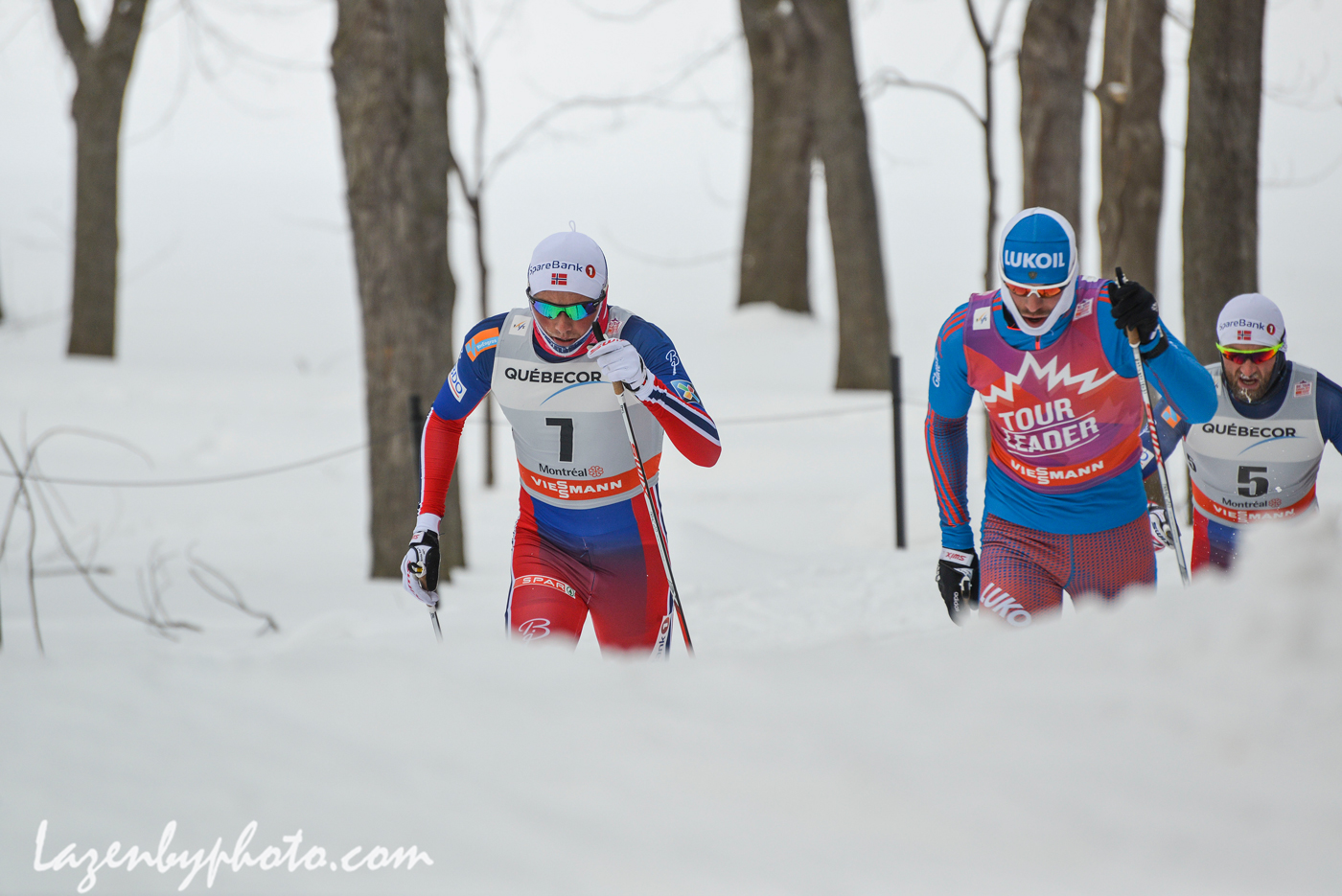
Norway’s Emil Iversen (l) and Russia’s Sergey Ustiugov (red leader’s bib) lead the men’s 17.5 k classic mass start at the second stage of the Ski Tour Canada in Montreal, Quebec, while Norway’s Petter Northug trails in third. Iversen went on to win, Northug placed second and Ustiugov took third. (Photo: John Lazenby/Lazenbyphoto.com)
When Iversen made his decisive move, he simply upped the pace and never looked back.
“In the fourth lap I saw Ustiugov was little bit tired,” Iversen said in the post-race press conference. “I decided to try and went for it 100 percent. I hoped I could get a gap and gain some seconds. My goal before the Ski Tour Canada was to have a good start. I’m sitting in second place. Now I have to take stage by stage and we see what happens.”
With his win on Wednesday, Iversen took his first ever distance World Cup victory and the third of his career. Iversen’s other two World Cup victories, both of which were sprints, also came this season.
Northug spoke about the trio out front and pushing an unrelenting pace.
“The plan was to stay in front of the field,” Northug said during the press conference. “After one lap it was only three or four guys in the lead. The pace was very high. We had to fight hard against the wind and snow. Ustiugov did a lot of work in the lead. He was the strongest today. We can thank him for the high speed.”
Ustiugov also acknowledged that he had taxed himself with the workload.
“It was a very tough race,” Ustiugov said at the press conference, through a translator. “I knew the guys behind me were fresher than me as I did all the work in the front, but I am satisfied with third place and be in the lead of the Ski Tour.”
With two consecutive podiums in as many stages so far, Ustiugov remains in first in the Tour standings, 6.1 seconds ahead of Iversen in second. Northug is third, 11 seconds back, and Sundby is nearly 1:40 minutes out of first in fourth overall.
Harvey in the Hunt
After two days of racing, both of which took place in his home province of Quebec, Harvey ranks sixth overall, 1:58.3 out of first, after placing ninth in Wednesday’s mass start (+1:16.4).
While racing the five laps of Montreal’s 3.5 k loop, Harvey appeared to be one of the few who could match the front runners’ pace. At 5.5 k, the Canadian skied in sixth, 14.5 seconds back.
Canadian World Cup Team member Alex Harvey (10) racing to ninth at the second stage of the Ski Tour Canada, the 17.5 k classic mass start in Montreal, Quebec. (Photo: flyingpointroad.com/NNF)
Again and again, it seemed Harvey would cover the breakaway. In an in-person interview afterward, Harvey said those efforts were exhasting.
“It was a drop in my energy.” Harvey said. “I tried closing the gap with the first three, but I exploded in trying to do so. I fought for the podium but the three guys at the front were out of reach. Ustiugov was really strong the first two laps. I paid at the end for my efforts.”
Harvey did ski wisely. He was close enough to the front to fight for the two mid-race time bonuses. Harvey took an 8-second time bonus at 4.6 k and a 2-second time bonus at 11.6 k.
Thinking more of the long-term than a one off race performance, Harvey said he is staying true to his STC plan.
“My fitness level is good and stable, which is important because you can’t win the Tour in one day, but you can lose it in one day,” he said. “The goal is to not loose the Tour on any day.”
The second best North American result came from fellow Canadian World Cup Team member Devon Kershaw, who began the day near the back of the pack in bib 50. Kershaw moved forward incrementally and by 5 k was skiing in 22nd place. He eventually skied across the finish in 17th (+1:38.9).
“It was a challenging day,” Kershaw said afterward. “Really soft snow, different conditions.”
Despite the less-than-ideal fresh snow and blustery wind, Kershaw appreciated the opportunity to ski in a city some of his family calls home.
“To race in front of friends and family here on the Island of Montreal is a pretty neat feeling,” he said. “It’s just so nice to have the home crowd behind you. My aunt and uncle live here, my mom and my brother live here as well. So I have a lot of family in the city. I heard their voices. It was pretty neat.”
In the points, and moving up on a day with tricky snow and biting wind, Kershaw remained positive.
“Seventeenth isn’t something we are going to be lighting fireworks off, calling everybody that I know,” he said. “But at the same time it’s a step in the right direction. I was pretty disappointed after yesterday so its better.”
Kershaw placed 50th on Tuesday’s freestyle sprint and now sits 17th overall.
A third Canadian World Cup Team skier in the points was Ivan Babikov in 29th (+2:32.1). Unlike Harvey, who started the day in bib 10 (meaning he had a good starting position heading into the courses steeply pitched and punchy climbs), Babikov wore bib 78. As a result, Babikov started near the rear in the field of 85 skiers.
When the day’s sinuous track kicked up on lap one, skiers had to herringbone some of the soft headwalls.
“There was actually a few places, mostly the first and second lap was the worst,” Babikov said on the phone after the race. “The course was just really interesting. I’ve never see something like that before.”
Babikov described quick downhills that pitched up into mandatory herringbone sections. Those sections created bottlenecks since the herringboning forced skiers to keep their skis wide.
“Oh yeah, like people crashing and tangling up all over the place,” Babikov said of the scene. “It also was really soft for the skis, so it created really like barely any track on the uphill where you could have strided … It was just a mess, broken poles, people falling down.”
Babikov explained that maybe the first five, 10 or 15 skiers could ski cleanly through, but not the main pack. On his first lap, Babikov said he felt like he waited thirty seconds for the mess of skiers to clear before pushing ahead.
When he finally did push ahead, he pushed hard. Of his jump from 78th to 29th place at the finish, Babikov said skiing conservatively wasn’t part of the plan.
“You have to take a risk today,” Babikov said. “Like, at times to pass people on the downhills. My body felt pretty good. I tried to pass people whenever I could.”
All that passing moved Babikov up in the overall standings. He now sits 33rd overall.
Canadian Head Coach Justin Wadsworth was pleased with the day’s result.
“It was actually a pretty solid day for us, three guys in the top 30, Alex in ninth, Devon in 17th and Ivan 29,” he said.
Wadsworth also spoke about the benefits of World Cup racing for a future generation of Canadian skiers.
“Today was an experience…,” he said. “For the younger athletes, it was a real eye opener. It was very hard conditions, with the wind and the snow and the course. I think our younger athletes, also arriving just last night … usually you get some time on the course ahead of time and there’s a ski warmup area and a testing area, and none of that happens here. Boom, you show up and you get ready to race on a race course your’ve never raced on at the highest level.”
Also for Canada, Graeme Killick (CNST) placed 50th, Kevin Sandau (Alberta World Cup Academy) was 53rd, Len Valjas (CNST) 63rd, Patrick Stewart-Jones (AWCA) 64th, Jess Cockney (CNST) 66th, Michael Somppi (NDC Thunder Bay) 68th, Knute Johnsgaard (AWCA/CNST) 69th, Bob Thompson (NDC Thunder Bay) 73rd, Russell Kennedy (Canmore Nordic) 74th, Andy Shields (NDC Thunder Bay) 76th, and Simon LaPointe (Skinouk) 82nd.
Bjornsen leads the U.S.
Erik Bjornsen (Alaska Pacific University/U.S. Ski Team) was the top American in 31st, just 0.4 seconds outside the top 30 and 2:37.3 behind the winner. In a post-race phone call, Bjornsen said he is feeling good after two STC stages.
Erik Bjornsen (USA) on his way to 31st place in the men’s 17.5 k classic mass start at Stage 2 of the Ski Tour Canada in Montreal, Quebec.. (Photo: Flyingpointroad.com/NNF)
“Coming into today I knew that I have been feeling pretty good lately, so I was hoping for a good result,” he said.
Bjornsen also noted the difficult herringboning and the likelihood for bottlenecks to develop.
“It went out at a pretty hot pace just knowing things were going to get strung out having such a narrow course like that,” Bjornsen said. “But I felt like I went out all right. I struggled a bit with the herringboning and felt strong on the double pole. I was not happy with being so close to the top-thirty. Definitely hoping for a little more in the next few stages.”
The STC is the second World Cup Tour for Bjornsen.
“In the last Tour I was right outside the top 40,” Bjornsen said. “It’s my goal this time to be closer to the thirties, but I think if I finish in the top 30 I would be very happy with my overall result. We will see how it goes, there is definitely a couple of good races for me coming up. If I could pop into the top 20 in one race that would be absolutely awesome.”
U.S. head coach Chris Grover discussed how the front-end racers escaped from the main group so quickly. Bottlenecks were a recurring theme.
“It was a pretty narrow course overall,” Grover said on the phone. “And in particular, the big longer herringbone hill was really only about one skier width … The packs got super strung out because the nature of the course but also because of the tough conditions. Once people got away from those that were trying to herringbone in the soft stuff, they really got away.”
Grover said those rough-an- tumble patches took a toll on both the U.S. men and women.
“We had a lot of broken equipment today,” he explained. “Just amongst our team, Ida Sargent broke a ski in a crash tangle-up right away. Brian Gregg broke a ski by having a binding rip off a ski. So it was definitely a challenging day.”
American Matt Liebsch (Gear West) waits for his good friend and training partner Brian Gregg (Team Gregg) to finish the men’s 17.5 k classic mass start at Stage 2 of the Ski Tour Canada in Montreal, Quebec. Gregg crashed and his binding ripped off his ski. (Photo: Flyingpointroad.com/NNF)
Gregg ultimately finished 81st.
“I had one pretty solid crash out there, which was certainly very frustrating but that’s part of racing,” Gregg said after.
Noah Hoffman (Ski & Snowboard Club Vail/USST) placed 42nd. He reiterated the tough course.
“It’s a really challenging course,” Hoffman said. “We were just standing still on the first lap, so often. It was so narrow, there’s so much herringbone. It was a challenge from way back off of yesterday’s finish.”
Also for the U.S., Scott Patterson (APU) finished 55th, Simi Hamilton (SMST2/USST) was 58th, Eric Packer (APU) 67th, Reese Hanneman (APU) 70th, Andy Newell (SMST2/USST) 71st, Dakota Blackhorse-von Jess (Bend Endurance Academy) 77th, Matt Liebsch (Gear West) 79th, Tad Elliott (SSCV) 80th, and Gregg (Team Gregg) 81st.
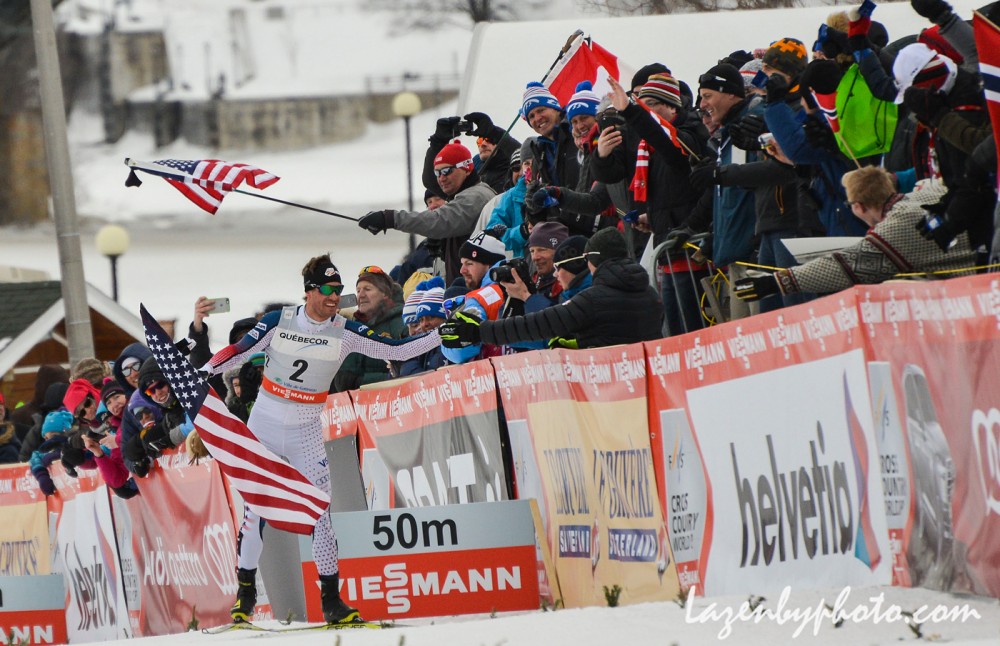
American Simi Hamilton during his “victory lap” after finishing in the top three of the men’s freestyle sprint at the Ski Tour Canada World Cup stage in Gatineau, Quebec. (Photo: John Lazenby/Lazenbyphoto.com)
For the men’s opening stage of the Ski Tour Canada on Tuesday, a 1.7-kilometer freestyle sprint, the end is the best place to start.
Adjacent a frozen Ottawa River in Gatineau, Quebec, those who withstood the -5 degree Celsius (23 Fahrenheit) cold, the tight corners, and the scrum-like jostling at the front of the pack went on to stand on the podium.
Russia’s Sergey Ustiugov won the speedy and tightly contested final in 3:09.36 minutes, proving it’s not over until it’s over — but more on that in a bit. Richard Jouve from France placed second, just 0.08 seconds back. But the big news for North America, U.S. Ski Team sprinter Simi Hamilton took third in a photo finish with both Ustiugov and Jouve. Hamilton was only 0.09 seconds behind Ustiugov and 0.01 seconds out of second place.
Hamilton: Waiting, Waiting, Then Pouncing
For the Aspen, Colo., native, Canada is as close to home-racing soil as he’ll get on this year’s World Cup. Considering he spends most of the offseason training with Vermont’s Stratton Mountain School (SMS) T2 Team, a long drive south, Hamilton came prepared for what he hoped would be a solid day in front of family and friends. And he didn’t disappoint.
In an in-person interview after the race, Hamilton, 28, explained the local support kept the stoke high.
“You always kind of want to play it cool and stay engaged and focused, but it’s so awesome when you run to the start or even when you are racing and you hear, ‘USA,’ and ‘Simi,’ ” Hamilton said. “I have a lot of friends and family out here. It’s just super cool to race so close to home and people are fired up. I think we are bringing a lot of good energy to cross-country ski racing on this continent, and it’s fun to be part of that movement.”
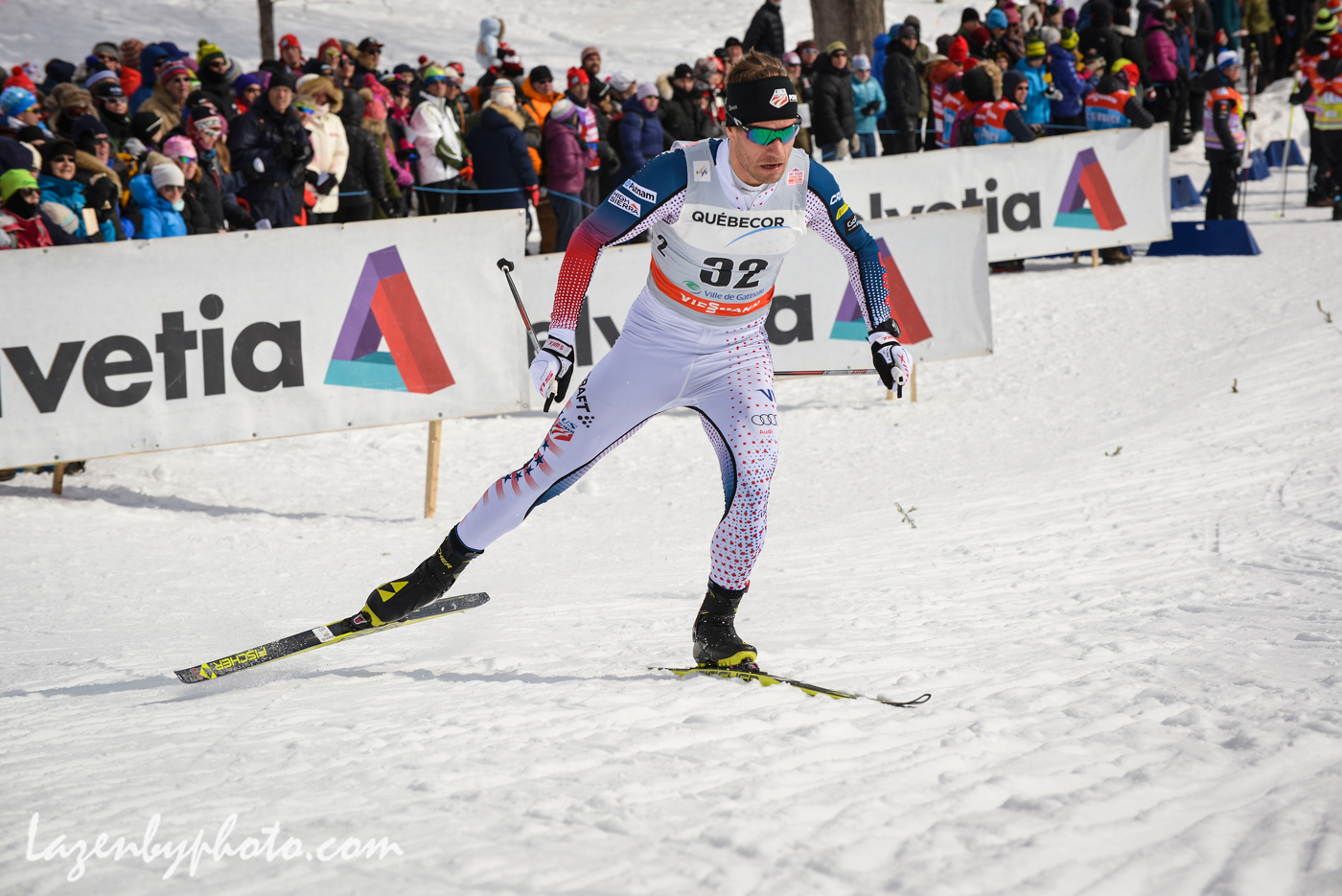
Simi Hamilton (U.S. Ski Team) racing to second in the men’s 1.7 k freestyle sprint qualifier on Tuesday at Stage 1 of the Ski Tour Canada in Gatineau, Quebec. Hamilton went on to place third in the final for his second podium of the season. (Photo: John Lazenby/Lazenbyphoto.com)
Hamilton’s effort in the qualifier made a statement. He wore bib 2 throughout the heats as a result of his second-place qualifying time. Fastest qualifier, Norway’s Petter Northug set the best mark in 3:12.99. Hamilton was a bit more than an eyeblink behind, finishing only 0.45 seconds back.
Quarterfinal 3, Hamilton’s heat, featured Norway’s Emil Iversenas a main threat — Iversen qualified fourth (+1.40). And in Lahti, Finland, the site of the last World Cup sprint, Iversen won out the day.
Clearly in good form again on Tuesday, Iversen led Hamilton’s heat like a greyhound chasing the unreachable rabbit — just go, go, go. Hamilton remained in the back, shifting from third to fourth and back to third. On a portion of the course where two small straights are linked by a horseshoe-shaped bend, Hamilton said he began to learn how the course could be exploited.
“Today I kind of figured out in my quarterfinal that it’s good to conserve energy in the middle of the pack or close to the back of the pack,” Hamilton said in the post-race press conference. “And then I knew that I was skiing that horseshoe climb really well all day today. So I knew that I could put a move on there and I knew that a lot of other people were kind of letting off the gas a little bit on that climb and around the corner.”
That’s where Hamilton began to move up and position himself for the final straight. Iversen took the heat win in 3:13.73, but Hamilton, who finished second (+0.35), took the best how-to-race notes.
Hamilton moved onto the second semifinal where Northug, Jouve, and Norwegian Ola Vigen Hattestad awaited.
With the flat light dulling the course, the star of the show appeared to be Northug. Sporting retro-looking mirrored sunglasses, Northug seemed ready for prime time. Having won his quarterfinal in iconic Northug fashion — never seeming to exert real effort yet moving faster than the others — he won out again in 3:13.38.
In that semi, Hamilton played the same hand as he did in the quarters, with slightly less stellar results. He remained in the pack. He conserved energy. He navigated a pushy and tightly packed group of skiers, but he left his chances up to a nail-biter sprint down the home stretch. But the semi proved to be the faster of the two semifinals, by just under a second. Hamilton placed third, 0.42 seconds back, but his time was fast enough for a spot in the finals.
Remember, Hamilton’s wore bib 2 for the day — a reminder to those around him how fast he had skied previously to reach the final. Lining up with Hamilton was a burly set of skiers, any one of which could take the day. There was third-fastest qualifier Ustiugov, the first semifinal winner Finn Hågen Krogh of Norway, his teammate Hattestad, France’s Jouve, and the ubiquitous Northug.
For the first two thirds of the final, it appeared Hamilton had given his best shot. Never in the front, and at times seemingly at risk of dropping off, the group seemed too congested for any skier to move up from the back. Nearly two minutes into the final, Hamilton remained in sixth place.
But Hamilton was playing it cool, knowing that his peers were used to shorter sprint courses over in Europe.
“I knew that if I played my cards right, I could throw some moves kind of in that horseshoe climb,” Hamilton said in the press conference. “It was going well all day and I just kind of banked on having that in my quiver for the final. So I focused on conserving my energy until then. And then tried to lay down as big a move as possible coming over that hill.”
Hamilton did make a move. But rather than appear decisive, it appeared to get him into a mix of skiers so closely clustered, all of them could end up a World Cup yard sale. Yet his positioning and timing worked.
“It was a long course today. It’s something that we don’t see too much on the World Cup these days,” Hamilton said. “Most of our sprints this year have been about 2:30, so to have a sprint over three minutes was really cool. I think you have to think about some different tactics that you can play. So I figured out that that was kind of one my main strengths on the course today, and I really just relied on that in the final, to be able to put a move in and get ahead of some people there [on the horseshoe].”
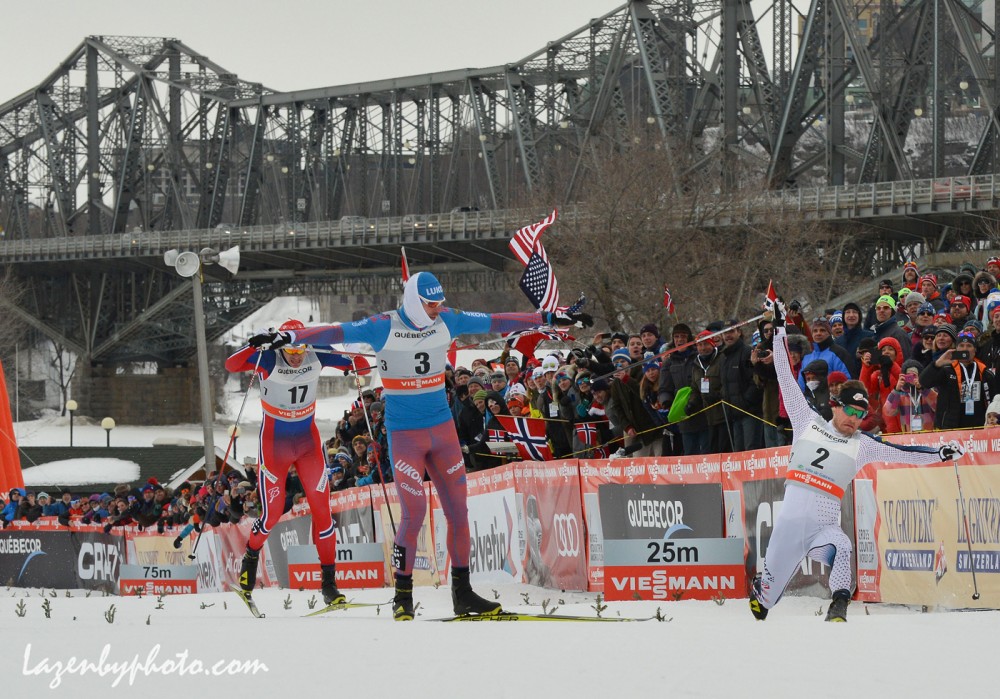
Russia’s Sergey Ustiugov (3) celebrates his win by mere hundredths of a second over France’s Richard Jouve (not shown) and American Simi Hamilton (2), who lunged across the line and placed third for his second podium of the season. Norway’s Finn Hågen Krogh placed fourth and Ola Vigen Hattestad (17) finished fifth, while Petter Northug was sixth. (Photo: John Lazenby/Lazenbyphoto.com)
Into the home straight, Hamilton came charging up along the fence to challenge Ustiugov in the lead.
The only thing clear at the finish was that the athlete with the biggest stretch would finish best. The race ended in a six-way photo finish with all six finalists within 0.72 seconds of Ustiugov.
Hamilton’s lunge at the line? That was good enough for third behind Ustiugov and Jouve, and ahead of three Norwegians.
“It’s great seeing the Norwegians win,” Hamilton reflected in the press conference. “They are incredible skiers, they come from an amazing skiing culture, but it’s pretty cool to be on the podium with people like Richard and Sergey. I think we are showing the rest of the world that this sport can be won by people other than the Norwegians and it’s fun to be able to be a part of that.”
Tuesday was Hamilton’s second podium of the season and third-career sprint podium.
“I think we are showing the rest of the world that this sport can be won by people other than the Norwegians and it’s fun to be able to be a part of that.” — Simi Hamilton, second in the freestyle sprint at the Ski Tour Canada in Gatineau, Quebec
Ustiugov’s Day
A word or two about Ustiugov is well worth a mention. Like Hamilton, the 23-year-old Russian played his tactics well, qualifying in third then winning his fast quarterfinal in a three-way photo finish. (His quarterfinal time bested the fastest qualifying time by almost two seconds.)
In his semifinal, Ustiugov broke a pole just after the start. Cooly, he power skated along until a Russian coach was able to hand him a new pole. On the longer-than-usual course, Ustiugov was able to eventually bridge back up to the leaders.
It also seemed like an aha moment. It was as if the pole break taught Ustiugov something that Hamilton had learned: conserving energy early pays dividends in the end.
By 1:49 into the semifinal, Ustiugov took the lead, despite his long-forgotten broken pole. He ended up second to Krogh in a photo finish.
In the final, Ustiugov hovered in the back of the pack, looking like an afterthought until late in the race.
“It was my tactical goal today,” Ustiugov said, according to a translation at the press conference. “In the quarterfinal, I also started very slowly. In the semifinal, I made a really fast start, and in the final again the same start like in the quarterfinal. So that was my tactic play today.”
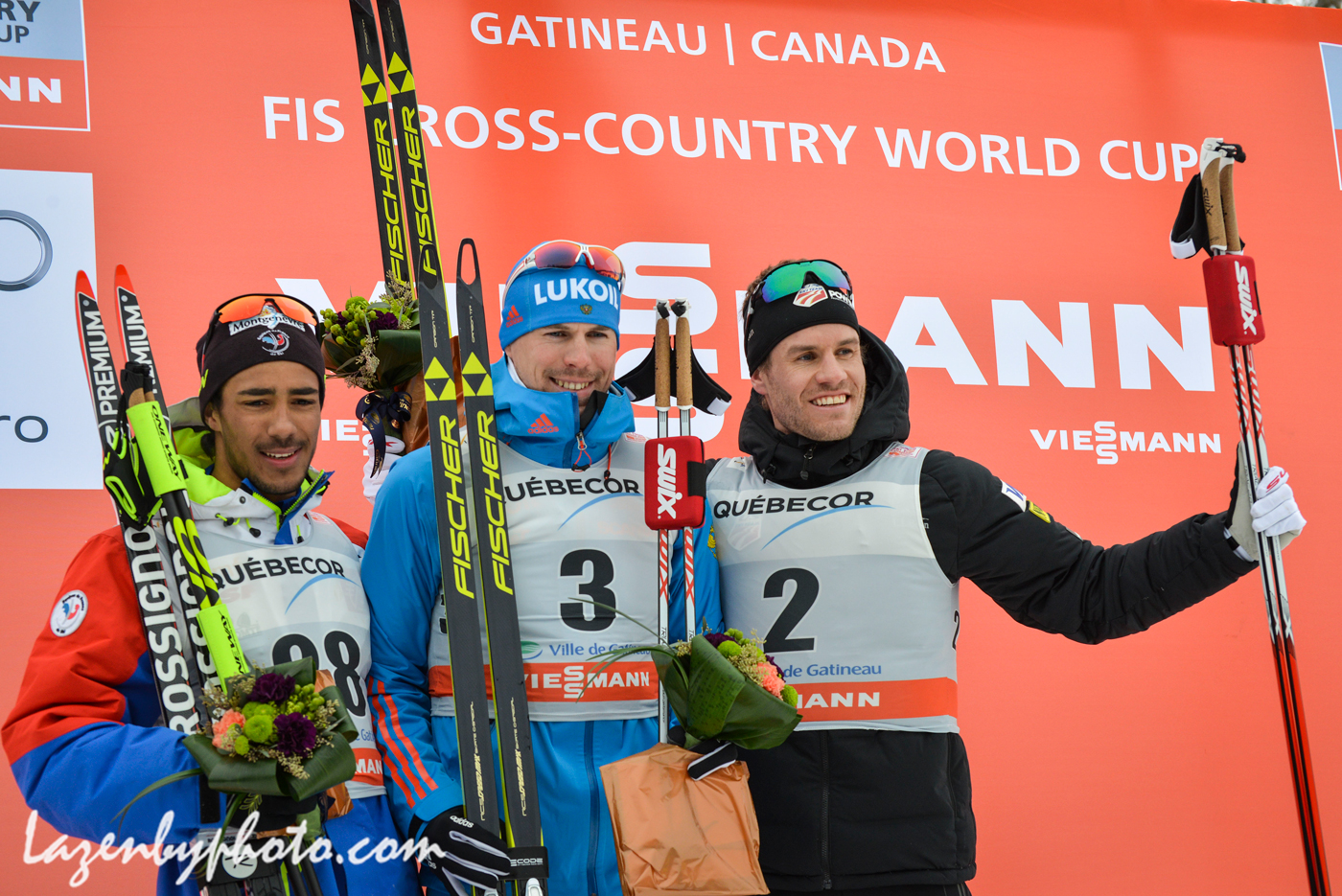
The men’s freestyle sprint podium at the first stage of the Ski Tour Canada with Russian winner Sergey Ustiugov (c), France’s Richard Jouve (l) in second and American Simi Hamilton (r) in third. (Photo: John Lazenby/Lazenbyphoto.com)
Gatineau marked Ustiugov’s first sprint victory since Nove Mesto, Czech Republic, where he won his first World Cup (a freestyle sprint) in January 2014. Last month, he won the 15 k freestyle mass start in Falun, Sweden for his second individual World Cup win.
And on Tuesday, he outlasted five skiers in a photo finish for his third victory, with first through fourth being separated by just 0.13 seconds.
Just a toe behind the Russian winner was Jouve. His plan, unlike Ustiugov’s building pace, was to hang on for as long as possible.
“We had a good race tactic, from the quarterfinals all the way to the final,” Jouve said in the press conference. “We tried to stay at the front of the pack as long as we could.”
Asked about lining up with Northug in the final, Jouve said he convinced himself he belonged.
“It really impressed me being in the final, but I had to tell myself I was as good as any of the other finalists,” he said. “The French-speaking public was great and I want to thank all who cheered for me.”
Including the team sprint in Planica, Slovenia, this was Jouve’s third podium of the season.
The U.S.
U.S. Ski Team member Erik Bjornsen was the next-best American in 25th overall. He qualified for his first sprint of the season in 27th, 7.3 seconds behind Northug’s top qualifying time.
“It was fun to jump into the heats and mix it up a little bit,” Bjornsen told FasterSkier after his quarterfinal.
Initially, at the start of his quarterfinal (the fourth of five), Bjornsen led the pack.
“I was just feeling comfortable and I knew it was important to get a good spot and maybe I got a bit too comfortable out there,” he reflected. “And also I let one or two guys go thinking, ‘It’s going to be fine.’ ”
Bjornsen was knocked out of the competition when he finished fifth in his quarterfinal, 2.17 seconds behind Northug as the winner of that heat.
Bjornsen said he’s looking forward to the distance days to come, starting with a 20 k classic mass start on Wednesday in Montreal.
“Tomorrow and then Canmore, both those classic distance races I’m pretty excited for,” he said.
No other Americans qualified for the heats. Bjornsen’s Alaska Pacific University (APU) teammate Reese Hanneman placed 35th, Andy Newell (SMST2/USST) finished 42nd, Dakota Blackhorse-von Jess (Bend Endurance Academy) was 54th, Eric Packer (APU) 72nd, Noah Hoffman (SSCV/USST) 74th, Scott Patterson (APU) 75th, Tad Elliott (SSCV) 81st, Matt Liebsch (Gear West) 82nd, and Brian Gregg (Team Gregg) 83rd.
The U.S. notched a never-before-seen double podium with both an American man (Hamilton) and woman (Jessie Diggins) on the podium, as Diggins placed third in the women’s final.
“We are so proud of all the USA athletes today,” U.S. Head Coach Chris Grover said in a USSA press release. “It was really exciting to see Erik Bjornsen take his first sprint points of the season and finish 25th. … Once the heats began, both Jessie and Simi were masterful when it came to making space in which to pass their competitors. They made gaps open for themselves and timed their podium bids perfectly.”
It’s Good to be Home
Canadian World Cup Team member Alex Harvey, of St-Férréol-les-Neiges, Quebec, took advantage of the home field right from the go. He qualified 15th (+4.18) for his first time making the heats in a World Cup freestyle sprint this season.
Alex Harvey (Canadian World Cup Team) racing to 15th in the 1.7 k freestyle sprint qualifier at the first stage of the Ski Tour Canada on Tuesday in Gatineau, Quebec. Harvey went on to reach the semifinals for 11th overall. (Photo: Peggy Hung)
“It was a great start to the Tour. I felt really good out there as the day went on,” Harvey said in a Cross Country Canada press release. “I haven’t had much success this year qualifying in the sprint races so to be 15th was a good sign.”
In his quarterfinal, the first of five, it didn’t appear Harvey would advance until the final stretch.
“We had three of the fastest men pushing the pace in the quarterfinals,” Harvey said in a press release. “We get to pick our heats that we want to race in and I wanted that one because I knew it would be fast and a good chance to have a lucky loser spot.”
In a four-way photo finish, Harvey finished fourth, 0.29 seconds behind Ustiugov, the winner of the heat. Krogh automatically advanced in second (+0.01), while Hattestad in third (+0.27) and Harvey two-hundredths of a second behind him reached the semifinals as lucky losers.
Harvey did not advance beyond the semifinals, finishing sixth in the first semi (1.44 behind Ustiugov in first), and placed 11th overall. It was his second-best sprint of the season after placing seventh in a classic sprint last month in Stockholm, Sweden.
“I was better positioned in the semis, but I almost crashed in that final corner and it scrubbed my speed. That was it for me,” Harvey said on Tuesday. “I felt really good as the day went on. The crowd was awesome today and really loud so it was a great start.”
That great start was not Harvey’s alone. Canadian National Development Team athlete Knute Johnsgaard, in his second World Cup sprint, qualified 29th (+7.80). He ended the day 30th overall for his first World Cup points.
Johnsgaard told FasterSkier he tried to relax compared to his recent starts in Europe.
“I think I maybe waited a little better,” Johnsgaard said. “The last rounds I did in Europe would have been the OPA Cup in Planica, the week before the World Cup weekend. And I was … getting a bit too excited off the start that time. So I was just trying to relax this time until the second lap, and maybe make a move on the second lap. But unfortunately everyone is so strong … I don’t think it was much about tactics today, just the strongest skiers went through.”
Canadian World Cup Team member Len Valjas finished 37th, Andy Shields (Thunder Bay National Development Centre) placed 48th, Devon Kershaw (CNST) was 50th, Bob Thompson (NDC Thunder Bay) 52nd, Jesse Cockney (CNST) 53rd, Russell Kennedy (Canmore) 59th, Kevin Sandau (AWCA) 70th, Gatineau’s own Simon Lapointe (Skinouk) 71st, Graeme Killick (CNST) 76th, Ivan Babikov (CNST) 78th, and Patrick Stewart-Jones (AWCA) 84th.
The Ski Tour Canada continues Wednesday in Montreal with the Stage 2 men’s 20 k classic mass start, and a 13 k women’s classic mass start on an approximately 3 k loop.
— Gerry Furseth, Alex Slobodian, François Léger Dionne, and Harald Zimmer contributed reporting
Simi Hamilton with his mom, Ruth, after Hamilton placed third in the men’s skate sprint at Stage 1 of the Ski Tour Canada in Gatineau, Quebec. (Photo: John Lazenby/Lazenbyphoto.com)
Simi Hamilton (U.S. Ski Team) racing to second in the skate sprint qualifier at the Gatineau stage of the Ski Tour Canada. He went on to place third in the final. (Photo: John Lazenby/Lazenbyphoto.com)
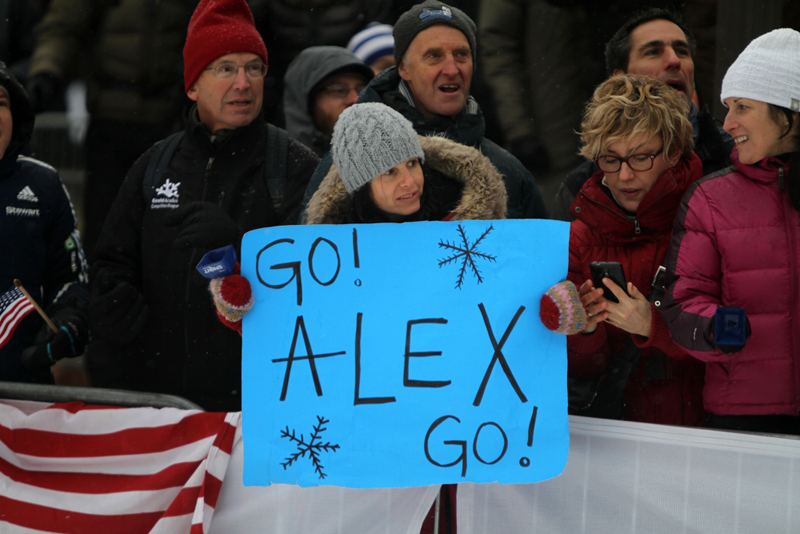
One of many Alex Harvey cheering sections at the Canadian World Cup in Quebec City, which took place Dec. 7-8, 2012. The World Cup is returning to Quebec City and Canmore, Alberta, for the first time in four years early next month, with Ski Tour Canada stages also planned for Gatineau and Montreal.
The Ski Tour Canada starts on March 1 and we have a good idea of who will be on the start line for the two North American teams. As Canada is hosting the new World Cup tour, both Canada and the U.S. get an increased quota on top of the normal (larger) tour quota.
Canada planned to select 12 women and 14 men, and the U.S. can take up to 13 women and 11 men. With roughly 175 international athletes expected to start the eight-stage tour on March 1 in Gatineau, Quebec, the 50 North Americans will play a big role in the event.
Canada
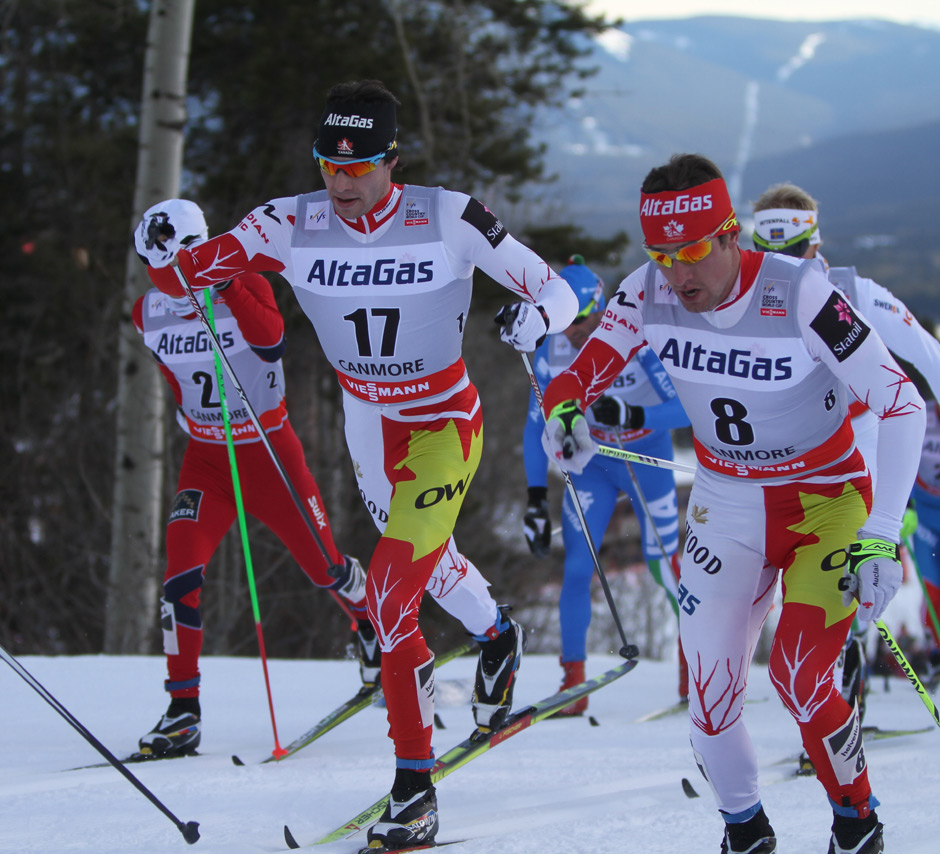
Canadian World Cup Team members Alex Harvey (17) and Ivan Babikov (8) racing at the last World Cup in Canmore, Alberta, in December 2012.
Canada has chosen not to use discretionary picks and is using an entirely rule-based selection system. To oversimplify it, skiers with top-30 finishes this season on the World Cup are automatically selected, as are the Continental Cup (NorAm) leaders in overall, sprint and distance. The remaining places are chosen using a series of ranked rules using CPL (Canadian Points List) points, which are a variant of the FIS points list. World Cup races, U23 World Championships, and Continental Cup events from November to Feb. 21 all count towards the CPL rankings used.
The provisional selections are based on results up to Feb. 17, changes are possible from Western Canadian Championships this weekend in Prince George, B.C, and U23 World Championships next week in Rasnov, Romania.
The selection rules are a bit complicated and there is a defined selection order, making it difficult to be mathematically certain how much this could change before Feb. 22. More detail is available on the Cross Country Canada (CCC) website. The athlete order below is from CCC, but it doesn’t appear to be ranking order.
For the women, it is fairly likely that only one name will change, but there could be significant shuffling of the selection reasons, including the partially funded spot as NorAm overall leader.
For the men, the selection situation is more fluid, with more changes likely. As of Feb. 18, the provisional selection was:
Name
Affiliation
Selection Reason
Alex Harvey
NST/CNEPH
WC top 30
Devon Kershaw
NST
WC top 30
Ivan Babikov
NST
WC top 30
Lenny Valjas
NST
WC top 30
Graeme Killick
NDST
WC top 30
Kevin Sandau
AWCA
NorAm overall leader
Andy Shields
CNEPH
NorAm distance leader
Julien Locke
Black Jack
NorAm sprint leader
Knute Johnsgaard
NDST/AWCA
CPLS1
Brian McKeever
Para-Nordic ST
CPLD2
Russell Kennedy
Canmore
4C1
Colin Abbott
Whitehorse
4C2
Michael Somppi
NDC Thunder Bay
CPLD1
Jess Cockney
NDST/CNEPH
CPLS2
It is likely that only a few names will change based on the CPL, but there are at least five athletes that could find their way in.
Most of the World Cup team and some of the development team will be doing an elevation camp in the Lake Louise area. Ivan Babikov is doing the American Birkebeiner as final preparation. A number of athletes will race at Westerns this weekend, either to defend their selection, gain selection, or final intensity before STC.
Daria Beatty, Olivia Bouffard-Nesbitt and Kevin Sandau will race the first two days at Westerns and return to Canmore, Alberta, on Sunday. Carrier-Laforte, Jackson, Locke, Maclean, and Vezina all chose to attend U23’s in Romania, with a training stop in Austria on the way. Johnsgaard is choosing to train instead of race as his final preparation, as he did on the European B tour in January.
“The plan is to skip the Lahti World Cups this coming weekend,” Kershaw wrote in an email earlier this week from his home in Canmore. “The plan now is to train at altitude between Lake Louise, Canmore and up at a lodge up above Canmore [Engadine Lodge] for 10 days and then have some days at home here in Canmore before flying back to Ottawa two days before the whole SkiTour Canada begins!”
None of the Canadians planned to race in Lahti this weekend.
USA
The American team used a combination of discretion and criteria to select athletes, with only one spot still open.
Name
Affiliation
Selection Reason
Jessie Diggins
USST/SMST2
Top-30 Sprint and Distance World Cup
Sadie Bjornsen
USST/APU
Top-30 Sprint and Distance World Cup
Sophie Caldwell
USST/SMST2
Top-30 Sprint World Cup
Ida Sargent
USST/CGRP
Top-30 Sprint World Cup
Liz Stephen
USST
Top-30 Distance World Cup
Caitlin Gregg
USST/Team Gregg
Discretion
Anne Hart
SMST2
Discretion
Caitlin Patterson
CGRP
SuperTour Overall Leader
Chelsea Holmes
APU
Distance Leader 2 after Nationals
Katharine Ogden
SMS/USST
Distance Leader 3 after Nationals
Jennie Bender
BSF
Sprint Leader 1 after Nationals
Kaitlynn Miller
CGRP
Sprint Leader 2 after Nationals
Rosie Brennan
USST/APU
Objective Crit. (WC Points Jan. 16-Feb. 21)
U.S. Ski Team Head Coach Chris Grover explained the selections in an email.
“Adam Martin was the 3rd man on the distance list post Nationals but has declined his start spot due to the conflict with NCAAs,” he wrote of the Northern Michigan University junior. “We have left one position open on the men’s side for an outstanding performance at the U23 Champs. If we don’t have that, Matt Liebsch will be the next athlete named via the post-Nationals ST Distance CAN-Selection list. We’ll make a decision on the 25th (last day in Rasnov).”
Name
Affiliation
Selection Reason
Simi Hamilton
USST/SMST2
Top-30 Sprint World Cup
Andy Newell
USST/SMST2
Top-30 Sprint World Cup
Erik Bjornsen
USST/APU
Discretion
Noah Hoffman
USST/SSCV
Discretion
???
Discretion
Eric Packer
APU
SuperTour Overall Leader
Scott Patterson
APU
Distance Leader 1 after Nationals
Brian Gregg
Team Gregg
Distance Leader 2 after Nationals
Reese Hanneman
APU
Sprint Leader 1 after Nationals
Dakota Blackhorse-von Jess
BEA
Sprint Leader 2 after Nationals
Tad Elliott
SSCV
Distance Leader 4 after Nationals
Of the U.S. Ski Team members, Andy Newell, Liz Stephen, Rosie Brennan, and Caitlin Gregg returned to the U.S. early, skipping the Lahti World Cup, to prepare for the tour.
“Many of the sprinters will travel home on Sunday from Helsinki,” Grover explained of the rest of the team in Lahti. “Those doing the skiathlon will travel home on Monday. For the Alaskans, most will go to New England (Craftsbury) rather than going back to AK in a short window.”
Cost Estimates
The Continental Cup (NorAm or SuperTour) leaders have a quota spot, with accommodation and some costs covered by the organizing committee. Red Group members get the same cost reduction and most have additional financial support from their respective national team.
For the rest of the nation’s group skiers, at least in Canada, the costs have been estimated by CCC. Note that this information was published in November and was subject to change. U.S. dollars reflects the conversion rate.
Item
Note
Original currency cost
$ CDN
$ US
Mandatory FIS charter flight, Montreal to Calgary
Athletes will be transported from Quebec City to airport.
895 euro
$1362
$995
FIS food and accommodation
This is 14 days, optional in Canmore only.
125 swiss francs
$173/night
$126/night
Waxing
Canadian team price
$30 CDN/race
$240
$176
Shipping classic skis from Montreal to Canmore
Both Quebec City races are freestyle
$35 CDN
$35
$26
Total for Canmore residents
Only 7 nights food and accom.
$2848
Total for non-Canmore residents
$4059
$2961
Flight to Ottawa
varies by athlete
Flight from Canmore
Or location where the athlete leaves the tour.
varies by athlete
If an athlete drops out of the tour, through elimination, illness or disqualification, they pay their own way home from the last location they raced and will not be refunded for food and accommodation.
Two weeks out from the event, there was still some uncertainty on final costs and support levels for individual Canadian skiers.
“We didn’t receive any information yet,” Browne wrote in an email on Wednesday. “I think it will be pretty expensive though. But if I’m still noram leader after Westerns it’ll be less expensive for me.”
“We got a quote from the CCC administrator yesterday that the Eastern part of the Tour — including accommodation, the charter flight, and all race service fees will be just over $2000,” Jenn Jackson wrote on Friday. “Most people will be staying with friends and family in Canmore to reduce costs, but if not it’ll be about another $1000.”
“The fee does not, however, include the costs of travelling to Ottawa for the start of the Tour or back home from Canmore after – so another several hundred dollars there…” Jackson added.
In an email, Colin Abbott, of Whitehorse, explained that he will skip Westerns despite not knowing for sure whether he had qualified.
“I decided that in order to be rested for the tour I needed to take a break after Easterns,” he wrote. “I will race the tour if I qualify, hopefully I can survive the whole thing! Final costs are likely to be $3000-$4000 but haven’t been finalized yet.“
“My guess is between $2500 to $3000,” Alberta World Cup Academy Head Coach Chris Jeffries wrote of the total cost. “Western athletes in Canmore do not have to stay in the race hotel.”
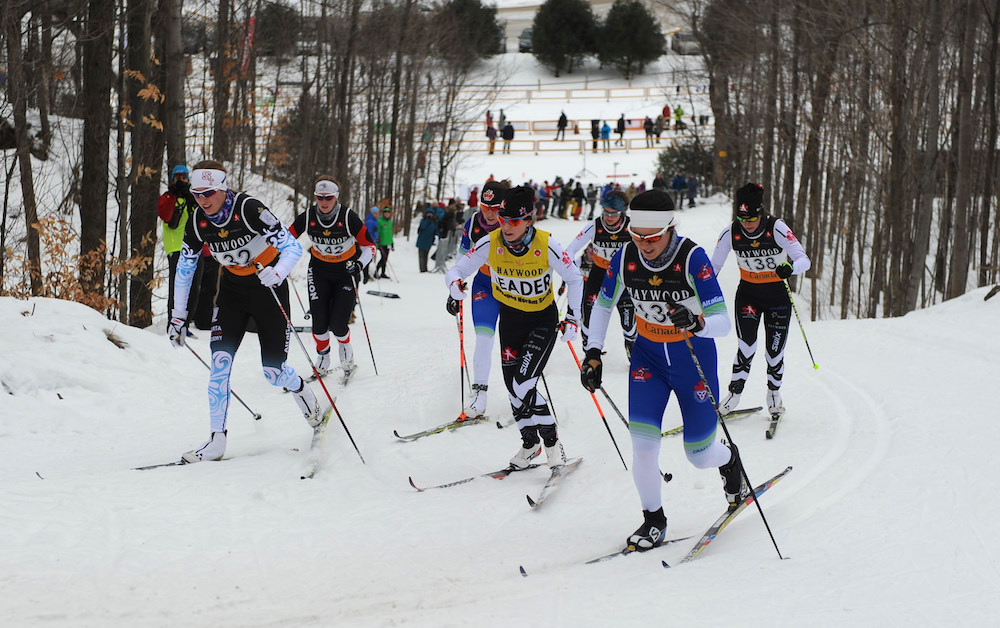
The women’s leaders in the 15 k classic mass start on Day 3 of Eastern Canadian Championships on Feb. 7 in Cantley, Quebec, with Dahria Beatty (l), Cendrine Browne (c), and Jenn Jackson (r) at the front of the pack. Beatty went on to win by 7.7 seconds over Browne, in the NorAm leader’s bib. (Photo: W. James MacLean)
Though patterns develop and race favorites exist, winning is never a given. At least according to Cendrine Browne, the NorAm leader and overall champion of the women’s 10-kilometer freestyle at Eastern Canadian Championships last Saturday, Feb. 6, at the Nakkertok Nordic Ski Centre, Cantley, QC
“I don’t think you can get used to winning. Winning is great but every day is different,” Browne, a member of Canada’s U23 Development Team and the Pierre-Harvey National Training Centre (CNEPH), wrote in an email.
“I chose to ski on white bases today at everybody’s surprise, but they were really fast,” Browne explained after winning in 27:10.8 minutes.
“I didn’t pace myself, I just went hard all the time and it worked pretty well,” she added. “I felt good mentally and physically, and that helped a lot.”
Finishing 9.1 seconds behind Browne was her biggest NorAm distance rival, fellow U23 Development Team member, Dahria Beatty, of the Alberta World Cup Academy (AWCA).
Beatty and Browne also both recently returned from World Cup races in Europe, where they teamed up with Emily Nishikawa and Maya MacIsaac-Jones in the first World Cup relay for all four women.
Rounding our Saturday’s top three for the women was Olivia Bouffard-Nesbitt, of the U23+ Development Team and Rocky Mountain Racers (RMR), who finished 21.8 seconds off Browne’s winning time.
“I was getting really good splits in the first 5k (being told I was leading) and I was having a lot of fun on course,” Bouffard-Nesbitt wrote in an email. “I faded in the second half of the race, but that can be a consequence of going hard at the start, so I have no regrets.”
Also of RMR, MacIsaac-Jones, who won Friday’s freestyle sprint on the first day of Easterns, was pleased with her fourth-place finish, 43.8 seconds behind Browne.
“My race today was really good — I was 4th, which is my best distance NorAm result this year!” MacIsaac-Jones wrote in an email.
Somppi Dethrones Sandau in 15 k Skate
Also on Saturday, Michael Somppi, of the Thunder Bay National Development Centre (NDC),claimed a decisive win in the men’s 15 k freestyle. Somppi completed the course in a time of 34:45.1, besting second-place finisher Kevin Sandau (AWCA) by 25.3 seconds.
“I’m super happy I was able to get back to feeling like myself in a skate race. I was really pumped to get back onto the top step at the NorAm,” Somppi wrote in an email.
The winner of every NorAm distance race he has competed in this season (with four victories total; he skipped the M.S.A. NorAm), Sandau regarded his next few weeks of race efforts as most important.
“Western’s has always been part of the plan leading up to the Tour,” Sandau wrote in an email, referring to the second set of championships, Feb. 19-21 in Prince George, British Columbia.
“Even with a [Ski Tour Canada] spot locked up now unofficially, I’ll be using it as some final hard efforts before flying out East,” he added.
The Ski Tour Canada, doubling as World Cup Finals, starts March 1 in Gatineau, Quebec, and extends through March 12 with the last four races in Canmore, Alberta.
Noting he was “pumped” to be on the podium on Saturday, Russell Kennedy, of the Canmore Nordic Ski Club, finished third, 31.2 seconds behind Somppi.
“I nailed my pacing. That was huge it really helped me as I made up a lot of time at the end,” Kennedy wrote in an email.
Kennedy also pointed to external sources of motivation during his race, including the man who started just ahead of him, Brian McKeever, of the Canadian Para-Nordic Ski Team.
“It also was good to have Brian there. He was super motivating,” Kennedy wrote.
McKeever, visually impaired, raced to fifth overall, 1:01.9 out of first and 19.6 seconds behind Knute Johnsgaard (AWCA/U23+ Development Team) in fourth.
Though Saturday left her chasing downBrowne,Beatty positioned herself as the woman to beat by the Nakkertok course’s final climb on Sunday in the women’s 15 k classic mass start.
“My plan going into today was to stay in contact until the final climb and leave everything on that final climb,” Beatty wrote in an email on Sunday.
Despite losing contact at one point during her third lap of the 5 k loop, Beatty managed to stick to her plan. Amidst Sunday’s snowfall, the Whitehorse native left everything on the last uphill and came away with the win in 46:54.4.
“I was able to regain contact with Cendrine and my skis were gliding especially well so I was able to carry good speed into the final climb and get a gap before the downhill into the finish,” Beatty wrote.
Browne finished 7.7 seconds later in second place.
“A second place is great but I could have won…My skis were so slow!” Browne wrote in an email.
Finding herself at the back of the lead pack during the downhills, Browne put her focus into Sunday’s course climbs.
“I told myself that if I wanted to win, I would have to give everything I had in the uphills because I couldn’t count on my skis in the downhills,” Browne wrote. “So in the second last uphill, I tried to break away from the pack. It worked. I had a 10-meter gap before the second last downhill.”
However, by the bottom of the hill, Beatty caught back up to Browne.
“As I was going down, Dahria passed me like I was still,” Browne added. “I tried to catch up in the last up hill and fell. So I didn’t catch her. I finished 2nd. I was disappointed. I hate giving excuses but I think I could have won.”
Finishing just 2.0 seconds behind Browne, and 9.7 seconds behind Beatty, was NDC Thunder Bay’s Katherine Stewart-Jones in third place.
“There was a big lead pack for a lot of the race. It was easy to stay relaxed because I had very fast skis,” Stewart-Jones wrote in an email. “I think the race came down to the last couple of hills of the course, whoever had energy left in the tank.”
She pulled some energy from fans on from the trailside.
“It was amazing to see the support from my home club,” Stewart-Jones, who grew up training with Nakkertok, wrote. “There were so many people out there cheering me on!”
After a large crash in the first lap, Bouffard-Nesbitt lost contact with the front group and raced to a 10th overall (+2:01.0).
“I’ve hardly classic skied this winter due to my stress fracture, and I’ve really been struggling in classic races,” Bouffard-Nesbitt wrote in an email.
“As a whole I’m happy with the weekend. I’m going to try to not be too hard on myself for this last classic race,” she added.
Shields Takes All in 20 k Mass Start
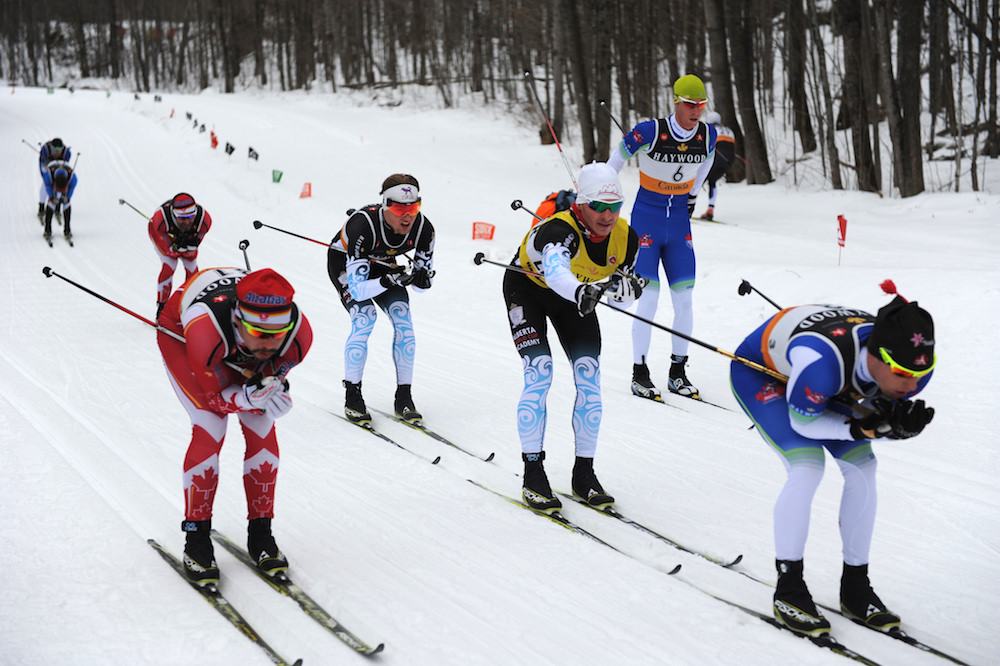
The men’s leaders during the 20 k classic mass start on Feb. 7 at Eastern Canadian Championships in Cantley, Quebec, with Andy Shields (r) leading, Brian McKeever (l), Sandau (yellow bib), with Sandau’s AWCA teammate Knute Johnsgaard behind him, and Scott Hill (6) of NDC Thunder Bay right there in the lead pack. (Photo: W. James MacLean)
En route to his third-career NorAm win, Andy Shields (NDC Thunder Bay), came away victorious in the men’s 20 k classic mass start on Sunday.
Shields completed the four-lap race in 52:53.6, besting second place finisher Jesse Cockney (CNEPH/NST) by 12.1 seconds.
“The herringbone sections were coved in deep sugary snow but I felt comfortable on them,” Shields wrote in an email.
With 2 k to go, Shields gapped the field during a herringbone hill and skied comfortably away to first place.
“It never felt like the pace was unmanageable so a ‘thank-you’ to the body for being in good shape today,” Shields wrote.
Cockney confirmed that Shields’ skiing on Sunday was left unrivaled by any other skier on course.
“Andy definitely won with stronger legs today. He was skiing the steep climbs really well and had lots left for the final lap,” Cockney wrote in an email.
After starting in bib 31, Cockney was happy to have maneuvered his way up to the front of the pack.
“I’m quite happy to have moved up from bib 31 to near the front. The distance races here have also been better feelings pushing hard than the rest of the year,” he wrote.
Finishing just 1.3 seconds off of Cockney was Johnsgaard in third, 13.4 seconds behind Shields.
“Kevin and I were leading a lot on the first lap, but there was a bit of fresh snow in the tracks and it was hard to drop the group,” Johnsgaard wrote in an email.
“We’d get a gap on some climbs and then it would come back together on the downhills. The course was basically double pole and then herringbone up steep climbs in ankle deep corn snow,” he added.
According to Johnsgaard, the herringbone sections played to Shields’ strength, but not his own.
“Not exactly my idea of a nice classic course,” Johnsgaard wrote. “Andy had some super herring bone on the last major climb and broke away a bit.”
Sandau, who had been skiing in the front pack with Shields, Johnsgaard and Cockney, crashed, which he wrote cost him “a podium spot.”
Despite his fall and fifth-place finish, 20.4 seconds off of first place, Sandau was satisfied with how he felt during the races.
“The past couple weeks had a really good chunk of volume and I was happy how I felt in both distance days and had some good fight,” Sandau wrote.
Ahead of Sandau in fourth, McKeever was half a second off the podium and 14 seconds behind Shields.
— Gerry Furseth and Alex Kochon contributed reporting
(From left to right) Kevin Sandau, Andy Shields, Brian McKeever, Michael Somppi, and Jess Cockney after the men’s 20 k mass start on Sunday, Feb. 7. Shields won by 12 seconds over Cockney, Knute Johnsgaard (not shown) placed third, McKeever was fourth, Sandau (the NorAm leader) fifth and Somppi eighth on the last day of Eastern Canadian Championships in Cantley, Quebec. (Photo: W. James MacLean)
The men start the 30 k freestyle mass start at U.S. Nationals in Houghton, Mich.
Note: This article has been updated to reflect that Tad Elliott has won four national distance races, including the 50 k skate in 2010 in Fort Kent, Maine.
HOUGHTON, Mich. — Although Tad Elliott’s name may have been missing from the top of U.S. results recently, at the 2016 U.S. Cross Country Ski Championships on Thursday, the former U.S. Ski Team member showed he’s still got it.
Elliott, 27, a longtime racer with Ski and Snowboard Club Vail (SSCV), made a move in the last three kilometers that went unanswered in the men’s 30 k freestyle mass start, and he entered the stadium with a comfortable berth over Brian Gregg (Team Gregg), winning by 9.6 seconds in 1:20:31.6.
Gregg held off a strong finish by Michael Somppi of Canada’s National Development Centre-Thunder Bay to secure second place, 3.7 seconds ahead of Somppi in fourth.
Over the last two years, Elliott has battled illness, forcing him to take nine months off from training, and endured multiple hospital stays due to complications of Epstein-Barr. Since then, Elliott struggled to attain the same level of results he had grown accustomed to prior — as one of the most promising distance skiers on U.S. Ski Team from 2011 to 2013. However, his upward trajectory began last season when he finished 14th at the American Birkebeiner ski marathon and 11th in the 50 k freestyle mass start at U.S. Distance Nationals in Sun Valley.
Tad Elliott cruises to his fourth-career national title in the 30 k freestyle mass start at U.S. Nationals in Houghton, Mich.
He competed in both SuperTour weekends this year, finishing 25th in the 15 k skate in West Yellowstone, Mont., and 15th in the 15 k classic in Sun Valley, Idaho, allowing him to enter this weekend flying somewhat under the radar.
“Before this week I knew I was in my best form for a long time, but could only dream of a podium,” Elliott said after Thursday’s win — his fourth national title following victories in 2010, 2011 and 2012 at nationals in Maine: first in the 50 k skate in Fort Kent, then in the 30 k skate and 15 k skate in Rumford.
This year’s 30 k skate mass start consisted of three laps around the 10 k course on the Michigan Tech Trails. About an inch of new snow had fallen overnight and racers awoke to a foggy and warm morning. Temperatures hovered around 30 degrees at race time when 91 men lined up for the event.
Since start positions are based on recent International Ski Federation (FIS) points, Elliott started in bib 140 and had to fight through the field to reach the front on the first lap. Elliott and the rest of the podium contenders stayed out of trouble out of the start, avoiding broken poles and navigating the high-speed hairpin turn two kilometer into the race.
Canadian Kevin Sandau (Alberta World Cup Academy) made the first decisive move at the end of the first lap just before 10 k. Scott Patterson of Alaska Pacific University (APU) answered Sandau’s attack, and the two gapped the field by 50 to 60 meters.
Meanwhile, Gregg was concerned with the strength of Patterson and Sandau together up the trail.
“I was nervous we wouldn’t be able to bring those guys back so I put pretty big surge in to bring them back,” Gregg said. “Unfortunately I brought six to eight skiers along with me. I was hoping it would be a bit smaller than that.”
Sandau’s move ended up establishing the the lead group. “Everyone was hurting and that was for sure the hardest part of the race for me and I think a lot of people today,” Somppi explained. “Once we regrouped and got into our 10-, 11-person pack then it was a lot easier and more chill. I just hung out in the group and waited for the finish.”
The resulting group of 11 consisted of Elliott, Gregg, Somppi, Sandau, Adam Martin and Jake Brown of Northern Michigan University (NMU), Patterson, Matt Liebsch (Gear West), Kyle Bratrud (CXC) and Kris Freeman (Freebird) .
“It was awesome to ski with Jake, who I’ve been training with all fall,” Martin said. “Jake led the pace for a good part of the second lap and it was pretty sweet to ski behind him. It just felt like an L3 workout at practice this fall.”
Patterson was another consistent presence at the front of the lead pack.
“I led a lot of the race, but my skis weren’t quite in the game today,” Patterson said. “I think I was one of the strongest in the field, but a little off on skis and that makes it a bit harder.”
The lead group stayed intact until Elliott made his statement.
“It was pretty steady until about three ‘k’ to the finish when Tad Elliott made a strong move and Brian kinda latched onto him,” Patterson described.
Gregg (Team Gregg) leads Elliot (SSVC) during the 30 k freestyle mass start at U.S. Nationals in Houghton, Mich. Elliott went on to win the race and Gregg took second.
Elliott’s move wasn’t completely premeditated, but it proved crucial.
“It was not planned before the race or during,” the eventual winner said. “I knew I had to drop Gregg for a chance to win. He is the best closer out there. My plan was to wait until 400 meters, but the opportunity was there and I felt amazing.”
With Gregg unable to match him, Elliott celebrated across the line.
“Tad was looking really strong. We’ve been teammates and friends for a long time so it is great to see him back on top,” said Gregg, who was Elliott’s former teammate on Central Cross Country (CXC).
After the race Elliott was thankful more than anything.
“I’m pretty thankful for my support team. It’s been a while since I’ve been at the front of a race and went through kind of a lot the past two years so I was really excited,” he said.
“My twin brother waxed my skis they were probably the best in the field,” Elliott added. “[I’ve had] Vail support me for a long time as well as Caldwell Sport who was helped me come back from my illness. This is a really big one for me and it feels like a huge team win.”
Somppi was happy for a podium while feeling less than optimal.
“I came here hoping to win but I’m feeling a bit worn out,” he said. “I raced Period 1 of the World Cup and I sick from coming back from Europe. It was a short ten days at home with some sickness and then come down here so it’s been tough racing.”
Adam Martin (l) leads Patterson (r) and NMU teammate Brown during Thursday’s 30 k freestyle mass start at U.S. Nationals in Houghton, Mich.
Since Somppi is Canadian, Martin made the American podium in third and was ecstatic about his race.
“In the past I’ve been much stronger in classic races so to get fourth today that was a huge surprise and I’m really satisfied with that,” Martin said.
Gregg was happy for Elliott’s success as well as his own performance.
“Today was really fun, felt like my skis were one of the best in the field,” he said. “I was trying to stay in the front group and conserve energy.”
As for the rest of the season, Gregg is looking to regain the overall SuperTour lead as he returns to the domestic circuit. Patterson will leave the domestic circuit this month as he earned World Cup starts as the Period 1 SuperTour leader.
Last season’s overall NorAm champion, Somppi will return to the Canadian circuit and race the next NorAm in his hometown of Thunder Bay, Ontario, a qualifying race for the Canadian World Cups in March.
As for Elliott: “We haven’t really talked about it yet,” his coach, Eric Pepper, said. “We had to see how this went first, but he will primarily focus the Birkie.
“Tad’s dealt with a lot the past couple years and to come back and win a race, and win it like that, it was just awesome,” Pepper continued.
Alaska Pacific University’s Scott Patterson (l) leads Northern Michigan’s Adam Martin during the second lap of the men’s 15 k classic individual start on Sunday at U.S. nationals in Houghton, Mich. Patterson won the individual start in 40:26.4 for his first national title and podium, and Martin placed third (+20.6). (Photo: Christopher Schmidt)
HOUGHTON, Mich. — The Patterson name echoed through the Michigan Tech stadium all day as both Scott Patterson of Alaska Pacific University (APU) and Caitlin Patterson of the Craftsbury Green Racing Project (CGRP) each took home their first national titles in classic individual starts on the first day of the 2016 U.S. Cross Country Championships.
Scott Patterson won men’s 15-kilometer morning race in a time of 40:26.4, 19 seconds ahead of Canadian runner-up Kevin Sandau of the Alberta World Cup Academy in Canmore, Alberta.
“I was personally really excited to see that my brother won this morning,” said 25-year-old Caitlin, who is almost exactly two years older than Scott, after the women’s afternoon race. “That was encouraging, but also a little bit of competition. He was going to give me a pretty hard time if I didn’t match him in that one.”
Caitlin pulled it off, winning the women’s 10 k by a margin even larger than her brother’s. Her time of 28:58.4 held as 36 seconds faster than her Craftsbury teammate and runner-up Kaitlynn Miller.
Temperatures hovered in the low 20s throughout the afternoon, but a chilly northwestern wind prevented it from feeling too temperate for Houghton. However, the conditions were a welcome change from the frigid temps and continuous snow of last year’s nationals. The tracks were firm and became a bit glazed through the day.
Racers continually commended the race organizers and groomers for the impressive course conditions given the limited snow. A total of 199 men and 151 women competed on Sunday.
Scott P. Tops Surprise Podium
The men’s 15 k classic podium on the first day of 2016 U.S. nationals in Houghton, Mich., with winner Scott Patterson (c) of APU, Canadian cowboy-hat wielding Kevin Sandau (l) of the AWCA in second, and Adam Martin (r) of NMU in third.
Even the most avid U.S. nordic fans probably couldn’t have accurately predicted the men’s podium for the first distance race of the championships.
The deep field with 20 A-seeded starters meant that several combinations of skiers could potentially land on the podium.
Despite the field, Scott Patterson’s victory was hardly a surprise. The 23 year old, who turns 24 on Jan. 28, was among the favorites to win as the current men’s SuperTour leader.
In his first full-time season on the domestic circuit, Scott quickly rose to the top of the Period 1 SuperTour overall standings, thus earning World Cup starts with the U.S. team beginning Jan. 23 in Nove Mesto, Czech Republic.
“I’m know I’m pretty fit and I’m heading over to the World Cup after nationals,” he explained. “I knew I could win so it was just a matter of executing and I did it today.”
Still, this was his first U.S. nationals podium and best nationals result since placing eighth in the 30 k classic mass start last year.
He got off to what he considered a slow start, but around 3 k, Scott said he “found the fight” and picked up the pace from the low part of the course back up to the stadium.
“By the first lap, I was in first and just hung on and skied strong,” he said.
Scott credited the race organizers for great course conditions, but described it as “a bit too flat” for his personal optimal course. Although the Michigan Tech Trails are rarely described as flat, runner-up Sandau echoed this sentiment.
Canadian Kevin Sandau (Alberta World Cup Academy) racing to second place in the men’s 15 k classic individual start on Sunday at U.S. nationals in Houghton, Mich. (Photo: Christopher Schmidt)
“The course is really flat for me, which is not my strong suit, but I got into a good rhythm after the first lap,” Sandau said. “I’m happy, second place is pretty sweet for U.S. nationals.”
After winning every distance race in the Canadian NorAm series this season, Sandau said the U.S. championships became his next focus.
“Since it is low elevation, my game plan was to just go as hard as I can from the start and trust the fitness.”
Sandau brought a flair of the wild west to Houghton as his cowboy hat was a unique site amid the ski caps and headbands at the awards ceremony.
“We are right outside of Calgary, and when the [Alberta World Cup Academy] team formed in 2008 it had a big cowboy theme,” Sandau explained.
Northern Michigan University’s Adam Martin rounded out the podium, finishing just 1.6 seconds back from Sandau. Martin was also the top U23 skier.
“This was the first real classic race I’ve done because of low-snow conditions so I just went out there to see what I could do,” the 21 year old said.
Although Martin has had limited time on snow compared to many of his competitors, he didn’t feel like it held him back.
“We’ve done a ton of rollerski time trials this fall which I think are pretty representative of skiing and the last couple weeks I’ve found snow,” he explained.
His finish today marks his first top 10 at nationals. His best result was previously 12th place a year ago in the 30 k classic mass start in Houghton.
“That was the best race I’ve had in a long time, without a doubt,” Martin said. “It was a pretty unbelievable race, I’m honored to be on the podium with these guys.”
Alaska Pacific University’s Eric Packer was the third American and fourth overall in the men’s 15 k classic on Sunday at U.S. nationals in Houghton, Mich. (Photo: Christopher Schmidt)
APU put two in the men’s top four (and three on the American podium, not counting Sandau) with Eric Packer in fourth (+31.7).
“I love the trails here,” Packer said. “Back in 2006, this was where I won my first Junior National championship so I have fond memories here. It was nice to be able to ski on some faster snow here compared to last year.”
Brian Gregg (Team Gregg) and Kris Freeman (Freebird) finished fifth (+8.1) and sixth (+9.1), respectively. Freeman recently returned from starting the season on the World Cup in Europe. Gregg also earned a World Cup start in Davos, Switzerland, after a win in the first SuperTour distance race of the season in West Yellowstone, Mont.
Also landing in the top 10, Ian Torchia (NMU) placed seventh, Lex Treinen (APU) was eighth, Matt Liebsch (Gear West) ninth, and Canadian Michael Somppi (NDC Thunder Bay) 10th. Last year’s NorAm winner, Somppi spent November and December with the Canadian World Cup Team in Europe.
When Craftsbury head coachPepa Miloucheva describes a day as “incredible,” you know something special happened.
That something special was Caitlin Patterson and Miller placing first and second in Sunday’s women’s race.
The Craftsbury Green Racing Project women’s team: (from l to r) Caitlin Patterson, Kaitlynn Miller, coach Pepa Miloucheva, Liz Guiney, and Heather Mooney after the women’s 15 k classic individual start on Sunday at U.S. nationals in Houghton, Mich. Patterson and Miller placed first and second, respectively, on Sunday in the women’s 10 k classic on Day 1 of U.S. nationals.
“Nothing in ski races can ever be planned, but you can hope for something like this,” Caitlin said after notching her first national title and third-career podium at U.S. nationals.
Interestingly, she’ll turn 26 on Jan. 30, two days after her brother’s birthday. Both skiers grew up in Anchorage, Alaska, and skied for the University of Vermont. After graduating, Caitlin headed to Craftsbury and Scott returned to Alaska to join APU.
“My skis were very good,” Caitlin said after Sunday’s race. “I knew there were quite a few fast starters in front of me, but also a lot behind. It was racing the clock. Going for it, working every transition and every downhill for everything I could get out of it.”
Although Caitlin has established herself as a regular on SuperTour podiums, Miller, 24, has made significant strides over the past year at Craftsbury to become a contender as well. This will be Miller’s second season with the team and her result on Sunday marks an improvement from placing 13th in the 20k mass start classic at nationals last year.
“Classic tends to be my stronger discipline, but I’m still going to go for it in the skate races,” Miller said after achieving her first national podium. “I feel like I’ve been improving in skating so I’m really excited for those events as well.
“I just felt like I went out there and skied as hard as could and we had really great skis,” she added. “Pepa was a great cheering squad as usual.”
Caitlin added, “Anything was possible certainly. Both of our classic skiing has been pretty good this year and our wax techs are great at nailing the skis.”
“It was incredible,” Miloucheva reflected. “Probably one of the best days we’ve had so far and I’m so proud of all of them.”
From left to right: runner-up Kaitlyn Miller (CGRP), winner Caitlin Patterson (CGRP), and Chelsea Holmes (APU) in third on the podium in the U.S. nationals women’s 10 k classic individual start on Sunday in Houghton, Michigan.
Current SuperTour leader Chelsea Holmes (APU) finished third, 1:02.6 back from Caitlin.
“It was a super-fun course and it was tough day, but I’m happy,” Holmes, 28, said.
The top U20, Katharine Ogden (Stratton Mountain School) continued her string of strong results, placing fourth overall (+1:05.1). APU had two in the women’s top five with Becca Rorabaugh in fifth (+1:09.0).
Eliska Hajkova, a coach with the Boulder Nordic Junior Racing Team, placed sixth, Craftsbury had another in the top seven with Liz Guiney in seventh, Anne Hart (SMST2) was eighth, Rosie Frankowski (APU) ninth, and Erika Flowers (SMST2) 10th.
Racing continues tomorrow with the freestyle sprint. The women’s sprint qualifier begins at 10 a.m. Eastern time and the men’s start at 11 a.m.. Heats will start at 12:30 p.m.
Race winner Kevin Sandau (AWCA) (r) in the leader’s bib leads Bob Thompson (Team Hardwood) during the men’s NorAm 15 k freestyle individual start on Sunday in Vernon, British Columbia. (Photo: XTS Photography)
Kevin Sandau is aiming for the Ski Tour Canada at the end of the season, so he didn’t feel like he needed to lead the NorAm circuit right away.
But being the Period I leader? That was nice, he admitted.
“To win NorAms is a pretty good feeling,” the Alberta World Cup Academy skier said in an interview. “West Yellowstone too, it was a tight race, so I was happy with that. At the beginning of the season I wasn’t gunning that do-or-die, I needed to win races. It’s great that I’m winning. But if I wasn’t, the season is long. It’s nice to see that there’s some good speed there and some good fitness even though the focus is on the later part of the season.”
Sandau swept the distance races at the opening NorAm weekend in Canmore, Alberta, and then also won the 15 k skate in Sovereign Lakes, British Columbia. Before that, he had started the season in West Yellowstone, Montana, placing fifth in the 15 k skate just 20 seconds behind 2014 Olympian Brian Gregg of the United States.
But it hasn’t been all racing; with his focus on a grueling World Cup tour at the end of the season, Sandau has been training as well. He skipped the sprint race at Sovereign Lakes to fit in two four-hour days of volume training.
That unique focus on the season-ending World Cups is also leading Sandau to do something you don’t see so often: he’s turning down an opportunity to race on the World Cup.
Kevin Sandau (c) and his Alberta World Cup Academy teammates Knute Johnsgaard (l) and Patrick Stewart-Jones (r) placed first, second and fourth, respectively in the men’s NorAm 16.5 k freestyle mass start on Dec. 6 in Canmore, Alberta. (Photo: Alberta World Cup Academy/Twitter)
As the NorAm leader, Sandau has automatic start rights for Period II of racing. That is provided through FIS, which does the same for the leader of each Continental Cup circuit around the world, and is independent of the fact that Cross Country Canada has declared Period II to be an Under-25 tour (Sandau is 27 years old).
But the provision does not include the Tour de Ski, which is the first batch of races after New Years; the Tour de Ski has only quota spots for each country, no additional quota spots for Continental Cup leaders.
“Granted we have never filled our full quota before,” Sandau wrote in an email. “Tours are great bang for your buck in terms of the number of races over a short period of time, and I’ve always considered racing the Tour if the opportunity arose. I find I handle race volume pretty well. There is no domestic criteria to qualify for the tour (only World Cup criteria). They are announcing the team today I believe, but a few athletes on the World Cup Team didn’t meet the criteria and I would assume they will make concessions anyway to bring them.”
After the Tour de Ski, Period II includes only two more World Cup weekends, with a team sprint, a relay, and importantly for Sandau, only one individual distance race.
“For me that trip was never a focus at all,” Sandau said. “I’d rather stay in Canada and race.”
And so he will head south to Houghton, Michigan, after New Years for U.S. National Championships, then follow the NorAm circuit to Thunder Bay, then to Western Canadian Championships, and finally to Eastern Canadian Championships. All with the goal of strong performances at the Ski Tour.
“That leaves just under a month of time to incorporate an altitude block and volume block as final preparations for the Tour,” Sandau said. “It’s nice to have these races in Canada because the logistics of going to Europe and finding altitude to ski at and volume, it’s expensive and difficult, especially since I’m not on the World Cup team. They have the flexibility. For me it would be more difficult.”
With not only normal World Cup quotas but also Nations Group start spots for Canada in the Ski Tour, Sandau is not worried about whether he will qualify. And once he gets there, he’s looking forward to a chance to ski his best races without the politics of team selection or national team spots.
“It feels like a more level playing field for the domestic guys,” he said.
Sandau was looking for a spot on the 2015 World Championships team last year, but was left off. Cross Country Canada did not fill all of their quota spots. Just before the Championships, which were in Falun, Sweden, Sandau was in Europe racing on a “B” tour.
He won the 15 k skate at Latvian national championships, but then watched from afar as Canada only started three, not the allowed four, men in the 15 k skate, and one of them was Jesse Cockney, a sprint specialist.
“When I found out they put a sprinter in the 15 k it was like a slap in the face,” Sandau said. “I was in Europe and it would have been a short flight over. But to them it was like I wasn’t part of their umbrella and so I didn’t meet their criteria, but there was other flexibility given to other athletes on that trip.”
He also saw that Cross Country Canada is placing an emphasis on developing young athletes, and doesn’t see value in carrying older athletes on tours if they have not yet had international success. That’s bad enough for Sandau, but he sees it hurting the women’s team even more.
“Especially women in this country, we don’t have too many and we don’t have too many above 25,” he said. “The last thing we should be doing is to discourage them from continuing to ski. I think that they can be seen as role models. They have a wealth of knowledge. It girls are getting beaten by older girls, they are just going to go back and want to be faster. Competition breeds excellence. It’s silly.
“When you look at the big picture, you see that they say they want to focus on the younger generation but it’s kind of like, well, at the cost of ignoring the current generation?”
-Kevin Sandau
By qualifying for the Ski Tour Canada through domestic criteria and focusing his season on doing the preparations that he thinks will be best, Sandau hopes to avoid the drama and emotions that he experienced last season, and also in a failed bid for the 2014 Olympic team.
“Last year when I was fighting to get a spot on the World Championships team because they had unused distance spots, I was a stress case and not sleeping and it was kind of sad,” he said. “That’s behind me now, but that’s why the Ski Tour is such a nice thing. As long as you qualify for a spot, there’s no age criteria on that spot and there’s just such a level playing field.”
Race winner Kevin Sandau (AWCA) in the leader’s bib ahead of Bob Thompson (NDC Thunder Bay) during the men’s NorAm 15 k freestyle individual start on Sunday in Vernon, British Columbia. (Photo: XTS Photography)
VERNON, British Columbia — Kevin Sandau of the Alberta World Cup Academy (AWCA) has no time for quitters, including himself. Despite not being renominated to the Canadian National Senior Team this spring, Sandau’s decision to carry on with his career as a professional nordic ski racer proved to be worthwhile as he won his third-consecutive distance race of the NorAm season (in as many races) on Sunday, the men’s 15-kilometer individual start freestyle race at the Sovereign Lake Nordic Centre.
“Going up the climbs, I felt super smooth with my V1 skate,” Sandau, 27, said during an in-person interview after winning Sunday’s race by 37.3 seconds in 39:05.9. “I made sure to push the flats using a strong V2 to keep the speed up. … It was one of those days where I just felt invincible.”
Though doubt shrouded Sandau’s ambition for the sport earlier this year, his latest performances appear to cast all queries aside.
After two weekends of NorAm races, the Canadian will head into the New Year with three distance titles already under his belt, which puts him in a position to potentially earn future World Cup starts as the NorAm (Continental Cup) leader.
“Third distance win in a row, I think that is a good way to end the 2015 year,” he said.
Part of Sandau’s first-place performance on Sunday stemmed from not just his in-race focus, but his pre-race routine and weekend training, he said.
Kevin Sandau and his mom after the men’s NorAm 15 k freestyle individual start on Sunday in Vernon, British Columbia. (Photo: Gerry Furseth)
“My warmup this morning felt bombproof,” Sandau said. “I also took [Saturday] off, didn’t do the sprint race, and did volume instead. … It [was] interesting to see how the body reacted to that.”
While Sandau sat out the sprint, his AWCA teammate and second-place finisher for the men’s 15 k, Knute Johnsgaard, of the national U23+ Development Team, competed both days, and reached the podium in second in both races.
“I thought I skied a good race and I am pretty happy with second,” Johnsgaard, 23, said. “But I’m still chasing that win.”
Johnsgaard’s podium on Sunday came from course knowledge and tact.
“I’ve skied this course so many times,” he said. “You’re able to push pretty hard on the uphills because there is quite a few tucking sections where you can recover after the climbs.”
While course experience was on Johnsgaard’s side, he left the Sovereign NorAm wanting a different kind of experience.
“I have a very large stack of silver medals now, and I’d like to get gold soon,” he said.
Just over 41 seconds behind Sandau, Russell Kennedy (Canmore) in third also craved the top spot on the podium.
“Everyone wants to win from the start, but I’m hoping to get better and better as the season goes on,” Kennedy said. “I feel like I’ve got a good stepping stone, and I’m going to try to keep building off of that.”
Kennedy spent most of his race getting splits for second behind Sandau, but and initially finished second 41.2 seconds after him. A later starter, Johnsgaard bumped Kennedy to third by 3.9 seconds.
On the women’s side, Dahria Beatty (AWCA/U23 Development Team) won the women’s freestyle distance race at Sovereign Lake for the second year in a row.
“I love this course,” the 21-year-old Beatty said after winning in 30:30.2, more than 32 seconds ahead of runner-up Jaqueline Mourao, originally from Brazil who trains with the Pierre Harvey Training Centre (CNEPH) in Quebec.
“I’ve been racing on this course since I was 15; I raced here with the Yukon [team when] I was a junior,” Beatty added.
With her course knowledge and Sunday’s snowfall during the race, she powered into the first climb.
Dahria Beatty (AWCA) in the leader’s bib during a snowy women’s NorAm 10 k freestyle individual start on Sunday in Vernon, British Columbia. (Photo: XTS Photography)
“A lot of people take the first climb conservatively because they are worried about blowing up,” Beatty said. “So I skied as hard as I could and as smooth as possible. I think that’s the key to this course, especially when it is snowing.”
On the podium for the second-straight day, Andrea Dupont, (Rocky Mountain Racers) finished third, 1:02.7 after Beatty.
“Today was okay,” Dupont, 25, said. “It was a bit of a slog because it really started dumping snow when the girls got on course.”
A sprint specialist, Dupont found pacing helped her to another top finish.
“I wanted to not go out too hard, because I’m definitely a sprinter and I characteristically go out too hard and can’t hold it,” she said. “[Sunday] I went out easy and tried to hold it … and I think I’m on track.”
Another sprint favorite, Beatty came into Sunday on the hunt for a win after missing out on Saturday’s A-final.
“I was a little disappointed with not making the A-final yesterday,” she said. “I wanted to come hard today and I knew that I could do well.”
After charging up the first climb, Beatty continued to get positive splits and raced to a 32.2-second win over Mourao.
“I kept getting splits saying I was 25 seconds up on second,” said Beatty, “When you get splits like that, it makes you ski faster because of the confidence boost,” she added.
A three-time Brazilian Olympian, Mourao also felt a confidence boost after her race.
“I’ve never thought about podiums,” said the 40 year old, who’s also competed in biathlon. “And now, with the right preparation, the right skis, the opportunity I’m having, I can dream more.”
Also an adept mountain biker, Mourao believed her time spent on the bike helped her during her time spent climbing on Sunday’s course.
“I’m a mountain biker and I like climbing so the course was perfect for me,” she said.
The last weekend of racing until the New Year (and the next NorAm Jan. 14-17 in Thunder Bay, Ontario) for many of the Canadians, most feel the Sovereign Lake NorAm races were a solid close to 2015.
“This is my last race of 2015,” said Beatty. “I won’t be racing until I head to Europe after Christmas [as the Continental Cup leader] and it’s nice to finish on a positive note.”
Kevin Sandau in the NorAm leader’s bib sets the pace from the front of the pack in the men’s 16.5 k freestyle mass start on the second day of the NorAm opener in Canmore, Alberta. His Alberta World Cup Academy teammate, Knute Johnsgaard, chases him down. (Photo: Alberta World Cup Academy/Twitter)
You’ve seen it on the World Cup, and now it’s happening at the domestic level: double poling a classic distance race, as seen at Canada’s NorAm opener in Canmore, Alberta.
The top men went without kick wax for the 10-kilometer classic interval start on Saturday, Dec. 5, double poling around a 2.5 k biathlon loop.
Kevin Sandau of the Alberta World Cup Academy powered to the win in 24:42.9 minutes, edging his AWCA teammate Knute Johnsgaard (National U23+ Development Team) by 2.9 seconds. Ian Murray (Capital Region Training Group) skied the fastest last lap to edge Brian McKeever of Canada’s Para Nordic Ski Team by 3.5 seconds for third, 9.5 seconds back from Sandau.
In an email, Sandau, 27, explained that double poling was essentially a no-brainer on the Canmore Nordic Centre’s biathlon trails — flatter than the usual race course with shorter climbs.
“Off the start I knew I needed to be aggressive as it was going to be a fast race,” he wrote. “Just gunned it off the start and trusted my body could clear the lactate from my arms on the downhills. Felt pretty solid throughout so wasn’t a bad plan.”
Johnsgaard explained he would have preferred striding over double pole, so considering that, he was happy with second place.
“Of course I would have liked to be 3 seconds faster! I was being extra careful not to do any skate or step turns, perhaps too careful,” Johnsgaard wrote in an email. “I just tried to pace things right and find the fastest part of the track. I was outside the track almost the whole race.”
For Murray, third stood as his NorAm career best.
“At the age of 37 I guess you could say I am coming into my groove,” Murray wrote. “I was 22nd on the first lap which was a bit slower than I hoped to start. Kevin Sandau passed me when I was on my second lap and that kicked me into gear. I have been focusing on ski marathon racing the last couple of years so I’m still figuring out the pacing for the 10 and 15km races.”
McKeever explained that he tried to build into the race, but was missing a few gears. “[I] was overly cautious about not skating, and consequently was not aggressive enough,” he wrote in an email.
In his first time double poling a distance race, Colin Abbott (Yukon Ski Team) in seventh (behind CNEPH’s Alex Dumas in sixth) observed that the pacing is different.
“You don’t max out aerobically as easily so the concern for pacing is trying not to burn your arms too soon in the race,” Abbott wrote. “I went out maybe a bit faster than was ideal, and definitely slowed on the last lap but don’t think the end result would have changed much if I started slower.”
NDC Thunder Bay athletes (in green) took second, third and fourth in the women’s NorAm 5 k classic interval start, behind Sophie Carrier-Laforte (c) of the Pierre Harvey National Training Centre in first. Katharine Stewart-Jones (second from l) placed second, Alannah Maclean (second from r) with third, and Jenn Jackson (l) was fourth. Rocky Mountain Racers’ Andrea Dupont (r) placed sixth. (Photo: NDC Thunder Bay/Twitter)
In the women’s 5 k classic race, Sophie Carrier-Laforte of the Pierre Harvey National Training Centre (CNEPH) won the two-lap race in 14:31.5, followed by U23 Development Team member Katherine Stewart-Jones (NDC Thunder Bay), 10.3 seconds back.
Thunder Bay had two on the podium with Alannah Maclean in third, 17.9 seconds behind Carrier-Laforte, and another athlete in fourth: Jenn Jackson (+30.8)
“I was aiming for a podium this week but didn’t expect to get it today,” Stewart-Jones wrote in an email. “It’s a very short race so I planned on going out really hard and just try to hold on to the same pace. On the first lap, I focused on skiing efficiently and then just went as hard as I possibly could on the second [lap].”
She added that her double-pole work this summer appears to have paid off.
While Stewart-Jones’s first lap ranked fourth and second lap was second-fastest among the women, Carrier-Laforte skied the fastest last lap. Andrea Dupont (Rocky Mountain Racers) was fastest on Lap 1, but faded on Lap 2 to place fifth (+36.0). Maclean posted the second-fastest opening lap.
Kevin Sandau (c) and his Alberta World Cup Academy teammates Knute Johnsgaard (l) and Patrick Stewart-Jones (r) placed first, second and fourth, respectively in the men’s NorAm 16.5 k freestyle mass start on Dec. 6 in Canmore, Alberta. (Photo: Alberta World Cup Academy/Twitter)
On Sunday, Dec. 6, Sandau repeated with a win in the second race of the season: the men’s 16.5 k freestyle mass start. The races were once again held on Canmore’s biathlon trails, this time on a 3.3 k loop.
Sandau won it in 38:59.9, again ahead of Johnsgaard, who finished 36.6 seconds back in second. About a minute and 3 seconds behind Sandau, McKeever placed third, four-tenths of a second ahead of fourth-place finisher Patrick Stewart-Jones (AWCA).
For Sandau, the race and the victory were even better than the day before.
“The 15km skate played out a lot more to my strengths and really let me test out my fitness,” he wrote. “I knew before the start I just wanted to go full throttle right from the gun. It was a mass start, and there was a crazy westerly wind, so I knew this race was going to be easier to bunch up and make it harder to break away.”
He strategized his pace changes for the bottom of the five-lap course, where there were two “decent climbs,” he explained. His fourth time around, he broke away from Johnsgaard and skied the rest of the race alone.
“I knew once I could break away from anyone, I could really start to put some time in because they had to fight the wind just as much as I did at that point on,” Sandau wrote.
Johnsgaard anticipated that Sandau would be the man to beat, “so the two of us started hard right out of the gate to try and lose the field as soon as possible,” Johnsgaard wrote.
They broke away around 5 k, and while Sandau’s pace felt fast, Johnsgaard explained holding on until the last 3.3 k lap.
“By that time I was hurting pretty bad and lost a lot of time on my last lap,” he wrote. “I thought everyone would catch back up to me but luckily we had opened up a big enough gap earlier on.”
McKeever noted the superior shape of Sandau and Johnsgaard compared to him and the rest of the field. “It went as well as it could have,” McKeever wrote. “I played the tactics right and made the most of the day.”
Dahria Beatty of the U23 Development Team and AWCA charged hard on the last lap of the women’s 10 k freestyle mass start to win by 8.8 seconds in in 27:07.5. Frédérique Vézina placed second and her CNEPH teammate Cendrine Browne (NST U23 Development Team) took the final podium step in third, 13.7 seconds behind Beatty. Another CNEPH skier Jaqueline Mourao, originally from Brazil, was 1.4 seconds off the podium in fourth. Mourao turns 40 later this month.
“It’s always amazing to be able to win a race!” 21-year-old Beatty wrote in an email after her second senior NorAm victory. “I ended up leading most of the race. My original plan had been to sit back for the first lap in the pack and then if I felt strong push the long climb that was on both the second and third lap.”
As she approached the climb on the second of three laps, she explained she tried to keep the pace high to “string out the pack.”
“On the final lap on the same long climb I had a ski lengths gap coming off the downhill so I took advantage of that small gap and just skied as hard as I could without looking back,” Beatty wrote. “I didn’t let off at all until the final 500 meters when I finally checked to confirm the gap my coaches had been telling me I had.”
Vézina wrote that, while she made a race plan and executed it well, mass starts are a toss up.
“You can expect some things but at the end you can really make intelligent decisions once you are in the race,” Vézina wrote. “I’m happy with the way I managed my race.”
Despite a broken pole at the beginning of the race and losing contact with the leaders, Browne was pleased to see where she stacked up at the start of the season.
“You always ask yourself if you are in shape or not compared to the other skiers,” Browne wrote. “The tactics didn’t play out as planned … I was planning on leading with Dahria but it didn’t really work out because I had to make my way back to the front.”
Sunday’s 10/16.5 k freestyle mass start results:Men | Women
Women’s Canmore NorAm classic sprint winner Dahria Beatty (AWCA/NST U23 Development Team) after her A-final victory. (Photo: CCC/Twitter)
On Tuesday, the final day of NorAm racing in Canmore, Beatty went on to win the women’s 1.5 k classic sprint final by 2.51 seconds over Browne. Earlier in the day, Browne topped the qualifier in 4:36.2, and Beatty was 6.8 seconds off the pace to qualify in fifth.
Browne and Beatty both won their quarterfinals before facing off in the semifinal, where Browne took first by 1.62 seconds over Beatty in second. In the final, Beatty explained that for the first time in a race, she screamed in elation as she crossed the finish. It was her first senior sprint victory.
“Going into this race I wanted to ski in the top two in all heats to avoid being stuck at the back of an accordion-effect after the herringbone climb. In all my heats I was able to do that,” she wrote. “Everyone’s skis were icing after this climb so it was easy to lose time kicking it off at the top. For the final I asked my coach to put a less sticky wax on so I would ice less and I think that made a big difference. I was still able to make it up the hills but more importantly I was able to crest the hill super aggressively on both laps, thus carrying more speed into the downhill.”
With two big climbs separated by two downhills, Beatty explained that it made sense to push hard each time up. That made pacing simple; she simply wanted to be in front.
“When I came down the last hill in the lead I went into sprint mode and didn’t look back,” she wrote. “I had to look at the results afterwards to realize how far behind the others were.
Another great thing about today was the rain waited until the women’s race was over, bonus.”
Dahria Beatty (l) and Jenn Jackson after Tuesday’s NorAm classic sprint in Canmore, Alberta. Beatty won the race for her second-straight victory of the weekend, and Jackson placed third behind Cendrine Browne (not shown). (Photo: CCC/Twitter)
Browne was pleased to win a sprint qualifier for the first time in her career and did so by four seconds over Jenn Jackson. Later in the final, she edged Jackson by 0.25 seconds for second place. Jackson was third, ahead of Andrea Dupont in fourth, Vézina in fifth, and Marie Corriveau (CNEPH/National Junior Team) in sixth.
For Browne, 22, it was her second podium in a senior sprint.
“In the semi final, my plan was to climb the last hill faster then Dahria so I would have more speed than her in the downhill. I had the same plan in the A final but it didn’t work out as well,” she explained. “I had a pretty high level of energy today but I still tried to manage it in the quarter final and in the semi final. … My skis were great. I had great kick and my skis were fast, and that helped me a lot.”
Bob Thompson (Thunder Bay NDC) made the top 30 to qualify for the heats in the 1.5 k men’s sprint, but was more than 17 seconds off the pace in 20th. Johnsgaard set the time to beat in the qualifier in 3:51.05.
In the quarterfinals, Thompson placed second to Julien Locke (Black Jack), but came back to beat Locke in the semifinal by 0.15 seconds. Thompson went on to win the men’s final by 1.24 seconds over Patrick Stewart-Jones.
Cendrine Browne (CNEPH) edges Jenn Jackson (NDC Thunder Bay) for second in the women’s NorAm classic sprint final. (Photo: CCC/Twitter)
“Definitely great to finish the day and the weekend with a win, seems I’m becoming notorious for coming off a poor qualifier and then figuring things out in the heats,” Thompson wrote in an email.
After the quarterfinal, he switched from grip skis to zeros/rub skis, he wrote, “and they made a huge difference.
“I definitely let my skis do a bit of work so I tried to keep the first lap in control and just keep a solid position in second or third and then just make sure to stay close over the top into the downhill to get the draft,” he added. “Tough day to try and lead into the downhill and finish.”
“Bob was really strong in the finish today and I have to accept that,” Stewart-Jones wrote. “The final was a little bizarre because the pace started out fast, but then on the top of the climb on the second lap it slowed right down because it was so narrow and no one could get by the leader. The pack bunched right up and from there on it was pretty much a 6 way drag race to the finish.”
Andy Shields (NDC Thunder Bay) placed third, 1.35 behind Thompson. Sandau was fourth, Locke fifth and Johnsgaard sixth.
“The classic sprint was a big turnaround from how I was skiing on the weekend,” Shields wrote. “Distance skiing so far this year has felt terrible. Luckily my sprinting pep is still strong. I went on wax for the quarter and it was unbelievably fast.”
With wet snow and rain before his semifinal, Shields switched to zeros, “which had crazy grip but lacked a bit in glide,” he wrote. “The techs were able to tune my zeros for the final. … Happy with now having NorAm podiums in both skate and classic sprinting, as well as podiums in both skate and classic distance.”
Rosanna Crawford (right) and Emma Lunder on course at the Frozen Thunder 8 k skate race. The pair of national team biathletes went 1-2 in the women’s rankings. Photo: Rosanna Crawford/Instagram.
“Putting a bib on always adds that extra bit of excitement and nerves!” Rosanna Crawford wrote in an email on Sunday.
One of Canada’s top biathletes, Crawford had bested a field of North American nordic athletes the day before in an 8 k skate competition at Frozen Thunder, the saved-snow loop in Canmore, Alberta.
“We’ve done a few biathlon [time trials] on snow, but it’s always fun to leave the rifle at home and just focus on the skiing,” wrote Crawford, who was 17.2 seconds faster than national team teammate Emma Lunder. “Going round and round the 900m [loop] made for a tough race, there isn’t much rest on that loop and you always have to be working.”
“I do feel that the increased amounts of intensity this year have helped me with speed – I feel quite strong going into this season, and it seems that my body is better at recovering from tougher workouts,” Lunder wrote in an email. “During the race Rosanna and I worked together for six out of the 8 loops which was great. We took turns leading and pulling and it was super fun to practice racing tactics with her. I think (especially for myself) skiing together helped us race even faster with the constant chasing/chase going on. It was motivating to try and react to her every move, and I was pretty psyched to actually lead us for a few of the loops.”
Mary Rose of the Sun Valley Ski Education Foundation Gold Team finished third, another 18.5 seconds behind Crawford.
“Putting a bib on and racing on snow is always an exciting experience,” the American skier, who won the Climb to the Castle rollerski race earlier this autumn, wrote in an email. “This time trial helped flush out the cobwebs and allowed me to focus on my race routine. This felt like a real race because it wasn’t just Sun Valley SEF Gold Team but several Canadians and the Canadian National Team. It was fun to get into the mix with athletes you don’t usually race with!”
Crawford noted that with recent cold weather, she had been hoping for a longer loop in the Canmore woods.
“It’s unfortunate the Nordic Centre wasn’t a bit more on top of having the snow guns out,” she wrote. “We had about 10days of below -5 temps at night and could have had a 3-4km loop by now! …It almost looks like the race season should have started in Canmore will how snow looks in Europe right now!”
She’s not wrong. Although Norwegian ski areas pour money into saving and making snow to provide early skiing, the weather in central and northern Europe has not been cooperating this year and some early-season venues are struggling to provide quality on-snow training.
Annika Hicks of Canmore Nordic was the top Canadian cross-country skier, finishing fourth. Her time was a minute and 17 seconds slower than Crawford.
In the men’s 10 k race, Graeme Killick of the Canadian National Ski Team took an 8.1-second victory over Kevin Sandau of the Alberta World Cup Academy. Spandau in turn eked out a time just 0.9 seconds faster than National Ski Team stalwart Ivan Babikov to secure second place.
Rose’s Sun Valley teammate Rogan Brown placed fourth, +27.3.
From here the athletes are headed either to Europe for the opening races of the World Cup season, or to other locations in North America to kick off domestic points series.
“I always look forward to the start of the season, heading to Sweden, knowing I get to visit my favourite Euro yarn store in Östersund, seeing all your friends and getting ready to see if all your hard work in the summer has paid off,” Crawford wrote. “We have a few more weeks until the first race, so training is still intense, a mix of volume and intensity. I seem to be strong in December and then not quiet as good the rest of the year. So we are trying a bit of a different approach to keep a better fitness through out the year.”
Rose will race next in West Yellowstone, Montana.
“The first races of the season will be in West Yellowstone, MT during Thanksgiving week,” explained Rose, who writes on her website that her sights are set on the Ski Tour Canada World Cup races later in the season. “From there we head home to Sun Valley for the second set of SuperTour races… My fitness is where I want it to be right now, but there is obviously room for improvement in the coming weeks. My goal is to keep building fitness as the season progress.”
Others don’t know yet where they are headed: Lunder wrote that the biathlon team has time trials November 10th and 13th to determine who will go to the World Cup (of the positions which were not pre-selected) and who will go to the second-tier IBU Cup.
Canada’s Alex Harvey finished 17th in the men’s World Cup 15 k classic individual start in Lahti, Finland, on Sunday, 35.7 seconds off the pace of winner Francesco de Fabiani of Italy. (Photo: Fischer/NordicFocus)
Even after earning two medals at the 2015 World Championships, Canada’s Alex Harvey is still OK with a 17th-place finish in Sunday’s 15-kilometer freestyle individual start in Lahti, Finland.
“It wasn’t bad, but it wasn’t great,” he said in a phone interview.
In 17th, Harvey ended up 35.7 seconds behind Italy’s Francesco de Fabiani, who won in 34:51.2, and 31.1 seconds from a podium spot.
“I thought it would be a tight race and it was a really, really tight race,” he said. “I was never really in it, but never too far out of it, either.”
Harvey placed better in last year’s Lahti 15 k, finishing eighth, but was 55 seconds behind the winner and farther from podium contention than he was on Sunday.
Harvey had a good start – he was 10th at the 6.2 k point and just 9.5 seconds off the pace.
“I opened hard and thought that was the right speed to fight for the top five or top 10, and I just faded a bit near the end, but I didn’t completely blow up and the wheels didn’t completely fall off,” he explained, adding that he slowly lost time and position near the end.
“I was skiing on my own the whole time, so I knew I had to make the work on my own,” he said.
Harvey explained that he took quite a bit of rest in the last week since World Championships and that it typically takes him a while to get back into normal skiing shape.
“My body was kind of asleep this weekend, I think,” he said.
He had hoped for a top five or the podium in Lahti, but knew he would be affected after an exhausting World Championships and subsequent rest.
Canada’s Emily Nishikawa finished 23rd in the 10 k freestyle individual start in Lahti, Finland. (Photo: Fischer/NordicFocus)
Meanwhile, Emily Nishikawa of the Canadian Development Team notched a career-best 23rd, 2:01.6 off the pace of Norway’s Marit Bjørgen, who won in 25:27.8. Previously, Nishikawa’s World Cup best was 29th in the 10 k classic in Davos, Switzerland, earlier this season.
“I’m really happy with my race today,” she wrote in an email. “I started faster than I normally do and I think that made a difference in my result.”
However, she explained that she thought she might have started too fast, as she faded in the last two kilometers. At the 8.4 k point, she was in 18th and 1:42.4 minutes behind Bjørgen.
“I was really struggling to keep up my speed,” she wrote.
On the men’s side, Graeme Killick – who was 19th in the 50 k classic at World Championships – finished 41st (+1:36.6), and Ivan Babikov placed 48th (+1:59.8).
Alberta World Cup Academy (AWCA) teammates and national development team members, Kevin Sandau finished 61st (+3:09.3), while Michael Somppi was one place behind in 62nd (+3:17.4).
Graeme Killick (AWCA/NST-Dev. B) racing to 41st in the men’s 15 k classic on March 8 at the World Cup in Lahti, Finland. (Photo: Fischer/NordicFocus)
The other Canadian women racing included Cendrine Browne, of the Pierre-Harvey Training Centre, in 52nd (+4:10.7), Olivia Bouffard-Nesbitt (Rocky Mountain Racers) in 54th (+4:36.0), and Andrea Dupont (Rocky Mountain Racers) in 58th (+5:08.0).
“We had good skis yesterday and today,” Canadian World Cup Coach Tor Arne Hetland told Cross Country Canada, noting the soft snow and warm temperatures. “We saw good racing out of Alex – I expect him to do well in Drammen later this week, and in the 50 k in Oslo. Emily skied very well and came out with a personal best, and Cendrine should be happy with how she has skied the last two races.”
Despite feeling like he is “running on fumes,” Harvey said he was looking forward to the last two World Cup races of the season.
He is hoping for a podium finish on Wednesday at the classic sprint in Drammen, Norway, explained that the sprint in Drammen is always fun and that he has vastly improved his classic sprinting this season.
“I’m still really motivated; I’m hungry to race, but the body needs to be there, so it’s kind of hit and miss for the body by mid-March,” he said. “But I’m motivated so that’s important.”
After the classic sprint in Drammen, the 2014/2015 World Cup season ends next weekend in Oslo with the 50 k men’s and 30 k women’s freestyle mass start races.
American Brian Gregg (l) and Canadian Andy Shields of the Thunder Bay National Development Centre ski alongside each other in the 11 k classic individual start last weekend at the NorAm opener in Rossland, B.C. Gregg went on to place fifth and Shields was 12th. (Photo: FRESH cafe & apres/Facebook)
While the opening weekend of the U.S. Super Tour marked the start of the North American race season in late November, Canada’s NorAm circuit kicked off last weekend in Rossland with two classic distance races, held despite challenging conditions and a lack of snow.
The second stop of the NorAm circuit was originally scheduled for Whistler this Friday and Saturday, but once again, warm weather and insufficient snow led the races to be moved further inland to Sovereign Lake in Vernon, British Columbia, better known as Silver Star.
This season, the NorAm will visit six venues, wrapping up at the Lappe Nordic Centre in Thunder Bay, Ontario, for Canadian Ski Nationals. The circuit attracts many of the most competitive Canadian and American domestic cross-country skiers, juniors and seniors alike, all trying to earn their stripes and log top results in an effort to get to Europe.
Canadians Alysson Marshall and Heidi Widmer, teammates at the Alberta World Cup Academy (AWCA) in Canmore, Alberta, and on the national development team — also based in Canmore, started the winter off with strong results at the SuperTour opener in West Yellowstone, Mont. Marshall won the first sprint of the season, and Widmer placed second.
In the 10 k freestyle the next day, Widmer again broke into the top 10 with a ninth-place finish, and Marshall finished 17th.
Patrick Stewart-Jones (AWCA), Bob Thompson (Thunder Bay NDC), Michael Somppi (AWCA/NST D-team), and Andy Shields (AWCA) were among several Canadians racing in West Yellowstone. There, Shields made the sprint A-final, but finished sixth after breaking a pole. In the 15 k, Stewart-Jones led the Canadians in 17th.
One week later, Stewart-Jones emerged as the winner of the classic sprint in Bozeman — the second SuperTour stop in Montana. Marshall placed fifth in the women’s A-final, and the next day in the 10 k classic mass start, she finished 14th, just ahead teammate Dahria Beatty (AWCA/NST U23) in 15th. In the men’s 15 k classic mass start, Somppi was the top Canadian man 13th.
Rossland’s opening NorAm races challenged organizers with difficult conditions, but quality racing still took place thanks to the hard work of the staff and volunteers. Warm weather and rain previously wreaked havoc on the snow, but below-freezing temperatures last weekend made for hard-packed, icy conditions for the two distance races. Leading up to the races, organizers ruled the course unsafe for a sprint and added another classic distance race to the schedule instead.
Yukon’s Annah Hanthorn racing to third on the opening day of the 2014/2015 NorAm season, in the women’s 7.5 k classic in Rossland, B.C. (Photo: FRESH cafe & apres/Facebook)
Marshall swept both races, as did American Kris Freeman. Somppi hit the podium in third in last Saturday’s 11 k classic, and was again the top Canadian in fourth in the following 15 k classic. Andrea Dupont (Rocky Mountain Racers) placed second to Marshall in the 7.5 k sprint on Day 1, and junior Annah Hanthorn (Yukon Territory Ski Team) placed third, then second in the women’s 11 k on Day 2.
Following an Olympic year, there have been some shifts in the key Canadian players: Dasha Gaiazova, Amanda Ammar and Zoe Roy were three of the nation’s top women last season and retired this spring. Graham Nishikawa, the reigning overall men’s NorAm leader, has re-committed his focus to guiding Canadian Para-Nordic teammate Brian McKeever at International Paralympic Committee (IPC) World Cups and 2015 World Championships.
Many of the top athletes are aiming for top results in order to qualify for later World Cups, U23 and Junior World Championships, and potentially senior World Championships in Falun, Sweden.
“Making the transition from domestic to World Cup racing is what everyone on the development team is trying to achieve, me included,” Somppi wrote in an email. “Experience is certainly helpful. The more international racing you do, the more comfortable you get with it and the better you perform.”
Women to Watch
Alysson Marshall at the last season’s Canadian Eastern Championships in Cantley, Quebec. (Photo: Canadian Eastern Championships)
Heidi Widmer (AWCA/NST D-team) – With last year’s overall NorAm cup winner Emily Nishikawa starting her season in Europe on the World Cup, Widmer is one favorite in the running for an overall NorAm title this season.
The 23-year-old Sochi Olympian already has a podium under her belt from West Yellowstone, where she also posted the fastest women’s qualifying time in the sprint. In late October before the season officially started, she qualified fourth in the Frozen Thunder classic sprint among U.S. Ski Team members and other top Canadians, and then edged Nishikawa in the distance skate to finish ninth.
Alysson Marshall(AWCA/NST D-team) — In six races so far this season, Marshall, 26, has won half of them. Marshall and Widmer have already been battling back and forth; neither has beaten the other in consecutive races this season (although Widmer did not race in Bozeman or Rossland). Marshall, 26, has been consistent in distance and sprinting, a critical asset in the run the overall NorAm title. Last season, she finished third in the NorAm standings behind Nishikawa and Widmer, respectively.
Dahria Beatty (AWCA/NST U23 team) – One of the youngest threats on the circuit, Beatty, 20, is a first-year senior who proved as early as the Frozen Thunder classic sprint that she’s able to ski with the best. There in October in Canmore, she qualified second behind former Olympian Perianne Jones.
Andrea Dupont (Rocky Mountain Racers) – After finishing fifth overall in the 2013/2014 NorAm (behind Ammar in fourth), this 34-year-old distance veteran is looking to lift herself to World Cup starts.
A sprint specialist, Dupont stressed in an email the importance of dominant qualifiers, while adding that racing well in the heats and advancing throughout each round is important as well. But more than anything else, she wants better qualifiers than last season.
“It isn’t enough to just get into the heats in Canada; you have to win the qualifier here if you want to have a chance of qualifying in Europe,” she explained.
Despite her sprinting preference and sickness early in the season, Dupont claimed second place in Rossland’s 7.5 k classic race.
Cendrine Brown (CNEPH/U23) – This 21-year-old member of the Pierre-Harvey Training Centre (CNEPH) in Quebec, made the junior-national team last season and competed at U23 World Championships in Val di Fiemme, Italy.
This year, after focusing on speed to improve her sprinting, Brown has already recorded fourth- and sixth-place finishes in Rossland, and will continue to shoot for another U23 World Championships in Almaty, Kazakhstan. The first three NorAm weekends serve as trials for Canada’s U23 and World Junior teams.
Brittany Webster(AWCA) — A two-time Olympian and veteran to high-level racing, Webster, 27, started her season off in 15th in the Bozeman classic sprint. She didn’t race in Rossland, but Webster has been busy this offseason; competing in her first off-road triathlon World Championships, where she won the amateur division.
Also this fall, she launched a pursu.it crowd-funding campaign in September and has raised over $19,500 to help cover the cost of what she anticipates to be an expensive international race season.
Men to Watch
Michael Somppi (AWCA/NST D-team) racing in the Frozen Thunder classic sprint on Oct. 24. (Photo: Angus Cockney)
Michael Somppi (AWCA/NST D-team) – Third overall in the NorAm last season; Somppi, 26, is eager to build on his past performances. For now, he’s focused on superb racing before the end of December.
“At this point in my ski career, I’m 26 and if I want a shot at being a World Cup competitor I need to be able to podium at home,” Somppi wrote in an email. “So every time I step on the start line I’m looking to finish on the podium.”
He was the top Canadian in both classic distance races in Rossland last weekend, claiming a bronze medal in the 11 k classic and finishing fourth in the 15 k.
Raphaël Couturier (CNEPH/U23) – In August, Couturier, 21, was the only Canadian not part of the World Cup Team invited to come down from Quebec to train with the team at a dryland camp in Stratton, Vt. He ranked fifth overall in the NorAm last year, and has started the season in seventh and 10th in Rossland.
Patrick Stewart-Jones (AWCA) – Wrapping up the 2013/2014 NorAm season in sixth overall, Stewart-Jones, 23, will be looking to improve his placing. Last winter, he posted some of his best results of the season at Canadian Olympic Team trials in Janaury (where he was third in the freestyle sprint and sixth in the 15 k classic), and was able to race at U23 World Championships as well as Scandinavian Cups in Latvia and Estonia.
In six races, he has two top 10’s: one win and an eighth-place finish in the 11 k classic last weekend.
Knute Johnsgaard(Independent) – Likely one of the biggest dark horses at the beginning of this season, Johnsgaard spends most of his training hours without company in the Yukon.
Despite his training partner leaving for school, having limited time with his coach, and developing his own training plan with the help of Graham Nishikawa, Johnsgaard is confident in his training, the work he has done and how it will translate on the tracks.
“I’m always really focused and motived to just get out and go by myself,” he explained. “It’s a little lonely sometimes but I don’t need anybody to ‘push’ me.”
Johnsgaard, 22, added he likes being off the radar and not having anyone knowing how his training is going. To that end, he joked that he’s won every single time trial he’s done this year. He’s hoping to continue this streak and claim victories at NorAm races.
Andy Shields (Thunder Bay NDC) – Last season, Shields finished ninth overall on the NorAm, yet his early season results indicate he’s had a successful summer of training that could put him closer to the top overall this time around. So far, the 23 year old has posted two sixth-place results: first in the West Yellowstone sprint and also in the 15 k classic last weekend.
Wild Cards
World Cup Academy teammates Kevin Sandau (NST D-team), Jesse Cockney (B-team), and Graeme Killick (B-team) were among the most competitive on the NorAm circuit last season, finishing second, fourth and seventh overall, respectively. Cockney and Killick earned Olympic spots for Sochi based on the mid-season NorAm races and all three have started their seasons on the World Cup in Europe.
In an email, Sandau described his excitement to race on the World Cup and some of his expectations: “Davos is a very unique race and I think it plays well with my strengths with it being a longer distance and a course with longer climbs than most other world cups,” the 26 year old wrote. After some tuneup FIS races in Switzerland earlier this month, he placed 70th in the 15 k classic last weekend in Davos.
“At the end of the day it really is the final result that counts, but more than anything I want to cross that line and just have that feeling of it being the perfect race,” he wrote.
Multiple-time Paralympic gold medalist, Brian McKeever races to 13th in the Rossland NorAm 11 k classic on Dec. 13. (Photo: FRESH cafe & apres/Facebook)
Last year’s overall NorAm leader, Graham Nishikawa is backing away from domestic racing to fulfill his commitments to the Para-Nordic Tea, although he confirmed he would take part in one or two NorAms to prepare for IPC World Cups. Despite the races not being his focus, Nishikawa, 31, is a potential treat if he makes it to the start line.
His younger sister Emily matched him as the women’s overall NorAm winner last season. She is currently racing on the World Cup, where she posted a career-best 29th last weekend in Davos.
“The major difference between racing on the World Cup and domestically is the depth of the field,” Emily Nishikawa explained in an email. “If you lose a few seconds, you will lose a few places as well. This probably won’t happen when racing domestically because the field is just that much smaller.”
Annah Hanthorn and Maya MacIsaac-Jones, both 19-year-old juniors, finished third and fifth respectively in last weekend’s 7.5 k classic (and Hanthorn was second in the following 11 k classic). Then there’s always Perianne Jones, a perennial World Cup staple, who could make NorAm waves should she return to Canada.
Already, it’s shaping up to be another exciting year of racing. Some athletes are most competitive in distance races, others sprinting, and a myriad of possible contenders can take the victory on any given day. Stay tuned for NorAm updates via the Continental Cup blog: http://blogs.fasterskier.com/continentalcup
Emily Nishikawa (Canadian Development Team) powers her way to a career-best 29th in the World Cup 10 k classic on Saturday in Davos, Switzerland. (Photo: Chelsea Little/FasterSkier)
No stranger to top World Cup results, Canadian Alex Harvey still managed to break new personal ground on Saturday, earning his first top-30 in a distance race in Davos, Switzerland, where he was 17th and 1 minute, 5.8 seconds behind Norwegian winner Martin Johnsrud Sundby in the 15-kilometer classic individual start.
And in another first, Emily Nishikawa, Canada’s sole female entrant in the 10 k classic, placed 29th, 2:31.9 behind Norwegian winner Therese Johaug, for a career best and first time into the World Cup points.
The 5 k loop — largely made of snow trucked-in from the nearby mountains — is known on the World Cup circuit for a lack of steep hills. For the men, this created a dilemma — skate or classic skis? Most went with classic, though Harvey was not so sure of his decision.
Canadian World Cup Team member Alex Harvey on his way to 17th in the World Cup 15 k classic on Saturday in Davos, Switzerland.
“It was [a good race], but maybe I should have gone on skate skis,” Harvey told FasterSkier’s on-site reporter Chelsea Little after the race.
With classic skis, Harvey explained that he did not gain any time on Switzerland’s Dario Cologna, who used skate skis en route to finishing third, on the course’s featured climb: the Cologna-Stutz. Theoretically, classic skis should have been faster on the uphills.
“I wasn’t even faster on the uphill. I was with him at the top of the downhill,” Harvey said. “He dropped me, and I was pushing super hard on the double pole. So I caught back up on this last little rise, but then instantly he dropped me again.
“But [to use skate skis in this race] you have to be super strong in the arms,” he continued, suggesting that he was unsure that skate skis were a good idea. “I just didn’t think of it. That was clever of [Cologna] and [Norway’s Petter Northug]. I just saw Petter leading on skate skis, I was like,’Oh, maybe we should have thought about it.’ ”
For Canada’s second man, Devon Kershaw, who just missed the points in 32nd (+1:45.5), there was no doubt about whether or not to use skate skis.
“No. That’s insanity. That’s crazy. Absolutely not. I’m not strong enough for that, no way,” he said.
Kershaw called his first two laps “great,” but said he struggled on the third lap.
“Things got really, really difficult on the Cologna-Stutz,” Kershaw said. “That climb, there things got really really ugly for me. So that’s too bad because it was a good race until then.”
Overall, he was pleased with his performance, given that he did not get any significant help in the form of skiing on anyone else’s tails during the race. At the end of the second lap, Canada’s World Cup coach Tor-Arne Hetland shouted to Kershaw, “This is the perfect ride!” as Kershaw pushed to get behind Norway’s Pål Golberg.
Canada’s Devon Kershaw (r) attempts to catch a ride from Norway’s Pal Golberg in the World Cup 15 k classic today in Davos, Switzerland. Kershaw passed Golberg shortly thereafter when he said Golberg “exploded.”
“That ride was awful, because he died,” Kershaw said. “He dropped me a little bit and then he just completely exploded and I dropped him easily, so that wasn’t a ride. He was only ahead of me for about 2 k. So that didn’t help. No rides.”
Golberg did not finish.
At the end of the day, Kershaw reflected that he started conservatively according to plan.
“I’m just not in my top shape right now; I can’t hold it,” he said. “But you know, it was a difficult day. I did it all by myself, no rides whatsoever. It was hard.
“It wasn’t great, but it wasn’t bad. It was just solid,” he added.
If Harvey was uncertain of whether he made the right ski choice, and Kershaw was grudgingly satisfied with his race, Nishikawa had no such reservations about her career-best World Cup result:
“So happy!” she exclaimed in a Skype interview. “This has been a big goal for me for a while now. I’ve been close a few times, but to actually do it feels really good!”
Graeme Killick (Canadian Development B-Team) on his way to 41st in the World Cup 15 k classic on Saturday in Davos, Switzerland.
Though the 25-year-old Whitehorse native and national-development team member explained she prefers hillier courses — like at her training base in Canmore, Alberta — she added that she exceeded her own expectations on Saturday.
“I started fairly early, so I didn’t know where I was standing in the overall field,” she explained. “It felt really hard out there! … But today I felt strong double poling, and there was a lot of that on this course!”
She hopes to continue on what she considers a positive trajectory.
“I’m racing better than I ever have, so I’m very happy about that,” she added. “I think it’s just been a steady progression, and I hope it will continue that way!”
Also for Canada, development B-team skier Graeme Killick placed 41st (+2:08.0), for one of his best World Cup finishes after placing 39th in Toblach, Italy, in the same event last season and 40th in two distance races in Canmore.
In his first World Cup of the season, Kevin Sandau, of Canada’s development team, finished 70th (+4:07.4).
Kevin Sandau, Michael Somppi, and Devon Kershaw (l-c) competed in the second installment of the 5 Peaks Race Series in Camore, Alberta June 14, 2014. Here they are pictured training with Alex Harvey (r) in Park City ,Utah in 2012.
On June 14th, the 5 Peaks Trail Running Series came to Canmore for the second installment of central Alberta’s race series. Consistent with the usual 5 Peaks format, the event consisted of an “enduro” distance and a “sport” distance, both 12 k and 8 k, respectively. But unlike your average 5 Peaks race, this event featured Olympians.
Devon Kershaw, of the Canadian World Cup Team and the Alberta World Cup Academy (AWCA) and teammate Jess Cockney (AWCA – NST B) took two of the podium steps on the day, finishing first in 51:14 and third in 53:17, respectively. Kevin Sandau (AWCA – NST Dev) rounded out the skiers in the top five of the enduro category with a fourth place finish in 53:55.
“It was definitely a hard race,” Kershaw told the The Cragand Canyon, who pushed the pace and ran off the front of the pack right from the start.
Cockney ran just behind Sandau and fellow AWCA skier Michael Somppi for most of the race, setting “a strong climbing rhythm” and pacing himself on the descents. He passed his teammates to take his spot on the podium with about 1.5 k to go.
Cockney was happy with his performance and felt that he “dug deep,” even though he prefers road running races to trail events.
“My preference is definitely to run road races as there’s no confusion about what pace to stick to or any descents to throw off my rhythm, but it’s good to switch it up and be uncomfortable with a new challenge,” he wrote in an email.
Sandau, who had not ran a trail running race in a number of years, also compared the race to the road running events that he is more familiar with.
“That was my first trail run in a long time, such a different feeling than road racing. The climbs are hard and doesn’t feel like I need to run my legs off. It was hard so I was happy with the race,” he wrote.
Noting Kershaw’s dominance right of the start, Sandau ran just behind teammate Graeme Killick (AWCA – NST B) until Killick took a wrong turn-off around 2 k into the event. From there, Sandau kept his position just ahead of Cockney until he “lost steam” at the 10 k mark and was passed.
While Killick, Cockney, and Kershaw made a good showing for the male Olympic skiers in the Enduro category, Heidi Widmer (AWCA – NST Dev) represented the women in the 8 k distance, posting a blistering speed of 39:27, almost three minutes ahead of the next competitor.
With the 8 k and 12 k races starting at the same time, Widmer ran with the 12 k runners until her turn-off, where the race became a practice in pacing for her.
Widmer really enjoyed the loop but was kept on her toes having not ran the course pre-race.
“The course was great! I had a general idea of where it went but hadn’t run the loop until the race. There was a long descent mid race that went to the bottom of the Georgetown trail which is essentially as low as you can get on the nordic centre trails. When I was sprinting down that hill, all I was thinking was ‘oh brother, I have to come all the way back up this,’ so the next bit of the race really hurt,” Widmer wrote.
The senior women’s 30 k classic mass start on the last day of Canadian Nationals last Saturday in Corner Brook, Newfoundland.
CORNER BROOK, Newfoundland — The last day of Canadian Nationals started bright and early last Saturday with the senior men’s competition at 9 a.m. The men raced 50 kilometers, women and junior men 30 k and junior women 20 k, all classic mass starts.
With skiers already having completed three other individual races this week, some doing four with the team relay, the distance race is not only a good indicator of endurance and race fitness, but also a test of who has recovered the best throughout the week.
Newfoundland came through with some pretty exciting weather for the final race. Blowing snow was the name of the game for most of the morning at Blow Me Down Trails and made for interesting conditions for the competitors.
Senior Men
Fighting through the snow, the senior men stayed in a pretty big pack for the first two-thirds of the race until Ivan Babikov, of the Canadian World Cup Team, pulled ahead to win the 50 k by 41.5 seconds in 2:19:32.3.
Ivan Babikov, of the Canadian World Cup Team, leads fellow Olympian Graeme Killick (AWCA/NST) and others in the senior men’s 50 k classic mass start on the last day of Canadian Nationals last Saturday in Corner Brook, Newfoundland.
Runner-up Kevin Sandau of the Alberta World Cup Academy (AWCA) and Canadian Senior Development Team (NST) talked about the race and about his experience at nationals this year.
Kevin Sandau (2nd)
– What was your race plan going into the 50 k? Stick with the pack? Push the pace and string things out?
“I didn’t want to have a relaxed and passive pace for much of the 50 k. Sometimes 50’s just aren’t hard enough until the last 10 t0 15 k, so they end bunching up quite a bit, and it can get frustrating and sketchy skiing with a big pack like that. I took my turns in the front, kept the pace high. When Ivan attacked on the second last lap a group of three of us tried to pull him back, but well he sort of crushed it that lap and put some big time into us.”
– Looks like you had a pretty good week of racing. How do you feel about your performance this year at nationals?
“Best nationals for me by far. I was actually most nervous about the team sprint and defending Foothills Nordic’s gold-medal streak in that race. Also it was the first time I did the sprint race since maybe 2009 at nationals and I managed to sneak into the A-final, so I was pretty excited about that.”
– How many nationals podiums do your currently have to your name? How many titles?
“Seven podiums including two team-sprints titles. The [individual] national-champ title still eludes me, but I did grab this years overall title so pretty pumped for that.”
– I hear you are racing at the Alberta Cup Sharkfest. Safe to say this was your main focus for the season?
“Pretty much the biggest focus. You’re only as good as your last race, right? And I figure it will be some good motivation to ski on the weekend.”
The senior women’s race played out quite differently. Amanda Ammar (Team Ninja) broke the pack early on, with only Emily Nishikawa (AWCA/NST) being able to match her.
The women’s 30 k classic podium at Canadian Nationals on Saturday in Corner Brook, Newfoundland, with winner Amanda Ammar (third from left), runner-up Emily Nishikawa (second from l) and Japan’s Chisa Obayashi in third (third from r). (Photo: Cross Country Canada)
These two skiers worked together, opening up a big gap over third-place skier Chisa Obayashi (Madshus Japan), until Ammar pulled ahead in the last lap to take the win with by 54 seconds over Nishikawa.
Amanda Ammar (1st)
– You really broke the field pretty early on. Was that your game plan before or did you decide during the race that you felt great and you’d just go for it?
“Winning the nationals 30 k was a goal of mine all year, but obviously not the most important. Olympics was first. Breaking the field was always in the back of my head, but you can only make that decision really on the day of … you need to gauge your energy and that day I felt awesome in my warmup, so it was an easy game plan. As a distance skier, I absolutely hate tactics, and would love to have the luxury of always just blasting off the start.”
– You’ve put down some really solid races at these nationals. Do you think that your experience at the Olympics put you in a good place for nationals or do you think that you went into these races pretty fatigued?
“The Olympics was physically and mentally exhausting. Leading up to the Olympics was stressful for me with the appeals, Brittany [Webster] and I had a horrible travel schedule, and then while traveling to Sochi the airline company broke most of my skis. So I wasn’t in the best headspace. That being said, the Olympic course was one of the most challenging that I have ever raced on. After completing all of my events, I felt a huge sense of accomplishment and confidence. I knew if I could start and finish a race on that grueling of a course, then it would be an absolute piece of cake on any other course.
“When I got home from the Olympics I was pretty toast. I had no desire to go to nationals, but I knew that once I got there that my frame of mind would change, and that I would have fun no matter what. So did I have energy going into nationals? No, but does anybody, really? It’s a long season, especially an Olympic season. We are all tired, and I feel that every athlete is in the same boat.”
– Any thoughts about your nationals races this year? The 30 k was your first national title, correct?
“I couldn’t be more excited about my results at nationals this year. A Ninja winning the nationals aggregate? So stoked! This is the first time I have ever medalled as a senior, and I managed to get top 5 in every race! In 2012, I was nine minutes and 30 seconds behind in the 30 k classic event, so that is just one example of how far I’ve come in three years. These results mean so much to me in that I’ve always wanted to be a positive role model for the young women coming up in sport.
“These last three years I’ve done it my way, no carding, no national/development team, no rules! Chris [Butler] and I made the training plan, and worked together with other athletes in the bow valley. We kept it sublimely simple.”
The junior men’s 30 k classic mass start on the last day of Canadian Nationals last Saturday in Corner Brook, Newfoundland.
In the junior men’s 30 k, NDC Thunder Bay ruled the roost once again, sweeping the podium. Pulling off his third national title this season, Scott Hill raced to a nearly two-minute win over the rest of the field. His NDC teammates also on the National Junior Team, Evan Palmer-Charrette and Ben Wilkinson-Zan followed in second and third, respectively.
Much like in the senior women’s race, the junior women spread out early on. This made for a mentally challenging race as most of the competitors pushed through the pain alone for much of the 20 k distance.
Upsetting this trend, the top three, Dahria Beatty (AWCA/NST), Katherine Stewart-Jones (Nakkertok/NST) and Annah Hanthorn of the Yukon Territory Ski Team, worked together for much of the race setting up a comfortable lead on the others. On the third of four laps, Beatty and Stewart-Jones slowly pulled away from Hanthorn and the last lap became a two-skier battle. Beatty pulled away on the hills of the final lap to take her second national title of the week by 16.5 seconds.
Ivan Babikov and Amanda Ammar, winners of the 50 and 30 k classic mass starts at 2014 Canadian Nationals in Corner Brook, Newfoundland. (Photo: Cross Country Canada)

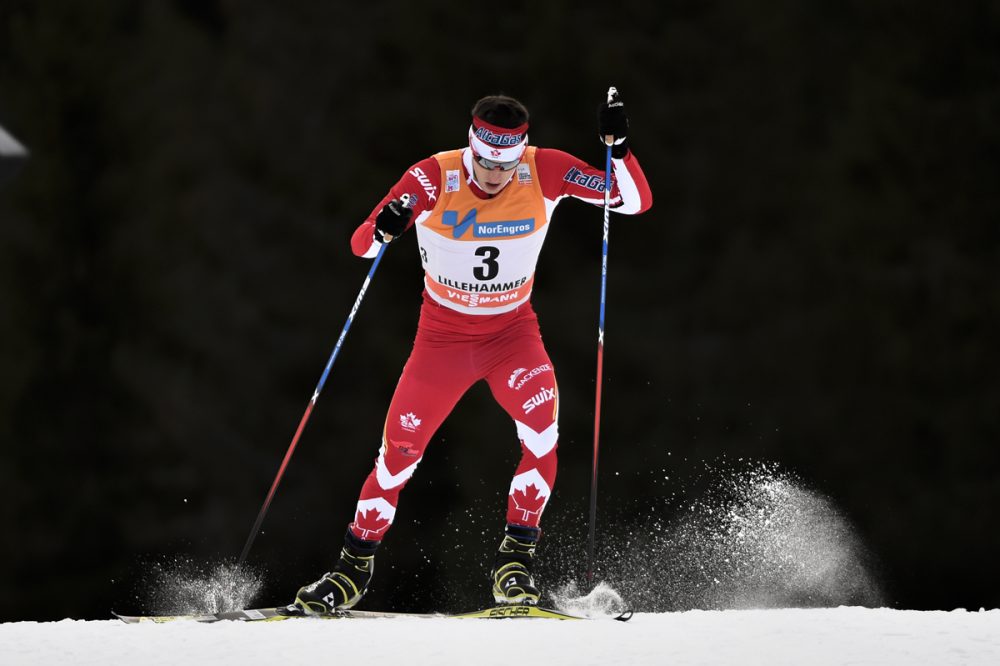
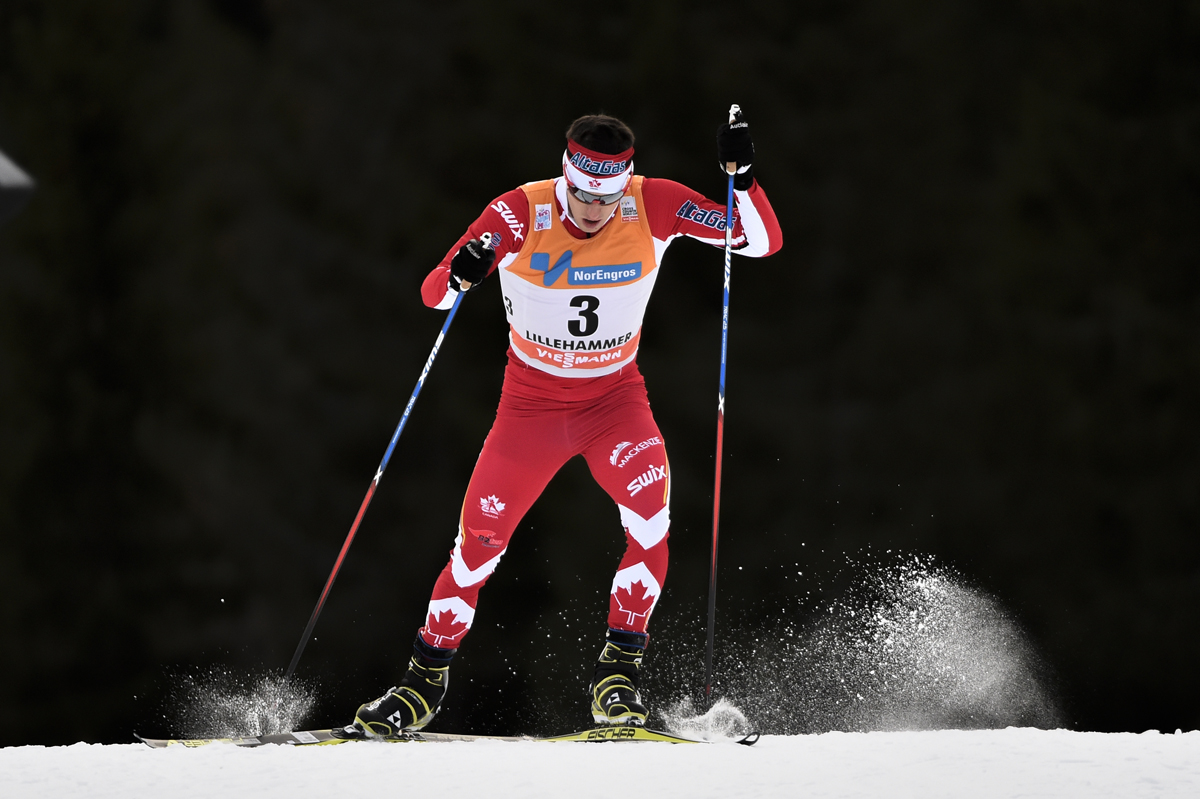
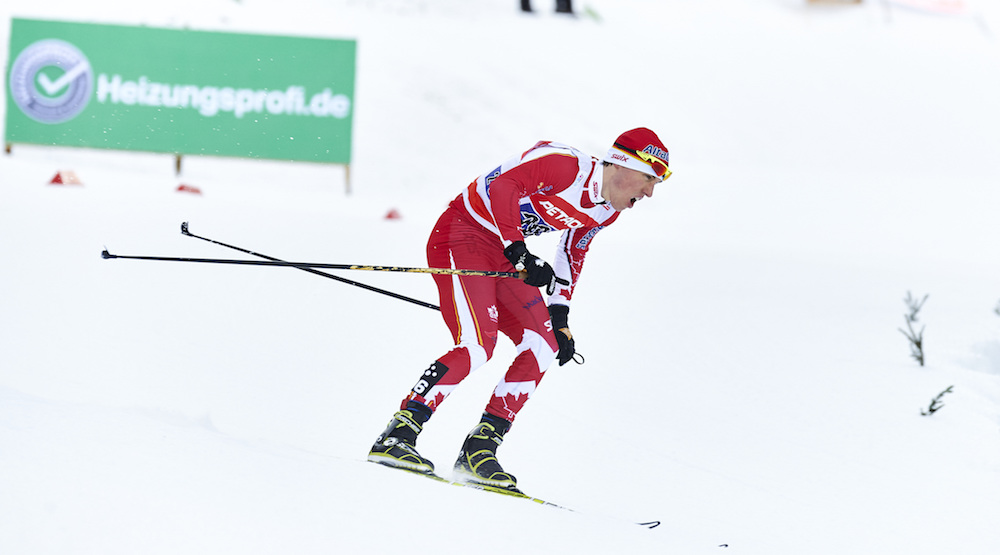
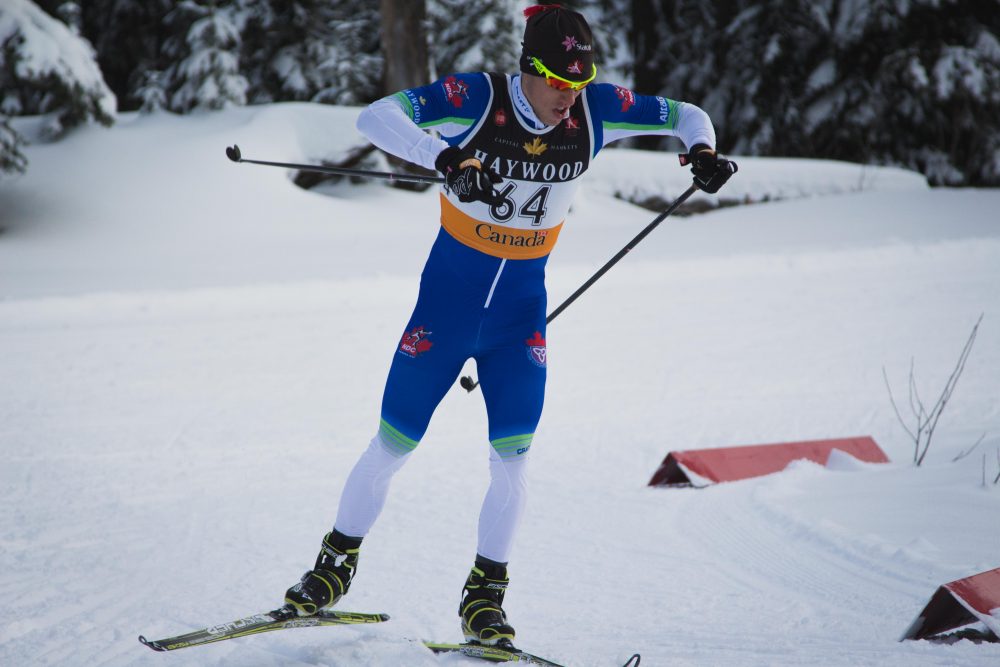
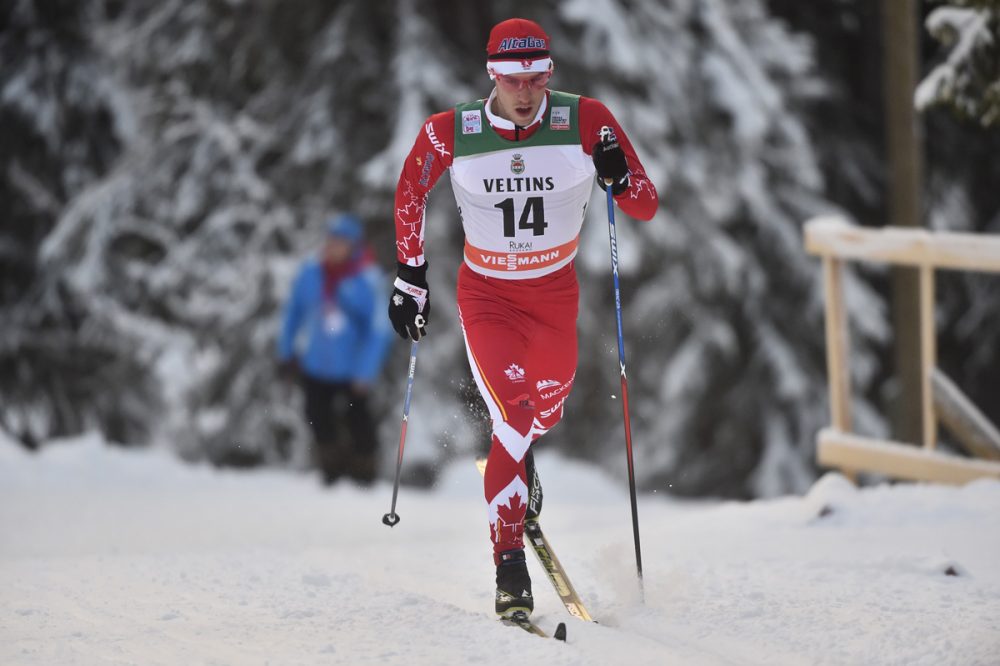

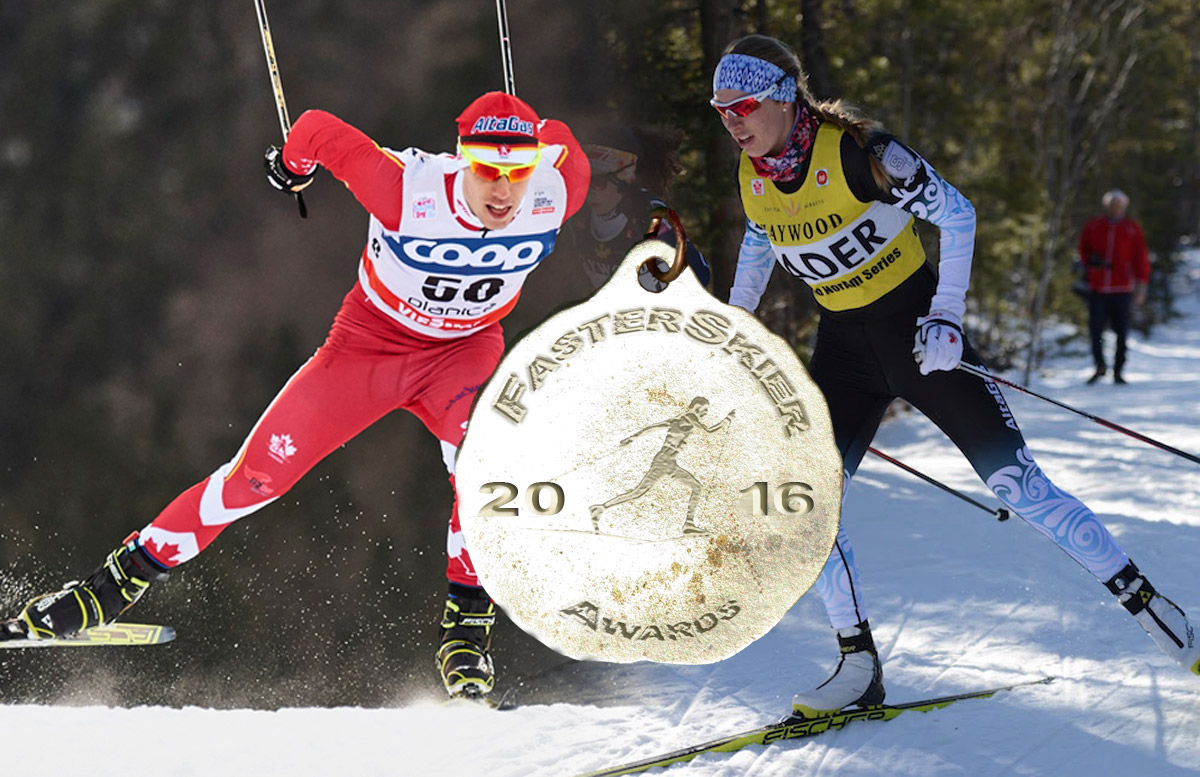
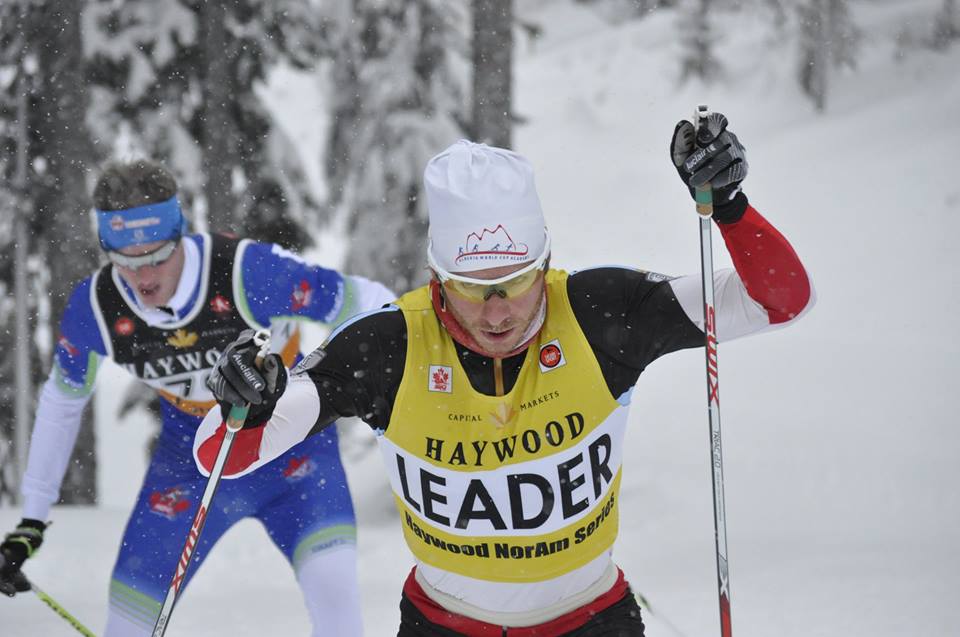
!["Me and Dahria [Beatty] worked together to stay on the tail of Emily Nishikawa, who's our best Canadian. It was a tough course with few spots to rest. ... Today was a critical stage because we were afraid to get lapped by the winner, but we didn't so we're now heading to Canmore with confidence." -- Cendrine Browne (CNEPH/CNST)](http://fasterskier.com/wp-content/blogs.dir/1/files/2016/03/DSC_5470copyW.jpg")