From the FasterSkier archive — posts syndicated from athletes’ and coaches’ own blogs between 2004 and 2012, kept online as published. Current coverage is at fasterskier.com.
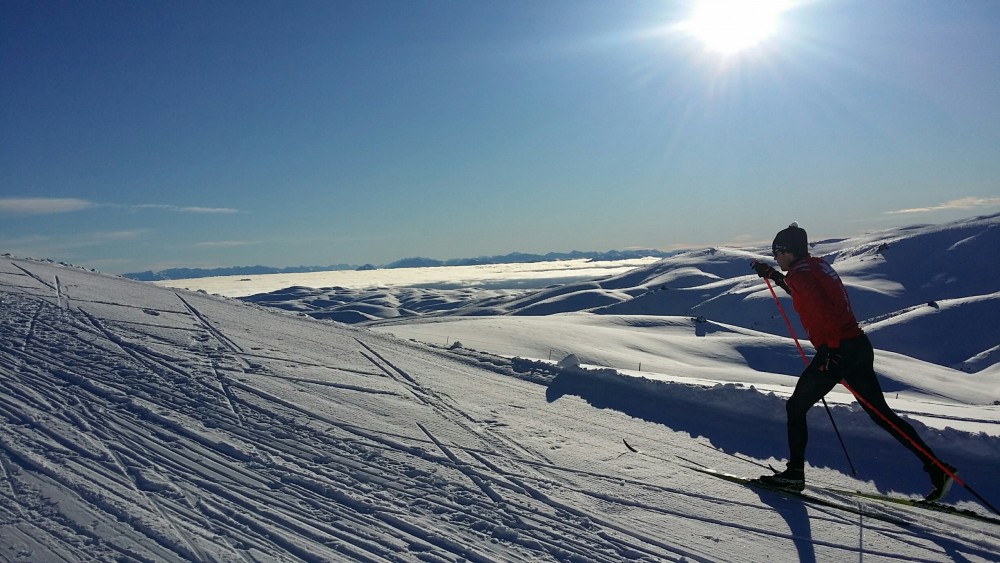
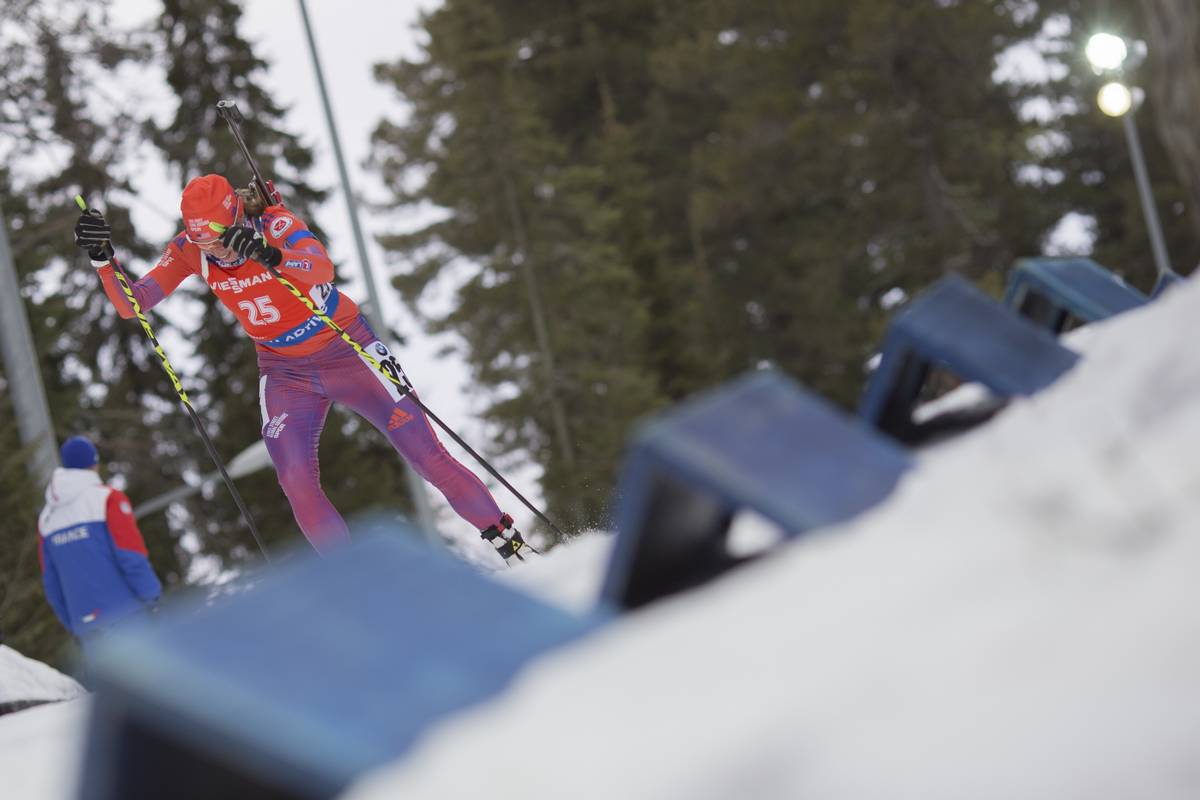
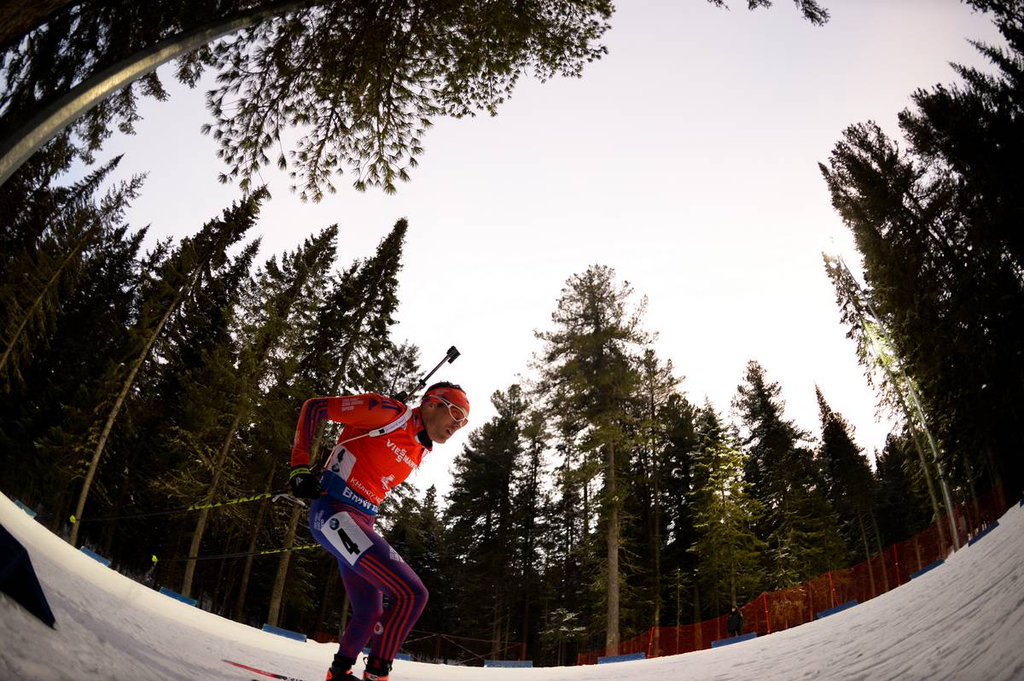
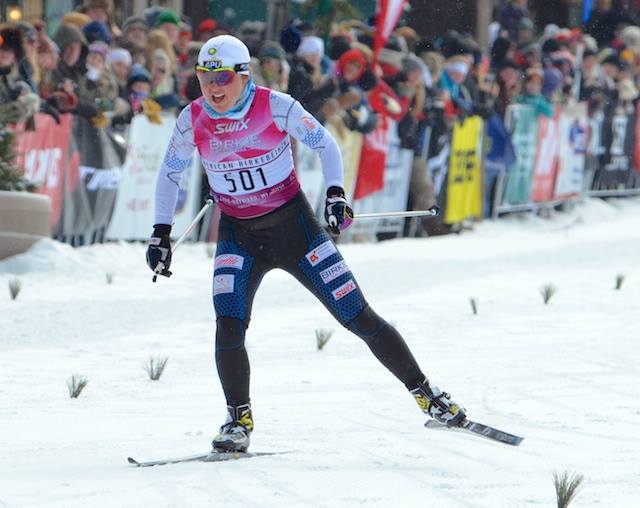
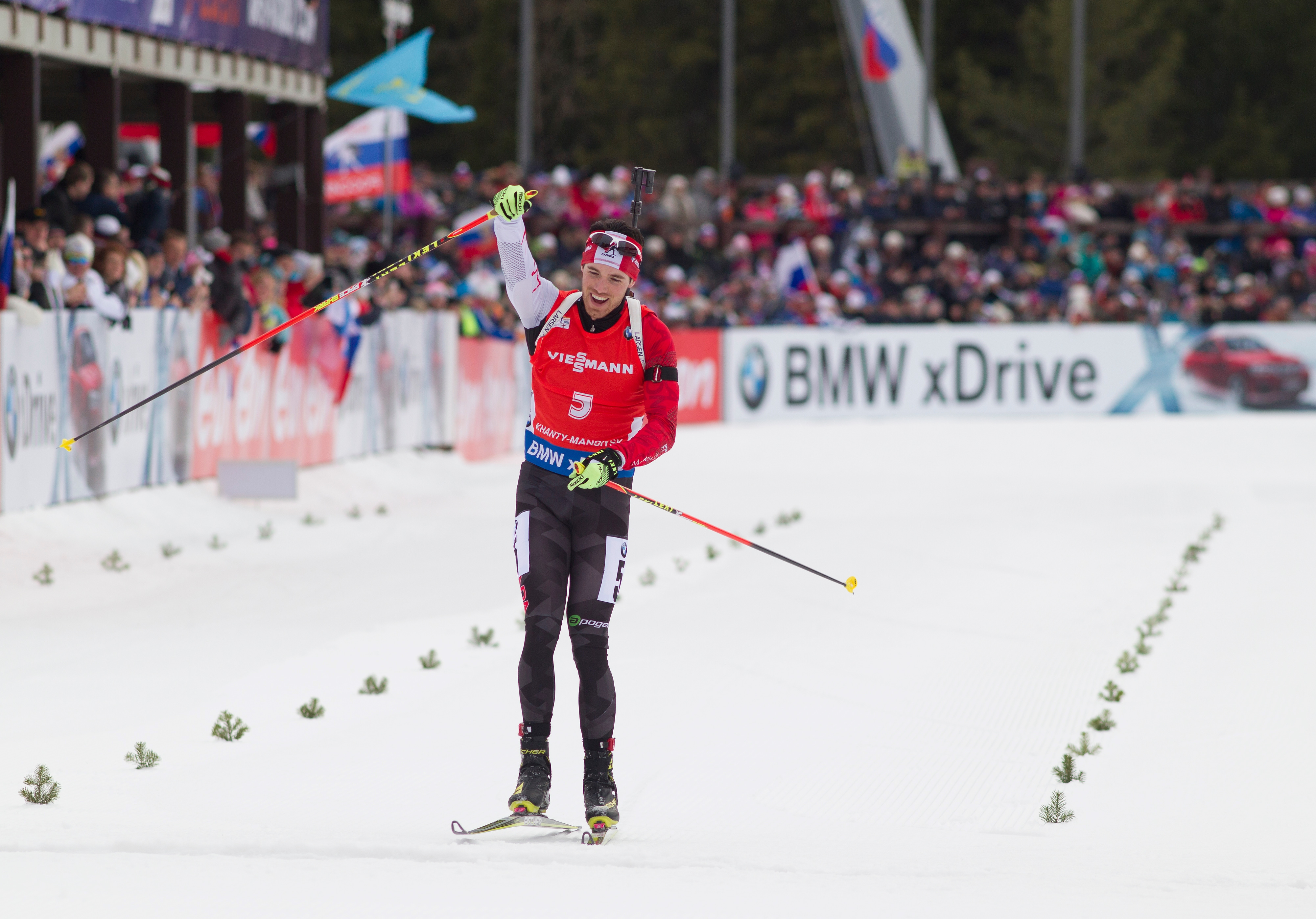
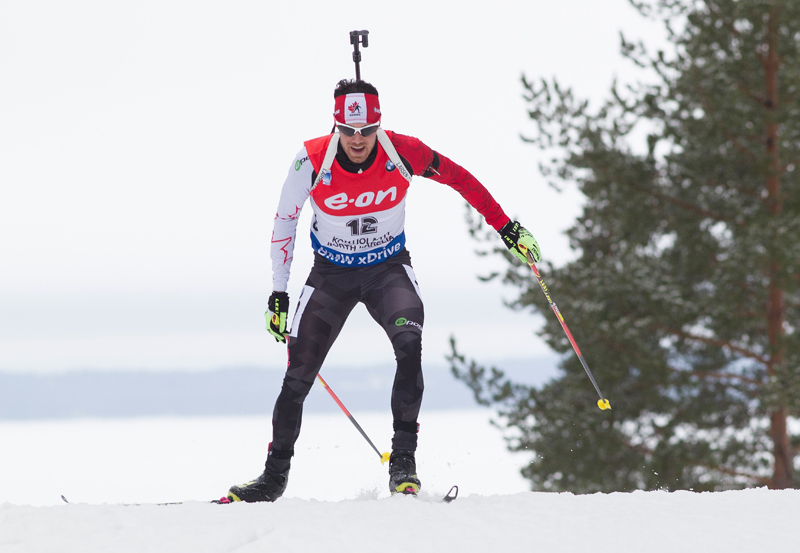
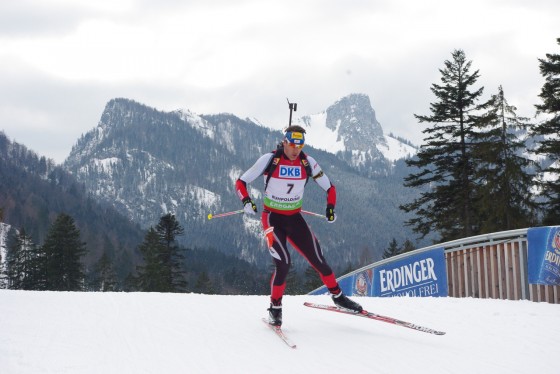
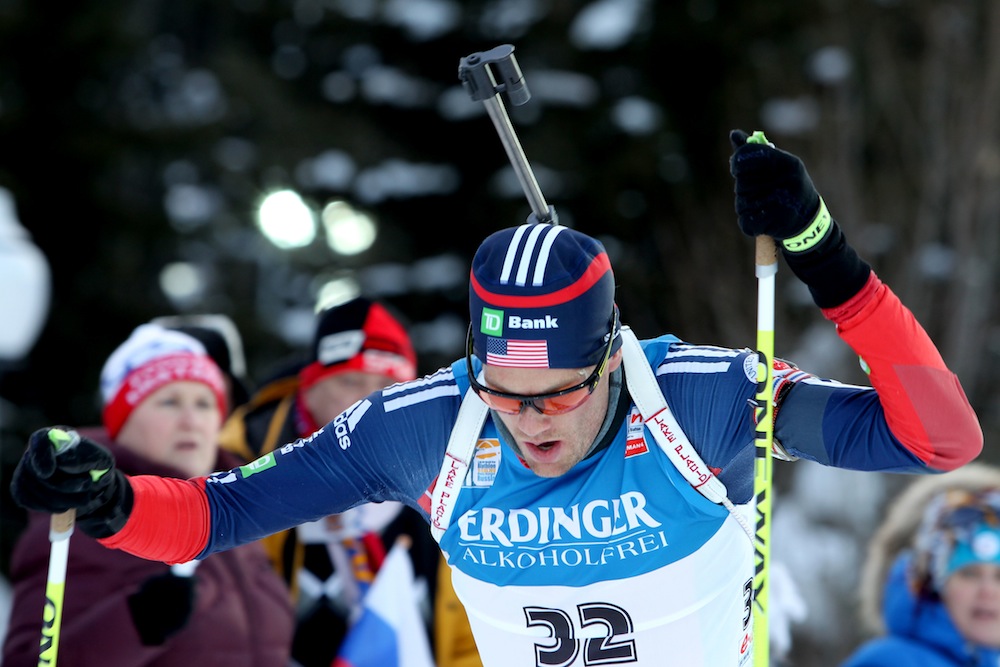
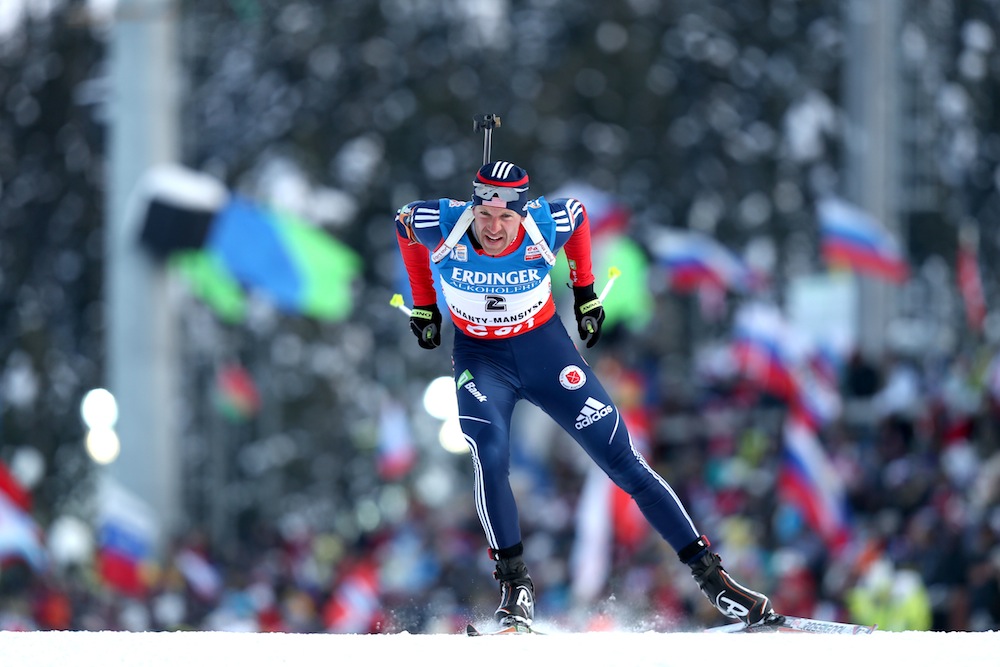
Nathan Smith, of Biathlon Canada, skiing during a national-team training camp this August at the Snow Farm in Wanaka, New Zealand. (Courtesy photo)
Wake up: 7:30 a.m. Coffee: 7:45 a.m. Commute to work: 8:15 a.m.. Punch in at 9. Punch out at 5. While this may describe the daily routine of an average North American’s work week, it’s not the case for Biathlon Canada’s Nathan Smith. And to the 3o-year-old Calgary native, there’s nothing wrong with that.
While he maintains that putting his education on hold has been one of his biggest sacrifices by choosing biathlon as a career, Smith also sees his decision to take a few years and be his own boss as better than a bachelor’s degree — not only to make himself more marketable in the future, but more unique in his life experience.
“I guess my reasoning [for choosing this path] was, I could go to school and get my bachelor’s degree and then go and work,” Smith said recently on the phone. “But that’s kind of like, I guess I’ll put it as, that’s a normal career trajectory. That’s what everyone does.
“When I’m training, I’m like my own boss, kind of an entrepreneur,” added Smith, who has been taking a few college courses (mostly science) on-and-off since he graduated high school in 2004. “And I think it’s probably similar in the States, but unfortunately here in Canada, getting a bachelor’s degree isn’t even all that great. It just makes everyone overqualified.”
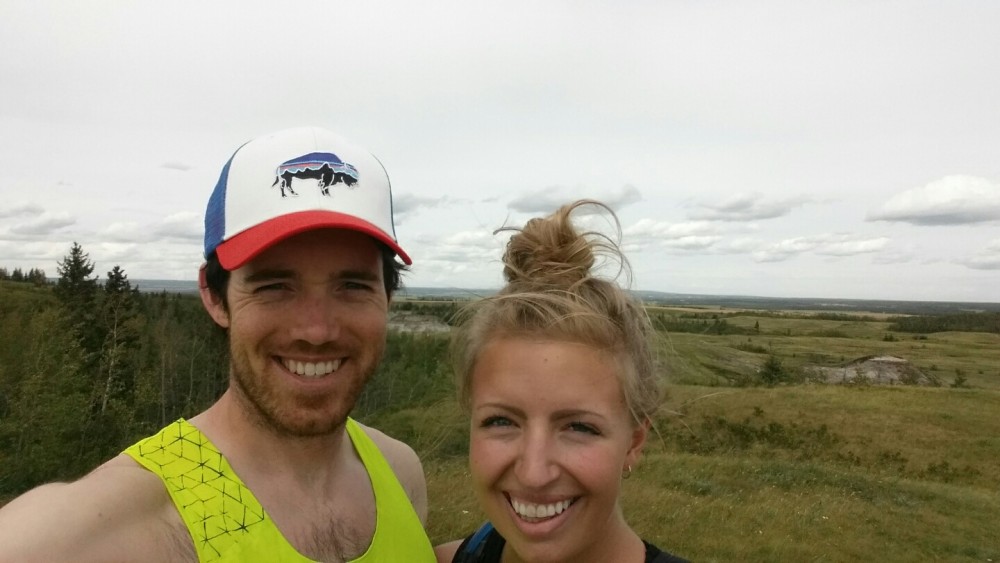
Nathan Smith with his girlfriend, Caroline. (Courtesy photo)
Instead, Smith has spent the past nine years (excluding the 2008/2009 season when he wasn’t named to the national team) sporting the red maple leaf of Canada. He’s also known to cruise the streets of Canmore, Alberta (where Biathlon Canada is based), on his 2007 Kawasaki ZZR 250 (at least when there’s no snow).
However, being a full-time biathlete was not always what Smith planned to do after high school. Before Biathlon Canada, he competed alongside his brother on Calgary’s local club biathlon team. And before that, he belonged to Calgary’s youth cross-country skiing program.
“I didn’t really know anything about the sport until I was doing Racing Rabbits which is [a program] for really young kids who [want to] cross-country ski in Calgary,” he said. “My brother and I were doing that and my mother was like, ‘Well, do you guys want to try biathlon?’ and we were like ‘Well, what’s that?’ and she was like, ‘Well, you shoot guns with skiing.’ I was 1o years old [at the time], so I was pretty excited about that … but I never really saw myself as staying in it past high school until I started to go to World Championships.”
Smith made his debut Junior World Championships appearance his sophomore of high school in 2002, and qualified again the following year, as well as in 2005 and 2006. From then on, he continued to build competition on competition, qualifying for his first World Championships in 2008, the Vancouver Olympics in 2010, five more World Championship events, and the Sochi Olympics in 2014.
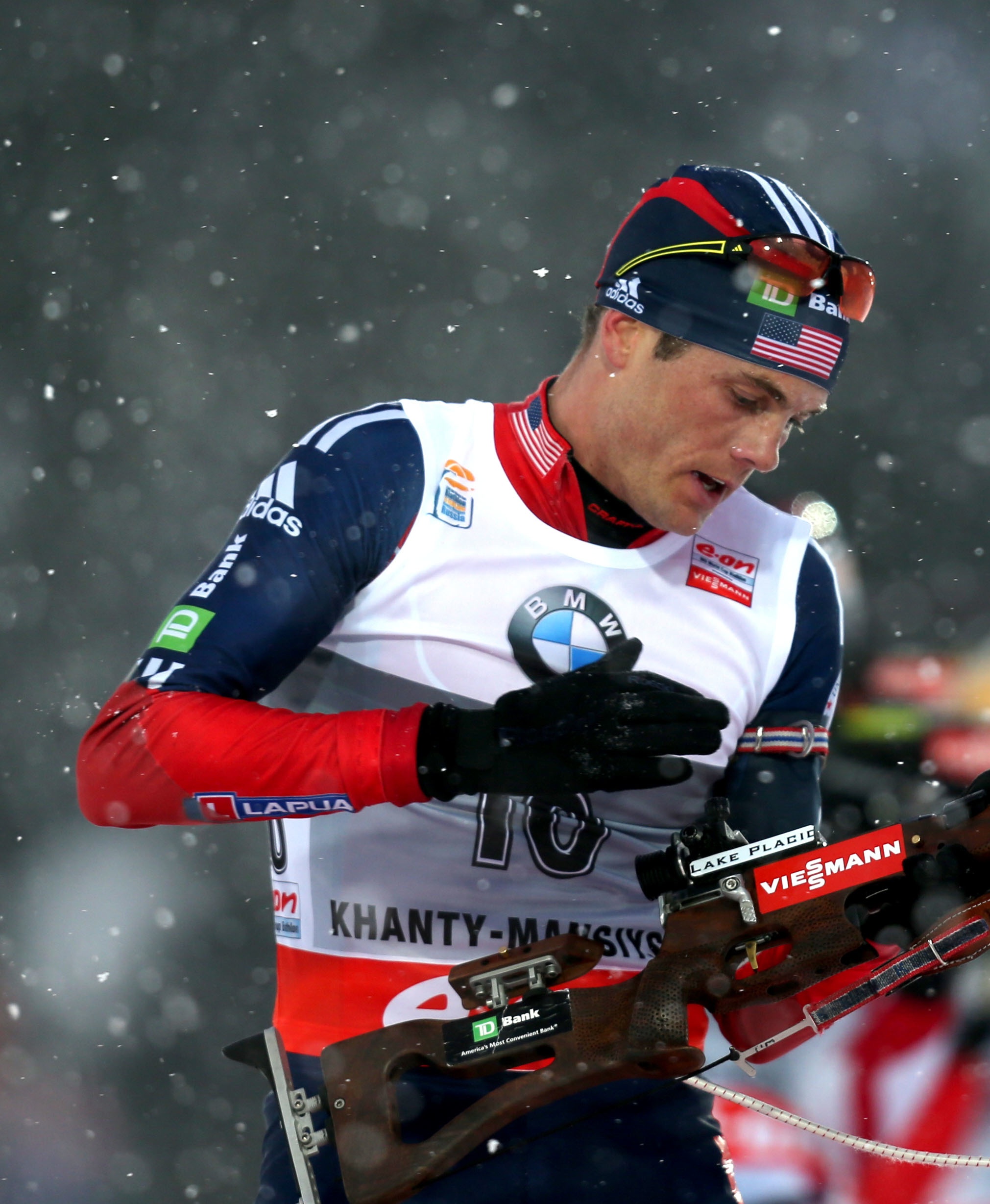
During the 2014/2015 season, he had a breakthrough performance when he raced to a first place in the men’s 10-kilometer pursuit in Khanty-Mansiysk, Russia. While he hopes to once again medal this season, he indicated that this year, doing so will take even more accurate shooting on his part, as many athletes continue to improve the speed of the shots they take.
“There’s definitely been some big changes in the way athletes approach the shooting range psychologically,” Smith explained. “It used to be a lot more cautious, [but] because skiing is getting tighter and tighter you really have to set yourself apart by shooting as fast as you can on the range.
“I’ve always been a fairly fast shooter,” he added. “So I’ve been focusing a little bit more on trying to improve accuracy while maintaining the speed I’m at.”
“There’s definitely been some big changes in the way athletes approach the shooting range psychologically. It used to be a lot more cautious … you really have to set yourself apart by shooting as fast as you can on the range.” –Nathan Smith on recent changes in biathlon
With a solid summer of volume training behind him, a fall full of intensity, and a few sessions on snow at the Snow Farm in New Zealand, Smith is excited about the start of a new season, but especially the fact that his job for another year will take place on skis.
“Obviously you go out there sometimes and there’s tough training days or times where you’re super tired or you’re having bad races and you’re like, ugh, why do I do this?” Smith said. “But if you have a normal 9-5 job, you’d have a lot more of those days I think.”
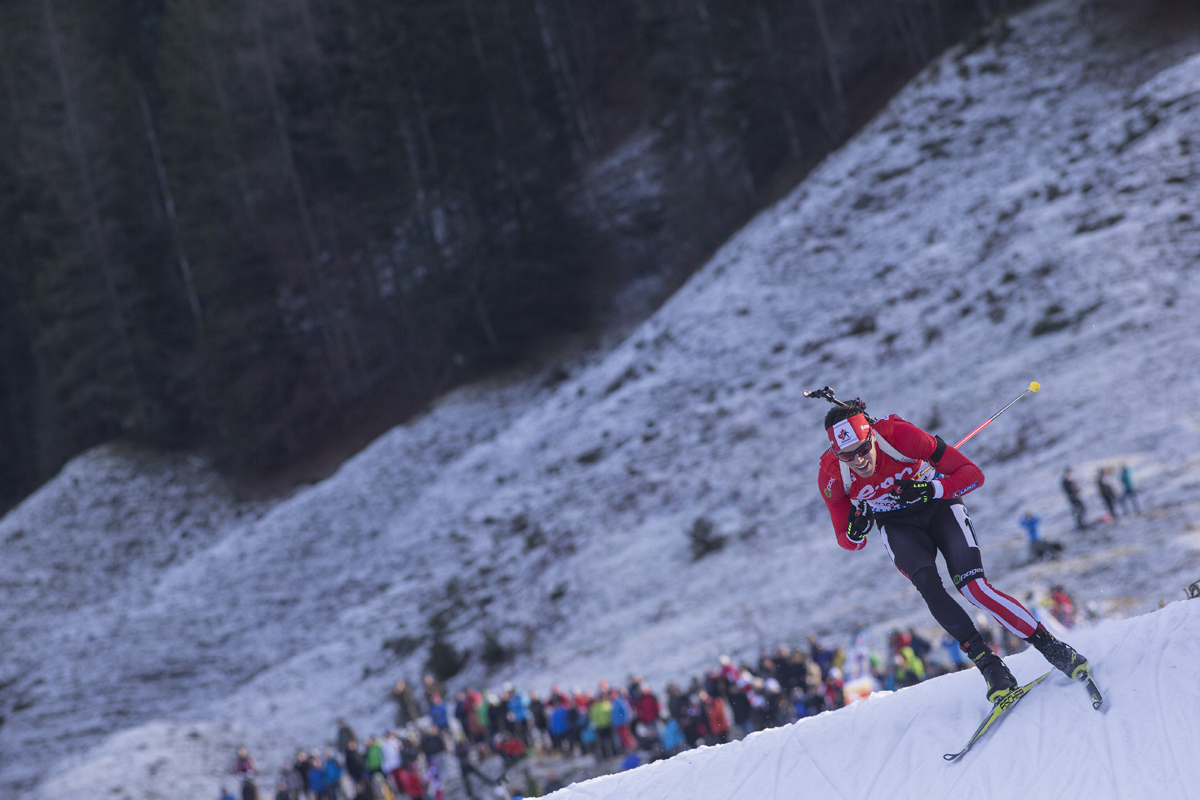
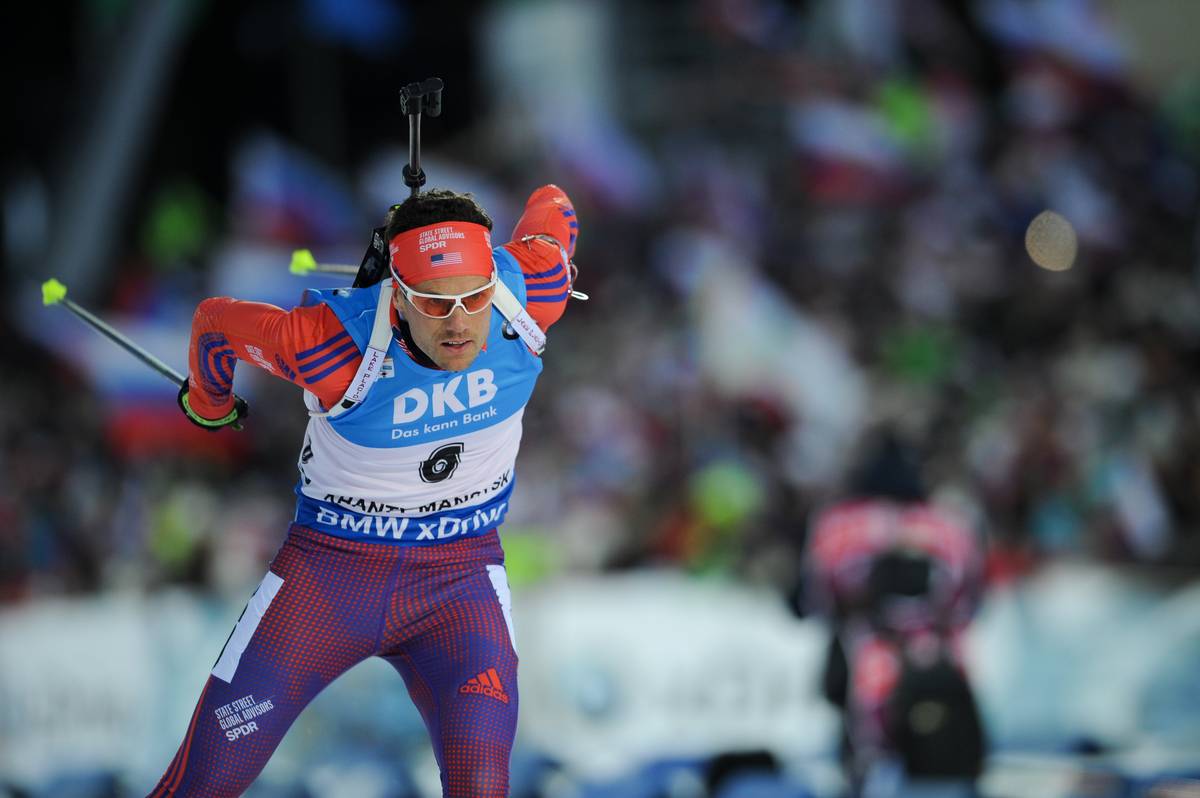
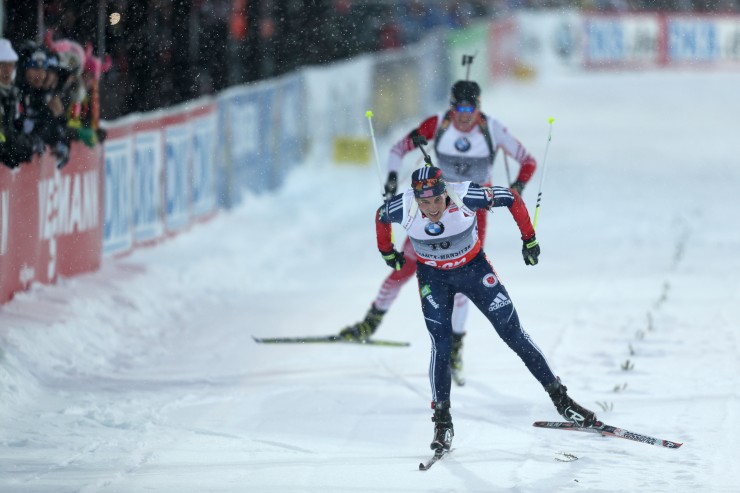
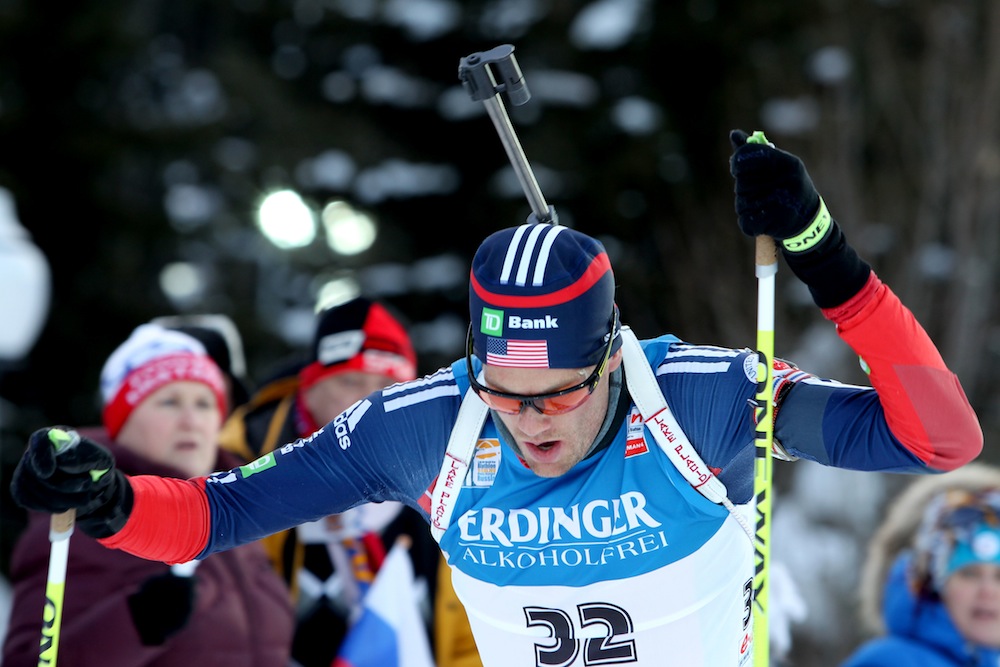
Nathan Smith skating his way to 18th at the 2015 IBU World Cup pursuit in Hochfilzen, Austria, last December. (Photo: Fischer/NordicFocus)
***
We asked Smith to give our ’17 Questions for 2017′ a go. Here are his responses:
1. Biggest change in your life in the last five or so months since the ski season ended?
I’ve been making trips up to Grande Prairie to visit my girlfriend (and her kitten). It’s nice to get away from Canmore on rest weeks, decompress, and experience regular town life sometimes.
2. Biggest change in your training?
I haven’t had too many changes in over all training philosophy. The team was reorganized this spring so Matthias [Ahrens] is now my personal coach instead of Roddy [Ward]. They work closely together though so aside from feedback it hasn’t changed too much in day-to-day training.
3. Major areas of improvement you’ve seen so far?
I’ve made some good gains in lower body strength and double pole work.
4. Whom you’ve been working closest with this offseason (coaches or training partners)?
Aside from Matthias and Roddy, we also have technique coaching at some camps from Mats Larsson. Former athlete Andrew Chrisholm has also been helping out our team on the range so we can get more individualized attention.
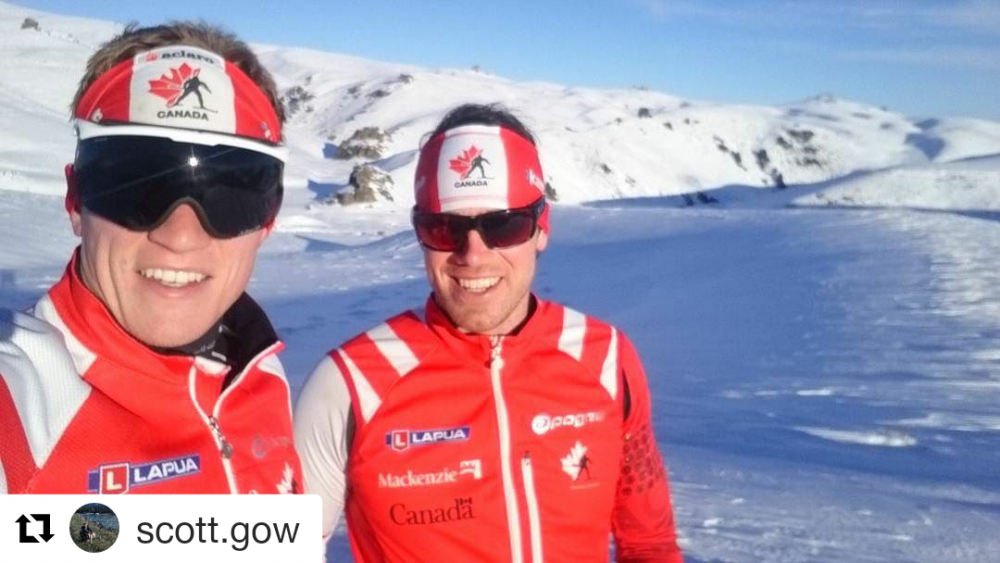
Biathlon Canada’s Nathan Smith (r) and Scott Gow during a ski. (Photo: Nathan Smith)
5. Best trip in the last five months (and why)?
Even though its not far, I always enjoy going to Jasper [Alberta] for “ManCamp”. It’s an amazing roller ski and drive up the Icefields Parkway, and the options for varied training once we get there are awesome. We also get to stay in rustic cabins on the river and practice slammo.
6. Favorite cross-training?
Mountain Biking
7. Favorite non-athletic activity or pastime this summer?
Motorcycling, and trying to fly fish.
8. Song that was your jam this summer?
That would definitely be Justin Bieber – I’ll Show You
9. All time favorite race moment?
Winning the pursuit at the world cup final in Khanty-Mansiysk in 2015
10. First thing you pack in your bag when you leave for Europe?
Armband. Never forget it!
11. Venue/event you’re most excited to visit this season?
Tyumen. I’ve never been there and I’m sure its going to be impressive
12. Who will win the men’s and women’s World Cup titles this year?
Martin Fourcade and Laura Dahlmeier
13. Biggest sacrifice you feel you’ve made choosing this career path?
Putting my education on hold.
14. If you could change one thing about your sport, what would it be?
Can it be -3, hard packed, calm, and sunny every day?
15. What did you have for breakfast this morning?
I desperately needed to go grocery shopping, so 3 bowls of granola with milk and a banana.
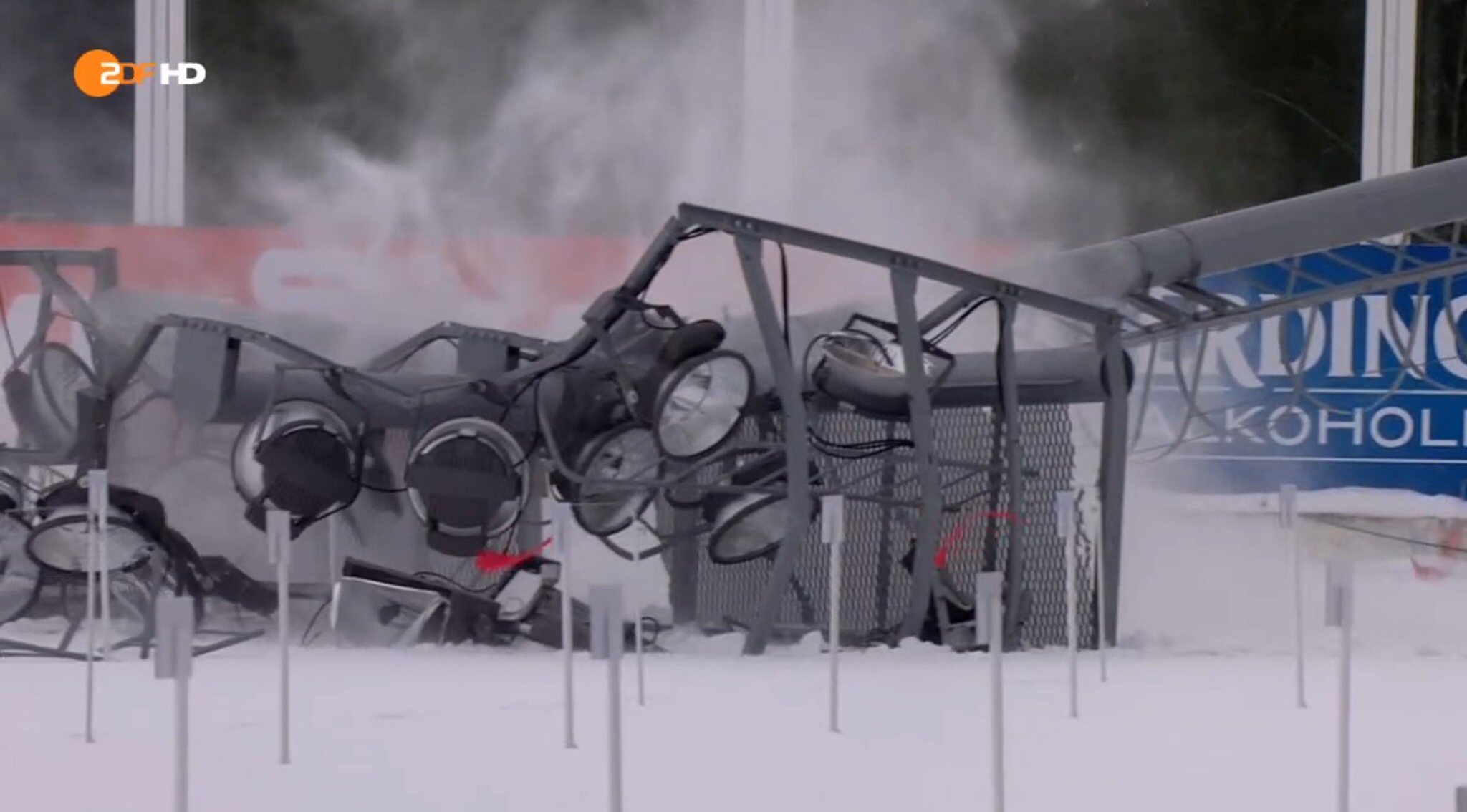
Strong winds led to the cancellation of Sunday’s mass starts, the final races of the IBU World Cup season, after a light post (at left) fell onto the shooting range in Khanty-Mansiysk, Russia.(Photo: IBU/Evgeniy Tumashov)
(Note: This post has been updated to include comments from Americans Susan Dunklee, Tim Burke and Lowell Bailey, and Canadians Rosanna Crawford and Nathan Smith.)
Just like that, the season’s over. After strong, gusty winds on Sunday led organizers to postpone the women’s mass starts in Khanty-Mansiysk, Russia, the decision was eventually made to cancel both the women’s and men’s competitions for security reasons.
According to an IBU press release, a light pole on the shooting range toppled over, but nobody was injured. Athletes, spectators and staff were instructed to leave the stadium for their safety.
Strong winds knocked over a light post in the stadium on Sunday in Khanty-Mansiysk, Russia, leading to the cancellation of both mass starts for safety concerns with the continued gusting winds. (Photo: ZDF screen shot)
“The season is therefore over,” the press release stated. “You can find the final standings shortly on www.biathlonworld.com and the remaining Globes will be handed over tonight.”
Gabriela Soukalova of the Czech Republic secured her hold on the World Cup Total Score with her fourth-place finish in Saturday’s pursuit, and France’s Martin Fourcade won the men’s overall World Cup title long ago by building an insurmountable lead. Both will be officially recognized at Sunday night’s award ceremony.
Three Americans finished the season in the top 20 overall, with Susan Dunklee becoming the best-ever ranked U.S. female biathlete in 14th, Tim Burke placing 15th and Lowell Bailey in 17th. Canada’s Nathan Smith stayed within the top 30 in 28th, and Rosanna Crawford was just outside in 32nd.
“It is my personal best overall finish yet and I am proud of it,” Dunklee wrote in an email.
“It would have been nice to have one last race and a little more closure, but I believe cancelling the race was the right decision because of serious safety concerns,” she explained.
“I’m definitely disappointed about the decision, but I also think they had little choice,” Bailey wrote in an email. “… It will take a lot of work just to clear the debris. Additionally, there were trees down on the course. And this doesn’t even get to the fact that it would be incredibly difficult to shoot in winds in excess of 30mph.”
“I nearly got blown over out running this morning,” Burke explained in an email. “The condition would have been totally unfair and dangerous. One of the huge light towers actually blew over in the stadium. I think that was the point when they decided to call it off and not delay anymore.”
“Today has been epic!” Crawford wrote. “We were walking back from town and could barely move the head wind was so strong! Our hotel has about 15 floors and some of the top floors the windows have been blown out and smashed on the ground below. Luckily no one was hurt.”
Tim Burke after placing sixth in the men’s pursuit on Saturday, repeating his season-best sixth place finish in Friday’s sprint, at the IBU World Cup in Khanty-Mansiysk, Russia. (Photo: USBA/NordicFocus)
Reflecting on their 2015/2016 race seasons, Burke explained his was solid overall.
“I feel like I proved that I can still be competitive with the best guys on a good day,” he wrote. “I’m not sure, but I think I probably had more top 15 results this season than in any previous season. I am just a little disappointed to be missing that podium finish. I had a few great opportunities for a podium finish but it just never completely came together.
“The competition in the men’s field is by far the strongest that I have ever seen and everything needs to be perfect for me now to get on the podium,” he continued. “Even though I have been doing this for a long time, I am still motivated to evolve and work at becoming a better biathlete. I already have a few things that I am excited to work on for next season!”
“I’m happy with the season,” Bailey wrote. “It is my second-best career result for overall ranking, at 17th, and a big improvement over last season.”
After missing out on qualifying for Saturday’s pursuit, Crawford explained she was somewhat disappointed with her season.
“The ski speed just wasn’t where I was hoping it to be and the results I was expecting never happened. But on the other hand, things started off great in Ostersund and I was at my peak for the World Championships,” she wrote. “There were a few glimpses of what I wanted to achieve this year, like qualifying for [World Championships] mass start, but for the most part I came up short. We will change a few things going into the training season and hopefully I can come back stronger next year!”
Nathan Smith racing earlier this season in the IBU World Cup 15 k mass start in Canmore, Alberta. (Photo: Daniel S. Guay)
Smith did not race at all this weekend after battling an illness for the better part of the last week.
“I haven’t been this sick very many times in my life, very unusual. Sore throat ears, eyes, muscles,” Smith wrote on Sunday from Khanty. “It’s pretty disappointing because I was in really good shape in Oslo and I feel like that would’ve continued here.
“I was hoping for overall a bit better of a season, but I feel like I was kind of unlucky in that my strong skiing days seemed to always align with poor shooting,” he added. “Can’t complain too much though with the two relay medals and a few top 10s.”
The U.S. team leaves Russia on Monday and will compete at U.S. nationals this week in Fort Kent, Maine.
Crawford explained she’ll be home in Canmore, Alberta, on Tuesday.
“Brendan and I will head to Silver Star [British Columbia] at the end of March for some cross country skiing and then in April we will go to Arizona for a week to visit my Aunt and Uncle,” she wrote.
“I’ll probably stick around the Canmore area this spring,” Smith wrote. “I’ve got some condo painting to do, and I’ll be sure to fit in some backcountry skiing.”
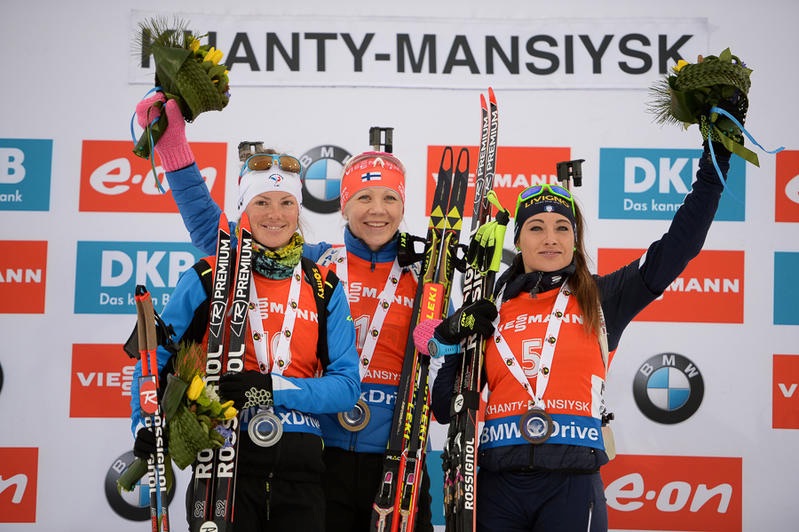
France’s Marie Dorin Habert (l), Finland’s Kaisa Mäkäräinen (c) and Italy’s Dorothea Wierer (r) on the podium of the women’s 10-kilometer pursuit at the IBU World Cup in Khanty-Mansiysk, Russia. (Photo: IBU/Evgeny Tumashov)
Six women went out closely together for the final loop of the 10-kilometer pursuit at the International Biathlon Union’s (IBU) final World Cup in Khanty-Mansiysk, Russia. The last one of the group, though only 4.6 seconds back, was Kaisa Mäkäräinen.
But by the finish, the 33-year-old Finn had overtaken everyone to secure her second victory in as many days in 30:06.7 with two penalties (1+0+1+0), following up on her win in Thursday’s sprint.
It was Mäkäräinen’s 19th World Cup victory and her fourth one of the season.
“I am really happy with my result today,” Mäkäräinen said at the post-race press conference. “I think two penalties for me is OK. It’s 90 percent. It’s better than my average, so I have to be satisfied with it. I was happy that the distance was not longer today, because it was quite tight in the end.”
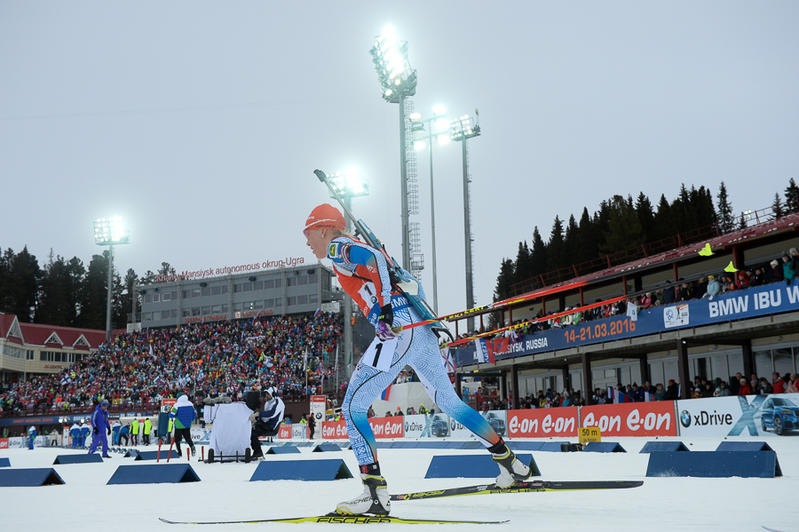
Finland’s Kaisa Mäkäräinen starting the women’s 10-kilometer pursuit at the IBU World Cup in Khanty-Mansiysk, Russia. (Photo: IBU)
France’s Marie Dorin Habert, the big winner at World Championships in Oslo, Norway, earlier this month with six medals including three gold, finished just 1.5 seconds behind her, with one penalty (0+0+0+1). In Oslo, Mäkäräinen earned bronze in the mass start.
Italy’s Dorothea Wierer secured third place (+5.7) after outsprinting the Czech Republic’s Gabriela Soukalová and Germany’s Franziska Preuss. Wierer finished with one penalty (0+0+1+0).
Despite missing the podium by 0.8 seconds, Soukalová, who had two penalties (1+0+0+1), still achieved the ultimate season-long victory by securing the overall World Cup title, ahead of Dorin Habert and Wierer.
Soukalová would have required at least the ninth place to do so already before the final mass start, and was the most consistent athlete throughout a season where she never placed worse than 11th (the pursuit in Oslo) in a race.
“Words are missing in this moment,” Soukalová told German TV broadcaster ZDF immediately after the race. “It’s very emotional. I am so happy for this. It’s very nice to have the Globe [trophy]. It’s awesome.”
Asked if she had been thinking about the World Cup title during the race, she added: “Before the last shooting maybe. That was the reason why I did a mistake.”
“It’s one of the biggest dreams of my life,” she later said in an interview with the IBU. ”I think I will never forget this moment. It was the main goal of the season. I am so happy, because World Championships in Oslo was a little bit unlucky for me.”
Depending on your historical perspective, this was the first or second biathlon World Cup title for the Czech Republic, after Jiřína Adamičková-Pelcová from the precursor state of Czechoslovakia (which later split up into the Czech Republic and Slovakia) also won the women’s World Cup in the 1989/1990 season more than 25 years ago.
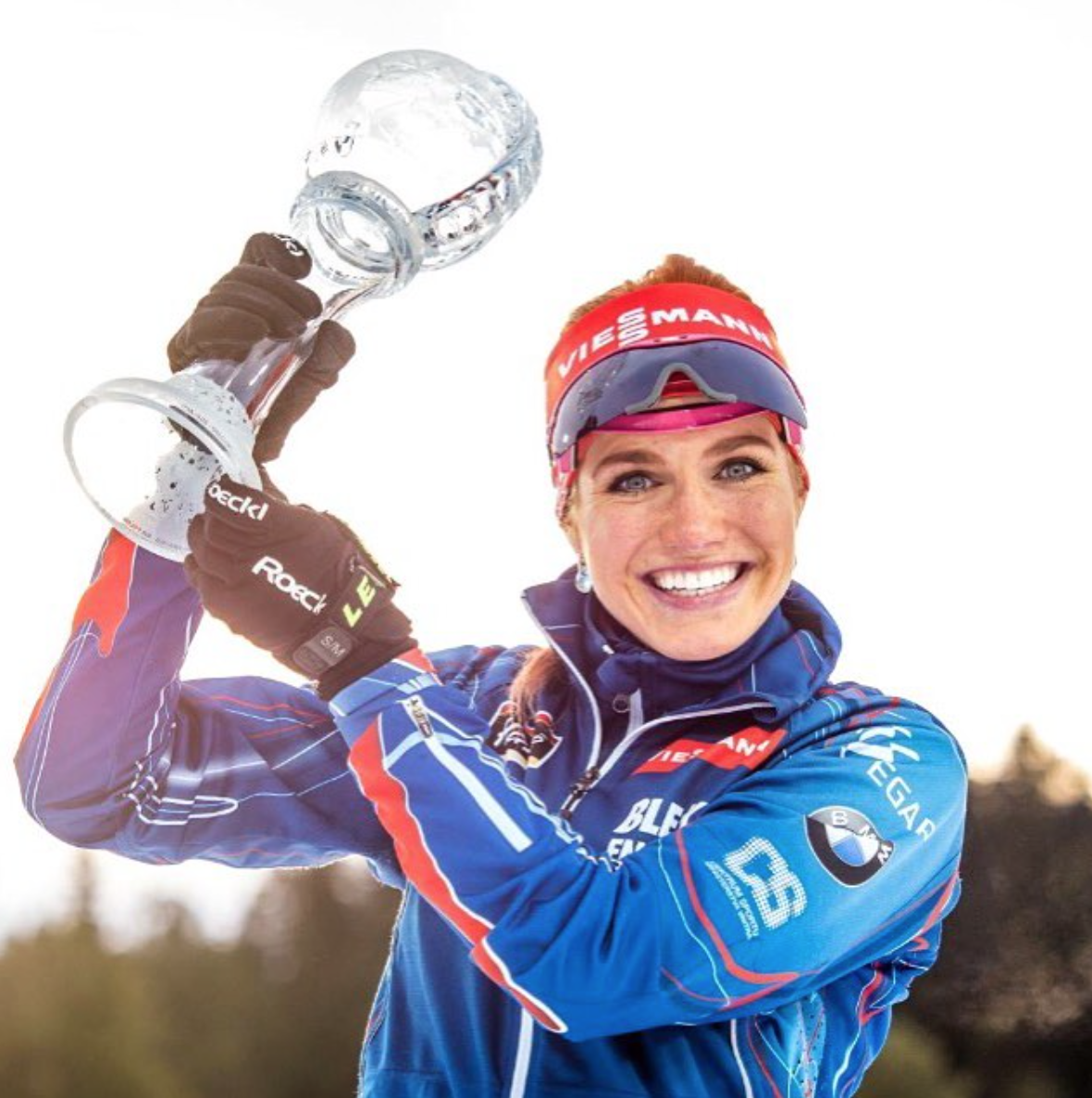
Gabriela Soukalová of the Czech Republic with her “small Crystal Globe” for the pursuit discipline title for the 2015/2016 IBU World Cup season. She also locked up the overall World Cup title on Saturday, but that will be awarded after Sunday’s mass start. (Photo: Gabriela Soukalova/Instagram)
In addition to the “big Crystal Globe” for the overall title, Soukalová also won the “small globe” discipline titles for the sprint and pursuit this week, and could still win the mass start discipline title on Sunday, which she currently leads.
“This is quite fun, I would say,” Mäkäräinen, a two-time overall World Cup winner, said of Saturday’s race and the last loop during the press conference. “Even if it feels heavy on the tracks. I like this sport!”
Reflecting on her fast skiing and still being in great shape just as the World Cup season ends, Mäkäräinen explained how she intends to close out her year.
“I think I will take part in cross-country Finnish championships, and not biathlon,” she said. “It’s more of a challenge for me. I will also make one classic race there again. I think that will be a good finish to this season.”
Dorin Habert left the range in first place after the final shooting, but Mäkäräinen quickly passed her and the French biathlete was unable to keep up.
“Kaisa was so strong,” Dorin Habert said at press conference. “When she passed us, we could not do anything. She was so fast. I just tried to race with the other girls.”
Preuss had taken the lead of the chase group behind Mäkäräinen out of a long one-minute downhill section, but was overtaken and boxed out by Dorin Habert, Wierer and Soukalová before the final climb. Dorin Habert created a small gap to the rest of the pack out of the climb into the arena to secure the second place, and Wierer won the three-women sprint for bronze thanks to excellent positioning on the last narrow turns in the arena.
“It was really a tough race,” Wierer said at the press conference. “When I went out from the last shooting range … we were six I think. Everybody passed me, and I was only saying ‘Oh my God! Oh my God!’… I am really happy that I made the third place today, because I was sure I would arrive sixth or something like that.”
Losing out in the finish sprint with Wierer and Soukalová, Germany’s Preuss finished fifth (+6.6 seconds with one penalty, and just 0.1 behind Soukalová).
“Khanty is the last competition on the World Cup, and somehow I am always able to bring out my last remaining energy here,” Preuss told ZDF. “The course suits me really well, and I am happy with the shooting range today. It’s cool to end the season like this.”
“Before the final climb there is a long descent,” she said of the last loop. “Someone always came out of the draft, and when I was in front I knew, ‘Oh now, they’ll surely pass me again.’ And then they were ahead on the climb, and it’s really difficult to overtake there … I already noticed during the climb I couldn’t quite keep up, but I am nevertheless completely satisfied with the fifth place.”
Norway’s Fanny Horn Birkeland placed sixth (+13.1, with one penalty) as the last athlete from the top group that left the range closely together onto the final loop.
Before the race, the organizers in Khanty had asked spectators and athletes for a minute of silence for the victims of a plane crash in southern Russia, and the Russian biathlon team competed with black ribbons on their arms on Saturday.
“The crowd did observe a moment of silence for the crash victims,” American Susan Dunklee wrote in an email. “During the race, they brought their same great energy they always bring here. This is one of the loudest stadiums that we race in.”
Dunklee 22nd, Ransom Knocks Off 20 Places with Clean Shooting
Dunklee started the pursuit in 25th and initially shot clean in both of her prone stages. This moved her up all the way to 15th place, just 41.4 seconds behind the leader when she left the range.
Susan Dunklee (US Biathlon) racing to 22nd in the women’s pursuit on Saturday in Khanty-Mansiysk, Russia. (Photo: USBA/NordicFocus)
On the track, she was able to keep up with the top of the field, overall skiing the fourth-fastest course time, and just half a second slower than the winner Mäkäräinen.
“I get the sense that practically everyone is exhausted, physically and mentally,” Dunklee wrote. “I am fighting off a sore throat but my energy levels felt good today and I am still hungry to compete. I often do well relative to the field when we hit this point in the season.”
But then in the first standing shooting, her race took a turn for the worse when she missed three targets.
“There was nothing difficult about the conditions for my third stage,” Dunklee wrote of that stage. “I approached that stage the same way I approached all the others. It was a simple case of me pulling the trigger when the rifle wasn’t pointed at the center of the target.”
Those penalties set her back more than an additional minute, and she set back out on the course in 23rd and was unable to make up the deficit.
In the last standing shooting, she incurred another penalty and left the range in 25th, before making up three positions on the final loop to finish 22nd (+2:13.2) with four total penalties.
Canada’s Julia Ransom as the only other North American starter in the pursuit had a perfect day on the shooting range, cleaning all of her targets in the four-stage race.
Earlier this season, Ransom also achieved 20-for-20 shooting at the pursuit in Antholz, Italy, as well as in the 15 k individual at the World Championships earlier this month. Both performances put her within the top 20 of those races; on Saturday, she picked off 20 places after starting 54th to finish 34th (+2:56.5).
Of 57 starters, Ransom was one of three women to shoot clean. Ukraine’s Yuliia Dzhima did so to place ninth, and Sweden’s Mona Brorsson finished 24th.
The two other North American starters at the World Cup in Khanty, Canada’s Rosanna Crawford and American Clare Egan did not make the top 60 to qualify for the pursuit. Dunklee is the lone North American woman qualified for Sunday’s mass start, the final race of the World Cup season.
“The course here is one of my favorites because of the good climbs and I especially like the hilly 2.5 km loop that we’ll use tomorrow,” Dunklee concluded in her email.
The ninth and final World Cup of the season ends with the men’s and women’s mass starts on Sunday. The women’s 12.5 k mass start begins at 5:20 a.m. Eastern, followed by the men’s 15 k mass start, with Americans Tim Burke and Lowell Bailey racing, at 8 a.m. Both races will be streamed live on Eurovision.
The men’s pursuit flower ceremony on Saturday in Khanty-Mansiysk, Russia, with winner Simon Schempp (second from l) of Germany, Norway’s Johannes Thingnes Bø (l) in second, Germany’s Erik Lesser (third from left) in third, and (from left to right) Switzerland’s Benjamin Weger in fourth, Germany’s Benedikt Doll in fifth, and American Tim Burke in sixth. (Photo: USBA/NordicFocus)
End of the season? One week after World Championships? No problem for guys like Simon Schempp. The 27-year-old German came out on all cylinders on Saturday after starting second in the men’s 12.5-kilometer pursuit in Khanty-Mansiysk, Russia, 1 second behind Austria’s Julian Eberhard in first.
The first loop and prone shooting didn’t hurt Schempp, but it didn’t necessarily help him, either. After entering the range in second, right behind Eberhard, Schempp proceeded to miss one and emerged from the penalty loop in third, nearly 10 seconds behind another Austrian Dominik Landertinger in first. Schempp’s teammate Erik Lesser had moved into second place with clean shooting, like Landertinger, and left the range 8.5 seconds behind the Austrian and about a second ahead of Schempp.
Meanwhile, Eberhard missed two and dropped to fourth, 22.7 seconds back.
Lesser caught Landertinger quickly on the next loop, and Schempp remained glued to Lesser’s tails in second as they entered the range together for the second time. There, Lesser cleaned prone once again, Eberhard cleaned to move into second, 17.6 seconds back. American Tim Burke cleaned his second-straight stage to leave the range in third, 21 seconds after Lesser.
Where was Schempp? Despite another miss, he was still in contention in fourth, 1.4 seconds behind Burke. Following Schempp, Norway’s Johannes Thingnes Bø cleaned his second stage in a row to improve to fifth after starting seventh (behind Burke in sixth).
What was shaping up proved to be a showdown between Schempp and Bø, which would play out on the final loop.
Schempp cleaned his first standing stage while Bø continued on the path of perfect shooting, putting them in second and first, respectively. Bø led Schempp by 0.3 seconds into the fourth of five laps, and the two skied together before the going head to head in the final shooting.
There, both missed one, but Bø did so faster, leaving the range first. Schempp followed 3.4 seconds later and prepared for the one last push to the finish.
“I know that he can shoot incredibly fast,” Schempp said of Bø in a post-race interview with Germany’s ZDF. “But I can also risk it at the end and push the tempo if necessary. We both were pretty exhausted, especially for the last shooting. So we both did it the same way [missed one], and went out together on the final loop, with the better outcome for me.”
Germany’s Simon Schempp (2) after winning the men’s pursuit on Saturday by 8.5 seconds over Norway’s Johannes Thingnes Bø (l) Khanty-Mansiysk, Russia. (Photo: IBU/Evgeniy Tumashov)
Bø continued to lead the duo for the bulk of the last loop, before Schempp attacked with about half a kilometer to go. Bø initially chased, then realized the gap was too much to overcome and backed off before the finish. Schempp won the final pursuit of the season in 33:27.8 while Bø claimed second, 8.5 seconds later.
“I came out of the shooting range in the first place. I knew there would be a fight with Schempp,” Bø recalled in a post-race press conference. “On the final downhill Simon had more power.”
“After the World Championships my shape is getting better and better,” Schempp said at the press conference. “I feel a lot of power in my legs. Nevertheless, I thought the win was possible only 200 meters before the finish.”
Lesser locked up third, 15.7 seconds back, after one miss on each of his standing stages. He held off Switzerland’s Benjamin Weger, who shot 20-for-20 to improve from 11th at the start to fourth at the finish (+18.7).
“I think this is the last time the World Cup will be in Khanty-Mansiysk, so I can put in some effort one last time,” Lesser told ZDF, after previously saying he lacked motivation in the Khanty sprint because he had not been successful there in the past. Lesser started the race in fifth, 38 seconds back, while Weger overcame a 1:15 starting deficit.
“In the beginning of the lap I wanted to get ahead of Weger to secure a gap,” Lesser said in the press conference. “Last year we had a similar fight in the mass start, and he beat me. Now it was reverse, and I am satisfied about it.”
A third German in the top five, Benedikt Doll placed fifth (+27.3) with two penalties (1+0+1+0), and Burke tied his season best from Friday’s sprint in sixth (+31.3) with two misses as well (0+0+1+1).
Tim Burke (US Biathlon) racing to sixth, which tied his season best, in Saturday’s pursuit in Khanty-Mansiysk, Russia. (Photo: USBA/NordicFocus)
“I’m very happy with my races so far here in Khanty,” Burke wrote in a post-race email. “I mean, these are my two best results of the season so I can’t be too disappointed. But I am also like most athletes in that I always want more!”
After starting 53 seconds back in sixth, 15 seconds behind Lesser and 9 seconds ahead of Bø, Burke skied alone during the first 2.5 k loop.
“This is very unusual in a pursuit, especially for the first lap,” he explained. “I just tried to stay focused on setting a good pace that I could maintain for the entire race. I feel like many athletes tend to go out way too fast in the pursuit, so it was nice to settle into my own pace.”
By the time he made his way into third at the race’s halfway point, Burke reflected that he continued to focus on his normal routine.
“Of course this is easier said than done but I try to keep my focus the same if I’m fighting for a podium or if I’m in the back of the pack,” he wrote. “Even with a penalty in each standing stage, I was within striking distance of the podium so it was no problem to keep fighting all the way to the finish.”
After a miss in the third stage, Burke left the range in fifth, 22 seconds out of first. One lap later and with another miss in the final bout, he was 27 seconds back in sixth.
“Tomorrow should be another good opportunity for me,” he said of the 15 k mass start. “I am definitely still in good shape and our technicians have put us on great skis here. Tomorrow I just want to execute my game plan. If I can do that, I know I will be happy with the result.”
For Schempp, the goal is to continue to improve in the World Cup standings, as he currently sits in fourth — 37 points behind Russia’s Anton Shipulin in third. Bø swapped places with Shipulin in the standings on Saturday, moving into second, 14 points ahead of the Russian. Shipulin started the pursuit 45th and improved to 20th with three penalties (0+1+1+1). France’s Martin Fourcade has unofficially won the World Cup crown, giving him the luxury to sit out the pursuit after placing 40th in the sprint.
“My season has been very good so far,” Bø said at the press conference. “I managed to attain a goal of being in the top 10 in the World Cup Total Score. I see now that I am in second, so I would like to preserve this.”
Lowell Bailey (US Biathlon) after placing 22nd in the men’s pursuit on Saturday in Khanty-Mansiysk, Russia. (Photo: USBA/NordicFocus)
After notching sixth in the Nation Cup to secure a fifth men’s quota spot for next season, three U.S. men raced the pursuit on Saturday, with Lowell Bailey improving from 31st to 22nd (+2:06) with one penalty (0+0+1+0) and Sean Doherty finishing 32nd (+2:47.7) with five misses (2+1+1+1). Doherty started 21st.
“I really wanted to put together a solid shooting performance today,” Bailey wrote in an email. “I wasn’t really that happy with yesterday’s Sprint, especially in the range.”
In Friday’s sprint, he missed two prone targets. He cleaned both prone stages on Saturday, with his only miss coming in the first standing stage. After the second prone, Bailey rose as high as 19th and held that position even after a miss on the next stage.
“I was happy to have moved up by that point, but I also know that a lot can happen after the midpoint of a pursuit,” he wrote. “Typically, most misses happen in the last two stages so I just tried to maintain my focus through the end of the race. … It was definitely a battle out on the course today. I’m pretty tired coming off of World Champs so I really just tried to give what I had left.”
Overall in the World Cup, Burke ranks 15th and Bailey is 17th, earning them both a spot in Sunday’s mass start.
“I’d like to finish with a quality performance; good shooting and solid skiing,” Bailey wrote of the season-ending World Cup race. “If I can do that, the result will follow!”
Canada’s lone starter, Brendan Green improved from 42nd to 36th (+3:05.2) with three penalties (0+0+2+1). His teammate Nathan Smith, who is 28th in the World Cup standings, is listed as a reserve on the mass start’s provisional start list, but has not raced yet this weekend.
Tim Burke racing to a season-best sixth in the men’s 10 k sprint on Friday at the IBU World Cup in Khanty-Mansiysk, Russia. (Photo: US Biathlon/Twitter)
Ask any athlete competing in Khanty-Mansiysk, Russia, and they’ll likely tell you it’s hard to focus. Sure, there’s the Siberian sunset — a breathtaking backdrop to the final IBU World Cup races of the season. But then there’s the fact that these are the last races of the season, and they come at the end of a long haul of nine World Cups and a World Championships.
“I have been fighting really hard to stay focused,” American Tim Burke wrote in an email after Friday’s 10-kilometer sprint. “Because I have to admit, it is easy to start focusing more on returning home then racing at this time of year.”
He wasn’t alone.
“I am noticing that the tension [focus] is a bit gone after the World Championships,” Austria’s Dominik Landertinger told Austria’s ORF. “But I managed to completely focus on the competition today.”
Austria’s Julian Eberhard celebrating his first IBU World Cup win (and podium) on Friday in Khanty-Mansiysk, Russia. (Photo: IBU/Evgeniy Tumashov)
While Landertinger ultimately finished fourth with clean shooting, and Burke placed sixth for a season best with a single standing penalty, Friday’s victory went to Julian Eberhard — the first Austrian to win a sprint in 15 years.
“After the World Championships that were disappointing for me, I didn’t have anything to lose today and just put all my eggs in one basket,” Eberhard, 29, told ORF. “I knew the shooting works, and just pulled through. I didn’t do anything differently on the shooting range than usual, I just worked off what I can do. On the course it then was hard work. But there I could rely on my qualities [abilities]. Also the equipment was great.”
Like the rest of the top-five finishers, Eberhard cleaned the two-stage race. He also skied the second-fastest course time to clinch the win. After starting 40th, Eberhard edged Germany’s Simon Schempp (in bib 21) by 1.1 seconds. On his 29th birthday, Germany’s Arnd Peiffer placed third, 23 seconds back.
“I felt pretty good today, and here in Khanty I usually do,” Peiffer told Germany’s ZDF. “When I got through with zero-zero [clean shooting] I knew this could be a good result today. … At the end of the day, the procedure is the same. On a birthday, you have a few more phone calls than usual, with relatives and a few others. Of course it’s nice if everything works out on a day like this.”
Schempp skied the fastest course time and topped his teammate Peiffer’s time by nearly 22 seconds at the finish. While it looked like a German 1-2 sweep, Eberhard came through and knocked them both down one step on the podium. With clean shooting, he led after both his first and second stages, leaving the range 1.9 seconds up on Schempp’s time with one loop to go.
While Eberhard told reporters afterward that he was confident in his ability to reach the podium, Friday’s win was his first-career podium after placing fourth in the Canmore sprint earlier this season.
“This year I had a very difficult season on the shooting range,” Eberhard told ZDF. “I knew that I was able to be in the mix on the course in every race, and today it worked out. So I am all the more elated.”
For Schempp, who ranks fourth in the overall World Cup standings with two more individual races to go (Saturday’s pursuit and Sunday’s mass start), the goal for the overall podium remains.
“… When you put on a race bib, I always want to be as far ahead as possible, no matter if it is a World Championship, a World Cup, or some other race,” he told ZDF. “Today I just wanted to achieve my optimum again, and I think that worked out very well, and I can live very well with that. I hope the next two days will be just like this one.”
France’s Martin Fourcade has a lock on the World Cup overall by an insurmountable 367 points, while Russia’s Anton Shipulin is currently second, just 19 points ahead of Norway’s Johannes Thingnes Bø in third, and Schempp is another 57 points behind Bø in fourth.
On Friday, Fourcade placed 40th with an uncharacteristic four penalties — three prone and one standing — on an essentially wind-free evening with steady snowfall.
“Today was not my day. I don’t know, I felt good on the skis and I felt motivated, in spite of the [overall World Cup] Globe already done,” Fourcade told ZDF. “I need to analyze my prone shooting, it’s where I did bad today, but honestly I was really focused on my competition, and it was not because of a lack of motivation. I can’t say why I was bad today, but yeah, I’ll try to do better in the mass start. I think I will not compete in the pursuit.”
Shipulin placed even farther back in 45th with just one standing miss but the 60th-ranked course time of 84 finishers. No Russians placed in the top 20 at their home World Cup.
Then there was Burke — the best finisher with a miss in sixth. He finished 52.6 seconds out of first with the fifth-fastest course time. Ahead of him, Landertinger placed fourth (+28.2) and Germany’s Erik Lesser was fifth (+38.1). Bø finished about 10 seconds behind Burke in seventh.
“I knew there would be a lot of physically and mentally tired athletes here, so I looked at this world cup as a great opportunity,” Burke explained.
“This World Cup definitely has a more relaxed feel coming after World Champs,” he wrote. “I knew that I was still in good shape after World Champs and I really wanted to perform here in Russia.”
Earlier this month at World Championships in Olso, Norway, Burke placed 14th in the sprint and 12th in the mass start for his two best individual results at the championships.
“I went out hard from the start today and just tried to hold on,” he wrote on Friday. “I was a little nervous at about 5k that I had started too aggressive but it worked out in the end.”
The fourth starter, Burke initially finished second to Landertinger in bib 3. After a clean prone, his time leaving the range for the second loop held up as fifth fastest overall. And after his standing penalty, his time ranked ninth overall leaving the range for the last time.
“Of course I am happy with my 6th place but I always want more!” Burke added.
The US Biathlon coaching staff, including development coach Jean Paquet (l), poses for a photo following the men’s sprint in Khanty-Mansiysk, Russia. (Photo: USBA/NordicFocus)
All three Americans qualified for the pursuit, with Sean Doherty finishing 21st (+1:38.3) with two prone misses and Lowell Bailey in 31st (+1:55.4) with one penalty in each stage.
“I was a bit disappointed with the prone misses but I felt great on the skis and I kept the focus up,” Doherty told US Biathlon. “It was a good overall race and I am excited for the pursuit.”
Above all, the U.S. men’s team clinched a best-ever sixth in the Nation Cup.
“Today was also a great day for the team, as we secured 6th place in the men’s Nation Cup score,” Burke wrote. “This is a best ever for this team and we are all very excited about that. We have come a long way since my start on the World Cup!
“Our ski technicians also did an amazing job today,” the 34-year-old New York native added. “The conditions are really tricky here with slow, dirty snow and some of the big teams struggled. We only have three technicians here but the nailed it today and I am confident that we were on the best skis.”
“Congrats to my teammates, coaches, and staff,” Bailey said in the press release. “It takes a lot of support just to get to the start line at a World Cup, let alone compete with some of the best teams in the world.”
Brendan Green was the top Canadian in 42nd (+2:08.1) with two standing penalties. Macx Davies placed 73rd with three misses (1+2), Scott Gow was 76th with five penalties (2+3) and Nathan Smith did not start. Last Saturday, Green, Smith, Gow and Gow’s younger brother Christian teamed up for bronze in the men’s relay at World Championships.
The women’s and men’s pursuits take place Saturday at 7:50 a.m. and 9:30 a.m. Eastern time, respectively, and can be watched live online at Eurovision.
Finland’s Kaisa Mäkäräinen racing to a 3.1-second win in the final women’s sprint of the IBU World Cup season on Thursday in Khanty-Mansiysk, Russia. It was her third win of the season. (Photo: IBU/Evgeniy Tumashov)
Something in the air in Khanty-Mansiysk, Russia, just works for Kaisa Mäkäräinen. Could be the Siberian temperatures, which reached a high of about 19 degrees Fahrenheit during race time on Thursday. Could be the time of year. Either way, the Finnish biathlete won the final IBU World Cup sprint of the season, beating overall World Cup leader Gabriela Soukalova of the Czech Republic by 3.1 seconds in 20:42.3. Mäkäräinen won the same race — the women’s 7.5-kilometer sprint in Khanty last year — and this year it marked her third World Cup victory of the season.
Mäkäräinen started 17th and after a clean prone and one miss standing, she left the range in second place, trailing Norway’s Marte Olsbu (in bib 14) by six seconds. Mäkäräinen bested the 25-year-old Norwegian by 4.8 seconds with the fastest last loop. In fact, out of 80 women in the race, Mäkäräinen was the fastest on every loop. That put her first at the finish despite a penalty, leaving Soukalova, the 38th starter who shot clean in both stages, and others to chase her down.
Overall IBU World Cup leader Gabriela Soukalova of the Czech Republic racing to second in the women’s sprint on Thursday in Khanty-Mansiysk, Russia. (Photo: IBU/Evgeniy Tumashov)
Ultimately, Soukalova came up 3.1 seconds short. She left the range for the last time with a 9.8-second lead on Mäkäräinen, but tangled skis with Russia’s Svetlana Sleptsova, who was headed for the penalty loop.
“I think there was no chance to hear me because of the spectators,” Soukalova told German broadcaster ZDF afterward. “It happens sometimes, what can I do?”
Soukalova’s final loop time ranked second fastest to Mäkäräinen by 13 seconds, and she settled for second place, 1.7 seconds ahead of Olsbu. Regardless, she said that near-crash fueled her on her last loop.
“I was very sad for it, but maybe that’s the reason why I tried to go a little bit faster than usual,” Soukalova said. “So I think it’s one of the best races of my life. I am so happy for it.”
Sleptsova ended up 67th with two penalties, one in prone and another in standing.
Meanwhile, Olsbu achieved her first-ever World Cup podium in third with perfect 10-for-10 shooting.
Norway’s Marte Olsbu celebrates placing third for her first career IBU World Cup podium in the women’s sprint on Thursday in Khanty-Mansiysk, Russia. (Photo: IBU/Evgeniy Tumashov)
“It feels very good. I am very motivated after my relay leg in Oslo,” Olsbu said at a post-race press conference, referring to World Championships when she anchored Norway to gold in the women’s relay on March 11. “My shooting in the World Championships was not good, so I was happy about my clean shooting today.”
For Mäkäräinen, it marked her second-consecutive sprint win in Khanty and 18th career World Cup victory.
“I am a little surprised that it is possible to win the race with one penalty,” she said. “I like the competitions here in Khanty. It was great to win a medal on the last day in Oslo, I was also quite tired, but I slept until 12 o’clock. I think it was my key to victory today.”
At the last race of World Championships, the 12.5 k mass start on Sunday, March 13, Mäkäräinen placed third behind France’s Marie Dorin Habert and Germany’s Laura Dahlmeier, respectively.
Four days later, they were back at it again in the final World Cup of the season — four time zones east.
“The chilly temperatures, the 4 hour time change and the evening race schedule have all been a shock to the system,” American Susan Dunklee wrote in an email after placing 25th in Thursday’s sprint in Khanty. She finished 1:19.8 back from Mäkäräinen with two prone penalties.
“In Oslo I was in the best shape of my life and I was looking forward to these last few World Cup races as chances to chase after more top tens, maybe even a podium,” Dunklee added. “Today certainly wasn’t what I had hoped for. To be competitive in this tight field you need near perfect shooting but today I botched my prone stage and shot very slowly.”
Susan Dunklee (US Biathlon) racing to 25th in the women’s 7.5 k sprint on Thursday in Khanty-Mansiysk, Russia. (Photo: USBA/NordicFocus)
While her overall course time ranked 10th fastest, her range time was 70th.
“I also struggled on skis the last two laps and couldn’t capitalize on a great ride behind Kaisa,” Dunklee explained. “Even with a rough start, it’s always worth fighting for every second until the finish, especially with pursuit start positions on the line. I know there are a lot of tired ladies here, both physically and mentally, so I see opportunity ahead in these last two races.”
Going into the final individual race of the season, Saturday’s pursuit, Dunklee is 13th overall in the World Cup standings — the best ranking of any U.S. female biathlete in history.
She qualified well within the pursuit’s top 60, and will be joined by Canada’s Julia Ransom, who placed 54th (+2:07) on Thursday with one standing penalty.
American Clare Egan tied Sweden’s Linn Persson for 63rd (+2:38.9) with three standing misses. Canada’s Rosanna Crawford missed two on each bout for a total of four penalties and finished 70th.
“After getting off to a promising start with perfect prone shooting and fast skiing, I tied my worst shooting performance of the year with three standing penalties and missed qualifying for the pursuit by three places,” Egan said in a US Biathlon press release. “This loss really hurts. I can only wish my teammates success now.”
The men’s 10 k sprint starts Friday at 9:15 a.m. Eastern time, and can be watched live on Eurovision with English commentary by Chad Salmela.
Holly Brooks (Alaska Pacific University/Salomon) racing to her second Birkie victory in Hayward, Wisconsin, in February. On April 11th, Brooks will try to wrap up the FIS Marathon Cup crown in Khanty-Mansiysk, Russia. (Photo: Darlene Prois/ABSF)
ZÜRICH, Switzerland– American racers might think the ski season is over, but not so for Holly Brooks.
“I think I might be the only North American skier who is still competing,” she laughed on Sunday. “Maybe someone else is out there, but I know a lot of people are heading to the beach.”
The Alaskan made the FIS Marathon Cup her season goal, and is about to fly to its last competition, the Ugra Ski Marathon in Khanty-Mansiysk, Russia. She currently leads the standings by four points over Tatjana Mannima of Estonia, with Aurelie Dabudyk of France only 41 points behind as well. With 100 points going to the winner, 80 to second place, then 60, then 50, any of the women could conceivably win the Cup.
That is, if any of them wins the actual race. Last year, marathon favorites Riita-Lisa Roponen of Finland and Seraina Boner of Switzerland finished second and third in the Ugra, minutes behind relative unknown Ekaterina Rudakova of Belarus. The podium finishers were the only non-Russians in a field of fast women.
In their head to head meetings, APU’s Brooks has beaten Mannima three times and Mannima has beaten Brooks twice, but both were in classic races. The Ugra is a 50 k skate, the technique which Brooks favors. FasterSkier caught her for an interview before she flew to Russia.
FasterSkier: What have you been up to for the last few weeks?
Holly Brooks: I’ve been country hopping, as per usual. Or, as usual for me this winter. The last week I spent in Chamonix, which sounds really exciting but it was gray and raining and I didn’t do a whole lot of skiing.
The week before that was kind of a Scandinavian tour. I spent the week in Trondheim with Anders Haugen, a Norwegian-Alaskan who just moved there. The snow wasn’t great there either. That was the week leading up to the Årefjällsloppet, the final of the Swix Ski Classics in Sweden. It was not a great race for me, but I was really happy to be there to experience and hang out with my team, Team Santander, who took the overall win. So that was really fun.
And then the week before that was the Norwegian Birkie. Which was great. You always have to check that off your bucket list as a cross-country skier.
FS: Your last FIS Marathon Cup race was a while ago at this point. How has it been trying to stay motivated?
HB: It’s really wild that the penultimate FIS Marathon Cup was the Engadin, which was March 8th, and the final, the Ugra Ski Marathon, is April 11th. So there’s more than a month there.
I have had a good month in between. I went to Holmenkollen and cheered on teammates there in the 30 and 50 k’s. I had some good racing – the Norwegian Birkie was a really fun experience. I actually cooked dinner for the head of the Norwegian Labor Party, who is potentially going to be the next Prime Minister of Norway. So I cooked his pre-Birken dinner, which was really fun. I’ve just gotten to see a lot more of Europe and of Scandinavia and places that are off the beaten path of the World Cup. And I’ve made a lot of new friends in the last month too.
FS: Now you’re off to Russia. You’ve had plenty of challenges this year with logistics, but how much harder is it with Russia?
HB: I don’t think I’ll believe I’m in Russia until I’m actually in Russia. It has been extremely hard. The logistics around this race have been a total bear. I will say that the people on the organizing committee have been really helpful and really welcoming.
But the visa alone, being a solo show I’ve had to do all the organization myself. For the visa alone I probably sent over 150 emails and made 30 calls. Put hours and hours and hours of time into that. And then figuring out the tickets and who will wax my skis, and all the normal solo stuff.
It will be a long journey to Khanty-Mansiysk. I didn’t even know where it was until I googled it. Siberia is quite far away. I think it’s five time zones away from central European time. I was definitely watching with interest when the biathletes ended their season there a couple of weeks ago. So yeah, I’m excited to get there.
FS: You’ve spent time racing in Russia before, on the World Cup and at the Olympics. Do you think that will help you deal with some of the unfamiliarity of things?
HB: I know that the only thing you can expect is that you have no idea what’s going to happen. You just have to be ready to roll with the punches. I definitely also know that you also have to be extremely patient, because things don’t necessarily happen in a timely manner or how you would expect them to happen.
The food could be great or it could be horrible. I’m definitely taking peanut butter, instant coffee, and instant oatmeal, amongst other things, just in case. And I’m supposed to be able to walk from my hotel room to the start/finish of the race. I’m hopeful that everything will go smoothly.
FS: In the beginning of the season you got a little cushion of time before you started racing, compared to the last couple of years and the World Cup crew. Now you’re going much later than them. What’s harder?
HB: This year has been interesting because I spent all of November and half of December in Alaska, studying. It was actually really hard being at home watching everybody kick off their season. Now I’m on the opposite end. Everyone’s done, they are headed to the beach, and I’m still going. Essentially my season is the same length, it’s just shifted back three weeks to a month.
I think this is a little harder. It was hard watching them race and I wanted to race at the beginning, and now I’m really tired and I’d like to be done. Everyone else is done and I have to stay focused and stay strong. I think the way I’ve done it this year is a little bit harder, but I’m hoping it will pay off.
FS: What’s the race preview?
HB: Well, I have a four point lead going into this race. It’s pretty crazy after an entire season of marathons in eight different countries, to have it be this close at the end is quite exciting but also a little stressful. The girl in second, Tatjana Mannima of Estonia, is only four points behind me and it’s the same as World Cup scoring so if I beat her, then I win the FIS Marathon Cup. If she beats me, then she wins. There’s a lot at stake here. I’m really just trying to stay focused for April 11th.
FS: And then what will you do?
HB: And then it will take me three days to get home [laughs]. I’m already having nightmares about potentially having to check four pieces of luggage on an international flight to Alaska! I’m really really excited to go home.
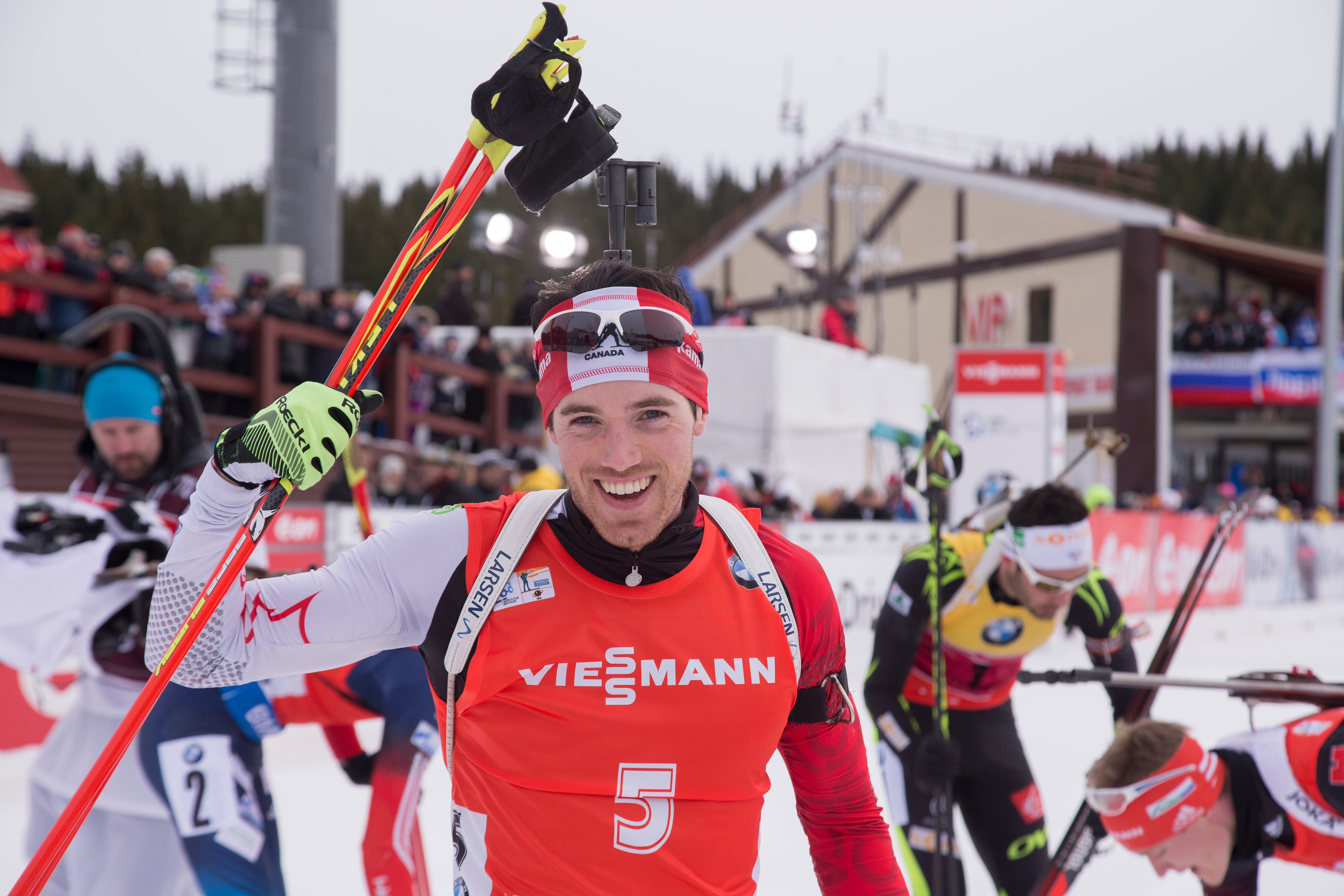
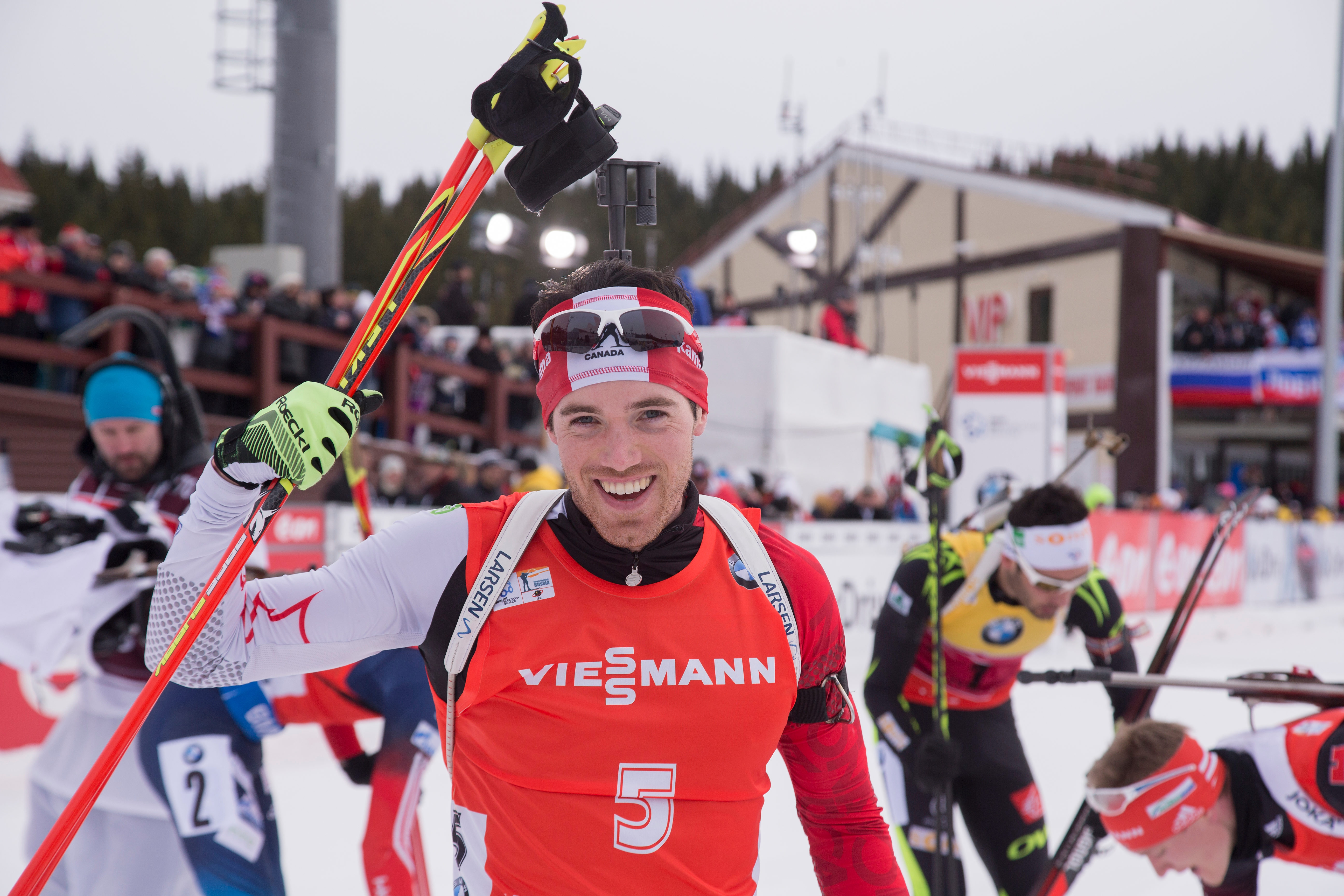
Nathan Smith celebrates after becoming just the second Canadian man to ever win a biathlon World Cup, after winning Saturday’s 12.5 k pursuit in Khanty-Mansiysk, Russia. (Photo: Biathlon Canada/NordicFocus.com)
When Nathan Smith crossed the finish line of Saturday’s 15 k mass start in Khanty-Mansiysk, Russia, he became just the second Canadian man in history to win a World Cup biathlon competition.
Smith had already had a record-breaking season. He won silver in the 10 k sprint at World Championships in Kontiolahti, Finland, making him the first Canadian man ever to medal at a Championships. It was the first podium of his career, but certainly not the last.
So when he finished fifth in the sprint in Khanty-Mansiysk, 34 seconds out of the win, Canadian staff knew that something special might happen in the following pursuit.
“I think he actually had a better opportunity for a good race in the [Khanty] pursuit versus after the second place after the World Championships,” Biathlon Canada High Performance Director Chris Lindsay said. “I think that the excitement and the novelty of what was an incredibly important result [at World Champs]… really didn’t set him up well for being able to carry through on the second day of racing.”
But in Khanty-Mansiysk, Smith was able to rely on a season’s worth of near-podium experiences, and he raced like someone who belonged at the top. That netted him a 24-second win.
“It feels really good to have a second medal on the results,” Smith said after the race. “It gives a little bit more credibility to my World Champs medal, like it wasn’t just a fluke. I can consistently put down medal-potential results.”
Plenty of North American biathletes have shown the ski speed needed to win a World Cup, but it takes more than just speed to actually do it. By coming so close a few times this season, Smith learned to do what it took on Saturday – for instance, leading Martin Fourcade and Anton Shipulin around the course.
Canadian head coach Matthias Ahrens cheering from the range during Saturday’s race. Because of budget concerns, Biathlon Canada only sent two staff members – Ahrens and head service tech Tom Zidek – to support the team in Khanty-Mansiysk.
“The more time that you can play up at the front of the pack, the more you realize that there’s not so much difference between what the top athletes are doing on the ski trail compared to what guys in the top 30 are doing,” Lindsay said. “When you need to step in front of somebody and take the lead, you don’t second-guess the choice to do it. Whereas the first time you’re up at the front of a pack skiing with athletes who are your peers but also in some ways your heroes, it can be difficult to assert yourself.”
Watching the win happen already had direct consequences for the team: Rosanna Crawford said that it immediately motivated her to do better, and later the same day she went out and climbed from 28th place to 13th in the women’s pursuit, her best result in weeks.
“Not only is a big step forward for him to prove to the World that he can be a consistent podium contender, but it’s also great for our team and will be a big motivator for us all when we start training again this spring,” said Smith’s teammate Brendan Green, who finished 23rd in the pursuit. “Nathan and I have been training together since we were 14 years old and it’s been awesome to see his progress over the years and especially in the last couple of seasons.”
Funding… Or Not
While earning a win instead of only a second-place finish might seem like an even bigger boost in the profile of Canadian biathlon, the national team’s biggest funding partner doesn’t see it that way.
Own The Podium (OTP), and public-private partnership which determines high performance funding for Canadian sports, focuses only on medal-worthy results at World Championships and Olympic Games, and does not consider podiums in regular season races as criteria for funding a sport.
“Medals at the World Championships and the Olympic Games are really what counts,” Lindsay said. “Our funding partners and our performance partners love to see that we are getting those medals at the critical competitions and are happy other evidence of success. Certainly medals and top-5’s, top-8’s consistently are signs of other success, but if that success can’t translate into success at the World Champs and Olympic Games they aren’t counted with the same weight.”
Luckily, Smith won that silver medal at World Championships. If Biathlon Canada sees an increase in OTP funding next year, it’s likely thanks to that – and that might be why Smith’s finish there was so exhaustingly significant. When he got the medal, he knew what it meant to his team, which has not had a World Championships or Olympic medal since the time of Myriam Bédard in the early 1990’s.
Biathlon Canada has a miniscule budget, with $1.1 million for 2013-2014 for high performance including salaries. Not only is the sport not massively popular in the country – a North American problem also faced by U.S. biathlon – but without any of those championship medals to call on, it seemed to fall at the bottom of OTP’s priority list.
Last February, the Banff-based Crag and Canyon reported that the federation has been running a deficit for the last five years, and wrote that “This year’s deficit amount falls somewhere between $100,000 and $150,000.”
While budget problems plague North American biathlon, Canada has it harder in some ways. For instance, according to the U.S. Biathlon Association’s 2013 990 Form, USBA paid over $368,000 to its three highest-paid employees combined (head coach Per Nilsson, High Performance Director Bernd Eisenbichler, and shooting coach Armin Auchentaller); Biathlon Canada had just $375,000 (which translates to less than $300,000 U.S.) for all its high performance staff combined, including the director, coaches, and technical staff.
That leads to situations like the team had last weekend, when it sent only its top three athletes to the far-flung Siberian venue of Khanty-Mansiysk instead of a full team. And to support them, only Ahrens and head service tech Tom Zidek were flown to Russia.
“Tom was up until 11 last night at the site testing, and then the shuttle service stopped before he got to the bus,” Smith said after his winning pursuit. “So he had to walk an hour back to our hotel. That’s the level of commitment that can make a big difference in the end for our results.”
It’s satisfying to win when other countries have ten times the staff and orders of magnitude more money available for high performance.
“It feels kind of good,” Smith said. “It’s like we’re right in their faces. Some of those teams have guys who basically just stand around and hold jackets and I don’t know, keep seats warm. On our team, even when we have a full support squad, like at World Champs, everyone is pretty busy doing stuff. We’re still a small team even then.”
But it’s also frustrating. What might be possible with a bigger budget? Ahrens wish he could find out.
“I definitely would say it is frustrating, mainly because the competitiveness of the biathlon World Cup,” Ahrens said. “It is just amazing how strong the field is, both on the men’s and the women’s side. You have thirty athletes really fighting for the podium and compared with other sports, where you really have maybe five contenders fighting for a podium. It’s gone to such a high level that there is no country out there not doing this very professionally. It’s getting tighter and tighter. If you just look at the results from yesterday in the sprint, the top 60 were within two minutes. A year ago or two years ago, that was usually around 2:30, so it’s amazing how the sport is developing.”
That’s why the hope is so strong that OTP will recognize Smith’s results and reward the team that helped him get there.
“The fact that he medaled at World Championships in Finland is huge and I really hope this will help boost our federation’s funding a bit,” Jean Philippe Le Guellec, the last (and first) Canadian man to win a World Cup, wrote in an email. “The next step is to have others follow his footsteps.”
Le Guellec was an obvious choice to be the guy to finally do it for Canada. He had already notched a best-ever result for a Canadian man at the Olympics in Vancouver in 2010, finishing sixth; in Sochi, Russia, in 2014, he upped that mark to fifth place.
It was with appreciation but also dismay that the biathlon community said goodbye to Le Guellec when he retired after the Sochi Games. But the gold the team had been mining was still right there in the team he had been part of, the Quebecois star explained.
“Funny, because I was told it was the end of an era when I retired,” Le Guellec wrote in an email on Sunday. “But this is simply, and clearly, the start of a new one… I was ecstatic but not surprised. With the season he had last winter and the effort he puts in training, I had hopes that he would do well this season. He’s the most consistent of us all as well. Knocking at the door often in the beginning of the season was making it a question of time until he climbed on the podium. I’m just pumped for him it happened sooner rather than later AND repetitively!!”
Smith isn’t the only Canadian who might be showing up on the podium next year. Rosanna Crawford came close this year, finishing fourth and fifth at the beginning of the season; Megan Heinicke had four top-15 performances; and Brendan Green was one of the most consistent performers after Christmas, having only two results out of the top 30 and finishing in the top 21 in every race at World Championships.
“It’s the same with Brendan [Green] and Rosanna [Crawford],” Smith said. “They are pretty consistently at the level where if they have a really good race, they could podium too.”
Lindsay and Ahrens agreed that Canada’s pipeline is in better shape than it often has been in the past.
“I’m really happy and not just by those two senior athletes who have really gone to the top of the pack, but also our upcoming younger athletes like the two Gow brothers, Macx Davies,” Ahrens said. “They have put a lot of effort of course in training, but they are part of our achievements. I look at the two Gows as being a really important part of our relay team…. If I look at this, it’s actually the younger athletes now, they’re coming in at a higher level then the young athletes came in ten years ago.”
Ahrens has personally seen the long-term development it took to get Smith to the top of the podium. Despite being hired as head coach only in 2010, he has known Smith much longer.
“I must say for me, it’s just an amazing experience,” Ahrens marveled. “Especially Nathan and Brendan, I started coaching them 10 years ago when they were still juniors, when I took the position for junior national team coach. So I really appreciate that I could grow with them and they could grow with me, and it has been an amazing journey up to this point.”
He hopes that means that some of the newer team members will eventually follow in Smith’s footsteps.
“That is always my hope, and I believe in that,” said the head coach. “Hopefully they stay with the sport and they can be supported enough that they can afford staying in the sport. That’s always a challenge for us. I think too often, athletes drop out too early. We know the highest performance age is, while it’s getting younger, it’s still around 27 years of age.”
Smith is 29 years old, and he was 26 when he watched Le Guellec climb to the top step of the podium on a windy afternoon in Sweden.
He hopes that his own success can do the same thing for the younger members of his team.
“You can make surprises happen,” he said. “[JP] surprised everyone that week; I surprised everyone last week. Neither of them should have been surprises, because JP had been close to the podium many times, but it really sinks in when someone actually does it. Then you see, oh yeah, I train with him. I can beat him in time trials sometimes. There’s no reason why I couldn’t podium either.”
Nathan Smith of Canada celebrates as he crosses the finish line all alone after the 12.5 k pursuit in Khanty-Mansiysk, Russia, for his first career World Cup victory. (Photo: Biathlon Canada/NordicFocus.com)
Nathan Smith has come close to winning a World Cup before. He’s just never quite done it.
The 29-year-old Canadian biathlete has been on the podium – he won a silver medal in the sprint at World Championships two weeks ago – and he’s been in podium position late in the game in pursuit and mass start races. That experience showed on Saturday in Khanty-Mansiysk, Russia, when things finally came together and Smith notched his first win, a 24-second victory over Benedikt Doll of Germany in the 12.5 k pursuit.
“I’ve felt good since taking a few easy days after Kontiolahti, and I knew that since I took an easy day yesterday I should be feeling good today,” Smith said. “I had that feeling in warmup too.”
Right from the start, Smith raced like someone who knew he belonged at the top. He cleaned target after target, and skied aggressively and confidently on the trails. At one point he pulled a group that included Martin Fourcade of France and Anton Shipulin of Russia – two of the sport’s biggest heavyweights – around for almost the entire 2.5 k loop.
“I passed Martin at one point,” Smith said. “I guess he didn’t want to lead, so he made me lead for a little while. I would have rather not, but he was sneaky about it. It was okay though– I didn’t want guys catching us from behind.”
Smith on course, all by himself. He had the 14th-fastest ski time of the day despite taking it easy on the final loop. (Photo: Biathlon Canada/NordicFocus.com)
It was when Smith cleaned the third shooting bout, and the first standing one, that it began to really look like he could take home the win. When his competitors missed shots, Smith headed out onto the trails alone. And the diminutive Canadian looked very much alone as he pushed through the loop, trying not to lose time to the chasers.
When he came back onto the range, he had a 15 second advantage. He could take his time, as long as he hit all his shots; a penalty loop, which usually takes a bit over 20 seconds to complete, would put him in jeopardy of losing the lead to someone behind him, should they shoot clean.
“I felt pretty nervous,” Smith admitted. “I definitely had a little flashback when I was coming into the stadium of Östersund earlier this season when I was in third, I think, and then I totally bombed the last standing. I missed three. I was a little bit nervous about that, but I think experiences like that also help you. I could really clear my mind coming into the lane, and I did a really good job focusing on the task.”
Smith didn’t clean. He picked up his first penalty of the day, and headed to the penalty loop. The expression on the face of Canadian Head Coach Matthias Ahrens, who watched the shots from behind a scope, was ambivalent.
Smith, focused on the range.
“I was still nervous,” said Smith. “I didn’t know how those other guys were going to shoot. I’ve seen Martin hit 20 out of 20 in gale force winds. He’s the best shooter on the World Cup. I think him and Shipulin were fighting for the [World Cup] overall so I think maybe that played to my advantage a little bit and threw them off their game on that final bout.”
Behind Smith, conditions on the range remained dicey – or maybe even got dicier. First Fourcade, then Shipulin, then Arnd Peiffer of Germany picked up two penalties apiece.
Doll, who came into the range in fifth place, had only one penalty, like Smith. He skied out of the penalty loop into second place, 37 seconds behind the Canadian.
“I wasn’t totally relaxed,” Smith said. “We only have one support guy here, Tom [Zidek, the head of the service team], and so I didn’t get that many splits. I just got one leaving the stadium when Tom said those guys were still in the loop. So I knew I had maybe 25 seconds. I kept going hard until the last climb and then I knew I was safe.”
It was a stunning margin for Smith, who was able to cruise around the final loop and enjoy his trip into the finishing lanes, a trip he had dreamed about for so many years.
“It was kind of surreal to be skiing by yourself on the last lap,” he marveled. “Usually your first win, you’d think it would be a nailbiter, right to the line and somehow outlunge the guy. It was kind of awesome to have a buffer where I could enjoy the final finish stretch and have that moment.”
Behind him, Doll was just as ecstatic to finish second. He was overcome with emotion as he crossed the line. Before this weekend, 24-year-old Doll had never been on the podium – he had a collection of top-10’s but as recently as last season was also competing at second-tier events like European Championships.
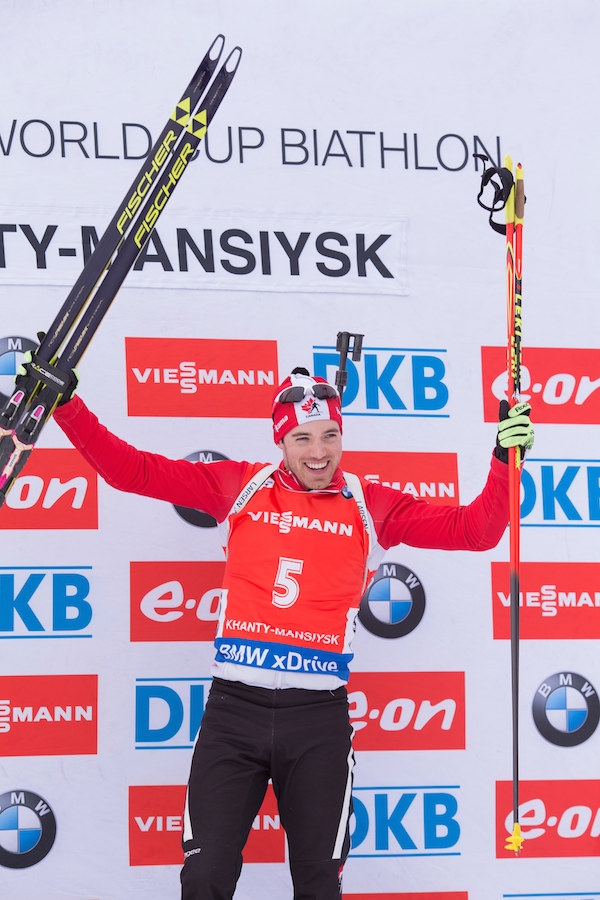
Smith celebrating his first trip to the very top step of the podium. (Photo: Biathlon Canada/NordicFocus.com)
Doll now has two podiums to his name after finishing third in the sprint, and is asserting his name as one to add to his teammates Simon Schempp, Peiffer, and Erik Lesser as being among the top Germans.
“I didn’t imagine it before the race,” he said in a press conference. “I said, okay, I just want to do my job, especially at the shooting range…. Standing, I had two times one mistake. In the last stage I said, okay, one mistake. I saw Martin and Anton in the [penalty loop] and I said, one [loop], it will be fourth or fifth place. I made my round and when I came out and saw, okay, second place, I was so excited! I gave everything.”
After completing their penalty loops, Shipulin and Fourcade had hit the course together. They left Peiffer behind as they tried to one-up each other on the trail. Fourcade is often the favorite under such circumstances – his explosive sprint speed can allow him to leave competitors behind in a matter of meters, when he decides to turn it on – but today, it was all Shipulin.
The Russian extended his lead coming around the final corner into the finish, and never looked back. He gave it his all and left Fourcade in the dust.
“I knew Martin was a very strong rival, and I had a choice,” Shipulin said in the press conference. “Try to catch up with Benedikt, and maybe not catch up because he’s in very good shape now, or save the power for the final rush… I decided to keep it for fighting Fourcade. It was quite cool that Russia was on the podium.”
“In the stadium Anton was just a bit faster than me,” Fourcade said in a post-race video interview with the IBU media team. “We both know he is powerful at the finish.”
Another Two Globes for Fourcade, Plus Wax Drama
Fourcade, though, still celebrated as he crossed the line. His result, compared to the results of others, means that he’s has clinched the overall World Cup title for the fourth time in a row.
“That was my main goal this season,” he said. “I’m full of happiness because I have these trophies. But I’m also not satisfied because of the fourth place…. With the sprint and pursuit globes and the overall World Cup globe for the fourth time in a row, that is more than a dream for me. I will enjoy this, this time.”
There’s still one more race, a mass start on Sunday, and other positions are up for grabs. Shipulin has clinched second place, and Jakov Fak seems to have a good hold on third, but other positions may shift.
Fourcade made history, as no other biathlete has ever won four World Cup Total Score titles in a row. If he can win two more, he will match Norwegian great Ole Einar Bjørndalen for the number of total titles. To steal Bjørndalen’s individual race win record, though, he’ll have to stay in the sport a long time: Bjørndalen has 93 wins and Fourcade just 37; this season he won eight races, at which rate he’d have to keep racing for seven more years with the same level of success.
On Thursday after winning the 10 k sprint, Fourcade enjoyed a reindeer-drawn victory lap in Khanty Mansiysk, Russia. He now has a crystal globe to celebrate as well. (Photo: IBU/Evgeny Tumashov)
One of Fourcade’s competitors, and a previous World Cup Total Score winner, Emil Hegle Svendsen of Norway dropped out mid-race. In the Norwegian press, Svendsen blamed it on his skis.
“I knew early on that skis were not working optimally,” he told NRK. “I’ve obviously made a wrong choice.”
Indeed, Svendsen had just the 51st-fastest ski time on his first loop (he dropped out partway through the third loop). Other Norwegians didn’t have such bad skis – or at least did not complain as much. Tarjei Bø had the 19th-fastest ski time on the day and moved from 50th place up to 11th to lead the Norwegian team.
Bjørndalen, who shot perfectly in Thursday’s sprint but only finished ninth, and was then undone by poor shooting in the pursuit and slipped to 27th, said his skis were horrible in the sprint but fine today.
In fact, he used Smith’s success to argue that Norwegian expertise in ski preparation is no longer the top of the game.
“On a scale of one to 10, with 10 being the worst, [my skis] were 10 in the sprint,” he told NRK. “With the resources we have, it’s not okay that some other man has better skiing. Canada has one serviceman here [in Khanty-Mansiysk], so there must be some knowledge that they have that we don’t.”
Canadian head wax tech Tom Zidek gives Nathan Smith a hug at the finish line after Smith’s first victory.
Fourcade also complained about his skis.
“My skis were not so much gliding during the competition,” he said in the post-race video. “It was really hard for me to follow the other guys.”
While emphasizing that he did, in fact, have great skis, Smith also brushed off the idea that his success came because others were slowed by their equipment.
“Whenever anyone is skiing well and they have a good result, they are going to say that their skis are good,” he said. “When they aren’t feeling well, they’re going to say, oh, my skis, they weren’t the best. But our skis are consistently among the best.”
Asked about what that special knowledge was, Canada’s head wax technician, Tom Zidek, did a metaphorical shoulder shrug (he often has other servicemen to help, but with just three athletes in Khanty-Mansiysk for budget reasons, Canada sent only Zidek and head coach Ahrens as staff).
“I don’t know how I can do it and not Norway,” he told NRK. “The secret is to work hard and use your head.”
Nordgren 19th, Bailey and Green Top-30
U.S. Biathlon’s Leif Nordgren had placed 21st in the sprint, and made his way up to tenth place after the final shooting bout. Nordgren missed three of his ten prone shots, but then cleaned every standing target to climb his way through the field.
“Today I was really disappointed to have missed 3 in prone,” he wrote in an email. “That’s not usually a problem for me and it wasn’t really that windy today like it has been in training the past few days. But I was able to turn it around in standing and save myself with 10 hits in a row. In a pursuit it really helps to hit the targets at the end of the race, if you miss in the beginning you still have a lot time to make up that deficit, so hitting in the end is a big bonus.”
Lowell Bailey of the United States racing to 22nd place in the 12.5 k pursuit in Khanty-Mansiysk. (Photo: US Biathlon/NordicFocus.com)
Unfortunately he was out of gas, having battled back from a head cold recently, and slipped to 17th place in the final loop. That still represented, however, his second-best result of the season, after a 16th-place finish in Nove Mesto, Czech Republic, earlier this year. It also qualified him for the 30-man mass start competition on Sunday.
“For skiing, I’m totally dead now,” Nordgren wrote. “I’ve had a little head and chest cold the last few days, so I think its maybe taking me a little longer to recover than normal, but its also getting to the end of a long season and there’ve been a lot of races recently so I’m sure that’s part of it too. Tomorrow is my first mass start of the season, first in about 4 years actually, since WCH were here in 2011. I’m really excited for it, I’m a lot better biathlete than I was back then, so I think I can have a decent results tomorrow and end the season on a really high note!”
It’s a return to form for Nordgren, who had breakthrough races and his first top-20’s at World Championships in 2011.
“Overall he showed a really high level over the last weeks and I think he would have done the same exact thing on any other venue as well, but of course it’s true that he has good memories from WCHs 2011 and really likes the course there,” USBA Chief of Sport Bernd Eisenbichler said of Nordgren’s performance. “He is good shape and would have done the same thing every where else. Overall I am very happy with his development. After a few rough years, he really made this big step forward now and it will keep going up from him from here- I am convinced about that.“
His finish put him just ahead of teammate Lowell Bailey, who moved from 51st after a frustrating sprint race all the way up to 22nd by way of shooting 19-for-20.
“Today’s race was bittersweet for me,” Bailey wrote in an email. “I was happy with my performance but it wasn’t enough to get me into the mass start tomorrow. It would have been nice to have my great performance yesterday instead of today! Anyway, it’s a good way to end the season. Now I have to shift gears and look forward.”
The final U.S. competitor, Tim Burke, finished 53rd with six penalties.
The other Canadian entrant besides Smith, Brendan Green, moved from 30th up to 23rd with just one penalty.
“Now at the end of a long season and three months away from home, I’ll take today’s result,” he wrote in an email. “Normally I would have expected more from myself on a day like today but I’m definitely running on empty and my body is ready for a break. I was happy with the performances I’ve been able to execute over the past few weeks, but at the same time I’m disappointed with the drop in my ski form and having to deal with some abrupt underlying issues with my back throughout the season, especially prior to World Championships.”
Green explained that he will have medical staff try to help re-evaluate his back problems, which stem from a slipped disc a few seasons ago and are proving difficult to permanently resolve, once he gets back to Canada.
One thing he is happy with is that 19-for-20 shooting, which has been more the rule than the exception for the second half of the season.
“My shooting since Christmas has been incredibly solid and I’m extremely happy about that,” he wrote. “I had a bit of a tough start to the season with my shooting prior to Christmas, but after re-thinking a few aspects in my approach to shooting and making a couple of changes it really seemed to come together. This is the best shooting of my career and I’m hoping I can carry it forward to next season.”
Darya Domracheva of Belarus, here winning a pursuit in Antholz, Italy, was at it again, capturing the penultimate win of the 2014-2015 season in a pursuit in Khanty-Mansiysk, Russia. (Photo: Fischer/NordicFocus)
Darya Domracheva had a few little hangups en route to winning Saturday’s 10 k pursuit in Khanty-Mansiysk, Russia.
The Belorussian seemed unfocused: on the second shooting stage, which is prone in pursuit format races, she came into the range first, skied onto the mat on point one, and then set up to shoot standing. Rival Kaisa Makarainen set up in prone on mat two, and Domracheva eventually realized her mistake just before firing her first shot.
“I think today I was maybe too much into the race,” Domracheva said in an interview with the IBU’s Jerry Kokesh. “I think the spectators rescued me today with their loud cheering. In understood that something wrong was happening on the shooting range.”
Then, in the third shooting stage – which she cleaned, perhaps why she was so overexcited to shoot standing – she nearly dropped her rifle as she went to sling it back over her shoulders.
Despite the seemingly wacky errors, Domracheva was perfect when it counted. A miss after that standing-to-prone transition, understandable since she was undoubtedly flustered, resulted in her only penalty loop of the competition. Domracheva cruised to a 15.7-second win and inched further ahead of Makarainen in the overall World Cup standings. Domracheva is now 32 points ahead of the Finn, and with one race to go it’s hard to see her losing the crown.
“It’s a big emotional win,” she said. “I felt really good physically, and also mentally good, but of course it’s the end of the season and you feel a little bit tired. But we keep all of our power to fight.”
Behind her, two young Germans – 21-year-old Laura Dahlmeier and 20-year-old Franziska Preuss – fought for podium positions. Dahlmeier left the range with a 3.2 second advantage on her younger teammate, but Preuss caught and passed her on the trails, leading into the final climb into the stadium.
Dahlmeier stayed on her tails, but couldn’t pull even and pass until the pair entered the finishing lanes. Even there, they were nearly inseparable, sprinting side by side to the finish. Dahlmeier prevailed by 0.2 seconds.
“Franziska was ahead and then I was ahead,” Dahlmeier said in a press conference. “We were touching skis on the uphill. It is nice that we are both now on the podium.”
“We are teammates and friends,” Preuss said. “But here at the end of the season, it is nice to be on the podium. There is no pressure now that the World Championships are over.”
Rosanna Crawford, the only Canadian woman to travel to this far-flung Siberian venue, moved from 28th up to 13th with 19-for-20 shooting.
“I was pretty disappointed after World Champs, I had set some high goals and didn’t meet any of them,” explained Crawford, who had top-six finishes earlier this season but a best finish of 25th at the World Championships which ended last weekend. “I was more than ready to head home and just not in a good head space going into Russia. Going from Finland food to Russian food is bound to make anyone a little grumpy! I was trying really hard to turn the motivation around for the races and didn’t quite make it yesterday. Tom kept telling me I seemed out of it and to put a smile on my face.”
Despite being tired after a grueling World Championships, she found her energy come back more and more in the past few days. In the final loop, she moved from 15th up to 13th. Being a stronger finisher is something she’s proud to have accomplished this season.
“This year I’ve been able to be strong on my last loop and really pace my self well,” she wrote in an email. “I think this has come with age and learning my body and getting fitter as an athlete. I now look forward to that last loop battle rather than dread it! Our skis were great today so I knew if I could hang onto that group of girls I could take a few of them on the last up hill. Sprinting is something [sister] Chandra has taught me well, and downhills!”
With one race remaining, Crawford sits in 21st place in the overall World Cup standings.
“It’s funny: my goals this year was to consistently place in the top 30, a few top 15 and top 10’s and I really wanted to be on the podium at least once,” she wrote. “I did achieve all but the last one. I was only outside of the top 30 two or three times I think (and Nove Mesto when I cross fired). Since my season started off so great with top form it was hard to come back down to top 30 level. This season has been my best yet and I am happy to finish it will a good race today. I can hit the targets!!”
For the United States, Susan Dunklee moved from 26th up to 10th with clean prone shooting, but missed five targets over her two final standing bouts and slid back to 23rd. She had the second-fastest ski time of the field, but five penalties were too many loops to make up.
“Today’s plan was to approach the race like a biathlon race and not just a ski race,” she wrote in an email. “That meant giving myself the time and space necessary to approach the range with 100% mental focus. I slowed coming through the stadium, took lots of deep breathes, checked for a solid feeling in the setup, and thought about my trigger pressure. I think I executed this plan very well for all the stages. It worked great in prone. Obviously something was slightly off in the standing and I’m not sure what it was.”
She was joined by Hannah Dreissigacker, who after a career-best 14th-place finish in the sprint missed two shots in each prone stage and one in the final standing stage to end up 38th.
“I actually wasn’t too nervous today, I was mostly just excited to be doing a pursuit with such a good start spot!” she wrote in an email. “It was a bummer that prone went so badly…its never fun to see yourself moving backwards like that in a pursuit. But I’m happy with how standing went!”
It’s all part of the learning process, said USBA Chief of Sport Bernd Eisenbichler.
“Hannah had some good positions for starting pursuits this season, and she will learn out of every single one and soon will go through there as well and keep her position and even climb up,” Eisenbichler wrote in an email. “It’s important to state that she had kind of a muscle spasm yesterday, so was not in full power today. I a, not worried about her for tomorrow. The coaches will find the right words to get her prepared for that special race and it’s just a really great way to end the season and see what’s out there for the future for her.
Despite the errors, Dreissigacker was still in the points, and her result was good enough to qualify her for the 30-woman mass start which will conclude the 2014-2015 season. It will be her first World Cup mass start.
“I’m psyched and kind of amazed that I still made the mass start after today’s race!” she wrote. “It is a nice surprise to end my season with! It has been a goal of mine for a while to make a mass start. I’m hoping for some better prone shooting tomorrow, and also that my legs miraculously feel fresher than they did today.”
All three North Americans will compete, and that’s something Dunklee is looking forward to.
“Two US women in a mass start- that hasn’t happened in a few years,” Dunklee wrote. “Hannah has come on strong this winter and it’s going to be a thrill to toe that start line together with a teammate!”
With teammate Leif Nordgren appearing in the men’s mass start for the first time in four years, it’s an exciting time for U.S. biathlon.
“We approach every race the same way and try to get the best result, and it’s great to see that Hannah and Leif even after long season and a lot of traveling, did that this week again,” Eisenbichler wrote. “They both knew that if they have a good sprint race, like they showed this season a couple of times, they have a really good chance to get in the mass start. They both wanted this to get accomplished for the whole past season- this will be a great motivator for the coming training period and shows that both of them made a good step forward and are on the right track.”
Hannah Dreissigacker (US Biathlon) achieved a career-best 14th in the last sprint of the season in Khanty-Mansiysk, Russia. She is pictured at IBU World Championships on March 13 in the women’s relay. (Photo: USBA/NordicFocus)
When Hannah Dreissigacker looks back at this season, she’ll probably remember Russia over Finland — that is, the last IBU World Cup races of the season in Khanty-Mansiysk over World Championships in Kontiolahti.
Or at least that’s where one of her fondest memories will stem from. After more than a week of headaches and insomnia at World Championships in Finland, the 28-year-old US Biathlon A-teamer rebounded to place 14th in Friday’s 7.5-kilometer sprint in Khanty-Mansiysk.
It was the best result of her career, topping her previous best of 16th in the World Cup sprint last month in Oslo, Norway.
“I have to admit I was very pleasantly surprised by today’s race in lots of ways,” Dreissigacker wrote in an email on Friday. “I had a pretty frustrating World Champs in Kontiolahti, with lots of bad shooting and then I was having trouble with insomnia and headaches by the end of my time there, and it had me feeling pretty down.”
At World Championships, Dreissigacker placed 61st in the sprint, narrowly missing the top-60 cutoff required for the pursuit, and finished 67th in the 15 k individual.
“Here in Khanty Mansiysk I’ve been sleeping better and pleasantly surprised by the weather (it’s not freezing cold), the food (there are good vegetables!), and the place in general (it’s a weird place, but weird is also interesting),” she explained. “I’ve still been having headaches, but I’ve been trying to reset my approach to just be confident and enjoy the last races of the season.”
She started 40th on an unusually warm, 40-degree Celsius evening with what an IBU press release described as a “stiff breeze” in the range.
With one miss in her first shooting, Dreissigacker left prone in 43rd overall, 47.6 seconds behind the German race leader at the time, Laura Dahlmeier, who started just ahead of her in bib 39.
One loop later, the American jumped into 14th with a perfect standing stage.
“I felt OK skiing but not really great, and prone was OK, but I’m definitely most happy about my standing shooting,” Dreissigacker wrote. “I had a little bit of wind and had to take a few extra breaths and really fight for those targets, and that made it feel extra good to hit them!”
She headed out on her last loop feeling energized and excited by her shooting, but not quite expecting 14th place.
“I definitely wasn’t expecting it to be a new personal best…but I guess that the whole field struggled with shooting today so it worked out well!” she wrote.
Dreissigacker finished 1:26.4 behind winner Kaisa Mäkäräinen of Finland, who started 36th and made up more than 12 seconds on her final loop to win by 14.2 seconds in 19:49.1. Mäkäräinen cleaned prone and missed one standing — just like Dahlmeier — and Dahlmeier lost her lead after the second shooting, trailing Mäkäräinen by 1.7 seconds with 2.5 k to go.
The women’s 7.5 k sprint podium at the final IBU World Cup of the 2014/2015 season in Khanty-Mansiysk, Russia. From left to right: Runner-up Laura Dahlmeier of Germany, winner Kaisa Mäkäräinen of Finland, and Darya Domracheva of Belarus in third. (Photo: IBU/Evgeny Tumashov)
The German finished second, 1.3 seconds ahead of Darya Domracheva of Belarus, who overcame two penalties (one in each stage) to place third (+15.5). The overall World Cup leader who is now just nine points ahead of Mäkäräinen, Domracheva skied the second-fastest course time overall, after Mäkäräinen.
“I am happy to be back on the podium and to be back in Khanty-Mansiysk,” Domracheva told the IBU. “Like everyone, the holidays are coming and that is something nice to look forward to.”
Mäkäräinen explained that she experienced more wind in prone than standing, but felt a shakiness in her legs for the second time this season during her second stage.
“Still, I am happy to be back on the podium,” Mäkäräinen told the IBU. “My legs were really gone after the World Championships … the physiotherapist did a lot of work on them this week. Last night I finally felt like I could go today.”
For Dahlmeier, 21, it was her sixth podium of the year.
“My results are better than I expected earlier in the season; I had hoped for one or two podiums this year,” she said. “All of these last races have been really almost perfect … I hope to have more good races for the next two days.”
In Saturday’s 10 k pursuit, Mäkäräinen will head out first, 14 seconds ahead of Dahlmeier. Domracheva will start 16 seconds back in third, and Dreissigacker will follow 1:26 back in 14th.
“I’m just going to try to keep my confident approach to shooting, and have fun out there!” Dreissigacker wrote.
U.S. Women Secure Nation Cup Top 15
Susan Dunklee (US Biathlon) racing to 26th in the IBU World Cup 7.5 k sprint on Friday in Khanty-Mansiysk, Russia. (Photo: USBA/NordicFocus)
Of the two American women competing in Khanty-Mansiysk, both she and Susan Dunklee qualified for the pursuit. Dunklee placed 26th on Friday, 1:49.4 after Mäkäräinen, with four penalties: one prone and three standing. The 11th starter, Dunklee made up four places on her final loop and clocked the fifth-fastest course time overall.
“I probably sound like a broken record after last week — my ski shape feels phenomenal right now and would put me in a very high position if I were to shoot well,” Dunklee said in a US Biathlon press release. “Unfortunately, the standing got the best of me this time.”
With a top-15 finish in the Nation Cup, the U.S. women earned four quota spots for next year’s IBU World Championships, according to the release.
“Today’s sprint was our last opportunity to score team Nation Cup points and we had a close battle going for the top 15,” Dunklee explained. “We fought for every place. I am so proud of Hannah putting together her career-best result today and we sealed 15th.”
Dunklee will start Saturday’s pursuit 1:49 back with Russia’s Daria Virolaynen, who finished 0.5 seconds ahead of her in 25th.
Canada’s lone starter, Rosanna Crawford placed 28th (+1:54.7) with three penalties: one prone and two standing. She started 21st and rose four places from 32nd to 28th overall during her last loop. Crawford’s range time ranked seventh.
Nathan Smith (Biathlon Canada) racing to Canada’s first men’s medal at IBU World Championships on March 7 in the 10 k sprint in Kontiolahti, Finland. Smith achieved silver for his first career podium at the World-Cup level. (Photo: Fischer/NordicFocus)
Before this season, Nathan Smith had never experienced a flower ceremony at the IBU World Cup level before. He had heard the ballads and seen the podium from a distance, yet he hadn’t been the one being photographed from multiple angles, waving to the crowd and mom and dad back home while accepting several prizes.
By the end of 2014/2015, Smith’s starting to feel like its almost routine. The 28-year-old Canadian placed fifth in Thursday’s World Cup 10-kilometer sprint in Khanty-Mansiysk, Russia, for his second-best sprint result since finishing second at IBU World Championships earlier this month in Kontiolahti, Finland.
In early February, Smith broke out with a career-best seventh in a World Cup sprint in Nove Mesto, Czech Republic. While that didn’t put him in the top six required for the flower ceremony, his result in the next day’s pursuit did; he placed fifth for a new high.
Almost exactly a month later on March 7, he became the first Canadian male to medal at IBU World Championships. He earned silver in the sprint and stood on the second-highest step on the international podium.
In the days that followed in Kontiolahti, Smith placed 13th in the pursuit, 44th in the individual (with five penalties) and 23rd in the mass start.
For him, the last World Cup in Khanty-Mansiysk was about ending on another high note. He achieved that with 90-percent shooting, missing one prone target and cleaning standing with the third-fastest range time overall. The 24th starter, Smith finished 34 seconds behind winner Martin Fourcade of France, who put down the fastest time of 23:47.0.
“I knew if my skiing came back up that a top-10 should be more than possible,” Smith explained in an email on Thursday. “I would say I actually exceeded my expectations a little. I would’ve been pretty happy with a top-16.”
Ranked 37th after prone, the Canadian moved into ninth overall after hitting all his standing targets. He closed the race with the sixth-fastest last lap and clocked the 11th-fastest course time overall.
“I was really tired in the Mass Start at the end of worlds. I knew I was still in good shape after a great ski in the relay the day before, so I was hoping with a few easy days I’d be able to recover and bring my ski speed back up to where its been the last month,” Smith explained.
The Canadian team’s travel day from Finland to Siberia went “really smoothly,” he added. He slept most of his flight and had been sleeping 10 to 11 hours every night since.
“I kept training easy until [Wednesday] when I did some pretty hard but typical race prep,” he explained.
While gearing up for Thursday’s sprint, the first of three races in Khanty (with the pursuit on Saturday and the mass start on Sunday), Smith and his teammate Brendan Green pushed each other during short intervals on Wednesday.
“I went really hard up the big climb before the range and totally blew up while shooting,” Smith recalled. “So that was a good lesson and I was careful not to repeat that today!”
Heading into his last lap on Thursday, he heard he was only a few seconds behind the current leader — France’s Simon Fourcade at the time.
“I gave it my all and I had enough to grab first when I crossed the line,” Smith wrote.
Germany’s Benedikt Doll on his way to his first IBU World Cup podium in third in the men’s 10 k sprint on Thursday in Khanty Mansiysk, Russia. (Photo: IBU/Evgeny Tumashov)
Germany’s Benedikt Doll in bib 27 finished 15.7 seconds faster to bump him to second, after a clean prone and one miss standing, and Latvia’s Andrejs Rastorgujevs in bib 32 came up 0.3 seconds short of Doll to move Smith into third.
Martin Fourcade started 38th and consistently set the fastest times on course, cleaning both stages and finishing 18.3 seconds faster than Doll.
Russia’s Anton Shipulin, in the hunt for the overall World Cup title behind Fourcade, started 43rd and also shot a perfect 10-for-10, but came up 13 seconds short of the Frenchman at the finish. After prone, Shipulin was 7.1 seconds down to Fourcade, and before the final lap, he had 11.4 seconds to make up. He ended up second and remains second in the overall World Cup standings, trailing Fourcade by 117 points.
“I knew that I could be conservative today or go very hard,” Fourcade told the IBU. “I decided to not be conservative and not have any regrets. I am very happy to win here in Khanty-Mansiysk; this is the place where I won my first World Championship.”
While it was Fourcade’s eighth win this season, it was a first-career podium for Doll.
“At the beginning of the race I did not feel so good,” the 24-year-old German told the IBU. “After the start, I suddenly did not feel tired and my legs did not hurt. I felt like I could run and run; I never had this feeling before. … I am very happy; it is a big honor for me to stand on the podium with these two men.”
Overall World Cup leader and Thursday’s 10 k sprint winner, Martin Fourcade of France enjoys his reindeer-drawn victory lap in Khanty Mansiysk, Russia. (Photo: IBU/Evgeny Tumashov)
Smith took fifth to tie his second-best result and take part in the reindeer festivities that accompanied Thursday’s awards ceremony.
“It feels great, and it’s reassuring to know that I can fairly consistently be in it when I’m on,” Smith said of the flower ceremony. “I’m almost getting familiar with it?”
On Saturday, he’ll start fifth in the 12.5 k pursuit, 34 seconds after Fourcade. Germany’s Arnd Peiffer, who finished 0.4 seconds behind him in sixth on Thursday, will start with Smith. Fredrik Lindström, who placed seventh, will start two seconds later.
“The pursuit is going to be a really tight one. It will come down to shooting,” Smith wrote. “I’m in a nice pack so I’ll try and conserve some energy and knock down all the targets. Then see what I’ve got left for the last lap. I’m not focusing too much on the mass start yet, one race at a time, but I’m getting pretty close to top-15 overall, so that’s a goal I have in mind.”
He currently sits in 18th in the overall World Cup, 45 points out of 15th.
Canada’s other male in the sprint, Green placed 30th (+1:23.5) with a single standing penalty. Green started 47th and ranked 29th overall after both shooting stages, ultimately finishing in the top 30 with the 38th-ranked course time.
Nordgren Surprises Himself in 21st
Leif Nordgren led three Americans in 21st (+1:14) for one of the top-five results of his career. Like Green, Nordgren cleaned prone and missed one standing. He started 41st and came within reach of a top 20 on his final lap, finishing 1.3 seconds behind Bulgaria’s Krasimir Anew in 20th.
Leif Nordgren (US Biathlon) racing to 21st in the men’s 10 k sprint on Thursday at the IBU World Cup in Khanty-Mansiysk, Russia. (Photo: USBA/NordicFocus)
“I’m pretty surprised with this result today, and really happy about it,” Nordgren wrote in an email. “Since [Wednesday] afternoon I’ve started coming down with a little upper respiratory sickness, probably just from the travel from Finland. I started to get a pretty stuffy nose, itchy throat, and today I can feel it getting down into my lungs, as well as that awesome achy body feeling!”
With that in mind, he didn’t have any expectations for the sprint.
“I had no idea on how I’d feel,” he wrote. “Since it was the last race of the season and I just started to get sick yesterday I didn’t really think about not starting.
“I knew that good shooting would be key to making the pursuit, which is what I thought would be a hard enough task for the day,” he added, explaining that conditions were near-perfect. “I felt like I didn’t really have anything to lose, so I went as hard as I could right out of the start, and I think I actually had an OK time for the first loop.”
He shot conservatively in prone to hit all his targets, which worked. He pushed himself again on his second lap and stayed ahead of a chase pack, then entered the range for the second time where he left with a single miss.
“One miss wasn’t bad,” he wrote. “The last loop I pushed as hard as I could, I was definitely starting to die a little, but about halfway through I got caught by Shipulin and it was nice to have someone to hang on to for the rest of the loop.”
Four years ago in Khanty, Nordgren notched a career-best 17th in the mass start at the same venue. He also placed 21st in the individual race there that year. This season, he set a new career-best in Nove Mesto, placing 16th in the sprint.
“This is my favorite course on the WC tour,” Nordgren explained. “I’ve had a lot of good races here before, so that was good for my head … I’m looking forward to the next races, but hopefully I can recover and be feeling a little better going into the weekend!”
Also for the U.S., Lowell Bailey placed 51st (+1:54.2) with two standing penalties and Tim Burke was 55th (+1:57.3) with four total misses, one in prone and three in standing. Both made the top-60 required for the pursuit, and will start 1:54 and 1:57 back, respectively.
Tim Burke sprinting for the finish line ahead of Simon Eder of Austria in today’s 15 k mass start in Khanty-Mansiysk, Russia. Photo: USBA/NordicFocus.
What a difference a day makes.
In Saturday’s 12.5 k pursuit, Martin Fourcade of France – who had already wrapped up biathlon’s overall World Cup title by a huge margin – looked decidedly unlike himself, missing five shots and missing the win.
“It was great to see that Fourcade is indeed human,” U.S. biathlete Tim Burke wrote in an e-mail to FasterSkier after that race. “Biathlon is a crazy sport and anything can happen in a race. I am looking forward to one more chance tomorrow!”
But come Sunday, Fourcade was putting those missteps behind him. In the 15 k mass start, he was once again the unstoppable force to be reckoned with that has had competitors quaking in their boots all seasons. Instead of those painful five penalties, Fourcade only missed one of his twenty shots. That meant that he was never far from the lead.
Even after the second stage, when that penalty loop knocked him back 18 seconds and he slipped to seventh, it took him only 1500 meters to make up the gap and rejoin the lead pack. Now that’s some skiing.
“It was a lot of fun – it was almost perfect,” Fourcade said in the post-race press conference. “This year every time I won a globe I did it with a victory, so I am really proud. And today I had to do it to win the last crystal globe.”
The win gave Fourcade something almost unprecedented: he won all of the titles available, from the overall to each of the four discipline globes. The last person to do that was another famous Frenchman, Raphael Poirée.
“I am really proud to join Raphael Poirée, who was the only one to do it before,” Fourcade said. “I’m really happy to be close to this great champion. He was my idol when I was young.”
And despite the focus that it took to get him here, Fourcade made sure he enjoyed the moment, too. He took his time skiing the French flag down the homestretch to the cheers of the crowd.
Snowy conditions have made the range tough for the last two days; Burke has experienced a jamming rifle and blocked sights so far this weekend. Photo: USBA/NordicFocus.
“I really enjoyed it,” he said. “It was really pleasant, the whole race. We all know that it’s the last World Cup of the season and it’s a special moment, because you have to look forward to the next season, but also look back, too. It was a lot of emotions today.”
By the time the racers had shot the fourth time, Fourcade was on his own. But a little over 30 seconds back, there was plenty of fighting still to be done. A pack of five men all left the range more or less together.
Anton Shipulin of Russia led the way. He had been the only one to keep pace with Fourcade through three laps, but missed a shot in the last stage. As he exited the penalty loop, he was joined by Simon Eder and Dominik Landertinger of Austria, Emil Hegle Svendsen of Norway, and Burke, who was, as planned, making the most of his last start of the season.
“Unfortunately, the last loop turned into a lot of tactics because it was so windy and no one wanted to lead,” Burke wrote in an e-mail to FasterSkier and USBA. “I don’t normally like sprint finishes but I had no choice today.”
Shipulin fell behind, and was even eventually passed by Simon Fourcade and Tarjei Bø. The other four bided their time, but not to the extent that the chasers could pass them. While the Austrians had teamwork, Burke had already demonstrated that he was among the fastest skiers this week.
Svendsen, meanwhile, had missed the previous two World Cup weekends and was recovering from being sick. He hadn’t been able to break into the top 20 in either of the previous races in Khanty-Mansiysk, and it was a question whether he would be able to race like himself – the man who had won two individual gold medals at World Championships, besting Fourcade.
The podium ceremony: Fourcade on top, Landertinger, Svendsen, and Burke. Photo: Max Cobb.
“The last few weeks have been really relaxing,” Svendsen said in the press conference, at least half seriously. “After World Championships I was just lying in my bed and lying on the coach for three weeks. It’s not the best to come here after that, but for sure it was nice. I was enjoying every minute that I had to myself while others were struggling on the slopes.”
Nevertheless, Svendsen had powerful motivation to do well. He’s not used to sitting on the sidelines, and willed his way around the course.
“I wanted to have a good result in the last race,” Svendsen said. “The sprint and the pursuit were really bad, so I just tried to stay with the leaders. But for sure my shape is the worst I have ever been on the World Cup, so I only raced with my head, not my body.”
Would he be able to pull off a sprint like he did at World Championships and beat the others?
Burke, too, was hoping he could maneuver his way to the front.
“Man, I wanted that podium so badly,” he told the IBU news service at the finish line.
But in the end it was Landertinger who got a bit of a jump and snuck away to second place, four seconds ahead of the others. It was a nice reward for the Austrian, who along with the rest of the Austrian team had suffered through several sub-par seasons before this one. He had also gotten knee surgery this summer, and was happy to be back at full strength.
On top of that, the race today earned him third place in the overall standings, passing Jakov Fak of Slovenia. The two finished separated by just six points after an entire season of racing.
“For me it is perfect after two bad seasons,” he said in the press conference. “I had a lot of good results—I am very happy to go home with this second place.”
Svendsen, not fast enough to win, did manage to outsprint Burke for third place, leaving the American with the wooden medal.
“There were a lot of us there,” Burke said. “It was really tough. I gave it everything I had, so that’s what it is.”
At least he can say that he pushed Svendsen to the limit: the Norwegian collapsed at the finish and had to be helped away from the course. With so few reserves to rely on, this was a particularly difficult race, he said.
“I was so dizzy when I got to the finish,” Svendsen told Norwegian broadcaster NRK. “I fainted for a few seconds and was suddenly completely gone. It was hell. My body is not quite used to doing it this way… it’s not such fun when you’re in bad shape. It was on pure will, and my shape is complete ass.”
One consolation is that the performance left Burke in third place in the mass start rankings; that goes with third in the individual rankings as well and tenth in the total score.
“Today was a great way for to cap of a memorable season,” Burke wrote in the e-mail. “I achieved all of my season goals with getting back to the podium, winning a World Championship medal and finishing in the top 10 of the overall. Now I am already looking forward to next year’s Olympic season!”
Lowell Bailey also had a strong race, turning in strong skiing to finish 14th despite a penalty in each of the last three stages.
After the end of the season, and such a successful one for these men, it’s time to relax. But also, to get ready for new goals, and to find new motivation.
“Now I, and I think all of the other guys, are focused on the Olympics,” Fourcade said. “It’s my last goal in biathlon, the last goal of my career. I’m only 24 but I… yes. It’s wonderful.”
When Landertinger was asked what his hopes were for next season, he confirmed that Fourcade was not alone in his aspirations.
Gabriela Soukalova of the Czech Republic was speechless, but smiling, after winning the mass start in Khanty-Mansiysk today.
Before this season, Gabriela Soukalova of the Czech Republic had never raced into the top ten in a biathlon World Cup.
She had only ever stood on the podium in relays – and then only once, in Hochfilzen, Austria. The 23-year-old had never made it into the top 60 of the World Cup standings, and had only scored 39 points in her young career.
So earlier this season when she started winning, it was a surprise.
And this weekend in Khanty-Mansiysk, it was still a surprise. First Soukalova won the sprint, then the pursuit, and finally, on Sunday, used perfect shooting and the second-fastest ski time of the day to win the 12.5 k mass start by ten seconds to cap off the World Cup season.
“I would like to say nothing, because this is an impressive moment for me right now – it is perfect,” she said in the post-race press conference. “I said yesterday that the win was the biggest shock of my life, but now I can say that again… this is the biggest shock of my life!”
In other ways, though, it’s not so unusual that Soukalova should rise to the top. She has good help: her father, Karel Soukal, is a biathlon coach in Poland, while her mother (also Gabriela) was part of Czechoslovakia’s silver-medal cross country skiing relay team in the 1984 Winter Olympics in Sarajevo. Together, the two are Soukalova’s coaches.
“We were watching the race on the internet through our phone,” her mother told Czech newspaper Sport Aktualne. “It was pretty exciting. I didn’t think that she could win a third time. It’s a really great performance and I bow down before her.”
The difference for the young Czech this year is not only good shooting, like her perfect work on the range today, but much faster ski speed which has allowed her to be competitive where other shooting specialists, like Marie Laure Brunet of France, have been left constantly just out of the picture even when they clean.
The hat trick in Russia makes it four wins and two additional podiums for Soukalova, who will finish the year ranked sixth in the World Cup total score.
Despite her clean shooting and fast skiing, it wasn’t always clear that Soukalova was going to win; after the first stage she was 20 seconds behind the leaders. Even after the third stage, when she had made it up to second position, she was skiing more than 15 seconds behind Vita Semerenko of Ukraine.
But Soukalova skied her way up to the Ukrainian, and then Semerenko missed a shot in the final standing stage while Soukalova cleaned. For the first time in the entire race, she had the lead, and held it all the way to the finish.
Behind her, Marie Dorin Habert of France moved into second position with a clean stage of her own; she was 15 seconds back. There was a gap of another 25 seconds to Olga Vilukhina of Russia, then Kaisa Makarainen of Finland a few seconds behind her.
While Dorin Habert was safe in second, no amount of cheering by the home team’s fans could keep Vilukhina on the podium. Makarainen skied the fastest finishing lap of the race and moved into third, closing all but ten seconds on Dorin Habert.
“I felt tired before the race today,” Makarainen said in a press conference. “But when I started the last loop and heard the gap between me and Semerenko, I knew that I needed to try. I was only thinking that I needed to be third today.”
It was the sixth podium of the season for Makarainen and the third for Dorin Habert. Despite the fact that neither won a race this year, they will land fifth and fourth, respectively, in the rankings.
“I was consistently good, except for the World Championships,” said a happy Dorin Habert of her season.
Despite a lackluster 13th-place finish, Tora Berger of Norway was so dominant during the rest of the season that she easily claimed the World Cup title.
No U.S. or Canadian women qualified for the mass start.
Christoph Sumann at last year’s World Championships in Ruhpolding.
Invincible? Meet vincible.
Down on your luck? Meet winner.
Just one day before the World Cup 12.5 k pursuit in Khanty-Mansiysk, Russia, Martin Fourcade of France showed once again why he is the best biathlete in the world when he took a 39-second win in the 10 k sprint. He shot clean; so did the next three finishers. It’s the combination of shooting and fast, fast skiing that has made Fourcade so unstoppable all season, and he showed no signs of letting up.
But in the pursuit, it was like a different Martin Fourcade showed up to the race. He missed at least one shot in each stage and five total, and didn’t have the fastest ski time. On the last lap he found himself chasing down older brother Simon, who had started a minute and a half back in 22nd place and is recovering from compartment syndrome surgery.
The younger Fourcade, the one in the yellow bib of the overall World Cup leader and the red bib of the Pursuit discipline leader, couldn’t do it.
Instead, Simon was second and Martin third. In first? By a huge margin – about the size of Fourcade’s from the day before – was Christoph Sumann of Austria. Like Simon Fourcade, he had cleaned all twenty targets, but starting from fourth position he had a bt of an advantage.
36-year-old Sumann, an Olympic and World Championship medalist with five prior career victories, hadn’t been on the podium since the very first World Cup weekend in Ostersund, Sweden. In the meantime, he had been left off his country’s World Championships roster for all but the relay.
Just two weeks ago, he was at home in Austria, competing in ski races. Not even skating ones – he placed second in a 15 k classic mass start FIS competition, his first since 2001.
Luckily for Summann, luck can change. He found himself back in his own sport and, today, at the top of the podium.
“This is a big surprise because I had a lot of troubles in the last weeks,” he said in the post-race press conference. “I started on the podium in Östersund and everything in between was not so good. I was thinking about quitting. It is a big surprise! It is big motivation to train hard one more year and then finish after Sochi.”
Despite Martin Fourcade’s woes on the range, it was a great day for France as the brothers were reunited again.
“This is the second time that Martin and I are on the podium together and the second time I am in front of him; that is great,” Simon Fourcade said. “But it is a great pleasure to be up here with him…I had really good feelings warming up today. I came back from 22nd place to the podium which I did not expect.”
Martin Fourcade actually tied for third, thanks to a disaster not of his own making. The race was marred by a cross-firing by Germany’s Andi Birnbacher, who was in fourth place in the third stage. But he fired on the wrong targets, instead knocking down those in lane three, which should have been Michal Slesingr’s. That left Birnbacher with five penalties for the stage, and Slesingr with problems of his own.
“The official had a very slow reaction to my raised hand,” Slesingr said. “The target needed to be cleared. Then he asked me what was wrong; ironically it was the Czech referee. I lost lots of time, probably more than the 25 seconds. I lost contact with the group when I spent such a long, long time standing. That affected my skiing. I felt my legs were more tired as soon as I left the shooting range.”
It undeniably affected the race to have Slesingr delayed on the range; he likely would have been a force in the fight for the win, although of course nobody knows for sure. In subtracting seconds from his race time, officials finally decided just to award him joint third place with Fourcade.
“The decision is fair for both of us,” Fourcade said.
Racing resumes tomorrow with mass start competitions.
Gabriela Soukalova of the Czech Republic competing in the mixed relay at World Championships last month. Today, she won her third World Cup of the season.
As Gabriela Soukalova picked up her second win of the weekend and third of the season in the 10 k pursuit in Khanty-Mansiysk, Russia, the American biathlon squad was not quite as happy with their performances.
After Susan Dunklee and Annelies Cook both notched season-best performances in Sochi the previous weekend, they hoped to stay on a roll when the World Cup moved from the Black Sea to Siberia.
In the sprint, the pair finished 28th and 36th: solid, good efforts, but nothing special given their recent results. Going into today’s pursuit, Dunklee said that she was hoping to move up enough to qualify for Sunday’s mass start, which takes only thirty women.
But things quickly went south. She missed two shots in her first prone stage, dropping out of the top 30. Then she failed to hit a single target on the second stage.
“As the race went on I had to constantly create new goals for myself to stay in the race,” she wrote in an e-mail to FasterSkier. “It was a sad downhill progression. At first I wanted to beat my bib number and maybe event earn a spot in tomorrow’s mass start. Next I refocused on making a top 40 and some World Cup points. Midway through the race disaster struck and I dirtied a stage in spite of calm conditions. By the end, my struggle was to not get lapped.”
If a competitor doesn’t finish shooting their final stage before the leaders hit the finishing stretch, they are pulled from the competition. As Dunklee pulled into the range for the final time, she knew that Soukalova, who was trying her hardest to stay in front of a hard-charging Olga Vilukhina or Russia, were nearing the finish. She needed to get out of there.
“I shot my last clip as fast as I could and only missed one,” Dunklee wrote.
That should have been, well, not exactly cause for celebration, but maybe a small victory: despite the earlier errors, when she was under the most pressure, Dunklee pulled through. But her travails weren’t over yet.
“The icing on the cake of my epic fail today was when my coach told me afterwards that I cross fired on that last stage and incurred several more minutes of penalties,” she wrote.
Two minutes, to be exact, is the amount of time added for each penalty loop that an athlete fails to complete, and firing on the wrong target once meant that Dunklee had done one penalty loop when she should have done two. The extra time that left her in 58th place out of 58 starters when the results came out – not 50th place, where she had been when she finished.
“The bright side is that I concentrated all my biggest mistakes of the season into a single race,” she joked.
While Cook did not have anywhere near the bad day, or the eleven penalties, that Dunklee experienced, she, too, was left frustrated. Clean through three stages, she had climbed all the way up to 17th place, on track for the fourth top-20 of her career. But it proved to be too much, too fast, and Cook imploded on the range in the final stage.
“I just wanted to do well so badly and I knew that clean shooting would be my ticket,” she explained. “But, my brain got in the way. People who have never sat there on their last stage, with three clean shootings, will never understand what it is like – but everyone who has knows the feeling of messing it up or pulling through beautifully. It is a learning process that you have to go through a few times and start to find ways to manage your brain versus what your body knows how to do.”
Four penalties in that last stage sent Cook round and round the penalty loop, and she left the range in 35th place. Tired from the extra 600 meters of skiing and also discouraged, the final lap of skiing was her slowest and she was unable to gain any places.
“I think normally, I would be happy for this result and how I did on average – it was not a bad day overall,” she wrote in an e-mail. “I felt good skiing and 80% shooting is a good to average day. But when you go from 36th to 17th and back to 35th in one shooting stage, it hurts inside a bit, especially when you want to finish on a high note.”
Without any spectacular results in the pursuit, neither Dunklee nor Cook made it onto the start list for the mass start. That meant that this was their last World Cup race of the season.
It was a pretty bittersweet way to finish, Cook said.
“Today was a classic biathlon day,” she wrote. “So painful and heartbreaking and good all at the same time. It’s hard to separate your feelings when you know you are having a good day and then you want something so badly, that you just mess it up… I have so much motivation to keep learning and getting better this summer.”
Despite her so-called “epic fail,” Dunklee said she was also leaving Russia with positive vibes.
“The week has been fun overall,” she wrote. “I have been hanging out a lot with athletes from different teams and practicing speaking German.”
Most of all, the Americans are relieved that after almost three months straight in Europe – they only take a small break for Christmas – they will finally be heading back to the Western Hemisphere for some time with family and friends.
“After almost five months in Europe [total], I’m psyched to be headed home soon!” Dunklee concluded.
Tim Burke (USA) en route to a ninth-place finish in the 10 k sprint on Friday in Khanty-Mansiysk, Russia. Photo: USBA/Nordic Focus.
Coming off the high of a top-five in Sochi, Russia, last weekend, U.S. Biathlon’s Tim Burke continued the momentum on Friday in Khanty-Mansiysk with a ninth-place finish in the 10 k sprint, the third-to-last race of the World Cup season. He recovered from a missed target in the prone stage to clean the rest of his shots and finish 1:03.7 behind Martin Fourcade’s (FRA) top time.
Lowell Bailey also had a strong finish in 11th place, just two seconds behind Burke, with perfect shooting. Between the two Americans, Khanty was the first time they’ve both placed at or near the top-10 in the same race. It was almost an actual top-10 for Bailey, but a time allowance awarded to Norway’s Vetle Sjastad Christiansen after a mid-race target snafu later bumped the American down a place on the final results.
For both athletes, Friday was a good, almost-great day.
“I am always happy with a top-ten result but of course it would have been great to hit one more target!” Burke said. “But this is biathlon.”
Given the timing of his single error, however, Burke was happy to have rebounded as quickly as he did from missing his first shot on the range. Such a mistake can cause athletes to lose focus for the remaining targets, but Burke stayed calm and made sure it was his only error.
“It was a tough start for me on the shooting range because I missed my first shot,” Burke said. “I am happy with how I was able to put that out of mind quickly and just focus on the next nine shots.”
Burke skied the seventh-fastest middle lap to move himself from 20th place after the prone stage to third before his second time on the range. Conditions were frigid and slow on the course, but Burke said the American technicians hit the mark in the wax department while other teams struggled.
“The conditions today were just like they have been here all week with really slow, cold snow,” he said. “I think you could see on the results that some of the bigger teams really missed the wax today. We have a smaller group of technicians here this week, but our guys nailed it.”
Khanty is the last weekend on the World Cup calendar, and before he leaves Russia Burke wants to reach the top-three again. It could happen with the way he’s been skiing, but within the ultra-competitive men’s field the achievement will require perfect shooting.
“I would really like to end the season with another podium but there are many other guys with that same goal,” Burke said. “I feel like I still have the shape to make that happen so it will come down to shooting. “
Lowell Bailey (USA) skiing to 11th place on Friday. Photo: USBA/Nordic Focus.
This was exactly Bailey’s assessment, too: “Anything less [than a clean race] and it is hard to get close to the top 15.”
Bailey wasn’t able to shoot cleanly in Sochi and consequently didn’t place higher than 30th, but in Khanty he hit all ten targets and produced one of his best results all season, after his seventh-place finish in Antholz and tenth in Hochfilzen.
“I’m happy with the result and looking forward to tomorrow’s pursuit,” Bailey said in an email.
As the second starter on Friday, Bailey was stuck with the disadvantage of receiving little in the way of meaningful feedback on the course, so “I just tried to focus on my own race and do the best I could,” he said.
The course was one that suited him. “I like this course a lot and I think it has all the elements of a great course — gradual terrain, steep climbs, lots of transitions.”.
Though he felt the snow slowing he skis down, Bailey told himself that everyone else had to deal with the same circumstances. He posted the 40th-fastest course time on the first lap, and with a closing loop that was nine seconds faster than his first he moved into tenth overall in the almost-final standings, which ultimately became an 11th place. Vetle Sjastad Christiansen (NOR) experienced some confusion on the range for the standing stage when another athlete’s wayward bullet hit one of his own targets. Officials cut 52 seconds off Christiansen’s result to account for the time it took to reset the targets, which bumped Bailey from 10th to 11th.
While Burke and Bailey put together one of their best collective days of theseason, their teammate, Russell Currier, had the best race of his winter in 43rd, 2:11.7 back from the winning time. Cleaning shooting was what made the difference for the 25-year-old on Friday.
“Long story short: The hits were good. As good as they can be,” Currier said. “Skiing was okay. About average, which I consider to be okay at best this year, but the time spent in the range was awful.”
For both his prone and standing stages Currier’s range time ranked in the 90s out of 97 finishers. The time he spent in the prone position was 29 seconds more than the fastest athlete through the range.
“The time it took me to get on the mat and take the five shots was terrible,” Currier said. “The total time cost me almost more than the time it would have taken to ski two penalty loops! This has always been my week point. It’s a good thing those targets went down.
Currier’s clean shooting record on Friday is his best one of the season.
“It may have come down to [this] series of races, but I managed to muster up at least one clean race this season!” he said. “I remember looking back at target 21 after standing just to confirm that it was another clean stage.”
After Currier, Leif Nordgren finished 53rd for the U.S. with three errors, 2:30.4 back.
The Khanty-Mansiysk World Cup continues for the men on Saturday with a 12.5 k pursuit.
Martin Fourade (FRA), shown here competing earlier this season, won the 10 k sprint in Khanty Mansiysk, Russia, by a gaping 39 seconds on Friday.
France’s Martin Fourcade was asked in the post-race press conference last week in Sochi, Russia, what he thought of winning the 10 k sprint there without Norway’s Emil Hegle Svendsen on the start list. Biathlon’s most dominant performer of the year was direct and confident in his response.
“He’s a great champion and he had wonderful results at World Championships, but I was better this year,” Fourcade said firmly. “I don’t care if he’s there or not.”
Well, Svedsen was there on Friday in Khanty Mansiysk, and Fourcade proceeded stomped all over the Norwegian and everybody else in the field. Wearing bib 23 on a start list that crammed the faster seeds at the beginning, Fourcade left little doubt he would claim another win before the day was through. Last week the top starters stayed within a few seconds of each other after the prone stage, but that was not the case on Friday. Fourcade came into the range for the first lap already 14 seconds up on the next contender, after which he shot cleanly and quickly to hold onto his margin as he left for his second loop.
Fourcade then cleaned his targets in the standing stage, too, and won the race by 39.6 seconds over Italy’s resurgent Lukas Hofer. Andreas Birnbacher (GER) took third, 43.8 seconds back. The win was Fourcade’s 17th podium of the season, a mark that surpasses the new record he set for himself with his 10 k win in Sochi.
“He’s something incredible on the skis, it’s really impressive,” Hofer said.
Svedsen’s presence, meanwhile, was of little consequence. The Nowegian floundered in 30th with one error, 1:40.1 off Fourcade’s mark. The Frenchman pointed this out.
“I was really happy Emil Svendsen was here and not to have the question from the media, ‘What do you think, to win without him here?’” Fourcade said. “He was here today.”
Noted.
Fourcade did not compete in the Sochi relay last weekend, but he didn’t think the extra recovery necessarily factored much into his performance in Khanty.
“I was hurt with my back for the relay and it was hard for me to say to my teammates I could not race with them and try to win, and I was really said, but now my shape is almost incredible,” he said. “I knew in training yesterday when I did a short test that my shape was still at the top.”
Conditions in Khanty were cold but calm, which set many athletes up for shooting well. Hofer in particular enjoyed competing in the cold, and with his second-place finish he was able to rekindle the energy he first felt at the venue four years ago.
“I like the low temperatures; I love this place,” Hofer said. “I train a lot at minus 20, so it does not bother me.”
The Italian struggled earlier this season after his father passed away in October, but since December his fitness and mental focus have finally come back around in time for the final races of the year.
“It was hard mentally in the beginning of the season,” Hofer said. “After December, I started to get better in both shooting and skiing. Now I feel I can finally bring the training into the races. We have to work a lot with our mental training…so for the moment it’s working well.”
Birnbacher has had a similar recent improvement in results. He was sick before World Championships in Nove Mesto but is now in a better place mentally, which he says is crucial in a field as tightly competitive as the men’s World Cup currently is.
“When you go to the podium you have to be in a very good mental situation; the men’s races are very close,” Birnbacher said. “I felt empty at World Championships but…now [my shape] is getting better and better for me, so I’m happy to get on the podium in Sochi and here.”
With only two races to go before the end of the season Fourcade has nearly guaranteed he will still be on top of the overall ranking when the last race is over. Though he’s been unstoppable as of late, he is very aware that anything could happen in the mass start.
“I know if I do the job, if I do a great race, I will win,” Fourcade said. “But I know also that this is biathlon. I have to finish over 19th to lose the globe but last year I was 24th in the last mass start, so anything can happen, I think. We all know it.”
Gabriela Soukalova of the Czech Republic soaking up her moment atop the podium of the IBU World Cup 7.5 k sprint on Thursday in Khanty-Mansiysk, Russia. The 23-year-old notched her second World Cup title of the season and her career.
Forgive Gabriela Soukalova for not being completely psyched about racing on Thursday in Khanty-Mansiysk, Russia. She was still on Czech-Republic time, five hours earlier than where she was in Siberia, and temperatures weren’t expected to rise above -15 degrees Celsius (5 Fahrenheit) for the IBU World Cup women’s 7.5-kilometer sprint that night.
She didn’t sleep well, and on a short walk to breakfast that morning, the 23-year-old started rethinking this whole racing-at-night-in-the-winter thing.
“I told one of my teammates that it was so cold that I did not want to race,” Soukalova told reporters. “She said, ‘You are going to win,’ and I told her she was crazy!”
Thursday’s IBU World Cup 7.5 k sprint winner, Gabriela Soukalova of the Czech Republic enjoys a reindeer-drawn sleigh ride with Germany’s second- and third-place finishers, Andrea Henkel and Miriam Gössner (not shown), in Khanty-Mansiysk, Russia.
Fast-forward to that evening, when Soukalova braved the frigid temperatures with more than 80 others. Starting 25th, the Czech cleaned both the prone and standing stages and rolled to a 17.2-second victory over Germany’s Andrea Henkel.
It was her second World Cup win of the season – and her career – and couldn’t have been awarded a more suitable ending. Soukalova, Henkel and Germany’s Miriam Gössner in third (+23.6) hopped into separate sleighs while reindeer carted them around the stadium for a victory lap.
“I did not expect it; this is wonderful,” Soukalova said.
Her previous win came in December at a sprint in Pokljuka, Slovenia. A week ago, she was a solid eighth in the individual 15-kilometer World Cup in Sochi, Russia, and said her shooting’s been coming along ever since.
“My shooting was not so good after Christmas,” she said. “I felt much stronger after relay in Sochi and had good training this week, so I had a feeling that would be more successful here.”
Just how successful? She really had no idea until she finished. Clean shooting is always a good thing in biathlon, but when someone like Henkel (who started 22nd) does it first, it makes for one tight race.
Gabriela Soukalova of the Czech Republic excited to finish first in Thursday’s IBU World Cup 7.5 k sprint in Khanty-Mansiysk, Russia.
Soukalova relied on skiing fast, with the fourth-fastest course time just ahead of Henkel in fifth, to bump Henkel to second and Gössner to third. Gössner started 20th and briefly had the lead after missing one standing and skiing the third fastest ski time.
Sixth-place finisher Kaisa Mäkäräinenof Finland was the fastest of the lot, but suffered two penalties on the second stage to finish 34.6 seconds out of first. Slovakia’s Anastasiya Kuzmina placed fifth (1+1) with the second-fastest course time, and Russian Olga Vilukhina, who started fourth and initially led despite one prone miss, ended up fourth (+30.4).
With one miss apiece, Vita Semerenko of Ukraine was seventh (+42.5), and the first starter, Norway’s Tora Berger took eighth (+43.5).
Two races remain for the women in Khanty-Mansiysk, the last World Cup stop of the season: Saturday’s 10 k pursuit and Sunday’s 12.5 k mass start. The top 60 in Thursday’s race qualified for the pursuit, which included two out of three Americans.
U.S. Biathlon’s Susan Dunklee placed 29th on Thursday with two prone penalties. She was 1:52.3 behind Soukalova, but time back didn’t make so much of a difference. Dunklee was pleased with her top 30.
“Missing two prone shots in my first stage was disappointing, but I knew it was important to refocus,” she wrote in an email, as she kept the pursuit in mind. “Then I got lucky – I left the penalty loop right behind Tora Berger, and was able to catch a ride with her for most of my second loop.”
Racing in the cold was tough, Dunklee added.
“Siberia is living up to its reputation with some cold weather, the likes of which we haven’t seen at all this season,” she wrote. “The snow was very slow.”
Annelies Cook, who placed 36th for the U.S. with two standing penalties, described the conditions as “squeaky styrofoam.” Last week in Sochi, where she notched career bests, Cook wrote that it was considerably different, with “rock-hard skiing” on a much harder course.
“Sochi was one of those courses that made itself hard and you had to be tough,” Cook explained in an email. “This course is relatively much easier, so you have to be able to push yourself to get to that level. Even though I felt good, the race kind of snuck up on me and I think I had more gas in the tank than I realized while I was in the moment. But it was a decent day and I am happy to make some points.”
The third U.S. skier, Sara Studebaker placed 66th (1+1) in her last World Cup race of the season. Compared to Sochi, where temperatures soared around 10 Celsius (50 Fahrenheit), adjusting the cold wasn’t easy, she wrote.
“I had pretty cold hands in prone, which was a little tough since you then have to be really careful with your shots,” Studebaker explained. “And it was especially hard since I haven’t had to deal with cold hands and cold races much this year at all!”
The skis were great, she added, “definitely one of the best out there.” At the same time, she couldn’t help but be a little disappointed.
“I feel like I did all I could with what I have right now, and am just in a bit of a slump, as happens to many athletes,” Studebaker wrote. “It’s hard to end on an off-note, but I hope it will serve as motivation for me to figure out what went wrong this season, and fix it so I can come back stronger next year for the Olympics. I know the potential is there for me to be a lot higher up on the results, we just need to find the right formula to get there!”
Emil Hegle Svendsen of Norway racing in the World Championships sprint in Ruhpolding earlier this month.
Coming into today’s 15 k mass start in Khanty-Mansiysk, Russia, Martin Fourcade of France seemed to be unstoppable.
At World Championships in Ruhpolding Germany a week ago, Fourcade had won the final race, a mass start, by overpowering a better-shooting Bjorn Ferry of Sweden. Then in the sprint here in Khanty-Mansiysk he eked out a 5-second victory, which he parlayed into a more sizable win in the pursuit. Those wins clinched the overall World Cup title for the Frenchman.
“I think it would have been really difficult to beat Martin today even with clean shooting,” second-place Arnd Peiffer of Germany said at the time.
It seemed likely that the mass start would be a victory lap for the dominant Frenchman. But if his competitors couldn’t stop him under normal circumstances, something else could: the wind. And instead of seeing yet another Fourcade victory, fans saw Emil Hegle Svendsen, who had been hoping to use this weekend to take back the total score lead from Fourcade, have the last laugh with a win of his own.
The wind was a factor throughout the race, but began to make itself a major nuisance in the first standing stage. Anton Shipulin of Russia led into the range, followed by teammate Dmitry Malyshko, Andriy Deryzemlya of Ukraine, and Florian Graf of Germany. Despite trying to be careful – the men would sometimes wait second upon second for the wind to die down, which is an unusual sight in a race – all four missed at least two shots.
Only four men in the entire field cleaned the third stage. The first was Svendsen, who moved into the lead with a 20-second gap to Sweden’s Carl Johan Bergman, who had been near the front and only missed one shot. Another was Fourcade, who had missed three shots in the prone stages but was now thirty seconds behind Svendsen in third. American Tim Burke also cleaned and was in a chase group only 15 or so seconds behind Bergman.
Svednsen at the outset of the final bout – skilled, or lucky?
When Svendsen entered the range for the final shoot, it seemed like maybe the worst was over. He shot slowly, but not too slowly, and missed a single shot. The Norwegian coaches on the range appeared unconcerned; even with a penalty loop, and even if the chasers shot clean, Svendsen’s lead was big enough that he could at least be in contention for the win.
They were right not to worry. Svendsen didn’t see another racer until he had crossed the finish line.
Fourcade, Arnd Peiffer of Germany, Michal Slesingr of the Czech Republic, Bergman, and Burke were next to pull into the range and settle into their stances. The wind flags were blowing back and forth, foreshadowing the disaster to come.
Sleisingr fired the first shot, and hit his target. Fourcade fired next, and missed. Peiffer also missed his first shot. Then Slesingr took his second, and missed. Fourcade hit his second, but after doing so actually took a step closer to the edge of his mat, and the targets, and resettled. At this point Bergman hadn’t even shot yet.
Svendsen left the penalty loop – he was safe.
“It was nice to win today, and it was nice not to have to go to the basement on the final loop,” Svendsen later told broadcaster NRK.
When all was said and done, Shipulin – who had clawed his way back from his previous penalties and was hovering around tenth – was the first to clean, and left with the lead. Peiffer hit his remaining targets and left with a single penalty loop. The others were less fortunate: Bergman, when he finally finished shooting an eternity later, had two misses, Slesingr and Fourcade three. Burke and the man behind him, Daniel Mesotitsch of Austria, missed four.
As the chasers left the range, there were still plenty of black targets standing.
“I was incredibly unlucky during this stage with the wind, it was blowing harder than we have seen here all week,” Burke told FasterSkier. “The others who I was shooting with at the time also struggled with three or four penalties. Unfortunately, this is part of biathlon.”
Whether Svendsen read and timed his shots better than the chasers, or whether he was simply lucky and the wind was slightly less severe 20 seconds earlier is unclear. But regardless, a whole section of the field had been wiped out of contention – and after Burke and his peers headed for the penalty loop, conditions improved. Later racers, like Andreas Birnbacher of Germany, who had been around 14th, Malyshko, Lukas Hofer of Italy, and Timofey Lapshin of Russia, were able to clean and move into the top eight.
Svendsen had a 30-second lead, and Shipulin hit the trails 20 seconds ahead of Peiffer. It seemed like the race was over. But it wasn’t.
Shipulin was obviously tired, and at several points began double-poling down hills. He didn’t lose even a second on Svendsen, but Svendsen also wasn’t pushing too hard – he had too large of a lead.
Peiffer, however, was giving it everything he had. After a frustrating World Championships, he somehow had the sense that he could match his second-place finish from the pursuit. A kilometer after leaving the range, Peiffer had cut the Russian’s lead from 20 seconds to just five. A couple hundred meters later, he was on Shipulin’s heels.
Peiffer saved his theatrics for a place where the fans could appreciate them – the stadium. As Svendsen skated across the line with his country’s flag a few hundred meters ahead, the German exploded past Shipulin on the final uphill, rounded the corner into view slightly ahead of the Russian, and put seven seconds in before crossing the line.
“He was really tired when we went out on the last loop, but I waited until that last hill to attack,” Peiffer said in the postrace press conference. “This has been a great end to my season.”
Birnbacher took fourth, just four seconds behind Shipulin, and Graf fifth two seconds later. It was the kind of race the Germans had been hoping for on home turf at World Championships, but this would have to do.
For Svendsen, the 2010 overall World Cup champion, the win was great – but it was ironic that it came because of his shooting. He had been disappointed in his performance on the range all year, which left him chasing Fourcade in the total score.
“It was a hard year,” he said. “This is the first time I have ever raced every single race. But I made too many mistakes on the shooting range. Next year, I will work on my shooting more and come back stronger, hopefully sitting here as the winner of the total score.”
While the total score was already decided, several other honors were also awarded today. Birnbacher received the crystal globe signifying the leader of the mass start discipline score, while Russia eked out a slight victory over France in the Nations Cup standings.
The U.S. improved to ninth in those rankings – last year the men were 12th – but both Burke, who finished 22nd, and Lowell Bailey, who struggled early and placed 24th, were understandably focused on their disappointing races today.
“This was a very frustrating way to end the season,” Burke said. “I was fighting for a podium finish until the last shooting… Now I am just looking forward to going home and relaxing. I raced 30 times this year and I am in serious need of a break!”
“Today was a tough start,” Bailey said of his race. “I fell in the opening 200 meters and that really put me a ways back from the field right of the bat. Then I had three misses in the first prone which put me even further back.”
While it would have been easy to be discouraged, Bailey fought gamely, picking up only one more penalty – a decent showing on a day when several competitors had seven or eight. And his perseverance had big rewards.
“From then on, the race went better and I was able to claw my way back up to 24th,” he said. “It turns out that it was pretty important for me to get those extra World Cup points. I ended up squeaking ahead of Bjorn Ferry in the overall World Cup score to finish the season at 14th!”