From the FasterSkier archive — posts syndicated from athletes’ and coaches’ own blogs between 2004 and 2012, kept online as published. Current coverage is at fasterskier.com.
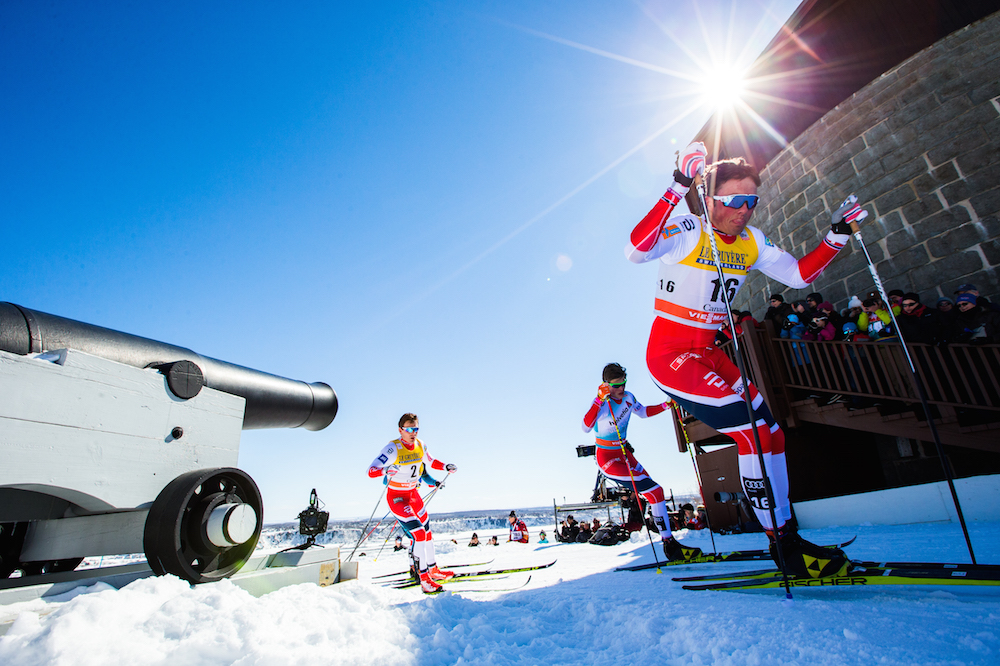
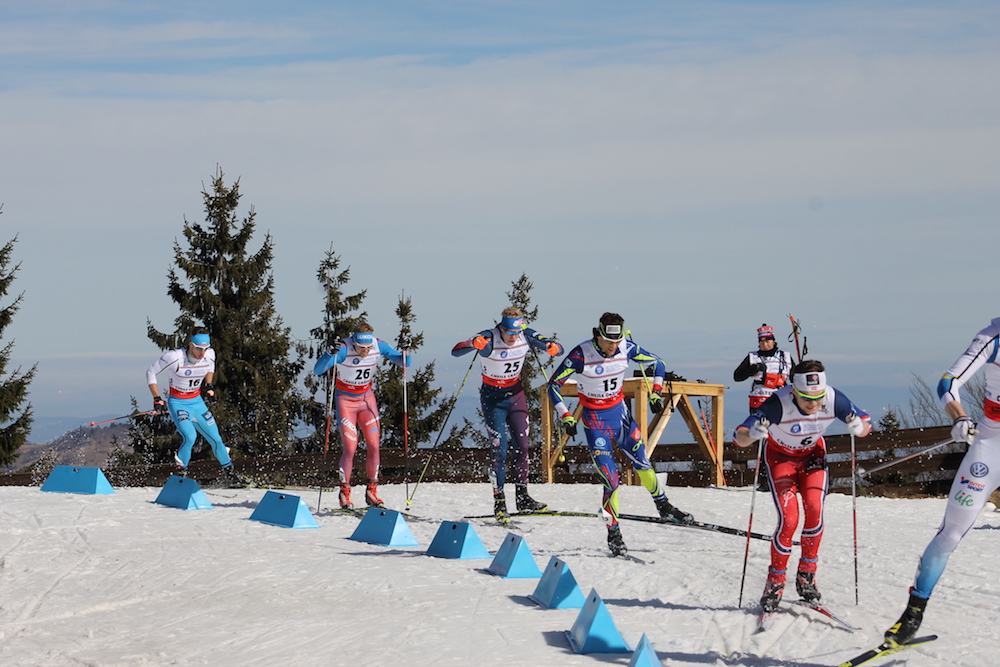
Norway’s Emil Iversen (16) leads Johannes Høsflot Klæbo (c) and Finn Hågen Krogh during the men’s 15 k classic mass start on March 18, 2017, at World Cup Finals in Quebec City. Klæbo went on to win. (Photo: Dustin Satloff)
North American World Cups are becoming a fixture on the schedule, with the season ending in Canada in 2016, 2017, 2019, and 2020. In 2020, Minnesota will join in with a city sprint- that race falls between the Quebec City and Canmore events. These races are important for athlete development as both Canada and the U.S. are granted ‘host nation’ start allocations. Fifteen male and 15 female athletes may represent each country with the added bonus of allowing young skiers to see World Cup stars in person.
Cross Country Canada wanted to integrate these World Cup events with the domestic racing calendar. As nationals are held at the end of the season, the obvious solution was to select a nationals host that is near the World Cup Final. While Canada has roughly the same population as California, that population is spread over 5.5 time zones in a land area far larger than the United States. The opportunity to race nationals and watch a World Cup with a single round-trip flight makes this much more attractive and affordable to families.
With the introduction of the Junior FIS Invitational Rising Stars in 2019 (a race for young skiers on the World Cup course), there is a third incentive to make the trip and see Alex Harvey’s retirement weekend in person. CCC’s Dave Dyer is excited about the new addition: “With the Rising Stars race, those [young athletes] that have a FIS license can also train beside WC athletes and compete on the same course. We have junior teams from across North America planning to participate in the junior FIS race.”
To make this schedule work, CCC needed host venues for nationals that could set homologated courses for seven days of racing later in March. Even in Canada, reliable snow in March can be a challenge.
To align with 2019 World Cup finals in Quebec City from March 22 to 24th, nationals will be hosted less than five hours drive away at the Nakkertok trails, in Gatineau, Quebec from March 13th to 20th.
In 2020, Sovereign Lake will host nationals after World Cup finals from March 25th to April 3rd. The 2020 bid document requested that bidders plan to follow the three final world cups in 2020, from March 14th to 22nd (Quebec City, Minnesota, Canmore). Sovereign Lake, along with the interconnected SilverStar Mountain Resort, has 105km of trails open every April. As the annual Spring Fling snow camp in May shows, ‘late season’ skiing is pretty reliable at 1,600m elevation.
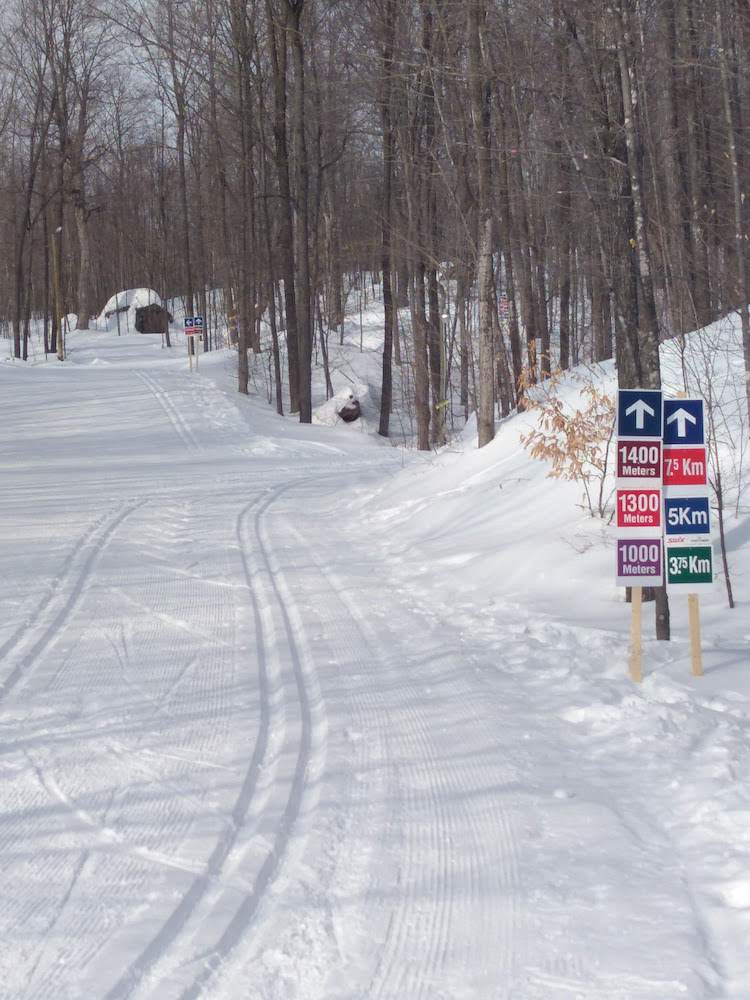
Nakkertok Trails on March 5th, 2019. (Photo: Toni Scheier)
In eastern Canada, there is snow and good skiing in March most years, but guaranteed snow on homologated courses is less certain. As a result, most clubs choose earlier dates in their bids to host nationals, sometimes even starting in February. With the advent of snowmaking at the Nakkertok trails in 2016, the game changed. While natural snow is abundant this season and snowmaking won’t be needed this month, the capacity to make snow was an important part of Nakkertok’s winning bid.
Gatineau remains an accessible area for many. The trails sit across the river from Ottawa (Canada’s capital) and are less than an hour from the major airport. The region is also surrounded by large population centres like Montreal and Toronto, with over 12 million Canadians within six hours drive. To restate, one third of Canadians live within weekending distance of the venue. This is one factor in the historic success of Eastern Canadian Championships over the past decade, with over 700 racers consistently making this the largest FIS event in North America in those years.
A second factor contributing to the venue’s race-hosting success was the formation of a stable coalition to host events. The 2019 nationals will be hosted by Évènements Nordiques Gatineau Nordic Events, an organization made up of Chelsea Nordiq, Nakkertok Nordic, Club Skinouk and the Gatineau Loppet. ÉNGNE also hosted the Gatineau stage of Ski Tour Canada in 2016.
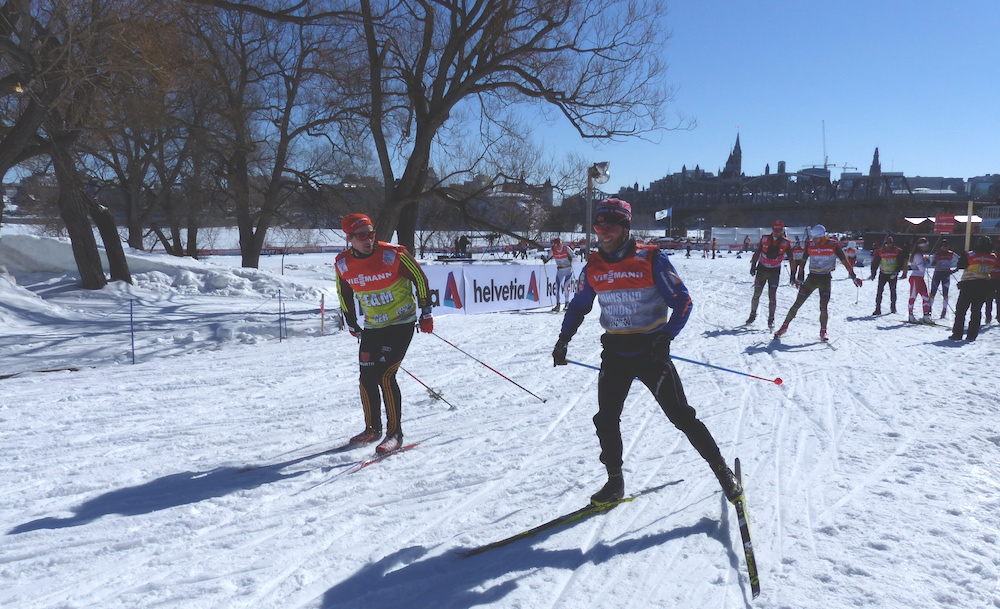
ÉNGNE was the host for stage 1 of the Ski Tour Canada in Gatineau. Martin Johnsrud Sundby inspects the course with Ottawa’s parliament building visible in the background. (Photo: Peggy Hung)
Pierre Millette, Chief of Race for 2019 Nationals and a Skinouk member, summarized the formula for success this way: “Mutual respect, a written agreement, complementary strengths. … The right people in the right places.”
Even though the races will be held on the Nakkertok trail system, every Nakkertok member interviewed for this article has been careful to reference the coalition.
Toni Scheier, a Nakkertok member who writes the CCC race reports, followed up with an emailed request: “Please emphasize that while the event is held at Nakkertok, […] the organizing committee ÉNGNE is from Skinouk, Chelsea, Nakkertok and Gatineau Loppet.”
This care to respect the contributions of others and a points system to share profits appear to be the key difference that keeps the engine turning. It is also easier to share profits than losses, which has contributed to ÉNGNE’s past reluctance to bid for late season events, as cancellations and venue changes are never profitable.
When Nakkertok’s snowmaking infrastructure was completed, the club expected to create reliable skiing on December 1st.
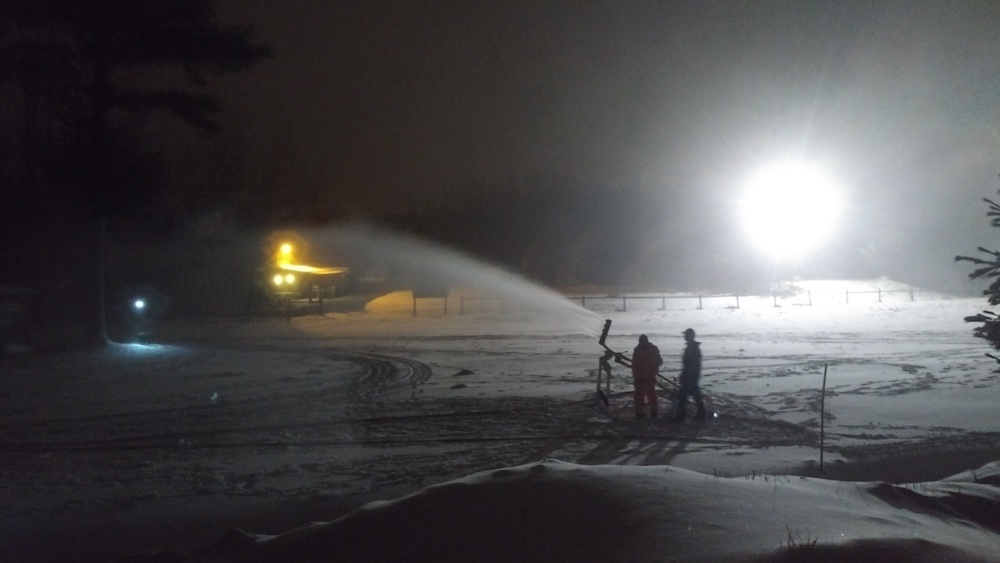
Testing the snowmaking equipment in November 2016. (Courtesy photo)
“From my perspective as head coach of the racing program, this is an amazing opportunity,” Nakkertok’s Kieran Jones wrote in November 2016. “Snowmaking has leveled the playing field across the country and the continent for our program. We’re competing against other top clubs and regions who have access to early season snow, and up until this point we have been at the mercy of the weather. For example, last season’s poor early-season weather meant we didn’t have skiing in the Ottawa-Gatineau area until between Christmas and New Year’s.”
Talking about the first Candy Cane Cup, scheduled for December 18th, 2016, Jones wrote, “our goal in the future is to create a high quality race experience at Nakkertok that is accessible in terms of cost and travel distance for the large numbers of athletes in Eastern Canada and the US who want and need to race.”
Scheier elaborated on Jones’s email, writing “It will also ensure snow for the Easterns where clubs from across the country attend, (700 plus competitors) and for our Nationals bid, likely 2019.”
On November 23rd, 2016, the day after Jones and Scheier made these statements, the first skiers were out training on man-made snow. Subsequently, they were able to open limited trails on November 11th, 2017 and November 12th, 2018. Those ambitious dreams are starting to look real.
Training on man-made snow on November 11th, 2017. (Photo: Toni Scheier)
The snowmaking system at Nakkertok came about in an unusual way. The core funding came from the Kraft-Heinz Project Play contest, which offers annual awards to communities in Canada to create opportunities to play. The grand prize winner gets $250,000, and the three runners up collect $25,000. Nakkertok won the 8th edition in 2016.
The race team raised $50,000 and money from other parts of the budget filled in the gaps to build the original system. The city of Cantley (on the west side of the trail system) helped Nakkertok to a “Fonds de développement des territoires” grant of $60,000 in 2017.
The ‘NakkerTrak’ expansion in 2018 is evidence of continued success in snowmaking and fundraising.
The upgrading process continues.
In the final analysis, was all the work that went into connecting these events together worth it? Many families will be making the combined trip, this nationals should be the largest FIS event in North American history, and to give Dave Dyer the last word:
“There are 250 racers in the National Capital Region that can sleep in their own beds.”
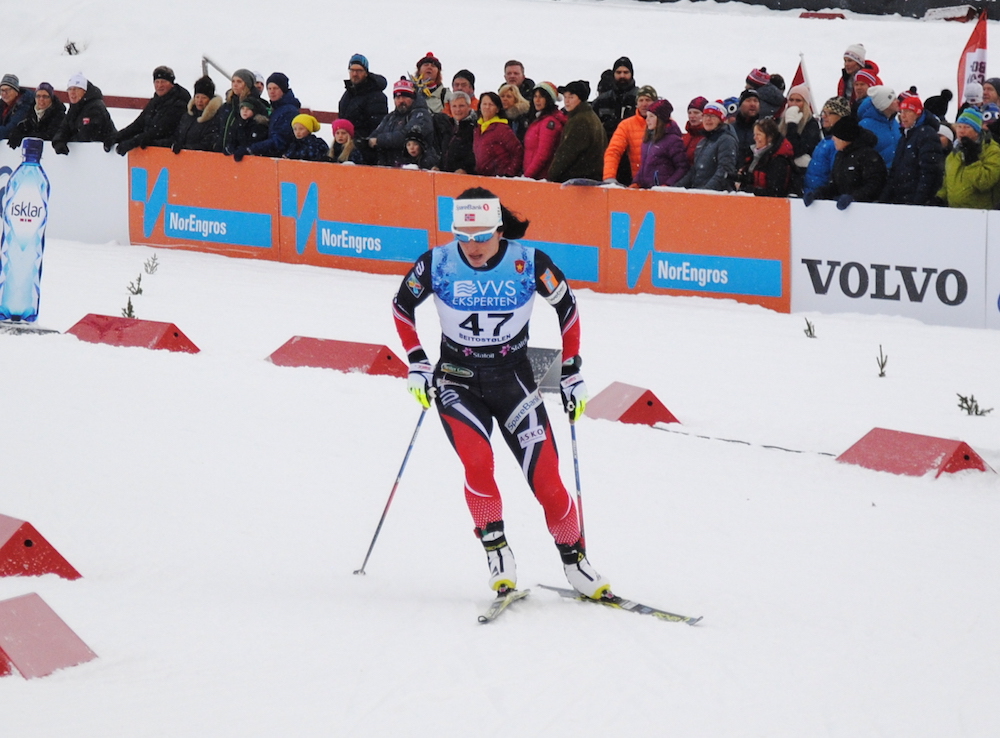
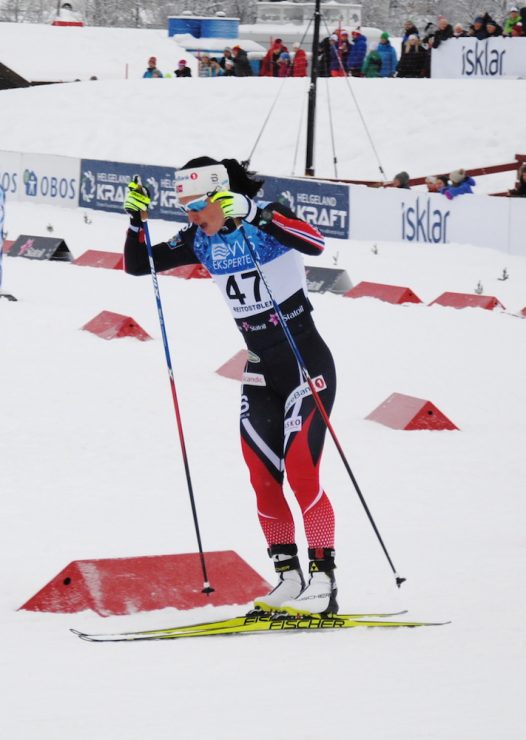
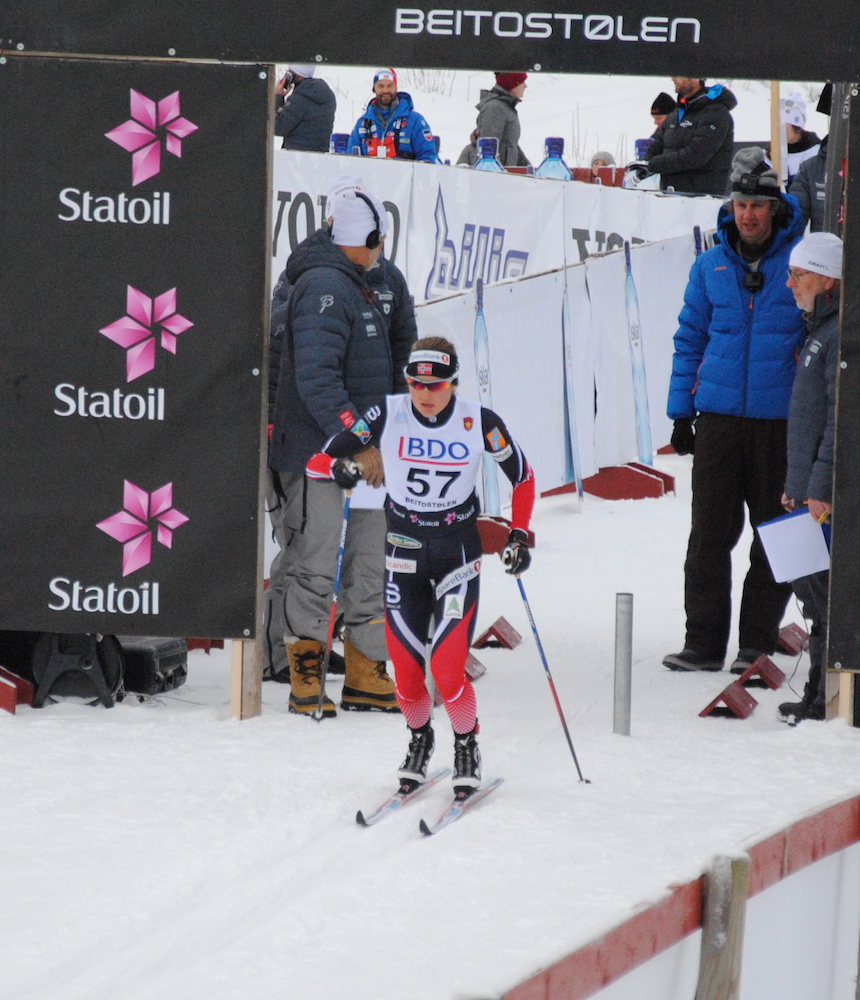
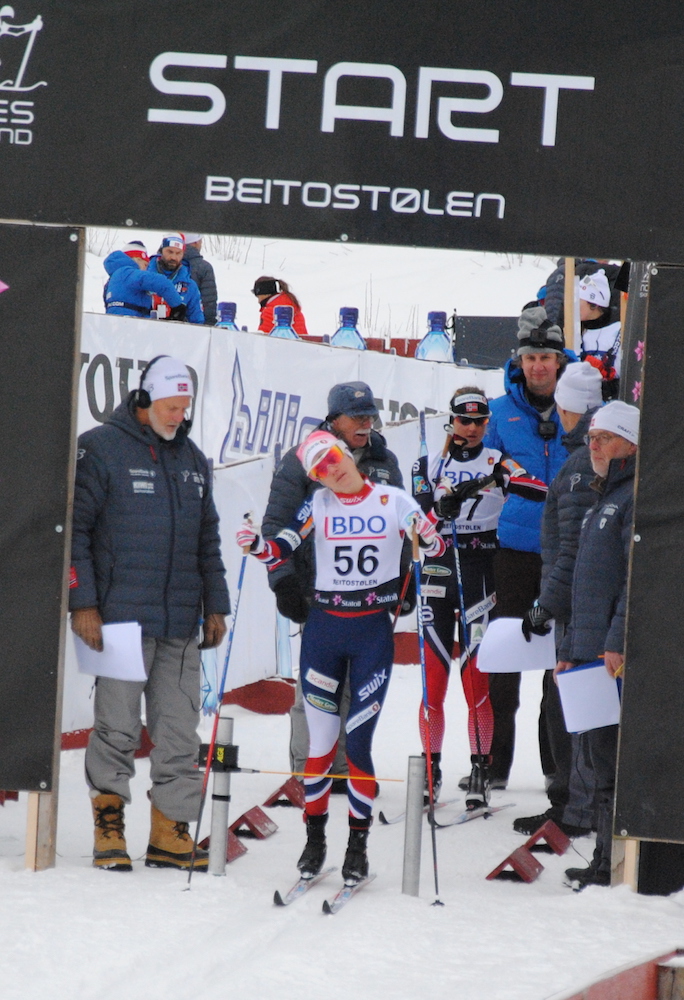
Norway’s Marit Bjørgen racing to first in the women’s 10 k freestyle on Saturday in Beitostølen, Norway. It was her first FIS race since March of 2015. (All photos: Aleks Tangen)
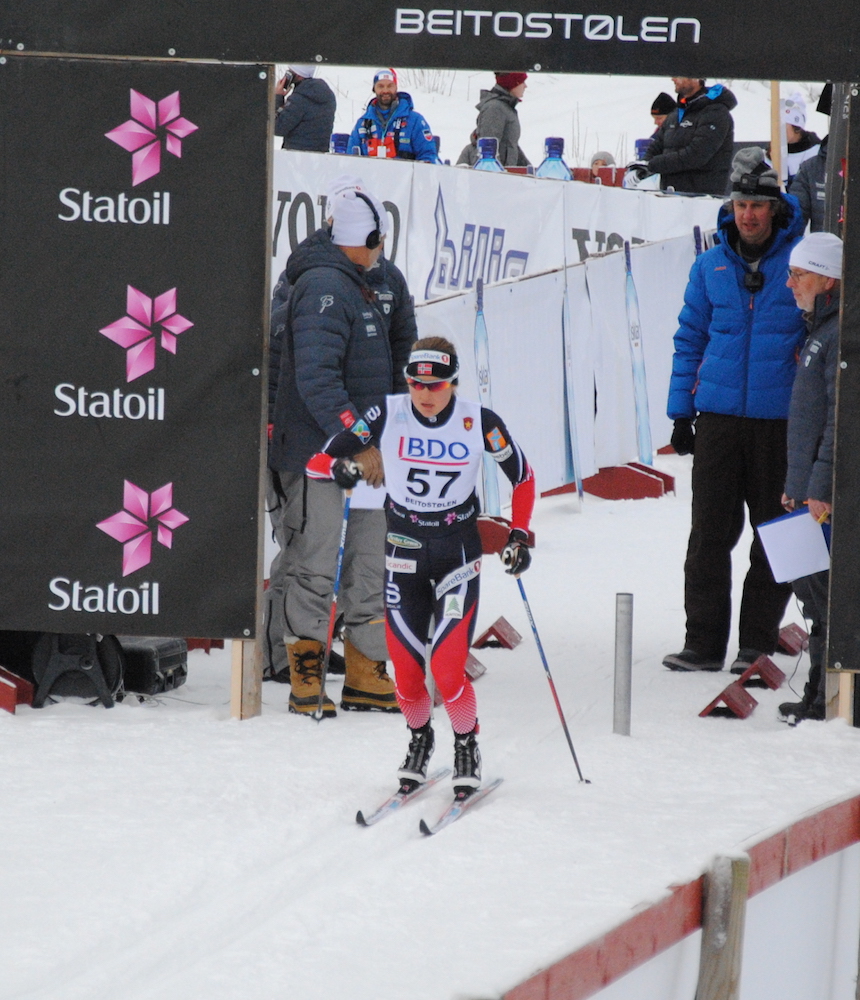
BEITOSTØLEN, Norway — Saturday’s 10-kilometer freestyle individual start was, from the start, all about Marit Bjørgen. Her previous race was 603 days earlier on March 27, 2015in Harstad, Norway, but that didn’t seem to affect Norway’s six-time Olympic gold medalist one bit.
“I’ll admit that I have had my doubts,” she told Dagbladet about returning to competition. “And I’ve been tired, but I made it through it and I’ve appreciated the good times.”
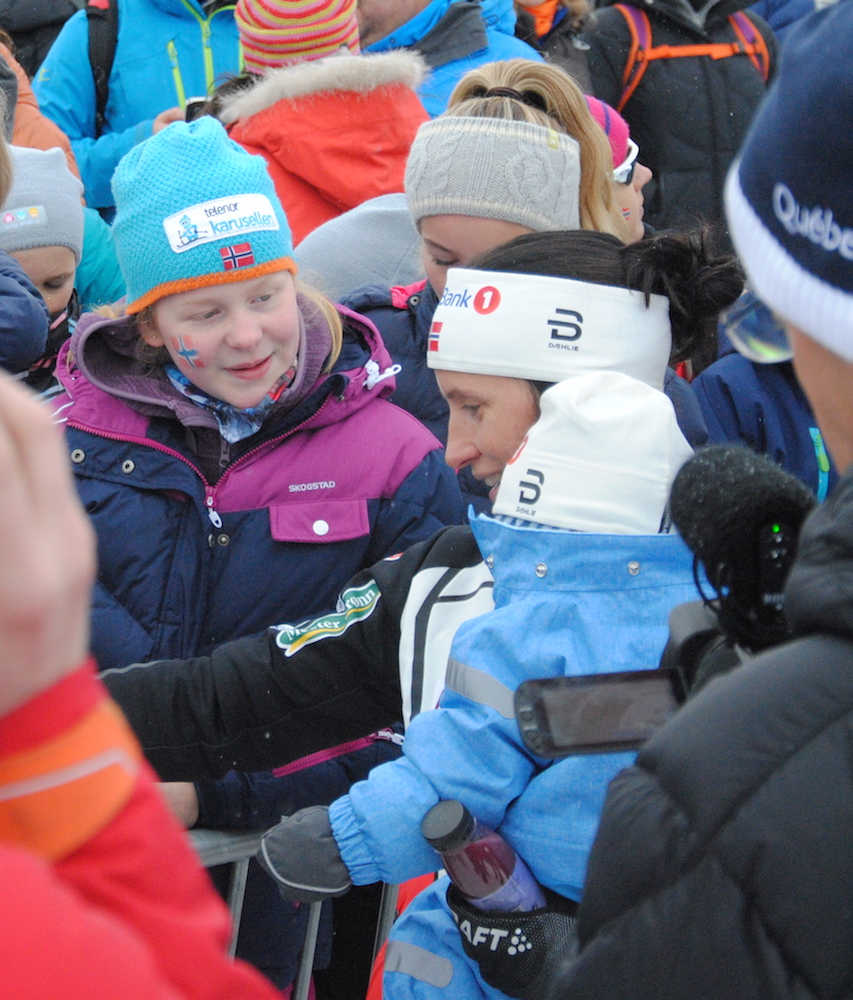
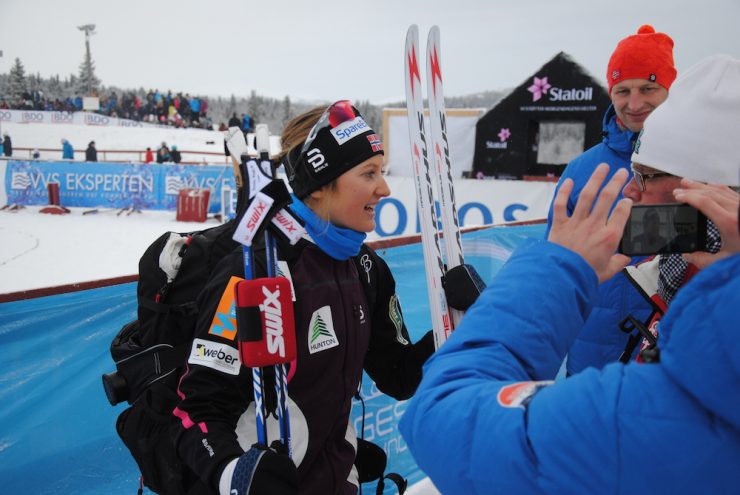
Norway’s Marit Bjørgen with her baby, Marius, and fans in Beitostølen, Norway, following Bjørgen’s first race since having a child in December 2015. Saturday marked Bjørgen’s first race back since March 2015. (Photo: Aleks Tangen)
The 36-year-old Bjørgen led Saturday’s International Ski Federation (FIS) race at every split mark and crossed the finish line in 24:40.3 minutes.
Fellow Norwegian national-team member Heidi Weng followed in second, 11.7 seconds behind. After placing second to teammate Ingvild Flugstad Østberg in Friday’s 10 k classic, Weng told VG that Bjørgen, who sat out the race with a cold, was “probably sitting at home and laughing at how slow it went went. She will race fast and I think will see Marit Bjørgen as good as she has been in the past. She’s done great during the summer and fall training.”
After her second-straight second-place finish, Weng told Dagbladet that she opened fast on Saturday, but her muscles tired as the race progressed.
“It’s irritating, but I really had no chance toward the end, and it’s not that bad, really, because I don’t think I’ve ever had a better season opener. I’m a little surprised by that really,” she said.
When asked by FasterSkier if she thought she could match her performances in Sunday’s skate sprint, Weng said, “I didn’t make it through from the prologue last year so I’m hoping that I can do better than that, but we’ll see.”
The race for third place proved to be the most exciting with Østberg crossing the finish line 28.2 seconds behind Bjørgen and just 1.7 seconds in front of Norway’s Astrid Uhrenholdt Jacobsen, who finished fourth. Norway swept the top eight as Kari Øyre Slind followed 2.9 seconds later in fifth and her sister Silje Øyre Slind was sixth, another 17.5 seconds behind.
Østberg told FasterSkier that she will not be competing in Sunday’s sprint. “If the World Cup weekend had been two weeks away then maybe, but after doing two tough races in two days and since sprints takes a lot of energy rest is probably the best,” she said.
Nonetheless, a first and third place finish in Beitostølen is Østberg’s best start to a season yet.
“It is without a doubt my best season opener, and I’m super happy,” she told both FasterSkier and Oppland Arbeiderblad, a regional newspaper from her hometown of Gjøvik.
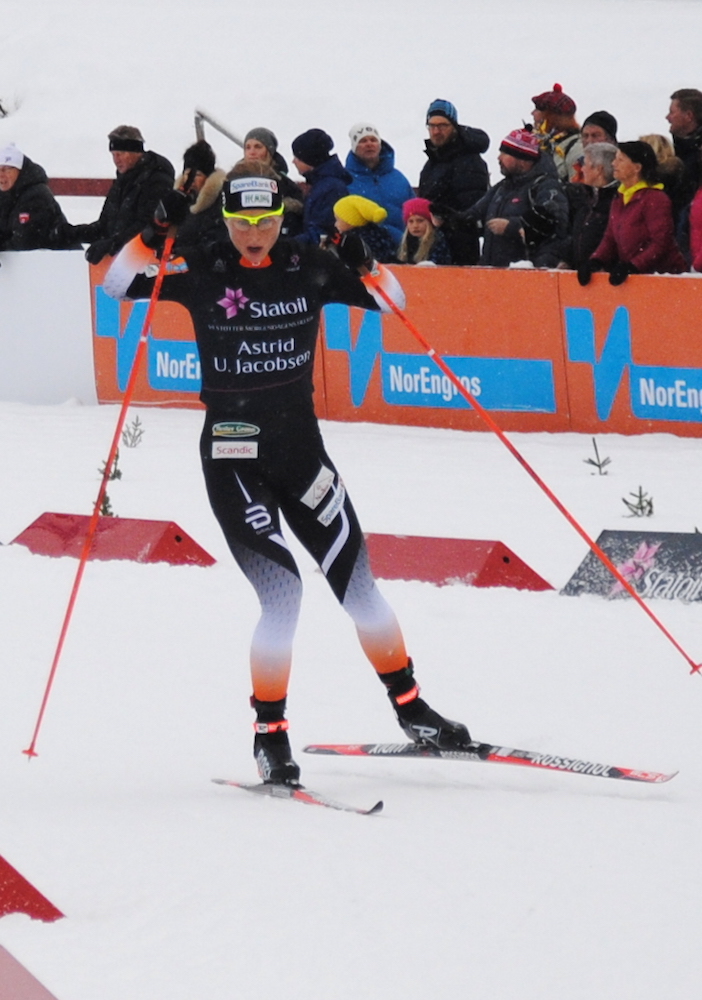
Astrid Uhrenholdt Jacobsen (Norway) racing to fourth in the women’s 10 k freestyle FIS race on Saturday in Beitostølen, Norway. (Photo: Aleks Tangen)
Jacobsen narrowly missed the podium after crossing the finish line 1.7 seconds slower than Østberg.
“I feel like I’m not quite there yet,” Jacobsen told FasterSkier after. “I still have some work to do in order to be in top shape, but I still ski relatively fast and I feel like I have a very good base condition so I think it can be a good year.”
Asked what it was like to have Bjørgen back, Jacobsen replied, “She wins as expected. I skied with her on my second lap and I definitely think she can ski faster. This race wasn’t Marit in her top shape.”
When asked about Bjørgen’s ability to perform as well as she did on Saturday, considering she hasn’t raced since 2015, Jacobsen smiled and waited a moment before she answered, “That’s something only Marit can do.”
Eighteen-year-old Norwegian Mathilde Myhrvold finished 27th (+3:49.7) of 48 finishers on Saturday. In 2014, she competed in the track and field World Junior Championships in Eugene, Oregon, and last season she won the Norwegian Cup. Saturday stood as her first race this season.
“Slightly after finishing the first lap I started feeling a little tired and then I skied a little slower, but I improved toward the finish and I’m happy about that,” Myhrvold said. “I may have started a little too fast and maybe that’s why I was tired.”
She figured a few races would help her return to top shape, and for the rest of the season, she’s focused on improving her conditioning for FIS Junior World Championships trials.
One spot ahead of her on the results sheet, American Cambria McDermott, who is living and training in Norway, finished 26th (+3:33.6). Canada’s Isabella Howden and Madison Fraser, both of Team Hardwood, placed 45th (+6:19.6) and 47th (+6:59), respectively.
(Story continues below)
Marit Bjørgen racing to first in the women’s 10 k freestyle FIS race on Saturday in Beitostølen, Norway. It was her first FIS race since March of 2015. (Photo: Aleks Tangen)
Norway’s Ingvild Flugstad Østberg (black headband) and Marit Bjørgen (white headband) being interviewed after Saturday’s 10 k freestyle FIS race in Beitostølen, Norway. It was Bjørgen’s first FIS race since March 2015. (Photo: Aleks Tangen)
Norway’s Ingvild Flugstad Østberg being interviewed after Saturday’s 10 k freestyle FIS race in Beitostølen, Norway. (Photo: Aleks Tangen)
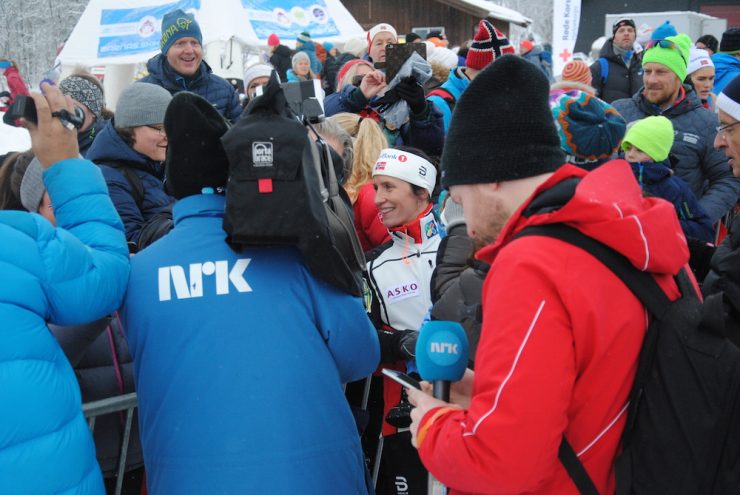
Norway’s Marit Bjørgen with fans and media after Saturday’s 10 k freestyle FIS race in Beitostølen, Norway. It was her first FIS race since March 2015. (Photo: Aleks Tangen)
Another ‘W’ for Tønseth
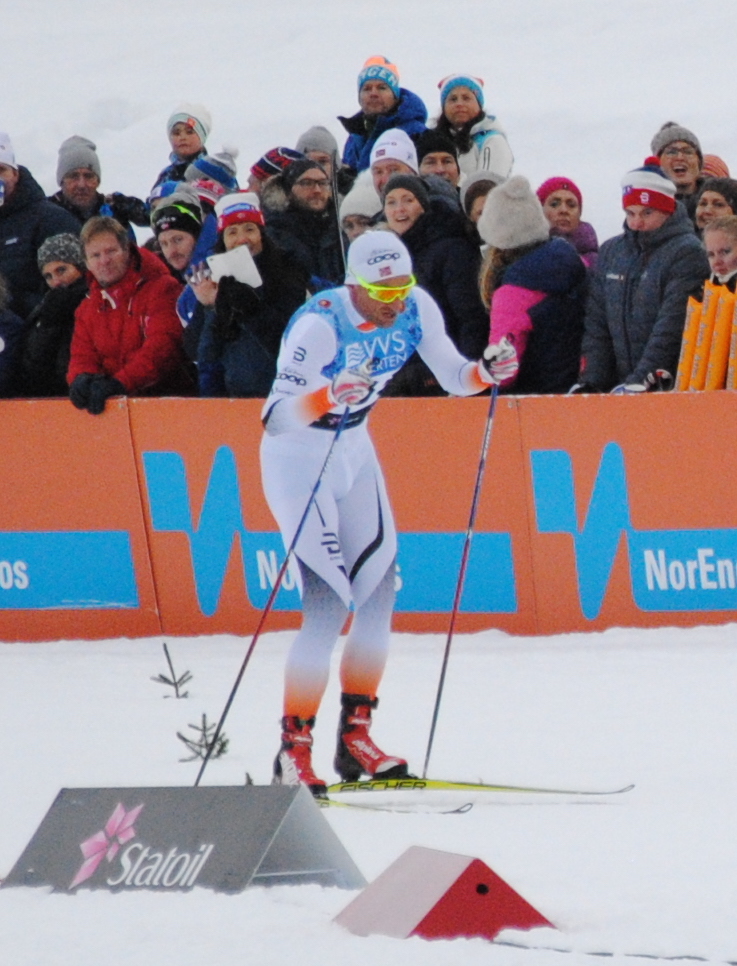
Norway’s Didrik Tønseth repeated his podium-topping performance from Friday’s 15 k classic and won Saturday’s 15 k freestyle in 33:20.9. But the biggest surprise of the men’s race was second-place finisher Simen Hegstad Krüger, who crossed the finish line in a time that was only six seconds slower than Tønseth.
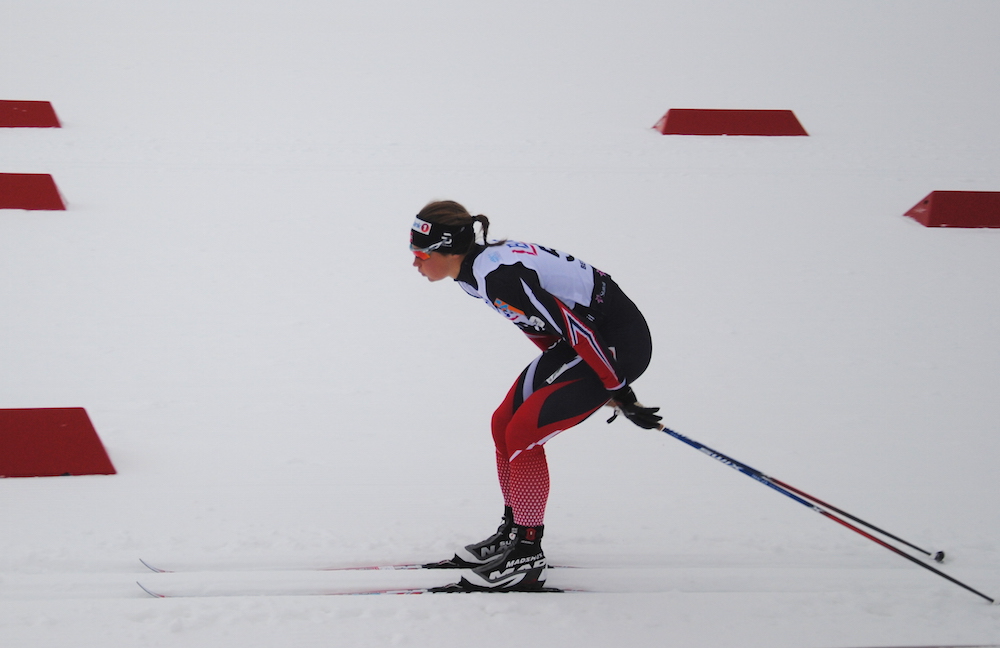
Norway’s Didrik Tønseth racing to his second-straight win of the weekend in the 15 k freestyle FIS race on Saturday in Beitostølen, Norway.
“I had nothing more to give, but this podium finish is incredibly satisfying,” the 23-year-old Krüger, who won the 15 k freestyle at U23 World Championships last season, told NRK after Saturday’s race.
“I’m hoping for a spot on the team for the World Cup in Lillehammer, but it might be too late for that,”
Norwegian men’s coach Tor-Arne Hetland seemed open to placing Krüger on the team for Lillehammer in two weeks.
“We’ll be choosing the team on Monday and I think the mini tour will suit him well, so he may receive a positive message in the coming week,” he told NRK.
Tønseth had the advantage of starting five bibs after Krüger and told NRK that he felt like he was in good shape and that he was ready to start the season. The 2017 World Championships in Lahti, Finland, are his main focus.
Norway swept the top five after a close fight for third, which Simen Andreas Sveen took, 32.6 seconds behind Tønseth. Anders Nøstedahl Gløersen was another 1.9 seconds back in fourth (+34.5), Mathias Rundgreen placed fifth (+36.9) and Andrew Musgrave of Great Britain finished sixth (+37.0).
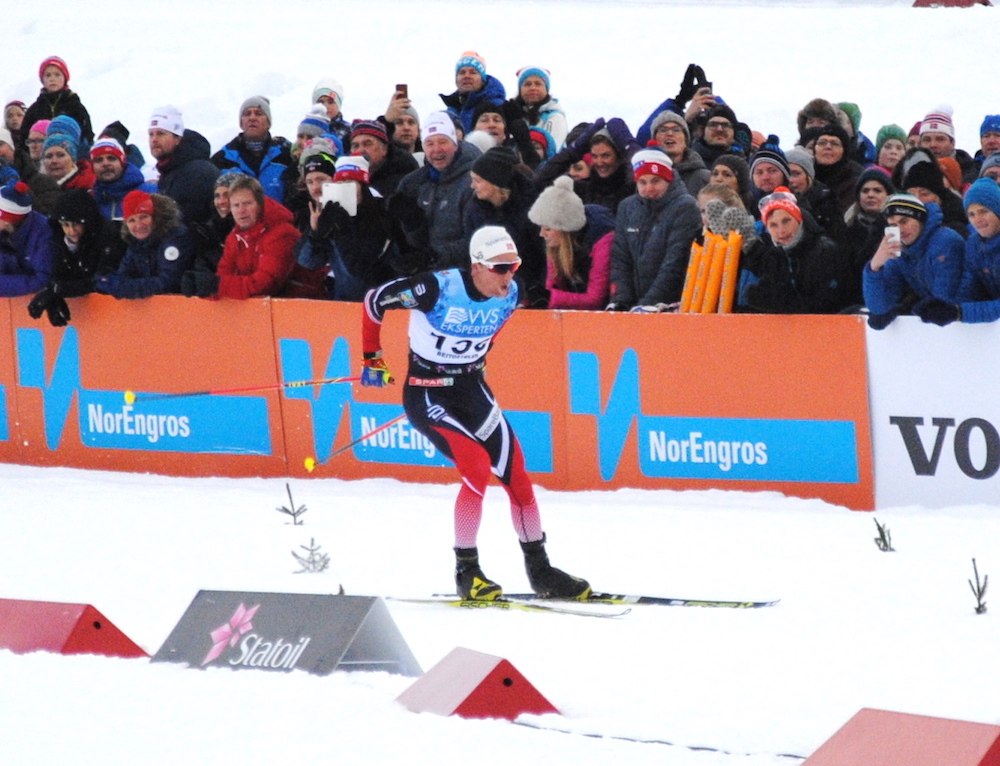
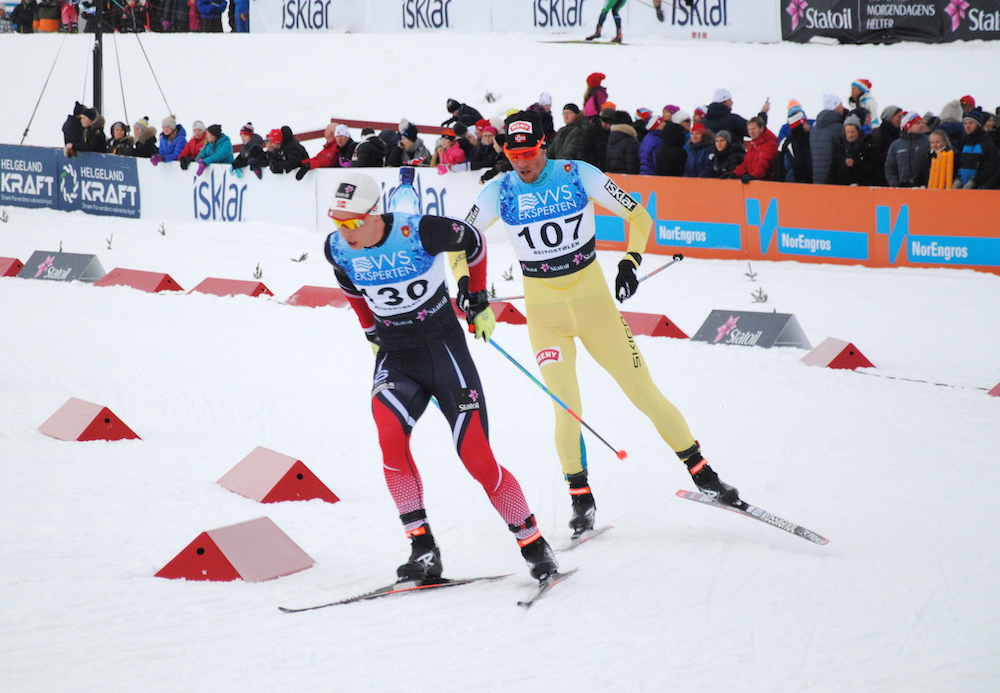
Norway’s 25-year-old Mathias Rundgreen (130) leads 33-year-old Chris Jespersen (107), also of Norway, in the men’s 15 k freestyle FIS race in Beitostølen, Norway. Rundgreen placed fifth and Jespersen finished eighth on Saturday.
“I feel good about the race, but I felt a little limply in the beginning,” Musgrave told FasterSkier after. “Though I was able to close some of the gap toward the end, but not enough.”
Like most World Cup skiers, Musgrave’s goal for the season is World Championship and he’ll be in both Kuusamo, Finland, and Lillehammer over the next two weekends to compete in the World Cup.
One place behind Musgrave was Norwegian Sjur Røthe in seventh (+37.2), who told FasterSkier that he felt “heavy during the start.” In a post-race interview with NRK, Røthe said he’s focused on the World Championships 50 k. He planned to skip Sunday’s sprint to recharge for the World Cup.
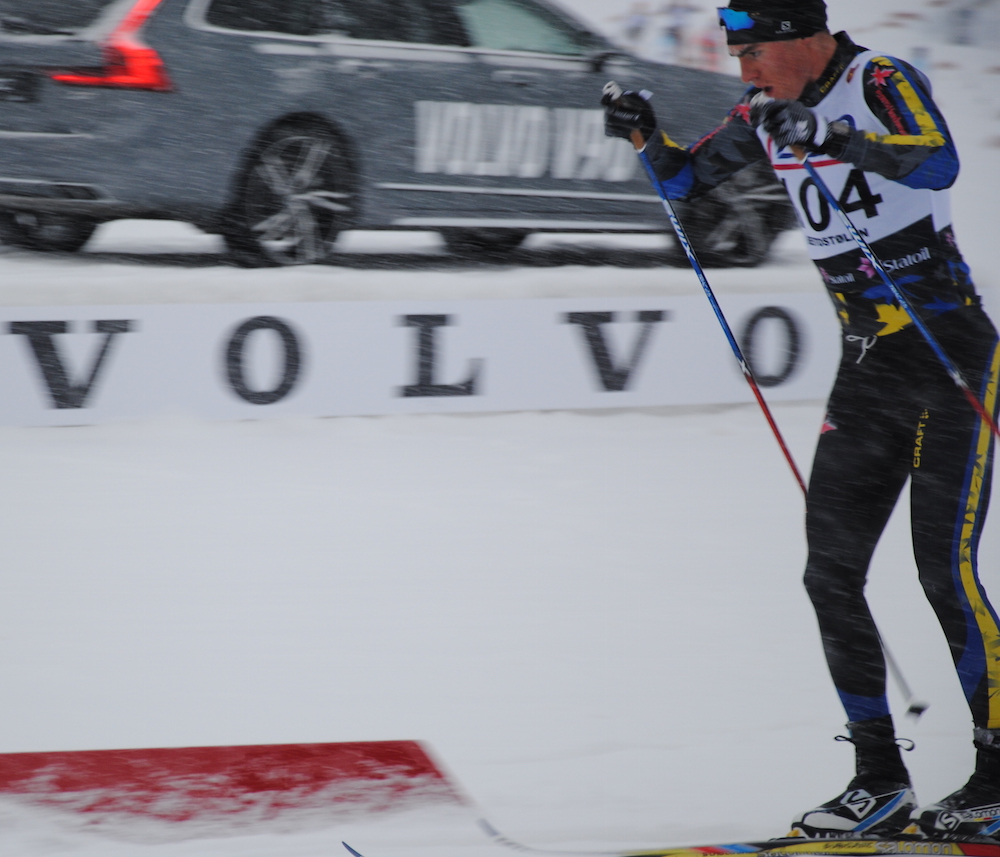
Petter Northug (Norway) approaching the finish of Saturday’s 15 k freestyle FIS race in Beitostølen, Norway. (Photo: Aleks Tangen)
Petter Northug finished Friday’s race like it was a workout, and during the start of Saturday’s race, it appeared that he was on the path to a podium, but such was not the case. Northug led the race at the 1.2 and 2.1 k marks, but for the rest of the race, he was unable to maintain the same speed as the other top finishers and ended up 15th (+1:02.6). However, Northug didn’t seem to be affected by his fading speed, telling Dagbladet, “I am where I want to be. I’ve had two good workouts now and I’m confident that the job is done. I am excited for the important races that are approaching.”
But he did offer some explanation for what happened.
“I opened too hard and during the second lap I felt like it would be too much to maintain the tempo,” Northug told NRK.
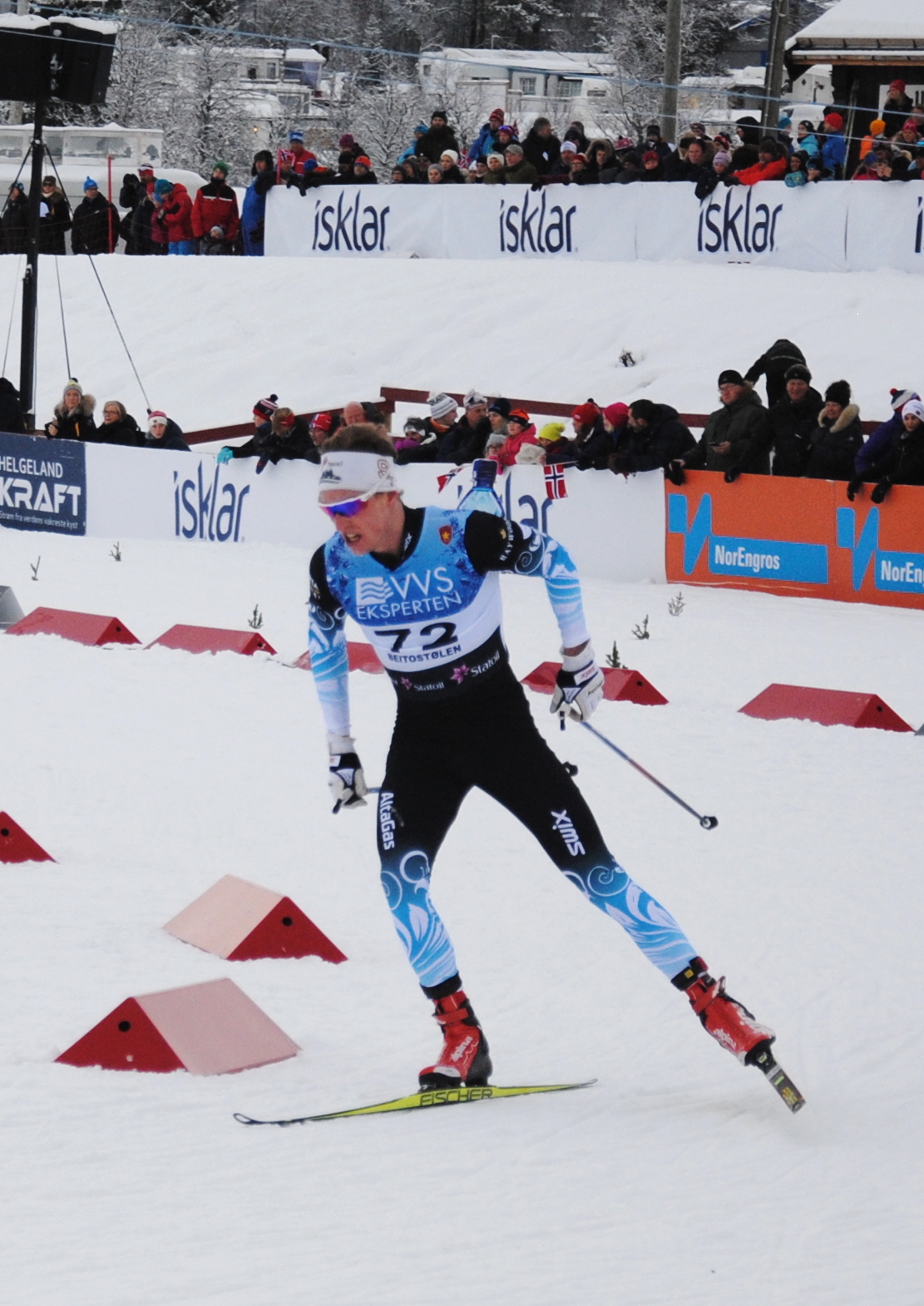
Out of 123 male finishers, Jack Carlyle (NDC Thunder Bay) led several Canadian juniors in 90th (+3:48.4). His NDC teammate Scott James Hill finished 101st (+4:25.6), Joey Foster (Pierre-Harvey Training Centre) was 103rd (+4:31), and Team Hardwood skiers Ryan Jackson was 106th (+4:50.4) and Kieran Jones was 115th (+6:11.5).
Ingvild Flugstad Østberg (Norway) out of the start in her country’s first FIS race of the 2016/2017 season: the 10 k classic in Beitostølen on Friday. (All photos: Aleks Tangen)
BEITOSTØLEN, Norway — Friday’s International Ski Federation (FIS) season opener in Beitostølen, with most of the Norwegian cross-country team participating, became a demonstration of strength by Norway’s Ingvild Flugstad Østberg.
With Therese Johaug suspended for the first part of the season and Marit Bjørgen out with a cold, Østberg led the race from start to finish and completed the 10-kilometer classic individual start in 26:47.4 minutes. She progressively increased her distance over teammate Heidi Weng, who started just 30 seconds ahead of her, leading her by 6.2 seconds at 2.1 k and 13.2 seconds at the finish.
Heidi Weng at the start with Norwegian teammate Ingvild Flugstad Østberg behind her in the FIS season-opening race in Beitostølen, Norway. (Photo: Aleks Tangen)
After the race, Østberg told Aftenposten that Johaug gave her some valuable advice just a day earlier. She said they spoke Thursday and Johaug offered some tips, encouraging her to focus on technique rather than worry about her form at this point in the season. Østberg said she told her to go for it and see how things turn out.
She took that advice to heart and came away with a victory. Østberg said it was strange not having her at the races, but she channeled her inner Johaug and focused on a strong start.
“It tends to work for her here, then I thought that I should try, too,” Østberg said, according to a translation.
“I’m usually a little slow in Beitostølen, but not today,” Østberg told NRK. “I had good skis and a body that played along. It was a good day. I’m very happy that I was able to ski well. Of course I got tired toward the end and consequently my technique deteriorated, but I felt that had good control over my opening so I’m happy.”
Notably, Østberg became the first woman other than Johaug or Bjørgen to win an opening race at Beitostølen since 2003.
“They would have probably been strong had both been here, but one cannot do anything about those who aren’t here,” she said.
The Norwegian national-team women swept the top nine, with Astrid Uhrenholdt Jacobsen coming on strong in the final third of the race for third place, 1:06.4 behind Østberg. Throughout much of the race, her split times ranked fourth of 55 finishers, behind Østberg, Weng and Kathrine Harsem.
Afterward, Jacobsen told Aftenposten that she thought she would finish farther back, noting the first races of the season are often the hardest.
“Third is far above my expectation; I had not thought that I would start there,” she said, according to a translation.
Ingvild Flugstad Østberg (Norway) double poling out of the start in her country’s first FIS race of the 2016/2017 season: the 10 k classic in Beitostølen on Friday.
At just one point in the day, Østberg’s time ranked second: at 1.2 k, where Harsem was 1.5 seconds faster.
“I’m a little surprised it worked this well,” Østberg told NRK after the race. “I’ve felt good all through the summer and fall, but during the last week I’ve felt kind of heavy, but then I suppose I just fooled myself.”
American Cambria McDermott, a former Montana State University skier who graduated this spring, finished the race in 44th, 5:05.3 behind Østberg. After spending the summer training with Henning Skilag and representing the Norwegian club during the race, she told FasterSkier afterward that “it was really cool to see so many fast women. I felt slower by comparison, but it was really fun. It’s an awesome course.”
McDermott, 23, is currently taking classes at Nord University in Meråker, a small town near Trondheim. When asked about the level of competition in U.S. collegiate skiing compared to Norway’s first FIS race of the season, she said, “I think NCAAs was really good preparation for these kinds of races. There are a lot of international racers at NCAAs and they bring a lot of competition to those races, but here, there are the best skiers in the world in this race, so I think it’s hard to find a race that matches that.”
She’ll continue to race for Henning Skilag in Europe for most of the season, competing in most of the Norwegian and Scandinavian Cups before heading back to the states for U.S. nationals in early January.
“I’m excited for tomorrow,” she said of Saturday’s 10 k freestyle in Beitostølen. “I like skating and it’s a little less complicated than classic skiing with the wax and everything.”
Canada’s Madison Fraser (Team Hardwood) racing to 50th in the women’s 10 k classic FIS race on Friday in Beitostølen, Norway. (Photo: Aleks Tangen)
Canadians Madison Fraser (50th place, +6:33.8) and Isabella Howden (55th, +8:21.6) also competed on Beito’s opening day. After the race, Fraser, of Team Hardwood, said she felt good about her effort.
“It was the first race I’ve done at this level,” she said. “So, really cool to see my name on the same list as Weng and Østberg, but it was hard, but nice course, really flowy. It felt good to get some intensity in. This is our first race over here.”
Reflecting on how she tackled the course, the 20-year-old, first-year senior described two big hills at the back of the course.
“I think that gritting down that extra bit and I was able to stride up the whole thing,” Fraser said. “Some people would hop out and start stepping, which is slower and more energy, so I was happy with that and stepped all the corners, so yeah, I was happy with how I handled everything.”
When the Cat’s Away… Tønseth Wins
In the men’s 15 k classic, Norway’s Didrik Tønseth capitalized in the absence of his team’s leading skier, Martin Johnsrud Sundby (out with a sore throat), beating out 140 men while double poling the entire three-lap course to win in 37:31.9.
Tønseth told NRK after that he was in “disbelief” at the conditions, with a heavy snowfall blanketing the course after the women’s race. He switched to skate skis one minute before the start, and said it worked well.
“It’s awesome to win … it’s good to put others in their place,” he said, according to a translation.
Starting 12 minutes earlier than Tønseth in bib 125, Norway’s Tord Asle Gjerdalen also double poled the entire course and rose from the seventh-ranked time at 4.9 k to second at the finish, 15.7 seconds back.
“It snowed a lot, but I think it was the right decision to skate,” Gjerdalen told NRK, according to a translation.
“When the cat’s away, the mice will play,” he added, taking a playful dig at Sundby.
All of the eventual top-six men double poled, with Norway’s Morten Eide Pedersen finishing third (+24.5) after opening with the fastest 4.9 k split, then ranking second at 9.8 k. A fourth Norwegian, Sjur Røthe took fourth (+33.2), Great Britain’s Andrew Musgrave broke up the sweep in fifth (+40.0), and Petter Eliassen (Norway) placed sixth (+45.4).
Meanwhile, Norwegians Pål Golberg and Petter Northug chose grip wax. While Golberg cracked the top 10 in ninth (+1:19.4), Northug ended up nearly four minutes back in 74th, approaching the finish line with a sedative pace that seemed more like a conscientious choice than a consequence of low physical conditioning.
After the race, an NRK interviewer said to Northug, “You look very smart for someone who finished 74th.”
Northug, looking as calm as he did during the final part of the race, answered, “You can interpret that the way you want. I believe I have good control even if it doesn’t look like it.”
A number of Canadian juniors competed on Friday, with Jack Carlyle, of the Thunder Bay National Development Centre (NDC), leading them in 116th (+5:32.4).
“The competition is super-fierce, which is super cool to see, but it’s not like they’re super human,” the 23-year-old Carlyle said. “It’s just that they’re very fit and fast, but it’s nothing untouchable, it’s cool to see and be a part of that.”
“The competition is super-fierce, which is super cool to see, but it’s not like they’re super human.” — Jack Carlyle (Thunder Bay NDC), after placing 116th in Beitostølen
His NDC teammate, Scott James Hill placed 131st (+6:25.1). Behind him, Ryan Jackson, of Team Hardwood, finished 135th (+7:06.3), Joey Foster (Pierre-Harvey Training Centre) was 139th (+8:17.5), and Kieran Jones (Team Hardwood) was 140th.
Canada’s Scott James Hill (NDC Thunder Bay) racing to 131st in the FIS season-opening 15 k classic in Beitostølen, Norway. (Photo: Aleks Tangen)
Like his Canadian teammates, Jackson chose kick wax and explained that too much grip probably affected his overall performance.
“I unfortunately lost a little bit of time on each downhill, which I really couldn’t afford to do,” the 19-year-old from Midhurst, Ontario, said. “I need to be on top of my game to compete with these guys. It’s a tough competition, but when things don’t come together, you lose a couple of seconds here and there, it’s too bad.”
Asked how he liked the course, Jackson said he loved it.
“I really liked how balanced it is. There’s a lot of spectators around the course so you’re always seeing people,” he said. “My favorite parts were probably the climbs.”
Foster described his race as a “real hard one”.
“My skis weren’t running nearly as quick as I needed them to be,” he said. “I think I went with too much grip and they just started dragging a lot. People were making up big time on me in the downhills.”
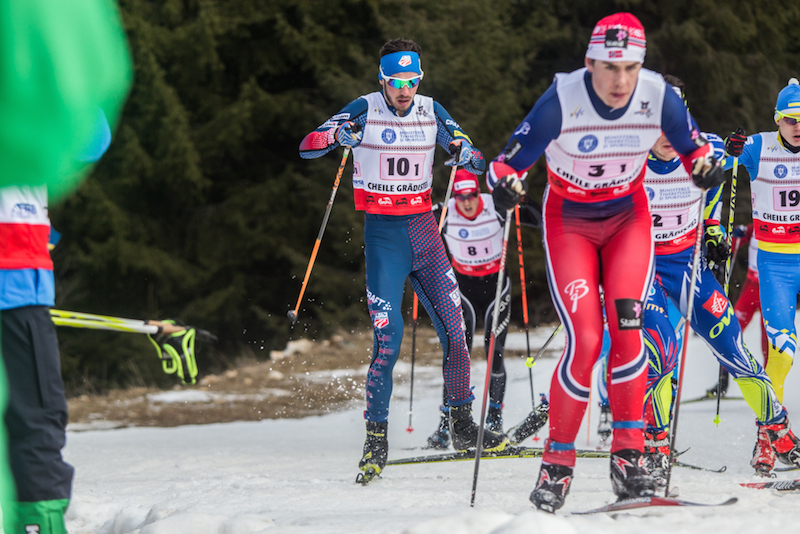
Ian Torchia (bib 10) chasing a Norwegian (bib 3) in the first leg of the junior men’s 4 x 5 k relay at 2016 Junior World Championships in Rasnov, Romania. “When I first heard the news I was extremely fired up,” Torchia told FasterSkier after learning that some of the Norwegians had been taking asthma medication despite not being diagnosed with asthma. (Photo: Logan Hanneman)
Norwegian team doctors prescribed asthma medication to young cross-country skiers without any diagnosis of the disease the country’s state broadcaster NRK reported. The incident occurred at 2016 Junior and U23 World Championships in Rasnov, Romania.
Petter Olberg, who was a physician on the team staff in Rasnov, said that the treatment was due to air-quality issues which irritated the airways of some athletes.
American and Canadian competitors and team staff at the event, however, did not recall any air quality problems. They expressed surprise that competitors who were still teenagers would be offered such drugs without a medical diagnosis of asthma.
“I am shocked to hear about this story and I do not recall there being poor air quality in Rasnov other than the coal burning pollution,” Julia Kern, an American who had two top-20 finishes in Rasnov, wrote in an email to FasterSkier. “My hope is that the doping regulations are set up to only help fix a medical disease instead of giving people an advantage.”
The medication allegedly prescribed, budesonide, is a glucocorticosteroid which is not prohibited for inhalation by the World Anti-Doping Agency (WADA). It was delivered by a nebulizer, rather than through inhalers; Olberg said he had also recommended that some athletes take a salt-water inhalation treatment through the nebulizer to improve their symptoms.
The case has caused a stir partly because a more senior Norwegian skier, Martin Johnsrud Sundby, was slapped with a suspension after taking asthma medication from a nebulizer. However, that was a different drug – salbutamol, which is a beta-2 agonist rather than a glucocorticosteroid – which is prohibited by WADA when used in high doses.
Air Quality Plagues FIS Site Selection, and Racers’ Lungs
Air quality has been a major issue at past Junior and U23 World Championships.
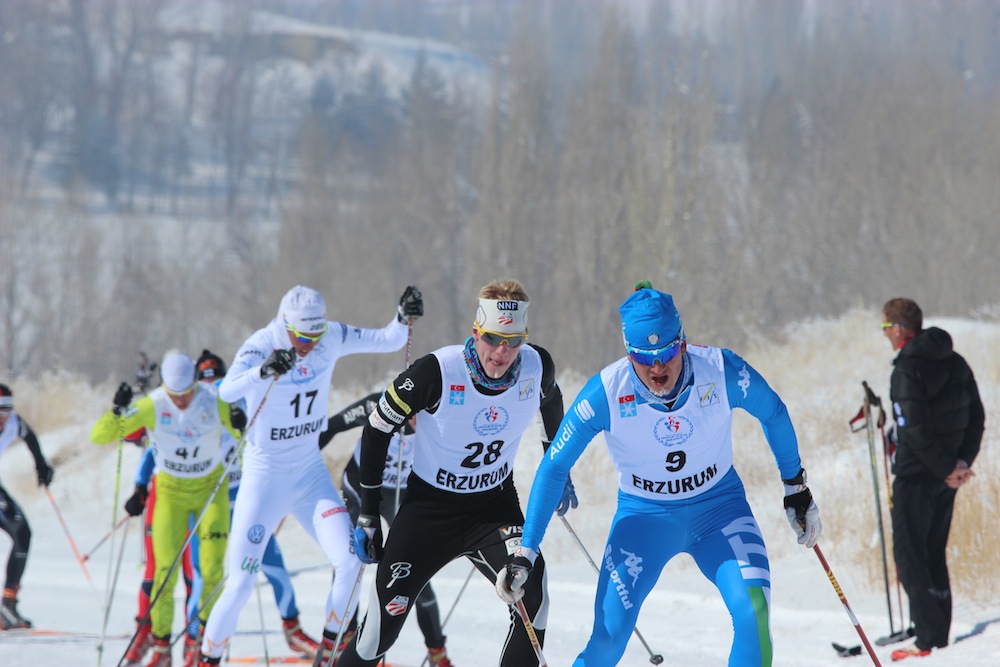
Logan Hanneman competing at World Junior Championships in Erzurum, Turkey, in 2012. (Photo: Reese Hanneman)
“When the World Junior & U23 Championships were held in Erzurum, Turkey in 2012 and Almaty, Kazakhstan in 2015, the air was possible the worst I have ever seen at a race venue,” Logan Hanneman of Alaska Pacific University (APU) wrote in an email.
Of the four Junior/U23 World Championships Hanneman has competed in, Erzurum and Almaty stood out for one reason: smog.
“In both locations, it seemed that the pollution was caused by poorly-regulated and designed coal power plants,” he explained. “With the large surrounding mountains in both locations, the inversion that would form during the night would suppress the pollution down to the valley floor and into the town where the teams were staying. The race venue in Almaty was above the pollution, but only in the early morning before it began to rise up the mountains.”
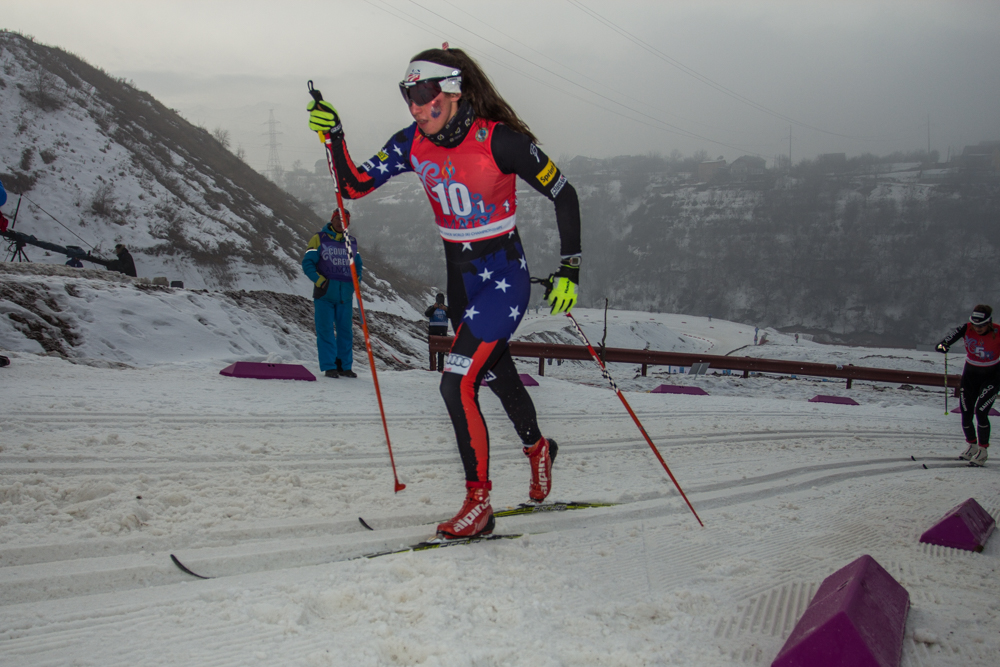
That was a nightmare for many athletes, including those who do suffer from asthma. Kern, now a U.S. Ski Team member based at Stratton Mountain School and Dartmouth College, remembers Almaty and its health challenges well.
“I had the experience of having my worst asthma attack ever in Almaty and I attribute that to the poor air quality,” she wrote. “I know some of my teammates who have never had any issues breathing even mentioned having some issues in Almaty.”
In fact, the International Olympic Committee released a consensus statement about asthma and elite athletes in 2008. In it, they addressed the influence of air pollution on the prevalence of airway problems during training and competition.
Julia Kern (CSU) racing against a backdrop of smog in the first leg of the 4 x 3.3 k relay at the 2015 Junior World Championships in Almaty, Kazakhstan. The American team would go on to place eighth. (Photo: Logan Hanneman)
“Airway function can be affected by exposure to seasonal and perennial allergens in sensitized individuals, dry/cold air, and poor quality air containing pollutants such as chlorine derivatives in swimming pools, ozone and oxides of nitrogen, and fine and ultrafine PM derived from combustion,” the group wrote. “The effects may be greater in subjects with asthma than without asthma.”
Other air characteristics are sometimes considered in assessing safety. The International Ski Federation (FIS) has a cutoff of -20° Celsius (-4°F), below which it is not permissible to hold competitions; one reason is frostbite, but another is airway damage. FIS is considering raising that lower limit, perhaps to -12° Celsius, specifically to protect athletes’ lung function from long-term damage.
But the pollution aspect of air quality does not appear to be a concern. Air quality is not discussed anywhere in the International Competition Rules (ICR), meaning that technical delegates and race juries do not have clear guidelines for deciding whether to adjust race schedules due to smog.
And by selecting sites like Erzurum and Almaty that are clearly plagued by such problems, FIS does not appear to make the issue a priority when awarding event bids.
They are not alone. The International Olympic Committee (IOC) awarded the 2008 Summer Olympics to Beijing, China, which has some of the worst smog in the world. That caused some long-distance runners to choose not to prioritize the marathon, for fear that prolonged exposure to the air while racing would cause asthma attacks.
Such an attitude by governing bodies must be changed, a growing number of athletes assert.
“My personal belief is that if we are racing in an area with high pollution, I think it is okay for people to use legal asthma medications at a legal dose in order to protect their lungs from damage,” Kern wrote. “But more importantly, I do not think races should be allowed to be held in places of pollution because it not only hurts the health of athletes in the short term, but in the long term as well.”
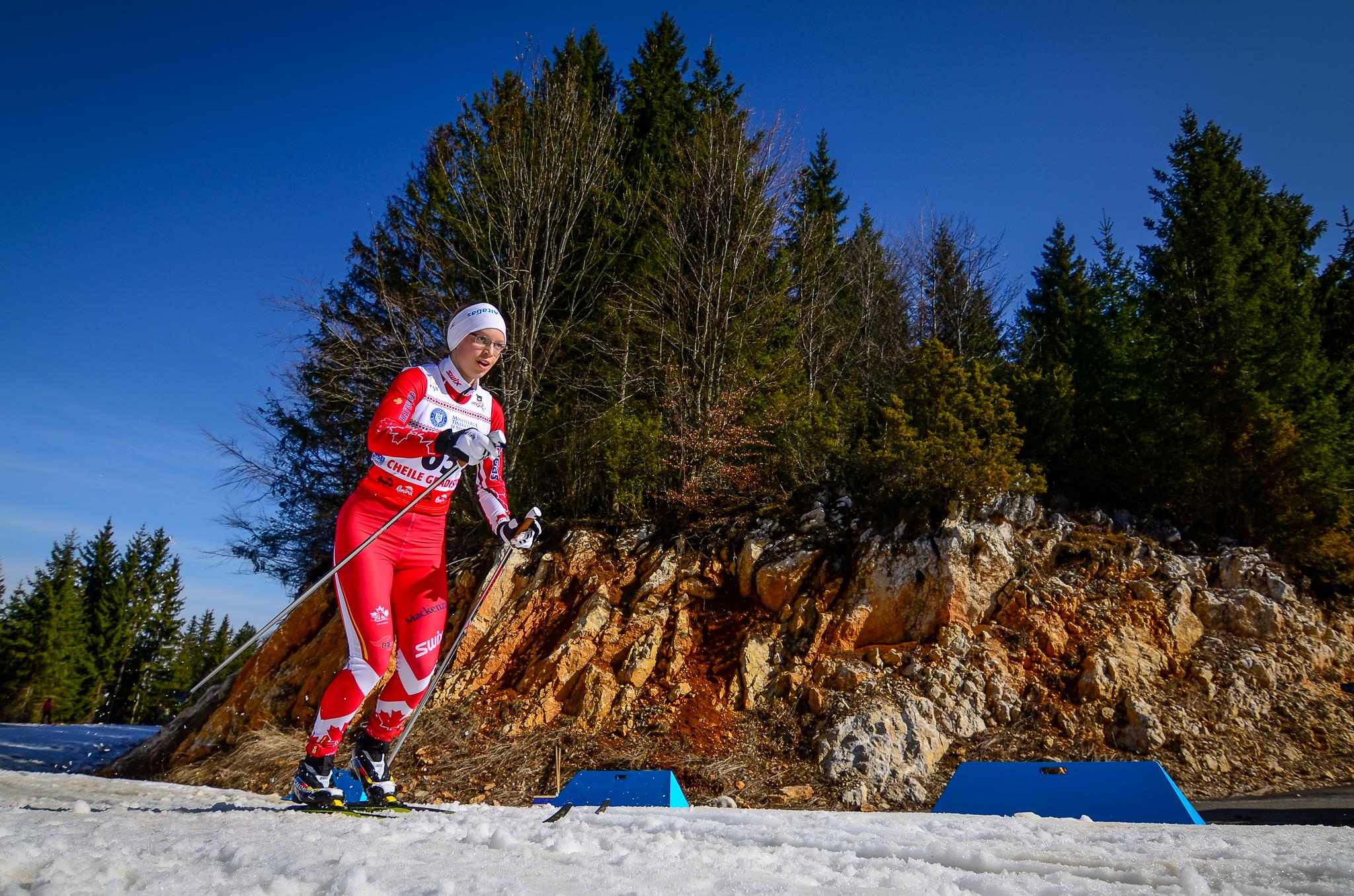
There were blue skies as Canada’s Hannah Mehain raced to 44th in the women’s 5 k classic on at 2016 Junior World Championships in Rasnov, Romania. (Photo: FIS Nordic JWSC & U23 WSC 2016/Facebook)
At Rasnov, where the ski competitions were held, traffic exhaust was less of an issue.
“The only thing that was polluting the air was the exhaust from coal burning, which is easy to recognize because it has a strong odor,” Kern wrote.
Of all airborne pollutants this type of exhaust can be particularly inflammatory to airways, according to Dr. Michael Kennedy at the University of Alberta, who studies respiratory health of endurance sports athletes.
“The ultrafine particles (UFP) are the most troublesome,” he explained in an email. “In any active person (most of the literature is from active transport — like bike commuting)… deposition of UFP in systemic circulation as well as lung function can be significant. Diesel is the worst of the polluters and fits with Romania and Kazakhstan, where High Emission Pollutants likely influenced lung health in all competitors. For those with [Exercise Induced Bronchoconstriction] it was likely worst.”
So it’s not crazy to suggest that athletes could have struggled to race in particulate-laden air, as Olberg suggested was true for the Norwegians.
But that’s not the way other teams remember Rasnov. Because of the way the venue was situated, American competitors did not notice the coal-produced UFP’s while they were skiing.
North American Perceptions of Air Quality in Rasnov
“I did not notice the ‘poor air quality’ in Rasnov as my biggest concern was the lack of snow. I think this is an excuse and if the air was bad in Romania I hate to think of what they were taking for Junior Worlds in Kazakhstan where the smog and air pollution was extremely prevalent.”
–Ian Torchia, USA (Northern Michigan University): 15th in the junior 10 k skate
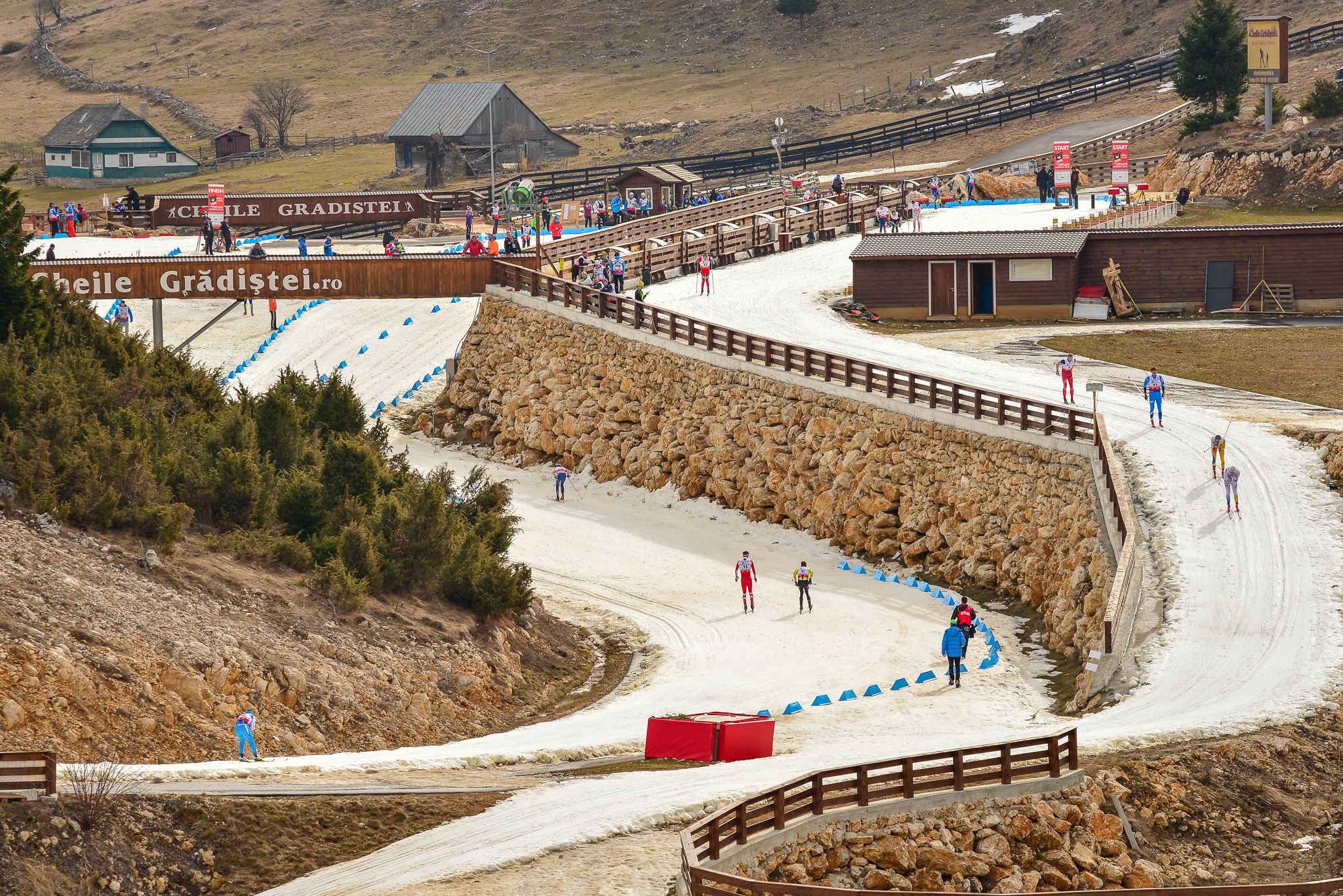
“In Bucharest, the city air was definitely thicker, but the venue (Cheile Gradistei) was quite remote, at least 20 or 30km from any major cities (or industrial sites, that I know of), out in the countryside, surrounded by rural farmland and fields. Water quality seemed to be a much greater concern in Romania.”
– Jenn Jackson, Canada (NDC Thunder Bay): 29th in the U23 sprint
“The air quality appeared okay to me, however there was heating with wood in the area. That can irritate some but no significant quality issues like we saw in Kazakhstan and Turkey. Romania was very warm and early warm conditions can bring on pollen, however I didn’t notice that either.”
– Bryan Fish, U.S. Ski Team coach/trip leader
“While I’m by no means an air-quality expert, I wouldn’t say the air quality was bad in Rasnov, at least at the race site. The race site was up high on a hill in a very agricultural area, on the edge of some mountains… I never had a moment where I thought to myself ‘wow – this air quality is bad’ and as a coaching staff we never had a discussion that indicated that air quality was an issue with the site. We were mainly focused on having snow to ski on… That being said, in my opinion, it also wasn’t great. There was a big smokestack from what I’m assuming was some sort of boiler that burned wood. It was also pretty dusty from the overall construction.”
– Kieran Jones, Nakkertok Nordic coach/Canadian team staff member
Like Kern, Hanneman has been diagnosed with asthma. In his case, he believes that it is a result of growing up in Fairbanks, Alaska, and “racing and training in the very cold and dry air.” He said that he was prescribed a small inhaler to treat his symptoms after a major flare-up in Erzurum, but he didn’t experience a similar problem in Romania.
“I seem to remember that my asthma related problems were not very present in Rasnov,” Hanneman explained. “I took my inhaler like I normally do for races, but the air did not seem to bother me as much as the previous locations. It helped that it was also 55 degrees.”
Why Offer Athletes a Nebulizer?
So, then, was giving new medications to some junior athletes necessary?
“When I first heard the news I was extremely fired up,” wrote Torchia, who initially assumed that the juniors were prescribed the same drug which Sundby had used, rather than a non-prohibited one. “My initial anger eventually turned to being demoralized that doping had come down to the junior level. You hear about the scandals on the World Cup but when it comes to the people you race, it felt like a punch in the gut. The most frustrating thing I have heard was the Norwegian doctor offering asthma medication to healthy athletes. This shows a clear indication from the upper levels of the system to cheat their way to victory. If you can’t compete clean, don’t compete at all.”
As it turns out, it was not salbutamol but budesonide which the athletes were using. Budesonide is not prohibited for inhalation, although like other glucocorticosteroids, it cannot be injected or ingested orally in or out of competition.
A bird’s eye view of the race course at U23/Junior World Championships in Rasnov, Romania. (Photo: FIS Nordic JWSC & U23 WSC 2016/Facebook)
Olberg told NRK that from his viewpoint, saying that the athletes without an asthma diagnosis were “healthy” was incorrect. The athletes, he said, were sick because of the air quality.
“I believe that we don’t medicate healthy people,” he explained to NRK. “If we medicate it is because they have gone ill. They have a symptom, a distress of some kind and then they reach out to me. We treat the symptoms…. I believe that to say that they are healthy is completely wrong, because if they’re healthy they wouldn’t have had the symptoms, and if that was the case they would not receive treatment.”
The North American athletes seemed to struggle internally about whether this was appropriate – especially since it’s relatively unclear whether non-asthmatics even receive benefits of such drugs. That’s even true in the case of salbutamol, the beta-2 agonist which is prohibited at high doses.
But the athletes felt that the intent of their competitors mattered, whether their performance was enhanced or not.
“After talking with [Northern Michigan University coach] Sten [Fjeldheim] and my exercise physiology professors and doing some personal research, it seems unclear on the performance enhancing benefits of taking salbutamol, especially in healthy athletes as the oxygen uptake is already at maximum potential,” Torchia wrote. “However… whether it is performance enhancing or not, if you are a healthy athlete and are taking synthetic drugs with the intention of helping your performance, you are cheating, and there should be repercussions.”
Hanneman and Kern, who take inhalers to treat their diagnosed asthma, had a hard time parsing whether it was wrong to use such medications without such a formal diagnosis.
“My hope is that the WADA has set the limitations and bans on certain drugs in ensure that the drugs permitted at legal doses would not have a positive impact on performance, but would only help treat the illness of asthma for those with the ‘disease’ (not sure what technical term to use),” Kern wrote.
American Logan Hanneman (c) racing to third in his quarterfinal of the freestyle sprint at U23 World Championships in Rasnov, Romania. He ended the day 15th overall. (Photo: Pete Leonard)
“Having exercise induced asthma myself, and seeing the health benefit that the medicine provides, I support the use of prescribed medications, but in limited quantities,” Hanneman agreed. “People who have not been treated previously should not be allowed to use such a medicine I feel.”
Many drew a distinction between whether such drugs were used as part of a long-time treatment plan, or prescribed more casually by doctors who are not intimately familiar with an athlete’s medical history.
“I am very much opposed to widespread usage of any medication,” U.S. Ski Team development coach Bryan Fish wrote. “That being said, there are athletes that have unique respiratory issues & these athletes should go through testing by qualified medical staff. The qualified medical staff should then create a unique and specific plan for that particular athlete.”
And as more and more such “gray area” incidents accumulate, it’s hard for athletes to interpret whether their competitors are seeking an unfair advantage or not – much less whether they are actually getting one.
“I don’t understand how people can be so invested in maximizing their performance that they’re willing to leave the white area and step into the grey,” Jackson wrote. “Unfortunately, medicating and supplementing just seems to be the norm these days, in sport and everyday society. People will do what they’ll do, so long as they feel it’s ‘normal’ or ‘okay’ – whether that be Norwegian juniors using asthma medication at the World Championships, Russians using xenon for Sochi, [Poland’s Justyna] Kowalczyk taking injections for her foot in 2014, or [Norwegian Therese] Johaug’s doctor providing her that super skin cream. I suppose it’s inevitable, as you approach the limits of human potential, that you toe the line between white and grey, but I don’t feel like I’m close enough to that point to really understand why someone would.”
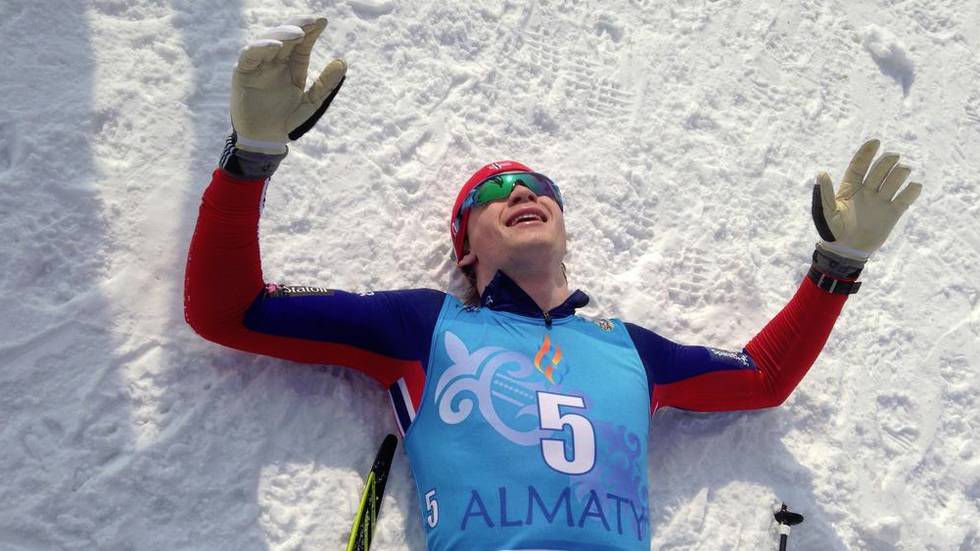
An exhausted-and-ecstatic Fredrik Riseth of Norway after winning his first Junior World Championships title on Tuesday in the 1.3 k classic sprint. (Photo: FIS)
Last year in his FIS Junior World Ski Championships debut, Thomas O’Harra placed 54th in the freestyle sprint in Val di Fiemme, Italy. Another year older and with another season of training under his belt, the 18-year-old Alaska Pacific University (APU) skier placed 14th on Tuesday in the opening race of 2015 Junior Worlds in Almaty, Kazakhstan: the 1.3-kilometer classic sprint.
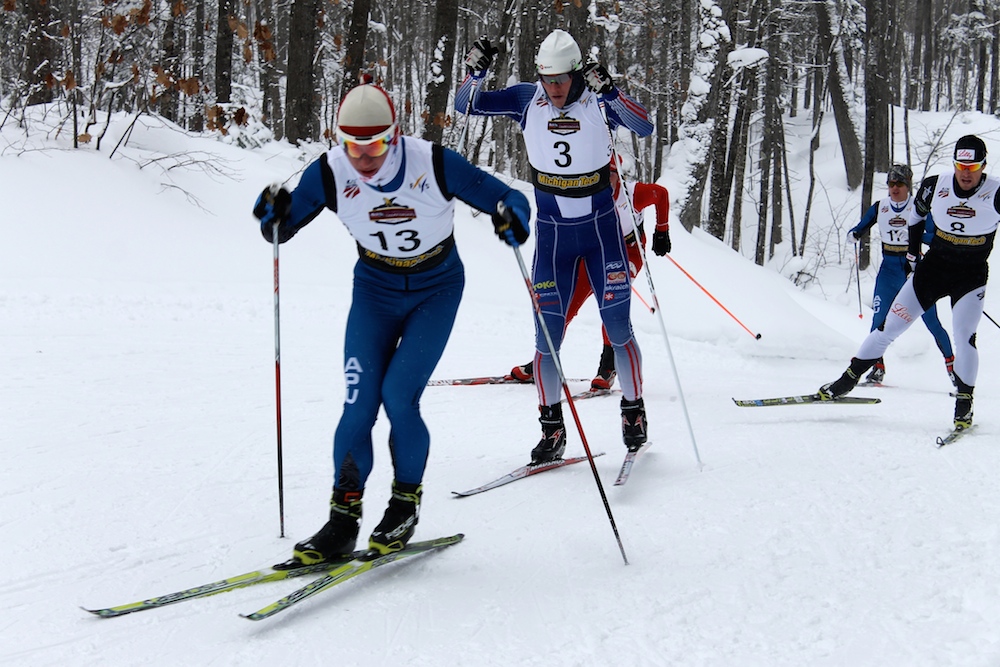
APU’s Thomas O’Harra (13) leading his freestyle-sprint quarterfinal with Sun Valley’s Miles Havlick (3) and Kris Freeman (8) last month at 2015 U.S. senior nationals in Houghton, Mich. He went on to place 18th overall.
O’Harra qualified 18th and went on to place third in his quarterfinal, 2.92 seconds behind the winner of his heat, Ludek Seller of the Czech Republic, and 0.35 seconds behind Russia’s Alexander Bakanov, who also automatically advanced in second.
O’Harra’s quarterfinal was the slowest of the five, which prevented him from moving on to the semifinals as a lucky loser. But at the end of the day, 14th was still way better than 54th.
“I don’t know if I can say I was expecting it, but I definitely knew that if I had a good race, I could get into the top 30,” O’Harra wrote in an email on Tuesday. “Coming into the sprint, my goal was to qualify. Ultimately though, my goal was to get into the top 10. Once I had qualified, I focused more on trying to advance out of my quarterfinal.”
He reflected that his quarterfinal was “pretty hard right off the bat … everyone was jostling for position.” Knowing that he needed a top-two in his heat to guarantee a spot in the semifinal, O’Harra followed Bakanov in his track to the finish and lunged between the Russian’s legs as Bakanov let up near the line. And while it wasn’t quite enough, O’Harra was pleased to finish well within the top 30.
“Today was a much better experience than last year’s sprint!” he wrote. “Last year I tripped myself going up the first hill and ended up 54th — not exactly super-duper. I think that a year’s more experience helped a lot. I was definitely a lot more collected and calm this year, both going into the race and during the race.”
He was also optimistic about another top 30 in Wednesday’s 10 k freestyle.
“I think that I’m in a really good place right now, but I didn’t actually try to peak specifically for these races, mainly because there is still a lot of racing left this season,” he wrote.
“Last year I tripped myself going up the first hill and ended up 54th — not exactly super-duper. I think that a year’s more experience helped a lot.” — Thomas O’Harra, 14th in 2015 Junior World Championships 1.3 k classic sprint
O’Harra led the North Americans in the junior men’s sprint, which Norway’s Fredrik Riseth won outright in 3:01.25. The Norwegian qualified fifth behind Finland’s Lauri Vuorinen (the top men’s qualifier in 3:01.88), and Riseth went on to win his quarterfinal and his semifinal before beating Bakanov by 4.85 seconds in the final.
Norway’s Johannes Høsflot Klæbo made the podium as well in third, 8 seconds behind Riseth. Germany’s Marius Cebulla was fourth (+10.04), Sweden’s Oskar Svensson finished fifth (+10.11), and Vuorinen was sixth (+21.67).
Riseth’s father, Svein Riseth, told Langrenn that he was impressed with his son’s result. While he knew Fredrik was in great shape, Svein wasn’t sure he had enough left after dominating his quarterfinal and semifinal. The contender he was most concerned about was Fredrik’s Byåsen IL teammate, Høsflot Klæbo.
“Johannes is not only a good skier, but he is mentally and tactically strong,” Svein said, according to a translation. “It is outrageously fun two Byåsen runners entered the podium. Not just for the team but for [Trondheim] skiing.”
While no other North American men qualified in the top 30, Canada’s Julian Smith (Georgian Bay) placed 39th, 3.82 seconds from 30th. Americans Evan Weinman (Middlebury) and Peter Holmes (University of New Hampshire) were 46th and 48th, respectively, Canada’s Alexis Dumas (CNEPH/NST-Junior) ranked 53rd, Ricardo Izquierdo-Bernier (CNEPH/NST-Junior) was 56th, American Gavin Hess (UNH) 58th, and Canadian Philippe Boucher (CNEPH/NST-Junior) 59th.
Stewart-Jones Leads Three Canadian Women in the Heats
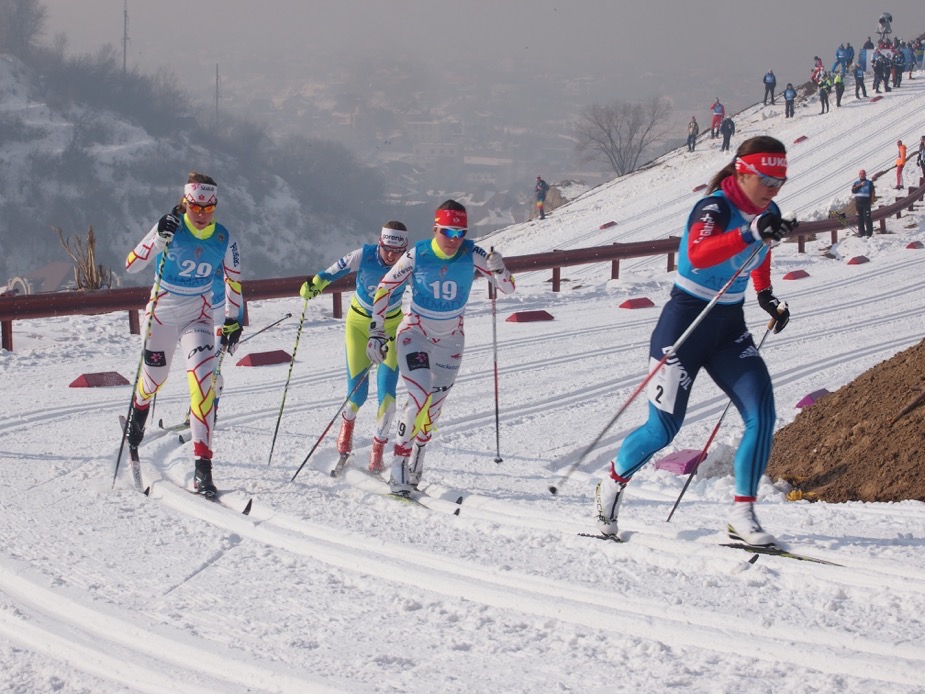
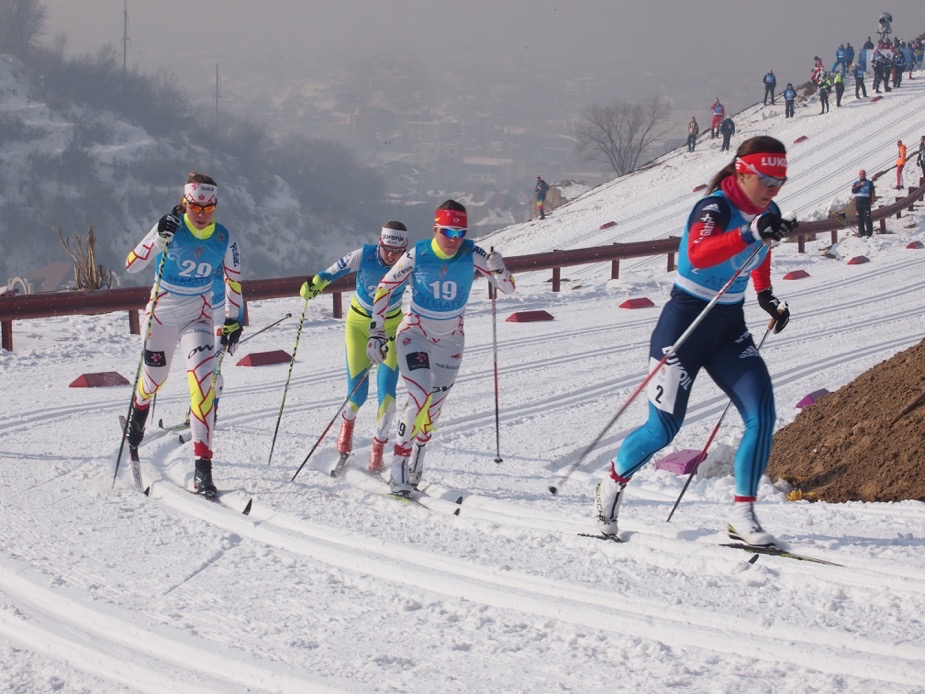
Canadian National Junior Team members Katherine Stewart-Jones (19) and Maya MacIsaac-Jones (29) chase Russia’s Natalia Nepryaeva (2) in the quarterfinal of the 1.3 k classic sprint on the opening day of 2015 Junior World Championships in Almaty, Kazakhstan. (Photo: Lisa Patterson/CCC)
In the women’s 1.3 k classic sprint, Katherine Stewart-Jones knew what was coming, or at least what to expect, in her third time qualifying for the Junior Worlds heats.
The 19-year-old Canadian National Junior Team member qualified in 19th, 13.61 seconds behind Russia’s Yulia Belorukova, the top qualifier in 3:29.24. Stewart-Jones then finished fourth in her quarterfinal, 9.77 seconds after another Russian, Natalia Nepryaeva, who won the heat. Their quarterfinal was the second slowest and Stewart-Jones did not advance, putting her in 19th overall.
“I am satisfied with my result,” Stewart-Jones, the top North American female junior of the day, wrote in an email. “I definitely had the goal to make it past the quarter-finals because last year I was extremely close. I can’t really be disappointed with how it turned out because I gave everything I had.”
“I definitely had the goal to make it past the quarter-finals because last year I was extremely close. I can’t really be disappointed with how it turned out because I gave everything I had.” — Katherine Stewart-Jones, 19th in 2015 Junior World Championships 1.3 k classic sprint
Last year at Junior World Championships, she placed 15th in the freestyle sprint, and the year before, she was 25th at the 2013 Junior Worlds in Liberec, Czech Republic.
But for the first time on Tuesday, she raced against one of her fellow national-junior team members in the heats: Maya MacIsaac-Jones of Rocky Mountain Racers (RMR).
“We both had a really good start so it was fun to ski at the front together for the first part of the race,” Stewart-Jones explained. “After the long downhill I was in third place but then I made a bit of a tactical mistake. At the start of the long uphill I went right behind a Russian but she slowed down. When I went to make the pass and change lanes I lost my momentum.”
MacIsaac-Jones, 19, made the top-30 qualifying cutoff in 29th and ended up fifth in her first time racing the heats at that level, 12.05 seconds behind the winner.
“Katherine and I have raced together for a long time, and since there are so many things at World Juniors that are different from racing in Canada, it was nice to have a familiar face beside me,” MacIsaac-Jones wrote in an email. “My ‘realistic’ goal for today was to qualify, and my ‘dream’ goal was to get a top-15 result. I am very happy to have qualified for the heats, especially to have qualified with two of my teammates, but I am disappointed that I wasn’t able to move on past the quarter final.”
Her previous best in her last Junior Worlds in 2013 was 36th in the classic sprint. On Tuesday, she placed 25th overall. The third Canadian woman to make the rounds, Sophie Carrier-Laforte (Skinouk/NST-Junior) qualified in 23rd and placed 22nd overall after finishing fifth in her quarterfinal, 12.21 seconds behind Austria’s Lisa Unterweger, who won the heat.
“It was a lot of fun to be racing with so many other Canadian girls in the heats today,” MacIsaac-Jones wrote. “We have all been training really hard for these championships, so it feels great to show the world what Canadian girls can do!
“This experience is definitely different from my experience in Liberec 2013,” she explained “I feel like I am in a lot better distance racing shape than I was in Liberec, and I should have a chance to race most or all of the distance races, which will be a lot of fun. This being my second Championships, I feel like I have a bit of a better idea of what to expect and how to prepare for racing on the international scene.”
Stewart-Jones was also looking forward to the distance races after placing 31st in the skiathlon in Val di Fiemme last year.
“I would like to make a top 15 in a distance race and I believe that I can,” she wrote.
Nakkertok Head Coach Kieran Jones wrote in an email that Stewart-Jones’ performance on Tuesday wasn’t a surprise.
“We have been targeting top 30’s at World Juniors since the start of the year. While I was pretty excited for the classic sprint, I would say that it’s definitely not her strongest event,” he noted. “It’s more of a good indicator that the fitness and speed is where we want it to be. Katherine is rock solid — once she gets rolling, she’s great at managing her energy, enthusiasm, and focus.”
He explained that she’s shooting for top-30 results in both Wednesday’s 5 k freestyle and Friday’s 10 k skiathlon.
“Personally, I think she has a shot at a top 10 in the 5 km if everything goes to plan,” Jones wrote. “She is also really looking forward to the relay — this year the Canadian women’s team is one of the strongest it has been in a long time, and she wants to help them have a strong finish.”
Germany’s Victoria Carl after notching her second Junior World Championships title and third podium in the first race of 2015 Junior Worlds in Almaty, Kazakhstan. (Photo: FIS)
Just 0.26 seconds from qualifying in the top 30, Julia Kern of the Cambridge Sports Union led the U.S. junior women in 31st. Vivian Hett (Northern Michigan University) placed 36th, 3.89 seconds from 30th, and Hailey Swirbul (Aspen Valley Ski & Snowboard Club) was 40th.
Canada’s Annah Hanthorn (Whitehorse) finished 45th, and American Kristen Bourne (NMU) placed 46th.
Germany’s Victoria Carl racked up her second Junior Worlds title since she last raced at the championships in 2013 (where she won the 5 k freestyle and placed second in the classic sprint). Carl, 19, qualified fourth and won her quarterfinal and semifinal before topping the final as well in 3:29.01, 1.64 seconds ahead of Belorukova in second.
Another one of the women in the Stewart-Jones/MacIsaac-Jones quarterfinal, Nepryaeva placed third in the final, 2.18 seconds back from the win. The Russian edged Norway’s Lotta Udnes Weng by 0.2 seconds for the podium, and Weng’s sister Tiril Udnes Weng placed fifth, 6.42 seconds after Carl. Germany’s Jenny Mann finished sixth in the final (+30.43).
First Impressions
The junior classic sprint was originally scheduled for Monday, then pushed back a day to allow more time to extend the 800-meter loop to 1.3 k. In addition to concerns about dirt and rocks on the trail, the air quality in Almaty continues to pose one of the biggest problems for athletes, with several U.S. athletes bringing ventilation masks to the championships.
“The air quality is certainly an issue, but we all share this challenge,” U.S. Ski Team Development Coach Bryan Fish wrote in an email. “Many of our athletes purchased filtering masks before arriving. The same ones used [at the Summer Games] in Beijing.
“They don’t wear them all the time — primarily when skiing,” he added. “The trails are uphill, so it depends how high the inversion is. Unfortunately there is no way to escape it in the city. All the teams are staying in the city except Russia is an hour away in the mountains.”
According to O’Harra, “Skiing here is… thin. When we arrived, there was only about 2.5k of trail, and that was full of rocks. The volunteers and organizers have done an amazing job, though! They have been blowing snow around the clock, and their hard work definitely shows,” he wrote. “The smog varies. It pretty much always sits down in the bottom of the valley, and most days it creeps up to where the trails are as we ski. It was definitely hazy today, but there have been worse days. I don’t think that it hindered my performance, but I still don’t like having it around.”
MacIsaac-Jones wrote that the skiing over the last week had not been ideal; the postponement of the first race “altered everyone’s race preparations, and we have been dealing with heavy smog all week.”
She added that there was adequate snow on the sprint course, “and there should be enough for the skate race tomorrow. The snow here is artificial, cold and hard-packed right now, which is great for me because it is similar to the snow I am used to training on in Canmore, Alberta,” she wrote.
“The skiing here is nothing like I have seen before,” Stewart-Jones explained. “The race site is built at the top of a huge sand hill in the middle of the city. All the trails weave around the hill and the snow is all man made. … The smog is definitely an issue; I have been coughing a lot more than usual.”
Through email exchanges, her coach Jones has been keeping tabs on the conditions.
“That stuff is out of our control,” he wrote. “That’s always been the message — control what you can, and don’t worry about anything else. … Kath is great at that, so I wasn’t worried.”
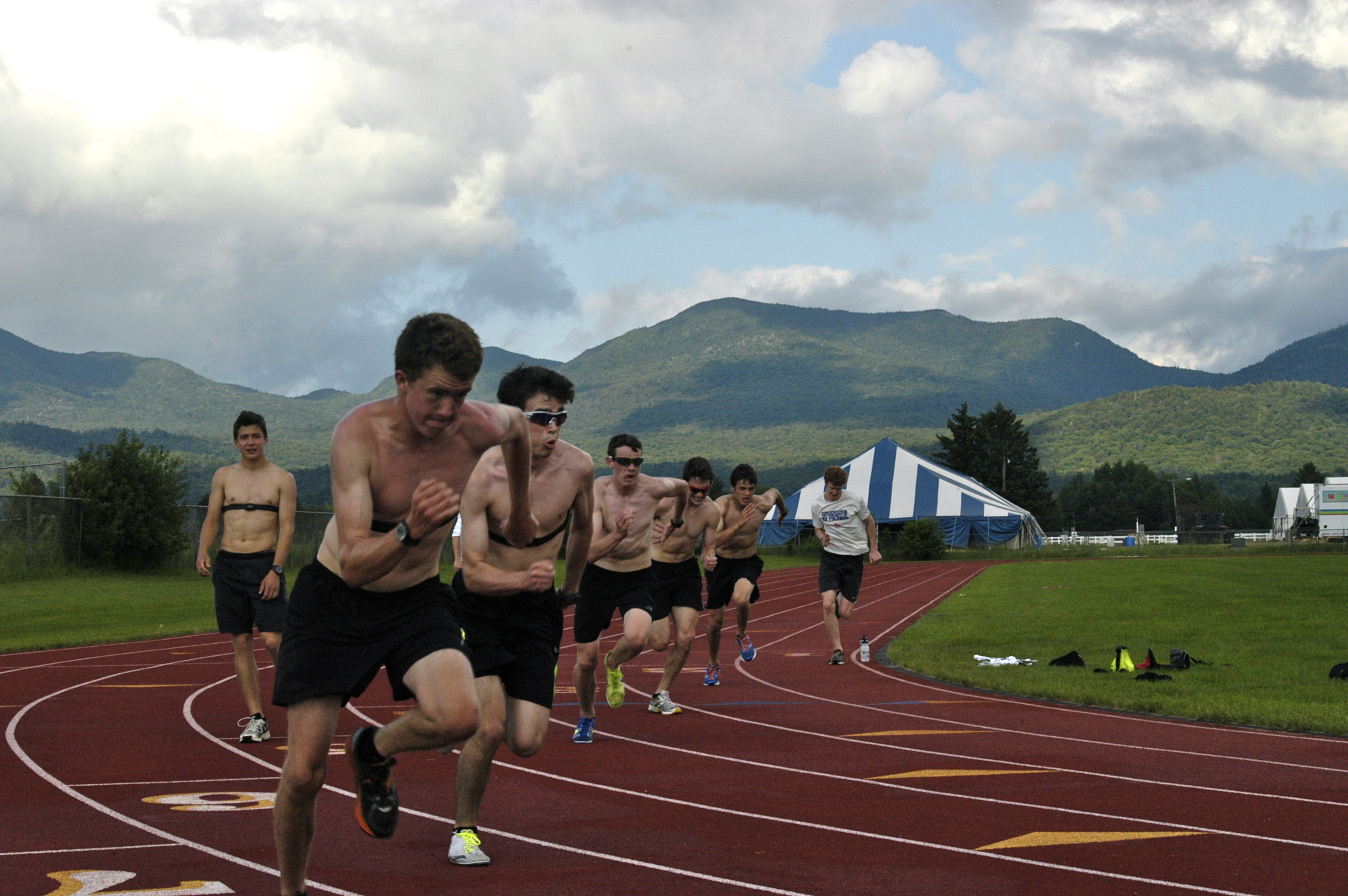
Nakkertok skiers hard at work during a recent track workout. From left to right: Isaac Alexander-Cook, Kyle Curry (St. Lawrence University), Cary Pomeroy, Phil Marshall, Brendon Howard, Symon Stowe, and Patrick Van Walraven. (Photo: Jesse Williams)
Welcome to Wednesday Workout, where we provide and break down training ideas on a weekly basis. This week, Kieran Jones, head coach of the Nakkertok Ski Club in Ottawa and former FasterSkier reporter, gives some advice for developing a strong baseline and widening the range between easy and max efforts.
***
Skiers like pain. Skiers like feeling exhausted. Regardless of whether you’re a 10 year old girl, a 55-year-old master-blaster, or an Olympic champion, if you’re a skier, you love feeling the hurt.
But sometimes, to get to the hurt, you need to lay out a strong baseline. And to do that, you have to think beyond “I want to hurt.”
Nakkertok has approximately 50 athletes in the two programs I directly coach, with almost all of them falling in the 15- to 20 year-old age range. As a coach of these Junior athletes, my major goal is to expand their physical literacy to the point where there is a range beyond “slow” and “all-out.”
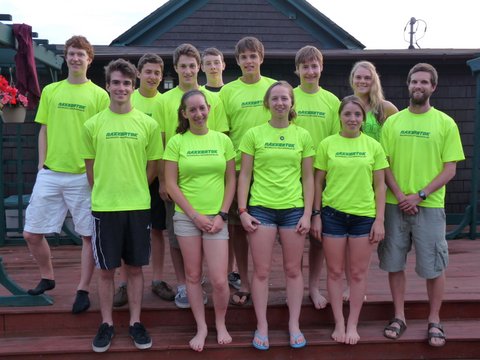
2013/2014 Nakkertok Nordic Team (Courtesy photo)
The Workout: Cue Level 3 Running Threshold Loops
Easy 15-minute warmup jog, followed by dynamic warmup exercises, including 5 x 6-second acceleration sprints for range of motion
4 x 10 minutes on rolling terrain, with 3 minutes recovery between each rep
Easy 15 minute cool-down jog
The major goal of the workout is to ensure that athletes are running at the correct speed and effort level. Depending on your available metrics, you can control it a number of ways. If you’re using heart rate zones based off a maximum heart rate, I recommend 82-88 percent of your max. If you’re using a lactate monitor, target lactate readings of 3-5 mmols. If you’re running based on ‘feel’, aim an 8 out of 10. Finally, if you’re running based on pure effort level, think of a pace you can sustain for around 50-60 minutes.
The first step is to mark out a clear loop over rolling terrain. I like to make the loop so that the faster athletes do a little more than 1 loop, and the slower athletes do a little less than one loop, so that whole group can start each rep together.
Generally I don’t get too bent out of shape about the number or grade of uphills, but it’s important to consider the level of runner you have. I try to avoid loops with hills I know will crush the groups’ legs on the first interval.
The greatest thing about the loop is that no matter what you have a number of metrics you can record as a coach. If you’re high-tech enough to own a lactate monitor, you can set up a lactate-test station, and take samples as people come off the loop. If your athletes have heart rate monitors, you can record max values for each rep. If you only have a stopwatch, you can record times for the loops for each athlete. Or if you have nothing but the shirt on your back, you can drop that shirt where you end on the first rep.
For pacing, emphasizing that the first rep should feel quite easy is important. If an athlete is breathing hard, or glancing at their watch every 5 seconds thinking “oh god, please let this end” on the first or second rep, chances are they are going too hard. If by the third interval they aren’t able to hit the same time or finish point, then you know they’ve gone out of the gate too fast.
If you’re measuring heart rates, I like to see a consistent increase without a huge jump or drop off. For example, recording a max heart rate at the end of each interval, I want to see the following: Rep 1: 165, Rep 2: 170, Rep 3: 172, Rep 4: 174.
The above athlete will finish the workout without collapsing on the ground due to the feeling of “concrete block” legs, be able to do an easy cool down, have a nap, and be ready to roll again by 3 PM for the afternoon workout.
The part B of this workout is something athletes love. We often return to the same spot six or eight weeks later, and repeat the workout. The athletes have recorded the time or distance they were able to travel the first time, and then are able to see themselves beat that mark working at a lower effort level or heart rate. As the workout is running, you remove the variable of rollerski speed, broken pole tips, or traffic that can often throw off data collection in a rollerski workout. Not all athletes can make it to World Juniors, or win a medal at Canadian Nationals – but all athletes want to see that the work they are doing is resulting in improvement.
My favourite part about this workout is that it forces athletes to think about controlling their speed and effort. If you’re a highly motivated skier (see: every skier ever) it’s quite easy to go out and hammer at your max. But it’s harder to rein yourself in, and work in the right range.