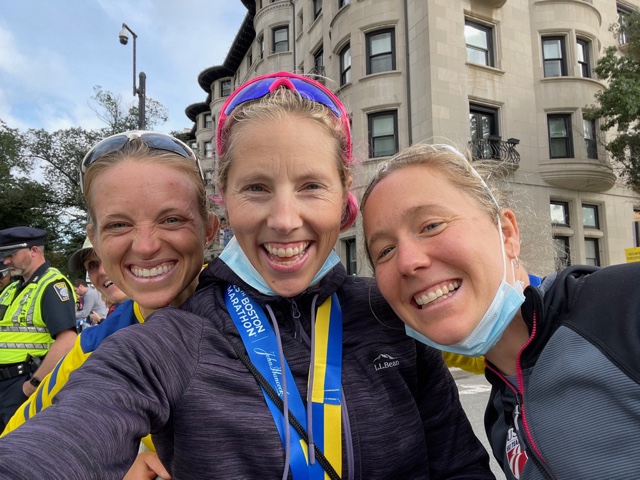
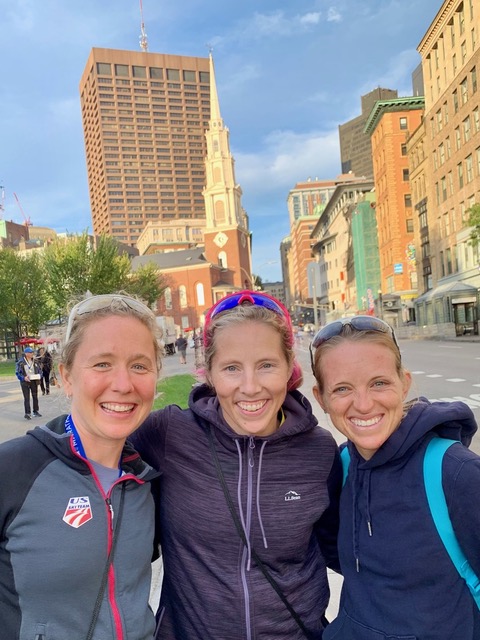
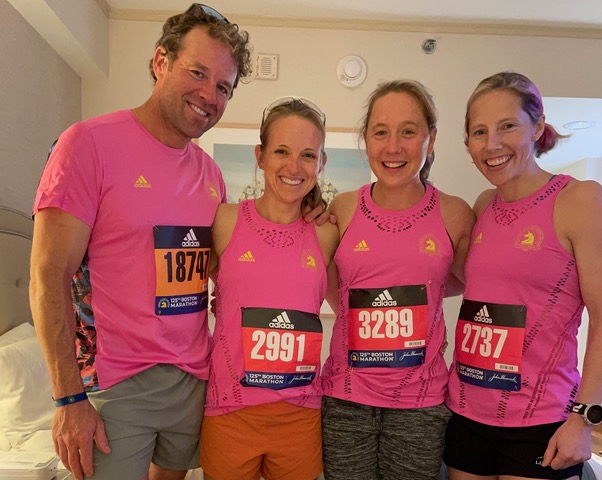
Lining up for their second marathon on behalf of Aktiv Against Cancer, Ida Sargent, Kikkan Randall, and Liz Stephen took on the 2021 Boston Marathon. (Courtesy photo)
While no one would wish for the circumstances, a fall running of the Boston Marathon is perhaps a skier’s dream. The iconic foot race is on many a bucket list; however, the third Monday in April is early for those who spend the winter strapped to skinny skis rather than pounding pavement.
After cancelling the April, 2020, running in light of the descending COVID-19 pandemic, and deciding against an April date for the 2021 event, the Boston Athletics Association (BAA) set its sights on October 11th, 2021, for a return to racing. 30 months without the Boston Marathon; it was go-time in Boston on Monday morning. The Red Sox even put on a show to celebrate, beating the Tampa Bay Rays 6-5 to win the ALDS in dramatic fashion later that evening.
Among the 15,716 individuals making their way from Hopkinton to the finish line on Boylston Street in Boston were three familiar faces: former teammates, U.S. Ski Team members, and Olympians Kikkan Randall, Ida Sargent, and Liz Stephen. The threesome ran on behalf of Aktiv Against Cancer, which promotes physical activity as an integral part of cancer treatment.
According to Aktiv’s mission statement, “Recent research indicates the benefits of physical activity extend beyond controlling symptoms and side-effects of cancer therapy; it is shown to reduce cancer progression and improve a patient’s response to anticancer therapy.”
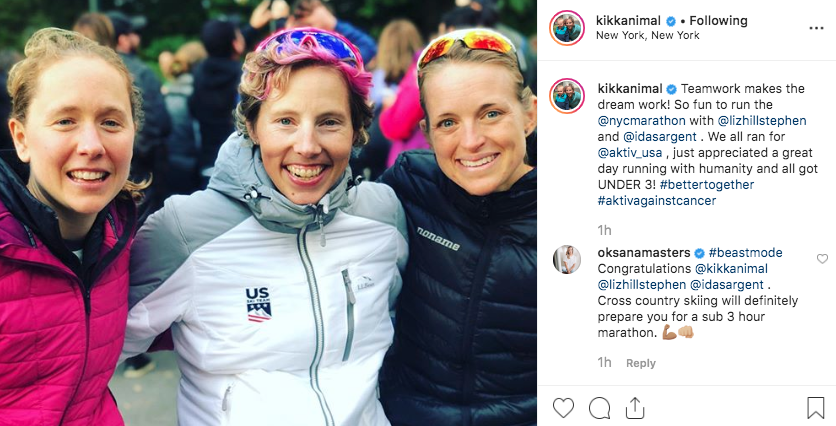
Nearly two years ago in November, 2019, these women lined up together for the NYC Marathon, each achieving their goal of finishing under three hours. At the time, Randall was only one year beyond her own cancer treatment journey. After receiving the diagnosis of Stage 2 breast cancer in June of 2018, Randall underwent six rounds of chemotherapy, infusions of the drug Herceptin, and a lumpectomy. All the while, she remained active, sharing her journey openly through daily video updates and social media.
Randall shared her Boston Marathon race experience via email.
“We’re all hobbling around today but also basking in the glow after a hard race and fun experience!! After meeting up for the NYC marathon two years ago, when the opportunity to run Boston in October came up (versus April) we jumped at the chance to get together and once again shine the spotlight on an organization near and dear to our hearts, AKTIV Against Cancer.
“All of us have had close contacts with cancer in our personal lives and as athletes recognize how important physical activity is for tackling the treatment. So to be able to raise funds for important research and outreach, we jumped at the chance. We were able to raise over $17,000 collectively toward the cause!”
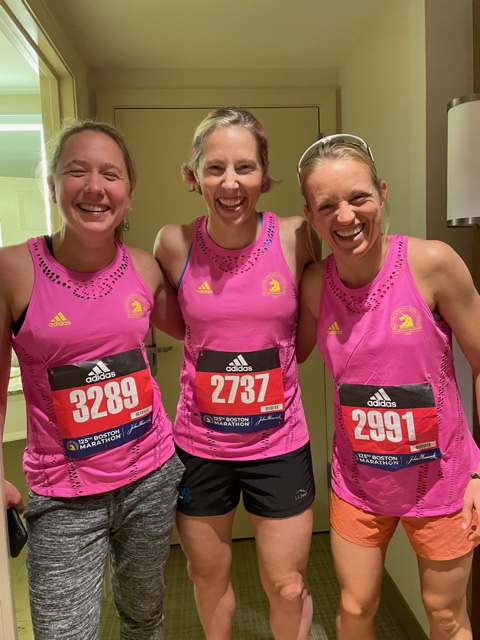
Dressed in hot pink and having no fun at all, Ida Sargent, Kikkan Randall, and Liz Stephen lace up for the 2021 Boston Marathon on behalf of Aktiv Against Cancer. (Courtesy photo)
In 2019, Randall checked the box on her sub-3 goal with a time of 2:55:12. This year, she was just shy with a net time of 3:00:27.
“When we decided to do this back in April/May, I think all of us had ambitions to prepare for this race more seriously. But as we’re all finding post-racing, life is busy and I think we all came in a little under prepared. Regardless, it was going to be a great excuse to meet up with best friends.”
Two minutes behind Randall, Sargent crossed the line in 3:02:26. Sargent also remarked that she felt under-trained at the start line, but the experience and opportunity outweighed the feeling of the final 10k.
“We plan to do these races as a little reunion and an opportunity to see and run with each other and support Aktiv,” wrote Sargent. “Today was so much fun but also a beast. The energy out on course of these big races is also so incredible. I hadn’t trained or run much at all leading up to the race so I really wasn’t sure what to expect but I was very excited that my legs felt great for so long. The last four or five miles were tough but I just told myself that I couldn’t walk and that kept me going through to the finish line.”
Happy 26.2 finishers: Ida Sargent (left) and Kikkan Randall (right). (Courtesy Photo)
Despite being veterans when it comes to endurance racing, Randall shared that the women were perhaps lured out too quickly, leaving them a little too dinged up when they faced the Newton hills late in the race. Runners face the infamous “Hearbreak Hill” at mile 20, steadily climbing for half a mile on tired legs.
Though all three women positive-split the race, Stephen bled the least amount of time in the second half; she clocked 1:25 through the first half, losing five minutes over the second to finish in 2:55:48.
“The downhill start was really fun for the first 10km,” wrote Randall. “At points we were on-pace for a sub-2:45. But being Boston rookies, and light on the running mileage, that early fast pace took its toll on all of us at different points. Liz made it under 3-hours, I was just a smidge over and Ida had a great day at 3:02. The last 10km was incredibly tough and I think we were all missing those gliding sections you get in ski races to recover and recharge.”
The fun didn’t stop when they reached the painted yellow and blue finish line emblazoned with the Boston Athletics Association unicorn.
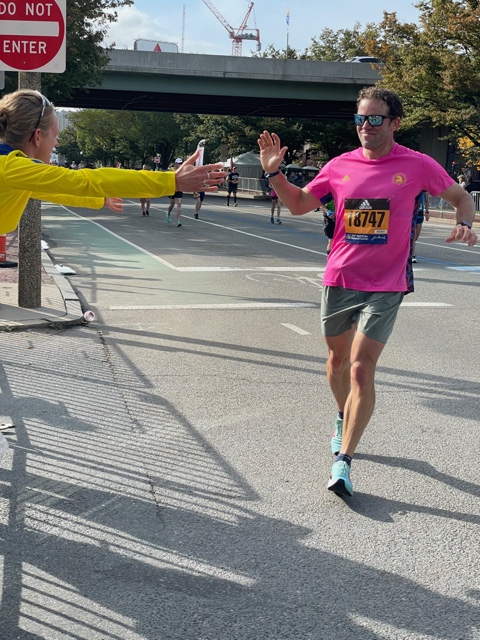
Liz Stephen extends a high five to her partner, Jeff Bland, as he makes his way to Boylston Street during the 2021 Boston Marathon. (Courtesy photo)
“Liz’s partner Jeff [Bland] also ran the race and fundraised for AKTIV with us,” Randall explained. “So after the three girls finished, we went back out to cheer him on. (Bland finished in 4:19:59.) We figured we ended up walking another 7 miles, which was painful — but also maybe a little helpful to keep from tightening up.”
What’s the next race-reunion? According to Randall, they’re looking for ideas!
“I think we’re all looking forward to not running for a while and yet we can’t help but wonder, what should we do next?!”
2021 Boston Marathon racers. From left to right, Jeff Bland, Liz Stephen, Ida Sargent, and Kikkan Randall. (Courtesy photo)
Kikkan Randall with her Olympic gold. (Photo: NNF)
On July 28th, the Nordic Skiing Association of Anchorage (NSAA) announced the hiring of Kikkan Randall as its new executive director. If you’ve found your way to this publication, we assume that Randall needs no introduction, but Olympic Gold Medalist, three-time World Cup Sprint Champion, mother to Breck, the example of success at the international level needed to propel the American women’s team into their current powerhouse status, and cancer survivor are just a few of the many descriptors that could be included in her bio. You can learn more about her illustrious career and retirement here.
From the NSAA press release: “Alaska’s Nordic skiing legend and Olympic gold medalist returns to lead the organization that sparked her cross-country skiing passion…
‘We are thrilled to have Kikkan return home to Alaska and serve as the NSAA’s Executive Director,’ said Joey Caterinichio, NSAA’s board president. ‘Kikkan is a product of Alaska skiing who has participated in NSAA’s Junior Nordic program and brought home an Olympic gold medal. We couldn’t ask for a better role model for our community or leader for NSAA.’”
FasterSkier connected with Randall on August 4th to learn more about her transition into the role, which she began remotely from Penticton, British Columbia, at the beginning of August. Randall will relocate to Anchorage later this month.
As Caterinichio mentions in the press release, Randall grew up skiing with NSAA youth programs, beginning as a “Polar Cub” and continuing through middle and high school racing. She continued her career racing at multiple Olympic trials and national championships put on by the NSAA. And now, she describes her return to Anchorage as “coming full circle.”
“My son [Breck] is five years old,” Randall said in the call. “So I’m starting to see the lifestyle of skiing through his eyes. And it’s a chance to take all the experience [I’ve gained through my ski career], and now put it back into getting more people excited about skiing, and enhancing their experience. I just can’t think of a better way to capitalize on the last 38 years worth of experience.”
In recent years, Randall estimates that the NSAA is composed of roughly 2,500 members — a number she hopes will grow given the city of Anchorage is home to 300,000 residents. The organization has had an executive director intermittently, but over the last few years has been led instead by the board of directors. She explained that the reinstatement of an executive director and a reorganization of the responsibilities of the administrative team will help refine operations and allow for more fluid and effective development for NSAA.
Randall is approaching her new position as she did her goals in skiing: seeing it as a process, which will require her to first put in the work to learn the organization and community it serves from a new perspective before utilizing her experience to implement changes.
“The organization has been in existence for 50 years,” Randall explained. “It’s got a great rhythm with established programs and events. So as I come in, I’m really looking to just learn a lot more about the way things have been done, what’s working and not working, and make sure that that experience through this next season is very consistent. Then as I learn, I hope to be able to look at every asset of the business and figure out ways where we can enhance our efficiencies, get more people into the sport, have more recognition in the community, and have strategic partnerships, both locally and nationally and potentially internationally.”
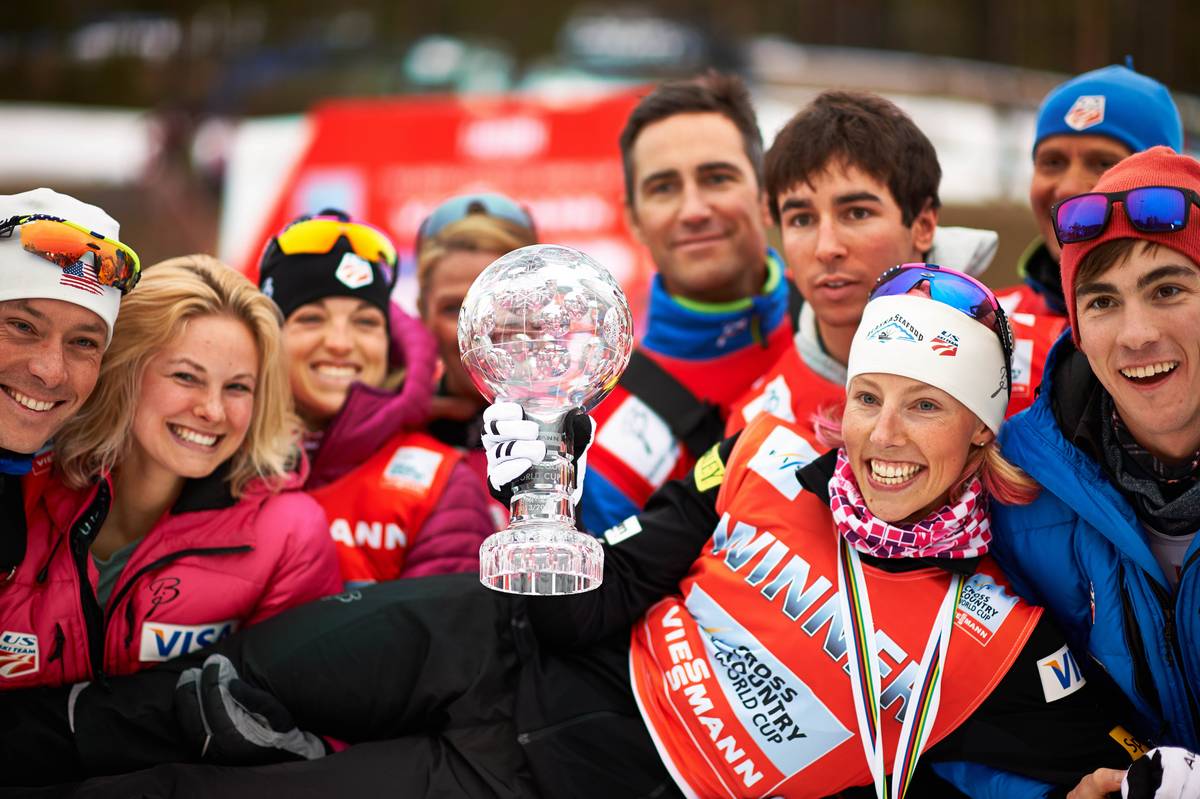
Several members of the U.S. Ski Team lift up Kikkan Randall after she won her third-straight World Cup sprint Crystal Globe a the end of the 2013/2014 season. (Photo: Fischer/Nordic Focus)
Randall mentioned growing the NSAA’s culminating community event, the Tour of Anchorage ski marathon, which takes place in early March. While the race is one of the largest marathons in the US, it sees primarily Alaska-based participants. While several APU elite team skiers that are in the area at that time typically capture the prize purse — Rosie Frankowski and Tyler Kornfield were the 2021 winners — Randall sees no reason the event could not attract a broader and perhaps international field with some strategic changes.
“So it’s going to be, you know, keeping on top of all the added administrative tasks and responsibilities, making sure the business is running well, staying on budget, analytics, coming up with some strategy for the future, overseeing and supporting the team on the deployment of the programs. And then working closely with a very engaged Board of Directors, to again, just continue to make sure that the experience is consistent, and then look for ways to grow. So my plan is: year one, just, you know, really get in and contribute. And then start to look at where we can really grow.”
While Randall was based in Alaska throughout her ski career before relocating to Canada, she acknowledged that it has been much longer since she actually spent a winter there. World Cup racing kept her in Europe from November until March each season. That said, she believes her history with the organization, paired with the fresh perspective of a relative outsider, helps her identify ways to increase the organization’s visibility and grow its membership base.
“In a sense, I’m going to be kind of new coming back to Anchorage. And I think that’s going to be helpful in that it’s going to allow me to just really try to get in and talk to people and find out: ‘Do people know about the club? Who is buying memberships? Where do we see opportunities?’ I think a huge focus in this first year will just be building public awareness.”
NSAA is primarily funded by memberships, donations, and community partnership. There are no trail passes or fees required to ski on the trails in Anchorage, which are owned by the city but groomed by the organization. And quality grooming is expensive.
Randall explained that many skiers who are less versed in the collaboration between the city and NSAA are unaware of this piece of the puzzle and simply see it as free access to quality skiing. As such, increasing the visibility of the organization and the retention and recruitment of paid membership will be an important component of Randall’s new job.
“We’ve got to connect the dots so that people know that the club is [providing this service] and continue to build on that partnership with the city. So I think that’s going to be a great focus this year.”
Like many other towns in the U.S., a desire for outdoor recreation sparked increased interest in cross-country skiing in Anchorage over the last two winters. Randall aims to bring these new skiers into the fold in order to promote retention and also encourage them to purchase memberships
“I also think partnering with, you know, with the retailers who are seeing, like who’s coming in and buying equipment right now and making sure we have a good presence to support them, and then they could help promote us with awareness. Just so hey, you’re buying skis, you’re getting into this. How about a membership, right? And here’s, here’s all the reasons why that is compelling — not only does it support the grooming, but you know, hopefully it has a larger benefit [to the skier] because you get to be a part of something bigger: a community… I have ideas of what it might be like or what might work, but it’s gonna be fun to just get in and talk to people and, and see what unfolds.”
Retirement feels like the wrong word to describe Randall’s transition out of her professional ski career over the past three years. Rather than wowing the North American ski community with her rigorous training and prolific success on the World Cup, we marveled at her seemingly superhuman capacity to dive into numerous meaningful projects as an advocate and inspirational figure. All while going through breast cancer treatment and parenting a small child.
So how did all of these projects and roles evolve into her decision to pursue the executive director position at NSAA? Randall condensed her whirlwind journey over the last few years into a synopsis, with a serendipitous ending.
“Coming off my ski career, I was fortunate to have a lot of cool opportunities and a lot of things I was interested in. And, you know, right as I was preparing to really jump in the pool, I found out I had cancer. So I had to press pause on things for about 10 months, while I went through treatment. And you know, that may have actually just been kind of nice to just have some time to think through and plan out. And then once my treatment was done, I did jump in the pool. I had all these great opportunities to go out and talk about all the things I learned from my Olympic career, all the things I was learning through my cancer journey, you know, being that face for skiing domestically, whereas I’d always been in Europe [in the winter]. So there were so many cool opportunities that I spent 270 days on the road. And as I got through that, I realized, while those were all really cool opportunities and I was making an impact on people, I had to balance it with family time, you know, just personal health balance, like being able to still work out.
“So, that inspired me as we headed into 2020 to kind of reevaluate all the things I was doing and think about what steps I needed to take to actually start to build a career that was going to fit that life balance. And I worked with a career coach at the US Olympic and Paralympic Committee, which got me turned on to accounting of all things. Realizing that all the data analytics I did on my training actually translated really well into analyzing financials and spreadsheets. So actually, that inspired me to go back to school at APU and finish my business degree.
“So I was considering that track, then the pandemic hit, and travel went away, which was kind of nice. But then I also had to kind of reinvent what I was doing. And I really just, in 2020, just went on the search of like, how can I take all of the experiences and skills that I’ve built through skiing and turn that into a career? And I’ve talked to a lot of people and tried different things. And so I was starting to realize, like, well, I love you know, I love leadership, I love working on teams, I love building strategy, and then coming up with plans to execute. That said, I love sport. I love skiing, you know, working with the International Olympic Committee, which was really cool to learn, and to see the inner workings of the IOC, and the US Olympic and Paralympic Committee. But it was very big and broad, you’re looking at all sports, all nations. And it was also pulling me, you know, away from my family priorities.
“So now, that brings me to 2021, and I’m still going through this exploratory process. You know, January through March, I kind of mulled over the decision about backing down from the IOC. Just because I wanted to be home and focus on Breck and focus on building my career and realizing I didn’t have the time and bandwidth to really focus on the IOC position to the level I felt it deserved. And if I couldn’t do it, I’d rather have somebody else be in that position.
“So I mulled over that for a few months and announced that in June, and literally coming off the heels of that big decision, I got the call about NSAA about the position. And I went ‘Whoa! This is a chance to stay involved in sport, come back to Alaska, be involved with skiing, but yet kind of test the waters of leadership and business skills and all of that. This just feels like the right next step for me.’ And that’s why I’m excited about it, because I just feel like, I can’t think of a better confluence of the skills and experience and connections I have from my past. And putting it into a way that allows me to build a future where I feel like I’m contributing, and challenging myself and growing, but in a way that’s just so connected to the people I love being around, and to the passion that I have around skiing.”
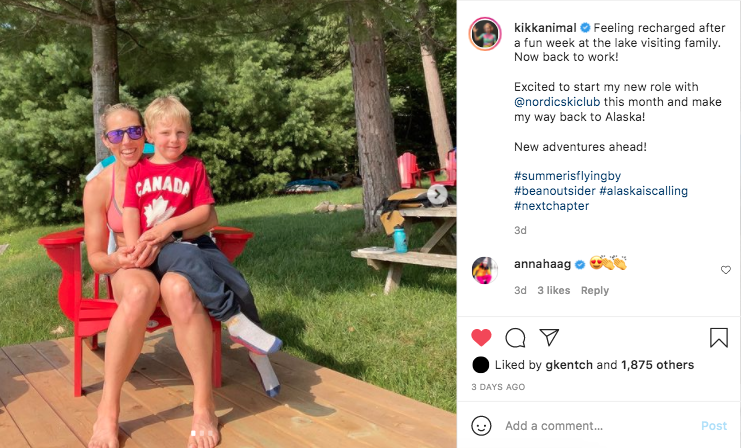
Kikkan Randall will move back to Anchorage with her son, Breck, in mid-August. (Photo: Instagram @kikkanimal)
Apart from a seemingly dream career opportunity, Randall says it feels “so good” holistically to be moving back home to Anchorage with Breck.
“When this came up — it’s a chance to come back, and be closer to my family, and be closer to all my friends and the community that literally raised me. I think back on all of the great memories from my childhood, and I’m so excited to have Brett get the chance to experience those same things now.”
In closing, Randall reflected on how impactful it has been to see the positive reception of the announcement of her role from her supporters.
“The press release went out last week. And it’s been so cool to see that the community is so excited to hear I’m coming back. I was joking with a friend — I was telling her about the release and the response. And she was like, ‘Only you would get a press release about your new job!’ And it just makes me realize and just have gratitude for the community support I’ve always enjoyed, and just how open the arms are to have me come back. For people to be excited about the potential in this new role. It’s a little bittersweet because I’ve made some friends here in Penticton as well, but they all know that this is a really good thing for me, so I’m grateful to have their support as well.
“I’ve always felt the love when I would have a big performance, but over the last couple of years, I’ve really learned to appreciate the value of how much people support me when I’ve been through cancer, or through making this big life transition to come back. So I’m just really excited to be around all the people that have been so supportive.”
Statistically speaking, only 2% of people who enter a marathon will finish under three hours. The 2019 TCS New York City Marathon was a bit above average, with nearly 3% (1,563 of 53,508 runners) breaking the elusive three hour barrier. Yesterday, four familiar cross country skiers joined the speedy club of athletes who have achieved this result.
Brian Gregg was first across the line, stopping the clock at 2:44:30 (6:17 per mile average). Next came a trio of Kikkan Randall, Liz Stephen, and Ida Sargent who worked together until the final miles. Randall finished in 2:55:12 (6:41 pace) followed by Stephen who was just 25 seconds behind. Fading behind her former teammates as they cruised through Central Park, Sargent made her way to 67th Street in 2:57:22.
A lot has changed for Randall since the 2018 TCS New York City Marathon where she stood in the crowd watching Stephen run by wishing she were out there too. FasterSkier caught up with Randall shortly before she headed to New York from her home in Penticton, BC to reflect on her experience with cancer treatment, marathon training, and what lies ahead now that she is back to feeling strong and healthy.
Randall was diagnosed with Stage 2 breast cancer in June of 2018 after discovering a lump in her breast on Mother’s day. She underwent six rounds of chemotherapy from July to October, followed by a lumpectomy in November. She continued to receive infusions of the Herceptin infusions every three weeks through July 2019 to stop the proliferation of the cancerous tissue. Though she is now finished with treatment, she will remain on anti-hormone medication for the next five to ten years to reduce the likelihood that the cancer will return.
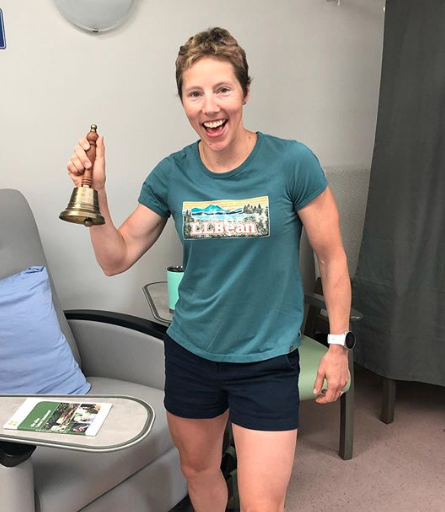
Kikkan Randall rings the bell marking her final Herceptin infusion in July 2019. (Photo: Instagram @kikkanimal)
In her typical fashion, Randall stayed active and positive all the while. With the support of her medical team, she explored the boundaries of what was possible physically during treatment. She explained that her doctors told her, “If I felt good, go for it.” And she committed to staying active, even if it was just for ten minutes each day or as simple as playing with her son, Breck.
Randall shared her journey openly throughout in order to inspire and encourage others going through similar challenges. She posted daily video updates for the first five months of her treatment on her website and continues to share her experiences through her Instagram and other social media outlets.
“I think back to where I was a year ago and I just feel incredibly grateful for how good I feel and the fact that everything has gone so well,” said Randall. “ Now I’m just staying optimistic that it’s going to stay that way.”
Randall explained that it is difficult to say whether her experience with treatment and how her body responded was what she expected.
“Cancer is something I really never had on my radar until I was getting that diagnosis. So not knowing what to expect, chemo was for sure the hardest part of it. It just knocks you down. It knocked my immune system down and I felt fluish between rounds. Overall, I still think I faired fairly well.”
She continued that she was relieved to be finished with chemo last October. As the lumpectomy was a minimally invasive surgery, she was able to recover quickly and began to feel as though she was getting back on her feet, despite continuing with radiation.
Kikkan Randall models her positivity through cancer treatment, heading into a lumpectomy “with good vibes”. (Photo: Instagram @kikkanimal)
“Some people said, ‘Oh, you’d be surprised how tired you get.’ So I was ready to be heavily fatigued and set up my lifestyle around the fact that if I needed to sleep a lot and not be accountable to too much, I was ready to do that. But I actually had the opposite effect.
“I was getting further from chemo, so feeling better and better as I went through radiation and I was in Anchorage, so I was able to ski a lot which was awesome. I did a 10k ski race the second to last week [of treatment].”
That is not to say Randall was immune to the effects of seven months of cancer treatment.
“I think by the time I got to the Birkie and did that, I didn’t feel awesome in the race. I felt like my legs were just really empty and I didn’t have a lot of power climbing on the hills. I think that was maybe the point where I went, ‘Oh, maybe there is a little bit of lingering fatigue.’ It wasn’t like I could barely make it through the day, it was just when I went to access that gear that I’ve always had, it just wasn’t quite as strong as I was used to.”
Randall finished 12th female in a time of 2:48:19.4.
Her version of retirement has not seemed to involve the change of pace one associates with the word. At the cessation of her treatments, Randall hit the gas, resuming her involvement in organizations like Fast and Female as well as saying “yes” to many speaking opportunities. This has created a busy schedule laden with frequent travel. Randall explained that she is navigating how to balance these opportunities alongside her desire to stay active and also have quality time with her family.
“For so much of the last 20 years, I had to be so in tune to getting enough sleep and rest so that every moment that I was training was effective. Now it’s more about, if I can exercise, it’s a bonus. I ultimately want to keep myself healthy, but that’s kind of a baseline, and there’s a lot of other responsibilities now.”
She continued that since training is no longer her primary focus, she is less concerned about the recovery aspects of her former lifestyle. She does not dwell on staying up late before waking up early if it means creating time for her family or other responsibilities.
“Which I think in some ways has come back to bite me,” Randall laughed. “I appreciate now why we take such good care of ourselves as athletes, why we get enough sleep, and have good nutrition, because it makes you feel so much better. So when I let myself get busy and don’t focus on that as much, after a week or two I start to feel it and snap back around.”
Randall expressed gratitude for the many intriguing opportunities she has been presented, from motivational speaking events to podcasts to traveling to China and hopping into a city sprint event on the streets of Beijing. Case in point: at the time of the call she had recently returned from the U.S. Ski Team Gold Medal Gala in New York City only to return the following week for the marathon. She acknowledged that she does not aspire to always be this busy, but after being somewhat on lockdown through treatment, she was “excited to finally do things again.”
She went on to describe the very relatable experience of fitting in her marathon training around all of this travel. One noteworthy experience took place this summer aboard a Royal Princess cruise ship. Randall was a guest speaker on the cruise from Vancouver to Ketchikan.
Kikkan Randall runs laps around the deck of a Princess Cruise ship to fit in her marathon training while on board as a motivational speaker. (Photo: Instagram @kikkanimal)
“I had to do my two-hour long run on the track around the deck, which wasn’t ideal but it’s the way I fit it in. I’ve been getting up at 5 am to get in workouts before I travel or before a day of appearances. I’ve just been trying to be creative — it hasn’t been ideal, but it’s been good enough.”
The TCS New York City Marathon on behalf of Aktiv Against Cancer has been on Randall’s radar for quite some time. She explained that her affiliation with Aktiv began in 2012 when the U.S. Ski Team was racing in Oslo, Norway. The organization invited Randall to an event and each subsequent year, the USST would go to partner hospitals in Oslo and workout with cancer patients in the exercise rooms that Aktiv funded.
“When I learned about the organization, I really believed in what they’re doing and that’s getting physical activity to be a prescriptive part of treatment, because I’ve learned through several experiences is a great way to deal with challenges… It was always incredibly inspirational and powerful to see the camaraderie [the patients] developed.”
Because of these experiences, she and her teammates, Liz Stephen and Ida Sargent, who were all slated to retire at the end of the 2018 season committed to racing that fall.
“That was the plan last spring when I came out of my career, then the co-founder of Aktiv actually called me and told me that were having an awards luncheon a couple days before the marathon and wanted to honor me with an award for the work that I had done.”
Randall accepted this invitation and expressed that she would be humbled by the award.
“A couple of weeks later, I got my cancer diagnosis, which was completely out of the blue. So I called them back and said, ‘You know what? I think our connection just got a lot deeper. I’m about to start treatment, so I’m not sure what’s going to happen, but I hope to be able to come to the luncheon.’”
Randall entertained the idea of still trying to run the marathon despite being in treatment, but quickly realized after a couple of rounds of chemotherapy that it would not be smart to push herself in that way. She still attended the luncheon and spectated to support Stephen in her run.
“It was so inspirational to see so many people out there running and at that point I had just finished chemotherapy, so it was just a chance to watch the racers come in and think, ‘Okay, next year I want to be back here. I want to be racing. I’m just going to believe that I’m going to be feeling good again.”
This optimism motivated her to raise money for Aktiv throughout her treatment.
“Along the way when I was going through treatment, I was wearing these brightly colored running shoes to remind myself to stay positive and hopeful through the process, and my husband came up with the idea to come up with some happy sock that would capture that same idea and be something we’d be able to pass out to other people going through a challenge.”
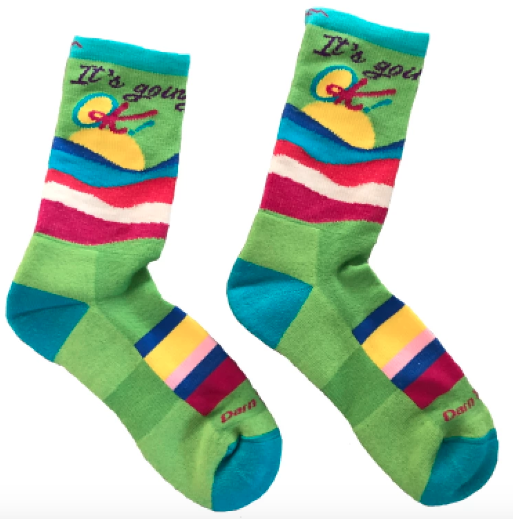
Kikkan Randall raised over $10,000 for Aktiv Against Cancer through the sales of her “It’s Going to Be OK” socks, made through a partnership with Darn Tough. (Photo: Instagram @kikkanimal)
The couple came up with the slogan, “It’s going to be OK” with a signature hot pink K. They collaborated with the Vermont based company Darn Tough to design brightly patterned socks and with USST sponsor LL Bean to create blue and pink headbands, which were sold through Randall’s website. $2 from each purchase goes to Aktiv.
“Through that project, we’ve been able to raise over $10,000 for Aktiv. We’ve sold over 5000 pairs of socks. It’s been so cool to see that these socks have been giving people hope.”
Though running often accounts for many hours of a yearly ski training program, Randall had not been spending much time on the roads during her career and consequently entered a marathon training program cautiously.
“I knew that the biggest thing to respect for the marathon was going to be getting enough running in — getting my legs ready to handle the pounding. And I knew that this would be quite a bit of an increase [in running volume] from what I had been doing in ski training.”
She contacted her former high school running coach who wrote her a training plan and began to slowly increase her mileage beginning in April.
“That’s been really helpful because I think it’s built up at an appropriate progression. And because I was able to stay pretty close to that plan all the way through, and I’ve made it through without any injuries — knock on wood.”
Kikkan Randall completed a one mile open water swim across Lake Washington in Seattle to on behalf of Swim Across America. (Photo: Instagram @kikkanimal)
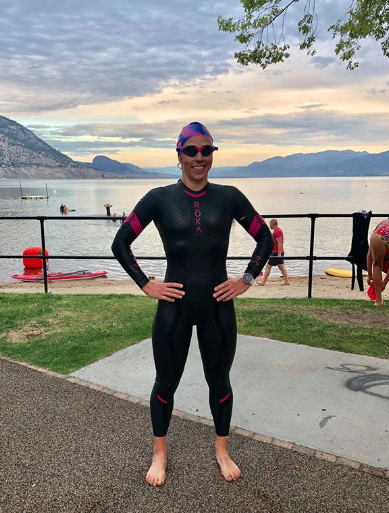
While long runs and track workouts have largely taken the place of the multisport nature of her former regimen, Randall has continued to dabble in other physical challenges throughout her marathon buildup. At the beginning of September, Randall traveled to Seattle for a one mile open swim across Lake Washington with the organization Swim Across America, which raises money for cancer research and clinical trials through the Seattle Cancer Care Alliance.
Since this event, Randall has locked eyes on the marathon, even dropping the regular strength training sessions she completed until early October. As a test of her fitness, she ran the Okanagan Half Marathon on October 20th, taking the win for women with a time of 1:23:47.
She has enjoyed the new challenge, but will also be happy to vary her modes of exercise.
“I have to say — I’ve rollerskied three times this summer, and each time, I was like, ‘Oh my gosh, I love this.’ Because I’ve been prioritizing the running training, I haven’t been on rollerskis as much, I haven’t been on my mountain bike as much, so I miss that and I’m looking forward to getting back to that before the snow flies, then ski a lot this winter.”
What’s next on Randall’s athletic calendar after the marathon? She explained that she is hoping for a few new ski experiences this year, possibly including the Ski to the Sun race in Mazama, Washington, which last year was raved about by winner Liz Stephen. Randall is also interested in returning to the Birkie to see what she could do in good health.
“Then next summer, trying some new things — maybe an off-road triathlon or a mountain bike stage race or something fun. I do love racing, I love preparing for things, and I am loving these events where I get to meet up with teammates and friends and get to go out and hurt so good.”
Kikkan Randall gets out for a ski with her son, Breck. (Photo: Instagram @kikkanimal)
Ski racing aside, what Randall is looking forward to most is spending quality time with her husband and son.
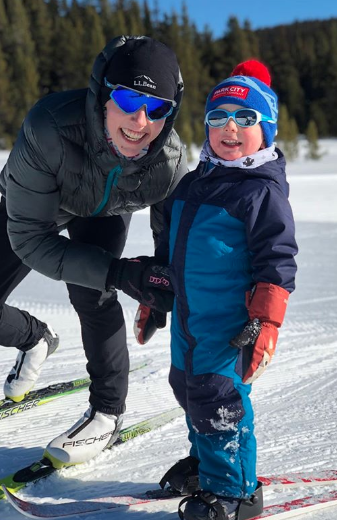
“I’m just excited to be out on the snow with my family this winter. Breck is three and a half, so he’s excited to get out on snow.”
Though Randall could not have predicted the turn of events that unfolded after her retirement, the opportunity to inspire others through her cancer journey is aligned with how she originally envisioned using her gold medal platform.
“Coming off my career, I had hoped to be active in different causes and bringing awareness to the power of positivity and a lot of things that I learned through my athletic career that can be applied to the things we tackle in daily life. I thought it was going to center more on being a mom, training through pregnancy and coming back after, and how to balance being an athletic mom. I also was heavily involved with Fast and Female, so it was going to be focused on keeping girls in sports, and my position with the IOC.
“Now I have this cancer experience thrown into the mix as well. I’ve always enjoyed being able to share my stories of what I’ve learned through my ski career to help motivate and inspire others, so I had hoped to do some public speaking and I’ve had some really cool opportunities since I finished treatment to be out sharing my experiences, both as an Olympic athlete and as a cancer survivor now and as a mom.”
Randall plans to continue accepting motivational speaking positions, remaining involved with the IOC and U.S. Olympic and Paralympic Committee (USOPC), and collaborating with her partners.
She also hopes to stay involved in cross country skiing in a more hands on level. This summer she had the opportunity to work with a few junior programs, including the national junior camp in Park City. She is also on the board of the National Nordic Foundation (NNF).
“I’ve got a lot of different balls in the air right now and a lot of fun projects to be involved with, and I’m realizing that there is a limit in what is physically possible, especially with things that involve so much travel. I think over the next couple of years it’s going to be finding which opportunities I can make the most impact in and trying to find the right balance.”
Kikkan Randall poses with her husband Jeff Ellis and their son Breck after her final race in Falun. (Photo: Instagram @kikkanimal)
The “First Tracks” series highlights the pregnancy, postpartum, and parenting experiences of noteworthy athletes in cross-country skiing in various stages of their professional careers. The sharing of these experiences can benefit athletes in any stage of their career, whether they are an elite or recreational skier, by demonstrating that it is very possible to return to skiing, competition, and an active lifestyle with a growing family. The series will include the physical challenges of being an athlete during and after pregnancy, balancing family life with skiing, and the joy that starting a family can bring. This is part two of Randall’s “First Tracks”. You can read part one here.
***
After Kikkan Randall delivered her son, Breck Stuart Randall Ellis, on April 14th of 2016, she began her return to racing.
“The one thing that kind of struck me as I was doing all of it, is that because I wasn’t racing while I was pregnant, I felt like I was taking my maternity leave before the baby came,” said Randall in a call, “because as soon as the baby came, it was time to get back into training.”
Randall described the adjustment of incorporating motherhood into her lifestyle as a professional athlete as a “cool mind shift”, and expressed gratitude for her support system for enabling her to spend lots of time with her new baby while still putting in the training hours she needed to pursue her goals.
“I had looked forward to being a parent for a long time, but I was completely blown away with how awesome it was,” said Randall. “From the moment he came into the world and you quickly realize – as a skier, my life had really been all about me, pretty selfish, because it has to be for performance. Pretty quickly it was all about him and I had to find a way for it to be about me in between.
“It was a change in perspective too in knowing that my training time wasn’t unlimited,” she added. “So the time that I got to be out there I was really grateful for, and I wanted to make the most of it so that when I could come back and be with Breck I still could make the most of that time.”
Kikkan Randall kisses her five-month-old son Breck after a training session with teammate Sadie Bjornsen. (Photo: Instagram @kikkanimal)
While Randall’s capacity for high volume training while pregnant may seem super-human, her recovery process brought her closer to the mortal realm.
“After the birth, there was just a bigger recovery process than I had anticipated,” admitted Randall. “I was still able to do three sets of eight pull-ups about a week before Breck was born, I was feeling really strong at the end of my pregnancy. So I thought, oh man when I have this baby and the extra thirty pounds come off, I’m going to be whipping out pull-ups right and left! I think I waited about four days or maybe it was a week and I was like okay, I’m going to try some pull-ups now, and I could barely do four!”
During pregnancy, a woman’s uterus grows to between an astronomical 500 to 1000 times its original size, from about the size of a pear to approximately the size of a watermelon. In addition to relocating the remainder of the mother’s internal organs, this growth puts a major strain on the core muscles that stretch to accommodate the growing baby and on the pelvic joint, which widens to aid the delivery of the baby. The body also produces a hormone called relaxin throughout pregnancy which allows ligaments to stretch and joints to loosen more easily as the body expands. This hormone is present in the body for 12 or more weeks after pregnancy, meaning women are at an increased risk of joint injury during the immediate postpartum period.
Because of the stretching of core muscles, many women develop a condition known as diastasis recti, which is a weakening of the connective tissue in the abdominal wall leading to a separation of the rectus abdominis, more commonly thought of as the muscles that make up a “six pack”. The degree of separation is measured by the number of fingers that can be inserted through the gap to the transverse abdominal muscles lying below. In severe cases, the condition needs to be rectified with a surgery similar to the treatment of a hernia.
“When I started doing exercise after the birth, I was relying on all the bigger muscles [rather than utilizing the core], and I ended up injuring my back about a month after Breck was born,” Randall shared. “So then I started going to Pilates classes and working with a physical therapist that specializes in postpartum stuff to really work to re-engage. I had about two fingers worth of separation between my abs, but thankfully, I have a really strong lining underneath it, and I was able to bring it back to about a half-finger gap.
Kikkan Randall hikes with her newborn son Breck. (Photo: Instagram @kikkanimal)
“The core strength, for sure, took a bit to come back,” Randall continued. “I think part of it was coordination and strength. And then, really for the whole first year, I didn’t feel like I had the tension in my joints like I had before… So things like really quick speeds, sprinting off the line, that stuff, just took a while to come back and that was a surprise.
“On the flip side, I couldn’t believe how strong I felt aerobically right off the bat. Within a week or so, I was testing things out on the ski erg and that felt pretty good, and I was getting on the bike, and that was good. We just made a really gradual approach back into training in the first three months, and I really was very cautious and easy with myself for those first six weeks, and then very gradually built back.”
While the non-weight-bearing nature of cross country skiing might provide benefits to a body in recovery, Randall realized that the multi-faceted training for her sport at the elite level made resuming her normal regime a slow process.
“We brought classic in first, thought that was going to be a little easier on the body than skating,” Randall explained. “And we realized how complicated ski training is as we were trying to introduce one thing at a time so we could really tell that I was passing a stage before moving onto the next. But when you’ve got classic, skate, running, biking, strength training, and then that at all these various intensities, it was really like, oh man, where do we even start.
“We started very simply with using biking as a way to keep up my aerobic intensity,” she continued, “then started with some really easy classic skiing and gradually worked up the volume. When that was going well we added a little bit of intensity. Then once classic was going well, then we did the same thing with skating. So I think it was three or four months before I was back to doing most of my normal training modes.”
Not all of her training modes were easy to reintroduce.
“Running took me a while,” Randall expressed, “probably six or seven months to get back into because I did have that separation in the front of my pelvic bone. I had started trying to run small amounts in my neighborhood thinking staying close to home would be good, but I was doing it on pavement. Then, later on, I had much better success building up my running on the trails, so I really think the surface mattered. I was able to do a lot of uphill running, striding, and stuff with poles, that was a really good way to reintroduce the impact on my legwork.”
Despite resuming a high volume training load, Randall was able to breastfeed her son for the first eight months after giving birth, a commitment that required a lot of planning.
“It was a blend of just timing feedings and going off for training and coming back and feeding him again and doing a lot of pumping,” Randall shared. “I did two short four-day camps on the glacier, so for that period, I was away from him. Thankfully, I had done a lot of extra pumping early on when I was producing more milk than he was eating, so I had a stockpile. So then, my husband was able to give Breck the stockpiled milk, and while I was on the glacier I was also pumping every few hours so I was building up a new stockpile.
“So that was kind of funny to be in the middle of the night in the back corner pumping, then leaving camp with this whole cooler full of frozen breastmilk,” Randall laughed. “Then I kind of weaned off on breastfeeding right as the race season was starting.”
Producing enough milk to sustain a growing baby adds a unique load on the body and requires approximately an additional 500 calories.
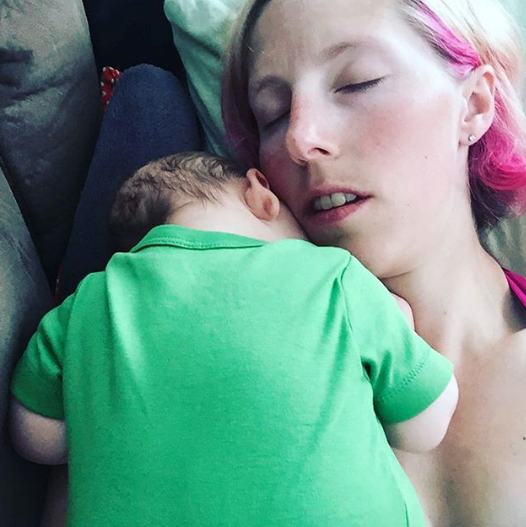
Kikkan Randall shares a photo of herself with her newborn son captioned “Naps between training just got a whole lot better.” (Photo: Instagram @kikkanimal)
“I didn’t really notice it,” Randall stated gratefully. “I didn’t find myself more tired. I was trying to drink a lot to keep my hydration up, but I never really felt like I got out of whack that way. I was enjoying the opportunity to eat the extra calories. Overall, I was pleasantly surprised at how well I was able to balance it with all the training that I was doing.”
While breastfeeding did not cross her mind as a source of impedance for her recovery between training sessions, Randall did have some concerns about the lack of sleep during the first few months of Breck’s life. However, she found it to be much less detrimental than anticipated.
“I had been wearing this device for a full year leading into pregnancy, then I wore it through my pregnancy and after – it measures the quality of my sleep and my recovery. I thought that I was going to see a huge decline, but I saw some of the best numbers I’ve ever seen!” Randall exclaimed. “So I think that the super mom powers you get, just the happiness factor… so even though I was getting less sleep, when I was sleeping I was sleeping really effectively, so it didn’t seem to have an impact on my training.”
In reflecting back on her pregnancy and postpartum experience overall, Randall saw both advantages and disadvantages to being a skier, versus a professional athlete in a different sport.
“I think our training as skiers is very complementary to what you do for pregnancy because of the low impact nature of it,” Randall stated. “Being able to ski a lot was really beneficial and I could bike and do all these different activities that contribute to the same goal, which was great. I could see being just a runner being challenging.
“I do however see a difference in the return,” she continued. “I followed a couple athletes like [professional cyclist] Kristin Armstrong who came back incredibly strong after the birth of her child and won gold medals. I was just thinking about how biking is so one dimensional and so linear, it would be so easy to hop on the bike and get back in shape because it’s all aerobic and it doesn’t matter the tension [in muscles and joints] as much. So some sports may be easier that way… Skiing was just so challenging with all the different pieces to figure out.
“But overall, there were a lot of other world cup athletes that all did it around the same time as me and everybody came back strong,” she concluded. “So I think it’s very doable.”
As Breck’s half-birthday approached, so did the World Cup season. Randall headed to Europe with her teammates once again after eighteen months away from racing.
“At six months, that was about a month before the season started, I was feeling strong, training with the team, doing time trials,” Randall remembered. “I thought I was really ready to go, and then when the race season started, that was when I got the reality check that being away from race intensity for several months takes a little while to come back. I think that was also in relation to the tension in my muscles.
“So the first three months of the race season were pretty challenging, I had to be really patient,” she added. “Then when I hit about the ten-month [postpartum] mark, I felt a really big change, and then another big change at a year.”
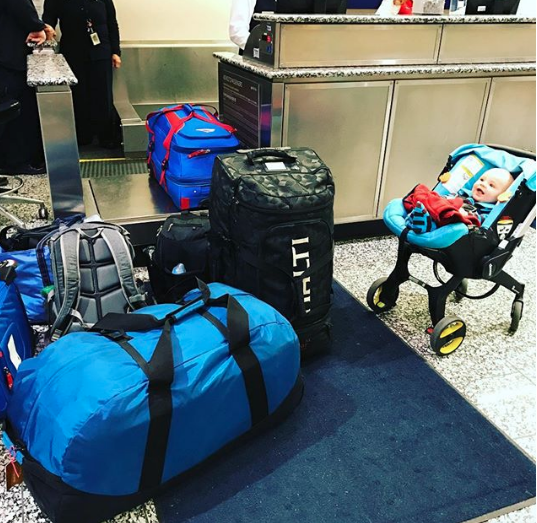
Kikkan Randall’s son Breck waits happily next to their bags as they depart for a winter in Europe for the World Cup Races. (Photo: Instagram @kikkanimal)
Apart from the physical challenge of being prepared to race at the highest level at seven months postpartum came the logistical challenge of traveling across the Atlantic for a winter on the road with an infant. What was their secret to success? Not dwelling too much on it.
“We didn’t really think too much about how we were going to do it,” Randall admitted. “We just decided that we wanted to do it and therefore we were going to figure it out. Some people were like, ‘how did you travel five-months on the road in Europe while ski racing?’ And I was like, ‘I don’t know, we just did it! And it was awesome!’ We schlepped a lot of gear around and just made it work and it was really an awesome experience for us all together.”
The World Cup moves between countries on a weekly basis, meaning regular flights, bus and train rides, and time changes. While this schedule might make any traveler weary, Breck seemed to handle it without too many problems.
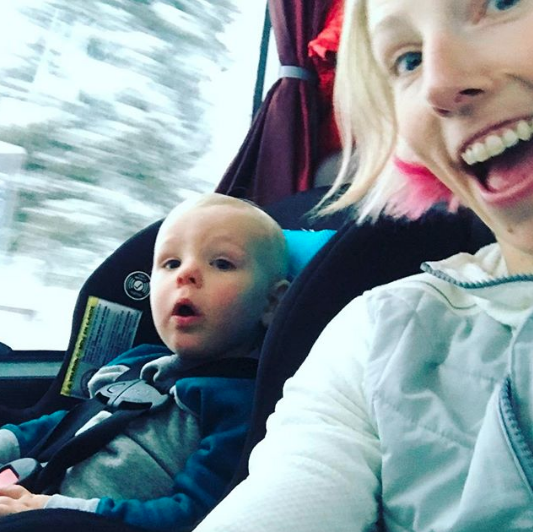
Kikkan Randall travels with her son, Breck, between World Cup race venues. (Photo: Instagram @kikkanimal)
“I don’t know that we’ll ever know the answer to the question of whether he is just a good easy-going, even-keel kind of kid, that’s just good for anything, or whether it was that early in his life we started taking him on trips, so that’s all he knows,” said Randall. “He ended up being a great traveler, even long van rides and being on big busses with the world cup field. He just went along with it.
“The time change, however, was quite difficult,” she continued. “It probably took us a good two or three weeks to get on a routine. When we went over he was starting to only wake up two or three times a night, I really wasn’t feeding him too much during the night. When we got over there, he started waking up five or six times a night. And because we had teammates all around us and I didn’t want to disturb them, we were doing whatever it took to keep him happy through the night. But then it would be one in the morning and he was wide awake like ‘let’s play!’ Then at three in the afternoon, we couldn’t keep him awake to save our lives.”
Luckily, Breck was born amidst a small baby boom on the World Cup, so Randall was not alone in navigating this experience. Marit Bjørgen of Norway, Aino-Kaisa Saarinen of Finland, and Katja Visnar of Slovenia all gave birth during the 2015-2016 ski season as well.
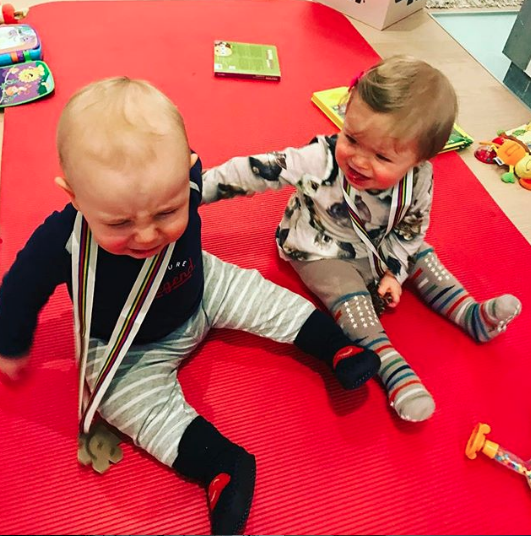
Kikkan Randall’s son, Breck, and Aino-Kaisa Saarinen’s daughter, Amanda, play with their matching bronze medals from the World Championships in Lahti, Finland. Randall captioned the photo, “It’s okay Breck, you’ll win gold next time.” (Photo: Instagram @kikkanimal)
“My Finnish friend [Saarinen] who is a World Cup skier and had a baby just a few weeks after me highly recommended that we do sleep training,” Randall explained. “So about three weeks into the season, we were in Switzerland and we were finally in an apartment so we wouldn’t disturb anyone around us and we committed to three or four nights of sleep training. And it was mostly done by Jeff – I got to sleep through it because I was racing – but he committed to letting him cry for longer and longer intervals and within about four nights, he was completely sleeping through the night, and from then on it was a huge game changer for us.
“We actually found it a lot more challenging the second year when he was between a year and a half and two years old because then he wanted to move a lot more and he was more aware of what’s going on and it was harder to keep track of him on the long travels.”
In addition to family and friends, Randall was grateful for babywearing and carrying gear during her preparation for and travel during the race season as it made it easier to bring Breck along for some sessions and to get him from place to place more easily while on the road.
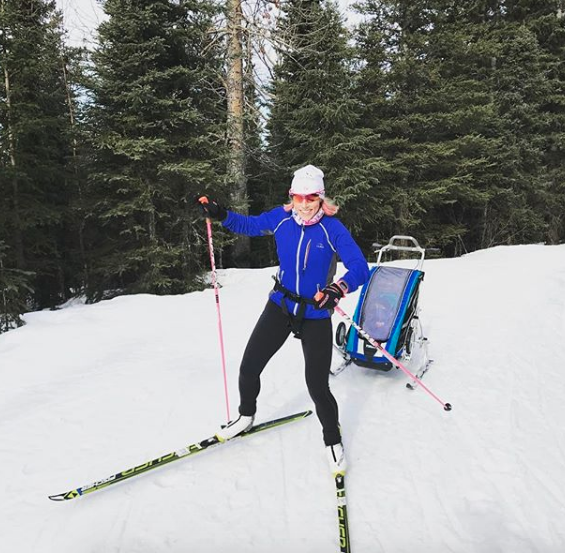
“We got a Thule chariot right away,” Randall explained. “That was super awesome because with the infant harness we could suspend him in there from pretty early on. I could use it to get out for walks and later runs. Then we could pull him behind the bike, and then we could pull him skiing.
“We found it really useful in Europe in the winter because we could just pack him in there all nice and
Kikkan Randall tows her son, Breck, in their Thule Chariot. (Photo: Instagram @kikkanimal)
warm, protected from the snow and wind and rain, then whoever we had with us helping take care of him could just take him out for these great walks all the time,” she continued. “That was a really great tool, I mean we’re still using it a ton.”
“That’s been one of the toughest parts of this breast cancer deal so far,” Randall shared. “We were so excited to expand our family after the Olympics ended, and now that’s on hold for at least a couple more years. We were fortunate that we were able to do some fertility treatment before I started chemo, so we have one little embryo as a backup plan. It just gives us some hope that in case my fertility has been wiped out by the chemo, that gives us one shot maybe. And there’s no guarantee that the chemo does wreck my natural fertility. So we’ll find out in a couple years when hopefully I can take a break from the anti-hormone stuff.
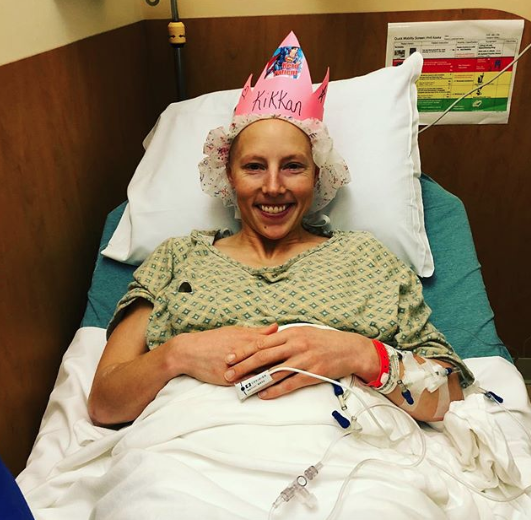
Kikkan Randall displays her newly bald head and tireless positivity after undergoing her second round of chemotherapy. (Photo: Instagram @kikkanimal)
“With that aside, it makes me really grateful that we have Breck,” she continued, “because I know how much I love being a parent and the fact that I get to do that with Breck is so amazing. I think if I hadn’t had any children and was facing this, it would be a lot harder.
“Also, you hate that it takes something like this to change your perspective, but we’re just really appreciating every day with Breck now, and the fact that we get to just focus on him, because sometimes when you have another kid then you have to shift your attention to two kids,” Randall added optimistically. “So we’re just going to really enjoy doing stuff with Breck and it makes me appreciate how much I love being a parent and making the most of every day that I have. And I’m staying hopeful that I get to go through this whole experience again, even if it’s not on the original timeline that I imagined.”
Finally, Randall was asked what message she would share with a fellow skier who is pregnant or thinking about starting a family.
“Approach this new situation with a curiosity and really just listen to your body,” Randall encouraged. “But have the confidence that your body is pretty tough and it is used to doing a lot, and probably the best thing that you can do for yourself and the baby is to just keep doing what you’re doing. I really think that when you’re used to getting a lot of exercise, and as an athlete, you’re used to taking good care of yourself, just keep doing that through pregnancy.
“Enjoy it!” she added. “Notice what’s different and unique, and also have the confidence that when the baby comes, it may take the patience of a couple of months to get your body to come back around again, but it will and you’ll be stronger than ever. I think it’s really exciting to be able to blend athletics and being a parent whether you’re doing it at the elite level or just someone who is worried about continuing to be athletic after having kids, it really works out great.”
Kikkan Randall (c) with her son, Breck, and husband, Jeff Ellis, in Penticton, British Columbia. (Courtesy photo)
Day by day. That’s how Kikkan Randall is approaching her battle with breast cancer after being diagnosed about three months ago. Now more than 50 days into her treatment — with six rounds of chemotherapy over an 18-week span — Randall, 35, is becoming more familiar with the ugly side effects and adjusting to her new normal.
While beating what is believed to be Stage 2 cancer remains the Olympic gold medalist’s biggest challenge yet, it’s not dampening her spirits — even on the extremely rough days, of which there have been many.
After Round 2 of chemo, Randall returned to her family in their new home of Penticton, British Columbia, where she quickly came down with a nasty cold. That cold required a visit to a local clinic and antibiotics, and Randall now wears a mask on airplanes to fend off germs while flying to and from her cancer treatments in Anchorage, Alaska.
“Getting the head cold on top of going through the worst days of the chemo cycle has definitely been one of the most uncomfortable weeks of my life,” Randall explained in an email to FasterSkier. “It’s mostly because I have no control and I have no idea how well my immune system can clear the cold. Normally I would be optimistic that it would just be a tough couple of days but now I just have to wait and wait.”
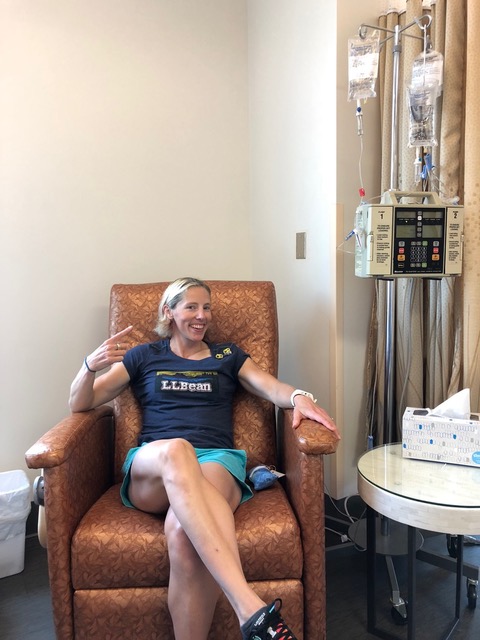
Kikkan Randall during her first chemotherapy infusion at the Providence Alaska Medical Center on July 9 in Anchorage. (Courtesy photo)
She eventually kicked the cold and got her voice back, just in time for Round 3 of chemo on Aug. 22. After what she called a “quick 36-hour trip to Anchorage,” she was back in Penticton on Aug. 23. So far, Randall explained on her daily video blogs that her current three-week round is going better than the previous two.
“Just getting used to my haircut … got a nice little fuzz growing on top,” she said in her Day 51 video posted last Wednesday, just over a month after she shaved her head for the first time.
“Definitely giving me a greater appreciation for all the guys out there and gals that deal with this,” she continued with a smile. “But I have to say it is pretty low maintenance so I guess I should just embrace it.”
Two weeks after receiving her first chemo infusion in July, Randall noticed she was losing her hair in clumps. She promptly went wig shopping with friends and scheduled an appointment with her hairdresser in Anchorage to get ahead of the hair loss.
Randall spoke with FasterSkier on the phone from Anchorage on July 26, the day after she initially asked her hairdresser to shave it all off.
“I sat in the chair and she said, ‘Are you ready?’ and I said, ‘Let’s do it,’ ” Randall recalled. “Three minutes later, I had a buzz cut, and I think I actually handled it better than I thought I would. It was kind of interesting to watch it, to feel it, and to be like, OK, now we’ve got that taken care of. Now we can move onto the next step.”
The next step and every passing day has proved to be an unknown. Oncologists never know exactly how a patient will react to treatment, as “everybody seems to react differently,” Randall explained.
“But in a lot of cases what you experience the first round is what you will generally feel like over the next subsequent rounds,” she continued. “Some of it will be a little bit cumulative, like the fatigue I’m sure will add up a little bit, but I also really think that staying active through this as much as I can will really help. I’ve noticed already that even on days where I don’t feel very good, if I get out and do something, it at least keeps my mind off of how bad I feel and I think it helps me process everything better, both physically and mentally.”
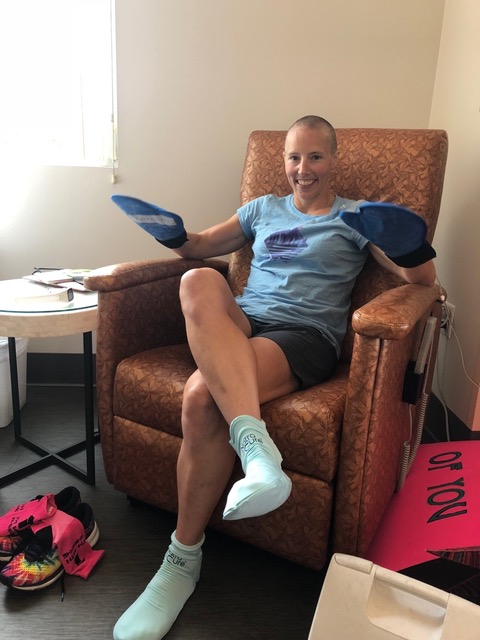
Kikkan Randall wearing ice mittens and socks to prevent neuropathy during a chemo infusion at the Providence Alaska Medical Center in Anchorage. (Courtesy photo)
As she approaches the halfway point of her chemo treatment — the first proactive step to eradicate the cancer (which was initially found in her breast and one lymph node), Randall has continued to make an effort to get outside and moving every day. Some days, that’s as much as a run with former training buddies or even intervals, and other days, it’s about playing with her 2-year-old son, Breck.
Ever since announcing her diagnosis on social media, Randall has been promoting AKTIV Against Cancer, a Norwegian nonprofit that she became involved with six or seven years ago without having any direct ties to cancer. According to Randall, the organization funds research on how physical activity can affect cancer treatment and creates supportive environments for patients to work out together, both in and out of the hospital.
“It falls along with what I believe is that physical activity is pretty much good for everything, so I was happy to support them as an athlete, but now that I actually have cancer myself, I have a little deeper connection,” she said. “I’ve committed personally to staying as active as I can through this, but I think in partnering with them, we can share the message on a bigger platform, and I’m looking forward to learning more about the research that they’ve done and also to continue to fundraise and promote awareness for getting other hospitals to have these places and rooms and programs that encourage cancer patients to be active.”
“I’ve committed personally to staying as active as I can through this…” — Kikkan Randall, on her cancer diagnosis
Randall continues to ride her bike to and from the Providence Alaska Medical Center in Anchorage. During a recent layover, she worked out in a Vancouver gym. And early in the treatment, she asked if she could use a stationary bike or treadmill during the several-hour-long infusions. While her oncologist and nurses ultimately encouraged her not to (“the nurses felt it would be hard to keep an eye on me for any reactions I might have to the medication”), the bottom line is: Randall is still plugging away at a rate that would put most people to shame.
After her last round of chemo in mid November, she’s hoping tests will reveal that her tumor has shrunk or disappeared altogether. That would make surgery “more straightforward”, she explained, yet she’ll still have to decide which type of surgery to undergo. Her options range from a lumpectomy (removal of the tumor and some surrounding tissue) to a unilateral or bilateral mastectomy (removal of one or both breasts).
“If you do the double [mastectomy], the idea is you’re taking out the most breast tissue as possible, which is where a second breast cancer would most likely come back so it gives you a slightly better piece of mind,” Randall explained. “You don’t have to be screened quite as much after the fact because there isn’t breast tissue for it to come back to, and then from there, you can decide whether you go the double route and wear prosthetics or whether you go a reconstruction route … so there’s a lot to consider between now and then between what I want to do for maintaining the lifestyle and all the activities I want to do.”
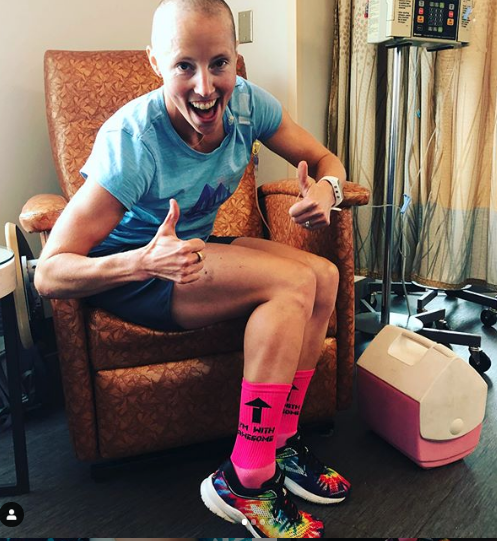
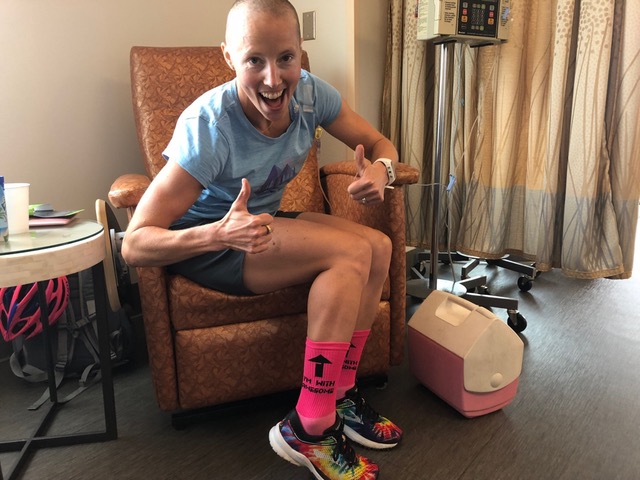
Kikkan Randall staying positive with pink socks and rainbow shoes during her second round of chemotherapy on July 31 at the Providence Alaska Medical Center in Anchorage. (Courtesy photo)
Through all of this, she’s learned that her tumor responds to estrogen, progesterone and HER2 (human epidermal growth factor receptor 2)/neu protein, and is initially being treated with two chemo drugs to specifically target the HER2/neu. That should help stop the growth of the tumor, and after chemo, Randall will start taking anti-estrogen and anti-progesterone meds.
Leading up to all of this, she and her husband had been hoping to expand their family.
“We were just starting to try for kid number two and definitely excited to have more kids so finding out about this thing, the diagnosis, and then knowing I needed to start chemo pretty soon, we didn’t have much of a window to work with,” she explained of her diagnosis in early June.
Later that month, before starting chemo in July, she sought fertility treatment in Seattle. There, Randall received a round of injections to stimulate egg production in her ovaries. That produced one embryo, which is being preserved in case the cancer treatment makes pregnancy difficult later on.
“There’s no guarantee that the chemo will knock out my natural fertility, but it’s nice to know that there’s at least a small chance for the future,” Randall said. “It’s going to be challenging because the type of breast cancer that I have, I will have to be on some anti-estrogen and anti-hormone treatment for probably five to ten years even after the chemo and everything is done, so that’s going to be a little bit tricky to figure out a pregnancy in there, but at least we kind of have a backup plan.”
While Randall repeats her multiple-leg commute between Penticton and Anchorage (a 1- to 1.5-hour drive from Penticton to Kelowna, B.C., followed by a two-stop, roughly 4.5-hour flight to Anchorage) every three weeks, she’s also staying involved in several work engagements, including with Fast and Female and as a new board member of the National Nordic Foundation.
“Everyone’s been so supportive, like the IOC, the USOC [U.S. Olympic Committee], they’ve been telling me to take as much time to make my health the number-one concern, and the same with Fast and Female, we wanted to get some stuff going this summer and fall and we’ve just had to postpone it a little bit,” she said in July. “The door’s open if I have the energy to work on some of that stuff, but if I can’t, I have the time to just focus on recovery. … And then the period after surgery is kind of up in the air in terms of what I’ll be able to do. I’m just trying to be creative; I’m hoping to be able to do stuff, maybe not as much in person but maybe I can contribute to things, whether it’s writing or interviews or projects. I’m just going to ride it out and see where it goes.”
Back in Penticton, her husband, Jeff Ellis, has been “doing the single dad thing”, as Randall put it, while she’s away for treatment. As she retired from racing this spring, Ellis transitioned from his marketing job with the International Ski Federation to sales and marketing with Swagman bike racks. He initially took some time off from Swagman when Randall was first diagnosed before deciding to leave his job and be home full time.
“Ultimately when Jeff said, ‘Hey, this has put things into perspective for us. I need to be home to help Kikkan out,’ they were definitely very understanding of that,” Randall said of Swagman.
Ellis recently started his own business as an independent marketing contractor, called the Jeffrey MW Ellis Group.
“He’s actually helping me with the ‘Kikkan Brand’ while I’m going through treatment and he’s picked up a few more small clients as well,” Randall explained.
Asked why she went public with the diagnosis in early July and what’s driven her daily video updates every day since, Randall said she never could have kept it private.
“I’m not very good at faking things, so I knew once I showed up in Anchorage when I wasn’t supposed to be here, people would start to ask questions and wonder what was going on and I was going to have to start bowing out of things,” she said. “I also felt like, especially Anchorage, especially Alaska, but really just so many people have supported me through my career and they really care what’s going on. So I kind of felt like they’d want to know what was going on with me. It’s always good to celebrate the good things, but I think it’s also important to share the really human moments, and I thought it was really good to show that you could be an Olympic gold medalist and four months later find out you have breast cancer.
“I think it’s important for a lot of people out there that are battling through this, it makes them feel like, this happens to all of us,” she continued. “I learned 10 years ago when I shared my story about blood clots that it helped people. … I kind of felt like, if me going through this can have a positive impact by sharing my story, then I’m happy to do so. I don’t feel like there’s anything I need to hide; I’m willing to share this.”
“It’s always good to celebrate the good things, but I think it’s also important to share the really human moments. … You could be an Olympic gold medalist and four months later find out you have breast cancer.”
One of Randall’s sponsors started a GoFundMe online fundraiser to help with some of her out-of-pocket medical and travel costs, and in a little over a month, it had generated more than $37,000 dollars toward a $45,000 goal. According to the site, any funds that exceed the associated expenses of Randall and her family will be donated to AKTIV Against Cancer.
“It’s been amazing,” Randall said of the community support in light of her diagnosis. “I got to come back after winning the gold medal, and of course I feel like our profile was higher than it had ever been — people were so excited and wishing me congratulations everywhere I went, but this has blown that out of the water. So many people have reached out, whether it’s over social media or messages through my website or cards arriving in the mail, people stopping me in the grocery store, they’re sharing their stories. Breast cancer’s way bigger of a deal than I ever appreciated.
“My traditional income as a ski racer was coming to an end anyway and I was going to be relying on being able to travel and do speaking engagements and things like that for some projects over the next year, and I won’t be able to do that now,” she said of the fundraiser. “It’s hard to put into words, but I just feel so supported. I’ve been reading through all those messages on the tough days and then trying to reach out to as many people as I can to say thanks.
“It’s unfortunate that it takes a situation like this to be able to appreciate the amount of people that do support me in that way,” Randall added. “But like I said, I’m blown away, I’m so grateful for it and it’s definitely going to help me through this.”
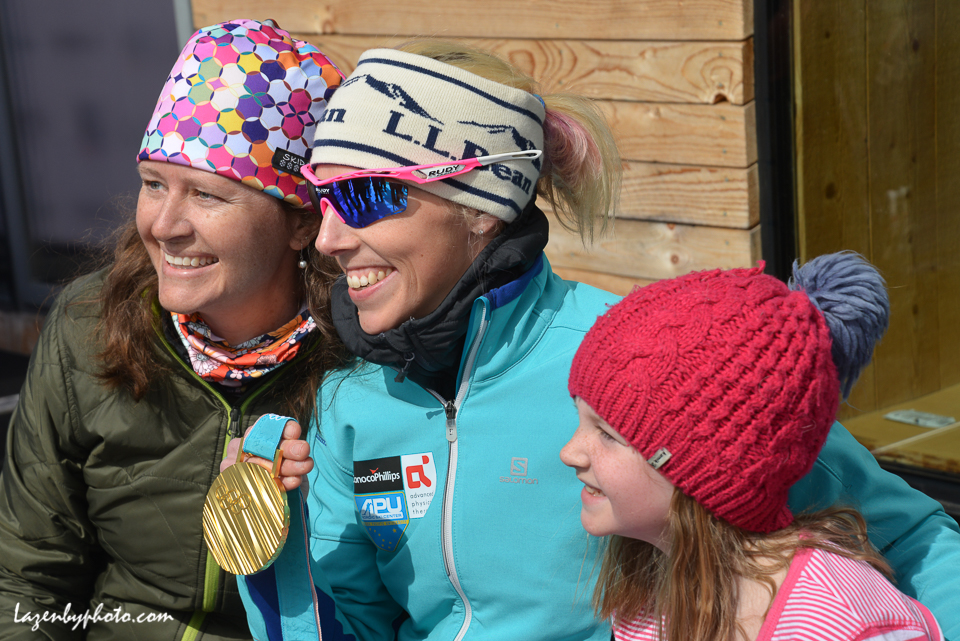
Kikkan Randall (c) with young fans and her Olympic gold medal after the 10 k freestyle mass start at 2018 SuperTour Finals in Craftsbury, Vt., this past March. (Photo: John Lazenby/Lazenbyphoto.com)
On Wednesday, Kikkan Randall went public with the news that she was recently diagnosed with breast cancer.
“Although we caught it early and the prognosis is good, my life will change quite a bit in the coming months,” she wrote on Facebook.
Randall received her first round of chemotherapy on Monday at the Providence Alaska Medical Center in Anchorage, Alaska, the city where she grew up. After winning Olympic gold in February with U.S. teammate Jessie Diggins then retiring from the U.S. Cross Country Ski Team this spring, she and her husband, Jeff Ellis, and their 2-year-old son, Breck, moved to Penticton, British Columbia. Jeff had a new job, and they hoped to expand their family there, according to the Anchorage Daily News (ADN).
As she spoke with the ADN inside her parents’ Anchorage home on Wednesday, shortly after announcing her diagnosis on social media, Randall, a 35-year-old three-time World Championships medalist, three-time Sprint World Cup champ and 13-time World Cup race winner, remained optimistic. While doctors won’t know the scope of the cancer until they operate, they believe its in an early stage, Stage 2, she said.
The ADN reported that Randall will have six rounds of chemotherapy with one infusion every three weeks. She rode her bike to the hospital on Monday wearing her rainbow-colored “happy shoes” and is hoping she can use a treadmill or stationary bike during future infusions, which take hours. She already emailed her oncologist to see if that was permissible.
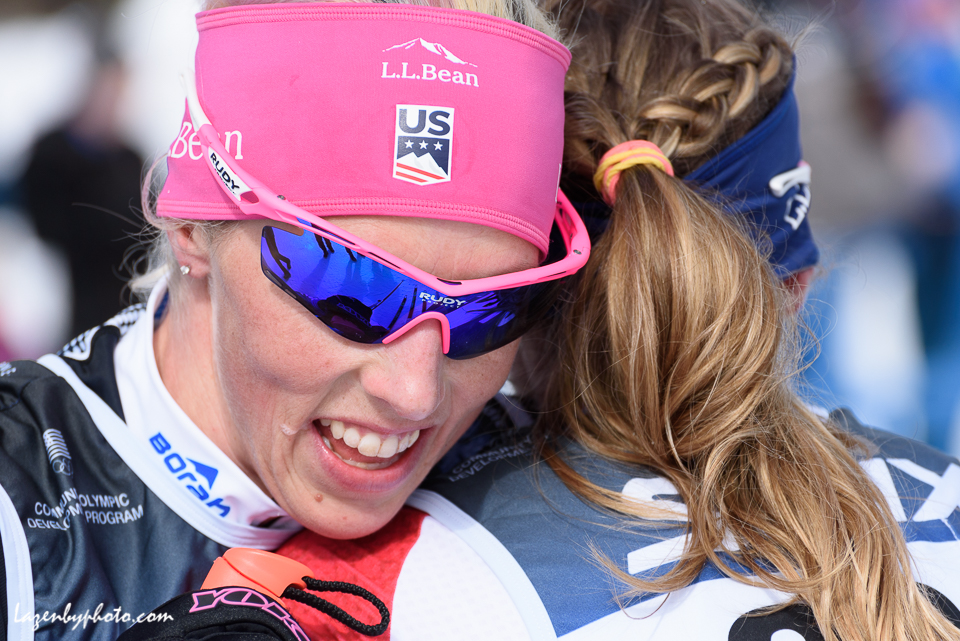
Kikkan Randall (l) and Jessie Diggins embrace after the finish of the women’s 10 k freestyle mass start on March 24 at 2018 SuperTour Finals in Craftsbury, Vt. Diggins won and Randall placed third. That was Randall’s second-to-last race before retiring from skiing. (Photo: John Lazenby/Lazenbyphoto.com)
“I haven’t heard anything back yet but if they’re open to it, I’d be willing to try it,” Randall told the ADN.
After chemo, she’ll have surgery, but Randall was unclear what that would entail. It could be anything from a lumpectomy to a double mastectomy.
In her interview with the ADN, Randall explained that she doesn’t have a family of breast cancer. Between chemo sessions, she’s hoping to return to her new home in B.C.
Since discovering two pea-sized lumps on her breast on Mother’s Day, May 13, Randall underwent a mammogram, an ultrasound and a biopsy, then received the news that she had cancer while in Sweden for a wedding less than a month later. In that time, she told the ADN she’s felt everything from “denial and disbelief and frustration, but I always come back to the same skills I’ve used in my athletic career,” she said. “I need to focus on what I can control. I need to be positive and optimistic.”
“… It’s so surreal for me because I just won a gold medal four months ago and I just was feeling on top of the world,” she said. “Life is going to kind of forever change.”
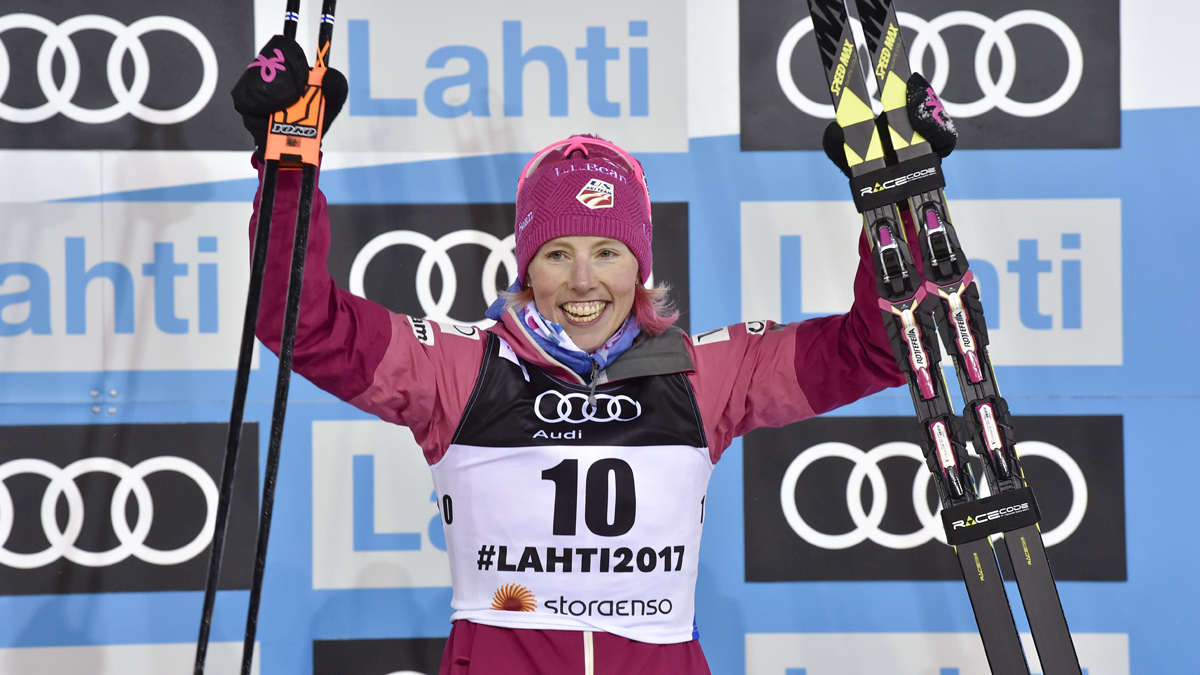
Kikkan Randall after placing third in the freestyle sprint at 2017 World Championships. (Photo: Fischer/NordicFocus)
Randall is widely recognized for her trademark pink hair, a color she wrote “has taken a on new chapter in my life” and one she plans to keep throughout treatment, even in the form of wigs. Randall has been involved in breast cancer awareness projects in the past, but previously used her pink locks to attract attention to her sport. Then pink became her good-luck charm.
Looking forward, she’s already coined a term for herself post-treatment: “Kikkan 2.0”.
“I’ll take this on like I have taken on anything else,” she told the ADN. “I think Kikkan 2.0 could be pretty awesome.”
She noted on social media that she’ll be using her blog, Kikkan.com, to provide updates during her “upcoming journey,” as she put it.
(Update: On Thursday, Randall’s friends started an online fundraiser to help with her medical costs. As of Friday, they had raised nearly $17,000 toward a $45,000 goal. For more information, visit www.gofundme.com/support-kikkan039s-fight)