From the FasterSkier archive — posts syndicated from athletes’ and coaches’ own blogs between 2004 and 2012, kept online as published. Current coverage is at fasterskier.com.
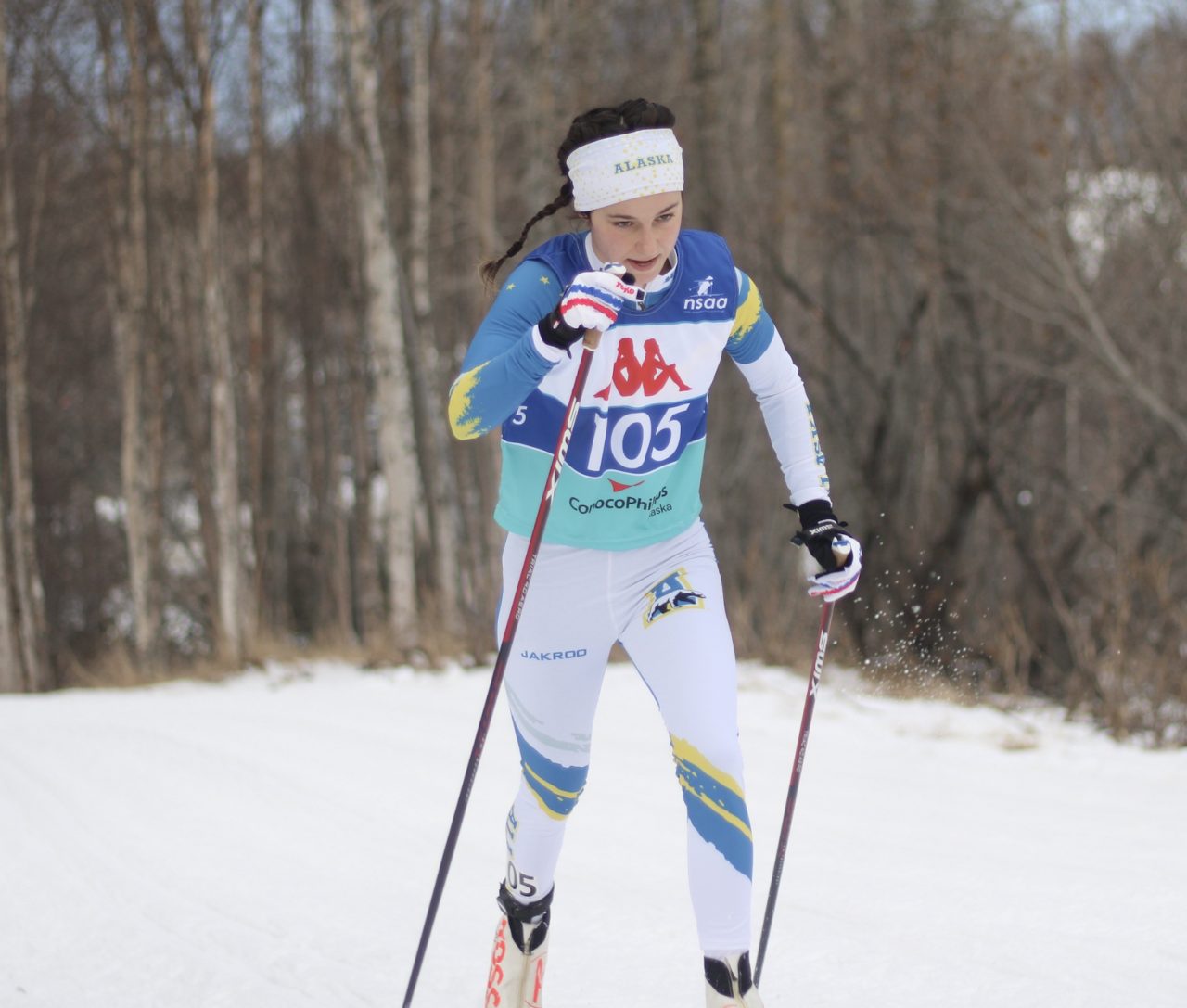
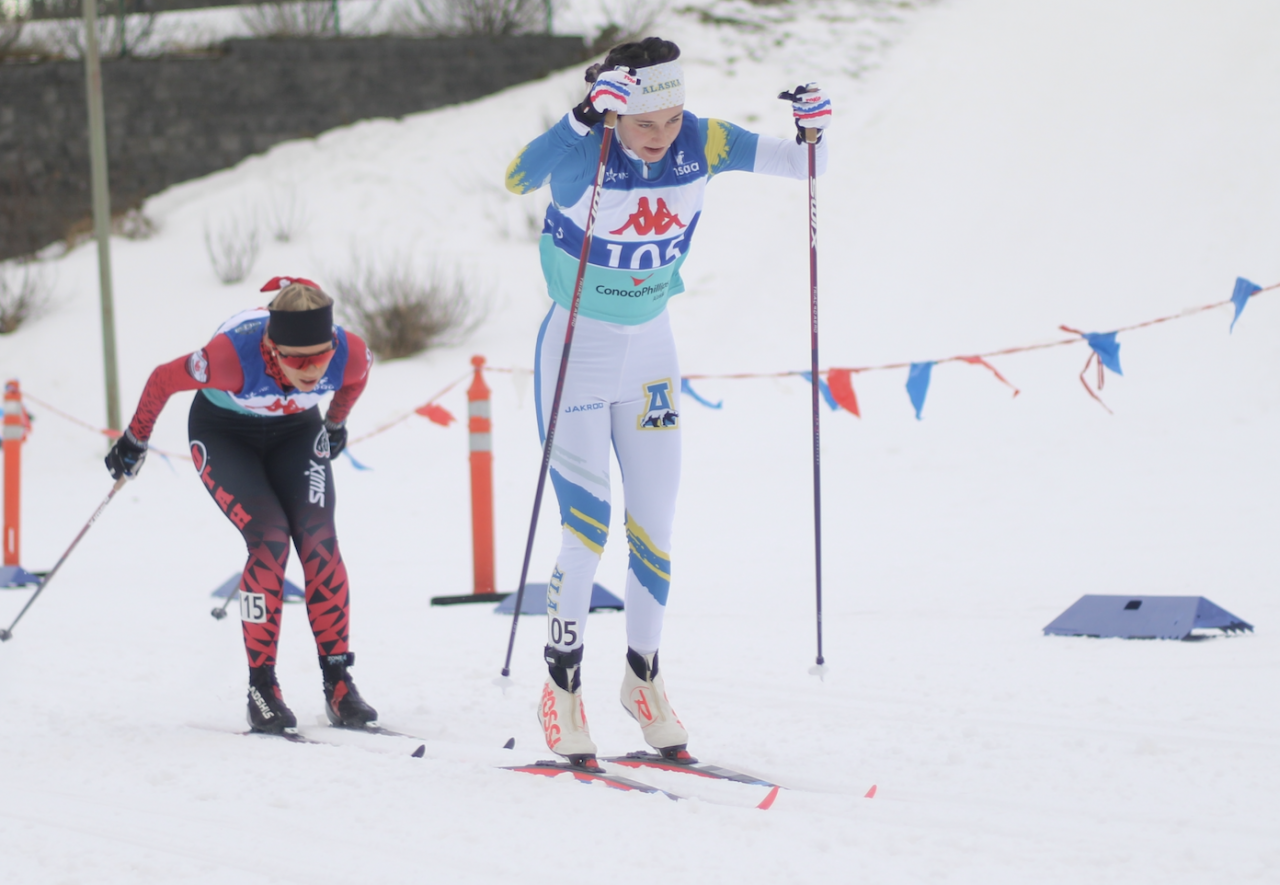
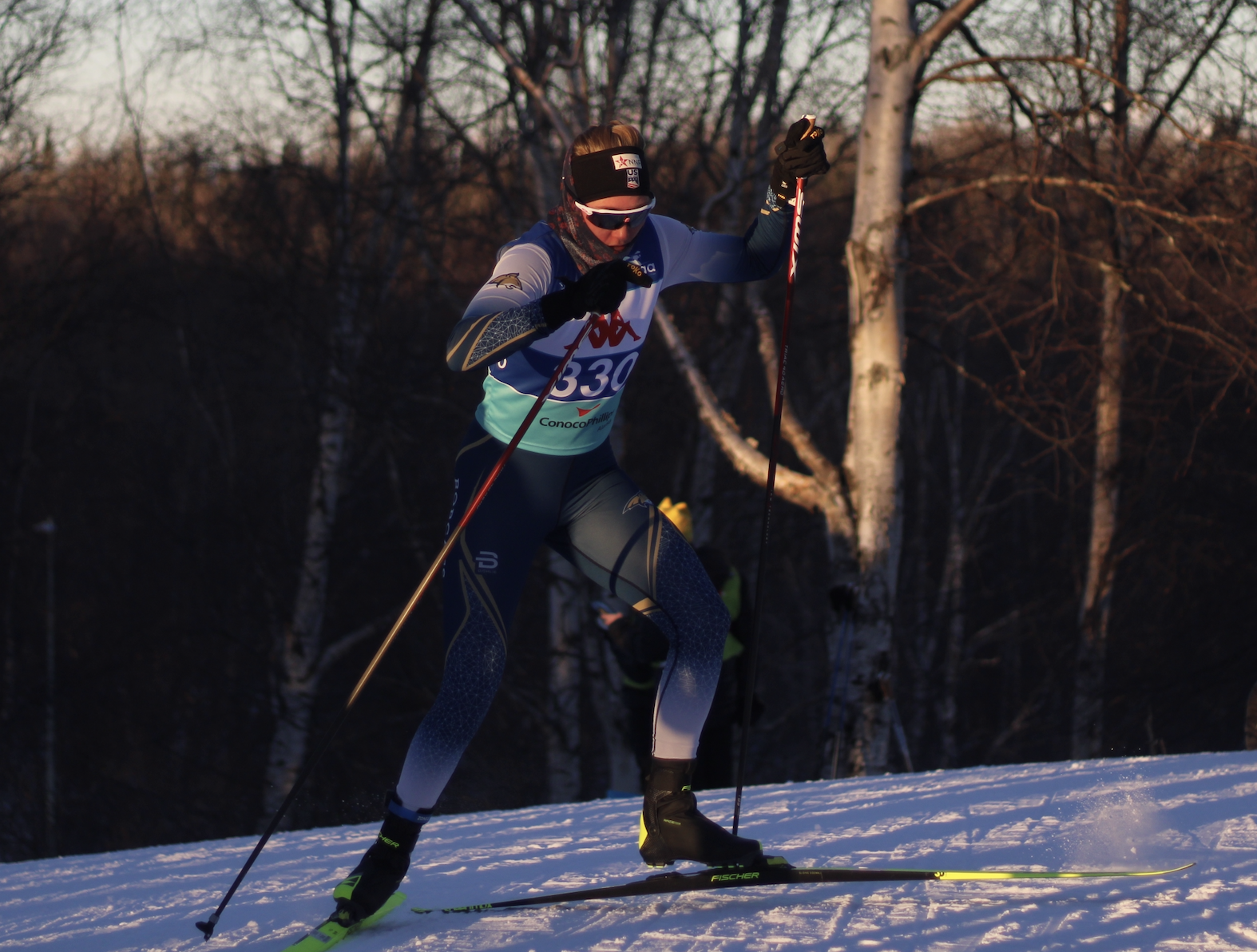
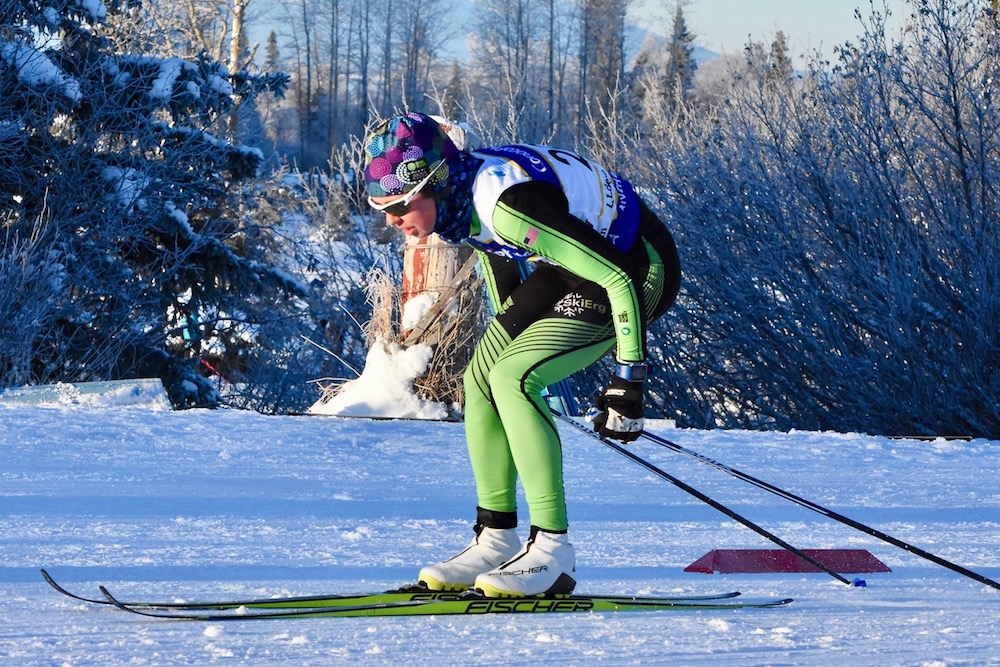
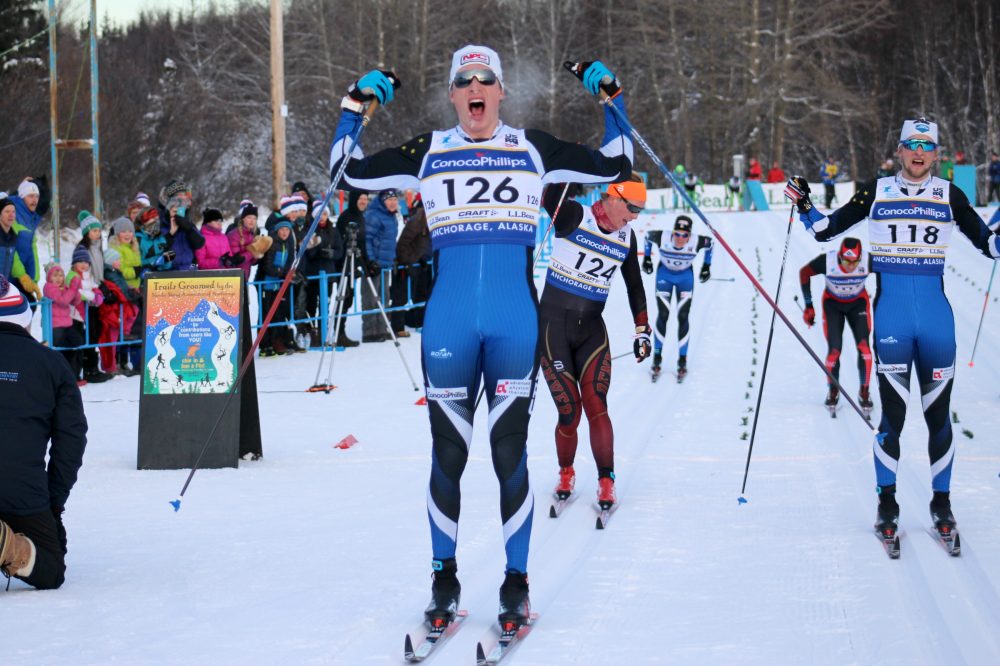
Kendall Kramer, racing Sunday at U.S. Nationals at Kincaid Park, is a multi-sport athlete at University of Alaska Fairbanks. She competes in both cross-country running and skiing. (Nathaniel Herz/FasterSkier)
ANCHORAGE — Alaskans like to think of their home state as the center of American cross-country skiing.
Minnesotans might quibble. But consider the more than 200 volunteers who turned out to help host the U.S. National Championships in Anchorage this week, and the dozens of local athletes who signed up to race.
There was just one problem: Through five of six of the championship events, athletes from Norway, Sweden, Colorado and Idaho had denied the Alaska crowd the pleasure of seeing one of their own cross the finish line first. (An Alaska man, Luke Jager, had technically claimed a U.S. championship Saturday, but crossed the finish line second to a Norwegian, who was ineligible to claim the title.)
Sunday’s 20-kilometer, classic-technique women’s race was the Alaskans’ last chance.
And Kendall Kramer came to the rescue.
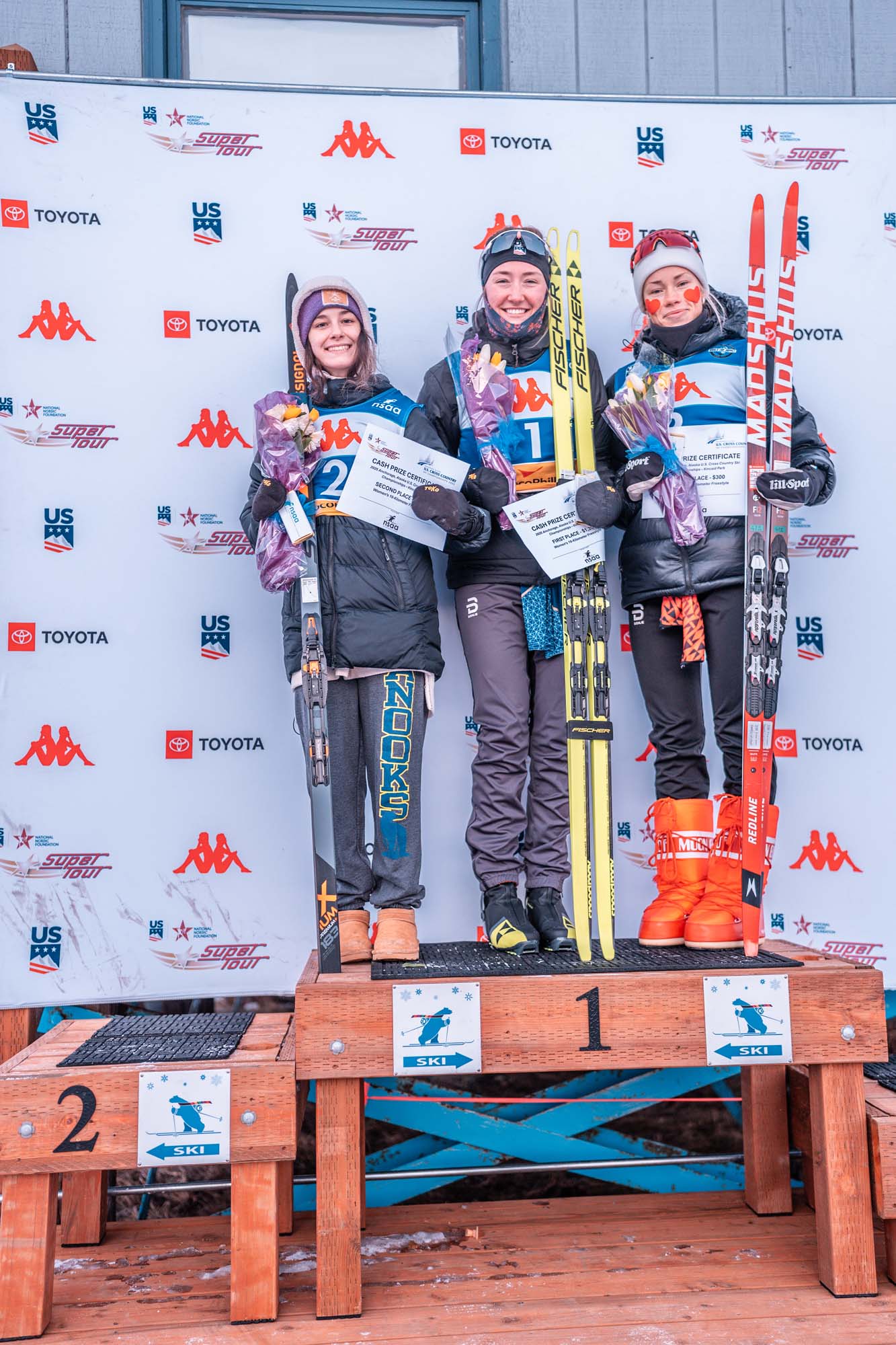
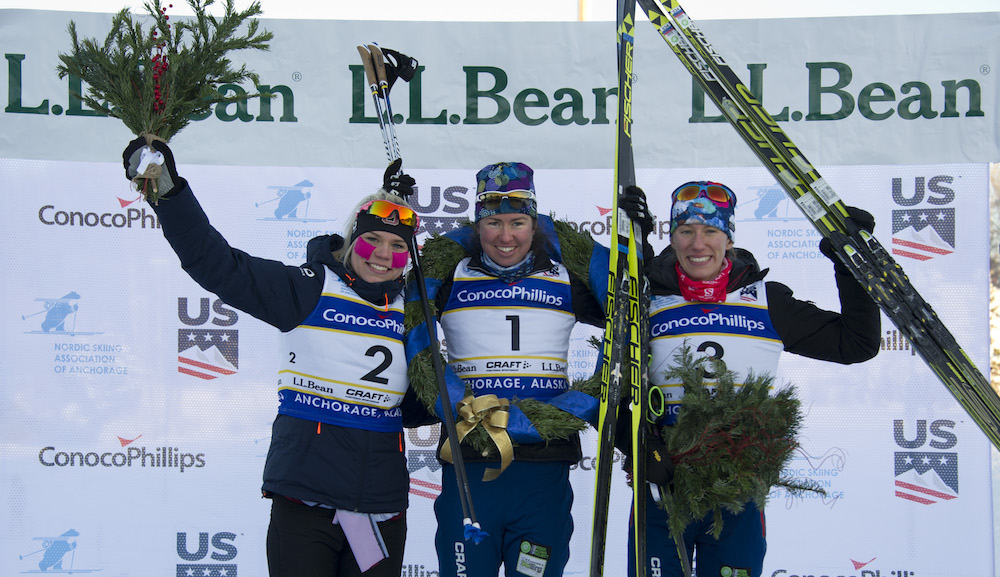
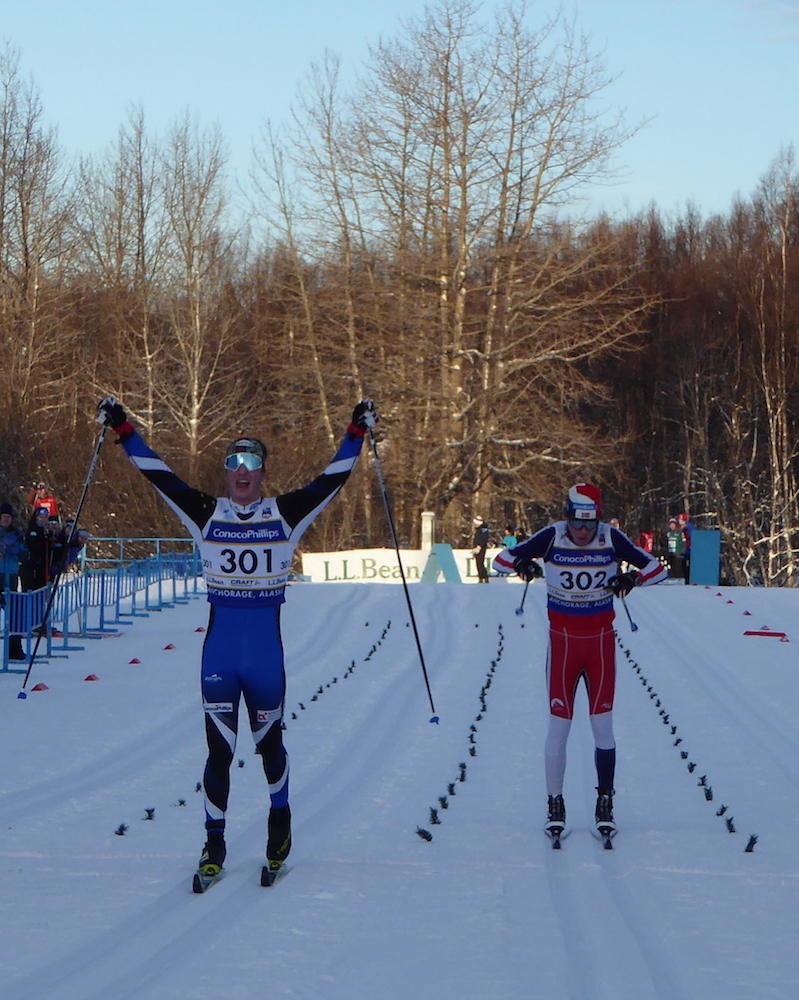
The 22-year-old Fairbanks native won her first-ever national championship fashion in stirring fashion, breaking away from the pack early in the race with one other athlete and slipping away in the final meters before the finish.
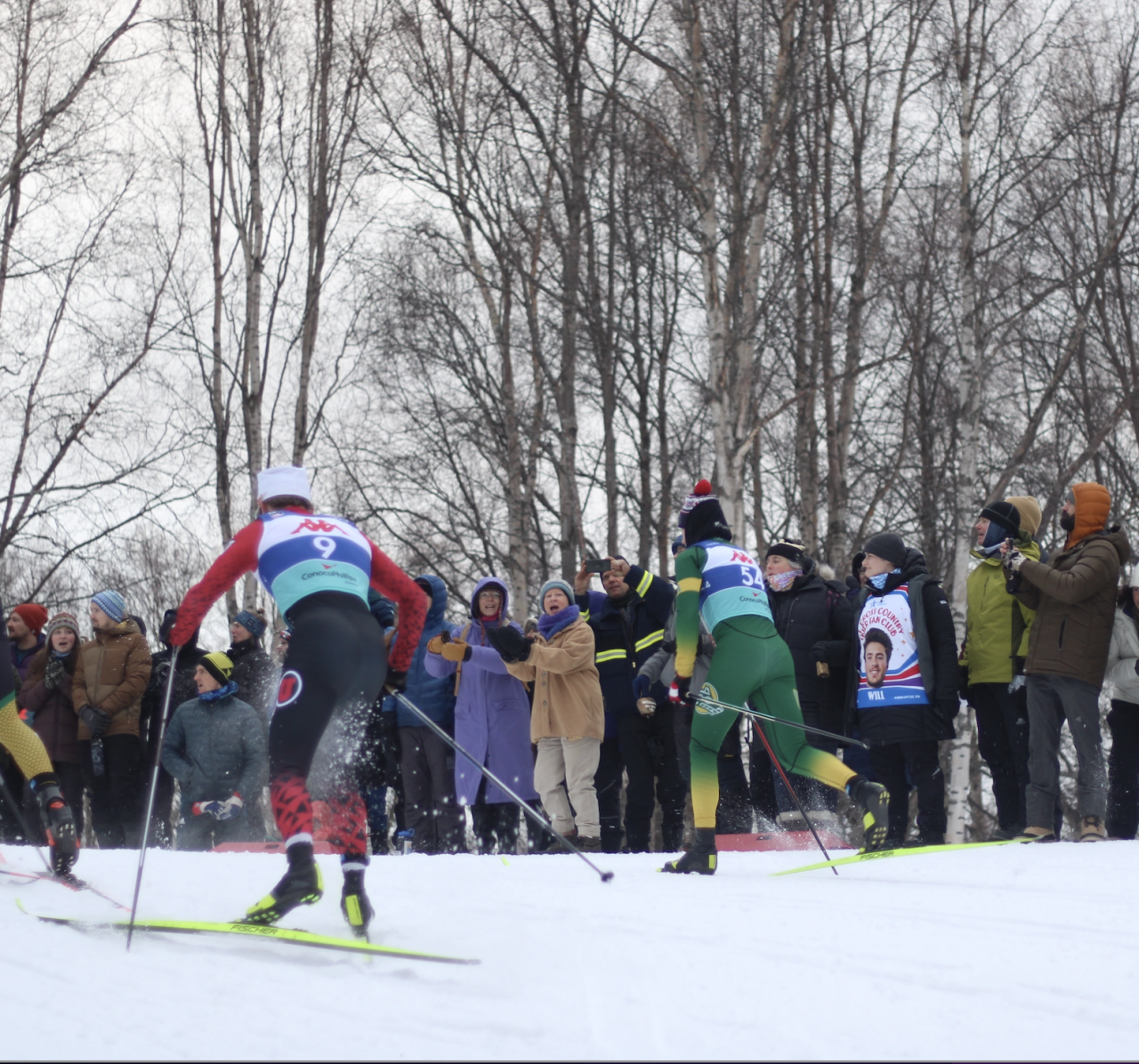
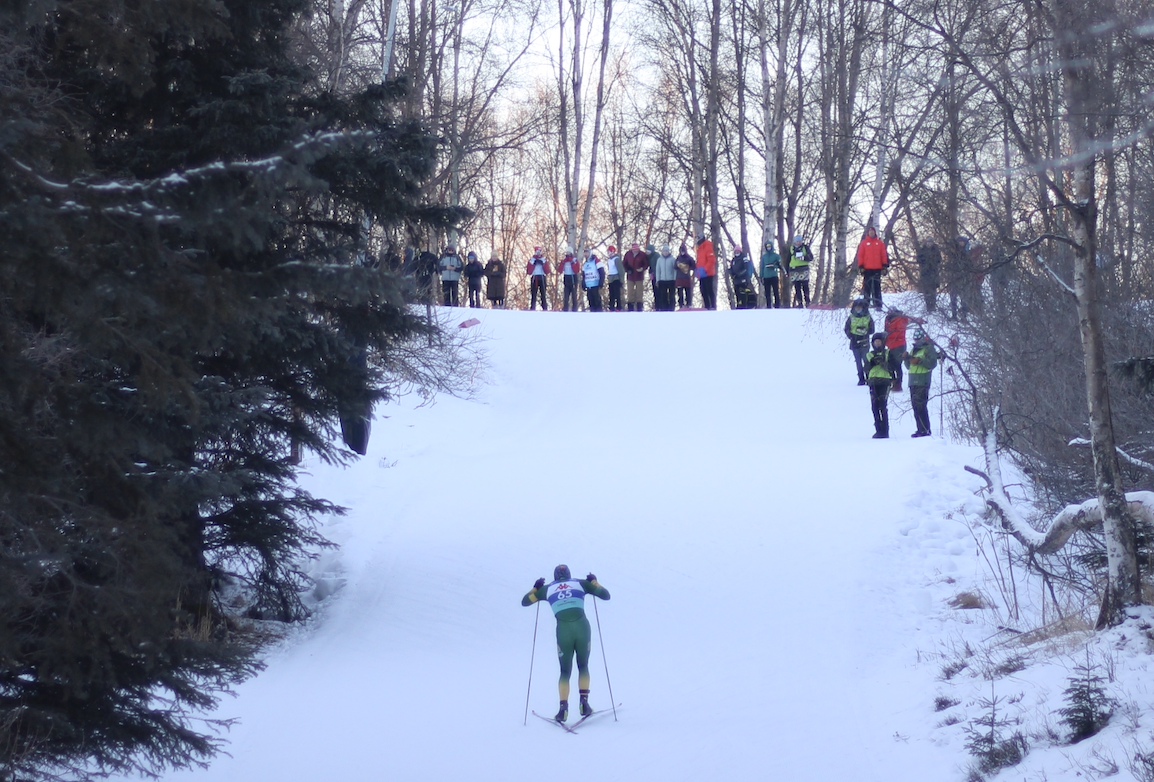
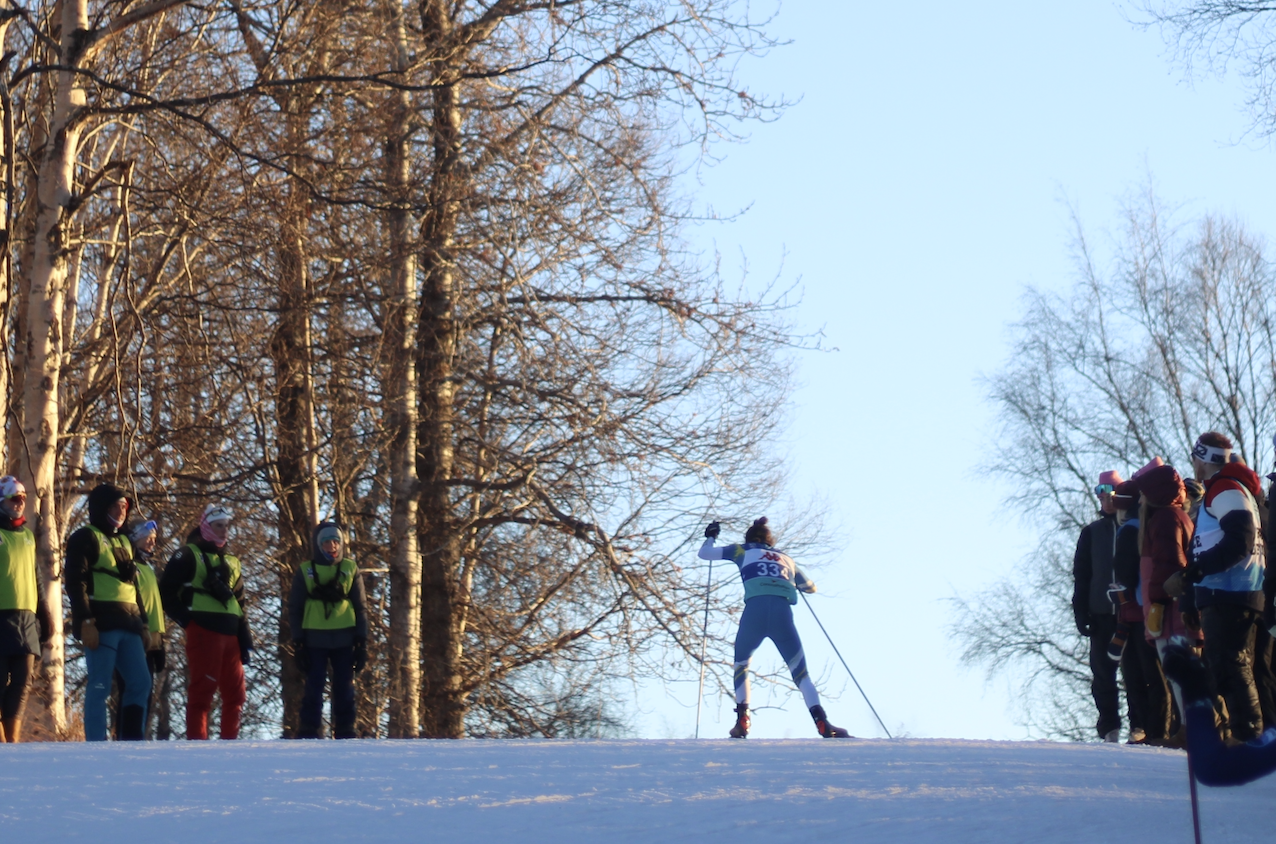
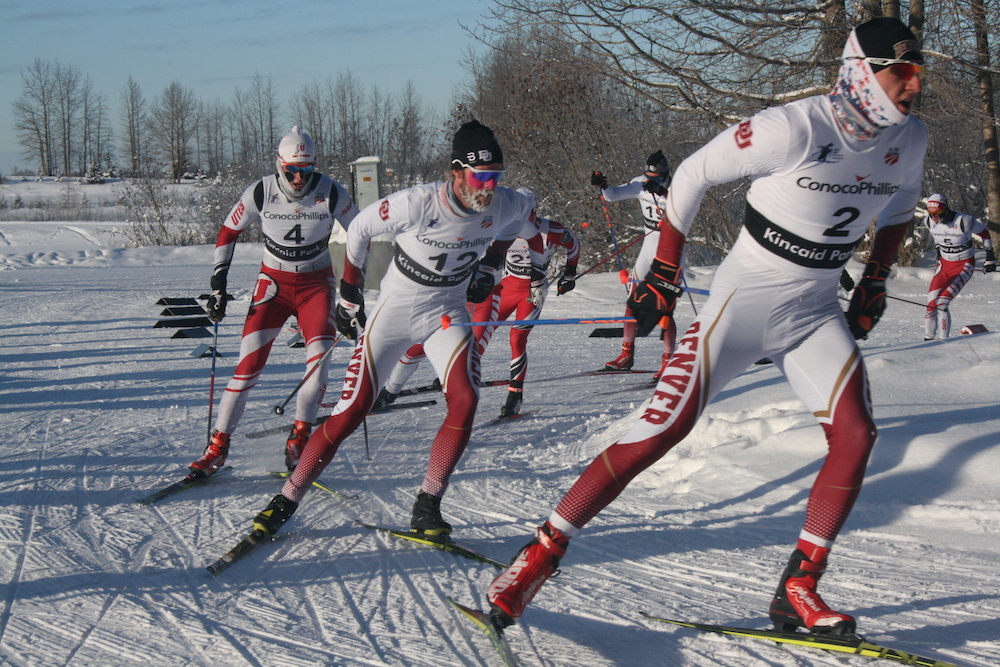
The crowd on one of the major hills cheers on U.S. Nationals competitors in Sunday’s men’s race. (Nathaniel Herz/FasterSkier)
“You can feel it in the energy,” said Kikkan Randall, the Olympic gold medalist who heads the Nordic Ski Association of Anchorage, which is co-hosting the event. “We have so many great volunteers out here, we really push to get spectators out here. And so when you see an Alaskan deliver, it’s just that sense of pride.”
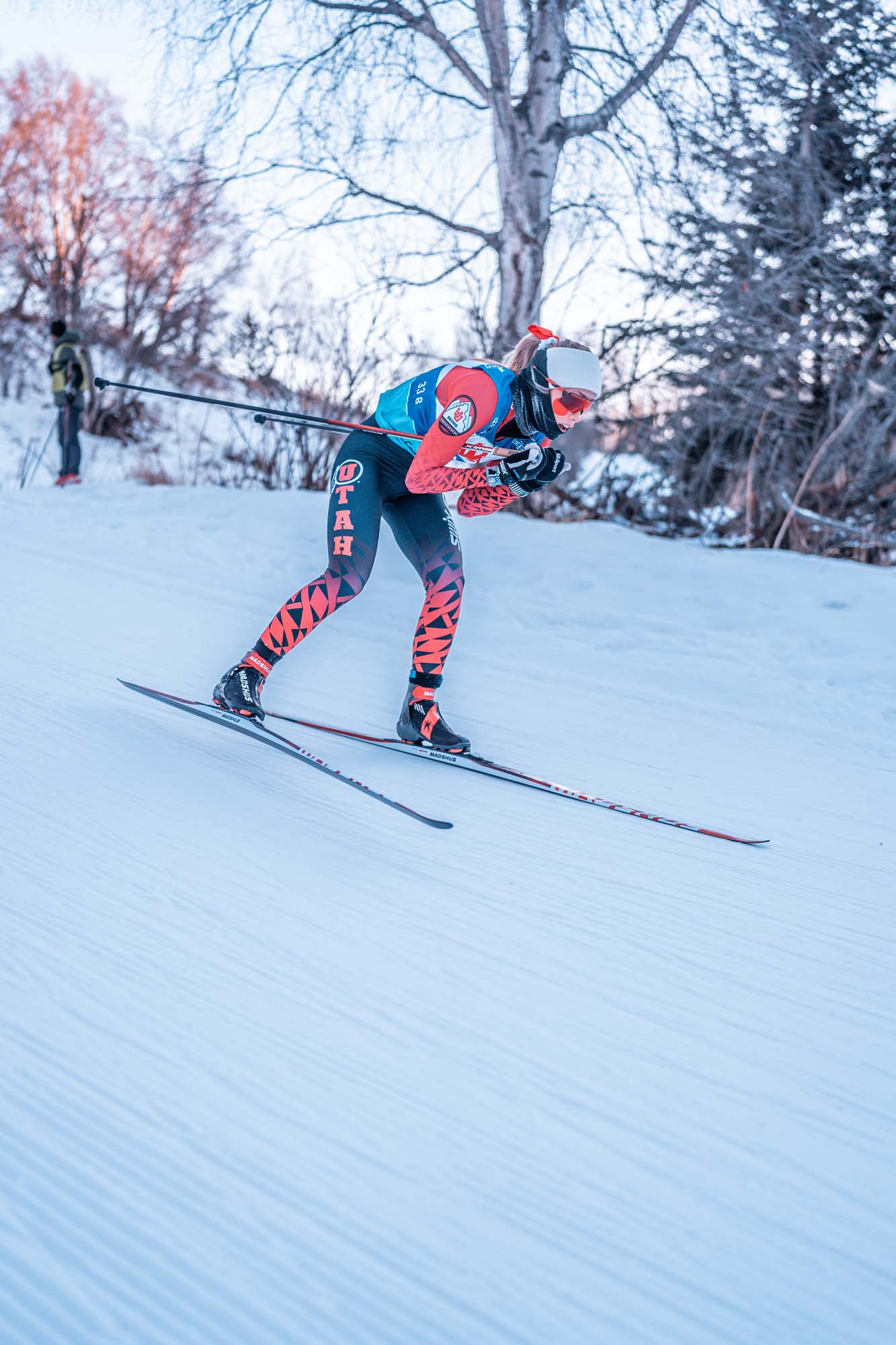
Kramer’s final margin of victory was 2.4 seconds over Erica Laven, a Swedish skier competing for the University of Utah. The rest of the women’s pack crossed the finish line a minute-and-a-half later, led by Lauren Jortberg, who races for a Quebec club team.
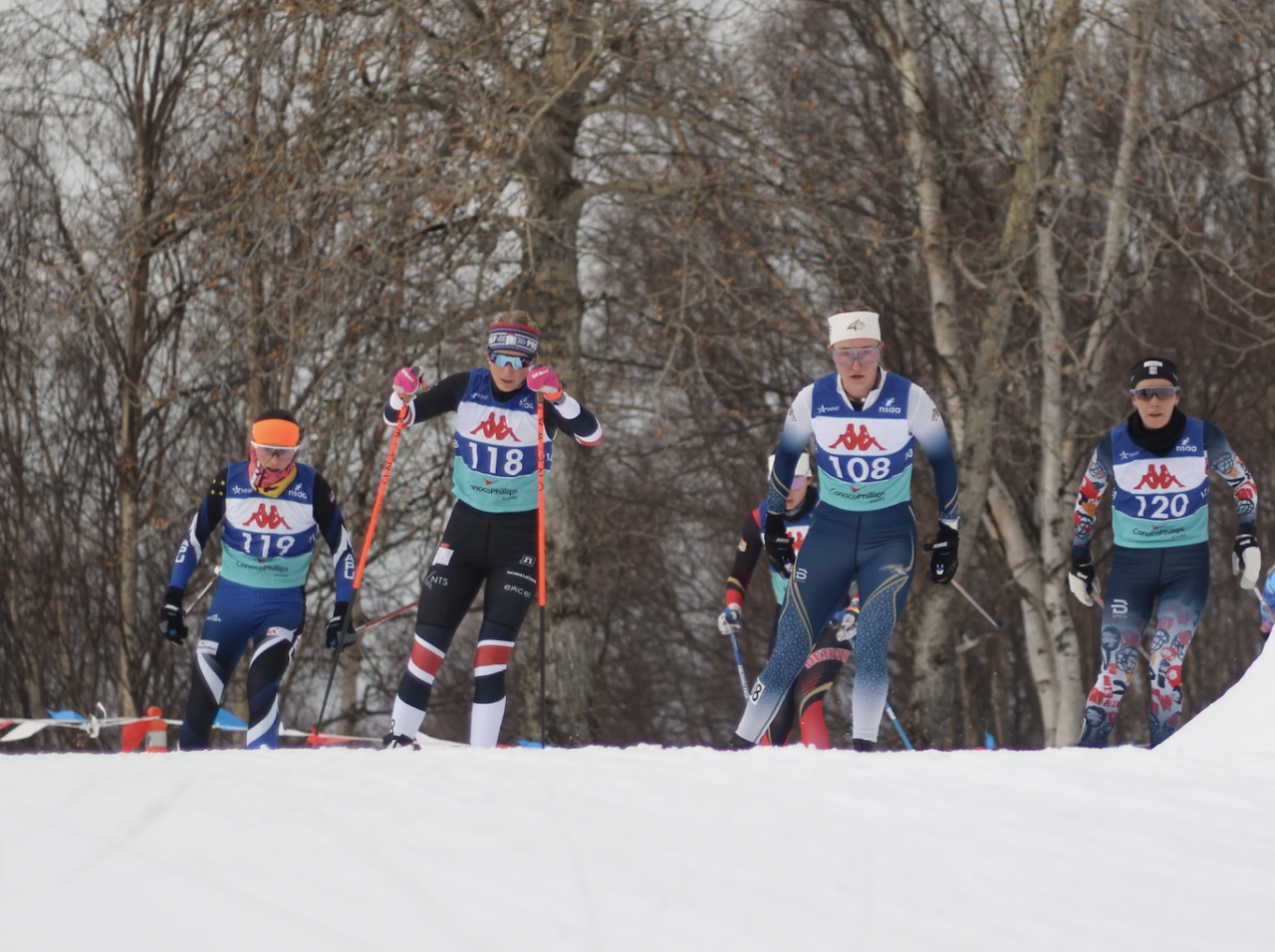
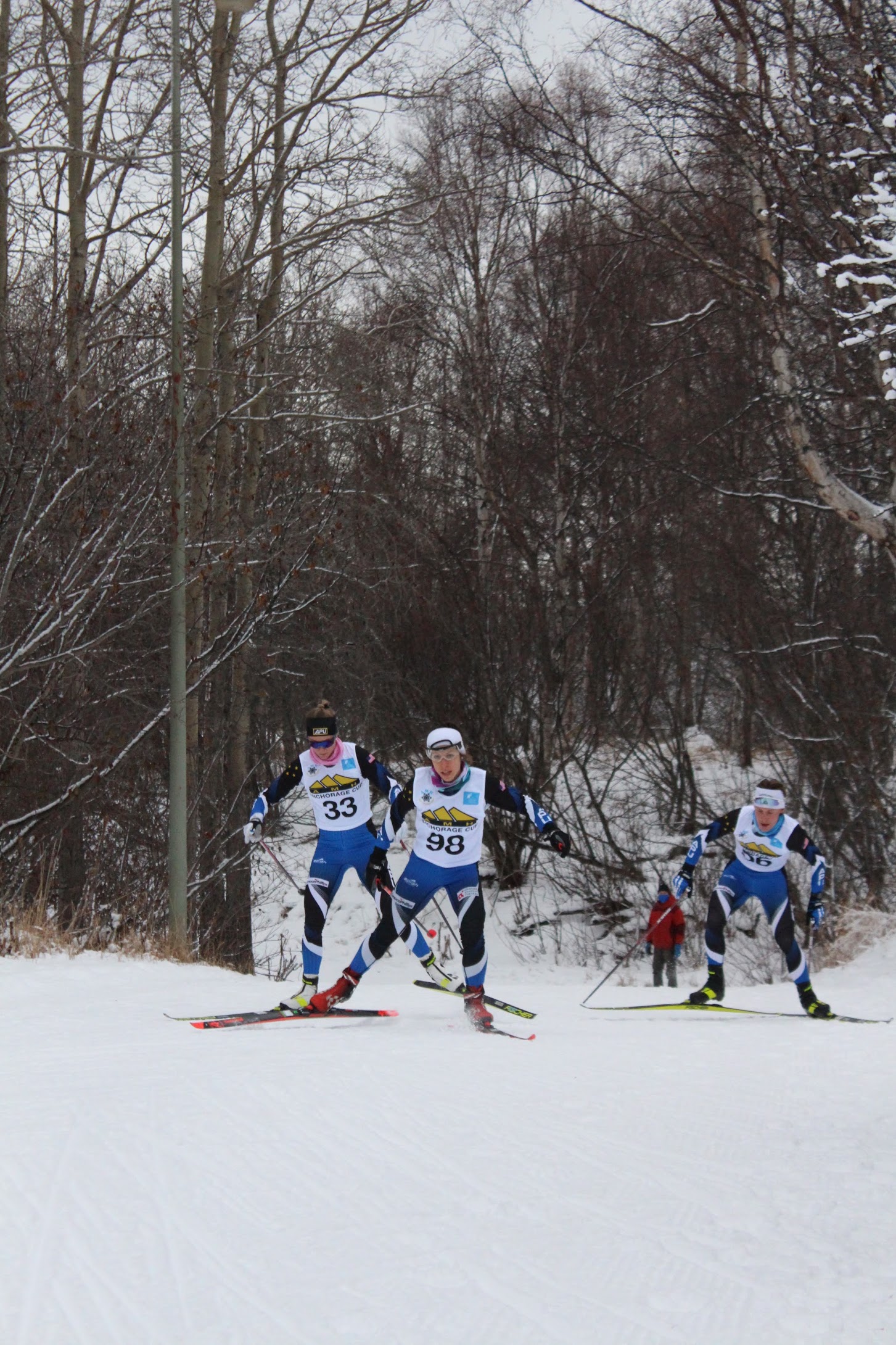
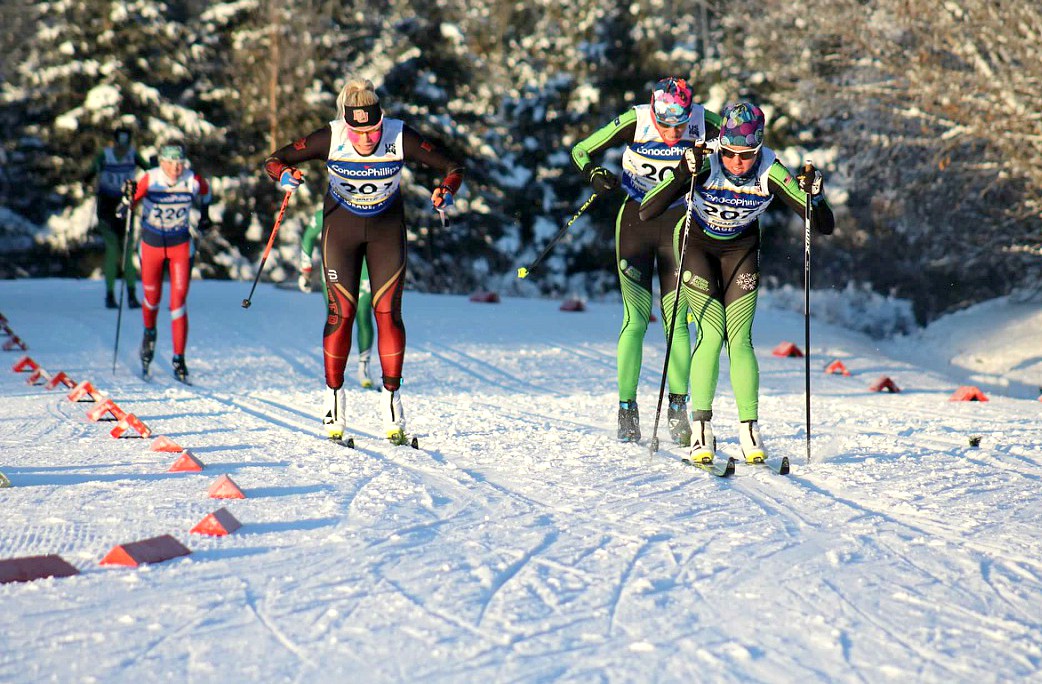
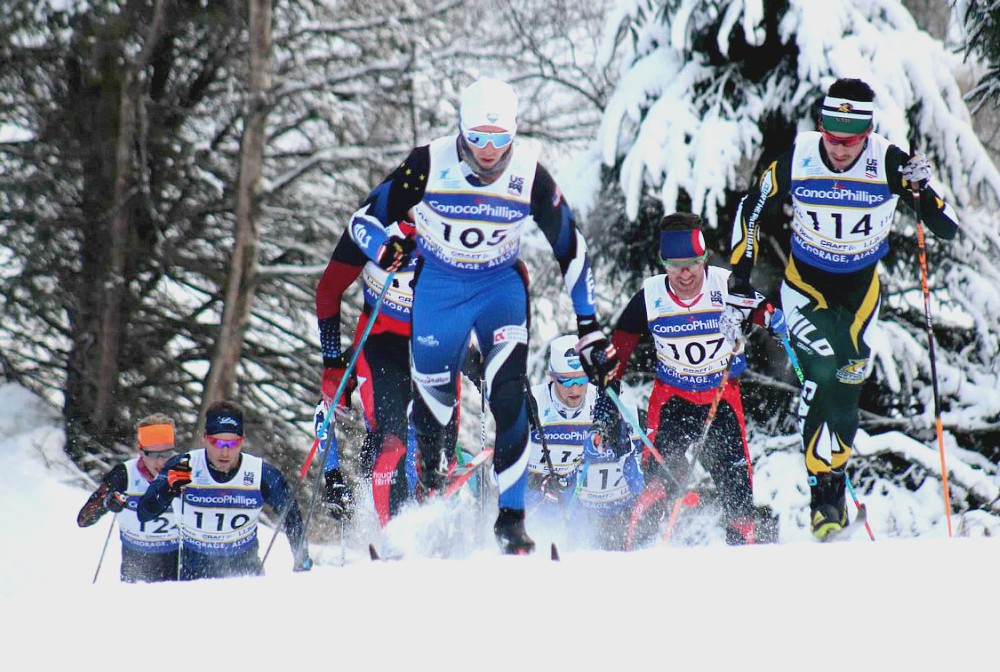
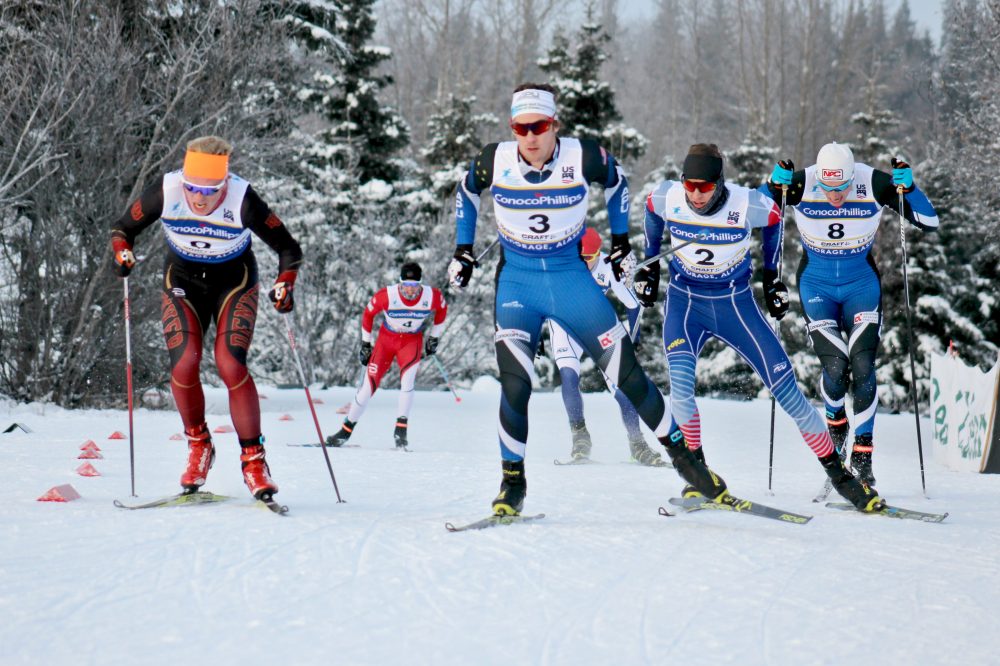
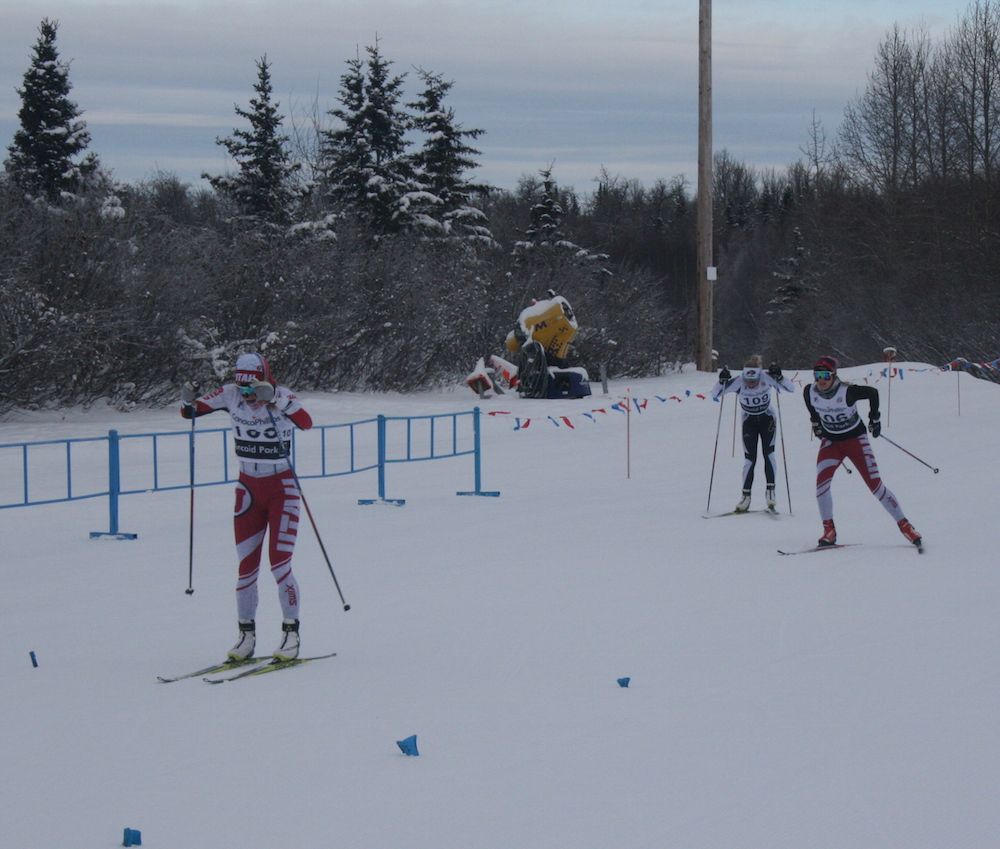
The women’s chase pack crests a hill in Sunday’s distance race. From left, Alaska Pacific University’s Renae Anderson, Bridger Ski Foundation Pro Team’s Erin Bianco, Montana State University’s Kate Oldham and CNEPH’s Lauren Jortberg. (Nathaniel Herz/FasterSkier)
Montana State University’s Kate Oldham was just behind Jortberg and rounded out the U.S. championship podium; Laven was ineligible due to her Swedish citizenship.
Kramer has been a standout since her years at West Valley High School in Fairbanks, where she won more than a dozen state titles between skiing, cross-country running and track and field. She was first named to the U.S. Ski Team while a junior in high school, then decided to stay in her home city for college, where she’s competed in both cross-country skiing and running.
She won a medal at the Youth Olympic Games in Switzerland in 2020, and has an array of junior national championships to her name. But two second places — including one Thursday to Oldham — were as close as Kramer had come to winning a U.S. title.
From the start of Sunday’s event, Kramer left little doubt about who would stand on the top of the American podium when she and Laven broke away from the pack on the first of four five-kilometer laps. The two skied the rest of the race together, with Kramer — who trains with Anchorage’s Alaska Pacific University club team during the summer — boosted by an energetic home crowd.
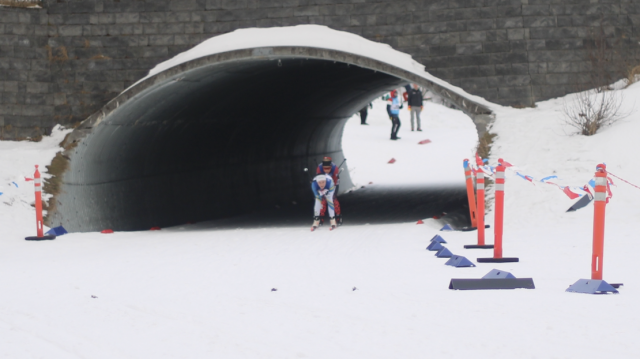
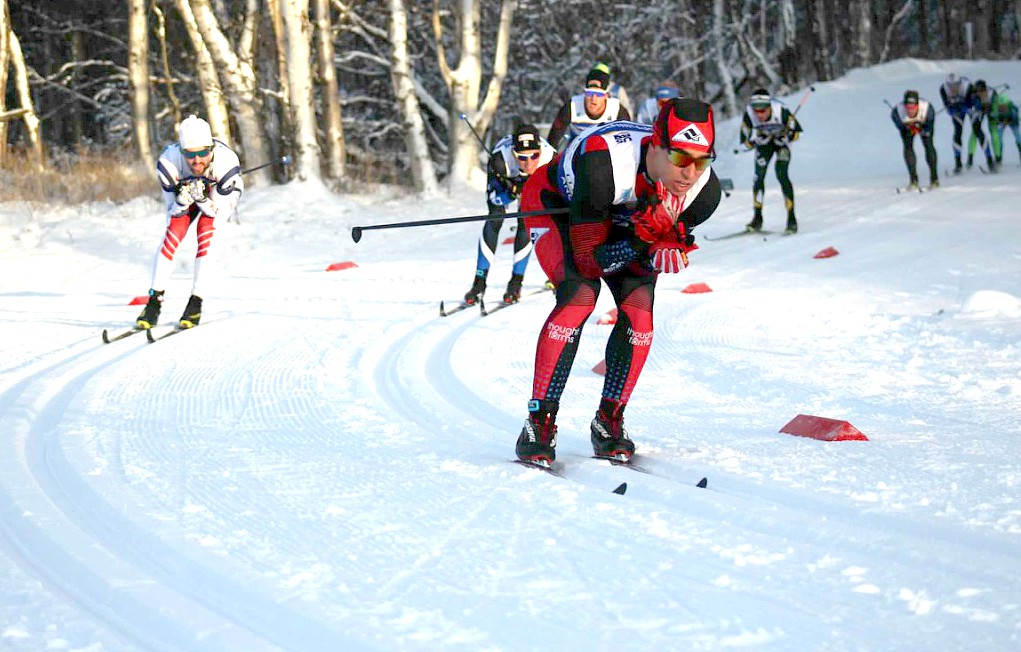
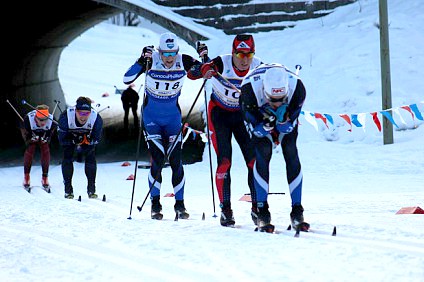
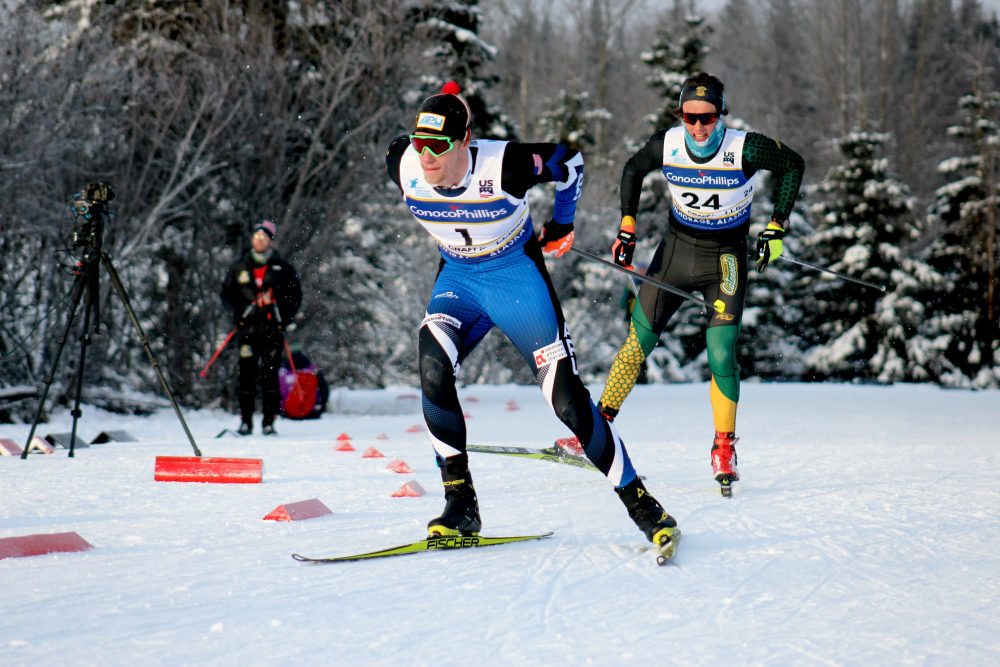
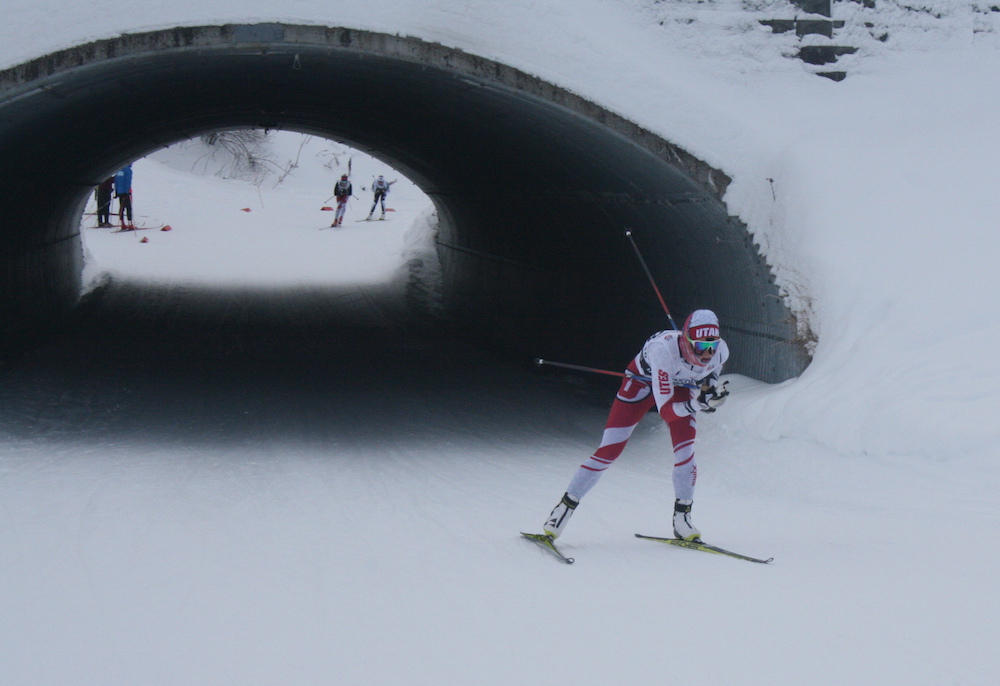
Kendall Kramer leads Erica Laven through the tunnel into the stadium at Kincaid Park. (Nathaniel Herz/FasterSkier)
“I really felt that — I was like, ‘This must be someone from here,’” Laven said, referring to Kramer. “Because it was a lot of people cheering for her.”
Among the fans at Kincaid were Kramer’s mother, Susan Schwartz, along with her grandmother, an aunt and innumerable teammates. Schwartz, who was working as a volunteer at the start line, described the race between Laven and her daughter as a “nail-biter.”
“They just kept on getting faster and faster and faster,” Schwartz said. “It was amazing to watch.”
Early on, Kramer said she realized that even if she lost the race to Laven, she’d still claim the U.S. title. But, she added, she didn’t necessarily want to settle for that. Laven was skiing stronger on uphills, but if Kramer could keep up in those segments, she said, she could “totally relax in the double pole.”
“She was expending a lot of energy on those. And I knew I had energy by the end,” Kramer said.
The closer Kramer got to the finish line, she said, the more confident she felt about her shot at winning the race outright. And on the home stretch, she pulled away.
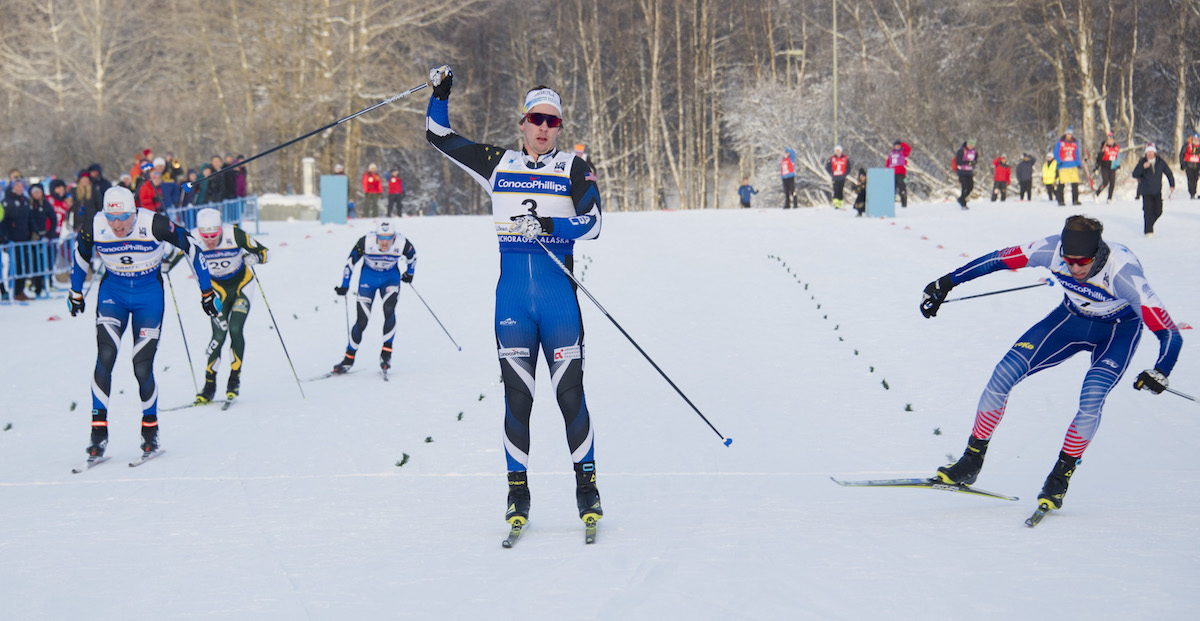
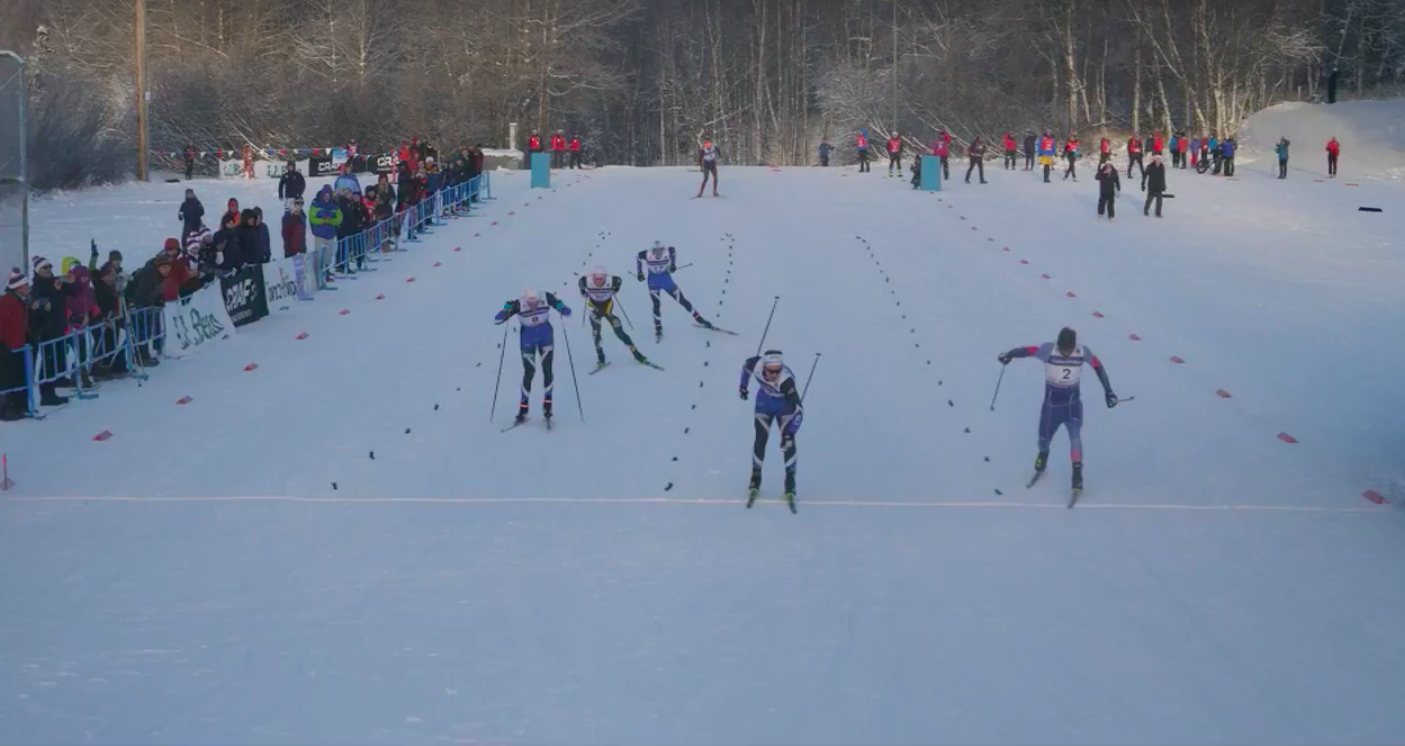
Kramer elevates in her double pole to lead Laven toward the finish. (Nathaniel Herz/FasterSkier)
“She was really strong in the double pole today,” Laven said. “I really had to push hard.”
Kramer crossed the line without celebrating. But her mother, Schwartz, “could tell she was just thrilled” — particularly after Kramer finished a close second in Thursday’s race.
“I could tell she wanted it bad,” Schwartz said. “She was not going to let it get away from her today — that’s kind of the feeling I got watching her race.”
Kramer is in her last year competing for University of Alaska Fairbanks and expects to race professionally next season.
She said she doesn’t want to miss this spring’s collegiate championships. But she grimaced when a reporter pointed out that the event conflicts with the World Ski Championships in Norway, where finishes at the past week’s races in Anchorage are likely to inform which U.S. athletes are chosen for the team.
“I’m super grateful if I do get the spot, because I know how hard people work for it and how bad people want it,” she said. “But we’ll see.”
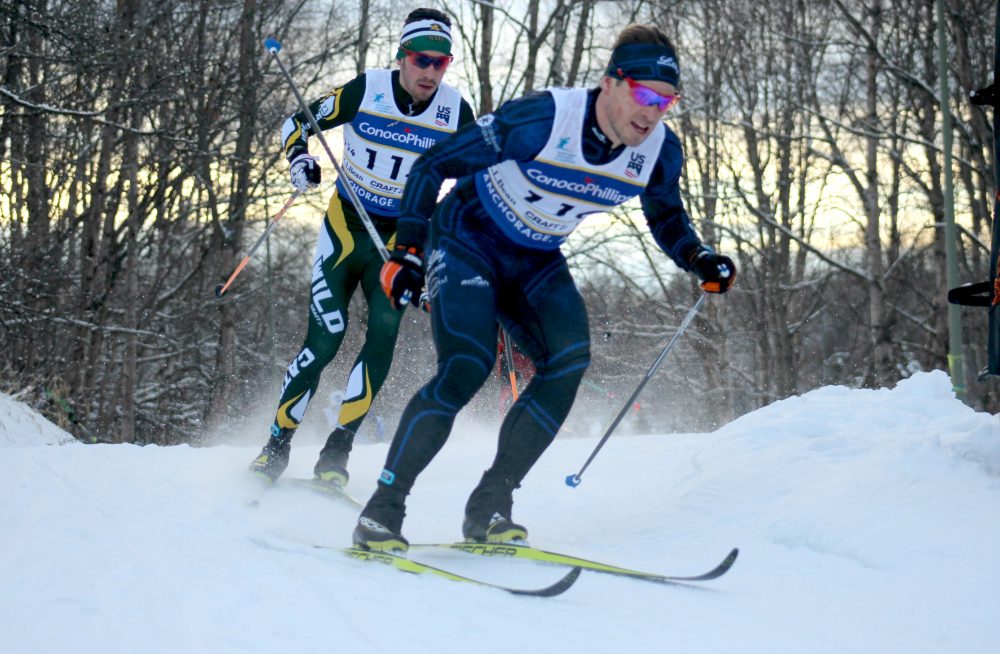
Erling Bjoernstad, a Norwegian freshman racing for University of Alaska Anchorage, climbs a hill toward the stadium at U.S. Nationals Thursday. (Nathaniel Herz/FasterSkier)
ANCHORAGE — Kate Oldham wasn’t expecting to win Thursday’s opening race of the U.S. National Championships.
It was her first competition of the season, after focusing on training in December, and she’d never placed better seventh at previous national championships.
Her coach at Montana State University, Adam St. Pierre, had other ideas about the 22-year-old senior — though he was keeping them to himself.
“I have been predicting Kate as a dark horse national champion for a couple of weeks now,” St. Pierre said. “But not talking about it with her, because she races best when expectations are low.”
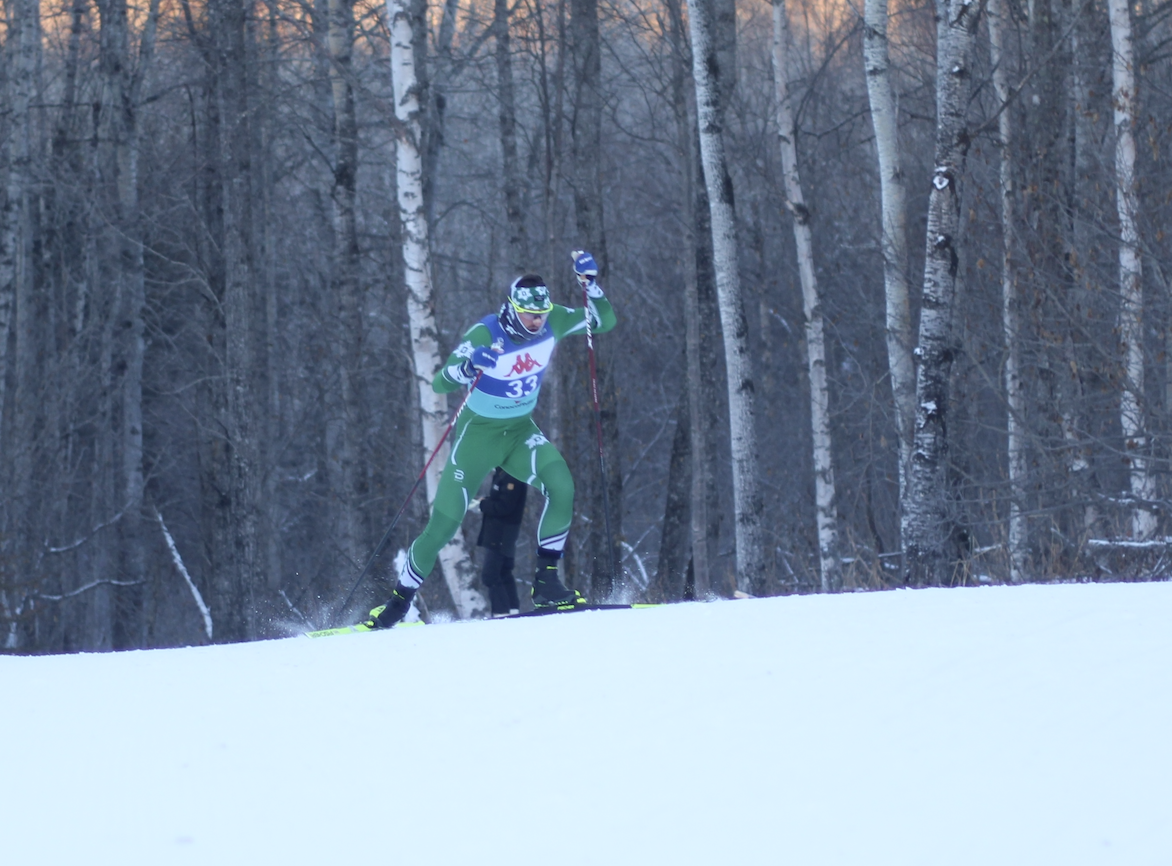
Kate Oldham racing at the U.S. National Championships in Anchorage on Thursday, January 2, 2025. (Nathaniel Herz/FasterSkier)
Oldham, St. Pierre said, is a superb glider on her skis, with a “killer instinct” — which apparently served her well Thursday on the rolling, blazing fast, 10-kilometer course at Anchorage’s Kincaid Park.
Oldham won her first-ever national championship, edging local favorite Kendall Kramer of University of Alaska Fairbanks to win the individual-start, time trial-style skate event by 11 seconds.
University of Utah’s Erica Laven was third, 28 seconds behind.
“I did not wake up thinking that was going to happen today,” Oldham said afterward, as she fended off bear hugs from teammates and rivals. “It’s surprising. But it’s also awesome, and makes me cry happy tears.”
Erica Laven on her way to third place. (Photo: Tobias Albrigtsen / @untraceableg)
If Oldham’s win fell somewhere between a surprise and a shock, John Steel Hagenbuch’s victory in the men’s race was hardly unexpected — though that event was much tighter.
Hagenbuch, a 23-year-old senior at Dartmouth College, already has several national titles to his name, along with solid results last season on the international World Cup circuit.
Hagenbuch held off Andreas Kirkeng, a Norwegian racing for the University of Denver, by a fraction of a second. Walker Hall, who races for the University of Utah, was third, 15 seconds behind.
Thursday’s races were the first of three national championship events at Kincaid Park, with two more to follow over the weekend — plus a non-championship race next week.
While temperatures in Anchorage have dipped recently, to single digits Thursday morning, a rainy, low-snow December required extra work from organizers to pull the races off. Kramer, in fact, was part of a battalion of volunteers, including numerous racers, who spent some of last weekend shoveling clean snow onto dirty patches along the course.
Kramer said she planned a long ski workout that day and kept her watch going while she pitched in on a little shoveling.
“It was kind of like playing in the snow,” she said. “I don’t want to take too much credit, because I wasn’t out there for the whole four hours people were doing it. But I am very grateful, and I was inspired by all of the people who were there.”
Kramer, 22, was in the hunt for the win Thursday, with coaches telling her at one point during the race that she was in the lead.
Kendall Kramer crests a hill in Thursday’s race. (Nathaniel Herz/FasterSkier)
But Oldham had the fastest times for each of her two five-kilometer laps, according to official splits. Laven was just one-tenth of a second behind her at the halfway point, though she faded on her second lap.
Oldham grew up in Colorado and spent her holiday break from school training at home, taking advantage of “incredible skiing” in Aspen instead of entering season-opening races, she said.
That plan is geared toward not peaking too soon, so she can notch her best results at the collegiate national championships toward the end of the season, in March. That plan made Thursday’s win even more of a “pleasant surprise,” Oldham said.
“I didn’t really sharpen for it,” she said. “It’s an intimidating way to start the season, because you kind of have no idea (what level) you are coming in. But it’s also really nice to go home and enjoy the holiday and just focus on training.”
Hagenbuch’s approach to the season has been sharply different: He began racing more than a month ago, on the World Cup circuit.
But after a breakout season last year — one in which he won a bronze medal at the World Under-23 Championships and also recorded a top-15 finish in a World Cup race — this year’s efforts have been uneven.
Hagenbuch started the season at World Cups in Finland and Norway, but failed to crack the top 30. Then, he returned to the U.S. and notched four straight podiums on the domestic circuit.
One challenge he faced in Europe, Hagenbuch said Thursday, was that he was having a breathing problem that appears to be a condition called exercise-induced laryngeal obstruction — where, he said, his larynx and vocal cords “seize up and close” during races.
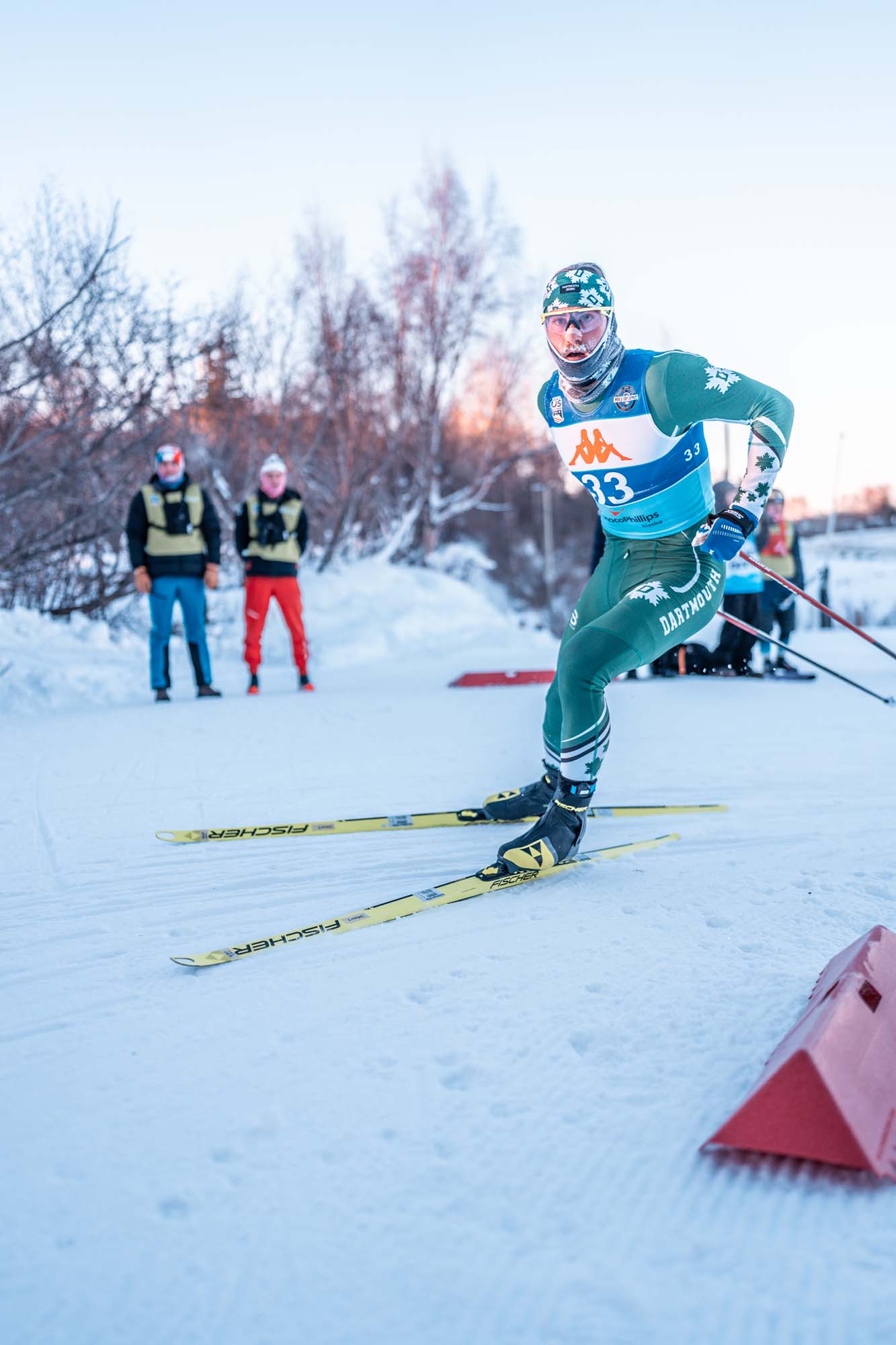
John Steel Hagenbuch works his way up Elliott’s climb at the U.S. National Championships in Anchorage on Thursday, January 2, 2025. (Nathaniel Herz/FasterSkier)
The first time it happened, in Finland, was “definitely pretty scary — I couldn’t breath really at all, and I couldn’t speak for 15 minutes after the race. Couldn’t say a word.”
“It’s kind of multifaceted in what causes it, but I’ve been working through it and trying to figure it out and keep all those muscles relaxed, because it isn’t something you can really address by taking medication,” he said. “It’s something that has to do with controlling your muscles and reducing your stress.”
Hagenbuch said he had a little bit of breathing trouble Thursday, but managed to keep it under control.
He had the fastest first lap of the five-kilometer course, giving him a slight edge over Kirkeng.
But on the second lap, the Norwegian started creeping back.
A 24-year-old senior studying finance at the University of Denver, it’s unlikely Kirkeng would be in contention for a national championship in his home nation, the global cradle of cross-country skiing.
But in the U.S., it’s hardly unusual for European athletes to dethrone their American competitors at marquee races: In fact, Kirkeng won the 10-kilometer distance race at the U.S. National Championships in each of the past two years.
John Steel Hagenbuch on his way to winning the national title. (Photo: Tobias Albrigtsen / @untraceableg)
As Hagenbuch neared the finish line, coaches along the course were giving him split times that showed Kirkeng closing the gap — even though Hagenbuch had started the race conservatively.
“I underestimated how hard it was going to get,” Hagenbuch said. “I thought I was going to lose it — I was hearing the splits go from eight seconds up on Andreas, to six seconds to three seconds to even.”
Kirkeng skied his last lap four-and-a-half seconds faster than Hagenbuch. But in the end, that wasn’t quite enough: Hagenbuch’s first lap was five-and-a-half seconds faster than Kirkeng’s, and he held on to win by eight-tenths of a second.
“The margins were not on my side today. But that’s how racing is,” Kirkeng said afterward. “And it’s been the other way around a couple of times.”
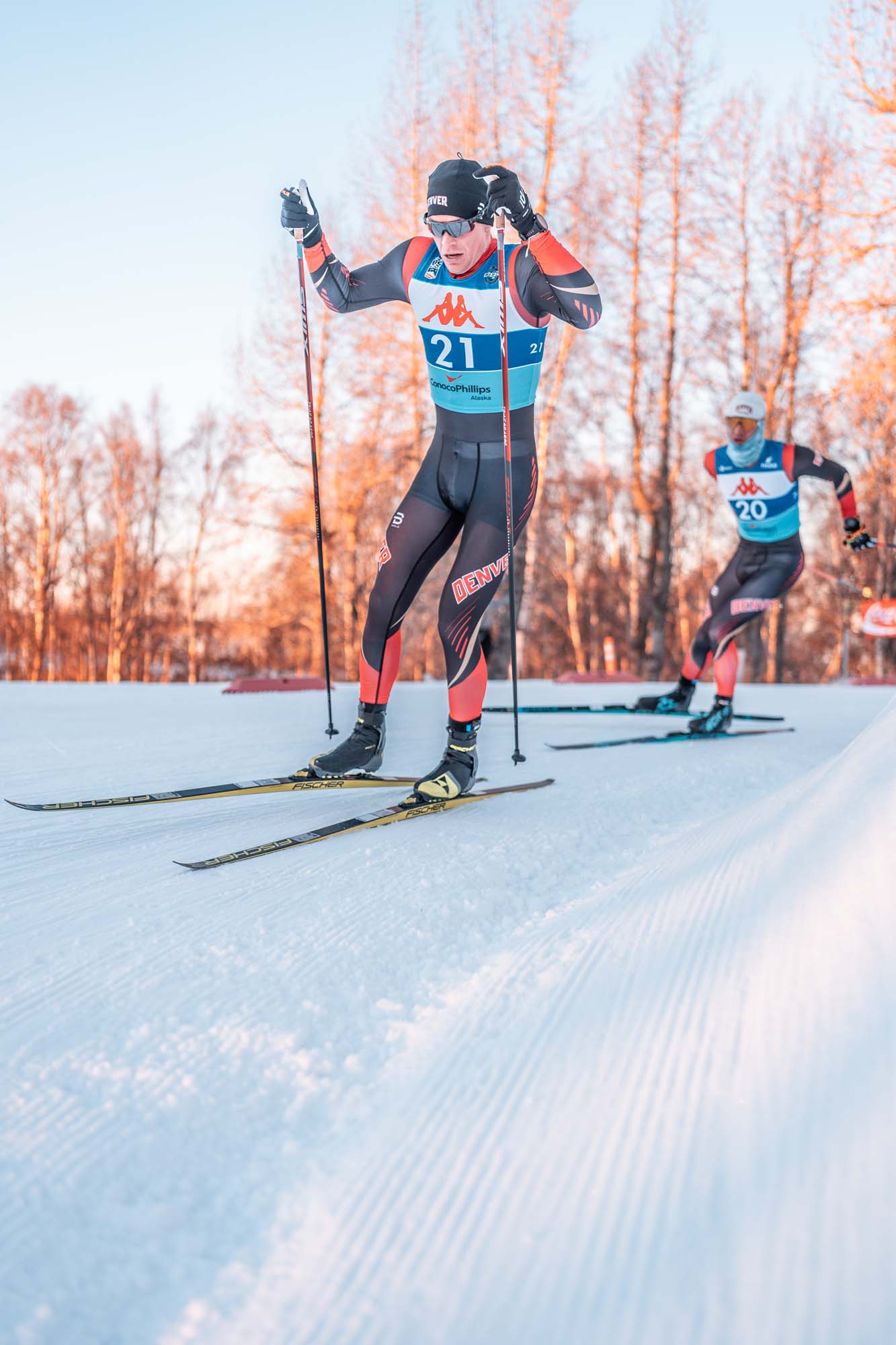
Andreas Kirkeng on his way to second place on the day. (Photo: Tobias Albrigtsen / @untraceableg)
Kirkeng is likely in the twilight of his career — he said he expects to retire after this season and, hopefully, find a finance job on Wall Street or in Boston. If not, he’ll probably return to Norway and enjoy more time with his family.
Hagenbuch’s career, meanwhile, is still taking off.
He said he’s looking forward to the rest of the races in Anchorage, which he expects to follow with more competitions in the U.S. — domestic SuperTour events and the college circuit, culminating in the NCAA championships.
Going back to the international World Cup circuit, he added, probably doesn’t make sense this year, especially after he missed substantial stretches of school while he traveled to races last season.
But even if this year’s European campaign didn’t pan out, Hagenbuch said, he’s not disheartened.
“I know I’m in good shape, and I had a good season of training — the hay is in the barn, if you will,” Hagenbuch said. “It’s just going to take some time for that to show itself.”
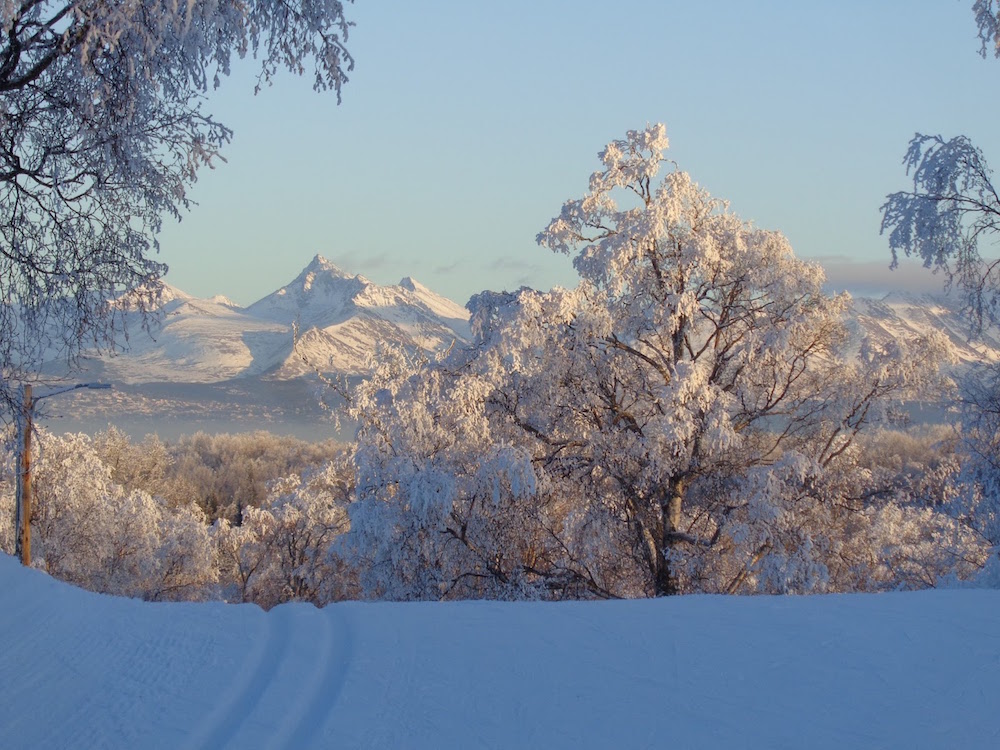
The Chugach Mountains as seen from the Lekisch Loop at Kincaid Park in Anchorage, Alaska, site of the Anchorage WinterStart SuperTour. (Photo: Adam Verrier)
The North American cross country scene offers numerous race opportunities throughout the winter season, but it’s the SuperTour that involves the very most competitive skiers from the United States and Canada. On December 12-17, Anchorage’s Kincaid Park plays host to the Anchorage WinterStart SuperTour, the first SuperTour event of the 2023-2024 season (presented with the support of Nordic Ski Association of Anchorage and Cross Country Alaska).
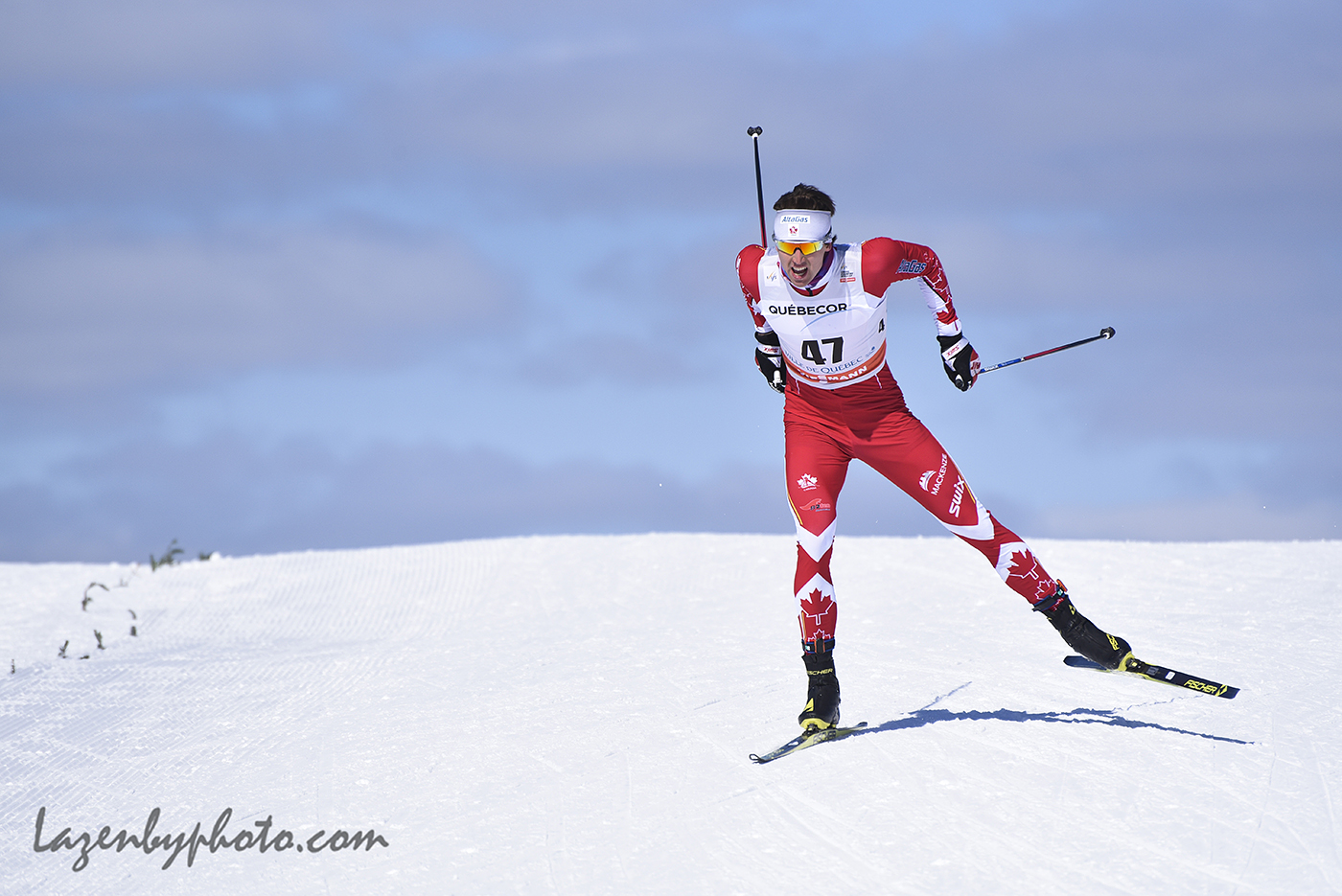
Early in his career, Julien Locke (CAN) raced to 20th place at FIS World Cup finals in Quebec City, Canada. This week in Anchorage, Locke was the winner of the SuperTour Men’s Freestyle Sprint. (Photo: John Lazenby/Lazenbyphoto.com)
Men’s and Women’s Sprint
Tuesday saw SuperTour action in both the Men’s and Women’s Sprints. American, Sammy Smith, topped the women’s results ahead of Lilian Gagnon and Anna Marie Dietze, while Canada’s Julien Locke led the men’s field ahead of Walker Hall and Michael Earnhart.
In post-race interview with FasterSkier’s Nat Herz, Locke articulated the importance of doing well at these North American SuperTour races. “SuperTours [are] the top level of domestic racing,” he said. “So everyone who’s not at the World Cup is here right now . . . For the United States and Canada, these are selection races for the World Cup later in the year.”
In Wednesday’s 10 k Classic Interval Start, the men’s field was led by Maximillian Holman, ahead of Hugo Hinckfus and Hunter Wonders. Smith continued her winning ways at the head of the women’s field ahead of Sydney Palmer-Leger and Nina Schamberger.
Winner of the first two women’s events (Freestyle Sprint and 10 k Classic), Smith commented on the heavy/fresh snow conditions in Anchorage. “The snow definitely made the conditions a little interesting,” she said. “It definitely made technique stuff a little more complicated; but it was super-fun racing, super competitive day.”
Winner of both Women’s Sprint and Women’s Classic 10 k Interval Start events earlier in the week week, Sammy Smith (USA) (seen here in a FasterSkier file photo from World Cup competitions in 2023) will be in action again in upcoming Classic Sprint and 10 k Freestyle Mass Start at the Anchorage WinterStart Supertour. (Photo: NordicFocus)
Schedule of Events
Anchorage WinterStart SuperTour events continue on Saturday with Men’s and Women’s Classic Sprints, followed by Sunday’s 10 k Freestyle Mass Start.
ANCHORAGE — The calendar said April, but the thermometer said January, as a small but well-credentialed field of athletes competed in a pair of FIS races at Anchorage’s Kincaid Park over the weekend. The April 10 and 11 events appear to have been among the latest FIS races held in this country in the past 30 years.
Saturday morning in Anchorage dawned clear and cold. Anchorage broke its all-time temperature record for April 10 with a 5° F (-15 C) reading at the official weather station, just a few miles east of the venue, around dawn. By the time the race came around, technical delegate Matt Pauli annotated the results with an official air temperature of -10 C, snow temp of -12 C. It had snowed a few inches the day before. It did not feel particularly vernal.
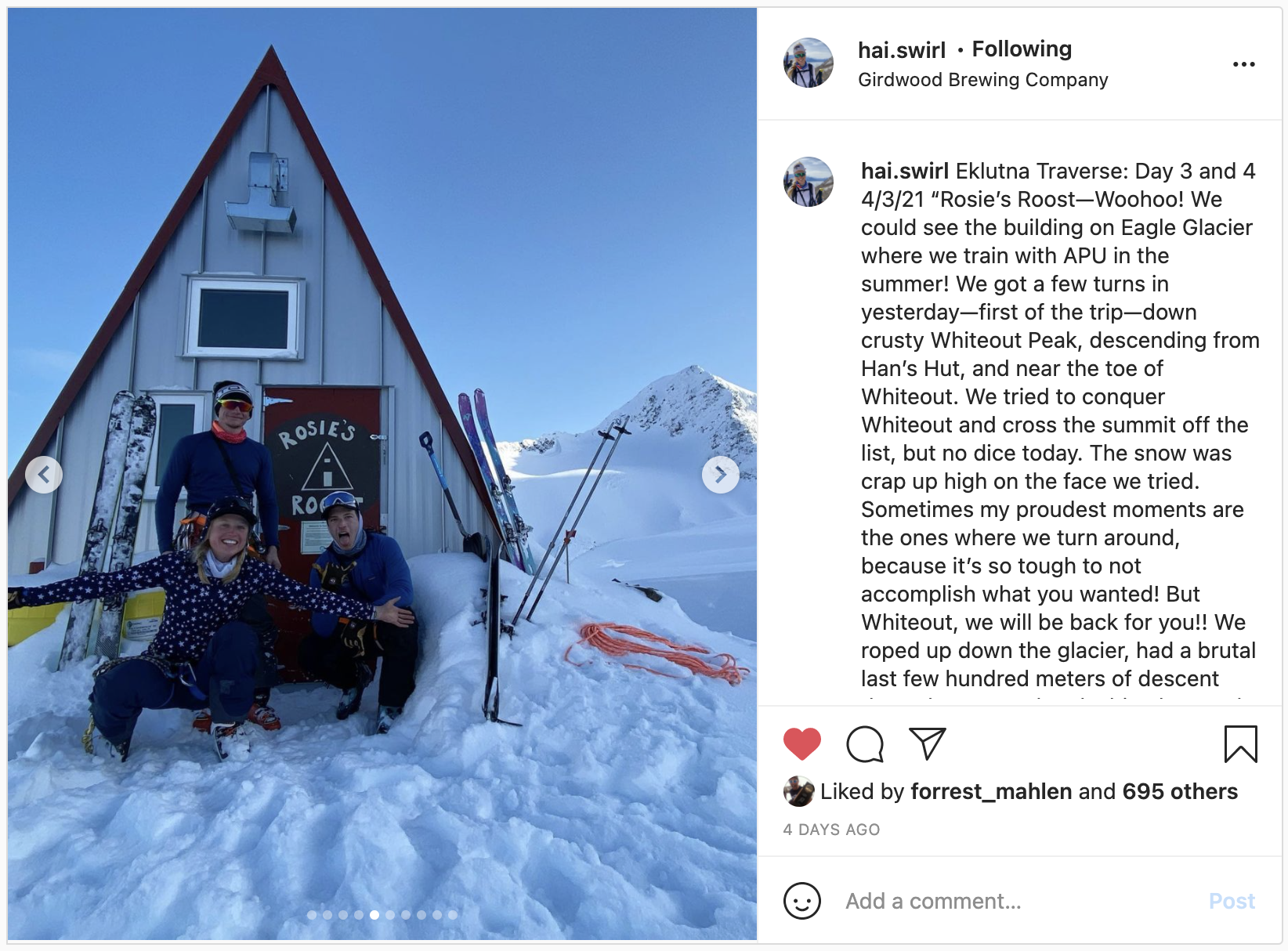
While conditions evoked mid-winter, athletes’ training regimens did not. Within the week leading up to race day, a brief survey of social media reveals, roughly half the pro skiers in the field went crust skiing; Scott Patterson went backcountry skiing; and Hailey Swirbul, Hunter Wonders, and Chip Schoff completed the Eklutna Traverse, a classic local mountaineering route, over four days. Oh, and Gus Schumacher, JC Schoonmaker, and Finn O’Connell logged a 200-kilometer, 10-hour day on Wednesday, before gorging on Moose’s Tooth pizzas at the edge of the Kincaid parking lot. Travel on Monday, intervals on Tuesday, race prep on Friday, this was not.
Chip Schoff (top), Hailey Swirbul, and Hunter Wonders outside the Rosie’s Roost hut, midway through the Eklutna Traverse.
The mountaineering trip seems to have been fine training, as both Wonders and Swirbul won their races on Saturday. In the men’s 10-kilometer interval-start classic race, Wonders posted the fastest time in a field of 25 athletes, 25:02.2, to take the narrow victory. Patterson (+.8) and Schumacher (+14.1) were not far behind.
Hunter Wonders racing to the win in Saturday’s 10 k classic race. (Photo: Adam Verrier)
In the women’s 5 k interval-start classic race, held over one lap of the men’s course (aka the Junior Nationals distance course, for any readers who raced at Kincaid in March 2019), Swirbul started first in the reverse-seeded field and set the fastest time in a field of 17, 14:20.6, by a substantial margin. Hannah Halvorsen (+41.9) was second, with Tuva Bygrave third (+46.5).
Hailey Swirbul, skiing here in her APU gear, won Friday’s 5 k classic in Anchorage. (Photo: Adam Verrier).
Wonders, Patterson, Swirbul, and Halvorsen ski domestically for Alaska Pacific University, or APU. Schumacher skis for Alaska Winter Stars. Bygrave skis for University of Alaska Anchorage, or UAA. All podium finishers save Halvorsen competed at this year’s World Championships in Obsterdorf, and all save Bygrave are on the U.S. Ski Team (Bygrave has Australian and Norwegian citizenship). It was a well-credentialed field.
Relatedly, the winner of the men’s race each day recorded a 22.76-point FIS race, making these, mathematically speaking, by far the most competitive races of all the FIS races held in the country this year. (Lower points are better. For perspective, the deepest races at 2020 U.S. Nationals were only good for 26.70 FIS points for the winner.)
Sunday’s skate races brought somewhat more temperate weather (-3 C, wrote Pauli on the official results), and another UAA skier on the podium.
In the women’s 10 k interval start (two laps of Saturday’s course), UAA athlete Astrid Stav set the pace in 26:42. She was followed by Anna Darnell of APU (+18.6) and UAA teammate Bygrave (+1.00.7). Stav was second in the distance skate race at this year’s NCAA Championships in New Hampshire.
UAA skier Astrid Stav won Sunday’s 10 k skate. (Photo: Laarni Power)
In the men’s 15 k interval start (three laps of the same course), Patterson paced a field of redoubtable distance skiers with the day’s best time of 33:26.5. He was followed by Schumacher (+27.7) and David Norris (+1.10.6) in second and third. All three athletes have been on a national championship or SuperTour podium in this event.
Scott Patterson won Sunday’s 15 k skate. (Photo: Laarni Power)
The weekend’s FIS races capped a domestic race season that, like many aspects of life over the past year, has had high highs and low lows. In Alaska, highs included race skis-good trails at sea level for five full months, and counting, and a robust local race schedule. In the Lower 48, races were held with strong regional fields in many areas, and cancelled in others. There were no national championships, no SuperTour, and no Junior Nationals. Some athletes completed an essentially normal race schedule. Some athletes did no races at all. Everyone probably did more interval-start races than they were accustomed to, and fewer sprint heats. Discretion was used widely in selecting athletes for international competition.
A memorable season of high-level racing came to a close with this bit of trivia: The weekend’s races appear to be among the latest FIS-sanctioned races held in this country within the modern era of the online FIS calendar (early 90s to present). They are tied with the final two races of the 2013 Spring Series (women’s 30 k and men’s 50 k), held in more traditionally spring-like conditions in Truckee, California, on April 10 and April 11, 2013. Temperatures there approached 60° F, and the snow was so slow that the winning time in the 30 k was nearly 1:42.
Andy Newell skis through deep slush in the 2013 Spring Series 50 k. (Photo: Mark Nadell/MacBeth Graphics)
Official racing in Alaska concludes next weekend with a hill climb up the alpine runs at Girdwood’s Alyeska Resort, which promises a Tour de Ski-esque gain of approximately 2,030 vertical feet or 619 meters (the final climb in Val di Fiemme appears to be “only” 418m). The athlete with the lowest combined times from this weekend’s two races, plus the hill climb, will be awarded the title of SkiMeister, wrapping up the inaugural Tour de SkiMeister three-race series.
Sadie Maubet Bjornsen races at Kincaid Park earlier this month. (photo: Eric Packer)
This article has been updated with additional information about the history of the Kincaid Hairpin FIS course, and with a link to an article compiling national club time trial results.
ANCHORAGE — Sunday, the second day of FIS races in Anchorage, saw, at some level, more of the same: fresh snow (though much less than the day before), soft and slow conditions, and Sadie Maubet Bjornsen at the top of the results sheet. There were some changes on the men’s side, however, as Hunter Wonders finally reached the top step of the podium this season, after coming in second in last weekend’s citizens race and third in Saturday’s sprint qualifier.
Women’s race
Sadie Maubet Bjornsen did seven 10 k skate races on the World Cup last year. (Okay, eight if you count the Tour de Ski final climb up Val di Fiemme, which is in fact also a 10 k, but that has a 418m max climb, and so has been discarded as an outlier for this point about comparing times across more typical courses.) The fastest took her 23:41, albeit on a 9.4-k course. The slowest took her 29:33, on what was actually a 10.8-k course given the precise combination of laps used.
Two laps of the hardest 5 k FIS course at Kincaid is actually closer to 10.4 k… but nonetheless, Sunday marked Maubet Bjornsen’s slowest 10 k in years, non-Tour de Ski final climb division, as she finished in 30:58.45. And she won by over a minute. It was slow going out there. (If you go back far enough: When Maubet Bjornsen, at the time 20 years old and named Sadie Bjornsen, raced this course at 2010 Senior Nationals, she was even slower, finishing 19th in 31:36.9, nearly 3 minutes back of Kikkan Randall.)
If you’ve done a senior-level distance race at Kincaid in the past decade (exception: distance races at 2018 Senior Nationals), you’ve likely raced on the Hairpin FIS course. As UAF skier Kendall Kramer said in a pre-race Instagram story about the course profile, “I don’t really understand it, but it’s like all up and no down, so that’s good.”
From left, Sadie Maubet Bjornsen, Rosie Frankowski, and Zanden McMullen race at Kincaid Park earlier this month, not actually on the FIS course. (photo: Lex Treinen)
As she wrote to FasterSkier on Sunday, “These last few weeks as I have gotten to train twice a day, mostly in the dark (December in AK), I find myself falling in love again with the sport I get to do. Generally I’m traveling all the time, trying to recover on these super challenging courses, which largely amounts to waddling around on the walls. I forgot what it feels like to ski through the woods, and ski smooth and fast, and just be in the little dream state alone in the dark. I feel like I couldn’t be luckier right now!”
Maubet Bjornsen added, “I’m so thankful for all the years of hard work I put in, and learning the circuit, because it gives me the confidence and belief to design my own plan this year. This weekend was a fun reminder that this plan was designed with a lot of thought and purpose. I’m thankful I have my teams and coaches behind me on it!”
To hear Maubet Bjornsen’s teammate tell it, this psychological comfort is accompanied by a strong physical base: “I will say that the world better watch out when Sadie gets to the World Cup,” Rosie Frankowski wrote to FasterSkier. “Yes, she might be racing small races here in Alaska, but that girl is not in local race shape. She would still be a dominant force in a strong international field so I can’t wait to see her back on the circuit when the time comes.”
Frankowski isn’t skiing that badly herself, picking up her second second-place finish behind Maubet Bjornsen in as many days (third of the season if you count last weekend’s 10 k skate). Sunday, she started second and finished second, 1:14 behind Maubet Bjornsen.
Frankowski noted that it is difficult for her to divine what her current shape is “when you aren’t racing head to head against that many people. I had some good time trials before our World Cup crew left,” she wrote, “and I have had some good races since then I think. I definitely feel that I made gains this summer in my weaknesses like coordination and speed, but, again, it is hard to tell how I would do against a World Cup field.”
Regarding her racing outlook for the rest of the winter, Frankowski observed, with equanimity, “As for myself, I might have lost the opportunity to race in Europe this year by turning down Period 1 [starts after the Lillehammer races were cancelled] so I am just going to keep focusing on what I can control, which is racing locally and enjoying the good winter we have had so far.”
The women’s 20 k skate podium at the 2019 U.S. Cross-Country Nationals at Craftsbury, VT. From left to right, Jessica Yeaton (APU/Australian National Team) in third, Caitlin Patterson (CGRP) first, and Rosie Frankowski (APU) second. (Photo: John Lazenby)
Third place went to Jessica Yeaton, an Australian national who grew up largely in Anchorage and previously trained full-time with APU. Yeaton now attends school in Albuquerque, where she is in the University of New Mexico’s three-year physical therapy doctoral program, and spends far less time on snow than she used to. That said, she took time out from her studies this spring to win the American Birkebeiner in a 48-hour trip crammed in between exams, so her snow fitness remains decent.
The rest of the top ten was: Becca Rorabaugh in fourth, 2:05 back; Anna Darnell in fifth, 2:16 back; Kendall Kramer in sixth, 3:07 back; Garviey Tobin in seventh, 3:23 back; Mariel Pulles in eighth, 4:00 back; Aubrey LeClair in ninth, 5:09 back; and Marit Flora in tenth, 5:18 back. Kramer and Pulles ski for UAF; the rest of the top ten skis for APU.
The top three U18 girls were Marit Flora (APU), Meredith Schwartz (Alaska Winter Stars, or AWS), and Katey Houser (ANR).
The top three U16 girls, who skied a single lap of the 5 k course, were Sammy Legate (AWS), Amae Kam-Magruder (AWS), and Kiley Dennis (Alaska Nordic Racing, or ANR).
Men’s race
While Maubet Bjornsen destroyed the women’s field all weekend, the men saw a new name at the top of the results sheet, as APU skier Hunter Wonders took the win in 27:06.98. Wonders is currently on the USST D-Team by virtue of his top-10 finish in the 15 k classic at this year’s U23 Championships (he was eighth), which is the sort of result that would have made headline news on this site five or ten years ago, before Gus Schumacher and Hailey Swirbul et al. began destroying worlds. Wonders was second in this race at Kincaid last year (behind Schumacher), and took his first national championship in Houghton last January, in the classic sprint. Sunday’s victory appears to have been the first of his career in a senior-level FIS race (he finished behind a Canadian at nationals).
In this file photo, Hunter Wonders races at Kincaid Park earlier this month. (photo: Eric Packer)
“I’m super stoked” about the win, Wonders wrote to FasterSkier. “It’s a really competitive field that we have in Alaska right now, which is fun and keeps things interesting. It’s a good confidence booster going into the rest of the season to really see that training has paid off over the last year. I’m hoping that it puts me in a good position to make the U23 World Junior team, as well as maybe get some discretionary starts on the World Cup.”
Last weekend’s winner in the 10 k skate, Zanden McMullen, was on the podium again on Sunday, this time in second, 8.66 seconds back of Wonders. Forrest Mahlen was third, 56.30 seconds back. All three men on the podium ski for APU.
The weekend marked “the first FIS races for me since the Birkie last year,” Mahlen wrote to FasterSkier. (For details on some of the intervening FIS races that didn’t happen, see this fine piece on Alaska Public Media from mid-March by FasterSkier alumnus Nat Herz, poignant headline, “This Anchorage skier flew 3,000 miles to his first World Cup race. Now he has to quarantine.”)
“It was a strange combination of remembering how to ski race, and learning how to do it safely with all of the new Covid protocols,” Mahlen continued. “The NSAA [Nordic Skiing Association of Anchorage] put together a very impressive event and I have no doubt we will have a lot more racing opportunities in Anchorage this season.”
Forrest Mahlen races at Kincaid Park earlier this month. (photo: Eric Packer)
So speaking of this season, what’s next for Mahlen? “With the uncertainty of racing at all this year my plan has been to take advantage of the amazing skiing Anchorage has had for the past nine weeks,” Mahlen wrote. “Instead of traveling and racing the Supertour I’ve been able to ski right from my front door on the APU campus onto groomed trails. With no national level racing I plan to spend the winter training far more than I usually would, and taking advantage of any local races that happen. With that in mind I was pleased with my result in the 10k today, especially with such an impressively deep men’s field for a local race.”
Mahlen noted, in reference to the national championships that would typically follow two weeks after this race weekend, “The [December] Besh Cups are usually a strong predictor of US Nationals podiums, and I don’t think that has changed this year.”
The rest of the top ten was: Thomas O’Harra (APU) in fourth, 57.30 back and just a second off the podium; Kai Meyers (APU) in fifth, 57.99 back; Sam Hendry (University of Utah) in sixth, 1:21 back; Michael Earnhart (APU) in seventh, 1:22 back; Luke Jager (APU) in eighth, 1:36 back; Magnus Norøy (UAA) in ninth, 2:11 back; and Sigurd Rønning (UAA) in tenth, 2:19 back.
The top three U18 boys were Porter Blei (ANR), Aaron Power (AWS), and Mark Eggener (AWS).
The top three U16 boys, who skied a single lap of the 5 k course, were Cole Flowers, Elias Soule, and Skyler Amy, all of Alaska Winter Stars.
Memes, as humor often does, use comedy to express a difficult truth: This is a large country; head-to-head racing across different regions during a pandemic is ill-advised and logistically problematic (not to mention currently barred in some states); some athletes are potentially uncomfortable with the elevated role given to discretion when it comes time to select athletes for international championships.
In a mid-November email to USSS members, U.S. Ski Team Cross Country Program Director Chris Grover acknowledged the stress that race cancellations create “for athletes, coaches, parents and clubs, as they try to qualify skiers for international trips like the Oberstdorf Nordic World Championships, the World Cup, and the Vuokatti WJC/U23s.” Grover wrote, “We would like the community to know that the U.S. Ski & Snowboard coaching staff, and the various discretionary selection committees involved in selection of athletes to these trips, will now consider any type of race result that is submitted, including smaller non-sanctioned local races, and even a well-run time trial. Of course, the more professionally run the event, the easier it is to interpret the results and to weigh those results; so if official races can be run, that is ideal. But in these challenging circumstances, we want everyone to know that we will evaluate any results that you send to us for consideration. We will also continue to consider top international results from the 2019-20 season, as described in the discretionary selection criteria.”
A survey of informal time trial results this season is outside the scope of this article. (Also, it was done already, and better, on SkinnySki.) As for official races, the two Kincaid races are the first FIS races held on the continent this season, and, given their place on the calendar and the strength of their field, may be unofficially viewed as 2020/2021 U.S. Nationals West. They are the first USSS/NRL (national ranking list) competitions with results up in the MyUSSA results database. (It appears that ski races were also held this weekend for the Quarry Road Maine Cup with a few dozen athletes, though official results are not up yet, just live timing.) Races remain proscribed in Vermont, as in Minnesota. SkinnySki.com has compiled a virtual hot lap competition leaderboard for the best times on three snowmaking loops in the Minnesota area.
Racing is currently scheduled to continue in Anchorage in January with the next two races in a five-race citizens race series.
Covid reporting disclaimer: The weekend’s races occurred under the provisions of the Municipality of Anchorage’s Emergency Order No. 16 and Attachment E, which together set forth the rules governing outdoor sports competition. This includes an exception from the city’s 10-person gathering limit for outdoor sports, but bars spectators if there are more than 10 people at the venue, counting both athletes and volunteers.
This reporter watched portions of Saturday’s sprint qualifiers from home via the Kincaid stadium webcam. When he drove to Kincaid on Sunday, he found more than 10 people in the Kincaid Stadium between athletes, coaches, and volunteers (and, it must be said, a handful of spectators), and so he did not add to the total. He parked elsewhere and went skiing on other trails in a large park, then covered the races via email and Instagram direct message without needing to come close enough to anyone to stick a microphone in their face. He thanks all the athletes interviewed for their time in writing.
In this file photo, Luke Jager races at Kincaid Park earlier this month in a custom APU/University of Utah combo suit. (photo: Eric Packer)
ANCHORAGE — Sadie Maubet Bjornsen, Luke Jager, and Hunter Wonders won FIS races at Kincaid Park over the weekend against strong fields, in what would typically be statewide races used for Junior Nationals qualification but were this year held as a mostly Anchorage-based weekend after a state sponsoring body declined to host. This race writeup covers Saturday’s classic sprint qualifier, which along with Sunday’s freestyle distance races were the first FIS races held on this continent this season. A separate article, later this month, will examine some of the logistical and public health issues involved in hosting high-level ski races during a pandemic.
Classic sprint qualifier
Senior Nationals in Houghton, Michigan, were cancelled this year, but Saturday’s conditions ensured that Alaska skiers nonetheless got something approximating the full Houghton experience: It was 15° F when the races started, with winds gusting above 25mph, probably more in the exposed Kincaid stadium. It snowed at least 8” in Anchorage on Sunday.
Junior skier Natalie Hood (APU) skis through a snowy Kincaid stadium in the NSAA Solstice Races classic sprint qualifier, Anchorage, Alaska, December 19, 2020. (photo: Julie Hood, who was in the stadium for her job as a medical volunteer)
Women and men both raced the same course that was used for the women’s sprint races at 2018 Senior Nationals. In 2018, APU skier Becca Rorabaugh clocked a 3:42.71 to set the top American time for classic sprint qualification. On Saturday, over the same course, Rorabaugh was over a minute slower; she afterwards wrote on Instagram, self-effacingly but not inaccurately, that it looked like she was skiing a 5 k. Her APU teammate Rosie Frankowski on Saturday was 54 seconds off the pace that she had set in those championships. It was a slow day out there.
Women’s race
The conditions may have slowed down Sadie Maubet Bjornsen (USST/APU) – Saturday’s race was likely the slowest sprint qualifier of her career as a senior athlete – but they had much less of an effect on her than on anyone else in the field. Wearing a massive face shield that covered half her head, plowing through fresh snow that accumulated in the tracks ahead of her as the first starter in the women’s field, single-use Tyvek bib flapping in the wind, Maubet Bjornsen stopped the clock in 4:17.88 after her first trip around the new Kincaid sprint course in race conditions. She posted the day’s fastest time by nearly 30 seconds.
Maubet Bjornsen exulted in racing in such conditions. “I have to be honest, a lot of the racing we do in Europe, it’s on manmade snow,” Maubet Bjornsen told a local television station after the race. “So I’ve had so much fun racing in Alaska this last month on real snow, real snowstorms, the real cross-country skiing.”
She expressed similar sentiments to FasterSkier. Addressing both her race and her decision to stay home for the start of this season, Maubet Bjornsen wrote, “It was super fun to spend some time racing at home, and incorporate the racing in with life. I still feel super happy with the plan I have made for myself this winter! I have gotten to spend more time than ever with my husband, I have gotten to chase another dream beside skiing (CPA studies), I will get to spend the holidays with my family, and I think I’m more fit than ever. For sure I feel happier than ever, so I know I made the right choice. My goals are in February/March – and I feel mentally and physically on track for that!”
In this file photo, Rosie Frankowski (front) and Sadie Maubet Bjornsen race at Kincaid Park earlier this month. (photo: Eric Packer)
Taking second place on the day was Maubet Bjornsen’s APU teammate Rosie Frankowski (+24.40), who is not traditionally known as a sprinter but who nonetheless made the classic sprint final on a blustery day in Houghton at 2020 Senior Nationals. (Frankowski’s qualification time on that 1.5-kilometer course was six seconds faster than her time on Saturday, implying that Anchorage saw even slower conditions.) Mariel Pulles (+24.94), who skis domestically for University of Alaska Fairbanks and internationally for Estonia, rounded out the podium. Pulles was the only non-APU skier to claim a podium spot all weekend.
“I was pleasantly surprised to see myself in 2nd in the sprint qualifier behind Sadie,” Frankowski wrote to FasterSkier, “although we are talking a looooonnnngggg way behind so I am not thinking of switching to focusing on sprinting or anything crazy like that haha!”
Frankowski, who like Laura Ingalls Wilder grew up in the Midwest, added, “The most eventful part of Saturday’s race was how snowy and windy it was. It truly was like racing in a blizzard on the prairie of the Great Plains where you need a rope to find your barn!”
The rest of the top ten was: Becca Rorabaugh (APU, +30.22) in fourth; Kendall Kramer (UAF, +31.97) in fifth; Garviey Tobin (APU, +41.77) in sixth; Tuva Granoeien (UAA, +43.86) in seventh; Marit Flora (APU, +44.02) in eighth; Meredith Schwartz (Alaska Winter Stars, or AWS, +46.18), a U18 athlete, in ninth; and Alison Arians (AWS, +47.31), an M5 athlete and Schwartz’s mother, in tenth.
Everyone after Tobin, in a strong U18+ field, finished the 1.5-km sprint qualifier in over 5 minutes. It was a slow day out there.
The top three U18 girls were Marit Flora (APU), Meredith Schwartz (AWS), and Quincy Donley (AWS).
The top three U16 girls, who skied a 1.2-kilometer course, were Sammy Legate, Heidi Schumacher, and Madeleine Reckmeyer. All three athletes ski for Alaska Winter Stars.
In this file photo, Becca Rorabaugh races at Kincaid Park earlier this month. (photo: Lex Treinen)
Men’s race
On the men’s side, Luke Jager, as the first starter of the day, had a similar experience to his APU teammate Maubet Bjornsen: Plow through fresh snow; ski more slowly than he was accustomed to; nonetheless take the win.
At 2018 Nationals, Jager, at the time 17 years old, covered the full 1.6-kilometer classic sprint course in 3:37.61 in qualification, placing 29th to become one of three juniors to sneak into the heats. On Saturday, Jager, now 20, covered a shorter course in 3:42.81. And won.
The race “was pretty good!” Jager wrote to FasterSkier on Saturday. “Definitely felt like I was missing a couple of gears out there still and was nervous about having to go first in the falling snow but happy I was able to execute the best I could despite that and that it worked out.”
Regarding his racing and training plans in this atypical year, Jager noted, “Definitely have been training quite a bit more in the past couple months than usual to try and put myself in a good place for hopefully U23s/any other opportunities I get past that. It’s been kind of hard balancing being in the best shape I can be for the few ‘qualifying’ races we have while also trying to build some fatigue and a good base to have success in February and after that. But I think I’m doing a pretty good job balancing base building and race tuning and today was a nice confidence builder that I am in a good place that is hopefully just gonna get a lot better as the season goes on.”
Jager added profuse thanks for the host club, Nordic Skiing Association of Anchorage, and the volunteers who stood outside in the notoriously windy Kincaid stadium for hours on a blustery day: “Very thankful that we live in a place that prioritizes skiing and being outside and have such dedicated volunteers that care enough to make races happen when it is really not easy at all.”
In this file photo, Zanden McMullen races at Kincaid Park earlier this month. (photo: Eric Packer)
The top of the men’s field was much tighter than the women’s field; the presence of a multi-time World Cup podium finisher has a way of skewing the curve. Jager was “only” 3.22 seconds ahead of his APU teammate Zanden McMullen (who won last weekend’s citizens race 10 k skate over largely the same field), and 5.83 seconds ahead of his APU teammate Hunter Wonders.
The rest of the top ten was: Thomas O’Harra (APU, +6.74) in fourth; Michael Earnhart (APU, +10.12) in fifth; Sam Hendry (University of Utah, +10.31) in sixth; Forrest Mahlen (APU, +11.94) in seventh; Kai Meyers (APU, +12.03) in eighth; Joel Power (AWS, +13.84) in ninth; and Mike Ophoff (UAF, +14.43) in tenth.
The top three U18 boys were Aaron Power (AWS), Aaron Maves (AWS), and Porter Blei (Alaska Nordic Racing, or ANR).
The top three U16 boys over a 1.2-km course, again all from Alaska Winter Stars, were Elias Soule, Owen Young, and Paul Hlasny.
In this file photo, Thomas O’Harra races at Kincaid Park earlier this month. (photo: Eric Packer)
This year’s sprint race was a qualifier only, no heats, for obvious, Covid-related reasons: Athletes starting at 30-second intervals should remain a reasonable distance apart over a single trip around a 1.5-kilometer sprint course, assuming a sensible seeding system. (Saturday’s race was seeded off a combination of FIS and USSS points for those athletes who had them, with the fastest athletes starting first (“reverse seeding”). Comparing bib numbers and finish places on the results sheet suggests that some athletes near the back of each field overtook each other on the course, but not too many.) By contrast, there is no easy way to keep athletes separate during head-to-head racing in sprint heats; heats therefore did not occur.
While the change was instituted for public health reasons, it had the salutary side effect of avoiding the traditional winter-solstice-in-Anchorage experience of starting the first qualifier shortly after sunrise, and running the last heat under the lights some time after sunset.
For readers of a certain age, the qual-only event hearkened back to the skate sprint at 2017 U.S. Nationals (when the schedule of an elementary school located at the Soldier Hollow venue prevented use of the trails for a full sprint day), or even to the short-lived SuperTour qualifier-only era, ca. 2009–2012. Presumably, the no-heats format will be present this season, but not into the future as, hopefully, health concerns subside; whoever authored this fine rant on JohnnyKlister can rest easy.
Tour of Anchorage 50k men’s winner Jack Novak tops the final hill to win the race Sunday, March 4, 2018. (photo: Michael Dinneen)
ANCHORAGE, Alaska — Hannah Rudd had never raced a 50 k before. Jack Novak was doing his second one in as many weekends. They took different paths to get there, but both ended up in the same place on Sunday afternoon: first in the flagship 50-kilometer freestyle race of the Tour of Anchorage.
The 30th annual Tour (pearl anniversary!) set off from Service High School, beneath the foothills of the Chugach Mountains at the eastern edge of metropolitan Anchorage, on Sunday morning amidst essentially perfect conditions: 20 degrees Fahrenheit, no wind, and clouds giving way to sunshine by race’s end. It was a far cry from 2017, when temperatures were 4 below at the start, dipping to -12° F a few kilometers down the trail in a notorious icebox spot in the black spruce forest of Campbell Tract.
While 2017 saw successful early solo breakaways for both the men’s and women’s champions, the strategy for this year’s winners was much more typical for a race that has hills at the start and at the end, but about 25 k of flat skiing in the middle: Join a pack near the start, ski with the pack over the flats, break away from the pack approaching the finish, don’t look back.
For Novak, who was racing on Sunday in Anchorage just eight days after a top-50 finish in the American Birkebeiner in Wisconsin last Saturday, that break came a gutsy six kilometers out from the finish at Kincaid Park.
Tour of Anchorage 50k men’s winner Jack Novak skis in a pack early in the race Sunday, March 4, 2018. (photo: Michael Dinneen)
He was skiing with APU teammate Forrest Mahlen and local master skier Seth Downs at that point, Novak recounted in a post-race interview with FasterSkier. He and Mahlen had gone off the front by 10 k into the race, but realized that Downs was catching up to them, so purposefully slowed until he caught them. The three of them then skied together for the next 30+ kilometers… until Novak made the impetuous decision that it was time to go.
“As we entered the Sisson Loop” at around the 44 k mark, Novak recounted of the point at which racers leave the flats of the Coastal Trail for the rolling hills of Kincaid Park, “I had just taken a pull on the front, so I moved back to third, and was just cruising in the back recovering. And right as we entered Sisson, Seth pulled over and decided it was time to feed, so he pulled his bottle out, and Forrest at that point thought it was a good idea to feed as well. And I took my waterbottle halfway out of my belt, but then realized that this was a great opportunity, so I shoved it back in and just went around on the edge of the trail, and just charged as hard as I could for the next six k all the way to the finish. And I was a little nervous, because I thought either this was going to be a winning move, or it was going to be a third-place move. And I was a little nervous, but I decided that I had to fully commit, and just go for it.”
Going for it worked for Novak. By the time he crested the final climb up to the hilltop finish outside the Kincaid chalet, ice crystals flecking his eyebrows and caking his lumberjack beard, he was over a minute ahead of Downs (+1:05.7) and nearly two minutes up on Mahlen (+1:41.5), who had himself been top-40 in the Birkie last weekend.
Rudd had a similar journey to Kincaid, initially skiing in a pack of several women occasionally joined by some of the slower first wave men. (Wave 1 at the Tour is the top 50 men, Wave 2 is a dozen or so elite women, then the remaining waves are co-ed. Much like at the Birkie, the lead women can keep apprised of their competition by virtue of the common start, but also often end up skiing with some men who started two minutes ahead of them in the first wave.)
As late as the Chester Creek greenbelt, roughly midway through the race, Rudd was skiing with a lead pack of women that included Michaela Keller-Miller, Shalane Frost, and Alison Arians. But eventually the lead pack dwindled down to a lead pair, just Rudd and her University of Alaska Anchorage teammate Keller-Miller.
Tour of Anchorage 50k women’s winner Hannah Rudd tops the final hill to win the race Sunday, March 4, 2018. (photo: Michael Dinneen)
Rudd skied with Keller-Miller for some time, then made her move “with about 3 k to go,” the 19-year-old sophomore told FasterSkier after the race.
Much like Novak’s surge before her, Rudd’s push may not have been easy, but it was effective. Rudd would ultimately cross the finish line in 2:38:54.4. Keller-Miller (+1:15.7) followed over a minute back in second, with Frost (+4:56.2) third. Frost had finished second to 2018 Olympian Rosie Frankowski in last year’s icy sufferfest.
Rudd had never raced a 50 k before Sunday, but count her a fan. “I really like 50 k’s,” said. “I like the distance. It was really fun.”
Rudd, who remains undefeated in lifetime 50 k races, had nothing but praise for her overall experience on the day: “It was really great. It’s an amazing trail system, beautiful day. Phenomenal course.”
The only thing that gave her pause was the question of whether she could accept the prize given to the first-place finisher in the 50 k ($1,000 and a roundtrip ticket on Alaska Airlines), in light of NCAA regulations that generally proscribe accepting prize money greater than the costs of participating in a competition.
“That’s still up in the air,” demurred the UAA student-athlete when asked about this immediately after the race. “Our Athletic Director is going to check on that.”
Novak had no bar to accepting the money, but his plans for the windfall reflected the realities of life as a 24-year-old professional cross-country ski racer. “It’s probably just going to be put toward racing,” Novak said. “Pay the bills.”
While Novak’s aims for his prize money were quotidian, he made it clear that it had still been a special day for him.
“Today feels really good,” he reflected after his win. “It’s been a rollercoaster ride of emotions for the Tour over the past couple years, with shortened courses, changed courses, cold weather, warm weather, all that stuff… so it’s really nice to be able to put everything together, and get the victory.”
Getting the win this year after earning the wooden medal for fourth the year before probably didn’t hurt. Neither did being born and raised in Anchorage — Novak graduated from South Anchorage High School, and placed seventh at State (behind Olympian Scott Patterson) in 2010 and fourth (behind Olympian Logan Hanneman) in 2011 — then finally winning the citizens race that has long served as the unofficial Alaska state championship.
Reflecting the high level of skiing in the state, a dozen different Olympians, most of them locals, have won the Tour of Anchorage over the past 30 years, according to an email from race organizers: Adam Verrier, Sue Forbes, Audun Endestad, Kevin Brochman, Todd Boonstra, Lars Flora, Laura McCabe, Suzanne King, Abby Larson, James Southam, Holly Brooks, and Rosie Frankowski. The number only goes up if you count second- and third-place finishers — Reese Hanneman, Tyler Kornfield, Rachel Steer, Justin Freeman, and Ben Husaby among them — and should actually be fourteen for victors alone, counting skier Betsy Youngman and biathlete Jay Hakkinen.
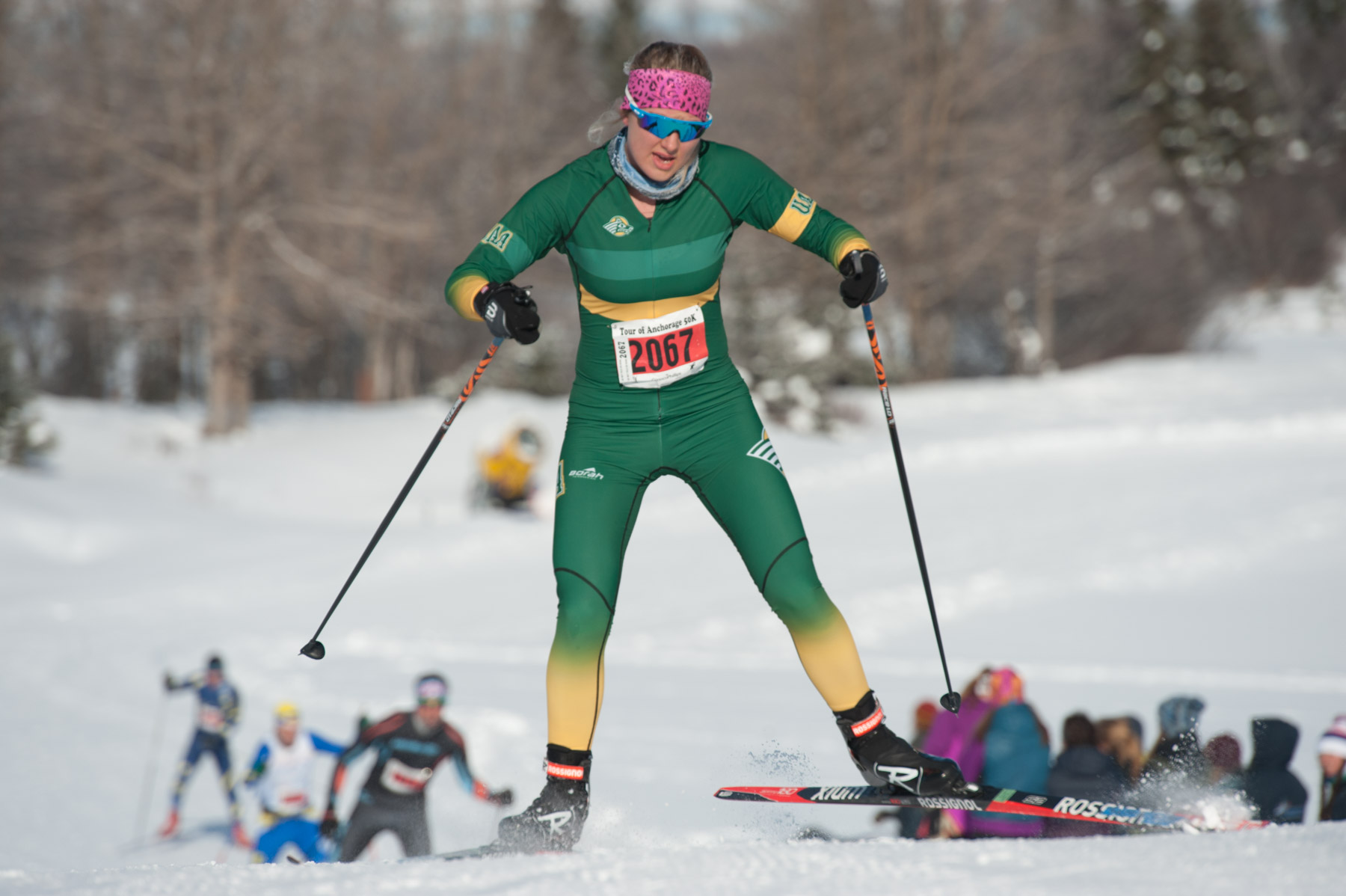
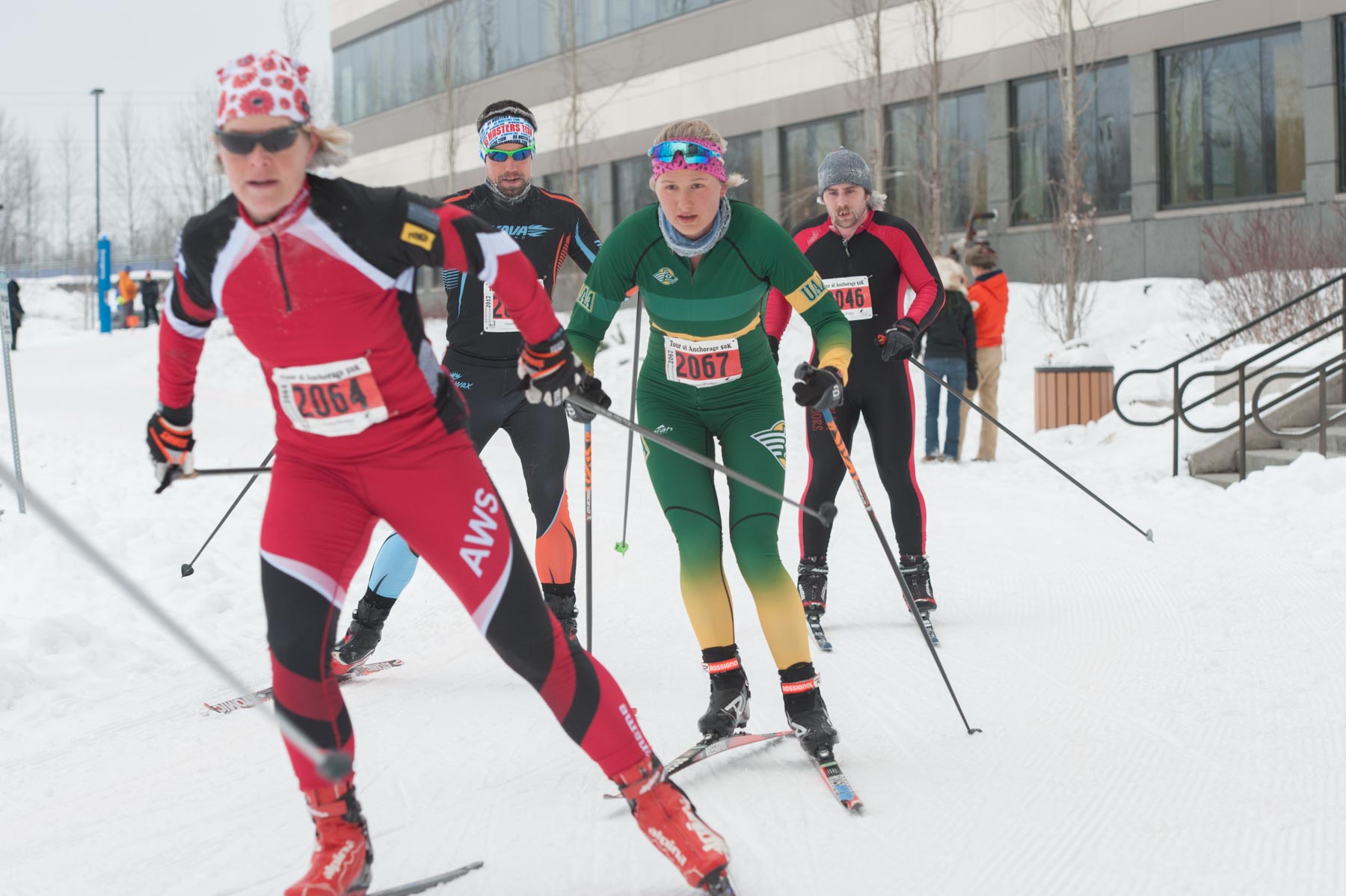
Hannah Rudd (2067) follows Alison Arians (2064) midway through the 2018 Tour of Anchorage. (photo: Michael Dinneen)
(2018 Australian Olympian Casey Wright was seventh among women on Sunday. Less than four minutes behind her came Brooks, a 2010 and 2014 Olympian for the U.S., who now describes herself as “a new mom of infant twins and a new business owner.” While Brooks raced the 50 k on Sunday, her husband, Rob Whitney, covered the entire route — including the 100-meter gain hors catégorie max climb of the Spencer Loop — towing a double Chariot with both six-month-olds inside. Plus diapers and snacks.)
New dad Whitney may not have used the phrase “just cruising around” to describe his heavily laden trip across town, but it seemed appropriate for the unencumbered Novak.
“Conditions today were phenomenal,” Novak said after the race, “sunny, 20 degrees — can’t complain about that. It was fun to just be out there skiing with my best friend, and Seth [Downs], and just be out there cruising around.”
The change in weather conditions from 2017 didn’t hurt, either.
“This year was so much more pleasant than last year,” Novak said after skiing on a day that was literally more than 30 degrees warmer than the last time he had done this race. “Last year I was wearing two long johns, and two long johns on top, and a vest, and two buffs, and I was still cold. And this year I was wearing just one long john top and bottom, and I was totally comfortable the whole time. And it was wonderful to just be out there, and just be skiing, and just not have to worry about freezing.”
Inside the results and other races
A total of 740 racers finished on Sunday, a sizeable field but down from a high of 2,050 in the mid-2000s, when the Tour was consistently the second-largest ski race in the country behind the Birkie. They ranged in age from 8-year-old girl Reine Soule and 8-year-old boy Jack Leveque (2:08 and 2:19, respectively, for the 25 k skate), to 88-year-old Reno Deprey (3 hours even for the 25 k classic).
While the Tour of Anchorage draws the lion’s share of its competitors from, well, Anchorage, the rest of the state put in an appearance as well. Finishers hailed from throughout the road system, from Homer to Fairbanks, as well as from Galena, Gambell, Juneau, Nome, and Sitka. (While athletes in all five communities had to board a plane to make it to Anchorage, and Galena, pop. 470, is no metropolis, Gambell is likely the most notable home for any entrant in Sunday’s race. It is “a roadless Eskimo village,” says the local church, situated on St. Lawrence Island in the Bering Sea. It is closer to Siberia than to mainland Alaska.)
A smattering of racers came up from the Lower 48 as well, enjoying a notable local sports weekend that features the Iditarod start on Saturday and a ski race on Sunday. The top Outside finisher in the 50 k at this year’s Tour was Hannah Smith of California, sixth among women. And Erik Pieh of Minnesota was 18th in the men’s 50 k.
Three other races were also held on Sunday, although prize money was awarded only to the winners of the 50 k ($1,000 and the plane ticket for first, $500 for second, $100 for third). In the 40 k, which skips the hills of the Spencer Loop and most of the Hillside trails before proceeding through greenbelts to Kincaid, Lisa Anglen prevailed in a tight finish in the women’s race to take first place in 2:10:13.7. She was followed by Meredith Noble (+12.8) and Naomi Kiekintveld (+16.5).
In the men’s 40 k, 13 of the top 17 finishers were junior boys; the 40 k often becomes a chance to unofficially see who is the fastest local junior not selected for Team Alaska for Junior Nationals. (One has to be 18 years old to race the 50 k.) The fastest junior this year was Thomas Bueler, 15, but he was 10:31 back from Andrew Boone, 36, in first (1:47:46.2). Third place went to David Funatake, 29 (+11:51). Next among junior boys were John-Mark Pothast in fourth (+13:17) and Jack Cater in fifth (+13:18).
The 25 k skate, which goes from Alaska Pacific University to Kincaid, also had a strong youth movement feel as 12 of the top 14 finishers were junior boys, led by winner Joel Power, 15, in 1:15:39.8. Crashing the youth brigade wereGary Di Silvestri, 50, in second (+3.6) and Kevin Donley, 52, in third (+20.5). The unofficial juniors podium was filled out by Niko Latva-Kiskola in fourth (+6:04) and Hayden Ulbrich in fifth (+6:15).
In the women’s 25 k skate, Homer skiers carried the day, with Emily Lints first in 1:30:39.1 and Hanna Young third (+38.5). Becky Butler of Anchorage was second (+14.0).
And the 25 k classic, finally (same route as the 25 k skate), saw youth in the women’s race and experience in the men’s race. In the women’s race, former UAF skier Hannah Rowland, 22, led the way in 1:47:06.0, followed by 17-year-olds Avery Mozen (+17.7) and Kellie Arthur (+7:31.0). And in the men’s race, Gary Snyder paced an all-40-something podium in 1:27:16.4, followed by Cory Smith (+40.5) and Ben Arians (+4:50.3). Snyder and Arians are locals who raced against each other in Anchorage high school competition decades ago, and for most of the 25+ years since. (Snyder was first on the 25 k podium in 1990, then again in 2008 and 2010.) Smith transplanted to the area following a systematic search for the best ski town in the early 2000s, and also found time to found a humble ski news website called fasterskier.com.
Next year’s Tour of Anchorage is tentatively scheduled for March 3, 2019.
One of North America’s biggest, and Alaska’s favorite, races celebrates 30 years
2017 Tour of Anchorage
More than 700, including Olympians, expected to compete; registration still open
WHAT: 2018 Tour of Anchorage
WHEN/WHERE: Sunday, March 4. Starts: 50K at 9:30 a.m., 40K at 10:30 a.m., Service High School; 25K classic at 11 a.m., 25K freestyle at noon, APU University Lake. All races end at Kincaid Park stadium.
ANCHORAGE – Alaska’s Nordic ski community celebrates ski racing and generations of standout Alaska athletes at the 30th annual Tour of Anchorage, the spring skiing festival and one of North America’s most popular ski races, which takes place Sunday, March 4.
Hosted by the Nordic Skiing Association of Anchorage and supported by this year’s signature sponsor ConocoPhillips, the Tour features three distances – 25-, 40- and 50-kilometers – for hundreds of skiers of all skill levels. Courses span Anchorage’s world-class trail system, crossing urban and natural segments, and passing festive aid stations that create a celebratory community vibe. The party continues at the Kincaid Park finish area with music, entertainment, food and drink from 49th State Brewing Company, Great Harvest Bread Company and Kaladi Brothers Coffee.
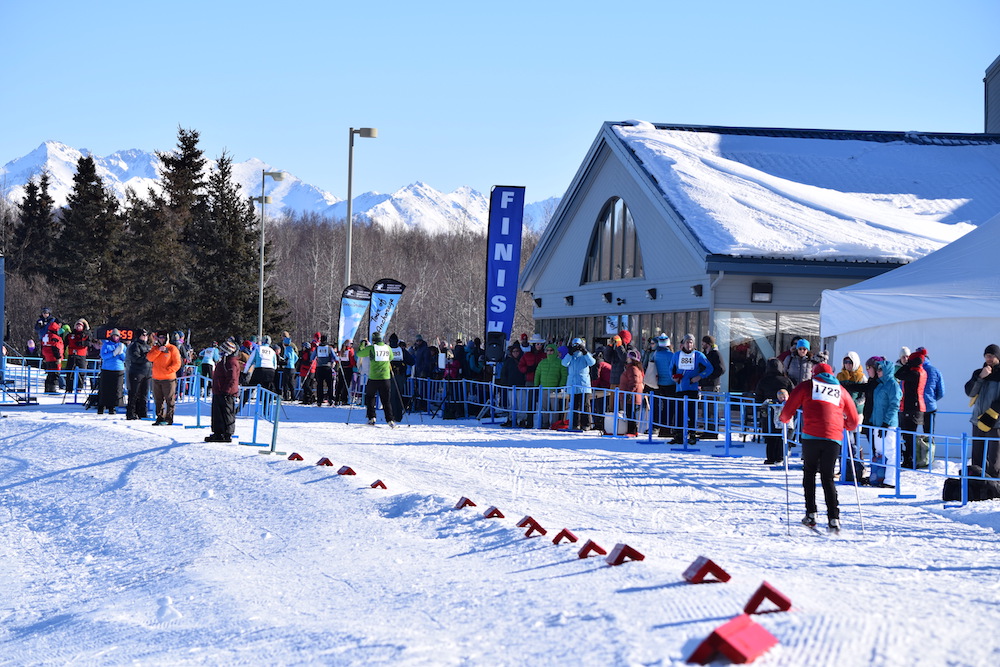
The Tour of Anchorage finish at Kincaid Park. (Photo: Jan Hazen)
Recent seasons of low snow in Southcentral threatened the Tour’s 30-year run, but the event carried on. This season’s event promises plenty of snow, inspiration and enthusiasm following fresh snow and the success of Alaska skiers at the Winter Olympic Games.
“We are thrilled that abundant recent snowfall has created such great course conditions,” said Matias Saari, race director. “The Tour allows all types of skiers to traverse an urban environment by way of tunnels, bridges and greenbelts.”
At least one 2018 Olympian, Jessica Yeaton, will compete in this year’s Tour while other Alaskans who competed in high-profile 2018 national and world events are expected to race. Half of 2017’s top 50K Tour finishers represented the U.S. at the Olympics – Rosie Frankowski won the women’s race; Reese Hanneman and Tyler Kornfield placed second and third, respectively, in the men’s 50K.
But one of the Tour’s most distinctive features is that it attracts all types of skiers: octogenarians to elementary school kids, elites to weekend warriors. More than 100 current entrants are 18 or younger, while nearly as many are 59 or older. At 87 years old, Reno Deprey is back to ski the 25K classic while Bruce Talbot, the only person to have skied all 29 Tours, returns for the 40K freestyle.
More than 700 skiers are expected to participate, including over 100 from outside Anchorage. Registration opportunities are still available. Register and learn more about the race at www.anchoragenordicski.com/races/tour-of-anchorage/.
Bib pickup is noon-7p.m. Friday and 10 a.m.-noon Saturday at the APU Moseley Center.
Caitlin Patterson (c) atop the podium for the fourth-straight race of the week at 2018 U.S. Cross Country Championships in Anchorage, Alaska, joined by Finland’s Jasmi Joensuu (l) of the University of Denver, in second and Patterson’s CGRP teammate Kaitlynn Miller (r) in third. (Photo: Michael Dinneen Photography)
Note: This article has been updated to reflect the fact that U.S. Ski Team member Jessie Diggins was the top American in four consecutive U.S. nationals races in 2012, winning the freestyle sprint, 10 k skate and 20 k classic mass start outright and placing second to Canada’s Dasha Gaiazova in the classic sprint (but topping the podium as the first American). This week, Caitlin Patterson, of the Craftsbury Green Racing Project, became the first woman since Diggins to be the top American in four U.S. national races as well.
***
ANCHORAGE, Alaska — Maybe there’s something to be said for growing up in Alaska. Or maybe there’s something to be said about the mystique of Kincaid Park, its surrounding Tordillo, Chugach and Alaskan mountain ranges all bathed in sunlight at the start on the last day of 2018 U.S. Cross Country Championships during the women’s 1.5-kilometer classic sprint.
Caitlin Patterson (Craftsbury Green Racing Project) approaching the finish line of the women’s 1.5 k classic sprint final on Monday, the last day of 2018 U.S. Cross Country Championships in Anchorage, Alaska. She won the final for her fourth-straight national title of the week. (Photo: Michael Dinneen Photography)
Be it either of those, Caitlin Patterson became the first woman since U.S. Ski Team (USST) member Jessie Diggins, to earn four consecutive titles at a single U.S. nationals. Diggins did it in 2012 in Rumford, Maine, two years after Kikkan Randall, a USST member who trains with Alaska Pacific University (APU), swept four races outright at Kincaid. (Both Randall and Patterson grew up in Anchorage; Randall was born in Salt Lake City, born in McCall, Idaho. Patterson, 27, attended South Anchorage High School while Randall, 35, went to East Anchorage High).
Even if Patterson, who’s currently based out of Vermont with the Craftsbury Green Racing Project (CGRP), had not won the final event of 2018 nationals, she had already posted a banner week. She started it by racing to first in the opening women’s 10 k freestyle individual start last Wednesday, amidst slushy ski trails, falling wet snow and a standard dark Alaskan winter morning sky.
After a training day on Thursday, she returned to the Kincaid trails on Friday — which had transformed from 48 hours before — racing once again to first, this time in the women’s freestyle sprint for her first sprint title.
Hedda Bångman, a Swedish freshman at the University of Colorado at Boulder (CU), racing to fourth in the qualifying round of the women’s 1.5 k classic sprint on Monday at 2018 U.S. Cross Country Championships in Anchorage, Alaska.
Up against Sweden’s Hedda Bångman, a University of Colorado at Boulder (CU) freshman, and Rosie Frankowski (APU), the two of whom led much of Sunday’s four-lap race, Patterson had met her match. However, Frankowski’s fall on the final hill paired with Patterson’s strong skiing led Patterson to finish as the day’s top American. Bångman took the outright win while Patterson placed second overall, ahead of Frankowski in third. The two were first and second on the U.S. podium.
If she had left it at that, Patterson would have tied Rosie Brennan — of the U.S. Ski Team and APU — who won three out of four U.S. nationals races in 2015.
But Patterson took it one step further.
With no training or rest day in between, the CGRP skier joined the remaining U.S. nationals field on Monday. Some skiers had already left, including Australian and APU skier, Jessica Yeaton, who flew out Monday morning to prepare for next weekend’s World Cup in Dresden, Germany.
Based on her qualifier alone, it might have seemed Patterson was beginning to feel the effects of four days of racing since last Wednesday. She qualified seventh, 4.77 seconds behind the fastest qualifying time of 3:41.40, posted by Finnish skier and University of Denver (DU) junior Jasmi Joensuu.
“Today qualification was really good, I felt really good,” Joensuu said after the race. “But then, my throat is really sore after the qualification … so I didn’t know if I could race actually. But I decided to race, I knew that I could win this race. I knew that there were some good girls but they also had 20 k yesterday, which I didn’t race, so that was good for me.”
With Joensuu, 21, having sat out Sunday’s mass start and Patterson having expended herself over 20 k, the Finn may have had a leg up on the American.
What Joensuu had not counted on was Patterson’s familiarity with the course and what the American had learned from Friday’s freestyle sprint.
“I think that bottom corner was a really good one for me all week and in the skate sprint I figured out how to ski it with good momentum,” Patterson said after Monday’s race, referring to the slightly inclined corner about 100 meters before the finish. “Even with that big gap that she put on the hill, I think just knowing how to ski the hill here at Kincaid … the finish stretch was mine.”
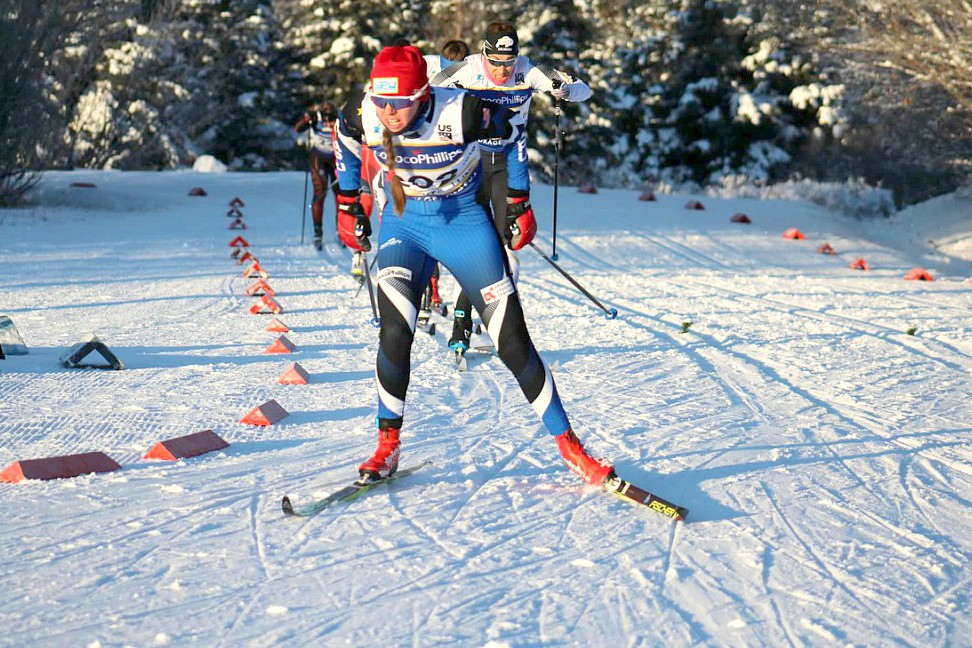
Craftsbury’s Caitlin Patterson (207) and Kaitlynn Miller (second from r) and Jasmi Joensuu, of the University of Denver, lead their semifinal during the women’s 1.5 k classic sprint on Monday at 2018 U.S. Cross Country Championships in Anchorage, Alaska.
In their semifinal, though Joensuu had gapped both Patterson and and another CGRP skier Kaitlynn Miller at the top of Gong Hill — the sprint’s final major climb — both Craftsbury skiers had caught Joensuu by the bottom of the descent’s corner back towards the finish.
A similar scenario played out in the final.
“In the final I did a tactic, I would ski the uphill as fast as I can, I don’t save anything and that almost worked,” Joensuu recalled.
Joensuu and Petra Hyncicova, a CU senior from the Czech Republic, had pushed hard out of the start of the final, followed by Patterson and Miller, as well as Dartmouth skier Lydia Blanchet and APU’s Becca Rorabaugh.
“I tended to lose time in the beginning of the race and then catch back up,” said Blanchet, who had to catch a plane within an hour of finishing the final. “I had great skis and downhills are one of my strengths.”
While the two non-Americans raced to the front halfway through the course’s major climb, Blanchet, Rorabaugh, Miller, and Patterson hung behind. Then halfway through the final hill, Joensuu attacked, attempting to distance herself from the pack.
By the top of the hill, she had done just that, with 4 meters separating her from the rest of the field. Miller and Patterson followed, tucked into the downhill swooping curve.
As Joensuu disappeared behind the trees blocking the corner from spectator’s view, Miller and Patterson were already hot on her heels. Using her momentum, Patterson swung around Joensuu and emerged from the corner first, double poling with a sizeable lead to her fourth victory in a row in a time of 3:39.58.
“It felt surreal coming down the finishing stretch today, realizing that I couldn’t hear people behind me and realizing that it was going to be number four,” Patterson said. “I could not have imagined this if I tried, but I’ve just had really good feelings all week. Great support from the staff and waxers and everything, and it’s fun being back here in Anchorage, especially.”
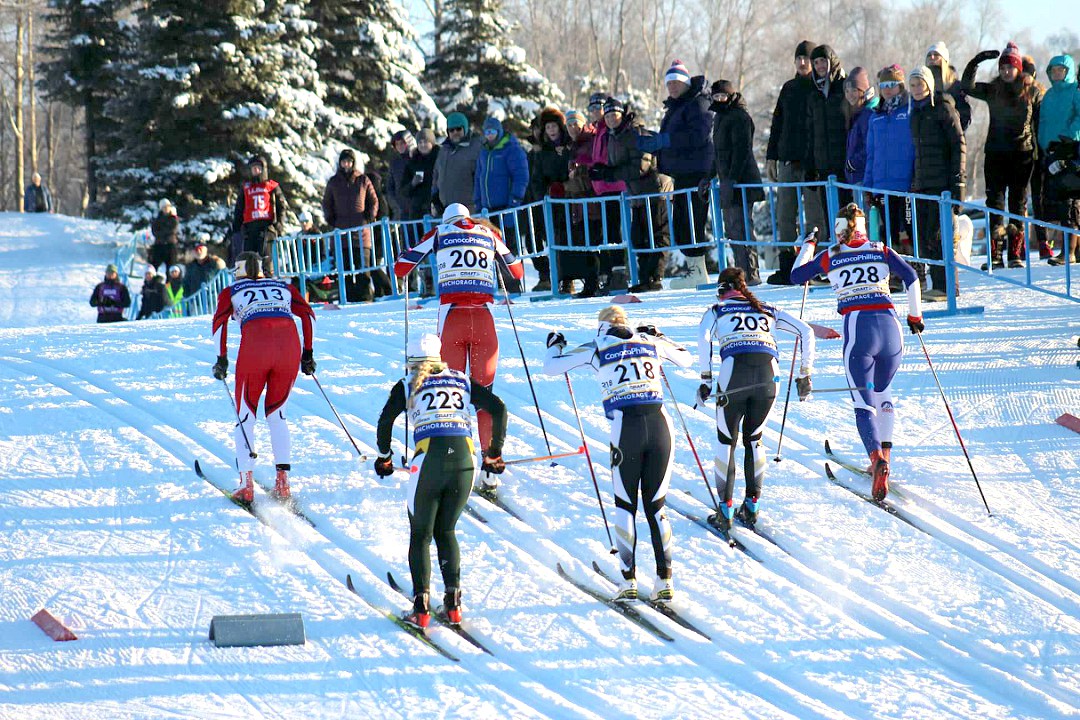
The fifth women’s classic sprint quarterfinal heat on Monday at 2018 U.S. Cross Country Championships in Anchorage, Alaska, with CXC/Peak Nordic’s Felicia Gesior (208) leading with Corey Stock (213) of the Bridger Ski Foundation, and Northern Michigan’s Nicole Schneider (223), the University of Colorado Boulder’s Christina Rolandsen (218) and Petra Hyncicova (203), and Mae Chalmers of SMS (228) chasing.
Finishing second, 2.36 seconds behind Patterson, was Joensuu. Capturing third for her third American podium this week was Miller (+3.9). Miller finished second to Patterson in Friday’s freestyle sprint and was the third American in Sunday’s 20 k.
“I’m really pleased with how everything panned out,” Miller said. “To me the big sign of improvement has been in my skating and I was really excited with my skate sprint and obviously really excited with yesterday and today as well, but it’s nice to see my skating moving up a little bit.”
Despite being the 2016 national classic sprint champion, Miller, of Elmore, Vt., explained she entered Monday’s race with nothing held over her head.
“I don’t ever go into a race expecting a certain result,” she said. “Anything can happen, even to strong, very experienced skiers … [but] it is exciting to be in the mix.”
Though Miller also explained she “felt pretty tired” by the time she lined up for the final on Monday, she also acknowledged that she was, in all likelihood, not alone.
“I think that was the situation for all of the women out there today, after the 20 k yesterday. It was sort of like, well, the snap isn’t there, the energy isn’t quite there, but everyone was in the same boat,” she said. “Everyone’s making the best of it, and your body knows what to do once you get to the start line.
“All things considered, I felt great, had a really great result, and I’m very happy with it,” Miller added.
Becca Rorabaugh (APU) during the women’s 1.5 k classic sprint on Monday at 2018 U.S. Cross Country Championships in Anchorage, Alaska. After finishing second in the qualifier (as the top American) she finished fourth overall in the final and was the third American on the day.
Rorabaugh finished fourth overall (+9.92) and was the third American. The Fairbanks native, who has spent the last 10-plus years living and training in Anchorage, was the top American qualifier on Monday, 1.31 seconds behind Joensuu in first overall.
“I was extremely excited with my qualifier,” Rorabaugh said. “It was rather unexpected. I was the first American and I had one really good qualifier in West Yellowstone this year but the other two so far have been pretty medium for me, so I was really excited really happy with this morning.”
Though the qualifier is what counts for the Olympic points list, Rorabaugh indicated that was of less importance to her than just “getting her qualifier back.”
“It’s been a couple years since I’ve been having a very strong qualification in sprint racing so I was just trying to work on having enough energy and having enough heat pumped to really crush a qualifier first thing in the morning,” she said.
“I wanted to have something special at home,” she added, referring to the friends and family that came to Kincaid to watch her race. “So it was good to have something at the end of the week.”
With firm tracks, cold temperatures reading around 10 degrees Fahrenheit and a low sun in the sky, Rorabaugh described the final U.S. nationals event as “a quintessential Alaskan day.”
“That was quite nice,” she added.
Rounding out the final was Hyncicova in fifth (+10.03) and Blanchet in sixth (+11.21).
“Today I was kind of tired. I finally hit the jet lag over the weekend,” Hyncicova, the two-time defending NCAA champion, said. “But … making the final, and even being third in the quarterfinal is awesome. It’s just proving that I am kind of in good shape so that’s a good start of the season.”
Rounding out the remainder of the women’s top 10 was Bångman in seventh, Sun Valley Ski Education Foundation skier, Kelsey Phinney in eighth, Central Cross Country’s Felicia Geisor in ninth and Stratton Mountain’s Erika Flowers in tenth.
In the junior women’s classic sprint, Wasatch Nordic’s Sarah Morgan took the win in 3:54.93. Novie McCabe (Methow Valley Nordic) placed second (+1.5) and her teammate teammate Ella-Sophie Kuzyk placed third (+6.66).
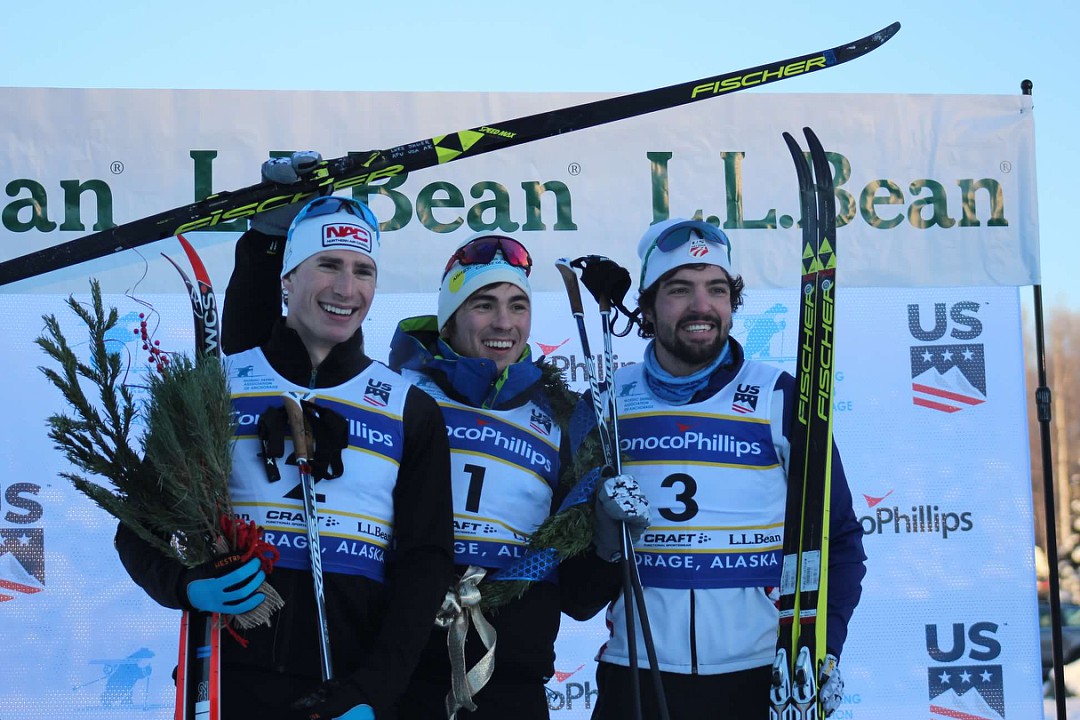
Left to right: Tyler Kornfield (APU), Reese Hanneman (APU) and Ben Saxton (SMS) as the top three finishers in the men’s 1.6 k classic sprint final on Monday, the last day of 2018 U.S. Cross Country Championships in Anchorage, Alaska.
ANCHORAGE, Alaska — No two races are exactly alike, the saying goes, and there’s a lot of truth to this cliché. But if you step back just a little bit, two race days can start to look awfully similar to one another.
For example, for the second time this week, a Hanneman brother won the sprint qualifier, Reese Hanneman won the final, and Alaska Pacific University (APU) put three athletes in the final and two on the podium on a perfect day for sprinting at Kincaid Park. That was the story on Monday, when Reese Hanneman led teammate Tyler Kornfield and Ben Saxton of the Stratton Mountain School (SMS) Elite Team across the line in the men’s classic sprint at 2018 U.S. Cross Country Championships. But it was also the case on Friday, when Reese was first and Kornfield was third in the freestyle sprint. It’s been a good week for the Hanneman family.
The classic sprint, the final race of this year’s U.S. nationals, had a slightly more subdued feel than the three that preceded it.
The fields were 50 percent smaller; a combined 160 athletes skied in the qualifier on Monday compared to 337 on Friday, as many juniors opted out of a race whose results did not bear on qualification for international trips and championship teams, and some athletes had already left town. The spectator numbers were smaller, measuring in the dozens rather than the hundreds after three days of packed parking lots and raucous crowds, as the first day of school following winter break sent local students back to the classroom. And the athletes were tired, too, after a full week of racing.
“I was just running on fumes out there, especially after the 30 k yesterday,” fifth-place finisher Kevin Bolger, of the Sun Valley Ski Education Foundation (SVSEF) told FasterSkier after the men’s final.
But cross-country skiers are nothing if not resilient, and so, just after 10 a.m., Dakota Blackhorse-von Jess (Bend Endurance Academy) once again led 95 men out onto the qualifying course at 15-second intervals. The temperature was 10 degrees Fahrenheit, according to the display on the stadium scoreboard. The sun had yet to rise and start burning off the morning’s dense fog. It felt cold.
“It’s a very quintessential Alaskan day,” women’s domestic podium bronze medalist Becca Rorabaugh (APU) said after. “It’s like an Alaska temperature, and I feel like a lot of the Alaskan teams have great skis, it’s hard-wax skiing, and it’s just a classic race day. It’s very Alaskan.”
Hanneman Brothers Headline Qualifier
https://www.instagram.com/p/BdsyQTkB945/
APU skiers did very well in the time-trial portion of the morning, which has added, if not exclusive, significance for Olympic qualifying purposes slightly a month before the 2018 Winter Olympics begin in PyeongChang, South Korea.
Reese Hanneman, 28, who grew up in Fairbanks, covered the brand-new, 1.6-kilometer sprint course in 3:21.93, a time good for the fastest qualifying mark on the day. And he did so by nearly three seconds. Next best was his APU teammate and younger brother, Logan Hanneman, 2.84 seconds back. Third was his APU teammate Tyler Kornfield, 4.23 seconds off Reese’s mark.
Alaska Pacific University’s Reese Hanneman during the men’s 1.6-kilometer classic sprint heats on Monday at 2018 U.S. Cross Country Championships in Anchorage, Alaska. Hanneman won the qualifier and eventually, the final for the national title.
In light of the bonus points awarded for U.S. nationals podium performances, FasterSkier’s unofficial calculations put Logan first on the 2018 Olympic Winter Games domestic sprint qualifying list, with 80 points (45 for first at U.S. nationals and 35 for second), and Reese second, with 71 points (45 for first and 26 for third).
In Monday’s classic sprint, Benjamin Ogden (SMS) was fourth in qualifying, 5.12 seconds back. Blackhorse-von Jess was fifth (+5.16), Zak Ketterson of Northern Michigan University sixth (+7.56), Cole Morgan (SVSEF) seventh (+7.61), David Norris of APU eighth (+7.85), Saxton ninth (+7.88), and Bolger tenth (+9.09).
Just like the skate sprint, Brian Gregg, of Central Cross Country (CXC), Loppet Nordic Racing (LNR) and Team Gregg, was the final athlete to make the heats, 16.53 seconds back in 30th.
“I would say all the top sprinting guys, everyone’s focusing kind of on the qualifier, more so than normal,” Reese said on Friday after he had qualified third in the skate sprint. “There’s no margin for error, and you just have to ski it absolutely as fast as possible. It’s definitely different tactics than in the heats… but if you’re fast, you’re fast.”
Reese Hanneman Wins Everything En Route to Final
On Monday, Reese was pretty darn fast. He won his quarterfinal, the first of the day, as well as his semifinal, the first of the day, to make the final with the maximum amount of rest possible. And then, of course, he won the final as well for his fourth national title — and second of 2018 nationals.
In the day’s first quarterfinal, Reese was in the lead by the first turn at 200 meters, followed closely by Bolger. The two of them had a big lead by the time they were coming off Gong Hill. The rest of the field caught up to them somewhat by the finish, but Reese and Bolger still took the top two spots with relative ease.
In the second quarterfinal, U18 skier Ogden led the field into the first turn, with Morgan and Bill Harmeyer, of the University of Vermont, right behind. Ogden was still into the lead coming back into the stadium, but Kris Freeman (Caldwell Sport) had caught up into third. Coming into the finish, Freeman won a four-way lunge for second over Thomas O’Harra (APU), Ben Lustgarten (CGRP), and Harmeyer. O’Harra’s third place in a fast heat was good enough to send him on to the semifinals with the day’s first lucky loser spot.
In the third quarterfinal, Andrew Egger (Colby College) took the lead out of the stadium, but it was Blackhorse-von Jess in the top spot by the time they came back. Blackhorse-von Jess entered the finishing stretch with a 10-meter lead. Ketterson took second, 1.2 seconds back, with Egger another second back by the finish.
From left to right: Logan Hanneman (APU), Like Jager (APU), Ben Saxton (SMS Elite Team) Nick Michaud (BSF), Scott Patterson (APU), and Jack Hegman (SVSEF) at the start of their quarterfinal in the men’s 1.6-kilometer classic sprint on Monday at 2018 U.S. Cross Country Championships in Anchorage, Alaska.
In the fourth quarterfinal, Saxton and Logan Hanneman left the stadium with the early lead, alongside a quick-starting Luke Jager (APU), one of three U18 skiers who made the senior heats. It was Saxton in the lead coming back to the stadium two minutes later, with Logan leading Jager. Saxton came into the finishing stretch with a healthy lead, but Logan made a powerful move to pull around him and come alongside. Saxton won the heat by 0.37 seconds over Logan. Yesterday’s medalist, Eric Packer (APU), was out in third.
The fifth quarterfinal was heavy on local pride, with three APU skiers and a fourth from University of Alaska Anchorage. Erik Axelsson (Montana State University) led Kornfield and Logan Diekmann (University of Utah) into the first uphill. But two minutes later it was all APU, with Kornfield, David Norris and Forrest Mahlen with a sizeable lead on the rest of the field. Kornfield took the win; Mahlen came around Norris for second, but Norris moved on with the day’s other lucky loser spot. Axelsson was nearly five seconds back of Norris in fourth.
In the first semifinal, Blackhorse-von Jess flashed his ski speed and momentum by dropping into a tuck within the first 200-meter straightaway in the stadium, then still led the field over the top of the first, smaller climb. Ogden and Reese Hanneman were nearby. When they returned to the stadium, Reese had a 20-meter lead over Ogden on the downhill. As happened throughout the day, though, that lead shrank to half that size by the time the skiers entered the finishing stretch. But Reese still had the lead, which he held to the finish. Bolger was second, 0.32 seconds back. Ogden was relegated for obstruction.
The second semifinal featured a predominantly blue color scheme, between four suits from APU and the blue accents on Saxton’s SMS suit. Saxton again led out of the stadium, with Ketterson and Kornfield close by. By the time they came off Gong Hill two minutes later, it was Kornfield in the lead, with Ketterson close behind him. Kornfield led into the finishing stretch, but Ketterson overtook him to place first in the heat.
Behind them, Logan Hanneman made a strong push for third. He closed down Saxton, edging him by 0.04 seconds for third behind Ketterson and Kornfield. In practice, both Logan and Saxton advanced to the final as lucky losers; Norris’s fifth place in this heat would have won the day’s first semifinal by nearly a second.
Reese Hanneman Wins Final, Again
Slightly after 2 p.m., six men lined up in the south end of the Kincaid Stadium. From racer’s left to right, it was Logan, Kornfield, Ketterson, Reese, Bolger, and Saxton in the starting blocks. The sun was out, the temperature was in the high teens, and the course was firm and fast. There was no wind. Conditions were once more basically perfect.
The field had a clean start at the sound of the starter’s pistol, double poling in six separate lanes over the first 200 meters slightly downhill through the stadium. As the racers turned right to go up the first hill it was the Hanneman brothers in the lead, with Kornfield immediately behind them and Ketterson to Kornfield’s right. The pack double poled up the first part of the climb, then strode up and over the top of the hill.
A quick descent followed, then a high-speed, double-pole section leading to the start of the course’s main hill. Reese pushed the pace going up the hill, and not everyone was able to respond.
“I basically started at the base of the big climb,” Reese recalled of the 24-meter vertical gain B-climb in the middle of the sprint course. “I just kind of led in the climb and then just threw down the hammer and just tried to drop everyone going up that thing, and just continue to pound it over the top and take it all the way home.”
The largest climb on the course is “tough for classic skiing,” Bolger explained. “That hill definitely adds a different dynamic to your whole approach to every heat you do. To be able to ski up that hill four times, strong, it’s a challenge.” (Bolger added that he didn’t think anyone would have attempted to double pole a hill of that size, saying that “it’s a challenging enough hill to where it’s going to rule out double poling for anyone.” But just to be sure, race organizers placed a no-double-pole technique zone up the entire length of the climb for both the qualifier and the heats.)
By the time the field descended the waterfall downhill back into the stadium, Reese had a substantial gap over Kornfield, who in turn had a sizeable lead over Ketterson.
Kornfield made up some of this gap going down and around the final 180-degree turn, but Reese still entered the final straightaway with a sizeable lead. Saxton had moved into third, ahead of Ketterson, by the time they reached the 100 meters to go mark.
Reese Hanneman (1) of Alaska Pacific University celebrates his second sprint title of the 2018 L.L.Bean U.S. Cross Country Ski Championships on Monday with a win in the classic sprint final, just ahead of teammate Tyler Kornfield (r) in Anchorage, Alaska. Ben Saxton (SMS Elite Team) rounded out the podium in third. (Photo: Michael Dinneen Photography)
Kornfield barreled down the slight uphill of the finishing straight with grace and fury, closing in on Reese with each extension of his lanky frame. But he was still in the same finishing lane as his APU teammate, getting closer to Reese, but still immediately behind him. With roughly 20 meters to go, Kornfield moved one lane to his left, then lunged as he approached the finish. But Reese’s lead was still too much, and he crossed the finish with his second sprint national title of the week.
Reese’s time for the final was 3:20.62. Kornfield was 0.2 seconds back in second.
Some distance behind them, Saxton crossed the finish line in third, 4.78 seconds back of Reese, with a slight lead over Logan and Bolger. Ketterson finished sixth, 6.83 seconds back, in his second sprint final of the week.
“He is obviously on super-good form right now,” Reese continued. “I just have to know that I have a little more speed than he does. … But he’s really cranking right now. He is skiing great, but it definitely motivated me to know to just drive that thing so hard in the final.”
The second national title in as many races was “an answer to a lot of prayers from this morning and in the heats,” Reese said. “I just feel really lucky and stoked that I could put it together and be in such good form right now in January. It was a great day, an amazing day.”
Tyler Kornfield leads his APU teammate Forrest Mahlen in the men’s 1..6 k classic sprint on Monday at 2018 U.S. Cross Country Championships in Anchorage, Alaska.
Although Kornfield was second today, he “probably got the all-around performance of the week for the men,” Reese said of his teammate. Kornfield reached the podium in every race this week save the opening 15 k freestyle individual start, where he was 14th.
Kornfield’s race series was “a dream come true a little bit,” Kornfield told FasterSkier, “a little unexpected, but I knew I had it in me. The start of the season didn’t go as planned, I got sick for a month before it started, I also sprained my wrist for another month and so I was pretty frustrated with the lack of performances, but I knew there was something there and it was just a matter of time.”
“In this sport there are a lot of ups and downs,” he continued, “and it’s really easy to get caught up in the downs and not realize that just because you have a few bad races doesn’t mean you lose your ability to succeed, so just have to keep your head up and keep trying and hoping for the doors to open.”
When it comes to possibilities for potential Olympic selection, “I don’t know anything,” Kornfield said. “I can let you know in a couple weeks.”
Mathematically speaking, Kornfield currently ranks second to APU teammate Scott Patterson on the most recent version of the Olympic selection distance points list, which reflects both distance races from U.S. nationals.
For now, Kornfield plans to leave Alaska on Tuesday (that is, today) for a previously planned trip to Austria. He plans to work out precisely what races he will contest soon; he had planned on racing a Ski Classics marathon, but is currently uncertain where he will be racing next.
While Kornfield’s week at U.S. nationals exceeded his expectations, Monday’s third-place finisher, Saxton, didn’t have the week he was hoping for.
“I came here, like many people, with goals of heading to Korea and representing the country racing in the Games,” Saxton said after the final. “I fell short of that this week and that’s nothing to be ashamed of, but I was really disappointed I wasn’t in the mix as much as I would have hoped to be. This week was difficult because I don’t feel like I put forth a representative effort.”
Saxton was quick to offer sincere congratulations to the skiers who had had more success this week.
“I am incredibly proud to know and am happy for Logan and Scott and Reese and all of the other champions from this week,” he said, “and incredibly happy that those are going to be the skiers going to over to represent us. I think it’s just, from a personal standpoint, people can understand I was disappointed not to feel like I had my absolutely best days out there, but I am really proud to end the day on a podium, representing the hard work that all my teammates and my coach and the program at Stratton have done all year, and to reward them for that work and that effort is a great feeling.”
Saxton also enjoyed the “playground mentality” of the sprint day.
“I think a lot of the times racing we can get lost in the technical aspects of it,” he mused, “but one of the reasons I love racing heats so much is, it just kind of reminds me of being back in elementary school and pointing to something in the far end of the playground, basketball hoop, or whatever it is, and just saying, ‘Let me race you there.’ And there’s no rules, there’s no anything, it’s just the feeling of you and the other person just going all out, and that’s a beautiful way to live and that’s a beautiful way to compete, and sprints are a wonderful thing like that.”
Strong Alaska Performances Throughout the Week
What a difference a year makes. One year ago this week, in the classic sprint at Soldier Hollow, APU didn’t put any athletes into the heats for the first time in at least a decade, done in by a combination of illness, seeding, weather conditions, and wax choice. This time around, head coach Erik Flora’s squad sent eight men through to the heats, six to the semifinal, three to the final, and two to the podium.*
The classic sprint capped a successful week for APU, and for Alaskan skiers more generally. Caitlin Patterson, who skis for CGRP, took all four gold medals for the women. Then APU skiers took all four golds on the men’s side, between Scott Patterson on Wednesday, Reese on Friday and Monday, and Kornfield on Sunday. Chelsea Holmes, Kornfield again, Hannah Halvorsen, Rosie Frankowski, Eric Packer, Becca Rorabaugh, and Kornfield again also stepped on the domestic podium for APU. All told, that’s 15 out of a possible 24 medals going to athletes who hail from or ski in Alaska.
(Although if you slice the data another way, there were also seven out of 12 possible medals in women’s races won by CGRP, between Patterson’s quadfecta and Kaitlynn Miller’s trifecta.)
This week’s results “just show the depth” of the team, Reese told FasterSkier after his race. “It speaks to the hard work of our coaches, especially Erik Flora. That guy will not be outworked, he just puts so much into us. I’m just really happy that we can have a week like this and go four for four in the men’s with APU, just to show that what he is doing works and how hard he works for us. … To get to this point that we can do that and crush all week and just give them a good show is really rewarding.”
“We’re all Alaska born-and-raised,” Reese added of the APU men. “Can’t beat that.”
*(Full disclosure, this reporter skis on the APU Masters team, and receives direct coaching from Flora roughly once a year at Masters Camp.)
APU’s Tyler Kornfield (126) celebrates as he crosses the finish line first in the men’s 30-kilometer classic mass start at 2018 U.S. Cross Country Championships on Sunday at Kincaid Park, Anchorage, Alaska. It was Kornfield’s second national title, first one since 2012 and first in a distance race.
ANCHORAGE, Alaska — It could have been mistaken for the finish of a sprint final — except for the fact that almost 10 skiers were in the hunt until the end, most of which were distance specialists.
As it were, the last 100 meters of the men’s 30-kilometer classic mass start at 2018 U.S. Cross Country Championships on Sunday involved eight men double poling in four lanes. Two of those men were past national classic-sprint champions.
“Honestly of all the people in the race, I did not want to be sprinting against Tyler Kornfield and Eric Packer to the finish because I know they’re really good sprinters,” Kris Freeman, of Caldwell Sport, said after the race. “That being said I also didn’t expect to be sprinting against them.”
Kris Freeman (r) leads Ian Torchia (NMU/U.S. Ski Team) during the men’s 30-kilometer classic mass start at the 2018 U.S. Cross Country Championships in Anchorage, Alaska.
Given their track record — Kornfield, who races with Alaska Pacific University (APU), has a 2012 national classic sprint title and Eric Packer, also from Anchorage and APU, has one from 2016 — not many skiers would want to find themselves up against either APU skier, let alone both, in the final 100 meters of a classic race.
But as Sunday’s six-lap men’s race progressed, and athletes continued to ascend Elliott’s Climb, it became more and more clear that the off chance of that happening was actually, fairly high.
Kornfield’s Calculations
Clipped into his race skis, Kornfield, 26, towers above many of his competitors, at close to 6-foot-2. Given his stature, the Anchorage, Alaska native is hard to miss on Kincaid Park’s ski trails.
APU’s Tyler Kornfield (l) and Eric Packer (r) hug after the men’s 30 k classic at U.S. Nationals at Kincaid Park in Anchorage, Alaska.
Yet when he raced toward the front of the pack in the first lap of Sunday’s mass start, wearing bib 126, it went fairly unnoticed. There were still five laps to go and most figured the charge would come later, from APU’s Scott Patterson (who had won the 15 k freestyle race earlier in the week by almost a minute), or from 2014 Olympian and three-time national champion Noah Hoffman.
“Honestly I was expecting Scott and Noah to break away,” Packer said during a post-race interview. “My goal today was to hang with them. They pushed the pace the first three laps and were putting in effort to break away. But right around Lap 3 or 4, when we were still grouped together, I think I started realizing personally that it was going to be a tight finish.”
While Packer’s enlightenment may have come at the same time for many of the spectators at Sunday’s event, Kornfield might have saved them the suspense had he been given an opportunity before the start of the race.
“I was looking at the course yesterday and in my mind I was picturing how I was going to win it,” Kornfield said after the race.
With Saturday being an official training day without any races, Kornfield took the time to learn every curve of the 5 k loop that made up the men’s course, the map of which was released Friday evening. Having grown up skiing and racing at Kincaid didn’t hurt the Service High School graduate’s confidence either.
“I’ve done that hill so many times in sprint racing,” Kornfield said of Gong Hill, which was also featured in Friday’s freestyle sprint and was about 3.5 to 4 k into the 5 k loop.
“So at like 2 k out I thought, ‘You know what? I feel fresh. If I don’t go, I’m going to regret this for the rest of my life,’ ” Kornfield reflected.
Packer’s Motivation
Many who had ventured to Anchorage for U.S. nationals awoke Thursday morning, poured a cup of coffee and proceeded with the championships’ first official training day/off day. Some, perhaps, even slept in.
When Packer, a 27-year-old former Dartmouth skier who attended South Anchorage High School, arose Thursday morning, it was to grave news: he learned his grandmother had unexpectedly passed.
He, his family and mother were shaken as they mourned their loss. The pull of commemoration was also in tow.
“It’s really interesting to be in the middle of the Olympic trials, you’re in the pressure cooker and then you have family come up and it helps remind you what’s important, and that’s the people and your family,” Packer said.
“On the skate sprint day, I was skiing for her and today on the start line, I said to myself, ‘This is for my grandma,’ ” he continued. “I think that just helped keep it in perspective, that the race isn’t for me, it’s for my family and community and everybody.”
With unseen weight, but light feet and a fire within him, Packer started Sunday’s mass start in bib 118, racing toward the back of the lead pack for the first two laps and moving to the middle for the next two.
Noah Hoffman leads early on in the the men’s 30-kilometer classic mass start at the 2018 U.S. Cross Country Championships in Anchorage, Alaska.
“The pack was churning the whole time,” Packer said. “The entire time I was telling myself to just relax. Stay in contact and relax.”
That lead group consisted of Packer, Kornfield, Freeman, Hoffman of Ski & Snowboard Club Vail (SSCV), and Patterson (APU), as well as APU’s David Norris, Kevin Bolger of the Sun Valley Ski Education Foundation (SVSEF), Ian Torchia of Northern Michigan University (NMU) and the U.S. Ski Team, Norwegians Dag Frode Trollebø and Eivind Romberg Kvaale of the University of Denver (DU), Adam Martin and Ben Lustgarten (last year’s 30 k classic champion) of the Craftsbury Green Racing Project (CGRP), Tad Elliott (SSCV) and Brian Gregg (CXC/Loppet Nordic Racing/Team Gregg). Each time they reached Elliott’s Climb, the lone A-climb on the 5 k loop, those in front would accelerate.
Often the acceleration came from Hoffman, who paced most of the uphills and often Elliott’s.
“Noah Hoffman, I feel like he was up there trying to push the pace all the way,” Kvaale, a 23-year-old DU sophomore, said after the race. “He’s not the fastest sprinter so I guess that natural for him, but the downhills are so long and you draft so well here, so it’s hard to get away.”
“I was thinking, ‘When is this going to break up?’ ” Hoffman reflected on Sunday, the day before his 29th birthday. “I kept pushing the pace. I tried to make it hard at times, but not only was it coming back together, it was also a massive group. I mean, it’s one thing if you go and three or four guys come with you, but it was way more than that.”
APU’s David Norris (105) leads up Gong Hill as Ian Torchia (114), Tad Elliott (107) and Kris Freeman (110) chase him during men’s 30-kilometer classic mass start at the 2018 U.S. Cross Country Championships in Anchorage, Alaska.
The group remained a pack of 14 through five and half laps, with the lead exchanging from Hoffman to Kvaale, to Martin and Norris.
“It didn’t really matter how fast people climbed, it always came back together,” said Norris, a Fairbanks native, who sat out Wednesday’s distance race due to illness and was still feeling under the weather on Sunday. “You could tell early that Noah was trying to break away. If anything it looked like he was working harder, but not doing damage.”
While at the top of Elliott’s Climb, gaps would form that Freeman described as being up to five seconds between him and Hoffman and the rest of the pack. But when the group reached the bottom of Gong Hill, all 14 racers were continually rejoined.
The Sprint Finish
By the time the group began descending toward back toward the stadium for the last time, apprehension filled within the spectators standing behind the colored flags lining the course and the athletes corralled on the inside.
A gap had parsed out a few skiers, though eight still remained within range of the win.
“I was debating the entire last lap, ‘When do I go? When do I go? When do I go?’ ” recalled Freeman, a 37-year-old four-time Olympian from New Hampshire. “Then Tyler went and I reacted rather than dictating.”
APU’s Tyler Kornfield (126) celebrates as he crosses the line first in the men’s 30-kilometer classic mass start on Sunday at 2018 U.S. Cross Country Championships in Anchorage, Alaska. Eric Packer (118) finished second and Denver University’s Eivind Romberg Kvaale (124) placed third.
The group had been climbing the final hill together when Kornfield made his move. He pushed around to the outside edge to the front leading into the descent and through the tunnel. As all eight rounded the final corner to the finish, Kornfield put his head down and did what he did best, double poling in an outright sprint to his first-ever U.S. nationals distance win.
“I knew the only way I could win as a sprinter was to conserve energy and try to stay with pack and wait for the final push,” Kornfield said. “In the finish I just kept pushing and watching that finish line come closer and closer. I’ve never had emotions like that after a race. ”
Kornfield crossed in a time of 1:21:43.6 for the overall win. Packer crossed 0.7 seconds back in second and Kvaale crossed 1 second out of first for third overall. Freeman, 1.6 seconds back, was the third American in fourth overall.
“We have a group of guys who are training as much as or more than anyone else in the country and sometimes it takes a while for that fitness to come around,” Packer said. “I think we were a little bit nervous in West Yellowstone and Silver Star [at the December SuperTours] and didn’t have our best races, but it’s great to have things come together at the right time.”
Finishing out the top 10 was Trollebø in fifth (+2.0), Norris in sixth (+2.5), Hoffman in seventh (+2.6), Patterson in eighth (+3.6), Martin in ninth (+14.7), and Lustgarten in 10th (+14.9).
“I had very good glide on my skis so I knew I was able to gain a lot on the other guys,” Trollebø said after. “But it was only two tracks at the end so, it’s almost like in a bike race, you have to stay well positioned to be there at the end.”
Right to left: APU’s Tyler Kornfield leads SSCV’s Noah Hoffman, APU’s Eric Packer, SSCV Kris Freeman, and DU’s Eivind Romberg Kvaale heading out of the stadium tunnel and toward the finish for the men’s 30-kilometer classic mass start at the 2018 U.S. Cross Country Championships in Anchorage, Alaska.
In terms of the U.S. Olympic points list, Patterson is ranked first, followed by Kornfield, Hoffman, Packer, and Gregg (Gregg finished Sunday in 11th, 16.1 seconds back).
“We’ll see what they do for naming a team. It’ll be interesting,” Hoffman said.
“I haven’t seen the math yet, but I have not figured many scenarios where I could be third and still make the Olympic team,” Freeman noted. “So it’s a bittersweet day.
“But that’s what happened and I’m happy for those guys,” Freeman continued. “They’ve been working at this for a long time. I’m not sure that they’re going to make the team but if they do, good luck to them.”
Wonders Wins Junior Race
APU’s Hunter Wonders (301) winning the junior men’s 10 k classic mass start, just ahead of Ben Ogden (SMS) at U.S. nationals at Kincaid Park on Sunday Anchorage, Alaska.
A junior men’s 10 k classic mass start was also run on Sunday, with APU’s 19-year-old Hunter Wonders claiming the win in a time of 26:07.1. Stratton Mountain School (SMS) skier Ben Ogden finished second, 0.6 seconds back, and Canyon Tobin (APU) placed third (+23.4).
“I’m extremely thrilled I was able to hold my bib position,” Wonders said after the junior’s race. “I crashed going down roller coaster on the first lap and lost some time, then I was fighting to get back to where I was, so I hammered until I was back with that lead pack. I felt good so I just kept trying to go for it and it paid off.”
Racing continues Monday for the final event of 2018 nationals, the men’s and women’s classic sprints.
Reese Hanneman (c) of Alaska Pacific University celebrates his win in the men’s freestyle sprint final on Friday at 2018 U.S. Cross Country Championships. He finished 0.08 seconds ahead of Kevin Bolger (r) of the Sun Valley Ski Education Foundation for the win at Kincaid Park in Anchorage, Alaska. (Photo: Michael Dinneen Photography)
ANCHORAGE, Alaska — Friday was a good day for Team Hanneman and its friends. Younger brother Logan Hanneman won the qualifier, older brother Reese Hanneman won the final, and Alaska Pacific University (APU) put three skiers in the final and two on the podium in the men’s freestyle sprint on a bluebird day at Kincaid Park on Day 2 of racing at the 2018 U.S. Cross Country Championships.
A long day of sprint racing got underway with the men’s qualifier at 10 a.m., precisely 10 minutes before the official sunrise. But it was already brighter then than at any point during the day on Wednesday, when a sodden snowfall blotted out most of the daylight and APU skier Rosie Frankowski openly mused about wearing a headlamp during her warmup.
Friday, by contrast, brought light fog in the morning, burning off to reveal full sunshine during the heart of the day and bring actual warmth to the hundreds of fans lining the sprint course around Kincaid Stadium and up and down the Gong Hill. Temperatures had reached as low as 14 degrees Fahrenheit during the night before, and were never much above 19 degrees during the day Friday. The course of mostly manmade snow, with a mixture of natural snow from the roughly three inches that fell on Wednesday, was firm and fast. There was no wind. In stark contrast to the slush racers experienced on Wednesday, conditions were essentially perfect.
Logan Hanneman Fastest in Qualifying
Dakota Blackhorse-von Jess (Bend Endurance Academy) led out the field of 191 men with bib No. 1 for the qualifier. Less than an hour later, APU skier Logan Hanneman had proven fastest in the individual time-trial portion of the day.
The Hanneman brothers after Friday’s skate sprint at 2018 U.S. Cross Country Championships in Anchorage, where they live and train with Alaska Pacific University. Reese Hanneman (l) won the men’s final and younger brother Logan (r) won the men’s qualifier.
Logan’s time on the 1.6-kilometer course was 3:07.40. The 24 year old was followed, on the imaginary but meaningful “qualifier podium,” by Kevin Bolger, of the Sun Valley Ski Education Foundation (SVSEF) in second, 0.48 seconds back, and Reese Hanneman in third, 1.13 seconds behind.
The rest of the qualifying top 10 were Nick Michaud (Bridger Ski Foundation) in fourth, Martin Bergström (University of Utah) in fifth, Dag Frode Trollebø of the University of Denver (DU) in sixth, Cole Morgan (SVSEF) in seventh, Tyler Kornfield (APU) in eighth, Eivind Romberg Kvaale (DU) in ninth, and Gus Schumacher (Alaska Winter Stars), Wednesday’s top junior in the distance race, in 10th.
Brian Gregg, representing Central Cross Country (CXC), Loppet Nordic Racing (LNR) and Team Gregg, took the coveted 30th and final qualifying spot, 8.82 seconds back from Logan. Nicholas Sweeney (DU) was another second-plus back in 31st.
This laundry list of results is of more than academic interest if you are a male sprinter trying to make the U.S. Olympic team for next month’s Olympic Winter Games in PyeongChang. As FasterSkier recently explained, the points list for Olympic selection “will only consider qualification-round finish placing,” and not an athlete’s final position based on racing in the heats. Notably, while both Logan Hanneman (fifth in his semifinal) and the day’s fastest female qualifier, Anne Hart (third in her semifinal), did well, neither of them made their respective final.
APU’s Logan Hanneman (l) leading the University of Vermont’s Bill Harmeyer in the men’s 1.6-kilometer freestyle sprint quarterfinals on Friday at the 2018 U.S. Cross Country Championships in Anchorage, Alaska. After winning the qualifier, Hanneman was eliminated in the semifinals.
If there was one person who had seen Logan Hanneman’s speedy qualifying time coming, it was his older brother.
“He’s one of the best qualifiers,” Reese, 28, said of Logan before this season began. This was true on Friday even though Logan was racing with a dislocated rib, according to Kornfield.
“So the fact that he won the qualifier is unbelievable,” Kornfield said after.
The added significance of the qualifier result for U.S. Olympic selection purposes, coupled with the desire to still have enough energy left to ski well through three rounds of heats, was on the radar of all three eventual podium finishers.
“I would say all the top sprinting guys, everyone’s focusing kind of on the qualifier, more so than normal,” Reese said on Friday. “There’s no margin for error, and you just have to ski it absolutely as fast as possible. It’s definitely different tactics than in the heats… but if you’re fast, you’re fast.”
According to Bolger, who finished second in both qualifying and the final, the significance of the qualifier “absolutely” affected his approach to the day overall.
“Definitely wanted to go into the qualifier and have a strong result,” Bolger said. “I was happy with being second, just barely behind Logan, which I was bummed about but also super happy – there’s a lot weighing on it. So to be able to have a good qualifier, and then still be able to, I think, ski strong throughout the heats, and then into the final – I think that says just as much. So overall I’m really happy.”
“All the pressure was on the qualifier,” echoed Kornfield, who finished third in the final after qualifying in eighth. “I’m normally not very good at qualifying, so the chance of me making that [No. 1 qualifying] spot would have been a moonshot, but I was happy with how I qualified. I know that if I qualify well, then my heats go well, so I was just, after qualifying well, trying to get back and focus on the heats.”
Reese Takes First Throughout Heats
Of the three podium finishers, Reese and Bolger had the smoother paths throughout the day. Reese was first in his quarterfinal and first in his semifinal to automatically advance to the final, winning each heat by less than 0.2 seconds. Similarly, Bolger won his quarterfinal, then was second to Reese in a fast semifinal, 0.17 seconds back.
Left to right: Eivind Romberg Kvaale (University of Denver), Nick Michaud (Bridger Ski Foundation), Reese Hanneman (APU), Kevin Bolger (SVSEF) and Tyler Kornfield (APU) during their men’s 1.6 k freestyle sprint semifinal on Friday at the 2018 U.S. Cross Country Championships in Anchorage, Alaska.
Kornfield skied fast enough in his semifinal to earn a lucky loser bid for the final in fourth, after finishing second behind Reese in his quarterfinal. The top-four men in that second semifinal all finished within less than a second of Reese as the winner, and both lucky losers — Kvaale in third and Kornfield — came from that heat.
Throughout the rounds, Reese skied fairly close to the front throughout the day. In his quarterfinal, the men’s fifth of the day, he was one of three skiers near the lead as the pack took a righthand turn heading up and out of the stadium. He was second coming off the course’s largest downhill back into the stadium, then turned on Beast Mode, approaching the final straightaway to pull into the lead and take the win in 3:10.62. Kornfield was second, 0.19 seconds back.
In the semifinal, similarly, Reese skied in the top three throughout the race, ultimately leading the four-man group sprint to the line for first.
Reese Hanneman Holds Off Bolger
Nearly four hours into the day, six men lined up for the final, now under bright sunshine. From skier’s right to left, it was Eric Packer (APU), Zak Ketterson (Northern Michigan University), Bolger, Reese, Kvaale, and Kornfield lined up across the south end of the capacious Kincaid Stadium.
That’s three APU skiers with national titles to their name, last year’s classic sprint national champion in Bolger, one skier whose previous best at U.S. nationals was 15th (Kvaale), and a 20 year old whom the livestream announcers called a “surprise finalist” (Ketterson).
The field had a clean start off the line, and into the slight-downhill straightaway through the Kincaid Stadium. After approximately 200 meters, the racers took a righthand turn up to the base of a gradual, all-V2, two-stage uphill. At this point it was Ketterson in the lead, with Kvaale and Reese tucked in immediately behind him, and the other three athletes following no more than a ski length further back.
By the top of this climb, it was still Ketterson in front, with Reese following and Packer up into third position.
Roughly one minute later, it was Ketterson in front coming down the waterfall downhill back into the stadium at high speeds. There was a gap of five meters back to Kornfield and Reese, who jostled slightly on the descent but did not fall, and Bolger and Packer immediately behind them. Ketterson was technically still in front, but five meters’ separation at those speeds meant little, and the lead pack was effectively still five athletes strong.
By the time the racers had negotiated a broad 180-degree turn and climbed back up into the stadium, Hanneman was in the lead coming around the final curve. Bolger was second, with Ketterson and Kornfield just off to his left.
Reese Hanneman (c) takes first, roughly half a ski length ahead of Kevin Bolger (r), with Tyler Kornfield (l) third. Zak Ketterson (second from l) and Eric Packer (third from l) are immediately behind Kornfield, with Eivind Romberg Kvaale farther back. (Screenshot: U.S. Ski & Snowboard live stream)
Hanneman came into the final straightaway with a slight lead, and took the middle lane. He skied smoothly through the finish, but Bolger was coming on strong to his left in the outer lane.
Reese kept his slight lead all the way to the finish. Bolger lunged better, but Reese skied faster. Bolger’s lunge got him to within less than half a ski-length of Reese by the finish, but Reese took the victory.
To Reese’s right, Kornfield led Ketterson and Packer in the next lane to the inside. Kvaale skied in leisurely at the back after suffering an untimely broken pole.
Reese’s winning time was 3:11.33 for the 1.6 k course. Bolger was 0.08 seconds back, with Kornfield another 0.8 seconds behind him for third. There was a gap of over a second to Ketterson and Packer, then another 12 seconds back to Kvaale.
Reese aimed to continue his frontrunning ways in the final, he explained to FasterSkier in a post-race interview.
“Everyone’s fighting for the front half because you know that’s kind of where you’ve got to be,” he said. “Everyone’s too fast; you know you’re not going to come from sixth. So I just fought really hard to stay kind of in the front half, throw down the move on the last hill coming into the finish, and it paid off.”
The men’s freestyle sprint podium at 2018 U.S. Cross Country Championships, with Reese Hanneman (c) in first, Kevin Bolger (l) in second and Tyler Kornfield (r) in third on Friday in Anchorage, Alaska.The men’s freestyle sprint podium at 2018 U.S. Cross Country Championships, with Reese Hanneman (c) in first, Kevin Bolger (l) in second and Tyler Kornfield (r) in third on Friday in Anchorage, Alaska.
Reese said he was thrilled by a day in which he won the national title — his third — and Logan won the qualifier.
“He’s one of the best in the country,” Reese said of Logan, “and he and I have been going back and forth in the sprints for a while now. He’s the defending champion in this event from last season, so I knew he was a factor. He’s a powerful skier, and it’s awesome to see him do well. I think we’re both better because we’ve been fighting with each other for years.”
Bolger explained he approached the final differently than his other heats.
“Honestly, I just tried to stay relaxed,” the 24-year-old Wisconsin native said. “I tried to kind of keep an open mind and not put too much into it, overthink it. … I wanted to ski kind of my own race and let things unfold in front of me, and then take chances where I could.”
In practice, this put Bolger in fourth coming off the big downhill back into the stadium. But he trusted his skis, and his finishing skills, and was able to move back into second within just a few hundred meters.
“I kind of got, not pushed to the back a little bit, but kind of toward the back,” he recounted. “But coming toward those last few corners I was right in there. And I was confident in my skiing and I knew I was strong, I felt strong, so I was kind of able to push those corners hard.”
Kornfield, similarly, said, “This is a hard course, so you just had to keep pushing to the finish.”
“The way the course starts, it doesn’t start too hard, it’s pretty flat for the first part. And the uphill is so big that – for some reason you can’t break away on that,” Kornfield added of Kincaid’s brand-new sprint course. “You couldn’t gain that much time; I think people were just conserving until that last 200 meters. It always bunched up with about 200 meters to go, and it was only about who had the best kick and who got lucky with the hole shot. If you tried to get yourself in good position by the final, you would have a good go at the finish.”
Reflecting on the vagaries of sprint racing, he noted, “This is an incredibly fair course. It’s incredibly wide, and it was a lot of fun, but we don’t race those kind of back-and-forth heats that often. So I was just pretty relieved to make the podium, because anything could have happened. You could have snapped a pole easily, you could have fallen. It was kind of a relief just to make it to the final in the first place, and then to make it on the podium was unbelievable.”
Kornfield, 26, who was born and raised in Anchorage and has raced at Kincaid Park dozens of times, summoned the same adjective when asked if he had ever seen a crowd like this at Kincaid for a ski race before.
“This is unbelievable,” Kornfield said. “I remember back [at U.S. nationals at Kincaid] in 2010, and I felt like it was just a wave of noise coming in. This is even more. It’s incredible that people were here and out here. I’m so excited that Reese and I could make the podium and make ’em proud.”
(A sportswriter for the local Anchorage Daily News with 30 years’ experience called it “One of the biggest spectator crowds ever to gather at Kincaid Park.”)
Kornfield likely has fond memories of 2010 for many reasons; he won his first national title then. Friday’s third-place finish marked his seventh time on a U.S. nationals podium, including two national titles. Reese, similarly, took home his third national title (after the 2014 classic sprint at Soldier Hollow in Utah and 2016 skate sprint in Houghton, Michigan), and recorded his eighth national podium. And Bolger notched his second-career podium finish at U.S. nationals, after winning the classic sprint at Soldier Hollow last year.
New Sprint Course Meets with Rave Reviews
As FasterSkier recently explained, Friday marked the debut of the new sprint course at Kincaid. And the athletes approved.
“It was a great course,” Reese said. “Really hard – I would say probably the hardest sprint course we’ve had at nationals in a while. It rivals Fairbanks last year. But there’s a big hill, something you would see on a World Cup, or [World] Championships, so that made it hard. Super-fast downhills. … I think it’s one of the best courses we’ve had in a while. There’s some gradual terrain, there’s a hill, an A-climb, one of the biggest climbs I’ve seen on a sprint course in the U.S., probably ever. I think it’s a great course. It’s fair, everybody likes it, it’s fun. But it skis really well, it’s fast. You can’t get too much better than that.”
“It’s a good course,” concurred Bolger. “It’s really fun. Good hills, good downhills, good cornering. I think it kind of gets at, you’ve kind of got to be a good all-around skier to kind of be able to go from the qualifier to the final.”
“This is an incredibly fair course, it’s incredibly wide, and it was a lot of fun,” said Kornfield.
Athletes will get another shot at it on the final race day of U.S. nationals, the classic sprint on Monday. Classic distance races (20/30 k mass starts) are the next races up, starting at 10 a.m. Sunday morning.
The women’s 10 k freestyle podium on Wednesday at Day 1 of 2018 U.S. Cross Country Championships in Anchorage, Alaska, with (from left to right) Caitlin Gregg (Team Gregg) in second, Caitlin Patterson (Craftsbury Green Racing Project) in first, and Chelsea Holmes (Alaska Pacific University) in third.
ANCHORAGE, Alaska — It was what most locals, or those familiar to the area, referred to as standard Anchorage weather: heavy, wet snow, temperatures reading around 31 degrees Fahrenheit, and a darkened sky that seemed to be brooding over whether or not to let the sun out of bed — the sky covered in a shroud of gray.
With the Pacific Ocean just 600 meters to the southwest and Kincaid Park’s nordic venue, the host of this year’s 2018 U.S. Cross Country Ski Championships, nestled in the state’s gulf socket, low-visibility and unpredictable weather was, ironically, a foreseeable factor to Wednesday morning’s women’s race.
After all, during the first week of January, sunrise in Anchorage is scheduled around 10:15 a.m. and the opening race of this year’s championship event, a women’s 10-kilometer freestyle individual start, was not slated to get underway until 15 minutes before then. The internal dialogue for a few early starters was whether a personal light might be a good addition to the commercial ones dotting the four-lap, 2.5 k manmade loop.
“For a moment while I was warming up, I was wondering if I’d have to wear a headlamp,” Rosie Frankowski, who skis for Alaska Pacific University (APU) and started in bib number 20, said after the race. “But that’s Anchorage.”
By the time the first women’s starter, Becca Rorabaugh, also of APU, departed the start gate, the continual glow from a few stadium lights outshone the dim carpet-colored sky. Close to half an inch of slushy snow covered the trail and more was well on its way.
Skiers would not be deterred, however, as potential spots for the U.S. 2018 Olympic team were on the line.
“I haven’t skied up here in a few years, but Alaska is sort of always unpredictable — this weird combo of manmade and freshly falling snow with bad visibility,” said Caitlin Patterson, who grew up in Anchorage, went to college at the University of Vermont, and currently trains and races with the Craftsbury Green Racing Project (CGRP) in Vermont.
“Until yesterday, I’d never skied that wall hill before; we’d always used that as a downhill, but otherwise I’m pretty familiar with [the trail],” the 27 year old continued. “The loop in the stadium and all these things were ones we used for Alaska State over the years, so even when I couldn’t see through my glasses, to know the corners and so forth was good.”
Caitlin Patterson (Craftsbury Green Racing Project) racing to first in the women’s 10-kilometer freestyle on Wednesday at the 2018 U.S. Cross Country Championships in Anchorage, Alaska.
Familiarity with the course wasn’t the only edge Patterson had heading into the race. She also entered Wednesday’s 10 k as the overall SuperTour leader, an honor garnered thanks to her win in the 10 k freestyle at Sovereign Lake, British Columbia, and her second- and third-place finishes in the 10 k classic mass start and freestyle sprint qualifier, respectively, in West Yellowstone, Mont.
The victory was her third national title. In 2016, she won both the 10 k classic and 20 k freestyle mass start.
Combined with her World Cup performances in previous seasons, Patterson was a prime candidate for Wednesday’s win, which she claimed in a time of 27:09.1, though there were moments on course when she questioned the outcome of her race.
“I wasn’t sure if it was going to turn into a win even midway through the race,” Patterson said.
Patterson was the fourth starter to push past the wand and by the time she looped through the stadium for her second lap, APU’s Chelsea Holmes (bib 16) and Team Gregg’s Caitlin Gregg (bib 17), were starting their first laps. Though she was ahead of Gregg, Patterson received what she called “backwards splits”: Gregg’s pace on laps that Patterson had already completed.
“I could see Caitlin [Gregg], see how the gap was progressing, and I also got some splits … how her first and second lap were comparing to my first and second, and I think I was running a few seconds down at that point,” Patterson recalled.
Caitlin Gregg (CXC/Loppet Nordic Racing/Team Gregg) racing to second in the women’s 10 k freestyle on Wednesday at 2018 U.S. Cross Country Championships in Anchorage, Alaska.
Gregg was also getting splits off Patterson, most of which informed her that the two were on par. It was in the final kilometer and half that Gregg learned she was losing time.
“I was getting splits and I was pretty even for it seemed like three and half laps,” Gregg said after. “Then that last little bit she put a bit of a gap on me.”
Patterson’s final half lap was fast enough to put close to 20 seconds on Gregg, and Gregg finished 19.7 seconds back in second. Having felt like she put in a solid race effort, Gregg was slightly surprised by the time gap, though quick to acknowledge Patterson’s strength on course.
“I thought it was going to be really close there, but obviously she skied super strong,” Gregg said.
Gregg, 37, who earned an individual bronze medal in the 10 k skate at 2015 World Championships and is aiming to qualify for her second Olympics (after making the Olympic team in 2010) holds high regard for the current women’s U.S. race circuit. Even after 19 years of U.S. nationals racing, the veteran skier is not immune to competition-day nerves.
“I still get nervous,” Gregg said. “The weight of these races are super high and I think we have a lot of really fast domestic women right now, I mean Chelsea Holmes has been top 30 on the World Cup and last year Caitlin Patterson was in the top 30, so I’m really hoping that we get a good domestic representation at the Olympics.
“We’re doing our part; working hard and skiing fast,” Gregg added. “Hopefully that gets recognized.”
Chelsea Holmes (Alaska Pacific University) racing to third in the women’s 10 k freestyle on Wednesday at the 2018 U.S. Cross Country Championships in Anchorage, Alaska.
Rounding out the women’s podium on Wednesday was APU’s Chelsea Holmes, 24.4 seconds back in third. Holmes raced World Cup Period 1 this season, with a season-best of 29th in the 10 k freestyle last month in Davos, Switzerland.
“My body didn’t have quite what I wanted today, but that’s OK,” Holmes, 30, who grew up just south of Anchorage in Girdwood, Alaska, wrote in an email. “I actually don’t mind the short course, the race felt like it blew by and it was fun to get to lap by friends and family.”
Also a hopeful for the 2018 U.S. Olympic team, Holmes indicated she would be leaving no race unanswered at this year’s U.S. nationals. She plans to compete in both sprints over the next week as well as the 20 k classic mass start, which she won last year.
“I’ve been working on my ‘Klaebo’. It’s pretty legit,” she wrote.
Pressure can encroach upon many athlete’s performances this week, especially with Olympic spots on the line. Processing that pressure, for Holmes, came in the form of the season’s preparation.
“As for the pressure, for sure it is there — even if it’s only from myself. How could it not be? Certainly I care immensely and I will do my best when the time comes to race, but between now and then I won’t be doing anything special,” she wrote. “I’ve prepared the best I know how and hopefully that is good enough. If not, I’ll still be me.”
Finishing in fourth (+41.7), 17.3 seconds off the podium, was Frankowski.
“I am definitely satisfied with my result today. Honestly, the new snow played into my hands as I like mushy, soft courses,” Frankowski wrote in an email. “On the other hand, a course with no A climbs and only two uphills that take 30 seconds to a minute, is not a course I’d tend to excel on. So I was quite surprised with being that close to a US Nationals podium, especially when the podium is made up of three ladies who I believe could score World Cup points on any given day (as Chelsea proved multiple times in Period 1).”
Frankowski, 26, who was born and raised in Minneapolis, Minnesota, indicated that her next target would be the 20 k classic (though she also maintains a ritualistic “season-long goal” of being in the top four of the SuperTour rankings to, as she puts it, “get free race entries.”)
“In all seriousness, I do hope they can find a way to add some longer and more grinding climbs to the 20k classic course with all the fresh snow Anchorage received today,” Frankowski wrote. “I believe it is important to have a race that is even slightly comparable to the Olympic or a World Cup venue, and although the organizers did a good job with what Mother Nature dealt earlier last December, I hope the priority is on utilizing the new snow to create a course that challenges racers who will be representing our country on an international level.”
Also in the top 10 were three University of Colorado Boulder (CU) skiers, with Petra Hyncicova of the Czech Republic in fifth (+56.7), Norwegian Christina Rolandsen in sixth (+1:02.4) and Swedish freshman Hedda Bångman in 10th (+1:37.8). Erika Flowers of the Stratton Mountain School (SMS) Elite Team placed seventh (+1:26.0), the University of Alaska Anchorage’s Hailey Swirbul placed eighth (+1:30.2), and Becca Rorabaugh (APU) finished ninth (+1:36.5).
U.S. nationals continues Friday with classic sprints at Kincaid.
Swirbul Top Junior in Eighth
https://www.instagram.com/p/BdgT2kzhNtr/
Hailey Swirbul, a U20 skier for the University of Alaska Anchorage, led a strong showing by several junior girls in eighth overall. Hannah Halvorsen (U20, APU) was 14th overall, with Novie McCabe (U18, Methow Valley Nordic) one spot back in 15th.
“I’m really pleased with how my body felt today,” Swirbul wrote to FasterSkier after the race, “and the result I was able to pull off with the help of fast skis (thanks to my coaches) and pacing from the skiers around me. I think the key today was to not stress about whatever the weather was doing and be light and quick through the slushy sections. It was important to pace the race well for me, because the conditions were slower than what we all were expecting after skiing on the race course the previous few days. My main goal was to qualify for World Juniors, and shoot for notable results compared to the western NCAA Division skiers. Overall, I can’t complain about how my first race of the week went!”
Swirbul almost wasn’t on the starting line in UAA green and gold. 14 months ago, she called it “ridiculous” and “outrageous” that the college ski team in Anchorage had been cut when U.S. nationals were on the horizon, and lamented that no UAA race suits were going to be at the starting line. But the decision was ultimately reversed, the ski team was reinstated, and six UAA skiers raced on Wednesday.
Scott Patterson (Alaska Pacific University/U.S. Ski Team) racing to first in the men’s 15-kilometer freestyle individual start on Wednesday at 2018 U.S. Cross Country Championships in Anchorage, Alaska.
(Note: This article has been updated to include comments from Noah Hoffman.)
ANCHORAGE, Alaska — It was a day of homecomings and returns at snowy Kincaid Park for the first day of the 2018 U.S. Cross Country Championships. Scott Patterson returned to his childhood training grounds with a convincing victory, Noah Hoffman returned to racing at U.S. nationals with second, and Matt Liebsch returned to the nationals podium with third in the men’s 15-kilometer freestyle individual start on Wednesday afternoon. All of them overcame notably difficult conditions to do so.
While there were several strong contenders in the field of 181 starters, many had tabbed Patterson, of Alaska Pacific University (APU), and Hoffman, affiliated with Ski & Snowboard Club Vail (SSCV), among the favorites coming in. They weren’t wrong, given both the pair’s recent World Cup experience and their domestic history at this distance.
For both athletes in the top echelon of U.S. men’s distance skiing, the 15 k race has long been their bailiwick. Coming into this week’s races, Patterson, of the U.S. Ski Team B-team, had reached the podium in six of his last eight 15 k races at the SuperTour or national championships level (plus wins in two competitive Alaskan 15 k FIS races in that time). While Hoffman, a former U.S. Ski Team member, has raced in this country less frequently over the past several years, he had achieved that mark in three of his last four domestic 15 k races. For a pair of high-training volume athletes with remarkable aerobic capacity, there is clearly something about this distance that lets them do well.
Noah Hoffman racing to second in the men’s 15-kilometer freestyle individual start on Wednesday at 2018 U.S. Cross Country Championships in Anchorage, Alaska. It was his first January nationals appearance since 2012.
On Wednesday, Hoffman did well, but Patterson did better.
“I was impressed by him and happy to see him skiing so well, I mean he handled the condition and that course really well and…he has trained a bunch, but you know I also think that I can ski at that level and I didn’t do that yesterday,” Hoffman said on the phone on Thursday. “In that sense there is more out there, but I am definitely satisfied with second place, I think it sets me up well for going into Sunday in terms of like qualifying for the Olympic team or just having a good week in general.”
Starting in bib 215 in the middle of the A-seed group, nine spots after Hoffman in bib 206, Patterson led wire-to-wire throughout the six-lap race. After one lap, his time advantage over Hoffman was 7.9 seconds. After two laps, it was up to 11.8 seconds. Patterson’s edge grew steadily from there – 24.1 seconds at three laps, then 41.4 seconds at four laps, then 52.2 seconds through five laps.
Patterson received an early clue he was having a good day when he passed Kyle Bratrud, of Central Cross Country (CXC), during the first lap.
“The full confirmation came from my coach, Erik Flora, just after the first lap when he gave me a split that I was leading,” Patterson wrote in a post-race email to FasterSkier. “From there it was mostly just building time against the clock rather than any competitor specifically.”
Patterson finished in 36:33.7. Hoffman was 55.2 seconds back in second.
The first lap saw more variability for several skiers, with some eventual top-10 finishers ranking as low as 28th after their first time around the course. Liebsch, representing Pioneer Midwest, was in seventh after Lap 1. But by the end of Lap 2, Liebsch was up to third overall, and he held that position all the way to the finish.
Matt Liebsch (Pioneer Midwest) racing to third in the men’s 15 k freestyle on Wednesday at the 2018 U.S. Cross Country Championships in Anchorage, Alaska. It was his first U.S. nationals appearance in two years and his first national podium since placing second in 2012 in a 15 k freestyle in Rumford, Maine.
Liebsch finished 21.3 seconds back from Hoffman in second, and 1:16.5 behind Patterson in first. Liebsch nipped fourth-place finisher Rogan Brown (Sun Valley Ski Education Foundation) by 3.7 seconds for the final podium spot.
The rest of the top 10 went to Tad Elliott (SSCV) in fifth (+1:24.4, Gus Schumacher (Alaska Winter Stars) in sixth (+1:27.7), Brian Gregg (CXC/LNR/Team Gregg) in seventh (+1:31.3), Jack Hegman (SVSEF) in eighth (+1:36.0), Benjamin Ogden (Stratton Mountain School) in ninth (+1:42.1), and Adam Martin (Craftsbury Green Racing Project) in 10th (+1:44.2).
Conditions for Wednesday’s race were markedly different from the “firm and fast” courses observed last week. Temperatures above 40 degrees Fahrenheit during the day on Tuesday softened the top few inches of manmade snow on the snowmaking loop and left two to three inches of soft slush on the course’s first main uphill. Above-freezing temperatures Tuesday night, some light rain and a steady snowfall at temperatures hovering around 31.5 degrees all day Wednesday, made for a challenging race.
For the men, that came after 147 women did four laps each in the day’s first race. Then the men skied a cumulative thousand-plus laps in the day’s second race. By the end of the day on Wednesday, the day’s final starters pushed to glide through four to five inches of slush on the first climb, Gong Hill.
Despite the conditions, or maybe even because of them, U.S. Ski Development Coach Bryan Fish said that Wednesday’s race courses were a worthy test for American athletes being chosen for international championship teams.
“I think it was actually good that it snowed,” Fish told FasterSkier in person after the race. “Not only for the long-term of the whole week, but also the fact that the course – just due to the fact that the limited amount of snow, they weren’t able to run it on a fully homologated course. So what I think this did, at least from my perspective, is that it was much harder because of the snow conditions. And I think that creates a better environment to pick the right athletes to go onto these championship courses that they’ll be racing in Europe and in PyeongChang.”
“The conditions were definitely tricky,” Patterson observed. “Yesterday for our prerace training we had crazy ice and wind in classic Anchorage Chinook style, but even then the forecasts were calling for something different today. Looking out the window in the morning, I knew it was going to be interesting with snow rapidly accumulating and a temperature around 35 degrees.”
“There were definitely some rough patches with soft deep snow,” Patterson wrote, referring to Wednesday’s race. “Also in many places, maintaining speed meant staying in the skied-in lane. Thus passing was difficult in some areas. Overall, racing fast was about getting through the tough areas quickly but not burning too much energy. Then really focus on the other areas where I could ski hard and put time into people. These conditions didn’t make the skis feel super fast, but I think the APU techs did a great job with the conditions out there to give me some of the fastest skis in the race.”
Patterson was the only athlete in the men’s race whose overall pace exceeded that of the fastest woman’s lap in the day’s first race, as continued snowfall made the course ski harder for everyone.
Despite the weather, Patterson wrote to FasterSkier, he felt confident going into Wednesday’s race.
“But I was also expecting a tight battle with Noah Hoffman and maybe some others,” he wrote. “We had been racing at quite a similar level on the World Cup, but I think the combination of home course advantage and a bit of rough travel for Noah tipped the scale in my favor.”
(Hoffman recently posted, in a series of Instagram video updates chronicling his travel misadventures, that it took him over 24 hours to successfully leave Hartford as he attempted to fly to Alaska, and that it ultimately took him 56 hours to travel to Anchorage from Putney, Vermont, by plane. “16 hours short of the drive time,” Hoffman wrote.)
“Scott was world-class today,” Hoffman said, according to a U.S. nationals press release. “I hope he can bring that back to Europe and I hope to be there with him.”
“You know I continue to feel that I am really looking for my skiing to click,” Hoffman later said during a phone conversation with FasterSkier. “I am really looking to figure out how to ski as well as I had in the past and as I know how… if I am skiing the way that I can, I am going to have all the opportunities I want…everything else really falls into place if that goal does.”
Hoffman hopes to qualify for PyeongChang, but still remains most concerned with his skiing, believing that performances will follow once he clicks in.
“I am just focused on trying to put together a representative effort of my fitness because I continue to believe that I am one of the fittest athletes in the world, and that the skiing that I did in 2013-14 wasn’t some miracle or some fluke, I want to give myself more opportunities to prove that, but that’s the goal,” Hoffman continued. :So making teams, and the politics of all of it, is really not, not what I am caught up in. I am focused on trying to ski as well as I can and as I have. I skied best in the world I know I can do that, its been a long time, and its been extremely frustrating, but that continues to be the focus. You got to focus on skiing fast and that’s all you can control.”
“Overall I felt quite good,” Patterson wrote. “I was getting a lot of good information and splits from my coaches so I had a good understanding of the race the whole time. I kept the pace steady throughout and made sure to work with the conditions instead of fighting against the tricky snow.”
Patterson had more support out there than just his coaches, on a day when the large parking lots at Kincaid filled to capacity and parked vehicles lined the road up the hill from the stadium at some points.
“Racing at home is always special,” the 25-year-old Patterson wrote, “both in terms of fans and having the home-course advantage. I have raced at Kincaid more than any other place in the world and I feel like I know how to ski well there. It does have its tricks that take some time to learn. In addition to that, there are the fans. The first time up to the course high point or the Gong Hill, I felt like every person on the sidelines was cheering for me. There were several instances where I would recognize someone’s voice and start to try and figure out who it was before going back to focusing on the race. It’s even more special with all the Olympic hype today.”
It was his second national title after winning the 15 k classic two years ago in Houghton, Michigan. Patterson, who attended high school in Anchorage, had more experience at Kincaid than anyone else on the podium, but Liebsch is also a fan of the city’s biggest cross-country ski area.
“I’ve always raced really well here,” Liebsch, 34, told FasterSkier on the phone Wednesday evening. “This is my third time up here, and I’ve had a third, a fourth, and a third. So I like racing at sea level; Kincaid seems to be good to me. So when I saw that Nationals was here this year, I was like, ‘Oh, I gotta go to that for sure.’ ”
Liebsch most recently made a U.S. nationals podium in 2012 at Rumford. This was also the last time, before Wednesday, that Hoffman raced at the full-fledged U.S. nationals in January; he has competed at U.S. Distance Nationals (an annual 50 k mass start) in the spring several times since then. (This season, Hoffman raced Period 1 of the World Cup. After not being offered a start spot in the Tour de Ski, he chose to come to U.S. nationals instead. Patterson was offered a Tour de Ski start spot, but declined that in favor of coming to nationals.)
“When I saw that [nationals were in Anchorage] I got really excited to try to train well this summer,” he said. “I never really stopped training. Sometimes I’m exercising, sometimes I’m training. I actually trained this year. Last year I exercised.”
(He later mused, “I’m less than 20 months removed from World Cup racing, so everyone thinks that I just rolled over and died. But I kept training, and I kind of had it in the back of my mind that I may take another swing, see what happens.”)
Liebsch came to Anchorage “with the expectation to win today,” he said. But he was quick to credit Patterson for his dominant performance: “Obviously Scott just sent it,” Liebsch said. “Scott was on his own planet today.”
For “everyone else” in the race, Liebsch said of the challenging and variable conditions, “it was kind of like you had to ski relaxed, and just kind of let the ski scoot along on the snow. Because there were like trenches, and then there was like mashed potatoes, and then there was like new snow. It was kind of weird.”
So what happens next? Short-term, Liebsch does not plan to contest Friday’s sprint, so he’s going to go skiing at Hatcher Pass instead.
He also has big technique plans, with an eye to qualifying for the upcoming Olympics in PyeongChang.
“I have a chance to probably go ski in Korea, potentially, after the points reshuffle from today,” Liebsch said. “They’re going to have to take a bunch of domestic guys, I think, and … I think I’m in the mix. If I can figure out how to classic ski between now and Sunday, it could be real exciting.”
Patterson has comparable goals in advance of Sunday’s 30 k classic mass start.
“For PyeongChang, today’s race feel like it puts me in the driver’s seat for the distance spots. Through the early season SuperTour, no one really stood out above the rest for distance races. Today, Noah Hoffman and I showed that we might not have scored many World Cup points, but we are still forces domestically. The 30k classic on Sunday will be my other big focus to get an Olympic spot.”
Two Juniors in the Top 10
https://www.instagram.com/p/BdgdIgbB92S/
While there was a separate podium ceremony on Wednesday for the top-three junior boys (after athletes of all ages raced together), you don’t have to go too far down the results sheet to find the top-three finishers under age 20: Gus Schumacher (Alaska Winter Stars) was sixth overall, Ben Ogden (Stratton Mountain School) was ninth, and Hunter Wonders (APU) was 21st. Schumacher and Ogden are still U18 skiers; Wonders is a U20.
Schumacher’s sixth overall is a quantum leap from his previous best finish at a U.S. nationals: he was 43rd in the 15 k classic at Houghton in Jan. 2016.
“I guess I wasn’t expecting this specific result,” Schumacher, 17, wrote to FasterSkier, “but I knew that on home snow I could possibly put up a pretty fast time and be competitive with the seniors.”
As for his mindset in conditions like those found on Wednesday, Schumacher wrote, “I guess my approach is that it’s the same for everyone and as long as I don’t get freaked out I can race as well as normal. So the goal is really to stay calm and try to adjust my technique in warmup to be more efficient.
“I was super stoked about today’s race,” he continued. “I think it is a great sign for the future, hopefully I can keep this pace up!”
Count Fish, the development coach, among those also stoked about Wednesday’s race. Fish is attending U.S. nationals for a number of reasons, he explained, including to help support the naming of various international championship teams (Junior Worlds team, U23 team, and the U18 Nations Trip team). And while he looks at results, to be sure, it’s more than just that.
“We’re also looking at results versus age as well,” Fish said. “And not only the result itself, but what were the times, and what were the time gaps. … Really exciting to see a couple of young men, like Gus Schumacher and Ben Ogden, sixth and ninth. And those two were back and forth. And I had Ben as high as eighth, and Gus in 10th, and Gus had an incredibly fast last lap, to put time not only into the other juniors but into the whole field, to finish sixth overall. So that was really exciting to see, to have two young athletes like that finish that high.”
Caitlin Patterson of the Craftsbury Green Racing Project (CGRP) earned a national title on Wednesday with a win in the women’s 10 k freestyle at 2018 U.S. Cross Country Championships in Anchorage, Alaska. (Photo: Instagram/US Nationals 2018)
2018 U.S. Cross Country Championships (Anchorage, Alaska): 10/15 k freestyle
The Patterson siblings are crushing it on Day 1 of the U.S. Cross Country Championships at Kincaid Park in Anchorage, Alaska.
Scott Patterson (APU/USST) racing to a 55-second win in the men’s 15 k freestyle on Wednesday at U.S. Cross Country Championships in Anchorage, Alaska. (Photo: Jim Jager/US Nationals 2018 Instagram)
Scott Patterson raced to a 55.2-second victory over Noah Hoffman in the men’s 15-kilometer freestyle individual start on Wednesday. Patterson is an Anchorage-based U.S. Ski Team (USST) member who trains with Alaska Pacific University (APU). Hoffman is a former USST member who raced Period 1 of the World Cup with Patterson. Matt Liebsch, of Pioneer Midwest, placed third, 1:16.5 minutes off of Patterson’s winning time of 36:33.7.
Patterson’s older sister, Caitlin Patterson, of the Craftsbury Green Racing Project (CRGP) won the women’s 10 k freestyle earlier on Wednesday by 19.7 seconds over Caitlin Gregg, who’s affiliated with Central Cross Country (CXC), Loppet Nordic Racing (LNR) and Team Gregg. APU’s Chelsea Holmes, who raced World Cup Period 1, placed third, 24.4 seconds off Patterson’s winning time of 27:09.1.
Also in the top 10 in the women’s race were Rosie Frankowski (APU) in fourth, University of Colorado Boulder (CU) skiers Petra Hyncicova and Christina Rolandsen in fifth and sixth, respectively, Erika Flowers of the Stratton Mountain School (SMS) Elite Team in seventh, Hailey Swirbul (University of Alaska Anchorage) in eighth, Becca Rorabaugh (APU) in ninth, and Hedda Bångman (CU) in 10th.
In the men’s top 10 were Rogan Brown of the Sun Valley Ski Education Foundation (SVSEF) in fourth, Tad Elliott (Ski & Snowboard Club Vail) in fifth, Gus Schumacher (Alaska Winter Stars) in sixth, Brian Gregg (CXC/LNR/Team Greg) in seventh, Jack Hegman (SVSEF) in eighth, Benjamin Ogden (SMS) in ninth, and Adam Martin (CGRP) in 10th.
ANCHORAGE, AK (Courtesy of U.S. Ski & Snowboard) – Top cross-country skiers from across America will compete for national titles, FIS Junior World Championship spots and potential Olympic berths at the 2018 L.L. Bean U.S. Cross Country Championships January 3-8. All events will take place at Kincaid Park. U.S. Ski & Snowboard will also carry a live stream of the events on its Facebook page (www.facebook.com/usskiandsnowboard/).
Alaska is a hotbed for cross-country skiing and past U.S. Championships in Anchorage have attracted large fields. The Alaskan city most recently hosted the event in 2010. The U.S. Championships are being organized by the Nordic Skiing Association of Anchorage.
The week’s competitions feature two freestyle and two classic events for both men and women. The top American in each race will be crowned national champion. Results from the freestyle races and the classic distance events will be used to determine the teams for the 2018 FIS Junior & U23 World Ski Championships in Goms, Switzerland January 28-February 3.
“The U.S. Championships is a stop for our top domestic skiers seeking not just U.S. titles but spots on international teams,” said U.S. Ski & Snowboard Nordic Domestic Program Director Robert Lazzaroni. “Anchorage is an excellent venue as the event will capture the great enthusiasm we have for cross country skiing in Alaska.”
“Anchorage has an amazing infrastructure for cross country skiing,” said organizing committee chair Joey Caterinichio. “Events such as the U.S. Cross Country Championships help keep the circle of cross country skiing alive and give our youth an atmosphere to thrive in at all levels of skiing and to witness the pinnacle of U.S. racing.”
All races in Anchorage are also part of the 2017-18 SuperTour and points will count towards the overall SuperTour titles, Olympic Winter Games selection and international World Cup starts. The long distance and team championships will take place March 23-28 in Craftsbury, Vermont.
While primary selection for the 2018 Olympic Cross Country Team will come from World Cup races, some final spots will be determined from results in Anchorage. The Olympic team nominations will be announced the week of January 23.
The Chugach Mountains as seen from the Lekisch Loop, part of the course for the weekend’s races, at Kincaid Park in Anchorage, Alaska. (Photo: Adam Verrier)
ANCHORAGE, Alaska — So how cold was it at Kincaid Park Sunday morning for the last of four Rocky Mountain Intercollegiate Ski Association (RMISA) races held in the Anchorage area this week?
“It’s f—ing cold,” said women’s winner Merete Myrseth of the University of Utah. “It was cold,” said men’s winner Moritz Madlener of the University of Denver. “Now we fly back to Denver and get warm.” [Unavailable for comment] were the two skiers who required an ambulance for cold-related injuries following the women’s race.
For the record, temperatures were consistently at or above zero degrees Fahrenheit all morning, so readily FIS-legal. (The International Ski Federation, which sanctioned all of this week’s races, has a temperature cutoff of -20° C, or -4° F, in order for a race to be held.) The real problem was the wind, which blew steadily from the north at around 10mph all morning.
Unless the real problem was the humidity. The city of Anchorage is, well, a natural anchorage, bordered by Cook Inlet to the north and Turnagain Arm to the south. The Kincaid stadium is well under a kilometer away from the shores of the ice-choked Pacific Ocean; athletes were within 150 meters of the Turnagain Arm beach at one point on Sunday’s race course. Humidity was over 90% all morning. By any measure, conditions were somewhere between “raw” and “brutal.”
At least atmospherically speaking. The ski trails were in superb shape following 30″ of snow in the month of January, if slow due to temperatures below zero Saturday night into Sunday morning.
The first race of the day, the men’s 20-kilometer freestyle mass start, saw its start moved one hour later due to cold conditions. In that time the temperature rose from -2° F to zero.
Denver’s Moritz Madlener (2) leads Dag Frode Trollebø of Denver (12) and Kevin Bolger of Utah (4) in the men’s 20 k skate at Kincaid Park in Anchorage, Alaska. (Photo: Adam Verrier)
When the race started, Denver’s Madlener quickly moved near the front as the field of 42 racers headed north out of the stadium to make their way up Elliott’s Climb. (For Anchorage readers, or anyone else familiar with Kincaid: the course went up Elliott’s and down Rollercoaster; up and down the Gong Hill; through the lower tunnel out to Mize’s Folly; take the first right onto Hairpin; take the first left at the top of Hairpin onto the 2.9 k Lekisch. Men did two laps of this, for 15 k, then a final 5 k lap that cut out Elliott’s. Women did two laps of the 7.5 k course for 15 k total.)
“I was in the front pack pretty much the whole race,” Madlener recounted in an in-person interview with FasterSkier. “Tried to, you know, set the pace every now and then to get rid of people. Which worked pretty well; I think four of us got away after maybe 12 [kilometers]. And then we stayed together for the rest of the race, and then the last couple hills we kind of separated.”
Madlener ultimately crossed the line in 52:39.2, edging teammate Dag Frode Trollebø by 2.6 seconds. Martin Bergström of the University of Utah followed in third (+10.4). “That’s a great feeling” to share the podium with a teammate, Madlener told FasterSkier.
Madlener recalled that he had “a really good start” to his season at U.S. nationals – he earned two podiums there, second in the classic sprint and third in the 15 k skate – before he got sick “and had to catch up. And the races so far here in Alaska weren’t that great,” he continued, “so I was very happy to win today.”
This week marked Madlener’s second time racing in Alaska; he previously competed in the last RMISA race series held in Anchorage, in early 2015. That week was marked by warm weather, rain, and shortened courses.
Madlener is a fan, of Alaska in general and particularly the full courses that athletes got to race on this year.
“I think it’s beautiful,” Madlener said of Alaska. “It’s like – I would say it’s like a big theme park; people are surfing and flying around and fishing. I really enjoy it. And the courses – again, two years ago, were not so great, but this year there’s a lot of snow, they’re pretty amazing courses. Like a rollercoaster.”
Merete Myrseth of Utah enters the stadium approaching the finish in the women’s 15 k skate at Kincaid Park in Anchorage, Alaska. (Photo: Adam Verrier)
Sunday’s race course featured a total of eight A-climbs for the men in 20 k, and six A-climbs for the women in 15 k. There was an average of 34 meters of climbing per kilometer on the main 7.5 k loop.
Four racers, roughly a tenth of the field, were DNFs in the men’s race, likely due to a combination of the hills and the cold. Two skiers did not finish the women’s race. An additional eight opted not to start.
The first words out of Madlener’s mouth when asked about his race were, “It was – first of all it was cold, obviously.” Myrseth, the women’s winner who skis for Utah, voiced similar sentiments: “It was cold, really cold,” she began her race summary. (By the time of the women’s race start at 12:30 p.m., temperatures had climbed to 1.6° F.)
“I was unsure if I would start the whole race because it was so cold, actually too cold for me,” Myrseth told FasterSkier in a brief in-person interview while shivering in the windy stadium soon after her finish. “But it went really easy in the first half of the lap,” she continued, and she felt good. “So I decided to speed up when I came to hills”; there Myrseth created a gap that she kept all the way to the finish.
But not without difficulty. “I didn’t feel good,” Myrseth said. “My feet, I couldn’t feel my feet, it was so cold. So I had to just, like, double pole over the hills, I was so tight in my feet and lost my balance, it was just so hard to keep balancing. But I made it to the finish line. And I am so happy that Guro took the second place.”
Merete Myrseth of Utah (l) in the finishing chute en route to the narrow victory over Guro Jordheim of Utah (106) and Christina Rolandsen of Colorado (109) at Kincaid Park in Anchorage, Alaska. (Photo: Adam Verrier)
Myrseth crossed the finish line in 46:28.3 for 15 k, double poling the last few meters to the finish. As she noted, she was followed by teammate Guro Jordheim in a close second (+0.5). Christina Rolandsen of the University of Colorado was not far back in third (+1.8). There was then a 30-second gap to a chase pack containing places fourth through sixth. 32 skiers finished the women’s race.
This week marked Myrseth’s first time racing in Anchorage or even visiting Alaska. So what did she think? “I love it,” said the native of Øverbygd, Norway. “It’s f—ing cold, but it reminds me of Norway, my home. I’m used to it. But it’s so nice; I really like it here.”
Sunday’s race marked the fourth race of the week in the Anchorage area for RMISA athletes. Recaps of the first three races follow below.
On Tuesday, February 7, RMISA athletes, plus a handful of skiers from Alaska Pacific University (APU) with sterling sprint credentials, raced a 1.4-kilometer freestyle sprint at Kincaid. Conditions were impeccable, with pure blue skies, temperatures in the high teens, and last month’s fresh snow mixed in with the base of manmade snow covering the sprint loop.
In the women’s race, Merete Myrseth of Utah posted the fastest time in qualifying, 3:25.77, followed by Becca Rorabaugh of APU (+2.14) and Utah’s Guro Jordheim (+3.65). All three skiers made the A-Final, where Myrseth took her first victory of the week. The overall podium, which was also the college podium, was Jordheim in second and Anika Miller (Montana State) in third. Casey Wright (UAA), Rorabaugh, and Jasmi Joensuu (Denver) were fourth through sixth.
Times were not available for any of the heats.
In the men’s race, Dag Frode Trollebø (Utah) set the pace in qualifying in 2:48.80. He was followed by APU’s Logan Hanneman (+1.52) and Utah’s Martin Bergström (+3.33).
Three of the six skiers in the men’s A-Final were locals (in the broad sense of being from Alaska; the Hanneman brothers are from Fairbanks, not Anchorage). And it was the Hanneman show in the final, as the elder Reese Hanneman took the victory over his younger brother Logan. Trollebø was third. Kevin Bolger of Utah, last seen winning the classic sprint national championship at Soldier Hollow, Bergström, and APU’s Forrest Mahlen rounded out the final finisher spots in that order.
The collegiate podium for the men’s race was Trollebø, Bolger, and Bergström. (APU is not an NCAA-affiliated athletic program.)
While sprinting may be on the horizon for NCAA skiing in general, it had yet to make an appearance on the RMISA circuit.
“This was the first sprint that I know of in my, what – 10 years of RMISA coaching now and we’ve never had just a straight invitational sprint,” University of Alaska Anchorage Head Nordic Coach Andrew Kastning told FasterSkier in person following Sunday’s distance skate races.
Kastning said that the addition of a sprint in Anchorage stemmed from a desire for a change of pace, and to avoid repetition in a single week with four races. “So when we sat down last spring and were deciding the schedule,” he said, “we’d been hearing for a few years now from our athletes that the fives, 10s, 15s, and 20s [kilometer race format] every weekend just kind of got boring, and we wanted to mix it up. So we counted the qualifying round as an invite at U.S. Nationals, and then we ran the full sprint [this week] and counted that. … So we just wanted to mix it up a little up here. Especially with four races in a short period of time, you don’t want to be doing all the same distances and the same courses.”
So did the college athletes appreciate the chance to contest a sprint race in the middle of the RMISA race season? “Some of them do,” Kastning said. “There’s always a sprint specialist in the crowd who gets to shine. And I know there were kids on the podium, or in the top-10 at least, that aren’t normally in a distance race. So it allows some athletes to play to their strengths and shine a bit when they maybe wouldn‘t in a 20 k race, they can in a sprint.”
On the non-collegiate side, APU skier Reese Hanneman, a sprint specialist, was thrilled to have a mid-season sprint race with high-level competition on his adopted home course. “I wish there were more sprint races in the middle of the season,” Hanneman told the Alaska Dispatch News.
Utah’s Martin Bergström (402) leads Denver’s Dag Frode Trollebø (right) and APU’s Reese Hanneman (center) at the start of the mixed-gender classic relay in Girdwood, Alaska. (Photo: Adam Verrier)
The next day, Wednesday, February 8, skiers made the 45-minute drive down Turnagain Arm from Anchorage to Girdwood for a classic relay race. Girdwood is perhaps best known in ski circles as home to the Alyeska Resort alpine area, which boasts an average annual snowfall of 669″ and (when it’s clear) sweeping views of the mountains and glaciers overlooking Turnagain Arm. Publications as diverse as Powder magazine and National Geographic have lauded Girdwood as a quintessential locals ski town (“Best For: Off-the-beaten-path powder hounds with an aversion to glamour”).
Girdwood also has a proud nordic heritage, though you have to look a little harder to find it. It is home to APU skier Chelsea Holmes, who will be competing at World Champs in Lahti later this month. And it hosted the 1969 Junior Nationals, on trails cleared from the continent’s northernmost coastal rainforest for this purpose.
As discussed in more detail on former U.S. Ski Team member Tim Kelley’s invaluable blog, Alaska Lost Ski Areas Project, the trails faded back into the woods at some point during the 1970s. High-level nordic skiing in Girdwood then languished for over thirty years, until the early part of this decade, when the Girdwood Nordic Ski Club oversaw construction of a new 5 k loop. The reborn nordic trails have since hosted a handful of local high school races in periods of poor snow conditions in Anchorage, but it is safe to say that Wednesday’s relay was the most significant cross-country ski race held in Girdwood since 1969.
APU (1st), Colorado (2nd), and Utah (3rd) make up the podium for the mixed-gender classic relay in Girdwood, Alaska. (Photo: Adam Verrier)
Athletes raced in a mixed-gender 4 x 5-kilometer classic relay in the epochal event, man/woman/man/woman. It was once again APU leading the way, as the team of Reese Hanneman, Rosie Frankowski, Logan Hanneman, and Rorabaugh crossed the finish line for the victory in 57:33.7. Second overall, and first among collegiate teams, was Colorado (Mads Ek Strøm, Jesse Knori, Petter Reistad, Christina Rolandsen), 25.6 seconds back. They were followed by Utah (Bergström, Jordheim, Bolger, Myrseth) (+1:02.6). Fourth overall, and third for the NCAA podium, was Denver (Trollebø, Linn Eriksen, Moritz Madlener, Joensuu) (+1:25.4).
“Everybody was psyched on a new format and a new trail in a beautiful location,” Kastning told FasterSkier of Wednesday’s race.
Kastning added that the relay, like the previous day’s sprint, was new territory for RMISA racing. “We’ve never had a relay that’s counted for anything,” he said. “I think the relay captures college skiing well, with the mixed gender and the team aspect, men and women working together to try and reach the podium.”
Three days later, Saturday, February 11, skiers were back in Anchorage for individual start distance classic races, 5 k for the women and 10 k for the men. Race time was moved forward from 10 a.m. to noon, which allowed temperatures to rise from 2° F up to 8°.
Saturday’s course was by some measures the hilliest of the week, clocking in at a healthy 39 meters of climbing per kilometer of distance. The upper limit for FIS homologation is 40 m/km. (The course covered the final two-thirds of Sunday’s 7.5 k course – notably Gong Hill, Mize’s Folly, Lekisch.)
Merete Myrseth of Utah (103) leads Denver’s Jasmi Joensuu (126) and Taeler McCrerey (108) in the women’s 15 k skate at Kincaid Park in Anchorage, Alaska. (Photo: Adam Verrier)
Rorabaugh started near the end of the field in the women’s 5 k classic, which had 39 starters. Two A-Climbs later she crossed the finish line in 15:47.0, which held up as the fastest time of the day. Colorado skier Knori was second (+4.2), followed by her teammate Rolandsen in third (+8.2). Jordheim of Utah (+13.8) was fourth overall to round out the collegiate podium, just ahead of APU’s Frankowski in fifth (+15.0).
It was Rorabaugh’s first 5 k classic FIS race in this country in over five years.
The men raced two laps of the same course for a 10 k classic. Denver’s Trollebø was again on the podium, posting the day’s fastest time of 26:51.60. He was followed by Utah’s Bolger in second (+15.0) and Colorado’s Reistad in third (+19.3). Utah skier Bergström (+29.2), immediately followed by Denver skier Madlener (+29.4), rounded out the top five.
The week’s four races were technically scored as parts of two college invitational race series. In the Seawolf Invitational, encompassing the sprint and relay from the first part of the week, plus two alpine races held at Alyeska in January, the University of Utah took the overall team title with 665 points. The University of Denver (569 points) and the University of Colorado (549 points) followed. The order was the same if the standings are broken out by exclusively nordic results: Utah, Denver, Colorado.
The weekend’s distance races combined with two other January alpine races to make up the week’s second race series, the UAA Invitational. Combined standings were unchanged here, as Utah (661 points) took the victory over Denver (636 points) and Colorado (544 points). On nordic results alone the ranking was the same: Utah, Denver, Colorado.
RMISA racing continues with the RMISA Championships/NCAA West Regional in Colorado in late February, then (for qualifying skiers) NCAA Championships in New Hampshire in March. Nordic races will be held at Jackson Ski Touring Center.
Kastning explained that RMISA schools take their biennial trip to Alaska in years when NCAA Championships are set for the East Coast, “because it’s lower elevation. So other teams like to get some sea-level racing,” he said. “And so it helps our whole region do better I think at NCAAs, because you get some tempo racing, a different kind or style of racing than you do when you’re racing at 9,000 feet.”
From left, Dag Frode Trollebø of Denver, Moritz Madlener of Denver, Kevin Bolger of Utah, and Martin Bergström of Utah enter the stadium in the men’s 20 k skate at Kincaid Park in Anchorage, Alaska. (Photo: Adam Verrier)
Gus Schumacher of Alaska Winter Stars (c) with APU skiers Canyon Tobin (r) and Luke Jager (l) on the podium for the men’s U18 15 k skate at the Besh Cup race on Sunday, Dec. 18, in Anchorage, Alaska. (Photo: Gavin Kentch)
Note: FasterSkier is accepting submissions for regional race reports. If you would like to see a particular race circuit covered and have the writer with the will to do it, please have them email info@fasterskier.com. Be sure to include link to results, and preferably a few original race photos with proper credits.
***
ANCHORAGE, Alaska — Becca Rorabaugh, Jessica Yeaton, and Reese Hanneman each claimed a pair of podium finishes on the weekend, while Alaska Pacific University (APU) senior skiers took 11 out of 12 total podium spots in the season’s first two Junior National qualifying races at Kincaid Park in Anchorage, Alaska. But the single most noteworthy result may have come from U18 skier Gus Schumacher (Alaska Winter Stars), who was third overall in the distance skate.
The Besh Cup series, named for former Alaskan skier and ski coach Tom Besh, is Alaska’s six-race selection series to determine the athletes who will race for Team Alaska at U.S. Junior National Championships. There are three race weekends throughout the state, one each in December, January, and February. The December races are traditionally held in the Anchorage area and attract a stacked field, including APU skiers tuning up for nationals and locals who ski collegiately but are home for Christmas.
(The December races are International Ski Federation (FIS) certified. The men’s winner in the distance skate earned a respectable 41.22 FIS points for the victory, which is not quite comparable to a SuperTour race but is getting pretty close.)
APU swept the podium with Jessica Yeaton (c), Becca Rorabaugh (r), and Rosie Frankowski (l) in the women’s 10 k skate at the Besh Cup race on Sunday, Dec. 18, in Anchorage, Alaska. (Photo: Lauri Bassett)
The podium for Saturday’s 1.4-kilometer classic sprint would not have been out of place at a SuperTour or national championship: Rorabaugh (APU), Yeaton (APU and Australian National Team), and Lauren Fritz (APU) in the women’s race. Likewise for the men: Reese Hanneman, Logan Hanneman, and Tyler Kornfield (all APU), all of whom have won a SuperTour or National Championship sprint. Reese Hanneman controlled the day, winning the qualifier by 6.23 seconds over younger brother Logan, several hours before winning the final in the mid-afternoon twilight.
The parade of APU blue continued on Sunday, as the women raced a 10 k freestyle mass start around two laps of a 5 k course while the men raced three laps for a 15 k skate mass start. Yeaton (26:29.9) and Rorabaugh (+0.3) traded places this time, with Yeaton nosing out Rorabaugh in a sprint to the line. Rosie Frankowski (APU), who led for much of the race in an attempt to keep the pace honest on the rolling hills, was third, 4.8 seconds back.
On the men’s side, Scott Patterson (APU) destroyed the field, skiing away from the 78-skier pack at the gun to cross the finish line unchallenged in 33:49.5. Reese Hanneman was second, 1:37.5 back. Schumacher was 0.3 seconds behind him. (Logan Hanneman, in fourth, came within 9 ½ seconds of making it a second fraternal podium.)
Behind the senior skiers dominating the podium, a number of age-group skiers put up impressive results in their quest to be named to Team Alaska.
In Saturday’s 1.1 k classic sprint, girls winners were Kaya Ratzlaff, Annie Gonzales and Kendall Kramer in the U16 division, and Quincy Donley, Marit Flora and Hjelle Personius in U14. For the boys, it was Zanden McMullen, George Cvancara and Eli Hermanson for U16, and Rudy Schumacher, Rowan Morse and Aaron Maves for U14.
On Sunday, both genders and age groups raced a 5 k skate (one lap of the course). Top U16 girls were Helen Wilson, Kramer and Ratzlaff. Top U14 girls were Donley (first overall in the combined U16/U14 race), Personius, and Alison Ulrich.
On the boys side, McMullen, Hermanson and George Cvancara paced the U16 division. Rudy Schumacher (Gus’s younger brother), Konrad Renner and Rowan Morse were tops among U14 boys.
At the front of the field, meanwhile, the U18 and senior racers were using the Besh Cup weekend as a springboard to bigger things. “I felt good today and am hoping to build on that heading into U.S. Nationals in Utah next month,” Sunday’s 10 k skate champion Yeaton wrote in an email to FasterSkier.
“It’s always fun coming home to race the Besh Cups,” Yeaton added. “Rosie made today’s race tough from the start by pushing the pace, and it was awesome having a sprint battle with Becca at the finish.”
Patterson, who won the men’s 15 k skate by over 90 seconds, is similarly looking toward the future. As the race began, he recalled in an in-person interview, “It was cold in the start, so I figured I’d go out real fast, and basically sprinted the first lap, and was able to pull away with that.” But “going into Nationals,” he continued, “I tried to push it the next two laps, and built a pretty good lead.”
Patterson must be comfortable with his own thoughts by now; he has made a habit of time-trialing the approximately 24-mile Crow Pass Crossing backcountry marathon completely on his own, running by himself for most of a three-hour race. “I do pretty well, honestly,” Patterson told the Alaska Dispatch News after winning last summer’s race by more than four minutes for his fourth victory in five years. “I can handle it.”
On Sunday, he was asked what he thinks about when he’s time-trialing a ski race. “A lot of it, once I’m out there on my own, it’s about building fitness, getting ready for more important races,” he explained to FasterSkier. “So it’s really still trying to make those surges, trying to push all the way in. I mean, I gave it a sprint finish, all on my own.”
APU swept the podium with Scott Patterson (c), Reese Hanneman (r) and Logan Hanneman (l) in the U18+ men’s 15 k skate at the Besh Cup on Sunday, Dec. 18, in Anchorage. (Photo: Gavin Kentch)
Patterson clarified that he won the sprint.
Patterson tends to win 15 k races, or at least to do very well in them: In his last eight domestic 15 k races, dating back to West Yellowstone in November 2015, he has eight podium finishes, including five wins. But he is quick with an answer when asked about the last 15 k skate he did not win: “This spring,” Patterson instantly replied. “At Craftsbury Spring Series. I lost to Noah Hoffman by point six seconds. I was quite disappointed with that one.”
He hopes to avoid future disappointment with his goals for next month’s U.S. Nationals: “Win. Two races. 15 k and 30 k.”
If Patterson, in first, is part of the present of American men’s distance skiing, then Gus Schumacher, in third, may portend the future. Schumacher, 16, who was first profiled in FasterSkier as a 13-year-old racing at Spring Series in Anchorage in 2013, was 0.3 seconds behind Reese Hanneman in the race for second, but well ahead of the chase pack of seven racers that finished within the next twenty seconds.
The race was “really fun,” Schumacher said in an in-person interview. “Lots of familiar skiers out on the course. Not too hectic at the start, good starting spot. It was fun to be able to relax and ski with some really technically good skiers.”
Schumacher confirmed that Patterson had simply skied away from the field off the start with relative ease.
“The last time I saw Scott was probably 0.2 k in,” Schumacher said. “He was gone.”
A large chase pack formed behind Patterson, including the Hanneman brothers. “And then Reese and Logan crashed on one of the icy corners on Rollercoaster, and fell back to the second pack.” The reconstituted chase pack “cruised for pretty much most of two laps,” Schumacher recalled, “and then it started to break up with some attacks.” Reese Hanneman put a move on the field with about 4 k to go on the final lap, “and really started to spread things out.”
While Schumacher has narrowly won both of the first two races on the competitive Anchorage high school circuit, like Patterson he shared more national- and international-level goals for the rest of the season: “I want to make Junior Worlds in SoHo [at U.S. Nationals], and then be able to race hard and competitively at SoHo again in February. And then keep my fitness up, and try to have some good results at Distance Nationals” in Fairbanks.
Besh Cup racing continues with skate sprint and classic interval start races at Soldotna’s Tsalteshi Trails in January.
Skiing under Liberty Bell on Washington Pass in November, 2016. (Methow Trails courtesy photo)
Natural snow is where it’s at, unless there’s none to be found. In high-elevation places like West Yellowstone, Mont., (roughly 6,600 feet above sea level) and Crested Butte (nearly 9,000 feet), November skiing is almost always a given — which is why those venues have hosted Thanksgiving-week ski camps for 16 to 30+ years. And they are again this year, while looking to the skies and weather forecasts in hope of more snow — much more.
While there are only two well-known Thanksgiving camps currently being held in the U.S., there are dozens of other places around the country you can likely go skiing. We did our best to present some of the most dependable options, so at the very least you can plan a future trip on snow this time next year. No offense to the in-laws, but wouldn’t you rather be skiing on Thanksgiving? Stay tuned for our Canadian early skiing edition, and feel free to share your favorite November ski spot in the comments section below.
***
What: Yellowstone Ski Festival
Where: West Yellowstone, Montana
A rendezvous point at the Rendezvous Ski Trails as seen last year in West Yellowstone, Mont., during the 2015 Yellowstone Ski Festival. (Photo: 2015 courtesy photo)
How many years running: Over 30 years. “It started with Drew Barney, Torbjorn Karlsen and Dick Hunt back in the 1980s as a Fall Camp, offering clinics for coaches and citizen racers looking to improve their technique,” West Yellowstone Ski Education Foundation Program Director Moira Dow explained. “Over the years, the camp grew into one of the top training camps available to the cross-country ski community.”
Skiers at the trailhead of the Rendezvous Ski Trails in West Yellowstone, Mont., on Monday, Nov. 21, 2016. (Photo: FBD)
Target audience: Open to the public and all levels of skiers.
Anticipated participation: Around 2,500. “We think it might be a little bit lower this year because of the late snow and the lack of the SuperTour,” Dow noted. “Last year we had a lot. We had really really early snow last year. Around 3,500 in years past.”
Advance reservation required? Yes for clinics and races. Online registration only. “The competitive events and the clinics all require you to be pre-registered, but all the evening events are open to the public,” Dow said.
Trail pass rates: $55 for the month of November for adults. $26 for kids, which is 10 and under. Day passes are $12 and $6
Grooming report:Approx. 20-25 k groomed as of Monday, Nov. 21.
A young skier darts out of the start at last year’s Yellowstone Ski Festival in West Yellowstone, Mont. (Photo: 2015 courtesy photo)
What makes this camp unique?
“Good, early, reliable snow,” Dow said.
“Also it’s a place where skiers from all across the country, juniors to seniors to masters, come together,” she added. “… And as a junior, that’s pretty unique to get to be able to do that. And also to see all the equipment from vendors and see wax clinics. To have all of the elements in one spot is one of the most unique things about this camp.
“We’re a tiny town out in the middle of nowhere,” she continued. “Our ability to put on such a big event, is, in my opinion, probably one of the most unique aspects of our camp. We are almost entirely volunteer run. The fact that the people who run the festival have little to no experience cross-country skiing, but put on these races, is just flabbergasting to me. It’s pretty incredible.”
Special events: See website for complete lineup of clinics and more, including:
Presentation: Wildlife photographer Tom Murphy
Yellowstone Historic Center presents The Ski Hero Soldiers of Yellowstone
Whiskers, Whiskey, and Waxing featuring whiskey tasting samples from Willie’s Distillery of Ennis, MT
Branch Beer Bash: Micro and craft beer tasting
Presentation: Kaatsu Training by Doug Barnard
Winter Wildlands Alliance Backcountry Film Festival
Women, Wine, and Waxing
Keynote speaker Ruff Patterson
Yellowstone Ski Festival Social
— Gabby Naranja
***
What: Crested Butte Nordic Thanksgiving Camp
Where: Crested Butte, Colorado
The downtown-based Crested Butte Nordic Center. (2015 courtesy photo)
When: Wednesday, Nov. 23, to Sunday, Nov. 27, 2016
How many years running: 16 as an official, organized camp: “In case of a low-snow year, like our current situation, we have a low-snow venue called Lily Lake and that’s up on Kebler Pass which is six miles West of town,” said Drew Holbrook, marketing director for Crested Butte Nordic.
Skiing at Lily Lake in Crested Butte, Colo., on Nov. 18, 2016. (Photo: CB Nordic/Facebook video)
The road up to Kebler Pass is maintained by the county. Individuals or groups can drive up to the pass, but carpooling is encouraged when the low-snow option is in play.
“We have vans to shuttle people up to try and minimize traffic and congestion — it’s kind of like a similar situation in terms of people (but not as and because not quite as many people) as driving up on the South Plateau outside West Yellowstone, so we shuttle people up there. For the people taking clinics we shuttle them all up in vans.”
The Lily Lake area receives 600 inches of annual snowfall and no trail pass is required. As of Nov. 18, Lily Lake had received nearly six inches of snow.
The Nordic Center located in town is also prepared for low snow, according to Holbrook. “Just in the last three years we have had the trail right next to the Nordic Center in town, called Ruthie’s Run, homologated re-engineered. So it’s seeded with grass, it is mowed and basically we can groom that with literally six inches of snow or so. It’s kind of interesting because it snows a lot more up on Kebler Pass at Lily Lake, it might snow two feet up there and only six inches in town, but it’s easier to actually groom on Ruthie’s down in town if we get the snow. Lily Lake is on Forest Service property, so we have to wait until there is a foot of snow before we are allowed to groom up there.”
Crested Butte Thanksgiving Camp: not just for big people. (2015 courtesy photo)
Target audience: All ages and abilities. New skiers are encouraged to come try the sport out.
Anticipated participation: Holbrook expects 60 participants for the clinics offered. A round-robin classic “refresher” will be held Thursday, Nov. 25, with full-day clinics on the 26th and 27th.
Advance reservation required? Strongly encouraged. “For the clinics it is best to sign up ahead of time,” Holbrook said. “We never get too many people signing up until it starts snowing, but they do fill up. You might get lucky the morning of and come into the Nordic Center and sign up and get a spot, no guarantees.”
Trail pass rates: $20/day, skiers 17 & younger ski free. $150 for a 10-punch transferable pass.
Grooming report: Lily Lake is receiving snow. The low-snow option looks more than promising.
What makes this camp unique? “One thing that makes it unique, Lily Lakes is a great locals’ place to ski,” Holbrook said. “It’s pristine and scenic. And of course, its great skiing from the Nordic Center in town, too. There is plenty of room on the trails for everybody, you are not getting swarmed by people and not being able to do your workout. It’s easy to get in a good ski.”
Special events:
Ski Free Day: Wednesday, Nov. 23 at the Crested Butte Nordic Center
Crested Butte Mountain Resort “Donation Day”. Donate some money, you decide the amount, and ski with a little help from gravity at the downhill area. All proceeds support the Crested Butte Snowsports Foundation
Round-robin refresher clinic: Thursday, Nov. 24
U16 Junior Training Camp: Nov. 25-27
Alley Loop Race Series (Race #1) 5 k & 10 k skate
Winter Kick-Off Party (Saturday night): Fundraiser for Crested Butte Nordic, tickets $25/adult,$15/children. (Author’s note: Crested Butte throws fun parties.)
— Jason Albert
***
NOT CAMPS, PER SE, BUT YOU’RE PROBABLY WONDERING ABOUT:
ALASKA
Fairbanks
Birch Hill Ski Area, in Fairbanks, is probably the most reliable spot in North America for groomed early-season skiing. This is the venue that once held a FIS race on Nov. 2. Temperatures are reliably cold, and any snow that falls tends to stay. The Nordic Ski Club of Fairbanks grooms approximately 35 k of trails at Birch Hill. The trails are meticulously maintained in summer, if not manicured, and are justly renowned for their ability to provide good skiing after mere inches of snowfall.
University of Alaska Fairbanks skier Alex Eckert racing in the Alaska Nordic Cup FIS races in Fairbanks, Alaska, on Nov. 19, 2016. (Photo: Max Kaufman)
Birch Hill again held FIS races on the recent weekend of Nov. 19-20. It had snowed approximately 5″ total in Fairbanks this winter by that point. Weekend racers – and there were hundreds of them, from kindergarteners without poles to the APU Elite Team – skied on trails that had been packed and dragged to create a base of approximately 2″. There were admittedly some leaves and dirt showing through in places – but, crucially, it was leaves, not rocks. Most skiers in the FIS/USSA class of the weekend’s races competed on their prior-generation, few-years-old race skis.
Locals consistently described the conditions, which led half the APU Elite men’s team to make the trek north from Fairbanks for the weekend, as among the worst mid-November conditions in living memory.
Anchorage and nearby
Under normal conditions, as measured by a 30-year average, Anchorage around Thanksgiving is a nordic nirvana. There are at least 40 kilometers of groomed trails at Kincaid Park, on the west edge of town, and another 16 k at Hillside, on the east edge of town. (16 k are lit at Kincaid, and 8 k are lit at Hillside.) The two ski areas are connected by a network of dozens of kilometers of additional trails (also groomed, or at least snowmachine dragged), ranging from moose-dense forest to urban greenbelt, including the Coastal Trail, which runs along the shores of the Pacific Ocean for most of its 15 k. You can ski from Hillside up into the Chugach Front Range, and from the frontcountry into true backcountry. Around 20 miles out of town to the north, Beach Lake has another 20 k of groomed trails (nine of them lit). 40 miles to the south, Girdwood boasts a growing trail network of around 10 k total, including a competition-level 5 k loop. All trails are open 24/7, and there is no trail fee for any of them.
Hillside ski trails in Anchorage, Alaska, on Oct. 22, 2016, before the rains came. (Current conditions are far worse.) (Photo: Gavin Kentch)
Judging from the last three winters, however, Anchorage sadly simply cannot be recommended as a viable option for Thanksgiving snow in these days of climate change. While all three winters saw the first snowfall in October or early November, and some period of good skiing immediately thereafter, all three gave way to wind and rain by Thanksgiving week. As of the weekend of Nov. 19-20, 2016, Anchorage has no natural snow on the ground at Kincaid, a 1-2″ base of bulletproof sheet ice at Hillside, and skritchy skiing on a local golf course. On the bright side, the trail running is amazing (bring your Icebugs), and the nordic skating is world class.
Kincaid has limited snowmaking capabilities, which are capable of covering a loop of as much as 3-4 k centered around the main stadium area. (This is where over 95 percent of Anchorage ski races have occurred over the last two winters.) The Nordic Skiing Association of Anchorage (NSAA) turned the snowguns on briefly on Nov. 16, then again on Nov. 18. Recent cold temperatures have allowed them to operate continuously since. NSAA stated on Sunday morning that there were no trails open for skiing yet, but that they were “getting closer” to opening the first loop and had reached the stage where the PistenBully was starting to move snow around. A loop of approximately 2 k was opened amidst single-digit temperatures on Thanksgiving morning, Nov. 24.
In a recent email to FasterSkier, NSAA Program Manager Tamra Kornfield addressed the possibility of, for example, guaranteeing skiable snow by Thanksgiving in exchange for attracting skiers and generating user fees. Kornfield wrote, “The theory of trail fees has been discussed for many years, but currently our ski trails are on Municipal Park land, and we cannot charge to access these parks. However, I can say that the snowmaking system was designed to extend the ski season, not create it from scratch, so I do foresee doing more to fundraise for this great expense that has now saved the last two ski seasons.”
Mat-Su Valley
Archangel Road above Palmer, Alaska, on Nov. 4, 2016 (current conditions are better than this). (Photo: Gavin Kentch)
The Matanuska–Susitna Valley, approximately one hour outside of Anchorage on a major highway (call it up to 90 minutes to the ski areas discussed here), has been described on this website as having “the season of winter that starts in the fall and ends in the spring.” That’s pretty fair.
The Mat-Su Ski Club, including the redoubtable Ed Strabel and sometime FasterSkier contributor Jeff Kase, typically groom 7 k of Bill Spencer-designed trails at Government Peak Recreation Area (to be expanded as soon as next summer), 7.5 k (one-way) on Archangel Road, and 5 to 10 k at Hatcher Pass. Archangel Road hosted one of the last North American ski races of 2015/2016 and one of the first of 2016/2017. Hatcher Pass is a truly special place, as the groomed trails wend their way past the historic buildings of an old gold mine nestled in a bowl in the Talkeetna Mountains. “Imagine skiing through an Old West ghost town turned collectible Christmas village,” local Master and English professor Shannon Gramse once wrote in these pages.
Skiing at Hatcher Pass, above Palmer, Alaska, on Nov. 20, 2016. (Photo: Nat Herz)
As of Nov. 19, Government Peak (a one-hour drive one-way from central Anchorage), which is at a lower elevation than the other two areas, did not have enough snow to ski on. Archangel Road (75-minute drive) had a base of approximately 4-5″, but it is bulletproof hardpack that should provide a reliable base until spring. The Mat-Su Ski Club has been grooming there several times a week, and the skiing is good to superb. The Mat-Su Ski Club also groomed Hatcher Pass (90-minute drive) over the weekend.
For the best information on current trail conditions, including formal grooming reports when available: Anchorage (official NSAA and user-generated), Mat-Su, and Fairbanks.
— Gavin Kentch
WASHINGTON
Then there are the possible Northwest options for early season skiing, including the well-known:
Bluebird day on Washington Pass in November 2016. (Methow Trails courtesy photo)
Methow Valley
“I giggle about the current skiing up at Washington Pass which is a the top of the North Cascades Highway,” said Kristen Smith, marketing director for Methow Trails based in Winthrop, Washington. “What they have groomed is almost exactly one mile or a 1.6-kilometer loop. It goes out to the Washington Pass overlook, which is stunningly gorgeous. I mean the whole ski is the most beautiful, their probably can’t be a place anywhere in the world that has more beautiful scenery than this, on this little loop.”
Smith explained the loop is being groomed for skate and classic. “It’s a handful of super-dedicated locals who do the grooming completely on their own and you don’t pay to ski there,” Smith said.
But here’s the important beta: call or check online before you head to the Methow or think you might ski at the top of Washington Pass. The Washington Department of Transportation is closing the pass temporarily due to possible hazardous weather and avalanche conditions as of Monday, Nov. 21.
Skiing at Washington Pass, Nov., 2016. (Courtesy photo)
“It will not mean a loss of skiing,” Smith explained in the event the pass is closed for the season. “If the gate is closed farther down on the road to Washington Pass, they will start to groom different areas that we can still access. So to get the snowfall that is expected, they will start to groom just start to groom a bit lower, but bigger loops than what we have up there at Washington Pass. If we are really lucky we will get a big snowfall here on the valley floor and then Mehto Trails who I work for, we will start grooming our system. And we are all set and ready to go the moment we get six inches of snow we will start grooming our trails here.
Conditions: Pass is closed. SR 20, the North Cascades Highway, is closed from milepost 134 to milepost 171 due to impending weather and potential increasing avalanche hazard.
Restrictions Eastbound: Pass Closed
Restrictions Westbound: Pass Closed
— Jason Albert
EAST-COAST SNOW?
While they’re often among the last to get on natural snow, let’s throw eastern skiers a bone. Wintry conditions exist in New England and northeastern New York. While we can’t list them all (and are obviously unable to cover all the open nordic centers across the country), here are a couple weather-dependent options in this region’s “North Country”.
Snow guns a’blazing at Gore Mountain’s Ski Bowl in North Creek, N.Y., on Monday morning, Nov. 21, 2016. (Photo: Mike Pratt)
Gore Mountain Ski Bowl
According to general manager Mike Pratt, Gore Mountain in North Creek, N.Y., expects to open its newly homologated ski bowl on Friday, Nov. 25. Gore’s new 4.24-kilometer trail network includes 3.19 k of trails with snowmaking.
“We should have quite a bit of terrain for an opening weekend,” Pratt wrote in an email, adding that they’re hoping for trails A, B, C, and G, which would amount to a total of 2.3 k. “The open stadium could accommodate more lanes if needed, but next week’s weather will ultimately determine how much terrain is available.”
This Friday through Sunday at the Ski Bowl, the Hudson United Race Team (HURT) is holding a three-day ski camp for its junior members. Skiers of all ages not associated with the club can buy a day pass and ski on the trails as well.
“We set up this camp as a way to highlight what Gore has been doing,” HURT coach David Kvam explained.
Craftsbury
Then there’s the Craftsbury Outdoor Center, the Northeast Kingdom’s iconic ski center. Although the ski trails were dry as of Nov. 18, the forecast has potential. According to Craftsbury’s Marketing Director Sheldon Miller, the National Weather Service issued a winter storm warning for six to eight inches of snow by the end of Monday. Asked about snowmaking, Miller replied, “We’re looking for cold and dry for snowmaking, but there’s definitely some potential this week. We do need 28 [Fahrenheit] at a minimum, but colder is always better.”
With overnight temperatures forecast for low to mid 20s Sunday through Thursday, the weather looks inclined to support snowmaking.
Elsewhere, Prospect Mountain in southern Vermont received snow. According to their conditions page, they’re closed, but Zach Caldwell posted this photo montage on Sunday:
As of Tuesday, Prospect reported more than 28 inches of packed powder. Current conditions
Mt. Van Ho
A skier skates on fresh powder at Mt Van Hoevenberg last Sunday, Nov. 20, in Lake Placid, N.Y. (Courtesy photo)
In Lake Placid, N.Y., Mt. Van Hoevenberg reported “beautiful packed powder” and 30 kilometers of skiing open on a 7-inch base. Current conditions
Josie’s Cabin, Mt. Van Hoevenberg’s ski-to destination, will be open for Thanksgiving. (Courtesy photo)
“The Olympic Cross Country ski trails of Mt Van Hoevenberg have been graced with just under two feet of snow in the last few days,” nordic program manager Kris Cheney-Seymour wrote in an email. “We have a little over 30k of trails groomed very good skiing. Classic tracks are set on varied terrain.”
The lodge is open with rentals and a snack bar for Thanksgiving, along with Josie’s Cabin, a “ski-to destination.” and a ski-to destination
“Upgrades over the last two summers on the famous Ladies 5k have allowed for the earliest opening of this trail in our history,” Seymour continued. “Our 5k homologated loop will be the primary course for the upcoming 2017 Junior National Championships hosted here this March.”
— Peter Minde & Alex Kochon
***
WE WANT PHOTOS! Share your Thanksgiving week ski photos with us by emailing info@fasterskier.com (please note when and where they were taken). We’ll post our favorites to Instagram, and if you’d like to share a firsthand trail report from your favorite spot or nordic center, do so in the comments below!
APU’s Eric Packer (l) and Simi Hamilton (r) of the U.S. Ski Team and Stratton Mountain School (SMS) T2 Team lead a group up a hill during a joint USST-APU training session on Saturday, July 9 in Anchorage, Alaska. (Photo: Gavin Kentch)
ANCHORAGE, Alaska — The cross-country ski world is remarkably accessible. World Cup winners train with junior skiers. Citizen racers can toe the same starting line as current World Cup skiers. And last month U.S. Ski Team member Jessie Diggins accepted an invitation to go to Norway, where she spent a week at training camp with several members of the Norwegian National Team.
Diggins blogged that she learned new vocabulary words for spongy bog running, thrilled to the presence of a team chef, and marveled at the national media interest in a June training camp. But she wrote that her most important lesson involved the teams’ similarities rather than their differences: “The biggest thing I found out right off the bat was that there really ARE no training secrets – in all the big ways, we train exactly the same as the Norwegians. Which was really awesome (and reassuring) to find out.”
In that same spirit of openness and commonality, check out what the U.S. Ski Team did in a recent workout on the roads near Anchorage’s Kincaid Park as part of their recent Alaska training camp (held in conjunction with local Alaska Pacific University, or APU). Whether you’re a junior skier aspiring to a Junior Nationals team, or a masters skier hoping to move up a wave in next year’s Birkie, chances are that you will find this workout more recognizable than you think.
Which is to say that you too can train like the U.S. Ski Team. Or, by the associative property, like the Norwegians. So take your pick – but keep in mind that, the way the Americans have been skiing as of late, Norway might not even be the sexiest role model here.
The workout that FasterSkier observed last Saturday morning, July 9, was a classic rollerski speed workout: long warmup, 12-15 x 15-second intervals with full moving recovery between each one (3 minutes), cooldown. Not particularly obscure, not esoteric, not rocket science. But here are some specific ways that the U.S. Ski Team coaches and athletes worked together, today and every day, to get the most out of each workout:
Simi Hamilton (l) of the U.S. Ski Team and SMST2 Team and APU’s Tyler Kornfield (r) lead a classic speeds workout on July 9 in Anchorage, Alaska. (Photo: Matt Whitcomb)
1. Actively work to maximize each workout. This may be the guiding principle for the U.S. Ski Team throughout the season. As U.S. Ski Team Women’s Coach Matt Whitcomb told FasterSkier in-person and informally during the workout, at this level (of World Cup racing), everyone is training approximately the same amount, and doing approximately the same things. The real challenge is to figure out how to get that slight extra percentage out of each athlete and each workout.
One way to achieve this is to work to “deliberately engineer each session,” Whitcomb told FasterSkier. For the U.S. Ski Team (USST) on this particular Saturday morning, that meant keeping the focus and priority on the 12 to 15 short speeds that were the point of the workout, and making sure that the athletes could appropriately achieve this stimulus.
“This can be a very different workout depending on the athlete,” Whitcomb told an assembled group of USST members and APU skiers after the workout had been explained and immediately before the athletes set out on their warmup. “Don’t be afraid to go fast or go slow; do what you need to,” in order to keep the workout a set of 15 distinct speeds, not a two-hour fartlek session.
For the citizen racer, this might look like… precisely this: keep the focus on the point of the workout, and do what you need to do to achieve this. Oh, and going easier in your recovery stretches to ensure a full recovery and good form in the next “on” stretch is probably never going to be remiss.
2. Figure out what variables you want to control. Rollerski speed is exceptionally variable, APU Head Coach Erik Flora was explaining to a pair of reporters before the workout began. You need to account for the terrain involved, the lead-in to each interval session, and each athlete’s acceleration or deceleration (in addition to more obvious variables of rollerski model, wheel speed, pavement temperature, and so on). “ ‘Speed’ is not constant” on rollerskis, Flora explained.
With this in mind, when the coaches set out cones to mark the beginning and ending point of each 15-second interval, not all cones were the same distance apart.
The intervals were also chosen with an eye to what the athletes wanted to be working on. For the athletes assembling in west Anchorage on a sunny Saturday morning, their minds were set on Lahti, Finland, and the 2017 World Championships roughly seven months in the future. The Lahti courses are renowned for featuring awkward transitions, including into “running uphills” (on classic skis), and hills an additional 15 to 20 seconds longer than what athletes are accustomed to. So the morning’s interval sections were heavy on awkward transitions, including around corners and from gradual terrain into steep uphills.
For the citizen racer, there’s no reason you can’t do the same. Most of us are presumably not headed to Lahti in February 2017. But most of us do have goal races with specific characteristics. For example, the Birkie is predominantly uphill for the first 13 kilometers. Junior Nationals this year will be held in Lake Placid, N.Y.., which features its own specific and notorious hills. The Western REG Camp previewed the notorious Hermod’s Hill in Soldier Hollow, where World Juniors will be held in January. Figure out what course attributes you want to mimic or what skills you want to work on, and design your workout to address those things.
Most of us are presumably not headed to Lahti in February 2017. But most of us do have goal races with specific characteristics.
3. Start with some video. Before the morning’s session, the athletes watched a three-minute video of World Cup skiers skiing well in the day’s technique. (It was not this video, but one could do worse for a compilation of high-speed doublepole classic skiing. Or just find the feed of a recent World Cup race with a prominent doublepole section, and focus in on an athlete there.)
There was one male skier and one female skier featured in the clip. For three minutes, the room went silent, while the athletes watched the video, and perhaps channeled it.
And apparently it works. There will be moments when Whitcomb is watching an athlete in a workout, he said, and something just clicks, and the athlete starts skiing better. “And I’ll ask, Were you channeling [Ola Vigen] Hattestad there?” Whitcomb said. “And they’ll say, Yes.”
Citizen skiers: also have the internet. Find a race, watch some footage that shows what you want to do, then go out and channel that.
4. Then do the workout. This morning’s workout included a 40-minute warmup on gradual terrain, segueing into the speeds only when the athletes were fully ready. Each speed occurred over an approximately 15-second stretch, which the coaches had marked out ahead of time. Much attention was given to ensuring that there was enough terrain between each speed section to ensure a full recovery… but, as assistant men’s coach Jason Cork finally noted at the end of one particularly long explanation, “We can give them elaborate instructions, but if they need a three-minute recovery, they’ll take it.”
After the final speed, a cooldown followed.
Citizen skiers: There are no secrets here. This is a workout you can do. You will presumably cover less ground in 15 seconds than an elite athlete does – but the neurological stimulus of briefly moving at high speed should be the same.
(For Anchorage-based skiers who want the full USST experience, the heart of the workout took place over the Lucy Street – Skyhills Drive – Jodphur Street – Kincaid Road loop just west of the old Sand Lake gravel pit, which cannot surprise anyone who has ever been rollerskiing in Anchorage. As of early July 2016, Dimond is still closed at Westpark, but the rest of the loop is open, and nearly all of it has gorgeous, smooth, brand-new pavement.)
5. Don’t let the workout end when the workout ends. In one obvious and literal sense, this workout came to an end a little under two hours after it began: the athletes did the warmup, 12 to 15 speeds, and a cooldown, and then it was over. Time for dry clothes, food, and recovery before getting ready for the next workout.
In another sense, as Whitcomb observed, “The workout is in fact longer than just this one hour and 45 minute process.” Coaches took video footage of the workout, from a number of points around the loop course covering all the speeds section. Following the workout, they uploaded it to a secure site, and shared the link with the athletes for their review. Whitcomb was clear that as much as the coaches and athletes work ahead of time to make sure the workout is worthwhile, work can also be done after the workout to ensure that the athlete gets everything possible out of the morning’s session.
Admittedly, this might be the hardest thing for the citizen racer to put into practice. Most of us don’t have one coach who will run a video camera during a workout, let alone three. (This particular joint USST-APU workout featured all of head coach Chris Grover, Whitcomb and Cork in attendance, as well as Flora.)
If you do have video of yourself to review, great. Barring that, at least take some time in the car or bicycle ride back from training to think about the day’s workout, and what went well or not well. Then maybe go watch some more footage. And channel Hattestad some more.
Jessie Diggins (second from right) of the USST and SMST2 Team leads a group up a hill during a joint USST-APU training session in Anchorage, Alaska, on Saturday, July 9. (All photos: Gavin Kentch)
U.S. Ski Team members Liz Stephen (l) and Kikkan Randall (also of APU) double pole up a hill during a joint USST-APU training session in Anchorage, Alaska, on Saturday, July 9.
A group of athletes round a corner during a joint USST-APU training session in Anchorage, Alaska, on Saturday, July 9.
APU’s Lex Treinen (r) and Scott Patterson (c) follow a third, completely airborne skier as they double pole up a hill during a joint USST-APU training session in Anchorage, Alaska, on Saturday, July 9.
Erik Bjornsen (USST/APU) follows Simi Hamilton (USST/SMST2) during a joint USST-APU training session in Anchorage, Alaska, on Saturday, July 9.