From the FasterSkier archive — posts syndicated from athletes’ and coaches’ own blogs between 2004 and 2012, kept online as published. Current coverage is at fasterskier.com.

Tag: kincaid park

  • Norris Wins 10-Lap Anchorage Tour; Brooks Tallies Third Title

    Norris Wins 10-Lap Anchorage Tour; Brooks Tallies Third Title

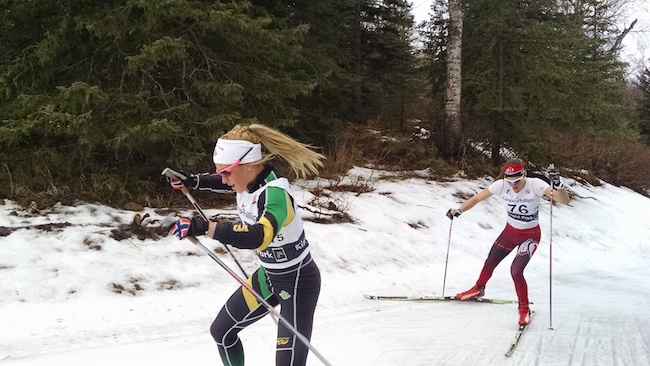
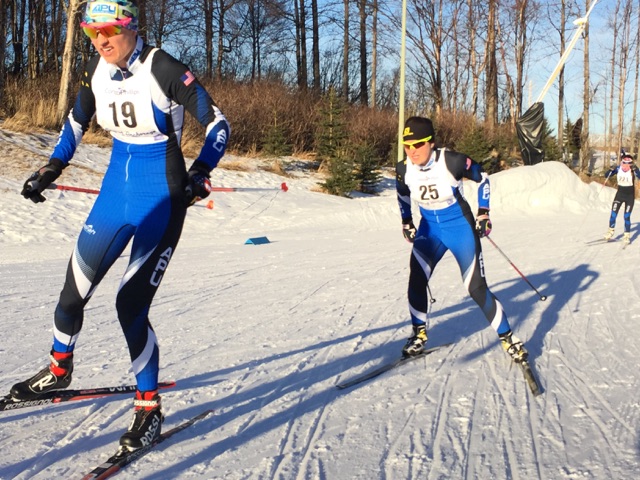
    APU teammates Lauren Fritz (l) and Holly Brooks racing for the win at the 2016 Anchorage Tour in Kincaid Park on March 6. Brooks won and Fritz placed second. (Photo: Rob Whitney)
    APU teammates Lauren Fritz (l) and Holly Brooks racing for the win at the 2016 Anchorage Tour in Kincaid Park on March 6. Brooks won and Fritz placed second. (Photo: Rob Whitney)

    ANCHORAGE, ALASKA – A first-time racer and a former champion returning after a long absence skied to convincing victories in the Anchorage Tour Festival 30-kilometer race, née Tour of Anchorage 50 k, at Kincaid Park on Sunday. David Norris, last seen coming out of a group sprint to win the American Birkebeiner two weeks ago, and Holly Brooks, previously seen in two Olympic games but not at this race since 2009, each won by roughly three minutes on a sunny morning at Kincaid.

    The Tour of Anchorage is traditionally a 50-kilometer, point-to-point race, ranging from the Chugach foothills on the east side of town to Kincaid Park at the west edge of the Anchorage metropolitan area.  In between, racers traverse ski trails, city greenbelts, and bike trails until they reach the Coastal Trail multiuse trail, at which point they cover 15 k along the shores of the Pacific Ocean before ascending a hill to finish at Kincaid.  It is truly a tour through the heart of Anchorage.

    This year’s race, like every other race held under the auspices of the Nordic Ski Association of Anchorage (NSAA) in this snow-sparse winter, occurred exclusively on the snowmaking loop centered on the Kincaid Stadium.  This year’s Tour presented 10 laps around a 3 k course, making for a 30 k freestyle race.  It was more a Tour of the Snowmaking Loop than a Tour of Anchorage.  Conditions on the course were very good at the outset, with recent fresh snow mixed into a solid base of manmade snow, though the steepest uphills and downhills broke down into sugar snow over glare ice by midway through the race.
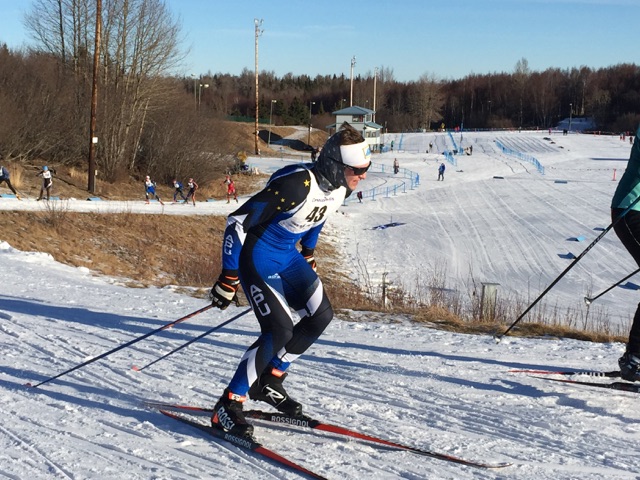
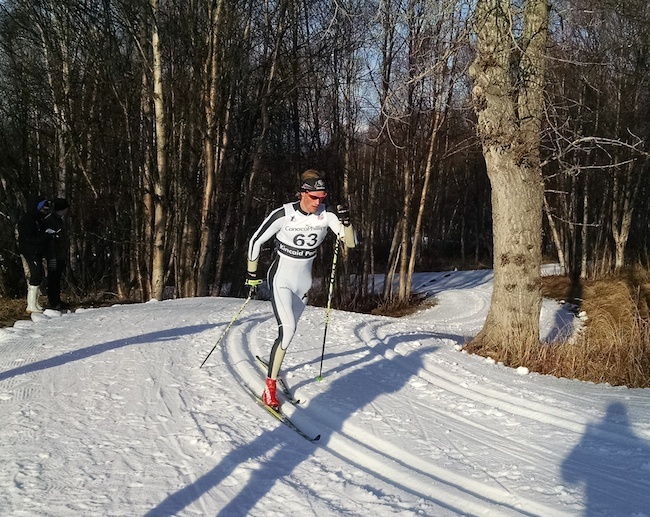
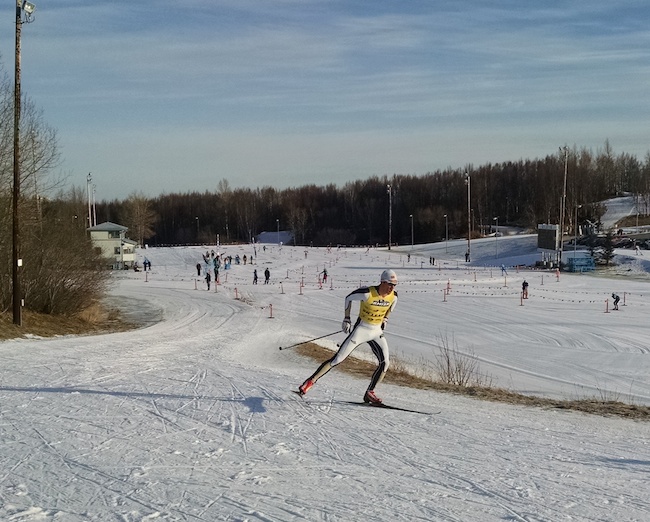
    David Norris (APU) racing to his first Anchorage Tour win at Kincaid Park on March 6. (Photo: Rob Whitney)
    David Norris (APU) racing to his first Anchorage Tour win at Kincaid Park on March 6. (Photo: Rob Whitney)

    Norris, who skis for Alaska Pacific University (APU) and who won the men’s race by nearly three minutes in 1:14:51.0, seemed undeterred in his first time racing the Tour of Anchorage.  In an email, he wrote, “This would have been my first year to do the actual Tour. … Due to the low snow year I was glad to have the Tour Festival 30km race on the manmade loop. I am glad the NSAA hosted the event even though we couldn’t do the formal course.”

    The men’s podium was all APU blue.  Jack Novak was second in 1:17:32.9.  Andre Lovett followed roughly a minute later in 1:18:27.9.

    Norris skied most of the race by himself, after breaking away from Novak late in the first lap.  Norris wrote of his race strategy, “I went out hard from the start to practice that kind of effort. Jack stayed with me for almost the entire first lap before settling in.”

    Norris had no other immediate competitors for the remaining nine laps and 27 k.

    But with a field of 148 skiers on a 3 k loop (60 racers for the 30 kilometer race and 88 for the contemporaneously held 15 kilometer race), Norris had plenty of company out there.  As Norris graciously wrote, “I thought I skied steady and was able to re-accelerate through corners or after congestion due to all the different levels of racers on a short 3km loop.  I really apologize if I ever startled anyone while making a pass.  I tried to be really careful not to be a jerk while making passes today.”

    “I tried to be really careful not to be a jerk while making passes today.” — David Norris, after winning 2016 Anchorage Tour 30 k

    While Sunday was the first time in this race for Norris, a Fairbanks native, the 2016 Tour marked a homecoming of sorts for Anchorage’s Holly Brooks.  Brooks won the flagship 50 k Tour in both 2008 and 2009, at a time in her ski career when she was an APU coach first and a competitive skier second.  Better results, a spot on the U.S. Ski Team, and nomination to the 2010 and 2014 U.S. Olympic teams famously followed.  Brooks then spent last winter traveling the world, competing in the FIS Marathon Cup/Worldloppet series on three continents.  She is now pursuing a degree, buying a house, and likely training somewhat less.  But she is still winning ski races.

    Brooks, who remains affiliated with APU, finished first among the women in 1:24:46.1.  Her main competition came from fellow APU skier Lauren Fritz, who finished slightly less than three minutes back in 1:27:39.0.  Citizen racer Sally Hokanson was third in 1:40:21.4.

    While Norris went out hard from the start and gapped Novak early, Brooks and Fritz skied together for a majority of the morning.  Brooks started to pull away about three quarters of the way through the race, she recounted in an in-person interview.  

    “It might have been on lap 7 of 10.  It was on [the downhill on] the backside [of the course], because my skis were running pretty well,” she said. “I noticed I had a little bit of a gap.  I just put a few extra strides in and a good tuck and a big push, and opened up a little bit of a gap.”
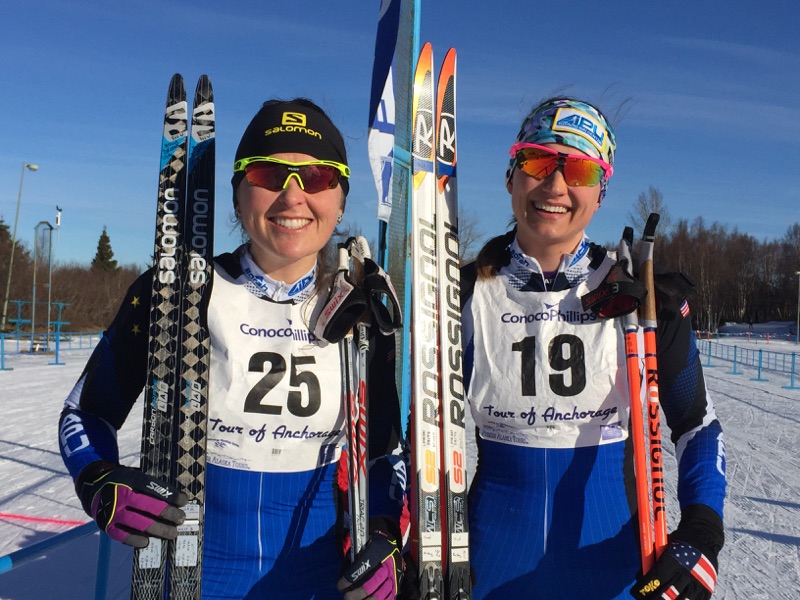
    Holly Brooks (l) and Lauren Fritz, both APU, after placing first and second, respectively, at the Anchorage Tour in Kincaid Park on March 6. (Photo: Rob Whitney)
    Holly Brooks (l) and Lauren Fritz, both APU, after placing first and second, respectively, at the Anchorage Tour in Kincaid Park on March 6. (Photo: Rob Whitney)

    Brooks kept her lead to the finish, aided by her own observations and splits from others.  

    “There’s a little out and back, where you can kind of get an idea if someone’s there or not, so I saw her there the first time after I’d made the move,” Brooks said.  “And then I got a couple of back splits after that that I had a little bit of a gap.”

    Brooks appreciated the chance to be back racing on home soil, after many winters spent skiing anywhere but in Alaska.  

    “It’s nice to be home,” she said.  “I had my husband out here giving me feeds, so that’s always fun, and a lot of local people out there on the course too.  There was a lot of traffic out there today, the 30 k and the 15 k on the same loop, and some of the downhills were a little sketchy with the traffic, but it was manageable.”

    A Kincaid lap race may not be particularly exciting, but it was certainly a change of pace from Brooks’ schedule last spring.  When asked where she had been one year ago this month, the peripatetic Brooks had to think for a while before answering.  

    “Last year I wasn’t home for another five weeks,” she finally said.  “Let’s see… I was at the Engadin this weekend last year I think.  And then after that I think there was the Norwegian Birkie. And then, I can’t remember if there was something between that and going to Siberia.  So, a much different year.”

    While Norris was racing the Tour for the first time, the rest of the day’s podium finishers were no strangers to this race.  Among the men, second-place finisher Novak won the race in 2015 (when it held as a criterium with a 50-minute time limit), and was third in 2014.  On the women’s side, second-place Fritz was also second in 2014.  And third-place Hokanson was second in the 2015 criterium, and (as Sally Johnson) won the 25 k classic race in 2008.

    So what are the winners’ plans for the rest of the season?

    “I will be training in Fairbanks until I leave for Spring Series in Vermont, which will conclude my season,” Norris wrote. “My season has progressed and I think I have made a good step forward. My goal at the beginning of the season was to earn a spot on the Canadian Tour World Cups, but with just average races in December and November I wasn’t able to secure a position.”

    Meanwhile, Brooks had upcoming spring marathon racing goals, including either the Kachemak Bay Nordic Ski Marathon in Homer or the Sonot Kkaazoot in Fairbanks. But as of early Sunday afternoon, standing in the Kincaid parking lot, the March sun finally taking the chill off what had been a brisk morning, she had more immediate plans.  “Oh, and I’m anxious for that sauna to get nice and hot,” she observed, gesturing toward a portable sauna that had been towed into the parking lot next to the beer garden.  “And the barrel hot tub.”

    Overall results

  • RMISA Season Concludes in Anchorage with Colorado Crowned Season Champs

    RMISA Season Concludes in Anchorage with Colorado Crowned Season Champs

    Colorado University's Mads Stroem on his way to victory in the 7.5 k classic race at Kincaid Park, part of the University of Alaska Anchorage Invitational held last week. (Photo: Tim Whiton)
    University of Colorado’s Mads Stroem on his way to victory in the 7.5 k classic race at Kincaid Park, part of the University of Alaska Anchorage Invitational held last week. (Photo: Tim Whiton)

    After a three-week break of racing after the University of New Mexico Invitational in Red River and the University of Colorado Invitational in Steamboat Springs, the Rocky Mountain Intercollegiate Ski Association (RMISA) shifted gears to sea level and the University of Alaska Invitational and this year’s RMISA Championships. The UAA Invite was originally scheduled to be held at Girdwood, but a lack of snow and an abundance of cold rain moved all four of the final RMISA races to Anchorage.

    “Seven days ago at this time, we didn’t have hardly any snow on the ground and we were in the middle of three days of steady rain,” the UAA team wrote on their blog this weekend. “We’d scrapped our original plan to race our first two (of four) races on the new Girdwood racing trail because there was no snow at all in Girdwood. Not even a thin film of ice. Just brown dirt and gray rocks. Skis hardly glide on that kind of surface.”

    Cambria McDermott of Montana State, who would eventually finish eighth, leading Emilie Cedervärn in the interval-start 5 k skate held at Hillside.
    Cambria McDermott of Montana State, who would eventually finish eighth, leading Emilie Cedervaern in the interval-start 5 k skate held at Hillside. (Photo: Tim Whiton)

    Despite the wet weather that greeted most teams on Saturday’s arrival, races began on Monday, Feb. 23, at the Hillside Nordic trails with 5- and 10-kilometer skate races for women and men respectively. The course was fully saturated with some standing water, dirt, and icy uphills. Using the Spencer loop as the beginning of the course, racers faced a challenging climbing section for roughly two kilometers before a slow, grinding descent past the start, and two kilometers of short, steep uphills and downhills before the finish.

    As much of the season has gone, the University of Colorado’s duo of Mads Strøm and Rune Ødegård paced the men’s field. Ødegård won the 10 k in 25:18.6, after starting slowly and speeding up on the second lap, with Strøm nipping University of Utah’s Niklas Persson by two-tenths of a second in 25:26.4. The rest of the men’s top ten was over thirty seconds back, but tightly bunched together despite the tough conditions and hilly course.

    Race winner Rune Ødegård of Colorado University leads Michael Fehrenbach of University of Alaska Fairbanks in the 10 k skate at Hillside. Fehrenbach placed 16th. (Photo: Tim Whiton)
    Race winner Rune Oedegaard of the University of Colorado leads Michael Fehrenbach of University of Alaska Fairbanks in the 10 k skate at Hillside. Fehrenbach placed 16th. (Photo: Tim Whiton)

    In the women’s 5 k race, University of New Mexico’s Emilie Cedervärn led New Mexico to the team win over Utah. Cedervärn won in 14:46.9 to Utah’s Veronika Mayerhofer’s 14:58.9 and New Mexico’s Eva Severrus’ 15:11.5. Much of the women’s top ten was strung out, finishing less than a minute out of the lead.

    After the first day of racing, the University of Utah led the University of Colorado by eight points.

    With the skate races finished, it was obvious the Hillside courses would not allow for another day of racing. With a return of freezing temperatures Monday evening, the trails turned to a sheet of ice and Tuesday’s races were tentatively postponed to Wednesday with the prospect of shifting even to Thursday depending on how Kincaid park, the site of the weekend’s RMISA Championships looked in the morning.

    Conditions at Kincaid Park were not always ideal, but organizers and racers made the best of things. (Photo: Tim Whiton)
    Conditions at Kincaid Park were not always ideal, but organizers and racers made the best of things. (Photo: Tim Whiton)

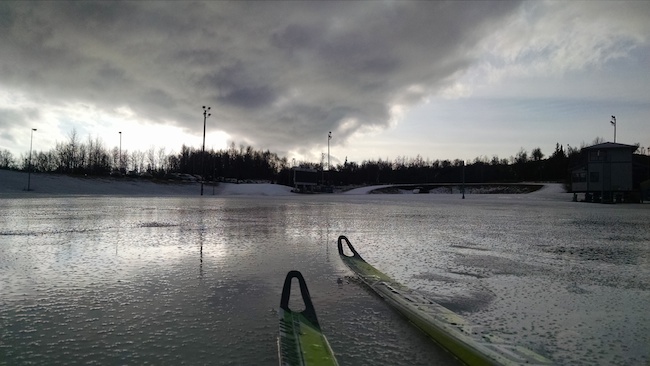
    Luckily, Kincaid did manage (mostly) to freeze over night. The traditional stadium remained under water so the courses focused on short 2.2 k loops starting and finishing in the biathlon stadium and racing resumed on Wednesday morning with five and seven and a half kilometer classic races. Despite aggressive grooming, the course was mostly chunked ice and sugar, resulting in fast times and challenging conditions.

    In the women’s race, Cedervärn made it two wins in a row in a time of 15:50 by beating  Mayerhofer, who had started wearing the yellow discipline leader bib. Mayerhofer’s 15:57.8 put her in front of teammate Sloan Storey’s 16:01.9 and UAA’s Manon Locatelli’s 16:06.1. The top four women were clearly in a league of their own, with a gap of 25 seconds between Locatelli and fifth-place Kathrin Schratt of UAA. However, after that it was again close racing for the women, with places five through nine separated by less than nine seconds.

    Storey’s third place finish was the only time in four days of racing in Alaska that an American skier stood on the podium in an RMISA race.

    Macjenzie Kanady of University of Alaska Anchorage, who finished seventh, and runner-up Veronika Mayerhofer of the University of New Mexico in the 5 k skate at Hillside. (Photo: Tim Whiton)
    Macjenzie Kanady of University of Alaska Anchorage, who finished seventh, and runner-up Veronika Mayerhofer of the University of  Utah in the 5 k skate at Hillside. (Photo: Tim Whiton)

    The men’s race saw the same top three from Monday’s race, but with a small shift. Strøm and Ødegård used some fine classic skiing to distance themselves, once again, from the men’s field. Strøm won in 20:22.2 and Ødegård finished second in 20:33.5. Persson finished third again in 20:57.4, just ahead of Clement Molliet of UAA. Places five through 18 were separated by only 35 seconds, making for some tight and exciting racing. Interestingly, four of the men’s top 10 raced the steep uphills on skate skis and double poling. Moritz Madlener of Denver University led the four in seventh place, while Montana State University’s threesome of Forest Mahlen, Erik Axelsson, and Martin Muan finished close together in 8th and tied for 10th respectively.

    After the two races of the UAA Invitational, the University of Utah won the team competition on the nordic side with 351 points to the University of Colorado’s 319. University of New Mexico rounded out the top three teams with 299 points. Combined with alpine, Utah took overall top honors.

    UAA Invitational Results: men & women at Hillside / men & women at Kincaid / overall scores

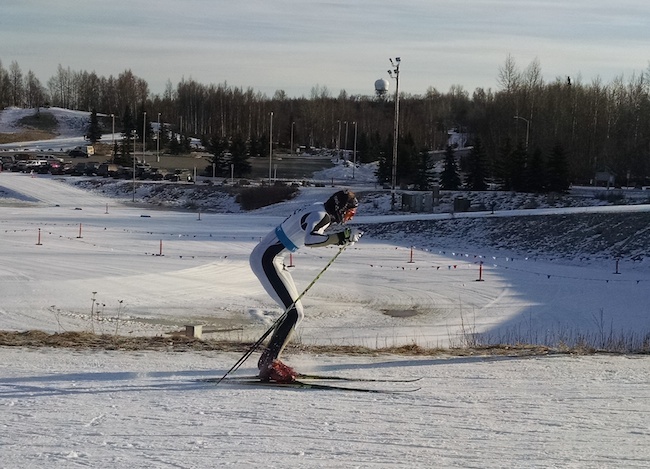
    CU's Rune Ødegård racing to second place in the 10 k skate at Kincaid Park as part of RMISA Championships. (Photo: Tim Whiton)
    CU’s Rune Oedegaard racing to second place in the 10 k skate at Kincaid Park as part of RMISA Championships. (Photo: Tim Whiton)

    After a training day at Kincaid on Thursday marked by late morning grooming that left the track soft and sugary, RMISA regional championships commenced on Friday with 5/10 k skate races. Thankfully, the Kincaid groomers did incredible work which, coupled with overnight lows around 15 degrees, made for a first and fast track. The extensive work allowed for an increase in track length to 3.7 k with several short, steep climbs and limited rest.

    Strøm made quick work of the challenging three lap course and stormed to a nearly twenty second victory in 22:49.3 over his teammate Ødegård’s second place 23:08.1. One second behind was Denver University’s Dag Frode Trollebø. Just as in the classic race on Wednesday, places four through 17 were separated by 35 seconds. The women’s race saw domination by New Mexico’s Cedervärn and Severrus. Cedervärn won the lap and a half course in 13:40.5 ahead of Severrus in 13:49.3 and Colorado’s Petra Hyncicova’s 13:51.1.

    Unfortunately, Anchorage, as it has much of the year, did not see very cold temperatures and come Saturday morning the track was soft and quickly turned into a loose mealy ice. Nevertheless, great racing occurred on the same courses at Kincaid with 15/20 k classic mass start races.

    The women raced first on a slightly longer course and the lead pack of seven stayed tightly bunched through about halfway despite some aggressive skiing. Early on the third lap, Cedervärn made a hard push on the steep climbs, breaking apart the field, and dropping everyone except Utah’s Mayerhofer. Despite a gritty chase, Mayerhofer lost time on the final lap and Cedervärn won in 42:35.3 with Mayerhofer in 42:59. UAA’s Locatelli finished strong in third in 43:10.8.

    Mads Strøm of CU became the RMISA Champion in the 10 k skate at Kincaid Park in Anchorage. (Photo: Tim Whiton)
    Mads Stroem of the University of Colorado was the RMISA Champion in the 10 k skate at Kincaid Park in Anchorage. (Photo: Tim Whiton)

    The men’s race, despite the end result, was quite different and more exciting than any other race this season.

    A large pack 11 formed on the first of six laps and stayed bunched together through four laps. Several skiers made hard pushes to get off the front and ski away, but the fast conditions, lack of long uphills, and strong drafting made the chase pack very strong. Aku Nikander of New Mexcio was aggressive in covering many of the attacks and Ødegård of Colorado also brought the race back together several times.

    Ultimately, the race came down to the last lap with Colorado’s Ødegård and Strøm attacking the uphills and creating some separation. Nikander continued to fight and managed to solidify a podium spot partway through the lap by closing down the gap several times. The three were together in the last climb, but the CU boys made a gap on the final downhill and rise into the stadium, distancing Nikander by two seconds at the finish.

    In the last hundred meters, Ødegård, visibly tiring from pushing the pace hard for the last two laps, was overtaken at the line by Strøm by three tenths of a second. The men finished in a blistering 50:20 for the over-21 kilometers. The rest of the men’s top ten was within 45 seconds of the lead.

    With final scores for RMISA Championships tabulated, Colorado won the nordic standings with 337 points to New Mexico’s 324 and Utah’s 295; CU also took the overall title, this time over New Mexico.

    Results from RMISA Championsips: men & women classic / men & women skate / overall standings

    The Western schools are looking forward to heading east shortly for NCAA’s. After racing at sea-level for a week, the RMISA skiers are psyched for some fast skiing and ready to see how the other divisions are skiing. Mostly though, they are all hoping for some cold snow and extra blue skiing, something not seen out west yet this season!
  • Lickety-Splits Camp Connects Anchorage Kids, Top Athletes

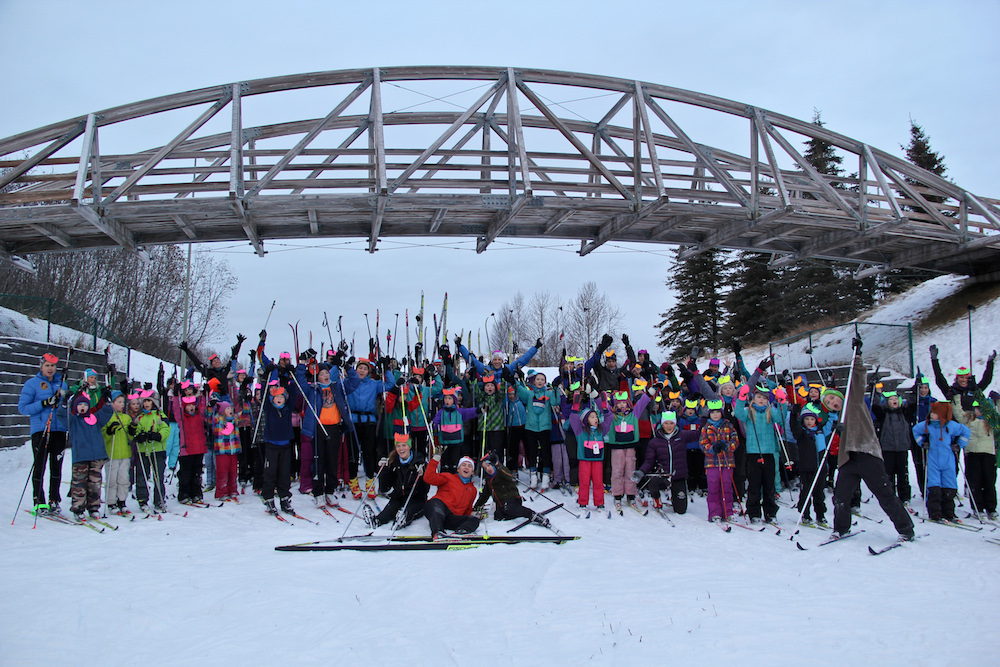
    Kids excited to ski at the start of the day at the fourth-annual Lickety-Splits Ski Camp for Kids on Dec. 22 in Kincaid Park in Anchorage, Alaska. (Courtesy photo)
    Kids excited to ski at the start of the day at the fourth-annual Lickety-Splits Ski Camp for Kids on Dec. 22 in Kincaid Park in Anchorage, Alaska. (Courtesy photo)

    Last Monday, 150 bright-eyed kids got a chance to ski with 23 top US athletes at the 4th Annual Lickety-Splits Ski Camp for Kids.  The camp offered the opportunity for kids to spend the afternoon playing games and learning to ski from some of the best skiers in the country.

    Tyler Kornfield, the founder of Lickety-Splits, noted “This year’s camp was the best yet. Since the beginning, we have had between 100 and 140 kids [per year] and this year, we had a record of over 150.”

    The Lickety-Splits camp is a way for elite Alaskan athletes to give back to the community and get kids excited about skiing, Kornfield explained.  “Among the coaches, eight ski professionally, 19 skied or are skiing in college, and they represent many of the ski clubs in Alaska.” Kornfield himself is a two-time US National Champion and professional athlete with the Alaska Pacific University Nordic Ski Center.

    Konfield noted “The priority of the camp was to get the kids outside and having fun while having solid role models to look up to.”  The camp was free to attend, and open kids ages 7-13.

    Lickety-Splits focuses on a younger age range than Fast and Female, and unlike Fast and Female, is open to both boys and girls.

    “When I was planning and starting Lickety-Splits, I based a lot of it off of Fast and Female because they do an amazing job. The priority of my camp was to get the kids outside and having fun while having solid role models to look up to.”

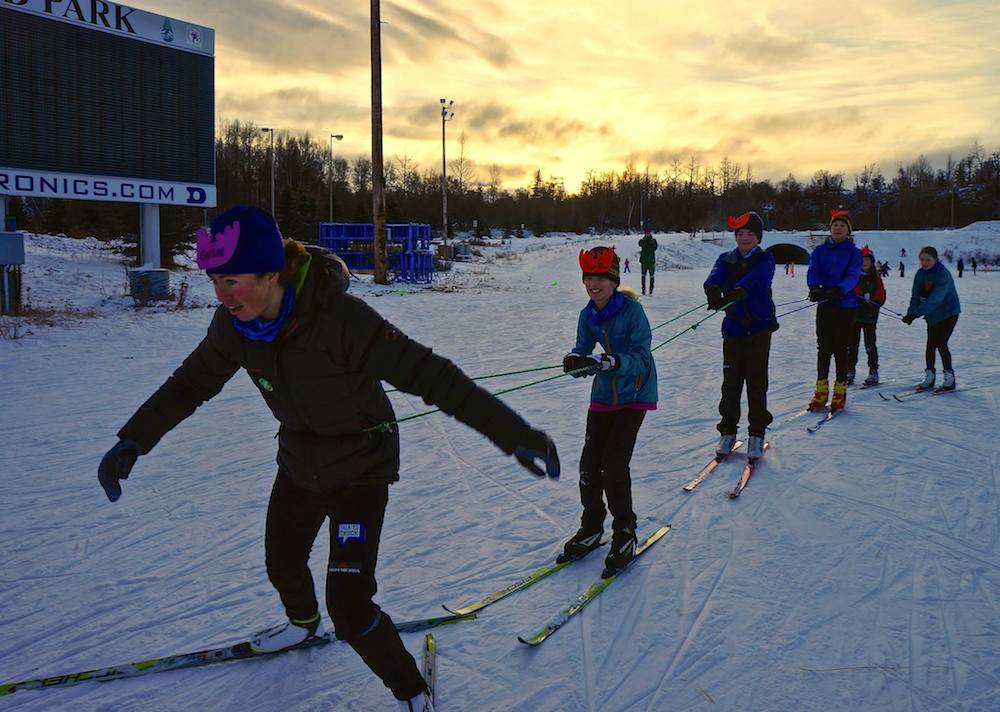
    Caitlin Patterson (Craftsbury GRP) pulls a train of happy skiers at the mushing station  at the fourth-annual Lickety-Splits Ski Camp for Kids on Dec. 22 in Anchorage, Alaska. (Photo: Lickety-Splits)
    Caitlin Patterson (Craftsbury GRP) pulls a train of happy skiers at the mushing station at the Lickety-Splits Ski Camp for Kids on Dec. 22 at Kincaid Park in Anchorage, Alaska. (Photo: Lickety-Splits)

    At the camp, the kids practiced technique, played games, and even participated in a mini race.  Lex Treinen, also an athlete with APUNSC, was the coach of the uphill/downhill station where kids learn basic climbing technique and practiced slalom turns on the descents.

    “My favorite part of doing this is meeting all the kids, seeing their excitement for skiing, and helping inspire the next generation of athletes”

    Kornfield’s goal, ultimately, it to get more kids interested in skiing early on.   “This is a crucial age group for getting them excited to ski before moving on to middle school and high school.”

    Kornfield himself followed that path, skiing with Alaska Winter Stars, UAF, and ultimately APU.  “We designed the camp to connect kids with more athletes like me who came up the same pipeline.”

    The camp is slated to be held again next year in mid-December.

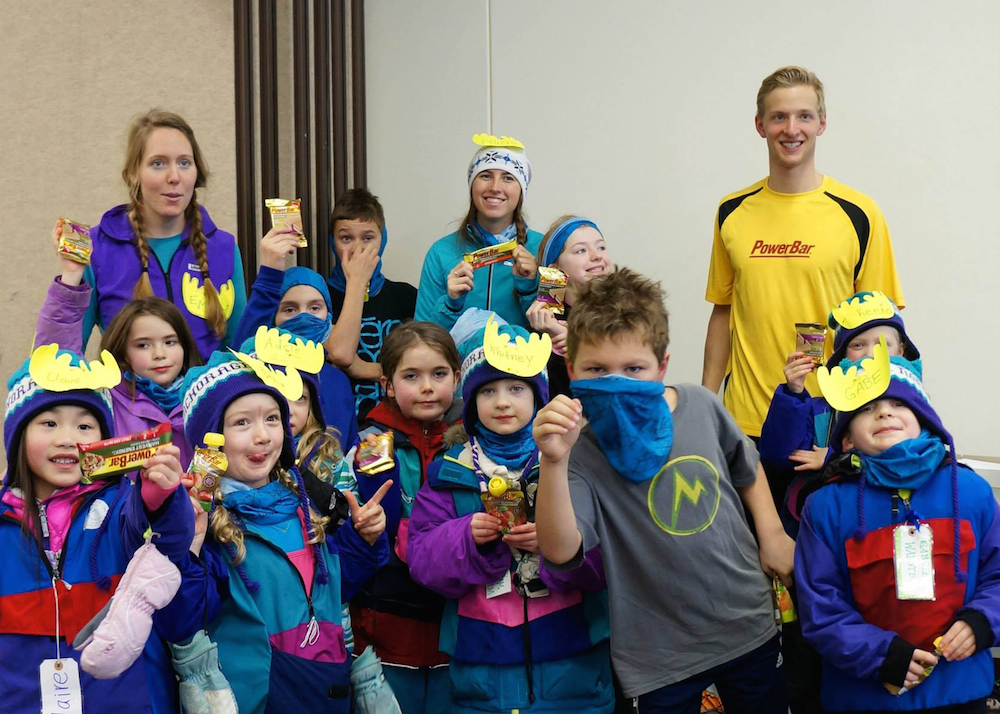
    Eric Packer and a group of kids enjoy some recovery food at the end of the ski at Lickety-Splits Ski Camp for Kids on Dec. 22 in Anchorage, Alaska. (Courtesy photo)
    Eric Packer and a group of kids enjoy some recovery food at the end of the ski at Lickety-Splits Ski Camp for Kids on Dec. 22 in Anchorage, Alaska. (Courtesy photo)
  • Wednesday Workout: Sand Dune Sprints with UAA Ski Team (with Video)

    Wednesday Workout: Sand Dune Sprints with UAA Ski Team (with Video)

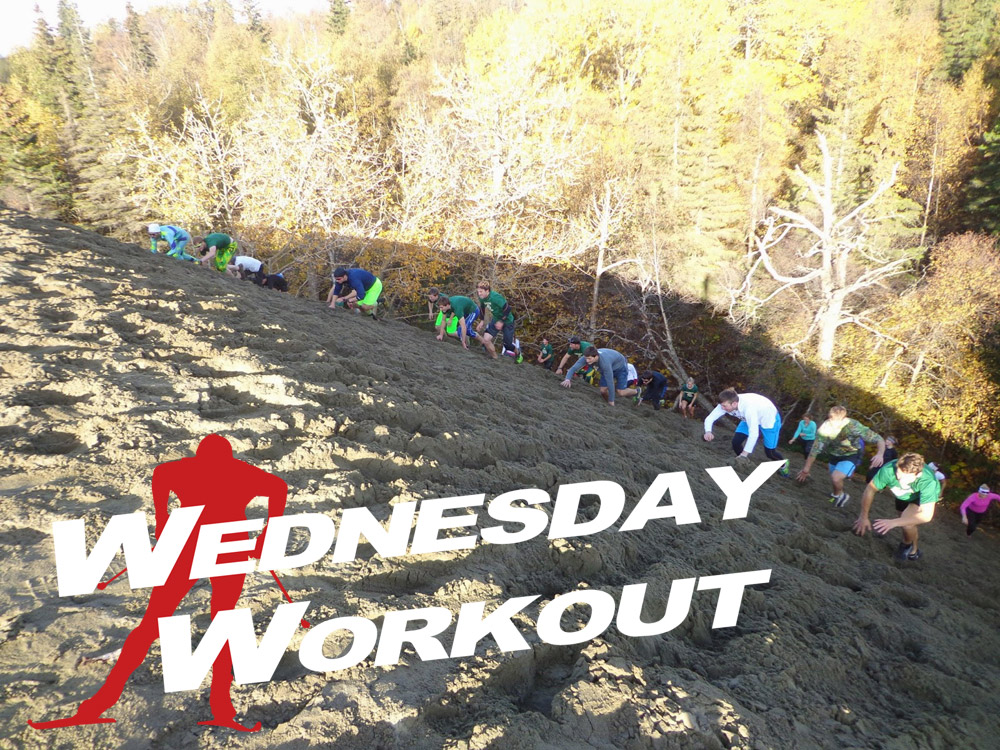
    The UAA nordic and alpine teams go head to head in the sand-dune sprints at Kincaid Park in Anchorage, Alaska. (Photo: Adam B. Verrier)
    The UAA nordic and alpine teams go head to head in the sand-dune sprints at Kincaid Park in Anchorage, Alaska. (Photo: Adam B. Verrier/UAAnordic.blogspot.com)

    The following workout comes from Andrew Kastning, head coach of the University of Alaska Anchorage (UAA) nordic team. Twice each fall, the university’s nordic and alpine teams converge on their favorite sandbox on their picturesque coast for a sufferfest of sand-dune sprinting. “The family that plays together stays together and the ski team that suffers together can win together,” Kastning explains. 

    Want to submit your favorite workout, or one of your team’s? Email info@fasterskier.com with the subject line: ‘Wednesday Workout’.

    ***

    Sand Dune Sprints, UAA from Andrew Kastning on Vimeo.

    ANCHORAGE, Alaska — On the far southwestern edge of Kincaid Park in Anchorage, AK there is a large sand dune that is growing into the forest. When high winds sweep along Turnagain Arm they deposit soft sand and silt in a quarter square mile area that offers a fantastic place to do some running intervals. In collegiate skiing, teams that are fighting for an NCAA Championship offer both Alpine and Nordic skiing to men and women.

    Other than the fact that we both slide on snow, Alpine athletes and Nordic athletes are a very different breed; from their physical shape to their mental obstacles, you cant find much in common across the two disciplines. Yet at the end of the day, our team scores are combined to one total in the final standings, so it’s important to know we all have the same goals. Once in a great while we can suffer together in workouts and the Kincaid Dunes offers the perfect venue!

    For video of the sand-dune sprints, click here.

    Alpine athletes continually work in the anaerobic zone, and Nordic athletes need to tune up speed and quickness. What better way than with hard running in soft sand?

    The UAA Ski Team does this workout twice each fall, with different formats. Last week we did the first one consisting of 12 x 20-30 second sprints. On the north side of the dune is much steeper and softer and gets the quad muscles flooded quickly as you try to be the first one to the top. The south side offers a little firmer surface and not as steep which can burn the legs and lungs as you try to be the first to the line drawn in the sand.

    We did six sprints on each side and saw four people, three Alpine, one Nordic, lose their breakfast by the end! The Alpiners usually win the first few sprints but the endurance training of the Nordics kick in about halfway through the workout.

    In two weeks we will conquer this dune again but with a pyramid-style format, 6 x 10 sec, 3 x 30 sec, 1 x 60 sec on the firmer side, then 3 x 30 sec up and over the softer side, finished off with 6 x 10 sec back on the firmer side. The family that plays together stays together and the ski team that suffers together can win together.

    To review: 

    First competition: 12 x 20-30 second sprints (with six sprints on one side of dune, six sprints on the other for different terrain, surfaces and muscle sensations)

    Two weeks later…

    Second comp: Pyramid-style: 6 x 10 seconds, 3 x 30 seconds, 1 x 60 seconds on the firmer side of the dune. Then 3 x 30 seconds up and over softer side, and finally 6 x 10 seconds on the firmer side


  • U.S. Ski Team Women and Men Among the Masses at Alaska Training Camp

    U.S. Ski Team Women and Men Among the Masses at Alaska Training Camp

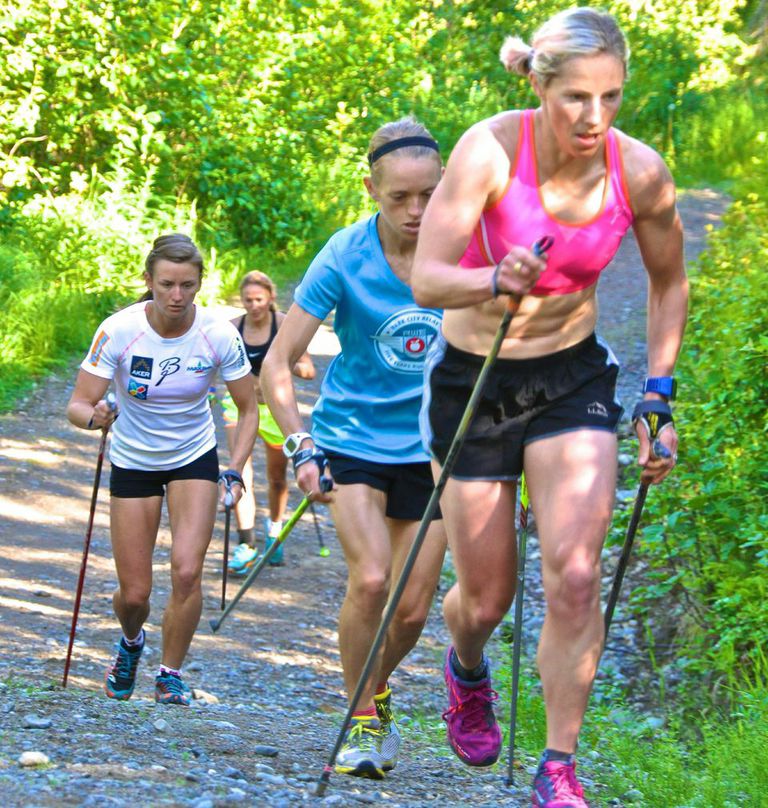
    Alaska Pacific University's Kikkan Randall (r) leads fellow U.S. Ski Team member Liz Stephen and Norway's Celine Brun-Lie (l) during a dryland session last week in Anchorage, Alaska, part of the North American Women's Training Alliance. (Photo: Matt Whitcomb)
    Alaska Pacific University’s Kikkan Randall (r) leads fellow U.S. Ski Team member Liz Stephen and Norway’s Celine Brun-Lie (l) during a dryland session last week in Anchorage, Alaska, part of the North American Women’s Training Alliance. (Photo: Matt Whitcomb)

    Watch out Dachstein, Stelvio and Oberhof — there’s a new summer hotspot for nordic skiers in the Northern Hemisphere, and for Americans, it doesn’t require a passport.

    While Eagle Glacier has been around since the Little Ice Age hundreds upon hundreds of years ago, its Thomas Training Center — contracted to the Alaska Pacific University (APU) nordic team — has only been around since the late 1990s.

    According to the U.S. Forest Service, it was created to help American nordic skiers reach international success. Build it and they will come.

    APU teammates Eric Packer (l) and Erik Bjornsen enjoy a clear day for training on Eagle Glacier near Girdwood, Alaska. (Photo: http://blogs.fasterskier.com/reesehanneman/)
    APU teammates Eric Packer (l) and Erik Bjornsen enjoy a clear day for training on Eagle Glacier near Girdwood, Alaska. (Photo: Reese Hanneman)

    At a given time, APU can put about 20 athletes on the glacier for each of its weeklong camps. There, at 5,500 feet and a 10-minute helicopter ride above sea level, skiers can log quality volume training amounting to several hours a day on snow. And they can get a taste of what the 2015 World Championships courses in Falun, Sweden, will be like.

    Just like last year, when APU put hours of GPS-mapping and grooming in to mimic the Sochi Olympic courses on Eagle Glacier, they’ve done it again — and APU Head Coach Erik Flora likes this loop better.

    “I think this is the best course we’ve ever built,” he said on the phone from Anchorage last week. “Sochi was interesting: one long time out of the bottom and that takes a lot out of the course. … There’s no less climb in this course, but it’s broken up a little bit. We probably spent eight to ten hours with the PistenBully mapping out the course in the snow.”

    That involved Flora and his team of coaches and wax techs (Dylan Watts, Don Haering, and Michael Matteson) making countless tracks and turns with the groomer, then getting out to ski them to see how each flows. They used a GPS to check their distance and measure grade.

    “The best part about it is when you get it in the snow and you get your camps up there and you see the changes,” Flora said.

    While APU hosts several of its own exclusive camps on its backyard glacier each spring, summer and fall, it’s also opened it up to other groups of elite skiers.

    “I think that’s the biggest change that I’ve seen,” Flora said, reflecting on his six years as APU’s nordic director. “We do have a team, but we also have an open door for anyone to come out and train with us.”

    Sun Valley's Chelsea Holmes (l) and Jessica Yeaton, who recently graduated from Montana State University and is now skiing for Australia, during a training run with the North American Women's Training Alliance in Anchorage, Alaska. (Photo: Matt Whitcomb)
    Sun Valley’s Chelsea Holmes (l) and Jessica Yeaton, who recently graduated from Montana State University and is now skiing for Australia, during a training run with the North American Women’s Training Alliance in Anchorage, Alaska. (Photo: Matt Whitcomb)

    From July 6-20, APU is hosting the North American Women’s Training Alliance (NAWTA): 13 women from across the U.S. and one Norwegian.

    In addition to the five U.S. Ski Team women (Sadie Bjornsen, Sophie Caldwell, Jessie Diggins, Kikkan Randall, and Liz Stephen), Norway’s Celine Brun-Lie joined the two-week camp as NAWTA’s international guest. Last year, they hosted Astrid Jacobsen.

    Then there’s two-time Olympian Holly Brooks and her APU teammates (in addition to Bjornsen and Randall) Rosie Brennan, Rosie Frankowski, Becca Rorabaugh, and Lauren Fritz. Erika Flowers (Stratton Mountain School T2), Chelsea Holmes (Sun Valley Gold Team) and Caitlin Gregg (Team Gregg) are also up on the glacier with the select training group.

    Three French biathletes — one of which recently retired — have also been in Anchorage training with these women, along with Stephanie Kirk, an APU training partner and University of Vermont skier, and Jessica Yeaton of Australia.

    Marie-Laure Brunet, who announced her retirement early last month, stayed with APU in May, along with Marine Bolliet, a current French biathlon national team member, who trained with the team in late May and June. Bolliet stuck around for one dryland day with the U.S. Ski Team (USST) last week before flying back for another camp in France.

    The two women came to town to visit their former teammate Marine Dusser, a current University of Alaska-Anchorage skier and Erik Bjornsen’s girlfriend.

    Sadie Bjornsen explained that having them around made for a “mini-France” up in Alaska, which she welcomed because “there is always something to learn from other athletes of other countries,” she wrote in an email. “We have had lots of time to talk about the way we train, how we approach training, and how we keep things fresh.”

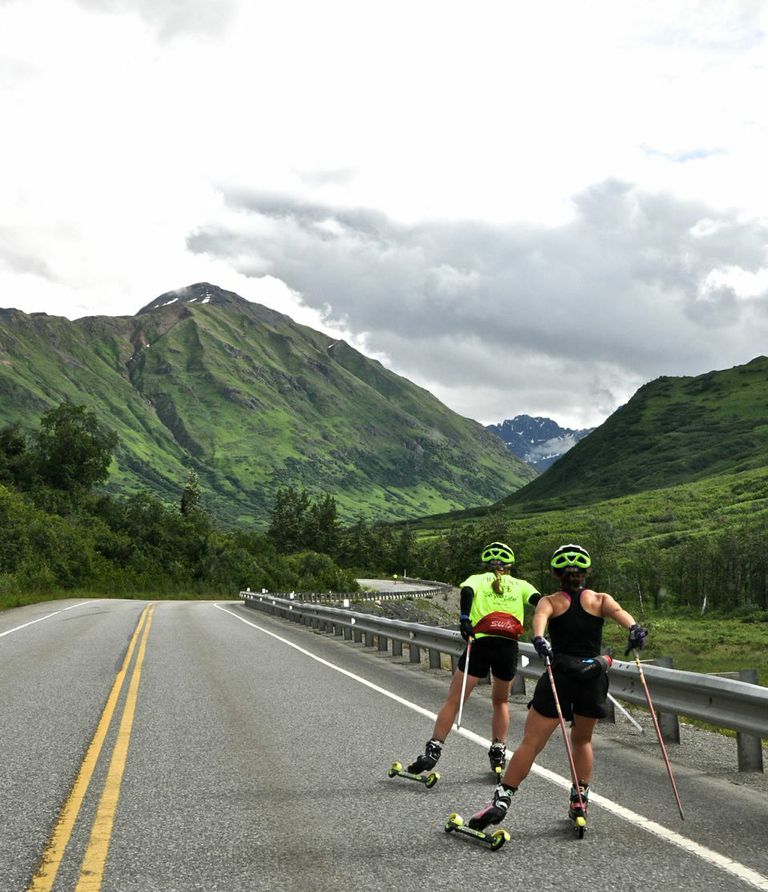
    Two members of the North American Women's Training Alliance during a skate rollerski near Anchorage, Alaska. (Photo: Matt Whitcomb)
    Two members of the North American Women’s Training Alliance during a skate rollerski last week near Anchorage, Alaska. (Photo: Matt Whitcomb)

    Last Monday, the 14 women with the fourth-annual NAWTA started their Alaska camp with a week of dryland and rollerski training in places like Kincaid Park in Anchorage. And with people like Bolliet, Dusser, Kirk, Yeaton, and up to 70 others training with them on certain days, one would be hard pressed to find that many rollerskiers in one place anywhere else in the world right now.

    That scene left Flora talking excitedly about the rising interest in Anchorage as a training hub. He’d seen 40 athletes rollerskiing along Kincaid’s hillside before, but 70?

    “That’s by far the largest,” he said. “It’s becoming like a training center. On any given day you can have someone pop out that was a former World Cup medalist and … and having Celine with us, it’s the same thing. She joined us for our APU strength [session] the other night. She joined like it was just like her training club.”

    The U.S. women’s team invited Brun-Lie to the camp, as it had with past guests, including Finland’s Aino-Kaisa Saarinen and Canada’s Perianne Jones and Chandra Crawford.

    “She’s been a friend of our team for a couple years now so we knew what we’d be getting when she decided she’d like to join us,” USST women’s coach Matt Whitcomb explained of Brun-Lie in an email. “She’s about as nice as they come and brings with her not just World Cup podium experience, but some of the smoothest technique on the World Cup. She rides a ski like Sophie and brings a ton to our group. Norway is lucky to have her on their team. We’ll do our best to send her home a bit faster as well.”

    U.S. Men Arrive

    And while his women’s team transitioned from dryland intensity to on-snow training on Eagle Glacier this past weekend, the U.S. men’s team started camp in Anchorage today for the first time as a unified group (Noah Hoffman had trained there previously, along with APU’s Erik Bjornsen). They’ll head up to the glacier next week.

    The men’s training group includes 14 athletes as well, five of which are on the USST: Hoffman, Andy Newell, Simi Hamilton, Bjornsen, and Ben Saxton. APU skiers Reese Hanneman, David Norris, Lex Treinen, Tyler Kornfield, Eric Packer, and Scott Patterson were also invited, along with APU training partners Tucker McCrerey and Kyle Bratrud, and Brian Gregg (Team Gregg).

    As for the goals of this men’s camp (led USST Head Coach Chris Grover and assisted by USST coach Jason Cork, Flora, and Matteson), Grover wrote that they’re shooting for “high-quality training” in the form of four to five intensity sessions while in Anchorage, “followed by some of the biggest volume of the season on-snow on Eagle Glacier.”
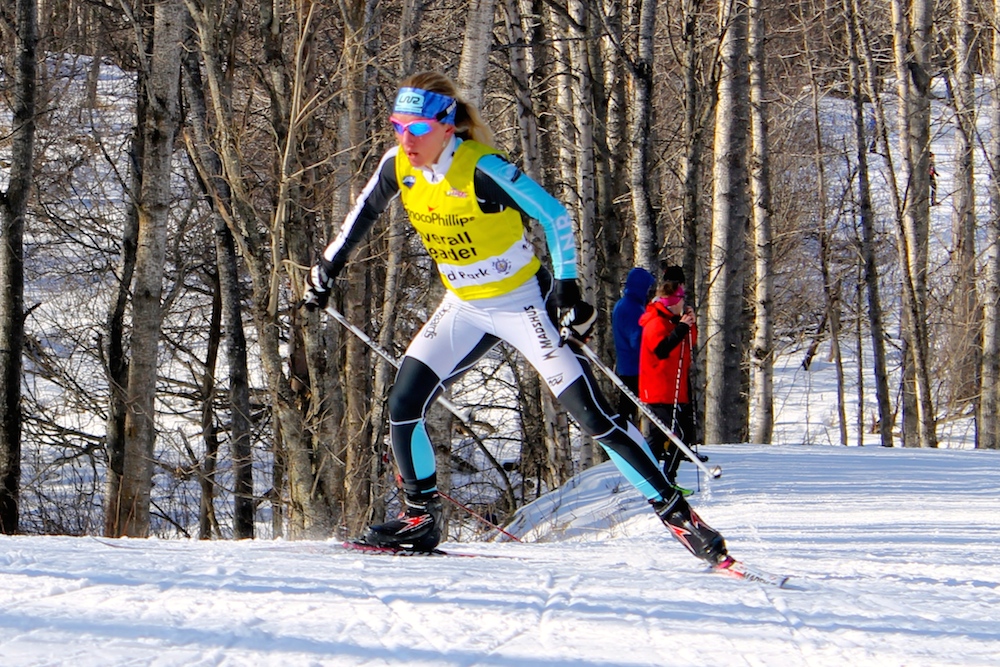
    Celine Brun-Lie (l) leads Sophie Caldwell (c) and Rosie Brennan during a dryland session last week in Anchorage, Alaska, part of the North American Women's Training Alliance. (Photo: Matt Whitcomb)
    Celine Brun-Lie (l) leads Sophie Caldwell (c) and Rosie Brennan during a dryland session last week in Anchorage, Alaska, part of the North American Women’s Training Alliance. (Photo: Matt Whitcomb)

    Also assisted by Cork and Flora, Whitcomb explained that the primary goal of the women’s camp “is to get the best women in the country together to train hard for fourteen days – just like the rest of our camps.”

    Specifically, they’re aiming to become “just 1 or 2% faster each season,” which is where a competitive training atmosphere comes in handy.

    “The aging model of training on your own for most of the preparation period is just not something I believe in,” Whitcomb wrote. “If you want to be stronger, you must surround yourself in strength.”

    While he acknowledged there are exceptions, they’re rare.

    “If you’re comfortable in every training session you’re either plateauing or slowing down,” he explained. “We put ourselves in vulnerable situations where failure is a real possibility.  That’s how we succeed.  It’s the training group itself that does its own coaching. The athletes receive feedback relative to the group in just about every aspect of training.”

    Week 1 and Done

    After the first week in Alaska, Whitcomb wrote that it was too early to compare the quality of training sessions compared to those in the past.

    “The volume will be high [this] week so we’ll see how training is being absorbed soon enough,” he wrote. “It becomes fairly binary by Thursday.  It is or it isn’t. Week one has been a success. Mostly because we saw that awesome bear.”

    During a run, the group spotted a grizzly bear about 300 meters ahead on a hill — well off the trail.

    “It was sleeping in a meadow and popped up its head, stood up to talk a look at us, and walked away,” Whitcomb wrote. “We were well armed with bear spray if needed.”

    Luckily, they didn’t need it, but in an unrelated incident, Diggins had to get six stitches in her knee. According to Whitcomb, she tripped on her way to a swimming hole after a long skate rollerski at Hatcher Pass.

    “She’s on the tougher side of the spectrum and had to only modify one workout by changing it from a run to a hike,” he wrote. “Her knee is stiff and a bit sore but training is still going well.”

    As for other USST injuries, doctors cleared Caldwell for full training after she sustained a minor elbow fracture at the last training camp in Bend, Ore.

    “Her range of motion has a bit more to go but I’ve been really pleased with the work she has done between camps with SMS T2,” Whitcomb explained. “Her legs are stronger and working technically better as a result of so much no pole and one pole training. She’s never really skipped a beat.”

    According to Whitcomb, Erik Bjornsen’s back injury is recovered, and Newell’s back is “much better” after he tweaked it while weightlifting.

  • Just Like Old Times, Randall Wins at Kincaid in SuperTour Finals Opener 10 k Skate

    Just Like Old Times, Randall Wins at Kincaid in SuperTour Finals Opener 10 k Skate

    Kikkan Randall (APU/USST) heads up Elliott's Climb in Kincaid Park at the end of the first of two laps on Saturday. She went on to win the 10 k freestyle individual start by 2.2 seconds on the first day of SuperTour Finals in Anchorage, Alaska.
    Kikkan Randall (APU/USST) heads up Elliott’s Climb in Kincaid Park at the end of the first of two laps on Saturday. She went on to win the 10 k freestyle individual start by 2.2 seconds on the first day of SuperTour Finals in Anchorage, Alaska.

    ANCHORAGE, Alaska — Liz Stephen had quite the task ahead of her on Saturday in the first race of 2014 SuperTour Finals. Kikkan Randall’s house guest for the week and her longtime buddy on the U.S. Ski Team, the 27-year-old from East Montpelier, Vt., started a minute behind Randall in the women’s 10-kilometer freestyle individual start at Kincaid Park.

    Usually, that would be fine, but when you hear cheers through the woods ahead of you and get splits that you’re right behind Kikkan, that you’re seven seconds down, one second down, it’s hard to know how to beat her.

    Stephen tried anyway, but at the end of the 27-minute race — which was actually 10.6 k on the two-lap course — Randall was the one who finished fastest in 27:27.1, by 2.2 seconds over Stephen in second.

    Alaska Pacific University’s leading veteran, Randall, 31, repeated her win in the 10 k distance from last year’s SuperTour Finals in Truckee, Calif. There, she won the 10 k classic by 36.6 seconds over her APU and USST teammate Sadie Bjornsen and finished 47 seconds ahead of Stephen.

    On Saturday, the 10 k skate was a favorite event for several on the U.S. Ski Team (with the exception of Sophie Caldwell, who finished eighth and smiling in one of her least-favorite races on her 24th birthday. She was greeted at the finish by nearly a dozen costumed competitors, including Randall in a tinsel wig and Stephen in an afro, somewhat contained by a ski headband).

    A few minutes earlier, Randall and Stephen had been just as gassed as most in the field at the finish, which ended on the winding uphill called Elliott’s Climb before an 80-meter straightaway into the World Cup stadium (a modified start and finish because of low snow).

    “I knew it was close,” Stephen recalled. She was down by 7.3 seconds to Randall after the first lap then two seconds a couple kilometers later.

    With 3 k to go, Stephen knew she had some climbing ahead — which was good for her. Randall’s strength was gliding, she reasoned, so Stephen went for it on the rolling (and sometimes-screaming) downhills and tried to ski relaxed, until the last time up Elliott’s.

    “On this final climb it was just head down and going,” Stephen said. “[Kikkan] got it and it’s great to see her win in her home state.”

    SuperTour leader Caitlin Gregg (Team Gregg/Madshus) clocks the fastest time through 5 k in Saturday's 10 k freestyle at SuperTour Finals in Anchorage, Alaska. She went on to place third.
    SuperTour leader Caitlin Gregg (Team Gregg/Madshus) clocks the fastest time through 5 k in Saturday’s 10 k freestyle at SuperTour Finals in Anchorage, Alaska. She went on to place third.

    While Randall had an edge on Stephen from start to finish, she was actually trailing Caitlin Gregg (Team Gregg/Madshus) by 3.6 seconds at the end of the first lap. However, Randall had little way of knowing; she started 5 1/2 minutes ahead of Gregg. (Stephen started ahead of her as well.)

    The 2014 American Birkebeiner freestyle champion, Gregg was also fresh off a flight from World Cup Finals in Europe. She arrived in Anchorage on Tuesday — one day before Randall and Stephen.

    While Gregg said her energy was good and wasn’t sure where she lost time on the second lap on Saturday, she credited Randall and Stephen as “great World Cup skiers” and was satisfied with third place, 20.9 seconds behind Randall and 4.1 seconds ahead of Bjornsen in fourth.

    “I always have really good skate races here in Anchorage,” Gregg said. “Whether it was at JO’s [Junior Nationals], NCAA’s, nationals twice, I qualified for the Olympics here in 2010 — for whatever reason, Alaska and I, Anchorage and I do great. I love the trails, I love the conditions, the crowds, it’s a good vibe.”

    When she and her husband, Brian, who placed ninth in the men’s 15 k, found out that Spring Series was going to be there, they couldn’t pass it up. Even after they raced more than ever this season — both domestically and internationally; Caitlin said she’s only had two weekends off since early October and has been back and fourth to Europe twice.

    “Even after our crazy long season, we were like, ‘Oh man, that is gonna be awesome,’ ” she said. “We went for an afternoon jog at nine o’clock last night. We watched the sunset over the ocean.”

    “For whatever reason, Alaska and I, Anchorage and I do great. I love the trails, I love the conditions, the crowds, it’s a good vibe.” — Caitlin Gregg (Team Gregg/Madshus), third in 2014 SuperTour Finals 10 k freestyle

    The ultimate hometown hero, Randall relied on the crowd to boost her the last time around Kincaid — the same trails she grew up on. Born in Salt Lake City, Utah, Randall moved to Anchorage with her family when she was just a few years old, and went on to rack up 10 state titles at East Anchorage High School, all of which were in running.

    As a junior skier, Randall won seven Junior National titles and set Alaska’s record for fastest woman on skis at 74.14 miles per hour in a 1994 speed-skiing event, according to her blog.

    But on Saturday, what mattered was that the four-time Olympian had another great day in her storied career, which she most recently added her third Sprint World Cup title to.

    “You spend the whole winter on the World Cup and then you come back here and it just feels so familiar,” Randall said. “Just seeing everybody and the snow is familiar. It was really funny packing my race bag this morning, I was so in the routine all winter, but then to do it in your own house is kind of funny.”

    Liz Stephen (Burke/USST)  heads up Elliott's Climb the first of two times in Saturday's 10 k freestyle at SuperTour Finals at Kincaid Park in Anchorage, Alaska. She went on to place second to teammate Kikkan Randall by 2.2 seconds.
    Liz Stephen (Burke/USST) heads up Elliott’s Climb the first of two times in Saturday’s 10 k freestyle at SuperTour Finals at Kincaid Park in Anchorage, Alaska. She went on to place second to teammate Kikkan Randall by 2.2 seconds.

    She had her husband, Jeff Ellis, and Stephen at home with her, too. Randall said it was that familiarity paired with the ability to make an impact on the community that made her want to have the post-Sochi Olympics, season-ending races there. These Finals are Randall’s first races in Anchorage since 2010 nationals.

    “It’s really nice for us racers to come back and race at home, but it’s so good for the community and the next generation of Olympians,” Randall said. “They’re seeing a high-level race for the first time and they’re like, ‘Oh man, I want to be there someday.’ I remember being a kid and feeling that way.”

    Randall went on to become the most successful female cross-country skier in U.S. history.

    “When I was standing in the start gate [today] I thought, I do this because I love it,” Randall said. “When you’re on the World Cup, it’s such a big scene there, but to do it here in front of all your friends and family, it’s like, Oh yeah, this is the true spirit of cross-country.”

    Stephen, who’s also under APU’s wing this week with wax help, said the kind of recognition Randall gets from her home state and supporters stands out.

    “Everybody knows her and it’s a really cool atmosphere here in Alaska,” Stephen said. “We were watching TV last night from some shows that had been recorded in December. Usually you fast-forward through the ads, and we were doing that, but on a number of different occasions I would be like, ‘There you are!’ And we’d have to go back and watch it.

    “It’s just really cool to see a community and a whole state really embrace cross country skiing and embrace their athletes,” Stephen added. “It’s fun to be here and it’s fun to be home with Kikkan because she is a star. In our minds, all the time and in her state too and it’s just fun to be a part of it.”

    Also in the top 10, Jessie Diggins, of the Stratton Mountain School T2 Team (SMST2) and USST, placed fifth (+29.8). Girdwood native Chelsea Holmes (Sun Valley Ski Education Foundation) was sixth (+55.0), Holly Brooks (APU/USST) seventh (+56.2), Caldwell (SMST2) eighth, Erika Flowers (SMST2) ninth, and Anchorage’s own Caitlin Patterson (Craftsbury Green Racing Project) 10th.

    Results (scroll down for women)

  • Spring Series Preview Video: Back in Alaska

    Spring Series Preview Video: Back in Alaska

    ANCHORAGE, Alaska — On a sunny afternoon in Kincaid Park, a 1,500-acre public-recreation venue that borders the Anchorage International Airport and Turnagain Arm coast, several World Cup skiers, including three Olympians and three Alaska Pacific University members, took the time to chat on camera on Friday.

    Out on the trails before and during training/testing, Kikkan Randall, Liz Stephen, Erik Bjornsen, and Reese Hanneman talk about returning to the U.S., their homecomings and what they’re most excited for at SuperTour Finals and U.S. Distance Nationals — a.k.a. Spring Series.

    Races start Saturday with the 10- and 15-kilometer freestyle individual starts. Start list

    Trouble viewing video above? Click here. 

  • America’s Top Skiers Converge on Kincaid

    America’s Top Skiers Converge on Kincaid

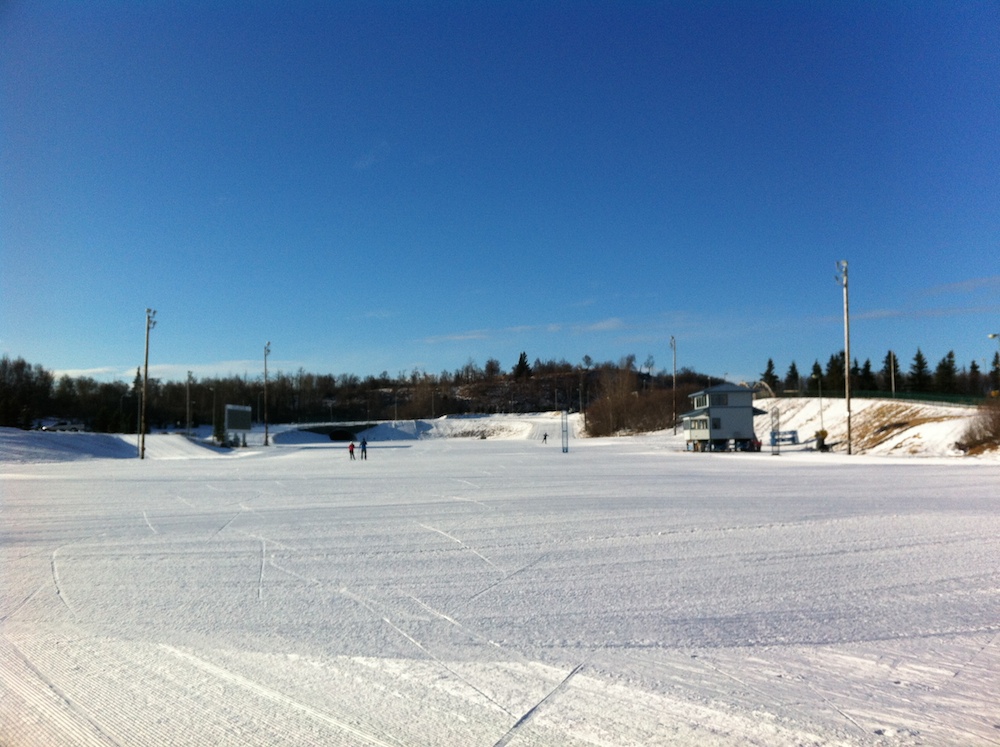
    The secondary stadium at World Cup start, 0.8 miles from the Kincaid Chalet and main open-aired stadium at Kincaid Park in Anchorage, Alaska, on Friday morning. While the primary stadium is snow covered, it's exposed and not quite deep enough for setting tracks.
    The secondary stadium at World Cup start, 0.8 miles from the Kincaid Chalet and main open-aired stadium at Kincaid Park in Anchorage, Alaska, on Friday morning. While the primary stadium has a thin base of snow cover, it’s exposed.

    Editor’s Note: Normally, FasterSkier will be doing the reporting and the Anchorage Daily News (ADN) will help with photos from this year’s SuperTour Finals and U.S. Distance Nationals, but on the eve of the first of four races, we’ll let the ADN do the talking in the form of this preview, which ran both in print and online.

    Like her U.S. Ski Team teammates, Anchorage’s Holly Brooks spent this winter living out of duffel bags, grinding out World Cup nordic races all over Europe and Olympic races in Sochi, rarely staying in one location for long.

    That schedule proved exhausting, and Brooks is finally back home in Airport Heights after four months away.

    But she can’t hit full relax-mode yet, not with the season’s final four races, replete with the strongest fields in North America this season, scheduled here beginning Saturday, when the 2014 U.S. National Championships and the SuperTour Finals open at Kincaid Park.

    The main stadium at Kincaid Park, which will not be used this week for SuperTour Finals and U.S. Distance Nationals because of Anchorage's low-snow situation. The trails are covered, and race organizers have yet to determine whether all the races will be held at Kincaid -- including the 30 and 50 k next Friday. Races are planned for the original site unless otherwise noted.
    The main stadium at Kincaid Park, which will not be used this week for SuperTour Finals and U.S. Distance Nationals because of Anchorage’s low-snow situation. The trails are covered, and race organizers have yet to determine whether all the races will be held at Kincaid — including the 30 and 50 k next Friday. Races are planned for Kincaid unless otherwise noted.

    Anchorage Olympians Brooks, Kikkan Randall, Sophie Bjornsen and Erik Bjornsen, who all compete for the APU Nordic Center, are part of the stacked fields registered. By Brooks’ count, 12 of the 14 U.S. Olympians from Sochi will be skiing. And SuperTour points leaders Reese Hanneman of APU and Caitlin Gregg of Minneapolis are also registered.

    “It’s the highest level that’s taking place in North America this year,” said two-time Olympian James Southam, the race director. “It’s the only time all season the best athletes in the country are in one place, and in the U.S.

    “For Anchorage to be holding these races, I think, is a super-cool opportunity for people to get out and see what the best in the world look like.”

    Brooks said she plans to ski all four races — two SuperTour events and two national championship events.

    “This is our only chance to ski domestically all season,” she said. “It’s also kind of a reunion of sorts, to catch up with old friends, teammates, old coaches. Most people will plan to ski all the races. It’s the end of the season — there’s nothing to save for, nothing to hold back.”

    Randall, the four-time Olympian who recently wrapped up her third consecutive World Cup sprint title, said she also intends to race every event. She appreciates that the country’s top skiers, almost to a person, have traveled here to end the season with loaded fields.

    “Everybody’s doing a good job the last few years of respecting the final races, to race domestically and to compete for your club,” Randall said.

    Randall said she’s excited for the upcoming races, in part because they will mark the first time she has competed in her hometown since the 2010 U.S. Olympic Trials.

    Southam said he was psyched nearly all the top racers have come here at season’s end.

    “At this time of year, you don’t always see the best ones because they’re super-tired,” Southam said. “But for the best to come here is great. The last few years, Anchorage has put itself on the map, especially with the APU program. People are like, ‘What’s going on there?’ What’s in the water?’ ”

    The races are all scheduled to take place on the world-class trails at Kincaid Park. That could change if conditions or temperatures change significantly. The trails at APU and Hillside give organizers alternatives.

    The SuperTour and national championship races lure top racers to compete against the best of the best in the hunt for titles. Prize money is another incentive. All together, about $10,000 in prize money will be awarded

    The SuperTour races — Saturday’s individual freestyle race and Sunday’s classical sprints — pay $750 to both the men’s and women’s winners. Second place will earn $500, third place $250, fourth $200, fifth $150 and sixth $100. The fastest male and female qualifiers in the sprint will each earn $250.

    In the national championship distance races — 30-K for women, 50-K for men — the winners will earn $1,200, the runner-up gets $600 and third place merits $300. In the relay, the top four-person team will split $750, the runners-up will earn $500 and third place will split $300.

    Find Doyle Woody’s blog at adn.com/hockeyblog, email him at dwoody@adn.com or call him at 257-4335.

    SuperTour (ST) and U.S. National Championship (NC) Nordic Races

    All events at Kincaid Park (subject to change)

    Saturday — Men’s 15K freestyle (ST), 11 a.m.; women’s 10K freestyle, 12:30 p.m.

    Sunday — Classical sprint (ST); qualifications, 11 a.m.; heats, 1 p.m.

    Tuesday — Mixed relay (NC), 4x5K, 5 p.m.

    Friday, March 28 — Women’s 30K classical (NC), 10 a.m.; men’s 50K classical (NC), 1 p.m.