Tag: kincaid

  • Kornfield Crowned National 30 k Champ After 8-Man Sprint to Finish

    Kornfield Crowned National 30 k Champ After 8-Man Sprint to Finish

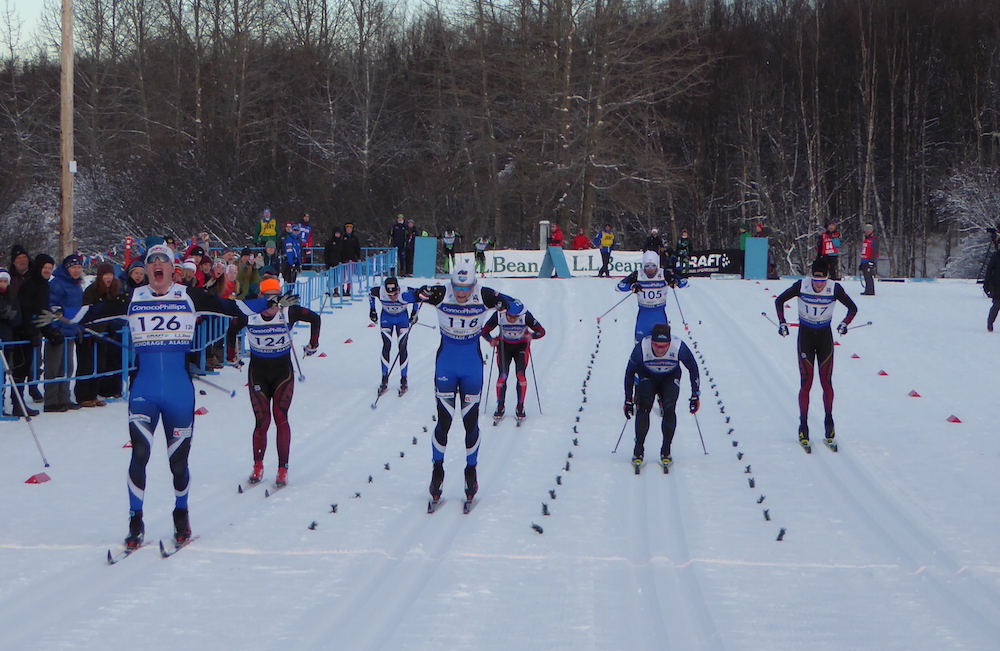
    APU’s Tyler Kornfield (126) celebrates as he crosses the finish line first in the men’s 30-kilometer classic mass start at 2018 U.S. Cross Country Championships on Sunday at Kincaid Park, Anchorage, Alaska. It was Kornfield’s second national title, first one since 2012 and first in a distance race.

    ANCHORAGE, Alaska — It could have been mistaken for the finish of a sprint final — except for the fact that almost 10 skiers were in the hunt until the end, most of which were distance specialists.

    As it were, the last 100 meters of the men’s 30-kilometer classic mass start at 2018 U.S. Cross Country Championships on Sunday involved eight men double poling in four lanes. Two of those men were past national classic-sprint champions.

    “Honestly of all the people in the race, I did not want to be sprinting against Tyler Kornfield and Eric Packer to the finish because I know they’re really good sprinters,” Kris Freeman, of Caldwell Sport, said after the race. “That being said I also didn’t expect to be sprinting against them.”
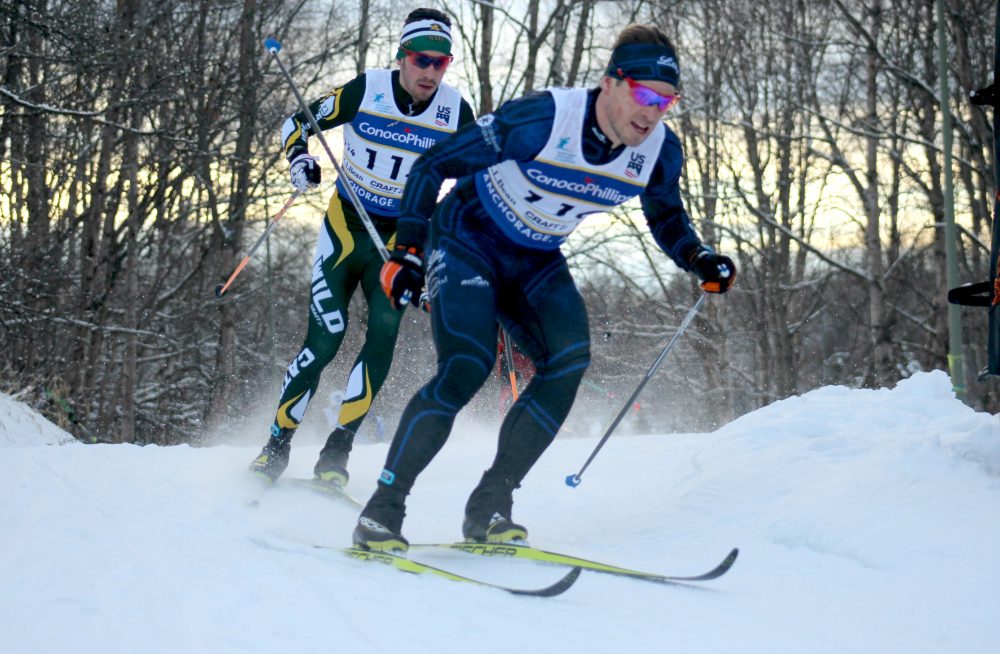
    Kris Freeman (r) leads Ian Torchia (NMU/U.S. Ski Team) during the men’s 30-kilometer classic mass start at the 2018 U.S. Cross Country Championships in Anchorage, Alaska.

    Given their track record — Kornfield, who races with Alaska Pacific University (APU), has a 2012 national classic sprint title and Eric Packer, also from Anchorage and APU, has one from 2016 — not many skiers would want to find themselves up against either APU skier, let alone both, in the final 100 meters of a classic race.

    But as Sunday’s six-lap men’s race progressed, and athletes continued to ascend Elliott’s Climb, it became more and more clear that the off chance of that happening was actually, fairly high.

    Kornfield’s Calculations

    Clipped into his race skis, Kornfield, 26, towers above many of his competitors, at close to 6-foot-2. Given his stature, the Anchorage, Alaska native is hard to miss on Kincaid Park’s ski trails.
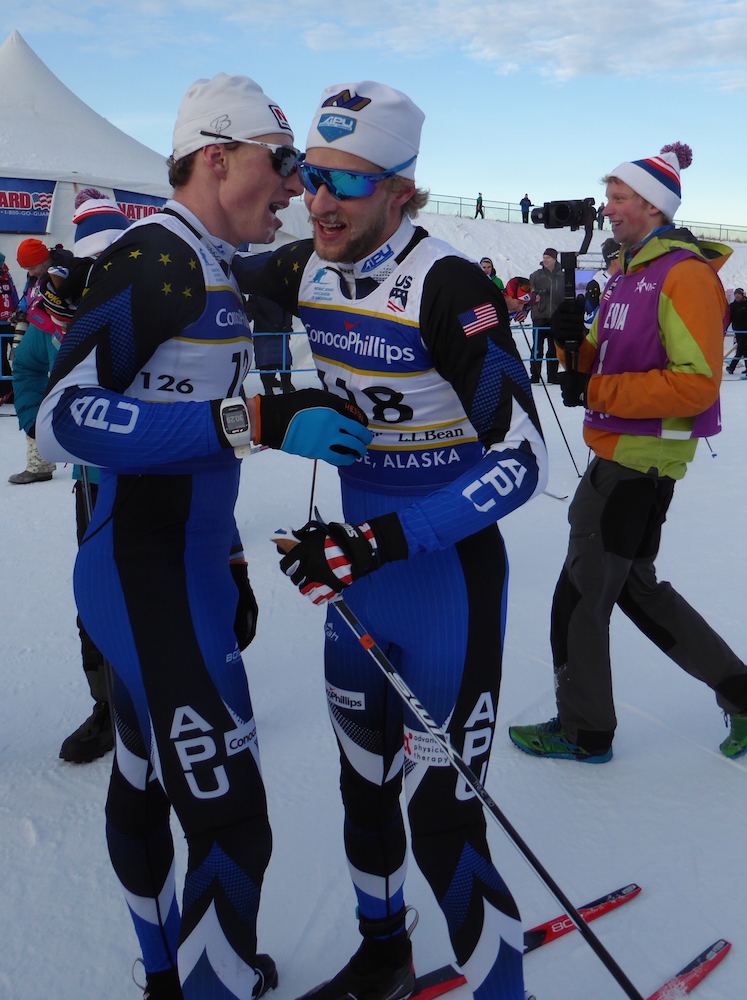
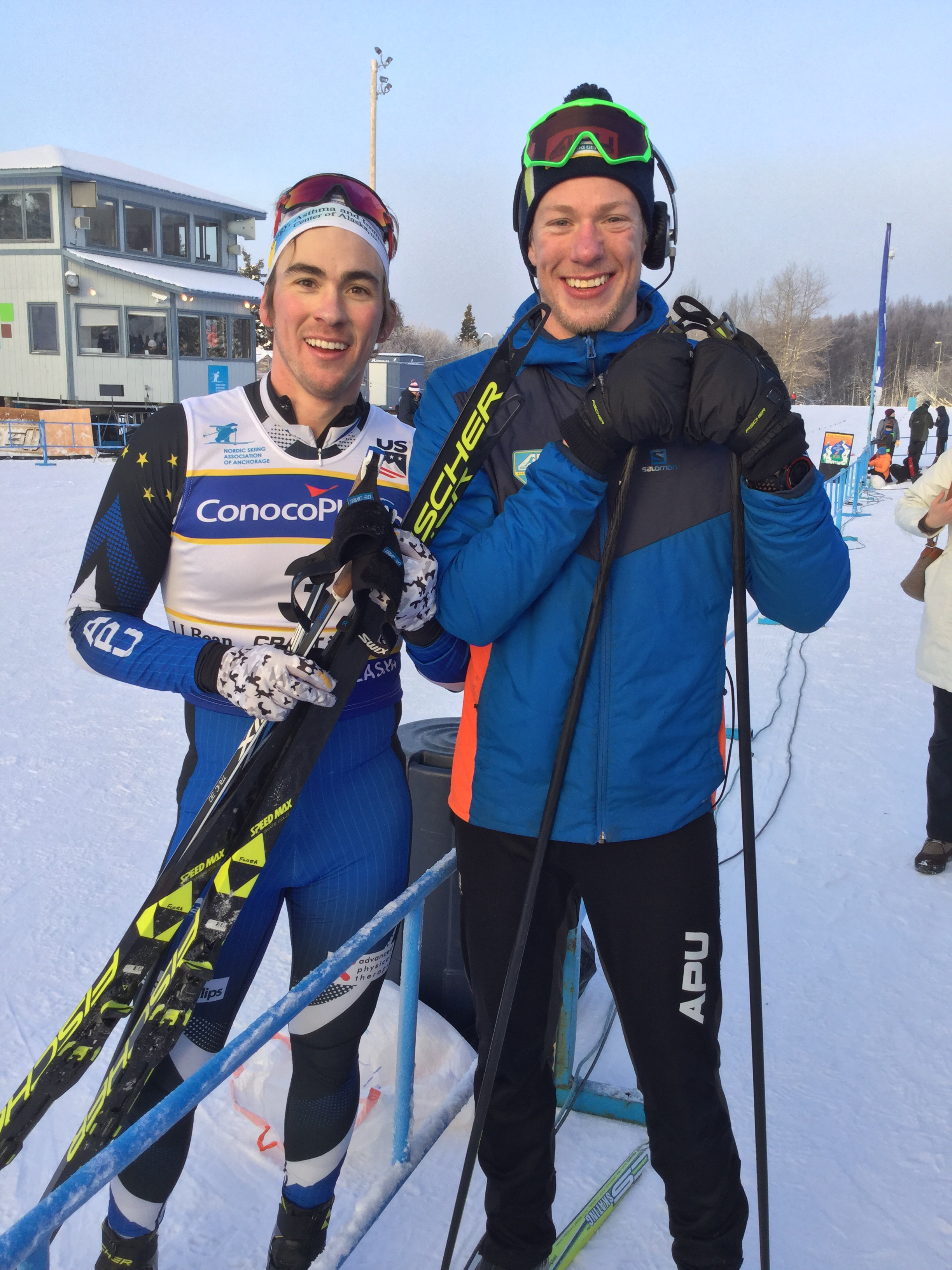
    APU’s Tyler Kornfield (l) and Eric Packer (r) hug after the men’s 30 k classic at U.S. Nationals at Kincaid Park in Anchorage, Alaska.

    Yet when he raced toward the front of the pack in the first lap of Sunday’s mass start, wearing bib 126, it went fairly unnoticed. There were still five laps to go and most figured the charge would come later, from APU’s Scott Patterson (who had won the 15 k freestyle race earlier in the week by almost a minute), or from 2014 Olympian and three-time national champion Noah Hoffman.

    “Honestly I was expecting Scott and Noah to break away,” Packer said during a post-race interview. “My goal today was to hang with them. They pushed the pace the first three laps and were putting in effort to break away. But right around Lap 3 or 4, when we were still grouped together, I think I started realizing personally that it was going to be a tight finish.”

    While Packer’s enlightenment may have come at the same time for many of the spectators at Sunday’s event, Kornfield might have saved them the suspense had he been given an opportunity before the start of the race.

    “I was looking at the course yesterday and in my mind I was picturing how I was going to win it,” Kornfield said after the race.

    With Saturday being an official training day without any races, Kornfield took the time to learn every curve of the 5 k loop that made up the men’s course, the map of which was released Friday evening. Having grown up skiing and racing at Kincaid didn’t hurt the Service High School graduate’s confidence either.

    “I’ve done that hill so many times in sprint racing,” Kornfield said of Gong Hill, which was also featured in Friday’s freestyle sprint and was about 3.5 to 4 k into the 5 k loop.

    “So at like 2 k out I thought, ‘You know what? I feel fresh. If I don’t go, I’m going to regret this for the rest of my life,’ ” Kornfield reflected.

    Packer’s Motivation

    Many who had ventured to Anchorage for U.S. nationals awoke Thursday morning, poured a cup of coffee and proceeded with the championships’ first official training day/off day. Some, perhaps, even slept in.

    When Packer, a 27-year-old former Dartmouth skier who attended South Anchorage High School, arose Thursday morning, it was to grave news: he learned his grandmother had unexpectedly passed.

    He, his family and mother were shaken as they mourned their loss. The pull of commemoration was also in tow.

    “It’s really interesting to be in the middle of the Olympic trials, you’re in the pressure cooker and then you have family come up and it helps remind you what’s important, and that’s the people and your family,” Packer said.

    “On the skate sprint day, I was skiing for her and today on the start line, I said to myself, ‘This is for my grandma,’ ” he continued. “I think that just helped keep it in perspective, that the race isn’t for me, it’s for my family and community and everybody.”

    With unseen weight, but light feet and a fire within him, Packer started Sunday’s mass start in bib 118, racing toward the back of the lead pack for the first two laps and moving to the middle for the next two.
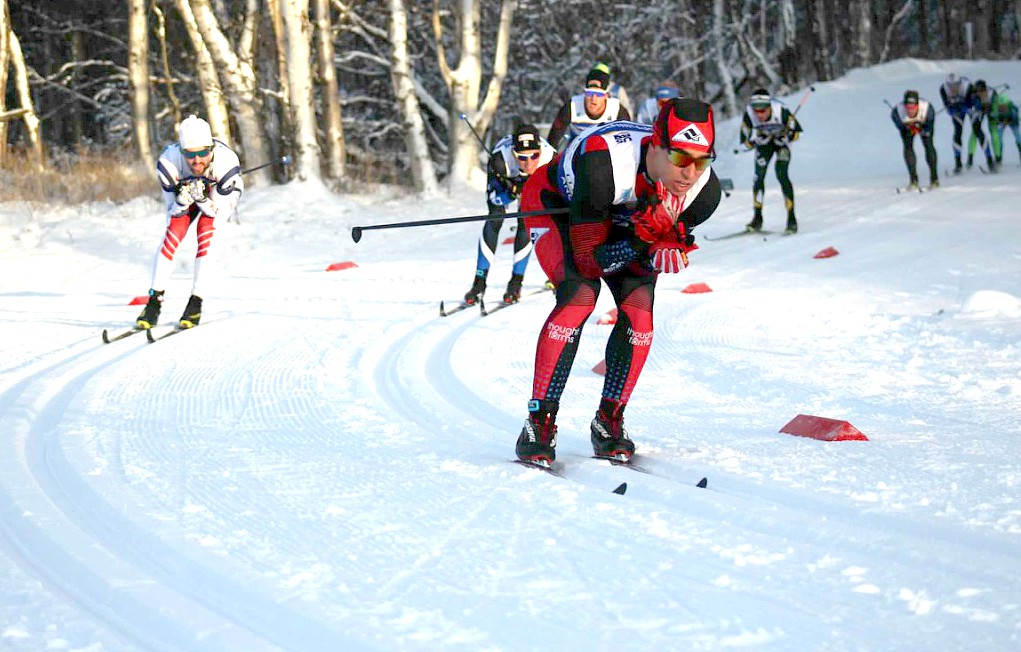
    Noah Hoffman leads early on in the the men’s 30-kilometer classic mass start at the 2018 U.S. Cross Country Championships in Anchorage, Alaska.

    “The pack was churning the whole time,” Packer said. “The entire time I was telling myself to just relax. Stay in contact and relax.”

    That lead group consisted of Packer, Kornfield, Freeman, Hoffman of Ski & Snowboard Club Vail (SSCV), and Patterson (APU), as well as APU’s David Norris, Kevin Bolger of the Sun Valley Ski Education Foundation (SVSEF), Ian Torchia of Northern Michigan University (NMU) and the U.S. Ski Team, Norwegians Dag Frode Trollebø and Eivind Romberg Kvaale of the University of Denver (DU), Adam Martin and Ben Lustgarten (last year’s 30 k classic champion) of the Craftsbury Green Racing Project (CGRP), Tad Elliott (SSCV) and Brian Gregg (CXC/Loppet Nordic Racing/Team Gregg). Each time they reached Elliott’s Climb, the lone A-climb on the 5 k loop, those in front would accelerate.

    Often the acceleration came from Hoffman, who paced most of the uphills and often Elliott’s.

    “Noah Hoffman, I feel like he was up there trying to push the pace all the way,” Kvaale, a 23-year-old DU sophomore, said after the race. “He’s not the fastest sprinter so I guess that natural for him, but the downhills are so long and you draft so well here, so it’s hard to get away.”

    “I was thinking, ‘When is this going to break up?’ ” Hoffman reflected on Sunday, the day before his 29th birthday. “I kept pushing the pace. I tried to make it hard at times, but not only was it coming back together, it was also a massive group. I mean, it’s one thing if you go and three or four guys come with you, but it was way more than that.”
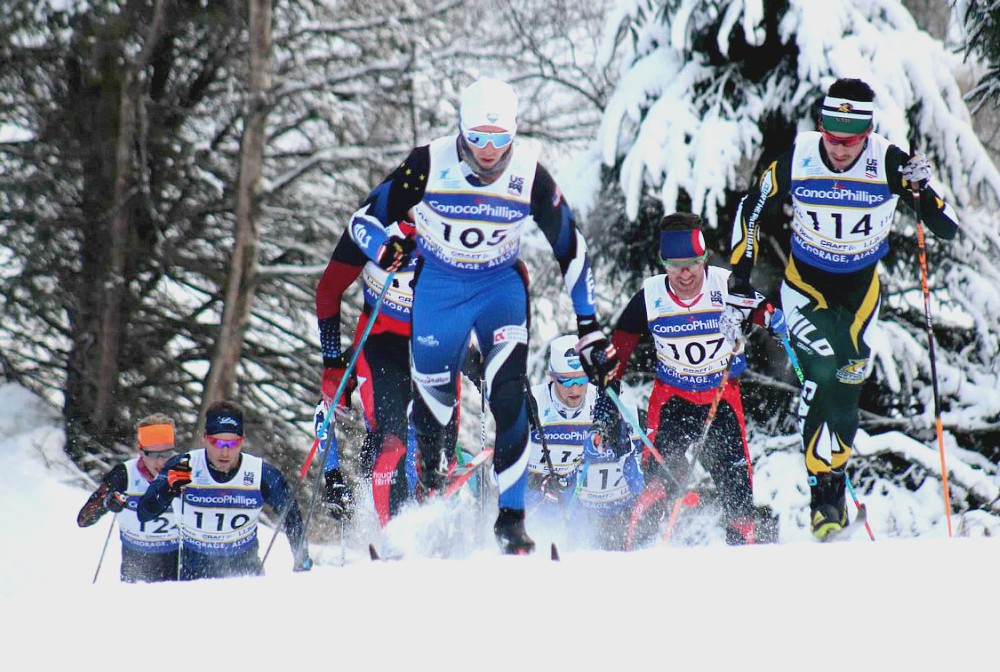
    APU’s David Norris (105) leads up Gong Hill as Ian Torchia (114), Tad Elliott (107) and Kris Freeman (110) chase him during men’s 30-kilometer classic mass start at the 2018 U.S. Cross Country Championships in Anchorage, Alaska.

    The group remained a pack of 14 through five and half laps, with the lead exchanging from Hoffman to Kvaale, to Martin and Norris.

    “It didn’t really matter how fast people climbed, it always came back together,” said Norris, a Fairbanks native, who sat out Wednesday’s distance race due to illness and was still feeling under the weather on Sunday. “You could tell early that Noah was trying to break away. If anything it looked like he was working harder, but not doing damage.”

    While at the top of Elliott’s Climb, gaps would form that Freeman described as being up to five seconds between him and Hoffman and the rest of the pack. But when the group reached the bottom of Gong Hill, all 14 racers were continually rejoined.

    The Sprint Finish

    By the time the group began descending toward back toward the stadium for the last time, apprehension filled within the spectators standing behind the colored flags lining the course and the athletes corralled on the inside.

    A gap had parsed out a few skiers, though eight still remained within range of the win.

    “I was debating the entire last lap, ‘When do I go? When do I go? When do I go?’ ” recalled Freeman, a 37-year-old four-time Olympian from New Hampshire. “Then Tyler went and I reacted rather than dictating.”
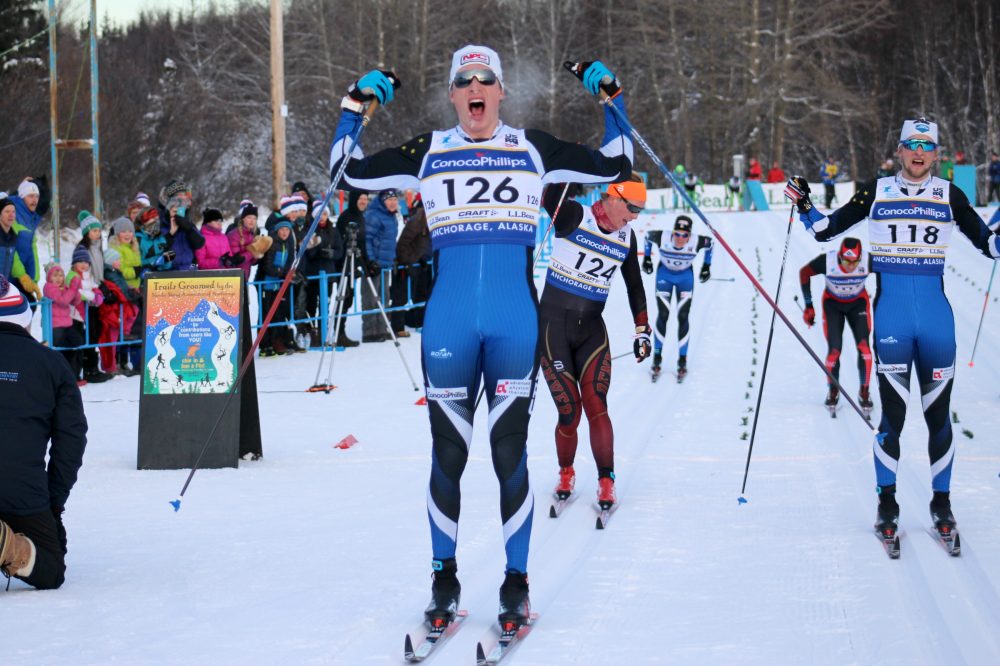
    APU’s Tyler Kornfield (126) celebrates as he crosses the line first in the men’s 30-kilometer classic mass start on Sunday at 2018 U.S. Cross Country Championships in Anchorage, Alaska. Eric Packer (118) finished second and Denver University’s Eivind Romberg Kvaale (124) placed third.

    The group had been climbing the final hill together when Kornfield made his move. He pushed around to the outside edge to the front leading into the descent and through the tunnel. As all eight rounded the final corner to the finish, Kornfield put his head down and did what he did best, double poling in an outright sprint to his first-ever U.S. nationals distance win.

    “I knew the only way I could win as a sprinter was to conserve energy and try to stay with pack and wait for the final push,” Kornfield said. “In the finish I just kept pushing and watching that finish line come closer and closer. I’ve never had emotions like that after a race. ”

    Kornfield crossed in a time of 1:21:43.6 for the overall win. Packer crossed 0.7 seconds back in second and Kvaale crossed 1 second out of first for third overall. Freeman, 1.6 seconds back, was the third American in fourth overall.

    “We have a group of guys who are training as much as or more than anyone else in the country and sometimes it takes a while for that fitness to come around,” Packer said. “I think we were a little bit nervous in West Yellowstone and Silver Star [at the December SuperTours] and didn’t have our best races, but it’s great to have things come together at the right time.”

    Finishing out the top 10 was Trollebø in fifth (+2.0), Norris in sixth (+2.5), Hoffman in seventh (+2.6), Patterson in eighth (+3.6), Martin in ninth (+14.7), and Lustgarten in 10th (+14.9).

    “I had very good glide on my skis so I knew I was able to gain a lot on the other guys,” Trollebø said after. “But it was only two tracks at the end so, it’s almost like in a bike race, you have to stay well positioned to be there at the end.”
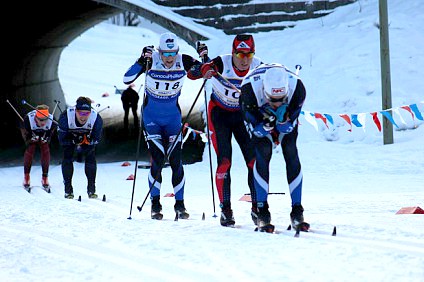
    Right to left: APU’s Tyler Kornfield leads SSCV’s Noah Hoffman, APU’s Eric Packer, SSCV Kris Freeman, and DU’s Eivind Romberg Kvaale heading out of the stadium tunnel and toward the finish for the men’s 30-kilometer classic mass start at the 2018 U.S. Cross Country Championships in Anchorage, Alaska.

    In terms of the U.S. Olympic points list, Patterson is ranked first, followed by Kornfield, Hoffman, Packer, and Gregg (Gregg finished Sunday in 11th, 16.1 seconds back).

    “We’ll see what they do for naming a team. It’ll be interesting,” Hoffman said.

    “I haven’t seen the math yet, but I have not figured many scenarios where I could be third and still make the Olympic team,” Freeman noted. “So it’s a bittersweet day.

    “But that’s what happened and I’m happy for those guys,” Freeman continued. “They’ve been working at this for a long time. I’m not sure that they’re going to make the team but if they do, good luck to them.”

    Wonders Wins Junior Race
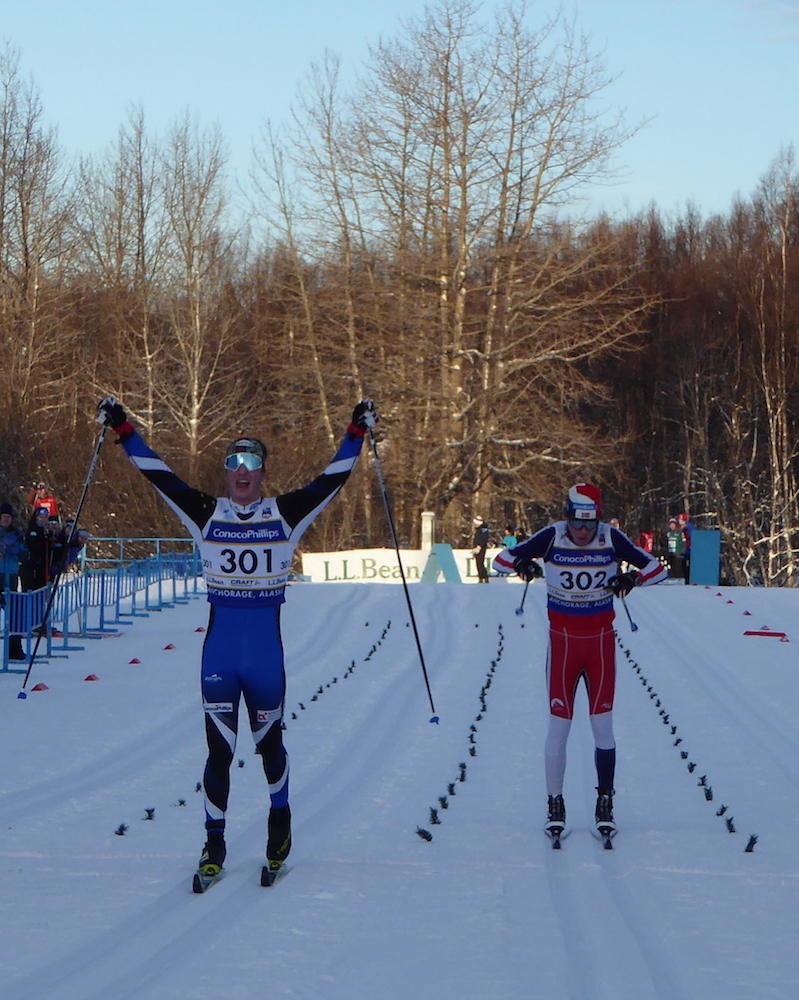
    APU’s Hunter Wonders (301) winning the junior men’s 10 k classic mass start, just ahead of Ben Ogden (SMS) at U.S. nationals at Kincaid Park on Sunday Anchorage, Alaska.

    A junior men’s 10 k classic mass start was also run on Sunday, with APU’s 19-year-old Hunter Wonders claiming the win in a time of 26:07.1. Stratton Mountain School (SMS) skier Ben Ogden finished second, 0.6 seconds back, and Canyon Tobin (APU) placed third (+23.4).

    “I’m extremely thrilled I was able to hold my bib position,” Wonders said after the junior’s race. “I crashed going down roller coaster on the first lap and lost some time, then I was fighting to get back to where I was, so I hammered until I was back with that lead pack. I felt good so I just kept trying to go for it and it paid off.”

    Racing continues Monday for the final event of 2018 nationals, the men’s and women’s classic sprints.

    Results: Men’s 30 k | Junior men’s 10 k

  • Caitlin Patterson Takes Third National Title of Week; Sweden’s Bångman First Overall

    Caitlin Patterson Takes Third National Title of Week; Sweden’s Bångman First Overall

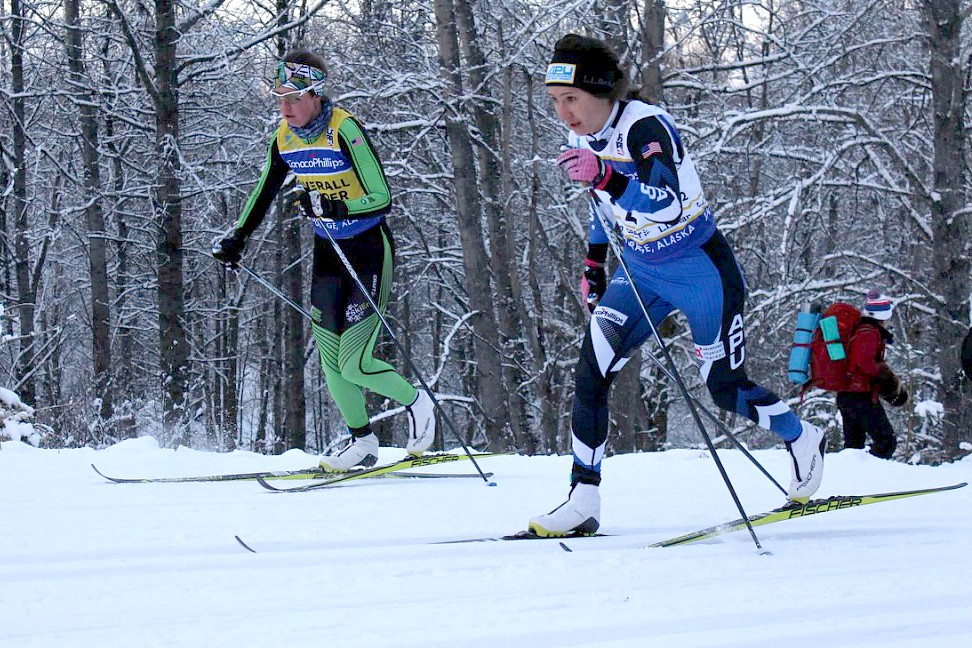
    The top-three Americans in the women’s 20 k classic mass start on Sunday at 2018 U.S. nationals in Anchorage, Alaska, with Caitlin Patterson (1) of the Craftsbury Green Racing Project (CGRP) in first, Rosie Frankowski of APU (l) in second, and Kaitlynn Miller (r) of CRGP in third.

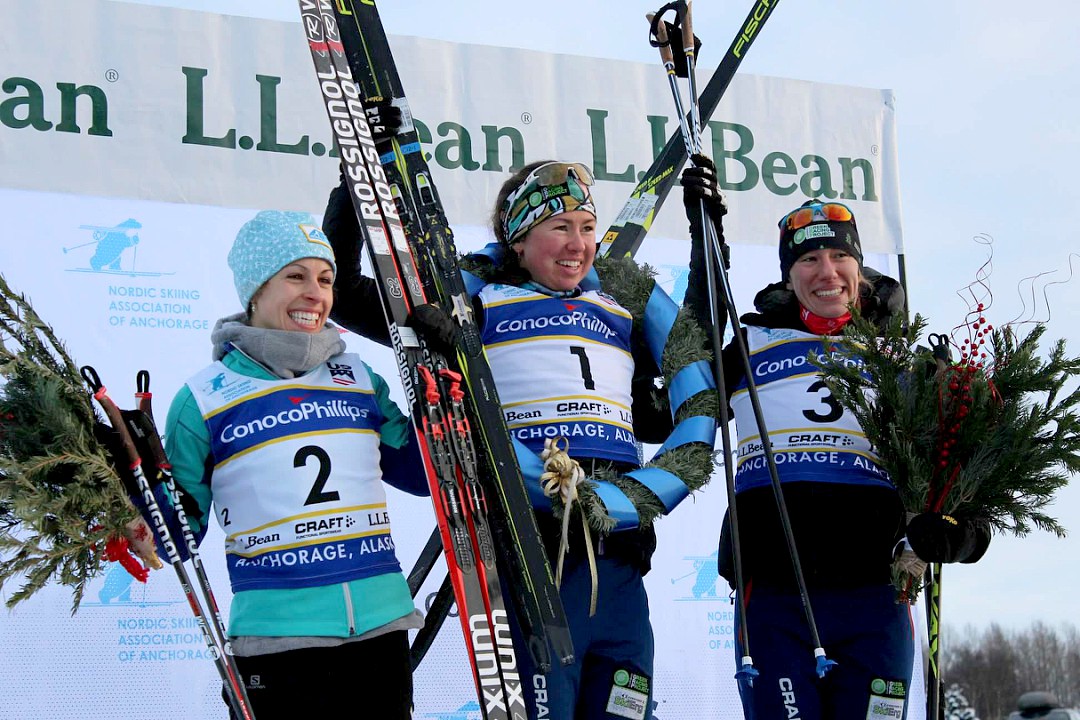
    ANCHORAGE, Alaska — It turns out that Caitlin Patterson does have a weakness: Swedes. The 27-year-old Craftsbury Green Racing Project (CGRP) skier was denied her first outright victory of the week when she crossed the finish line second to Hedda Bångman, a former member of Sweden’s U23 National Team who now skis for the University of Colorado Boulder (CU), in the women’s 20-kilometer classic mass start at the 2018 U.S. Cross Country Championships on Sunday morning at Kincaid Park. But as the first American, Patterson captured her third national title in as many races.

    Rosie Frankowski, of Alaska Pacific University (APU), was the third athlete across the line and second American. She was followed by Jessica Yeaton, who competes domestically for APU, but is an American-Australian dual citizen and competes internationally for Australia. Kaitlynn Miller, also of CGRP, was the fifth athlete across the line to round out the domestic national championship podium.

    Bångman crossed the finish line of the four-lap, technically 22-kilometer course in 1 hour, 55.3 seconds, 15.9 seconds clear of Patterson in second. It was the first time all day that Bångman had enjoyed such an edge.

    CU’s Hedda Bångman on her way to win the women’s 20 k classic mass start at 2018 U.S. Cross Country Championships on Sunday in Anchorage, Alaska.

    The field of 42 skiers left the Kincaid Stadium at 10 a.m. on another perfect race day, the temperature around 16 degrees Fahrenheit and an approaching sunrise about to reveal mountains shimmering in all directions.

    Wednesday’s fresh snow had allowed race organizers to come up with a compromise between the snowmaking loop and the full International Ski Federation (FIS) distance courses, a 5.44-k loop that began with an A-climb up Elliott’s Climb, descended most of the way back to the stadium, covered all the hills on the snowmaking loop, then traversed the 1.5 k Lekisch Loop before finishing in the stadium. The hills on the course were relatively front-loaded, with the single largest climb coming in the start of the loop and smaller (but still steep) hills over the final four-plus kilometers. The final kilometer was predominantly downhill from the high point of the 1.5 k Lekisch into the finish.

    Snow coverage off of the manmade loops appeared to be good to very good, albeit with a relatively abrasive and icy base in the bottom of the tracks.

    The first time up Elliott’s, Frankowski led a large group of 30-plus women (effectively the entire field) up to the top of the A-climb roughly 1.3 k into the race. She was closely followed by APU’s Chelsea Holmes to her left, and Bångman and Miller to her right.

    The second time up Elliott’s, little had changed. Frankowski led a group of 10 women, with Bångman, Yeaton, and Holmes immediately behind her, and Patterson a few strides farther back.

    The third time up Elliott’s, it was yet again Frankowski in the lead, followed yet again by Bångman, Yeaton and Holmes, with Patterson yet again appearing to lag back slightly on the uphill.

    Rosie Frankowski definitely deserves a shout-out for leading the train a whole lot out there and really pushing the pace,” Patterson told FasterSkier in a finish-line interview.

    Four kilometers later, the athletes lapped through the stadium a final time as they headed out on their fourth loop. At this point, Frankowski, Bångman and Patterson, in that order, were still within one second of each other, with Yeaton around seven seconds back in fourth and Miller in fifth 12 seconds behind Yeaton.

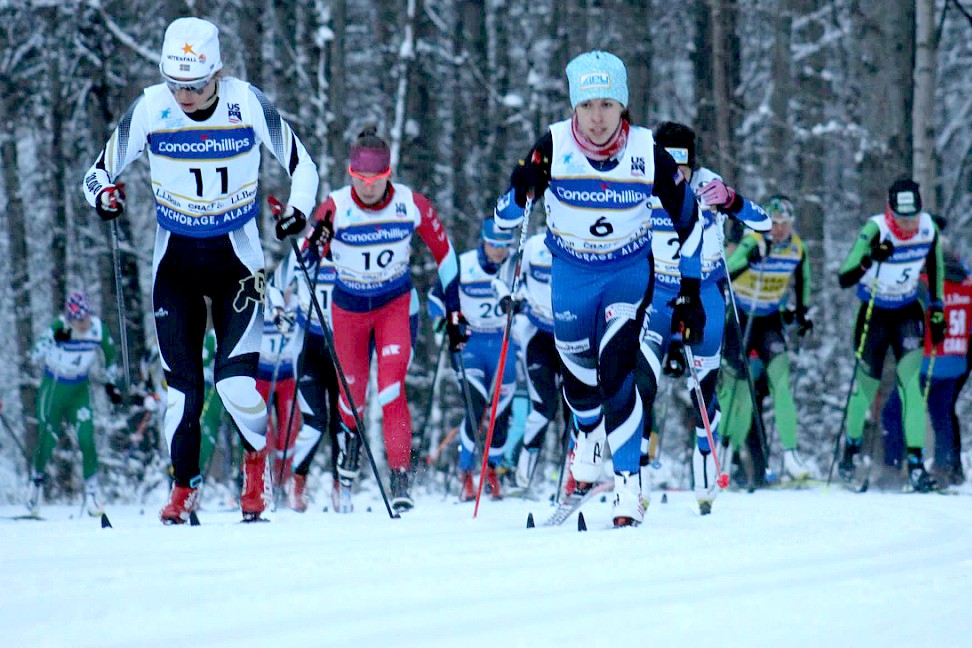
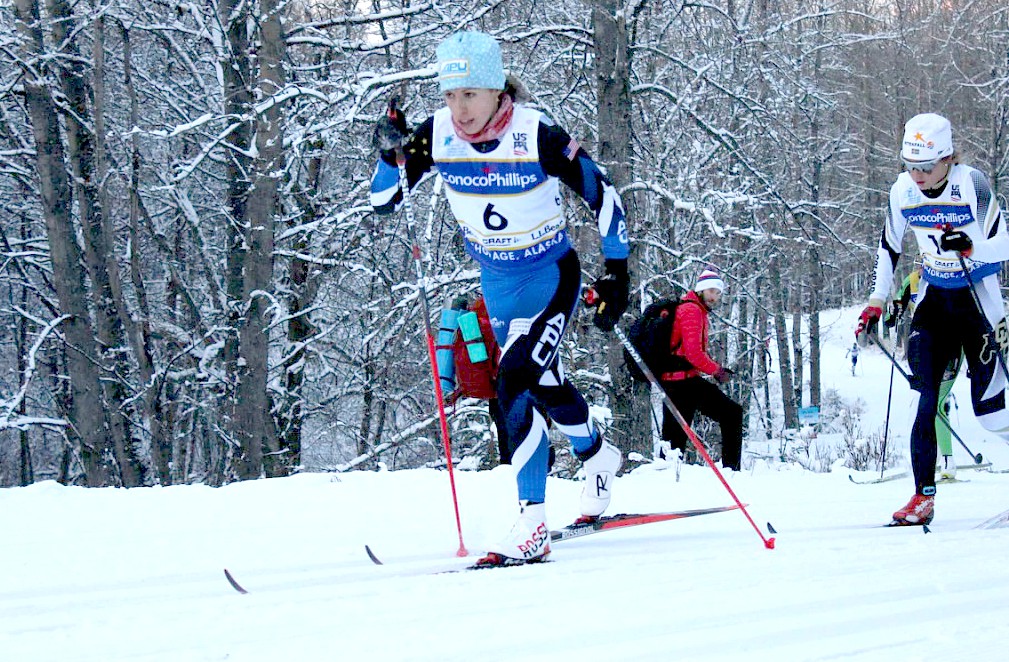
    APU’s Rosie Frankowski (6) and CU’s Hedda Bångman (11) leading the charge up Elliott’s Hill in the women’s 20k classic mass start at the 2018 U.S. Cross Country Championships in Anchorage, Alaska.

    If the lead pack was going to avoid a three-woman sprint to the finish, something was going to have to give. And the final time up Elliott’s, it did.

    “The fourth lap is where it really splintered apart,” Patterson said. “At the top of Elliott’s, that last really kicker hill, the herringbone hill.”

    At that point, Patterson, who grew up in Anchorage, recounted that Bångman had “really good skis, like stay-in-the-track that whole way up good. All the rest of us were running outside [the tracks] flailing around a bit, so she gapped us there. And she skis the downhills very well, so she closed a gap there across the World Cup [start area] flat out there, and we never closed that down. Frankie and I were chasing her on Rollercoaster, but I think she held her gap about the same from there all the way to the finish.”

    As Bångman, 22, told FasterSkier after the race, “I didn’t have a plan before [the race], but I knew I was the strongest. So when we went out on the last lap, then I realized, ‘I can really make this race.’ So in the first hill on the last lap, I started to push harder, and then I left the others behind me. And then it was just to push as hard as I can to the finish line.”

    By the time the three-woman lead pack came around the edge of the stadium again, midway through their final lap, Bångman had a significant lead, roughly 12 seconds. She stretched it to 15.9 seconds by the finish, finally allowing herself to slow slightly, look around, and celebrate in the final meters before crossing the finish line.

    Behind her, a battle for top American was shaping up between Frankowski, who had never stood on a national championships podium, and Patterson, who had been there twice already this week.

    Coming through the edge of the stadium, Patterson held a lead of two to three seconds over Frankowski as the two of them approached the wall-like climb up the Gong Hill for the final time. Patterson began heading up on the left side of the trail, Frankowski a few meters behind her on the right, herringboning with stunning alacrity for being 20 kilometers into a 22-kilometer race.

    Then Frankowski caught a pole tip on her ski and fell into the sugar snow on the uphill. It took her several seconds to get up. While she extricated herself, Patterson skied away and up and over the top of the Gong Hill.

    “The real cool thing that came out of that fall,” Frankowski told FasterSkier after, “was that I actually had my pole stuck under my ski, and I had to literally think, ‘Relax, and figure this out and stand up.’ While in the past I would have been so frantic I probably would have dropped more places than I did.”

    “So I basically was just trying to get up,” recalled Frankowski, a 26-year-old Minneapolis native. “And when I got up someone yelled, ‘Don’t give up.’ And immediately I felt like, well, I am going to try to catch Caitlin, and if I could I would, but I didn’t. She is so strong right now; I tried and got close, but I didn’t do it.”

    Frankowski’s travails were news to Patterson when told about this after the race.

    “I had no idea,” Patterson said of her fall. “But that makes sense because it confused me because I was certain that as I ran up on the wall on the left side I was certain that there was someone just by me on the right side. But then I could hear on the downhill that there was no one close and then people were cheering for her 10 meters back, so I didn’t see that during the race.”

    Frankowski’s fall came midway through the last lap, roughly 2.1 kilometers before the end of the race. After giving chase over the Lekisch Loop, she made up roughly the time she had lost in the fall before running out of real estate, crossing the finish line 3.7 seconds after Patterson for third overall and second American.

    Rosie Frankowski (APU) leads CU’s Hedda Bångman (11) up Elliott’s Hill in the women’s 20 k classic mass start at the 2018 U.S. Cross Country Championships in Anchorage, Alaska.

    Yeaton, 26, who was born in Perth, Australia, and moved to Alaska at age 12, skied into the finish alone 24 seconds later for fourth overall. Miller followed another 29 seconds later for fifth overall and third American. Alayna Sonnesyn, a University of Vermont junior, was the second college skier and second U23 skier in the top six.

    “I felt so strong today,” said overall first-place finisher Bångman. “It was a so-good race, I’m so happy. My skis were perfect, and my body felt so good.”

    Patterson is now three-for-three for national titles this week, but this one didn’t come easy.

    “I am pretty excited about this third one, but it was the toughest of them all,” she said.

    “It was a real struggle to hang with the people who were pushing the pace today,” she added, crediting Frankowski for her work at the front.

    “I know especially how I am racing right now that I just need to hang on and the end can be good, and it was fairly good today,” Patterson added. “So I am really happy with the national title.”

    Patterson said that she had opted to prioritize glide over kick on Sunday in light of the course profile, “because I feel like a lot of those walls are steep enough where I would be running anyway.”

    “I probably erred a little too much on the glide side,” she continued. “Which is my fault with some testing … so I was herringboning like every single one of those technique zones, every kind of big hill, just had to keep moving. And luckily because the skis were so fast and I know these downhills so well, I was able to catch up on a lot of the downhills when I did get gapped on several uphills, almost every lap.”

    Each lap featured three of the technique zones that Patterson had mentioned, in which doublepoling was forbidden. For the Anchorage readers, or anyone else familiar with the Kincaid trails, one was at the top of Elliott’s Climb; one was at the southern end of Dark Alley, approaching the lower tunnel; and one was the entire climb up to the Gong Hill from the north/back side of the snowmaking loop just a few hundred meters later.

    (There had been a fourth zone marked during Saturday’s course preview, Patterson recounted, in the first uphill on the Lekisch Loop, which features a stair-step climb with a slight saddle or depression between the two steps. “There was a technique zone that they tried to put there,” she said, “and it literally had a downhill in it, but luckily the coaches protested that and they took it out.”)

    After 22 k of skiing and 12 careful trips through each technique zone, Frankowski finished 3.7 seconds behind Patterson. It was the first national championships podium of her career.

    Her sole strategy coming into the start of the race had been to “push every uphill,” Frankowski explained. “I have raced at Kincaid enough to know that you recover at every single downhill, and so for someone who doesn’t have a sprint at the end, I needed the pace to be hot at the beginning. So right when we started, immediately out of the start I realized that our skis were incredibly fast, and honestly comparable to or better than anyone else’s in the field, and so I felt, well I am going to doublepole as much as I can and then every downhill, especially the ones I struggle on, just tuck behind and try to be relax and know that I can catch back up.”

    Craftsbury skier Caitlin Patterson (l) with APU’s Chelsea Holmes during the the women’s 20 k classic mass start at the 2018 U.S. Cross Country Championships in Anchorage, Alaska.

    Frankowski made clear that, like Patterson, she had gone thin to win when it came to choosing how much kick wax she wanted. “The course here,” she said, “except for maybe Elliott’s, all these hills are running hills so you really had to Klæbo it up or herringbone and just know that you are not going to have perfect striding today, and if you do, your skis are going to be too slow through the stadium to be in the mix.”

    Frankowski, whose public social media profile frequently features paeans to the consumption of Thai food, also clarified, “I would say the key to success is that last night I had Tom Yum soup and Pad Thai for dinner, and lots of cookies, so I think that helped also.”

    Fellow APU skier Yeaton was the fourth skier across the finish line, 24.5 seconds behind Frankowski and 44.1 seconds back from Bångman.

    Yeaton pulled no punches when asked if she had been expecting this result.

    No,” she said. “Not even close. Nowhere in the ballpark. … I was hoping, like on a great day, maybe I’d get top 10. I never thought I’d get fourth.”

    Yeaton’s fourth wrapped up a strong week of domestic racing for the Australian-American dual national, who is known more as a sprinter rather than a distance skier. Indeed, her next races will be Dresden, Germany, to compete for Australia at next weekend’s sprint-centric World Cup stop. Yeaton is presumptively qualified for the Australian Olympic Team in the latest FIS Olympic Points List simulation.

    29.4 seconds behind Yeaton came Craftsbury’s Miller in fifth overall, but the third American across the line after Patterson and Frankowski. She had been “in contact with the lead group until about the third lap when a gap formed on Elliott’s [Climb] that I was unable to bridge,” Miller wrote in an email to FasterSkier after the race.

    “I’m very pleased with my race and it was very exciting to see my teammate, Caitlin Patterson, place second,” she added. “I was very impressed with the 5k course that the organizers put together for the event. It was a fun course to race on.”

    Sunday marked Miller’s fifth time on a national championships podium, and second in this week, following a second on the American podium in Friday’s freestyle sprint.

    Sonnesyn filled out the rest of the top six. The 21-year-old Vermont college skier identifies as a distance skier and had been hoping for a better result in Wednesday’s 10 k skate, she told FasterSkier at the finish.

    I was excited for that, but unfortunately I didn’t have the race I was hoping for,” Sonnesyn said. “But I came back with a really strong sprint, which kind of surprised me. And I was feeling so great that I came into this race today pretty confident. So I was excited for it this morning, and I’m really happy with the way it went.”

    Hannah Halvorsen Wins Junior Race

    While junior women (U20 skiers and under) raced alongside the senior/master field in Wednesday’s 10 k freestyle individual start, Sunday saw the juniors get their own starting time and course for the 5-kilometer classic mass start race. One lap, 92 starters, 5.5 kilometers, go!

    Before long, a pileup ensued. But “I only heard about it from quite a few girls,” junior winner Hannah Halvorsen, of APU and the U.S. Ski Team, told FasterSkier after. “I was right in front of it; I got lucky.”

    Halvorsen, 19, covered the one-lap course in 15:07.8. Second place went to Hailey Swirbul, a University of Alaska Anchorage sophomore, 10.4 seconds back.

    Third place on the all-Alaska podium went to an athlete with four years’ less experience and one fewer Junior World Championships medal to her name, U16 athlete Kendall Kramer. Kramer, who finished 4.4 seconds behind Swirbul, skis for the Nordic Ski Club of Fairbanks/Fairbanks XC (NSCF-FXC), as well as West Valley High School. She had competed in only one other FIS race in her life before this week.

    Halvorsen was second on the junior girls podium in Wednesday’s distance skate race, and third overall among American women in Friday’s sprint race. Swirbul was the top junior woman on Wednesday and reached the quarterfinals of the senior women’s sprint on Friday.

    Halvorsen had high praise for Sunday’s race course: “Super-fun course, up and down, kind of rolling,” she said. “Good places to find speed and carry momentum, time to rest and do different transitions. Just, like, a fun course.”

    It probably doesn’t hurt that she won. “It felt good,” said Halvorsen, who grew up in Truckee, California. “I was tired this morning, but it doesn’t really matter how you feel, you just get out there and go for it. I had really good skis, really good support; my dad’s here, my brother’s here. It’s a beautiful day to be racing; really fun racing out there.”

    — Gabby Naranja and Ian Tovell contributed reporting

    Results: Women’s 20 k | Junior women’s 5 k

    Highlights video from Max Romey Productions

  • Friday Rundown: Oberhof, Mont Sainte-Anne Trials, and U.S. Nationals

    Friday Rundown: Oberhof, Mont Sainte-Anne Trials, and U.S. Nationals

    The Hanneman brothers after Friday’s skate sprint at 2018 U.S. Cross Country Championships in Anchorage, where they live and train with Alaska Pacific University. Reese Hanneman (l) won the men’s final and younger brother Logan (r) won the men’s qualifying round.

    U.S. Cross Country Championships (Anchorage, Alaska): Freestyle sprints

    Men’s report

    Women’s report

    Caitlin Patterson racked up her second-straight national title at this year’s 2018 U.S. Cross Country Championships and Reese Hanneman topped the men’s freestyle sprint final on Friday at Kincaid Park in Anchorage, Alaska.

    In the first of two sprints at 2018 U.S. nationals, Patterson, the Craftsbury Green Racing Project (CGRP) skier who won the women’s 10-kilometer freestyle on Wednesday, posted a 3.56-second win in the women’s 1.5 k freestyle sprint final on Friday.

    After qualifying 12th, 5.76 seconds back from Anne Hart of the Stratton Mountain School (SMS) Elite Team, who won the qualifier in 3:22.10, Patterson won both her quarterfinal and semifinal, both times ahead of University of Denver (DU) junior Jasmi Joensuu in second.

    The two advanced to the final, where Patterson reached the finish line first once more in 3:20.93, about 3 1/2 seconds ahead of Joensuu in second and 4.19 seconds ahead of Petra Hyncicova, a senior at the University of Colorado Boulder, in third. Craftsbury had two in the final with Kaitlynn Miller placing fourth (+4.35). U20 skier Hannah Halvorsen of Alaska Pacific University (APU) and the U.S. Ski Team (USST) finished fifth (+7.66), and Kelsey Phinney of the Sun Valley Ski Education Foundation (SVSEF) placed sixth (+9.78).

    Hart won her quarterfinal then placed third in the first semifinal, behind Miller, who won that heat, and Hyncicova in second, to miss advancing to the final. Hart had won the qualifier by 1.78 seconds over Joensuu in second.

    In the men’s 1.6 k skate sprint, Logan Hanneman (APU) won the qualifier in 3:07.4. Kevin Bolger (SVSEF) qualified in second (+0.48), and older brother Reese Hanneman (APU) was third (+1.13).

    In the quarterfinals, Reese won his heat by 0.19 seconds ahead of his teammate Tyler Kornfield, and Logan finished second, 0.42 seconds behind U18 skier Gus Schumacher (Alaska Winter Stars), as the winner of the first quarterfinal. Bolger won the fourth quarterfinal.

    Reese raced to another win in the second semifinal, 0.17 seconds ahead of Bolger in second. APU’s Eric Packer won the first semi, 1.66 seconds clear of Zak Ketterson of Northern Michigan University (NMU) in second. Logan finished fifth in that semifinal, 4.48 seconds out of first, trailing Dakota Blackhorse-von Jess (Bend Endurance Academy) in third and Schumacher in fourth.

    In the final, which included three APU athletes out of six total, Reese nipped Bolger by just eight-hundredths of a second for the win in 3:11.33. APU had two on the podium with Kornfield in third (+0.88). Ketterson finished fourth (+1.92), Packer was fifth (+2.34), and DU sophomore Eivind Romberg Kvaale was sixth (+14.08).

    U.S. nationals racing continues Sunday with the 20/30 k classic mass starts.

    Complete results

    ***

    NorAm Trials (Mont Sainte-Anne, Quebec): Classic sprints

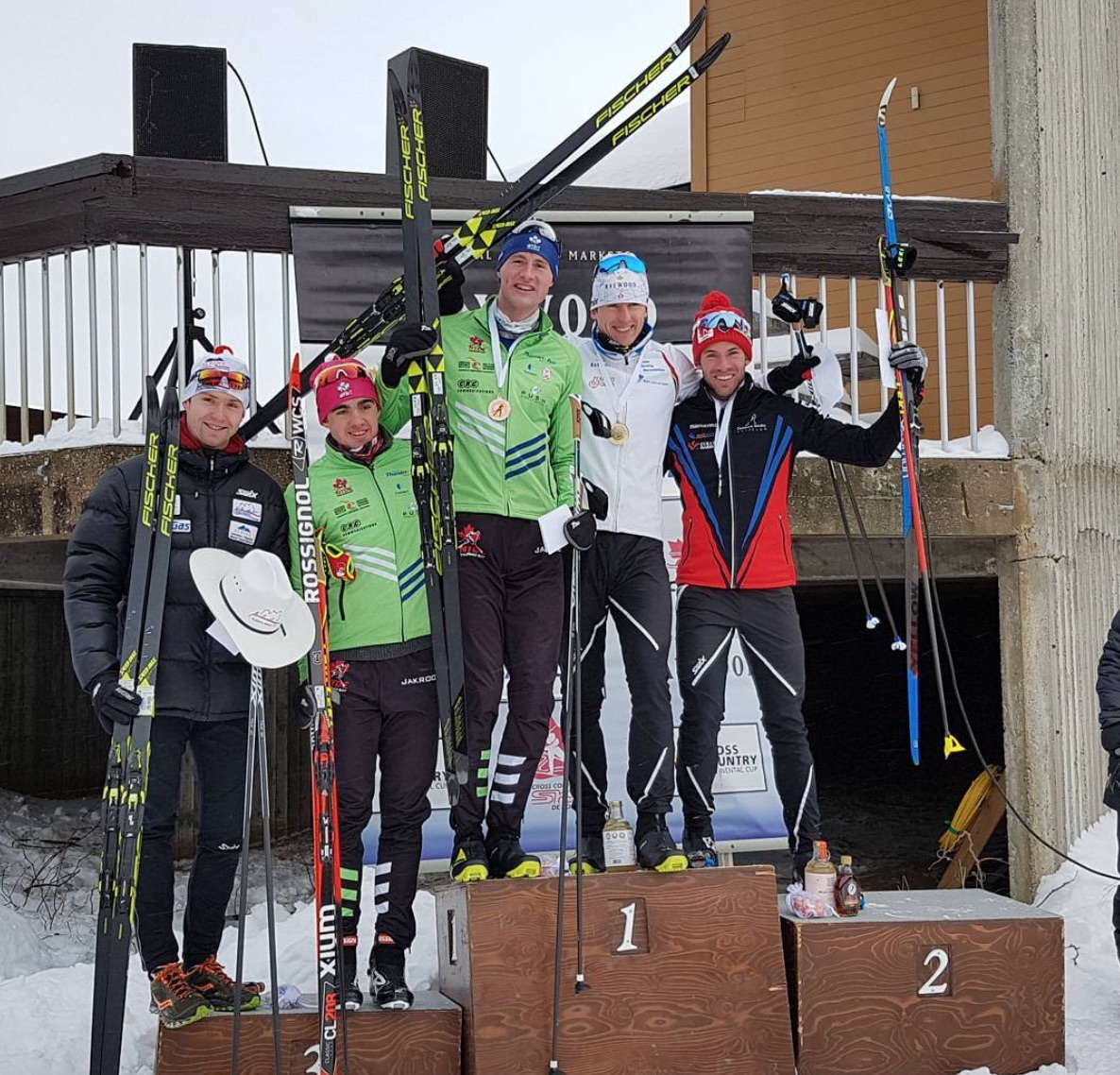
    The men’s classic sprint podium at 2018 Canadian NorAm Trials on Friday at Mont Sainte-Anne, Quebec, with Julien Locke (second from r) in first, Russell Kennedy (r) in second, Bob Thompson (c) in third, Evan Palmer-Charrette (second from l) in fourth, and Dominique Moncion-Groulx (l) in fifth. (Photo: Canmore Nordic Ski Club/Instagram)

    Canada’s NorAm Olympic trials opened Friday at Mont Sainte-Anne in Beaupré, Quebec, with Dahria Beatty (Canadian World Cup Team/Alberta World Cup Academy) winning the women’s 1.35-kilometer classic sprint and Julien Locke (Canadian U25 Team/Black Jack) topping the men’s 1.35 k classic sprint final. While Beatty has already secured her spot at the 2018 Olympics in PyeongChang, South Korea, Locke has not — but the win didn’t ensure he’ll be selected to the team. In a tiebreaker, it looks like he is second on the men’s sprint list at trials to Russell Kennedy, of Canmore Nordic/Team R.A.D.

    Based on its published nomination procedures for the 2018 Olympic Games, Cross Country Canada (CCC) will consider both qualifying and final results in its “sprint selection ranking process”. In the men’s qualifying round on Friday, Kennedy qualified first (in 3:02.81 minutes) and Locke followed in second (3.06 seconds back). Kennedy later placed second to Locke in the men’s final. Effectively, that meant they were tied, should CCC select another male sprinter to its Olympic team. But the tiebreaker is the qualifying round, which Kennedy won.

    To reach the final, Kennedy placed second in his quarterfinal, behind Ricardo Izquierdo-Bernier of the Pierre-Harvey National Training Centre (CNEPH), and Locke was second in his quarterfinal as well, behind Andy Shields of Lappe Nordic. All four automatically advanced to the semifinals, where Kennedy posted a 1.12-second win over Bob Thompson, of the National Team Development Centre (NTDC) Thunder Bay, and Locke edged Jess Cockney (of the Canadian World Cup Team, who prequalified for PyeongChang) by 0.34 seconds.

    In the final, Locke notched a 1.17-second win over Kennedy, crossing the line first in 3:04.16. Thompson took third (+2.49), Evan Palmer-Charrette (NTDC Thunder Bay) was fourth (+5.74), Dominique Moncion-Groulx (AWCA) was fifth (+7.2) and Cockney sixth (+55.97). Len Valjas, who is recovering from a shoulder injury and is prequalified for PyeongChang, won the men’s B-final for seventh overall.

    In the women’s race, Beatty qualified first in 3:41.55, then won both her quarterfinal and semifinal before topping the final as well in 3:45.02, 0.64 seconds ahead of Maya MacIsaac-Jones (U25 Team/Rocky Mountain Racers) in second. Katherine Stewart-Jones (U25 Team/NTDC Thunder Bay) finished third (+1.2) in the final, Cendrine Browne (U25 Team/CNEPH) was fourth (+4.58), Annika Hicks (AWCA) fifth  (+10.21), and Andrea Dupont (RMR) sixth (+12.18).

    Browne posted the second-fastest qualifying time, 3.13 seconds back from Beatty. Olivia Bouffard-Nesbitt (RMR) qualified third (+8.08), but was disqualified in her quarterfinal. MacIsaac-Jones qualified fourth (+8.49), putting her total points for the day — based on CCC’s selection ranking — at 6. Browne scored 6 points as well (for qualifying second then finishing fourth overall), but with the better qualifier, Browne is expected to be deemed the winner of that Olympic sprint spot. Laura Leclair (CNEPH) qualified fifth (+10.57), and Stewart-Jones ranked fifth (+13.8) in the qualifying round.

    NTDC Thunder Bay’s Katherine Stewart-Jones (l) and CNEPH’s Cendrine Browne, both the Canadian U25 Team, after the NorAm Trials classic sprint at Mont Sainte-Anne, Quebec. (Photo: Mario Walker/NorAm MSA 2018 Facebook)

    Browne won her quarterfinal by 1.5 seconds over Hicks, and the two met again in the semifinal, which Browne also won, this time by 2.81 seconds over Hicks. MacIsaac-Jones posted a 0.25-second quarterfinal win over Dupont, then finished second in her semifinal, 0.22 seconds behind Beatty.

    Fresh off racing Period 1 of the World Cup, Browne, 24, is best known as a distance skier, but she’s been on the NorAm sprint podium before. She last won a sprint qualifier and finished second overall at two years ago at the Canmore NorAm in December 2015.

    Kennedy, 26, as last year’s overall NorAm winner also spent the last two months racing World Cup Period 1. He is an American-born dual citizen who has lived in Canada since 2010. He’s also expected to attend the PyeongChang Paralympics as a backup guide for Brian McKeever.

    In an email, CCC High Performance Director Thomas Holland confirmed Browne and Kennedy were the sprint-selection winners next in line for Olympic quota spots.

    On the NorAm Hayward Mont Sainte-Anne Facebook page, the following announcement was posted on Saturday:

    “Cendrine has officially been named the winner of the Olympic sprint selection event.

    The only catch is that Cross Country Canada’s official selection cannot be announced until FIS (the international ski federation) announces its final quota re-allocation at the end of January.

    The most recent version of the FIS quotas, dated yesterday morning (Friday) allocates only eight quotas for Canada. IN THEORY, that quota could be lowered further still, in which case certain named athletes could be left out.

    Which is why Cendrine will have to wait until late January to shout her news from the rooftops!

    Her victory in the sprint selection is doubly important as it puts her in the Number 3 spot on the women’s team, behind Dahria Beatty and Emily Nishikawa, according to Amendment #2 of Cross Country Canada’s Olympic selection criteria.

    If the FIS quota were to be lowered to 7, for example, it would be the women’s distance winner who would lose out.”

    The NorAm trials for Olympics as well as Junior and U23 World Championships resume Monday with skiathlons, followed by skate sprints on Tuesday. Sunday’s 10/15 k classic individual starts were postponed to Wednesday.

    Results: Qualifying round | Heats

    ***

    IBU World Cup (Oberhof, Germany): Men’s 10 k sprint

    Full report

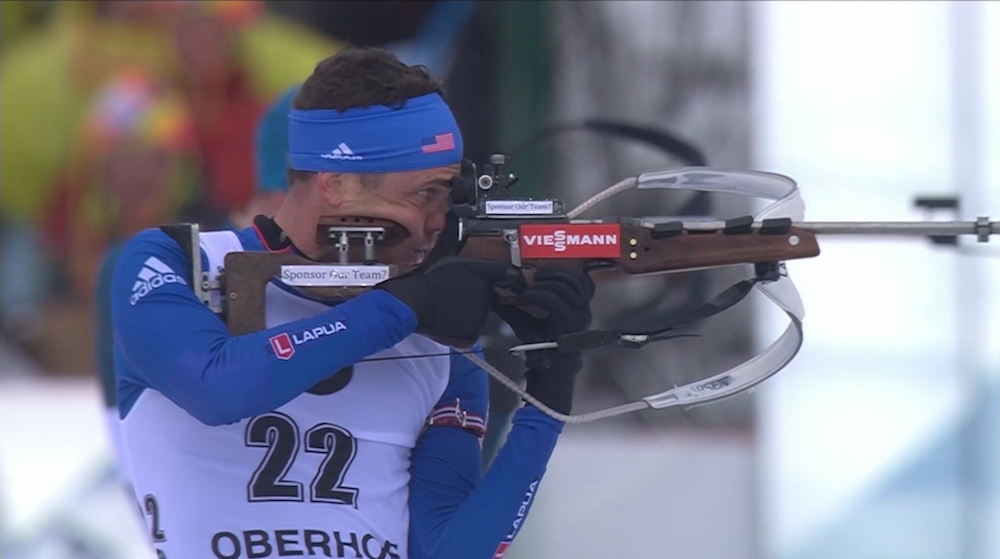
    Tim Burke shooting clean in standing for his second-straight stage en route to a fourth-place finish in the men’s 10 k sprint on Friday at the IBU World Cup in Oberhof, Germany. (Screenshot: ARD broadcast)

    In his first race of the new year, Tim Burke raced to fourth — his best result in four years — in the men’s 10-kilometer sprint at the International Biathlon Union (IBU) World Cup in Oberhof, Germany.

    The 35-year-old American started 22nd out of 103 and shot clean to cross the finish line in third, 20.1 seconds behind France’s Martin Fourcade, who also shot clean and finished in 25:03.3 minutes — a time that would hold up against the entire field as the fastest and give the Frenchman his second win of the season.

    Fourcade had bumped early race leader Norway’s Johannes Thingnes Bø to second, after Bø missed two targets on his initial prone stage then cleaned standing (2+0), but skied the fastest overall course time to reach the podium. Burke’s time was 9.9 short of Bø’s.

    Ultimately, Norway’s Emil Hegle Svendsen as the 58th starter bumped Bø to third and Burke off the podium, finishing second, 8.1 seconds behind Fourcade, also with clean shooting.

    Canada was led by Scott Gow in 32nd (+1:48.7), who had a single standing penalty (0+1), and his brother Christian Gow finished 36th (+1:50.3) with one standing miss as well (0+1). Brendan Green was 57th (+2:30.4) with three penalties (1+2), and in his first European World Cup race, Carsen Campbell finished finished 94th (+4:05.3) with two misses (2+0).

    The U.S. started two men on Friday, with Sean Doherty finishing 84th (+3:24.4) with four penalties (3+1).

    The Oberhof IBU World Cup continues Saturday with the men’s and women’s pursuits.

    Results

  • O’Harra, Frankowski Claim Solo Victories in Tour of Anchorage

    O’Harra, Frankowski Claim Solo Victories in Tour of Anchorage

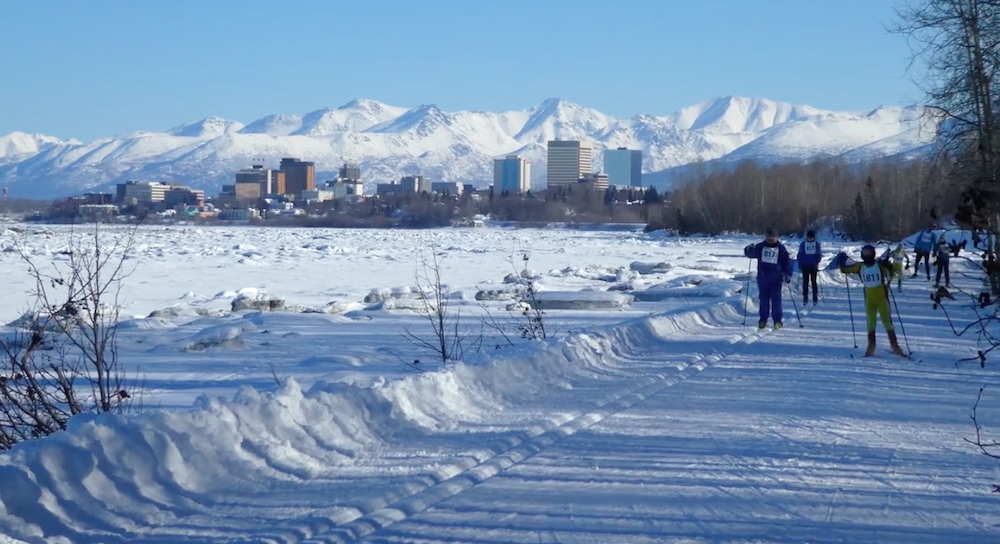
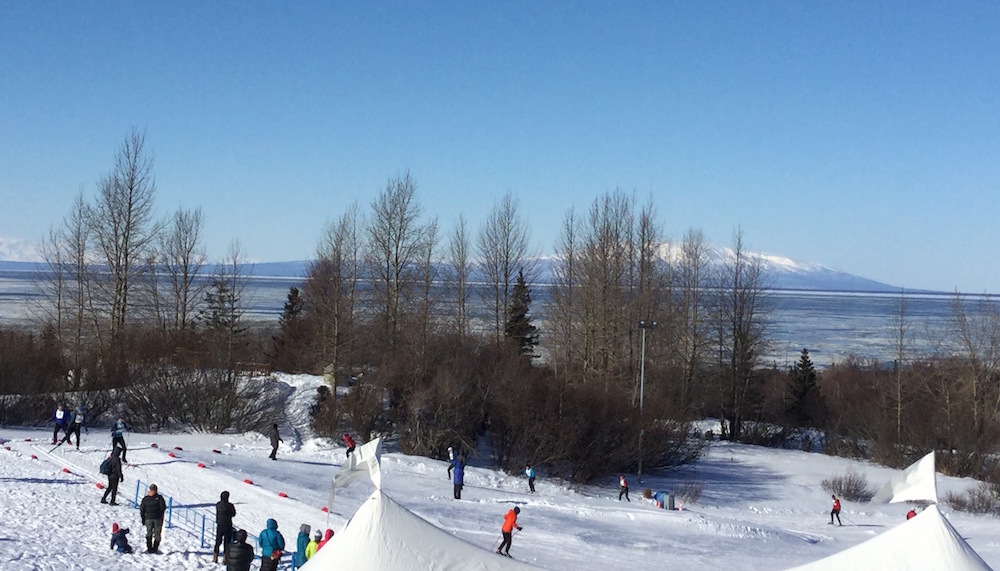
    Midpack racers ski on the Coastal Trail, with the Pacific Ocean to their right and downtown Anchorage in the background, in the Tour of Anchorage on March 5 in Anchorage, Alaska (Photo: Robert Arnold video screenshot)

    ANCHORAGE, Alaska — There are several strategies for winning the Tour of Anchorage, the annual 50-kilometer freestyle marathon from one side of town to the other that is the unofficial citizens’ race championship for the State of Alaska. There is one obvious way to lose it: Go out too hard on the climbs of the first 10 k, only to lose steam and be swallowed up by a chase pack at some point in the 40 k of flats and rolling downhills that follow.

    But Alaska Pacific University skiers Thomas O’Harra and Rosie Frankowski were undeterred by these risks, as both got a gap early in the race and held it to reach the finish line unchallenged, claiming victory in the 30th Tour of Anchorage on a bluebird Sunday morning.

    For Frankowski, pushing hard from the start was her plan all along. “I went off the line,” she told FasterSkier during an in-person interview after the race. “I knew that the only place where it’s easy to build a gap is Spencer’s, and I would much rather ski uphill any day than ski on a flat downhill course. So from the gun I went for it. I tried to ski relaxed, and then the minute I got to even the climbs heading up to the Gasline, I just hammered as if I was in like a 20 k race.”

    Despite the fast pace at the start of a long day, Frankowski was relatively unconcerned about her effort level. “I knew that there’d be tons of recovery, even on Spencer’s,” she said. “We raced a 30 k there a couple years ago [at Spring Series 2014], and you hammer the uphills and you get two minutes of recovery on downhills. So I just went for it. I caught some groups, I had people to chase, people from the men’s waves, and had a lot of local support that definitely moved over.” By the bottom of the Spencer Loop, Frankowski was hearing that she had a five-minute gap on her nearest pursuer.

    Alaska Pacific University (APU) skiers Thomas O’Harra (l) and Rosie Frankowski in the Kincaid Chalet after winning the 2017 Tour of Anchorage on March 5 in Anchorage, Alaska. (Photo: Gavin Kentch)

    “And so I just tried to hammer” at that point and catch the next group, she recounted, “because I wanted to catch a group to draft for the mid-part of the race, and I caught Rob Whitney’s group.”

    Frankowski had nothing but praise for her on-course treatment from Whitney, once a leading American junior and now a formidable Masters skier. “And with Rob and three other guys, we traded off the lead. And it was fun, because they were psyched to have me in the group, compared to – I mean, you hear about sometimes some of the male skiers being annoyed, but they were awesome. And we had this little group going with switching the lead every minute toward the end to try to catch some of the APU guys we could see in front of us. It was really fun.”

    Ahead of all those APU guys was the fastest skier on the day, Thomas O’Harra. The 20-year-old junior and Anchorage native was skiing alone on familiar trails, at one point passing the house he had grown up in. “My season hasn’t really gone the way I’d hoped and so today felt awesome to have a good race at home, on trails that I grew up learning to ski on,” O’Harra said in an APU press release.

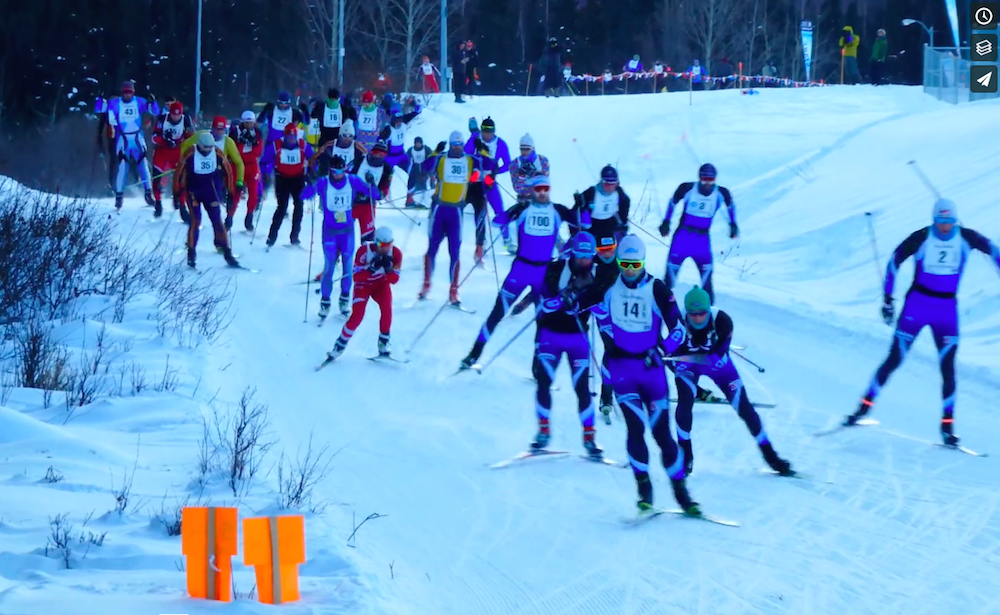
    Like Frankowski in the elite women’s wave starting two minutes behind him, O’Harra led the race off the line. While Frankowski dropped the other women almost immediately, O’Harra had somewhat more company, leading a pack that included fellow APU skiers Reese Hanneman, Tyler Kornfield, and Jack Novak up through Gasline, roughly four kilometers into the race. O’Harra sat in second through the ensuing climbs of the Spencer Loop, until, he recounted, “I made a move going up Wall Street [at the top of the main climb] on Spencer, and I led from there to the finish line.”

    O’Harra was pleasantly surprised that the gambit worked. “My plan coming into the race was to see how my skis were running and decide from there,” O’Harra told FasterSkier after the race, “Once I figured out that my skis were running pretty well compared to everybody else, I decided to go for it and try and stretch it out. I expected – I didn’t expect to ski alone the whole 50 k. I expected everybody else to chase me. And they tried, I heard, but I had a little bit too much of a gap.”

    O’Harra crossed the line in 2:10:49.2. Hanneman (+2:11) and Kornfield (+2:54.8) made up the rest of the podium, with Novak finishing several more minutes back in fourth (+7:21.8). APU skiers took six of the top seven spots in the men’s race, including APU Masters Coach Galen Johnston and former Tour champ Dylan Watts.

    Eventual podium finishers Thomas O’Harra (14), Reese Hanneman (100) and Tyler Kornfield (2), all APU, lead off the starting line of the 2017 Tour of Anchorage on March 5 in Anchorage, Alaska. (Photo: Robert Arnold video screenshot)

    Breaking away at the 7 k mark carries risk in any 50 k, because of the differences in efficiency between leading solo versus skiing in a chase pack that characterize any long race. It is particularly fraught in the Tour, given the elevation changes and topography of the point-to-point race from one side of town to the other.

    Briefly put, the Tour goes up for the first 10 k, but down or flat almost all the rest of the way. More specifically, the 50 k course ascends the rolling uphills of the Hillside ski trails for around 5 k, then tackles the Spencer Loop. Spencer is locally notorious for having more climb than is allowed under International Ski Federation (FIS) regulations – the maximum climb of 104 meters readily exceeds the 80-meter limit permitted for an A-climb on a FIS-homologated course of any distance. Within the first 7 kilometers of the Tour, skiers have climbed more than 150 meters above where they started. (For comparison, the American Birkebeiner, famous for its hills, climbs roughly 105 meters over 11 kilometers.)

    But it’s virtually all downhill from there. Racers descend Spencer, ski on rolling downhills back through the Hillside lighted trails, drop down through Campbell Tract, and then cruise on greenbelt trails until the 44 k mark before climbing up to the finish at Kincaid over the last six kilometers. For parts of the course skiers are on the Coastal Trail alongside the ice floes of Cook Inlet, elevation approximately one meter. All of which is to say that a chase pack has a lot of time to work together on the flats to reel in an early solo breakaway.

    Oh, and it was not warm out there, so leaders were dealing with slow snow as well. Race-time temperatures Sunday morning were -4 degrees Fahrenheit at the starting line, down to -12 degrees in a notorious icebox spot in the black spruce forest of Campbell Tract. Skiers sported the latest in face-tape fashion – Frankowski carried the day with her pink tape and pink buff ensemble – and race photos show a series of frosty faces, ice beards, and clouds of frozen breath.

    Even Frankowski, who dominated the women’s field en route to finishing sixth overall in 2:23:42 (Shalane Frost and Nicole De Yong followed roughly 15 minutes back), noticed the cold.

    “I don’t think it was particularly fast,” Frankowski said. “I never race with a watch, but definitely the snow was slow. … It was not a warm day out there. And by the end – normally I die with 10 k left in all the 50 k’s I’ve done, so today I died with four k left, which was a vast improvement. And the worst part is, I had to stop like four times during the race, because I dropped my waterbottle, or it froze and I couldn’t get it back in my pack. So at one point at Westchester Lagoon I dropped it, my whole group had to go around me because I snowplowed to a stop to pick it up, and then I just threw it onto the Lagoon. So I have to go find it after the race.”

    O’Harra also had plans for after race: “I was informed after the awards ceremony that there is a bottle of wine for me, waiting for when I turn 21, which is next Sunday, and I get it then.”

    With the roof of the beer-garden tent in the foreground and Mt. Susitna in the background, skiers approach the finish line of the 2017 Tour of Anchorage on March 5 in Anchorage, Alaska. (Photo: Gavin Kentch)

    But last Sunday morning, as skiers flocked to the outdoor beer garden following the race, O’Harra was left inside. Let his former roommate Frankowski graciously explain: “I am really excited mostly for my teammate Thomas O’Harra’s win. Thomas and I had been roommates, until December, for about a year, and Thomas now has my room on the APU campus. Which, obviously, the karma contributed to why he won. And in fact, Thomas isn’t even 21, so he can’t go to the beer garden that the Tour of Anchorage and [Nordic Ski Association of Anchorage] has graciously provided for us. So unfortunately, the Tour winner’s stuck inside.”

    Other than bottles, of either wine or water, what were the winners’ future plans? Frankowski, reflecting the realities of life as a professional cross-country skier, was planning to use her $500-dollar winner’s check toward rent money. And as for the rest of her first-place prize, the roundtrip Alaska Airlines plane ticket? “You can’t fly to Cuba” with it, she lamented, “which is basically the main destination I wanted to go to. So now I have to find another destination where Alaska flies. Honestly, I’ll probably go to Minnesota, where I’m from.”

    O’Harra, meanwhile, was planning to put in a three-week training block, “and be in good shape for Spring Series in Fairbanks” in late March.

    O’Harra explained that he had been planning on racing this year’s Birkie before it was canceled, “so that would have been my first 50 k. This instead became my first 50 k. So hopefully my second 50 k, in Spring Series in Fairbanks, will be just as good.”

    For Frankowski, Sunday marked the fourth-career 50 k for the Midwest native, including two Birkies and a win in last year’s Great Bear Chase in Calumet, Mich. “This is definitely the prettiest 50 k I’ve ever done in my life,” Frankowski said of a perfect day when mountains and ocean were visible in all directions throughout the course. “It was beautiful out there.”

    A triumphant return

    Frankowski’s sentiments were clearly shared by many in the crowd of 872 finishers, which marked both the smallest Tour field in over twenty years but also, with this year’s Birkie washed out, the largest ski race in the country this winter to date. Although the Tour was held over its full course 25 times in its first 26 years, the race only went halfway across town in 2014, and was confined to a lap race on Kincaid snowmaking trails in 2015 and 2016 as snowfall was scant and participation numbers plummeted.

    But this year the Tour returned to Anchorage, and Anchorage returned to the Tour. Families raced. Parents raced. Grandparents raced. Anchorage Mayor Ethan Berkowitz raced. Alaska State Representative Matt Claman (D–Anch.), whose house lies within 100 meters of the course, raced. A 9-year-old completed the 25 k (in a healthy 2:08), and 87-year-old Reno Deprey classic skied the 40 k in 4:47. It was a great day for skiing in Anchorage.

    It was also an historic day: March 5, 2017, was just over one century removed from the first recorded ski race in Anchorage, a town founded in 1914 as a construction camp for workers on the Alaska Railroad.

    As former U.S. Ski Team athlete Tim Kelley recounts in more detail on his blog, a 10-mile race was held, starting and finishing on Fourth Avenue in downtown Anchorage, on March 4, 1917 (start line photo here). The winning time was a solid 1:08:30 for 10 miles, more than respectable considering what we would now term the primitive ski technology involved. First place went to a John Aho, with one Emil Gustafason second. A man whose given name was literally “Young Viking” served as race director. They raced again the following weekend, by which time the winning time was down to 57:25 for 10 miles. O’Harra posted a faster pace in March 2017 for 50 k, but not that much faster.

    Other races

    Three other races were held on Sunday. In the 40 k, which skips Spencer Loop and most of the Hillside trails, first place in the women’s division went to former junior standout and Besh Cup Trophy winner Jaime Bronga in 2:05:15.1. Christina Pohl and Melina Park followed.

    In the men’s 40 k, three local juniors used the 40 k to once again unofficially see who is the fastest local junior not selected for Team Alaska for Junior Nationals. (One has to be 18 years old to race the 50 k. The 11 year old who skied this year’s 40 k in 3:06 suggests that there may be no lower age limit for the 40 k.) This year it was Chip Schoff, 17, who took the victory in 1:48:16.3, over 17-year-old Trent Fritzel and 16-year-old Hans Personius.

    In the 25 k skate race, Jasmine Maurer of Homer took the victory for the women in 1:32:59.9, followed by Clare Ross of Anchorage and Mallory Conger of Nome, reflecting the fact that the Tour draws racers from the entire state. For the men, it was Kai Meyers, 16, in first in 1:12:22.6, Kevin Donley, 51, in second, and Dale Baurick, 14, in third.

    And first overall in the 25 k classic was University of Alaska Anchorage skier Sadie Fox in 1:30:28.1, followed by Alison Arians and Anna Rix for the women. First among men, and second overall, was Erik Hjelm in 1:31:42.6, followed by Paul Kari and Karl Volz.

    Next year’s Tour is scheduled for March 4, 2018.

    Results (all races) | Race video

  • U.S. Ski Team Women and Men Among the Masses at Alaska Training Camp

    U.S. Ski Team Women and Men Among the Masses at Alaska Training Camp

    Alaska Pacific University's Kikkan Randall (r) leads fellow U.S. Ski Team member Liz Stephen and Norway's Celine Brun-Lie (l) during a dryland session last week in Anchorage, Alaska, part of the North American Women's Training Alliance. (Photo: Matt Whitcomb)
    Alaska Pacific University’s Kikkan Randall (r) leads fellow U.S. Ski Team member Liz Stephen and Norway’s Celine Brun-Lie (l) during a dryland session last week in Anchorage, Alaska, part of the North American Women’s Training Alliance. (Photo: Matt Whitcomb)

    Watch out Dachstein, Stelvio and Oberhof — there’s a new summer hotspot for nordic skiers in the Northern Hemisphere, and for Americans, it doesn’t require a passport.

    While Eagle Glacier has been around since the Little Ice Age hundreds upon hundreds of years ago, its Thomas Training Center — contracted to the Alaska Pacific University (APU) nordic team — has only been around since the late 1990s.

    According to the U.S. Forest Service, it was created to help American nordic skiers reach international success. Build it and they will come.

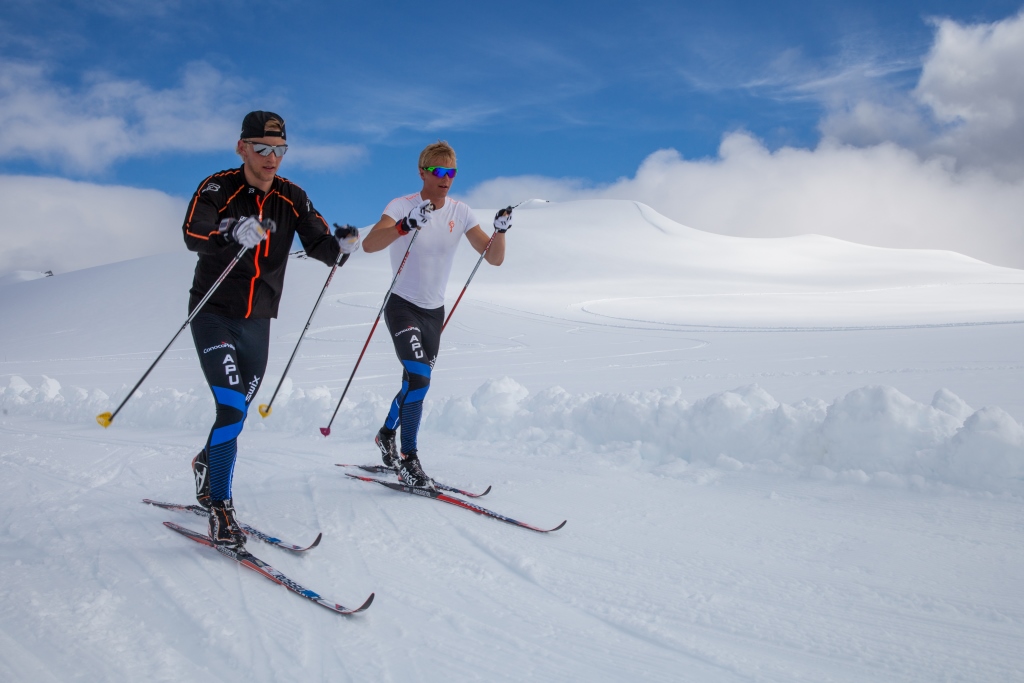
    APU teammates Eric Packer (l) and Erik Bjornsen enjoy a clear day for training on Eagle Glacier near Girdwood, Alaska. (Photo: http://blogs.fasterskier.com/reesehanneman/)
    APU teammates Eric Packer (l) and Erik Bjornsen enjoy a clear day for training on Eagle Glacier near Girdwood, Alaska. (Photo: Reese Hanneman)

    At a given time, APU can put about 20 athletes on the glacier for each of its weeklong camps. There, at 5,500 feet and a 10-minute helicopter ride above sea level, skiers can log quality volume training amounting to several hours a day on snow. And they can get a taste of what the 2015 World Championships courses in Falun, Sweden, will be like.

    Just like last year, when APU put hours of GPS-mapping and grooming in to mimic the Sochi Olympic courses on Eagle Glacier, they’ve done it again — and APU Head Coach Erik Flora likes this loop better.

    “I think this is the best course we’ve ever built,” he said on the phone from Anchorage last week. “Sochi was interesting: one long time out of the bottom and that takes a lot out of the course. … There’s no less climb in this course, but it’s broken up a little bit. We probably spent eight to ten hours with the PistenBully mapping out the course in the snow.”

    That involved Flora and his team of coaches and wax techs (Dylan Watts, Don Haering, and Michael Matteson) making countless tracks and turns with the groomer, then getting out to ski them to see how each flows. They used a GPS to check their distance and measure grade.

    “The best part about it is when you get it in the snow and you get your camps up there and you see the changes,” Flora said.

    While APU hosts several of its own exclusive camps on its backyard glacier each spring, summer and fall, it’s also opened it up to other groups of elite skiers.

    “I think that’s the biggest change that I’ve seen,” Flora said, reflecting on his six years as APU’s nordic director. “We do have a team, but we also have an open door for anyone to come out and train with us.”

    Sun Valley's Chelsea Holmes (l) and Jessica Yeaton, who recently graduated from Montana State University and is now skiing for Australia, during a training run with the North American Women's Training Alliance in Anchorage, Alaska. (Photo: Matt Whitcomb)
    Sun Valley’s Chelsea Holmes (l) and Jessica Yeaton, who recently graduated from Montana State University and is now skiing for Australia, during a training run with the North American Women’s Training Alliance in Anchorage, Alaska. (Photo: Matt Whitcomb)

    From July 6-20, APU is hosting the North American Women’s Training Alliance (NAWTA): 13 women from across the U.S. and one Norwegian.

    In addition to the five U.S. Ski Team women (Sadie Bjornsen, Sophie Caldwell, Jessie Diggins, Kikkan Randall, and Liz Stephen), Norway’s Celine Brun-Lie joined the two-week camp as NAWTA’s international guest. Last year, they hosted Astrid Jacobsen.

    Then there’s two-time Olympian Holly Brooks and her APU teammates (in addition to Bjornsen and Randall) Rosie Brennan, Rosie Frankowski, Becca Rorabaugh, and Lauren Fritz. Erika Flowers (Stratton Mountain School T2), Chelsea Holmes (Sun Valley Gold Team) and Caitlin Gregg (Team Gregg) are also up on the glacier with the select training group.

    Three French biathletes — one of which recently retired — have also been in Anchorage training with these women, along with Stephanie Kirk, an APU training partner and University of Vermont skier, and Jessica Yeaton of Australia.

    Marie-Laure Brunet, who announced her retirement early last month, stayed with APU in May, along with Marine Bolliet, a current French biathlon national team member, who trained with the team in late May and June. Bolliet stuck around for one dryland day with the U.S. Ski Team (USST) last week before flying back for another camp in France.

    The two women came to town to visit their former teammate Marine Dusser, a current University of Alaska-Anchorage skier and Erik Bjornsen’s girlfriend.

    Sadie Bjornsen explained that having them around made for a “mini-France” up in Alaska, which she welcomed because “there is always something to learn from other athletes of other countries,” she wrote in an email. “We have had lots of time to talk about the way we train, how we approach training, and how we keep things fresh.”

    Two members of the North American Women's Training Alliance during a skate rollerski near Anchorage, Alaska. (Photo: Matt Whitcomb)
    Two members of the North American Women’s Training Alliance during a skate rollerski last week near Anchorage, Alaska. (Photo: Matt Whitcomb)

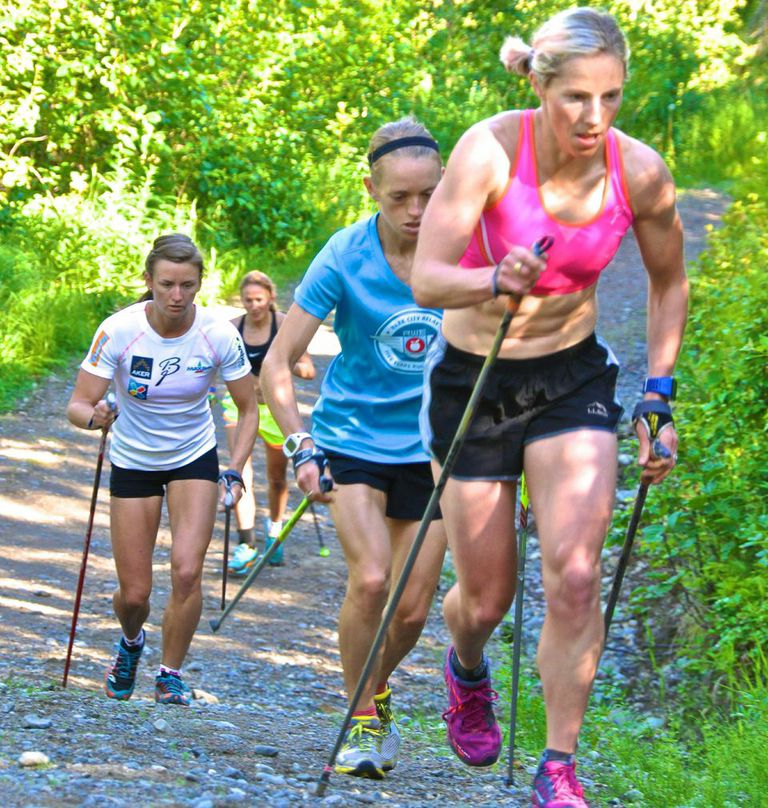
    Last Monday, the 14 women with the fourth-annual NAWTA started their Alaska camp with a week of dryland and rollerski training in places like Kincaid Park in Anchorage. And with people like Bolliet, Dusser, Kirk, Yeaton, and up to 70 others training with them on certain days, one would be hard pressed to find that many rollerskiers in one place anywhere else in the world right now.

    That scene left Flora talking excitedly about the rising interest in Anchorage as a training hub. He’d seen 40 athletes rollerskiing along Kincaid’s hillside before, but 70?

    “That’s by far the largest,” he said. “It’s becoming like a training center. On any given day you can have someone pop out that was a former World Cup medalist and … and having Celine with us, it’s the same thing. She joined us for our APU strength [session] the other night. She joined like it was just like her training club.”

    The U.S. women’s team invited Brun-Lie to the camp, as it had with past guests, including Finland’s Aino-Kaisa Saarinen and Canada’s Perianne Jones and Chandra Crawford.

    “She’s been a friend of our team for a couple years now so we knew what we’d be getting when she decided she’d like to join us,” USST women’s coach Matt Whitcomb explained of Brun-Lie in an email. “She’s about as nice as they come and brings with her not just World Cup podium experience, but some of the smoothest technique on the World Cup. She rides a ski like Sophie and brings a ton to our group. Norway is lucky to have her on their team. We’ll do our best to send her home a bit faster as well.”

    U.S. Men Arrive

    And while his women’s team transitioned from dryland intensity to on-snow training on Eagle Glacier this past weekend, the U.S. men’s team started camp in Anchorage today for the first time as a unified group (Noah Hoffman had trained there previously, along with APU’s Erik Bjornsen). They’ll head up to the glacier next week.

    The men’s training group includes 14 athletes as well, five of which are on the USST: Hoffman, Andy Newell, Simi Hamilton, Bjornsen, and Ben Saxton. APU skiers Reese Hanneman, David Norris, Lex Treinen, Tyler Kornfield, Eric Packer, and Scott Patterson were also invited, along with APU training partners Tucker McCrerey and Kyle Bratrud, and Brian Gregg (Team Gregg).

    As for the goals of this men’s camp (led USST Head Coach Chris Grover and assisted by USST coach Jason Cork, Flora, and Matteson), Grover wrote that they’re shooting for “high-quality training” in the form of four to five intensity sessions while in Anchorage, “followed by some of the biggest volume of the season on-snow on Eagle Glacier.”

    Celine Brun-Lie (l) leads Sophie Caldwell (c) and Rosie Brennan during a dryland session last week in Anchorage, Alaska, part of the North American Women's Training Alliance. (Photo: Matt Whitcomb)
    Celine Brun-Lie (l) leads Sophie Caldwell (c) and Rosie Brennan during a dryland session last week in Anchorage, Alaska, part of the North American Women’s Training Alliance. (Photo: Matt Whitcomb)

    Also assisted by Cork and Flora, Whitcomb explained that the primary goal of the women’s camp “is to get the best women in the country together to train hard for fourteen days – just like the rest of our camps.”

    Specifically, they’re aiming to become “just 1 or 2% faster each season,” which is where a competitive training atmosphere comes in handy.

    “The aging model of training on your own for most of the preparation period is just not something I believe in,” Whitcomb wrote. “If you want to be stronger, you must surround yourself in strength.”

    While he acknowledged there are exceptions, they’re rare.

    “If you’re comfortable in every training session you’re either plateauing or slowing down,” he explained. “We put ourselves in vulnerable situations where failure is a real possibility.  That’s how we succeed.  It’s the training group itself that does its own coaching. The athletes receive feedback relative to the group in just about every aspect of training.”

    Week 1 and Done

    After the first week in Alaska, Whitcomb wrote that it was too early to compare the quality of training sessions compared to those in the past.

    “The volume will be high [this] week so we’ll see how training is being absorbed soon enough,” he wrote. “It becomes fairly binary by Thursday.  It is or it isn’t. Week one has been a success. Mostly because we saw that awesome bear.”

    During a run, the group spotted a grizzly bear about 300 meters ahead on a hill — well off the trail.

    “It was sleeping in a meadow and popped up its head, stood up to talk a look at us, and walked away,” Whitcomb wrote. “We were well armed with bear spray if needed.”

    Luckily, they didn’t need it, but in an unrelated incident, Diggins had to get six stitches in her knee. According to Whitcomb, she tripped on her way to a swimming hole after a long skate rollerski at Hatcher Pass.

    “She’s on the tougher side of the spectrum and had to only modify one workout by changing it from a run to a hike,” he wrote. “Her knee is stiff and a bit sore but training is still going well.”

    As for other USST injuries, doctors cleared Caldwell for full training after she sustained a minor elbow fracture at the last training camp in Bend, Ore.

    “Her range of motion has a bit more to go but I’ve been really pleased with the work she has done between camps with SMS T2,” Whitcomb explained. “Her legs are stronger and working technically better as a result of so much no pole and one pole training. She’s never really skipped a beat.”

    According to Whitcomb, Erik Bjornsen’s back injury is recovered, and Newell’s back is “much better” after he tweaked it while weightlifting.

  • Spring Series in Photos: Mixed Relay

    Spring Series in Photos: Mixed Relay

    ANCHORAGE, Alaska — Ask anyone who attended Tuesday’s 4 x 5-kilometer mixed relays at U.S. Distance Nationals and you’d be hard-pressed to find anyone who didn’t think it was a good idea for future races and a fun event in general. Here are some photos from the evening race at Kincaid Park.

  • Ultimate Team Event: Anchorage Hosts Coed Relay at National Championships

    Ultimate Team Event: Anchorage Hosts Coed Relay at National Championships

    It's an amiable atmosphere at Spring Series in Anchorage, Alaska. Teams will be competing for a national title on Tuesday in Kincaid Park in the coed 4 x 5 k, the first race of U.S. Distance Nationals. (Photo: Rob Whitney)
    It’s an amiable atmosphere at Spring Series in Anchorage, Alaska, as seen here after Sunday’s classic-sprint final. Teams will compete for a national title on Tuesday in Kincaid Park in the coed 4 x 5 k, the first race of U.S. Distance Nationals. From left to right: Andy Newell (SMST2/USST), Reese Hanneman (APU/USST), Ben Saxton (SMS), Pat O’Brien (CGRP), Dakota Blackhorse-von Jess (BEA), and Tyler Kornfield (APU). (Photo: Rob Whitney)

    When the U.S. Ski and Snowboard Association (USSA) met last spring, they decided it was time for a bit of a change at the season-ending SuperTour Finals and U.S. Distance Nationals. Instead of a hill climb, they opted for a team relay at the races in Anchorage, Alaska, scheduled for the following March 22-28.

    According to the event’s race director James Southam, a two-time Olympian from Anchorage, athletes brought up the idea of a team event last year. An opening in the schedule made the 4 x 5-kilometer relay possible for 2014.

    But unlike most four-person relays, the one going off Tuesday at 5 p.m. Alaska time will be coed with a male scramble classic leg tagging to a female classic skier, then male freestyle skier, and finally, a female freestyle anchor.

    “I think it’s gonna be fun,” Southam said. “The last distance relay I remember doing was I think in Bend [Ore.] in 1998 or something like that for nationals. I think having the coed is going to be cool. … You don’t need four good guys or four good girls; I think it makes it a little more competitive.”

    Eighteen official teams (including two junior squads), each made up of two males and two females from the same USSA club, will compete for a national title — and $750 dollars in prize money to split four ways. The second-place team will receive $500, and third gets $300.

    It’s the second-to-last competition before Friday’s 30 and 50 k classic mass starts, which will be held at a different venue than the rest of the races at Kincaid Park, at the Hillside Trail System on the east side of town.

    Teams to watch include Alaska Pacific University’s first team, with Reese Hanneman, Sadie Bjornsen, Erik Bjornsen, and Kikkan Randall, in that order. The top team from Stratton Mountain School T2, Andy Newell, Sophie Caldwell, Simi Hamilton, and Jessie Diggins will also contend for the title, along with Craftsbury’s Patrick O’Brien, Ida Sargent, Gordon Vermeer, and Caitlin Patterson, and Sun Valley’s Mikey Sinnott, Mary Rose, Matt Gelso, and Chelsea Holmes.

    Several college teams, such as the University of Vermont, Northern Michigan, New Mexico, and the University of Alaska-Anchorage will also be vying with the best of them.

    There are also few unofficial teams with skiers from different clubs that have a shot at winning for glory rather than cash. Fastest of the Fast Twitch includes Brian Gregg (Team Gregg/Madshus), Liz Stephen of the U.S. Ski Team (USST), Noah Hoffman (SSCV/Team HomeGrown/USST), and Caitlin Gregg (Team Gregg/Madshus). The Vagabonds are Karl Nygren (Podiumwear), Jennie Bender (Bridger Ski Foundation), Mark Iverson (Rossignol), and Cambria McDermott (independent).

    Each competitor will ski two laps of either a roughly 3.3 k classic loop (for 6.6 k total) or a 2.6 k skate loop (for approximately 5.2 k).

    As for the 5 p.m. start? It’s all about getting the best bang for the buck in terms of participation, volunteers and spectators.

    “We want as many of the kids from around town to be able to race in it as well and to come out and watch it,” Southam said. “When you have midweek races at 11 o’clock it’s hard to get the kids out to watch. One of the big reasons we wanted to host these races is, after the Olympics people have been paying attention to skiing all winter long and it’s pretty powerful for kids coming up to be able to watch Olympians and world champions.”

    Of the 26 teams entered in Tuesday’s relay, the two official junior squads are from APU. One unofficial team includes three men and a woman, another has four junior males, and one has three males, which will complete three legs and then call it a race.

    Start list

  • Hanneman Proclaimed Winner After Newell’s Late-Lane Change in SuperTour Finals Sprint

    Hanneman Proclaimed Winner After Newell’s Late-Lane Change in SuperTour Finals Sprint

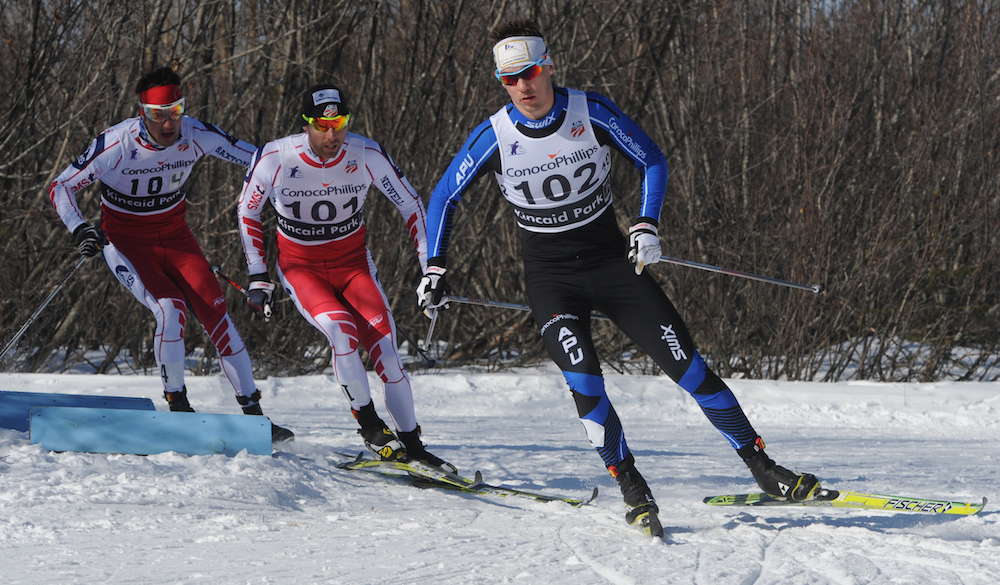
    (Reese Hanneman (102) leads Andrew Newell (101) and Benjamin Saxton (104) while skiing to victory during the men's final at the Super Tour Finals classic sprint races at Kincaid Park on Sunday in Anchorage, Alaska. (Photo: Bill Roth/Anchorage Daily News)
    Alaska Pacific University’s Reese Hanneman (r) leads Andrew Newell (c), of the Stratton Mountain School (SMS) T2 and U.S. Ski teams, and Benjamin Saxton (SMS), in the men’s classic-sprint final at the Super Tour Finals at Kincaid Park on Sunday in Anchorage, Alaska. The three went on to finish in the top 3, with Newell first, Hanneman second and Saxton third, but Newell was relegated for obstructing Hanneman and listed as sixth. (Photo: Bill Roth/Anchorage Daily News)

    ANCHORAGE, Alaska — Andy Newell’s victory was over almost as soon as he’d finished. The U.S. Ski Team member’s lane switch in the last 80 or so meters before the finish of the men’s 1.4-kilometer classic sprint final at SuperTour Finals on Sunday prompted several jury members to convene once he finished first.

    In the second lane from the right out of four lanes to the finish, Reese Hanneman of Alaska Pacific University (APU) had been trailing Newell slightly, who was farthest right, before Newell decided to shift left to the inside of a slight lefthand curve before the final straightway.

    He had to accelerate to do so and needed to leave enough room between him and Hanneman before jumping across his lane, two tracks to the left. Hanneman, who’s lived and trained in Anchorage for the last five seasons and is originally from Fairbanks, later said he had to stand up for a second and the move cost him a chance at winning. Newell claimed he had the space and went for the opening.

    The two double poled to the line, where Newell stayed ahead of Hanneman by several meters through the finish. Hanneman tossed his head back in disappointment — it was the one low point of an otherwise picture-perfect day. Warm sun, consistent conditions, and for Hanneman, a win in each of the preceding heats with the exception of the qualifier, in which he placed second to Newell by 2.6 seconds.

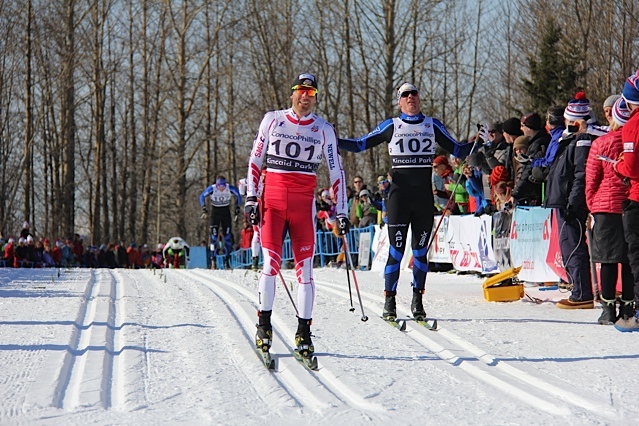
    Andy Newell (101) beat Reese Hanneman (102) to the finish of Sunday's 1.4 k classic sprint final, but was later relegated to sixth in the heat for obstructing Hanneman about 80 meters before the finish. (Photo: Rob Whitney)
    Andy Newell (101) beat Reese Hanneman (102) to the finish of Sunday’s 1.4 k classic sprint final, but was later relegated to sixth in the heat for obstructing Hanneman about 80 meters before the finish. (Photo: Rob Whitney)

    In the final, Hanneman had to come to grips with losing to Newell in the end-all race of the day. In first for much of the 1.4 k loop, which included a gradual downhill into a tight right corner and long descent before the big climb back up, Hanneman initially attacked at the bottom of the final hill known as Elliott’s Climb and led halfway up.

    Newell followed him closely and pulled up alongside Hanneman some 200 meters before the finish, then the two raced side by side over the top. Skiing in the same suit for the same team as Newell, Ben Saxton of the Stratton Mountain School (SMS) was the next closest competitor a few seconds back.

    Just after the crest before the flat to the finish, that’s where the moment in question went down. That’s what sent APU head coach Erik Flora running to the finish to meet with jury members after the two finished. According to Hanneman, the jury was already aware of the incident and in the process of discussing whether to deny Newell of the victory because of obstruction.

    About an hour and 45 minutes later, the announcement was made: unofficially, Hanneman had won, and everyone else in the final had moved up one place — Saxton to second, Tyler Kornfield (APU) in third, Pat O’Brien (Craftsbury Green Racing Project) in fourth, and Dakota Blackhorse-von Jess (Bend Endurance Academy) in fifth. Newell was relegated to sixth with a competition suspension.

    A 15-minute protest period allowed Stratton coaches to file the first official protest of the day, in which they opposed the decision to penalize Newell. Twenty-five minutes later, the jury arrived at their decision: Hanneman would remain the classic-sprint champion and Newell was sixth.

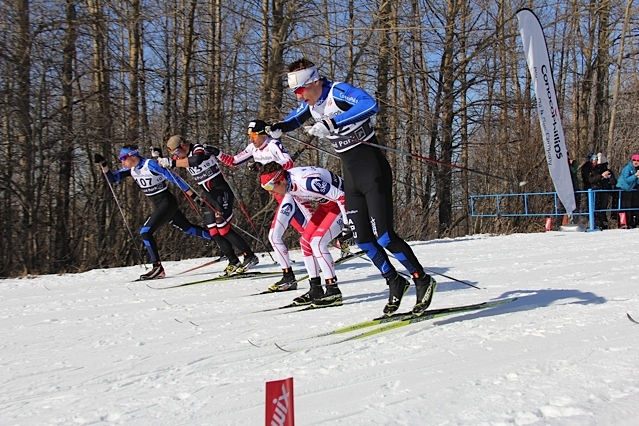
    Start of the men's final at the SuperTour Finals classic sprint on Sunday at Kincaid Park in Anchorage, Alaska. (Photo: Rob Whitney)
    Start of the men’s final at the SuperTour Finals classic sprint on Sunday at Kincaid Park in Anchorage, Alaska. (Photo: Rob Whitney)

    It wasn’t the way anyone wanted it to happen.

    “I would rather win without all that shenanigans, but that was one of the few times I’ve actually felt like a move really kind of did affect the race,” the 24-year-old Hanneman said. “So that’s why I wanted to stand behind that.”

    As the jury informed both men of their decision inside the timing trailer the finish, Hanneman sat on a table looking down and Newell stood up, smiling. He wasn’t happy. If anything, he was in awe.

    “I don’t see how that’s possible. … I don’t really now what they’re thinking,” Newell said. “I think they’re kind of beginners in there.”

    For someone who laughed as he said he’s “been to a lot of TD meetings in my life,” Newell’s frustrations were easily understood. Hanneman got it and initially didn’t want to rock the boat. Second was a great result, but he stood behind his coaches’ decision to follow up with the jury. Hanneman is known as one of the most social guys on the circuit, amiable and friends with a lot of people. Newell’s also highly respected at the domestic and international levels.

    “That’s what I want it to be. I have nothing against anybody, I don’t want anyone having anything against me,” Hanneman said. “But I don’t want people to abuse that and ski all over me because I’m a nice guy.”

    As for the official decision, technical delegate Bill Rogers said Newell was issued a competition suspension for obstruction, something that wouldn’t affect other races this week.

    “Basically we had the jury made a decision based on evidence, Andy Newell protested that and so we did have a closed jury meeting, which involves interviewing both the athletes and then separately meeting to go over the evidence,” Rogers said.

    The process itself involved calling the athletes and their coaches to the table, which convened outside then moved into a private meeting inside the timing trailer, to review video and photos. Hanneman argued that Newell skied over his skis: “They have pictures of video of him just mobbing all over my gear,” he said.

    Newell couldn’t say whether there was contact or not, but said he made a point to get far enough ahead of Hanneman to make his lane change.

    “I also changed two tracks over instead of one so I wouldn’t block him,” Newell said. “I guess according to the video he stands up a little bit, but I am barely even going near the tips of his skis, if they did at all.”

    The process itself, according to Newell, involves the jury asking each skier involved “was is it intentional or not, is the first question … and it was obviously not intentional,” he said. “And then, was there an advantage or not? And that’s kind of the shady area. It’s not like Reese lost much time, he did maybe stand up for a second and so if you call that an advantage or not, I don’t know because it didn’t really affect the outcome of the race.”

    Hanneman said the jury asked about contact first, to which he said, “Absolutely. Was it intentional? That’s more up to [Newell], I have no clue. But to say you accidentally switched tracks? That doesn’t happen. … I felt like once he made that move that kind of decided the race. It seems like they made the right decision even though I wish they didn’t have to make that decision at all.”

    Newell knew that because his previous infraction at World Cup Finals last weekend was a technical warning, equivalent to a yellow card on the World Cup (for skating while changing lanes in a classic sprint), it wouldn’t affect anything at SuperTour Finals. Plus, the season was over after these races in Anchorage.

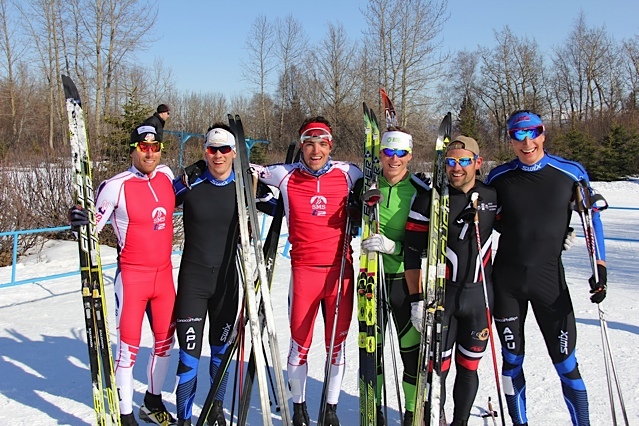
    Friends 'til the end: the men's final, all of which placed in the top sixth (from left to right) Andy Newell, Reese Hanneman, Ben Saxton, Pat O'Brien, Dakota Blackhorse-von Jess, and Tyler Kornfield. (Photo: Rob Whitney)
    Friends ’til the end: the men’s final, all of which placed in the top sixth (from left to right) Andy Newell, Reese Hanneman, Ben Saxton, Pat O’Brien, Dakota Blackhorse-von Jess, and Tyler Kornfield. (Photo: Rob Whitney)

    The penalty cost Newell $650 dollars in prize money, plus the $100 he and his coaches had to put forward to protest. At the end of the day, he made $100 for sixth place, which the protest fee negated.

    On the flip side, Hanneman took home an extra $250 dollars for the win ($750 for first as opposed to $500 for second). It was the SuperTour leader’s second victory in national-caliber classic sprints this season after he won his first national title at U.S. Cross Country Championships in the classic sprint in January.

    But he also knew what the other side of a jury decision felt like. In December, Hanneman was disqualified for skating in a Besh Cup classic sprint — which he initially won.

    “I know that it’s not fun but when you do something that’s questionable, like when I skated in Besh Cup, I was like, well, I shouldn’t have done that and know I know,” he said. “You need that to reinforce … Andy needs to know that he can’t make a move like that because it’s not fair racing. You have to some checks like that to keep people in line.”

    According to Rogers, “Unfortunately, obstruction in sprints is common. I think it’s very normal.” He declined to explain how the jury made their final decision and the evidence they considered in the process.

    At the end of the day, Hanneman was a champion and the 20-year-old Saxton had one of the best races of his career in second — up there with his runner-up finish in the skate sprint at 2014 nationals. He finished 4.74 seconds behind Hanneman (who ultimately won in 3:25.56) and held off Kornfield by 1.49 seconds.

    For Kornfield, the 2012 national classic-sprint champion, third stood as his best race of the season. He finished 4 seconds ahead of O’Brien, who ended up fourth, and 13 seconds ahead of Blackhorse-von Jess in fifth.

    Saxton said Hanneman and Newell took off toward the bottom of the hill, over the first roller on the way up to the finish. He was caught in the far left lane in fourth and unable to go with them. Despite the fact that he thought he could’ve stuck with them to the finish, Saxton said he was happy with his result — even if it was third at first.

    “I haven’t felt this good all year. This was an incredible feeling,” Saxton said.

    “Andy and Reese threw down World Cup qualifiers today so that’s pretty awesome,” he added, referring to Newell’s top time of 3:19.52. Hanneman was 2.6 seconds back in second and Blackhorse-von Jess advanced to the heats 4.09 seconds behind Newell in third. Saxton qualified fourth (+7.4).

    Saxton went on to win his quarterfinal (as did Newell), as well as the first semifinal by 0.24 seconds over Newell.

    “It’s pretty cool for me to get to race against Andy [and] experience that for the first time,” Saxton said. “[Watching him in the quarterfinals] it was incredible dichotomy between him and the other skiers. He’s so relaxed. It’s not that there technique is bad, but it’s just this innate tightness. There’s a laboredness in their movements.”

    So to beat him in the semifinal was fun.

    “In my semi, we went side by side up the hill, so it was cool to feel that pace and feel the turn of pace,” Saxton said. “It was exciting.”

    Hanneman bested O’Brien in the second semifinal by 0.83 seconds. O’Brien and Simi Hamilton (SMST2/USST) also won their quarterfinals, but Hamilton placed fourth in the second semifinal, 2.6 seconds behind Blackhorse-von Jess in third, and did not make the final.

    “Reese is skiing incredible,” said Saxton, Hanneman’s roommate in Europe last year, shortly after the finish. “I could not be happier for that guy.”

    — Nat Herz contributed reporting

    Results

  • Just Like Old Times, Randall Wins at Kincaid in SuperTour Finals Opener 10 k Skate

    Just Like Old Times, Randall Wins at Kincaid in SuperTour Finals Opener 10 k Skate

    Kikkan Randall (APU/USST) heads up Elliott's Climb in Kincaid Park at the end of the first of two laps on Saturday. She went on to win the 10 k freestyle individual start by 2.2 seconds on the first day of SuperTour Finals in Anchorage, Alaska.
    Kikkan Randall (APU/USST) heads up Elliott’s Climb in Kincaid Park at the end of the first of two laps on Saturday. She went on to win the 10 k freestyle individual start by 2.2 seconds on the first day of SuperTour Finals in Anchorage, Alaska.

    ANCHORAGE, Alaska — Liz Stephen had quite the task ahead of her on Saturday in the first race of 2014 SuperTour Finals. Kikkan Randall’s house guest for the week and her longtime buddy on the U.S. Ski Team, the 27-year-old from East Montpelier, Vt., started a minute behind Randall in the women’s 10-kilometer freestyle individual start at Kincaid Park.

    Usually, that would be fine, but when you hear cheers through the woods ahead of you and get splits that you’re right behind Kikkan, that you’re seven seconds down, one second down, it’s hard to know how to beat her.

    Stephen tried anyway, but at the end of the 27-minute race — which was actually 10.6 k on the two-lap course — Randall was the one who finished fastest in 27:27.1, by 2.2 seconds over Stephen in second.

    Alaska Pacific University’s leading veteran, Randall, 31, repeated her win in the 10 k distance from last year’s SuperTour Finals in Truckee, Calif. There, she won the 10 k classic by 36.6 seconds over her APU and USST teammate Sadie Bjornsen and finished 47 seconds ahead of Stephen.

    On Saturday, the 10 k skate was a favorite event for several on the U.S. Ski Team (with the exception of Sophie Caldwell, who finished eighth and smiling in one of her least-favorite races on her 24th birthday. She was greeted at the finish by nearly a dozen costumed competitors, including Randall in a tinsel wig and Stephen in an afro, somewhat contained by a ski headband).

    A few minutes earlier, Randall and Stephen had been just as gassed as most in the field at the finish, which ended on the winding uphill called Elliott’s Climb before an 80-meter straightaway into the World Cup stadium (a modified start and finish because of low snow).

    “I knew it was close,” Stephen recalled. She was down by 7.3 seconds to Randall after the first lap then two seconds a couple kilometers later.

    With 3 k to go, Stephen knew she had some climbing ahead — which was good for her. Randall’s strength was gliding, she reasoned, so Stephen went for it on the rolling (and sometimes-screaming) downhills and tried to ski relaxed, until the last time up Elliott’s.

    “On this final climb it was just head down and going,” Stephen said. “[Kikkan] got it and it’s great to see her win in her home state.”

    SuperTour leader Caitlin Gregg (Team Gregg/Madshus) clocks the fastest time through 5 k in Saturday's 10 k freestyle at SuperTour Finals in Anchorage, Alaska. She went on to place third.
    SuperTour leader Caitlin Gregg (Team Gregg/Madshus) clocks the fastest time through 5 k in Saturday’s 10 k freestyle at SuperTour Finals in Anchorage, Alaska. She went on to place third.

    While Randall had an edge on Stephen from start to finish, she was actually trailing Caitlin Gregg (Team Gregg/Madshus) by 3.6 seconds at the end of the first lap. However, Randall had little way of knowing; she started 5 1/2 minutes ahead of Gregg. (Stephen started ahead of her as well.)

    The 2014 American Birkebeiner freestyle champion, Gregg was also fresh off a flight from World Cup Finals in Europe. She arrived in Anchorage on Tuesday — one day before Randall and Stephen.

    While Gregg said her energy was good and wasn’t sure where she lost time on the second lap on Saturday, she credited Randall and Stephen as “great World Cup skiers” and was satisfied with third place, 20.9 seconds behind Randall and 4.1 seconds ahead of Bjornsen in fourth.

    “I always have really good skate races here in Anchorage,” Gregg said. “Whether it was at JO’s [Junior Nationals], NCAA’s, nationals twice, I qualified for the Olympics here in 2010 — for whatever reason, Alaska and I, Anchorage and I do great. I love the trails, I love the conditions, the crowds, it’s a good vibe.”

    When she and her husband, Brian, who placed ninth in the men’s 15 k, found out that Spring Series was going to be there, they couldn’t pass it up. Even after they raced more than ever this season — both domestically and internationally; Caitlin said she’s only had two weekends off since early October and has been back and fourth to Europe twice.

    “Even after our crazy long season, we were like, ‘Oh man, that is gonna be awesome,’ ” she said. “We went for an afternoon jog at nine o’clock last night. We watched the sunset over the ocean.”

    “For whatever reason, Alaska and I, Anchorage and I do great. I love the trails, I love the conditions, the crowds, it’s a good vibe.” — Caitlin Gregg (Team Gregg/Madshus), third in 2014 SuperTour Finals 10 k freestyle

    The ultimate hometown hero, Randall relied on the crowd to boost her the last time around Kincaid — the same trails she grew up on. Born in Salt Lake City, Utah, Randall moved to Anchorage with her family when she was just a few years old, and went on to rack up 10 state titles at East Anchorage High School, all of which were in running.

    As a junior skier, Randall won seven Junior National titles and set Alaska’s record for fastest woman on skis at 74.14 miles per hour in a 1994 speed-skiing event, according to her blog.

    But on Saturday, what mattered was that the four-time Olympian had another great day in her storied career, which she most recently added her third Sprint World Cup title to.

    “You spend the whole winter on the World Cup and then you come back here and it just feels so familiar,” Randall said. “Just seeing everybody and the snow is familiar. It was really funny packing my race bag this morning, I was so in the routine all winter, but then to do it in your own house is kind of funny.”

    Liz Stephen (Burke/USST)  heads up Elliott's Climb the first of two times in Saturday's 10 k freestyle at SuperTour Finals at Kincaid Park in Anchorage, Alaska. She went on to place second to teammate Kikkan Randall by 2.2 seconds.
    Liz Stephen (Burke/USST) heads up Elliott’s Climb the first of two times in Saturday’s 10 k freestyle at SuperTour Finals at Kincaid Park in Anchorage, Alaska. She went on to place second to teammate Kikkan Randall by 2.2 seconds.

    She had her husband, Jeff Ellis, and Stephen at home with her, too. Randall said it was that familiarity paired with the ability to make an impact on the community that made her want to have the post-Sochi Olympics, season-ending races there. These Finals are Randall’s first races in Anchorage since 2010 nationals.

    “It’s really nice for us racers to come back and race at home, but it’s so good for the community and the next generation of Olympians,” Randall said. “They’re seeing a high-level race for the first time and they’re like, ‘Oh man, I want to be there someday.’ I remember being a kid and feeling that way.”

    Randall went on to become the most successful female cross-country skier in U.S. history.

    “When I was standing in the start gate [today] I thought, I do this because I love it,” Randall said. “When you’re on the World Cup, it’s such a big scene there, but to do it here in front of all your friends and family, it’s like, Oh yeah, this is the true spirit of cross-country.”

    Stephen, who’s also under APU’s wing this week with wax help, said the kind of recognition Randall gets from her home state and supporters stands out.

    “Everybody knows her and it’s a really cool atmosphere here in Alaska,” Stephen said. “We were watching TV last night from some shows that had been recorded in December. Usually you fast-forward through the ads, and we were doing that, but on a number of different occasions I would be like, ‘There you are!’ And we’d have to go back and watch it.

    “It’s just really cool to see a community and a whole state really embrace cross country skiing and embrace their athletes,” Stephen added. “It’s fun to be here and it’s fun to be home with Kikkan because she is a star. In our minds, all the time and in her state too and it’s just fun to be a part of it.”

    Also in the top 10, Jessie Diggins, of the Stratton Mountain School T2 Team (SMST2) and USST, placed fifth (+29.8). Girdwood native Chelsea Holmes (Sun Valley Ski Education Foundation) was sixth (+55.0), Holly Brooks (APU/USST) seventh (+56.2), Caldwell (SMST2) eighth, Erika Flowers (SMST2) ninth, and Anchorage’s own Caitlin Patterson (Craftsbury Green Racing Project) 10th.

    Results (scroll down for women)