Tag: Klemen Bauer

  • More Olympic and World Championship Medalists Join Tyumen Biathlon Boycott

    More Olympic and World Championship Medalists Join Tyumen Biathlon Boycott

    Canada’s Christian Gow (12) chases Germany’s Erik Lesser during the men’s 4 x 7.5 k relay at the 2018 Olympics in PyeongChang, South Korea. Germany won bronze. Lesser lamented the situation and said of the IBU’s decision to hold World Cups in Tyumen, Russia, despite requests from him and other athletes to move the event: “If we don’t go, it’s wrong because it’s our sport we love. [But] if we go to Tyumen, we maybe send the wrong sign to IBU.” (Photo: FlyingPointRoad)
    In three weeks time, biathlon’s World Cup circuit will move to Russia.

    But a number of the sport’s stars won’t be there – and others plan to attend, but aren’t very happy about it.

    In an Executive Board session in PyeongChang, South Korea, a few weeks ago, the International Biathlon Union (IBU) decided to go on as planned with World Cup races in Tyumen, Russia, even though the Russian Anti-Doping Agency is still not compliant with the World Anti-Doping Code.

    Biathlon Canada had announced in December that it would boycott the event if it was kept in Russia, following revelations of systematic abuse of the anti-doping system by that country. In the intervening months, athletes appealed to the IBU through private channels to move the races to a country which complies with the WADA Code.

    After the IBU’s most recent announcement, the United States and Czech Republic have also gone public with boycotts of the event.
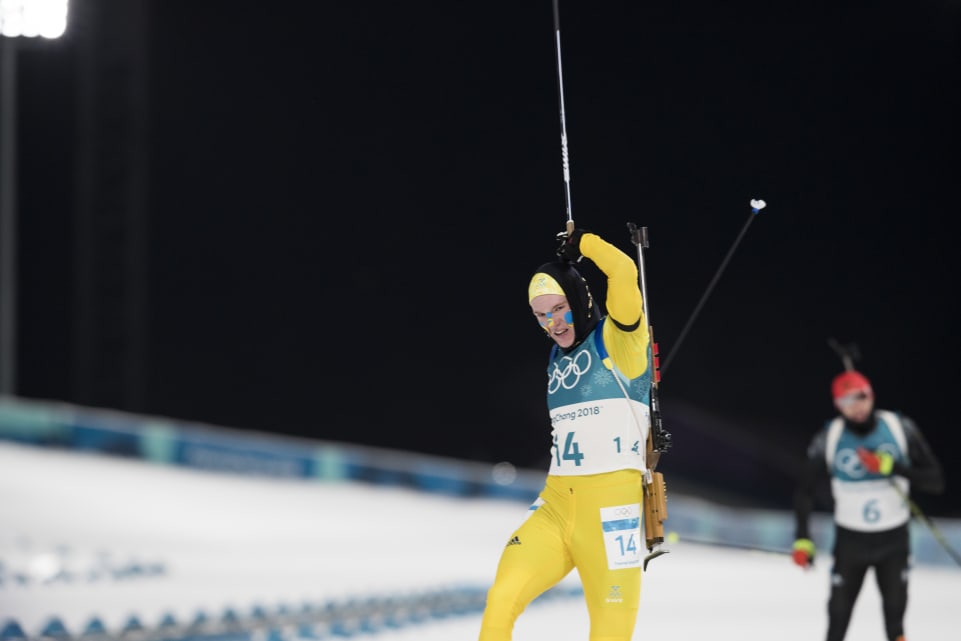
    Sebastien Samuelsson of Sweden celebrating silver in the men’s 12.5 k pursuit at his first Olympics on Monday in PyeongChang, South Korea. Samuelsson announced today that he is boycotting the World Cup Finals in Tyumen, Russia, because Russia is not in compliance with the World Anti-Doping Code. (Photo: IBU/Biathlonworld)

    Today, 2018 Olympic pursuit silver medalist (and relay gold medalist) Sebastian Samuelsson of Sweden announced on Twitter that he will not go to the races either.

    “Nations without a functioning anti-doping organization should not have competitions at the international level,” he wrote, according to a translation. “Also, worried about the safety of both myself and the doping tests in Russia.”

    Also not going is Klemen Bauer of Slovenia, a 2012 World Championships relay medalist who is a four-time Olympian.

    “I’m not planning to go to Russia at all,” he told FasterSkier in a Twitter exchange. “I was quite sure the IBU will replace the races, but despite all the effort we put into the clean/er biathlon, thanks to the president of the IBU that didn’t happen.”

    Both men are running for positions on the IBU’s Athletes Committee.

    “The idea is to improve the active role of the athletes and the voice of the athletes,” Bauer wrote of his candidacy. “We’ll see.”

    Another man running for a spot on the Committee is Germany’s Erik Lesser, 2014 Olympic silver medalist in the individual, 2015 World Champion in the pursuit, and several-time Olympic and World Championships relay medalist.

    Lesser will be attending the races in Tyumen, but he wasn’t happy about the IBU’s decision to hold them there.

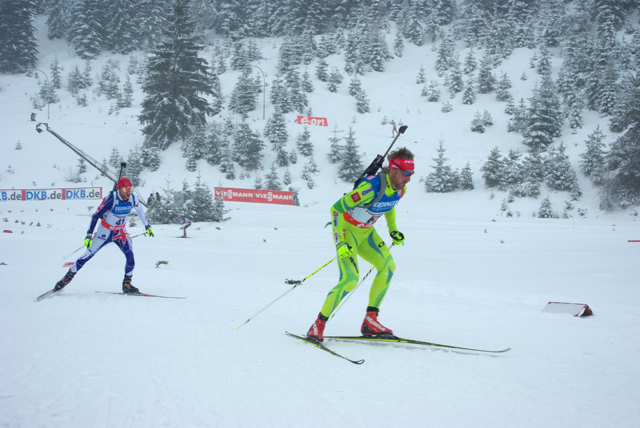
    Klemen Bauer of Slovenia competing in the mass start at the 2018 Olympics in PyeongChang, South Korea. Bauer will not compete in the World Cup Finals in Tyumen, Russia. (Photo: FlyingPointRoad)

    “In my opinion the RUSADA and the Russian Federation have not done enough to light up this case,” he wrote in an email to FasterSkier. “During the last years, WADA and some commissions found a bunch of proof about a doping system in Russia. But RUSADA and [the Russian Biathlon Union] did nothing to fight against doping. The Anti-Doping-Laboratory in Moscow still does not have a license, and all the officials are in the same seats. It’s a wrong sign, after these problems, to go to Russia and celebrate World Cup Finals.”

    Lesser and teammate Arnd Peiffer, the 2011 World Champion in the sprint who then won gold at the 2018 Olympics, and who has even more World Championships and Olympic relay medals than Lesser, wrote a letter to the IBU explaining their position.

    Yet a few weeks ago, the IBU decided to go ahead and hold the World Cup in Tyumen anyway. They issued a press release explaining the decision.

    “I‘ve read the press release and I still don‘t understand why they decided this way,” Lesser wrote. “Because it‘s a threat to Russian biathlon fans and the Organizing Committee will take care of our safety? Wow, these are true reasons to keep the World Cup in Tyumen. So, I don‘t really think that reasons are valid.”

    Last season, there was also supposed to be a World Cup in Russia. But in 2017, several teams announced that they would boycott the event and IBU President Anders Besseberg had a contentious meeting with athletes, after which the IBU decided to move the event.

    This season, despite appeals by athletes like Lesser, Peiffer, and the others, that has not yet happened. And so in the end, Lesser says that he will compete in Tyumen, even though he wishes the races were somewhere else.

    “We argued with our federation and we decided to go to Tyumen,” he wrote. “The sport is the first [priority] and we want to compete. We hope that we can do a good job in Russia. We are there to stand as clean athletes.

    “It‘s bad that the IBU put us athletes in this position,” he wrote. “Actually it‘s not our job to be political. It‘s our job to be athletes and compete against other. If we don’t go, it’s wrong because it’s our sport we love. [But] if we go to Tyumen, we maybe send the wrong sign to IBU.”

  • Klemen Bauer on How It Feels When a Teammate Dopes

    Klemen Bauer on How It Feels When a Teammate Dopes

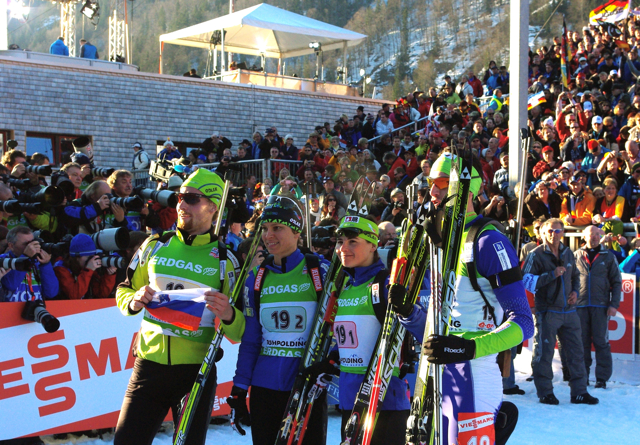
    The Slovenian biathlon team of Klemen Bauer, Teja Gregorin, Andreja Mali, and Jakov Fak after winning silver in the 2012 World Championships mixed relay in Ruhpolding, Germany.

    Slovenian biathlete Klemen Bauer has competed in nine World Championships and three Olympics, landing just one spot away from a medal in the sprint in Vancouver in 2010. He has a handful of top-10 World Cup finishes to call his own.

    Bauer has also been a prominent voice for fair and ethical sport, speaking out in support of the anti-doping process and more recently participating in a campaign to eradicate sexual abuse from sport.

    But a few weeks ago, he learned that a longtime teammate, Teja Gregorin, had used a banned growth hormone promoter at the 2010 Olympics, where she had also come very close to a medal. (Four years later, she won a bronze medal in the pursuit at the Sochi Olympics.)

    Bauer tweeted cryptically when the International Olympic Committee (IOC) announced that one athlete had been caught doping when samples from the 2010 Olympics were re-tested this year using up-to-date analytical methods. When it was announced that Gregorin was the athlete in question, he tweeted, “Sad, mad, & disappointed.”

    Klemen Bauer of Slovenia (right) racing at an IBU World Cup in Hochfilzen, Austria, in 2013.

    In a press conference after the news was released, Gregorin said, “I sincerely apologize to all who have been affected my actions in any way.”

    Among those affected are, obviously, Gregorin’s competitors, some of whom have voiced their own anger. But her teammates are also affected. Bauer, along with Andreja Mali and Jakov Fak, won mixed relay silver at 2012 World Championships. It remains to be seen whether that result will be invalidated.

    Besides that, the Slovenian team’s reputation is affected.

    “I feel bad for her other teammates, like Klemen, who has been at this for a long, long time, and it would seem that he will be the victim of speculation surrounding the case,” said U.S. veteran biathlete Lowell Bailey. “That’s just the natural tendency. ‘Well, if there’s one case, then how did she do it? Why did she do it? Who was helping her?’ All those questions come up.”

    Bailey has known Bauer for almost his entire biathlon career, and said that Bauer supported his efforts to get other World Cup biathletes to sign a petition to the International Biathlon Union (IBU) to hold a meeting with athletes to discuss anti-doping policy and in particular the McLaren report.

    “Klemen is like a lot of other athletes – he is really a really hard-working, motivated, determined athlete,” U.S. veteran Lowell Bailey said in an interview last week. “He has always been a person that understands the seriousness of what it takes to be a career biathlete, but also understands that there’s a balance there. He has a son, Axel, and a family, and he has that personal balance that is important for a lot of the elder statesmen of the biathlon world. He’s a great guy and I have always enjoyed competing against him and with him.”

    Bauer agreed to answer some questions about the Gregorin case and how it is affecting him and his team. The lightly edited interview is presented below, followed by more context from Bailey.

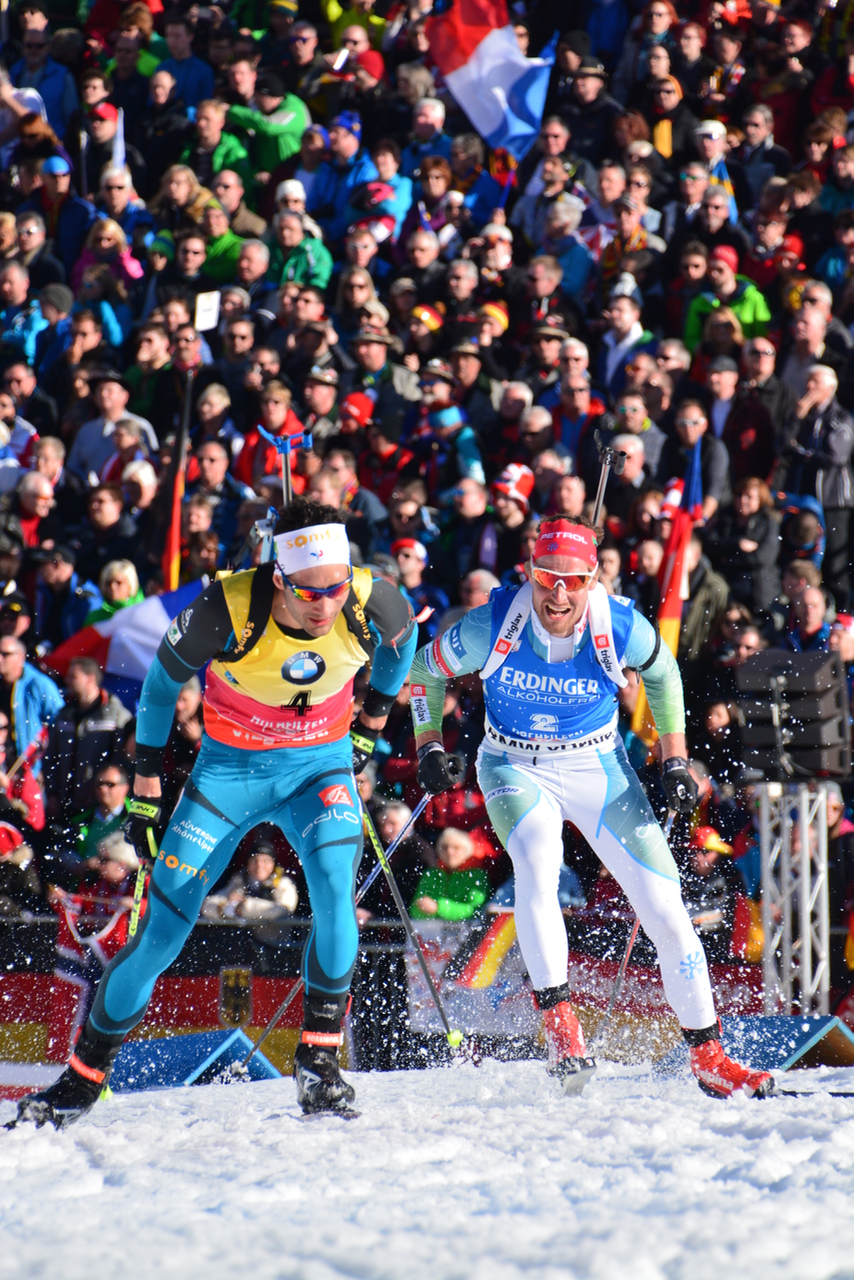
    Klemen Bauer of Slovenia (right) chasing Martin Fourcade of France in the 20 k individual at 2017 IBU World Championships in Hochfilzen, Austria. (Photo: Glen Crawford)

    FasterSkier: When did you hear about this case and what was your reaction? Were you with the team at the time, or did you have to process this all on your own?

    Klemen Bauer: We (athletes) were informed a week before the public announcement. First reaction was shocking and frustrating. Then I was really mad and sad about it. I was on my own at the time. We were all back home.

    FS: I guess you have known Teja for a long time.

    KB: Yeah. I’ve known her since I was a little kid. She started in the same local club, training with her father. We were training mostly together (at training camps) for the past eight years.

    FS: Would you have thought someone could do something like this with nobody else finding out?

    KB: I think it’s an easy job to do it without anybody knowing it — as long as it’s a matter of an individual, which it was in Teja’s case.

    FS: Do you think or do you worry that this violation by Teja will also affect your reputation? Slovenia’s reputation?

    KB: Absolutely. That was actually one of my first biggest concerns. All the good stories we [Slovenian biathlon] have created in the past 8-10 years were destroyed in a moment. Well, hopefully it won’t be that cruel as I think — At this point I find it crucial to expose that it was an act of a single individual athlete. Me personally, I don’t like teams who were involved into doping scandals, so I can imagine the response of the athletes after this. But as I said, I really hope they will realize the rest of us are far away from what happened.

    FS: Have you talked to any athletes from other teams/countries since the news came out?

    KB: Not really.

    FS: What about Teja, have you talked to her?

    KB: Not at all. I have no intention to. I will wait for her to come in and explain (apologize).

    FS: Has this affected your training for the upcoming season?

    KB: It was hard to fall asleep first few couple of days after the news, but the training went well. Sometimes I even got an extra boost, when thinking about it – my anger came out.

    FS: What about your attitude?

    KB: In general after any doping scandal, my morale goes down. I would rather give up right away. But let’s say I still kind of believe in fair, clean sport (which is very naive), and probably that’s what still keeps me in sport. After recent events I’m even more determined to prove that a good result can be done in a fair, clean way.

    FS: Is there anything else you would like to say about this situation, to fans of the sport for instance?

    KB: I’d like to emphasize to have faith in our small team — most of other athletes are still young — and not to judge us by the act of one individual.

    FS: Is this something you would have said in the past, when an individual from another team was caught?

    KB: There are countries doing it [doping] on national level (supported by their government), and there are individuals. Of course a single act usually leads to suspicion of the whole rest of the team even if not so. I might be a little more careful about my judgment after this incident.

    Bailey could sympathize with Bauer to some extent – the American had no idea that Gregorin had been doping, and he did not indicate that he’d ever had suspicions of the Slovenian team, who he called “always really friendly and open.”

    It got more personal for Bailey when he pulled up that athletes’ petition during the interview and realized that Gregorin had signed it, adding her voice to demands for stronger anti-doping policies.

    “That’s troubling to see from someone who had three positive tests – that, in my mind, represents knowingly committing an anti-doping rule violation,” he said. “To be quite honest, she was an athlete who I had a lot of respect for. She came from a smaller country in terms of biathlon and had some really impressive results. I always looked at her as an example of an athlete who was working hard within the rules. So it’s a feeling of betrayal to have something like this come out.”

    Bailey emphasized that Gregorin deserves due process. When the case is over, competitors and fans may know more about how and why she decided to dope.

    “I stand steadfastly behind every athlete having due process – there has been a lot of discussion about just treatment of alleged doping cases,” Bailey said. “I totally support that. I support due process and quick and fair and just proceedings. I hope that her case is treated that way. But it’s really sad. It’s really unfortunate to see that happen.”

  • Slovenia Is First Across the Line, but Norway Takes the Win in World Championships Opener

    Slovenia Is First Across the Line, but Norway Takes the Win in World Championships Opener

    Norway’s Ole Einar Bjørndalen leaving the range; he skied a penalty loop that he later found out was not required.

    RUHPOLDING, Germany – There were plenty of errors at the IBU World Championships mixed relay today, mistakes that were big enough to have a surprising and significant impact on the outcome of the race.

    France’s third-leg racer, Simon Fourcade, received the tag from Marie Dorin Habert in second place, just 11 seconds behind Norway. But he imploded in spectacular fashion, using all six of his spare rounds, hitting the penalty loop, and losing almost two and a half minutes to the leaders; France dropped to 12th and was never able to recover.

    Peiffer in the mixed relay in Ruhpolding.

    Arnd Peiffer, too, finishes this race as an unpopular figure in his home country. The German anchor began skiing with a 40-second advantage over Norway, which grew after the prone shooting stage. Peiffer choked in standing, however, using all three spare rounds and still skiing a penalty loop.

    But the most notable error wasn’t by an athlete. It was instead by the eletronic target system, which inexplicably failed to record Ole Einar Bjørndalen’s first shot of the standing stage.

    The third skier for Norway, Bjørndalen later said that he had felt like it was a good shot. The target, though, stayed black. Bjørndalen struggled through the rest of the stage and ended up skiing a penalty loop, dropping his team several places.

    “It is a shame that the target system didn’t work for Ole, because maybe the race will have gone differently if you didn’t miss your first shot,” German third-leg skier Andreas Birnbacher told the media.

    Both a Norwegian trainer who had scoped the shot and a jury member noticed that Bjørndalen’s shot should have been a hit. They brought it to the attention of Max Cobb, the technical delegate for this series and also the president of the U.S. Biathlon Association, who walked out, examined the target, and saw that it was indeed a on the mark. He, in turn, went to the jury.

    Magdalena Neuner of Germany, working to give the men a lead.

    “It was not recorded – there was no signal coming from the target to the computer which scores the competition,” Cobb said in a press conference after the race. “Fortunately, both the Norwegian trainer and one of our jury members had scoped the shot… We told the trainers on the shooting range that Norway would receive a credit, first for the penalty loop and then for the extra shot that had to be fired. The jury discussed this and awarded a time credit of 28.4 seconds.”

    That information was not relayed to staff on the range until before the final stage of the anchor leg, and the exact amount of time wasn’t clear at that point. By that stage, Peiffer was in the lead, with Norway’s Emil Hegle Svendsen and Slovenia’s Jakov Fak trailing by a significant margin.

    When Peiffer missed his shots and hit the penalty loop, Fak took the lead. It was shaping up to be an exciting race: Germany trailed by several seconds, and Norway by about 15. Given the ski speed of Svendsen in particular, the race was likely to come down to a sprint finish.

    But while Fak managed to hold off the Svendsen by eight seconds, it didn’t matter: as soon as results were posted on the board, the second-place Norwegians had a star next to their time, indicating that something unusual was happening. Later, the team – who won this event last year but came into the race ranked 20th after starting a “B” squad in the two World Cup races this season – finished as the victors by a margin of 20 seconds.

    Emil Hegle Svendsen, knowing that he was winning even in third place.

    The Norwegians were happy for the gold, but not pleased with the way they got it.

    “It was a little bit strange today,” Bjørndalen said in a press conference. “When I came to the finish line I was told that I had hit one more target… It is not a good feeling, when you do not cross the finish line first, but you win.”

    As to whether the problem was addressed appropriately, he said only that it was a matter for the jury.

    The rest of the team might have felt more like winners. Both leadoff skier Tora Berger and second leg Synnøve Solemdal tagged off in first place. And while Svendsen wasn’t the first one to finish, he had enough information to know that he was winning.

    “I heard on the last loop that we had maybe some time cut off, so I knew that if I was within 15 or 20 seconds of Slovenia we could have the gold,” he said. “I just tried to control that.”

    Jakov Fak embarking on the anchor leg.

    The Slovenians put on a happy face and quelled any lingering discontent they might have about the time adjustment.

    “This is when dreams come true,” leadoff racer Andreja Mali said of the silver medal. “After all these years this is my first medal at World Championships.”

    The Slovenian men, too, were able to look on the bright side. Fak said that he hadn’t even thought a medal was possible today, much less gold, based on the team’s 19th-place ranking in the event.

    And for Bauer, a speedy skier who is less reliable on the range, today’s performance was certainly something to be happy about.

    “It’s been a while since I left the shooting range without a penalty loop, so I was quite happy today,” a smiling Bauer said at the press conference. “Even though I spent five spare rounds, I made some progress in the rankings. I guess also my competitors missed a little bit more than me. It went out perfectly.”

    As for the Germans, well, they too acted happy with their bronze, although the pressure to win gold has been intense leading up to these home World Championships. Even while the athletes were warming up, the stadium, full of thousands of people not even counting those lining the trails, would explode with noise every time a German racer skied by.

    When Birnbacher was leading during the third leg, the stadium was completely silent as he shot, and would then explode in a single, unified roar with every hit. The cheers echoed up and down the narrow valley that houses the Chiemgau arena; even the mountains themselves seemed to be urging the Germans toward victory.

    But it was not to be.

    “I knew that the Norwegian team got a time bonus of 30 seconds, so I had no hassle,” Peiffer said. “I knew they were in front of us. I thought about my shooting, not about Emil.”

    Full results

    The German team leaving the range after their bronze medal.