From the FasterSkier archive — posts syndicated from athletes’ and coaches’ own blogs between 2004 and 2012, kept online as published. Current coverage is at fasterskier.com.
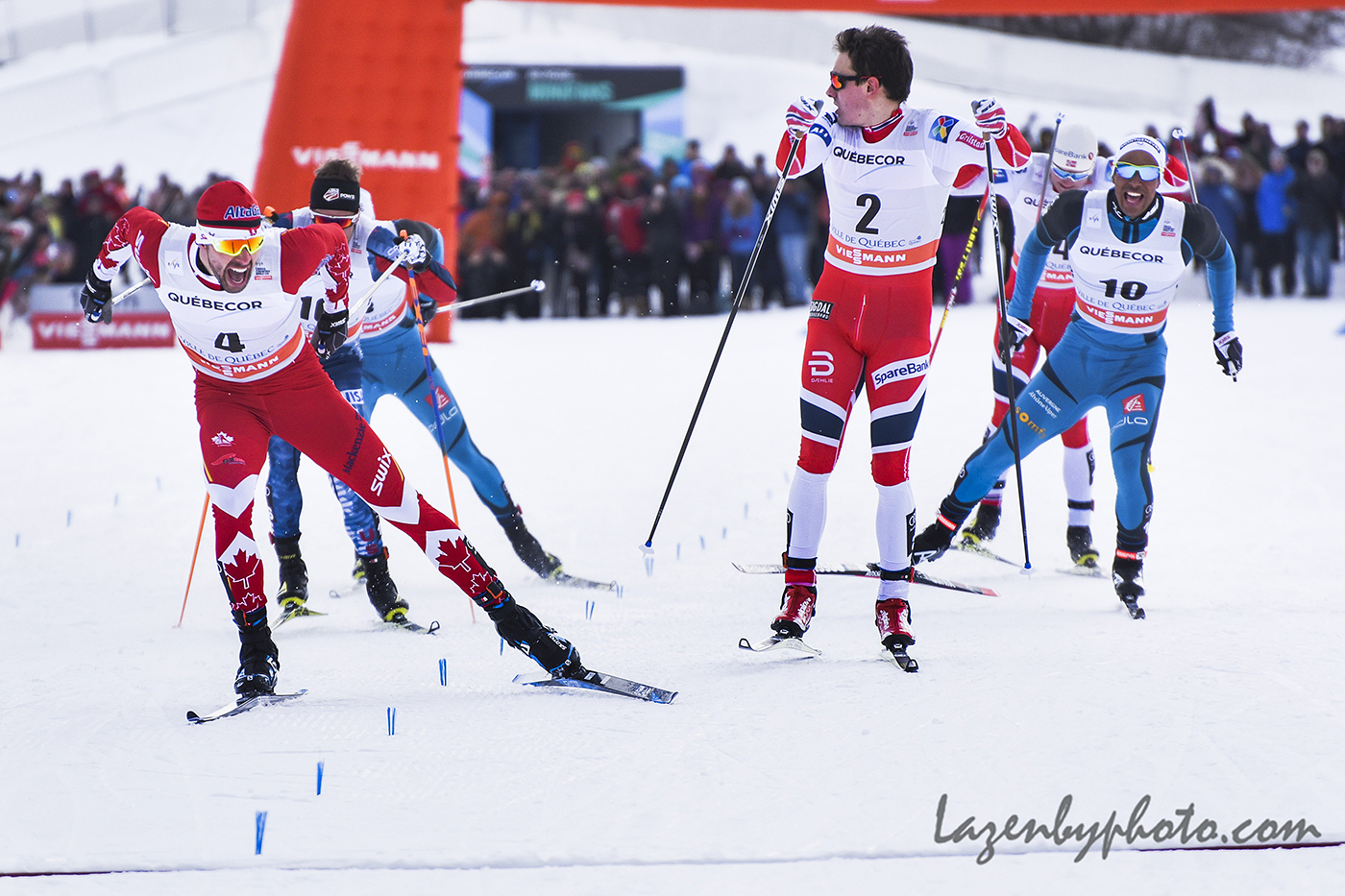
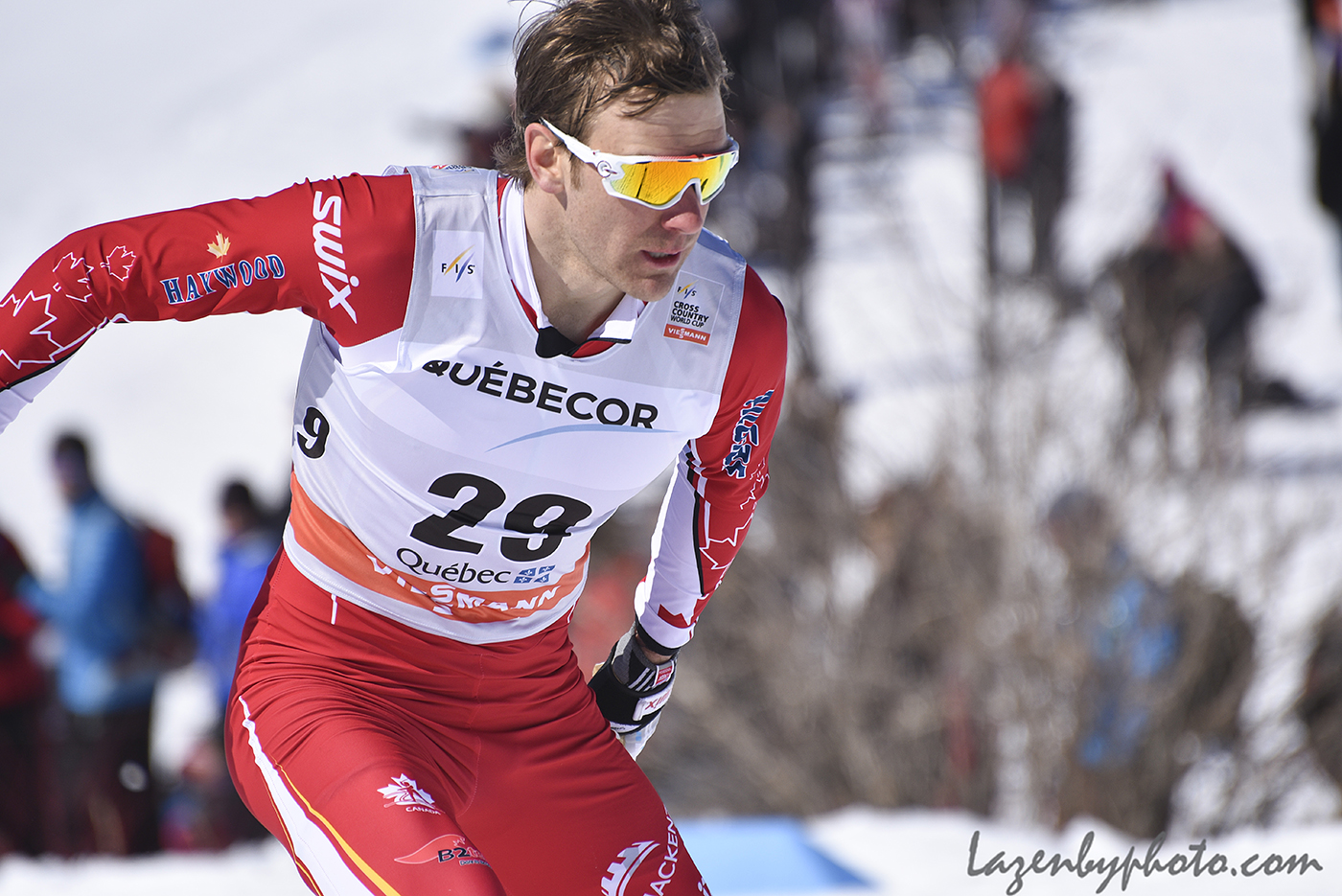
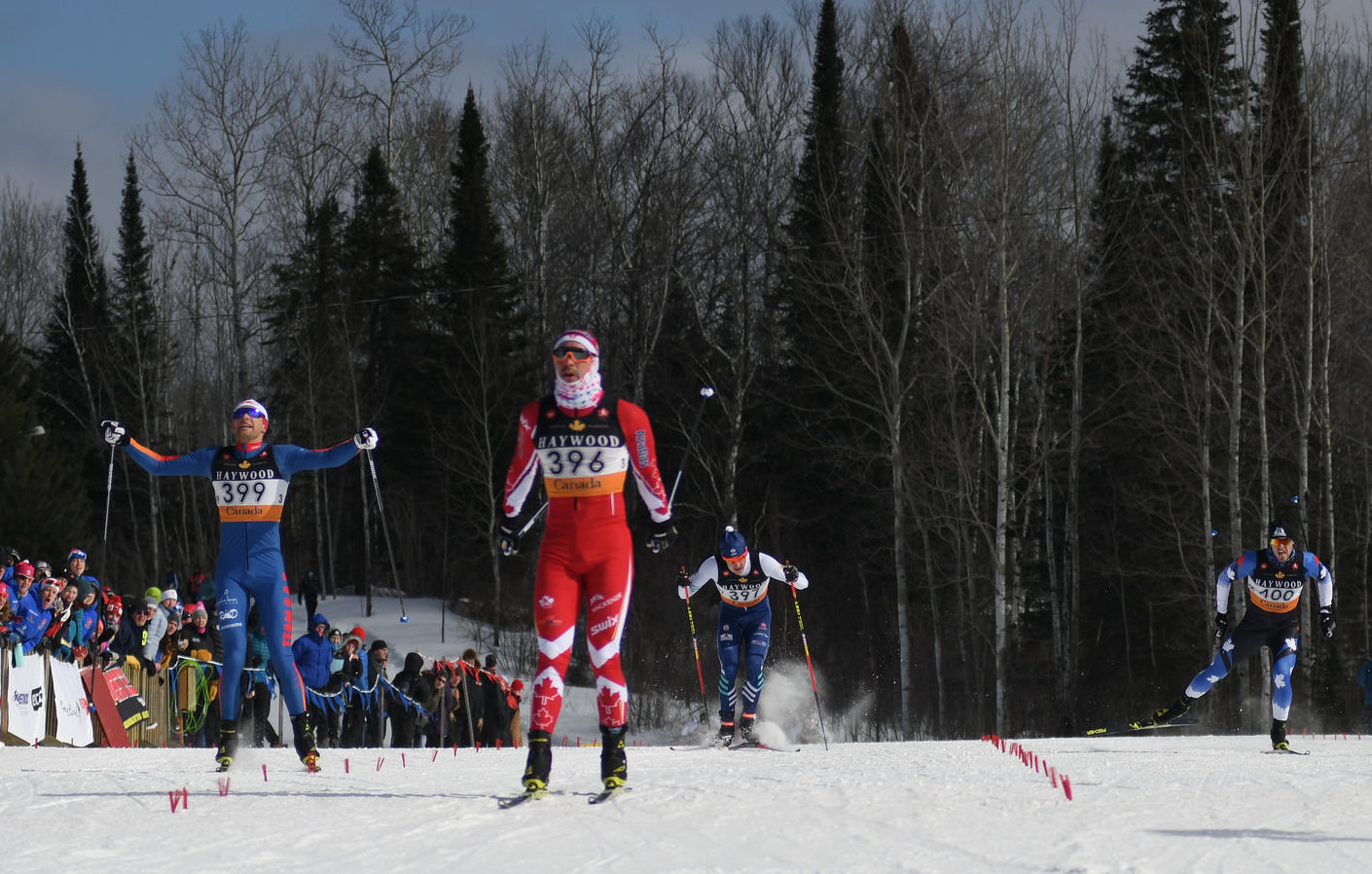
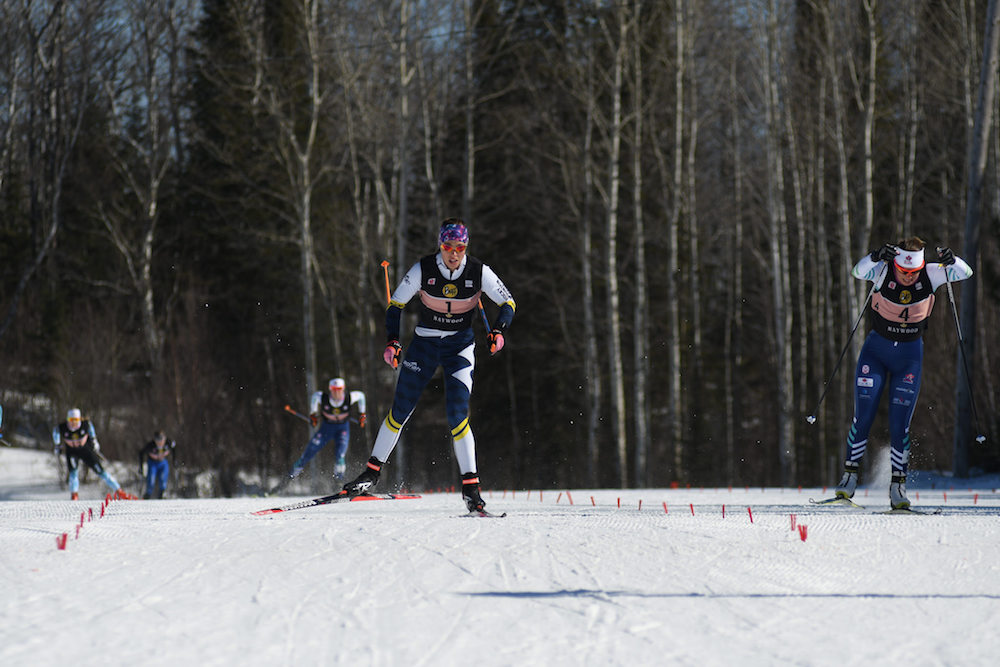
Canada’s Alex Harvey (l) coming on strong in the finishing stretch to outlast Norway’s Finn Hågen Krogh (2) by 0.31 seconds for the win in the World Cup Finals freestyle sprint on Friday in Quebec City, while France’s Richard Jouve (10) races to third, just ahead of American Simi Hamilton (behind Harvey) in fourth. (Photo: John Lazenby/Lazenbyphoto.com)
Welcome to FasterSkier’s World Cup Preview, where we check in with the top-10 teams from last year’s FIS Cross Country World Cup tour before the season starts. The World Cup begins with a classic sprint in Ruka, Finland on Nov. 24th.
***
Canada
Overall in Nations Cup Last Year: 10th
Women’s Ranking 2017/2018: 18th
Men’s Ranking 2017/2018: 8th
Canadians to Watch:
Canada has shape-shifted it’s world cup team as part of a larger restructuring of its high performance program. With fewer resources and a funding system tied to championship medals, contraction has been a major theme for Cross Country Canada (CCC).
Let’s begin with Quebec’s bread and butter: Alex Harvey. At thirty-years-old, Harvey remains podium-elite. He scored five podiums last season, including a win in Falun, Sweden’s 15-kilometer pursuit. Omni-present in the front of the pack, Harvey positioned himself for sustained success in 2017/2018. Like last year, Harvey plans on racing the full World Cup in 2018/2019. After placing third in the Tour de Ski and fourth overall in the World Cup final standings, CCC and fans alike have high expectations for Harvey.
Emily Nishikawa and Cendrine Browne earned period 1 starts as the top ranked distance skiers. Expect them at period 1 stops in Beitostolen, Norway and Davos, Switzerland.
The COC leaders for period 1, Andy Shields and Olivia Bouffard-Nesbitt, have guaranteed start rights through FIS rules.
Dahria Beatty, Maya MacIsaac-Jones, and Katherine Stewart-Jones will begin the season racing in North America.
Who’s Missing:
Devon Kershaw, Jess Cockney, Knute Johnsgaard, and Graeme Killick all retired at the end of the Olympic cycle.
Pre-season Results:
Many top-ranked Canadians turned up at the Frozen Thunder races. As the races were not used for selection, nearly all of the top athletes treated them as race intensity.
In the Frozen Thunder king’s court sprints and free technique distance races, Valjas was 3rd and 4th, Shields was 2nd and 11th, Locke was 5th and DNS, Beatty was 1st and 2nd. Nishikawa completed the sprint qualifier, placing 2nd, before withdrawing . She won Frozen Thunder’s distance competition.
News of Note:
Harvey claims he is excited as the season approaches.
“I’m feeling great right now,” Harvey wrote in an email. “I was able to execute the plan pretty much to the dot this year, no injury or illness slowed me down and I have a fun time the whole Summer and Fall! As per usual, I’m a slow-ish starter so the first goal of the season for me will be the Tour de Ski.
“The big goal for me this season is the World Championship in Seefeld. I’m focusing on the skiathlon and the 50k where I’m going to defend my world title to the best of my abilities! Right behind Worlds are World Cup Finals in Québec City, so that’s a huge motivating factor for me to wrap up the season at home once again just like we did in 2017.”
Valjas also plans on a gradual build up to his form after his rough season last year. “This summer was a tough one,” Valjas wrote after the Frozen Thunder sprints. “My back was in need of some serious rest and recovery, so I took 2.5 months almost completely off. I ran and biked a bit, but no roller skiing. I am expecting the start of my season to be a little slow, but I plan to race myself into top shape once again come World Champs.”
For the athletes who aren’t consistent podium threats on the World Cup, the season outlook is less clear.
CCC CEO Shane Pearsall was feeling optimistic about the season when he spoke to FasterSkier on November 8th.
“I’m thrilled,” he said of a week in which CCC hired a new national team coach, finalized the World Cup head coach role, and finally published a long awaited selection criteria. “I think it’s one of those things where you need fresh blood,” Pearsall said, while acknowledging the short term delays and difficulties inherent in that choice.
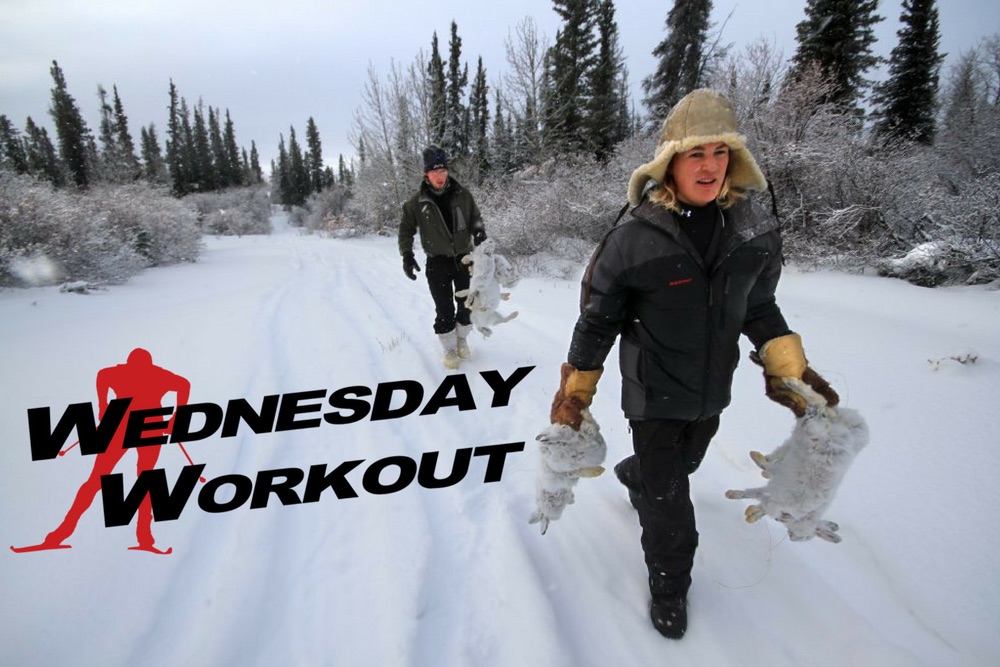
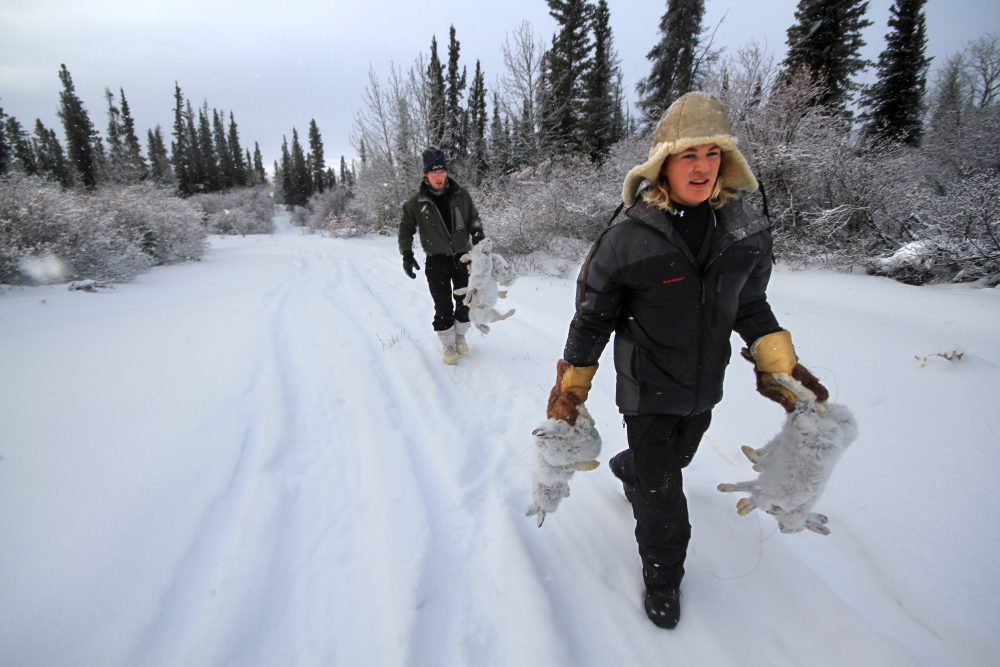
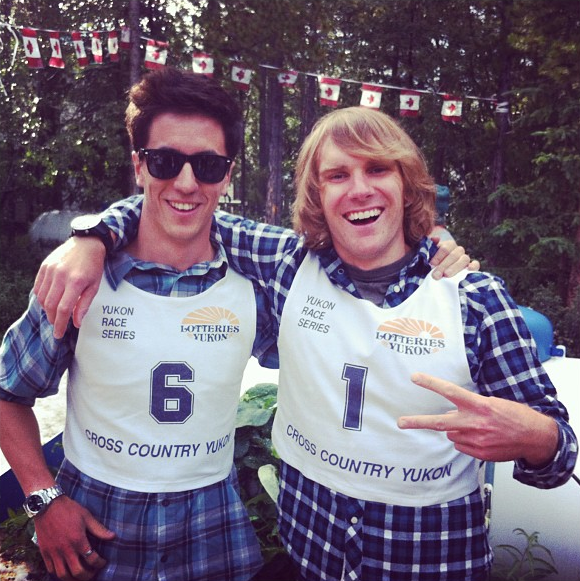
Canadian Knute Johnsgaard (r) after checking on rabbit snares on his family’s trapline in the Yukon. (Courtesy photo)
For this week’s Wednesday Workout (WW), FasterSkier is featuring Knute Johnsgaard, a native of Canada’s Yukon Territory. A 2018 Olympic cross-country skier and former Canadian World Cup Team member, Johnsgaard, 25, recently retired from professional skiing. With one of the more non-traditional ascents to the World Cup, Johnsgaard shared a workout that incorporates non-traditional training. The following assimilates chores and exercise into one, ideal for multitaskers everywhere.
***
The basement or garage might not be the first place most cross-country skiers visit before working out. For Knute Johnsgaard, however, there’s no better place to get started.
Knute Johnsgaard racing to 54th in his first international World Cup, a freestyle sprint in Planica, Slovenia, in January 2016. (Photo: Fischer/NordicFocus)
“I think athletes can benefit from doing some ‘real work’ now and then,” Johnsgaard wrote in an email. “It’s unfortunate that you don’t always get rewarded for the hard work that you put in to ski training. Usually you do see it down the road, but sometimes you may unknowingly be doing the wrong workouts at the wrong time or whatever–it just didn’t pay dividends like you thought.
“That’s why I’ve always enjoyed doing feel-good jobs or chores and treating them as a workout,” Johnsgaard explained.
His chores of choice include shoveling snow or splitting wood.
“It’s incredibly satisfying not only that you’re killing 2 birds with one stone (getting in a workout and getting chores done) but because you will always no matter what be rewarded for your efforts, especially if it’s a chore for someone else and you get to see their satisfaction as well,” Johnsgaard wrote.
So get to the garage, grab an axe or a shovel, and get to it.
The Workout: Real Work
Choose a physical task or job. Johnsgaard’s favorites include:
Shoveling snow
Splitting wood
Get the job done. Johnsgaard estimates 10.5 hours should do the trick.
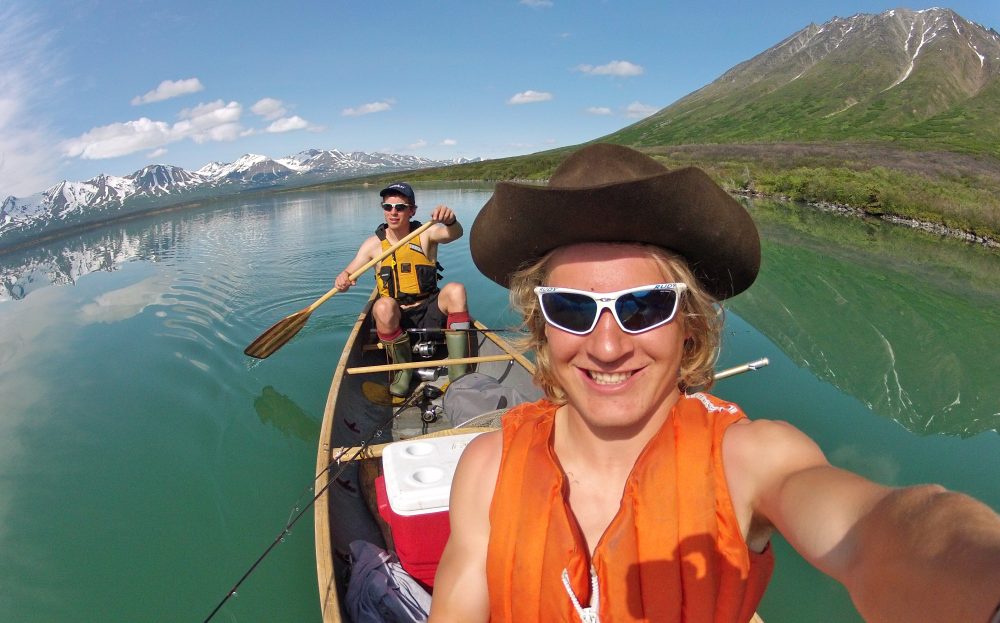
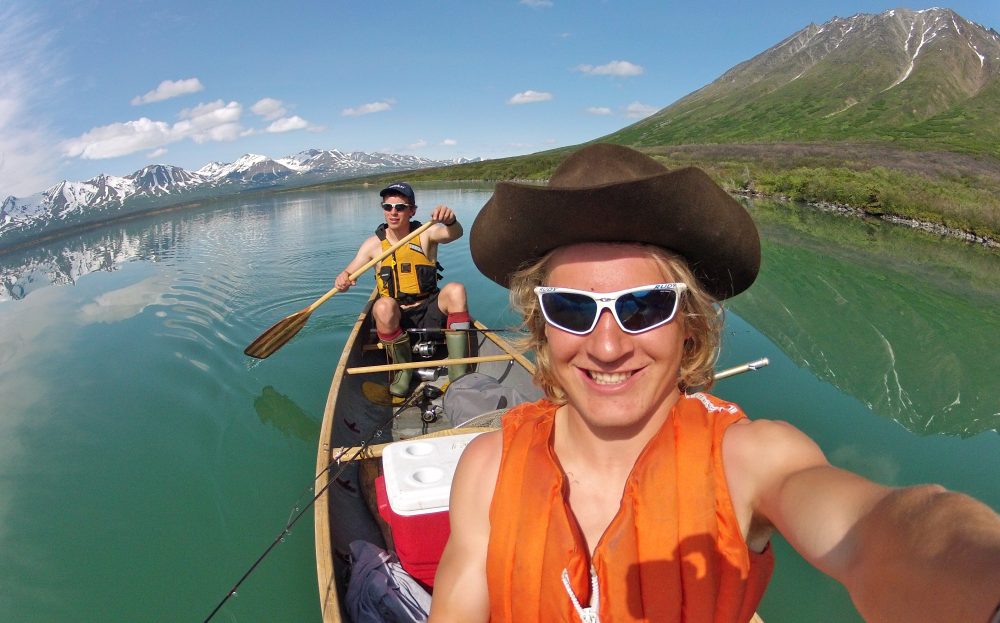
Former Canadian World Cup skier Knute Johnsgaard snaps a photo during a canoe trip. (Courtesy photo)
One hundred and fifty kilometers from the city of Whitehorse, if you are adventurous enough to hike through the troves of white spruce and over the two mountain passes to get there, you may come across Knute Johnsgaard’s family trapline. Traverse the 100 square kilometers of land where his family holds the rights to trap, and you may even catch a glimpse of Johnsgaard himself.
Johnsgaard, a native of the Yukon Territory’s Mount Lorne community, plans to spend most of next winter hunting on his family’s remote patch of land in northwest Canada. He will set traps for lynx, wolverines, foxes, and wolves. He will drop a few fishing lines into the land’s frozen lakes. He will sport cross-country skis as he travels from trap to trap.
He will not, however, train as he once did. That kind of work is a thing of the past (he will, incidentally, get in a few nordic over-distance workouts, as he plans to ski the 60-kilometer stretch of snow-covered land from snare to snare).
At 25, Johnsgaard has been a member of Cross Country Canada’s senior national team for the past three seasons (first on the U23+ Development Team, then on the U25 Team, and finally on the World Cup A-team last season). He represented Canada at this year’s Winter Olympics in PyeongChang, South Korea. And as of this spring, he is officially retiring from professional skiing.
***
Looking at the 2018 Olympic and Paralympic team rosters for Canada and the U.S., the pattern of athletes with the same last name is tough to miss. The Bjornsen siblings. The Patterson siblings. The Nishikawa brother-sister duo.
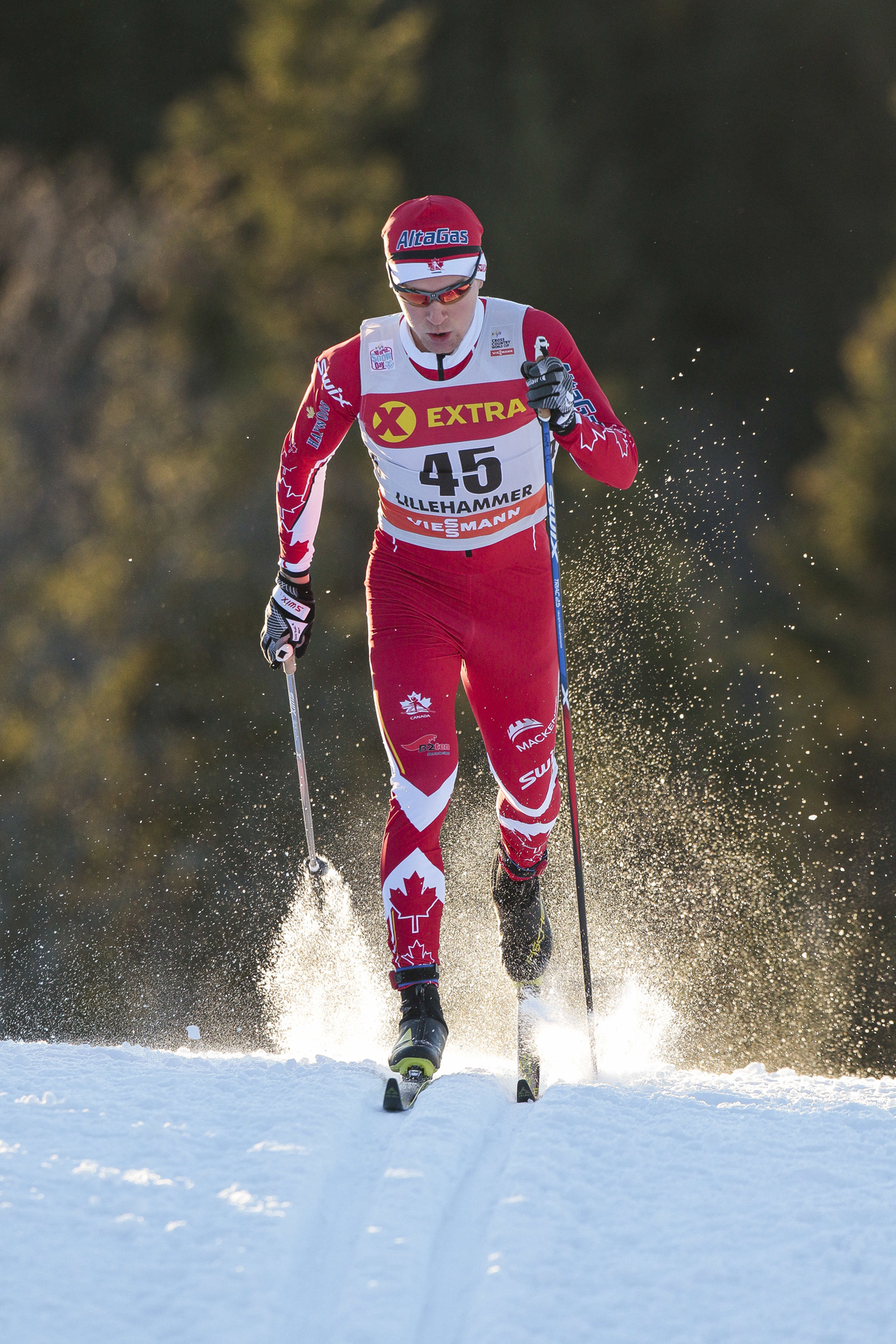
Knute Johnsgaard racing a 2016 World Cup in Lillehammer, Norway. (Photo: Fischer/Nordic Focus)
Johnsgaard is not one of those. He does not come from a family of athletes. Most of his relatives, he explained, had never followed his skiing or cross-country in general until the two weeks he competed at the PyeongChang Winter Games. What Johnsgaard did have growing up was a family who encouraged him to be outdoors and access to it. A lot of it.
The Yukon Territory spans an area of nearly 500,000 square kilometers, and includes Canada’s tallest mountain, Mount Logan. The region is, as Johnsgaard puts it, “one of the world’s last true wilderness areas.” It was within this last wilderness area that the Canadian began his cross-country journey.
He first started skiing on the ski trails of Mount Lorne. In between skiing adventures, he would join his father for trips to the family trapline. At the age of 13, Johnsgaard’s father suffered an accident that left him paralyzed, which halted their trips together.
Around that time, Johnsgaard and his mother moved to Whitehorse, the Yukon’s capital and only city, where Johnsgaard joined the Whitehorse Cross Country Ski Club. Johnsgaard remained active with the club through his high-school years. Following graduation, he moved to Quebec to train with the Pierre-Harvey National Training Centre, where he spent two years.
“I enjoyed my time in Quebec, but I really missed the Yukon,” Johnsgaard explained. “I felt it was kind of silly, I guess, to be training on the other side of the country when we had better snow conditions and so much available to us right here at home [in Whitehorse].”
***
Scroll through the photos Johnsgaard has posted on his blog and a few anomalies crop up. The first being that many of the shots feature Johnsgaard, proudly smiling, while kneeling over the hulking form of a freshly fallen carcass (the seamless transition between shots of Johnsgaard sporting camouflage then spandex also seems slightly unorthodox for the average cross-country skier).
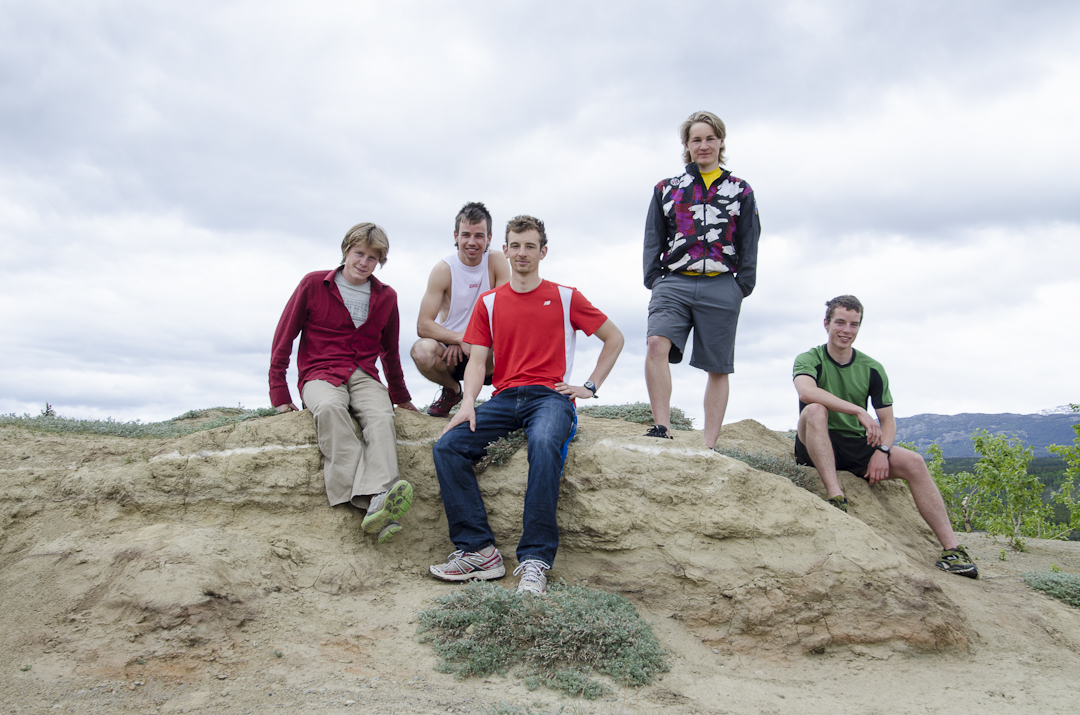
Knute Johnsgaard (standing) with the Yukon Elite Squad during a cliff-climbing trip. (Courtesy photo)
Yet to those who are familiar with Johnsgaard, there is a reason hunting appears in tandem with his athletic pursuits. Hunting was more than a hobby outside of ski training. For Johnsgaard, hunting was also how he trained.
“The type of hunting he was doing, it’s not like weekend-hunter-type skier, it was a lifestyle,” said former Canadian national-team head coach Justin Wadsworth, who coached Johnsgaard during his first season on the team, during a recent phone interview.
“I think he drew a lot of his confidence from that kind of upbringing and those kinds of experiences,” Wadsworth said.
Following his two years in Quebec, Johnsgaard returned to the Yukon. He and four other Yukon skiers started a training group called the Yukon Elite Squad (YES). The five men had no formative coach, which permitted them to train when and how they wanted. For Johnsgaard, it also meant a hunting trip could count as training, if he wanted.
“There was nobody to tell us we couldn’t skip training to leave and go moose hunting for a week,” Johnsgaard said.
According to Johnsgaard, the squad met about four times a week and tried to coordinate one training camp a year with Alaska Pacific University (APU), an American elite ski team located about 1,000 kilometers west in Anchorage, Alaska. YES also competed at Canadian nationals, “throwing cash” to any team’s wax technicians who were willing to help out.
“We were in a unique situation where we recognized that the Yukon was a great place to ski train and we all wanted to pursue skiing,” Johnsgaard said. “We made the best of it, and that’s how I made it onto the national team, training in the Yukon with just a few other teammates. I was pretty proud of that.”
After two years with YES, at age 22, Johnsgaard was nominated to the senior national team in 2015. In his rookie season as a member of Canada’s under-23 development team, Johnsgaard scored his first World Cup points in 30th place in the freestyle sprint in Gatineau, Quebec.
The following spring, he was renominated to the team, which changed its name to the U25 (under-25) Team. He started that winter of 2016/2017 on the World Cup circuit in Europe, competing in Finland, Norway, Switzerland, and France. During that World Cup Period 1, his top finish was 51st in a classic sprint.
Then came Period 2. While his World Cup teammates Len Valjas, Alex Harvey and Devon Kershaw were overseas competing at World Cups, Johnsgaard was at home in the Yukon training. He was also looking at the World Cup calendar, with one race in late January in particular focus: the 4 x 7.5 k relay in Ulricehamn, Sweden.
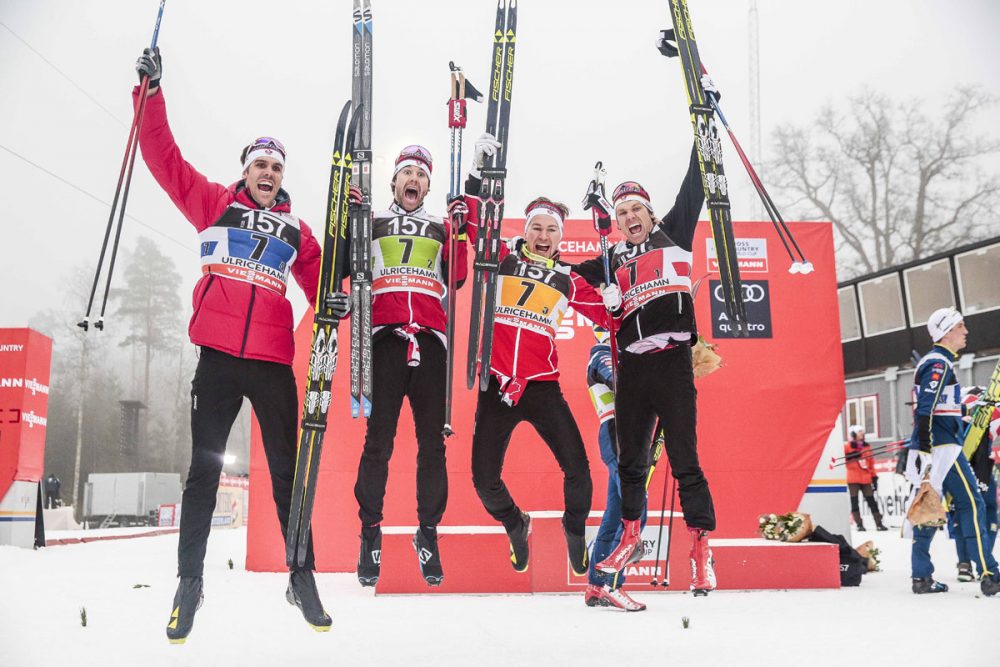
Left to right: Canada’s Len Valjas, Alex Harvey, Knute Johnsgaard, and Alex Harvey after their historic third place finish in the men’s 4 x 7.5-kilometer team relay on Jan. 22, 2017 in Ulricehamn, Sweden. (Photo: Fischer/Nordic Focus)
“They actually weren’t going to start a relay team because they didn’t have a fourth guy,” Johnsgaard said. “I had a meeting with our high-performance director [Thomas Holland] and begged him to send me over there to race that race.”
Holland consented and Johnsgaard flew to Ulricehamn to start in the relay. He arrived a few days before the race and was told he’d ski the third leg (first skate portion) of the relay.
On the day of the relay, Kershaw led off the first classic leg, putting the Canadians in third and just 0.7 seconds out of third at the first exchange. Harvey skied the second classic leg, holding onto the front pack of skiers before tagging to Johnsgaard in fifth, 3.5 seconds back. Despite being a little jet-lagged, Johnsgaard explained having a “weird confidence” that day on the trails.
He maintained his team’s position in the pack through his leg, handing off to Valjas in seventh, just 5 seconds out of first. After a smooth handoff, Valjas stayed streamlined in the group to the finishing stretch, sprinting to the line for third place. The result was historic for Canada. It also secured Johnsgaard’s spot on the 2018 Olympic team the following year.
“That was probably the highlight of my sporting career, that weekend in Sweden, qualifying for the Games there, and making World Cup team history for Canada at the same time,” Johnsgaard said.
The fact that the race pre-qualified him for the Olympics was a surprise to Johnsgaard.
“I always imagined getting a phone call after a stressful weekend at trials or something like that, but instead it was just one of my wax techs telling me over beer that evening, going, ‘Hey, I think you made the Olympic criteria,’ ” Johnsgaard said. “It was a pretty funny way to find out.”
Just over a year later in PyeongChang, Johnsgaard competed in the 15 k freestyle, 30 k skiathlon and 4 x 10 k relay. His best individual result was 69th in the 15 k skate, and he skied the anchor leg of the relay, which placed ninth as Canada’s second-best Olympic relay.
He started 12 individual World Cup races last season, with a top finish of 51st in a skate sprint in Seefeld, Austria.
“Since I started skiing at a young age, the Olympics were the ultimate goal,” Johnsgaard said. “To have finally accomplished that, I guess I feel fulfilled and I don’t really see incentive to keep going. I met my goal that’s all I ever wanted and now I’m moving on to new goals.”
“There has never been a ‘DNF’ next to my name,” he wrote. “I’ve never backed down, never not finished a race without laying it all out on the line. … Exploring my limits has always been something I loved doing. Results are inconsistent and out of your control, giving 100% effort, however, is attainable every time you’re on course.
“The world of sport is cruel in that I was always left wanting more,” he continued. “When you believe anything is possible, then everything less than perfect is not good enough. I always found myself striving for the next step that I could only hope would bring satisfaction. Instead, it brought only desire for greater success, which only got exponentially harder to achieve as I climbed the ladder. The final step was hard for me, and near the end of my career I began to struggle with anxiety and depression. It took so much energy that I didn’t have anything left over for ski races anymore, and I wasn’t happy.
“Now that I’m retired, I’m finally satisfied,” Johnsgaard added. “I’m able to step back and see for the first time this giant mural that I’ve painted, rather than focusing on the many imperfect brush strokes. I feel a cool breeze of fresh air bringing relief with each breath. I’m calm and content.”
***
All of the animals Johnsgaard traps are, in his words, “put to good use” for clothing, etc. In order to spend his winters living off the grid on his family’s trapline, Johnsgaard plans to work for a construction company through the summer and fall. Construction work is nothing new for Johnsgaard. It is also how he funded his skiing career.
“I did have to work a lot to afford to ski race before I was carded,” Johnsgaard explained in an email. “Even with working, I never could have pursued skiing without Cathy Wood of RyanWood Exploration. Cathy anonymously donated enough money for me to go to a training centre after high school and then supported me again in just my last two seasons on the World Cup.”
Knute Johnsgaard (front) after checking on rabbit snares on his family’s trapline. (Courtesy photo)
He will continue to organize and run the Father Mouchet Loppet in Old Crow, which he and friend/former YES teammate Colin Abbott helped create. Johnsgaard also hopes to do some coaching with the Whitehorse Cross Country Ski Club. Other than that, his connection to skiing will remain a lifestyle choice, and no longer a career one.
“I’ve always had quite a number of other hobbies and interests, so I’m not at all worried or stressed about what I might do,” Johnsgaard said of his retirement. “I’m just excited for new things, whatever they may be. It’s kind of exciting to be free.”
Johnsgaard is particularly excited about being able to do what he wants, when he wants.
“I hope people understand my decision and I hope that it’s not a question mark of why Knute is retiring at age 25 and he might not even be at his peak yet or this and that,” Johnsgaard continued. “It’s just that I’m satisfied with how far I’ve taken it and I feel fulfilled and I’m excited to do new things.”
Some do wonder whether he might have taken it further. Wadsworth described Johnsgaard as a “physiological talent”, his non-traditional ascent to the World Cup level an attestment in itself.
“He had a lot of natural strength and physical ability, and I think my guess is he would have had a much longer career had he had that upbringing of the traditional cross-country ski training,” Wadsworth said. “But Knute did it his way and for me to say, ‘Oh, he could have been better, had he taken the traditional method,’ that’s not for me to say. That’s purely a speculation on just what I’ve seen.”
For now, the reality is Johnsgaard’s skiing will stay in the Yukon — where he hopes to acquire land and build a home — which is exactly how he wants it.
“I would describe it like getting a wild mustang,” Wadsworth said of working with Johnsgaard. “Wild mustangs are used to running around out in the field and not being told what to do.”
(Note: This article has been updated to reflect that Len Valjas was nominated to the B-team, rather than the A-team as previously stated.)
On Thursday, Cross Country Canada (CCC) announced its national-team nominations for the 2018/2019 season via a press release.
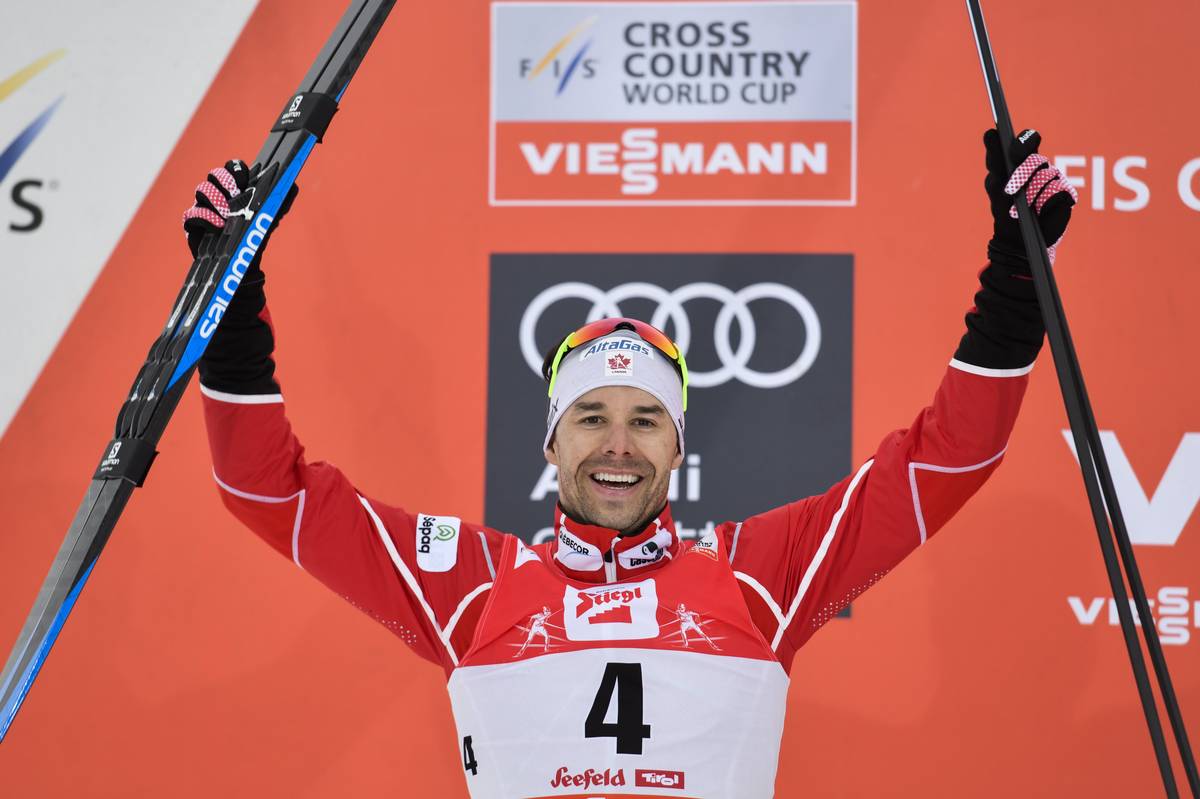
Canada’s Alex Harvey celebrating on the podium after placing second in the World Cup men’s 15 k freestyle mass start in Seefeld, Austria, last season. (Photo: Salomon/NordicFocus)
Notably, the World Cup A-team is made up of one man — Alex Harvey — after three athletes from last year’s World Cup A-team retired (Devon Kershaw, Jess Cockney and Knute Johnsgaard). Graeme Killick, of last season’s World Cup B-team, also retired. Len Valjas was nominated to the B-team, a demotion, he said, that was a result of him ending his season immediately after the PyeongChang Olympics.
“The reasoning is that I … didn’t show up to [the World Cup in] Drammen, is that I didn’t follow what the team said,” Valjas told FasterSkier on May 22. He explained he had a broken spine, which required rest and rehabilitation.
On the women’s side, Dahria Beatty was renominated to the World Cup B-team, while Emily Nishikawa and Olivia Bouffard-Nesbitt were not.
All five of last year’s U25 Team were renominated to the national team, with Cendrine Browne and Julien Locke making the jump to the World Cup B-team, while Katherine Stewart-Jones, Maya MacIsaac-Jones and Gareth Williams were renominated to the U25 Team. Also on the U25 development squad, Antoine Cyr was promoted from the junior national team, and Graham Ritchie earned his first national-team nomination.
The World Cup team will once again be led by co-coaches Ivan Babikov and Louis Bouchard.
On the Para-Nordic side, the World Cup Team grew by one despite the retirement of Chris Klebl. Six athletes and two guides were nominated to the Para-Nordic World Cup Team, while two were renamed to the Development & Prospects Team. Four other athletes round out the team as part of the Prospects Team.
Canada’s Devon Kershaw racing at 2017 World Cup Finals in Quebec City, where he finished 26th in the 15 k freestyle pursuit and 19th for time of day in the last race of the 2016/2017 season. (Photo: John Lazenby/Lazenbyphoto.com)
On April 26, Devon Kershaw posted a photo on social media of Alpina boots hanging on a line. The next day, he spoke on the phone with FasterSkier from his new home in Lillehammer, Norway, after a day of running around outside with his 15-month-old daughter, Asta Isabel.
Kershaw was tired, but in a good way. For the first time in 17 years, he was ready for a new challenge, a new focus and much more time with his daughter and wife, Kristin Størmer Steira, a former standout Norwegian skier.
Three years after Steira left professional cross-country skiing and pursued a career in business, starting with her master’s degree in business management, Kershaw is following suit and headed back to school. The 35-year-old Canadian hung up his boots to quietly announce his retirement after about a month of deliberation.
“I was really keen to keep ski racing, to be honest,” Kershaw said. “I had the motivation to go one more year, and in my head, I wanted to race one more season, but as things progressed in the spring, there were a lot of different factors that just made it seem like, oh man, it doesn’t look like it’s gonna be super realistic at this point.
“I struggled with that, when you feel like you still have more in the tank,” he continued. “But at the same time, it’s a bit of a double-edged sword in the sense that it’s been a fantastic career.”
Kershaw was quick to reflect on his roots as a kid growing up in Sudbury, Ontario, “a mining town with a small but passionate skiing community,” as he put it. He also reiterated how proud he was to represent Canada for 17 consecutive seasons, first as a junior national team skier for two seasons starting in 2001, then as an under-23 national team member in 2003, and finally as a full-fledged World Cup Team member starting in 2004.
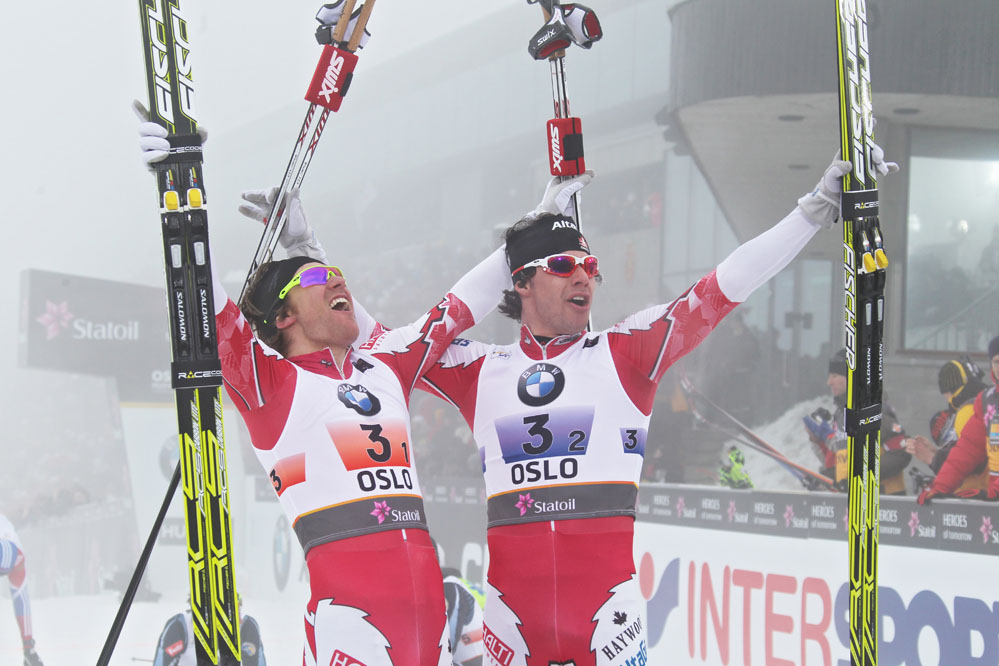
Devon Kershaw (l) and Alex Harvey celebrate their 2011 World Championships gold in Oslo, Norway. (Photo: Fischer/NordicFocus)
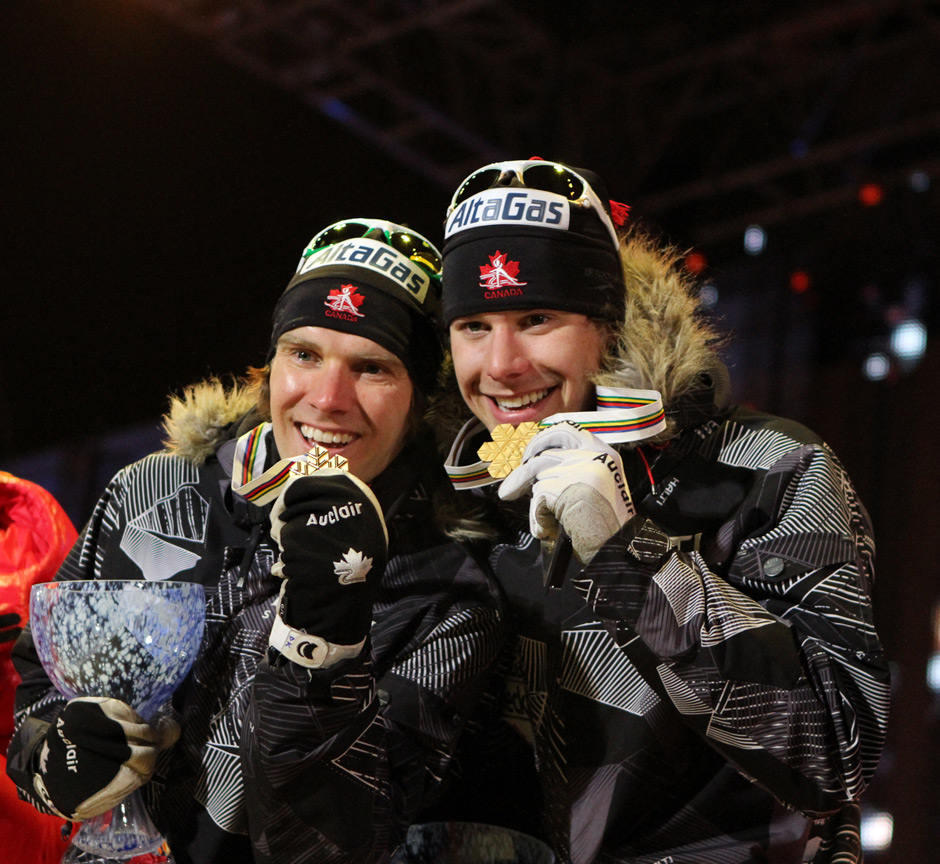
His career included three World Cup wins and 14 podiums, and a gold medal at 2011 World Championships with teammate Alex Harvey in the classic team sprint. Kershaw finished the 2011/2012 World Cup season ranked second overall and second in the distance rankings.
When he reflects on those accomplishments, he still has a hard time believing that all happened to him.
“So instead of focusing on being bummed at the situation or a bit frustrated with the state of things in Canadian skiing right now, I have to look back with a smile,” Kershaw said. “I feel just so privileged and grateful to have had the opportunity to be part of a real movement for men’s skiing in Canada.”
Kershaw said he was left with unanswered questions this spring during a transitionary period at Cross Country Canada (CCC). The team’s budget was undetermined, camps were not yet set in stone, and Kershaw said his decision — which he wanted to make by May 1, the start of the new training year — became about energy management.
“Part of managing your energy properly is putting all of your energy and focus into training, and if you’re being pulled with uncertainty or being stressed about uncertainty, that will come back, the World Cup will exploit that,” he said.
According to CCC Chief Executive Officer Shane Pearsall, High Performance Director Thomas Holland had planned to retire this past March, yet has stayed onboard as an advisor until CCC fills the position. Pearsall said the hiring process is still ongoing and will hopefully be wrapped up by next month. He confirmed that CCC has yet to finalize its budget and doesn’t anticipate being able to do so until a government minister signs off on the amount from Own The Podium (OTP), one of its primary funding sources, in July. Pearsall explained that they expect to have a better sense of national-team finances in mid to late June.
Typically, the team’s budget is determined in May, but because of necessary “quad reviews” following the Olympics, which took place before CCC met with OTP, the process was delayed by about a month. Pearsall did not elaborate on how significantly the budget would be decreased from last year, but said, “It’s certainly tighter than last year.”
Kershaw said he needed to pay about $25,000 Canadian dollars in team fees if he wanted to continue racing this year, up from $15,000 last year. That didn’t cover the cost of living, which he figured to be around $55,000 Canadian, for a grand total of $80,000.
“The financial burden is big, and moving forward the financial burden went from big to 100 percent paying for every cost,” Kershaw said. “So all travel, accommodations, everything. … I’ve just been in the sport a long, long time, and from a directional standpoint, I’m not sure we’re moving in a direction that will yield sustainable results at this point in time, but I understand it is difficult when you’re under such financial duress to create a sustainable program. But from a vision standpoint, I think there’s a lot of questions that remain unanswered, and it’s late in April. The fact of the matter is the rest of the world has all of the holes plugged — if they have holes in their boat — because May 1 is the new year of every ski program. And we’re just constantly slow and off the mark with that.”
Budget cuts had been expected as Canada’s World Cup Team missed performance benchmarks throughout last season. The team finished 2017/2018 with just two men scoring World Cup points (top 30) in distance races: Harvey and Kershaw. Two men (Harvey and Julien Locke) scored in World Cup sprints. On the women’s side, Dahria Beatty landed one World Cup sprint top-30 last season, and Cendrine Browne was the top Canadian woman in a distance race with a 27th place for time of day in the last race of the season.
Meanwhile, Alex Harvey led the team with four World Cup podiums, including third overall in the 2018 Tour de Ski, and a top result of fourth place at the 2018 Olympics. He finished his season in fourth in both the Overall and Distance World Cup standings. But Harvey’s results alone weren’t enough to buoy the whole team for another winter.
“Throughout my entire career, it’s almost unfathomable to think that the season ends and that’s the stat line,” Kershaw said of the team’s overall results. “It wasn’t so long ago that we had over 16 World Cup podiums in a season. The truth hurts, as [former Canadian coach] Tor-Arne Hetland once said, but things go in waves and this is the reality that we live in right now.”
Despite the prospect of self-funding, Kershaw didn’t feel pressed into retirement. Several of his teammates have decided to retire as well, including Graeme Killick, Jess Cockney and Knute Johnsgaard, but Kershaw said they weren’t forced, either.
“You can choose to work and you can choose to hustle for money; there are ways to make it,” he said. “No one’s forced into it. I could keep skiing if I wanted to, but I think the stark choice you’re faced with is, maybe perhaps some people are like, I can’t really see a path to international success currently, and that’s what I think is sad…”
‘A dream scenario’
When Kershaw moved to Canmore, Alberta, in 2001 and entered Canada’s elite skiing scene, Cross Country Canada (CCC) was entering a fruitful period. At the 2002 Olympics, Beckie Scott was proclaimed winner of the women’s 10-kilometer pursuit (now called the skiathlon), becoming the first North American woman to win an Olympic gold. At 2005 World Championships, Sara Renner earned a sprint bronze to become the first North American woman to medal at World Championships. Scott and Renner teamed up for silver in the team sprint at the 2006 Olympics in Turin, Italy, where yet another Canadian woman, Chandra Crawford, won the individual skate sprint for Canada’s second-straight gold in as many Winter Olympics. Scott finished that 2005/2006 season ranked second overall in the World Cup, just 16 points behind Norway’s Marit Bjørgen in first.
Devon Kershaw (r) with Graham Nishikawa in 2013. (Photo: Devon Kershaw)
Kershaw made his Olympic debut in 2006.
“Coming into Torino, we were quoted in the newspaper as being like the world’s most anonymous men’s ski team,” he said of the Canadian men’s team that year. “We weren’t really ‘on the map,’ but I’ve just been so grateful and lucky to have such a great group of guys around that really welcomed me in.”
He credited his former roommate and teammate Chris Jeffries as well as other Canadian competitors of his time, including George Grey, Gordon Jewett, Dan Roycroft, Sean Crooks, Dave Nighbor, Phil Widmer, Brent McMurtry, and Graham Nishikawa (who’s still racing), for having a major impact on the formative stages of his career.
“[There were] so many athletes in Canmore that tried hard, wanted it bad, and loved ski racing and training,” Kershaw reflected. “That’s a dream scenario for a young athlete to come into a community like that and be welcomed into that environment.”
Less than a month after the 2006 Olympics, he notched his first World Cup podium by placing third in the Borlänge, Sweden, skate sprint. In doing so, he became the first Canadian male cross-country skier to reach the podium since Pierre Harvey (Alex’s father) in 1988 and the first ever to medal in a World Cup sprint.
“I had no idea who Pierre Harvey was,” Kershaw said of his younger self.
Pierre Harvey had previously won the 1988 Holmenkollen 50 k as well as two other World Cup distance races and the Norwegian Birkebeiner, making him the most successful Canadian male skier before Kershaw.
“He could walk into the room and I would not recognize him,” Kershaw continued. “Even his results, I had heard that he had five World Cup podiums and that seemed pretty cool, but that’s all I knew about him.”
Kershaw’s second World Cup podium came early in the 2006/2007 season in a skate sprint in Munich, Germany. That same day, Crawford — whom he was dating at the time — placed third in the women’s sprint.
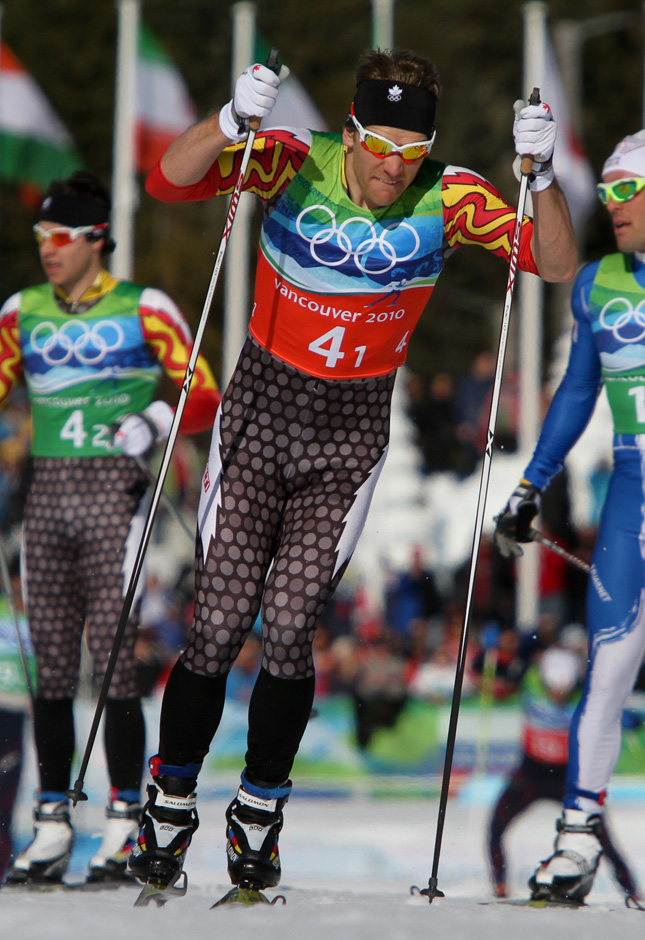
Devon Kershaw after being tagged by his Canadian teammate Alex Harvey (l) in the freestyle team sprint at the 2010 Olympics in Vancouver, B.C. They went on to finish fourth.
At his second Olympics in 2010, Kershaw finished fifth in the 50 k classic mass start for the best individual Olympic result for a Canadian male nordic skier. That record stood until Alex Harvey, who burst onto the World Cup scene in 2008, bested it with a fourth place in the 50 k classic at this year’s Olympics in PyeongChang, South Korea.
Kershaw and Harvey also teamed up to place fourth in the freestyle team sprint at the 2010 Olympics.
Kershaw’s first World Cup win came in a skate sprint during the 2011 Tour de Ski. He finished that Tour in seventh, and the next year, came back to place fourth overall in the 2012 Tour de Ski (TdS). Kershaw started all 12 editions of the TdS, a record he shares with France’s Jean-Marc Gaillard.
Harvey scored his first individual World Cup podium in a 50 k classic in 2009 and won his first World Cup race (a 3.3 k freestyle prologue) at the TdS in 2012.
“Then next thing you know, Alex and I are sharing a podium on some World Cups,” Kershaw reminisced. “Two Canadians on one podium in the World Cup, like, really? And then you win World Championships and I’m on the overall World Cup podium, and then next thing you know, Alex has been on the overall World Cup podium a few times and also now 50 k world champion. It’s crazy. It’s insane. From nothing. From no results. The journey has just been amazing. … I never would’ve thought Canada would, I mean, how could you? We had Pierre Harvey and that’s it in, like, a hundred years of international ass-kicking.”
Kershaw credited his initial World Cup breakthrough as a 23-year-old skier in Borlänge to Dave Wood, Canada’s national-team coach at the time.
“I came into a team with a coach that you could call at midnight. He’d do anything for you,” he said of Wood. “There was no way I would’ve stepped onto the podium in 2006 without him, and Mike Cavaliere, too, my first-year senior, Mike was my coach. We had staff that was just committed to the core for the cause and I’m incredibly grateful for that.”
‘A hell of a season’
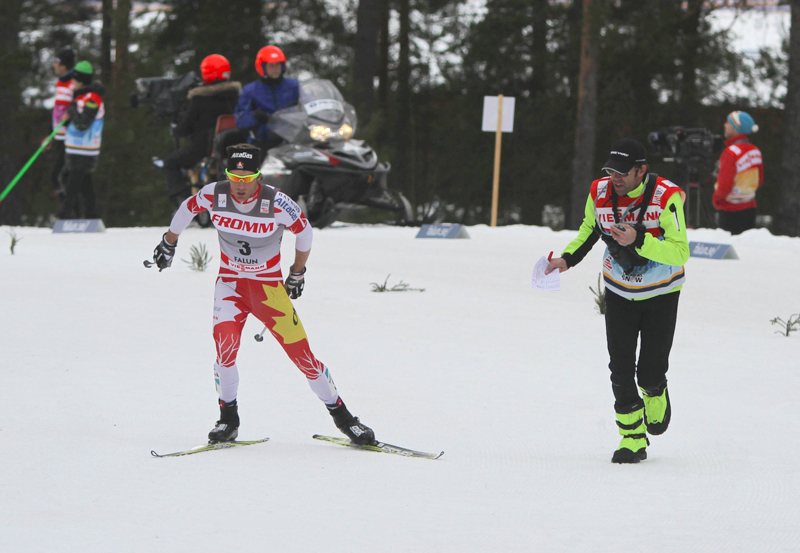
Canadian head coach Justin Wadsworth (r) giving splits to Devon Kershaw at 2012 World Cup Finals in Falun, Sweden.
Of his coaches, Kershaw gave special credit to Justin Wadsworth. A three-time U.S. Olympic cross-country skier who became Canada’s head coach in the spring of 2010, Wadsworth coached Kershaw for five seasons, and the two developed a close friendship.
“When Justin came into the national team, the level of professionalism and excitement and freshness that he brought … I don’t know if you call it luck or happenstance or just the right place, right time,” Kershaw reflected, alluding to his 2011 World Championships gold with Harvey and his 2012 Overall and Distance World Cup podiums. “Justin’s best results as a coach were me and my best results as an athlete were when I was coached by Justin. Talk about an amazing relationship there.”
“The main thing that I really appreciated with Devon, and I think he would say the same thing about me, is that we could be honest with each other and talk about hard things and enjoy the good times when we had them,” Wadsworth said on the phone last week. “… It’s cliche, but when I was talking to Devon the other day about his retirement, it’s not about the medals or the performances or whatever, it’s about your times together on the road.”
One of Kershaw’s biggest moments came at those 2011 World Championships in Oslo, Norway, where he and Harvey beat out Norway’s Petter Northug and Ola Vigen Hattestad by 0.2 seconds for gold on the Norwegians’ home turf. They had done so after Kershaw lost one of his skis early in the race, Wadsworth pointed out.
“His ski fully came off and he had to put it back on and get back into the race,” Wadsworth said. “Just the whole day was pretty incredible. That was a great, great opportunity for us, and the guys cashed in.”
Devon Kershaw (l) and Alex Harvey with their World Championship gold medals at the 2011 World Championships in Oslo, Norway.
In a difficult-yet-strategic move to conserve for that race, Kershaw and Harvey both sat out the 15 k classic the day before.
“With anybody else running the ship, there’s no way I would’ve trusted that [decision],” Kershaw said of Wadsworth’s call. “But I trusted Justin’s leadership and we went all-in, and the next thing you know we won World Championships. I mean, are you kidding me? How can you get a better start to the next quadrennial? And Justin as a first-year head coach of a national team, that’s gotta go down as maybe the best season ever for a first-year North American coach of a national-team program.”
He and Wadsworth reiterated the crucial foundation that Wood had laid.
“Dave Wood had done a really good job with the athletes leading into that period, mainly focused on building a big base and doing a lot of hours and also doing a lot of time at altitude,” Wadsworth explained. “And when I took over the position, I saw that both Alex and Devon were really primed and had a really good response rate to altitude, and all we had to do was fine tune a little bit of strength training and intensity. I was really excited to work with both those athletes and saw that they had a lot of potential.”
For Kershaw, Wadsworth’s “American swagger … was magic for me,” he said. During the 2011/2012 season alone, he stood on the podium 10 times, with four top-three finishes in seven races at the 2012 Tour de Ski.
“It was a hell of a season for me,” Kershaw said.
‘Best sand-digger ever’
He went on to compete at two more World Championships and two more Olympics. This past season, Kershaw finished in the top 30 in eight World Cup distance races, with a top result of 19th in the 30 k skiathlon in Lillehammer, Norway. While struggling with lung issues, he finished 26th in the 50 k classic at the PyeongChang Olympics.
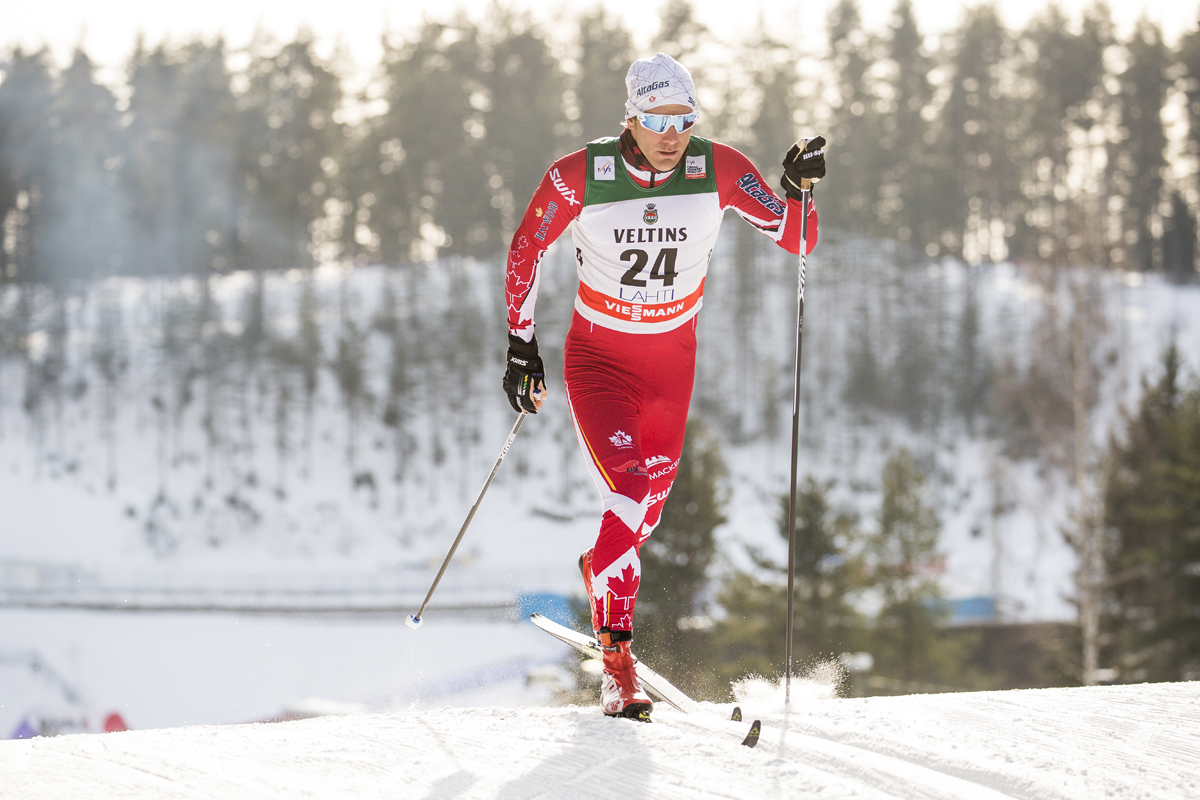
Devon Kershaw racing to 25th in the World Cup 15 k classic this past March in Lahti, Finland. (Photo: Fischer/NordicFocus)
“We worked to get that under control and it was manageable but it never felt good like it felt prior to 2015,” Kershaw said his health over the last three seasons. “In PyeongChang, it was a calamity of bad luck. When we got there it was minus 20 [Celsius], and this makes me sound so soft, because I’m from northern Ontario so you’d think I’d know, but it was really cold. I did some intervals and it aggravated my lungs and it was super windy and dirty and a lot of sand blowing around, and that really flared up my asthma to the point that I was wheezing badly.”
His breathing troubles also affected his sleeping and took most of the two-week Olympics to manage. At one point, he had a chest X-ray to make sure it wasn’t pneumonia.
“It was sporting asthma,” he said. “… It took all the way to the 50 k to kind of get it 70 percent.”
While he noted he was left wanting more from a performance standpoint at both his final Olympics and in his final season, Kershaw also acknowledged that he’s his biggest critic.
“That’s been probably the biggest detriment to my entire career; I’m the best sand-digger ever,” he said. “I am disappointed in the sense that I work really hard and I train hard and I prepare well, and it didn’t go exactly as planned. … When you’ve competed in the top 10 for as many years as I have and on the podium, of course that becomes your bar that you hope to achieve, but at the same time … when you’re in the top 30 in the results page, you’re in the race at least. And I’m proud of the fact that in almost all classic races, not every, but most, I was in the top 30 and ‘in the race’.
“Am I satisfied? In my life I’ll probably never be satisfied, that’s just how it goes,” he added with a laugh. “But am I somewhat proud of maintaining a fairly competitive level? Yeah, absolutely.”
Wadsworth reflected that Kershaw was one of the best athletes he had ever seen, even “physiologically as good as Alex [Harvey]” at the peak of his career.
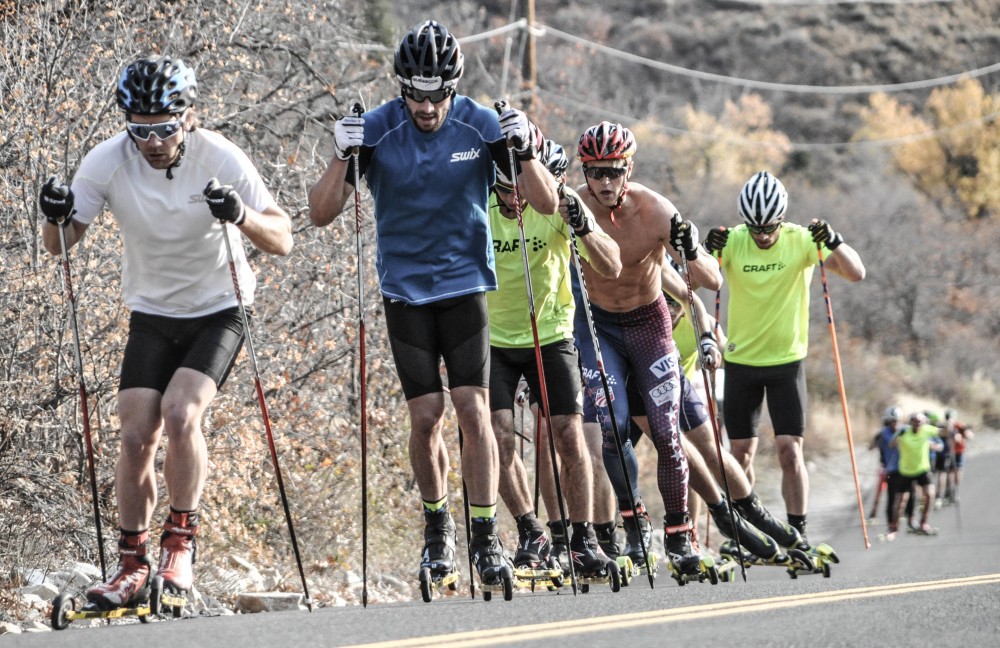
Left to right: Canada’s Devon Kershaw leads his teammate Alex Harvey and U.S. Ski Team members Noah Hoffman, Erik Bjornsen and Simi Hamilton during a Level 3 interval skate session up Snake Creek Canyon in Midway, Utah, during their respective teams’ 2016 training camps in Park City, Utah. (Photo: Matt Whitcomb)
“Devon’s a very intelligent person and sometimes he might’ve overthought things and lacked in confidence, and as a coach that’s really frustrating to see because you know how good they are physically,” Wadsworth said. “And when he was on mentally, too, in training, when he was at his very best, he had total confidence and could destroy anybody in any workout.”
He recalled a hill-bounding workout with the Norwegian team in which Kershaw was literally leaps and bounds ahead of everybody else — even Martin Johnsrud Sundby and Russia’s Ilia Chernousov, who joined the training session.
“He was just shelling everybody,” Wadsworth said. “So when Devon was at his best like that and mentally confident and relaxed, he was a real force of nature. Unfortunately that didn’t always translate into the racing season, but in 2012 he put it all together and had a tremendous year. … If he had the confidence the whole time, he would’ve been almost unbeatable, in my opinion, but it takes the whole package all the time, and he was among the greats there for a while.”
‘Younger, faster, better dog’
And then there was Harvey, another one Kershaw’s of his best friends and longtime roommates.
“I’ve spent more nights in a room with him than my wife or any girlfriend I’ve had,” Kershaw joked. “… He was eager to learn, he chased me for years, he was always a hard worker, too. He trained really hard, he believed in himself, and I still am in total awe of that. I’ve never met anybody as confident as him. It’s too bad that didn’t rub off on me, but that’s been great to be around.”
He likened Harvey’s addition to the team as a family adopting a puppy.
“You know when your parents get a puppy because your dog is 10 years old? He’s kind of slowing down a little bit and then you see that old dog get fired up and run again and jump around and play; that’s me,” Kershaw said. “And I’m so grateful that my owners got a younger, faster, better dog to hang out with because it was so inspiring.”
Several times over the last few years, Kershaw has said that witnessing Harvey make Canadian history has been one of his biggest reasons for staying in the sport.
“He, for sure, has kept me in this probably longer than I should’ve,” Kershaw said. “I just love traveling with him and seeing what he can accomplish and training with him and seeing that professionalism.
“There’s no question he’s the best Canadian skier ever, that’s not even close,” he added. “… I just feel so honored that I got the chance to see it all happen, from his last-year junior when he did his first World Cups and then all the way though I’ve been with him.”
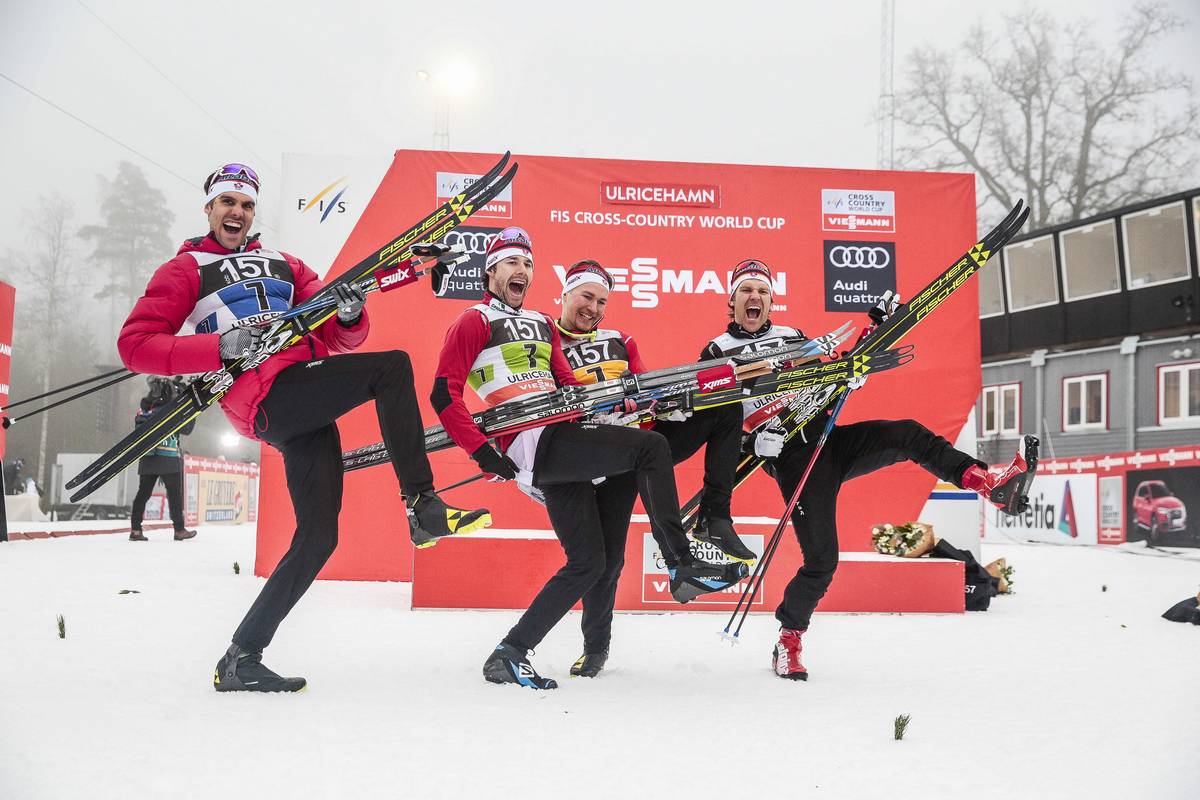
The Canadian men’s relay after placing third in January 2017 in Ulricehamn, Sweden, for Canada’s best-ever World Cup result in the 4 x 7.5 k relay. From left to right: Lenny Valjas, Alex Harvey, Knute Johnsgaard, and Devon Kershaw. (Photo: Salomon/NordicFocus)
In an email, Harvey explained that he and Kershaw first met in the fall of 2005 at a training camp at Sovereign Lake, British Columbia. Harvey was on the junior team and Kershaw a senior, but the whole team stayed at the same hotel.
One morning, Kershaw accidentally took Harvey’s poles from the hotel. Harvey had to track him down on the ski trails to get them back.
“That was the first time I talked to him and to me it’s just perfect because that’s so Devon,” Harvey wrote.
Later that season on March 7, 2006, Kershaw made history with his first podium. That same day, Harvey won his first national title in the 10 k classic at Canada’s senior national championships as a 17-year-old junior.
“I guess our friendship was meant to be before we even knew it!” Harvey wrote.
When the two became teammates, Harvey immediately took to imitating Kershaw, both in training and racing.
“He took me under his wings and he has a big part in the athlete I became today,” Harvey wrote, likening Kershaw to a big brother. “I feel very privileged to have spent all that time with him. I think we became such close friends because we are both very driven athletes and we don’t accept any compromise. We’re both huge fans of our sport, ‘nor-dorks’, so we also love to talk about everything from altitude training to who is seeing who on Tour.”
Kershaw’s decision to retire didn’t surprise Harvey.
“I think it’s a mix of a few things,” Harvey wrote. “… Probably this biggest reason, he has a little girl at home. I know this winter was extremely hard on him. Not seeing Asta Isabel was pure torture, I think I would have done the exact same if I was him.
“I will miss a lot of things about Devon,” he added. “He’s always there to give good advice about everything and anything. He knows so much about all that is going on in the world, probably the most well-read person I know. He’s kinda my news source. I’m still amazed by how indecisive one can be. This brought a lot of laughter throughout the years. I have so many memories from the last 10 years with him. Seeing him dominate the World in 2012 was just amazing but also very eye-opening for me. He raised the bar for all North American skiers that year and I’m very thankful for it.
“We both lived great emotions in high accomplishments and huge disappointments. I’d like to think I helped him get through these upsets and I can say he definitively helped me get through mine. A page turns in the life of Devon Kershaw but knowing the man, I’m not worried about what’s gonna come next.”
Without Kershaw, Killick, Cockney, and Johnsgaard on the men’s team, Harvey acknowledged that next winter will be “very different” for him on the World Cup.
“All these guys are calling it a career and I’m super proud of what all my friends accomplished,” he wrote. “I’m excited to try to help the next generation step it up and fill the shoes of the previous generation. … Also, after 10 years on Tour I’ve made some friends on other teams so I’m not too worried. I’m just excited to step into a bit of a mentor role for our next generation.”
Onto the Next
As for Kershaw, he didn’t rule out coaching future generations of Canadian skiers, but he said he was focused on getting an education first. In just over a week, he’ll start a course that requires 20 hours of classes a week — all in Norwegian — for what he anticipates will take six months. The course is essentially an advanced version of Norwegian as a second language, and foreigners must pass it to pursue a degree in Norway.
After that, Kershaw plans to apply to universities “and hopefully study forever,” he said with a laugh. “Not forever, but study, and I want to stay involved in skiing in any way I can and I want to help the next generation get better.
Kristin Størmer Steira (l) and Devon Kershaw during a day hike on one of their acclimatization days. The couple got engaged in 2014 after summiting Mera Peak during a three-week trek in Nepal’s Himalayas. (Photo: Devon Kershaw)
“First things first, I have to get my Norwegian at a level where I can sit through a lecture and write an essay at a decently good level, at least good enough that my wife doesn’t have to rewrite it, she can just correct it,” he explained.
Asked what he’d like to study, Kershaw said medicine, specifically orthopedic surgery, has always intrigued him. (As a junior skier, Kershaw took undergraduate classes at the University of Calgary until 2006, but those credits have since expired.)
“But now I’m 35 and I’m going to have to do all of this in my third language,” he acknowledged. “So for now, I’d say that that’s still my first choice and I’m exploring what it would take.”
If not medicine, he’d like to pursue a degree in “some kind of science physiology, and then in a totally shifted way, if I have a panic attack and be like, ‘Science is too hard after ski racing forever,’ then I am interested in economics and economic theory and business to some degree…”
Regardless of which path he choses, he’ll be doing it in Norway, Kershaw said.
“I don’t mind the challenge. … It’s intimidating in a way, but it’s also really exciting,” he said. “Kristin’s family [who lives in Lillehammer] is just so fantastic and to see how happy my daughter is here, to have her family, to have family around her and everything for the short term, and I hope to be educated in Norway.”
Asked if he’ll jump into any ski races this season, Kershaw was quick to respond, “No.” But he will continue skiing. The beauty of the sport and the struggle, as he put it, is what’s kept him in it so long.
“Imagine just having a singleness, a purpose, a goal that’s just there in your face and then you get to wake up every day and do the things you absolutely love to do,” he said. “… I adore cross-country skiing. I just think it’s such a peaceful, beautiful exercise, and the technique and the flow of it all. … You’re just skiing through the woods peacefully, gliding over snow, over all the terrain you can cover. It’s a beautiful, zen-like endeavor, and I think that’s what’s kept me in it this long. And the people, the Canadian ski community, the world ski community, really. I’ve met so many inspiring people and beautiful people and worked with a lot of absolute experts and I’ve had brilliant teammates and brilliant coaches.”
And because of skiing, he met his wife and started a family in Norway.
“I have a daughter with a woman that I love and respect and am in total awe of every day of my life and without ski racing there’s no way that would’ve ever come to fruition,” he said. “There’s the biggest gift right there, as cliche and Hallmark as that sounds, it’s true.”
Jess Cockney (396) after winning the men’s 15 k freestyle pursuit at 2018 Canadian Ski Nationals, ahead of Ty Godfrey (l), Michael Somppi (r) and Evan Palmer-Charrette (second from r) in Thunder Bay, Ontario. (Photo: Doug Stephen)
Canadian Ski Nationals (Thunder Bay, Ontario): Freestyle pursuits and sprints
Ski Nationals continued Tuesday and Wednesday at Lappe Nordic in Thunder Bay, with 10- and 15-kilometer freestyle pursuits (based on Sunday’s 5/10 k classic interval starts) followed by sprints.
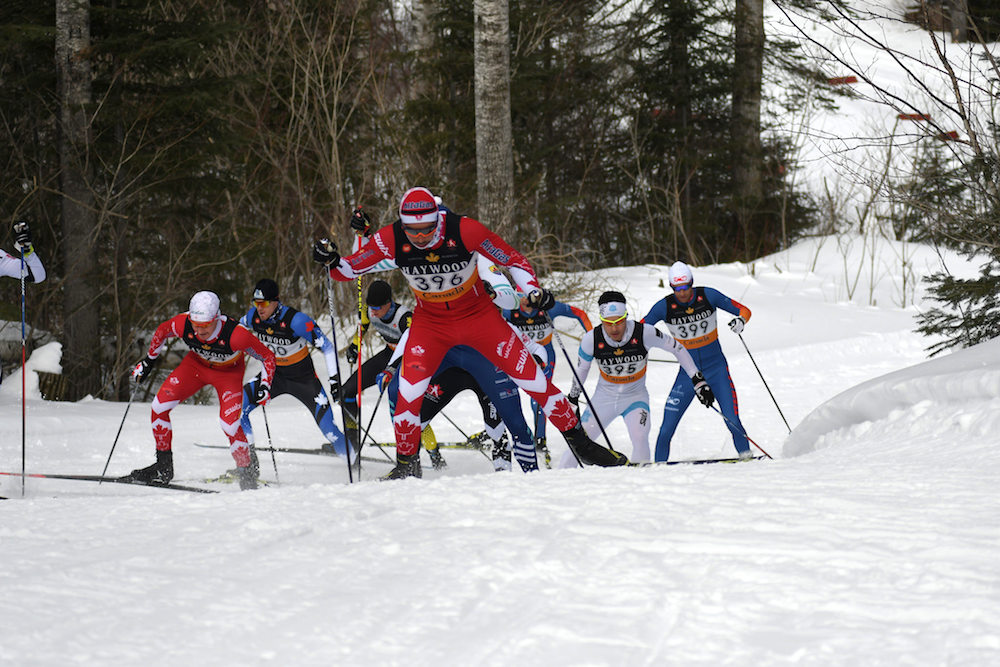
Jess Cockney (396) leading the men’s 15 k freestyle pursuit on Tuesday at 2018 Canadian Ski Nationals in Thunder Bay, Ontario. He went on to win the pursuit as well as the freestyle sprint the next day. (Photo: Doug Stephen)
On Tuesday, Jess Cockney of the Canadian World Cup Team and Alberta World Cup Academy (AWCA) raced to first in the men’s 15 k freestyle pursuit, up from sixth after the 10 k classic. His cumulative time for the two races was 1:04:06.7 hours, just 1.2 seconds ahead of Ty Godfrey of Team R.A.D. in second. (Godfrey previously placed ninth in the 10 k classic.) Michael Somppi, who grew up skiing with Lappe Nordic and now trains with the AWCA, completed the podium in third, 2 seconds behind Cockney, after placing 10th in the classic race.
Just behind Somppi, another local skier Evan Palmer-Charrette, of Lappe Nordic and the National Team Development Centre (NTDC) Thunder Bay, placed fourth in the pursuit (+2.8). Antoine Cyr and Alexis Dumas, both of the Pierre-Harvey National Training Centre (CNEPH), finished together in fifth (+11.5) and sixth (+11.6), respectively, ahead of Knute Johnsgaard (World Cup Team) in seventh (+13.4), Scott Hill of Barrie Cross Country (BXC) in eighth (+16.3), Reed Godfrey (Team R.A.D.) in ninth (+31.8), and Ryan Jackson (BXC) in 10th (+38.9).
The fastest 15 k skate time of the day was clocked by Somppi in 36:54.5. Ty Godfrey had the second fastest time of day, just 0.2 seconds back, while Cockney’s freestyle time ranked third fastest (+4.9).
Olivia Bouffard-Nesbitt (Rocky Mountain Racers) racing to second overall (first Canadian) in the women’s 10 k freestyle pursuit on Tuesday for her second national title of the week at 2018 Canadian Ski Nationals in Thunder Bay, Ontario. (Photo: Doug Stephen)
American Caitlin Gregg, of Central Cross Country (CXC), Team Gregg and Loppet Nordic Racing, won the women’s 10 k freestyle pursuit by more than a minute in 43:12.4, after placing second in the 5 k classic. The winner of Sunday’s classic race, Olivia Bouffard-Nesbitt of Rocky Mountain Racers (RMR) scored her second-straight title as the first Canadian in the pursuit, placing second overall, 1:03.4 behind Gregg. Annika Hicks (AWCA) was the second Canadian in third overall (+1:16.3), up from fifth in the classic race.
Gregg clocked the fastest 10 k skate time in 27:51.6, while Vézina was second fastest on the day, 1:06.5 back. Hicks had the third-fastest time, 1:07.3 back from Gregg.
On Wednesday, Cockney racked up his second-straight national title with a victory in the 1.4 k freestyle sprint final. Cockney edged Andy Shields (Lappe Nordic) by 0.83 seconds for the win in 2:39.87. Just three-hundredths of a second behind Shields, Palmer-Charrette reached the podium in third (+0.86), Somppi followed in fourth (+2.14), Julian Smith (NTDC Thunder Bay/National U25 Team) finished fifth (+4.3) and Sebastien Boehmler-Dandurand (Stefan Kuhn HP Team) placed sixth (+11.81).
Shields won the qualifier to start the day in 2:44.54, while Cockney was the second-fastest men’s qualifier, 1.39 seconds off Shields’s time. Shields went on to win his quarterfinal and place second in the first semifinal, while Cockney was second to Smith in both the fourth quarterfinal and second semifinal.
Maya MacIsaac-Jones (l) and Katherine Stewart-Jones (r) go head to head for the win in the women’s freestyle sprint final on Wednesday at 2018 Canadian Ski Nationals in Thunder Bay, Ontario. MacIsaac-Jones won it by 0.05 seconds. (Photo: Doug Stephen)
MacIsaac-Jones won the women’s skate-sprint final in 3:06:68, five-hundredths of a second ahead of Stewart-Jones in second. In a race for third, Maclean took it (+4.82), ahead of Gregg in fourth (+5.01). Hicks placed fifth (+7.22) and Zoë Williams (Nakkertok) was sixth (+9.12).
MacIsaac-Jones topped the women’s qualifier by 5.78 seconds in 3:12.87. Mathilde Petitjean of Club Nordique Mont Sainte-Anne (C.N.M.S.A.) qualified second, and Maclean was 6.42 seconds back in third.
MacIsaac-Jones then won the first quarterfinal and placed second to Stewart-Jones in the first semifinal. Stewart-Jones finished second to Bouffard-Nesbitt in the second quarterfinal, and Maclean won the second semifinal over Gregg, after finishing second to Gregg in the fifth quarterfinal.
Nationals conclude with 30/50 k classic mass starts on Saturday.
Patrick Stewart-Jones (l), skiing for his club team Nakkertok, and Scott Hill (r) of Barrie Cross Country (BXC) going head to head in the men’s classic team sprint on Saturday at Canadian Ski Nationals in Thunder Bay, Ontario. Nakkertok won and BXC placed second. (Photo: Doug Stephen)
Canadian Ski Nationals (Thunder Bay, Ontario): Team sprints + 5/10 k classic
Canada’s 2018 Ski Nationals opened this past weekend at Lappe Nordic in Thunder Bay, Ontario, with classic team sprints on Saturday followed by 5- and 10-kilometer classic interval starts on Sunday.
Nakkertok topped the podium in both the open men’s and women’s team sprints. In the men’s final, Nakkertok’s Dominique Moncion-Groulx and Patrick Stewart-Jones won by 1.95 seconds over Barrie Cross Country (BXC) in 14:50.79. BXC’s Ryan Jackson and Scott Hill teamed up for second place, and Skibec’s Alexis Morin and Antoine Brand raced to third (+2.57).
Katherine Stewart-Jones (22), skiing for her club team Nakkertok, while leading Annika Richardson (Hollyburn Ski Club) and Mathilde Petitjean (r) of C.N.M.S.A. during the women’s classic team sprint at 2018 Canadian Ski Nationals in Thunder Bay, Ontario. (Photo: Doug Stephen)
The Stewart-Jones family was also a big winner on Saturday, with Nakkertok’s Zoë Williams and Katherine Stewart-Jones (Patrick’s sister) racing to first in the women’s final in 13:04.72. They finished 2.37 seconds ahead of Katie Weaver and Annika Richardson of the Hollyburn Ski Club in second place, and Marie Corriveau and Mathilde Petitjean of Club Nordique Mont-Sainte-Anne (C.N.M.S.A.) raced to third (+7.42).
On Day 2 and the first official day of Canadian Ski Nationals, Hill (BXC) took his second-straight win of the weekend, topping the men’s 10 k classic with a time of 26:45.1 for his first senior national title. He finished 7.2 seconds faster than Alexis Dumas, of the Pierre-Harvey National Training Centre (CNEPH) in second, and an early race leader, Knute Johnsgaard of the Canadian World Cup Team, placed third (+12.0)
Johnsgaard clocked the fastest split at the race’s halfway point, while Hill’s 5 k time was almost 10 seconds slower. But over the final 5 k, Hill’s lap time was nearly 22 seconds faster than Johnsgaard’s. Dumas skied a consistent race, with the fourth-fastest first lap and second-fastest second lap.
Knute Johnsgaard (Canadian World Cup Team) racing to third in the men’s 10 k classic on Sunday at Canadian Ski Nationals in Thunder Bay, Ontario. (Photo: Doug Stephen)
Jackson (BXC) finished fourth (+14.7), and Jess Cockney of the Alberta World Cup Academy (AWCA) and Canadian World Cup Team placed fifth (+22.2). Leading the National Team Development Centre (NTDC) Thunder Bay on its home trails was Evan Palmer-Charrette in sixth (+24.8), and Lappe Nordic’s Michael Somppi (AWCA) placed seventh (+29.1). Gareth Williams of Telemark Nordic and the Canadian U25 Team finished eighth (+39.5), American Brian Gregg (CXC/Team Gregg/Loppet Nordic Racing) was ninth (+44.7), and Jack Carlyle (AWCA) 10th (+49.5).
Olivia Bouffard-Nesbitt of Rocky Mountain Racers (RMR) collected her first senior national title with a 13.3-second victory in the women’s 5 k classic. She finished in 15:07.5, ahead of American Caitlin Gregg (CXC/Team Gregg/LNR) in second, while Katherine Stewart-Jones (NTDC Thunder Bay) was the second Canadian and third overall (+17.9).
NTDC Thunder Bay had two in the top four with Alannah Maclean in fourth (+19.8). Annika Hicks (AWCA) followed in fifth (+22.2), Frédérique Vézina (CNEPH) was sixth (+30.8), Sophie Carrier-Laforte (Skinouk) seventh (+33.0), Maya MacIsaac-Jones (RMR/Canadian U25 Team) eighth (+37.4), Laura Leclair (CNEPH) ninth (+58.1), and Williams (Nakkertok) 10th (+1:07.2).
Nationals continue Tuesday with 10/15 k freestyle pursuits, followed by skate sprints on Wednesday and 30/50 k classic mass starts on Saturday.
Canada’s Len Valjas (l) and American Andy Newell scrambling during the first leg of the men’s 4 x 10-kilometer relay on Sunday at the 2018 Olympics in PyeongChang, South Korea. (Photo: FlyingPointRoad)
PYEONGCHANG, South Korea — Zooming in on the leaders of Sunday’s nordic race, the Olympic broadcast stream focused on a red Norwegian suit set against the backdrop of Russian maroon. The televised showdown presented for the men’s 4 x 10-kilometer relay final leg was shaping up to be between the Olympic Athletes from Russia and Norway: Denis Spitsov verses Johannes Høsflot Klæbo. As the two skiers struck out for Lap 2 of 3 of the final 10 k leg, both spectators and screen apprehensively followed.
Had the camera panned 250 meters ahead, it might have caught the flurrying ski tails of American Noah Hoffman, dashing the top of the 3.3 k lap’s initial climb. Around 45 seconds earlier, Hoffman had been tagged into the race as the anchor leg for the U.S. men. His hot start was not just for show or a final push to the front. If he wanted to prevent the U.S. team from an eliminatory pull, he would need to stay ahead of Spitsov and Klæbo.
A cat-and-mouse game between the leaders certainly could buy the U.S. skier a little more time to pad the time gap. But until then, he sifted a reductionist race: Stay in the game. Don’t get caught by Klæbo.
American Noah Hoffman anchoring the U.S team during the men’s 4 x 10-kilometer relay on Sunday at the 2018 Olympics in PyeongChang, South Korea. (Photo: FlyingPointRoad)
“The highlight for me was watching these guys stick with their guys,” Canada’s Len Valjas said of his relay teammates in a post-race interview with FasterSkier. “And another one was watching Noah stay away from Klæbo. We were all yelling, cheering for him. That was amazing.”
The relay had more than one race in the works. Hoffman staying in front of Klæbo was one. Canada’s Graeme Killick catching Sweden was another.
After Valjas scrambled the first classic leg, he came through the exchange in 10th, handing off to Killick for the second classic leg. As Killick headed out for his first lap, Sweden was four places and 38.3 seconds ahead.
The 28-year-old Canadian, in his second Olympics, was by no means deterred. Working kilometer by kilometer, Killick strode past the Czech Republic’s Martin Jaks, Germany’s Thomas Bing and eventually Sweden’s Daniel Rickardsson.
After moving up three places, Killick went through the second exchange in seventh with the seventh-fastest time, passing off the race to Russell Kennedy. Going into Leg 3, 2.6 seconds separated the Canadians from the tag between Sweden’s Rickardsson and Marcus Hellner. All said and done, Killick had made up 40.9 seconds to catch and pass Sweden.
“Everyone, I think, skied to a higher level today,” Killick told FasterSkier after. “We were all able to dig deep for our teammates and make sure we pass off in good position.”
“Anything can happen in a relay and that’s one of the reasons it’s always exciting to get on the start line and do your best,” Killick continued. “When I tagged off Russell, he was with Hellner … It was cool to see everyone dig so deep and just fight for the team.”
Racing Canada’s third relay leg, Kennedy, a 26-year-old Olympic rookie, held tight to Hellner through the first lap. And again through the second. And through the first half of the third. It was not until around the final major climb, that Hellner broke away from Kennedy’s red maple-leaf suit.
Canada’s Graeme Killick racing the second leg of the men’s 4 x 10-kilometer relay on Sunday at the 2018 Olympics in PyeongChang, South Korea. He brought the team from 10th to seventh with the seventh-fastest second-leg time. (Photo: FlyingPointRoad)
“I was psyched when I saw GKill killed it, and gave me an amazing position,” Kennedy said after. “But I was also a bit nervous because … I was walking to the line with Hellner and I was like, he’s an Olympic champ. I got to stick with him and hold on, and that’s what I did. I just locked on, the wax techs gave me amazing skis today, and I held on as hard as I could. He threw in a sprint at the top of the hill, blew me up, but I was psyched to have made it almost three laps with him.”
Hellner has two relay gold medals from the Olympics, one from 2014 and another from 2010, as well as two 30 k skiathlon golds from the 2010 and 2014 Games. The 32-year-old Swede is also a multiple-time World Championships medalist with several top-10 World Cup 15 k freestyle results. While Kennedy considers himself more of a sprinter, Sunday’s performance may perhaps change his perspective.
“I was just thinking, don’t blow. Do it for the team,” Kennedy said. “I knew that if I could hand off to Knute in a good position, were were in a really good position for us. Can’t ask for much more than that. I gave it everything for sure. I was just happy we caught the Slovakian guy so Knute had someone to ski with. But yeah, amazing day for me, for sure. I felt really good.”
Canada’s Knute Johnsgaard (12) racing the final leg of the the men’s 4 x 10-kilometer relay on Sunday at the 2018 Olympics in PyeongChang, South Korea. He anchored the team to ninth for its second-best Olympic relay result. (Photo: FlyingPointRoad)
After skiing the seventh-fastest third leg, Kennedy came through the exchange in eighth and handed off to teammate Knute Johnsgaard, also in his first Olympics, for the final freestyle leg. Johnsgaard kept the Canadians ahead of the Czech Republic, staving off Kazakhstan until the final kilometer and a half.
“It was pretty tough for me, especially the sprint hill,” Johnsgaard, 25, said. “We knew it was going to be hard. We did the best we could.”
Canada finished in ninth, 3:41 seconds off first, which was taken by Norway’s lineup of Didrik Tønseth, Martin Johnsrud Sundby, Simen Hegstad Krüger, and Klæbo in a time of 1:33:04.9. The ninth place ties the country’s second-best Olympic relay result, which was set at the Calgary Games in 1988. Canada’s best relay finish was in 2010 when the team placed seventh with Devon Kershaw, Alex Harvey, Ivan Babikov, and George Grey.
Harvey opted not to race Sunday’s relay, and Johnsgaard started in his place.
In last year’s World Championships team relay in Lahti, Finland, with Harvey on the team, the Canadians were lapped out of the race.
“We’ve had some terrible luck with relays. I think we did great today,” said Valjas, a 29-year-old two-time Olympian. “It’s not our A-team; we knew that coming in. I think we performed amazing and I’m super happy with how it went. Especially all these guys staying with some serious big names in cross-country skiing. I’m impressed, these guys were fighting hard and I’m proud of all of them.”
Alongside the Canadian’s solid team performance, the U.S. had several personal highlights. Scrambling in the first leg was American Andy Newell in his second race of the week (after placing 37th in the individual classic sprint) and potentially, the 32 year old’s last Olympic race.
“The sprint day was really disappointing, because I knew I had a lot more to give in the qualification. To be just out was frustrating, I know I had a much better result than that in me, and my body is feeling better than that result,” Newell told FasterSkier on Sunday. “To be able to come back and get another start, it was great.”
Having scrambled in Olympic relay races before, Newell explained that allowing the pace to burn off the front was part of his plan. Through the first lap he was 2.3 seconds off the lead pace. Around 5 k, he was racing with Canada, Estonia, Austria, the Czech Republic, Switzerland, and Germany around 6 seconds back. With around one lap to go, Kazakstan’s Alexey Poltoranin bulldozed to the front and began pushing pace. Newell stuck to his racing plan.
“It’s a high-pressure event. Somebody who has raced first legs for their country before, talk about being nervous the night before, when you know you’re going to go off and the rest of the team’s counting on you,” Newell said. “Relays … there’s so much national pride, no matter what team you come from. Whether it is a Norway/Sweden rivalry or and Canada/U.S. rivalry, they all go back and have their history.”
“I probably haven’t raced a 10 k in probably over a month, talk about nerve racking,” Newell continued. “To step to the line with Poltoranin, some of these guys, when you know they are much better 10 k classic skiers than I am.”
Poltoranin has reached the World Cup podium numerous times in distance classic races. On Sunday, Newell came through the exchange in 12th, 1:28.8 minutes behind Poltoranin in first.
“I just have to go and be like, ‘A minute twenty back, it feels like a bad race, but these guys are the best in the world. … It sounds bad, but we have to do what we call damage control a little bit, try to ski with the guys we can ski with, and put our team in the best position we can,” Newell explained.
American Resse Hanneman racing the second leg of the men’s 4 x 10-kilometer relay on Sunday at the 2018 Olympics in PyeongChang, South Korea. In his first Olympic race, after being tagged in 12th, he came through the second exchange in 14th. (Photo: FlyingPointRoad)
He passed off to American Reese Hanneman for the second classic leg. The event was Hanneman’s debut Olympic race. The 28-year-old Alaska native was called on to the team as the first alternate.
“Skiing with the top 13 classic skiers in the world … for me, it became apparent that I was going to have to really focus and make it hurt to minimize the time I was going to lose to them,” Hanneman said. “I could barely see or stand up by the end of it. I’m not happy with how I performed, but I’m happy with how deep I was able to dig.”
Hanneman tagged off to Scott Patterson in 14th, who then took the American’s first freestyle leg. Creeping up on Patterson were the race leaders. He geared up through all three of his laps, holding off both Norway’s Simen Hegstad Krüger and Russia’s Alexey Chervotkin.
“All the coaches were out there going, ‘You’ve got two minutes. You’ve got 1:39,’ just the whole way,” Patterson said, referring to his time back to the leaders. “It’s not the direction you want to be getting splits, but that’s where we were.”
“Also, we knew with Erik [Bjornsen] sitting out, with Simi [Hamilton] sitting out, with Paddy [Caldwell] sick, we knew were in a little bit of a tough shape for today, so not getting lapped was a bit of goal going in,” Patterson added.
With Hoffman anchoring the final three laps, the Americans achieved their goal. Don’t get caught by Klæbo became ‘Klæbo can’t catch me.’
“They weren’t charging their second lap — my first lap — but I knew they would be charging on the last lap and I knew I needed every second I possibly could, so I went out hard,” Hoffman said. “I was just viewing it as a 6.6 k race. Like the last lap doesn’t matter at that point, just got to get there. I did everything I could and it was close but I am pretty psyched that we as a team made it.”
The Americans finished the relay in 14th (+9:24.2) out of 14 teams.
“You never know how its going to go down,” Hoffman said of relays. “Unless you are scrambling you don’t know what the start is going to be like, where you’re going to be, if you’re going to be alone, if you’re going to be with people, you got to be adaptable, you got to be able to make your own plan out there.
“This was my first time ever anchoring a relay so that’s pretty cool experience,” Hoffman added. “I had a lot of support finishing. … Even though we were a long ways back the crowd seemed to stick around for me, which was pretty fun.”
Johannes Høsflot Klæbo anchoring the Norwegian men’s 4 x 10 relay to gold on Sunday at the 2018 Olympics in PyeongChang, South Korea, while Denis Spitsov (background) celebrates silver for the Olympic Athletes for Russia. (Photo: FlyingPointRoad)
For a while in the men’s 4 x 10-kilometer relay on Sunday, it looked like the Russians might run away with the win. But that was just two classic legs and 20 k into the race, with a lot more racing to come.
While Kazakhstan’s Alexey Poltoranin had handed off in first at the first exchange, just ahead of Andrey Larkov of the Olympic Athletes from Russia, Italy, France and Norway skied together behind them, with Norway’s Didrik Tønseth trailing off the back, 18 seconds behind.
On the next classic leg, Russia’s Alexander Bolshunov put a hurt on the field. Within the first 3.3 k lap, he was 25 seconds ahead of Kazakhstan’s Yevgeniy Velichko in second, who was followed closely by Italy, Norway and France in third through fifth. Sweden’s Daniel Rickardsson had fallen farther behind to more than a minute back in sixth place, after his teammate Jens Burman lost contact with the lead group on the first leg.
By the second exchange, Russia was 24.5 seconds clear of second place, while Italy’s Francesco de Fabiani tagged Giandomenico Salvadori in second, France’s Maurice Manificat tagged Clement Parisse in third (+28.0), and Norway’s Martin Johnsrud Sundby tagged Simen Hegstad Krüger in fourth (+32.1). Kazakhstan’s Velichko had fallen off the pace and was another 19 seconds back in fifth.
Over the next 10 k, the first skate leg, Krüger and Parisse reeled in Russia’s Alexey Chervotkin, catching him before the end of their second lap. One lap later, Krüger came through the final exchange in first, tagging Johannes Høsflot Klæbo 0.4 seconds ahead of France in second. Chervotkin tagged Russia’s anchor Denis Spitsov in third, 16.2 seconds back, while Finland’s Matti Heikkinen passed Italy’s Salvadori on the last climb to put Finland in fourth (+58.6).
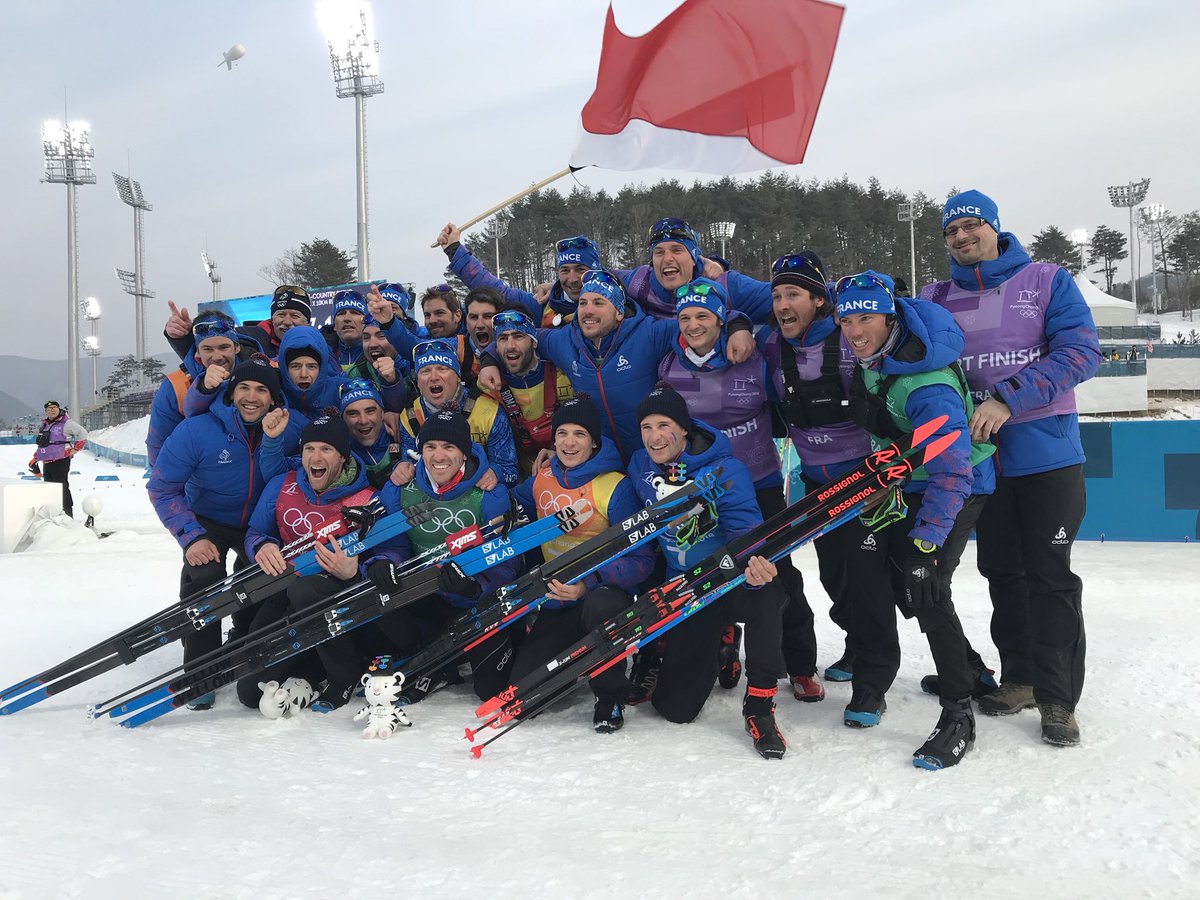
Team France celebrates its bronze-medal finish in the men’s 4 x 10 k relay at the 2018 Olympics on Sunday in PyeongChang, South Korea. (Photo: FIS Cross Country/Twitter)
Early in the final leg, France’s Adrien Backscheider took the lead ahead of Klæbo. The two held Spitsov off until the end of the second lap, where Spitsov came through the stadium first to start the final loop. Spitsov and Klæbo soon upped the pace, dropping Backscheider, and shortly after the 8.27 k checkpoint, Klæbo truly put the jets on to accelerate away from Spitsov. He dropped the Russian on a climb just before the final uphill, where it was clear that the gold was Norway’s.
As he sped down into the stadium, Klæbo relaxed his arms, skied to the sideline and took a flag from the stands. He looked back for a moment and then crossed the finish line first in 1:33:04.9 hours, while Spitsov followed 9.4 seconds later for silver for Russia. Backscheider held on for bronze (+36.9) as his team exuberantly celebrated with him at the finish.
Finland placed fourth (+1:40.5), Sweden fifth (+2:05.6), Germany sixth (+2:08.2), Italy seventh (+2:35.2), and Kazakhstan eighth (+3:31.4). Canada was ninth (+3:41.0) for its second-best Olympic relay result (with Len Valjas, Graeme Killick, Russell Kennedy, and Knute Johnsgaard), and the U.S. finished 14th (+9:24.2), out of 14 teams, with Andy Newell, Reese Hanneman, Scott Patterson, and Noah Hoffman.
France’s Martin Fourcade lunging for his second gold of the 2018 Olympics in PyeongChang, South Korea, winning the men’s 15 k mass start on Sunday. (Photo: FlyingPointRoad)
Martin Fourcade is the champion once again. Six days after he won the 12.5-kilometer pursuit for his first gold in PyeongChang, the 29-year-old Frenchman did it again in the men’s 15 k mass start on Sunday, winning in a photo finish at the line.
He took charge on the first loop, leading the field into the range for the first prone shooting. There, Fourcade shot a penalty and slipped to 19th, but it wasn’t over.
Clean shooting on the second prone brought him up to eighth, 9.4 seconds out of first. Germany’s Benedikt Doll took that lead at that point after his second stage without a miss. Meanwhile Norway’s Johannes Thingnes Bø shot three misses on that second stage and dropped out of contention.
One loop later, Fourcade moved into first with a clean standing. He left the range about 1 second ahead of Germany’s Simon Schempp and 2 seconds ahead of Germany’s Erik Lesser, after both made it through the first three stages without a miss. Doll missed one to slip to seventh, almost 30 seconds behind.
After Fourcade and Schempp exchanged leads over the next loop, Lesser moved into first just before the final shooing, Going head to head, Fourcade and Schempp both missed one while Lesser missed two. Fourcade and Schempp still left the range in first and second, respectively, separated by 0.4 seconds, while Lesser slipped to fifth, 22.5 seconds back.
Doll left the range in third (+19.2) after cleaning and Norway’s Emil Hegle Svendsen moved into fourth (+21.9) with a clean standing stage as well.
In the end, Fourcade outlunged Schempp for the win in 35:47.3 minutes, with Schempp finishing less than a tenth of a second behind for silver, and Svendsen beat out Lesser in the finishing stretch by 0.4 seconds to claim bronze, 11.2 seconds behind, while Lesser settled for fourth (+11.6). Doll followed them in fifth (+18.8), Austria’s Julian Eberhard placed sixth (+30.7) with three penalties, Norway’s Erlend Bjøntegaard seventh (+32.1) with two misses, Norway’s Tarjei Bø eighth (+34.6) with three penalties, Sweden’s Jesper Nelin ninth (+34.6) with two misses, and Slovenia’s Jakov Fak 10th (+36.1), just ahead of the Czech Republic’s Ondřej Moravec in 11th (+36.3), with one miss each.
Dario Cologna has shown that he meant business this season, winning another Tour de Ski title as well as the last World Cup before the Olympics. But it was still remarkable that he came out and won the 15 k skate today, by a dominant margin of 18.3 seconds over Norway’s Simen Hegstad Krüger. At 31 years old, Switzerland’s Cologna becomes the first man to ever win three 15 k Olympic gold medals in a row. The first came in the freestyle race in Vancouver in 2010, the second in the classic race in Sochi in 2014, and now another gold today.
“A lot has come together for me today,” Cologna – who was in tears after he finished – said in a postrace interview with Switzerland’s SRF broadcaster, according to a translation. “A lot of hard work behind this. For me to come back this year, and that it now was enough for another Olympic gold, I can hardly describe that… Most of all I wanted to win a medal, and now it’s even a golden one. I have had a lot of successes in the past, so I don’t have to prove anything in that regard, but you do sports for those moments, to win. So of course I am very proud to be able to win a gold medal for Switzerland. An Olympic medal is always a little more special and a little more beautiful than other victories.”
Simen Hegstad Krueger of Norway (bib 60) pushed his way onto another Olympic podium, earning silver in the 15 k skate. (Photo: FlyingPointRoad)
Krüger, who is at his very first Olympics, picked up his second medal of the Games after winning the 30 k skiathlon to open the men’s cross-country ski competitions. In third place (+23.0) was 21-year-old Denis Spitsov of Russia, who placed fourth in the 30 k.
Fourth place went to Norway’s Martin Johnsrud Sundby (+24.9) who was still denied in his quest for individual Olympic gold, and fifth to France’s Maurice Manificat (+27.0). Rounding out the top six was Norway’s Hans Christer Holund (+34.5).
Canada’s Alex Harvey was in the fight for the medals in the middle of the race, but faded over the final kilometers to end the day seventh (+35.5). Behind him, Graeme Killick finished 38th (+2:39.4), Knute Johnsgaard 69th (+4:04.6), and Devon Kershaw 71st (+4:17.6).
The United States was led by Scott Patterson in 21st place (+1:44.1). Erik Bjornsen was close behind Patterson in the opening kilometers but slipped to 41st place by the finish (+2:44.7). Noah Hoffman placed 48th (+3:01.3), and Tyler Kornfield 74th (+4:34.0).
University of Utah alumnus Snorri Einarsson, racing for Iceland, placed 56th (+3:21.7). Dartmouth College alum Tucker Murphy of Bermuda finished 104th (+9:21.8) and Canada-based Kequyen Lam of Portugal 113th (+20:50.2).
Norway swept the medals in the first men’s cross-country race of the 2018 Olympics in PyeongChang, South Korea, with Simen Hegstad Krüger (c) taking gold, Martin Johnsrud Sundby (l) silver and Hans Christer Holund (r) bronze. (Photo: FlyingPointRoad)
PYEONGCHANG, South Korea — First a quick parable every skier has heard: never give up. From coaches, teachers and certainly parents, it’s always the same. Never give up. For those on the receiving end of the timeworn parable, it can sound like the annoying advice of elders; something that only applies in the later years. Easily brushed off words that might apply later, never now.
Early in the men’s 30 k skiathlon at the 2018 Olympics in PyeongChang, South Korea. (Photo: FlyingPointRoad)
During Sunday’s blustery and downright frigid 30-kilometer skiathlon, the first men’s cross-country race of the 2018 Olympic Games, that parable came into play not more than fifteen seconds after the start. Sixty-eight skiers shot off the line and merged into the classic ski tracks — the front-row athletes, the likes of Canada’s Alex Harvey, Norwegians Martin Johnsrud Sundby and Johannes Høsflot Klæbo, Switzerland’s Dario Cologna, and Finland’s Iivo Niskanen, skied clean up the first climb.
Caught up in the striding, double poling and the tumbling was Norway’s 24-year-old Simen Hegstad Krüger, bib 7, waving his arm as he lay prone on the snow. Skier down — broken pole. There really didn’t seem much to it other than it was bib 7. Bib 7 slow to get up, slow to unstrap his mangled pole, slow to get into the tracks and single stick for tens of meters. Bib 7. Krüger.
Then the coach arrives, the pole becomes functional, the game is on. By then, Niskanen, a renowned classic skier, had accelerated the pace. From the front, the pack was pulled apart like taffy. From the back of the mass of skiers, where Krüger now ventured, a sea of 67 other bib numbers waited to be picked off. Whatever the phrase “never give up” is in Norwegian, it most certainly rattled around in Krüger’s mind.
“It’s my first-ever Olympic race and it started in the worst possible way,” Krüger said during the post-race press conference. “I just had to try to stay calm and use some time to catch up because I think if I had skied too fast there after my crash, I don’t think I would have any power when I caught up.”
Let’s ascend from the bottom up on Krüger’s World Cup results pyramid. He has 28 World Cup top-30 results, 12 of which are top 10’s. Of those top 10’s, he has two podiums: a third place in the fifth stage of the 2017 Tour de Ski, the 10 k skate in Toblach, Italy, and another win in Toblach this past December in the 15 k skate.
Surely this is no spoiler — bib 7 won the Olympic 30 k skiathlon on Sunday in 1:16:20 hours in burley conditions. On top of that, consider this: he’s a first-time Olympian, this was his first Olympic race and first championship gold.
Let’s get back to Niskanen, who is a no-joke classic skier. Of all his major wins, including Finland’s National Junior Championships (with multiple titles in 2012 and 2013), you have to comb through to find a freestyle win. There are three skate wins, none on the World Cup. And here’s another striking piece of information, according to the International Ski Federation (FIS) database, Niskanen has never won off of Finnish soil except for the 15 k classic at 2014 U23 World Championships in Val di Fiemme, Italy.
Finland’s Iivo Niskanen leads Switzerland’s Dario Cologna, Canada’s Alex Harvey and several Norwegians during the classic portion of the men’s 30 k skiathlon at the 2018 Olympics in PyeongChang, South Korea. (Photo: FlyingPointRoad)
PyeongChang is in South Korea, seven time zones from Finland.
Number crunching in sport is nothing new. Somebody in the Norwegian head-shed must have known Niskanen’s skewed geographic preference.
Off the Finn went with the skiathlon favorites all in tow. By all accounts, Niskanen set a punchy pace. Nearly through 10 k, the 26 year old owned it. No doubt he knew his chances were slim if he didn’t break the pack and stretch out a solo lead before the transition to 15 k of skate technique. For a bit after 10 k, Sundby took some pulls up front. But in what became a familiar classic leg trend, the 13 skiers, separated by no more than five seconds, zipped down the banked corner before the 15 k mark gear exchange led by none other than Niskanen.
The Finn had done the job of cutting the lead pack down to a manageable number, but he hadn’t built a gap from which he could nurse a cushion during the skate leg. In being the fox for at least 12 hounds, Niskanen had burned through his high-pace fuel. Fourth out of the transition, 1.3 seconds behind Klæbo in first, he was back in 18th just under 4 k later, 9 seconds out of first. He ultimately finished the skiathlon in 19th place, 1:14.2 minutes behind the winner.
A quick swap of the skis and the poles and the 21-year-old young gun from Norway, Klæbo, was first through the 15 k time check. Harvey followed next with a tight grouping from first to 13th within 9.5 seconds, tightening pole straps on the run and readying for the skate leg throwdown.
Norway’s Simen Hegstad Krüger (7) leads Germany’s Lucas Bögl during the skate leg of the men’s 30 k skiathlon on Sunday at the 2018 Olympics in PyeongChang, South Korea. (Photo: FlyingPointRoad)
Here’s the thing: the 14th skier through the exchange, 15.2 seconds back was Krüger. This athlete was in 67th at 0.88 k, and improved to 57th 1.5 k later. Fast and steady, Krüger would reel in the front group. By 17.25 k, he was within a few seconds of lead.
“As soon as I changed skis, then suddenly my legs felt great again,” Krüger said at the press conference. “I knew that now all possibilities are open again and just tried to start fresh.”
The skate leg’s dynamics proved the opposite of the classic. There was no Niskanen-type breaking the wind. At moments it appeared Harvey would surge, or Cologna, or Sundby, or Holund, or Great Britain’s Andrew Musgrave.
Krüger hung tight, never taking the leadership reins.
“I knew that the skating part is my strongest part and I had to try to save some power the first two laps there and just stay with the group,” Krüger reflected.
The plot thickened as the k’s ticked off. With the likes of Sundby in the pack, Krüger couldn’t risk a finish-line sprint. In his third Olympics, Sundby is still seeking his first Olympic gold (after taking bronze in the Sochi 30 k skiathlon and silver in the 2010 Vancouver 4 x 5 k relay).
Before Sundby, 33, could dictate the closing chapter of Sunday’s race, Krüger stung the group with a power surge around 26.25 k and quickly gapped the chasers by 9.1 seconds. A little over a kilometer later, Krüger had opened up a 22.8-second lead.
“I know that there’s some quite fast skiers in the group, so I knew that my chance was to get rid of them before the finish,” Krüger said of his tactics. “When I got some meters there I had to go for it and don’t look back.”
Norway’s Simen Hegstad Krüger celebrates after winning gold in the men’s 30 k skiathlon on Sunday at the 2018 Olympics in PyeongChang, South Korea. (Photo: FlyingPointRoad)
He never looked back. It was an exclamation-point Olympic gold medal win, and he beat Sundby in second by 8 seconds and another Norwegian teammate Hans Christer Holund in third by 9.9 seconds.
Although Krüger kept his eyes focused ahead, Sundby said during the press conference that he and Holund were looking around for potential chasers.
“For sure, we have a really clear team tactics,” Sundby explained of why he and Holund did not attempt to close the gap on Krüger. “If one of us gets seconds from the rest of the pack, the others cannot try to catch him, so me and Hans Christer, I think we were waiting for Alex, Dario, Maurice [Manificat], everybody else to try to catch Simen. I think both of us were a bit surprised that nobody really tried.”
Both Sundby and Holund acknowledged that when the gap grew to 20 seconds, they felt the team pact to not chase down a potential Norwegian gold medalist had been honored. On the final hill climb before the finish Sundby and Holund went.
“I don’t think either me or Martin wanted to have Alex or Dario, we didn’t want to sprint with them in the last few hundred meters so when it was like 1 1/2 kilometers [to go], I think [Sundby] said or I said, ‘Now we just go,’ ” Holund said at the press conference. “And we did that in the hill.”
Sundby settled for silver and Holund bronze, 2.8 seconds clear of Denis Spitsov, representing the Olympics Athletes of Russia, in fourth.
“For sure, for us it was a bit frustrating, we also wanted to go for the gold for sure,” Sundby said. “But our team tactics was clear today and it’s just amazing that we really pulled this [podium sweep] off.”
“… Simen is a really strong guy, not just physical but also mental,” said the 28-year-old Holund, also in his Olympic debut. “I think we should give credit to Simen that he was actually daring to break loose on the last lap there. I don’t think many people would have the confidence to do that and that’s why he deserves that gold medal.”
Norway’s Simen Hegstad Krüger (7) gets a big hug from one of his teammates after he won gold in his first Olympic race, the men’s 30 k skiathlon, on Sunday at the 2018 Winter Games in PyeongChang, South Korea. (Photo: FlyingPointRoad)
After the race, Krüger acknowledged that he owed some gratitude to his silver and bronze Norwegian teammates.
“I think both the guys there on both sides [of me] could’ve gone faster when I got some meters, but they let the others do the work,” noted Krüger. “So I think I owe them a big thanks for not catching up with me when I went for it.”
Spitsov, 21, also in his first Olympics, finished fourth, ahead of France’s Maurice Manificat in fifth (+14.2), Cologna in sixth (+25.1), Musgrave in seventh (+25.7), and Harvey, who edged Martin Jaks of the Czech Republic, for eighth (+33.4 and +33.8, respectively). Klæbo, one of the pre-race favorites, finished 10th (+43.4).
Harvey, who had been eyeing the skiathlon, said after the race the best skiers had won.
Canada’s Alex Harvey (4) leading France’s Jean-Marc Gaillard (9) and Finland’s Iivo Niskanen (8) during the skate leg of the men’s 30 k skiathlon at the 2018 Olympics in PyeongChang, South Korea. Harvey went on to finish eighth. (Photo: FlyingPointRoad)
“I think the three best guys won today,” Harvey told FasterSkier after. “It was a fair race and they were just stronger than anybody else in the world.”
Asked about the race’s defining breakaways in the final kilometers, he said he just didn’t have the legs to react.
“I was feeling good until Sundby and Holund went and then I just couldn’t go,” Harvey said.
After Harvey’s top 10, the next Canadian across the line was Devon Kershaw in 36th (+3:35.3). Graeme Killick finished 45th (+5:19.6), and Knute Johnsgaard was lapped and did not finish.
Kershaw noted the high pace during the classic leg curtailed his later-race efforts.
“I was really shocked that the classic went out as hard as it did,” Kershaw told FasterSkier. “And, after that, you’re in survival mode … It was really, really brutal today. “You know, it wasn’t the coldest day I’ve done, but it was for sure the windiest race I’ve ever competed in. When you’re having a bad day, that wind really tears at your mind, so I struggled.”
For the U.S., Scott Patterson led the way in 18th (+1:07.5). In his first Olympics, Patterson’s moxy was palpable. The the 26-year-old, first-year U.S. Ski Team member began the skate leg in 27th position, 47.7 seconds behind the leaders.
U.S. Ski Team member Scott Patterson (c) on his way to 18th place in his first Olympic race, the men’s 30 k skiathlon, at the 2018 Winter Games in PyeongChang, South Korea. (Photo: FlyingPointRoad)
Immediately as Patterson skated away, his powerful strides were evidence he’d only be picking off spots in the final 15 k.
“The last couple skiathlons I’ve done it’s been a little bit rough classic,” Patterson told FasterSkier after. “Then you switch to skating and it’s like, ‘OK, now I know what I’m doing’, and it definitely felt like that today.”
A year ago at the pre-Olympic World Cup in PyeongChang, Patterson finished ninth in the 30 k skiathlon. Besides that result, his best individual World Cup finish was 27th in the 15 k freestyle mass start at the most recent World Cup on Jan. 28 in Seefeld, Austria.
As he completed the third of four skate laps, Patterson could see Sundby’s lead group 34 seconds ahead of him.
“Everyone was giving us splits off to that front group and it was like, ‘OK, maybe we can make it, maybe we can make it,’ ” Patterson reflected, smiling. “But then you’re also like, ‘They’re going to start charging real soon.’ So I was kind of optimistic, but also, when you’re leading that pack, it’s like, I want this pack to move up, but I don’t want to be the one making it move up because that’s a lot of work.”
He credited France’s Jules Lapierre, who finished 15th, and Italy’s Francesco de Fabiani, who placed 20th, for helping to pull the group along.
“I ended up leading the final sprint hill quite a few times, but [Lapierre] did a lot of work out on the course, which was super helpful…,” Patterson said. “We were able to kind of pull apart our group a bit and pick off a few of the guys struggling from the lead pack, like we got Iivo Niskanen right at the end, which I was pretty psyched about.”
Erik Bjornsen (U.S. Ski Team) racing to 42nd in the men’s 30 k skiathlon at the 2018 Olympics in PyeongChang, South Korea. (Photo: FlyingPointRoad)
Also for the U.S., Erik Bjornsen finished 42nd (+4:34.7), Paddy Caldwell 51st (+6:58.1), and Noah Hoffman 54th (+7:08.7).
“I really enjoy both courses and I think the classic portion was maybe a little trickier with the wind today,” Caldwell said of his race. “I was just telling Reese [Hanneman] that I thought that things were pulling apart more in the classic side. You know, if you lose the group in front of you and then you catch the wind, it gets really tough. I think that the time gaps today are probably going to be quite, quite large because of that, but we had awesome skis on both sides [classic and skate]. I was trying to maintain position in classic and pick off people where I could in skate.”
In his second Olympics, Hoffman also said the wind played a factor.
“Honestly, it was gusty and there were sections where you’d come into the wind and just be brought to a dead stop,” Hoffman said. “But overall, it could have been a lot more of a grind because we had this warm spell the last couple days and the snow was quite fast out there. It was an uphill wind in terms of the general direction, and so for the most part the downhills were slower, but still tucking and then the uphills, you got a little bit of a boost … My body wasn’t there today.”
Olympic cross-country racing continues Tuesday with the men’s and women’s classic sprints.
Norway’s Simen Hegstad Krüger celebrates after winning gold in the men’s 30 k skiathlon on Sunday at the 2018 Olympics in PyeongChang, South Korea. (Photo: FlyingPointRoad)
It was an improbable move: Norway’s Simen Hegsted Krüger attacked a few kilometers from the finish of the men’s 30 k skiathlon, and the rest of the field let him go. Krüger didn’t let up and at one point had a lead of 25 seconds with just about two kilometers to go, all the more impressive because he had crashed just meters into the race and broken a pole, having to then make up 35 to 40 seconds to get back to the lead pack.
Norwegian teammates Martin Johnsrud Sundby and Hans Christer Holund tried to close the gap to Krüger in the final kilometer, but the 24 year old hung on for a 8-second win. Sundby was second and Holund was third (+9.0) to give Norway a medal sweep.
Denis Spitsov of the Olympic Athletes of Russia, also in his first Olympics, finished fourth, 12.7 seconds back. Maurice Manificat of France was fifth (+14.2), Dario Cologna of Switzerland sixth (+25.1), Andrew Musgrave of Great Britain seventh (+25.7), and Alex Harvey of Canada edged Martin Jaks of the Czech Republic for eighth (+33.4 and +33.8, respectively). Johannes Høsflot Klæbo of Norway, one of the pre-race favorites, finished 10th (+43.4).
For the U.S., Scott Patterson led the way in 18th (+1:07.5). Erik Bjornsen finished 42th (+4:34.7), Paddy Caldwell 51st (+6:58.1), and Noah Hoffman 54th (+7:08.7).
After Harvey’s top-10 finish, the next Canadian across the line was Devon Kershaw in 36th (+3:35.3). GraemeKillick finished 45th (+5:19.6), and Knute Johnsgaard was lapped and did not finish.
University of Utah alum Snorri Einarsson finished 56th (+7:13.9) in Iceland’s best result in Olympic cross-country skiing since 1994.
Arnd Peiffer on his way to winning the 10 k sprint at Alpensia Biathlon Center today. The German was one of just four men to shoot clean in windy conditions. (Photo: FlyingPointRoad)
With the race favorites each picking up a bevy of penalties, Germany’s Arnd Peiffer skated to a gold medal in the men’s 10 k sprint on Sunday. Both he and silver medalist Michal Krčmář of the Czech Republic shot clean, and were two of only four men in the field to do so. With that performance, Peiffer — whose lone senior Championship-level individual medal came when he won the World Championships sprint back in 2011 — made Germany two-for-two in biathlon races so far after Laura Dahlmeier’s win in the women’s sprint on Saturday.
The top of the results sheet was tight, with Krčmář finishing just 4.4 seconds slower than Peiffer. Krčmář only has one World Cup podium to his name, coming last season. Dominik Windisch of Italy finished with the bronze medal (+7.7) despite one missed shot, and edged out Austria’s Julian Eberhard (+8.4) seconds, who also had one penalty.
Erlend Bjøntegaard of Norway was fifth (+17.4) with two penalties, and Benedikt Doll (+17.6) and Simon Schempp (+21.4) gave Germany an impressive three spots in the top seven.
Those pre-race favorites? Martin Fourcade of France missed three shots in prone and despite cleaning standing, couldn’t make up enough time on the final loop for a top result. He finished eighth, +22.1. Johannes Thingnes Bø of Norway missed three shots in prone and then another in standing, finishing 31st, +1:12.7.
For the U.S., Lowell Bailey cleaned prone and then collected one penalty in standing to end the day 33rd (+1:15.6). Tim Burke had four penalties to land 47th (+1:47.5), and Leif Nordgren will join them in Monday’s pursuit after finishing 58th (+2:10.2) with two missed shots. Sean Doherty missed four of his five prone targets and was unable to come back from that blow, finishing 65th (+2:16.4).
The Canadians also suffered shooting woes. with Nathan Smith able to limit the losses to one penalty and finish 44th (+1:43.5). He is the only team member to make the pursuit. Brothers Scott and Christian Gow missed four and three shots, respectively, to earn the unlucky honor of being the first two men outside the pursuit cutoff in 61st (+2:14.0) and 62nd (+2:14.7). Brendan Green cleaned prone but then missed three shots in standing to finish 82nd (+3:09.2).
The women’s 10 pursuit and men’s 12.5 k pursuit are set for Monday at 5:10 a.m. and 7 a.m. Eastern Standard Time.
On Monday, Cross Country Canada announced its 2018 Olympic cross-country ski team for the upcoming Winter Games in PyeongChang, South Korea. The team includes 11 athletes: seven men and four women.
According to the press release, “each of the 11 athletes met the standard for nomination to the Canadian Olympic Committee under Cross Country Canada’s Internal Nomination Procedures for the 2018 Olympic Games, and in the process form a talented squad replete with veteran leadership and podium potential.”
“This is a team that has evolved from a group of talented athletes excited to be on the start line into a group of determined high-performers focused, and confident, in their ability to achieve international podium results,” Cross Country Canada (CCC) High Performance Director Tom Holland said in the press release. “Led by our men’s team of Devon, Alex and Lenny over the last two quadrennials, we are in the podium hunt, and will continue to push towards getting Canada back on the Olympic podium at the Nordic venue.”
As the press release points out, Canada has three Olympic medals in cross-country skiing, starting when Beckie Scott earned the gold medal at the 2002 Salt Lake City Games. She added a silver Olympic medal to her collection in 2006, placing second in the team sprint with Sara Renner. Also in 2006, Chandra Crawford won gold in the Olympic skate sprint in Turin, Italy.
Early in the men’s 15 k freestyle mass start at the World Cup in Seefeld, Austria, with Canada’s Alex Harvey (4), Switzerland’s Dario Cologna (6) and Norway’s Hans Christer Holund (2) skiing near the front of the pack. (Photo: Salomon/NordicFocus)
SEEFELD, Austria — A gray sky shadowed over the Tirol ski trails on Sunday. A similarly cool tension built on the course as slightly more than 100 racers warmed up for the mass start of the men’s 15-kilometer freestyle mass start.
With five minutes to spare, spectators hurried to stake their spot, some carrying steaming-cheese-fondue-filled baguettes from the Le Gruyère cheese tent: Switzerland’s stamp on the Austrian snow.
For those on site, the Le Gruyère brand would not be the only Swiss name to eventually sweep through the crowd.
Marked by the announcer, Switzerland’s Dario Cologna was watched and pointed to by many as he made his way to the four-track start lane.
By the time the Cologna had clipped into his skis, other names had been announced over the mic, including Canada’s Alex Harvey and Norway’s Martin Johnsrud Sundby. Of Sundby’s 22 individual World Cup distance victories, two came in 15 k freestyle races.
Then there was France’s Maurice Manifcat — standing in this season’s red distance leader’s bib — as well as Russia’s Sergey Ustiugov, who had won six individual World Cup distance races and was seeking another on Sunday in Seefeld.
At the sound of the gun, it appeared the Russian was claiming the chase for his own. Within the first two minutes of the race, Ustiugov in bib 7 had moved to the front of the pack.
Following him was Manificat in second, Norway’s Daniel Stock in third, Finland’s Iivo Niskanen in fourth, and three Norwegians: Hans Christer Holund in fifth, Didrik Tønseth in sixth and Sundby in seventh.
Hanging around ninth position was Harvey. American Erik Bjornsen, who started in bib 30, had put himself in the mix in 16th.
As the group forged further into the first lap, Ustiugov toyed with the field. He led up the two major climbs on the men’s 3.75 k course. Just before the corner back toward the stadium at the end of Lap 1, he put in a surge and appeared to gain a small gap.
“Ustigov started really fast,” Harvey told FasterSkier after. “I was like ‘Oh man, maybe he is going to go away from the pack,’ but then it got kind of it a bit more mellow and I was able to reposition myself and from then it was better.”
As the group made their descent at the end of the lap, Ustiugov was sucked back in by the rest of the field. Heading into the second of four laps, Manificat, Niskanen, Sundby, Cologna, and Harvey were all hot on the Russian’s heels. Around 4 k as they climbed the first hill once again, Holund came on the attack. He passed Ustiugov to the left and took control of the pace.
Holund maintained his lead through the next descent and uphill. Manificat held tightly to second and Cologna third. France’s Jean-Marc Gaillard had moved up to fourth. Harvey had lost ground and dropped back to 10th.
As the racers rounded the turn into their third lap, Holund came through in first. The Norwegian had sunk his teeth — but, it turned out, not deep enough.
Holund’s Norwegian teammate Simen Hegstad Krüger skied just behind him and shadowed his every move on the climbs and descents of Lap 3. With Krüger, came Cologna, Manificat, and Harvey — around 10 k, the Canadian had maneuvered himself back into fourth.
By the time the group pressed out for their fourth and final lap, Holund had been swallowed up. Tønseth now had the lead, followed by Ustiugov and Germany’s Thomas Bing. Then came Holund, Cologna and Harvey.
Just 2 seconds out of first was Bjornsen in 19th with less than 4 k to go.
As the group began to climb, Austria’s Max Hauke tore to the front, glancing behind him on the way up. By the following downhill, however, he was replaced by Holund and Harvey.
In another 2 k, Holund was still in the lead, though unable to shake Harvey from the back of his skis, along with Cologna, Gaillard, Sundby, and Tønseth. Bjornsen had passed 10 skiers and was up to ninth, 2.8 seconds out of first.
The field had barely separated by the final climb and a pack of 10 powered together for the final push. At first it was Tønseth in the lead, but then, halfway up the hill, Cologna made his move.
The Swiss skier increased in speed and tempo. As he did, so did the crowd’s recognition that the win was about to be won.
Harvey and Sundby began a mad dash to keep up with the flurry of Cologna’s black suit. But by the time the Swiss skier cornered back toward the stadium for the last time, he was alone. Cologna crossed the finish line first in a time of 31:37.9 minutes.
The win marks Cologna’s 14th individual World Cup victory and third in the 15 k freestyle discipline, which will be featured at this year’s 2018 Olympic Winter Games (as an individual start) in PyeongChang, South Korea.
“With the fast pace from the start I wasn’t quite ready for it, but I moved up when I could and knew that the final big hill would be the place to try and win the race,” Cologna said, according to an International Ski Federation (FIS) press release. “It’s good to know that since the Tour de Ski my shape is still at a high level and I’m happy heading into the Olympics.”
Switzerland’s Dario Cologna being awarded the 2014/2015 Overall World Cup Crystal Globe on Sunday in Seefeld, Austria. (Screenshot: SRF broadcast)
Cologna won the 2018 Tour de Ski. On Sunday, he was also retroactively awarded the 2014/2015 Crystal Globe for leading the Overall World Cup season (after Sundby had to return the trophy).
In the race for second place on Sunday, Harvey took it, 1.4 seconds after Cologna and 1.5 seconds ahead of Sundby in third.
“I talked with Martin [Sundby] and it is the same with him and everybody, I think mostly the distance skiers,” Harvey said. “Everybody did a lot of training coming up into the weekend so we’re not the most fresh. Still I was surprised I was feeling better and better during the race.”
Before this weekend, neither Cologna, Harvey nor Sundby had raced a World Cup since the end of the Tour de Ski on Jan. 7.
Canada’s Alex Harvey celebrating on the podium after placing second in the men’s 15 k freestyle mass start in Seefeld, Austria, for his best result of the World Cup season. (Photo: Salomon/NordicFocus)
“I was in ideal position right behind Dario, I just didn’t have the legs to finish,” Harvey continued. “But it was still really good.”
Rounding out the top 10 was Tønseth in fourth (+5.9), Manificat in fifth (+7.5), Krüger, in sixth (+7.7), France’s Clement Parisse in seventh (+8.0), Ustiugov in eighth (+8.4) Bjornsen in ninth (+9.3) and the Czech Republic’s Martin Jaks in 10th (+9.5).
Bjornsen’s ninth-place finish was just 9.3 seconds out from the win and 6.4 seconds out from third place. It is a personal best for the American and also his first individual World Cup top 10.
“I actually have had a couple hard weeks of training,” Bjornsen said. “So today is a good sign.”
Erik Bjornsen (near) racing to a career-best ninth on Sunday in the World Cup men’s 15 k freestyle mass start in Seefeld, Austria. (Photo: Garrott Kuzzy / LumiExperiences.com)
Despite crashing on the second lap, Bjornsen managed to work his way back up. He had been in 15th through the first lap.
“I actually had a fall on the second lap and lost like 10 spots,” Bjornsen said. “I had to put in a little surge after that, but for the most part it felt pretty comfortable. … Then [I] went to make some moves on the last lap and it just came pretty easy. It was a boost in confidence to see Simi up there.”
His U.S. teammate Simi Hamilton also had a strong performance on Sunday, finishing 12th (+12.4) for his best World Cup distance result to date. He has never before scored World Cup points in a distance event.
“I think the best thing I did was just be really patient early on,” Hamilton said. “I think there was a lot of people trying to get to the front early, which kind of caused a lot of scrambling mix up, poles getting stepped on up front. So I just kind of hung back, and tried to find a hole that I could get in when I could and just try to move up slowly every lap.
“My skis were unreal, it seemed like every downhill and corner I was just sucking people in,” Hamilton added. “It was like the perfect course for me.”
The U.S. men had three in the top 30 on Sunday, with American Scott Patterson racing to 27th (+23.4). The finish is Patterson’s fourth individual World Cup performance in the points and his second best World Cup result, after placing ninth in the 30 k skiathlon last year in PyeongChang. On Sunday, he also celebrated his 26th birthday.
“A good day to get a race in,” Patterson said. “I didn’t feel like I had much for acceleration at the finish, but I was happy the gap was right behind me so I didn’t have to outsprint to many people. It was a solid last race before the Olympics, I am pretty happy with it and going into [the upcoming races] with some confidence.”
Also scoring World Cup points on Sunday was Canadian Devon Kershaw in 30th (+26.5). His Canadian World Cup teammate, Graeme Killick finished just 0.9 seconds outside the top 30 in 31st (+27.4).
Canada had four others compete in the 15 k mass start, with Len Valjas in 58th (+1:53.1), Knute Johnsgaard in 82nd (+3:23.1), Bob Thompson in 87th (+4:27.5), and Julien Locke in 92nd (+4:56.9).
Three more Americans also competed on Sunday, with Paddy Caldwell in 49th (+1:26.2), Ben Lustgarten in 55th (+1:42.7) and Tyler Kornfield in 77th (+3:00.0).
“I just could not stay in the pack that I wanted to, like, I would be three seconds out of the draft and then having to fight,” Lustgarten said. “But I caught like four or five guys every climb so I was really happy with that.”
The next stop for many World Cup racers following is PyeongChang for the Winter Olympic Games, with the Opening Ceremony on Feb. 9 and first race on Feb. 10.
Off the front and in for the win, Norway’s Johannes Høsflot Klæbo leads down the finishing straight in Seefeld, Austria en route to another win in the men’s 1.4 k freestyle sprint final, ahead of France’s Lucas Chanavat in second and Sweden’s Calle Halfvarsson in third. (Photo: Garrott Kuzzy / LumiExperiences.com)
There are no brakes for the World Cup until Sunday afternoon in Seefeld, Austria. The Opening Ceremony of the 2018 Winter Olympics is Feb. 9. For the champing-at-the-bit thoroughbreds in Seefeld, Saturday featured the last sprint before the Games: a 1.4-kilometer freestyle sprint.
If you were thinking the World Cup’s sprint leaders were taking a “taper” weekend in the run-up to PyeongChang, you’d be wrong. Jumping into the mix were overall Sprint World Cup leader Norway’s Johannes Høsflot Klæbo, Italy’s Federico Pellegrino, who’s second in the sprint standings, and Norwegian Emil Iversen, who was third at the time. The list could get exhausting. Let’s just say the heavy hitters of the sprint world came out to play.
Under Seefeld’s alpine sun, the boldest pattern on the men’s World Cup continued. Klæbo won the qualifier by nearly five seconds, covering the course in 2:46.89 minutes. Pellegrino qualified in second, crossing the line 4.88 seconds slower.
Norway’s Johannes Høsflot Klæbo racing to the win in his semifinal, which he took by 0.33 seconds over France’s Lucas Chanavat (not shown). Klæbo went on to win the final as well. (Photo: Garrott Kuzzy / LumiExperiences.com)
Klæbo also took the Seefeld sprint win with a time of 3:02.66 in the final. France’s Lucas Chanavat placed second overall, 0.48 seconds back, Sweden’s Calle Halfvarsson third (+0.97), Pellegrino fourth (+1.06), Russia’s Gleb Retivykh fifth (+1.17), and Iversen sixth (+5.57).
The winning trend is clear, these races appear to be Klæbo’s to lose. The day marked Klæbo’s sixth World Cup sprint victory of the year and his ninth overall. After Saturday, he has a 205-point lead over Pellegrino in the sprint standings. Chanavat moved up to third, 293 points behind Klæbo and six points ahead of Iversen in fourth.
“No, I don’t have a plan before I start,” Klæbo told the International Ski Federation (FIS) in a post-race interview. “I just take it step by step, and just try to be in front and to have this control. This was quite fun for me; you have this uphill where no one wants to be in first and into a downhill. It’s something else, but it’s fun.”
Klæbo-style fun.
Let’s circle back to Klæbo’s time in the finals: 3:02.66 minutes. Much slower than his rocketing qualifying time. Yet, Klæbo commands respect like Petter Northug did in his prime or Martin Johnsrud Sundby did just a few months ago. Through the quarterfinals, semifinals and finals, it’s clear the men’s field awaits Klæbo’s kill-shot before making any decisive moves in earnest.
In the first heat, which featured Klæbo, Austria’s Dominik Baldauf shot off the front in what looked like a frenzied attempt to gamble his own fast-twitch-muscle-fiber reputation. Klæbo let him go for about a minute. Midway up the first climb, the group seemed to stall a bit, waiting for the inevitable. Of course, Klæbo went. With a now trademark speed-burst, the 21-year-old Norwegian was up and over the top of the hill. Only Halfvarson was able to catch Klæbo’s tails as the pair finished first and second, with Halfvarsson 0.53 seconds back.
In Klæbo’s semifinal, slow-the-boss-down tactics played heavy until the first hill again as Halfvarsson and Chavanat controlled the pace. One-two-three it was Halfvarsson, Chavanat, then Klæbo over the top. American Simi Hamilton, who had qualified fifth and placed second in the second quarterfinal to reach the semis, crested the hill in fourth.
American Simi Hamilton (near) gunning down the final straight with Italy’s Federico Pellegrino in the first men’s semifinal. Pellegrino placed fourth, 0.09 seconds ahead of Hamilton in fifth, and the Italian advanced to the final as a lucky loser. Hamilton did not and finished the day ninth overall. (Photo: Garrott Kuzzy / LumiExperiences.com)
On the false working flat prior to the course’s second climb, Klæbo simply began to pull away. Looking under his legs passing under the 100-meters-to-go banner, Klæbo’s win was already settled. Chavanat was second (+0.33), Halfvarsson third (+0.52), Pellegrino fourth (+2.52), Hamilton fifth (+2.61) and Poland’s Maciej Staręga sixth (+28.76). While Halfvarsson and Pellegrino advanced to the finals as lucky losers, Hamilton did not.
Perhaps it is time for the guessing to start. As in, will Klæbo dominate in PyeongChang? Can the 21 year old handle Olympic size pressure? Klæbo keeps his cool. But will the Games see a field ready to play for silver and bronze as they kowtow to Klæbo or a field with steady nerves ready to settle a score in what looks to be the start of a long and storied Olympic career for Klæbo?
Hamilton was the best-placed American man on Saturday. He clocked the fifth-fastest qualifying time, 6.46 seconds off Klæbo’s top time, then placed second to Pellegrino in his quarterfinal and was fifth in the first semifinal, 2.61 seconds behind Klæbo. Overall, Hamilton ended the day in ninth.
“I felt like, in the quarters I skied downhill really well, and I was able to get a really good draft and slingshot coming down through the stadium, so I was kind of trying to rely on that again,” Hamilton told FasterSkier in person after the race. “I was just trying to be mid-pack going over the top of the big climb, and the downhill was skiing quite a bit different than it was in my quarter. It was like, much, much icier. I was definitely way more conservative skiing into it, and I just did not ski it very well, and as a result, didn’t carry my speed down through the long straightaway nearly as well as I could have or should have. I knew that Federico and I were fighting for that fourth spot there.”
Also for the U.S., Erik Bjornsen (U.S. Ski Team) finished 37th in the qualifier, 0.89 seconds out of the top 30 and 11.99 second out of first. Logan Hanneman, of Alaska Pacific University (APU) was 39th (+12.52), Andy Newell (U.S. Ski Team) 42nd (+12.90),Reese Hanneman (APU) 65th (+17.91), and Ben Lustgarten (Craftsbury Green Racing Project) 76th (+21.88).
Brothers Logan (l) and Reese Hanneman after the World Cup skate sprint in Seefeld, Austria. The two were recently named to the U.S. Olympics cross-country team for PyeongChang, South Korea, next month. (Photo: Garrott Kuzzy / LumiExperiences.com)
In his second-career World Cup race, Logan Hanneman, 24, left venue wanting more.
“It was really hard, I don’t quite understand why, but I felt very close to cramping right out of the start,” Hanneman told FasterSkier after. “I think it was a lot of nerves. And then you hit this huge hill right out of the start, and then it hurt quite a bit. Then you have the downhill ripping across [the arena] and your legs just fill up with lactate quite a bit before that last uphill. But it was good. I think I was about the same as last week from out [of the heats], so really close again. I would have really wanted to get in today especially because it’s skating.”
At last weekend’s classic sprint in Planica, Slovenia, Hanneman placed 35th.
Alex Harvey was the lone Canadian in the heats and placed eighth overall. In his first World Cup race since placing a historic third overall in the 2018 Tour de Ski, Harvey played perfect tactics in his quarterfinal, holding his big efforts back on course’s first major climb. Toying in sixth initially, his hand unfolded from the back of what he called a “come-from-behind course”.
Canada’s Alex Harvey during the men’s 1.4 k freestyle sprint at the World Cup in Seefeld, Austria. He finished fourth in his semifinal for eighth overall. (Photo: Salomon/NordicFocus)
Coming into the final climb, Harvey moved up the outside and gained position.
“I was trying to see if I could save energy on that first hill and make my way past a couple guys on the downhill and come up that last hill with a lot of speed and still have the energy to makes some moves there,” Harvey said on the phone after.
In what was the fastest quarterfinals of the day (both lucky losers advanced from Harvey’s heat), the Canadian was able to ski a dicey corner into the final stretch with speed and take the quarterfinal win in 2:29.96 minutes.
“It worked in the quarter and then in the semi, I think that worked well also but it was just the very final corner before the last hundred meters that didn’t take as well as I should have,” Harvey reflected.
Iversen settled in and took control of Harvey’s semifinal with a slightly more laid-back pace than Harvey’s quarterfinal, at least initially. Midway through the first hill, Iversen punched into the lead and crested the hill with physics in his favor.
“It was slow when Emil was in the front,” Harvey noted. “We were basically just walking up that big hill and he didn’t really drill it. He just went hard the last couple of steps over the hill to generate some speed and try to hold his own and it worked well for him. Probably Emil is one of the only guys in the men’s field who can hit the top of a hill first and hold it down a hill because he is both a bit heavier than a few other guys. He is actually a really good downhiller. He can take those corners really well. … He is one of the few guys, but I still think for me and basically anyone else in the field other than him it’s not the best strategy.”
Canada’s Alex Harvey racing with Switzerland’s Dario Cologna during the men’s 1.4 k skate sprint quarterfinal in Seefeld, Austria. Harvey won that heat by 0.44 seconds over Cologna, and went on to place eighth overall, while Cologna finished the day in 10th. (Photo: Garrott Kuzzy / LumiExperiences.com)
Iversen won that semifinal, the second one of the day, in 2:56.88 minutes. Harvey finished 0.47 seconds back in fourth, behind Russia’s Retivykh in second and France’s Richard Jouve in third, as he was unable to gain ground in the last hundred-meter stretch.
Canada’s Len Valjas placed 40th, 12.72 seconds back in the qualifier, after fighting a lingering injury for much of the race season. Valjas injured his back in the gym prior to last season’s World Championships in Lahti, Finland and told FasterSkier he tried to manage the injury and fight off the pain until he re-injured himself this past November.
“I went home again and pretty much got every test done and they found a herniated disk in T2-3 and below that a cracked vertebrae on T-4 which is the rib that is probably affecting my breathing,” Valjas explained. “It just feels like there is a rubber band around my chest so when it’s flared up and tight it just takes longer to take a deep breath, and I honestly can’t go any higher than [Zone] 3, my body can’t go on any slower breathing. So yesterday was a really bad day, my breathing sucked, I didn’t do any pre-race I just skied slow and got worked on.”
Valjas went on to say he felt better trying to qualify for Saturday’s heats and plans on taking the next four days off before flying to South Korea for the Olympics.
“I just need to manage resting but also I need those hard efforts to get my body ready for racing again. Right now it’s kind of a pain,” Valjas added. “I know that I can ski fast so I am trying to save my one effort for the sprint in Korea. These efforts, I need them, but also at the same time, I need to give some rest.”
Also for Canada, Julien Locke (Canadian U25 Team) skied to 43rd (+13.31), Knute Johnsgaard (World Cup Team) 51st (+14.74), Bob Thompson (NTDC Thunder Bay) 58th (+16.55), Graeme Killick (World Cup Team) 61st (+17.28), and Devon Kershaw (World Cup Team) 70th (+19.53).
“I am feeling pretty good, the shape is definitely starting to come around compared to the start of the season for me,” Johnsgaard told FasterSkier after. “But I am also coming off a pretty big kind of training block here in Livigno at high altitude so I am feeling it a little bit, but the plan is to build off that training and hopefully absorb it and be in top shape for the games. Considering that, it was a great race for me today.”
Racing continues Sunday in Seefeld with 10/15 k freestyle mass starts.
The podium for Day 2 of the Seefeld Triple Nordic Combined World Cup, with Japan’s Akito Watabe in first (c), Germany’s Vinzenz Geiger (l) in second and Norway’s Jarl Magnus Riiber (r) in third. (Photo: FIS Nordic Combined/Twitter)
FIS Nordic Combined World Cup (Seefeld, Austria): Normal hill/10 k
Two of the same men from Friday repeated on the podium on Day 2 of the Seefeld Triple Nordic Combined World Cup, with Japan’s Akito Watabe notching his second-straight win on Saturday.
Norway’s Jarl Magnus Riiber, who finished second on Friday, placed third in Saturday’s individual normal hill/10 k Gundersen, while Germany’s Vinzenz Geiger placed second, more than a minute behind Watabe.
Watabe jumped to first and started the 10 k with a 25-second head start on Riiber in second. Geiger started seventh, 1:45 minutes back, and rose to second at the finish, 1:05.5 behind Watabe (who won in 23:28.5) and 3.4 seconds ahead of Riiber in third (+1:08.9).
For the second day in a row, Norway’s Jan Schmid narrowly missed the podium in fourth (+1:14.1), up from fifth after the jump.
Taylor Fletcher was the lone American competing on Day 2, and he ended up 31st, up 10 places after jumping to 41st. Fletcher started the 10 k race 4:44 out of first then finished 3:52.9 behind Watabe.
The Seefeld Triple concludes Sunday with the individual normal hill/15 k Gundersen.
American Sophie Caldwell (l) and Switzerland’s Laurien van der Graaff (r) tied for first on Saturday in the women’s 1.1 k freestyle sprint final at the World Cup in Seefeld, Austria, while Norway’s Maiken Caspersen Falla placed third. (Screenshot: ARD broadcast)
FIS Cross Country World Cup (Seefeld, Austria): Freestyle sprints
It doesn’t get any closer than that. On Saturday, American Sophie Caldwell and Switzerland’s Laurien van der Graaff tied for first in the women’s 1.1-kilometer freestyle sprint final at the World Cup in Seefeld, Austria. They both finished within one-hundredth of a second of each other to take the victory — the last sprint before the Olympics — in 2:18.65 minutes.
Norway’s Maiken Caspersen Falla finished 0.21 seconds later for third place.
The women’s freestyle sprint podium at Saturday’s World Cup in Seefeld, Austria, with American Sophie Caldwell (l) and Switzerland’s Laurien van der Graaff (c) tying for first and Norway’s Maiken Caspersen Falla (r) placing third. (Photo: FIS Cross Country/Twitter)
“I broke my pole in the semifinal, then I got really tired,” van der Graaff said in a post-race interview with the International Ski Federation (FIS). “But I still believed I can be with Maiken and Sophie, and that I could catch them in the final was just great.”
Norway and the U.S. both had two in the final, with Kathrine Rolsted Harsem of Norway placing fourth (+1.34), Sweden’s Linn Sömskar finishing fifth (+1.83) and American Sadie Bjornsen taking sixth (+2.26).
Falla had raced to first in the qualifying round with a time of 2:21.44, Italy’s Greta Laurent qualified second (+1.43), van der Graaff third (+1.66), Caldwell fourth (+1.84), and Bjornsen fifth (+2.01).
Van der Graaff then won her quarterfinal and placed third in the first semifinal, 0.77 second behind Caldwell, who won it. Falla was second in that semifinal (+0.16) and van der Graaff advanced as a lucky loser.
Caldwell and Falla went head to head in every heat, with Falla winning their first quarterfinal by 0.08 seconds over Caldwell in second.
Bjornsen won her quarterfinal and finished second to Harsem in the second semifinal.
A third American, Kikkan Randall also qualified for the heats, placing 18th in the qualifier then finishing third in her quarterfinal (1.33 seconds behind Sömskar in first) to end up 14th overall.
Canada’s Dahria Beatty placed 30th in the qualifier to nab the last spot in the rounds, then finished fourth in her quarterfinal (1.65 seconds behind Laurent in first) for 20th overall.
For the U.S., Ida Sargent missed qualifying by about half a second in 37th (+8.20), Rosie Brennan finished 42nd (+9.86) and Caitlin Patterson was 52nd (+13.0).
Also for Canada, Emily Nishikawa finished 51st (+12.68) and Cendrine Browne was 54th (+13.34).
The men’s 1.4 k freestyle sprint podium at the World Cup in Seefeld, Austria, with Norway’s Johannes Høsflot Klæbo (c) in first, France’s Lucas Chanavat (l) in second and Sweden’s Calle Halfvarsson (r) in third. (Photo: FIS Cross Country/ Twitter)
The men raced 1.4 k, with Norway’s Johannes Høsflot Klæbo qualifying first in 2:46.89 then winning his quarterfinal and semifinal before putting the hammer down for one last time in the final, finishing first in 3:02.66.
France’s Lucas Chanavat placed second in the final, 0.48 seconds back, after qualifying sixth, winning his quarterfinal and placing second in the first semifinal (0.33 seconds behind Klæbo). Sweden’s Calle Halfvarsson took the third spot on the podium after finishing 0.97 seconds after Klæbo. Halfvarsson had previously qualified seventh, taken second in his quarterfinal and advanced as a lucky loser in third in the first semifinal (0.52 seconds behind Klæbo).
Italy’s Federico Pellegrino missed the podium in fourth (+1.06), Russia’s Gleb Retivykh placed fifth (+1.17), and Norway’s Emil Iversen was sixth (+5.57).
Canada’s Alex Harvey and American Simi Hamilton both made it to the semifinals, where they finished fourth and fifth, respectively, and did not advance to the finals. Harvey had qualified for the rounds in 22nd and won his quarterfinal, then raced in the second semifinal, where he finished fourth, 0.47 seconds behind Iversen in first. That put Harvey eighth overall on the day.
Hamilton clocked the fifth-fastest qualifying time, 6.46 seconds back from Klæbo’s top time. The U.S. Ski Team member then placed second to Pellegrino in his quarterfinal and was fifth in the first semifinal, 2.61 seconds behind Klæbo. Overall, Hamilton placed ninth.
Also for the U.S., Erik Bjornsen finished 37th in the qualifier, 0.89 seconds out of the top 30 and 11.99 second out of first, Logan Hanneman was 39th (+12.52), Andy Newell 42nd (+12.90), Reese Hanneman 65th (+17.91), and Ben Lustgarten 76th (+21.88).
Canada’s Len Valjas placed 40th (+12.72), Julien Locke 43rd (+13.31), Knute Johnsgaard 51st (+14.74), Bob Thompson 58th (+16.55), Graeme Killick 61st (+17.28), and Devon Kershaw 70th (+19.53).
France’s 22-year-old Chloé Chevalier racing to her second win and third podium of the week in as many individual races at 2018 IBU Open European Championships on Saturday in Ridnaun, Italy. (Photo: IBU/Biathlonworld)
IBU Open European Championships (Ridnaun-Val Ridanna, Italy): Men’s and women’s pursuits
France’s Chloé Chevalier picked up her second win and third podium of the week at the International Biathlon Union (IBU) Open European Championships on Saturday in Ridnaun, Italy, winning the women’s 10 k pursuit, while Russia’s Alexander Loginov rose to the top step of the podium in the men’s 12.5 k pursuit on Saturday.
Chevalier started the women’s pursuit in second, 13 seconds behind Ukraine’s Iryna Varvynets (who won Friday’s sprint and thus started first), and shot clean to take the lead after the third stage — where Varvynets missed one. Chevalier went on to clean the final stage for perfect 20-for-20 shooting and crossed the line first in 29:25.4. Varvynets finished second, 11.0 seconds back after missing a single target in the first standing (0+0+1+0), and France had two on the podium with Julia Simon in third (+43.2). Simon also shot 19-for-20, with her miss coming in the second prone stage (0+1+0+0).
“Three medals in three races is definitely more than I had expected,” Chevalier, 22, told the event’s organizers on Saturday. “Today I saw that Iryna shoots faster than I, and so I really gave my all in the track. Even if it might not look like it, after the many races in the last few days I am noticing that I am getting more and more tired.”
American Chloe Levins rose from 59th at the start to 42nd at the finish (+4:11.8), with three clean stages and two misses in the first standing (0+0+2+0). She had the 28th-fastest overall range time and 30th-ranked shooting time.
In the men’s pursuit, Loginov started first as Friday’s sprint winner Latvia’s Andrejs Rastorgujevs did not start. Loginov held the lead throughout the race despite two misses — one in the first stage and another in the last stage (1+0+0+1) — and secured the win in 32:22.1. Bulgaria’s Krasimir Anev started second, 19 seconds after Loginov, and held his place as well, shooting clean and finishing second, 27.6 second back.
“I am really happy here in Ridanna and the results reflect that,” Loginov, 25, told organizers. “Not to start in the individual event on Wednesday was the right decision because the last few days had been very demanding with six races in eight days. I am cross with my two errors in the shooting range, but very happy with my performance in the track.”
Russia had two on the podium with Evgeniy Garanichev in third (+1:10.7) after Garanichev started in bib 19 and overcame three penalties (1+0+2+0) with the fastest overall course time.
Canada’s Macx Davies started 27th and finished 35th (+4:33.9) with five misses (3+0+2+0), while American Alex Howe rose from 53rd at the start to 43rd (+5:53.5) with five penalties (2+2+1+0).
The 2018 Open European Championships conclude with the single mixed relay and mixed relay on Sunday. American Susan Dunklee and Lowell Bailey are on the start list for the single mixed relay, Canada’s Carsen Campbell and Sarah Beaudry. For the mixed relay, the U.S. has entered Levins, Maddie Phaneuf, Paul Schommer, and Alex Howe.
The senior men’s NorAm skate sprint podium, with Jess Cockney (c) in first, Andy Shields (2) in second and Bob Thompson (3) in third, along with Olivier Hamel in fifth, Knute Johnsgaard in sixth and Ricardo Izquierdo-Bernier in sixth in Mont Sainte-Anne, Quebec. (Photo: Mario Walker/NorAm MSA 2018)
The Mont Sainte-Anne (MSA) NorAm weekend continued Tuesday with freestyle sprints, which counted toward Junior and U23 World Championships team selection only.
In the women’s 1.3-kilometer sprint, Dahria Beatty, of the Canadian World Cup Team and Alberta World Cup Academy (AWCA), won every heat to take her second win of the MSA NorAm, after winning Friday’s classic sprint. According to a timing error, in which the clock was started well before athletes left the start, the A-final was more than a minute slower than the fastest heat of the day (the second semifinal, which Cendrine Browne won in 3:34.33, ahead of Zina Kocher in second). Beatty won the final with a time listed as 4:39.44.
“Most definitely we did not ski that much slower, if it was slower,” Kocher wrote in an email after the race. “My legs were on fire & we were all fighting to give it everything!”
Monday’s skiathlon winner, Browne, of the national U25 Team and Pierre-Harvey National Training Centre (CNEPH), took second overall, 0.52 seconds back, and Kocher (Foothills Nordic) rallied for her first podium of the week in third (+2.44). The day’s fastest qualifier, Maya MacIsaac-Jones, of the U25 Team and Rocky Mountain Racers (RMR) finished the day in fourth (+2.93), Laura Leclair (CNEPH) followed in fifth (+4.78), and Sophie Carrier-Laforte (Skinouk) finished sixth (+30.43).
The junior women’s NorAm podium in Mont Sainte-Anne, Quebec, on Tuesday, with Annika Richardson (c) in first, Elizabeth Elliott (2) in second, and Catherine Reed-Métayer (3) in third. (Photo: Mario Walker/NorAm MSA 2018)
Annika Richardson, of the Canadian national junior team and National Team Development Centre (NTDC) Thunder Bay, won the junior women’s sprint in 3:42.10, ensuring a return to Junior World Championships this year. Elizabeth Elliott (Revelstoke Nordic) finished 3.27 second back in second, and junior qualification winner Catherine Reed-Métayer (Skibec/National Junior Team) reached the podium in third, 4.9 seconds back.
In the men’s 1.35 k skate sprint, World Cup Team member Jess Cockney won the A-final by a commanding 3.5 seconds in 2:56.39, ahead of Andy Shields (Lappe Nordic) in second. Bob Thompson (NTDC Thunder Bay) continued his consistent season in third place (+4.1). Olivier Hamel (CNEPH) followed in fourth (+8.93), Monday’s skiathlon winner Knute Johnsgaard (World Cup Team) finished fifth (+14.9), and Ricardo Izquierdo-Bernier (CNEPH) placed sixth (+35.77).
Johnsgaard won the qualifying round in 2:57.37, just 0.01 seconds ahead of Hamel in second. Thompson was 2.46 seconds back in third.
In the junior men’s A-final, Antoine Cyr (CNEPH) took his second consecutive win, finishing first in 3:03.81. Graham Ritchie (NTDC Thunder Bay) placed second (+1.2) and Étienne Hébert (AWCA) third (+1.99).
Left to right: Tyler Kornfield (APU), Reese Hanneman (APU) and Ben Saxton (SMS) the top three Americans in the men’s 1.6 k classic sprint final on Monday, the last day of 2018 U.S. Cross Country Championships in Anchorage, Alaska.
U.S. Cross Country Championships (Anchorage, Alaska): Classic sprint
Caitlin Patterson did it. With a classic-sprint win on Monday, she successfully capped off an undefeated 2018 U.S. Cross Country Championships, as the top American woman in all four races over the past week in Anchorage, Alaska.
Patterson, of the Craftsbury Green Racing Project, qualified seventh then won the women’s 1.5-kilometer final by more than 2 seconds in 3:39.58 minutes. Finland’s Jasmi Joensuu, a junior at the University of Denver (DU), won the qualifier and ultimately finished second in the final, 2.36 seconds behind Patterson.
Craftsbury once again had two on the podium with Kaitlynn Miller placing third overall (+3.9) as the second American. Becca Rorabaugh, of Alaska Pacific University (APU), was the top American in the qualifier in second overall, then placed fourth in the final (+9.92) and reached the U.S. podium in third.
Petra Hyncicova, a University of Colorado Boulder (CU) senior from the Czech Republic, placed fifth overall (+10.03), and Lydia Blanchet, a Dartmouth College U23 skier, finished sixth (+11.21) and was the fourth American woman.
Joensuu, 21, of Kuortane, Finland, started the day by winning the qualifier in 3:41.4, while Rorabaugh followed in second, 1.31 seconds back. Hyncicova qualified third (+1.85), CU’s Hedda Bångman (who won Sunday’s 20 k classic) qualified fourth (+2.92), and Miller qualified fifth (+2.93). Anne Hart of the Stratton Mountain School (SMS) Elite Team clocked the sixth-fastest qualifying time (+3.88), and Patterson followed in seventh (+4.77).
From there, Patterson won both her quarterfinal and semifinal, besting Miller and Joensuu in the latter by 0.66 seconds and 2.63 seconds, respectively. Blanchet placed fourth in that same semifinal (+5.15) and advanced to the final as a lucky loser with a fast-enough time, along with Joensuu (Patterson and Miller automatically advanced in first and second).
With her 4-for-4 record at 2018 nationals, Patterson is the most successful woman at U.S. Cross Country Championships since U.S. Ski Team member Jessie Diggins was the top American in all four races at 2012 nationals in Rumford, Maine.
In the men’s classic sprint final, Reese Hanneman (APU) captured his second title in as many sprints this week (after winning the freestyle sprint on Friday). He won the qualifying round by 2.84 seconds in 3:21.93, and later the final by a 0.2 seconds in 3:20.62. Kornfield placed second, and Ben Saxton (SMS Elite Team) rounded out the podium in third (+4.78).
Logan Hanneman, the winner of Friday’s freestyle-sprint qualifier, finished second to his older brother Reese in Monday’s classic-sprint qualifier, then went on to reach the final and place fourth overall (+5.42). Kevin Bolger (Sun Valley Ski Education Foundation) placed fifth (+5.52), and Zak Ketterson (Northern Michigan University) was sixth (+6.83).
NorAm Trials (Mont Sainte-Anne, Quebec): 15/30 k skiathlons
The women’s 15 k skiathlon podium on Monday at NorAm trials at Mont Sainte-Anne, Quebec, with Cendrine Browne (c) of the Pierre-Harvey National Training Centre (CNEPH) and Canadian U25 Team in first, Anne-Marie Comeau (l) of Laval University in second, and Dahria Beatty (Alberta World Cup Academy/Canadian World Cup Team) in third. (Photo: Cross Country Canada/Instagram)
Cendrine Browne won the women’s 15-kilometre skiathlon in 43:01.9 minutes on Monday at the Mont Sainte-Anne (MSA) ski trails to put an exclamation point on her presumptive selection for the PyeongChang Olympics. Browne, of the Centre National d’Entraînement Pierre Harvey (CNEPH)/Pierre-Harvey National Training Centre, which is based in nearby Saint-Ferréol-les-Neiges, broke away with Laval University’s Anne-Marie Comeau during the classic leg to take a 20-second lead that she held to the finish.
Comeau faded slightly to take second, 11.9 seconds back, qualifying for U23’s and putting her name in the hat for the upcoming 2018 Olympics. Either Comeau or the winner of Wednesday’s classic interval start should take that potential Olympic berth as Canada’s top female distance skier not already qualified. Browne has theoretically earned a spot as the top women’s sprinter, besides Dahria Beatty, who won the sprint and already met Canada’s Olympic qualifying criteria.
“It now has to go before the selection committee,” Cross Country Canada’s High Performance Director Thomas Holland wrote in an email on Friday.
After trials races were shuffled around due to extreme cold, with temperatures near -20 Celsius on Sunday at MSA, it warmed up to a balmy -8 degrees Celsius (17 Fahrenheit) by mid-afternoon on Monday. Both the women’s and men’s skiathlons were held, which not only served as one of two distance races for Olympic selection, but for Junior and U23 World Championships as well.
In the race for third place,Beatty outsprinted a group of four to take the final podium spot, 19.9 seconds behind Browne and 0.3 seconds ahead of their fellow Canadian National Team member Maya MacIsaac-Jones, of Rocky Mountain Racers (RMR) and U25 Team. Just 0.2 seconds out of fourth, Katherine Stewart-Jones, of the National Training Development Centre (NTDC) Thunder Bay and national U25 Team, placed fifth (+20.4) and CNEPH’s Laura Leclair was another second back in sixth (+21.4).
Almost 55 seconds passed before the seventh-place finisher came across the line, which was Zina Kocher (Foothills Nordic) skiing alone (+1:15.8). Another 49 seconds later, Jaqueline Mourao of Brazil’s national team placed eighth (+2:04.9), ahead of Zoë Williams (Carleton University) in ninth (+2:11.3), and Andrea Dupont (RMR) in 10th (+2:11.5).
In the junior women’s 10 k skiathlon, Whitehorse’s Natalie Hynes won in 30:19.8 to punch her ticket to Junior Worlds in Goms, Switzerland, from Jan. 28-Feb. 3. India McIsaac (RMR) finished 0.7 seconds back in second and Orford’s Alexandra Racine completed the podium in third (+32.8).
The men’s 30 k skiathlon podium at NorAm trials at Mont Sainte-Anne, Quebec, on Sunday, with Knute Johnsgaard (c) of Canada’s World Cup Team in first, Graham Nishikawa (r) of the Canadian Para-Nordic Team in second and Gareth Williams (Telemark Nordic/Canadian U25 Team) in third. (Photo: Cross Country Canada/Instagram)
On the men’s side, Canadian World Cup Team member Knute Johnsgaard, who met qualifying criteria for PyeongChang last season, shook off a slow start to the World Cup season with a win in the NorAm trials men’s 30 k skiathlon, finishing in 1:13:30.9.
Graham Nishikawa, who’s already destined for the PyeongChang Paralympics as a guide on the Canadian Para-Nordic Ski Team, finished 1 second back for second place. The 34-year-old Nishikawa edged out first-year senior national-team member Gareth Williams, 20, of Telemark Nordic and the national U25 Team, by 0.5 seconds. Williams was the top U23 athlete to qualify for this year’s U23 World Championships.
The top 6 finished within 41 seconds of the podium, with Jack Carlyle (AWCA) in fourth (+5.8), Philippe Boucher (CNEPH) in fifth (+13.9), and Scott Hill (BXC) in sixth (+40.7). World Cup Team member Len Valjas led the next group across the line in seventh (+1:28.6), followed by Bob Thompson (NTDC Thunder Bay) in eighth (+1:29.4), Alexis Dumas (CNEPH) in ninth (+1:35.5), and Ricardo Izquierdo-Bernier (CNEPH) in 10th (+1:35.7)
CNEPH’s Antoine Cyr won the junior mens 15 k skiathlon in 50:13.1 to earn a spot at Junior Worlds. Félix Longpré, of the local M.S.A. ski club, finished second (+15.7) and Thomas Manktelow was third (+49.0), just ahead of his Alberta World Cup Academy teammate Étienne Hébert in fourth (+49.3).
After Sunday’s racing was postponed due to temperatures well below the legal race limit, the remaining trials schedule includes freestyle sprints on Tuesday (for Junior and U23 World Championships qualifying purposes only), and classic interval starts on Wednesday.
The men’s 15 k freestyle podium at the Toblach World Cup in Italy, with Norway’s Simen Hegstad Krüger (c) scoring his first World Cup victory, last weekend’s winner Maurice Manificat (l) of France in second, and Great Britain’s Andrew Musgrave (r) in third. (Photo: FIS Cross Country/Twitter)
The first time Simen Hegstad Krüger stood atop a World Cup podium, it was last season in the company of three teammates, after Team Norway won the men’s relay in Ulricehamn, Sweden.
An individual podium win had remained elusive to the 24-year-old Norwegian for the past four World Cup seasons. Over the course of his professional cross-country career, Krüger had recorded two top-three results: his relay podium and a third place in the 10-kilometer freestyle stage of the 2017 Tour de Ski in Toblach, Italy.
On Saturday, that statistic changed. Once again in Toblach, Krüger raced to his first individual World Cup win with the fastest time in the men’s 15 k freestyle. He covered the three-lap course in 29:58.8 minutes, besting second-place finisher Maurice Manificat of France by 10.6 seconds.
“It’s great to finally win a World Cup race,” Krüger said, according to an International Ski Federation (FIS) press release. “I have been fourth twice this season. I thought my shape was good and I was hoping for a good performance and hopefully a podium, but to be first today, it’s absolutely amazing.”
With 30-second intervals separating racers at the start, the race was a solo affair for most, particularly for the starters in the second half of the field, including Krüger in bib 66 (out of 90).
Manificat, wearing the red bib of the Distance World Cup leader after winning last weekend’s 15 k skate in Davos, Switzerland, started 70th and also skied solo for most of the race, closing in on Krüger, but not enough to take the win.
“I congratulate Simen on the win, it was just great what he delivered today,” Manificat said, according to FIS. “I am very happy with the second place. It is a confirmation of my good shape, which I have had since the beginning of the season.”
In third, 11.5 seconds back from Krüger and 1.1 seconds out of second place, was Great Britain’s Andrew Musgrave, earning what he described as his “first proper World Cup podium.”
“All the previous ones were for the fastest times in pursuit competitions,” Musgrave told FIS, referring to his stage win in a 25 k freestyle pursuit in Toblach in 2015 and his second-fastest time of day in the 15 k freestyle pursuit at 2017 World Cup Finals in Quebec. “I knew I could ski fast here. Today, everything fell in the right place. I am in a good shape and I was skiing well. My classic has not been great this year, but I am in a good position. I hope for another good result.”
Finishing just 2.5 seconds off the podium on Saturday was Canada’s Alex Harvey in fourth. Though happy with his race, Harvey indicated the finish left him hungry for more.
“I thought it was a great race,” Harvey said on the phone after. “For sure coming so close to the podium, sometimes you would rather be in sixth or fifth. Fourth is always a bit frustrating, it leaves you wanting more, but I think it’s good moving forward,”
In Sunday’s pursuit, Harvey will start 2 seconds after Musgrave and 14 seconds after Krüger in first. Russia’s Sergey Ustiugov, who finished fifth on Saturday, will head out of the gate 5 seconds after Harvey.
“I have been the hunter a lot before, so I know these guys are going to be coming hard,” Harvey said, referring to the starters behind him.
Norway’s Johannes Høsflot Klæbo racing to 10th in the men’s 15 k freestyle at the World Cup in Toblach, Italy. (Photo: Fischer/Nordic Focus)
After Ustiugov, who was 18.9 seconds back in fifth, Norway’s Finn Hågen Kroghplaced sixth (+23.8) and Hans Christer Holund finished seventh (+25.9). Finland’s Matti Heikkinen was eighth (+27.3), Switzerland’s Toni Livers ninth (+35.0), and the current overall World Cup leader who hadn’t lost a race until Saturday, Norway’s Johannes Høsflot Klæbo 10th (+35.2).
“I think [Manificat and Ustiugov], those two guys are probably going to be the ones pushing the most early on to try to stay away from Klæbo especially,” Harvey predicted. “[Manificat] has had [the top] time of the day a lot in this type of event, so it will be interesting to see.”
Leading up to Saturday’s race, Klæbo had won every competition he’d entered this season. With his 10th place finish, he maintained his position as the overall World Cup leader by 250 points over Russia’s Alexander Bolshunov in second overall. Bolshunov did not race Saturday in Toblach.
Bjornsen 29th for U.S.
While several U.S. Ski Team (USST) sprinters opted to race this weekend’s OPA Cup in St. Ulrich, Austria, the distance skiers stayed on the World Cup circuit in Toblach. Erik Bjornsen led the latter contingent in 29th, finishing 1:09.6 minutes back from Krüger. Despite the 15 k freestyle individual start being his “least favorite race”, Bjornsen said he was “psyched” to be in the top 30.
“I feel like I had a good start and then was able to hang on for the last 7 k or so. I was pretty happy with that,” Bjornsen said on the phone. “I took the last weekend off hoping to have some more energy for this weekend, and so I was shooting for a top-30 finish to be within a reasonable distance of the top 20 going into my favorite race, the 20 k classic.”
On Sunday, he’ll start 1:10 back and within 12 seconds of 20th.
“I am excited for tomorrow and feel like I am in a decent spot to move up,” Bjornsen said. “There are for sure some skaters in front of me that I think should be pretty easy to pass, but then of course there are some strong guys behind me. So hopefully we can get a good crew of guys that are willing to work hard and move up the field.”
Canada’s Devon Kershaw racing to 38th in the men’s 15 k freestyle at the World Cup in Toblach, Italy.(Photo: Fischer/Nordic Focus)
Also racing for the U.S., Noah Hoffman finished 40th (+1:24.5), Scott Patterson was 42nd (+1:29.4), and Paddy Caldwell was 53rd (+1:50.0).
A total of five Canadians competed, with Devon Kershaw placing 38th (+1:22.1), Graeme Killick in 49th (+1:47.8), Russell Kennedy in 60th (+2:13.2), and Knute Johnsgaard in 85th (+3:28.3).
France’s Maurice Manificat (c) after winning the World Cup men’s 15-kilometer freestyle on Sunday in Davos, Switzerland. He finished ahead of Russians Sergey Ustiugov (l) and Alexander Bolshunov in second and third, respectively. (Photo: FIS Cross-Country/Twitter)
There’s always a bit of pomp and circumstance in Davos, Switzerland, where you’re as likely to spot a world banker, posh fur coat or World Cup skiers taking center stage. With a brisk wind, clouds descending from the Alps, and light snowfall on Sunday, it was 15-kilometer freestyle time in Davos.
With an interval-start format and the traditional three laps of the course that essentially climbs to 3.3 k then descends through forest to the valley floor — a solid but tempered start, sustainable pacing, and big lungs in the 5,120-foot altitude of Davos are critical.
If you parse the data, France’s Maurice Manificat shows up in Davos. Before Sunday, Manificat and Norway’s venerable Bjørn Erlend Dæhlie shared the honor of most Davos podiums with four apiece.
After Sunday’s race, Manificat now stands alone on the top step. The Frenchman won the 15 k skate in 33:56.2 minutes for his fifth-career Davos podium and his ninth World Cup victory. Manificat shares the title for most distance World Cup wins for France at nine with countryman Vincent Vittoz. Before Sunday, Manificat’s best finish in a Davos 15 k (skate or classic) was third place in 2009. He’s placed second twice and has one victory in 30 k skate races in Davos.
Russia took the next two steps on Sunday’s podium. Sergey Ustiugov finished second, exactly 4 seconds off Manificat’s winning time, and Alexander Bolshunov was 14.6 seconds back in third.
Post-Davos, Norway’s Johannes Høsflot Klæbo leads the World Cup overall with 626 points. (Klæbo won Saturday’s skate sprint and opted to sit out Sunday’s race.) Bolshunov remains second overall with 402 points. Norway’s Martin Johnsrud Sundby sits in third with 339 points. Sundby placed 20th on Sunday.
In what amounts to a race of truth — to poach from the ranks of cycling journalism — the interval-start format sends skiers off in 30-second increments. Early starters are lucky if they can tag onto a fresh-legged seeded skier as they lap through at the 5 or 10 k mark. But in essence, this Davos 15 k skate remains a hold-the-pedal-down, time-trial-style sufferfest.
Manificat was dialed from the start. Early on it was his race to let fade away or grasp with an oxygen-deprived grip.
“I am really happy. It was a tight race for sure,” Manificat told FasterSkier in Davos. “It is more comfortable when you have 10 or 15, 20 seconds ahead of the field. But for the suspense and for the public watching the race there is more excitement.”
Despite his admitted fear that his lead would fade, Manificat kept a race-leading pace.
“I was really afraid because I was eight seconds ahead, then five, then four, then two seconds,” Manificat said. “I know Ustiugov has a strong finish. But when I saw four seconds and green, I say, ‘Ahh yes!’”
With the climb to the top and speed-down format of the race course, the descent is no place to cede time. It’s a working downhill.
“It was an exciting race, but for me, I thought I could fight to the end,” Manificat noted. “The end of the race is crucial. The long downhill you have to be active all along the track. It is really important to be active. I felt I could do it.”
During his interview, Manificat explained his pleasure with the win since the 15 k freestyle will be contested at the upcoming 2018 Olympics in PyeongChang, South Korea.
“I am happy because it is a format of the Olympic Games and it is my goal so I am happy to win,” Manificat said.
The best placed North American skier was Canada’s Alex Harvey in 10th place, 1:01.1 minutes out of first. Like Manificat, Harvey has more long-range goals for the season: each race an incremental part of peaking for the Games.
Canada’s Alex Harvey racing to 10th in the World Cup men’s 15 k freestyle on Sunday in Davos, Switzerland. (Photo: Reese Brown / U.S. Ski & Snowboard)
Harvey’s 10th-place finish on Sunday is his best distance result in Davos. He was 12th in the 30 k skate there in 2016. The Canadian skier, however, feels he is never his best at altitude.
“I was good … I mean, I always struggle at altitude, but I think I’m gonna be just outside the top 10 so, yeah, it’s good,” Harvey said in the Davos mixed-zone before all the skiers had finished. “It’s all I have here, but it was a good race.”
For Harvey, the pacing strategy focused on accelerating on the last lap.
“I was thinking about the last lap, and I think I was about to move well in the rankings on my last lap,” Harvey explained. “So that was the plan. … I mean, you gotta think about your last lap –whether it’s a 10 k or a 15 k, like, you gotta be strong on the last lap.”
Harvey played that strategy well. He was in 15th at the five and 10 k mark but moved up to 13th at 13.2 k, and 10th by the finish.
Before moving onto the other North American finishers, it’s worth noting the importance of this race for U.S. Ski Team (USST) Olympic qualification. Race formats on the World Cup that are featured in the 2018 Olympics are an opportunity for automatic qualification with a top-eight result. In other words, place in the top eight on Sunday’s 15 k skate, and you’ve punched your ticket to South Korea.
Although at altitude, the race did have that added selection criteria weight. No U.S. skiers met that criteria today.
According to the selection-criteria document, “Athletes ranking in the top-50 in the distance World Cup standings or the top-50 in the Sprint World Cup standings as of January 15, 2018, shall be selected to the team.”
The season is still extremely early; only four distance races have been contested on the World Cup. Seven distance races remain before Jan. 15 (including the final Alpe Cermis final climb of the Tour de Ski).
After Sunday’s race, USST member Erik Bjornsen (who sat out Sunday’s event) is ranked 37th, teammate Paddy Caldwell 41st, and Noah Hoffman 58th. USST distance skier Scott Patterson has not skied into the points this season.
Paddy Caldwell (U.S. Ski Team) racing to 41st in the World Cup men’s 15 k freestyle on Sunday in Davos, Switzerland. (Photo: Reese Brown / U.S. Ski & Snowboard)
Caldwell was the best placed American on Sunday in 41st (+1:50.2). Sunday’s 15 k marked Caldwell’s 10th career World Cup. New to the U.S. Ski Team B-team this year, he’s still in learning mode when it comes to course pacing in places like Davos.
“I think it was pretty good,” Caldwell told FasterSkier about holding his race pace.
“I felt like I wasn’t totally on it, the last lap. Legs were starting to go and it’s a really funky course with the pacing. I think you have to punch it in the right spots, and I was having a hard time figuring out where I could redline and where not to. So I think that’s a bit of a learning process, but I think overall the pacing was good.”
Caldwell said he’ll finish Period 1 of the World Cup, and spend the holidays in Seefeld, Austria. Otherwise, his race schedule is yet to be determined.
Hoffman placed 48th (+2:05.5) and Patterson 88th (+3:46.2). Andy Newell did not finish, and Simi Hamilton did not start.
According to USST Head Coach Chris Grover, Erik Bjornsen planned on sitting out Sunday’s race as he preps for next weekend’s two distance events.
Canadian World Cup Team member Graeme Killick, who placed 59th (+2:27.8), gave some insight into how he has mapped out the season and how to place Davos in perspective.
“The goal is to kind of build into the training camp for the Olympics, and then just have the best races there that I can,” Killick said. “As long as the happens, and the best race of the year are at the Games, I think, I’ll be happy with that.”
Canada’s Devon Kershaw placed 44th (+1:59.8), Russell Kennedy68th (+2:43.4), andJulien Locke in 94th (+4:27.5). Knute Johnsgaard did not start.
Racing continues in Toblach, Italy, next Saturday with more 10/15 k skate individual starts and 10/15 k classic pursuits on Sunday.