“Get whatever you want. I’m buying.”
“It’s ok. I’ve got a card with me.”
“No. You’re over here working for us. The least I could do is buy you a coffee and a bun.”
Conversation over. Jessie Diggins bought my cinnamon bun and cappuccino. The same Jessie Diggins who won Gold at the last winter Olympics and is a regular on World Cup podiums just refused to let me buy my own snack at the café stop while skiing in Sjusjøen, Norway. If I didn’t already feel accepted, I did then.
The email from U.S. Ski and Snowboard had arrived two months earlier. The Physical Therapist who was scheduled to work with the U.S. Cross Country Ski Team during races in March was unable to travel. Would I be able to cover for her? My jaw dropped. My pulse quickened. I’d just been asked to travel with the U.S. Ski Team to Norway—the Mecca, the Motherland.
I didn’t sleep a wink that night.
This was not my first gig as a PT working with elite athletes. I’d had a stint as a part-time soigneur with a U.S. based, pro cycling team. In French, soigneur means “helper.” In every other language, it means “worst job in sports.” The hours are long, the tasks are menial, and the actual “physio” role is often limited to recovery massages (aka Rubs). I found myself exhausted, unappreciated, and wondering why I’d left my “easy” PT job in the clinic to work twice as long for half the pay. Like most experiences that become teachable moments and help us grow in life, my time as a soigneur was the sort of arduous misery that, once survived, opened doors to better things. While grateful, I was still more than a little burned.
The burned feeling was felt even more by my wife. I’m pretty sure she could still smell the smoke when I asked her how she felt about a redo in Norway for two weeks. During my time with the cycling team, while I was off babysitting professional athletes, she was single-momming it with our toddler son. And she was not happy about it. Proving how wonderful she really is, my permission slip to Norway was signed. The other signature required was from my boss at work. That proved to be easier than imagined as my manager in the PT clinic at the University of Utah’s Orthopaedic Center gave me her full support. Permission granted, passport renewed, and official team logo wear issued, I was ready for Norway.
But I still wasn’t sure if this was going to be heaven or hell.
I was used to communication from the cycling team management being brief, procrastinated, and severely limited to an “as needed” basis. Don’t call me, I’ll call you … maybe, sometimes a couple of days before you deploy. So I was quite surprised when I started getting timely and detailed emails from the ski team coaches, which included sentences like “Looking forward to working with you Ned!” and “Thanks again for joining us.” Maybe these folks are going to be different. Maybe they know how to feed themselves and do their own laundry. Maybe I won’t be working 14 hours a day with my face coated in a mixture of sweat, sports drink powder, and massage lotion. Maybe I’ll be appreciated.
After 21 hours of travel and 21 minutes of sleep, my train pulled into Lillehammer, site of the 1994 Winter Olympics. I had arrived! And I was greeted trackside by Matt Whitcomb and Jason Cork, two of the ski seam coaches. I did not have to send a text and wait for a ride. I did not have to catch a bus to some hotel I couldn’t pronounce. I was riding shotgun while Jason was wedged in the back of the van, imprisoned by duffel bags and pole cases. Severely jet-lagged, I tried to make sense of my surreal surroundings as Matt briefed me while we ascended the winding road to the cross-country heaven that is Sjusjøen.
The plan for the next two weeks looked something like this: The first week was to be a “training camp” for four of the top skiers. Then we would head to Drammen for the famous city sprint. After that would be the even more famous World Cups at Holmenkollen—the Super Bowl of cross country ski racing, typically attracting over 50,000 fans.
As all plans are subject to change, so did this one. Multiple times. But one thing stayed consistent—everyone’s positive attitude.
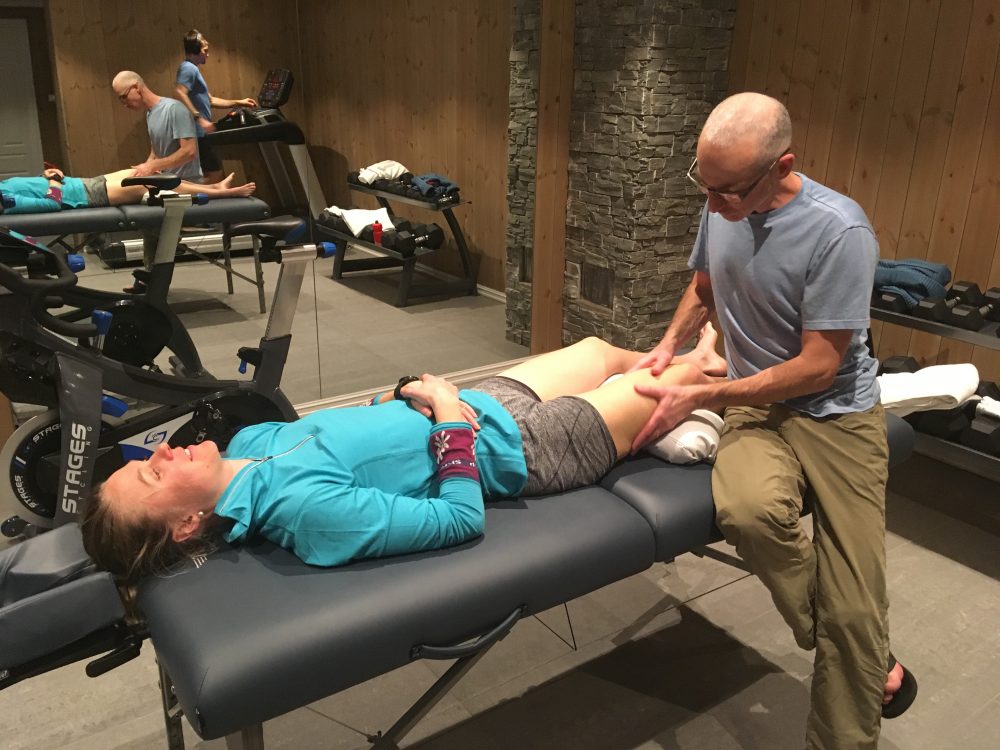
That first week turned out to be more about recovery than training. The athletes in Sjusjøen were coming off of Ski Tour 2020, a new addition to the World Cup calendar with six races in nine days and no shortage of travel in between. Exhausted was an understatement. I felt like a jet-lagged zombie, but I met the cast of Night of the Living Dead when Simi Hamilton, Sadie Maubet Bjornsen, Jessie Diggins, and David Norris arrived at the cabin. We were surrounded by a few hundred kilometers of perfectly groomed ski tracks literally right outside of our door and not a single one of them wanted to ski. At least for a day. While I did my best to resuscitate their muscles and joints with daily manual therapy treatments, they slowly returned to the land of the living.

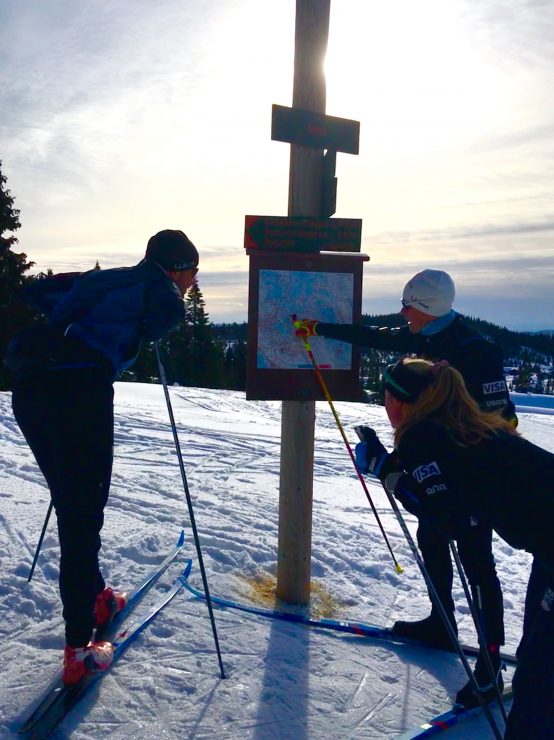
The silver lining for me was they all skied slowly enough that I could keep up. The days began to take on structure for me: wake up at a normal time (versus the jet-lagged pattern of undersleeping one night then oversleeping the next), eat, ski, eat, treat athletes, eat, sleep. Their days resembled mine except for being on the other side of the treatment table. Remarkably to me, the athletes and coaches took turns grocery shopping, cooking meals, and doing dishes. Everyone even did their own laundry! I was so used to working in the world of cyclists where “self-sufficient” wasn’t even in their dictionary. (We used to have a duffel bag labeled “DA” that was taken to the start of every bike race. It was full of extra jerseys, bib-shorts, and socks for the inevitable rider who forgot something. “DA” stood for Dumb Ass.) But these skiers were elite athletes, winners of medals, the best in America, and yet they could take care of themselves.
Despite the fatigue, a respiratory infection that was eventually passed to all of the athletes, a couple of days with sideways blowing snow, barley flour (“that’s all the grocery had!”) that left the baked goods flat as matzo, and the increasing presence of coronavirus in the news, the team just seemed to roll with the punches, make lemonade, and keep on keepin’ on.
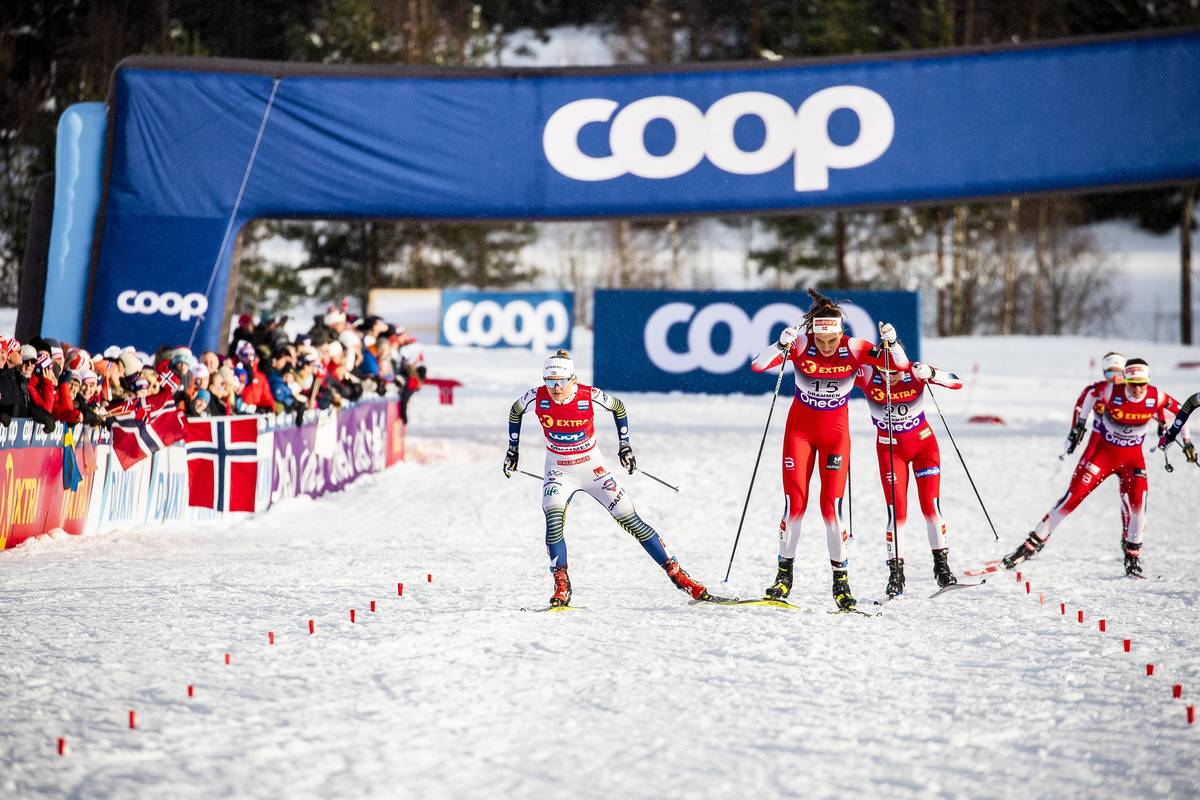
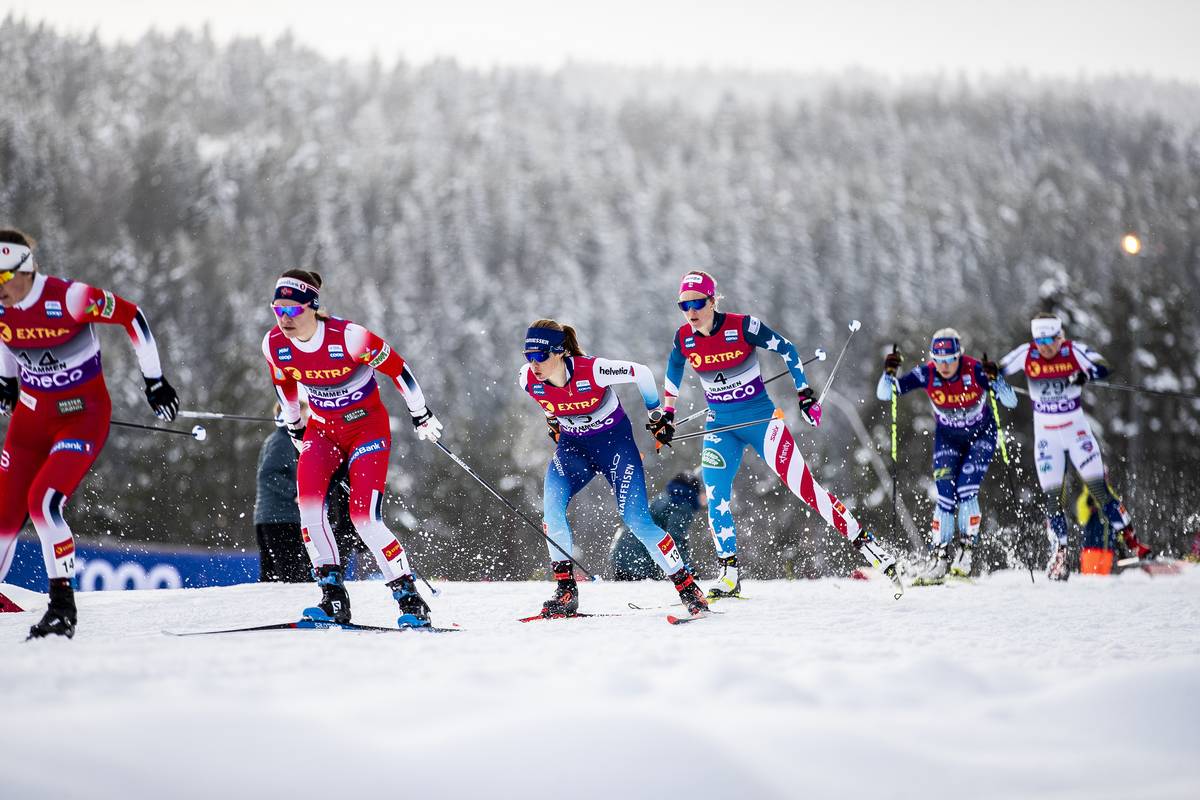
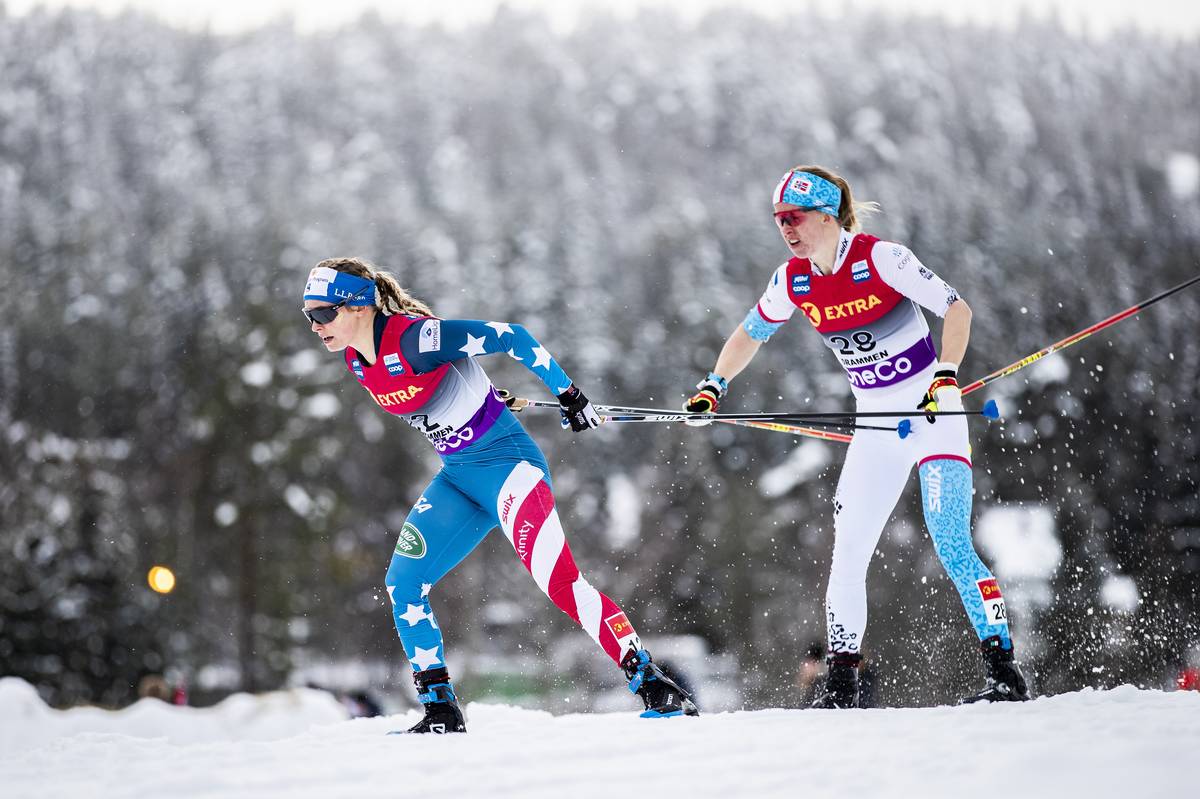
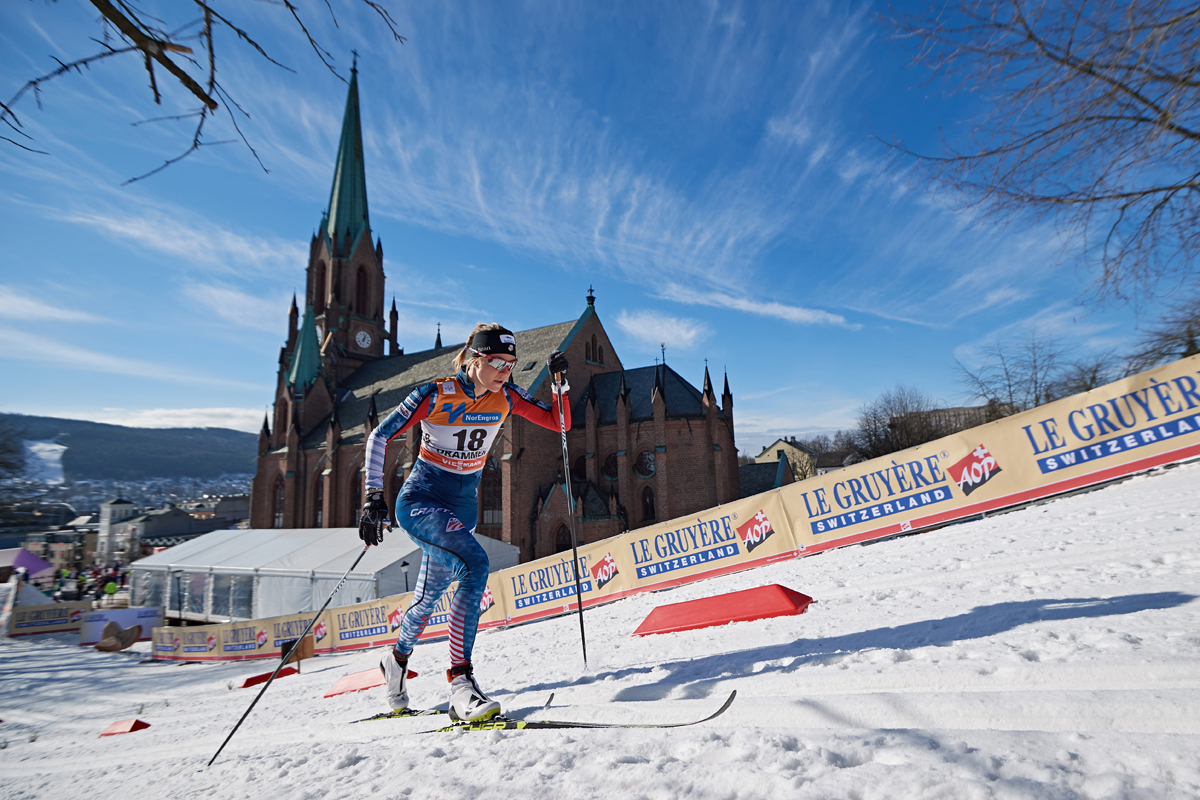
Just before we left Sjusjøen for Drammen, it was announced that, due to a lack of snow, the race would be moved to Konnerud. The race in Drammen is one of the coolest venues on the calendar with skiers sprinting up and down the main street through the old city center and around the Bragernes Church. Instead, it was moved to a small ski venue that had not hosted a World Cup caliber race since 2011. That 2011 race, it turns out, was the first World Cup start for both Jessie and Sadie. Now, veterans of the race circuit, they were excited for the venue change out of nostalgia, and the media loved the silver lining story.
With the next day came the news that the weekend of races in Holmenkollen, the biggest party in Norway, would be closed to spectators due to fears over the spread of the coronavirus. While utterly disappointing, this made sense on two levels. For one, most of the 50,000 fans arrive packed like sardines in the trains from Oslo. Secondly, as pointed out by one of the health ministers, drunk people tend to make poor hygiene decisions. And the fans lining the Holmenkollen course are known to party.
The next round of bad news came when Sadie, one of the top skiers and a front pack contender, did not start due to the bug that had made its way around the Sjusjøen cabin. (David would end up dropping from his race from the same cold). Saturday morning at the often raucous Holmenkollen began with an eerie quiet in the ski stadium and a little less chaos in the wax truck since only three women were starting the 30 k classic.
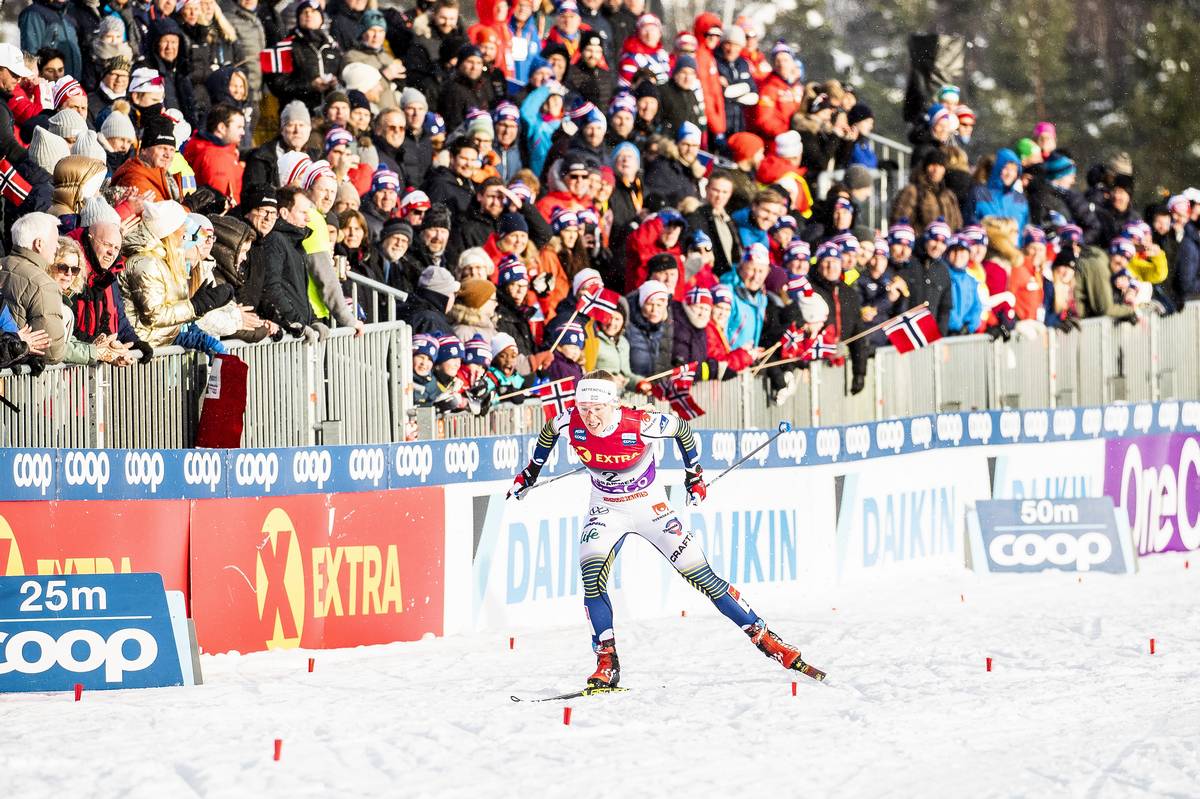
The race, at least on the front end, turned out to be one of the more exciting in recent years with the strongly favored Norwegian, Therese Johaug, getting caught and passed in the last kilometer by a young Swede, Frida Karlsson.


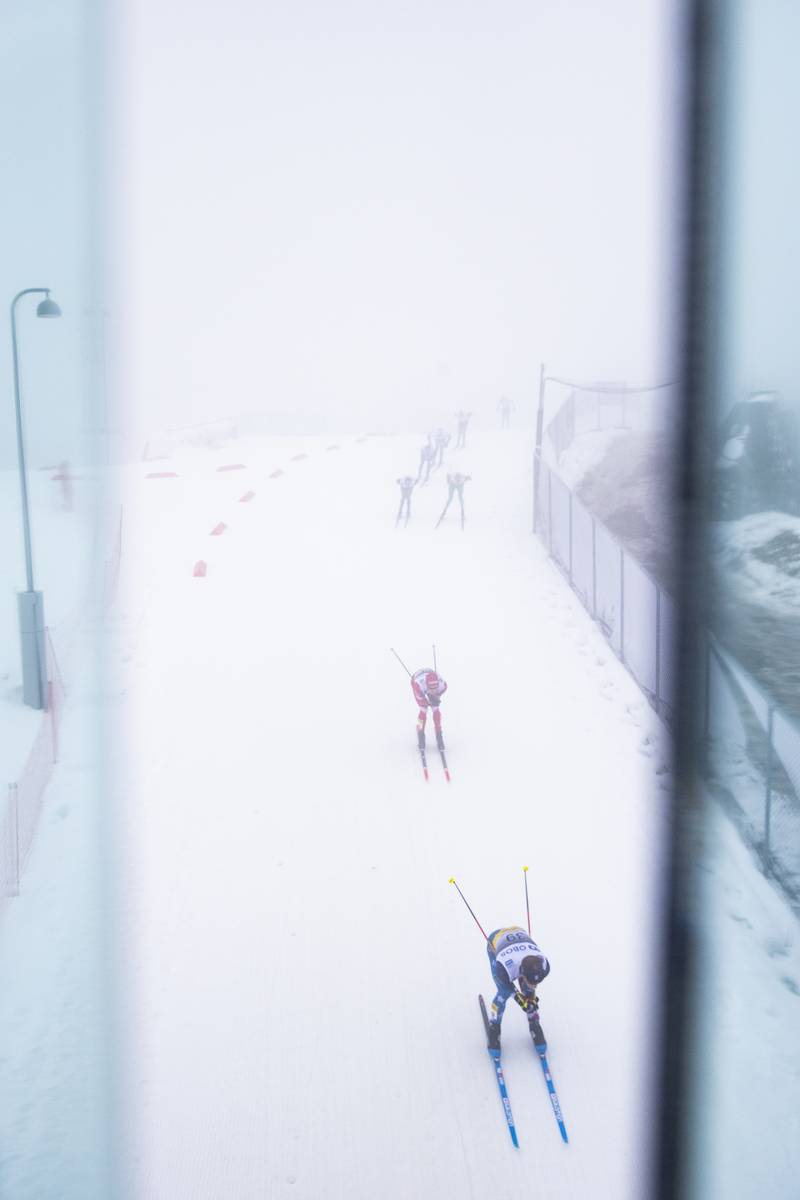
There was more bad news on the back end of the race as the American women struggled to keep pace — like your local marathon hero trying to toe the line with Eliud Kipchoge. They fought hard for a grueling 90 minutes and finished at the bottom of the standings in what would turn out to be the last race of the season. But there was a remarkably bright spot in that foggy, ghost town of a ski stadium as I watched Kaitlynn Miller wait for Becca Rorabaugh. Exhausted and disappointed, they hugged and walked together past the podium presentation that was already starting. Seeing that display of kindness and friendship, my mood was immediately uplifted. I was proud to walk with these women, heads held high, past vacant looks from the media and other skiers. The results don’t always matter as much as the comradery of the team.
On Sunday, the men raced 50 k. At least those who finished. It was cold, wet, foggy, windy, and – we’ll mention again — cold and wet. For over two hours the men slogged around an increasingly slow and sloppy track. David abandoned due to illness and anticipation of upcoming races that would eventually be canceled (had he known that he was in his last race of the season, he would have surely soldiered on). Ian Torchia dropped out after throwing up his breakfast and every ounce of liquid he tried to take in at the feed zones. Ben Lustgarten and Adam Martin persevered and crossed the finish line; both later suggested it was one of the more miserable races of their lives.
At the team meeting that night, there might have been feelings of disappointment but no one showed it. As Matt spoke to the team, he emphasized that he was proud, not embarrassed, by the performances that weekend. There is no shame in showing up and trying your best, even if your best leaves you at the bottom of the results sheet. There’s much more to it than the results sheet. Gratitude and appreciation were reiterated with not a mention of anger or blame.
A rising tide lifts all boats is an idiom often used to describe a setting where one person’s success or positive attitude inspires others to push the limits of their own performance. Sadly there were no podium celebrations during my two-week stint, but that did not deter me from doing whatever I could to help, whether fetching coffee for wax techs (an errand that used to irritate the hell out of me when I was a soigneur) or tactfully (I hope) ushering Jessie away from admiring fans when she was needed elsewhere.
And I was especially motivated to put my energy into the well-being of the athletes, simple as my role was: to methodically push on a joint here and a muscle there in hopes of giving the athletes the physical and psychological confidence to charge into battle with their skinny skis, carbon fiber poles, and Lycra armor. I’d like to think that I channeled my years of Physical Therapy practice and experience into their muscles, joints, and fascia to make them more resilient in the fight, whether that was 2 ½ minutes at full gas in a sprint or 2 ½ hours in the 50 k pain cave. My simple role was to help them perform at their best.
What I know I accomplished during these two weeks in Norway was an education in the meaning of team spirit. They cheered each other’s victories and consoled each other in defeat. They cooked each other meals and volunteered to do the dishes. They said thank you after every PT session. I would call my time with the U.S. Cross Country Ski Team a once in a lifetime experience, except that I want to go back next year.