From the FasterSkier archive — posts syndicated from athletes’ and coaches’ own blogs between 2004 and 2012, kept online as published. Current coverage is at fasterskier.com.
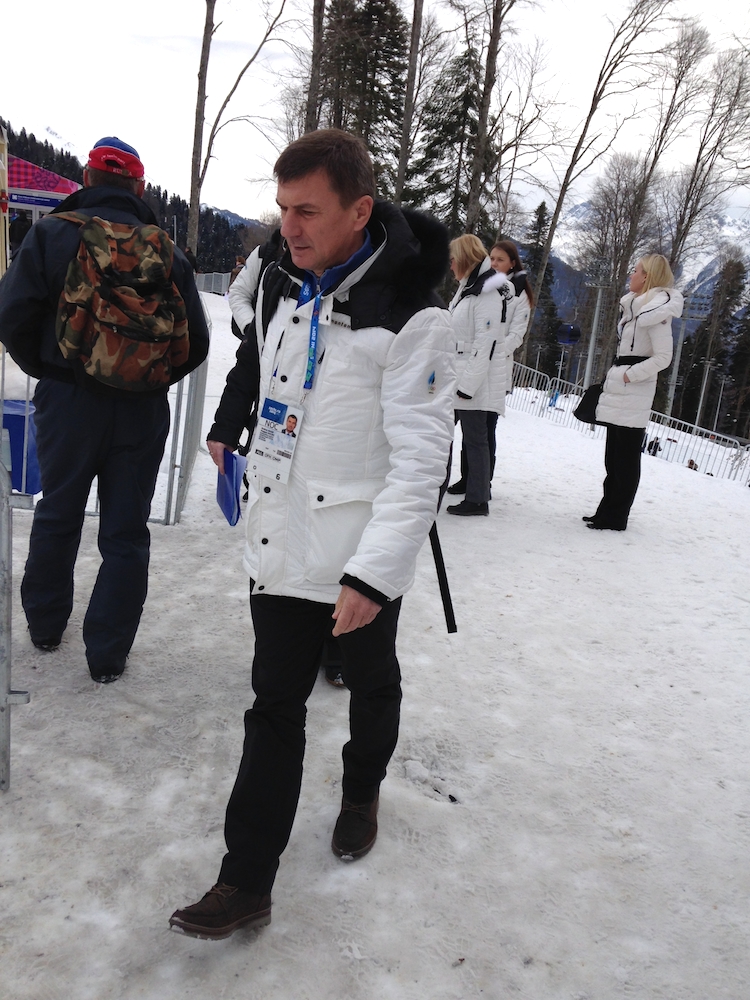
Former Estonian prime minister Andrus Ansip at the Laura Cross-Country & Biathlon Center in Krasnaya Polyana, Russia.
Estonian Prime Minister Andrus Ansip resigned last week, to allow his political party to choose a replacement before elections in 2015.
But wait—this is a skiing website. What do we care about Estonian politics? Because, as befits this ski-crazy nation, Ansip is an avid cross-country skier himself, holding the title of Worldloppet master—meaning that he’s finished 10 of the races in the international marathon series. That likely makes him the fastest prime minister on skis.
Ansip showed up at the cross-country ski venue at the Sochi Olympics in an unmarked motorcade, along with a surly security detail.
After what looked like a serious conversation with an Estonian skiing official, a FasterSkier reporter—who caught a glimpse of Ansip’s name on his Olympic credential—intercepted the politician for a brief conversation about his interest in the sport, and the status of cross-country skiing in Estonia.
A few important things to keep in mind. Estonia was once a cross-country skiing powerhouse. In the 1990s and 2000s, Andrus Veerpalu, Jaak Mae, and Kristina Smigun-Vähi all won Olympic medals, and medals at the cross-country skiing World Championships.
Those three, however, have all retired, and there’s currently no one on the Estonian team ranked in the top 75 in the world.And, confirming suspicions that long dogged him on the international circuit, officials with the International Ski Federation in 2011 said that Veerpalu had failed a drug test on the eve of his retirement.
That positive test, for human growth hormone, was ultimately invalidated by the Court of Arbitration for Sport last year for technical reasons, but the court’s opinion nonetheless said it was likely Veerpalu had taken HGH.
Here’s the interview, which was lightly edited for clarity.
FasterSkier: Tell me about your interest in skiing.
Andrus Ansip: Some people, they are collecting different stamps or coins. And then some people are collecting different cross-country skiing marathons. I’m one of those crazy people who are collecting different cross-country ski marathons. I took part in Gatineau—yeah, I’ve been in Canada. I’ve took part in all the European Worldloppet Series marathons—our own Tartu Marathon I’m taking part in almost every year, in this marathon. And then, Vasaloppet, 90 kilometers-long marathon, I took part in this marathon twice. Then, Birkebeinerrenet (in Norway), the Finlandia-hiihto, Konig Ludwig Lauf in Germany, La Transjurassienne in France, Marcialonga in Italy, and Kangaroo Hoppet (in Australia).
FS: Do you think you’re the fastest prime minister?
AA: I don’t think how many prime ministers are exactly interested in cross-country skiing—not so many of them, I think. But yep, I’m first prime minister who got this Worldloppet Master title. So it means I’m the first that took part in 10 different cross-country skiing marathons around the world.
Sorry to say but your marathon, American Birkebeiner, is the only one I didn’t take part in. It’s because we are celebrating the anniversary of our republic exactly at the same week.
FS: Fair enough.
AA: But one day, I will take part in the American Birkebeiner anyway.
FS: What are you guys doing, as a government, to kind of rebuild the Estonian team after the retirement of Jaak Mae, and Andrus Veerpalu, and Kristina Smigun-Vähi?
AA: You know, it’s kind of not up to par. It’s up to our people, and I’m quite proud of our young people who are interested in sports, and training very, very hard. We have real aims in sports. So, I hope one day, we will get gold medals from Olympic Games once again.
Today, we have a quite famous young girl—Kelly Sildaru, she’s (12) years old. It’s in the sport—like snowboarding, but it’s with skis…?
FS: Slopestyle?
AA: Slopestyle. She’s really good in slopestyle, already. She beat even those who are taking part in the Olympic Games in Sochi already. But (12) years old—it’s not (old enough) to take part in the Olympic Games. So I hope, one day, Estonians, they will win Olympic gold medals once again.
FS: Last question: Do you think Veerpalu was innocent?
AA: Veerpalu. It’s a decision made by court. So, I don’t want to speculate about decisions made by independent court. But of course, everyone wants to keep fingers crossed. Their own heroes—we would like to believe our heroes, they were clean. But at the same time, of course, sports, they have to be clean. They have to be really clean, and doping is not accepted. So, I hope nowadays, Olympic Games, and sports, are more clean than some years ago.
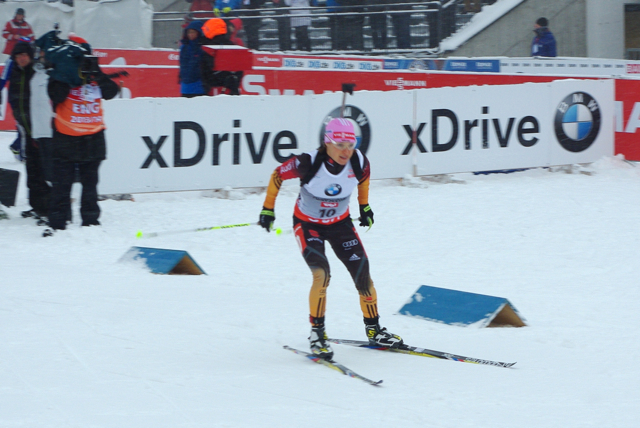
Evi Sachenbacher Stehle (GER) has reportedly tested positive for a banned substance.
FasterSkier’s coverage is made possible through the generous support of Swix.
KRASNAYA POLYANA, Russia – German biathlete Evi Sachenbacher-Stehle, 33, has tested positive for the use of a prohibited substance, according the German news agency DPA.
The agency did not cite the source that gave them Sachenbacher-Stehle’s name. She is a biathlete who switched to the sport from cross-country skiing last winter.
Stefan Schwarzbach, a spokesman for the German Ski Association, said Friday evening that he could confirm that an A- and B-sample from a German skier had tested positive for a stimulant.
He did not identify the athlete’s name or gender, or the sport in which the athlete competed. But he said the athlete belonged to his association, which includes teams from biathlon, cross-country skiing, nordic combined, ski jumping, alpine skiing, and extreme sports.
Schwarzbach stressed that the substance was not one of the banned blood-boosting drugs like erythropoietin, which athletes have used in endurance sports like cross-country skiing and biathlon to enhance their fitness. The fact that the substance was not erythropoietin, he added, suggests that it could have been administered accidentally.
Schwarzbach said that he could not confirm the athlete’s identity until more information is released by the International Olympic Committee, which is responsible for drug testing at the Olympics.
“I only confirm that it’s an athlete of our ski federation,” he told a group of reporters at the Olympic biathlon venue.
On Thursday evening, the International Olympic Committee informed the German Olympic Committee that a sample from one of its athletes had been tested and returned an adverse analytical finding, according to a statement from the GOC on Friday.
An adverse-analytical finding is a preliminary positive test. The GOC said that a test of the athlete’s B-sample had been scheduled for Friday, and that more information would be released afterwards.
At the 2006 Olympics, the IOC benched Sachenbacher-Stehle due to a high hemoglobin reading, and was not allowed to start competing until the reading went down.
Hemoglobin is an oxygen-transport protein in the bloodstream, and higher hemoglobin is generally desirable in endurance sports. Sachenbacher-Stehle appealed the decision to the Court of Arbitration for Sport, but lost. (You can read the verdict here.)
Sachenbacher-Stehle is not on the start list for Friday evening’s women’s biathlon relay. She placed fourth in the 12.5 k mass start competition, losing out on a bronze medal in a sprint finish with Norway’s Tiril Eckhoff, but then had a relatively weaker performance in the mixed relay, using two spare rounds in each shooting stage.
Schwarzbach said that the team for Friday’s race had been set “long before” the report of the adverse analytical finding from the IOC.
Sachenbacher-Stehle’s brother Josef told the German newspaper Bild that “she has done nothing wrong,” and that she “would never dope.”
In a brief interview Friday, Wolfgang Pichler, a German who now coaches part of the Russian women’s biathlon team, said that the report of the positive test is “a catastrophe for the sport.”
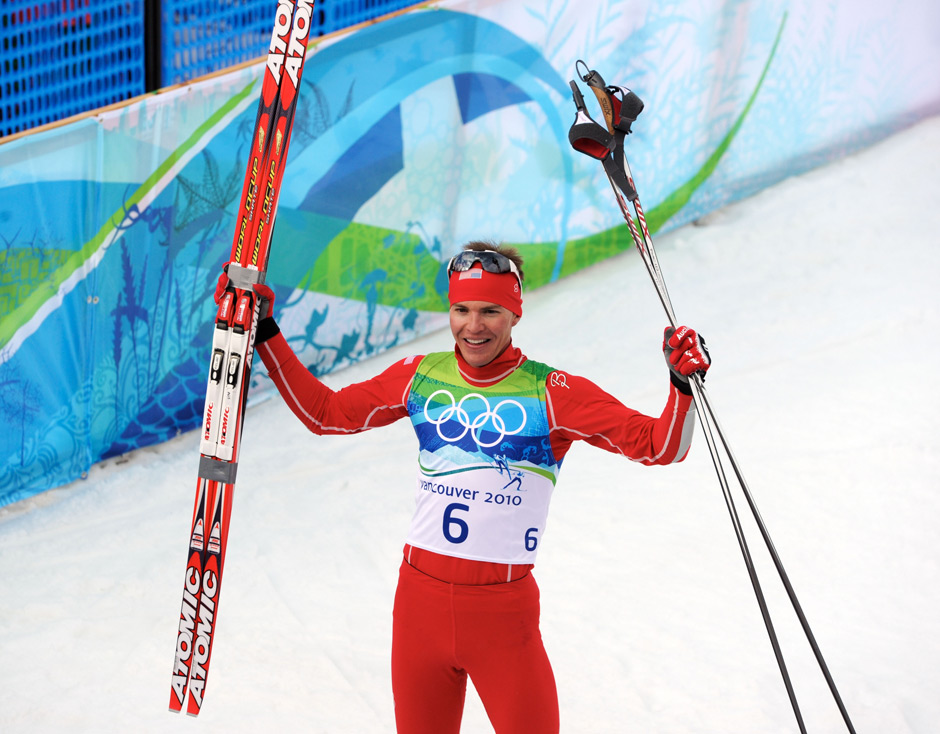
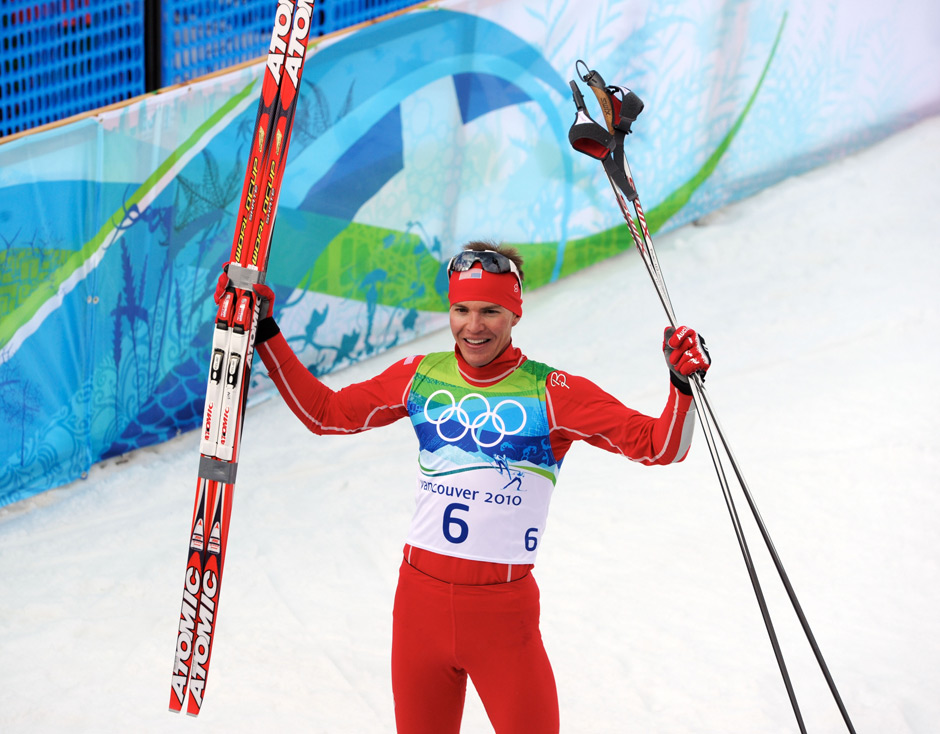
Billy Demong after winning gold in the large hill/10 k competition at the 2010 Olympics in Vancouver, B.C.
KRASNAYA POLYANA, Russia — It’s been almost a week since the nordic-combined Olympians did their thing in the first of three competitions at the 2014 Winter Games. Last Wednesday’s event was on the 106-meter normal hill, not exactly U.S. Nordic Combined’s favorite.
Billy Demong led the U.S. in 24th, nearly a minute and 50 seconds behind German’s Eric Frenzel, who won the 10-kilometer Gundersen start. He had posted the 31st-best jump (tied with Finland’s Janne Ryynänen) out of 46 in the competition round, going 92.5 meters for 108.2 points. In the preceding trial round, Demong, 33, had his best jump of the season — just shy of 100 meters.
“It’s hard to be too upset because I’ve been struggling a little bit this week on this hill,” said Demong, the defending large hill Olympic champion, after last week’s competition. “I think it’s a little flatter than anything I’ve skied before.”
Flatter? His teammate Bryan Fletcher, who improved from 41st to 26th, for the second-best U.S. result on Feb. 12, tried to explain.
“This is probably one of the hardest hills I’ve ever jumped in my life,” the 27-year-old Fletcher said. “The rhythm of the hill does not match how your subconscious feelings are, so it was really difficult to find a rhythm. I found it in the trial round today, but I went for it in the comp jump, tried to lay it all out on the line, all or nothing. Unfortunately it didn’t work out, but I’ll try again next week.”
His younger brother Taylor Fletcher, who improved from 46th to 33rd, was the third American in the results. Todd Lodwick jumped to 34th — in his sixth jump after a scary crash in France in early January — but did not race in order to further heal his shoulder before the team event.
“This hill … is … it’s hard. I don’t understand it,” Taylor, 23, said. “I think a lot of people have the same feelings. I don’t know what it is that makes it so difficult. It’s a big hill, and we’ve jumped big hills. I jumped really well last year on it. It was my best jump, my best result all year, so I know I can race that. I’m a little bit better on a big hill. I don’t know if it’s my size that allows me to do that, but I get in a rhythm on it, and I can be a little more aggressive, which you really can’t on a smaller hill.”
Demong said there were positive takeaways from Day 1 of the Olympics: he had his two best jumps of the season between the trial and competition rounds.
“I almost pulled off the miracle jump today — what I didn’t think was possible before today, but it was by far my best jump of the weekend,” he said. “It kind of gave me a little hope. I’ve already almost been looking forward to the big hill because I think things were pretty good there last year, and my shape’s much better.”
The competition also gave the NoCo guys a chance to scope out the 2.5 k course they’ll race around two more times at the Olympics — with another 10 k Gundersen start after today’s large hill competition (starting at 4 p.m. Moscow time) and the 4 x 5 k team event on Thursday.
“I think the cross-country course is a lot of work,” Bryan said. “There’s no rest on it whatsoever, and any rest is followed by a technical corner or stuff like that. You really zap the legs going in with all the hills, and if you ski the hills hard like you want to, you pay for it on the corners again, so it’s just a very cumulative course as far as energy goes.”
Looking ahead to Tuesday’s large-hill competition, U.S. Nordic Combined Head Coach Dave Jarrett said Lodwick wasn’t a definite for the 10 k, and he was hoping the rest of his athletes would rise to the occasion on the 140-meter hill.
“We were better than our average, but our average wasn’t good enough,” Jarrett said last week. “We need to get off to good start on the big hill. The first training jump needs to be good. There are some good things that happened: Todd jumped pretty well and tested his shoulder and I think he’ll be able to ski. [The others] jumped OK, at least they had a good jump and they’re not walking away from the small hill without any good jumps. We’re looking forward to the big hill and keeping a positive attitude.”
With a drawn-out schedule that spaces out three competitions over nine days, Jarrett said it can be tough to stay focused — especially in a place like Krasnaya Polyana, at least an hour away from the coastal cities of Adler and Sochi. In 2010, they flew down to Park City, Utah, between Olympic competitions in Vancouver.
“There’s nowhere to go, really,” Jarrett said of their current Olympic home base, adding that they’ve trained at the Laura Cross-Country & Biathlon Center as well.
Sightsee? Shop?
“Yeah, we’ve done that,” he said.
Could the extra time help Lodwick’s shoulder?
“Yeah, it’s good for him,” Jarrett said. “The difference between this week and next week as far as a fracture being healed is not really that much. … Rehab is going well, he’s not out of the woods yet, but if everything stays the same, he’ll be able to compete.”
Update: After Tuesday’s jump, Bryan Fletcher led the team in 27th, Todd Lodwick was 30th, Taylor Fletcher 35th, and Billy Demong 38th.
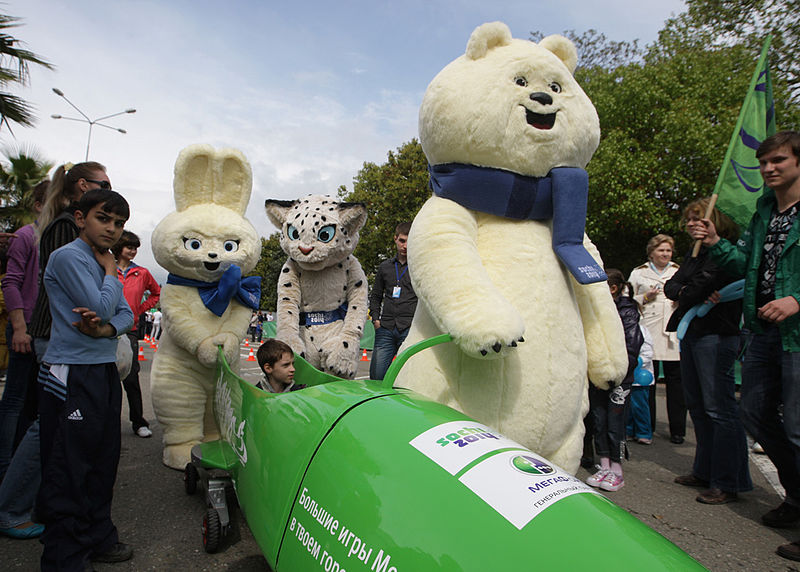
The official mascots of the 2014 Winter Olympics, a polar bear (r), European hare (l) and an Amur leopard (c), walk the city streets in May during the “2014 Winter Olympics: 1,000 Days To Go” festival in Sochi, Russia. (Photo: Wikimedia Commons)
We’re at the 199-days-and-counting mark if you’re keeping track of how much time remains until the start of the 2014 Winter Olympics in Sochi, Russia, and we know many of you are. In case you haven’t been reading every ounce of pre-Olympic coverage, we’ll do our best to stay on it and provide relevant nordic updates throughout the next sixth months.
For now, here’s some noteworthy starter information:
1. Opening ceremony: The 22nd Winter Olympic Games will kick off Friday, Feb. 7, in Sochi, Russia. Closing ceremony 16 days later on Sunday, Feb. 23.
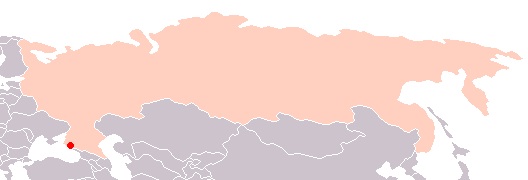
Sochi (as indicated by red dot) in southwestern Russia. (Photo: Wiki Commons)
2. Where: Sochi, which spans some 145 kilometers (90 miles) with a population around 345,000 along the shores of the Black Sea in western Russia.
Krasnaya Polyana, an urban mountain town about an hour drive (70 kilometers) inland from Sochi, is where all the snow-sport events will be held (i.e. cross-country skiing, biathlon, alpine, freestyle, snowboarding). In 2010, it had a population of about 4,500, but expect a lot more people buzzing around in February.
3. Climate: Categorized as humid subtropical, Sochi typically experiences mild winters averaging 11 degrees Celsius (52 Fahrenheit) during the day and 4 degrees Celsius (39 degrees Fahrenheit) at night from December to March. What could that mean for snow sports? Another potentially tricky year, just like in 2010 in Vancouver, British Columbia, and 1998 in Nagano, Japan. In both previous Olympics, weather postponed events, but everything eventually took place. According to Philip Hersh of the Chicago Tribune, the Russians are stockpiling snow.
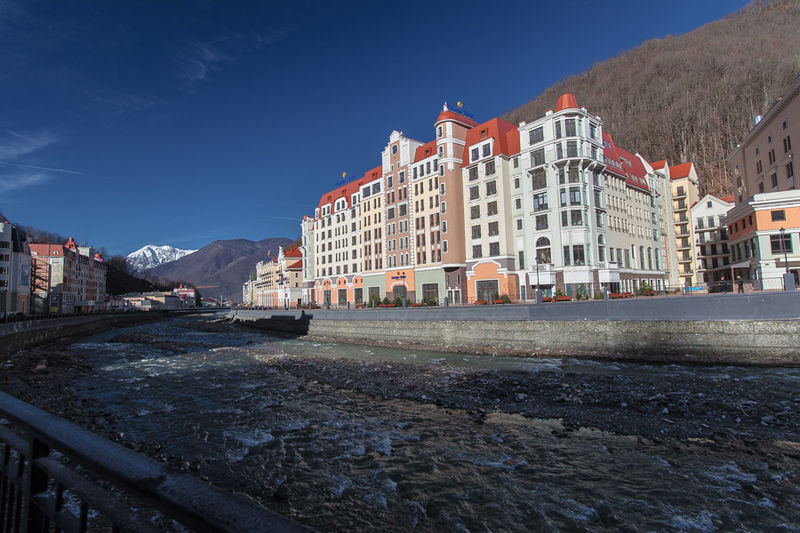
The Golden Tulip Rosa Khutor Hotel on the Mzymta River in Krasnaya Polyana, Sochi. (Photo: Wiki Commons)
4. Money: Hersh posed the question as why a palm-tree-laden, authoritarian nation would be awarded the Winter Games. Because of “Russian supremo [president] Vladimir Putin,” he wrote, who promised an unlimited budget and has already overspent it. Last February, a year from the Olympics, Russia had spent $51 billion dollars, $11 billion more than China’s previous record-setting grand total for the 2008 Summer Games.
Some $130 million dollars alone was set aside for a road connecting Krasnaya Polyana to Sochi, and according to the Christian Science Monitor, that makes it the world’s most expensive byway. “That’s about 50 times the average cost of a highway in the United States,” former deputy prime minister Boris Nemtsov told the Monitor.
5. A first: Neither Russia nor the former Soviet Union ever hosted the Winter Olympics,although it’s long been considered a winter-sports stronghold. Who could forget then-president Dmitry Medvedev’s televised remarks four years ago, after Russia’s showing at the Vancouver Games. “Those responsible should take the brave decision and sign a letter [of resignation]. If they can’t, we will help them,” he said of the Russian officials and sports bureaucrats blamed for a lack of medals and disappointing sixth-place finish in men’s hockey.
6. A dozen new events: Stay tuned for the brand-new biathlon mixed relay, women’s ski jumping, luge team relay, figure skating team event, men’s and women’s halfpipe and slopestyle freestyle skiing, and men’s and women’s slopestyle and parallel slalom snowboarding.
7. How to watch: According to the Tribune, prime-time coverage on NBC will be delayed, but more than half the Olympic events will be live on some NBC network, and every event will be streamed live.
8. Boycotts: Remember Beijing and the civil-rights movements surrounding the Games? Same sort of thing here, except Russia isn’t just ignoring protesters, it’s threatening them to stay away. Putin recently signed a law allowing police officers to arrest tourists and foreigners they suspect of being homosexual, lesbian or “pro-gay,” the New York Times reported. What? Yep, if this stands, those arrested could be detained for up to 14 days – that includes Olympic athletes, coaches, trainers, family members, fans and spectators. Earlier in June, Putin signed another bill classifying “homosexual propaganda” as pornography, which essentially means that anyone who condones homosexuality to someone underage could face fines or jail time.
The International Olympic Committee (IOC) responded with a statement that read, “The IOC would like to reiterate our long commitment to non-discrimination against those taking part in the Olympic Games, the IOC is an open organization and athletes of all orientations will be welcome at the Games.”
A leading international organization, Human Rights Watch (HRW) wrote a letter to the IOC urging it “to take additional steps to send a clear signal to the Russian authorities that discrimination of people based on their sexual orientation and gender identity is at sharply at odds with Russia’s human rights and Olympic commitments.”
HRW also encouraged the IOC to get a guarantee that Russian authorities will not adopt or implement homophobic legislation.
“We also urge you to press the authorities to state publicly that, as Olympic Host, Russia will ensure, without distinction, the safety and the freedom of expression and association of all athletes, coaches, fans, and others who will attend the Sochi Games.”
9. No laundry: Don’t hang it from balconies or use window air conditioners, because Sochi doesn’t want to see it. Residents could face fines up to $46 dollars, The Moscow Times reported, for clothes on the line or air conditioners that look “chaotic.”
The city “should look especially decent in a zone of international hospitality,” Sochi’s deputy mayor Yevgeny Gorlov wrote on the local government’s website last week. “If people have made the decision to install an air conditioner, they should have a symmetrical location on the building and be agreed upon with all the [other] owners … in an agreed scheme.” This is in effect for the preparatory period before the Games, but it brings up a previous concern: are people going to need air conditioners at the Winter Olympics? (See No. 3).
10. A polar bear, a European hare and an Amur leopard: These are the three official mascots of the Games, decided by a public vote (another first for Russia, according to the Sochi 2014 organizing committee).
The official mascots of the 2014 Sochi Winter Olympics (Photo: Wiki Commons)
11. “Hot. Cool. Yours.” The official Olympic slogan. Organizing Committee President and CEO Dmitry Chernyshenko said in a statement it’s aimed to bring more foreigners to Sochi and make Russians proud.
“The Sochi 2014 slogan says it’s impossible not to take part, impossible not to watch, impossible not to get excited and it’s worth being proud because these are our Games,” Chernyshenko said.
“Hot” and “cool” are references to Sochi’s sun-and-snow climate and symbolize progressive movement forward.
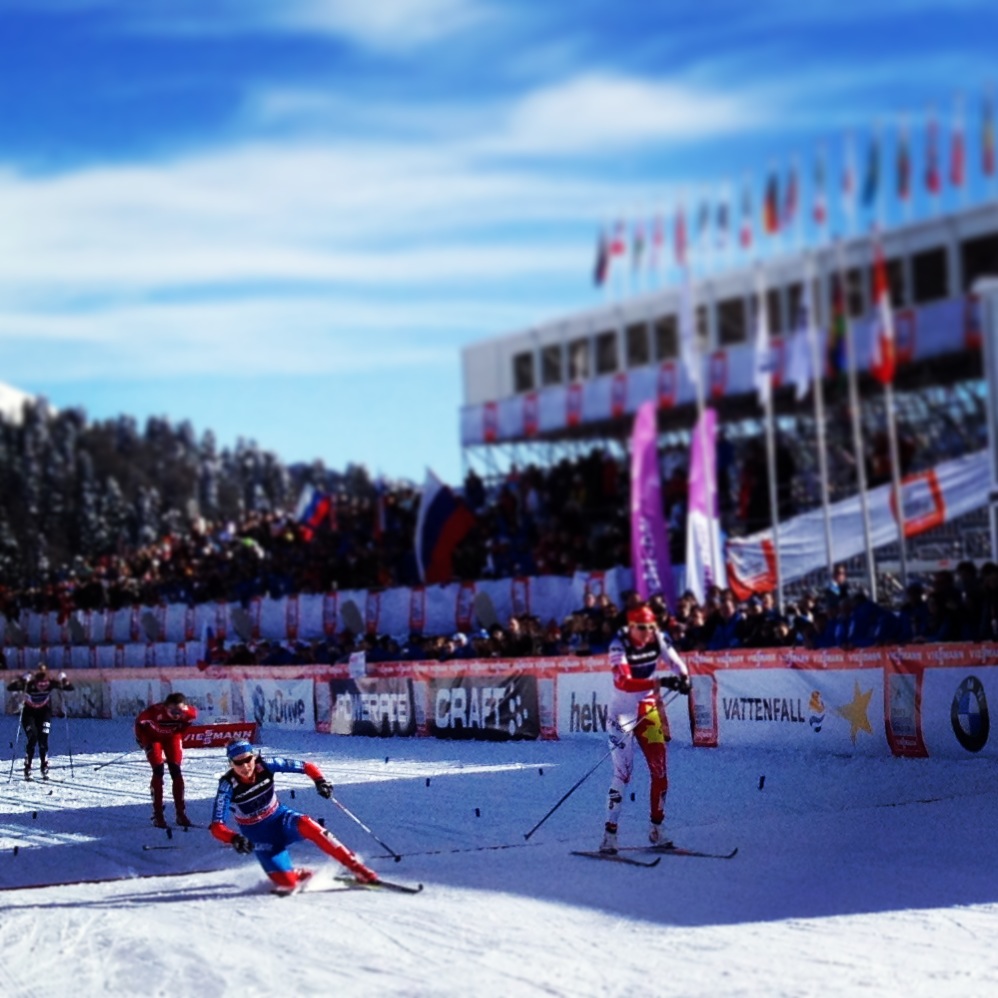
Dasha Gaiazova (r) finishes third, just six-hundredths of a second behind Russian Natalia Matveeva (l) in second, at Sunday’s Sochi World Cup classic team sprint in Krasnaya Polyana, Russia. (Photo: Chandra Crawford)
Krasnaya Polyana, Sochi’s mountain village and one of its 2014 Olympic venues, is nowhere near Dasha Gaiazova’s birthplace just outside Moscow. In fact, it’s almost 1,700 kilometers south of the Russian capital and a day’s drive away.
But Sunday, the 29-year-old Canadian transplant who spent her formative years in Banff, Alberta, found herself right at home in the 6 x 1.25-kilometer classic team sprint, the last of three pre-Olympic races in Krasnaya Polyana.
Some Russian fans knew her story, and they cheered her on as she rounded the course six times – three in the semifinal and three in the final.
Gaiazova and teammate Perianne Jones successfully advanced out of the semis in third with a fast-enough time despite slowing conditions under sunny skis. In the final, Jones got off to a slippery start and tagged off to Gaiazova in 10th, five seconds out of the lead. She handed her skis to her husband and wax tech, Joel Jacques, and begged for more kick.
Meanwhile, Gaiazova began clawing her team closer to the front, where Finland and Russia’s B-team steadily increased the pace. First through the first two laps, Finland’s Mona-Liisa Malvalehto and Anne Kyllönen proceeded to switch leads with Russia’s Julia Ivanova and Natalia Matveeva on the second leg.
Canada worked to pick of the places, moving all the way to sixth. On the final go-around, Jones burst out of the exchange and brought the team to fifth, 3.8 seconds behind Russia and 2.7 behind Finland in first and second, respectively. Norway stood between them in third, but Gaiazova took care of that, passing Celine Brun-Lie on the last lap.
Working her way up the long climb toward the stadium, Gaiazova heard one voice. There could’ve been dozens cheering her on, but it was Canadian head coach Justin Wadsworth who got through to her.
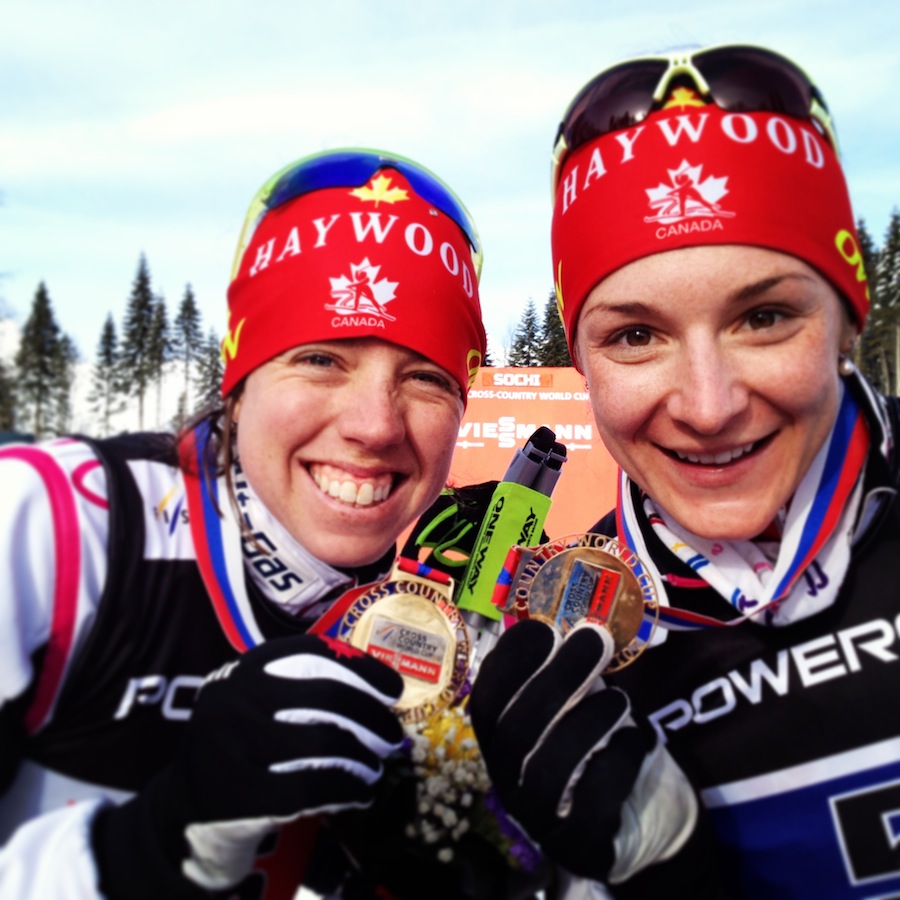
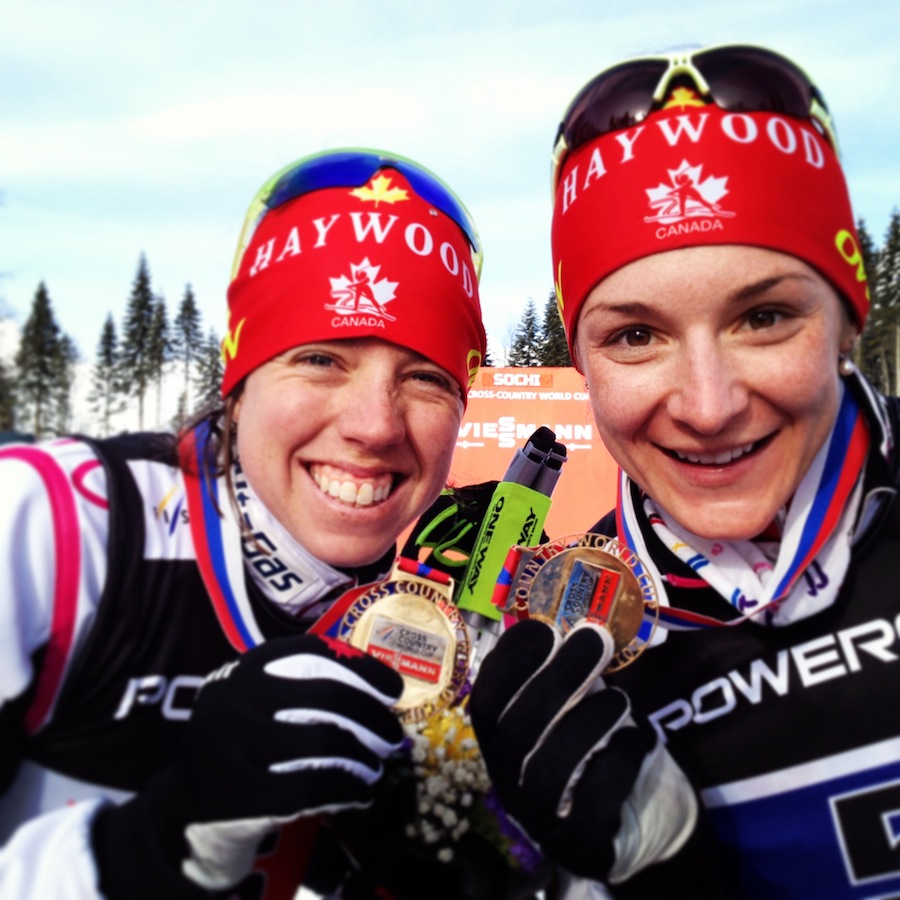
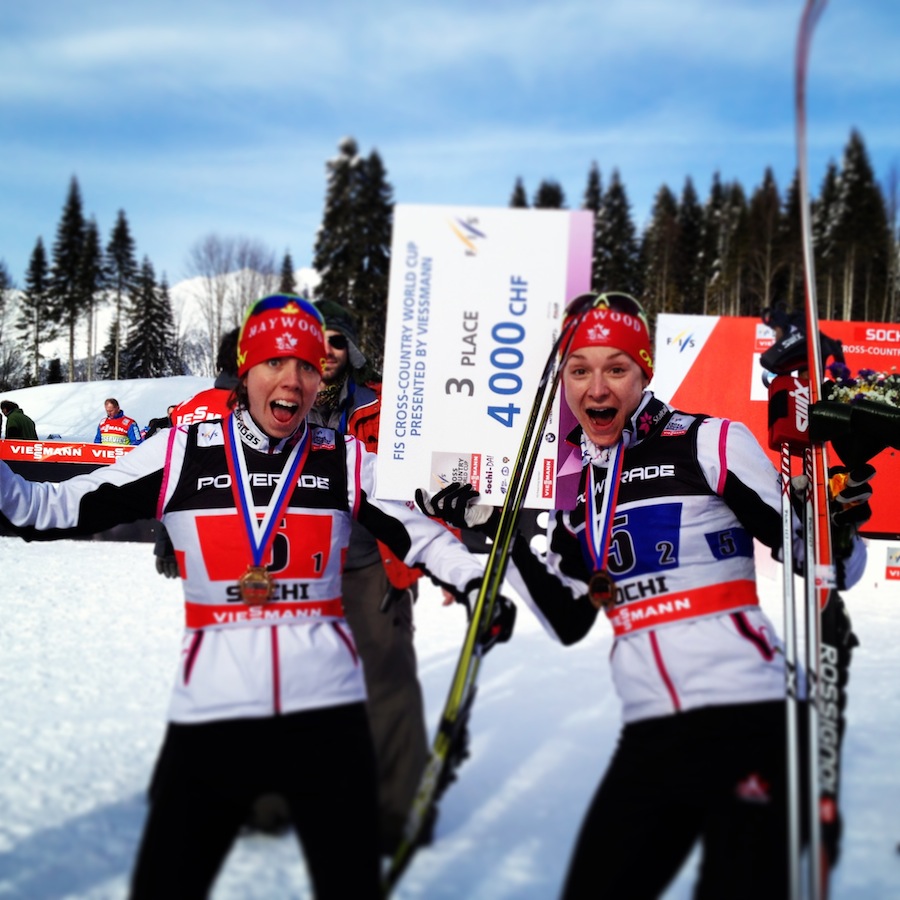
Canadians Perianne Jones and Dasha Gaiazova celebrate their first bronze of the season, and together, in the Sochi World Cup classic team sprint. (Photo: Chandra Crawford)
Pushing hard up and over, Gaiazova gained on Russia’s Matveeva entering the finish. Matveeva had lost contact with Kyllönen, who dropped the pack on the last lap, and likely had no idea what was coming from behind. Gaiazova surprised her at the line, where Matveeva lunged to secure second by 0.06 seconds. Gaiazova captured third, 5.58 seconds behind the Finnish winners, for the Canadians’ best team-sprint result of the season.
“If it had been a little bit longer, it would’ve been more of an advantage to me, but I did the best I could and I was happy with that,” Gaiazova said. “It’s kind of good, always leaves me with a little bit more to wish for, like, ‘OK, I was fourth and photo finishing for third and now I’m third photo finishing for second.’ ”
Gaiazova recently notched an individual career best of fourth in a classic sprint at the World Cup in Liberec, Czech Republic. After placing third in a World Cup freestyle team sprint last year with Chandra Crawford in Dusseldorf, Germany, the podium was Gaiazova’s first of the season – as it was for Jones (who also won bronze with Crawford in a freestyle team sprint last season in Milan, Italy).
“It feels really good and really good to do it here in Sochi,” Jones said Sunday. “I think it also speaks to the strength of our women’s program. Now all three of us have been on the podium in the team sprint in all different configurations so that’s pretty exciting.”
On her final leg, Jones knew she had some gas left after conserving somewhat the second time around. She made a point to charge up the hill, where she also found Wadsworth cheering her on over the top.
“He was just screaming his head off,” Jones said. “That was really awesome because I passed a couple more girls there and just hung on for the downhill and made sure to go around the corner without crashing and handed off to Dasha relatively cleanly.”
Easier said than done. With changing conditions throughout the day, several skiers and their wax techs worked frantically within the roughly two-and-a-half minute frame between exchanges to get the wax right. It was never going to be perfect on the 4-degree Celsius (nearly 40 Fahrenheit) afternoon, with either no kick or way too much sticking, but they continued to try.
Gaiazova said her hairies worked great throughout the day and Jones found a better pair of skis after the first leg. With a fast descent and sharp corner heading into the finish, staying on one’s feet was also important – and Russia’s eventual silver medalists nearly didn’t qualify for the final after crashing and placing fourth in the semi. They came in 12.37 seconds behind the Americans, Ida Sargent and Sadie Bjornsen, in first, but fortunately for them, that was the faster semifinal of the two.
Gaiazova and Jones felt some tension after learning their semifinal, the second one, was almost seven seconds slower than the first with softer snow in warming conditions.
“I got a little nervous, but thankfully we made it through,” Gaiazova said after her team finished third (+4:32) behind Finland in first and Russia’s A-team in second.
Perhaps the biggest game changer of the day, however, occurred at the exchanges, which were tracked. According to Gaiazova, there were six tracks for 10 teams, which made it especially tricky.
“Say I’m standing in the exchange zone in the track … waiting for Peri to come and tag me,” she explained. “Peri’s coming in, but she can’t ski in the same track as me, her skis would run into my skis, so she has to ski in the track next to mine and then step out at the very last moment to tag me so each team is taking, like, two tracks. It’s messy. There’s people everywhere and all you’re trying to do it just to it as quick as possible and carry the speed from one person to another. I think everybody struggled with exchanges today.”
Perianne Jones (l) and Dasha Gaiazova having some fun after notching their first podium together with bronze in the classic team sprint at the Sochi World Cup on Sunday. (Photo: Chandra Crawford)
“I hope with today’s result and basically this whole month we can just carry the momentum for the girls, for the team,” Gaiazova said.
For Finland, which notched its first women’s team-sprint victory since Aino-Kaisa Saarinen and Virpi Kuitunen won the classic event at the 2009 World Championships, the win was pretty sweet – but tiring.
“I was tired, but I tried everything [in] intervals,” Kyllönen told Eurosport, according to the Helsingin Sanomat.
Malvalehto explained their strategy was to get in front on the first lap, ski the second one more moderately and push hardest on the third.
“The last leg of the race was the most difficult leg, but overall we didn’t have any big problems here today,” Malvalehto said in a press conference. “The track was very good. I hope it will be the same for the Olympics. It’s very nice here when it’s sunny.”
Matveeva said the finishing stretch was especially tough.
“I just didn’t have enough in me, but we still did well,” the Russian said in a press conference. “The speed today was much higher than on previous days. It was wonderful to feel the support of all the Russian fans here today.”
Norway’s Astrid Uhrenholdt Jacobsen and Brun-Lie finished fourth (+7.2), and the Americans were fifth (+9.16) after coming through the last exchange in fourth.
Todd Lodwick (second from left) after winning Sunday’s competition at the FIS Summer Grand Prix in Krasnaya Polyana near Sochi, Russia. Austrians Bernhard Gruber (l) placed second and Tomaz Druml was third. (Dave Jarrett courtesy photo)
At the biggest international competition of the summer, hardly anyone could blame the Americans if their heads weren’t totally in it.
It’s not that they weren’t focusing on nordic combined’s International Ski Federation (FIS) Summer Grand Prix. They just had a lot of other things to absorb during their first visit to Sochi, Russia.
For veteran competitors like Todd Lodwick, Johnny Spillane and Billy Demong, the new venue was a welcome change to their routine trips to the sport’s typical sites. Sure, they loved their jumps in Park City, Utah, and enjoyed getting some practice in Oberstdorf, Germany, before heading to Russia about a week ago. But sometimes, unique sights are the most stimulating.
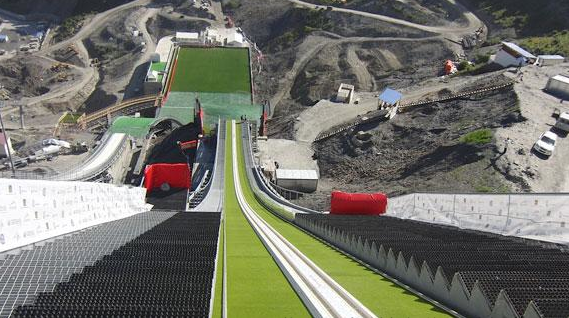
View from the top of the 2014 Olympic ski jumping complex near Krasnaya Polyana, Russia. (USSA/Dave Jarrett photo)
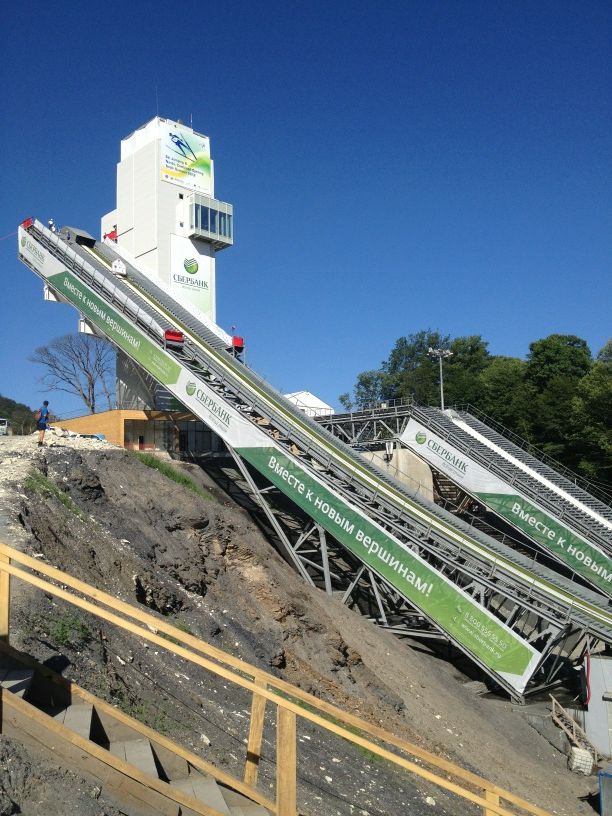
The U.S. Nordic Combined team soaked up plenty last weekend at the under-construction venue near Krasnaya Polyana, about 40 kilometers northeast of Sochi. For the 2014 Olympics, the “Mountain Cluster” will host all the of the ski, snowboard and sled events (bobsled, luge and skeleton) and high-speed gondolas and trains will be in place to get people where they need to be.
Eighteen months before the Winter Games, U.S. head coach Dave Jarrett estimated there were 60,000 laborers running around, working around the clock in six-week shifts to get the job done. The Americans were only there for an extended weekend at the Summer Grand Prix (SGP) July 21-22, yet managed to capture the energy.
“I think everyone was psyched, especially the older guys,” Jarrett said on the phone from Florida, where he met his family for vacation after returning from Sochi. “It’s not every year that they get to go to a new jump or a new place. It [can be] like Groundhog Day all over again. Those guys were psyched to be somewhere new.”
The oldest member of the A-team, Lodwick, 35, did exceptionally well in the hot and humid conditions, with temperatures around 95 degrees Fahrenheit that rose higher on the newly paved rollerski track. After placing second on Saturday, Lodwick won gold at the Grand Prix on Sunday and raced the fastest time on both days.
While Lodwick couldn’t be reached for comment, Jarrett talked about his performance – more impressive considering Lodwick hadn’t competed since December of last season. The 2009 World Champion last won a race nearly two years ago at a Continental Cup in his hometown of Steamboat Springs, Colo. A five-time Olympian, Lodwick hadn’t been on the podium since the 2010 Vancouver Games, where he won silver in the team event, yet had six World Cup victories and 26 podiums to his name.
“He’s definitely a competitor,” Jarrett said. “He’s been around for a long time. I wouldn’t bet against him, but I wouldn’t have picked him to do as well as he did … on the jumping hill. I think he was really psyched and I think it gives him some motivation moving forward.”
Sochi’s nordic-combined jumps, which will be used in competitions leading up to the 2014 Winter Olympics, as seen in July. (Dave Jarrett courtesy photo)
Jarrett knew Lodwick could dominate a relatively thin Grand Prix field in the 8.8 k rollerski race, but was surprised by how well he jumped on the 140-meter large hill. On Saturday, Lodwick ranked ninth in the jump and climbed seven places in the Gundersen-start race to finish second, and Sunday, he finished fifth in the jump and landed the top spot overall.
“He’s been obviously doing a good job,” Jarrett said, adding that Lodwick hadn’t jumped as well in practice leading up to the event.
Four months ago, Jarrett wasn’t sure what Lodwick’s plans were. He essentially took last year off to remedy some pulmonary issues, and with a wife and two young children at home, Jarrett couldn’t blame him. However, with the 2014 Olympics fewer than two years away, Jarrett had a more frank discussion with Lodwick this spring.
“He and I sat down in March, and basically, I required him to make a commitment,” Jarrett said. “If he wasn’t going to commit to being a full-time athlete and good teammate, then there wasn’t going to be a place for him because he technically didn’t qualify for the team based on his results last year.”
With his sixth Olympics in sight, Lodwick chose to commit. According to his biography on the U.S. Ski and Snowboard Association (USSA) website, Lodwick said last season was a difficult because his asthma prevented him from training.
“I got down on myself and wondered if this was something I wanted to continue to do,” Lodwick said. “But this sport provides so much more to me than winning. I’m truly passionate about it. And with the staff we have and the athletes on the nordic combined team, I couldn’t ask for a better bunch of guys to work with to push the sport to the next level.”
Lodwick wasn’t the only American who shined in Sochi; Spillane and Taylor Fletcher also made the top 10 on Sunday.
Spillane, who finished seventh overall, said he was pleased with how things went at the SGP, but didn’t put too much thought into summer results.
“It really doesn’t matter at all, but the trip served its purpose for us to go there and get a feel for what it’s like over there,” Spillane said on the phone from Steamboat Springs. “As far as the competitions go, I was happy with how it went, and my goals aren’t to do well in July by any means.”
On the phone in Park City, Fletcher confirmed that his 10th place was a Grand Prix career best, but that didn’t mean a whole lot to him, either.
“It wasn’t a full field, which is kind of a bummer, but it’s good to go,” he said of the competition, which included several top jumpers from Austria and Japan, but lacked some of the best athletes from Norway and Germany. “Nonetheless it was still a good show and everybody had a good time.”
The Big Picture
Aside from testing Sochi’s new venue, the U.S. team also wanted to get its bearings before traveling to Russia again this winter. From Feb. 2-3, they’ll compete on the same large hill near Krasnaya Polyana and race a similar course.
About Taylor Fletcher and Billy Demong’s Grand Prix DQ’s:
According to Jarrett, the Grand Prix presented a good opportunity to compete at a new World Cup and Olympic venue, but he didn’t take it too seriously.
“On the jumping hill, it was clear that we certainly made improvements, which was what we were looking for,” Jarrett said.
“To have those guys ski as well as they did was a bonus, but if they were horribly slow it wasn’t going to be the end of the world either. It turned out well.”
Demong finished seventh on Saturday and was disqualified Sunday because his suit was three centimeters too loose. On Saturday, Taylor Fletcher was disqualified after the jumps because his undersuit had holes in it.
Jarrett didn’t have a problem with the Demong’s disqualification – Demong opted not to tighten his suit the night before – but he did take issue with Fletcher’s DQ.
“Taylor got disqualified because he broke an undersuit rule, an underwear rule,” Jarrett said with a laugh. “They didn’t enforce it last year. … They pick certain people to get checked every day, but the threat of being checked is there all the time.”
Regardless, Jarrett couldn’t believe he was spending so much time discussing threads, needles and bobbins.
“Now your suits basically become illegal because it becomes too big after a few jumps,” he said.
“Tongue and cheek, I joked that we ought to hire a seamstress instead of a second service guy [to travel with us]. It’s pretty stupid when a sport comes down to that. … We brought our sewing machine from Europe and those guys were sewing their suits before the competition.”
“The Grand Prix is just that; there wasn’t a lot of teams that came to Sochi,” Jarrett said. “It’s more important to just be there and jump on the jumps more so than the competition.”
In the winter, racers will have to do the full 10 kilometers on a slightly longer loop (the rollerski course was shortened to keep within maximum climbing limitations), and they’ll start and finish in the jumping flats so that spectators can watch from their stadium seats.
Another difference is that skiers probably won’t sink into the pavement like they did last weekend.
“It was so hot out that our rollerski [pole] tips were sticking; we were digging into the pavement and our wheels were running on hot, hot tar,” Fletcher said. “It’s a hard course and it’s going to [be] really challenging in the winter because everything’s going to be a little bit longer and … you’re not going to have the same speed that you have on rollerskis, I don’t think.”
Fletcher’s older brother, Bryan, tried to look beyond his results last weekend (16th on Saturday, 21st on Sunday) and envision himself competing there this winter.
“I held some hopes for the jump hill however after an extremely tough week in France for our TDF [Tour de France] camp, I knew I would be tired heading into the competitions,” Bryan wrote in an email, referring to the team’s preceding cycling camp in the French Alps. “I am not strong in extreme heat and humidity and Sochi had plenty of both.”
Outside of competition, he noted the magnitude of the development going on near Sochi, referring to the amount of construction as “astronomical.” All the snow venues will be accessed by gondolas and trains, which “could be fantastic for spectators,” he added.
According to Spillane, there weren’t a huge amount of local spectators at the Grand Prix, but that was to be expected given its location.
“The venues are not near anything; it’s a ways from the city,” he said. Taylor Fletcher estimated it took an hour and a half to drive there from Sochi.
“All the hotels are under construction so there’s nothing done,” Spillane added. “It’s pretty incredible actually.”
Before the Grand Prix competitions, the U.S. team hiked to a vantage point with former Canadian nordic-combined coach Nik Petrov, who works for the Russian Olympic Committee.
“He kind of pointed everything out up high,” Taylor Fletcher said. “We could see where everything was going, where the [athletes’] village is going to be an whatnot.”
One of the purposes of the trip was to find the best accommodations, and while their American-style hotel near their venue was suitable, they weren’t sure what other options would become available in the meantime. Jarrett felt the OC might be in a bit of a time crunch.
“It’s a big undertaking,” he said. “I guess the road from the Sochi airport up to Krasnaya Polyana, the valley where everything happens, used to take two hours to go almost 50 k’s. Now they built this high-speed highway and double-decker highway up this valley. It looks like it’s going be really nice when they get everything done, tons of hotels, tons of skiing, but we’ll see, they don’t have a lot of time. I guess they have no choice.”
***
Team photos from Sochi:
The high peaks of Krasnaya Polyana, a mountain resort near Sochi, Russia, where the 2014 Olympics will take place. (Taylor Fletcher photo)
A view of the valley in Krasnaya Polyana, where the 2014 Olympic snow sports will take place at the “Mountain Cluster” venue about 50 kilometers northeast of Sochi, Russia. (Taylor Fletcher photo)
During a hike near Krasnaya Polyana, Russia, the U.S. Nordic Combined team took some photos of the 2014 Olympic nordic combined and jumping venue in the valley below. (Dave Jarrett photo)
Hanging out on the rocky beaches of the Black Sea on the coast of Sochi. (Dave Jarrett photo)
Warming up on the rollerski course at the nordic-combined venue in Krasnaya Polyana near Sochi, Russia. (Dave Jarrett photo)
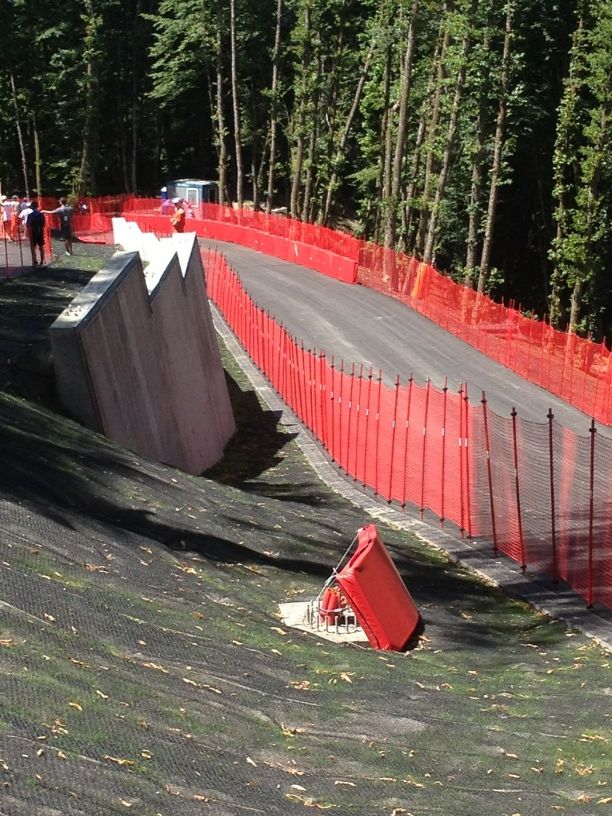
Switchbacks a-plenty at the rollerski course at the nordic-combined venue in Krasnaya Polyana near Sochi, Russia. (Dave Jarrett photo)
The runner-up on Day 1 of the FIS Summer Grand Prix in Sochi on Saturday, American Todd Lodwick (l) stands on the podium with Austrian winner Bernhard Gruber (c) and Akito Watabe of Japan (r). (Dave Jarrett photo)
The big downhill on the rollerski course at the nordic-combined venue in Krasnaya Polyana near Sochi, Russia.
Sochi’s nordic-combined jumps, which will be used in competitions leading up to the 2014 Winter Olympics, as seen in July. (Dave Jarrett photo)
View from the top of the 2014 Olympic ski jumping complex near Krasnaya Polyana, Russia. (USSA/Dave Jarrett photo)
Looking down at Sochi’s nordic-combined venue in Krasnaya Polyana, Russia, during a hike in late July 2012. (Taylor Fletcher photo)
Top of the 140-meter large hill at the nordic-combined and ski jumping venue in Krasnaya Polyana near Sochi, Russia. (Taylor Fletcher photo)
Todd Lodwick (second from left) after winning Sunday’s competition at the FIS Summer Grand Prix in Krasnaya Polyana near Sochi, Russia. Austrians Bernhard Gruber (l) placed second and Tomaz Druml was third. (USSA/Dave Jarrett courtesy photo)
U.S. Nordic Combined team members Bryan Fletcher (l) and Taylor Fletcher (second from left) at Stage 11 of the Tour de France, just 1 kilometer from the top of the Col de la Madeleine with their cycling trip’s VIP members Walter McCormack (c), Jon Schafer (third from right), Eric Oberg, and Jed Hinkley (r). (USST photo)
Just over two weeks ago, the U.S. Nordic Combined Ski Team set foot in France and immediately hopped on their road bikes. From there, they embarked on a weeklong cycling camp and watched two stages of the Tour de France along the way.
In all, they rode more than 600 kilometers and tallied some 14,500 meters of climbing, including a team time trial up L’Alpe d’ Huez. The team’s youngest A-team member, 22-year-old Taylor Fletcher clocked the fastest time up the nearly 15-kilometer ascent, which gains about 3,600-feet of elevation on an overload of switchbacks.
FasterSkier spoke with Fletcher on the phone Tuesday after he arrived in Park City, Utah, earlier that morning. Fletcher and his U.S. Ski Team (USST) teammates recently returned to the U.S. after ending their trip in Sochi, Russia, where they competed in the first competitions of the FIS Summer Grand Prix.
Before that, the U.S. squad visited Oberstdorf, Germany, where the A-team spent a day and a half reminding their legs how to jump after so many hours on the bikes.
(Note: Check back for another FasterSkier story on the U.S. team’s experience in Sochi, including what its members thought of the venue and they’re feeling at this point in the summer. Below is a video about the team and the Tour made by Fletcher’s older brother, Bryan.)
***
FasterSkier:How many times have you personally seen the Tour de France in person?
Taylor Fletcher: That’s my second time going over there and checking it out. We saw two stages this trip and two last trip. They’re really fun to go to, but watching them on TV is almost better because you can see the whole race, not just the 10 seconds they come by. The first year what was really cool is we were able to go watch the stage and ride down, go to the car, drive back to the hotel and watch the finish. That’s definitely the way to do it.
FS:Did you something similar this year?
TF: We did it one of the days. Actually what we did, which was really cool, we biked to watch the stage, watched them come by and they still had about 18 kilometers to go and so then we biked down, went to a bar with a bunch of people, ordered pizza and watched the last climb. So that worked out pretty good.
FS:What’s it like being at the Tour?
TF: It’s nuts. I would compare it to any of the biggest events in the U.S. or even the Olympics. There’s people lining every climb, pretty much the whole way up, and some are hammered from 2 o’clock, from pretty much 11 o’clock until they are sober enough to un-park their campers and drive down. Then you have people who are riding from their houses and climbing up, so you have pretty much anybody that you can imagine up there, and it’s just a great atmosphere. Everyone loves it and they’re all cheering for everybody. It’s just a great time.
FS:Did watching them make you ride faster?
TF: Definitely. The whole purpose is to go over there and bike and enjoy ourselves and have fun with what we’re doing. We’re going to watch people that are the best in the world at doing it, so we try to be like them, which is fun. It’s not very successful for us because we’re still, like, beginners compared to them. It’s crazy. There’s hundreds of people in the roads so it’s almost more like the interstates become bike paths and you can bike anywhere.
FS: How did the team time trial go up L’Alpe d’ Huez?
TF: Going back like a month ago … we did a race up Sundance Resort [in Utah] and they have a really nice road there. I think it’s like eight miles of really nice road and it winds through the trees. [U.S. Ski Team sport science trainer Alex Moore] based everybody off a relative threshold, so everybody spun around on a stationary bike and figured out what their threshold was, and he set everybody up. [One] freeskier, she started 32 minutes ahead of Tad Elliott and Noah [Hoffman] and I. Based on your threshold you were either closer or some guys were like five minutes ahead of us, some were like 15. The idea of that was to get everybody to come to the finish line at once, so it was almost like a mass sprint. It wasn’t as close, [though].
Billy [Demong] wanted to try to do the same thing with the Alpe d’ Huez time trial, but he didn’t have the same data that the sport science guys have. He started a minute and a half ahead of me, and he beat me to the top by 30 seconds, but I raced it a minute faster than him. It was kind of like he won, but I had the fastest time. I was 47:30 and he was 48:30.
I don’t remember who started first, but they started, like, 25 minutes ahead of me. I was the last person to go. It’s funny, every time you start the race, you’re like, ‘There’s no way I’m going to catch this person, 25 minutes is way too much on a 50-minute climb,’ and then sure enough at the top, you’re going past them, like ‘Holy crap, I can’t believe I just made up 25 minutes on that first hill.’ It’s pretty interesting and it’s kind of fun because you never know who’s going to win.
FS:How hard is it?
TF: It was hard. The first 2 [kilometers] average like 11 percent, but the first 2 k’s are steep and it starts to level out. I think the average gradient for the whole thing is 8.1 percent.
FS:How are you feeling about your fitness considering how you did there and also in Sochi on Sunday, with a career-best Grand Prix result of 10th?
TF: I feel like I’m at a good level. I’ve been biking really strong all spring up until now, and I haven’t really spent much time on rollerskis. I definitely don’t feel like I’ve overtrained, I don’t feel like I’ve undertrained, I just feel like I’m right at that perfect level and the more time I’m going to spend on rollerskis, the better I’ll get. Leading up to nationals next week, I think I’m at a really good level and I’m excited about it.
FS:What exactly did you do in Oberstdorf (the site of the next set of Grand Prix races in late August)?
TF: We basically went there to have a couple jump sessions and we had one interval session at the rollerski course there, which is a really nice course, just to get our normal cross-country legs underneath us … after biking for a week.
We’ve jumped there pretty much every year. We had a World Cup there last year, and usually every summer we go there for a couple sessions because it’s a really nice facility.
FS:How was Sochi?
Looking down from the 2014 Winter Olympic jumping complex near Krasnaya Polyana, about a 1-1/2 hour drive from Sochi, Russia. (Photo courtesy of Taylor Fletcher)
TF: It’s unbelievable, just the area is absolutely beautiful. Everyone said it kind of reminded them of East Coast, Vermont. The mountains are 3,000 meters high. It’s nuts; there are big mountains and it’s a true ski town. If they were to cut more trails, they could have resorts up and down the valley.
It’s kind of crazy that whole entire area is under construction and just big buildings are going up everywhere. They’re building a giant rail system from the airport all the way up to the Olympic venues, all the skiing venues and stuff. That’s going to be amazing when it’s all finished. Right now it reminds me of, like, SimCity, just thousands of guys running around. They don’t even wear hard hats or shirts, all they have is their tools and they’re just working day and night.
We’re going back there this winter for World Cup, so it’ll be pretty interesting to see how much more they’ve gotten done by the time we’re there. I would think they should have everything done by the Olympics, and once it’s done it’s going to be a really impressive town.
FS:Why were you disqualified for your suit on Saturday?
TF: I have an undersuit, like a one-piece undersuit that is head to toe, and I like it because it’s tight and it [fits] underneath the jumpsuit so it doesn’t catch. I had cut some holes in there, which were legal last year, but they changed the rules and you’re not allowed to have them anywhere. So I had to go get tested and [the official] felt that I had some holes, and now they’re being really strict with rules to enforce them for the winter so they had to disqualify me, so that was a bummer.
I found it out after I jumped on Saturday. If I found it out before, I could have just cut it off and skied, but I didn’t know that. It’s just my suit that goes underneath my jumpsuit … it’s just really more comfort than performance.
FS:How did you feel about Sunday’s performance (when you were 16th on the large hill, eighth in the race and 10th overall)?
TF: I was extremely happy because definitely some of the best jumpers were there that usually jump top five, and I was jumping pretty well in comparison to them. I had a pretty good race; I had one little spill. I slipped on some water and fell down.
There was a section you could hand water to the racers. [The first day when I was disqualified,] I gave Bill a feed of sports drink and everyone else just wanted me to pour it on them. I was just giving them bottles of water and dumping it on them. Bill got disqualified the second day [because of his suit] so he did the same thing. He threw it and it hit my back wheel and I just instantly slipped out. It was like I was running on ice and fell down, and I got back up and I kind of spazzed to get back where I was and I definitely think that cost me a lot of energy so I’ve got to work on that for sure. … Other than that I think it was a good showing. Everyone was happy.
FS:What was it like seeing teammate Todd Lodwick at the top of the podium on Sunday after he took second on Saturday?
TF: It’s good to see Todd doing well after taking a year off last year, and it’s good to see everyone else doing well. Everyone wants to take the first spot. Only one person can do that. It is what it is, you can’t change it, you can only wish to do better.
To have three or four in the top 10 is even better [Lodwick was first, Johnny Spillane placed seventh and Fletcher finished 10th on Sunday]. It shows the depth of the team and what we’re doing for summer training seems to be worthwhile and it just increases the motivation of the rest of the team to get to that level and continue to improve so they can have their chance up there as well.