Tag: Krista Lahteenmaki

  • Norway Out, Sweden In as Kalla and Company Capture Historic Relay Gold

    Norway Out, Sweden In as Kalla and Company Capture Historic Relay Gold

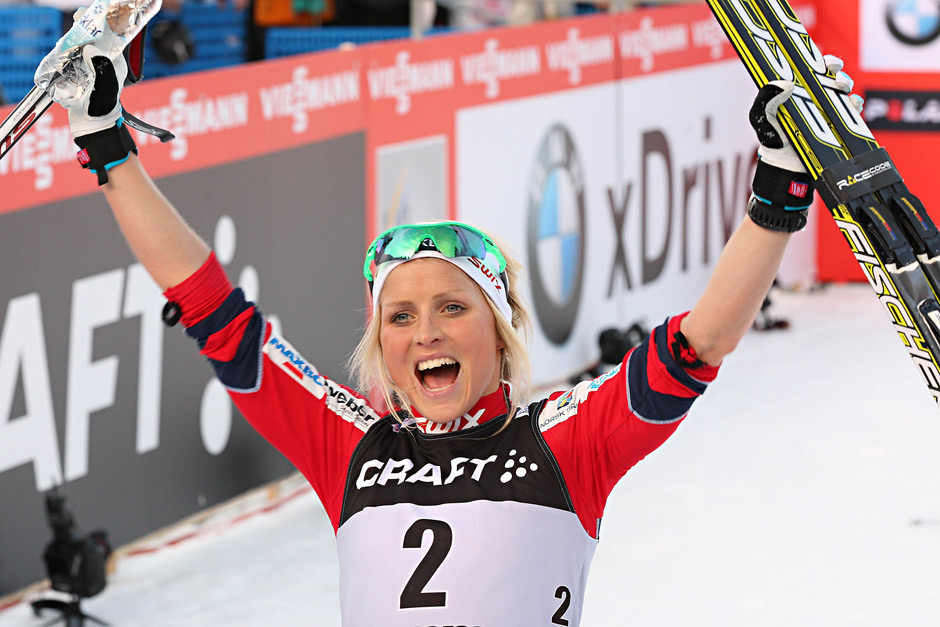
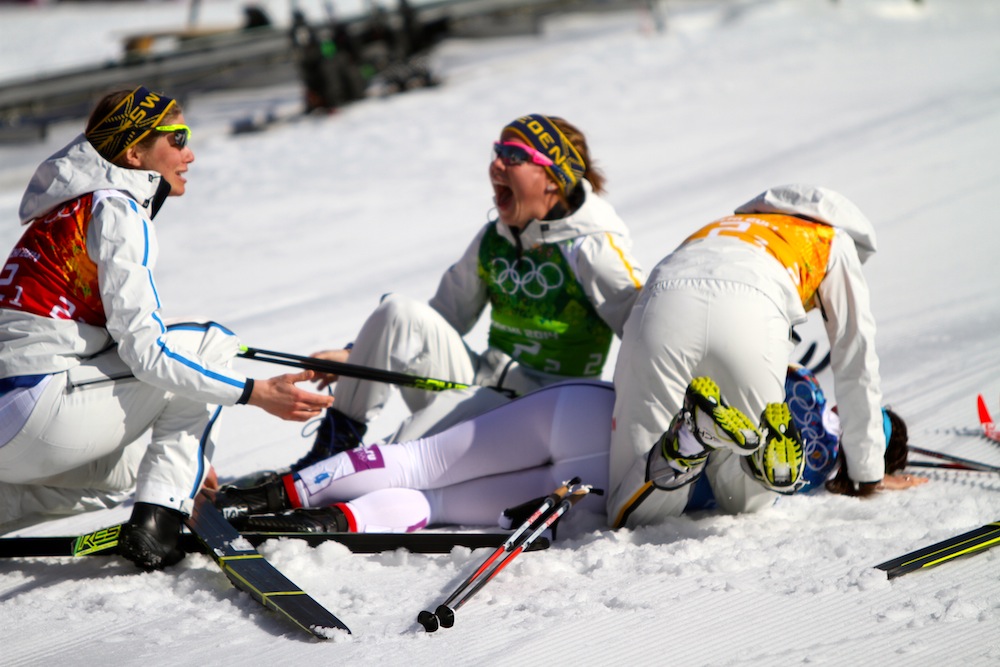
    The Swedish women's relay team celebrates Olympic gold, their first since 1960.
    The Swedish women’s relay team celebrates Olympic gold, their first since 1960.

    FasterSkier’s coverage is made possible through the generous support of Rudy Project.

    SOCHI, Russia – “When her eyes get dark, I know she will go fast,” Ida Ingemarsdotter said in a press conference today.

    She was talking about Swedish teammate Charlotte Kalla, with whom she won team sprint at 2011 cross-country World Championships and the silver two years later.

    And in today’s Olympic 4 x 5 k relay, Ingemarsdotter – a sprinter who nevertheless turned in a flawless scramble leg for Sweden to tag off in third, just 4.3 seconds behind the leader – saw that expression on Kalla’s face once again.

    “When I saw Charlotte going out on her finish…” Ingemarsdotter marveled.

    She wasn’t the only one. Finnish coach Magnar Dalen said that when he saw Kalla start, he began to worry about whether his team, anchored by Krista Lahteenmaki could hold onto gold.

    At face value, that seemed ridiculous. At the final handoff, Sweden was down 25 seconds to Finland and Germany, who had put themselves in the lead with strong third legs.
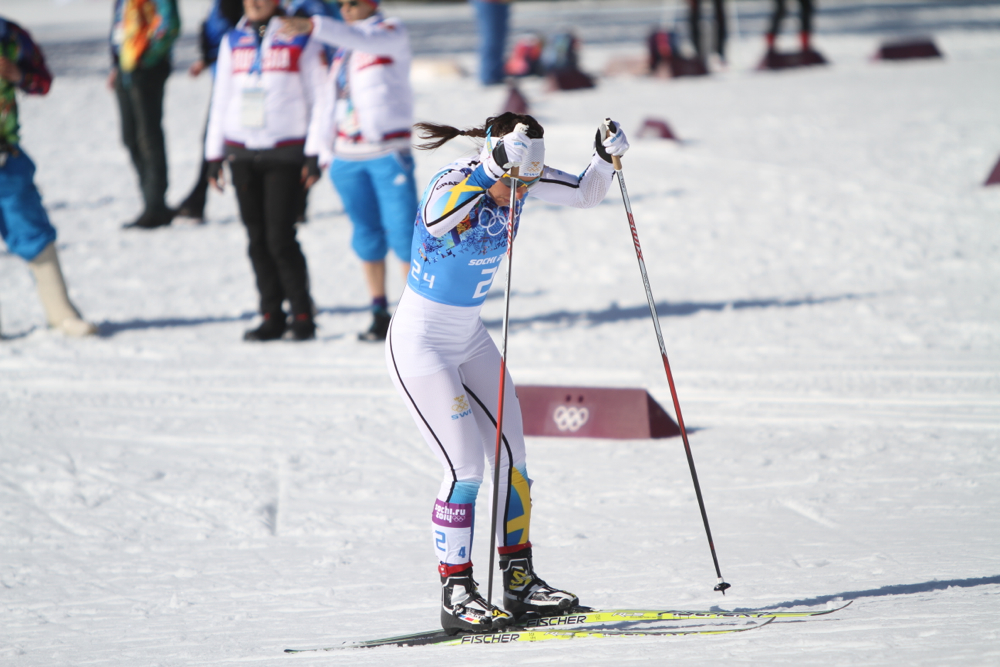
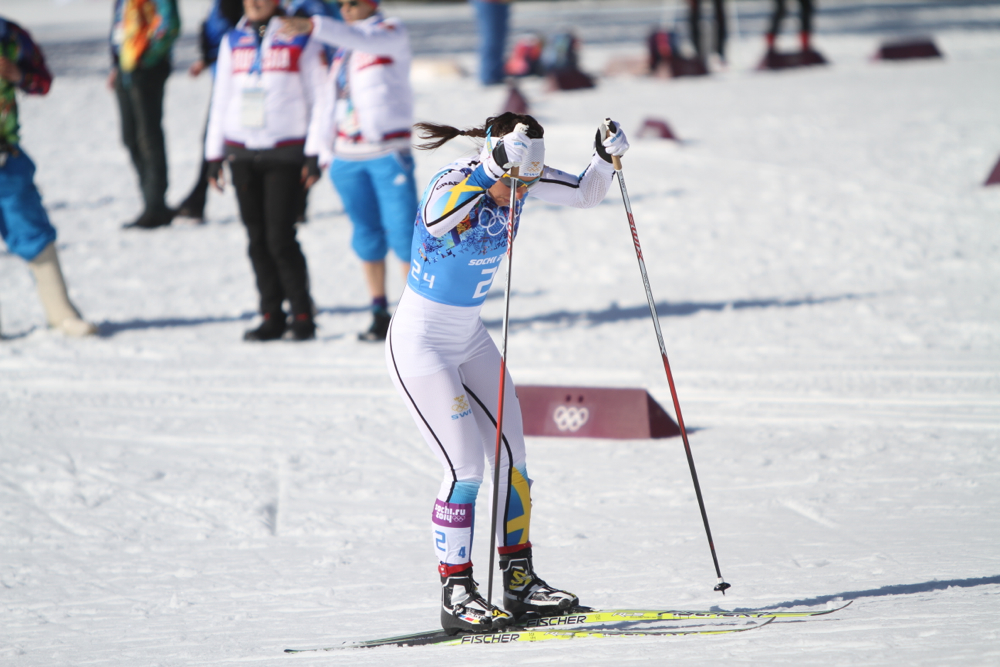
    Charlotte Kalla sets off out of the stadium on the final leg of the relay.
    Charlotte Kalla sets off out of the stadium on the final leg of the relay.

    And on a normal day, Kalla should have been arguably more concerned about what was going on behind her, not in front. Marit Bjørgen of Norway – the winningest skier in World Cup history and the gold medalist over Kalla in the 15 k skiathlon – was just eight seconds behind Kalla at the tag.

    The Swede’s challenge was to avoid being caught by Norway. If she could hang on to bronze, it would be Sweden’s first medal in a women’s relay since 1968.

    But neither history nor Bjørgen weighed too heavily on Kalla’s mind.

    “I tried to keep my focus on my own race and my own skiing,” she said. “I tried to open quite controlled and not going too fast before the next kilometer.”

    As it turned out, Bjørgen was slowed down by the same challenge that the rest of her Norwegian team faced: slow skis. The team came in as the defending Olympic champions and hadn’t lost a World Cup relay since before the last Games, but not a single skier was able to turn in a top-three time on their leg of the relay.

    “Innrømmer smørretabbe” was the headline on Norway’s NRK broadcaster, loosely translated as “admitting a wax mistake.”

    It’s not common to see Bjørgen struggling around a ski course, but just like her teammates, she turned in an unusually poor performance. At various points she looked belabored or even checked out, and brought Norway home in fifth – an unmitigated disaster.

    “An ass of a day and one of my worst as a coach,” Norway’s Egil Kristiansen told NRK.

    In any case, Bjørgen wasn’t going to be coming back.

    Instead, Kalla was going forward.

    “I was pretty inspired by the other women in my team,” Kalla said. “They did their best of the season so far, and I knew that we had really good skis. So I was really motivated to do my very best when we went out…. I just tried to catch as much seconds as possible.”

    Slowly, she climbed closer to the front.
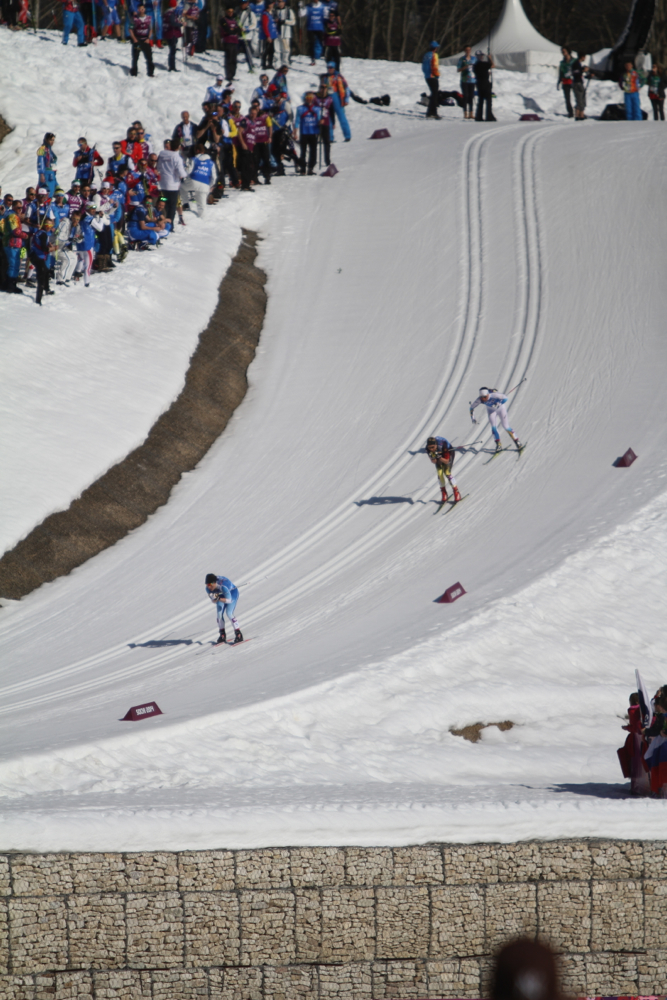
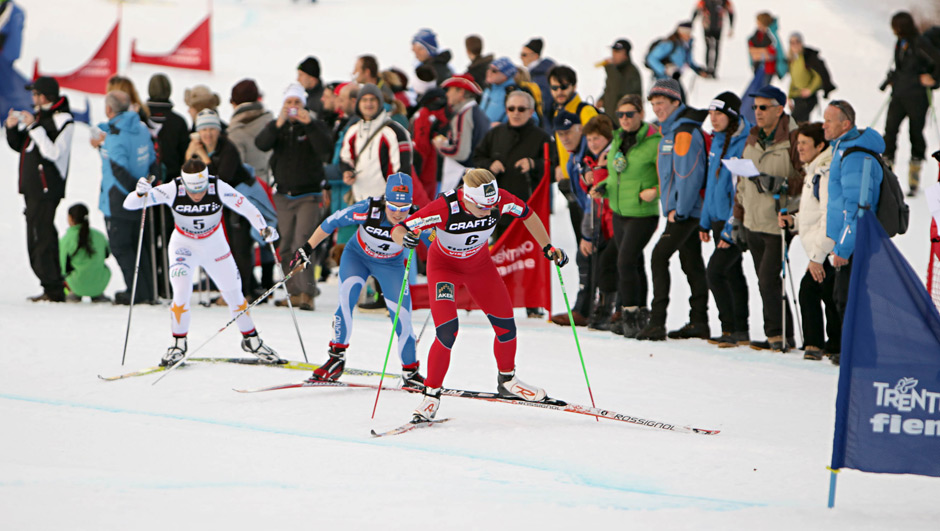
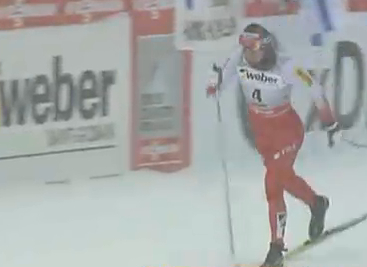
    Lahteenmaki leads Herrman and Kalla into the stadium to the finish.
    Lahteenmaki leads Herrman and Kalla into the stadium to the finish.

    “We felt that Charlotte comes nearer and nearer to us,” German anchor Denise Herrmann said, remembering the feeling of the last four kilometers.

    Johan Granrath, Sweden’s assistant coach for its women’s team, said that Kalla had made up five or ten seconds on the leaders very quickly. Then, it got harder.

    “She was really tired,” Granrath said. “I had to coach her.”

    Granrath couldn’t tell exactly how tired – he said that her eyes were “going like this,” waving his arms in circles as a demonstration.

    “But Herrmann and Lahteenmaki were tired as well,” Granrath said. “I knew Herrmann and Lahteenmaki are really good in the end… I was worried about whether [Kalla] could beat them.”

    By 500 meters from the finish line, the Swede had, incredibly, made contact with the two leaders. She followed them down the hill into the stadium, getting pinched on the downhill corner but recovering quickly. By the last turn, she overtook the two and started her finishing sprint.

    “The last 300 meters I thought I could make a good sprint, but the other two girls were really fast too,” said Herrmann.

    “I was full of lactic acid 200 meters before the finish line – I thought I would fall down,” Lahteenmaki admitted.

    Neither was able to hang on as Kalla jetted towards the finish line and crossed it with a half-second lead.

    “When I saw the backs of Finland and Germany, I just wanted to go for gold,” Kalla said. “I was satisfied with a bronze, but I knew that if I fought really hard, it would be possible to cross the finish line first of all.”

    In doing so, she made even bigger history for Sweden: it was the first time the women had won an Olympic relay since 1960. Kalla also became the first athlete of this Olympics to earn three medals, after her silver in both the 30 k skiathlon and the 10 k classic.
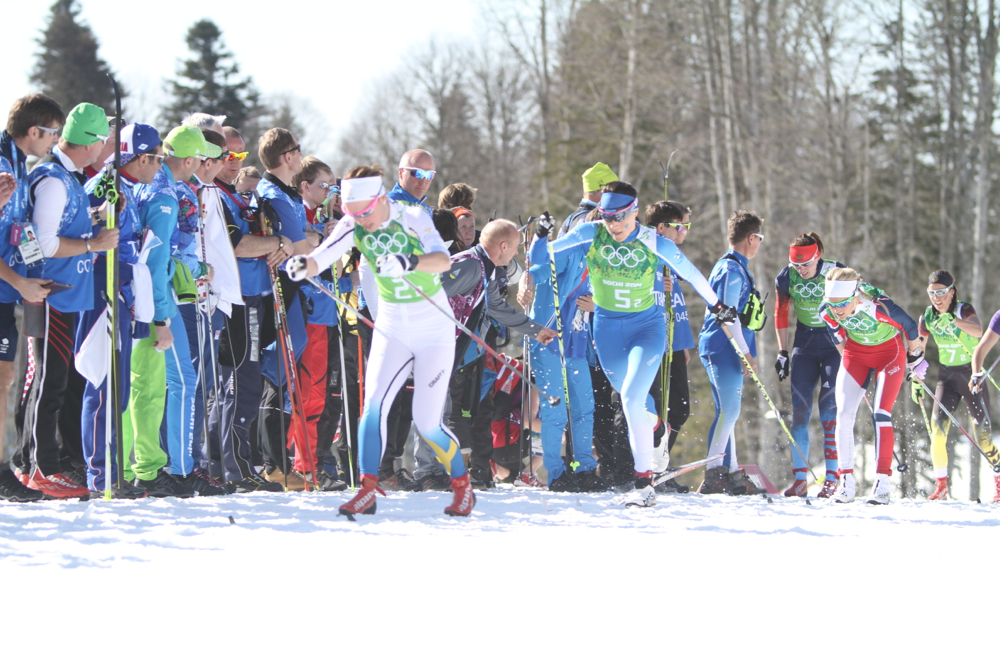
    Emma Wiken of Sweden leads Finland's Aino Kaisa Saarinen on the second leg of the relay.
    Emma Wiken of Sweden leads Finland’s Aino Kaisa Saarinen on the second leg of the relay.

    It was Sweden’s eighth medal in cross country skiing so far at this Games, which is one more than Norway and leads all other countries. It’s also already a Swedish record, even with five more races still to come.

    While Kalla and Ingemarsdotter have found plenty of success together, it was a remarkable accomplishment for the team. At 25 years old, Emma Wikén skied a strong classic leg as the team’s second skier to tag off in first place.

    “The skiing Emma did today was probably the best skiing I’ve ever seen from her,” said Johan Granath, the assistant coach for the Swedish women’s team. “This was the best race she did this season.”

    Haag, skiing in the third leg, was an even bigger question mark. She has had a tough season, not receiving full World Cup starts and never finishing in the top 10. It is a far cry from the 2010 Olympic season, where she won silver in the 15 k skiathlon.

    Haag was not chosen for the relay until two days ago, when she learned she had been picked ahead of Sara Lindborg and Britta Johansson Norgren, both of whom have better results at this Games so far.

    “I was so nervous,” Haag said of waking up this morning and knowing the task that faced her, namely not to let the team down.

    A Swedish journalist speculated that had the team not medaled, there would have been calls for Haag’s head on a platter.

    While she lost those 25 seconds to Finland and Germany, Haag’s effort was good enough.
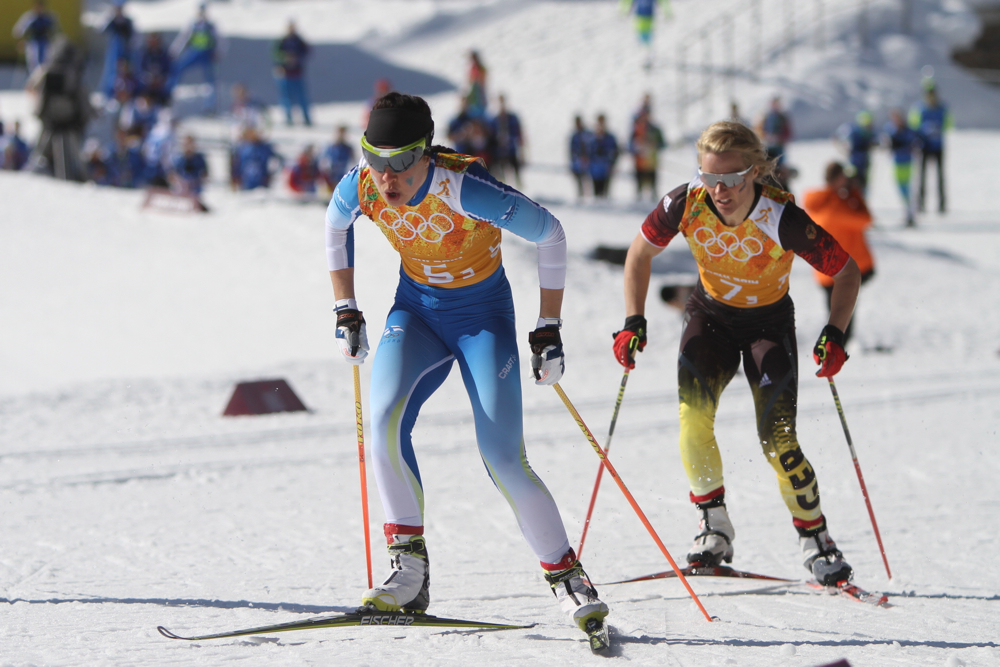
    Kerttu Niskanen of Finland leading Claudia Nystad of Germany, who completed her comeback from retirement with a bronze medal.
    Kerttu Niskanen of Finland leading Claudia Nystad of Germany, who completed her comeback from retirement with a bronze medal.

    “I’m just really happy to be part of this team,” she said. “I fought as hard as I could. Winning a gold medal after this season is just incredible – and these girls! We won a gold for the team today, not just us four. For all the coaches and all the other athletes. It’s just amazing.”

    Granath agreed.

    “We don’t maybe have the best skiers on every leg, individually, but this is a team competition,” he said.

    Finland is used to winning relay medals – this was their ninth relay medal since women began skiing in team competitions at the Olympics in 1956 – but for the Germans, bronze was unexpected.

    It’s not because they haven’t had strong relays in the past. This is the fourth consecutive Olympic relay medal for Germany, the longest active streak of any country’s men’s or women’s team.

    Rather, their distance skiing is not particularly deep or remarkable in the last few years.

    Indeed, the strongest performance of the day came from 35-year-old Claudia Nystad, who won gold in the team sprint in Vancouver before retiring. This is her first season out of retirement, and she has claimed only a single top-10 finish on the World Cup.

    Today, though, Nystad skied a monster third leg for Germany to hang tough with Finland’s Kerttu Niskanen. Nystad tagged off five seconds down from Niskanen, and had left Haag in the dust.

    “This is a great honor to participate in the Olympic games and to be successful,” Nystad said through a translator. “This is wonderful. It’s a great reward because it means I came back to the sport… it’s not always easy to win. I also won a medal [four] years ago, but now with regards to a 5 k race, I had to pull together all my energy. This is great happiness and joy for Germany. This medal means a lot for the team and my joy is endless.”

    Herrmann had quickly made up the gap to Lahteenmaki, and although she had dreamed of gold, was happy to hang on to bronze.

    “We are really happy, because we didn’t think that the German team would be able to be on the podium today,” Herrmann said.

    France finished fourth, their best result in the history of the Olympic Games.

    Host nation Russia missed out on a medal in cross country yet again, finishing sixth.

    -Nat Herz contributed reporting.
    Results


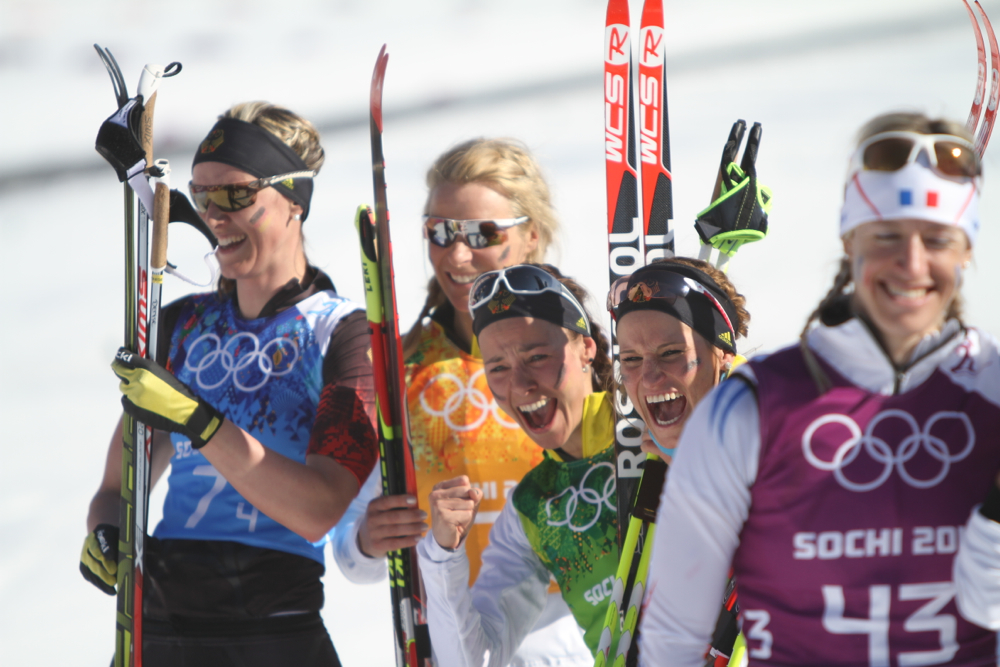
    A happy German team at the finish (l-r): Denise Herrman, Claudia Nystad, Stephanie Boehler, and Nicole Fessel.
    A happy German team at the finish (l-r): Denise Herrman, Claudia Nystad, Stephanie Boehler, and Nicole Fessel.
  • Johaug Wins First Norwegian Tour de Ski Title, Leads Podium Sweep

    Johaug Wins First Norwegian Tour de Ski Title, Leads Podium Sweep


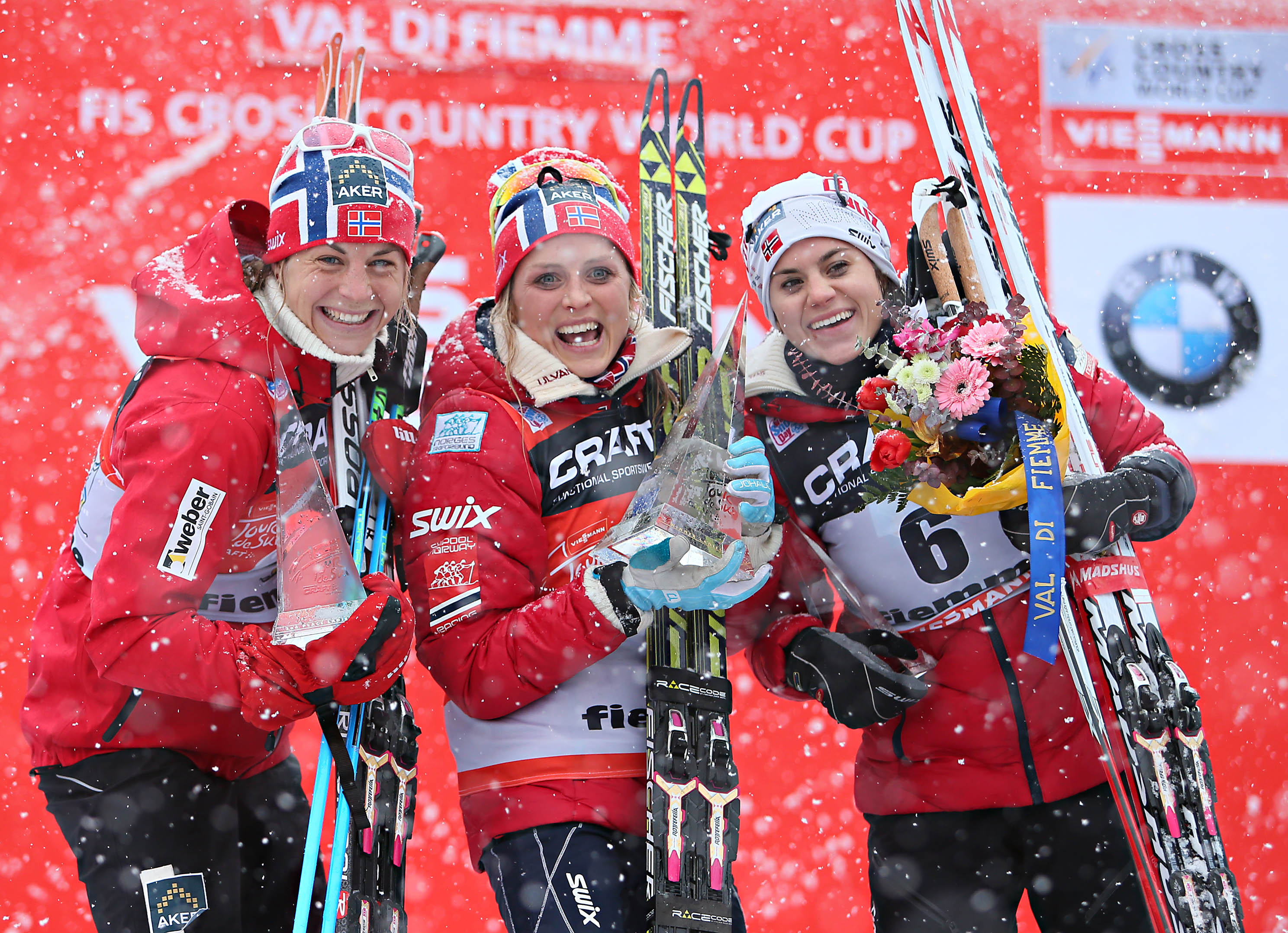
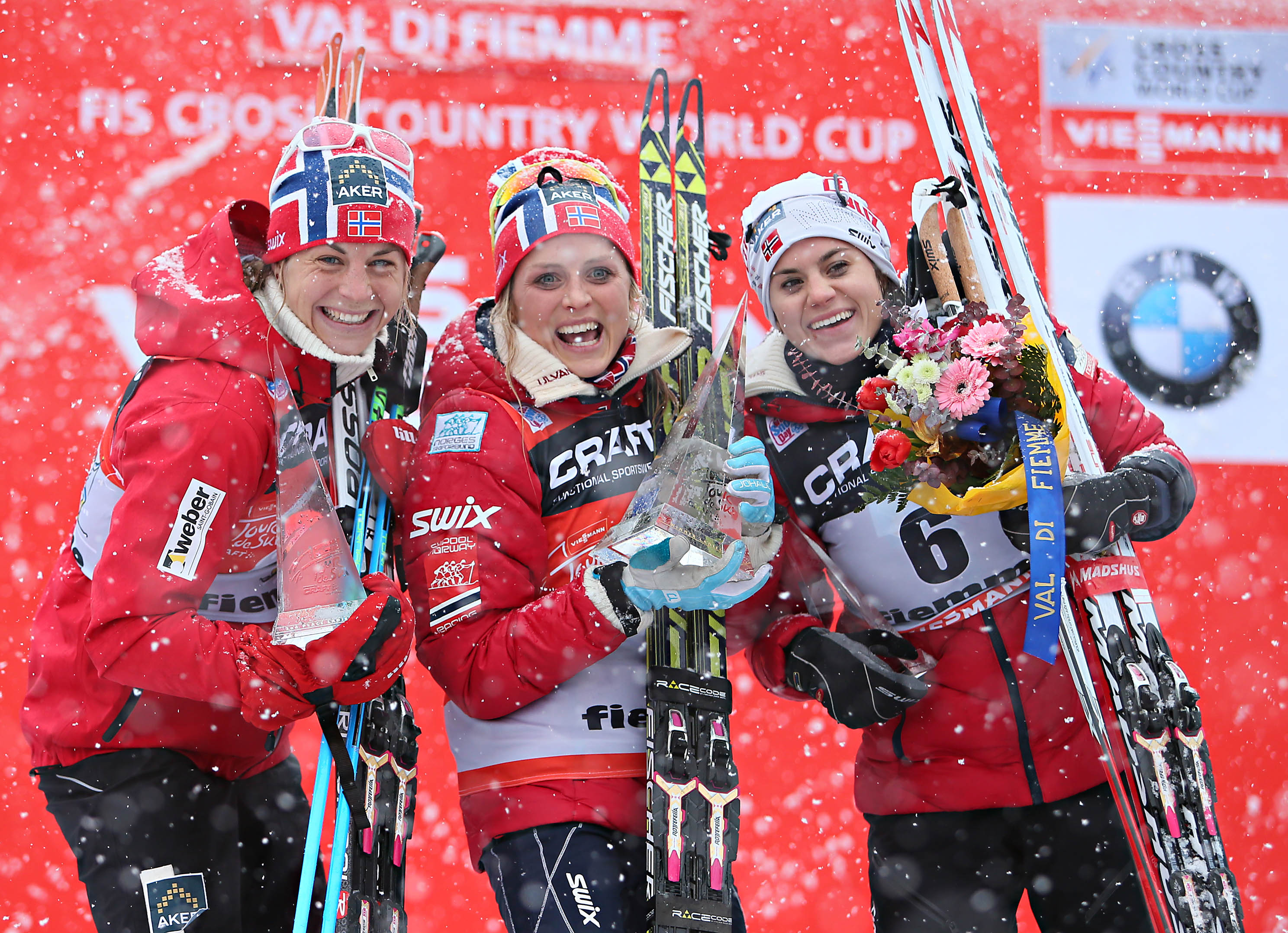
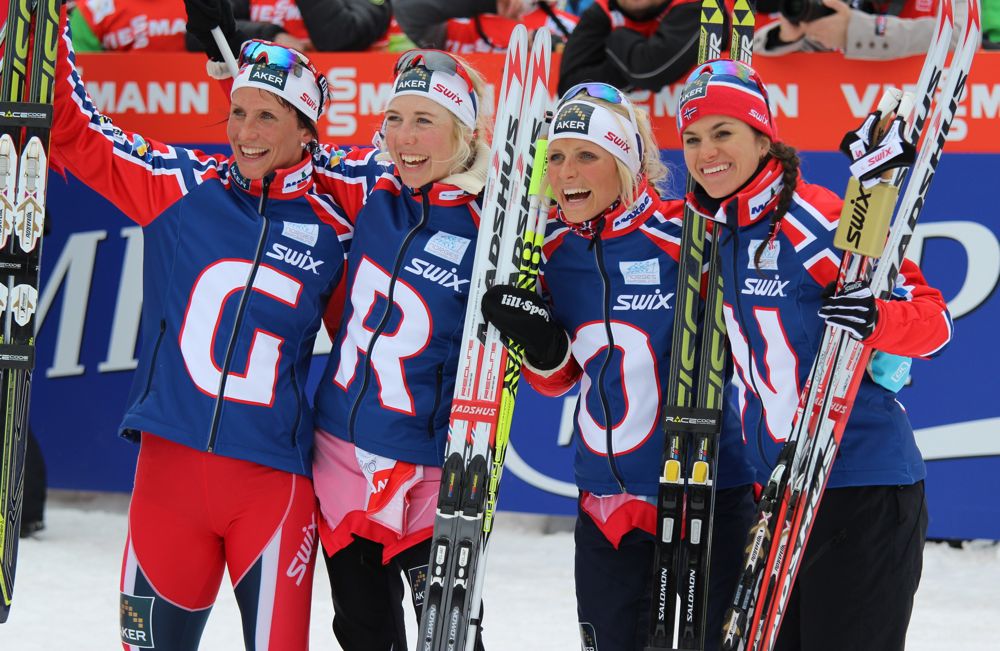
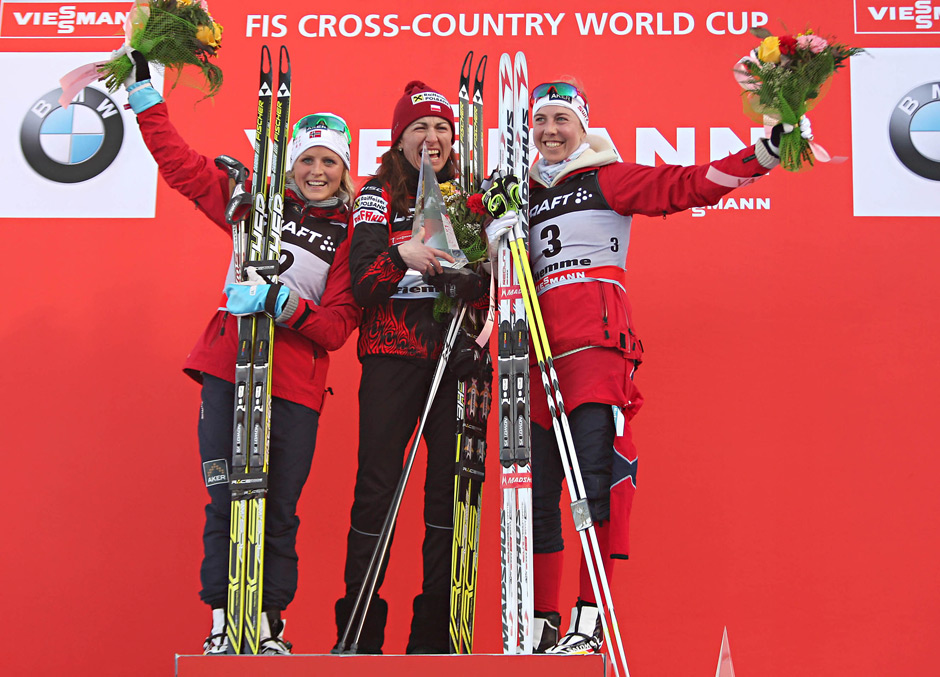
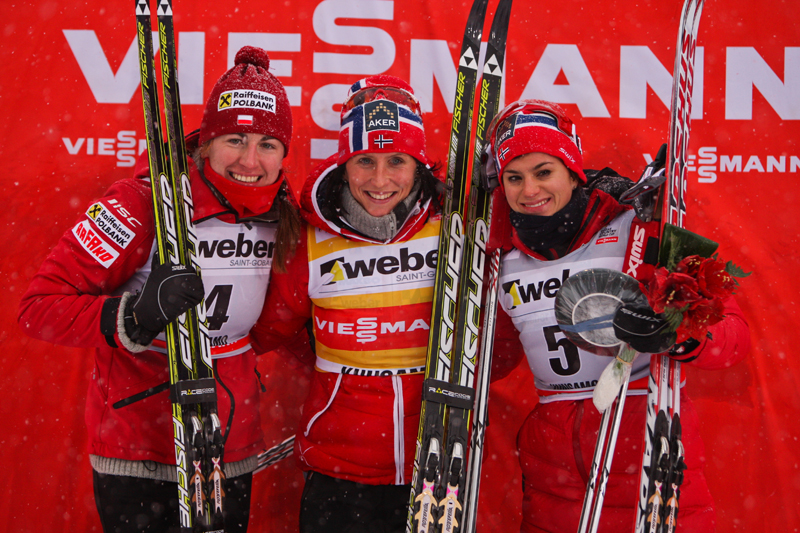
    Astrid Jacobsen, Therese Johaug and Heidi Weng (l-r) on the podium at the conclusion of the 2014 Tour de Ski. Photo: Fiemme Ski World Cup
    Astrid Jacobsen, Therese Johaug and Heidi Weng (l-r) on the podium at the conclusion of the 2014 Tour de Ski. Photo: Fiemme Ski World Cup

    Norway has suffered few droughts in the history of competitive cross-country ski racing, with periods of total dominance interrupted by slumps that would be the envy of most other nations.

    But over the course of the last decade, there has been one event where victory has eluded the sea of red that has ruled the major championships and regular season alike.

    No Norwegian had won the Tour de Ski, the grueling stage race modeled on the multi-day event popular in elite cycling, though there were plenty of close calls.

    In the seven years the event had run, Norway totaled 11 podium finishes and five sprint cup victories. Petter Northug finished second three times and Marit Bjørgen and Therese Johaug two each.

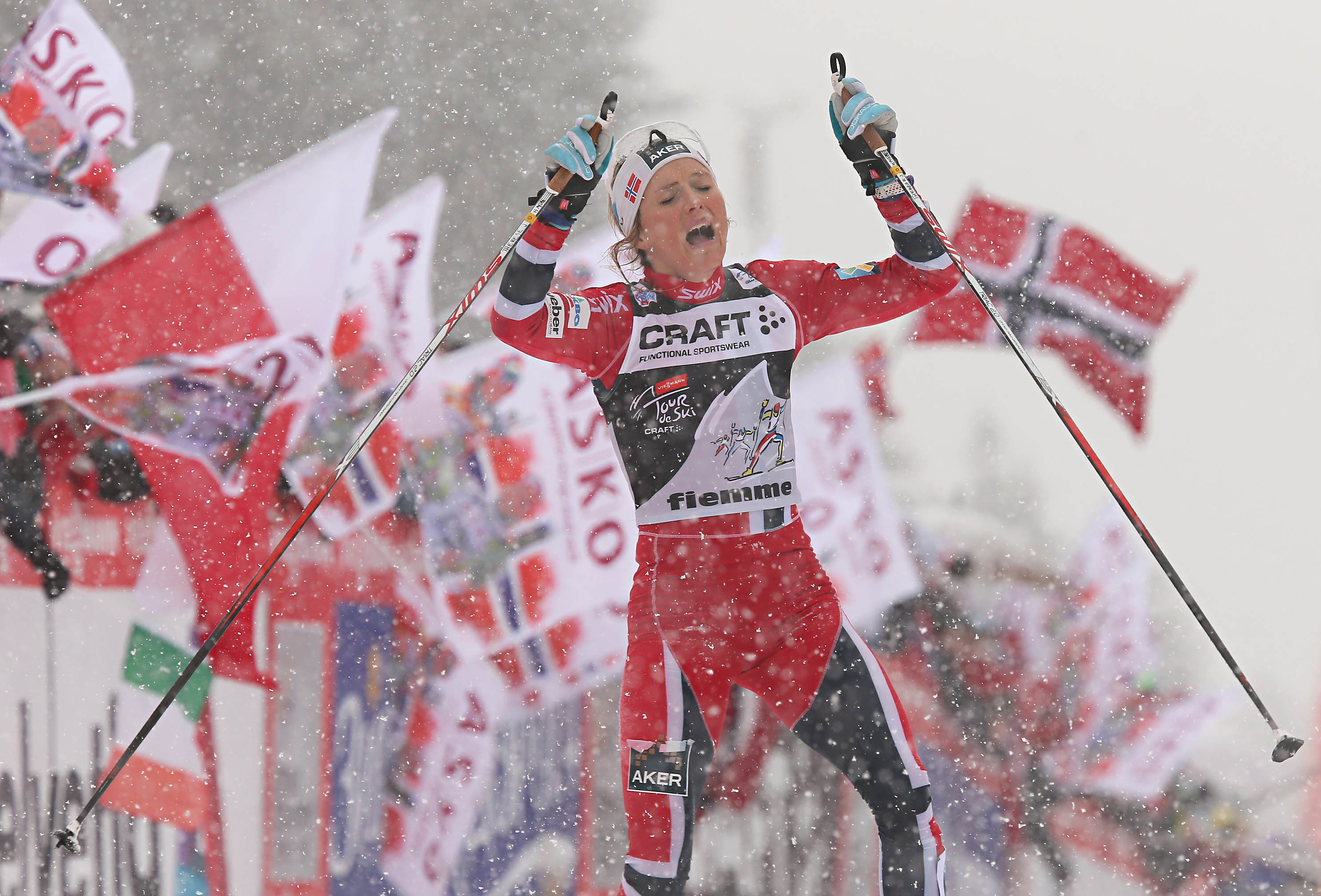
    That all changed on a sopping day on the Alpe Cermis, site of the renowned Final Climb. The Norwegian women, led by climber extraordinaire Johaug, swept the podium in definitive fashion.

    As expected Johaug overtook teammate Astrid Jacobsen on the three kilometer ascent, and skied away to a clear victory. Jacobsen maintained her lead on the rest of the field to take second, while 22-year-old Heidi Weng held off an impressive comeback by Finland’s Krista Lahteenmaki to round out the podium.

    Johaug became just the fourth woman to win the Tour in eight years, joining four-time defending champion Justyna Kowalczyk of Poland, two-time winner Virpi Kuitunen (FIN) and Sweden’s Charlotte Kalla.

    Jacobsen, a somewhat surprising force on the Tour this year, had planned to withdraw after four stages, but with a chance to win, and a podium spot firmly in grasp, she kept racing.

    She entered the final stage with a 23.8 second lead on Johaug, substantial, but in her mind, not enough. In the days leading up to the Final Climb she consistently pointed to Johaug as the favorite, a claim not based in false modesty.

    Entering this season, Johaug completed the Tour five times. Her first season in the event, 2008, she was fourth in the last stage before reeling off four consecutive Final Climb victories, often by a large margin.

    Jacobsen, a tall powerful skier, excels on more gradual terrain, and she left the start in a hurry, pushing through the earlier flats and descents. Johaug, however, kept pace, and while Jaccobsen did not falter on the hill, she was no match for the high tempo and light step of Johaug.

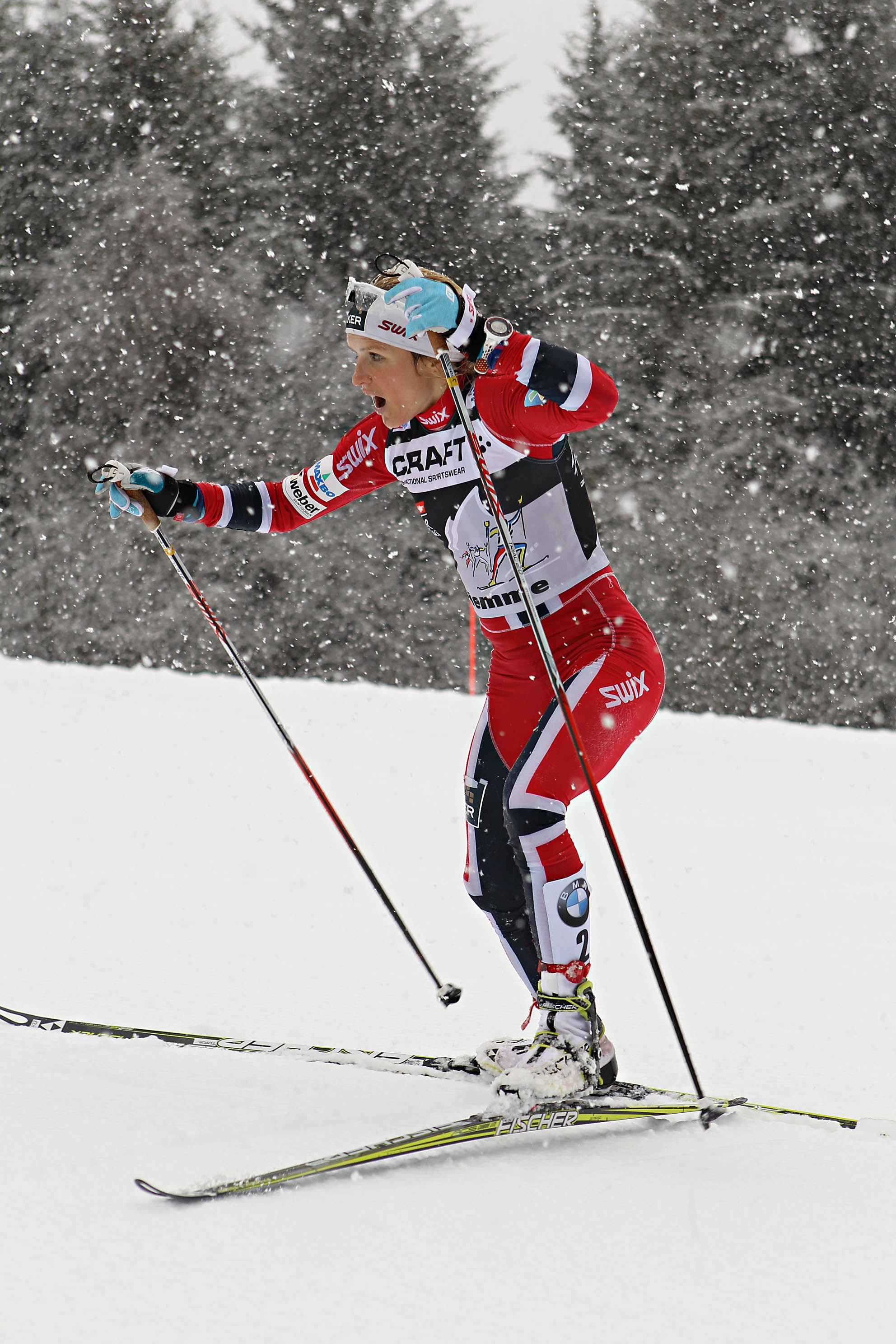
    Johaug climbing. Photo: Fiemme Ski World Cup
    Johaug climbing. Photo: Fiemme Ski World Cup

    Johaug came up from behind, and did not hesitate, moving right by her teammate, and immediately opening a gap on the 28 degree headwall half way up. With Jacobsen single-sticking and Johaug in a V1, the lead grew.

    Jacobsen said after the race that she was focused on her own race.

    “I knew Therese is a strong climber,” she told FIS News. “I skied my own speed. Therese passed me fast.”

    As the terrain became more skiable again, Jacobsen slowed the bleeding, but the damage was done. Johaug, not taking anything for granted, looked back several times, confirming her lead was secure.

    She crossed the line with a pump of her arms and a yell, before collapsing into the new wet snow. Jacobsen followed 20 seconds later, falling into her own gasping heap.

    The pair had some time to recover before the rest of the field trudged into sight. Anne Kylloenen (FIN) started in third, +1:31.5, and lost ground from the start.

    Weng, in bib 6, quickly formed up with two more Finns, Lahteenmaki and Kerttu Niskanen, and set about hunting Kylloenen, the trio staying together into the climb.

    Niskanen was the first to drop, unable to manage the pace. Weng, doing most of the leading, pulled Lahteenmaki by Kylloenen, with the later looking exhausted.

    Racing in her second Tour, Weng appeared the more controlled, and when she pulled away from Lahteenmaki on the big switchbacks, it appeared the podium would be solid red.

    But the steep grade makes distance meaningless. Eight hundred meters straight uphill takes a long time, and with the focus on the top two, Lahteenmaki made one last charge, closing back up on Weng, catching her with just 65 meters to go. Sprint finishes are usual in the Tour, particularly for the podium, and they are always agonizing, the athletes trying to eke one last push out of exploding muscles and lungs.

    At the 50 meter mark, Lahteenmaki pulled alongside Weng, trying to gain the advantage, but the Norwegian had something in reserve, accelerating, and leaving Lahteenmaki meters back in fourth.

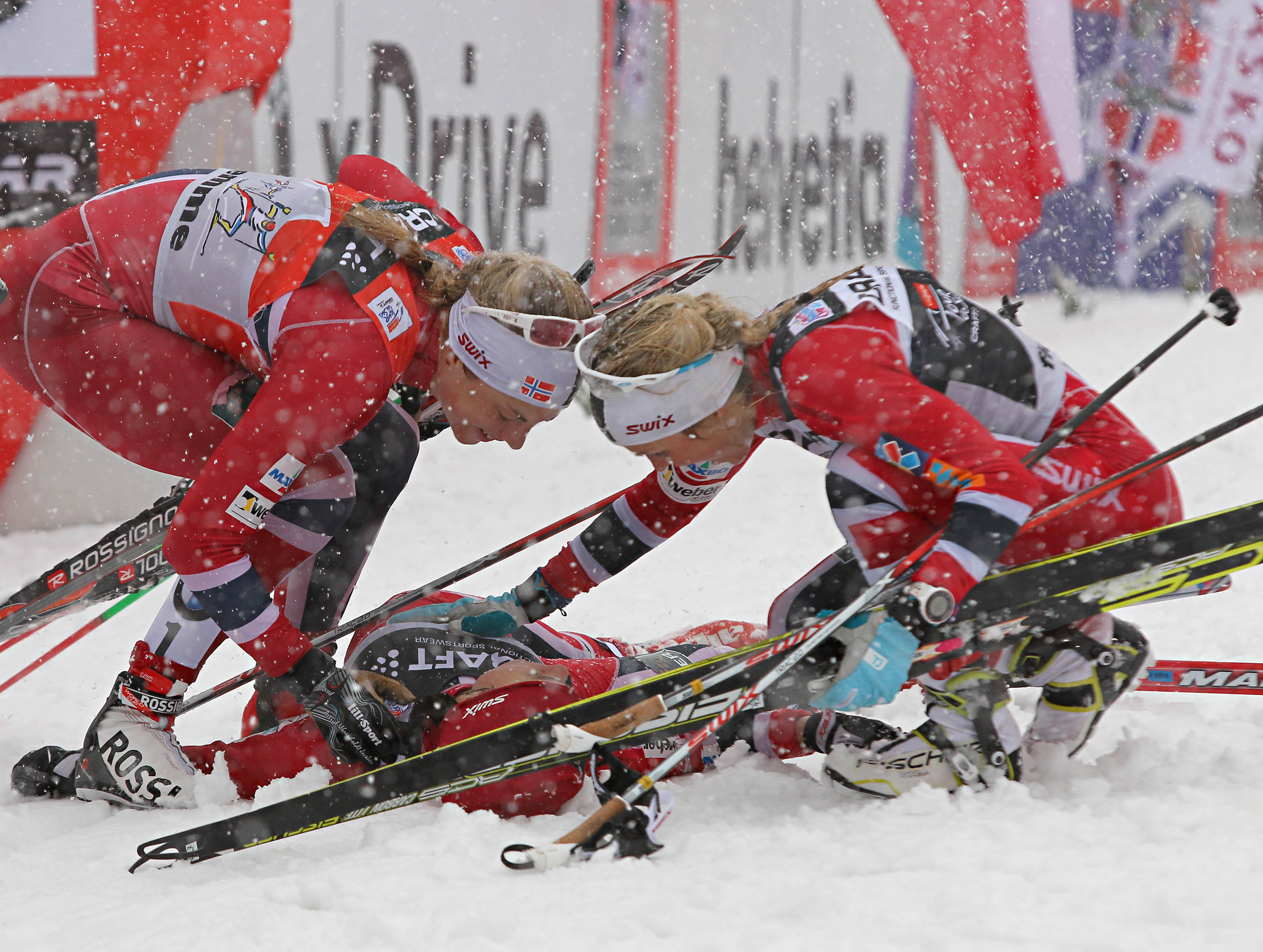
    Johaug and Jacobsen waited across the line cheering voraciously. As Weng collapsed in the snow, the top two fell on top of her, celebrating over their nearly comatose teammate, finally rising and high-fiving.

    Jacobsen and Johaug greet Weng at the finish. Photo: Fiemme Ski World Cup
    Jacobsen and Johaug greet Weng at the finish. Photo: Fiemme Ski World Cup

    The trio were the only Norwegians to finish the whole event, with star Marit Bjørgen dropping out due to illness, and last year’s bronze medalist, Kristin Stoermer Steira also withdrawing, with bronchial issues.

    Niskanen followed Lahteenmaki in fifth, and Kylloenen was sixth before American Liz Stephen broke up the Norwegian/Finnish parade.

    Johaug posted the fastest time of the day, 44.2 seconds ahead of Jacobsen. Stephen was third best, another 14.5 back, followed by Weng.

    “It’s a dream come true for me,” Johaug told FIS News after the race. “It is amazing to become the first Norwegian to win the Tour, and even better when Astrid and Heidi could join me on the podium.”

    Heavy rain turning to wet snow made for soft, slow conditions, and perhaps the toughest Final Climb ever. Norwegian coach Egil Kriastensen describes the snow as “like glue” to Norwegian broadcaster NRK.

    “There are many thoughts through your head when you pass the finish line,” Johaug told NRK. You are quite tired, and many of the thoughts turn to how much I have sacrificed…Now it’s absolutely worth it.”

    Johaug with little energy left for celebration. Photo: Fiemme Ski World Cup
    Johaug with little energy left for celebration. Photo: Fiemme Ski World Cup

    Jacobsen was also thrilled with her performance.

    “I have good reason to be proud. I’m number two behind Therese. Who’d have thought it?” she said to NRK.

    Jacobsen won the World Championship sprint in 2007 in Sapporo, Japan, but while she has turned in plenty of strong results, her career has been interrupted by a combination of illness and serious injury.

    The young Weng has plenty to look forward to, and is ready to head home to start recovery.

    She described the experience as “almost like World Championships” last year in Val di Fiemme, where she took bronze in the skiathlon and was a member of the gold medal winning relay team.

    “Now I will go home and eat everything I come across,” Weng told NRK.

    Of Note:

    – Maako Ishida (JPN), usually a force in classic, was fifth fastest on the day

    – Eva Vrabcova-Nyvltova (CZE) was a surprising eighth overall. The 27-year-old has never stood on a World Cup podium and has just six top-10 results in her career, two of which came in this Tour.

    – Twenty-year-old Julia Svan, daughter of the great Swedish skier Gunde Svan, placed 41st out of 42 skiers.

    – Overall 38 skiers withdrew from the Tour, including Kowalczyk and Anastasia Slonova (KAZ) both of whom did not start the first stage.

    – Kowalczyk did not start in protest of the format, particularly the number of skate events.

    – Valentina Schevchenko (UKR) completed her eighth Tour at age 38. She is the only person to ski every Tour de Ski. She finished 14th. Schevchenko was third in the inaugural Tour back in 2007.

    – Jacobsen won the Sprint Cup for best Tour sprinter. The ranking combines the sprint races with additional sprint bonuses from distance races. She was the first Norwegian woman to win the Cup. Ingvild Flugstad Oestberg was second and Johaug third.

    – Johaug helped herself with continued improved sprinting. She set a career-best Tour sprint mark by placing 7th in Oberhof, Germany and was 24th in Lenzerheide, Switzerland, picking up valuable bonus seconds.

    Results

    Time of Day (PDF)

    Final Tour de Ski Standings 

  • Johaug Takes Off ‘Like a Crazy Lady’ to Set Up Norway’s Relay Win; U.S. Hammers for Third

    Johaug Takes Off ‘Like a Crazy Lady’ to Set Up Norway’s Relay Win; U.S. Hammers for Third

    Thursday's 4 x 5 k relay winners (from left to right), Marit Bjorgen, Kristin Stormer Steira, Therese Johaug and Heidi Weng celebrate their second-straight title at World Championships. The topped Sweden by 26.2 seconds for the victory in Val di Fiemme, Italy, but had a little difficulty spelling out a tribute to Norway at the finish.
    The reigning world champions in the 4 x 5 k relay winners (from left to right), Marit Bjørgen, Kristin Størmer Steira, Therese Johaug and Heidi Weng celebrate their second-straight title at 2013 World Championships in Val di Fiemme, Italy.

    At least the race for second was interesting. The women’s 4 x 5-kilometer relay at the Lillehammer World Cup in Norway on Sunday was, in some ways, a tale as old as time.
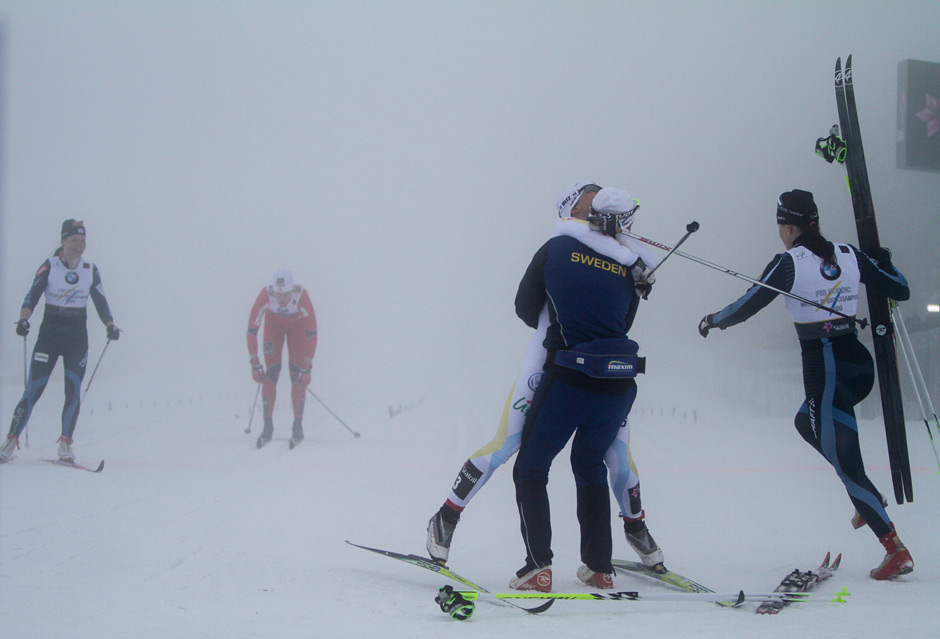
    The Norwegian’s top team (out of four Norwegian squads in the women’s race) might as well have lulled spectators to sleep with their predictable execution and essentially flawless victory. But the reality is they’re fun to watch.

    And ultimately, teams like the U.S. think they’re beatable – at least that’s what they’ve been told.

    “We got a really funny email from a 44-year-old guy in Norway that told us that Norway is definitely beatable, we just have to get close to Marit [Bjørgen] and get her stressed out on the last leg,” US Ski Team member Kikkan Randall said in a post-race phone interview with her relay team. “We’re close. I think our best form is still coming. You’ve got some people that are starting this year off super hot, some people that are building into it, so when it comes to Sochi we just gotta stay close, and I think if we put them under pressure, anything can happen.”

    The U.S. women after placing third in a World Cup relay, the first relay podium in the history of the program – Kikkan Randall, Holly Brooks, Jessie Diggins, and Liz Stephen. Photo: NordicFocus/Felgenhauer/Fischer.
    The U.S. women after placing third in a World Cup relay, the first relay podium in the history of the program – Kikkan Randall, Holly Brooks, Jessie Diggins, and Liz Stephen. (Photo: NordicFocus/Felgenhauer/Fischer)

    On Sunday, the U.S. women were close, tying their best-ever result of third in a World Cup relay, which they first achieved just over a year ago in Gällivare, Sweden.

    The U.S. women’s first team of Randall, Sadie Bjornsen, Liz Stephen and Jessie Diggins was 23.4 seconds shy of another historic first in second place, which went to Finland’s Aino-Kaisa Saarinen, Anne Kyllönen, Kerttu Niskanen, and Krista Lähteenmäki.

    However, the Finns finished a minute and 13.1 seconds behind the Norwegians, who skied themselves out of the ballpark (starting on the second leg) for yet another relay win in 58:38.9.

    “This was a good performance from the team, but annoying is when I was not able to [match] Johaug,” Finland’s Kyllönen told the Ilta-Sanomat.

    If it makes her feel any better, nobody could on Sunday.

    Heidi Weng opened with a solid classic leg to put Norway I in first, Therese Johaug vented some frustrations after her fourth-place finish on Saturday, and Kristin Størmer Steira held steady in the third leg to set Bjørgen up for two final cruiser laps.

    Bjørgen told NRK that the lead was so good, she simply needed to stay on her feet. After Steira tagged her in first with a 35-second lead, Bjørgen was one of the few skiers who appeared smooth from start to finish on a snowy and technically wrenching day. Johaug was the other, accelerating out of the stadium with a two-second lead, which quickly grew to 15 seconds just 800 meters into the second classic leg.

    But their race started with Weng, the youngest on the team at 22, who made a move just over halfway through the first classic leg.

    The U.S. scramble skier, Randall was one of the first out of the gate and led for most of the two-lap 5 k, until Weng attacked exactly where Randall expected her to on the second lap.

    As Weng surged up the steep section of the long climb, Randall latched on.

    “I just did everything I could to stay on her heels” Randall said. “I was able to all the way up [and over the hill], then just kind of followed her, figuring it would be good to tag off to Sadie [Bjornsen] in the pack knowing we were in touch at the front.”

    Weng handed off to Johaug in first, tied with Norway II’s Ingvild Flugstad Østberg. Randall was 2.1 seconds back in third, just ahead of Russia’s Julia Ivanova and Finland’s Saarinen in fourth and fifth, respectively.

    The scramble leg of the second U.S. team (the first time the Americans have been able to start two women’s relays in recent memory), Sophie Caldwell came through in sixth, just 5.5 seconds after Weng.

    With a two-second lead, Johaug didn’t waste anytime breaking away. Meanwhile, Bjornsen and Kyllönen took turns leading the chase, and realistically, battling for second. Strung out by the attack, the rest of the pack fell behind.

    “Johaug took off like a crazy lady from the start,” Bjornsen recalled. “It was challenging out there today with all that snow, and you start falling apart at one point and then you just have to collect your mind and know that it’s relay day and just have to keep going. So it was really awesome to have that Finnish girl just to chase down. That’s why I was so stoked to where Kikkan put me … thank God she didn’t stick us way in the front.”

    The two followed Johaug into the tag zone, with Kyllönen 38.5 seconds behind in second, Bjornsen 39.2 seconds back in third, and Russia’s Alija Iksanova another 20 seconds back in fourth. Johaug had put down the kind of race Norway needed, setting Steira up perfectly to put Bjørgen in a position to win.

    “I was much more active today,” Johaug told NRK, according to a translation. “It was a slightly different body … I was probably a bit annoyed after the race yesterday … and I managed to get the flick that I was missing.”

    With nearly 40 seconds separating Stephen from Steira at the start of the third leg, Stephen immediately sprang to try to chase her down.

    Two kilometers in, Stephen had made up about five seconds on Norway. Niskanen followed closely in an effort to do the same, and ended up passing Stephen on a climb with about 1 ½ k remaining.

    “If I had known how my body was going to feel today, I would have stuck behind Finland for a bit longer than I did,” Stephen said. “But you certainly always hope for the best, and I felt fairly good in warm up and just off the bat, I felt really psyched. Probably a lot of that was adrenaline. Maybe if I had it to do over and I knew exactly how it was going to go, but I was not as concerned with Norway as I was with Charlotte Kalla catching me.”

    Down by nearly 45 seconds heading into the third leg, Sweden rose from sixth to fourth with Kalla, just three seconds behind the Americans, by the final exchange.

    Trying to hang onto Niskanen while holding off Kalla, Stephen caught her ski tip in some powder on the edge of the course and nearly fell just meters before the exchange. She caught herself, and tagged Diggins in third, about 14 seconds behind Finland and 49 seconds back from Bjørgen.

    The U.S. women surround Jessie Diggins after she anchored them to third in the Lillehammer World Cup 4 x 5 k relay, tying their best-ever relay result on Sunday.
    The U.S. women surround Jessie Diggins after she anchored them to third in the Lillehammer World Cup 4 x 5 k relay, tying their best-ever relay result on Sunday.

    Careful not to blow up on the first hill out of the stadium, Diggins, the tried-and-tested U.S. anchor, reeled in Lähteenmäki by the 2 k mark. The two skied together to drop Sweden’s Britta Johansson Norgren and Maiken Caspersen Falla of Norway II, in fourth and fifth, respectively.

    “I knew we were in for a medal; it would either be silver or bronze,” Diggins recalled.

    She took the lead up the long climb of their second lap and over the top, Diggins dropped Lähteenmäki, and said she could feel her energy rising.

    “I was ready for a sprint, like, ‘OK, bring it, we can do this. We have this silver medal,’ ” Diggins said. “But then I caught my tip in the powder in the same spot that Liz [did], where suddenly you’re in the track and then [it] suddenly goes away and you’re in some powder.”

    Not expecting that, Diggins fell and broke a pole, forcing her to ski over the last bridge without one. On the descent, Norwegian coach Vidar Lofshus ran over to her with a replacement.

    “They didn’t have to do that; that’s not part of their job,” Diggins said of the gesture. “I was able to hold off the chasing Norway and Sweden and we were able to get a bronze, which was awesome. It’s still tying our best result ever and it’s cool because I know that, hey, it was a little bit of bad luck with the hard fall and all that, but we’re in good shape. We know how to put together a good day … we are right the hunt and that’s right where we want to be.”

    Trailing the U.S. in third by 10.8 seconds, Norway II placed fourth (+1:47.3), Russia I was fifth (+1:53.9), and Sweden placed sixth (+2:05.1) of 19 teams.

    USA II, with Ida Sargent, Holly Brooks and Rosie Brennan, went on to place 12th (+3:20.5).

    — Emily Schwing contributed reporting

    Results

    Liz Stephen (USST) hits the weight room hours after racing to third with the U.S. women's team in Sunday's World Cup 4 x 5 k relay in Lillehammer, Norway. (Photo: Billy Demong/Twitter)
    Liz Stephen (USST) hits the weight room hours after racing to third with the U.S. women’s team in Sunday’s World Cup 4 x 5 k relay in Lillehammer, Norway. (Photo: Billy Demong/Twitter)
  • Kowalczyk Makes it Four, Holds off Ferocious Johaug for Tour Win

    Kowalczyk Makes it Four, Holds off Ferocious Johaug for Tour Win

    Justyna Kowalczyk (POL) powers to the top of the Alpe Cermis and her fourth Tour de Ski victory. (Photo: Fimme2013)

    To say Justyna Kowalczyk (POL) owns the Tour de Ski might be an understatement at this point. The event embodies the Pole’s career, mirroring her overall success while illustrating the adage that defines her body of work — “the harder the better.”

    For the fourth consecutive year, Kowalczyk made her laborious way up the famed Alpe Cermis, crossing the line with little energy for celebration, but well ahead of her pursuers.

    In seven years of Tour racing, there have been only three winners, the last non-Kowalczyk being two-time champion Virpi Kuitunen (FIN) back in 2009.

    Since that year, when she placed just off the podium in 4th, Kowalczyk has had a stranglehold on the event, even as venues and formats have shifted.

    More sprints, fewer sprints, bonus seconds, nine stages or seven stages — the one constant has been Kowalczyk.

    “Once again, it’s been a fantastic Tour de Ski. For the fourth time I sit on the first spot and I’m so happy,” Kowalczyk said after the race.

    After a strong performance in Saturday’s mass start, where she picked up 45 bonus seconds in addition to her 33-second margin of victory, there was little doubt as to the overall outcome.

    From the start of the Tour just over a week ago, Therese Johaug (NOR) was seen as the one woman who might challenge Kowalczyk, at least with Norwegian Marit Bjørgen out of the picture with an irregular heartbeat.

    The conventional wisdom was that if Johaug could stay within a minute, she would have a good shot at the top spot.

    The climbing champion had won the Final Climb the past two years, putting 50 seconds on the field last year, and over a minute the previous season.

    Johaug celebrates her second place finish. (Photo: Fiemme2013)

    But the mass start and Kowalczyk’s classic prowess proved too much for Johaug, and she started the day over two minutes back.

    To her credit, Johaug still generated some excitement, though she ultimately ran out of hill.

    On the flats alone, prior to the start of the climb, Johaug knocked a full 40 seconds out of Kowalczyk, and with the course switchbacking up the Alpe Cermis, she had a visual to work off of.

    While Kowalczyk stuck with a slow tempo, methodically V1-ing up a pitch that reached a maximum pitch of 29%, Johaug opted to single stick the hardest parts, relying on her light tempo.

    “I saw the hope of taking her to the ground,” Johaug told Norwegian broadcaster NRK.

    She continued to close, and by the finish the gap was down to just under 30 seconds, and Johaug was once again the Queen of Alpe Cermis.

    “I took it second by second, and finally I saw Kowalczyk…I felt really good today, but it was not enough,” Johaug said to NRK.

    She did take a moment to engage in hindsight, wishing for another ten seconds in the Toblach prolgoue and the mass start.

    With Kristin Stoermer Steira (NOR) off by herself in third, none of the podium spots would be closely contested.

    Steira had an impressive Tour, surprising even herself with a freestyle sprint finals appearance in Switzerland, and consistently strong results throughout.

    Steira won the Final Climb back in 2010, on her way to 5th overall, so she has proven her ascending chops.

    Jacobsen makes a move ahead of Lahteenmaki and Kalla. (Photo: Fiemme2013)

    She started the day just ten seconds behind Johaug, but never got any closer. Steira put time on the tailing chase group on the flats, holding a minute plus at the base of the climb.

    She bent somewhat on the hill, but never broke, and the woman who has an uncanny ability to finish fourth, held her bronze position.

    “I had fun each day since the beginning of the Tour, especially the sprint competition in Val Müstair,” Steira said after the race. “It’s been a fantastic Tour de Ski…and I think I’m in a good shape at the moment.”

    Steira finished a shocking third in the Tour sprint standings, behind Kowalczyk and Randall.

    The most drama on the climb, however, was in the group just behind.

    Krista Lahteenmaki (FIN), Charlotte Kalla (SWE), Astrid Jacobsen (NOR), Kikkan Randall (USA), and Anne Kylloenen all started within 12 seconds.

    The first three quickly came together, with Randall systematically closing down over the flats.

    Kylloenen, starting simultaneously with the American, couldn’t hang initially, but did close the gap in her own time before the start of the hill.

    Lahteenmaki, who came on strong in the later stages of the Tour, did much of the early work, pushing the pace on the flats. Kalla, who skied an impressive race in the 15k pursuit back in Toblach, took her turn at the front as well, with the other three content to ride behind.

    As is usually the case, the early portion served only to setup the real competition.

    It didn’t take long for the composition of the chase group to change. First Kylloenen, and then Randall, disappeared off the back, and when Jacobsen moved to the front with 900 meters to go, Kalla could not respond.

    The seemingly irrepressible Lahteenmaki, would not go away however, and she staged her own attack with less than 400 meters to go, skiing clear to fourth place.

    Another Norwegian, Heidi Weng, has been charging up the field, and she mowed through the fading Kalla to give Norway four of the top six spots in the race.

    Kalla told Swedish broadcaster SVT that she simply ran out of legs on the hill and was never able to find her stride.

    The 2008 Tour Champion was hoping to fight for the podium but will need to be content with 7th and some strong individual days.

    American Liz Stephen substantially bettered her 8th place in the Final Climb a year ago, posting the second fastest time of the day, 39.5 seconds behind Johaug, and 30 up on Weng.

    Stephen picked up seven spots to finish the Tour in 15th, just three spots behind teammate Randall, who slipped to 12th.

    Despite overcoming Bjørgen last year, and holding off Johaug this time around, Kowalczyk points to her first win, a tight battle with now-retired Slovenian star Petra Majdic, as the toughest.

    After seven races in nine days, a happy Steira voiced a sentiment that had to be running through the minds of all finishers.

    “Now it is good to be done,” she said.

    Results

    The podium. (Photo: Fiemme2013)
  • Norwegian Teamwork Can’t Stop Kowalczyk in Tour Mass Start; Pole Now Has Two Minutes in Overall Standings

    Norwegian Teamwork Can’t Stop Kowalczyk in Tour Mass Start; Pole Now Has Two Minutes in Overall Standings

    In the same race in Canmore before Christmas, Justyna Kowalczyk (POL) pulled away from the field for a big win. That happened again in Val di Fiemme today, and has all but secured her another Tour victory.

    With Justyna Kowalczyk’s Tour de Ski strategy playing out exactly as she had planned so far, it was up to the rest of the field to make one last-ditch effort to stop here in the 10 k classic mass start in Val di Fiemme, Italy today.

    There was just one problem: Kowalczyk is pretty unstoppable in distance classic racing. She had no reason not to be confident heading in to the penultimate stage of the seven-race series.

    If anyone was going to hang on, it was probably going to be Norway. Entering the mass start, they occupied the three of the next four positions in the Tour de Ski rankings, with Therese Johaug, Astrid Jacobsen, and Kristin Størmer Steira following the Pole’s lead. Only Charlotte Kalla in second place was also ahead of them.

    Johaug had said that she thought she could make up a minute on Kowalczyk on the final climb; entering the mass start, she was already that far behind in the standings. So to have any hope of taking the title, she needed not to lose any more time.

    She and the other Norwegians had an extra trick up their sleeves, though. There were two sets of bonus seconds up for grabs out along the course, and an additional bonus for the winner. Maybe they couldn’t beat Kowalczyk to the finish line, but if they could manage to beat her at some of the sprint premiums, that would help their causes.

    Surely, working together – Heidi Weng also started near the front, in bib 10, giving them a four-woman group – they could lock Kowalczyk out at least once, right? At least, it seemed, they could grab the bonus seconds and get their skiers ahead of Kalla in the standings.

    As it turned out, the first goal wasn’t possible, and the second irrelevant.

    Although Johaug jumped in front of Kowalczyk at the start and the Norwegians tried to dominate the climb up to the first premium at 1.8 k, Kowalczyk maneuvered around them with no problem at all and took the 15 bonus seconds.

    Jacobsen was immediately sprung from the group, as was Kalla. While Kowalczyk was hardly going all out, the pace was high and only Johaug and Steira could stay with her. The three skied together for most of the first lap; at one point Kowalczyk motioned to the Norwegians that one of them should lead, and Johaug took on the challenge.

    It was all part of Kowalczyk’s plan.

    “My tactics was not to ski 100% in the first lap and go full speed in the last five kilometers,” she told FIS in a press conference.

    While Johaug had been hoping to get help from her teammates, Kowalczyk got even better assistance from another team: her wax technicians. Her skis appeared to be among the best in the field, and she climbed effortlessly while Johaug was slipping and had to rely on her arms.

    As such, when Kowalczyk took off going through the lap, there was really nothing that Johaug or Steira could do to go with her.

    “I just have to realize that first place is lost,” Johaug told Norwegian broadcaster NRK after the race. “Today was just to concentrate on second place.”

    While the Norwegian was slipping a bit, her woes seemed like a bed of roses compared to Kalla’s situation. After working so hard in the skate pursuit two stages ago to ski herself into second and attempt to salvage a Tour that had so far been frustrating, Kalla completely missed the wax today. The other Swedish women didn’t seem to be suffering quite so much, and Kalla didn’t explain exactly how she ended up with such an inadequate pair of skis.

    But on the uphills, her left ski appeared to be almost completely useless. She finished over a minute and 45 seconds behind Kowalczyk and is now in fifth place in the overall standings. That doesn’t sound so bad, but her gap to Kowalczyk is well over three minutes.

    “Today my chance for a top placing in the whole race disappeared,” a teary-eyed Kalla told Swedish television after the race.

    So Johaug and Steira didn’t have to worry about that.

    But in the final kilometers of the race, with Kowalczyk far in front of them, a new threat emerged from behind: Krista Lahteenmaki of Finland, who had placed second in the previous day’s 3.3 k prologue. With no reason to work together against the Pole, Steira attacked and dropped the flagging, slipping Johaug, going for second place all on her own.

    She was obviously expending huge effort and in plenty of pain, but managed to ski away from her teammate and crossed the line 33 seconds behind the winner.

    The more diminutive of the Norwegians was caught by Lahteenmaki on the hill descending into the stadium, and the Finn powered by her in the finishing stretch to end 39 seconds behind Kowalczyk and two ahead of Johaug, and grab a few bonus seconds as well.

    “Admittedly, I’m a bit surprised that it went this way,” Lahteenmaki told the Finnish press. “But this is good. I didn’t dare to go [at the front in the beginning], but then I had to do all the work alone. Little by little I closed on them as the Norwegians were shutting down.”

    Johaug now sits second in the standings, Størmer Steira third, and Lahteenmaki fourth. None have a chance of catching Kowalczyk; her lead is 2:08 on Johaug and another nine seconds to Steira.

    “Two minutes is too much to close,” Johaug admitted to NRK.

    Instead, the two Norwegians, who are favorites to have the fastest times up the daunting climb, will likely battle each other to determine who stands where on the podium.

    “We’re both good at hills, so we’ll see who is strongest towards the end,” Johaug said.

    Lahteenmaki, meanwhile, is another minute behind; Kalla, Jacobsen, American skier Kikkan Randall, and Anne Kylloenen of Finland all start within 12 seconds of her.

    “I feel strong now, but who knows what it will be like tomorrow,” Lahteenmaki said of her chances of hanging on to fourth. “But I will give it a fight.”

    She’ll have to contend with Randall, among others.

    “It will be interesting to see how it feels tomorrow, because I feel like my skating has been a little higher this year than it was last season, so I hope to be a little stronger on the climb than I’ve been in the past,” Randall told FasterSkier of her goals in the final stage.  “Having two climbs under my belt now I know it’s going to be really important to be strong over the top. I’m hoping I can get in a good pack and ski well up most of the climb, and then be able to find one more gear to come home strong.”

    Of the race today, Randall said she was happy with her eleventh-place finish. Although she had good kick going up the climb – something Kalla would have killed for – it was at the expense of a bit of speed on the flats and downhills. But she had good energy and felt better than she had in the skate pursuit two days ago.

    And, being practically a Tour veteran now, she used a solid strategy in the mass start.

    “It was the climb up to the bridge on the first lap, people really accelerated, and I was still trying to figure out how I was feeling right then,” she said of the timing of getting separated from the leaders. “The pace felt a little fast. But then once we came back and headed out on the next lap I started to feel better. I think it was a good strategy because some girls went really hard to get ahead there but then they all just came back to me.”

    Finally, she thought she’d be ready for a skate race tomorrow. Unusually, she referred to the two grueling classic races of the last two days as recovery, in a way.

    “The nice thing about flip-flopping between classic and skate is that you use slightly different muscles, so now hopefully my skate muscles have been a little bit rested. I think I’m in a good place – at this point last year we still had three races to go, and now we just have one. You have to just focus on that. I just hope to leave it all out there tomorrow.”

    -Audrey Mangan contributed reporting

    Results / Tour de Ski standings


  • Kowalczyk Powers to Prologue Victory, Opens Tour Lead

    If Justyna Kowalczyk (POL) is first across the line at the top of the Alpe Cermis on Sunday, she can look back at the Toblach prologue as the defining moment of her Tour de Ski.

    Yes, she claimed that Thursday’s skate pursuit was the most important for her, given the technique and gradual terrain. But after wavering and eventually holding a lead in that race, she turned the tables on the rest of the women’s field, posting a stunning 16.5-second victory in the 3.3-kilometer classic race.

    With her third victory in five Tour races thus far, Kowalczyk extended her overall lead to just over a minute ahead of Charlotte Kalla (SWE) and Therese Johaug (NOR).

    Kowalczyk said she felt strong, though like everyone was feeling the effects of her fifth race in seven days.

    “She is exactly the type of skier who would do well on a course like this,” U.S. Ski Team coach Matt Whitcomb said of Kowalczyk. “She has a tremendously powerful and long stride and she can really get into her double pole on the flat sections.”

    Kowalczyk added that she expected double poling to be critical on the gradual terrain of the Toblach loop and that she prevailed despite not finding the snow conditions favorable.

    The race for second was much closer, with Finn Krista Lahteenmaki edging out Astrid Jacobsen (NOR) by just .6 seconds.

    Lahteenmaki has come on strong after an unspectacular start to the Tour. She closed the gap on skiers ahead of her with her prologue performance, but did not pick up any places, and ends the day where she began it — 9th overall.

    Finland had an impressive day overall, with Anne Kylloenen another .6 seconds in back of Jacobsen in 4th and veteran Aino Kaisa Saarinen just behind in 5th. Add in Kerttu Niskanen in 11th and Riikka Lilja Sarasoja  in 18th and the Finnish women were easily the strongest team on the track.

    Overall the team had Norwegian-like seven skiers in the top-30.

    Kalla minimized the damage in an event that is not her strength, placing 9th, 25 seconds behind Kowalczyk, and lost only three seconds to Johaug, who was 6th.

    Places four through eight are separated by just 12 seconds in the overall standings, and with many bonus seconds available in Saturday’s 10km mass start classic, there will be plenty of opportunity for skiers to move up ahead of the Final Climb.

    Results


  • Bjørgen Busts Through Snowy Tracks to Complete Kuusamo Sweep

    Bjørgen Busts Through Snowy Tracks to Complete Kuusamo Sweep

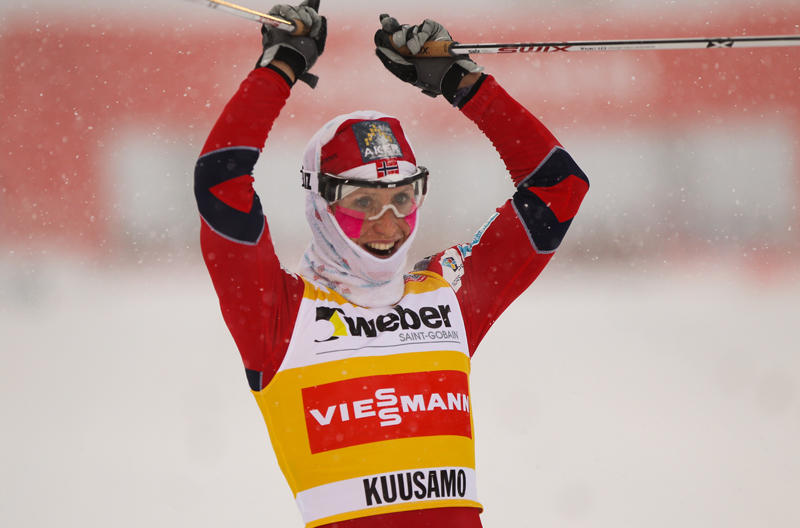
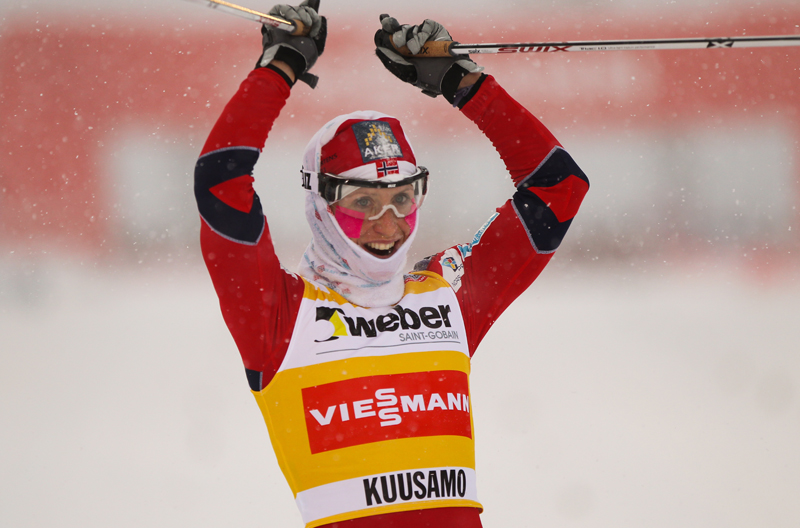
    Marit Bjørgen (NOR) after winning the Kuusamo World Cup 10 k classic pursuit by a minute and 21 seconds for the Ruka Trip mini-tour title on Sunday in Kuusamo, Finland. Photo: Fischer/Nordic Focus.

    As far at the television coverage showed, it didn’t look like Marit Bjørgen ever looked back on Sunday in Kuusamo, Finland. It would’ve been pointless to do so; Norway’s defending World Cup champion was always more than a minute ahead and the white-out conditions made the visibility near zero.

    Starting first in the 10-kilometer classic pursuit – the culminating race of the Ruka Triple mini tour, with full World Cup points and 5,000 Swiss francs ($5,400 dollars) on the line – Bjørgen had nearly a minute to play with off the line. Kikkan Randall of the U.S. started next, 53 seconds back, and Finland’s Krista Lahteenmaki went out third (+0:59).

    However, it was the next couple starters that formed the most contentious chase group within the first few kilometers, with Justyna Kowalczyk of Poland in bib 4 leading Norwegians Heidi Weng and Therese Johaug, who started fifth and seventh, respectively. (Yulia Tchekaleva of Russia did not start sixth, traveling instead to Canada in preparation for the Quebec World Cup sprints next week.)

    Randall settled in behind the group and after losing contact before 4 k, worked with Lahteenmaki to try to gain back some ground on the front four. Bjørgen remained out of reach throughout the race with Kowalczyk, Weng and Johaug narrowing the gap to a minute and 14 seconds before the halfway point.

    They reeled her in by about the same margin by 6.4 k, but with one lap to go, Bjørgen made up a few more seconds despite an increasingly difficult workload in the snow-covered tracks.

    Justyna Kowalczyk (POL) enters the stadium and strides to second in Kuusamo 10 k classic pursuit.

    In the end, the 32-year-old Bjørgen won the fourth-straight individual World Cup race of the season; yep, every single one. She swept the mini tour, with victories in the classic sprint, 5 k freestyle and classic pursuit, winning the latter in 31:19.4. Kowalczyk pulled off second place, 1:21.4 back. Weng surged up the last hill past Johaug to challenge Kowalczyk, but settled for third (+1:23.9). Johaug was fourth (+1:34.1) with the second-fastest time of the day, 8.1 seconds behind oBjørgen.

    Randall broke away from Lahteenmaki around 6.4 k to make a run for the chase group. She managed to stay ahead by at least a few seconds and ultimately finished fifth (+2:24.8) while Lahteenmaki placed sixth (+2:33.1). At the finish, all eyes were on Bjørgen, whom Randall had predicted would take an army of efforts to defeat.

    “Maybe we can work together and try to reel Marit back in,” Randall said after Saturday’s 5 k, where she was second. “She’s definitely strong right now … so it’s gonna be fun and hard.”

    Hard was probably the best description of it on a cold afternoon near the Arctic Circle with temperatures around -9 degrees Celsius (15.8 Fahrenheit) and snow falling heavier throughout the women’s race.

    “Another incredible day for me,” Bjørgen told NTB, according to a translation. “I concentrated on doing well technically, and it went fast as I had done throughout the weekend. This was one of my best weekends in Kuusamo ever.”

    She won the Kuusamo mini-tour title last year as well, and given a 53-second lead from the start, Bjørgen was confident she could keep it.

    “I knew I had to focus on [myself to] succeed,” she told Eurosport.Onet.pl. “Right at the start I heard that my advantage has increased … [and] I felt that I was able to get the best time of the day. In the second part of the distance the snow was falling very strong, however, this is a winter sport and you have to compete in such an environment. I have a big advantage when the conditions do not really matter.”

    For overall World Cup runner-up Kowalczyk, it was her first podium of the season.

    “It was a good race,” Kowalczyk told NRK. “The shape is good and the skis were good. There is a lot of hard work, but it’s better than a week ago. My form is getting better every start. Maybe I come in the same form as Marit.”

    Bjørgen, for one, is worried that it might be too much too soon.

    “I hope that the form did not come too soon,” she told Eurosport. “I’m going to leave a couple of starts in order to better prepare for the Tour de Ski and World Cup.”

    Bjørgen and Johaug planned to skip the Canada World Cups in preparation for the Tour de Ski and second period. According to Norwegian coach Vidar Løfsus, the rest of the women’s team will be there, including seventh- and eighth-place finishers Vibeke Skofterud and Kristin Stoermer Steira.

    “I will go home now and then train two weeks at high altitude in [Italy’s] Seiser Alm to get ready for the Tour de Ski,” Bjørgen said.

    ***

    Women’s pursuit results

    Justyna Kowalczyk (POL), Marit Bjoergen (NOR) and Heidi Weng (NOR) take the Kuusamo (FIN) mini-tour podium. Photo: Fischer/Nordic Focus.
  • Randall Keeps Climbing, Second to Bjørgen in Kuusamo 5k

    Randall Keeps Climbing, Second to Bjørgen in Kuusamo 5k

    Kikkan Randall (USA) on her way to second place in the 5km women’s skate in Kuusamo (FIN). Photo: Fischer/Nordic Focus.

    Last season Kikkan Randall (USA) turned in one stellar performance after another, winning two races and finishing on the podium three other times on her way to the overall Sprint Cup title.

    The 2012 season would be a tough act to follow — but now, just four races into the 2013 campaign and Randall’s premier event, the skate sprint, yet to be run, she has done more than just follow up.

    A week after posting the first ever women’s World Cup distance podium in the history of U.S. cross-country skiing, Randall climbed one step higher, placing second to the currently unbeatable Marit Bjørgen (NOR) in a 5km skate race in Kuusamo, Finland.

    “Nope,” U.S. women’s team coach Matt Whitcomb responded succinctly when asked if Randall could surprise.

    Marit Bjoergen (NOR) celebrates her win in the 5km women’s skate in Kuusamo (FIN). Photo: Fischer/Nordic Focus.

    Starting at the back of the field, Bjørgen never trailed, skiing clear to a 22.7-second victory over the American in the individual start event, continuing an impressive three year win streak in the opening two weeks of the World Cup season.

    “I have been feeling very good,” Bjørgen told assembled media at the post-race press conference. “When I was warming up this morning, I felt my body was very strong. I had to tell myself to take it little bit easy.”

    The battle for the remaining podium spots was much tighter however. Randall was in the mix from the start, ranking third at 1.3k, less than two seconds down on Therese Johaug (NOR), and fourth at 3.1k, still just over a second behind Johaug with Heidi Weng (NOR) slipping in between.

    The five-kilometer distance is generally only raced as part of a relay, but appears as stage in the Ruka Triple Mini-Tour.

    The strategy, Whitcomb told FasterSkier after the race, was to attack the short course from the get-go, to be “a bit violent,” and to not “waste a single minute of the course on being conservative or focusing too much on…pace.”

    The Norwegians didn’t fade off much, but it was Randall, and Russian Yulia Tchekaleva, who had a bit more left over the final kilometer-and-a-half.

    Johaug slipped down to fourth and Weng fifth, as Tchekaleva made up a solid eight seconds to claim third, just 1.8 seconds behind Randall.

    Tchekaleva is back in action this year after sitting out last season while having a baby.

    The 28-year-old earned her first World Cup podium today, and now sits in 6th in the mini-tour standings.

    While the Russian notched a personal-best, her nation has a long history of success. Randall’s result, however, marked yet another high water mark for the United States.

    Thirty years after the last US distance podium, Randall bounced back from a sub-par performance in Friday’s classic sprint.

    “It played out as results often do for Kikkan, where the second day can be very strong,” Whitcomb said.

    He explained that she often needs a hard effort to “spark the body.” On a sprint day Randall often improves through the heats as each round cranks the engine a bit more.

    Yesterday, that wasn’t a case, and Randall experienced “a little flatness” according to Whitcomb. But the effort provided the charge necessary to be ready for today’s 5k.

    And ready she was.

    “I’m feeling a little bit relieved. Yesterday I felt pretty flat in the sprint, and didn’t feel super good warming up today so I was a little nervous,” Randall told FasterSkier. “Still I felt good once I got out there on the race course and pretty psyched with another solid finish today and psyched for a good day tomorrow.”

    With the format an individual start, Randall couldn’t know exactly where she stacked up. She said she did not pay much attention to splits, instead staying “focused on skiing each hill hard, getting speed over the top, skiing the flats well.”

    She did hear she was in contention for the podium headed over the last hill, but knew that with a number of fast starters behind, nothing was guaranteed.

    “I gave it what I had to the finish line and it ended up being pretty awesome,” she said.

    Randall enjoying the leaders chair. Photo: Fischer/Nordic Focus.

    While Randall led the way at the top, she was not the only American to standout. With teammates Jessie Diggins, Liz Stephen and Holly Brooks all cracking the top-20, the day was arguably the best distance day ever for the team.

    With a 10k classic pursuit event on Sunday to wrap up the Ruka Triple, Bjørgen has the win wrapped up barring catastrophe, holding a 53-second lead on Randall.

    The battle for second and third, however, should be tight.

    Krista Lahteenmaki (FIN) will start third, 5.8 seconds behind Randall. She is closely followed by Justyna Kowalczyk (POL) another three seconds back.

    Kowalczyk is off to her usual slow start, perhaps even slower than in past years. But she is strongest in classic distance races, and her version of “slow” meant an 11th place finish today.

    After the Pole, Weng sits in no-man’s-land 12 seconds behind Kowalczyk and 12 ahead of Tchekaleva and Johaug.

    Results

    Mini-Tour Standings

    Of Note:

    –       Norway placed six skiers in the top eight, with only Randall and Tchekaleva breaking up the red sea.

    –       Lahteenmaki placed 10th, just 1.5 seconds ahead of Kowalczyk.

    –       Norway and the U.S. were the only teams to have four or more skiers in the top-20.

    –       After strong sprint results on Friday (2nd and 3rd), the Russian women appear to be back as a force on the World Cup. In addition to 3rd today, the team took 20th, 22nd and 23rd.

    –       Veteran Aino Kaisa Saarinen (FIN) struggled to 52nd place.

    Kikkan Randall (USA), Marit Bjoergen (NOR) and Yulia Tchekaleva (RUS) gather on the podium following the 5km skate in Kuusamo (FIN). Photo: Fischer/Nordic Focus.


  • With Sprint Victory in Moscow, Kowalczyk Takes Over Yellow Bib

    With Sprint Victory in Moscow, Kowalczyk Takes Over Yellow Bib

    Kowalczyk on her way to winning the freestyle sprint in Moscow, Russia. Photo: Fischer/Nordic Focus.

    The reigning queen of Polish skiing is officially back on top of the world. After a slow start to her 2011-2012 campaign, Justyna Kowalczyk owned the Tour de Ski in January, then followed up that performance with her victory on Thursday in the Moscow city sprint.

    In doing so, she took over the yellow bib that represents the top level of World Cup success.

    In front of a home crowd, Russian teammates Natalia Korosteleva and Anastasia Dotsenko finished a close second and third in the freestyle sprint, respectively.

    “I’m really emotional today, because normally I am not strong at city sprints,” Kowalczyk said in a press conference after the race. “I am happy I have taken over the yellow, but it will be a hard job to keep it till the end of the season.”

    With her third straight victory, worth 100 World Cup points, Kowalczyk overtook Norway’s Marit Bjoergen in the standings, and now sits ahead by 38 points. Following illness earlier this month, Bjoergen was absent from Moscow on Thursday.

    In contrast to the collision-ridden sprints seen at other venues this season, the wide trails in Moscow afforded competitors plenty of room to maneuver, and unfolded relatively tamely.

    In her quarterfinal, Kowalczyk got off to a moderate start, and skied in the middle of the pack while Korosteleva led the way. A headwind in Moscow gave skiers reason enough to tuck in behind each other to conserve energy, which is exactly what Kowalczyk did after moving up into second.

    Kowalczyk leading the charge over the bridge in the quarterfinals, with Sargent (26) close behind. Photo: Fischer/Nordic Focus.

    The reportedly slow snow and longer-than-usual distance made a visible difference in the way the women skied: For a sprint race, their tempo seemed more labored and deliberate than what it had been in Dusseldorf or Milan earlier this season. Kowalczyk moved into the lead in the second half of the race, and comfortably crossed the line in first. Her final effort from the front made hers the fastest quarterfinal.

    While skiing from the front worked for Kowalczyk, others were unable to maintain the lead through the finish after pushing early.

    In the fourth heat, Astrid Jacobsen (NOR), the second-fastest qualifier and fresh off a Norwegian sprint title, paid for her decision to ski from the front and faded to fourth, failing to advance. Anastasia Dotsenko (RUS) and Riikka Sarasoja-Lilja (FIN) successfully drafted and passed her in the final straightaway.

    The beginning of the first semifinal presented an unusual sight: three American women in black spandex, all skiing at the front of the pack. Jessie Diggins led early, with her teammates Kikkan Randall and Ida Sargent just behind her.

    The Americans led all the way to the top of a bridge just before the final straightaway, but as the pack came off of the brief downhill on the other side, Korosteleva pulled up behind Randall and squeezed in front of Sargent.

    As Diggins, Korosteleva and Randall entered the lanes, it almost appeared as though the Russian would win the heat, but Diggins lunged for the top spot. Randall was less lucky, and crossed the line in third. With the second semi yet to take place, at that point a spot in the final as a lucky loser was still a possibility for the World Cup sprint leader. Ida Ingemarsdotter (SWE), Ingvild Oestberg (NOR) and Sargent finished fourth, fifth, and sixth.

    The second semifinal featured Kowalczyk and Saarinen, who skied to the front out of the gate and remained there for the entirety of the heat. Kowalczyk didn’t seem to suffer from doing most of the work; when the real race began up the bridge, she held her lead, though Saarinen threatened to edge her to the line in the final meters.

    Just as it had been in the quarters, Kowalczyk’s semi was the faster of the two, and third and fourth place finishers Dotsenko and Krista Lahteenmaki (FIN) made it through to the finals as the lucky losers.

    As the six remaining women lined up next to each other for the final, Kowalczyk was the clear favorite next to Diggins, Korosteleva, Dotsenko, Saarinen and Lahteenmaki. Diggins presented a bit of a wild card—she had clearly demonstrated spectacular fitness in the first two rounds, but it was hard to tell how much they had taken out of her.

    Kowalczyk raising her arms in triumph. Photo: Fischer/Nordic Focus.

    The gun went off and Korosteleva took the lead, with Diggins skiing wide to tuck into second down the back side of the first of the two bridges. Kowalczyk began to push her way up halfway through, and moved into second behind Korosteleva. Diggins held position in the middle of the pack, and as the group skated up the hill on the second bridge, the pack was still tight behind Kowalczyk and Korosteleva.

    Down the other side into the stadium, Kowalczyk and Korosteleva were practically even, but Kowalczyk once again proved her dominance and took victory in a lunge. Dotsenko was third (+0.2), Saarinen fourth (+0.7) Lahteenmaki fifth (+0.8) and Diggins, who ran out of gas in the final 150 meters, was sixth (+1.1)—still a career best effort.

    For the two Russians in second and third, podium finishes at home brought a great deal of pride.

    “It is special for me,” said Korosteleva. “The fans and atmosphere was great. I hope the cross-country World Cup returns to Moscow.”

    “I’m proud to be on the podium in Moscow,” added Dotsenko.

    The World Cup continues on Saturday in Rybinsk with a 10 k freestyle.

    Women’s results.

    Women’s World Cup standings.

    The women's podium in Moscow: 1. Kowalczyk 2. Korosteleva 3. Dotsenko. Photo: Fischer/Nordic Focus.
  • Finns Settle Contract Dispute, and National Team Reassembles

    Finland's Krista Lahteenmaki on her way to winning the 10 k skate at 2011 U23 World Championships. A provision in Lahteenmaki's contract requires her to turn over five percent of her earnings to the ski federation.

    A dispute between the Finnish ski federation and members of the national team was resolved on Monday, the federation reported, meaning that all 18 members of the team have rejoined the coaching staff and are training together in the final period before World Cup competitions begin.

    “Now it’s finally time to focus only and exclusively on elite sport,” a group of athletes who had been training independently while embroiled in the conflict said in a joint press release.

    The problems originated with a clause in the athletes’ contracts stipulating that skiers born after 1987 must pay five percent of their prize money to the federation. The rule was first written into contracts in 2008, when it affected a single young member of the national team. But as team composition changed, it affected more and more athletes and last season, the rule garnered the federation roughly a thousand euros. According to Finnish team leader Reijo Alakoski, all of that money was reinvested in the junior program.

    The cash may have helped young skiers develop into national-team prospects, but nobody is thrilled by the idea that once they “make it”, those same skiers will be handing their money back to the federation. Even senior members of the team are up in arms, with many refusing to sign their contracts.

    Only four skiers had done so – all women – and head coach Magnar Dalen had just a skeleton squad going into a training camp in Val Senales, Italy last week. World champion Matti Heikkinen was left behind, along with World Championship medalists Sami Jauhojaervi, Ville Nousiainen, and Krista Lahteenmaki.

    Lahteenmaki wrote on her blog that she found it particularly harsh that young skiers were required to fork over their cash because prize money makes the biggest difference early in a skier’s career. At just 21 years of age, she has already won two World Championships medals. She’s also one of the athletes affected by the five-percent provision.

    “I just do not understand why they want the money only from the young, why not subject everyone to the same rule?” she wrote. “In fact, I feel that the money which I got is really important… It is the spark, why the athletes want to invest more and more [effort in the sport].”

    Sami Jauhojärvi celebrating a win in the 2010 Tour de Barents.

    Jauhojaervi made similar comments to the press and called for the provision to be dropped from the national team contracts.

    “Mainly, it would be equal in terms of the young athletes being treated as we are treated,” he told the Finnish Broadcasting Company. “The team’s financial situation has improved and it shouldn’t be funded by the success of young athletes.”

    Although Jauhojaervi was not affected by the provision, he is the captain of the Finnish team and took it upon himself to fight what he saw as an ethical battle.

    “It’s about equality under the law,” he told Bergen News. “It’s one of the basics of the Olympic ideology.”

    Alakoski, the team leader, told the same newspaper that the provision could be considered a tax, and that successful athletes should be happy to give something back to their teammates.

    But Lahteenmaki didn’t share his rosy vision.

    “Is this the right way to treat athletes?” she asked on her blog. “Why should I encourage young people to continue in this sport, when I know what is waiting for them?”

    The standoff  dragged on all summer, but with the race season rapidly approaching things came to a head. Without officially being on their national team, the skiers could not represent Finland in international competition. In addition, they were not invited to training camps like the one in Italy, and instead trained on their own. By mid-October, this no longer seemed acceptable.

    Aino Kaisa Saarinen racing in the 10 k at 2011 World Championships.

    Four-time world champion Aino-Kaisa Saarinen said that these considerations were what ultimately caused her to sign the contract even though she didn’t agree with the five-percent provision. She was one of the four athletes who were cleared to travel to Val Senales.

    “I signed the contract and left the politics behind,” she wrote in a blog post. “I decided that the Val Senales camp would be the best. And if I don’t earn money, how can I support my family? As a professional athlete, I had no choice.”

    Lahteenmaki described how the dispute, which played out very publicly in the Finnish media, had affected her training.

    “On Wednesday, we were informed that the majority of the squad have been separated, and on Friday we would have had to leave the camp in Italy,” she wrote on her blog, adding that in the following days she spent her time talking to the media and waiting for communications from the ski federation; Jauhojaervi told a Finnish news website that he had spent ten hours negotiating in just a single day last week.

    “Of course, in this situation, training would have been futile,” Lahteenmaki wrote.

    While Saarinen made her choice somewhat earlier than most of her teammates, in the end they all had to agree with her rather than spend more time talking to the press and the ski federation. After losing what some claimed was the most important week of training leading up to next month’s World Cup openers in Beitostolen, Norway, the skiers said that enough was enough and issued a joint press release.

    “[We] are willing to compromise and willing to sign the contract that the union previously offered,” they said. “The athletes hope that the association’s board still can remove the so-called five percent clause from the contract. If the Board does not agree to it, the athletes are still signing contracts because they have already missed a week of training, both mentally and physically.

    “Despite the compromise, the underlying conflict between athletes and federations have not disappeared.”

    The federation promised to revisit the issue at the end of the season, before the skiers are given new contracts to sign for the 2012-2013 season.

    “I can’t believe this was all over a thousand euros,” Alakoski said. “But despite that we hope to return to this in the spring.”

    In the meantime, the athletes are back training with head coach Magnar Dalen, and the fight has given them a greater sense of unity.

    “I greatly appreciate that the team that was ready to fight for our young people,” Lahteenmaki wrote. “Also, all the support that has come from outside our group has been really important. All of this has … created a belief that our fight is for the right cause.”


  • Majdic, Manificat Victorious in Tour de Barents Stage 1

    The North American elite racing season may be over, but there is still plenty of action to be found in Europe, including the second annual Tour de Barents, a four-stage mini-tour in the Barents region of northern Europe.

    While fields are not large – just 11 women and 35 men are contesting this year’s event – there is plenty of firepower. Petra Majdic (SLO) leads the women as she wraps up her farewell tour. Majdic is joined by young Finnish star Krista Lahteenmaki and her World Cup teammate Kerttu Niskanen.

    World Cup standouts Kristin Stoermer Steira (NOR) and Alena Prochazcova (SVK) are also competing.

    On the men’s side, 2010 Tour de Barents champion, Sami Jauhojärvi (FIN) will attempt to defend his title. He will be challenged by the French duo of Maurice Manificat and Jean Marc Gaillard as well as Lukas Bauer (CZE), John Kristian Dahl (NOR), World Champion Matti Heikkinen (FIN), Tobias Angerer (GER) and Estonian veteran Jaak Mae.

    The mini-tour kicked off this morning with a 6/12km individual start event in Tana, Norway.

    Majdic skied to a 12.8 second victory over Niskanen. Lahteenmaki was just another .8 seconds back in third.

    Prochazkova was fourth, and Italian Virginia De Martin Topranin, 24th in the 2011 Tour de Ski took fifth.

    Stoermer Steira who has not been in top form in classic events this season, struggled to a seventh place finish, over a minute back of Majdic.

    “The race was perfect for me,” Majdic said, noting she hasn’t classic skied in two weeks. “The course was great for me, because the uphills were not steep and the track was fast.”

    Manificat served notice that this year’s Tour de Barents would be no cakewalk for Jauhojärvi, who ran away with the overall title last year.

    The 25-year-old Frenchman skied to an eight second victory over Jauhojärvi. Teammate Gaillard was third +9.9 seconds, with Bauer and Heikkinen rounding out the top five.

    “I heard intermediate times well, and my finish was really good today,” Manificat said referring to on-course splits. He led at every official time check, and surprised many given that he has been known as something of a skate specialist.

    “I have worked a lot on classic during the season, and it shows,” Manificat said.

    Racing continues on Thursday with a 10/15km freestyle mass start in Inari, Finland. Following an off day on Friday, the Tour picks up with a classic sprint in Rovaniemi, Finland, before concluding with a hill climb at the same location.

    Majdic is realistic about her chances in the hill climb, so is looking to build a substantial lead in the next two stages. The sprint, especially, with bonus seconds will be critical.

    “Tomorrow’s mass start and Saturday’s sprint with bonus seconds are important for me, because I think I will not be the best on the Ounasvaara Climb on the final day,” Majdic said.

    The final climb is a new take on the format popularized in the Tour de Ski. Instead of the standard mellow terrain into wall of a hill to the finish, the Tour de Barents version features a repeated 4.4km loop.

    The women will ski the circuit twice and the men three times. The hill is 109 meters of vertical over just a 900-meter stretch. The course then drops precipitously back to the stadium, where the fun starts all over again.

    Skiers may race any of the races individually and compete for prize money, but obviously must complete all stages to be eligible for the overall title.

    There is also a junior competition – both in the individual races and for the overall Tour.

    The Barents region consists of land bordering the Barents sea, and was established following the fall of the Soviet Union with the goal of creating international cooperation for promotion and development of the area.

    Tana is a municipality in Norway consisting of numerous small townships. It is the fifth largest municipality in the country based on area but is home to only 3,000 people. Bordering Finland, official languages include Sami and Bokmål.

    Complete Results

  • Swedes Sensational in Team Sprint Win in Oslo

    Swedes Sensational in Team Sprint Win in Oslo

    Charlotte Kalla in the women's team sprint.

    Norwegians Petter Northug and Marit Bjoergen have now both sat out a race at World Championships – not Charlotte Kalla though, and the Swedish star has no plans to take a day off.

    In another day at the office, Kalla teamed with Ida Ingemarsdotter to win the women’s World Championship classic team sprint in Oslo, Norway, skiing away from Finland and Norway in the last lap.

    Ida Ingemarsdotter (L) and Kalla (R) celebrating at the medals ceremony.

    The team sprint features pairs of athletes, alternating laps, for a total of six loops in a contest that favors neither pure speed, nor great endurance, but a balance of the two. Referred to as the “Championships of interval training,’ the nearly twenty minute race is a brutal test, especially on the challenging Holmenkollen course.

    The big climbs, and relative lack of recovery played into team selection, with more weight being placed on the ability to maintain a high pace for a long period – the bread and butter – or perhaps more appropriately, the brød and gjetost – of the distance skier.

    With that taken into account, Finland, the two-time defending Champions, were favorites to keep a tight grip on the crown. Both Aino Kaisa Saarinen and the young Krista Lahteenmaki excel in the longer races. But the women’s field generally features many fewer sprint specialists than the men’s, and with the emergence of Ingemarsdotter as a solid World Cup racer on the longer courses, Sweden certainly looked good coming in.

    Two semifinals of eight teams kicked off the day in a battle for the ten slots in the final. The top three teams in each heat advance automatically plus the next four fastest pairs.

    With only one team per nation allowed at the World Championships, the field was somewhat diluted. In both semis, the top teams were able to break away, back off the pace, and cruise to the finals, leaving the rest to fight for every second, and a lucky loser slot.

    Norway, Sweden and Slovenia easily outpaced their competition in the first semi booking their spots in the final. In the

    Finland's Aino-Kaisa Saarinen leading through the fog.

    second heat, Finland and Italy easily advanced, with the US taking down Germany for the last automatic slot.

    Ingemarsdotter summed up the basic strategy for the medal favorites, saying “In the qualification I tried to do an easy job…just going with the others slow and easy, and save all energy I could for the final.”

    Two teams from each semi moved on as lucky losers, and the table was set.

    Right from the gun it was clear this was a different race – the pace was high the intensity palpable. There would be no “easy job” here.

    Finland, with Saarinen taking the first leg, pushed the pace from the start, a planned approach according to Finnish head coach Magnar Dalen.

    “They are distance skiers first of all,” Dalen said of his women, “so the thing was to ski fast and hard from the beginning.”

    The goal was to break as many teams as possible, and tire out anyone who could hold on. In many ways, the strategy paid off. Sweden, Finland, Norway, Slovenia and Italy quickly opened a gap, and even among these teams there were some clear differences.

    Slovenian Katja Visnar and Italy’s Arianna Follis were both struggling to remain in contact, putting pressure on their teammates – Petra Majdic and Marianna Longa respectively.

    By the time the fifth lap came around, those teams were out of the medal hunt, the stronger skiers unable to make up for their weaker teammates. Barring something cataclysmic, the podium would be an all-Scandinavian affair.

    The Swedes celebrating their victory.

    “We were quite happy to drop Slovenia so Majdic doesn’t have the possibility [of fighting for the podium], Dalen said. “If she is coming close [at the finish] she is very hard to beat.”

    Saarinen’s approach to accomplishing this goal was simple – ski each lap faster than the last.

    Down to the homestretch for the final tag, the three teams were all within a second, Finland holding a slight lead. Out of the fog and into the tag zone, they came, double poling with a fury – these were the last meters for the scramble skiers.

    In a matter of seconds the race changed, Sweden making a move that would result in gold. Kalla waited right at the beginning of the zone, and took over from Ingemarsdotter before Saarinen had reached Lahteenmaki.

    This gave the Swedes an edge as Kalla was able to accelerate to speed first, and shealmost instantly had three meters on Finland and Norway. She continued to attack up and out of the stadium and into the descent.

    The move was not in response to Finland’s late tag. After the race Kalla said that she planned all along to go hard from the start of her last leg. And Finland’s error was one of strategy, not of execution. According to Dalen, the Finn’s had picked out a spot for the exchange before the race, and merely were following that plan.

    Lahteenmaki and Astrid Jacobsen, who had taken over from Maiken Caspersen Falla for Norway, faced a solid 10-meter deficit by the time they hit the big climb. Halfway up they had made no progress, and Jacobsen, seeing the chance for gold slipping away, made her move. She stepped out from behind the Finn, and pulled alongside. Over the top she led, a position she held around the stadium, up the final hill and down into the homestretch.

    “I saw that Krista – that she didn’t have the power to catch Kalla,” Jacobsen said. “I tried to go in front…because I was

    The women's final.

    dreaming for the gold.”

    Kalla meanwhile opened her lead further, pumping her arms as she crossed the line, skiing into the arms of the strapping Ingemarsdotter, laying claim to the medal that has eluded the Swedish women so far this Championships.

    Jacobsen held her lead until the last 50 meters, but finally succumbed to the relentless Lahteenmaki.

    “I knew that being first into the finish with a girl just behind was not the best,” Jacobsen said. “So when I got in front I knew I was going for the gold and risking the silver.”

    Lahteenmaki described her legs as “full of lactate” on the finish run, but said that her arms still felt good. And with the last 200 meters straight double pole, that was all she needed.

    It was still a good day for the Norwegian pair. Falla is just twenty-years-old, and she bounced around the finish area, still in just her race suit, like a child on Christmas morning, helping the exhausted Jacobsen, and enjoying the moment.

    Jacobsen, for her part, grew up just several kilometers from the venue, and was able to thrill the hometown crowd. At one point her Championships appeared to be over. With Falla besting her in the last two sprints, she had no spot in this event until Marit Bjoergen opted to sit out.

    The former overall World Cup runner up, and the sprint World Champion in 2007 said the bronze today bested both of those accomplishments. Two summers ago, Jacobsen was hit by a car while biking, and for a time it was unclear that she would walk again, let alone ski race at a high level.

    Norway after the race.

    The silver was also a fine accomplishment for the Finns. Veteran Saarinen claimed her second medal of the Championships, and the performance marked the first major conquest of Lahteenmaki, Saarinen’s heir-apparent on the women’s team.

    It wasn’t always the plan for Kalla to race every event. Over the summer, when she was planning for World Championships, she considered dropping the team sprint. She hadn’t had much success classic sprinting in 2010, and that technique has always lagged behind her skating.

    But with her first World Championship gold in hand, Kalla has to feel pretty good about her decision. At the post-race press conference she said that the decision to race was made before she heard that Bjoergen would take a pass.

    She pointed to the improvements she has made in her classic skiing this year and Swedish coach Rikard Grip noted several strong classic sprint results for Kalla.

    And Grip is not concerned about Kalla breaking down under the tough schedule.

    “At the moment when she has the gold medal that gives her much more energy and confidence than if she not should race and have a rest day today,” Grip told FasterSkier.

    The race was also some bit of redemption for the Swedish wax staff who were responsible for the men’s slow skis in both the classic portion of the pursuit and Tuesday’s 15km classic.

    The Championships are likely over for the two Norwegians. Barring something unforeseen, neither has a start spot in the two remaining races. The young Falla can count her first World Championships a great success, despite failing to reach the individual sprint final.

    Before the team competition, she said she was very nervous. “My whole body was shaking,” she described at the press conference.

    Jacobsen, the veteran of numerous big races, shared the feeling.

    “We sat up in the wax cabin shaking together,” she joked.

    Kalla and Ingemarsdotter look to lead Sweden to another medal in Thursday’s 4x5km relay. The two will bookend the race with Ingemarsdotter scrambling and Kalla anchoring.

    Saarinen skis the critical second classic leg for Finland, and Lahteenmaki has another opportunity to close.

  • Lahteenmaki Leaves Women’s 10 K Behind; Nishikawa 16th

    Lahteenmaki Leaves Women’s 10 K Behind; Nishikawa 16th

    Finland's Krista Lahteenmaki on her way to the win in Thursday's 10 k freestyle in Otepaa, Estonia. Photo courtesy of Langd.se

    If one of the races at the 2011 World U-23 Championships was a foregone conclusion, it was probably the women’s 10 k freestyle.

    The top-seeded athlete on Thursday’s start list in Otepaa, Estonia was Finnish powerhouse Krista Lahteenmaki, a World Cup silver medalist—and the results were predictable.

    In an effort that serves as a stark benchmark for the rest of the U-23 women, Lahteenmaki skied to the win by a full minute over Russia’s Mariya Guschina, with Norway’s Hilde Lauvhaug in third.

    Only 15 athletes were within two minutes of Lahteenmaki’s time of 26:33. Canada’s Emily Nishikawa was the top North American in 16th, while Sadie Bjornsen led the Americans in 23rd.

    Canada's Emily Nishikawa racing to 16th place.

    After Wednesday’s junior races went off in cloudy weather, with moderate temperatures, Thursday greeted athletes with a beautifully clear, crisp, and frigid morning—the first time in a week that a color other than gray graced the Estonian skies.

    The snow was squeaky and slow, and temperatures on the coldest areas of the Otepaa trails were close to the legal racing limit of negative four degrees Fahrenheit. The women raced wearing buffs, mittens, and even athletic tape on their cheeks to stave off frostbite.

    Their course, three laps of a 3.3-kilometer loop, took the athletes out of the stadium and on much of the same terrain as last weekend’s World Cup here, through a pair of open fields on an expansive hillside.

    Lacking on Thursday, though, was the brutally steep climb near Otepaa’s ski jump—as well as the spectators. No more than 25 viewed the race from the stadium, while farther out, the course was lined with more coaches than fans.

    Lahteenmaki has raced in front of much larger crowds in the 2011 Tour de Ski and at the 2010 Olympics, but the setting didn’t seem to make much of a difference to her. By the end of her first lap, she was already 25 seconds up on German Denise Herrman, her nearest challenger, and never looked back.

    “She can do this kind of performance when it’s needed,” said Ilkka Jarva, the Finnish U-23 coach—noting that part of Lahteenmaki’s success can be attributed to her health. This year, it’s been good; last year, she was battling an infection with Mycoplasma.

    Still, Lahteenmaki’s victory almost didn’t happen. After her hemoglobin levels tested high before last weekend’s World Cup races and she received a five-day ban, she nearly decided to leave Estonia.

    Instead, according to Heidi Lehikoinen, her spokeswoman, she did a 10 k time trial on the distance race course—recording a time, 29:12, that would have put her in the top 20 of the World Cup field. She had another hemoglobin test on Tuesday before the U-23 racing started, and passed.

    “I was happy that I could ski today,” Lahteenmaki said in the press conference.

    Fortunately for the rest of the field, the 10 k was the only event Lahteenmaki is contesting at U-23’s—she’s departing Otepaa for the Finnish national championships later this week, then competing at the 2011 World Ski Championships in Oslo.

    After her podium finish in a stage of the Tour de Ski earlier this month, it’s conceivable that Lahteenmaki could crack the podium

    American Sadie Bjornsen on her way to 25th.

    in Norway—or at least at future Worlds.

    “It’s just a question of time, I think, when she will take the big win,” Jarva said. “The potential is there.”

    Nishikawa, meanwhile, recorded her personal best U-23 finish with a “really good race,” after warming up with a 46th place in last weekend’s 10 k classic World Cup, when she said she was feeling a little jet-lagged.

    On Thursday, she latched onto Germany’s Monique Siegel, who was starting as Nishikawa lapped through the stadium after a controlled, conservative start. At 3.3 kilometers, she was sitting 25th, before moving up nine places by the finish.

    “I didn’t want to start too fast,” Nishikawa said, noting that she doesn’t get “too wound up” for races.

    U-23’s is often sparsely-attended, and on Thursday, a mere 42 athletes completed the women’s race. Many of Norway’s best athletes were racing at home at their national championships, and the field wasn’t quite as competitive as usual.

    But with Lahteenmaki at the top, there was no question that the world’s U-23 women had a good barometer in the Finn.

    “The U-23—it’s always a little bit thinner, for sure,” said Eric Bailey, one of the Canadian coaches. “But…obviously, there’s still some pretty nice-quality skiers here.”

    Link to full results.

  • Norway Tops Women’s Relay in Thrilling Finale; U.S. Team Eighth, 15 Seconds From Fourth

    Norway Tops Women’s Relay in Thrilling Finale; U.S. Team Eighth, 15 Seconds From Fourth

    Hanna Brodin (SWE) leads Ingvild Flugstad Oestberg (NOR) in the women's relay
    Hanna Brodin (SWE) leads Ingvild Flugstad Oestberg (NOR) in the women's relay

    With pursuit champion Ingvild Flugstad Oestberg and sprint champion Hanna Brodin anchoring their respective teams, today’s women’s relay race was primed for a showdown.

    Oestberg, a Norwegian, had proven to be one of the strongest distance skiers here at the World Junior Championships after winning the pursuit, while Brodin, a Swede had dominated the sprint. The 3.3k distance was right in between the two disciplines.

    They received the tag ten seconds apart, with Oestberg in the lead. By the time they reached the bottom of the main climb here, Brodin had made up the ground, and the two were together. In the middle of the hill, Brodin came around Oestberg to make her move, and for about a minute, she gave it full gas.

    Oestberg told FasterSkier afterwards that she didn’t think she would be able to hold on— but she did. And after hammering up the entire hill, Brodin was exhausted. Over the top, Oestberg put in a surge, and left the Swede behind. Coming into the stadium, she had a lead that looked insurmountable.

    But as the Norwegian neared the finish, one more challenger turned up: Finland’s Krista Lahteenmaki. Chasing ferociously, Lahteenmaki had nearly closed a thirty-second gap to Oestberg, and she passed Brodin like she was standing still, relegating the Swedish team to a bronze medal. And by the time Oestberg made the turn onto the finishing straight, Lahteenmaki was only a few meters behind, and closing hard.

    For fifteen seconds, the crowd held its collective breath, waiting to see if Lahteenmaki could do it. It came down to the final meters. In the end, Lahteenmaki needed just a few more, as Oestberg held her off by 0.5 seconds.

    Ingvild Flugstad Oestberg getting mobbed by her teammates at the finish of the women's relay
    Ingvild Flugstad Oestberg getting mobbed by her teammates at the finish of the women's relay

    “I would have been thinking about that for a long time, if I hadn’t managed to win,” Oestberg said.

    As the Scandinavian battle unfolded at the front of the race, the U.S. women were less than a minute back, just behind heavyweights Russia and Germany. At the finish, Jessie Diggins gave a huge effort to nearly top France in the sprint for seventh, collapsing in pain and exhaustion as soon as she crossed the line. The American team of Diggins, Sophie Caldwell, Caitlin Patterson, and Joanne Reid ended up eighth, just fifteen seconds from Kazakhstan in fourth.

    The team was one spot back of their finish last year, but Matt Whitcomb, the head junior coach here, said that the result wasn’t indicative of the way the women skied.

    “The actual performance was better this year,” he said.

    The Canadians struggled today, ending in 14th, three and a half minutes back. Dahria Beatty’s first leg left the team in eighth, but the rest of her teammates—Heidi Widmer, Marlis Kromm, and Rebecca Reid—couldn’t hold on.

  • 3 of 4 U.S. Women Notch Top Thirties in WJ Classic; Lahteenmaki Wins

    3 of 4 U.S. Women Notch Top Thirties in WJ Classic; Lahteenmaki Wins

    Sophie Caldwell in the 5k classic at the World Junior Championships, Hinterzarten, Germany
    Sophie Caldwell in the 5k classic at the World Junior Championships, Hinterzarten, Germany

    After a strong day by the U.S. U-23 team yesterday, the American junior women said they were feeling the pressure for a strong performance today in the 5k classic.

    “We’ve got to step it up and show that we mean business here,” said Annie Hart.

    While they didn’t exactly match yesterday’s fourth place by Ida Sargent, the juniors did manage a decent show of depth today, putting three of their four women in the top 27. Caitlin Patterson led the way in 17th, with Sophie Caldwell and Hart following in 24th and 27th. All three were within a minute and fifteen seconds of the winner, Krista Lahteenmaki of Finland, while Adele Espy was the fourth American, in 51st.

    Krista Lahteenmaki (FIN) on her way to the win
    Krista Lahteenmaki (FIN) on her way to the win

    Lahteenmaki was followed closely by Ingvild Flugstad Oestberg, a Norwegian who frequently races on the World Cup circuit. Oestberg led halfway through the race by six seconds, but she gave it all up on her second loop to finish three seconds down.

    “I didn’t feel that I went slowly at the end—Krista was tough,” Oestberg said afterwards.

    Monday’s sprint winner, Hanna Brodin (SWE), was another second back, in third.

    Matt Whitcomb, head coach of the American juniors, said that three top-30 results for his women are nothing to scoff at—they used to be “unheard of for the U.S.—we’d get a couple a year. Now we’re shooting for dozens.”

    “The standard has been higher for the last several years,” he said. “The athletes feel it.”

    One of the strengths of the group here, Whitcomb said, is its depth.

    “We don’t have just single athletes that are our only hope in any of these races—we have a full team of athletes that can contend,” he said.

    A slow starter, Patterson said that she favors longer races, and is more jazzed for the upcoming pursuit 10k pursuit on Friday.

    “Do this race and then tack a five k skate on the end of it, plus mass start, I’m really excited,” Patterson said.

    Racing for the U-23 athletes resumes here tomorrow with another individual start classic race. With snow in the forecast, conditions could be more challenging than today’s, but the temperature is expected to stay cold enough to avert any chaotic waxing.

    Link to full results.

    Caitlin Patterson climbing one of the hills in the 5k classic
    Caitlin Patterson climbing one of the hills in the 5k classic