From the FasterSkier archive — posts syndicated from athletes’ and coaches’ own blogs between 2004 and 2012, kept online as published. Current coverage is at fasterskier.com.

Tag: Krista Parmakoski

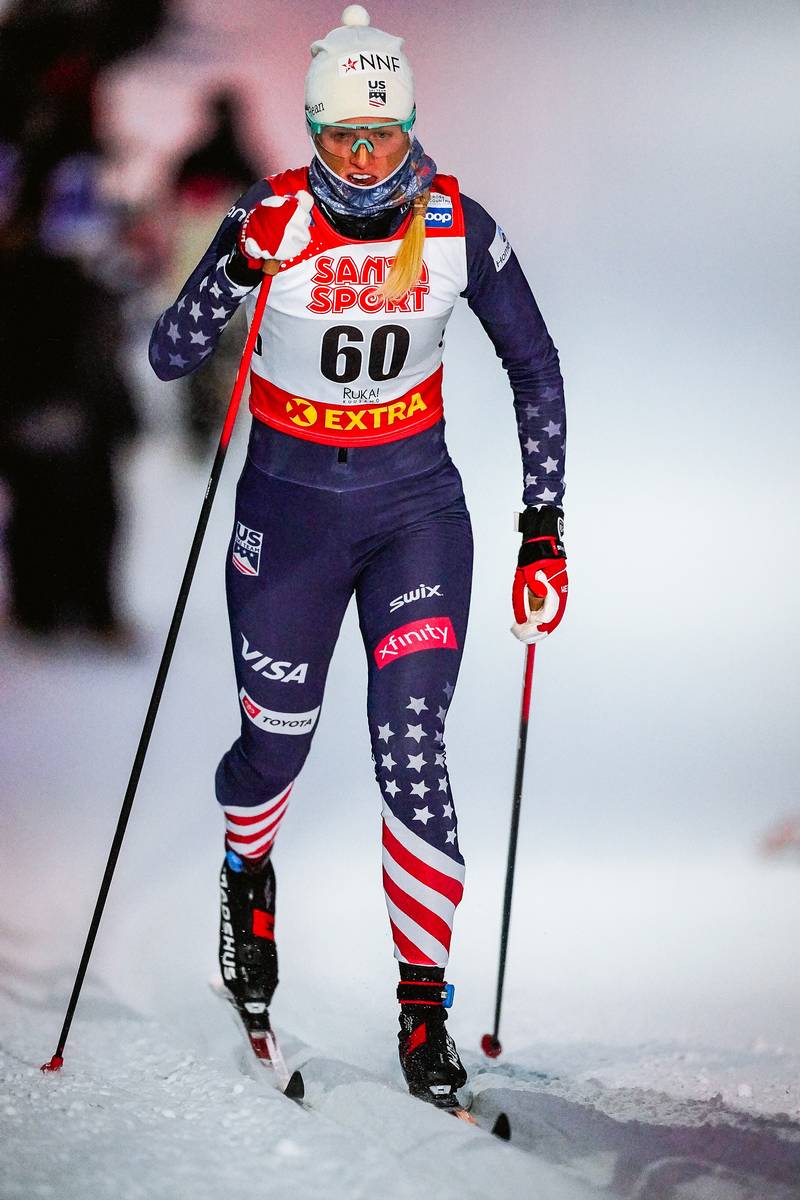
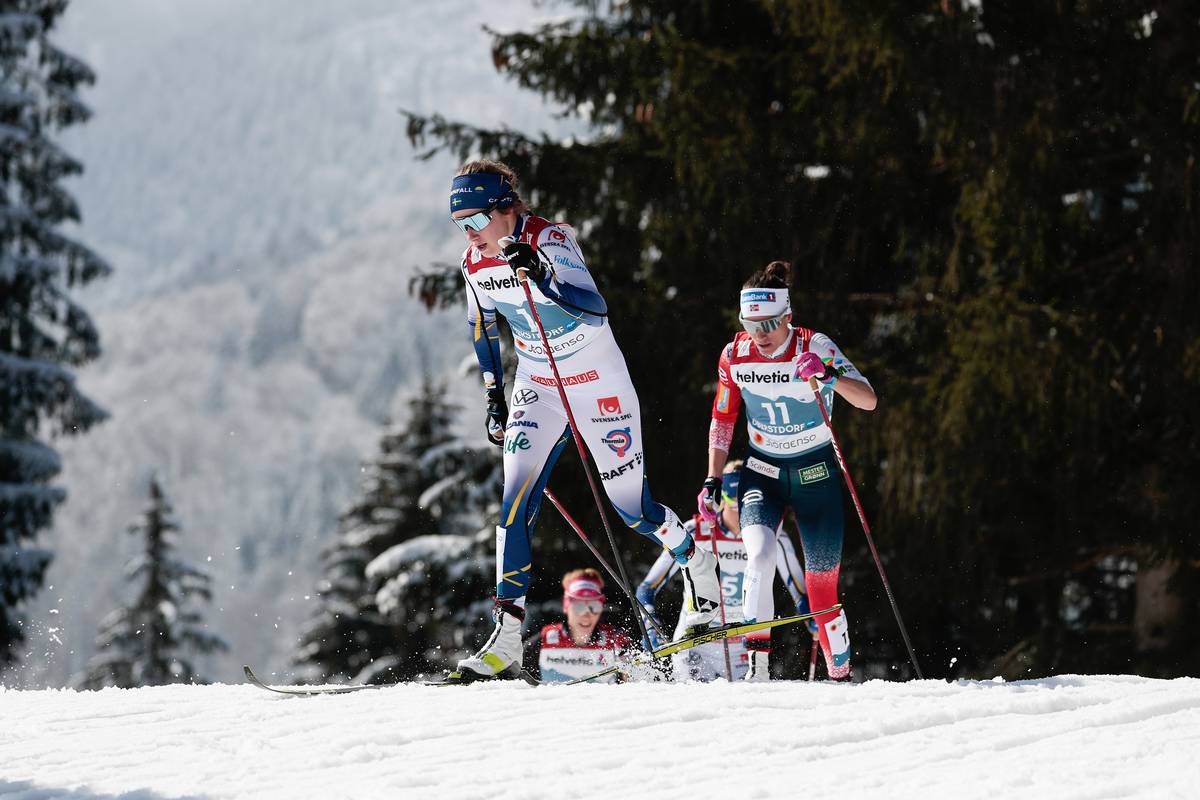
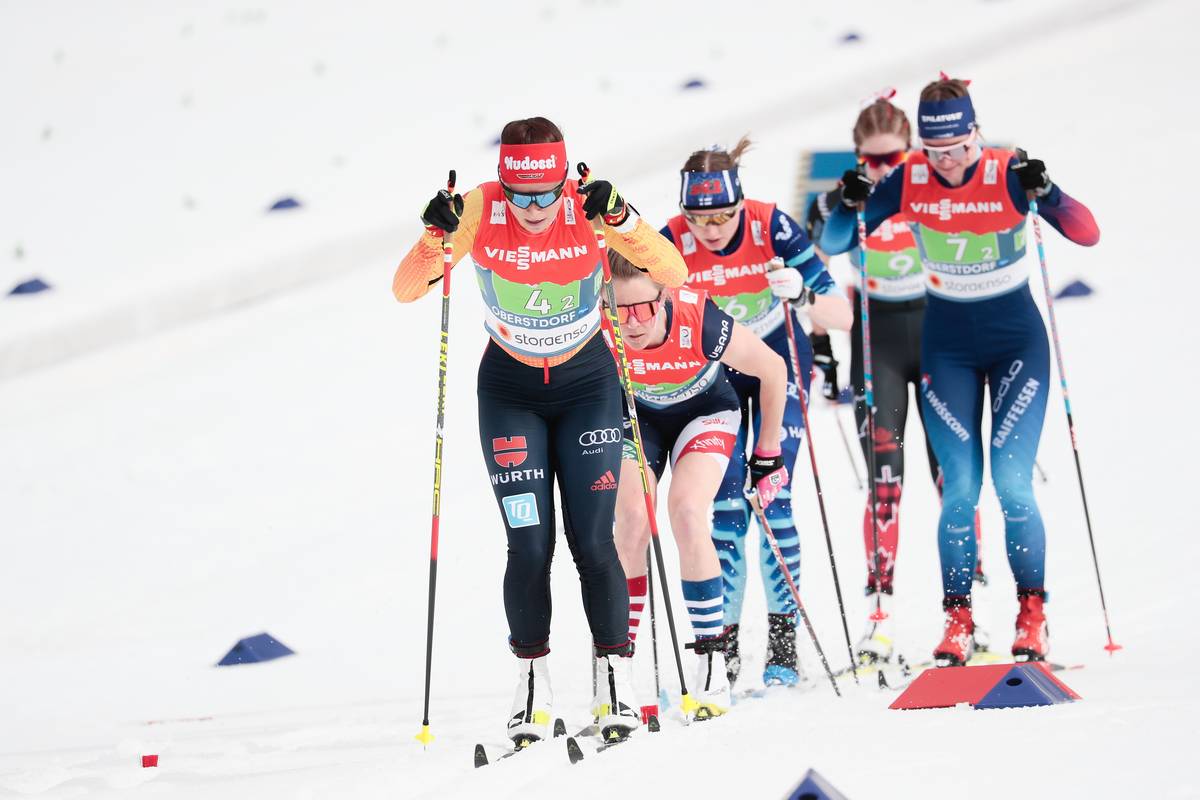
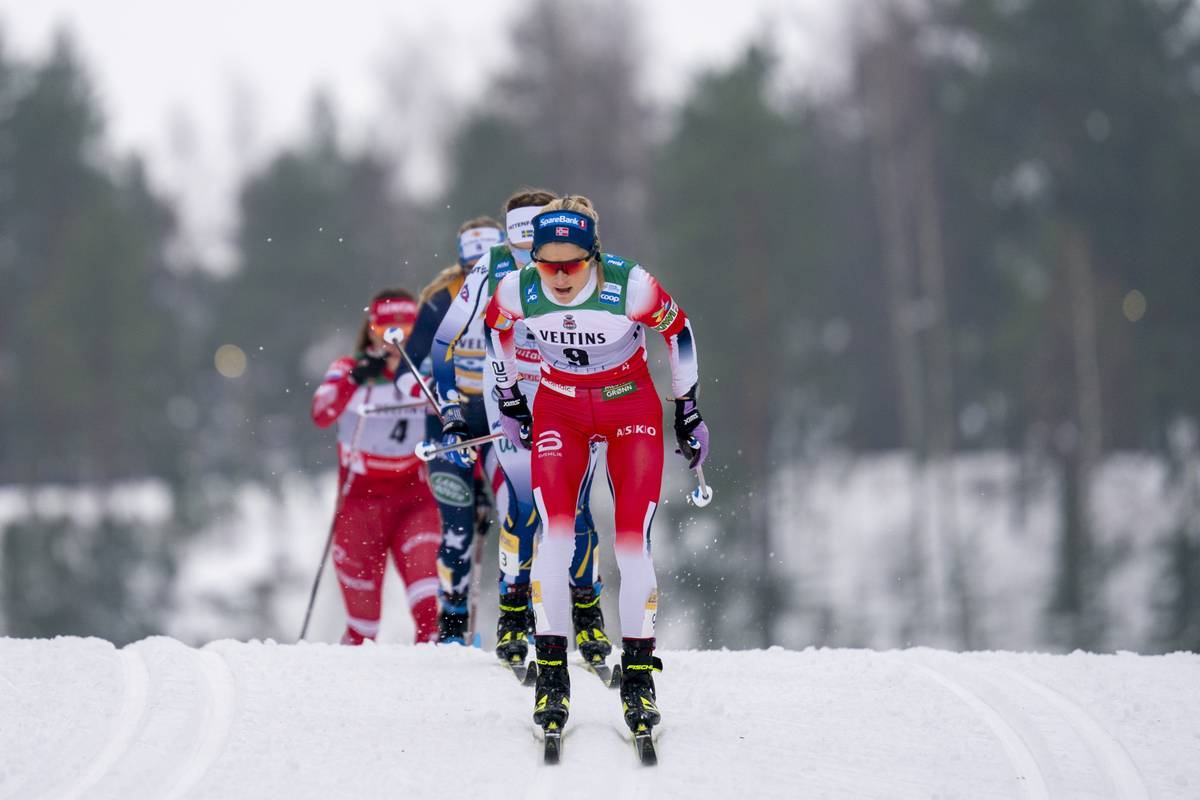
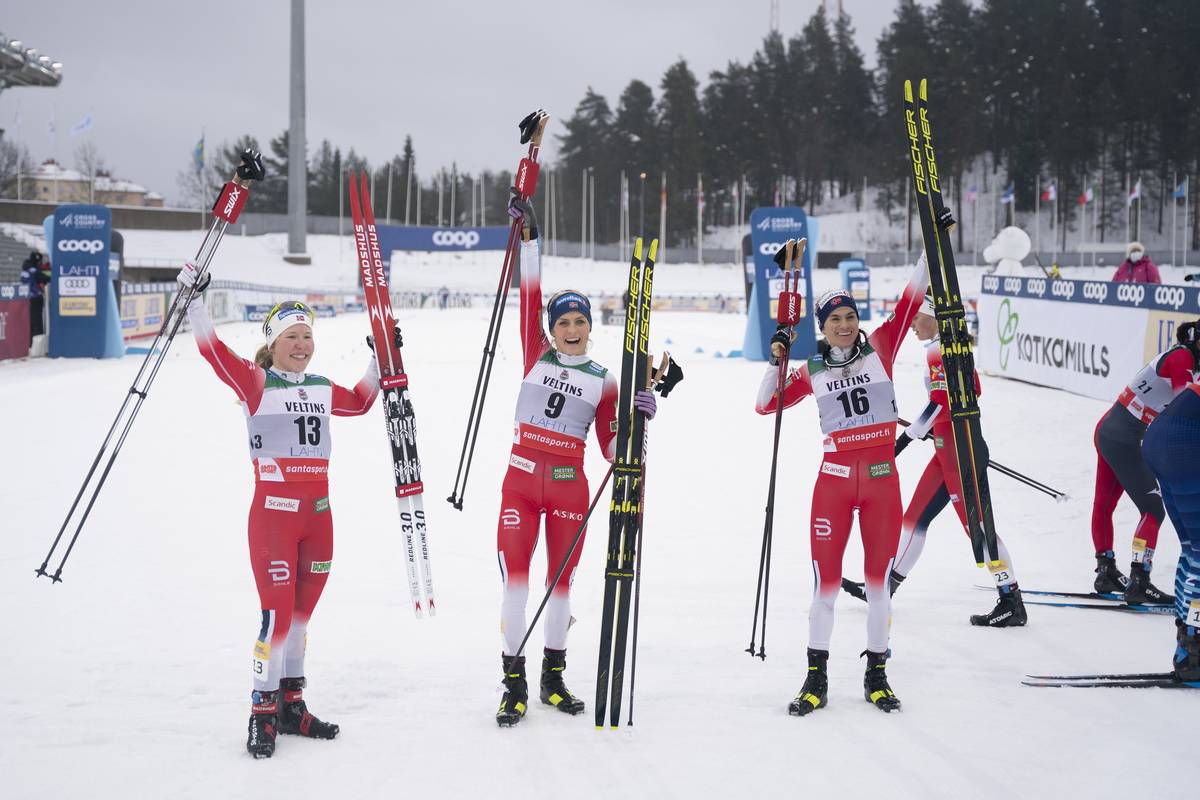
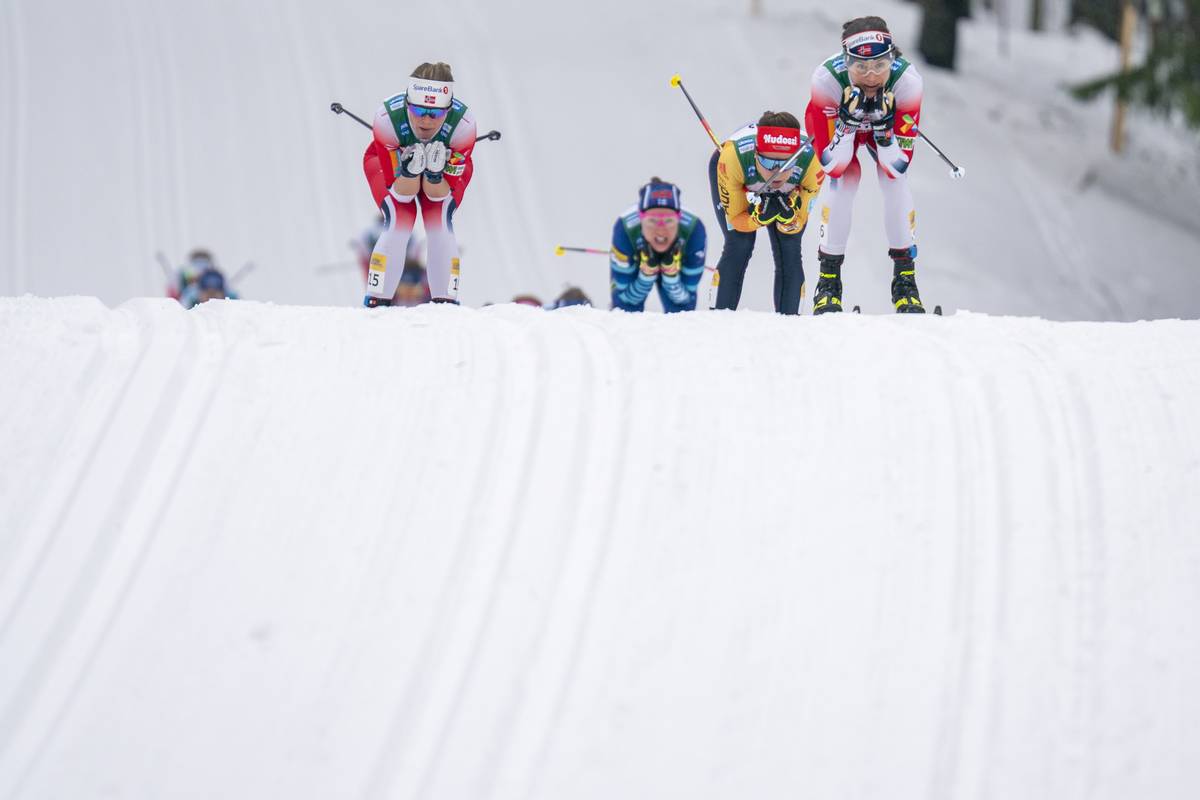
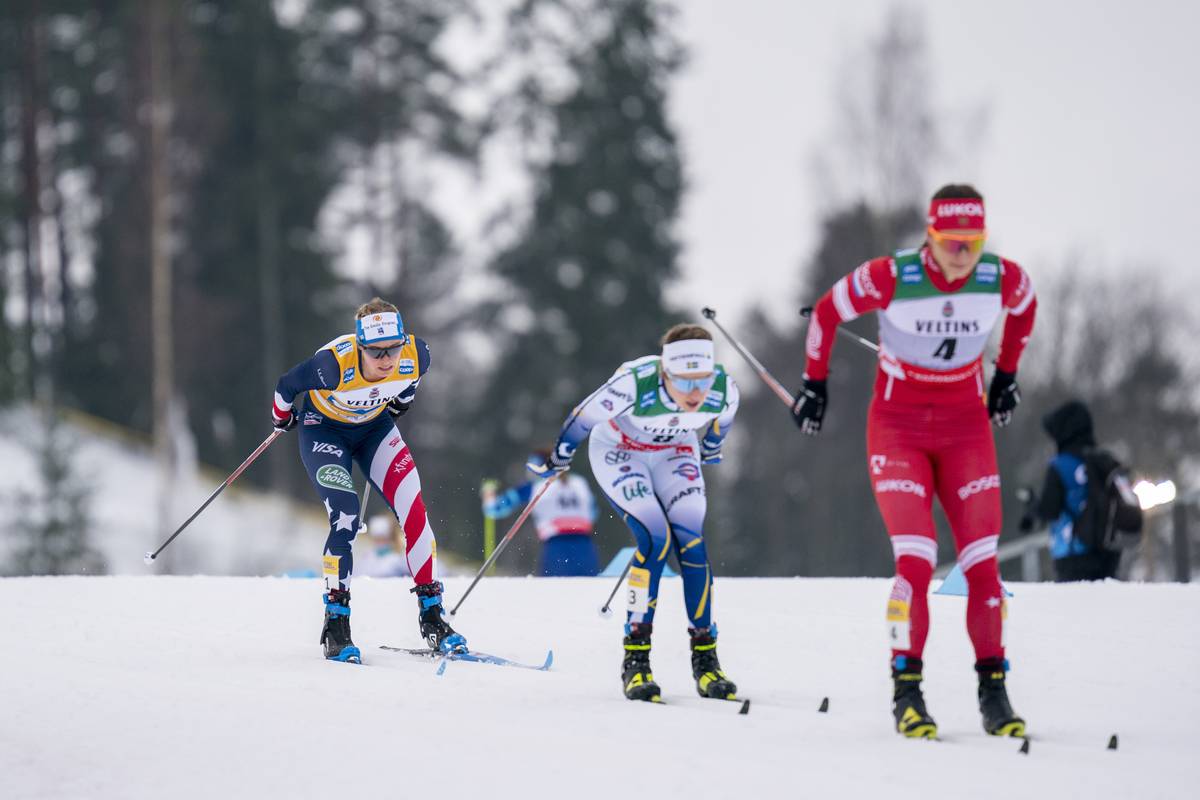
  • Ruka Launches an Olympic Winter: Karlsson Victorious, Diggins Fifth in 10k Classic Opener

    Ruka Launches an Olympic Winter: Karlsson Victorious, Diggins Fifth in 10k Classic Opener

    This coverage is made possible through the generous support of Marty and Kathy Hall and A Hall Mark of Excellence Award. To learn more about A Hall Mark of Excellence Award, or to learn how you can support FasterSkier’s coverage, please contact info@fasterskier.com.

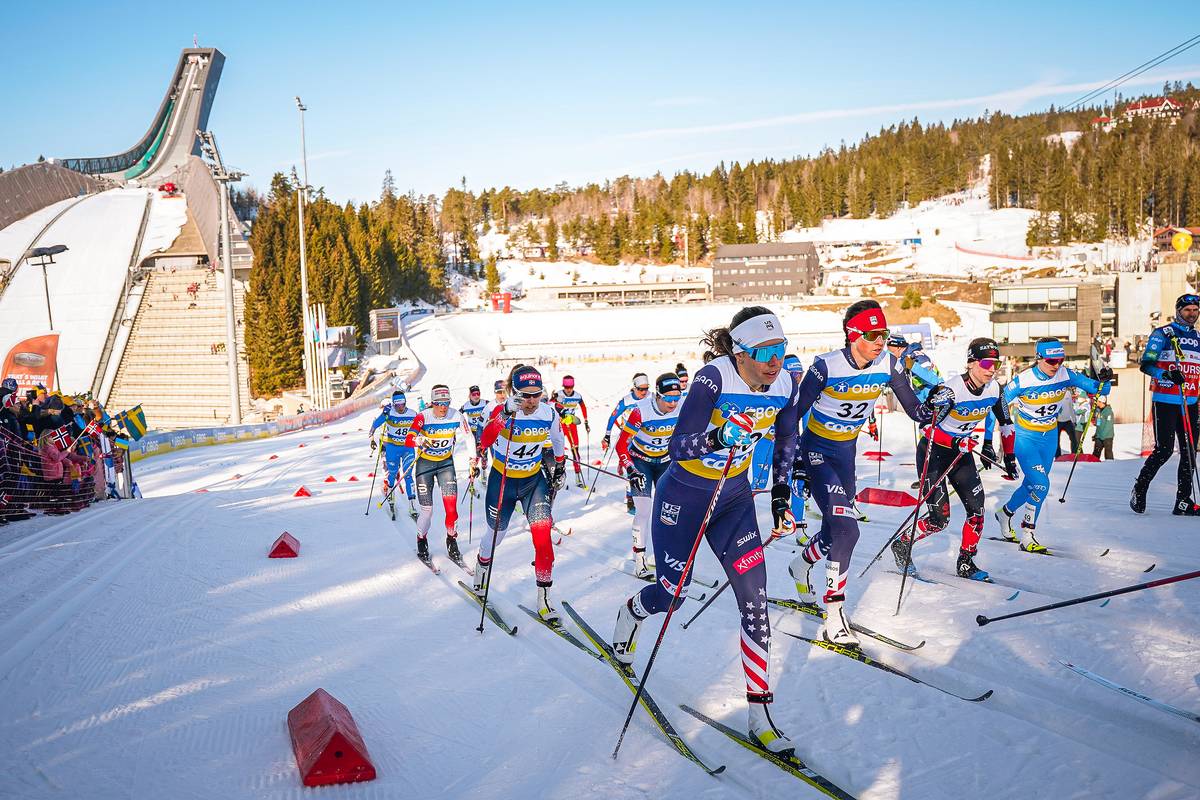
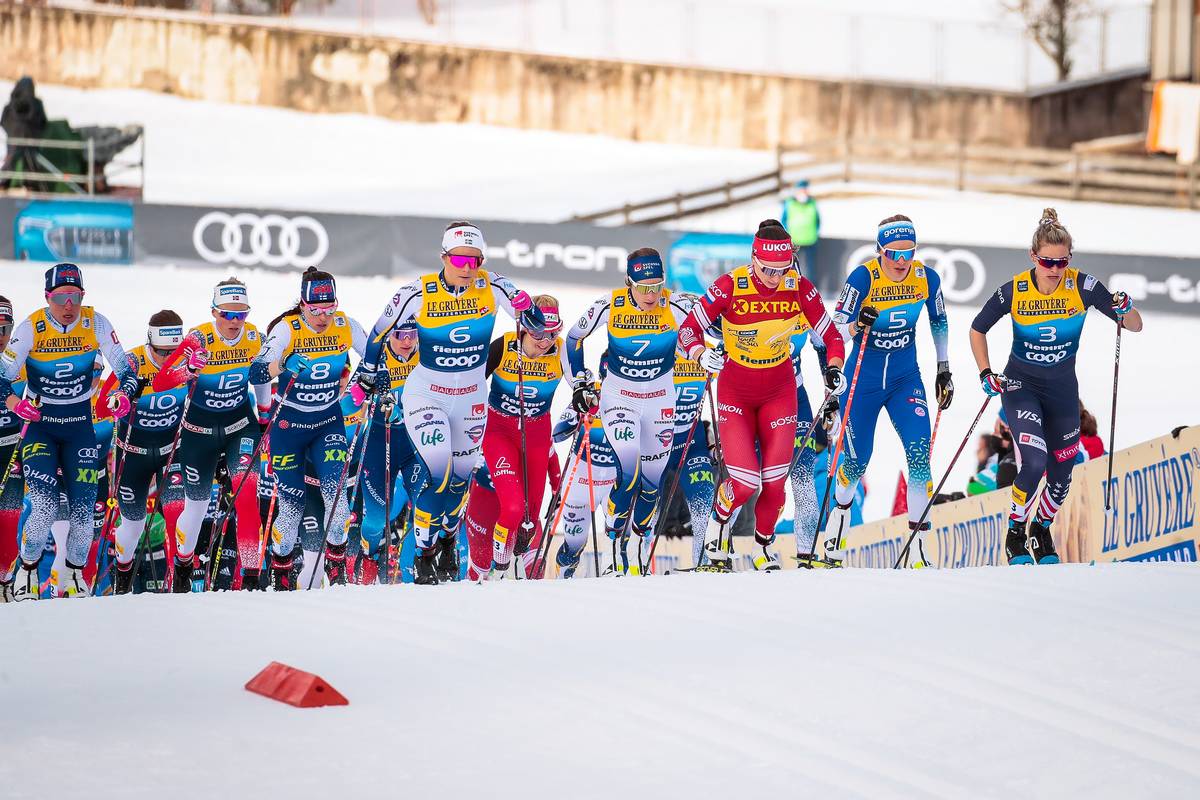
    Okay, who else didn’t sleep last night? It felt like waiting for Santa Claus on Christmas Eve — that fizzy, restless anticipation you can’t shake, even as an adult who should know better. Part of it was simply the joy of finally watching World Cup racing again after eight long months. But more than that, this morning in Ruka felt like the beginning of something bigger: the start of the Olympic year, the opening chapter of a season that will define so many careers, answer so many questions, and launch a web of storylines that will stretch from today all the way to Milano-Cortina.

    This year, the stakes are different. For veterans, it’s legacy. For rising athletes, it’s opportunity. For everyone, it’s a race against time.

    And for those of us who follow this sport as if it were a second bloodstream, the first race in Ruka is the moment winter starts breathing again.

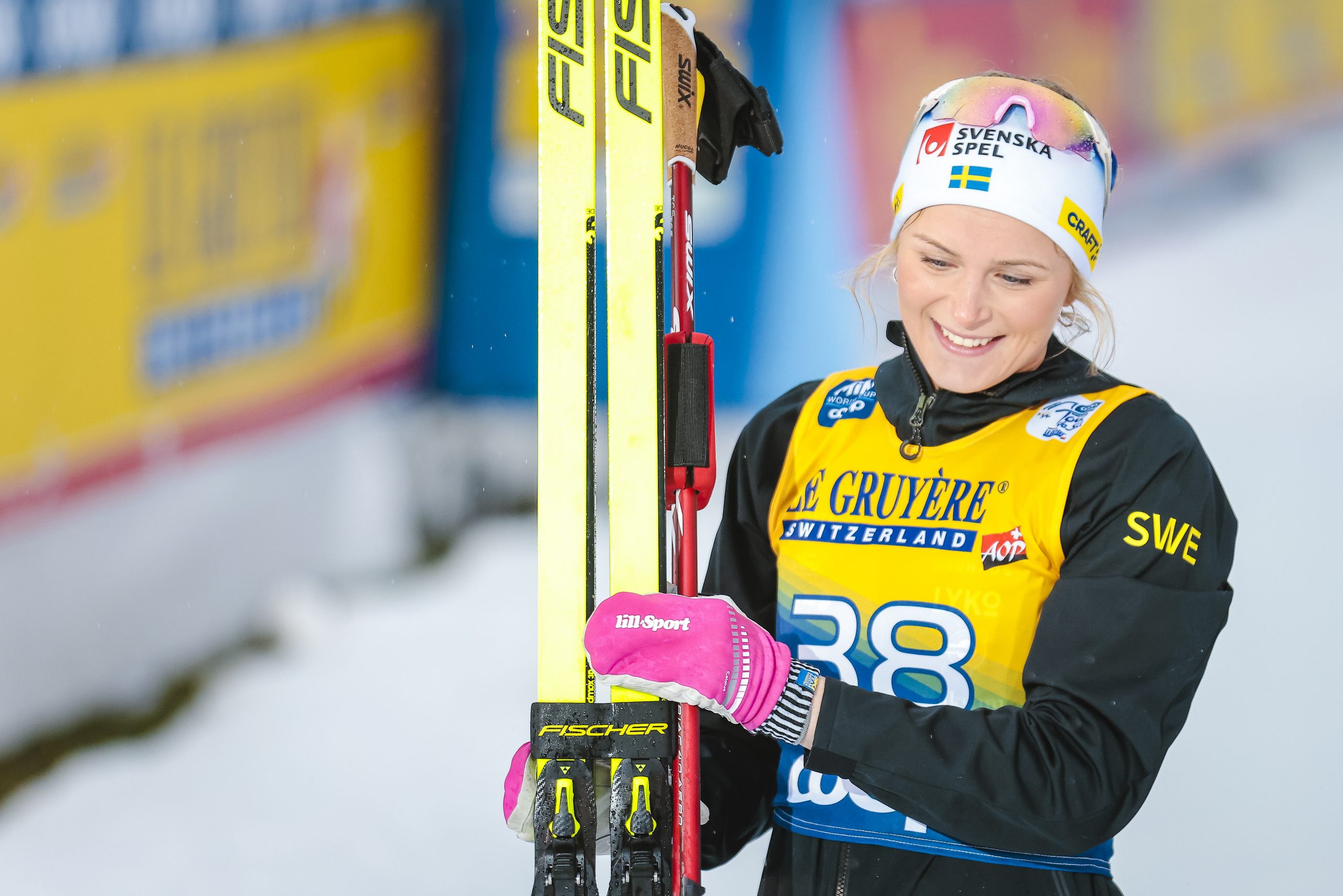
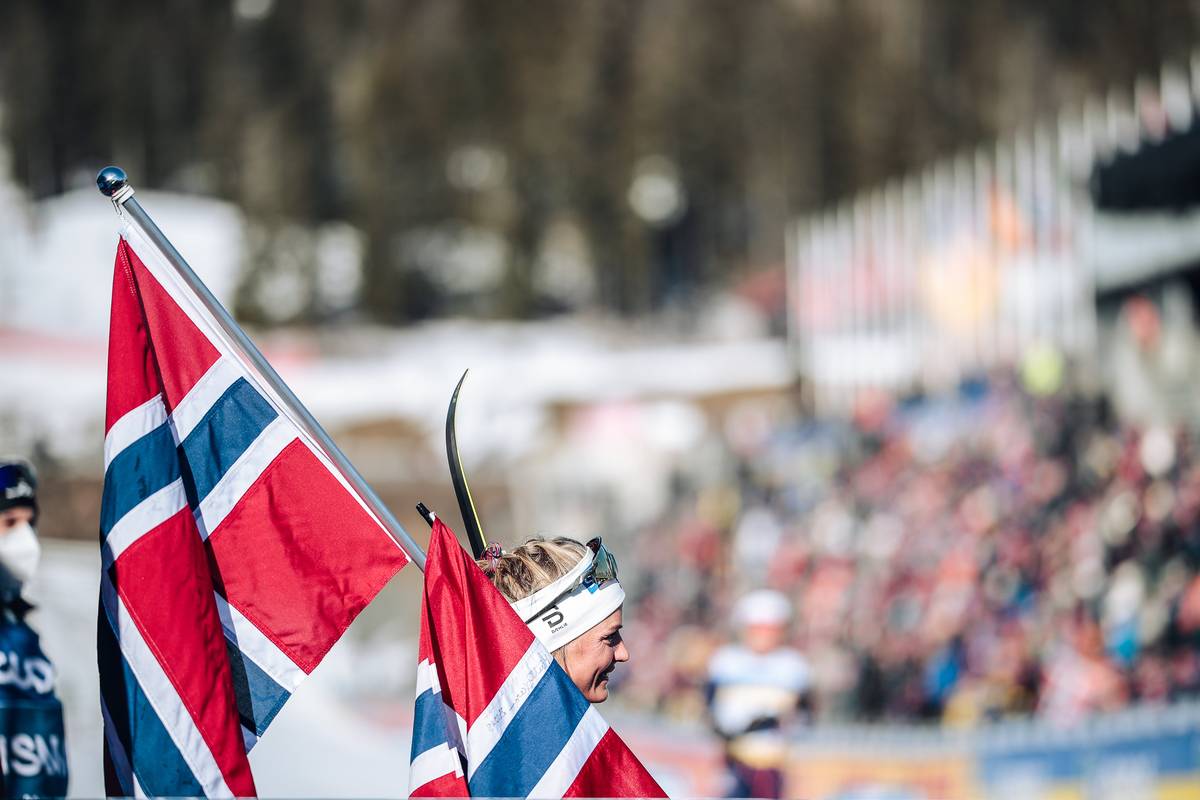
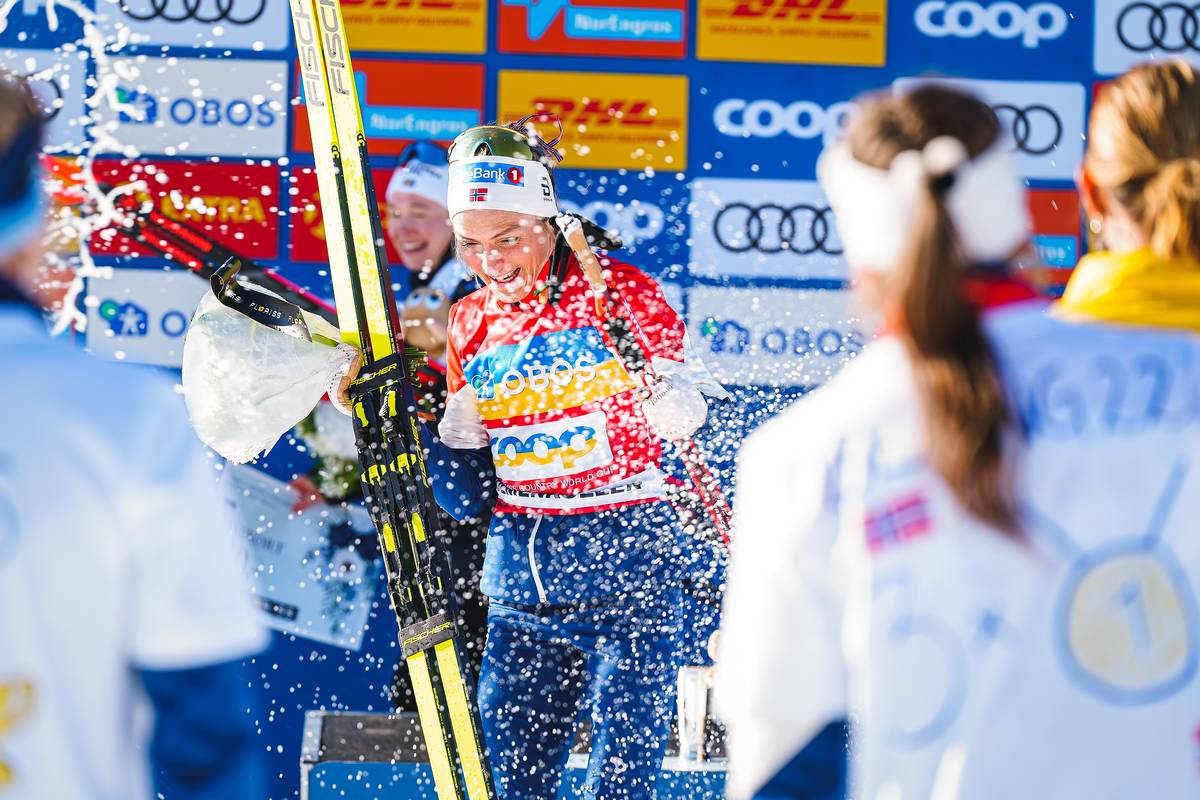
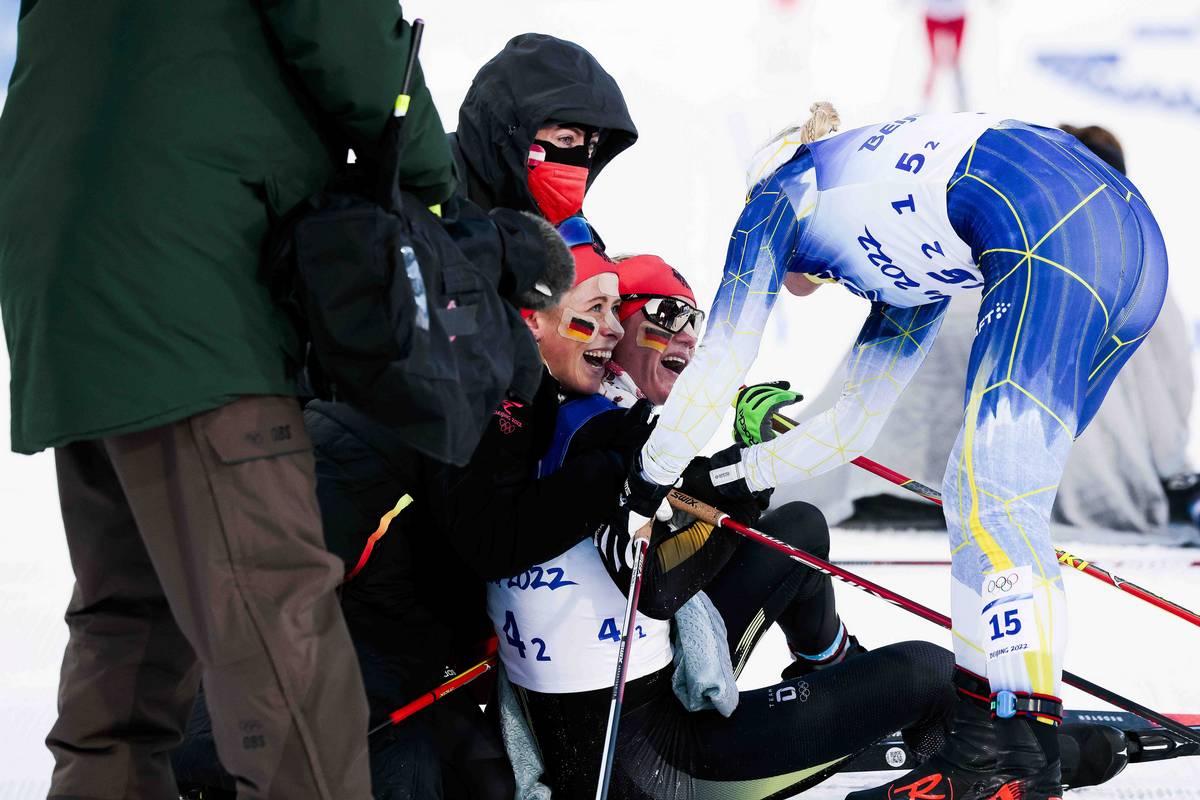
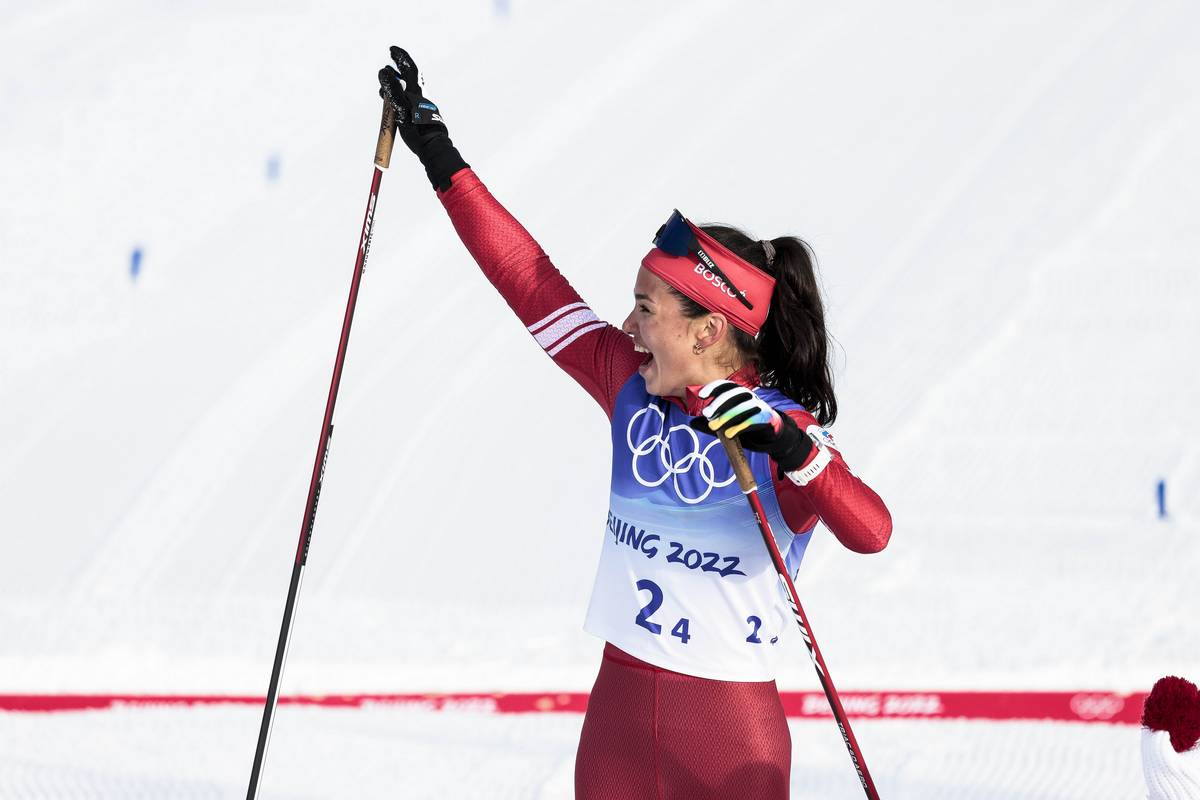
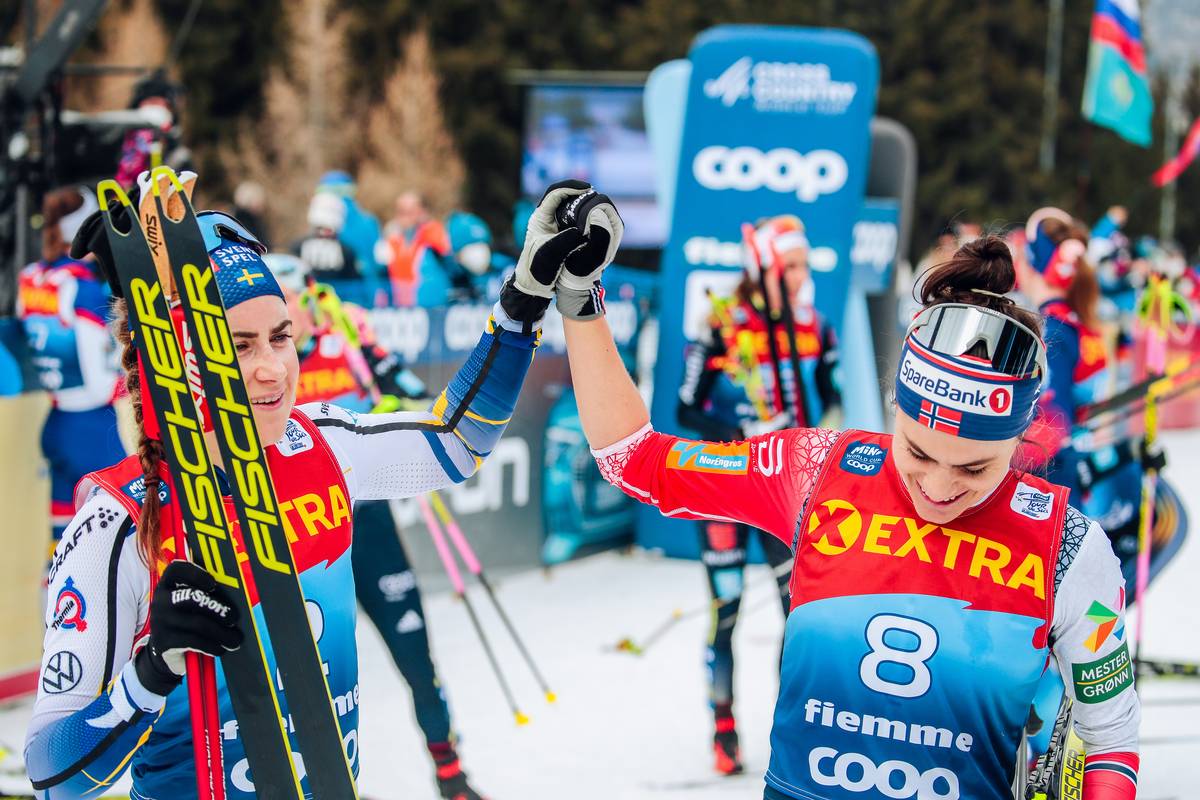
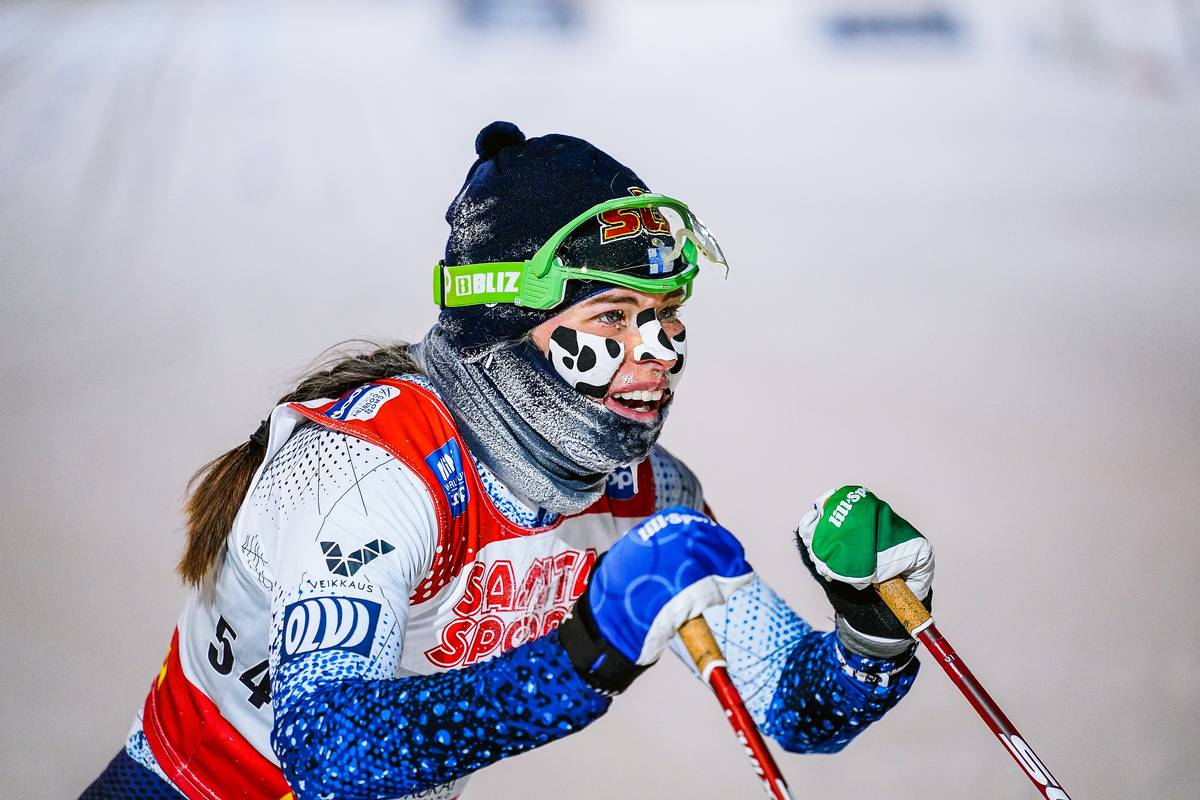
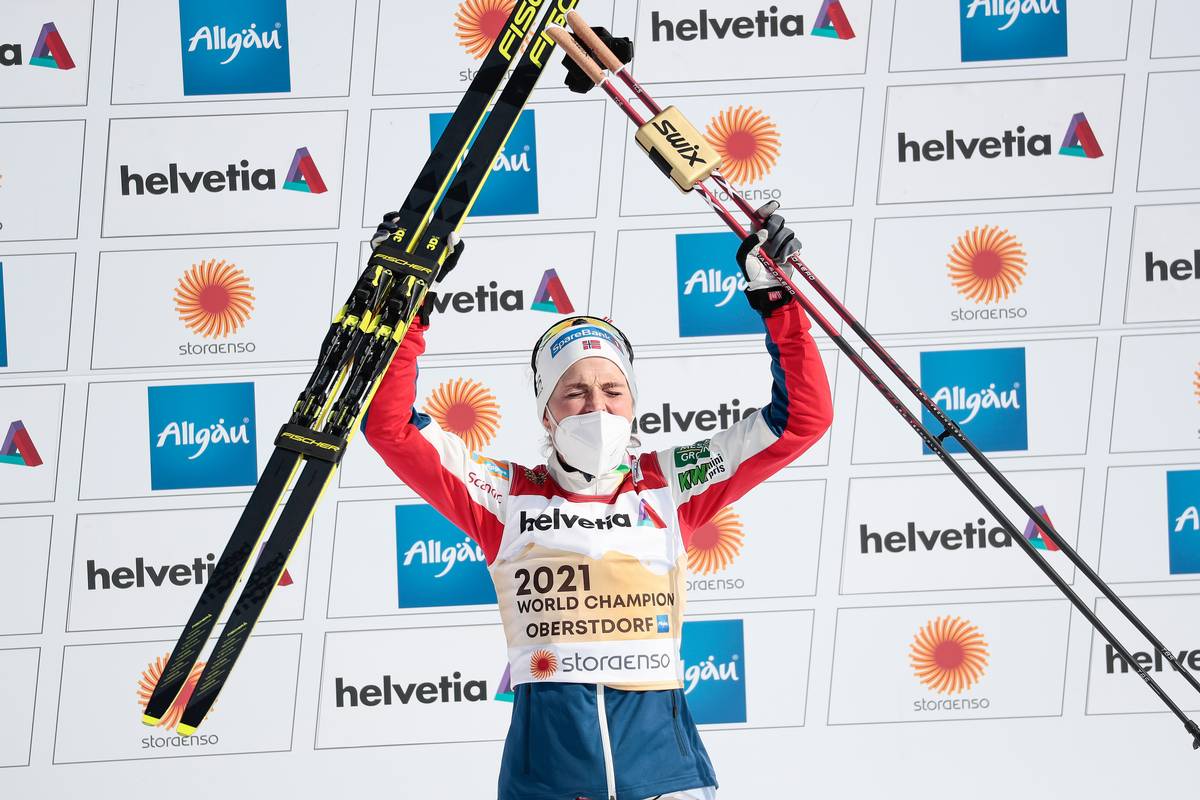
    Frida Karlsson (SWE) poses with Mr. and Mrs. Claus following the 10k Classic in Ruka (FIN). (Photo: Modica/NordicFocus)

    Before the Gun: What Was at Stake

    Even before the racers hit the snow, there were subplots everywhere.

    Norway opened the season in a moment of transition. Therese Johaug — retired again and pregnant with her second child — leaves a vacuum on the women’s team that hasn’t existed in over a decade. Who leads now? Is Heidi Weng’s late-career renaissance real? Is this the year Norway’s depth must finally be enough?

    Sweden, meanwhile, enters the Olympic season with the most complete women’s distance squad on earth. Their classic technique is crisp, balanced, efficient — a signature advantage on days like this.

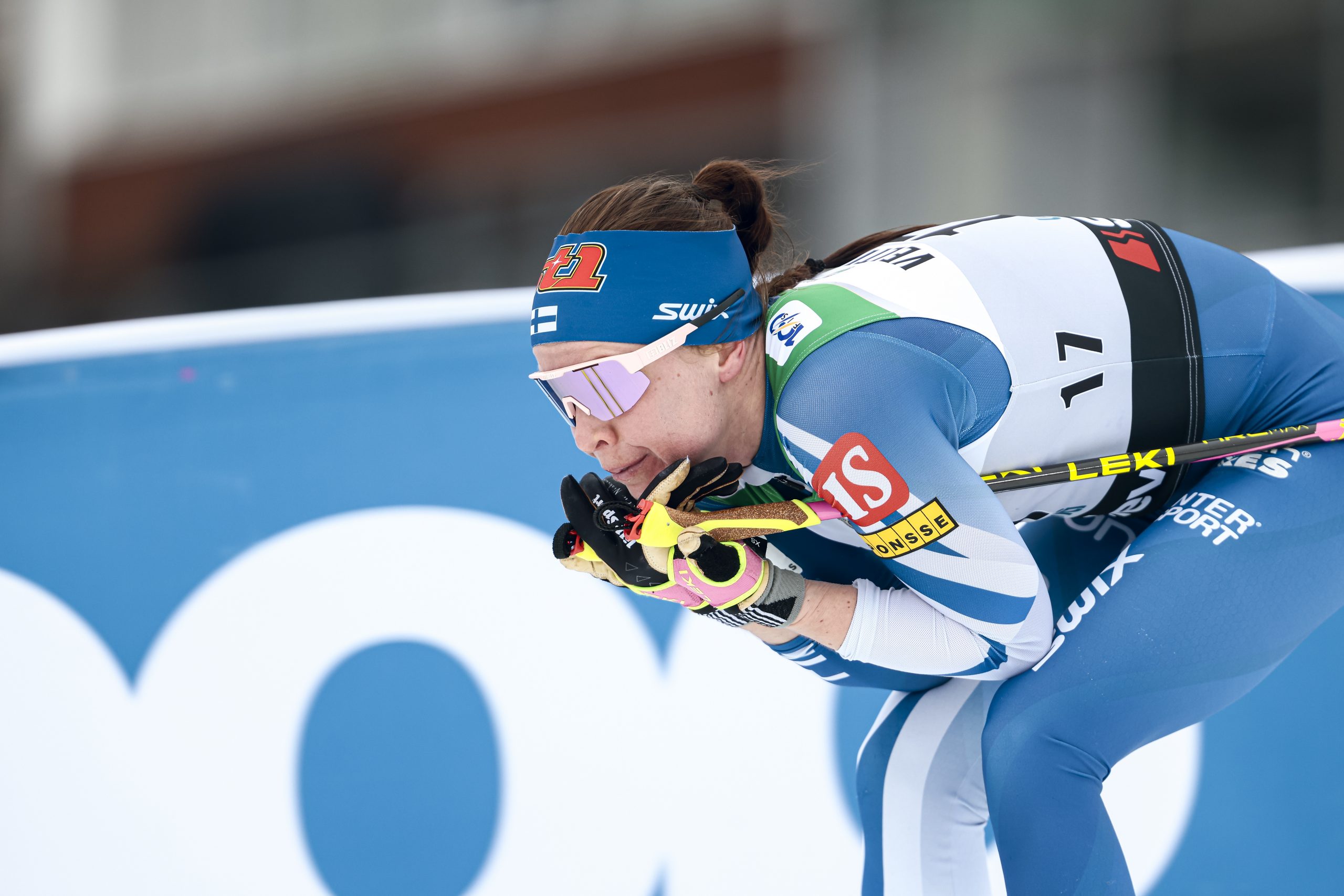
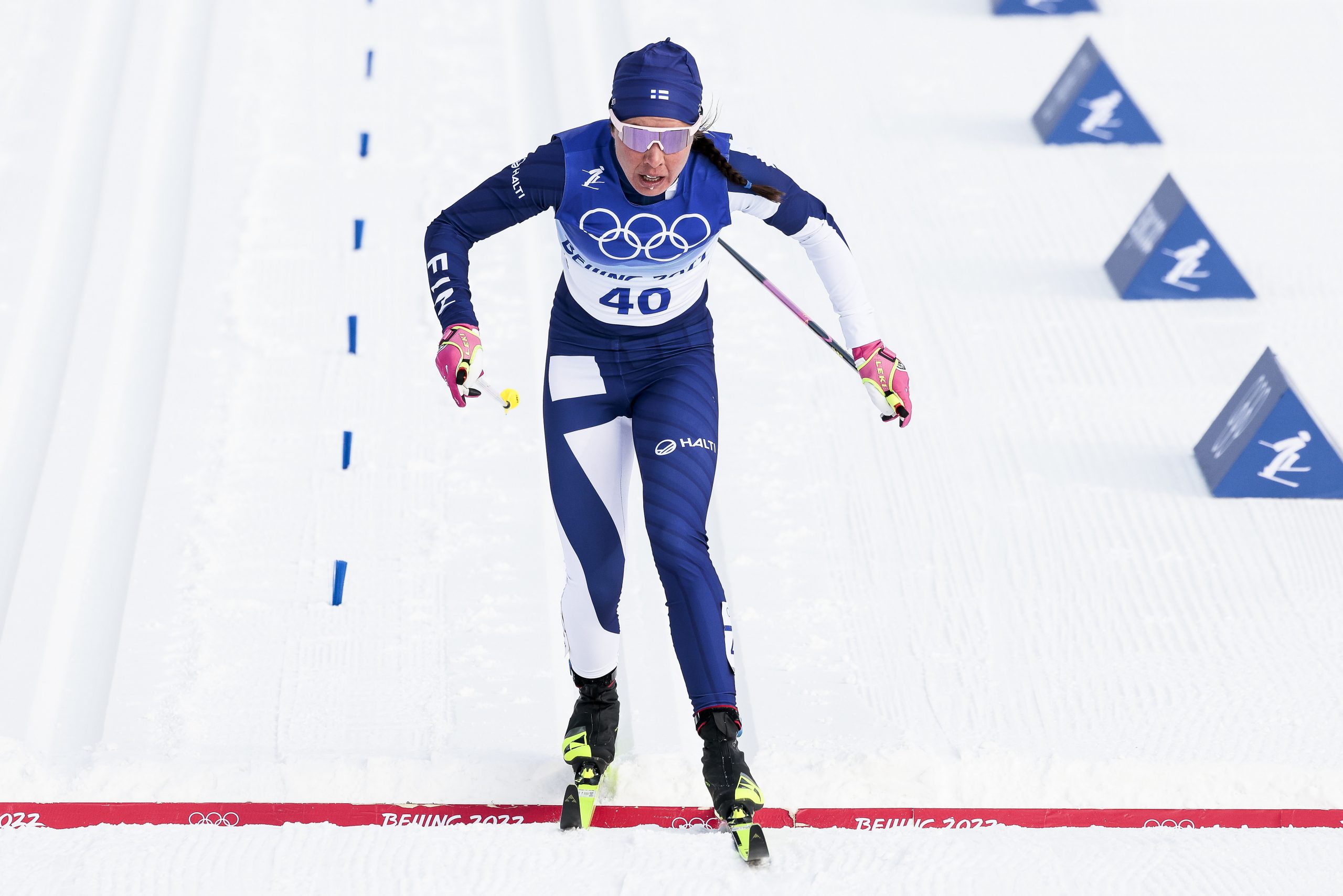
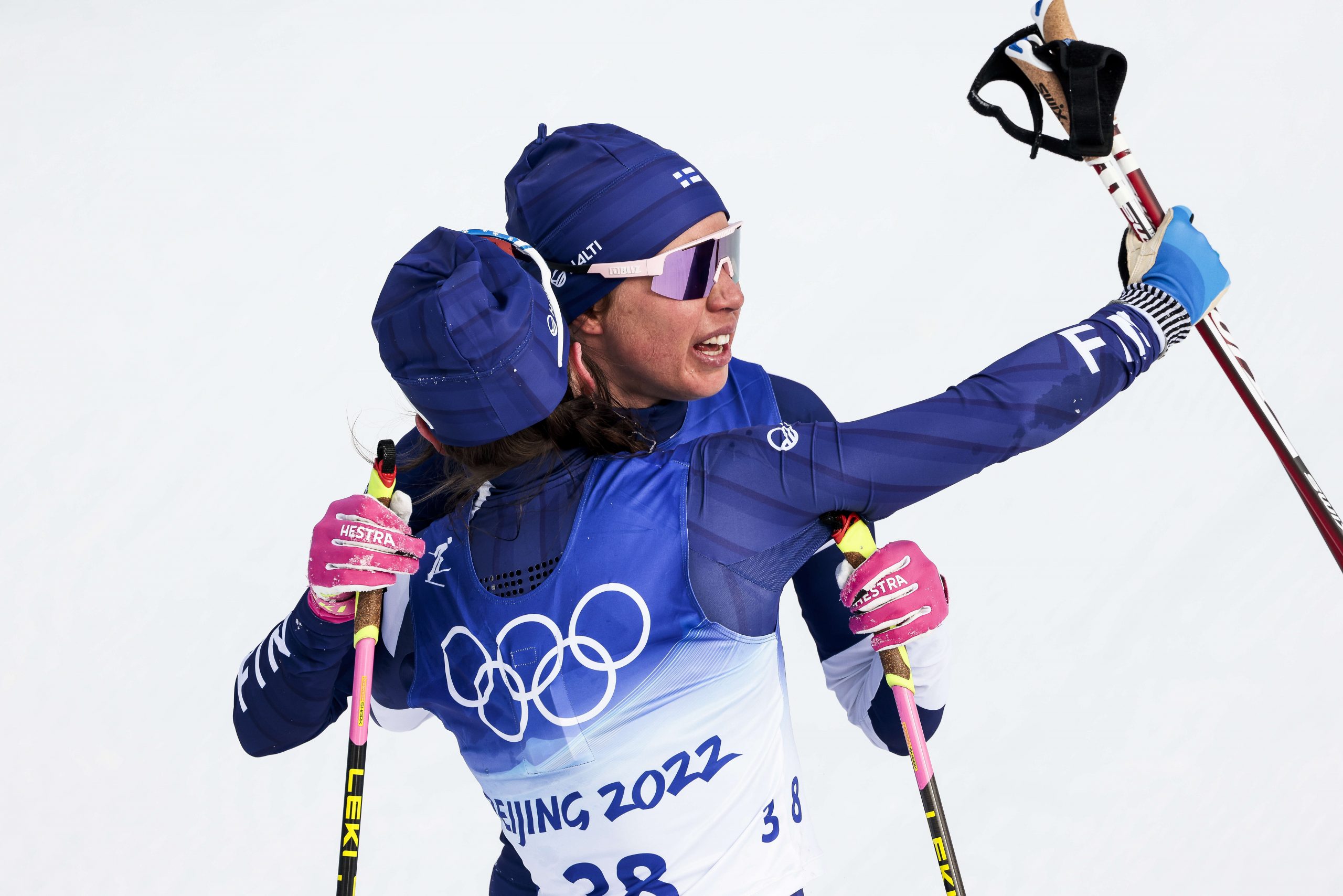
    Finland carries the emotional core of the weekend. Krista Pärmäkoski, racing her final season, took her last opening-day start in Ruka on home snow. Kerttu Niskanen, always a threat in classic, lined up ready to test herself in front of the home crowd.

    And for the United States, the arcs were wide-ranging:

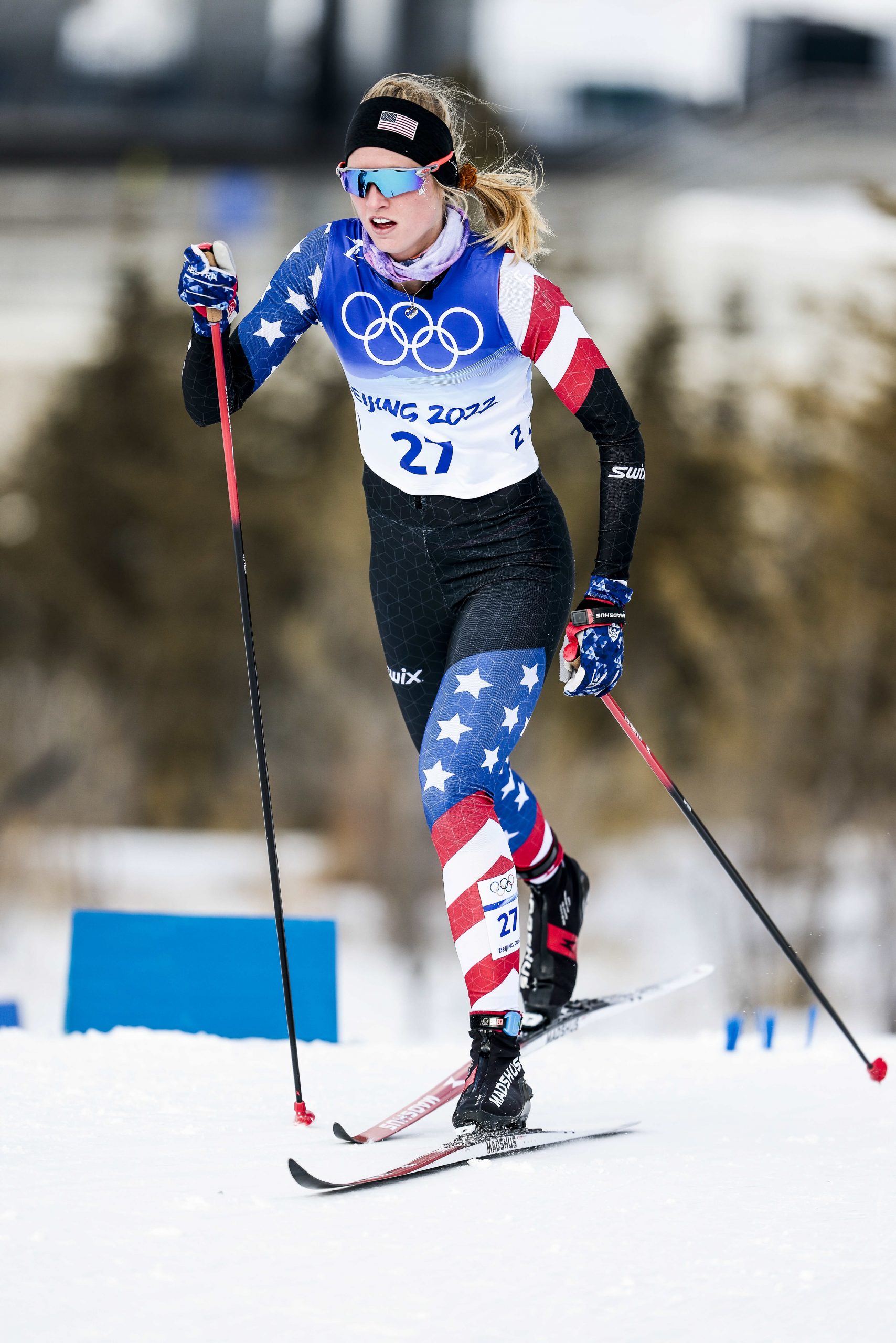
    • Jessie Diggins begins the final season of her career.
    • Rosie Brennan enters winter in deeply untraditional circumstances after an Epstein-Barr reactivation.
    • Julia Kern arrives healthier and steadier than in years.
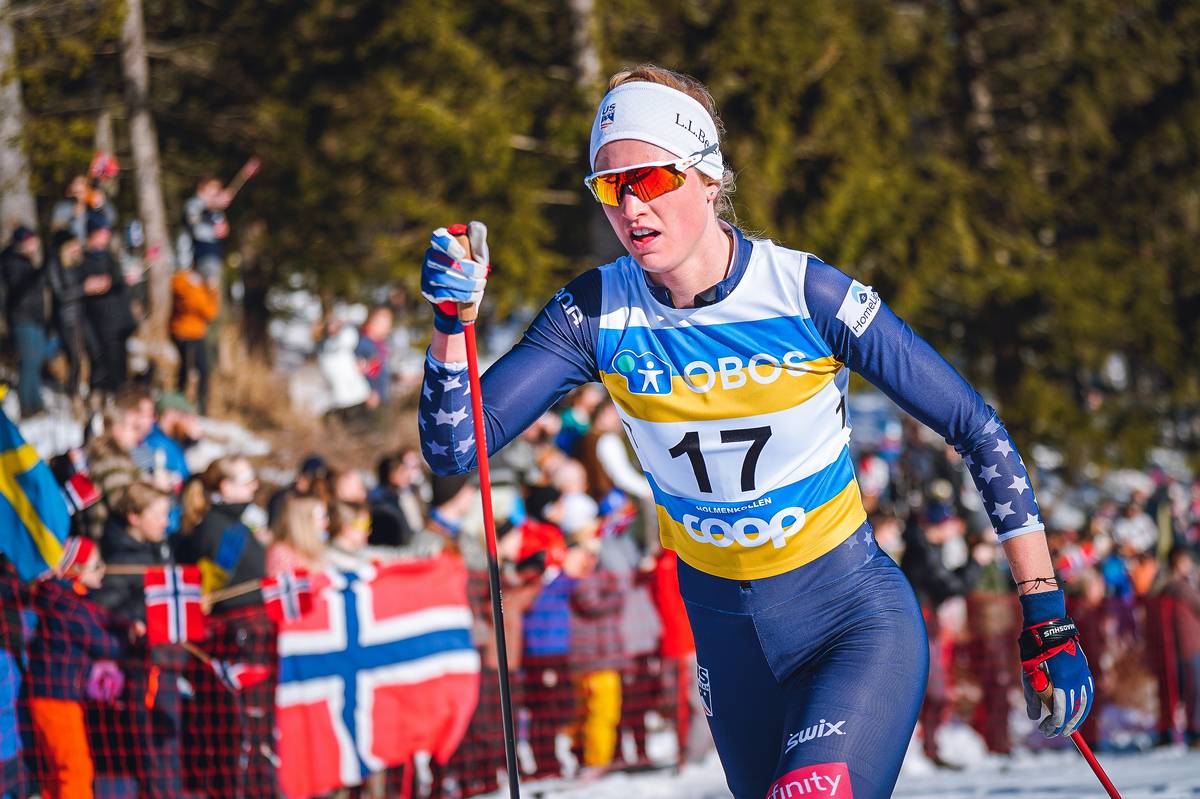
    • Sophia Laukli brings a redesigned training life out of Norway.
    • And three additional American women (Kate Oldham, Kendall Kramer, and Alayna Sonnesyn) who begin the short, intense race for Olympic qualification.
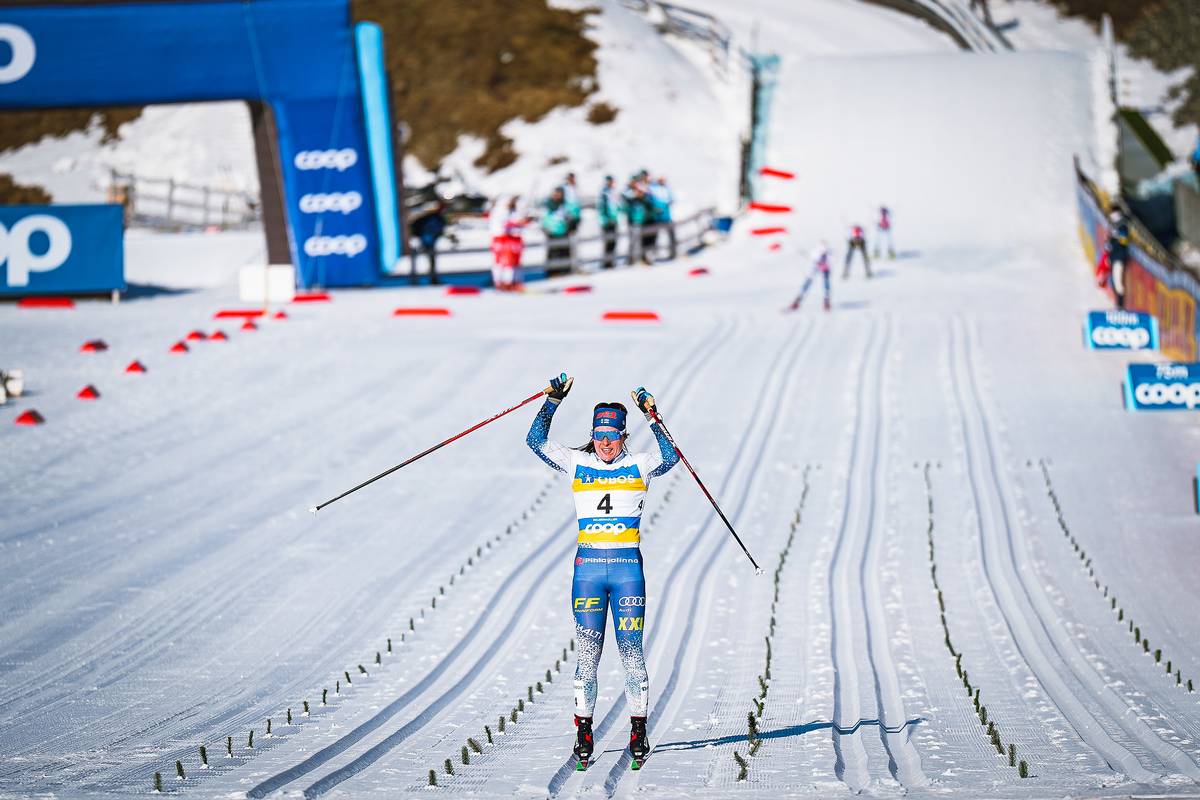
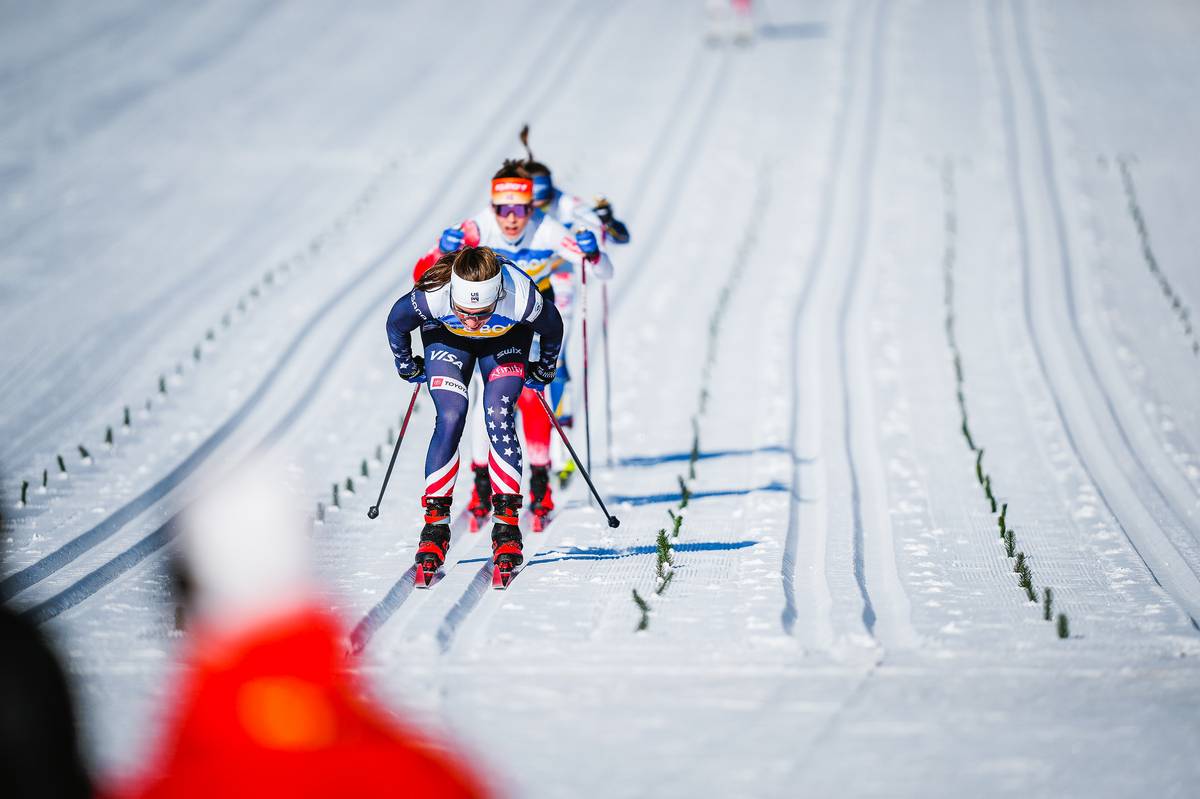
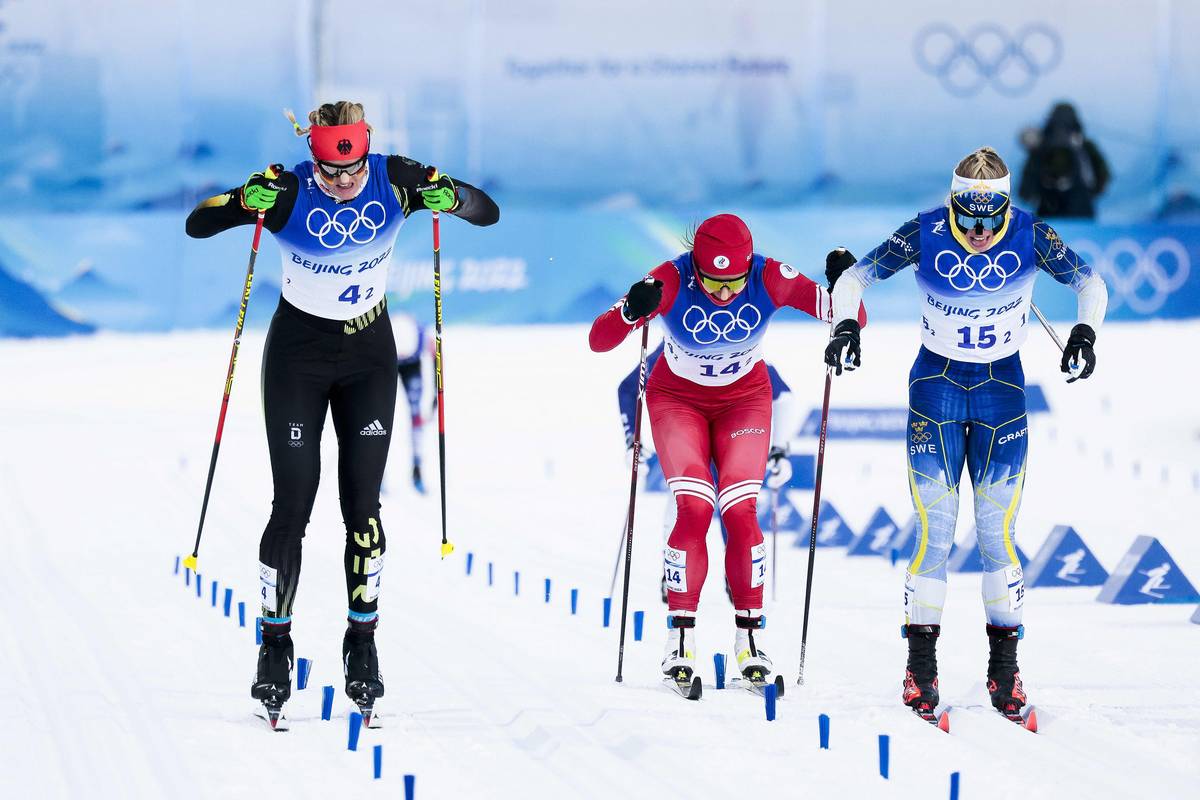
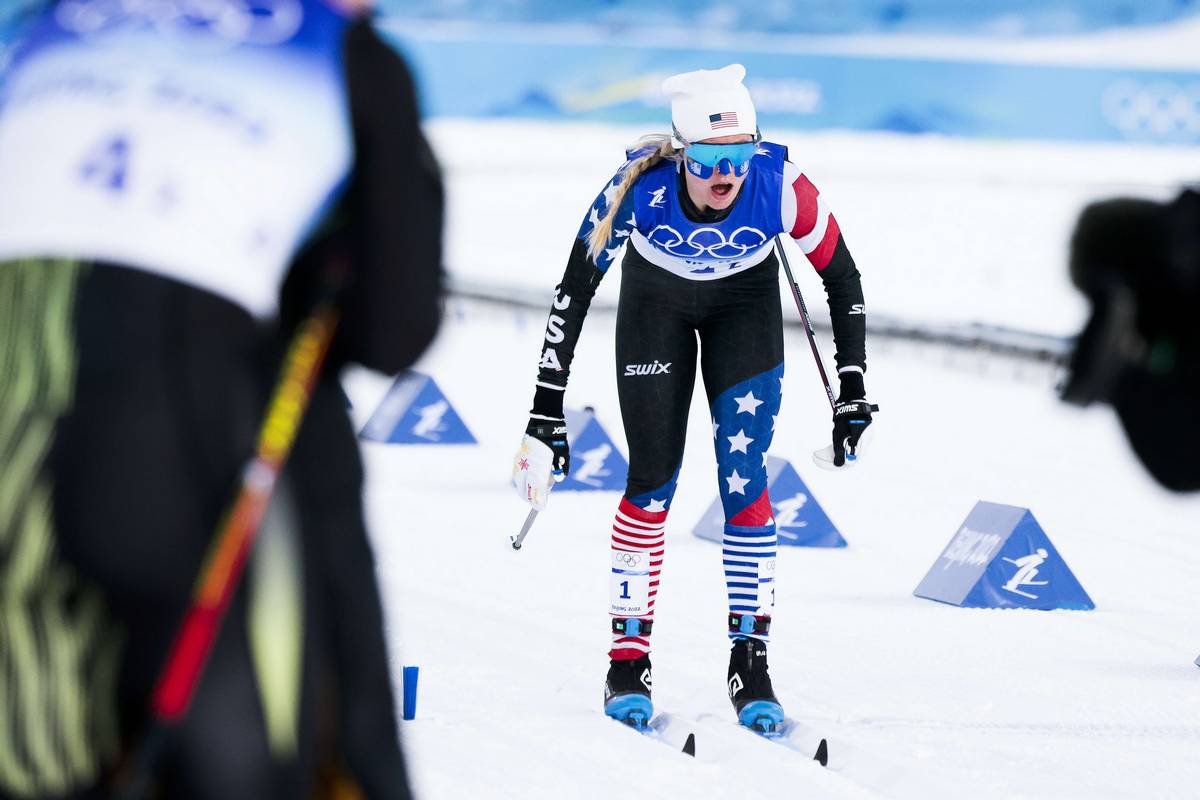
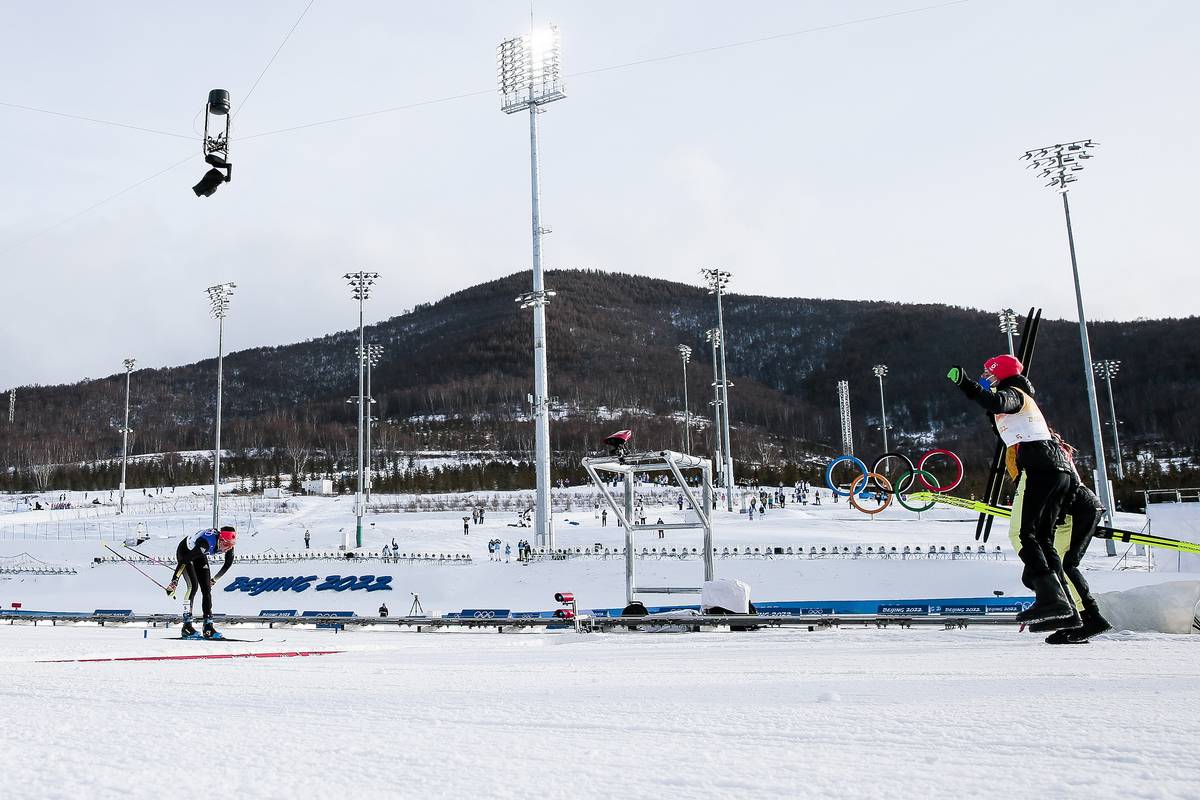
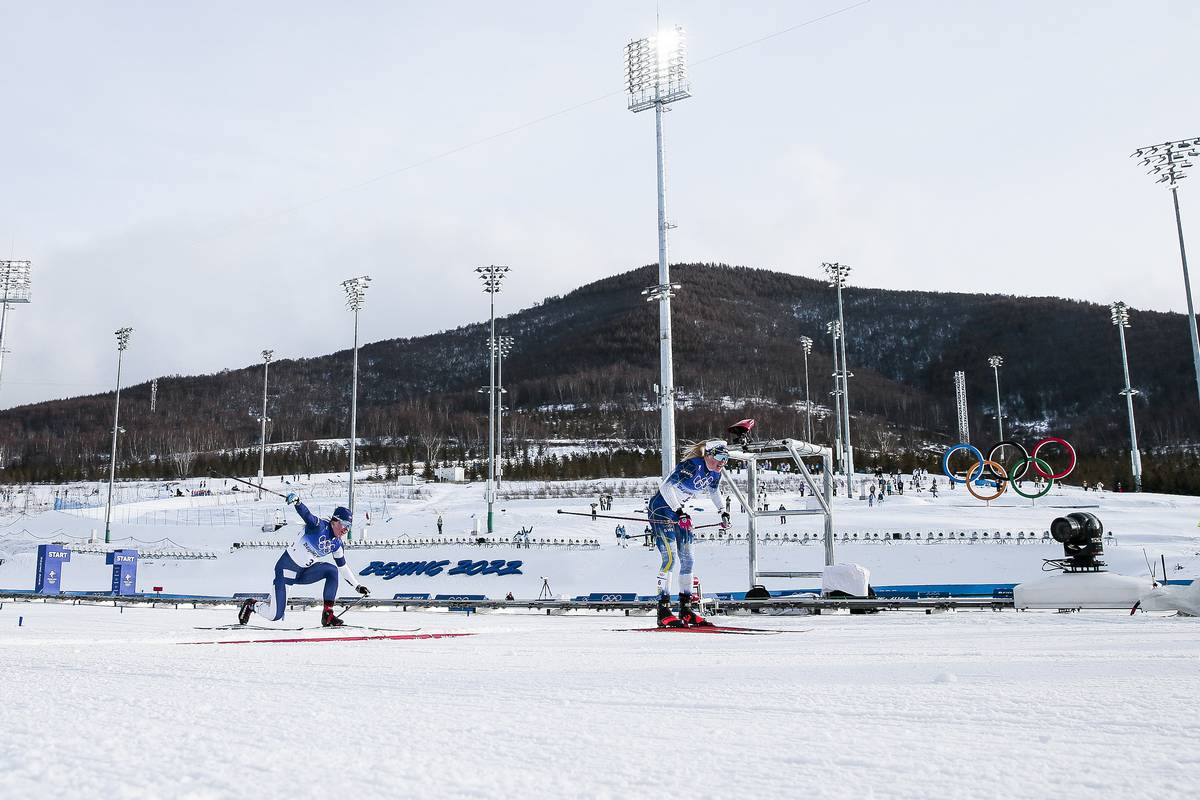
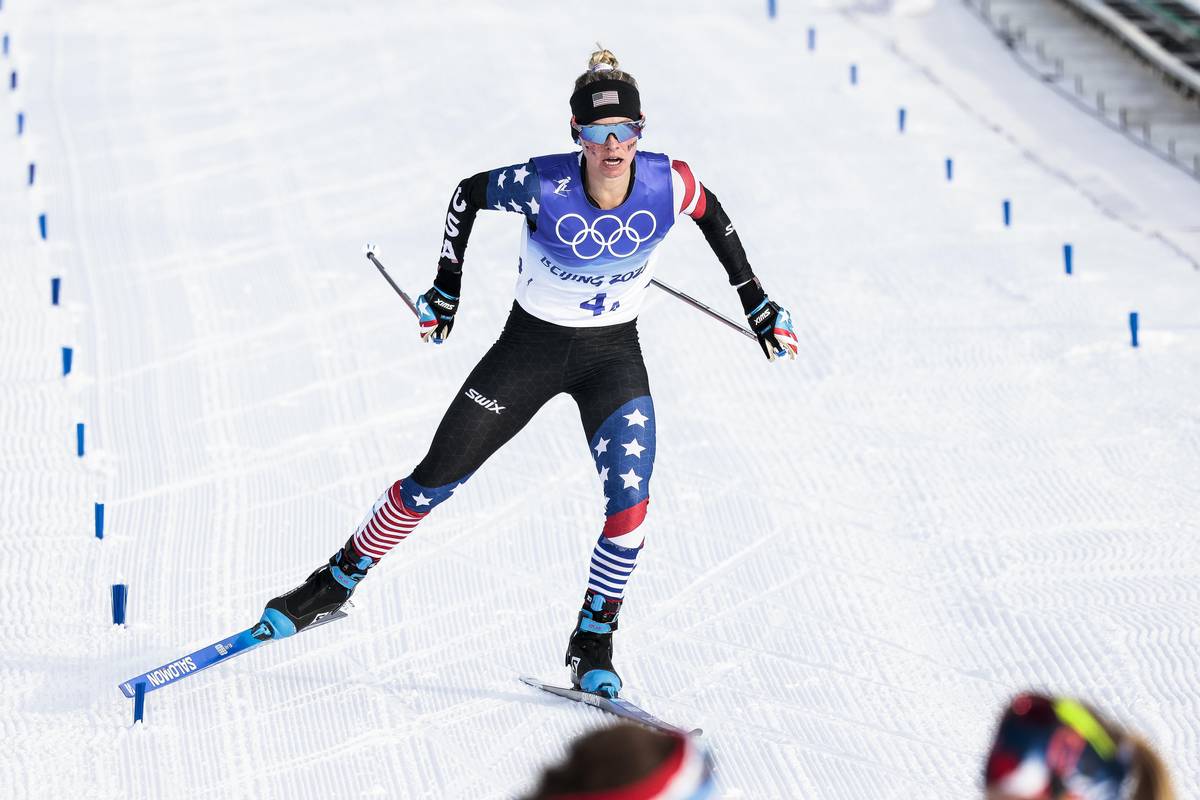
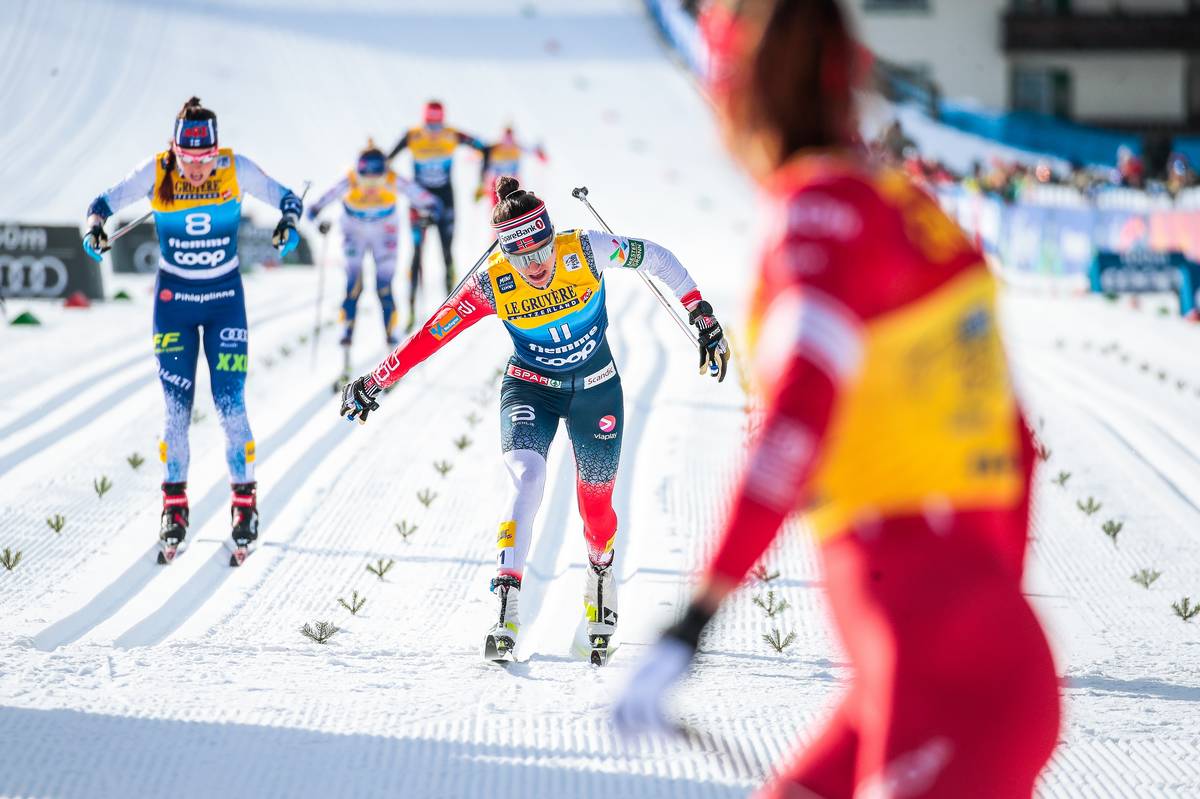
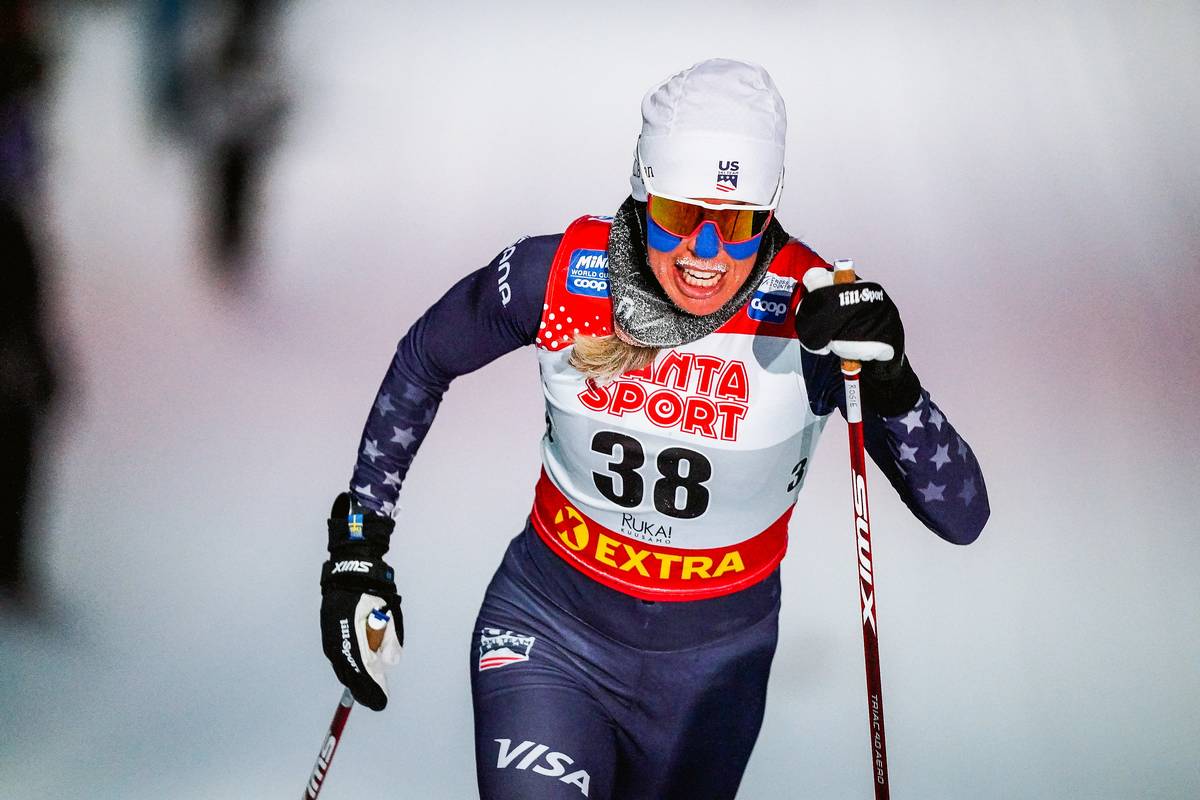
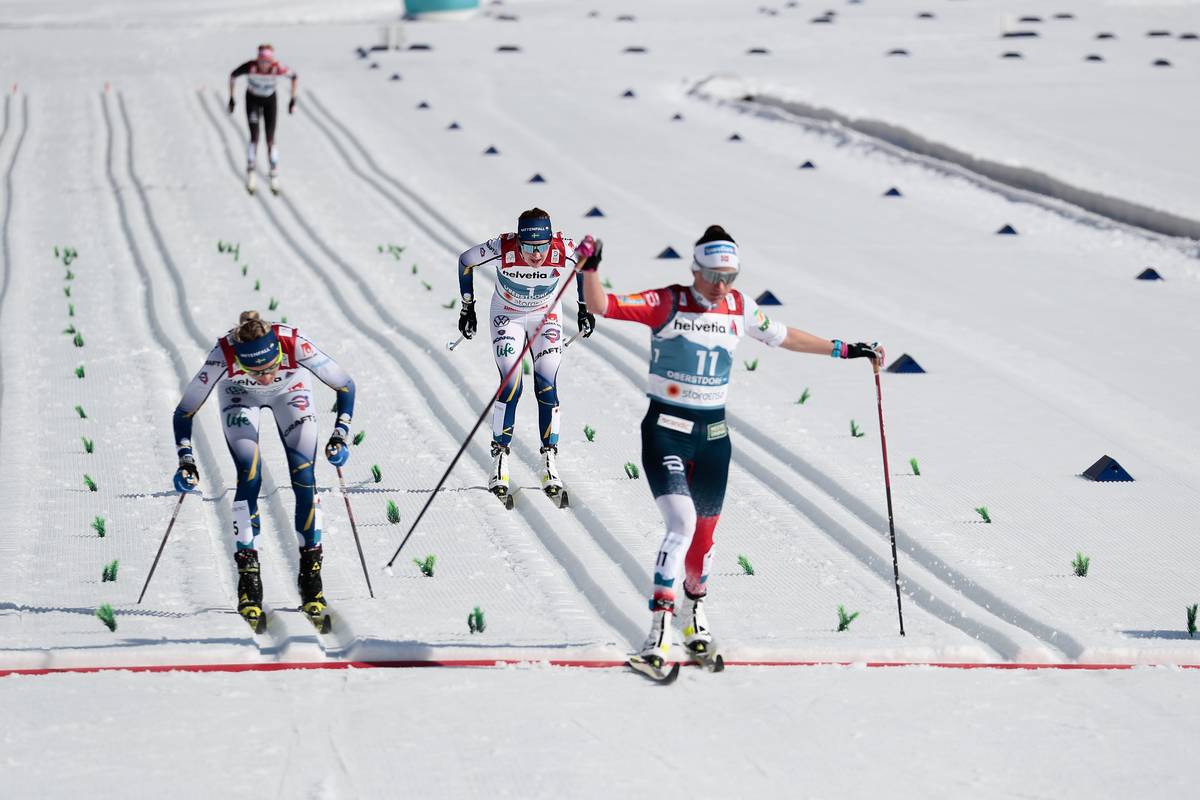
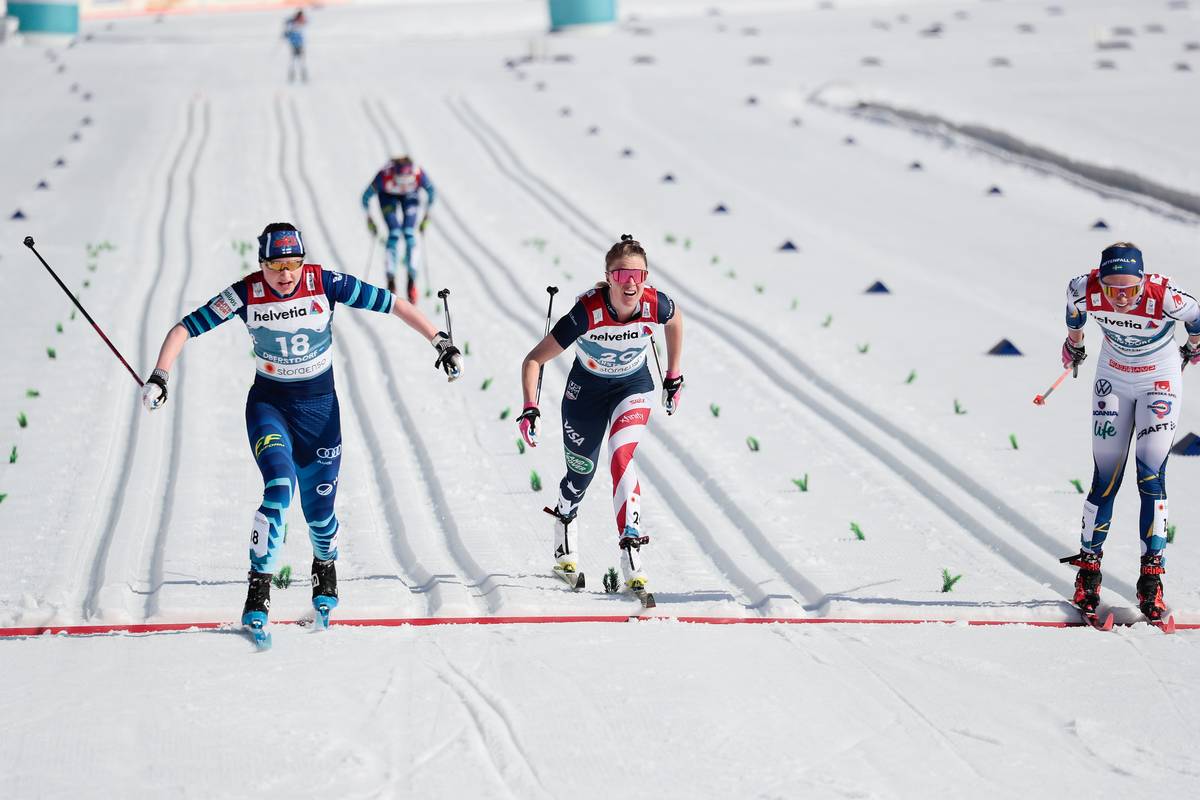
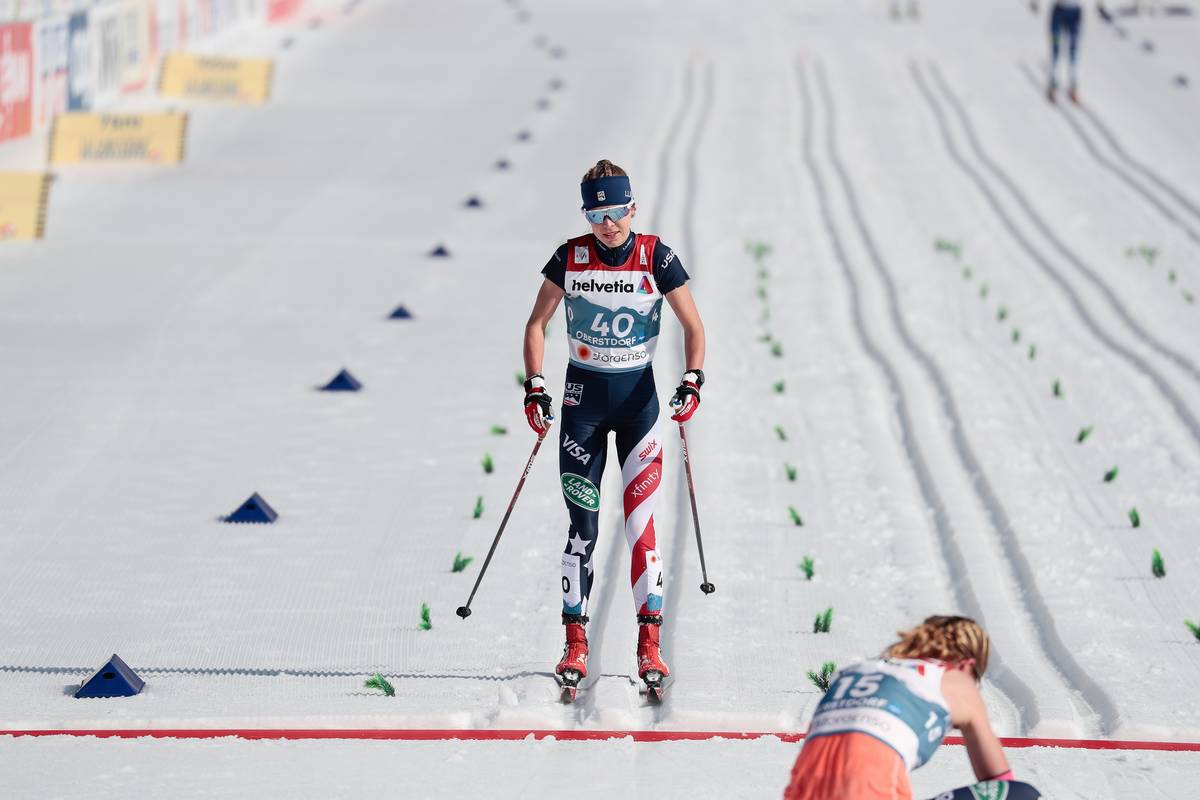
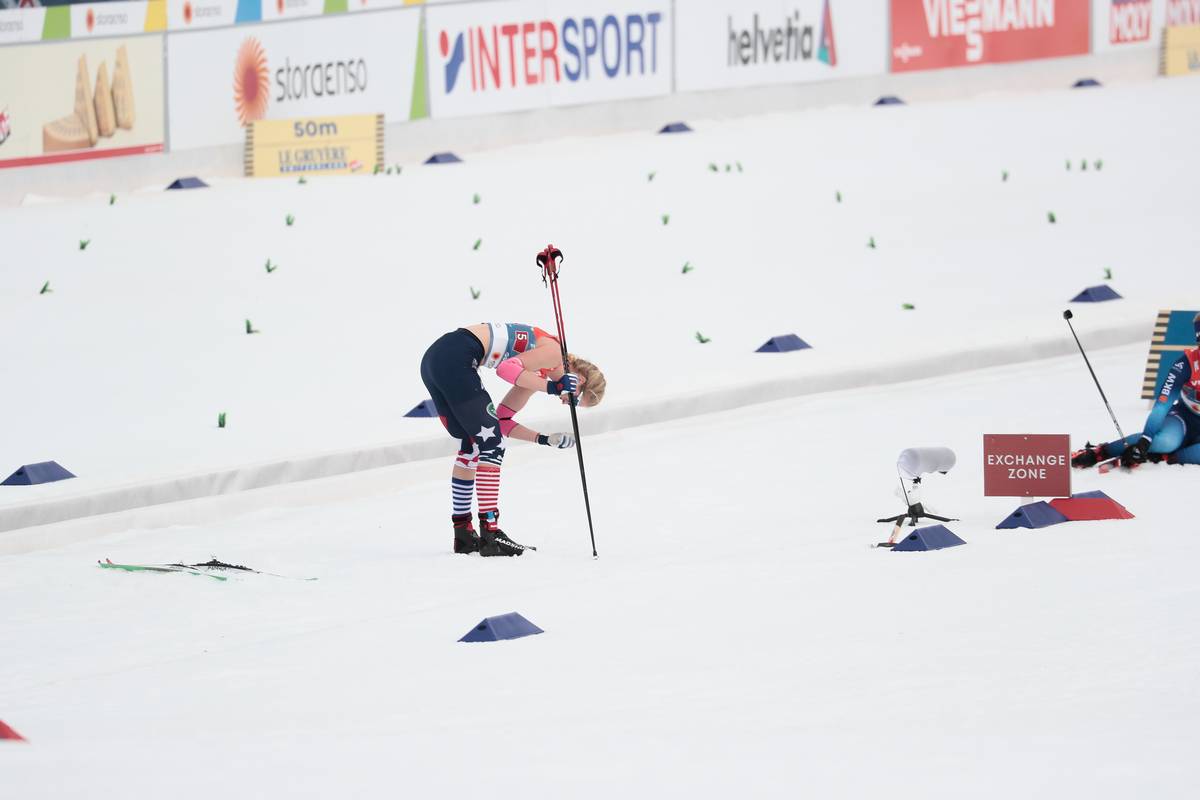
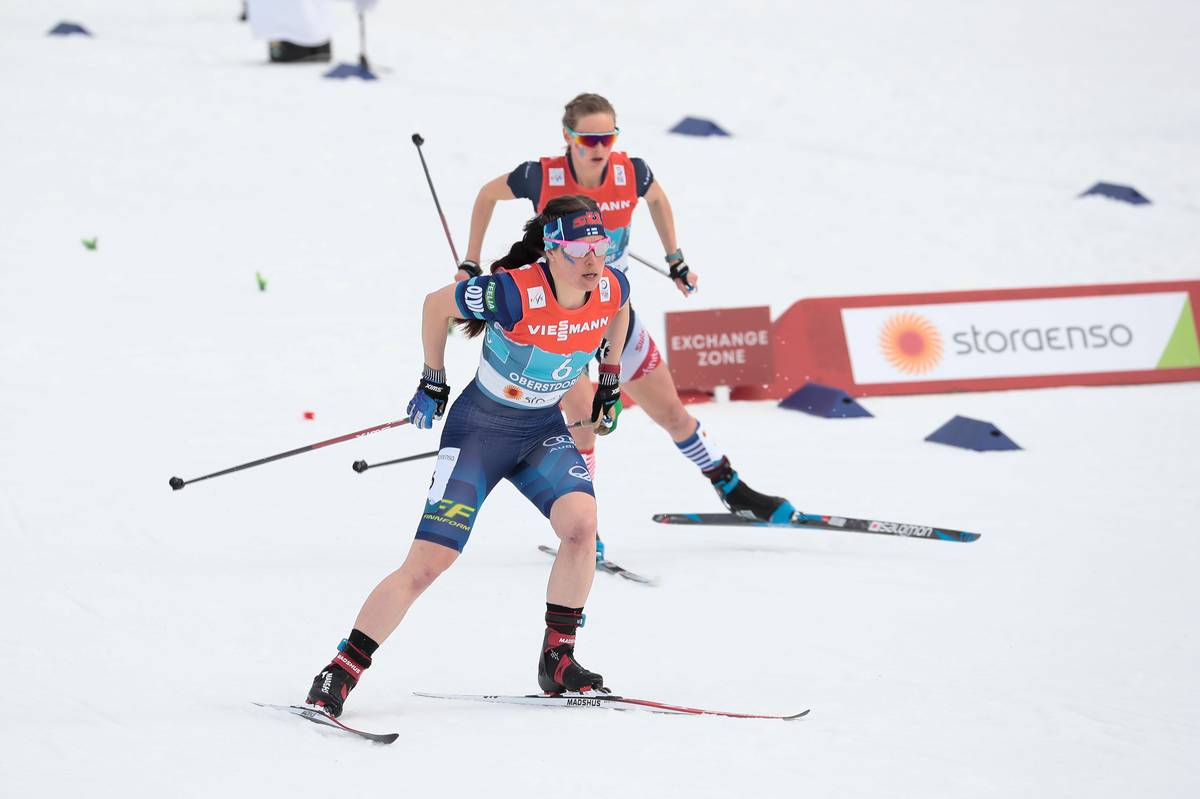
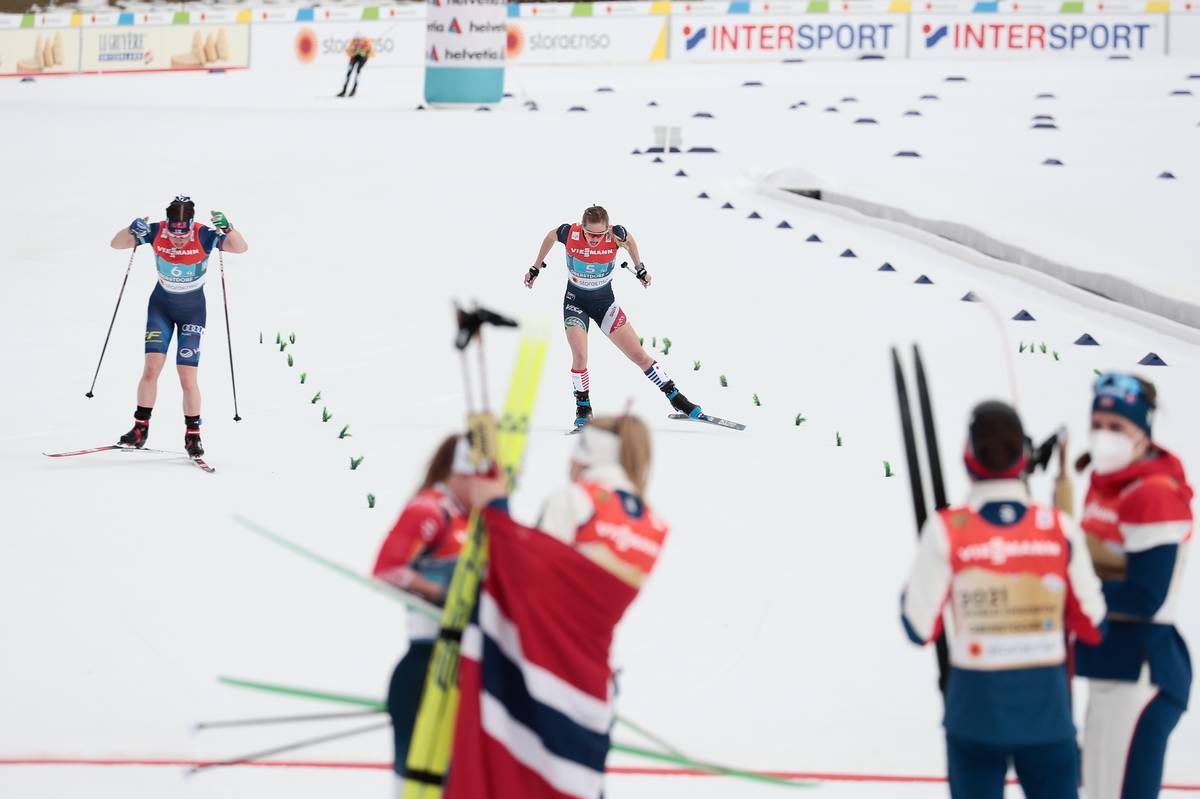
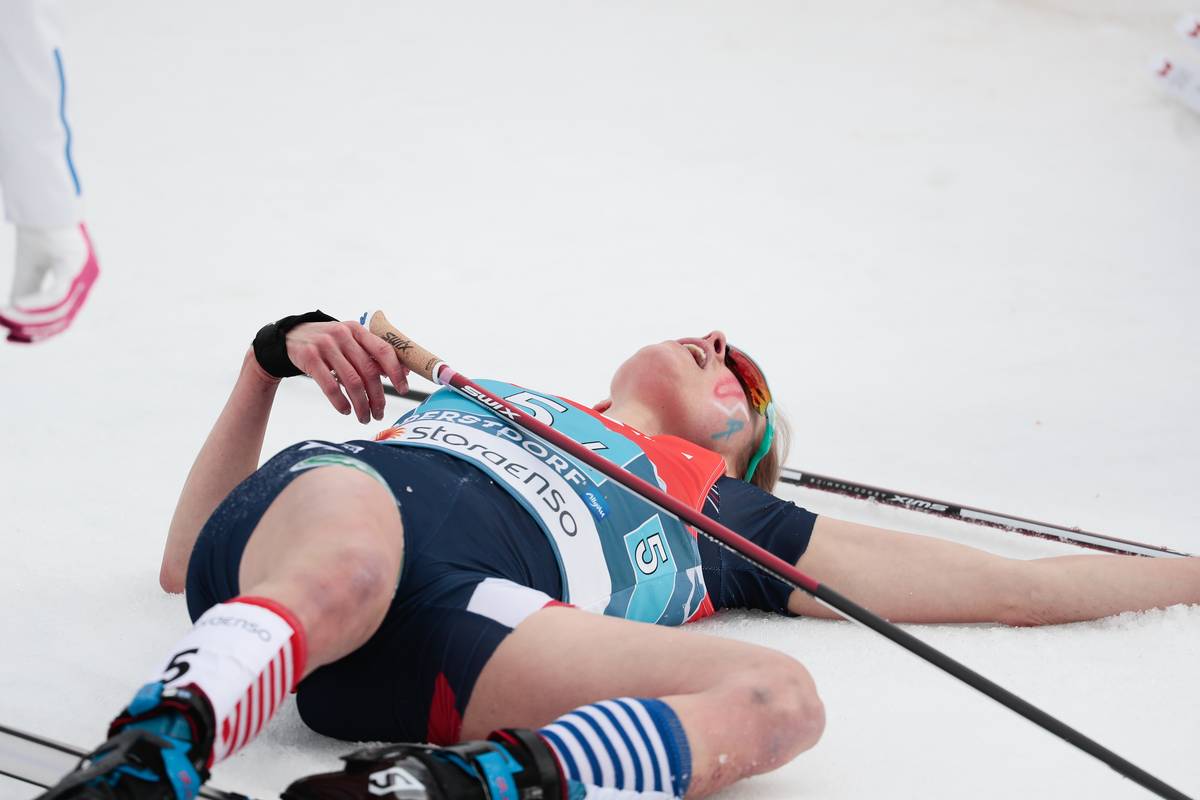
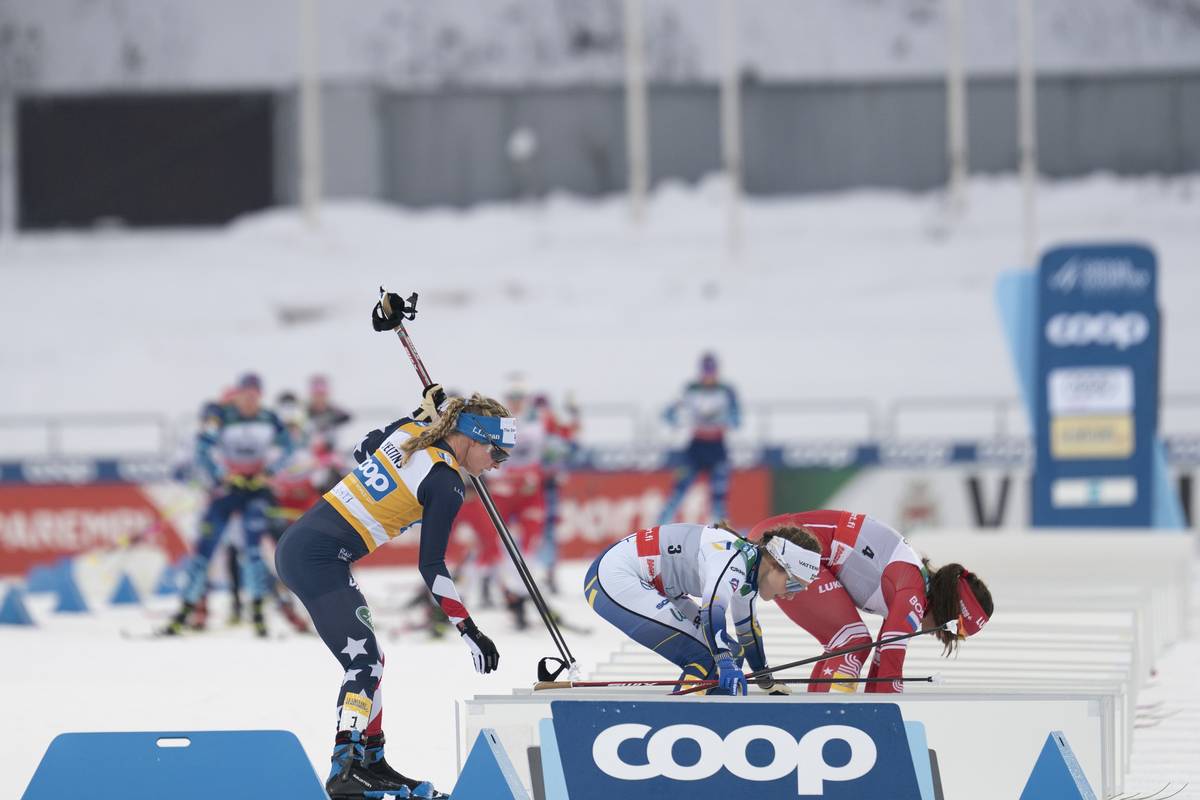
    Alayna Sonnesyn (USA) lunges for the line at the end of the 10k Classic in Ruka (FIN). (Photo: Modica/NordicFocus)

    A Day Shaped Before It Started: New Snow, Glazing Tracks, and Wax Tech Calculus

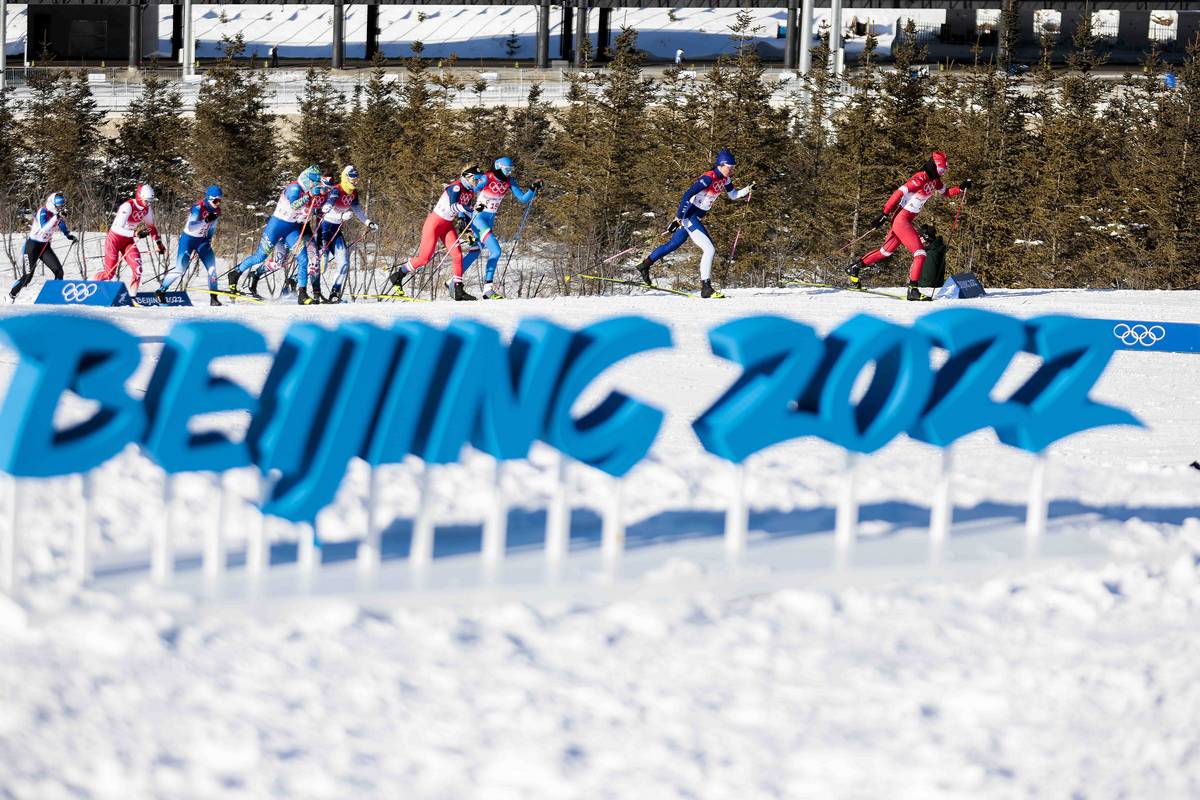
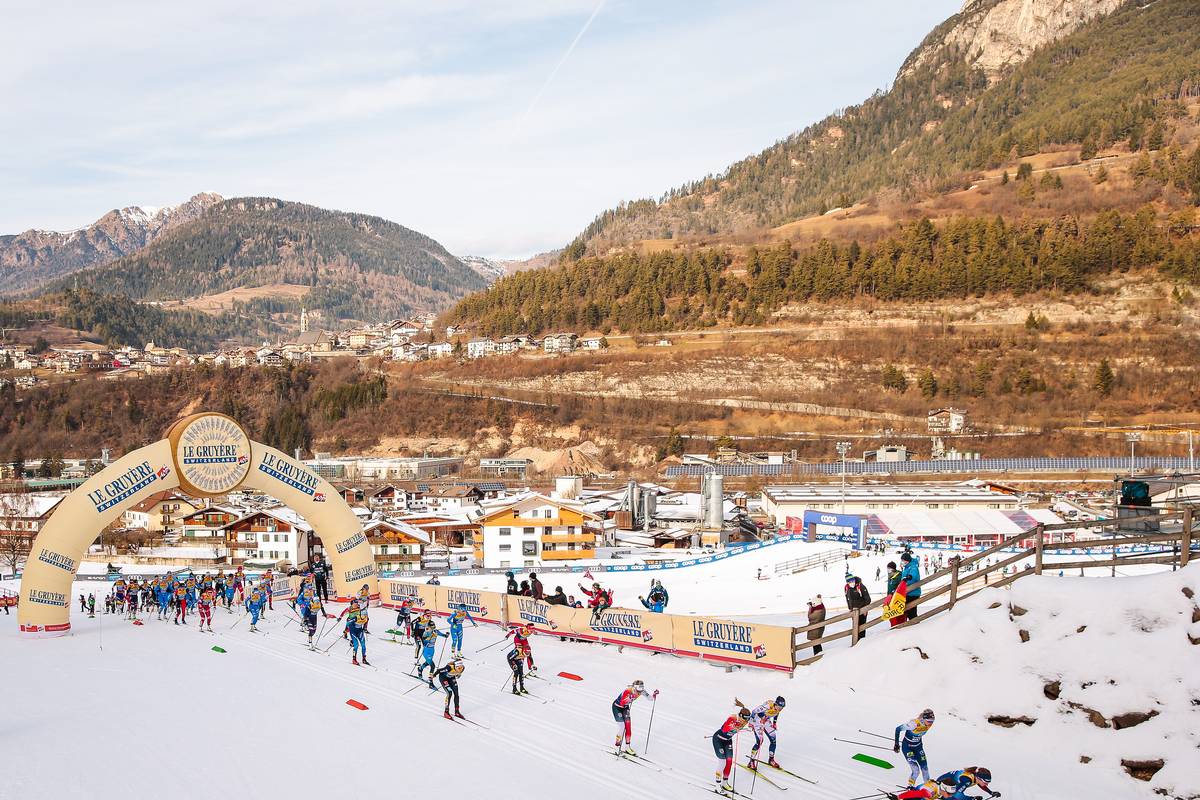
    Ruka had been bitterly cold in recent weeks — until a foot of new snow fell and temperatures climbed toward freezing. The result was a wax technician’s nightmare: soft snow in the shade, glazing climbs in the sun, and a classic course twisting through varying microclimates.

    Kick wax that worked at the start failed on the climbs. Skis that kicked well on the climbs dragged on the flats. Double-pole sections demanded freedom; the final climbs demanded grip. There was no perfect answer — only compromise and risk.

    This race was always going to reward the skiers with the best technical balance and the wax techs bold enough to choose the right kind of “wrong.”

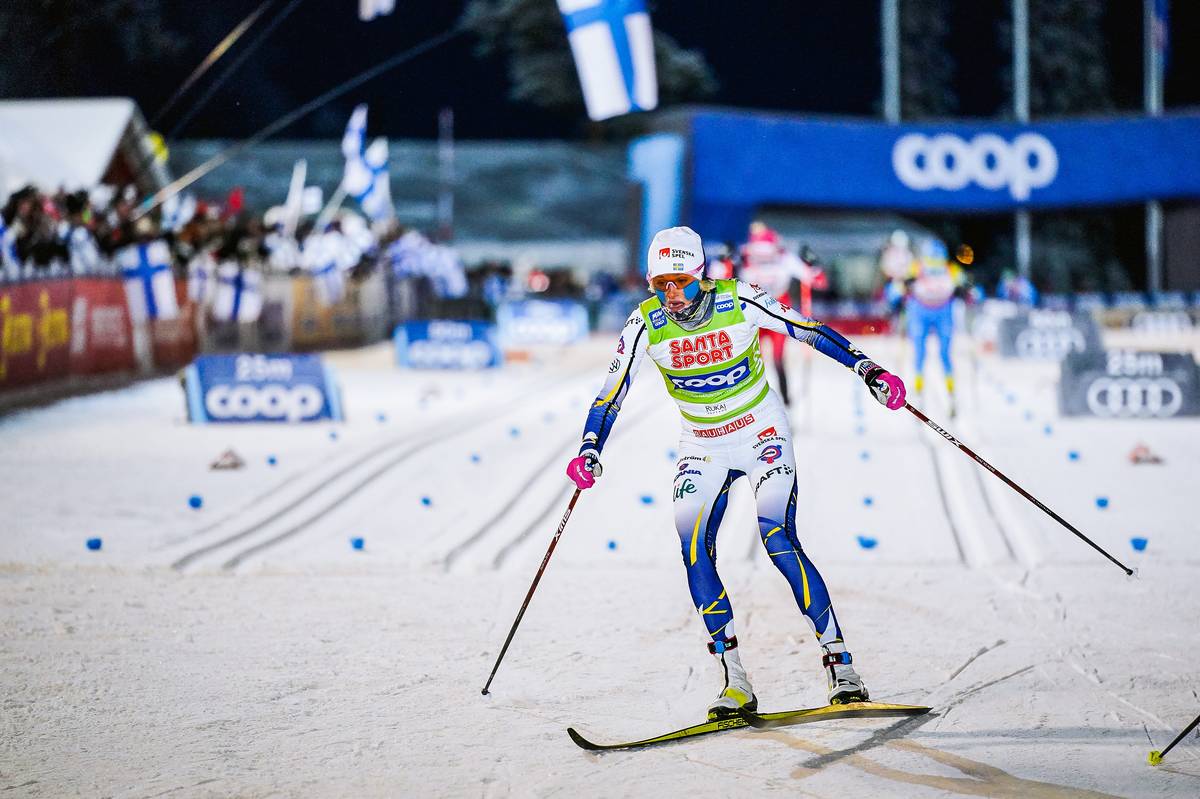
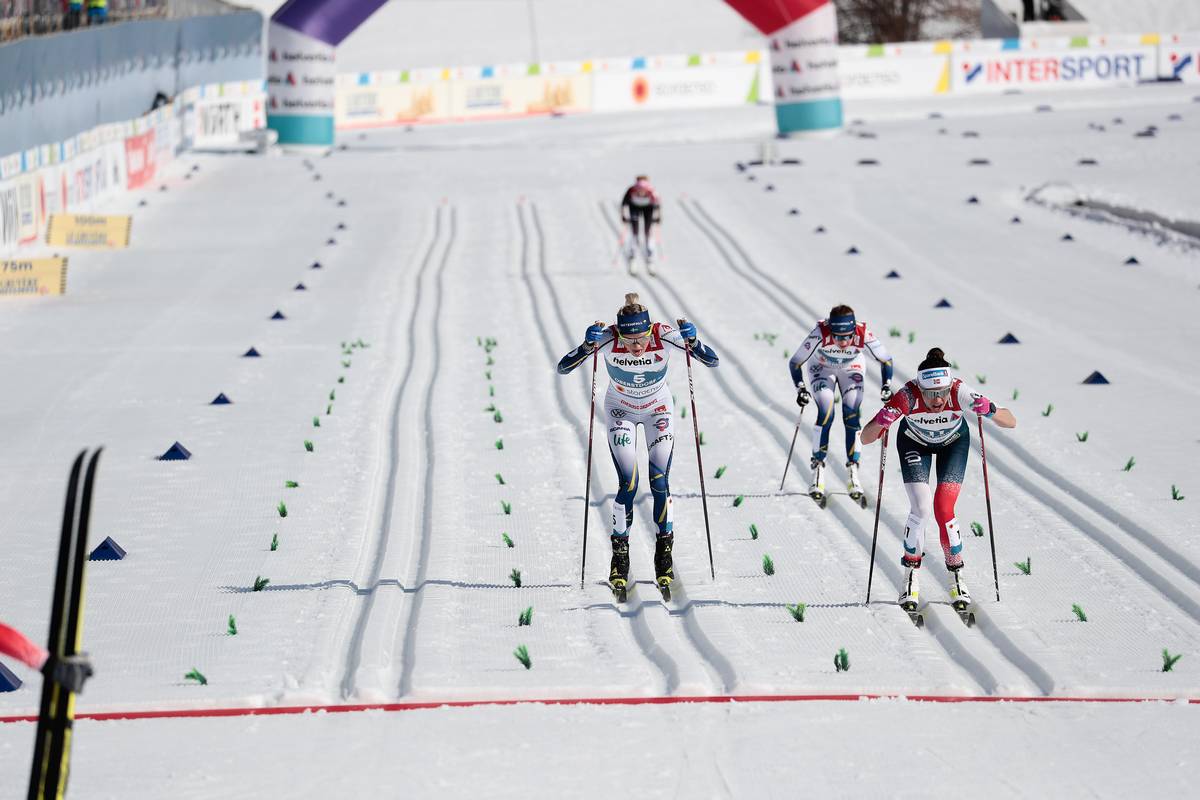
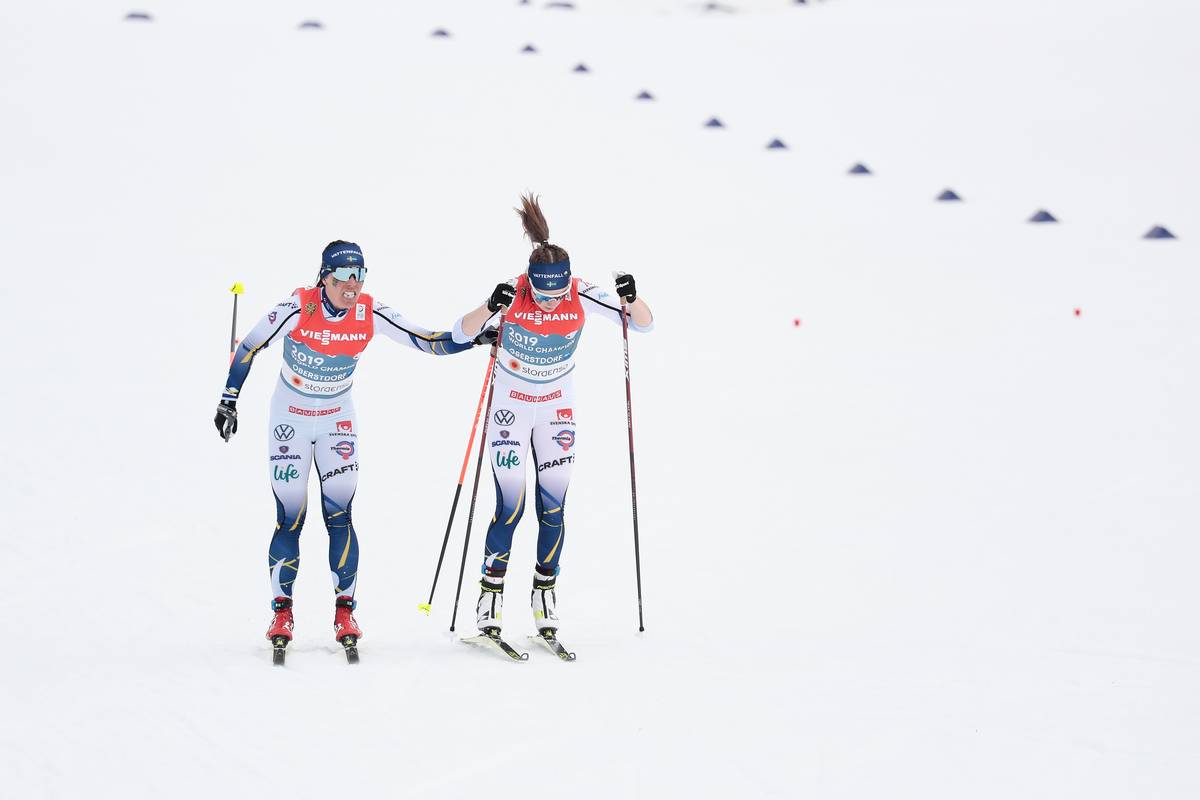
    Moa Ilar (SWE) charges down the finishing stretch at the end of the 10k Classic in Ruka (FIN). (Photo: Modica/NordicFocus)

    The Race: Karlsson Sets the Standard, Weng Returns, Ilar Rises, Diggins Surges

    1.1 km — Jessie Diggins Takes the First Lead of the Season

    From the moment the race began, the tone was unmistakable.

    With bib #1 Julie Bjervig Drivenes setting the baseline, Jessie Diggins blasted through the first checkpoint with the early lead — 1.3 seconds ahead of Frida Karlsson.

    It was classic Diggins: joyful, aggressive, fearless.

    3.3 km — Karlsson’s Stride Takes Control

    By 3.3 km, the race reshaped itself. Frida Karlsson, with her strong hip stability and long, economical stride, surged into the lead on the climbing sections. Diggins, whose double-poling and downhill flow looked excellent, lost time on the steepest pitches and slid to seventh.

    Behind Karlsson, Sweden formed a front of precision:

    • Moa Ilar at +3.0
    • Ebba Andersson at +5.1
    • Three Swedes in the top three splits.

    A message, delivered early.

    6.1 km — Heidi Weng Charges Back Into the Story

    Heidi Weng, skiing 30 seconds behind Diggins, mounted the late charge of the day. She began cutting into Karlsson’s lead — from 14 seconds at 6.1 km to only 10.5 by the line.

    After several up-and-down years, Weng signaled something unmistakable: she’s not done yet.

    Final Kilometers — Diggins Closes Hard, Ilar and Andersson Duel, Fosnæs Threatens

    Jessie Diggins mounted her own push on the flats and downhills, gaining time between 6.1 and 8.1 km. She crossed the line in a time that held the top spot until the final seeded skiers, ultimately placing fifth — one of her strongest classic results ever on this course.

    Moa Ilar executed a poised final push, taking third and bumping Andersson to fourth. Kristin Austgulen Fosnæs threatened Diggins’ time but ultimately finished behind her in sixth.

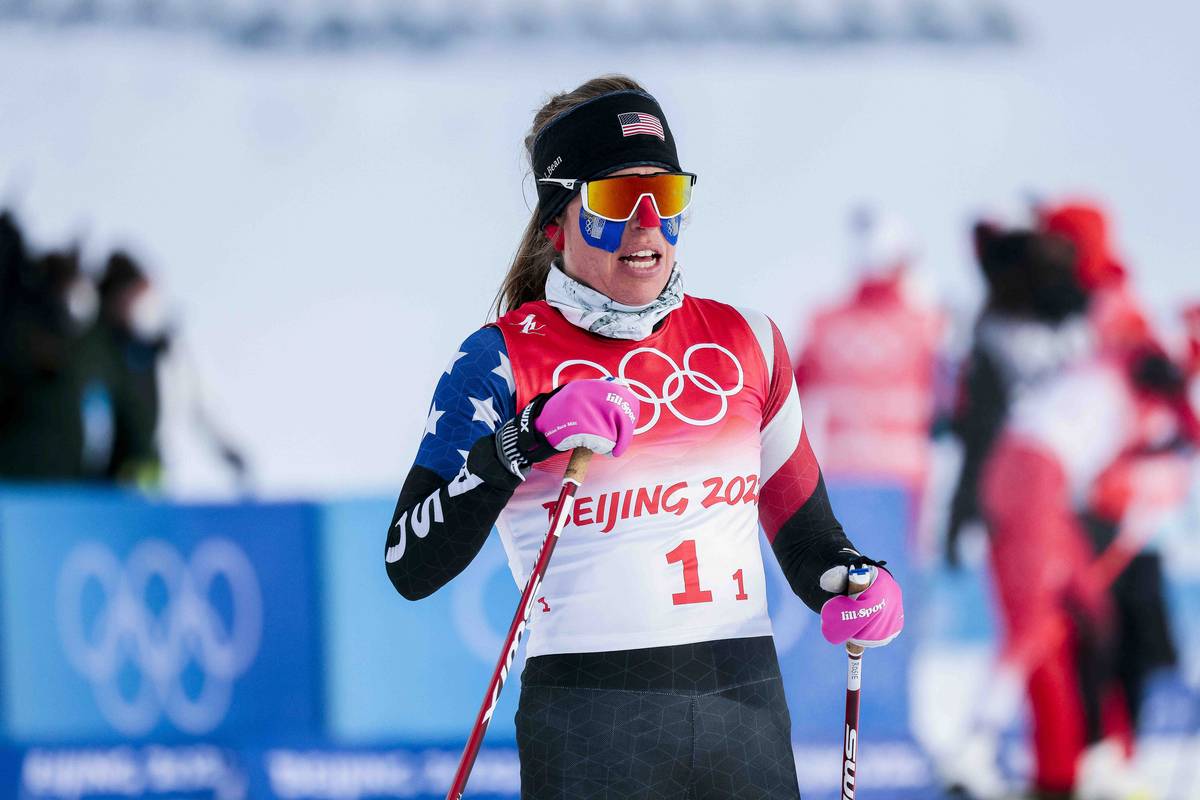
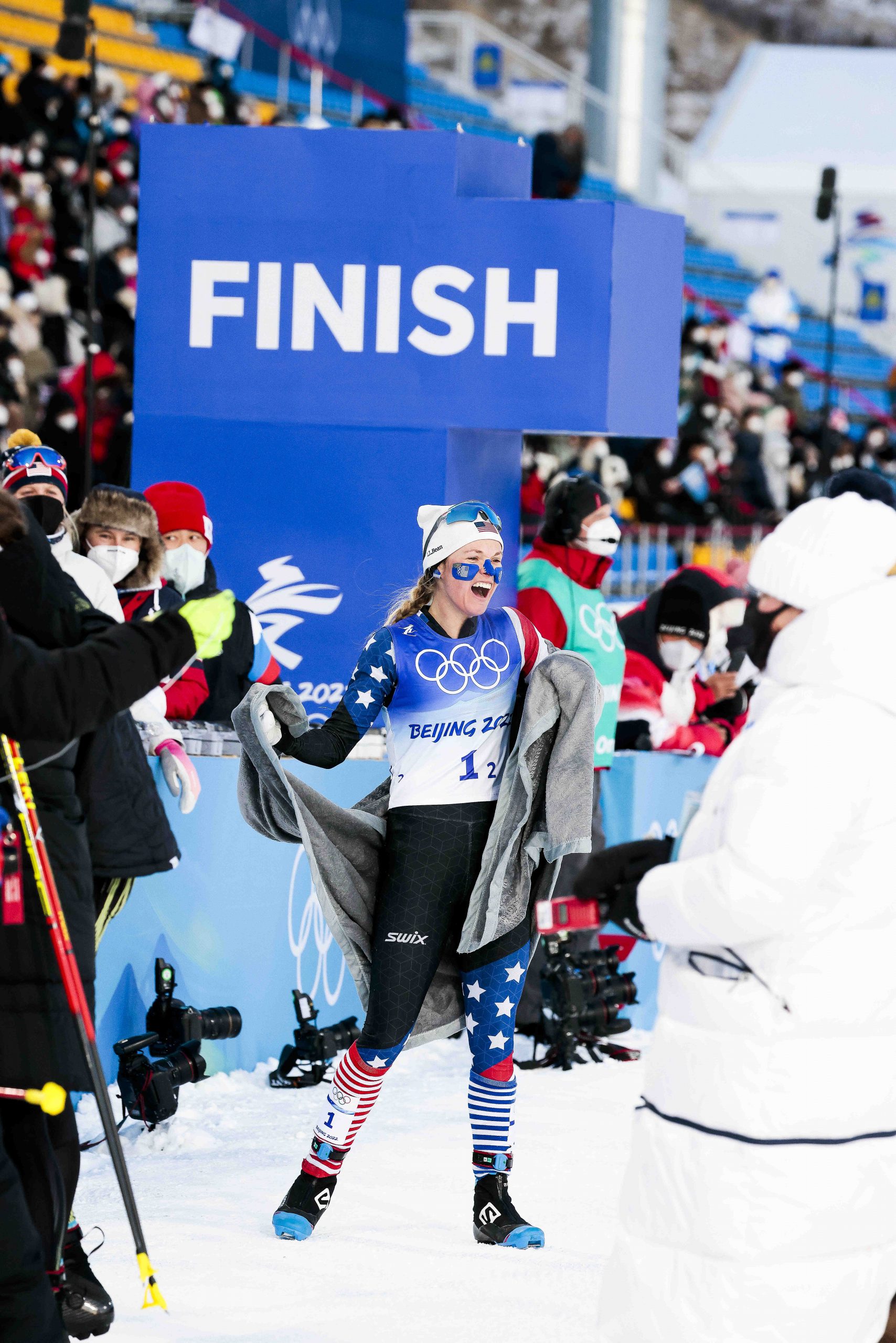
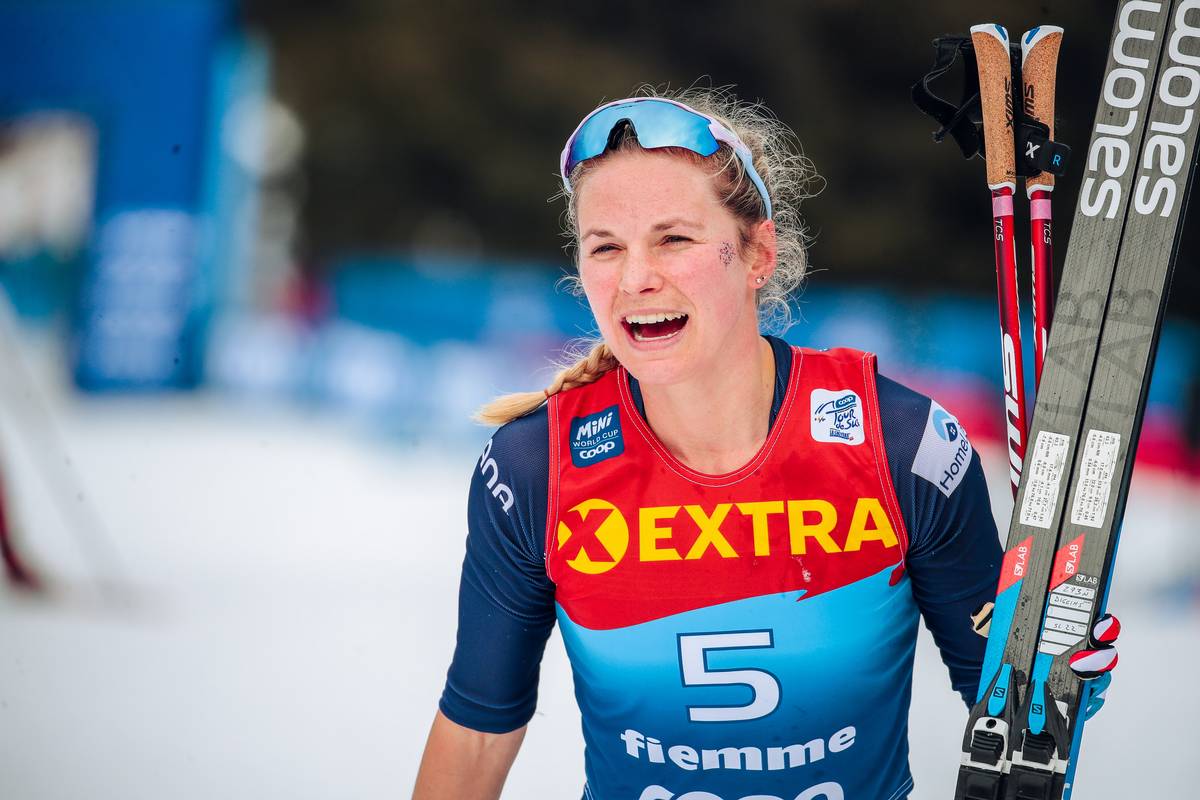
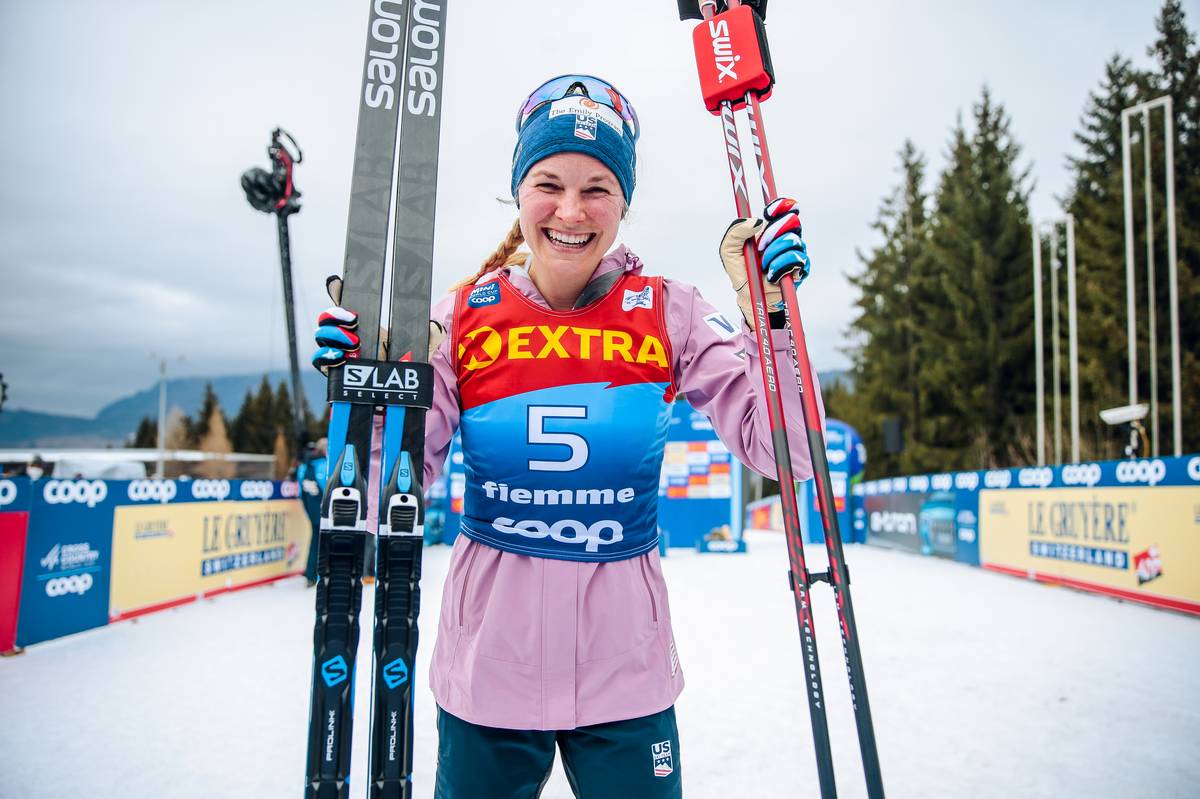
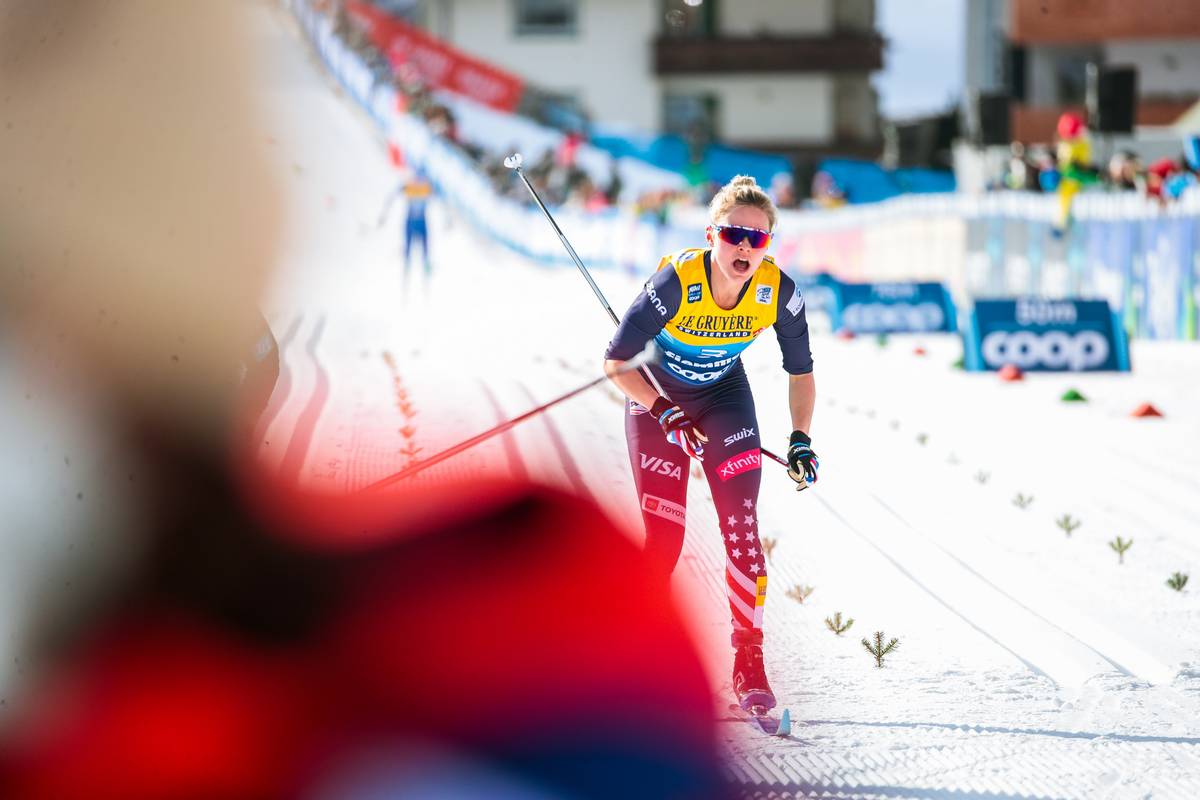
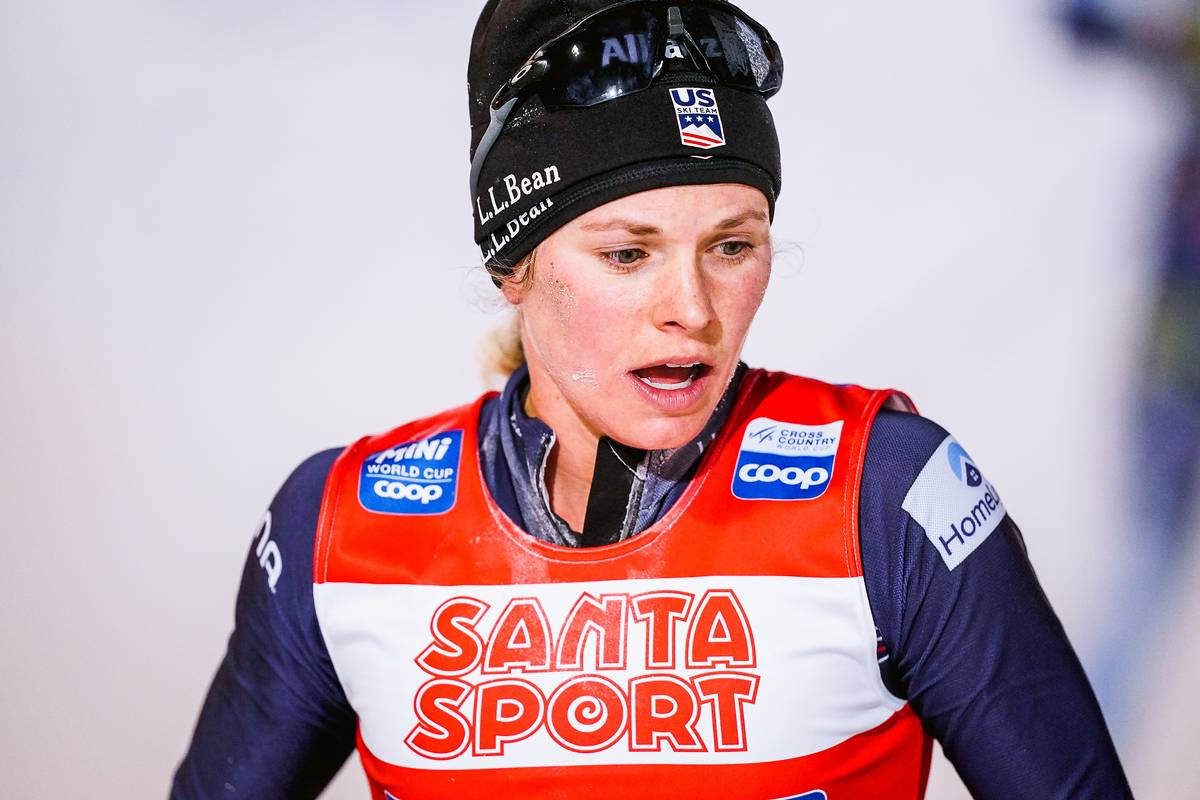
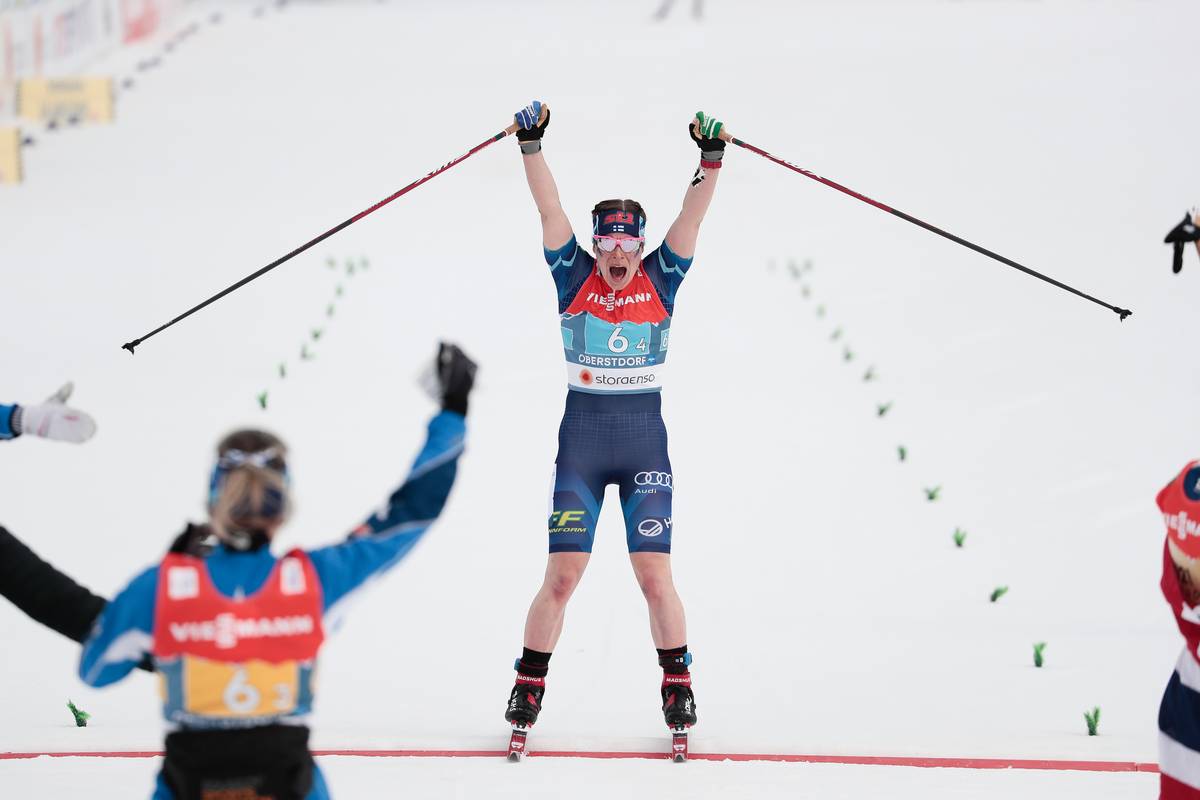
    Jessie Diggins (USA) was all smiles after the 10k Classic in Ruka (FIN). (Photo: Modica/NordicFocus)

    Jessie Diggins: Racing the First Day of Her Last Season

    As Diggins enters the last year of her storied career, her goals have nothing to do with podiums.

    “My goals are really not about race results at all,” she said. “My goals for the season are to be happy and healthy and just in the present moment… just really soaking in the moment and the feeling of, like, wow, I get to do this.”

    She brought that joy directly into today’s start.

    “I just wanted to go hard and use this race to get the season started.”

    And yet, the question remains: when Diggins puts on a bib, does instinct overtake the plan?

    “I do like to push myself to the max whenever I race — maybe not 100% where I’m scraped off the snow, but really darn close,” she said.

    “It’s part of my training plan with Cork — we use early season races to build sharpness.”

    On a tricky waxing day, Diggins was clear-eyed about the team effort.

    “I was really happy with my skis… a great mix of just enough kick but also really free. We needed the skis to be fast in the double-poling, and knowing I was going to herringbone the climbs anyway, we went for that in-between.”

    For Diggins, this wasn’t just a top-five finish. It was a signal: the last season of her career may feature some of her best classic skiing.

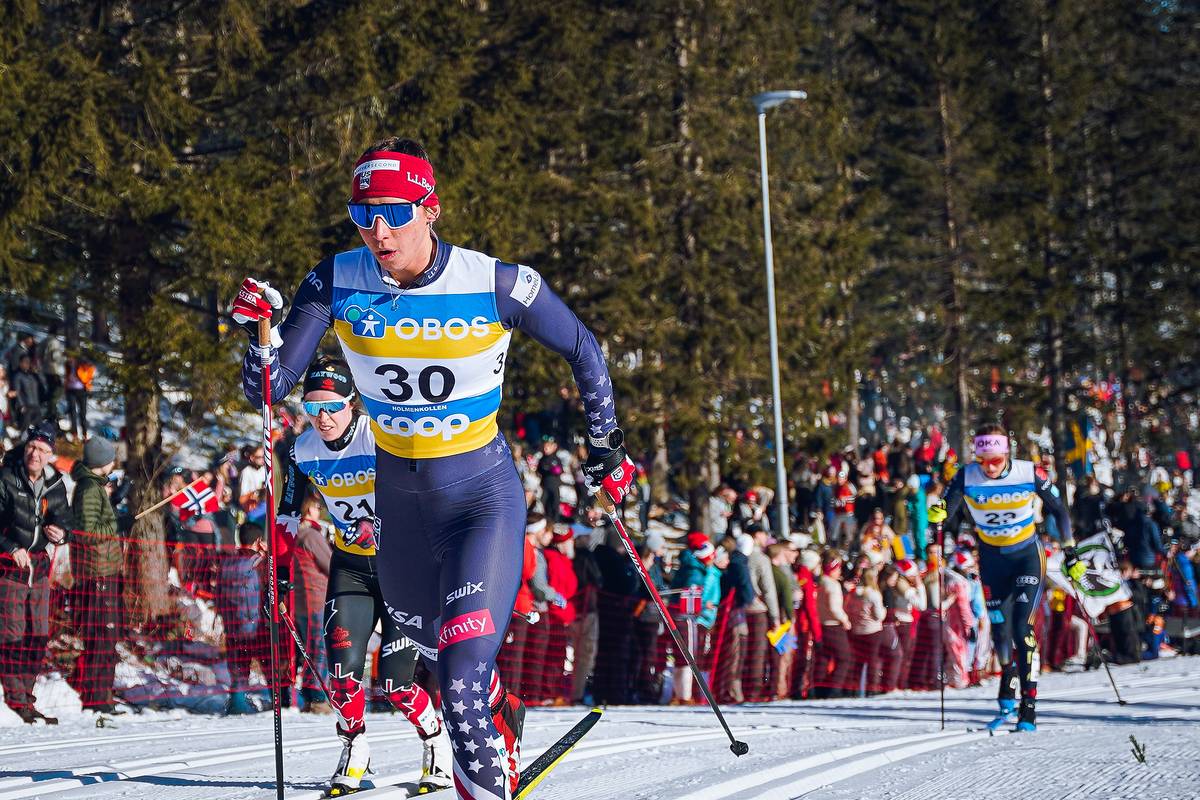
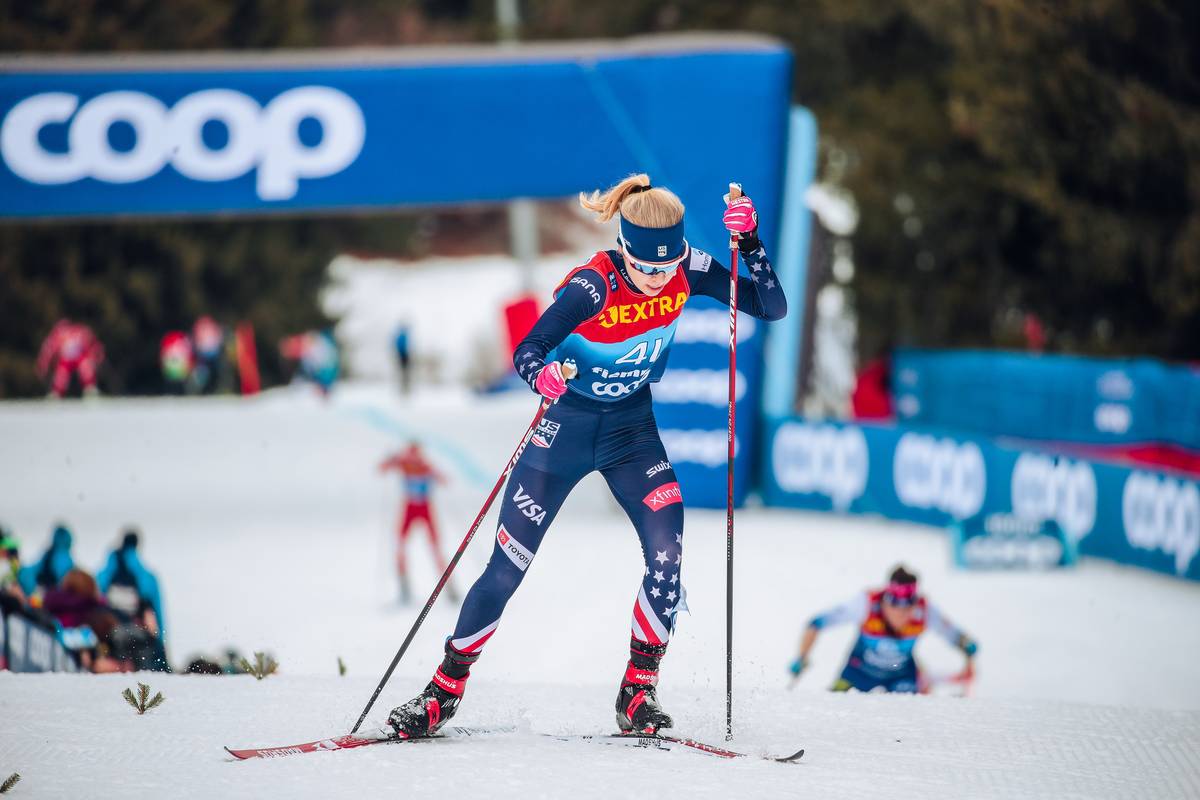
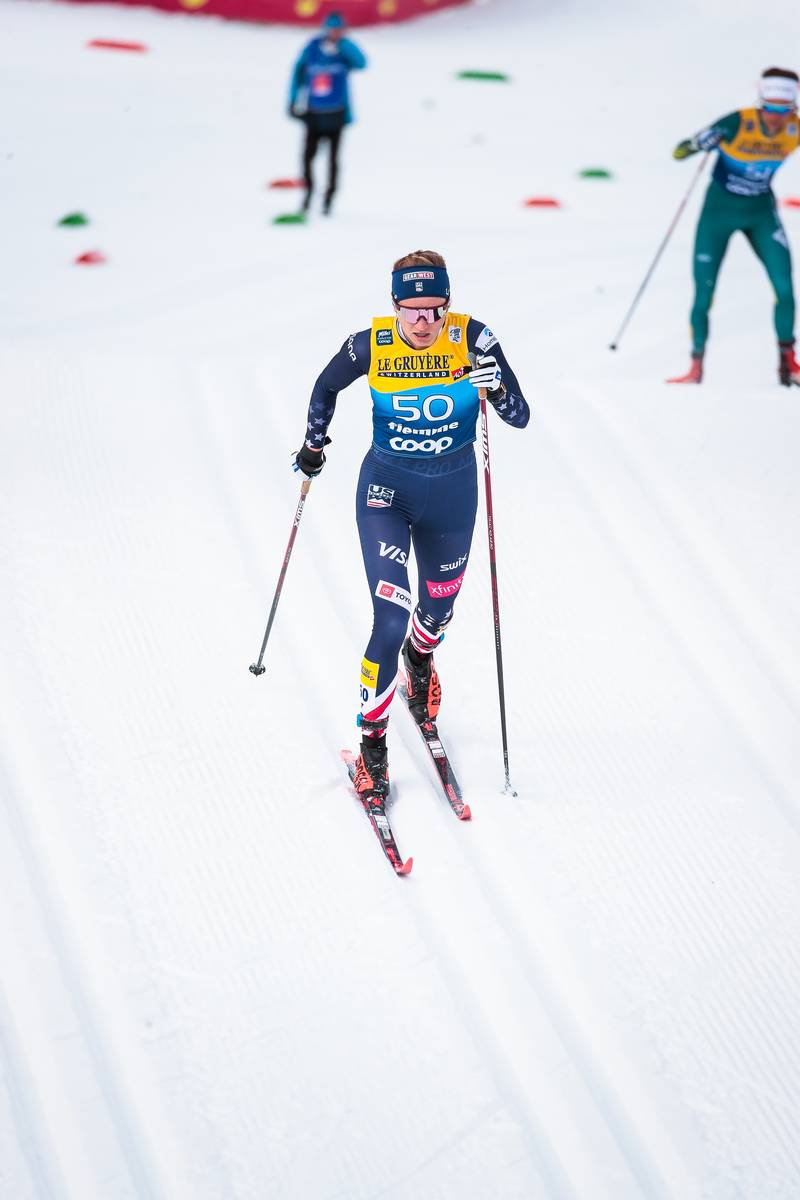
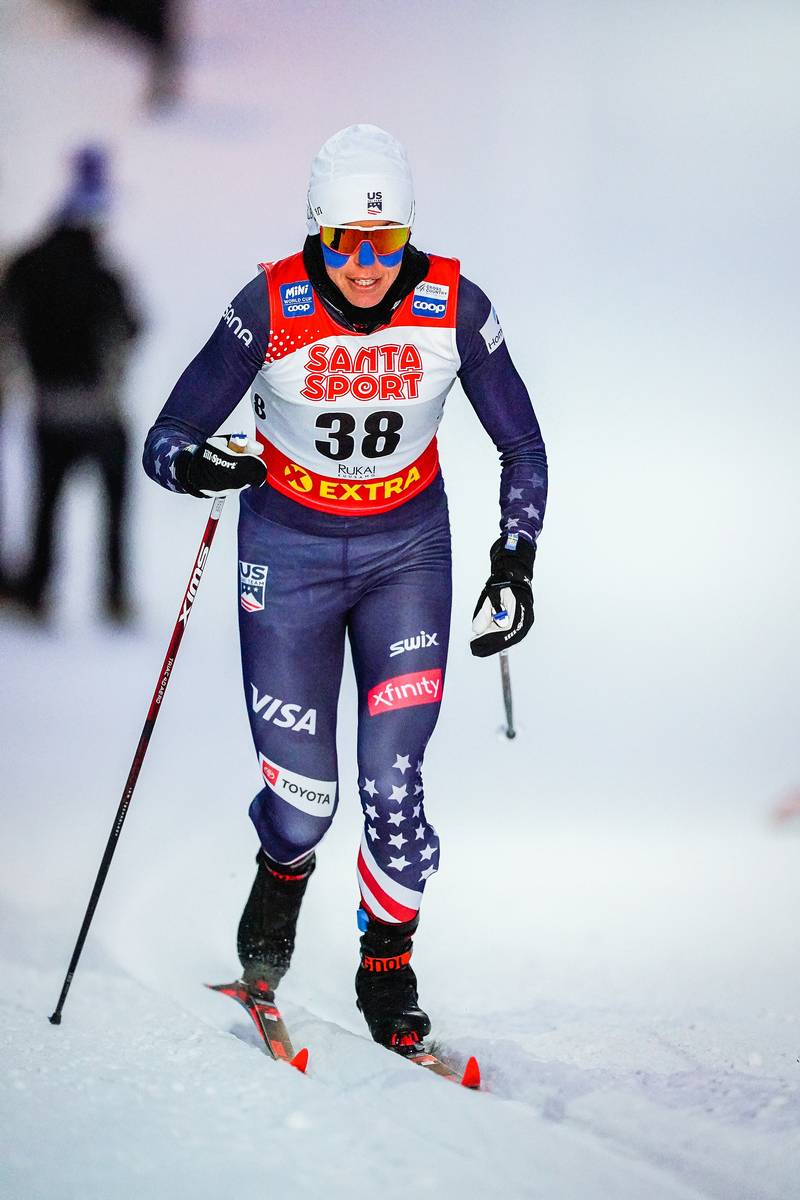
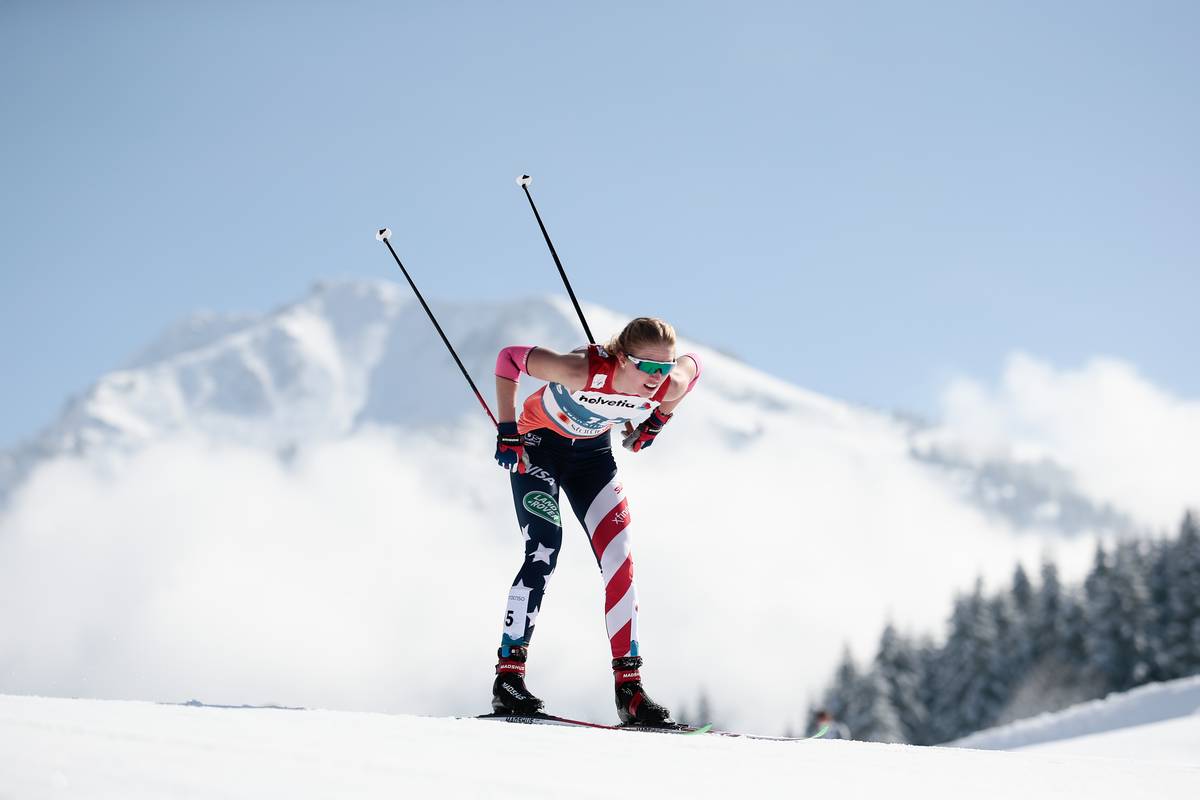
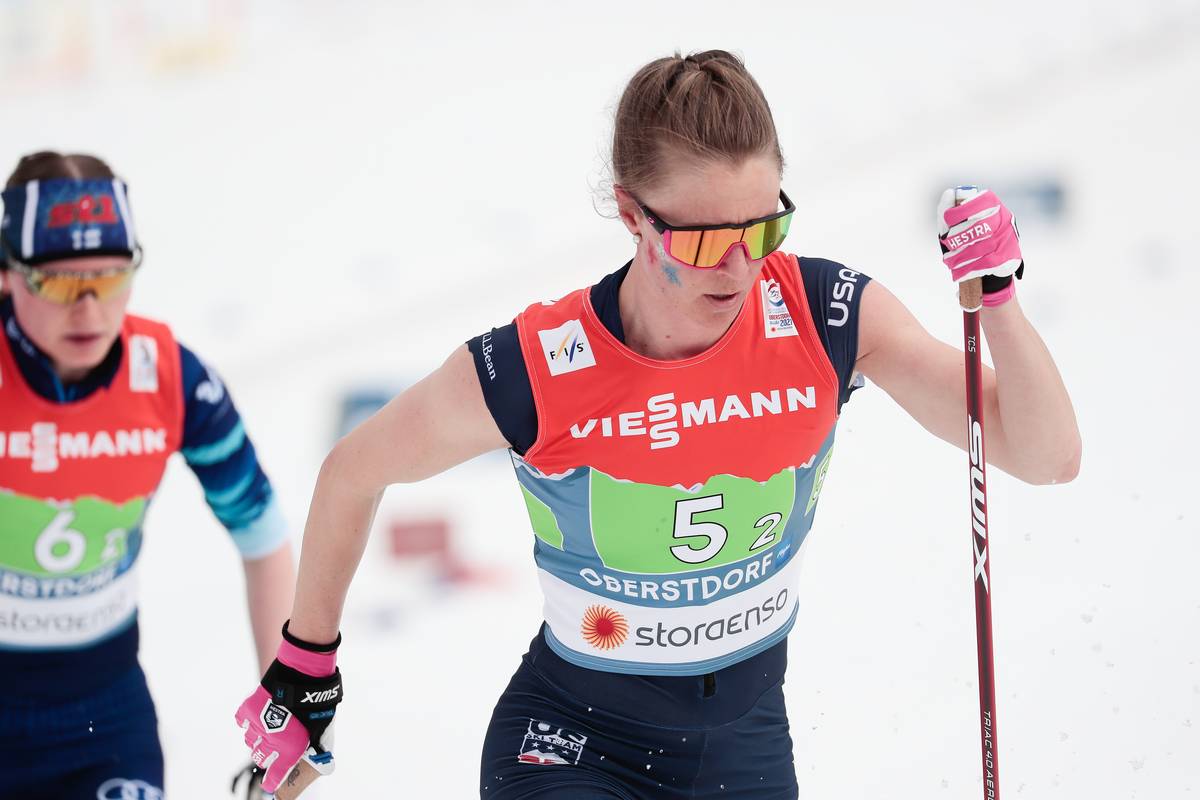
    Rosie Brennan (USA) with her signature long stride during the 10k Classic in Ruka (FIN). (Photo: Modica/NordicFocus)

    Rosie Brennan: “This Is Uncharted Territory”

    Rosie Brennan entered the winter with one of the most unconventional lead-ups of her career — a necessity after an Epstein-Barr reactivation forced her into weeks of “micro-intervals” and tightly controlled volume.

    Her return to full-distance racing revealed both progress and uncertainty.

    “If I’m honest, I had a little higher expectations for myself today, so I’m feeling a bit mixed about it,” she said.

    “There were some moments of skiing I was really happy with and some that left me wanting more.”

    The hardest part, she explained, has been adapting to Europe — travel, fatigue, recovery — with a body that no longer responds as it used to.

    “It’s been a really hard adaptation to Europe with a body that isn’t as resilient as I’m accustomed to… this is uncharted territory for me, and I just don’t know what will happen.”

    Still, she holds hope — and patience.

    “I have to keep trying and experimenting and figure out what will work for me this winter. I’m sure there will be a lot of ups and downs in the process.”

    For Brennan, today wasn’t a verdict — it was the next step in a complicated, courageous return.

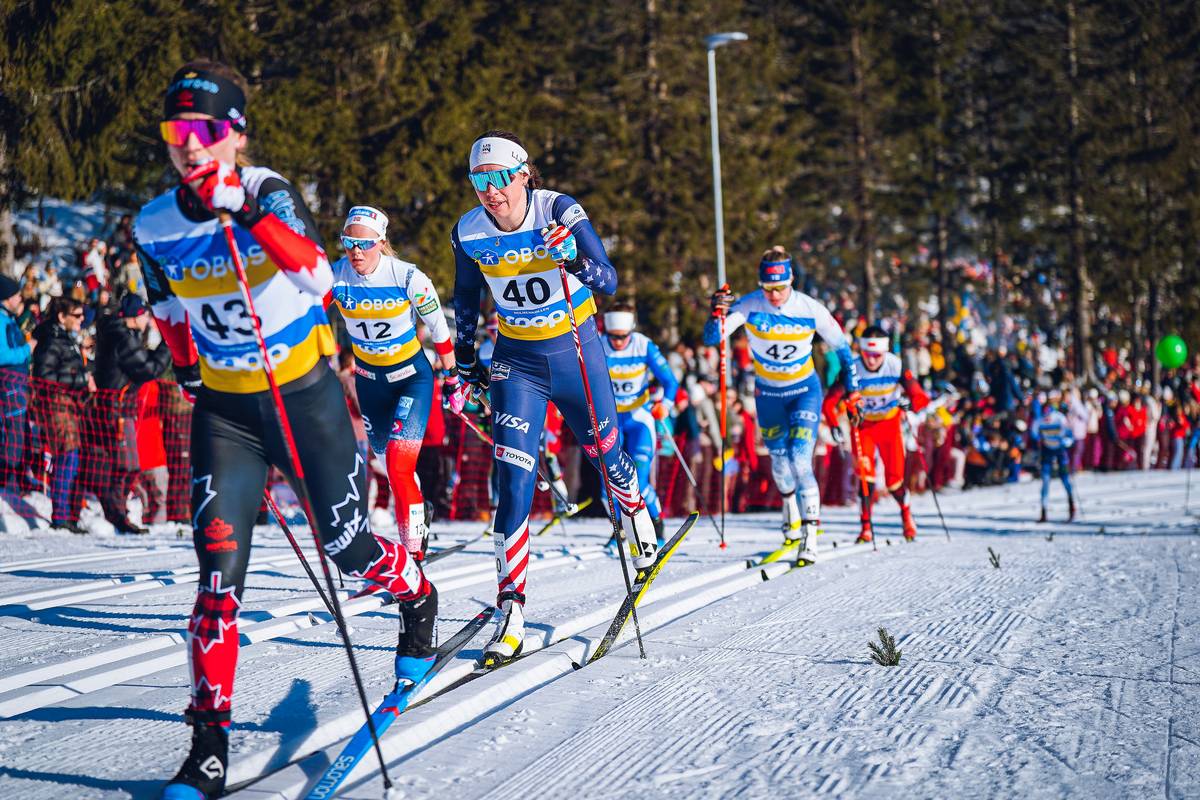
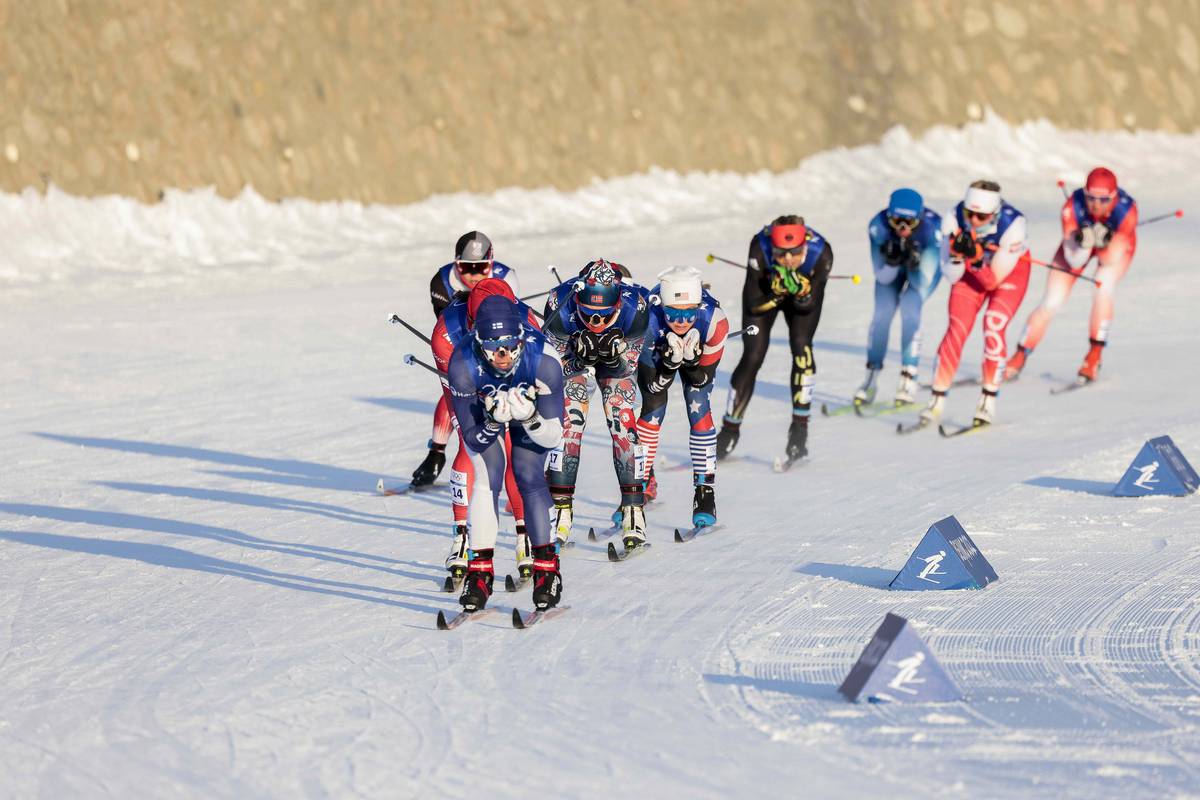
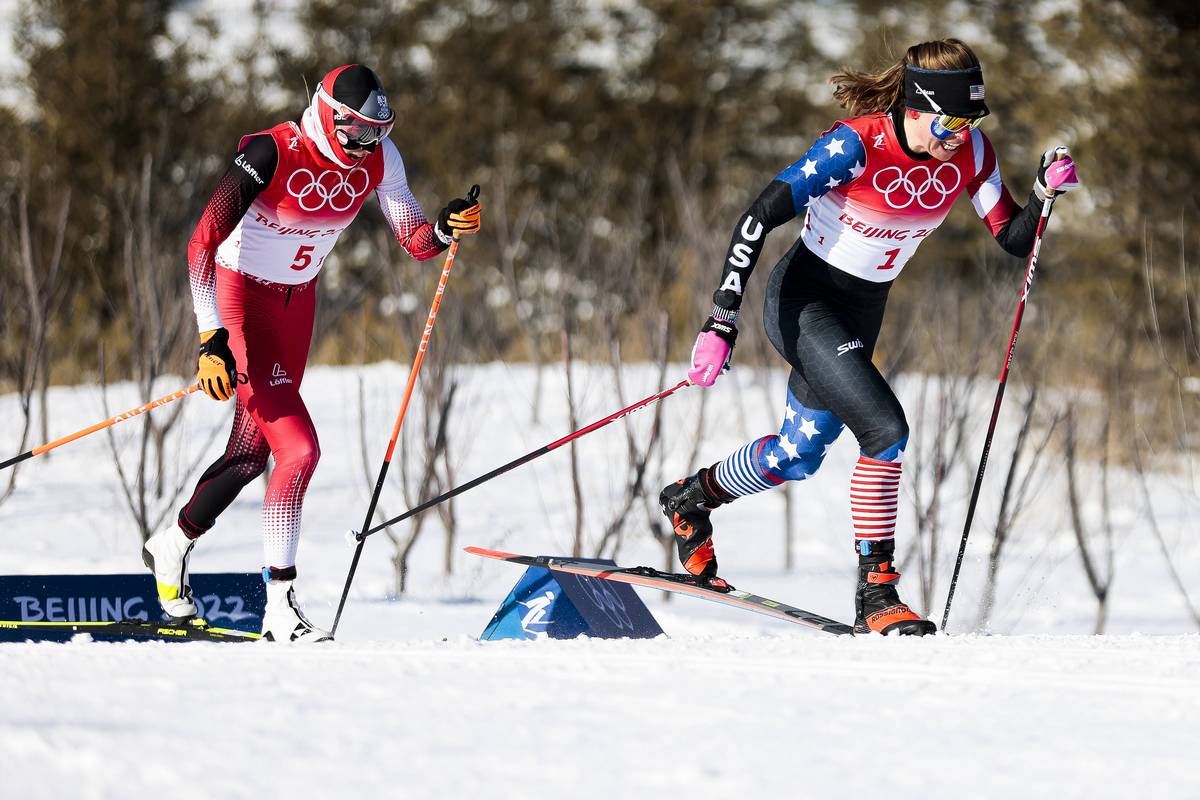
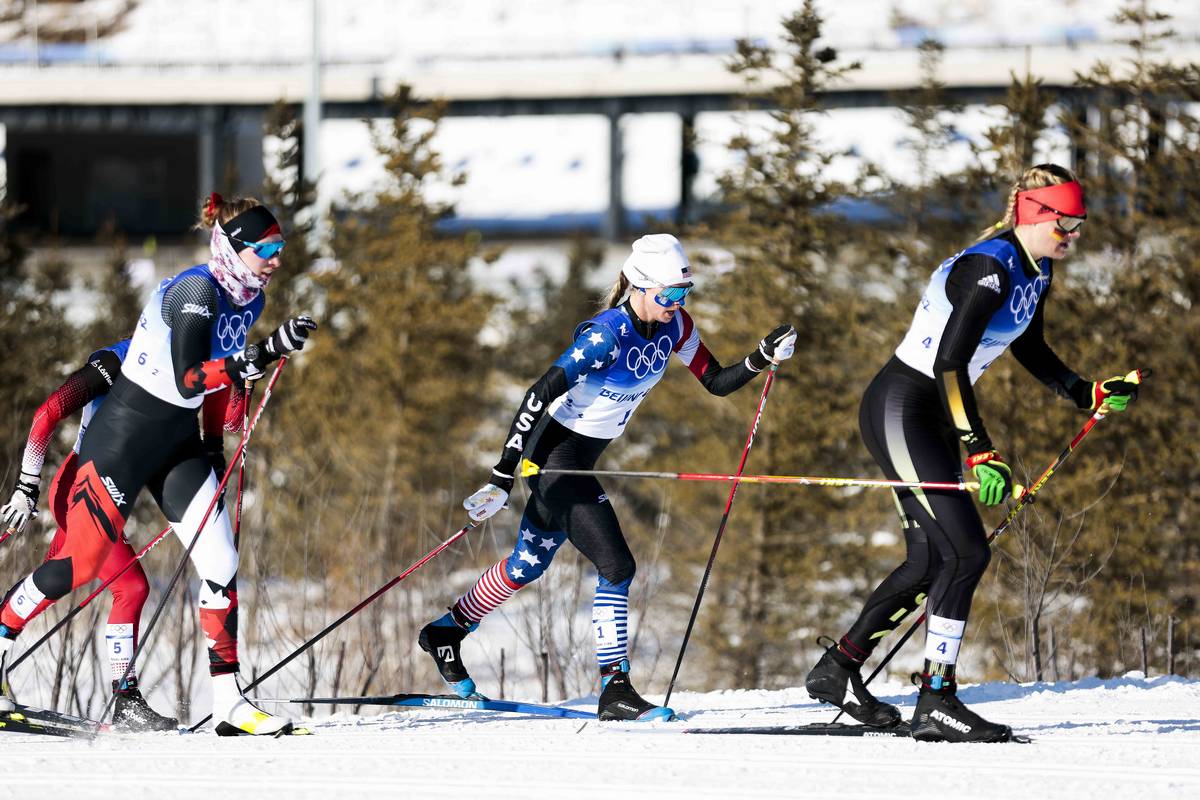
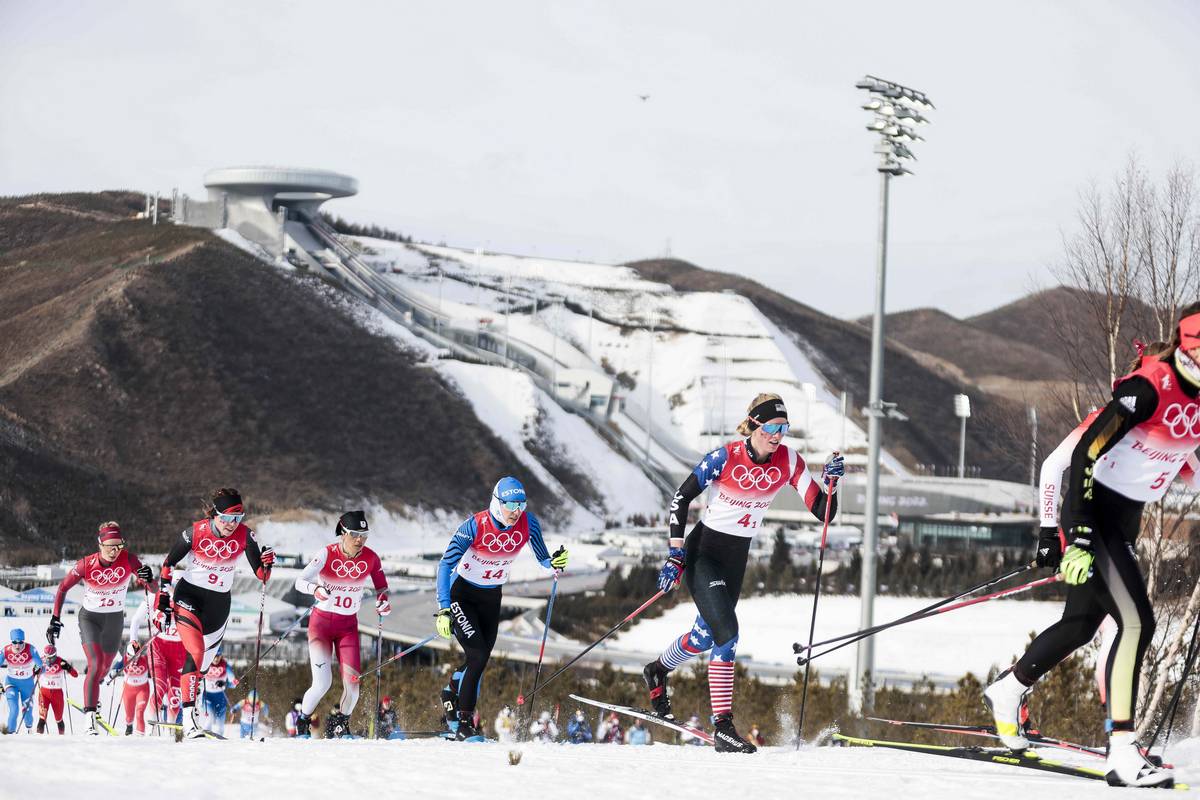
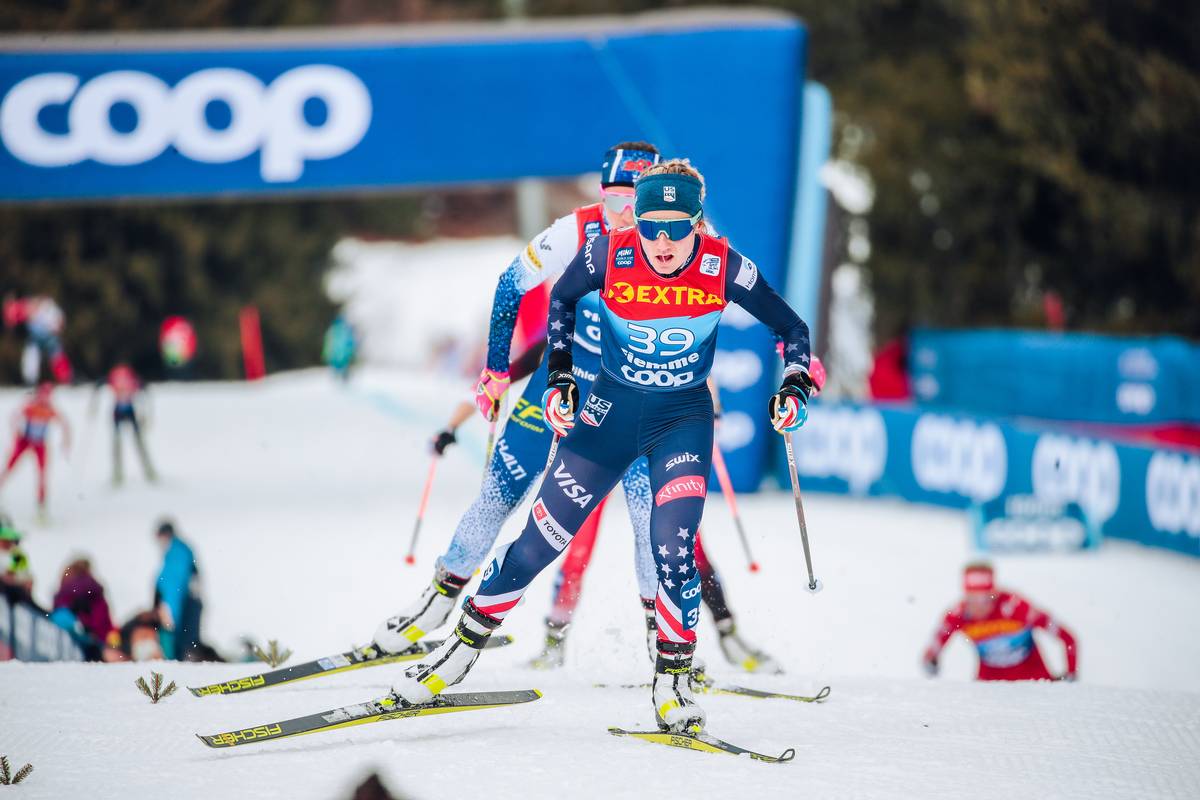
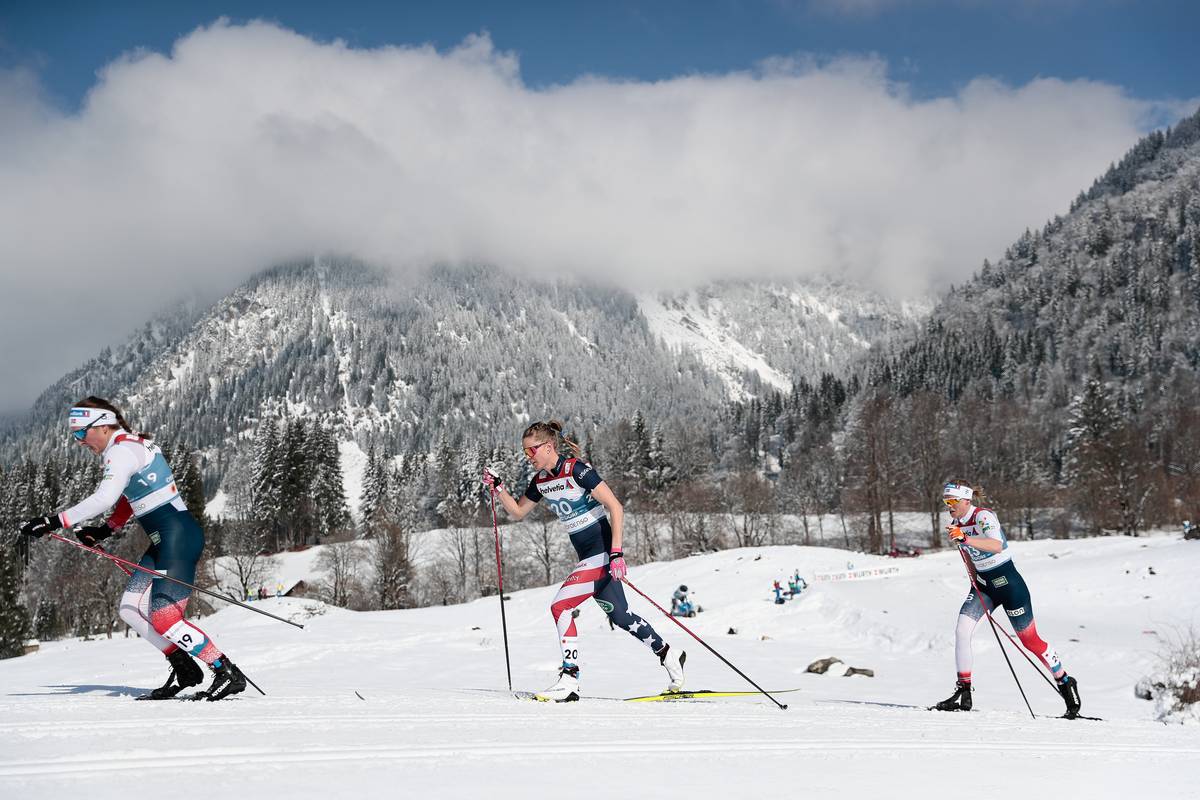
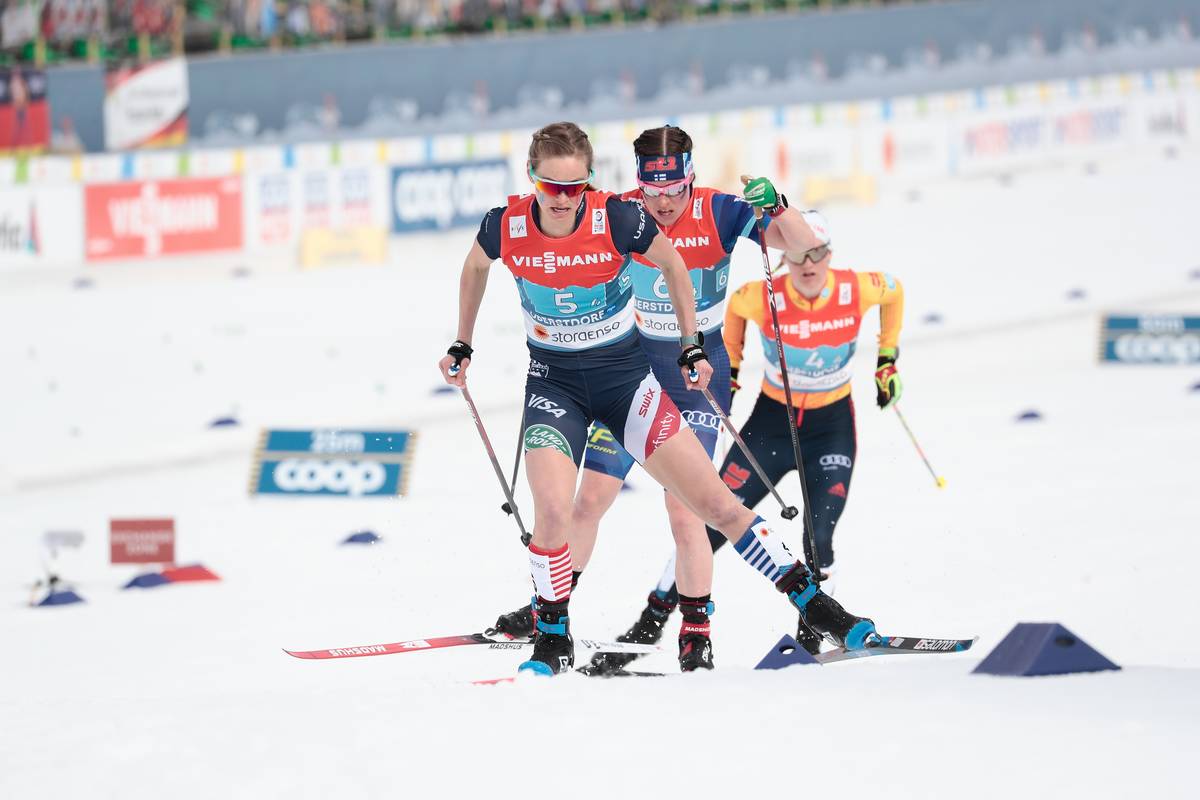
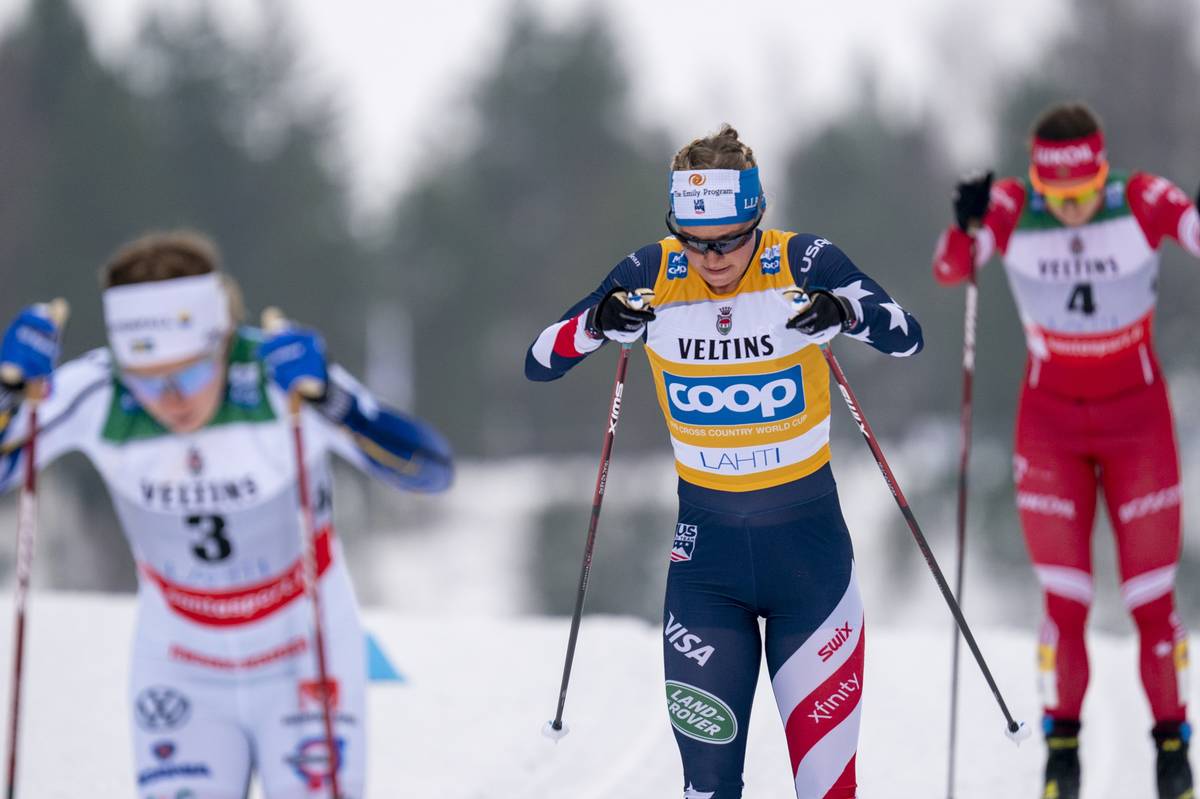
    Ebba Andersson (SWE), Julia Kern (USA), (l-r) push up the climb in Ruka (FIN). (Photo: Modica/NordicFocus)

    Julia Kern: A Personal Best Hidden Behind the Result Sheet

    Julia Kern’s final ranking might not have turned heads on the results page, but the performance meant far more than the number beside her name. For Kern — often a slow starter in Ruka — today marked meaningful progress.

    “Actually, I’m proud of my race today,” she said. “If you just look at the result… You would think I’d be quite dissatisfied, but this was a personal best for me in the opening Ruka 10km.”

    The opener in Ruka has long been one of the toughest venues for her, a course whose steep climbs, cold temps, and early-season timing rarely align with her strengths.

    “This was my eighth time doing this race, and the result has never been great or representative of other races later in the season,” Kern explained. “I was proud of having moments out there where I skied with good technique, and my body had good energy.”

    Her long-term confidence remains intact — today was a step, not a verdict.

    “Of course, I want to climb higher in the results list, but my result today doesn’t worry me,” she said. “I use this race to race myself into shape and wake up the body for the sprint tomorrow and the rest of the season.”

    Like many in the field, she dealt with some of the day’s most fickle challenges: a mix of new snow, fog, drizzle, and instant glazing that made finding kick nearly impossible.

    “It was on and off snowing/light fog or drizzle… a classic Ruka day where the tracks seem to glaze in an instant,” she said. “The glaze made it really challenging to kick from the start, and even harder in the second lap.”

    But where the climbs demanded compromises, the flats rewarded her strengths.

    “Otherwise the conditions felt fast on the downs and flats,” Kern added, “and I felt strong on the flatter terrain today.”

    Kern leaves day one not discouraged, but energized — a skier who knows this course never tells the whole story and who trusts what today’s moments of good skiing suggest about what’s ahead.

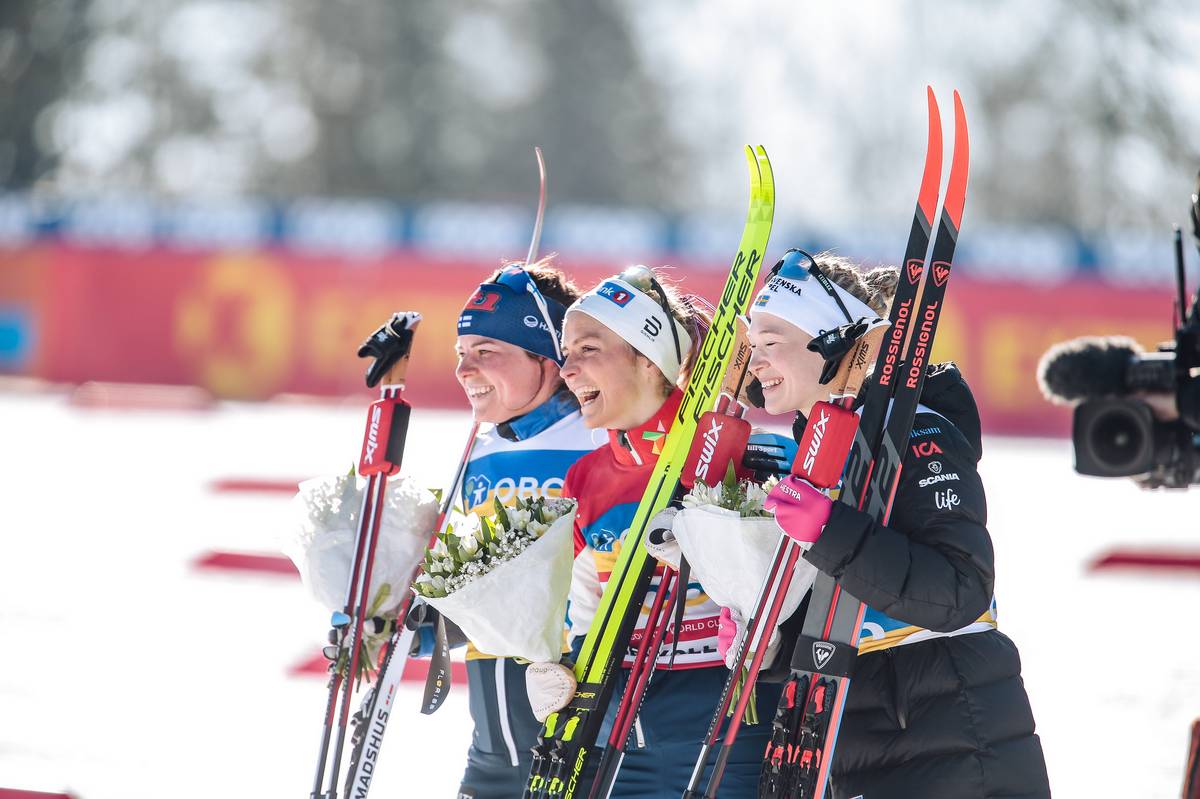
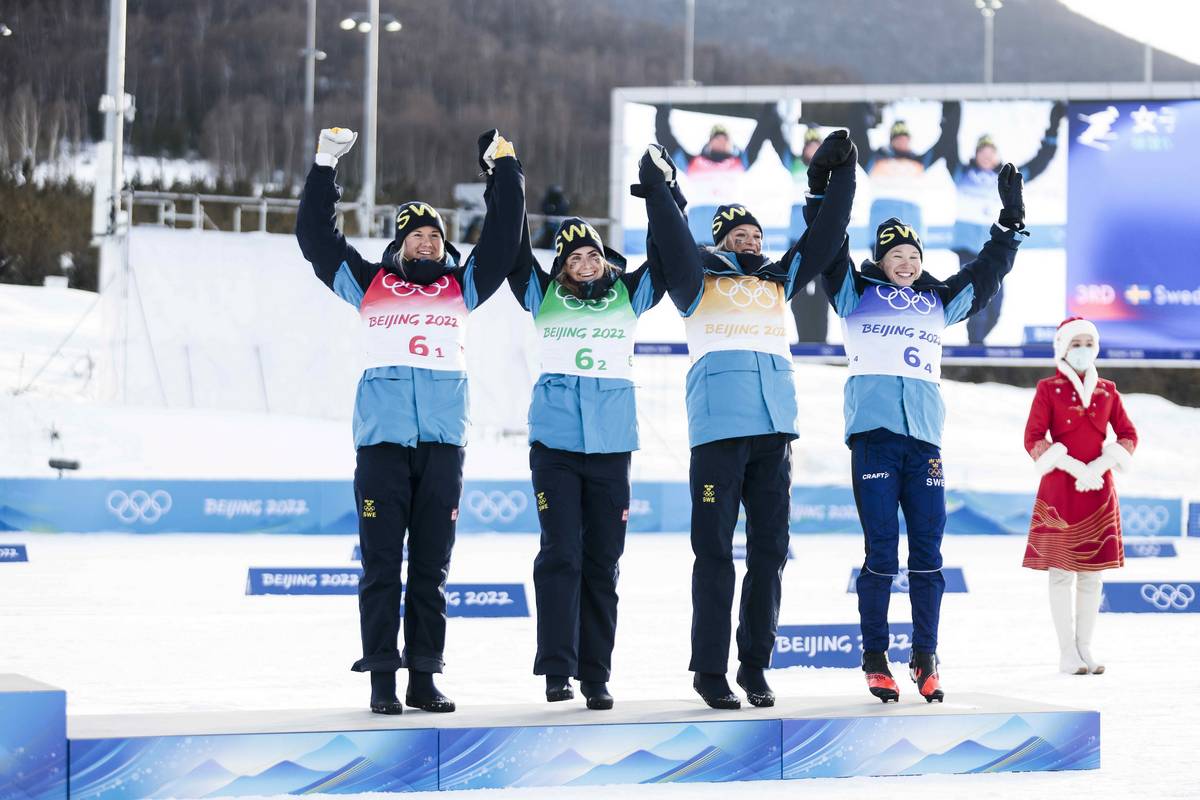
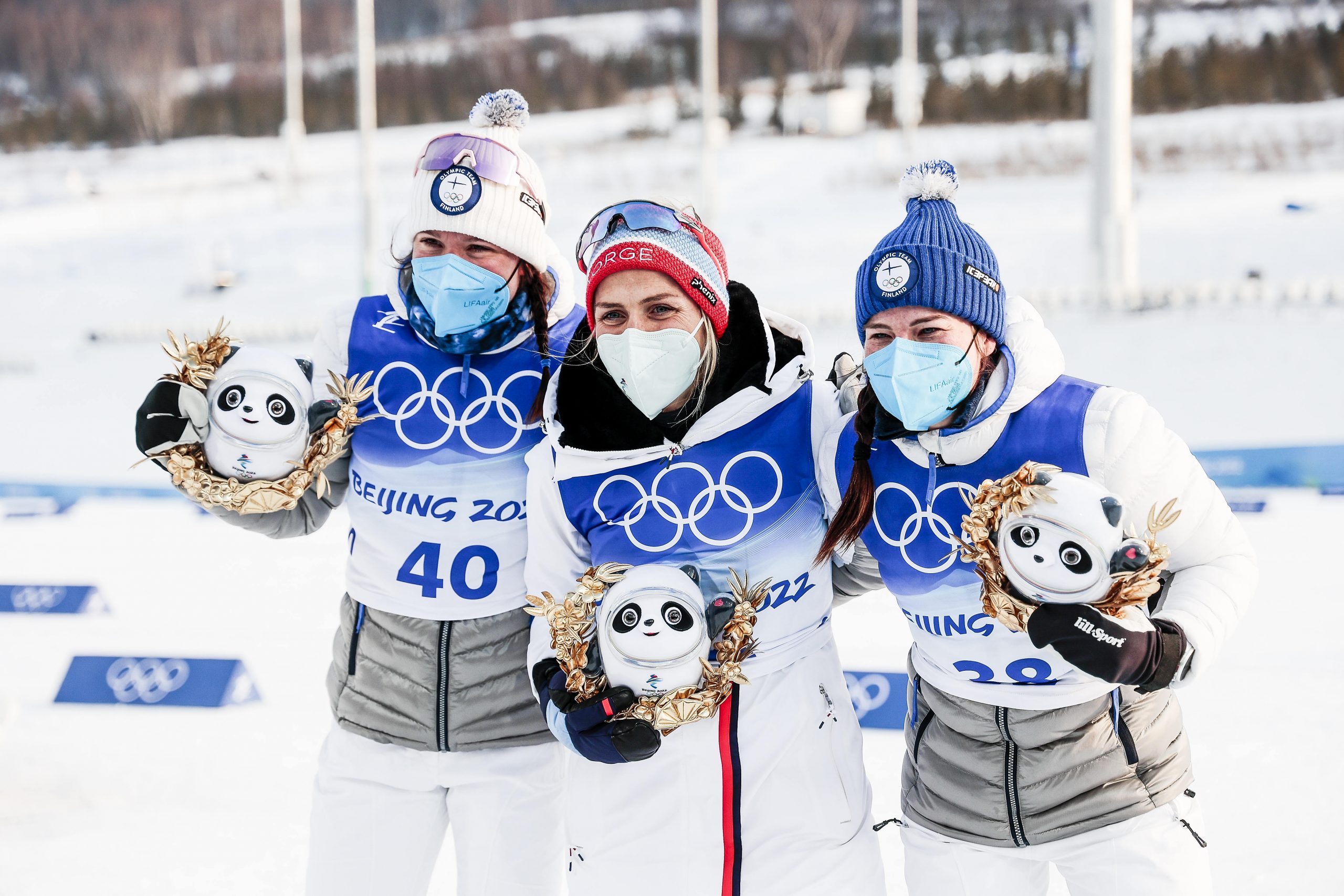
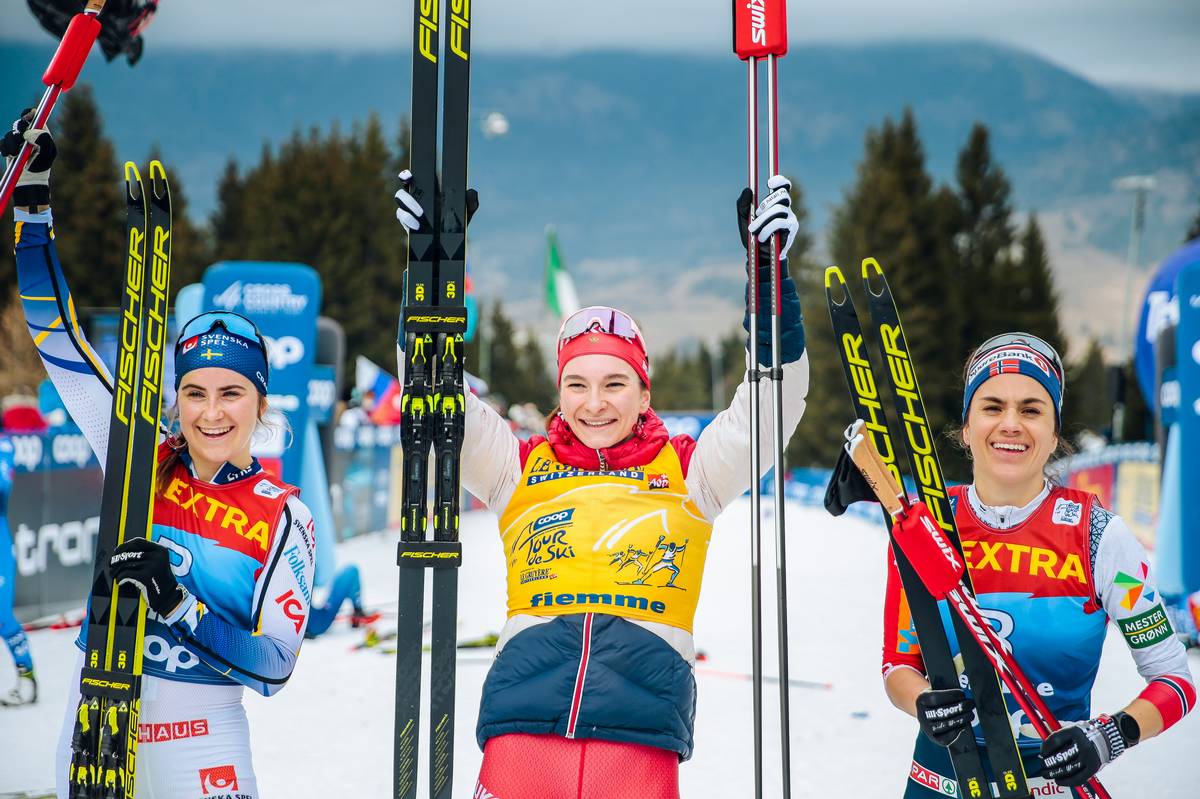
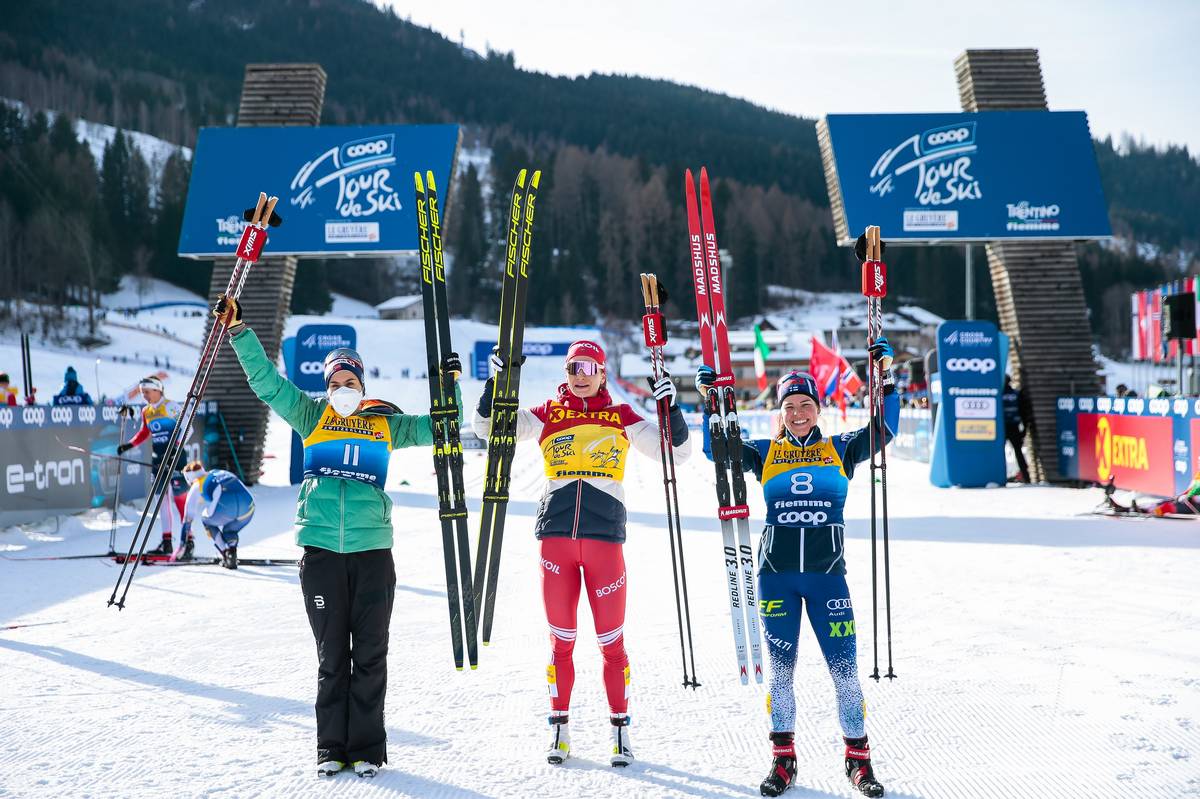
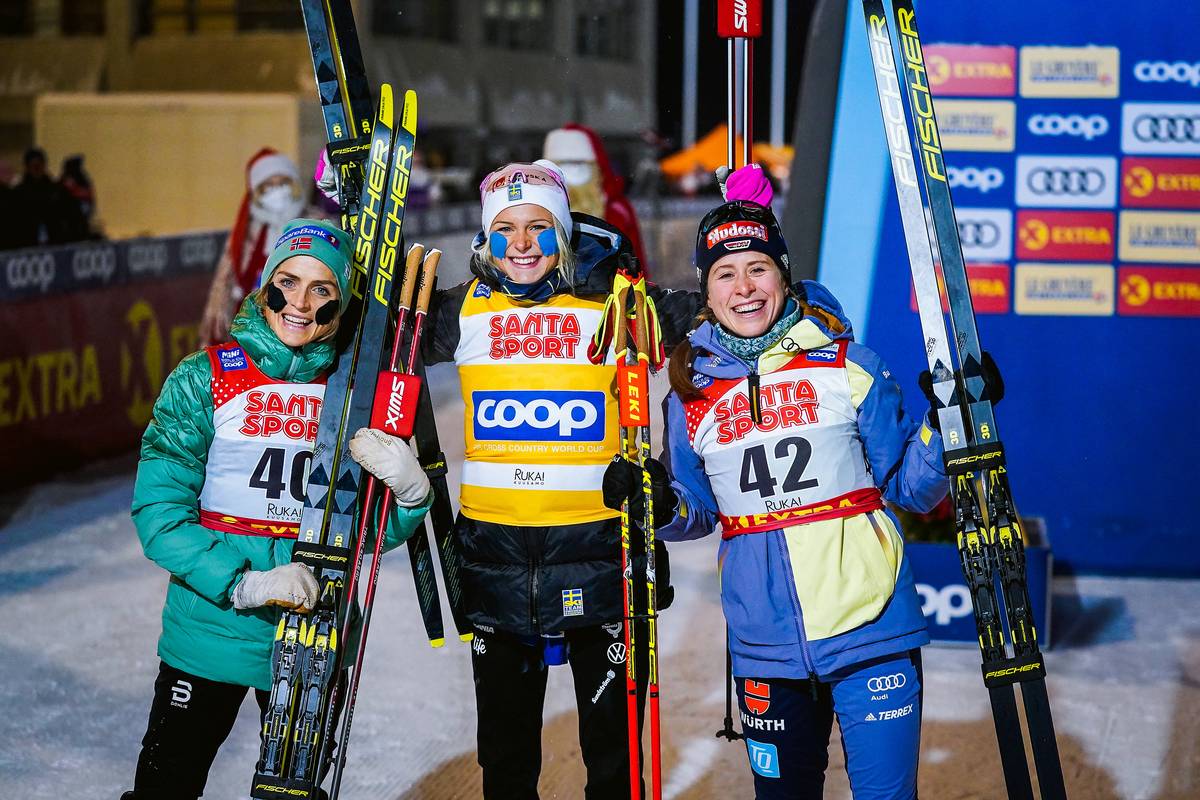
    Heidi Weng (NOR), Frida Karlsson (SWE), Moa Ilar (SWE), (l-r) share the podium of the 10k Classic in Ruka (FIN). (Photo: Modica/NordicFocus)

    The Podium: Sweden Opens the Olympic Year With Authority

    The final standings reflected both power and depth:

    1. Frida Karlsson (SWE) 23:31.8
    2. Heidi Weng (NOR) +10.5
    3. Moa Ilar (SWE) +18.3
    4. Ebba Andersson (SWE) +21.2
    5. Jessie Diggins (USA) +27.6
    6. Kristin Austgulen Fosnæs (NOR) 37.2

    Sweden finished with three in the top four. Karlsson earned her 16th career victory; Weng her 139th career podium; Ilar her 9th.

    On the Finnish side, Krista Pärmäkoski delivered a valiant final Ruka classic performance. Kerttu Niskanen, traditionally a force here, struggled to find her usual early-season spark.

    And for the Americans, the opener delivered clarity: Diggins strong, Brennan resilient, the younger athletes gaining essential early-season data for Olympic qualification.

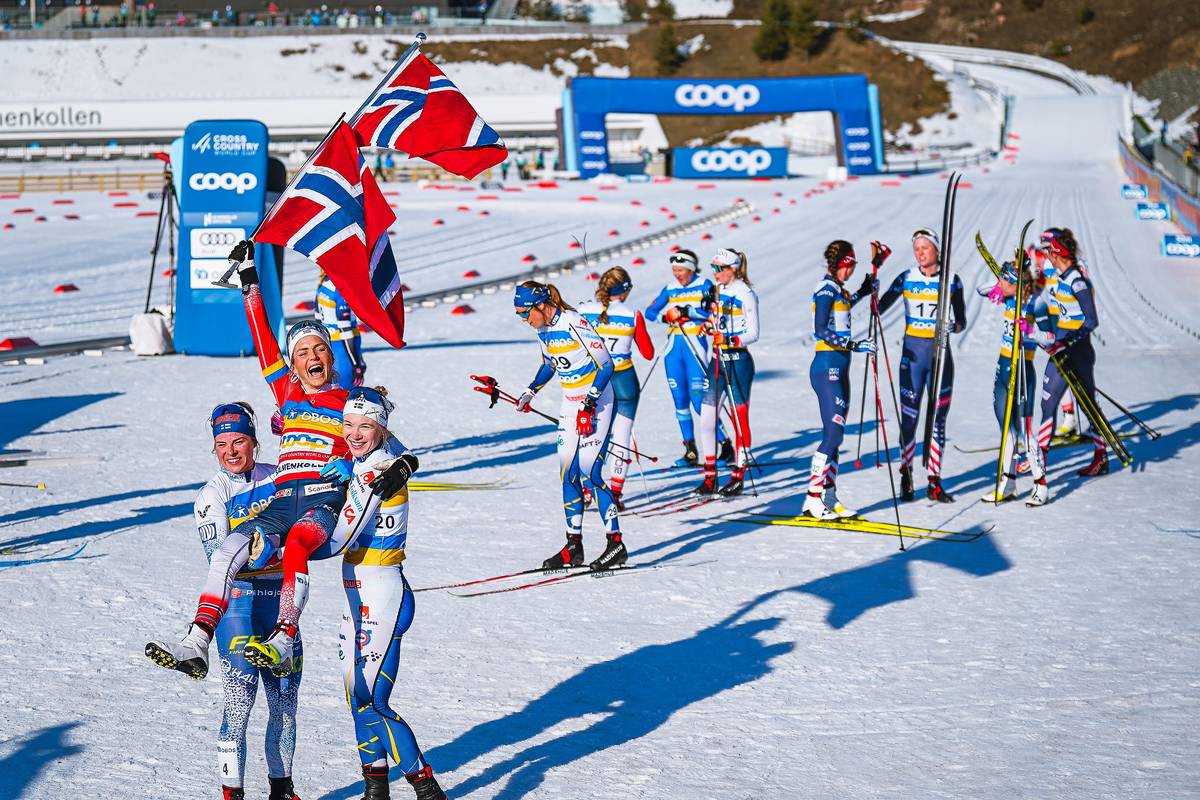
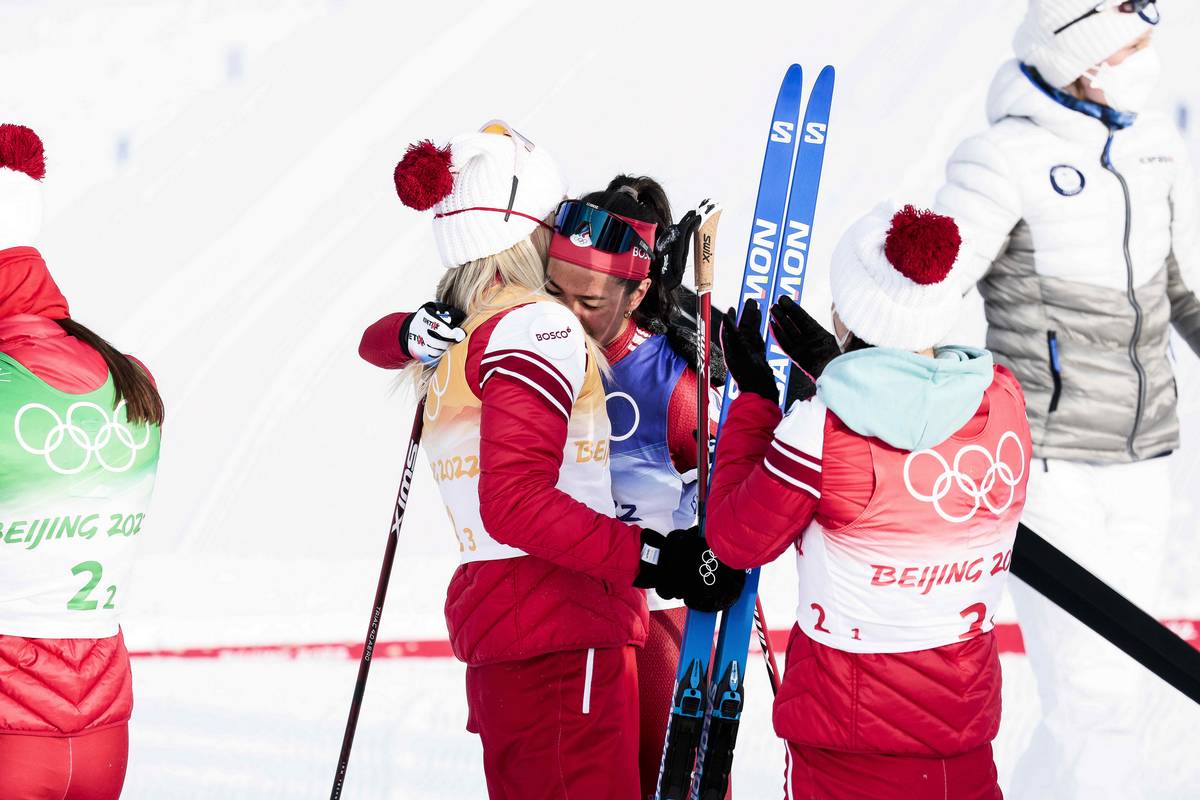
    The 10k Classic podium with Heidi Weng (NOR), Frida Karlsson (SWE), Moa Ilar (SWE), (l-r) in Ruka (FIN). (Photo: Modica/NordicFocus)

    What It All Means

    Today’s 10k classic didn’t answer every question — but it answered enough to shape the early contours of an Olympic year:

    • Sweden has the momentum.
    • Norway has a leader again.
    • Finland is beginning a farewell tour.
    • The U.S. has real reasons for belief — and real reasons for patience.
    • The waxing cabins will decide as much as the athletes.
    • The Olympic shadow looms over every split, every selection, every training day.

    And for those of us lying awake the night before the opener, waiting for winter like children waiting for Christmas — the season is here again.

    It begins in Ruka, with a direct path to the Olympics in Italy, and ends in Lake Placid.

    And today was the first chapter.

    Complete Results:  Women’s 10k Classic


    Love Stories Like This? Help Keep Them Coming.

    Feature interviews like this one take time, access, and care to produce. If you value thoughtful storytelling and independent ski journalism, please consider becoming a Voluntary Subscriber. Your support directly fuels the work we do to cover the people, places, and moments that make our sport special.

    Join the FasterSkier community!


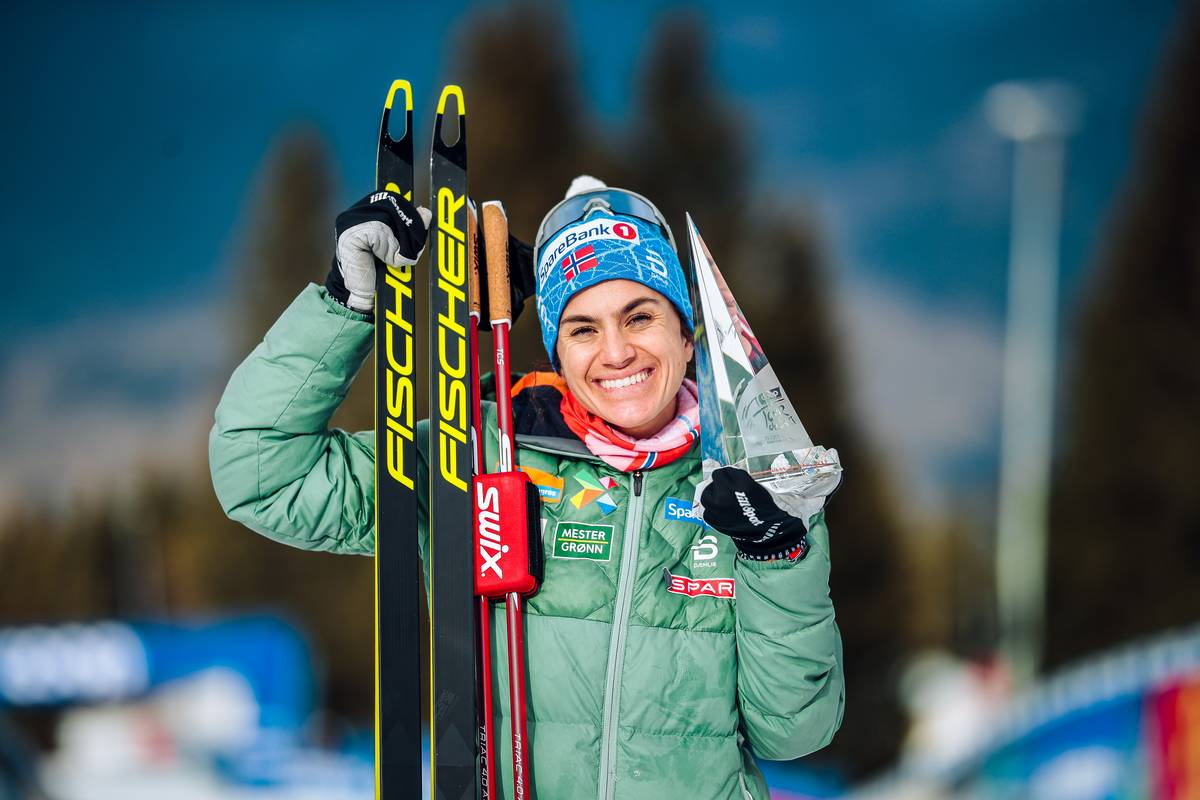
    Frida Karlsson (SWE) looked pretty comfortable in the reindeer pelt-covered leaders chair following the 10k Classic in Ruka (FIN). (Photo: Modica/NordicFocus)
  • Parmakoski’s Redemption in Lahti

    Parmakoski’s Redemption in Lahti

    This coverage is made possible through the generous support of Marty and Kathy Hall and A Hall Mark of Excellence Award. To learn more about A Hall Mark of Excellence Award, or to learn how you can support FasterSkier’s coverage, please contact info@fasterskier.com.

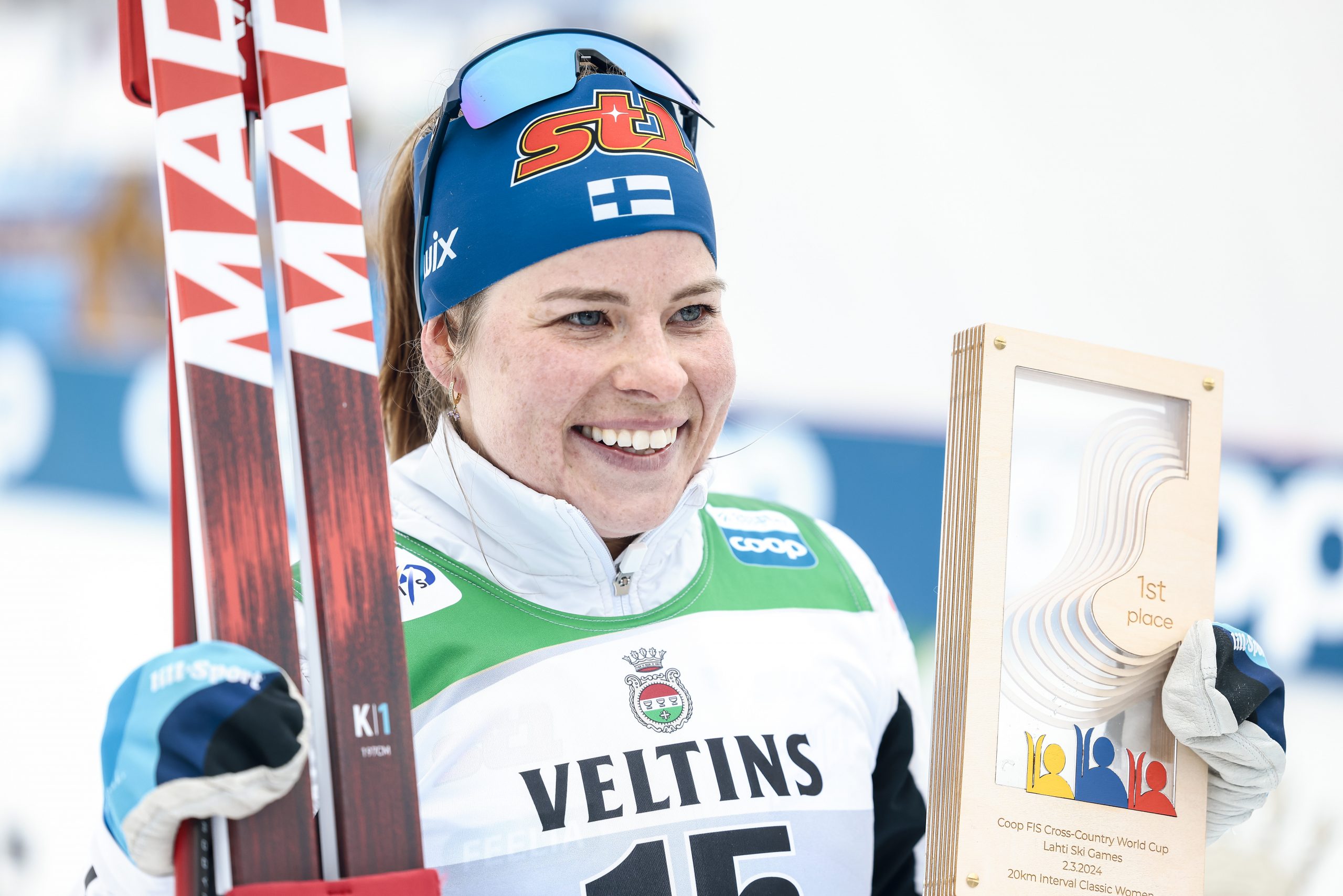
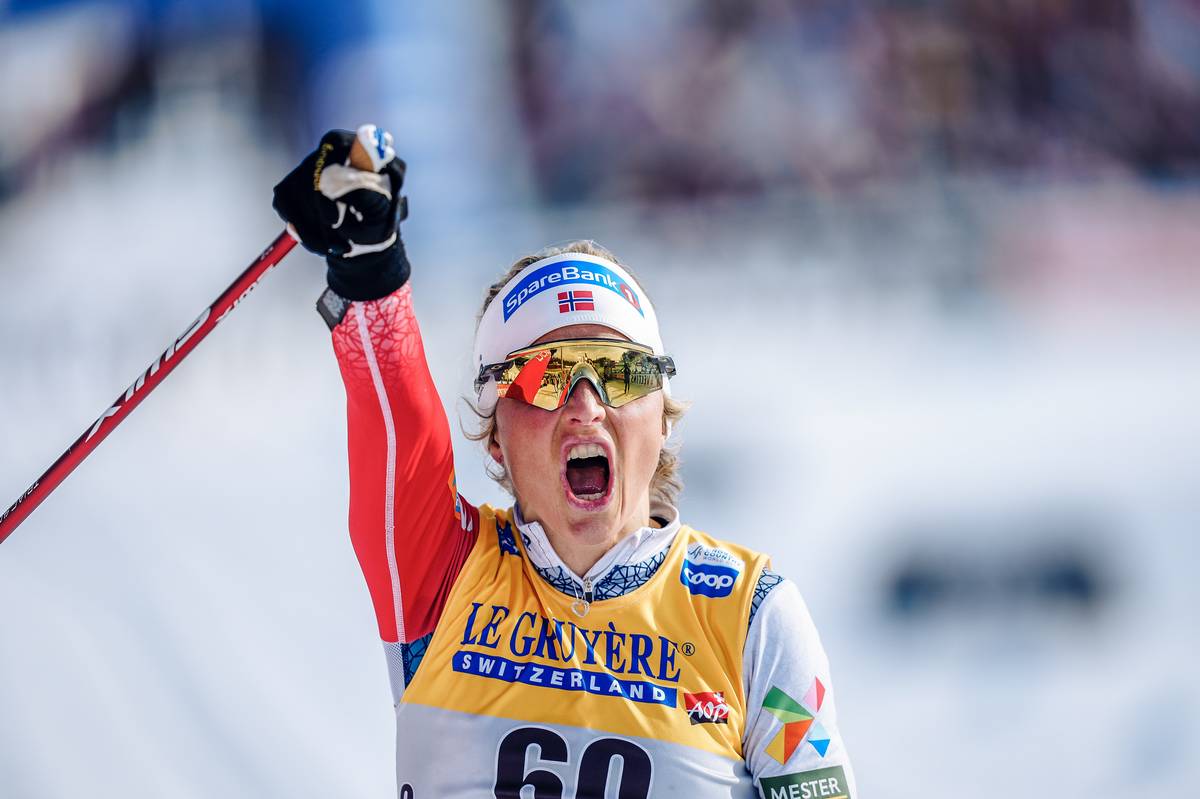
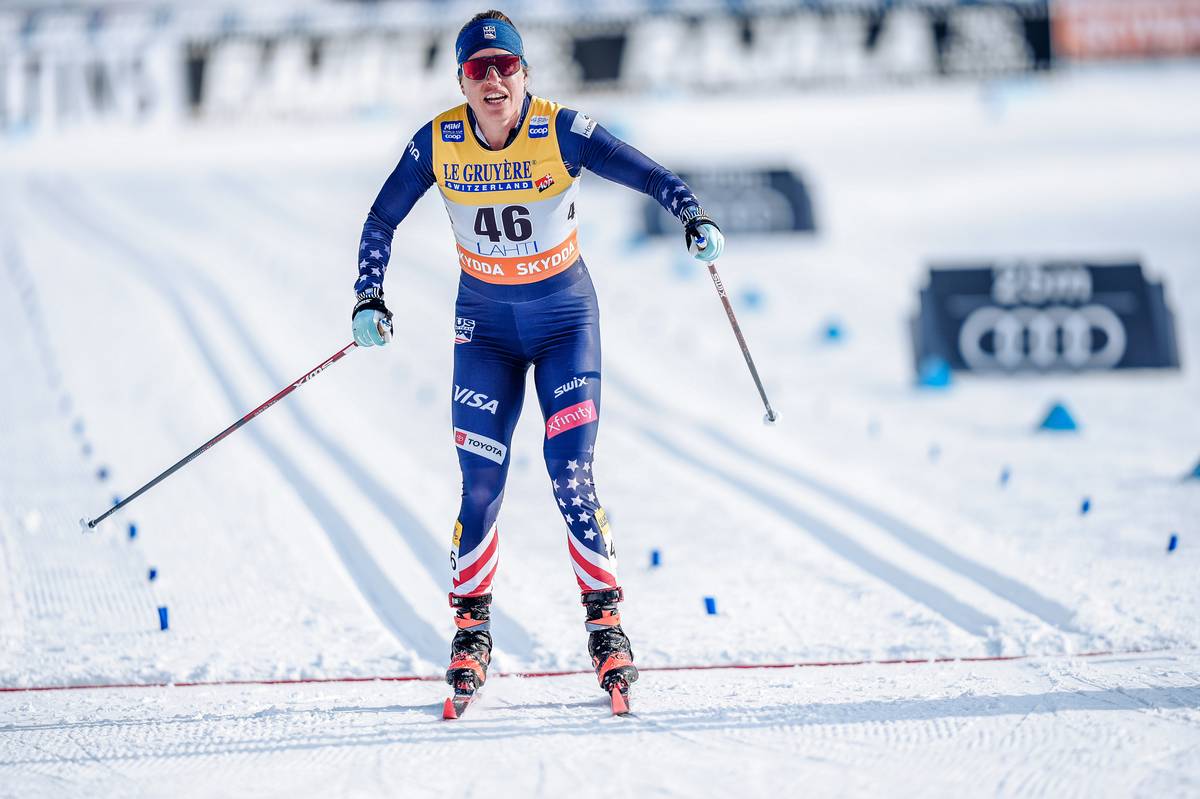
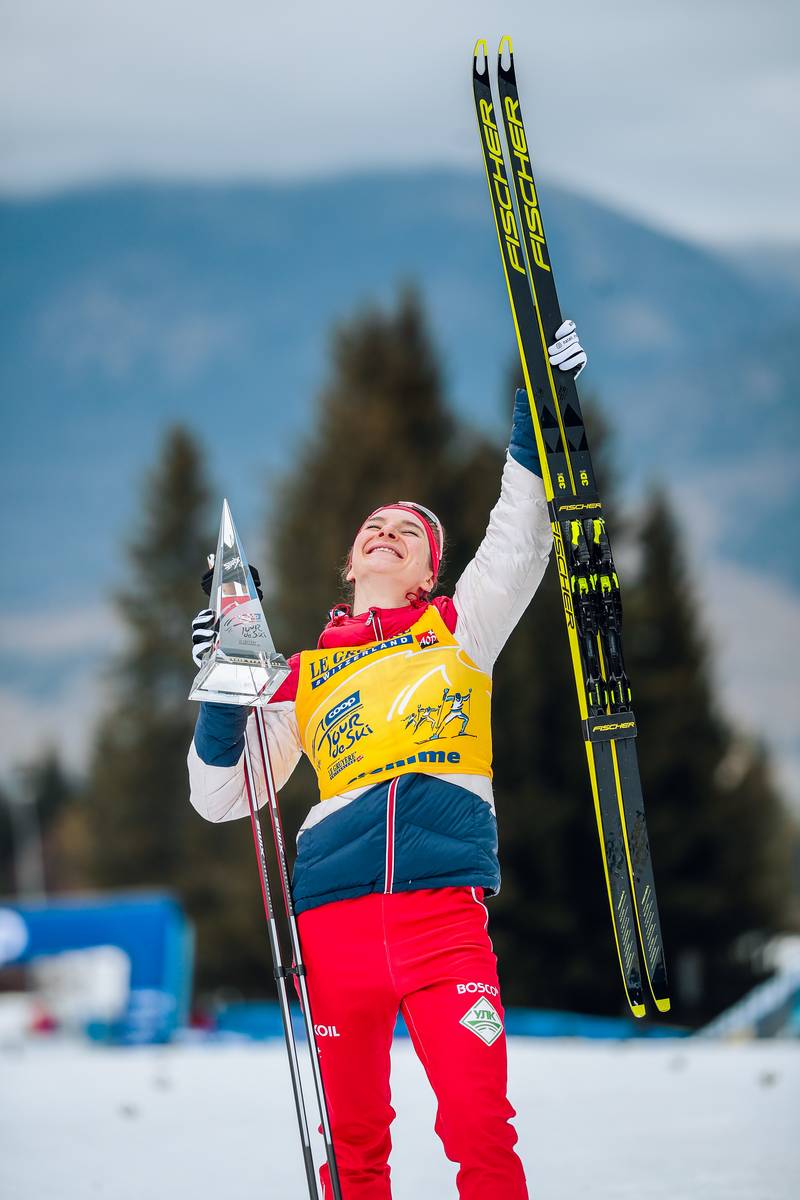
    Six years after her last World Cup victory, Krista Parmakoski (FIN) returned to the top of the World Cup podium in front of Lahti Finland’s delighted fans. (Photo: Modica/NordicFocus)

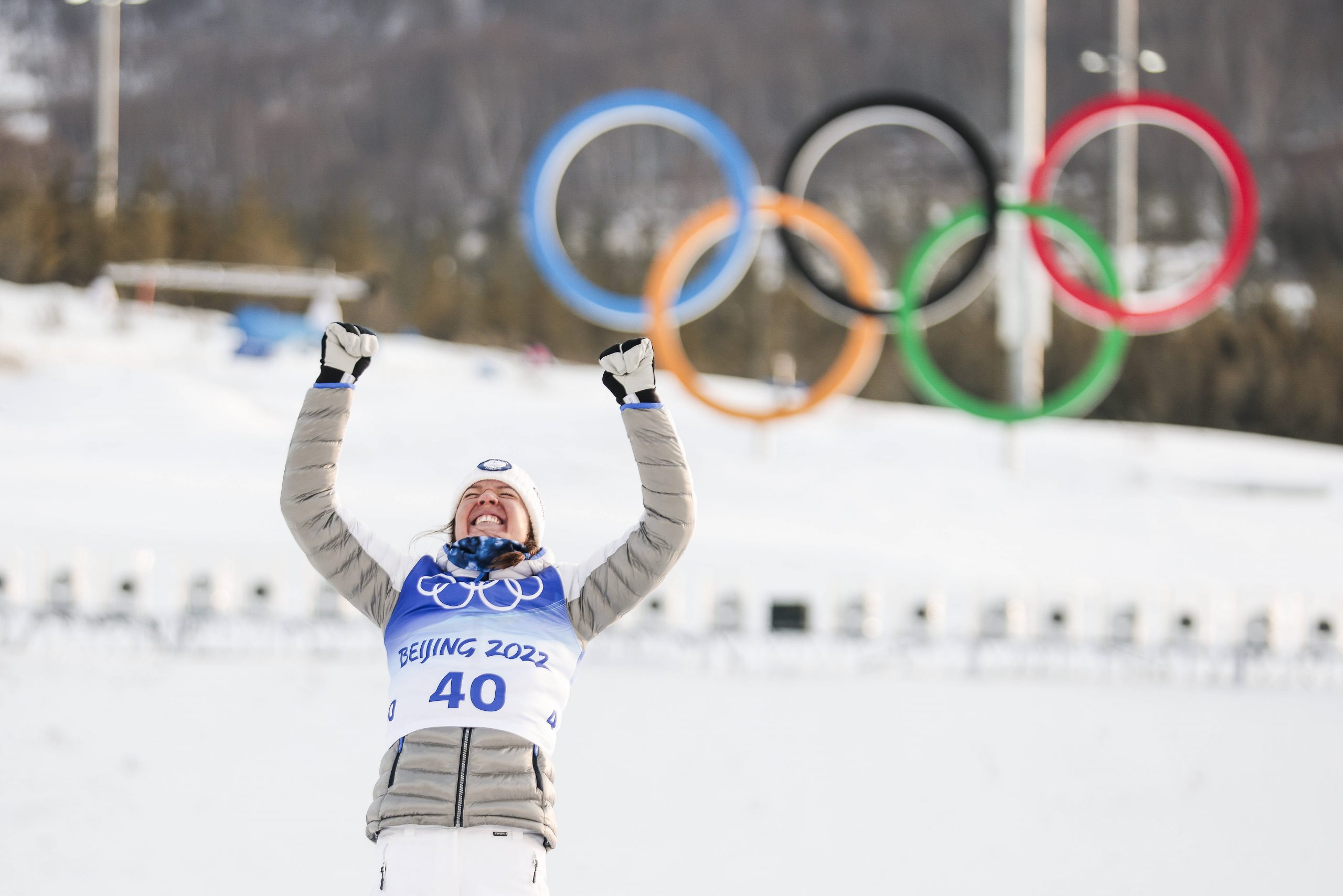
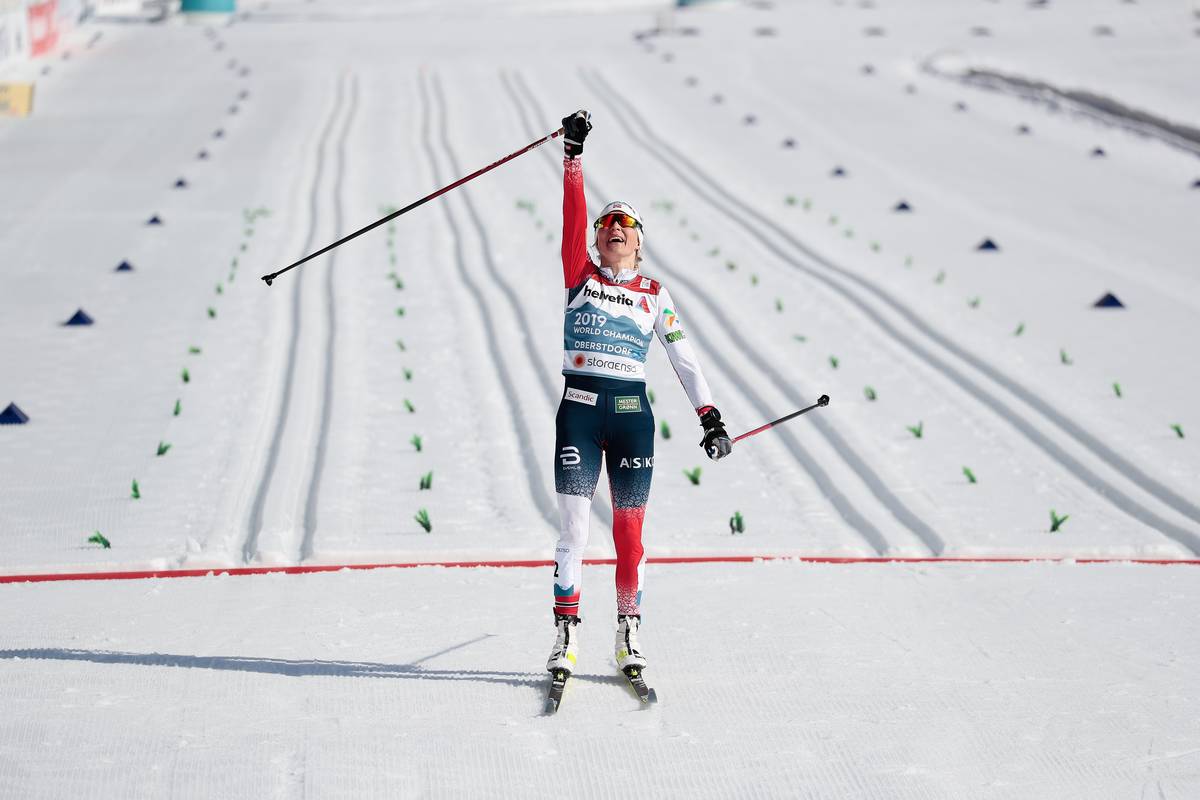
    Krista Parmakoski (FIN) has battled the greats: Marit Bjorgen, Therese Johaug, Charlotte Kalla, Justyna Kowalczyk, Heidi Weng, Jessie Diggins. Across fifteen years of World Cups, World Championships, and Olympics, whomever was the dominant skier in the women’s field always had to contend with the brave and aggressive racing of Parmakoski. In Lahti—six years after her last World Cup victory—Parmakoski thrilled a sparse but energized Finnish crowd, winning the 20 k Classic Individual Start with a narrow margin over Victoria Carl (GER) and Kerttu Niskanen (FIN).

    “An emotional day. I’m so happy that I’m back on the podium,” said Parmakoski in post-race comments. “It’s so nice to take the victory in the home crowd.”

    Among Americans, Rosie Brennan finished ninth, Jessie Diggins 21st, and Sophia Laukli 26th.

    “I love interval start racing,” said Brennan. “I get to push where I want and relax where I want and more or less just hold a steady pace which I think is one of my strengths so I think the challenge of doing that for 20k is awesome and I wish we did more intervals starts.”

    Kerttu Niskanen (FIN) is a consistent threat in any Classic race. In Lahti, she secured a third place finish to join her countrywoman, Krista Parmakoski (FIN), on the podium. (Photo: Modica/NordicFocus)
    Women’s 20 k Classic Individual Start

    On a day like this—in a technical discipline like this—there’s simply no place to hide. Old, sugary snow, finnicky klister under every ski, temperatures hovering around freezing, and a layer of low clouds hanging over the flat-topped ridges that define the course in Lahti. After a sprint day marred by numerous crashes due to the challenging klister conditions, athletes knew that their four laps of Lahti’s five kilometer course would be a serious challenge, both physically and mentally. Every skier would feel slow today, every skier would suffer slips today. Would the kick hold? Would there be enough glide? The true test would be continuing to battle while the psyche continued to be tested. Pacing and patience, aggression and ambition, courage and consistency: it would not be an easy day.

    “The conditions were wet and soft but honestly not that bad by Lahti standards,” commented Brennan. “This place has some of the toughest waxing on the circuit. The course demands a lot technically and physically so I really felt that focusing solely on good skiing was my best chance to put together a decent race. I’m proud my classic has come to a place that that is possible and that leaves me happy with the day.”

    Leaders indicated by early splits included Frida Karlsson (SWE), Sundling, Carl, Parmakoski, and Niskanen. At five kilometers, Brennan was within ten seconds of the leaders. She would maintain her pace and remain in contention throughout, ultimately finishing ninth.

    The challenges faced by the Americans were evident early on.

    “With this being the last seven races of the season, I went out there and skied as hard as I could today,” said Diggins. “Unfortunately, we had some challenges with the glide—that’s okay; that happens—so I felt like the results did not reflect the effort and grit that I put into that race, but I skied a race and an effort level that I do feel really proud of. And I’ll continue doing that for each of the races that we have left!”

    If part of the interest in today’s racing was the ongoing competition between Diggins and Linn Svahn (SWE) for the Overall World Cup championship (in which Diggins 2290 points at the start of the day ahead led Svahn’s 2033 points), then their comparative  splits would tell the story. Diggins already trailed Svahn by eight seconds at the 1.1 kilometer check point, by 25 seconds at 3.4 kilometers, by 45 seconds at ten kilometers. By the 13.4 kilometer checkpoint, Svahn could begin to see Diggins skiing just ahead. Having started a minute behind, Svahn could definitely tell how much she had gained on her rival in the chase for the Overall World Cup. Svahn (11th place) would catch and pass Diggins (21st place) just before the finish line.

    Victoria Carl (GER) was the mid-race leader, only to be overtaken by a late-race surge from eventual winner, Krista Parmakoski (FIN). (Photo: Modica/NordicFocus)

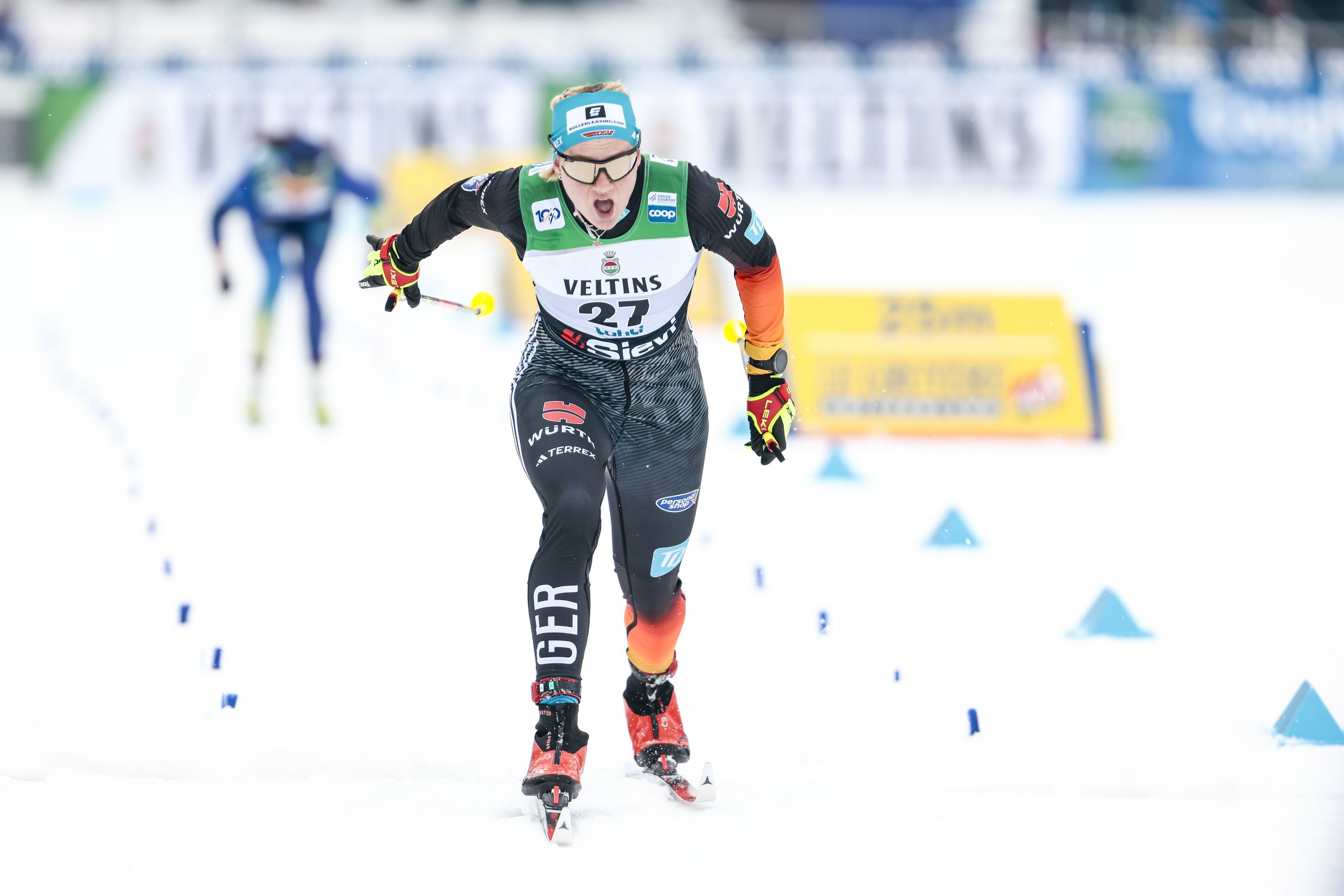
    But this was not just a race for a season-long prize. It was definitely a race for World Cup individual honors. Earlier in this World Cup season, Victoria Carl (GE) won the 10 k Classic Individual Start in Trondheim. In Lahti, Carl surged into the mid-race lead, marked closely by Karlsson, Parmakoski, and Niskanen.

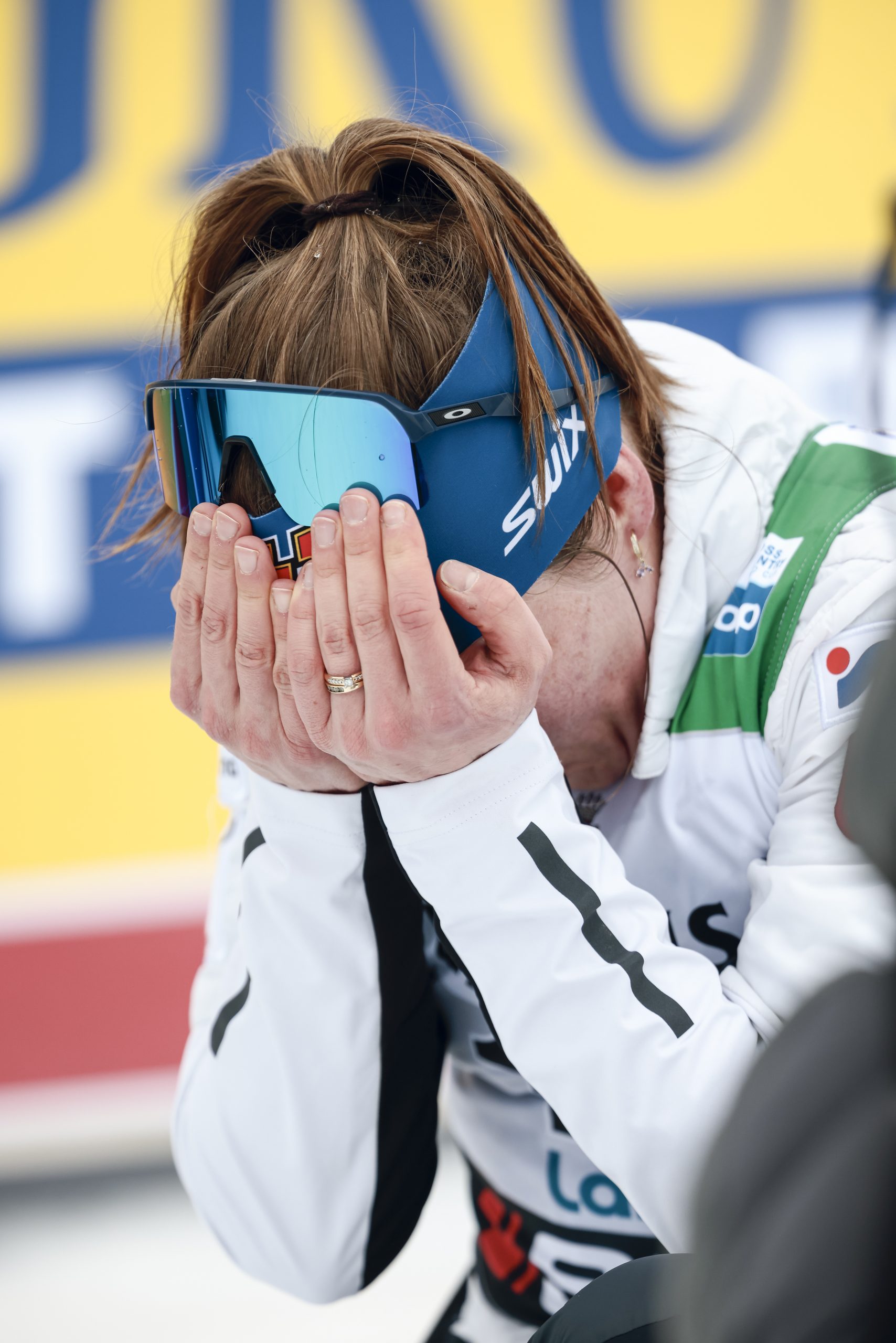
    Krista Parmakoski’s (FIN) emotional victory in the 20 k Classic Individual Start seemed a sweet form of athletic redemption.  (Photo: Modica/NordicFocus)

    Carl and Parmakosi remained virtually tied with just under four kilometers remaining. Ultimately, it was a late-race surge that delivered Parmakoski her sixth career World Cup win ahead of Carl and Niskanen. Jonna Sundling (SWE) continued to demonstrate her fine form with a fourth place finish. The win was Parmakoski’s first at 20 k Classic (all her other victories had been earned at 10 k Classic), and her first World Cup win since Falun in 2018. Siox years is a long time to wait—a long time to work—and Parmakoski’s emotional felt like redemption, indeed.

    Women’s 20 k Classic Individual Start RESULTS

    World Cup Standings

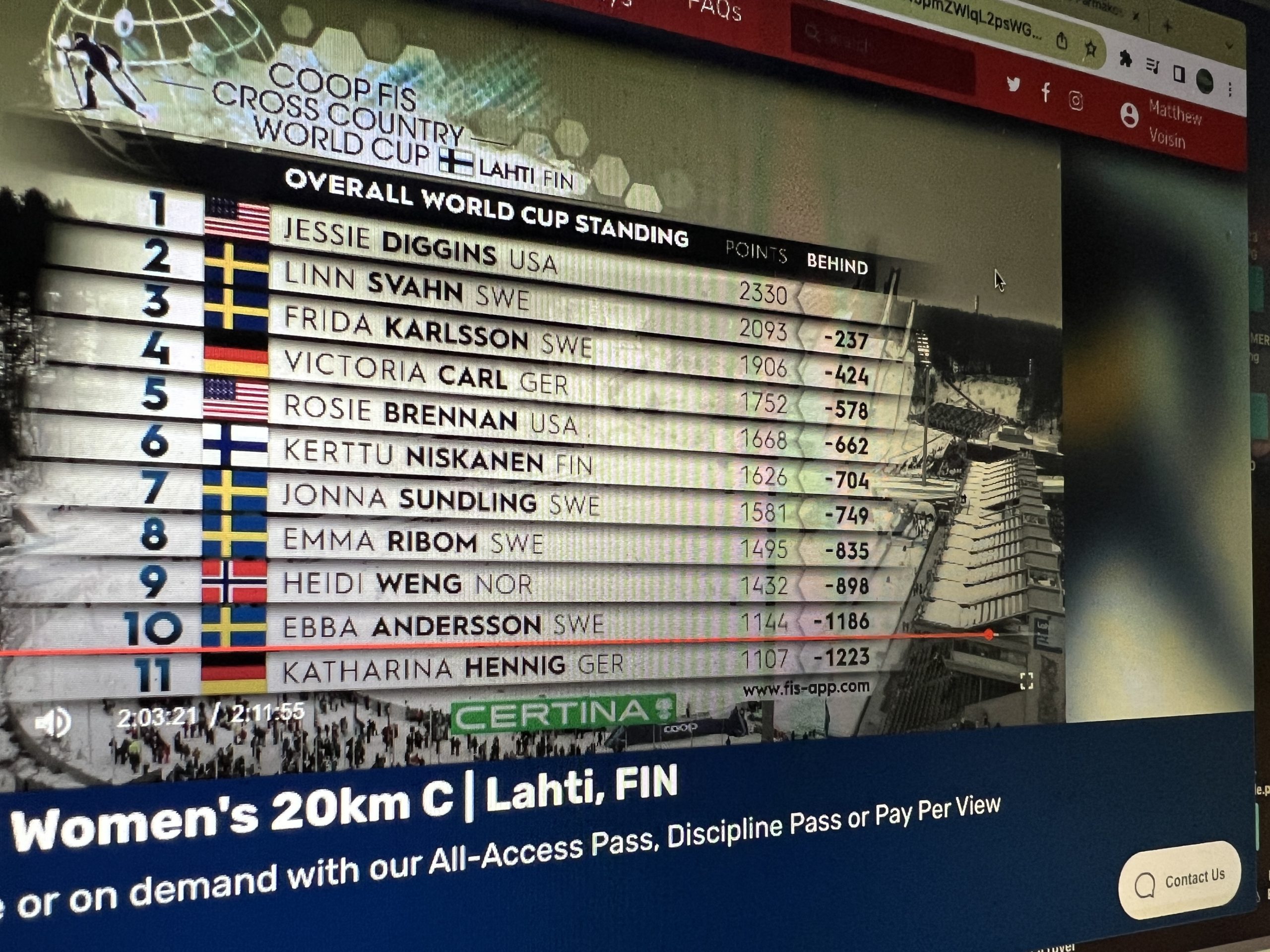
    In the race for the season-long overall championship, Linn Svahn’s (SWE) 11th place finish made up ground on current leader, Jessie Digins (USA), who finished the day 21st. Diggins (with 2330 points) continues to lead Svahn (2093) in the race for the Overall World Cup. With 1328 points, Diggins also continues to lead in the Distance standings ahead of Carl (1112 points), Ebba Andersson (SWE) (1090 points) and Brennan (1044 points).

    Post-race standings: Jessie Diggins (USA) continues to lead Linn Svahn (SWE) in the season-long race for the Overall World Cup.
  • Twins Atop Tour de Ski Sprint Podium, Brennan 10th

    Twins Atop Tour de Ski Sprint Podium, Brennan 10th

    A_Hall_Mark_of_Excellence_Award-logo-300.png (300×244)This World Cup coverage is made possible through the generous support of Marty and Kathy Hall and A Hall Mark of Excellence Award. To learn more about A Hall Mark of Excellence Award, or to learn how you can support Fasterskier’s coverage, please contact info@fasterskier.com.

    Lotta Udnes Weng (NOR) celebrates her victory in the Stage 5 Women’s Sprint at the 2023 Tour de Ski in Val di Fiemme, Italy. She shared the podium with her twin sister, Tiril Undnes Weng (NOR), who finished second. (Photo: NordicFocus)

    Stage 5 of the 2023 Tour de Ski was a sprint, but not a “normal” sprint. Typically, sprint races are won by pure sprinters, those who control the pace of heats, and rely on mad dashes in the homestretch to secure victory. Unlike a typical World Cup sprint race, Val di Fiemme’s sprint stage was a race that was bound to affect the overall Tour de Ski standings: any distance skier who could advance to the later heats would be sure to rise in the ranks with just two more stages remaining. A number of significant sprint specialists were absent from the Tour de Ski startlist, and other skiers normally known for distance prowess were vying for sprint advancement. Those skiers would use the tools available to them to make that possible. Predictably, the pacing was fast, and the tactics merciless. This was not a sprint that could be taken: this was a sprint that would be earned.

    A number of those all-arounders advanced to the final, including Finland’s Krista Parmakoski who set a brutal pace in both her quarterfinal and semifinal heats. The final podium was pure Norwegian red: Lotta Udnes Weng in first, her twin sister Tiril Udnes Weng second, and Myhrvold third.

    Canadians in the final standings included Catherine Stewart-Jones who qualified 28th, but did not advance beyond her quarterfinal (finishing 29th), and Dahria Beatty 34th.

    Americans failed to advance to the final, but had fine showings, nonetheless. With a hard-fought 10th place finish, Rosie Brennan showed that her form is returning to the world-challenging status that’s become her norm in recent seasons. Week after week on the World Cup tour, Brennan delivers a level of consistency that rivals that of any American skier from the present, or the past. While this week’s Sprint in Val di Fiemme was not a stand-out result for her, it was an indication that Brennan is once again rounding into form, and preparing herself to contend in races—both sprint and distance—in the remainder of the World Cup season.

    “I was very happy to make the semi finals today,” Brennan said. “Sprinting has been such a struggle for me this year, so it felt good to make a small step forward. There isn’t much snow here and it’s warm so the tracks were fast and breaking down, but everything held on just enough and my skis were good. I lacked the punch I needed to make the final, but any step forward is all you can ask for. There is still a lot left in the Tour, so I’m still just trying to focus one day at a time and take things as they come. ”

    Behind Brennan’s 10th place finish, American finishers included Julia Kern 14th, Jessie Diggins 21st, Alayna Sonnesyn 38th , and Sophia Laukli 44th

    Rosie Brennan (USA), Lotta Udnes Weng (NOR), and Nadine Faehndrich (SUI) in a blistering quarterfinal heat that set the tone for the day in Val di Fiemme, Italy. (Photo” NordicFocus)
    Women’s Sprint

    Val di Fiemme offers a rolling sprint course with very little time for recovery. An initial uphill is followed by a rolling middle section. Later in the loop, the racers navigate a tight, tactically significant lefthand bend, a narrow spot in the course where speed can be gained, or lost. A wax-revealing downhill needs to be timed to create a slingshot effect over the final small rise.

    With a number of Team Sweden’s sprint specialists sitting out the Tour de Ski, the Women’s field would be marked by racing that was likely to affect the overall standings (with a 60 second bonus for the winner). Distance skiers had great motivation to attempt to reach the later heats, meaning that the heats would be fast: no sprinters jockeying for position. It would come as no surprise that sprinters would be a bit tired after four challenging stages of Tour de Ski racing, and race strategy was dictated by the pace of the distance skiers.

    The quarterfinals turned into tests of sustained speed. Heat times were incredibly fast, with blistering paces set by Parmakoski, Kerttu Niskanen (FIN), Eva Urevec (SLO), and current Tour de Ski leader Frida Karlsson (SWE). The sprinters appeared surprised by the early pace, with specialists like Dahlqvist and Faendrich finding themselves needing to accelerate late in their quarterfinal heats in order to advance. But those efforts took too much out of both of them, and neither would advance beyond the semifinals.

    In her quarterfinal heat, Diggins found herself cut off at the narrow lefthand turn, and was unable to recover her speed by the finish. she would finish fourth in her quarterfinal. Julia Kern avoided that traffic jam in the same heat, but was only able to finish third. Neither would advance to the semifinals.

    Semifinals

    Semifinal 1 pitted the season’s dominant sprinter (Faehndrich) against four of the main TDS contenders: Parmakoski, Katherina Hennig (GER), L. Weng, and T.Weng. Parmakoski returned to her original strategy, driving the pace at the front and stringing out the semifinal field. Appearing exhausted, Faehndrich dangled off the back early on, and would not be a factor in the outcome of the heat. T. Weng and Hennig both caught Parmakoski in the finishing straight, with Brennan finishing fifth, and Faehndrich sixth.

    Semifinal 2 was the days first race that was not run all-out, but stayed tightly grouped for most of the lap, seemingly playing to the advantage of Dahlqvist. Tereza Beranova (CZE) charged forward at the sharp left turn, but did not manage to gap the field. Finishing lanes became totally clogged behind her at the finish with Anna Dyvik (SWE) and Dahlqvist literally having nowhere to go. Mathilde Myhrvold (NOR) found an unobstructed lane, sprinting forward to win the semifinal, followed across the line by Beranova.

    Women’s Sprint Final

    The women’s final involved Parmakoski, Myhrvold, Beranova, T. Weng, L. Weng, Hennig. Parmakoski had already succeeded in gaining time on Karlsson, who failed to advance beyond the quarterfinal. Her goals accomplished on the day, she seemed content to let the more others set the pace in the final. Hennig, on the other hand, seemed determined to make the other racers work for the win: she drove the pace through the rolling middle of the course, marked comfortably by T. Weng. Beranova lingered at the rear with L. Weng.

    Racers crowded through the notoriously tight left-hander. Hennig exited in the lead, but both T. Weng and L. Weng executed the hill slingshot to perfection, passing Hennig in the finishing straight where she also lost the battle with Myhrvold for third.

    Norwegians—and Twin sisters—atop the Tour de Ski podium. Lotta Udnes Weng with the win, followed by her twin sister, T. Weng, and Myhrvold in third. In a post-race interview, Lotta Weng commented on her victory: “We planned to let the other girls do the job, and we can just chill behind them.The waxers are doing a great job,” she continued. “That makes it easy for us.”

    The overall Tour de Ski standings are tightening. Karlsson continues to lead, though with a smaller the margin over T. Weng, Parmakoski, and L. Weng. Brennan moves into 7th overall with two stages remaining.

    Women’s Classic Sprint RESULTS

    Tiril Udnes Weng (NOR), Lotta Udnes Weng (NOR), Mathilde Myhrvold (NOR), (l-r) celebrate a Norwegian sweep of the podium at the 2023 Tour de Ski Women’s Sprint in Val di Fiemme, Italy. (Photo: NordicFocus)


  • Diggins Resurgent, Karlsson Dominant in TDS Stage 4 Freestyle Pursuit

    Diggins Resurgent, Karlsson Dominant in TDS Stage 4 Freestyle Pursuit

    A_Hall_Mark_of_Excellence_Award-logo-300.png (300×244)This World Cup coverage is made possible through the generous support of Marty and Kathy Hall and A Hall Mark of Excellence Award. To learn more about A Hall Mark of Excellence Award, or to learn how you can support Fasterskier’s coverage, please contact info@fasterskier.com.

    Jessie Diggins (USA) leading teammate Julia Kern (USA) through the chase group in a hard-fought 20 k Freestyle Pursuit. As she proved today in Stage 4 of the 2023 Tour de Ski, Diggins is one of the most fiery competitors in any sport. (Photo: NordicFocus)

    With starting positions based on individual finishes in yesterday’s racing, Wednesday’s 20 k Freestyle Pursuit appeared likely to confirm who the leader of the 2023 Tour de Ski truly was. Frida Karlsson entered the day with an advantage, one she would surrender by mid race, only to regain it by the finish. At the line, it was Frida Karlsson (SWE) first, ahead of Krista Parmakoski (FIN) in second, and Tiril Udnes Weng (NOR) third.

    Pursuit racing can be a confusing affair . . . the times and placings don’t always mean what we think they mean. There’s a skier’s finishing place in the field, and then there’s a skier’s finishing time on the day. The Pursuit field behaves like a mass start race, offering many opportunities for skiers to move up through the field. Good fitness and good fortune combine to create numerous ways for skiers to shine. On this day, the Americans took full advantage of those opportunities. Diggins (who started 40th) raced forward to a remarkable 8th, signaling that her racing form may be returning. Rosie Brennan finished 13th, Kern 17th, Laukli 30th, and Sonnesyn 31st. However, the compelling story of the Americans’ day of racing was told by their finishing times on the day: led by Diggins’ fastest finishing time of all competitors, Americans placed five skiers among the top finishers as Alayna Sonnesyn skied to a remarkable 5th, Julia Kern 6th Sophia Laukli 8th, and Rosie Brennan 11th.

    “I finally had great skis, and that’s really what I needed,” Diggins said, while continuing to praise the team’s crew of technicians. “I was just so grateful,” she said. “They’ve been working so so hard. I knew my body was fine the whole time, but no one else knew it! Honestly, I had to just keep believing and trusting the plan. My fitness is still there; it’s been there all along. I just needed a chance to let it fly.”

    “I’m really proud that I was patient throughout this tour and throughout this season,” said Sonnesyn. “I was really optimistic, and didn’t know really what to expect. And this, by far, exceeded my expectations.”

    Canadian racers all improved their positions on the day: Katherine Stewart-Jones skied from 29th to 21st, Lilian Gagnon skied from 51st to 44th, and Dahria Beatty skied from 52nd to 45th.

    Frida Karlsson (SWE) celebrates her win in the Tour de Ski 20 k Freestyle Pursuit. She continues to lead the Tour de Ski overall standings with three stages remaining. (Photo: NordicFocus)
    Women’s 20 k Freestyle Pursuit

    In this recently-arrived age of World Cup distance equality, the women—like the men—raced six laps of a 3.3 kilometer course. Temperatures in Oberstdof continued to rise throughout the day, with thermometers hovering around 48 degrees by the time the Women’s 20 k Freestyle Pursuit began. Staged a few hours after the Men’s Pursuit race, the Women’s 20 k Pursuit developed into a harder-hitting affair. Racers in the women’s field raced like they had more to protect today . . . with a small chase group forming in pursuit of early leader, Karlsson. Karlsson, herself, appeared indecisive in the early kilometers: she seemed to question whether or not to drive her advantage, or to wait for the chasers? Unlike Klaebo (who won the day’s men’s pursuit by waiting for chasers, and sprinting at the end), Karlsson is not a dominant field-sprinter, so if she allowed the chasers to catch her, she’d be likely to surrender the race win (along with her time-advantage in the overall). Her choice was not an easy one . . . but if the chase group grew no larger than three racers, Karlsson knew she might have a chance to hold them off. After two kilometers of ambivalent pacing, Karlsson seemed to decide to forge ahead, and to test her own limits against the 20 k distance.

    While Karlsson entered the Pursuit with a 20 second lead in the overall standings, the story of the day may have been Jessie Diggins and her American teammates. Diggins and Kern moved steadily up through their group, with Diggins having made up 20 spots by the end of the second lap. As Kern faded, Diggins drove toward the chase group (leading with Patricia Eiduka (LAT), and Lotta Udnes Weng (NOR). Together, they caught on to the Brennan/Urevec/Hennig group at 14 k, forming a group of eleven that continued in pursuit of the leaders.

    04.01.2023, Oberstdorf, Germany (GER):
    Alayna Sonnesyn (USA) – FIS world cup cross-country, tour de ski, pursuit, Oberstdorf (GER). www.nordicfocus.com. © Modica/NordicFocus. Every downloaded picture is fee-liable.

    At seven kilometers, Karlsson was caught by the chasers (Parmakoski, T. Weng, and Anne Kjersti Kalvaa), perhaps a cause for concern that she had used too much energy in attempting to hold them off. This group of four stayed together through the halfway mark with Parmakoski doing most of the pace making, and Kalvaa seeming vulnerable at the rear. With a minute lead over the chase group, they were in no danger of being caught, though their pace proved too hot for Kalvaa who was dropped at 11 kilometers. One kilometer later, Parmakoski (with Karlsson in tow) dropped T. Weng, and the lead group was reduced to two. They proceeded to open a considerable gap over the next few kilometers—ten seconds, twenty, forty, sixty. The race at the front would only involve Karlsson and Parmakoski.

    Karlsson made her move up the final big climb, opening an 11 second gap over Parmakoski at the 18.6 kilometer mark. That would be enough for Karlsson to claim the win. Parmakoski crossed the line soon after for second. Behind them, Kalvaa and T. Weng tangled as Kalvaa put a pole between her own skis, but they were not slowed enough to allow the larger chase group to catch them. Kalvaa led up the final uphill near the stadium, but T. Weng was able to slingshot past her on the downhill to capture third.

    Karlsson’s win in the Freestyle Pursuit extended her lead in the overall Tour De Ski standings, though Karlsson, T. Weng, Kalvaa, and Niskanen, all sit within  40 seconds of each other. With three stages remaining, much is still left to be decided, including a daunting climb up the Alpe de Cermis in Val di Fiemme, Italy.

    Tour de Ski Women’s 20 k Freestyle Pursuit RESULTS

    Krista Parmakoski (FIN), Frida Karlsson (SWE), Tiril Udnes Weng (NOR), (l-r) : Women’s podium at the 2023 Tour de Ski Stage 4 20 k Freestyle Pursuit. (Photo: NordicFocus)
  • Green Grass in Oberstdorf: Karlsson Masters Conditions in TDS Women’s 10 k

    Green Grass in Oberstdorf: Karlsson Masters Conditions in TDS Women’s 10 k

    A_Hall_Mark_of_Excellence_Award-logo-300.png (300×244)This World Cup coverage is made possible through the generous support of Marty and Kathy Hall and A Hall Mark of Excellence Award. To learn more about A Hall Mark of Excellence Award, or to learn how you can support Fasterskier’s coverage, please contact info@fasterskier.com.

    Winner of the Tour de Ski Stage 3 10 k Classic in Oberstdorf, Germany, Frida Karlsson (SWE) shows the strain of having raced through difficult conditions. (Photo: NordicFocus)

    The Tour de Ski will take its toll. The distances, the pace, the conditions, the limited time for rest or recovery: eventually, the strain of such condensed and challenging racing will begin to identify the true contenders. Today was such a day in Oberstdorf, Germany at the 17th Tour de Ski where Sweden’s Frida Karlsson dominated the race at each check point, finishing with a margin of more than 16 seconds over her closest rival. On the podium with her stood Krista Parmakoski (FIN) 2nd, and Anne Kjersti Kalvaa (NOR) 3rd.

    Americans were led by Rosie Brennan who finished 11th (tied with Norway’s Astrid Oyre Slind). Other American finishers included Julia Kern 38th, Sophia Laukli 44th, and Alayna Sonnesyn 54th. Jessie Diggins seems still to not have found her racing form; she finished 40th, 2:10 behind the race winner. Of her search to recover world-beating form during the challenges of the Tour de Ski, Diggins said, “It’s a long tour . . . honestly, the pressure’s off. For me, it’s just a chase now. I actually love that. It’s more fun for me than having the pressure of being in the yellow bib. Maybe it turns out that this is the best thing that could’ve happened. You never know.”

    Canadian finishers included Katharine Stewart-Jones 29th, Lilian Gagnon 51st, and Dahria Beatty 52nd.

    As had proven mostly true in the men’s 10 k race earlier in the day (America’s Ben Ogden may be the notable exception), many of the sprinters who had  skied so strongly in TDS distance events began fading into the background. At one point in today’s Women’s 10 k classic race, an exhausted Nadine Faehndrich (SUI)—the early leader of this year’s TDS—looked like she was ready to pull over and stop. Such is the strain of the third day of racing in a tour event, made even more challenging by supremely adverse conditions:  temperatures hovering just above freezing, and light but steady rain. This is NOT the sort of day that anyone wants to be a wax technician . . .

    Krista Parmakoski (FIN) races through a strange winter landscape of green and white. She would set the early pace in the Women’s 10 k Classic, and finish second on the day. (Photo: NordicFocus)
    Women’s 10 k Classic

    Oberstdorf’s race course was snowy strip of white winding through green, rain-soaked meadows and forests of dripping pines. Wet and raspy tracks—worn round-edged and indistinct—sent most teams’ wax trailers into the nervous scramble of klister selection, testing, and preparation. Remarkably, few skiers were seen struggling with kick. Predictably, no one seemed to enjoy much in the way of glide. In such conditions, it’s usually those who are most aerobically fit who find themselves at the top of the standings.

    The 2.1 k checkpoint saw the leaders tightly packed, with Kalvaa, Niskanen, Weng, Parmakoski, and Karlsson all recording split times within two seconds of each other. The 2.1 k checkpoint also represented TDS bonus points, with Karlsson ultimately crossing fastest, and collecting a bonus that would increase her TDS-leading margin at the end of the day.

    Rosie Brennan (USA) races back into contention in Oberstdorf, Germany. She would finish 11th on the day, and currently sits 8th in the overall TDS standings. (Photo: NordicFocus)

    Brennan has gamely raced her way back into contention during this World Cup season, her recovery from illness followed by a slow, steady rise through the ranks, gradually improving her prospects with each successive race. On Tuesday in Oberstdorf, Brennan showed that her recent progression is continuing, crossing the 2.1 k checkpoint only 5.5 seconds behind the leaders. Brennan’s early speed would fade a bit on the day as she finished a minute behind race winner, Karlsson, but in an entirely respectable 11th place.

    While Parmakoski, Kerttu Niskanen (FIN), Kalvaa, and T. Weng all skied strongly and consistently, it was Karlsson who made the mid-race move that no other racer could match, crossing the 6.9 k checkpoint with a whopping 21.4 second lead over Parmakoski. Karlsson’s advantage was one she would maintain through the next checkpoint at 8.3 k. While Parmakoski accelerated across the final kilometer, it was still a race owned by Karlsson who finished with an advantage of 16.6 seconds. Along with bonus points earned at the 2.1 checkpoint, Karlsson moves into the overall lead of the Tour de Ski with a margin of 20 seconds over her closest rivals, Tiril Udnes Weng and Anne Kjersti Kalvaa.

    The 2023 Tour de Ski continues on Wednesday in Oberstdorf with Stage 4, Men’s and Women’s 20 k Freestyle Pursuit races.

    Women’s 10 k Classic Individual RESULTS

    Current Tour de Ski Standings

    2023 Tour de Ski, Oberstdorf, Germany: the podium of the Women’s 10 k Classic Individual Start (l-r): Krista Parmakoski (FIN), Frida Karlsson (SWE), Anne Kjersti Kalvaa (NOR). (Photo: NordicFocus)
  • The Devon Kershaw Show: Finals in Falun, eff yeah

    The Devon Kershaw Show: Finals in Falun, eff yeah

    It was full sun and full gas in Falun, Sweden, for one last hurrah of World Cup racing. The three-day weekend brought us new formats, American podium performances (plural!) and any number of other highlights. Thanks for listening over the course of the World Cup tour — we’ll be back periodically during the off-season with interviews and updates.

    You can email us at devon@fasterskier.com and nat@fasterskier.com. We’ll catch up with a mailbag episode in the next few weeks.

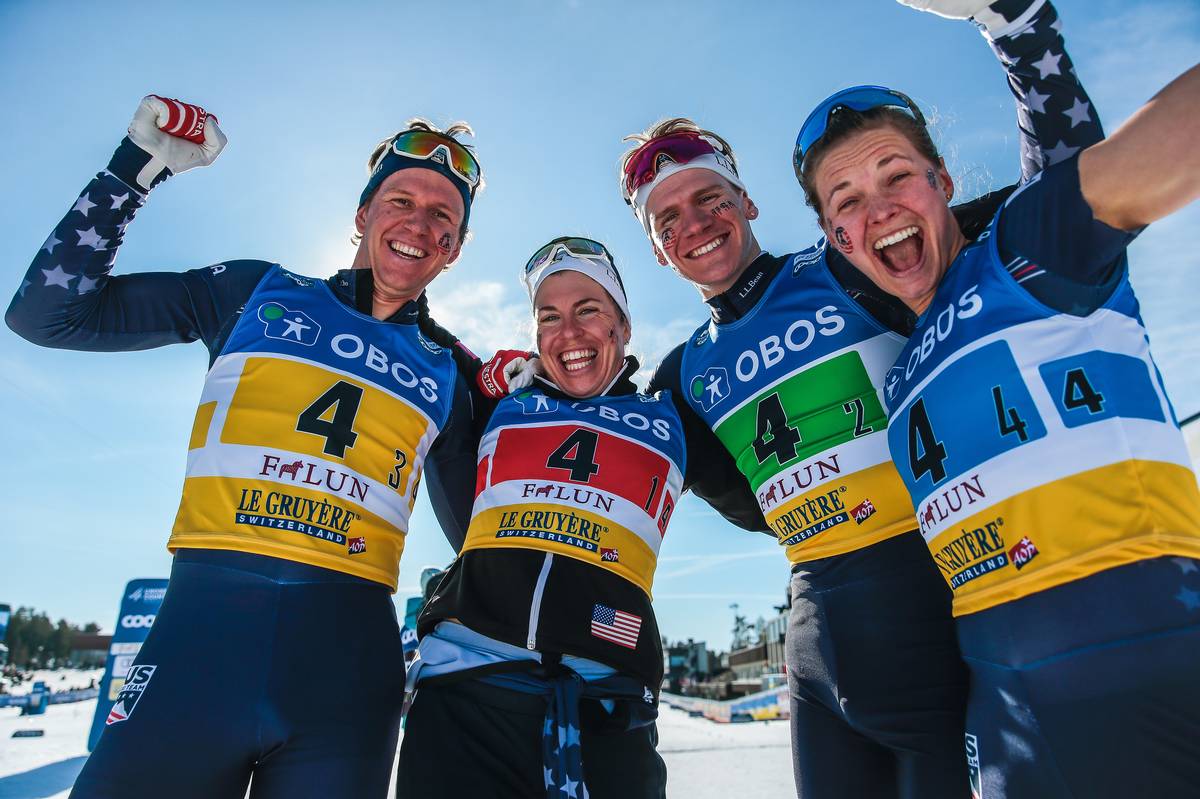
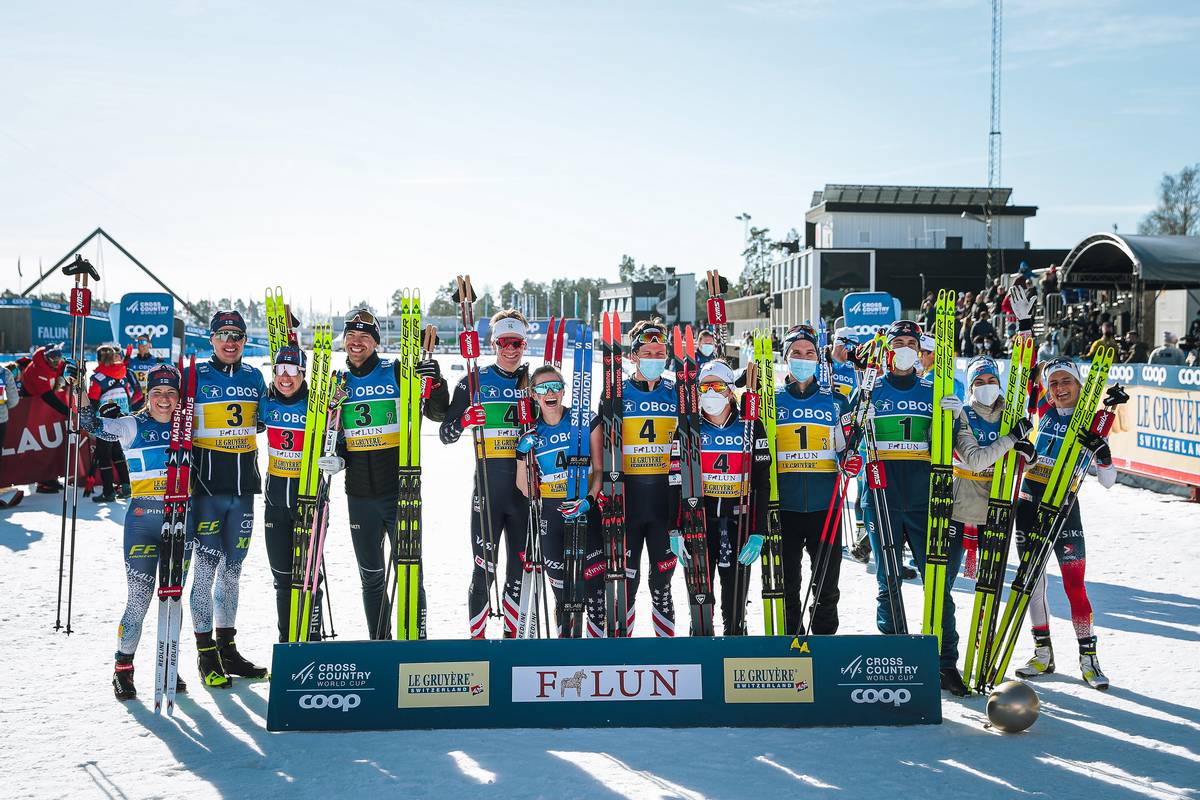
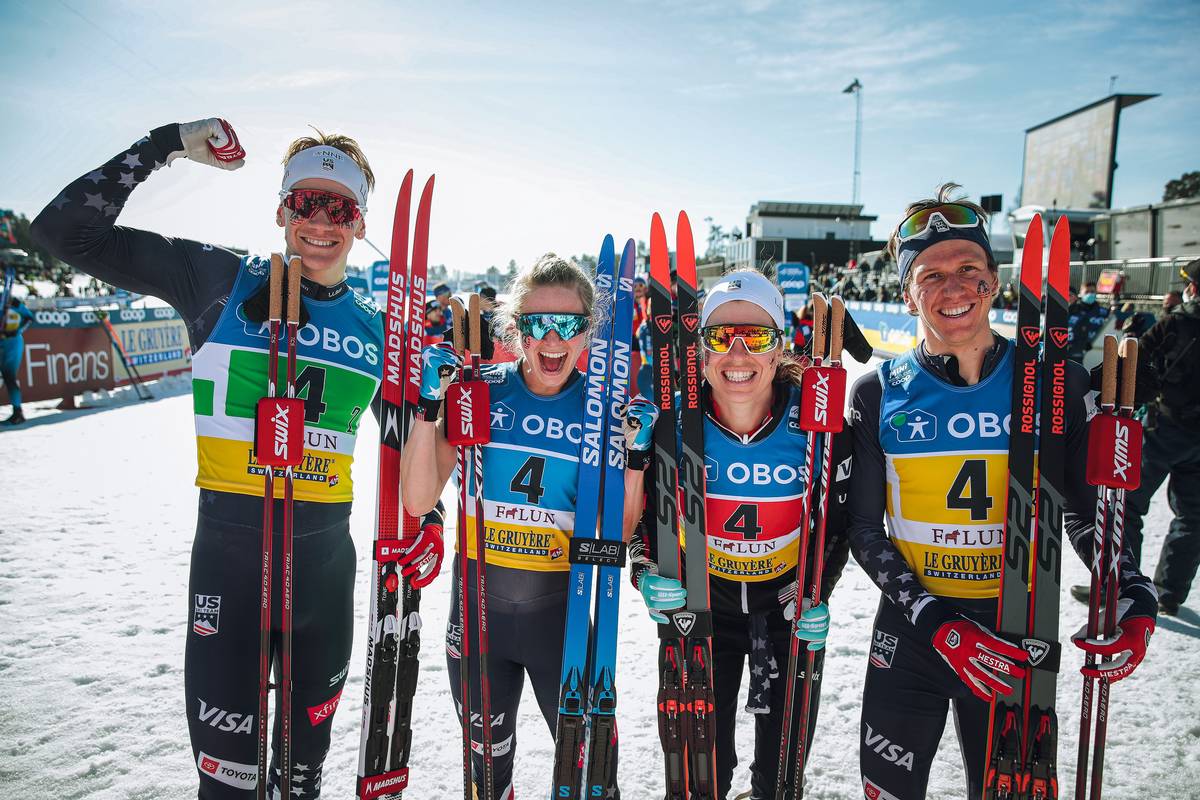
    USA I takes the win in Falun’s 4 x 5 k mixed relay. From left to right, Scott Patterson, Rosie Brennan, Zak Ketterson, and Jessie Diggins. (Photo: NordicFocus)
  • With Diggins as Anchor, USA I Comes Out On Top in Falun’s Mixed Relay

    With Diggins as Anchor, USA I Comes Out On Top in Falun’s Mixed Relay

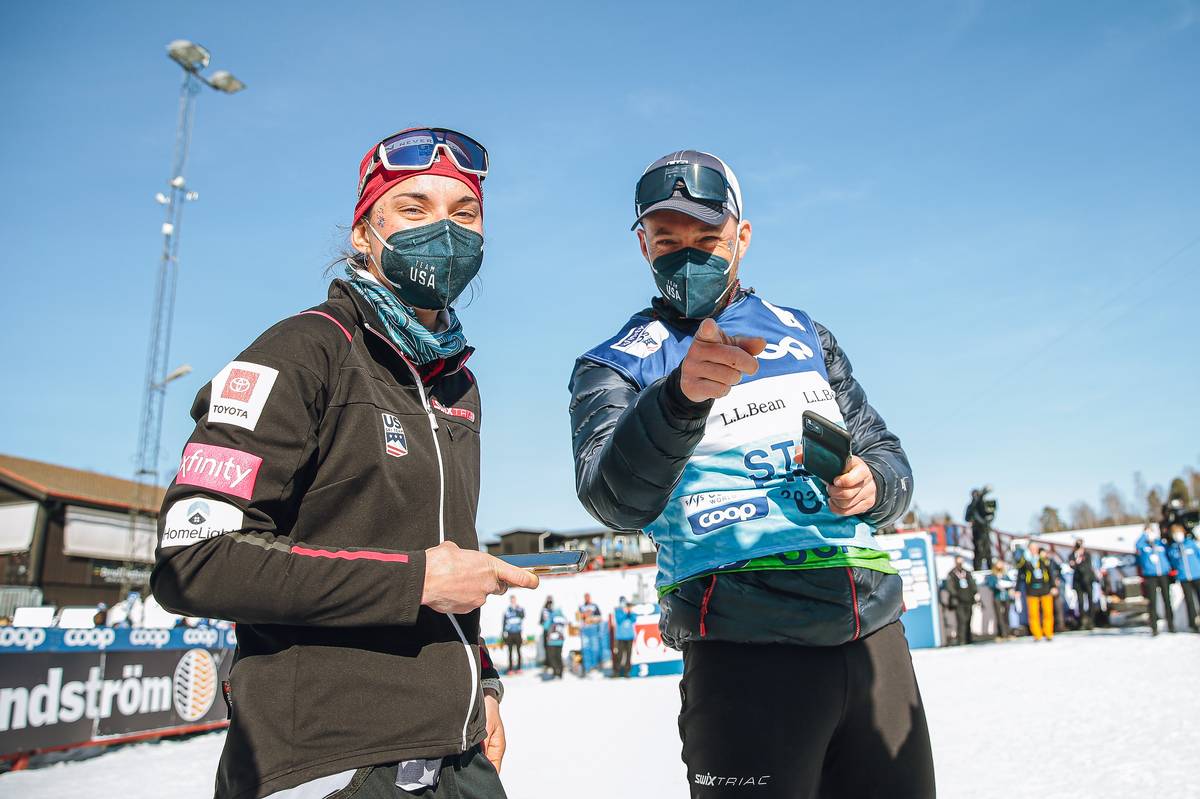
    Julia Kern and US Ski Team head coach Matt Whitcomb watch the 4 x 5 k relay from the stadium. (Photo: NordicFocus)

    This World Cup coverage is made possible through the generous support of Marty and Kathy Hall and the A Hall Mark of Excellence Award.  To learn more about A Hall Mark of Excellence Award or to learn how you can support FasterSkier’s coverage pleasecontact info@fasterskier.com.

    While it was perhaps not the final event originally planned for the season, today’s 4 x 5-kilometer freestyle mixed relay in Falun, Sweden shaped up to be quite a way to go out. Particularly for Team USA, who broke away in the final lap to take the win in 42:01.8. 

    With Rosie Brennan scrambling to tag Zak Ketterson for the second leg, Scott Patterson skating third, and Jessie Diggins anchor, it was a team composed of four skiers who had all raced into the top-15 in yesterday’s 10/15 k skate, three within the top-eight. Perhaps the only team more loaded was Norway 1, which featured Heidi Weng, Hans Christer Holund, Didrik Tønseth, and Therese Johaug, all of whom placed in the top-five yesterday, including both of the day’s winners in the final two relay spots. Also a force, Finland I consisted of three Olympic medalists, one of whom is the 2022 men’s World Cup distance champion with the lineup: Kerttu Niskanen, Perttu Hyvarinen, Iivo Niskanen, and Krista Pärmäkoski. 

    Each nation was allowed two teams, allowing the US to start a second lineup of Julia Kern, Logan Hanneman, Adam Martin, and Caitlin Patterson. Canada raced one team, which included Katherine Stewart-Jones, Antoine Cyr, Philippe Boucher, and Jasmine Drolet, racing in that order. 

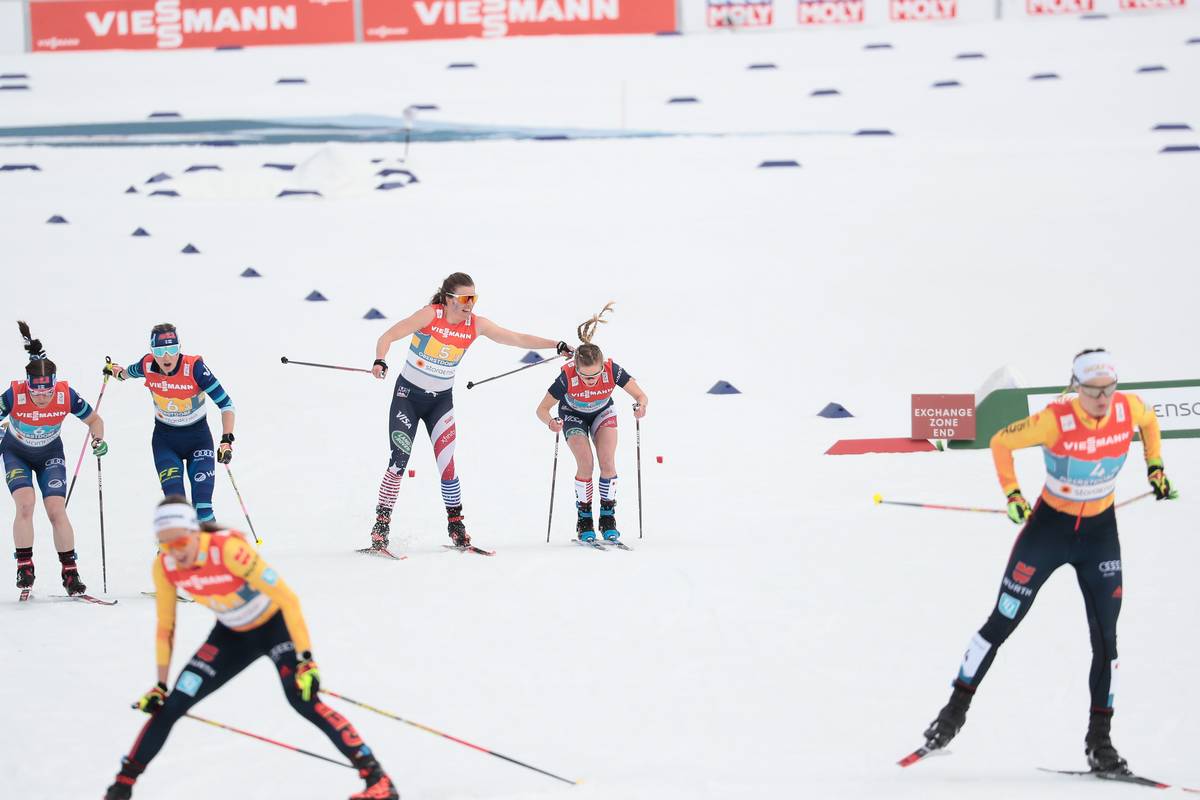
    Stars and stripes at the front, as Julia Kern scrambles for USA II in Falun’s mixed relay. (Photo: NordicFocus)

    New to the World Cup, the mixed relay is modeled after the biathlon competition format, which debuted in 2005. It had originally been slotted onto the calendar for the Canmore World Cup events in March 2020, which were canceled as COVID-19 began to spread around the globe. It had been tested on the tracks in Falun during the 2021 Swedish senior national championships, with local club leader Johan Eriksson saying afterward, “Team cohesion was strengthened when ladies and gentlemen fought against the same goal line. At the same time, the entertainment was great with reversals in the result lists and tactical moves in team line-ups.”

    The entertainment value was certainly high today, particularly for American ski fans. Racing a distance now only seen in relays, it would be a painful blend of sprinting and distance. And the Americans would be lucky to have a woman anchoring the team who has previously been described as the “Queen of the 5 k skate”. 

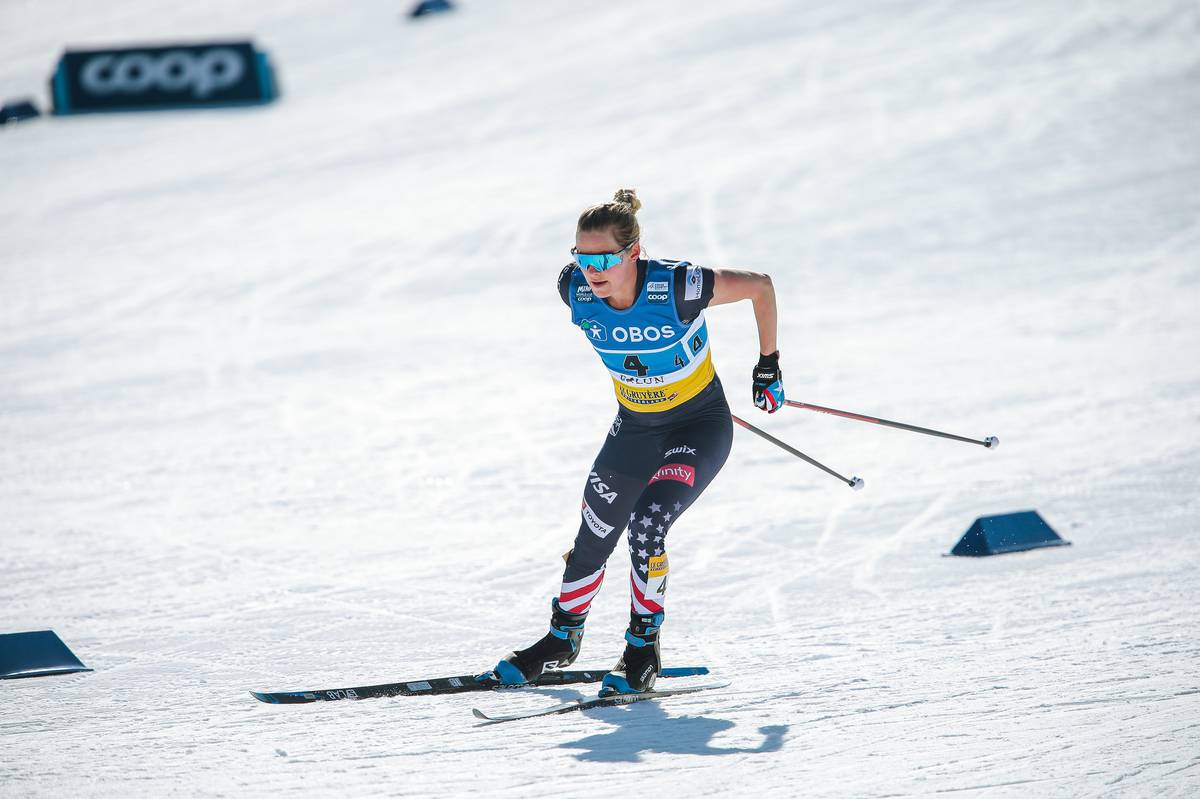
    Rosie Brennan scrambles for USA I during the inaugural World Cup 4 x 5 k mixed relay in Falun. (Photo: NordicFocus)

    As expected, the pace was high from the start, as the Star Wars theme blared through the stadium loud-speakers. Up for the task at hand, Brennan went toe-to-toe with the other women at the front through two 2.5 k laps. Later describing the event as “fast and furious”, Brennan kept USA I within the lead group, Kern duking it out on USA II  alongside through the first lap.

    “I think our goal today was to stay out of trouble and stay in the pack, and then let Diggy do her thing that she does best,” Rosie told FIS post-race with a laugh. “And that worked out really well.”

    Brennan handed off to Ketterson at the first exchange, in line with Germany I, Norway I, and Sweden I, Finland I just behind. 

    Though new to the World Cup this season, Team Birkie’s Ketterson has consistently shown his range. Domestically, he won three SuperTour sprints, and stood on the podium in four distance races, one of which was also a win. He chiseled away at the World Cup puzzle, finishing just outside the top-30 during the Tour de Ski, and returning following the Olympic break to place 41st in Lahti’s distance classic race and at the 50 k classic at Holmenkollen. Smashing a 15th place finish in yesterday’s 15 k free, Falun has been a breakthrough weekend.

    Though 5 k is not a distance men traditionally race on the World Cup, Ketterson emailed post-race that the event felt familiar and reminiscent of his early days in the sport. 

    “I am a huge fan of the 5 k race distance as I spent four years in Minnesota high school races doing that distance multiple times a week in the winter. Today brought me back to those days! It was super chaotic pack skiing but I felt really strong the whole time and did my best to keep up with the leaders. Honestly, when Jessie is your anchor, you don’t really have to worry too much about the rest!”
    Zak Ketterson tags Scott Patterson during the 4 x 5 k mixed relay in Falun. (Photo: NordicFocus)

    On lightning fast tracks with matching skis, Ketterson skied smoothly within the large lead group, keeping USA I within contact of the leaders, while Sjur Røthe tried to crack open pack for Norway II. Tagging Patterson roughly four seconds back, USA I sat in 10th, alongside Canada, at the second exchange. USA II tagged in 14th, +34 seconds back. 

    Still a large and dense group of front runners, Patterson worked at the back of the lead group to minimize further time losses, keeping his team within reach of the podium. With both Norwegian teams at the front in the second lap, Patterson whittled down the American’s time back, tagging Diggins 2.2 seconds behind the leaders to “do her thing” over two 2.5 k laps. Canada had lost contact with the front group, sitting in 11th (+17.9), while USA II tagged following a gap in 15th (+1:14.5). 

    “My goal was to hang on with the pack early and get in the groove, then try to match accelerations later,” Patterson wrote after the race. “I knew I wasn’t going to be the one with super accelerations but could sprint the whole way. During the race I was thinking ‘Just hold on’, so Jessie could work her magic relay anchoring skills. There were a few moments where some gaps formed but I barely managed to cling on.”

    Scott Patterson races the third leg for USA I in Falun. (Photo: NordicFocus)
    Scott Patterson makes the final tag to Jessie Diggins during the 4 x 5 k mixed relay in Falun. (Photo: NordicFocus)

    Diggins quickly got to work. Halfway through the first lap, it was Diggins marking Johaug at the front, with Krista Pärmäkoski for Finland I and Victoria Carl for Germany I tucked into their wake. Recall that Carl had anchored the German relay team for an Olympic silver medal in Zhangjiakou just a few weeks ago.

    Skis ripping on the downhill, Diggins moved to the front to lap through the stadium 1.4 seconds ahead of Finland I and Norway I, Frida Karlsson for Sweden I challenging Germany’s Carl just behind. 

    Jessie Diggins brings USA 1 through the stadium in the lead after her first lap. (Photo: NordicFocus)

    Diggins worked patiently up the climb, once more tucking behind the rapid fire tempo of Johaug on the uphill, and tucking calmly into the draft of the Norwegian and Finn heading into the descent. Diggins hit the second climb hard as the three women hop-skated up and over. Among the best descenders on the World Cup, Diggins skis were only fueling the fire, allowing her to maintain her lead in the rolling last kilometer and into the stadium which erupted with noise from the packed sidelines. 

    Rounding the final bend with a clear shot to victory, Diggins took a few tuck skate pushes before powering in V2 across the line with a fist pump and loud cheer, and maybe an expletive, before collapsing onto all fours surrounded by her ecstatic teammates.

    Nerves run high as the American team waits for Jessie Diggins at the finish of the 4 x 5 k mixed relay in Falun. (Photo: NordicFocus)
    USA I celebrates victory as Jessie Diggins crosses the finish of the 4 x 5 k mixed relay. (Photo: NordicFocus)

    Outsprinting the World Cup distance champion, Pärmäkoski edged out Johaug to bring Finland I to the line in second (+3.8), leaving Norway I just 0.5 seconds behind in third. Having strung out over the last lap, Sweden I took fourth (+9.1), with Germany I fifth following another gap (+16.2).

    A packed podium for the 4 x 5 k mixed relay in Falun. USA I took the win ahead of Finland I and Norway I. (Photo: NordicFocus)

    Describing the experience of winning the mixed relay on the final day of World Cup racing, Diggins told FIS with a laugh, “[It] feels like champagne getting sprayed on you.”

    Surrounded by her teammates, she continued, “That was so, so fun. We really pulled together as a team. We live together as a team for four months on the road, so it’s pretty cool to get to end the season racing for each other. I’m so proud of these guys, so I was feeling pretty inspired.”

    Jessie Diggins helps USA I to the mixed relay win in Falun. (Photo: NordicFocus)

    Later sharing her strategy in a post-race audio clip as the remainder of the team packed their bags to begin travel home tomorrow, Diggins discussed her strategy as anchor, adding how the rockets under her feet allowed the race to unfold somewhat differently than she anticipated.

    “I knew that those downhill working corners were one of my strengths, so I knew that if I got to the top of that big sprint climb first, then I could ski all the other downhills how I want and have a good shot at setting up a finishing sprint. As it turned out, we had such great skis that I didn’t need that finishing sprint, but it was so fun to go ski that as hard as I could. Again, I’m just so proud of the team. It was so special and fun to share that with everyone, and I can’t think of a more perfect way to end a really awesome year.”

    Full post-race audio clip from Jessie Diggins:

    USA I ends the season on top in the 4 x 5 k relay. From left to right, Zak Ketterson, Jessie Diggins, Rosie Brennan, and Scott Patterson. (Photo: NordicFocus)

    “What a way to close out the World Cup season!!!!!” Brennan emphasized in an email. “After Scott and Zak had great days yesterday, I felt that we definitely had a chance, but I was not expecting a victory like that! It was fast and tactical racing out there and in the scramble leg, I wanted to stay near the front of the pack and stay out of trouble. I found myself further back in the pack than I wanted on the 2nd lap, but also knew a fall or broken pole would cost us so I tried to be patient, calm and tag off in the pack. Zak, Scott and I had the same strategy and Scott made a great move to get ahead of a split in the pack to tag Jessie in a great place. Jessie skied an insane leg and I feel lucky to have her as a teammate!” 

    Echoing her sentiments to conclude his post-race email from the road, Patterson added, “It’s really cool to win the last World Cup and especially awesome to be part of the team. The mixed gender event was extra special as the guys were finally able to tap into the relay energy the women have cultivated over many years.”

    Canada’s anchor Jasmine Drolet receives a tag from Philippe Boucher during Falun’s mixed relay. (Photo: NordicFocus)
    Adam Martin tags his Craftsbury teammate Caitlin Patterson, who raced the anchor leg for USA II. (Photo: NordicFocus)

    Losing contact over the third and fourth legs, consequently racing alone, Canada ended the day in 12th (+1:45.2), while USA II pushed alongside Finland II through its final lap. Edged out in the final sprint, Katri Lylynpera (FIN) snuck her boot over the line ahead of Caitlin Patterson’s, leaving USA II in 14th (+2:10.9). 

    Celebrations fed by cheering crowds, energy was high throughout the stadium. Regardless of finish order, acts of camaraderie and sportsmanship could be seen and heard as cameras meandered through the groups of athletes waiting for their relay teammates. We could hear a Frenchman congratulate Norway’s Tønseth on ending his season with an individual win, Ketterson and Kern anxiously trying to predict what might happen in the American’s final legs, along with a host of supportive cheers as teammates and coaches egged on the racers.

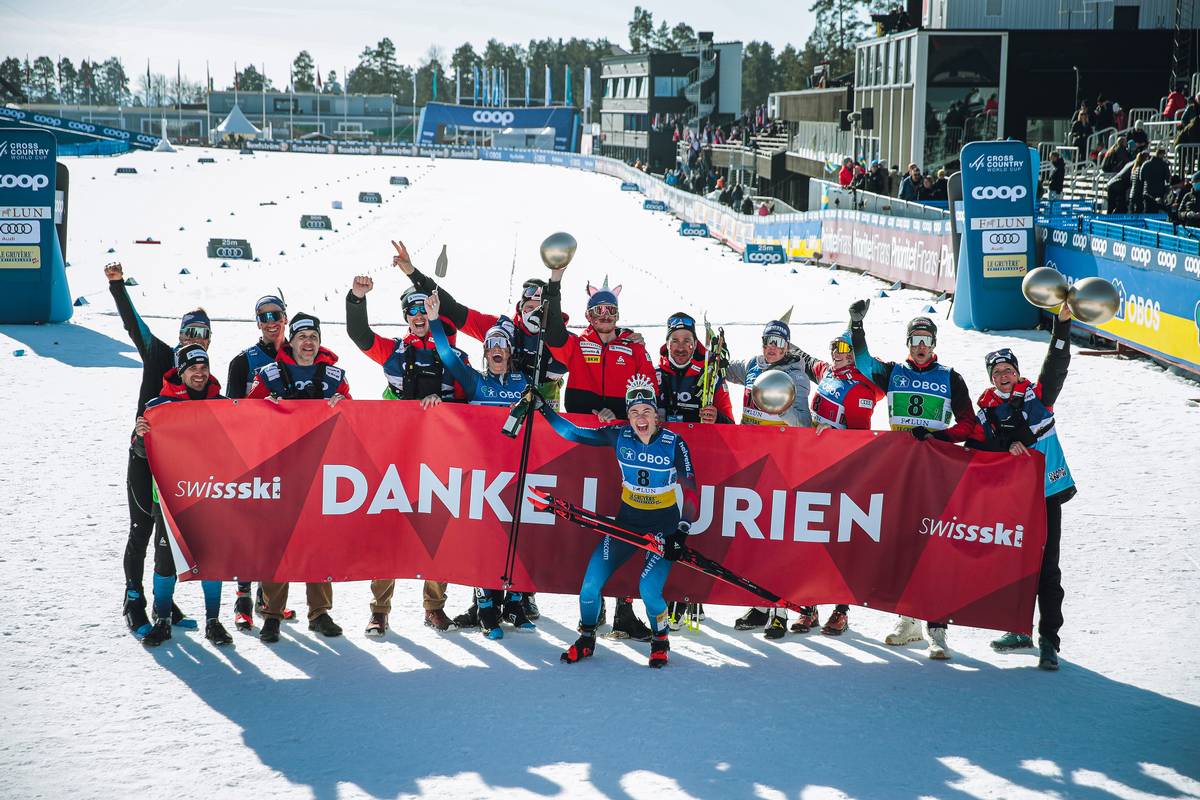
    Awaiting the Swiss anchor Laurien Van der Graaff was a princess tiara, teammates in golden unicorn horns, and a large banner that read “Danke Laurien”, in celebration of her retirement. The 34-year-old has long been a presence on the World Cup, collecting a slew of podiums and a World Championship team sprint silver medal along the way.  

    The Swiss program celebrates the retirement of Laurien Van der Graaff at the finish of the 4 x 5 k mixed relay in Falun. (Photo: NordicFocus)

    With revelry and thrill in the air, only the mixed team sprint remained on deck as the 2021/22 World Cup season drew to a close in Falun. The American program did not enter the team sprint competition, and will next compete as a team at the Whistler Olympic Park in British Columbia March 20th – 27th. The event will serve as both the Canadian National Championship and SuperTour Finals.

    Results

  • A full-circle moment, Johaug wins the 30 k classic at Holmenkollen, exactly 11 years after her first individual World Championship gold; Brennan leads the US in 7th

    A full-circle moment, Johaug wins the 30 k classic at Holmenkollen, exactly 11 years after her first individual World Championship gold; Brennan leads the US in 7th

    Crowds line the storied tracks at Holmenkollen during the women’s 30 k classic. (Photo: NordicFocus)

    This World Cup coverage is made possible through the generous support of Marty and Kathy Hall and the A Hall Mark of Excellence Award.  To learn more about A Hall Mark of Excellence Award or to learn how you can support FasterSkier’s coverage please contact info@fasterskier.com.


    Terese Johaug wins her first individual World Championship gold medal in the 30 k mass start skate in Oslo, NOR. (Photo: FS Archives)

    Eleven years ago to the day, racing the 30-kilometer mass start skate, a 22-year-old Therese Johaug won her first individual World Championship gold medal in a breakout performance at Holmenkollen near her home in Oslo, NOR. In doing so, she had broken apart a field of women considered legends of the sport on an equally legendary course known for long grinding climbs that require superior fitness and technique. Johaug won by nearly 45 seconds over one of the greatest cross country skiers of all time, her teammate Marit Bjørgen, and was 1:34 ahead of the Polish champion Justyna Kowalczyk. 

    “It was hard for me. It’s hard to see her go in front, and the gap [grow] bigger and bigger,” said Bjørgen that day. Then at the peak of her career, Bjørgen had gone four-for-four that week with gold medals in each of the previous World Championship races in Oslo, and the upset was a shock to those following along. “But I’m very happy for Therese. She is a young girl, and a girl for the future—and for Norway.”

    Little did cross country ski fans know just how storied the athlete’s career would be.

    Therese Johaug races in front of a home crowd during the 30 k classic at Holmenkollen. (Photo: NordicFocus)

    Today, under clear skies that allowed for views of the city skyline and Oslofjord, Norwegian flags flying, and fans returning to the crowded stadium and partying in the woods, she did it again, as one of her final performances after more than a decade as the top female distance skiers of all time. 

    And what’s more, Johaug won today’s 30 k classic in the same dominant fashion that she did eleven years ago, and has done many time since, stopping the clock at 1:19:22.8.

    Though the final results show just 19.4 seconds as her winning margin, this only tells part of the story. By 10 k, Johaug held a margin of over 23 seconds, which she steadily grew over the subsequent laps. At 25 k, she led by nearly a minute and a half.

    Therese Johaug waves Norwegian flags as she skis the final meters of 30 k classic at Holmenkollen. (Photo: NordicFocus)

    As she entered the stadium, Johaug was greeted by coaches and techs who handed her a flag for each hand, which she carried through the finish, waving, and stopping to take in the erupting cheers from the crowds. 

    Laughing behind tears as the rest of the field began to trickle across the line, Johaug was hoisted onto shoulders, waving her flags for a loud Norwegian crowd who had supported and applauded her through fifteen years of racing on the World Cup. 

    “It’s a lot of emotion now,” Johaug said at the finish. “I start here in 2011 with my first individual victory, and today is my last race here. It was sun and blue sky, the same as  in 2011, and there were a lot of people around the track cheering for me. I’m so happy now, but also so sad that this is the end of my career.”

    Therese Johaug was emotional at the finish of today’s 30 k classic at Holmenkollen, the venue where she won her first individual World Championship gold in the 30 k skate eleven years prior. (Photo: NordicFocus)
    Norway’s legendary Therese Johaug wins the 30 k mass start classic, exactly 11 years after her first individual World Championship gold medal was won on the same tracks. (Photo: NordicFocus)

    While she indicated during the Olympics that she would not compete another four years, it was not until yesterday that she officially announced that this would be her final race at Holmenkollen. 

    “In many ways, it feels as if the [story] ends when on Saturday, March 5, 2022, I stand on the starting line for another 30 k in Holmenkollen. I really do not want the journey to end, but it is a time for everything,” she wrote to NRK. “In light of this, I look forward to a final fight at home with the flag on my chest, and I am grateful for everything the sport has given me.”

    Therese Johaug is showered with champagne after winning the 30 k classic at Holmenkollen following her retirement announcement. (Photo: NordicFocus)
    Therese Johaug celebrates her final race race at Holmenkollen, winning the 30 k classic exactly eleven years after taking her first individual World Championship gold on these tracks. (Photo: NordicFocus)

    As Queen’s “We are the Champions” blared through the stadium, Johaug stepped off the podium only to be soaked by champagne sprayed by a flock of teammates wearing shirts spelling her name, with “takk” – thank you – written with a heart at the end of the row. It was a joyous celebration fitting for the moment, and perhaps also a refreshing distraction from the times at large.

    “There are a lot of strong moments, but I am moved when so many people come here and see my last race. I must thank the Norwegian people who stand here today,” Johaug later said to NRK.

    While you can certainly expect a more in-depth look at her storied career on FasterSkier, for now, we’ll echo the crowds in congratulating Therese Johaug, and we look forward to following along for the next chapters.

    Therese Johaug celebrates her final race race at Holmenkollen, winning the 30 k classic exactly eleven years after taking her first individual World Championship gold on these tracks. (Photo: NordicFocus)
    Krista Pärmäkoski (FIN) and Jonna Sundling (SWE) lift champion Therese Johaug (NOR) for a podium shot at the finish of the 30 k classic in Oslo. (Photo: NordicFocus)

    Behind the celebration, the lineup of women in today’s top-10 was remarkably similar to the Olympic 10 k interval start classic, with a few name swaps, and of course, a few noteworthy athletes missing – namely, Natalia Nepryaeva and Tatiana Sorina of Russia, and Jessie Diggins, who had been fourth, seventh, and eighth, respectively. 

    The volume of the ringing cowbells swelled as Finland’s Krista Pärmäkoski skied through the stadium on her own for second place, after pulling away from the first chase pack with 5 k to go and maintaining a healthy 10-15 second gap through the finish. Coming back on form after a few rocky seasons, Pärmäkoski had been third in the 10 k classic in Zhangjiakou, behind her teammate Kerttu Niskanen, who was fourth today (+33.8). 

    Finland’s Krista Pärmäkoski takes second in the 30 k mass start classic at Holmenkollen in Oslo, NOR. (Photo: NordicFocus)
    The women’s 30 k classic podium at Holmenkollen: Therese Johaug (NOR) took the win ahead of Krista Pärmäkoski (FIN) and Jonna Sundling (SWE). (Photo: NordicFocus)

    Between the Finns, Sweden’s Jonna Sundling reaffirmed her talents across all distances, taking the third spot on the podium (+32.3) just two days after being second in Drammen’s classic sprint. Matching her fifth place result in the Olympic 10 k, Germany’s Katharina Hennig followed Niskanen to the line (+34.7) with Therese Stadlober, who was ninth at the Games, crossing after a gap in sixth (+46.7). 

    Leading the next chase group, and the American team, was Rosie Brennan in seventh (+1:12.3), bringing Norway’s Marte Skaanes and Sweden’s Ebba Andersson to the line just behind her for eighth (+1:13.1) and ninth (+1:13.8), respectively.  

    Rosie Brennan leads Norway’s Marte Skaanes and Sweden’s Ebba Andersson to the line. (Photo: NordicFocus)

    “Today was huge for me,” Brennan wrote in a post-race email. “I have struggled here my entire career, and [though] it’s been a few years since I’ve raced here and I have improved a lot in the last few years, I still felt I lacked a lot of confidence and excitement coming here [today]. It’s also been a really stressful week for a variety of reasons, so I showed up today with an immense amount of anxiety that I needed to get a hold of before the race started. 

    “I am really proud of giving myself another chance to put together a good race here and to have managed the stress and anxiety well enough to do so. I wasn’t feeling in a place to shoot for the moon so I tried to start a bit a conservative the first 5 k and then reevaluate. I had a great ride with Ebba and really had an enjoyable time skiing out there today. The last lap, we had the chance to pick off a few from the lead pack and so I started to ramp things up to see what was possible. I felt strong on the last climb and felt I had a good shot at the sprint finish so I went on the last little bump before the [last 100 meters]. It felt great to finish strong and to put together a really solid race today.” 

    Rosie Brennan skis to seventh in the 30 k classic at Holmenkollen. (Photo: NordicFocus)

    Following her classic sprint race in Drammen Thursday, Brennan joked post-race that she had lost out on yet-another boot slide. Today, the final sprint was hers. It was perhaps, also worth American fans celebrating that today that she won amongst her chase group, just under two weeks after a brave and gritty performance in the Olympic 30 k skate where she had pulled the chase group for much of the race, wearing herself out to break the wind, only to be dropped in the final 600 meters as Niskanen pulled away for a bronze medal. However, Brennan said she is not connecting any dots between the two.

    “This race was nothing like Zhangjakou, really hard to even compare the two. 30 k’s are always an adventure and I am really happy to have put together two strong ones, in each technique.” 

    Rosie Brennan skis to seventh in the 30 k classic at Holmenkollen. (Photo: NordicFocus)

    Commenting on how she is feeling, mentally and physically, with one final race weekend to go, Brennan concluded, “I am really bummed that the [World Cup] Finals were canceled. I haven’t raced a ton this season because of the earlier cancellations and while it has been a very high density block since the Olympics started, I am still feeling strong and wanted to see what I could do. But it will be really fun to end the season with the mixed relay event as that is a new one for us!” 

    Julia Kern was next for the US in 23rd (+3:37.2), followed by Hailey Swirbul in 26th (+3:57.8), and Caitlin Patterson – six days after taking second at the American Birkie – in 30th (+4:11.5). 

    Julia Kern skis to 23rd in the 30 k classic at Holmenkollen in Oslo, NOR. (Photo: NordicFocus)
    Hailey Swirbul skis to 26th in the 30 k classic at Holmenkollen in Oslo, NOR. (Photo: NordicFocus)

    In a post-race call, head coach Matt Whitcomb shared that Kern’s result was perhaps especially noteworthy as she has been struggling throughout the season with nausea during distance races, making it difficult for her to keep down fluids taken in prior to the race, let alone receive feeds during. Whitcomb also explained that Diggins sat out today’s race as she was feeling lingering fatigue from the long, and successful, season of racing. He affirmed that she is healthy and will be ready to race for the final World Cup weekend in Falun, beginning next Friday. Listen to the full call with Whitcomb below.

    Outside the top-30 for the US, Katharine Ogden was 37th (+5:54.1), followed by Rosie Frankowski, who has consistently landed on SuperTour podiums throughout the season, in 46th (+8:12.2). 

    Katharine Ogden (left) and Caitlin Patterson (right, bib 32) take to the course at the start of the women’s 30 k classic at Holmenkollen. (Photo: NordicFocus)
    Canada’s Cendrine Browne (bib 43) leads Katharine Ogden (bib 40) during the 30 k mass start classic at Holmenkollen. (Photo: NordicFocus)

    Racing for Canada, Katherine Stewart-Jones led the way in 22nd (+3:25.0), with Cendrine Browne also inside the top-30 in 25th (+3:53.7). After a successful World Junior Championship in Lygna, NOR, Jasmine Drolet finished 42nd today (+6:53.2), with Olivia Bouffard-Nesbitt closing out the Canadian racers in 48th (+10:19.8). 

    Results

  • Johaug Sneaks Inside Nepryaeva’s Mark for the 10 k Interval Start Classic Win; Brennan Leads U.S in 8th

    Johaug Sneaks Inside Nepryaeva’s Mark for the 10 k Interval Start Classic Win; Brennan Leads U.S in 8th


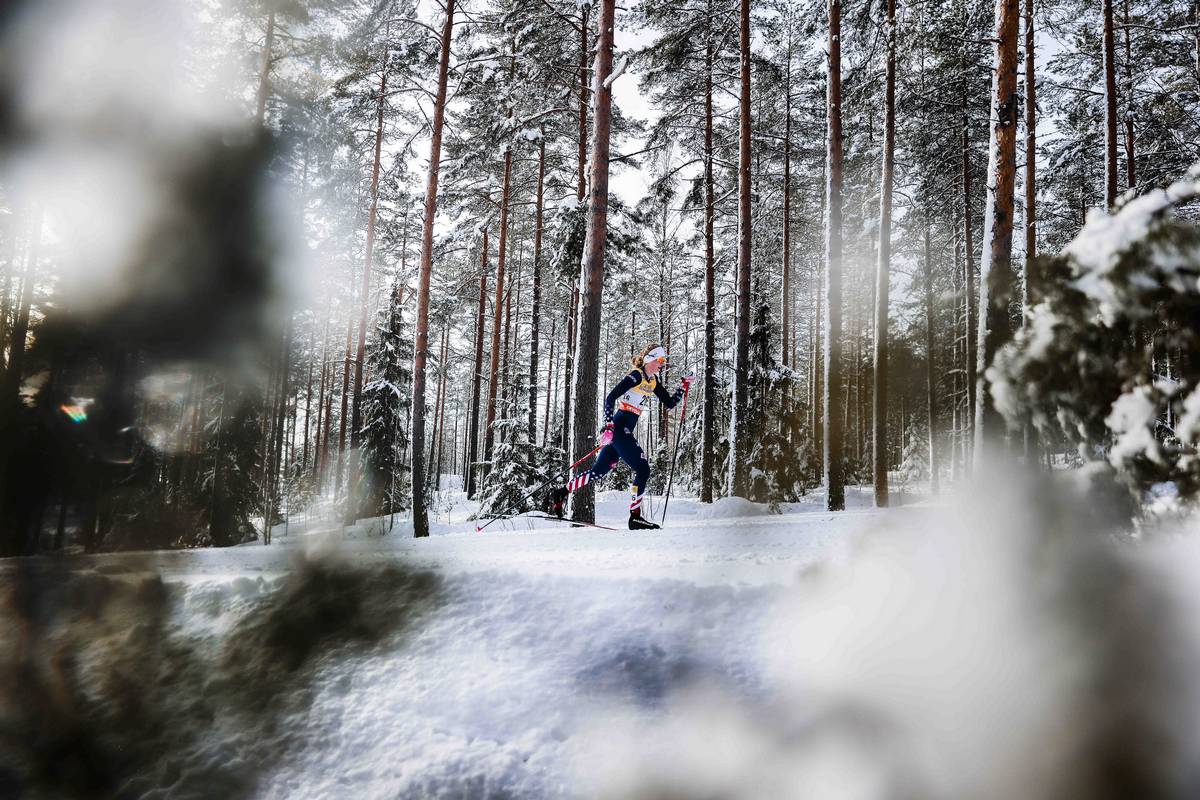
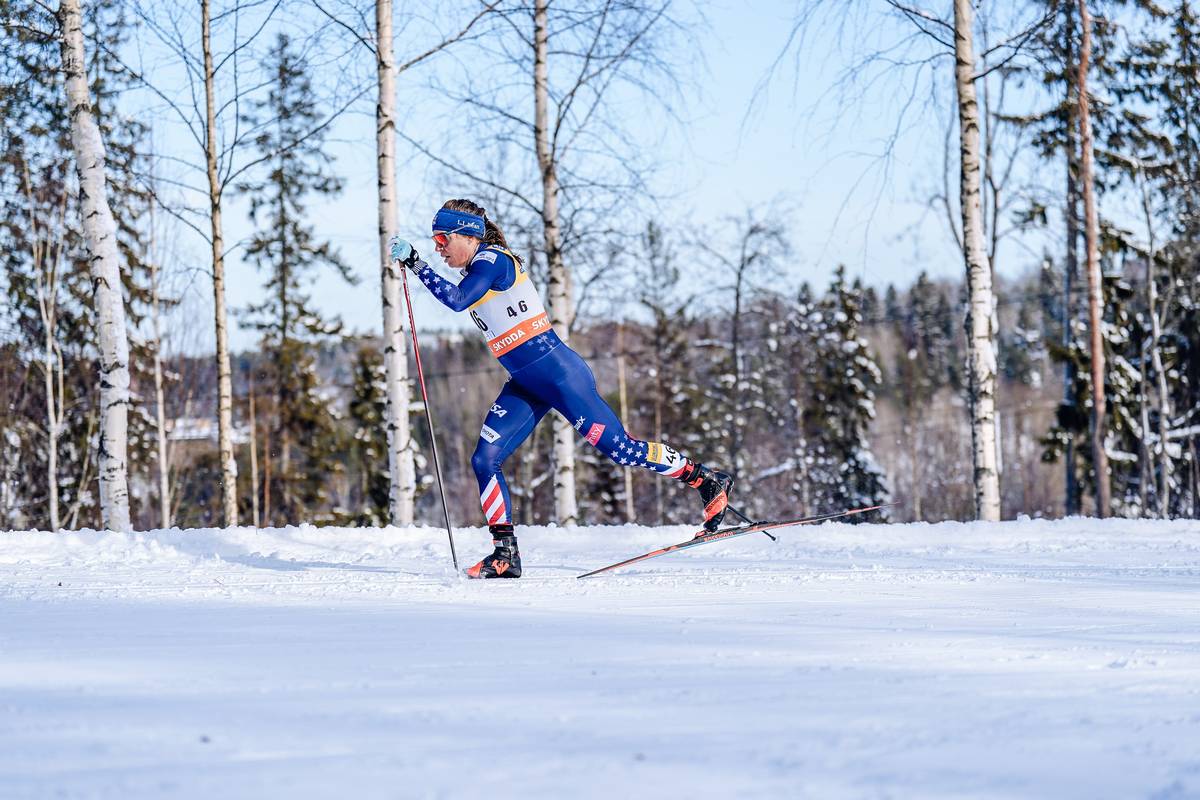
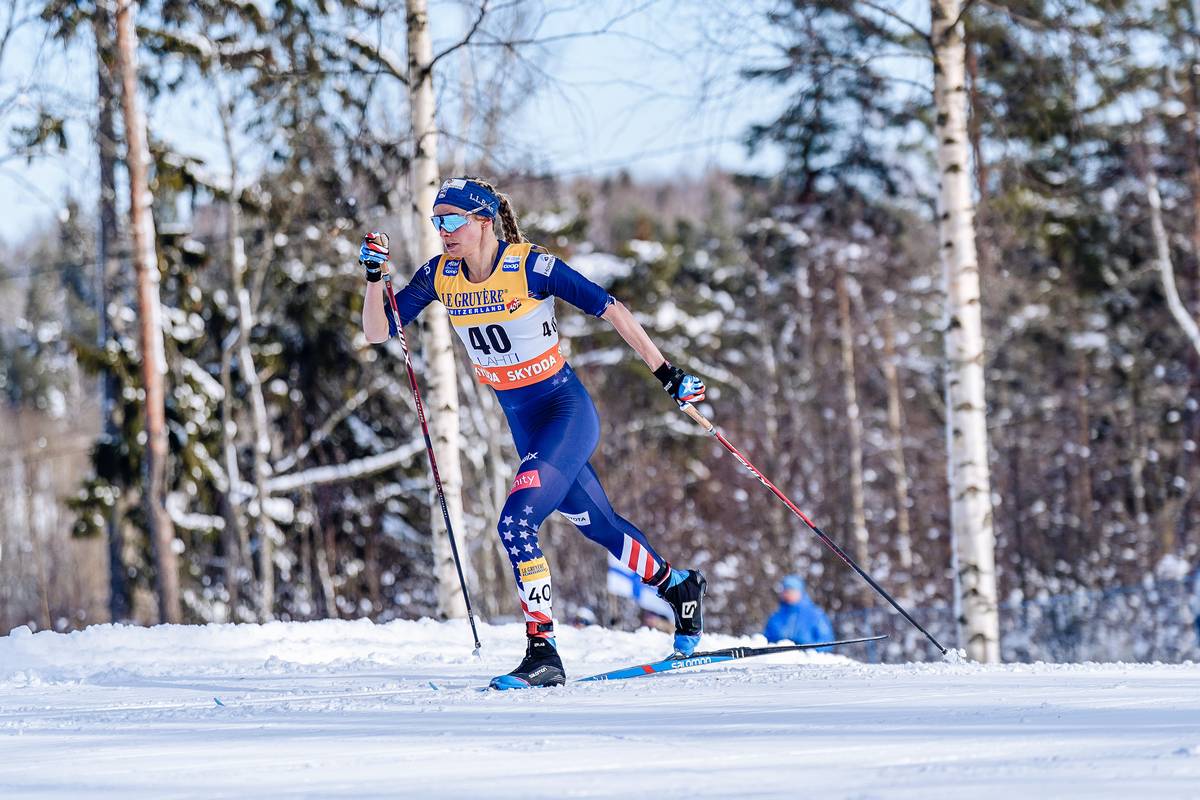
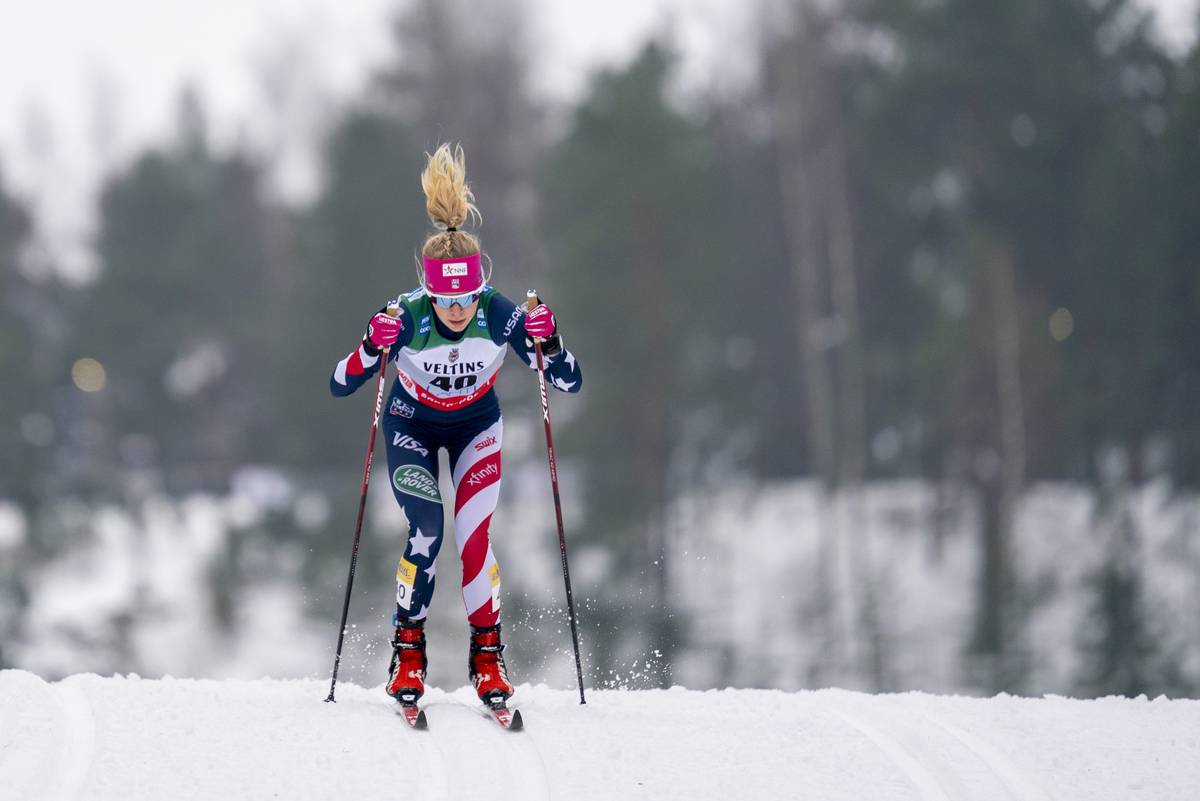
    Hailey Swirbul races through the snow-capped pines of Lahti, FIN. (Photo: NordicFocus)

    This World Cup coverage is made possible through the generous support of Marty and Kathy Hall and the A Hall Mark of Excellence Award.  To learn more about A Hall Mark of Excellence Award or to learn how you can support FasterSkier’s coverage please contact info@fasterskier.com.

    An iconic venue, Lahti’s ski jumps rise out of the pine forest from atop the rolling hills, tucked between the many lakes of the region in southern Finland. After two years of empty trails and stadiums, horns blazed, cowbells rang, and voices cheered during the women’s 10-kilometer individual start classic race as fans lined the hills and filled the stadium, memories of pre-pandemic racing flooded back into mind. 

    What has remained constant through the last two years is the presence of Norway’s Therese Johaug at the top of the results sheet in distance races, particularly classic. Johaug started as the final athlete in the seeded group wearing bib 60, meaning she would have information available to her from the start on how hard she would 

    A little over halfway through the first of two 5 k laps, it looked like Johaug would run away with yet another World Cup distance race. At the 3.7 time check, Johaug was 11.7 seconds up on Natalia Nepyraeva of Russia who had clocked the fastest prior split, with the Finnish Olympic bronze and silver medalists, Krista Pärmäkoski and Kerttu Niskanen, lurking just behind at 16.2 and 17.5 seconds back. And the Finns were racing on home soil with most of the aforementioned fans waving their country’s flag.

    Norway’s Therese Johaug races the 10 k interval start classic in Lahti, FIN. (Photo: NordicFocus)

    Sure enough, the margin of Johaug’s lead narrowed. At the lap, she was just under ten seconds ahead of Nepryaeva, who looked to have conserved her energy in the first lap to push the pace in the second. While the Finns became less of a threat to Johaug, the Norwegian’s margin over the Russian’s splits whittled down rapidly. 

    And ironically, the Russian’s fast second lap might have been partly Johaug’s own doing. As the Norwegian had headed out on course, Nepryaeva was lapping through the stadium, allowing her to match pace as she chased the high-tempo Norwegian through the woods for the second 5 k, perhaps pressuring Johaug to burn a few of her matches a bit earlier than she’d otherwise planned. 

    Regardless of what was going through each athlete’s mind, Nepryaeva finished her second lap to set the bar at 24:29.6.

    Over the first kilometer of Johaug’s second lap, now racing on her own, the time difference between the two women was slashed in half, from 9.8 to 4.8 seconds, and at 8.7 k, it had essentially remained constant at 5.5 seconds. It would come down to the wire.

    Looking back at the season, it might be easy to focus on the three Olympic gold medals Johaug won in Zhangjiakou, including in the 10 k classic event. But, she had been beaten in the only other 10 k classic she’s raced on the World Cup this year, which also took place in Finland, during the opening weekend of World Cup racing in Ruka. She might be the favorite, but she’s also beatable. 

    Natalia Nepryaeva puts together a strong performance in the 10 k classic in Lahti. (Photo: NordicFocus)

    As Nepryaeva watched the clock eagerly from the leader’s chair, Johaug kicked, glided, and double poled through the final kilometer. Having over ten minutes prior, she had plenty of time to wait, watch, and be watched by the cameras.

    Nepryaeva leaned forward, not taking her eyes off the leaderboard as Johaug made the tight right-hand turn down into the stadium without losing too much momentum, and began to charge as hard as she could toward the line.

    With 15 seconds remaining to stay inside Nepryaeva’s mark, Johaug rounded the corner to the finish. With ten seconds to go, she hit the lanes. Nepryaeva watched the seconds tick by hoping Johaug’s time would change to red, while the Norwegian was just trying to keep it in the green.

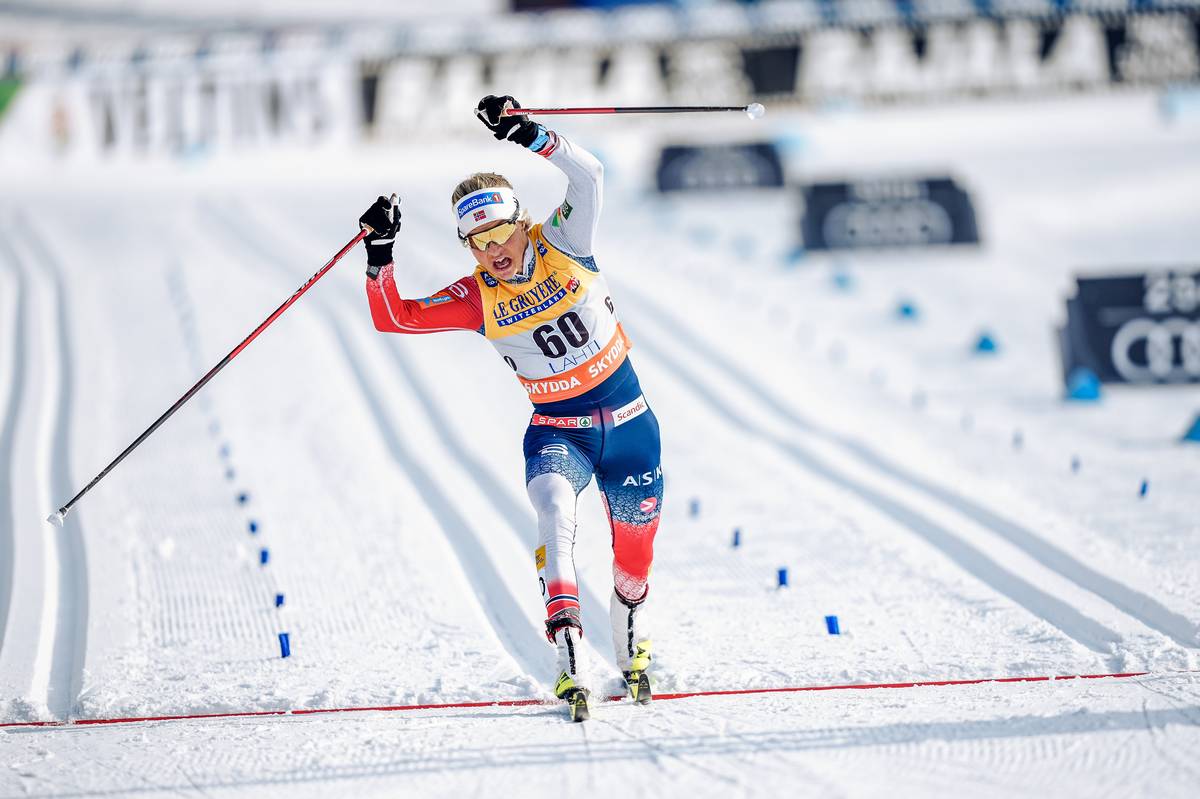
    Therese Johaug (NOR) throws her boot to take the win just 1.2 seconds ahead of Russia’s Natalia Nepryaeva. (Photo: NordicFocus)
    Therese Johaug (NOR) celebrates her victory in Lahti’s 10 k individual start classic. (Photo: NordicFocus)

    Until the actual finish line was crossed, it felt like the result could go either way. But with a final push from her poles and kick with her boot, Therese Johaug sealed the deal, just 1.2 seconds ahead of Natalia Nepryaeva. Johaug let out a victorious roar, just before cameras showed the Russian roll her eyes in exasperation, as if thinking, “Really? Not again.”

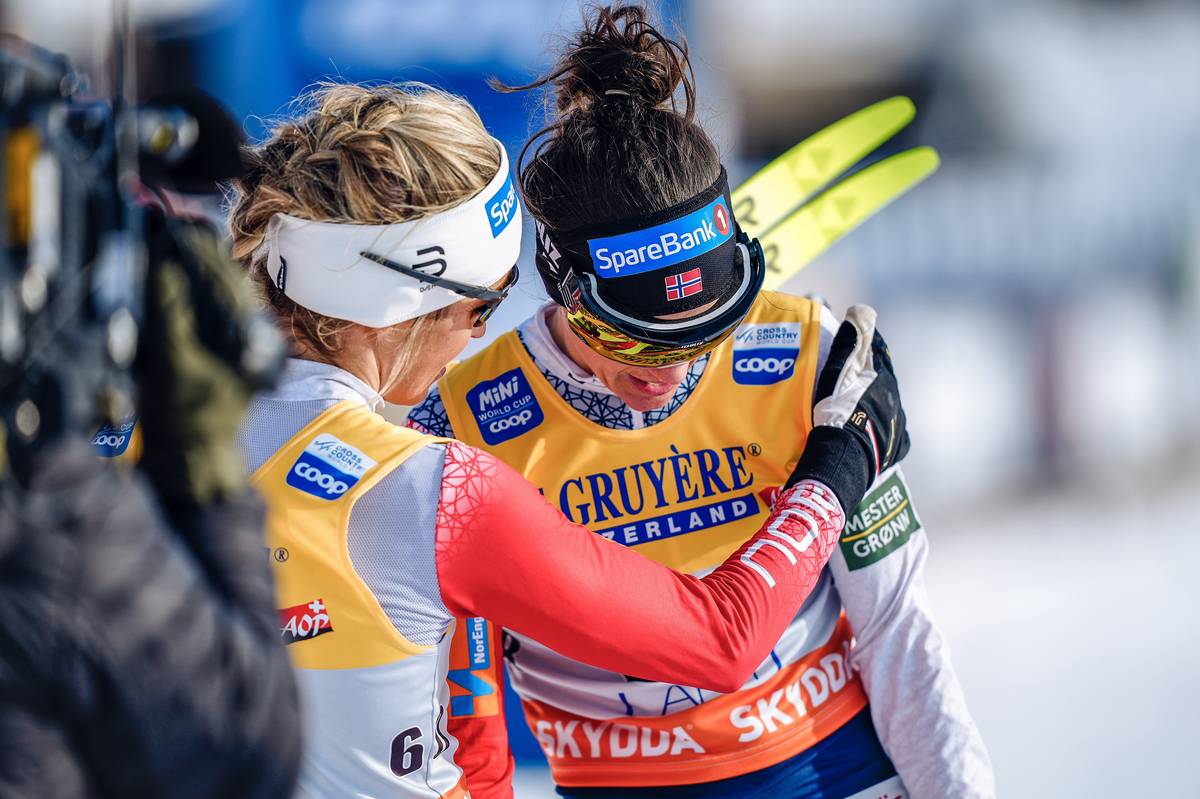
    Cameras panning back to Johaug watched her shift away from her own celebration to comfort a very disappointed Heidi Weng, who had started a minute ahead of Johaug in bib 58, but finished 42 seconds behind her teammate in 19th place (+1:42.4). After promising results in the Tour de Ski, Weng had tested positive for COVID just prior to the Olympics, leaving her watching the event from afar. From Weng’s disappointment at the finish, it looked as though she had been looking for more in her return to racing on the World Cup.

    Therese Johaug (NOR) comforts her disappointed teammate Heidi Weng at the finish of the 10 k individual start classic in Lahti. (Photo: NordicFocus)

    Johaug spoke with FIS after the finish, speaking to what it means to win again today as she nears the end of a successful season, including the three gold medals earned in Zhangjiakou this month.

    “It means a lot for me, and I am so happy that I have a second on my side,” Johaug said with a laugh. “After the Olympics, you’re coming home and it’s a little bit hard to motivate again, but when I come to Lahti and go on this beautiful track, I really enjoy it.”

    Johaug was also asked whether she felt the benefits of having trained and raced at altitude surrounding the Games, which were held at roughly 5,500 feet above sea level. 

    “Yeah, I feel that,” Johaug said of the boost. “When you train a lot at altitude and then you go down, you feel like you have more energy in the hills. I think my shape right now is really good, so I’m excited to race at the Holmenkollen next weekend, and in Falun, then the rest of the season.”

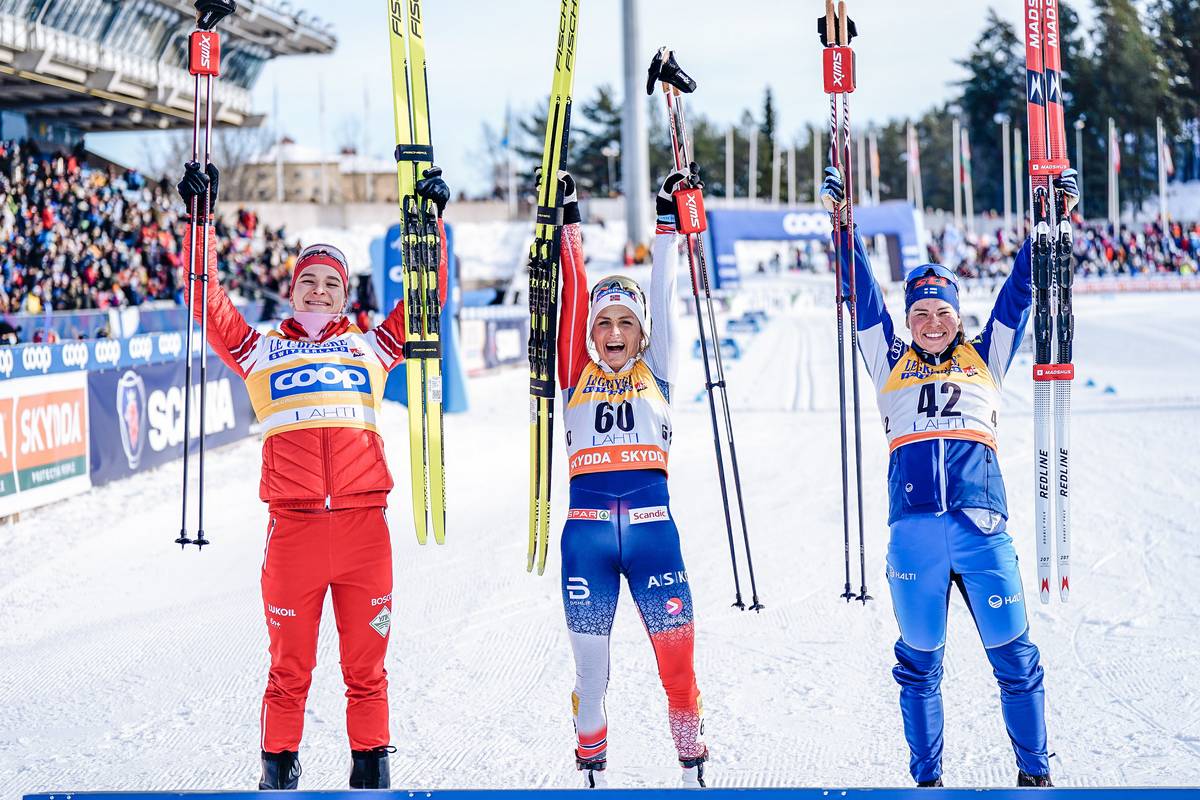
    The women’s podium in Lahti: Therese Johaug (NOR) took the win ahead of Natalia Nepryaeva (RUS) and Krista Pärmäkoski (FIN). (Photo: NordicFocus)

    Rounding out the women’s podium, Finland’s Pärmäkoski held her margin to 16.7 seconds at the finish for third place, followed after a gap by her teammate Niskanen in fourth (37.7). Sweden’s sprint champion Jonna Sundling was just behind in fifth (+40.7).

    Leading the way for the American team, Rosie Brennan posted consistent splits to hover in sixth place through the first lap. Maintaining even tempo and effort, Brennan remained in this position until the last checkpoint, which showed a hard-charging Ebba Andersson of Sweden trade positions to bump Brennan back to 7th.

    Rosie Brennan leads the American team during a 10 k individual start classic in Lahti, FIN. (Photo: NordicFocus)

    Also posting a split Brennan was not quite able to match in the final kilometer, the American lost nearly eight seconds to Germany’s Katharina Hennig between the final time check at 8.7 k and the finish, leaving Brennan in eighth place overall (+1:02.8) at the finish.

    “I am really happy with today.,” Brennan wrote in a post-race email. “I have always struggled post-championships, not so much in my body, but in my mind. It’s really difficult to live on the road and be sharp and push so hard all the time. It often feels like there is never a chance to let down the way someone who goes home every week might experience. I am always trying to figure this out and work towards finding ways to let down and then pull the fight back up for the weekend. It’s all part of the game and it’s a good challenge to try to figure everything out.

    “Anyway, today, I felt much more like myself and was able to ski the way I wanted to. Lahti has been a tough venue for me in the past and today I really felt strong in my classic skiing and had some ability to push hard. I was definitely frustrated after yesterday and am really happy I was able to let it go and find myself out there today. We have had really great weather this weekend and a big crowd so that was a huge bonus. It was a joy to not be skiing in an arctic tornado!”

    Rosie Brennan crosses the line for 8th place in Lahti’s 10 k interval start classic. (Photo: NordicFocus)
    Jessie Diggins skis to 20th place in the 10 k classic in Lahti, FIN. (Photo: NordicFocus)

    Following a podium near-miss in yesterday’s sprint, Jessie Diggins was next for the U.S., just behind Heidi Weng in 20th (+1:43.4). Julia Kern and Hailey Swirbul also raced into the top-30 for the second day in a row, finishing 28th (+2:03.2) and 29th (+2:10.5), respectively.

    Just off Swirbul’s split, Canada’s Katherine Stewart-Jones led her team in 30th place (+2:10.7), with her teammate Dahria Beatty just outside the top-30 in 33rd (+2:19.4). Cendrine Browne raced to 36th (+2:24.5), while Laura Leclair was the final Canadian woman in 58th (+4:29.7). 

    Canada’s Katherine Stewart-Jones leads her team in 30th during the 10 k individual start classic in Lahti, FIN. (Photo: NordicFocus)

    Finishing 30 seconds outside the top-30, Katharine Ogden returned to the World Cup in 43rd (+2:40.8).

    Following the races, US Ski Team head coach Matt Whitcomb provided insights into both the women’s and men’s races in Lahti, as well as sharing the news that Östersund, SWE may become the host to the initially cancelled World Cup Finals that had been scheduled for Tyumen, Russia. Whitcomb also speaks to the “Olympic hangover” that can make hard for athletes to perform at their best the weekend following the Games, and gave a shoutout to the athletes racing at World Juniors in nearby Lygna.

    World Cup racing continues on Thursday, March 3rd with a classic sprint in Drammen, Norway, just prior to the storied 30/50 k mass start classic races at the Holmenkollen in Oslo.

    Results 


  • Germany outsprints Sweden and the ROC for gold and a second team medal; Brennan and Diggins fifth for USA

    Germany outsprints Sweden and the ROC for gold and a second team medal; Brennan and Diggins fifth for USA

    This World Cup coverage is made possible through the generous support of Marty and Kathy Hall and the A Hall Mark of Excellence Award.  To learn more about A Hall Mark of Excellence Award or to learn how you can support FasterSkier’s coverage please contact info@fasterskier.com.

    The team sprint: two skiers racing three laps each at roughly 1.5-kilometers a piece with a long climb thrown into the middle of the course and temperatures in the single digits Fahrenheit. It boils a sport that already requires both power and endurance down to its essence.

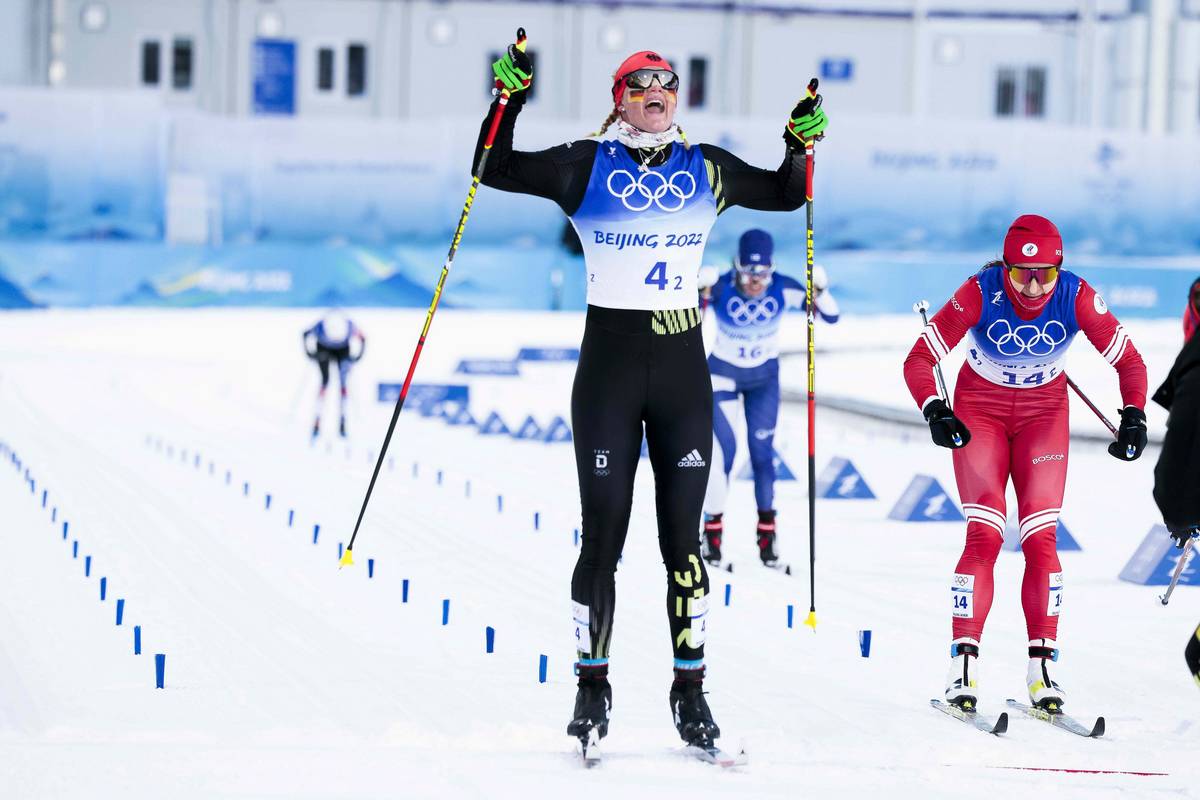
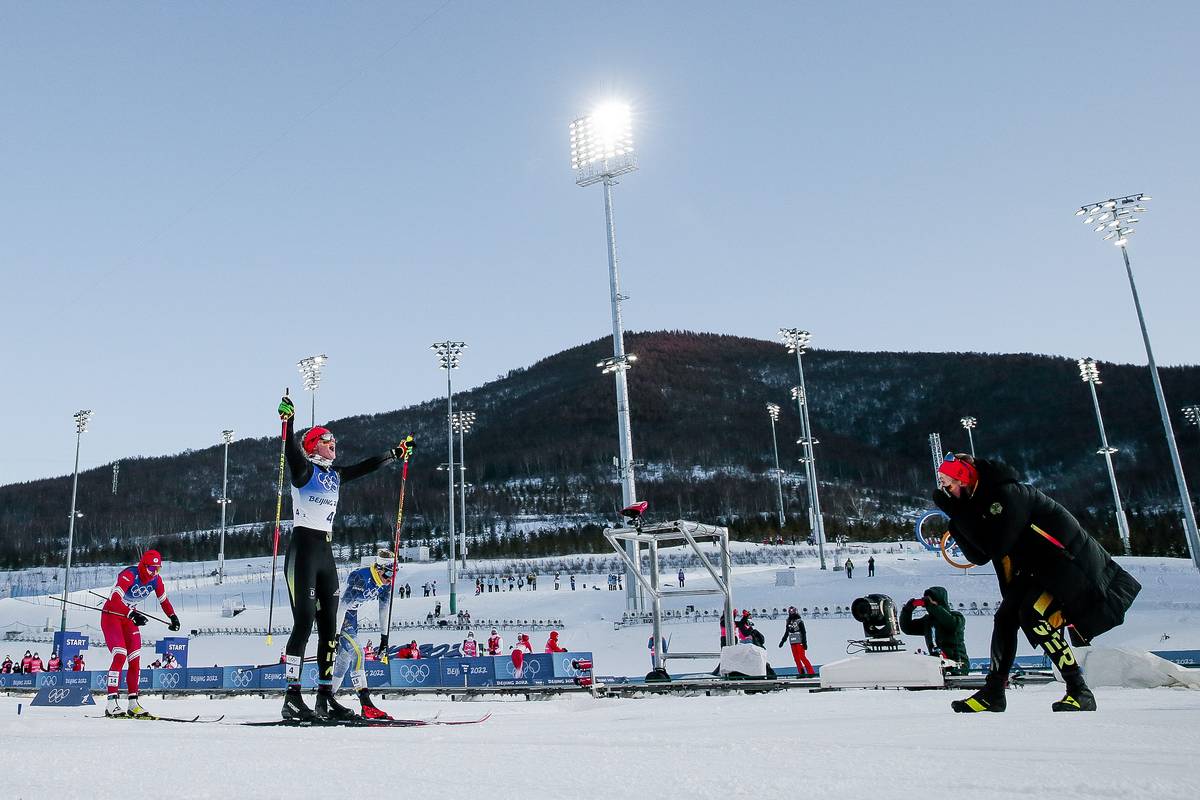
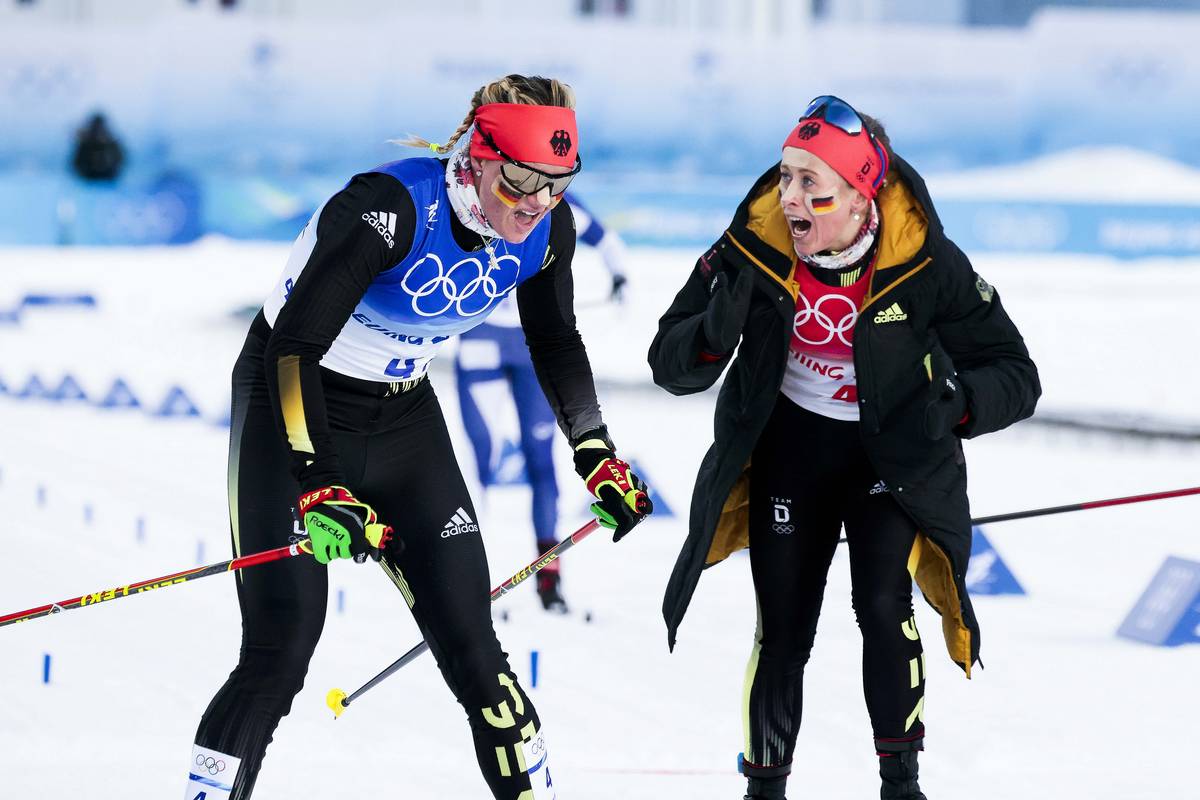
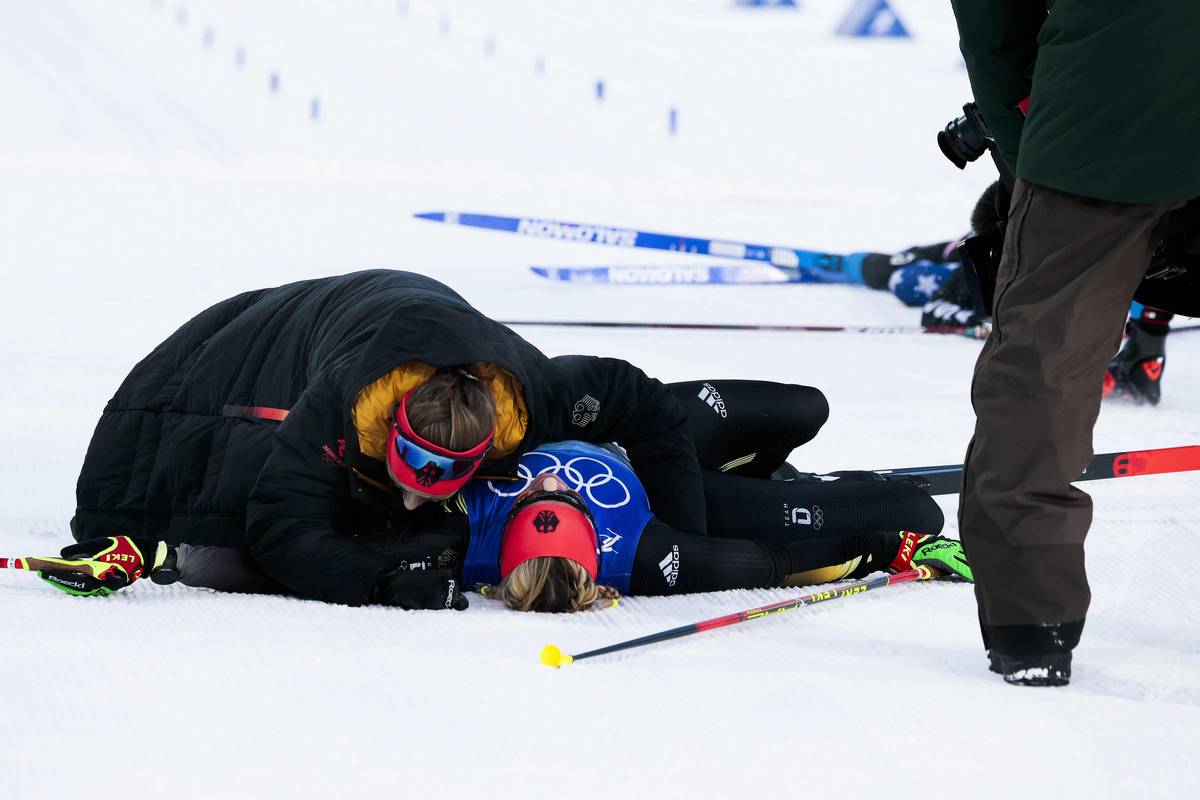
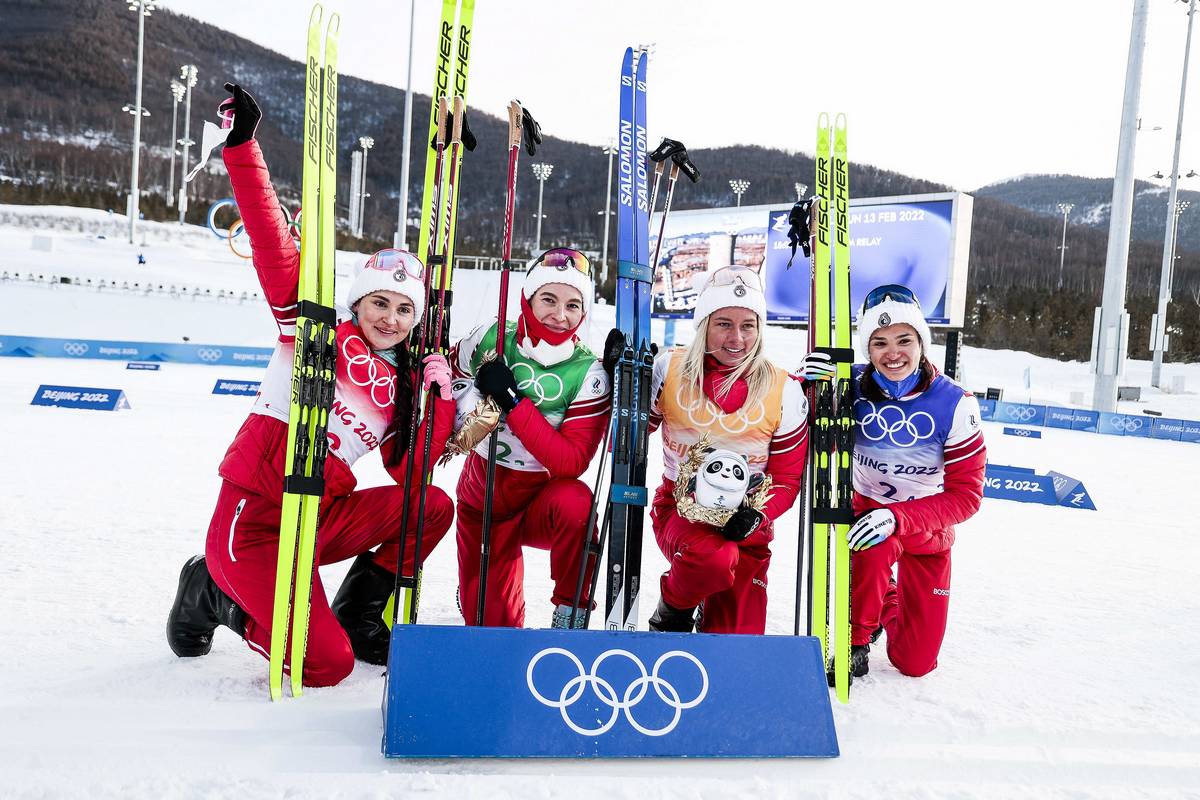
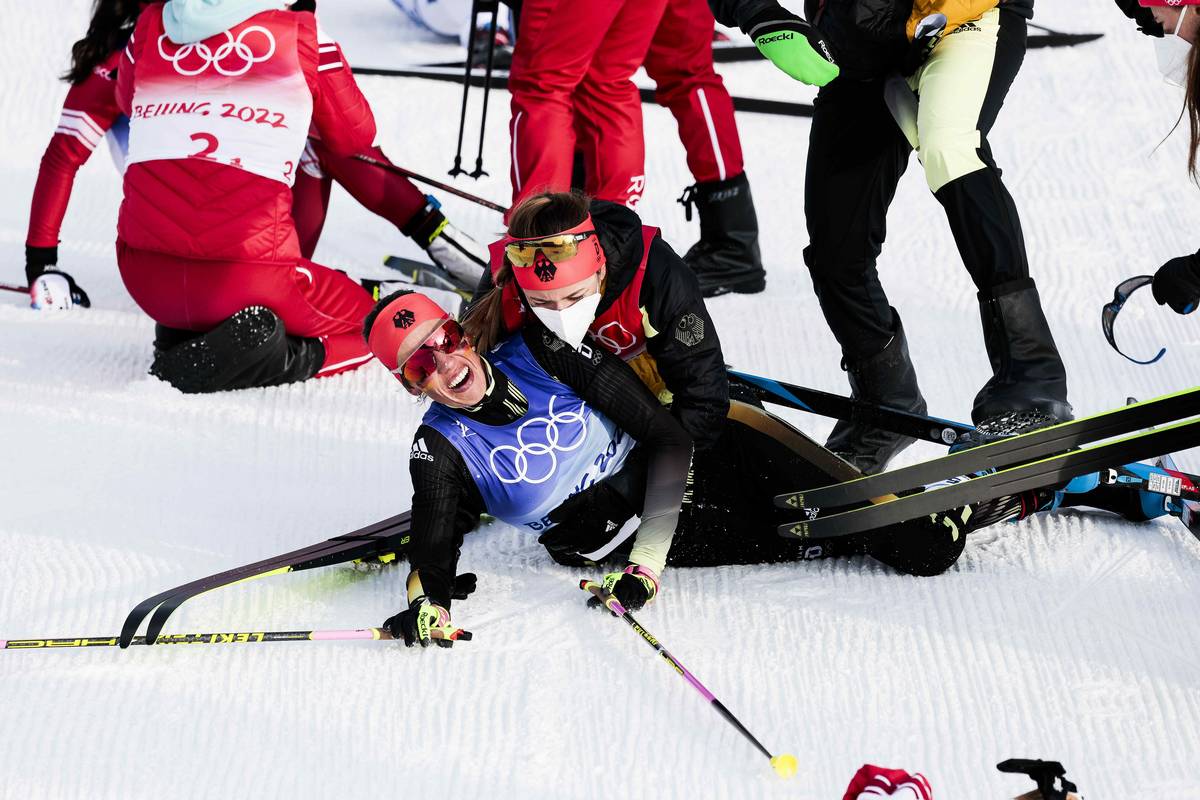
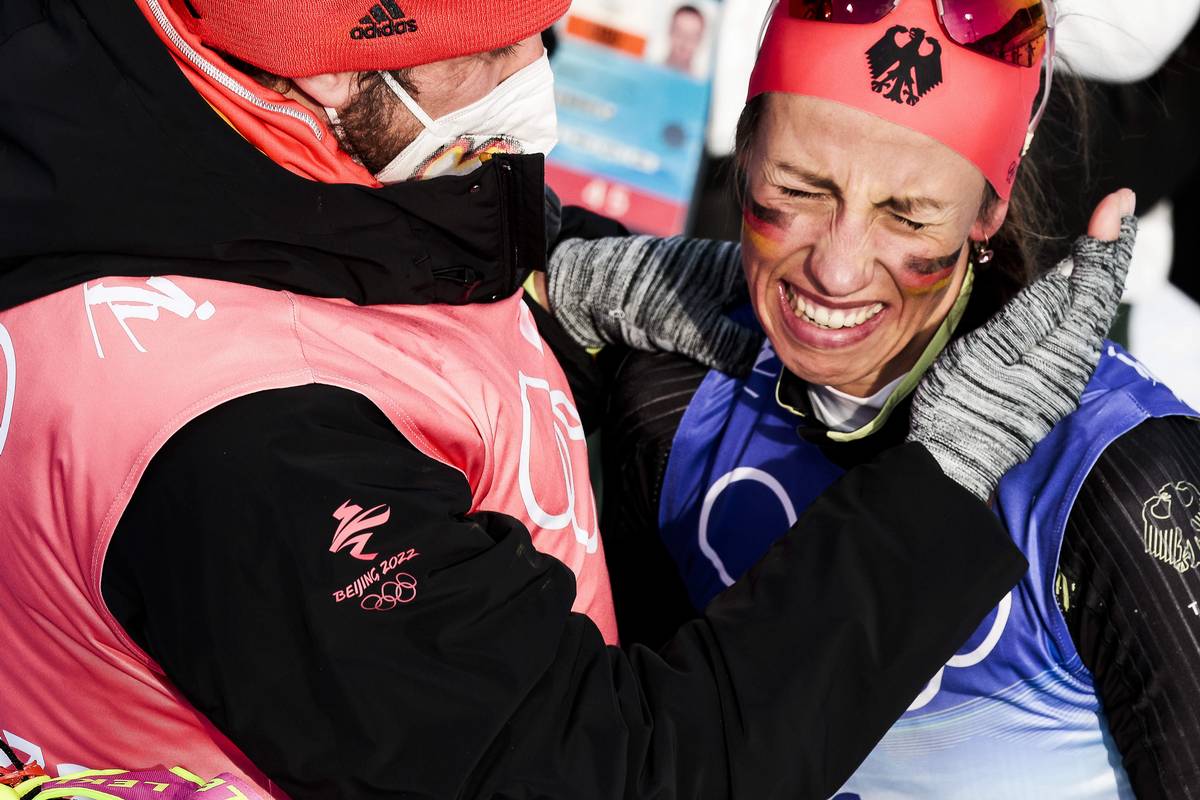
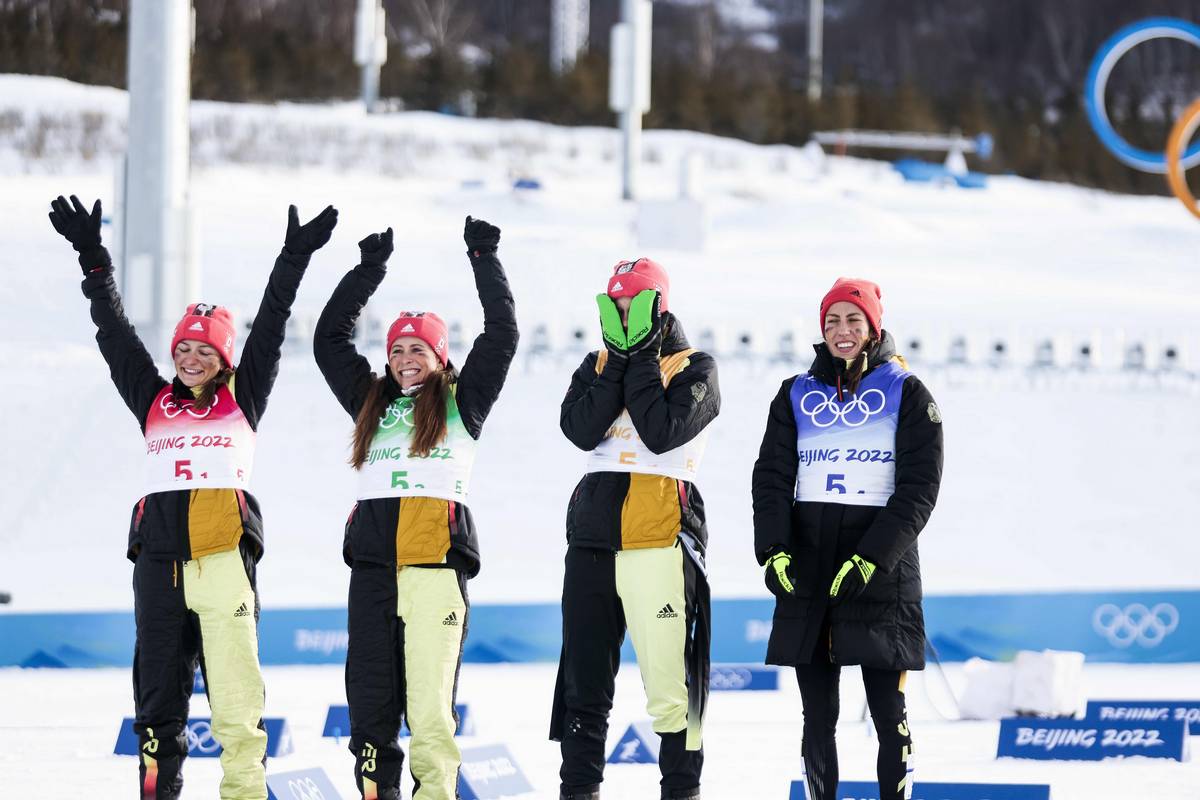
    Riding the high of their silver medal in the women’s 4 x 5 k relay, the duo from Germany, Katharina Hennig and Victoria Carl, won a thrilling sprint finish to decide the medals, collecting gold in a time of 22:09.85. To take the stop spot, the anchor, Carl, out-sprinted the Swedish individual freestyle sprint gold medalist, Jonna Sundling, in the final meters to win by just 0.17 seconds, while the Russian Olympic Committee’s Natalia Nepryaeva crossed just behind in third (+0.71).

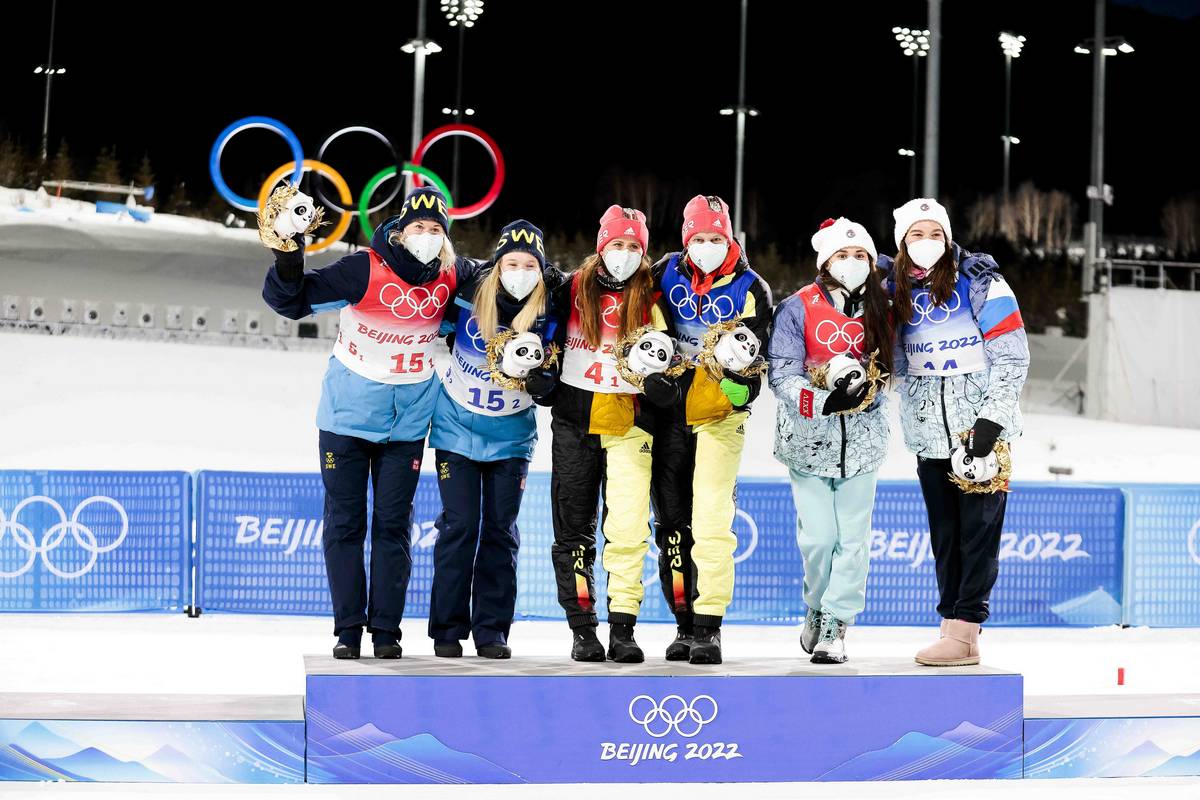
    Sweden, Germany and Russia share the women’s classic team sprint podium.
    (Photo: NordicFocus)

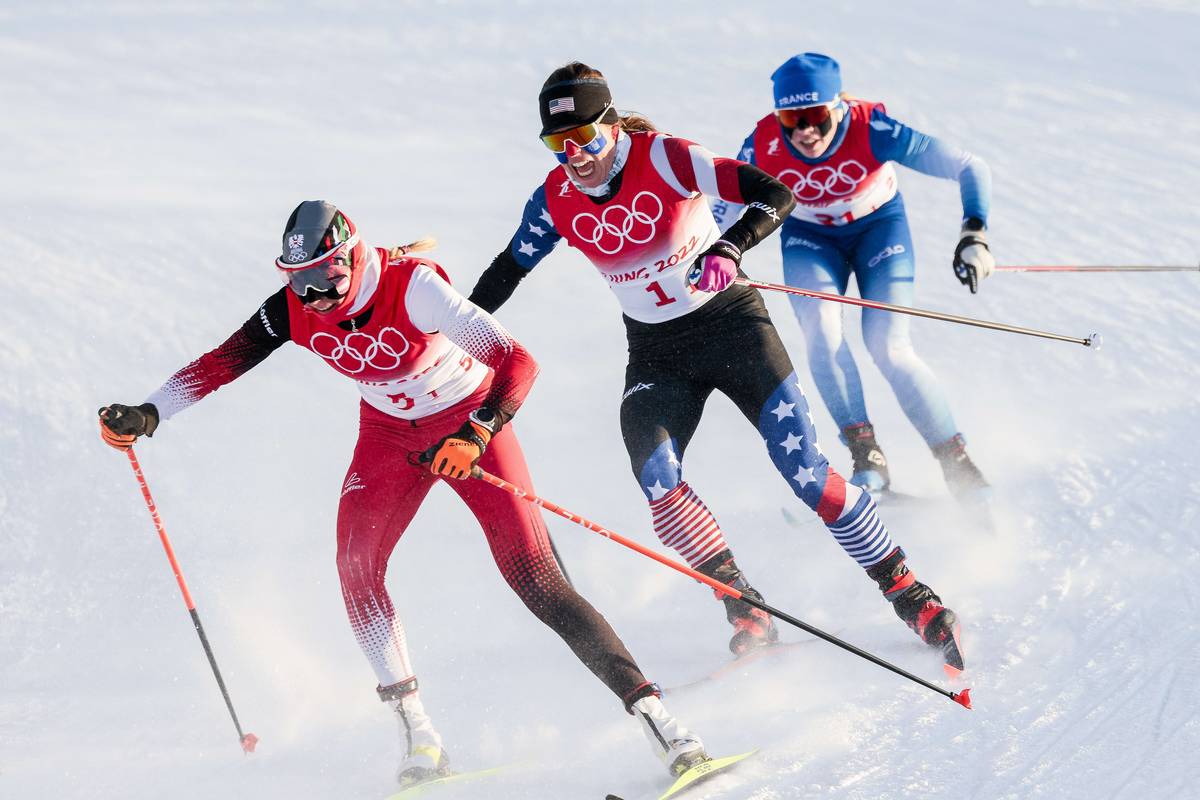
    After holding strong in medal contention throughout the first five of six laps, the American pair of Rosie Brennan and Jessie Diggins lost contact with the leaders in the final leg, crossing the line fifth (+12.93) behind Finland in fourth (+3.86).

    Now, let’s take a step back.

    There is, perhaps, no reminder needed that USA won the team sprint in 2018; Kikkan Randall and Jessie Diggins collected the first Olympic medal for the United States in cross country skiing – a gold, no less – since Bill Koch took silver in the 30 k classic in 1976. However, the team sprint in PyeongChang was raced freestyle, whereas today’s team sprint would be held in classic. 

    “I’m not trying to compare today to four years ago,” said Diggins in the mixed zone after the race. “It’s a different course, different altitude, different technique, like literally nothing is the same and, and that’s okay. I think today, I was going out there and skiing for Rosie and skiing as hard as I could and as best I could… but I’m really proud of this race and proud of giving it our best fight.”

    Rosie Brennan helps the Americans finish second in the first team sprint semifinal, automatically advancing to the final. (Photo: NordicFocus)

    We have to look back eight years for a classic team sprint at the Olympic Winter Games, to the 2014 Games in Sochi. Norway took the gold that day in dominant fashion ahead of Finland and Sweden, who were stretched behind by roughly ten seconds a piece. Only one of the six women on the podium returned to the Games in 2022, again making the team sprint roster: Finland’s Kerttu Niskanen. The American pairing of Sophie Caldwell (now Hamilton) and Kikkan Randall were sixth in Sochi, +35.06 back on the Norwegian winners.

    In the intermediate FIS World Championships, the Americans finished fifth both years, racing Brennan and Sadie Bjornsen (now Maubet) in the freestyle competition in Oberstdorf, Germany in 2021, and pairing Bjornsen with Diggins for the classic team sprint in Seefeld, Austria in 2019. In Oberstdorf, the Americans missed the podium by roughly 2.2 seconds, finishing 2.8 seconds behind the winning team from Sweden. In 2021, they missed the podium by an equivalent margin, this time finishing 5.8 seconds back in the overall standings, again to Sweden. It’s a mark of consistency and depth across techniques for the American women. 

    Yulia Stupak (ROC), Kerttu Niskanen (FIN), and Katerina Janatova (CZE) lead the way early in the women’s classic team sprint semifinal. (Photo: NordicFocus)

    To make the team sprint final, each team must finish in the top-two of semifinal A or B, or be within the next six fastest times from either heat. The U.S. was second to Germany (+4.03) in Semifinal A, while the ROC won the second semi in a close finish with Finland in second (+0.35) and Sweden third (+1.0). Austria and Switzerland also advanced from the first semi, with Sweden, Norway, France, and Poland filling the remaining spots from semifinal B. 

    With bursts of frozen mist released from their mouths, the athletes took to the course for the final round, with Yulia Stupak (ROC), Maja Dahlqvist (SWE), Kerttu Niskanen (FIN), Tiril Udnes Weng (NOR), and Katharina Hennig (GER) racing with Brennan at the front of the pack. 

    With a hooded parka draped over her, face tape obscuring her normally glittery cheekbones, and heated socks inside her boots, Diggins waited in the exchange for the tag. She would be facing Natalia Nepryaeva (ROC), Jonna Sundling (SWE), Krista Pärmäkoski (FIN), Maiken Caspersen Falla (NOR), and Victoria Carl (GER) in the even-numbered legs. 

    Racing comfortably near the front with skis that looked competitive for both kick and glide, Brennan tagged Diggins +1.1 second back on Finland in fourth, well within the lead group. In what would become a pattern for her first two legs, Diggins quickly moved to the front to control the race and ensure a fast pace, perhaps risking accumulating her own fatigue while also taking the sting out of the legs of the individual sprint gold and silver medalists of Sweden, who had also won the World Championship gold in 2021.

    Diggins races at the front of the lead pack during the classic team sprint final. (Photo: NordicFocus)

    Diggins tagged Brennan virtually even with Sweden and Finland after her first lap, a position Brennan was able to hold through her second leg. Near the bottom of the long, grinding climb to the high point of the course, Norway’s Weng wobbled slightly, placing her pole in front of Dahlqvist’s ski to catch her balance. Weng’s pole snapped, leaving her running up the sidelines of the climb with one pole, detaching her strap to grab another from a coach who stood along the fenceline. This lost Norway several seconds, which they were unable to regain in subsequent legs, leaving the team out of podium contention.

    On the odd legs, Niskanen of Finland consistently controlled the race at the front, putting the powerful stride that earned her a silver medal in the 10 k last week on display as she led up the climb in each round. She tagged her teammate Pärmäkoski in the lead at the halfway mark, with Germany, the ROC, and USA within a second back. 

    Kerttu Niskanen (FIN) sets the pace in the first lap of the women’s classic team sprint final. (Photo: NordicFocus)

    Diggins again charged to the front, her hands and legs pumping metronomically as she drove her skis up the climb. Diggins crested the hill in front, with Sundling and Pärmäkoski on her tails heading into the descent. A gap had opened to Germany and the ROC, but these teams had lightning fast glide and were able to regain contact in the descent. 

    At 6 k, with four of six legs complete, it was Sweden and Finland in the lead at the exchange, with Brennan receiving a tag 2.5 seconds back. Niskanen again set the pace at the front, still looking strong as she pushed the pace up the A-climb, with Dahlqvist matching pace behind. In a critical moment where loss of contact might have meant accepting a podium was not in the cards on the day, Brennan accelerated up the climb, steadily closing the gap to the Swede ahead of her. 

    Rosie Brennan (USA) awaits her turn during the women’s team sprint. (Photo: NordicFocus)

    An aerial shot showed Brennan upping her tempo as she brought the U.S. back in contact with the leaders, bringing Hennig and Stupak along with her. All five women dropped into a tuck as they headed downhill together, rounding the sweeping right-hand bend and sprinting up a final climb before the last exchange. Throwing her hands up the hill in a run, Brennan challenged Sweden’s Dahlqvist on the final uphill, double poling around a left-hand bend into the exchange in third behind Germany and Finland. 

    In the last lap, Diggins went hunting. With Pärmäkoski and Carl leading the charge up the climb, Diggins would need to work the hill. Striding powerfully, Diggins did everything she could to keep her team in contact with the leaders, but it was not enough on the day. Doublepoling across the false flat before the descent, it was Pärmäkoski leading Carl, Nepryaeva, and Sundling. 

    The leaders were four abreast coming around the final bend, with Pärmäkoski and Sundling pushed into the outer two lanes, leaving them at a deficit as they headed up the final climb to the stadium. 

    Cresting the rise, Carl looked to be falling off the pace, while Nepryaeva and Sundling pulled to the front, the Swede leading around the final left-hand corner into the finish. 

    But Germany wasn’t done yet. Carl moved up along the outside of the bend, challenging Sundling as they headed into the finish lanes. Doublepoling powerfully, Carl began to slowly pull ahead of Sweden, with the ROC dropping back a few meters behind. 

    Coming to the line to decide the medals, it was Victoria Carl (GER), Natalia Nepryaeva (ROC), and Jonna Sundling (SWE) (l-r). (Photo: NordicFocus)

    In a surprise upset of the Swedish favorites, Carl took it to the line, holding off Sundling as she crossed the line in 22:09.85, welcomed by her ecstatically screaming partner Hennig. Sundling was just 0.17 seconds back for silver, with Nepryaeva unopposed for bronze on their tails (+0.71). 

    Victoria Carl (GER) celebrates gold in the women’s team sprint while Natalia Nepryaeva brings the ROC across the line in third.(Photo: NordicFocus)
    VIctoria Carl takes gold in the classic team sprint, while partner Katharina Hennig awaits in disbelief. (Photo: NordicFocus)

    After falling off the leaders in the final climb, Pärmäkoski brought Finland to the line in fourth (+3.86) with Diggins holding strong after a gap to cross fifth (+12.93). 

    “It means a lot for us,” Hennig told the media after her race. “Also the silver medal in relay and today the gold medal in team sprint. It means a lot and we are very thankful for the whole team. It’s very important for cross-country in Germany.”

    Excitement was high at the finish of the women’s team sprint, as Victoria Carl narrowly took the win for Germany, racing with partner Katharina Hennig. (Photo: NordicFocus)
    Katharina Hennig hugs her exhausted teammate Victoria Carl at the finish of the women’s classic team sprint. (Photo: NordicFocus)

    Though she was the key player in the final lap, Carl was not originally on the start list. She was substituted for Katherine Sauerbrey, who had skied the first leg of the women’s relay on Saturday. German coach Peter Schlickenreider, who celebrated his 52nd birthday today, explained in the mixed zone that Saurbrey had made a “great decision” to let the team know that she was feeling fatigued and as though she may be getting sick. 

    From there, the calculus became: “Okay, you have a silver medal, you did a good race [in the relay], and we have prepared Victoria Carl, so she’s ready,” Schlickenreider explained. “So then let’s do the safe thing.”

    He added that Germany had raced an athlete, Nicole Fessel, in the team sprint during the 2018 Games who was feeling sick, which proved to be a significant mistake as Fessel struggled with her health for the following three months, before ultimately ending her career. The coaches had vowed never to make this error again.

    Jonna Sundling (SWE) congratulates Victoria Carl and Katharina Hennig on Germany’s gold medal in the classic team sprint. (Photo: NordicFocus)

    On the performance of the German skis, which have allowed the team to excel throughout the Games, Schlickenreider explained that waxing has been a focus for the team over the last quadrennial. 

    “We worked really hard the last four years to get this good team. And I think that’s the main thing, that everybody’s working together so that the athlete and ski technicians were communicating quite well.”

    Jessie Diggins (USA) comes to the line in fifth in the women’s team sprint. (Photo: NordicFocus)

    After winning gold in the event, it’s easy to look at a fifth place finish as a disappointment for the American team. But observing the last five seasons, it remains a testament to the consistent strength of the American women’s program, the depth of the field racing at this level, and the fact that ultimately, an Olympic medal is viewed among the highest accomplishments an athlete can achieve purely because it requires the fortuitous coming together of infinitely many pieces to do so.

    Both Brennan and Diggins stated with confidence that they were happy with their performances today, highlighting advances made in classic racing throughout the Games.

    “I felt really good about my skiing today,” Brennan said. “I think it was one of my better classic races this week, so I’m really happy to put it together by the end of the Olympics. And I did what I could to stay in contact to give Jessie her best shot. And I’m happy with that.”

    Rosie Brennan (USA) strides up the A-climb in the women’s team sprint semifinal. (Photo: NordicFocus)

    “I’m really proud of how we skied,” Diggins affirmed. “It was so cool seeing Rosie just crushing, and I went as hard as I could. And there’s no doubt in my mind that I could not have possibly tried harder. I finished with zero sugars left and was dizzy and sick. And I’m currently wearing all the clothes of Team USA… I think we had great skis, or at least I definitely had the kick that I needed. I felt like, technically, this was some of my best classic skiing. And yeah, I’m just really proud of giving it our all because that’s all you can do.”

    Jessie Diggins anchored the women’s classic team sprint to fifth. (Photo: NordicFocus)

    In NBC’s broadcast, team sprint gold medalist turned analyst Kikkan Randall explained that the Americans knew that competitive skis would be a requirement to allow Brennan and Diggins to fight for a medal today. 

    Both athletes expressed that their skis were up to the task, particularly for A-climb, which is roughly 400 meters in length (a quarter mile) with nearly 100 feet of elevation gain. Ascending this three times each in the final, optimizing kick could be essential.

    “I have to have enough kick, or else I really struggle,” Diggins explained. “So I definitely asked for an extra bump. In hindsight, maybe I shouldn’t have but also, that’s on me. And I know that that’s what I need. I need to be able to get up the hill. And that was my biggest priority. And so I think having not enough kick would have made me lose more time.”

    Jessie Diggins (USA) marks Victoria Carl (GER) during the women’s team sprint semifinal. (Photo: NordicFocus)

    Both athletes confirmed that they would be racing the final event of the 2022 Olympic Winter Games on Sunday, the 30 k mass start freestyle, barring unforeseen changes. With one last opportunity to fight for medals, Brennan encapsulated the Americans’ outlook on the whirlwind of racing and Olympic hype. 

    “One thing that the US is really bad at is only caring about the Olympics,” Brennan said in the mixed zone. “But we’re racing and World Cups every weekend all winter long and World Championships on the [odd] years, so if you look at the results from all of those races, you know, this is in the ballpark. I wouldn’t say I had the world’s best races [here] and certainly not the world’s worst races. So it’s been a good experience and we will head straight back to the World Cup and keep fighting for more.”

    Dahria Beatty (CAN) races in semifinal A during the women’s classic team sprint. (Photo: NordicFocus)

    Racing for Canada, Katherine Stewart-Jones and Dahria Beatty took sixth in the first semifinal and did not advance. They ended the day in 12th overall.


    Results: Semifinal A | Semifinal B | Final

  • Stepanova Anchors ROC to Gold in the Women’s 4 x 5 k Relay; USA 6th

    Stepanova Anchors ROC to Gold in the Women’s 4 x 5 k Relay; USA 6th

    This World Cup coverage is made possible through the generous support of Marty and Kathy Hall and the A Hall Mark of Excellence Award.  To learn more about A Hall Mark of Excellence Award or to learn how you can support FasterSkier’s coverage please contact info@fasterskier.com.


    A relay medal evaded the American women’s 4 x 5-kilometer team for another Olympic quadrennial today, as Hailey Swirbul, Rosie Brennan, Novie McCabe, and Jessie Diggins finished sixth, +1:28.2 behind the winners from the Russian Olympic Committee (ROC). Silver went to the German team, who finished +18.2 back on the ROC, while bronze went to Sweden (+19.7), who took Finland to the line, leaving them 0.5 shy of a medal in fourth.

    The relay is seen as a testament to a program’s depth and breadth; with two classic and two skate legs, it’s not enough to have one or two podium-caliber skiers who are specialists in one technique or the other. A team needs to have four strong women who can compete at the top of the field, and the program must have the technical proficiency to maintain contact with the front as the race switches from classic to skate.

    A glittery flag tattooed on her cheek, Hailey Swirbul warms up to lead the American 4 x 5 k relay team. (Photo: NordicFocus)

    And, those four strong women need to have all the pieces come together on the day. “It’s really hard to have four people have an amazing day on the same day,” Brennan said after today’s race.

    The American team has steadily become a medal contender in the event as the level of the program has continually elevated over the last four Olympic cycles. 

    In 2010, Kikkan Randall was the sole member of the relay team who was reaching the World Cup podium, as she raced alongside Caitlin Compton (now Gregg), Holly Brooks, and Morgan Arritola. The American women finished 11th in Vancouver, nearly +3:40 behind the Norwegian gold medal team, which was anchored by a young Therese Johaug. 

    Eight years ago in Sochi, a team of Jessie Diggins, Randall, Liz Stephen, and Sadie Bjornsen (now Maubet) pulled the team up to 7th, +2:30 behind the Swedish winners. Four years later in PyeongChang, Sophie Caldwell, Bjornsen, Randall, and Diggins again brought Team USA 70 seconds closer to the podium, finishing fifth, +1:20 behind Norway. 

    Over the last three World Championships, the Americans finished fourth in 2017, 30 seconds behind the Finnish bronze medal team, and fifth in 2019, one minute behind Russia in third. 

    At the 2021 World Ski Championships in Oberstdorf, Germany, the Americans were impossibly close to the podium. In a final sprint between anchors Krista Pärmäkoski (FIN) and Diggins, the Finn closed hard in the final kilometer to pull ahead of the Americans, taking bronze by just 0.8 seconds.

    While only one of the four relay team members from the 2018 Olympic team remains on the team in 2022, three of the four members from last year’s World Championships made today’s list. That lineup was Swirbul, Bjornsen, Brennan, and Diggins.

    Hailey Swirbul heads out to lead the American 4 x 5 k relay during the 2022 Beijing Olympic Winter Games. (Photo: NordicFocus)

    Today, Swirbul would again lead the Americans skiing the first classic leg, this time followed by Brennan, who was 13th in the 10 k classic on Thursday. McCabe skated the third leg in her second Olympic appearance, tagging off to Diggins as the anchor. 

    Keeping with tradition, all four women – along with current NBC analyst Randall calling from a booth in Connecticut – wore knee-length striped “relay socks”, with beglittered cheekbones to feed their enthusiasm for the event. In a program that remains focused on team, even when standing on an individual podium, glitter and socks are merely symbols of the cohesion that has fostered the American’s rise to success. 

    The ROC’s Yulia Stupak pulls away in the first lap of the women’s 4 x 5 k relay. (Photo: NordicFocus)

    As the first two-lap 5 k classic leg took to the course, the ROC’s Yulia Stupak charged off the front, creating a 12 second gap by the end of the first lap while the next eight team remaining tightly spread, with less than three seconds of separation. In the final kilometer of the first leg, the German team dropped the chase pack to tag its second skier just 1.5 seconds behind the ROC. Masako Ishida tagged off in third for Japan, with Finland just behind in fourth, and Sweden a few seconds behind in fifth. 

    Swirbul tagged off for the Americans in seventh, +24.7 back on the ROC and Germany, and +12.4 seconds on the podium chase pack. The Canadian team, led by Katharine Stewart-Jones, tagged off in 10th (+43.2).

    Katharine Stewart-Jones skis the opening leg of the women’s 4 x 5 k relay. (Photo: NordicFocus)

    The Germans are often a dark horse in the relay, despite frequenting individual World Cup podiums less often than other countries like Norway, Russia, or Sweden. Germany won a silver medal in the women’s relay in the 2010 Games in Vancouver, followed by a bronze in Sochi. They were roughly 20 seconds behind the Americans in fifth at the 2021 World Championships, and 20 seconds ahead of the Americans in fourth place in 2019.

    In this Games, two of the four members of the 2021 World Championships team were again in the lineup, Victoria Carl and Katharina Hennig, both of whom have seen top-10 finishes in the Games so far. Hennig, who would ski the second classic leg, was fifth in the 10 k classic on Thursday, while the third leg skater Carl was 10th in Tuesday’s freestyle sprint. Anchor Sofie Krehl was 8th in qualification and 11th in the final during the freestyle sprint, while classic opener Katharine Sauerbrey was 11th in the 10 k classic and 13th in the 15 k skiathlon. A deceptively stacked lineup.

    Meanwhile, Norway’s Tiril Udnes Weng had tangled with a Latvian skier, causing a crash that robbed her momentum. Already at a deficit with two of their eight athletes, including Lillehammer World Cup relay team member Heidi Weng, waylaid due to positive COVID tests just prior to the Games, the team that would otherwise be a podium threat faced yet another setback.

    Katharina Hennig (GER) follows Natalia Nepryaeva (ROC) during the second leg of the 4 x 5 k relay. (Photo: NordicFocus)

    In the second classic leg, the ROC and Germany remained at the front, trading off in the lead at each checkpoint as they built their lead over third place to come through the exchange with nearly double the gap to third. This time, it was Germany’s Hennig in the lead, with the ROC’s Natalia Nepryaeva four seconds behind. Gold medalist in both distance events so far this Olympiad, Norway’s Therese Johaug brought her team back into podium contention, tagging Helene Marie Fossesholm in third (+22.8), just ahead of Sweden and Finland. 

    Norway’s Therese Johaug brings her team back into podium contention in the second leg of the 4 x 5 k relay. (Photo: NordicFocus)

    The Americans lost an additional 12 seconds over the course of Brennan’s leg, but held their ground in seventh (+36.4). Canada’s Dahria Beatty tagged teammate Cendrine Browne in eighth after a sizable gap (+1:42.7). 

    Rosie Brennan follows Sweden’s Ebba Andersson during the second leg of the women’s 4 x 5 k relay. (Photo: NordicFocus)

    While Germany and the ROC continued the story at the front, Norway and Finland began making up time on the leaders, with Fossesholm and Thursday’s 10 k classic silver medalist Kerttu Niskanen gaining roughly 8 seconds during the first skate leg. Norway was less than 15 seconds back at the final exchange, with Finland an additional three seconds behind. Sweden was in fifth, exactly 35 seconds off the leaders and just over 20 seconds behind Norway, but they were about to prove they were not out of the running. 

    Novie McCabe skates a strong third leg for Team USA in the 4 x 5 k relay. (Photo: NordicFocus)

    McCabe had brought the Americans into sixth (+1:34), in a dead zone with 30 seconds to the next racer on either side. The Canadian women tagged off in 8th, +2:21.2 back on the leaders. 

    In the final leg, the ROC’s Veronika Stepanova quickly began to reel in Germany’s Krehl. 

    Establishing herself as a strong closer at just 21 years of age, Stepanova also anchored Russia’s winning relay team in Lillehammer back in December to a thrilling finish, narrowly beating Norway and Sweden in a three-way sprint to the line. 

    In the lead at the final exchange, Germany’s Victoria Carl tags Sofie Krehl during the Olympic 4 x 5 k relay. (Photo: NordicFocus)
    Tatiana Sorina tags Veronika Stepanova as the ROC chases down Germany in the final lap of the 4 x 5 k relay. (Photo: NordicFocus)

    This time, it did not look as if the ROC was looking for a climactic ending for its spectators. Stepanova had Krehl in her sights at the lap, and was now just 1.5 seconds behind. Stepanova kept the effort high, leaving the German five seconds back a kilometer later. 

    Then, Krehl began to fade rapidly. 

    As the ROC soon looked to have the gold medal on lock, the question became whether Germany could hold onto silver. Sweden’s sprint gold medalist Jonna Sundling was showing her stamina against Pärmäkoski, who looked to be repeating the approach that allowed her to take bronze for Finland in the 2021 World Championship where she was facing Diggins. 

    The pace stayed hot as the Finnish veteran steadily fatigued the legs of the sprint champion, and over the final lap, the pair brought Krehl into contact. Heading into the stadium, Krehl was hanging onto her lead by a thread. 

    Sofie Krehl hangs on to anchor the German team to silver in the 4 x 5 k relay. (Photo: NordicFocus)

    Cameras panned away as the German rounded the final bend into the stadium, returning just as she crossed the line, only ten meters ahead of Sundling and Pärmäkoski, who V2ed side by side through the lanes.

    Ultimately, Sundlings sprint prowess gave Sweden the advantage, as she nipped Pärmäkoski by 0.5 seconds at the line for the bronze medal. 

    Jonna Sundling (SWE) takes bronze by 0.5 seconds ahead of Krista Pärmäkoski (FIN). (Photo: NordicFocus)

    It was the ROC for gold in 53:41.0, with Germany in second (+18.2), and Sweden third (+20.7).

    “Of course, it is a special day,” Stepanova told the media after the race. “It was really tough because we have a win in the World Cup, and a lot of people know we can win, so they say, ‘You must win, you must win.’ So I am like, ‘OK, we need a good result,’ and I do what I can do.”

    Veronika Stepanova anchors the ROC to gold in the women’s 4 x 5 k relay. (Photo: NordicFocus)
    The Russian Olympic Committee celebrates gold in the women’s 4 x 5 k relay as anchor Veronika Stepanova crosses the line with a solid lead. (Photo: NordicFocus)

    While the depth of its women’s team made the ROC a good choice as a podium pick, Stupak made it clear in her post-race comment that the team had also been targeting the event, saying the result was “not a shock.”

    “We prepared for this race the whole year,” she explained. “It’s a good result for everybody in our team. We were ready for this medal.”

    On the ROC’s approach and early lead, Stupak continued, “We tried to push the limit. We had big motivation and good concentration before the start. It was a hard race but it was a good race for us.”

    The 4 x 5 k relay gold medalists of the ROC: Yulia Stupak, Natalia Nepryaeva, Tatiana Sorina, and Veronika Stepanova (l-r). (Photo: NordicFocus)

    For the Germans, the tone implied less certainty that a medal would be earned. Rather, it was the culmination of strategic pacing and hard work, leading to what Krehl called a “surprise” ending. 

    “We are so happy and excited,” Hennig said. “This is a special day for us and we are so thankful that all the hard work pays off now for the whole team and all of cross-country Germany. So we are very, very happy. We had a good plan and our plan worked. And we did our best, and so it was an exciting and amazing day.”

    The German team welcomes anchor Sofie Krehl to the finish, earning a silver medal in the 4 x 5 k relay. (Photo: NordicFocus)
    Caught by the emotion of earning a silver medal for Germany, Sofie Krehl is embraced by her coach at the finish of the 4 x 5 k relay. (Photo: NordicFocus)

    Krehl explained that she had skied her first lap defensively, expecting Stepanova to catch her sooner. In the second lap, she described the ROC athlete as “too good”, causing her to let go of gold. Though she was nervous when she began to feel Sweden and Finland closing on her, she was able to hold on for a result she described as “good for the whole team”, including the German coaches and wax technicians.

    “It’s a lot of emotion,” Krehl said. “It feels like a dream. Maybe I need some time and then I can recognize what we have done.”

    Putting together a gutsy performance, Katherine Sauerbrey, Katharina Hennig, Victoria Carl, and Sofie Krehl (l-r) earn silver for Germany. (Photo: NordicFocus)
    The Swedist team of Maja Dahlqvist, Ebba Andersson, Frida Karlsson, and Jonna Sundling (l-r) earn silver in the 4 x 5 k relay. (Photo: NordicFocus)

    Behind the podium contenders, Norway had lost contact with the Swedes and the Finns over the final lap, fading to fifth (+28.8). Racing alone through her lap, Diggins crossed the line for Team USA a minute later in sixth (+1:28.2).

    “Personally, I’m really, really proud of this team,” Diggins said in the mixed zone. “Every single one of these girls went out and skied so hard and skied gutsy races. And we gave it everything we have. And some days that ends up in the results of your life and some days it doesn’t. But either way, all you can control is going out there as hard and as smart as you can. And this team did that.”

    Jessie Diggins brings the Americans home in sixth in the women’s 4 x 5 k relay. (Photo: NordicFocus)

    Though they did not walk away with Olympic hardware, the energy and enthusiasm were high in the mixed zone, with laughter filling the gaps between the athletes’ comments. 

    On a team composed of two veteran Olympians, Brennan and Diggins, and two first-timers, Swirbul and McCabe, experience and insight helped unify the group and set the Americans up for their best chance at putting together a strong performance. 

    Leading the breakdown of the race, Swirbul shared, “It’s always important, I think, to try to ski my own race, even though you’re in the field. I definitely had advice from Rosie last night to make sure to pace it how I would face the race – and Jessie. We’re focusing on time, so the fastest time that we can get around that course [for] each person is the best, no matter what place you come in.”

    Rosie Brennan races the second leg of the 4 x 5 k Olympic relay. (Photo: NordicFocus)

    Brennan’s performance in the sprint demonstrated her impressive mental strength to overcome setbacks and not count herself – or in this case, her team – out of the running. A bad pole plant directly onto her ski in the sprint quarterfinal could have shaken her confidence, but she rebounded to ultimately finish just over a second off the podium in fourth place.

    She approached today with a similar resolve. 

    “I knew it was full of a lot of the heavy hitters, so I knew I had a tough job ahead of me,” Brennan said. “So I tried to ski smart, but also find something extra to dig a little deeper, but I knew there was going to be some hard fighting at the end. I felt really good about my climbing. And I was a little disappointed with my inability to stick with [the other women] over the top of the hill in the double pole section, but it was all I had out there. So, I have to be happy with that. And I guess I know what I’ll be working on in the future.”

    At 21-years-old, McCabe is the youngest member of the relay team. 

    “It’s so cool to be a part of a team with three legends and I had a lot of fun doing it, even though I was extremely nervous beforehand,” she said with a laugh.

    Novie McCabe tags Jessie Diggins for the final leg of the 4 x 5 k relay. (Photo: NordicFocus)

    Her mom, Laura McCabe, is a two-time Olympian who skied the third leg of the relay in both 1994 and 1998. However, Novie laughed that she had not talked to her mother in several days and thus had not received any advice heading into the relay. After much deliberation, the team had only been decided the afternoon prior.

    “I tried on the first lap to just stay relaxed,” McCabe explained of her plan. “I knew that there was  a chance I would blow up and end up losing a lot of time to that group ahead of me. So I was just trying to focus on [pacing] for the first lap, and on the second, I kind of tried to drop the hammer and do what I could to not lose time.”

    In her lap, McCabe lost just 11 seconds to Sweden’s distance standout, Frida Karlsson. She had accomplished her goal.

    Diggins explained she headed out for the final leg optimistically hoping things would shake out differently than they ultimately did.

    “I basically just swung for the fences and thought, ‘Okay, I’m gonna go out as hard as I can. Because if there’s a chance that [the women ahead of me] monkey around and don’t want to lead, then I’ve got to go for it.’ I thought, ‘You know, if I get lucky and they’re messing around in tactics, there’s a chance I can glom on the back.’ Unfortunately, they did not, as much as I had hoped. And I definitely paid for it in the second lap. I could not feel my legs at all.”

    Jessie Diggins anchors the Americans to 6th in the 4 x 5 k relay. (Photo: NordicFocus)

    After a windy skiathlon and 10 k classic that left tracks blown in with loose snow, the women expressed that conditions today were the best they’ve experienced in racing so far. Though two inches of snow came down overnight, perhaps an unexpected twist in the weather patterns, the Americans each affirmed that their skis were competitive, with Swirbul and Brennan adding the change was especially favorable for their classic legs.

    “I actually got to ski in the tracks today, which is so nice,” Brennan said. 

    On the camaraderie of the team, Brennan shared, “It’s an individual sport, but we also spend close to five months on the road a year together. So it would be pretty boring if you only ever care about yourself. [That’s] not very fun or fulfilling – it doesn’t mean that much. So when we get to actually, truly be out there together, and all of our times count for each other. I think that brings like a new level of meaning and purpose to what we’re doing. And it’s really special to get to share that with your teammates.” 

    Olivia Bouffard-Nesbitt (CAN) collapses as she’s greeted by her team at the finish of the 4 x 5 k relay. (Photo: NordicFocus)

    Closing for Canada, Olivia Bouffard Nesbitt lost one spot to the Italian team in the final leg. The Canadian women ended their day in 9th (+3:39.9). 

    Results

  • Johaug Wins Second Gold in a Close Race; Diggins Leads Americans in 8th

    Johaug Wins Second Gold in a Close Race; Diggins Leads Americans in 8th

    Podium finishers, Kerttu Niskanen (FIN), Therese Johaug (NOR), Krista Pärmäkoski (FIN), (l-r) (photo: NordicFocus)

    This World Cup coverage is made possible through the generous support of Marty and Kathy Hall and the A Hall Mark of Excellence Award.  To learn more about A Hall Mark of Excellence Award or to learn how you can support FasterSkier’s coverage please contact info@fasterskier.com.

    Thursday morning saw the third women’s cross-country race in the Zhangjiakou stadium. On the docket, a 10-kilometer individual start classic with two laps of a challenging 5 k course. After a reprieve from the wind during the sprint event Tuesday evening, it was blowing once again as the athletes headed to the start.

    Zhangjiakou 5 k course. (screenshot from FIS homologation certificate)

    Unlike the skiathlon which saw 62 finishers, the start list for the 10 k individual classic featured 98 racers. Most of the later starters represented nations we don’t normally see at World Cup events, such as Greece, Brazil, and Hungry. Many of these skiers fall into the ‘B-standard’ Olympic qualification category; provided they can earn less than 300 FIS points in a competition prior to the games, but have greater than the 100 point threshold of the A-standard, these athletes can race in the 10 k and relay events. 

    To set the stage for Thursday’s race, we can begin with a brief dive into recent Olympic, World Championship, and World Cup results at this distance. Given that this year’s edition of the individual-start 10 k event was contested in classic technique, the 10 k individual start in PyeongChang was a freestyle race (disciplines alter every two years at championship events). As such, it is harder to draw direct predictions from the podium four years ago to possible success in today’s event. Nevertheless, to remind ourselves, it was Ragnhild Haga of Norway who walked away with the gold in 2018. Charlotte Kalla of Sweden finished second and she was followed by Marit Bjørgen of Norway in third position. Delving deeper into the Olympic records, a look at the results from the 10 k individual classic in Sochi, shows that Justyna Kowalczyk of Poland took gold, with Kalla again the runner-up, and Therese Johaug rounding out the podium with bronze. 

    Sweden’s Charlotte Kalla racing to silver in the 10 k classic individual start at the 2014 Olympics in Sochi, Russia. (Photo: FS archives)

    The most recent championship-level 10 k individual-start classic race was in Seefeld, Austria when the World Championships were held there in 2019. There, the victory went to Therese Johaug who finished 12.2 seconds ahead of Frida Karlsson of Sweden. Johaug’s teammate, Ingvild Flugstad Østberg was third, but has since battled health concerns and been largely absent from international racing. 

    This season, the two 10 k individual start classic events have been won by Karlsson (in Ruka, FIN +13.7 ahead of Johaug) and Kerttu Niskanen of Finland in Lenzerheide, SUI (during the Tour de Ski in which Johaug did not compete). 

    Perhaps one of the more open events in terms of podium predictions, the race turned out to be an exciting one with the margins between medal positions coming down to hundredths of seconds. In the end, it was Johaug of Norway who walked away with her second gold medal from these Games, eking out a win ahead of Niskanen (FIN) by just 0.4 seconds. 

    Therese Johaug (NOR) crosses the finish line and collapses (Photo: NordicFocus)

    Rewinding to the start, Russian Olympic Committee athletes Natalia Nepryaeva and Tatiana Sorina clocked the fastest times to begin. Looking at the course profile, the first split at 1.3 k comes at the end of a good deal of climbing. Close behind the ROC athletes were two Finn’s, Niskanen and Krista Pärmäkoski, with Johaug rounding out the top five, a surprising +12.8 seconds behind Nepryaeva. 

    Move forward to 3.6 k and the top three were within 0.5 seconds of each other, Niskanen and Johaug tied with a split of 10:47.7, Nepryaeva passing through at 0.5 seconds off their mark. With one lap complete, Nepryaeva had started to fade, perhaps paying the price for her early pace. At 5 k it was Johaug with the advantage over Niskanen, but only by +0.6 seconds, and Nepryaeva was now +6.2 behind. 

    Therese Johaug (NOR) striding her way to a win in the 10 k classic (Photo: NordicFocus)

    Through 6.3 k it seemed like Niskanen had made a break, pulling ahead of Johaug by 11 seconds, on a section of course that is mostly climbing, generally a strong point for Johaug. Nepryaeva was still in third +14.7 behind Niskanen and Pärmäkoski (FIN) was holding onto her fourth place position, +17.7 back. In the next 0.5 k, something appears to have happened to the ROC athlete, as Nepryaeva lost 12.1 seconds to Niskanen (+26.8) and was overtaken in by Pärmäkoski who moved into third +18 seconds behind her teammate. 

    The final course split was at the 8.6 k mark and with Johaug having the earlier bib, we saw her through first. She had gained the minute start deficit she had to Jessie Diggins and moved past the American, employing her signature high tempo up the final A-climb. When Niskanen came through moments later, her body language was visibly more labored than Johaug’s. In spite of this, Niskanen still held the lead, +1.3 seconds ahead of the Norwegian. Pärmäkoski remained in third, +23.6 behind, followed by Nepryaeva who was +31.8 behind. 

    Natalia Nepryaeva (ROC) slides her foot across the line, 0.1 seconds behind Krista Pärmäkoski of Finland (Photo: NordicFocus)

    Entering the stadium, Johaug was skiing outside the windblown tracks. Knowing the margins were tight, she pushed hard, crossing the finish line in a time of 28:06.3. Facing a headwind into the finish, Niskanen chose to keep her skis inside the tracks, battling the final meters as the stopwatch ticked by. Sliding her foot across the line, the timestamp turned to red. She crossed +0.4 seconds behind Johaug. 

    “It was the two most nervous minutes in my life, waiting for [Niskanen]”, said Johaug in the press conference after the race. 

    “It was a really tough race out there today and, as Kerttu said, it was really close race,” Johaug continued. “So I feel that it’s also Kerttu’s gold medal because 0.4 second is nothing. I think we both are the the winners today in my head.”

    Kerttu Niskanen (FIN) digs deep for precious time in the 10 k classic (Photo: NordicFocus)
    Teammates Krista Pärmäkoski (FIN) and Kerttu Niskanen (FIN) celebrate their podium finishes. (Photo: NordicFocus)

    After earning her first individual gold medal just days ago in the skiathlon, Johaug continues to cement her place in history as she gains another. Her performance gives the Norwegians something to hold onto as the rest of the team struggled to perform at the level fans are accustomed to.

    With twins Tiril Udnes and Lotta Udnes Weng finishing 21st and 25th respectively and Mathilde Myhrvold back in 44th position, the remaining women racing on behalf of  Norway did not have their strongest showing. 

    So far, Johaug is the only female Norwegian athlete to earn a medal of any color, while Johannes Høsflot Klæbo earned the only medal on the men’s side, a gold in the 1.5 k freestyle sprint on Tuesday. Three Norwegian athletes, including medal favorites Heidi Weng and Simen Hegstad Krüger, remain detained due to a positive COVID test just prior to travel. Weng recently announced on social media that she will not be making it to China and it is unclear whether Krüger will be cleared in time to compete in events next week.

    Lotta Udnes Weng (NOR) finished 25th in the 10 k classic (Photo: NordicFocus)

    For Kerttu Niskanen, this silver marks her first individual championship medal. She holds two silver medals from team events, both coming from Sochi in 2014. Niskanen only has three World Cup victories to her name and they all were in 10 k classic events, a specialty of hers. 

    “My plan before this race was to push hard every time and try to ski within my limits,” Niskanen explained in the press conference. “In the second laps on the long uphill from stadium, on the big uphill, [that] was the best part part for me in these tracks… I tried to push hard also end of the race but the I can say that Therese was much better than me. I did my best and it was really near but, yeah.”

    Kerttu Niskanen (FIN) celebrating her first individual Olympic medal (photo: NordicFocus)

    The bronze medal was also decided by a razor-thin margin. Pärmäkoski started bib number 38 and was hunted by Nepryaeva in bib 60 who had the advantage of more split information. However, when Nepryaeva crossed the finish line, she was outside by just 0.1 seconds, having finished in a time of 28:37.9 whereas Pärmäkoski came across in 28:37.8. Pärmäkoski has three individual Olympic medals, from a range of events in PyeongChang. She earned bronze in both the skiathlon and 10 k individual freestyle in 2018, as well as silver in the 30 k classic mass start. 

    Krista Pärmäkoski (FIN) stretching for the lunge that gave her third place (Photo: NordicFocus)

    For the American contingent, there was some back and forth playing out between Jessie Diggins and Rosie Brennan throughout the race. Just 48 hours after winning the first individual medal for women’s cross-country skiing, Diggins was back on the start line wearing bib 34, starting one minute ahead of eventual winner, Johaug in bib 36. Brennan started in bib 44.

    Jessie Diggins (USA) crests a climb in the 10 k individual start classic (Photo: NordicFocus)

    At the 1.3 k mark, the two were 13th and 14th, with Brennan +19.9 behind and Diggins +20.4. At 3.6 k Brennan had moved into 8th, +21.3 behind with Diggins in 10th, +25.1 back. With the climbing complete for the first lap, the 5 k split showed Diggins in 9th, +30.1 behind with Brennan now behind her in 11th, +31.8. Begin the climbing for the second lap and Brennan was again the first American, in 9th place and +45.7 behind while Diggins was in 14th, +52.7.

    Rosie Brennan (USA) hits a dynamic stride in the 10 k classic (photo: NordicFocus)

    At 8.6 k the two were neck and neck, Diggins in 10th, +1:05.6 and Brennan in 11th, +1:11.6. Over the final 1.4 k Diggins grew her advantage over her teammate to finish in 8th position, +1:08.8 behind winner, Therese Johaug (NOR). Brennan finished her day in 13th place, +1:22.3 behind Johaug. 

    Jessie Diggins (USA) left it all out on the course in the 10 k classic, per usual. (Photo: NordicFocus)

    As she provided comments on today’s performance, Diggins first spoke to savoring the moment of yesterday’s medal ceremony. “It was so special to call my family and call my fiancé, and come back to the apartment and show our staff like our coaches the medal and just enjoy that moment.”

    After a “rollercoaster” of eating, drinking, and other recovery-focused actions – Diggins said the Tour de Ski was helpful for knowing how to handle the tight turnaround – she turned her full attention to today’s classic race.

    “I was really, really happy today,” Diggins said in the mixed zone. “I was so focused on my process. This is undoubtably my weakest event, but I was just so focused on enjoying it – like, ‘Great! No pressure. This is just my day to go out there and enjoy racing at the Olympics.’ Especially seeing Novie do her first Olympic race – I got to put the glitter on her I give her a hug – it was honestly pretty emotional. But in a good way.”

    Though she has steadily closed the gap between her results in skate and classic performances, Diggins has been primarily seen success in freestyle competitions. On today’s race, she maintained that her focus was not on the result, but on giving her all despite classic being her weaker technique.

    “It was so cool to work on that process and dial in the kick,” Diggins said. “I was so, so grateful for awesome skis. When I go really hard, I can’t feel my body from the waist down. And when you can’t feel your legs and you’re still kicking up the hill –  you have to have great kick… And man, they delivered. I was just so proud of them.Especially in challenging conditions where it’s windblown in the tracks, or you’re trying to keep skis fast and grippy. That’s hard… I think they did a great job.”

    Speaking to whether she has made progress in her classic skiing, Diggins continued, “I would like to think so. I’ve been working very very hard on it for a lot of years. I’ve been just so focused on that process on the technique and every single stride I was just thinking so hard about my technique. It really kept me right in the moment and thinking about what I could do so yeah, I’m gonna keep working on it to keep improving it.”

    Jessie Diggins skis to 8th in the 10 k classic. (Photo: NordicFocus)

    On a course Brennan described as “brutal” she explained that seconds could easily be gained or lost along any stretch, up or downhill. She also acknowledged the challenge of facing the wind in an interval start race where there may be less opportunity to use another skier to block the wind than there is in a mass start. Overall, Brennan executed her goals on the day, despite looking to be higher on the results sheet.

    “I was really focused on having powerful classic skiing and I was pretty happy with how I skied,” Brennan said in the mixed zone. “I wish I had a little more, but I did what I could with what I had today.”

    Brennan finished one place (just 0.6 seconds) behind Sweden’s Frida Karlsson, who has two wins in the 10 k classic on the World Cup, including a win over Johaug earlier this season. This strong result is on the heels of her Olympic career best finish in the individual skate sprint, which was held under the lights Tuesday evening.

    “The turnaround was definitely hard,” Brennan said. “It’s really hard with these late night races to  get good sleep afterwards. So I think that was challenging. I did a lot of training this summer to try to like mimic that load. So I’m hoping that I can manage it, but we will take it day by day and see what we can do.”

    Rosie Brennan comes to the line in 13th in the 10 k individual start classic. (Photo: NordicFocus)

    Making her Olympic debut, Novie McCabe was the first starter for the United States, wearing bib number 5. At the age of 20, McCabe is the youngest member of a young team in Beijing. After earning her first World Cup points in Davos earlier this year, McCabe also notched a top-ten finish during the Alpe Cermis hill climb during the Tour de Ski. In an impressive performance, McCabe skied her way to 24th in a time of 30:34.9.

    When she started, the British Eurosport announcers remarked, “I think McCabe is going to be a superstar like Diggins in a few years.”

    At 5 k, McCabe was in 38th position, +1:27.9 behind Johaug. At 6.3 k she had moved into 32nd, at 6.8 k she was in 29th and by 8.6 k she had jumped to 24th, which she held through the finish. 

    “The long last hill was, for sure, so hard,” McCabe said after the race. “I tried to kind of just zone out and get through it. And I knew that it would be tough, especially on the last time up. But it was nice also to have so many people like around me out there and kind of have people to watch ahead of me. That helps a lot.”

    Novie Mccabe (USA) skiing strong in her first Olympic race (Photo: NordicFocus)

    Hailey Swirbul was the fourth American competitor and wore bib 27. Swirbul raced in the skiathlon earlier this week and finished in 40th. In today’s 10 k classic, she bested that performance and landed herself in 32nd, +2:59.0 behind Johaug. Swirbul was just five seconds outside of the Top-30.

    “It was better than my last race,” Swirbul said simply in response to how she felt about her day. “I’m excited. I had a little bit of a reset – had a few days to recover from that first effort and have really focused on kind of resetting my goals, trying to push as hard as I could through that whole race and not give up no matter what. And I was able to do that today.”

    With the women’s relay looming, team selection is a buzzing topic amongst ski fans. Swirbul skied a classic leg in the December, 2021 relay in Lillehammer, NOR, and was a member of the 2021 World Championship relay team in Oberstdorf, GER. The American team finished just off the podium in fourth in both races.

    Swirbul said that relay team selection was not on her mind during her race today, though she does feel the pressure to perform that is perhaps inescapable at an Olympic level competition.

    “That definitely does factor in for all of us here,” she said. “But I think at the end of the day, everyone on our team is confident that we’re going to try to put in the team with the best shot of a relay medal. So there are no hard feelings. There’s nothing personal about that team selection. We all trust that we’re just trying to do the best for our nation and give us a good shot.”

    Hailey Swirbul (USA) working her way to a 32nd place finish in the 10 k classic (Photo: NordicFocus)

    For the Canadians, Dahria Beatty continued her momentum, building off of strong performances in both the skiathlon and sprint to finish 18th, +1:53.9. This is a personal best for Beatty, following a week of personal bests. She finished 25th in the skiathlon and 25th in the sprint; her best Olympic performance before that was a 37th place in 2018 during the 10 k freestyle at PyeongChang. 

    Dahria Beatty (CAN) skiing to a personal best result of 18th (Photo: NordicFocus)

    Behind Beatty, Kathrine Stewart-Jones finished 36th for team Canada, +3:02.3 behind. Cendrine Brown was 48th (+3:41.6), and Olivia Bouffard-Nesbitt was 61st (+4:54.8). 

    Representing Australia, Jessica Yeaton finished 51st (+3:48.3). 

    The women now have a day to recover before the 4 x 5 k relay, which will take place on Saturday. 

    Results

    Rachel Bachman Perkins contributed.

  • (Results Brief) Johaug Takes Gold By Narrow Margin Ahead of Finns; Diggins 8th, Brennan 13th

    (Results Brief) Johaug Takes Gold By Narrow Margin Ahead of Finns; Diggins 8th, Brennan 13th

    Stay tuned for in-depth race coverage, coming soon.

    The third women’s cross country ski competition of the 2022 Beijing Winter Olympic Games featured a 10-kilometer interval start classic competition. 

    Starting as the second athlete in the seeded group in bib 36, Therese Johaug (NOR) set a high bar, her tempo quick and her breathing labored as she worked every meter of the course to finish in 28:06.3. The next two seeded bibs, both of Finland, served as her biggest threats for the win; at 6.3 k, Kerttu Niskanen was 11 seconds ahead of Johaug, with Krista Pärmäkoski just under 7 seconds behind. 

    In the final kilometers, Johaug and Niskanen’s times began to converge, with the leader uncertain through the finish. As Johaug stared at the clock, Niskanen double poled through the finish lanes, using her final energy for a final boot kick as she slid over the line 0.4 seconds behind Niskanen to earn the silver medal. Pärmäkoski held pace for third (+31.5).

    Podium finishers, Kerttu Niskanen (FIN), Therese Johaug (NOR), Krista Pärmäkoski (FIN), (l-r). (Photo: NordicFocus)

    Jessie Diggins was the top American skier in 8th (+1:08.8), with Rosie Brennan 13th (+1:22.3). 

    In her first Olympic appearance, 20-year-old Novie McCabe finished 24th (+2:28.6), with Hailey Swirbul just missing the top-30 in 32nd (+2:59.0). 

    Racing for Canada, Dahria Beatty had a standout performance to finish 18th (+1:53.9), with Katherine Stewart-Jones finishing as the next Canadian in 36th (+3:02.3). Cendrine Browne was 48th today (+3:41.6), while Olivia Bouffard Nesbitt rounded out the team’s results in 61st (+4:54.8).

    Results

  • Weng Wins the Hill Climb, While Nepryaeva Locks Up the Overall Tour Victory

    Weng Wins the Hill Climb, While Nepryaeva Locks Up the Overall Tour Victory

    This World Cup coverage is made possible through the generous support of Marty and Kathy Hall and the A Hall Mark of Excellence Award.  To learn more about A Hall Mark of Excellence Award or to learn how you can support FasterSkier’s coverage please contact info@fasterskier.com.


    Again the capstone of the Tour de Ski, athletes faced the infamous and grueling hill climb up the Alpe Cermis in Val di Fiemme, Italy to close out six stages of racing over eight days. After winding roughly 6.5-kilometers along the valley floor, a gradual climb leads to the alpine ski area, where 418 vertical meters (~1,370’) of incline spread over the final 3k awaits, snaking up an alpine ski area with maximum grades over 40%.

    The profile of the point-to-point hill climb up the Alpe Cermis, the capstone of the Tour de Ski. (Photo: Screenshot 2022 FIS Broadcast)

    Heading into the final stage, Jessie Diggins sat in sixth place in the overall Tour standings, facing a deficit of 1:42 to leader Natalia Nepryaeva (RUS). Quickly reviewing the blur of racing over the last week, Diggins had two stage victories, first in the opening skate sprint in Lenzerheide and again in the 10k mass start free in Oberstdorf, her career best start to the Tour. However, a crash in the quarterfinal in Stage 4, followed by a challenging 10k mass start classic in Stage 5, turned the tide on Diggins’ status as a favorite to win the overall Tour. 

    Over the last 15 years of the Tour de Ski, nine of the winners entered the final stage in the lead, including the winners of the last three iterations, namely Diggins in 2021, Therese Johaug (NOR) in 2020, and Ingvild Flugstad Østberg (NOR) in 2019. The last upset occurred in 2018, where Heidi Weng (NOR) overcame a minimal two second deficit to overtake Østberg in the hill climb and snag the overall Tour victory. 

    An ecstatic Natalia Nepryaeva (RUS) celebrates her overall victory in the 2021/22 Tour de Ski. (Photo: NordicFocus)

    With this in mind, perhaps today’s storyline was already written: Nepryaeva’s lead of 1:12 over second place Ebba Andersson (SWE) looked, from a historical perspective, like more than enough to seal the fate of the Tour. With two second-place finishes on her resume, a win would make Nepryaeva the first Russian woman to win the Tour de Ski. 

    But it would still need to be decided who would be the first woman to the top of the hill, and by how much. Perhaps the end result would not change, but in an event more about grit than technique or tactics, anything could happen. 

    At the base of the hill, it was Heidi Weng (NOR) leading the way with Ebba Andersson matching her V1 stride for stride. Diggins sat near the front of the lead group, which also contained Nepryaeva, Krista Pärmäkoski (FIN), and Kerttu Niskanen (FIN). 

    Spectators highlighting the steepness of the Alpe, Heidi Weng (NOR) and Ebba Andersson (SWE) race to the line in the final hill climb during Stage 6 of the 2021/22 Tour de Ski. (Photo: NordicFocus)

    As the grade increased, Andersson and Weng began to trade off in the lead, climbing perfectly in sync as the field behind them began to thin. Pärmäkoski was 3.3 seconds back at 7.5, with  Nepryaeva now 9.8 seconds back. Again, with 1:12 to play with between herself and Andersson, and 1:40 to Weng who entered the final stage in fifth, Nepryaeva did not need to worry about her placement in the final stage; her overall win was safe so long as she kept herself within that margin of the other women. 

    Between 7.5 and the subsequent 9.2k, Weng and Andersson put another 15 seconds on Nepryaeva, who trailed 18.1 seconds behind in third, now ahead of Pärmäkoski. 

    Skiing her way from 11th into 5th, within striking distance of Pärmäkoski, was 21-year-old Sophia Laukli (USA). Laukli skied with high tempo, somehow accelerating relative to those around her despite the fatigue and lactate that must have been flooding each of their bodies after climbing for so long at that effort. Also moving up on the steepest grades, Novie McCabe (USA) had picked off four places between 7.5 and 9.2k, skiing from 13th into 9th. Still fighting, but perhaps not with the same fury we saw last year when she raced for the win, Diggins had faded from 8th place into 14th. 

    Heidi Weng (NOR) accelerates in the final kilometer to drop Ebba Andersson (SWE) and take the win in the hill climb. (Photo: NordicFocus)

    Over the final 0.8k, it became clear that Weng, who has a history of strong finishes in the hill climb, had been biding her time. With Andersson no longer able to match, she accelerated off the front with confidence. Andersson did not respond to the move, and Weng skied away to win by 7 seconds in a time of 35:41.2. 

    Weng was the overall Tour winner in 2017 and 2018, each time skiing the fastest time of day in the hill climb. After a 2019/20 season where her results could most-kindly be described as “off”, Weng was fourth overall in the Tour but second up the hill in 2020. The Norwegians did not compete in the Tour de Ski last year in 2021. 

    After working together through the first 9.2k, Heidi Weng (NOR) took the win in the hill climb ahead of Ebba Andersson (SWE). (Photo: NordicFocus)

    Weng’s win in the hill climb moved her from fifth into third in the overall standings behind Andersson in second, her first time back on the overall Tour podium since her win in 2018. It’s Weng’s fourth time being on the Tour podium, having also achieved a third place result three consecutive years in 2014-2016. 

    “It was very hard today, when it’s mass start it’s chaos,” Weng told FIS at the finish. “I wanted to be first at the bottom of the hill, so I tried to get out fast, so it was good that Ebba was with me. It was very steep today and the snow was not as easy as yesterday, so it was a very hard hill today and I was very happy that I [could go fast] and I just tried to stay focused on the finish line.”

    Today’s queen of the hill, Heidi Weng (NOR) won the final stage of the 2021/22 Tour de Ski, advancing to third in the overall standings. (Photo: NordicFocus)

    Powering through the final kilometer, Claudel Delphine of France made her way from 6th at 9.2k onto the stage podium, overtaking Nepryaeva to finish third (+28.5). Solidifying herself as the overall Tour champion, Nepryaeva was fourth to the top of the Alpe, 32.3 seconds behind Weng and well within the margin needed for the accomplishment. 

    Claudel Delphine (FRA) celebrates a third place finish in the hill climb, while Natalia Nepryaeva (RUS) crosses in fourth for the overall Tour victory. (Photo: NordicFocus)

    During her four previous years of racing the Tour, Nepryaeva has been on the podium twice, finishing second in 2019 and 2020. Finally on top, eyes smiling behind her N95, Nepryaeva shrieked with joy as she stepped onto the podium to accept her trophy, hopping up and down as she raised her skis and poles in celebration. The FIS broadcast did not include a post-race interview.

    After two second-place finishes, Natalia Nepryaeva (RUS) is the winner of the 2021/22 Tour de Ski. (Photo: NordicFocus)

    Next to the top of the mountain was Laukli in fifth (+49.9), followed by Pärmäkoski in sixth (+59.9), and McCabe in seventh (+1:04.4). Americans have a strong history on the hill climb, with Liz Stephen skiing the fourth fastest time of day in 2015, the third fastest in both 2014 and 2016, then peaking at the second fastest time in 2017. Laukli and McCabe are in good company. 

    “It felt pretty good!” an enthusiastic McCabe told U.S. Ski & Snowboard cross country communications manager Tom Horrocks at the finish. “It was tough, obviously, but I am stoked about it.”

    Novie McCabe races to 7th in the Alpe Cermis hill climb. (Photo: NordicFocus)

    McCabe explained that she had followed Laukli through the valley runout and into the hill climb, knowing her teammate was looking to be in good position as they reached steep sections.

    From there, McCabe was “just trying to keep moving around people without flooding [with lactate] on the way up.”

    For Laukli, the result “was quite a shock.” 

    “After yesterday, I was extremely tired, so it was a bit of a 180,” she told Horrocks after the race. “I was really, really, looking forward to this race though. I knew this was my style of a course… I tried to stay chill and ski it tactically well, and I was able to start the climb with a lot of energy.”

    Laukli explained that through the first 6k, she had sat in the draft of the women in front of her. With “super fast skis”, this allowed her to do minimal work before the hill began to pick up. 

    Full audio interview with Novie McCabe and Sophia Laukli, hosted by Tom Horrocks.

    Sophia Laukli skis her way to 5th in the final hill climb of the 2021/22 Tour de Ski. (Photo: NordicFocus)

    While arguably not comparable to other World Cup races, these results are nonetheless career-best finishes for both Laukli and McCabe, leaving them confident in their fitness as they head into a recovery block. 

    Making relentless forward progress in the face of the Tour’s challenges, Diggins crossed the line in 15th (+2:06.1), pushing her down the overall standings to a final placement of eighth (+3:15.8).

    “This was one of the hardest days of many years for me,” Diggins said in the mixed zone. “I’m just so proud to have finished. The last few days I have been really having to fight through a lot.”

    Full audio interview with Jessie Diggins, recorded from the mixed zone by Tom Horrocks.

    Still smiling after a challenging Tour, Jessie Diggins finished 15th in the final hill climb. (Photo: NordicFocus)

    Ever-focused on the importance of those around her, Diggins emphasized how proud she was of her support team and teammates, before concluding, “It’s always a good feeling to have finished something so hard.”

    Outside the Top-30, Alayna Sonnesyn was the final American finisher in 36th (+3:46.1) of the 46 Tour finishers. 

    Making her way through the long-haul of racing, Sonnesyn explained that she is “ready for a nap.”

    “It’s definitely been a tough Tour for me and I was hoping for a lot more going into it,” she told Horrocks after the race. “But Jessie gave the advice last night to only allow positive thoughts during the hill climb, and that’s what I did. There were many times where I felt like I could stop, but I told myself to keep going, and I’m proud of that.”

    Full audio interview with Alayna Sonnesyn, hosted by Tom Horrocks.

    Katharine Ogden did not start the hill climb, instead hopping aboard a plane for Salt Lake City, UT to race the 15k interval start classic, the final event of the U.S. National Championships in Soldier Hollow. 

    The 2021/22 Tour de Ski Podium: Natalia Nepryaeva (RUS) took her first overall win ahead of Ebba Andersson (SWE) in second and Heidi Weng (NOR) in third. (Photo: NordicFocus)

    Taking a final look at the overall tour standings by cumulative time and points, Nepryaeva was the overall winner by a margin of 46.7 seconds ahead of Andersson in second, and Weng in third (+1:07.7).

    In the point standings, which favor sprinters and those chasing the bonus point opportunities that arrive at early checkpoints in distance races, Johanna Hagström (FIN) took the win with 60 points, narrowly beating Diggins in second with 59. Hagström finished second in the classic sprint in Oberstdorf, and eighth in the freestyle sprint in Lenzerheide, but also collected 15 points in yesterday’s distance race and again from the combination of two bonus point opportunities today at 2.3 and 6.8k. Nepryaeva was third in the point standings with a total of 55. 

    Despite setbacks, Jessie Diggins finished second in the 2021/22 Tour de Ski point standings. (Photo: NordicFocus)

    After a 10-day break, World Cup racing continues with a mini-tour at a new venue in Les Rousses, France. 


    Stage 6 Results

    Overall Tour Results: Cumulative Time | Points

  • Nepryaeva Cushions Her Lead with 10k Mass Start Classic Win; Diggins 13th

    Nepryaeva Cushions Her Lead with 10k Mass Start Classic Win; Diggins 13th

    Not-quite-winter. The women’s 10-kilometer classic kicked off the final two stages of the 2021/22 Tour de Ski in Val di Fiemme, Italy. (Photo: NordicFocus)

    This World Cup coverage is made possible through the generous support of Marty and Kathy Hall and the A Hall Mark of Excellence Award.  To learn more about A Hall Mark of Excellence Award or to learn how you can support FasterSkier’s coverage please contact info@fasterskier.com.

    After a day of rest, the Tour de Ski kicked off it’s final two stops in the mountains of northern Italy. After a dramatic freestyle sprint in Stage 4, there was a lot on the line with little time to go in the Tour for many of the women who lined up for today’s 10-kilometer mass start classic in Val di Fiemme. With blue skies and sunshine illuminating the spectacular Italian Dolomites, the stage was set for a spectator’s dream over the four lap course.  

    First, a quick look to the overall Tour standings to set the tone. Natalia Nepryaeva (RUS) took the lead in Stage 4. With the 60-second time bonus for a sprint win, Nepryaeva entered Stage 5 with a 34 seconds lead on Kerttu Niskanen (FIN) in second, and 38 seconds ahead of Jessie Diggins (USA) in third.

    A favorite for a second consecutive Tour win, Diggins led the standings heading into the fourth stage, during which she was taken out by Frida Karlsson (SWE) in the quarterfinals, losing vital time in the Tour standings. Karlsson was later disqualified for obstruction and withdrew from the Tour after being issued a three minute time penalty that put her out of contention for the overall win. 

    While Diggins typically responds well to pressure and has put together impressive performances up the final hill climb, the classic tracks in Val di Fiemme have historically challenged Diggins, who would need to minimize time lost in order to still be in a position to fight for the overall win in the final stage. In last year’s Tour, Diggins was 10th in the 10k classic in Val di Fiemme, 17th in 2020 and 2019, and 4th in 2018. The odds were, perhaps, not in her favor, but the potential was there.

    Athletes take to the tracks for Stage 5 of the 2021/22 Tour de Ski, a mass start classic in Val di Fiemme, Italy. (Photo: NordicFocus)

    Within the race, there were two opportunities for bonuses, one for Tour points and one for bonus seconds. These opportunities arose at 2.3 and 6k, respectively. 

    As racers took to the course, the congestion of a mass start was apparent. A pole snapped within the first minute as racers jostled for position in the lanes before settling in. 

    As the second lap started, a gap began to form behind a large lead pack of about 14 women, which included Diggins, Nepryaeva, and Niskanen. The lead women created a roughly eight-second lead on the chase pack at 3.5k.  

    Heidi Weng navigates fast and icy corners during the 2021/22 Tour de Ski in Val di Fiemme, Italy. (Photo: NordicFocus)

    At the halfway mark a group of six skiers began to thin out the lead group, led by Krista Pärmäkoski (FIN), Heidi Weng (NOR), Ebba Andersson(SWE), Katharina Henning (GER), Nepryaeva, and Teresa Stadlober (AUT). They opened up about a six-second lead on the chase pack which included Diggins and Niskanen. 

    As the women lapped through the stadium for the last 2.5k, this lead group, now led by Andersson, had stretched their lead to more than 20 seconds over the next chase pack.  

    Working together through most of the final lap, the group of six women skied together until the final climb before the stadium where Nepryaeva began to surge.

    Charging up the hill and pushing hard over the top before dropping into a tuck, she quickly dropped the women in pursuit. Cruising through the stadium with a powerful doublepole, Nepryaeva had a comfortable lock on the win, stopping the clock with a fist pump in 29:51.3. 

    Natalia Nepryaeva (RUS) takes the win in Stage 5 of the Tour de Ski. (Photo: NordicFocus)
    Fighting for second and third, Heidi Weng (NOR) overtakes Krista Pärmäkoski (FIN). (Photo: NordicFocus)

    In second at the top of the climb, but gaining ground in the descent and double pole, Weng pulled ahead of Pärmäkoski to finish second (+3.7), with the Finn just behind in 3rd (+4.7). The remainder of the lead group skied through the finish evenly spread with Andersson in 4th (+7.5),  Henning in 5th (+10.9), and Stadlober 6th (+14.3).

    The women’s podium after Stage 5 of the Tour de Ski. Natalia Nepryaeva (RUS) took the win ahead of Heidi Weng (NOR) in second, and Krista Pärmäkoski (FIN) in third. (Photo: NordicFocus)

    In a FIS Interview, Nepryaeva was asked how she felt about the race and about the course. “I am really happy to win here, it is a really important place for me, as it was my first win at World Juniors here.”  

    Outside the lead group and fighting hard to minimize time lost, Diggins crossed the finish line in 13th (+58.0). Diggins explained after the race that the icy conditions in Val di Fiemme were tricky for many of the women racing, as the speed checks needed to stay in control through the downhills in mass start conditions also cost them some grip in the final laps. 

    “I think it was one of those [days] where I had to really catch myself and be thinking really, really hard about standing tall and thinking about technique, which is harder for me in classic,” Diggins explained post-race. “I’m really proud of staying in the moment and never giving up and doing what I could with what I had.”

    Never a question of whether she has given her all, Diggins crosses the line in 13th in Stage 5. (Photo: NordicFocus)

    Looking ahead to the Alpe Cermis, where her time deficit may prove insurmountable, Diggins once again showed her never-give-up attitude 

    “I’m excited. It’s so hard, but it’s such a feeling of accomplishment making it to the top of that mountain… You can rest assured I will be crossing that finish line with nothing left.”

    Full audio clip from Jessie Diggins, interviewed on-site by Tom Horrocks, U.S. Ski & Snowboard cross country communications manager. 

    Katherine Ogden skis to 31st in Stage 5 of the 2021/22 Tour de Ski. (Photo: NordicFocus)

    Missing the Top-30 by just 13 seconds, Katherine Ogden raced to 31st (+2:17.4) as the next American finisher. Also with strong finishes, Novie McCabe crossed the line in 36th (+2:38.3) just ahead of her teammate Sophia Laukli, who took 39th (+2:57.7). Alayna Sonnesyn rounded out the women in stars and stripes in 51st (+5:32.1).

    Post-race interview with Katharine Ogden and Novie McCabe, interviewed by Tom Horrocks. 

    Sophia Laukli skis to 39th in Stage 5 of the Tour de Ski in Val di Fiemme. (Photo: NordicFocus)

    Looking back on the bonus opportunities, Johanna Hagström (SWE) made a move just before the 2.3k point bonus to pull away from the pack to snag the maximum of 15 points.  Pärmäkoski and Weng tied for second to both get 12 points. Diggins crossed the 2.4k mark in 8th, earning 3 bonus points.  

    At the 6k time bonus opportunity, Andersson was the first over the line, giving her 15 bonus seconds in the tour. Weng was able to continue her bonus streak on the day by crossing second and getting a 12-second bonus, while Pärmäkoski crossed in 3rd for 10 bonus seconds.  Nepryaeva finished in 5th, collecting six seconds.

    After today, Nepryaeva was able to not only hold on to her lead in the Tour, but expand it. Now leading Andersson by 1:12 seconds, heading into the final stage of the tour tomorrow. Diggins dropped down to sixth place from third, now behind by 1:42.

    Alayna Sonnesyn skis to 51st in Stage 5 of the Tour de Ski in Val di Fiemme, Italy. (Photo: NordicFocus)

    The final stage of the 2021/22 Tour de Ski, the infamous Alpe Cermis hill climb, kicks off at 11:30 CET / 5:30 EST.

    Stage 5 Results 

    Overall Tour Standings: Cumulative Time | Points

  • Karlsson — Not Johaug — Wins the Distance Opener in Ruka; Brennan in Sixth

    Karlsson — Not Johaug — Wins the Distance Opener in Ruka; Brennan in Sixth

    This World Cup coverage is made possible through the generous support of Marty and Kathy Hall and the A Hall Mark of Excellence Award. To learn more about A Hall Mark of Excellence Award or to learn how you can support FasterSkier’s coverage please contact info@fasterskier.com.

    Aerial views of Ruka, Finland showed a venue coated in thick rime, a visual representation of the temperatures and conditions on the course. At nearly 66 degrees North, Ruka currently sees just four and a half hours of daylight. Despite the women’s race happening at 1:30PM local time, shadows were long, the course was lit with supplemental beams, and little warmth could be absorbed from the trickle of fading sunlight that did find its way through the trees.

    Before the women’s 10-kilometer individual start classic event kicked off, FIS spoke with technical delegate Pokikvar Uros of Slovenia to discuss the temperatures relative to the threshold which would delay or cancel the competition.

    “We measure the temperature at the coldest point on the course, which happened to be down by the lake,” Uros explained. 

    In the morning, he said this temperature was -18.6 C, while temperatures in the stadium hovered closer to -14. 

    “If the temperature is below -20C, the jury must decide whether to postpone or cancel the competition.”

    Ultimately, this did not impede the competition from taking place, but the temperatures were nonetheless apparent in the athletes’ appearance. They warmed up in hooded puffy coats and raced with face tape, helping minimize the surface area of exposed skin.

    Local favorite, Krista Pärmäkoski (FIN), highlights the temperatures in Ruka with her frosted appearance after the race. Pärmäkoski was 5th on the day. (Photo: NordicFocus)

    As we begin a new season, it’s natural to question whether narratives of seasons past will continue onward. Would this race report mirror that of last year, where Norway’s Therese Johaug won the individual start classic by a comfortable margin, her metronomic tempo and refined technique carrying her around the course seemingly unmatched? 

    Since 2018, when she returned from an 18-month ban following an anti-doping violation, this repetitive storyline has made race reporting both simple and boring on many occasions. If Johaug is in the race, the result seemed almost pre-written. However, this has, perhaps, made the occasions where women have interrupted the dominance even more exciting to witness. 

    Therese Johaug sets the bar during the 10k individual start in Ruka. (Photo: NordicFocus)

    Among the women who seemed to be prime candidates for a plot twist are Johaug’s teammates, Heidi Weng, who finished second to Johaug in the FIS races in Beitostølen last weekend, and relative dark horse, Ingvild Flugstad Østberg, who made a long-awaited return to the World Cup in Ruka after an extended absence to address personal health issues. In seasons prior to her departure, Østberg was a podium regular and the winner of the 2019 Tour de Ski. 

    However, Østberg last raced on the World Cup in March, 2020. She began that season late after failing to meet national team health criteria; it was speculated that these criteria included body weight and bone density. In March, after jumping off a three-foot concrete step, she sustained a stress fracture in her heel, which ended her season. She did not race in the 2020-21 season. 

    Another contender was Sweden’s Frida Karlsson, who first turned the tables on Johaug on the Norwegian’s home course in the Holmenkollen 30k in March, 2020. The 22-year old won the FIS distance openers in Gällivare, Sweden, and showed her range yesterday with a 6th place finish in the classic sprint. 

    As splits from the seeded group began to roll in, this was the narrative that became the one to follow. Karlsson started in bib 52, six minutes behind Johaug in bib 40, receiving information from coaches on the sidelines about her time relative to Johaug throughout the day. Johaug could set the bar as high as she was able, but Karlsson would be the one with the information on the exact time needed to overtake her. 

    Chasing Johaug’s rabbit, Frida Karlsson lays down the fastest time on a cold day in Ruka. (Photo: NordicFocus)

    As expected, Johaug did set the bar high, beating the times set by previous women by more than ten seconds at each checkpoint. 

    But, as Karlsson chased the imaginary rabbit past the 3.1k mark, she had 4.1 seconds on the Norwegian. This time decreased to 2.1 seconds at 5k. As she kicked and poled uphill past a section of spectators, the chant of “Free-Da! Free-Da! Free-Da!” could be heard, encouraging her onward as she powered toward the finish line. 

    Therese Johaug watches the clock after finishing the 10k individual start classic in Ruka. (Photo: NordicFocus)

    By 8.1k, Karlsson had rebuilt her time gap to 5.6 seconds, and she fired on all cylinders over the final 2k over the course. 

    Wobbly legged, Karlsson collapsed after her final push over the finish line, her chest rising and falling as her lungs reoxygenated her blood. Sitting up to view her final standing, her arms rose into the air and the lungs expelled a celebratory shout. She had beaten Johaug by 13.7 seconds.

    After knocking down each of Johaug’s benchmarks, Frida Karlsson crosses the line in Ruka as the winner of the 10k individual start classic. (Photo: NordicFocus)
    Sweden’s Frida Karlsson takes the win in the 10k individual start classic in Ruka. (Photo: NordicFocus)

    Let that sink in for a second: Johaug did not win the first distance race of the year. 

    “I’m super happy,” a smiling Karlsson told FIS from the leader’s chair after the race. “Today I felt really strong. I was having the control from the start, and I think it was really fun to ski today.”

    Commenting on how it feels to be at the top this early in the year, Karlsson continued, “This is an exciting season because of the Olympics, and I feel like I am having really good control over the situation.”

    The women’s podium of the 10-kilometer individual start classic race in Ruka. Sweden’s Frida Karlsson had the fastest time on the day, ahead of Therese Johaug (NOR) and Katharina Hennig (GER). (Photo: NordicFocus)

    Rounding out the podium, Germany’s Katharina Hennig was third (+15.2). Hennig moved into this position at the 5k mark, skiing a very strong second lap to decrease her time gap to Johaug from roughly ten seconds at her first lap through the stadium, to just 1.5 seconds at the finish. 

    Germany’s Katharina Hennig crosses the line for third place in the 10k individual start classic in Ruka. (Photo: NordicFocus)

    This is Hennig’s third World Cup podium, each of which has been achieved in 10k classic events. Her other two podiums, a second and third, have both been in Val di Fiemme, ITA, during the Tour de Ski. 

    Ebba Anderson (SWE) was fourth today in Ruka (+31.8), with Krista Pärmäkoski (FIN) just behind in fifth (+35.1). The aforementioned Weng finished 10th (+55.7), while Østberg was outside the points in 33rd (+1:52.0). 

    Skiing strong and steady, Rosie Brennan finishes 6th in the 10k individual start classic race in Ruka. (Photo: NordicFocus)

    On the American side, Rosie Brennan was the woman of the day, skiing back-to-back strong and steady laps to finish 6th (+38.6). 

    “We had a frigid and dark 10k today in Ruka,” Brennan wrote in a post-race email to multiple news sources. “We had a solid morning of worrying about what layers to wear and how dark it’s going to be. All worked out in the end and I stayed warm out there and only had a few moments where it was truly too dark to see where I was going. I had really good skis and tried to just dig in and see where my body was at. I didn’t quite have the extra push I needed in the end, but stayed consistent and strong to hold on for a good result. I am really happy to be in the mix and to have a strong group to go chasing with tomorrow. I feel good about where my body is at and where I need to go from here.” 

    Rosie Brennan charges over the line to finish 6th in a cold individual start classic race in Ruka. (Photo: NordicFocus)

    As the 10k classic is one of the cross-country events in the Olympic schedule, Brennan’s Top-8 result meets the objective criteria for team selection, potentially punching her ticket to Beijing. Head coach Matt Whitcomb commended Brennan for her consistency on the day, recognizing the result as a positive indicator despite a focus on process on the day and longer-term goals of the season ahead.

    This audio includes comments on both the men’s and women’s distance classic races in Ruka. 

    Jessie Diggins was next for the American team, finishing 18th (+1:13.7). In a press conference earlier this week, Diggins explained that she has been working with her coaches on a peaking plan for the Olympics. In general, Diggins, who was last year’s overall World Cup winner, builds into the season, with her best results coming much later than Period 1. She indicated that fans can expect the same this season, as she’ll use the Tour de Ski as a fitness booster, followed by an altitude camp to prepare for her goal races during the Olympics. 

    Jessie Diggins skied to 18th place on a cold afternoon in Ruka. (Photo: NordicFocus)

    Outside the Top-30, Katharine Ogden finished 38th (+1:58.3), followed by Hailey Swirbul in 41st (+2:06.3), and Caitlin Patterson in 43rd (+2:16.0). Novie McCabe was 53rd in Ruka (+2:51.6), while Julia Kern took 55th (+2:54.2). Sophia Laukli rounded out the American squad in 61st (+3:21.1). 

    Hailey Swirbul on course on a cold afternoon in Ruka. (Photo: NordicFocus)

    Racing for Nordiq Canada, Katharine Stewart-Jones was 35th (+1:54.0), followed by Cendrine Browne in 49th (+2:40.6). 

    Women’s Final Results

  • Pärmäkoski And Bakken Rule The Season Openers

    Pärmäkoski And Bakken Rule The Season Openers

    Madshus racers delivered a handsome collection of solid performances in biathlon and cross-country, including two stellar victories.

    First, Sivert Bakken (NOR) set the standard both at the range and on the course, winning the biathlon season opener at Sjusjøen (NOR) on Saturday by ten seconds.

    “What a way to start the season. It was huge for me to win in front of a huge crowd and with such a strong field,” says Bakken, who is thrilled to be back into racing and excited about the season ahead.

    On Sunday, Bakken put in a top-10 finish in the mass start, despite two penalty laps.

    Related coverage
    Meet Team Beijing 2022

    As a curious side note: Ski Classics cross-country marathon specialist Astrid Øyre Slind posted the fastest skiing time in the women’s sprint on Saturday. Missing only one target the first time at the range, her nerves messed her up for the second shooting, and Slind ended up in 27th place overall with a total of five missed targets.

    “I started shooting in March, and I thought it would be interesting to give biathlon a go before the marathon season starts in December,” Slind says after her first ever biathlon competition.

    When Krista Pärmäkoski (FIN) stepped up to the start line for the first time this season on Sunday, she won the 10-kilometer skate race on home turf in Muonio.

    “I have been waiting all summer to be able to compete again, over all it was a good and balanced performance,” says Pärmäkoski, after winning by 0.9 seconds in her first race of the season, with a start list worthy of a World Cup.

    “It felt hard to get going, and it was hard to know how I was because I didn’t get many splits. But on the second lap, I was told it was really close and that I had to really push it all the way to the finish line.”

    The 30-year-old Finn is entering her 14th season at the World Cup level and aiming for her fourth Winter Games in February.

    Related coverage
    Krista Pärmäkoski renews her contract with Madshus through the 2022 season

    Next weekend, both Norway and Sweden kick off their FIS cross-country seasons, in Beitostølen and Bruksvallarna, respectively, both featuring incredibly strong start lists.

    On November 26 to 28, Ruka (FIN) host the FIS World Cup opener, while the biathletes head to Östersund (SWE) for the IBU World Cup opener on November 27 to December 5.

    Let the 2021/22 season roll!

    Curious about their #SeriouslyFast gear? Check out what’s the big deal with the new Madshus redline 3.0

    Krista Pärmäkoski won the 10-kilometer skate race in Muonio (FIN) on Sunday, her first race of the season. Photo: Petri Ikavalko
  • Johaug Runs Away With Gold in the 30-kilometer Classic; Maubet Bjornsen 15th in Final Professional Race

    Johaug Runs Away With Gold in the 30-kilometer Classic; Maubet Bjornsen 15th in Final Professional Race

    A clear day after Friday’s snowstorm greeted the start of the women’s 30 k classic in Oberstdorf. (Photo: NordicFocus)

    This World Championship coverage is made possible through the generous support of Marty and Kathy Hall and their A Hall Mark of Excellence Award. To learn more about A Hall Mark of Excellence Award or to learn how you can support FasterSkier’s coverage please contact info@fasterskier.com.

    A blanket of fresh snow lay on the ground while the frozen rocky peaks of the Bavarian Alps peaked through the clouds. Finally, Oberstdorf, Germany looked like a wintery venue. 

    With temperatures that might feel brisk relative to the tropical heatwave earlier in the week, the women’s field took to the tracks for their final event of the 2021 World Championships: a 30-kilometer mass start classic. 

    The women’s 30 k closes out racing for the women at the 2021 World Champs. (Photo: NordicFocus)

    To set the stage for today’s race, one should first look back to the 2019 World Championships, which featured a 30 k freestyle, and the 30 k classic at last year’s Holmenkollen in Oslo, the last World Cup race to take place before the season was truncated due to the rise of the COVID-19 pandemic. 

    Let’s glance at the World Champs in Seefeld, Austria, where Norway’s Therese Johaug led the field through the first 5 k, then pulled away. She gapped the field by more than 30 seconds, holding her ground on her own at the front for the remainder of the race. Her teammate Ingvild Flugstad Østberg led the chasers to take second place, followed by, what was at the time a new name, Sweden’s 19-year-old Frida Karlsson, earning a bronze medal in her inaugural World Championships. 

    Johaug’s performance at the Holmenkollen looked to be an attempt to repeat this style of victory. She was off the front at the 20 k mark, but had not taken the opportunity to switch her skis. Working together on fresh boards were Karlsson and teammate Ebba Andersson, who steadily closed the gap to Johaug. With less than 2 k to go, Karlsson could be seen from the same camera angle, gaining ground with every kick and glide.

    Inside the last kilometer, Karlsson overtook Johaug on a long climb. Despite the Norwegian’s best efforts, she could not match the speed of the Swede’s skis on the downhill and Karlsson broke away to win by just under 2 seconds. 

    So what would it be today? 

    Therese Johaug on course during the World Championshp 30 k classic in Oberstdorf, Germany. (Photo: NordicFocus)

    Johaug’s pace from the start seemed impossible to sustain for the full duration of the event. While other women looked steady and controlled, Johaug was simply charging, her rapid breathing matched by her tempo. 

    By 10 k, Johaug had a lead of over 53 seconds to the first chase group, led by her teammate Heidi Weng, Andersson of Sweden, and Katharina Hennig of Germany. At the halfway mark, this lead ballooned to over 1:32. Even if impeded by subpar skis, it looked to be an insurmountable margin. Spoiler alert: it was. This left a race for silver and gold in her wake. 

    Ebba Andersson, Heidi Weng, Frida Karlsson, and Therese Stadlober – the main chasers – play for second and third place as Johaug skis off the front. (Photo: NordicFocus)

    A pack of five women seemed to be pulling ahead of the larger chase group that had been together from the start. At 15k it was: Andersson, Karlsson, Weng, Hennig, and Therese Stadlober of Austria. 

    After a 15 second gap, Krista Pärmäkoski skied alone in an effort to gap up, leaving behind a second chase group that included Sadie Maubet Bjornsen in 8th, in what she announced would be the final race of her professional career. 

    Sadie Maubet Bjornsen (USA) alongside Yana Kirpichenko (RSF), (l-r) in the 30 k classic. The race closes out Maubet Bjornsen’s international race career. (Photo: NordicFocus)

    At 18k Johaug smoothly switched into new boards, while the first chase pack worked their way toward the stadium in the background. Johaug’s gap was approaching two minutes. 

    A solo affair for the win: Therese Johuag of Norway during the 30 k classic. (Photo: NordicFocus)

    Inside the final 10k, a few women led by Pärmäkoski, had gapped up to the first chase group. After a crash took out the three women at the front — Andersson, Karlsson, and Weng — Stadlober snuck around the right side, increasing her tempo to kick and glide away from the women now 16 seconds behind her in pursuit. 

    Striding and poling in sync, Karlsson, Andersson, and Weng looked determined to regain contact with the Austrian. As they departed the stadium in the sun with 6k to go, the threesome had achieved this goal. They strided away up tracks that looked to be eroding in the sun, heading into the woods where the course looked much different. As more crashes had already happened behind them on sugary sweeping downhills, the task ahead looked to be as much about staying upright as skiing fast. 

    Heidi Weng (NOR) leads Therese Stadlober (AUT) and Frida Karlsson (SWE) during the mass start 30 k classic. (Photo: NordicFocus)

    Talking to a trailside coach on a climb with 2k to go, Johaug seemed to be basking in the confidence of her victory. Attacking through the final kilometer of the course nonetheless, Johaug alternated between a spicy double pole and throwing her arms up in celebration as she made her way down the finishing lanes to stop the clock in 1:24:56.3.

    Therese Johaug is a singular distance champ. (Photo: NordicFocus)

    Earning her 14th championship medal, ten of which are gold, Johaug has overtaken Norwegian ski legend Marit Bjørgen for the most World Championship medals. The first in her collection was a bronze in the 30k classic in Sapporo, Japan in 2007. Johaug struck out in 2009, but came into the 2011 World Championships on her home turf in Oslo ready to go, taking gold in the 30 k skate and relay, and bronze in the skiathlon. 

    Johaug is also the second woman to have won 30 k events in both freestyle and classic at the World Championship, following in the footsteps of Elena Välbe of Russia who retired after the Nagano Olympics in 1998. Johaug also joins Välbe and Bjørgen as the only women to have won successive 30 k events at a World Championships. 

    Therese Johaug takes a fourth gold medal in the 30 k mass start classic. (Photo: NordicFocus)

    “It’s amazing, actually,” said of her string of four gold medal performances in Oberstdorf in a post-race interview with FIS. “I work so hard for it, training so much to reach my goals. To come here to Oberstdorf and fight for four gold medals, I have no words. I know so many girls train really hard to reach their goals, and I know that I have a lot of pressure on me when I come here. I was a favorite to win the distance, but you have to do it, and it takes a lot of focus to reach your goals.”

    The FIS interviewer called it the “era of Therese Johaug”, to which the Norwegian gave an emotional response, her voice breaking tearfully with her final statement. 

    “I never have been in such good shape. I am so happy. I’m 33 years and I know I’m getting older and older and I know that this time ends soon, so I am just so happy.”

    Sun, glory, and another championship distance win. (Photo: NordicFocus)

    In the closing kilometers of the race for silver and bronze, Weng, Andersson, and Karlsson began to drop Stadlober. Finding a new gear as she surged up the last steep climb, Weng rounded the hairpin turn in the lead and dropped into a tuck. 

    With just a sugary right hand curve out of the downhill to navigate before the final straightaway, Weng was shooting her shot. However, Karlsson’s skis and double pole were superior as they headed down the lanes, gaining her centimeters on Weng with each strike. 

    In the end, the small gap Weng had created from her move was enough. By a margin of 0.6 seconds, Weng took silver (+2:34.2), leaving Karlsson with her second bronze medal in the event (+2:34.8). 

    Frida Karlsson, and Heidi Weng (NOR), (l-r) dual for silver and bronze. (Photo: NordicFocus)
    Heidi Weng (NOR) edges out Frida Karlsson (SWE) for a silver medal in the 30 k classic. (Photo: NordicFocus)

    Andersson held on for fourth (+2:36.3), followed by Stadlober in fifth (+2:59.4). 

    After the finish, Karlsson was seen rolling up the sleeve of her race suit and holding her forearm, which she proceeded to show the Swedish support staff. After icing and splinting the injury, she was reportedly taken away by medical staff and did not participate in the podium ceremony. In an interview with the Swedish news outlet Expressen, a team doctor explained that the injury occured in the crash with Andersson and Weng and that she is being taken to the hospital for x-rays. FasterSkier will share additional information as it becomes available. 

    Frida Karlsson was carted away for x-rays after a bronze medal performance in the 30 k classic. (Photo: Expressen.se)
    Only gold and silver represented at the podium ceremony after the 30 k classic. Therese Johaug (NOR) took the win ahead of Heidi Weng (NOR), with Frida Karlsson (SWE) earning bronze before being taken away for x-rays of her arm injury. (Photo: NordicFocus)

    Turning our focus to North America, Maubet Bjornsen skied her way to 15th. After falling off the pace with the second chase group as it broke apart, Maubet Bjornsen held her ground well inside the top-20 over the final two laps. Finishing in a tight finish with Johanna Matintalo of Finland and Emma Ribom of Sweden, who took 13th and 14th respectively, Maubet Bjornsen crossed the line 4:42.4 behind Johaug. 

    In a close finish, Sadie Maubet Bjornsen takes 15th in the 30 k classic. (Photo: NordicFocus)

    “I had many kilometers of celebrating and it was just the hardest 30 k I have ever done,” said Maubet Bjornsen after her race. “So you know, nothing like going out on that to remind you how hard this sport is.”

    Providing insight into her day, Maubet Bjornsen reflected positively on the first half of her racing, adding that her equipment could not quite match her effort after the ski change.

    “I felt totally incredible for the first three laps and then I switched onto some skis that were not quite good enough to stay with the pack I was skiing with. Then it was just like fighting to get to the finish. But I feel really stoked about my first 15 k and that is a good memory, just feeling like one of the strongest girls climbing that monster hill. That is a fun memory to go out with.”

    Sadie Maubet Bjornsen ends her professional career at the World Championship 30 k classic in Oberstdorf, Germany. (Photo: NordicFocus)

    Closing out her initial thoughts on her final race, Maubet Bjornsen added, “I definitely feel really grateful for my whole career and this last week was definitely really special and the relay was certainly the highlight of the week. It is good to finish on a really hard note too, pushing through 30 kilometers and yeah, I am thankful for my whole career.”

    Also inside the top-30 were Hailey Swirbul in 26th (+6:55.6) and Sophia Laukli in 28th (+8:00.7). The final American starter, Katharine Ogden, took 37th (+11:30.7). 

    “I think it went pretty well for me,” said Swirbul after her race. “I am happy with my day. I had a pretty fast start and I got to ski with my Sadie for a brief moment there in her last race as a professional, so that was really special.”

    Hailey Swirbul of the U.S., cresting a hill during the 30 k classic. (Photo: NordicFocus)

    “In the 30 k there are so many deaths, and so many revivals that you just have to keep going,” Swirbul continued. “And I went through a couple of those and was very relieved to see the finish line. I am proud out team today and some good fighting.”

    For Laukli, today was a first — her debut in the 30 k event. She explained after the race that was not sure how to pace, and felt she had good energy throughout, never on the cusp of a bonk despite skiing alone with no one to draft behind for much of the distance.

    “This is the type of race you want to ski with other people,” Laukli said regarding what she learned. “And also, you should switch skis — which I forgot to do. Definitely a learning experience and there’s a lot I can improve on, but I am overall happy with how it went.”

    Sophia Laukli crosses the line 28th in the 30 k classic. (Photo: NordicFocus)
    Sophia Laukli and Hailey Swirbul share a supportive hug after 30 kilometers of classic ski racing. (Photo: NordicFocus)

    Canada’s Katherine Stewart-Jones led the way for our neighbors to the North (or East, if you’re Alaskan), finishing 23rd (+6:05.7). Stewart-Jones went out at a fast pace, sitting at the back of Maubet Bjornsen’s chase group in 17th at the 10 k mark, fading into 21st by 20k, holding her ground in this range for the remainder of the day.

    Katherine Stewart-Jones (CAN) chases Tatiana Sorina (RUS) during the mass start 30 k classic. (Photo: NordicFocus)


    Sofie Krehl (GER), and Katherine Stewart-Jones (CAN), (l-r) finish strong. (Photo: NordicFocus)

    Cendrine Browne was next for Canada, finishing 27th (+7:57.6). Outside the top-30, Dahria Beatty took 34th (+10:01.0).

    Canada’s Cendrine Browne racing to 27th in the 30 k classic. (Photo: NordicFocus)

    Jessie Diggins and Rosie Brennan did not start today, reportedly conserving energy for the final World Cup stop in Engadin, Switzerland beginning March 13th. The weekend will include a 10 k classic and 30 k skate.

    Final Results

    Katharine Ogden on her 30 k classic journey. (Photo: NordicFocus)
  • Norway Leaves No Doubt in 4 x 5 k Championship Relay Win; Finland and U.S. Down to the Wire with Finland Taking Bronze.

    Norway Leaves No Doubt in 4 x 5 k Championship Relay Win; Finland and U.S. Down to the Wire with Finland Taking Bronze.

    15 teams beginning the 4 x 5 k relay at the 2021 World Championships. (Photo: NordicFocus)

    This World Championship coverage is made possible through the generous support of Marty and Kathy Hall and their A Hall Mark of Excellence Award. To learn more about A Hall Mark of Excellence Award or to learn how you can support FasterSkier’s coverage please contact info@fasterskier.com.

    Tension built, tension released, as the build-up to the women’s 4 x 5-kilometer relay at the World Championships began under a partly cloudy sky, light breeze, and what we’ve come to expect, warm temperatures at 54 degrees Fahrenheit. Modified race suits aside, the scramble leg ensued with a narrative none predicted.

    With 15 teams beginning, and a handful realistically in the medal hunt, the scramble leg, for all practical purposes, did scramble the narrative.

    Sweden won a nailbiter 4 x 5k relay at the 2019 World Championships. And with a team loaded with Jonna Sunding, Charlotte Kalla, Ebba Andersson, and Frida Karlsson, they at least, in the Monday-morning-quarterback discourse, seemed a medal contender if not a gold medal lock. Sundling, however, with slick kick, fell off the pace set by Tiril Udnes of Norway and Kirpichenko of Russia. She came through the 5 k mark to tag Kalla 12.5 seconds back of the Czech Republic in first, then Norway, RSF, and Canada’s mega-scramble performance by Katherine Stewart-Jones.

    Charlotte Kala of Sweden raced the second leg for Sweden. The team lost ground on the scramble leg and were out of podium contention early on. (Photo: NordicFocus)

    Focusing on Sweden here seems on point as they eliminated themselves from contention early on. Kalla, the storied Olympic and World’s champion, fell off the pace something hard on the second leg and landed with a thud. Be it poor ski speed or off-the-mark fitness on the day, the sand through the hourglass flowed freely in terms of Sweden’s time back. Kalla handed Andersson, bronze medalist on Tuesday’s 10 k skate, a whopping 1:39 deficit.

    Sweden out. Andersson and then Karlsson took the team in for a sixth-place finish, 2:00.0 off the winning time of Norway’s 53:43.2 mark. Swedish news outlet Exprssen quoted the Swedish wax tech chief as claiming they had missed the wax for the classic portion of the race.

    Kalla tagging off to Ebba Andersson: leg two to leg three. (Photo: NordicFocus)

    In a relay where first place was a foregone conclusion mid-way into the third leg, we might as well jump to the win. Therese Johaug was tagged with a 2.6 second lead over Russia’s Tatiana Sorina. For their part, Yulia Stupak kept Russia in the hunt as did a coy leg by Heidi Weng, as the Norwegian pulled in front of Russia near the conclusion of her leg with a burst of fast-paced climbing.

    Norway’s Therese Johaug dominated the third leg to ensure a Norway win. (Photo: NordicFocus)

    Around the 12 k mark, Johaug pulled away with her iconic turnover. The race for gold over barring a catastrophic fall. Johaug tagged U23 skier Helene Marie Fossesholm with a 19.8-second gap to Natalia Nepryaeva for Russia. Nepryaeva held on for silver, stopping the clock 26.6 back.

    Norway wins the 4 x 5 k relay with Helene Marie Fossesholm anchoring. (Photo: NordicFocus)

    This left the bronze medal up for grabs until the final meters.

    Rewinding to the second leg, Swirbul for the U.S. kept it close until roughly 3 k, when she faded from the leaders. She tagged Maubet Bjornsen off, 14.5-second back in ninth place. Maubet Bjornsen kept it calm and held those in front within sight. Skiing with poise and patience, Maubet Bjornsen was 11 second out of third at 7.5 k. Not a kilometer later she had latched onto the Czech Republic’s Petra Novakova in third.

    At the 10 k tag, when the skate legs began, Maubet Bjornsen, Germany, and Switzerland were grouped about 27 seconds behind Norway, while Finland came through in sixth, five-seconds after the American.

    Hailey Swirbul tagging Maubet Bjornsen. (Photo: NordicFocus)


    Maubet Bjornsen pain-caving on leg two of the 4 x 5 k relay. (Photo: NordicFocus)


    Swirbul recovers after the grind of a scramble leg. (Photo: NordicFocus)

    Brennan charged. She led Germany’s Pia Fink through the 12.5 k checkpoint in third. Finland’s timeless Riitta-Liisa Roponen was fifth, nine seconds behind the American-German pairing. Tagging off for the final leg, Germany, Finland, and the U.S. tagged off third, fourth, and fifth, respectively, with no significant time gaps between them.


    Rosie Brennan racing leg three for the U.S. (Photo: NordicFocus)
    Brennan tagging Diggins and Ropenan tagging Pärmäkoski for the anchor leg drama about to unfold. (Photo: NordicFocus)

    Victoria Carl for Germany, Krista Pärmäkoski for Finland, and Jessie Diggins for the U.S. began a 5 k hunt for bronze. Like Brennan before her, Diggins took over the pacing, with Pärmäkoski and Carl close behind. Not until late in the leg did Carl fall off Diggins’ pace.

    For readers of FasterSkier, Diggins is well known. Yet if Pärmäkoski was off your radar, we’re here to fill you in. At the 2018 Olympics, she won two individual bronze medals; one in the skiathlon, the other in the 10 k skate. She won silver in Korea too in the 30 k mass start. She has won five World Cups, all, however, in classic technique. Since 2011 she has 27 World Cup podiums.

    Diggins driving the pace followed by Pärmäkoski and Carl. (Photo: NordicFocus)

    By her standards, the thirty-year-old Pärmäkoski has had an off-year. She has no individual podiums, yet she did finish fifth overall in the Tour de Ski. She’s been consistent, by all measures, but missing her podium gears. She finished 13th overall in this week’s championship 10 k skate when Diggins just missed a medal when she placed fourth. Diggins bested the Finn’s time in that race by 52 seconds.

    Again, on paper, Diggins takes this leg and the Americans in for their first championship 4 x 5 k relay hardware.

    This is why they race. To see how it all unfolds. With Carl shaken off, it was Diggins and Pärmäkoski bronze medal hunting. Diggins’ tactic was full-steam ahead, leading Pärmäkoski until the closing few hundred meters. Pärmäkoski, sat tight, only showing her presence a few times on the American’s periphery.

    Finland’s Krista Pärmäkoski on a late-race move to pull ahead of Diggins. (Photo: NordicFocus)

    Up the final leg-quivering climb a final time, Diggins came over a second ahead of Pärmäkoski and at 51:37 into the race Diggins briefly glanced back. Pärmäkoski was still there.

    On the plateau above the climb, you could hear U.S. Ski team Head Coach screaming encouragement. Diggins continued to lead, both skiers noticeably fatigued from the effort ascending to the course high point.

    Working and tucking down the sinuous and technical downhill, the two skiers mirrored one another. In a furious pace heading into the final short climb before the stadium, Pärmäkoski revealed herself directly to the side of Diggins. Pärmäkoski carried her speed and passed Diggins and led up the final buckling climb. Pärmäkoski descended first and entered the final straight with a four-meter gap. Pärmäkoski V2ed, Diggins pushed with a few free skate pulses and tried to eke out more speed as she too V2ed to the line.

    Met by her Finnish squad, Pärmäkoski closed out for bronze (+46.2) with the U.S. in fourth (+47.0).


    Down to the wire: Krista Pärmäkoski  and Jessie Diggins (l-r). (Photo: NordicFocus)
    With the advantage down the straight, Pärmäkoski closes in for third, while Diggins takes fourth. (Photo: NordicFocus)


    Pärmäkoski and pure emotion crossing the line. (Photo: NordicFocus)
    No more to give: Jessie Diggins after crossing the finish line in the 4 x 5 k relay. (Photo: NordicFocus)

    The racing, if anything, was great. Down to the wire, it went, just falling on the favorable side for Finland in the medal count. If fans want solid racing regardless of the outcome, they got it. With the heavy task of shouldering U.S. hopes in the relay, Swirbul kept them in it, Maubet Bjornsen, Brennan, and Diggins sparked dreams of biting down on the elusive medal.

    It was Swirbul’s first opportunity to be a part of a championship relay team at the senior level. “I was really proud I’m so proud to be part of it I don’t, it’s a weird feeling because we’re expected to feel sad with getting fourth place but I feel really proud of this team,” she told the U.S. Ski Team after the race.

    For Maubet Bjornsen, in what is likely her final season of World Cup racing, she spoke of an unrivaled legacy in U.S. women’s 4 x 5 k relay’s that has come ever so close to the championship podium.

    Maubet Bjornsen, pictured second here, during the women’s 4 x 5 k relay. (Photo: NordicFocus)

    “For sure that the relays are the highlights of why I am still ski racing and I think it’s so cool to see everybody just give every bit that they can,” Maubet Bjornsen said to the USST. “Of course we’re shooting for medal and for about six championships in a row we know that it’s possible, if we get all the ducks lined up. “But you know, part of the game is getting those ducks lined up. And that’s how you keep coming back and fighting. For sure we are fit enough and if we get all those ducks running, man we’re coming for the world.”

    At one point this season, Brennan wore the yellow bib as the overall leader of the World Cup. She adds another level of depth to a loaded U.S. team. “The relay is the race we have all been looking forward to and had some big goals around that event,” Brennan wrote in an email. “It was another hot day with really soft conditions. This is a team of gritty girls and a team that likes to lay it all out there. We skied that way today and tried our best to play our cards right. It is certainly bittersweet to be so close to that podium and not get there, but when everyone skis with that much grit, there isn’t much else you can do. I am personally a bit disappointed with my leg. I believe I am capable of a bit more than I showed today. It was surprisingly hard to get away from people with a significant draft in effect. My best card was to grind away from the others, so that’s what I did and I am disappointed I couldn’t have been more effective. This is the closest we have been to the goal of a podium and for that I am proud. I know if we keep showing up and trying, we will find our way there.”
    All in: Diggins. (Photo: NordicFocus)

    Diggins remains the face and spirit of a squad continually knocking on the podium door after four legs of relaying racing. In her post race comments, she explained race strategy is hardwired.

    “I played the only part I had and I knew I had to ski like twice as hard as the girls that were with us,” said Diggins to the USST. “I did my absolute damnedest to drop them in the only place that I thought we could. I’m really proud of that…, Yeah it’s heartbreaking to come that close to a medal and know that fitness wise, we are so there. And I think that’s what’s really encouraging about this because that’s the only part that we can really control is coming into World Championships, knowing that our fitness is there, our minds are there, our tactics are there, and most importantly that we’re gritty enough.

    “And we definitely are. So I think, for me, when you look at things we can control is how we skied that race. I’m so proud of it. That was an absolute championship performance from every single member of this team and not just from the people who were racing but people who weren’t racing. It’s heartbreaking to come that close and know that we’re there but also that’s, that’s part of the sport.”

    The U.S women have placed fourth in World Championship relays in 2013, 2015, 2017, and 2021. If the U.S.’s white whale remains the relay medal, it’s a big ocean out there. Tactics and fitness profiles will be analyzed. But, roughly 12 months from now when the Beijing Olympics go down, the relay socks will be pulled up and 4 x 5 k relay medal dreams will begin anew. Today, Finland gets the well-deserved podium spot.

    Results

    The women’s 4 x 5 k relay podium: Russia second, Norway first, and Finland third (l-r). (Photo: NordicFocus)
  • Norway Returns with Gusto, Sweeping the Women’s Podium in the 7.5/7.5 K Skiathlon; Diggins 5th

    Norway Returns with Gusto, Sweeping the Women’s Podium in the 7.5/7.5 K Skiathlon; Diggins 5th

    Same as it ever was – Therese Johaug with the off the front win. (Photo: NirdicFocus).

    In case you missed the discussion on the Devon Kershaw podcast, the Norwegian team made its World Cup return today in Lahti, Finland after nearly two months of training and competing domestically. As predicted, neither their form nor racing gears have not been from this decision. The women in red went 1-2-3 in the 7.5/7.5-kilometer skiathlon, led by powerhouse Therese Johaug who notched her third consecutive win in the event and third career skiathlon win on the tracks in Lahti. Her total of nine career skiathlon wins is a women’s record, surpassing Johaug’s former teammate and one of the most decorated skiers of all time, Marit Bjørgen.

    In her usual style, Johaug took command from the start, skiing away from the pack displaying remarkable precision in her technique and metronomic tempo, stopping the clock at 37:45.1.

    Therese Johaug drives the pace during the classic leg of the Lahti skiathlon. (Photo: NordicFocus)

    As has been remarked before, with the lack of spectators and commentary overlaying the live stream, it’s hard not to be struck by the intensity of the athletes’ breathing. As they kicked, glided, and skated six laps of the 2.5 k course, their lungs pumped at a rate and effort that seemed impossible to sustain. Yes, Johaug had a gap to the chasers from early on, but like the others, her rapid breathing made it abundantly clear that she did not simply walk away with the victory.

    “It was so fun to be on the World Cup again,” Johaug told FIS after the finish. “It has been a long time since I was in Kuusamo [for the opening World Cup races in Ruka, FIN], so it’s really good to race here and see all the people in the cross country family again.”

    Unlike the teams coming off a two-week break following the Tour de Ski, the Norwegian squad made a quick turnaround from their National Championships, which wrapped up just five days ago in Trondheim. Today’s skiathlon is the second this week that Johaug has raced and won. In fact, with only minimal rearrangement for the second and third spots, the podiums in the two events were identical.

    The women’s 15 k skiathlon podium in Lahti, Finland: Helene Marie Fossesholm (NOR) second, Therese Johaug (NOR) first, and Heidi Weng (NOR) third, (l-r). (Photo: NordicFocus)

    “My shape has been really good, now and the last weekend. Today, I know that I was starting in the line, so I knew to take it a little bit easy in the first lap and then go hard from the second and the third. I felt really strong today, and of course, I had to do all the job alone, and especially then, it’s really good to stand on top of the podium.”

    Norway’s Heidi Weng and  Helene Marie Fosseholm – lead the chasers during the skiathlon in Lahti, Finland. (Photo: NordicFocus)

    Perhaps the more interesting race to watch unfold happened behind Johaug. When the Norwegian began to pull away in her second classic lap, a small chase pack emerged in her wake, containing Russia’s Natalia Nepryaeva, Sweden’s Ebba Anderson, and Jessie Diggins in stars, stripes, and the yellow overall World Cup leader bib. Diggins striding was strong and confident, as she tucked in behind the other two racers, entering the exchange zone at 7.5 k on their tails and smoothly switching into her skate skis and poles. 

    The eventual second and third-place finishers, Helene Marie Fossesholm of Norway followed by teammate Heidi Weng apex a corner during the skate leg. (Photo: NordicFocus)

    As the first skate lap unfolded, Norway’s Helene Marie Fosseholm and Heidi Weng began to ski off the front of the second group of chasers, which contained names like Olympic champion in the Skiathlon Charlotte Kalla of Sweden and bronze medalist Krista Pärmäkoski of Finland. Wearing the red World Cup distance leader bib, Rosie Brennan also sat comfortably in this group.

    Though only 29-years-old, Weng is a veteran compared to Fosseholm, who is only 19. Her results this season indicate she is a name to get to know; she finished 6th overall in the Ruka Triple, and proceeded to earn four podiums during her subsequent time racing on home turf, including a Johaug-like victory in the 10 k skate last week during the Norwegian National Championships, winning by a margin of over 30 seconds. Johaug did not contest this event. 

    By the 10 k mark, Fosseholm and Weng had caught the group of Andersson, Nepryaeva, and Diggins. The Russian began to fall off the pace, but Diggins was not about to follow suit. The women skated as a unit through the next lap, never separated by more than a second or two. 

    Jessie Diggins (USA) skiing behind Sweden’s Ebba Andersson and Russia’s Natalia Nepryaeva on Saturday’s 15 k skiathlon in Lahti, Finland. (Photo: NordicFocus)
    Jessie Diggins (USA) at the ski exchange 7.5 k into the women’s skiathlon alongside Ebba Andersson of Sweden and Natalia Nepryaeva of Russia. (Photo: NordicFocus)

    As they left the stadium for their final lap, Fosseholm made a surge, testing her mettle against her more seasoned pursuers. With just over a kilometer to go, she had nearly a seven-second gap, which dissolved much faster than it was formed. 

    Andersson, Weng, and Diggins powered through the back half of the lap, steadily closing in on Fosseholm. Aerial shots showed the women charging up the final climb, still able to jump skate after nearly 40 minutes of exertion. They V2’ed over the top of the climb, all cylinders firing as they dropped back toward the stadium, around a couple of tight curves and toward the lanes.

    Fosseholm could be seen taking nervous glances over her shoulder, knowing the other women had zeroed in their sights and there was no room for error. Luckily for Fosseholm, she had maintained enough real estate to enter the lanes with a clear path to second place (+28.1).

    Behind her, it was still anyone’s game. Weng was first into the lanes, but Andersson was by her side and charging, Diggins just behind. With a furious throw of boots at the line, Weng snagged the third spot on the podium (+29.6) with Andersson centimeters behind in fourth (+29.7) and Diggins in 5th (+30.1). 

    Yellow bibbed Jessie Diggins double poles during the first leg of the 7.5 k / 7.5 k skiathlon. (Photo: NordicFocus)

    In a post race interview, Diggins shared insights into the conditions in Lahti and how bomber kick on klister allowed her to ski what she identifies as one of her best classic races on the World Cup. With suboptimal glide in skate, Diggins had to shift her tactics so she could stay in the draft of those in front of her and ultimately left a final slingshot around Andersson and Weng to fight for the podium just out of reach. 

    “I was excited to dare greatly and try to stay with Johaug as long as possible, just to see and to really push it… In the skate half, it was nice to have those girls to work with. I had to keep adjusting my strategy as I realized how our glide stacked up to their glide. I had to keep changing it around, and I played the only card I had, tactically speaking. It didn’t really work, but it was the only thing I could do in the situation that I was in. I was really proud of that and I think I skied as smart of a race as possible.”

    Jessie Diggins leaves everything on the course to finish 5th in the 15-kilometer skiathlon in Lahti, Finland. (Photo: NordicFocus)

    Diggins also discussed the team recovery camp in Seiser Alm, Italy, how she manages the balance of increased media attention with training and recovery and her desire to support meaningful causes like the Emily Program, and how “new blood” on the World Cup squad re-energizes the veteran members of the American team.

    Maintaining her position in the second group of chasers, Brennan skied to 11th place (+1:07.6), ending her race just ahead of Kerttu Niskanen in a photo finish.  

    In focus and red bibbed as the World Cups leading distance skier, Rosie Brennan near the start of the 15 k skiathlon in Lahti, Finland. (Photo: NordicFocus)

    “It’s always hard to know how the body is going to bounce back from an event like the Tour de Ski,” wrote Brennan in an email after the race. “As a result, I decided to start controlled and then see what I had when I switched to skating. I felt much stronger in classic than I have all season and as a result maybe should have been more aggressive in the classic leg, but hindsight is always 20/20. After the transition to skate, my muscles struggled a bit, but I found better movements and strength as the skate portion went on. There wasn’t much space to move in the skate portion and I feel I missed some moves that I shouldn’t have, but had a strong final climb to move up a bit. In all, I feel this race was a really good step in the right direction for me as I am now focused on preparation for the World Championships.”

    Rosie Brennan finishes strong in the chase pack for 11th place in the 15-kilometer skiathlon in Lahti, Finland. (Photo: NordicFocus)

    A quick look to the overall World Cup ranks. With today’s results, Diggins remains at the top of the overall leaderboard with 991 points and also ties Brennan for the top spot in the distance standings with 401 points. Brennan remains in second place overall with 824 points, followed by Russia’s Yulia Stupak with 802 points. 

    In her first World Cup start, Sophia Laukli (USA) skis to 33rd in the Lahti, Finland skiathlon. (Photo: NordicFocus)

    Also for the U.S., Sophia Laukli in her first World Cup start raced to 33rd (+3:54.8). Laukli is a member of the US Cross Country D-Team and is a sophomore at Middlebury College in Vermont. Caitlin Patterson was the next American in 37th (+4:33.8), Julia Kern 40th (+6:31.3), and Alayna Sonnesyn 43rd (+6:41.1). Forty-eight skiers finished the race. 

    This was Canada’s first World Cup appearance this season. Two athletes scored points, Katherine Stewart-Jones in 24th (+3:23.5) and Cendrine Browne in 27th (+3:44.9). Laura Leclair skied to 44th (+6:41.7).

    Katherine Stewart-Jones (CAN) and Cendrine Browne (CAN) (right) at the finish of the 15 k skiathlon. (Photo: NordicFocus) – FIS world cup cross-country, skiathlon women, Lahti (FIN). www.nordicfocus.com. © Vianney THIBAUT/NordicFocus. Every downloaded picture is fee-liable.

    7.5/7.5-kilometer Skiathlon Results  

    World Cup Standings: Overall | Distance