From the FasterSkier archive — posts syndicated from athletes’ and coaches’ own blogs between 2004 and 2012, kept online as published. Current coverage is at fasterskier.com.
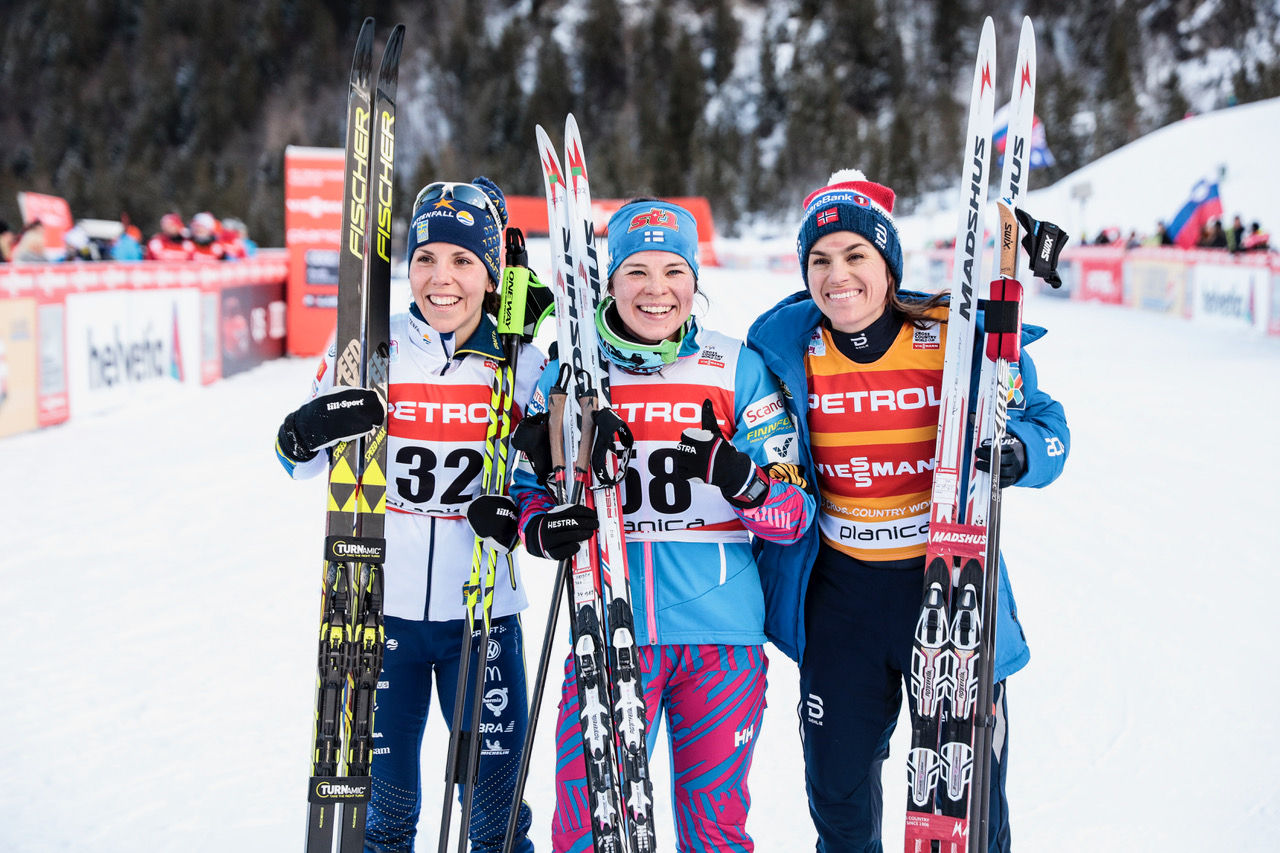
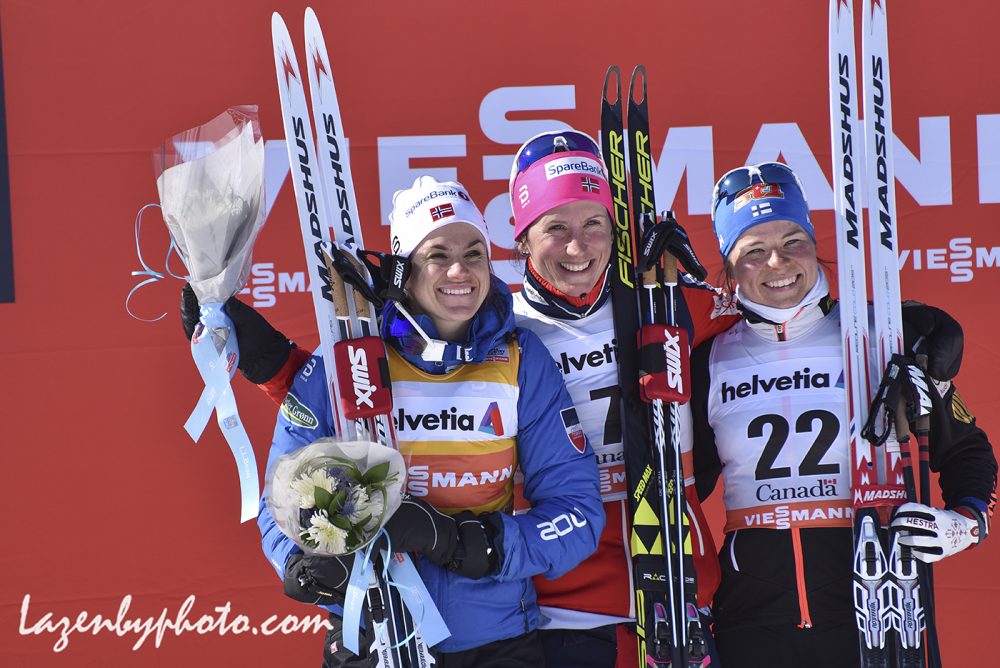
The women’s podium from the fourth stage of the 2018/2019 Tour de Ski — a 10 k classic mass start. Russia’s Natalia Nepryaeva (left) placed second, Norway’s Ingvild Flugstad Østberg (center) first. and Anastasia Sedova (right) also from Russia third. (Photo: Fischer/Nordic Focus)
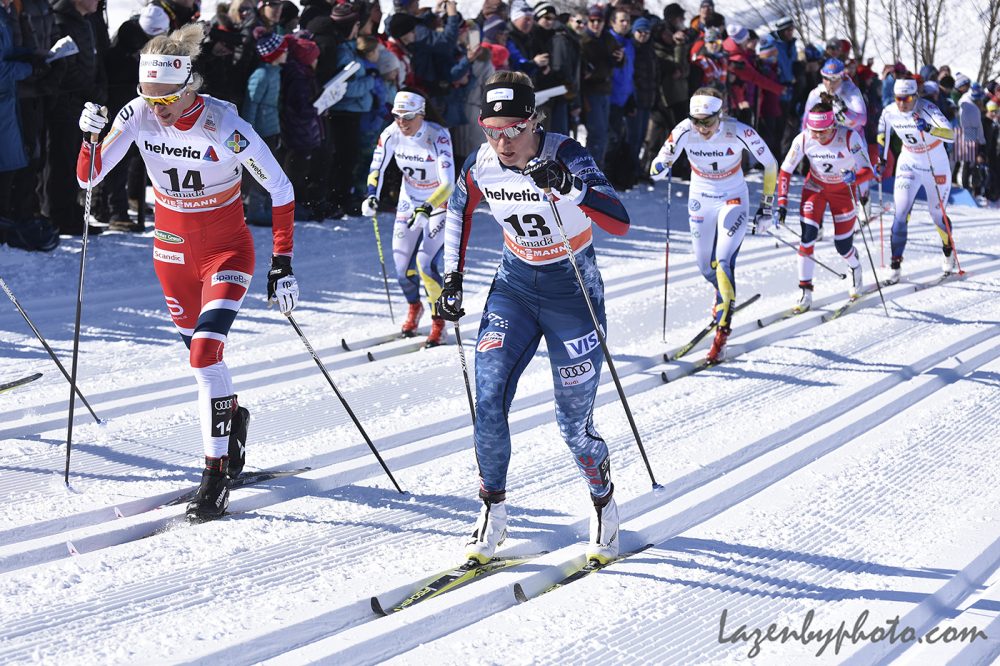
It was a snowy and grabby day in Oberstdorf, Germany, for Stage 4 of the Tour de Ski (TdS). The temperatures were sitting right around freezing, making it challenging conditions for dialing kick wax. Many racers skied on zeros for this 10-kilometer classic mass start. But throughout the race, many women appeared to be struggling to find the right amount of kick as slipping on the hills was a common theme for some.
U.S. Ski Team Coach Matt Whitcomb commented on the day’s tricky conditions.
“The races were typically hard Oberstdorf races, in some ways, it’s what every cross-country skier dreads and in other ways, it’s what is so great about this sport,” Whitcomb said. “It was a really challenging day surface wise, conditions were slow, the course was hard and it snowed like hell, so it was a challenging day today.”
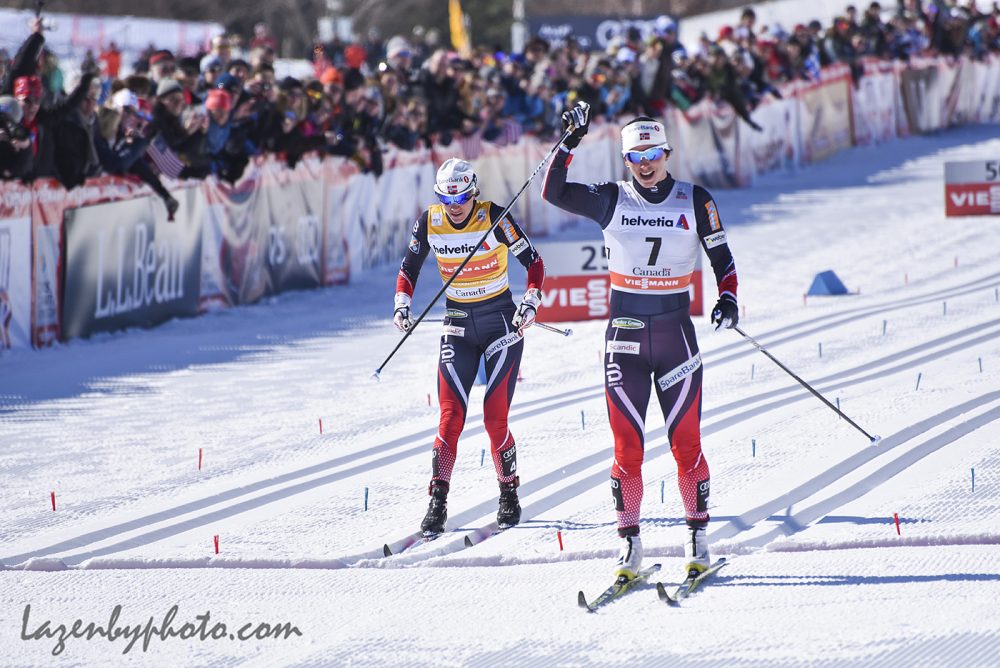
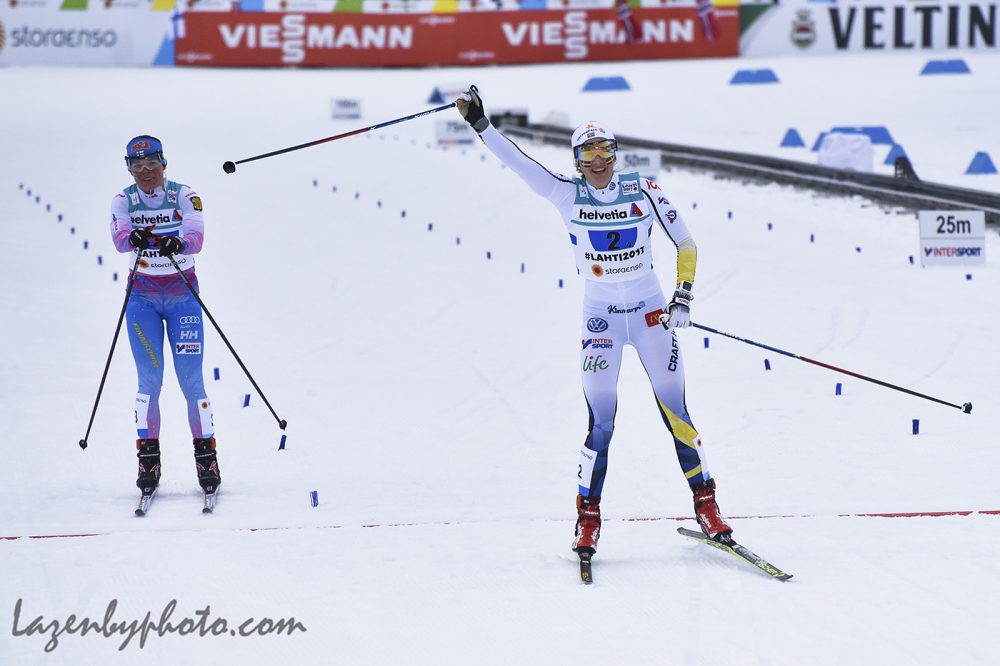
Ingvild Flugstad Østberg of Norway drag racing down the final 100 meters with Russia’s Natalia Nepryaeva in Oberstdorf, Germany during Stage 4 of the Tour de Ski (Photo: Fischer/Nordic Focus)
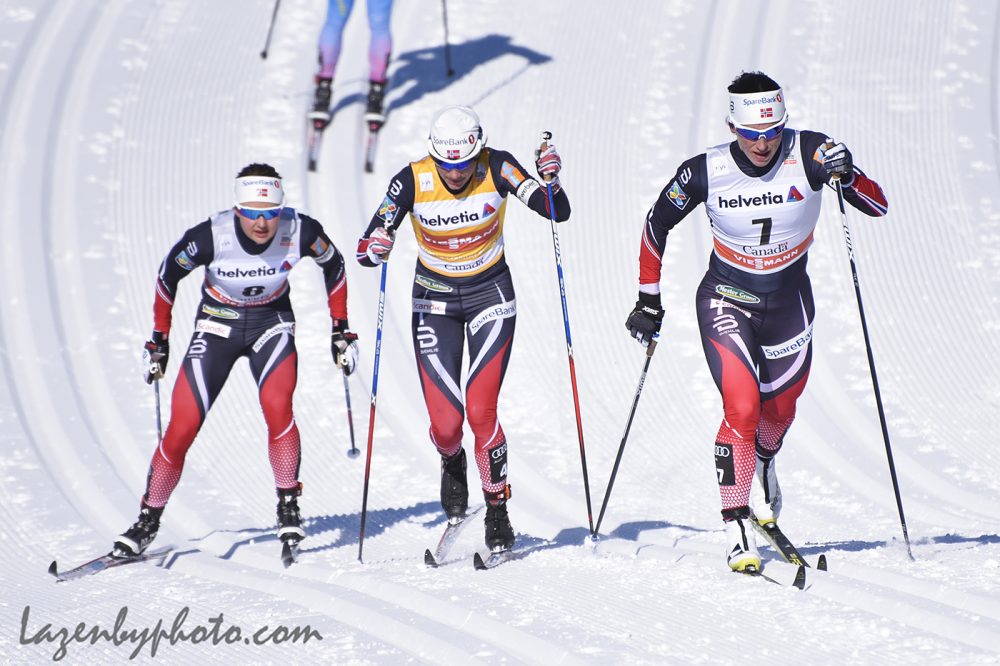
Wearing bib 2 as the TdS second overall skier, Norway’s Ingvild Flugstad Østberg fought hard for the victory today finishing in 32:08.9 minutes. Østberg led the majority of the race, only giving up the lead three times before quickly taking it back — once to Krista Pärmäkoski of Finland and twice to Natalia Nepryaeva of Russia.
Østberg spoke with an International Ski Federation (FIS) reporter after the race and noted she had to be persistent.
“It was a really tough race and when we saw it was snowing and knew it would be hard to be in front, but I knew I had to try and I just had to work and work and work and maybe people would fall off one by one,” Østberg told FIS.
Nepryaeva attempted to pull away from Østberg in the finish stretch and nearly took the win. But Østberg out lunged her across the line.
Østberg recounted, “the Russian were really strong, especially in the last uphill. But today, I just decided to give it all and in the last 100 meters, I just had to try and it was an incredible feeling to cross the finish line first.”
Today’s victory makes Østberg the overall leader of the TdS.
“It’s really fun to be in the lead of the Tour de Ski. I’ve been here before and it’s always fun and I’ve been working hard for four stages. But I know a lot can happen in the next three, so I just have to take it race by race,” Østberg said.
https://youtu.be/c34Cc8tVKQ8
In nearly taking the win, Nepryaeva displayed she has the overall fitness to contest a top overall spot at the Tour. The twenty-three-year-old Nepryaeva kept pace with Østberg the entire race. She never was more than five seconds behind the day’s winner. In the last 2.5-k of the race, Nepryaeva’s teammate Anastasia Sedova caught her, allowing the two Russians to work together and challenge Østberg.
Despite being out-lunged, this is not the first time this season that Nepryaeva has gone head to head with Østberg. During Stage 2 of this year’s Tour, a 10 k skate, Nepryaeva beat Østberg by just under a half-second for her first career World Cup victory. After today’s result, Nepryaeva is positioned second place in the overall TdS standings.
Sedova skied a very strong race as well, putting in a massive effort to finish third. After the first 2k, she was in 11th, but she moved quickly through the pack and by 7.5k she was in the mix for a podium position. Once catching her teammate Nepryaeva, Sedova settled in with the winning pace and finished five seconds behind Østberg. Sedova’s third-place finish put her into sixth in the overall TdS standings.
Jessie Diggins of the U.S. Ski Team was the first North American to cross the finish line. Diggins started today with the TdS leader’s bib. In what was admittedly a tough waxing day, Diggins held onto the lead pack for the first kilometer before falling back to 24th. After the race’s mid-point, Diggins found her groove. She surged forward to 12th place at the 5 k time check, 18.7 seconds back. Diggins finished in 11th (+58.5). After Stage 4, Diggins is in fourth overall in the TdS standings, 1:26.3 minutes behind overall leader Østberg.
“Frankly, we missed the boat on the wax today, but I fought as hard as I could and I know I’m in great shape right now,” Diggins texted FasterSkier after the race. “I did everything I could with what I had today! And now the pressure of the leader’s bib is 100% off, and I’m just going to ski as hard as I can tomorrow and recover as smart as I can!”
Whitcomb also commented on the USST women’s skis, confirming that day’s dicey conditions.
“We did not have good skis for the women, it was straight up just a really difficult race for them because of this,” Whitcomb said. “What I will say is about 2/3rds of the race had very bad skis and our girls did incredibly well considering those things.”
Diggins will be racing in the next three stages of the TdS as she plans on completing the Tour.
“The goal remains the same for Jessie, whether starting 1st, 4th or 50th,” Whitcomb said. “Until the finish line on Alpe Cermis, we’re racing to win. It’s just how she does things.”
Sadie Bjornsen (USST) finished 15th on the stage.
Sadie Bjornsen of the U.S. Ski Team during Stage 4 of the Tour de Ski — a 10 k classic mass start race. (Photo: Fischer/Nordic Focus)
Diggins and Bjornsen skied in the same pack for the majority of the race. During the first half of the race, Bjornsen sat in 17th. When Diggins made a move, skiing into 12th, Bjornsen followed suit, skiing to 15th. Bjornsen held this position for the remainder of the race and finished 1:05.4 minutes behind Østberg. Today’s result lands Bjornsen in 10th in the overall TdS standings.
“It was a really challenging race out there,” Bjornsen texted. “Unfortunately, our team really missed the kick, so we had to fight with what we had. Our skis were icing really bad, which made it quite challenging to ski both the uphills and the downhills. Thank goodness there were a few flat sections out there to feel like I was out for a ski race. It’s a bummer to have a day like today because my body felt really good, and I really like this course for classic skiing- but that’s life, and sometimes you have to just laugh it off and hope you can learn something as a team from the experience.”
Bjornsen will exit the Tour after tomorrow’s fifth stage.
“Tomorrow will be the last race of my tour, as I have planned to not complete the full tour this year, and try to do a training block without too much accumulated race fatigue,” Bjornsen explained. “So, let’s hope tomorrow can work out a little better, and I can make some use of these good feelings!” Bjornsen told FasterSkier.
After her exit, Diggins will be heading to Seefeld, Austria to join some of her other teammates for a mini-training camp before World Cup racing starts up again after the Tour.
“Given how strong Jessie and Sadie skied today with skis that weren’t working for them, I’m very optimistic about tomorrow,” Whitcomb stated. “These two are strong right now, and pretty pissed off. That’s a good combo to bet on.”
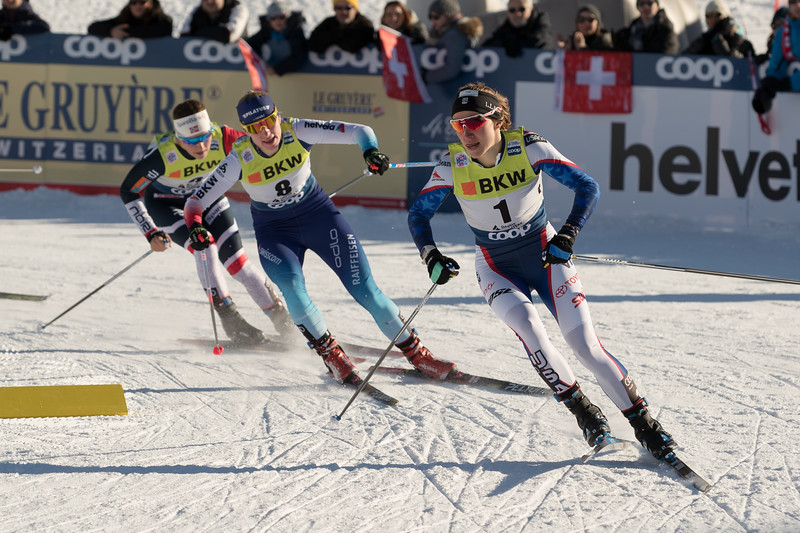
Sophie Caldwell (bib 1) of the U.S. Ski Team racing on Saturday during the women’s 1.5-kilometer freestyle sprint in Davos Switzerland. (Photo: Reese Brown/ U.S. Ski Team)
DNS. It’s a rare acronym to crop up in the results portion of Sophie Caldwell’s FIS database. But after battling a cold for the first few weeks of the 2018/2019 season, Caldwell did not start (DNS) the Lillehammer freestyle sprint and also chose to sit out the women’s relay last weekend.
By this Saturday in Davos, Switzerland, the 28 year old’s decision to rest and not race seemed to have paid off. She sprinted to a second place in the women’s 1.5-kilometer Davos freestyle competition, finishing just behind Sweden’s sprint superstar, Stina Nilsson. Earlier in the day, Caldwell also won the women’s qualifier in a time of 2:46.2.
“I think when you lay down a really fast qualifier, it gives you confidence moving forward,” U.S. World Cup head coach, Matt Whitcomb said during a phone conversation after the race.
“I was coming off a long bout of illness, so I was honestly just really happy to be racing again and didn’t have any expectations going into the day,” Caldwell wrote in an email to FasterSkier.”I think when you’ve had a period of illness or feeling down, it’s important to set smaller goals to gain your confidence back, so I was really grateful to be feeling healthy again and told myself I would be happy to qualify today. I was very pleasantly surprised when I won the qualifier and continued to feel great throughout the day, so the day exceeded any expectations I had going into it.”
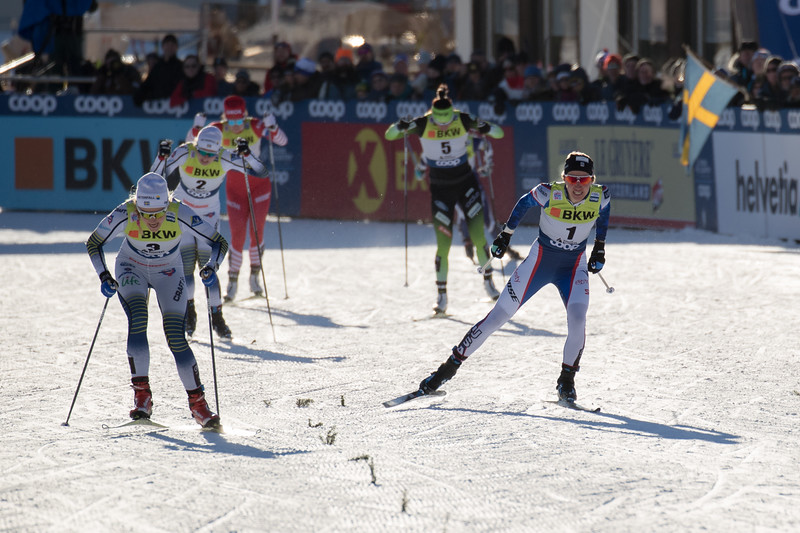
Sophie Caldwell (bib 1) and Stina Nilsson (bib 3) during the women’s 1.5-kilometer freestyle sprint final on Saturday in Davos Switzerland. (Photo: Reese Brown/U.S. Ski Team)
After qualifying in first, Caldwell advanced to the first quarterfinal which she won in a time of 2:41.97. Moving on to the semifinal, Caldwell once again crossed first in a time of 2:42.28. For both her quarterfinal and semi, Caldwell remained positioned in third to fourth through the first climb and descent and second major climb of her heats, before making her move in the final descent.
“She decided in both her quarters and semis and final to lay back a little bit mid-pack try and follow a little bit and then pounce as the pack tired out intending to have bit more energy herself and that went to plan perfectly,” Whitcomb said. “Really proud of her tactics today.”
“I really like how technical and fast this course is, so after I had a good qualifier, I knew I could be really confident in my ski speed and finishing stretch, so I just tried to ski smart the rest of the time, conserving energy when I could and moving into a good position up the hill the second time,” Caldwell said.
In the final, it was Nilsson along with Slovenia’s Katja Visnar setting the pace from the gun. Caldwell, who had started in lane two, slotted herself to the inside of the final group in third through the first climb.
As the field approached the crest of the course’s first major uphill, Finland’s Krista Pärmäkoski made a decisive move to the front. She maneuvered to the left of the group, jetting from fourth to first. Caldwell continued to click away, cornering to the inside to maintain a draft off Visnar and Pärmäkoski. Just to Caldwell’s left, was Nilsson.
As the group swept into the course’s first descent, the skis of the U.S. and Sweden seemed to outpace the rest. Heading into the following course’s flatter V2 section, Nilsson had snuck around Visnar and Pärmäkoski to take the lead. Caldwell shadowed her move and the two began to push the pace. It was Sweden’s top sprinter being chased down by Caldwell; the remainder of the sprint final’s field chasing down the U.S.
Neither Caldwell or Nilsson let up. The two pulled away in the final climb, with Nilsson holding a slight gap over Caldwell. As the racers began the final descent on course, almost two meters separated Caldwell from the next closest skier, Sweden’s Maja Dahlqvist.
Rounding into the final 100-meters, Nilsson maintained her lead on Caldwell and crossed ahead of the American for first in a time of 2:41.34. Caldwell finished 0.72 seconds behind for second place.
“I was feeling pretty good on the climb, but I knew I had fast skis and felt really good in the finishing stretch, so my goal was to position myself in 2nd or 3rd at the top of the last hill to take advantage of the draft, corner, and finish stretch,” Caldwell wrote in an email. “Unfortunately, Stina got away from me a bit on the climb, but I tried to push as hard as possible to close the gap and am of course thrilled with 2nd!”
The win is the first of the season for Nilsson. She won the Davos freestyle sprint in December last year, besting American Kikkan Randall (now retired) and Norwegian Maiken Caspersen Falla. Falla placed fourth in her quarterfinal and did not advance to the semis. Nilsson now has 13 individual World Cup sprint victories and is currently ranked first in the sprint standings with 186 points, ahead of Dahlqvist in second with 140 points and Russia’s Yulia Belorukova in third with 119 points.
2018 Davos, Switzerland women’s sprint podium. Sweden’s Stina Nilsson (center) placed first, Sophie Caldwell (left) of the U.S. was second, and Maja Dahlqvist (right) also of Sweden was third. (Reese Brown/U.S. Ski Team)
Claiming Saturday’s third and final podium position was Dahlqvist, who crossed 2.60 seconds behind Nilsson. The podium is Dahlqvist’s second World Cup podium this season. She placed second in the FIS classic sprint opener in Kuusamo, Finland. Prior to this year, Dahlqvist has had one other individual World Cup top three performance, that being her second place finish in last season’s Dresden freestyle sprint.
Finishing in fourth on Saturday was Russia’s Natalia Nepryaeva (+3.98). Following Nepryaeva was Visnar in fifth (+4.34) and Pärmäkoski in sixth (+11.16).
Rounding out the top-ten was Swiss skier Nadine Fähndrich in seventh, Evelina Settlin in eighth, Lotta Udnes Weng in ninth and Ingvild Flugstad Østberg in tenth.
The U.S. placed four women total in the top-30, with Caldwell’s second place performance followed by Sadie Bjornsen in 14th, Ida Sargent 21st, Jessie Diggins 26th, and Rosie Brennan 29th.
Sadie Bjornsen of the U.S. Ski Team during the third quarterfinal of the women’s skate sprint in Davos, Switzerland. (Photo: Reese Brown/U.S. Ski Team)
Both Bjornsen and Brennan advanced to the third quarterfinal, with Bjornsen having qualified in 10th and Brennan 28th. Bjornsen had led the first climb and descent of her quarterfinal before Sweden’s Hanna Falk took over the pace as they headed into the course’s second climb.
Bjornsen held onto second through the descent before getting passed by Nepryaeva in the finishing stretch. She finished the quarterfinal in third behind Falk and Nepryaeva. Bjornsen missed advancing by 0.13 seconds. Brennan crossed in sixth.
In the first quarterfinal along with Nilsson, Sargent led the group through the first uphill. However, by the second climb on course, Sargent had dropped back to sixth and eventually crossed her quarterfinal in fifth.
Ida Sargent locked in during her World Cup quarterfinal in Davos, Switzerland. of the U.S. Ski team during the qualifier of the women’s skate sprint in Davos, Switzerland. (Photo: Reese Brown/U.S. Ski Team)
In the fourth quarterfinal, an early fall put Diggins out of contention for advancement to the semis. In the first straightaway, the American’s left ski collided with the pole of Russian ski racer, Natalia Matveeva, causing Diggins to crash.
“Traffic just sort of closed in on her,” Whitcomb said. “Just a race incident, the kind of the thing you saw happen in some of the other heats.”
In the second semifinal, a collision between Pärmäkoski and Norway’s Tiril Udnes Weng caused the Norwegian’s left ski to fall off midway through the race.
“Unfortunately in Davos, even Jessie can’t recover the 30-meters required to catch back up to the group,” Whitcomb added. “It’s too delicate a venue at altitude.”
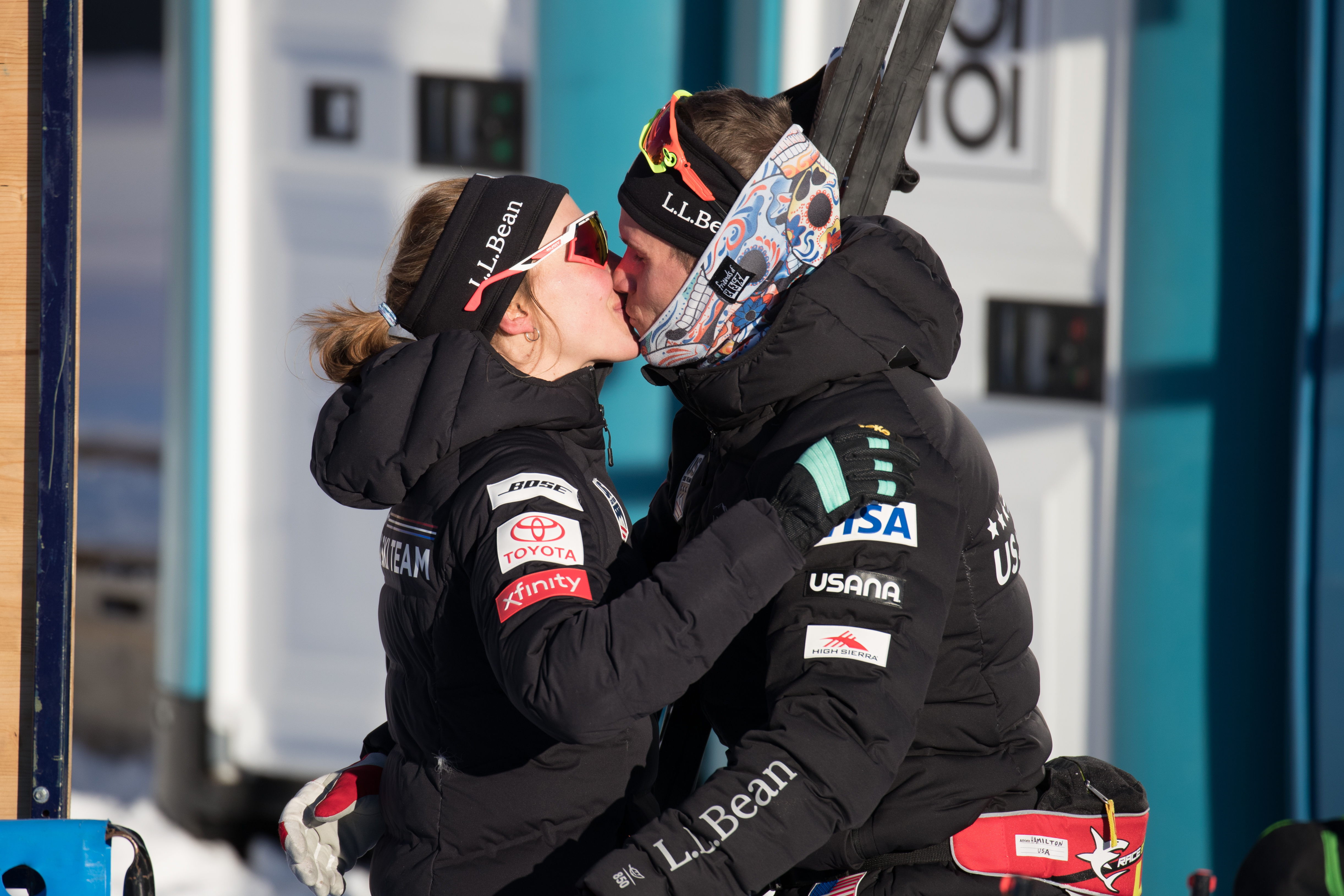
Sophie Caldwell (l) and U.S. Ski Team teammate/boyfriend Simi Hamilton after Caldwell placed second in Saturday’s 1.5-kilometer freestyle sprint on Saturday in Davos, Switzerland. (Photo: Reese Brown/U.S. Ski Team)
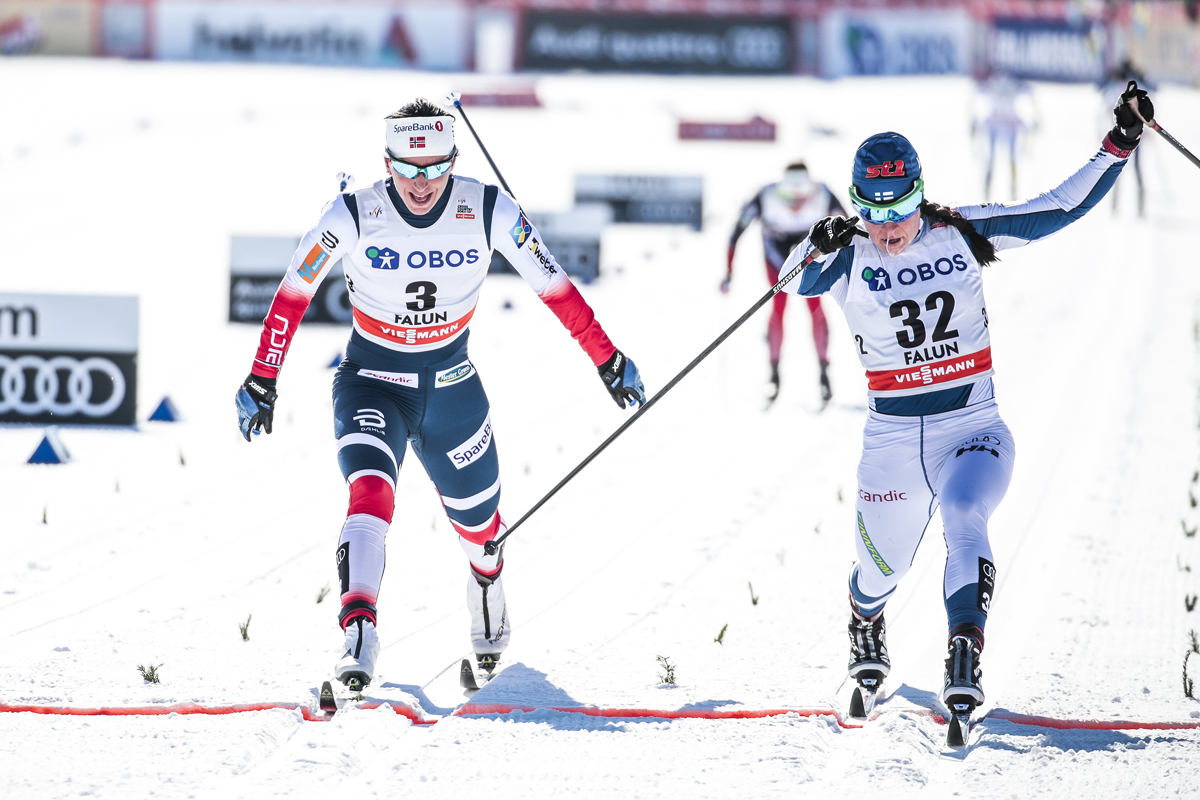
Finland’s Krista Pärmäkoski (32) edges Norway’s Marit Bjørgen for the win in the women’s 10 k classic mass start at 2018 World Cup Finals in Falun, Sweden. (Photo: Fischer/NordicFocus)
Welcome to FasterSkier’s World Cup Preview, where we check in with the top-10 teams from last year’s FIS Cross Country World Cup tour before the season starts with the Ruka weekend in Kuusamo, Finland, on Nov. 24 with a classic sprint.
***
Finland
Overall in Nations Cup Last Year:4th
Women’s Ranking 2017/2018: 4th
Men’s Ranking 2017/2018: 7th
Finnish Skiers to Watch:
If there are two names Finland’s cross-country ski fans loves to cheer–and will be looking to chant again this season–it’s Krista Pärmäkoski and Iivo Niskanen. And with good reason.
Pärmäkoski opened Period II of last season with a win, cruising to first in the 10-kilometer classic race in Planica, Slovenia. Pärmäkoski racked up two more 10 k victories after Planica, winning both the Lahti 10 k and the Falun 10 k. Altogether, Pärmäkoski landed on the World Cup podium seven times last season, capping off the FIS 2017/2018 season ranked fourth, just ahead of Norway’s Marit Bjørgen in fifth.
Outside of the World Cup, Pärmäkoski also came away from the 2018 Pyeongchang Winter Olympic Games with three individual medals, one silver and two bronze.
ComplimentingPärmäkoski on the men’s side, Niskanen, earned two World Cup podiums last season, placing third in the Ruka 15 k and third in the Lahti 15 k. He landed in the top-20 twelve times during last year’s World Cup season, and finished 15th in the FIS overall.
Like Pärmäkoski, he also departed the Winter Games with hardware, a gold medal from the men’s 50 k mass start.
Pärmäkoski and Niskanen aren’t the only Finns capable of pushing into the top tiers of World Cup skiers. With the retirement of Aino-Kaisa Saarinen this past spring, the women’s side will look to Kerttu Niskanen (Iivo’s sister), Riitta-Liisa Roponen, Anne Kyllönen and Laura Mononen–all of whom scored World Cup points more than once last season– to keep the women’s team’s forward momentum.
Following Niskanen, Matti Heikkinen and Ristomatti Hakola are two veteran Finnish names who are not about to let up as the 2018/2019 season prepares to get underway.
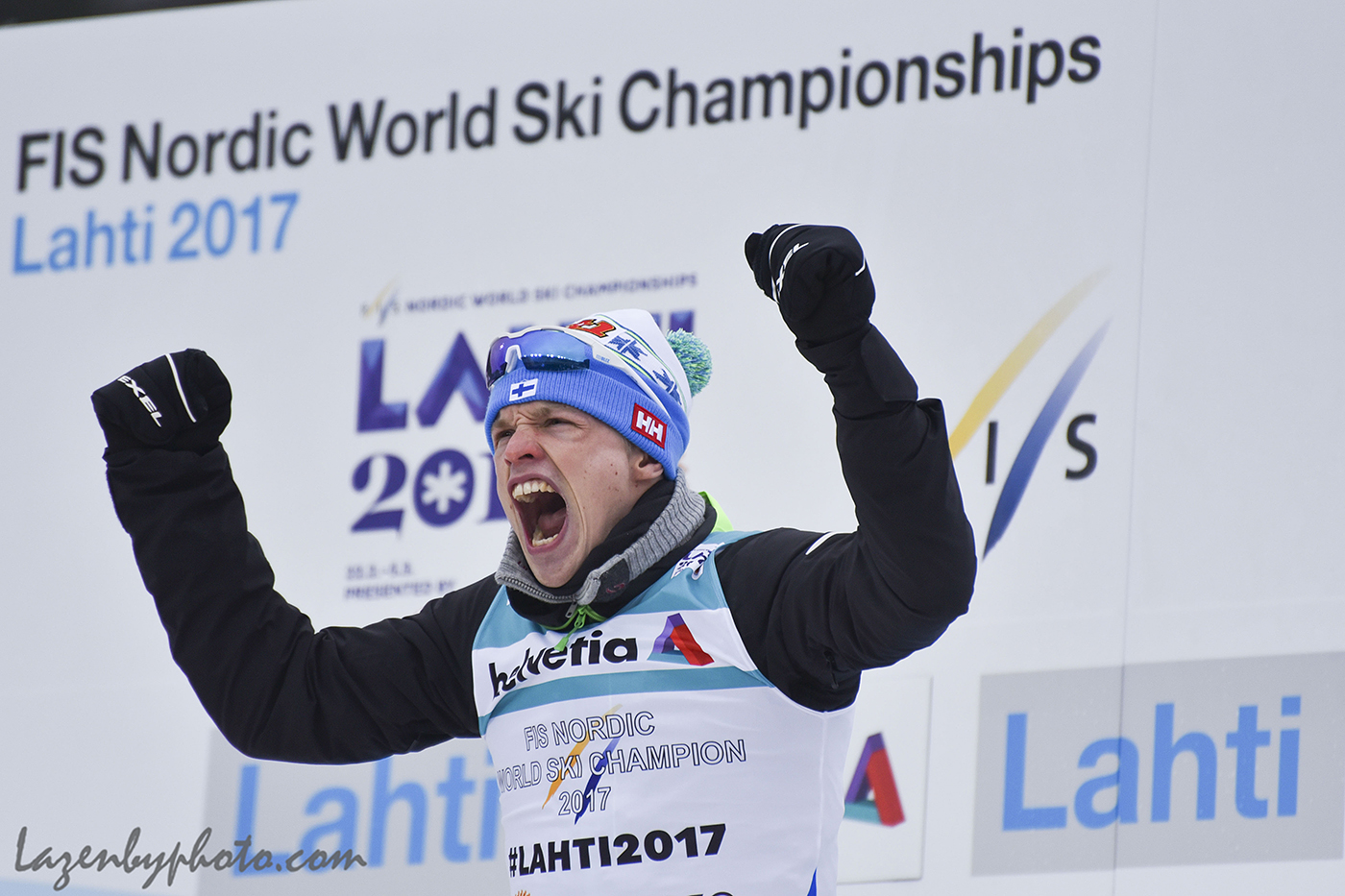
Finland’s Iivo Niskanen celebrating his first World Championships gold in the men’s 15 k classic on March 1, 2017, in Lahti, Finland. (Photo: John Lazenby)
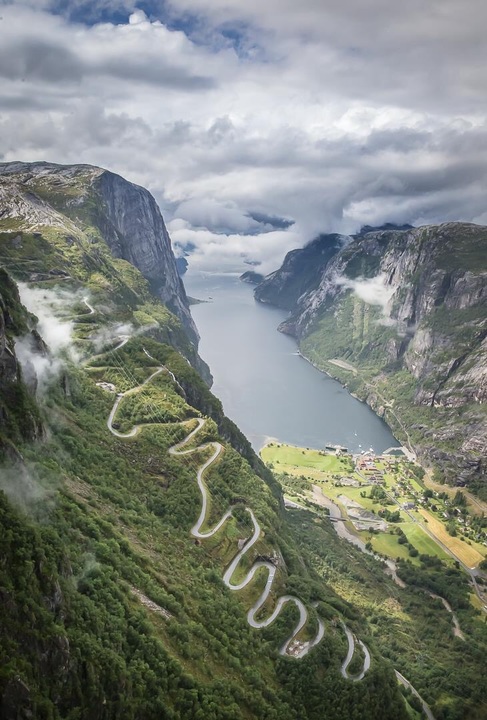
The 7.5-kilometer race course for the Lysebotn Opp, an annual hill climb at the Blink Ski Festival in Lysebotn, Norway. (Photo: Blink Ski Festival/Facebook)
The Blink Ski Festival’s famed Lysebotn Opp hill climb returned on Thursday, and with it, a familiar name landed at the top of the results.
After serving an 18-month ban from ski racing and subsequently missing the 2018 Winter Olympics, Norway’s Therese Johaug is back.
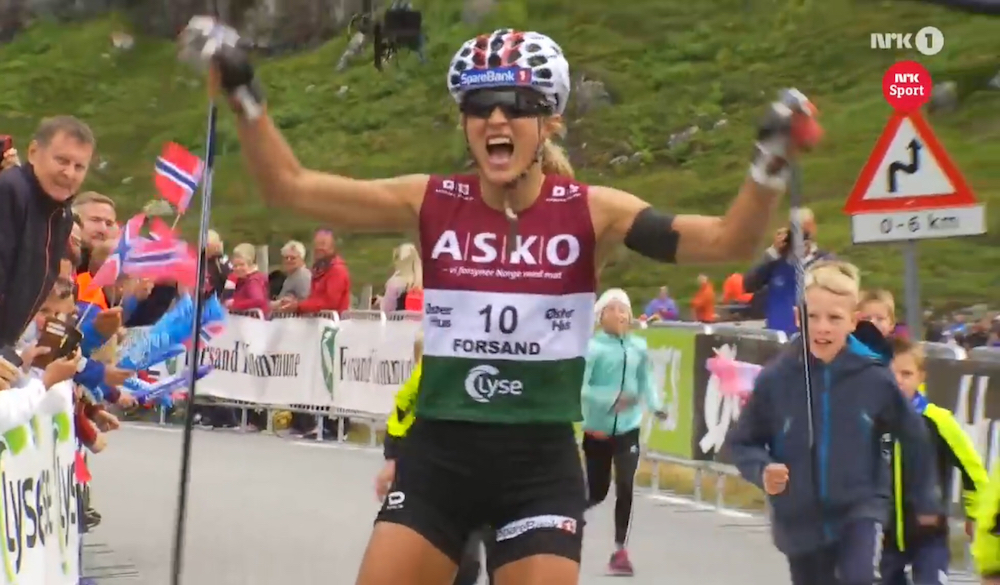
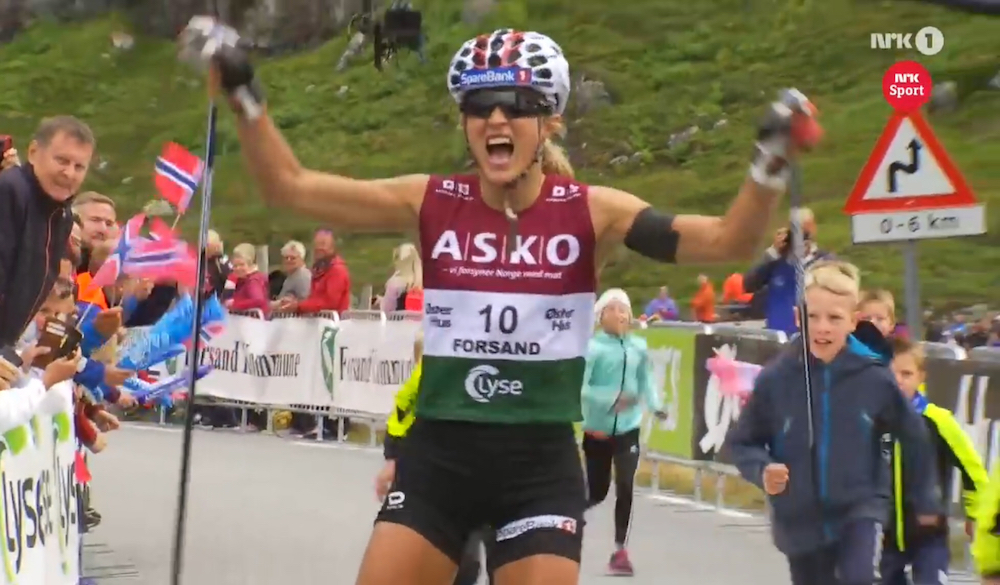
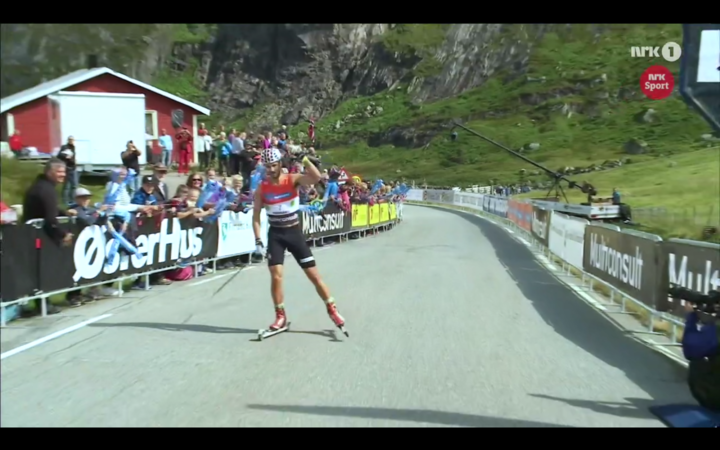
Norway’s Therese Johaug winning the 2018 Lysebotn Opp hill climb, part of the Blink rollerski festival, on Thursday. She finished in a record-setting 31:46.3 minutes, topping her previous course record of 32:36 from 2012. American Liz Stephen, who retired from skiing this past spring, holds the third-fastest time of 32:53.9. (Screenshot: NRK broadcast)
The 30-year-old Johaug won Thursday’s rollerski hill climb in a record time of 31 minutes, 46.3 seconds, while Sweden’s Charlotte Kalla finished 1:47.5 minutes back in second.
Kalla, 31, won last year’s Lysebotn Opp in 33:18.3, telling NRK at the time that “it’s been long since I’ve been in this good a shape in July.” Kalla’s 2017/2018 season went on to be one of her best. She racked up 10 individual wins, including a gold medal in the Olympic skiathlon.
If Kalla is using her the past year and half as a springboard for the upcoming season, Johaug might be considered the antithesis to the Swede. The year and half competition bar behind her, Johaug appears ready to move forward.
“If there’s one thing I’ve learned from all this, it’s that you should never rely on anyone, period,” Johaug told Newsinenglish.no. “It’s terrible, but that’s the way it is.”
Following Johaug and Kalla on Thursday, Sweden’s Ebba Andersson claimed the third spot on the podium, finishing 3.9 seconds behind her compatriot Kalla and 1:51.4 behind Johaug.
Norway’s Haga Ragnhild placed fourth (+2:21.6) and Ingvild Flugstad Østberg was fifth (+2:48.9), Austria’s Teresa Stadlober finished sixth (+3:05.7), Russia’s Yulia Belorukova seventh (+3:52.4), Norway’s Kari Øyre Slind eighth (+4:05.0), and Russia’s Elena Soboleva ninth (+4:14.1) and Yana Kirpichenko 10th (+4:26.2). Finland’s Krista Parmakoski finished exactly ten seconds outside the top ten in 11th (+4:36.2). Forty-seven women finished the senior women’s race.
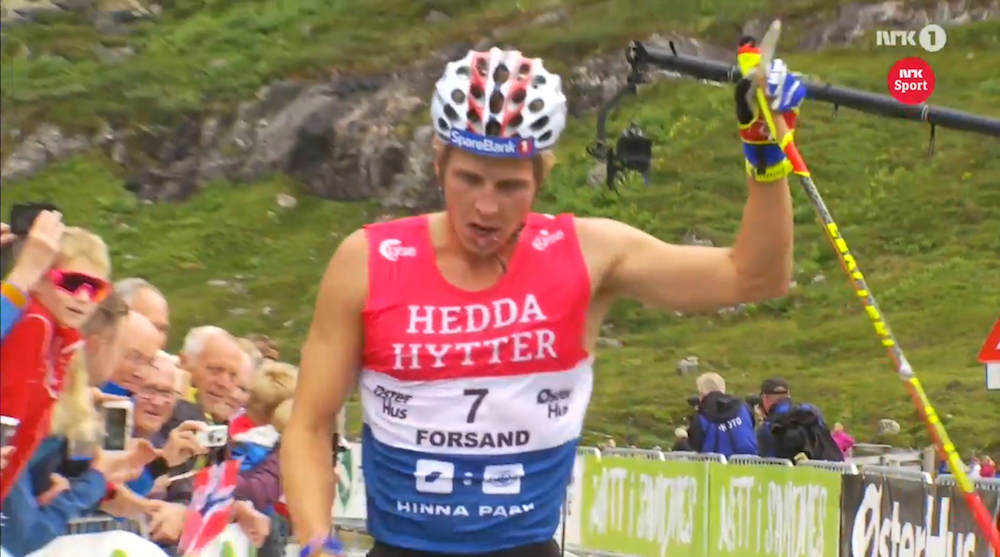
Norway’s Simen Hegstad Krüger winning the 2018 Lysebotn Opp hill climb, part of the Blink rollerski festival, on Thursday. (Screenshot: NRK broadcast)
In the senior men’s Lysebotn Opp that followed, two Norwegians battled up front, with reigning Olympic skiathlon champ Simen Hegstad Krüger ultimately winning the race for the first time in 27:53.2. Another national team member and 2018 Olympian (and last year’s Lysebotn Opp winner), Hans Christer Holund finished 3.9 seconds back for second place, and Norway swept the podium with Simen Andreas Sveen in third (+16.0).
Rounding out the top 10 were Norwegians Vebjørn Turtveit in fourth (+51.7), Martin Johnsrud Sundby in fifth (+52.6), France’s Clement Parisse in sixth (+1:12.4), Norway’s Henrik L’Abée-Lund in seventh (+1:21.1), France’s Adrien Backscheider in eighth (+1:24.7), Russia’s Artem Maltsev in ninth (+1:31.4) and Canada’s Alex Harvey in 10th (+2:02.1).
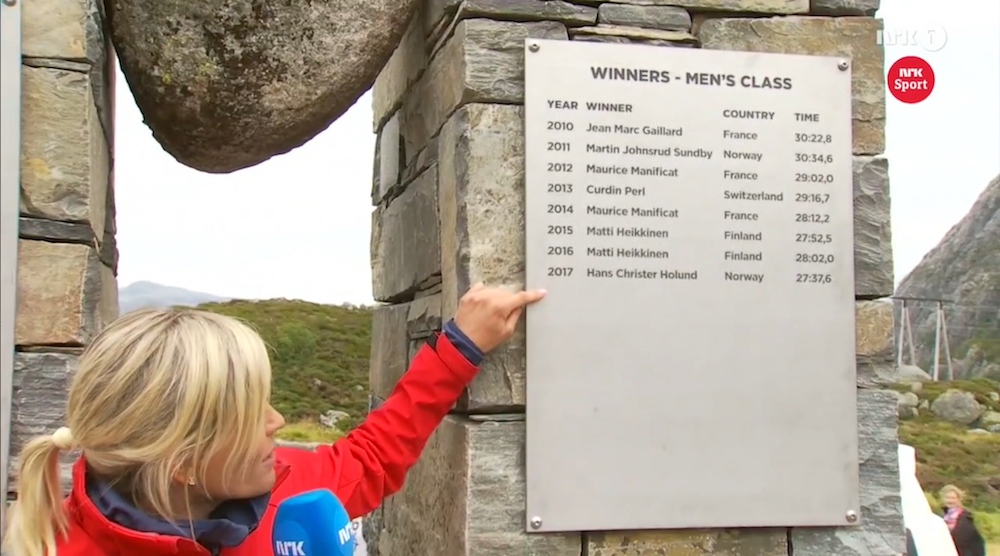
Past winners of the Lysebotn Opp rollerski hill climb in Lysebotn, Norway. Simen Hegstad Krüger’s winning time on Thursday was third fastest on record at 27:53.2. (Screenshot: NRK broadcast)
The women’s 10 k classic podium at Sunday’s World Cup in Planica, Slovenia, with (from left to right) Sweden’s Charlotte Kalla in second, Finland’s Krista Pärmäkoski in first, and Norway’s Heidi Weng in second. (Photo: Fischer/NordicFocus)
PLANICA, Slovenia — Move over Norway and Sweden, there’s a another skier scouting and snagging World Cup wins — and she’s just over 5 feet tall and Finnish.
Krista Pärmäkoski set out on a rugged 10-kilometer classic course on Sunday located directly in the Julian Alps, the highest mountain range in Slovenia. Any challenge the course summoned, however, the 27-year-old Pärmäkoski dished twice as hard in return.
Though a bluish early morning light cast a sombre glow on the course, Pärmäkoski was punchy. She pushed past the start gate one minute ahead of Norway’s Heidi Weng, who was a favorite heading into the weekend’s distance event.
The reigning Tour de Ski champion, Weng was coming off back-to-back wins in the last two distance events she’s entered: the Tour’s 10 k classic mass start stage in Val di Fiemme, Italy, and the 9 k final climb freestyle pursuit, also in Val di Fiemme.
On the other end, Pärmäkoski has had six runner-up finishes in the individual distance events she’s entered. She has also posted two stage wins for time-of-day performances, and racked up 19 individual podiums.
Until Sunday, however, the satisfaction of standing as the outright winner of a non-stage World Cup had remained elusive.
But if anything, that only motivated her. The long striding climbs featured in Planica’s course suited her powerstride style, and she knew it. She had seen them during a dryland camp with her team last year.
“We had a training camp here in the summer and when I saw the competition tracks here I said to my coach that I will have a good race in Planica this winter,” Pärmäkoski said, according to an International Ski Federation (FIS) press release.
Still, once the snow hits, Mother Nature has a way of foiling even the most prepared skier’s plans. Or working to the advantage of others.
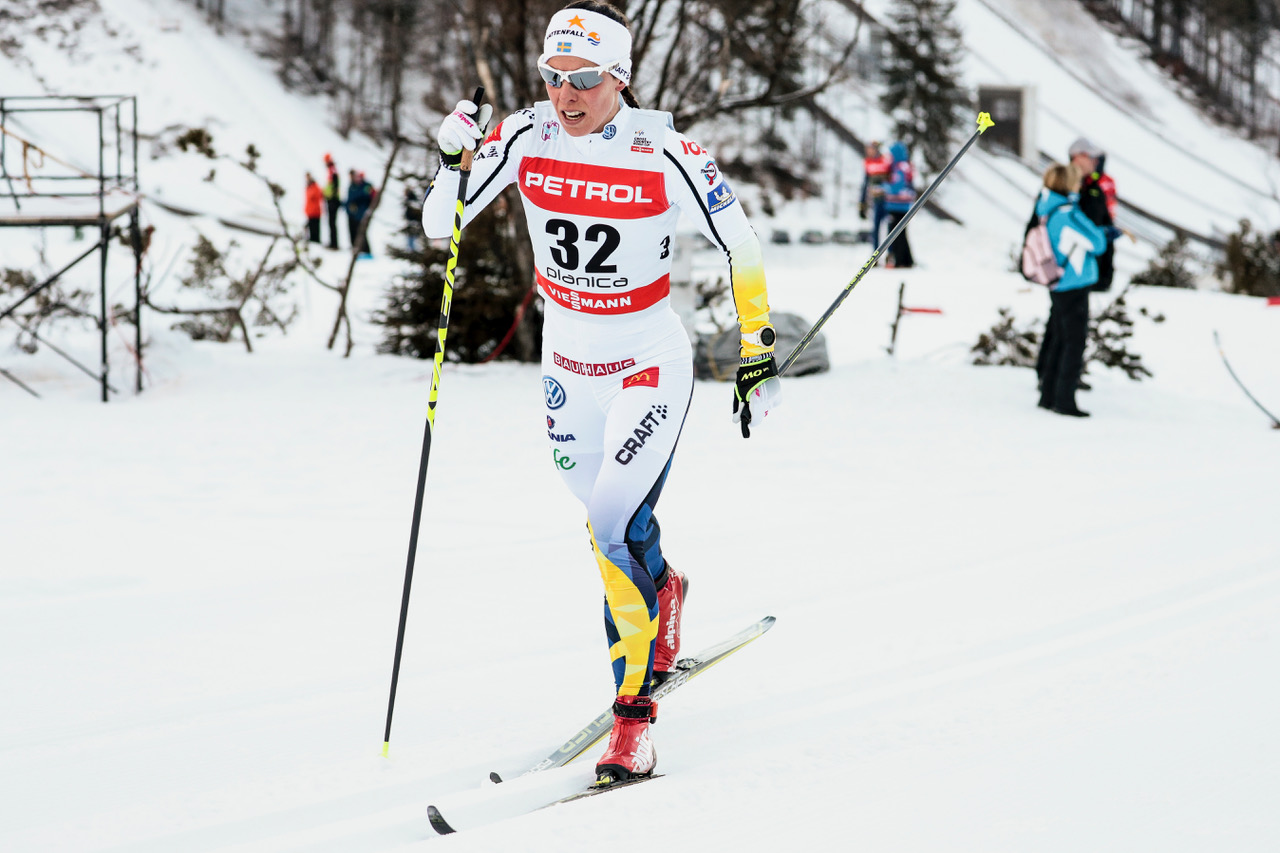
Sweden’s Charlotte Kalla racing in the women’s 10 k classic at the World Cup in Planica, Slovenia. She went on to finish second. (Photo: Fischer/NordicFocus)
With firm tracks laid out for Sunday’s individual starts, another contender for the win was Sweden’s Charlotte Kalla. Though most of her World Cup victories have come in 10 k freestyle races, she is no less threatening in classic. At the start of this season, she won the FIS 10 k classic in Gällivare, Sweden, by 17.7 seconds.
In Planica, Kalla, the 32nd starter, appeared to be heading in the same direction. At a little under 2 k in, she posted the fastest split. She did the same 2 k later and for the next 5 k following that. For close to 9 k, Kalla’s splits were unmatched. Pärmäkoski, who started 58th, trailed her by almost ten seconds at the halfway mark.
For the first half of the 10 k, Kalla maintained that nearly 10-second gap on Pärmäkoski. In the second half, however, the countdown began. The Finn began picking Kalla off second by second, stride by stride.
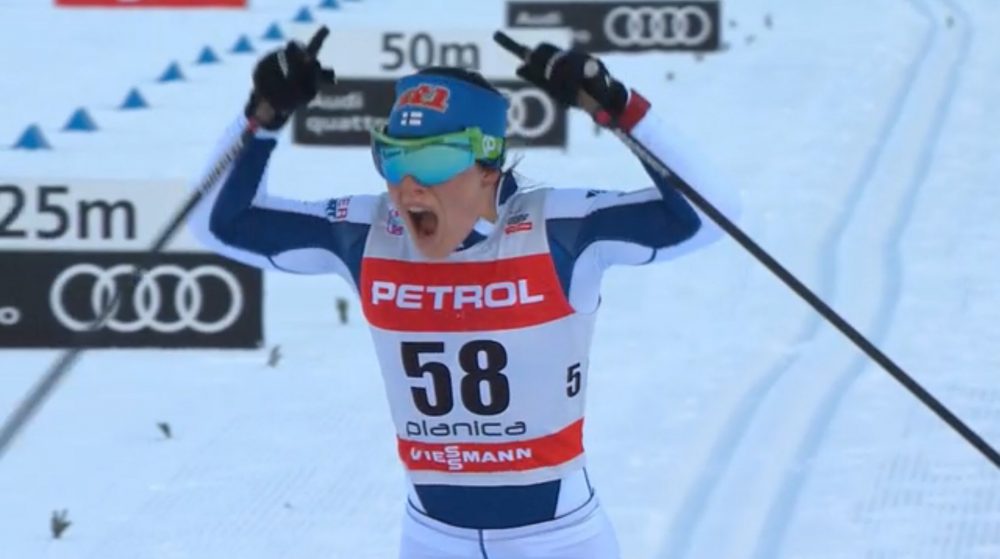
At the 7 k mark, Kalla held the lead over Pärmäkoski by only one second. Realizing how close she was to the leading time, Pärmäkoski made her attack in the final kilometer. She ended up beating Kalla’s time by 3.6 seconds, crossing the line in 27:08.7.
Krista Pärmäkoski celebrates her first World Cup victory in the women’s 10-kilometer classic race on Sunday in Planica, Slovenia (Screenshot: ARD broadcast)
“I wanted to get faster as the race went and when I saw that I was battling with Charlotte, I really pushed hard over the final kilometer,” Pärmäkoski said. “It feels great to finally have my first win.”
“It was exciting to have the battle with Krista today and for sure I would like to have won, but it’s also nice to see her get her first win,” Kalla said afterward, according to FIS.
“It was a great race. It’s nice to be back on World Cup,” she added. “I will go to Seiser Alm now to get ready for Korea.”
Following Kalla was Weng, who started 60th and ended up third, 33.5 seconds off Pärmäkoski’s winning time. The Norwegian had been skiing in second for the first 4 k, but lost time to Pärmäkoski and Kalla by the halfway point. During a FIS interview, Weng indicated that the grade of the climbs, which featured more gradual pitches with sustained periods of striding, didn’t exactly play to her strengths.
Norway’s Heidi Weng racing to third in the women’s 10 k classic race on Sunday in Planica, Slovenia. (Screenshot: ARD broadcast)
“The profile didn’t suit me with the long gradual hills,” Weng said. “My plan was to start slower and then speed up. I tried my best and to push over the top of the hills. It’s good to be on the podium with the other ladies today.”
Rounding out the top ten in Sunday’s event was Austria’s Teresa Stadlober in fourth (+39.0), Sweden’s Ebba Andersson in fifth (+48.6), Finland’s Kerttu Niskanen in sixth (+49.4), Norway’s Kari Øyre Slind in seventh (+49.5), Poland’s Justyna Kowalczyk in eighth (+1:02.1), Norwegian Kathrine Rolsted Harsem in ninth (+1:03.2) and American Jessie Diggins in 10th (+1:05.4).
“That was a gnarly course,” Diggins told FasterSkier in person after. “You don’t get rest because the downhills, you’re working the corners, which I love, but I am tired right now. That’s on purpose, it’s part of the plan, but I am looking forward to a nap and some rest and some extra food and just getting ready for next week.”
Jessie Diggins (U.S. Ski Team) racing to 10th in the World Cup women’s 10 k classic in Planica, Slovenia.(Photo: Salomon/NordicFocus)
Diggins, coming off a third-place finish in the 2018 Tour de Ski, also raced Saturday’s classic sprint in Planica, where she finished fourth for her best World Cup classic-sprint result.
“Really cool to see her making that progress,” U.S. Ski Team Head Coach Chris Grover said on Sunday.
Also scoring World Cup points on Sunday was Caitlin Patterson (Craftsbury Green Racing Project), the Period 1 SuperTour leader, in 20th (+1:45.2). Now into her second World Cup weekend of the season, Patterson had a banner week earlier this month in Anchorage, Alaska, where she won four titles in four races at U.S. nationals.
Reflecting on the courses she’s raced this season, Patterson said that the SuperTour in West Yellowstone, Montana, and U.S. nationals in Anchorage had more “double poling [sections] and herringbone hills.”
“I knew this course was going to be different than anything I’ve skied in a while, for classic at least,” Patterson said of Planica. “It’s just so much gradual striding.”
The change of pace, however, seemed to work to her advantage.
“I had a little trepidation going into it….I think it allowed me to relax into it really nicely and make sure I found my kick well which the skis were great.”
“The long gradual stuff was kind of fun,” Patterson added. “It felt a lot different, it felt less about quick accelerations back and forth and more just sustained work.”
The finish is Patterson’s sixth individual World Cup top 30, and her second-best individual World Cup performance to date. She placed fourth in last year’s Pyeongchang skiathlon.
“It was a great classic result,” Grover said of Patterson. “She is somebody who has only been here a week and a half, or maybe just over a week. We expect some more great stuff from her.”
Kikkan Randall (U.S. Ski Team) racing to 23rd in the women’s 10 k classic at the World Cup in Planica, Slovenia. (Photo: Fischer/NordicFocus)
The U.S. had three score World Cup points in the top 30, with Kikkan Randall racing to 23rd (+1:50.4) on Sunday. Randall sat out Saturday’s classic sprint, as she is in the process of recovering a foot injury. She aimed to use Sunday’s distance race to assess her progress.
“It was really hard to sit out yesterday’s classic sprint, but I needed to test out my foot and we felt a distance race would be a safer test,” Randall wrote in an email. “I’ve been battling the stress reaction and tendonitis in my left foot since Davos and I just got back to classic skiing this week. I still have some lingering pain in my foot but we’ve got it under control enough to race again.”
The 10 k was Randall’s first distance race in more than a month, and she described it as having the “best classic racing conditions I’ve seen all season.”
“10 k classic individual start is one of the toughest race formats for me usually so I’m pretty happy to be solidly in the top 30 today and just a few seconds out of the top 20,” Randall continued. “I’m looking forward to a couple skate races next weekend in Seefeld to continue sharpening for the Olympics.
“I was definitely motivated by my teammates strong results yesterday and really happy to see Caitlin Patterson have a strong race today for 20th!” she added. “It’s not easy to come right over to Europe after all that racing at US Nationals! And of course, Jessie continues to be on fire. Look out world!”
American Sophie Caldwell, who placed ninth in Saturday’s classic sprint, finished just 1.7 seconds outside of the top 30 in 31st (+2:17.2). Two more American women competed on Sunday, with Liz Stephen in 35th (+2:34.9) and Ida Sargent in 37th (+2:37.5).
“A couple of great performances,” Grover said referring to the overall weekend’s results. “Jessie’s fourth yesterday, that is her best classic sprint result of all time. I thought a great race yesterday out of Logan Hanneman, to be that close to qualification. He just got over here this week from the U.S. Similarly, a really nice qualification out of Tyler Kornfield yesterday … Caitlin Patterson’s 20th place today. Those were some silver linings for sure.”
But with many athletes in a transitional zone, some recovering from the TdS and others adjusting to the travel and recouping from U.S. nationals, Grover indicated that next weekend in Seefeld, Austria, the energy levels and pop of the U.S. team’s skiers should be even more pronounced.
“I thought some of our skiers looked a little bit flat,” he said. “Probably to be expected. We have some athletes obviously who just got here, some who just came out of U.S. nationals, some who are just coming back to skiing after the Tour de Ski … I definitely expect next weekend will be a lot better for us.”
The last World Cup weekend before the Olympics takes place next Saturday and Sunday in Seefeld, with freestyle sprints and 10/15 k freestyle races.
Sweden’s Stina Nilsson celebrates her third individual sprint victory of the season on Saturday in the World Cup classic sprint final in Planica, Slovenia. Behind her, Norway’s Kathrine Rolsted Harsem (third from l) placed second and Maiken Caspersen Falla (l) finished third and American Jessie Diggins (far r) placed fourth. (Photo: Fischer/NordicFocus)
PLANICA, Slovenia — With the Julian Alps and Mount Triglav, Slovenia’s highest peak, as a backdrop, it’s suitable to say the Planica Valley nordic course can be summed up in one word: burly.
A high mid-afternoon sun had illuminated the mountain range throughout the rounds for the World Cup women’s 1.4-kilometer classic sprint on Saturday, but by the time the six finalists lined up for the final heat, a few shadows were being recast onto the course.
At the sound of the gun, Sweden’s Stina Nilsson took the lead into the first downhill. Norway’s Kathrine Rolsted Harsem followed close behind. Maiken Caspersen Falla, also of Norway, dangled to the far right, while American Jessie Diggins hugged tightly to the inside left, just ahead of Sweden’s Anna Dyvik.
The third Norwegian in the final, Heidi Weng picked up the rear of the group through the corner that had seen at least one skier in the men’s quarterfinals fly into the blue net that fenced off the course. Diggins had also fallen on that corner during her warmup.
“It rattled my confidence,” Diggins said, referring to her warmup mishap. The American then took the corner more cautiously during her qualifier, which she felt was uncharacteristic of herself and and left her wanting more going into the day’s heats. (Diggins had qualified in 19th, 6.19 seconds behind Harsem’s winning qualifying time of 3:28.03.)
American Jessie Diggins leads Sweden’s Hanna Falk during their quarterfinal of the women’s classic sprint on Saturday at the World Cup in Planica, Slovenia. Diggins went on to place fourth overall in the final. (Photo: Salomon/NordicFocus)
“I am not a hesitant downhill skier at all,” Diggins explained. “So I was like, ‘All right, in the rounds I am not going to ski like a wimp,’ and I was really proud of myself for … taking something that had rattled me and put it away and then just ski the rest of the day.”
In the women’s final, Diggins maintained her position through the bottom of the sharp downhill corner and the brief double-pole section before the first uphill hiccup. As the pitch increased, Nilsson transitioned to striding and the rest of the field followed suit.
Pressure began mounting from the Norwegians as Harsem strode to Nilsson’s left and Caspersen Falla caught up to her right. A meter behind them were Diggins, Dyvik and Weng.
The group disappeared from the teleprompter for a moment as they moved under the wooden bridge spanning the course. When they reappeared, Harsem had overtaken the lead. Nilsson clung to the back of her skis.
Diggins, who had been skiing alone in the second inside track, switched lanes, maneuvering herself into second alongside Harsem and Nilsson. But as they descended into the second downhill, the Norwegian and Swede pulled slightly away.
Another corner and the six finalists were heading uphill again, Diggins was the only skier who chose the far outside track. The climb was the course’s most grueling uphill, and Harsem had used it to break away from her competition all afternoon.
In the final, it appeared Harsem would do the same as she strode powerfully to the front, looking to gap Nilsson and Falla. But the 28 year old had not factored in her teammate Falla’s own dig in the ups. Halfway up the hill, Falla, 27, changed tracks and was gunning for the lead.
By the time the group reached the hairpin turn that would lead them back down to the stadium, Falla was first, Harsem second, and Nilsson third. Chasing them around two meters away was Diggins, followed shortly by Dyvik and Weng.
As they descended, the Swede’s skis seemed to lose ground. A Norwegian battle for first looked to be in the cards. In the second group, Diggins continued to hold off Dyvik’s attempts to push past her for fourth.
With one final hill to go, Falla strode with a speedy turnover to the outside. But while the Norwegian’s legs swished through the tracks, the Swede was powering forward in a powerful double pole.
Three years younger than her Norwegian challenger, Nilsson, 24, had already won one of two classic sprints previously this season. On Saturday, she was looking to rack up another win (and her third individual victory of the season after winning a skate sprint in Davos, Switzerland).
The women’s classic sprint podium on Saturday in Planica, Slovenia, with Sweden’s Stina Nilsson (c) in first, and Norway’s Kathrine Rolsted Harsem (l) in second and Maiken Caspersen Falla (r) in third.(Photo: Fischer/NordicFocus)
She and Falla strode over the top of the final climb together, but heading into the final double pole to the finish, the Swede had made up her mind. The red World Cup sprint leader’s bib she was wearing would stay with her.
She double poled away from Falla and Harsem in the final 100 meters, crossing first in a time of 3:26.28. The win marked her fourth-career victory in a World Cup classic sprint and her 12th World Cup sprint win.
“I saw an opening there and took the chance,” Nilsson told Längd.se, according to a translation. “I think it worked very well technically.”
Crossing second, 1.27 seconds behind Nilsson was Harsem. The second-place finish was the Norwegian’s first World Cup podium ever.
“It’s amazing to be finally on the World Cup podium,” Harsem said, according to an International Ski Federation (FIS) press release. “I have been fourth a couple of times and seventh 100 times. It is very emotional for me. There have been many ups and downs in my career. I feel just amazing.”
Falla placed third, 1.81 seconds behind Nilsson. The defending Sprint World Cup champion, with 14 individual World Cup titles to her name, Falla was more critical of her own result.
“I did not really have it today. It’s good to be third but I will be headed home now and try to find shape for the Olympic Games,” Falla told FIS.
Diggins ended the day just off the podium in fourth (+3.81), while Dyvik was fifth (+4.45) and Weng sixth (+14.89).
“I feel like I just did the hardest interval ever,” Diggins told FasterSkier after. “But I think that’s great because going into the Olympics, it’s fun knowing that I have qualified and I made it to the finals in three out of four classic sprints this year; it is a good confidence booster.”
Though tired by the end of the day after rounding the course four times at a hard effort, Diggins indicated she found ways to keep herself relaxed and have fun.
“They played my absolute favorite songs all day I was doing a little salsa dance getting ready,” Diggins said with a laugh. “You do have to have fun, this is your life you have to enjoy it.”
Two Americans in Top 10
Rounding out the the top 10 was Russia’s Yulia Belorukova in seventh, Sweden’s Hanna Falk in eighth, American Sophie Caldwell in ninth, and Norway’s Mari Eide in 10th.
Sophie Caldwell (U.S. Ski Team) racing to 13th in the women’s classic sprint qualifier at the World Cup in Planica, Slovenia. She went on to reach the semifinals and place ninth overall. (Photo: Fischer/NordicFocus)
After qualifying in 13th, 5.38 seconds out of first, Caldwell advanced to the first quarterfinal, going head-to-head with Nilsson, Belorukova and Finland’s Aino-Kaisa Saarinen.
Caldwell skied strong through the first portion of the major climb, pacing toward the front with Nilsson, Belorukova and Norway’s Anna Svendsen. Just before the final hairpin turn, however, Nilsson and Belorukova charged. Caldwell pushed to maintain contact, but was edged out just before the final straightaway.
Her quarterfinal time was fast enough for her to earn the day’s second lucky loser spot, after Diggins advanced as the first lucky loser in third in her heat, behind Falk and Harsem.
Caldwell then advanced to the first semifinal, up against Falla, Nilsson, Belorukova, Falk, and Finland’s Krista Pärmäkoski. Caldwell was in the mix until halfway through the mjor course climb, when Nilsson, Falla and Belorukova began to push the pace.
“I think a lot of the classic courses now kind of have big steep hills that you do more of a run shuffle up,” Caldwell said. “[Today’s] was more power striding, which for me personally is definitely one of my weaknesses and something I’m working on.”
Caldwell finished her semifinal in fifth, 4.34 seconds behind Falla in first.
“I felt good, but it was definitely one of the hardest sprints I’ve ever done,” Caldwell said. “I don’t know if it felt that way because we’ve been racing some shorter ones lately and this one was quite a bit longer … but I’m happy with today.”
Sadie Bjornsen (U.S. Ski Team) racing to seventh in the women’s classic sprint qualifier at the World Cup in Planica, Slovenia. She went on to finish fifth in her quarterfinal for 21st overall. (Photo: Fischer/NordicFocus)
Also for the U.S., Sadie Bjornsen placed 21st and Ida Sargent 23rd overall, after finishing fifth in their quarterfinals.
Reflecting on her qualifier, in which she qualified seventh (+4.10), Bjornsen said she finished “feeling like I had lost some time in the corners.”
“In my [quarterfinal] I felt like there was a lot of bouncing and trying to find a track and just trying to find a place to ski, so I was kind of depending on that final corner and climb into the finish,” Bjornsen said on the phone.
Her quarterfinal saw Falla and Pärmäkoski take the lead early on, but Bjornsen was positioned well within striking range as the group rounded the hairpin turn for the final descent.
The final descent and corner went smoothly for Bjornsen, but a tangle with Germany’s Sandra Ringwald caused her to crash out of contention. By the time Bjornsen reached the finishing stretch, Pärmäkoski and Falla had already locked up the top-two spots to automatically advance to the semifinals, and Bjornsen followed 8.81 seconds back in fifth.
“I had an awesome corner and then came into that final climb and unfortunately, Sandra just ended up falling on top of me, which was a bummer because I felt like I was really opening up there and finally had an opening,” Bjornsen said. “At the end of the day you just have to, for me, focus on what felt really good and channel that extra energy into some Olympic racing coming up here soon.”
Bjornsen did not race last weekend in Dresden, nor will she start Sunday’s 10 k classic in Planica.
“I just want to make sure I am fully recovered,” Bjornsen said of her decision to opt out of Sunday’s distance race.
“I actually think this going to work out really naturally well for me just to have one more week to absorb that enormous load and feel really fresh and quick and ready for next weekend,” she added.
The fourth American woman to qualify on Saturday was Sargent in 17th (+6.13).
“Warming up for the heats, I tried to do a little harder warm up to try to see if I could get my body going, but I was definitely feeling some fatigue,” Sargent said after. “It was a hard course to feel that way, so I’m looking forward to hopefully getting a little more energy for tomorrow.”
Three other American women’s also competed on Saturday, with Julia Kern finishing 43rd, Rosie Brennan 49th and Caitlin Patterson (Craftsbury Green Racing Project) 53rd.
The 7.5-kilometer race course for the Lysebotn Opp, an annual hill climb at the Blink Ski Festival in Lysebotn, Norway. (Photo: Blink Ski Festival/ Facebook)
There’s a little more than six months to go until the opening ceremony of the 2018 PyeongChang Winter Olympics. For the recently turned 30-year-old Charlotte Kalla, a two-time Olympic gold medalist and three-time silver medalist from Sweden, nothing would be sweeter than to capture another gold this winter in South Korea.
Her last individual Olympic win came in 2010 in Vancouver, B.C., when she took first in the women’s 10-kilometer freestyle. A repeat podium in the PyeongChang 10 k skate is not far from her thoughts.
“It is a race that is certainly on my mind,” Kalla told NRK on Thursday, according to a translation.
What better way for Sweden’s 10 k favorite to practice than at the Blink Ski Festival’s Lysebotn Opp, an annual 7.5 k freestyle rollerski hill climb in Lysebotn, Norway? With names sure to contest her at the Olympics –including Norway’s Marit Bjørgen and Heidi Weng, as well as Finland’s Krista Pärmäkoski, Germany’s Stefanie Böhler and American Liz Stephen — on the start list for Thursday’s race, Kalla couldn’t resist entering herself.
Sweden’s Charlotte Kalla (r) racing to the win in the Lysebotn Opp, a 7.5-kilometer uphill climb, at the 2017 Blink Ski Festival on Thrusday in Lysbotn, Norway. (Photo: Axelar/Arild Aarnes)
If her performance in the rollerski race is any indication of where Kalla is headed this winter, it’s the direction she wants. After breaking away with Bjørgen, Pärmäkoski and Weng early on in the race to form a lead pack of four women, Kalla quickly decided to make the race her own.
Within the next few kilometers, Kalla dropped the two Norwegians and Pärmäkoski and went on to finish first in a time of 33 minutes, 18.3 seconds. Weng followed 40.3 seconds later and Bjørgen crossed in third, 1 minute and 50.5 seconds back.
Notably, Kalla’s time was faster than 57 out of 100 elite men that raced the same 7.5 k course later on Thursday.
“One shouldn’t focus too much on what happens in July, there is a lot left to be done before the season, but it’s been long since I’ve been in this good a shape in July. The last time was probably 2013,” Kalla told NRK.
The Lysebotn Opp’s 2014 champion,Stephen finished sixth overall (+3:35.7) on Thursday, after Norway’s Ragnhild Haga in fourth (+2:43.4) and Pärmäkoski in fifth (+2:47.0). Prior to winning three years ago, Stephen also placed third in the famous rollerski hill climb in 2012 (the Lysebotn Opp was added to the festival in 2010).
In the men’s 7.5 k uphill race that followed, Hans Christer Holund broke away for the win in 27:37.6, besting fellow Norwegian Simen Hegstad Krüger in second (+1:13.9) and Finland’s Matti Heikkinen in third (1:25.6).
Holund took it out strong from the start, holding his lead through the climb’s entirety.
Norway’s Hans Christer Holund after winning the men’s 7.5-kilometer Lysebotn Opp rollerski hill climb on Thursday at the 2017 Blink Ski Festival in Lysebotn, Norway. (Photo: NRK screenshot)
“I am healthy and have done some solid training this summer,” the 28-year-old Holund told NRK after. “It looks promising. There’s still a lot of time Olympics, but it does look promising. It is so competitive in Norway and it’s tough to just be selected. If I am selected for the Olympics when the time comes then I will be good enough and then an Olympic gold-medal is the next task.”
Norway occupied seven of the top eight on Thursday, with Henrik L’Abée-Lund in fourth (+1:59.6), Sjur Røthe in fifth (+2:05.7), Martin Johnsrud Sundby (Wednesday’s 60 k winner) in sixth (+2:11), Simen Andreas Sveen in seventh (+2:12.4), and Gaute Kvåle in eighth (+2:14.7).
Andy Newell of the U.S. Ski Team did not race the hill climb, but he was back for the 15 k mass start on Friday (as was Stephen for the women’s 10 k). Stay tuned for results in a separate report.
Marit Bjørgen (7) celebrates her victory over Norwegian teammate Heidi Weng during the women’s 10 k classic mass start on Saturday at World Cup Finals in Québec City. (Photo: John Lazenby/Lazenbyphoto.com)
When it comes to distance classic events, at least this season, Norway’s Marit Bjørgen is calling the shots. She completed her undefeated streak in 10-kilometer classic competitions (in both individual or mass starts), winning her fourth in a row on Saturday at World Cup Finals in Québec City.
Starting in bib No. 7, Saturday’s eventual mass-start winner was skiing just outside of the top 10 for the first kilometer, following two U.S. skiers, Sadie Bjornsen in eighth and Jessie Diggins in fifth. Setting the pace from the front were Norwegian teammates Heidi Weng and Ingvild Flugstad Østberg.
In another half a kilometer, Bjørgen moved to an outside lane and tucked past Sweden’s Ida Ingemarsdotter and Stina Nilsson. The maneuver moved her from 12th to fourth by the bottom of the third major downhill. And within the next climb, the classic queen had changed tracks and strode her way to the front, overtaking Weng.
Right to left: Norway’s Marit Bjørgen leads her teammates Heidi Weng and Ingvild Flugstad Østberg during the women’s 10 k classic mass start on Saturday at World Cup Finals in Québec City. (Photo: John Lazenby/Lazenbyphoto.com)
From there, the race for the win became one about Bjørgen.
While the Norwegian stayed put up front, Finland’s Krista Pärmäkoski, who started the day ranked 22nd in the mini tour, began gaining ground from the back. At 3.3 k the eventual third-place finisher, Pärmäkoski, who had crashed earlier in the race, was skiing 8.1 seconds back from the leader in 21st. In another kilometer, she had moved up ten places and was within 5.3 seconds of Bjørgen.
“I fell today after the start and I had to fight hard to ski back to the leading group,” Pärmäkoski said during an International Ski Federation (FIS) interview.
While Pärmäkoski managed to move up, Diggins, who had been within striking range of the podium, had slipped 19th. The American explained that, while her energy felt good throughout the race, the real struggle came from her lack of kick.
“I had many races when I had outstanding skis this year, arguably the best in the world,” Diggins said. “I guess at some point, it was natural to fall on the other side of that. You can’t nail it every time.”
Despite ideal conditions for spectators — clear, blue skies and a strong sun that sent temperatures soaring into the mid-30’s Fahrenheit (about 2 degrees Celsius) by midday — it was a tricky one for classic waxing.
“Our wax techs work so hard, they are under incredible pressure,” Diggins added. “We did the best we could, we tested as well as we could, and it was a huge struggle for me out there today. But I’m ready for tomorrow. I know at the end of the season, everyone is tired, I just want a good race to finish it off. In skating, you don’t have to worry about kick, so I’ll go out and fight.”
As Diggins dropped back, a trio of Norwegians spearheaded the front. Around the halfway point, Bjørgen, Weng and Østberg began their breakaway, foreshadowing an all-Norwegian podium.
But what they hadn’t counted on, least of all Østberg, was Pärmäkoski. The Finn had decreased her distance from the Norwegians within the next kilometer by another 4 seconds, now merely a meter away from the top three.
“I was really fighting and hoping for a podium,” Østberg told FasterSkier. “I actually felt strong and strong enough but there was three girls stronger than me so, fourth is also good.”
With less than four kilometers to go, Østberg took a pull at the front, but it wasn’t long before the lead was back to Bjørgen.
“I think Marit and I did an awesome job in the front,” Østberg said. “Marit for sure did most of the job, but I tried to help and tried to keep up the speed in the leading group because there was someone chasing behind and I knew that she had some power left at the end of the last lap.”
Left to right: Norwegians Heidi Weng and Marit Bjørgen and Finland’s Krista Pärmäkoski on the podium for the women’s 10-kilometer classic mass start on Saturday at World Cup Finals in Québec City. (Photo: John Lazenby/Lazenbyphoto.com)
As the four headed into their final kilometer, Bjørgen and Weng steamed off the front, while Pärmäkoski passed Østberg and locked into third. The two Norwegians cornered into the finishing stretch together, but Bjørgen’s double pole proved too strong for Weng and she crossed first in a time of 24:23.6.
Weng crossed 0.6 seconds later for second place, and Pärmäkoski finished 2.9 seconds back in third, while Østberg was 4.9 seconds off the podium in fourth.
“I have been winning all of the distance, so I’m happy with that,” Bjørgen said. “I was fighting for my position from the beginning, so I wasn’t in front before 2 kilometers, and then I wanted to speed up and then I saw the group was smaller and smaller. A good finish, so I am happy.”
A day after Weng locked up the Overall World Cup title, she clinched the Distance World Cup season-long title as well on Saturday. For Sunday’s pursuit, the last World Cup race of the season, Weng has a 1-second head start on Bjørgen in the 10 k freestyle pursuit.
Bjornsen Top American in 15th; Nishikawa Top Canadian in 37th
The top North American woman on Saturday was U.S. Ski Team (USST) member Sadie Bjornsen in 15th (+29.9).
Bjornsen and Diggins had been skiing with the top 10 for the first 3.3 k loop. As Diggins began to fall back, Bjornsen continued to race within and around the top 10. Bjornsen, like Diggins, also explained she had trouble slipping.
“I just couldn’t get up that hill,” Bjornsen said, referring to one of the course’s final climbs. “I started slipping so much, I was trying to keep it together. I made the mistake of wanting to go on the steep part of the climb, because I wanted to follow Kalla, but it was super hard to kick there, so it was a bit of a mistake … But I didn’t lose too much time on the group in front of me for tomorrow, so I’m excited.”
American Sadie Bjornsen (13) racing alongside Norway’s Kathrine Rolsted Harsem (14), ahead of Sweden’s Charlotte Kalla (27) and Stina Nilsson (1) and Norway’s Maiken Caspersen Falla (2), during the women’s 10 k classic mass start on Saturday at World Cup finals in Québec City. Bjornsen went on to place 15th. (Photo: John Lazenby/Lazenbyphoto.com)
Bjornsen will start Sunday’s pursuit 1:10.4 minutes after Weng. While she admitted that classic races used to be her favorite, Bjornsen has embraced the fact that she can perform well in either discipline and attributed part of that newfound confidence to the depth of the women’s team.
“In 2011, we knew that Kikkan was good, but we didn’t know that we could be good,” Bjornsen said. “Each year, a new person on the team is discovering that they have podium potential, and they belong here. Yesterday, for example, for Rosie to make it into the heats is just crazy, the lift it gives the team, or Julia making her first World Cup points.
“We talk a lot about what we can do to improve together, and that’s different from 2011, because we’re not like, ‘OK, we have to do what Kikkan is doing,’ ” she continued. “Now we can speak with each other, and have an idea of what we can do.”
Diggins finished Saturday’s mass start in 27th (+1:06.9) followed by her teammate Sophie Caldwell in 38th (+1:56.0).
“I felt pretty good. I haven’t done much distance racing this year so it was fun to hop in one,” Caldwell said.
Following Caldwell, was Caitlin Patterson crossing in 44th (+2:39.9), Liz Guiney 45th (+2:43.3), Kaitlynn Miller 47th (+2:46.5), Chelsea Holmes 48th (+2:48.4), Rosie Brennan 50th (+2:48.8), Julia Kern 52nd (+3:05.5), Erika Flowers 55th (+3:37.2), Becca Rorabaugh 57th (+3:39.5), and Jennie Bender 58th (+3:41.9).
“I was happy with the result,” Guiney said. “I got in a little bit of a pile out of the start. I didn’t expect it to stop, but other than that it was good. I had fast skis and good kick so I was happy.”
Brennan explained that she broke a pole on her first lap.
“I was fighting my skis a lot and fighting myself, then fell and broke a pole and then it was not a good race,” she said.
For Canada, Emily Nishikawa led the team in 37th (+1:51.7). She explained that while she once again finished outside the points (top 30), a result is not so much her ultimate goal as a feeling.
“I have just been out of the top 30 a lot this year … it has been really close” Nishikawa said. “Everyone always bases it on top 30 is good and anything other than that is not that good. But I just kind of focus on my own self and if I have been skiing well I am happy with that.”
Nishikawa further indicated that being able to race the final World Cup competitions in front of a home crowd is indescribable.
“I can’t wipe out the smile of my face, it’s hard to put into words just how special it is to race in your home country,” she said.
Cendrine Browne, of the Canadian U25 Team and CNEPH, after finishing 41st in the women’s 10 k classic mass start on Saturday at World Cup Finals in Québec City. (Photo: John Lazenby/Lazenbyphoto.com)
Following Nishikawa was Cendrine Browne in 41st (+2:28.2). Despite getting caught early on in the competition, Browne is satisfied with her position heading into tomorrow’s pursuit and hopes to move up into the top 30.
“Unfortunately, I got stuck behind on the first uphill, which prevented me from staying with the leading group,” Browne said. “I felt I could of stayed with them, I felt strong and relaxed. At the start of the last lap though, I was leading my pack, which made it harder for me. I still managed to distance myself from the skiers behind, but I was unable to catch those in front. I was caught up between two groups. Anyway, it’s good news for tomorrow.”
Also competing for Canada, Dahria Beatty finished 53rd (+3:15.4), Annika Richardson 54th (+3:36.3), Katherine Stewart-Jones 56th (+3:38.1), Frédérique Vézina 59th (+3:43.6), Annika Hicks 60th (+3:45.6), Sophie Carrier-Laforte 61st (+4:05.9), Andrea Dupont 62nd (+4:05.9), Katherine Weaver 63rd (+4:27.9), Alannah MacLean 64th (+4:29.4), Sadie White 66th (+5:31.1), Lisle Compton 67th (+5:34.3), Mia Serratore 68th (+5:58.6), and Laura Leclair 69th (+6:46.2).
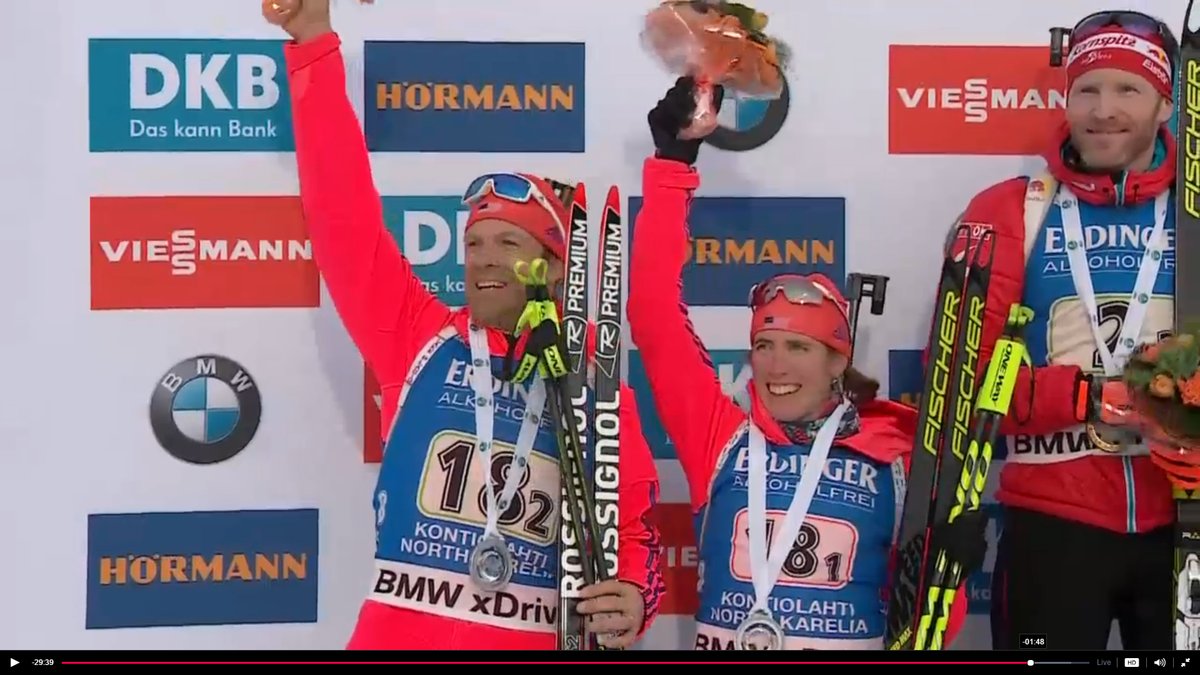
Lowell Bailey and Susan Dunklee celebrate finishing second in the single mixed relay in Kontiolahti, Finland. (Screencap: US Biathlon/Twitter)
IBU Biathlon World Cup (Kontiolahti, Finland): Single Mixed Relay
In the last single mixed relay of the season, Susan Dunklee held the lead after two loops of skiing. She was looking for a top tag-off to American Lowell Bailey, but she crashed on a downhill. Nevertheless, she was able to focus on the shooting range and climb back into podium position.
The leaders were gone, however: Simon Eder and Lisa Therese Hauser of Austria ran away with the competition, using five spare rounds to race to a 32.8-second victory.
Bailey left the last shooting in third position, and caught Germany’s Roman Rees on the trails. The pair also managed to hold off Jean Guillaume Beatrix of France, who left the range just behind them. It came down to a sprint finish, with Bailey besting Rees (and his relay partner, World Cup Total Score winner Laura Dahlmeier). The U.S. had five spare rounds to Germany’s six.
It was the first relay podium of any kind for the United States since 1994, when the women finished second in a relay in Canmore, Alberta.
The Canadian team of Julia Ransom and Christian Gow finished 19th (+2:27.0) with eight spare rounds.
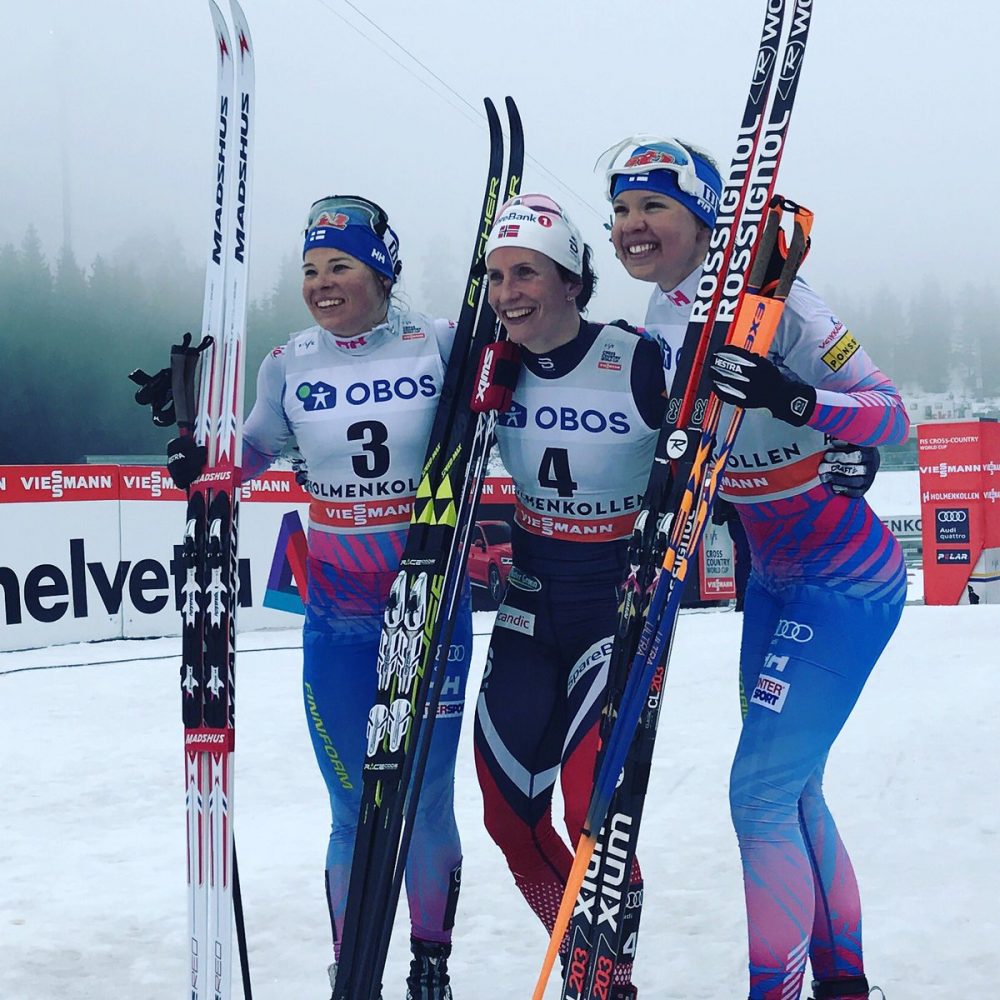
Left to right: Finland’s Krista Pärmäkowski, Norway’s Marit Bjørgen and Finland’s Kertu Niskanenen after the women’s 30kiloimeter World Cup classic mass start on Saturday in Oslo, Norway. (Photo: FIS Cross-Country/Twitter)
FIS Cross-Country World Cup (Oslo, Norway): Holmenkollen 30 k classic mass start:
Norwegian Marit Bjørgen won the women’s 30-kilometer classic mass start at Homenkollen on Sunday, in a time of 1:22:59.2. She bested two Finns, Krista Pärmäkoski and Kerttu Niskanen. Pärmäkoski finished in second (+2:05.8) and Niskanen in third (+2:07.0).
Norway’s Heidi Weng finished fourth (+2:08.6), outlasting Sweden’s Charlotte Kalla (fifth, +2:11.7). Poland’s Justyna Kowalczyk finished sixth (+2:12.9), Finland’s Aino-Kaisa Saarinen seventh (+2:19.6), Norway’s Ingvild Flugstad Øtsberg in eighth (+2:31.3), Sweden’s Anna Haag in ninth (+3:27.9) and Finland’s Laura Mononen in tenth (+3:28.7).
The first North American to finish on Sunday was Kikkan Randall, who placed 20th (+6:17.2). The next North American across the line was the U.S. Ski Team’s Sadie Bjornsen in 24th (+6:48.8). Liz Stephen finished in 31st (+8:46.8), and Chelsea Holmes (Alaska Pacific University) in 39th (+11:19.1).
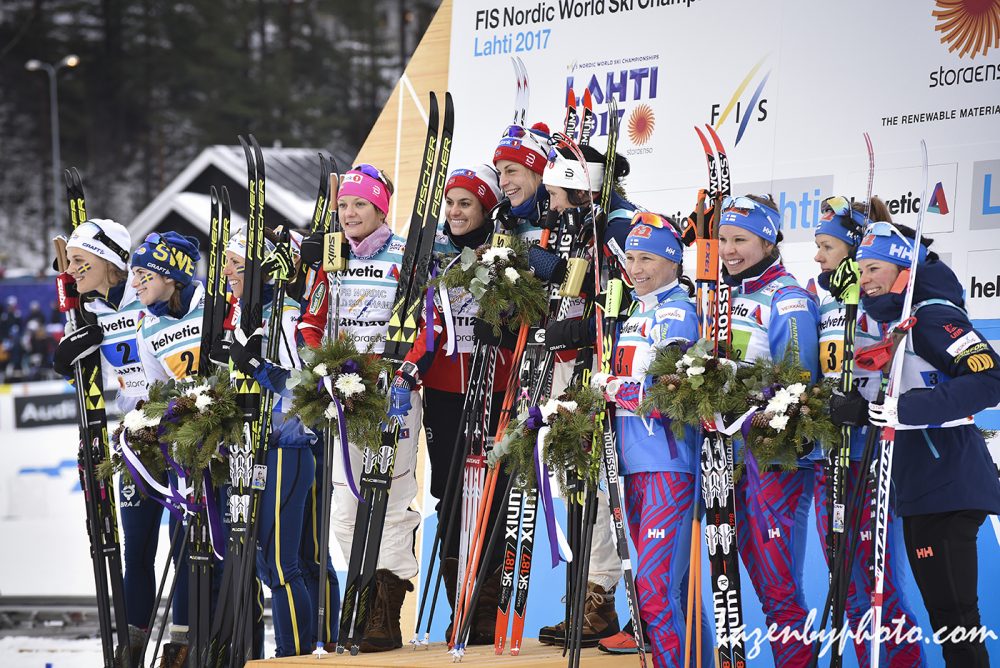
The women’s 4 x 5 k relay podium at 2017 Nordic World Ski Championships in Lahti, Finland, with Norway (c) in first, Sweden (l) in second and Finland (r) third. (Photo: John Lazenby/Lazenbyphoto.com)
LAHTI, Finland—The Norwegian lineup for the women’s 4 x 5-kilometer team at the 2017 Nordic World Championships on Thursday was daunting: Maiken Caspersen Falla, Heidi Weng, Astrid Uhrenholdt Jacobsen, Marit Bjørgen. On paper and on snow, a rundown of names and accomplishments.
On Thursday the Norwegian women made the country’s historic championship gold medal count a tidy 100 by winning the 4 x 5 k relay in 52:21.5 minutes. In a sprint for the remaining two podium spots, Sweden’s anchor skier Stina Nilsson outsprinted Finland’s Krista Pärmäkoski for second.
The Swedish team of Anna Haag, Charlotte Kalla, Ebba Andersson, and Nilsson scored silver (+1:01.6) while Finland’s home team of Aino-Kaisa Saarinen, Kerttu Niskanen, Laura Mononen, and Pärmäkoski was third (+1:02.1).
The U.S., represented by Kikkan Randall, Sadie Bjornsen, Liz Stephen, and Jessie Diggins, placed fourth (+1:33.8).
Two Legs of Parity, Then Norwegian Dominance
Rabid fans of the sport know Norway is winner of the last three consecutive championship relays. And lovers of tactics also know the Norwegians like to push the pace from the gun and break the pack early.
Halfway through the first leg, Poland’s Justyna Kowalczyk, a classic specialist, led Finland, Norway, Sweden, and the U.S. through the 2.5 k mark.
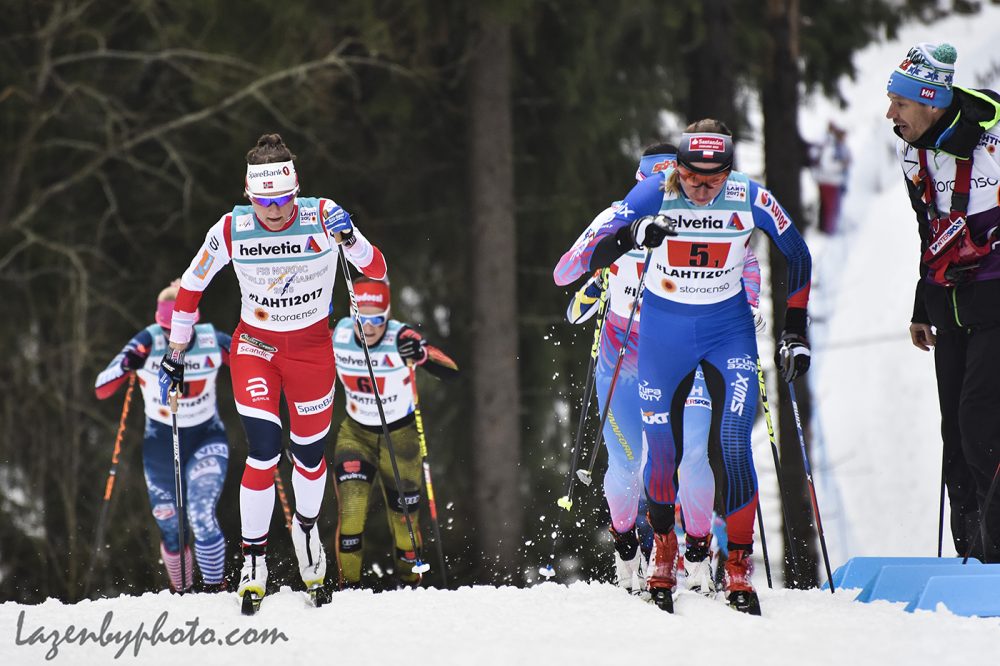
Norway’s Maiken Caspersen Falla (l) leads one row of skiers, Poland’s Justyna Kowalczyk lead’s another, during the scramble leg of the 2017 Nordic World Championships 4 x 5 k relay in Lahti, Finland. (Photo: John Lazenby/lazenbyphoto.com)
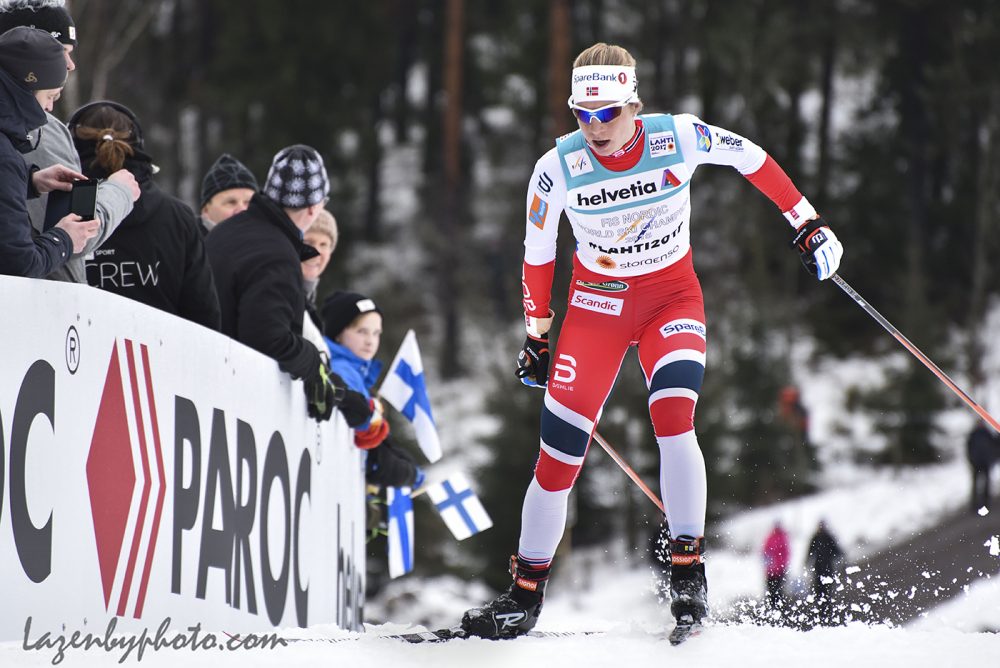
For Falla, Norway’s scramble leg, it was her debut in a championship 4 x 5 k relay. Despite her prior medals, her pre-relay nerves were unsettled.
“I was really excited today and I was just hoping that the time could pass fast so I can race,” Falla said after the race. “It was a lot of waiting time, but I get good advice … and that helped me today. So I get my nerves under control.”
According to Falla, here’s the advice: “That I should stay behind the first lap and be strong in the climbs in the last lap,” she explained. “I did that, just as they said.”
In the last kilometer, Falla made a small break, tagging off to Weng with a near eight-second advantage on the chasers.
Weng leads the World Cup overall standings, but racing in the Finnish ski-den, she was unable to fend off the surging Finns. Five kilometers later, Niskanen had absorbed Norway’s punch. Finland and Norway tagged off to their respective third-leg skiers simultaneously. Sweden trailed twelve seconds back.
Up the first hill, the mother of all climbs on the skating course, Jacobsen and Mononen pulsed. Carrying Sweden’s hopes was Andersson — a 19-year-old junior fresh off a win in the 5 k skate at last month’s Junior World Championships at Soldier Hollow in Utah.
The Finn-Norwegian duo pulled away, leaving Andersson with a 22.6-second deficit 1.3 k into the third leg.
Astrid Uhrenholdt Jacobsen, Norway’s third-leg skier, made a decisive move to put major time into second-place Sweden and third-place Finland during the 2017 Nordic World Championships 4 x 5 k relay in Lahti, Finland. (Photo: John Lazenby/Lazenbyphoto.com)
A resurgent Jacobsen kept pushing; her moves to drop Andersson early on weren’t only a tactic to make it a two-team race, but a sustained display of overdrive that ultimately broke the Finns, too.
The third leg was the tipping point for Finland and Sweden. They were on the side of bleeding time to Norway; Norway on the side of looming victory. By 13.8 k, Norway was up 30.4 seconds on Finland and 45.8 seconds on Sweden.
Andersson managed the damage. She and Mononen skied into the stadium amidst a raucous Finnish crowd. By then, Jacobsen handed Bjørgen nearly a minute cushion.
That kind of margin and Bjørgen hustling from the line: Boom!
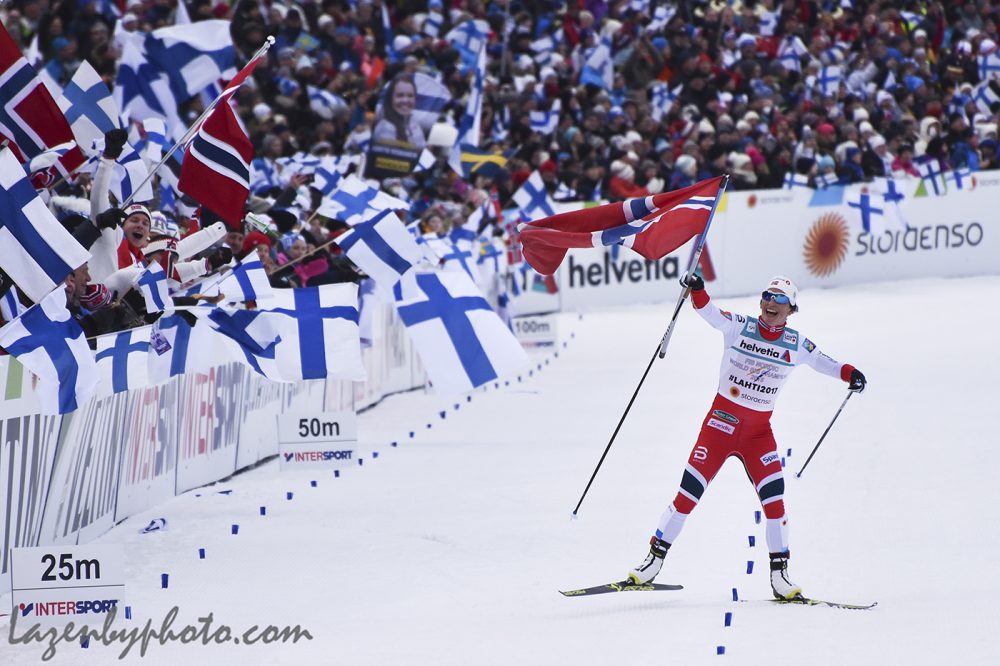
You know how this ends, with the queen waving an oversized Norwegian flag.
After the race, Jacobsen spoke of the pressure of skiing on Norway’s storied relay teams.
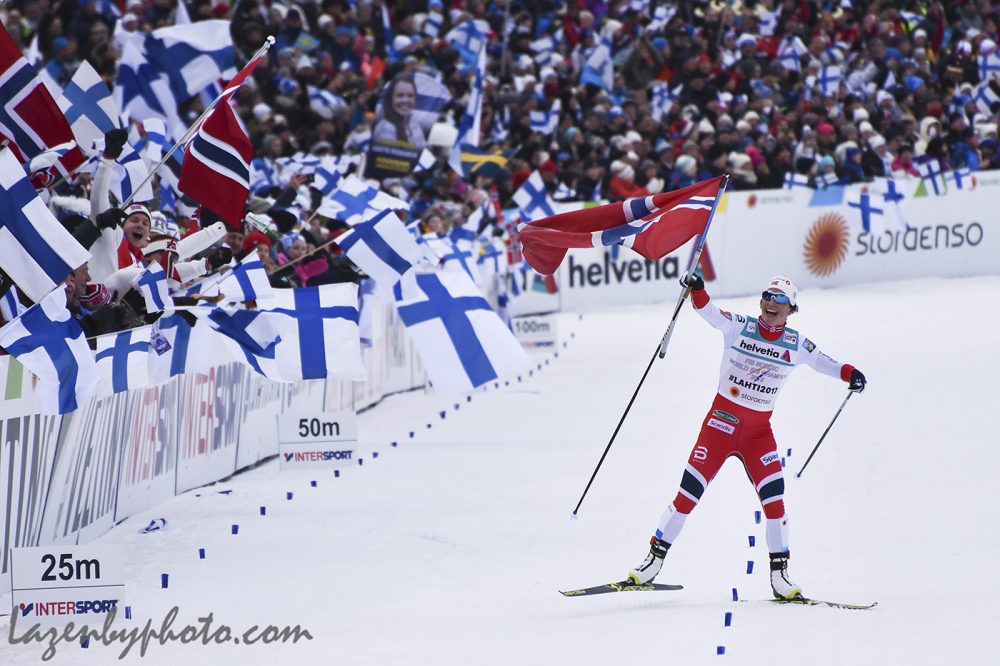
Marit Bjørgen carrying the Norwegian flag as she crosses the line first for Norway’s 100th World Championship win during the women’s 4 x 5 k relay at the 2017 Nordic World Championships in Lahti, Finland. (Photo: John Lazenby/Lazenbyphoto.com)
“I think actually the biggest pressure is the one we put on ourselves and probably because it’s so hard for us to qualify for the team,” Jacobsen said. “We are skiing for the girls who didn’t make it this year but will probably make it next year. So we ski of course for our people and our nation. But I think the biggest nerves come from the desire to perform well and do strong legs.”
One hundred championship gold medals later, Jacobsen acknowledged it’s a full treasure chest.
“The Norwegian people are getting spoiled in gold medals, but it not so easy like it looks,” Jacobsen said.
Glide for glide, pole for pole, Sweden and Finland were mirror images the last leg. Known as a closer, Nilsson strategized that coming into the final corner she wanted to follow Parmakoski.
Sweden’s second-leg skier Kalla explained that Nilsson’s tactic was one of waiting until the end.
“If Stina should go with some team in the end, she should wait to the stadium and just focus on her strength and she made it just like the plan,” Kalla said.
Days earlier in the team sprint, Nilsson lost out on bronze to Diggins in a sprint to the line.
“In the team sprint I was first in the final curve,” Nilsson reflected. “And I felt that Diggins had an advantage of it, so I didn’t want to be first today.”
The press conference’s moderator interjected and tried to correct Nilsson, saying she was first again in the closing moments, not shadowing the Finn.
“No, not in the curve, but after the curve,” Nilsson said with a laugh.
The silver and bronze fight came down to Nilsson’s final kick and this time she made it stick for silver.
(Story continues below)
Sweden’s Stina Nilsson celebrates silver after outsprinting Finland’s Krista Parmakoski (l) in the final meters of the women’s 4 x 5 k relay at the 2017 Nordic World Championships in Lahti, Finland. (Photo: John Lazenby/Lazenbyphoto.com)
Same Place, But Progress: U.S. Places Fourth, Canada 10th
With three world champs medals already in the hands of American skiers prior to Thursday’s team relay, the public hope for a podium was high. Perhaps too high.
As U.S. Ski Team (USST) Head Coach Chris Grover explained, medaling in the team relay was certainly on the radar coming into the world champs week, but not where the team’s greatest expectations were held.
The U.S. women’s relay team, (from left to right) Sadie Bjornsen, Liz Stephen, Jessie Diggins, and Kikkan Randall, after placing fourth on Thursday at 2017 World Championships in Lahti, Finland. (Photo: John Lazenby/Lazenbyphoto.com)
“The relay we knew was a shot, the team sprint we knew was an outside shot,” Grover said after Thursday’s race. “Probably our greatest medal opportunity was the individual sprint.”
As a gritty group of women, the Americans exude the attitude of a top team. Adorned in red, white and blue socks and face paint sporting the U.S.A.’s emblematic stars and stripes, it’s easy to see the enthusiasm the U.S. women show for team events.
But where does the blur between team-relay hype end and the reality of results begin?
Disappointment in anything less than a podium only comes when the expectation of one exists. Taken over the past few world champs years, the relay event might be one where the U.S. women can, and have, improved the most.
Eight years ago, at the 2009 world champs in Liberec, Czech Republic, the U.S. finished 13th, a little over three minutesout of third place. The following World Championships year, 2011 in Oslo, Norway, they were almost two minutes off the podium, crossing in ninth overall.
This year? The U.S. once again finished fourth — the third time in a row that the team has finished one place outside the podium at a World Championships event.
Yet, Thursday’s performance was the second closest the team has come to bronze, with the Americans crossing 31.7 seconds after third (their 2013 result in Val di Fiemme, Italy, was closer: 26.6 seconds behind third). Given room for systematic error, the statistical trend for the U.S. women in the team relay over the past five world champs: positive.
American Kikkan Randall during the first leg of the women’s 4 x 5 k relay at the 2017 Nordic World Championships in Lahti, Finland. (Photo: John Lazenby/Lazenbyphoto.com)
“Even though this is the third time in a row that we’ve been fourth place at a world championships, there’s progress, there’s real progress,” Grover said. “The athletes could see the competition ahead of them the whole time. … To be getting closer and closer to that top standard, that’s very gratifying.”
When looking at the longer-distance performances from the week in tandem with Thursday’s start list, Grover further explained that the U.S. team’s incoming rank was similar to their outcoming result.
“I guess I’d say that when you look at the start list and you look at the results from the 10 k and the skiathlon, on paper we’re fourth,” Grover said. “Sweden, Finland, Norway they’re definitely ahead of us in terms of the distance results that we’ve seen here all week. So we knew we were sort of an outside chance to be fighting for the bronze and we knew that when we’re successful on the World Cup, it’s because one of those teams has a weak leg.”
A weak leg from Finland, Norway or Sweden — the three teams that finished ahead of the Americans — at least in Thursday’s race, was nowhere to be found for the U.S.
From the start, Kowalczyk, pushed the pace with Falla, Haag and Saarinen in close quarters, while the USST’s Randall worked hard to hold on.
“Unfortunately, we lost some important time there in the beginning,” Randall said. “I know that’s something I’ve got to work on for next year, but it was exciting to know that we were still in the race the whole time and made Sweden and Finland really fight for those medals.”
Randall handed off to Bjornsen in fifth, approximately 16 seconds back from the second, third, and fourth spots. From there, the Americans raced alone, working hard to reel in the racers ahead.
“It’s always hard to have a carrot right in front of you and not go too hard at the beginning,” Bjornsen said. “I think all of us had a hard time with that today, not going too hard to try to catch them right away.”
By the end of her leg, Bjornsen needed another eight seconds from Randall’s time back to catch the third place position. She handed off to Stephen, who would have to make up 23.5 seconds on Sweden’s third leg, Andersson, to contend for the podium.
The young Andersson, however, was putting on a show. And Stephen wasn’t surprised. During the early stages of her ski career, Stephen attended a weeklong camp in Sweden. While there, she’d learn invaluable lessons from countless coaches, one just happening to be Andersson’s father.
Liz Stephen racing the third leg for the U.S. women’s team in the 4 x 5 k relay at the 2017 Nordic World Championships in Lahti, Finland. (Photo: John Lazenby/ Lazenbyphoto.com)
“As I was lining up with her today I was just like ‘this is just full circle,’ “Stephen said after. “She’s a damn-good skier.”
That of course didn’t stop Stephen from putting her best foot forward. The American emphasised the areas she knew were her strength, working the hills.
“Part of me wanted to go out and blow [it] out of the water off the bat, but I also knew that these conditions are also a little bit more energy-expending than normal, hard-packed conditions,” Stephen explained.
Halfway through the first lap, Stephen had gained close to seven seconds on Andersson. By the end of the second lap, however, Andersson had regained the ground that she had lost.
“Unfortunately I couldn’t get her,” Stephen said. “But I did what I could out there … and I am very inspired to be on this team again. To watch my teammates give it all out there, it just makes you want to do the same.”
When Stephen handed off to Diggins, the anchor legs for Sweden and Finland were skiing together. Diggins explained that she had hoped Nilsson and Pärmäkoski’s race tactics would provide an opportunity for her to gain on them.
“I saw where we were coming in and I said, my only strategy is to go out as hard as I can and hope that they are playing cat and mouse in the front,” Diggins said. “[I thought] if they’re trying to be all strategic for the final sprint-out, then maybe I can catch them.”
Ultimately the gap proved too large, with Diggins crossing in fourth.
“I wasn’t able to close the gap but I never stopped fighting and neither did my teammates, and I’m really proud of that,” Diggins said.
Canada’s team of Katherine Stewart-Jones, Emily Nishikawa, Cendrine Browne, and Dahria Beatty finished 10th (+4:16.2) for the fourth-best world champs result of a Canadian women’s relay team. According to a Cross Country Canada press release, this was just the fourth time in the last decade that Canada has fielded a World Championships women’s relay (excluding the Olympics).
At the 2001 World Championships, Beckie Scott, Milane Thériault, Jaime Fortier, and Sara Renner raced to sixth for Canada. Before that, the program’s previous best was eighth at 1989 world champs, also in Lahti.
(Left to right) Canada’s Emily Nishikawa, Cendrine Browne, Dahria Beatty, and Katherine Stewart-Jones after placing 10th in the women’s 4 x 5 k relay at the 2017 Nordic World Championships in Lahti, Finland. (Photo: John Lazenby/Lazenbyphoto.com)
“I think today we surprised ourselves,” Canadian World Cup coach Ivan Babikov said on Thursday.
“[Katherine Stewart-Jones] skied incredibly that first leg, with everything she could,” he added. “She was ahead of Germany, ahead of Russia, so many really good countries, and after that it was a matter of holding on and it was great.”
Stewart-Jones finished her leg in eighth, just seven-tenths of second behind Germany’s Katharina Hennig in seventh. Though Switzerland and Italy eventually caught the Canadians, the women expressed excitement about the finish and results yet to come.
“This is the first time we’ve fielded a world champs relay in a long time so that’s a huge accomplishment [in itself],” Nishikawa said during an in-person interview. “And then to come 10th … it’s really the beginning of something that’s pretty special.”
“I’m really proud of us,” Browne added. “I think we all skied really strongly today, and very positive for the future.”
— Harald Zimmer, Gerry Furseth, and Alex Kochon contributed
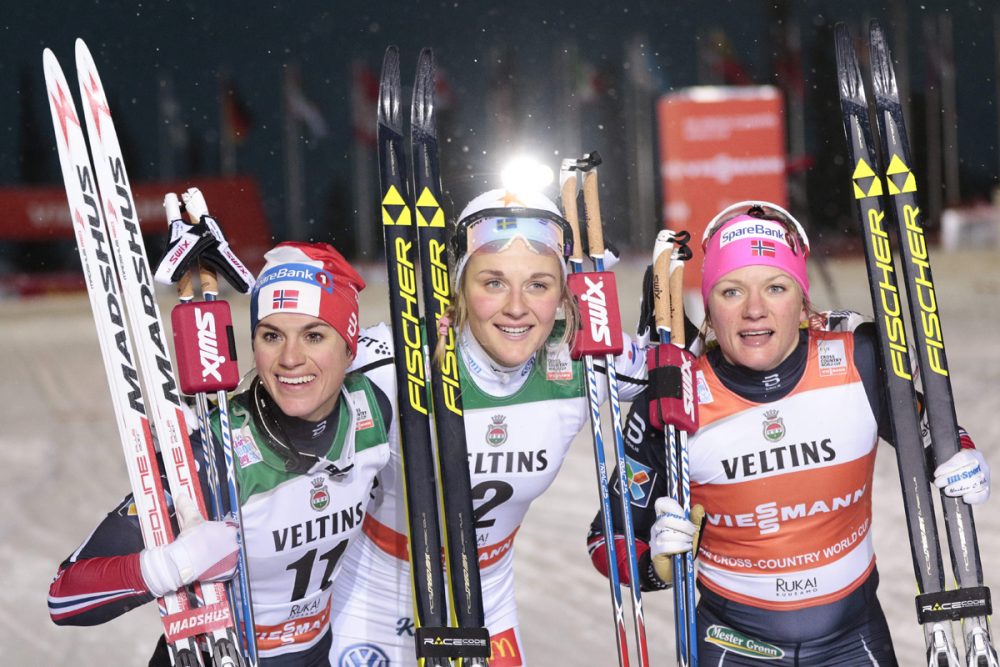
The women’s classic sprint final podium at the opening World Cup races in Ruka, Finland on Saturday Nov. 26. From left to right: Heidi Weng of Norway, Sweden’s Stina Nilsson, and Norwegian Maiken Caspersen Falla. (Photo: Fischer/NordicFocus)
Norway’s women’s team has a long history with classic racing in Kuusamo, Finland. For 15 years, International Ski Federation (FIS) Cross Country World Cup competitions have taken place on these trails, with Norway winning every classic race at the Ruka venue except two — falling to Finland’s Aino-Kaisa Saarinen in 2009 and more recently, Poland’s Justyna Kowalczyk in 2013.
Three years later, another woman’s name has now knocked Norway’s out of first: Sweden’s Stina Nilsson.
In the women’s 1.4-kilometer sprint final on Saturday, Nilsson battled two Norwegians –including last year’s Sprint Cup winner, Maiken Caspersen Falla — two Russians, and a Finn, for her first title ever in a classic race.
“It feels super awesome, especially to win a classic race,” Nilsson, 23, said during a television interview.
After qualifying second, 1.14 seconds behind the winning qualification time of 3:21.15 set by Finland’s Krista Parmakowski, Nilsson overtook the lead by the end of the first quarterfinal and held it through her semifinal and the final.
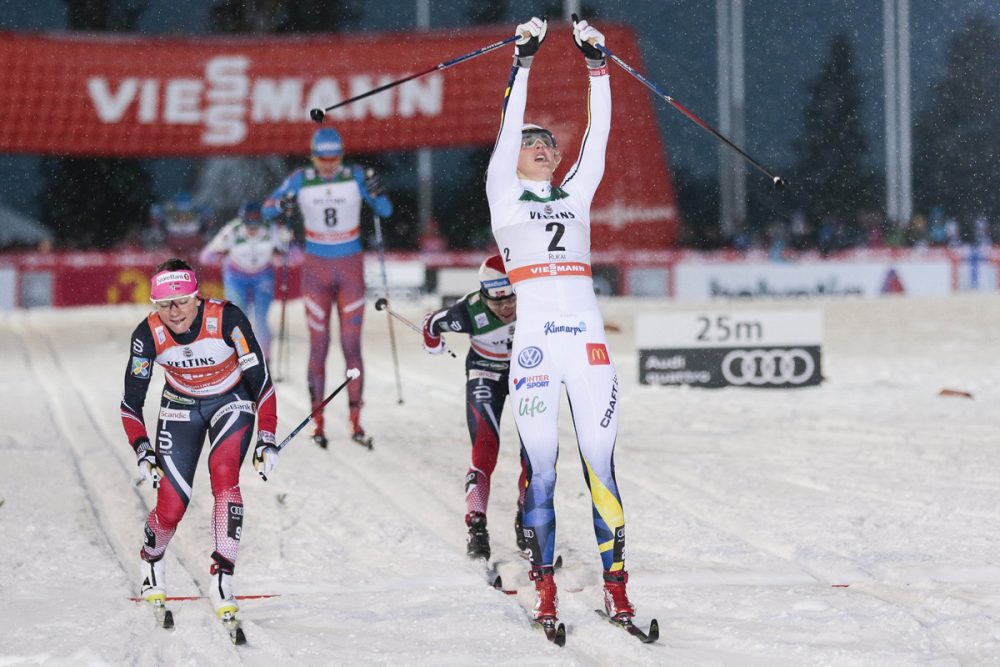
Sweden’s Stina Nilsson bib 2 racing to her first ever classic title on Saturday Nov. 26 at the opening World Cup races in Ruka, Finland. Norway’s Maiken Caspersen Falla (l) finished in second. (Photo: Fischer/NordicFocus)
Nilsson and Parmakoski started the day’s rounds in the first quarterfinal one, leading Kowalczyk and another Finn, Laura Mononen, as well as Russia’s Natalia Nepryaeva and Norway’s Astrid Uhrenholdt Jacobsen off the start.
Parmakoski pulled into the lead through the first major downhill, first major ascent and into the second major course descent. However, by the last large climb, Nilsson proved too powerful for the Finn. Within three strides, Nilsson passed Parmakoski and by the top of the hill had established enough of a gap to double pole her way safely across the finish line of her quarterfinal in first.
In a much closer semifinal, Nilsson found herself in fourth alongside her Swedish teammate Hannah Falk for most of the heat, tightly trailing Russia’s Natalia Matveeva and Norway’s Falla all the way through the second major descent. By the bottom of the final climb, it was Matveeva in front, with Falla working to her left. Navigating to the inside, Nilsson found a second wind, eventually outlasting both the Norwegian and the Russian in the race to the top.
Back in the lead with 100-meters to go, Nilsson once again crossed in first, leaving the photo finish to Falla and Matveeva. Falla automatically advanced to the final after capturing second, while Matveeva earned one of the ‘Lucky Loser’ spots. Parmakoski garnered the final’s last lucky loser spot after crossing fourth in Nilsson’s semifinal.
Facing off against Falla once more, as well as her Norwegian teammate, Heidi Weng–the winner of the second semifinal–along with Russia’s Yulia Belorukova and Matveeva, as well as Parmakowski in the final, Nilsson took no chances off the start.
The Swede punched the pace through the initial decent, but by the first major climb she began to lose steam. Falla challenged Nilsson on the right, while Matveeva closed in from the left. Weng hung on behind her teammate in fourth place, while Parmakoski raced in fifth and Belorukova in sixth.
Regaining the front position from Nilsson by the second large downhill on course, the sprint leader Falla appeared to be preparing to gap herself from the group. Midway through the final climb, however, the Swede’s white suit was once more on the attack. Fading into a chase pack by the top of the climb were Falla, Weng, and Matveeva, while Nilsson blew her way back into the lead.
With 100 meters to go, Falla jumped in behind Nilsson. With 50 meters to go, Falla switched lanes, moving to the Swede’s right in an effort to edge by for the win. Holding on tightly her first classic title, Nilsson double poled across the finish line first in a time of 3:21.61, while Falla finished 0.17 hundreths of a second behind her in second.
“I’m happy about the [second] place, it was a good start to the season and it shows promise for Lillehammer– it’s fun to be on the podium already,” Falla, 26, said during a television interview.
Falla’s teammate Weng rounded out the podium in third, crossing 0.69 seconds off of Nilsson’s time.
“I’m very happy, I’ve never had such a good season opener in Kusammo,” Weng, 25, said during a T.V. interview. “The conditions were challenging so we had use herringbone.”
Other final finishers included Matveeva in fourth (+3.18), Parmakowski in fifth (+5.12) and Belorukova in sixth (+8.94).
Four Americans Qualify; Bjornsen 17th
American/USST member Sadie Bjornsen racing to a seventh place in the women’s qualifier on Saturday Nov. 26 at the opening World Cup races in Ruka, Finland. Bjornsen went on to finish 17th overall. (Photo: Fischer/NordicFocus)
The U.S. Ski Team (USST) saw four women qualify for the heats on Saturday, with Sadie Bjornsen leading the group after qualifying in seventh (+4.41), followed by Jessie Diggins who qualified 13th (+6.27), Ida Sargent in 23rd (+10.28) and Sophie Caldwell, who nabbed the final qualification spot, in 30th (+11.84).
Though Bjornsen indicated that her preparation leading into the season has been different than in years past–due partly to a heel spur problem she has been nursing during the past two months, which forced her to engage in sans shoe training, such as swimming, ski erging, and heel-less biking–the 27-year-old saw Saturday’s performance as a good sign of where her training is taking her.
“Today was only my third time classic skiing in the past months, so it was great to finally find my classic ‘feeling’ this morning just before the start,” Bjornsen wrote in an email to media outlets. “The past few days I have been nervous, and questioning myself more than normal, so today was a wonderful ‘check’.”
A Winthrop, Washington, native who trains with Alaska Pacific University (APU) in Anchorage, Alaska, Bjornsen decided prior to the start of the 2016/2017 season that she would hold no expectations over herself, other than to give every race she entered a good fight.
With that in mind, she lead the start of her quarterfinal and pushed the pace early on. Following close behind her was the swiss skier Laurien Van der Graaff, Russia’s Daria Vedenina, Kerttu Niskanen of Finland, Norway’s Heidi Weng and Germany’s Sandra Ringwald.
Bjornsen held her lead until the final climb of the course, where the powdery snow appeared to slow down her ability to keep up a high turnover in her herringbone. She was overtaken by Weng and Rigwald before the top of the climb and crossed fourth in her quarterfinal for 17th overall.
“I had a great qualifier, and went into the heats with some confidence,” Bjornsen wrote. “The start was great, but I started to struggle on the final climb. I am missing a little bit of “high speed leg speed”, but that is something I am confident will come with using my legs again. I am looking forward to skiing more, and racing more!”
“I believe that as a team, we will do well pretty much all year, but today we were kicking out the cobwebs a little bit.” — U.S. women’s head coach, Matt Whitcomb the USST’s sprint performance in Ruka
The next two American finishers for the day were Sophie Caldwell in 20th overall and Ida Sargent in 23rd. Both were slated to start in the third quarterfinal, going head-to-head against some of Norway’s top competitors, including Falla and Ingvild Flugstad Østberg. Though her qualifier was not what she was looking for performance-wise, Caldwell was glad she was able to sneak into the rounds and get a bit more time racing before the day’s end.
“In my quarterfinal I felt better, skied smarter, and made a better decision with skis than I did in the morning,” Caldwell, 26, wrote in an email. “Even though this isn’t the result I’m the most proud of, it is the best result I’ve ever had in Kuusamo and it was a good opportunity to clean out the cobwebs and get a race under my belt.”
Sargent, who traveled to Europe a couple weeks prior to the start of the World Cup race season with her club team, the Craftsbury Green Racing Project, managed to jump into a few races in Muonio, Finland in hopes of feeling more mentally and physically prepared for the official FIS season’s start.
American/USST member Sophie Caldwell racing to a 30th place in the women’s qualifier on Saturday Nov. 26 at the opening World Cup races in Ruka, Finland. Caldwell went on to finish 20th overall. (Photo: Fischer/NordicFocus)
“It has a give and take because I think having a little bit more time at home for me especially right after the Park City camp also would have been beneficial,” the 26-year-old Sargent said during a phone conversation of her decision to travel to Europe early. “It was nice to just get my feet under me and do a few warm-up races,” she added. “I think those made a big difference.”
“Today was one of the days you had to be good at feathering [the uphills]” Sargent continued. “I’m still working on that…It was good to get the first one out of the way and go from here.”
The final American woman to finish in Saturday’s sprint was Diggins in 26th overall. Along with a false start from Finland’s Anne Kylloenen, Diggins also dealt with a close encounter from Russia’s Polina Kovaleva at the start of her quarterfinal.
“[Kovaleva’s] lane ended and she was going to try to move over and she tried to move over right on top of me and obviously that didn’t work,” Diggins, said during a phone conversation.
“But I was proud of myself for not letting it rattle me and being able to shake it off and get back into the race,” Diggins added.
Unlike previous years, Diggins did not travel to Europe for a pre-World Cup race season camp. She opted instead to spend a few extra weeks at home, meaning the opening races in Ruka would be her first on snow.
“It was definitely pretty nerve wracking coming into the race season being like ‘OK I haven’t raced yet this year’,” Diggins said. “I mean, we’ve done time trials, but that’s not the same.”
Though Diggins feels confident in her fitness coming into the season, the 25-year-old is ready to make changes where she feels they are necessary using Ruka as her baseline.
“Definitely, it was really tricky conditions out there with the tracks deteriorating,” Diggins said. “But I also need to work on my technique…that’s on me and I’m not going to make any excuses for my races.”
With four women having qualified for the heats, U.S. women’s head coach, Matt Whitcomb indicated that standout performances were not a priority for races this early in the season.
“We always have the intention of winning the races that we race in, but there is in fact a strategy of really trying to build into this period one and to place our higher performances later in the year so that we can really smash things at World Champs,” Whitcomb said during a phone conversation. “I believe that as a team, we will do well pretty much all year, but today we were kicking out the cobwebs a little bit.”