From the FasterSkier archive — posts syndicated from athletes’ and coaches’ own blogs between 2004 and 2012, kept online as published. Current coverage is at fasterskier.com.
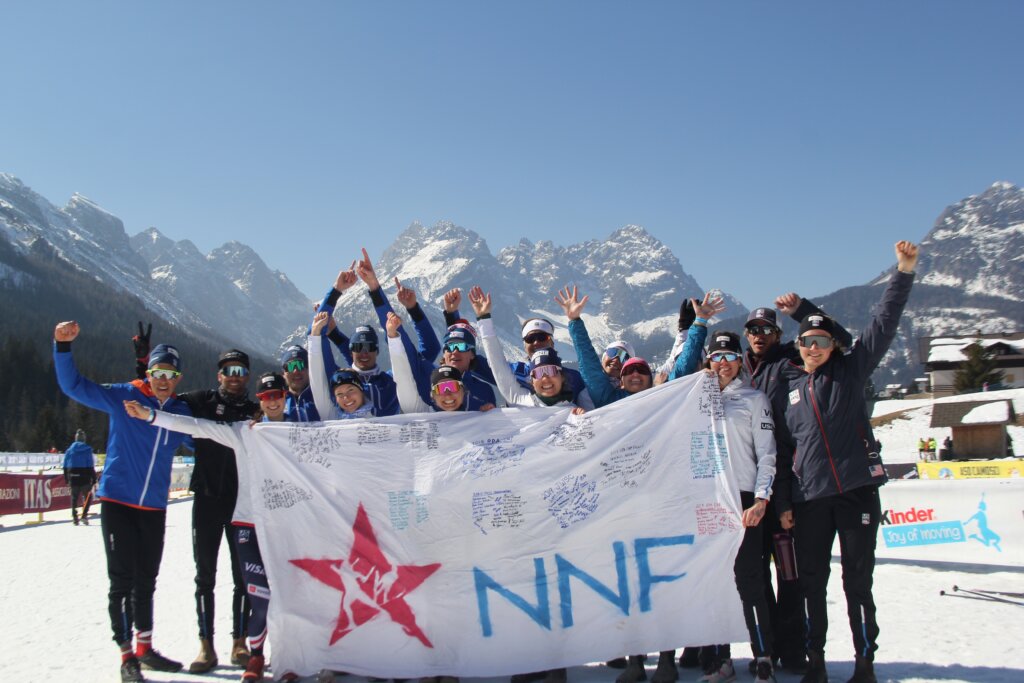
The National Nordic Foundation (NNF) has kicked off its annual Summer Auction, running through July 13, with a fundraising goal of $30,000 to support grassroots Nordic ski development across the country. As of this week, the auction had already raised roughly $8,700 toward that target.
The online silent auction features a mix of gear, experiences, and unique memorabilia, including a fan bib signed by Jessie Diggins, an entry into the Alley Loop 42k, a training and technique video call with Kristen Bourne, and an autographed soccer ball from Sammy Smith, among other items still open for bidding.
Proceeds support NNF’s mission of centralizing funding and energy behind Nordic sport, connecting donors with athletes and programs at every level of the pipeline. Skiing fans can browse items and place bids at www.32auctions.com/NNFSummerAuction2026 before the auction closes on July 13.
By the time Sophia Laukli picks up the phone from Lillehammer, it’s raining again.
“There is, like, a small 1k loop up at Sjusjøen,” she says, “but it’s… yeah, it’s, like, raining every day, so it’s not really great conditions.”
On paper, Laukli is one of the most intriguing dual-sport athletes in endurance sport: a U.S. Ski Team member and Olympian who has also become a force in international trail running. In person—or over Zoom—she’s thoughtful, understated, and very clear on one thing: the way she trains now, in Norway, looks a lot more boring than the world might imagine.
You come to Norway expecting secrets, she says. What she found instead was simplicity.
“They’re so simplistic around ski training,” Laukli explains. “It’s not rocket science. You can do the same… You do essentially the same workouts every single week, all year round.”
That realization—combined with a crash-and-burn experiment as a full-time runner and a new coaching relationship with her boyfriend, longtime Norwegian pro skier Gjøran Tefre—has quietly reshaped her career.
As this Olympic season approaches, Laukli’s bet is clear: train like a skier, keep the training simple, stay within herself, and let the results show up in both sports.
Maine Roots, Late Commitment
For all the talk about Norway, Laukli’s story really starts in coastal New England.
“I was actually in the Boston area until I was, like, six or seven,” she says. Then came a year and a half in Norway, and finally Yarmouth, Maine—the place that still feels like home.
“From my memories and my ski memories, it’s all from Maine.”
Her father is Norwegian, so skis were always around. Winters meant skiing, family trips to Norway, and a life that looked, from the outside, like an early pipeline to the World Cup. From the inside, it didn’t feel that way at all.
“It was a very recreational thing,” she says. “I didn’t really enjoy it that much. It was just kind of like, obviously, we’re gonna ski because it’s winter. But I didn’t know anything else.”
In Maine, her parents weren’t just ski parents—they were essentially the ski people in the community.
“They were my coaches,” she says. “And very present in the ski world, which was hard for me… A part of me became pretty hesitant towards skiing.”
She gravitated toward soccer and tennis. Skiing felt obligatory.
“Up until midway through high school, skiing was kind of just something I did because my family did it,” she says.
The idea of becoming a professional athlete wasn’t just unrealistic—it was unimaginable.
“I was gonna just go to school and be a nerd or something,” she says. “Being a professional skier wasn’t even a consideration.”
Then came the pivot: joining the iconic Yarmouth High School ski team, coached by the legendary Bob Morse.
“It opened my eyes a lot,” she says. “It wasn’t super competitive, but it showed me the sport that felt forced on me was actually something I liked—and could be really good at if I tried.”
Looking back, she’s grateful it took so long.
“I’m super happy I went through that zero-pressure, uncommitted relationship to skiing,” she says. “Today I have so much motivation to be 100% committed… and I’m far from burnt out compared to many skiers who commit when they’re 12.”
Discovering Running (By Hating It First)
The other half of her dual-sport identity—trail running—comes from an even stranger origin story.
“Running was something that I actually hated,” she says, laughing. “I really, really, really did not like to run when I was young.”
Running in Maine didn’t help.
“It just wasn’t enjoyable to run there,” she says. “Unless you really liked running on roads and golf courses.”
She ran cross country her senior year only because the coach wanted her on the roster for states. She ran track for one year and found it “horrible.”
“It wasn’t until I started training out West in the summers, finding mountains… that I actually enjoyed running.”
Those Western US trails served as the practice grounds, preparing Laukli for some of the world’s biggest trail races. But first she had to figure out college—and how training would fit around it.
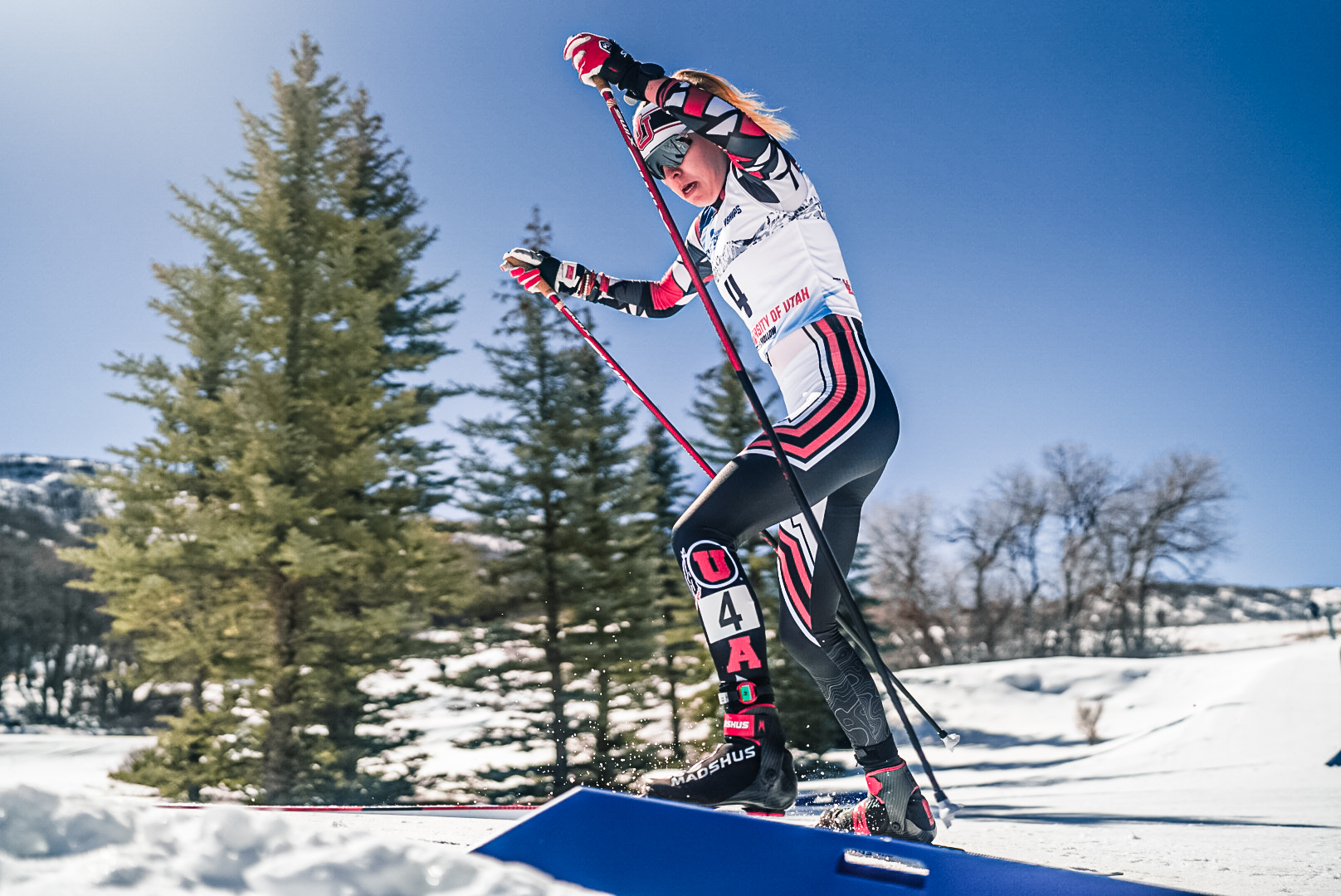
Sophia Laukli takes the collegiate national title in the 15 k skate in 2022. (Photo: Tobias Albrigtsen / @untraceableg)
Middlebury to Utah: Building a Life Around Skiing
Laukli chose Middlebury because, at the time, academics were the top priority.
“I knew I didn’t want to be done skiing,” she says, “but it wasn’t the priority.”
Covid changed everything. Remote classes allowed her to chase early World Cup opportunities without living on campus. Once Middlebury required students to return in person, the timing coincided with the rapid ascent of her ski career.
That led to a transfer to the University of Utah.
“Utah is built for athletes,” she says. Most classes were online and flexible. She chose economics not out of passion but practicality.
“I didn’t necessarily choose the thing I thought was interesting,” she says. “I chose what would best suit my ski career.”
Now, even as a full-time pro based in Norway, she’s studying again—an online Norwegian MBA.
“I’ve never been someone who can come home from training and sit on the couch until my next session,” she says. “I think I was missing having more than just training.”
Balancing skiing and school helps her prevent the sport from consuming everything.
Last year, after the World Championships, Laukli decided to lean all the way into running. It seemed logical—if she’s good at running without specifically training for it, imagine how good she’d be if she did.
“I always thought I’d be a much better runner if I had just run,” she says.
So she tried it. No roller skiing. No ski sessions. Just running—every day.
“I was running 10 to 12 hours a week,” she says. “And I was so tired each day. I was getting worse and worse at running. And obviously not good at skiing.”
The experiment collapsed at a race where she felt utterly depleted. She flew home, frustrated and confused. That’s when she sat down with her boyfriend, Gjøran Tefre.
“He said, ‘It’s fine. I’ll write a plan. Don’t freak out,’” she says. “‘We’ll get you a coach, but ski training is straightforward. We’re gonna baby you into ski training again.’”
Two weeks completely off. Then a return to “textbook” ski training.
Within a week of roller skiing, something wild happened: her running started feeling good again.
The pattern was clear. She ran better when she trained like a skier.
Sophia Laukli (USA) during the World Cup 20km in Engadin (SUI). (Photo: Authamayou/NordicFocus)
Kristen Bourne Saw The Same Thing
“Last season was definitely a struggle for her, both running and skiing,” says U.S. Ski Team assistant coach Kristen Bourne, who monitors Laukli’s training load. “And she’s just trying to figure out why.”
For Bourne, the shift wasn’t just physical—it was psychological.
“I’m a huge believer that what makes a difference from a good athlete to a great athlete is the athlete who is very invested in their own process,” Bourne says. “The ones who are thinking, advocating for what they need—not just deferring to a coach because the coach’s word is gospel.”
That ownership, she says, is new in Laukli.
“She’s definitely leaning into that more this year,” Bourne says. “Which is really cool.”
Sophia Laukli and Gjøran Tefre at the Cross Country Skiing World Championships. (Photo: Courtesy Photo)
The Gjøran Factor: Coach, Partner, Check on Reality
Mixing a relationship with coaching is a delicate thing. Laukli knows the risks—she’s heard them all.
“I’ve been told by many people this is not a good idea,” she says. “And other people are like, ‘Wow, I wish I could do that.’”
She also knows why it works.
For one, they communicate constantly. For another, his intentions are pure.
“One of the hardest parts of finding the right coach was that they either only cared about skiing or only cared about running,” she says. “He’s the only one who actually wants me to do well in both.”
Still, she doesn’t call him her “coach.”
“I want our personal life and work life to be separate,” she says. “We need other people in the room.”
That’s where Bourne plays a key role.
“At this level, athletes have so much experience—they do know what they need,” Bourne says. “So my goal isn’t to dictate everything. It’s to help Sophia articulate what she feels and translate it into training.”
The two systems—Tefre’s daily presence and Bourne’s structured oversight—meet in the middle.
One of the key themes that has emerged from all our recent interviews is the importance of making time for fun. Sophia Laukli and Gjøran Tefre embrace that notion entirely. (Photo: Courtesy Photo)
The Norwegian Experiment: Simple Workouts, Serious Control
When Laukli moved to Norway, she expected cutting-edge workouts—maybe some secrets behind the country’s dominance.
“It’s almost been the opposite,” she says. “They’re so simplistic around ski training.”
Five-by-ten-minute intervals around the Holmenkollen loop. The same long, easy days. Repeated blocks of threshold.
“You’re gonna become better if you do five-by-ten once a week for 12 weeks in a row,” she says. “You’re gonna become better.”
The key difference from the U.S.? Control.
Almost every Norwegian skier has a weekly treadmill “profile test,” which involves six-minute stages at a 10 percent incline, with lactate samples taken at each step andheart rate recorded.
“It’s to see if you’re in the right range,” Laukli says. “Not to get better each week.”
Bourne sees value in that simplicity.
“Sometimes a coach wants to prescribe the flashy intervals,” Bourne says. “But honestly, the athletes who can execute the basics really, really well—that’s where the gains are.”
She sees Laukli finally embracing that mindset.
“Athletes shouldn’t feel like training is something done to them,” Bourne says. “They should feel like they’re building something in collaboration with the coach. Sophia is starting to live that.”
Laukli agrees that American juniors often overtrain because they don’t know any better.
“If I go too hard too many times in a row, it’s a much worse year,” she says.
The hardest part? Slowing down when training with Norwegian women who can drop her on almost every roller-ski interval.
“Every interval I do here, I know I’m not gonna keep up,” she says. “At 17, that would’ve crushed me. Now I have evidence that I can beat them in the winter.”
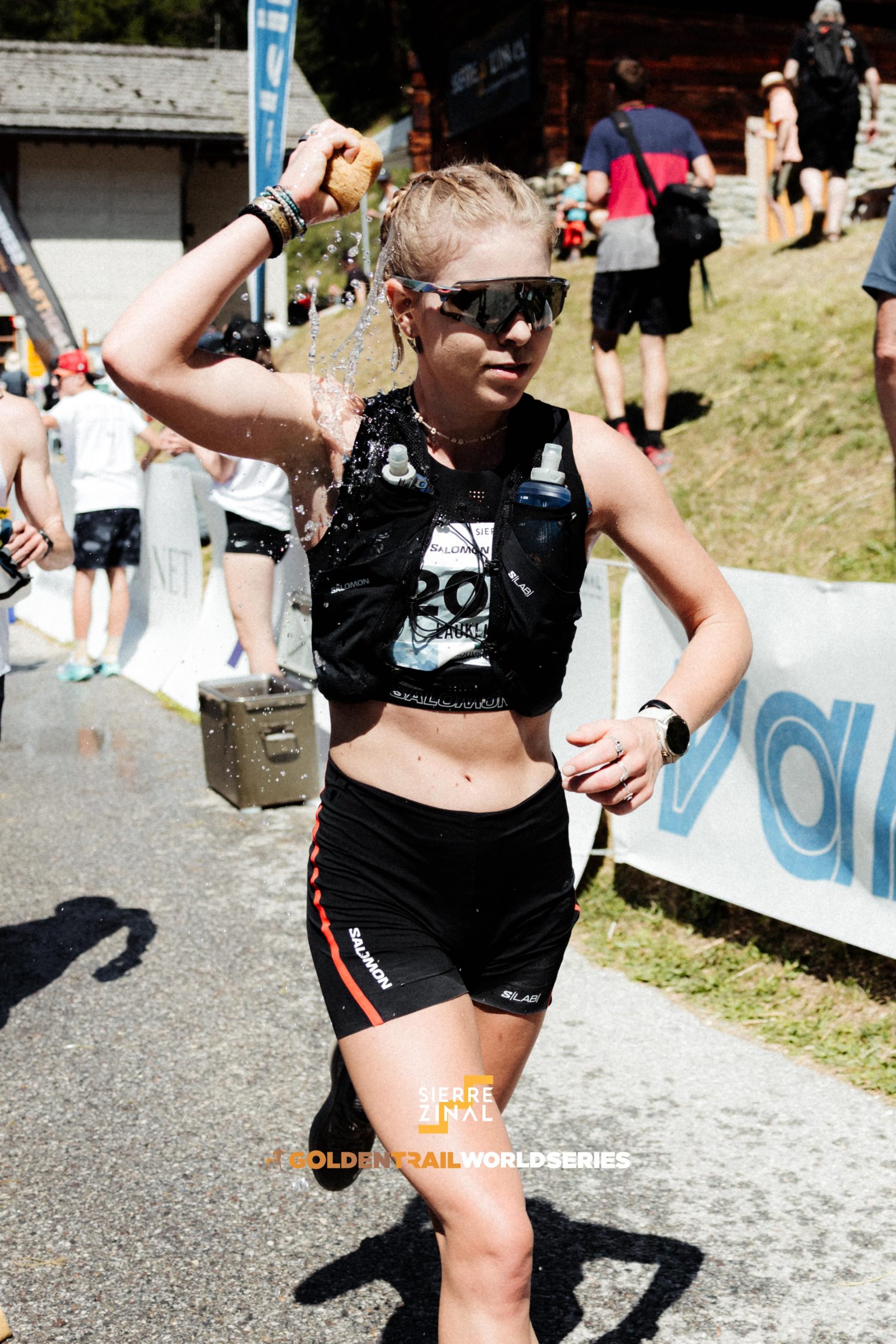
Laukli racing Sierre-Zinal in the Gold Trail World Series in 2024. (Photo: @rising.story_@colinolivero_GTWS_SierreZinal
Two Seasons, One Mindset
Running and skiing back-to-back seasons creates year-round excitement—and pressure.
“I have two competition periods,” she says. “It’s easier to motivate. But it also means I’m 100% consumed by performance all year.”
That obsession became a barrier last year. Now, Laukli is working with Bourne and Tefre to shift her mindset.
She has clear goals for skiing: the Olympic 10k, the Olympic relay, andthe final hill climb at the Tour de Ski.
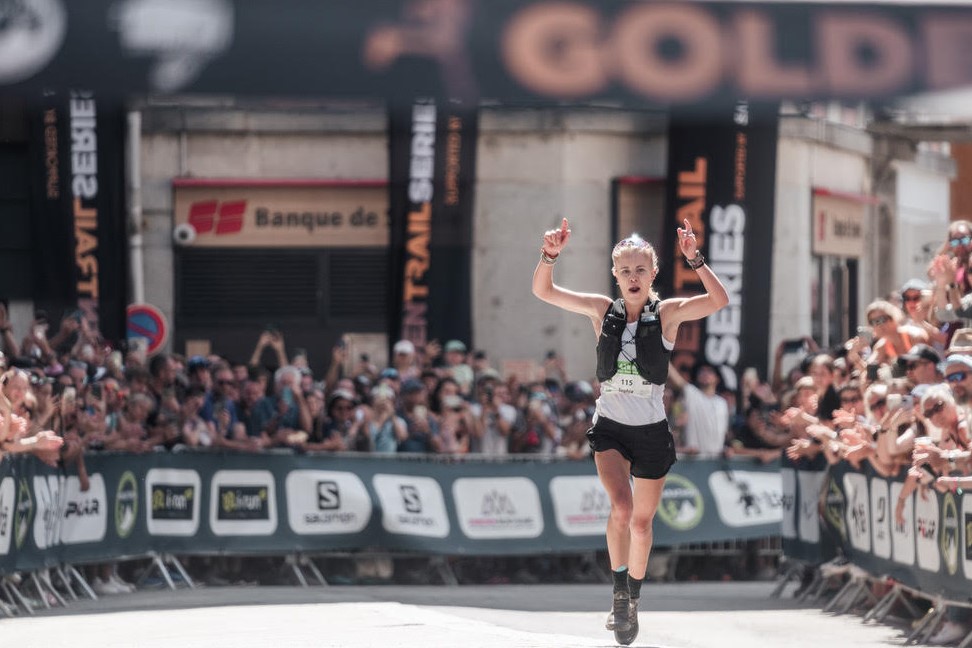
She has equally specific running goals: above all, returning to Sierre-Zinal, where she once ran 2:53 on the iconic 31 km route.
However, she’s no longer defining success solely by results.
“There’s so much I’m working on—technique, tactics, how I ski courses,” she says. “It’s easy to be on a start line and focus on whether those things show up.”
Bourne sees that evolution clearly.
“Sophia has the instincts of a really high-level athlete,” Bourne says. “But learning to trust those instincts—rather than obsessing about the result column—is where she’s growing most.”
Laukli nears the finish of the final climb of the 2024 Tour de Ski on Alpe Cermis, where she claimed the victory. (Photo: NordicFocus)
Why Salomon Fits: One Athlete, Two Worlds
For an athlete splitting her year between the World Cup and the Golden Trail Series, sponsorship could easily become complicated. Many runners work with running-only brands; many skiers work with ski-only brands. For Laukli, that would have been a logistical mess — and maybe even a dealbreaker.
Instead, she found the perfect home with Salomon.
“I’m super grateful that I get to have my sponsor, my main sponsor, support me in both,” she says. “Because then it’s a lot easier to focus on each season. I know that they’re supporting me in that.”
That unified support matters. It lets her shift from skis to singlets without the politics of competing brand calendars and conflicting performance expectations.
“I don’t really know if it would be possible for me to be a runner for another brand and a skier for a different brand,” she says. “Like, defending to them that I can’t run a normal running season because it’s the Olympics, or I need to drop World Cups so I can run better this year — that just wouldn’t work.”
With Salomon, the opposite is true. Everyone’s aligned.
“Having everyone be on the same team makes it manageable,” she says. “And a lot more motivating, because everyone has the same goal.”
She works directly with Salomon’s France-based team, and Laukli lights up when she talks about the group behind her.
“They’re all French,” she says, laughing — a nod to the company’s deep culture in both ski sport and trail running. It’s also a reminder that Laukli lives firmly in the middle of two endurance worlds that Salomon understands and embraces.
That harmony matters. Her identity isn’t split; it’s blended. And Salomon is built for that.
Sophia Laukli (USA) racing the World Cup Mass Start in Les Rousses (FRA). (Photo: Modica/NordicFocus)
Sunny Weekends and Simple Breakfasts
Some things have gotten simpler, like her pre-race breakfast.
“I used to do peanut butter and banana,” she says. “Now I just have cereal. Apparently, simple is better.”
World Cup life has also taught her the importance of flexibility.
“You learn how to adapt,” she says. “Something will always go wrong on a race weekend.”
When she’s asked for her favorite place on the circuit, she doesn’t hesitate.
“Davos,” she says. “It’s sunny. You can have bad races, and it doesn’t matter because it’s a really nice place to hang out.”
That small detail fits her evolving philosophy. Training is simpler. Goals are more balanced. And the sport—skiing and running—feels more sustainable.
Somewhere between Maine and Norway, between Middlebury and Utah, between World Cup stadiums and alpine trails, Sophia Laukli has built a training model that doesn’t look flashy. It’s repetitive. It’s measured. It’s rooted in trust, communication, and doing the basic things right, over and over again.
And if the Norwegians are right—and if Laukli’s instincts keep sharpening—those basics may be exactly what carry her to the front this season, in both sports.
Love Stories Like This? Help Keep Them Coming.
Feature interviews like this one take time, access, and care to produce. If you value thoughtful storytelling and independent ski journalism, please consider becoming a Voluntary Subscriber. Your support directly fuels the work we do to cover the people, places, and moments that make our sport special.
When JC Schoonmaker talks about his earliest memories of ski racing, he doesn’t begin with speed or snow conditions, or the particular magic of gliding across winter trails. He starts, instead, with raffles. “I just remember as a kid, there’d be raffles after every race that I would be so stoked for,” he says. “Trying to get a prize, like a new pair of gloves or a hat.” It is an unexpectedly tender snapshot of a skier now known for his explosive starts and the sharp, angular drama of World Cup sprint heats. But it is also revealing. Long before Schoonmaker was on national team radars, long before he was analyzing sprint tactics or refining breathwork, he was simply a boy who loved showing up at races, surrounded by friends, snow, and the possibility of leaving with a hat.
Schoonmaker grew up in Tahoe, a place where winter sport is woven into the fabric of childhood. Yet unlike many of the region’s rising athletes, he was not funneled into Alpine skiing or a single disciplinary track. Instead, he moved constantly—and in every direction. “Both my parents were super athletic, into sports,” he says. “So from a really early age, I was just doing tons of different stuff: soccer, downhill skiing, andNordic skiing. I played lacrosse. A little bit of baseball.” The variety shaped him in ways he didn’t appreciate at the time: balance from soccer, strength from downhill, elasticity from lacrosse, and a developing sense of rhythm from all of it.
Meanwhile, the Nordic community in Tahoe was small enough to feel intimate yet substantial enough to provide him with peers, mentors, and a place to grow without suffocation. “Joining a Nordic team for me was super fun because I got to go out and ski with friends,” he says. “It was kind of my first experience racing.”
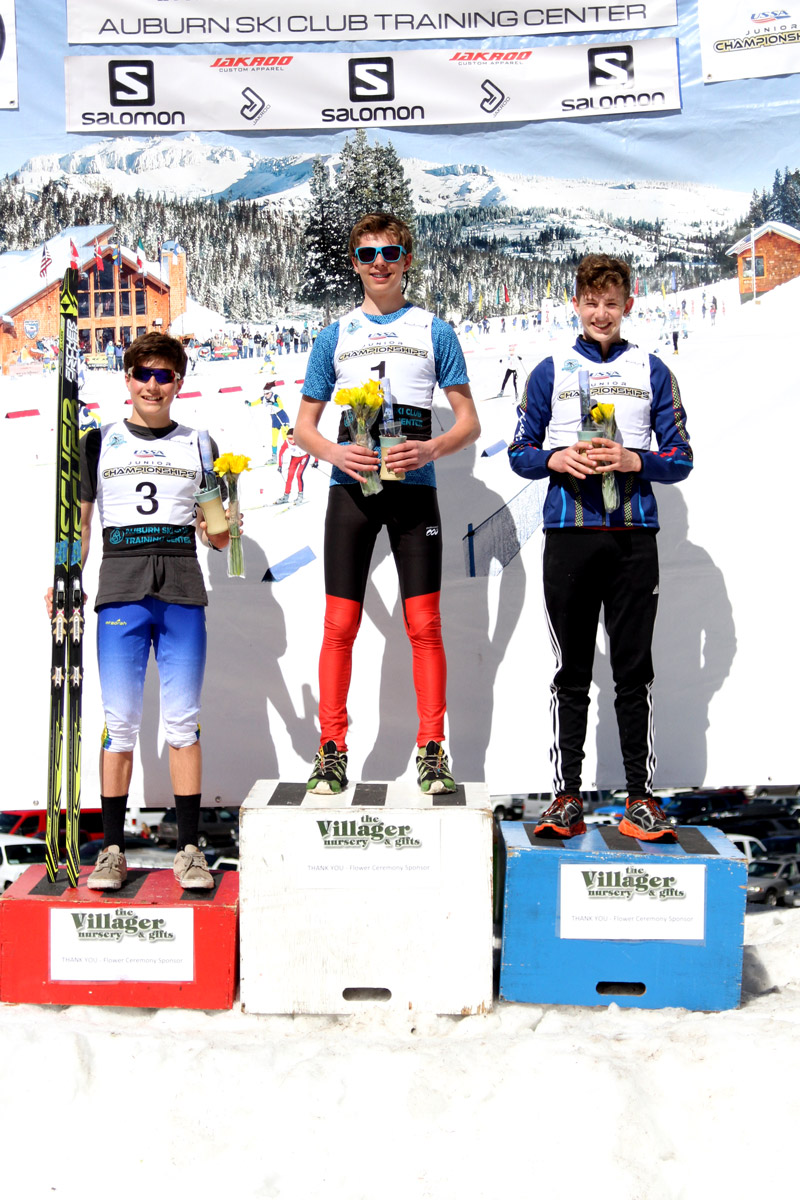
The U16 men’s podium from the 5 k Classic Mass Start at 2015 U.S. Junior Nationals at Auburn Ski Club in Soda Springs, Californial. JC Schoonmaker took home third place. (Photo: Mark Nadell/MacBeth Graphics)
Early Validation in Soldier Hollow and Truckee
It wasn’t until he traveled outside his region that Schoonmaker realized how he measured up. On a Far West trip to Soldier Hollow—his first time racing beyond his local bubble—he surprised himself. “I think I got third in the first race… then I won the second one,” he recalls. “I didn’t even really know it was a big deal, but all the older kids on the trip were… really excited for me.” Their reaction revealed something he hadn’t yet recognized: that his potential extended well beyond his local podiums.
A similar revelation arrived at Junior Nationals in Truckee, where home snow became a proving ground. He had hoped to earn All-American status, although the early races had gone poorly. “All the first races didn’t really go super well,” he says. “I had high expectations.” Yet in the final individual race before the relay, he stepped onto the podium. “Somehow onto the podium and got third,” he says. “That gave me a bunch of confidence… really helped me.” It was not just affirmation but a directional sign. Skiing was becoming more than an activity. It was becoming a path.
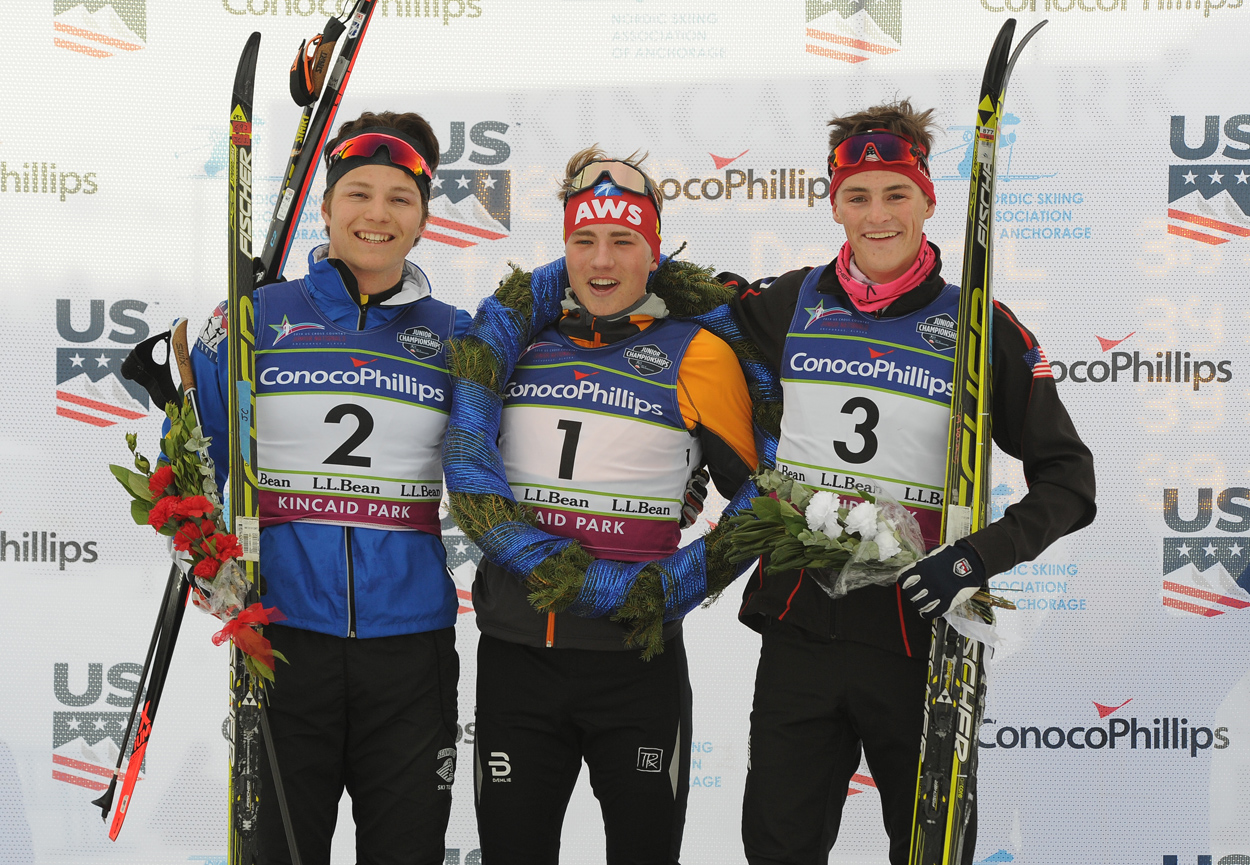
Gus Schumacher (Alaska Winter Stars/Team Alaska), center, won the U20 men’s 15K classic mass start race at the 2019 U.S. Ski & Snowboard Cross Country Junior National Championships at Kincaid Park. J.C. Schoonmaker (UAA-Auburn Ski Club/Far West), left, was second, followed by Cameron Wolfe (Ski and Snowboard Club Vail/Rocky Mountain), right. (Photo: Michael Dinneen)
Choosing Anchorage and the Power of the Right Environment
Despite his junior successes, Schoonmaker’s college recruiting process was sobering. His age cohort was stacked—Gus Schumacher, Luke Jager, Canyon Tobin—and their achievements overshadowed many strong skiers. “My top choice was UVM, and I just didn’t get a spot there,” he says. “I didn’t have a ton of options.” But an unexpected opportunity appeared when a Tahoe friend encouraged him to consider the University of Alaska Anchorage. He visited, and something clicked. “I’d say that’s the best decision I ever made,” he says. “I ended up coming to an excellent team… It’s an awesome place for skiing.”
Anchorage wasn’t glamorous, but it was grounding: clear air, big terrain, and a training culture built on consistency rather than spectacle. Under coach Trond Flagstad, Schoonmaker’s skiing matured—his engine, his technique, and his confidence—all while laying the foundation for a collaborative coaching story that would shape his rise.
A Uniquely Collaborative Coaching Path
Schoonmaker’s development is defined by the unusually harmonious network of coaches who supported him. In Tahoe, he trained with Will Sweetser, whose workout creativity brought nuance to his summer training. At UAA, Flagstad built his fall rhythm with threshold work and bounding. In the winter, U.S. Ski Team coaches—Matt Whitcomb, Kristen Bourne, and Chris Grover—stepped in with race-day craft and a national pipeline. And now, in Anchorage, he works with Eric Flora at APU, whose daily presence has brought structure and clarity.
“I feel like I didn’t even really have to do much in the way of balancing that,” he says. “Trond, Will, and Matt… kind of just took that on themselves.”
That kind of multi-coach collaboration is rare. Instead of conflicting philosophies, Schoonmaker received overlapping layers of expertise, each building on the others. He remembers one of Sweetser’s signature interval sets with particular fondness: “Twenty seconds L5… forty seconds rest… forty seconds L5… then six minutes of threshold. A cool blend… essential for getting you ready for doing sprints on the World Cup.” Flagstad brought heavy doses of fall bounding at L4. Whitcomb and Bourne added race sharpness. Flora, finally, aligned everything. “Having him at World Championships last year made it feel like just a practice in Anchorage,” Schoonmaker says.
JC Schoonmaker (bib #1) at the 2020 Senior Nationals in Houghton Michigan. (Photo: Reese Brown)
The Unexpected World Cup Start That Changed Everything
The first moment when Schoonmaker truly understood the trajectory he was on came suddenly. At U.S. Nationals in Houghton, Michigan, in 2020, he won the sprint qualifier. It was exciting, but he didn’t assume it meant anything beyond that day’s result. Then his assistant coach, Marine Dusser Bjornsen, approached him with unexpected news. “She was like, ‘Oh yeah, you’re gonna get World Cup starts from that,’” he recalls. “And I was like, ‘What? No way.’” His passport was expiring, his bags were unprepared, and within days, he was on a plane to Dresden.
Stepping into the World Cup for the first time felt surreal. “I wasn’t even really worried about those being my first World Cups,” he says. “I was mostly just hoping to get to go over there.” The qualifiers felt manageable; the heats were startling. “Racing against those dudes in the heats… was just a whole other level. A different beast.” Still, he never felt crushed by the moment. “We were just having fun,” he says. “It wasn’t crazy high expectations.” That experience didn’t instantly transform him, but it recalibrated his sense of where he belonged.
APU: A Training Collective That Became Home
When Schoonmaker finished college and committed to training full-time in Anchorage, it wasn’t only because of Flora’s coaching. It was because the environment felt like home. “Luke coming back… Gus joining… Zan and Michael… it was such a good team,” he says. “A lot played into it… but mostly that stuff.” APU is one of the few places in the country where the majority of the national team trains together throughout the year, creating a rare sense of continuity on the World Cup.
Yet even in a group that suits him so well, Schoonmaker knows he needs occasional solitude to stay balanced. “I definitely find times during the summer where I’m pretty excited to do an interval session by myself,” he says. “I grew up training alone in Tahoe.” Winter, of course, is different. “You’re living with this group of people for the entire winter,” he says. “Sometimes it is hard to find time to yourself.” But the team understands him. “Everyone knows whatever’s best for you is what’s best for the team.”
A New Kind of Training: Mindfulness and Sprint Awareness
This year, Schoonmaker added something he had never practiced formally: daily mindfulness training. “Some breath holds… super simple, just five minutes of mindfulness,” he says. “Focusing on my breath, trying not to let my thoughts wander.” The shift wasn’t driven by physical shortcomings, but by an honest assessment of where he needed to grow tactically. “In sprint heats… I’ve tended to have my head down, thinking about my technique… rather than, ‘I need to get this position around this corner.’”
Mindfulness gave him a way to sharpen his presence during races and training. During intervals, he began noticing moments when his focus drifted. “My mind starts thinking about what I’m gonna have for lunch,” he admits. “I’m getting better at bringing myself back… loosen up, ski relaxed.” The work is subtle, internal, and mostly invisible, yet deeply connected to the kind of racer he wants to become.
Passing It On: What He’d Tell the Next Generation
If Schoonmaker were speaking to a group of juniors in Tahoe today, he would know exactly what he would emphasize. “I love this puzzle of trying to get better every day,” he says. “Focus on the small things you can control… let the cards fall where they fall.” But he would also add a piece of training wisdom gained from experience. “I almost feel like I got a little too caught up in L1 and L3,” he says. “Walking up hills on classic skis isn’t getting you better at classic skiing. You have to ski fast to get better at skiing fast.” It is the kind of message that cuts through both trends and dogma.
Life on the Road: Davos, Oslo, and a Simpler Suitcase
Schoonmaker’s favorite destinations reflect a balance of beauty and familiarity. Davos stands out. “I’d love to go there when I’m not getting ready for the Tour de Ski… explore it a little more,” he says. He also holds a soft spot for Oslo. “That’s a special spot. I always feel like I’m having a really good time there.” On race mornings, he keeps things simple: “Probably a couple eggs and a few pieces of toast with jam.” And he no longer travels with the heaviest item from his early career. “I brought over an Xbox… took up, like, 12 pounds in my bag,” he laughs.
Schoonmaker and girlfriend, Emma Ribom (SWE). (Photo: Courtesy Photo)
Olympic Season: Ambition, Clarity, and the Calm Before the Heats
Despite the stakes of the Olympic year, Schoonmaker hasn’t reinvented his approach. “I honestly haven’t been doing anything different,” he says. “I’m more excited to be healthy and head into Period 1 feeling good.” But his goals are not small. “My goals would be to win a medal,” he says. “That’s what I’m shooting for.” A chance to race the relay again is just as meaningful. “The relay in Trondheim was super fun,” he says. “I would love to get another chance.”
As for the individual sprint, his ambition is both grounded and bold. “If I could make the final… that would be a solid day,” he says. “But I do feel like I can win a medal.” Few athletes can express that kind of aim with such composure. Schoonmaker delivers it as calmly as if he were describing a morning ski.
JC Schoonmaker (USA) had a breakout day in Oestersund (SWE) in 2023, reaching the podium for the first time. The American took third place. (Photo: NordicFocus)
Where He Stands Now
What stands out most about Schoonmaker at this moment is not bravado, but clarity. He is no longer the boy who raced for raffle prizes, nor the college skier unsure of his place, nor the rookie dragging an Xbox through European airports. He has become something steadier, more self-aware, and more intentional. A sprinter with composure. An athlete with perspective. A competitor capable of holding his ambition lightly without losing its sharpness.
Presence, for Schoonmaker, is not stillness. It is an ongoing process of tuning himself to the shifting rhythms of a sprint heat, listening to what his mind and body are telling him, and moving through the season with intention rather than urgency. If he keeps his head up—literally and figuratively—this may be the season when the skiing world begins to see not only what he has built, but why it was built this way.
Love Stories Like This? Help Keep Them Coming.
Feature interviews like this one take time, access, and care to produce. If you value thoughtful storytelling and independent ski journalism, please consider becoming a Voluntary Subscriber. Your support directly fuels the work we do to cover the people, places, and moments that make our sport special.
On a late-October morning, Julia Kern sat in San Diego, sunlight spilling through the window after cradling her infant nephew. “He’s a cutie for sure,” she laughed. In a few short weeks, she’ll trade baby giggles for the squeak of ski pole baskets on the cold Finnish snow, but the warmth in her voice already says a lot about where she is mentally this Olympic year: grounded, grateful, and still having fun.
“It’s been a really good lead-up this year,” Kern said. “I’ve been able to stay healthy. I’ve done a lot of physical therapy on my back from my injury last year, and that’s finally going well. So being able to link consistent training together without major disruptions has been the biggest difference this year. That makes me really excited to see what will happen this season.”
Cycling gives Julia Kern a place to turn her mental rhythm and flow into motion. (Courtesy Photo)
The Year of Steady Rhythm
After an injury-plagued 2024 season, Kern’s return to full health has been both physical and psychological. She’s worked closely with physical therapist Brie Beckwith and coaches Kristen Bourne and Colin Rogers to rebuild her movement patterns and ski technique. “A lot of what I’m doing from my back rehab is retraining movement patterns—learning to actually use my glutes, push through the right way, fully transfer weight,” she explained. “Part of it is having less pain, which lets me move more fluidly. But it’s also about translating that from the gym to skiing.”
For the first time, she spent a full three-week training block with Bourne in New Zealand, where daily feedback deepened their connection. “That was really cool because I’ve never had that before,” Kern said. “It’s one thing to text once a week; it’s another to work together every single day. We built a real rhythm.”
That word—rhythm—is perhaps the throughline of Kern’s 2025 Olympic campaign. Rhythm in training, in recovery, in how she manages a long World Cup season without burning out. Her “don’t reinvent the wheel” approach to the Olympic year reflects a maturity hard-won through injury and experience. “You do what’s working well,” she said. “Changing things is always a risk.”
Jessie Diggins and Julia Kern flank their US Ski Team coaches Jason Cork (kneeling) and Kristen Bourne (standing) at their annual on-snow training camp in New Zealand. (Courtesy Photo)
Learning the Language of the Body
If Kern’s early career was marked by her ability to push, her recent evolution is defined by knowing when to pull back. “Recovery is a big one,” she said. “Not just lying in bed—but mental recovery, physical therapy, fueling, hydration. As I get older, I spend more time on that. I’ve learned what works and what doesn’t, and how to read cues—whether I’m ‘good tired‘ or ‘bad tired.’“
Her typical week includes two or three intensity sessions, distance training, and strength work, but with flexibility to fit around life: weddings, visits home, mountain-bike trips. “Working around the life schedule is what makes it rewarding,“ she said. “You’re excited to go do it, and you also feel like you can do all those fun life things too.”
That balance shows in how she approaches her mental game. Kern has worked with the same sports psychologist for over five years, meeting weekly or monthly. Together, they’ve developed what she calls a “good energy“ framework: a way to make decisions rooted in joy rather than obligation. “It doesn’t mean bouncing off the walls,“ she explained. “It means asking: What makes me feel good in skiing? If I’m dreading something because I’m missing an important life event, that probably isn’t bringing me good energy. So I make decisions based on that.”
Patience, she says, has been her greatest teacher. “Everyone has their bumps in the road,“ she said. “Taking those as learning experiences rather than failures is huge. Setbacks force you to approach things differently, and you can actually learn a lot about yourself that way.”
Spending time being active and relaxing with friends and family is a cornerstone to Julia Kern’s success. (Courtesy Photo)
A Culture of Team First
If there’s a single quality that defines Kern, according to U.S. Ski Team Head Coach Matt Whitcomb, it’s her blend of positivity and perseverance. “She’s had a hard road,“ Whitcomb said. “Even as a junior, she battled compartment syndrome, mono, back troubles, shoulder troubles, nerve issues—you name it. That would defeat most athletes. But despite it all, Julia goes on to win World Cup and World Championship podiums.”
Whitcomb sees her as both a survivor and a student. “She had incredible leaders to follow—Sophie, Liz, Kikkan, Sadie—and she was always listening, always learning,“ he said. “Julia’s a scholar. Her parents are scholars, her sister’s a scholar. She comes from a learning family. And now she’s the sum of all those experiences. She reminds me so much of Kikkan Randall—so driven individually, but without a team to celebrate it with, she’d quit skiing. Julia’s the same way: such a team-oriented person.”
That team ethos is something Kern now passes along to younger teammates, such as Kate Oldham. “I really appreciated when older athletes just showed by doing,“ Kern said. “Now I try to do the same. When we do race prep, anyone who wants can join. Like at World Champs—Kate, Jessie, Rosie, and I practiced that final corner together. It was so slushy and tricky, and Kate ended up being the best one out of all of us. So we said, ‘Okay, we’re learning from her here.‘ Everyone has value on this team.”
It’s a culture built not on hierarchy, but on collaboration—crafting beaded bracelets during camps, sharing meals, and creating ways to connect off the snow. “It’s easy to be isolated in hotel rooms,“ Kern said. “We make time for activities that bring us together. Everyone brings something.”
The American women celebrate after United States I – Rosie Brennan and Julia Kern – finished 3rd in a Team Sprint in 2023. (Photo: Nordic Focus).
Learning from Leaders, Leading by Example
When asked what she’s learned from her longtime teammates Rosie Brennan and Jessie Diggins, Kern doesn’t hesitate. “Rosie’s been such a great example of someone who’s had more adversity than maybe anyone I know and still shows up for the team,“ Kern said. “When I was first named to the team and had compartment-syndrome surgery, Rosie—who I didn’t even know—emailed me. She told me it would be tough but that I’d get through it. That stuck with me.”
From Diggins, Kern learned the art of curiosity. “Jessie never goes around thinking, ‘I’m the fastest in the world, I know everything,‘” she said. “She’s always got a growth mindset—always wanting to follow someone, to learn something. That’s really rare for someone at the top.”
Whitcomb has noticed the same instinct. “Julia’s evolved from someone who needed guidance into someone others now look to,“ he said. “She embodies that positive feedback loop of mentorship that defines this team.”
Mental Toughness in the Grind
On the World Cup circuit, there’s little room for reflection. Races pile up; travel blurs weeks together. Kern’s approach to a long season is both pragmatic and optimistic. “I love to race,“ she said. “The World Cup is part of the bigger plan. Early season, we’re still training on the road. You’re not trying to peak at Ruka. It’s about understanding where you are in the load of the season.”
She deliberately builds in breaks—two weeks at home after the Tour de Ski, Christmas with her boyfriend, family visiting during the Olympics. “Those resets make all the difference,“ she said. “They help you stay excited.”
You’re probably already following Kern on Instagram, but if you aren’t, you are missing out on a lot of delicious food inspiration. Cooking has become another activity for her to recover and connect with her friends and family. (Courtesy Photo)
Her outcome goals are clear: make sprint finals consistently, push into the top-10 in distance races, and—if everything lines up—fight for a team-sprint medal at the Olympics. “That’s what I think about during hard intervals,“ she admitted. “The team sprint is a big goal of mine.”
But Kern’s definition of success extends well beyond medals. “A successful season for me,“ she said, “is staying healthy, enjoying the process, and feeling good about how I carried myself. Pressure is a privilege. I want to soak up the experience and make it fun again.”
Beyond the Podium
For Kern, the sport’s meaning has broadened. As an athlete representative to FIS and an advocate with Protect Our Winters, she’s become a voice for climate responsibility and athlete well-being. During the 2025 World Championships, when environmental protests threatened to disrupt races, Kern helped mediate between activists and organizers. “We agreed that protesting during the race wasn’t the way to send a strong message,“ she said. “Now we have an open dialogue. These things take time, but they’re moving.”
Her motivation, she said, “is less about results and more about impact.“ She wants younger athletes to know that skiing fast can be both a platform and a privilege. “I feel grateful that I had such an active childhood and want that for the next generation,“ she said. “Clean air affects everyone. Being outside isn’t something we can take for granted anymore.”
Using her success as a platform to make a lasting impact on children has become a priority for Kern. (Courtesy Photo)
The Joy of Motion
Talk to Kern for long enough, and you realize skiing is just one part of her athletic identity. She’s an all-around mover—mountain biking, surfing, beach volleyball. “I’ve always loved doing every sport imaginable,“ she said. “Even as a kid, I just wanted to move. There’s so much value in being active and having fun. You don’t have to specialize too early. Playing lots of sports keeps it fresh and helps you avoid burnout.”
Cooking has become her creative outlet. “My boyfriend and I love to cook together,“ she said. “We have a CSA, so we get creative with whatever veggies we have. It’s like art—making the food look pretty, connecting with what we eat. It’s a kind of recovery, too.”
From the Gym to the World Stage
Whitcomb sees this blend of drive and joy as Kern’s secret strength. “Julia’s positivity isn’t surface-level,“ he said. “It’s a choice she makes every day despite setbacks. That’s what makes her such an anchor on this team.”
For her part, Kern sees the season ahead not as a culmination, but as another chapter in a long-term process. “Fourteen-year-old me would be surprised I’m still ski racing,“ she said, laughing. “Back then, I thought junior nationals were the pinnacle. I didn’t even know what the World Cup was. I think she’d be proud that I’m still doing this—and still having fun with it.”
Enjoyment is what keeps Kern chasing perfect rhythm through the snow, trusting that good energy leads to good skiing, and that joy and excellence can, in fact, coexist.
Kern seems fully ready to send it this season. (Courtesy Photo)
Love Stories Like This? Help Keep Them Coming.
Feature interviews like this one take time, access, and care to produce. If you value thoughtful storytelling and independent ski journalism, please consider becoming a Voluntary Subscriber. Your support directly fuels the work we do to cover the people, places, and moments that make our sport special.
This coverage is made possible through the generous support of Marty and Kathy Hall and A Hall Mark of Excellence Award. To learn more about A Hall Mark of Excellence Award, or to learn how you can support FasterSkier’s coverage, please contact info@fasterskier.com.
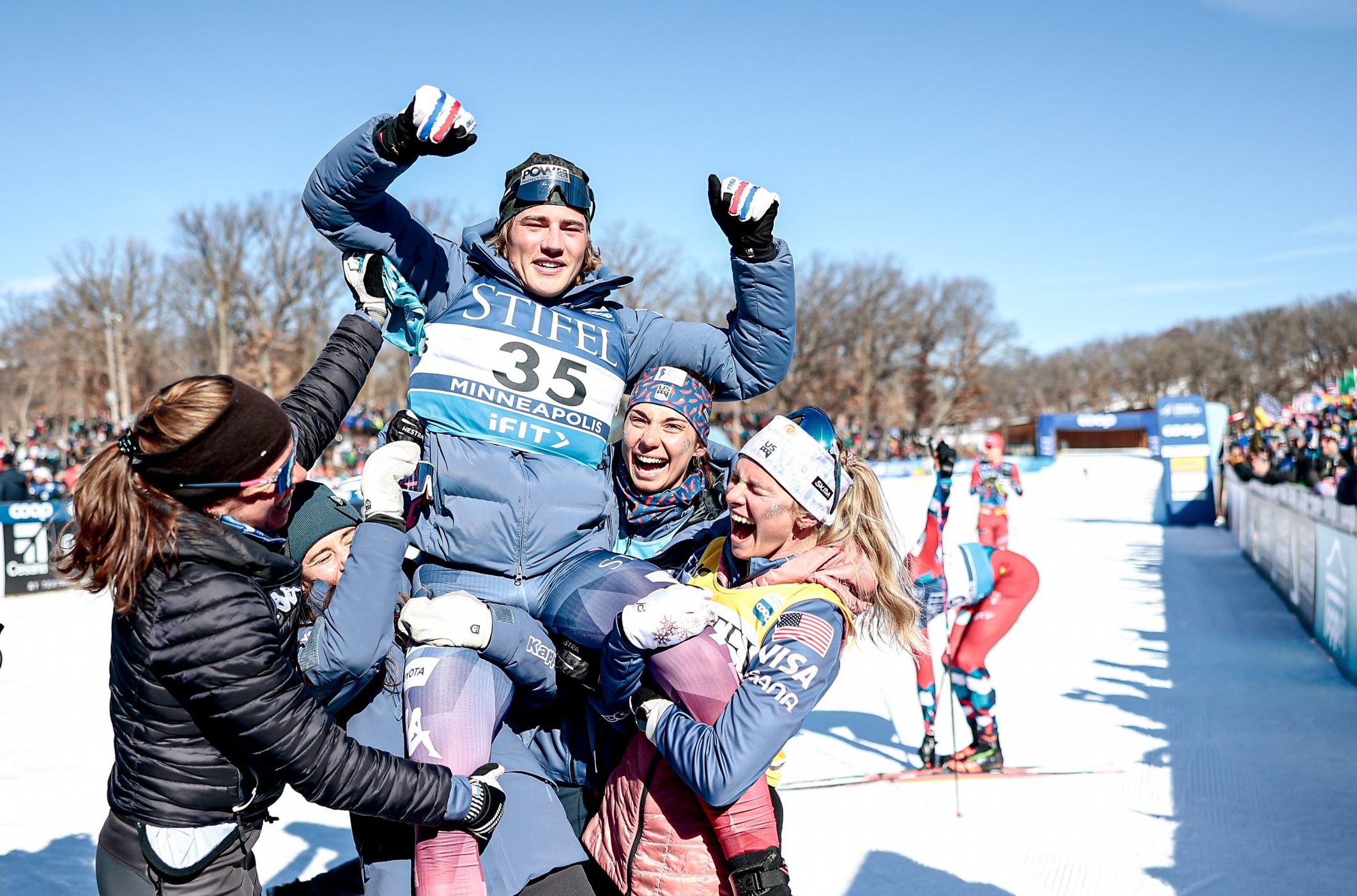
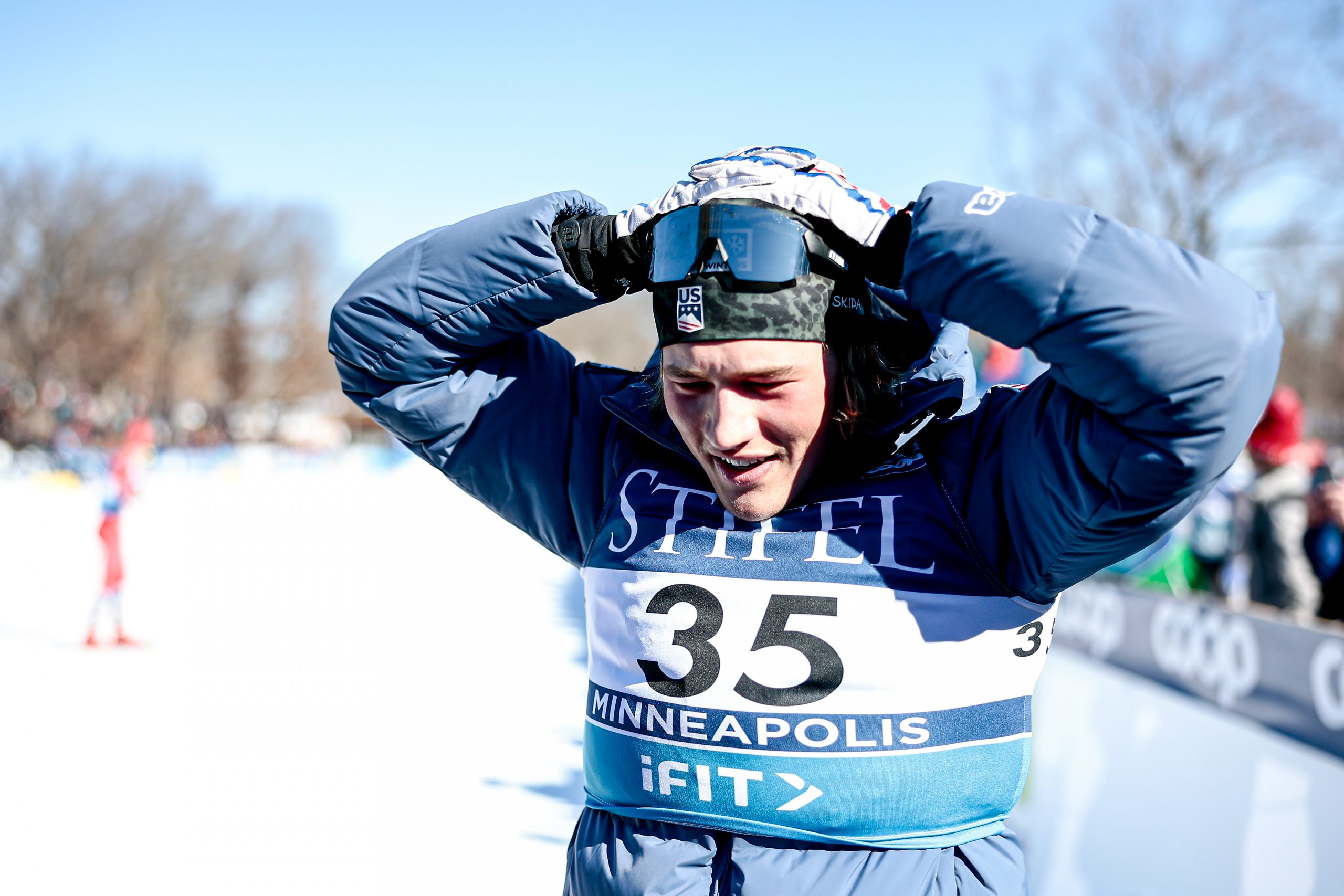
U.S. Ski Team members, including Jessie Diggins, right, hoist Gus Schumacher on their shoulders after he won a World Cup race in Minnesota on Sunday. (Photo: Modica/Nordic Focus)
MINNEAPOLIS — Gus Schumacher, a 23-year-old from Anchorage, accomplished something Sunday that no American man had done in 40 years: he beat every single Norwegian, Swede, Finn and all other comers in an international cross-country skiing distance race.
The result was a star-is-born moment achieved before thousands of screaming fans in Minneapolis. Inn some ways, it felt almost scripted. Schumacher’s abundant potential has been making headlines since he was 13 years old, back when his coach joked that the teenager weighed less than his dog. But Schumacher’s route to the top has not been straight. And just below the surface, there’s another strand in the arc of his career that shows why Sunday’s result moved him, and his teammates, to tears.
Just two seasons ago, Schumacher went through a wrenching season—and a nightmarish Olympic Games in Beijing—where instead of fighting for medals, he was grasping for explanations for why his body was failing him. In one race, he finished nine minutes behind the winner. Afterward, Schumacher regrouped, adjusted his training and brought in new coaches—producing an abrupt turnaround and a validation that the talent that put him on the cross-country skiing map is still there.
“It was always in my mind that if I did the right things, it’s still in there—it doesn’t go away,” Schumacher told reporters Sunday. He added: “I’ve made some training mistakes, I think, in the last couple of years, but kept loving the sport and wanting to do it. And just kept showing up and kind of figured out what I was doing wrong.”
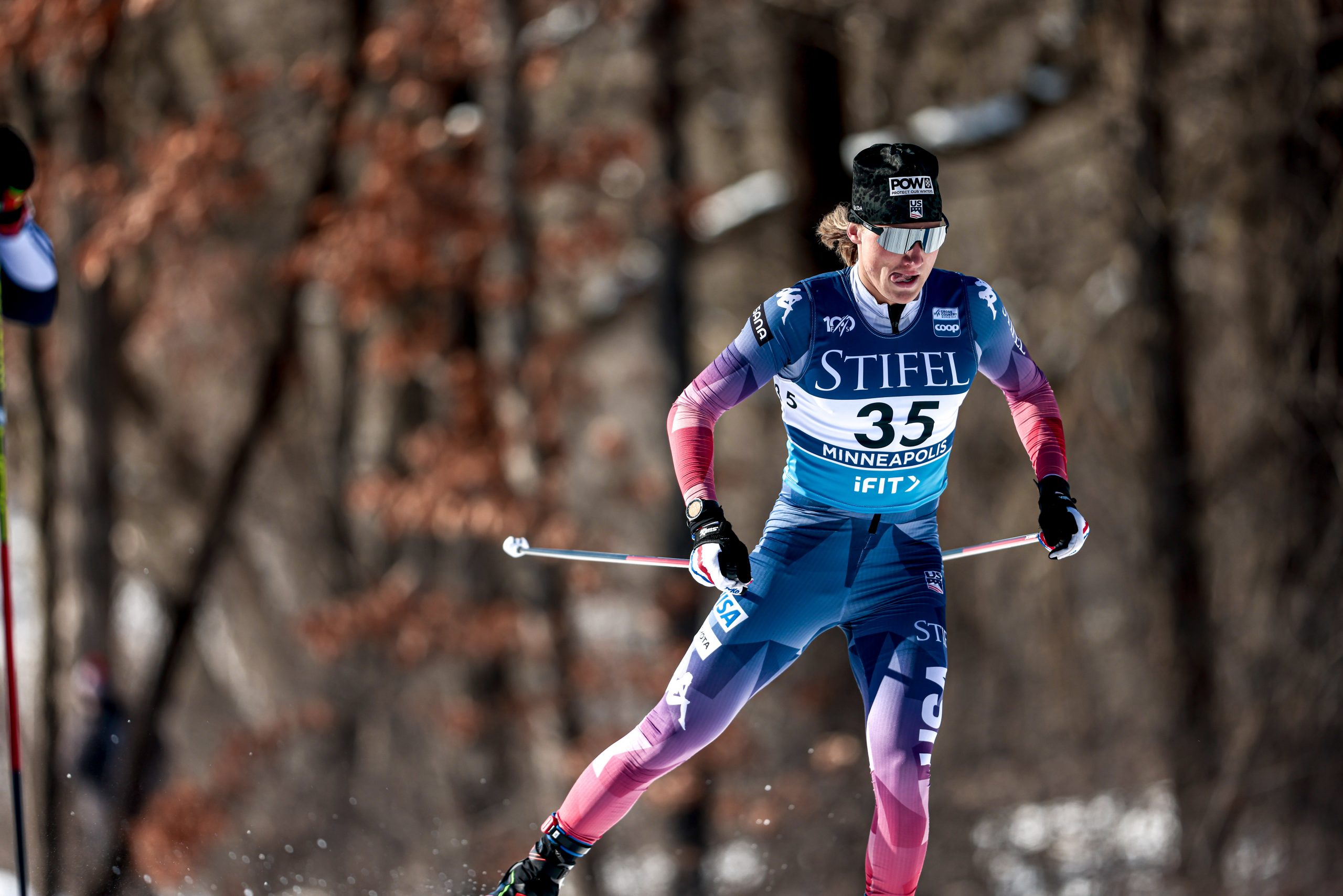
Gus Schumacher races Sunday. (Photo: Modica/Nordic Focus)
Schumacher’s result in Minneapolis—on the World Cup circuit’s first stop in the U.S. in two decades—will serve as inspiration to the hundreds of young, aspiring Olympians who lined the city’s trails Sunday. But it also resonated for his teammates, many of whom endure similar ups and downs themselves.
That includes Julia Kern, a 26-year-old American Olympian who said she was trying to channel Schumacher as she warmed up for her own race Sunday, after his win. Kern won a World Championships medal last year, but has been struggling this season.
“Warming up, I was just thinking about how I want to ski like Gus,” Kern said. “It gave me confidence. I’ve had a tough year. And I was thinking back to his Olympic year.”
Schumacher, who grew up training with the Alaska Winter Stars program in Anchorage, first announced himself as a once-in-a-generation talent four years ago. That was when, at the age of 19, he won a gold medal at the World Junior Championships in a 10-kilometer race—the same distance as Sunday’s event.
But after he graduated to the top-level World Cup circuit, Schumacher started struggling with his training formula, only sporadically translating his big junior performances into good results on the adult circuit. In his toughest moments, like at the 2022 Olympics, he was struggling to understand the “weird” feelings in his body.
“That’s tough, to not feel like myself, and not knowing when it’s going to come back,” he said at the time.
In retrospect, Schumacher and his coaches have made a relatively straightforward diagnosis: he was training, simply, too much. That’s a common mistake for early-career cross-country skiers, since the sport generally rewards hard work and the limits to training can often only be found through trial and error.
Jessie Diggins, 32—the superstar American skier from Minnesota who owns three Olympic medals—went through a similar process of self-discovery earlier in her career, said Chris Grover, one of the U.S. Ski Team’s lead coaches.
“She just wanted to train, train, train. And at one point, she was getting diminishing returns,” Grover said after Sunday’s race. “Gus is starting to figure that out, starting to figure out his body at this level.”
Since that tough Olympic year, Schumacher has made some changes. He’s now moved to the Alaska Pacific University training program, which includes several other members of the U.S. World Cup team and a renowned coach, Erik Flora.
He’s also been getting advice from one of the U.S. team’s coaches, Kristen Bourne, who described Schumacher’s experience over the past few years as a natural part of the sport.
“When we’re having those hard times, absolutely, you do learn from them and become better,” she said. “We’re trying to figure out the individual jigsaw puzzle that is each athlete.”
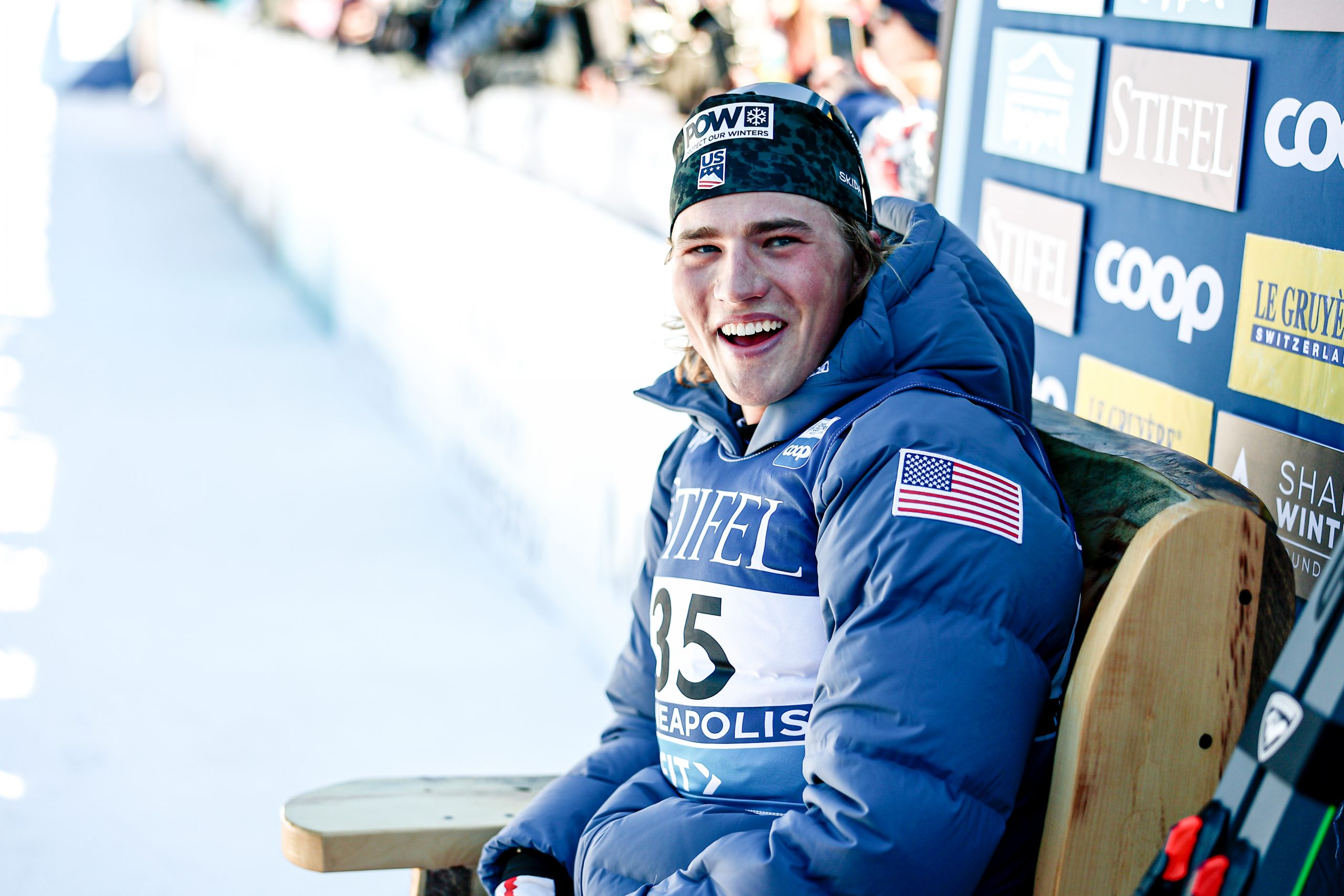
Gus Schumacher sits at the finish line Sunday. (Photo: Modica/Nordic Focus)
The changes clearly seem to be helping Schumacher, who already notched several eye-catching results earlier this season, including fourth place at a World Cup race last month.
What’s excited his coaches, teammates and boosters is how Schumacher already appears to be absorbing some of the important lessons about training and racing in a career that’s only just starting.
“I’m sure I’ll make some more mistakes,” he said Sunday. “But hopefully less from here on out.”
Schumacher’s perseverance was rewarded with an experience of a lifetime Sunday.
He was an early starter in the race, held in a time trial format that sends athletes on to the course one at a time.
Schumacher had the fastest pace when he crossed the finish line. But he knew that a whole pack of Olympic medalists was behind him, and was likely to better his time.
But as he waited at the finish, with a growing pack of teammates and supporters, none of his rivals could catch him.
Gus Schumacher learning that he’d won Sunday’s World Cup race. (Photo: Modica/Nordic Focus)
“They started finishing, and I was like, ‘Oh my God—I might get a podium,’” Schumacher said.
First William Poromaa, a top Swedish talent, crossed the line eight seconds behind Schumacher. Then came Norwegian Harald Ostberg Amundsen, the leader of the overall World Cup standings, four seconds slower, and Johannes Hoesflot Klaebo, another Norwegian, who has five Olympic gold medals to his name: six-and-a-half seconds back.
Teammate Luke Jager, among those gathered with Schumacher in the finish, “was like, ‘You’re going to fucking win this thing.’ And I was just, like, ‘Oh my God. I might actually win this race,’’” Schumacher said. “And then it happened.”
His teammates hoisted him onto their shoulders as the huge crowd that had gathered for the Minneapolis race roared, and later erupted in a chant: “Gus! Gus! Gus!” Afterward, Schumacher posed on the podium with 20 teammates and support staff, then took a celebratory jog, dispensing high fives to fans in the grandstand.
His whole family—father, mother, siblings and girlfriend—was there to watch it happen.
“The happy thing for me is that this has the potential to be a normal length career. And it feels like he’s maybe discovered the secret sauce now,” said Greg Schumacher, his father. “He’s done what he could to get here. And so it’s nice for him to have a day where it worked.”
The electric atmosphere after Schumacher’s win Sunday spread even to his competitors—the two Norwegians who shared the podium with Schumacher couldn’t hold back their smiles when he climbed up to the top step for an awards ceremony. A star French athlete, Lucas Chanavat, stood in the crowd, filming the scene.
“It was insane. It was so cool. It gave me goosebumps,” Chanavat said. “This is cross-country skiing.”
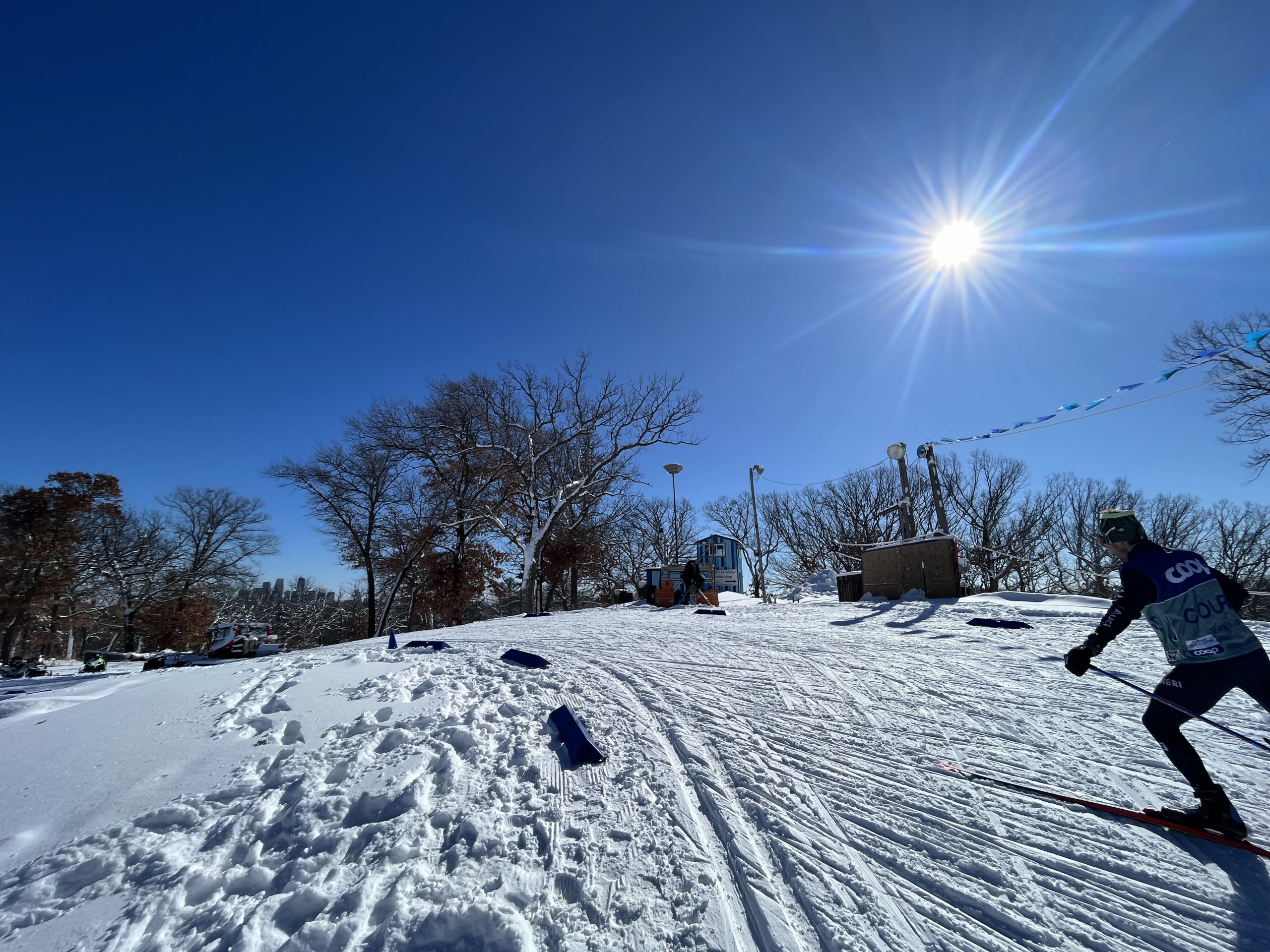
A World Cup team member skis across the top of the course Thursday at Theodore Wirth park in Minneapolis. The city skyline is between the trees on the left. (Nathaniel Herz/FasterSkier)
MINNEAPOLIS — All winter, cross-country ski race organizers in this midwest metropolis faced weather that just wouldn’t cooperate.
Heading into the weekend, it had not snowed in Minneapolis in nearly a month, with daily high temperatures above freezing every single day since late January.
All this as a local nonprofit, the Loppet Foundation, was set to host the first cross-country World Cup events in America in more than two decades — after a last-minute, coronavirus induced cancelation in 2020.
The World Cup circuit is the sport’s highest level of racing, and it’s contested almost exclusively in Europe.
The Minneapolis organizers had borrowed snowmaking equipment from neighboring ski areas and made enough during a ten-day cold snap to stretch a strip of white through an otherwise barren municipal golf course.
But athletes, fans and volunteers were girding for a decidedly non-wintry atmosphere for the two days of racing this weekend.
Until Wednesday. That’s when a fast-moving storm dumped some six inches on the city — nearly double the entire winter’s snowfall at its airport—and transformed Minneapolis back into a winter wonderland on the same day that the Olympic-level World Cup athletes arrived for the sold-out events.
Claire Wilson, the Loppet Foundation’s executive director, described the storm as a “magic snowfall.”
But, she said, “We were ready to do this yesterday, when it was a ribbon of snow on brown ground.”
Across the board, World Cup racers—most of whom arrived in Minneapolis on Wednesday from the Canadian Rockies — said they were delighted to find fresh snow and engaging skiing at Theodore Wirth Regional Park.
“Exquisite,” “city skiing at its finest” and “American dream”—replete with an eagle and stars and stripes emoji—were among the reactions that athletes posted on social media after their first laps at Wirth.
A screenshot of an Instagram post Thursday, February 15, 2024 from French skier Hugo Lapalus.
“I think it’s really pretty here,” Lena Keck, a 23-year old German, said as she left the trails Thursday. And, she said, “it’s a really tough course,” which was not what she and her teammates anticipated.
“Everyone’s surprised,” said Chris Grover, a longtime U.S. World Cup team coach. “I think they heard ‘golf course’ and thought, like, Boca Raton or something.”
The 3.3-kilometer loop that athletes will ski three times in Sunday’s distance race winds through trees and open sections in rolling terrain, with views of downtown skyscrapers from the course’s high points.
Scott Patterson, the veteran American who excels on difficult courses, said he did a harder training session Thursday and found the loop to be unexpectedly grueling, mainly because of the new snow slowing his skis down.
“It’s kind of slow on the downhills, and you have to work all the way down—so it feels like you hit the bottom of the next hill and you really haven’t recovered much,” he said. “It felt hard, for sure.”
Patterson and several other Americans skied Thursday in newly printed “fan club” bibs featuring the faces of the team’s coaches and ski waxing support staff—their own twist on bibs that U.S. supporters sold printed with athletes’ faces to raise money for the team.
American skier Scott Patterson, photographed Thursday, February 15, 2024 in Minneapolis, models a new bib featuring the faces of U.S. coaches and support staff. (Nathaniel Herz/FasterSkier)
The celebratory atmosphere spread across the park Thursday, with eager volunteers—some 700 total will help this weekend—fanning out to unload pallets of food and drinks, tweak course fencing and manage traffic.
Organizers have distributed some 30,000 tickets, with many fans eager to see Jessie Diggins, the Olympic gold medalist and U.S. superstar who leads the women’s overall World Cup standings this year.
Diggins grew up in Afton, a half-hour east of Minneapolis, and returned to the U.S. this week for the first time since she left for Europe in the fall.
Her home is a little too far out of town, and too full of visiting family members, for her to stay there this week. But, she told reporters earlier this week, at least she’ll be reunited with her husband at the World Cup race hotel.
The kind of attention that Diggins is receiving for the hometown events, she said, is not quite the same type as at major championships like the Olympics. But particularly given her lead in the World Cup standings, she added, the weekend “comes with its own different, special kind of pressure that feels about as big.”
“My goal is to enjoy it and hopefully not be so overwhelmed that I can’t be present,” she said. “It will be a delicate balance, for sure, but one that I’m going to try to achieve.”
Jessie Diggins races in Canada last week. (Federico Modica/Nordic Focus)
The rest of the American athletes—even the ones who aren’t from Minnesota—also seem to be soaking in the excitement around what still feels like a home event.
“The whole way here, on the plane, on the bus, people have heard that tickets have sold out, they sold out really fast,” said Kristen Bourne, another U.S. coach. “People have been looking forward to this, from all different countries, for a really long time. So, I think the stoke is insanely high.”
Keck, the German racer, said that the trip to the United States is the first of her life—and the setting has definitely made an impression.
“Everything is so much bigger than in Europe,” said Keck. “The houses, the cars, the trucks, also the landscape—it’s so much wider.”
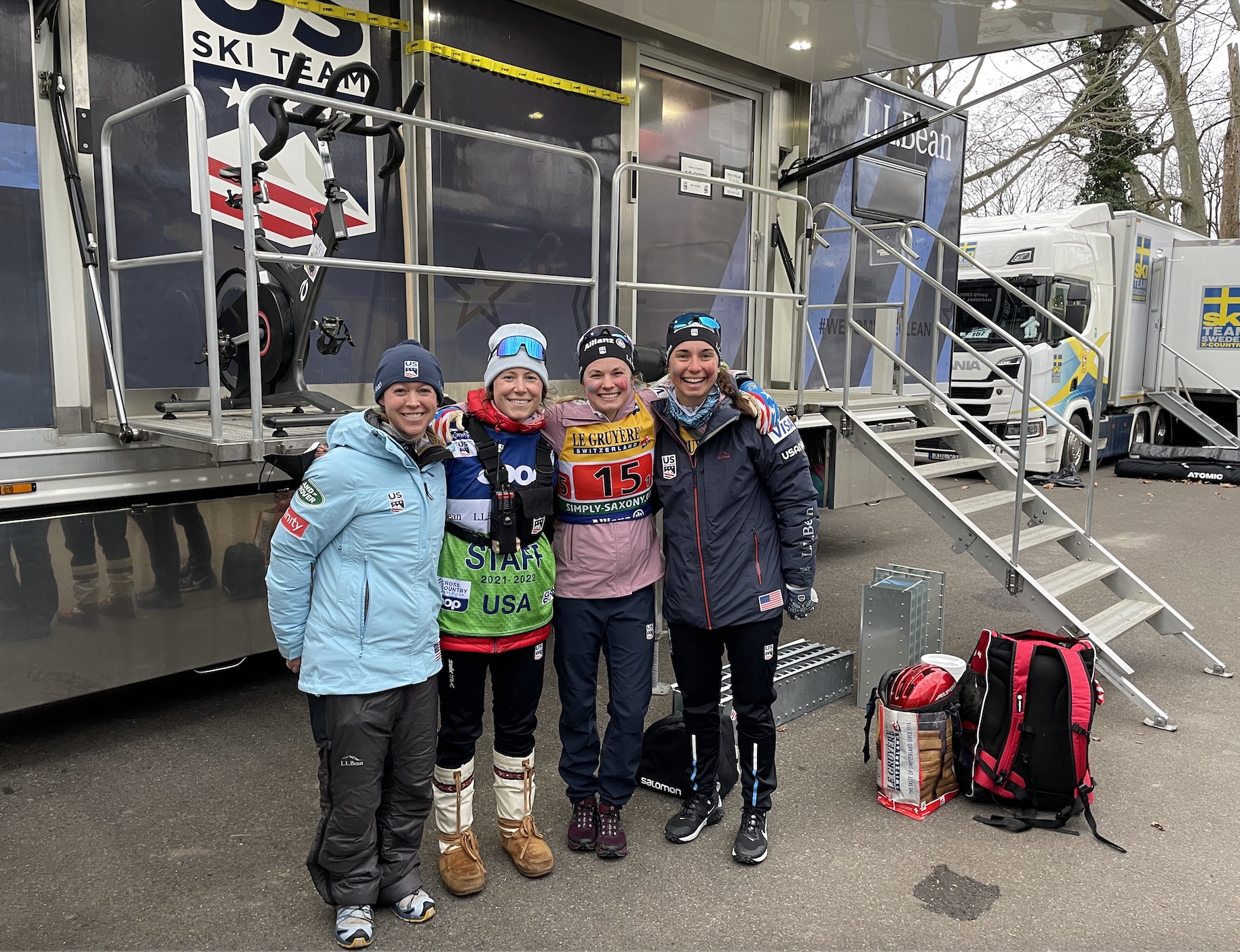
Physical therapist Ana Robinson, Kristen Bourne, Jessie Diggins, and Julia Kern (left to right), at the Dresden World Cup in December 2021. (Courtesy photo)
Applications are open until August 31st, interested women coaches are encouraged to applyhere. Trail to Gold: the journey of 53 Women Skiersis available here.
Moving from idea to action for the women involved in the Trail to Gold book turned out to be expedited thanks to an existing template for not only what they wanted their Fellowship to look like, but what they wanted that Fellowship to accomplish. That case study; U.S. Ski Team Development coach Kristen Bourne.
The story of how Bourne joined the U.S. Ski Team coaching staff is a parable for how success in the sport of nordic skiing should come. In which an extraordinarily talented young coach was paired with supportive institutional structures, relationships, and yes, a little luck here and there, to find her way through the U.S. ski coaching system. It’s also remarkable that Bourne’s whole narrative fits the space of a short story rather than a novel. After a decorated junior and college skiing career at Northern Michigan University (NMU), Kristen Bourne did a stint post-grad skiing that culminated in one last Senior Nationals in Houghton, Michigan in 2020. In an instance where metaphorical resonance became something literal, as Bourne was walking away from her athletic career, College of St. Scholastica (CSS) Head Coach Maria Stuber pulled up in the parking lot and – Midwesterner to Midwesterner – let out a big ol’ “OH Hey there!” which quickly led to a discussion about Bourne coaching, and then, a position as Assistant coach for St. Scholastica.
From there, it’s been an ongoing whirlwind. Stuber is the founder and leader of the Women Ski Coaches’ Association, founded in 2019 to “develop, retain, and advance women in ski coaching leadership.”Stuber and Bourne worked through existing NCAA coaching development programs, which saw Bourne win theWomen Sport’s Foundation Tara VanDerveer Fellowship in 2021, a first for a nordic skiing coach. Bourne’s Fellowship partially helped fund her position at St. Scholastica, but also came with an additional stipend to utilize for professional development in other organizations.
Stuber reached out to U.S. Ski Team coaches Matt Whitcomb and Chris Grover to see if there would be any opportunity to work with U.S. Ski & Snowboard. That turned into a two-week internship on the World Cup that saw Bourne wax teching and coaching at last year’sDavos andDresden World Cups. In turn, Bourne received additional offers to work with U.S. athletes making World Cup starts later in the season, all of which culminated in her hiring as a U.S. Ski Team Development Coach earlier this year. To sum it all up, as Bourne did a couple of times when I interviewed her, it’s been a “whirlwind.” Which, to keep to her own metaphor, is a wind that has turned up inspiration among coaches, athletes, and administrators across U.S. Skiing to bring the type of program that put Kristen Bourne in contact with the U.S. Ski Team into the fold of the nordic community. And now, with the Trail to Gold Fellowship, that’s become a reality.
The energy that’s been infused into making that opportunity a reality is still overflowing at the source. When I caught up with Bourne about the experiences that have made up her journey, she was at the end of a long day working with members of the U.S. Ski Team as they prepared for racing inTorsby, Sweden and atToppidrettsveka in Trondheim, Norway. She brought the same thoughtfulness to our conversation about what formed her approach to coaching as had just gone into that night’s technique session (which happened to include guests Maja Dahlqvist and Frida Karlsson). We not only talked about her journey, but about her influences, mentors, and outlook as a women coach who, just through her own story, has been a leader in the movement to correct for the historic gender inequity in U.S. ski coaching.
Kristen Bourne at a CSS practice in Fall 2021 (Photo: Maria Stuber).
(This interview has been edited for length and clarity).
Ben Theyerl (BT): Can you start off by giving us a summary of your personal background? What was your journey to your current position with the US Ski Team?
Kristen Bourne (KB): I’m originally from the Twin Cities [in Minnesota]. I ended up going to Northern Michigan University (NMU)and skied for them for five years. Then, about three weeks after graduation, I packed up my bags and moved to Norway, where I lived for ayear and a half [ski racing]. There’s a funny story about that ending – I lost my permit in a friend’s car. I ended up coming back to race US Nationals in 2020, where I met Maria Stuber [Head Coach at the College of St. Scholastica in Duluth, MN]. At the time, I was thinking of calling it quits, and my dad had put out some emails to coaches to really try and pull me towards it. Maria had just started the Women’s Ski Coach Association (WSCA), and my dad had also gone out and signed myself and my sister up for a membership – so between emails and that he was really pulling.
We were literally in the parking lot when she pulled up and was like ‘I’ve heard about you, you’re going to get an email from me.’ That turned into ‘Do you want to coach with me?’ and she helped set me up with a summer internship coachingwith Pepa Miloucheva at the Craftsbury Green Racing Project. Summer of 2020, I started coaching at Craftsbury, and then I was one of Maria’s assistant coaches at St. Scholastica (CSS) for two years.
When I got to CSS, Maria and I applied for a grant with theWomen’s Sports Foundation – the Tara Vanderveer Advancement for Women in Coaching Fund Fellowship. We didn’t get it the first year (2020), and then we applied again, and we got it the second year (2021). That Fellowship partially funded my position at CSS, and then there was an extra $2,500 for professional development outside of that position – which was very broad. Maria nudged me to reach out to the U.S. Ski Team and see if they’d need any help for anything really, and as soon as we did Matt Whitcomb was like yes – ‘we actually could use more help for some World Cups.’ Which was unexpected but made me go, ‘woah.’ So, I went to Davos and Dresden last year.
Over there, I ended up wax teching for Caitlin Patterson, and learning a whole lot from the U.S. staff. Then I was back in the U.S. for the collegiate season and made one more trip back to the World Cup with Bill Harmeyer as his wax tach. That was actually a really cool moment, as he reached out because I had already had World Cup experience. So that little internship directly translated into another opportunity very quickly. Then two months later, Kate Johnson announced she was leaving her position as the U.S. D-Team coach, and I applied and now here I am. It’s a lot, but it’s been a whirlwind.
BT: And now you’re back in Scandinavia at the moment…
KB: Yeah, it’s super full circle now because this is my first time back in Scandinavia since I left and lost my permit. The camp we’re at right now was one of the first ones of a few I had when I was living over in Norway, so it’s definitely a cool thing to be back as a coach this time.
BT:That’s a really great story in itself. If I can dig a little deeper into your background, what was your earliest inclination that you might want to coach? Was this something you thought about when you were younger? Or was it really just when you were stuck trying to negotiate the next step after being a ski racer?
KB: I think I always paid attention to people who were like, ‘you should try coaching.’ But I was kind of stubborn in saying that I was going to do something different after skiing. I guess I kept pushing off that idea in my head, but sporadically when I would help out coaching when I was an athlete, I always really loved it. But I guess, it’s one of those things I guess you don’t think of as a career path when you’re an athlete, right?
As I was ending my ski career and figuring out what I wanted to do I was there with a Bachelor’s in Exercise Science, and I was wanting to do a Master’s in the same, which all just leads me back to skiing. It’s what I love. There was a slow roll towards acceptance that ‘oh man, I think coaching is what I want to do, and then Maria definitely solidified how much I love doing this job.’
BT: You’ve touched on Maria, which we’ll talk about a little bit more, but I was wondering if now that you are coaching, do you look back on any of the coaches you had as an athlete and go ‘oh, like that was why they did that?’ Like is there an inspiration that’s shaped your coaching from your athlete days?
KB: Oh yeah. I had a track and field coach in high school,Bev Docherty. I look back and can’t believe she was coaching me in high school based on her accomplishments – (Docherty has a long list of running accomplishments, including having run in the first 6 U.S. Olympic marathon trials open to women). I look back on her style and who she was and how she coached, and she wasn’t super energetic, super loud, or outspoken. She would lean in during the middle of a race though and you could still hear her clearly even when the crowds were cheering all around. I always look back on that because it was so different than anyone I’ve ever been coached by and she was also one of two women coaches that I ever had. I think that I look back to that and try to emulate just how steady she was as a coach. I don’t know if she knows that: she’s been there throughout my racing career and now as I’m going through my own coaching journey, I really do try to emulate her.
BT: You’ve touched on Maria Stuber a few times. How was that relationship formative when you were starting out coaching, especially given that it was right around when she was taking over at St. Scholastica and starting the Women Ski Coaches Association (WSCA)?
KB: I mean, do you want to write the book on it? She would shrug this off and say it’s not true, but she is one of the biggest reasons that I’m in this job [as U.S. Ski Team Development Coach] right now. She’s pushed me and knows exactly where and when to push is how I would best describe it. And I think that goes both for coaching and also for which opportunities to pursue. She’s 100% my biggest mentor and I will always look up to her.
I think the WSCA and her passion for it is also a big aspect of that. She said ‘this is a change that needs to be made and we as coaches can make it if someone is willing to organize it’ and I’m a testament – as are other women coaches – that she is right on that.
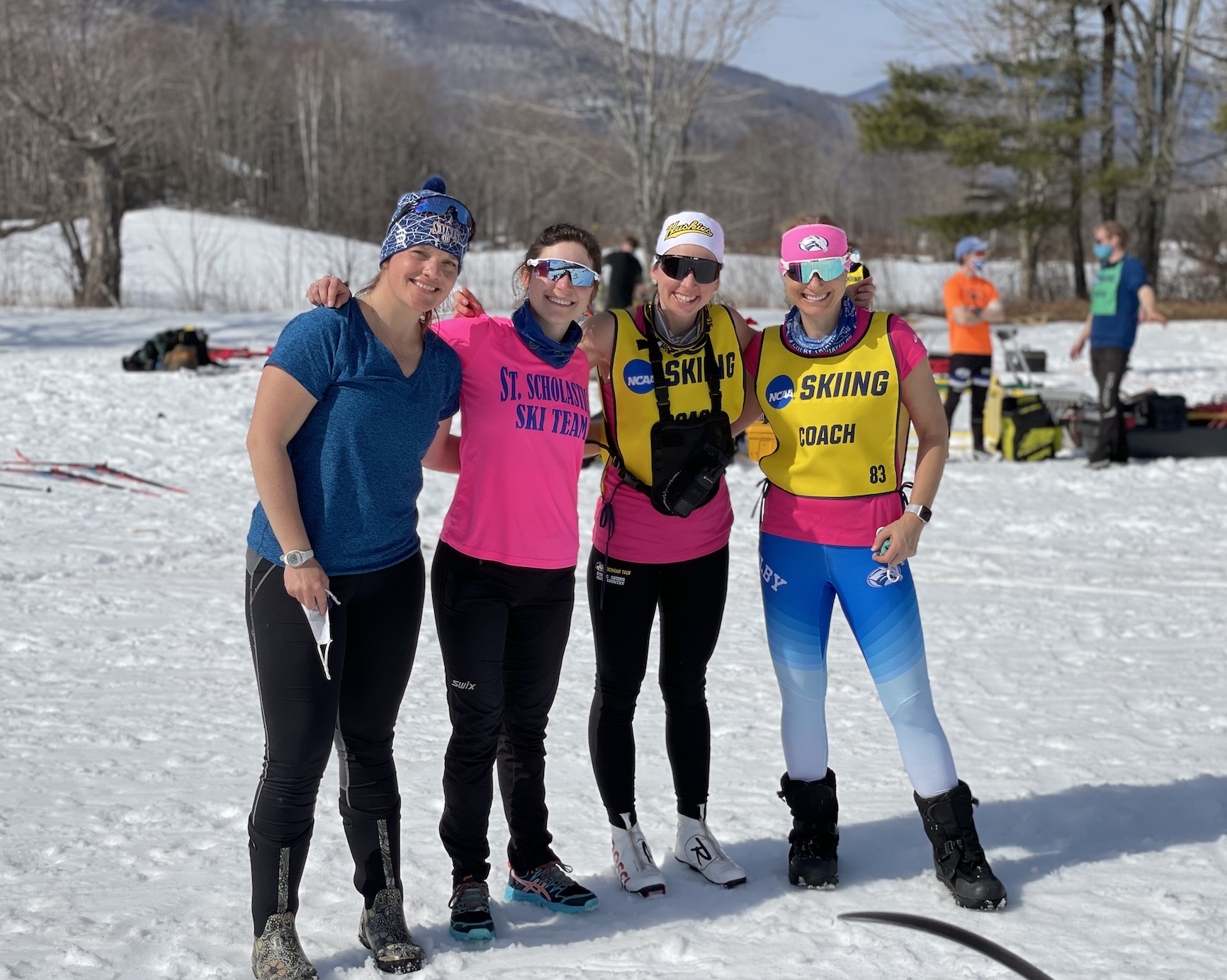
WSCA members Maria Stuber (CSS), Kristen Bourne (CSS), Kristen Monahan-Smith (Michigan Tech), and Tracey Cote (Colby) (l-r) at NCAA Championships in Jackson, New Hampshire in 2021. (Courtesy Photo).
BT: Can you describe how the World Cup Fellowship came together, and what you actually did when you were there last year?
KB: I think the most important part of setting that experience up – because it was really a creation of equal parts myself and Chris Grover and Matt Whitcomb – was that it was a fully immersive experience both on the coaching side and [technician] side, not one or the other. I went over and met up with them right after Lillehammer, which was when the team was on its way to Davos. That gave me three and a half days where I was getting an intensive overview of everything from the wax truck to how [the U.S. techs] do glide-outs, wax application on race day, and the whole process of going from setting up at a World Cup to having our athletes be on the start line.
Then Saturday came, which was sprints in Davos, and I was fully part of it all. Waxing on the World Cup. Sunday for the Distance race, meanwhile, I worked more one-on-one with Caitlin Patterson. It was a whirlwind, but I never felt like I was overwhelmed, because the coaching staff really from the moment I was there was like ‘we want you to be part of everything, and we also know that you’re doing this for the first time and are here to make our team stronger.’
That first weekend was a real introduction into the inside process of what goes on with the process of preparing athletes for a World Cup race. When I wasn’t in the wax truck, I was at team meetings where we would watch sprint footage from previous years on that Davos course and discuss tactics. It’s cool to see how the veterans on the team really are thorough about explaining their tactical ideas and are able to make specific suggestions to their newer teammates. You really get a sense of how the ‘team’ aspect of the U.S. Ski Team operates, and it’s pretty special. I would sit in on meetings with Matt and Chris whenever I was allowed, and also got to be part of the team Christmas celebration.
That was all just in one week. And then we packed up and drove the van to Dresden. Which you know, like I’m driving the whole women’s team from Davos to Dresden and hitting the autobahn and frankly, that was the most nerve-racking part of the entire trip. But we did make it.
In Dresden, I turned over to more of a coaching role. That’s where I got to go out on course for the first time, with poles and radio – the whole nine yards of what you think of when you’re watching the World Cup and see coaches running alongside their athletes on the course. Everyday was really intense, and exhausting, and most of all fun, just taking in everything and not really processing it until later.
BT: Was there a moment of realization where you were like ‘holy crap, I’m on the World Cup?’
KB: I think I tried to process that as much as I could before I got there. Like the moment was really when I had my plane tickets in hand and was like, ‘woah, I’m really gonna go to the World Cup and wax skis.’ But you get there, it was way less intimidating than it looks like on TV. Your years of going to ski races as an athlete of coach kick in and you realize that it’s exactly the same feel and atmosphere – just with the fastest skiers on the planet. Living in Norway and being able to watch World Cups – at Holmenkollen especially – really prepared me for all the extra people, and I think mitigated that feeling you could have when Klæbo or Johaug just skis past you.
But also, I shouldn’t play it down too much. Like yeah, there were moments throughout the two weeks where I did just look up and go, ‘this is the World Cup!’
BT: A big part of the Trail to Gold Fellowship that is based off your experience is that there is avalue in having World Cup experience cross-pollinate with the coaching back in the U.S. What did you bring back from the World Cup that you felt like you applied to your coaching on the NCAA circuit at St. Scholastica, and now with the D-Team?
Kristen Bourne logs kilometers on the stunning tracks of Davos, SUI while teching for the U.S. Team. (Courtesy photo)
KB: There were a few things immediately. Like at Scholastica we adopted the glide-out system I learned on the World Cup to our team. More importantly, the mentalities and being willing to talk with other wax techs and understand that waxing theory is really – and that’s a weird thing to call it – less science. You’re not driving towards a single answer, but rather using your knowledge and experience to make a better call than you would if you didn’t. I had a big realization for both teching and coaching that you’re not learning the answer in how to ski coach, but instead that you’re trying to develop a sense of confidence in your experience so that you give that to athletes. There isn’t a one size fits all in coaching.
BT: I really like that idea as a young coach myself. You’re not building towards an answer, but rather you’re building experience to bear so you can make a difference in the really tough situations, you know?
KB: Yeah, I really think that’s a good way of putting it. It’s kind of that moment you realize that there’s not one way to do the job of being a coach, and that’s what makes it a really challenging and exciting profession.
BT: What about how that attitude played into your role now with the U.S. Ski Team? What are you excited about looking ahead to this winter?
KB: For [the D-Team], our athletes are well on their way to hopefully getting World Cup starts soon. And so that’s where I can act as a resource with my experience of what they can expect as they look to make those first starts. I’ll also be full-time on the World Cup this winter, which is exciting. I’m not anyone’s primary coach but will be doing a lot of what I did last winter, so in that respect, the World Cup experience I got will be about as good of preparation as I could get.
BT: I had one last question pertaining specifically to the Trail to Gold Fellowship. What do you think the role of gender representation on the top-level of skiing is in helping the sport develop?
KB: I think it has an immediate impact. I think it’s as simple as the fact that the more women that young kids see out on the course the more, they are going to believe that they belong there. I hope that immediate impact spreads to those coaches that are doing this fellowship this year as well. They can walk away with tangible World Cup experience, and also realize that they are part of pushing the movement for gender equity in coaching forward and inspiring girls that are out there at the races.
I think back to being around wax rooms, at local races, or watching the World Cup on TV growing, and I really do think that if I would have seen more female representation it might have made me realize that coaching could be a viable career for me because I’d seen people like me in that position. Doing this fellowship works to inspire both the women who are coaching and the women who will be coaching one day.
BT: That’s a really eloquent way to put that.
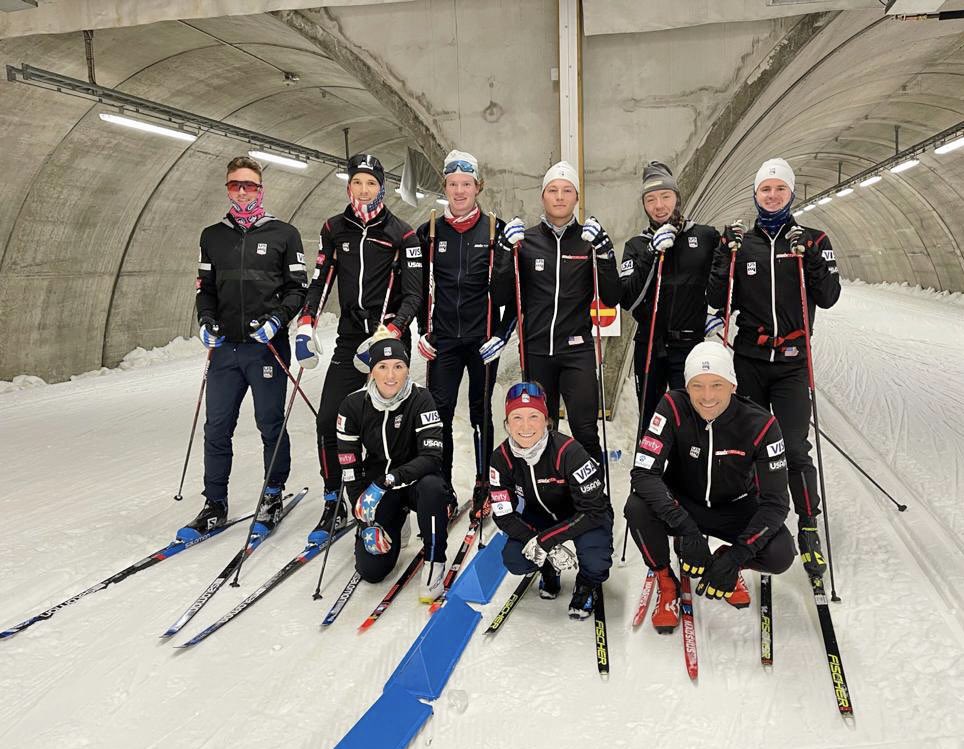
USST athletes and coaches in the Torsby Ski Tunnel, August 2022. Back row, from left: Johnny Hagenbuch, Kevin Bolger, Finn O’Connell, JC Schoonmaker, Ben Ogden, and Walker Hall. Kneeling, from left: coaches Greta Anderson, Kristen Bourne, and Matt Whitcomb. (photo: François Faivre)
Applications for the Trail to Gold Fellowship are open until August 31st.
To buy Trail to Gold, the Journey of 53 Women Skiers, click here. Proceeds are dedicated to funding the Trail to Gold Fellowship.
While it’s difficult to get exact numbers, the general distribution of coaches and service staff on the World Cup level is largely male dominated. The recently announced Trail to Gold Fellowship aims to help change that. Following the publication of the Trail to Gold book in November of 2021, members of the book committee began discussing how to use the net proceeds generated by book sales. After bouncing around various proposals, they settled on the idea of a fellowship to help the development of women cross-country coaches in the United States.
Julia Kern and U.S. Ski Team head coach Matt Whitcomb watch the 4 x 5 k mixed relay in Falun from the stadium. (Photo: NordicFocus)
In partnership with the National Nordic Foundation, the Trail to Gold Fellowship will provide funding to the U.S. Cross-Country Ski Team (USST) for the cost of bringing women ski coaches on World Cup trips. Once there, the Fellowship coaches will learn and participate in coaching and ski service internships with mentorship from the U.S. Ski Team staff. Fellowship recipients are also expected to complete a professional development plan for the experience and write a final report upon conclusion, with guidance from the Women Ski Coaches Association (WSCA) and USST mentors.
A recently adopted proposal by the International Ski Federation (FIS) will aid the process of getting the fellowship coaches out on course, and hopefully incentivize other countries to invest in the development of female staff members. Brought forward by the U.S. Ski & Snowboard, the proposal adds a number of course access bibs per team for female service staff only.
The U.S. wax staff in Zhangjiakou China for the 2022 Olympics. From left to right, Patrick Moore, Andrew Morehouse, Bjorn Heimdal, Tim Baucom, Chris Hecker, Jason Cork, and Eli Brown. (Photo courtesy fellow technician, Karel Kruuser)
Current U.S. Ski Team D-Team coach, Kristen Bourne, participated in a similar program to the one proposed by the Trail to Gold Fellowship, though with funding for her trip to the World Cup coming from the Women’s Sports Foundation VanDerveer Fellowship. Bourne spent two weeks as an intern on the World Cup, gaining invaluable international level experience and knowledge. In an email to FasterSkier about Bourne’s time on the World Cup, USST Program Director Chris Grover wrote, “We have a U.S. Ski & Snowboard program-wide goal, and a cross-country specific goal, to drastically improve gender equity in our coaching and technician staff, so this opportunity was perfectly aligned with this mission.” The Trail to Gold Fellowship also fits squarely within that mission and both Grover and WSCA’s Maria Stuber are working to help make the program a successful reality.
Kristen Bourne (center) joined the U.S. tech team to learn and support the American squad in Davos, SUI. (Courtesy photo)
While initial funding for the Trail to Gold Fellowship will come from the Olympic Women’s Cross-Country Book Project, the committee is working with the National Nordic Foundation (NNF) to expand the size and life of the fellowship. Led by a commitment of NNF Board members Kikkan Randall and Matt Whitcomb, NNF will work to gain donations that add to the Fellowship, increasing both the number of internships that can be awarded and the number of years that the program can exist.
The Women Ski Coaches Association launched in September 2019 in pursuit of gender equity in coaching.
The Women’s Ski Coaching Association is also involved in this collaboration. Having helped with the funding to send Bourne to the World Cup last winter, the WSCA will have a representative on the Fellowship selection committee. The committee will also have representatives from the Trail to Gold book committee and the U.S. Ski Team. This committee will be in charge of selecting the Fellowship recipients.
Sue Long Wemyss, head of the Trail to Gold book committee, wrote to FasterSkier, “We, the book committee, look forward to more American women ski coaches and ski technicians having a very similar experience [to Bourne’s] of interning with the U.S. Ski Team at the World Cup this winter, and in winters to come. We are incredibly grateful to the USST leadership for their willingness to bring and mentor the selected women with them on a World Cup trip. We are also very appreciative for NNF’s support and help in making this program happen.”
Applications for the Fellowship are open now and will close September 1st. The application can be found here or on the NNF website.
Kristen Bourne (center) joined the U.S. tech team to learn and support the American squad in Davos, SUI. (Courtesy photo)
In November, FasterSkier interviewed Kristen Bourne, assistant coach at the College of St. Scholastica (CSS) in Duluth, MN, after she was selected as a Women’s Sports Foundation Van DerVeer Fellow, which came with a grant totalling $17,500. The objective of the fellowship is to improve representation of women in elite level coaching by supporting the development of rising coaches at the college level.
The majority of the funds from the VanDerveer Fellowship went directly to CSS, allowing the university to support Bourne’s position. However, $2,500 of the grant was allocated toward independent professional development opportunities of the fellows choosing. With additional support from U.S. Ski & Snowboard, Bourne recently had the chance to shadow, support, and learn from the American squad of athletes, coaches, techs, and support staff who were traveling the World Cup circuit.
Joining the team in Davos, Switzerland in early December, Bourne was immediately welcomed into the fold and handed responsibilities as both a coach and wax tech, which she described as an “intensive course” on all things World Cup. While this might seem like a high-stakes, intimidating experience for a developing coach, Bourne explained that she was well-supported as she stepped into the role.
“Coming in, the idea was that I was going to get a taste of doing everything,” Bourne explained in a call from Dresden, Germany. “I came in pretty early on in the week before [the races in] Davos, and was able to get a bit of a tutorial and orientation on the wax truck and how everything worked on a day to day basis. It actually turned out that that first weekend in Davos, I was going to be teching for Caitlin Patterson, so I needed to get an idea of what I was walking into, how everything worked, and how to make it as efficient as possible. So those first couple of days, the techs really took me under their wing and showed me the ropes. [They] taught me a bunch of new waxing techniques, and I got to pick their brains a whole bunch — just being in the wax cabin with them and asking any kind of question that I had, and they would take time to answer it.”
On the coaching side, Bourne sat in on pre-race team captains meetings, helped out during intensity sessions, recorded video to discuss technique and course strategy, and supported logistical planning as the team moved from Davos to Dresden and back. Throughout her time with the team, she explained that she shadowed Matt Whitcomb and Chris Grover, listening in and engaging with their discussions regarding what would be important for the team, and each athlete individually week-to-week.
She also took her turn behind the wheel. While not a glamorous part of the job, most coaches would agree it is a significant, and sometimes quite stressful, component.
“I drove a van of athletes from Switzerland to [Dresden],” she said with a laugh. “That was my first European road trip, so that was an experience that ended up being okay… I’ve had an opportunity to at least try everything once if not way more than that, so it’s been super awesome.”
At 25, Bourne is just beginning her career in ski coaching, and though she had done some post-collegiate training and racing in Norway, she was newly minted to the World Cup scene. It’s natural that with such an opportunity would come some self-doubt. Would your 25-year-old self feel comfortable talking World Cup tactics with Jessie Diggins? Yet, Bourne spoke highly of the culture developed on the U.S. Ski Team, and how both athletes and coaches made her feel valued as she stepped into each of her roles.
“Of course, that thought comes into your head. I’m working with people that are several years older than me, who have much more experience being in this environment than I do. But it’s been way easier than I thought it would be primarily because everyone has been really welcoming. When you have athletes who are older than you that then ask for your feedback or your opinion or your help, then all of a sudden it’s like, ‘Oh, they want to hear what I have to say here. They are appreciative of any feedback that they get. Age doesn’t matter so much.’ So it hasn’t been difficult at all, and I think that’s primarily due to the people and the environment that this team has created.”
Kristen Bourne logs k’s on the stunning tracks of Davos, SUI while teching for the U.S. team. (Courtesy photo)
Though there were not established times for her to debrief or ask questions of coaches or techs, Bourne described the communication between herself and the coaches and techs as open. The crew would regularly ask how she was doing, and she felt comfortable asking questions whenever they cropped up.
“We have had this natural agreement where – they know I’m here to learn. And I also know I’m here to learn, but I’m also here to help them. And so, it’s been quite open that way. We have a plan for once this trip kind of wraps up and I get back that we’ll chat again and talk about that whole experience. But I’m hoping that this is something that [the U.S. program] will continue to do with other female coaches in the future, and I’m hoping this at least set the tone for a good experience on their end. It definitely has on my end.”
According to Grover, Bourne immediately demonstrated her capability and potential as she stepped into her roles, and what started as a stand-alone opportunity may just be the beginning.
“Having Kristen on this trip to Davos and Dresden was incredibly helpful, and we are so grateful to the Women’s Sport Foundation and to Maria Stuber and the College of St. Scholastica for making this trip possible,” wrote Grover in an email. “We have a U.S. Ski & Snowboard program-wide goal, and a cross-country-specific goal, to drastically improve gender equity in our coaching and technician staffs, so this opportunity was perfectly aligned with this mission.
“Kristen was an amazing asset to the World Cup group right away, almost seamlessly integrating into both our coaching and service teams, having never met many of the team members. We were really impressed by her skiing ability, her stamina in the test track, her knowledge of the sport and exercise physiology, and her ability to relate so well with each athlete and staff member. She was quick to embrace the team culture, including being thrown into one of the most intimidating team rituals of all – Secret Santa – almost immediately upon arrival, and brought fresh perspective and energy to the Team.”
On all accounts, the U.S. Team had highly successful weekends in both Davos and Dresden. Highlights include: Jessie Diggins taking second in the 10k skate in Davos, with Rosie Brennan close behind in 4th and Hailey Swirbul in 6th, plus Sophia Laukli in 19th and Novie McCabe 28th. The previous day, Brennan had been 4th in the freestyle sprint, while Ben Ogden skied through the semis to finish 12th. Dresden saw another American podium finish with Diggins and Julia Kern finishing second in the team sprint, while JC Schoonmaker made his third World Cup semifinal in the individual sprint. Grover applauded Bourne’s contributions to the team’s success throughout these events.
“She skied an amazing amount of kilometers in the test track in Davos, and was instrumental in identifying the products that we raced on in the 10/15 km F there,” Grover continued. “In Dresden, where we had a smaller staff, I would have really struggled without her support. We all really enjoyed getting to know Kristen and cherish making this professional connection and friendship with her. I know we’ll be looking to get her on another trip as soon as possible.”
The team behind the podium in Dresden. From left to right, physical therapist Ana Robinson, rising tech and coach Kristen Bourne, Jessie Diggins, and Julia Kern. (Courtesy photo)
After the World Cup experience, Bourne would return to CSS, bringing back a host of new insights into the highest levels of racing. As she leaves the whirlwind adventure behind, what would stand out as key takeaways from her time in Europe? In particular, Bourne added tools to her belt on the technical side of sport performance.
“The waxing, for sure, [stands out],” she said conclusively. Different techniques, different ideas of what to focus on. It gets really easy to focus on certain aspects of picking skis, but their perspective is so much different. And they focus on things that [I wouldn’t have before], but when they explain it, it makes a lot more sense.”
A specific example that came to mind was a conversation she had with one of the techs, Bjorn Heimdall, regarding ski selection for Luke Jager.
“The skis that he had picked had a colder grind on them, however, It was also a pretty stiff ski. And so I asked, ‘Why would you put a cold grind on such a stiff ski?’ And he explained that, from his perspective, it has to do with the firmness of the snow, not necessarily how cold the snow is. It’s just how firm the track is that makes the difference. The grind does have some effect, but to him, it had more to do with the flex of the ski, and how high the ski was that made the bigger difference overall [in those conditions].”
Bourne contrasted this concept with her experience waxing for collegiate athletes, where she felt there was more focus on the ski’s grind.
Another factor that stood out from her time in the wax truck was the strategy and robust processes used to select the products used on race day and the skis to which they’d be applied. With massive fleets of skis, and an equally massive chemistry kit, finding a winning combination seems like a special brand of magic.
“I also realize that their ability to do that is much different than at the college level where you have only two coaches, instead of five to six wax techs who are able to test all of these powders, structures, topping… That’s pretty intense. But I think that the way they do it with various measurements, I find that to be really interesting. They can do all of these tests and not eliminate a specific ski in the first round. When you do single testing, [comparing pairs of skis] one to one, they have a method for that. I think that’s really cool.”
Bourne also explained how impacted she was by the depth of the relationship between an athlete and their tech.
“[The techs] are just as much coaches in this process as the actual named coaches of the team. They have really close relationships with their athletes. There’s a lot of trust there. And I really admire it. I’ve seen and heard from multiple techs that say, “I want to bring my athlete skis to her or to him.’ Because it’s like this special moment that they get to have before every race and that I just admire a lot.”
Lastly, Bourne revisited the culture within the U.S. program, remarking on how cohesive the group was as a whole.
“It shows that when you have people that you work with that you really enjoy, you can work in a hard environment or a tough environment, you can have long hours. But if you’re around people you enjoy working with, it makes the whole group become successful. It’s just very cohesive. And I’ve been very impressed by that… You hear all the time that this team is really great, and then when you’re in it, you’re like, ‘Wow, this is actually really cool.’ So I’m just really grateful. It’s been awesome.”
Kristen Bourne (left) snaps a picture with Vale Vuerich, head of service on Slovenian tech team and one of the only women teching at the World Cup level. (Courtesy photo)
As the conversation concluded, Bourne spoke to the impact this opportunity has had on her career development, opening the door to a level of racing many coaches never truly see up close. Continuing to build on this model, Bourne feels that developing coaches of all genders can gain the skills to continue the elevation of American cross country skiing at all levels.
“I hope that this is something that can be continued. It has been super valuable. And I know that [U.S. Team members and staff] also feel pretty on board with continuing something like this. It’s an interesting conversation that I’ve been having where – when you’re new to something, you don’t know what you don’t know. But with this experience, I’m starting to realize that I do know what I don’t know now. And so it’s very easy to pick out the specific things that I have questions about, and I get those answered really, really quickly. I’m learning from some of the best. So I hope that other people also get to have this experience because it’s incredibly valuable, and there’s a lot that you can take back. If more people have had an experience like this and could learn these types of [skills], it just would progress the development of not only coaches and techs but also the athletes going forward.”
CSS assistant coach Kristen Bourne was awarded the Women’s Sports Foundation VanDerveer Fellowship for the advancement of women in coaching. (Photo: Maria Stuber)
Kicking off her second year as assistant coach at the College of St. Scholastica (CSS) in Duluth, MN, Kristen Bourne was recently named one of ten recipients of the Women’s Sports Foundation VanDerveer Fellowship. The program, named for revered Stanford University Basketball coach, Tara VanDerveer, aims to increase representation of women in coaching at the collegiate level through the development of the rising generation. This is the first time that the award has been granted to a cross country ski program.
According to the WSF, “this pioneering program provides grants, paid fellowships and mentorships for aspiring female coaches. Emphasizing hands-on training for female coaches in all collegiate sports, from basketball and volleyball to water polo and fencing, it is a salute to the extraordinary compassion, optimism and leadership that its namesake has shown over the years.”
Along with opportunities to collaborate with coaches across a variety of sports nationwide, the program offers institutions $15,000 to use in support of their fellow, along with $2,500 that goes directly to fellow to put toward additional professional development opportunities. FasterSkier connected with Bourne to learn more about the fellowship, her path to coaching, and how this opportunity will support her growth and long term goals in cross country ski coaching.
Originally from Lake Elmo, MN, on the eastern side of Minneapolis, Bourne attended Northern Michigan University (NMU), where she graduated with a degree in Sport Science in May, 2018. While racing for NMU, Bourne raced on four NCAA championship teams, and was a member of the 2015 U.S. World Junior Championships team and the 2016 U23 World Championships team. Post-college, she headed to Norway to train with Lyn Ski and Team Obos in Oslo, while competing in numerous FIS races throughout the country.
CSS assistant coach Kristen Bourne spent time in Norway after college training with Lyn Ski / Team Obos. Bourne is pictured here racing in a Norwegian Cup race in Gålå. (Photo: Martin Riseth)
Bourne returned to the US in December, 2019 to finish her racing career at the 2020 U.S. National Championships in Houghton, MI. It was there that she met Maria Stuber, head coach at CSS and the founder of the Women Ski Coaches Association (WSCA), who recognized Bourne’s potential as a coach and recruited her to the CSS program.
“I was just deciding that my ski career was about done and trying to figure out what to do next,” Bourne explained in a call. “I was at U.S. Nationals, I was leaving a parking lot, and Maria drove up and essentially slammed on the brakes, and yelled out the window, ‘Hey! My name is Maria. I heard that you’re interested in potentially coaching. You’re gonna get an email from me sometime soon.’”
Bourne went on to explain that Stuber emailed her the next week asking if she would be interested in joining her as the assistant coach at CSS. Tying the fellowship opportunity into the offer, Stuber knew about the VanDerveer grant and would help oversee the school’s application on Bourne’s behalf. CSS was not chosen after the first year of application, but they were selected this year on the second attempt.
Bourne explained how receiving the VanDerveer fellowship allows her to pursue a number of development opportunities beyond her role at CSS.
“Right now I have a few things in mind that I’m going to put that money towards. I would really like to go to the NCAA Women Coaches Academy, which happens every May. They have a bunch of super awesome female speakers and head coaches that all talk, and it seems really valuable. I think Maria did it a few years ago. Then the other professional development opportunity would be: I’m currently working on a trip over to the World Cup this winter.”
Though her education and wealth of experience lends itself well to coaching, Bourne did not always see this as a path she would choose.
“People were always telling me that I would probably end up being a coach, and I didn’t want to do what everyone thought,” she laughed. “And then, you come to this realization: I love the sport, and I want to learn more about it, and I’m really passionate about it. I can take my personal experiences from being in Norway and seeing how they work over there, I can apply what I learned there, and through college, my own [time as an athlete]… Right now I’m also working on my master’s in exercise physiology. So being able to take all of that experience and knowledge and be able to apply it as a coach, I think it’s kind of a no brainer.”
Though improvement is trending, women remain underrepresented in leadership roles in the ski community. According to the 2020-2021 Women in College Coaching Report Card issued by the Tucker Center for Research on Girls & Women in Sport, only two of nine NCAA Division 1 cross country ski coaches are women.
A few of the female coaches represented at the 2021 NCAA championships. From left to right, Maria Stuber, Kristen Bourne, Kristen Monahan-Smith of Michigan Tech, and Tracy Cote of Colby College. (Courtesy photo)
Stepping into this realm without significant experience in coaching, Bourne spoke to the importance of having a strong mentor and role model in Stuber, who has helped her realize her potential in the role.
“The other [factor influencing my transition into coaching] has been working for Maria. She has just taken me on and put me under her wing, and really gets me to do things that I wouldn’t normally do. It has boosted my confidence in myself knowing that I can do this and that this is what I want to do for the rest of my life. That was a huge piece of it, too.”
Expanding on Stuber’s formal role as a mentor for the VanDerveer Fellowship, Bourne explained that both she and Stuber will have the opportunity to connect with the other fellows and mentors involved in the program, which spans a variety of sports from basketball to water polo to track & field. This collaboration allows the women to discuss their successes and challenges in their respective sports, and learn from each other’s experiences.
In a 2019 presentation at the U.S. Ski & Snowboard annual meeting on the importance of women in coaching, Dr. Nicole LaVoi of the previously mentioned Tucker Center explained the importance of women in leadership roles to inspire the next generation of coaches and improve the experience of developing female coaches.
“When you see women being successful, it inspires people,” LaVoi said. “‘Oh, I could do that. That seems cool, she seems cool, I want to do that.’ And in they come. It’s the same thing with women in positions of leadership.”
Bourne emphasized that this concept rings true for her in working with Stuber, who has stoked her fire to become an example for future women in the sport.
“She said so many times that the Women’s Ski Coaches Association and empowering women — this is her passion. I just feel so honored that I get to be right alongside her. She’s so powerful, and she has such a strong impact, and she’s doing this incredible thing that I think quite a few people are scared to do. She just says, ‘No, I’m doing it. We’re gonna change some things here.’ And I think that’s just — it’s pretty dang cool.”
Looking to the future and the role she hopes to play, Bourne aspires to be a head coach at or above the college level. She enjoys the environment of collegiate programs, but remains open-minded. Reflecting on the dearth of female coaches in her own athletic experience, she concluded with her intention to be part of the solution in the slow progression toward gender equity in sport leadership.
“When coming to the decision of becoming a coach, there is this thought of, ‘Well, I’ve never really experienced anyone like me in that position before. Can I do that? Can I have the same impact on a team as a man would? But really it’s [lack of] representation. There’s also the concept that women are proven to improve work environments — having more women is better. And being able to support female athletes — and being able to support male athletes — with a different perspective is super important. There’s a lot of pieces — it’s a huge question. I just hope I can be a role model for more women coming up who want to get into coaching and stay in the sport.”
The CSS Assistant Coaches: Kristen Bourne (left) and Joshua Tesch (right). Stuber explained that Tesch has bee coaching at CSS for 15 years and has been a mentor for both herself and Bourne. (Photo: Maria Stuber)
Ian Torchia (front) leading L3 intervals with the Stratton Mountain School (SMS) team in June. (Photo: Pat O’Brien)
Two summers ago, with just five miles left of the Marquette Trails Fest 30-mile mountain bike race, all Ian Torchia could hear in his head was the voice of Krystof Kopal, his Northern Michigan University (NMU) teammate, snidely saying, “You drop out again?”
Fifteen minutes earlier, Torchia had careened into a tree. After dusting himself off, he remounted his bike, but not before noticing his left wrist was badly injured.
For a moment, Torchia considered pulling out of the race. Thoughts of Kopal, however, kept his feet on the pedals. A few months earlier, Kopal had given Torchia ceaseless verbal flak for dropping out of the 2016 Spring Series 50-kilometer ski race due to cramping.
“[Kopal] was playing in my head … so I finished the last five miles with a broken wrist,” Torchia, now 22, recalled on the phone this summer, noting that it wasn’t until after he had finished the race that he found out it was broken.
The NMU men’s ski team with Ian Torchia (third from r) in late August. According to Torchia, the paper he’s holding is a contract. “If we win [the] team NCAA title [this winter], they get to tattoo my gluteus maximus,” Torchia wrote. (Photo: Andy Keller)Shortly after, Torchia had his wrist examined by doctor and was told he would need to have surgery. The procedure — scaphoid fixed via percutaneous fixation–left Torchia in a cast.
About a month before his crash, Torchia had been nominated to the U.S. Ski Team (USST) D-team and invited to two national-team training camps that summer. Torchia had intended to attend both camps, regardless of whether his wrist was healed or not.
Fourteen days after his accident, Torchia departed Marquette, Michigan, his “home” since he began attending NMU in 2014, and headed for Eagle Glacier, Alaska, the location of the first USST camp.
On the glacier, he skied with either one pole or none at all. When he returned to Marquette, the pattern continued for another two months. It wasn’t until the end of August that he had his cast removed.
“I kept training super hard with the broken wrist,” Torchia said.
All that training led Torchia to what he recalled as being “in pretty good shape” leading up to November. Then things started to go south. Fast. Right around Thanksgiving, Torchia was exhausted and experiencing severe night sweats.
“If you type in ‘mono’ on Google and look at the symptoms, I probably had seven out of the eight,” he said. “But I at the time was thinking ‘It’s just a bad virus. It will pass.’ ”
The symptoms continued. Torchia’s girlfriend suggested he get tested for mononucleosis. He didn’t.
“I didn’t want to believe her,” Torchia said.
Soon enough he had to. In mid-December, hypothermia forced him to drop out of a race. At 2017 U.S. Cross Country Championships in Midway, Utah, he felt sluggish and “off” during training, so he visited a walk-in clinic in Park City. The doctor tested for mono, and the results came back positive.
“The doctor was kind of nonchalant about it,” Torchia said. “He came in and was like, ‘Oh yeah, you’ve got mono, but nordic skiing isn’t a contact sport so you should be good to go and ski at nationals. I was like, ‘Oh, sweet…that’s not how it works.’ ”
Following the diagnosis, Torchia decided to skip nationals and return to his hometown of Rochester, Minnesota, for the holidays. He stopped exercising for a month before gradually returning to training.
“A lot of different skiers messaged me saying, ‘On this return, you need to take it really easy,’ ” Torchia said. (One of those skiers included Tad Elliott, who caught the Epstein-Barr virus in 2014 and went on to win a national title in 2016).
Torchia took their advice, as well as that of his NMU head coach, Sten Fjeldheim, who has helped other athletes diagnosed with mono safely return to training. The two worked out a meticulous day-by-day plan for Torchia’s return. Torchia redshirted the 2017 college season, but by March, he was back on skis.
“I wasn’t really thinking about what other people thought,” Torchia said when asked if he was worried whether others were questioning his USST nomination during that time.
“I was thinking more about the next steps,” he continued. “Like the day to day, ‘Oh, my morning heart rates are going down,’ or ‘This next weekend I can start running again.’ … I think before [mono], I was riding really high on skiing, and it was … a big, big part of my life. Getting mono kind of let me take a step back and realize, OK, there are other things [besides skiing].”
Ian Torchia (1) on the shoulders of Northern Michigan University Head Coach Sten Fjeldheim after he won the men’s 20-kilometer freestyle race at 2018 NCAA Skiing Championships in Steamboat Springs, Colorado. (Courtesy photo)
Mono not only gave Torchia a little perspective, but also an extension on his time to compete in college. By redshirting in 2017, Torchia retained eligibility to compete in 2018 (as a junior) and 2019 (as a senior). In his fifth year at NMU, he is currently working toward a master’s degree in exercise science.
This past March, he won the 20 k freestyle at NCAA Skiing Championships to become NMU’s seventh NCAA champion in program history. In the other race at 2018 NCAA’s, the 10 k classic, he placed fifth for All-American status. Earlier last winter, Torchia qualified for and competed at U23 World Championships in Goms, Switzerland.
“I try to look at the positives that mono brought,” Torchia said. “That first season of being on the USST brings a lot of pressure and inadvertently getting mono kind of lessened that. Afterward, when I got renominated to the team [last spring], I was like, ‘OK, they’ve given me this second chance, so I need to take it.’ ”
Torchia was renominated to the D-team for 2017/2018 and again this past spring for the 2018/2019 season. After his third-straight nomination, he approached his summer with revitalized vigor. For the first time since enrolling at NMU, he decided to spend some time training outside of Marquette, largely as a result of a wedding invitation from his USST teammate, Erik Bjornsen. In July, Bjornsen and Marine Dusser were married in Villard-de-Lans, France.
Right to left: Ian Torchia, Paddy Caldwell, Adrien Backscheider, Simi Hamilton, and Erik Bjornsen during a post-interval cool down in Villard-de-Lans, France. (Courtesy photo)
“After getting Erik and Marine’s ‘save the date’, I knew there was no way I was missing the wedding,” Torchia explained.
After the wedding in early July, Torchia remained in France for the USST men’s training camp. The camp lasted 10 days and featured what Torchia described as “hard rollerski intervals and epic mountain runs.”
He was accompanied by three teammates, Bjornsen, Simi Hamilton and Paddy Caldwell, and their coach Chris Grover. French national-team member Adrien Backscheider joined the group for interval sessions.
Following the camp, Torchia had made arrangements to stay in Europe for another two and a half weeks, which was partially prompted by his Norwegian teammates at NMU. Over the years, many had encouraged him to travel to Norway and compete in the famed Lysebotn Opp, an uphill rollerski race in Norway’s Blink ski festival.
Before heading to Sandnes, Norway, for Blink, Torchia made two stops. First, Oslo, where he stayed with his former NMU teammates Fredrik Schwencke, a native of the city, and Kristen Bourne, an American citizen currently training with the Lyn Ski Club in Olso.
“Pretty lucky to have so many great friends and teammates that put me up throughout the trip,” Torchia wrote in an email.
Torchia spent a week in Oslo before traveling to Kragerø, where he visited his current NMU teammate Mathias Aas-Rolid. A native of Redalen, Norway, Rolid has a cabin in Kragerø that he opened up to Torchia for “a pre-Blink training camp”.
Ian Torchia rollerskiing up Alpe d’Huez, two days before the Tour de France on July 17, 2018. (Photo: Chris Grover)
Following Kragerø, Torchia headed to Sandnes for the Blink races. Canadians Evan Palmer-Charrette, Scott Hill and Bob Thomson had rented an Airbnb in Sandnes for the weekend, and keeping with his summer nomadic style, Torchia crashed on their couch during the festival.
He competed in the 60 k distance race as well as the Lysebotn Opp. The 60 k was what Torchia referred to as “an add-on to the main focus of Lysebotn.
“For the 60, I made a big blunder by not bringing a water pack and counting on getting feeds along the race course,” he recalled. “Turns out trying to get a feed from a stationary volunteer at 20+ mph is not very effective.”
Without feeds, Torchia explained that he “bonked” halfway through the 60 k and ended up finishing 55th. The result left him ready to “turn it around” for the 7.5 k Lysebotn Opp the next day. He managered to position himself well early on in the race’s mass start and within the first kilometer, found himself with the likes of Russia’s Sergey Ustiugov and Finland’s Iivo Niskanen.
“After the 1 k tunnel, I passed Ustuigov and Niskanen and probably got a little too excited and blew my load about 2 k from the finish,” Torchia wrote of his Lysebotn start. “ ‘Twas a long 2 k in from there and almost managed to catch Harvey but just missed the auto qualifying for the mass start (top-10) by about 15 seconds. I’ve never done a rollerski race, period, so competing in Norway in the strongest field they’ve ever had was a hell of a way to start.”
Torchia placed 13th, just over 2 minutes behind the winner (and 2018 Olympic skiathlon gold medalist) Simen Hegstad Krüger of Norway and 15 seconds behind Canada’s Alex Harvey, who placed 10th.
Torchia’s summer adventure ended after Blink, and he flew back to the U.S. on Aug. 6.
“Getting to do intervals with Adrien Backscheider, [South Korean/Norwegian skier] Magnus Kim, and then race with a World Cup field at Blink served me a big piece of humble pie but was a good indicator that the summer progress[ed] well,” Torchia wrote.
Torchia is now back in Marquette, focused on school and skiing. Beyond college races, Torchia is targeting 2019 U.S. nationals in Craftsbury, Vermont, 2019 World Championships in Seefeld, Austria, and 2019 World Cup Finals in Québec City.
“It’s been some ups and downs and definitely a learning experience,” Torchia said of the years since he was first nominated to the USST. “But it’s made me stronger in the process.”
Ian Torchia (l) with girlfriend, Kameron Burmeister, hiking in Franconia Notch, N.H., during an East Coast road trip they took in June. (Courtesy photo)
The SuperTour men’s 20 k freestyle podium on Saturday, Feb. 17 in Ishpeming, Michigan, with David Norris (c) in first, Kevin Bolger (l) in second, and Brian Gregg (r) in third. (Photo: APU)
U.S. SuperTour (Ishpeming, Michigan): Friday, Saturday and Sunday
The SuperTour circuit ventured to the Al Quaal Recreation Area in Ishpeming, Michigan, this past Friday, Saturday and Sunday for three days of racing Feb. 16-19.
Day 1
In Friday’s 1.6-kilometer freestyle sprints, Kevin Bolger of the Sun Valley Ski Education Foundation (SVSEF) posted a 2.69-second victory in the men’s final over his teammate Jack Hegman in second and 3.02 seconds ahead of David Norris of Alaska Pacific University (APU) in third.
Bolger started the day by qualifying first in 3:43.04 minutes (2.41 seconds ahead of Hegman in second). Eighteen men entered the race, all of which advanced to four quarterfinals. Bolger went on to win his quarterfinal and semifinal before ultimately winning the final in 3:38.45.
Kris Freeman (Caldwell Sport) finished fourth in the final (+6.4), Forrest Mahlen (APU) took fifth (+10.07), and Eric Packer (APU) was sixth (+10.1).
In the women’s sprint, Northern Michigan University (NMU) sophomore Anikken Gjerde Alnæs edged Erika Flowers of the Stratton Mountain School (SMS) T2 Team by 0.1 seconds for the win in 4:09.87. Alnæs, of Norway, had previously won the qualifier in 4:22.88, 1.72 seconds ahead of Flowers in second.
With 10 women entering the qualifier, all 10 were seeded in two semifinals. Alnæs won the first semi in 4:20.24, and APU’s Chelsea Holmes won the second semi in 4:14.18.
In the final, Alnæs shared the podium with Flowers in second and Kaitlynn Miller of the Craftsbury Green Racing Project (CGRP) in third (+6.75). Holmes placed fourth (+7.49), Liz Guiney (CGRP) was fifth (+2.13), and Canada’s Sophie Carrier-Laforte finished sixth (+7.3).
Day 2
The SuperTour women’s 15 k freestyle podium on Feb. 17 in Ishpeming, Michigan, with Chelsea Holmes (c) in first, Caitlin Gregg (l) in second and Erika Flowers (r) in third. (Photo: APU)
On Saturday, APU reigned, with Holmes winning the women’s 15-kilometer freestyle and Norris topping the men’s 20 k skate.
In the women’s race, Holmes and Caitlin Gregg (CXC Team/Loppet Nordic Racing/Team Gregg) broke away from the field and duked it out for first, with Holmes taking it by 5.9 seconds in 42:37.1. Almost two minutes back, Flowers placed third (+1:58.4) to return to the podium. Kristen Bourne (NMU) placed fourth (+1:59.7), Miller was fifth (+2:01.2), Guiney sixth (+2:01.6), and NMU had two more in the top eight with Nicole Schneider in seventh (+2:02.5) and Alnæs in eighth (+2:07.5), respectively. Carrier-Laforte finished ninth (+2:25.3) and another Canadian Alannah MacLean (NTDC Thunder Bay) was 10th (+2:45.7) out of 43 women.
In the men’s race, the top-eight finishers were separated by less than 10 seconds, with Norris taking the win by 2.9 seconds over Bolger in 50:01.7. Brian Gregg (CXC Team/LNR/Team Gregg) placed third (+5.9), 1 second ahead of Ben Lustgarten (CGRP) in fourth (+6.9). In a photo finish for fifth (+7.2), Tad Elliott (Ski Club Vail) took it by 0.1 seconds over Adam Martin (CGRP) in sixth (+7.3) and Hegman in seventh (+7.3). Ian Torchia (NMU) finished eighth (+9.9), Canada’s Evan Palmer-Charrette (NTDC Thunder Bay) was ninth (+16.0), and Kyle Bratrud (CXC Team/LNR) 10th (+18.1) out of 62 finishers.
Day 3
On Sunday, Norris raced to his second-straight win (and third in as many distance races since winning the 15 k classic pursuit on Feb. 4 at the NorAm/SuperTour in Gatineau, Quebec). With a time of 24:42.7, Norris skied 28.2 seconds faster than Lustgarten in second place, and Freeman joined them on the podium in third (+32.4). Martin followed in fourth (+34.5), Hegman was fifth (+35.9), Bolger sixth (+39.3), Zak Ketterson (NMU) seventh (+42.5), Bratrud eighth (+42.8), Elliott ninth (+1:00.5), and Torchia 10th (+1:02.2).
Miller won the women’s 5 k classic on Sunday in 14:53.9, just 2.7 seconds ahead of her Craftsbury teammate Guiney in second. Holmes returned to the podium in third (+7.8), and was followed by Felicia Gesior (CXC Team/Peak Nordic) in fourth (+32.4), Vivian Hett (NMU) in fifth (+36.5), Flowers in sixth (+46.5), Bourne in seventh (+58.5), MacLean in eighth (+1:00.8), Alnæs in ninth (+1:05.3), and Carrier-Laforte in 10th (+1:05.3).
Northern Michigan University’s Kristen Bourne (c) after the 5-kilometer classic race at the 2017 NCAAs in Jackson, New Hampshire. (Photo: Jackie Schneider)
Two-and-half months into her summer training last year, Kristen Bourne woke up in a cold sweat. Her temperature read higher than normal and no amount of lozenges could soothe her sore throat. The Northern Michigan University (NMU) skier went to a doctor and received antibiotics to treat what was thought to be strep throat.
But two weeks later, Bourne still didn’t feel like herself, and she wanted to know why.
Behind her were 215 logged hours of summer training in Marquette, Mich., a 6 1/2 hour drive from her hometown of Lake Elmo near Stillwater, Minn.
Ahead of her was a promising junior season at NMU, with plans to attend the university’s sports-science graduate program in the winter of 2018. She had redshirted the year before and gained an extra year of development under NMU Head Nordic Coach Sten Fjeldheim, as well as an extension on her National Collegiate Athletic Association (NCAA) eligibility.
The investment she had put in her season was nothing to scoff at; neither was her uncharacteristic exhaustion at practice. After finishing one session in late August feeling especially spent, Bourne returned to the doctor, and this time, was able to pinpoint the issue.
“I went to the doctor that day and they did a mono test,” Bourne explained on the phone.
NMU junior Kristen Bourne racing to 19th in the 15 k skiathlon at the 2017 U.S. SuperTour Finals on March 27 in Fairbanks, Alaska. (Photo: Lance Parrish, Fairbanks)
The results tested positive. With fall training just around the corner, and a sudden uncertainty about where she was headed, Bourne began to worry. What did this mean for her season? Was there any way out? Were all those hours of work and training for nothing?
“I was so bummed,” Bourne, who turns 22 later this month, said. “It was the best I had felt training; when you put in all this work and then realize that you’re not going to do anything and for that long, it’s really concerning.”
The mononucleosis put her out of training for two months, from the beginning of September until the end of October. These months are not dispensable as they often incorporate a new cycle of intensity sessions, hours and gym time.
But for Bourne, it was the beginning of a learning process and careful track back to top form, thanks in part to Fjeldheim and his connection to the NMU sports-science department.
The First: Fielding Mono with Fjeldheim
What exactly is mono? How does it affect athletes? How might it affect athletes as they return to training?
These were some of the questions Fjeldheim had when he encountered his first case of mono among his student athletes. While coaching NMU’s cross-country running team, one of his top runners came down with the illness at the end of the summer. (Fjeldheim coached for the NMU running program for more than 20 years, and now solely coaches nordic).
With the cross-country running season only lasting about eight weeks, there was limited time before some of the more important scoring races, like regionals, appeared next on the calendar.
Fjeldheim wasn’t deterred. He approached Dr. Phil Watts, NMU’s sports-science program coordinator and professor. Sitting in Watts’s office — a room Fjeldheim had visited when he was a Wildcat — the two discussed the costs and benefits of de-training to the body and ultimately developed a way to help the runner make a full recovery.
“We laid out a plan with the team doctor on how to bring her back,” Fjeldheim said. “I think she got [mono] in early August and then by early November we ran our regionals and she got third. That’s after running only one other running race before the regionals. I think she ran a running race at the end of October and then second week in November, she’s third in our regionals.”
NMU’s Kristen Bourne (c) topped the podium at the 2017 CCSA Distance Championships in early February in Houghton, Mich. (Photo: Jackie Schneider)
After that, Fjeldheim worked with a few other athletes who came down with mono early in their season yet went on to become All-American athletes. Though Bourne would not earn this accolade, she came close.
Bourne’s comeback was not without meticulous and methodical planning. Her return to training was slow and her situation was unique: not only did her coach, Fjeldheim, have experience working with athletes who had mono and successfully returned to racing, but Bourne was also the type of athlete who made the return more amenable.
Over the course of an entire summer, Bourne routinely checked her heart rate each morning, before getting out of bed. She wrote it down and kept track of fluctuations and differences. Every day.
When she was diagnosed with mono, knowing her base heart rate was crucial. After two months off and having her spleen examined to ensure it was no longer enlarged, she started exercising again. Each week entailed meetings with coaches and every day, she assessed her resting heart rate and how far off it was from her previous one.
“We used the morning heart rate as a guide,” Fjeldheim explained. “Once her morning heart rates were back to normal, within say two or three beats of what her base morning heart rate had been for months and possibly years, then we just started with getting back into moving again.”
He emphasized that this came after making sure Bourne’s spleen was a normal size. Then she safely began training again while agreeing to listen to what her body was telling her via her heartbeat and lactate tests. And she had to keep it to a minimum.
“When I started working out, it was 15-minute jogs,” Bourne said. “Then every week, I’d sit down with my coaches and re-evaluate how I felt, how that week went. Every two weeks I was doing some lactate tests to monitor my heart-rate zones … then every week adding a little bit if I was ready. Come November, I started actually doing more systematic training instead of just doing low distance.”
Fjeldheim also monitored Bourne’s sleep patterns to make sure there weren’t disruptions and whether she was gaining or losing weight.
If any of the numbers were off, she rested.
“You don’t mess with mono,” Bourne emphasized. “If you don’t feel good, you do nothing. You can’t try and push it out of your system it just doesn’t work that way.”
NMU junior Kristen Bourne racing the freestyle leg of the mixed relay at the 2017 U.S. Distance Nationals in late March in Fairbanks, Alaska. (Photo: Lance Parrish, Fairbanks)
This perhaps was the hardest part. While Bourne rested in bed, her teammates were out training. When Bourne finally began training an hour and a half again, her teammates were out doing three. She missed out on more than three months of interval training. And when she did reincorporate hard efforts, she didn’t always feel good.
“Mentally, it’s really tough,” Bourne said. “I just had to trust what my coaches said and trust myself and keep my fingers crossed and hope that my season would work out. We figured that I wouldn’t start doing well until February because I didn’t actually start doing intervals until the end of November. … I have to give so much credit to my coaches reassuring me all the time and my teammates being so supportive about it, being like, Kristen if anyone can do it, you can do it.”
Rather than get caught up in what training she couldn’t do, Fjeldheim advised Bourne to focus on what she could do, like improving her technique.
“As I told her, hey you know, you’re going to come back from this. It’s not cancer, it’s not debilitating, you didn’t find out you’ve got some rare disease,” he said. “You have mono and we’re going to figure out a plan. You got to have a plan and then they got to buy into it.”
The experience gave Bourne not only some of her best collegiate results, but also a new edge on her training. She plans to ski for NMU next winter and is considering continuing to race competitively after she graduates.
“A lot can happen in a year and I can’t set any expectations for myself right now,” Bourne wrote in an email. “We’ll just have to wait and see!”
***
Author’s note: This article is not intended to be a guide on how to train through mono, but rather track one athlete’s recovery from illness.
The 2015 Junior World Championships concluded on Sunday in Almaty, Kazakhstan, and left the U.S. team with a lot to celebrate.
Seventeen-year-old Katharine Ogden, of the Stratton Mountain School, in particular had a standout week, finishing sixth in the 10-kilometer skiathlon (for the best American distance result at Junior Worlds since 2002) and 11th in the 5 k freestyle. Northern Michigan University’s Ian Torchia finished 11th in the men’s 20 k skiathlon, while earlier in the week Thomas O’Harra of Alaska Pacific University was 14th overall in the classic sprint. The U.S. capped off Junior Worlds with its women’s squad placing eighth in the 4 x 3.3 k relay and the men taking 11th in their 4 x 5 k relay.
Below are several photos from American athletes and coaches of their week in Almaty.
From l-r, Vivian Hett (NMU), Kristen Bourne (NMU), Julia Kern (CSU), and Hailey Swirbul (Aspen Valley) after the classic sprint at Junior World Championships in Almaty, Kazakhstan (Photo: Vivian Hett)
Thomas O’Harra (APU) races in the classic sprint quarterfinals at the Junior World Championships in Almaty, Kazakhstan. O’Harra would place third in his heat and 14th overall. (Photo: Thomas O’Harra)
Kristen Bourne (NMU) overlooking the ski jump and the city of Almaty, Kazakhstan (shrouded in smog) from the course at Junior World Championships (Photo: Vivian Hett)
From l-r, Alayna Sonnesyn (UVM), Vivian Hett (NMU), and Kristen Bourne (NMU) doing some casual training on the course at Junior Worlds in Almaty, Kazakhstan (Photo: Vivian Hett)
The view overlooking the course and the stadium at Junior World Championships in Almaty, Kazakhstan (Photo: Julia Kern)
From l-r, Julia Kern (CSU), Hailey Swirbul (Aspen Valley), and Katharine Ogden (SMS) cheering on the U.S. U23 team at World Chamionships in Almaty, Kazakhstan. Kern and Ogden were named to the U.S. Ski Team’s “D” team this spring. (Photo: Julia Kern)
Kristen Bourne (NMU), Alayna Sonnesyn (UVM), and Vivian Hett (NMU) enjoying some time away from racing at the Junior World Championships by exploring a bazaar in Almaty, Kazakhstan (Photo: Vivian Hett)
Julia Kern (CSU) on her way to 38th place in the 10 k skiathlon at Junior Worlds in Almaty, Kazakhstan (Photo: Bryan Fish/USSA)
17-year-old Katharine Ogden’s sixth-place finish in the women’s 10 k skiathlon at the 2015 Junior World Championships was the best American result in a distance race since 2002 (Photo: Bryan Fish/USSA)
Katharine Ogden (10) on her way to a sixth-place finish in the women’s 10 k skiathlon at the 2015 Junior World Championships in Almaty, Kazakhstan (Photo: Bryan Fish/USSA)
Ian Torchia (NMU) on his way to an 11th-place finish in the 20 k skiathlon at the 2015 Junior World Championships in Almaty, Kazakhstan (Photo: Bryan Fish)
The view at sunset from the U.S. team hotel at the 2015 Junior World Championships reveals smog permeating the valley over Almaty, Kazakhstan (Photo: Thomas O’Harra)
U.S. Ski Team Development Coach Bryan Fish being glittered up by Hailey Swirbul at the Junior World Championships in Almaty, Kazakhstan (Photo: Julia Kern)
Julia Kern (CSU) racing against a backdrop of smog in the first leg of the 4 x 3.3 k relay at the 2015 Junior World Championships in Almaty, Kazakhstan. The American team would go on to place eighth. (Photo: Logan Hanneman)
The venue in Almaty, Kazakhstan, was faced with problems of snow shortages during Junior and U23 World Championships in early February. Here, American Thomas O’Harra (back left) staying with the leaders during the first leg of the junior men’s relay; his team would go on to finish 11th. (Photo: Logan Heinemann)
Hailey Swirbul of the Aspen Valley Ski Club races the anchor leg while guiding the American team to eighth place in the 4 x 3.3 k relay at the Junior World Championships in Almaty, Kazakhstan, in 2015. (Photo: Logan Hannneman)
Do you have photos from Junior World Championships or U23 World Championships that you’d like to share? Email info@fasterskier.com with a high-resolution photo attached and photo caption/credit information.
Katharine Ogden (SMS) placed 11th in Wednesday’s 5 k freestyle in the Junior World Championships in Almaty, Kazakhstan. (Photo: Bryan Fish/USSA)
American Katharine Ogden (Stratton Mountain School) made the most of her World Junior Championships debut, placing 11th in the women’s 5-kilometer freestyle individual start on Wednesday in Almaty, Kazakhstan. The 17-year-old Stratton Mountain School T2 Team athlete was the top North American skier and finished 24.5 seconds behind winner Victoria Carl of Germany.
Ogden is coming off a U.S. Nationals performance where she placed sixth in the 10 k freestyle and won the juniors’ 5 k classic mass start.
Ogden wrote in an email that her strategy was to ski hard throughout the race and focus on the uphills – where she thought she could make up the most time. Going into the race, she was hoping for a top-20 result but wrote that she did not know what to expect.
“I skied the whole race pretty hard because everyone was saying that the people here go out really hard and keep going really hard,” Ogden explained, adding that she skied alone except when she briefly skied with a Swiss skier who started in front of her.
Ogden wrote that the experience at Junior Worlds has been incredible.
Victoria Carl of Germany (50) tops the podium after winning the women’s 5 k freestyle at the Junior World Championships in Almaty, Kazakhstan. Anastasia Sedoiva of Russia (66) was second and Natalia Nepryaeva was third. (Photo: FIS)
“Everything here is new and exciting and different … I love skiing with all of the people from different countries and learning from them as well as learning from my amazing and talented teammates from the U.S.,” she wrote.
Race-winner Carl skied to a time of 13:26.9 and gapped the field by over five seconds to earn her second victory of worlds. She also won Tuesday’s 1.3 k classic sprint.
“It’s a big and very important moment for me personally and in my career. The day is unbelievable. It’s a very, very big success for me. The course is great! I would also like to thank my coaches and everybody, who supported me today,” she said in a post-race interview with the International Ski Federation (FIS).
Rounding out the women’s podium were two Russians – Anastasia Sedova was 5.3 seconds off pace in second, while Natalia Nepryaeva finished 5.9 seconds behind to take third.
“The course was hard and difficult, but I was well prepared for today’s race. I had some troubles with my legs, but I coped with it,” Sedova told FIS.
Nepryaeva explained to FIS that the course was difficult, but her training at the venue this season was a large factor in her second third-place finish in as many days.
Meanwhile, Katherine Stewart-Jones (Nakkertok) led the Canadian women in 25th (+1:05.0)
The race comes a day after Stewart-Jones earned a 19th place performance in Tuesday’s 1.3 k classic sprint. The 19-year-old found success at the international level prior to Kazakhstan. She earned 15th in the freestyle sprint at the 2014 Junior World Championships freestyle sprint in Val di Femme, Italy.
Stewart-Jones wrote in an email that she was happy with the result, especially when recalling a 56th-place finish in the same event at Junior Worlds two years ago.
“I felt a lot better than I thought I would and sort of expected to have to push to keep the same pace during the second half, but that wasn’t the case,” she explained, adding that while coaches were giving her splits she was not focused on her place during the race.
Stewart-Jones maintained a consistent pace throughout the race, as she was also 25th at the 1.7 k split.
Teammate Anne-Marie Comeau (CNEPH/NST) crossed the 1.7 k split in 21st but eventually fell to 39th (+1:23.2). Two fellow Canadians finished back-to-back – Annah Hanthorn (Whitehorse) was 44th (+1:35.8) and Maya Macisaac-Jones (Rocky Mountain Racers/NST) placed 45th (+1:36.6).
American Vivian Hett of North Michigan University (NMU) was right behind in 46th (+1:42.8), followed by two teammates – Kristen Bourne (NMU) in 51st (+1:53.6) and Alayna Sonnesyn (University of Vermont) in 52nd (+2:04.2).
Dumas Cracks Top 30 to Lead North Americans
Russian skiers dominated the men’s 10 k freestyle, snagging the top four places, while Canada’s Alexis Dumas (CNEPH/NST) was the lone North American skier to finish in the top 30. The 19-year-old took 30th, and crossed the line 2:09.3 minutes behind winner Alexey Chervotkin (23:36.4).
Desis Spitsov was 15.9 seconds back from his teammate to take second, while Alexander Bakanov trailed by 34.4 to take third. The Russian trio told FIS that their sweep was indicative of Russian skiing and that they were pleased to share the podium with teammates.
Russians Alexey Chervotkin, Denis Spitsov, and Alexander Bakanov swept the podium in the Junior World Championships 10 k freestyle in Almaty, Kazakhstan (Photo: FIS)
“We are extremely glad to stand on the podium together,” Chervotkin said.
“I’m glad to stand here with my teammates also. I hope the other days of competitions will be successful for the Russian team too,” Bakanov added. His third-place performance comes off a second-place finish in Tuesday’s sprint.
Meanwhile, Dumas wrote in an email that his plan was to start strong, as he is typically a slow starter.
“In an event like World Juniors you cannot afford to be conservative. You have to hammer as hard as you can and if you fade, at least you tried,” he wrote.
Dumas started strong, and was 21st overall at the 1.7 k split. He later faded to 34th after 5 k. He explained that his race went well but he felt there was a potential for a better result, as he felt he could have skied with more speed on the last lap and on the course’s downhill section.
Dumas added that he likes the difficulty of the course along with its long climbs.
“You have to be strong in your head to continue pushing hard. I think I’m good with dealing with the pain and that really helped me today because I definitely felt pain all through my body,” he wrote.
Dumas improved on his results from the 2014 Junior Worlds in Italy, where he finished 60th in the 20 k skiathlon and 46th in the 10 k classic.
“My experience from last year in Val di Femme definitely helped me. I was a lot more confident. Last year, I wasn’t feeling good at all, but I learned a lot and this year I was ready to perform,” he explained.
American Ian Torchia of Northern Michigan University of was the next North American finisher, taking 35th (+2:20.2), and Canada’s Philippe Boucher (CNEPH/NST) was right behind in 40th (+2:24.4). Thomas O’Harra of Alaska Pacific University – who placed 14th overall in Tuesday’s sprint – finished 49th (+2:36.3).
After the sprint was pushed back on Tuesday due to air-quality concerns, the air was clearer on Wednesday, according to Ogden.
She wrote that since the race started at 11 am, the pollution was fairly under control, as the smog remains in the valley and the city of Almaty in the morning before gradually rising into the mountains throughout the day.
“I didn’t notice it during the race, although afterwards I did have a bit of a weird cough,” she added.
Nakkertok Head Coach Kieran Jones wrote an email on Tuesday, “That stuff is out of our control. That’s always been the message — control what you can, and don’t worry about anything else.”
Racing in Kazakstan continues Thursday with the U23 10/15 k freestyle interval starts.
— Chelsea Little and Lander Karath contributed reporting
An exhausted-and-ecstatic Fredrik Riseth of Norway after winning his first Junior World Championships title on Tuesday in the 1.3 k classic sprint. (Photo: FIS)
Last year in his FIS Junior World Ski Championships debut, Thomas O’Harra placed 54th in the freestyle sprint in Val di Fiemme, Italy. Another year older and with another season of training under his belt, the 18-year-old Alaska Pacific University (APU) skier placed 14th on Tuesday in the opening race of 2015 Junior Worlds in Almaty, Kazakhstan: the 1.3-kilometer classic sprint.
APU’s Thomas O’Harra (13) leading his freestyle-sprint quarterfinal with Sun Valley’s Miles Havlick (3) and Kris Freeman (8) last month at 2015 U.S. senior nationals in Houghton, Mich. He went on to place 18th overall.
O’Harra qualified 18th and went on to place third in his quarterfinal, 2.92 seconds behind the winner of his heat, Ludek Seller of the Czech Republic, and 0.35 seconds behind Russia’s Alexander Bakanov, who also automatically advanced in second.
O’Harra’s quarterfinal was the slowest of the five, which prevented him from moving on to the semifinals as a lucky loser. But at the end of the day, 14th was still way better than 54th.
“I don’t know if I can say I was expecting it, but I definitely knew that if I had a good race, I could get into the top 30,” O’Harra wrote in an email on Tuesday. “Coming into the sprint, my goal was to qualify. Ultimately though, my goal was to get into the top 10. Once I had qualified, I focused more on trying to advance out of my quarterfinal.”
He reflected that his quarterfinal was “pretty hard right off the bat … everyone was jostling for position.” Knowing that he needed a top-two in his heat to guarantee a spot in the semifinal, O’Harra followed Bakanov in his track to the finish and lunged between the Russian’s legs as Bakanov let up near the line. And while it wasn’t quite enough, O’Harra was pleased to finish well within the top 30.
“Today was a much better experience than last year’s sprint!” he wrote. “Last year I tripped myself going up the first hill and ended up 54th — not exactly super-duper. I think that a year’s more experience helped a lot. I was definitely a lot more collected and calm this year, both going into the race and during the race.”
He was also optimistic about another top 30 in Wednesday’s 10 k freestyle.
“I think that I’m in a really good place right now, but I didn’t actually try to peak specifically for these races, mainly because there is still a lot of racing left this season,” he wrote.
“Last year I tripped myself going up the first hill and ended up 54th — not exactly super-duper. I think that a year’s more experience helped a lot.” — Thomas O’Harra, 14th in 2015 Junior World Championships 1.3 k classic sprint
O’Harra led the North Americans in the junior men’s sprint, which Norway’s Fredrik Riseth won outright in 3:01.25. The Norwegian qualified fifth behind Finland’s Lauri Vuorinen (the top men’s qualifier in 3:01.88), and Riseth went on to win his quarterfinal and his semifinal before beating Bakanov by 4.85 seconds in the final.
Norway’s Johannes Høsflot Klæbo made the podium as well in third, 8 seconds behind Riseth. Germany’s Marius Cebulla was fourth (+10.04), Sweden’s Oskar Svensson finished fifth (+10.11), and Vuorinen was sixth (+21.67).
Riseth’s father, Svein Riseth, told Langrenn that he was impressed with his son’s result. While he knew Fredrik was in great shape, Svein wasn’t sure he had enough left after dominating his quarterfinal and semifinal. The contender he was most concerned about was Fredrik’s Byåsen IL teammate, Høsflot Klæbo.
“Johannes is not only a good skier, but he is mentally and tactically strong,” Svein said, according to a translation. “It is outrageously fun two Byåsen runners entered the podium. Not just for the team but for [Trondheim] skiing.”
While no other North American men qualified in the top 30, Canada’s Julian Smith (Georgian Bay) placed 39th, 3.82 seconds from 30th. Americans Evan Weinman (Middlebury) and Peter Holmes (University of New Hampshire) were 46th and 48th, respectively, Canada’s Alexis Dumas (CNEPH/NST-Junior) ranked 53rd, Ricardo Izquierdo-Bernier (CNEPH/NST-Junior) was 56th, American Gavin Hess (UNH) 58th, and Canadian Philippe Boucher (CNEPH/NST-Junior) 59th.
Stewart-Jones Leads Three Canadian Women in the Heats
Canadian National Junior Team members Katherine Stewart-Jones (19) and Maya MacIsaac-Jones (29) chase Russia’s Natalia Nepryaeva (2) in the quarterfinal of the 1.3 k classic sprint on the opening day of 2015 Junior World Championships in Almaty, Kazakhstan. (Photo: Lisa Patterson/CCC)
In the women’s 1.3 k classic sprint, Katherine Stewart-Jones knew what was coming, or at least what to expect, in her third time qualifying for the Junior Worlds heats.
The 19-year-old Canadian National Junior Team member qualified in 19th, 13.61 seconds behind Russia’s Yulia Belorukova, the top qualifier in 3:29.24. Stewart-Jones then finished fourth in her quarterfinal, 9.77 seconds after another Russian, Natalia Nepryaeva, who won the heat. Their quarterfinal was the second slowest and Stewart-Jones did not advance, putting her in 19th overall.
“I am satisfied with my result,” Stewart-Jones, the top North American female junior of the day, wrote in an email. “I definitely had the goal to make it past the quarter-finals because last year I was extremely close. I can’t really be disappointed with how it turned out because I gave everything I had.”
“I definitely had the goal to make it past the quarter-finals because last year I was extremely close. I can’t really be disappointed with how it turned out because I gave everything I had.” — Katherine Stewart-Jones, 19th in 2015 Junior World Championships 1.3 k classic sprint
Last year at Junior World Championships, she placed 15th in the freestyle sprint, and the year before, she was 25th at the 2013 Junior Worlds in Liberec, Czech Republic.
But for the first time on Tuesday, she raced against one of her fellow national-junior team members in the heats: Maya MacIsaac-Jones of Rocky Mountain Racers (RMR).
“We both had a really good start so it was fun to ski at the front together for the first part of the race,” Stewart-Jones explained. “After the long downhill I was in third place but then I made a bit of a tactical mistake. At the start of the long uphill I went right behind a Russian but she slowed down. When I went to make the pass and change lanes I lost my momentum.”
MacIsaac-Jones, 19, made the top-30 qualifying cutoff in 29th and ended up fifth in her first time racing the heats at that level, 12.05 seconds behind the winner.
“Katherine and I have raced together for a long time, and since there are so many things at World Juniors that are different from racing in Canada, it was nice to have a familiar face beside me,” MacIsaac-Jones wrote in an email. “My ‘realistic’ goal for today was to qualify, and my ‘dream’ goal was to get a top-15 result. I am very happy to have qualified for the heats, especially to have qualified with two of my teammates, but I am disappointed that I wasn’t able to move on past the quarter final.”
Her previous best in her last Junior Worlds in 2013 was 36th in the classic sprint. On Tuesday, she placed 25th overall. The third Canadian woman to make the rounds, Sophie Carrier-Laforte (Skinouk/NST-Junior) qualified in 23rd and placed 22nd overall after finishing fifth in her quarterfinal, 12.21 seconds behind Austria’s Lisa Unterweger, who won the heat.
“It was a lot of fun to be racing with so many other Canadian girls in the heats today,” MacIsaac-Jones wrote. “We have all been training really hard for these championships, so it feels great to show the world what Canadian girls can do!
“This experience is definitely different from my experience in Liberec 2013,” she explained “I feel like I am in a lot better distance racing shape than I was in Liberec, and I should have a chance to race most or all of the distance races, which will be a lot of fun. This being my second Championships, I feel like I have a bit of a better idea of what to expect and how to prepare for racing on the international scene.”
Stewart-Jones was also looking forward to the distance races after placing 31st in the skiathlon in Val di Fiemme last year.
“I would like to make a top 15 in a distance race and I believe that I can,” she wrote.
Nakkertok Head Coach Kieran Jones wrote in an email that Stewart-Jones’ performance on Tuesday wasn’t a surprise.
“We have been targeting top 30’s at World Juniors since the start of the year. While I was pretty excited for the classic sprint, I would say that it’s definitely not her strongest event,” he noted. “It’s more of a good indicator that the fitness and speed is where we want it to be. Katherine is rock solid — once she gets rolling, she’s great at managing her energy, enthusiasm, and focus.”
He explained that she’s shooting for top-30 results in both Wednesday’s 5 k freestyle and Friday’s 10 k skiathlon.
“Personally, I think she has a shot at a top 10 in the 5 km if everything goes to plan,” Jones wrote. “She is also really looking forward to the relay — this year the Canadian women’s team is one of the strongest it has been in a long time, and she wants to help them have a strong finish.”
Germany’s Victoria Carl after notching her second Junior World Championships title and third podium in the first race of 2015 Junior Worlds in Almaty, Kazakhstan. (Photo: FIS)
Just 0.26 seconds from qualifying in the top 30, Julia Kern of the Cambridge Sports Union led the U.S. junior women in 31st. Vivian Hett (Northern Michigan University) placed 36th, 3.89 seconds from 30th, and Hailey Swirbul (Aspen Valley Ski & Snowboard Club) was 40th.
Canada’s Annah Hanthorn (Whitehorse) finished 45th, and American Kristen Bourne (NMU) placed 46th.
Germany’s Victoria Carl racked up her second Junior Worlds title since she last raced at the championships in 2013 (where she won the 5 k freestyle and placed second in the classic sprint). Carl, 19, qualified fourth and won her quarterfinal and semifinal before topping the final as well in 3:29.01, 1.64 seconds ahead of Belorukova in second.
Another one of the women in the Stewart-Jones/MacIsaac-Jones quarterfinal, Nepryaeva placed third in the final, 2.18 seconds back from the win. The Russian edged Norway’s Lotta Udnes Weng by 0.2 seconds for the podium, and Weng’s sister Tiril Udnes Weng placed fifth, 6.42 seconds after Carl. Germany’s Jenny Mann finished sixth in the final (+30.43).
First Impressions
The junior classic sprint was originally scheduled for Monday, then pushed back a day to allow more time to extend the 800-meter loop to 1.3 k. In addition to concerns about dirt and rocks on the trail, the air quality in Almaty continues to pose one of the biggest problems for athletes, with several U.S. athletes bringing ventilation masks to the championships.
“The air quality is certainly an issue, but we all share this challenge,” U.S. Ski Team Development Coach Bryan Fish wrote in an email. “Many of our athletes purchased filtering masks before arriving. The same ones used [at the Summer Games] in Beijing.
“They don’t wear them all the time — primarily when skiing,” he added. “The trails are uphill, so it depends how high the inversion is. Unfortunately there is no way to escape it in the city. All the teams are staying in the city except Russia is an hour away in the mountains.”
According to O’Harra, “Skiing here is… thin. When we arrived, there was only about 2.5k of trail, and that was full of rocks. The volunteers and organizers have done an amazing job, though! They have been blowing snow around the clock, and their hard work definitely shows,” he wrote. “The smog varies. It pretty much always sits down in the bottom of the valley, and most days it creeps up to where the trails are as we ski. It was definitely hazy today, but there have been worse days. I don’t think that it hindered my performance, but I still don’t like having it around.”
MacIsaac-Jones wrote that the skiing over the last week had not been ideal; the postponement of the first race “altered everyone’s race preparations, and we have been dealing with heavy smog all week.”
She added that there was adequate snow on the sprint course, “and there should be enough for the skate race tomorrow. The snow here is artificial, cold and hard-packed right now, which is great for me because it is similar to the snow I am used to training on in Canmore, Alberta,” she wrote.
“The skiing here is nothing like I have seen before,” Stewart-Jones explained. “The race site is built at the top of a huge sand hill in the middle of the city. All the trails weave around the hill and the snow is all man made. … The smog is definitely an issue; I have been coughing a lot more than usual.”
Through email exchanges, her coach Jones has been keeping tabs on the conditions.
“That stuff is out of our control,” he wrote. “That’s always been the message — control what you can, and don’t worry about anything else. … Kath is great at that, so I wasn’t worried.”