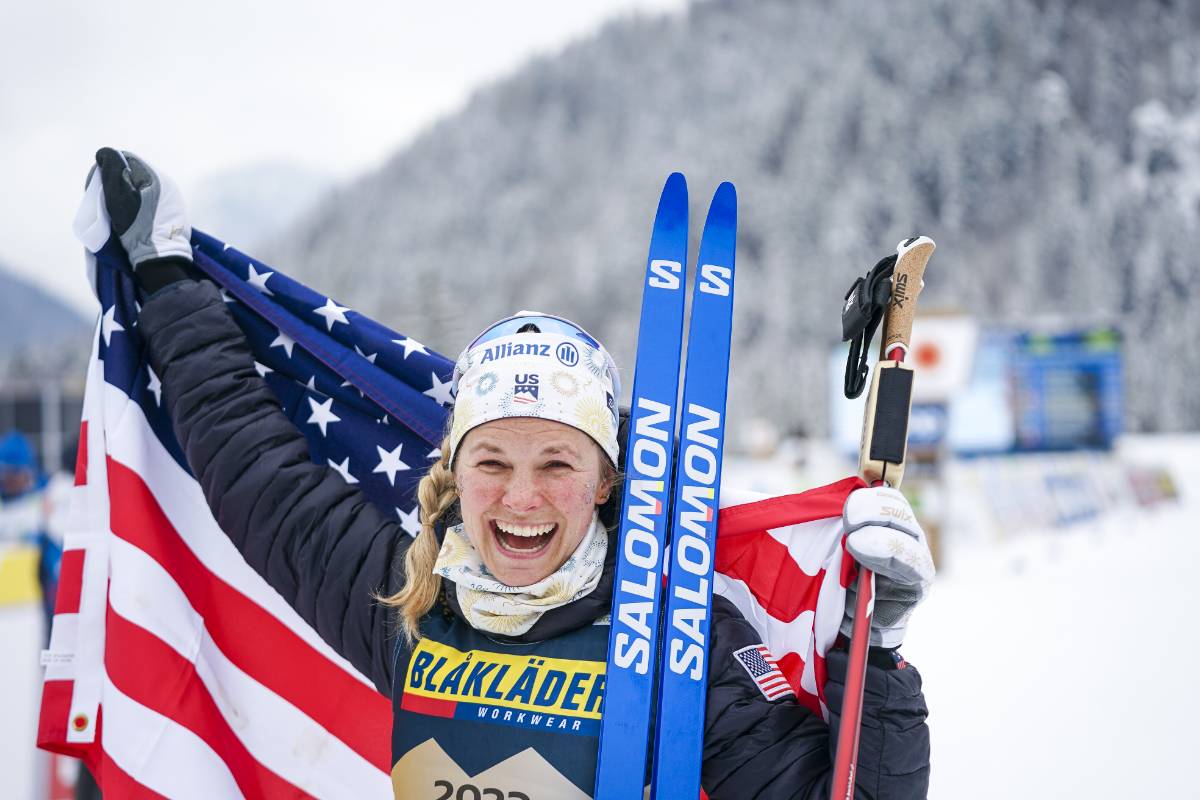
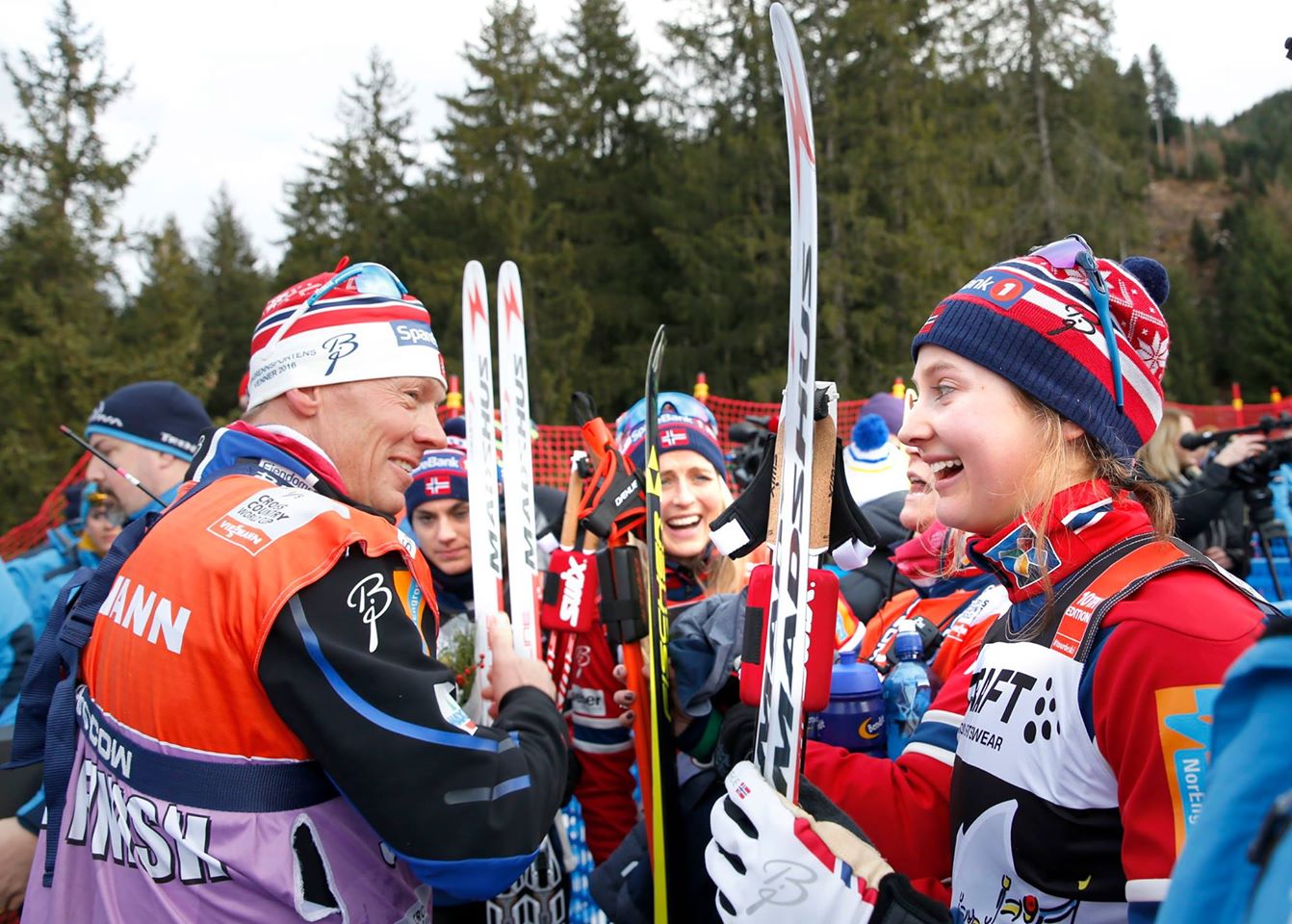
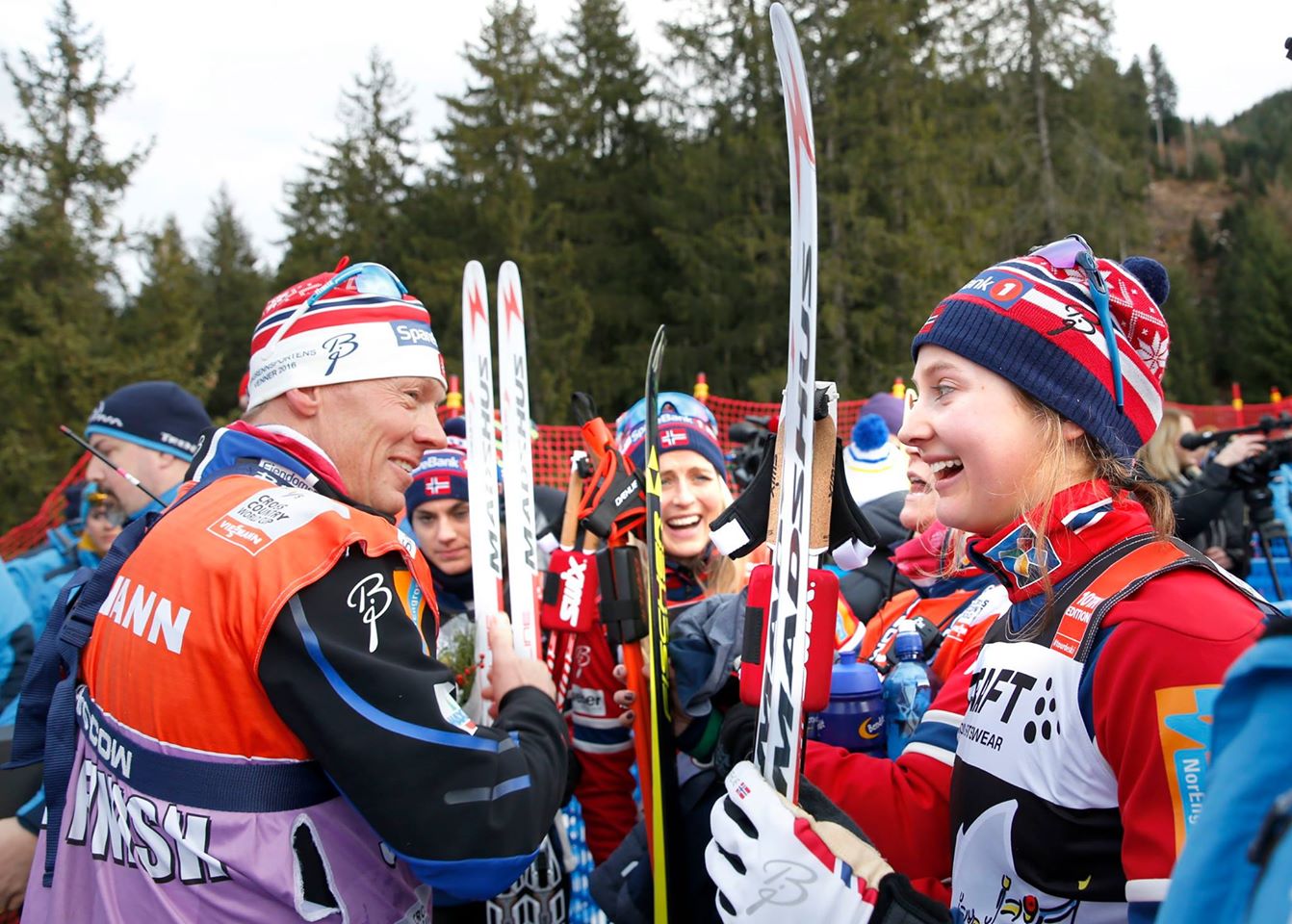
Two words: Jessie Diggins. The American superstar smashed her competition Tuesday, winning America’s first-ever World Championships gold medal in an individual race.
Kristin Størmer Steira and some guy that’s married to her, Devon Kershaw, join Nat for a recap. Get at us at nat@fasterskier.com and devon@fasterskier.com.
The pod is back to recap a good old-fashioned individual start throwdown, with special guest Kristin Størmer Steira.
We break down Therese Johaug of Norway’s nail-biting win over Finland’s Kerttu Niskanen and another nail-biting race for third between Finland’s Krista Pärmäkoski and Russia’s Natalia Nepryaeva. And we discuss questions about the U.S. team selection for the upcoming women’s relay, and the pressure cooker environment of the championships.
We’ll be back after tomorrow’s men’s 15 k.
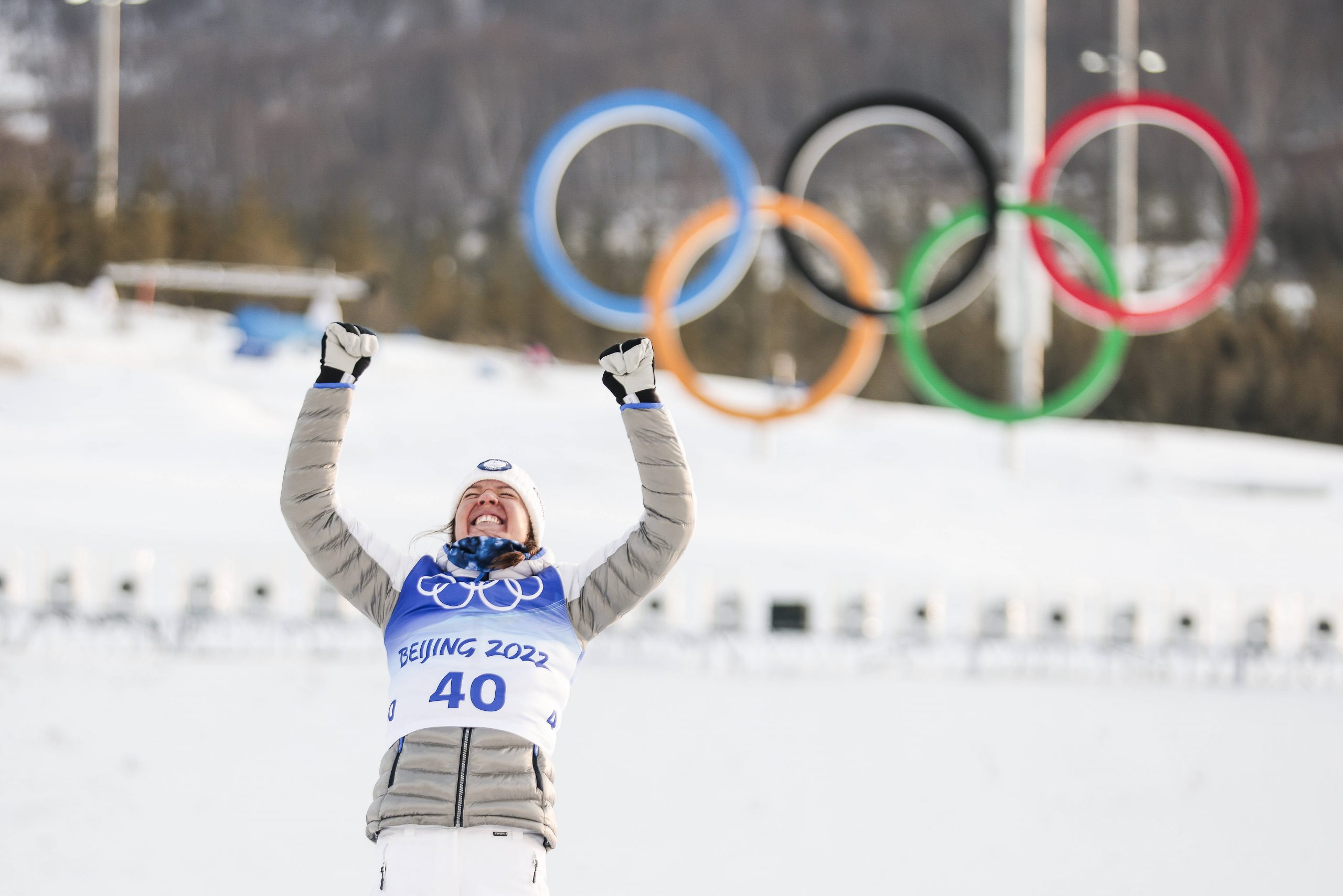
Kerttu Niskanen (FIN) celebrating her first individual Olympic medal. (photo: NordicFocus)
The most special of special guest on the podcast today, Kristin Størmer Steira. Størmer Steira, a retired Norwegian ski star, chats it up with Devon from Lillehammer, where the two are busy raising two young daughters.
In her own right, Størmer Steira was a Norwegian ski star. Back in 2005, Størmer Steira had a breakout in Oberstdorf at the World Champs where she placed third in the 2 x 7.5 k pursuit and won gold as a member of the 4 x 5 k Norwegian relay team. Along with accolades such as more World Champs and Olympic hardware, she’s known as a salt of the earth human being. As listeners of the podcast know, the medals are stashed in a humble wooden box somewhere above the garage.
Kristin Størmer Steira after taking bronze in the 30 k mass start at the 2014 Olympics. (Photo: FIS)
Along with Devon, Størmer Steira provides insight into the vagaries of racing in Oberstdorf and the highlights from today when Alexander Bolshunov won his first individual championship medal as he pulled away in the closing moments of the 30 k skiathlon, and Norway’s Therese Johaug steamrolled on the women’s side.
Thanks for listening to our championship coverage.
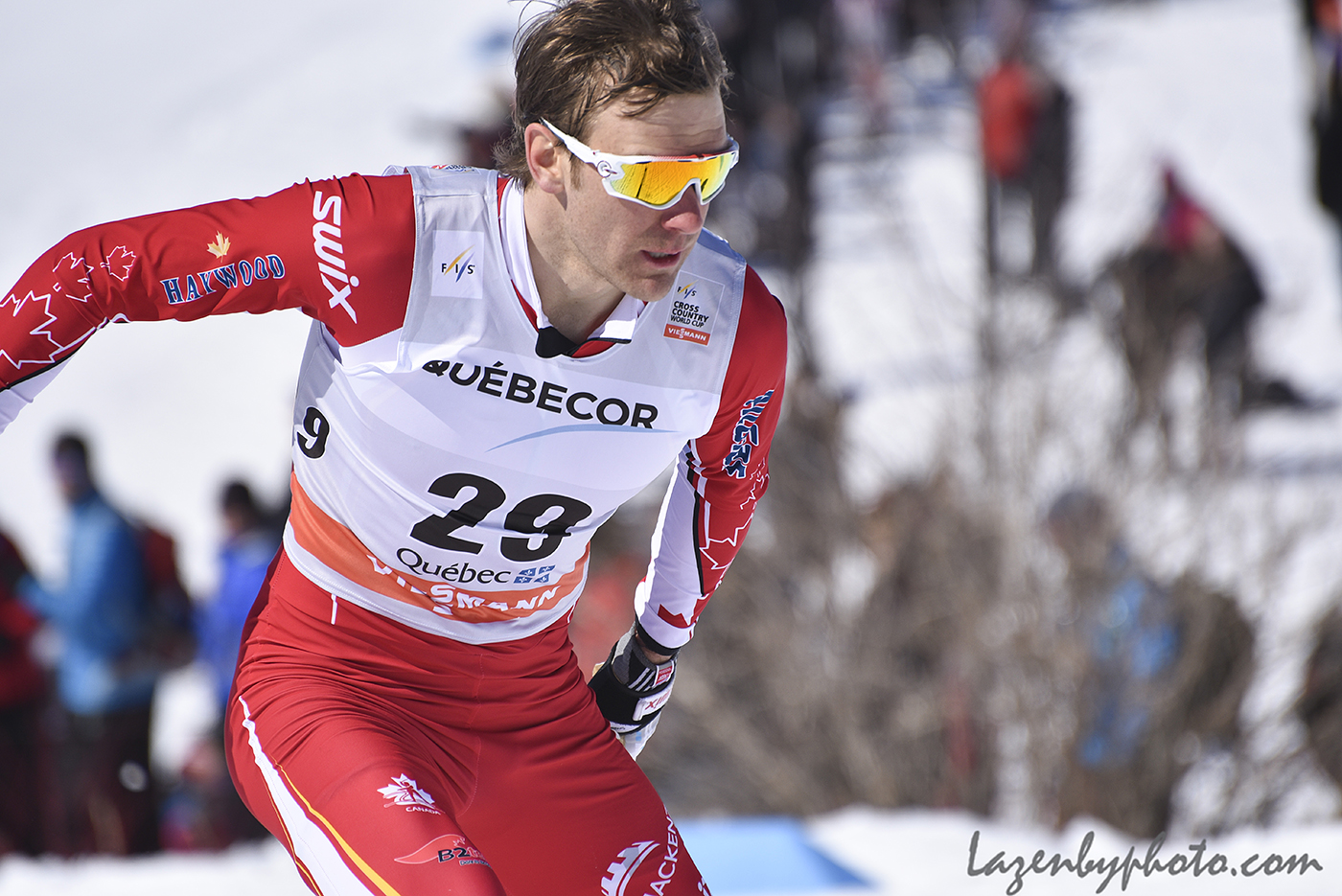
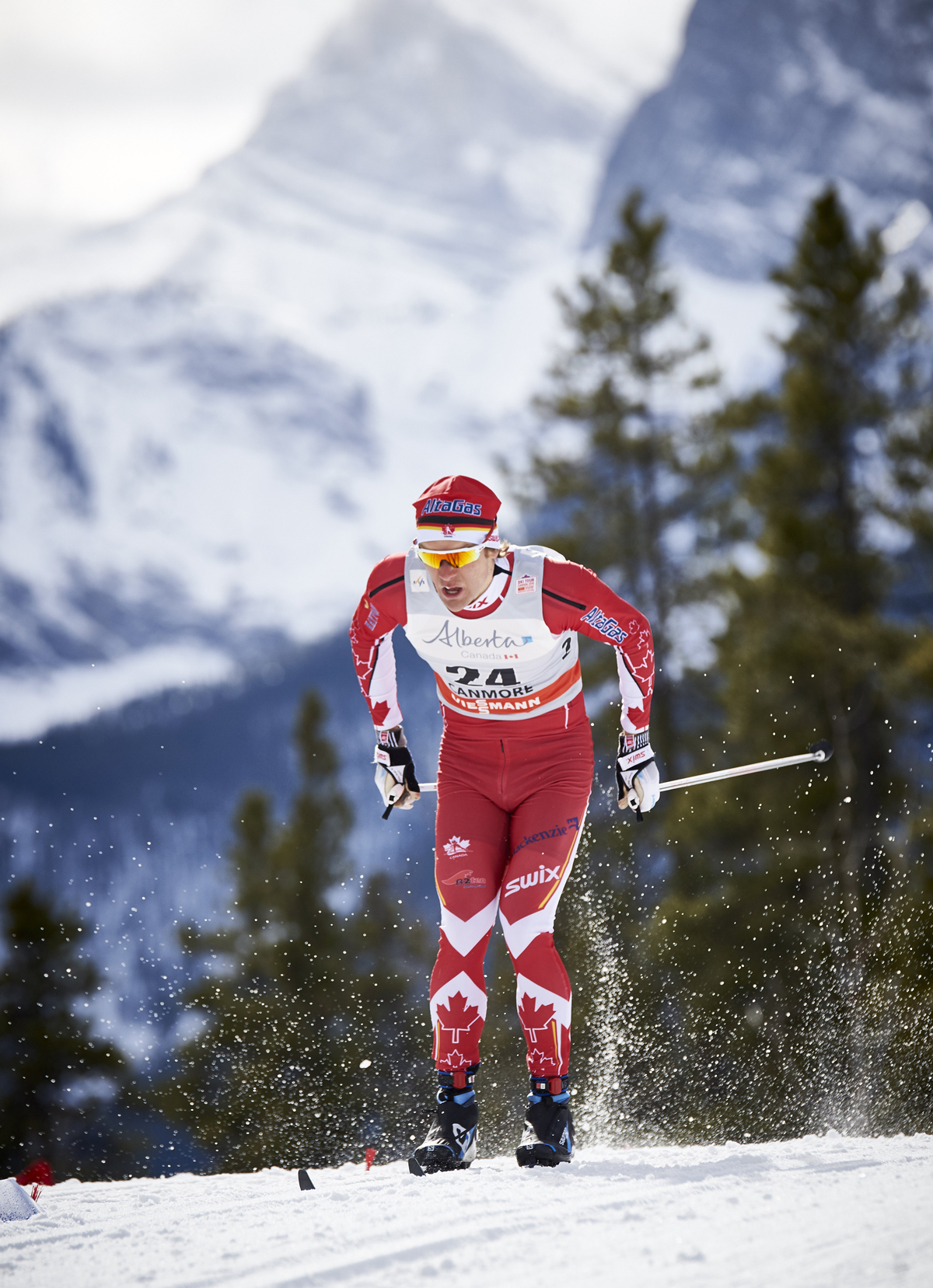
Canada’s Devon Kershaw racing at 2017 World Cup Finals in Quebec City, where he finished 26th in the 15 k freestyle pursuit and 19th for time of day in the last race of the 2016/2017 season. (Photo: John Lazenby/Lazenbyphoto.com)
On April 26, Devon Kershaw posted a photo on social media of Alpina boots hanging on a line. The next day, he spoke on the phone with FasterSkier from his new home in Lillehammer, Norway, after a day of running around outside with his 15-month-old daughter, Asta Isabel.
Kershaw was tired, but in a good way. For the first time in 17 years, he was ready for a new challenge, a new focus and much more time with his daughter and wife, Kristin Størmer Steira, a former standout Norwegian skier.
Three years after Steira left professional cross-country skiing and pursued a career in business, starting with her master’s degree in business management, Kershaw is following suit and headed back to school. The 35-year-old Canadian hung up his boots to quietly announce his retirement after about a month of deliberation.
“I was really keen to keep ski racing, to be honest,” Kershaw said. “I had the motivation to go one more year, and in my head, I wanted to race one more season, but as things progressed in the spring, there were a lot of different factors that just made it seem like, oh man, it doesn’t look like it’s gonna be super realistic at this point.
“I struggled with that, when you feel like you still have more in the tank,” he continued. “But at the same time, it’s a bit of a double-edged sword in the sense that it’s been a fantastic career.”
Kershaw was quick to reflect on his roots as a kid growing up in Sudbury, Ontario, “a mining town with a small but passionate skiing community,” as he put it. He also reiterated how proud he was to represent Canada for 17 consecutive seasons, first as a junior national team skier for two seasons starting in 2001, then as an under-23 national team member in 2003, and finally as a full-fledged World Cup Team member starting in 2004.
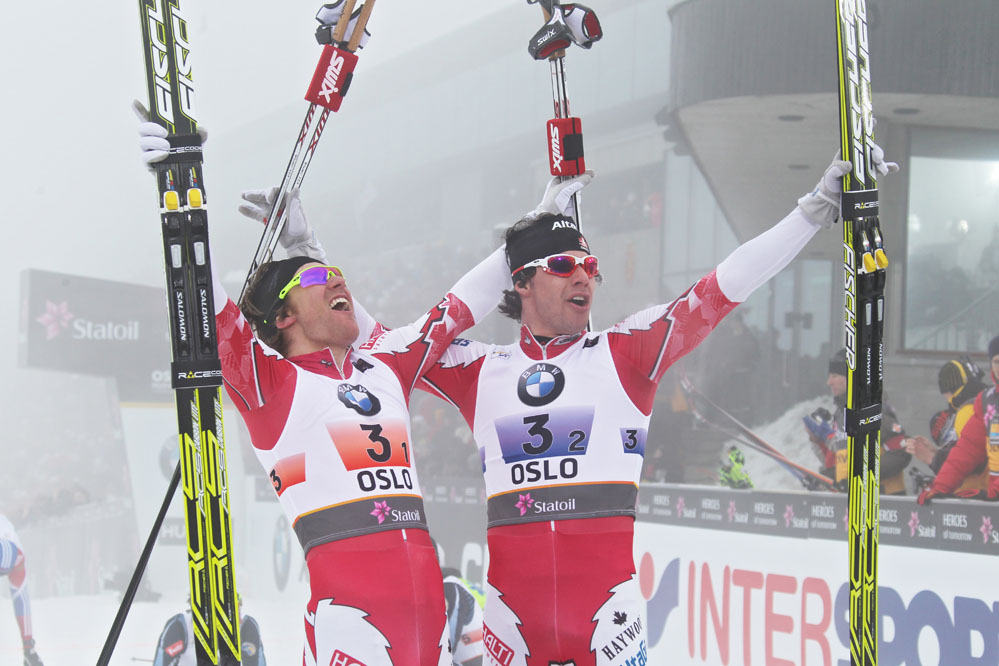
Devon Kershaw (l) and Alex Harvey celebrate their 2011 World Championships gold in Oslo, Norway. (Photo: Fischer/NordicFocus)
His career included three World Cup wins and 14 podiums, and a gold medal at 2011 World Championships with teammate Alex Harvey in the classic team sprint. Kershaw finished the 2011/2012 World Cup season ranked second overall and second in the distance rankings.
When he reflects on those accomplishments, he still has a hard time believing that all happened to him.
“So instead of focusing on being bummed at the situation or a bit frustrated with the state of things in Canadian skiing right now, I have to look back with a smile,” Kershaw said. “I feel just so privileged and grateful to have had the opportunity to be part of a real movement for men’s skiing in Canada.”
Kershaw said he was left with unanswered questions this spring during a transitionary period at Cross Country Canada (CCC). The team’s budget was undetermined, camps were not yet set in stone, and Kershaw said his decision — which he wanted to make by May 1, the start of the new training year — became about energy management.
“Part of managing your energy properly is putting all of your energy and focus into training, and if you’re being pulled with uncertainty or being stressed about uncertainty, that will come back, the World Cup will exploit that,” he said.
According to CCC Chief Executive Officer Shane Pearsall, High Performance Director Thomas Holland had planned to retire this past March, yet has stayed onboard as an advisor until CCC fills the position. Pearsall said the hiring process is still ongoing and will hopefully be wrapped up by next month. He confirmed that CCC has yet to finalize its budget and doesn’t anticipate being able to do so until a government minister signs off on the amount from Own The Podium (OTP), one of its primary funding sources, in July. Pearsall explained that they expect to have a better sense of national-team finances in mid to late June.
Typically, the team’s budget is determined in May, but because of necessary “quad reviews” following the Olympics, which took place before CCC met with OTP, the process was delayed by about a month. Pearsall did not elaborate on how significantly the budget would be decreased from last year, but said, “It’s certainly tighter than last year.”
Kershaw said he needed to pay about $25,000 Canadian dollars in team fees if he wanted to continue racing this year, up from $15,000 last year. That didn’t cover the cost of living, which he figured to be around $55,000 Canadian, for a grand total of $80,000.
“The financial burden is big, and moving forward the financial burden went from big to 100 percent paying for every cost,” Kershaw said. “So all travel, accommodations, everything. … I’ve just been in the sport a long, long time, and from a directional standpoint, I’m not sure we’re moving in a direction that will yield sustainable results at this point in time, but I understand it is difficult when you’re under such financial duress to create a sustainable program. But from a vision standpoint, I think there’s a lot of questions that remain unanswered, and it’s late in April. The fact of the matter is the rest of the world has all of the holes plugged — if they have holes in their boat — because May 1 is the new year of every ski program. And we’re just constantly slow and off the mark with that.”
Budget cuts had been expected as Canada’s World Cup Team missed performance benchmarks throughout last season. The team finished 2017/2018 with just two men scoring World Cup points (top 30) in distance races: Harvey and Kershaw. Two men (Harvey and Julien Locke) scored in World Cup sprints. On the women’s side, Dahria Beatty landed one World Cup sprint top-30 last season, and Cendrine Browne was the top Canadian woman in a distance race with a 27th place for time of day in the last race of the season.
Meanwhile, Alex Harvey led the team with four World Cup podiums, including third overall in the 2018 Tour de Ski, and a top result of fourth place at the 2018 Olympics. He finished his season in fourth in both the Overall and Distance World Cup standings. But Harvey’s results alone weren’t enough to buoy the whole team for another winter.
“Throughout my entire career, it’s almost unfathomable to think that the season ends and that’s the stat line,” Kershaw said of the team’s overall results. “It wasn’t so long ago that we had over 16 World Cup podiums in a season. The truth hurts, as [former Canadian coach] Tor-Arne Hetland once said, but things go in waves and this is the reality that we live in right now.”
Despite the prospect of self-funding, Kershaw didn’t feel pressed into retirement. Several of his teammates have decided to retire as well, including Graeme Killick, Jess Cockney and Knute Johnsgaard, but Kershaw said they weren’t forced, either.
“You can choose to work and you can choose to hustle for money; there are ways to make it,” he said. “No one’s forced into it. I could keep skiing if I wanted to, but I think the stark choice you’re faced with is, maybe perhaps some people are like, I can’t really see a path to international success currently, and that’s what I think is sad…”
‘A dream scenario’
When Kershaw moved to Canmore, Alberta, in 2001 and entered Canada’s elite skiing scene, Cross Country Canada (CCC) was entering a fruitful period. At the 2002 Olympics, Beckie Scott was proclaimed winner of the women’s 10-kilometer pursuit (now called the skiathlon), becoming the first North American woman to win an Olympic gold. At 2005 World Championships, Sara Renner earned a sprint bronze to become the first North American woman to medal at World Championships. Scott and Renner teamed up for silver in the team sprint at the 2006 Olympics in Turin, Italy, where yet another Canadian woman, Chandra Crawford, won the individual skate sprint for Canada’s second-straight gold in as many Winter Olympics. Scott finished that 2005/2006 season ranked second overall in the World Cup, just 16 points behind Norway’s Marit Bjørgen in first.
Devon Kershaw (r) with Graham Nishikawa in 2013. (Photo: Devon Kershaw)
Kershaw made his Olympic debut in 2006.
“Coming into Torino, we were quoted in the newspaper as being like the world’s most anonymous men’s ski team,” he said of the Canadian men’s team that year. “We weren’t really ‘on the map,’ but I’ve just been so grateful and lucky to have such a great group of guys around that really welcomed me in.”
He credited his former roommate and teammate Chris Jeffries as well as other Canadian competitors of his time, including George Grey, Gordon Jewett, Dan Roycroft, Sean Crooks, Dave Nighbor, Phil Widmer, Brent McMurtry, and Graham Nishikawa (who’s still racing), for having a major impact on the formative stages of his career.
“[There were] so many athletes in Canmore that tried hard, wanted it bad, and loved ski racing and training,” Kershaw reflected. “That’s a dream scenario for a young athlete to come into a community like that and be welcomed into that environment.”
Less than a month after the 2006 Olympics, he notched his first World Cup podium by placing third in the Borlänge, Sweden, skate sprint. In doing so, he became the first Canadian male cross-country skier to reach the podium since Pierre Harvey (Alex’s father) in 1988 and the first ever to medal in a World Cup sprint.
“I had no idea who Pierre Harvey was,” Kershaw said of his younger self.
Pierre Harvey had previously won the 1988 Holmenkollen 50 k as well as two other World Cup distance races and the Norwegian Birkebeiner, making him the most successful Canadian male skier before Kershaw.
“He could walk into the room and I would not recognize him,” Kershaw continued. “Even his results, I had heard that he had five World Cup podiums and that seemed pretty cool, but that’s all I knew about him.”
Kershaw’s second World Cup podium came early in the 2006/2007 season in a skate sprint in Munich, Germany. That same day, Crawford — whom he was dating at the time — placed third in the women’s sprint.
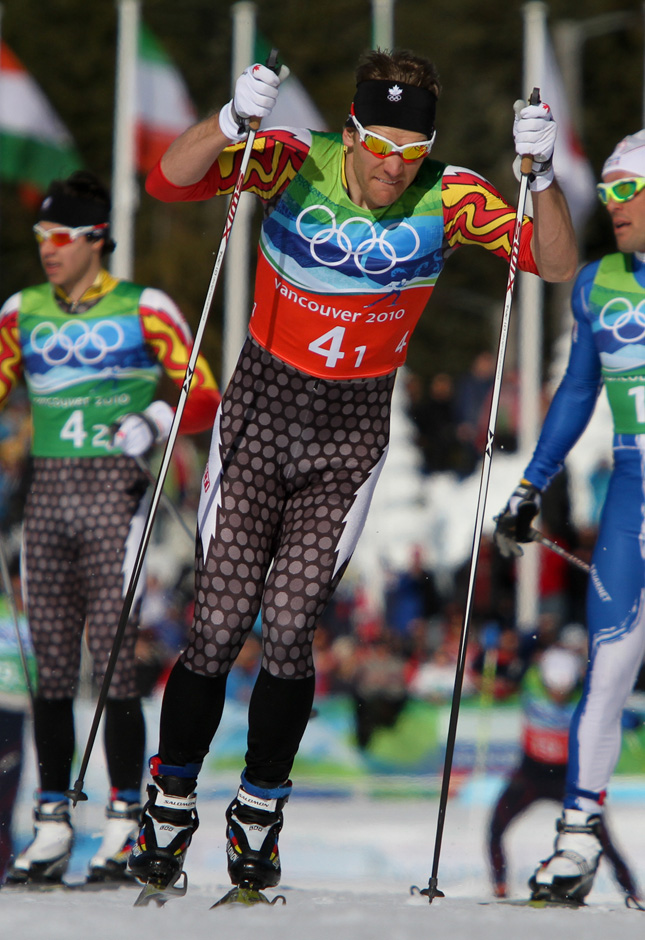
Devon Kershaw after being tagged by his Canadian teammate Alex Harvey (l) in the freestyle team sprint at the 2010 Olympics in Vancouver, B.C. They went on to finish fourth.
At his second Olympics in 2010, Kershaw finished fifth in the 50 k classic mass start for the best individual Olympic result for a Canadian male nordic skier. That record stood until Alex Harvey, who burst onto the World Cup scene in 2008, bested it with a fourth place in the 50 k classic at this year’s Olympics in PyeongChang, South Korea.
Kershaw and Harvey also teamed up to place fourth in the freestyle team sprint at the 2010 Olympics.
Kershaw’s first World Cup win came in a skate sprint during the 2011 Tour de Ski. He finished that Tour in seventh, and the next year, came back to place fourth overall in the 2012 Tour de Ski (TdS). Kershaw started all 12 editions of the TdS, a record he shares with France’s Jean-Marc Gaillard.
Harvey scored his first individual World Cup podium in a 50 k classic in 2009 and won his first World Cup race (a 3.3 k freestyle prologue) at the TdS in 2012.
“Then next thing you know, Alex and I are sharing a podium on some World Cups,” Kershaw reminisced. “Two Canadians on one podium in the World Cup, like, really? And then you win World Championships and I’m on the overall World Cup podium, and then next thing you know, Alex has been on the overall World Cup podium a few times and also now 50 k world champion. It’s crazy. It’s insane. From nothing. From no results. The journey has just been amazing. … I never would’ve thought Canada would, I mean, how could you? We had Pierre Harvey and that’s it in, like, a hundred years of international ass-kicking.”
Kershaw credited his initial World Cup breakthrough as a 23-year-old skier in Borlänge to Dave Wood, Canada’s national-team coach at the time.
“I came into a team with a coach that you could call at midnight. He’d do anything for you,” he said of Wood. “There was no way I would’ve stepped onto the podium in 2006 without him, and Mike Cavaliere, too, my first-year senior, Mike was my coach. We had staff that was just committed to the core for the cause and I’m incredibly grateful for that.”
‘A hell of a season’
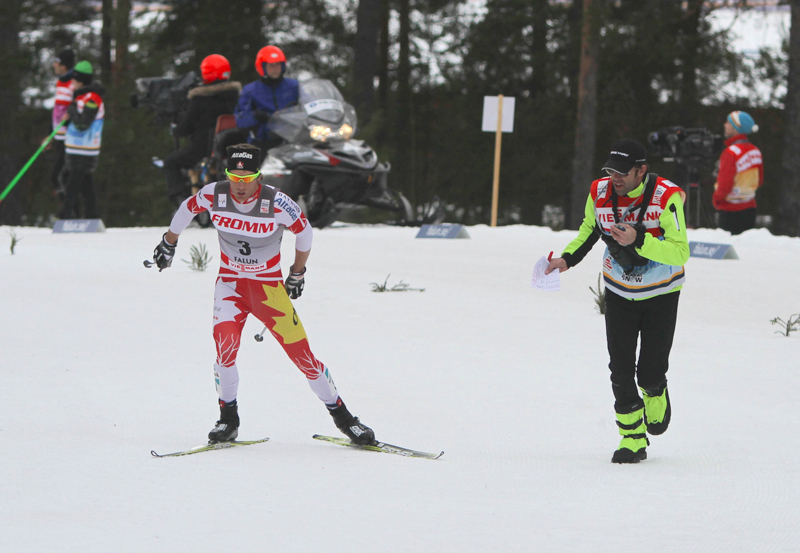
Canadian head coach Justin Wadsworth (r) giving splits to Devon Kershaw at 2012 World Cup Finals in Falun, Sweden.
Of his coaches, Kershaw gave special credit to Justin Wadsworth. A three-time U.S. Olympic cross-country skier who became Canada’s head coach in the spring of 2010, Wadsworth coached Kershaw for five seasons, and the two developed a close friendship.
“When Justin came into the national team, the level of professionalism and excitement and freshness that he brought … I don’t know if you call it luck or happenstance or just the right place, right time,” Kershaw reflected, alluding to his 2011 World Championships gold with Harvey and his 2012 Overall and Distance World Cup podiums. “Justin’s best results as a coach were me and my best results as an athlete were when I was coached by Justin. Talk about an amazing relationship there.”
“The main thing that I really appreciated with Devon, and I think he would say the same thing about me, is that we could be honest with each other and talk about hard things and enjoy the good times when we had them,” Wadsworth said on the phone last week. “… It’s cliche, but when I was talking to Devon the other day about his retirement, it’s not about the medals or the performances or whatever, it’s about your times together on the road.”
One of Kershaw’s biggest moments came at those 2011 World Championships in Oslo, Norway, where he and Harvey beat out Norway’s Petter Northug and Ola Vigen Hattestad by 0.2 seconds for gold on the Norwegians’ home turf. They had done so after Kershaw lost one of his skis early in the race, Wadsworth pointed out.
“His ski fully came off and he had to put it back on and get back into the race,” Wadsworth said. “Just the whole day was pretty incredible. That was a great, great opportunity for us, and the guys cashed in.”
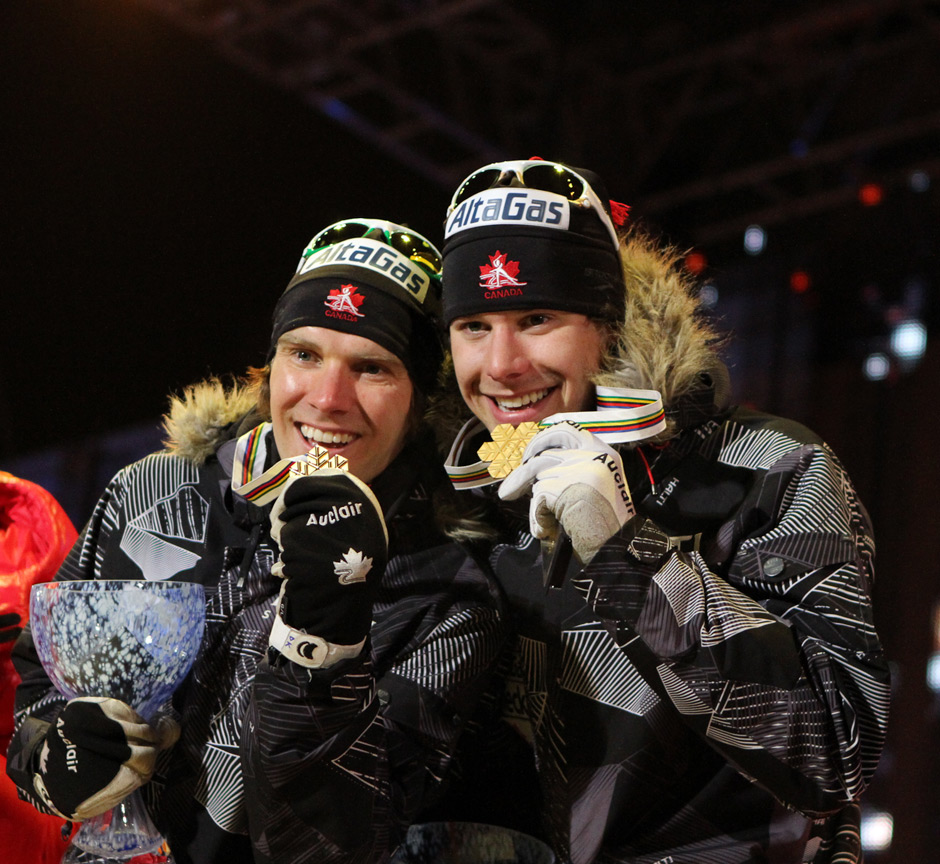
Devon Kershaw (l) and Alex Harvey with their World Championship gold medals at the 2011 World Championships in Oslo, Norway.
In a difficult-yet-strategic move to conserve for that race, Kershaw and Harvey both sat out the 15 k classic the day before.
“With anybody else running the ship, there’s no way I would’ve trusted that [decision],” Kershaw said of Wadsworth’s call. “But I trusted Justin’s leadership and we went all-in, and the next thing you know we won World Championships. I mean, are you kidding me? How can you get a better start to the next quadrennial? And Justin as a first-year head coach of a national team, that’s gotta go down as maybe the best season ever for a first-year North American coach of a national-team program.”
He and Wadsworth reiterated the crucial foundation that Wood had laid.
“Dave Wood had done a really good job with the athletes leading into that period, mainly focused on building a big base and doing a lot of hours and also doing a lot of time at altitude,” Wadsworth explained. “And when I took over the position, I saw that both Alex and Devon were really primed and had a really good response rate to altitude, and all we had to do was fine tune a little bit of strength training and intensity. I was really excited to work with both those athletes and saw that they had a lot of potential.”
For Kershaw, Wadsworth’s “American swagger … was magic for me,” he said. During the 2011/2012 season alone, he stood on the podium 10 times, with four top-three finishes in seven races at the 2012 Tour de Ski.
“It was a hell of a season for me,” Kershaw said.
‘Best sand-digger ever’
He went on to compete at two more World Championships and two more Olympics. This past season, Kershaw finished in the top 30 in eight World Cup distance races, with a top result of 19th in the 30 k skiathlon in Lillehammer, Norway. While struggling with lung issues, he finished 26th in the 50 k classic at the PyeongChang Olympics.
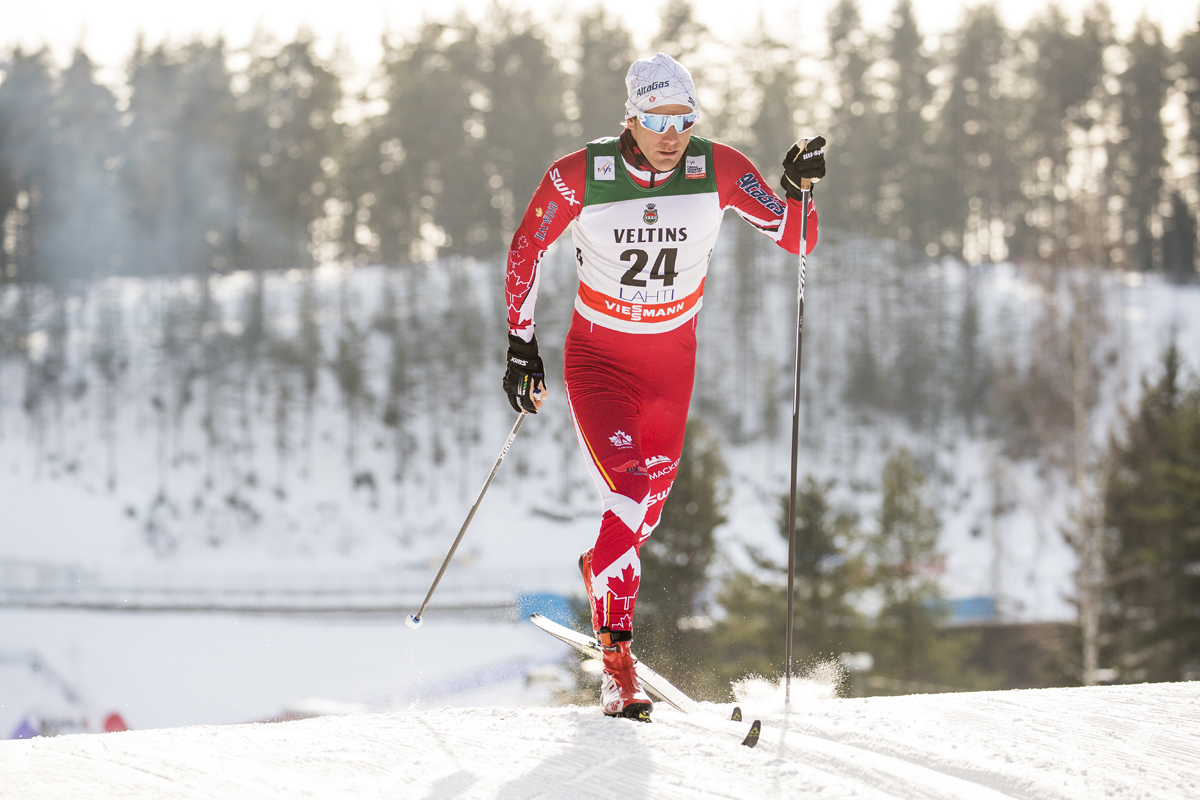
Devon Kershaw racing to 25th in the World Cup 15 k classic this past March in Lahti, Finland. (Photo: Fischer/NordicFocus)
“We worked to get that under control and it was manageable but it never felt good like it felt prior to 2015,” Kershaw said his health over the last three seasons. “In PyeongChang, it was a calamity of bad luck. When we got there it was minus 20 [Celsius], and this makes me sound so soft, because I’m from northern Ontario so you’d think I’d know, but it was really cold. I did some intervals and it aggravated my lungs and it was super windy and dirty and a lot of sand blowing around, and that really flared up my asthma to the point that I was wheezing badly.”
His breathing troubles also affected his sleeping and took most of the two-week Olympics to manage. At one point, he had a chest X-ray to make sure it wasn’t pneumonia.
“It was sporting asthma,” he said. “… It took all the way to the 50 k to kind of get it 70 percent.”
While he noted he was left wanting more from a performance standpoint at both his final Olympics and in his final season, Kershaw also acknowledged that he’s his biggest critic.
“That’s been probably the biggest detriment to my entire career; I’m the best sand-digger ever,” he said. “I am disappointed in the sense that I work really hard and I train hard and I prepare well, and it didn’t go exactly as planned. … When you’ve competed in the top 10 for as many years as I have and on the podium, of course that becomes your bar that you hope to achieve, but at the same time … when you’re in the top 30 in the results page, you’re in the race at least. And I’m proud of the fact that in almost all classic races, not every, but most, I was in the top 30 and ‘in the race’.
“Am I satisfied? In my life I’ll probably never be satisfied, that’s just how it goes,” he added with a laugh. “But am I somewhat proud of maintaining a fairly competitive level? Yeah, absolutely.”
Wadsworth reflected that Kershaw was one of the best athletes he had ever seen, even “physiologically as good as Alex [Harvey]” at the peak of his career.
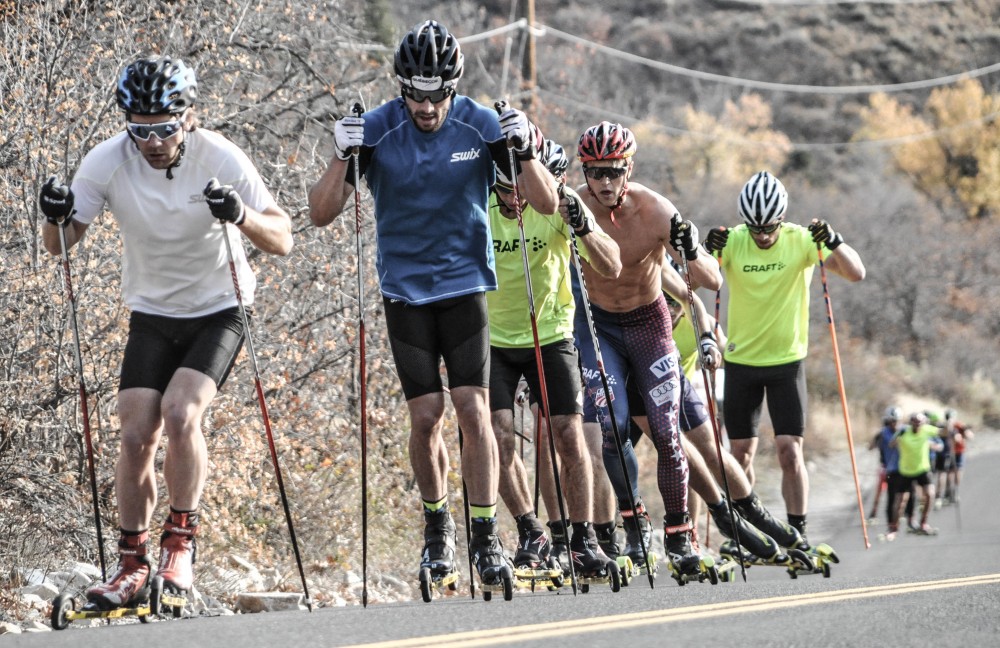
Left to right: Canada’s Devon Kershaw leads his teammate Alex Harvey and U.S. Ski Team members Noah Hoffman, Erik Bjornsen and Simi Hamilton during a Level 3 interval skate session up Snake Creek Canyon in Midway, Utah, during their respective teams’ 2016 training camps in Park City, Utah. (Photo: Matt Whitcomb)
“Devon’s a very intelligent person and sometimes he might’ve overthought things and lacked in confidence, and as a coach that’s really frustrating to see because you know how good they are physically,” Wadsworth said. “And when he was on mentally, too, in training, when he was at his very best, he had total confidence and could destroy anybody in any workout.”
He recalled a hill-bounding workout with the Norwegian team in which Kershaw was literally leaps and bounds ahead of everybody else — even Martin Johnsrud Sundby and Russia’s Ilia Chernousov, who joined the training session.
“He was just shelling everybody,” Wadsworth said. “So when Devon was at his best like that and mentally confident and relaxed, he was a real force of nature. Unfortunately that didn’t always translate into the racing season, but in 2012 he put it all together and had a tremendous year. … If he had the confidence the whole time, he would’ve been almost unbeatable, in my opinion, but it takes the whole package all the time, and he was among the greats there for a while.”
‘Younger, faster, better dog’
And then there was Harvey, another one Kershaw’s of his best friends and longtime roommates.
“I’ve spent more nights in a room with him than my wife or any girlfriend I’ve had,” Kershaw joked. “… He was eager to learn, he chased me for years, he was always a hard worker, too. He trained really hard, he believed in himself, and I still am in total awe of that. I’ve never met anybody as confident as him. It’s too bad that didn’t rub off on me, but that’s been great to be around.”
He likened Harvey’s addition to the team as a family adopting a puppy.
“You know when your parents get a puppy because your dog is 10 years old? He’s kind of slowing down a little bit and then you see that old dog get fired up and run again and jump around and play; that’s me,” Kershaw said. “And I’m so grateful that my owners got a younger, faster, better dog to hang out with because it was so inspiring.”
Several times over the last few years, Kershaw has said that witnessing Harvey make Canadian history has been one of his biggest reasons for staying in the sport.
“He, for sure, has kept me in this probably longer than I should’ve,” Kershaw said. “I just love traveling with him and seeing what he can accomplish and training with him and seeing that professionalism.
“There’s no question he’s the best Canadian skier ever, that’s not even close,” he added. “… I just feel so honored that I got the chance to see it all happen, from his last-year junior when he did his first World Cups and then all the way though I’ve been with him.”
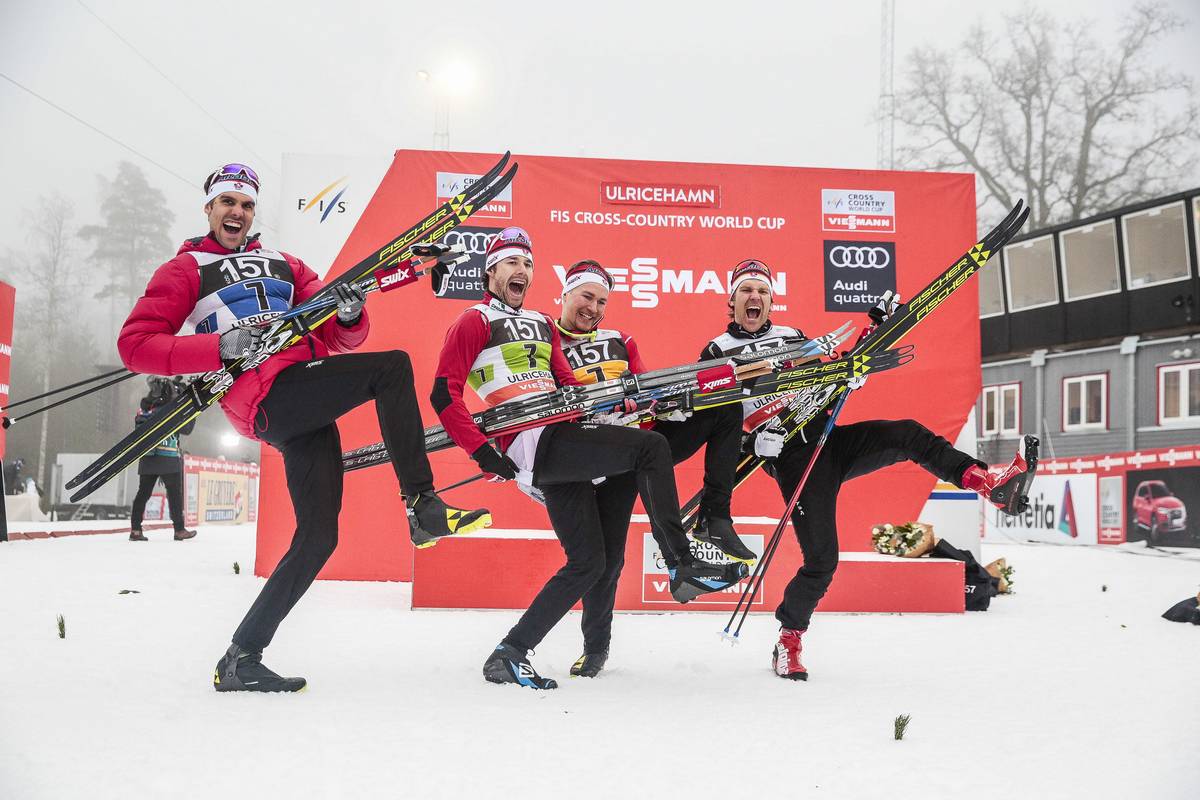
The Canadian men’s relay after placing third in January 2017 in Ulricehamn, Sweden, for Canada’s best-ever World Cup result in the 4 x 7.5 k relay. From left to right: Lenny Valjas, Alex Harvey, Knute Johnsgaard, and Devon Kershaw. (Photo: Salomon/NordicFocus)
In an email, Harvey explained that he and Kershaw first met in the fall of 2005 at a training camp at Sovereign Lake, British Columbia. Harvey was on the junior team and Kershaw a senior, but the whole team stayed at the same hotel.
One morning, Kershaw accidentally took Harvey’s poles from the hotel. Harvey had to track him down on the ski trails to get them back.
“That was the first time I talked to him and to me it’s just perfect because that’s so Devon,” Harvey wrote.
Later that season on March 7, 2006, Kershaw made history with his first podium. That same day, Harvey won his first national title in the 10 k classic at Canada’s senior national championships as a 17-year-old junior.
“I guess our friendship was meant to be before we even knew it!” Harvey wrote.
When the two became teammates, Harvey immediately took to imitating Kershaw, both in training and racing.
“He took me under his wings and he has a big part in the athlete I became today,” Harvey wrote, likening Kershaw to a big brother. “I feel very privileged to have spent all that time with him. I think we became such close friends because we are both very driven athletes and we don’t accept any compromise. We’re both huge fans of our sport, ‘nor-dorks’, so we also love to talk about everything from altitude training to who is seeing who on Tour.”
Kershaw’s decision to retire didn’t surprise Harvey.
“I think it’s a mix of a few things,” Harvey wrote. “… Probably this biggest reason, he has a little girl at home. I know this winter was extremely hard on him. Not seeing Asta Isabel was pure torture, I think I would have done the exact same if I was him.
“I will miss a lot of things about Devon,” he added. “He’s always there to give good advice about everything and anything. He knows so much about all that is going on in the world, probably the most well-read person I know. He’s kinda my news source. I’m still amazed by how indecisive one can be. This brought a lot of laughter throughout the years. I have so many memories from the last 10 years with him. Seeing him dominate the World in 2012 was just amazing but also very eye-opening for me. He raised the bar for all North American skiers that year and I’m very thankful for it.
“We both lived great emotions in high accomplishments and huge disappointments. I’d like to think I helped him get through these upsets and I can say he definitively helped me get through mine. A page turns in the life of Devon Kershaw but knowing the man, I’m not worried about what’s gonna come next.”
Without Kershaw, Killick, Cockney, and Johnsgaard on the men’s team, Harvey acknowledged that next winter will be “very different” for him on the World Cup.
“All these guys are calling it a career and I’m super proud of what all my friends accomplished,” he wrote. “I’m excited to try to help the next generation step it up and fill the shoes of the previous generation. … Also, after 10 years on Tour I’ve made some friends on other teams so I’m not too worried. I’m just excited to step into a bit of a mentor role for our next generation.”
Onto the Next
As for Kershaw, he didn’t rule out coaching future generations of Canadian skiers, but he said he was focused on getting an education first. In just over a week, he’ll start a course that requires 20 hours of classes a week — all in Norwegian — for what he anticipates will take six months. The course is essentially an advanced version of Norwegian as a second language, and foreigners must pass it to pursue a degree in Norway.
After that, Kershaw plans to apply to universities “and hopefully study forever,” he said with a laugh. “Not forever, but study, and I want to stay involved in skiing in any way I can and I want to help the next generation get better.
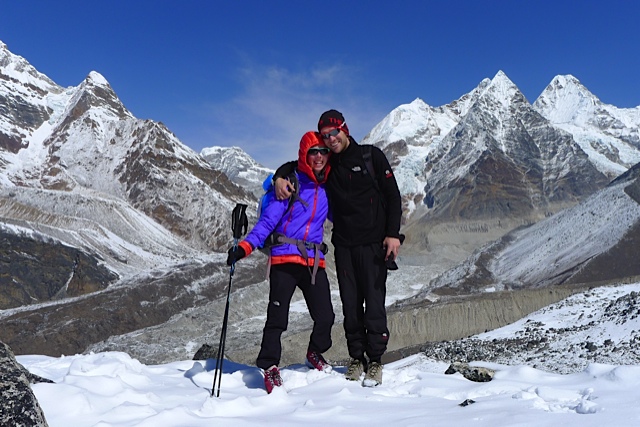
Kristin Størmer Steira (l) and Devon Kershaw during a day hike on one of their acclimatization days. The couple got engaged in 2014 after summiting Mera Peak during a three-week trek in Nepal’s Himalayas. (Photo: Devon Kershaw)
“First things first, I have to get my Norwegian at a level where I can sit through a lecture and write an essay at a decently good level, at least good enough that my wife doesn’t have to rewrite it, she can just correct it,” he explained.
Asked what he’d like to study, Kershaw said medicine, specifically orthopedic surgery, has always intrigued him. (As a junior skier, Kershaw took undergraduate classes at the University of Calgary until 2006, but those credits have since expired.)
“But now I’m 35 and I’m going to have to do all of this in my third language,” he acknowledged. “So for now, I’d say that that’s still my first choice and I’m exploring what it would take.”
If not medicine, he’d like to pursue a degree in “some kind of science physiology, and then in a totally shifted way, if I have a panic attack and be like, ‘Science is too hard after ski racing forever,’ then I am interested in economics and economic theory and business to some degree…”
Regardless of which path he choses, he’ll be doing it in Norway, Kershaw said.
“I don’t mind the challenge. … It’s intimidating in a way, but it’s also really exciting,” he said. “Kristin’s family [who lives in Lillehammer] is just so fantastic and to see how happy my daughter is here, to have her family, to have family around her and everything for the short term, and I hope to be educated in Norway.”
Asked if he’ll jump into any ski races this season, Kershaw was quick to respond, “No.” But he will continue skiing. The beauty of the sport and the struggle, as he put it, is what’s kept him in it so long.
“Imagine just having a singleness, a purpose, a goal that’s just there in your face and then you get to wake up every day and do the things you absolutely love to do,” he said. “… I adore cross-country skiing. I just think it’s such a peaceful, beautiful exercise, and the technique and the flow of it all. … You’re just skiing through the woods peacefully, gliding over snow, over all the terrain you can cover. It’s a beautiful, zen-like endeavor, and I think that’s what’s kept me in it this long. And the people, the Canadian ski community, the world ski community, really. I’ve met so many inspiring people and beautiful people and worked with a lot of absolute experts and I’ve had brilliant teammates and brilliant coaches.”
And because of skiing, he met his wife and started a family in Norway.
“I have a daughter with a woman that I love and respect and am in total awe of every day of my life and without ski racing there’s no way that would’ve ever come to fruition,” he said. “There’s the biggest gift right there, as cliche and Hallmark as that sounds, it’s true.”
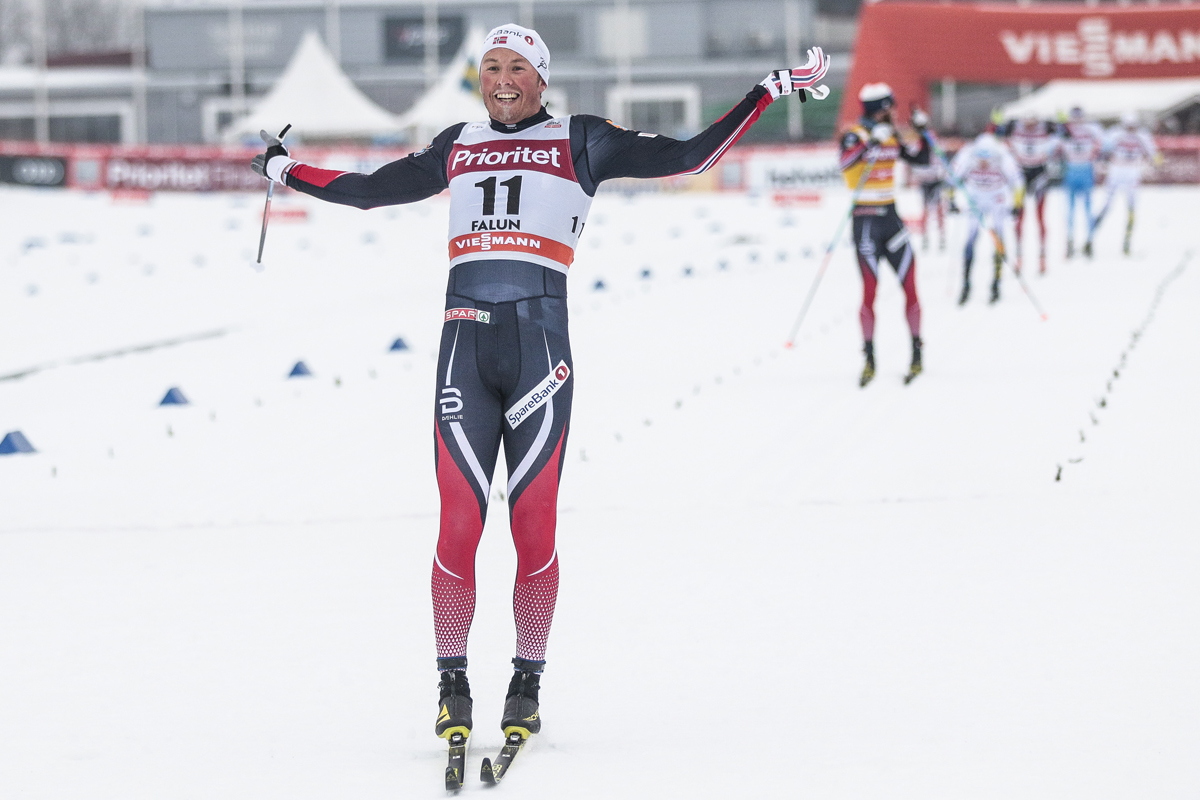
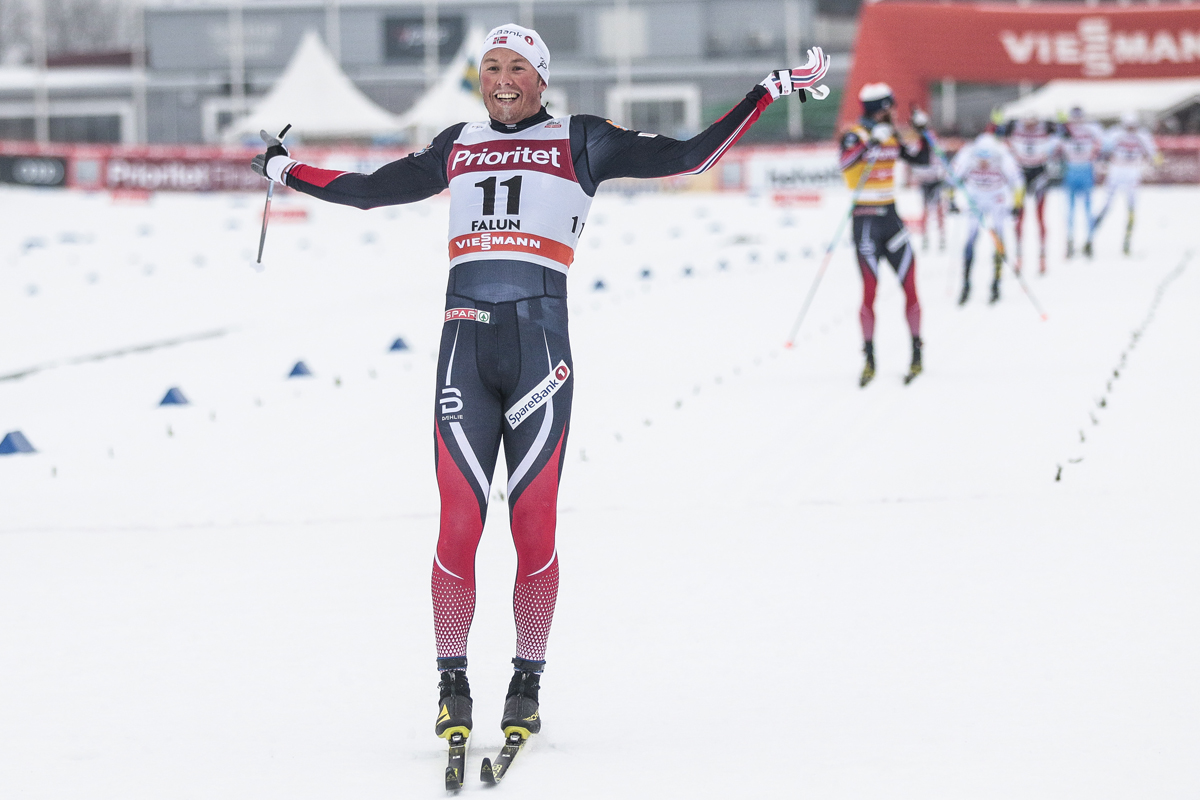
Norway’s 25-year-old Emil Iversen celebrates his first win of the season on Sunday in the men’s 30 k classic mass start, which he won by 3.7 seconds over fellow Norwegian Martin Johnsrud Sundby (yellow bib). (Photo: Fischer/NordicFocus)
$75,400: the yearly amount top Norwegian national-team members reportedly make, not counting sponsorships — closer to the amount someone like Iversen, 25, is now making.
The look on Iversen’s face on Sunday after crossing the finish line first on Sunday for his first World Cup win of the season? Priceless.
The victory, which he secured by 3.7 seconds over his team’s superstar Martin Johnsrud Sundby in the men’s 30-kilometer classic mass start in Falun, Sweden, was his second in a World Cup distance race and fourth of his career.
But the way Iversen talks, he should’ve been winning every race this season.
“My performance says a lot; I’m pretty good at skiing and I master several things,” he told VG.
Iversen’s World Cup win on Sunday was redemption for what he deemed a sub-par performance on Saturday. Second place by 0.06 seconds was unacceptable, and the look on his face and the pole he snapped in two after the men’s freestyle sprint final said it all.
“I’ve been pretty mad at my little brothers, but I don’t think I’ve been this angry in years,” Iversen told NRK.
For the sake of reflection, let’s rewind to a year ago, when Iversen credited training with the best, Norway’s Petter Northug.
“I have trained too much with him now I think,” Northug said at a February 2016 post-race press conference in Lahti, Finland.
Iversen, then 24 with his second sprint World Cup victory, jested that he knew Northug’s weakness, but there was no way he was disclosing it.
“I know what that is, so I’m going to use it also next year,” he said.
It’s now next year, and Northug’s nowhere in sight — at least not until Sunday, when he returned to the World Cup for the first time in over a month to finish 31st as the seventh-best Norwegian (out of nine) in the 30 k mass start.
Northug finished a whopping 3 minutes and 10.6 seconds behind Iversen, who’s proven himself one of Norway’s strongest starters in any given race.
“The plan is sprint, team sprint, classic distance and the relay,” Iversen said of 2017 World Championships, slightly less than a month away in Lahti, Finland.
At the same time, he explained he hadn’t heard anything definitive about Norway’s World Championships team.
“I haven’t heard sh*t, so maybe they don’t have faith in me. But I’ve handed in some good applications,” he said. “I think I was born to do a team sprint. The distance suits me incredibly well.”
Asked who he’d pick as his teammate, Iversen was uncertain.
“It would have been fun to do it with Petter, but if you’re gonna do the team sprint you need to have performed well in the distance,” he said.
How the tables have turned…
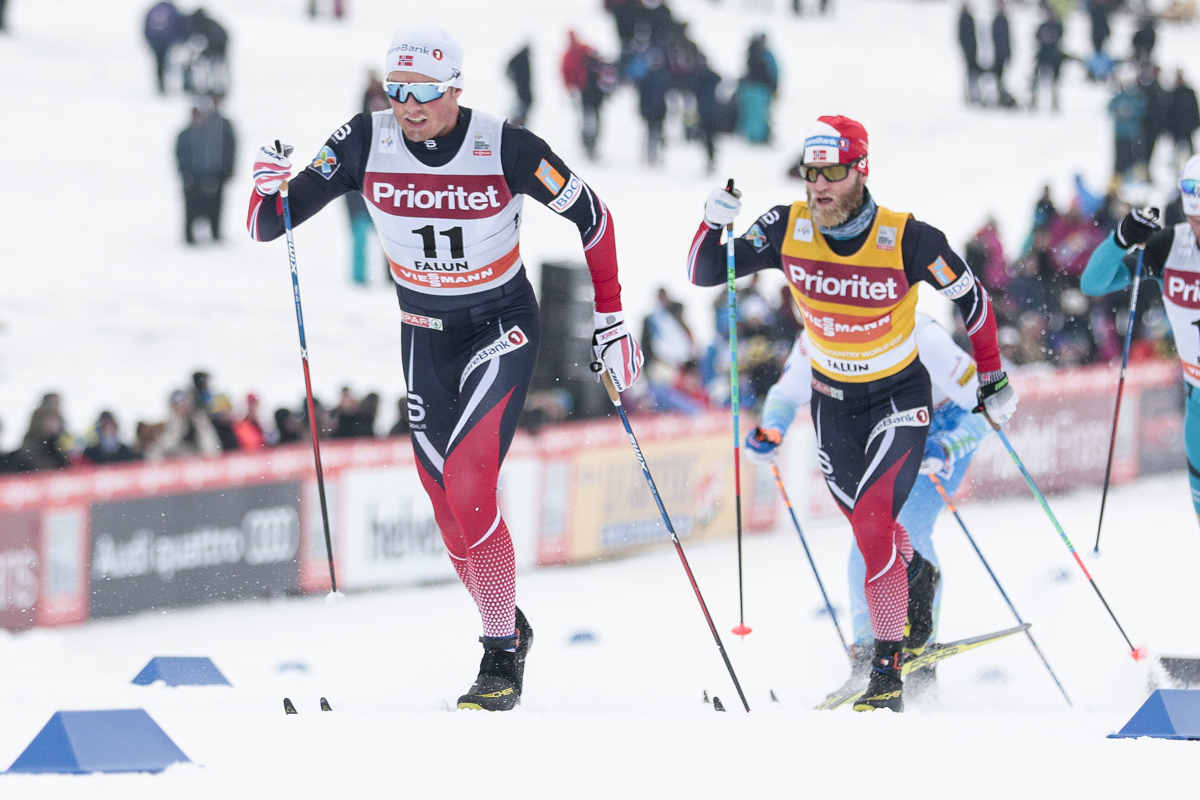
Emil Iversen (11) leading fellow Norwegian Martin Johnsrud Sundby (yellow bib) in the men’s 30 k classic mass start on Sunday at the World Cup in Falun, Sweden. (Photo: Fischer/NordicFocus)
On Sunday, Iversen hung in where he needed to, within striking distance of the leaders in the six-lap 30 k.
Conditions weren’t easy, with temperatures around -4 degrees Celsius (25 Fahrenheit) and snow that was described as “sugary” in Falun. Iversen scored bonus points at three out of the four intermediate sprints on the course, racing through the 6.5 k checkpoint in fourth, 16.5 k in fifth, and 21.5 k in fifth.
Meanwhile, his teammates Sundby and Sjur Røthe mostly drove the pace up front. With 10 k to go, Røthe made a move and put five seconds into the field. One and a half kilometers later, at the final bonus sprint, Røthe had built that lead to 8.5 seconds. Skiing alone and having to herringbone outside the tracks, however, isn’t easy, and Røthe was swallowed by the pack as he entered the stadium for the final lap at 25 k.
Sweden’s Daniel Rickardsson was one of several different men to take the lead after that point, before Iversen moved into first halfway around the loop at 27.5 k. Finland’s Iivo Niskanen followed, along with Sundby, both within a second of first. By 28.2 k, Sundby was again leading Iversen and Niskanen, with a 1.4-second gap to Russia’s Alexander Bessmertnykh and Røthe in fourth.
With less than a kilometer remaining, Sundby began his final push. Iversen caught up to him, ultimately challenging Sundby for the win. With about 200 meters to go, Iversen made it clear he was going take it all on Sunday — not second to Sundby or anyone else. He crossed the line first in 1:15:46.7 minutes, 3.7 seconds ahead of Sundby.
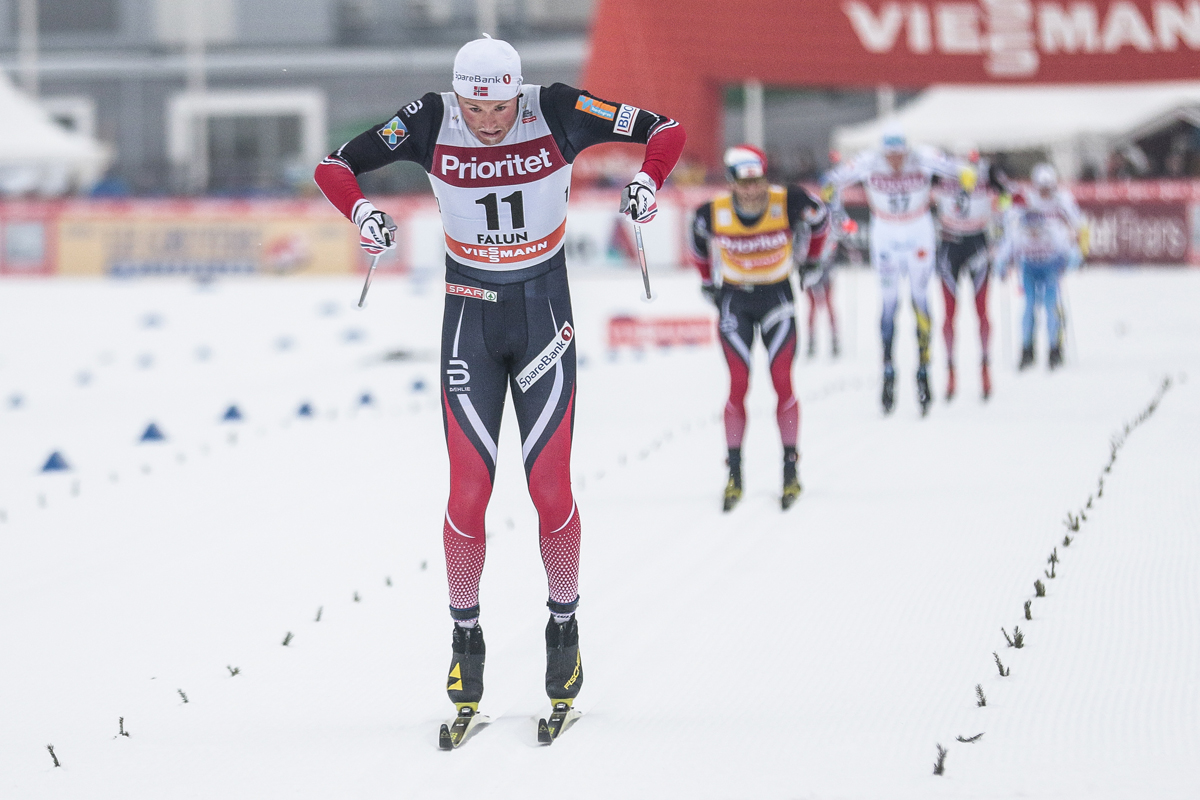
Norway’s Emil Iversen double poling to a decisive victory on Sunday, ahead of Norway’s Martin Johnsrud Sundby (yellow bib) and Sweden’s Calle Halfvarsson (in white) in the World Cup men’s 30 k classic mass start in Falun, Sweden. (Photo: Fischer/NordicFocus)
“It felt good when I realized there was no Italian in the final stretch like yesterday,” Iversen told NRK, referring to his photo-finish loss in the sprint to Italy’s Federico Pellegrino.
“There was a war between me and Martin,” he said of Sunday’s distance race. “It turned out a little like I wanted it to, and then it’s all about attacking.”
The overall World Cup leader by more than 300 points, Sundby settled for second and Sweden’s Calle Halfvarsson locked up third, 5.6 seconds behind Iversen. Just 0.1 seconds off the podium, Røthe placed fourth. Norway had four in the top five with Niklas Dyrhaug in fifth (+8.2), while Niskanen finished sixth (+9.8), Rickardsson was seventh (+10.3), and Bessmertnykh eighth (+10.9).
Iversen currently ranks seventh in the overall World Cup standings, behind Russia’s Sergey Ustiugov (who placed 12th on Sunday) in second, Finland’s Matti Heikkinen (14th on Sunday) in third, Canada’s Alex Harvey (15th) in fourth, Sweden’s Marcus Hellner (didn’t race on Sunday) in fifth, and Switzerland’s Dario Cologna (16th) in sixth.
‘Double Whammy’ for Canada’s Harvey
For most of the first two laps of Sunday’s 30 k, Harvey skied in the top three. By 10 k, he had dropped to ninth, but was still within 3 seconds of Ustiugov up front. One lap later, he remained in the top 10 and 2.3 seconds out of first, before dropping back to 16th and 7 seconds behind Iversen in first at 20 k.
“The first lap the kick was still, it was not locker kick, but I honestly don’t think anybody had locker kick today, it was hard to get good grip,” Harvey explained on the phone after. “So the first two laps, till 10 k was fairly comfortable, I was not fighting the skis too much, but then from 10 k to 20, I started fighting the skis a lot. I would kind of drift on the uphills, but my skis were really fast so I could kind of come back with the group. Even being at the tail of the group I could still use the draft and everything, but then at one point, the elastic just popped and I couldn’t come back anymore.”
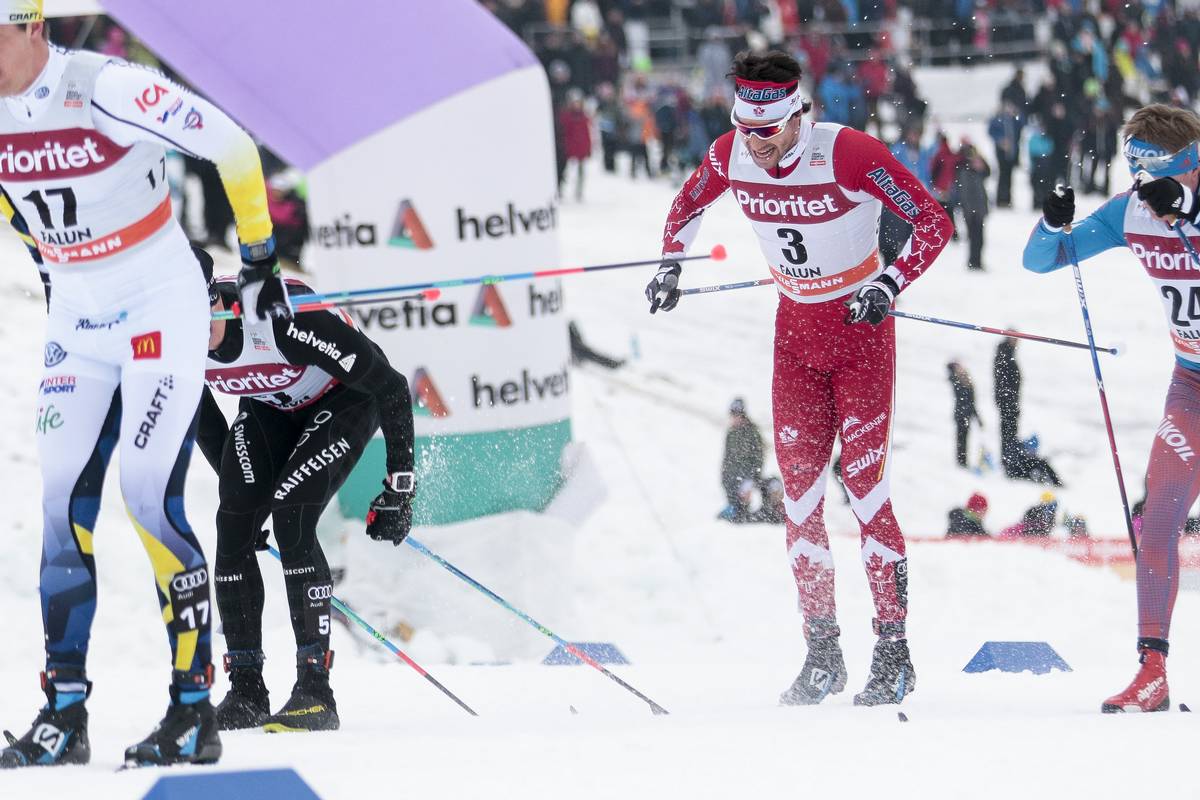
Canada’s Alex Harvey (3) skiing behind Sweden’s Calle Halfvarsson (17) and ahead of Russia’s Dmitriy Japarov (r) during the World Cup men’s 30 k classic mass start in Falun, Sweden. Harvey finished 15th. (Photo: Salomon/NordicFocus)
For the last 10 k, Harvey held on, skiing with Cologna (among others) while fighting to stay within reach of the podium. Just 6.8 seconds out of first in 16th at 25 k, Harvey slipped to 55 seconds back in 15th just over 3 k later. He finished 1:17.5 back in 15th (13.8 seconds behind Heikkinen in 14th and 4.7 seconds ahead of Cologna in 16th).
“I was just losing a bit more kick every lap and getting more and more tired,” Harvey explained. “So it’s harder to compensate and yet you have less energy to compensate so it was just kind of a double whammy.”
According to Canadian World Cup coach Ivan Babikov, he told the team’s two racers on Sunday — Harvey and Cendrine Browne (who competed in the women’s 15 k classic mass start) — that no one would have perfect kick because of the soft conditions.
“It’s more like a running, double poling [race],” Babikov said on the phone after. “The uphills, especially Mördarbacken, got pretty mashed-potatoey. It was really sugary, super soft and really hard to get kick for many nations, and we struggled with the kick wax today. That’s a bit disappointing to all of us … but it’s one of those days that we did our best…
“We tried actually changing it for Cendrine, but it actually got even worse somehow and she struggled even more,” he said of Browne, who finished 46th in the women’s race.
“Not the proudest day of the season so far on the waxing side, but we’re just moving forward and learning from our mistakes,” Babikov continued.
The day before, Harvey missed qualifying for the skate-sprint heats in 46th. It was only his second time time not qualifying in a sprint this season and first time outside the top 40.
“Falun being arguably the best stop for me on the World Cup, I really had quite high expectations,” Harvey said on Sunday. “I think I went to the start line [of the skate sprint] a bit too excited and with too much adrenaline and I just really skied really bad. I didn’t ski like myself yesterday. I skied all tempo and no tempo and no glide, and for me, that’s not a good way to ski.”
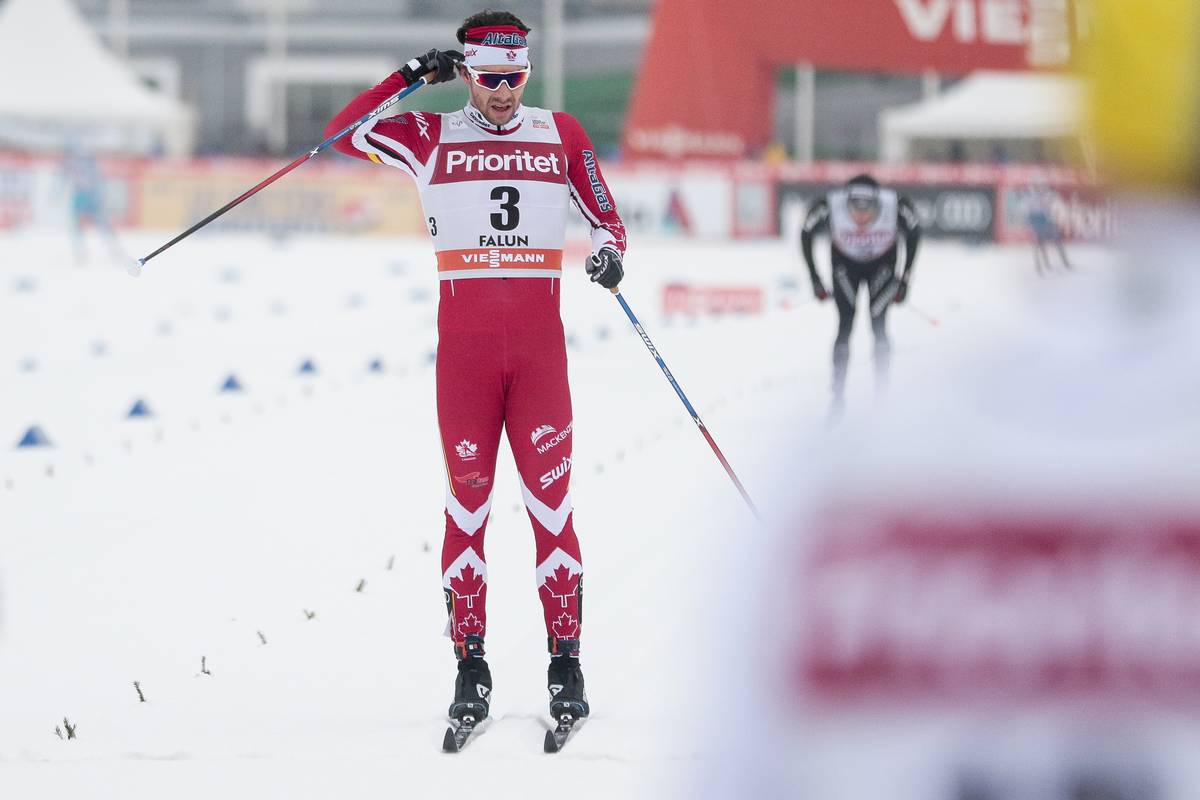
Canada’s Alex Harvey finishing 15th in the World Cup men’s 30 k classic mass start on Sunday in Falun, Sweden, ahead of Switzerland’s Dario Cologna (in black) in 16th. (Photo: Salomon/NordicFocus)
As for the conditions on Sunday and how they affected his race, he blamed his choice in skis.
“[The conditions were] kind of a bit abrasive, but we think the binder didn’t hold up enough,” he explained. “I made a bit of a risky pick because I had a pair [of skis] that was way faster, but the kick was a bit limited on them in the beginning so I for sure paid for it when I started losing a bit of kick.”
He started to lose it after 10 k, he said.
“Then I could kind of fake it for 10 more k’s, but then that was it,” Harvey explained. “Coming 15th is a bit of a disappointment after the previous two weekends, but I know that the shape is still really good. I think that with the mistake I made, with picking a bit of a too slick of a ski, I could’ve been out of the top 30 today in those conditions, so it was still kind of a good sign even though it was a bit disappointing.”
The Canadian team in Falun was a lean one, not by design but rather because of circumstance, especially on the men’s side. Babikov explained that Knute Johnsgaard had been recovering from a stomach bug he picked up last week, which prompted an overnight hospital stay in Falun. He was on the mend, Babikov said, but had a “rough couple days.”
Graeme Killick had returned to Canmore, Alberta, after the Tour de Ski earlier this month and originally planned to be back on the circuit in Falun.
“But unfortunately he got sick as well so that kind of postponed all of it,” Babikov said. “We made the decision that it would be best to get ready for the World Champs … so he’s doing some good training at home and we’ll see him in a week in Davos [Switzerland, at the team’s training camp].”
Until then, Harvey will go to Livigno, Italy, with coach Louis Bouchard, Johnsgaard, and Browne, Babikov will return to Canmore, Len Valjas will race at next weekend’s World Cup in PyeongChang, South Korea, and Devon Kershaw will continue to await the birth of his first child with his wife, Kristin Størmer Steira.
Among the Americans in Sunday’s 30 k classic, a race that has only been held three times in the last 10 years, according to an International Ski Federation (FIS) press release, Erik Bjornsen and Noah Hoffman finished 35th (+3:30.8) and 37th (+3:59.8), respectfully, followed by Matt Gelso in 44th (+5:23.6) and Andy Newell in 53rd (+7:45.3).
For Bjornsen, who finished about 20 seconds behind Northug in 31st, he reflected that he was happy with the majority of his race.
“Most of the race I was skiing in a position I would have been very happy to finished in,” Bjornsen wrote in an email, after hovering in 25th to 30th throughout it. “I skied alone for about 10km near the end of the race and that was enough to put me over. I really needed some help to stay away from a pack of 10 guys that were hunting me down. I could see a them chasing me down for about 10km. They finally caught me with 4km to go. I didn’t have much fuel left in the tank. It was really disappointing to finish in 35th when at 25km I was in 24th.”
On Monday, he planned to head to France, where he’ll spend two weeks training before racing the pre-World Championships World Cup in Otepää, Estonia.
Meanwhile, FasterSkier caught up with Hoffman while he was packing his bags for South Korea.
“I had not a great start for the first k and a half, and then kind of made a good move on the first time up the big hill and was able to run by a bunch of people and move up into the top 30, which is where I wanted to be skiing,” Hoffman reflected of his race on Sunday. “And I noticed that I had the fastest split of the whole race for that section [from around 0.5 to 2 k].
“But then I paid the price for that a little bit and faded pretty quickly,” Hoffman added. “And really Laps 2 and 3 were a bit of a struggle, and I ended up in no-man’s land off the back of the group all by myself.”
He regrouped for the third and fourth laps, catching back up to a sub-group of skiers that had been dropped from the main group, skiing between 30th and 40th place.
“I skied with that group for a while and was feeling pretty good, and I was actually helping lead the charge up to another group that was falling off the main pack, and that represented all the way up to 24th place,” Hoffman said. “And right as we made contact with them, with about 5 k to go, I crashed on the same corner that I crashed on three years ago when I was having a good race in the mass start skate race here. And it’s just a terrible place to crash, right on the sprint course as you are coming into the stadium with a lot of speed.”
In an instant, he had lost an estimated 13 places and skied alone for the final 5 k, out of reach of that group.
“All of a sudden, I was like ‘OK, six or seven people out of this group are gonna get points … and that could have been me.’ I felt good, and so I let points today go with that crash,” he said. “There were some good signs today, and it’s a frustrating result. It’s a result where I felt I was better than the result shows. But it’s kind of been a frustrating season.
“I still feel good, and I think today was a positive sign, and there are still some really good races [coming up for me],” Hoffman added.
Among those were next weekend’s races in PyeongChang, with a classic sprint, 15/30 k skiathlons, and a freestyle team sprint from Feb. 3-5. (Hoffman planned to race the skiathlon.)
“Next weekend [in Korea] it’s gonna be a light field. And then we go back to Otepää, where I scored my first-ever World Cup points on a course that I really love,” he said. “And then with the World Championships, which obviously if you are successful at World Championships then nobody remembers the rest of the season. And I feel like I can have a really good championship. Those courses suit me really well, and I am particularly psyched for the 50 k skate there…”
American Matt Gelso racing to 59th in his first-ever World Cup sprint on Saturday in Falun, Sweden. (Photo: Salomon/NordicFocus)
He’ll be joined in PyeongChang by a few other U.S. Ski Team members (mostly sprinters, as well as distance skier Liz Stephen). Gelso, the Period 1 SuperTour leader from the Sun Valley Ski Education Foundation, also planned to be there.
“Today was a solid race, not great, but solid,” Gelso, who previously raced in Falun at 2015 World Championships, wrote in an email on Sunday. “World Cups in Scandinavia are very competitive so I am relatively happy with my result although it leaves MUCH room for improvement. My body also felt MUCH better than it has since I have been here. The sprint yesterday was my first World Cup sprint and was also a decent result for me [in 59th], however it was easy to identify a few costly mistakes.
“The overarching goal on the World Cup is to score World Cup points/have a top 30 result,” Gelso explained. “As far as a non-result goal it is hard to get over to Europe and acclimate to sea level, European courses, wetter snow, different food, very stout competition, timezone changes, long travel, etc. It is easy to come over here and feel pretty bad racing, always feeling like you are blowing up and hanging on and never really racing. My goal today was to not feel like that and actually be able to get a race feeling going in my body.”
Looking ahead, he was focused on next weekend’s World Cup in South Korea. While an individual top 30 remains his goal, Gelso explained he also wanted to “nail my travel and acclimatization there so that I can feel good racing, and race well.”
He planned to return to the U.S. after to race the SuperTour in Ishpeming, Mich., and the American Birkebeiner in Wisconsin. Ultimately, he hoped to qualify for the World Cup Finals in mid-March in Quebec City.
Devon Kershaw (Canadian World Cup Team) competing in the classic sprint at the 2016 Ski Tour Canada in March in Canmore, Alberta. (Photo: Fischer/NordicFocus)
When race organizers in Gällivare, Sweden, decided to change the date of their pre-World Cup race series by a week, Canada’s Devon Kershaw lucked out. For the past couple of seasons, most of the Canadian World Cup Team has spent their final days before the start of the race season skiing and competing in Gällivare.
Once again, the team planned to travel 100 kilometers north of the Arctic Circle for a pre-World Cup camp, booking their plane tickets to Sweden for the week of Nov. 19 — when the city’s races were originally slated to take place.
However, due to a scheduling conflict with Sweden’s annual early season races in Bruksvallarna, the Gällivare race dates moved up a weekend, leaving only one of Canada’s cross-country athletes the option to race in Gällivare.
“Since I am based in Oslo, it was just sheer luck that we hadn’t booked my flight yet (from Oslo up here to Gällivare) when those changes took place,” Kershaw, who lives just outside of Oslo, Norway, with his wife Kristin Størmer Steira, wrote in an email. “So I asked to come up a few days earlier than the team to get a chance to race.”
With the help of Canadian head wax tech Yves Bilodeau, who lives in France and was able to join Kershaw, the 33-year-old Kershaw won Sunday’s 15 k classic individual start in 35:18, besting the runner-up, Petr Knop of the Czech Republic, by a minute. Michal Novak, also of the Czech Republic, placed third, (+1:05).
Though only 11 senior men entered Sunday’s 15 k, which wasn’t an International Ski Federation (FIS) sanctioned race, Kershaw indicated that from his standpoint, putting on a race bib and bringing his body back into racing was important.
“Being a slow-starter at times with regards to World Cup period #1 in my career (I have never been on the podium on the World Cup prior to Christmas) the biggest focus was just to put a bib on and blow out the cobwebs,” Kershaw wrote. “It’s nice to get nervous, test skis properly, and go through a whole routine around an organized race. In the race itself I focus on skiing technically well, being present and just being as efficient as I can be when my body is screaming to stop.”
Kershaw explained that he lucked out even more with getting into the Gällivare races, as they would be his only opportunity to for a preseason on-snow race this season.
“Time trials are great workouts, but for me I really believe that nothing replicates racing and have always have benefited from getting in some ‘lower key’ races before starting off on the World Cup,” he wrote. “This season [the Gällivare 15 k] will be the only race I get to do before the World Cup starts.”
In a post-race interview, Kershaw told Langd.se that he benefited from some summer training with Norway’s Martin Johnsrud Sundby and Sweden’s Martin Johansson, who lives in Norway. On Sunday, Kershaw took control of the race early, leading the first of four 3.75 k laps by more than 20 seconds over his nearest competitor.
“It was amazingly good conditions today, the body responded as it should and the skis were really good,” he said.
Kershaw arrived in Sweden late last Friday and will remain there until the rest of the Canadian World Cup team (except Alex Harvey, U25 Team skier Cendrine Browne and coach Louis Bouchard, who are training in Davos, Switzerland) joins him on Nov. 23. Then they’ll drive as a group to Kuusamo, Finland, where the opening World Cup will be held Nov. 26-27.
“Of course it would perhaps be nice to start the year with really competitive races in Beitostølen or Bruksvallarna (like we have done many times in the past), but with our budget having been absolutely decimated these last couple years it’s no longer realistic and/or viable,” Kershaw wrote. “The fact that we can en-masse drive to Kuusamo for the World Cups saves our team bundles of money that we can then use to support the World Cup racing as best we can.”
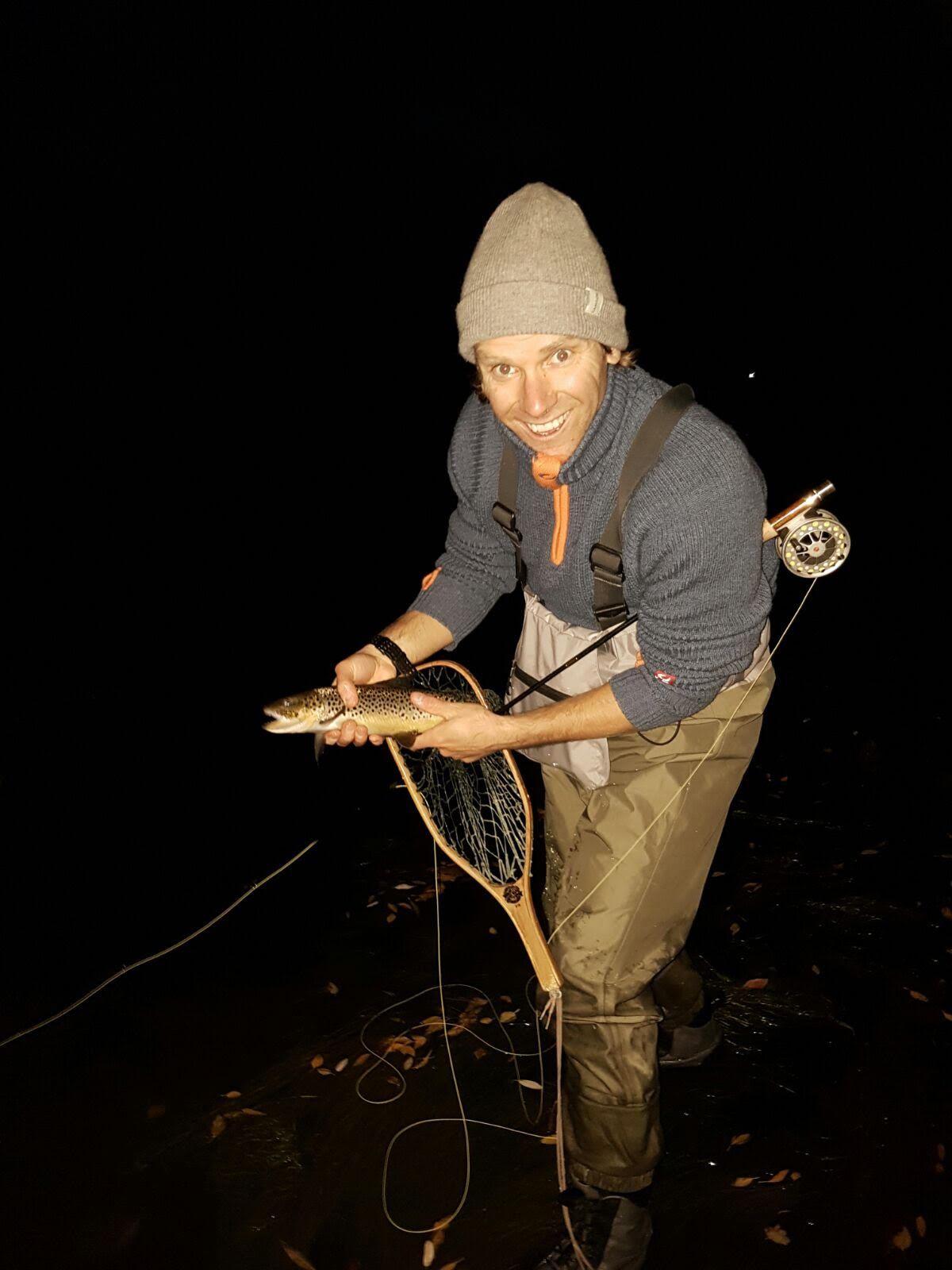
“Fishing this evening here in Utah!” Devon Kershaw wrote in an email last week. “Just catch and release – always. Lenny [Valjas] is allergic to fish 😂” (Courtesy photo)Welcome to “17 Questions for 2017″, where we are catching up with American and Canadian national-team members before the beginning of the winter season.
***
2011 World Champion Devon Kershaw may have been spending more time in Europe than in his native Canada this year, but he told FasterSkier in a podcast in August that he’s all in for Team Canada through the 2018 Olympics. As he adjusts to the prospect of becoming a dad in the next year, Kershaw has been training with Norwegians and Swedes around Oslo, where he is based with his wife.
He tackled FasterSkier’s “17 Questions for 2017” from Utah, where the Canadian ski team was having a training camp.
1. Biggest change in your life in the last five or so months since the ski season ended?
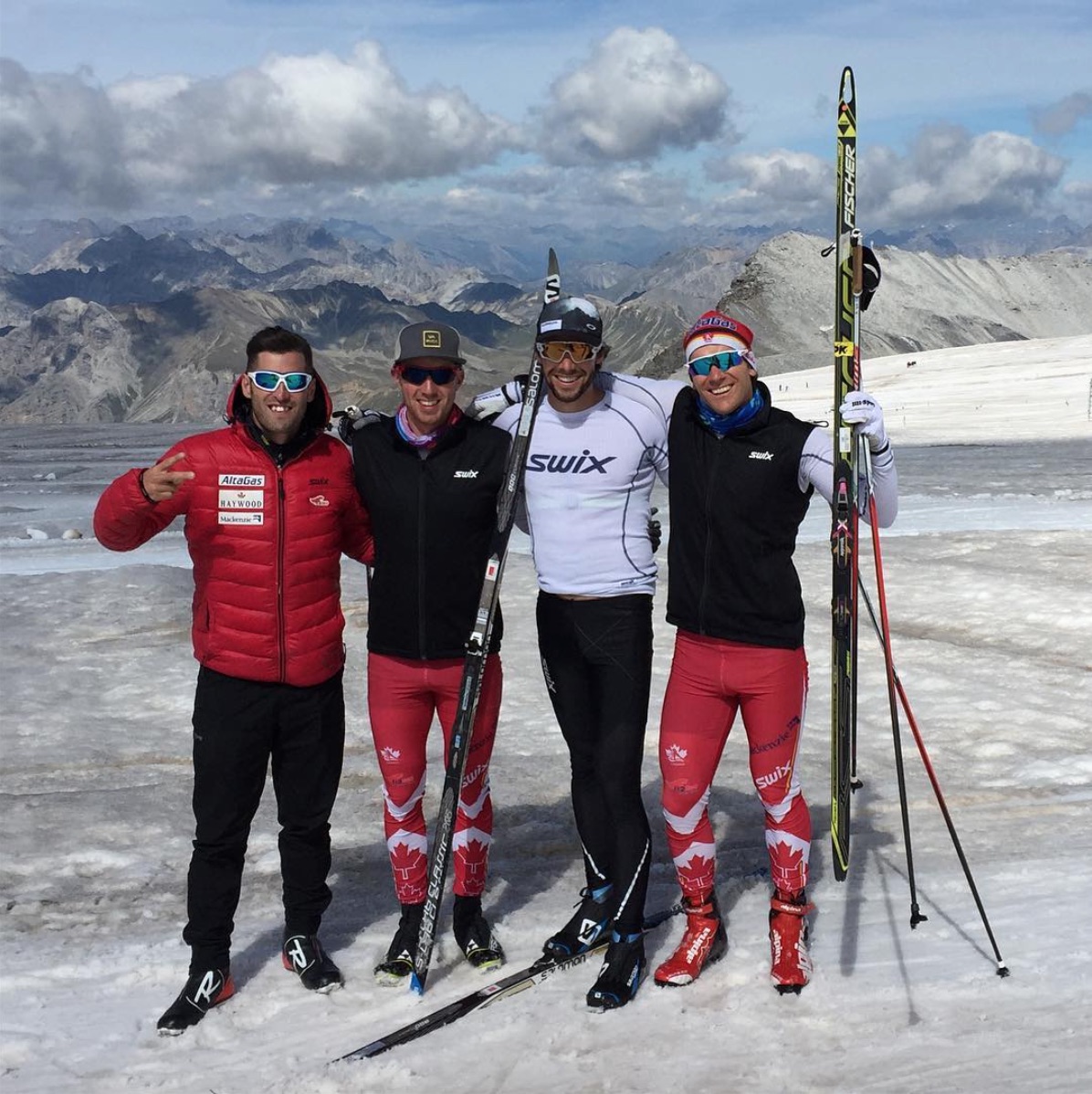
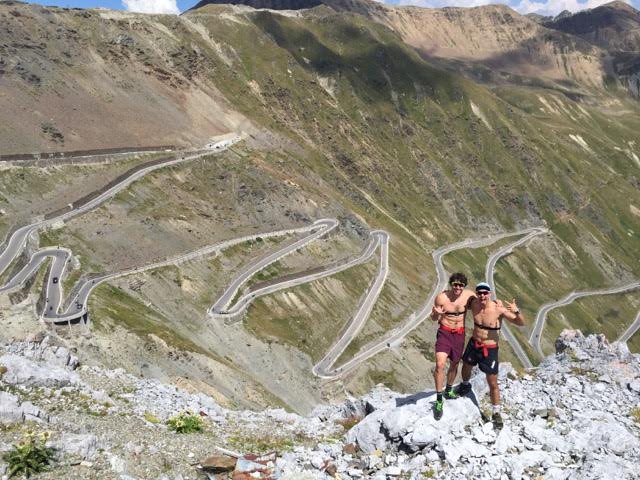
Part of the Canadian crew at Stelvio Pass in northern Italy, with Devon Kershaw (r), Alex Harvey (second from r), Graeme Killick (second from l) and wax technician, Nic. “Beauty first ski on the Stelvio with #squad Thanks to our new Italian-stallion tech Nic for joining and showing us how’s it’s done up here! #3400m,” Kershaw captioned the photo on Instagram. (Photo: Devon Kershaw/Instagram)
Spending more time in Norway and finding out I’ll be a father for the first time this winter!
2. Biggest change in your training?
Getting back to a more volume based program.
3. Major areas of improvement you’ve seen so far?
For sure the double poling – I’ve focused on that quite a bit this year.
4. Whom you’ve been working closest with this offseason (coaches or training partners)?
Jess Kryski (our team’s physiologist) has been really important and I have trained some great sessions with some Norwegian skiers and Martin Johansson (who also lives in Oslo).
5. Best trip in the last five months (and why)?
A quick weekend in Copenhagen with Kristin. It rained a lot, but what a cool city!
6. Favorite cross-training?
Hmmmm. Backcountry skiing or climbing.
7. Favorite non-athletic activity or pastime this summer?
My usual favourite would be fly fishing – but the Norwegian rules are so complicated.
8. Song that was your jam this summer?
I am really liking the new Bon Iver album and Angel Olsen’s latest. I am never a “one song” kind of dude.
9. All time favorite race moment?
That’s the moment: Kershaw and Harvey celebrate their World Championship gold medal in the team sprint in Oslo, 2011.
Seeing Alex [Harvey] edge out Hattestad to take team sprint gold in Olso in 2011.
10. First thing you pack in your bag when you leave for Europe?
I absolutely hate packing… So the first thing I pack is usually shoes and boots – to create a good base at the bottom of my bag. But this is at an ungodly late hour after procrastinating as long as humanly possible.
11. Venue/event you’re most excited to visit this season?
The World Champs in Lahti will be a great event. After being sick AF with pneumonia and whooping cough in 2015 10 or so days prior to Falun which ended my season, I am really excited to race a championship again!
12. Who will win the World Cup title this year?
I can’t believe I am writing this, but after training with Martin (Sundby) over the last months I really can’t see anyone coming close. He’s a beast.
13. Biggest sacrifice you feel you’ve made choosing this career path?
Canada’s Devon Kershaw during the men’s 15k skate stage of the Ski Tour Canada in Canmore, Alberta. Kershaw finished the tour ranked 16th. (Photo: Fischer/Nordic Focus)
Money and education. A Canadian skier is not what you pick if you want to be stable financially and my mom will be really excited to see me finish up a university degree when the spandex no longer fit.
14. If you could change one thing about your sport, what would it be?
Hmmm…. Having it be more simple for fans. The fact that our sport is the only one in the Olympic program that you cannot be a defending champion confuses folks. That and I guess finding some way to make it healthier for the wax techs. Thinking of what they breathe in week-in and week-out for something as frivolous as skiing fast around a little loop is a bit scary. The trucks help – but is it enough?
15. What did you have for breakfast this morning?
Oatmeal with fruit, brown sugar, a cappuccino and a cortado (I know…).
16. In 5 years, I’ll be ____?
Exhausted in school and probably have two kids. Hopefully I will be fully (or at least close) trilingual at that point.
17. In 50 years, I’ll be ____?
Probably dead, but if not then I hope to still have my wits about me to enjoy conversations and time with family. Still being able to be active – no matter what that looks like – would be a big goal in 50 years if I am still around.
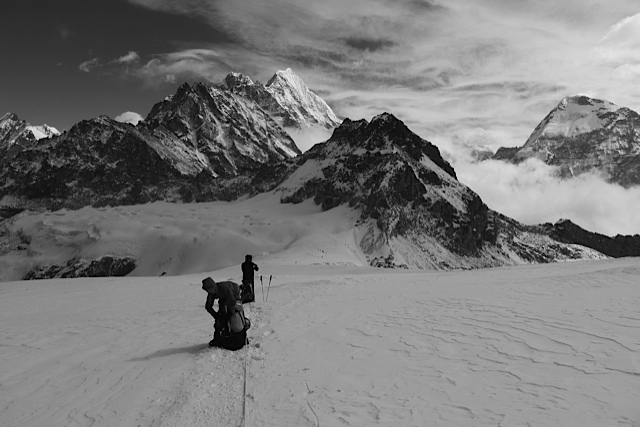
Heading up to high camp on the glacier of Mera Peak, Nepal, in April 2014. (Photo: Devon Kershaw)
As long as the Canadian men’s national ski team has been a force, Devon Kershaw’s name has been synonymous with that success. As recently as 2012, Kershaw finished the season ranked second overall in the final World Cup standings. And in 2011, along with teammate Alex Harvey, he won the classic team sprint at World Championships in Oslo, Norway.
Beyond his Oslo win, Kershaw has settled for the time being with his wife, former Norwegian ski star Kristin Størmer Steira. The two live close to downtown Oslo where Kershaw has found a profoundly livable city; it’s easy to find world-class training and as he works on his Norwegian, he can default to English. Kershaw says nearly the entire population can converse in perfect English.
Kershaw (l) and Alex Harvey (r) celebrating their team sprint victory at the 2011 World Championships in Oslo, Norway. (Photo: Hemmersbach/NordicFocus)
At 33, and having been on the international ski scene for over a decade, Kershaw speaks with experience and authority when it comes to the evolution of the sport. Then there’s the dark side exposed bare this July with the release of the McLaren report.
“As an athlete, I’m just getting a bit sick of lip service. How much lip service do we need to take? It’s either a priority for us, for like, WADA, IOC, FIS … or it is not,” Kershaw said in the podcast.
Kershaw notes he’ll continue competing through the 2018 Winter Olympics, then it’s most likely back to school for the Sudbury, Ontario, native.
Listen to the full podcast here by clicking the play button below.
Devon Kershaw (Canadian World Cup Team) competing in the classic sprint at the Ski Tour Canada on March 8 in Canmore, Alberta. (Photo: Fischer/NordicFocus)
Egil Kristiansen (l) announced his resignation as Norwegian cross-country women’s team coach earlier this week. Kristiansen has led the women’s team for the last 10 years. (Photo: Skilandslaget/Facebook)
Proud moments are not always performance based. After leading the Norwegian women’s cross-country team to 47 World Championship and Olympic medals — for a total of 23 gold — over the past 10 years, it was not the results that have meant the most to Egil Kristiansen, the Norwegian national team women’s coach who announced his resignation Sunday via a team press release. It was the pressure he, his athletes, and Norway put on others to push themselves in the sport.
“It’s actually what we have managed to achieve,”Kristiansen told NRK, according to a translation, of his proudest coaching moment during the last decade with the team. “Managing to keep the pressure up, regardless of whether the results are bad or good; to do the damn job one hundred percent anyway. Not being dragged down by a poor outcome, or about to take off for good results. To paint on paint anyway.”
Kristiansen, 50, began heading up the women’s team in 2006, after working as an assistant coach under Svein Tore Samdal. The next 10 years are history.
In 2009, Kristiansen coached the now-retired Kristin Størmer Steira to silver in the women’s 15-kilometer pursuit at World Championships in Liberec, Czech Republic.
In 2010, he helped Norwegian Marit Bjørgen to her first Olympic gold at the Vancouver Olympics in the women’s classic sprint. She went on to achieve four more medals at those Olympics after that, including two more gold. Prior to Vancouver, Kristiansen worked with Bjørgen for 10 years and would work with her for five more.
“Egil has meant a lot to me,”Bjørgen told VG.no during a press conference, according to a translation. “There has been a security for me to have him there … He’s been a crazy good leader, a manager type that has gathered the group.”
Beyond Bjørgen and Størmer Steira, Kristiansen has worked with numerous other Norwegian superstars, including Olympics or World Championships medalists Therese Johaug, Maiken Caspersen Falla, Heidi Weng, Ingvild Flugstad Østberg, Vibeke Skofterud, and Astrid Uhrenholdt Jacobsen.
Norway’s “Coach of the Year” in 2011, Kristiansen said he’s ready to move forward and feels the the Norwegian women’s team should as well.
“I feel privileged to have worked with the world’s best cross-country skiers,” Kristiansen told Aftenposten, according to a translation. “But I’ve determined that it’s time to move on. As a coach, it is difficult to always give one’s best to the same group athletes over many years. Therefore, I believe this is the right time to resign, and it will help the athletes receive new inspiration.”
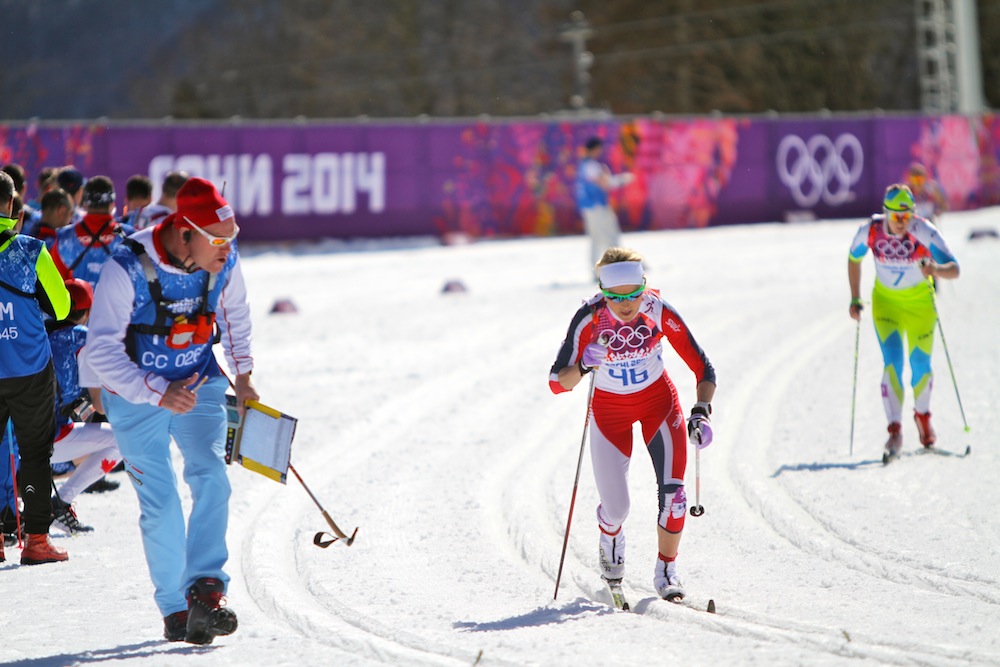
Norwegian women’s sprint coach Roar Hjelmeset calls out to Therese Johaug as she races to bronze in the 10 k classic at the 2014 Sochi Olympics.
There is no official word as to who will look to replace Kristiansen’s shoes. Women’s sprint coach Roar Hjelmeset has said he’s interested in filling in, but only for a year.
“I‘ve said I want to be national coach a one year period for women. The problem is that they were looking for someone who can train [through the] Olympics in 2018,” Hjelmeset, who first coached national-team juniors in 2008 then the women’s sprint team since 2011, told NRK.
National team director Vidar Løfshus indicated that Kristiansen’s successor must be willing to make a commitment through the 2018 Winter Olympics.
“I was prepared that [his decision] could go either way, hoping of course that he would continue,” Løfshus said to Langrenn, according to a translation. “To sum up his time as coach of the national team will be the one long tribute.”
Hetland Takes Over Norway’s Men’s National Team
Kristiansen’s resignation is not the only change in the nexus of Norwegian nordic skiing. Tor-Arne Hetland was hired this spring as the new men’s cross-country coach.
Tor-Arne Hetland was a Swiss sprint coach from 2010-2014, then coached the Canadian World Cup Team for a season (2014/2015) before taking an assistant coaching position with his alma mater, the Norwegian national team. He is now the Norwegian men’s head coach. (Photo: FIS)
A 2002 Olympic gold-medalist sprinter, Hetland, who competed for Norway, previously worked as a national coach for Germany, Switzerland and Canada before assisting the Norwegian team last season under former men’s coach Trond Nystad.
“Trond has been generous and given me great responsibility allround team this season,” Hetland told Skiforbundet,according to a translation. “I want to continue a culture where athletes together take responsibility for their own training and development. Created to be the best trained and set a standard that new generations of skiers want to strive for. I look forward to continue working with the team and with the rest of the support develop each athlete so that they can bring out their maximum potential.”
The outgoing coach for the Norwegian men’s cross-country team Trond Nystad fields questions at the 2014 Sochi Olympics
Nystad, 45, had been the head coach for the men since 2011, working with his twin brother Knut Nystad, Norway’s head wax technician. Trond had previously coached the U.S. and Swiss teams.
Nystad’s contract with the team ends May 31. Earlier this month, he dispelled rumors that he would advise Russia’s Alexander Legkov this winter. Rather, after spending what he estimated to be nearly 250 days on the road in the last five years, Nystad wanted to focus on being a dad.
“Nothing is certain, nothing is excluded, but in relation to their family situation is probably not wise to continue with 240-250 days of travel,” he told NRK. “But I still want to work with sport.”
Canadians (l-r) Jesse Cockney, Alex Harvey, and Devon Kershaw after a rollerski session in Italy. (Photo: Devon Kershaw)
Fresh off of marrying his new wife Kristin Størmer Steira in northern Norway, Devon Kershaw drove to Oslo and then jetted off for a training camp with his Canadian teammates and buddies, Jesse Cockney and Alex Harvey.
“After the wedding we stayed up in Lofoten for some days together with friends and family before driving the long drive back to Oslo (20+ hours) and then we had two nights there before I flew to the Italian Alps,” Kershaw wrote in an email explaining how he ended up spending the traditional honeymoon period with male teammates. “We will do a ‘honeymoon’ in the autumn – either Italy or Copenhagen or something, but since Kristin was injured and I was really sick we took a pre-honeymoon to the Seychelles in March together which was amazing.”
With some of his teammates already in Europe for the wedding, it made sense to try to put together a training camp. So they headed to Livigno, Italy, to do some dryland training at elevation. Kershaw answered a few questions over email on his way from Oslo to Aure, Norway, after the camp.
He’s the lone Canadian competing in the Toppidrettsvecka festival there, where he finished 16th in the uphill running race on Thursday morning.
Alex Harvey and Jesse Cockney after climbing the famous Stelvio pass. (Photo: Devon Kershaw)
FasterSkier: Italy hasn’t been a staple of your summer schedule in the past, if I remember right – what was the motivation to go there?
Devon Kershaw: The camp was actually in Livigno – we didn’t do any summer skiing on the Stelvio glacier (instead we just did one workout roller skiing up the fabled pass)…. the motivation was to do a proper altitude camp in the summer again – and Livigno is a great place for higher altitude living and training. Alex was really keen for this, and was the driving force to make it happen. I was really happy to join him (Alex) and Jess – both training under Louis Bouchard (who was the coach at the camp) for the 16 days.
FS: What was the goal of the training block?
DK: For me the goal was to continue to get back to a“normal” training load. After being sick for almost three months I’ve had to be a lot more patient than any other season in my career thus far. In May I hadn’t done any training in over 8 weeks, and was still not 100%, so I started the year conservatively (lower hours, no intensity whatsoever) and have been building slowly from there. I didn’t do any harder (level 4) training until July, and even in July with my wedding it was only two sessions (the other interval sessions were still only level 3), so I am behind where I normally would be at the moment.
Jesse Cockney hitting the Italian meadows for a workout. (Photo: Devon Kershaw)
In Livigno the goal was to do a couple 25hr (roughly) weeks and the two main focuses were longer days of training (4-5hr) and secondly to have some great quality interval sessions with Alex and Jess. It’s good to be pushed and see where I am compared to those guys at this time of year and how I am recovering from the big illnesses (I had both whooping cough and pneumonia in the spring (which is why I didn’t compete in any races in February or March of 2015)).
FS: Any favorite highlights or trips from Italy?
DK: For sure the highlights in Italy were roller skiing the Stelvio – those famous 48 switchbacks are amazing. Also, we did a tough skate interval session up the Mortirolo which some professional road cyclists have dubbed “the hardest pass in Italy to race up” – and I can attest it was VERY steep and difficult! Those were the two rollerski highlights, and running we had some great highlights running some stellar passes and gorgeous trails. All in all – a great camp!
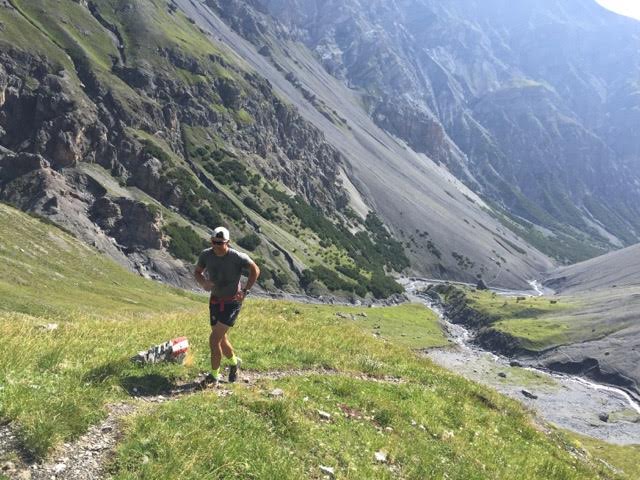
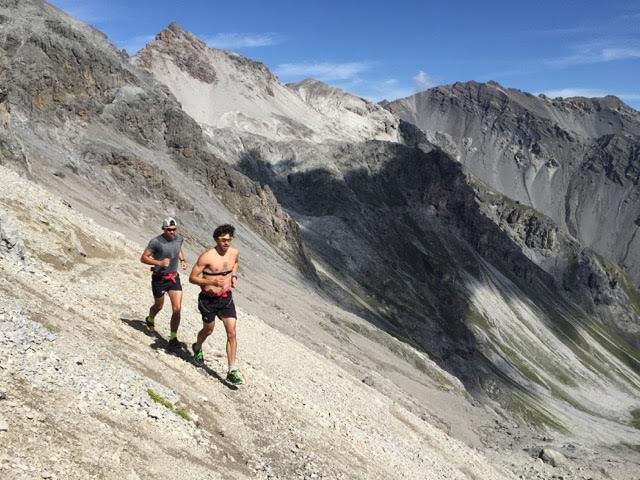
Alex Harvey and Jesse Cockney checking out some rockier terrain for a trail run. (Photo: Devon Kershaw)
FS: Is the whole men’s team in Norway for the races this week, or is this something you’re doing on your own thanks to Norway connections?
DK: I am the lone Canadian competing this weekend in Norway. Alex and Jess went home and Graeme, Lenny and Ivan are all in Canmore where they have been all summer. With our decimated budget the Livigno camp was a “pay to play” deal, and Alex and Jess have been in Europe since July 20th, so they headed home. As I am based more in Oslo now, this was a good opportunity to do some rollerski competitions – something I have never really done other than the two in the Blink festival in the South-West of Norway last year – so it’s just a fun way to do some hard sessions after a taxing altitude camp. The Americans are here though, as are a lot of the best skiers in the world – so it will be a tough but exciting three days of competitions.
FS: How is training and the body feeling so far this summer?
DK: As I mentioned above, it’s been a very different summer so far of training… I am usually in quite good shape in the summer over the last years (Babs, Harv and Lenny even gave me the nickname “summer Kersh” because I am usually quite strong in time trials and intervals throughout the summer), but this year is different. I don’t have that high-end fitness right now. I’ve had to be careful and I am stuck to my plan to come back properly so that I can be 100% ready come winter.
I have done a lot less level 4 work and my first “race-pace” effort since Rybinsk in January will be tomorrow here in Aure, NOR. That’s not normal. That said, I do feel as though I am getting stronger and better week by week which is encouraging. The motivation is still there and very high and I am really happy with the work and feelings coming out of the altitude camp in Livigno. Still, I’m down in hours for the year (I’m just over 300hr so far), I have more longer level 3 sessions, and less max or level 4 sessions. If it keeps trending up like this I am happy!
FS:When are you heading back to Canada next?
DK: I will be in Canada on September 11th for a week before our team goes for our altitude camp in Park City, UT (which runs from Sept 19 – Oct 9th) which will be nice to check in on the house in Canmore and see some friends before I head out until March and the Canada Tour!
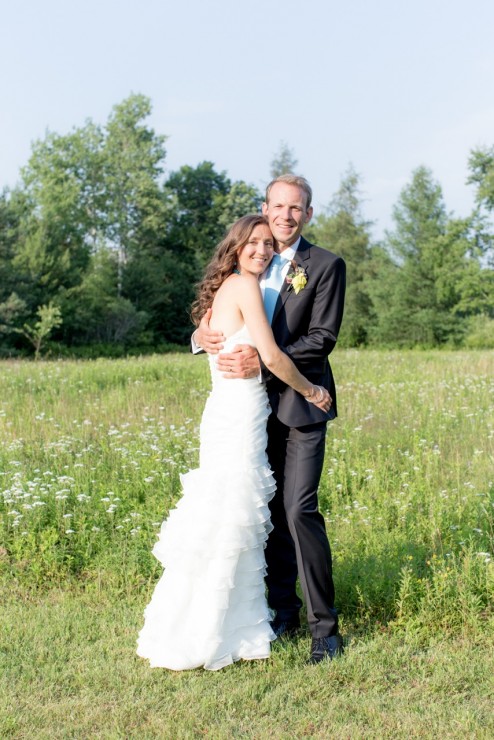
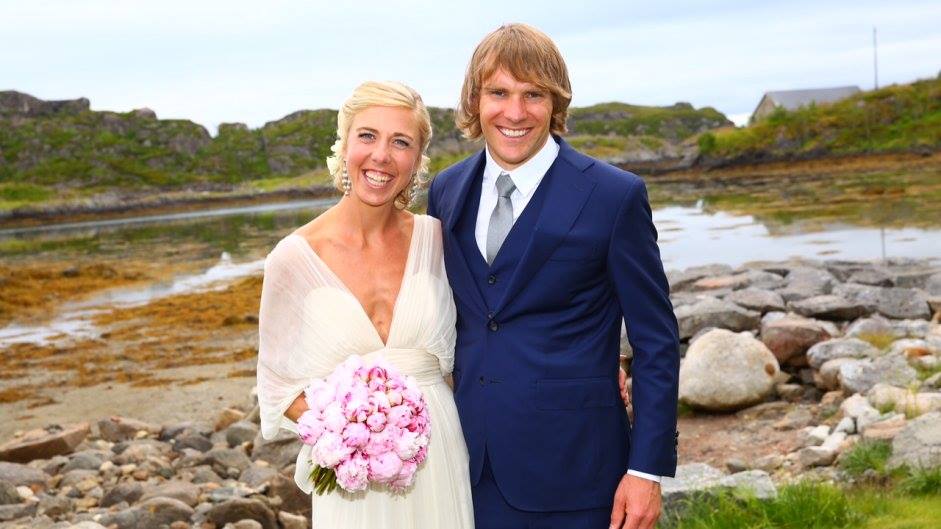
Skiers have been wearing a lot of white lately — or variations thereof. This past weekend, Canadian World Cup Team member Devon Kershaw and his Norwegian girlfriend, three-time Olympian Kristin Størmer Steira, tied the knot in Lofoten, Norway, where Steira has family ties.
Kristin Størmer Steira, of Norway, and Devon Kershaw, of Canada, were married last weekend in Lofoten, Norway. (Photo: CCC/Facebook)
Steira’s teammates, including Marit Bjørgen, Therese Johaug and Ingrid Flugstad Østberg, made the trip to the northern islands for the wedding, along with Canadian skiers Alex Harvey, Jess Cockney, Graham Nishikawa, Drew Goldsack, and Phil Widmer.
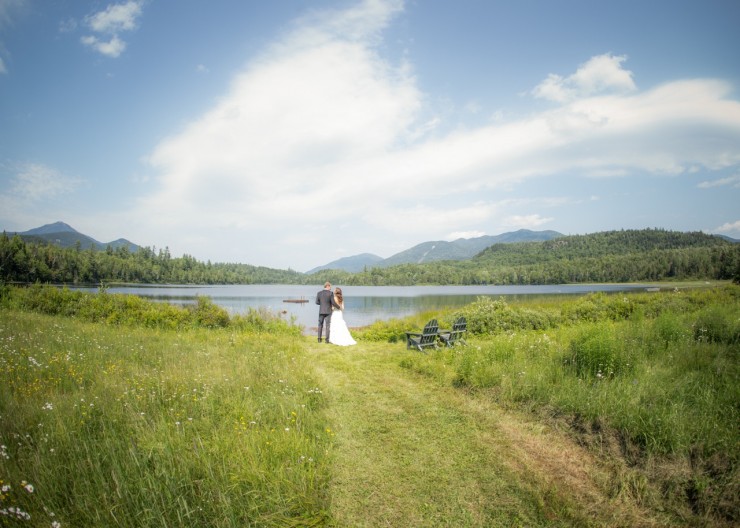
On July 11, US Biathlon’s Lowell Bailey wed Erika Edgley at Connery Pond (photos above) in North Elba, N.Y., then held a reception in front of the house where Bailey grew up in Lake Placid. Edgley is also from Lake Placid. They celebrated with about 120 guests from “all over the world,” Bailey explained in an email. “Americans, Brits, Germans!”
Bailey recently arrived in Stavanger, Norway, for the Blink Summer Ski Festival — a three-day series of rollerski races, starting this Thursday and ending Saturday. His teammates Leif Nordgren and Susan Dunklee also plan to participate.
Sara Studebaker (second from l) married Zach Hall in mid July and celebrated with friends and former US Biathlon teammates Susan Dunklee (l), Hannah Dreissigacker (second from r), and Annelies Cook (r) in Stanley, Idaho. (Photo: Sara Studebaker/Facebook)
Also this month, former U.S. biathlete Sara Studebaker married another retired biathlete and current ski coach, Zach Hall, with her 2014 Olympic relay teammates Dunklee, Hannah Dreissigacker and Annelies Cook by her side in Stanley, Idaho.
And on July 18 near Canmore, Alberta, Canadian biathlete and Olympian Scott Perras married Jodi Etcheverry, a former biathlete, at a lakeside ceremony.
Longtime sweethearts, former U.S. skiers and now development coaches, Maria Stuber and Bryan Cook recently wed in their native Wisconsin.
Steira celebrating prematurely at the Vancouver Olympics. She ended up with another fourth place finish in this race.
The World Championships in Holmenkollen might be the last major event for Kristin Størmer Steira. “I have to sit down after the season is over and take stock. I could go for a few more seasons, or this could be the last,” the 29-year-old said to NRB in Italy last Wednesday.
There were plenty of relaxed Norwegian racers hanging out there, and Størmer Steira appeared to be one of the most laid-back of them all. She was kicking back after an easy distance workout at 7,000 feet.
Størmer Steira is known as an athlete with an incredible ability to peak when it matters. She’s logged a few fourth places, and she’s also netted some medals. But she’s always delivered when it really mattered.
Her relaxed attitude is partly due to the last 2 weeks, which Størmer Steira has spent in Alpe di Siusi in Italy. “Aside from last year, I’ve been here twice every year since 2003. It’s incredible here, peaceful and quiet. Sunny, perfect skiing and the most spectacular terrain you can imagine right outside the door,” Størmer Steira said. She admits that it’s good to get away from everything for a little while. “You don’t get recognized at the grocery store by well-meaning people asking how my foot and fitness is. They mean well, I know that, but down here I can get away for a little while before it all starts over again,” she said.
You’ve always managed to peak at major events?
“That’s one of the reasons it feels so good to come here. This is a place I dial in my peak. It’s one of the few places we do training camps that I really would consider to return to for a summer vacation.”
Several injuries, including a stress fracture, kept her from classic skiing until Christmas.
“I actually regained my classic technique surprisingly fast. I don’t think I did a particularly good race in Otepää, but I did well at the Norwegian nationals. Now I’m doing about equal amounts of classic and skating, and there are no problems,” Størmer Steira said.
Wednesday she did a classic workout while reporters were watching. Størmer Steira will most likely race all the four events at the 2011 Worlds that are not sprint races. She is still aiming for an individual gold medal.
“A medal is the goal, but I’m still waiting for the gold,” she concluded.
BEITOSTØLEN, Norway – Alexander Legkov (RUS) was about a minute ahead of the top Norwegian racer, Geir Ludvig Aasen Ouren, in fourth place. Given that Aasen Ouren is not a part of the Norwegian national ski team, he more or less secured himself a spot on the impulse World Cup team for the season opener in Gällivare (SWE) next weekend.
And while the season opener is an anticipated event that both racers and fans look forward to for weeks, it is generally not an event the skiers peak for. Rumors have it that the Russians put in about 700 kilometers on snow over the past 12 days leading up to Friday’s race. “What Legkov does is simply impressive. The 15K skate is arguably the event with the stiffest competition, and when Legkov dominates the way he did today, it’s a real wakeup call for us,” said Norwegian national team coach Morten Aa Djupvik to Norwegian television station NRK.
Petter Northug Jr was 49th, more than three and a half minute behind Legkov, but isn’t worried. Neither is Djupvik. ”I’m totally in control. I will race the next two events here, and then I’ll drop my hours leading up to Gällivare next weekend. I think I will be in much better shape by then,” Northug said to NRK after Friday’s race.
“That’s the way the best racers think. (Northug) dares to train hard right up to the World Cup season opener. Today he had a bad day, and he didn’t push himself,” Djupvik says.
If the Russians dominate the men’s field, the Norwegians were equally superior in the women’s race. Therese Johaug won the 10K skate with more than 40 seconds to spare, crossing the finish line in 28:17.4. She opened hard and just kept hammering.
“I had a great race today. My body was responding and that makes it fun to race,” Johaug said.
While Johaug knew she was fit going into the race, the season opener is always exciting, she said.
“I was nervous before start. After all, this was the first race, but I’ve felt good at practice lately. I’ve worked a lot with my technique this year, and that helps me conserve energy,” Johaug said to NRK.
Kristin Størmer Steira was second, but no less thrilled with her first race. Having battled injuries, including two fractures in her foot this dryland season, she has done more alternative training than traditional dryland workouts.
“This just felt incredibly good,” Steira said to NRK after the race. “I’m surprised. I had no expectations at all, and was just happy to be able to race. That’s more than I expected just a couple of weeks ago,” Steira said.
“But I have more to offer. I ski technically well, and have a good feel for the snow, but I only have one gear. That’s how it goes when you’ve done a lot of volume and lack that little extra,” Steira explained.
Half a foot of fresh powder overnight and falling snow throughout the morning made for a tough day on the course.