Tag: Kristin Stoermer Steira

  • ‘Heia Norge’ — Bjørgen Leads an Unstoppable Norway in World Champs Skiathlon

    ‘Heia Norge’ — Bjørgen Leads an Unstoppable Norway in World Champs Skiathlon

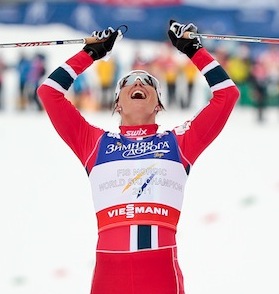
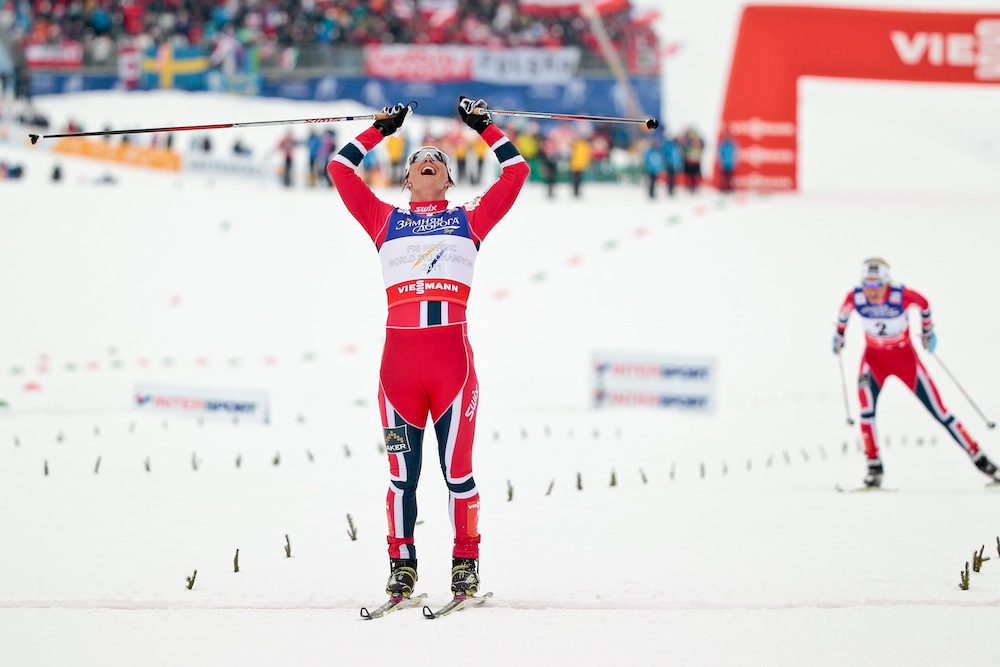
    Norway's Marit Bjørgen goes two-for-two at World Championships on Saturday, claiming the women's 15 k skiathlon by 2.03 seconds over teammates Therese Johaug and Heidi Weng. Photo: Fiemme 2013.
    Norway’s Marit Bjørgen goes two-for-two at World Championships on Saturday, claiming the women’s 15 k skiathlon by 2.03 seconds over teammates Therese Johaug and Heidi Weng. Photo: Fiemme 2013.

    FasterSkier’s coverage of the 2013 FIS Nordic World Ski Championships in Val di Fiemme, Italy, is brought to you by the generous support of Fischer Sports.


    VAL DI FIEMME, Italy — There are few ways to make a gold medal taste sweeter than it does on its own, but Marit Bjørgen and teammates Therese Johaug, Heidi Weng and Kristin Stoermer Steira somehow accomplished it for Norway in the women’s 15 k skiathlon on Saturday at the 2013 Nordic World Ski Championships. With golden-girl Bjørgen leading the way the women swept the top four spots in the finish for one of the most dominant performances ever seen from one country.

    “I was feeling very good today, incredible body and my skis were so good,” Bjørgen told reporters afterwards. “I’m really happy. I really wanted it, and with the other teammates it’s incredible to have the four girls in the top four. It’s a big day and incredible feeling.”
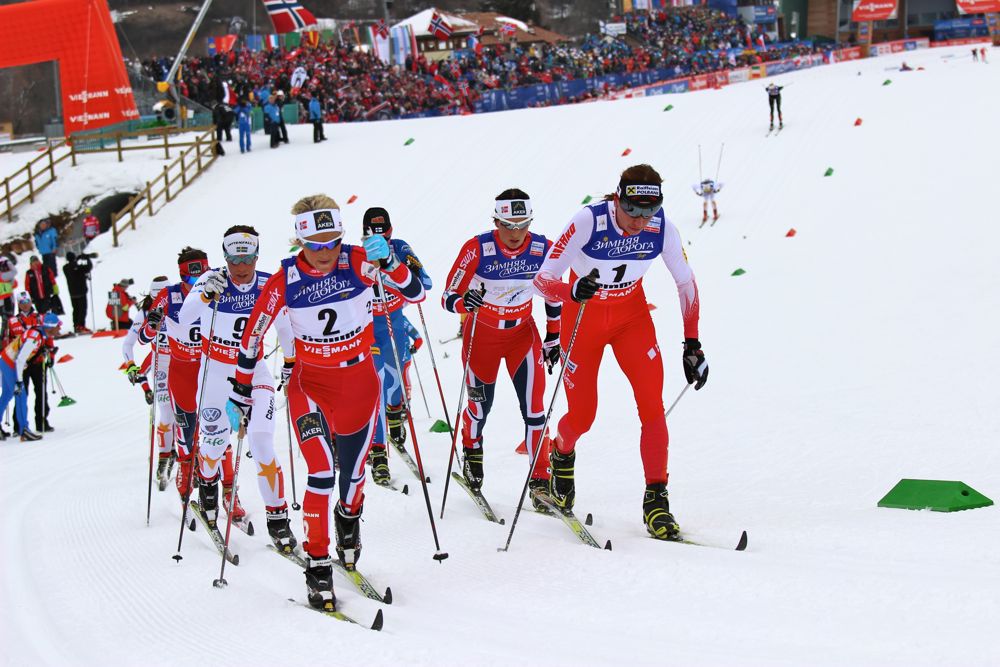
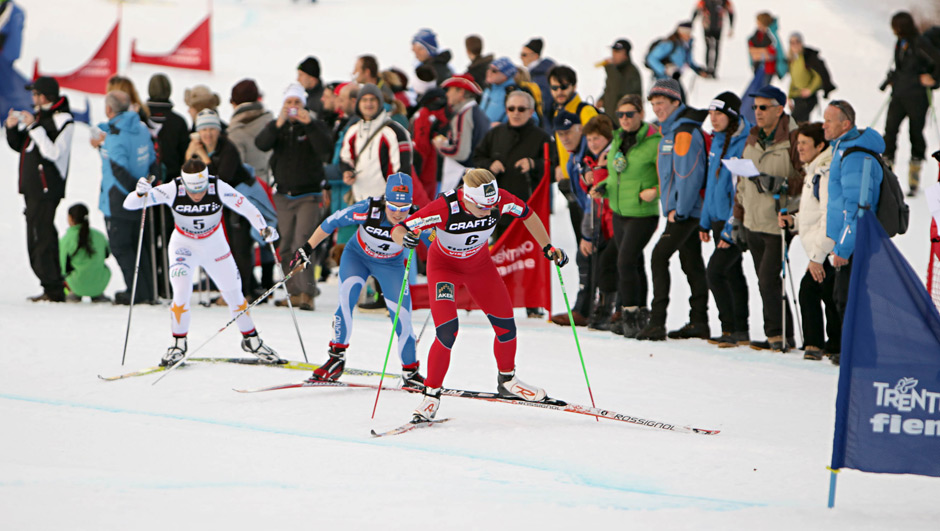
    Therese Johaug (NOR) and Justyna Kowalczyk (POL) lead the pack on the second lap of the skiathlon.
    Therese Johaug (NOR) and Justyna Kowalczyk (POL) lead the pack on the second lap of the skiathlon.

    Bjørgen played her hand perfectly on Val di Fiemme’s rollercoaster course, leading as little as possible and biding her time for a big move on the final climb. This was definitely not one of those mass starts that got blown out of the water; at World Championships everyone comes ready to fight. Poland’s Justyna Kowalczyk, out for blood from a disappointing sprint, led much of the classic half. Johaug and Sweden’s Charlotte Kalla took pulls from the front, too. But all the while Bjørgen skied quietly in the second row, assessing both her own fitness and everyone else’s.

    Ten women remained in the lead group after the ski exchange at the halfway mark but they dropped like flies over the next few minutes. Soon their numbers were five — four Norwegians plus Kowalczyk. As the remaining kilometers ticked by and the sprint champion from Thursday was still in the mix it became clear Bjørgen would be hard to beat. The only real question became how she would take her tenth world championship gold and who fight her the hardest for it.

    In interviews later Bjørgen explained she made two separate plans for her gold-winning move prior to the start; one in case she felt incredible and one if she only felt OK. It was somewhere in the second half of the race that she realized she felt great and picked Plan A, which prescribed she break the field relatively early on the final climb.
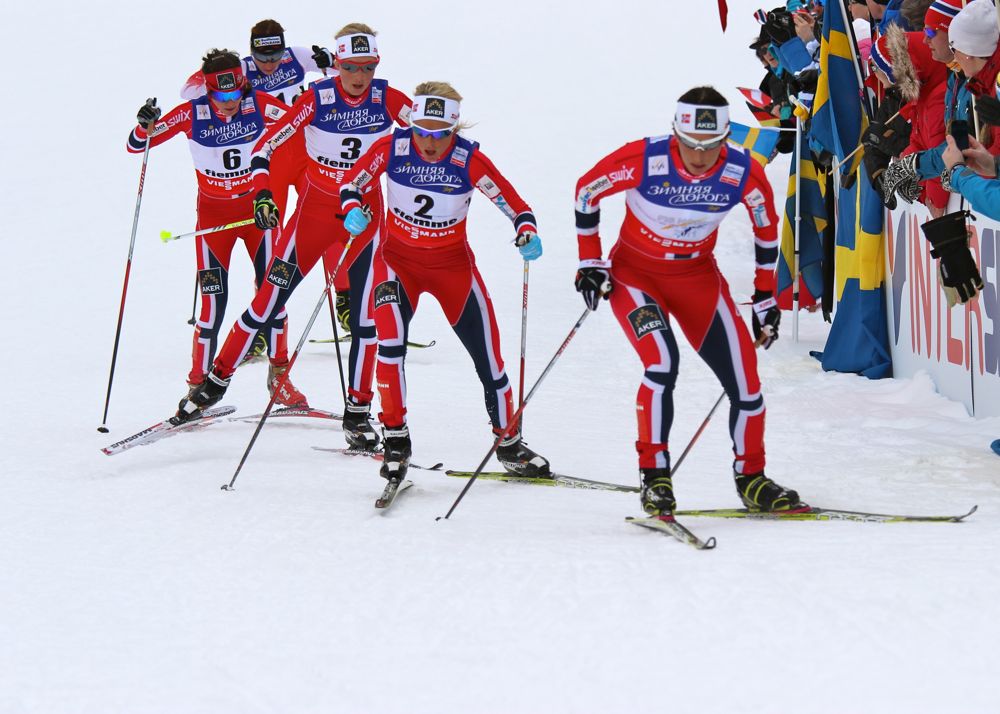
    Bjørgen moves to the front.
    Bjørgen moves to the front.

    “I wanted to stay behind and not use so much [energy] in the beginning, and I was planning to attack in the last climb if I was feeling very good,” Bjørgen said. “If I was not good, I wanted to try on the last 100 meters.”

    Whether her teammates knew what was coming or not, Bjørgen’s finishing speed is no secret. Johaug, Steira, Weng and Kowalczyk worked hard and created one of the most evenly-matched women’s mass starts of the year until the point when Bjørgen decided to go. Johaug alone matched Bjørgen’s tempo as the pace increased and the terrain took its toll, but only for a limited time.

    With two kilometers to go, Steira, Weng and Kowalczyk dropped off the pace. Bjørgen and Johaug, all alone, stopped playing games and threw down a blistering V1. Spectators, sensing the building tension, screamed with renewed frenzy.

    Then Bjørgen truly went for it — and when Bjørgen attacks there’s no stopping her. Johaug put up as much fight as she could, briefly drawing even with her teammate as the two sprinted furiously together up the last Zorzi climb, but she was ultimately unable to match Bjørgen’s tempo for the entire length of the pitch. Bjørgen pulled away and carried more speed over the crest, her lead growing to meters within seconds from the additional downhill momentum.

    Bjørgen’s red and blue form emerged over final small hill into the stadium with empty space behind her and the crowd went wild. A few pole-plants before the line Bjørgen glanced back to see Johaug and two other teammates behind her — smiling broadly at the sight, she raised her arms in victory for the second time this week as she eased up over the line. Johaug mirrored the gesture and the two friends embraced with delight as they waited for two more of their teammates to complete the Norwegian sweep. Weng outsprinted Steira for her first career medal at World Championships, 8.9 seconds back. Steira, in forth for the umpteenth time, crossed the line a second behind. Kowalczk staggered through in fifth, 16.18 seconds back, and Kalla took sixth.
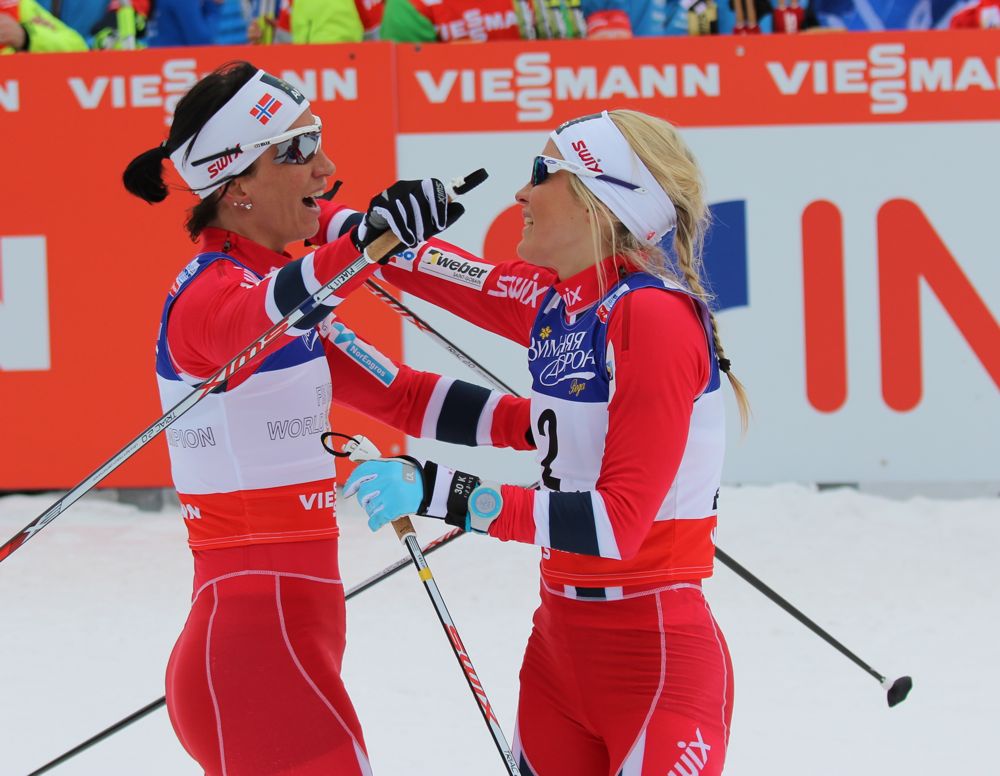
    Bjørgen and Johaug.
    Bjørgen and Johaug.

    Four Norwegian women at the top results is an intimidating sight to behold as two team events loom later this week at World Championships. After the finish Bjørgen credited her own success in part to her teammates.

    “We are so strong a team and the reason is we’re pushing each other so much on the training. They are pushing me and I know I must do the work to be at the top level,” Bjørgen explained.

    Johaug was a particular threat in Bjørgen’s mind. Kowalczyk was a known challenger in the classic half, but Bjørgen says she fears her fiery compatriot more than anyone.

    “What I was afraid of was Therese because I knew she was strong today,” Bjørgen said. “I wasn’t so afraid of [Justyna] but I was really afraid of [Therese].”

    Johaug must be getting used to playing second-fiddle to Bjørgen by now, but as she had never before earned silver at World Championships she was ecstatic with the outcome.

    “It was a special race today and my body felt really good, but Marit was much stronger than me,” Johaug said. “My goal for this season today was to take a individual medal in this World Championships in Val di Fiemme and I did it first race so I am happy.”

    Asked if there was a Norwegian team strategy to work against Kowalczyk, Johaug acknowledged they used the information from their coaches that the Pole was tiring in the second half.

    “We had a trainer say that Justyna was a little bit tired so I had to push, but it was a special race because in the skating there was tactics,” Johaug replied. “We looked at each other and nobody wanted to go first, but that’s cross-country skiers.”

    Norway’s bronze medalist was also thrilled with her finish, as this is Weng’s first career medal at World Championships. She was so exhausted after the race her coaches quickly ushered her away from reporters, but she managed to succinctly convey her joy.

    “I am very happy today,” Weng said. “A medal today — I can’t believe it. I am starting to cry now.”

    Results.

    — Alex Matthews contributed reporting.
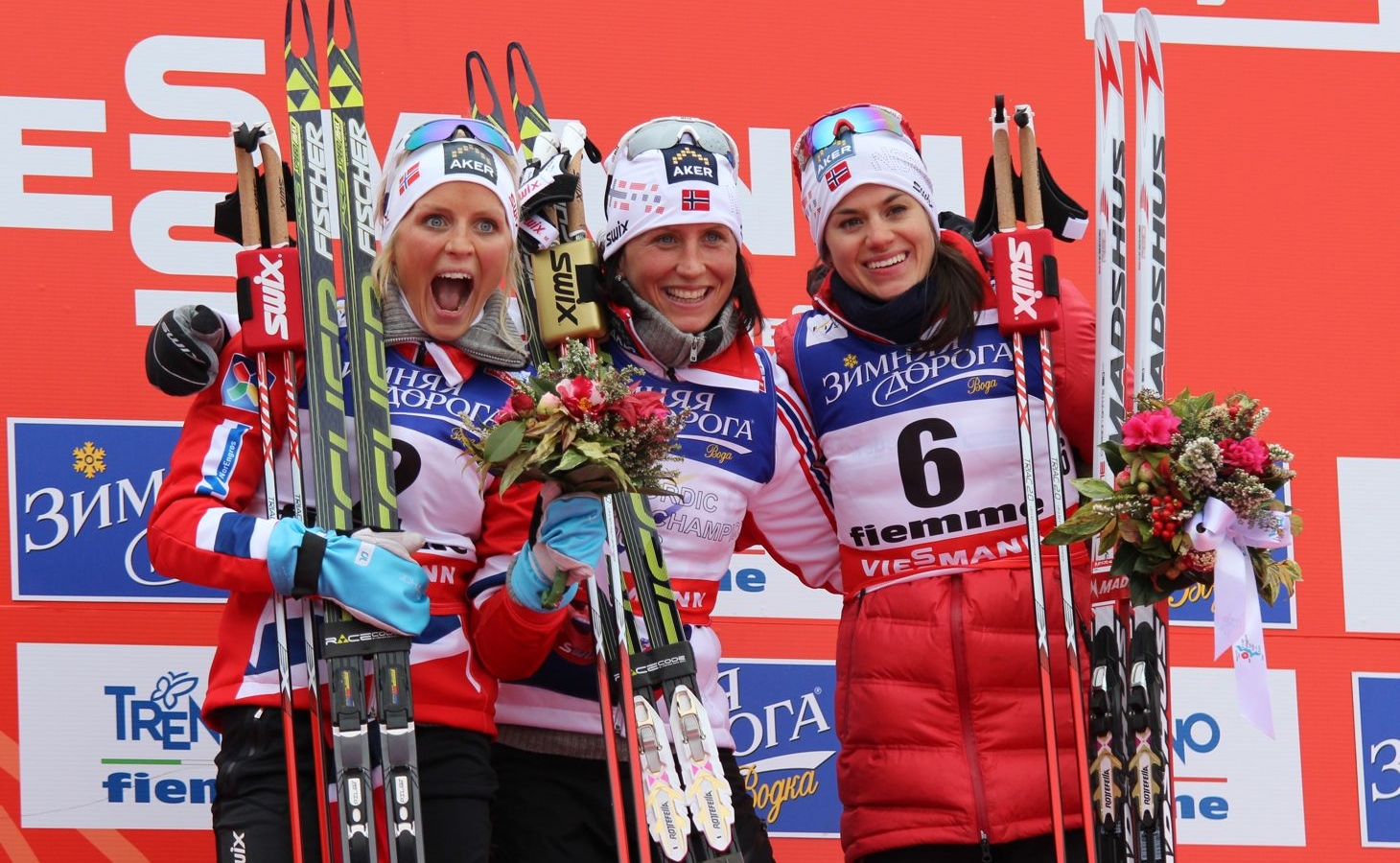
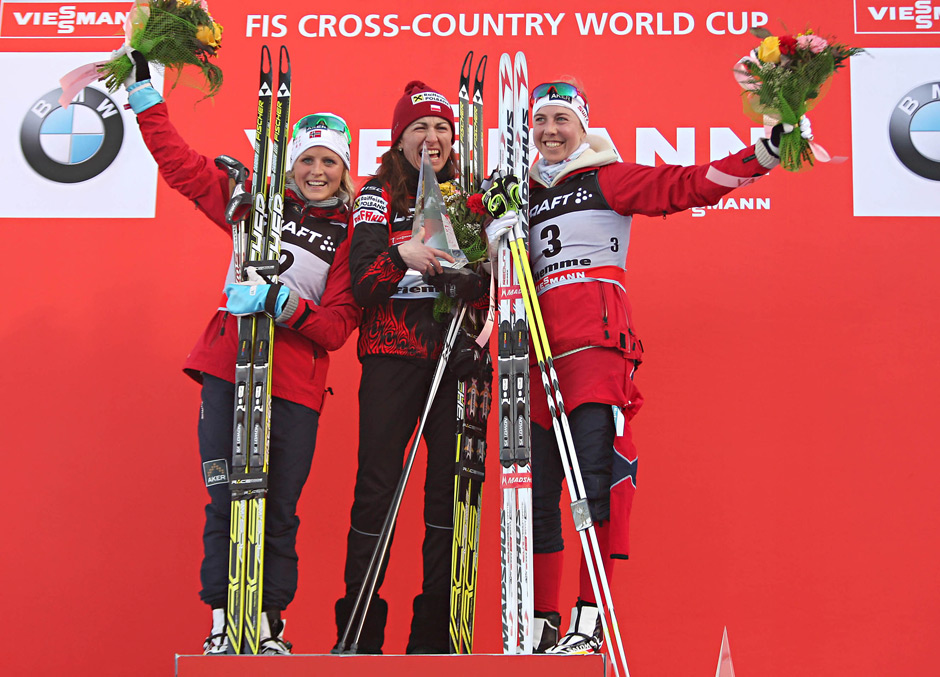
    Bjørgen, Johaug and Weng delight in the Norwegian sweep.
    Bjørgen, Johaug and Weng delight in the Norwegian sweep.
  • Kowalczyk Makes it Four, Holds off Ferocious Johaug for Tour Win

    Kowalczyk Makes it Four, Holds off Ferocious Johaug for Tour Win

    Justyna Kowalczyk (POL) powers to the top of the Alpe Cermis and her fourth Tour de Ski victory. (Photo: Fimme2013)

    To say Justyna Kowalczyk (POL) owns the Tour de Ski might be an understatement at this point. The event embodies the Pole’s career, mirroring her overall success while illustrating the adage that defines her body of work — “the harder the better.”

    For the fourth consecutive year, Kowalczyk made her laborious way up the famed Alpe Cermis, crossing the line with little energy for celebration, but well ahead of her pursuers.

    In seven years of Tour racing, there have been only three winners, the last non-Kowalczyk being two-time champion Virpi Kuitunen (FIN) back in 2009.

    Since that year, when she placed just off the podium in 4th, Kowalczyk has had a stranglehold on the event, even as venues and formats have shifted.

    More sprints, fewer sprints, bonus seconds, nine stages or seven stages — the one constant has been Kowalczyk.

    “Once again, it’s been a fantastic Tour de Ski. For the fourth time I sit on the first spot and I’m so happy,” Kowalczyk said after the race.

    After a strong performance in Saturday’s mass start, where she picked up 45 bonus seconds in addition to her 33-second margin of victory, there was little doubt as to the overall outcome.

    From the start of the Tour just over a week ago, Therese Johaug (NOR) was seen as the one woman who might challenge Kowalczyk, at least with Norwegian Marit Bjørgen out of the picture with an irregular heartbeat.

    The conventional wisdom was that if Johaug could stay within a minute, she would have a good shot at the top spot.

    The climbing champion had won the Final Climb the past two years, putting 50 seconds on the field last year, and over a minute the previous season.

    Johaug celebrates her second place finish. (Photo: Fiemme2013)

    But the mass start and Kowalczyk’s classic prowess proved too much for Johaug, and she started the day over two minutes back.

    To her credit, Johaug still generated some excitement, though she ultimately ran out of hill.

    On the flats alone, prior to the start of the climb, Johaug knocked a full 40 seconds out of Kowalczyk, and with the course switchbacking up the Alpe Cermis, she had a visual to work off of.

    While Kowalczyk stuck with a slow tempo, methodically V1-ing up a pitch that reached a maximum pitch of 29%, Johaug opted to single stick the hardest parts, relying on her light tempo.

    “I saw the hope of taking her to the ground,” Johaug told Norwegian broadcaster NRK.

    She continued to close, and by the finish the gap was down to just under 30 seconds, and Johaug was once again the Queen of Alpe Cermis.

    “I took it second by second, and finally I saw Kowalczyk…I felt really good today, but it was not enough,” Johaug said to NRK.

    She did take a moment to engage in hindsight, wishing for another ten seconds in the Toblach prolgoue and the mass start.

    With Kristin Stoermer Steira (NOR) off by herself in third, none of the podium spots would be closely contested.

    Steira had an impressive Tour, surprising even herself with a freestyle sprint finals appearance in Switzerland, and consistently strong results throughout.

    Steira won the Final Climb back in 2010, on her way to 5th overall, so she has proven her ascending chops.

    Jacobsen makes a move ahead of Lahteenmaki and Kalla. (Photo: Fiemme2013)

    She started the day just ten seconds behind Johaug, but never got any closer. Steira put time on the tailing chase group on the flats, holding a minute plus at the base of the climb.

    She bent somewhat on the hill, but never broke, and the woman who has an uncanny ability to finish fourth, held her bronze position.

    “I had fun each day since the beginning of the Tour, especially the sprint competition in Val Müstair,” Steira said after the race. “It’s been a fantastic Tour de Ski…and I think I’m in a good shape at the moment.”

    Steira finished a shocking third in the Tour sprint standings, behind Kowalczyk and Randall.

    The most drama on the climb, however, was in the group just behind.

    Krista Lahteenmaki (FIN), Charlotte Kalla (SWE), Astrid Jacobsen (NOR), Kikkan Randall (USA), and Anne Kylloenen all started within 12 seconds.

    The first three quickly came together, with Randall systematically closing down over the flats.

    Kylloenen, starting simultaneously with the American, couldn’t hang initially, but did close the gap in her own time before the start of the hill.

    Lahteenmaki, who came on strong in the later stages of the Tour, did much of the early work, pushing the pace on the flats. Kalla, who skied an impressive race in the 15k pursuit back in Toblach, took her turn at the front as well, with the other three content to ride behind.

    As is usually the case, the early portion served only to setup the real competition.

    It didn’t take long for the composition of the chase group to change. First Kylloenen, and then Randall, disappeared off the back, and when Jacobsen moved to the front with 900 meters to go, Kalla could not respond.

    The seemingly irrepressible Lahteenmaki, would not go away however, and she staged her own attack with less than 400 meters to go, skiing clear to fourth place.

    Another Norwegian, Heidi Weng, has been charging up the field, and she mowed through the fading Kalla to give Norway four of the top six spots in the race.

    Kalla told Swedish broadcaster SVT that she simply ran out of legs on the hill and was never able to find her stride.

    The 2008 Tour Champion was hoping to fight for the podium but will need to be content with 7th and some strong individual days.

    American Liz Stephen substantially bettered her 8th place in the Final Climb a year ago, posting the second fastest time of the day, 39.5 seconds behind Johaug, and 30 up on Weng.

    Stephen picked up seven spots to finish the Tour in 15th, just three spots behind teammate Randall, who slipped to 12th.

    Despite overcoming Bjørgen last year, and holding off Johaug this time around, Kowalczyk points to her first win, a tight battle with now-retired Slovenian star Petra Majdic, as the toughest.

    After seven races in nine days, a happy Steira voiced a sentiment that had to be running through the minds of all finishers.

    “Now it is good to be done,” she said.

    Results

    The podium. (Photo: Fiemme2013)
  • Kowalczyk Clings to Lead, Hard Charging Kalla Moves into Second

    Three stages remain in the 2013 Tour de Ski, including the grueling Final Climb up Alpe Cermis, but three-time defending champion Justyna Kowalczyk (POL) overcame what may have been her biggest challenge of the seven race event.

    Kowalczyk, starting the day with a 50 second lead on chief rival Therese Johaug (NOR), held on to her top position in the women’s 15km freestyle pursuit despite skiing the entire race off the front in her less preferred technique.

    While Kowalczyk can perform in any distance and discipline, skating on gradual terrain is not her forte. A year ago she skied even with Marit Bjørgen in this race, but with the Norwegian star on the shelf with health issues, Kowalczyk is looking over her shoulder at the likes of Johaug.

    Last year Johaug won the Final Climb, putting 54 seconds on Kowalczyk, so she is looking to stay close enough to have a shot on the last day.

    The Norwegian attacked hard from the start, and over the course of the first five kilometers, knocked 13 seconds off the lead. But progress slowed at that point, and Johaug was unable to continue closing.

    Kowalczyk was certainly aware of her diminishing lead and was able to respond, though there was nothing she could do about another Scandinavian woman, Charlotte Kalla (SWE).

    Kalla won the Tour way back in 2008 at just 21-years-old, but has not challenged for the podium since.

    Challenge she will, however, as she put forth an impressive effort in the small Italian town nestled in looming Dolomites.

    Starting in 7th, 1:32 behind Kowalczyk, the Swede systematically moved up through the field.

    Over the first two kilometers a chase group of Kalla, Astrid Jacobsen (NOR), Kikkan Randall (USA) and Anne Kelloenen (FIN) came together.

    Kalla told Swedish broadcaster SVT that her plan was to start conservatively, skiing in a group, and then to accelerate as the race progressed.

    During the second loop, Kalla made her move, breaking off on her own, hunting the next small group of Kristin Stoeremer Steira (NOR) and Denise Herrmann (GER).

    By the halfway mark, she had caught them, and only Johaug remained between Kalla and Kowalczyk.

    “It was inspiring to see their backs,” Kalla told SVT.

    Veteran Stoermer Steira, coming of a career-best performance in the freestyle sprint, latched onto Kalla, with Herrmann doing her best to keep pace.

    The German ultimately faltered, slipping back to the Jacobson-led chasers, while Kalla continued to move.

    Johaug remained just under 40 seconds down on Kowalczyk, but halfway through the final lap, with just 2.5k remaining, Kalla finished closing, wasting little time moving past, Steira along for the ride.

    Johaug was not unhappy to see the Swede, however, telling Norwegian broadcaster NRK “They came faster and faster behind me, but I am very happy that they came. I felt like I got extra power when Charlotte skied past me.”

    Kowalczyk appeared strained at the front, but was hardly sluggish. Kalla, however, was on fire. Pulling in 15 seconds a kilometer over the rest of the race, her only pause was when Johaug made a last ditch effort to hold onto second, moving ahead just before the stadium.

    With bonus seconds of 15, 10 and 5 awarded to the top three the motivation to move up was high.

    Kalla would have none of it, and regained her spot on the short steep climb before the backstretch. She could not gap the two Norwegians, leading by inches down the descent into the final 180-degree turn before the homestretch.

    Easily the best sprinter of the trio, Kalla closed out the day with one final strong push, claiming the second spot, skiing 1:14 faster than Kowalczyk over the 15k track.

    For her part, Kowalczyk described the race as “very hard,” looking uncharacteristically depleted in a finish line interview.

    The race, she said, was “the most important” of the Tour. With two classic races remaining before the Final Climb, including the Val di Fiemme mass start, Kowalczyk is in good position to extend her lead.

    Despite an epic day, Kalla will still have her work cut out for her. The last time she beat Kowalczyk in the Final Climb? 2008 on her way to victory.

    Kowalczyk may not be the strongest skater in the field, but on steep climbs she is still one of the best. She dismantled Bjørgen last year, and while Johaug was fastest, Kowalczyk’s time was number two.

    That year following the Toblach pursuit, Bjørgen and Kowalczyk held a lead of nearly three-and-a-half minutes over Johaug. There had already been seven races at that point, but even without Bjørgen there is potential for plenty of drama over the final three days this time around.

    Full time-of-the-day results have not been released, but the International Ski Federation (FIS) has announced that German Katrin Zeller posted the top mark, 36:01, just .2 seconds ahead of Kalla.

    After the race, both Johaug and Steira thanked Kalla for her efforts, gratitude that was appreciated, but not necessary according to the Swede.

    “I did this primarily to gain seconds for myself,” Kalla explained to NRK. “The Norwegians thanked me for the help, and it was nice. They won enough some of it, but I did too.”

    Results


  • Johaug Paces Norwegians to Top-4 Sweep in Lahti

    Johaug Paces Norwegians to Top-4 Sweep in Lahti

    Therese Johaug (NOR) celebrates winning the final climb of the 2012 Tour de Ski, a 9 km freestyle pursuit at Alpe Cermis, Italy.

    Norway’s Therese Johaug notched her fourth individual World Cup win of the season on Saturday in Lahti, Finland, skiing to a comfortable 10.8-second win in the 15 k skiathlon. She won a the 10 k pursuit race there last year.

    Johaug led a top-four Norwegian sweep; Marit Bjørgen led the chase pack to finish second, Heidi Weng notched her first career individual World Cup podium in third and Kristin Stoermer Steira was, once again, fourth.

    Therese Johaug (NOR) and Justyna Kowalczyk (POL) come into the transition during the skiathlon in Lahti, Finland. Kowalczyk's fall cost her valuable seconds. Photo: Fischer/Nordic Focus.

    Just before the transition from the 7.5 k classic to 7.5 k skate, Justyna Kowalczyk of Poland fell on a sharp curve, falling back from second place to 47 seconds behind her contenders. She ended up eighth, and Bjørgen took the World Cup lead by 38 points. She stared the day 14 points behind Kowalczyk.

    “I must say I was lucky today,” Bjørgen told NRK. “The classical part felt a little heavy and I had to go my own race. It loosened over time.”

    She credited her team for helping her, especially Johaug, who tested Kowalcyzyk in the classic portion.

    Johaug’s gap was 20-plus seconds at one point early in the skate portion of the race, and though a trio of compatriots worked together to chase her down, she managed to hold them off by a sizeable margin. Her small stature and quick tempo let her seemingly fly up the gradual climbs that twice culminated in bonus checkpoints. Johaug won both, adding 30 points to her 100-point victory.

    “I am in good shape these days, apparently,” Johaug told NRK. “I like the trails here. They are hard and fit me well. I felt I was on a roll all the way and took control along the track.”

    Marit Bjoergen (NOR), Kristin Steira (NOR) and Heidi Weng (NOR) made the chase group. Photo: Fischer/Nordic Focus.

    The chase group of Bjørgen, Weng and Steira remained unchanged for the second half of the race. Steira attempted a move past Bjoergen on the final climb, but ended up being no match for the latter’s closing speed and slipped back into wooden-medal territory for the umpteenth time, 2.5 seconds behind Weng in third.

    “It is great there are other strong girls in the team,” Johaug told FIS News. “We push each other on training and that is the reason we are here today. … It is also great Heidi claimed her first podium today.”

    Johaug said she’d do her best to make sure Bjørgen held on to the yellow leader’s jersey at the World Cup finals in Falun, Sweden, in two weeks.

    Kowalczyk made a run at the podium, hanging onto the front of the race in the classic portion, but began to falter after the switch to skating and never recovered. The Norwegian chase group quickly dropped her, and three more skiers eventually passed Kowalczyk before the end. She finished 52.6 seconds behind Johaug.

    Results

    The ladies' skiathlon podium in Lahti, Finland: Marit Bjoergen (NOR), Therese Johaug (NOR), and Heidi Weng (NOR). Photo: Fischer/Nordic Focus.


  • Johaug Climbs to Solo 30 K Win, as Bjoergen is Finally Bested

    Johaug Climbs to Solo 30 K Win, as Bjoergen is Finally Bested

    Therese Johaug on her way to her first career World Championships gold.

    Carrying the hopes of a nation on your shoulders is hard enough. But when your shoulders are as small as Therese Johaug’s, it’s a feat nothing short of monumental.

    In the penultimate race of the 2011 World Ski Championships, the 5’2” Johaug did something that so many larger women had tried and failed to do all season: she beat her teammate Marit Bjoergen.

    Marit Bjoergen (L) embracing Johaug at the finish.

    Buoyed by the cheers of an estimated 100,000 spectators packed dozens deep along the sides of the trails in Oslo, Johaug skied to a victory in Saturday’s 30 k freestyle that was nothing short of breathtaking, with Bjoergen 45 seconds down in second and Poland’s Justyna Kowalczyk in third, a full minute-and-a-half behind.

    On a tough course that suited her, Johaug opened up a gap on Bjoergen and Kowalczyk on her second of three trips up the relentless Styggdalen climb. She skied alone back into the stadium and raced the last half of the race by herself under a cloudless sky, slicing through a stiff breeze.

    “What more can I say? The sky was blue, the sun is shining, and all the people are coming up here to cheer us. It was fantastic, and it’s memories for the rest of my life,” Johaug said.

    The victory earned the 22-year-old Johaug her first-ever World Championships individual gold, and it simultaneously denied Bjoergen her fifth win in five races here—the only real blemish in what has otherwise been a season that was close to perfect.

    “It was hard for me. It’s hard to see her go in front, and the gap go bigger and bigger,” said Bjoergen, who does a lot of training with Johaug. “But I’m very happy for Therese. She is a young girl, and a girl for the future—and for Norway.”

    Johaug wasn’t supposed to be the one to dethrone Bjoergen, though. If anyone was going to be able to pull off the feat in Oslo, most people expected it to be Kowalczyk, whose nail-biter of a victory in the Olympic 30 k classic was the last time anyone had beaten the Norwegian in a head-to-head distance race.

    Through four events in Oslo—she skipped the team sprint earlier this week—Bjoergen hadn’t lost, though her four-second margin of victory over Kowalczyk in Monday’s 10 k classic was one of her smallest all year, perhaps suggesting

    The pack early on in the women's 30 k.

    that her rivals were getting closer.

    At the start of Saturday’s race, Bjoergen didn’t waste much time getting into her usual position at the front. Kowalczyk led up the first climb as the pack made its way out on a promenade lap, but on their way back, it was Bjoergen driving the train.

    On their first lap, the women skipped the Styggdalen (Norwegian for “ugly valley”), a multi-pitched ascent that grinds its way to a peak after more than 300 vertical feet of climbing in just two kilometers.

    But after completing their promenade loop, the women then went out for their first of three trips around a much more robust 8.3-kilometer loop, which included the Styggdalen. That was where Johaug got to work.

    “I knew that my chance was the uphill,” she said.

    Hands down, Johaug is the best climber on the women’s circuit—she won the ascent up the massive Alpe Cermis at the end of the Tour de Ski in January by a full minute. And her quick-tempo, churning hop-skate on the Styggdalen was enough to shatter the pack just halfway through the race.

    Bjoergen was the only one who didn’t crack at all—even Kowalczyk had problems, with a small gap opening between

    Poland's Justyna Kowalczyk.

    her and the two Norwegians. By the time the women headed back through the stadium in the middle of their first big lap, a small group had re-formed that also included Kristin Stoermer Steira (NOR) and Sweden’s Charlotte Kalla, but it was clear that the pressure applied by Johaug was starting to cause problems.

    In the stadium, the group traded their skis in the stadium for freshly-waxed boards. (They were taking advantage of a rule instituted a few years ago and since revised to allow the women to use as many as four different pairs over the 30 kilometers.) On the second trip up the Styggdalen, Johaug made another push, and her opponents began to falter—first Steira, then Kalla.

    Kalla came off so fast that it appeared that she’d crashed, but according to Rickard Grip, one of the Swedish coaches, “she was only tired.”

    “They have smashed really hard in the front, from Johaug,” Grip said. “She was really strong today.”

    By this point, short of an equipment problem, or catastrophic explosion by one of the leaders, Johaug, Bjoergen, and Kowalczyk all seemed assured a medal. But Johaug was at a clear disadvantage in any type of sprint finish.

    While both Bjoergen and Kowalczyk faced off in the sprint finals just over a week ago, Johaug has no such speed. If it the race were to come down to the last 200 meters, she would be looking at bronze.

    Settling for third place was not in the cards for the diminutive Norwegian. With the grade and duration of the Styggdalen ideal for a climber, Johaug remained at the front—which was hardly a surprise. What brought the crowd to

    Johaug and Bjoergen after the first ski change.

    its feet in an roar was when Johaug opened a small gap—to which Bjoergen and Kowalczyk could not respond.

    “It was too hard for me to follow,” Bjoergen said.

    The attack wasn’t aggressive—a subtle increase in pressure, and she quickly had five meters. Passing the time check at 15.5km halfway up the climb, Johaug held an eight-second gap, a margin she more than doubled in the next kilometer. Reaching the top of the climb at Frognerseteren, Johaug was ahead by a full 22 seconds, and looking fresh.

    The crux of the attack was approaching, however. Would the lightweight Johaug be able to hold off the more robust Bjoergen and Kowalczyk on the long descent back to the stadium, especially with a strong gusting wind?

    The answer was a simple yes. Bjoergen succeeded in closing the gap to 14 seconds, but as soon as they headed back out on the hills above the stadium, Johaug pulled away again. The pattern repeated over the next ten kilometers–Johaug would pad her lead on the uphills, and Bjoergen and Kowalczyk would make some up on the descents. But they were losing more than they were gaining, and the lead would eventually break the one-minute barrier.

    Entering the stadium at 21.9 kilometers, Johaug and Bjoergen both opted to switch skis for the second time. After the race, both women said they chose to start on their second-fastest pair of skis, then changing to their third-ranked set, before closing out on the fastest pair.

    Johaug on her own.

    Kowalczyk on the other hand, said the pair she was using were excellent, and opted to ski right through. Bjoergen had opened a gap of nearly twenty meters on the one last climb before the lap, which Kowalczyk took the opportunity to instantly close back up.

    The pair headed back out to the long climbs, Bjoergen content to let Kowalczyk take the lead. It was clear that the chasers had given up on gold and focus their efforts on the silver.

    While Kowalczyk and Bjoergen are usually loathe to play games, choosing to ski hard, then harder, they dropped the pace nearly to a walk on their last time up the Styggdalen. Skiing from the front doesn’t give many chances to practice tactics, but Bjoergen had no problem following Kowalczyk, confident in her fresh skis on the downhill.

    “I had better skis than her—I had my best skis in the end of the race,” Bjoergen said. “I knew if she could do a little bit of work, and I could stay behind, I knew that I was much better than her on the downhill.”

    And indeed, when they hit the descent, Bjoergen’s skis took over. From the top of the course back to the stadium, Bjoergen opened up twenty seconds on Kowalczyk, and with less than four kilometers to go and another significant drop to come, the race was decided.

    On the same hills, Stoermer Steira finished reeling Kalla back in, and the two were locked in a battle for the “wooden

    Charlotte Kalla leading Kristin Stoermer Steira

    medal.” The Norwegian has become famous for finishing fourth in major championship events, and on Saturday, she had another opportunity for the same.

    The lack of finishing drama at the front did not bother the crowd. Bjoergen may be the Queen of Cross-Country Skiing, but the Norwegians don’t play favorites. The hills of Holmenkollen shook with the shouts of the red-and-black clad masses, as Johaug dropped down along the back of the main grandstand, heading for the Gratishaugen–the brutal climb on the sprint course.

    They bellowed their approval once more when she reappeared in front of the jump and turned into the stadium, but cacophony was loudest when she took the Norwegian flag on the high stretch before the final run to the finish.

    Johaug danced her way along the last 100 meters, flag waving madly, before crossing the line with her trademark yell. She collapsed in exhaustion, face an emotional mix–physical pain, joy, and the magnitude of the occasion bringing her close to tears.

    She was quickly back on her feet, waiting as Bjoergen took her own triumphant trip in front of the stands, waving to the crowd and pumping her fists, a massive grin on her face as she skied into Johaug’s arms.

    Johaug heading into the finish.

    Kowalczyk, too waved to the crowd—the Pole might be the chief rival to “their” girls, but she received nearly as warm a welcome. While there’s no question Kowalczyk wanted a gold, she, too, could not contain a smile as her World Championships came to an end.

    Meanwhile, Kalla led Stormer Steira into the stadium in a battle for fourth. At the base of the last hill, at the end of the backstretch, the Norwegian tripped, and went down. Kalla hesitated, looking over her shoulder, then hit the gas, and was gone.

    The two talked briefly at the finish—Stormer Steira, with her usual smile, making clear that no hard feelings were apparent.

    Kalla, however, was downcast afterwards. She had entered the day as a medal favorite, and was out of the contest much earlier than anyone had expected. The only top skier, male or female, to race all six events, one can only

    Bjoergen at the line.

    speculate if the effort of the last ten days finally caught up with her.

    Johaug’s win, meanwhile, was the seventh Norwegian gold in eleven cross-country races in Oslo—a dream come true for a rabid home crowd that hadn’t seen a World Championships in the city for nearly three decades.

    The thousands of flags flickering on the breeze served as a reminder of why cross-country skiing can attract talents like Johaug and others, and her win will surely inspire others—just as Bjoergen’s efforts in the 2005 World Championships in Germany did for Johaug herself.

    “Since I was a little girl and I saw Marit take a lot of gold in Oberstdorf, I thought that one day, I also would stand here,” Johaug said.

    With all four of the nation’s starters finishing in the top six, and plenty of others waiting in the wings, there’s no sign that other countries will be challenging the Norwegian women’s hegemony any time soon. But that doesn’t mean they’ll stop trying—especially the Swedes, who will host World Championships in Falun, in 2015.

    “We will see, when it’s time for Falun, if we can make something like this,” Grip said. “We are working hard to keep our position, and move it a little bit.”

    Victory.
    Norway's Vibeke Skofterud, who finished sixth.
    Kowalczyk closing out her championships.
  • Women’s WCH Pursuit Bjoergen’s to Lose – Remaining Medals Open

    Women’s WCH Pursuit Bjoergen’s to Lose – Remaining Medals Open

    Bjoergen leading her quarterfinal in Thursday's sprint. Follis is on the right. Nobody consumed by a tiger.

    Marit Bjoergen (NOR) has already achieved her goal of winning an individual gold at the 2011 World Championships. Now the ski world gets to see what a relaxed Bjoergen can do.

    The winner of five medals, including three golds, at the 2010 Olympics, Bjoergen is the clear favorite in the women’s 15 k pursuit on Saturday, as distance racing gets underway at Holmenkollen in Oslo, Norway.

    While rival Justyna Kowalczyk (POL) is the defending World Champion in the event, a lot has changed since 2009. The few things that could stop Bjoergen from winning the race include her technicians swapping her skate and classic skis in the dual technique event, Emil Joensson dressing up as his girlfriend Anna Haag and taking over for the last kilometer of the race, or being eaten by the tiger that currently resides in her bed.

    Needless to say, it is Bjoergen’s race to lose. She has put together a remarkable string of nine consecutive World Cup distance race victories dating back to last season, and her margins of victory have run the gamut from convincing to ridiculous. European betting sites are paying a mere one dollar for every four bet on Bjoergen to win.

    Kowalczyk in Thursday's sprint – she suffered an early exit, and will be out for revenge.

    The most likely to unseat the “Queen of Cross-Country Skiing” is Kowalczyk. The Pole has already locked up the overall World Cup title, and finished a relatively close 17 seconds down in last weekend’s 10 k classic World Cup in Drammen.

    Kowalczyk’s primary weapon is her ability to go harder than anyone else, usually splintering the field on the large climbs. But she hasn’t had that edge on Bjoergen this year, and if the race comes down to a sprint, Bjoergen, the winner of Thursday’s individual sprint, is clearly faster.

    While Bjoergen is considered a near-lock for the win, Kowalczyk will have plenty of challengers for second place, including Charlotte Kalla (SWE), Aino-Kaisa Saarinen (FIN), Kristin Stoermer Steira (NOR), Therese Johaug (NOR) and the aforementioned Haag (SWE).

    Stoermer Steira will try to defend her silver in this event from the 2009 Liberec Championships. The slender Norwegian, despite being a stronger skater, has excelled in this event since its introduction. In addition to her 2009 silver, she has two bronzes, from 2005 and 2007, and has twice finished fourth at the Olympics.

    Stoermer Steira (right) gets encouragement from a Norwegain coach during the 10km classic in Drammen. Teammate Vibeke Skofterud is to the left. Stoermer Steira finished 19th.

    She struggled with a foot injury early in the season, but appears to be well clear of those issues. She is obviously experienced, and should not make any mistakes.

    Saarinen skipped the sprint, a potential medal event for her, in order to be well rested for the pursuit. She also started the season slowly due to injuries, but has skied very well of late. She was third in the classic race in Drammen, and is defending a bronze medal from the 2009 pursuit. She skis well in both techniques, and has good finishing speed.

    Kalla is a stronger skate skier, though she has improved her classic skills in recent years. If she can maintain contact with the leaders through the first half of the race, there are few better in the free technique. Her speed is World Cup top-10 on a good day in classic, and winning material in skating.

    Her teammate Haag was a big surprise in Vancouver, besting Kowalczyk in taking the silver in this event. She has just one podium finish this year, but she has already proven her big-race ability. She will be hard-pressed to repeat her Olympic performance, but Haag shouldn’t be counted out.

    Johaug gives the Norwegians three legitimate medal contenders. The diminutive twenty-two-year-old has two career podiums in the pursuit, and should thrive on the challenging Oslo courses. She had a brilliant finish to the Tour de Ski, dominating the Final Climb, and her classic skiing is on par with her skating.

    Johaug in the Drammen classic race.

    After Johaug, the list of potential medal contenders is long – veteran Italians Marianna Longa and Arianna Follis cannot be counted out, nor can the rest of the Finns – young Krista Lahteenmaki, who exploded onto the international scene during the Tour de Ski, and the more experienced Riitta-Liisa Roponen.

    The key to the race will be who decides to go with Bjoergen, and how they hold up. The favorite will likely push the pace early, and blow apart the field. Anyone who can get a ride could end up far enough ahead to hold on for a medal. But the stakes are high, especially on these courses. Give too much too early, and the chasers will come back to get you.

    Four Americans will take to the line, led by Holly Brooks.

    Brooks did not race the sprint on Thursday, and should be sharp. She is joined by teammates Liz Stephen, Morgan Arritola and Jessie Diggins.

    Brooke Gosling is the lone Canadian starter.

    The racers will ski an interesting configuration of loops – one 2.5-kilometer classic, a different 5-kilometer classic, and then two 3.75 circuits for the skate leg.

    The race kicks off at 11:30 in Oslo, a pre-dawn 5:30 EST in the US.

    Saarinen attacking the sprint qualifier in Drammen. Nobody can say she doesn't go for it.
  • Norway Women Dominate World Cup Relay

    At the end of World Cup period I, Norway sits on top of the Nation’s Cup standings, and in a shift from the recent past, it is the women leading the way.

    The 4x5km relay in La Clusaz demonstrated exactly how the Norwegians built their points lead, with four women putting on a virtual clinic on their way to a 56 second victory over Italy.

    Three of the four Norwegians posted the fasted times on their respective legs, and the only one who didn’t was Therese Johaug, who virtually tied for second with Italy’s Marianna Longa, 18 seconds behind the always-strong Justyna Kowalczyk.

    Sweden finished third, +1:24.

    Vibeke Skofterud led the way for Norway I, pairing with Astrid Jacobsen of Norway II to open a 15 second gap on the field.

    Johaug took over and held position on the second classic leg before handing off to Kristin Stoermer Steira.

    “The victory for our team is great,” Steira said following the race. “We all know a relay is a relay and anything can happen, but today all of us were very strong.”

    Steira kept the pressure on, adding another 17 seconds to the lead, an insurmountable margin with the undefeated Marit Bjoergen anchoring.

    And the Norwegian star did not disappoint, winning the 5km leg by 20 seconds, to keep her perfect record for the season.

    Italy, with the inexperienced Virginia de Martin Topranin scrambling, skied a strong race, and never slipped below second place after the first lap. The team was led by veterans Marianna Longa and Arianna Follis, both second in the second and fourth legs.

    “It is a hard course but I could ski without the pressure from behind and skied my own race,” Follis said. “Second place is great for this young team!”

    None of the Swedes had sensational days, but all were solid, which was good enough for the final podium spot.

    Charlotte Kalla skied away from Finnish youngster Krista Lahteenmaki in the final 2.5 kilometers to secure third for Sweden.

    The Swiss women could not match the performance of the men’s team, and did not even finish the race after second skier Ursina Badilatti lost two minutes.

    Norway II also dropped out despite sitting in third after three legs. While Kristine Skeie was scheduled to anchor, but according to Langreen.com, she was not actually present, and there was never any intention of finishing.

    No North American teams entered.

    Women’s 4x5km Relay – complete results

  • Bjoergen Takes La Clusaz Mass Start; Americans 18th and 19th – Updated

    Marit Bjørgen racing in Norway last year. Photo, Geir Olsen.

    As the World Cup circuit heads towards its Christmas break, Marit Bjoergen is still in a class by herself.

    After breaking away from the pack less than five kilometers into the La Clusaz 15 k freestyle on Saturday, along with her teammate Kristin Stoermer Steira and Poland’s Justyna Kowalczyk, Bjoergen easily matched challenges by her opponents on the last of six laps, then turned on the jets on the homestretch to pull away for the win.

    Kowalczyk was second and Steira third. Americans Liz Stephen and Morgan Arritola both had their best performances of the year, finishing 18th and 19th, respectively.

    “It was incredibly fun. It was an awesome race, but tough,” she told Norwegian broadcaster NRK.

    Indeed, Bjoergen did appear vulnerable for the first time this season, biding her time until just a few hundred meters before the homestretch to make her move.

    She skied nearly the whole race with Kowalczyk and Steira, the trio having left everyone else behind before they had even skied a third of the 15 k distance.

    All three took turns at the front, and the gap to the chasers, led by Italians Arianna Follis and Marianna Longa, kept going up—it was more than a minute at the finish.

    None of the leaders dared to try anything before the last few climbs. Steira was the first to launch, putting in a few hundred meters of high-tempo, aggressive climbing, but it wasn’t nearly enough to drop Bjoergen or Kowalczyk.

    Kowalczyk was the next to go, but Bjoergen held on, then used what appeared to be a faster pair of skis to pass on one of the final descents. She shifted into a new gear as the course pitched uphill into the finish, crossing the line with a comfortable, one-second cushion.

    While the International Ski Federation credited Bjoergin with 42 victories, those don’t include overall stage race wins, or results at World Championships and the Olympics, which would push her up to 49.

    Regardless, the win was Bjoergen’s fifth in six races this season. (Her only loss came in the handicap start event in the Kuusamo mini-tour, which, for all intents and purposes, doesn’t count.) After racing the relay on Sunday with her Norwegian teammates, she’ll get a well-deserved break of nearly a full month off, since she plans on skipping the 2011 edition of the Tour de Ski.

    Stephen and Arritola skied most of the race together, with Stephen ultimately coming out on top in a head-to-head drag race to the line.

    It was Arritola’s best career result, and it was the top finish for Stephen since the 2009 World Championships in the Czech Republic. They came just in time, too—after both struggled in the early races this season, the La Clusaz race was likely their chance to prove themselves on the World Cup until February.

    Neither Arritola nor Stephen were available for comment, but in a press release, U.S. Ski Team coach Matt Whitcomb said that Stephen fell at the start, leaving her as the second-to-last woman in the race.

    “But when they met up, they skied together, pushing each other, as they have done a million times,” he said. “I am so proud of these gals; most of all, they were patient out there, and they worked together.”

    After fighting illness early this week, Kikkan Randall elected to skip the events in La Clusaz and remain in Switzerland, where she plans to spend Christmas in advance of the 2011 Tour de Ski.

    Link to full results.

  • Team 1: Norway

    Norway

    Nations Cup Ranking: 1st (9899 pts)

    Men: 1st (5249 pts)

    Women: 1st (4650 pts)

    2010/2011 A Team

    Men

    Tord Asle Gjerdalen

    Petter Northug

    Eldar Roenning

    Martin Johnsrud Sundby

    Kristian Tettli Rennemo

    Petter Eliassen

    Simen Oestensen

    Ola Vigen Hattestad

    Johan Kjoelstad

    Eirik Brandsdal

    Oeystein Pettersen

    Anders Gloersen

    John Kristian Dahl

    Women

    Marit Bjoergen

    Astrid Uhrenholt Jacobsen

    Therese Johaug

    Marthe Kristoffersen

    Kristin Stoermer Steira

    Vibeke Skofterud

    Celine Brun-Lie

    Ingvild Flugstad Oestberg

    Maiken Caspersen Falla

    Karianne Bjellanes

    Kari V. Gjeitnes

    What You May Have Missed Last Season

    The complete lack of Norwegian men’s distance skiers behind Petter Northug Jr.

    Everyone knows Northug dominated the World Cup last year. The man can win everything – distance, sprint, skate, classic, individual mass start, under-water basket-weaving: you name it, he will win it. He’s got a love him or hate him type of personality, but you cannot deny that Northug has the skills to get it done.

    The rest of the Norwegian distance men, however, proved that they cannot get it done, as their display of skills – or lack thereof – showed, during the Olympic relay as well as in the overall World Cup.

    After Northug, the next best Norwegian male on the distance points list was Eldar Roenning. Roenning was 25th, which is respectable for most nations, but in Norway, it’s a bit of a disaster. To draw comparisons to a major North American sport, it’s as if the New York Yankees fielded a squad of Derek Jeter and eight Little Leaguers, or if the NHL’s Alexander Ovechkin scored only 10 goals all season, or if the NFL’s Brett Favre actually retired and stayed retired. It’s that unheard of.

    And after Roenning, it doesn’t get much better. Martin Johnsrud Sundby, one of the most inconsistent skiers on the circuit, was 28th, while Tord Asle Gjerdalen (you may recognize him from his sunglasses) was 35th, and the fifth-highest ranked Norwegian male was Ronny Andre Hafsaas. In case you forget, Hafsaas was the biathlete who won the first race of the season last year in Beitostolen, Norway, then promptly dropped biathlon for cross-country and a spot on the Olympic team – only to compete in one race and do very poorly. For recording a win on the World Cup, you are awarded 100 points towards the overall standings. Can you guess how many Hafsaas finished with? That’s right – 100.

    What You Should Know For This Season

    While the distance boys are in for another rough season, the Norwegian sprinters are without a doubt the best in the world.

    While Ola Vigen Hattestad struggled last year, sprinting is notoriously fickle, and it can be tough to be as dominant as Hattestad was in 2008 – 2009, when he won eight of the 10 sprint races he entered. No less than eight Norwegian sprint men pack the top 30 in the sprint rankings. In addition to Northug in second, Hattestad was fifth, John Kristian Dahl seventh, Anders Gloeersen ninth, Erik Brandsdal 11th, Oeystein Pettersen 14th, Roenning 17th and Simen Oestensen 29th.

    Also, if you’re playing any ‘Pick the Podium’ style games with your friends, FasterSkier suggests avoiding Kristin Stoermer Steira. The woman is the best in the world – at finishing fourth. While it probably aggravates to no end, Stoermer Steira seems to almost always win the wooden medal, especially when it matters. Her tally of fourteen fourth place finishes on the World Cup level is heart-wrenching, especially when four of them come at the Olympic Games. Not that fourth is bad, but for a skier with the stats and skill of Stoermer Steira (sixth overall last year, with 892 World Cup points), a podium is not an unreasonable expectation.

    The ongoing feud between Marit Bjoergen and Justyna Kowalczyk over the use of asthma medication will – whether you like it or not – be a storyline this season. If things get really heated, expect the two to butt heads on the course, as they have done before.

    If you’re expecting Norwegian gossip, FasterSkier could write an entire post full of it, and most of it would be about Northug.

    For example: Northug plays poker with Nat Herz. Northug tries to be Andy Newell. Northug doesn’t wear a helmet. Northug high fives the entire finishing stretch in Falun. Northug organizes a summer ski race, survives a dispute with a reindeer herder, and then the weather conspires against him. Northug has a hot girlfriend.  Northug and his team mates take their shirts off and wear goofy wigs. You get the idea.

    And with World Championships falling in Norway this year, there will be even more pressure on Northug to deliver – especially in the relay. You can bet that if this happens instead of this, Northug’s four Olympic medals from Vancouver won’t be enough to save him from the Norwegian public.

    Who You Should Watch

    Thomas Northug is a bit of a no-brainer here. At this point, his potential is huge, but so is the pressure being placed on him, especially after besting his older, Crystal-Globe owning brother twice last weekend. He seems to have Petter’s kick, and after a taste of World Cup action last season, Thomas will look for more whenever he can.

    Petter Northug (NOR) and Oystein Pettersen (NOR) celebrate their Olympic gold after the team sprint.
  • Steira’s Recovery to Take Longer than Expected

    Kristin Stoermer Steira suffered a heel injury in late June, which prevented her from taking part in European Athletics Championships. She had to adapt her summer training schedule. She should have started in KirkkebakkenGrand Prix, but the recovery took longer than expected.

    “Thursday last week I was in hospital for a CT image. It showed that the heel was healed. I got off the plaster was allowed to walk in higher heels. I was really happy about that but I realized quickly that the pain was still there. Pain that I knew very well.  A MR image unfortunately showed that the heel has not been properly healed,” said Steira to Norwegian newspaper Dagbladet.

    As the full recovery will take additional three weeks, Steira has to continue with her special training workouts. Running in water, MTB training sessions and strength sessions. Despite Steira’s unfortunate situation, she does not admit any doubts about the upcoming season and home World Championships in Oslo. “I am not worried about that. At least not yet,” she said to Dagbladet.

    Source: FIS

  • More trouble for Steira

    NORWAY – Achilles pain has mared Kristin Stoermer Steira for a long time this spring, and forced her to skip her plans to race the 5,000 meter event at the European Championships in Barcelona (SPA). However, after she bagged her plans for the championships, she discovered her injury was more serious than she initially thought. Steira was recently diagnosed with a stress fracture in her heel, and will have to use crutches for the next couple of weeks. She won’t be able to do any load-bearing activities for at least four weeks.

    “After two rounds of cortisone injections that didn’t help and cross-training, which also didn’t help, we found the stress fracture,” Steira notes on her home page. “It’s pretty depressing to say the least. But I have to deal with reality and train in whatever way I can.”

    Kristin Störmer Steira is a skate specialist who also performs well in double pursuit events. She’s been tagged the “eternal fourth” after just missing the podium several times at some of the big championships. However, at the 2009 World Championships in Liberec (CZE), she skied into a silver medal, and at the 2010 Olympics in Vancouver, she skied the third leg for the Norwegian relay team that hauled home the gold.

    Steira is also an accomplished track and field athlete, and has been a staple among the top Norwegian distance runners for a long time. Steira is also the Norwegian trail running champion.

    From www.langd.se July 11, 2010, by Kjell Erik Kristiansen. Translated by Inge Scheve.

  • Bjoergen Caps Dream Season With WC Final Victory; Randall 17th

    Falun, Sweden – She wasn’t completely unbeatable, but for the past two months, Marit Bjoergen (NOR) was pretty darn close.

    Starting with her three golds, a silver, and a bronze at the Olympics, Bjoergen streaked to the end of the season with 10 victories in 14 starts (including relays).  And the other four races?  All either 2nd or 3rd.

    Starting with a 50 second lead on rival Justyna Kowalczyk (POL), Bjoergen easily maintained the gap to win the World Cup Final.

    Kowalczyk was never able to get closer than 40 seconds over the course of the 10km race, leaving all suspense to the fight for 3rd.

    Kristin Stoermer Steira (NOR), who has put together an impressive streak of her own, with eight top-10 results since February 15, and Charlotte Kalla (SWE), starting virtually even in 3rd and 4th, worked together to take some time out of Kowalczyk, but were unable to get within striking distance, leaving the pair to fight for the last podium spot.

    Kalla, the stronger finisher, skied clear in the last 200 meters.  She posted the best time of the day, with Steira just seconds behind.  Bjoergen and Kowalczyk were 5th and 6th on the day with nearly identical times.

    “Conditions today were really difficult,” said Bjoergen.  “I had a big advantage over Justyna with my time gap.  The crowds along the course were incredible and supported me a lot.”

    Kowalczyk may have spent the later part of the season looking at Bjoergen’s tails, but she left the Olympics with three medals of her own, including one gold, and her second consecutive World Cup overall title.

    Anna Olsson (SWE), starting in 3rd, slipped to 8th, while Kristina Smigun-Vaehi (EST) made up 8 places with the 3rd fastest time of the day to finish 6th overall.

    Randall Rolls On

    Kikkan Randall keeps right on rolling, yesterday, holding steady in 17th place.  Randall started the day in 16th, and skied the 17th fastest race while losing the one spot.  She finished just 1.3 seconds behind Italian veteran Marianna Longa (ITA) and ahead of the likes of Valentina Schevchenko (UKR), Marthe Kristoffersen (NOR), Sabina Valbusa (ITA), and Virpi Kuitunen (FIN).

    Like Bjoergen, Randall stepped up her game with the start of the Olympics.  Since the classic sprint in Whistler, where she posted a record-breaking 8th result, she has turned in one top performance after another, in both distance and sprint races.

    Dasha Gaiazova, the lone Canadian woman, finished the World Cup Final 41st out of 42 women.  She was 38th on the day.

    Of Note

    – Norway placed three women in the top-7 of the World Cup Final, with Bjoergen and Steira joined by Theres Johaug in 7th.

    – Russian Valentina Novikova picked up the most places, nine, while moving from 23rd to 14th.

    – Randall was caught by two skiers, while she overtook one.

    Complete Results

  • Norway Sweeps Again; Randall Sets Career Mark

    Falun, Sweden – For the second time in a week, the Norwegian women swept the World Cup podium, with Marit Bjoergen, Kristin Stoermer Steira, and Therese Johaug taking the top three spots.

    Kikkan Randall (USA) had a career-best distance finish of 14th in the 10km pursuit event.

    The impressive Norwegain trio finished in the same order seven days ago in Oslo in the 30km mass start.  In that race they broke away relatively early and held position to the finish.  Today Bjoergen and Steira got away not long after the transition to skate, and once again battled each other to the line.

    Johaug came in 33.6 seconds later at the head of the chase pack.

    The relatively short mass start event meant a large pack for the first portion of the race.  At the halfway mark, the first 31 skiers were all within 22 seconds of the lead.  But Bjoergen and Steira broke things up not long after with a strong move.

    By 7.8 kilometers, the pair was 24 seconds clear, and Johaug, along with Riitta-Liisa Roponen (FIN), was 16 seconds in front of the next group.

    “After yesterday’s race it is great to be back on the podium,” said Steira.  “It was not our day yesterday and we had very bad skis.  However, today’s equipment was excellent and it helped me a lot.  My strategy was to stick on Marit and help her to create a gap for the victory.”

    Added Bjoergen, “I am little bit tired but my body shape was very good.  The skating leg was good.”

    Randall was in the mix for the whole race, finishing just 52 seconds behind Bjoergen, and less than 20 seconds off the podium.  She edged Anna Olsson, who won the Stockholm sprint on Wednesday, in a photo finish for 14th place, besting her previous best distance result of 18th.

    Randall battled in the main group the entire race and finished in the large pack, 6.5 seconds behins Evi Sachenbacher Stehle (GER) in 5th.

    Overall World Cup leader Justyna Kowalczyk (POL) struggled to 12th today, allowing Bjoergen to take over the World Cup Final lead.

    Bjoergen is very confident heading into the final competition.  “Tomorrow I will start with a 50 second advantage.  It will not be easy for Justyna to catch me.  If she succeeds, I believe I will be faster in the finish.  Tomorrow it’s my 30th birthday and I think I am in best shape and best years of my career.”

    Olsson is 3rd in the overall Finals standings, 1:44 behind Bjoergen.  Her teammate, Charlotte Kalla is just a 3 seconds back in 4th with Steria right on her heels.

    Randall moved up to 16th overall and is closely packed with a number of other skiers.

    The World Cup Final and the 2010 World Cup season comes to a close tomorrow with the handicap start freestyle race.  Kowalczyk has secured the overall World Cup title, and barring a major mishap, Bjoergen will pass Petra Majdic (SLO) to take second.

    Complete Results

  • Bjoergen Leads Norwegian Rout in Holmenkollen

    Marit Bjoergen (NOR) celebrates one of her Olympic gold medals.

    Oslo, Norway – Norway may be taking criticism for a lack of depth on the men’s distance team.  Behind Petter Northug, the talent is considered “mediocre,” which means in Norwegian terms that there is no one else who can consistently place in the top-10.

    The women, on the other hand, have held up their side of things, today turning in a dominating performance to sweep that podium in the historic Holmenkollen 30k.

    The freestyle race was missing just two top skiers who could have broken up the Norwegian trio at the top – Justyna Kowalczyk (POL) and Virpi Kuitunen (FIN).

    Bjoergen broke away with in the last 500 meters to claim her third consecutive World Cup win since the Olympics – and fourth if you count the relay in Lahti.  She was followed across the line by teammates Kristin Stoermer Steira and Therese Johaug, both of whom won Olympic medals in the relay, and have skied very well since the beginning of February.

    The race stayed closely packed for the first 8 kilometers, before a group of 10 skiers moved off the front.  The chase pack regained contact 3k later, but as is often the case, skiers began to slowly drop off the back.

    At 15km the pack was just seven, and not long after Stoermer Steira attacked hard.  Bjoergen and Johaug went with her, but no one else attempted to follow.

    The three worked together and quickly opened up a gap.  By 20k, they held a 26 second advantage on the chasers, a margin that spread to over a minute.

    Stoermer Steira’s move was well timed as Charlotte Kalla (SWE), a pre-race favorite, was off the back of the pack, perhaps due to a ski change.

    Kalla worked her way back up, and even made an impressive attempt to bridge the gap with less than 5k left to go.  It was too little too late, but she did fracture the remnants of the pack, and skied clear to 4th place.

    Bjoergen made her move before entering the stadium charging hard and dropping both Steira and Johaug.  Steira was able to close back on Bjoergen entering the stadium, but the Olympic Champion’s sprint prowess was too much to overcome.

    “We created a gap around 15 kilometers,” said Bjoergen.  “I knew I was a slightly better sprinter than Kristin and Therese, but I was very tired on the top of the climb, and Kristin was still holding so I had to push hard all the time.”

    Johaug noted that the team discussed strategy during the race, and worked together to pull off the sweep.  She faded at the end, but still earned her second podium of the season, both coming in the last week.

    “On the last uphill I was really exhausted but it was so fun to race with these girls,” she said.

    The Norwegians opted to change skis early on, a move Steira credited as an element of their success.

    “We made a clever choice with our service staff after first round. We had better skis than those who did not change, and glide was just great.”

    Bonus World Cup points were awarded three times during the race.  The Norwegian triumvirate claimed all but 15 – Riitta-Liisa Roponen (FIN) won the first intermediate sprint at 8k.

    Despite Bjoergen picking up another 110 World Cup pints, Kowalczyk is officially the winner of the overall World Cup for the second year running.

    Bjoergen, focusing on the Olympics, skipped the Tour de Ski and several other World Cup weekends, taking her out of the running.  She does still have a shot a 2nd, with Petra Majdic (SLO) done for the season.

    Bjoergen was also awarded the prestigious Holmenkollen medal, given to the top skier in Norway.  The medal is not given every year, and was lasted presented three years ago.

    “Marit Bjørgen was awarded the medal for her success over time and her ability to fight her way back to top form after…The award has not been given out every year, but this year it is awarded to a very worthy candidate,” said chairman of the Norwegian Ski Association, Ole Anker-Rasch.

    Racing continues in Oslo on Sunday with a freestyle sprint.

    Complete Results

  • Kowalczyk Gets Her Gold, Bjoergen Ends Record Olympics With Silver

    Kowalczyk Gets Her Gold, Bjoergen Ends Record Olympics With Silver

    Justyna Kowalczyk, Olympic Champion

    Whistler, British Columbia – Pouring rain, heavy snow, back to pouring rain, classic Whistler weather, and no one was more happy than Justyna Kowalczyk.  She plowed her way through the muck to earn the first Polish gold in Olympic cross-country ski history.

    Kowalczyk’s Olympics to date had hardly been poor.  She won the silver in the sprint,  bronze in the pursuit, and skied well in the 15km, and has made no bones about the fact that these courses do not suit her.

    But the best female skier in the world over the last two years could hardly be satisfied with a single medal, and a silver at that.

    She responded to a furious attack by Marit Bjoergen at the 22km mark, coming back from a 30-meter deficit, and the two skied the last 5km together.  Neither could get away, and it all came down to the final 100 meters – the two women charging neck and neck toward the line, 29.9 kilometers down, and still no edge either way.

    Finally, with just 20 meters to go, Kowalczyk crept ahead, Bjoergen switching to classic striding in desperation.  But her fate was sealed – the gold to Kowalczyk and a silver for Bjoergen, an amazing 5th medal joining her three golds and a bronze.

    Two hours before race time, it was raining heavily in downtown Whistler, meaning snow a few hundred meters higher at Whistler Olympic Park, at least briefly.  By 11:00 though, it was just rain, falling relentlessly, soaking the already soft track, and making the 38 degrees feel substantially colder.

    Classic waxing for the day would be challenging, especially with specter of a return to snowfall hanging low over the stadium.  But for the first time at the Olympics, racers would be allowed to switch skis – three times during the race.  This added an additional element of strategy to the race.  Switching skis potentially means faster skis, especially in the warm wet conditions, but each swap takes time that must be made up.

    The rolling Whistler course skied harder than usual with greatly reduced rest due to the slow conditions.  Kowalczyk led out early pushing a moderate pace.  At several points over the first five kilometers the large lead pack stretched, but never broke, always coming back together on the gradual terrain.

    The pack approaching the 10km mark.

    There isn’t much more to say about the first half of the race – other than it was miserable, at least from a spectator’s standpoint, cold and wet, the rain showing no sign of stopping.  Several top skiers opted for early ski switches, but they quickly closed back on the pack ending any potential drama.

    At the halfway mark, a strong pack of a dozen skiers remained at the front, including a trio of Norwegians – Bjoergen, Kristin Stoermer Steira and Therese Johaug as well as Kowalckyk, Aino-Kaisa Saarinen, Charlotte Kalla, Evi Sachenbacher-Stehle and Marianna Longa.

    The action heated up as the race moved back through the stadium at the 20-kilometer mark.  Kowalczyk, Bjoergen and Saarinen all switched skis and Steira took advantage.  She attacked out of the stadium, and continued to push up the big climb.

    Steira’s attack looked strong, but Saarinen said that she wasn’t concerned.

    With ten long kilometers still to go in the race—and a long flat and downhill section approaching—the lightweight Steira didn’t pose too much of a threat.

    The Finn proved correct as Steira’s teammate Bjoergen quickly countered and closed back up.  However, the charge did have the effect of finally splintering the group.

    After bridging up Bjoergen sat on Steira’s tails for 500 meters before launching her own attack, and what an attack it was.

    It looked like she was skiing almost as hard as in her gold medal heat in the sprint. She went by Steira like her teammate was standing still, then continued on her own.

    But Kowalczyk refused to go away. More relaxed in her skiing, it didn’t seem like she was working nearly hard enough to keep up. But according to Bjoergen, the gap never made it over six seconds.

    “I knew that I had to go fast…because six seconds is not too much,” she said.

    For a time the two remained even, Bjoergen unable to extend the 20-meter lead, and Kowalczyk’s efforts to close stuck in neutral.

    But slowly but surely the Pole crept up, Bjoergen, checking over her should several times.

    By the time they reached the stadium at 25 k, Kowalczyk had done what nobody else here had been able to do in a mass start race: catch Bjoergen.

    Saarinen and Steira staged their own surge, unnoticed as the leaders stole the spotlight.  They had no chance of regaining contact with Bjoergen, but maintained a furious pace, the bronze medal a fine consolation.

    Leaders

    At that point, even though she remained in the lead for the next three kilometers, Bjoergen had recognized that it was time for her to pull back a bit and recover, so that she would have some fuel left for a final sprint.

    Bjoergen lead Kowalczyk up and out of the stadium, neither stopping for new skis.  In just over two kilometers, the pair had opened a gap of a nearly minute on the rest of the field.

    Saarinen and Steira came through next, clear of the rest of the chasers.  Saarinen stopped to change skis for the third time and Steira took the opportunity to attack once again.

    Saarinen acknowledged that the switch was potentially a bit “risky.” But she said afterwards that once she had made the decision before the race to change skis three times, she never considered deviating from that plan—even when locked in a duel with Steira.

    Despite the temptation to ski right through the exchange and follow the Norwegian up the first climb, Saarinen said that she had seen enough races come down to the final downhill into the stadium to know that switching skis would be worth it.

    “It was the only thing I should do there,” she said. “It’s better to have good glide when you come to the stadium.”

    Steira said she had seized the opportunity to make a move, but that in retrospect, she probably could have used a fresh pair of boards herself. Her glide, she said, wasn’t as good on her last lap.

    Saarinen struggling with her last ski change

    But in the moment, Steira’s decision seemed prescient.  Saarinen, hands frozen, struggled to get her bindings clipped on.  She started out of the transition area only to lose a ski, dropping more time to Steira as she retreated to attach it.

    Saarinen ended up back in 7th, 16 seconds in back of the Norwegian.

    Meanwhile, at the front, regardless of what she said after the race, it didn’t look like Bjoergen backed the pace off much.  Kowalczyk content on Bjoergen’s tails, dropped off the pace only on the downhill corners.

    The rain had finally stopped and the 4,000 fans packed into the stadium area waited with bated breath for the pair to emerge from the woods for the final time.  Would it be Kowalczyk or Bjoergen with the legs for a final attack?

    The pace remained fast, but Kowalczyk finally shifted into a higher gear, making the pass with just one kilometer to go.  Bjoergen wasn’t going anywhere however, and they hit the last climb with fury, matching stride for stride.

    Going up the final pitch before dropping into the stadium for the sprint, Kowalczyk and Bjoergen were glued together. Kowalczyk led, but Bjoergen was all but standing on her tails—not giving an inch.

    But going over the top, Kowalczyk found just a single ounce more, drawing on the reserves built up by hundreds of hours of training and countless races. She got a few meters on Bjoergen as the pair crested the rise, which widened as the two swooped down the final corner into the stadium.

    Bjoergen closed the gap with some furious double poling on the backstretch, then swung out from behind Kowalczyk on the finishing straight. The two drew even, then Bjoergen pulled ahead, then Kowalczyk, and then they were even again. But over the last 20 meters, Kowalczyk edged a few inches forward, and Bjoergen, despite switching to some frantic striding, had no answer.

    Bjoergen said afterwards that to win, she needed to be at the front on the last descent, since the slower snow in the outside track kept her from swinging alongside Kowalczyk until the homestretch..

    “One track is faster than the other, before the last 100 meters,” she said. “Had I been first, maybe I could take the gold, but today, Kowalczyk was stronger.”

    Said Kowalczyk “I am happy and I am tired.  It is great to be Olympic champion.”

    While Kowalczyk and Bjoergen recovered in the finish area, Saarinen hammered down the finish to take bronze.  She caught Steira two kilometers into the final 5km lap, bringing Sachenbacher Stehle and Therese Johaug with her.  Steira continued to fight and with Saarinen slipping badly on the big climbs, she pulled back into the lead.

    But Saarinen’s fresh skis were faster, and on the easier terrain, she quickly pulled away.  The skis were too much for Steira to overcome, and her dream of an individual Olympic medal came to an end.

    She dropped back to 8th, with Sachenbacher-Stehle taking 4th.  Masako Ishida (JPN) staged a late attack to move up to 5th, her best-ever Olympic result.

    Despite her low profile, Ishida was gunning for a medal.  She finished 3rd last year in this same event at the Trondheim World Cup, and she spent the day within the top-10.

    Kalla was next in 6th – a very good race for the Swede, and Johaug capped a strong Olympics in 7th.

    “It was a really great race,” said a glowing Sachenbacher-Stehle.  “I did not expect it would be such a great day.  The start of the season was not so good for me.  I did not expect a good Olympics, but now they have been very good.  I have two medals and a 4th place.  Now I am very happy. “

    Sachenbacher-Stehle noted she had very good skis at the end helping her to a strong finish.  “I realized during that race that I might have a shot for a medal.  I came up short, but I am so happy about this 4th place.”

    Johaug was also pleased saying, “I’m really satisfied with the race today.  It was really tough tough conditions, but I fight.”

    Johaug called the race “special” noting the accordion action of the pack for the first half.  “We would spread out, then catch up – up and down,” she said.

    Canada’s Sarah Renner wrapped up an outstanding career, finishing a gutsy 16th.

    Kikkan Randall ended her excellent Olympics with a career-best 24th in this distance.

    While the Olympic racing is over for this year, both Bjoergen and Kowalczyk are already looking ahead.

    29 years old, Bjoergen could easily add to her treasure chest of medals at the Sochi Games, in 2014. But after a career filled with ups and downs that reached its pinnacle in Whistler, the newly-crowned queen of cross country would only commit to racing the 2011 World Championships in Holmenkollen.

    “It’s a lot of [work]…to be at the front in cross country, and I think it’s four years to Sochi,” she said. “I’m not sure—we’ll see after Holmenkollen.”

    Kowalczyk, at 27, will almost certainly continue on to the 2014 Games, according to Sebastian Parfjanowicz, a Polish journalist covering the Olympics for the TV station TVP Sport.

    Parfjanowicz said Kowalczyk is smitten with Russia and its people, and likes the Sochi courses much more than the ones in Whistler—which she criticized heavily.

    “She says that [Sochi’s trails] are the best tracks for her,” said Parfjanowicz. “She has spoken with people from Russia who are responsible for the tracks, and tracks in Sochi are going to be very difficult…not like this.”

    “Her goal is to be Marit Bjoergen of Sochi,” he said.

    Nat Herz contributed reporting

  • Bjoergen Leads Norway to Relay Gold

    Bjoergen Leads Norway to Relay Gold

    Norwegian Gold!

    Lightning. Bears. Concrete walls.

    Those are a few things that might be able to stop Norway’s Marit Bjoergen right now. Mere mortals from Italy, Finland, and Germany? Fat chance.

    Taking the tag from Kristin Stormer Steira with Italy hot on her heels, Bjoergen laid down a blazingly fast final leg, dropping Sabina Valbusa on the very first climb. She skied away, uncontested, to her third gold medal of these Games—Norway’s first in the women’s relay in 26 years.

    The real battle unfolded behind, as the chase pack of Finland, Sweden, and Germany quickly swallowed up Valbusa. Without a single medal for her country from the 2010 Games thus far, Aino-Kaisa Saarinen (FIN) was out for blood, driving the pace hard for her two laps of the 2.5 kilometer course. Only Germany’s Claudia Nystad could hang on, and she passed the Finn on their final lap to take silver, while Saarinen held on for the bronze.

    How it Unfolded

    With Bjoergen anchoring, Norway may have been the favorite, but their coaches couldn’t take anything for granted until Vibeke Skofterud made it through the first leg unscathed.

    Italy and Germany led things out up the first big climb, with the pack still together. Kikkan Randall was skiing in the second row, just next to Skofterud.

    Skiing aggressively, Randall still sat in the lead group on her second lap, then used a fast pair of skis to gap the rest of the field on the course’s biggest downhill. Anna Olsson (SWE), Skofterud, and Katrin Zeller (GER) made up the ground on the climb before the stadium, but Randall came into the stadium with the leaders, tagging off to Holly Brooks in fourth place—just ten seconds back.

    “I knew that if I could put together a good race, I could bring our team in near the front,” she said. “It’s fun to be ahead of those teams that you know can win medals.”

    Brooks didn’t have the legs today, though, and she quickly fell off the back. She said afterwards that she’s worried her health problems from the summer may have resurfaced, and that she has spoken to the team’s doctor about doing some testing to find out what’s wrong.

    “It was really fun having Kikkan come in in such a strong position,” Brooks said. “There was a little pressure going into that, but I just know that can ski a lot faster than I’m skiing right now, and it’s pretty frustrating.”

    At the front, Norway, Italy, and Germany were still together, while Sweden’s Magdalena Pajala was dropped going up the big climb on her first lap.

    As the three leaders duked it out up ahead, Poland’s Justyna Kowalczyk was working her way back from the 18-second deficit she’d inherited from her teammate, Kornelia Marek. Echoing yesterday’s spectacular second leg by Lukas Bauer (CZE), Kowalczyk made up all the ground Marek had lost, then just kept on going.

    When Kowalczyk caught them, Marianna Longa (ITA), Therese Johaug (NOR), and Evi Sachenbacher-Stehle (GER) couldn’t hold the pace, and the lead group shattered. Kowalczyk’s leg was nearly thirty seconds faster than the next closest, and she tagged off to Paulina Maciuszek with a ten-second lead.

    Which promptly evaporated. Maciuszek was no match for the power of Norway’s Kristin Stormer Steira and Italy’s Silvia Rupil, as that pair caught her and dropped her almost in the same breath.

    Meanwhile, after a miserable first leg, Finland’s Riitta-Liisa Roponen had worked her way back to a chase group, which included Sweden, Germany, and France. Led by Charlotte Kalla (SWE)—who turned in the fastest split of the leg—that group stayed within striking distance of Steira and Rupil, coming through into the final exchange just fifteen seconds behind.

    But with Bjoergen anchoring, the most any of the trailing teams could hope for was silver or bronze. While Italy and Norway came into the exchange together, Bjoergen was gone before Valbusa could say “arrivederci.” Bjoergen gapped the Italian going up the first climb out of the stadium, and was off to her third gold of the Games.

    “In the first climb I took five seconds, and I knew my skis were good and my body was good,” she said. “After the first lap I had 27 seconds, and I knew that this was going to be our day.”

    Despite coming to a full stop before the finish to pick up a Norwegian flag—and skiing the last hundred meters without poles—Bjoergen still had the fastest time of her leg.

    After being dropped by Bjoergen, Valbusa, in second, was fading hard. The chase group behind her was gaining, led by a ferocious Saarinen. As the Finn V2-ed her way up the course’s big climbs, it didn’t seem like there was any way that Germany’s Claudia Nystad or Sweden’s Ida Ingemarsdotter could hold on, and indeed, Ingemarsdotter came off on the last lap, just as the trio caught and passed Valbusa. But Nystad hung tough, just like she did when she was battling Charlotte Kalla (SWE) for gold in the team sprint earlier this week.

    Nystad wasn’t struggling—on the contrary, she said she was comfortable sitting in and saving energy while Saarinen worked herself to the ground.

    Halfway through their leg, though, the German could sense that her rival was waning.

    “In the second lap, she wasn’t skiing the same…I had enough energy to go by,” Nystad said. “The next decision was when.”

    On one of the final corners, Saarinen was a little unsteady, and Nystad seized the opportunity, powering by to steal the silver and relegate the Finns to bronze.

    Anchored by Caitlin Compton, the U.S. trailed in for twelfth place. Like Brooks, Compton said that she wasn’t at her best today.
    “I struggled to find the speed and the snow for the glide—it just felt like one of those wet, sloppy days,” she said.

    The Americans finished 3:38 down, and the Canadian team of Dasha Gaiazova, Perianne Jones, Chandra Crawford, and Madeleine Williams was another minute back, in 14th.

  • Bjoergen Doubles Down on Gold; Haag Breaks Through

    Bjoergen Doubles Down on Gold; Haag Breaks Through

    Marit Bjoergen (NOR) celebrates her 2nd gold medal.

    Two days after winning the 100th gold medal in Norway’s Winter Olympic history, Marit Bjoergen wasn’t ready to stop.  She added to that tally Friday, skiing to an impressive victory in the women’s 15km Pursuit at Whistler Olympic Park.

    Bjoergen put on a powerful move on the second-to-last climb of the race, leaving her competition in the dust.  She was able to celebrate down the finish stretch in front of the cheering crowd while the battle for silver played out behind her.

    Anna Haag (SWE) won that battle, capturing her first Olympic medal, and erasing the disappointment of a fourth place finish in the sprint.  Justyna Kowalczyk (POL) out-lunged Kristin Stoermer Steira (NOR) at the line for the bronze, continuing Steira’s remarkable run of Olympic fourth place finishes.

    Conditions were excellent for the third women’s cross-country race of the 2010 Olympics.  With a warm sun beating down, but cold temperatures overnight, the atmosphere was festive, and the skiing fast.

    The pack one kilometer in.

    The pace was fast from the start, with Kowalczyk and Bjoergen pushing on the first climbs.  The pack spread out quickly, and a lead group of fourteen women formed up as the race moved through the stadium after the first classic lap.

    The attrition continued, and by the five kilometer mark, only eight women could maintain the blistering pace.  Charlotte Kalla (SWE), the gold medalist in the 15km, tripped and fell when switching tracks in the stadium, losing contact.  She would never get back in the race.

    Within the group of leaders, Bjoergen and Aino-Kaisa Saarinen (FIN) looked strongest.  Saarinen was looking for the first Finnish cross-country medal of the games, and appeared to be on a mission.

    The chase pack continued to lose ground as the halfway mark and the transition to skate approached.  Saarinen had a blistering exchange, leaving the transition zone on her skate skis 20 meters out front.  But Bjoergen brought the pack right back.

    Norway was in excellent position for a medal, maybe two, with Bjoergen, Steira and Theresse Johaug making up 40% of the frontrunners.  The trio took advantage of their numbers, trading leads and working together.  “We had really good teamwork today,” Johaug told FasterSkier after the race.

    The lead pack of seven, completeing the second lap.

    Coming through the stadium for the last lap, Steira and Bjoergen led Kowalczyk, Haag and Johaug, with the rest beginning to fall off the back.

    Between kilometers 12 and 13, on the biggest climb of the course, everything changed.

    Saarinen, powerful and strong to this point, ran out of gas.  Johaug and Italian Marianna Longa were in the same boat, and by 13km, they were over 30 seconds out.

    So two Norwegians, a Swede and a Pole set about deciding the medals.  Steira attacked first on the second to last climb, but quickly pulled over, letting Bjoergen take over.  She didn’t miss a beat and started her punishing move.  She immediately had a gap, and the race for gold was over.  Her nine second margin of victory is misleading as she celebrated over the last 100 meters.

    “When Kristin attacked on the uphill, she opened a gap and wanted me to go ahead,” said Bjoergen.  “I went by and heard I had 20 seconds with one kilometer to go, and then I knew that this was my day.”

    “Marit was really strong on the second-to-last uphill,” added Haag.  “The three of us [Kowalczyk, Haag and Steira] was a little bit tired and we did not have the strength to fight for the win.  We just stayed strong and had to fight among the three of us.”

    Meanwhile, Haag looked to be tiring more than the others, barely hanging on to Kowalczyk and Steira.  The best sprinter of the three, she needed to stay in contact.  She did just that as they crested the last hill and descended into the stadium.  In 4th swinging around the big downhill corner, she immediately attacked when they hit the flat, pulling into 2nd before the stadium hairpin.  She showed off her sprinting prowess holding on to the silver position.

    The battle for silver

    Steira pulled ahead of Kowalczyk, a notoriously bad finisher, and appeared to be headed for her first Olympic medal.  Kowalczyk, stubborn as always, wouldn’t go away, came back even, and won the lunge to the line by no more than two inches.

    Steira celebrating prematurely.

    There was a long wait before the photo finish was announced, with Steira celebrating wildly at one point, when officials initially announced her in 3rd.   But the photo finish video showed Kowalczyk clearly, if marginally, ahead.

    “It is extra hard to be number four when I’ve been told that I won the bronze medal, only to have it changed.  But in the pictures, I’m behind,” Steira said after the race.

    In five Olympic individual races, Steira has now been 4th a remarkable four times.

    “When I was number four in Torino, I was actually quite happy.  Now it’s bitter,” Steira told Langrenn.com, with tears in her eyes.

    Kowalczyk was thrilled with her medal, crying on the podium, and telling media that she was surprised to be in the top-3 given her strengths do not play to the Whistler course, with its many transitions and tight corners.  She repeated what she has many times before.  “I prefer the uphills…”

    She also had a long wait for the results to be announced, but when asked if this was the toughest minuets of her life, she laughed in disbelief, saying “The spot is very important, but not that important.”

    Kowalczyk on the podium.

    Gracious as always, whether in victory or defeat, she noted Steira’s string of Olympic disappointments. “I am very sorry for Kristin.  She has been number four many times.  That is not nice.”

    But while the drama came in the battle for second, Bjoergen was the woman of the day.  She became the first dual gold medalist in Vancouver, and the first athlete with three medals total.  She looked very strong and in control throughout the race.

    She said she took it a little easier on the second lap, not leading, and conserving energy.  “When we switched to skate, the speed was not so high,” leaving her with the strength to ski away at the end.

    From 2004 to 2007, Bjoergen won the overall World Cup twice and finished 2nd twice.  But she struggled the next two years and made significant changes to her training entering this season.

    Norway in control.

    She focused on training, competing less in preparation for the Olympics.  She sat out the Tour de Ski, and while she found it tough to watch it on television, she is very happy about that choice now.

    Last summer she increased her training volume, decreased the intensity and worked hard on her skate technique.

    Said Norwegian Team Leader Age Skinstad  “The main reason [for her success at the Olympics] is all the hard work she has done since we were here in April last year.  And the choices that she has made regarding training and recovery since then has been the biggest thing that has mattered.  For Marit today everything was perfect.”

    Haag hanging on the last climb.

    Added Swedish coach Joakim Abrahamsson  “We are happy for Marit.  She has been the best for many years, so it is time for her [to win a gold].”

    “I don’t think anyone could beat Marit today,” a still happy Haag said at the post-race press conference.

    Haag was her own story.  The Swedish all-rounder has been in the shadow of Charlotte Kalla for most of her World Cup career, and while she has two podium finishes on the World Cup, she had never finished better than third.  That changed today.

    “She showed that she is a fighter in every moment,” said coach Abrahamsson.  “She won’t let the medal pass her by so that was very strong of her.  She is very strong mentally – she never gives up.”

    To most observers, it didn’t look like she would make the podium, hanging on by a thread on the last climbs.  “On the last hill I didn’t think I could make it.  I don’t know where the strength came from.”

    “She looked like she was suffering,” said boyfriend and decent skier in his own right, Emil Joensson.  “It looked like oh no, fourth again, but she got good speed and the waxers did a good job, and she had good speed at the finish.  It was great!”

    He was confident in Haag’s chances.  “She has been strong and so cool, so relaxed before the race.  I felt like it could be a great day, and it was.  This was good.”

    Complete Results