From the FasterSkier archive — posts syndicated from athletes’ and coaches’ own blogs between 2004 and 2012, kept online as published. Current coverage is at fasterskier.com.
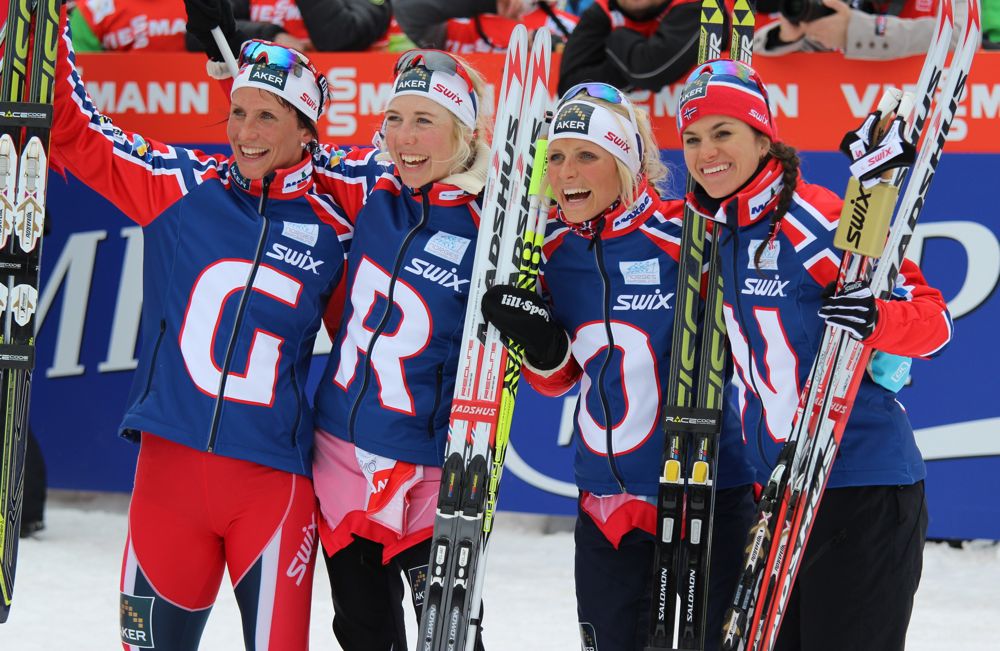
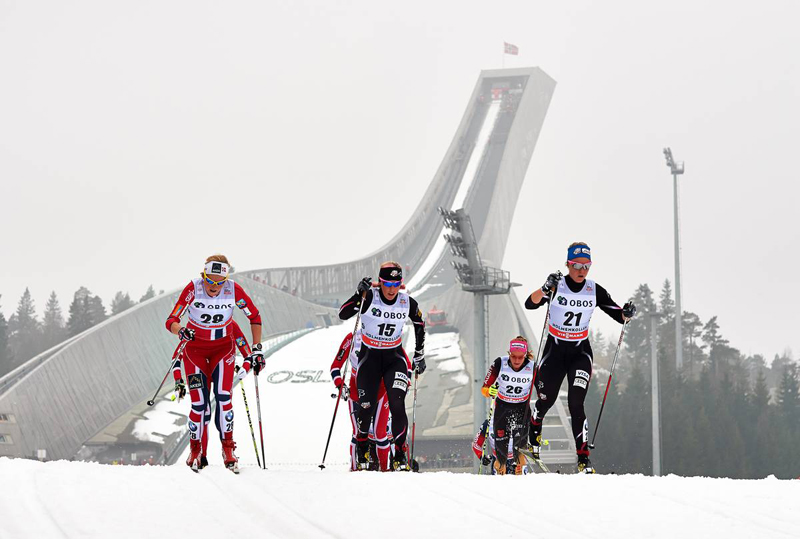
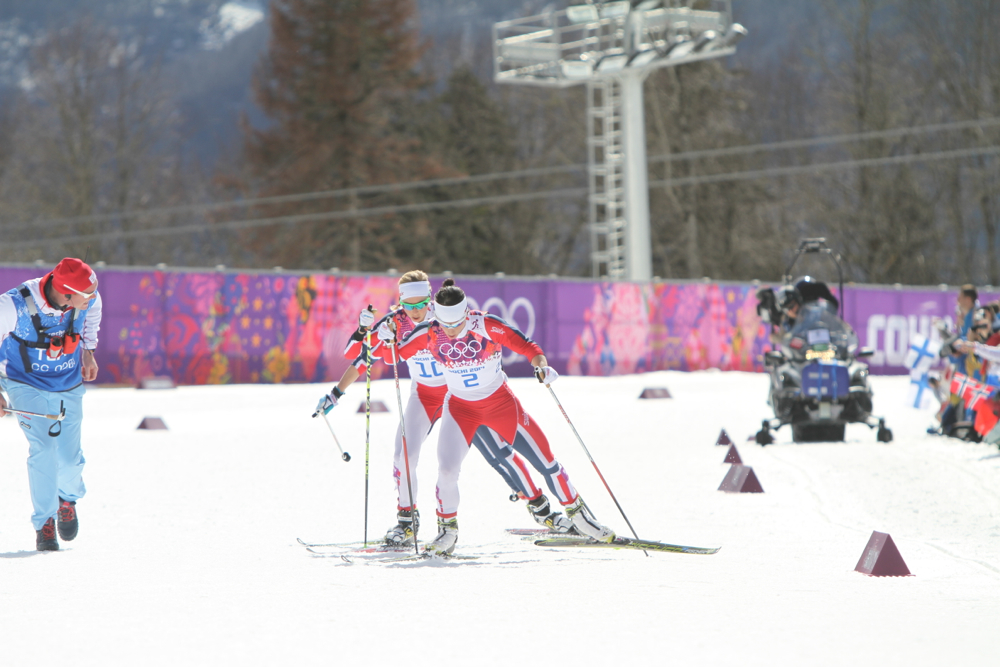
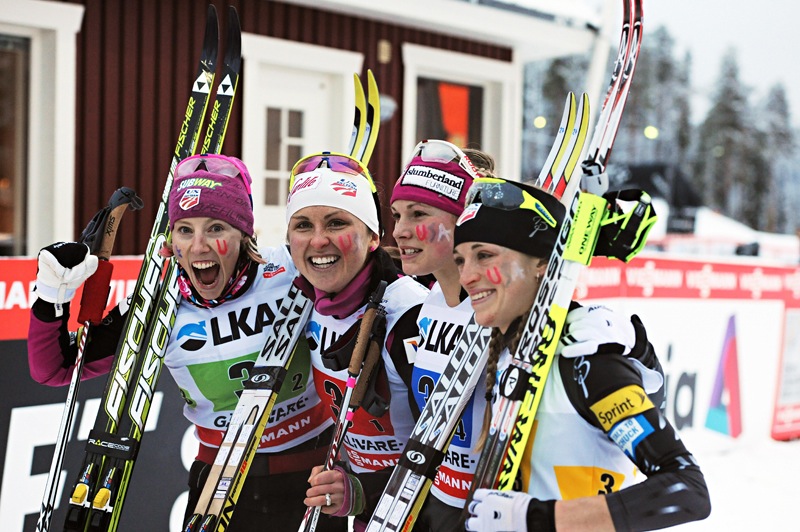
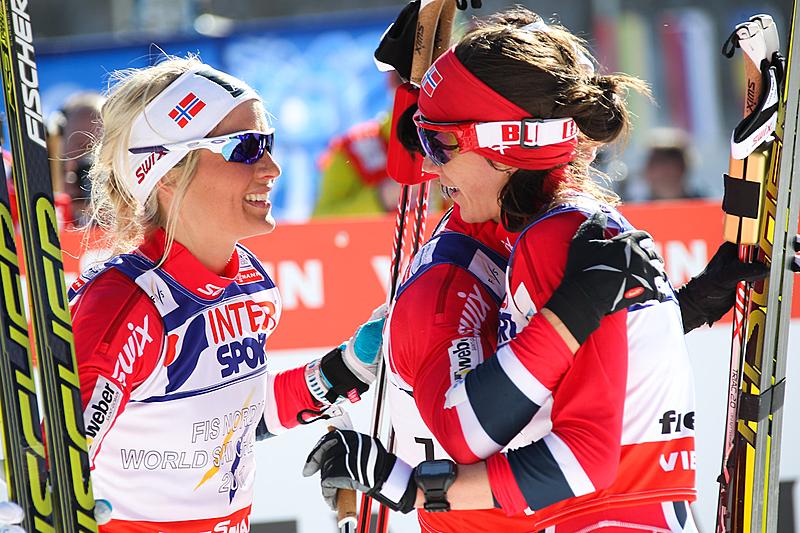
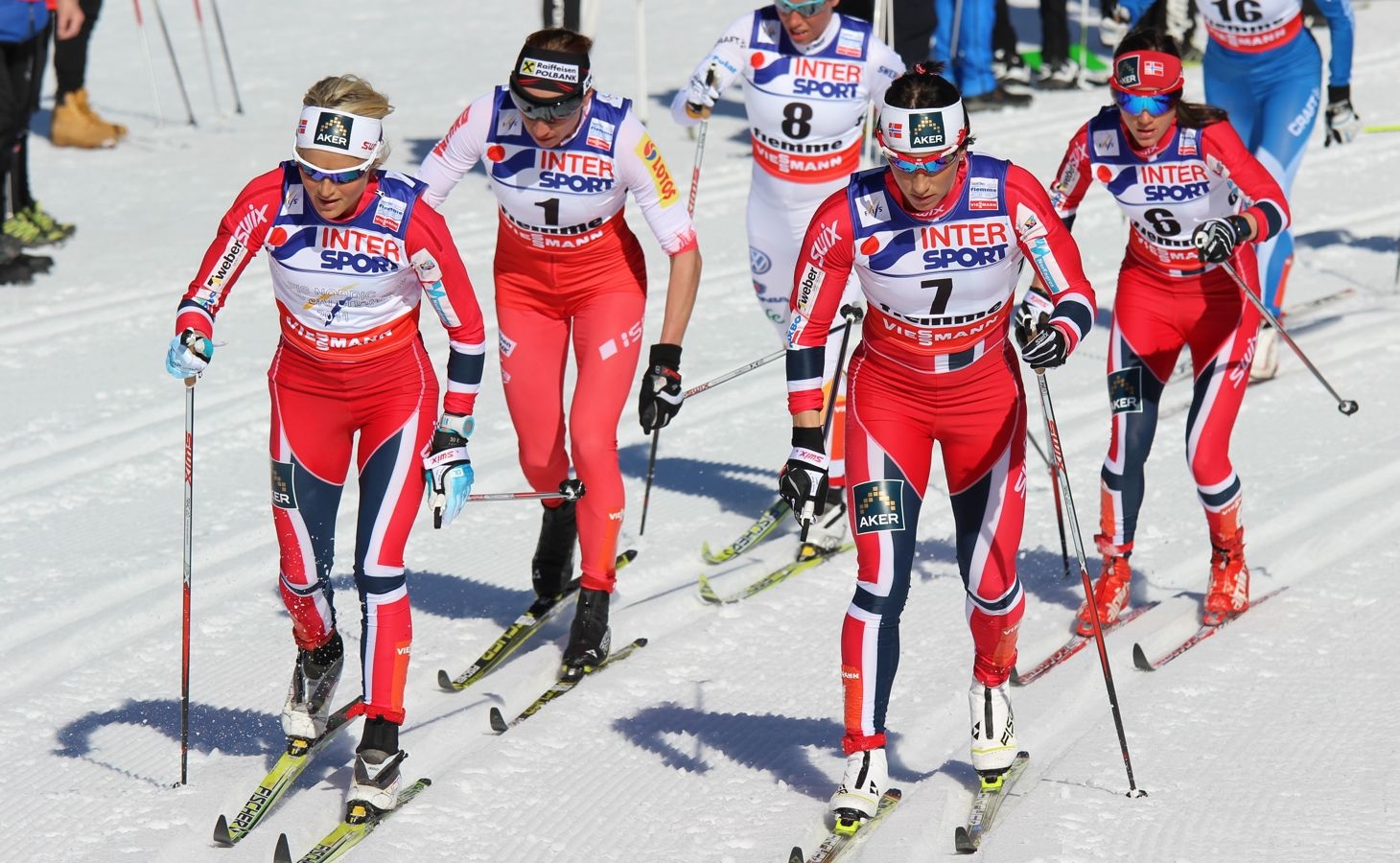
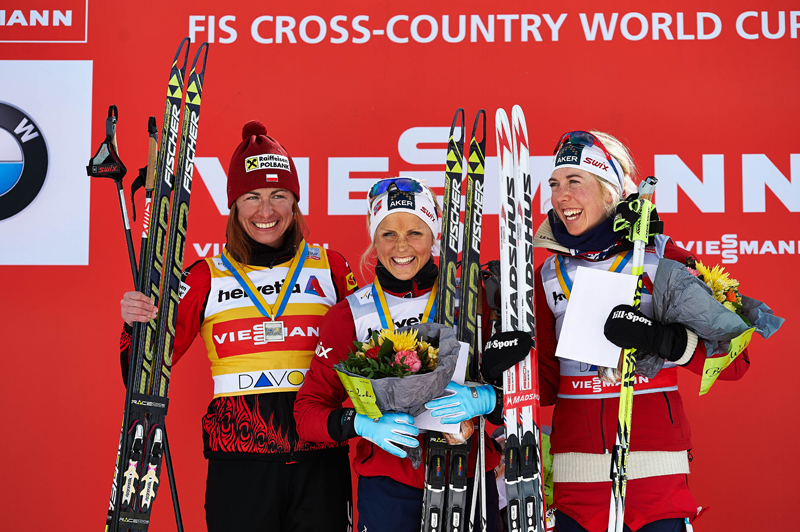
Kristin Størmer Steira (second from l) with the Norwegian gold-medal relay team at 2013 World Championships with teammates Marit Bjørgen (l), Therese Johaug (second from r) and Heidi Weng in Val di Fiemme, Italy.
Last Monday, April 20, Norwegian national-team veteran Kristin Størmer Steira, 33, announced her decision to retire following several seasons of injuries and illness, the most recent of which came just prior to 2015 World Championships in Falun, Sweden, and kept her from racing the 30-kilometer classic mass start there.
“I’ve experienced so much as a cross-country skier and I love ski racing, but the time has come to find a new track. And that won’t be a ski track,” Steira said in a translated team press release.
“I feel privileged to have had the chance to work with the best ski racers and coaches in the world,” she added. “There have been rough times, sacrifices, blood, sweat and tears too, but those are valuable experiences that I will carry with me.”
And she will be missed, by both her teammates and coaching staff.
“I am sad to see her quit now,” Marit Bjørgen told TV2. “Kristin and I have been teammates since 2003, so it will be strange to continue without her, but I respect her decision. She has meant so much to me, both as a teammate on the course and as a friend outside the track, and she has been an important part of Norwegian cross-country skiing for over a decade.”
“She has been an important part of Norwegian cross-country skiing for over a decade.” — Marit Bjørgen, on Norwegian teammate Kristin Størmer Steira’s retirement
“Kristin is not only a solid skier. She is a fantastic person with a great personality and contributes to a positive atmosphere wherever she goes,” said national-team director Åge Skinstad.
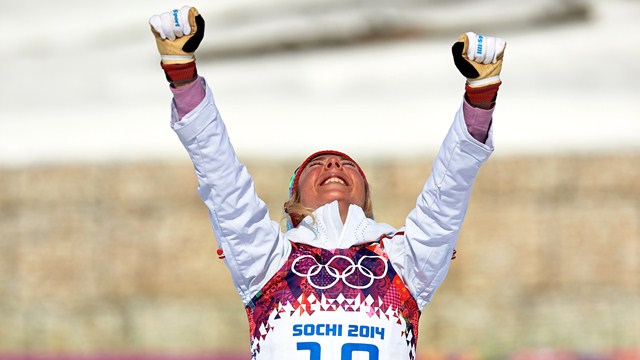
During her career, Steira participated in three Olympics: 2006 in Turin; Italy, 2010 in Vancouver, Canada; and 2014 in Sochi, Russia. She earned an Olympic gold medal in the relay in 2010, and her first individual Olympic medal in 2014 with bronze in the 30 k freestyle mass start.
Kristin Størmer Steira after taking bronze in the 30 k mass start at the 2014 Olympics. (Photo: FIS)
Steira competed in six World Championships: 2003 in Val di Fiemme, Italy; 2005 in Oberstdorf, Germany; 2007 in Sapporo, Japan; 2009 in Liberec, Czech Republic; 2011 in Oslo, Norway; and 2013 again in Val di Fiemme. During that time, she helped Norway win three World Championships golds in the relay in 2005, 2011 and 2013. Additionally, she earned four individual World Championships medals: two silvers in the 30 k classic mass start in 2007 and 15 k pursuit in 2009, as well two bronze medals in the 15 k skiathlon in 2005 and 15 k pursuit in 2007.
She also holds two individual Norwegian national titles in the 15 k pursuit in 2014 and the 30 k classic in 2010, along with two silver and three national bronze medals.
Steira first entered the World Cup circuit in 2002, when she raced the 30 k classic on home turf in Holmenkollen and came in 46th. She started 181 World Cups, tallied six individual World Cup victories and reached the World Cup podium 22 times.
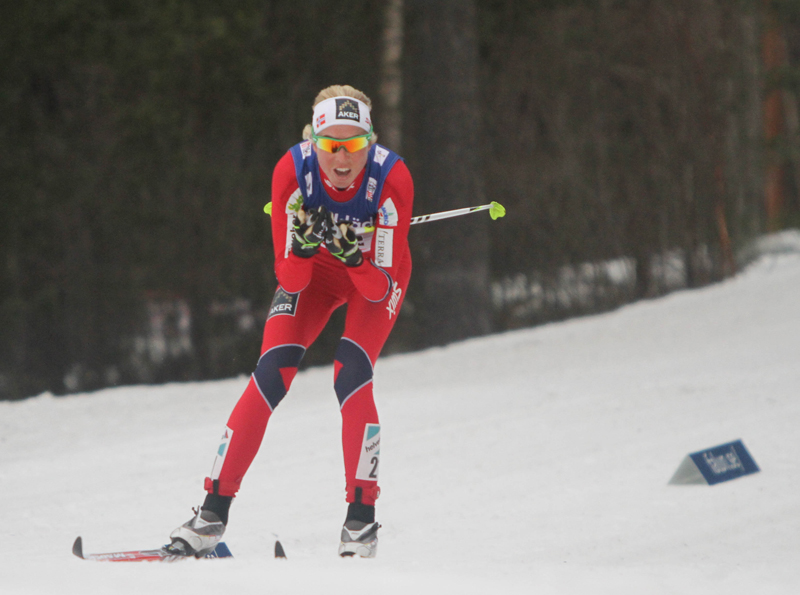
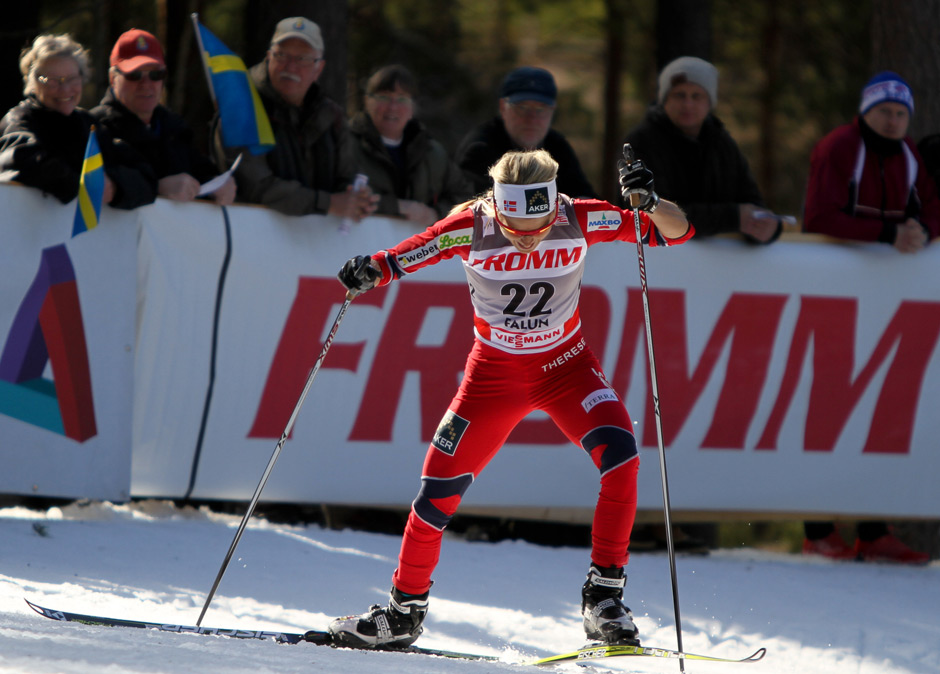
Kristin Størmer Steira racing in the 10 k classic mass start at 2012 World Cup Finals.
In 2012, the national team sidelined her in the middle of the season due to weight concerns, with a BMI under the team’s minimum limit. She told NRK that she has fought weight problems throughout her career.
“It is something that has been challenging for me through my whole sports career. I’m naturally thin, and when I train my body reacts with that I lose weight,” she said, according to a translation. “I have worked hard, and it has been challenging since I have been on the border many times.”
She reiterated that she did not have an eating disorder and was happy to talk about the subject.
“People have wondered and I have tried to be as open about it as I could,” she said. “This is particularly true with teammates and the others we have worked with on the team … But it’s not something I feel … has been a major problem.”
For the rest of the spring, Steira will continue to study full time, stepping up her academic pursuits of earning a business degree. In July, she has a wedding date set with Canadian World Cup skier Devon Kershaw, and the couple hopes to start a family soon.
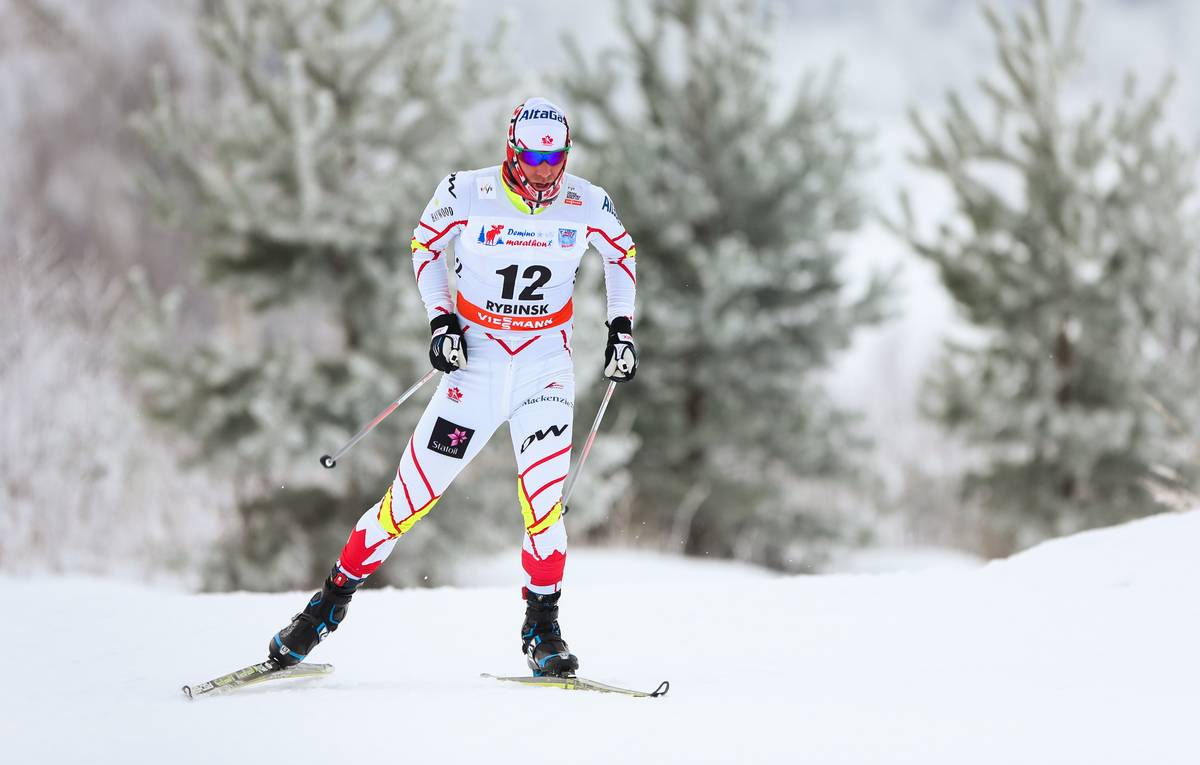
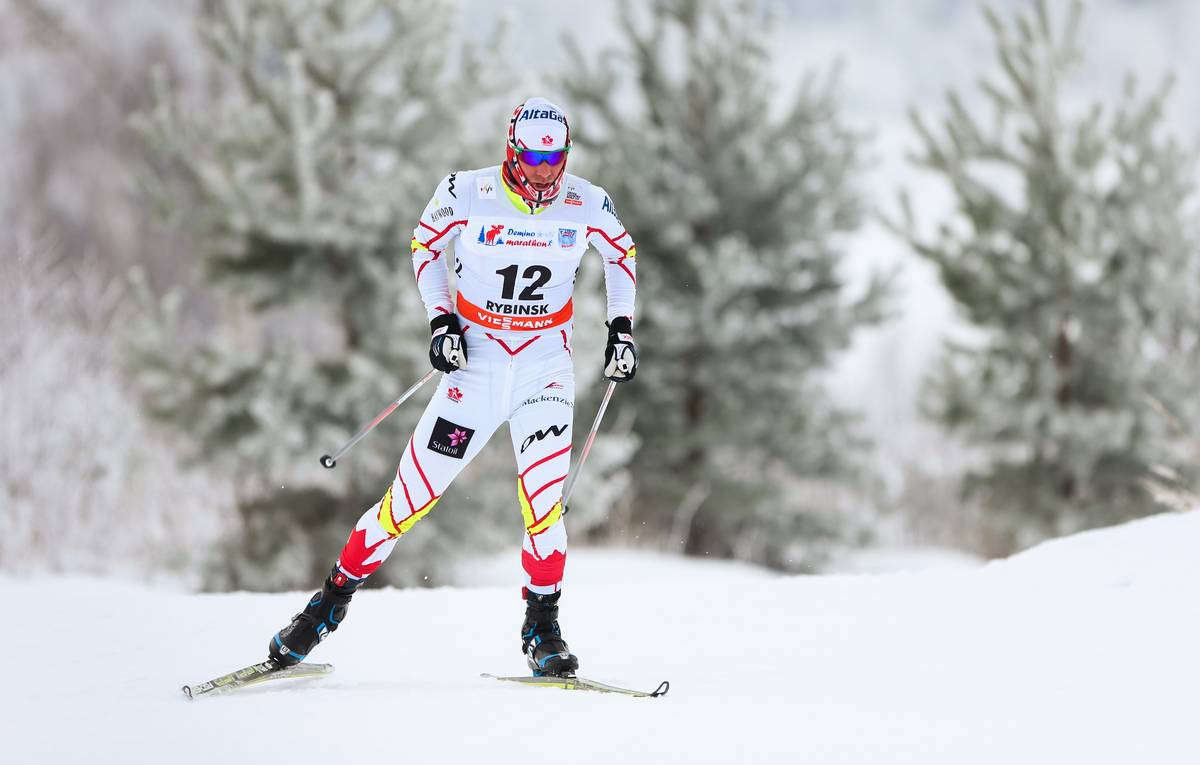
Devon Kershaw (Canadian World Cup Team) racing to 36th in the World Cup 15 k freestyle individual start on Jan. 23 in Rybinsk, Russia. (Photo: Fischer/NordicFocus)
What started out like any other cold turned into a season-ending downward spiral for Devon Kershaw, who, in the midst of what would have been his eighth World Championships, had to forgo racing and head to his fiancée’s home in Oslo, Norway, to recover.
A day after being diagnosed with mycoplasma pneumonia, commonly known as walking pneumonia, Kershaw found himself in the car last Saturday with his mom and fiancée Kristin Størmer Steira’s parents — driving from Falun, Sweden, to Oslo.
It all happened fairly fast, but the 32-year-old Canadian World Cup Team member couldn’t say he didn’t see it coming.
“The World Cup weekend in Östersund [Sweden], I came down with a really light cold, nothing that serious, just had a little bit of coughing and not feeling that good and a little bit of congestion,” Kershaw, a 2011 World Championships team-sprint champion with Alex Harvey, said in a phone interview on Wednesday.
“It was a really wussy cold, but I wanted to be careful ahead of World Championships so I didn’t travel down with the team from Östersund to Falun,” he explained. “I stayed up in Östersund, but I just never got better and the races kept ticking by.”
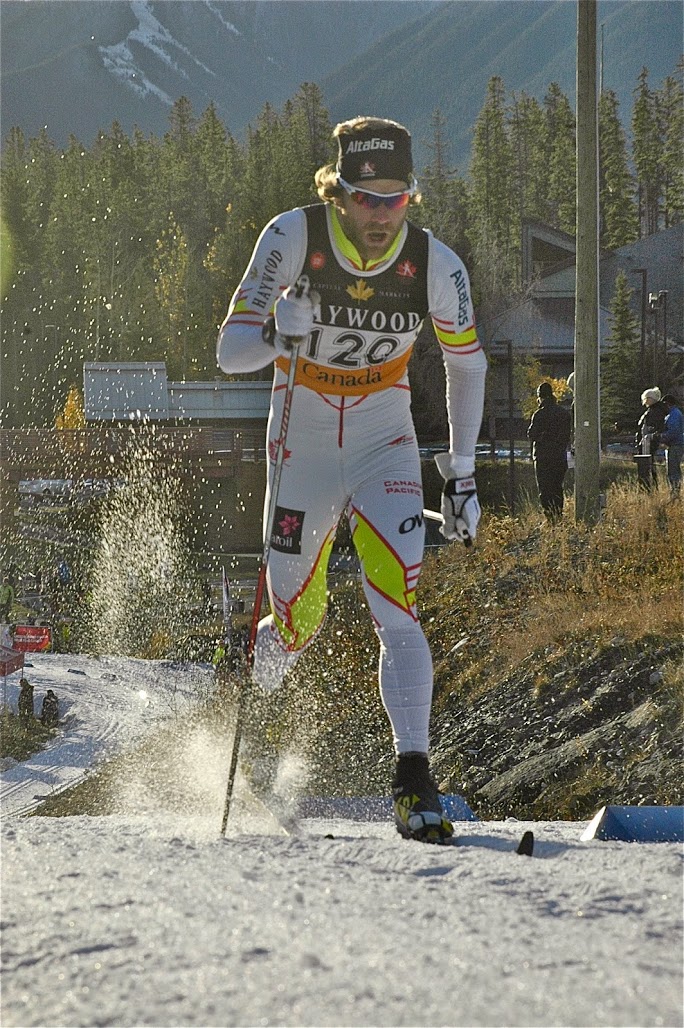
Devon Kershaw tuning up his classic sprinting in a preseason race on Oct. 24 at Frozen Thunder at home in Canmore, Alberta. (Photo: Angus Cockney)
At World Championships in Falun, Kershaw had planned to do the classic sprint, 30-kilometer skiathlon, 4 x 10 k relay, and 50 k classic mass start, as well as the team sprint if he raced well enough to make the two-man team.
But with each passing day and little improvement in his health, the races went on without him. Kershaw remained in Östersund until Sunday, Feb. 22, when he drove to Falun with three other teammates that had been fighting illness as well. While each of them got better and competed in the championships, he didn’t.
The morning of his trip to Falun, Kershaw started coughing uncontrollably. Unable to stay in Östersund, he traveled with his teammates to Falun. Burdened with a dry cough there, he felt his energy had improved.
“I think I started lying to myself because I really wanted to race the relay on Friday,” he reflected. “I was trying to ski, but I didn’t do any intensity or anything and it was just getting worse and worse. I wasn’t sleeping that well because every time I lied down I’d cough incessantly and we didn’t have a team doctor with us at that point.”
By the time he got there, Harvey’s mom, Canada’s volunteer doctor for beginning of World Championships, was already on her way fly back to Quebec.
“That week we didn’t have the team doctor with us,” Kershaw explained. “Thursday I tried skiing again and realized really fast that I wasn’t going to be able to do [the relay]. I was just feeling way too bad and coughing like crazy, couldn’t ski at all without having to stop and really cough, like lung-busting coughing.”
He arranged to meet with Norway’s team doctor, Knute Gabrielsen, and physiologist, Erland Hem, whom he described as an expert on lung function.
“They checked me out and did a bunch of tests and it turns out I had mycoplasma pneumonia,” Kershaw explained. “That ended my World Championships and ended the season actually. There’s only two weeks left of the season and I won’t be able to recover in time to do the 50 k in Holmenkollen [on March 14]. It’s too close. Especially a 50 k race, it’s not going to happen.”
He last raced Jan. 25 at the World Cup in Rybinsk, Russia, where he was 34th in the 30 k skiathlon and 36th in the 15 k freestyle on Jan. 23.
“I’m gutted,” he said. “My season ended before it started. Like every team, my training was really tailored towards the four [or] five races at the World Championships and I felt like I was in really good shape coming out of the training camp we did, and I have a lot of experience, too, so I trust that shape. … To not even get the chance to use it at all is really discouraging.”
“It’s like my car broke down on the way to the exam, but I live like far away and there’s no way I can get to the exam, and I got a zero.” — Devon Kershaw on having his season end with walking pneumonia
He started on antibiotics as soon as he was diagnosed, but as of Wednesday of this week, Kershaw said they didn’t seem to be working as well as he’d hoped. He wasn’t sleeping through the night and the inhalers he was on hadn’t cleared his lungs.
“I think the name of the game is really just patience,” he said.
Looking back on his season, essentially two months long, Kershaw described it as “bad,” with highlights at the World Cup opener in Kuusamo, Finland, where he placed 14th in the 15 k classic, and in the Tour de Ski freestyle sprint, when he qualified for the first time this season and finished 22nd. Over the next two stages of the Tour, he placed 21st in the 10 k classic and 25th in the 25 k freestyle pursuit.
“If you look through my history, my speed before Christmas … especially in sprint qualifiers, is usually pretty bad. I think I’ve only been in the final once before Christmas in my whole career,” he said. “So I wasn’t qualifying before Christmas, which was kind of normal but a bit frustrating and skating was a real problem…
“The Tour wasn’t spectacular by any stretch of the imagination; it started actually quite bad. Again the skating just wasn’t quite feeling that great,” he continued. “We had a major debacle with the skis in the 15 k [classic] mass start in Val di Fiemme the [second-to-last stage] of the Tour de Ski and that destroyed all our chances. Ivan [Babikov] and Alex and myself, we were minutes behind with like some of the worst skis I’ve ever had. That ended the Tour right there, which was tough. [Then leading up to] Rybinsk, I was training a ton and doing a lot of volume and my mind was on the World Championships so it didn’t really work out that well in Rybinsk, either…”
So that was it. For the last week, Kershaw said he was doing his best to pass the time, playing some guitar and trying to get his energy back. Once he started feeling better, he planned to finalize some wedding plans with Steira in Lofoten, a group of islands in northern Norway. The two have a wedding date set there for July 26.
He also planned to get an X-ray in a month to check on his recovery.
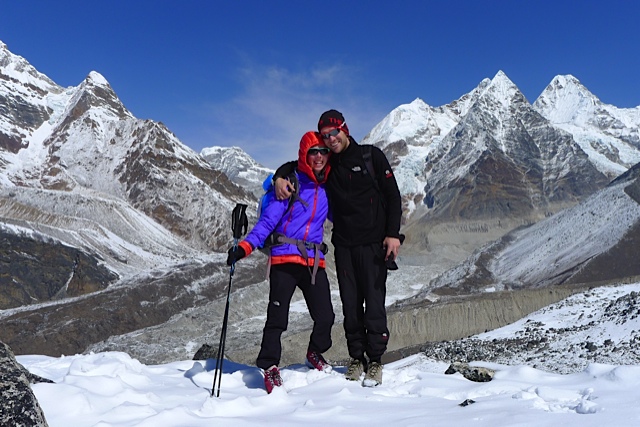
Kristin Størmer Steira (l) and Devon Kershaw during a day hike on one of their acclimatization days in Nepal’s Himalayas. The couple got engaged last April after summiting Mera Peak during a three-week trek. (Photo: Devon Kershaw)
Meanwhile, Steira was taking classes toward her MBA degree and healing a foot injury she sustained on a run two days before the 30 k classic mass start at World Championships. That prevented the 33-year-old Norwegian from competing in what would have been her seventh World Championships. A fractured pelvis previously derailed the first half of Steira’s season.
“This week she’s trying to get some answers and in the meantime she’s going to school,” Kershaw said on Wednesday. “She’s had an MRI done, but she hasn’t heard anything yet. She’s pretty discouraged, too. She trains so hard. To come back from a fractured pelvis and even make the Norwegian [World Championships] team is ridiculous. I was really proud of her. When she called me and said, ‘I can’t kick my skis. My foot’s really sore,’ I’m just like, ‘What? Two days ago you were just so smiley and good and loving it and things were great.’ So she had some really bad luck, too.”
If Kershaw is feeling up to it and still in Oslo (not up north in Lofoten) next weekend, he explained he would watch the 30 and 50 k season-ending World Cup races in Holmenkollen.
“That might be wishful thinking, but we’ll just see how the body recovers,” he stated. “It’s always so hard to watch races that you want desperately to be competing in, but that’s life sometimes and you got to take your knocks on the chin and keep going.”
In late April, he said he’ll head back to Canada to hopefully do some ski touring before revving up for another season. If Steira’s foot injury isn’t too serious, she’ll likely join him in May in Canmore, Alberta.
“I would like to ski next year purely because you can’t go out like this,” Kershaw said. “I showed that I can still ski at an international level and I know that I can still do the training that allowed me to. I was in good shape before all this happened and I know that’s lip service now, but at the same time I do have a wealth of experience. It’s not like I was getting murdered-murdered on the World Cup every weekend.”
Next year, he’s looking forward to competing at 2016 World Cup Finals, dubbed the Tour du Canada, which will take place at five venues across Canada: Gatineau, Montréal, Québec City, Canmore, and Lake Louise.
“Racing at home like that is a pretty incredible opportunity,” Kershaw said. “In the short term, it’s hard mentally, you feel like you’re beat up. You did so much in preparation. I’ve already trained 800 hours already this year and all for what? At the end of the day you’re like, God damn. It’s like my car broke down on the way to the exam, but I live like far away and there’s no way I can get to the exam, and I got a zero. Not being able to sit down and write it is going to take some time to get over for sure, but I’m still keen and I think we have a good team.
“This year for sure, Alex has been a major standout. For the last two seasons, no questions, Alex has been keeping our team afloat because others, myself included, we haven’t delivered like we have in the past,” he added. “So it’s time for us to start pulling our weight a bit joining Alex on the international level. I’m still motivated, absolutely, but you want to do it properly, too. We’ll just have to see how long it takes to fully recover from this.”
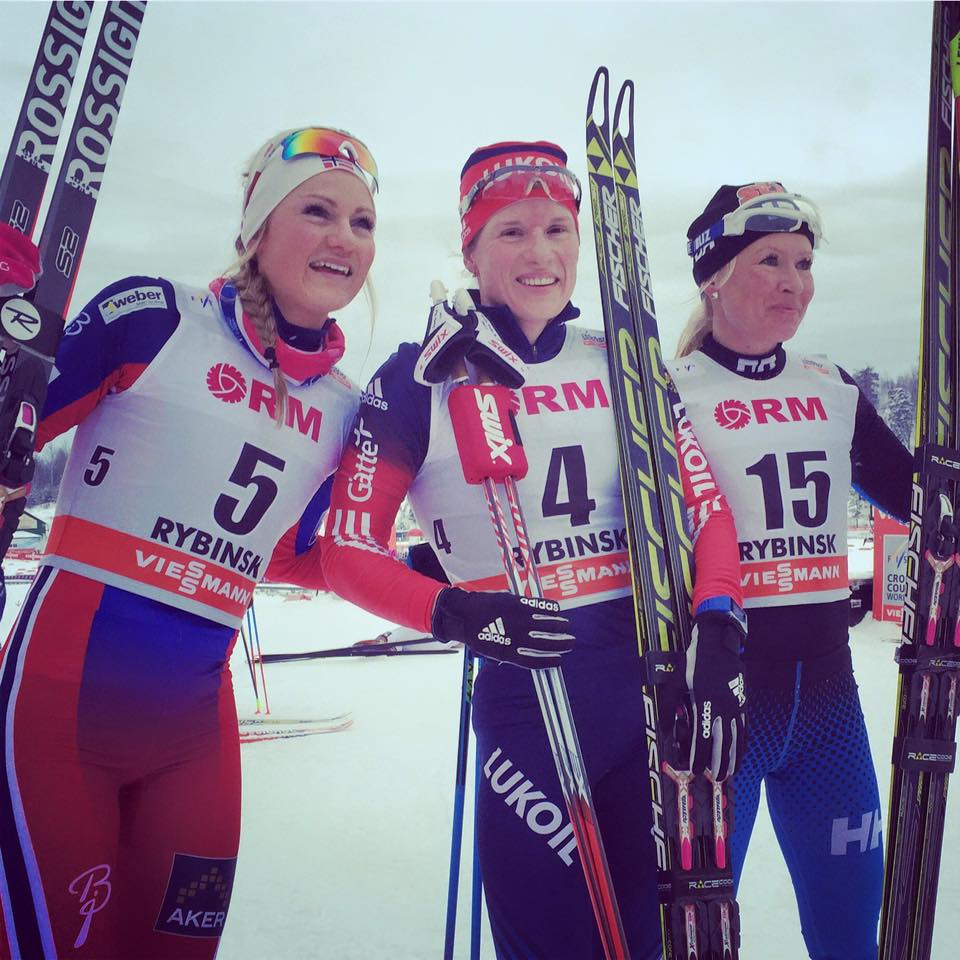
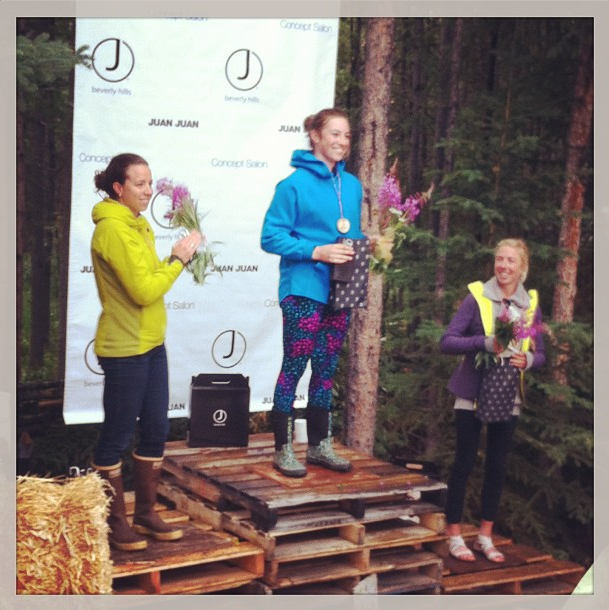
Women’s 15 k skiathlon podium in Rybinsk, Russia (from left to right): Martine Ek Hagen of Norway (second), Yulia Tchekaleva of Russia (first), Riitta-Liisa Roponen of Finland (third) (Photo: FIS/Facebook)
Russian Yulia Tchekaleva won the women’s 15-kilometer skiathlon Sunday by 15.6 seconds, earning her first-ever World Cup victory and delivering her best result of the season on home turf in Rybinsk, Russia. Tchekaleva finished the 15 k skiathlon in 44:16.0, with Martine Ek Hagen of Norway in second place, trailing by 15.6 seconds. Riitta-Liisa Roponen of Finland placed third, 22.9 seconds behind Tchekaleva.
“I tried to save energy in the classic part of the race. I just tried to stay with the front group but not work too hard. When we switched to skating, I felt that I had a lot of power, so I went for the victory,” Tchekaleva said to FIS reporters.
“It was really nice to win my first World Cup here in Russia,” she added.
Tchekaleva attacked at the end of the classic portion of the competition and skied alone for the final 7.5 km freestyle portion of the course. However, she could never relax as a Norwegian was hot on her tail. Ek Hagen broke away from the chase group on the first of three laps in the skate portion. As they neared the final kilometers she chipped away at Tchekaleva’s lead, and at one point was just six seconds back.
In the end Ek Hagen unable to catch Tchekaleva. In the process of the chase, however, she put a gap on the rest of the field and skied alone to the finish.
“This is my first World Cup podium and I am very happy. It was a hard race today. When Yulia [Tchekaleva] attacked, I tried to go get her and hoped someone else would be able to come with me, but I was alone. Which I guess is good because I was able to get second place,” Ek Hagen said to FIS reporters in a post-race interview.
Behind her, a fight was brewing for third as a group of roughly six athletes were all within five seconds of each other. With only a lap to go Roponen pulled away from the chase group, followed closely by Stefanie Böhler. The others in the pack were unable to respond, and the fight for third narrowed to two skiers. As the two entered the finishing stretch, Roponen was able to hold off the German to gain her first World Cup podium since 2010.
The Finnish skier said she was very happy with her return to the podium.
“I am feeling very good right now. It has been a long time since I was on the podium for an individual result. It was a hard fight with Steffi (Böhler) to the finish, and I was hoping that I could stay ahead of her, and I did,” Roponen said after the race, adding that she surprised herself with the result. “I was not sure that I thought I would be on the podium today, so I am very happy that I was.”
U.S. Ski Team’s Jessie Diggins was the fifth finisher across the line, 25.8 seconds behind Tchekaleva and 2.9 seconds from third. She logged the second-fastest skate portion of the skiathlon – only 0.2 seconds slower than Tchekaleva. She also posted the second-fastest pit stop, but given that her 7.5 k classic split was 13th, the gap to Ek Hagen and Tchekaleva was too big to gap.
In addition to Diggins’ result, the USST also boasted a 7th place from Liz Stephen. The weekend has been largely successful for Stephen, as she placed second in Friday’s 10 k freestyle.
Sunday’s race in Rybinsk was the first regular World Cup skiathlon in almost two years, aside from the 2014 Olympics in Sochi. The last regular World Cup skiathlon was held in at the pre-Olympic World Cup in Sochi in 2013, when Steira won ahead of Tchekaleva and Nicole Fessel of Germany was third.
Norway’s selection to the World Championships
With her second place today and her first-ever World Cup podium, Ek Hagen has made a solid bid for a spot on the Norwegian squad to the 2015 FIS World Championships in Falun, Sweden this February. The races in Rybinsk will be a significant part of the World Championships selection criteria for those who did not race the Tour de Ski. Despite the strong result, Ek Hagen doesn’t take anything for granted until the final selection is made.
“It will be difficult to make the Norwegian team for the World Championships, but I feel really good right now and I hope I can make the team,” Ek Hagen said.
Astrid Uhrenholdt Jacobsen, the winner of the women’s 10k skate on Friday, lead most of the first 7.5 k classic but ended up in ninth place after falling back on the skate portion of the race. Jacobsen’s previous win in a regular World Cup event was the skiathlon in Falun, Swden, almost seven years ago in February 2008. Since then Jacobsen has won a stage in the 2014 Tour de Ski.
For sixth place finisher Størmer Steira, Rybinsk was the first World Cup weekend since her hip fracture in October. With Sunday’s result and fifth in Friday’s 10 k, she has definitely put her name in the hat for a selection position.
Liz Stephen earned the best finish of an American woman in a World Cup distance race Friday, with her second place in Rybinsk, Russia. She is pictured here in the 2015 Tour de Ski. (Photo: Marcel Hilger)
After her second-place finish in Friday’s World Cup 10-kilometer freestyle in Rybinsk, Russia, Liz Stephen had a lot to celebrate – it was her first individual World Cup podium, just two weeks after her historic fifth-place finish in the Tour de Ski.
But there was something the 27-year-old hadn’t realized.
As she sat down for the press conference with FIS Marketing Support Jeff Ellis, he informed her of another historic accomplishment – Stephen had posted the best distance result for an American woman on the World Cup, besting Ellis’ wife, Kikkan Randall’s third place in Gällivare, Sweden in 2012.
With the realization, Stephen said she there was only one word to describe the plethora of feelings surrounding the result.
“To sum it up in one word, I’m ecstatic. I’m really happy to put it all together on one day. I’m ecstatic for sure and a little emotional,” Stephen said in a phone interview.
The results in Rybinsk marked a respite from the familiar podium names with major players such as Norwegians Marit Bjørgen, Therese Johaug, and Heidi Weng avoiding the long journey to Russia in order to rest for the remaining races of the season. However, with strong competitors like Poland’s Justyna Kowalczyk and Finland’s Kerttu Niskanen in the mix, no result was guaranteed.
Stephen placed second to Norway’s Astrid Jacobsen, who finished the 10 k in 28:12.5. Stephen was off-pace by 14.4 seconds, but placed ahead of Germany’s Stefanie Böhler (+36.4) who claimed the final podium spot. Rounding out the top-five were Yulia Tchekaleva (+37.6) of Russia and Kristin Størmer Steira (+41.4) of Norway. Until Friday, Størmer Sterira had been absent from the World Cup after a double hip fracture in October.
The Comeback Podium
Friday’s win was Jacobsen’s first since 2008 when she won the World Cup 15 k pursuit in Falun, Sweden. In the nearly seven years since, Jacobsen has been on the World Cup podium many times but another victory was always been elusive.
Jacobsen’s path to the top of the podium was a difficult one. Just one day before the start of the 2014 Olympic Games, her brother and training partner passed away unexpectedly, causing emotional hardship for the Norwegian throughout the event and remainder of the year. Later that season she crashed into a lamppost in the Holmenkollen 30 k and was rushed to the hospital. With no serious injuries resulting from the crash, Jacobsen began what looked to be a productive training season that spring. By the fall, however, Jacobsen told NRK that her body was no longer responding to training.
Astrid Uhrenholdt Jacobsen of Norway returned to the top of a World Cup Podium Rybinsk, Russia after a seven year absence. She is pictured here in the 2012 Tour de Ski.
According to NRK, the physical hardship lasted through the beginning of the season where Jacobsen raced to uncharacteristic results over the Lillehammer World Cup weekend. With her body feeling out of whack, Jacobsen decided to rest. After seeing improvement since the begging of the year, she participated in Scandinavian Cups while her teammates competed on the World Cup circuit. Her most recent was in Falun, Sweden, the site of the 2015 World Championships, where she won the 15 k skiathlon and placed third in the 10 k freestyle.
“I have felt since New Year that the shape has been better and better. I had some good races in Falun, but today it was even better,” she told NRK Sport.
In Friday’s race, Jacobson dominantly skied the hilly course to earn top splits throughout the race. Skiing one bib behind Stephen for the entirety of the 10 k, she crossed the finish line with her arms outreached and a smile on her face.
“I have had to be very patient this year. My body has not handled training as it should since August. So I am very happy to have such a result today,” she told FIS in a post-race interview. “It is a difficult course with challenging conditions today so I was cautious on the first lap and I think that helped very much.”
Rybinsk has been friendly to Jacobsen in the past. In 2007 she earned her first World Cup win in the 15 k mass start.
Third place finisher Böhler also has fond memories of Russia. In 2009 she earned her first and only other individual World Cup podium in a Rybinsk World Cup 10 k mass start.
Stefanie Böhler of Germany earned the third place and her second-ever individual World Cup podium. She is pictured here in the 2012 Tour de Ski.
“This is a great result. My only other podium on World Cup was here in 2009 so I am really happy to be back on the podium here again,” she told FIS. “I always like coming here. The courses are hard, the people are so friendly and there are many spectators. It’s just really nice to be here in Rybinsk.”
Böhler has faced her share of challenges as well. In 2012 she was diagnosed with thyroid cancer but fought back to compete in the 2014 Olympics where she and her teammates earned a bronze medal in the 4 x 5 k relay.
Stephen, who is close with Jacobsen after the two exchanged training time in Alaska and Norway, said she was happy be on the podium with both her friend and Böhler.
“It was a really fun podium to share. For [Jacobsen] to come back and get a win is pretty special for her,” Stephen said. “After last year’s really challenging year with her it’s really special to be on the podium with a friend and someone who has had her fair share of ups and downs, in skiing and in regular life too. Steffi is the same. She battled cancer a couple years ago and she’s one of the more smiley people on the World Cup and always rooting for everyone else.”
History in the Making
With many of the biggest names absent from Rybinsk, Stephen knew there was an opportunity to land a spot on the podium – and she was ready to take it.
“I really wanted to get on the podium today,” Stephen said of her ambitions. “In order to do that I focused on each section of the course.”
Known for her climbing abilities, the hilly course in Rybinsk favored the Vermont native. Stephen explained that her main strategy for the competition was to ski the flats smoothly. She also focused on skiing over the top of each hill aggressively – an area in which she’s struggled in the past.
“I just like to go up hills, but over the top can be an issue for me so I saved enough to really go over the top and carry good speed on the downhills and grab a low tuck,” she said.
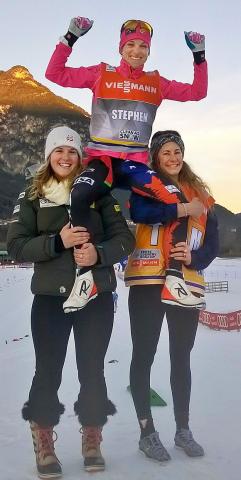
U.S. Alpine Ski Team athletes Paula Moltzan and Resi Stiegler lift Liz Stephen after a leg of the 2015 Tour de Ski. Stephen’s fifth ranking in the Tour was the best American result ever. (Photo: U.S. Ski and Snowboard Association)
The strategy worked and as Stephen sped around the course, consistently earning the second-fastest splits. When she crossed the line it was all but certain she had secured her first World Cup podium. Stephen said she hadn’t thought about the historic possibility of earning the top finish in a distance World Cup by an American woman until Ellis told her in the press conference.
According to USST Head Coach Chris Grover Stephen’s success is due to her superior fitness.
“Obviously she came out of the Tour de Ski where she was in really good shape and then she was able to stay healthy and recover. She’s in good form right now and that’s the absolute key,” he said of Stephen.
Stephen also explained that her result was not just a product of her individual abilities, but also the support of her team. Pointing to her fellow American skiers and coaches, Stephen said that everyone, especially women’s team coach Matt Whitcomb who taught Stephen how to ski at Burke Mountain Academy, played a role in Friday’s historic result.
“It means a lot to be with this team, having this result, and knowing that you’re never ever out there by yourself. Good days, bad days, great days, this team forms around you,” she said.
With World Championships three weeks away, Stephen said she hoped to inspire the team to reach their best results of the season in Falun.
“Having these results going into World Championships for me personally is, of course, wonderful but I also think and hope that it boosts everyone else’s confidence and belief in themselves,” she explained. “I’ve seen it in the past with Kikkan and other teammates having best-ever results for them, or making history. The whole team gets pulled up by it. I think it will.”
U.S. Women Solid in Top-20
It seems that Stephen has already inspired one of her USST teammates.
Finishing Friday’s race in 12th place, Jessie Diggins explained the 2015 season hasn’t met her expectations, but that Stephen has helped her work towards a stronger mental attitude.
“Liz has actually been encouraging and inspiring me to work harder with Sports Psychology and start believing harder that I have what it takes,” Diggins wrote in an email. “This season has been tough on my self confidence so far… and I’ve been working on having more confidence when I step onto the snow. Especially after getting quite sick and having to drop out of the Tour de Ski, there were a lot of thoughts running through my mind – wondering if I would be in good enough shape to race after being sick and not being able to train as planned, etc.”
After taking over week of rest between the Tour de Ski and Rybinsk, Diggins said that she was able to “put those thoughts away” in Friday’s 10 k and ski a focused and driven race. However, even though she was able to perform mentally, said her body was not responding.
“I definitely am not in my greatest race shape right now as I think everything came together quite smoothly in this race and my results weren’t close to what they were a few years ago on this course. I need to be patient as I come out of being sick and let these three races this weekend help me get back in my best race shape!” she wrote.
Just behind Diggins was Rosie Brennan, who earned her best ever finish in a World Cup. As the period one SuperTour leader, Brennan is participating in her second weekend of racing with the USST.
Rosie Brennan earned her first World Cup points in Rybinsk, Russia. Brennan is pictured here racing in Houghton, Michigan. (Photo: Christopher Schmidt)
Throughout much of the competition Brennan’s splits were in and out of the top-10, indicating a rapid start. According to Brennan it was all part of the plan, even if it meant her finish speed was reduced.
“I started pretty hard, maybe a little too hard, but I believe it takes putting yourself out there to really find out what you are capable of. With that in mind, I just tried to keep pushing the whole way. I think I faded a bit at the end, but held it together just enough for a sold result,” she wrote in an email.
Brennan said she was excited to have “broken that barrier” to earn World Cup points and that she hoped the result would give her confidence through the rest of her time in Europe.
“Huge race for Rosie, who really skied exceptionally well. That was really exciting to have her in the mix,” Grover said of her race.
Racing continues in Rybinsk Saturday, with a freestyle sprint.
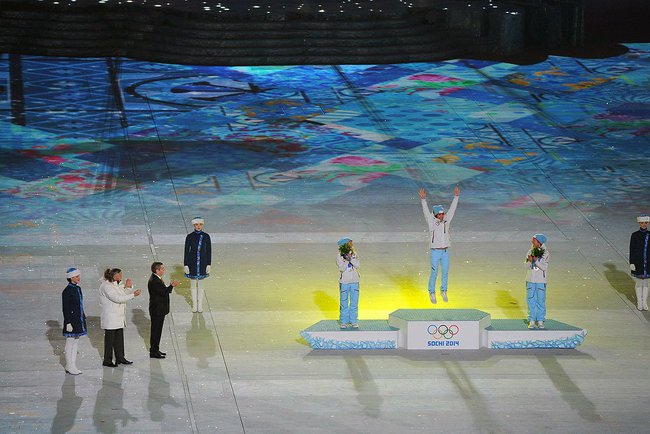
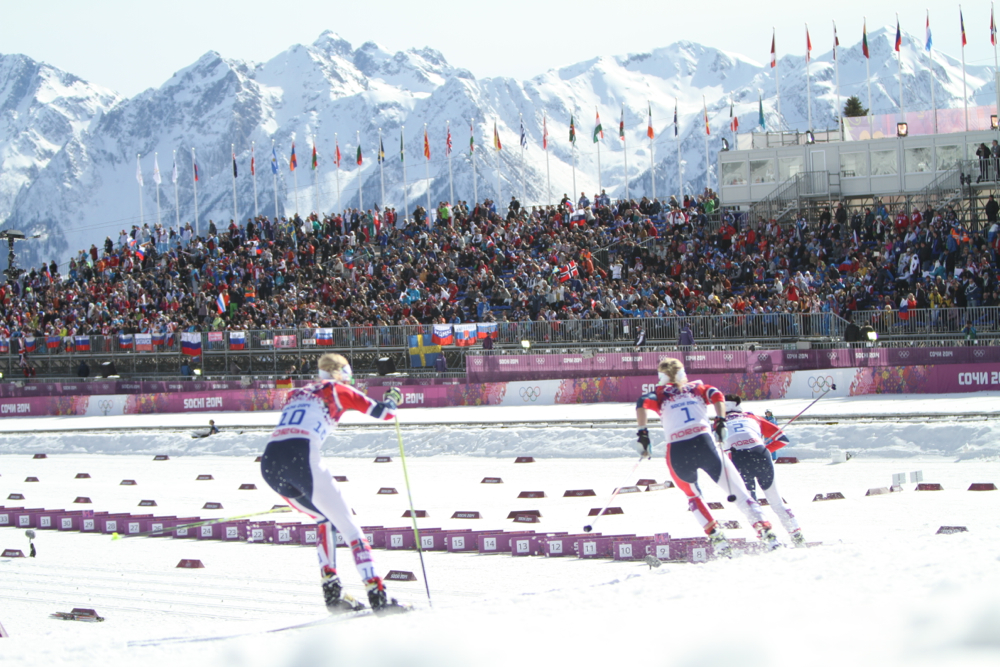
Kristin Størmer Steira (r) on the podium at the Sochi Olympics closing ceremony with teammates Marit Bjørgen (jumping) and Therese Johaug, after Norway swept the podium in the women’s 30 k freestyle mass start, the last cross-country race of the Olympics. (Photo: Wikimedia Commons)
Note: This article has been updated to include Kristin Størmer Steira’s most recent athletic accomplishment as 10,000-meter champion at Norwegian Athletics Championships on Sunday. It was her first time running the 10,000, according to VG.
***
If you asked Kristin Størmer Steira about the ‘R’ word six months ago, the Norwegian national-team member might’ve told you she was considering it.
A not-so-hot start to her third Olympics had left the then-32-year-old Steira contemplating retirement. Never before had she been outside the top 10 at the Olympics, and in two previous 15-kilometer skiathlons at back-to-back Olympic Games, she placed fourth.
Kristin Størmer Steira in 2012 (Photo: Wikimedia Commons)
But in Sochi, she was 23rd — not bad, but not to her standards.
Her next chance came in the 30 k freestyle mass start, the final race of the Sochi Games.
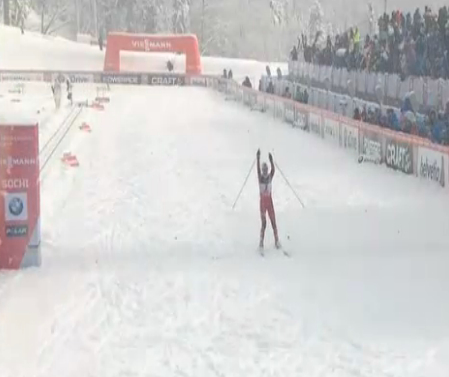
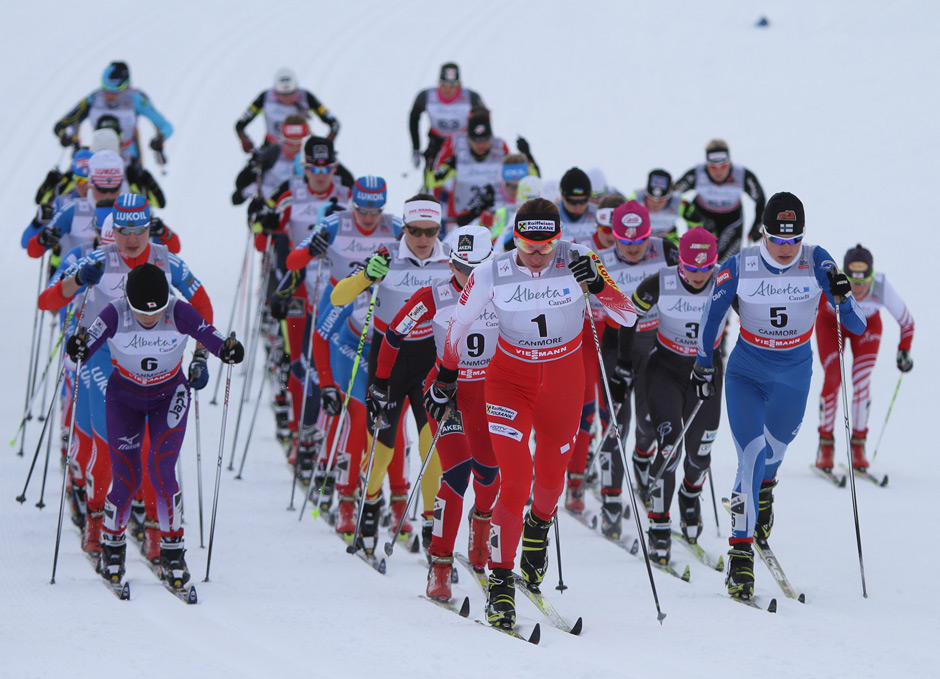
In a seemingly seamless race for three Norwegians, Steira placed third behind her two teammates Marit Bjørgen and Therese Johaug, respectively. It was her first Olympic medal in eight individual starts.
“My Olympics went from the worst competition I’ve ever had to maybe the best,” Steira said on the phone from Norway earlier this summer. “It was a special Olympics for sure.”
Before the races began, her team had to cope with the sudden passing of teammate Astrid Jacobsen’s brother, a skier whom many of the national-team members were close with.
“It was a lot of feelings, a lot of emotions,” Steira recalled. “We had a rough time in our team … but in the end, to have a medal in the 30 k … I really, really felt that I worked hard for that and to be able to do it when it counts was a great feeling.”
She also had the unique experience of standing on the podium at the closing ceremony in front of 40,000 spectators and millions more who watched on TV.
“It was maybe the best day for being on the podium,” Steira said. “You felt kind of small getting up on stage with the crowd and the stadium. I’ll never experience [that] again.”
One might ask, why not? With four individual World Championships podiums and 22 World Cup podiums in the last 12 years, and after placing second in the rollerski hill climb at the Blink Festival in Norway earlier this month, how does she know when it’ll be over?
She doesn’t, but she was thinking about it after Sochi.
“I was more towards not doing another year and I guess the medal in the 30 k both made me kind of feel [like] I could stop skiing — I managed to do what I planned to do: have a medal individually in the Olympics,” she said. “On the other side, it also makes you so motivated to do another year. I guess when I was thinking about it, it counted both ways.”
“I want to learn something other than classic and skating and technique, to put my mind a bit on other stuff and also start preparing for the next step — whatever that will be.” — Kristin Størmer Steira, Norwegian national-team member & three-time Olympian
So here she is, 33 and revving up for the 2015 World Championships in Falun, Sweden.
“It’s close to Norway,” she said of her decision to focus on Falun and race for another season. “I think it will be amazing [at World Championships] … a lot of people, but I guess in the end mostly the motivation was still there and I love skiing and I wanted to give it one more year, mostly because it was so fun.”
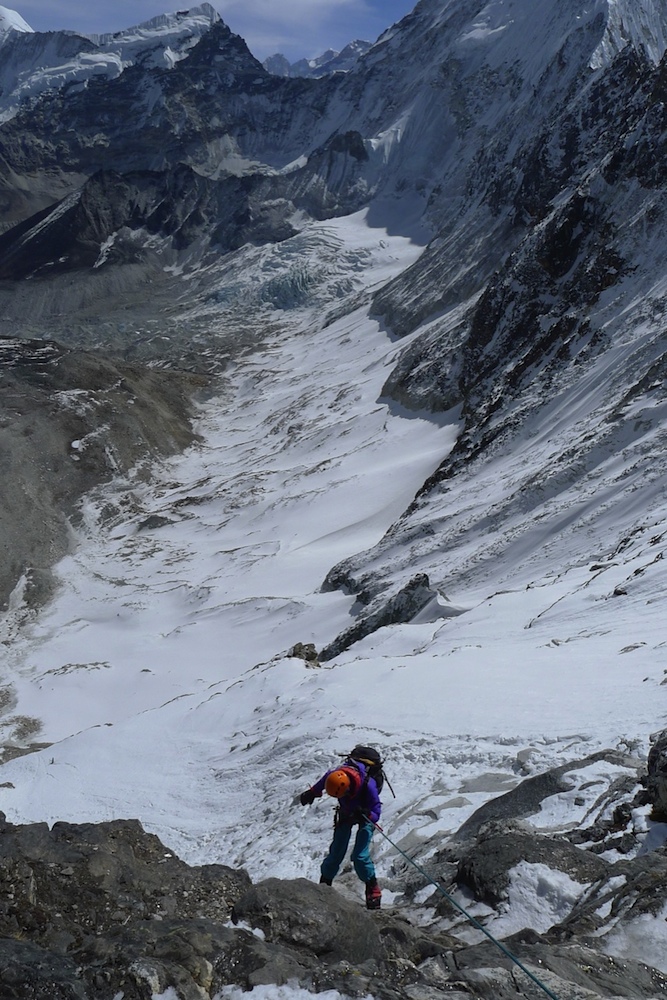
Kristin Størmer Steira rappels during their Himalayan trek. (Photo: Devon Kershaw)
In late April, she got sick during a three-week excursion in the Himalayas. She left Kathmandu with a ring on her finger, thanks to fiancé Devon Kershaw, but it took her some time to shake the parasite she contracted on her way up the 6,476-meter (21,000-foot) Mera Peak.
“Early summer was not quite as planned … I still struggled to recover after illness in Nepal,” she wrote on her blog.
After spending some time with family, “hiking, swimming, grilling,” she worked back into her full-training load before Blink and her team’s training camps in August.
Steira missed the women’s team’s June camp in Hemsedal because she wasn’t fully recovered, but was back with them in Lillehammer earlier this month. She said they planned to train in Italy in late August-early September, and will be back in Norway in October.
“We normally have been in Italy in the last week of June-first week of July, but since worlds is not at altitude we decided not to,” she said of the altitude camp.
On Sunday, she ran the 10,000-meter distance event at Norwegian Athletics Championships and won it by a minute and 46 seconds. Norway’s VG asked Athletics Association Director Ronny Nilsen whether that was embarrassing for the sport.
“No, it is not,” he said, according to a translation. “Kristin is strong, and there were several good runners that were missing at the starting line.”
Steira said “it was a pity” that so many top runners didn’t start, but it wasn’t embarrassing. She simply dropped the pack early.
“Ten-thousand [meters] is a distance that suits a skier well,” she told VG. “But athletes certainly wish there were more people to compete with.”
After the race, she tweeted that she was celebrating her 10,000-meter debut with coffee.
“Ten-thousand [meters] is a distance that suits a skier well.” — Steira on her 10,000-meter win in her debut at Norwegian Athletics Championships
Back to Skiing
Looking ahead to Falun, Steira couldn’t say exactly what was next — except for no more Olympics.
“I do not have a long-term plan for my skiing, but I learned from my earlier mistakes saying this is my last year,” she said. “But I don’t think longer than Falun this year of skiing, then we’ll see. It’s a pretty sweet life so it’s hard to stop doing the thing you love the most. I’m getting older and it’s other things I want to do and have a family and stuff so we’ll see. I will not take another Olympic year, that’s for sure.”
She has a bachelor’s degree in marketing and is starting an MBA program this fall.
“I’m going part time back to school this year mostly because I feel it’s time,” she said. “I want to learn something other than classic and skating and technique, to put my mind a bit on other stuff and also start preparing for the next step — whatever that will be, I’m not sure.”
Her focus will be human resources: mostly concerning personal relationships and working in teams.
“I’m still hoping that Oslo will get the Olympics for 2022, so maybe I’ll get some work for that,” she said. “That could be interesting.”
Kristin Størmer Steira (l) and Devon Kershaw during a day hike on one of their acclimatization days. The couple got engaged during their 22-day trek in Nepal’s Himalayas. (Photo: Devon Kershaw)
Devon Kershaw tucked the ring away inside a tiny pocket of his pack, then spent the next 14 days of his Himalayan trek thinking about how he was going to take it out and hoping it wouldn’t get lost.
A two-time Olympian and Canadian World Cup Team skier, Kershaw, 31, had experienced intensely physical, high-pressure scenarios before. He’d come out with a gold medal in the team sprint at 2011 World Championships and taken second overall in the World Cup in 2011/2012.
But no amount of nordic racing would prepare him for what was to come along Mera Peak, 6,476 metres (21,247 feet) above sea level in Nepal. For one, he’d never climbed anything that big, and neither had his Norwegian girlfriend, Kristin Størmer Steira, a three-time Olympian and Sochi bronze medalist in the 30-kilometer mass start. She planned the 24-day trek with the help of her personal sponsor, The North Face, which invited Steira and Kershaw to join one of its April expeditions.
Kristin Størmer Steira heads towards Amphu Labtsa Pass in April. (Photo: Devon Kershaw)
Under the guidance of trip leader Bjørn Arne Evensen, The North Face’s professional climbers picked Mera for an acclimatization peak before ascending the 7,200-metre Baruntse a few days later. Steira and Kershaw signed up for the first mountain, giving themselves 24 days to get up and down it, including a traverse over Amphu Labtsa Pass, 5,950-metres high.
“It had always been a dream of mine and Kristin to go to the higher mountains,” Kershaw said on the phone in June. “I was like, ‘Oh my god, these guys are professional climbers and I don’t really know what I’m doing for something like this,’ but I’ve used ropes before and am familiar with some climbing skills.”
Kershaw had ski mountaineered and done some alpine routes on the Canadian Rockies and Pacific Coast Ranges. Steira, 33, had used crampons once before.
“But that was almost 15 years ago in gymnasium — high school,” she said with a laugh on the phone from Norway. “So I felt like I knew nothing going there.”
The two familiarized themselves with some borrowed equipment and reviewed the trekking route with their seasoned group of experts. Fortunately, Steira said Mera wasn’t that technical, even in its highest areas, and as a climber, she wasn’t afraid of heights.
“I love that stuff,” she said.
Kristin Størmer Steira rappels during her three-week trek with Devon Kershaw in the Himalayas in April. (Photo: Devon Kershaw)
Kershaw was a little anxious.
“When you’re joining people that are professionals and you’re a cross-country ski racer, you’re like, ‘I hope I don’t slow them up!’ ” he recalled. “In the end, we did pretty good.”
The patience needed to move slow enough to acclimate to the lack of oxygen was difficult, Kershaw said, and he had some trouble with it. Five or six days in, the group spent a day at 4,200 metres — and Kershaw felt the urge to keep moving.
“I did a day trip on a step ridge that got up to 5,100 [metres],” he explained.
That was more than the recommended 600 metres per day, but he was having fun.
“We got to the top and this giant snowstorm came in,” he said. “I ended up having a bit of a headache when we got down.”
Back at camp, Kershaw went to bed and started shaking, feeling an uneasiness in his stomach.
“It was a scary night. I didn’t get any sleep,” he said. “I told the guys and they were like, yeah, you were hiking too hard … too much. That gave me a real appreciation for what I was up against.”
Meanwhile, Steira was a specimen.
“All the guys that had climbed multiple 8,000-metres, they couldn’t believe her oxygen acclimatization,” Kershaw said. “She was the best in the whole group.”
Slightly nervous but mostly excited for the challenge, Steira said she wasn’t sure what to expect out of herself.
“I’ve been in altitude at 3,000 metres a lot at our training camp in Val Senales [Italy],” she said. “From there to 6,500, it’s kind of a big difference.”
For the first 14 days, she felt fine.
“I didn’t have any problems at all — no headaches, no bad feelings,” she said. “That was fun.”
Then, all of a sudden it wasn’t any more. The night before their summit attempt, she felt sick.
Unsure whether it was the water, food or some kind of parasite that upset her stomach, she pushed on anyway.
On Top of the World
The view from Mera Peak in Nepal’s Himalayas. (Photo: Devon Kershaw)
Struggling with strong winds and dizziness from the altitude, the two reached the top and Kershaw quickly scanned their surroundings. Not only was it windy, the summit was also cold, narrow and corniced, he said. Not the ideal place to pull out the ring.
He suggested they rappel down one pitch to a more sheltered spot where they could see 8,000-metre peaks, including Mount Everest.
“She’s like, ‘I’m cold and let’s just get down,’” he recalled. “And I said, ‘I’ve got something to cheer you up.’ ”
He pretended to reach for chocolate in his backpack. She sat down, fighting tears.
“I was just really, really tired and to be honest, couldn’t see how I would get back down the mountain for another four hours of hiking,” she said.
And then Kershaw, her boyfriend of 2 1/2 years, asked if she’d would be his wife. Steira said she started laughing, said yes, and the two cried happily.
Was she surprised? Sort of.
“I kind of made a fatal flaw,” Kershaw reflected.
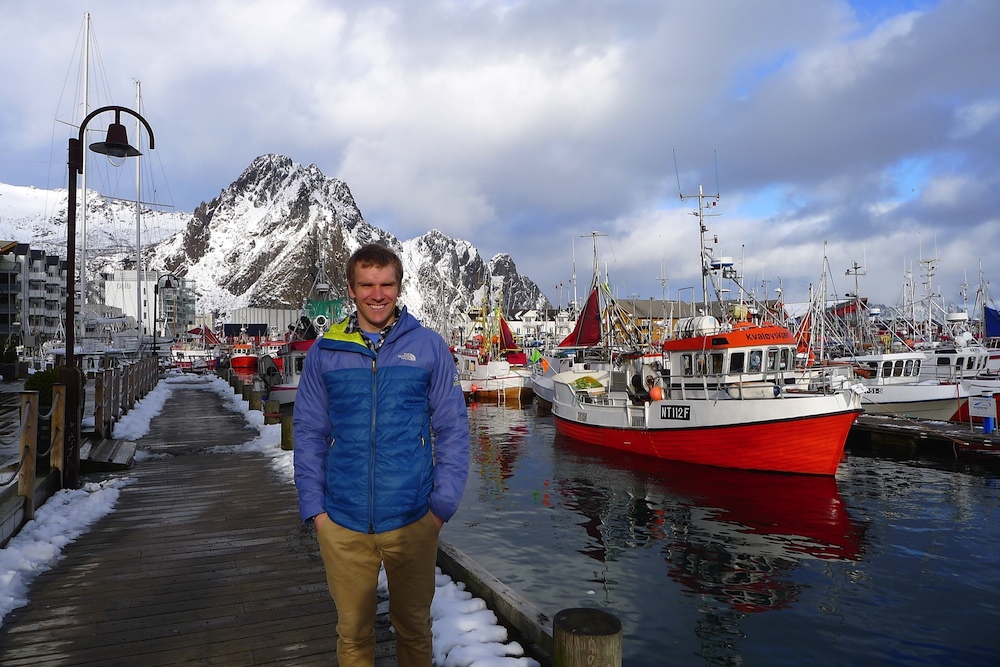
Devon Kershaw during a March trip to Lofoten, Norway, to visit Kristin Størmer Steira’s mother and brother. (Courtesy photo)
In March, after spending just over a week with Steira, her mother and brother in Lofoten, more specifically Svolvær, in northern Norway, Kershaw asked Steira for her mom’s phone number.
“She said, ‘Yeah. Why?,’ and I said to thank her, but I couldn’t get ahold of her mom at all,” he said. “I tried to make up an excuse. ‘I can’t get ahold of your mom. Can I have your dad’s number?’ She’s like, ‘Why do you want to talk to my dad?’ She’ll tell you now, the gig was up.”
“I thought, there’s not many reasons that he has to get in touch with my dad before [we go to Nepal],” she said.
Kershaw eventually reached him. Unsure of Norwegian tradition when it comes to asking permission to marry someone’s daughter, he erred on the safe side.
“I guess it was [a tradition] maybe a hundred years ago,” Steira said with a laugh. “My mom and dad really appreciated it, but they thought it was funny.”
A cold Kristin Størmer Steira at 5,800 metres up the 6,500-metre Mera Peak, “but not the coldest she’d be,” according to fiancé Devon Kershaw. (Photo: Devon Kershaw)
High up on Mera Peak, it lifted her spirits. Kershaw had sought out Finnish jewelry maker in Calgary, a woman who spent four years studying and working in Norway. She came up with an original design for Steira, and he took a guess on her ring size.
He didn’t take into account how much one’s fingers swell from two weeks of hiking at altitude. It fit her pinky finger.
“The ring is amazing,” she said. “But he should know that I don’t care at all about jewelry. He could’ve given me a wooden band and I’d be just as happy, but he really did a lot of work and thought about it. He was still nervous about the ring, which he shouldn’t be.”
Still not feeling great, the proposal gave her something to think about on the way down.
“It was an amazing turnaround of the day,” she said. “It was a beautiful day and the views were fantastic … I was tired [but] it helped me run down the hill.”
That night at camp, she started feeling worse. Unable to keep any food or drink in her system, she told Kershaw they needed to head back to Kathmandu.
“I wasn’t really scared, I was just getting more and more tired,” she said. “What’s the point when you cant enjoy it anymore? This is supposed to be a vacation, not something to push through — this is what we do all year.”
“The first week she was engaged probably wasn’t the best of her life,” Kershaw joked. “I almost felt bad, like, ‘Your body rejected me.’ ”
They shortened the trip by two days, checking off the high pass but skipping a valley hike. It still took them nearly a week to walk out, and Steira went three days without being able to digest any food.
Once in Kathmandu, Steira got the medication needed to kick the parasite and the two changed their plane tickets to leave sooner in late April. They celebrated with dinner, and 36 hours after arriving in Nepal’s capital, Kershaw was on his way home to Canmore and Steira off to Norway to take care of some team obligations.
“The first week she was engaged probably wasn’t the best of her life. I almost felt bad, like, ‘Your body rejected me.’ ” — Devon Kershaw, on fiancé Kristin Størmer Steira’s stomach ailment during their Himalayan trek
Less than a month later in early May, she flew to Canada to help Kershaw repaint his new house — their new home when she’s in Canmore. During her three-week stay, they took a weekend trip to Vancouver and shared the story of their engagement with friends and Kershaw’s family.
Last month, Kershaw visited her in Norway — one place he envisions himself spending more time once he retires.
“We have some ideas, but they change often,” he said of their long-term plan. “Maybe I’ll go to school in Norway; she already has a degree in marketing. We’ll see how long I keep skiing, but nothing’s stressing us out.”
They plan to get married next July or August in Norway, probably in Lofoten.
“No matter what or where we end up living full time, we’ll have a house in Canmore and we’ll have a house in Oslo or somewhere [else in] Norway,” Steira said. “That’s to be sorted out when we stop skiing or one of us stops skiing.”
Kershaw is interested in becoming a doctor, she explained, so they’ll have to see where he can go to medical school. If it’s in Canada, she’ll be there. Learning in Norwegian could be a hurdle for Kershaw, but the two are used to moving and having multiple places they call home.
Reflecting on the early stages of their relationship, Steira said Kershaw’s “great smile” hooked her.
“I guess that’s one of the things I fall for,” she said. “It turns out we have a lot of things in common, like climbing, fishing, music, training of course, reading books. … He’s a great communicator, and that’s really important for me in a relationship, that you can really talk with the person you’re with. If I’m quiet and down a bit, he doesn’t give up until he knows what’s wrong, and he makes me a better person by doing that.”
“She’s an amazing person and just getting to know her and her family it’s like wow,” Kershaw said. “It sounds so dorky, but sometimes you just know, I think. It feels so right.”
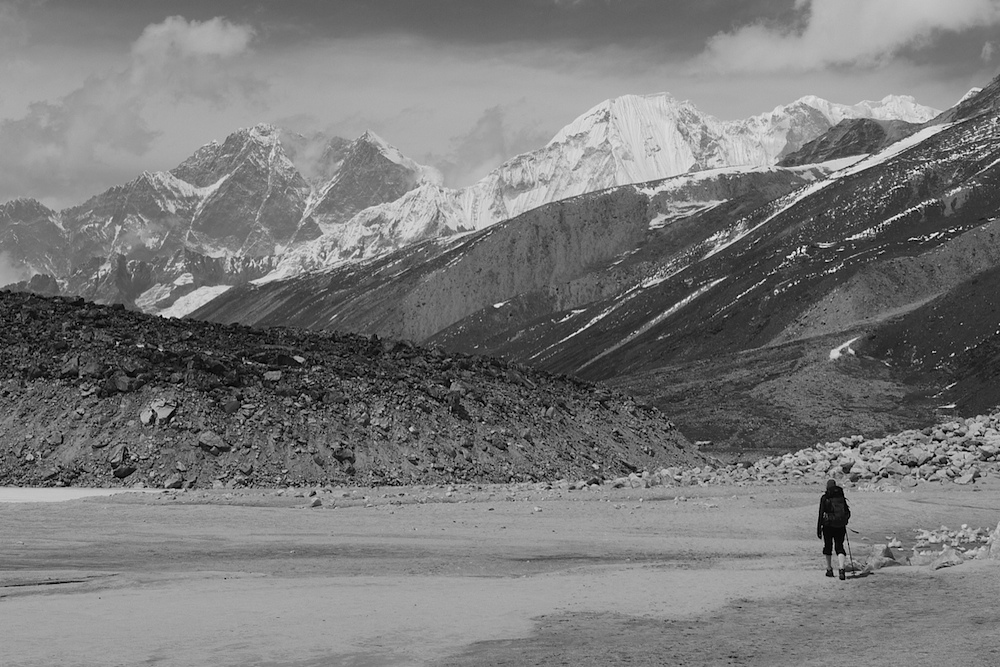
The approach of Mera Peak (Photo: Devon Kershaw)
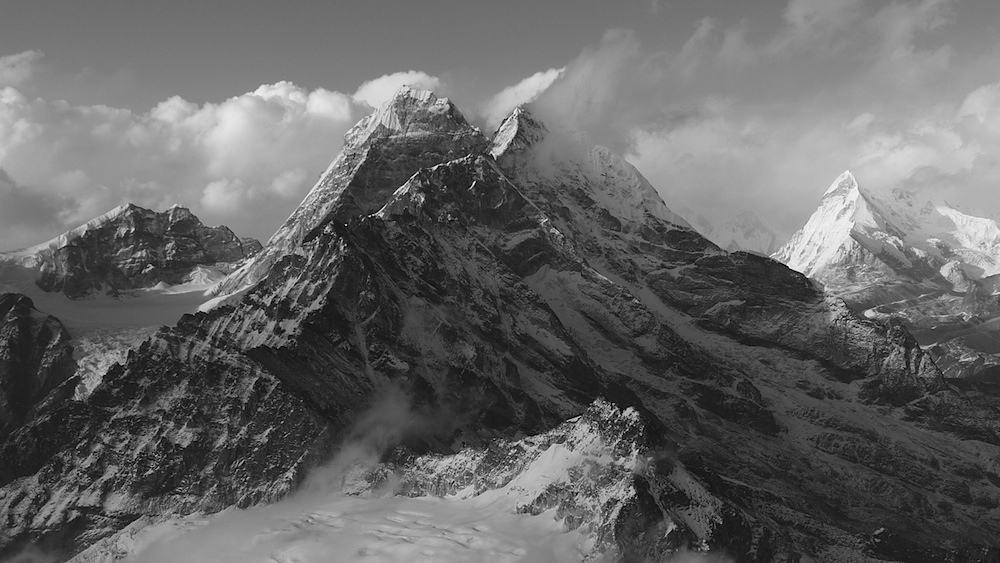
Mera Peak (Photo: Devon Kershaw)
Matoco, a climber from Argentina who accompanied Devon Kershaw and Kristin Størmer Steira on their Himalayan trek up Mera Peak. (Photo: Devon Kershaw)
Baruntse, the 7,162 m (23,497 ft) peak The North Face pro climbers planned to ascend after Mera Peak. “They actually bailed on their summit attempt because they all had ‘a bad feeling about it,’” Devon Kershaw explained. “It had snowed a quite a bit, and the Everest tragedy had happened only a few days prior and I think that coupled with a bad feeling in their stomachs made the call relatively easy.” (Photo: Devon Kershaw)
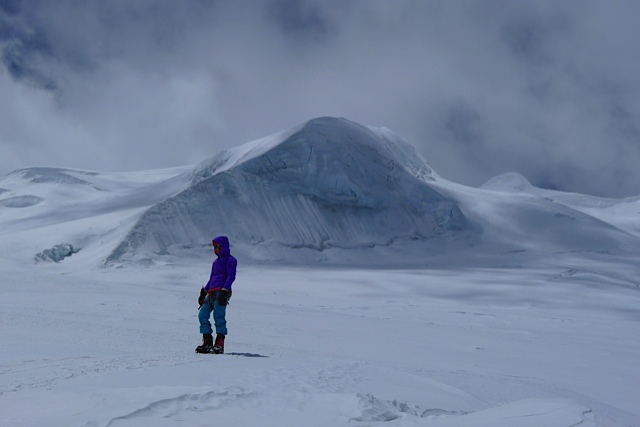
Heading up to high camp on the glacier of Mera Peak, Nepal. (Photo: Devon Kershaw)
At high camp, where Devon Kershaw and Kristin Størmer Steira camped out for three weeks, at 5,800 m on Mera Peak. (Photo: Devon Kershaw)
A cold Kristin Størmer Steira at 5,800 meters on Mera Peak, “but not the coldest she’d be,” according to fiancé Devon Kershaw. (Photo: Devon Kershaw)
The view from Mera Peak. (Photo: Devon Kershaw)
Kristin Størmer Steira heads towards Amphu L’ Pass in April. (Photo: Devon Kershaw)
Top of Amphu Labtsa Pass, with the south face of Lhotse behind (Photo: Devon Kershaw)
Kristin Størmer Steira rappels during her three-week trek with Devon Kershaw in the Himalayas in April. (Photo: Devon Kershaw)
Lofoten, Norway, in late March. (Photo: Devon Kershaw)
Devon Kershaw during a March trip to Lofoten, Norway, to visit Kristin Størmer-Steira’s mother and brother. (Photo: Devon Kershaw)
Kristin Størmer Steira (l) and Devon Kershaw during a day hike on one of their acclimatization days. The couple got engaged after summiting Mera Peak during a three-week trek in Nepal’s Himalayas. (Photo: Devon Kershaw)
Americans Kikkan Randall (c) and Sadie Bjornsen (r) ski with Norway’s Marthe Kristoffersen (l) and Germany’s Nicole Fessel (second from r) in the Holmenkollen 30 k classic mass start on Sunday in Oslo, Norway. (Photo: Fischer/Nordic Focus)
There’s something to be said for skiing like you’ve got nothing to lose. Ask Kikkan Randall, who locked up the World Cup sprint title for the third year in a row last Wednesday in Drammen, Norway. Or Sadie Bjornsen, who’s been plagued with bouts of illness for the better part of the last three months.
Both U.S. Ski Team members later said they felt relatively good before the start and during most of the world-famous Holmenkollen 30-kilometer classic mass start on Sunday in Oslo, Norway.
It was still a dang-tough course, with an initial 5 k lap followed by a larger 8.3 k lap containing two smaller loops (at least the skiers kept it straight). After getting off to a strong start, Bjornsen said she was a little frightened with the tempo of the women she was skiing with.
“At four k, I was like, ‘There’s no way I’m going to be able to maintain this pace, but I’ll hang on until I explode,’ ” she recalled.
Bjornsen did her best to hold her position just outside the top 10, first testing her grit with some Finns, including Krista Lahteenmaki and Anne Kyllönen. The American quickly found their classic style didn’t match hers and she opted to ski with several Norwegians, including Tuva Toftdahl Staver, Ingvild Flugstad Østberg, Kristin Størmer-Steira, and Martha Kristoffersen for the first several kilometers.
Bjornsen said the Norwegians’ “really big strides,” matching hers, made the difference. “I was appreciative of that,” she said.
Kyllönen’s stride was simply too big, she said, and “Lahteenmaki, I felt like I was in a sprinting running race; she has a very short tempo. I followed her for a couple k and my legs were flooded.”
By 10 k, Norway’s Martine Ek Hagen was right there with Bjornsen as well, and Randall was just off the back of their seven-person chase pack, which at the time, was about a minute and 30 seconds behind eventual winner Marit Bjørgen.
With Norwegian fans lining the entire course, Bjornsen said the atmosphere brought her back to her international debut at the 2011 World Championships in Oslo.
American Kikkan Randall (15) racing to 12th, a career best in the 30 k, at the Holmenkollen 30 k classic mass start on Sunday in Oslo, Norway. (Photo: Fischer/Nordic Focus)
“It was World Championships loud,” Bjornsen said. “I kept hearing my name in the mix, but more than anything, I could hear them yelling, ‘Kikkan.’ She’s a national hero here. She’s huge.”
The crowd and endless cheers fueled Bjornsen to staying within the top 15 throughout the race, with Randall close behind for most of it. Ultimately, Randall shot to the front of the pack and continued to pick off places with 1.5 k to go, finishing 12th for her career-best 30 k, just 10 seconds ahead of Bjornsen in 14th, also her best distance race.
Two years ago — the first time Bjornsen raced in Holmenkollen — she placed 40th in the 30 k classic. She did not race there last year.
“I couldn’t have picked a better way to ski it with four Norwegians,” Bjornsen said after going head-to-head with Heidi Weng, Østberg, Hagen and Kristoffersen to the line. She beat all but Weng, who took 13th by 0.4 seconds, and edged Østberg by one-tenth of a second for 14th, 4:27.8 back from Bjørgen. The top Norwegian became the first woman to win four Holmenkollen titles in what doubled as her 100th World Cup podium.
Randall finished 4:17.7 after Bjørgen, without anyone within several seconds of her. She recalled being 100 meters behind the pack for most of the middle part of the race, with skis that were “a little slick” on the first lap sending her in for a fresh pair at 13.3 k.
Bjornsen changed there as well, where she said everyone was switching. Skiing on her “B-pair” until that point, she said her skis were great — gripping on the uphills and fast enough on the downhills. But she wasn’t about to second guess what everyone else was doing, and changed to her A-pair. That was the first time a ski change worked out in her favor, she said.
The group she was with never switched again (out of a possible three times), and while most struggled with kick on the icy last lap, Bjornsen said it was the same for everybody.
The turning point for Bjornsen and Randall’s group came with 5 k to go. Bjornsen and Staver fell off the pace slightly around 20 k, but worked their way back up by the top of the long climb known as Frognerseteren. By then, Bjornsen and Randall racing with five Norwegians and Japan’s Masako Ishida.
“We came down the hill and suddenly [the Norwegians] started sprinting so hard,” Bjornsen said. “Suddenly, they’re in sprint pace and I was like, ‘Wow, are they going to do this to the finish? This is gonna be really hard.’ ”
About a kilometer later with 4 k remaining, the pace slowed. Randall then took off before the 28.5 k checkpoint.
“Now I’m kicking myself for not trying to go with her,” Bjornsen said. “But she was so impressive.”
After changing her skis, Randall said her arms started cramping on the second lap, but she double poled with her legs and core as much as possible, and was able to latch back on by the top of the course on lap three.
“It’s kind of a nice feeling when you get to the top of the course on that third lap — now you know some of the big hills are done and … see whats left in the tank,” she said.
With two climbs remaining, Randall knew she had the speed and energy to knock off a few places in the standings. She jumped in her own track and skied her own tempo, then simply “ran out of room toward the finish,” she said. “It’s aways fun having people to catch.”
The result was something she could be pleased with, especially in a distance classic race that isn’t typically her bread and butter. Going into the 30 k, Randall said she didn’t have to worry about her mind wandering off to the upcoming sprint at World Cup Finals on Friday. Had the pressure been on to win that sprint, she might have approached Holmenkollen differently, especially as the race got tougher.
“It was kind of nice to be able to wrap up the Sprint Cup and go, ‘Now I just get to race,’ and not worry about whether it’s a smart decision or not,” she said.
While Randall was aiming for a top 15, Bjornsen said she wasn’t sure what to expect for a result. She had come down with one of her worst colds yet after the Sochi Olympics, and went for her first 30-minute walk/ski last Tuesday. She raced Wednesday in Drammen (qualifying in 21st then placing 30th), then focused on getting healthier each day until the 30 k.
“I would say now I’m 100 percent,” Bjornsen said.
Reflecting on her second Holmenkollen experience, she said this one will definitely be among her most memorable races.
“Holmenkollen has such an incredible atmosphere,” she said. “I was trying to take in the noise level at the top of Frognerseteren, so that helped and also skiing with a bunch of Norwegians.”
Sophie Caldwell (U.S. Ski Team) racing to 35th in her first Holmenkollen 30 k mass start in Oslo, Norway. (Photo: Fischer/Nordic Focus)
Three other U.S. women made the top 40, and Ida Sargent was close behind in 42nd.
Liz Stephen placed 32nd (+8:30.2) after two crashes. Sophie Caldwell finished 35th (+8:48.1) in her first Holmenkollen 30 k, and Caitlin Gregg (Team Gregg/Madshus) was 39th (+10:15.3).
“Tough day for me with a couple of crashes early on, but nothing serious like Astrid [Jacobsen] experienced,” Stephen wrote in a message, referring to the Norwegian’s scary crash off a ledge that sent her to the hospital. She suffered a blow to her head, shoulder and hip, but was not seriously injured, according to NRK.
“The atmosphere here at Holmenkollen is definitely something special, with fans chanting your name, and campfire smoke billowing in the air and sausage smells and fresh waffle smells wafting throughout the race,” Stephen wrote. “Someday I am going to have to come camp out and be one of the fans out there, for sure.”
Caldwell explained that it was a long enough race that she had “multiple highs and lows throughout it, but overall I think it went well,” she wrote in an email.
She switched her skis once at 13.3 k because everyone else was doing it, not necessarily because she needed to.
“I got to ski with Liz a bunch which was fun and then otherwise kind of hopped between a couple groups,” Caldwell wrote. “The race atmosphere was insane. There are people lining the entire course who have been camping out all weekend and they all know your name. They have start lists, so as long as you aren’t skiing with any Norwegians, they start chanting your name as you go by. I think the extra cheers definitely helped motor me around the course.”
According to Gregg, who was especially confident in her skis and stuck with the same pair throughout the race: “no matter how you are feeling, the spirit of the crowds lift you up.” While the classic race wasn’t her specialty, she enjoyed the length.
“My result was solid but certainly not outstanding,” Gregg wrote. “Some of girls had awesome races today so that was really cool! I found the pace right off the gun to be ridiculously fast and it kind of caught me off guard. I was in last place from the end of the stadium. This is something I obviously need to work on. Throughout the race I continued to move up steadily as other racers got tired.”
Gregg with travel with the U.S. team to race at the three-day World Cup Finals in Falun.
“This will be my first time racing there and I am very excited about the format!” she wrote.
Bjornsen said making it to World Cup Finals has been her major goal since last season.
“It’s going to be fun because it’s a lot of different races,” she said.
Marit Bjørgen celebrates a 2.6-second victory over Norwegian teammate Therese Johaug in Saturday’s 30 k freestyle mass start, the last women’s race of the Sochi Olympics.
FasterSkier’s coverage is made possible through the generous support of Swix.
KRASNAYA POLYANA, Russia — Wouldn’t it have been fun to be a fly on the wall, or on the headband of one of the three Norwegian women leading the Olympic 30-kilometer freestyle mass start on Saturday?
The dialogue between Marit Bjørgen, Therese Johaug and Kristin Størmer Steira throughout the three-lap race must’ve been interesting. Who called the shots? Who decided when to lead when? Who directed the charge?
Then again, it sounded like it was fairly straightforward and a matter of executing a plan that didn’t really need verbal cues. With the three skiing alone for the last 20 k of the race, it was basically like a long training session. If anything, the chatter was probably conversational.
After Johaug led early out of the start, the Norwegians’ defining break came at the end of the first 10 k loop. They had already put some time into the women behind them up the unrelenting 2.5 k climb back to the stadium. There, they stuck with their team plan and skipped the first of two possible ski changes. Sweden’s Charlotte Kalla in fourth followed Johaug, Steira and Bjørgen, respectively, just under 5 seconds back.
A full lap later, Kalla was down to 31st, two and a half minutes back behind Bjørgen. No one else was close to the Norwegian trio; Eva Vrabcova-Nyvltova of the Czech Republic led the chase 50 seconds back.
Norway’s Marit Bjørgen leads teammates Kristin Størmer Steira (10) and Therese Johaug (behind) up one of the steep climbs in the 30 k freestyle mass start on Saturday, the final women’s race of the 2014 Sochi Olympics, while Norwegian women’s sprint coach Roar Hjelmeset runs along side them. Bjørgen won by 2.6 seconds over Johaug in second, and 23.6 seconds ahead of Steira in third.
“We have a plan to go as a team the first 20 [kilometers] and after that they have to go for each other,” Norwegian women’s coach Egil Kristiansen said afterward.
According to Johaug and Steira, they had also been instructed to change skis before the final 10 k. They made the executive decision not to, fearing what some 30 seconds in the transition area would cost them.
“Me and Therese decided not to change skis; I think Marit was a bit more insecure,” Steira said in a press conference. “She was in the stadium looking around and she was thinking, if I do the ski change then the other two won’t. We talked about it and got some messages from coaches around 15, 17 k and they told us to change the skis and we were like, ‘No, no we’re not doing it!’ ”
Bjørgen, the well-established queen of cross-country skiing, went with the consensus. Unlike teams like the U.S., which switched to fresh skis at both 10 and 20 k, the Norwegians wore the same pair from start to finish.
The plan worked as they finished nearly a minute ahead of anyone else, with Finland’s Kerttu Niskanen closing hard at the front of the 11-person chase pack and edging Vrabcova-Nyvletova by 0.2 seconds for fourth.
Aside from who would win the race for fourth, the top story of the day materialized in the last few hundred meters of the final climb. Johaug led up the long hill from the lowest point of the course a few kilometers before the finish. Bjørgen sat in second and Steira started to waver in third, allowing some daylight between her and the other two for the first time in the entire race.
Up to that point, the three had generally skied single file on the tails of one another, taking feeds simultaneously and even chatting when the terrain allowed.
Now, Johaug was starting to push. The sense was that Bjørgen would make a move; where was the question.
The 33-year-old Bjørgen, who had already notched two Olympic golds in Sochi, charged over the top of the steep hill before the finish, passing Johaug and immediately gapping her on the downhill.
Johaug, 25, chased her down into the finishing lanes, which ended with a horseshoe-shaped loop and false flat that was actually slightly uphill. Bjørgen took the victory by 2.6 seconds over Johaug with a winning time of 1:11.05.2. Steira finished 23.6 seconds after Bjørgen for bronze, her first individual Olympic medal.
“I’ve tried so many times and I finally succeeded,” Steira, 32, told reporters. “It’s amazing. … It’s been a lot of hard work, but also a lot of fun. [I was] smiling all the way, but when I crossed the finish line, I felt emotional.”
It was Norway’s first Winter Olympics medal sweep since 1994, and 12th overall in the history of the Games.
For Bjørgen, the gold was her sixth, adding to her total Olympic haul of 10 medals, which made her the most successful woman in Winter Olympics history. She equaled the total gold medals won by former Russian speed skater Lidia Skoblikova and former cross-country skier Lyubov Ivanovna Yegorova, also from Russia, and tied former nordic skiers Stefania Belmondo of Italy and Russia’s Raisa Smetanina for 10 Olympic medals.
But her ratio of six golds, three silvers and one bronze beats them all.
“I am not thinking about how many medals I have,” Bjørgen said in a press conference. “This year, for sure this 30 k has been motivation for me. I am really happy … with my teammates also … it’s very good for our teammates. I think when I’m finished skiing I can think about how many medals I have.”
While she plans to compete through the 2015 World Championships in Falun, Sweden, Bjørgen said this Olympics will likely be her last.
“I think in four years is a long time, and I’m not getting younger,” she said. “I’m also thinking to have a family. I was also thinking to compete in Falun and we’ll see after that. … It’s hard to sit here and say what I will do in four years.”
Marit Bjørgen leads Norwegian teammates Therese Johaug and Kristin Størmer Steira into the stadium during the 30 k freestyle mass start, the last women’s race of the Sochi Olympics.
Johaug notched her best individual finish at the Olympics and second medal at these Games (after bronze in the 10 k classic). Four years ago, she and the Norwegian women’s team won gold in the 4 x 5 k relay. This year they placed fifth behind Sweden, Finland, Germany, and France, respectively.
“We knew we were stronger than that,” Johaug told reporters.
As for her own race, Johaug knew an attack was coming from Bjørgen, who’s typically stronger than her on the flats. While Johaug’s strength is climbing, she said her legs seized a bit on the last hill.
“I know that Marit is really strong in the last hill and she had a lot of power,” Johaug said. “I tried to do my best, but she was better than me today. … I’m really happy with my second place, but what I’m most happy for is we are three girls in the top three. It’s a big day for my team and for Norway.”
It was also the final women’s cross-country race of the Olympics, and it left Bjørgen with as many golds as she accumulated in Vancouver. At those 2010 Games, she was second in the 30 k classic and won gold in the classic sprint, 15 k skiathlon, and relay. This year, she defended her skiathlon title, then went on to win the team sprint with Ingvild Flugstad Østberg, and finally the 30 k.
“It’s incredible,” she said. “This has been a goal for me for a long time.”
Despite skiing in eighth through 12.5 k, Poland’s Justyna Kowalczyk pulled out of the race after someone apparently accidentally kicked her broken foot.
“Immediately after starting I got a minor collision with another skier,” the 10 k classic Olympic champion, Kowalczyk told Poland’s TVP, according to a translation. She had received injections in her foot before her races in Sochi to numb the pain. But on Saturday, someone’s ski hit her in a part of it that wasn’t numb.
“Eventually I got so much pain that I could not continue,” she said.
While Kowalczyk has declined to elaborate on when she plans to retire, she’s said this is her last Olympics.
“I am very upset,” she told TVP. “It was not how I wanted my Olympic career to end.”
Germany’s Nicole Fessel and Bulgaria’s Teodora Malcheva also did not finish.
As for Kalla, who ended up 34th, her Swedish teammate said the result was not unexpected after she had been “lying in bed” sick for the last few days, according to EuroSport. Aftonbladet reported that she had a cold.
Finnish head coach Magnar Dalen said his team was “very happy” with fourth.
“Norway had a very strong team with four skiers, and one of them had a bad day and three had a good day, so then the medals was gone,” he said, referring to Norway’s fourth woman Heidi Weng in 19th. “Then we was winning the league number 2, so we’re happy about that.”
“That is not an abnormal … high altitude, hard track, skating race,” he said of the Norwegian sweep. “It was just sad that Charlotte Kalla had been sick and was not able to fight with them.”
“It’s nice to see them skiing, helping each other, working as a team and building up the distance to the others,” Swiss head coach Guri Hetland said. “It’s impressive, and it’s impressive what Marit does. I think it’s her 18th gold medal in championships or Olympics. So that’s amazing. For them, it’s normal. They are training together, they are pushing it, and that’s also the reason why they are so strong.”
Østberg said her teammates have been “really focused since the relay, trying not to think about the skis.” Ultimately the Norwegian team went out on a high note, along with its waxing staff.
“At some point [we knew] they would figure out what to do with the skis,” Østberg said.
— Nat Herz and Chelsea Little contributed reporting
Holly Brooks (USA, foreground) laps through as Justyna Kowalczyk (POL) starts the 15 k freestyle in Davos today. Brooks decided against catching a ride with the Pole, reasoning that skiing too fast at altitude would have disastrous consequences.
DAVOS, Switzerland – The last race the U.S. women’s ski team competed in was a relay in Lillehammer, Norway, and it’s safe to say that it was a high for the season. For the first time in years, they entered two teams. Both did well, and the first team tied their best-ever result of third place.
You might think that would lead to especially high expectations for the next weekend of World Cup racing here in Davos. But, said Kikkan Randall, going into today’s 15 k freestyle individual start, everyone had their own separate, and reasonable, goals.
“This group is becoming more of a veteran group, and I think that we know that every weekend has different highs and lows,” she said after placing 18th to lead the squad. “Everybody’s spirits have been good this week and I think everybody had a good approach going into today. It sounded like maybe people were having some good races out there, and it’s still so early in the season that as long as it was a solid day today, everyone should be happy.”
If that’s the metric, then everyone definitely should be happy. Just three seconds slower than Randall, Liz Stephen placed 20th. Holly Brooks was 25th and Jessie Diggins 30th, and Continental Cup racer Rosie Brennan placed 51st.
While nobody had a career-best result, getting every U.S. Ski Team member who started to score points is nothing to laugh at.
Liz Stephen.
“I think my standards have just changed,” Stephen said. “It has been interesting watching the team’s standards change as well. Now, when we’re not in the top 30 it’s kind of a bad day. A couple years ago it wouldn’t have been like that. We have to remember that our standards are new, and my personal standards are new after last season.”
In fact, for Randall and Stephen, the top-20 results were particularly gratifying. Both have raced this course many times in the past. Have they had much, much better finishes in other distance skate races? Yes. But never here in Davos.
“Honestly, I’ve never had a great race here in Davos, so I wasn’t banking on anything,” Stephen laughed. “It’s a weird course here. I’ve had really bad races here, and decent races. And when I’m out there I never know if I’m having a good one or a bad one. It’s such a weird grade and it’s always really flat light, and it’s not a course you feel super good on.”
Randall agreed.
“I’ve tried to race this place so many different ways,” she said. “I’ve tried starting slow, I’ve tried starting fast, it’s just one of those courses where you never feel that good, you never feel that fast. But I think if you can find the right rhythm, there’s a really small window that’s the perfect pace in there. And if you can find that, it can be good. I’m just happy to have skied my way around and get a great workout in.”
Diggins was the lone team member who seemed disappointed in her race (FasterSkier missed talking to Brennan).
“It didn’t feel very good for me,” she said. “I was cramping up on the uphills. The downhills felt good, but I think I’m just not used to racing at altitude yet. I felt pretty bad actually. But the skis were good and I tried really hard, and I worked on some things.”
Rosie Brennan starting out.
But for the rest of the squad, just having an okay result felt like a victory. For Stephen and Randall, it was redemption after many attempts here in Davos. For Brooks, it was a relief after not starting off the season nearly as well as she did last year.
“It was okay, especially considering how my season has been so far,” she said. “It’s a pretty good step up.”
After finishing fifth in the very first race of the 2012-2013 season, Brooks hasn’t had the same kind of luck. But it seemed likely that today might turn things around: “This is by far my favorite course and my favorite kind of race, so that suits me well,” she said. Brooks was ranked as high as the top 20 about halfway through the race, but couldn’t quite hang on to match Randall and Stephen.
She was close though, just 14 seconds behind Stephen, and knows that she was almost even closer.
“I wish I could have caught a little more of a ride,” she lamented. “[Third-place finisher Charlotte] Kalla caught me at the top of the course, and I just lost contact with her just a tiny bit. I could have moved up a bunch of places if I could have stayed with her and drafted off her on the downhill, but I was just a little bit too far away to do that. She’s flying.”
Brooks had some other chances too. But at 5,000 feet of elevation, she knew better than to take the risk of following someone who was going too fast.
“I lapped through when Kowalczyk was starting, and people were shouting for me to catch a ride, but that’s just a recipe for disaster,” she said. “You know if you go one percent too hard at altitude, you’re in trouble. I felt in control most of the time, which was nice. But it’s not like I broke any records or took any personal bests.”
Randall had better luck, as fourth-place finisher Kristin Størmer Steira of Norway caught her from one minute back about halfway through the race. Randall was able to go with her.
“From the beginning of that second lap it was really good to ski with her, and we kind of went back and forth on the downhill and worked together,” said Randall. “It made for a solid race.”
Stephen complimented Steira’s technique, which she said perfectly suite this “weird” course. Randall agreed.
“She just has a really nice tempo on her V2 for some of those gradual sections, and that’s where I was definitely starting to let my tempo bog down,” she said. “So to be able to follow her tempo there and find a new rhythm, it was perfect. Like, oh, I can do this!”
For most of the team, today was just a reminder to stay patient, and take the good things out of every race effort.
“Yeah, it’s so far been a sort of mediocre start for me,” Stephen said. “Of course the relay was awesome, but I personally didn’t ski great that day. So, well, the season is long… I’m not having a bad season, but there hasn’t been a stellar result yet.”
Today wasn’t that stellar result. But it was something.
“I’m happy with it,” she concluded. “I fought pretty hard out there, I was mentally in it the whole time, and worked the downhills the best I could, so I’m happy.”
Marit Bjørgen of Norway heading out onto course in Davos today.
DAVOS, Switzerland – About 40 meters into today’s 15 k freestyle interval start competition, Marit Bjørgen of Norway almost had a problem.
The course, which started out heading into the center of the stadium before immediately pulling a 180-degree turn, had been causing a fair bit of consternation to the field. Up until Bjørgen, who was the last starter by virtue of her yellow overall World Cup leader’s bib, women had been taking it with varying strategies: go wide. Cut close. Start off fast then cut speed coming into the corner. Or don’t even bother to start quickly – just accelerate once rounding the turn.
Bjørgen, though, was one of the few who bobbled. But it didn’t cost her anything, and she went on to win the race by 13 seconds. It was the 61st World Cup victory of her career.
“It’s nice and I like the track,” she said of the course where she has won three World Cup competitions before. “I have always done well here in Davos.”
But 39 1/2 minutes into the women’s 15 k freestyle interval start competition, it was teammate Therese Johaug was the one to put the crowd on notice.
Therese Johaug rounding the last bend before the finish.
The race had been proceeding as individual start competitions usually do. Barbara Jezersek of Slovenia posted a fast early time at the four-kilometer checkpoint, and then, one by one, seconds were chopped off of it. A second here, two there, as later starters started filing through.
But when Johaug, in bib 56, hit that checkpoint, she wasn’t shaving off seconds. It was more like using a battering ram. Norwegian teammate Kristin Størmer Steira had been in the lead, but Johaug carved more than 30 seconds out of her time.
The race had changed.
A few bibs later, two women proved that while they couldn’t catch Johaug, they could certainly try – and had a better shot than anyone else. Charlotte Kalla of Sweden, the World Cup distance leader coming into today’s race, and Bjørgen both came within 10 seconds of the diminutive Johaug.
And then they came closer. And closer. Finally, with less than 5 kilometers to the finish, Bjørgen seemed to hit her stride and finally surpassed Johaug’s time. From there, the race was over – Johaug was the winner no more. By the time Bjørgen crossed the finish line, she had put 13 seconds into her teammate.
“Today I was doing my own race – I was 8 or 10 seconds behind Therese after some, and then I was two seconds in front and I thought, this is possible, because there’s only downhill left and that’s my best,” Bjørgen said. “So it was great, and I’m happy to be here and happy to have a good race.”
Despite the fact that victory seemed to be within her grasp, Johaug was gracious when she gave the leader’s chair up to her teammate.
“Marit was great today and faster than me,” she said. “I tried everything possible but after the 12 km I felt empty and my legs were heavy. I am satisfied with the second place.”
It was revenge for the Norwegian women, who were bested by Justyna Kowalczyk of Poland and by Kalla last weekend in the 10 k classic in Lillehammer, Norway. Today, Kalla skied strong on for third, and actually caught Kowalczyk, who had started a minute ahead of her. Kowalczyk is not a strong skater, but that’s still a feat.
Charlotte Kalla coming out of the start.
“I tried to keep high speed from the beginning,” Kalla said. “In the second lap it was quite hard because of the altitude, but I am very satisfied with the first part of the World Cup. I have had a great feeling and I hope I can take it with me towards the Olympics.”
Steira hung on for fourth, and Astrid Uhrenholdt Jacobsen and Heidi Weng placed eighth and ninth, giving the Norwegian women half the top ten. That’s part of their strength, according to Johaug.
“I am happy with the work we did during the off-season,” she said. “All the hard workouts with Marit paid off. We were pushing each other to be better.”
At 1,500 meters above sea level (5,000 feet) and with plenty of climbs, pacing was not easy for anyone in the field.
“At this height it doesn’t take much to make things really difficult,” Kalla told the Swedish daily Expressen. “I really struggled mentally and technically to hold it together.”
The winner agreed – and that’s why she didn’t worry when she wasn’t in the lead right away.
“You have to go on your limit,” Bjørgen said. “If you go over your limit your legs will not be good.”
Now, Bjørgen is looking forward to tomorrow’s sprint, an event she last won in 2011.
“I hope I have a good feeling tomorrow and I am recovered after today,” she said. “I think it will be a nice race.”
The reigning world champions in the 4 x 5 k relay winners (from left to right), Marit Bjørgen, Kristin Størmer Steira, Therese Johaug and Heidi Weng celebrate their second-straight title at 2013 World Championships in Val di Fiemme, Italy.
At least the race for second was interesting. The women’s 4 x 5-kilometer relay at the Lillehammer World Cup in Norway on Sunday was, in some ways, a tale as old as time.
The Norwegian’s top team (out of four Norwegian squads in the women’s race) might as well have lulled spectators to sleep with their predictable execution and essentially flawless victory. But the reality is they’re fun to watch.
And ultimately, teams like the U.S. think they’re beatable – at least that’s what they’ve been told.
“We got a really funny email from a 44-year-old guy in Norway that told us that Norway is definitely beatable, we just have to get close to Marit [Bjørgen] and get her stressed out on the last leg,” US Ski Team member Kikkan Randall said in a post-race phone interview with her relay team. “We’re close. I think our best form is still coming. You’ve got some people that are starting this year off super hot, some people that are building into it, so when it comes to Sochi we just gotta stay close, and I think if we put them under pressure, anything can happen.”
The U.S. women after placing third in a World Cup relay, the first relay podium in the history of the program – Kikkan Randall, Holly Brooks, Jessie Diggins, and Liz Stephen. (Photo: NordicFocus/Felgenhauer/Fischer)
On Sunday, the U.S. women were close, tying their best-ever result of third in a World Cup relay, which they first achieved just over a year ago in Gällivare, Sweden.
The U.S. women’s first team of Randall, Sadie Bjornsen, Liz Stephen and Jessie Diggins was 23.4 seconds shy of another historic first in second place, which went to Finland’s Aino-Kaisa Saarinen, Anne Kyllönen, Kerttu Niskanen, and Krista Lähteenmäki.
However, the Finns finished a minute and 13.1 seconds behind the Norwegians, who skied themselves out of the ballpark (starting on the second leg) for yet another relay win in 58:38.9.
“This was a good performance from the team, but annoying is when I was not able to [match] Johaug,” Finland’s Kyllönen told the Ilta-Sanomat.
If it makes her feel any better, nobody could on Sunday.
Heidi Weng opened with a solid classic leg to put Norway I in first, Therese Johaug vented some frustrations after her fourth-place finish on Saturday, and Kristin Størmer Steira held steady in the third leg to set Bjørgen up for two final cruiser laps.
Bjørgen told NRK that the lead was so good, she simply needed to stay on her feet. After Steira tagged her in first with a 35-second lead, Bjørgen was one of the few skiers who appeared smooth from start to finish on a snowy and technically wrenching day. Johaug was the other, accelerating out of the stadium with a two-second lead, which quickly grew to 15 seconds just 800 meters into the second classic leg.
But their race started with Weng, the youngest on the team at 22, who made a move just over halfway through the first classic leg.
The U.S. scramble skier, Randall was one of the first out of the gate and led for most of the two-lap 5 k, until Weng attacked exactly where Randall expected her to on the second lap.
As Weng surged up the steep section of the long climb, Randall latched on.
“I just did everything I could to stay on her heels” Randall said. “I was able to all the way up [and over the hill], then just kind of followed her, figuring it would be good to tag off to Sadie [Bjornsen] in the pack knowing we were in touch at the front.”
Weng handed off to Johaug in first, tied with Norway II’s Ingvild Flugstad Østberg. Randall was 2.1 seconds back in third, just ahead of Russia’s Julia Ivanova and Finland’s Saarinen in fourth and fifth, respectively.
The scramble leg of the second U.S. team (the first time the Americans have been able to start two women’s relays in recent memory), Sophie Caldwell came through in sixth, just 5.5 seconds after Weng.
With a two-second lead, Johaug didn’t waste anytime breaking away. Meanwhile, Bjornsen and Kyllönen took turns leading the chase, and realistically, battling for second. Strung out by the attack, the rest of the pack fell behind.
“Johaug took off like a crazy lady from the start,” Bjornsen recalled. “It was challenging out there today with all that snow, and you start falling apart at one point and then you just have to collect your mind and know that it’s relay day and just have to keep going. So it was really awesome to have that Finnish girl just to chase down. That’s why I was so stoked to where Kikkan put me … thank God she didn’t stick us way in the front.”
The two followed Johaug into the tag zone, with Kyllönen 38.5 seconds behind in second, Bjornsen 39.2 seconds back in third, and Russia’s Alija Iksanova another 20 seconds back in fourth. Johaug had put down the kind of race Norway needed, setting Steira up perfectly to put Bjørgen in a position to win.
“I was much more active today,” Johaug told NRK, according to a translation. “It was a slightly different body … I was probably a bit annoyed after the race yesterday … and I managed to get the flick that I was missing.”
With nearly 40 seconds separating Stephen from Steira at the start of the third leg, Stephen immediately sprang to try to chase her down.
Two kilometers in, Stephen had made up about five seconds on Norway. Niskanen followed closely in an effort to do the same, and ended up passing Stephen on a climb with about 1 ½ k remaining.
“If I had known how my body was going to feel today, I would have stuck behind Finland for a bit longer than I did,” Stephen said. “But you certainly always hope for the best, and I felt fairly good in warm up and just off the bat, I felt really psyched. Probably a lot of that was adrenaline. Maybe if I had it to do over and I knew exactly how it was going to go, but I was not as concerned with Norway as I was with Charlotte Kalla catching me.”
Down by nearly 45 seconds heading into the third leg, Sweden rose from sixth to fourth with Kalla, just three seconds behind the Americans, by the final exchange.
Trying to hang onto Niskanen while holding off Kalla, Stephen caught her ski tip in some powder on the edge of the course and nearly fell just meters before the exchange. She caught herself, and tagged Diggins in third, about 14 seconds behind Finland and 49 seconds back from Bjørgen.
The U.S. women surround Jessie Diggins after she anchored them to third in the Lillehammer World Cup 4 x 5 k relay, tying their best-ever relay result on Sunday.
Careful not to blow up on the first hill out of the stadium, Diggins, the tried-and-tested U.S. anchor, reeled in Lähteenmäki by the 2 k mark. The two skied together to drop Sweden’s Britta Johansson Norgren and Maiken Caspersen Falla of Norway II, in fourth and fifth, respectively.
“I knew we were in for a medal; it would either be silver or bronze,” Diggins recalled.
She took the lead up the long climb of their second lap and over the top, Diggins dropped Lähteenmäki, and said she could feel her energy rising.
“I was ready for a sprint, like, ‘OK, bring it, we can do this. We have this silver medal,’ ” Diggins said. “But then I caught my tip in the powder in the same spot that Liz [did], where suddenly you’re in the track and then [it] suddenly goes away and you’re in some powder.”
Not expecting that, Diggins fell and broke a pole, forcing her to ski over the last bridge without one. On the descent, Norwegian coach Vidar Lofshus ran over to her with a replacement.
“They didn’t have to do that; that’s not part of their job,” Diggins said of the gesture. “I was able to hold off the chasing Norway and Sweden and we were able to get a bronze, which was awesome. It’s still tying our best result ever and it’s cool because I know that, hey, it was a little bit of bad luck with the hard fall and all that, but we’re in good shape. We know how to put together a good day … we are right the hunt and that’s right where we want to be.”
Trailing the U.S. in third by 10.8 seconds, Norway II placed fourth (+1:47.3), Russia I was fifth (+1:53.9), and Sweden placed sixth (+2:05.1) of 19 teams.
USA II, with Ida Sargent, Holly Brooks and Rosie Brennan, went on to place 12th (+3:20.5).
Liz Stephen (USST) hits the weight room hours after racing to third with the U.S. women’s team in Sunday’s World Cup 4 x 5 k relay in Lillehammer, Norway. (Photo: Billy Demong/Twitter)
Devon Kershaw after an interval workout in Klosters, Switzerland, before his training camp with the Norwegian national team in Val Senales, Italy. (Photo: Kristin Størmer Steira/www.kristinsteira.no)
With his ninth consecutive World Cup season in the bag, Devon Kershaw, 30, could finally put his feet up this spring and think about 2012/2013 – not that he necessarily wanted to.
It wasn’t easy reliving that fateful stumble down a flight of stairs in Bruksvallarna, Sweden, in which the Canadian national-team skier tore a ligament in his foot a weekend before the season started. Unable to run for several months, he taped the afflicted area around his ankle and pushed through every ski race – refusing to publically acknowledge it or use it as an excuse.
Kershaw pushing through the pain in his left for during the World Cup sprint qualifier last December in Canmore, Alberta. He was 50th and failed to advance.
Things perked up about midseason (he placed eighth in two World Cup sprints in February and narrowly missed the World Championships team-sprint podium with teammate Alex Harvey in March), but ultimately, Kershaw finished farther back than he had hoped: 27th in the overall World Cup, compared to second in the world the year before. He ranked 42nd in distance events, his worst showing since 2007, but was better in sprints: 22nd, down from seventh in 2011/2012.
All too aware of his results, Kershaw needed answers and had a good idea where to find them.
“I’m a pretty big journaler,” he said on the phone from Davos, Switzerland, where he was getting acclimated earlier this month before a high-altitude camp in Val Senales, Italy. “But I haven’t taken much time going back to read what I write.”
Thumbing through his entries, Kershaw took a particularly close look at his thoughts on World Championships in Val di Fiemme, Italy. He considered the team sprint the best race of his season, but the rest of his performances there “a disaster.”
“That was a big slap in the face,” he said. “When I got back in Canada in the spring, I met with [head coach] Justin [Wadsworth] a lot, went back to my journals, met with the sports psychologist. … I realized how poor of place I was in for many, many months and how my decision-making was horrible. I was like, ‘Wow.’ ”
His musings weren’t limited to sports, but also included personal reflections.
“I wasn’t in a good place mentally,” he said. “I wasn’t sleeping great. With some of the things going on in my life, I shouldn’t have been racing as well as I was … There’s a lot that wasn’t going that well, but at the time I was just trying to stay so positive because you want to make the most of every day.”
By nature, Kershaw is an optimist. He’s been dating Kristin Størmer Steira, one of Norway’s best distance skiers, for more than a year and said she’s had a tremendous impact on him.
“I’ve been known to exaggerate a bit and make mountains out of molehills, and Kristin’s super, super grounded and a calming influence on me,” he said “As a person she’s got great, great perspective so it’s awesome to be around her.”
Glancing at his schedule this year, Kershaw felts a pang of the in-season blues. He had been doing this for a long time, often the same training camp after another, and now he had a girlfriend who lived thousands of miles away in Norway.
Steira, 32, visited him in Canmore, Alberta, in late July and trained with the Canadian women’s team through early August. Then, the couple parted ways, knowing they’d see each other in November. That didn’t sit well with Kershaw.
“I’m old; I’m 30 and that’s a bit too long,” he said. “It’s not the best way to be in a great frame of mind heading into the racing season when you’re missing someone that you really care about.”
The view from the Norwegian national team’s annual fall camp in Val Senales, Italy, earlier this month. (Photo: Kristin Størmer Steira/www.kristinsteira.no)
Steira suggested he come to the Norwegian-national team camp in Val Senales in late October, then spend the rest of November with her in Norway. Reasoning he might as well ask, Kershaw contacted his former national-team coach, Steinar Mundal, who left Canada to coach the Norwegians in 2007. Mundal was open to it, Kershaw asked Wadsworth if he was, too.
A former U.S. Ski Team member who crossed borders and married Canadian Olympic gold medalist Beckie Scott, Wadsworth understood. He and Kershaw turned to Norwegian head coach Trond Nystad, who coached the U.S. team until 2006, to work out the specifics.
“I made sure for Trond to ask the boys if it’s OK if I’m there because, I don’t know, I don’t want to piss anyone off,” Kershaw said.
On his first full day in Val Senales – his first time on the glacier that soars more than 3,200 meters (10,000 feet) into the atmosphere – Kershaw tweeted, “First impressions … ? I don’t miiiiiiiiiinnnnnnddddd it. #feelsgoodtobeskiing.”
“I’ve been in the game for a long time so its nice to have something to look forward to, seeing Kristin was the main thing, and training in a different environment in the fall is something to look forward, too,” Kershaw explained on the phone.
From Oct. 20 to Nov. 6, he expected to see the Swedish national team there, along with the Swiss, and more than 50 Norwegians between the distance, sprint and U23 teams. More familiar with Norway’s sprinters than its distance skiers, Kershaw said he was invited to a couple workouts and would primarily train with the distance team.
“That’s [the] thing about being a little older, I’m not in high school and trying to bring my lunch tray to a table and say, ‘Hey, can I sit here?” Kershaw joked.
“I’m really not that concerned. I’m not there to rock any boats or do anything; I’m there do to my thing.”
For the last five or six days, Wadsworth planned to join Kershaw in Val Senales to make sure he stuck to his training regimen. The two received the Norwegians’ camp outline a couple months ago and planned accordingly to make sure it jived with Kershaw’s plan.
The dryland scene in Val Senales, Italy, earlier this month. (Photo: Kristin Størmer Steira/www.kristinsteira.no)
“It’ll be hard, but nothing groundbreaking,” Kershaw said. “The plan looks pretty similar to what I do back in Canada: skiing in the mornings … then, in the afternoons doing some runs or rollerskis.”
But most importantly, he’d be getting that skiing feeling back every day. That’s what Kershaw said he needs before his first races in late November at the World Cup opener in Kuusamo, Finland. He’ll stay with Steira at her home in Oslo, Norway, until then.
“I’m here ’til late March so it’s a long haul,” Kershaw said. “Packing up from Canada, it’s tough, [but] I’ve been doing this for a long time and I’ve spent five months in Europe before; what’s the difference with a couple extra weeks? My girlfriend is Norwegian and that’s important. A happy skier is a skier that usually races fast.”
As for how he’s feeling now, almost a year after he tripped in a pair of loosely tied sneakers and tore a ligament around his ankle, Kershaw said he’s in a much better place – physically and mentally. Last February, he said his foot wasn’t the sole reason for the sub-par start to his season.
“There were a lot of other factors, too,” Kershaw said.
Now, he feels more settled.
“My life’s a lot calmer,” he said. “I’ve taken care of a lot of things that were in flux the last couple years. You want to win every year and you want to win every season so when you have a little bit of a disappointing season, it’s not great, but we learned a lot and we’re a lot better at calculating what we can and can’t do. I tried to do a lot with not a lot of energy and it bit me in the ass.”
Devon Kershaw en route to a historic fourth-place finish with teammate Alex Harvey in the team sprint at the 2010 Olympics.
Leading up to Kershaw’s third Olympics – the 2014 Winter Games in Sochi, Russia – he’s excited and not entertaining retirement.
“I’ll continue to race through 2015,” he said. “This isn’t going to be a season where it’s like, ‘Oh, it’s over.’ Moving forward, as long as I’m really enjoying what I’m doing and can wake up every day with a passion and excitement to do what I’m doing, that’s kind of what’s driven me through my career, then I’ll continue racing.”
Almost four years ago in Vancouver, B.C., Kershaw and Harvey placed fourth in the team sprint for the best Olympic finish by Canadian men. A year later, they won the same event at World Championships.
“I actually don’t feel much pressure,” Kershaw said of Sochi. “No one can put more pressure on myself than myself. Last year I piled on pressure on myself, and what did that get me? Nothing. Hopefully I’ve learned lessons.”
This time around, he said he’s better prepared and more realistic. “I hope to have some great races, but I’ll also have some miserably awful races, too. I’ll have some OK races, and that’s how most seasons look for most people.”
That’s where his “dorky” journals help him in pointing out trends, Kershaw said.
“It’s ski racing and I’m trying my best,” he explained.
That said, he wants an Olympic medal – and if he can’t capture one, he’ll be happy if any of his teammates do.
“No Canadian man has ever stepped on the podium and that sucks,” he said. “We’re better than that and the times is now. If it’s me, awesome. If it’s Alex, that’s just as good. … We really, really want to bring and Olympic medal back for Canada and I don’t care [which nordic events] it comes from.”
“Is this my last Olympics? I don’t know, we’ll have to see,” Kershaw added. “Predominately, I look at [last] season as horrendous, and if the season’s like that again, there’s a lot of other things I’d like to get done. … [But] our team is just so fun to be around. I love those guys like brothers.”
A competitor on course at the JP Grand Prix, a ski race that took place in a backyard in Whitehorse, Yukon, last Friday. (Photo: Brian McKeever)
If you noticed the slew of photos from a ski race in the Yukon last week, you weren’t dreaming. The second-annual JP Grand Prix, hosted in the backyard of Whitehorse skier John Perry and his family, was held on Friday complete with live music, a barbecue, TV crew and, yes, snow. And because it was scheduled to coincide with Canadian World Cup skier Graham Nishikawa’s wedding, there were quite a few world-class athletes who partook in the festivities. Welcome to the world’s coolest ski race.
The course laid out for the JP Grand Prix. (Photo: Devon Kershaw)
So, how is a ski race made possible in late July? With a lot of foresight. Perry and his father began stockpiling snow last winter to save up for the event. When it came time for the race, everyone at the party grabbed a shovel to build the course.
“The man with the name in the title deserves all credit for organizing the race,” wrote Canmore’s Phil Widmer in an email. “John Perry and his Dad save snow through the winter under their deck, cover it with saw dust and wait for the right time to host the ‘JP Classic.’ They did an amazing job with forerunners, a bagpipe lead procession for all competitors, bibs, prizes, medals, beer, it had all the fixings of a great race. This year it made sense to have it while everyone’s in town for the wedding. Thanks John!”
The making of the course. (Photo: Brian McKeever)
Widmer estimated that about 150 showed up for the event, and the Yukon Elite Squad’s website put the number of competitors at around 40, although ‘competitor’ is a loosely-applied term for race participants. The atmosphere was relaxed; Devon Kershaw raced in jeans and a flannel, as did Widmer and Nishikawa.
“I don’t know that there are results,” Widmer said. “It was honestly more about having fun skiing in the middle of summer in downtown Whitehorse.”
Knute Johnsgaard leaves the gate. (Photo: Yukon Elite Squad)Phil Widmer on course. (Photo: Devon Kershaw)Kristin Størmer Steira. (Photo: Devon Kershaw)Devon Kershaw with Graham Nishikawa before the start. Nishikawa was married the weekend following the race. (Photo: Devon Kershaw)
Results or no, somebody kept track of times and named podium finishers. Locals Janelle Greer and Knute Johnsgaard of the Yukon Elite Squad took top honors. Phil Widmer and Brent McMurtry took second and third, respectively, in the men’s category, and Perianne Jones and Kristin Størmer Steira claimed silver and bronze in the women’s race.
The women’s podium: 1. Janelle Greer (Yukon Elite Squad), 2. Perianne Jones (Canadian National Ski Team), 3. Kristin Størmer Steira (Norwegian National Team). Photo: Devon Kershaw.Men’s race-winner Knute Johnsgaard (YES) pops a bottle of champagne on the podium. Phil Widmer and Brent McMurtry, not pictured, took second and third, respectively. (Photo: Devon Kershaw.)
After the race, the real party began, complete with good food, drink and multiple bands.
“The idea is amazing and they pulled it off really well. I think two to three different bands played through the night and the atmosphere was great,” Widmer said.
Former Yukon Elite Squad skier Fabian Brook and his band Griswold played at the afterparty. (Photo: Brian McKeever.)
In conclusion, Brian McKeever’s description of the JP Grand Prix as the “world’s best ski race” seems to be fairly accurate. If the number of video cameras that cropped up in pictures is any indication, we may be able to expect another video recap of it in the near future. In case you missed it last summer, here’s last year’s edit from David Greer.
Norway’s Marit Bjorgen celebrates her fourth gold and fifth medal of the 2013 World Championships after winning Saturday’s 30 k classic mass start in Val di Fiemme, Italy. She hadn’t won the ultimate distance event at a World Championships since 2005.
FasterSkier’s coverage of the 2013 FIS Nordic World Ski Championships in Val di Fiemme, Italy, is brought to you by the generous support of Fischer Sports.
VAL DI FIEMME, Italy – When you’ve already got 11 World Championship golds, it takes something really special to bring you to tears for the 12th one.
For Norway’s Marit Bjørgen, who’s been on the Nordic World Ski Championships podium more than any other woman, it wasn’t the 19 medals or number of victories that moved her. The 32-year-old was focused on her achievement in the one race that mattered most to her this season: the 30-kilometer classic mass start.
One of the sport’s most unrivaled competitors, Bjørgen had some losses over the years that haunted her. Placing second to Poland’s Justyna Kowalczyk in the 2010 Olympics and again at the 2011 World Championships to teammate Therese Johaug topped the list. Both were in 30 k mass starts, and while she viewed the latter as “winning a silver,” it still wasn’t the gold she had hoped for.
Norway’s bronze medalist in Saturday’s 30 k classic mass start, Therese Johaug (l) and fourth-place finisher Heidi Weng congratulate teammate Marit Bjørgen on her fourth victory at the 2013 World Championships in Val di Fiemme, Italy. (Photo: Fiemme2013)
And so she tailored her focus and training this season specifically for that race. That’s why Bjørgen, who will turn 33 in 19 days, took nearly a month off of World Cup racing from late-January to mid-February. That’s why she collapsed at the finish on Saturday and held her head in her hands as two of her teammates, Johaug and Kristin Størmer Steira, kneeled to hug her.
Her fourth gold medal of the week, and fifth in five races, meant everything to her. And she had worked for 30 k to get it.
“I think the other girls on the team knew that this was one of my biggest goals this season,” Bjørgen said at a post-race press conference. In the last 300 meters, she outsprinted Kowalczyk to claim her first 30 k gold since the 2005 World Championships in Oberstdorf, Germany.
“They were really happy for me and we are really happy for the whole team that we have been so good in this World Championships,” she added. “We have taken many golds, many medals, but we haven’t celebrated yet.”
Bjørgen contributed to Norway’s total of 16, between the men and the women, with four golds – one of which was in Thursday’s relay – and a silver. Johaug added another gold and a bronze, which she took 5 seconds behind Kowalczyk on Saturday.
Easily a race favorite, Bjørgen had her work cut out for her in taking on Johaug, the defending world champ and this week’s 10 k winner, and Kowalczyk, the classic distance specialist. Of course there were other contenders, too, like Norway’s Heidi Weng, Germany’s Nicole Fessel, Sweden’s Anna Haag and Charlotte Kalla. Finland’s Kerttu Niskanen and Anne Kyllönen were also in the mix, along with Masako Ishida of Japan, but none came close to the podium.
A sea of red: Three Norwegians and Poland’s Justyna Kowalczyk (second from l) lead early in Saturday’s 30 k classic mass start at the 2013 World Championships. Therese Johaug (l) and eventual-winner Marit Bjørgen work up fron, followed by Heidi Weng (r) and Sweden’s Charlotte Kalla (8).
The Kowalczyk-Bjørgen-Johaug trio wouldn’t let them.
On the third of six laps, the three frontrunners – who led from the start – began to drop the 42 other starters. Weng held onto the back, and Steira and Haag managed to stay within a few seconds behind. By the halfway point, six women remained in contention, with Bjørgen up front then Johaug, Kowalczyk, Weng, Fessel and Haag, respectively.
Lap four was a different story.
With temperatures soaring above 10 degrees Celsius (50 Fahrenheit) and the snow softening accordingly, several of the top skiers had already changed their skis.
Ishida was the only one besides Kowalczyk, Bjørgen and Johaug to catch a glimpse up front, albeit briefly, at the start of lap three after they did so. She chose to go another round on the same boards and paid the price, slipping up the final climbs.
Japan’s Masako Ishida briefly took the lead, ahead of eventual-winner Marit Bjørgen (7), on the start of the third of six laps in Saturday’s 30 k classic mass start at the 2013 World Championships in Val di Fiemme, Italy. She finished 10th.
“I can’t make diagonal up so I was losing power,” Ishida said after falling back to 10th and fighting to keep that position to the finish. “It was difficult. I am not so strong like Marit Bjørgen and Justyna. … I made a mistake today.”
Still going strong up front halfway through the fourth lap, Kowalczyk, Johaug and Bjørgen steadily distanced themselves from the rest. Coming through the stadium at 20 k, Weng skied in fourth, 11 seconds back, and Fessel another 8.3 behind in fifth.
All the top women used their second opportunity to change skis, and Kowalczyk, Johaug and Bjørgen left the stadium with a sizable gap. Less than two kilometers later at the high point of the course, they were 34 seconds up on Weng.
Over the top of one of the last hills, Johaug looked over her shoulder to make sure no one was close. Comforted by the empty expanse behind her, she proceeded to switch leads with Kowalczyk and her teammate for the rest of the penultimate lap.
Heading into the stadium with 5 k to go, Bjørgen, Kowalczyk and Johaug had 42.5 seconds between them and Weng. Fessel was 57.4 seconds back in fifth, and Ishida was sixth, nearly a minute and 30 seconds behind, leading a chase group with Steira, Haag and Niskanen. Kyllönen was another nine seconds back in 10th.
A Norwegian coach shouts to Marit Bjørgen (l) and Therese Johaug (c) as they set out on the last of six laps in Saturday’s 30 k classic mass start with Poland’s Justyna Kowalczyk. Bjørgen went on beat Kowalczyk by 3.7 seconds.
The front three remained relatively quiet on the last lap, saving their energy for the final two kilometers. Bjørgen and Johaug strategically hung in second and third throughout the loop while Kowalczyk worked to stay ahead, picking up the pace on second-to-last hill.
Her Norwegian contenders answered, and they kept their order — Kowalczyk, Johaug, Bjørgen – over the top. As Kowaczyk double poled into the ensuing downhill, the other two stood up, conserving.
At the bottom, Bjørgen carried her momentum and pulled alongside Kowalczyk. With less than a kilometer left, this was the moment everyone had been waiting for. Bjørgen challenged Kowalczyk to the top, and Johaug slipped back while struggling with her kick. Before the descent, Bjørgen let Kowalczyk lead into the stadium.
“I attacked on the last climb and Justyna answered on that, and I thought, ‘I have to be in second [on the] downhill and use my power,’ ” Bjørgen told reporters.
The tactic worked as Bjørgen slingshot past Kowalczyk over the final bump before the long stretch to the finish. There, she extended her gap by several hundred meters, leaving no question who was the 30 k world champion. Bjørgen beat Kowaczyk by 3.7 seconds in 1:27:19.9, and Johaug finished third, 8.7 seconds back.
“I am proud of myself,” Bjørgen told NRK. “This here was my goal in this championship. I have an incredibly good feeling right now.”
Sitting on the ground with her head tucked into her knees, Kowaczyk absorbed the loss. She later told reporters she was disappointed, but pleased with the effort. Asked why she didn’t attack first, she said she tried, but without much luck.
“Today, Norway skied really good,” Kowalczyk said. “After 30 k, you don’t think nothing, you try to ski fast and fast and nothing more.”
The race’s 2011 freestyle champion, Johaug immediately congratulated her teammate at the finish, hovering over Bjørgen as she recovered on the ground.
“Justyna was much stronger than me to the last hill,” Johaug said at the press conference. “I won the bronze medal today. It was a special race; it was a lot of tactics and nobody wants to go first. This World Championships has been a dream for me. I leave here with one gold and one silver and one bronze medal, and of course, the gold in the relay so I could never dream about that before.”
Nearly a minute and 30 seconds off the podium, Weng was the third Norwegian across in fourth, 1:38.3 behind Bjørgen. Fessel notched her best individual result at World Championships in fifth (+1:49.0) and Haag was sixth (+2:05.7). Finland took seventh and eighth with Niskanen and Kyllönen, respectively, and Steira placed ninth. Ishida made it into the top 10, and Kalla, who competed in all six races at this year’s World Championships was 11th.
Norway’s Marit Bjørgen Norway nabs a clear-cut victory over Justyna Kowalczyk of Poland in Saturday’s 30 k classic mass start at the 2013 World Championships in Val di Fiemme, Italy.
Of note:
While it had nothing to do with the race, one of the most comical moments of the day came at the post-race press conference. Just when it seemed like the question-and-answer session with Bjørgen had come to an end, an Italian reporter asked her what she thinks about being a “sexy icon” – “sexikon” in Euro-speak.
Bjørgen laughed.
“I’m not thinking about that,” she said. “I’m getting [to be] an old women and I think the younger women on the team like Therese and Heidi are much more sexy.”
Therese Johaug (NOR) clinched her first individual World Cup win on Sunday in the 10 k freestyle.
In the final tune-up race before the 2013 World Championships, Therese Johaug (NOR) notched her fourth World Cup victory on Sunday in the women’s individual start 10 k freestyle in Davos, Switzerland.
The result confirmed her fitness in the final days before Val di Fiemme and served as an important morale boost for the Norwegian women’s team after the absence of their leading light, Marit Bjørgen (NOR), who elected to sit out today’s race.
“She was plain and simply tired after the race yesterday,” said Gro Eide, a press contact for the Norwegian national team.
“The decision for Bjørgen not to go was made 30 minutes before the start,” said Egil Kristiansen, a Norwegian trainer. “During the warm up she felt tired and said that she was in doubt whether she should go. If you’re in doubt, you should not go. That’s how we made the tough decision.”
In the absence of Bjørgen it was left to others to take up the challenge against World Cup Overall leader Justyna Kowalczyk (POL). Johaug responded.
She stormed to the first check point at 1.6 kilometers, besting teammate Kristin Størmer Steira by 8.7 seconds with Kowalczyk lurking just 0.2 seconds behind.
Therese Johaug (NOR) crosses the finish with the win in the ladies’ 10k freestyle in Davos, Switzerland. Photo: Fischer/Nordic Focus.
For Johaug, her strategy was straightforward — start hard and hold it.
“I opened really hard and managed to keep that tempo through the entire race,” Johaug told NRK.no.
The diminutive Norwegian superstar essentially maintained the eight second margin she earned in the initial 1.6 kilometes. She finished the course in 26:16.7, 8.9 seconds ahead of Kowalczyk.
Pacing in Davos was a tricky proposition. Situated at 5,120 feet above sea level, the altitude of the venue accentuates the difficulties of a deceptive course. Though it lacks the monster climbs that are a hallmark of a World Cup course profile, it is relentless and technically demanding. There’s always a danger of going out too hard and never recovering.
Johaug wasn’t certain whether her aggressive start would backfire, saying, “I started hard and I was not sure if I did not ski too fast.”
Oddly enough, the tiny Norwegian superstar credits her performance in part to her technical abilities.
“I gained some time in the downhill sections,” she said.
In the final analysis Johaug’s pacing strategy and preparations in Seiser Alm were enough not just for the win, but for praise from Kowalczyk, who is not usually one to shower compliments on her rivals.
“She (Johaug) was fantastic,” Kowalczyk said to NRK.no. “Therese and Marit will be my two biggest challengers at World Championships.”
Kowalcyzk’s second-place finish underscores her impressive recovery after a dismal showing two weeks ago in Sochi, Russia. After claiming a comfortable victory yesterday against Bjørgen, Justyna notched another impressive result in her weakest discipline — skating.
“Before today’s competition I did not know if I would start in the 10 k free in Val di Fiemme, but after today I seem to not have other option,” Kowalcyzk told FIS. “I have skied one of my best competitions in free technique in my life.”
Clearly, her world championship form has arrived.
Justyna Kowalczyk (POL) working for second in Davos. Photo: Fischer/Nordic Focus.
Apart from the return of Kowalczyk’s imposing form, Steira’s impressive run was another notable outcome of the 10 k. The omission of Bjørgen left a gaping hole to be filled at the top and Steira rose to the challenge.
Altitude pacing was central to Steira’s race, she said.
“At such a high altitude it is easy to go out too hard so I wanted to start carefully and then speed up and keep the pace,” she told FIS.
Steira couldn’t match her teammate’s vicious acceleration in the first 1.6km. She was 8.7 seconds behind Johaug at the first intermediate split but maintained a strong tempo and only conceded 4.5 seconds to Kowalczyk over the duration of 10 k.
Taken together with her win two weeks ago in Sochi, Russia, Steira’s recent run of form gives her confidence for a podium position at world championships.
“I am in good shape and I hope for a medal in Val di Fiemme,” she concludes. “It was a good confirmation, because I was nervous and excited before the start of today’s race after my prior training at altitude.”
Given Steira’s performance, team Norway was the winner of the day, proving they can deliver top results with Bjørgen.
“That was two solid runs by Johaug and Steira,” Egil Kristiansen reiterated. “It shows that we can win even if the assumed strongest of us [Bjørgen] doesn’t show.”
Tucked in just 4.4 seconds behind Steira in 4th position was Emma Wiken of Sweden, whom bested her high profile teammate Charlotte Kalla by 1.6 seconds.
Wiken, 23, is an relative newcomer to the World Cup circuit; today’s performance marks a personal best for her and a boon to team Sweden and they head to Val di Fiemme.
With the conclusion to Sunday’s races in Davos the stage is set, and the final dress rehearsal before world championships is over.
Justyna Kowalczyk (POL), Therese Johaug (NOR) and Kristin Stoermer Steira (NOR) top the women’s podium after the 10k freestyle. Photo: Fischer/Nordic Focus.
Kristin Størmer Steira competing in the seventh stage of last year’s Tour de Ski, the 15 k freestyle pursuit, in Toblach, Italy. On Saturday, the Norwegian notched her first individual World Cup win in four years.
When you’ve got about 7 ½ kilometers of real estate ahead of you, it’s not easy going it alone. Just ask Kristin Størmer Steira, who skied away from 55 others in the Sochi World Cup 15-kilometer skiathlon shortly after the transition.
After the two-lap classic leg, the Norwegian attacked the taxing freestyle course in Krasnaya Polyana, Russia, earlier than anyone else dared to. With Polands Justyna Kowalczyk, the overall World Cup leader, out after 5.5 k, Steira figured she had every opportunity to go for the win.
She hadn’t done so in an individual World Cup since 2008, but why not try? She came to Sochi to get a feel for the Olympic course; might as well leave some good memories there.
The 31-year-old ended up schooling the field, but not without pushing herself to the finish. She had to round the course twice on her own, both times ascending a kilometer-long climb solo. Several in a chase pack worked behind her, drafting off one another and trying to close the gap.
At Steira’s high point, she was 35 seconds ahead of the group, led by Russia’s charging Yulia Tchekaleva and Nicole Fessel of Germany. Liz Stephen of the U.S. also got in the mix and pushed the pace with 2.5 k to go, and from there, the space between them grew closer.
Steira continued to plug away through the falling snow, looking back frequently. With one kilometer remaining, she was 26.8 seconds ahead of Tchekaleva, Fessel and Norwegian teammate Astrid Uhrenholdt Jacobsen. Germany’s Katrin Zeller was also in the hunt, as was Finland’s Anne Kylloenen, Japan’s Masako Ishida and Stephen.
As Steira weaved around the curving descent into the stadium, which from a distant camera shot looked like a tiny figure floating down an alpine trail, Tchekaleva gave all that she had left as she ascended the other side. Fessel forged ahead behind her, hanging on and getting in good position with a few extra pole plants over the top.
Kristin Størmer Steira celebrates her clear-cut victory in the 15 k skiathlon at the Sochi pre-Olympic World Cup on Saturday.
Into the finish, Steira was safe and secured her first World Cup win since the 15 k freestyle more than four years ago in La Clusaz, France. She crossed the line in 46.17.7 while Tchekaleva, Fessel and Jacobsen duked it out for second. Tchekaleva took it by 0.7 seconds over Fessel, and Jacobsen settled for fourth.
For Tchekaleva, who finished 19.2 seconds back from Steira, the silver was a career best. For Fessel, it was her first World Cup podium. Jacobsen came through 0.4 seconds later and Zeller was fifth, another nine seconds behind (+29.8). Kylloenen placed sixth (+31.5), Ishida was seventh (+37.3) and Stephen nabbed a career best eighth (+45.3).
Nearly 15 seconds later, Russia’s Olga Mikhailova and Natalia Zhukova placed ninth and 10th, respectively.
All smiles at the finish, Steira soaked up what it felt like to win in Sochi. After placing fourth in the Olympics three times, she really wants a medal at the upcoming Games in Sochi.
“Before the last Olympics in Vancouver I thought if I would change one thing for [next time, it would be to] race one year before in pre-Olympics,” Steira said in a press conference.
Turns out, she likes Sochi, especially it’s classic course. Early on Saturday, Steira and Tchekaleva put the pressure on Kowalczyk in the leader’s bib. The took the lead by 2.3 k, but Kowalczyk held on until she couldn’t bare to anymore.
Collapsed on the side of the trail, she pulled out during the second classic lap.
“The form did not feel good, and I had also bad skis,” Kowalczyk told NRK, according to a translation.
Waxing conditions were notably tricky, with falling snow and temperatures just below freezing. But Former Norwegian national team coach Morten Aa Djupvik told NRK in the studio he had never seen Kowalczyk quit like that. “It is very unusual,” he said.
And it wasn’t the pain in her leg – brought on by skating – that prompted her to pull out before the freestyle portion, she said after pulling off the course and breaking down with disappointment.
Before the race, Steira told reporters she hoped to stay with Kowalczyk. With her gone, she remained in front with Fessel and Tchekaleva through the transition, then decided to get going.
“I was a bit skeptical if I had tried to go early, but I felt refreshed and it was just to go,” Steira told NRK.
“It was hard fighting for the podium the whole way and when I got [to the finish] I was really tired,” she said in the press conference.
Meanwhile, Tchekaleva and Fessel joined her in celebration on the podium.
“This is my second podium this season andit is particularly nice to stand on the podium in your own homeland,” Tchekaleva said. “I have never been to the Olympics and it is the first time that I have encountered people checking my badge all the time. I have never encountered something like this before.”
Adding to the Olympic-like atmosphere, with all the training involved, were the changing conditions, which athletes and coaches have noted in preparation for the Games.
“I was little bit afraid before the competition about the snowfall, but then it was not that bad,” Fessel said. “Of course it is always difficult to compete in snowfall but I had great skis.”
“It seems like snowy weather is good for me,” Steira said, smiling.
Marit Bjoergen at World Cup Finals last spring. She brought home the win for the Norwegian relay in La Clusaz, France, on Sunday by almost half a minute.
For a brief moment on Sunday in La Clusaz, France, it looked as though the women’s 4 x 5 k relay could be an interesting race. A few hundred meters out of the start Heidi Weng of Norway’s first team went down in a tangle with Ida Ingemarsdotter (SWE) and Holly Brooks (USA), breaking a pole, and for once Norway didn’t look infallible.
Twenty kilometers later, however, and the view of the finish line looked just like it has so many times before. Marit Bjørgen, after toying with Finland’s Kerttu Niskanen and allowing her to lead the first half of the anchor leg, skied casually into the stadium with no one in sight. The decorated Norwegian smiled and waved to the crowd as she skied by and crossed the finish nearly a half-minute behind ahead of Finland’s Kerttu Niskanen. Norway’s second team took bronze.
Though everyone watching usually expects Norway to win, this is apparently not the case with the athletes. “Many people take it for granted that we will win, but we do not,” Therese Johaug told the NRK. “We know we have to do a 100% job to succeed.”
Bjørgen concurred. “We are a good team, but… everyone has to do their job and we need to be focused,” she said.
For at least the past three straight years the Norwegian women have won every single World Cup relay on the calendar, and on Sunday they showed again what they can do when everyone does their job well.
It wasn’t a Norway show right from the gun. After the early pile-up sorted itself out Weng struggled to regain her focus and Finland gave her a run for her money. “I did not lose so much time on it directly, but I could not get it calmed down afterwards,” Weng told the NRK. “The whole thing was just annoying.”
Both France and Finland both pulled away from Weng during the first 5 k, and at the first exchange Anne Kyloennen (FIN) tagged off to Aino-Kaisa Saarinen to put Finland in a five-second lead on the rest of the field.
It was not an insurmountable difference by any means, but it took some doing for Norway to catch back up in the second leg. Johaug’s quick tempo put her right on Saarinen’s tails in the later half of her 5 k, and from there the writing was on the wall.
Johaug passed Saarinen on an uphill, handed off to Kristin Størmer Steira with an 8.7 second lead and Norway essentially had a straight shot from there to the win. With an anchor leg like Bjørgen waiting in the wings all Steira had to do in the third portion was not let Finland’s Riitta-Liisa Roponen get away.
Steira did what she needed to. When Bjørgen got the handoff Niskanen had a fraction of a second on her, but the position worked to Bjørgen’s advantage. She was able to draft and coast for a few kilometers and let Niskanen do the work before turning on the backburners. When Bjørgen decided it was time to go, Niskanen didn’t have the energy to respond. There was no one in sight as Bjørgen cruised happily into the stadium and crossed the line with her arms raised.
With both a relay and individual victory in La Clusaz this weekend, Bjørgen completed a perfect return to the World Cup circuit since taking a break due to an irregular heartbeat experienced in December. Bjørgen’s skiing showed no sign of setback from the incident and she said her health has felt back to normal ever since.
“The body and heart functioning very well,” she said.
In the same race in Canmore before Christmas, Justyna Kowalczyk (POL) pulled away from the field for a big win. That happened again in Val di Fiemme today, and has all but secured her another Tour victory.
With Justyna Kowalczyk’s Tour de Ski strategy playing out exactly as she had planned so far, it was up to the rest of the field to make one last-ditch effort to stop here in the 10 k classic mass start in Val di Fiemme, Italy today.
There was just one problem: Kowalczyk is pretty unstoppable in distance classic racing. She had no reason not to be confident heading in to the penultimate stage of the seven-race series.
If anyone was going to hang on, it was probably going to be Norway. Entering the mass start, they occupied the three of the next four positions in the Tour de Ski rankings, with Therese Johaug, Astrid Jacobsen, and Kristin Størmer Steira following the Pole’s lead. Only Charlotte Kalla in second place was also ahead of them.
Johaug had said that she thought she could make up a minute on Kowalczyk on the final climb; entering the mass start, she was already that far behind in the standings. So to have any hope of taking the title, she needed not to lose any more time.
She and the other Norwegians had an extra trick up their sleeves, though. There were two sets of bonus seconds up for grabs out along the course, and an additional bonus for the winner. Maybe they couldn’t beat Kowalczyk to the finish line, but if they could manage to beat her at some of the sprint premiums, that would help their causes.
Surely, working together – Heidi Weng also started near the front, in bib 10, giving them a four-woman group – they could lock Kowalczyk out at least once, right? At least, it seemed, they could grab the bonus seconds and get their skiers ahead of Kalla in the standings.
As it turned out, the first goal wasn’t possible, and the second irrelevant.
Although Johaug jumped in front of Kowalczyk at the start and the Norwegians tried to dominate the climb up to the first premium at 1.8 k, Kowalczyk maneuvered around them with no problem at all and took the 15 bonus seconds.
Jacobsen was immediately sprung from the group, as was Kalla. While Kowalczyk was hardly going all out, the pace was high and only Johaug and Steira could stay with her. The three skied together for most of the first lap; at one point Kowalczyk motioned to the Norwegians that one of them should lead, and Johaug took on the challenge.
It was all part of Kowalczyk’s plan.
“My tactics was not to ski 100% in the first lap and go full speed in the last five kilometers,” she told FIS in a press conference.
While Johaug had been hoping to get help from her teammates, Kowalczyk got even better assistance from another team: her wax technicians. Her skis appeared to be among the best in the field, and she climbed effortlessly while Johaug was slipping and had to rely on her arms.
As such, when Kowalczyk took off going through the lap, there was really nothing that Johaug or Steira could do to go with her.
“I just have to realize that first place is lost,” Johaug told Norwegian broadcaster NRK after the race. “Today was just to concentrate on second place.”
While the Norwegian was slipping a bit, her woes seemed like a bed of roses compared to Kalla’s situation. After working so hard in the skate pursuit two stages ago to ski herself into second and attempt to salvage a Tour that had so far been frustrating, Kalla completely missed the wax today. The other Swedish women didn’t seem to be suffering quite so much, and Kalla didn’t explain exactly how she ended up with such an inadequate pair of skis.
But on the uphills, her left ski appeared to be almost completely useless. She finished over a minute and 45 seconds behind Kowalczyk and is now in fifth place in the overall standings. That doesn’t sound so bad, but her gap to Kowalczyk is well over three minutes.
“Today my chance for a top placing in the whole race disappeared,” a teary-eyed Kalla told Swedish television after the race.
So Johaug and Steira didn’t have to worry about that.
But in the final kilometers of the race, with Kowalczyk far in front of them, a new threat emerged from behind: Krista Lahteenmaki of Finland, who had placed second in the previous day’s 3.3 k prologue. With no reason to work together against the Pole, Steira attacked and dropped the flagging, slipping Johaug, going for second place all on her own.
She was obviously expending huge effort and in plenty of pain, but managed to ski away from her teammate and crossed the line 33 seconds behind the winner.
The more diminutive of the Norwegians was caught by Lahteenmaki on the hill descending into the stadium, and the Finn powered by her in the finishing stretch to end 39 seconds behind Kowalczyk and two ahead of Johaug, and grab a few bonus seconds as well.
“Admittedly, I’m a bit surprised that it went this way,” Lahteenmaki told the Finnish press. “But this is good. I didn’t dare to go [at the front in the beginning], but then I had to do all the work alone. Little by little I closed on them as the Norwegians were shutting down.”
Johaug now sits second in the standings, Størmer Steira third, and Lahteenmaki fourth. None have a chance of catching Kowalczyk; her lead is 2:08 on Johaug and another nine seconds to Steira.
“Two minutes is too much to close,” Johaug admitted to NRK.
Instead, the two Norwegians, who are favorites to have the fastest times up the daunting climb, will likely battle each other to determine who stands where on the podium.
“We’re both good at hills, so we’ll see who is strongest towards the end,” Johaug said.
Lahteenmaki, meanwhile, is another minute behind; Kalla, Jacobsen, American skier Kikkan Randall, and Anne Kylloenen of Finland all start within 12 seconds of her.
“I feel strong now, but who knows what it will be like tomorrow,” Lahteenmaki said of her chances of hanging on to fourth. “But I will give it a fight.”
She’ll have to contend with Randall, among others.
“It will be interesting to see how it feels tomorrow, because I feel like my skating has been a little higher this year than it was last season, so I hope to be a little stronger on the climb than I’ve been in the past,” Randall told FasterSkier of her goals in the final stage. “Having two climbs under my belt now I know it’s going to be really important to be strong over the top. I’m hoping I can get in a good pack and ski well up most of the climb, and then be able to find one more gear to come home strong.”
Of the race today, Randall said she was happy with her eleventh-place finish. Although she had good kick going up the climb – something Kalla would have killed for – it was at the expense of a bit of speed on the flats and downhills. But she had good energy and felt better than she had in the skate pursuit two days ago.
And, being practically a Tour veteran now, she used a solid strategy in the mass start.
“It was the climb up to the bridge on the first lap, people really accelerated, and I was still trying to figure out how I was feeling right then,” she said of the timing of getting separated from the leaders. “The pace felt a little fast. But then once we came back and headed out on the next lap I started to feel better. I think it was a good strategy because some girls went really hard to get ahead there but then they all just came back to me.”
Finally, she thought she’d be ready for a skate race tomorrow. Unusually, she referred to the two grueling classic races of the last two days as recovery, in a way.
“The nice thing about flip-flopping between classic and skate is that you use slightly different muscles, so now hopefully my skate muscles have been a little bit rested. I think I’m in a good place – at this point last year we still had three races to go, and now we just have one. You have to just focus on that. I just hope to leave it all out there tomorrow.”
The view from a higher point at the Canmore Nordic Centre during the 2012 Alberta World Cup, which took place Dec. 13-16 in Canmore, Alberta. It was the area’s fourth World Cup since 2005.
Note: This article has been corrected to omit the Salt Lake Olympic venue from the list of places that several interviewed skiers haven’t visited.
Most skiers dream of skiing like a World Cup racer.
Okay, one article can’t change your VO2 max, your last eight years of training and your technique. The next best thing is skiing where the WC Euro-stars like to ski. FasterSkier asked a few at the recent World Cup in Canmore, Alberta.
Here’s what they had to say. It’s worth noting there are almost as many favourite places as there are skiers. Also, assume that everyone loves their hometown and their “home” training centre.
North America
There is a lot of what Joran at StatisticalSkier would call selection bias here. All of the favourite venues have hosted WC races. Most of the skiers interviewed aren’t old enough to have skied at Lake Placid, N.Y., or Thunder Bay, Ontario. While Quebec City throws a great party, none of the skiers got to the permanent ski areas outside the city.
— Kristin Størmer Steira (NOR):
“I must say Canmore, it is so beautiful although I also raced in Vernon/ Silver Star and that’s a beautiful place, and of course the Olympics in Whistler was great, but this scene with all this beautiful mountains, it is great. … [Canmore] is a great course.”
— Anna Haag (SWE):
“It is hard; I really like Canmore. It was the first place I saw in Canada. For sure, it is special. But then Whistler, I have my Olympic medal so that is special. But I like it over here, I like to compete in Canada. … [Sovereign Lake/Silver Star] was really nice. The amount of snow was amazing and I think we had like almost 50 centimeters of snow during the time we were there and the conditions were perfect. [Courses] are really tough over here, especially here in Canmore. I think [Canmore is in] the top three of the toughest course I ever skied, especially with the altitude it gets even more tougher. But they are really nice and they are really fair, and that is really important for competition.”
— Tobias Angerer (GER):
“Canmore. I was many times here and I love this area with the nature, with this mountains, and the track is perfect. It is so wide, and yeah, you have place for skiing. It is really good and the atmosphere is really good. I think every year more and more people are coming and the atmosphere is better every year.”
Sweden’s Jens Eriksson (l) racing to a NorAm 15 k mass start victory on Dec. 8 at the Sovereign Lake Nordic Centre in Vernon, British Columbia. (Eriksson photo: www.teamjens.se)
— Emil Jönsson (SWE):
“You can’t be sad when you are here [in Canmore].”
— Vibeke Skofterud (NOR):
“That is hard to say. I love Canmore. I love Silver Star; I have been there for one time. To race here in Canmore, it’s amazing. It’s really hard course, but good course, it’s wide, the snow conditions is really good, and the preparation is really good, the training course is good, and we stay at the Radisson [laughs]. The nature is good. I have only positive things to say. Right now, I have to say Canmore, but also Silver Star is a really good place to stay.
— Jens Eriksson (SWE):
“The conditions in Canmore was the best I have ever competed in, hard groomed tracks and perfect conditions. … [Sovereign/Silver Star] was just a great place for anyone who loves skiing. It was really a lot of snow in Silver Star and so many nice groomed tracks every day. It was just great and very fun to train and prepare for the World Cup there.
Europe — Angerer:
“I have many, many favourite places. Davos, maybe. Holmenkollen. Trondheim is a very good track.”
— Haag:
“I have a lot of favourites. I think since me and Emil having an apartment in Davos, I think Davos is one of my favourite places in Europe.”
— Skofterud:
“Norway is good! Davos is good. I like Kuusamo, because I always race good there. A lot of nice places.”
— Eriksson:
“It’s really fun to be part of the World Cup Final in Falun [Sweden].”
— Steira got carried away and didn’t answer the question, but she did say she is going to Davos to relax before returning home for Christmas.
General:
Many skiers were excited about going to Val di Fiemme, Italy, but whether that excitement was for the 2013 Nordic Ski World Championships, the food, the skiing or some combination of these was unclear.
The Venues:
— Val di Fiemme:
The Tour de Ski finishes here, the World Championships are coming for a second visit, and Petra Majdič (SLO) loves the food. — Davos:
Swiss superstar Dario Cologna’s home, and a favourite training area for skiers from Canada, USA, Norway and Sweden. — Holmenkollen:
The race trails with ocean views are on Oslo’s mass transit system. The 2,700-kilometer trail system includes Drammen, another world cup venue. More than 100,000 spectators attended the final day of 2011 World Championships. — Falun:
Morderbakken and the World Cup Final. Enough said. — Canmore:
Elevation: 1,400 meters. Annual snowfall: 2.4 m (8 feet). Trails: 20 k in early season, or ski to the next town (Banff) once the snow starts falling. Season: October 15th to mid-April.
Events this year: World Cup, various regional XC and biathlon events.
Past Events: 1998 Olympics, 2005 World Cup, 2008 World Cup, 2010 World Cup.
Funding: 65% government support, 35% users fees. $925,000 in special grants for 2012 World Cup.
Short story: Frozen Thunder opens the new season with leftover snow from the previous winter. The natural snowfall is fairly low, but the largest nordic snowmaking system in the world provides great skiing. The facilities are as spectacular as the scenery: the Alberta government provides funding that other regions can only envy, and that money has been spent well. Accommodation is in Canmore, with the downtown less than 2 k from the stadium.
Skiing: The Olympic (classic) 3.75 k loop is brutal, even by World Cup standards. The Centennial (skate) 3.75 k loop is much more flowing and can be enjoyed by middle-aged, middle-speed masters. The descents on both trails are on the challenging side, with no recovery except on the final drop into the finish straight. The recreational trails vary from beginner-friendly to very advanced. By Christmas, it is possible to ski to Banff and catch a bus back.
At Whistler Olympic Park in April 2009, some of the nordic combined Olympians arrived early at the start line for the Woppet. Claudia Nystad was the women’s winner that year, practicing for her Olympic gold medal. (Photo: Gerry Furseth)
Elevation: 900 m. Annual snowfall: over 4 m (13 feet). Trails: 56 k. Season: Mid-November to mid-April.
Events this year: Nationals (cross country, biathlon, nordic combined, ski jumping), Payak, BC Cup.
Past Events: 2010 Olympics, 2010 Paralympics, 2009 World Cup, 2008 Nationals.
Funding: A mixture of Legacy funding and user fees.
Short story: If you want to ski a 50k/30k/15k race without worrying if there will be snow, try the Payak. This is a place with a lot of snow at low elevation, with an average 1.9m snow base by February, and much more in April. The season length is limited more by post-Olympic mandate/funding constraints than snow. Accommodation is at Whistler or Squamish. The 2010 Olympic season was by far the worst snow in the short history of the venue.
Skiing: The Olympic loops are fairly easy by WC standards, with easy descents that allow recovery. Despite this, big pack finishes were rare. The Olympic loops flow through many transitions and are fun to ski at easy pace. There are also 42 k of recreational trails.
Top of the Upper World Cup 5 k in October at Sovereign Lake Nordic Centre. (Photo: Gerry Furseth)
Elevation: 1600 m. Annual snowfall: 7 m (23 feet). Trails: 50 k + 60 k. Season: mid-November to mid-April. There is often a May re-opening for team camps.
Events this year: NorAms, BC Cup, Sovereign Lake Loppet.
Past Events at Sovereign: 2011 World Masters, 2005 World Cup.
Past Events at Silver Star: 1991 World Cup.
Funding: Sovereign is a non-profit club: one third season passes, one third day passes, the rest is event fees, fund raising and government grants. Silver Star’s nordic financials are blended in with the resort.
Short story: Although appearing as Vernon on the FIS results, this is actually two interconnected trail systems. Vernon is a town of 30,000 people (20 minutes drive and 1200 m below the skiing). Sovereign Lake is a ski club of 1,700 members that hosts races, and Silver Star is a ski resort (alpine, nordic, and village with accommodation). Most visitors buy the dual-area pass and never notice the area borders.
Skiing: The 3.75 k World Cup loops used in 2005 are fairly easy, as World Cup trails go, and were designed to be skied by club members between races. The lower (skate) 2.5 k loop and upper (classic) 5 k loop look FIS moderate on the course profile, but feel harder at race pace. Pacing an individual start on the upper 5 k is particularly challenging. Upper world cup 5 k has one challenging hairpin, otherwise descents are easy and allow recovery. The Master’s World’s 15 k loop is very flat and easy skiing. The recreational trails are only hard in the sense that climbing to the viewpoint at 1890m elevation can leave you breathless. Luckily, a dual-area pass includes one chairlift ride to the top viewpoint.
The view from 1,870 metres at Sovereign Lake on Sunday. (Photo: Gerry Furseth)
CANMORE, Alberta – Justyna Kowalczyk knows a thing or two about racing in Canmore. Among them, hard tracks, big hills and cold snow. Perfect, she thought before Sunday’s World Cup 15-kilometer skiathlon.
Every single distance race Poland’s pride and joy has done at the Canmore Nordic Centre, some 1,400 meters (4,600 feet) above sea level, she’s made the podium. Last year’s overall World Cup runner-up, Kowalczyk has won four races in Canmore since 2008, and two of them came this week.
After a victory in Thursday’s 10 k classic mass start, the 29-year-old rebounded from a less-then-stellar skate sprint on Saturday (in which she was 21st) to win the skiathlon. Doing so didn’t seem to be much of a problem; she created a gap of nearly a minute and ended up finishing in 42:51.5 minutes, 34.9 seconds ahead of Finland’s Anne Kylloenen in second.
Just one-tenth of a second behind, Vibeke Skofterud of Norway took third after Kylloenen outsprinted her to the finish. Kristin Størmer Steira (NOR) was fourth (+35.8) after initially trying to hang on to Kowalczyk with Skofterud for the first half of the race. Skofterud dropped off the pace on the second of four laps, but Steira held on.
Kowalczyk opened up an 11-second gap by the transition, and over the next kilometer, Steira fell off the pace. Skofterud picked up the slack and led a six-person chase group, but the 30-second deficit progressively increased. With one lap to go, Kowalczyk was nearly 50 seconds ahead.
“My plan was not so fast the first lap and then … ,” Kowalczyk said with a laugh.
The rest was self explanatory. She created a gap that made her essentially untouchable, even as the group worked together to catch up – albeit slightly – with three kilometers to go. Kowalczyk’s lead went from 52 seconds to about 35 at the finish.
“This was good plan I think,” she added.
Steira tailing Kowalczyk in the classic portion of the race.
Kowalczyk said she expected Steira and Skofterud to stick with her, and was surprised to drop Skofterud relatively early. Meanwhile, Kowalczyk tried to maintain a steady pace in the classic leg and accelerate when she put on her skate skis, and was pleased to find she wasn’t tired at the transition.
“My ski was working better today [and] I feel good,” she said. “It was really nice, not-so-fast snow, perfect for me.
Her win put her atop the World Cup standings ahead of American Kikkan Randall (who was eighth on Sunday) and Norway’s Marit Bjørgen, respectively.
“I have good feelings here, great memories,” she added, acknowledging a crowd with dozens of Canmore-based Polish supporters. “Sprint skating is not perfect for me, but all races, number one or number two is perfect.”
First place was probably preferable on Sunday. Kylloenen, 25, was more than happy with her silver, which matched the previous personal best she set Thursday. Kylloenen hadn’t been on a World Cup podium before this week, and on Sunday, she climbed from skiing outside the top 10 early to do so.
“I know that I’m in very good shape now,” Kylloenen said in a press conference. “I also tried to stay in the group and I know that I’m very strong that last part.”
Skofterud early in the race.
She edged Skofterud as well as Steira, Masako Ishida (JPN), Valentina Shevchenko (UKR) and Alija Iksanova (RUS), respectively, by less than two seconds at the finish. Kikkan Randall was next across the line in eighth, 1:18.4 minutes back, Ingvild Flugstad Oestberg (NOR) was ninth (+1:18.5) and Anna Haag (SWE) was 10th (+1:19.2).
Skofterud said she didn’t feel well during the classic portion, but hung in and found the 7.5 k skate leg was an entirely different race. About 10 seconds back on Steira at the transition, she led the chase group out on the next lap while Steira fell off the pace.
“I had to fight hard to stay in the group and when I get my skating skis I felt better and
better,” Skofterud said. “In the end I was looking forward to the sprint and I was looking for where Kylloenen was because I know she has a good last hundred meters, but I’m happy.”
After placing fourth in Thursday’s 10 k, she was pleased to capture her first individual World Cup podium of the season. The 32-year-old said she’s been having problems with her lungs in Canmore.
“This year I have not been feeling that good so I have been fighting hard to get in shape,” Skofterud said. “Today I felt better than I did Thursday, but still not 100 percent, but it’s going the right way and it’s good to go home to Christmas with better feeling.”
From here, she’ll prepare for the second World Cup period, minus the Tour de Ski. She made the decision to skip the Tour in order to maintain her form and training through the holidays and peak at World Championships. Without the conflict, it was an easy decision to race in Canmore.
Skofterud (l) and Kylloenen (r) battle to the line.
“I wanted to race every race before Christmas except for the sprint,” she said. “I think it was positive.”
Narrowly missing the podium in fifth and sixth, Ishida and Schevchenko took turns leading the chase pack, but ultimately, Skofterud drove the pace. Steira also got in the mix after climbing back from seventh place.
“I was surprised [with] myself with this day and that made me feeling even better than I did,” Skofterud said. “When I saw that I had possibilities to take part in the sprint, it was a good feeling and that made me stronger. It was cool to ski down into the stadium in front.”