Tag: Kristina Owen

  • The Rise and Fall of Team Endurance Professionals

    The Rise and Fall of Team Endurance Professionals

    Editor’s Note: The original version of this article listed Laura Valaas as a member of Team Endurance Professionals.  According to Valaas, she was never a part of the team, despite being listed in Team Endurance Professionals marketing material.  The article has been corrected, and we apologize for the error.

    In April of this year, Kristina Owen and Josh Korn began sharing a grand idea with some of their friends in the ski world: they wanted to create a factory-style pro team focused on athletes and community ski projects. They recruited five more elite skiers and told them there would be equipment sponsorships, race support, and stipends. They created promotional materials, pitched their idea to potential sponsors, and even e-mailed out a detailed win schedule.

    It’s now the beginning of the race season. So where’s the team?

    The answer is that Team Endurance Professionals, as Korn and Owen called their enterprise, is nowhere to be found. As early as June, their plans were getting away from them, and they were having trouble securing sponsorships. Now Korn, who was supposed to be the team manager, has a coaching job at Michigan Tech, and everyone else involved has moved on.

    “A Conduit To The Grassroots”

    Sometime during the winter or early spring, Owen, who was one of CXC Team Vertical Limit’s top female athletes last year, and Korn, who was a representative for Swix, had an idea.

    “There needs to be another option for marathon skiing in the U.S.,” Owen told FasterSkier. “Especially having skied for CXC, and knowing that their marathon support is next to non-existent.”

    Their vision was to establish a team of elite skiers working to build ski communities throughout the country. Each athlete would live in his or her own hometown and establish a training group, run clinics, and demo equipment. Korn would be the team manager, and coordinate many of these activities.

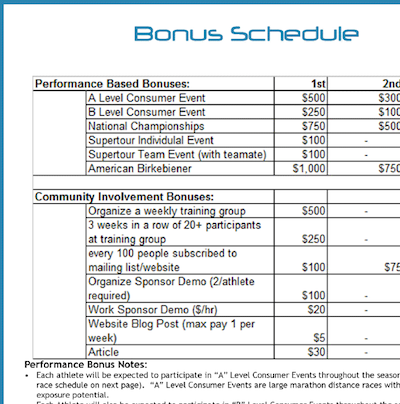
    In return for their work, the athletes would be paid, with incentives for recruiting more people as well as for winning popular races – the proposed win schedule offered $500 for a victory at an “A-Level Consumer Event”, but only $100 for a SuperTour win. The specifics were outlined in a five-page information packet for the athletes.

    By the time Korn was marketing the team to sponsors, there were five athletes on board:

    • Owen, who last year finished seventh at the American Birkebeiner and had one SuperTour podium to her name;
    • Andre Watt, also formerly of CXC Team Vertical Limit, who finished the Birkie in the top 20 last year;
    • Audrey Weber, who had won the classic Birkie in a CXC uniform and was also in the top 10 in the sprint at SuperTour Finals;
    • Johanna Winters, who finished fifth in the Birkie skiing for CXC’s marathon team;
    • and Ian Case, who skied to a handful of SuperTour top 10’s representing Far West Nordic.

    The promotional materials for Team Endurance Professionals were introduced by the following mantra: “We provide a framework which makes professional cross-country skiing in the United States feasible, both logistically and economically. Recognizing the importance of community support, our athletes will work as a conduit to the grassroots, sharing their knowledge, expertise, and experiences. By doing this, we create excitement for the sport, support for the athletes, and generate unique marketing opportunities for our sponsors.”

    A page from Endurance Professionals' promotional materials shows the locations of the team's different members.

    According to Case, this last phrase was key to the way that the team would function. The concept had been described to him by Korn and Kevin Johnson, a Salomon representative, as early as the previous winter.

    “They wanted to create a team that would focus on huge citizen events, as well as giving some clinics, and also having each athlete start a training group in their region, free of charge and open to anyone: masters, juniors, whatever. [They wanted] to position team members as role models, mentors, and ambassadors for the sport,” Case said.

    Korn and Johnson had told Case that with the rise of elite clubs like CXC, Alaska Pacific University, and the Sun Valley Olympic Development Team, they felt that the SuperTour was no longer the best place for exposure.

    “They were very competitive races, and not always a proportionally high level of visibility compared to something like [the] Boulder Mountain Tour, the Great Race, the Birkie, or the Craftsbury Marathon,” Case said.

    And indeed, since the demise of the Saab-Salomon Factory Team, Salomon hadn’t had anyone fronting its name. CXC was Salomon’s biggest team, but their title sponsor was Vertical Limit.

    With an all-star group of athletes, Team Endurance Professionals began the process of attracting more sponsorship. Although Salomon and Swix had signed on, they still needed other sources of funding.

    The group launched a website, which included a blog with entries by Weber, Case, Owen, and Watt. There was also a nine-page info packet for potential

    sponsors, touting the affluence of the ski community and breaking down demographics.

    Team Endurance Professionals had all the trappings of an official endeavor – but where was the money?

    Bad Economy, and Bad Timing

    Despite their best efforts, Korn and Owen were struggling to find outside support for Team Endurance Professionals, which Owen blamed on circumstances outside their control.

    “A combination of factors made it not work this year,” Owen told FasterSkier. “[There was] a bad economy overall, and bad timing with it being the end of an Olympic cycle – the industry tends to scale back with marketing dollars.”

    The team had two major sponsors in Salomon and Swix. For Johnson, the Salomon representative, supporting the team seemed like a no-brainer.

    “Most of the athletes were currently Salomon athletes,” he said. “So for them, our sponsorship would have meant a similar level of support with equipment. The biggest thing was to centralize this group of individual athletes, which would have made things easier for me.”

    But according to Johnson, Salomon wasn’t about to float the whole team by itself. And because of the economic climate and other factors, additional sponsors never materialized.

    “Josh and Kristina were challenged to come up with a plan that was attractive to many sponsors, not just Salomon,” Johnson said. “If we were the only sponsor, it wouldn’t have been able to function.”

    By mid-June, Korn had changed the team’s direction away from community programs, focusing instead on assisting companies with product demos and learn to ski clinics across the country. And while Korn said that there would be some money involved, his plans to pay the team’s athletes were scaled back.

    The team's original structure included a detailed win schedule.

    “We are unfortunately more than likely not going to be able to offer a win schedule… sorry guys!” he wrote in an e-mail to the team on June 19.

    But while Korn’s new plan was less ambitious, his e-mail still seemed to promise support, and the team’s athletes were undeterred.

    In fact, when FasterSkier contacted Case in October, he still believed that the team existed, although he didn’t know all the details. He said he had since decided to pursue his music career more fully, and was no longer training full-time.

    “Thanks for getting me off my butt to resolve things with Josh!” Case told FasterSkier.

    But what he didn’t know was that Korn had already moved on to Plan B—a plan that didn’t involve Case or any of the other athletes. On August 25, Michigan Tech University announced that it had hired Korn as an assistant coach for cross-country running, nordic skiing, and track and field.

    Case had never been informed of the team’s demise or of Korn’s new position, and neither had Weber or Winters. In fact, they hadn’t heard from Korn since the June 19th e-mail.

    Winters didn’t seem to feel strongly about the situation – like Case, she has other priorities, including applying for graduate-level art programs. And Case was vehement in his support of Korn and Johnson, and his gratitude for their work.

    “In my experience Josh is a good guy, if a bit optimistic at times, and I’m not angry with him or anything,” Case said. Starting a professional team, he added, “is one of the hardest, most nearly-impossible things one can take on in the ski world, especially in the current economic – and meteorological – climate.”

    Weber, on the other hand, said that Korn and Owen could have done more to keep her in the loop. When she ran into Korn at the Trans Rockies Run in August, he didn’t mention anything about the team.

    The whole episode, Weber said, “reflects very poorly on their character, and it shows where their priorities lay for this whole team, and that it wasn’t really an effort that was for the athletes… it was something they were doing because they wanted those things for themselves.”

    When contacted about the team, Korn gave only a short statement.

    “That team was put on hold. I got offered a job at Michigan Tech University and wasn’t going to have time to manage the team, so there’s no news to be had,” he said in a brief phone conversation.

    Owen did not respond to additional requests for information from FasterSkier. Instead, she posted a message on the Team Endurance Professionals blog.

    “Suddenly, FasterSkier keeps calling us, trying to dig up a story about who and what we are. Well…for right now at least, we are nothing… FasterSkier, stop calling. Ain’t no dirt, no story here. Just a dream that hasn’t happened yet.”

    “The More the Better?”

    Korn and Owen were facing other pressures beyond their struggles to find additional sponsorship. In the June e-mail to the athletes, Korn mentioned politics.

    “In the recent weeks there has been some controversy regarding having another ‘Team’ with a focus on the marathon racing scene,” he wrote. “Because of this we have had to adjust the approach of the Endurance Professionals. To comply with some sponsors requests and needs, we are going to have to move away from the ‘Team’ [sic] concept.”

    When contacted by FasterSkier, few of the athletes knew any of the details about the political pressures. But Winters had spoken with Korn and Owen about the situation.

    “I spoke with Josh and Kristina on the phone, and they indicated that the directors of CXC were displeased with the formation of another similarly-structured team,” she said. “I’m not sure how any decisions were made, or who influenced these decisions – CXC, Salomon, etc. – but it sounded like Josh

    The promotional materials also touted the demographics of the cross-country ski community.

    and Kristina had to alter the layout of Endurance Professionals to make it less similar to CXC.”

    Johnson, the Salomon rep, would neither confirm or deny Winters’ account, and instead referred FasterSkier to his superior, Paul Guimond, who strongly refuted it.

    “No,” Guimond said. “No, no. Be clear. There was no pressure from anybody. [CXC Executive Director] Yuriy [Gusev] and I didn’t put any pressure on Josh. I would know if that had happened.”

    When asked whether he was familiar with Team Endurance Professionals, Gusev told FasterSkier that he wasn’t – but that as far as CXC was concerned, “The more [ski teams], the better.”

    However, after FasterSkier presented him with the basics of the story, Gusev said that he remembered discussing the team with Salomon.

    “I think they were trying to get some funding from Salomon, which to us was totally fine,” Gusev said. “It seemed that after our discussion with Salomon, the team would be focused at a national level.”

    Aftermath

    Endurance Professionals won’t be on the race circuit this year. But according to Johnson, the team—and its concept—will still have an impact on the ski community.

    “I think that some of the ideas that came out of the development process will get implemented by Salomon and other companies in the future,” he said.

    And of the four athletes interviewed by FasterSkier, all were happy with the directions their careers had headed. Owen is volunteer coaching and training with Michigan Tech; Case has scaled down his racing schedule for other reasons; and Winters and Weber are currently training with Piot Bednarsky of Go! Training in Minneapolis. Johnson has picked up the slack, and Salomon will still be supporting most of the athletes with equipment.

    Case was still vehement in his support of Korn.

    “I still support Salomon and Swix as companies, and the individuals (including Josh and Kevin) I worked with, even if things didn’t go the way we hoped,” Case said.

    And, as he pointed out earlier, founding a new team is a huge challenge. Most existing pro teams rely on a single large source of funding, like Steinbock Racing or the Craftsbury Green Racing Project. If a new team manager doesn’t find that one big sponsor, they are facing an uphill battle. But Guimond, from Salomon, still seemed to hope that there would be more efforts like Team Endurance Professionals in the future.

    “It’s a tight-knit community and people try to do things a lot – and there’s nothing wrong with that,” he said.

    –Nat Herz contributed reporting.

  • Fever Preview #5:  Hayward Elite Talk “Birkie”

    Fever Preview #5: Hayward Elite Talk “Birkie”

    Three Elite Wave Racers with Hayward and Birkie Experience

    John Bauer (photo: Toko)
    John Bauer (photo: Toko)

    John Bauer has lived in Hayward five years and has raced the Birkie for six.  As a 2002 Olympian in Salt Lake,  Bauer placed 12th, 19th, and 33rdin the distance races, and 5th in the relay.  He has been a member of the Rossignol team for 20 years, and tough he is still strongly competitive, his family has taken over a large part of his life which used to be filled with ski training and racing.

    “With kids, I haven’t quite figured out how to train and recover quite like I used to. . . .so I haven’t done as many races as I would have liked this year.”

    “I’ve been racing,” said Bauer, “but I’m definitely not expecting to win – I’d love to, I love skiing and I’ve always been geared to that, but then you can’t do that forever, so you have to change your focus.”

    Instead, Bauer says he tries to “still keep the skiing fun without contending. . . I’m still competitive with myself, more than anything.”

    Brian Gregg

    Brian Gregg has lived in Hayward for four years, done the Birkie as many times, and though he says that he spends a surprisingly small amount of time on the trail in the winter (due to his racing and travel schedule) he does get to know the trail very well by running on it in the summer time.   In order to freshen up on his memory of the course, Gregg says he has “been in Hayward the past 3 weeks focusing on my Birkie preparation and have skied the entire course several times.  I incorporate my intervals so that I have the chance to ski key portions of the course at race speed.”

    Gregg’s results have been 19th in ‘07, 5th in ‘08 and 4th in ’09.  When asked if his next goal was the podium or a win this year, Gregg replied, “A strong field is racing this year. Bryan Fish and CXC do a great job making sure we have the fastest skis on the course so that will help.  I am healthy and feeling strong and the podium is my goal.  I will be racing to win but a lot can happen over 50km.”

    Kristina Owen is also a member of CXC who lived in Hayward for two years before recently moving back to Houghton, Michigan.  While living in Hayward she trained almost every day on the Birkie trail, starting from “OO”, and that was when she began to enter the race as well.  In her first year she was a solid 8th place, but last year she took 15th, a result she wasn’t thrilled about.  This year she will be trying to “redeem” herself, and though she couldn’t specify an exact finish place, she said she would “like to be in the top group.”

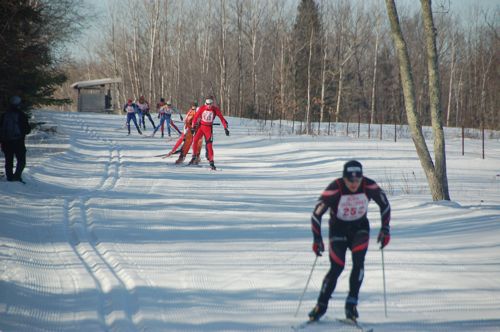
    Kristina Owen leads Evelyn Dong and Rebecca Dussault through "OO"

    Race Course Conditions

    Owen skied some of the trail last week and is excited about the conditions, “It’s awesome this year. . . .  It’s in good shape, it’s looking good.”

    Bauer agrees, and is glad that this year the conditions will provide for a very fair race.

    “The track this year is really hard, really firm. We’ve had really good snow, but we’ve also had a little rain with that, and so the whole trail is pretty compact, very, very firm. . . . And in that way it should be a consistent experience for everyone skiing, from the first to the last.”

    Birkie start: Get there on time – and try to relax a little!

    Sage Advice

    Bauer said that the word of caution he would give to racers with less experience would be to not get overly excited.

    “It’s a long race, so I would say don’t get too riled up at the start. The Birkie start is, in my view. . . notoriously chaotic.  A lot of people go too hard, and it’s a long race. . . it’s too bad, so many start out [too fast] and they really slow down, and that’s not a fun way to struggle in at the end of an event –  cramping and things like that. . . ”

    Though it is hard to pace in a mass-start race like the Birkie, Bauer says that the way you ski will help you conserve energy.

    “In the typical event, I ski relaxed and there are so many transitions where I can catch people, from keeping the speed going a little bit better than others. ..  That’s what you really have to focus on in the Birkie trail more than anything – the trail isn’t that hard – yeah, it’s hilly and for some it is a challenge, but from my perspective it’s about some of the climbing, but it’s also about skiing smart and skiing the transitions really well and keeping the speed up. And that’s hard if you’re skiing in a crowd, if you catch someone and have to slow down because they’ve already hit the hill. . .  but if you can ski transitions well it’s the key to this race.”

    Gregg has these tips to share with the less experienced racer:

    1) “Getting to the start takes longer than you think.  Give yourself plenty of time.”

    2) “Also, the snow is cold and dry so wax colder than you think.  Make sure you have some Toko Cold Powder in your   wax box.”

    Gregg also refers to a handy online tool, which allows a person to view a simulation of the race course, called “Race my Race.”

    Owens adds:

    1)“The high point is at 14 kilometers and after that you’re mostly going downhill, which is a nice psychological thing to know.”

    2) “Remember that it’s a long race and that it’s much easier to pick people off then to go out hard and blow up.”

    After bonking in both of her previous races, Owen says that she is going to do one thing different in her own preparation this year:

    “Eat. Eat so, so much the days before, and I’m going to be so much better at making sure I hit all my feeds, and eat a few Gu’s out there, and just fuel.”

    Favored –and not so favored – Sections of the Course

    Gregg says his  favorite part of the race is coming into Hayward’s Main Street, because “The contrast of the quiet open lake to the roar of spectators on Main Street is pretty cool.”

    For Owens, the best piece of the course is “Coming down mosquito brooks – it’s a rolling downhill. . . you don’t realize you’re losing so much elevation, but you are, and you just feel like a rock star.”

    Owens also adds that she enjoys the famous “Bitch Hill”, because even though she is racing hard she still enjoys the “Bitches of Bitch Hill” who stand on the side and play loud music, dance, and give out hugs and pins.

    Owens points out that, though many racers talk of this part of the course with dread, the hill is actually more of a psychological wall than anything.

    “Theres about one big hill every five kilometers and they all have names, but [Bitch Hill] is the one everyone talks about.  It’s ‘cause it’s at the end – the ones at the beginning – going up to the high point – those ones are actually a lot bigger, but you’re fresh so they don’t hit you as hard.”

    A strong climber, Bauer says,  “I particularly enjoy the start, once we enter the woods and get off of the powerline, from about 5km to the “OO”, the 23 kilometer point, that’s my favorite section.  There’s a lot of climbing leading up to “OO” and the pace picks up there . . .”

    Bauer said if he had to choose a least favorite section (a tough decision, because he thinks the whole trail is great) it would come after the hills, with the lighter piece of track that led to Mosquito Brooks.

    Owen’s least favorite part of the course is Duffy’s Climb,  “It’s right before you hit Hayward. It’s the last hill. . . but no matter what, it’s close enough to the finish where you’re going just about as hard as you can – it’s painful!”

    For Gregg the hardest part is Lake Hayward because, he says, “It is wild that you can see the finish but are still 3km away.”

    Birkie spectators cheer in the finishers

    The Birkie Weekend Fever

    Gregg’s favorite part of the weekend is the race itself, but he says he also enjoys “everything.”

    “The craziness of the expo at Telemark and standing in line to pick up your race packet is fun.  Every year my family comes to race and cheer and we go to the pasta feed at the Catholic Church in Hayward.  Some pasta feeds try to just make money, these church ladies are competitive in their desert making…which is awesome.  We all stay in the cabin at Cresthill and it is fun to get ready for the big race as a family.”

    As far as the major influx of people into the little town, Gregg says he doesn’t mind a bit.

    “Living in the small quiet community of Hayward it is fun to see the town explode with cross country skiers and all the excitement about cross country skiing.  The long weekend sees the real big surge, but race is part of the community all year.”

    Bauer just likes to stay focused on the main event.

    “It’s really about the race. Mostly you’re thinking about what you have to do, but there’s so many distractions.  It’s mostly about getting to the race on time, getting to the start and not breaking  a pole, but there’s so much excitement and so many people. . .”

    Distractions aside, Bauer still enjoys the throngs of people who spill into town for the event.

    “I don’t know how it’s possible that many people can come into town, so the energy of that crowd is pretty fun!”

  • Liebsch and Owen Take Mora Vasaloppet Victory

    Liebsch and Owen Take Mora Vasaloppet Victory

    The Mora Vasaloppet is not only a prestigious ski marathon featuring some of the nations top racers, it has a very interesting prize.  The race offers a free trip to Sweden to the overall winners to contest next year’s Swedish Vasaloppet (or $1,000).

    Over 350 racers lined up for this year’s Mora Vasaloppet with that trip in their sites, but after 58k of racing, it was Matt Liebsch and Kristina Owen who claimed the victories and the rights to that special prize.

    Liebsch, skiing for Team CXC Vertical Limit, skied away from a strong field to take the victory in a blazing fast time of 2:16:14.  Following him, a minute and 38 seconds later, was Adam Swank of Duluth, MN.  Filling out the podium, also from Duluth, was Andre Watt, 4:01 off of Liebsh’s time.

    Liebsch skis away from the field (Photo Ed Swain)
    Liebsch skis away from the field (Photo Ed Swain)

    The women’s race was similarly spread out at the finish, with Kristina Owen of Houghton, MI finishing in 2:31:03, a minute 50 ahead of Johanna Winters of the Twin Cities.  The only non-midwestern skier to make the podium was Anna McLoon, Harvard graduate, finishing third, 4:03 off Owen’s pace.

    Mora Vasaloppet
    Mora Vasaloppet
  • Liebsch, Owen take City of Lakes Loppet Victories

    Racers toeing the line of the 2010 edition of the City of Lakes Loppet were greeted Sunday morning with blue skies and pleasant winter temperatures.  The snow set up firm overnight, leaving the 35k course in Minneapolis firm and fast.

    In the 35k freestyle Loppet, local hero Matt Liebsch (CXC Team Vertical Limit), fresh off his first points-scoring effort in the Canmore World Cup 15k skate, took the victory.  Second went to Rossignol’s Josh Smullin, current racing and coaching for the Steamboat Springs Winter Sports Club.  CXC Team Vertical Limit’s Andre Watt edged Dave Chamberlain (MWSC/Fischer) and Duluth-native Adam Swank (Fischer) in a three-way sprint for the final podium spot.

    CXC Team Vertical Limit also took the victory in the women’s race, with former Michigan Tech standout Kristina Owen outpacing teammate Maria Stuber (CXC Team Vertical Limit) by a comfortable 46 seconds.  Completing the CXC sweep of the women’s podium was Johanna Winters.  Biathlete (and current medical school student) Carolyn Bramante and Atomic’s Lindsey Dehlin rounded out the top five.

    Local ski shop Hoigaard’s sponsored the 25k classic Loppet.  Former University of Alaska Seawolf Andy Liebner skied to a convincing victory, leaving his nearest competitor nearly four minutes behind.  Evan Pengelly was second, beating Duluth’s Grant Nelson in a sprint finish.

    CXC Team Vertical Limit picked up another victory in the women’s division of the Hoigaard’s Classic.  This time it was Dartmouth alum Audrey Weber coming in ahead of former US Ski Team member Hilary Patzer (Rossignol).  Angie Robinson was just edged by Patzer and had to settle for third place.

    Full results and photos available here,

    Video of the Liebsch, Smullin, and the sprint for third:

  • Kristina Owen

    Kristina Owen

    Kristina Owen grew up skiing for her local club in Wenatchee, Washington, claiming to be “more into the M&Ms they had at the finish than the races themselves.” After coming in last in her first JO race, Owen came back to win the 10K classic the following year in Lake Placid.

    Owen continued to develop as a skier at Michigan Tech, posting high finishes at NCAAs in 2005, 2006, and 2007, including an 8th place in the 15K Classic in 2007. Since graduating in the spring of 2007, Owen has been training with the CXC Elite Team in Hayward, Wisconsin, posting top-10 finishes at US Nationals and 8th in the 2008 US Birkiebiener.

    Owen plans to continue racing for several more years, after which she hopes to coach at the collegiate level. When Owen is not skiing, she enjoys reading, sewing, knitting, and baking cookies. “I’d make the perfect 50s housewife,” she claims.
    Birthdate: 7/16/84
    Hometown: Wenatchee, WA
    Current Residence: Hayward, WI
    Ski Club: CXC Elite
    Height: 5’3
    Weight: 120lbs
    Best Results: 8th place 2008 American Birkiebiener, 5th place 30k Classic at 2008 US Nationals, 6th place 15k Pursuit 2008 US Nationals, 8th place 15k Classic 2007 NCAA, 7th place 5k classic 2006 NCAA
    Sponsors: CXC Elite Team, Salomon, Toko, OneWay

    Full Interview

    When did you start ski racing, and what were some highlights of your young skiing career?
    I started skiing as soon as I could walk, and racing when I was a J3-ish.  My mom coached the local club, so skiing and races were always something I was around and familiar with.  I wasn’t one of those junior phenoms though, that’s for sure.  I was the kid who came to every race because my mom was there anyway, but was more into the M&M’s they had at the finish than the races themselves.  Then from second year as a J1 on, I started slowly and steadily getting better.  By my last year as a junior, I actually managed to win the 10K classic at JO’s in Lake Placid. Going from DFL my first year to that was pretty cool.

    Who has been the most influential person for you, whether as a skier or a person?
    My mom.  And she’s a little crazy, so the fact that i’m slowly turning into her terrifies me.
    Where is your favorite place to ski, where is your favorite place to race, what is your favorite part of the season, what are your favorite ski conditions?

    Place:  Tech Trails, Houghton MI
    Race:  Tech Trails, Houghton MI
    Part: Right now
    Conditions:  28 degrees, blue skies.

    What drives you to succeed at the highest possible level, and what are your long-term goals as a skier?

    Skiing makes me happy.  I love racing, and I love training.  I’ll might never be the best in the world, but I sure as heck want to see how good I can get.

    What are your favorite race formats/distances, and do you try to specialize for these events?

    I like ’em long.  I don’t try to specialize, I’m actually really trying to get better at the shorter stuff.  So far though…15k or longer seems to be my best.

    What are your overall goals for this season?
    1.  Have consistent results through the season
    2.  Make the Canadian World Cup team
    3.  Be more pro, stay on top of all aspects of this job, racing and non.
    4.  Stay healthy
    5.  Top 5 at US Nationals

    Do you have any consistent training partners? Do you prefer training alone or with others?
    CXC has a pretty unique schedule, in that we rotate in and out of training camp every two weeks.  So, during camp, I train with all the other CXC ladies.  Out of camp, I generally train alone.  This way, we don’t get too tired of each other!

    What is your favorite on snow workout and favorite dryland workout?
    I like super hard intervals, and long slow over-distance workouts.

    What do you enjoy doing besides skiing?
    Reading, sewing, knitting, baking cookies….I’d make the perfect 50’s housewife.

    In terms of employment, are you a 100% full-time athlete, or do you have another job besides training/racing? If so, what do you do?
    100% full-time athlete, baby.

    How long do you think you will ski at the elite level? What do you see yourself doing after you finish your ski career?
    Couple more years, at least. And then coach somewhere, hopefully at the collegiate level.

    Do you or did you ever attend college? How did you make that decision?
    I attended Michigan Tech and graduated in the spring of 2007.  In high school I wasn’t a very fast, but I was real into my books.  College was the logical next step, and gave me time to develop as a skier.

    Do you enjoy racing/competing in other sports during the offseason? Did you play other sports as a kid? What are some of your favorite non-skiing competitions?
    I love cross-country running.  I raced from the fourth grade through college, but haven’t found many race opportunities that fit in our training plan now with CXC.

    What do you do with any spare time at training camps or on race trips?
    Mostly waste a lot of time on the internet.  That, and knit.

    What does your diet consist of?  Do you have a favorite pre-race dinner and breakfast?
    My diet is really basic.  Go to the store, load up on fruits, veggies, a little meat, and giant bags of flour.  Pretty much everything is from scratch.  The fact that it’s healthier that was is really secondary to the fact that it’s also way cheaper, and pro skiers don’t make a lot of $$.  Pre-race I like spaghetti for  dinner and oatmeal for breakfast.

    What’s one thing people would be surprised to know about you?
    I hate going fast.  Motor boats, fast cars, carnival rides…they terrify me.  And yes, steep downhills sometimes challenge me.  I work on getting over the fear constantly.

    How do you spend your weeks off?
    Eh?  When’s that?  Last year was my first year not as a 3 sport athlete…I spent April in Hayward.  At first I slept a lot, and then I was just bored out of my mind, waiting to train again.  I need to come up with something cool for this year so I don’t repeat that.

    What is the best race or workout you have ever done?

    30k Classic at last year’s Distance Nationals.

    What race events are in your plan for this season, and which race are you are looking forward to the most?
    West Yellowstone, Boseman, and Solider Hollow supertours, Whistler for the NorAm, Anchorage for Nationals, perhaps Whistler again for the World Cup, and then back to the midwest for the Supertours there.  Then the Birkie and up to Alaska again for distance nationals!  Most excited about both nationals, and the Birkie.

    What else do you want to say?
    I chronicle my  training life at www.kristinaowen.com.  It’s a fairly good waste of a few minutes if you’re bored.