From the FasterSkier archive — posts syndicated from athletes’ and coaches’ own blogs between 2004 and 2012, kept online as published. Current coverage is at fasterskier.com.

Tag: Kristina Stavaas Skistad

  • Kern Takes Podium in Tallinn City Sprint. Joensuu Locks up Sprint Lead

    Kern Takes Podium in Tallinn City Sprint. Joensuu Locks up Sprint Lead

    This coverage is made possible through the generous support of Marty and Kathy Hall and A Hall Mark of Excellence Award. To learn more about A Hall Mark of Excellence Award, or to learn how you can support FasterSkier’s coverage, please contact info@fasterskier.com.

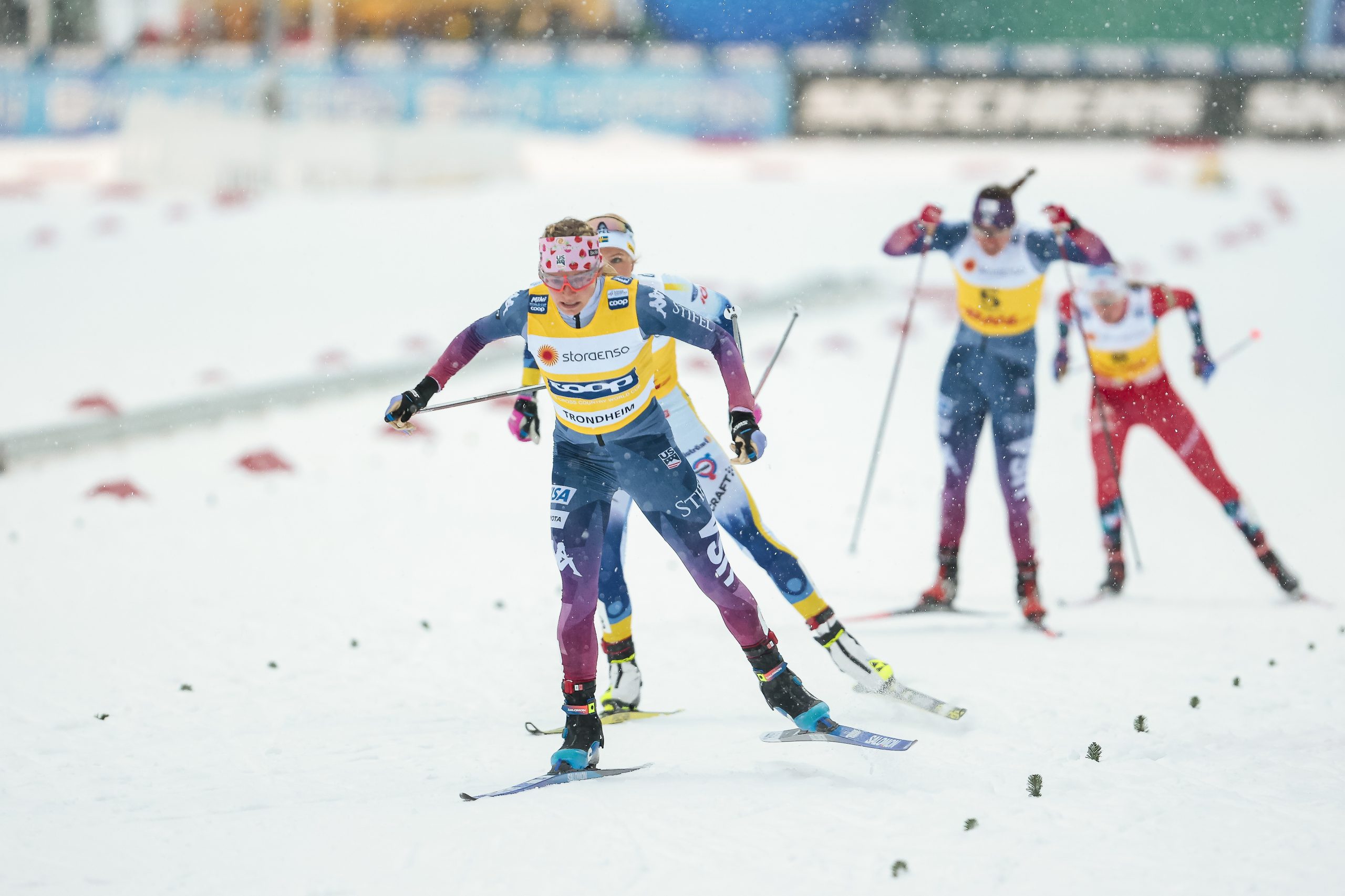
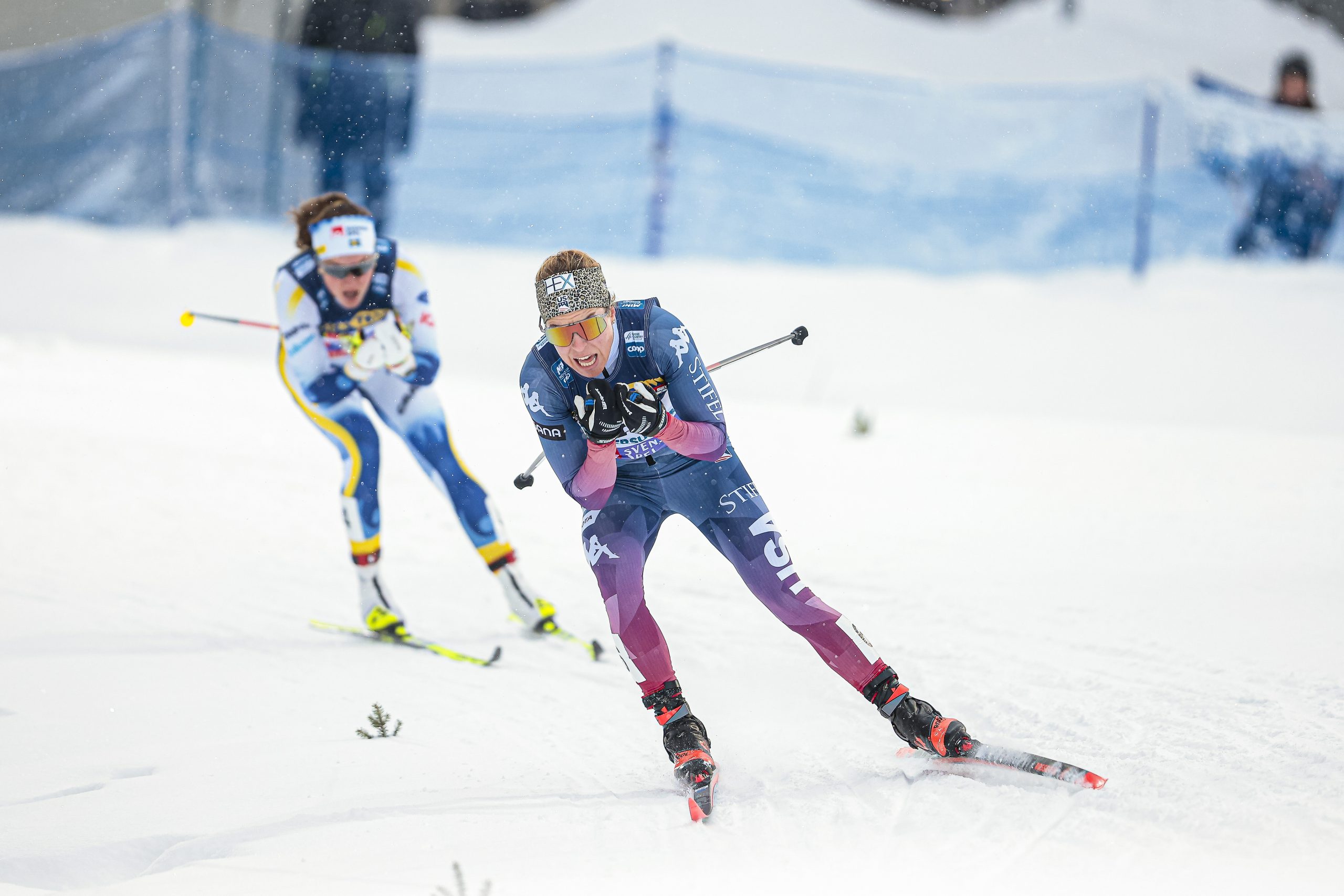
    Julia Kern (USA) took her first individual podium since 2019. (Photo: NordicFocus)

    Today’s nighttime mid-week Freestyle city Sprint in Tallinn, Estonia is an unique event. It’s one day of individual Sprint racing coming at the tail end of the season leading into the final weekend of racing in Lahti, Finland. The race also requires all skiers to use the same ski wax.

    In the women’s event— with the chase for the Overall crystal globe already mathematically secured by Jessie Diggins and a 50 kilometer World Cup finale looming this coming weekend— there wasn’t much incentive for the American star to race today. Her teammate Rosie Brennan would also be taking the day off. But it wasn’t just Diggins and Brennan who would be missing from the lineup. World Sprint Champion Jonna Sundling (SWE) is ill and not racing. Her teammate Linn Svahn, who has had an almost unbearable string of bad luck, is also still on the sidelines suffering from concussion symptoms. That meant that Kristine Stavaas Skistad (NOR), along with Sprint crystal globe leader Jasmi Joensuu (FIN) and Nadine Faehndrich (SUI) would be catapulted into the pre-race favorites position. With Joensuu entering the day leading the Sprint cup by 148 points over Sundling, and 157 points over Faehndrich—with only one individual Sprint race remaining after today— she was in prime position to cement her chances for the Sprint crystal globe.

    It has been an odd journey for the Finnish skier who could receive the Sprint crystal globe and yet hasn’t won a World Cup Individual Sprint race this season and has only been on the Sprint podium once. A victory today would help to erase that asterisk from her championship.

    With Diggins not racing, Julia Kern (USA) immediately moved into the favorite position for team USA.

    The script was set perfectly by the qualifying results when Faehndrich finished first besting Joensuu, who qualified second, by almost two seconds. Kern also had a strong qualifier finishing sixth. But at the end of the day it was Faehndrich who triumphed taking the victory with Maja Dahlqvist (SWE) finishing second, and Kern taking a dramatic third for her first individual podium since 2019.

    It was a satisfying day for Kern. “It feels really good, especially after over 5 years since my first individual podium,” said Kern. “I never stopped believing, and I felt like coaches and teammates close to me as well, and it feels good that how I imagined I can ski finally all came together today. I feel like I’ve had a lot of injuries and obstacles along the way that have often disrupted my training, so even in a year where I still experienced major training disruptions, it means that it’s still possible with enough patience and persistence!”

    Kern also acknowledged the efforts of the wax technicians. “The staff did an amazing job in ski testing and strategy today, especially with the limited course access and neutral waxing rules. They were cheering so loud around the course that I no option but boost into another gear and I feel so grateful for their unwavering belief over the years, and especially this season where I was reminded to be patient, and that likely my form will catch up and come around at the end of the season!”

    It was definitely a race of redemption for Kern who struggled early in the season after a summer of nagging injuries. “A podium possibility is something I have been chasing the past 5 years ever since my first podium. I never stopped believing that I had it in me, but there were definitely times when it felt far out of reach, like in Period 1 this season. Things with sprinting were really not clicking early season, which wasn’t so surprising given my injury ridden fall. But I knew my fitness was there with strong distance races, so I worked really hard with the coaches and strength coach in the lead up to World Champs to get my sprinting gears back. The belief has always been there deep down, but I feel like my body has not been able to get there. I’m pleasantly surprised how quickly I was able to build back my sprint gears in the last month, making it feel that much sweeter!”

    Joensuu finished sixth and was still in the awkward position of being on the cusp of winning the Sprint crystal globe, having never won a Sprint and only having found the podium once. But that’s the lesson of a long World Cup season; persistence and durability often win out over intermittent victories and podiums.

    Nadine Faehndrich (SUI) took the Sprint victory, but she can’t overcome Joensuu’s crystal globe lead. (Photo: NordicFocus)
    Women’s Freestyle Sprint-Quarterfinals

    In heat number one, Kern had the difficult task of facing off against Skistad, and Moa Ilar (SWE), the winner of the most recent world cup Sprint. But very quickly, the entire heat was turned upside down when three athletes fell in an early turn, including Ilar. That paved the way for Kern to advance with little difficulty. Kern quickly jumped to the front to take the lead, which she held until the finish line, with Skistad content to sit far back in second place conserving energy.

    All eyes were on Jasmi Joensuu (FIN) to see if she could maintain her Sprint lead and whether she could win a Sprint race. (Photo: NordicFocus)

    Emma Ribom (SWE) and Mathilde Myhrvold (NOR) took the second heat with the narrow course proving to be the most dominating factor.

    Heat four included the two fastest qualifiers with Faehndrich and Joensuu facing each other. Joensuu blasted out from the start immediately, but Faehndrich was able to take the lead up the steep final hill with Joensuu drifting back to third having been displaced from automatic advancement by Katerina Janatova (CZE). Joensuu would have to wait until the next heat was completed to see if she could advance as a lucky loser. If she didn’t, her lead for the Sprint cup would dwindle substantially.

    Sammy Smith (USA) qualified for the heats, but couldn’t advance out of the quarterfinals. (Photo: NordicFocus)

    In the final heat the only other American to make the heats, Sammy Smith, would try to advance to the semi-finals, but she couldn’t keep up with the pace set by Johanna Hagstroem (SWE) who won the heat. But more importantly to the Sprint cup standings, Joensuu’s time from the prior heat held up for her to advance as a lucky loser which let her avoid what would have been a disastrous outcome had she not advanced out of the quarterfinals.

    Women’s Freestyle Sprints-Semifinals
    Kristine Stavaas Skistad (NOR) found herself in the unusual position of being shut out of the finals. (Photo: NordicFocus)

    Kern was in the first semifinal and would again face Skistad as well as Ribom, Maja Dahlqvist (SWE), and Myhrvold. Skistad didn’t waste any time going to the front with Dahlqvist right behind her. Kern was pinched to the outside early but was able to pick her way toward the front as Dahlqvist shot into the lead. Kern and Skistad came to the line together with Dahlqvist ahead of them taking the victory. In an incredibly tense photo-finish Kern nipped Skistad at the line to finish second. It was now Skistad who was in the unusual position of having to wait on a lucky loser position with Kern automatically advancing to the finals.

    Kern had to adjust her strategy during the race. “My strategy was to be as far front as possible and push the pace. Unfortunately I did not have a great start and my backup strategy was to move up and find a window as I lapped through and that is what I did. I knew I was feeling really strong in the second lap all day, so if I could be in the right position, I had confidence I could go.”

    The second semifinal was packed with top contenders with Joensuu, Faehndrich, Janatova, Hagstroem, and Coletta Rydzek (GER) facing each other. Joensuu and Faehndrich again went to the front early with Faehndrich setting the pace. Faehndrich was able to put a small gap on the field early, but the group quickly closed in on her with Joensuu doggedly in pursuit. Faehndrich pushed hard up the final hill and was able to re-establish her lead over Joensuu who began to fade. Gina Del Rio (AND) took advantage of Joensuu’s slowdown and finished second. But miraculously once again Joensuu was able to advance as a lucky loser. Joensuu’s good fortune was Skistad’s bad luck as she would not be able to advance as a lucky loser and for the first time in a long time, she wouldn’t reach the finals.

    Maja Dahlqvist (SWE) had a strong showing finishing second. (Photo: NordicFocus)
    Women’s Freestyle Sprint-Finals

    In the finals Kern would match up with Faehndrich, Dahlqvist, Del Rio, Joensuu, and Rydzek. Joensuu had been living a charmed existence all day having advanced twice through the heats using the lucky loser position. Having reached the finals ensured that she would maintain a healthy lead going into the final Sprint this weekend. But there was still a podium to contend for today. Following the previous heat’s form, Faehndrich shot to the front at the start with Del Rio gamely following closely. Faehndrich continued to charge as the field went up the final steep hill with Dahlqvist behind her and Kern in third. Faehndrich put in a big gap on the field to take the win with Dahlqvist finishing second, Kern finished third to take her second ever individual world cup podium, her first since she finished third in Planica in 2019. Joensuu finished sixth but it was mission accomplished for the Finnish skier who miraculously managed to maintain an insurmountable Sprint cup lead by advancing twice as a lucky loser.

    For Kern it was a landmark day finding an individual podium after a very long absence, and for Joensuu it was a combination of luck, persistence, and speed which locked up her grasp of the Sprint crystal globe. Joensuu will go into the final weekend of racing with an insurmountable 129 point lead in the Sprint competition with only one race left to be contested.

    Maja Dahlqvist (SWE), Nadine Faehndrich (SUI), Julia Kern (USA), (l-r) (Photo: NordicFocus)

    Women’s Freestyle Sprint, Tallinn, Estonia: Results
  • Skistad Clinches Trondheim Freestyle Sprint—Diggins Fourth

    Skistad Clinches Trondheim Freestyle Sprint—Diggins Fourth

    This coverage is made possible through the generous support of Marty and Kathy Hall and A Hall Mark of Excellence Award. To learn more about A Hall Mark of Excellence Award, or to learn how you can support FasterSkier’s coverage, please contact info@fasterskier.com.

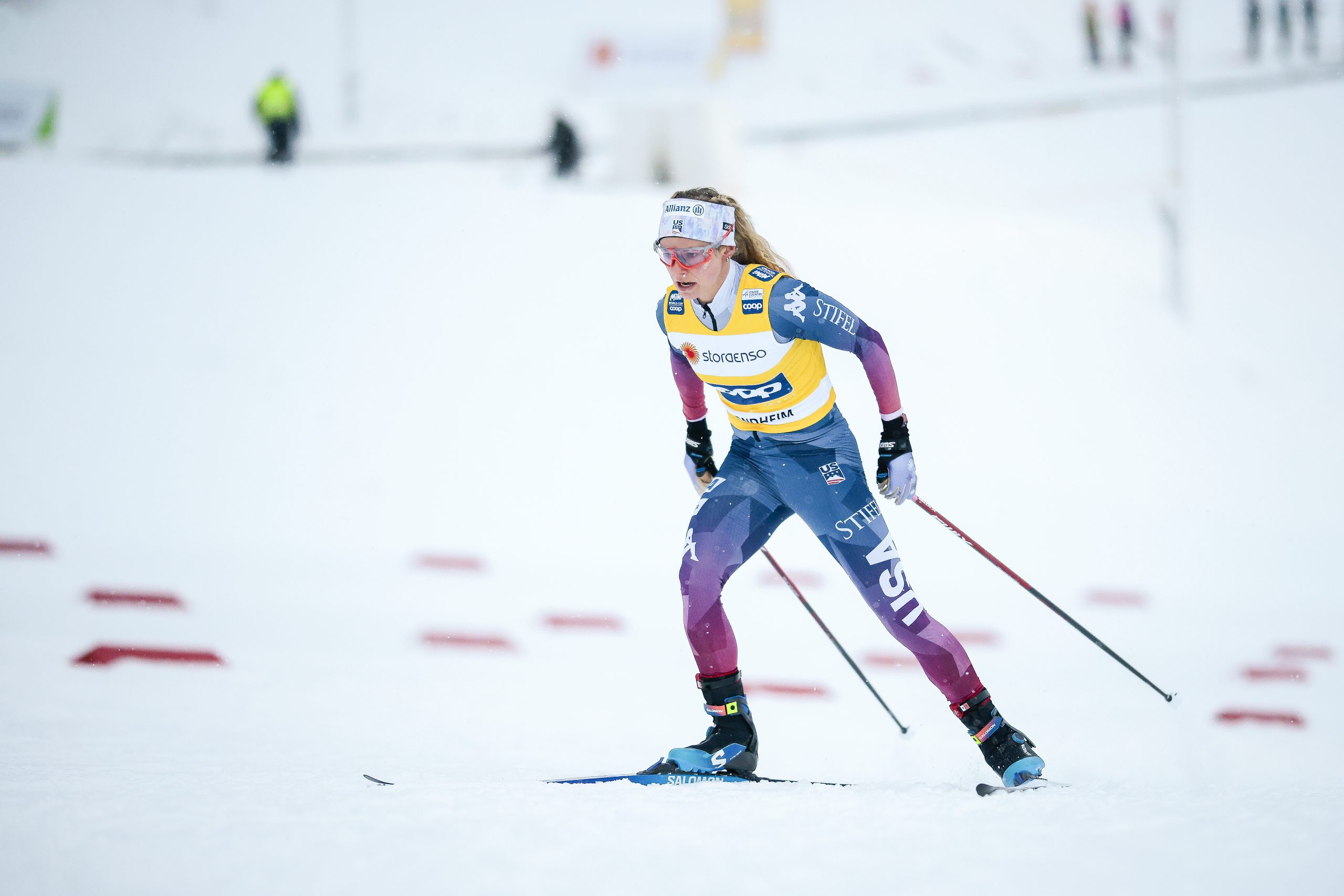
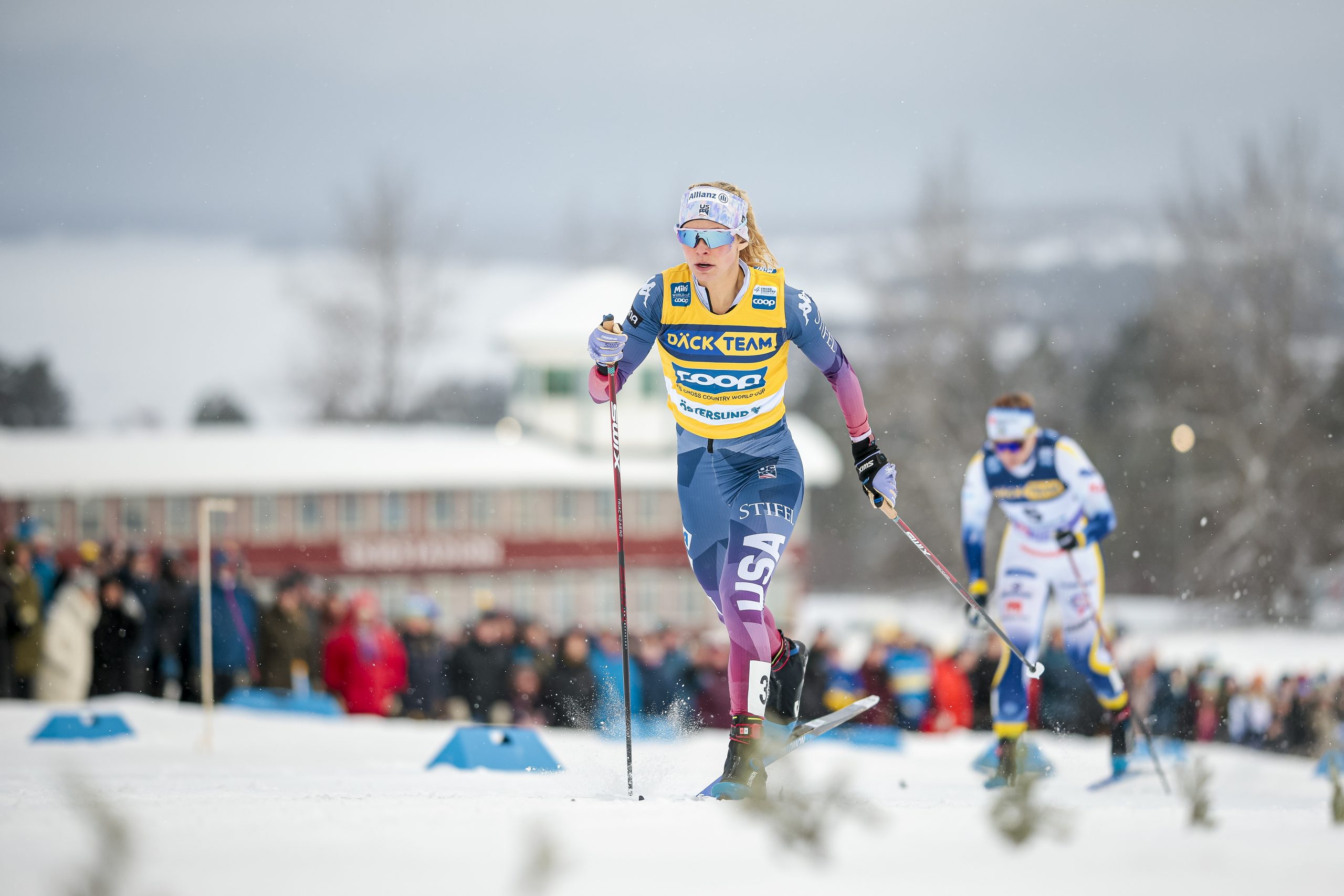
    Jessie Diggins’ (USA) strategy was to lead the field and use a long downhill toward the end of the race to try and gap the field. (Photo: NordicFocus)

    On Friday, the FIS World Cup moved on to Trondheim, Norway for the first Freestyle Sprints of the season. At the start of the day, America sat 1-2 in the World Cup overall rankings with Jessie Diggins in the lead and Rosie Brennan holding a one point advantage over Emma Ribom (SWE) for second. Ribom has won both sprint races held this year—both in the Classic technique— and would be looking to use her Sprint prowess to overtake Brennan. It was still an open question how Ribom would perform in a Freestyle-discipline sprint. Kristine Stavaas Skistad (NOR) would also be in the mix as she has proven herself to be a consistent Sprint contender; she has six Sprint podiums in a row. Still absent from the tour is last year’s overall crystal globe winner Tirul Udnes Weng (NOR).

    After all of the action was over, it was Skistad taking the win in dramatic fashion in front of a loud and jubilant Norwegian crowd. Linn Svahn (SWE) finished second, with Ribom  coming in third.

    Diggins was the top American finisher in fourth place. Julia Kern was the next best American, taking ninth. Other American finishers were Rosie Brennan 18th, Alayna Sonnesyn 39th, and Novie McCabe 43rd. Lauren Jortberg was scheduled to race, but did not start due to illness.

    The top Canadian was Amelia Wells in 51st.

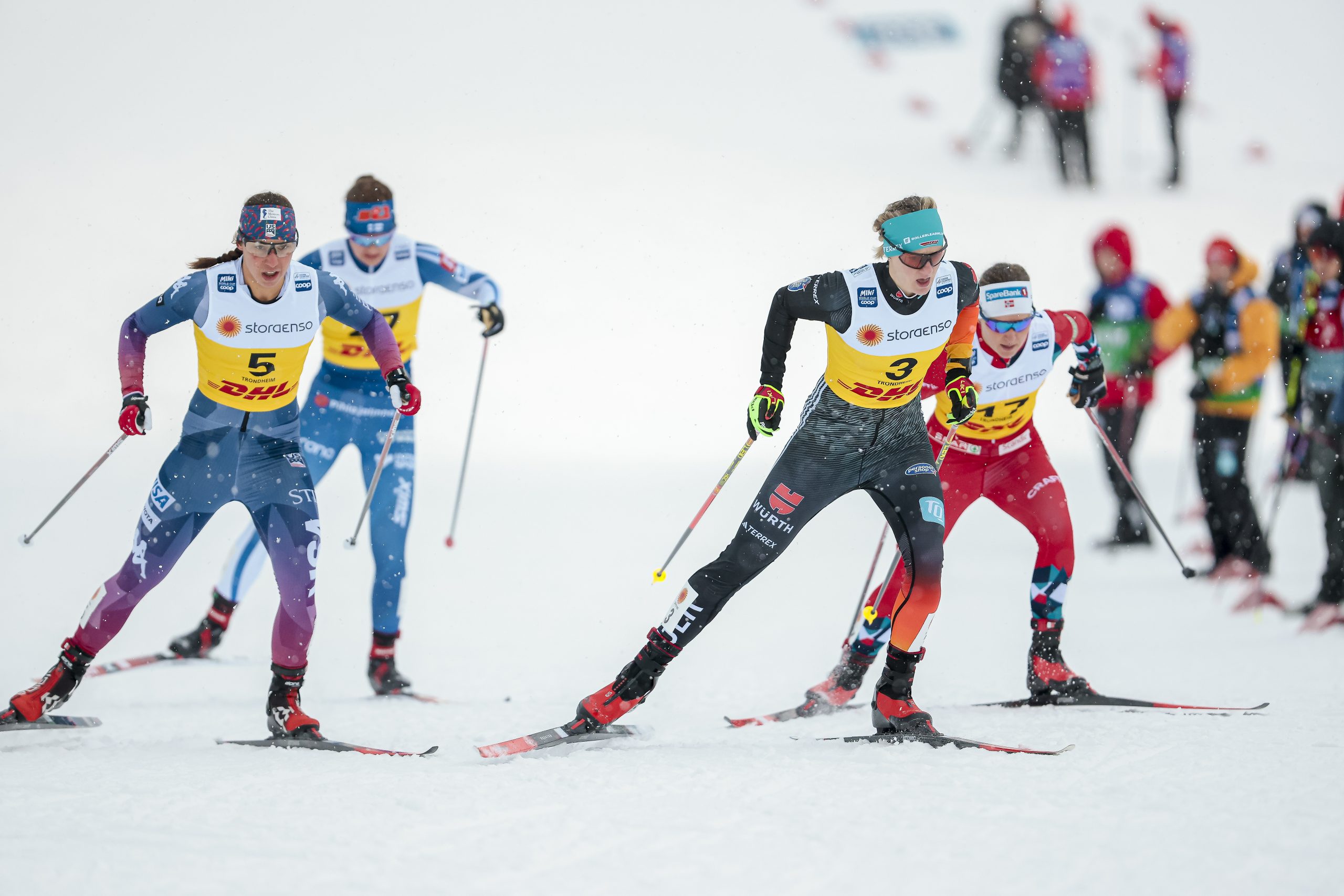
    Julia Kern (USA) (far left), was able to fight her way to the semifinals. (Photo: NordicFocus)
    Women’s Freestyle Sprint

    In the first quarterfinal heat, the second overall qualifier Jasmi Joensuu (FIN) would face the unenviable task of trying to hold off Ribom and Skistad. It proved too great a challenge for Joensuu, as Ribom and Skistad finished first and second. Joensuu finished fourth and would not advance beyond the quartefinal.

    Svahn advanced out of the second quarterfinal in her continued ascent back to the top of the sprint standings after two seasons of injury and disappointment.

    Rosie Brennan (USA) was unable to advance beyond the quarterfinals. She missed a lucky loser spot by only .03 seconds and was not pleased with her performance. (Photo: NordicFocus)

    The third quarterfinal featured Rosie Brennan in a duel against Maja Dahlqvist (SWE), Mathilde Myhrvold (NOR), and Sofie Krehl (GER) who was the fastest qualifier of the group. Brennan went out hard, but quickly found herself forced to the outside of the first turn, but still able to maintain third position. Brennan was able to keep the pace up for the first uphill and moved to the front. She kept the lead into the stadium where Dahlquist passed her. Brennan fought to hold off Myhrvold and Kertuu Niskanen (FIN) but she ended up in a photo-finish with Niskanen and Myhrvold. Once the photo was analyzed, it was shown that Brennan had just missed out, finishing fourth. She would be done for the day. Her time wasn’t fast enough for a lucky loser. She missed advancing by only 0.03 seconds.

    Diggins was in the fourth quarterfinal. She started off fast, a tactic she would repeat throughout the day. Leading up the first hill, she quickly opened a bit of a gap on Ane Appelkvist Stenseth (NOR). Diggins maintained a torrid pace up the course’s biggest uphill. Her strategy was clear; she wanted to go to the front and wear down the pack. She maintained her lead going into the course’s long downhill close to the finish. It was there that Diggins used her un-matched descending abilities to gap the field. She comfortably won the heat ahead of Frida Karlsson (SWE) in second.

    Julia Kern (USA) landed in the fifth quarter final alongside Victoria Carl (GER) who had qualified third. Carl went straight to the front, using the same strategy the crowd had seen Diggins employ. She went out very hard, and quickly established a gap. But Kern was able to stay within striking distance and closed the gap on the first uphill. Carl kept up a brutal pace and had a hefty lead coming into the stadium. Kern put on a very strong finishing burst to finish second and beat out Lotta Udnes Weng (NOR).

    After the quarterfinals were done, there were two Americans moving on: Diggins and Kern.

    Throughout the heats, Jessie Diggins (USA) used the long downhill to separate herself from the pack, a strategy that succeeded in getting her into the finals. (Photo: NordicFocus)
    Sprint Semifinals

    The first semifinal saw the fastest qualifier—Svahn—facing Ribom, Dahlqvist, Nadine Faehndrich (SUI),  Skistad, and Jasmin Kahara (FIN). Kahara fell early in the race and would not be a factor. There wasn’t much separation of the pack throughout the race as they ascended the big climb going toward the finish. It was Svahn who was able to push to the lead along with Ribom. The two Swedes then set the pace at the front on the long downhill leading to the finishing stretch.

    Emma Ribom (SWE) was looking to make it three Sprint victories in a row. She found the podium, but ended up third. (Photo: NordicFocus)

    It was a fight all the way to the finish with a three way photo-finish between Svahn, Ribom and Skistad. After the photo was analyzed, it was Ribom and Svahn first and second. Skistad finished third, only .03 seconds out of first. She would be forced to wait to see if she advanced. Ultimately, Skistad advanced as a lucky loser.

    Both American qualifiers were in the second semifinal along with Carl, Myhrvold, Karlsson, and Lotta Weng. In that race, Diggins quickly went to the front but was not able to create the same separation as she had in the quarterfinal. Kern was quickly pushed back to fifth.

    Diggins continued to push the pace as Karlsson tried to hang with her, staying on Diggins’ ski tails. The rest of the field was able to close the gap as they entered the final downhill; there, Diggins was again able to use her descending skills to string out the field. Diggins pushed to the lead coming into the stadium along with Carl who was right with her. Carl pressed Diggins hard, but the American was able to hold off Carl. They would advance along with Weng.

    Kristine Stavaas Skistad (NOR) powered past Linn Svahn (SWE) to take the victory in Trondhiem. (Photo: NordicFocus)
    The Finals

    The finals featured Diggins along with Ribom, Svahn, Carl, Weng, and Skistad. At the start, Skistad went to the front with Diggins forced out wide to the side, but Diggins quickly went by Skistad and worked her way to the front again.  Her strategy was the same as it had been all day: go out hard and try to wear everyone down. But this time other skiers were able to hang with her. Ribom, Svahn, and Skistad were able to find another gear. In an impressive display of power, they established a gap over the other skiers with Diggins moving down to fourth.

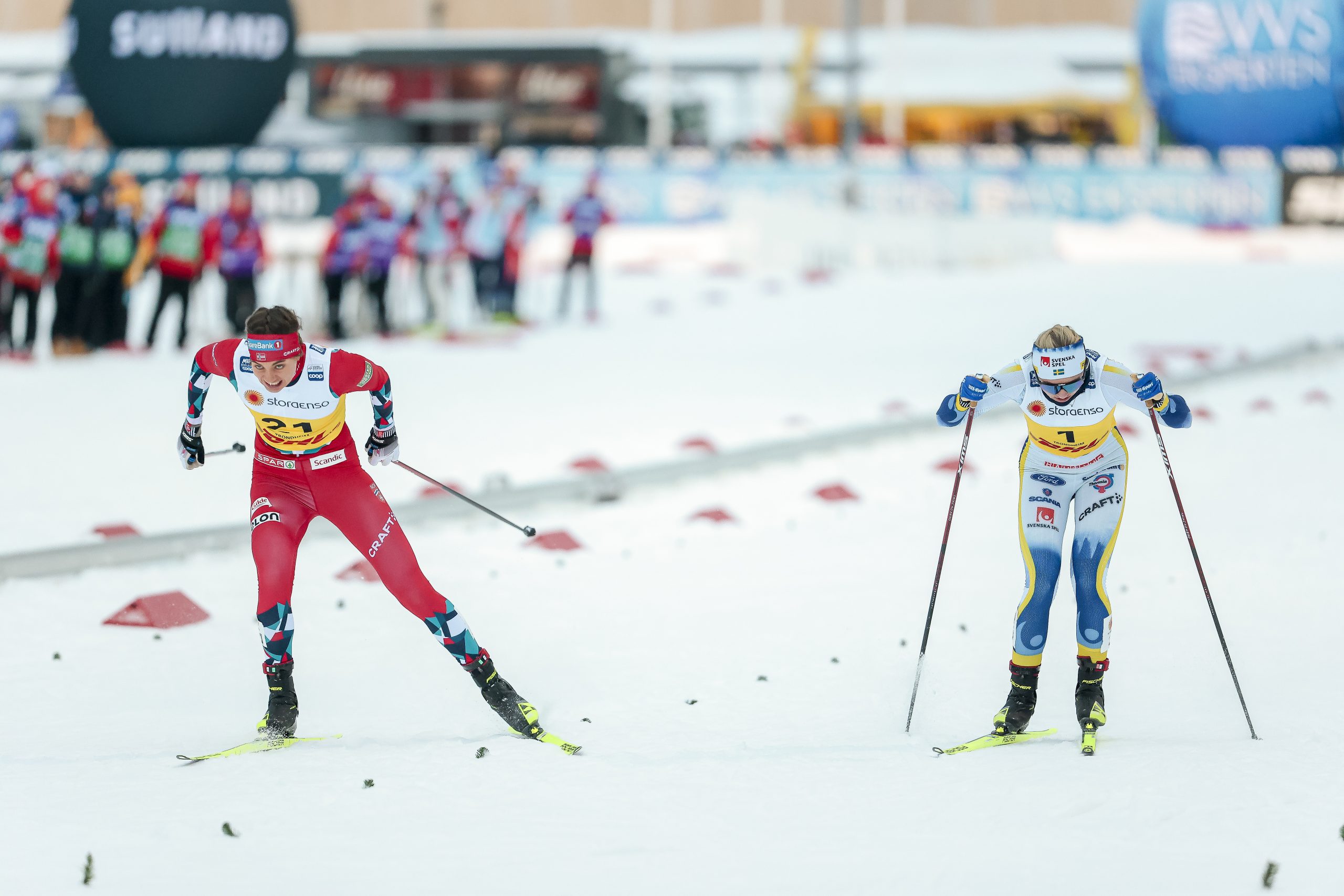
    Coming into the stadium it was Svahn in the lead with Skistad charging hard. At the finish it was another three-way photo finish, this time between Svahn, Skistad, and Ribom. After the review it was Skistad with the win, Svahn finishing second, Ribom taking third. Diggins ended up fourth.

    After the race Diggins was asked if her strategy throughout the day was to go out hard and break up the field. She replied, “yes, in some ways.” She continued that, “I know my fitness is in a very good place, so I knew I could trust that to try and get myself into the final. It definitely is expensive in that you end up a little more tired for the final, but you are more likely to get into the final.” The conditions also played a factor, Diggins said, “I figured it would be very hard to pass; there’s mostly just one skied in track through all that slow new snow. So I figured I needed to be out in front.”

    For her part, Brennan wasn’t pleased with today’s outcome. “I’m not very happy with my race,” she said. “I don’t think it was my best showing by any means. I felt I was skiing well and just really botched the finish. I don’t have any excuse for that. I’m mad at myself for not having good enough fight to the end; sometimes that’s hard to swallow.”

    Today’s conditions presented a new challenge for racers and ski technicians. Today was the first race of the World Cup season in warm moist weather under the new fluoro free policy. Brennan didn’t seem to think it made much difference.  “It was a little warmer today with falling snow,” she said. “I don’t think [wax] was the issue. As we move into the weekend and it turns to rain and very warm temperatures maybe we’ll notice more of a difference.”

    Team USA coach, Chris Grover, thought the warm conditions were handled well. “It wasn’t super warm. There was cold snowpack underneath,” he said. “But it was new waxes and new structures for the [wax techs] in the truck. We’re going to really see it tomorrow when it’s supposed to dump rain.”

    Diggins said she really didn’t notice a difference without fluoros, “but it’s hard to notice a difference unless you have a direct comparison. I honestly haven’t noticed any change. It’s fair; it’s even for everyone.”

    Grover described the unique challenges of preparing skis for today’s conditions. “Yesterday, it was still quite cold, all the sudden this was the first morning of a change,” Grover observed. “So a lot of the testing was reserved for this morning, so there was a flurry of waxing this morning, and for a skate race you only get one pair of skis. One of the hardest things is getting up and getting going that much earlier. It makes for a really tough schedule.”

    This weekend’s World Cup races in Trondheim are a preview of next year’s World Championships. Skiers liked the Sprint course, especially its generous width. (Photo: NordicFocus)

    Today’s venue is the same location as next year’s World Championship. It’s a scouting opportunity for racers. “The three courses that we’re racing [this weekend] are the exact courses we’re going to race at the World Championships,” said Grover. “We’re going to get a great feel for it. Athletes came away from today’s Sprint course saying that it’s a really fair course, because it’s so wide. Today’s new snow did change the tactics a little and made passing on the outside difficult.”

    For Norway, it was a dramatic finish on home soil, and the local crowd was definitely pleased.

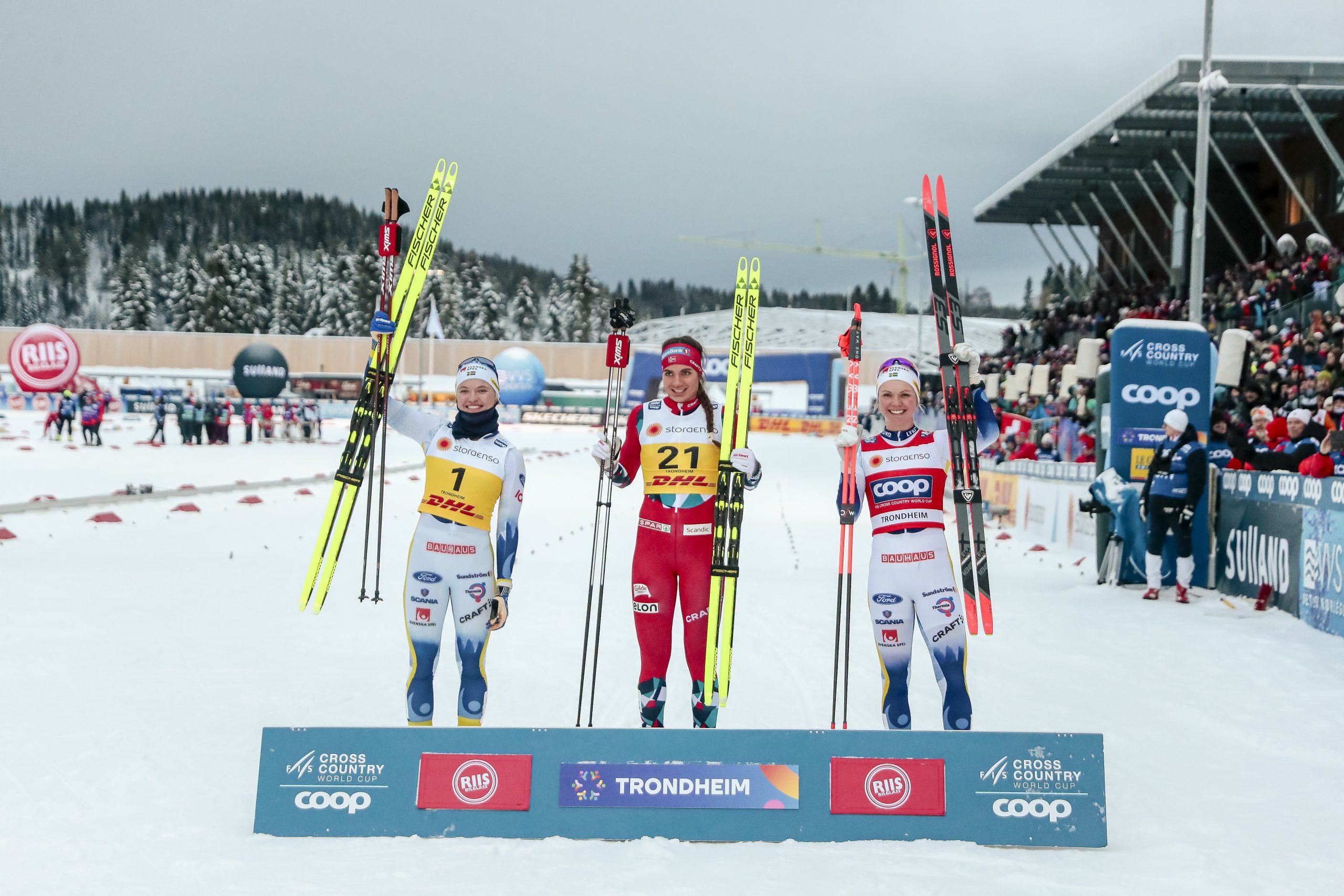
    Linn Svahn (SWE), Kristine Stavaas Skistad (NOR), Emma Ribom (SWE), (l-r) took the podium in the first Freestyle Sprint of the FIS World Cup season. (Photo: NordicFocus)

    Women’s Freestyle Sprint RESULTS

  • Ribom Dominates Oestersund Classic Sprint, Brennan and Diggins Fourth and Fifth

    Ribom Dominates Oestersund Classic Sprint, Brennan and Diggins Fourth and Fifth

    This coverage is made possible through the generous support of Marty and Kathy Hall and A Hall Mark of Excellence Award. To learn more about A Hall Mark of Excellence Award, or to learn how you can support FasterSkier’s coverage, please contact info@fasterskier.com.

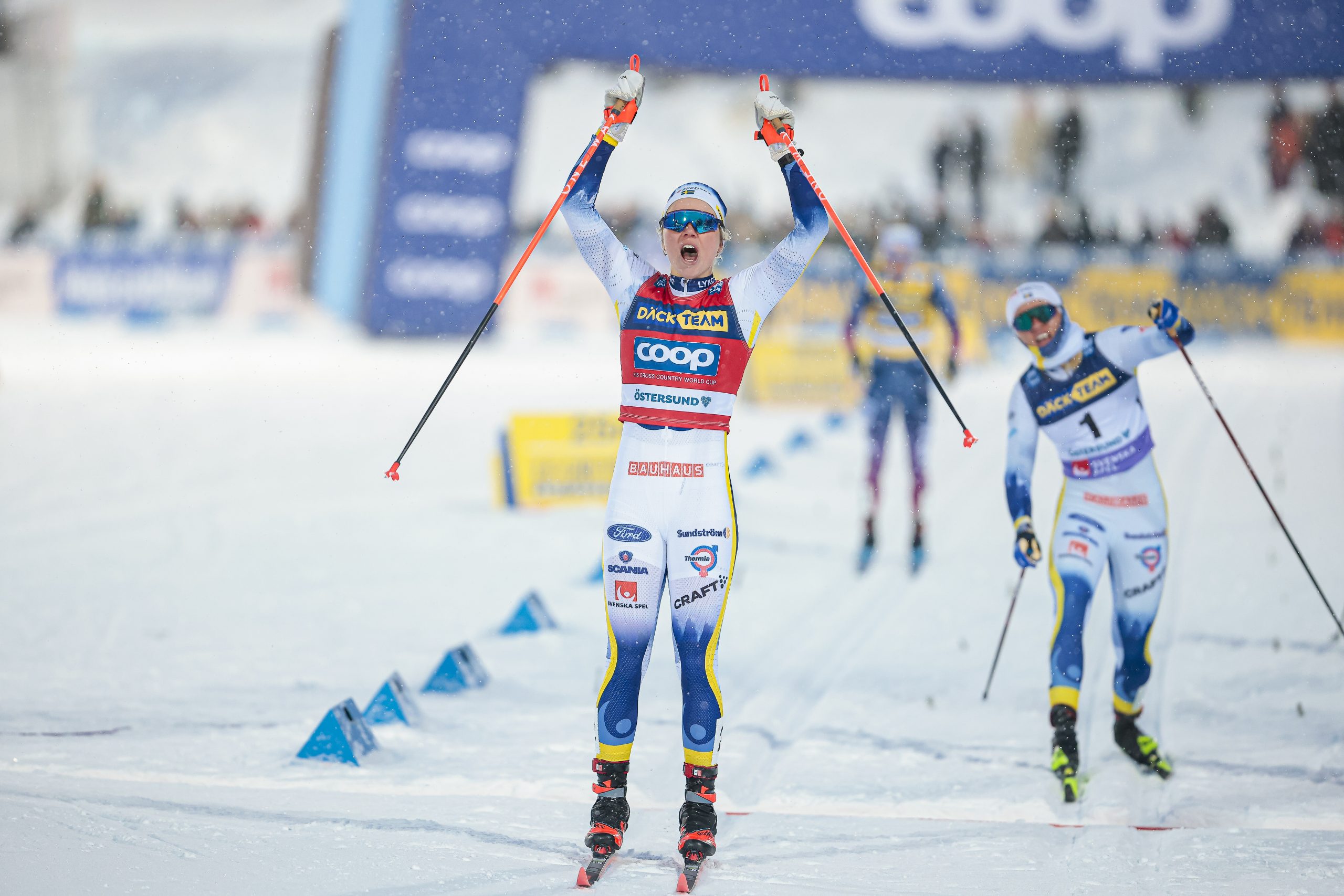
    Emma Ribom (SWE) dominated the FIS World Cup Sprint in Oestersund, her second consecutive Classic Sprint victory of the season. (Photo: Modica/NordicFocus)

    While much of North America continues to wait for skiable snow, Europe and Scandinavia are enjoying prime, early-winter conditions. Oestersund, Sweden had excellent conditions on its World Cup sprint track, though freshly falling snow seemed likely to affect glide in the tracks throughout the day’s racing. Sweden and the USA continue to dominate recent results, and the sprint in Oestersund proved no exception. Emma Ribom (SW) has won both Classic sprints this World Cup season, while Linn Svahn (SWE)—former World Cup Sprint Crystal Globe winner (2020)—seems to be returning to form as she topped all qualifiers on the day.

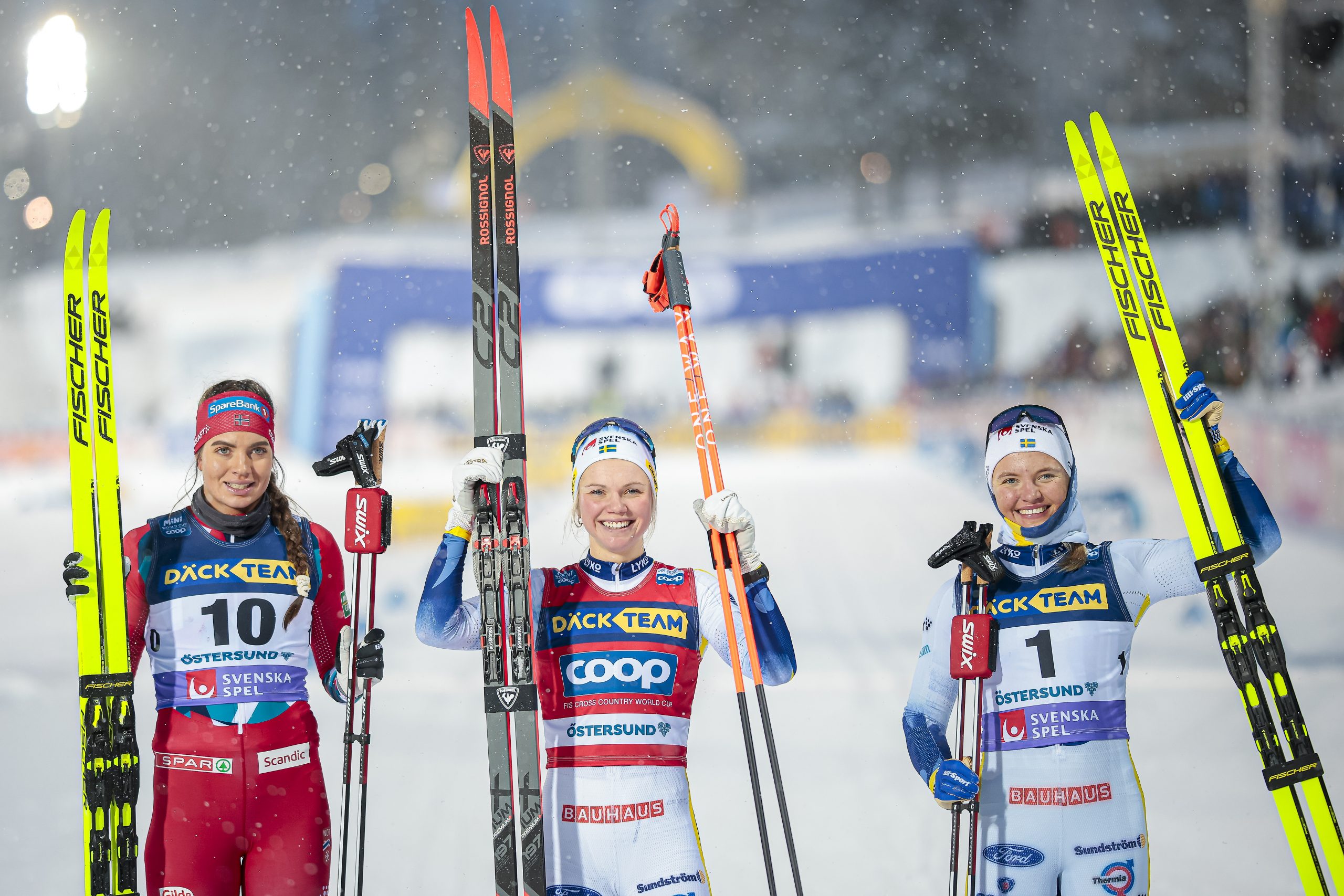
    Ultimately, Sweden’s Ribom continued her early-season sprint dominance as she skied away from the field to take the win. In second, Kristine Stavaas Skistad (NOR) sprinted past a resurgent Svahn who returned to the podium in third after two seasons struggling with injury.

    Starting the day second in the World Cup overall standings, American Rosie Brennan raced to fourth, ahead of World Cup overall leader, Jessie Diggins (USA), in fifth. Julia Kern qualified 15th, but did not advance beyond the quarterfinals. She would finish the day 17th. Other Americans included Alayna Sonnesyn 43rd, and Lauren Jortberg 47th.

    “I’m generally pretty excited about my race today,” Brennan said. “I’m pretty sure that was my best ever Classic Sprint.”

    Canadian finishers included Katherine Stewart-Jones 34th, and Amelia Wells 46th,

    Women’s Classic Sprint

    Oestersund’s sprint course is a bit longer than most, and freshly fallen snow filling the tracks would slow things down (especially in the early rounds), making this sprint something of an endurance event. The final downhill is often an area where drafting can influence who crosses the line first, but the new snow seemed likely to minimize that effect.

    “This was kind of a distance sprint,” Diggins explained. “It was 3:30, 3:40 for the women. [That’s] a longer sprint which, personally, I like! I think it’s safe to say that [Rosie and I] were pleased with having more time to play around with out there.”

    Svahn (SWE) qualified first, returning to the form that saw her win multiple World Cup sprints in years past. Jessie Diggins qualified 3rd , three seconds behind top qualifier, Svahn. Rosie Brennan qualified 6th , only a fraction behind Diggins. Kern qualified 15th, 8.9 seconds behind the leader. Then the snow began to fall, filling tracks and slowing skis. It was a beautiful winter setting for a beautiful winer sport, but competitors may have preferred something a little less scenic and a little more speedy. Wax technicians scrambled to concoct the best combination of kick and glide, while working under the time constraints of the new FIS rules that force teams to deliver skis for fluoro testing far earlier than in the past (and with no opportunity to alter ski bases—or trade out skis—after inspection concludes). It’s a technological and weather-predicting gamble that saw mixed results—some notable slipping, some extraordinary gliding—among the early heats.

    In Quarterfinal 1, Ribom (the World Cup Sprint leader) drove the pace to finish just ahead of Skistad. Swedish teammates, Svahn and Frida Karlsson, advanced out of Quarterfinal 2.

    Quarterfinal 3 saw Brennan start slowly, but she popped to the front as soon as the course turned uphill. She powered up the slope, hoping her skis would prove fast enough on the subsequent downhill. By the halfway mark, Brennan had pulled clear of the field with only Moa Lundgren (SWE) for company. Brennan cruised to the heat win, only easing up in the final few meters. She was followed across the line by Lundgren.

    “It was snowing during the race, and filling in the tracks a little bit . . . My strength is in climbing; the climbing was at the beginning—and it was a little turny coming back to the stadium—so I thought I would just do my best to stay in the front.”

    Kern seemed clogged near the back of Quarterfinal 4, while the distance skiers—Lotta Udnes Weng (NOR), Kertu Niskanen (FIN) and Ebba Anderson (SWE)—used their long-fitness to push the pace. Kern’s good skis allowed her to move forward in the final meters, but only enough to finish fourth where her time as not fast enough to earn a lucky loser spot.

    Racing in the World Cup leader’s yellow bib, Jessie Diggins (USA) used her endurance and climbing ability to set the pace in early heats, but could not maintain that tactic in the final. (Photo: Modica/NordicFocus)

    Quarterfinal 5 saw Diggins power to a heat victory in the fastest time of the day. The Swedes seemed to have gone light on kick wax: forced to herringbone on the uphills, but hoping to have better glide in the snowy downhill tracks. Diggins apparently realized that strategy; she countered by driving the pace on the uphills, distancing the field early in the course and continuing across the finish line unchallenged. Behind her, Dahlqvist executed a mad-dash double-pole to the finish to pip Finland’s Tiia Olkkonen for second.

    Semifinals

    The Oestersund snow had stopped falling by the beginning of the semifinals, and the tracks had begun to be skied-in: higher speeds on the downhills, more opportunity for drafting on the downhill leading into the finish. Semifinal 1 was stacked: Svahn, Ribom, Brennan, Karlsson, Skistad appeared poised to follow a fast pace; then no one wanted to take the lead. Brennan pressed the pace on the first uphill,  and then the action began. The three Swedes followed Brennan while Skistad dangled unexpectedly off the back. Showing the strength she’s demonstrated in allWorld Cup stops thus far this season, Ribom pulled away for the win, while the fast skis of Skistad allowed he to double pole through top qualifier, Svahn, to grab an automatic entry into the final. Svahn finished third well ahead of Brennan in fourth, and Karlsson in fifth. Svahn and Brennan would would ultimately advance as luck losers.

    Semifinal 2 saw Diggins lining up against Dahlqvist, Lotta Udnes Weng (NOR), Moa Lundgren (SWE), and Niskanen. Dahlqvist dropped off the back on the very first uphill (though she did not seem to be suffering from inadequate kick) while Diggins moved to the front with Lundgren. The gap continued to increase as the field entered the two significant downhills. Diggins’s style is not to let up—even when she has a comfortable lead—and she double-poled powerfully across the line for the semifinal win. Dahlqvist sprinted forward from waaaay back to finish a close third (behind Lundgren), though her finishing time was not fast enough to claim a lucky loser spot in the final.

    Sprint Final

    The snow had begun falling again as three Swedes—Ribom, Svahn, Lundgren—lined up in the final in front of the hometown Oestersund crowd. With them at the line were the two Americans—Brennan and Diggins—and the lone Norwegian, Skistad. Skistad and the Swedes made the pace right from the gun with the Americans trailing, though the pace leveled off quickly allowing Diggins to ease forward on the first uphill. Svahn and Ribom seemed to be slipping a bit on the climb, while Diggins skis appeared solid. Brennan was pinched on a tight corner and was forced to work to regain contact.

    “For me, the strategy was just to get to the final by going hard,” Diggins said. “Making sure that it spaced out and didn’t become a race of rushing or people trying to out-corner other people . . . that’s not one of my strengths. So I just decided to go for it and give myself a little space . . . It was a bold strategy, but I was happy with how it panned out . . . I just kind of ran out of gas in the final!”

    Rosie Brennan (USA) skied confidently at the front for much of the day’s sprint heats in Oestersund. In the final, she may have been inadvertently interfered with by a Swedish coach as she attempted to set up for a notoriously tight turn just before the finish. (Photo: Modica/NordicFocus)

    Once over the climb, the speed of the Swedes’ skis became apparent. While Ribom and Svahn opened a gap, the Americans were forced to work hard to remain in contention. Entering the final righthand turn, Brennan may have been inadvertently interfered with by a Swedish coach; she calmly brushed him aside, managing to push herself forward.

    “I was really bummed to be impeded by the Swedish coach,” Brennan said. “That’s really not the first time that’s happened to me; It’s the first time that it was on camera,” She chuckled. “So it’s nice that other people saw it! It’s impossible to know what impact that had on my race; I was obviously gaining momentum and had picked that line because I felt like I could pass some people. I feel like coaches are the people who should know the best about how a race works: in a sprint, all people are fighting for all positions, and all lanes are likely going to be used. [Coaches] should be looking out for more than just your own nation. When I left, the jury was discussing and figuring out what to do. I have no idea what the result of that was, but I’m sure that I’ll find out at some point.”

    Ahead of the fray, Ribom showed her class as she glided to the win. All Brennan’s hard work and clever maneuvering was undone by the superfast skis of Skistad who glided through Brennan and powered toward the finish where she caught Svahn for second. Sweden first and third, Norway second, USA fourth and fifth.

    Diggins maintains her lead in the World Cup overall race, just one point ahead of Ribom. Brennan remains in the top three as the World Cup returns to Oestersund on Sunday for an Individual Start 10 k Freestyle.

    “I am feeling good, and I’m excited to have some sprint in me. That makes me really happy and optimistic . . . things are good right now!”

    Women’s Classic Sprint RESULTS

    Kristine Stavaas Skistad (NOR), Emma Ribom (SWE), Linn Svahn (SWE), (l-r) – FIS World Cup Individual Sprint in Oestersund , Sweden. (photo:  Modica/NordicFocus)