From the FasterSkier archive — posts syndicated from athletes’ and coaches’ own blogs between 2004 and 2012, kept online as published. Current coverage is at fasterskier.com.
A man associated with the University of New Mexico carries a Lobos flag in support of its ski team on March 8 at the 2017 NCAA Skiing Championships at Cannon Mountain in Franconia, N.H. (Photo: Flyingpointroad.com)
The slogan’s cheerful inclusivity seems merited these days, in light of the support flowing toward Albuquerque from some of the biggest names in American alpine and nordic skiing.
Here’s what Mikaela Shiffrin – Olympic gold medalist, four-time FIS Alpine World Ski Championships gold medalist and reigning overall World Cup champion, among other accolades – posted on Instagram earlier this month soon after the news broke:
Screenshot from Mikaela Shiffrin’s Instagram account.
And here’s four-time Nordic World Championships medalist Jessie Diggins on Facebook last week, taking time out from her Hawaiian vacation to talk about the importance of collegiate skiing:
Screenshot from Jessie Diggins’s Facebook page
(The reference to the ski team at UAA, or University of Alaska Anchorage, involves the outpouring of community support directed to the University of Alaska Board of Regents urging it not to cut skiing within the University of Alaska system, culminating in what ski team supporters said was one email to the Board of Regents “every two minutes.”)
And finally, here’s former UNM skier Kristina Strandberg. A Swedish native, Strandberg was not heavily recruited to the university, but ended up winning the 2000 NCAA Championships 15 k classic her freshman year. Strandberg would ultimately leave Albuquerque as a four-year All-American and four-year Academic All-American. She went on to spend several more years in the U.S. training and racing, racking up myriad SuperTour victories and at least one first-place finish in a U.S. national championship race while spending a total of 12 years living and racing in America.
“What I thought would be one year’s adventure turned out to be a life changing experience,” Strandberg wrote to FasterSkier in a recent email.
She added:
“When I was recruited to the UNM Ski Team I was a mediocre skier by Swedish standards,” she added. “I was right out of a few years retirement and I was looking for a situation where I could develop my skiing while traveling and seeing other parts of the world before ‘growing up and getting a job’. With my short list of results there were not many coaches interested in me. I was waitlisted at Utah without any hope for a spot to open when the Utah coach suggested I’d contact Fredrik [Landstedt]. I did, and since he needed more girls on his roster he offered me a scholarship. …
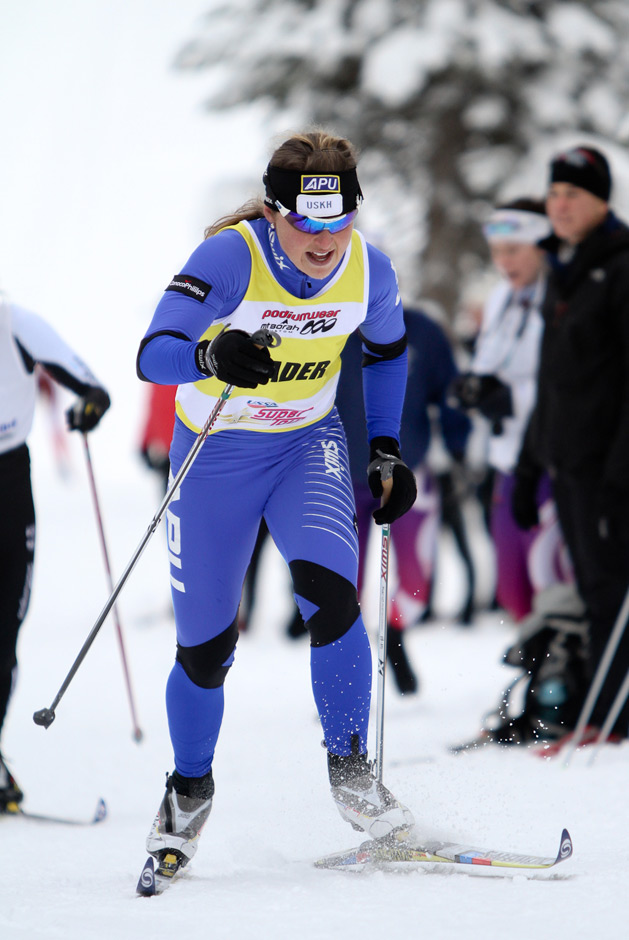
Kristina Strandberg (then racing for XC Oregon) racing in West Yellowstone in 2010.
I spent a total of 12 years living and ski racing in the US and I’ve come to think of Fredrik as one of the best coaches in the nation,” she continued. “He is a skier through and through, with a solid understanding of the sport and an unparalleled interest in the development of technique and equipment. He understands the commitment it takes to be a college athlete and he knows how to offer the support that is needed to succeed. When I was out of college and raced on the Supertour he was still there for moral support. I truly believe that I would not have become the skier I was, in college or afterwards, if it wasn’t for Fredrik and I still consider him one of my best friends.
I can only echo what others have said before me regarding the Ski Team’s impact on the local ski community. Our coaches always made a point of us reaching out to local skiers and to participate in local events. I’ve skied all over NM, in places like Abq, Red River, Santa Fe, Los Alamos and Chama. People have always been very happy to see their “local” university team in action. I also enjoyed weekend camps in Durango, CO, where we interacted with kids and coaches in the ski club.
One aspect that is often overlooked is that we were given fantastic opportunity to explore the Southwest. The Ski Team went on several training trips a year, all around NM and the surrounding states. With no other support needed than a van for transport, we biked in Moab, hiked Wheeler Peak and ran in White Sands. Fredrik made a point of showing us as much more of the country as he could. He’s really proud of his adopted home grounds and I am too!
Strandberg also gained a post-graduate scholarship for additional study at UNM. She ultimately graduated with a Masters of Science degree, which, she added, “I’m putting to good use now at my job as a methodologist at Statistics Sweden.”
Back in Albuquerque, the current members of the ski team continue to hit the books. At the 2017 Lobo Scholar-Athlete Banquet on Monday evening, “the Athletic Director’s Cup for the top academic program went to women’s skiing for the second straight year,” according to a UNM press release. Additionally, three of the nine senior student-athletes who were honored for graduating with a 4.0 GPA hailed from the ski team.
UNM senior Sydney Staples racing at 2017 NCAA Skiing Championships on March 10 at Mittersill at Cannon Mountain in Franconia, N.H. (Photo: flyingpointroad.com)
Alpine skier Sydney Staples, a senior from Bountiful, Utah, who is one of the three skiers about to graduate with a perfect GPA, was named the women’s Lobo Club Student-Athlete of the Year. In an emotional speech captured on video, Staples unsuccessfully fought back tears as she acknowledged the elephant in the room when it came to celebrating the accomplishments of the UNM ski team at this particular time:
“My team just barely received an award for [highest] cumulative GPA for the women’s team, and there are three of us skiers up here,” Staples said. “And there are a lot of skiers in this room right now that are going to go on to compete at the highest level of the World Cup or go to the Olympics, and some will stay here and pursue careers. And I’m so proud of all that they’ve accomplished, all that we’ve accomplished. And at the same time, I’m devastated that they won’t get the opportunity to stand where I’m standing today.
“And for the kids that we ski with each year in Santa Fe, and … Taos, and Colorado, all over the states, who tell us that they want to be just like us when they grow up – I’m sad that they won’t get that opportunity either,” Staples continued. “And so I want to encourage you, everyone here, to keep working hard, in your sport and in your classroom, and to keep taking advantage of all the incredible opportunities that are given to you at this school. Because you never know if that opportunity is going to be taken away from you.”
Staples subsequently left the podium to a standing ovation.
At 35, Kristina Strandberg (XC Oregon) has enjoyed something of a resurgence in her career this year, with strong results in the West Yellowstone SuperTour races and in events in her native Sweden. Still, it might come as a surprise to see Strandberg on the start line of the Tour de Ski on Tuesday.
No, not that Tour de Ski—Strandberg won’t be in Germany alongside Justyna Kowalczyk and Kikkan Randall. Instead, she’ll be in the town of Xiwuqi in Inner Mongolia, for the first race of the four-stage Tour de Ski China.
In an e-mail, Strandberg said that she was invited to participate in the event in a month ago,and while the details weren’t clear, she accepted.
“It was hard to turn down a free trip like that,” she said.
Strandberg (XC Oregon) getting after it in West Yellowstone.
According to its official website, the Tour de Ski has been held every year since 2008. It’s organized by Nordic Ways, a Chinese sports tourism company, with the help of the International Ski Federation and the Chinese Ski Association.
The 2011 edition features four stages: two sprints, a short distance race, and the 50-kilometer Vasaloppet China. The third stage—one of the sprints—will be held at night in Beijing’s Bird’s Nest stadium, which was used as a venue for the 2008 Summer Olympics.
In the past, a number of Scandinavian athletes have competed, including Norwegian Kjetil Hagtvedt Dammen, and Swedes Anders Hoegberg, Peter Larsson, and Maria Rydqvist.
Olympic gold medalists Bjoern Lind and Thobias Fredriksson, both Swedes, headline this year’s start list. And Kjell-Erik Kristiansen, the peripatetic World Cup announcer, will be on hand to call the sprint at the Bird’s Nest, according to the race website.
The prize purse isn’t on the same scale as the European Tour de Ski, which awards upwards of $100,000 to the top finisher. But it’s not bad: stage winners in China will take home 1,075 euros, while the overall victors each get 2,150 euros.
Strandberg departed from Europe on Sunday, and with the first stage of the tour coming on Tuesday, she won’t have a lot of time to adjust to jet lag. In her e-mail, she said she wasn’t sure what to expect from the race.
“At this point, I have no idea what I’m getting myself into,” she said. “I hear from the girls who have done it before that it is a lot of fun, and some good skiing, but beyond that, I know as little as you.”
The women’s 5 k classic SuperTour may have been held in West Yellowstone on Saturday, but the top of the results sheet read like an event from Scandinavia, with international skiers claiming three of the top four spots.
Kristina Strandberg (XC Oregon) edged out Holly Brooks (APU) for the victory, while fellow Swede Maria Graefnings (U of U) rounded out the podium, ahead of Czech Eliska Hajkova (CU).
Strandberg capped an excellent stretch of racing this week, in which she finished in the top five in all four events.
A two-time overall SuperTour Champion, and veteran of nine World Cup starts, Strandberg overcame understandable fatigue to beat out Brooks by five seconds.
“Today was hard,” Strandberg said following the race. “I felt like there wasn’t much juice left in the tank, but I was trying to think that if I feel like this, everybody else does too.”
And while it is still early, Strandberg felt significant pressure, telling FasterSkier, “a lot of people expected me to win, and I didn’t really realize how nervous that would make me, so it is an enormous relief.”
She noted that that the pressure came from herself as well, adding that she “really wanted to win the classic race here, and knew I had a chance. I wanted to prove that I can still do this.”
“I am an M2 after all,” she concluded with a laugh, referring to her relatively advanced skiing age of 35.
Holly Brooks (APUNSC)
Brooks leaves West Yellowstone with the overall SuperTour lead, thanks to her two victories in Thursday’s Sprint Showdown and consecutive second place finishes in the distance races.
“Strandberg is an awesome classic skier, and 5 k classic is her thing,” Brooks said. “I feel good about being five seconds behind her in that.”
The course, significantly changed from past SuperTour events, featured two large climbs, including the wall of “Telemark Hill.”
Despite being a strong double-poler, Strandberg was happy to see the additional terrain.
“This is a much better course, and a much better race altogether.”
The big hill was an obvious pick as the difference maker, but Brooks noted that she was five seconds down on Strandberg before the climb—which didn’t change by the finish, just one kilometer later.
While several women did manage to stay in the tracks for most of the big climb, race organizers eliminated them on the steep pitch toward the bottom, and many athletes chose to step out toward the top.
Brooks described the technique of choice as “a running herringbone,” and noted that the off-camber nature of the hill presented an additional challenge. She said it was important to keep her herringbone narrow and the tempo high, which made the hill go by quickly.
Like Brooks, Strandberg chose to climb a majority of the way outside the track. She opted for more glide, trying to “stay a little light with the kick wax,” and wasn’t entirely thrilled with the decision.
“I ended up going outside the track, which—I don’t necessarily think that was the best,” she explained. “But on the other hand, going in the track and slipping is not good either.”
Strandberg “just tried to hammer” over the top, and said that she was glad she could stick to double poling for the last kilometer of the race, “because my legs were gone.”
Hajkova, the fourth place finisher, was also happy to see the large climb.
“I love uphills, so I felt really good on the big hill,” she said. “It is a nice change, because you have to change your tempo, and it wakes you up again.”
Maria Graefnings (UU)
Graefnings, a 25-year-old student at the University of Utah, clocked in at just a hair over 16 seconds behind Strandberg. She skied last season for the University of Nevada-Reno (UNR), but transferred to Utah when the UNR ski team was cut.
“The conditions were awesome today, not too cold, and really good tracks,” said Graefnings, who also has World Cup experience.
Hailing from the ski mecca of Falun, Graefnings notched her second consecutive SuperTour podium. She edged out Strandberg in Friday’s 10km freestyle, much to the good-natured chagrin of the elder Swede.
After the race, Graefnings said that she has been enjoying her time in the US.
“College skiing is special, something you can do once in your life,” she said—though she doesn’t see graduation as the end of her elite career.
“I am going to go back to Sweden and try to make the A-team. But right now I am here, and it is super fun,” she said.
The 22-year-old Hajkova placed second in the classic sprint and sixth in the freestyle version, before sitting out Friday’s distance race.
With only six days on snow under her belt, she was pleased with Saturday’s effort.
“I felt good, and we had great skis. It is just the beginning—and I think everybody will be better later in the season,” she said.
Hajkova, who raced in the 2009 Tour de Ski, edged Friday’s freestyle winner, Kate Fitzgerald (APU), by four seconds.
With Brooks in second, Fitzgerald in fifth, and Morgan Smyth, Sadie Bjornsen and Becca Rorabaugh ranking sixth through eighth, respectively, APU had the top five American women in the race.
Eliska Hajkova (CU)
The Continental Cup circuit now moves to Canada for two weekends of NorAm races. Brooks and the rest of the APU squad head north to SilverStar Resort in a few days, while Strandberg is on her way to Sweden.
“Sweden has a lot of good skiers right now…and it is a tough crowd to race against,” Strandberg said. But she added, she enjoys the challenge, which makes it more fun if she’s skiing fast.
“When you race well in Sweden, people notice—there is so much more media coverage,” she said.
This is Strandberg’s final season of focused elite ski racing, and she has no specific goals.
“I am taking it as it comes. This season is like a bonus season for me. If I am not enjoying it, I am not going to suffer it out,” she explained. “But so far so good!”
The surprising Fitzgerald entered this season with just a single top-10 result, and no top-5’s, in nearly 30 SuperTour, NorAm, and U.S. and Canadian Nationals starts. She will leave West Yellowstone with a win, a third, and two fifths, moving her into the upper echelon of the U.S. women’s field.
But on Saturday, it was the veteran Strandberg standing on the top step of the podium.
“I am stoked,” she said, before engaging in some well-earned Swedish patriotism. “And, you know what, we’re dominating on all continents right now!”
BEND, Ore. – Kristina Strandberg moved to Bend from Sweden. Evelyn Dong moved to Bend from the East Coast. And Chisa Obayashi just recently transplanted herself in Bend all the way from Hokkaido in Japan. They all have been training with the XC Oregon program director and coach John “JD” Downing.
“The three of them are in pretty identical positions, in three different ways. Evelyn is just on the cusp of a breakthrough, Chisa is on the cusp of making the Japanese national team, and Kristina has raced on the Swedish World Cup team,” Downing said.
Perfect match
Obayashi, 25, first came to Bend in June, but the initial set-up happened earlier this spring.
“I tried the SuperTour in the spring, and Peter Hale, the racing manager for Madshus USA, introduced me to some club teams in the USA. I chose Bend and XC Oregon, and JD accepted me,” Obayashi recalled.
Downing was excited to welcome Obayashi to Bend and explained that the chemistry with the women on the team could not have been better.
“Chisa and Kristina really hit it off and trained together daily. The design of our program is perfect for that,” he said.
Kristina Strandberg during a dryland workout in Bend, Ore. (Photo: The Center)
Independent and flexible
“Our program is pretty much perfect for Chisa in that it is so athlete-driven. It lets the athletes dictate how they train, and because the program is so athlete-based, I as the director didn’t really do much for Chisa on a regular basis besides making sure the logistics were covered and match her up with training partners,” Downing said.
Downing explained that self-reliance has been part of his coaching philosophy since the XC Oregon program was established 12 years ago, and that the independence helps athletes excel.
“Chisa could easily have flourished in a more structured training environment as well, but I think she really benefitted from seeing how independently athletes train here and how they can take advantage of the support when it’s there,” Downing said. “Bend is an amazing place to train, and one of the best places in the world for skiers.”
On her first visit, Obayashi stayed for three weeks. She arrived just as the snow season was transitioning into dryland. She didn’t mind at all, as Bend has plenty to offer no matter what the time of year.
“I really like Bend. Bend is a great place for training. It has the best weather, and it has some really nice roller ski courses and big mountains,” Obayashi said. She ended up training a lot with Strandberg – much more than Strandberg had imagined to start with.
“She is pretty much a self-coached athlete, and after one of her first camp workouts, she wondered what I was doing the next week. So I sent her my training plan for the week and I figured she could pick out which workouts she wanted to join me for. But then she just said that the plan looked great and did all of it with me,” Strandberg said with a laugh.
In love with Bend
In fact, Bend was such an amazing place for Obayashi this spring that she e-mailed Strandberg from a New Zealand training camp this summer and wondered if she couldn’t come and stay with her for, say, four weeks this September.
Chisa Obayashi teaches Lars Flora how to make sushi from scratch. (Photo: Kristina Strandberg)
“You always start to wonder when someone comes to stay with you for several weeks, how on earth that is going to go. We don’t exactly have the largest house in town. But she is the easiest house guest ever. She immediately told us she likes housework and likes to cook, and she did a lot of both,” Strandberg said, mentioning that homemade sushi and Japanese specialties often landed on her dining table.
Mutual benefits and lasting impressions
“Kristina and Evelyn taught me some training methods and ways to weight train,” Obayashi said. “They are very strong and have very strong spirits. I have a lot of respect for them, and want to train to become as strong as they are.”
While Strandberg and Dong might have taught Obayashi a lot about their training methods and sent her home with some new tricks – most importantly, more focus on heavy strength training – Obayashi certainly left her impression on the Bend girls too.
“Skiing with Chisa was valuable, because she has perfect technique every minute she is out there,” said Dong. “She is never sloppy, even when we’re just going easy. You can tell she puts a lot of hours into perfecting every detail. That’s probably the thing that stuck out the most and hopefully will stick with me the most,” Dong noted.
Obayashi inspired Strandberg and Dong in ways that go far beyond the trails.
“She is incredibly polite and expressed such gratitude whenever she got help. She was always nice and kept her stuff in meticulous order. Even on training camps when things start to go everywhere for all of us, Chisa kept her stuff neat and packed away,” Strandberg said.
Now what?
For the upcoming season, the three skiers are in very similar positions. They all have to prove their potential to earn spots on their respective teams, and they all dream big.
Strandberg, 35, will try to make the Swedish World Cup team again this season, but she knows it will be hard.
“It’s a very hard team to get onto at this point, and it will be more interesting for the coaches to pick a 20-year-old than a 35-year-old, everything else being equal,” Strandberg explained. “But I will race hard and do my best, and if I make it, it would be fantastic.”
Obayashi will go to Muonio, Finland, with the elite ski team from Japan. “I want to get a chance to race at the World Championships in Oslo and get a good result,” she said.
However, to make it to Oslo, Obayashi will need to have all the stars aligned for her.
“She has to ski really well to make it to the World Cup,” Strandberg said. “She’s a distance racer, but she hopes to make it to the World Championships this year. It would be amazing if she did.”
Dong, 25, also has her eyes on Oslo.
“My goals for the season? I’m aiming big. I want to go to the World Champs and make top 30,” she said.
Kristina Strandberg raced in seven World Cups for Sweden last year
Our Pro Workout series continues, this week shifting from rollerskis to running shoes for ski bounding intervals with XC Oregon’s Kristina Strandberg.
A native of Sweden, Strandberg is a consistent force on the U.S. racing circuit. A two-time SuperTour overall champion and repeat winner of the FasterSkier Continental Skier of the Year award, Strandberg earned a spot on the World Cup circuit for the start of last season.
She competed in seven World Cup events, with a top finish of 24th in the classic sprint in Rogla, Slovenia, before spending the bulk of the winter racing in Scandinavia. She returned to the U.S. for the SuperTour finals, and is now back in Bend, Oregon, training hard.
We talked to her about a staple of that training: ski bounding intervals at the renowned rock climbing mecca that is Smith Rock State Park, outside of Bend.
“It is so easy to push the intensity right to where you want it,” Strandberg says of bounding, “sometimes even more so than rollerskiing.”
While she varies the duration of the intervals over the course of the season, a common choice is a challenging 6×5 minute workout. The Smith Rock access road allows her to complete the session without excessive downhill running in between, while providing an ideal steady climb.
Pacing is a key component, and the ability to regulate heartrate is also critical. She starts the first interval at a controlled pace, with the goal of going faster and working harder during each successive repetition.
Starting too hard is a common problem, and one that Strandberg strives to avoid, pointing out that if she pushes her limits on the first interval, she will build up too much lactate and will struggle to complete the workout.
For example, explains Strandberg, “if I start the first interval at 170 (heart rate), and then push it a few beats every interval, I can easily finish around 180 without filling up with lactate.”
But while there is a fine line to ride, recovery is less clearly defined. Strandberg does not worry about resting a precise amount, usually taking three to five minutes between intervals.
“Usually what happens is that I might take three minutes after the first few, and then upwards of four minutes toward the end.”
Coach Justin Wadsworth has told her that resting as much as six minutes is fine, but she prefers to keep it shorter than the length of the interval.
At this point in the training year, Strandberg will do a bounding-type workout every few weeks. Her plan used to include interval blocks, and therefore many more of such sessions, but as some of her focus has shifted to other areas of her life, she no longer has the time for the extensive recovery needed to execute that type of training.
But the experience of periods of daily intervals has taught her to dial in the precise effort to maximize the benefit of the session.
And while individual pacing is key, it doesn’t mean that the workout has to be done alone. Strandberg often pairs up with XC Oregon teammate Evelyn Dong. Dong is a faster bounder, but Strandberg keeps her under control on the earlier intervals, then lets Dong pushes the pace as the workout progresses.
Smith Rock, a climber's mecca, is a good place for Strandberg when she wants to mix up the setting
Technique is also important, and Strandberg stresses the importance of using bounding poles of appropriate length. She goes with poles shorter than her classic sticks, allowing her to push her hands all the way through with each stride.
Smith Rock State Park is 30 to 40 minutes outside of Bend, and one of the major appeals of this workout is the opportunity to vary training. Strandberg describes XC Oregon trips to Smith Rock as a “treat.”
“Workouts are workouts, and you do a lot of them over the course of the summer, so it is nice every now and then to pull an ace out of your sleeve,” she said.
Strandberg does point out that skiers need to watch out for rattlesnakes, and that the reaction of choice is “to scream like a girl” (which, rumor has it, even three-time Olympian Torin Koos is wont to do – at least according to training partner Lars Flora).
Despite the dangers of venomous snakes, getting out of town is worth the time. “It is really good for inspiration to go somewhere else and have a spot that you don’t do all the time. Smith Rock is just that.”
After four races and flying across half a dozen different time zones in the last week, Kikkan Randall probably had a tough time telling up from down and left from right on Wednesday. But in the U.S. 30 k National Championship, she could still do the one thing she does best: ski fast, and win.
“My body really doesn’t know what to think,” she said. “But it’s in good shape, so we’ll just keep rolling.”
After an hour and a half of tight pack racing, Randall won the sprint over CXC’s Rebecca Dussault and APU’s Holly Brooks, with Caitlin Compton (CXC) and Canadian Brooke Gosling just behind.
With narrow trails and only one track skied in, there was little chance for Randall’s rivals to mount a challenge once she took the lead on the last of three ten-kilometer laps.
“There wasn’t room,” Dussault said. “I made a move to try to get by Kikkan, and it…got shut down, because it was just so easy to block each other.”
While eight inches of snow and a big dose of rain fell overnight, the precipitation had mostly tapered off by the time racing got underway at nine. But there was still enough new snow on the course to keep the women single-file.
Holly Brooks leading a big group in the field early in the race
Randall led the race from the gun, stringing things out to stay out of trouble in the first few kilometers. With Brooks’s help, the lead pack was already down to six by the end of the first lap: Randall, Brooks, Compton, Dussault, Gosling, and SVSEF’s Nicole DeYong.
Taz Mannix (APU/USST) had been left behind in an early split, when she’d been passed by some skiers who couldn’t respond to a pace increase. Mannix managed to chase back to the leaders with Kristina Strandberg (XC Oregon), but the pair couldn’t hold on for long.
For the next 15 kilometers, all six women did their time at the front.
“We…all took one, some maybe took two longer leads,” said Dussault. She said she tried to ratchet the pace up at one point to see who could hang, “and everyone hung.”
Through the end of the second lap, the composition of the lead pack was static. Then, at 25 k, the pace finally ramped up as the women got a whiff of the finish line, and DeYong got popped.
As they dropped down onto the open field that precedes the long, grinding, two-kilometer climb to the finish, Randall was at the front, and from that point, her win seemed inevitable.
“I kind of knew I was going to be stuck out there—I didn’t think a lot of people were going to want to take the lead,” she said. But, she added, she also knew that “with it being such a narrow trail, if I could control the pace on the way up, then I’d have a good shot for the end.”
Randall’s decision proved to be a wise one, as behind her the remaining women did everything but drop their poles and bare-knuckle box for position for the downhill sprint into the finish.
“There’s really no opportunity to pass,” Brooks said. “If someone’s trying to make a move, they just get off in this soft stuff on the side…People were trying all kinds of things—that was more contact than I’ve had in a ski race in a long time, sprints included.”
Brooks made a desperate bid to pass Dussault before the sprint, but couldn’t get by, while Compton elected to stay out of the fray.
“There were some definite fist throws, and poles, and things going on skis everywhere,” said Compton. “I was like ‘oh my gosh, I’m staying out of this one!’”
No one could challenge Randall, though, and with a downhill sprint to the line, she was on overdrive, cruising to the line to beat Dussault by just over a second. Brooks, Compton, and Gosling followed.
Randall crossed the line at about 4:30 PM Swedish time, where just she wrapped up her fourth race in five days on Sunday.
Randall at the line
She said she couldn’t miss partying with the her friends from the World Cup, so she only got about two hours of sleep before catching a four AM shuttle to the airport.
She arrived in Maine at about 11 PM , then slept for seven more hours before heading out for an easy ski on Tuesday. With the coach’s meeting wrapping up late in the evening, she still didn’t get much rest before Wednesday’s race.
A 30 k on top of so much travel probably would have put most skiers in a coma, but “Kikkan’s really, really, really tough, and really good at managing her recovery,” said Erik Flora, her coach at APU.
There was some concern over Randall opening herself to illness, but the two discussed it on Tuesday, and she felt more than good enough to pull the trigger.
It was Randall’s first-ever U.S. Championship in the 30 k, and her success after such a brutal schedule could be a harbinger of things to come next year.
“It kind of gives her a little bit of a look at racing the Tour de Ski,” Flora said.
Rick Halling is the Director of Nordic Racing for Atomic US.
The summer preceding an Olympic year is a tense time for coaches, athletes and suppliers. The old saying that skiers are made in the summer definitely holds true. Both the quality and quantity of summer training are highly scrutinized in an Olympic year. Along with the training, athletes are reviewing their equipment needs and many are switching to what they feel are more competitive choices. Most ski companies wish they could support every applicant. Unfortunately, resources are limited and race directors start to feel like the dean of admissions at highly desirable colleges. The race departments of different ski companies not only look at athletes’ results when choosing recruits, they look at what roles the athletes play with junior programs, master programs and how they represent the sport.
Atomic was thrilled and honored to have two time North American Skier of the Year, Kristina Strandberg, become part of The Thin Red Line this summer. Kristina is a four time NCAA All American, two time Super Tour overall champion and a USSA National Champion. She has an impressive record of promoting the sport and she represents the Olympic ideals. We called her right after she returned from summer training in New Zealand.
Kristina Strandberg
RH:Did you have a good camp in NZ?
Kristina: Yes, the skiing was really good with lots of snow and excellent grooming. It was three weeks of solid training and a good opportunity to test skis. I think we were pretty lucky with the weather too, not too much wind and mostly blue skies.
RH:Were you in some races? How did you and the Americans do?
Kristina: There were no races while we were at the Snow Farm, but we did a couple of time trials together with the USST. It’s always nice to have people around you who can push you in training. I prefer the more casual time trials to racing in the summer months though.
RH:I have been at the tunnel in Vuokati and the Dachstein glacier for end of summer skiing. I always see a number of Europe’s top teams at both locations. I have asked them about New Zealand and why they don’t go. All the Euros have given me the same answer, the level of athletes in NZ is not very high and that is an important part of training. The European teams claim that when they go to Vuokati or Ramsau they will be skiing along side the best in the world. If they go to NZ, they will be skiing with lower tier athletes. That seems like a pretty strong argument for choosing Europe over NZ, can you comment on that?
Kristina: It is really important to expose yourself to skiers faster than yourself every now and then. I think that is true for both training and racing. It is a good way to see in what areas you need to improve and it reminds you what you are striving for. It is of course also inspiring to train alongside World Cup winners and Olympic Champions. At the end of the day you have to train for yourself though. When you have to put all your focus on your own training it can be a little distracting to see other athletes ski faster than you. I think one of the most important reasons for the Euros to go to Vuokati or Dachstein is that they get a good camp with good training partners really close to home. NZ is a lot father away.
RH:Do you remember the old Saturday night live skit, “Pat?” Characters could never figure out if Pat was a man or a woman. Anyway, you are a four time All-American, you are a US SuperTour Champion, you are an USSA National Champion and you have been voted North American Skier of the Year for two years. But it sounds like you will be going to the Olympics in a Swedish uniform. Just like we couldn’t figure out Pat’s gender, it’s hard to figure out your nationality. What are you?
Kristina: If you check my passport you’ll find I’m Swedish. I am very much a product of the Swedish ski culture; I grew up in a family where skiing was the favorite pastime and we would watch both domestic and international ski racing on TV almost every weekend. Just like (I imagine) American kids grow up dreaming about the Major League or the NFL, I grew up dreaming of skiing for the Swedish National Team. On the other hand, I spent four years on the American College Circuit and six years on the Factory Team. I definitely feel like a part of the US Ski community. People here have been very nice and made me feel at home, like I am an American skier. But the final conclusion is; if I qualify to wear a National, it will be a Swedish one.
Pat from Saturday Night Live. Never really knew what he/she/it was???
RH: Uniforms. You raced NCAA for four years in a Lobos uniform. After college you raced another six years in the NorAm and marathon circuit in a manufacturers uniform. Then you finally return to Europe and enter the women’s 30k classic in Norway, arguably the most prestigious and competitive of all World Cup events, and you wore the Swedish National Team uniform. A lot of Americans would have trouble comprehending this kind of pressure and honor. A good analogy would be if a young American went overseas to play baseball right out of high school, and after seven years he returns to the US and in his first game he puts on a Yankees uniform and plays against the Red Sox at Fenway. Can you describe the experience?
Kristina: It was quite an experience. Growing up it was always a dream to someday wear the Swedish uniform. It felt a little strange that I qualified for the uniform by racing here in the US, but the Swedish team was very accommodating and I got to travel with them for two weekends. I thought I could just sneak into a Word Cup, try it out without being noticed, but that did not happen! Skiing is a major sport in Sweden and people really care who gets to ski World Cups and who do not. When all of a sudden this “new” unknown girl was on the national team they had to explain who I was and where I came from. Overall the whole WC experience was nothing but positive. It was such an incredible feeling skiing at Granasen (Trondheim) with the ski trails lined by screaming spectators. I’d gladly do that again!
RH:How helpful were the Swedish technicians? Were the Swedish women very supportive?
Kristina: Everyone was very helpful. The technicians have a big Scania truck to wax in with room for (I think) seven people to work at the same time. Every athlete has a wax technician assigned to him or her and they help you out with both waxing and testing. I got all the help that I needed and could not have asked for anything else. The women were all very nice to me and they patiently answered all the questions from the WC newbie. They had quite a few questions themselves about skiing and living in the US. The only girl I knew since before was Anna Olson, we skied together in the same region when we were juniors. It was pretty cool to be out at ski races together again, it’s been a while!
Swedish wax technicians are always eager to help.
RH:What got you to switch to the Thin Red Line?
Kristina: The decision to switch ski brands matured in the weeks after Nationals in Fairbanks. It is an important year coming up and I had to put myself into the best possible position to be competitive internationally and skis are a big part of that. I looked at the different options in front of me and I felt that Atomic was my best chance to get good skis and WC support. After three weeks testing in New Zealand I’m confident in my decision.
Support is as important as the skis. Atomic's Roar Lillefjell is a key reason why so many athletes are switching to the Thin Red Line.
RH:Roman Toferer likes to use World Cup athletes as guinea pigs to test new ideas. Did he set you up with a couple of pairs of the Featherlight prototypes? How do you like them?
Kristina: Yes, I really liked them. At first all the skis were new and different from what I had been on before, so I did not notice too much of a difference to the regular Worldcup ski. After trying the skis for a while, I noticed that I really enjoyed skiing on the Featherlites, especially the skate skis. They were really stable and easy to ski, and most importantly, they were really fast.
Athlete as guinea pig. Kristina tests the new Worldcup Featherlight in full on winter conditions in New Zealand.