From the FasterSkier archive — posts syndicated from athletes’ and coaches’ own blogs between 2004 and 2012, kept online as published. Current coverage is at fasterskier.com.

Tag: Kristina Trygstad-Saari

  • Finding Assurance with Michael Stone

    Finding Assurance with Michael Stone

    We often hear of the pipeline in Olympic sport. The path to the highest level of elite competition. The pipeline is not consistent in diameter: Wide-mouthed at its start, tapered to needle-wide at its terminus. There are many ways to identify talent within a pipeline. In the cross-country ski world, there are incremental benchmarks to progress to the next tier. Within U.S. Ski & Snowboard, for example, skiers in the pipeline begin in the club system and might progress from local, regional, Junior Nationals, Junior Worlds, to senior-level racing.

    It’s a system with a relatively steady influx of skiers at the pipeline’s intake.
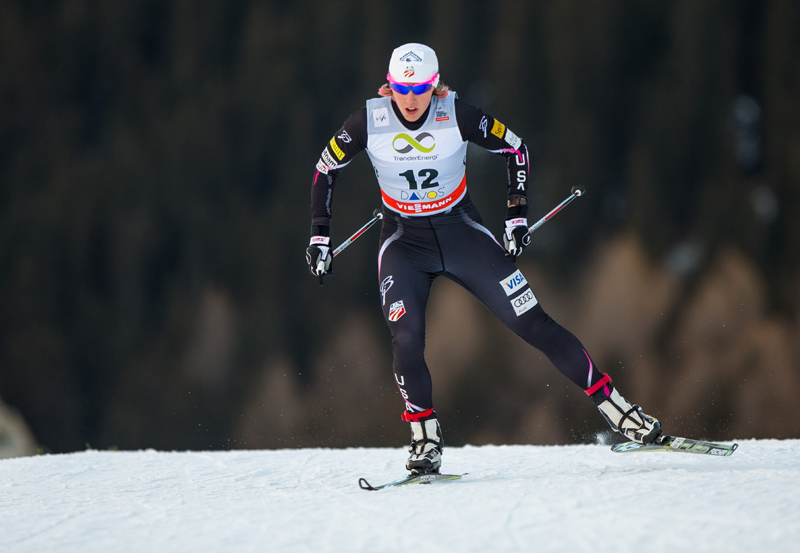
    Kikkan Randall racing here in 2013 on the World Cup, advanced through the U.S. Ski Team’s pipeline. (Photo: Fisher/Nordic Focus)

    One aspect of the product, the potential to advance in the pipeline, can, in many ways, sell itself. If you live in a mountain town or northern latitude city, odds are cross-country skiing is on the menu of outdoor activities for certain demographics. Two American women winning gold in 2018 is also a wonderful sales pitch to aspirants. This healthy lifestyle and medal-winning context afford stakeholders a modicum of breathing room when considering marketing approaches to athlete recruitment and the ability to maintain pre-existing participants. Although the problem of attrition in youth sports is real, and cross-country skiing is no exception, junior-level ski racing remains popular in traditional cross-country ski hotbeds.
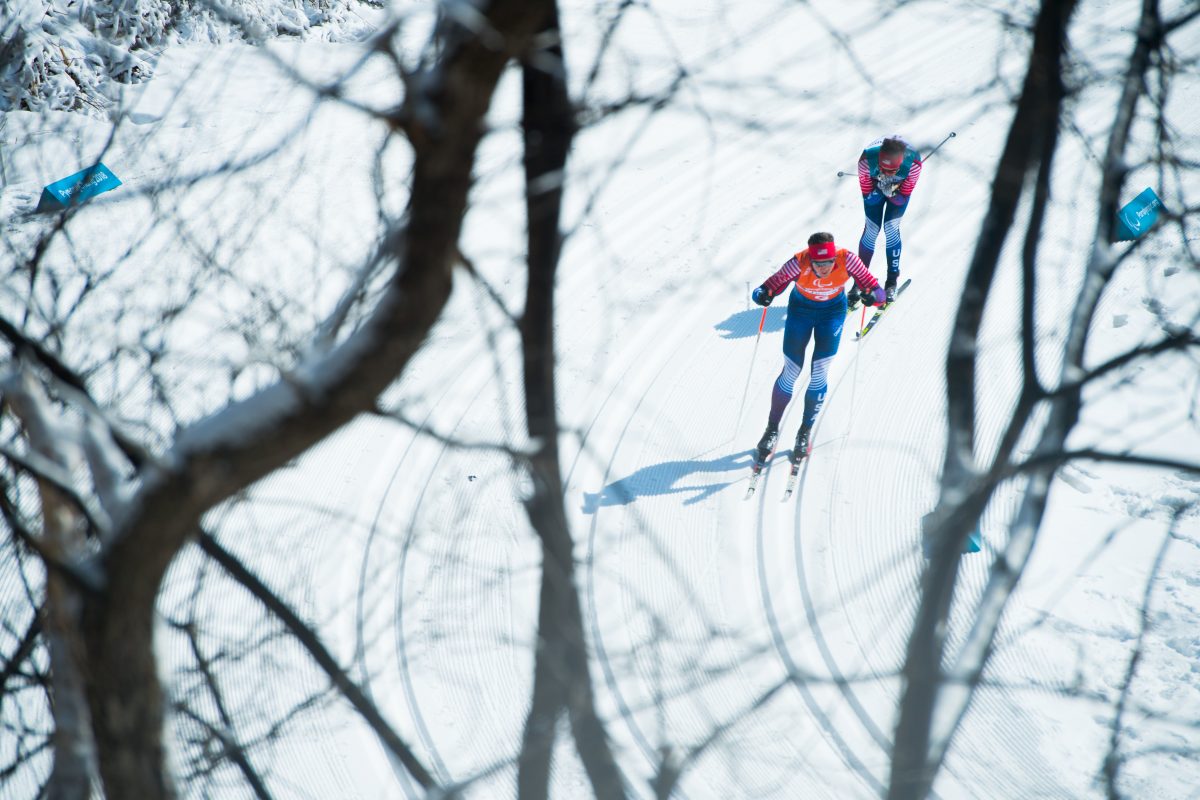
    Sawyer Kesselheim guides his U.S. teammate Jake Adicoff, a visually impaired athlete, during the open relay at the 2018 Winter Paralympics in PyeongChang, South Korea. (Photo: U.S. Paralympics/Mark Reis)

    The Para side of the sport, however, must take a more active approach when it comes to marketing. Drawing athletes into the Para Nordic disciplines requires a significant time investment with national-level coaches often meeting in small groups with raw beginners to introduce their respective disciplines.

    A few weeks back, US Para Nordic hosted a Zoom call for visually impaired (VI) athletes and families interested in learning more about how to become involved.

    Two US Para Nordic coaches were on the Zoom call, Kristina Trygstad-Saari, and BethAnn Chamberlain, along with several veteran athletes and a few newcomers. In terms of grassroots, this was the seeding process. A visually impaired participant logged in from Los Angeles, another potential visually impaired athlete, a teenager, logged in from Indiana. Neither had easy access to snow. Neither had skied before.

    A basic Q & A ensued. There was nothing extravagant about the presentation. Lots of nuts and bolts. Let’s call it pithy. Yet, the level of engagement was high. The meeting, which could have trended towards perfunctory, was not. By the end of the call, maybe 45 minutes later, the hook was sunk.

    My intent for listening in was to learn how US Para Nordic pitches their sport and attracts prospects to their respective pipeline, and then write up a brief story. I became sidetracked.

    ***

    Fifty-two-year-old VI biathlete Michael Stone, who spoke during the Zoom call, was my hook setter. Stone resides in Boulder, Colorado. According to Stone, his first race of any kind was the Bolder Boulder — an iconic 10-kilometer road running race that snakes through Boulder’s neighborhoods and finishes in a packed Folsom Field on the University of Colorado campus.

    “That was probably one of the most spectacular days of my life. And since then, over 21 years, I’ve done over 230 races,” said Stone.
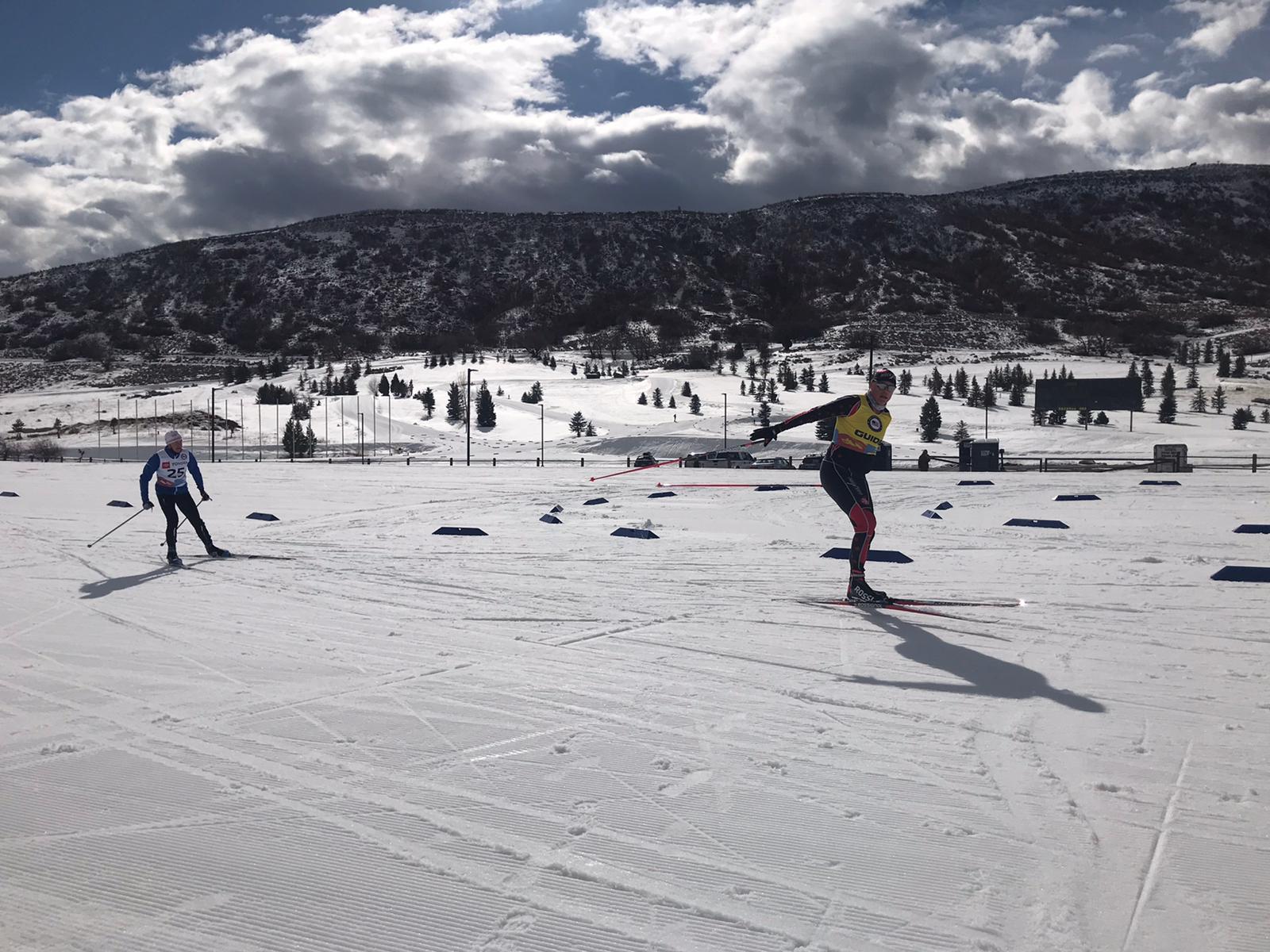
    Colonel Don Hickman guiding Michael Stone at Soldier Hollow. (Courtesy photo)

    In 2003, Stone completed his first Ironman. That race, in contrast to Stone’s first Bolder Boulder experience, was inauspicious. The race was in New Zealand, and at one point Stone inadvertently took a wrong turn. “I remember one of the course marshals yelled, ‘What are you blind?’ At that moment, I actually wondered if I was,” recalled Stone. “I mean, I remember feeling very, you know, dejected.”

    There’s a backstory here worth telling. Post-New Zealand, Stone returned to his childhood home in Chicago to seek advice from his family physician.

    The abridged version of Stone’s adolescence, which the doctor took notes on, goes something like this. A caring family that exposed Stone and his siblings to sports and the arts. There were eventual vacations to Aspen for downhill skiing which Stone began to dread. “Everybody else would be exhilarated and I’d be miserable,” said Stone. “We’d be skiing in the trees and I’d fall, and not even know why. I was screwed, even in good light. And it should have been a good indicator that something wasn’t adding up.”

    There were attempts at ball sports where Stone often could not see the ball thrown his way. There were laughs, and the “he sucks” microaggressions.

    “At some point, you just stay away from sports because it’s intimidating, it just eats away at your soul,” said Stone. “For a young person struggling, with their vision of something undiagnosed like dyslexia, every aspect of life is going to be very hard.”

    Stone withdrew. He folded himself into music where he learned to play the guitar and other instruments. “That’s where I hid from the world,” he said.

    But if you thrive on moving your body, as Stone does, the draw of sports can be irresistible. Stone eventually found martial arts, and then rock climbing – which initially brought him out to Boulder. According to Stone, hearing his climbing partners constantly tell him where to place his hands and feet pushed him out, saying it became too exhausting emotionally. He purchased a bike and he began to run.

    Then there was that goose-bump Bolder Boulder where Stone came running into that packed stadium. “It was just such a spectacular feeling that I forgot all about anything related to my vision or whatever,” said Stone. “It was simply that I ran six miles and that was huge.” Then came the Ironmans and the demeaning “What are you blind?” comment from the course marshall.

    ***

    Back in Chicago, Stone visited his physician and then a specialist who sent him to another specialist. The MD-PhD diagnosed Stone with a genetic degenerative disease called retinitis pigmentosa. The disease affects the retina’s photoreceptors.

    “The doctor was just beside himself,” said Stone. “He asked, ‘How have you gotten through life like this?’ It was like he knew everything, and he quickly told me what my life was like because obviously, it was a familiar story to him with sports and with school and family life, everything, he just sort of knew it. He had been diagnosing these things for probably 40 years. He was shocked that I had gone through life undiagnosed.”

    Stone said he had most likely been legally blind since he was five. His youngest brother was also diagnosed with the disease. Eventually, they traced the gene back in the family’s genealogical tree.

    The diagnosis helped Stone define his life trajectory. But as a successful hotel and spa developer, Stone has not defined himself solely as an endurance athlete. He is, like many role models among us, capable of compensating, adapting, thriving, and finding community. Stone understands his predicament but moves forward. He knows he’ll occasionally miss his toothbrush with the toothpaste, have issues making a simple cup of coffee, or have difficulty finding a public bathroom. Stone navigates a physical and emotional culture set up for the able-bodied. He’s still out there riding, running, swimming, skiing, and running a business — all at a high level.

    During some background reading about life as a visually impaired person, I came across this excellent story in the New York Times: Is There a Right Way to Act Blind by Andrew Leland. In short, Leland, who himself is blind, keenly explores how some people experience blindness, but also how sighted actors portray blind characters.

    This passage from Leland’s piece caught my attention: “I recently spent a weekend with a friend who has been blind since childhood. I watched him pat and fumble for objects, but he did so in a way that struck me as utterly assured, and entirely unembarrassed — his fingers scanned the table just as your eyes might: quickly, casually, without apology. I aspire to this kind of blindness. The only way to get there, I suspect, is through rehearsal — practicing until my blind presence becomes convincing, if not to the world then at least to myself.”

    Leland’s words, for me, resonated. It was a reminder that we travel the world on a gradient. We are constantly aspiring to be “utterly assured, and entirely unembarrassed.” I’m still trying to let that all sink in and imagine what that might be like for someone experiencing a disability and hailing a cab, or simply bathing. Let alone performing an endurance sport like biathlon at a high level.

    ***

    Stone discovered cross-country skiing over a decade ago and ultimately found an interest in biathlon. Para biathletes use an audio rifle with no live rounds. As the biathlete aims closer to the target, remember, this is the visually impaired class, the noise projected from the rifle becomes higher pitched. The VI athlete pulls the trigger when they sense via the rifle’s audio signal the shot is on target. Like able-bodied biathlon, keeping range time to a minimum is part of the challenge.
    Michael Stone (left) with his guide, Colonel Don Hickman (right), at Soldier Hollow. (Photo: BethAnn Chamberlain)

    Stone admits, although he is an accomplished triathlete, that he desires more independence. He rides on a tandem bike, and in some situations remains tethered to a sighted guide when running. Stone equates freedom with cross-country skiing. The closest he feels to being able-bodied is when he is skiing and then shooting on the biathlon range, explained Stone.

    “Cross-country skiing is one of the most spectacular sensations because it’s the closest thing I get to freedom and independence out of any sport I do,” said Stone. “I’m not tethered cross-country skiing, as I would be for running or swimming like we do in triathlon, I’m not on the back of a tandem. We’re on our own skis, on our own snow, and we have our own mistakes to make. We do get lefts and we get rights and a few whoops as verbal cues from a sighted guide, just to keep straight. And once we drop down in the shooting range, as we always shoot prone, it is pure freedom.”

    In the Para Nordic biathlon world, VI athletes are relatively scarce. That makes sense considering the logistics of transport, arranging a sighted guide if needed, and having access to a rifle and shooting range, let alone snow. Stone, for his part, has become an unassuming ambassador who wants to give back to a community of coaches and peers who have refeinforced his self-assurance. He is, as I came to realize, the perfect salesperson for any athlete hoping to get motivated and seize any opportunity.
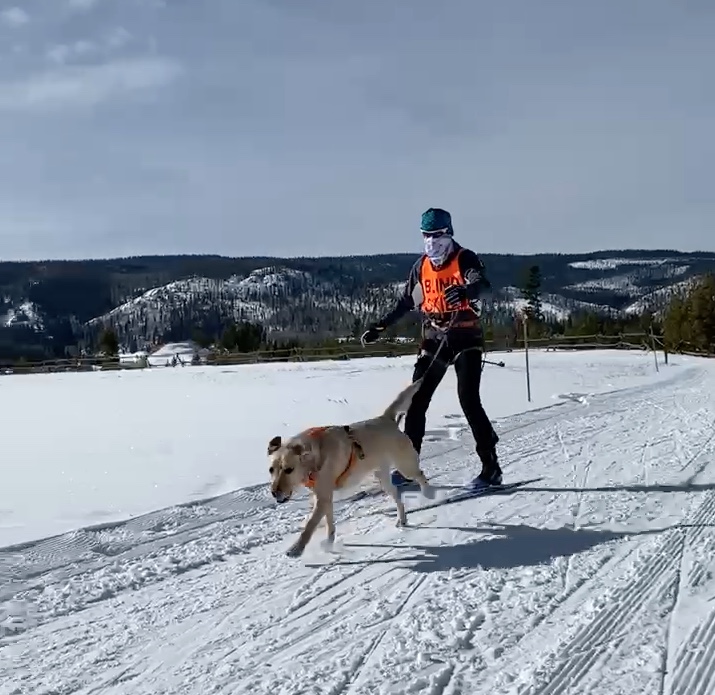
    Michael Stone skiing with his guide dog Geo. (Courtesy photo)

    “I’m not a young guy, and so when there are younger people, say in their teens and 20s and 30s, I don’t want them to miss out on this opportunity to experience biathlon — not to mention, just to be able to experience the love we get from the coaches,” said Stone. “I really don’t know why it’s there, they’re like higher beings to me. Nobody should face the world alone. And the fact that there are people that are willing and capable to at least try to walk in your shoes and create an opportunity for you when there are really few opportunities in this world that will be generated like this. I live by only a couple really important codes and one of them is you owe your best to the people who love you most.”

    My impression from Stone is that he could do most anything he wanted with his life. It’s a good thing he found cross-country skiing and biathlon. We’re better for it.


    For information about becoming a sighted guide, or becoming involved as an athlete, here’s a link to US Para Nordic’s recruiting survey.

    To learn more about how a VI biathlete shoots on the range, watch the video below. The on-range segment begins at approximately 2:55.


  • Paralympic Trailblazing with the Bogus Basin Nordic Team

    Paralympic Trailblazing with the Bogus Basin Nordic Team

    Bogus Basin Nordic Team (BBNT), based in Boise, ID, became a Paralympic Sports Club this year, the first cross-country ski team in the United States to do so.
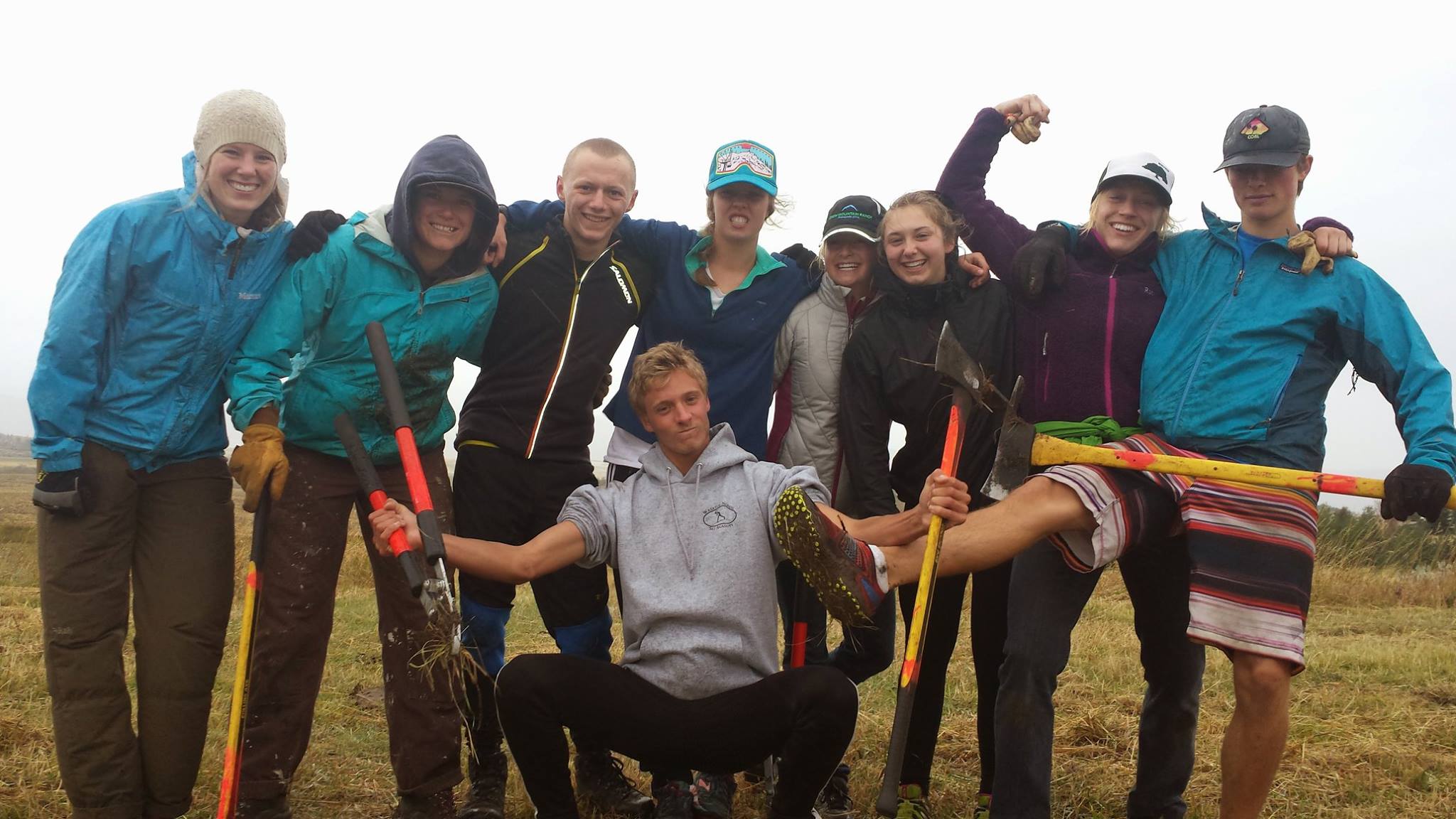
    Paralympic Sports Clubs are partnerships between US Paralympics and community organizations across the country that, according to the US Paralympics website, “provide local sports programming for individuals with Paralympic-eligible impairments.” They are “designed to be implemented within an organization’s menu of programs,” thus bridging the gap between adaptive-specific and existing sports programs within a community.

    Bogus Basin Nordic Team and the United States Paralympic Nordic Skiing coaching group during a “how-to” training session. (Photo: Sarah Carey)

    The conversation for BBNT to become a Paralympic Sports Club began with Wilson Dippo and Willie Stewart. Dippo is the former head coach and program director of BBNT. Stewart is a BBNT parent and Paralympic silver medalist in cross-country skiing. Both are passionate advocates for increasing inclusivity in sports programs, especially those meant for young athletes.

    “I am by no means an expert on working with adaptive athletes, but I have a lot of experience working with kids,” said Dippo. “And for kids, taking one group and putting them in a box or putting them over on the side seems like a really ineffective way to both build their skills and build their community.”

    Stewart, who lost his arm in a construction accident when he was 18-years-old, echoes this sentiment. He describes the experience of transitioning to life with a physical impairment as one characterized by “terrible loneliness.”

    “I was isolated and it was devastating. That was way worse than losing my arm,” said Stewart. “I believe that people with disabilities are often isolated. They’re sometimes put into programs where they’re training alone, and that’s not that empowering. If adaptive athletes are only in adaptive programs and little kids with disabilities are not with little kids without, that doesn’t grow a vision of inclusion.”

    Stewart is also a spokesperson and advocate for Challenged Athletes Foundation (CAF), an organization that strives to provide opportunities and support to people with physical challenges so they can pursue active lifestyles through physical fitness and competitive athletics. When CAF received a grant from The J.A. and Kathryn Albertson Foundation (JKAF) to start an Idaho-specific branch, Dippo and Stewart felt the timing was right to pursue becoming a Paralympic Sports Club.

    “It seemed like there’s no time like the present to start moving things forward,” said Dippo.

    Dippo reached out to Eileen Carey, director of United States Paralympic Nordic Skiing (USPN), for advice and information regarding how to become a Paralympic Sports Club. Carey took the opportunity to provide a two-day coaching clinic in Boise with Kristina Trygstad-Saari, assistant coach with USPN, last March.

    The first day focused on educating BBNT coaches and local ski instructors on how to work with adaptive athletes.

    “[Carey and Trygstad-Saari] gave us the rundown on coaching sit skiing, tips for working with visually impaired athletes and generally covering the basics,” said Dippo. “We even got to try sit skiing.”

    The following day, BBNT and USPN opened up the clinic to the general public. One of the attendees was 14-year-old Annie Carey (no relation to Eileen Carey), an accomplished adaptive athlete in track and field, swimming and triathlon.

    BBNT athlete Annie Carey racing at the recent SuperTour in Sun Valley, Idaho. (Photo: BBNT)

    Annie Carey is now fully integrated into BBNT and is the program’s first adaptive athlete. She recently competed in her first ski race in Sun Valley, ID and will be going to Soldier Hollow, UT in early January for the US Paralympics Nordic Sit Ski Nationals & World Para Nordic Skiing NorAm.

    While its adaptive program is still small, BBNT believes the Paralympic Sports Club designation offers the program credibility.

    “The story isn’t necessarily, hey look, BBNT is doing such a great thing, they have one adaptive athlete. Everybody give them a big pat on the back,” said Dippo. “It’s more, hey look, our doors are completely open and we’re going to do whatever it takes to actually make this door stay open. Not only are you welcome here, but we want you here.”

    Paralympic Sports Clubs also receive support and access to resources from US Paralympics and its National Governing Bodies and High Performance Management Organizations. These resources include coaching education and program development courses.

    “The materials out there for us all to read and look at are incredibly helpful. They’ve really made me feel more confident that what I’m doing is right,” said Emma Donohoe, co-head coach and program director of BBNT.

    “I can go in there and see how to compare Annie’s time to non-adaptive athletes. And if we were to have a sitting athlete, I can see what I need to be communicating to race organizers about what their course should be. It’s great for the technical side of things.”

    Additionally, Paralympic Sports Clubs have permission to use the US Paralympics logo, which may help with marketing and fundraising efforts.

    “When you have a big vision of inclusion and getting away from isolation, you can raise money,” said Stewart. “Access, integration and inclusion. Those are narratives where people will get on board and say, let’s do it.”

    On January 18 and 19, CAF will host an adaptive nordic and biathlon clinic in Tamarack, ID. USPN’s emerging athlete coach, BethAnn Chamberlain, will help run the clinic. Donohoe hopes the clinic, in conjunction with the recent Paralympic Sports Club designation, will attract more adaptive athletes to BBNT.

    “I believe that this sport gives you a lot for your entire life,” said Donohoe. “So expanding who can access becoming a cross-country skier in this valley is an important value to us.”

    Indeed, BBNT has a history of providing skiing opportunities to diverse and underserved populations. RefuSKI, a program started by a local English as a Second Language teacher, gives children who are part of Boise’s refugee population the opportunity to learn to nordic ski. Community partners and donors help support tuition costs, equipment, transportation, and clothing for children who participate. According to Dippo, BBNT usually has about six to eight kids who regularly participate in the program each season.

    “Having our refugee program up and running for years now has been really cool for both the refugee skiers and for everybody else on the team,” said Donohoe. “A lot of these kids wouldn’t know a refugee if they didn’t have a teammate. Same thing with para-skiing. A lot of our athletes don’t necessarily know para-athletes until they become teammates with them.”

    Elliott is a development coach for United States Paralympic Nordic Skiing 

    Paige Elliott at the 2018 Paralympics in PyeongChang, South Korea. (Photo: Courtesy Paige Elliott)Elliott is a development coach for U.S. Para Nordic 
  • Mia Zutter and Kristina Trygstad-Saari: Interdependent on the Ski Tracks

    Mia Zutter and Kristina Trygstad-Saari: Interdependent on the Ski Tracks

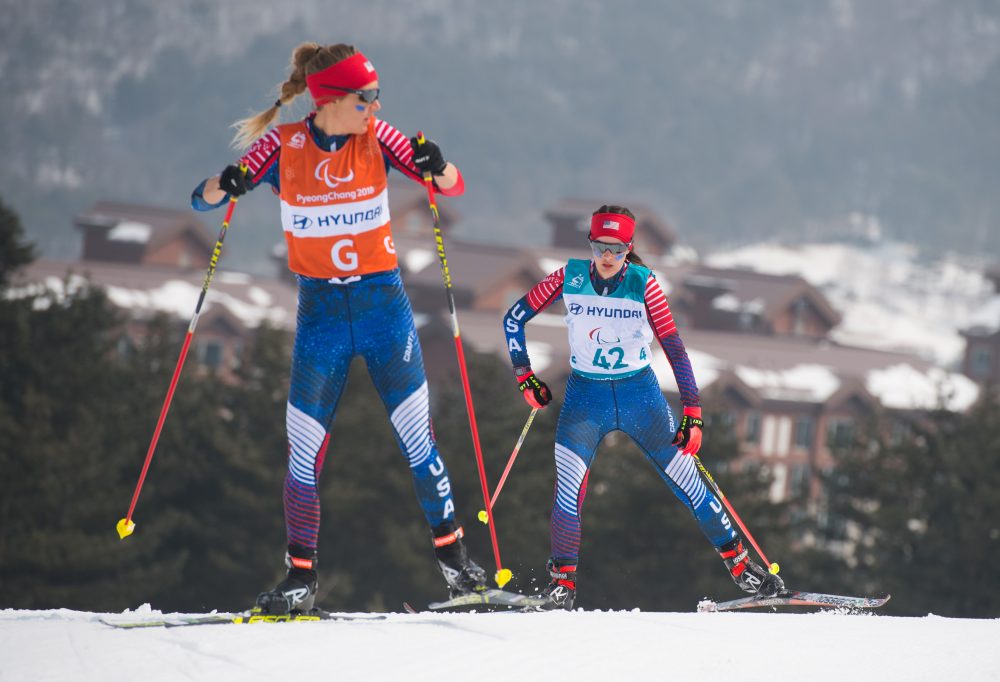
    Guide Kristina Trygstad-Saari leads Mia Zutter of the US during Cross Country competition Monday, March 12, 2018 at the Alpensia Biathlon Center at the 2018 Pyeongchang Winter Paralympic Games. (Photo:Mark Reis)

    One skier is twenty years old, the other thirty four. Mia Zutter, the younger of the duo, and Kristina Trygstad-Saari, the eldest, exemplify interdependence on the ski tracks. One guides for the other. They met in Canmore in 2018 at a Para World Cup that served as a qualifier for the PyeongChang Paralympics. 

    Zutter is a visually impaired skier. At the age of 12, having been a lifelong athlete immersed in gymnastics and figure skating, she began experiencing issues with her vision. She was diagnosed with Stargardt disease and gradually began losing her central vision. 

    “I have the normal peripheral vision that everybody has,” said Zutter between classes at the College of St. Scholastica campus in Duluth, Minnesota. “But if I am standing up and looking straight down at the ground using my central vision, I cannot see my feet.”

    Trygstad-Saari for her part is an able bodied skier from Bozeman who raced collegiately at Dartmouth and had several top-tens on the SuperTour. She is also an accomplished ultra-runner. Prior to those qualifying races in Canmore, the pair had never met. 

    “There was this new woman there in Canmore, and I thought she was just helping out, they did not say this is your new guide or anything and we get on the snow and she said she’d be skiing with me,” Zutter said. “And I was like ‘OK, we are going to race together tomorrow but I just met you today?’”

    Zutter had trust in her coaches — they knew what attributes to look for in a guide. “They know me and they know how to pick good people,” said Zutter. “We skied together that day and she was great. It was just a really good conversation and it was good to have a women guide — we get each other.”

    The guide-racer courtship was quick.

    “I fell a couple times but it is never really the guide’s fault when I fall. But she was nervous that she blew it, and I was like ‘nope, this is how this goes, I fall sometimes.’” 

    Zutter and Trygstad-Saari contested several races in Canmore. Zutter expressed that up to that point she had never raced better and recalled thinking at the time “this is who I want for Korea.”

    The two paired up in PyeongChang where Zutter raced as an eighteen year old. Currently, Zutter is completing her junior year at St. Scholastica and will race the collegiate circuit as she continues her studies in communications and psychology. Trygstad-Saari works as a development coach for USA Para Nordic. She’s also tasked with guiding skiers and raising awareness about nordic opportunities for adaptive athletes. 

    “A lot of people just don’t know what that entails and who can do that,” said Trygstad-Saari. “How can you ski if you don’t see? How do you ski if cannot use your poles? And so a lot of what we are trying to do is just educate.”

    One initiative that begins on Sunday October 6th, which is National Blind Athlete Day, is an online survey from USA Para Nordic. The end goal is to build a database that eventually can pair potential athletes with potential guides. Trygstad-Saari and her colleagues aim to spread the word and get more people involved with their mission. 

    As a former racer who took time away from the sport to pursue other modes of adventuring and racing, Trygstad-Saari said her skiing horizons have now broadened.  

    “I never thought of guiding as an option and when John Farra, [the former head of USA Para Nordic] asked if I would consider being a potential guide for Mia at the 2018 Games, I was completely surprised. It turned into one of the coolest opportunities I have had in nordic skiing.”

    No longer solely focused on herself and drawing the best from her own efforts, Trygstad-Saari is now firmly invested in helping others pursue their goals. 

    “It is a different way to feel pressure in a race when you are guiding,” said Trygstad-Saari. “I was pretty burned out for awhile on ski racing for myself and this has brought back the joy and the positive challenge. It has been so fun to be back in ski race mode but racing for somebody else. And basically my job is to create a scenario where Mia can have her best performance. The experience has transformed me.”

    Zutter’s path to the sport began when her eyesight became compromised. With an older sister she admired running track, Zutter found an inclusive sport in running where she could build an aerobic engine. It was also a sport in which she could improve despite her diminished sight. After a statewide newspaper eventually ran a piece about Zutter, a representative from Central Cross Country Skiing (CXC) took note and expressed an interest in getting Zutter on rollerskis and then snow. 

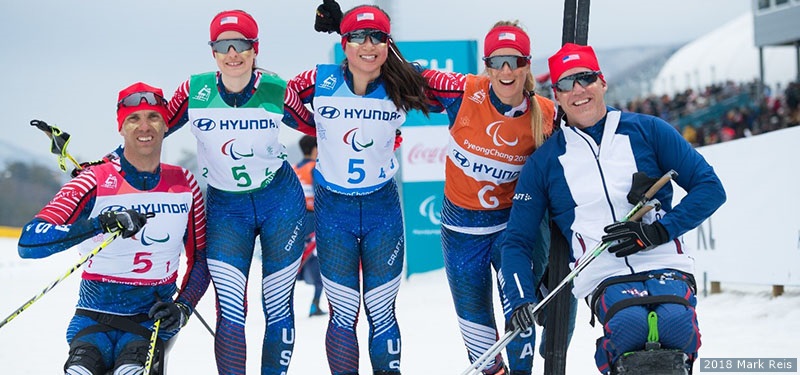
    The U.S. open relay at the 2018 Paralympics in PyeongChang, South Korea, with (from left to right) Andy Soule, Mia Zutter, Grace Miller, and Kristina Trygstad-Saari (guide), and Sean Halsted. (Photo: U.S. Paralympics/Mark Reis)

    “I got on rollerskis and fell in love with it,” said Zutter. “It reminded me of figure skating and I was joking around that I would like rollerskiing more than snow skiing which looking back is crazy.”

    A trip to West Yellowstone with CXC that Thanksgiving and she was hooked as a high school sophomore. A year later she drove from her home outside Madison, Wisconsin to Craftsbury, Vermont for Para Nordic Nationals. She was then invited to Germany with the national team. 

    “The rest is history,” Zutter lightheartedly said. 

    Zutter will race with a guide this season, Jason Kask, who also serves as a wax tech for the Para Nordic team. When a guide is unavailable for daily practices at St. Scholastica, Zutter said that she can follow her teammates. 

    “They keep me in mind when we are skiing and tell me when downhills are coming up,” said Zutter. “But I try to really just keep up with the team and blend in as best as I can.”

    If you’d like to get involved as a potential athlete or guide, here’s a link to the US Paralympics Nordic survey. 

    There’s no better promotion than Trygstad-Saari’s descriptor of her guiding experience as “transformational”.

  • Canada Notches First Paralympic Relay Medals with Silver and Bronze

    Canada Notches First Paralympic Relay Medals with Silver and Bronze

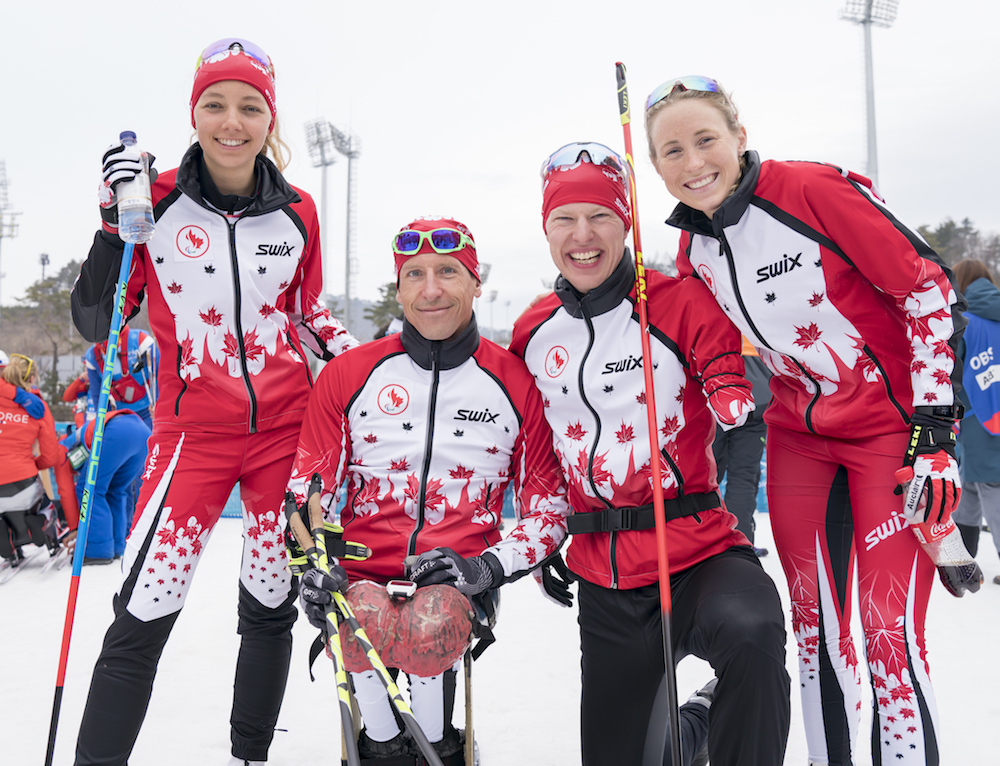
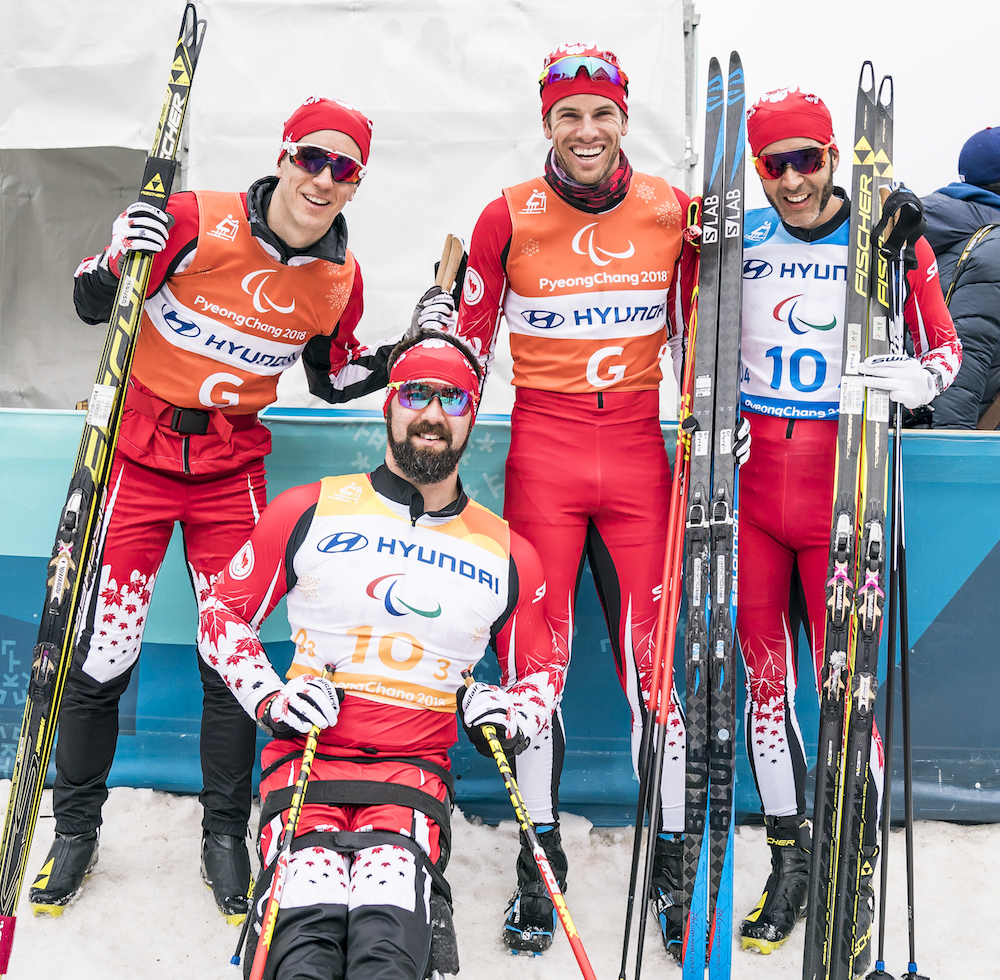
    Canada’s mixed relay after taking silver on the last day of the 2018 Paralympics in PyeongChang, South Korea, with (from left to right) Natalie Wilkie, Chris Klebl, Mark Arendz and Emily Young. (Photo: Dave Holland/Canadian Paralympic Committee)

    2018 Winter Paralympics (PyeongChang, South Korea): Mixed and open relays

    On the final day of the PyeongChang Paralympic Games, Canada was the only country to medal in both the mixed and open cross-country relays, and its mixed relay anchor, Mark Arendz, became the most decorated Canadian at a single Winter Paralympics with his sixth medal of the week.

    In the 4 x 2.5-kilometer mixed relay on Sunday, Natalie Wilkie, Emily Young, Chris Klebl, and Arendz teamed up for silver, 50 seconds behind Ukraine (Iurii Utkin, Liudmyla Liashenko, Yuliia Batenkova-Bauman, and Oksana Shyshkova), which claimed gold in 24:31.9 minutes. On the final skate leg, Arendz held off Germany (Andrea Eskau, Steffen Lehmker and Alexander Ehler) by 3.4 seconds at the line.

    Wilkie and Young, standing athletes coming off gold and bronze in Saturday’s 7.5 k cross-country race, started the team off for the first two classic legs. Wilkie, 17, also earned an individual bronze at these Games. While Wilkie tagged Young in fifth, Young went on to tag Klebl, a 2014 Paralympic champion sit-skier, in seventh place.

    “Our team worked so well together,” Young said of the relay, according to a Cross Country Canada press release. “It looked a little scary in the beginning, but we knew we had Chris in third and Mark anchoring which was going to be the difference. We each held our own in our individual sections and it is so fun to win this one as a team.”

    Klebl, 46, made up 27 seconds on the field and tagged Arendz in fourth. Arendz then caught and passed Japan’s Taiki Kawayoke and later Germany’s Ehler on the last downhill into the finishing stretch to finish second.

    “This is fantastic. It is our first relay medal ever,” Arendz, 28, told Cross Country Canada. “It is great to end the Games with a historic moment that we get to share with each other for the rest of our lives. This is a great team of two veterans and two rookies. I’m so happy we were able to get this done.”

    Arendz, who elected flag bearer of the Canadian Paralympic Team for Sunday’s Closing Ceremony, is taking home a gold medal from the 15 k biathlon race, two silvers, and three bronze medals. He competed in all but one race throughout the week, skipping the distance cross-country race.

    “I came in here thinking I could get three medals, but to get six is incredible,” Arendz said. “Today’s is a special one. I am happy we got this done, but there is no way I could do another race. I’m done.”

    American Kendall Gretsch (l) racing in the 4 x 2.5 k open relay at the 2018 Paralympic Winter Games in PyeongChang, South Korea. (Photo: U.S. Paralympics/Mark Reis)

    The U.S. team, with Kendall Gretsch, Ruslan Reiter, Jake Adicoff (and guide Sawyer Kesselheim)  placed seventh in the mixed relay, 1:35.7 out of first. Gretsch skied both the first and third legs and tagged Adicoff in ninth out of 13 teams at the last exchange.

    “It’s a little bit nerve-wracking and a little bit fun,” Adicoff said of skiing the anchor leg. “They did an awesome job on the first three legs.”

    In the 4 x 2.5 k open relay an hour later, Canada raced to bronze with two athletes: sit-skier Collin Cameron and visually impaired skier Brian McKeever (and his guides Graham Nishikawa and Russell Kennedy).

    The duo finished 1:05.8 behind France, which placed first with Benjamin Daviet, Anthony Chalencon and Thomas Clarion in 22:46.6. Norway finished 22.5 seconds back for silver, with Nils-Erik Ulset, Hakon Olsrud and Eirik Bye.

    Ukraine (Iaroslav Reshetynskyi, Olha Prylutska, Grygorii Vovchynskyi, and Anatolii Kovalevskyi) crossed the line in third but was penalized 30 seconds for an early exchange and slipped to fifth (+1:26.3), while Canada moved into third and Belarus placed fourth (+1:23.7).

    Canada’s open relay after taking bronze on the last day of the 2018 Paralympics in PyeongChang, South Korea, with (from left to right) Graham Nishikawa (guide), Collin Cameron, Russell Kennedy (guide), and Brian McKeever. (Photo: Dave Holland/Canadian Paralympic Committee)

    Early in the race, Cameron tagged McKeever in eighth at the first exchange, and McKeever and his guide raced up to fourth. On the third leg, Cameron was skiing in third until he dropped a pole on the last climb and had to turn around to recover it. He came through the last exchange in sixth, 25 seconds behind Ukraine in third. McKeever went on to crossed the finish line fourth place, but his team was awarded bronze after Ukraine was penalized for tagging outside the exchange zone.

    buy skelaxin

    The bronze medal was Cameron’s third of the week after he placed third in two biathlon races earlier in the week. For McKeever, Canada’s most decorated Winter Paralympian of all time who won all three individual cross-country races he competed in over the last week, it was the 17th medal of his Paralympic career.

    “I just tried to pace it properly and be as fast as I could. It was so much fun,” Cameron, 28, told Cross Country Canada. “This is my first relay, so I was really looking forward to this. I am super happy to leave here with three medals.”

    “It’s incredible to get two relay medals today,” McKeever, 38, said. “We knew we had a shot if we all had really good days. What Mark, Chris and the girls did in that first relay was awesome. These races are so interesting with all different disabilities together. It is never over until last tour around, and in both cases, we saw that today with lots of different lead changes out there.”

    The U.S. open relay at the 2018 Paralympics in PyeongChang, South Korea, with (from left to right) Andy Soule, Grace Miller, and Mia Zutter, Kristina Trygstad-Saari (guide), and Sean Halsted. (Photo: U.S. Paralympics/Mark Reis)

    The U.S. team, with Andy Soule, Sean Halsted, Grace Miller, and Mia Zutter (and guide Kristina Trygstad-Saari), placed 12th in the open relay out of 12 teams.

    “It’s been an amazing Paralympic Games,” Soule, 38, told U.S. Paralympics Nordic. “The organizers have put on a great event. This is a great team to be involved with. We’ve had a lot of fun here. This is my last Paralympic race, but we have a couple of young athletes here. We’ll have a great team for a long time.”

    In total, both the Canadian and U.S. Paralympic teams tallied 16 medals between nordic and biathlon in PyeongChang — a record for both programs. Notably, every member of Canada’s Para-Nordic World Cup Team is taking home at least one medal.

    Results: Mixed relay | Open relay

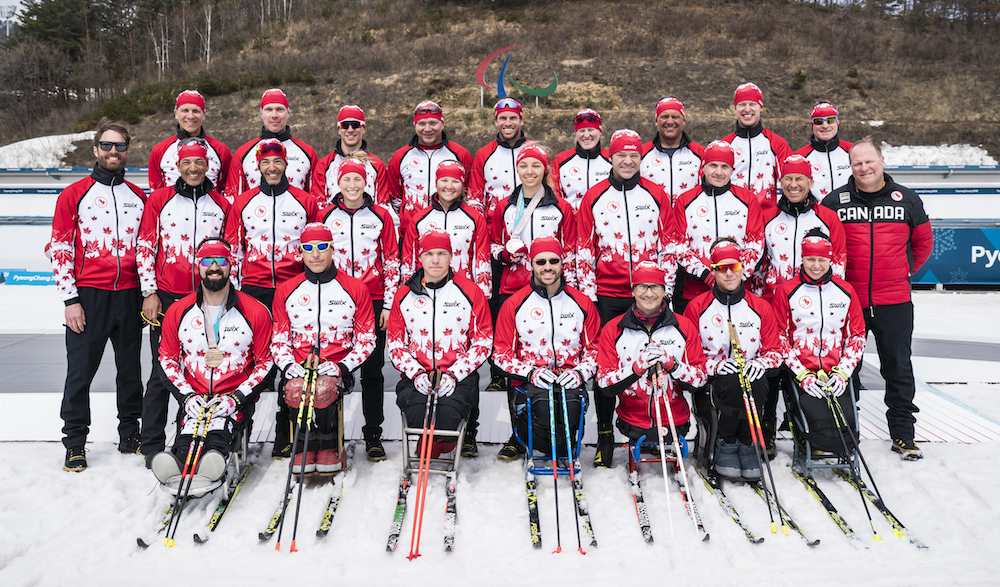
    Canada’s 2018 Paralypmic cross-country and biathlon team at the Alpensia Biathlon Centre on the last day of the Games in Pyeongchang, South Korea. (Photo: Dave Holland/Canadian Paralympic Committee)
  • Wilkie, McKeever, Masters All Win Gold in Last Individual Race of Paralympics

    Wilkie, McKeever, Masters All Win Gold in Last Individual Race of Paralympics

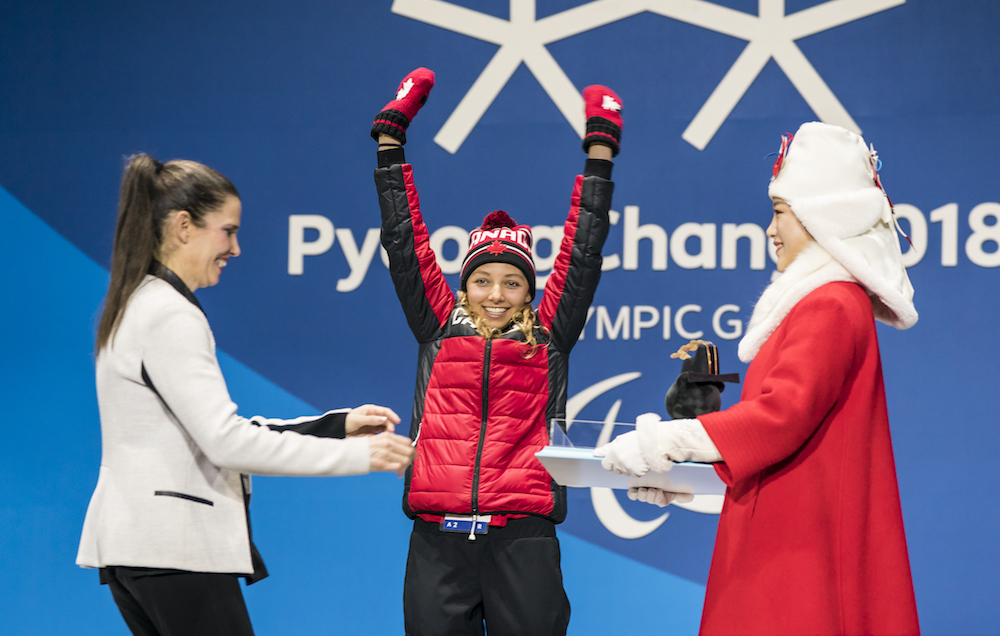
    Canada’s 17-year-old Natalie Wilkie being awarded gold after she won her first Paralympic race on Saturday, the women’s 7.5 k standing classic, in PyeongChang, South Korea. (Photo: Dave Holland/Canadian Paralympic Committee)

    2018 Winter Paralympics (PyeongChang, South Korea): 5/7.5/10 k cross-country races

    Saturday marked the last day of individual racing at the PyeongChang Paralympics, and as they have over the last week, the U.S. and Canadian teams did not disappoint, with the U.S. Paralympics Nordic Team adding a gold and two silvers to its medal count and the Canadian Para-Nordic Team notching two golds and two bronze medals in the middle-distance cross-country races.

    Seventeen-year-old Natalie Wilkie of Salmon Arm, British Columbia, won the women’s 7.5-kilometer standing classic race, while her Canadian teammate Emily Young placed third in that race.

    Brian McKeever, 38, of Canmore, Alberta, won his third-straight race of the Paralympics, the men’s 10 k visually impaired classic race, sweeping all three races at the Paralympics for the third-straight time (he was undefeated at the 2014 Games in Sochi, Russia, as well as the 2010 Paralympics in Vancouver, B.C.)

    Canada’s Mark Arendz raced to bronze in the men’s 10 k standing classic race for his fifth medal of the week (including a biathlon gold) and seventh of his Paralympic career.

    For the U.S., Oksana Masters won her second gold of the Games in the women’s 5 k sitting (after winning the cross-country sprint as well) and fifth medal total in PyeongChang. In three Paralympics, she has eight medals to her name.

    Dan Cnossen continued his medal streak with another silver in the men’s 7.5 k sitting for his sixth medal in as many races this week (three in cross-country, three in biathlon), and Jake Adicoff achieved his first Paralympic medal after placing second behind McKeever in the 10 k visually impaired classic.

    In the women’s standing race on Saturday, Canada nearly went first and second, with Young missing out on silver by 0.1 seconds. While Wilkie took the win in 22:12.2 minutes, Ekaterina Rumyantseva of the Neutral Paralympics Athletes (NPA) finished 1.6 seconds back for second, just ahead of Young in third (+1.7).

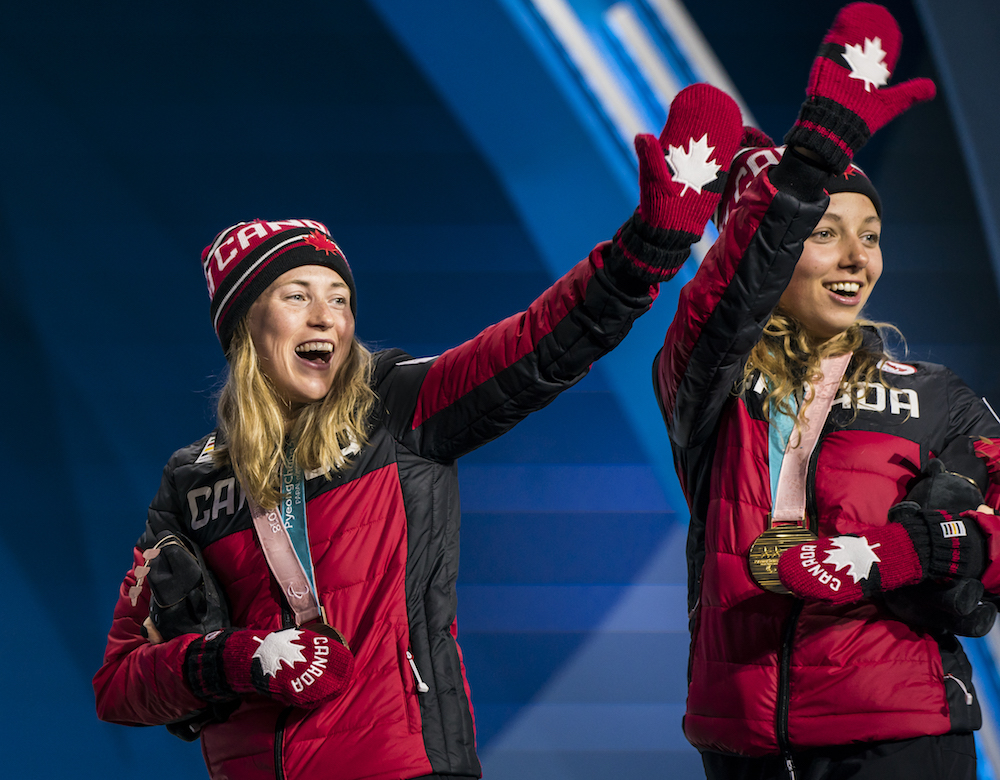
    Natalie Wilkie (r) and Emily Young at Saturday’s 2018 Paralympic medal ceremony with their gold and bronze medals in the women’s 7.5 k standing classic race on Sunday in Pyeongchang, South Korea. (Photo: Dave Holland/Canadian Paralympic Committee)

    “This is crazy awesome,” Wilkie said after winning the last individual race of her first Paralympics, according to a Cross Country Canada press release. “I didn’t think this would happen at all…

    “The difference today was double poling,” she added. “I just kept telling myself to pretend I was elbowing my older brother.”

    During the race, Young channeled her teammate for motivation.

    “ ‘What would Natalie do?’ I just kept saying ‘What would Natalie be doing?’ ” Young, 27, said with a laugh to Cross Country Canada. “I was trying and trying all week to get onto the podium. I knew this race would be my big chance. I kept telling myself to get this done. There is nothing left in the tank. I didn’t want any more hills. I just wanted to get over the finish line. I left it all out there today.”

    Also in the women’s standing race, Canada’s Brittany Hudak placed eighth (+1:37.4) and American Grace Miller finished 18th (+7:09.7).

    McKeever spent about half the race with each of his guides, Graham Nishikawa and Russell Kennedy, to win the men’s visually impaired race by more than a minute in 23:17.8. Adicoff, of the U.S., with his guide Sawyer Kesselheim had the second-fastest time for silver (+1:13.5), while Belarus’s Yury Holub (with guide Dzmitry Budzilovich) placed third (+1:19.3).

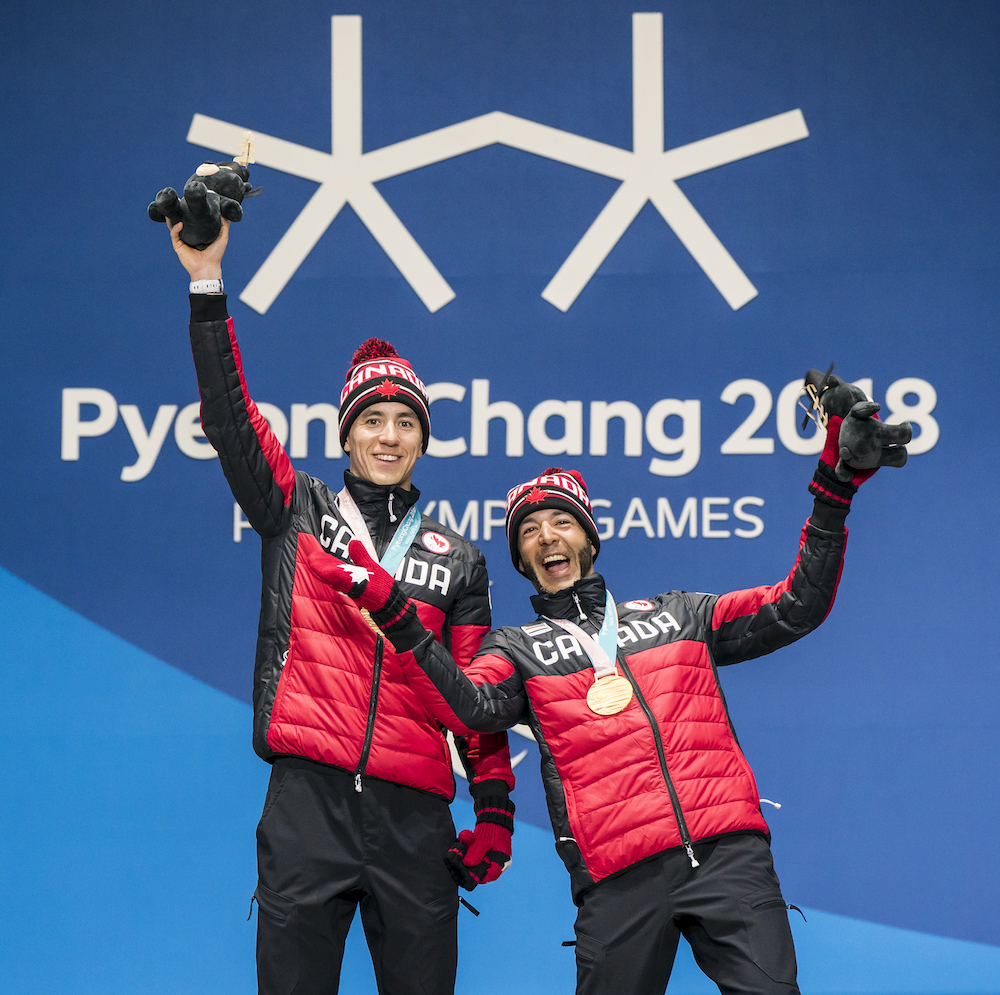
    Canada’s Brian McKeever (r) having some fun at the medal ceremony after winning gold with guides Graham Nishikawa (l) and Russell Kennedy (not pictured) in the men’s 10 k visually impaired classic race at the 2018 Paralympics in PyeongChang, South Korea. (Photo: Dave Holland/Canadian Paralympic Committee)

    “This feels good,” said McKeever, who has won 13 gold medals in five Paralympics. “That one was hard today and was a lot closer than the others.

    Nishikawa led him for the first 6 k, helping him claw back 4 seconds on Sweden’s Zebastien Modin (and guide Johannes Andersson) ahead of him. At the race’s halfway point, the Canadians took the lead, and after Kennedy jumped in to guide McKeever, they widened their gap over the final 4 k. Modin did not finish.

    “Sebastian had a pretty hard crash and I’m most concerned about him because he is a very good friend and you don’t want to win that way,” McKeever said. “It was a good fight today. We knew when to hit it and when to pull back. It’s nice to complete what we set out to do.

    “Today was all about teamwork,” McKeever added. “There was a huge temperature change so we were out very early as a team testing new skis with our wax techs for 90 minutes before the race even started. It was a huge effort by everyone today.”

    For Adicoff, 22, the silver marked the first Paralympic medal of his career. He had previously been awarded bronze in the cross-country classic sprint, but was relegated to fourth for a technique violation.

    As for Saturday’s middle-distance race, he said the skiing was “absolutely awesome. We had great skis by our staff,” Adicoff said, according to a U.S. Paralympics Nordic press release. “I got a little bit sick a couple days ago, so going into this race I told myself to stay relaxed the first part and see if we could keep adding throughout the whole race. It ended up working out, I’m really happy about that.”

    “He was really smart today, thinking about how he’s going to pace the race,” Kesselheim told U.S. Paralympics. “Taking it out not too hard and then building throughout. Really using the skis to our advantage and skiing smooth.”

    In the women’s 7.5 k visually impaired classic race, American Mia Zutter (with guide Kristina Trygstad-Saari) finished ninth, 5:33.7 behind the winner, Belarus’s Sviatlana Sakhanenka (with guide Raman Yashchanka).

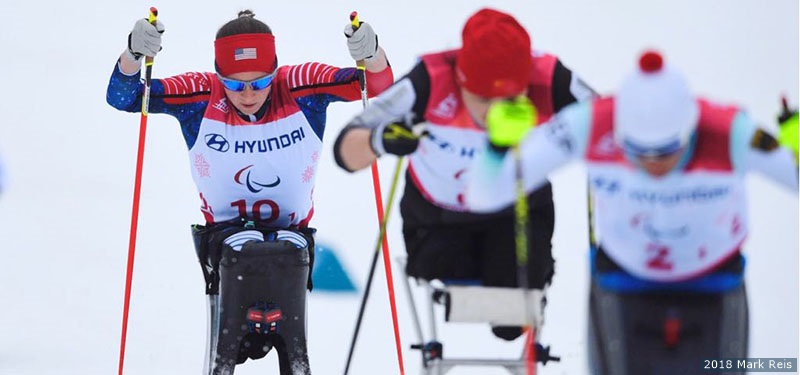
    Oksana Masters and her U.S. coach Eileen Carey after Masters won the women’s 5 k sitting cross-country race on Saturday at the 2018 Paralympic Winter Games in PyeongChang, South Korea. (Photo: U.S. Paralympics/Mark Reis)

    Then there was Masters, 28, who learned Friday that she was elected as the flag bearer for the entire U.S. Paralympic team at Sunday’s Closing Ceremony. She picked up her second gold medal of the week with a win in the 5 k sitting in 16:42, 11.5 seconds ahead of Germany’s Andrea Eskau in second.

    “I am absolutely truly speechless on this performance,” Masters told U.S. Paralympics on Saturday. “I was a little bit nervous because I didn’t get my full warm up in and I was yawning at the start line thinking I was a little too relaxed. I have no idea what just happened.

    “I thrive and love the athlete lifestyle of eat, sleep and train,” she continued. “To put yourself to the ultimate test on that start line and seeing all your hard work come through, and not just that, it’s a whole team effort. Seeing how our amazing team between our wax tech, nutritionist, sport psych, everything just comes together at the finish line. That’s really what it’s all about. It’s that moment coming together. It’s not a one-person show. It definitely takes a village and we have an incredible team.”

    In that race, American Kendall Gretsch, who won two golds earlier in the week, placed sixth (+1:04.4), Canada’s Cindy Ouellet (+4:04.6) finished 17th and American Joy Rondeu was 19th (+5:13.1)

    American Dan Cnossen racing to silver in the men’s 7.5 k sitting cross-country race at the 2018 Paralympic Winter Games PyeongChang in PyeongChang, South Korea. (Photo: U.S. Paralympics/Mark Reis)

    In the men’s 10 k sitting, Cnossen pulled off his fourth silver medal of the week (and sixth medal total), finishing 5.3 seconds shy of gold, which went to South Korea’s Sin Eui-hyun in 22:28.4.

    “This is my favorite race that we do,” Cnossen, 37, told U.S. Paralympics. “It’s 20-21 minutes of effort, or thereabouts, just all out as hard as you can go. I left it all out on the course and was edged out by five seconds. I’m really happy for Mr. Sin, my South Korean competitor. He earned the gold medal.”

    After what he estimated to be around 60 k of racing over the last eight days, not including training, warming up or cooling down, Cnossen said he was feeling “very fatigued.”

    “I came into the Games just trying to take it one race at a time and give it my all — each and every race — and not think too far ahead,” the retired Navy SEAL said. “Just focus on the here and now, and soak up the moment and be in the present.”

    Also in that race, Andy Soule of the U.S. finished fifth (+34.0) and Canada’s Chris Klebl placed sixth (+1:00.9). Also for Canada, Derek Zaplotinsky followed in 15th (+3:15.2), Sebastien Fortier placed 16th (+3:19.9) and Yves Bourque 31st (+8:47.9). For the U.S., Sean Halsted finished 23rd (+4:19.8), Bryan Price 26th (+5:35.9) and Jeremy Wagner 30th (+8:06.9).

    In the men’s standing division, Arendz claimed his fifth medal in as many starts this week, placing first, second and third in the three biathlon races and earning another bronze in the cross-country sprint. (He skipped the long-distance cross-country race.)

    Canada’s Mark Arendz after being awarded bronze in the men’s 10 k standing classic race at the 2018 Paralympics in PyeongChang, South Korea. (Photo: Dave Holland/Canadian Paralympic Committee)

    On Saturday, in the middle-distance cross-country event, Arendz finished 20.3 seconds behind the winner, Japan’s Yoshihiro Nitta, who won in 24:06.8, and 11.6 seconds behind Ukraine’s Grygorii Vovchynskyi, who placed second (+8.7).

    “The focus was to come here and race in six out of the seven events,” Arendz explained. “I have one more left to accomplish in the relay, but I got done what I set out to do in biathlon and to get a couple in cross-country is extra special. This course here really suits me well and the skis have been great all week.”

    Arendz was chosen as Canada’s flag bearer for Sunday’s Closing Ceremony.

    With two relay races (mixed and open) remaining on Sunday, Canada has a grand total of 14 nordic and biathlon medals at these Paralympics, surpassing its previous Paralympic medal total. The U.S. team is up to 16, also record-breaking for its nordic/biathlon program.

    Results

    Americans Jake Adicoff (l) and his guide Sawyer Kesselheim racing to silver in the men’s 10 k standing classic race at the 2018 Paralympic Winter Games in PyeongChang, South Korea. (Photo: U.S. Paralympics/Mark Reis)
  • McKeever Wins Record-Breaking 14th Paralympic Medal, 11th Gold

    McKeever Wins Record-Breaking 14th Paralympic Medal, 11th Gold

    Brian McKeever follows guide Graham Nishikawa during the men’s visually impaired 20 k freestyle on Monday at the 2018 Paralympics in PyeongChang, South Korea. Along with guide Russell Kennedy, they won the race by over a minute for McKeever’s 14th Paralympic medal and 11th gold. (Photo: Scott Grant/Canadian Paralympic Committee)

    2018 Winter Paralympics (PyeongChang, South Korea): 15/20 k visually impaired and standing races

    Make that record-breaking medal No. 14 for Brian McKeever. In his fifth Paralympics, the 38-year-old Canadian raced to the 11th gold medal of his career (and 14th medal total) on Monday at the 2018 Paralympics in PyeongChang, South Korea. He did so in the 20-kilometer visually impaired freestyle cross-country race with his guides Graham Nishikawa and Russell Kennedy, who traded guiding responsibilities during the four-lap race.

    Canada’s Brian McKeever (l) and one of his two guides on Monday, Graham Nishikawa, (Russell Kennedy was the other), at Monday night’s medal ceremony after they all teamed up for gold in the visually impaired 20 k freestyle cross-country race at the 2018 Paralympics in PyeongChang, South Korea. (Photo: Dave Holland/Canadian Paralympic Committee)

    McKeever finished in 46:02.4 minutes, more than a minute faster than silver medalist Yury Holub and his guide Dzmitry Budzilovich of Belarus, who finished 1:05 back in second. France’s Thomas Clarion (with guide Antoine Bollet) completed the podium in third (+1:33.3), Sweden’s Sebastian Modin (with guide Johannes Andersson) took fourth (+1:38.4) and American Jake Adicoff and his guide Sawyer Kesselheim placed fifth (+3:41.0).

    “It was super good today. Thanks to our wax techs and both of these guides. They all did an awesome job,” McKeever said, according to a Canadian Paralympic Committee press release. “It is super windy out there so to be able to tuck in behind these big boys is important for me. They pushed hard, skied well and towed me along the whole way.”

    Nishikawa led McKeever for the first half of the race before handing off to Kennedy.

    “The biggest thing about coming in mid-race is I have to remember that I’m fresh and Brian has already skied 10 kilometres so you have to be careful not to go out too hard or he could blow up,” Kennedy explained. “Brian is such an incredible athlete. He is so fit, so I knew it would not be a major problem. It worked out really well today.”

    After pushing hard in the middle of the race, McKeever changed skis at 14 k, then worked to hang on to the sizable lead he had built.

    “The plan was to ski comfortably into it and build towards the end, and I think I built a little too much during the middle and almost undid it because that last lap was very hard to keep the pace,” McKeever said with a laugh. “It was touch and go there for a bit, but we did enough in the middle to build a nice cushion, and we were able to manage it and hang on.”

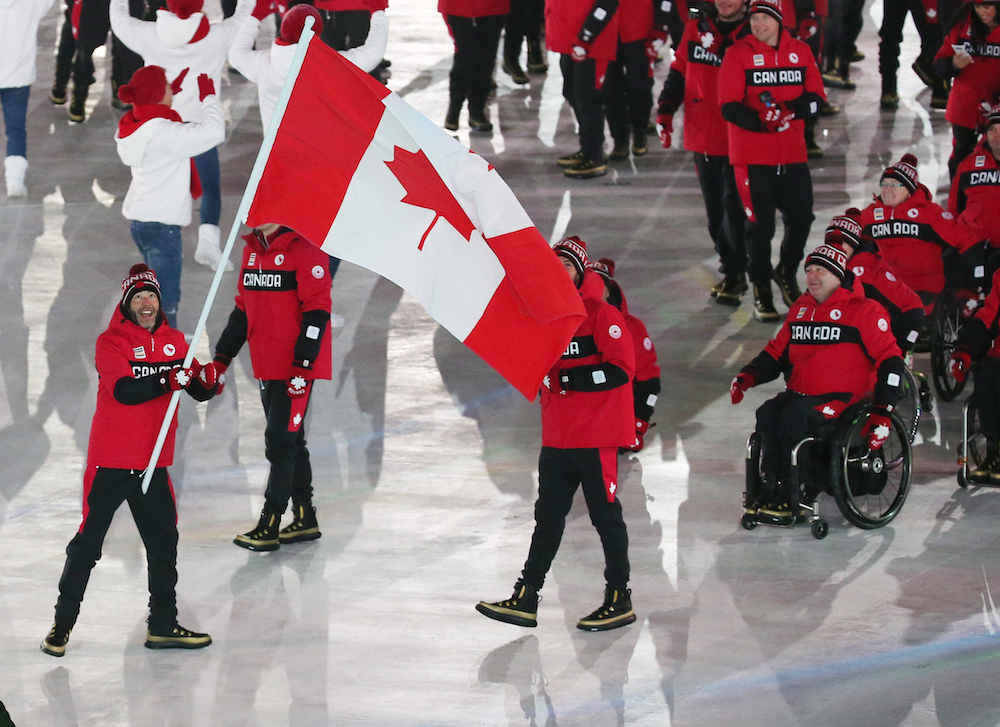
    Brian McKeever leads the Canadian Paralympic team during the Opening Ceremony of the 2018 Paralympic Games in PyeongChang, South Korea. (Photo: Scott Grant/Canadian Paralympic Committee)

    The race was McKeever’s first of the 2018 Games and came three days after he served as Canada’s flag bearer at the Paralympics’ Opening Ceremony. With his 14th medal, he became Canada’s most decorated Winter Paralympian, surpassing the late Para-alpine skier Lana Spreeman, who amassed 13 medals in five Paralympics.

    “I wasn’t aware of this record, but it is pretty cool,” McKeever said. “I think for me more than anything is this is a testament to our entire program. We’ve had so many great skiers leading the way for me with my brother, Robin who is now coaching us, and Colette Bourgonje. Now it is awesome for me to be a part of a new generation that has arrived in Mark [Arendz], Colin Cameron, and the young women like Emily [Young], Brittany [Hudak] and Natalie [Wilkie], who are ready to carry the torch. I’m so excited to be around all of them this week and to be there cheering them on.”

    Canada’s Emily Young racing to fifth in the women’s standing 15 k freestyle on Monday at the 2018 Paralympic Games in PyeongChang, South Korea. (Photo: Scott Grant/Canadian Paralympic Committee)

    In the women’s standing 15 k freestyle race, his teammate Emily Young raced to fifth in slushy conditions, 2:21.3 behind Ekaterina Rumyantseva, a Russian designated as a Neutral Paralympic Athlete (NPA), in first. Anna Milenia, also an NPA, placed second (+1:21.0), and Ukraine’s Liudmyla Liashenko took bronze (+1:32.9).

    Canada’s 17-year-old Natalie Wilkie, the youngest member of her team in her first Paralympic race, raced to sixth (+2:41.9). Eighteen-year-old Grace Miller, of the U.S., placed 10th (+20:02) in that race.

    “That was really tough – a lot tougher than I thought it was going to be,” Wilkie said. “I’ve never raced over five kilometres before in these types of conditions. It wasn’t easy, but I’m happy I was able to push to the end.”

    In his second Paralympics, Adicoff, a 22-year-old Bowdoin College skier, led the U.S. team on Monday in fifth place in the visually impaired 20 k skate. The result bested his previous Paralympic mark of sixth place in the 20 k classic at the 2014 Games in Sochi, Russia.

    “First lap felt pretty good. We were right in it,” Adicoff recalled in a U.S. Paralympics press release. “I just got tired and started to slow down, ended up getting bumped from the podium.

    American Jake Adicoff leading Canada’s Graham Nishikawa and Brian McKeever in the men’s visually impaired 20 k freestyle on Monday at the Paralympic Winter Games in PyeongChang, South Korea. (Photo: US Paralympics/Mark Reis)

    “It’s pretty warm out, but the skiing stayed fast. It was awesome out there,” he added.

    In the women’s visually impaired 15 k on Monday, Americans Mia Zutter and her guide Kristina Trygstad-Saari raced to eighth place, 13:09.0 behind Belarusian winner Sviatlana Sakhanenka and her guide Raman Yashchanka. Ukraine’s Oksana Shyshkova (with guide Vitaliy Kazakov) placed second (+8.2) and Mikhalina Lysova (with guide Alexey Ivanov) of the NPA placed third (+3:20.1).

    “It was so much fun,” Zutter, 18, told U.S. Paralympics Nordic. “I competed here [in PyeongChang] last year, so I kind of had an idea of what to expect, but definitely the big ‘Games’ title made it a lot more nerve-wracking but also really fun.”

    Paralympic action continues Tuesday with men’s and women’s middle-distance biathlon races, starting at 10:00 a.m. Korea time (7 p.m. EDT on Monday).

    Complete results

  • Johnson Takes Over as Head Coach at MSU after Trygstad-Saari Resigns

    Johnson Takes Over as Head Coach at MSU after Trygstad-Saari Resigns

    Matthew Perry Johnson was hired as the new head coach for the Montana State University Ski Team. He will begin his position in August. (Photo: Montana State University)
    Matthew Perry Johnson was hired as the new head coach for the Montana State University Ski Team. He will begin his position in August. (Photo: Evan Hagen)

    It has been a tumultuous two years for the coaching staff of the Montana State University cross country ski team. The past two springs have seen complete shifts in staffing — long-time head coach Grethe-Lise Hagensen’s contract was not renewed in 2014 and her replacement, Kristina Trygstad-Saari, resigned from her position at the team’s helm earlier this year. The Bozeman, Mont. university recently announced that former Middlebury College racer and Alaska Winter Stars coach Matthew Perry Johnson will be the newest head coach for the Bobcats starting in August.

    In Trygstad-Saari’s first year as a coach the MSU Ski Team finished seventh at the 2015 NCAA Championships in Lake Placid, and the nordic team garnered two All-Ammerican honors. Despite the success, Trygstad-Saari decided to leave the position to explore paths unrelated to skiing. The 30-year-old has been in the ski community as a racer and coach since a her days as a junior with the Bridger Ski Foundation, and explained that she needed a change. “I’ve spent a lot of years moving around in the ski world, both racing and coaching, and I haven’t always been 100 percent sure that it’s where I should be,” Trygstad-Saari wrote in an email, adding that the decision to leave was incredibly difficult.

    Trygstad-Saari said her experience with the MSU team was highly positive, and that a highlight of the season was in Lake Placid where skiers Cambria McDermott and Forrest Mahlen notched fourth and fifth place finishes, respectively. The lone year as head coach didn’t come without challenges, however, as Trygstad-Saari worked to balance athlete’s training and travel, in addition to the coaching transition.

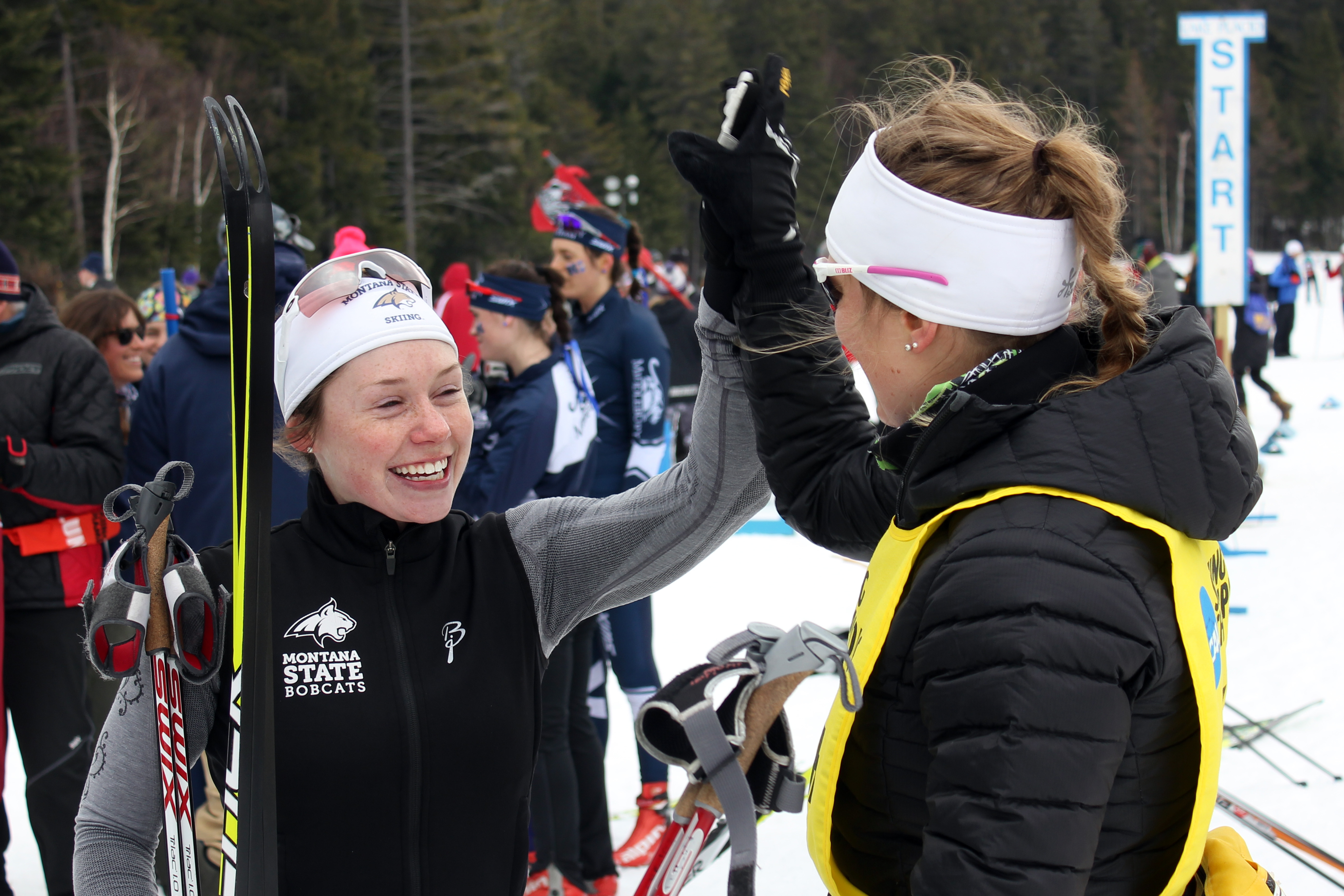
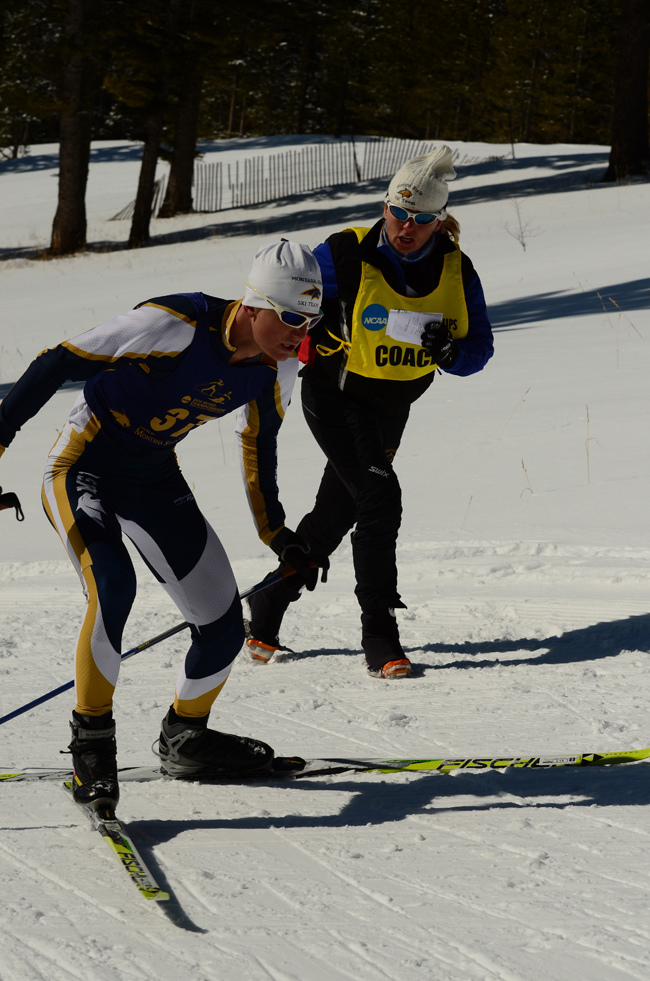
    Cambria McDermott, fourth place and top American finisher in the 2015 NCAA Championship 5 k, high fives Montana State University Head Coach Kristina Trygstad-Saari.
    Cambria McDermott, fourth place and top American finisher in the 2015 NCAA Championship 5 k, high fives Montana State University Head Coach Kristina Trygstad-Saari.

    “The year was challenging, and I had a lot to balance and learn,” she wrote. “Some of our athletes got pretty tired later in the season, and I think I could have done some things differently with training and travel planning. However, I was generally satisfied and think the team responded well to the changes.”

    With her departure from the team, the single-season coach is ready for what the future holds. Trygstad-Saari is currently in Vermont finishing up her master’s degree at the Middlebury College Breadloaf School of English. “Hopefully I can explore some options that will put [the degree] to use!,” she wrote. “As of now, the future is wide open, and I look forward to some new adventures.”

    A large pool of candidates applied to replace Trygstad-Saari, but in the end it was Johnson who got the job. The new head coach grew up skiing with Alaska Winter Stars in Anchorage and raced for Middlebury College in the years following. After graduating he began assistant coaching at Burke Mountain Academy. He left three years later to become the program/director and head coach of the Utah Nordic Alliance, and in 2014 he returned to his roots and coached with Alaska Winter Stars.

    MSU Athletic Director Peter Fields said in a press release that he was pleased with Johnson’s hire. “Matt possesses a strong background in program and student-athlete development,” Fields said. “He has also worked on both coasts as well as the Rocky Mountain region, and is well respected. Matt sees the big picture and is very motivated to continue the level of excellence the Bobcat ski program has established.”

    Johnson applied for the open position at MSU because of the potential he saw in the program. While it was difficult for the Alaska native to leave his current athletes, he said the high-level juniors he has coached over the years inspired him to make the progression to collegiate coaching.

    “Bozeman is such a great environment for ski training year round and the potential I see in the MSU Nordic Program is massive, so in that sense applying for this position specifically was an obvious choice,” Johnson wrote in an email. “The more difficult aspect of the decision was deciding whether to move on from coaching juniors, which I’ve made the focus of my career so far… The way those kids motivate me to work as hard as I can for them definitely pushed me towards pursuing the position with MSU to work with an entire team at that level.”

    In the coming year, Johnson hopes inspire the team and its individuals to greater success. As for the future, however, he has big hopes for his team including an NCAA title. “I would like to help establish this team as a place where athletes who are serious about their skiing as well as academics know they will have every opportunity to improve and grow,” Johnson wrote. “I think this team can win NCAA titles and produce athletes who are ready for World Cup competition after graduation.”

    To get there, Johnson will have to overcome the challenges associated with being a new coach on a well-established team, especially given the fact he will be the third head coach in two years for many of the older athletes. “Any time there is coaching turnover there are challenges to overcome,” he wrote. “It’s a situation I’ve dealt with from an athlete’s and coach’s perspective so I know that as long as everyone feels comfortable communicating openly, there’s nothing we can’t overcome with relative ease.”

    Although Trygstad-Saari is leaving, she is excited to see what Johnson will do with her former team. “He’s had a wide-range of coaching experience and has the passion and motivation to help drive the program,” she wrote. “He also has the skills to excel in the position beyond the ski trails; he will be a tremendous asset to the Bozeman nordic community. I think the team is in a great place, but I’m confident that Matt will bring even more to MSU and continue this trajectory.”

    Johnson will start at MSU in August and said that he has yet to come to a final decision regarding an assistant coach.

  • Wednesday Workout: Early Season Race Prep with MSU

    Wednesday Workout: Early Season Race Prep with MSU

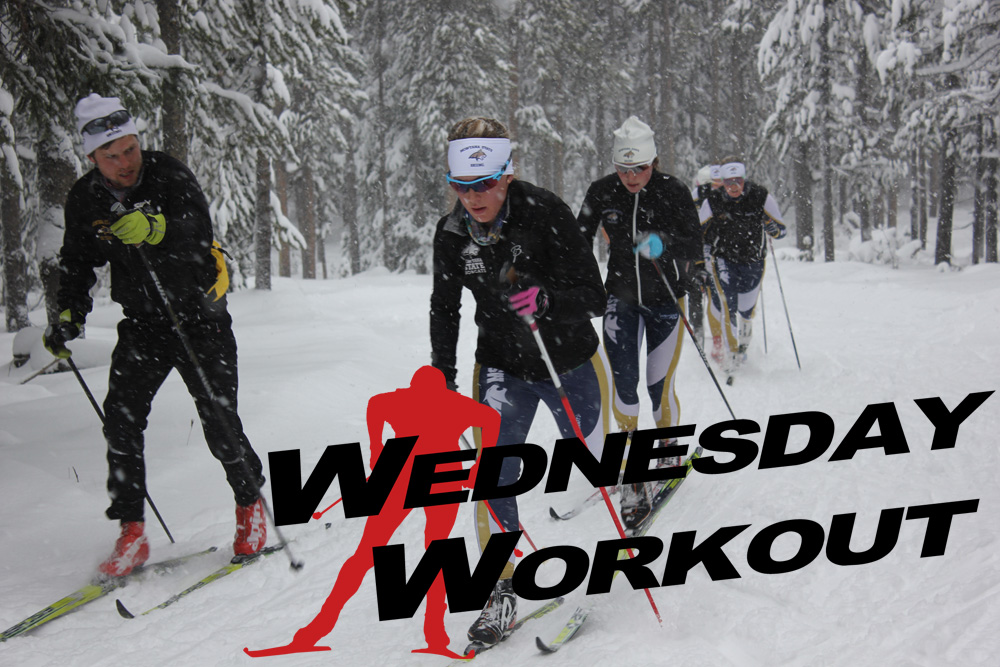
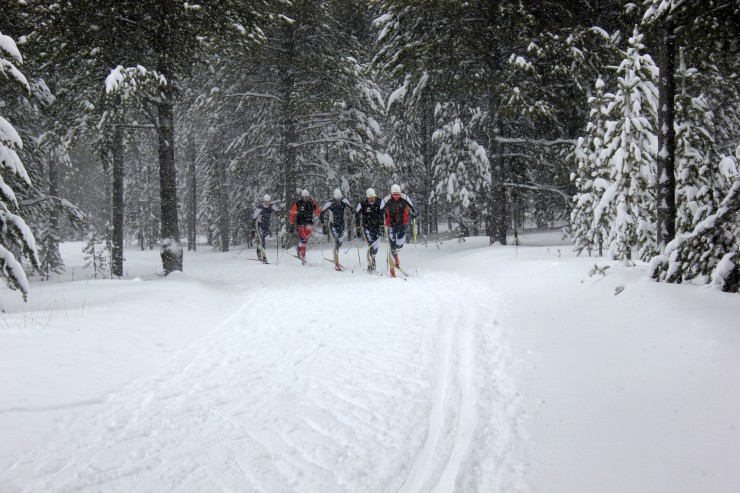
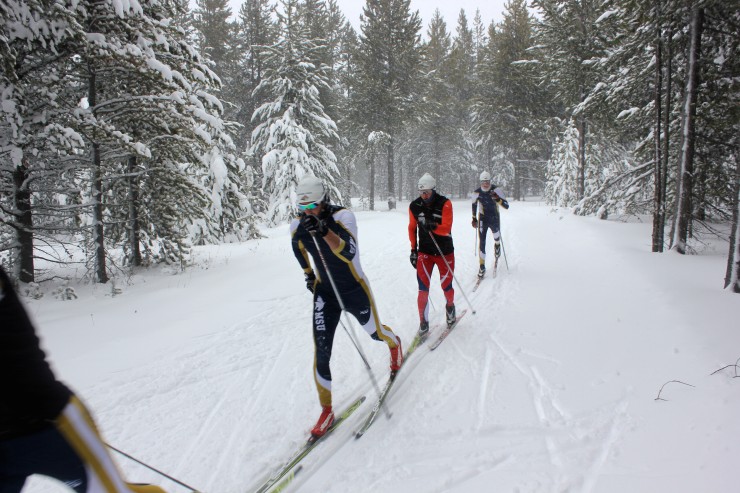
    MSU assistant coach Tim skis alongside his athletes during an interval as part of this week's Wednesday Workout.
    MSU assistant coach Tim Whiton skis alongside his athletes during an interval as part of this week’s Wednesday Workout.

    WEST YELLOWSTONE, Mont. — Even though the Montana State University (MSU) Ski Team is stationed only an hour and a half north of West Yellowstone, Mont., its skiers still have to adjust to the elevation.

    MSU – Bozeman, which sits at roughly 4,800 feet, is 2,000 feet lower than West Yellowstone. Fortunately for the MSU skiers and those who come from well below 6,000 feet, the week leading up to the 2014 SuperTour opener is the perfect opportunity to adjust.

    That’s why the majority of the MSU intensity workouts in West Yellowstone have focused on threshold intervals. That changed Tuesday as head coach Kristina Trygstad-Saari began preparing the team for the season’s first weekend of races.

    In order to get the team race-ready, Trygstad-Saari introduced a series of Level-4 intervals to prepare her skiers for racing at altitude before the SuperTour races this coming weekend.

    “Part of it is physiological and part of it is mental,” she said, explaining that once athletes process lactate at altitude, it allows them to deal with it in a more efficient manner once they begin racing.

    As for the mental side of the workout, Tuesday’s new snow, strong winds, and variable trails made for a challenging morning.

    “On a day like today when we didn’t have perfect grooming and it was their first hard workout, they were probably feeling it after the first interval and so they just had to push through five. That’s exactly what they’ll be doing Friday and Saturday” she said.

    The Workout: 

    Warm up: 30 minutes continuous skiing followed by six minutes of 15 second pickups followed by 45 seconds of easy skiing. 

    Intervals: 5 by 4 minute intervals with the first at threshold and the following three at level 4 or 5 k race pace. Rest until heart rate returns to resting or after four minutes.

    Cool down: 20 to 30 minutes continuous skiing.

    After arriving at the bustling trailhead of the Rendezvous Ski Trails, MSU athletes set out on a warm up consisting of a 30-minute ski followed by six minutes of a cycle of 15-second pickups proceeded by 45 seconds of rest.

    “We wanted them well warmed up… [The pickups] make sure that they were feeling warm and snappy by the time they did the first interval,” Trygstad-Saari said of the warm up.

    “It’s just like a race. If you go out of the start gate feeling warm and ready to go you’re just going to maximize your race time,” she continued.

    Once the MSU team was warm and snappy, the real workout began with skiers embarking on five four-minute intervals starting at threshold and progressing to level 4, or 5 k race pace.

    According to Trygstad-Saari, four minutes is long enough to make the intervals hurt, but short enough from her skiers to maintain technique and speed throughout each interval.

    As the team dispersed to cool down following the intensity, Trygstad-Saari noted that she was expecting great things from the MSU athletes this season. However she and her assistant coach Tim Whiton have been stressing a controlled start to the season.

    “They’re all coming into fine form but we’re trying to remind them that we’re early in the season and we don’t want them peaking for West Yellowstone races. They’re all excited to race and we’re all excited to see what they can do,” she said.

    Check out MSU’s promotional video for the 2014/2015 season here.

  • After Turbulent Summer, BSF Rebounds with New Focus

    After Turbulent Summer, BSF Rebounds with New Focus

    Members of the Bridger Ski Foundation elite and postgraduate perform trail maintenance at Bozeman's Lindley Park in September. (Photo: Bridger Ski Foundation)
    Members of the Bridger Ski Foundation elite and postgraduate perform trail maintenance at Bozeman’s Lindley Park in September. (Photo: Bridger Ski Foundation)

    The future of the Bridger Ski Foundation (BSF) elite and postgraduate team was a bit uncertain in July.

    Shortly after coming on as BSF’s new elite-and-postgrad coach in May, alumna and Bozeman, Mont., native Kristina Trygstad-Saari left her position to lead the Montana State University (MSU) nordic team.

    To make matters worse, soon-to-be BSF athletes Sam Tarling and Eric Wolcott decided to retire from skiing, leaving just two elite skiers, Jennie Bender and Riley Eusden, on the team.

    Today, however, the woes of the summer are behind BSF as it says its team is stronger than it has been in years. In a remarkable turn of events, the elite and postgraduate team now boasts 14 high-level athletes led by Truckee-native Bernie Nelson.

    Rebuilding the Team

    Dragan Danevski, the Bridger Ski Foundation head coach and program director. (Photo: Bridger Ski Foundation)
    Dragan Danevski, the Bridger Ski Foundation head coach and program director. (Photo: Bridger Ski Foundation)

    According to BSF Head Coach Dragan Danevski, the summer months were trying for the team’s skiers and coaches due to the uncertainty of the program. However, Danevski and his colleagues worked tirelessly to build the team from the bottom-up.

    “It was not good for BSF’s image in the summer,” Danevski said in a phone interview. “Many of us were not happy with how that developed. It was disappointing for us.”

    According to Danevski, the first step in rebuilding the team was hiring a coach.

    Nelson, who served as assistant coach to Grethe Hagensen and Chad Andersen at MSU, was exactly what Danevski was looking for: she had extensive knowledge of the sport, experience racing, and energy.

    “This is not a job for everybody. Everyday you have to work with athletes, you have to energize them, and you have to motivate them,” he said. “You can do that only if you as a coach are energetic and enthusiastic. That is what we see with Bernie.”

    Once Danevski hired Nelson, he was faced with the daunting task of completing the team roster.

    With persistence and good luck, Danevski recruited 10 incoming and current MSU students to join the postgraduate program.

    Nelson was also instrumental in building the the team’s numbers. Given her experience as a college athlete from her days at MSU, the 23 year old could relate to university students as they balanced school and skiing.

    With the postgraduate team squared away, all that remained was the addition of more elite skiers to the team.

    American skiers had already been with their respective teams since the beginning of the summer, but fortunately for Danevski and BSF, two foreign skiers were looking for an American team to join.

    Bernadette Nelson joined BSF as its post graduate and elite coach in September after Kristina Trygstad Sarri left the position in June. (Photo: LinkedIn)
    Bernadette Nelson joined BSF as its elite and postgraduate coach in September after Kristina Trygstad Sarri left the position in June. (Photo: LinkedIn)

    Australian Paul Kovacs contacted Danevski this spring about the possibility of training with the BSF elite team. Always open to new energy, Danevski remained in touch with the Australian and accepted him on his squad. After hearing about the opportunity from Kovacs, another Australian skier, Mark Pollock jumped at the chance to train in Montana and worked to earn a spot on the team as well.

    Both Kovacs and Pollock raced in the FIS Australia New Zealand Cup this summer, and now that the Australian winter is over, the two will travel to Bozeman in the coming weeks to begin their training and racing with the team.

    Reflecting on the changes to his team, Danevski said he was pleased with the progress and happy that the program was able to recover from a tumultuous summer.

    Bender, who spent part of August and September in the east, said that she didn’t recognize the team when she returned to Bozeman.

    “When I left for the Lake Placid [training camp] there were three athletes,” she said. “When I came back there were 14 new people and a new coach. Now that we have this big group, there’s been great a vibe.”

    Team Veteran: Bender 

    The women's 1.5 k freestyle sprint podium, with winning Jennie Bender (c) of the Bridger Ski Foundation, Caitlin Gregg (l) of Team Gregg/Madshus in second, and Rosie Brennan (APU) in third. (Photo: Tom Kelly/USSA)
    The women’s 1.5 k freestyle sprint podium at the 2014 U.S. Cross Country Championships , with Jennie Bender (c) of the Bridger Ski Foundation, Caitlin Gregg (l) of Team Gregg/Madshus in second, and Rosie Brennan (APU) in third. (Photo: Tom Kelly/USSA)

    At the center of the BSF elite team, Bender has seen it all. In the past two years, she’s had ranging results spanning from the top of the podium to the back of the pack.

    Since she began skiing with BSF last season, the Vermont-native earned her second national title in January. At the same time, however, she failed to accomplish her goal of making the 2014 Olympics and struggled to find her form in last March at the World Cups in Finland and Norway.

    Bender said that a major factor in her inconsistent results over the past two years was her health. In addition to a case of mono and Lyme disease in 2012, Bender suffered a herniated disk in 2013. Due to fatigue and pain, her training and racing suffered.

    “The last two years have been a physical struggle and a mental struggle,” Bender on the phone. “Having a couple good races at nationals was huge. … I didn’t go out and accomplish what I was hoping to do with my World Cup starts, but having those starts was important for me and I’m hoping to have more because I’m ready for that next stage. I feel that there is more that I can give.”

    Despite the impediments of the the last two years, Bender said she believes the 2014/2015 season will be her best yet. With her health intact and little-to-no pain in her back, she said she recently finished her most consistent-and-productive summer training to date.

    She also has a new outlook on life and skiing. Bender said she learned important aspects about herself from the past ups and downs, and that such lessons will aid her in her search for top results.

    “Tenacity became really important. I’ve had my lowest of the lows and my highest of the highs all in one year with being at my wits end and then being on top of the podium,” she explained. “Being thrown into different those two different spectrums, I’ve learned to maintain a solid head and realize what’s important and what’s not important in life. I think it’s been a good lesson on how to stay positive and not dwell on the negative.”

    As the winter approaches, Bender said that she is excited to demonstrate the hard work she has put into her training over the past months. Her season goals are lofty – a spot on the 2015 U.S. World Championships team – but not out of reach.

    A Team of Potential

    Bender’s teammates are also aiming high.

    According to Danevski, Kovacs hopes to compete for the Australian World Championships team in Sweden this February, while Pollock’s main goal is to race at the U23 World Championships in Kazakhstan.

    Three of the nine postgraduate skiers are training to compete at Junior World Championships, while the rest of the squad is looking to prequalify for Junior Nationals by ranking as top-20 juniors at U.S. nationals in January in Houghton, Mich.

    While the team will have the opportunity to accomplish their goals in a few short months, the way BSF sees it, it’s already won half the battle, rebuilding from what many would call a devastating summer.

    “I think BSF has potential to be a very solid elite team,” Bender said. “Everyone on the team is in a really good space. Everyone is working hard and it’s great.”

  • From the Arctic Circle to Bozeman: Hagensen Reflects on MSU Coaching Career

    From the Arctic Circle to Bozeman: Hagensen Reflects on MSU Coaching Career

    Gethe Hagensen runs along former Montana State University athlete Tyler Reinking in the 2012 NCAA Championship in Bozeman, Mont. Grethe was head nordic coach at the university for a decade. (Photo: Stuart Jennings)
    Grethe Hagensen runs alongside former Montana State University athlete Tyler Reinking at the 2012 NCAA Championship in Bozeman, Mont. Hagensen was head nordic coach at the university for a decade. (Photo: Stuart Jennings)

    Grethe Lise-Hagensen served as Montana State University’s Head Nordic Coach from 2003 to 2014. During her decade as head coach, Hagensen brought the team from a state of near non-existence to ranking third in the nation at the 2010 NCAA Championships. In May of 2014, Hagensen’s contract was not renewed by the university’s administration. FasterSkier sat down with Hagensen in July to talk about her time at the helm of the MSU program and the accomplishments she achieved during her ten years as head coach.

    ***

    BOZEMAN, Mont. — Like most Norwegians, Grethe-Lise Hagensen was born with proverbial skis on her feet. Unlike most Norwegians, she decided to bring her successful ski career to the United States.

    Hagensen grew up in Tromsø, Norway, roughly 300 miles above the Arctic Circle where she found an early introduction to skiing out of necessity. Her family didn’t have a car and like many of the other townspeople, she had no choice but to ski into town whenever she needed to go to school, buy groceries, or visit friends.

    Hagensen’s skiing soon evolved from a means of travel to a form of competition as she was introduced to racing. Her entrance into world of ski racing would change her life forever, and by the time she was a teenager she had already won a Norwegian national championship and was on the Norwegian National Ski Team.

    In 1979, Hagensen was part of what she described as the “the biggest athletic event in northern Norway.” A relay team consisting of Hagensen and fellow Tromsø skiers made their way to the top of the podium, astounding spectators.

    “It was a huge sensation. It is still probably the biggest athletic event that has ever happened in northern Norway because we were such underdogs,” she said during a recent in-person interview. “For us to win it was a shocking thing. Top ten would have been a sensation, and we ended up winning.”

    Hagensen first ventured to the U.S. to attend the University of Wyoming. During her time there, she earned all-American honors each of her four years at the university and was part of its winning team in the 3 x 5 k relay at the 1985 NCAA Skiing Championships.

    Hagensen graduated from the University of Wyoming in 1986. She returned to Norway, where she coached both soccer and skiing. She then married American John Villar and the couple had two daughters.

    In 2002, Hagensen and her family made the decision to move to Bozeman, Mont. for a year so that her children, Bjørk and Embla, could learn English. The family’s plan was changed when a friend informed Hagensen that the head coach position at Montana State University (MSU) was available.

    Hagensen applied for the job, accepted the university’s offer, and has lived in Bozeman ever since.

    “Suddenly they could smell gold”

    Grethe Hagensen smiles at an undated ski race. Hagensen served as head nordic coach at Montana State University from 2003 to 2014. In 2010 she lead the team to third place in the nordic rankings at the NCAA Championships. (Photo: Montana.edu)
    Grethe Hagensen smiles in an undated photo. Hagensen served as head nordic coach at Montana State University from 2003 to 2014. In 2010 she lead the team to third place in the nordic rankings at the NCAA Championships. (Photo: Montana.edu)

    When Hagensen took over as MSU’s head nordic coach in 2003, it was the first year since the 1980s that the university had a male team. While women had been part of the team for many years, their results were lackluster and recruitment was challenging.

    “You need to have results to get good athletes — it’s like the chicken and the egg,” Hagensen said of her entry into the program in 2003. “I thought it would take me five years to build up a winning team that would be competitive against CU [the University of Colorado] and DU [the University of Denver].”

    The winning combination came earlier than expected. While a handful of good finishes from MSU skiers scattered the results of the Rocky Mountain collegiate series in Hagensen’s early years as head coach, it wasn’t until 2007 that the team really started to excel.

    The turning point came during the first weekend of Rocky Mountain Intercollegiate Ski Association (RMISA) races at Soldier Hollow in Midway, Utah.  With a relatively strong first day of competition, Hagensen was optimistic about the mass-start races. During the women’s 10 k, she was waxing the men’s skis and conversing with a fellow coach.

    “I remember I said to one of the coaches, ‘I might get a medal today’ and he said to me, ‘Grethe, you might take the top three,’ ” Hagensen explained.  “After that I don’t remember anything.”

    Her colleague was correct as a trio of MSU women consisting of Jamie Woelk, Mandy Bowden Axelson and Claire Rennie rounded the corner into the final stretch of the women’s race. The three Bobcats swept the podium, separated by less than a second.

    It was the first time in RMISA history that a women’s team had taken all three spots on the podium in a single race, but the historic moment almost didn’t happen as all three skiers were nearly disqualified.

    “We almost got disqualified because someone said that I skied next to them,” Hagensen said. “I don’t remember skiing but I must have because I was in shock. I was so happy. Maybe I skied maybe I didn’t, who knows.”

    Despite the alleged incident, the women’s results stood and Hagensen was issued a warning. The moment, however, was a major turning point for the program, which had existed on a small scale four years prior.

    “Suddenly they could smell gold. Once you do it, you have broken the barrier,” Hagensen said.

    She credits the rapid rise of the MSU nordic team to a focus on American athletes who might have been overlooked by other universities, some of which heavily recruit European skiers and only the best American juniors.

    “I always had, not the best juniors in the U.S., but maybe the ones who were a little bit behind,” she said. “I tried to get them to become the best. You have Ryan Scott and Tyler Reinking, these guys were OK and then we just built them. That’s what made me the most proud over my years: taking care of the Americans.

    She also made sure to focus on building technique before anything else.

    “We tried to tap into whatever edge they had. Technique was something that we had to work on a lot,” she said. “You can’t be the best if your technique is a handicap. I tell everyone to focus on their technique and then we get them to the next level.”

    After joining the big show in 2007, MSU continued to progress at an unprecedented rate. With recruitment soaring and a tight-knit team, Hagensen entered the 2009/2010 season with high hopes.

    With their eyes on the NCAA Championships in Steamboat Springs, Colo., the team qualified a full six-person squad for the event: Scott, Reinking, Bernhard Roenning, Kaelin Kiesel, Mellie Park, and Casey Kutz.

    Underdogs from the beginning, MSU wasn’t expected to be overly competitive, let alone make a run for the podium. However, they did just that with all three men placing in the top 10 in the second day of competition. The results propelled the squad to third place overall at NCAAs.

    “We had a phenomenal year, and suddenly we had three [men in the] top ten and Kaelin Kiesil was fifth,” Hagensen said. “Sometimes everything lines up.”

    Later that year, Hagensen received the Intercollegiate Coach of the Year Award in recognition of her contributions to MSU.

    Termination After a Decade

    Upper-body power testing with the Montana State University Nordic Team (Dan Heil photo)
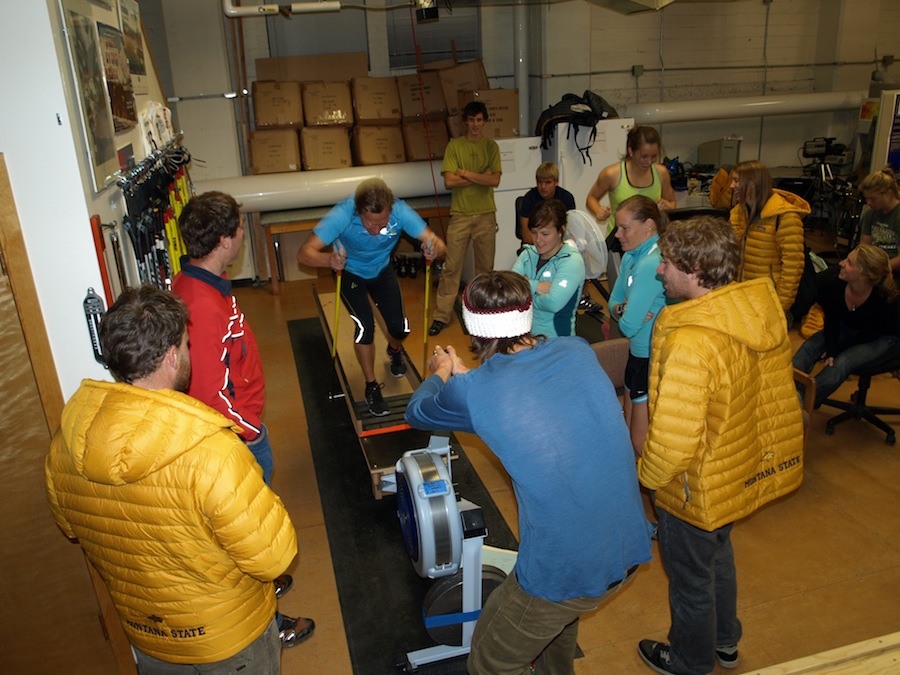
    The Montana State University Nordic Team performs upper-body testing in an undated photo. (Photo: Dan Heil)

    After 2010, both Hagensen and the MSU nordic team continued to find success with top finishes in the RMISA and NCAA race series. In 2012, for the first time in school history, MSU qualified a full team in both alpine and nordic for the NCAA Championships that took place on their home courses in Bozeman, Mont.

    Hagensen also received the RMISA Coach of the Year Award that year.

    During the 2012/2013 season Hagensen took a sabbatical year so that she could spend time with her mother in Norway who had just suffered a stroke. During that season, assistant coach Chad Andersen took over the responsibility of the team.

    In what would be her final season as MSU’s head nordic coach, Hagensen lead her team to qualify a full NCAA Championships squad once again. At the 2014 NCAAs in Soldier Hollow, MSU saw two athletes — Jessica Yeaton and Sawyer Kesselhiem — earn all-American honors with fifth- and ninth-place finishes.

    Adding to the season’s milestones, the nordic team won both the men’s and women’s awards for team of the year at the Montana State Athletics’ 2014 ALL (Academics, Leadership and Life Skills) Banquet in April.

    Not long after, Hagensen said she received a positive review from her athletic department and was given a mandate to hire a new assistant coach. The new assistant coach, Andrew Morehouse, had both a verbal and written agreement with Hagensen for his position that was yet to be made official by the university.

    In May, she said she was summoned MSU Athletic Director Peter Fields’ office for what she assumed would be a conversation about the assistant-coaching position.

    What she experienced was far from what she expected.

    Instead of discussing the assistant coach position, Fields told Hagensen that her contract would not be renewed in the coming year.

    “They asked me to come in and I thought they were going to ask me about the new assistant coach that I was to hire,” she said. “… Ten years of my life was canned in two minutes.”

    The university declined to comment on the decision due to its personal nature, according to Sports Information Director Tom Shutlz.

    “I’m still traumatized,” Hagensen said. “You would think that an institution would bring you in and give you a reprimand or warning or something, but the fact is that there is no job guarantee. You would think that Montana State University would be bigger than this and that they would communicate.”

    Hagensen claims that Fields gave her no indication as to why her contract was not renewed and failed to even thank her for ten years of service to the university.

    She quoted from her prepared statement regarding her departure from MSU:

    “I was surprised that after a decade of strong performance as a head coach, my boss Peter Fields made no comment to me about all the success that the nordic ski teams that I have coached have brought to MSU. Most surprising was the reaction of President Cruzado, who has as well reported record on workplace issue and good management practices. I realize that most of us have one-year contracts and that MSU management can make changes as they see fit. But after a decade as an MSU coach, to be tossed aside without any reason…”

    MSU issued a press release on May 22, which read in its entirety: “The contract of Montana State head Nordic ski coach Grethe Hagensen will not be renewed, announced Bobcat Athletics Director Peter Fields, Thursday afternoon. Hagensen recently completed her tenth year at Montana State. A national search for the position will be conducted.”

    There were those who weren’t surprised by the move. Three former skiers of Hagensen who wished to remain unnamed, claimed that coach was distracted and absent during her last year of coaching.

    When asked about these claims, Hagensen said she made a conscious effort to take a back seat in the 2013/2014 season because she did not want to overbear the atmosphere that assistant coach Chad Andersen had created during her sabbatical year.

    “Last year I wasn’t there and this year I was easing back in so that I wasn’t too powerful or too controlling,” Hagensen said. “Maybe I should have done it differently but those are small things. Not enough to get fired. It is an adjustment.”

    Despite some athlete discontent, Hagensen has received many positive reviews from former athletes, including Scott who graduated in 2012. While Scott had not yet returned an inquiry from FasterSkier at the time of publication, he was quoted in a 2011 Montana State University press release saying that, “she (Hagensen) cares about you personally as well as how you are doing as a skier. She taught me how to seek out my strengths and capitalize on those, which carries over to all aspects of my life.”

    In the same article, Axelson (member of the podium sweeping team in 2007) is quoted saying, “Grethe taught us that in order to be successful, you have to be self-motivated; you have to know what you want and go after it. When you are driven, opportunities come your way–that’s Grethe’s legacy.”

    On July 11, MSU announced the hiring of new head coach Kristina Trygstad-Saari, a Bozeman resident and former Dartmouth skier and coach.

    Hagensen was pleased that Trygstad-Saari was tapped for the position, insisting that Trygstad-Saari could accomplish the one goal Hagensen never did with MSU.

    “My dream while at MSU was always to win the NCAA Championship,” Hagensen wrote in an email after the announcement. “As the new head nordic coach, Kristina Trygstad-Saari brings experience in racing and coaching to the team. Together with MSU Alpine coach Kevin Frances, I believe the MSU ski team has the potential to achieve that goal, winning the NCAA Championship. I wish them all the best.”

    Unsure of what exactly lies ahead of her, Hagensen explained her future will likely involve traveling between the U.S. and Norway. During her sabbatical year she taught at the University of Tromsø which may be a future possibility for the Norwegian.

    She’s planned a trip to Oslo with her oldest daughter, Embla, who’s taking a postgraduate year at an outdoors school. Her youngest daughter, Bjørk, has a year left at a boarding school in Park City, Utah.

    Wherever Hagensen finds herself, she’s certain of one thing: she will always remember her time at Montana State with fond memories and will continue to be proud of the athletes she coached.

  • Trygstad-Saari Leaves Bridger Ski Foundation for Montana State

    Trygstad-Saari Leaves Bridger Ski Foundation for Montana State

    Kristina Trygstad-Saari in the leads the 2009 Boulder Mountain Tour. The  29-year-old was announced as Montana State University's nordic ski team head coach on July 11. (Photo: Saab/Solomon Factory)
    Kristina Trygstad-Saari in the leads the 2009 Boulder Mountain Tour. The 29-year-old Bozeman native was announced as Montana State University’s nordic ski team head coach on July 11. (Photo: Saab/Salomon Factory)

    When Montana State University (MSU) started a national search for a new nordic head coach, little did they know that their final pick would come from their own backyard.

    The university announced last Friday that Bozeman, Mont., native Kristina Trygstad-Saari will take the place of former head coach Grethe-Lise Hagensen, whose contract was not renewed in May.

    This is the second job announcement in recent months for Trygstad-Saari as she was reported to be the new elite/post-graduate  coach of the Bridger Ski Foundation (BSF) in May. She has since resigned from the position.

    “The job opened up later than is ideal for ski coaches and I was already working for BSF doing the elite team,” Trygstad-Saari explained in a phone interview. “Growing up in Bozeman I’ve always watched that position as something that could be a potential career position so when it opened up I decided to apply and see what happened.”

    Trygstad-Saari was one of four finalists for the post, including former MSU assistant coaches, Chad Andersen and Dan Campbell, and current University of New Hampshire assistant coach Stephen Monsulick.

    “We’re fortunate to live in one of the best ski towns in the United States,” MSU Athletics Director Peter Fields said in a press release. “And to be able to tap into our local community for our Nordic ski coach is exciting. Coach Trygstad-Saari has competed at the highest levels, raced and coached collegiately at Dartmouth, and knows the challenges of being a student-athlete. We feel she is a great fit for our program and look forward to her taking over the reins of the Bobcat Nordic program.”

    Returning member of the MSU ski team and former BSF racer Cambria McDermott also expressed her excitement to have Trygstad-Saari at the helm of the university’s nordic program.

    Former Bridger Ski Foundation (BSF) elite team racer Kristina Trygstad-Saari was recently named head coach of the BSF elite nordic team. (Photo: Mary Klotz)
    Former Bridger Ski Foundation (BSF) elite team racer Kristina Trygstad-Saari had planned to coach the BSF elite nordic team. However, when the head coach position became available at Montana State University, Trygstad-Saari jumped at the opportunity.  (Photo: Mary Klotz)

    “Kristina is a great choice for our new head coach. She has had so much success as an athlete and, more recently, as a coach. Besides her knowledge and experience, I think she will bring a new, focused energy to our team,” McDermott wrote in an email.

    The decision to leave Bridger shortly after her hire was difficult for Trygstad-Sarri, who was one of the program’s most successful skiers as a junior. While content with her position at BSF, she had always wanted to coach collegiate-level skiing and knew the position at the university was an opportunity she had to take.

    “I would say that this has been a really tough decision for me for a lot of reasons. I have always been supportive of and supported by BSF. I am really loyal to the organization and I was very happy with my position there at the elite team,” she said. “I had in the back of my mind that I wanted to coach college eventually. It seemed like one of those opportunities that I just needed to go for and if it ended up working out, I knew I might need to take that step.”

    “When I found out that I got the job, I took some time to think about all sides of the situation and it’s definitely challenging to leave something that’s really good. I had really great coworkers, Dragan [Danevski] has always been super supportive of me. I look forward to the new position but it has been challenging for sure.”

    BSF Head Coach and Program Director Dragan Danevski had no comment about the departure of Trygstad-Saari but said that the program was currently searching for her replacement.

    Without Trygstad-Saari, the club’s elite and post-graduate team is currently without a coach and with several skiers joining the program in the fall, a new hire will be necessary in the coming weeks.

    When asked whether she was open with BSF about her college-coaching aspirations, Trygstad-Saari said she had communicated with the club prior to her acceptance of the job.

    “I was pretty open part way through the process. Initially I applied not knowing what would happen and just did that on my own,” she explained. “I’ve been pretty open about the process and trying to communicate things well with people. I know it’s a hard decision that affects a lot of people and I hope that in the end it works out for everybody.”

    Despite the tough choices that Trygstad-Saari has made, she is ready to lead the MSU ski team into a new era.

    Upper-body power testing with the Montana State University Nordic Team (Dan Heil photo)
    The Montana State University Nordic Team conducts an upper-body power test in 2012. Trygstad-Saari will become head coach of the team August 1, 2014. (Photo: Dan Heil)

    “I’m really excited to be working with collegiate athletes. It’s an interesting and exciting time for skiers,” she said. “I look back on my college skiing experience and I really value that. I really looked up to my coach at that time so I’m really excited to step into that role and lead these athletes through their college experience.”

    Trygstad-Saari, 29, intends to use her depth of knowledge as both a ski racer and coach to push her athletes to the next level. A nine-time junior national champion, she placed sixth in the 2002 Junior World Championships, and was named 2002 National Junior Skier of the Year.

    At Dartmouth, she skied two seasons for the Big Green. Since then he has been both racing and coaching, culminating in her position as interim men’s coach at Dartmouth where she lead the team to fifth place at the 2013 NCAA Championships in Middlebury, Vt.

    In terms of goals for the MSU ski team, Trygstad-Saari is focused on making her transition into the program easy for her athletes. Once that is accomplished she plans to bring the team to its full potential.

    “My priority right now is making a smooth transition for the athletes individually and the program as a whole,” she said. “I know it’s hard to transition between coaches so it’s going to take some time to get to know everybody. I’ve been watching this team grow over the last 10 years and I see a lot of potential. There is no reason that we can’t be in the top three teams collegiate circuit and I hope to take the team to that level.”

  • Returning to Her Roots: Trygstad-Saari Becomes Elite/Post-Grad Coach with Bridger Ski Foundation

    Returning to Her Roots: Trygstad-Saari Becomes Elite/Post-Grad Coach with Bridger Ski Foundation

    Former Bridger Ski Foundation (BSF) elite team racer Kristina Trygstad-Saari was recently named head coach of the BSF elite nordic team. (Photo: Mary Klotz)
    Former Bridger Ski Foundation (BSF) elite team racer Kristina Trygstad-Saari was recently named head coach of the BSF elite nordic team. (Photo: Mary Klotz)

    A return to one’s roots can often lead to new opportunities. Such is the case with Kristina Trygstad-Saari, a Bozeman, Mont., native and Bridger Ski Foundation (BSF) alumnus who was recently named the ski club’s elite and post-graduate coach for the 2014-2015 season.

    Trygstad-Saari found her start in nordic ski racing with the Bridger Ski Foundation and found great success in her skiing under the guidance of head coach, Dragan Danevski. After nine junior-national titles, Trygstad-Saari attended the Junior World Championships in 2002 and earned one of the top finishes by an American woman in the championships after finishing sixth in the 5 k freestyle.

    After her junior years were over, Trygstad-Saari made her leap to the collegiate circuit at Dartmouth College, where she skied with the Big Green for two seasons. She left New Hampshire in 2007, ready for a break from ski racing. However, when the 2010 Olympic Games were on the horizon Trygstad-Saari was ready to give it another go, and adorned the red BSF racing suit along with former teammate Leif Zimmermann. While she didn’t make the Olympics, she continued to stay involved with the Bridger Ski Foundation.

    Kristina Trygstad-Saari (BSF)
    Former Bridger Ski Foundation (BSF) elite team racer Kristina Trygstad-Saari was recently named head coach of the BSF elite nordic team.

    With her beginnings as a coach in the U14 age group, she made her way up through the ranks of the coaching staff, until she left Bozeman to be the men’s assistant team coach at Dartmouth for the 2012-2013 season, helping the team earn a fifth place finish at the 2013 NCAA Championships in Middlebury, Vt.

    Since her season-long stint at Dartmouth, Trygstad-Saari, returned to Bozeman and BSF in the hopes of revitalizing the masters program as well as creating a new citizen’s race series aimed at attracting members of the community who were uninvolved with the ski club.

    “In the past we had a masters coach but it hasn’t been super established and we’ve rotated coaches through each session,” Trygstad-Sarri said in a recent phone interview. “I kind of wanted to take that on and make it a more established program for a year.”

    She considers her work last season a success, especially in regards to the citizen’s race series, hoping that the progress she made will continue in the future. “It was our first year doing it and it actually went really well. We had between 50 and 75 skiers at every race and a lot of those were citizens racers and not from BSF. We felt really great about how it went.”

    With the departure of BSF coaches Tim Baucom, who is headed to Sun Valley as a wax technician, and Andrew Morehouse, who was hired as an assistant coach at Montana State University, a void was opened in the elite coaching staff of BSF. Due to her history with the club, success in both national and international racing, and experience coaching, Trygstad-Saari was viewed as the perfect fit.

    According to Baucom, he simply “needed something different” after several seasons of working as a wax technician and assistant coach at BSF.

    “[Andrew] and I both decided, independently of course, to move on from BSF,” he wrote in an email. “I really value everything I have learned working for BSF over the last 5 years, and believe it is a excellent club.”

    In her new role, Trygstad-Saari said her main goal is to create a cohesive team atmosphere that not only helps skiers attain their individual goals but also helps further the team as a whole.

    “Even though skiing is an individual sport, we’ve seen that it’s really important to have a good group to train with and be with and live with and travel with,” she said. “I would really like to establish a more cohesive group and bring more people to Bozeman and up our elite team status in the world of elite teams.”

    Former Bridger Ski Foundation (BSF) elite team racer Kristina Trygstad-Saari was recently named head coach of the BSF elite nordic team. (Photo: Doug Edgerton)
    Former Bridger Ski Foundation (BSF) elite team racer Kristina Trygstad-Saari was recently named head coach of the BSF elite nordic team. (Photo: Doug Edgerton)

    This spring, an influx of new skiers joined the team, which already included veteran Jennie Bender, the 2014 U.S. national champion in the freestyle sprint. They include Trygstad-Saari’s former Dartmouth athlete, Sam Tarling, Eric Wolcott (formerly of St. Lawrence and CXC), Riley Eusden (Bowdoin College), former BSF skier Sawyer Kesselheim, as well as a variety of post-grad skiers.

    Asked whether Torin Koos, a multiple Olympian and national champion, would return to the elite team in any capacity, Trygstad-Saari said he was finishing up school and making that decision about racing next season.

    “We’re not sure about that,” she said. “I think he’s done with his full-time skiing career but we’re open to other options.”

    As for Danevski, he will retain his role as BSF head coach, and Trygstad-Saari will assume the role of elite coach.

    “She’ll run workout and communicate with athletes and I will be in the back supporting,” he said in a phone interview. “I’m working with Kristina on developing the year round plan and trainings and volume of training and intensity and wax. Athletes will have access to talk to me, or they will go through Kristina, and Kristina will ask me these things.”

    At the end of the day, Trygstad-Saari is happy to be working with her former coach in the community where she developed her skiing career.

    “Dragan is a really great leader and he provides a foundation for all of this and I’m excited to work with him and learn from him and be able to execute the job on my own on a daily basis but have him back me up and help me out,“ she said. “I think that BSF and Bozeman have a lot to offer skiers and we have a lot of potential in this area. We’ve spent a lot of time trying to put these teams together so I think that we have the opportunity to take another step in the right direction.”

  • Trygstad-Saari to Head Bridger Ski Foundation Elite Team

    Trygstad-Saari to Head Bridger Ski Foundation Elite Team

    Former Bridger Ski Foundation (BSF) elite team racer Kristina Trygstad-Saari was recently named head coach of the BSF elite nordic team. (Photo: Doug Edgerton)
    Former Bridger Ski Foundation (BSF) elite team racer Kristina Trygstad-Saari was recently named head coach of the BSF elite nordic team. (Photo: Doug Edgerton)

    (Press release)

    Former BSF athlete returns to coach the club’s highest-level Nordic skiers

    BOZEMAN, MT – Bridger Ski Foundation has named a new Head Coach for its Nordic Elite Team. The Bozeman-based nonprofit ski club announced today that Kristina Trygstad-Saari, one of their former Elite athletes and accomplished international ski racer, has filled this leadership role.

    Bridger Ski Foundation’s Nordic Elite Team strives to offer the highest quality individual and team training experience for talented, committed skiers, giving them the opportunity to reach their full athletic potential and achieve success at the highest levels of National and International competition.

    Former Bridger Ski Foundation (BSF) elite team racer Kristina Trygstad-Saari was recently named head coach of the BSF elite nordic team. (Photo: Mary Klotz)
    Trygstad-Saari (Photo: Mary Klotz)

    Kristina Trygstad-Saari grew up racing for Bridger Ski Foundation (BSF). A nine-time junior national champion, Kristina was on multiple World Junior and U23 teams, and qualified for the 2003 World Championship team. She competed in 2001 World Cup races, placed 6th at the 2002 World Junior Championships, and won a NorAm at age 18. Kristina continued racing for the BSF Elite Team and the Saab-Salomon Factory Team, with top-5 U.S. and Canadian Nationals finishes, and Super Tour podiums.

    She attended Dartmouth College, where she raced for two seasons and graduated with a B.A. in Philosophy in 2007. Since then, Trygstad-Saari has coached youth and adult BSF skiers, and also spent one year coaching at Dartmouth. She is currently pursuing a master’s degree in English.

    “I am so excited to have this opportunity to work with the Elite Team,” said Trygstad-Saari. “We have a tremendous group of athletes, coming from many different backgrounds, and I look forward to working with each of them. My experiences skiing and coaching for BSF have brought me to this point, and I think I have a lot to offer this team as we head into the 2014/2015 season.”

    While BSF Nordic Program Director and Head Coach Dragan Danevski will still be very involved with the Team, Trygstad-Saari will take over the day-to-day coaching and race travel.

    Last season’s Elite Team included four-time Olympian Torin Koos, who competed at Sochi, and two-time national sprint champion Jennie Bender. Koos and Bender both took national skate sprint titles at the U.S. Championships at Soldier Hollow in January 2014.

    This coming season, Trygstad-Saari will coach returning Elite Team member Bender, as well as new members Sam Tarling (Dartmouth), Eric Wolcott (St. Lawrence), Riley Eusden (Bowdoin), and former BSF junior athlete Sawyer Kesselheim (Montana State). BSF is still accepting Elite Team applications for the 2014/2015 season.

    Learn more about the BSF Nordic Elite Team at www.bridgerskifoundation.org/nordicelite

    ***

    Bridger Ski Foundation is a nonprofit community organization based in Bozeman, Montana, that promotes athletic and personal excellence through educational and competitive programs in three Olympic ski disciplines.

  • Part of the Team, Part II: Female Collegiate Coaches in the U.S

    The Bates College nordic team after winning the Broomhall Cup last season. (Photo: Flying Point Road Photography/flyingpointroad.com)
    The Bates College nordic team after winning its third Chummy Broomhall Cup last season. (Photo: Flying Point Road Photography/flyingpointroad.com)

    Editor’s note: This is the second installment of a four-part series on the impact of female nordic coaches in the U.S. In Part I, former U.S. Ski Team member Nancy Fiddler introduced herself and reason for writing about the topic. Part II takes a look at several female collegiate coaches and their influence at that level. Parts III and IV will discuss female coaches in the Junior Nationals pipeline as well as grassroots programs across the country.

    ***

    Part II of my series on female cross-country ski coaches in the U.S. looks at the careers of five female collegiate coaches. As I have said before, back in the 1970’s, when I was a collegiate racer, there were no female coaches on the scene. I contacted these women through email and was pleasantly surprised by their generous and very eloquent responses. Each has made a contribution to skiing and has a distinctive story to tell.

    To give a little background, Cami Thompson-Graves is an old teammate and friend, Tracey Cote someone I have heard much about and finally met a year ago, and Becky Woods is the daughter of Bob Flynn, who was the head ski coach when I was at Bates. As a coach, I watched Abi Holt and Kristina Trygstad-Saari during their racing careers, and now am following their coaching careers with interest.

    Cami Thompson-Graves

    Women’s Team Coach, Dartmouth College, 24 years

    “I see myself as just one person contributing to a team.” — Cami Thompson-Graves, on how she’s contributing to the big picture of women’s skiing in the U.S.

    Cami Thompson-Graves and Kristina Trygstad-Saari (Photo: Flying Point Road Photography/flyingpointroad.com)
    Dartmouth women’s coach Cami Thompson-Graves (r) and interim men’s coach Kristina Trygstad-Saari. (Photo: Flying Point Road Photography/flyingpointroad.com)

    Cami Thompson-Graves has indeed contributed to the recent success of the U.S. Women’s Cross Country Ski Team. Just this spring, 2012 Dartmouth graduate Sophie Caldwell was named to the U.S. Ski Team (USST) B-team.

    While Dartmouth did not win the 2013 NCAA Championships, its women are definitely players on the national collegiate stage, with freshman Mary O’Connell taking second and fourth places in March in Ripton, Vt. With the woman affectionately known as Coach Cami at the helm, Dartmouth won NCAAs in 2007.

    Her own racing pedigree, which spans a career from Vermont High School Ski Meister to USST member, has seen some success. Thompson-Graves was a promising racer in the mid ’80s with near perfect technique whose career was cut short after a bout of overtraining. She turned her talents to coaching.

    Thompson-Graves’ 24-year career at Dartmouth College in Hanover, N.H., puts her at the leading edge of the phenomenon of female collegiate coaches in a traditionally all-male environment.  Pursuing an interest in motivating and developing athletes, Thompson-Graves began her career at Dartmouth as a development team coach, soon moving up to the head women’s coach position.

    “I love the women I work with,” she said. “They have such different personalities and work towards their goals each in their own way.”

    Dartmouth women have a strong role model to look up to in their coach, who juggles her career with being married and parenting. Thompson-Graves feels like she is making a difference for the skiers in her program.

    “I think we have a great team here, and it is all those women working together that help each of them achieve whatever their goals are,” she said.

    Beyond teaching the women in green the secrets to maintaining a rigorous training and racing schedule while attending classes in one of the country’s top schools, Thompson-Graves is impacting her skiers in other ways.

    “Hopefully they are learning to think big … and to make their own decisions,” she said. “It is so important for women to realize they can do this.”

    Her coaching style is distinctive; one might say she leads in a soft manner.

    “I feel strongly that a coach is a mentor, not a dictator,” she said. “We should be challenging, guiding, and nurturing rather than micro-managing and directing.”

    On the subject of whether female nordic coaches are on a par with their male peers, Thompson-Graves is vehement that a woman is capable of doing anything a man can in this field. The difficulty for women, she believes, is that the lifestyle is tough, especially for young coaches.

    “If we want more women to be involved in the sport, then we need young women to see it is something they can and might want to aspire to,” she said. “I am lucky that I can do my job and still have a family. Some coaching jobs are much less family friendly.”

    Thompson-Graves will be leading young women in skiing for some time to come; she knows she has a great coaching situation and she appears to get just as much back as she gives to the team she coaches. As long as Thompson-Graves feels like she is doing a good job, she will continue to coach.

    “When I see so many of the women I have worked with still involved in the sport in some way I am proud of what I have accomplished,” she said

    Tracey Cote

    Head Nordic Coach, Colby College, 16 years

    “I’m modeling the great things about being involved in skiing for a long time. Some of my proudest moments have been to watch my former skiers in their new roles as coaches. This contribution, I know, is making a difference.” – Tracey Cote

    Tracey Cote (Photo: Flying Point Road Photography/flyingpointroad.com)
    Tracey Cote (Photo: Flying Point Road Photography/flyingpointroad.com)

    Tracey Cote was running cross-country at the University of Minnesota-Duluth when her teammates convinced her to go out for the brand-new nordic team. Cote ended up pursuing her love for her the sport even after the Duluth team was cut two years later, transferring to Northern Michigan University, where she ran and skied for the duration of her undergraduate career.

    A year after taking a part-time coaching position at Colby College in Waterville, Maine, Cote was offered a full-time faculty position there, coaching the men’s and women’s nordic teams. On top of her racing experience, Cote has a Master’s degree in health education and a teaching degree.

    Heading into her 16th year at Colby, she hasn’t looked back.

    “The one thing about ski coaching is that as sad as it is to see your seniors leave, you’re always excited to see your incoming skiers develop and you can’t imagine not being her for their four years,” she said. “This pattern could keep me coaching for the next 25 years!”

    Citing fellow college coaches Becky Woods (Bates College) and Dartmouth’s Thompson-Graves as mentors, Cote soon hit her stride as a coach and leader of young people. Athlete development is what she likes most about her job and the challenge to inspire each skier to reach his or her potential.

    “My biggest reward is seeing what my skiers accomplish after Colby,” she said. “I feel lucky to have developed close relationships with such amazing people.”

    Cote said she’s not afraid to push her skiers to make them better, but she is their biggest fan and supports them when they are struggling.

    With three boys, ages 4, 6 and 9, Cote and her husband, Patrick, are an involved nordic-skiing family.  Waterville has recently been a hotbed of activity with the formation of the Central Maine Ski Club four years ago and the recent addition of the Quarry Road racing venue just a short distance from campus. While on sabbatical leave last year, Cote jumped into athlete development at the grassroots level and got the “Get Ready to Race Program” for third- and fourth-graders off the ground.

    Cote will be back on the college circuit next winter and looks forward to getting back to her job developing athletes at the highest level.

    “Although I coach a small program in the scheme of things, I do my best to develop athletes at the highest level,” she said. “I see my program as a step to bigger opportunities in skiing.”

    On the topic of gender equality in coaching nordic, Cote said she “feels very lucky to be in the college world, as I feel men and women are treated very equally and the Eastern [conference] coaches are very professional.”

    She is not sure that coaching at the Junior National level has reached that degree of professionalism and is more male-dominated, but thinks this will change with time.

    Between her jobs as head coach, associate athletic director and senior women’s administrator at Colby, Cote is a wife and a mom. She knows what it is like to be busy.

    “Obviously, the U.S. Ski Team has been primarily coached by men, and I may be wrong, but I don’t think too many women are willing to live the lifestyle it takes at that level,” she said.

    Cote sees herself as a role model for women and said she’s “really proud to be one of a few women in any college sports program coaching men … with the U.S. women doing so well and being such an inspiration to a whole new crop of women, I hope we see female coaches at the highest ranks.”

    Abi Holt

    Head Nordic Coach, University of Utah, four years

    “I think I am one of a few coaches in the country who has coached at literally every level of skiing.  I have coached youth ski leagues, middle school skiers, high school skiers, college, US Ski Team, and masters… and taught beginner ski lessons.” – Abi Holt

    Abi Holt and Rick Kapala (Photo: Max Durtschi/SVSEF blog http://blogs.fasterskier.com/svsef/2008/02/05/photos-max-durtschi/)
    A former Sun Valley junior and eventual coach, Abi Holt (l) with SVSEF nordic director Rick Kapala (Photo: Max Durtschi/SVSEF blog)

    Abi Holt, head coach of the men’s and women’s nordic teams at the University of Utah in Salt Lake City has a solid grasp on the skiing pipeline. Her own ski-racing background covers just as much ground.

    As a junior from Sun Valley, Idaho, Holt was a three-time junior national champion and an 18-time junior All-American. Skiing for Dartmouth, she was an NCAA All-American. She said she fell into coaching “sort of by accident.”

    All it took was a phone call from Park City coach, John Callahan (formerly of The Utah Nordic Alliance, or TUNA) to steer Holt to a career in ski coaching in 1999. Fresh out of college and new in town, Holt needed a job, so she spent the winter as Callahan’s assistant coaching the high-school-age competition team the following season.

    After three years in Park City, Holt moved back to Sun Valley, coaching there for five years, then put in a year in Vancouver, British Columbia, as the Hollyburn Ski Team head coach. Back in Utah, she took a position as University of Utah assistant coach and signed a joint contract with the USST as an assistant development coach. Holt is now heading into her fourth year as Utah’s head coach.

    The lifestyle appears to agree with Holt, who said she likes her job for

    “the variety! Getting outside and not sitting at a desk all day. Watching young people develop into fantastic human beings. The challenge of managing team dynamics.”

    Holt’s impact on the men and women she coaches goes beyond the management of training and racing.

    “I believe that involvement with Nordic skiing creates great humans,” she said. “I hope that young skiers who I am involved with learn how to mix the necessary intensity of the sport with some humor.”

    Holt knows she has a great situation in her position at Utah.  She loves her job and her confidence demonstrates that she is at the top of her game. After finishing second at NCAA Championships for the last three years, Holt is focused on winning in 2014. She believes that college skiing has a place in the pipeline of U.S. skiing.

    “College programs are well-funded and we have access to a tremendous amount of support for our athletes,” she said. “Additionally, nearly every coach in this country has come through a college skiing program, so if nothing else, we are feeding the coaching system.”

    Holt sees herself as a role model for her athletes, but also for women looking at coaching as a career option. At Utah, she is the only woman who is a head coach of a men’s team at a university where many men serve as head coaches of women’s teams.

    “I’d like to think that my team’s success serves as proof that women can be successful as ski coaches, no matter which gender they are working with,” she said.

    Holt has dedicated herself to her career and sees herself as “one of the women who is leaning in to the profession and the industry,” she said. “I have worked hard and pushed hard to get to this position.”

    She is a self-proclaimed “true fan of American nordic skiing” and a “constant advocate of college skiing.” Finally, Holt believes that “women coaches are on par with the male coaches in the U.S. – there just aren’t enough of them!”

    Becky Woods

    Head Nordic Coach, Bates College, 20 years

    “Performance and success correlate with one another! If I can help my athletes perform well and find success in ski racing this will translate into their personal lives as well.  It is about building confidence, finding self-assurance, and believing in your abilities.” – Becky Woods

    Bates head coach Becky Woods (r) with one of her former athletes, Sylvan Ellefson, who graduated in 2009, and her daughters Kaelyn and Emma at the World Cup sprints last December in Quebec City. (Courtesy photo)
    Bates head coach Becky Woods (r) with one of her former athletes, Sylvan Ellefson, who graduated in 2009, and her daughters Kaelyn and Emma at the World Cup sprints last December in Quebec City. (Courtesy photo)

    The head men’s and women’s nordic coach at Bates College in Lewiston, Maine, for the last two decades, Becky Woods can be described as a quiet force. She has built the team into a reputable program over the years and has become a much-beloved coach by her athletes.

    Woods, who skied for Bates and graduated in 1989, began her career as an assistant coach on weekends, where she helped out on the Carnival circuit. After a stint in coaching juniors of various ages in Colorado, she returned to Maine, where she was asked to come back to Bates as head coach.

    While Bates might not be the biggest heavy-hitter on the NCAA circuit, Woods consistently turns out high-quality skiers. Among them are four All-American skiers – Sylvan Ellefson, Justin Easter, David Chamberlain, and Justin Freeman – who have all had a big presence on the U.S. skiing stage.

    For Woods, coaching runs in the family as her father, Bob Flynn, coached at Bates for many decades. In the ’70s, he served as head ski coach and also served many years as a coach of baseball and golf. He continues to coach as one of Woods’s assistants in the winter. She called him her mentor: “My Dad ‘Coach Flynn’ was and continues to be someone I go to for advice, support, and a few laughs!”

    As a collegiate coach, Woods is highly in-tune with her athletes.

    “I think I build some solid relationships with my skiers,” she said. “It is really important for me to get to know the ‘whole’ person so I can help them be the best ski racers they can be.”

    She considers herself to be a big part of their lives while they are at Bates.  “We consider ourselves a ski family here,” she said. “So in that sense, once you enter the family, you are here to stay!”

    The life of a college skier is a demanding one, and Woods is there to help her athletes.

    “Balancing their workloads is a challenge,” she said. “Academic schedules combined with daily, consistent training and racing is a tough combination but something that is so worth it.”

    Woods is a strong believer in collegiate skiing. “The opportunities that my athletes have are just fantastic and to be a part of that is a privilege.”

    She knows she’s preparing her skiers for a career in ski racing beyond college, should they choose this path. “When skiers from Bates are skiing on the World Cup and at the Olympics, it certainly feels like we are having an influence at a level larger than just collegiate skiing.”

    While not all Bates skiers continue on to the big leagues beyond college racing, Woods prepares everyone for life. “I think my role as a D1 college coach is to prepare athletes physically, mentally and emotionally for what is to come,” She said.

    She said she’s equally proud of “those folks who leave Bates and go on to give back in skiing.  It is a true testament to their experiences here at Bates and their passion for skiing.”

    Woods credits her husband, Tucker, with whom she has two teenage daughters, for giving her the support she needs to pursue her career. She believes that the women who coach skiing are absolutely on par with their male peers.

    “There are fewer women coaching, but I don’t think that speaks to the abilities of the coaches, more to the choices that people make professionally,” she said.

    Kristina Trygstad-Saari

    Interim Men’s Coach, Dartmouth College, one year

    “From both my experiences as an athlete and a coach, it’s important to have women in the mix … as a junior skier, it was always beneficial to be around strong, healthy, positive women.  I figure that more perspective and diversity is always better.” – Kristina Trygstad-Saari

    Kristina Trygstad-Saari (BSF)
    Kristina Trygstad-Saari while training with the Bridger Ski Foundation. (Courtesy photo)

    Dartmouth grad Kristina Trygstad-Saari (’07) thought she was returning to her alma mater last year to serve as the development-team assistant. In the end, the men’s team needed her more and she wound up coaching that team for the fall and winter.

    Trygstad-Saari has been a cross-country ski racer most of her life, and now she wants to give back some of what she learned during her racing career. She had a stellar career as a junior with the Bridger Ski Foundation (BSF) in Bozeman, Mont.  She holds nine Junior National titles and was sixth at World Juniors, and has competed in World Cup races and skied on the U.S. Development Team.

    While studying at Dartmouth in Hanover, N.H., Trygstad-Saari decided to take a break from serious skiing. She didn’t stay away long, making a trip to the NCAAs her junior year in 2006. After a few years of racing out of college and an Olympic-team bid, Trygstad-Saari turned her experience toward coaching.

    Trygstad-Saari quickly climbed the coaching ladder, returning to BSF to work for her former coach, Dragan Danevski. Coaching J5’s her first year and J2’s and masters the next year, Trygstad-Saari drew from Danevski’s knowledge.

    “Once I started coaching for BSF, he was an obvious mentor and a resource,” she said. “He has incredible experience with coaching and athletics.”

    It was just a year later that Trygstad-Saari was learning from another revered coach, this time at Dartmouth.

    “Coach Cami Thompson-Graves was an exceptional mentor,” she said. “She gave me the freedom to learn through experience while also sharing her own knowledge and experiences to help me along.”

    Trygstad-Saari sees herself as a role model for the athletes she works with and feels that she is making a difference through her coaching. She has a big worldview of cross-country skiing, but works on a very “local and personal level,” she said. “I really try to connect with each individual I‘m working with, and if I can have even the smallest positive effect on most of the people I work with, then I’m happy. A little bit can go a long way.”

    Trygstad-Saari uses her own experiences as an athlete, ski racer, and student to guide her athletes. “I had a lot of ups and downs in my ski career, especially during college, and I try to share what I learned to help others.”

    Having fun and working hard go hand-in-hand for Trygstad-Saari and are the foundation of her coaching method. She reminds her skiers that a love of the sport is just as important as success.

    “Creating a healthy environment for training and racing is one of my priorities,” she said. “Providing this on the development levels will only help skiing on the highest levels.”

    Trygstad-Saari sees a future for herself in ski coaching and would eventually like to be a head coach of a college team. Her coaching plans are open-ended, but for the time being, she is working at her favorite summer job: catering. That said, come next winter, Trygstad-Saari will be pursuing her passion for coaching cross-country skiing.

  • Osgood, Trygstad-Saari Take Day One of Aspen SuperTour

    Brayton Osgood (Bend, OR) and Kristina Trygstad-Saari (Bozeman, MT) skied to victory in the 5/10K classic races in the opening day of the Aspen Valley Ski Club SuperTour.  The former Dartmouth College skiers each captured their first SuperTour title of the season, with Osgood winning a tight race over a competitive men’s field, while Trygstad-Saari opened up nearly a thirty second lead over a fairly spread out women’s field.

    Brayton Osgood, shown here at the Classic Sprint at US Nationals, Photo courtesy of Chris Hall, Fischer Sports USA
    Brayton Osgood, shown here at the Classic Sprint at US Nationals. Photo courtesy of Chris Hall, Fischer Sports USA

    In the men’s 10K classic race, the top seven racers all finished within one minute of one another.   Osgood, racing for XC Oregon, skied to a 9-second victory (28:24.8) over fellow Dartmouth alum and current Bridger Ski Foundation athlete Glenn Randall (28:33.8) on the trails at the Aspen Valley Ski Club.   Steinbock Racing’s Chris Cook was third in 28:35.7, just 1.9 seconds off Randall’s pace.  Noah Hoffman placed fourth, 26 seconds back in 28:51.1, while Sun Valley’s Michael Sinnott took fifth in 29:07.7 and edged Sylvan Ellefson (29:09.1), skiing for Team HomeGrown, to sixth place.  The win is Osgood’s first major victory of the season.

    Kritina Trygstad-Saari racing in the Classic Sprint at US Nationals, Photo courtesy of Rob Whitney
    Kritina Trygstad-Saari racing in the Classic Sprint at US Nationals, Photo courtesy of Rob Whitney
    In a relatively small women’s field, Trygstad-Saari found enough speed over the 5K course to distance herself from second place finisher Nicole DeYong.  Trygstad-Saari, skiing for BSF, crossed the line in 16:05.1, 24 seconds faster than Sun Valley’s DeYong (16:29.8), while XC Oregon’s Evelyn Dong claimed the final step of the podium with a time of 17:21, good enough for third place.  A tight trio of 16-year-old junior racers claimed places four through six with Durango Nordic’s Alicia Rose Pastore claiming fourth in 17:29.7, only nine seconds behind Dong.   Steamboat Springs athlete Haley Piske (17:29.8) took fifth place, one tenth of a second behind Pastore, with Steamboat teammate Michaela Frias 1.6 seconds back in sixth place with a time of 17:31.4.   Like Osgood, this is Trygstad-Saari’s first win of the season, as the 25-year-old improves upon her silver medal performance at the Bozeman SuperTour 10K classic in December.

    The Aspen SuperTour continues Sunday with the 21K Owl Creek Chase.