
Tag: Kristine Staavas Skistad

  • Klaebo-Skistad Win Falun Sprints. Svahn Closes in on Diggins

    Klaebo-Skistad Win Falun Sprints. Svahn Closes in on Diggins

    This coverage is made possible through the generous support of Marty and Kathy Hall and A Hall Mark of Excellence Award. To learn more about A Hall Mark of Excellence Award, or to learn how you can support FasterSkier’s coverage, please contact info@fasterskier.com.

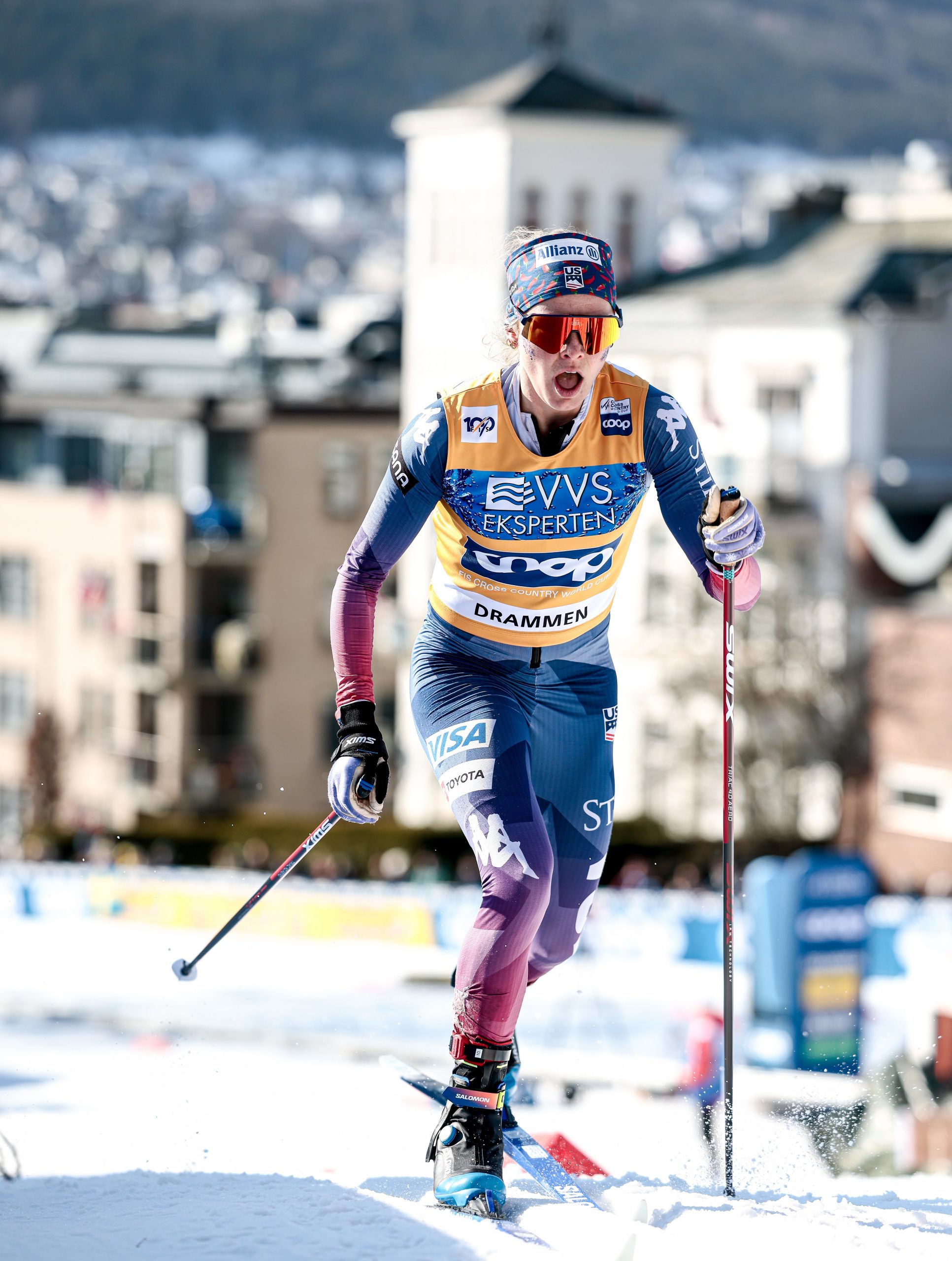
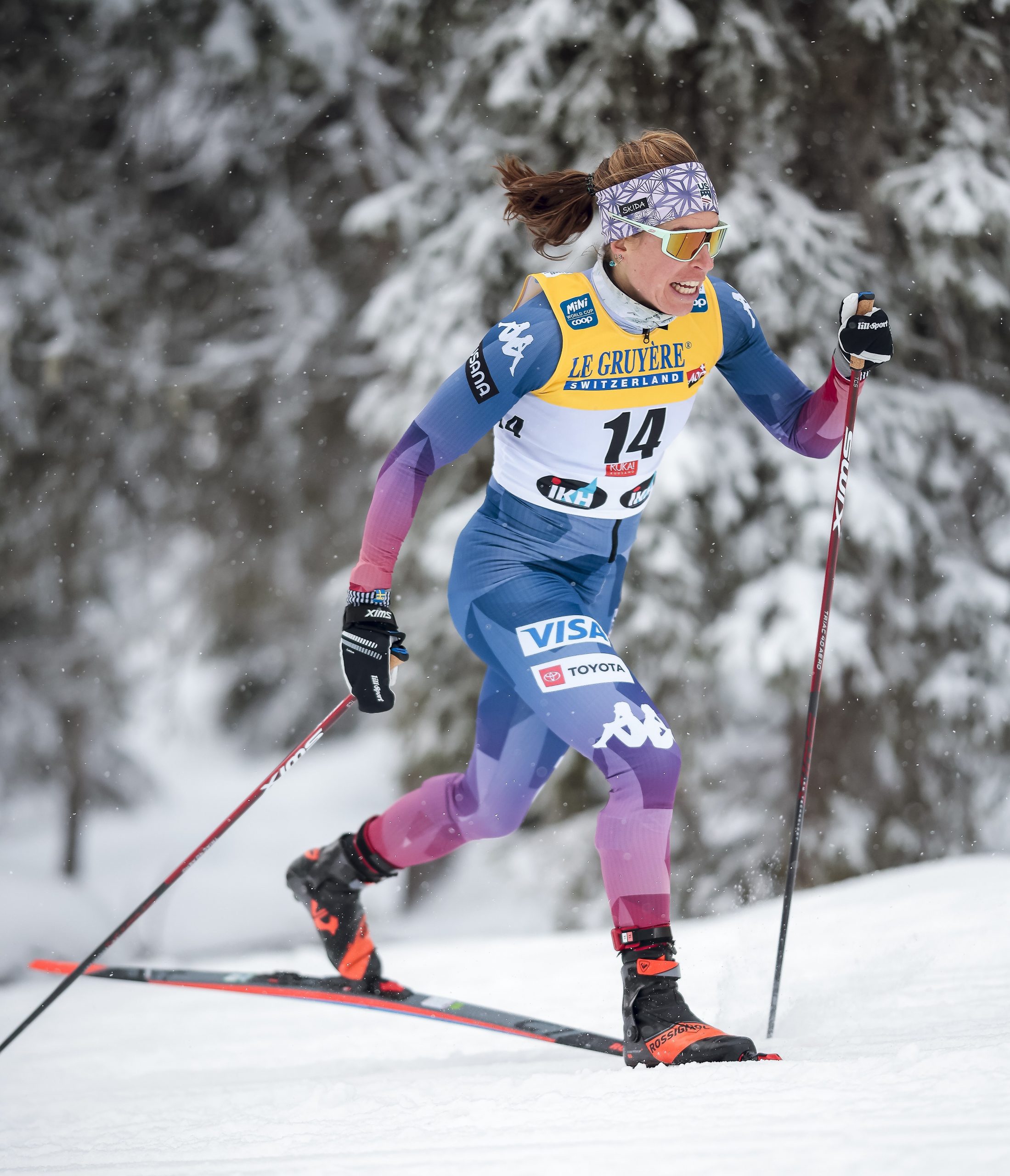
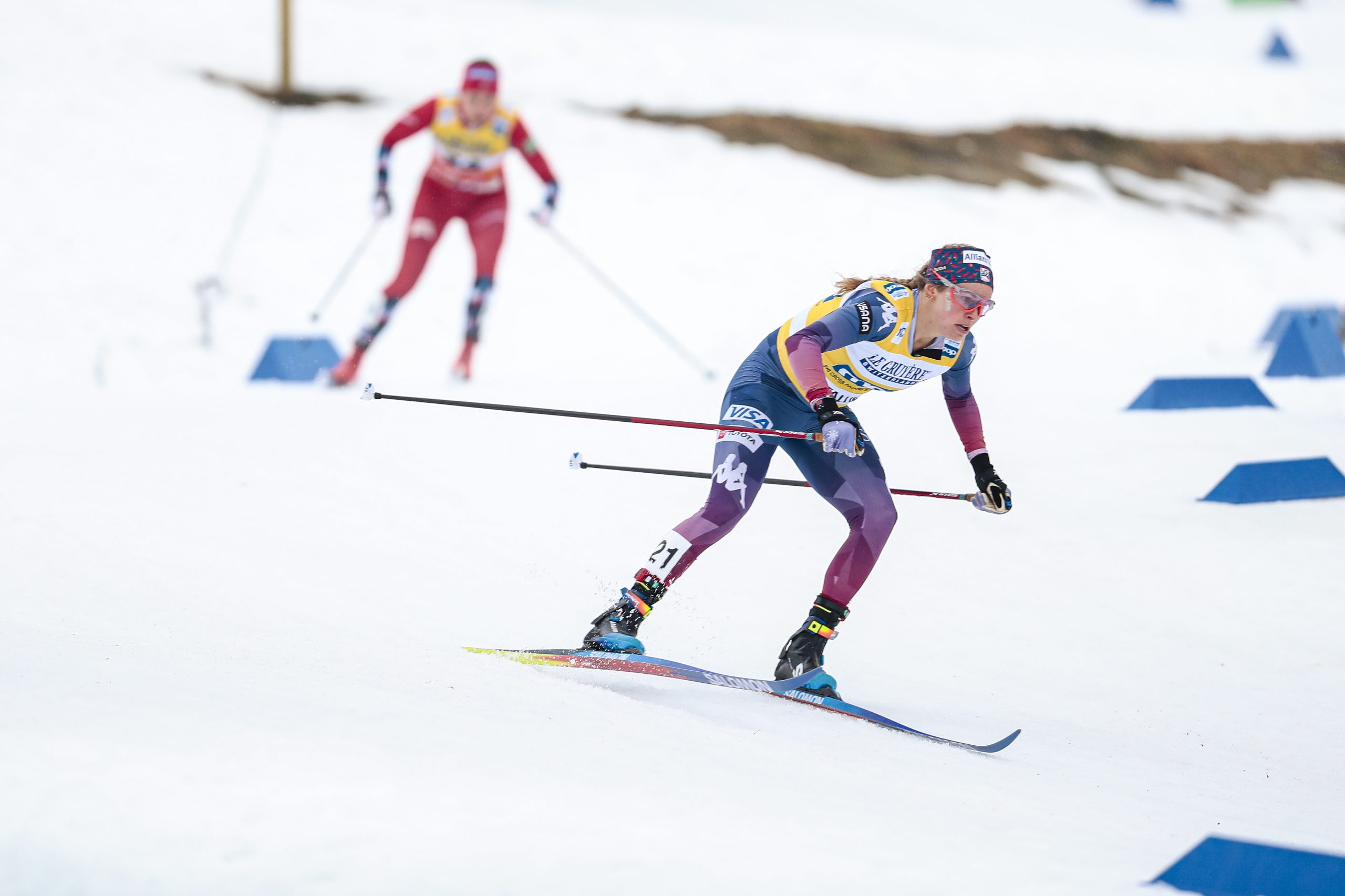
    Jessie Diggins (USA) finished 18th in Falun’s Classic sprint. Her lead in the Overall competition is now only 41 points. (Photo: NordicFocus)

    It’s hard to believe, but this weekend in Falun, Sweden, marks the final weekend of competition in the FIS World Cup season. The strong showing by the American team in the first period of racing—and Jessie Diggins’ (USA) early domination of Distance racing and the Tour de Ski—seem like a lifetime ago. The results for the Women’s Overall Championship rest upon this weekend’s outcome in Falun.

    Diggins carried a 102 point lead in the Overall Crystal Globe competition into today’s Classic Sprint race. Chasing her was Linn Svahn (SWE), who secured the Sprint Crystal Globe Sprint championship last weekend in Drammen. While Diggins entered the race with the Overall lead—and would hope to preserve that lead going in tomorrow’s Classic 10-kilometer Individual Start—Svahn entered the weekend with the momentum, as she has been steadily chipping away at Diggins’ margin. But Svahn would need a strong showing today to keep her in the hunt for the Overall trophy.

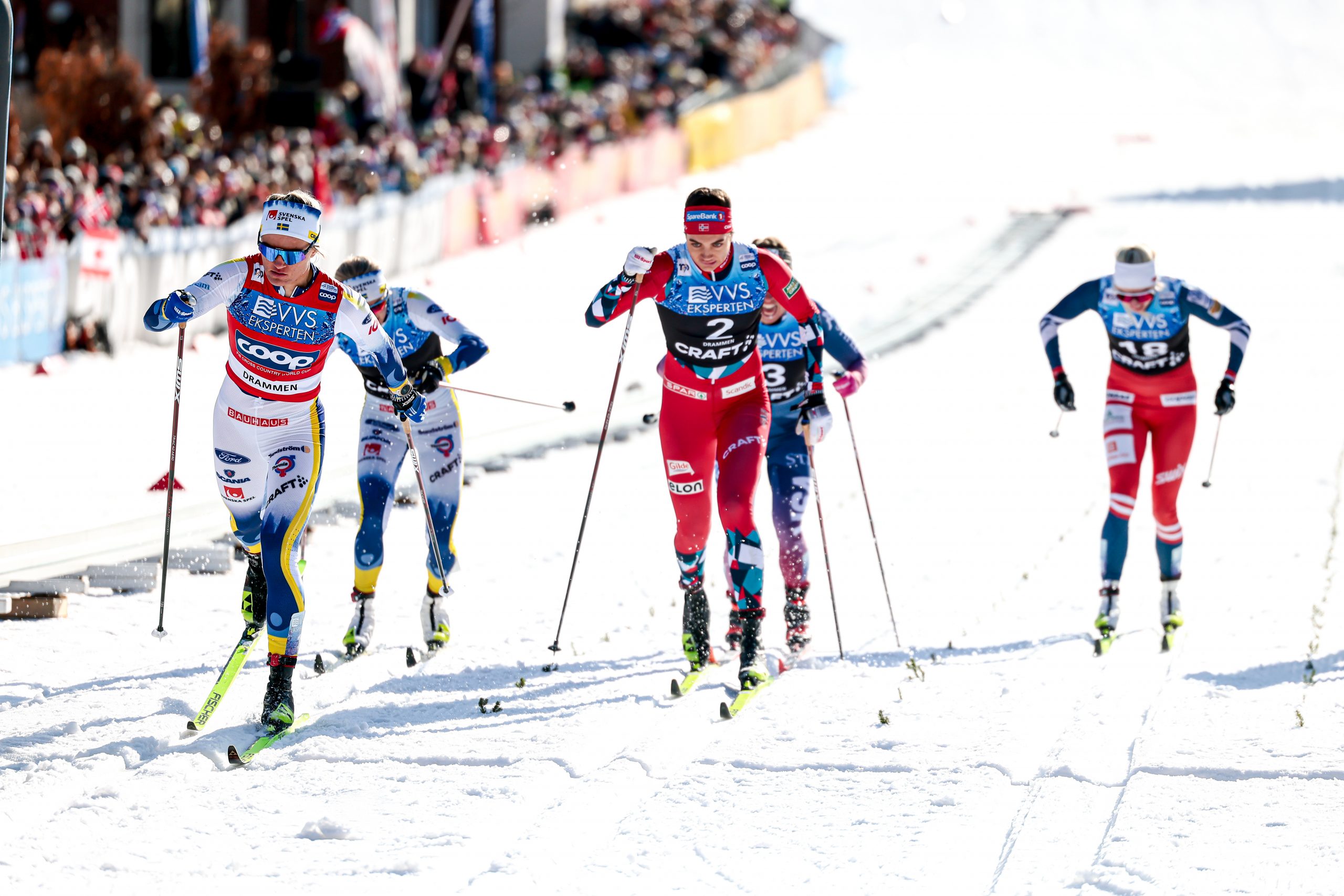
    Linn Svahn (SWE) (r) did everything she needed to do today except beat Kristine Stavaas Skistad (NOR) (c). (Photo: NordicFocus)

    Securing the Sprint championship last weekend gave Svahn the freedom to throw caution to the wind if she so desired. She would also have the support of the home crowd as she tried to claw away at Diggins’ lead. Another factor in Svahn’s favor was that Sweden took full advantage of the host nation’s quota, fielding 12 skiers. Svahn would have lots of support on and off the snow. In a sense, she was playing with house money today: nothing to lose, everything to gain.

    The qualifying round went Svahn’s way as she finished second (earning 12 points). Diggins finished 21st and didn’t receive any points. Before the heats had even begun, Diggins’ lead was reduced to 90 points. Also qualifying and joining Diggins in the heats were teammates Julia Kern, and Rosie Brennan.

    But Diggins couldn’t manage to advance out of the quarterfinals and finished 18th. Kristine Stavaas Skistad (NOR) took the victory with Svahn finishing second and Jonna Sundling (SWE) finishing third. Svahn’s second place—combined with Diggins’ less-than-stellar 18th—was exactly what Svahn had needed to do to close the gap on Diggins.

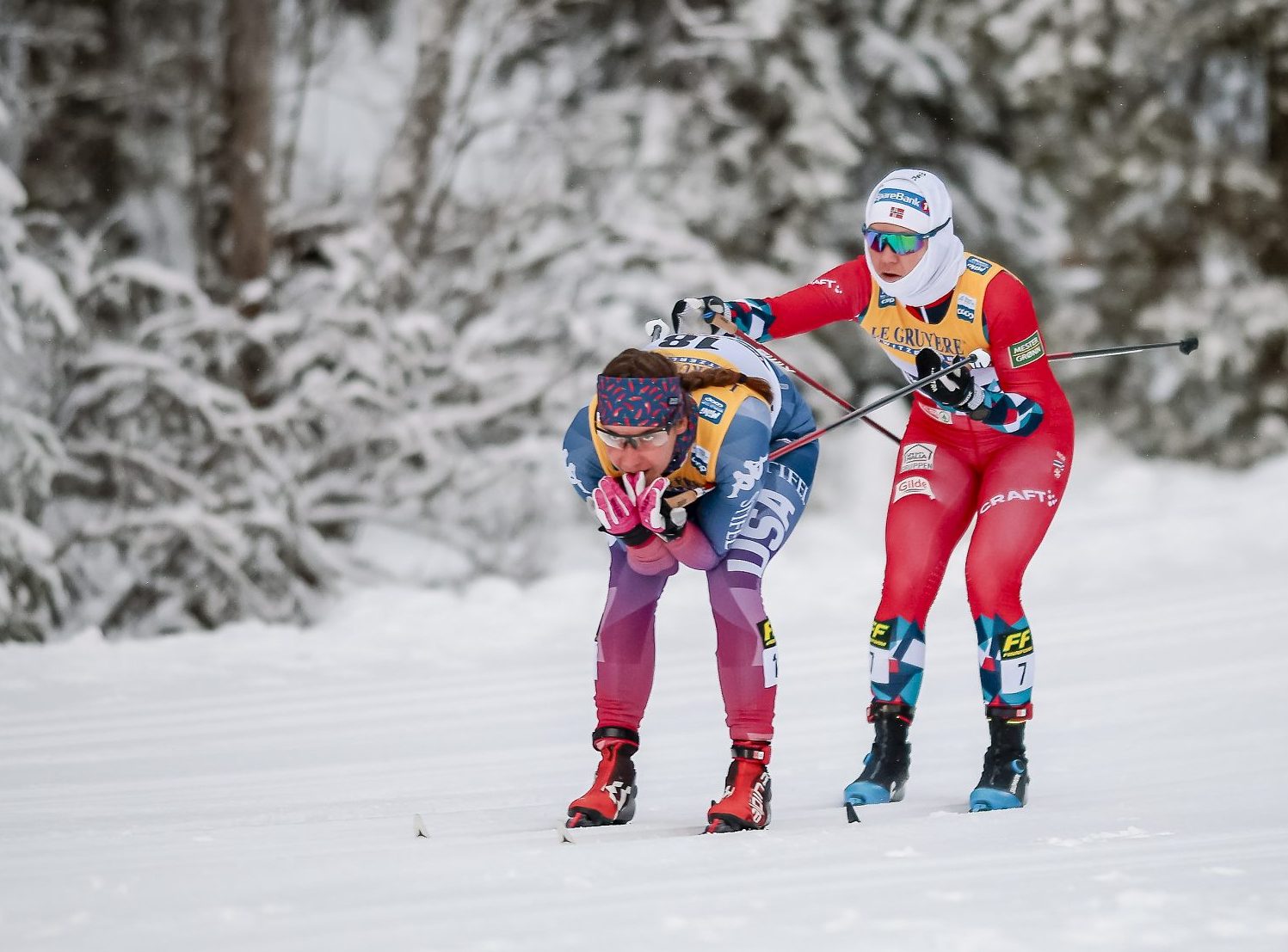
    Jessie Diggins (USA) raced hard but seemed to have trouble with her kick wax. (Photo: NordicFocus)

    “My goals and priorities might be different than the ones other people have for me,” Diggins remarked after her quarterfinal heat. “Out of everything I can control, I’m proud of how I skied. Last year I probably wouldn’t have even qualified. I definitely need to get stronger at double pole.”

    “For me the most important thing is that I don’t let other people’s priorities take away my joy from ski racing,” said Diggins. “Sometimes that’s hard to do, and that’s what I’m focused on.”

    “I just told Linn good luck, cause she’s having a great year,” said Diggins. “I hope she has coaches and people in her life who say the things my coaches say to me. ‘We’re still going to love you if you’re dead last.’ I think that’s way more important. That’s how I cope.”

    After all of the mathematics were completed, Diggins still leads going into tomorrow’s Individual Start Classic race by a scant 41points. The stage has been set for what promises to be two tense days of racing.

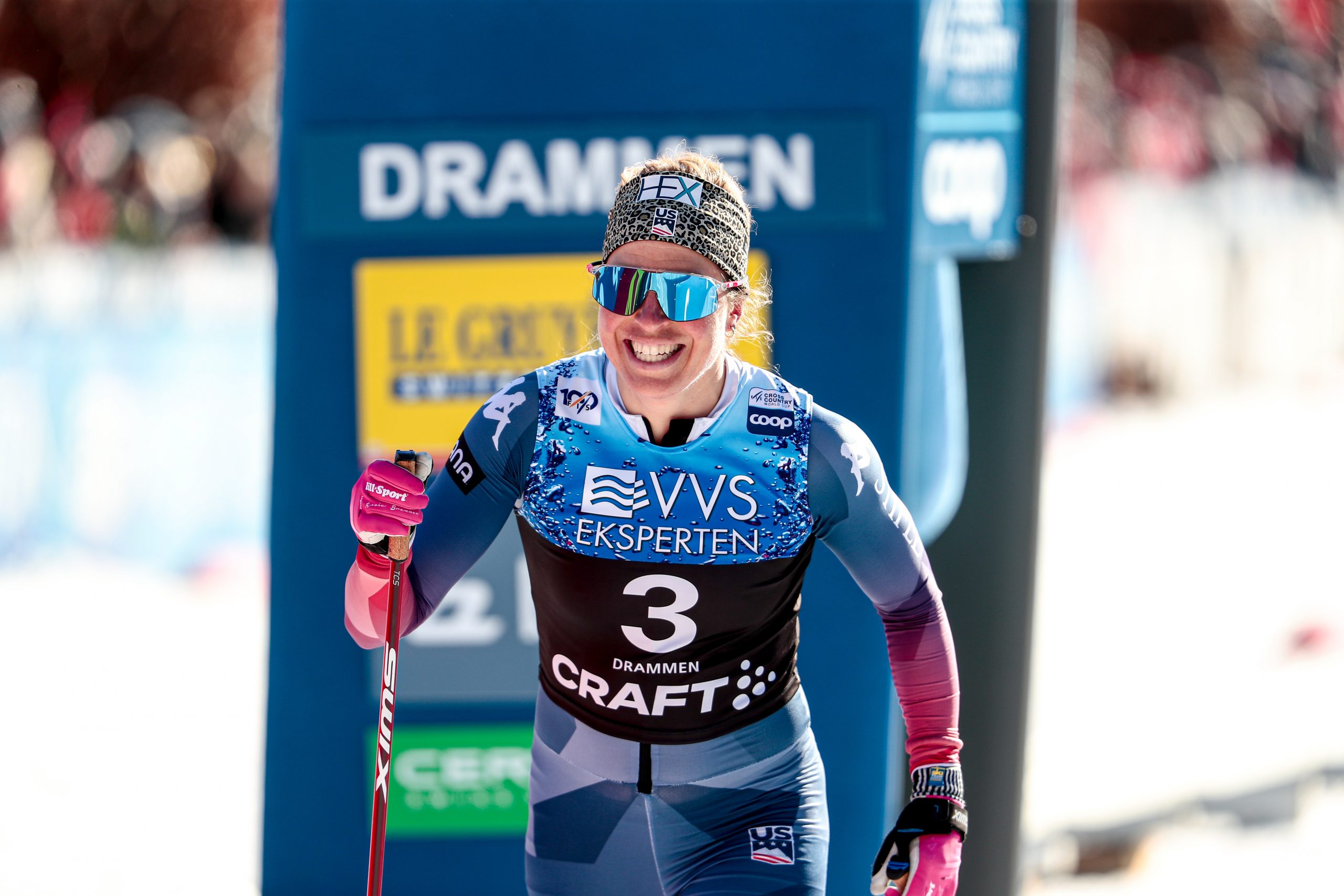
    Rosie Brennan (USA) after her podium in Drammen was unable to advance out of the quarterfinals. (Photo: NordicFocus)

    Seven American women competed today. Other American finishers were Rosie Brennan 20th, Julia Kern 24th, Sammy Smith 39th, Erin Bianco 44th, Haley Brewster 51st, and Renae Anderson 54th. For Brewster, it was her first World Cup race outside of North America, and today marked Anderson’s second World Cup in Europe.

    For Canada, the top finisher was Sonjaa Schmidt in 45. Liliane Gagnon finished 48th.

    On the men’s side of the race, Johannes Hoesflot Klaebo (NOR) had wrapped up the Sprint Crystal Globe last week. Today’s race was a battle for second place in the Sprint competition with Erik Valnes (NOR) coming into the race holding a 35 point lead over Lucas Chanavat (FRA) for the second spot. With bonus points available for Sprint qualification, the race for second place was wide open.

    Klaebo once again demonstrated why he is the best Sprinter in history as he chose whatever tactics suited him in the heats, and easily captured first place in the final. Lauri Vuorinen (FIN) took second place for his first World Cup podium. Harald Oestberg Amundsen (NOR) was third.

    “It was a hard one,” Klaebo commented after the race. When asked about winning the Sprint competition he replied that, “the Crystal Globes are always part of the goals. This has been one of my best Sprint seasons in my career.”

    Valnes finished sixth and Chanavat finished tenth, meaning that the battle for second place in the Sprint standings went to Valnes with Chanavat settling for third.

    Seven American men raced in Falun, and three qualified for the heats. JC Schoonmaker was the top American man finishing ninth. Other American finishers were Gus Schumacher 19th, Zanden McMullen 20th, Zak Ketterson 53rd, Luke Jager 57th, Kevin Bolger 61st, and Michael Earnhart 64th.

    The top Canadian finisher was Antoine Cyr in 23rd. Other Canadian finishers were Xavier McKeever 29th, Sasha Masson 54th, and Pierre Grall-Johnson 59th.

    After the race, Schumacher commented on the warm course conditions.”It’s warm and they salted the course,” he said. “So it makes it harder. It’s honestly skiing pretty well, my skis are good, but it’s kind of funky.”

    Women’s Quarterfinals

    In the first heat, Sundling continued with her usual strategy of going quickly to the lead. She developed a huge gap on the field early while Skistad finished second. It was a repeat of a formula which has been witnessed often this season in the Sprints: Sundling going off like a rocket and Skistad doing only what she needs in order to advance.

    Svahn was in the second heat along with Brennan, Frida Karlsson (SWE) and Julie Myhre (NOR). Svahn went out to the lead in a controlled fashion along with Myhre and Johanna Matintalo (FIN). Svahn maintained her position at the front and easily won the heat. Brennan finished fourth and did not advance.

    With Svahn’s advance, the pressure was now on Diggins in the next heat to keep pace. Diggins would face off against Tiril Udnes Weng (NOR), Moa Lundgren (SWE) and Laura Gimmler (GER). Immediately after the start, Diggins was at the back of the pack but quickly moved up to the middle of the group. She was visibly slipping up the steep hills, and every slip cost her precious time sending her behind the leaders. But there appeared to be a glimmer of hope as after the biggest downhill she was able to move herself back into third place and used the draft to gain on the leaders. Diggins took an outside line into the final stretch and had an unobstructed path to the finish line, but she couldn’t keep up with the double pole pace. Finishing fourth, her day was over. No matter what happened next, her lead in the Overall competition would further erode as Svahn advanced.

    Julia Kern (USA) finished fifth in her quarterfinal. (Photo: NordicFocus)

    Julia Kern was in the fourth quarterfinal. She would face Emma Ribom (SWE) who had been disqualified in the last Sprint race for interference. Kern maintained pace with the lead group early and was fourth half-way through the race. But then Ribom took control of the race and went to the lead distancing herself from the field. She went into the stadium with a large lead and coasted to the finish. Kern finished fifth and would not advance. And just like that, the day was over for the American women.

    In the fifth heat, Maerta Rosenberg (SWE) went out to an early lead. The 21 year old raised the excitement level for the Swedish fans as they cheered a youngster trying to hold off a veteran World Cup field. The fairy tale ended in the stadium as the field swallowed up Rosenberg: she finished sixth. Desiree Steiner (SUI) and Coletta Rydzek (GER) took first and second.

    Women’s Semifinal

    Svahn was in the first semifinal where she was joined by Sundling, Gimmler, Skistad, Myhre, and Anna Svendsen (NOR). It was a very tough field for Svahn to try and advance through. Sundling and Skistad went out to the lead early, but Svahn quickly passed\ Skistad to move into second. It was a perilous position for Svahn who was in danger of being out-dueled at the finish by Skistad. As they entered the final stretch, all three skiers were together. Svahn was able to surge to the lead, and once again Skistad exerted the least amount of energy possible to eke out second place over Sundling. Svahn would advance to the finals and was now guaranteed to take a sizeable chunk out of Diggins’ lead.

    In the second semifinal Ribom took a commanding lead early and was never seriously challenged. Nadine Faehndrich (SUI) was able to join Ribom at the finish line for second. The two advanced to the finals with no one from the heat getting a lucky loser position.

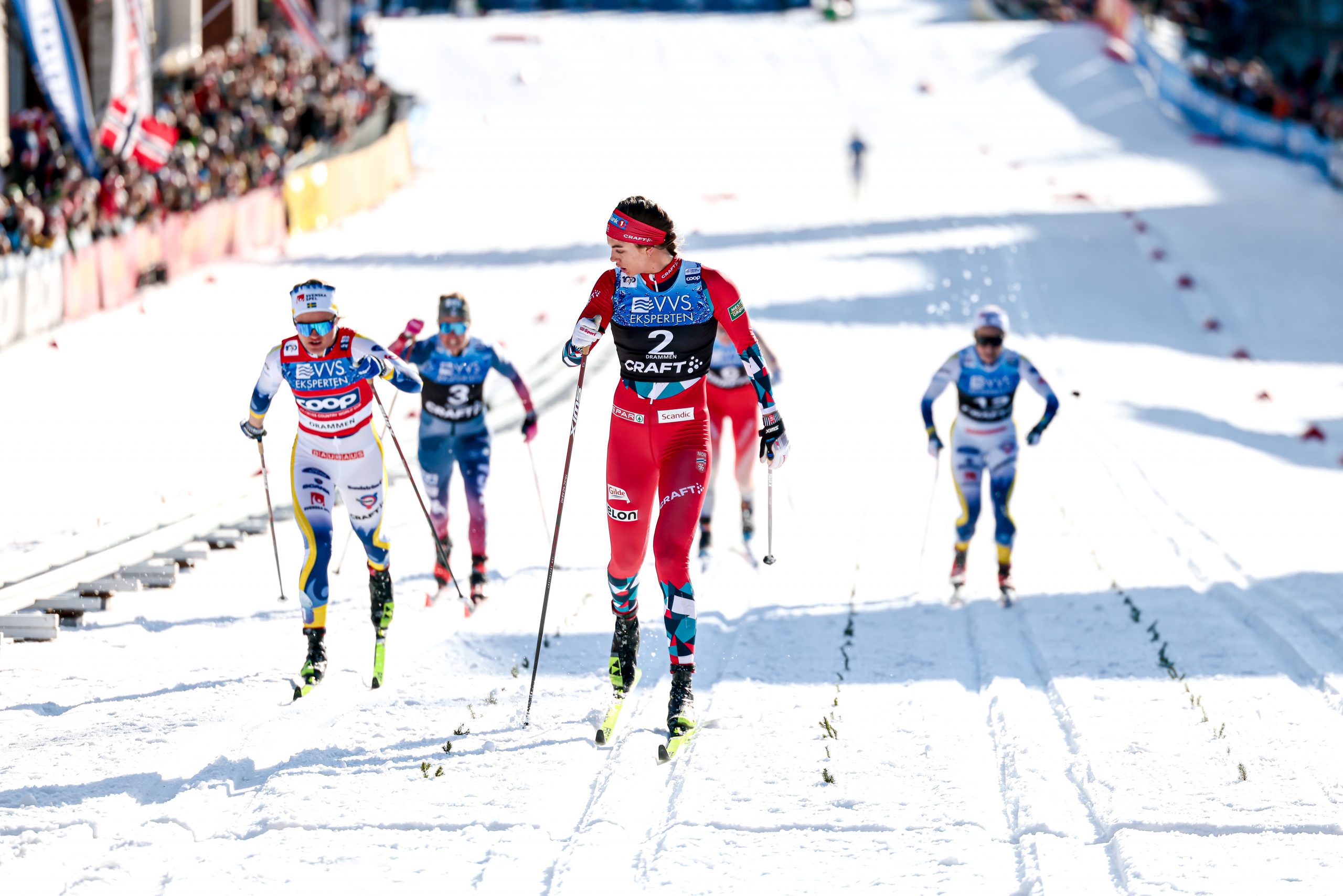
    Kristine Stavaas Skistad (NOR) dominated the Sprints and literally silenced the Swedish crowd. (Photo: NordicFocus)
    Women’s Finals

    The women’s finals consisted of Svahn, Ribom, Skistad, Faehndrich, Sundling, and Gimmler. Entering the final, the question was would Skistad’s strategy of skiing conservatively in the heats pay dividends for her in the finals? In a total change of tactics, Skistad went into the lead early. Sundling tucked in behind her, then passed her on the first climb. Sundling was then joined by Svahn who also passed Skistad, and the three women quickly gapped the field. Sundling, Svahn and Skistad skied together in a trio into the final long downhill. Then Skistad was able to easily blast by the two Swedes and shot into the lead. She maintained her lead coming into the stadium and created a large gap, winning easily. As Skistad crossed the finish line she pressed her index finger to her mouth miming the “shush” gesture at the crowd. Svahn finished second to get the second most possible points out of the heats. For Svahn, it was mission accomplished; she is now within striking distance of Diggins.

    James Clinton Schoonmaker (USA) was the top American finisher. (Photo: NordicFocus)

    Men’s Quarterfinals

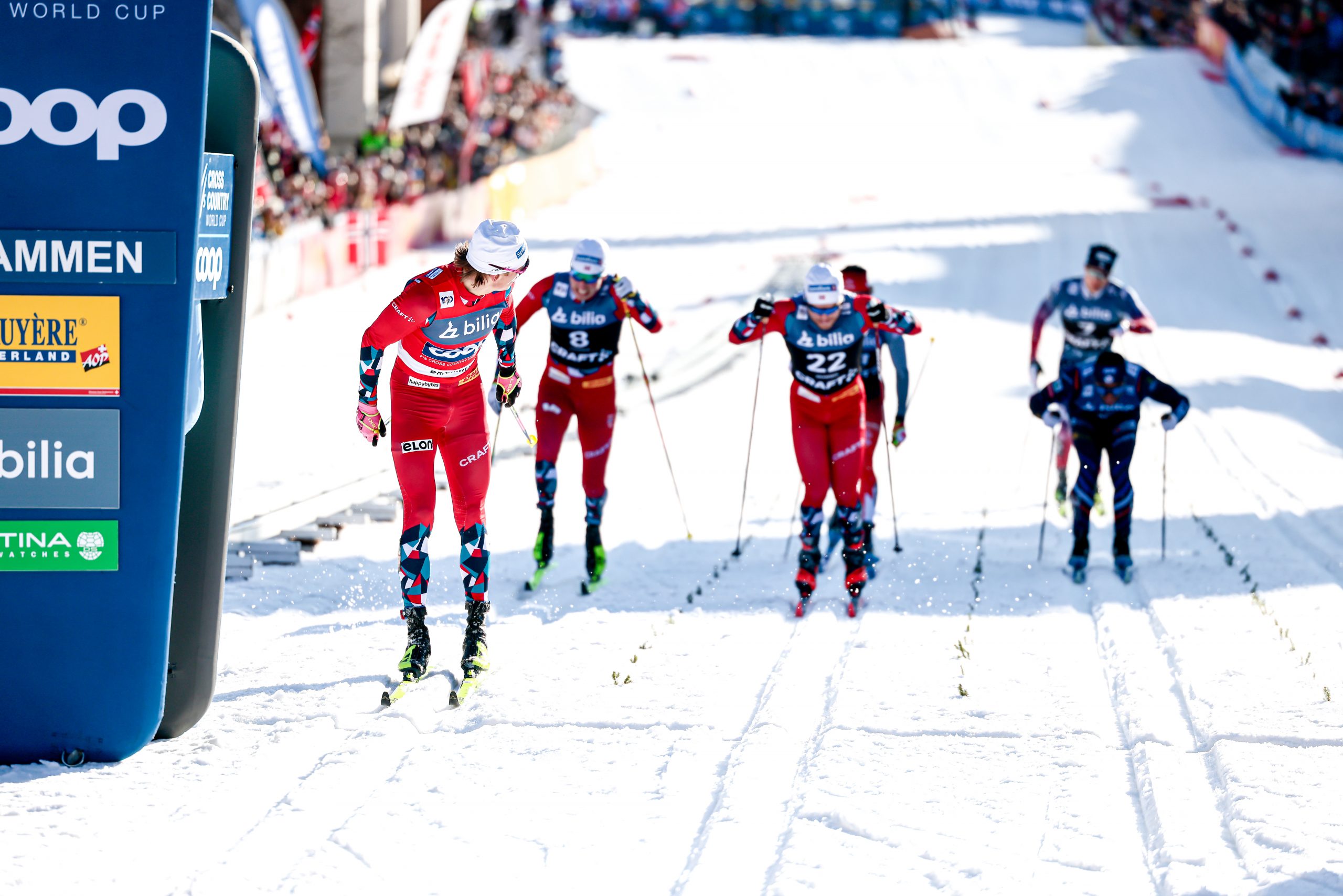
    Schumacher was in the first heat and was in the unenviable position of going up against Klaebo and Valnes. Anton Grahn (SWE), a 19 year old junior went to the front early, but the field was unconcerned by his outburst. Klaebo— as is usual for him— remained calm and pushed to the front group. Schumacher then contended for the lead, but as the group entered the stadium the Norwegians glided by him, and he dropped to third. Valnes won the heat with Klaebo finishing second. Schumacher finished fourth and would have to wait on a lucky loser spot.

    The men’s Overall leader, Amundsen, was in the second heat. He immediately went into the lead along with Vuorinen. The two took a large lead into the stadium and easily advanced. It was a fast heat which meant that Schumacher lost the lucky loser’s position.

    Schoonmaker was in the third heat. Halfway through, he moved to the front and pressed the pace as he was able to develop a large gap. As the field entered the final stretch they began to close on him. Schoonmaker was able to stay with the field as there was a three-way photo finish. After the review, Schoonmaker was awarded first place and he would automatically advance. Edvin Anger (SWE) took second. Schoonmaker would be the first American of the day to advance.

    Cyr was in the fourth heat alongside Federico Pellegrino (ITA), Even Northug (NOR), and Sivert Wiig (NOR). Wiig took the victory with Northug finishing second. Cyr would not advance.

    McMullen was in the fifth heat. In that race, Marcus Grate (SWE) and Emil Danielsson (SWE) immediately went to the lead. They were quickly joined by Ondrej Cerny (CZE). McMullen skied well tactically and went into the lead two-thirds through the race. He maintained the lead going into the stadium as a five way double pole sprint to the finish took place. In another photo-finish it was Cerny and Chanavat taking first and second. McMullen finished fourth and would not advance.

    Johannes Hoesflot Klaebo (NOR) took home the Sprint Crystal Globe after his performance on Friday in Falun. (Photo: NordicFocus)
    Men’s Semifinals

    Schoonmaker was in the first semifinal along with Klaebo, Valnes, and Amundsen. Amundsen went to the front early and kept the tempo very quick. Halfway through it was five skiers in a big pack with Amundsen leading it. Entering the final climb, Klaebo and Valnes blew past Amundsen. Klaebo took the lead and leisurely double poled across the finish line in first. Valnes was second. Amundsen and Vuorinen would wait for a lucky loser positions. Schoonmaker finished fifth and would not advance.

    In the second semifinal the field went out extremely leisurely in what quickly developed into a tactical race. Finally, more than halfway through, Chanavat put in a couple of quick strides to create a gap near the final stretch. But it was still a five-way grouping coming into the stadium. Johan Haeggstroem (SWE) and Northug advanced to the finals.

    Johannes Hoesflot Klaebo (NOR) waved to the fans through the fog. (Photo: NordicFocus)
    Men’s Finals

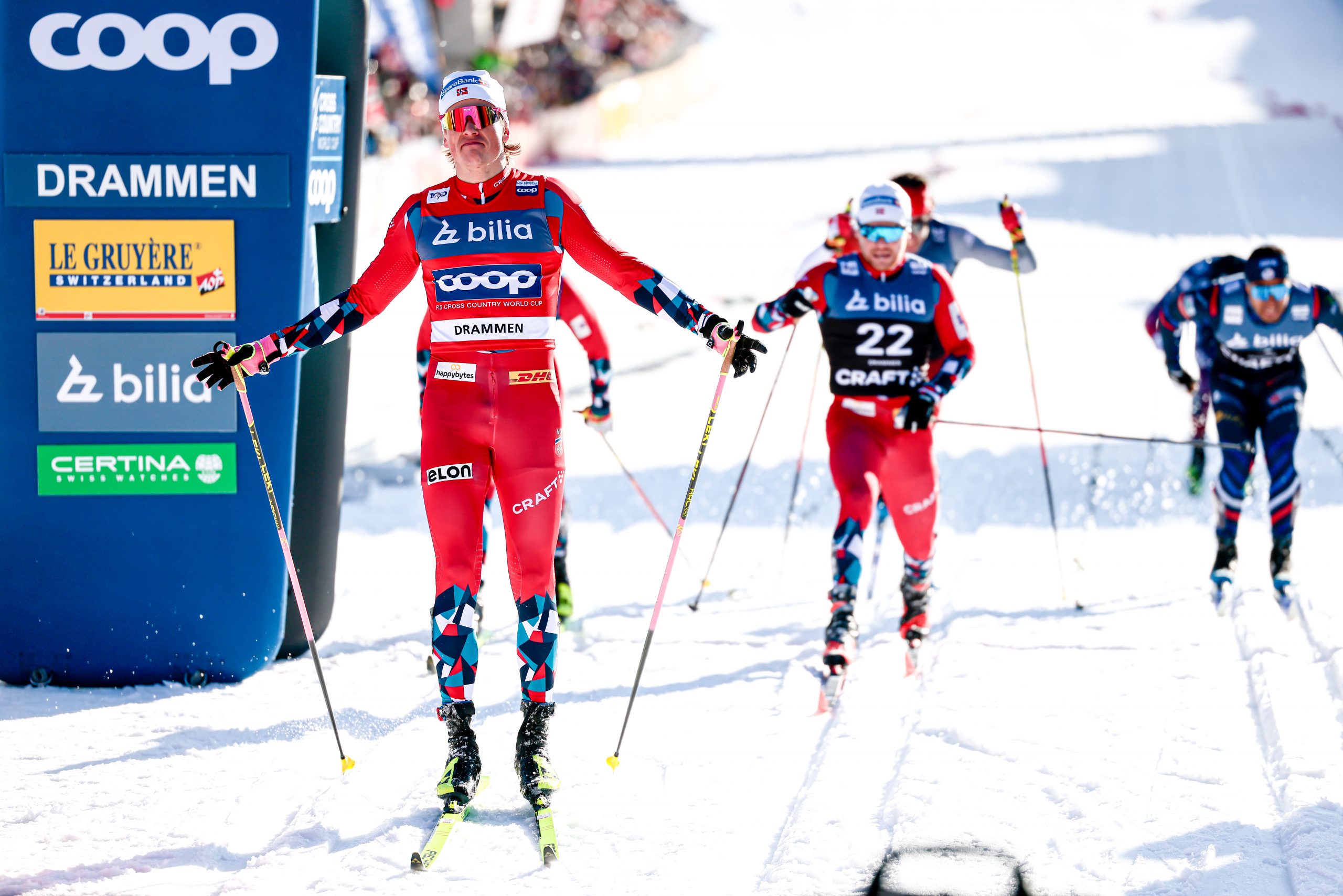
    Klaebo, Haeggstroem, Valnes, Northug, Amundsen, and Vuorinen were in the men’s finals, which saw a change of strategy from the heats. Klaebo and Amundsen went early to the front. Klaebo lead up the final climb as something unusual then happened—he had a slight slip. That minor miscue allowed Amundsen to shoot to the front. But Klaebo didn’t panic, he was able to pass his teammate on the final large downhill, put in an incredible turn of speed, and in seconds created a gigantic gap. He didn’t even have to kick or double pole for the last 20 meters of the race. It was a scene of complete domination. Klaebo easily took the win with Vuorinen finishing second for his first World Cup podium. Amundsen ended up third, providing an excellence defense of his lead over Klaebo in the World Cup overall points chase.

    Lauri Vuorinen (FIN), Johannes Hoesflot Klaebo (NOR), Harald Oestberg Amundsen (NOR), (l-r)

    MEN’S RESULTS

    WOMEN’S RESULTS


  • Brennan Third in Drammen, Cyr Takes Fourth, Schoonmaker Sixth

    Brennan Third in Drammen, Cyr Takes Fourth, Schoonmaker Sixth

    This coverage is made possible through the generous support of Marty and Kathy Hall and A Hall Mark of Excellence Award. To learn more about A Hall Mark of Excellence Award, or to learn how you can support FasterSkier’s coverage, please contact info@fasterskier.com.

    Rosie Brennan (USA) had a great day in Drammen, finishing third. (Photo: NordicFocus)

    The World Cup moved to its second to last venue today as racers competed in the Drammen, Norway, City Classic Sprints. Over the years, Drammen has taken on an aura all its own as it serves as a transition between the crushing Holmenkollen marathon and the final weekend of the race season. Drammen is unique in many ways. It happens inside the center of a city, it has a course which is considered very tight by World Cup Sprint standards, and it can often determine the winner of the Sprint Crystal Globe. Coming on Holmenkollen’s heels, it can also often have a start list where many of the top racers are absent.

    But today, most of the stars were present to shine as a great deal was at stake. Entering today’s race, Jessie Diggins had a 159 point lead in the Overall competition over Linn Svahn (SWE). With a potential of 115 points going to today’s winner, Diggins needed to avoid being shut out of the finals like she was just a little over a week ago in the Lahti Sprints. And, with three races coming up next weekend in Falun—offering a total of 345 points—it was critical for Diggins to continue to keep Svahn at bay.

    Jessie Diggins (USA) was able to make the heats, but Linn Svahn (SWE) continued to eat away at Diggins’ Overall lead. (Photo: NordicFocus)

    Svahn would not only be trying to gain ground on Diggins but also trying to also secure her Sprint title. Coming into the race she had a 178 point lead in the Sprint competition over Kristine Stavaas Skistad (NOR). A strong showing today could mathematically wrap up the Sprint crown. But also on Svahn’s to do list was to chip away at Diggins’ lead.

    But at the end of the day, the Diggins-Svahn battle was overshadowed by Rosie Brennan’s (USA) performance. Brennan was able to advance out of the quarterfinals—finishing second—move forward from the semifinals as a lucky loser, and ski a strong race in the finals to reach the podium and finish third. Finding triumph toward the season’s end was a sweet moment for Brennan who has been frustrated by her performances the last several weeks.

    “[I’m] honestly very surprised,” Brennan commented. “At the end of the season, everyone is on their last ropes, and you never know what the body is going to give you, I’m really happy, it was really nice to have a podium again.”

    She acknowledged the stress of racing so soon after Holmenkollen. “I was glad it was today and not yesterday,” Brennan said. “I felt really bad yesterday. I think that extra day helped compared to last year, but you just never know what the body will do. I really enjoy Drammen, I think it’s one of the best World Cups we do.”

    But the Diggins-Svahn dance continued to keep everyone’s attention. Svahn finished second today, while Diggins was unable to advance out of the quarterfinals—finishing 16th—after being impeded by Emma Ribom (SWE) in their heat. Svahn’s success and Diggin’s bad luck combined to further tighten the battle for the Overall Championship. Diggins’ lead was reduced to only 102 points. Ribom’s interference led to her disqualification which did provide some consolation for Diggins, moving her up in today’s results, and giving her an extra two points.

    “It was tough, my body felt really good,” Diggins said after the race. “Two things happened that were not great…I got trapped on the inside, it was frustrating, we weren’t going fast enough, and I knew it, I couldn’t get out. And I needed some better glide on the downhills. I did everything I could, but I think I need to have a stronger double pole and be more aggressive out of the start.”

    Svahn’s second place finish gave her a 176 point lead in the Sprint standings over Kristine Stavaas Skistad (NOR). With only 115 Sprint points left in the season, Svahn’s performance secured her Sprint Crystal Globe.

    On the men’s side, Johannes Hoesflot Klaebo (NOR) had a chance to wrap up his sixth Sprint crown. Going into the race he held a 141 point lead over teammate Erik Valnes (NOR). A win today would lock up the crown for Klaebo. After claiming a landmark victory last weekend in Holmenkollen, any other racer might have been questioned about how much fight he would have left in him only two days later. With Klaebo, none of the normal concerns seem to apply. So, as usual—and despite Sunday’s effort—he would be the prohibitive favorite. Klaebo qualified first, and went on to win the Sprints. Going into next weekend, he takes a 190 point lead over Valnes, and has mathematically sewn up the Sprint crown yet again. “I had so much fun, I love this race,” Klaebo said, but he is not optimistic about his chances in the Overall competition. “I think I’m a little too far back, so I’ll be super happy with today’s races.”

    North American men had a day to celebrate. While no North American men reached the podium, Antoine Cyr (CAN) finished fourth, and American J.C. Schoonmaker took sixth.

    “It feels great to be back in the finals,” Schoonmaker noted. “I would have loved to put up more of a fight in the end, but it’s some pretty fast guys in there and they don’t make it easy.”

    It was a thrilling day in Drammen, and with so much riding on today’s race the pressure was high and was only accentuated by the narrow Drammen course where things can quickly go sideways.

    Linn Svahn (SWE) and Kristine Stavaas Skistad (NOR), (l-r) would battle for first place all day. (Photo: NordicFocus)
    Drammen Women’s Quarterfinals

    Svahn served notice early that she was still in the hunt by qualifying first. Rosie Brennan also had a good qualifier, finishing third.

    Kern and Brennan were in the first quarterfinal together facing Skistad. In a difficult field, Brennan was able to advance by finishing second. Kern had to wait, having finished third, while her fate as a lucky loser was decided.

    Svahn chose the second heat and left little to chance as she went out early to win her heat. She had already achieved part of today’s goal by gaining 13 points on Diggins by qualifying first while Diggins qualified eighth. While Svahn had a lot of math on her mind, Skistad skied in total control, appearing to exert very little energy, to finish second in the heat.

    Julie Myhre (NOR), Katharina Hennig (GER), Lena Quintin (FRA), Jessie Diggins (USA), Anna Svendsen (NOR), Emma Ribom (SWE), (l-r) in the quarterfinals. Ribom was disqualified for impeding Diggins. (Photo: NordicFocus)

    As has been her strategy all season, Diggins elected to race in one of the last quarterfinals, choosing the fourth heat. Early on, Diggins sat comfortably in third place tucked in behind the two leaders. As the group came around the final turn into the finishing straightaway Diggins had dropped to fourth. She was never able to gain contact with the leaders Emma Ribom (SWE) and Julie Myhre (NOR) who finished first and second. Myhre had an impressive race after falling out of the starting gate and recovered to appear to take second.

    For Diggins, her day was over, and she would now have to wait and see how many more points Svahn could eat into her lead. But, after the heat was over Ribom was handed a yellow card and was disqualified from the race for obstructing Diggins. Ribom’s disqualification automatically advanced Diggins in the standings and gained her additional points, while Myhre was moved into first place. But Ribom’s disqualification didn’t allow for Diggins to advance to the next heat. Ribom would sit on the sidelines for the rest of the day, while Diggins had to watch and wonder about what might have been.

    Drammen Women’s Semifinals

    In the first heat Brennan faced off against Skistad, Svahn, and Frida Karlsson (SWE). Svahn was the first one to break from the field and take the lead, which hadn’t been a winning formula today. Skistad was right on Svahn’s ski tails, and was able to easily slingshot past Svahn, who then returned the favor by rebounding past Skistad. The pair crossed the line 1-2. Brennan finished fourth and would have to wait for a lucky loser position, which she ultimately won along with Karlsson.

    Kern was in the second semifinal with Nadine Faehndrich (SUI) and Johanna Hagstroem (SWE). Faehndrich and Hagstroem took the victory with Kern finishing third, but it wasn’t enough for her to advance as a lucky loser.

    Kristine Stavaas Skistad (NOR) (center) appeared to dispatch the competition with ease in Drammen. (Photo: NordicFocus)
    Drammen Women’s Final

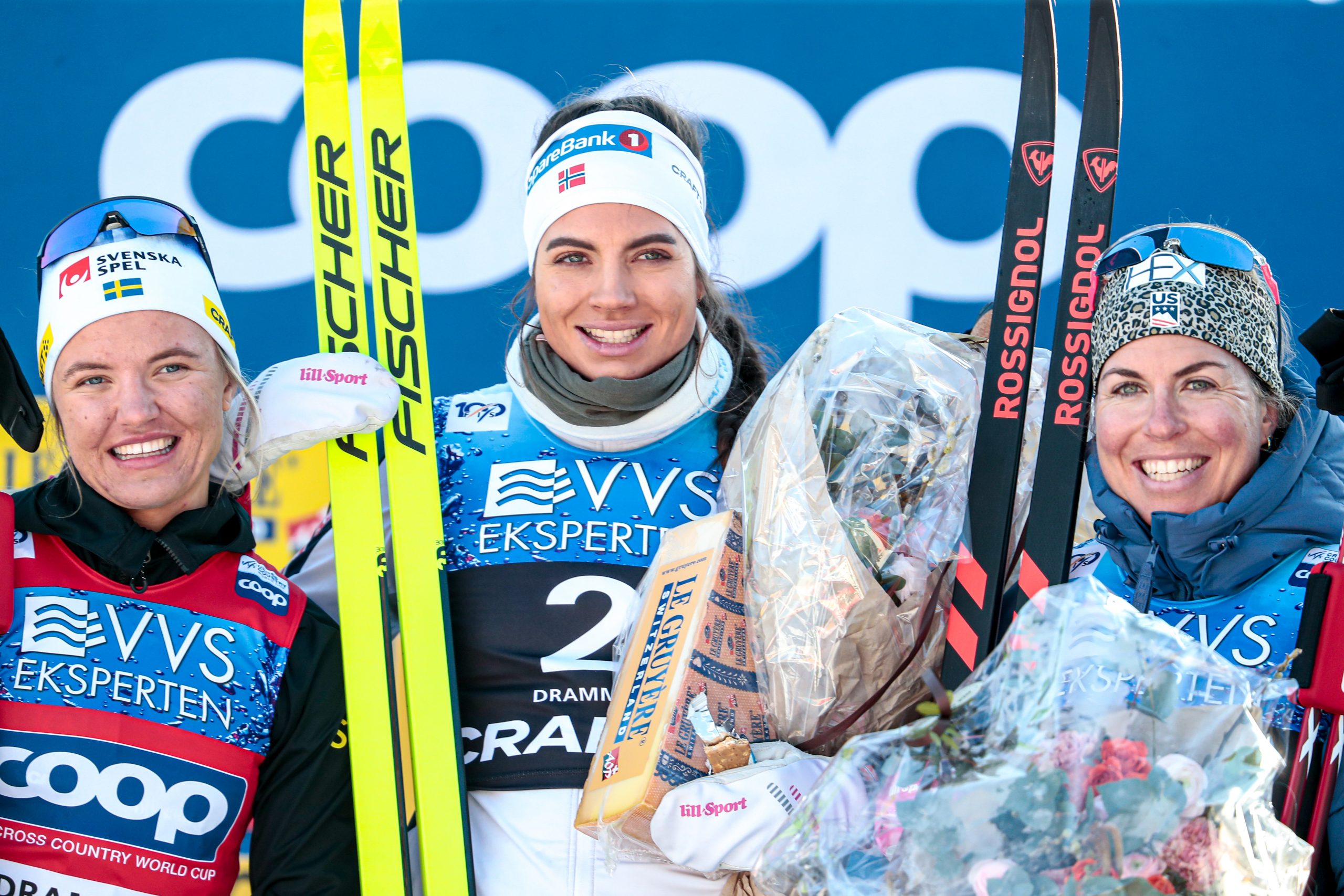
    The women’s finals featured Svahn, Faehndrich, Skistad, Hagstroem, Karlsson, and Brennan. Skistad went out to the front early to set the tempo alongside Svahn. As Skistad slowed slightly, Svahn went to the front which tactically was not the best place to be. Svahn realized that, and then significantly slowed the pace. Faehndrich took advantage of the cat and mouse games to go to the front. However, her strategy didn’t work as Svahn and Skistad were able to slingshot past her. As they approached the finish, Skistad found an extra gear and easily pulled away from Svahn. During the back and forth, Brennan was able to fight her way to the front to finish third.

    Linn Svahn (SWE), Kristine Stavaas Skistad (NOR), Rosie Brennan (USA), (l-r) (Photo: NordicFocus)
    Drammen Men’s Quarterfinals

    The first men’s quarterfinals featured Klaebo and Zanden McMullen (USA). It was a fast heat as Edvin Anger (SWE) quickly jumped into the lead. But no one could keep pace with Klaebo who effortlessly double poled to the victory. McMullen finished fourth to for the moment, preserve a lucky loser opportunity.

    Another American Zak Ketterson was in the second heat. He would have a difficult task as he faced Frenchmen Richard Jouve and Lucas Chanavat. Ketterson gave American fans a thrill as he led for the first half of the race. But he couldn’t maintain the lead and it was Jouve and Sivert Wiig (NOR) who advanced.

    Antoine Cyr (CAN) finished fourth in the Drammen Sprints. (Photo: NordicFocus)

    The third heat saw two North Americans, Antoine Cyr (CAN), and JC Schoonmaker (USA) taking on Overall leader Harald Oestberg Amundsen (NOR). Amundsen immediately went to the front and established a large gap over the rest of the field. But the dynamics of the Drammen course worked against him as the pack was able to swallow him up. It was Ansgar Evensen (NOR) and Cyr taking the victory. Schoonmaker finished third and was now in the lucky loser position displacing McMullen.

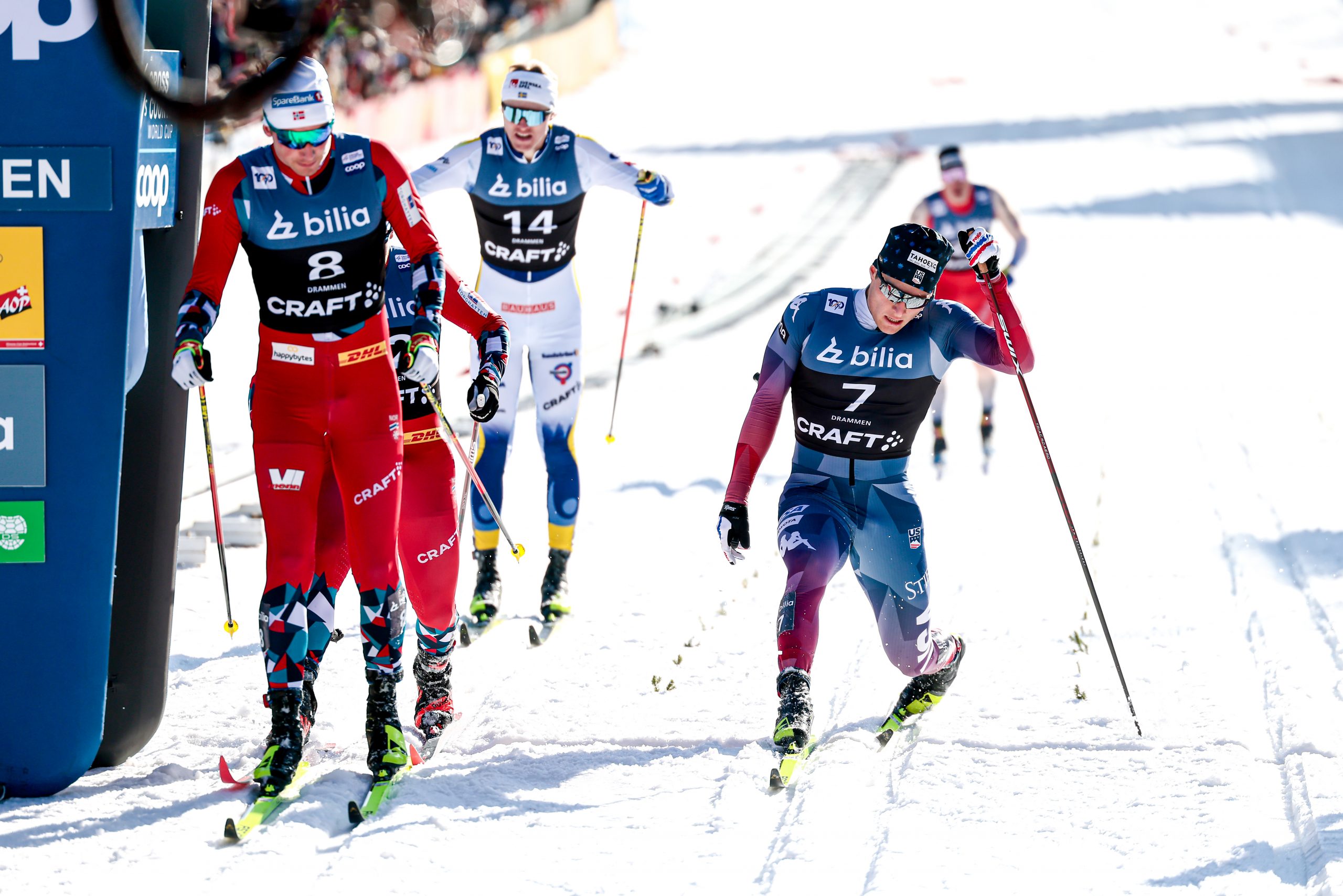
    James Clinton Schoonmaker (USA) (right) finished sixth. (Photo: NordicFocus)
    Drammen Men’s Semifinals

    Klaebo was in the first semifinal alongside Richard Jouve (FRA), Erik Valnes (NOR), Evensen, Amundsen and Wiig. It was Klaebo and Jouve out front early with Klaebo clearly dominating. He once again easily went on to the victory with Jouve finishing second.

    Two North Americans—Schoonmaker and Cyr—were in the second semifinal. Haavard Solaas Taugboel (NOR) took the early lead. The race changed quickly when Valerio Grand (SUI) broke a pole and was pushed to the back near the beginning of the race. Even Northug (NOR) and Taugboel finished first and second. Cyr and Schoonmaker finished third and fourth, and both advanced as lucky losers.

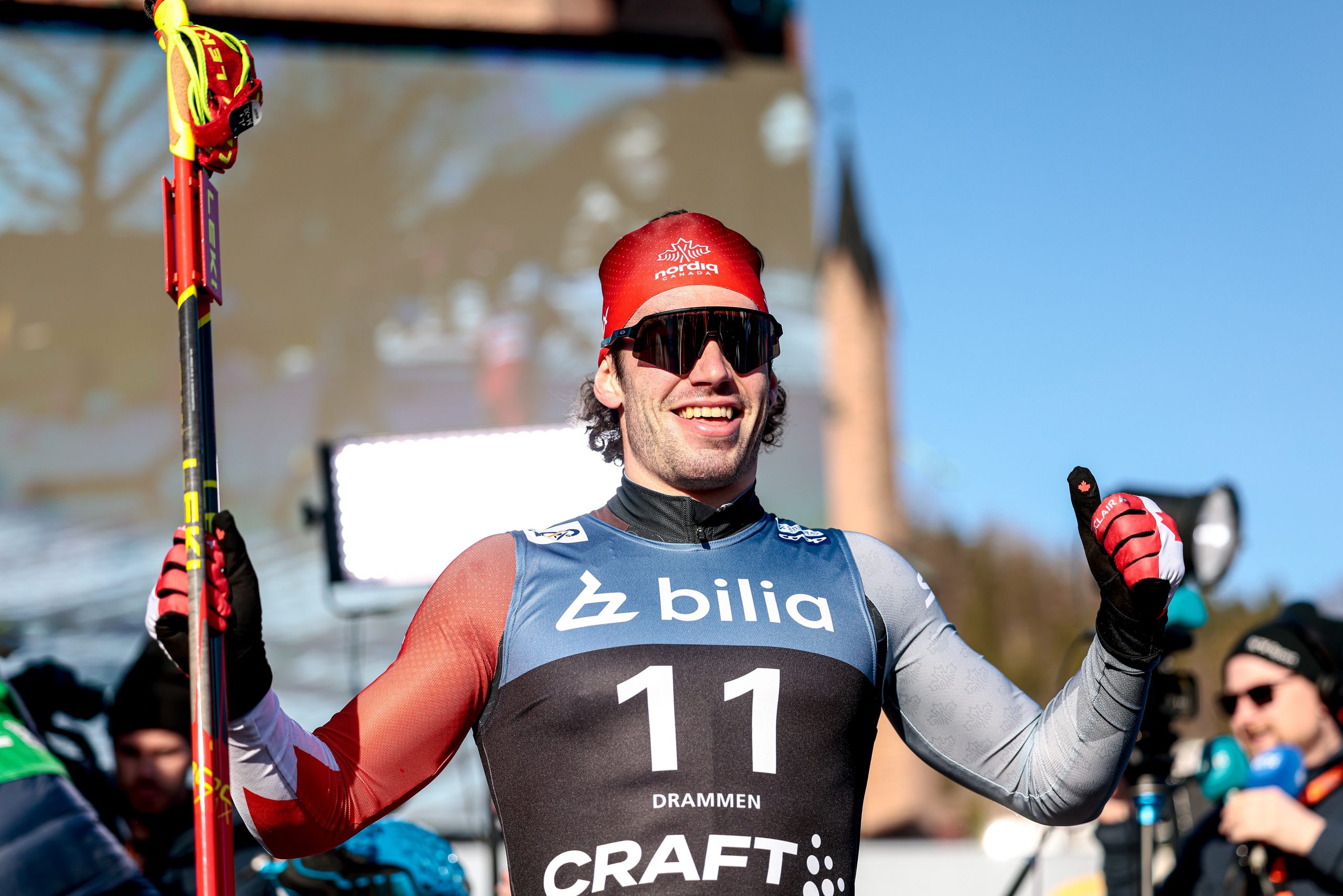
    For Johannes Hoesflot Klaebo (NOR) things seemed effortless as he glanced back at the competition. (Photo: NordicFocus)
    Drammen Men’s Final

    The two North Americans in the finals—Schoonmaker and Cyr—would face Klaebo, Northug, Jouve, and Taugboel. Jouve went out to the lead early along with Klaebo, who took an unusual outside line. As Klaebo navigated along the outside, Schoonmaker was pushed to the back.

    Johannes Hoesflot Klaebo (NOR) had another day where everything he did seemed to work like magic. (Photo: NordicFocus)

    As the skiers came around the final hairpin turn Klaebo was in second, but in a sleight of hand he surged to the front and once again dispatched the competition without anyone seeming to understand exactly how he did it. Cyr went on to finish fourth while Schoonmaker was sixth.

    Drammen had lived up to its billing as the lead for the Overall championship between Diggins and Svahn tightened substantially. Sprint titles were determined, and North Americans had an outstanding day.

    Drammen Classic Sprint RESULTS MEN

    Drammen Classic Sprint RESULTS WOMEN

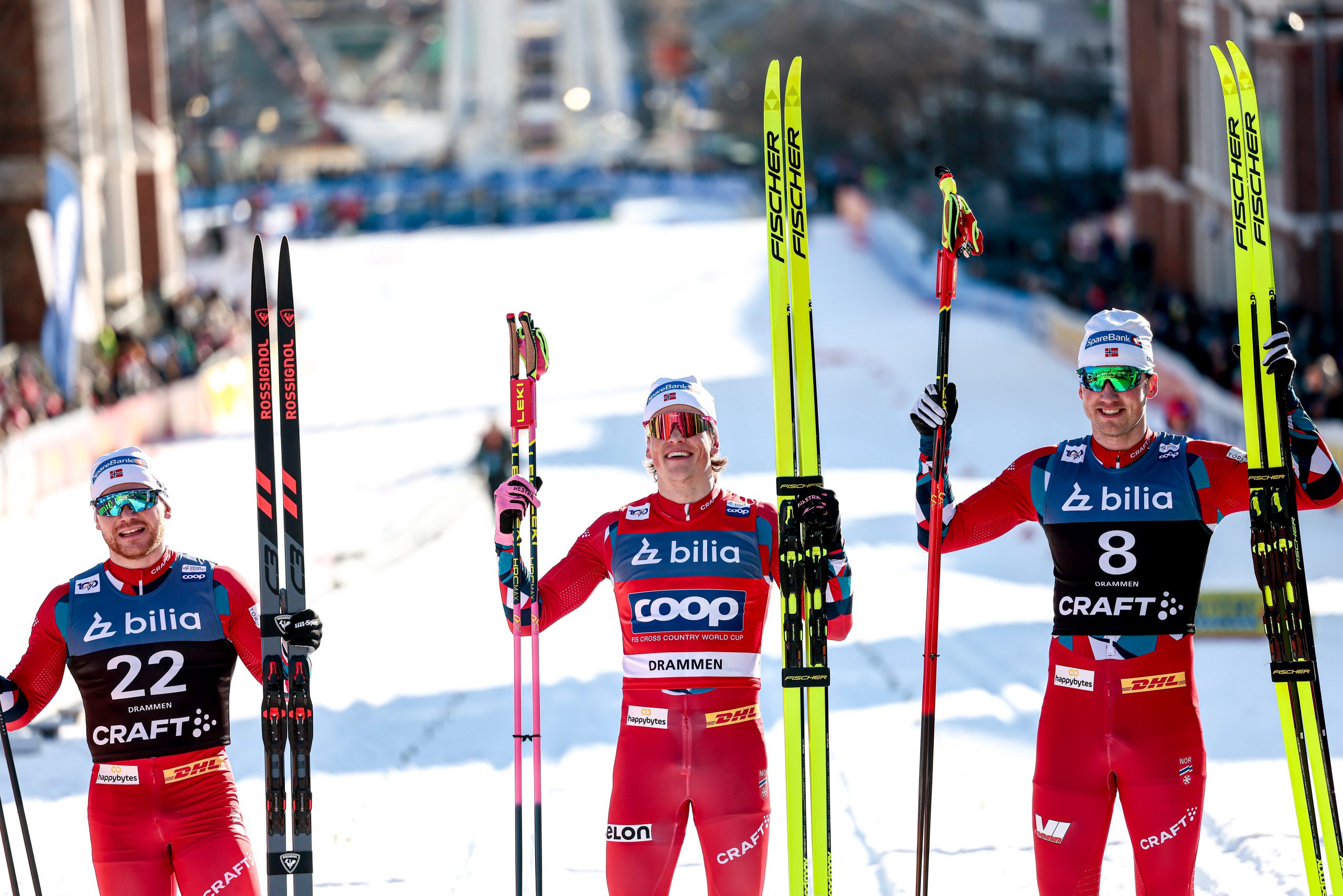
    Haavard Solaas Taugboel (NOR), Johannes Hoesflot Klaebo (NOR), Even Northug (NOR), (l-r) (Photo: NordicFocus)
  • Emma Ribom Repeats in Ruka Sprint

    Emma Ribom Repeats in Ruka Sprint

    This coverage is made possible through the generous support of Marty and Kathy Hall and A Hall Mark of Excellence Award. Learn more about A Hall Mark of Excellence Award—or about supporting FasterSkier coverage—by contacting info@fasterskier.com. 

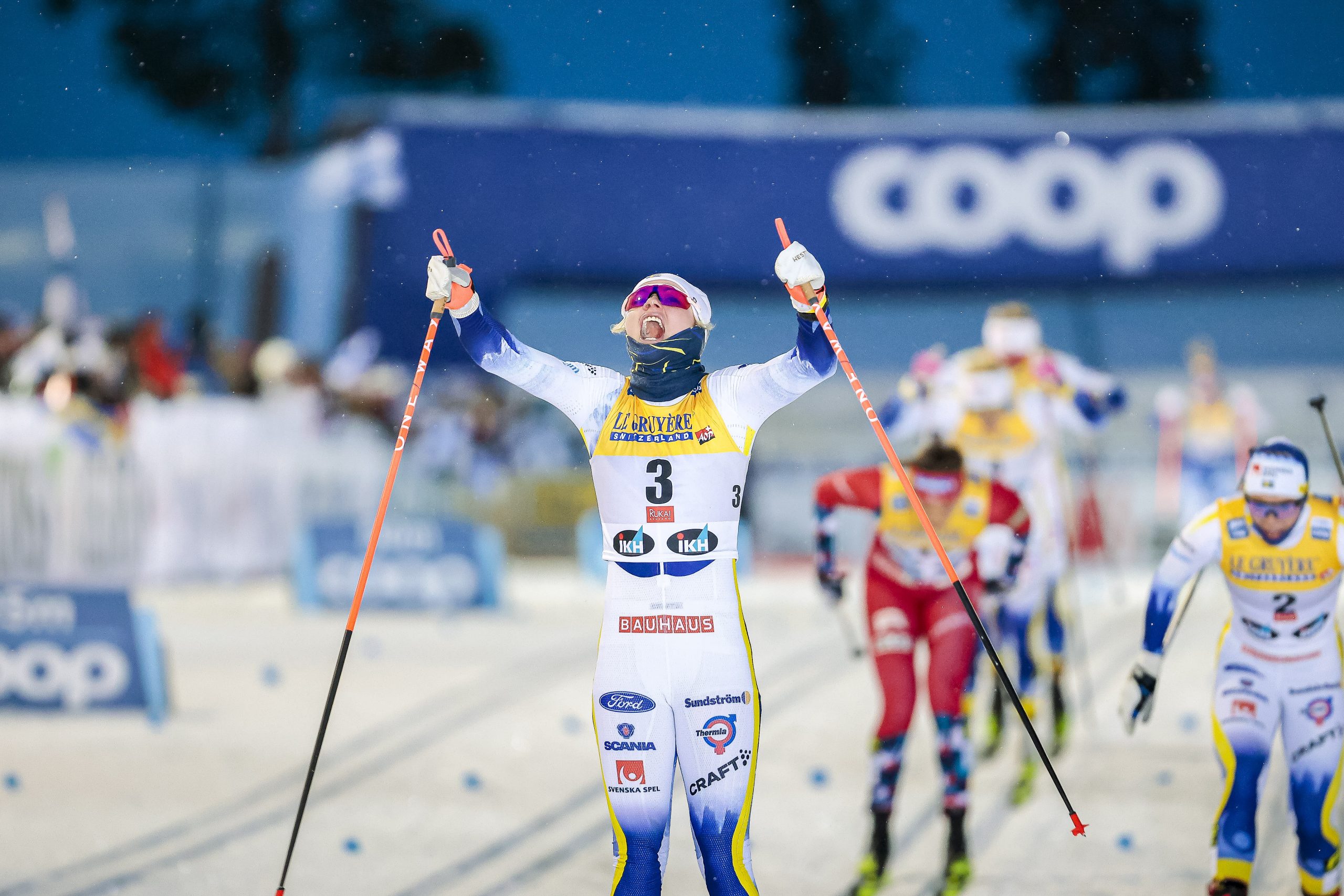
    Emma Ribom (SWE) led the strong Swedish contingent in repeating her Ruka World Cup sprint win of a year ago. (Photo: NordicFocus)

    Today, in the near perpetual darkness of Finland’s early winter, the classic sprint competition announced the dawn of the new World Cup season. The new season brings with it a new rule—perhaps the most significant rule change since skating was allowed—the much awaited fluoro ban, and the associated anxiety over testing protocols. Also affecting race outcomes is the continuing Russia ban.

    But the more things change, the more they stay the same in women’s sprinting. Emma Ribom (SWE) repeated last year’s victory taking the classic sprint title in Ruka for the second year in a row. Sweden also continued its domination of women’s sprinting placing four skiers into the finals with Jonna Sundling taking second. Norway only placed one skier into the finals, Kristine Skistad, but it was enough to find the podium as Skistad took third. Skistad picked up where she left off from last season having had a tremendous late season showing having won the last four sprint events last year.

    The American contingent had a good day placing three skiers into the heats. Rosie Brennan, qualified 8th, Julia Kern qualified,18th, and Jessie Diggins qualified 12th. Other Americans who did not qualify were Novie McCabe finishing 43rd, and Lauren Jortberg finishing 45th. Canadians Katherine Stewart-Jones finished 40th, and Amelia Wells finished 46th.

    Julia Kern (USA) looked great in her quarter final, but was unable to advance out of her semifinal. (Photo: NordicFocus)

    All three American qualifiers performed well in their heats and moved into the semis; for a while, it looked like there might be a strong American presence in the finals. But then the Swedish freight train asserted its dominance.

    Kern and Brennan were together in the first semifinal, but couldn’t push through to the top. Kern finished fourth and Brennan finished fifth. Kern nearly advanced to the finals as her time tied her for a lucky loser spot to the hundredth of a second, but due to a complex tie-breaking formula she was unable to advance. Kern finished eighth overall and Brennan ninth.

    Rosie Brennan (USA) also looked strong, finishing second in her quarterfinal heat. But, like the rest of the Americans, she could not advance out of the semifinals. (Photo: NordicFocus)

    Diggins looked great in her quarterfinal, crushing the field in her heat and setting expectations high by putting up the fastest quarterfinal time of the day. She looked strong at the start of her semifinal—leading at the half-way point—but couldn’t sustain the pace and failed to advance out of the semifinal. She would finish seventh overall.

    It was a good day for team USA with the team’s coach, Matt Whitcomb, describing the team’s performance as “better than expected. This exceeded our average Ruka day.” Whitcomb pointed out that on the first day of racing the American team might be at a bit of a disadvantage. “I don’t like to make excuses,” he said. “But the Scandinavians have been racing already for a while longer than we have.”

    The day clearly belonged to Team Sweden despite the shocking debut of last year’s crystal globe sprint winner, Maja Dahlqvist (SWE), who failed to qualify for the heats. When all was said and done, Sweden showed it’s still the team to beat in women’s sprinting, and the Americans continued to be knocking on the podium door.

    The biggest non-story of the day was day one of racing with the fluoro ban. No one was sanctioned for a fluoro infraction and the cold snow rendered the lack of fluoros a non-issue. This outcome was due to the hard work of all teams’ wax technicians. “Today we were really seeking to nail the process with everyone getting their first starts under their belts,” Whitcomb said. “Our stress meters were slightly higher than normal.” Whitcomb was able to provide insight into the new fluoro protocols. “We’re nervous about this [new fluoro rules], but FIS has really done their homework.”

    “Yesterday, our whole team showed up at 3:00 p.m.” Whitcomb continued. “And we did a dry run of the entire process.” Whitcomb also shared that some of the major ski powers have their own fluoro testing machines, which cost about $30,000 a piece, which the U.S. does not have the resources for. He mentioned that the Austrians were generous enough to loan the American’s their machine for two days to test all of their skis.

    Whitcomb described the race day testing protocol: “Skis are tested before and after racing with different tolerances for before and after a race to allow for post race contamination,” he said. “For sprints, skis are tested before qualifications. Skis are then tested after qualification and we can take them back to the truck to re-wax for the heats. For the heats, they’re tested again before the quarterfinals, and after the finals. For a classic race, an athlete can bring two pairs of skis to the start, have them both tested, and then choose which pair to race on. Clean tested skis are held in a green zone which FIS and volunteers control. If a tested ski exits the green zone or the race course, they are out for the day. On classic race days, techs are allowed to modify kick wax, under FIS supervision, while skis are in the green zone.”

    It’s a lot to process, but teams and racers seem to have adjusted well. It’s been a lot of work. Whitcomb said they spent three weeks just cleaning the wax truck, including scrubbing down light bulbs. It certainly isn’t the end of the fluoro story, though. Whitcomb pointed out that skis with deeper structure which have been used for warm conditions can be cleaned, but that fluoros can rise out later and a ski can fail the test. If a ski tests positive, the racer is disqualified for the day. “As I understand it, if any of the skiers’ sets of skis test positive, that skier is not permitted to start.”

    It’s a brave new world for waxing, but for day one, it went off without any glitches.

    Women’s Classic Sprint RESULTS

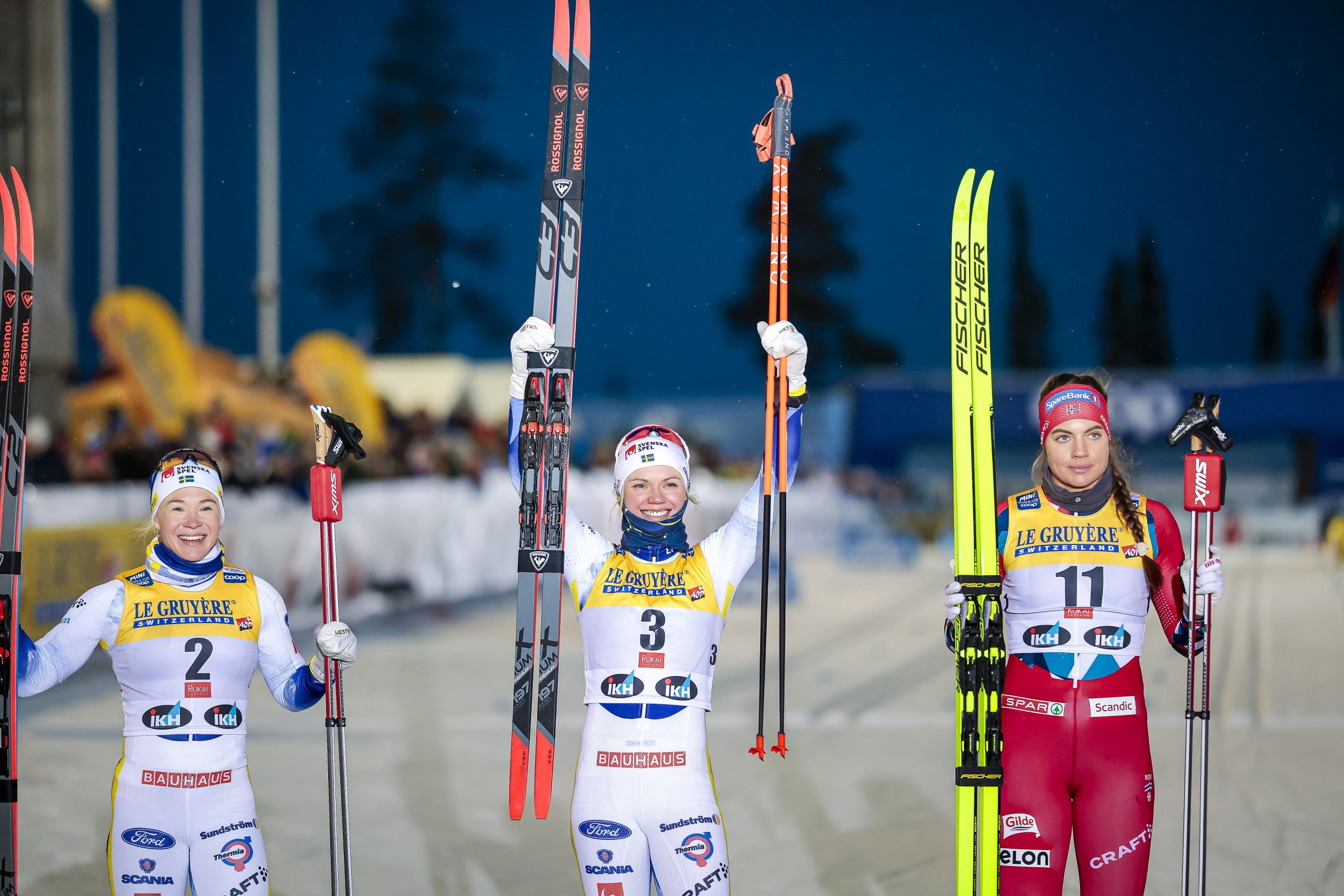
    Jonna Sundling (SWE), Emma Ribom (SWE), Kristine Stavaas Skistad (NOR), (l-r) take the podium in the season opener in Ruka, Finland. (Photo: NordicFocus)


  • Skistad Wins Again: Crystal Globe Race In Focus Under Tallinn’s Lights

    Skistad Wins Again: Crystal Globe Race In Focus Under Tallinn’s Lights

    This World Cup coverage is made possible through the generous support of Marty and Kathy Hall and A Hall Mark of Excellence Award. To learn more about A Hall Mark of Excellence Award, or to learn how you can support FasterSkier’s coverage, please contact info@fasterskier.com. 

    Jonna Sundling (SWE) and Kristine Stavaas Skistad (NOR) at the front of their heat in Tallinn, Estonia. (Photo: NordicFocus)

    For the last week of World Cup sprinting, two pairs of skis have followed each other back and forth, every stride marked in tandem with the other. Twenty meters from the finish in Tallinn, Estonia Tuesday night, the matched skis of Kristine Stavaas Skistad (NOR) and Jonna Sundling (SWE) knocked together. Through the quarterfinal, semi-final, and final it had been the same sight: Sundling leading out Skistad at the front of each of their heats, completing two laps of the up-then-down downtown course as night-time city-racing returned to the World Cup. Sundling had burst over the top of the final climb each time to distance herself from the chaotic tangles that characterized the racing the rest of the night. But in the Final, Skistad followed, closing on Sundling as they hit the bottom of the hill, moving to the outside and, for the third consecutive World Cup sprint, crossing the finish in first place.

    With the exception of the World Championship Classic Sprint—which Sundling won—Skistad has not lost a World Cup sprint she started this calendar year. Tallinn was the latest chapter in her remarkable emergence to the front of the World Cup field after having struggled under the weight of expectation the past few seasons. It also marked the first victory on matched glide wax in World Cup history, adding to the luster of Skistad’s winning move on the final Tallinn downhill. Skistad will look to cap off this run as the World Cup heads to its final sprint in Lahti, Finland next Saturday.

    Sprint Crystal Globe—Focusing on the Semifinals

    (Click here for a refresher on the New World Cup points math this season)

    What had been a grouping of just Skistad and Sundling through the quarterfinal and semifinal was joined by one other skier in the final. Nadine Faehndrich (SUI) went into the last steep pitch of the final climb in a defiant hop skate that moved her over the top of the climb in third place, and closer to a Crystal Globe. When she crossed the finish line in third place to round out the podium, it marked a significant step towards securing first place in the sprint classification for the whole season. As the World Cup began its final week, eyes were just as much on that result as they were on the day’s winner. Faehndrich had entered the day just two points ahead of Maja Dahlqvist (SWE) for the sprint Globe with two races on the calendar.

    The pair wouldn’t meet head-to-head, but Faehndrich’s approach to her semifinal was a sign that her eye was on the Swedish sprinter’s results. Faehndrich started the second semifinal with the knowledge that Dahlqvist had just finished in a lucky loser spot in the first quarterfinal. Which spot, third or fourth, wasn’t exactly clear, as Dahlqvist closed late on a move from Czech skier Tereza Beranova in the sprint for third place, with it going to a photo finish. When the question was resolved, Beranova had won the boot throw, nipping Dahlqvist by 0.01 seconds. Dahlqvist stood in the second lucky loser spot.

    Nadine Faehndrich (SUI) leads out the second semi-final with Lena Quintin (FRA) in tow. Faehndrich’s third place netted her points in a close Sprint Classification battle over Maja Dahlqvist (SWE). (Photo: NordicFocus)

    In the second semifinal, Faehndrich wasted no time pushing the pace. By drawing out the field, there was a chance that the third place skier in her semifinal could knock out Dahlqvist by posting a faster time. Faehndrich proved to be a step ahead of the field, easily cruising to first place in the heat; behind her, the chase had left two skiers vying to keep her pace. Coletta Rydzek (GER) won the two-way battle over Lena Quintin (FRA), but Quintin finished third place a second ahead of Beranova and Dahlqvist’s time. With the first lucky loser spot, Quintin knocked out Dahlqvist, and gave Faehndrich the opportunity to net points ahead of Lahti. With Faehndrich’s third place—and Dahlqvist seventh—the Swiss skier netted 18 points, which after bonuses grew to 20 points. Into the final race, then, the difference was 22 points, as Faehndrich angled to become the first Swiss woman to win the sprint classification, and the second Swiss skier after Dario Cologna.

    Four Americans in Heats, Globe Hunt Little Changed

    Jessie Diggins, Rosie Brennan, Julia Kern, and Sammy Smith all advanced to the quarterfinals. The layered nature of the World Cup field was fully on display in the first quarterfinal; Jessie Diggins and Sammy Smith lined up in an all-star heat that included Sundling and Skistad. Smith looked to continue her impressive World Cup debut, qualifying for heats in a second straight race at 17 years of age, while Diggins stood poised to try to gain some points on Tiril Udnes Weng in the World Cup Overall classification (the difference between the two at the start of the day stod at 102 points). Despite the stakes, Diggins’ approach stayed centered on racing the race in front of her. “For me personally, I’m just trying to focus on racing the best I can,” Diggins said. “I have concrete process goals everyday when I go out there.”

    Jessie Diggins (USA) under the lights in Tallinn. Diggins’ and Tiril Udnes Weng’s (NOR) quarterfinal exits left the World Cup Overall largely unchanged going into Lahti this weeknd. (Photo: NordicFocus)

    Sundling and Skistad stayed controlled through most of the heat, before pushing over the final climb. Smith held onto the back of the heat through the first lap, before Sundling pushed the pace. Diggins had moved from the back of the pack on the last climb, but Sundling’s move over the top left her out of the race when the pack stretched in the final downhill. She ended up finishing fourth, sitting for themoment in a lucky loser spot.

    Weng followed in the second quarterfinal that included Maja Dahlqvist and eventual finalist Tereza Beranova (CZE). Beranova skied with bib 28, and with her resilient push to the final, would prove to play a big role in both Crystal Globe races today. After following a move on the final climb from Weng, Beranova edged the World Cup leader out for the second spot. That left Weng in the second lucky loser spot, which knocked Diggins out of the running. Weng’s own lucky loser spot, though, would be lost in the next quarterfinal, when Appelkvist Stenseth came across the finishline and bested her time by half a second.

    The race for the Overall left Tallinn largely in a stalemate. Weng finished 14th on the day, while Diggins finished 18th, netting the Norwegian 8 points and bringing her lead to 110 points. Diggins also enters Lahti in second in the Distance classification, just 22 points behind Kertuu Niskanen (FIN).

    A late fall in her quarterfinal left Julia Kern (USA) out of the race, but with the best American finish of the day in 17th. (Photo: NordicFocus)

    Julia Kern finished as the top American on the day in 17th, after Kern’s skis traversed the soft snow at the periphery of the finishing curve, and an untimely fall left her fourth in the heat.

    Mixed Reactions to Wax Protocol

    The first ever wax protocol-controlled World Cup race in Tallinn saw mixed reactions from the techs and skiers. “It was an interesting concept,” said US Ski Team Coach Jason Cork, “but in practice when you pick skis the day before and see conditions change, it’s really challenging…it can leave you frustrated.”

    For many, ski selection frustrations alone wouldn’t have been a reason not to try the concept, but when combined with the timing of the event in Tallinn, such a drastic race day change was ill-advised. “There is so much that’s unsettled in the World Cup standings,” Cork said in post-race comments. “Do this as a test event or showpiece, but on the World Cup, with so many points and so much money on the line, it seems a little crazy.”

    All eyes will be on the race for the Crystal Globes as the World Cup heads to Lahti for its final weekend. A Team Sprint kicks off the weekend Friday, before the Faehndrich-Dahlqvist battle in the Sprint classification is decided Saturday, and the Overall and Distance classifications are settled in a 20 k classic Mass Start Sunday.

    In that Overall title chase, Jessie Diggins is coming away from Tuesday with positive signs for the weekend. “I’m really pleased with how my energy has come back,” she said. “It was quite a lot doing a 50 k, two sprints, and a 10 k in the span of seven days. I was pretty tired yesterday. I’m missing power right now, but am happy with where my energy is headed.”

    Full Tallinn Skate Sprint RESULTS

    World Cup Classification STANDINGS

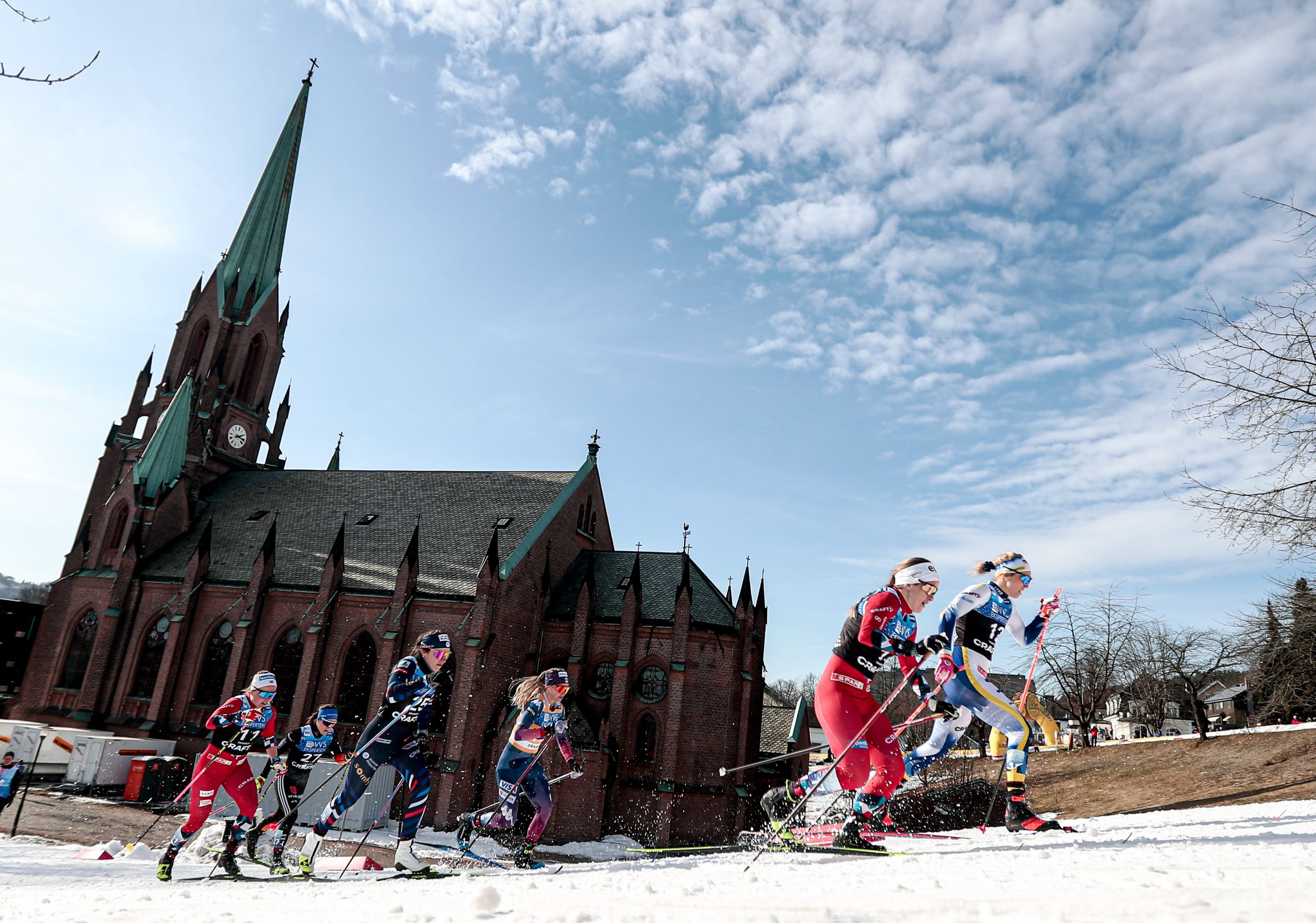
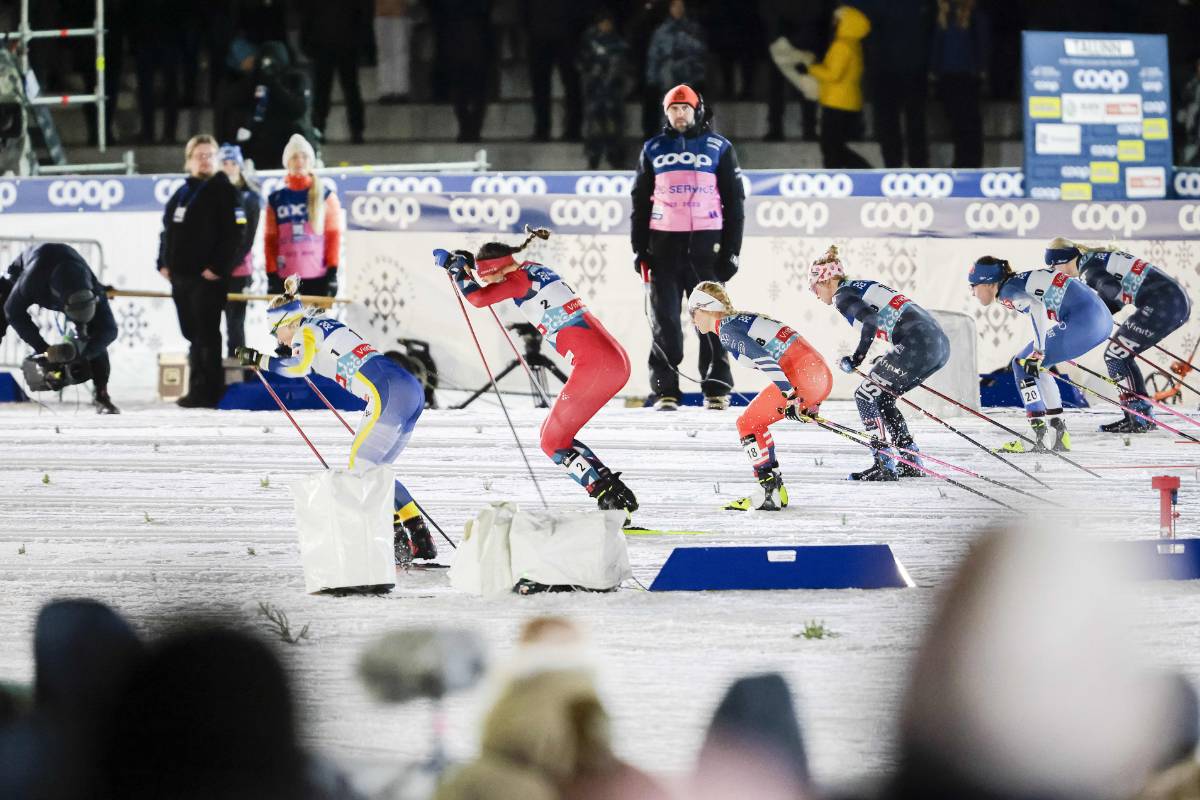
    The first quarterfinal heads out on course Tuesday night, including race winner Kristine Stavaas Skistad (NOR), second place Jonna Sundling (SWE), and Americans Jessie Diggins and Sammy Smith. (Photo: NordicFocus)