From the FasterSkier archive — posts syndicated from athletes’ and coaches’ own blogs between 2004 and 2012, kept online as published. Current coverage is at fasterskier.com.

Tag: Kristine Stavaas Skistad

  • Klaebo’s Lake Placid Decision Day Is Today

    Klaebo’s Lake Placid Decision Day Is Today

    This article was made possible through the generous support of our voluntary subscribers. If you value coverage like this, please support FasterSkier with a voluntary subscription.

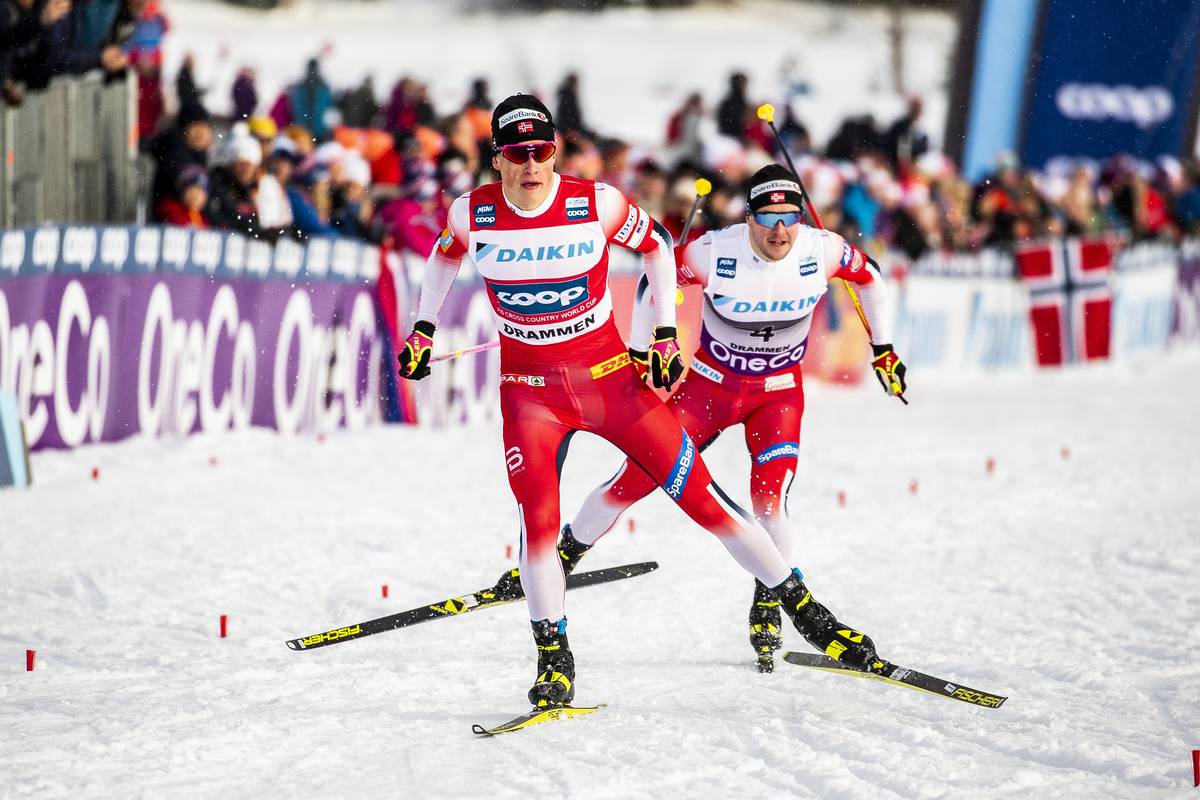
    Fans from across the United States who will be in Lake Placid are anxiously hoping Johannes Hoesflot Klaebo (NOR) is well enough to travel and race in Lake Placid this weekend. (Photo: Authamayou/NordicFocus)

    Johannes Hoesflot Klaebo has been included in Norway’s 22-athlete squad for this week’s World Cup finals at Mt. Van Hoevenberg in Lake Placid, N.Y., BUT the six-time Olympic gold medalist’s participation hinges on a decision being made today.

    Klaebo, 29, suffered a mild concussion in a dramatic crash during the sprint semifinals at last Thursday’s World Cup in Drammen. American sprinter Ben Ogden lost his footing on the icy course and fell across Klaebo’s skis, sending the Norwegian backward and slamming the back of his head into the hard-packed snow. Klaebo lay on the ground for several minutes before being helped off course and transported to a hospital for evaluation.

    The Norwegian Ski Federation confirmed the concussion diagnosis on Friday, and Klaebo withdrew from Saturday’s 50-kilometer race at Holmenkollen.

    “He shall make an evaluation together with the national team doctor on Tuesday and would potentially travel on Wednesday,” Klaebo’s manager, Lasse Gimnes, told Norwegian broadcaster NRK on Monday. If cleared by national team doctor Ove Feragen, Klaebo would travel to New York on Wednesday — arriving just two days before Friday’s 10-kilometer classic interval start.

    The crash also disrupted a planned trip to New York City for media appearances with CNN, NBC, the New York Times, and the Wall Street Journal — a reflection of the enormous international attention Klaebo has drawn since his record-setting six-gold performance at the Milano Cortina Olympics. Those in-person interviews have been scrapped, though some may shift to virtual formats.

    Johannes Hoesflot Klaebo (NOR) poses with the FIS Crystal Globes he won last season at World Cup Finals in Lahti, Finland. (Photo: Thibaut/NordicFocus)
    The distance globe is on a knife’s edge

    The distance cup title is the central subplot heading into the finals. Before Holmenkollen, Klaebo held a 128-point lead in the distance standings. But with the Norwegian watching from home on Saturday, Amundsen’s 131-point haul vaulted him into the distance lead: Amundsen now sits at 939 points, three ahead of Klaebo’s 936. Martin Loewstroem Nyenget climbed to 914 in third. Just two distance events remain — Friday’s 10-kilometer classic interval start and Sunday’s 20-kilometer freestyle mass start. If Klaebo can travel and race, the margin is thin enough that a single strong result could flip the standings again. If the concussion keeps him out, the distance globe almost certainly goes to Amundsen.

    Klaebo has already clinched both the overall World Cup — his sixth, tying Bjoern Daehlie’s all-time record — and the sprint globe.

    Norway’s men’s squad: Harald Oestberg Amundsen, Martin Loewstroem Nyenget, Einar Hedegart, Andreas Fjorden Ree, Mattis Stenshagen, Emil Iversen, Johannes Hoesflot Klaebo, Lars Heggen, Even Northug, Ansgar Evensen, and Even Solem Michelsen.

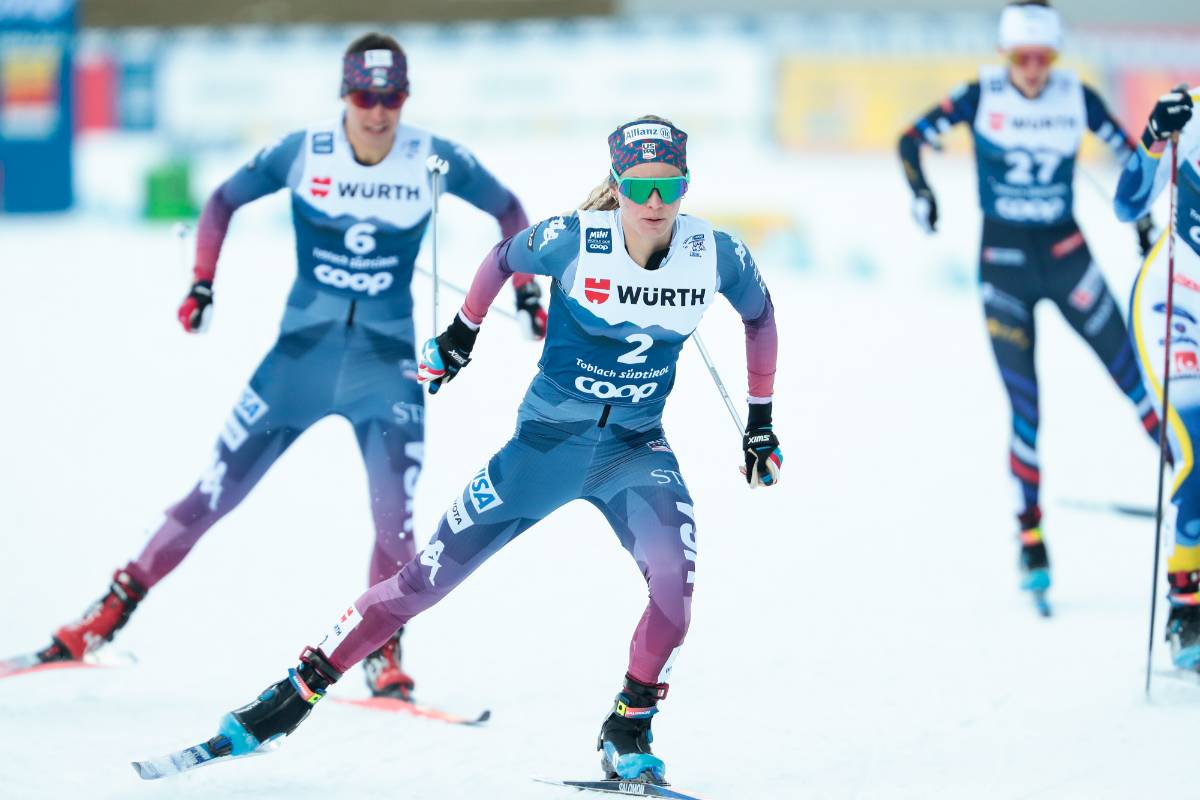
    Jessie Diggins soaks in all the energy from the home crowd during her warmup in Minneapolis — the last time the World Cup was on American snow. (Photo: Leann Bentley/USST)
    Diggins’s farewell, and notable absences

    The Lake Placid finals will serve as the final competitive races for Jessie Diggins, the most decorated cross-country skier in U.S. history. The women’s overall cup and distance cup are both decided, with Diggins winning with a comfortable margin over Sweden’s Moa Ilar in second. The three-time Olympic medalist and three-time overall World Cup champion announced before the season that this would be her last, and a farewell on home snow in front of an American crowd at the first-ever U.S.-hosted World Cup finals is about as fitting a send-off as anyone could script.

    Klaebo is not the only notable question mark heading into the weekend. Norway’s Kristine Stavaas Skistad and Mathilde Myhrvold have opted to skip the finals to prepare for part two of Norwegian nationals in Harstad next week. Sweden’s Ebba Andersson has also pulled out.

    Norway’s women’s squad for Lake Placid includes Astrid Oeyre Slind, Heidi Weng, Kristin Austgulen Fosnaes, Karoline Simpson-Larsen, Nora Sanness, Karoline Groetting, Julie Bjervig Drivenes, Tiril Udnes Weng, Julie Myhre, Lotta Udnes Weng, and Milla Grosberghaugen Andreassen.

    The men’s freestyle mass start gets started at the US National Championships in Lake Placid, NY, 1/8/26. (Photo: Nancie Battaglia)
    A historic venue

    The Lake Placid finals mark the first Cross-Country World Cup finals ever held in the United States and the return of World Cup racing to Lake Placid for the first time since 1979. Racing kicks off Friday at Mt. Van Hoevenberg with the 10-kilometer classic interval start, followed by a freestyle sprint on Saturday and a 20-kilometer freestyle mass start on Sunday.

    This is a developing story. FasterSkier will update when Klæbo’s decision is announced.


    Help Support Our Olympic Coverage!

    If you value the thoughtful work and access FasterSkier provides, please consider becoming a Voluntary Subscriber. Your support directly fuels our work to cover the people, places, and moments that make our sport special.

    Join the FasterSkier community!
     

  • Sundling Seizes Drammen, Denying Skistad on Home Snow

    Sundling Seizes Drammen, Denying Skistad on Home Snow

    This coverage is made possible through the generous support of Marty and Kathy Hall and A Hall Mark of Excellence Award. To learn more about A Hall Mark of Excellence Award, or to learn how you can support FasterSkier’s coverage, please contact info@fasterskier.com.

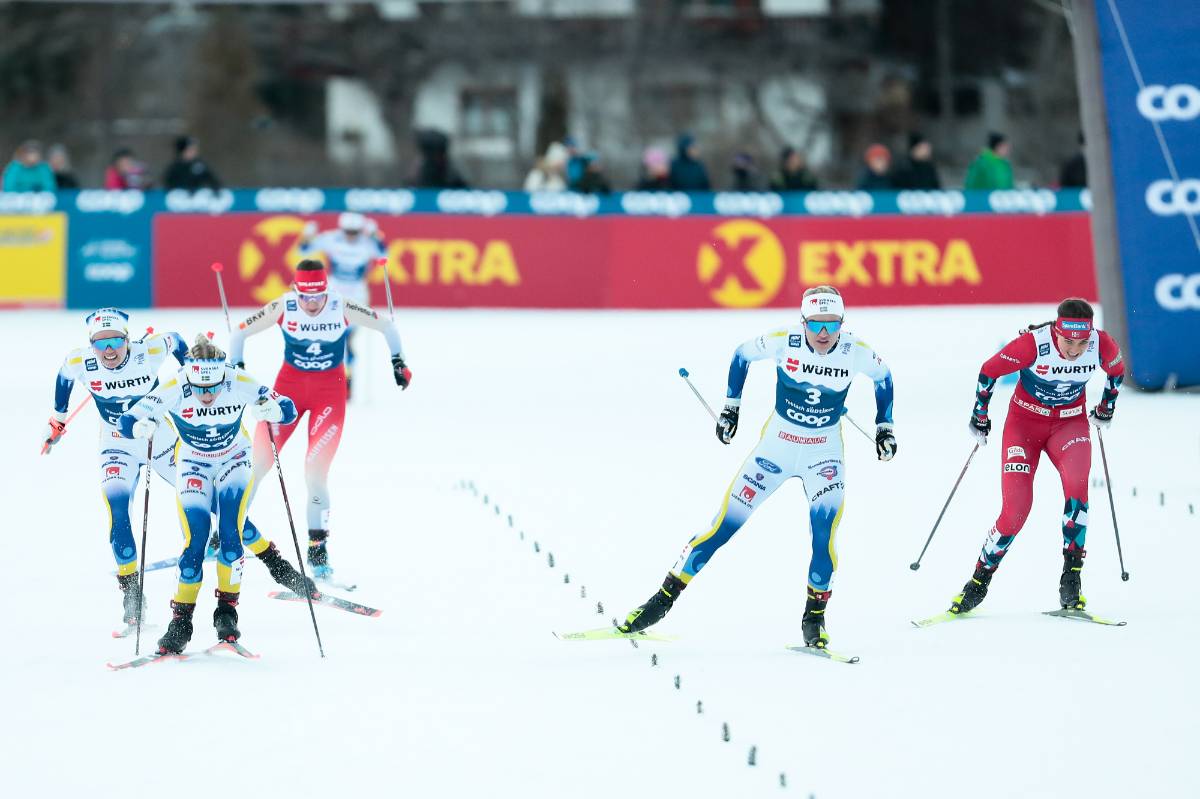
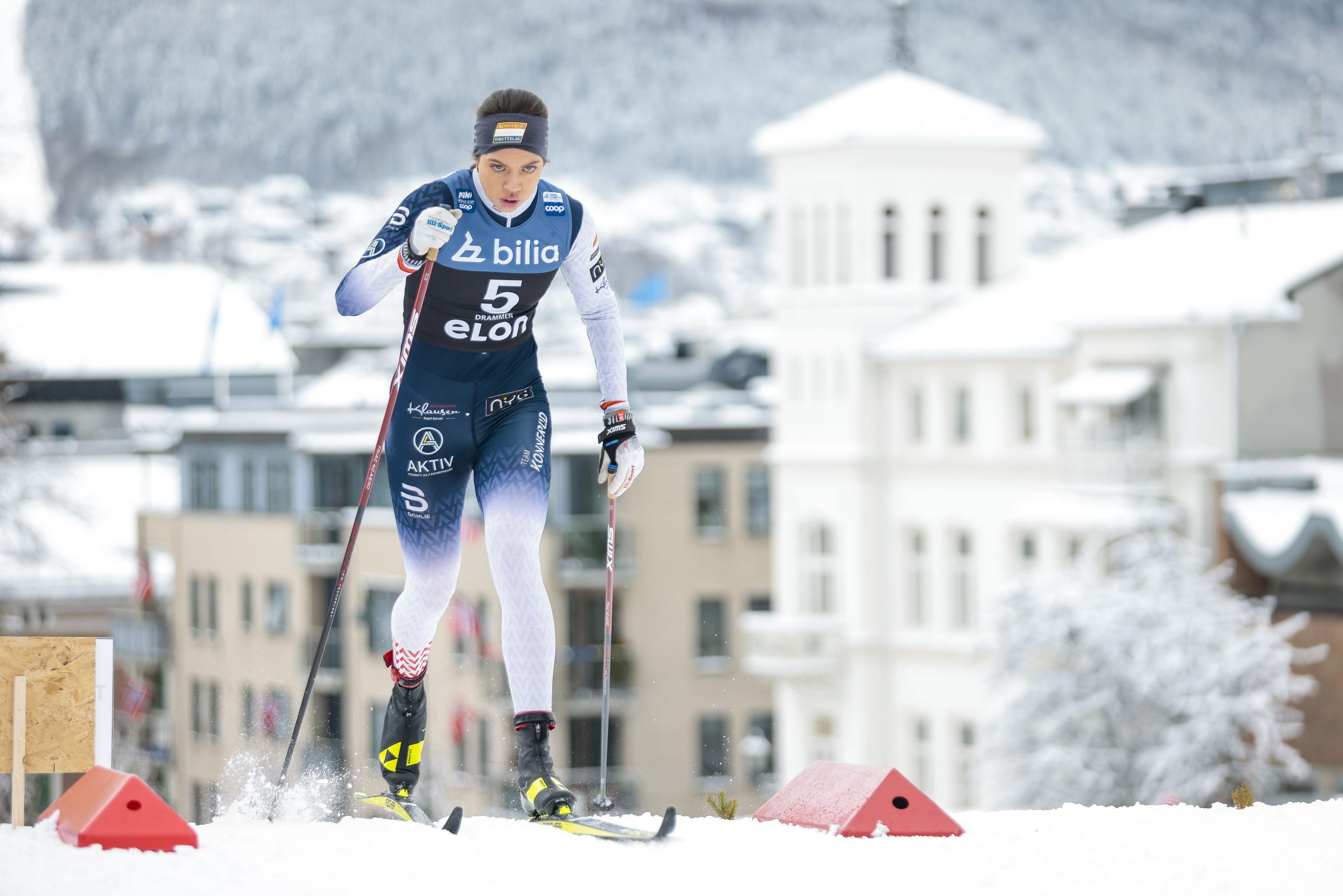
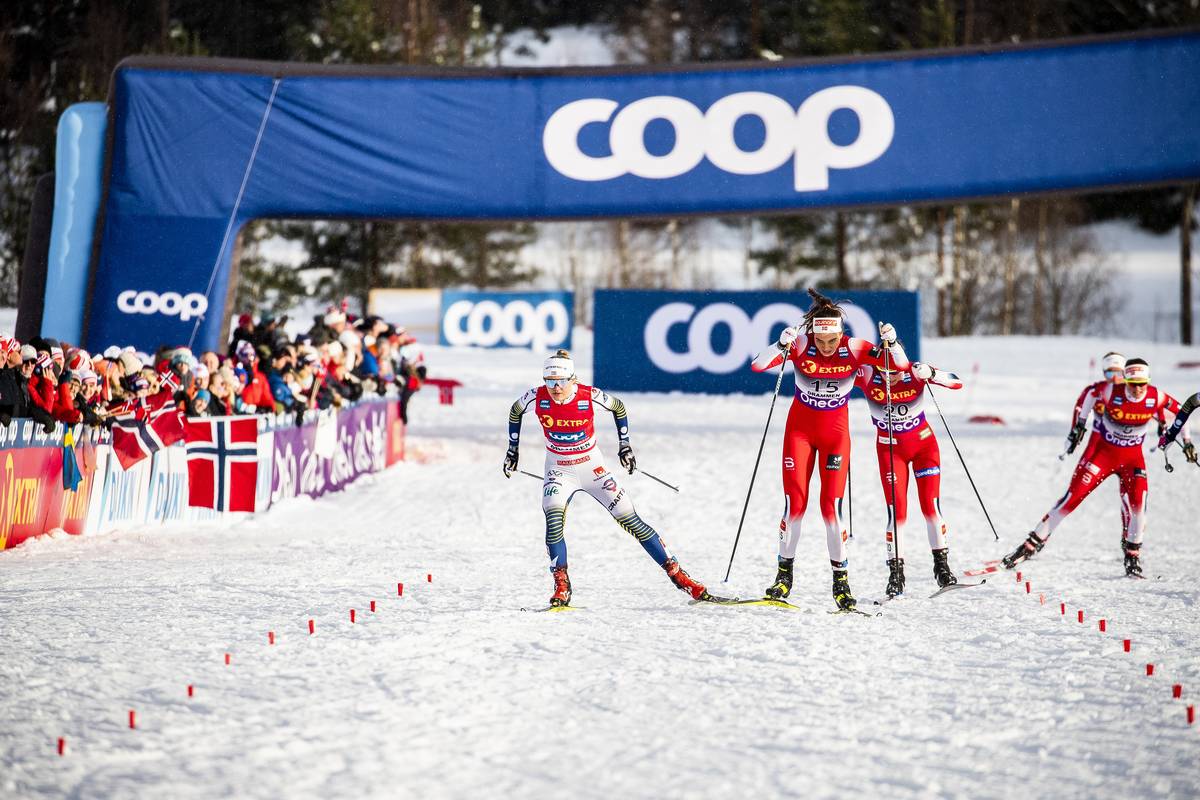
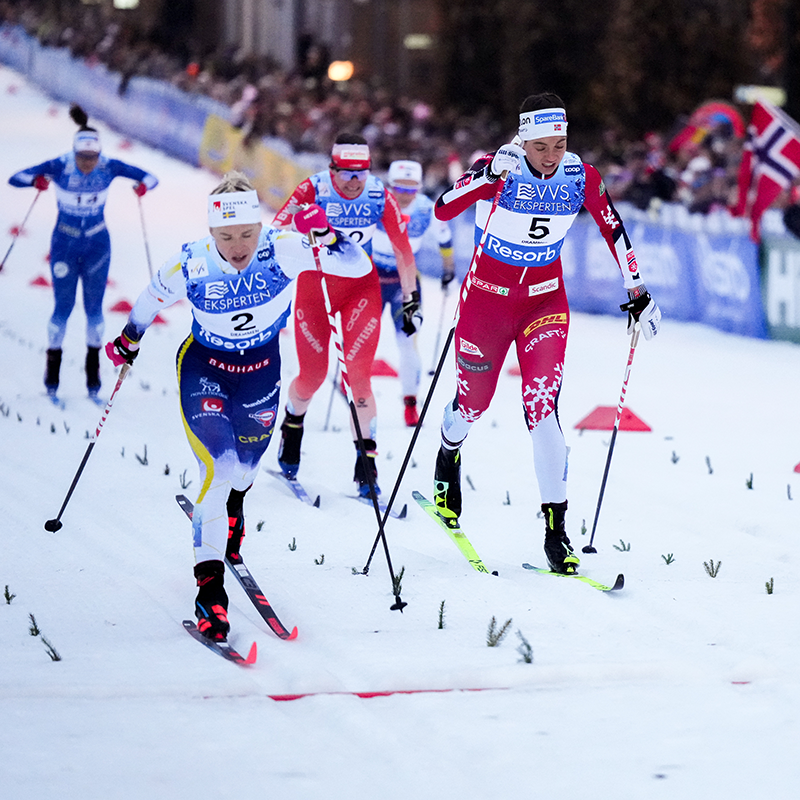
    The women’s sprint final comes into the finish in Drammen, Norway with: Laura Gimmler (GER), Ane Appelkvist Stenseth (NOR), Jonna Sundling (SWE), Nadine Faehndrich (SUI), Johanna Hagstroem (SWE), and Kristine Stavaas Skistad (NOR), (l-r). (Photo: Nordnes/NordicFocus)

    The snow was trucked in, the rock band was playing near the finish, and Norwegian children cheered from second-story windows along the course. On a rare midweek World Cup race day in Drammen — a small city just southwest of Oslo where the sprint course loops through the streets, wraps around an old fountain, and finishes on the snow-covered steps of an iconic church — Jonna Sundling of Sweden took home another World Cup sprint victory.

    Sundling won the women’s classic sprint, going stride for stride with Norway’s Kristine Stavaas Skistad before pulling away in the final meters. Switzerland’s Nadine Faehndrich, racing her final classic sprint before retirement, earned the bronze.

    It was Sundling’s fifth individual World Cup victory of the season and the latest chapter in an intensifying rivalry with Skistad that has captivated ski fans, especially Scandinavian ones, for the last few seasons. From the World Championship final in Trondheim last year to the Olympic final in Milano Cortina, Sundling, with the rest of the Swedish sprinters, and Skistad have been locked in a tactical chess match. On Thursday in Drammen, it was Sundling who played the final move.

    Quarterfinal number one heads up the first climb with: Barbora Antosova (CZE), Mathilde Myhrvold (NOR), Jessie Diggins (USA), Melissa Gal (FRA), (l-r). (Photo: Nordnes/NordicFocus)
    Qualification and Quarterfinals

    Sweden’s Linn Svahn, the reigning Olympic sprint champion, posted the fastest qualification time at 2:41.87 — nearly three seconds clear of Sundling’s 2:44.39. But qualification speed, as World Cup sprinting always reminds us, is only the entry ticket.

    Two Americans advanced to the heats. Jessie Diggins, the overall World Cup leader wearing the yellow bib in what she called a “full circle moment,” qualified 17th in 2:50.91. Rosie Brennan, seeded 28th, also made the top 30.

    Diggins chose Quarterfinal 1 alongside Sundling and Skistad — a loaded heat. Skistad took the win with Sundling second via a photo finish, just 0.18 seconds separating them. Diggins fought hard for third, advancing as a lucky loser after finishing just 0.22 seconds behind Sundling.

    Rosie Brennan (USA) said after the race, “Drammen is one of my favorite races, it’s a fun course and always has a lively atmosphere.” (Photo: Nordnes/NordicFocus)

    Brennan’s day ended in the quarterfinals. Racing in Heat 3, she bobbled heading into the downhill and lost the draft, which was a costly moment on a course where the slipstream effect was enormous all afternoon. She finished fifth in her heat.

    “I was happy to get a chance in the rounds, but the conditions were very tough,” Brennan said. “They salted the course, and it was skiing great in the qualifier and then got really icy for the rounds. Anyway, I bobbled into the downhill and lost the draft and then just don’t have the power I need to pass that many people up the finish stretch, so I was disappointed to not be more in the mix.”

    Meanwhile, Svahn survived a scare of her own… as her quarterfinal rounded the fountain that anchors the bottom of the course behind the start gates, five of the six athletes ended up in a pile and Svahn seemingly had the most bodies and equipment to navigate as she got back out on the course, but somehow recovered to advance. The Olympic champion’s troubles, however, were only beginning.

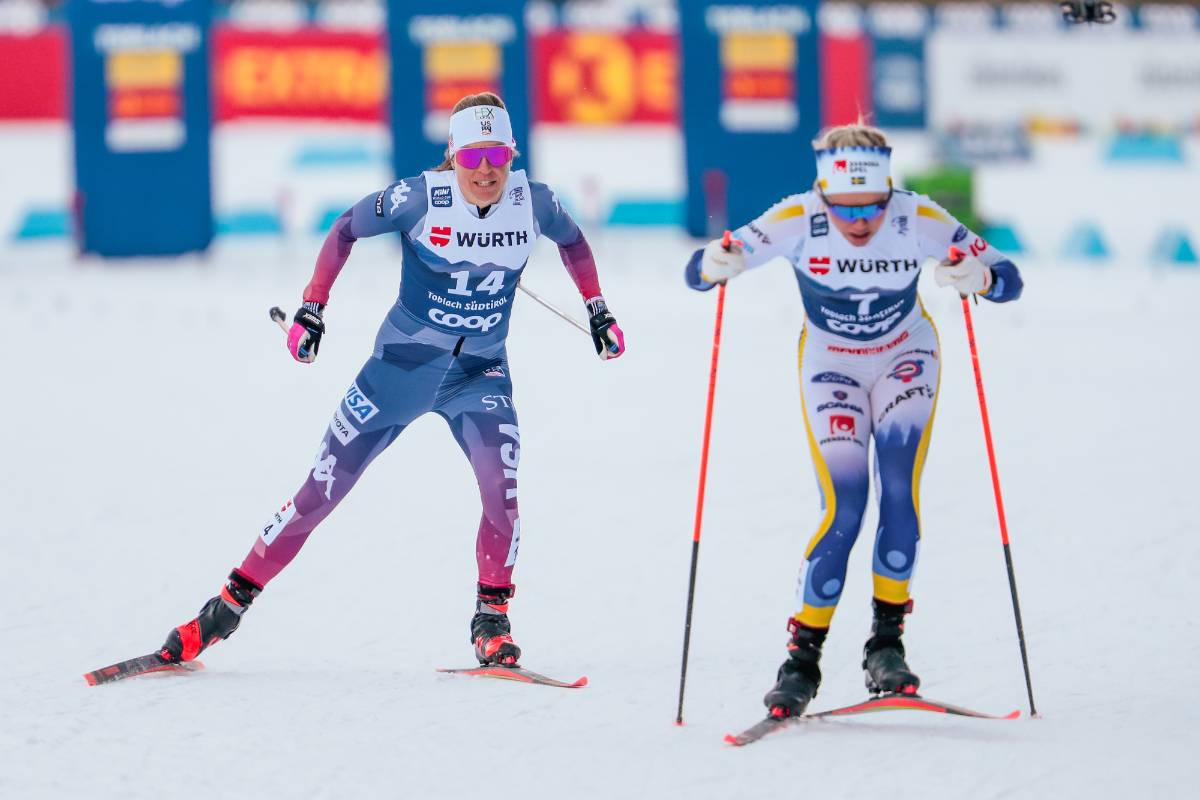
    Maja Dahlqvist (SWE) and Jessie Diggins (USA), (l-r) during the second semifinal. (Photo: Nordnes/NordicFocus)
    Semifinals

    The two semifinals told entirely different stories, and the contrast between them shaped the final.

    In Semifinal 1, Skistad took the win with Sundling second, just 0.20 seconds back. Both advanced automatically. Behind them, Svahn finished third and would not advance.

    Semifinal 2 was a different race entirely. Johanna Hagstroem and Ane Appelkvist Stenseth pushed the pace from the gun, stringing the field out over the first climb. But on the long downhill, the draft did its work. Faehndrich and Laura Gimmler of Germany surged past, using the slipstream to slingshot into the lead.

    Nadine Faehndrich (SUI), who is planning to retire after the season, found a little extra Drammen magic today as she finished on the podium in third. (Photo: Nordnes/NordicFocus)

    Faehndrich won the heat decisively. Gimmler was second. The fast overall times meant Hagstroem would advance along with Stenseth, who just out-lunged Diggins for fourth and the second lucky loser position.

    For Diggins, the day ended in 10th. But she left Drammen at peace.

    “This was really cool because the Drammen area was my first ever World Cup start and it was a skate sprint,” Diggins said. “So it’s kind of a very full circle moment to close it out with a classic sprint here as the last classic sprint of my career.”

    She had tried something new in the heats, sitting in the draft instead of going to the front, a departure from her usual aggressive approach. “Normally, because literal strength is not my strength, I usually just try to go really, really hot and try to go off the front,” she said. “I was like, nope, I don’t think that’s gonna work for me here with the crazy draft and slingshot effect. I was taking a lot of notes in warm-up, and in the quarterfinal, I had the smallest tuck of my life. It was just really fun to try to believe in myself as more of a pure sprinter and to try to be a little more tactical.”

    She acknowledged she ran out of power in the semifinal, but had no regrets. “I still felt like I executed my plan to the best of my ability, and that’s always a cool feeling.”

    Jonna Sundling (SWE) crosses the finish line just ahead of Kristine Stavaas Skistad (NOR) for the win in Drammen, Norway. (Photo: Nordnes/NordicFocus)
    The Final

    Six women lined up for the final: Sundling and Hagstroem for Sweden, Skistad and Stenseth for Norway, Faehndrich for Switzerland, and Gimmler for Germany. Svahn and Maja Dahlqvist, the Olympic gold and bronze medalists in the sprint classic, were both absent.

    On the opening climb, Skistad sat behind Sundling in a familiar posture — patient, conserving, waiting for the right moment. As Kikkan Randall mentioned on the broadcast, Skistad almost never leads into a downhill. She baited Gimmler into taking the front position, then tucked into her slipstream.

    Coming off the descent and around the final hairpin, Faehndrich made her bid, surging past Gimmler and into third. But the race was between the two women everyone expected.

    Sundling and Skistad skied side by side on the final climb, and what followed was a scene that encapsulated their rivalry. Stride for stride, shoulder to shoulder, neither yielding a centimeter. Sundling’s transition from double pole to striding was fractionally sharper — she carried more momentum through the final meters — and she crossed the line with a small advantage.

    “It is usually very tight in Drammen, but today it was extremely tight,” Sundling said on air afterward. “Till the last meter. I was like, okay, I need to continue all the way over the finish line. It was tough, but I’m happy that I was the first person over the line.”

    For Faehndrich, the bronze was a fitting farewell. The 30-year-old Swiss racer, who announced her retirement this season, now sits third in the sprint World Cup standings at 700 points — just behind Hagstroem (708) and within striking distance of leader Dahlqvist (720) heading into the final sprint of the season in Lake Placid next weekend.

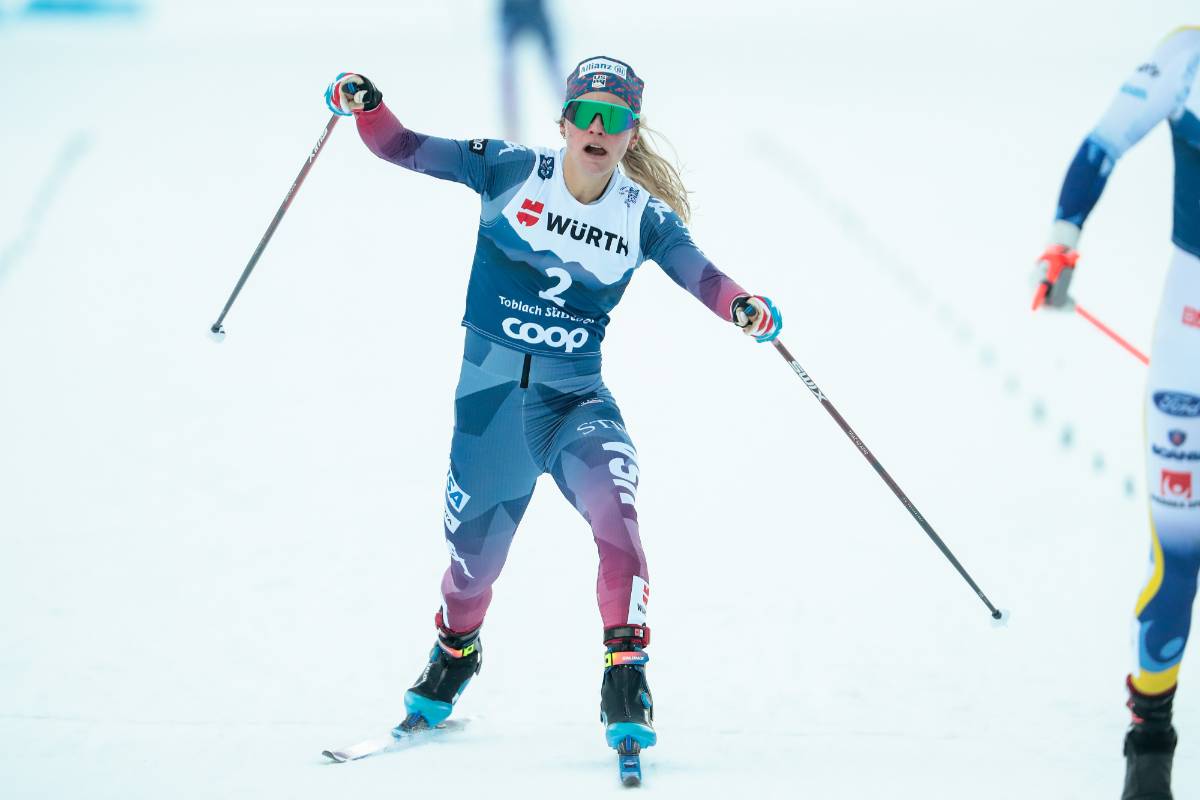
    Jessie Diggins (USA) gave her fans something to cheer about during her quarterfinal when she charged to the finish line. (Photo: Nordnes/NordicFocus)
    Looking Ahead

    Diggins continues to lead the overall World Cup standings with 1,961 points, 275 points ahead of Sweden’s Moa Ilar, a margin that appears insurmountable with four races remaining. The distance globe, too, seems firmly in her grasp. But the sprint crystal globe race is wide open: Dahlqvist, Hagstroem, and Faehndrich are separated by just 20 points at the top of the standings, and the final sprint in Lake Placid could decide everything.

    For Diggins, there’s another milestone ahead — she’s only a few nights away from sleeping in her own bed before racing in front of an American crowd at the World Cup Finals. “Very, very, very excited about that,” she said.

    The World Cup moves to the historic Holmenkollen venue in Oslo on Saturday for the Women’s 50 k Freestyle Mass Start, before the season concludes in Lake Placid, New York, March 20-22.


    Drammen Women’s Classic Sprint QUALIFICATION RESULTS

    Drammen Women’s Classic Sprint FINAL RESULTS


    Love Stories Like This? Help Keep Them Coming.

    Feature stories like this one take time, access, and care to produce. If you value thoughtful storytelling and independent ski journalism, please consider becoming a Voluntary Subscriber. Your support directly fuels the work we do to cover the people, places, and moments that make our sport special.

    Join the FasterSkier community!

     

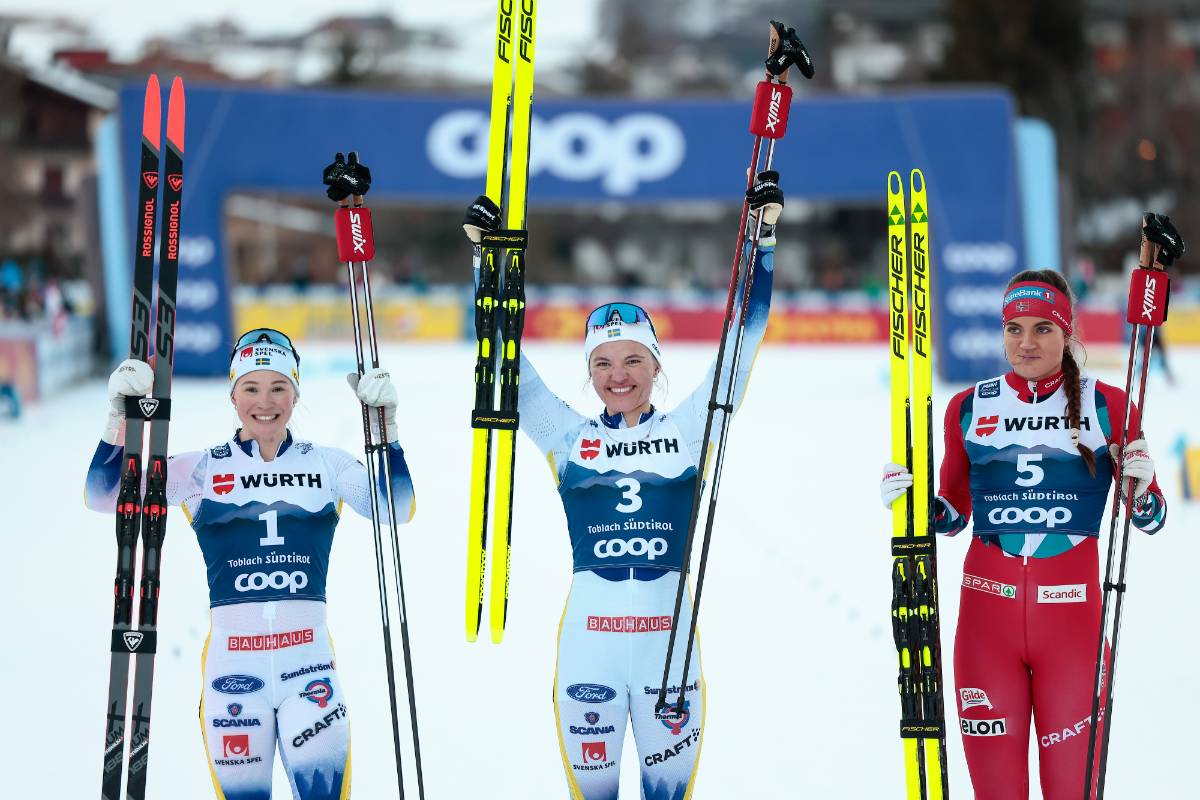
    Kristine Stavaas Skistad (NOR), Jonna Sundling (SWE), and Nadine Faehndrich (SUI), (l-r) share the Classic Sprint podium in Drammen, Norway. (Photo: Nordnes/NordicFocus)
  • More Than One Tactic—Svahn Masters Falun Sprint

    More Than One Tactic—Svahn Masters Falun Sprint

    This coverage is made possible through the generous support of Marty and Kathy Hall and A Hall Mark of Excellence Award. To learn more about A Hall Mark of Excellence Award, or to learn how you can support FasterSkier’s coverage, please contact info@fasterskier.com.

    Linn Svahn (SWE) can afford to ignore all the recommended tactics normally employed on Falun’s infamous Sprint course. She’s just too fast. (Photo: Thibaut/NordicFocus)

    Falun’s Sprint course rewards experience . . . but not every skier who possesses that experience pays very close attention. Skiers can get distracted by how they feel, by how their heat is shaping up, by the tactics of others. Sometimes, that sort of counter-punching can prove profitable. Not in Falun . . . not on most days anyway.

    In Falun, skiers prepare for an infamous and well-known draft on the penultimate downhill . . . they either deal with that draft, or they find themselves out of contention. By now, every skier should know that whomever is leading at the top of the significant downhill is almost certain to be swallowed up by the field. Leading is a mistake, and it appears nearly impossible to establish enough of a lead to overcome the advantage gained by skiers speeding up from behind. Falun represents perhaps the most tactical—and most obvious—of all World Cup Sprint courses. And it will manufacture that same crucial factor next year when the World Championships are staged on this very same course. If skiers take advantage of watching replays of these races, they’ll begin to see that there’s only one tactic to employ in Falun . . . unless, of course, you just happen to be lots faster than everyone else, like Linn Svahn.

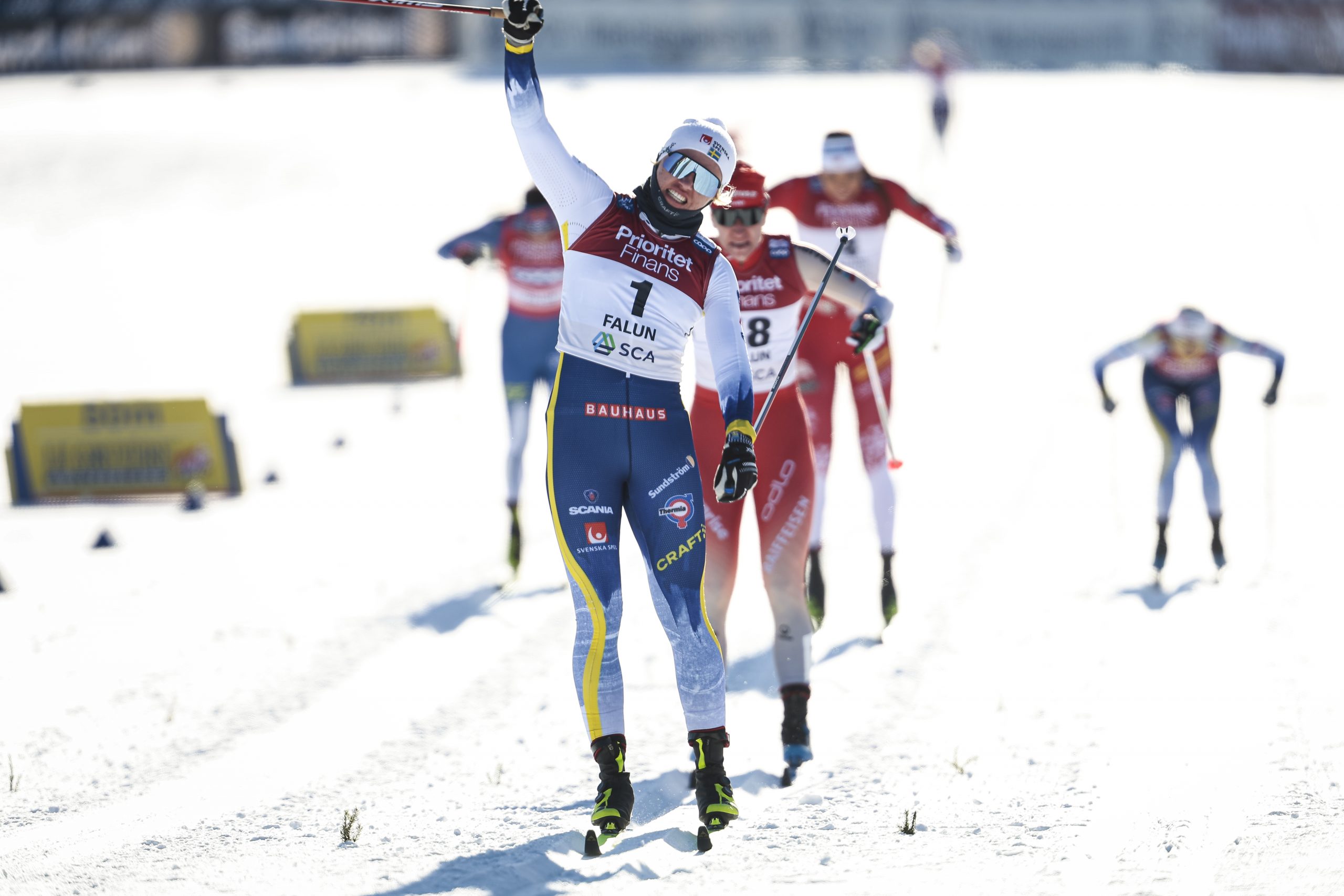
    In the Sprint final, Svahn found herself forced to the front by a cagey Kristine Stavaas Skistad who positioned herself to take advantage of Falun’s infamous draft. What Skistad did not anticipate was the raw speed that Svahn would bring to the Final. Stuck as she was at the front, Svahn simply engaged the after-burners on the course’s penultimate uphill—a tactical decision that had proven disastrous for every other skier in Falun’s Sprint heats. Accelerate there, and you’re all but certain to get caught on the downhill. But Svahn is riding the crest of a wave that has carried her to the very top of the Sprinting world. The same speed she employed to claim dominant wins in both the Classic Sprint and Team Sprint in the Olympics a week ago continued to propel her to the top step of the podium in Falun. Skistad set things up well in the Sprint Final, but Svahn was simply too strong.

    Nadine Faehndrich (SUI) continued her recent podium run in third place ahead of Coletta Rydzek (GER), Maia Dahlqvist (SWE) and Johanna Hagstroem (SWE).

    Americans qualified two skiers into the heats—Jessie Diggins and Sammie Smith—both of whom would find themselves undone by Falun’s infamous draft in their quarterfinal heats. Diggins would finish the day 17th, Smith 23rd.

    Canada’s Liliane Gagnon would qualify seventh, confirming her arrival on the international Sprint scene by advancing to the semifinal where she wold finish tenth on the day.

    Liliane Gagnon (CAN) announced her arrival as a World Cup Sprint contender with a brilliant 10th place finish in Falun. (Photo: Authamayou/NordicFocus)
    After the Olympics . . .

    The Olympics are over, the biggest pressure is off, the medals are stowed safely away. Now it’s back to the re-start of the World Cup season that these skiers began months ago. Returning, as the skiers do now, to the post-Olympic season, this is a time when we may find out who is truly worn out from the Games, contrasted with who may have mis-calculated their peak for the Olympics, but may now find themselves in top shape as all those who collected Olympic medals are strangely and uniquely vulnerable.

    The weeks following the biggest competitions are sometimes full of surprises, especially when a few of the medal-winners and event-dominators choose to stay home. Who can blame them? They spent weeks and months and years and careers building up to those Olympic Games. And those who succeed in claiming the medals that the media expected must then run the loving gauntlet of media attention and sponsor responsibilities that accompany Olympic success. After the Lake Placid Olympics in 1980, where the immortal speedskater Eric Heiden had proven to be unbeatable (winning all five of the five speedskating events), Heiden signed up for the All-Around World Championships, where he promptly got beat. Lesson learned: just because you’re the best one week doesn’t guarantee you’ll be the best every week . . . not after the insistent press, the pressing sponsorship responsibilities, and the adoring crowds have gotten done with you, anyway.

    Diggins entry into the Falun’s World Cup Freestyle Sprint was significant for another reason: after today, she stands alone as the skier who has recorded more individual World Cup starts than any other. (Photo: Jason Cork/FasterSkier)

    Switzerland has one of its medalists on the starting line, but not the other. Nadine Faehndrich is here, but no Nadja Kaelin (medalist in both the Team Sprint—with Faehndrich—and the 50 k). Sweden has its newly crowned Sprint Queen, Linn Svahn, in the lineup, but Jonna Sundling—Sweden’s former Sprint Queen—has stayed home. And of course the USA’s Jessie Diggins was here . . . isn’t she always here? Every weekend, every event, every starting line, Jessie Diggins lines up to race. That’s why she’s seemed nearly impossible to best in the season-long World Cup standings: she’s almost always signed up to race, and she’s almost never out of contention. It’s an astonishing level of durability and prolonged excellence, one that we’ll be able to enjoy and appreciate for only a few more weeks until her retirement . . . until that racer who we’ve known would always be there is no longer there. Believe me, we’ll miss Jessie Diggins terribly in seasons to come.

    But, for the time being, Diggins has a World Cup Overall title to defend . . . a defense that would benefit from a few more Sprint points. Her fourth place qualifying time would reward her efforts, but she would ski impatiently in her quarterfinal, fining herself undone by the strategic draft that heat-leaders give up on Falun’s Sprint course. Diggins would finish fourth in a heat that was not fast enough to offer advancement as a lucky loser.

    “It was my 357th World Cup start,” said Diggins. “It was just a really cool chance to feel extra grateful to my team, to look back on why that was possible, and to look at the bigger message for me here, that asking for help with my mental health got my physical health to a place where I could race this hard for this long . . . And the season isn’t over yet!”

    Samantha Smith (USA) just keeps getting stronger week after week. (She would qualify 19th, and finish the day 23rd). Photo: Thibault/NordicFocus)
    Tactics on Display

    The first quarterfinal involved Skistad and Svahn. Skistad dangled at the back mid-heat, but glided forward on the final downhill to finish second behind Svahn.

    Liliane Gagnon (CAN) qualified seventh at the start of the day, and she skied strongly in the second quarterfinal (won by Switzerland’s Nadine Faehndrich) to claim a lucky loser spot, and a space in the semifinal.

    Diggins headlined Quarterfinal 3. She led from the start but seemed hindered by slower skis onthe significant downhill. Diggins ran out of gas in the final straightaway as the heat was taken by Coletta Ryzek (GER) ahead of Moa Ilar (SWE).

    Sammie Smith (USA) began the day aas the 19th qualifier, continuing to show the form that saw her named to the US Olympic Team. Smith lined up in Quarterfinal 5 where Julie Myhre (NOR) and Johanna Hagstroem (SWE) provided the early pace. Smith has begun to reveal a strategic preference: allowing herself to drop back into the field early on, then charging forward late in the race. She did that again in Falun, storming up the final climb. Unfortunately, experience suggests that the draft given up on Falun’s Sprint course is often the deciding factor, and Smith (like Diggins before her) found herself swallowed up on the descent. Hagstroem would take the heat win, ahead of Julie Bjervig Drivenes (NOR).

    “I felt like I skied the hills really strong today and was disappointed with some of my tactical decisions,” said Smith. “Unfortunately, Falun is notorious for a large draft on the final downhill. I was trying to ski to my strengths today, but I should have been more patient and tried to tuck behind other skiers so I didn’t get drafted so much.”

    “The more time I have on skis, the more races I get to do, the better I feel,” Smith continued. “I’m really looking forward to the last few weeks of the season.”

    Kristine Stavaas Skistad (NOR) showed that she understood the tactics that Falun’s Sprint course dictates, but Linn Svahn (SWE) was just too fast. (Photo: Authamayou/NordicFocus)
    Tactics Confirmed—Sprint Semifinals

    Semifinal 1 offered Skistad a chance at Redepption after a disappointing fifth place finish in the Olympic Classic Sprint,and she perhaps better than anyone else seemed to understand the importance of utilizing Falun’s draft. Gagnon streaked forward to contend with Svahn and Faehndrich, while Skistad and Rydzek—famously fast closers—lingered at the back. Skistad easily coasted back into contention in the draft of the long downhill, and was able to get to the tails of Svahn before the finish line. Those two would move on to the final while Rydzek and Faehndrich would wait to see if they would move forward as luckylosers.

    The second semifinal involved a slate of Swedes: Moa Ilar, Moa Lundgren, Hagstroem, and the cagey veteran, Dahlqvist, who rarely leads in the early stages of heats. True to form, Dahlqvist hovered around third or fourth. Hagstroem would ski the downhill draft section to perfection, launching into the lead at the bottom, and followed across the line by Dahlqvist. Again, experience ahead of speed.

    Linn Svahn (SWE) established a gap ahead of Kristine Stavaas Skistad (NOR) in the Sprint final. Usually, Falun’s course would not reward such audacity, but Svahn was able to hold her advantage to the end. (Photo: Authamayou/NordicFocus)
    Tactics Defied

    In the ongoing defense of her lead in the season-long Sprint standings, Dahlqvist had done her job in just getting to the Final. Her lead would be protected for another week in her quest to finish the season wearing the Sprint leader’s red bib. But the other skiers in the Final had other challenges in mind. Team Sweden’s Hagstroem, Svahn, and Dahlqvist matched up against Skistad, Faehndrich, and Rydzek. Skistad went to the front, where it appeared she would control the pace (and force others to go around her into the lead). Her tactic seemed to be working as Svahn found herself at the front. Skistad must’ve been pretty satisfied with that positioning . . . satisfied, that is, until Svahn applied the power. In just a few strokes, Svahn accelerated up the hill where no one else dared acccelerate, creating a massive gap that left Skistad in an unexpected panic.

    While Skistad may be one of the fastest sprinters in the world, her strength is definitely not in quick acceleration. Though Skistad would chase gamely, Svahn was gone, the finish line photo making the result appear far closer than it really was. Faehndrich would hold on for third ahead of a fast-charging Rydzek. Dahlqvist would finish fifth, holding her lead in the World Cup standings, but seeing her lead shrink in the wake of Faehndrich’s podium performance. That season-long race is definitely tightening, and appears likely to be decided in the final World Cup weekend in Lake Placid.

    Falun Women’s Freestyle Sprint RESULTS

    Falun Women’s Freestyle Sprint QUALIFYING

    Love Stories Like This? Help Keep Them Coming.

    Feature stories like this one take time, access, and care to produce. If you value thoughtful storytelling and independent ski journalism, please consider becoming a Voluntary Subscriber. Your support directly fuels the work we do to cover the people, places, and moments that make our sport special.

    Join the FasterSkier community!
    The victory lap in Falun. Linn Svahn (SWE), Kristine Stavaas Skistad (NOR), Nadine Faehndrich (SUI). (Photo: Thibault/NordicFocus)
  • Gold at the End of Linn Svahn’s Long Path

    Gold at the End of Linn Svahn’s Long Path

    This article was made possible through the generous support of our voluntary subscribers who have helped put our Nat Herz on the ground at the Olympics. If you value coverage like this, please support FasterSkier with a voluntary subscription.

    Linn Svahn (SWE) has long looked like the best sprinter in the world, but she has only rarely had the chance to prove it. After years of injury and delay, finally she earns Olympic gold. (Photo:  Barbieri/NordicFocus)

    PREDAZZO, ITALY — Checking today’s ESPN home page makes it clear that the Olympics don’t seem to occupy the American imagination like they once did. I remember the Olympics as being a bigger deal—a set of events that captured the imagination of the world, an international spectacle that occupied the media spotlight. Life magazine, Time magazine, Sports Illustrated:  all devoted their covers and countless pages to Olympic events when they were upcoming, to the results when they became available, to the impact that these performances had on the viewing public. There was something bigger about it, something that seemed to separate it from mere sport, something that seemed to elevate it above mere commercialism. These weren’t just athletes; these were Olympians.

    They still are . . . Over in Italy, the Olympians are parading in ceremonies and competing in events and collecting medals while national anthems resonate in the crisp mountain air … but ESPN covers only the sports that matter to most Americans: NFL Football and NBA basketball and NHL hockey and MLB baseball and PGA golf, followed by men’s college basketball and women’s college basketball and college softball and MLS soccer and WCW Wrestling and the lingering stories surrounding Super Bowl commercials and Super Bowl halftime shows. And waaaaay beneath all that, we find a mention of the American gold medal in Team Figure Skating and the final helicopter flight of Lindsey Vonn’s legendary career. Thus far in Milano-Cortina, Olympic performances haven’t proven sufficient to capture the attention of a jaded viewing public. The only story American’s are likely to follow in cross-country skiing is that of reigning World Cup Champion, Jessie Diggins. Even with that accolade in hand—even being a defending medalist in the Olympic Sprint—Diggins does not find herself appearing often in the daily conversation that dominates column inches over at ESPN.

    Strength and grit, tactics and tenacity: Julia Kern (USA) earned her way through to the Olympic Sprint final. (Photo: Vanzetta/NordicFocus)

    And it really is too bad that ESPN may overlook another tremendous story that unfolded in the Women’s Classic Sprint, as the long-suffering Linn Svahn—whose history of injury and ill-fortune has repeatedly interrupted what could’ve been a legendary career—finally grabbed the medal that has always appeared to be within her reach. Svahn led a Swedish sweep of the podium ahead of Olympic and World Champion, Jonna Sundling and the ever-crafty veteran, Maia Dahlqvist. Svahn delivered a performance that cements her place in the history of cross-country skiing. After a long, long wait, Linn Svahn is Olympic champion.

    Though it appeared that Americans were still struggling with waxing issues in the soft snow of Val di Fiemme, Team USA saw four skiers advance through qualifying: Jessie Diggins (20th), Sammy Smith (26th), Julia Kern (28th), and Lauren Jortberg (30th). Those qualifying placings did not inspire a tremendous amount of confidence in what was likely to be a lightning-fast day of sprinting. Ultimately, it was Kern who would ski with power and grace in advancing to the Olympic Sprint final where she would finish sixth. Diggins may still be suffering the effects of her crash in Saturday’s Olympic Skiathlon; Diggins skied bravely, but could be seen clutching her injured ribs after placing fourth in her quarterfinal. She would finish the day in 17th.

    “My qualifier didn’t go as well as planned,” said Kern. “But it was enough to qualify, and I always get stronger in the rounds. And I had really good skis and played to my strategy and knew I had a strong finish and really never gave up and was hanging really tough when I was pretty tired. And so I went the lucky loser route today, which was my strategy. And that obviously has a cost. So come the final, I was completely spent, but I didn’t know it, and I really gave it my all, tried to be in the mix, and I had left everything on the course to get to the final. And I don’t have any regrets about that. I think that’s what I needed to do to get there. And that’s where I’m skiing right now.”

    “Obviously it was 30th, but I think it still wasn’t really, like, my best qualifier,” said Jortberg. “I think there’s still a lot of room to move there, which is cool. And I think had it not been in such a stacked heat, I think it would have maybe been a slightly different quarterfinal for me, but we’re still really proud of how I skied. I think I made a couple tactical errors out there.”

    Ultimately, the final American placings were Kern 6th, Diggins 17th, Smith 19th, Jortberg 30th.

    “Really exciting to have my Olympic debut,” said Smith. “And I wish I would have done a few things differently in that heat. Like what? I mean, I think I tried to make a move on the left side on the hill. I could have potentially been able to make more time over the top, but it’s pretty incredible opportunity and just excited to be out here and racing.”

    Smith explained the challenge and the complexity of competing in the Olympics while simultaneously enrolled at Stanford: “I’m taking material science and engineering. I’m taking environmental law class. I’m taking a creative nonfiction class, doing an independent study as well with a psychology professor,” said Smith. “And then I’m also taking physics. Stanford probably has more Olympians per capita than most places. It’s actually pretty cool. We have four winter Olympians from Sanford this year. So Eileen Gu is competing for China in big air and slope style, Zoe Atkin in half pipe and big air, and then Brandon Kim in speed skating. So it’s pretty cool that there’s four of us. The school’s been incredibly supportive, and I’m excited for all of us to compete.”

    Sprint Quarterfinals

    Jortberg and Smith lined up together in a quarterfinal that was packed with stars and contenders including Sundling, Kristine Stavass Skistad (NOR), and 2025 World Cup Sprint champion, Jasmi Joensuu (FIN). Sundling went to the front, setting the pace ahead of Skistad, providing a possible preview of the tactics likely to define the Sprint final. Jortberg and Smith dropped to the back where they appeared incapable of overcoming the blistering pace set by Sundling. Over the top of the ultimate downhill, Sundling led Joenssu as Skistad appeared to struggle. But the finish line lies at the far end of a straight downhill, and Skistad’s fast skis and gliding ability were able to dismantle Joensuu. Skistad would follow Sundling across the line to claim automatic spots in the semifinal. Smith would finish fourth to sit in a lucky loser position after the first quarterfinal.

    Quarterfinal 2 included Kern, Nadine Faehndrich (SUI), and the day’s top qualifier, Svahn. Faehndrich and Svahn made the pace in the heat, though Faehndrich would fade from contention in the late stages. The suprising Italian, Caterina Ganz, would drive forward to claim the second spot to advance to the semifinal behind Svahn; Kern was able to hold her position in the pack moving forward into third place, a status that would allow her to claim a lucky loser spot in the semifinal.

    Johanna Matintalo (FIN) took the third quarterfinal ahead of Laura Gimmler (GER). Julie Bjervig Driveness (NOR) would move into the fastest  lucky loser, spot pushing Kern down a spot, but allowing her to remain in contention with two heats remaining.

    Still sore from a crash in Saturday’s Skiathlon, Jessie Diggins (USA) gave her all in her Olympic Sprint quarterfinal. (Photo: Vanzetta/NordicFocus)

    Diggins started in the fourth quarterfinal alongside Maia Dahlqvist (SWE). They appeared to be the strongest in their heat, and Diggins sprinted directly to the front to set the pace. But the snow in Val di Fiemme was unusually slow, which did not favor the leaders, especially with the course profile that descended steadily to the finish line. Diggins paid the price for leading early, finding herself passed by the field, and unable to improve her position in the finishing straightaway. Diggins would end her day with a fourth place finish in the quarterfinal from which Dahlqvist and Federica Cassol (ITA) would advance.

    “I didn’t realize it right after it crashed, when I bruised my ribs,” said Diggins. “But then afterwards, you feel it; right now they really hurt. So I’m doing the best I can. I know I’m in good shape and I really want to make the team proud and I’m just trying the best I can . . . I needed to figure out how to manage this for Thursday. I hope that my body’s feeling better, but my energy is good and I’m excited to be here.  I think I’M not a best shape in my life. I just need everything to come together in the right moment. But I know there’s possibility there. So I’m going to keep coming and bring my best.”

    Sprint Semifinals

    Kern found herself in a semifinal crowded by the résumés of Svahn, Sundling, and Skistad. Sundling and Svahn would claim hte automatic qualifying spots, while Kern would overcome a mid-race loss of speed to finish fourth (behind Skistad) to reside in a lucky loser spot (behind Skistad) with one semifinal remaining. Ultimately, the second semifinal involved fewer stars, and a field that seemed less likely to produce fast times and lucky losers. Driveness and Dahlqvist advanced out of the second semifinal, allowing lucky loser spaces for Skistad and Kern.

    Linn Svahn (SWE) streaking toward her Olympic Sprint gold medal. (Photo: Barbieri/NordicFocus)
    Olympic Classic Sprint Final

    Six months ago, FasterSkier’s Editor-in-Chief made a bold and confident confident call, predicting that Julia Kern would qualify for the Olympic Sprint final. While that early prediction may have been a reflection of the proud Massuchessetts roots he shares with Kern, it also reflected his knowledge of World Cup and Olympic skiing, and his understanding of just what it takes to ski and compete at this level. The Editor knows his stuff, and Kern has proven herself entirely deserving. That Kern advanced to the Olympic Classic Sprint final came as no surprise to Fasterskier.

    But Kern was not alone in the final. The cast of characters in this Sprint drama was one that left no room for pretenders or understudies. Kern lined up alongside Skistad, Sundling, Svahn, Dahlqvist, and Driveness. At the crack of the starter’s pistol, Team Sweden began to assert itself as Sundling drove straight to the front. This has been the tactic that has earned Sundling World and Olympic championships, and it came as no surprise to see her at the front. She was followed by Svahn as Skistad appeared overcome by the early pace. At the mid-race point, Dahlqvist eased her way past Skistad, and Team Sweden headed for the podium. At the finish, it was the power of Svahn that drove across the line ahead of Sundling and Dahlqvist. Linn Svahn’s long path had finally delivered her to the destination that fans had always imagined. After years of injury and disappointment, after seasons of patience and impatience, Linn Svahn finally wears the Olympic gold medal.

    Julia Kern (USA) used all her experience and every bit of her energy to advance to the Sprint fFinal. (Photo: Barbieri/NordicFocus)

    “I am really happy with today,” said Kern. “It’s been a challenging season. I haven’t made it out of the quarterfinals this year. So to make it to the finals of the Olympics Is a huge accomplishment, and I’m really proud of it because I fought really hard today.

    The typical ESPN viewer may find other events to be more compelling, but the thrill of competing in an Olympic Games is not lost on the athletes: “I’ve never raced with the rings on my bib,” said Jortberg. “There’s a lot going on, which is super cool, and I feel like I just feed off that.”

    Women’s Olympic Classic Sprint RESULTS

    Women’s Olympic Classic Sprint QUALIFYING


    On the ground reporting by FasterSkier’s Nat Herz.


    Help Support Our Olympic Coverage!

    FasterSkier has our own Nat Herz on the ground at the Olympics, which is a significant financial lift for us. If you value the thoughtful work and access FasterSkier provides at championships like this one, please consider becoming a Voluntary Subscriber. Your support directly fuels our work to cover the people, places, and moments that make our sport special.

    Join the FasterSkier community!
    An all-Swedish podium in the Women’s Olympic Classic Sprint: (L-R) Jonna Sundling , Linn Svahn , Maja Dahlqvist. (Photo:  Vanzetta/NordicFocus)
  • Falun Classic Sprint—Linn Svahn is Back!

    Falun Classic Sprint—Linn Svahn is Back!

    This coverage is made possible through the generous support of Marty and Kathy Hall and A Hall Mark of Excellence Award. To learn more about A Hall Mark of Excellence Award, or to learn how you can support FasterSkier’s coverage, please contact info@fasterskier.com.

    Linn Svahn (SWE) was the dominant World Cup Sprinter before injury derailed her young career. With her confident win in the Falun Classic Sprint, she appears to have returned to form just in time for the upcoming World Championships. (Photo: Modica/NordicFocus)

    As followers of cross country skiing, we may be some of the most spoiled fans in the entire sports world. Nordic skiing is incredibly taxing and exhausting, and the World Cup tour is a non-stop whirlwind of uphills and downhills, airplanes and hotel rooms, foreign foods and unpredictable winter weather. Still, what we expect (as fans) is that skiers will continue to show up each weekend to entertain us in this unscripted drama unfolding across the forests and snowfields of northern Europe. What they do, week in and week out, is simply amazing. Little surprise then, that some of them eventually need a break. Over the past few weeks, some notable stars have been conspicuous by their limited appearances. Consider the lists of the injured: Kristine Stavaas Skistad (NOR) and Jessie Diggins (USA). The ill or exhausted: Linn Svahn (SWE) and Maja Dahlqvist (SWE). And the recently returned: Julia Kern (USA). In Falun, Sweden, nearly all of the serious Sprint contenders—including the durable every-weekers like Jasmi Joensu (FIN), Johanna Hagstroem (SWE) and Nadine Faehndrich (SUI)—were gathered for the Classic Sprint. With only Sweden’s Jonna Sundling being absent, the crowd in Falun would be in for a treat.

    Americans Jessie Diggins, Julia Kern, and Sammy Smith advanced to quarterfinals by qualifying 8th, 10th, and 14th respectively. Diggins and Kern would advance to semifinals, ultimately finishing 7th and 8th. Smith would bow out in her quarterfinal, earning a 30th place finish. Other American finishers included Erin Bianco 33rd, Kate Oldham 34th, Emma Albrecht 41st.

    Among Canadians, Olivia Bouffard-Nesbitt finished 32nd, Katherine Weaver 37th, Sonjaa Schmidt 45th, Amelia Wells 50th.

    Back from an extended break following the Tour de Ski, Julia Kern (USA) showed great speed in her quarterfinal heat, advancing easily to the semifinal where she would earn an eighth place finish on the day. (Photo: Modica/NordicFocus)
    Falun Classic Sprint

    Fans had not seen Svahn since January’s Tour de Ski. In Falun, she was able to move easily through Quarterfinal 2, showing a bit of the spark and tactical control that epitomized her early career (where she had already won 12 World Cup Sprints). Skistad and Joensu moved on from Quarterfinal 1 while Kern (also recently returned to the World Cup field after a lengthy absence) dominated Quarterfinal 3 in which Dahlqvist overcame a broken pole to chase down the entire field and storm from behind in the closing meters to claim a space in the semifinals. Diggins led Quarterfinal 4 early on, to finish in second behind Faehndrich. Hagstroem and Julie Myhre (NOR) advanced out of Quarterfinal 5.

    Semifinal 1

    The first semifinal pitted Skistad against Joensu, Svahn, Kern, Coletta Rydzek (GER), and Mathilde Myhrvold (NOR). Skistad would go quickly to the lead, but did not seem eager to push the pace. Joensu volunteered to lead the significant downhill with Svahn wisely tucked in behind, from which position she was able to surge forward for the heat win (ahead of Skistad). Kern found herself off the back early on, but was able to recover for fourth in the heat. Joensu would advance to the final as a lucky loser, but Kern would find herself bumped out of the final position by finishers in Semifinal 2.

    Semifinal 2

    Diggins would line up for the second semifinal against Myhre, Hagstroem, Faehndrich, Dahlqvist, and Gimmler. After a slow start, Diggins would weave her way through the field, but was never able to advance farther than fourth (behind Dahlqvist, Faehndrich and Hagstroem, all of whom would advance to the final).

    Kristine Stavaas Skistad (NOR) relies on power in sprinting. Today in Falun, her form appeared slightly off, but still good enough for third place in the World Cup Classic Sprint. (Photo:  Authamayou/NordicFocus)
    Sprint Final

    Skistad drove quickly to the front in the Women’s Sprint Final, marked by Svahn who accelerated impressively over the top of the course’s steepest climb. Up the first climb, Skistad dropped back behind Faehndrich while Dahlqvist and Hagstroem trailed the field. Svahn would power to the line for her 13th World Cup Sprint win, demonstrating that she is back at full strength as the field looks forward to the World Championships two weeks from now in Trondheim. Faehndrich would hold on for a hard-earned second, while Skistad settled for third, just holding off a hard-charging Dahlqvist in the final meters.

    Falun Women’s Sprint RESULTS

    Falun Women’s Sprint QUALIFYING

    A beaming Linn Svahn (SWE) is joined by Nadine Faehndrich (SUI) and Kristine Stavaas Skistad (NOR) on the World Cup Classic Sprint podium in Falun, Sweden. (Photo:  Authamayou/NordicFocus)
  • Skistad Returns to Win Les Rousses Classic Sprint

    Skistad Returns to Win Les Rousses Classic Sprint

    This coverage is made possible through the generous support of Marty and Kathy Hall and A Hall Mark of Excellence Award. To learn more about A Hall Mark of Excellence Award, or to learn how you can support FasterSkier’s coverage, please contact info@fasterskier.com.

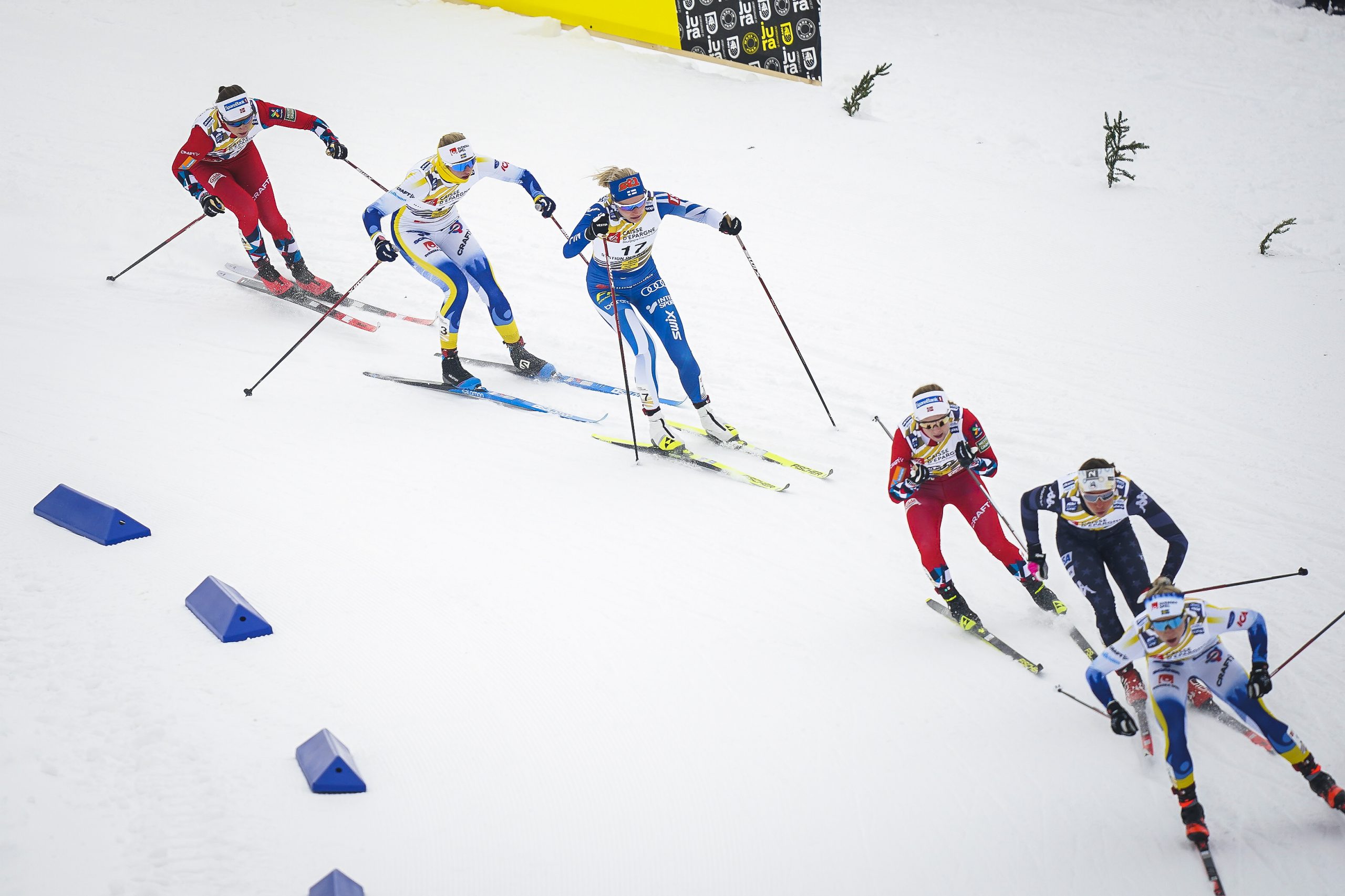
    Sprinting has the most unpredictable action of any World Cup racing format. Skiers are crammed into a narrow patch of snow, leading to skis crossing and poles breaking. Wobbly legs often misfire, and mistakes ensue. Whenever a racer gets crowded out at the finish line, there is an inevitable shrug followed by the common refrain of, “that’s Sprinting.” But even in the unpredictable world of Sprinting, there are usually a few constants.

    Jessie Diggins (USA) was unable to advance to the heats and finished 40th. (Photo: NordicFocus)

    But one of those constant themes was upended when Jessie Diggins (USA) failed to qualify for the heats. For the last two years Diggins qualifying for the Sprints and choosing to race in the final heat has been about as predictable as Sprinting gets. But that constant failed to materialize as Diggins had a tough time and finished 40th in the qualifying rounds which meant she would not race in the heats. Due to her foot injury, Diggins was unable to stride during the race and was forced to double pole and herringbone the entire course, creating a difficult on course situation for her resulting in her not qualifying. But she was able to pick up several valuable points for still finishing in the top 50.

    Another constant has been the American team usually fielding three or four women in the heats. But that also didn’t happen when Alayna Sonnesyn (USA) finished 38th and also failed to qualify. That meant that all of the hopes for team USA were riding on Rosie Brennan (USA) who qualified 22nd.  Julia Kern’s (USA) usual presence in the heats wasn’t a factor as she wasn’t racing this weekend as she was still recovering from the Tour de Ski.

    Rosie Brennan (USA) was the only American woman to make the heats. (Photo: NordicFocus)

    Brennan had a hard time in the heats and couldn’t advance out of the first round and ended up 26th on the day. So, today the usually reliable American Sprint team fell victim to the unpredictable nature of Sprinting.

    Kristine Stavaas Skistad (NOR) returned to World Cup racing, and to Sprinting dominance. (Photo: NordicFocus)

    After the racing had concluded some of the predictability of Sprinting returned as Kristine Stavaas Skistad (NOR) asserted herself throughout the day to defeat all of her Swedish rivals. Maja Dahlqvist (SWE) was second with Jonna Sundling (SWE) coming in third. After the race, the always reserved Skistad said, she was “very happy and that the race had been very hard.”

    Yesterday’s Distance races had been significantly affected by the absence of many top Norwegians who had elected to stay home and race in their national championships. But today’s women’s field wouldn’t be as dramatically affected as Norway’s top Sprinter, Skistad was back after her prolonged absence from abdominal surgery. Skistad raced on Thursday in the Norwegian championships and won the Freestyle Sprint competition. She appeared to be fully back in form, but racing again only two days after the Norwegian championships— with travel in between— was going to be a major test. Before her surgery Skistad had been about as consistent as things get in Sprinting. Skistad was joined on the Norwegian squad by Elena Rise Johnsen—who is little known to North American audiences—but finished third in the Norwegian Sprint championships. Also joining her was Ane Appelkvist Stenseth who finished seventh in the Norwegian nationals Sprint competition. Missing today was Julie Myhre (NOR) who going into the day was second in the world cup Sprint competition.

    Maja Dahlqvist was the top Swede, finishing second. (Photo: NordicFocus)

    The Swedish women have also been one of the constants in Sprinting for some time. But they competed today at  less than full strength as two time former Sprint Overall champion Linn Svahn was absent in order to recover from the Tour de Ski and prepare for the world championships. She would be replaced by Moa Hansson, whose previous best performance in a Sprint world cup was 22nd.

    Another recent Sprint constant is the presence of Jasmi Joensuu (FIN) who has proven to be a continual Sprint threat this year and currently leads the Overall Sprint competition. But Joensuu was unable to find the podium today and finished fourth.

    Kern is a usually reliable presence for the Americans in the Sprint heats but needed more time off after the Tour. She posted on social media, “my body wasn’t quite ready to race in France this weekend, but a little extra time at home is feeling like a special treat right now!!! Lots of motivation to train smart for the bigger goals ahead and soak up that extra recharge time at home!”

    Canadian Katherine Weaver had an excellent day finishing 16th. The other Canadian finishers were Olivia Bouffard-Nesbitt in 29th, and Alison Mackie 31st.

    Les Rousses Women’s Classic Sprints-Quarter Finals

    In the first heat Skistad appeared to show that she was completely back as she and Jonna Sundling double poled away from the other contenders with Sundling nipping Skistad at the finish. But as she often does, Skistad let up at the finish unconcerned about the victory and more focused on saving energy and moving through the heats.

    The second heat featured Joensuu and Emma Ribom (SWE). About halfway through Joensuu and Ribom established themselves at the front with Ribom gaining ground on the more technical sections. Joensuu went into an extra deep tuck on the downhills which helped her gain ground as Ribom took the win with Joensuu finishing second.

    In heat three Brennan faced Laura Gimmler (GER) and Stenseth who went into the early lead with Gimmler right behind her. About halfway through Brennan was in the back of the pack and didn’t seem to have the ski speed to keep pace with the leaders. Coming into the finish Gimmler and Stenseth were side by side as they eased up to cross the finish line with Stenseth taking the win. Brennan finished sixth and would not advance. It was not only the end of her day, but the end of the day for team USA.

    In the fourth heat Nadine Faehndrich (SUI) was matched against Maerta Rosenberg (SWE) and Katherine Weaver (CAN). Rosenberg went out to a blistering start and put a large gap on Faehndrich. But Faehndrich used her veteran skills to slowly but surely close the gap and took the lead as they entered the stadium. Weaver’s pace was too much for her to sustain as Coletta Rydzek (GER) was able to pull ahead at the finish. Rosenberg would advance as a lucky loser. Weaver finished fourth and would not advance.

    In the fifth heat Johanna Hagstroem (SWE) and Dahlqvist battled against Victoria Carl (GER). They were joined by hometown favorite Leonie Besson (FRA) who finished 29th in the qualifying round and gave the French fans a brief thrill. But her hopes were dashed early as she broke a pole at the start and would never be able to be a factor. Ingrid BergeneAabrekk (NOR) went to the lead early, but about half way through, Hagstroem—who was the top qualifier—picked up the pace and went to the front along with Dahlqvist. At the finish, no one could match the fire power of the Swedes as Dahlqvist and Hagstroem finished first and second.

    Semi Finals
    Jasmi Joensuu (FIN), (far left,red bib) made it to the finals, but couldn’t reach the podium. (Photo: NordicFocus)

    The first semi final was a battle of Sprinting all-stars. Sundling, Ribom, Skistad, and Joensuu were all in the first heat. Skistad went to lead early with Ribom going with her. Sundling charged up the first steep hill to take the lead as she tried to put some distance on Skistad who would have a double poling advantage coming into the finish. But Skistad showed off amazing skis as she glided up and over a small hill toward the end of the race to take the lead back. Sundling pulled ahead at the finish as Skistad dramatically let off the accelerator about 20 yards before the finish. Joensuu made a late charge but couldn’t catch the leaders. Nonetheless, she advanced as a lucky loser along with Ribom.

    The second heat featured Faehndrich, Dahlqvist, Hagstroem, and Gimmler. Hagstroem and Gimmler took the early lead in what was a very controlled pace. The race remained very tactical as no skier was anxious to go into the lead. Coming into the stadium all six skiers were together with Hagstroem going to the front and she began to press the pace along with Faehndrich. But it was Dahlqvist who moved to the lead with Gimmler joining her. It was a photo-finish between Dahlqvist and Gimmler—with both skiers being awarded the same time—and no skiers advanced from this heat as a lucky loser.

    Finals

    In the finals, Skistad would have the chance to show that she was completely back as she faced a formidable field of Sundling, Joensuu, Ribom, Dahlqvist and Gimmler. It was the repeat of a familiar theme from last year’s Sprint competitions as three Swedes battled the lone Norwegian: Skistad.

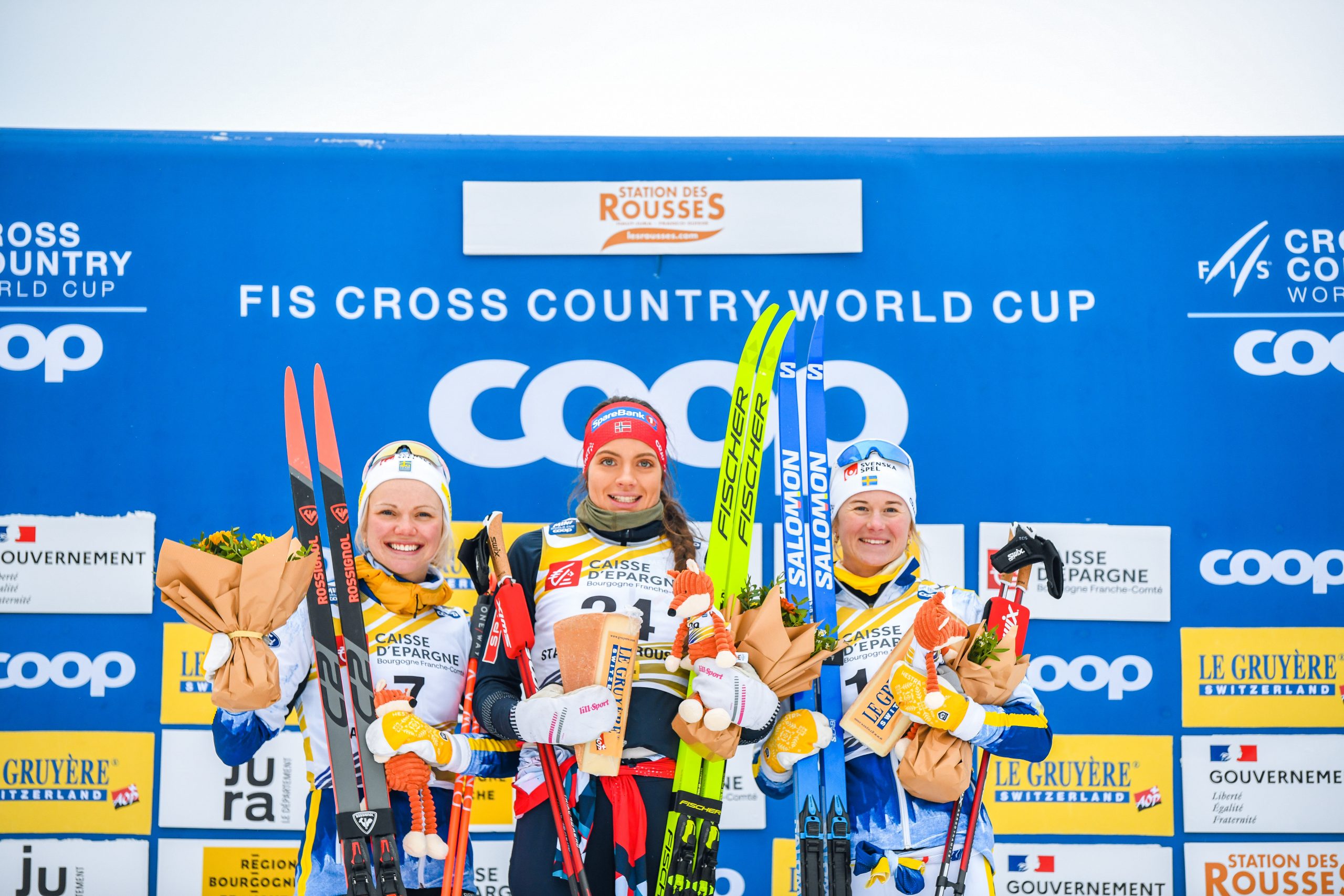
    No one had an answer for Skistad in the finals. Maja Dahlqvist (SWE), Jonna Sundling (SWE), Kristine Stavaas Skistad (NOR), (l-r) (Photo: NordicFocus)

    Skistad immediately went to the front and sent the message early that this was not going to be a tactical race. Sundling was able to close the gap up the first hill and looked like she might have an advantage over Skistad. But Skistad looked controlled and calm as she stalked Sundling, while Joensuu was hanging on in third place. Skistad repeated her excellent glide over a small uphill to slingshot into the lead and began pulling away. She was able to double pole to victory as Dahlqvist snuck up from behind to take second, while Sundling held on for third. The effort clearly showed on Skistad who remained collapsed onto the snow for some time after the race, which is not her habit. Nonetheless, the race was a statement for the rest of the women, that the rivalry between Skistad and Sweden was back.

    Les Rousses Classic Sprint Results

    Maja Dahlqvist (SWE), Kristine Stavaas Skistad (NOR), Jonna Sundling (SWE), (l-r) (Photo: NordicFocus)


  • Skistad and Klaebo Master Lahti Sprint Tactics

    Skistad and Klaebo Master Lahti Sprint Tactics

    This coverage is made possible through the generous support of Marty and Kathy Hall and A Hall Mark of Excellence Award. To learn more about A Hall Mark of Excellence Award, or to learn how you can support FasterSkier’s coverage, please contact info@fasterskier.com.

    The season has been long, and many World Cup competitors are struggling gamely to hold it together. Many surprising results and developments were witnessed in Lahti, Finland’s World Cup Freestyle Sprint, though top contenders—Johannes Hoesflot Klabo and Kristine Stavass Skistad—were able to achieve the victories. (Photo:  Modica/NordicFocus)

    The World Cup season has definitely gotten long, and the edges are beginning to fray. The FIS World Cup points system favors those who race the most, but the season is just too long, too challenging, and filled with too much travel for most skiers to make it cleanly and handsomely to the year’s end. Cross-country skiing is an exhausting sport—nowhere more so than for competitors in the FIS World Cup. Over the weekend at the Lahti Ski Games, some of the very best among World Cup contenders are beginning to appear a bit ragged.

    With Jessie Diggins (USA) failing to qualify for the Sprint heats, Linn Svahn (SWE)—Digggins’ primary rival in the race for the season-long World Cup Overall crown—seemed poised to make up serious ground in their season-long race. Ironically, Svahn—who dominated Sprint events through the first half of the season—appeared decidedly un-sprinty today, finishing fourth; good enough to eat into Diggins’ points lead, but not with as big a bite as Svahn might’ve hoped.

    “It’s not a secret that we missed the glide this weekend in a way that critically impacted results,” commented Diggins. “But it’s important to know that everyone is working their hardest, doing the best they can in each moment and ready to learn and improve. Today was heartbreaking in the moment for me, but also a chance to learn and improve on how to deal with a really tough day. My focus doesn’t change from how I handle a good day; I evaluate the race, take lessons and notes on it and then move forward.”

    Hoping to translate her fast qualifying into additional points in the race for the Overall World Cup, Frida Karlsson (SWE) veered radically in the last turn before the finishing straight thus impeding Julia Kern (USA). As a result, Karlsson found herself disqualified from the quarterfinals. Kern’s quarterfinal result was moved up to third, though the time she lost behind Karlsson’s erratic maneuver may have prevented Kern from advancing as a lucky loser.

    “What happened today has been happening a lot this season,” said Kern. “And it’s been super frustrating because the opportunity to advance can’t be given back. I know what I’m capable of, I know that my fitness and tactics are there, and I always try to ski a fair race. But in these situations, I can’t show that because I’ve been getting tangled up so often with certain athletes, making it impossible to advance. I think the Jury made the right decision today and that hopefully this sets a precedent for what is and is not clean and fair racing. I am believer that sprint racing should be aggressive and tactical, and yes, there will be crashes and tangles, but those are “race incidents” and part of racing. However, race incidents and deliberate maneuvers to obstruct other athletes are two separate things and I hope the Jury will continue to protect the fairness of the sport.”

    Jonna Sundling (SWE) seemed determined to follow her race-from-the-front strategy that has seen her achieve remarkable success of late, but her Norwegian rival, Kristine Stavaas Skistad feasted on that strategy with a well-timed draft on the final downhill in their early heat—a strategy Skistad would continue to follow in the final, where she won easily over Maia Dahlqvist (SWE) in third and a remarkable Coletta Rydzek (GER) in second.

    In the Men’s competition, Johannes Hoesflot Klaebo (NOR) and Lucas Chanavat (FRA) continued to prove that they possess more speed and tactical acumen than their rivals, finishing first and second on the day. Behind them came the career-best finish of third-place Valerio Grond (SUI).

    Other regular Sprint contenders were not so fortunate. Erik Valnes (NOR) fought his way through a complex quarterfinal in which he had languished in the rear after an angry tangle with Michal Novak (CZE). Valnes has raced and raced and raced in pursuit of the Sprint and Overall rankings. It’s possilbe that such a come-from-behind necessity depleted Valnes, as he was eliminated in the subsequent semifinal. Though having possibly the best season of his career, Valnes continues to lose ground in both season-long contests.

    Havaard Solaas Taugboel (NOR) became mired in mid-race crowding, finding himself eliminated in the quarterfinal. Federico Pellegrino (ITA) wove his way through a confusing semifinal to nip Joni Maki at the line; then Pellegrino seemed to have nothing left in the final. He finished fifth, again just ahead of Maki.

    James Clinton Schoonmaker (USA) qualified 16th, and finished 13th on the day in Lahti. (Photo: Modica/NordicFocus)

    Canadians qualified Sonjaa Schmidt (22nd) and Pierre Grall-Johnson (16th) into the quarterfinals, where each were narrowly eliminated. They would finish 19th and 14th, respectively. Americans qualified four into the quarterfinals (Julia Kern, Sammy Smith, Rosie Brennan, and JC Schoonmaker), though none found themselves able to advance. Even so, Americans can be proud of their results on the day: Schoonmaker earned the top result in 13th, Kern 16th, Smith 23rd and Brennan 25th.

    “Today was tough!” said Brennan. “I was feeling the race from yesterday and we were definitely struggling with our skis on the salted snow. After a less than ideal week, I just wasn’t feeling my best self and I’m not good enough at sprinting to make it happen when I’m not at my best.”

    On-air commentators remarked that American skiers appeared flat this weekend in Lahti, attributing it to recent trans-Atlantic travel and post-Minneapolis let-downs. The Americans do seem to be learning that the World Cup season is long . . . and that the season does not conclude after the echos of loud cheering have faded in Minneapolis.

    “[I] made a mistake going into the last hill by not owning my space and I got kind of swarmed by the other guys,” said Schoonmaker. “That’s a little frustrating but hopefully can learn from it. The conditions on the course were great. The snow held up really well which was nice because I was definitely a little worried we were going to have a slush party out there.”

    Kristine Stavaas Skistad (NOR) bested her Swedish rivals throughout the day in a show of dominance in Lahti’s World Cup Sprint Freestyle. (Photo: Modica/NordicFocus)
    Women’s Freestyle Sprint

    The Lahti Freestyle Sprint course curls its way around the base of Lahti’s famous ski jump, creating a course that is highly tactical: not conducive to aggressive pace setting, and rewarding those who can master the draft on the final downhill, and slingshot into the finishing straightaway. The first heat included Sundling, Skistad, Brennan, and Jasmi Jonssu (FIN). With Sundling in the lead, the heat was typically fast, though Skistad showed her understanding of the tactics by easil gliding up to Sundling in the draft provided by the final downhill.

    The headline semifinal included Sundling, Svahn, and Skistad who again demonstrated her mastery of Lahti course tactics by gliding forward to pass the entire field, and coasting to the semifinal win. Surprisingly, both Svahn and Sundling skied poorly in the semifinal, but found themselves advancing as lucky losers.

    Dahlqvist, Sundling, Svahn, Skistad, Joensuu, and Coletta Rydzek (GER) contested the Women’s Final in which Svahn went immediately to the front (the Swedes seemingly oblivious to the ins and outs of Lahti’s Sprint course tactics). Svahn was followed closely by Skistad, and trailed at a distance by Sundling who, uncharacteristically, sat at the rear of the field. The Swedes appeared to lack their usual speed and pop, finding themselves easily bested by Skistad who etablished a draft-thwarting gap on the final downhill, and coasted easily to the win. The Swedes also surrendered second place to a beaming Rydzek who achieved her first World Cup podium result. Dahlqvist captured third place, ahead of Svahn in fourth and Sundling in fifth.

    Women’s Freestyle Sprint RESULTS

    Men’s Freestyle Sprint

    The nature of Lahti’s course—favoring those who can accelerate quickly after the mid-course hairpin—made it appear unlikely that anyone would be able to best Klaebo. But Lahti’s Freestyle Sprint course is one that encourages alternative strategies, and many of those who are not as experienced may choose strategies that may confound those customarily found at the front. Klaebo found himself contesting a semifinal in which he was forced to race from the rear. Late in that heat, Chanavat chose a daring inside line on the final hairpin turn, skidding masterfully through the apex and stealing the lead for a moment before Klaebo shot past. The two dominant sprinters of the season advanced with counter-punching tactics and tremendous finishing speed.

    Klaebo continues to be just plain amazing, having won the Team Sprint (with teammate, Paal Golberg) on Friday, then dominating the 20 k Classic Individual Start on Saturday (beating Classic specialist, Iivo Niskanen by 24 seconds). Then Klaebo shows up on Sunday showing absolutely no signs of fatigue to win the Freestyle Sprint. In the final, Klaebo baited Even Northug into taking the lead, then dusted him on the subsequent downhill to begin his surge to the finish line. Only Chanavat could come close to matching Klaebo’s speed as they coasted across the line first and second. Behind them, Valerio Grond (SUI) capped a career-best day by finishing third.

    Men’s Freestyle Sprint RESULTS

    Team Switzerland piles on to the podium in celebration of Valerio Grond’s third place finish in the World Cup Freestyle Sprint in Lahti, Finland. (Photo:  Modica/NordicFocus)
  • Linn Svahn Resurgent in TDS Stage 1 Sprint Victory

    Linn Svahn Resurgent in TDS Stage 1 Sprint Victory

    This coverage is made possible through the generous support of Marty and Kathy Hall and A Hall Mark of Excellence Award. To learn more about A Hall Mark of Excellence Award, or to learn how you can support FasterSkier’s coverage, please contact info@fasterskier.com.

    Linn Svahn (SWE) has been plagued by shoulder injuries, having been forced to wait nearly three years between World Cup victories. With her victory in Tour de Ski Stage 1, she seemed pleased to be making up for lost time. (Photo: Modica/NordicFocus)

    Over eighteen editions, the rhythms of the Tour de Ski have become familiar for the World Cup for both skier and viewer alike. The stark change of scenery from the arctic fields and fjords of Northern Europe in Period I to the mountain valleys of Southern Europe indicates that the stakes have been raised right alongside the topography. Seven stages, contested over nine exhausting days, create an event whose stature grows with each passing year, following paths to victory forged by skiing’s greats.

    Toblach played host to this year’s first Tour de Ski skate sprint stage. A fixture since the discipline was first pioneered in the early 2000s, the Toblach Sprint course has played an outsized role in garnering Sprint racing’s reputation as a tactical discipline that highlights not just the outright physical speed of the world’s greatest skiers, but the thoughtfulness with which they race, too. The Toblach course, “is really windy and punchy,” said Rosie Brennan (USA) on the skate sprint she raced today, “which makes it difficult to pass and requires really quick acceleration,” This year, the final stretch that rewarded drafting for many previous years was tempered by a chicane, but one that didn’t temper the overall effect. Sweden’s Linn Svahn mixed cunning and physical prowess throughout the entire day, earning her first individual World Cup win in nearly three years to open this year’s Tour de Ski. She was followed onto the podium by her teammate, Jonna Sundling, and Norwegian sprint specialist, Kristine Stavaas Skistad.  

    For the Americans, it was Diggins qualifying second. And with promising early-season results in sprinting, there was an early opportunity to gain some advantage over other rivals in chasing her second Tour de Ski victory. She would be joined in the last quarterfinal of the day by sixth place qualifier Julia Kern (USA), with Rosie Brennan (USA) skiing out of the fourth quarterfinal to round out the three heat qualifiers for the Americans during Stage 1. Ultimately, Diggins would finish ninth, Kern 11th, and Brennan 27th. 

    The only Canadian competitor—Katherine Stewart-Jones—finished qualifying in an uncharacteristic 64th.

    Linn Svahn (SWE), bib 3, won the final sprint on Tour de Ski Stage 1 to take her first World Cup win in two years Friday. (Photo: NordicFocus)

    Svahn’s win capped an early season, and early career renaissance. At 24 years old, she already has experienced the full depth of skiing’s highs and lows, scoring perennial Sprint wins on the World Cup for two years in both 2019-2020 and 2020-2021, before a shoulder injury led to a long recovery. She won today by outsprinting the entire current crop of top sprint contenders. The win puts Svahn into the yellow bib of the Tour de Ski’s Overall leader going into Sunday’s 10 k Classic Interval Start race. 

    Jessie Diggins (USA) and Julia Kern (USA) skied in lockstep during their quarterfinal on Friday. Diggins finished the day in 7th Overall in the Tour de Ski standings, setting her up to compete for a second career TDS victory this week. (Photo: NordicFocus)
    Diggins Starts Strong in Tour de Ski Overall Chase

    Diggins came into the 2024 Tour de Ski as the leader of the World Cup’s Overall classification; however, that didn’t come with the usual Yellow bib that the World Cup leader wears. Instead, last year’s Tour de Ski winner Karlsson (SWE) was in Yellow. Both Diggins and Karlsson would advance out of qualifying. 

    Before Diggins would take to the quarterfinal, the Swedish-Norwegian duo of Sundling and Skistad would lead a hard-driving quarterfinal alongside Frida Karlsson that saw the Yellow bib finish in third. The second quarterfinal produced a lucky loser in Estonia’s Patricija Eiduka, so Karlsson would be on the outside looking in for the semi-finals. Karlsson would finish Stage 1 in 14th place.

    Rosie Brennan (USA) finished 27th at Stage 1 of this year’s Tour de Ski. She goes into Stage 2 in 26th place Overall, one minute behind the race leader. (Photo: NordicFocus)

    When the fifth quarterfinal featuring Jessie Diggins and Julia Kern started on course, Diggins was in a good spot to gain an early advantage over other Overall contenders. She skied with the intention to take the chance early, driving the pace from the start. Kern remained steady behind Diggins, and the two kept together through pulses and pushes along the course’s undulating terrain. Norway’s Mathilde Myhrvold was the only other skier in the field capable of following the Americans’ driving pace. In the closing moments of the heat, Kern relented ever-so-slightly, and the Norwegian shot up the final stretch to put in a boot throw for the second semifinal spot behind heat winner,  Diggins. Following Diggins’ pace had paid off for Kern; she was into the semifinal as the first lucky loser.

    “The tactic in the quarterfinal was, ‘ok, let’s pick this one’ and hopefully [Julia and I] could scare some people out of picking that heat, which worked,” said Diggins in post-race comments. Kern echoed the sentiment, saying “Jessie and I talked beforehand and we wanted to string it out so it didn’t come down to a sprint in the end.”

    Jessie Diggins (USA) throws her boot across the line during the semifinal of Friday’s Skate Sprint in Toblach, Italy. (Photo: NordicFocus)

    The American pair would advance to the second semifinal together. Diggins led the heat out hard alongside the Swedish pair of Emma Ribom and Johanna Haeggstroem; Kern fell off the back early. Diggins would push over the course’s decisive International Bridge hill coming out of the first lap, but the Swede’s were able to mark her. Off the final corner, Diggins forged a middle path between the Swede’s, but was unable to keep up with their finishing push. Diggins finished the heat in fifth, giving her a ninth place finish, and seventh Overall in the Tour de Ski after Stage 1 (See the section below on how that placings-discrepancy is possible).

    Kern described the semifinal in post race interviews. “[It] was a pretty similar [to the quarterfinal],” she said. “But I was pretty worked from the last heat.”

    “I was not aggressive enough [in my semi-final],” said Diggins. “I just didn’t hold my line well enough, and I wish I could do that one over . . . In general, though, I’m really happy with how I skied. The fitness is right where it needs to be.”

    The other semifinal saw a tactically savvy Svahn waiting patiently, marking Sundling, and ultimately sprinting around her to first. Sundling secured second in a photo finish over Kristine Stavaas Skistad, with last year’s World Cup Sprint runner-up, Nadine Faehndrich (SUI), getting the second lucky loser spot to round out the Finals field. The semifinals importance to the Tour de Ski Overall was that Victoria Carl finished the heat in sixth place, and 12th in Stage 1. That left Jessie Diggins (seventh) furthest up the Tour de Ski standings of the main contenders for this year’s Overall, with a 10 k Classic race to follow tomorrow.

    Tour de Ski Standings After Stage 1

    Svahn will wear the Yellow bib into Tour de Ski Stage 2 with a two second lead over today’s second place finisher, Sundling and a time of 1:55.

    Math matters at the Tour de ski, so it’s worth reviewing Page 43 of your handy FIS World Cup Rule Book.  For Tour de Ski sprint races, times are passed on qualifying results, but time bonuses are calculated off the heat results. Therefore, Stage 1 results do not necessarily equate to Tour de Ski standings after Stage 1. 

    Linn Svahn’s time Overall time comes from her qualifying time (see Qualifying Results here) , 2:55.01, which is first truncated to the nearest second before each successive stage, hence 2:55. Then, she earned a 60 second time bonus for her Sprint heat finish position, 1st place, so 2:55 – 1:00 = 1:55, and 1st place in the Tour de Ski Overall. Stage 1 second place finisher Sundling qualified in first with a time of 2:51, and earned a 54 second time bonus for her place in the Finals, so is two seconds off Svahn with a 1:57.

    For Diggins, her second-best qualifying time of 2:54, plus a time bonus of 28 seconds for her ninth place heat finish equates to 2:26 (+0:31), seventh place in the Tour de Ski Overall. Kern also is in the top ten of the Tour de Ski Overall, moving up from 11th on Stage 1 with bonuses to 10th Overall (+0:39). Rosie Brennan is in 26th (+1:01).

    Note the parentheses there, as it’s how a three-minute sprint race with split second time gaps translates into the Overall dynamic that will now be raced out over the next week. Going into tomorrow’s 10 k classic, Diggins is roughly 30 seconds off the Yellow Bib, while Brennan is roughly one minute off the same mark. Those are some handy marks for viewers to consider as racers approach tomorrow’s first distance-racing challenge: the 10 k Classic Interval Start.

    Stage 1 Tour de Ski RESULTS

    Overall Tour de Ski STANDINGS

    The podium of Friday’s Freestyle Sprint, Stage 1 of this year’s Tour de Ski in Toblach, Italy. Linn Svahn (SWE) first, Jonna Sundling (SWE) second, Kristine Stavaas Skistad (NOR) third. (Photo: NordicFocus)
  • Drammen Sprints: Redemption for Skistad, Business as Usual for Klaebo

    Drammen Sprints: Redemption for Skistad, Business as Usual for Klaebo

    This World Cup coverage is made possible through the generous support of Marty and Kathy Hall and A Hall Mark of Excellence Award. To learn more about A Hall Mark of Excellence Award, or to learn how you can support FasterSkier’s coverage, please contact info@fasterskier.com. 

    Racing just a few miles from her hometown (and wearing her club racing suit rather than Norwegian National Team uniform) Kristine Stavaas Skistad (NOR) stormed to victory in the World Cup Classic Sprints at Drammen, Norway: sweet redemption for tactical errors that left her a disappointing fifth in the recent FIS World Championships. (Photo: Modica/NordicFocus)

    The International Ski Federation (FIS) is not in the business of making things easy: this season’s World Cup scoring system rewards those skiers who ski every event, those who excel consistently. Gone are the days when a dominant skier could show up only on occasion, win the events that provide the biggest points, and collect the Crystal Globe at season’s end. Now, it’s an every-weekend journey, an every-race struggle, a constant battle with rivals and conditions and health and timing. The season is long . . . and it just keeps getting longer.

    Just two days ago, the world’s best distance skiers convened at Holmenkollen for a 50 k Classic Mass start (historically, the first such distance race ever contested for the women’s field). Anyone hoping to contend for the year-long overall Crystal Globe not only needed to race that 50 k distance, but needed to race it well. There was no way around it: super-human efforts would be required.

    Jessie Diggins (USA) and Tiril Udnes Weng (NOR) are currently running neck-and-neck in the race for the Overall Crystal Globe—their race separated by just 80 points after Holmenkollen where Diggins won five of six point bonus sprints, and finished third overall. Just two days later (!), both Diggins and Weng would toe the line for a further-exhausting day of sprinting at Drammen, Norway. Similarly, Norwegian stars Johannes Hoesflot Klaebo and Paal Golberg are locked in a race-by-race battle that appears likely to extend all the way to season’s end. Klaebo inched further ahead of Golberg at Holmenkollen, but crowds are anxious to see if the sprinter’s limbs will remain fresh enough to carry him through the remaining events of the season. There’s still a long, long way to race, and the FIS schedule ahead of them offers precious few days  in which to recover: a full sprint schedule today in Drammen, Norway, followed closely by a three-day weekend in Falun, Sweden (sprint, distance race, and relay). Then another mid-week sprint looms in Talin, Estonia next Tuesday. Finally (and only a few days later), the season concludes in Lahti, Finland where final points will be tallied and Crystal Globes awarded. Very little rest, lots of racing, everything at stake. Anyone pursuing the Crystal Globe will be forced to chase like crazy, arms and legs aching, lungs protesting, tongues dragging, desperate to crawl first across Lahti’s finish line.

    Predictably, the sharks have begun circling: with racers atop of the World Cup standings committing to exhausting themselves in every race, opportunities abound for fresher skiers—specialists in certain events—to knock the biggest names off the podium. Last weekend’s Holmenkollen field had included none of Sweden’s stars: neither sprinters nor distance specialists. As a result, Diggins and Weng would be challenged by a field of fresh sprinters in Drammen. The men’s Holmenkollen field had included none of the World Cup’s known sprint specialists: no Italian sprinters (Federico Pellegrino, Simone Mocellini), no French sprinters (Renaud Jay, Richard Jouve, Theo Schley, Jules Chappaz, Lucas Chanavat), no Finnish sprinters (Lauri Vuorinen, Niilo Moilanen), no Swedish sprinters (Calle Halfvarsson, Marcus Grate), no Norwegian sprinters (Even Northug, Erik Valnes, Sindre Bjoernestad Skar). None of them skied Holmenkollen. Even Ben Ogden (USA) chose to skip both the Holmenkollen 50 k AND his chance to defend his NCAA titles. Still seeking his first trip to a World Cup Sprint Final, Ogden would be fresh in Drammen, as well.

    Women’s Sprints

    Diggins quarterfinal was a fast-paced affair pushed by Ane Appelkvist Stenseth (NOR), Jonna Sundling (SWE), and Johanna Hagstroem (SWE). It was not surprising to see Diggins looking like a skier who had just recently finished a race-pace 50 k. She would finish well behind the leaders in 3:01.8 (in a heat that was won by Sundling in 2:54.8). Diggins’ day would end in the quarterfinals.

    Rosie Brennan (USA) qualified 16th, later finding herself in a quarterfinal heat alongside Weng (who had a chance to pad her lead after Diggins quarterfinal elimination). Brennan would finish this quarterfinal in a competitive third place, but her finishing time (2:58.1) was not fast enough to earn advancement to the semifinal as a lucky loser. Like Diggins, Brennan’s day would end in the quarterfinals, while Weng would advance.

    Julia Kern (USA) drives across the line to win her semifinal ahead of Laura Gimmler (GER) and Tiril Udnes Weng (NOR). She raced the heats with tactical mastery, ultimately finishing the day in sixth. (Photo: © Modica/NordicFocus)

    Having skipped Sunday’s Holmenkollen, Julia Kern (USA) may have felt relatively fresh when she approached the heats at Drammen. Having qualified 17th, Kern remained controlled and tactical in a quarterfinal led out by World Cup Sprint Leader, Dahlqvist. Kern navigated the turns brilliantly in a very crowded field, and opened up a high-tempo double pole to pass Dahlqvist and Lotta Udnes Weng (NOR) in the finishing straight. She won the heat, and advanced to the semifinal where she took advantage of fast skis (and a perfectly executed slingshot) to accelerate past the field on the final bump. She led around the final corner, and showed a very strong double pole down the finishing straightaway to take the semifinal win. Surprising eliminations in the semifinal included The Swedish contenders, Dahlqvist, and Hagstroem. Ultimately, Kern may have spent all her energy advancing through these heats. She never really contended in the final, finishing sixth.

    The Drammen Sprint Final would provide answers to a number of questions: How much could T. Weng have left in the tank? Would someone interfere with Skistad’s long-running tactic, perhaps even preventing Skistad from ruining her own chances? Throughout Skistad’s career, she’s appeared notoriously stubborn and hard-headed about her tactics—go to the front, stomp the accelerator, punish the field . . . but get passed in the end. In her Drammen quarterfinal and semifinal, Skistad skied conservatively, allowing others to make the pace then passing them with strong double-poling at the end. Had she finally learned that this might not be the best tactic? In this Final, she proved that she had, following the pace of early-leader, Sundling, before sling-shotting past her at the base of the final downhill, and powering to the finish line for a thrilling win in front of her hometown crowd. It was sweet redemption for a skier who has struggled long and hard in order to prove her potential. Few would doubt her now . . .

    T. Weng showed her class and capability with a third place finish, just behind second place Sundling. T. Weng leads the Overall World Cup chase by147 points over Diggins going into the weekend of racing in Falun.

    Women’s Sprint Qualifying RESULTS

    Women’s Sprint RESULTS

    Johannes Hoesflot Klaebo (NOR) finishes the Sprint Final in Drammen, Norway as he has finished so many other World Cup Sprints: looking back on a field of chasers. (Photo: Modica/NordicFocus)
    Men’s Sprints

    The story of the men’s Sprint was all those well-rested sprinters lining up to take a shot at Klaebo. Good luck with that . . .

    Klaebo is just too smart, too quick, too nimble, too fast, too powerful. Lots and lots of lucky stars must line up in order for someone to have a chance at out-sprinting Klaebo; evidently those stars didn’t align in the sky over Drammen. In World Cup Sprints, Klaebo has only been defeated by three men in the last two seasons: Alexander Bolshunov has been benched by the FIS (along with all his Russian teammates) . Federico Pellegrino raced in Drammen, but he failed to even qualify! Richard Jouve advanced to the Drammen final alongside Klaebo, but then changed the tactics that got him there. Unlike the quarterfinal and semifinals where Jouve lurked at the rear and made winning drives at the end, in the final Jouve opted to drive the pace from the front. That only served to allow to Klaebo to script a signature downhill slingshot that propelled him into the lead for a seemingly easy victory. Jouve would finish third behind second place Valnes.

    Ben Ogden (USA) gaps the field in his quarterfinal. (Photo: Modica/NordicFocus)

    Ogden orchestrated quite a day for himself as he continued to experiment with tactics that he hopes may soon land him in a World Cup Sprint Final. Ogden has speed, and audacity, and guts . . . and his tactics regularly alarm and flummox some of the world’s best sprinters. Ogden’s strategies this season have been both fascinating and brave; a number of times, he has committed an astonishing amount of energy in semifinals, calculating that advancing to a final may be accomplished as a lucky loser from a semifinal. Today, though, Ogden seemed willing to devote that degree of effort to the quarterfinal, as well, where he accelerated straight from the gun, launching to the front and establishing a comically huge gap. In the end, Jouve easily overtook Ogden in the final double pole straightway, while Ogden managed to hold off a stumbling Northug for second. While Ogden visibly ran out of gas in the finishing straight, he did manage to advance to the semifinal (a better result than his World Championship performance). Ultimately, a repeat performance of that hard-rushing tactic resulted in his being overtaken in the semifinal (where he finished sixth). In earlier interviews, Ogden suggested that he’ll keep trying, that he’ll keep putting himself in position to win so that—when the stars align—he’ll be ready.

    Men’s Sprint Qualifying RESULTS

    Men’s Sprint RESULTS

  • Kern Reaches Finals in Les Roussses Classic Sprint.  Diggins Veers off Course.

    Kern Reaches Finals in Les Roussses Classic Sprint. Diggins Veers off Course.

    This World Cup coverage is made possible through the generous support of Marty and Kathy Hall and A Hall Mark of Excellence Award.  To learn more about A Hall Mark of Excellence Award, or to learn how you can support FasterSkier’s coverage, please contact info@fasterskier.com.

    The women’s classic sprint was contested today in Les Rousses, France. It was an anniversary of sorts as it marked the 100th time a sprint classic race has been held on the World Cup. Women’s classic sprinting does not have the predictability of the men’s: there is no Klaebo-equivalent who dominates the women’s field. As proof of that point, the last eight women’s classic sprints have been won by eight different individuals.

    Jessie Diggins (USA) just before tangling her skis and veering off course in the Les Rousses World Cup Sprint qualifier. (Photo: NordicFocus)

    The day for American contender, Jessie Diggins, certainly took a wrong turn, as she veered off course in qualifying and failed to advance to the quarterfinals. After yesterday’s podium, it appeared that Diggins’ struggles were behind her, but today’s performance was surely not what had been hoped for. In the qualifier Diggins said that while navigating a curve she stumbled, caught an edge and actually went off the course.  She continued that, “Flying off into the field and doing a little ski-cross powder racing definitely wasn’t part of the sprint plan today.” She emphasized that she was not injured. She managed to keep her balance and finished the qualifier.

    American Julia Kern finished fifth, despite recently needing stitches on her thumb from an accident while cutting cheese. Tape across her gloved hand could be seen throughout the day. She told FasterSkier that she was cutting podium cheese from last weekend when her Swiss Army knife slipped and “Took a chunk out of my thumb.  It resulted in having to do a bit of a jury-rigging with my pole strap.”  It was a gutsy performance by Kern who even needed help tying her laces. American coach Kristen Bourne shared with FasterSkier that there had been concern about Kern’s thumb in advance of the race, but that everyone was satisfied that she could ski without injuring herself. “She worked with our team doctor and had it taped,” Bourne said. “She wasn’t having any pain…we felt confident that she’d be able to handle it.”

    Rosie Brennan (USA)  failed to advance out of her heat (finishing the day in 17th). After the race, Brennan commented that “I have such a love/hate relationship with sprinting, and today was a bit of the latter.” She continued that her heat “ended up being a little more than I had today, and I am frustrated by that as I feel I am a better skier than I was able to show today.”

    Recently returned from her triple-championship performance at US Nationals, Hailey Swirbul (USA) had an especially strong day, qualifying 18th and advancing to the semifinal. She would finish the day in 12th.

    Other American finishers included Sonnesyn 33rd, Lawson 36th, and Jortberg 39th. Nordiq Canada entered no skiers in the Les Rousses sprints.

    Julia Kern working her way to the finals with her bandaged thumb clearly visible (Photo: NordicFocus)
    Women’s Classic Sprint

    Coming into the race, there were several themes that emerged:

    1. Would the Swedish women’s sprint team, now mostly healthy, be able to continue to reassert its dominance? Sweden swept the podium last week, in a freestyle sprint, with familiar names re-establishing themselves.
    2. How would the Norwegians fare with Tiril Weng on the sidelines still recovering from illness? At the last classic sprint race, held in Val Di Fiemme, Italy, Norway swept the podium. Tiril Udnes Weng, currently first in the overall World Cup standings, could afford to sit things out since the woman in second place overall, Frida Karlsson (SWE), also was not racing. Joining those on the sidelines was Nadine Faehndrich (SUI) the current World Cup sprint leader.
    3. Then there were the questions surrounding the Americans: could a fully stocked U.S. team find its way onto the podium? With Jessie Diggins finding the podium yesterday and Rosie Brennan fifth, the Americans were poised to pounce. Joining the Diggins-Brennan one-two punch was Julia Kern, who has had an outstanding sprint season, currently fifth in sprint points. Rounding out the American team were Hailey Swirbul, who is recovered from illness and coming off winning every race at the U.S. National Championships, Lauren Jortberg, and Alexandra Lawson.

    Norway proved it didn’t need its full team to win.  Kristine Stavaas Skistad (NOR), who had qualified first, ended up taking the victory, followed by Emma Ribom (SWE) and Maja Dahlqvist (SWE).

    Hailey Swirbul (USA) on her way to her first semifinal appearance. (Photo: NordicFocus)

    Swirbul advanced out of her quarterfinal as a lucky looser; the first time she had advanced to a World Cup sprint semifinal. In that semifinal, Swirbul faced the daunting task of going against three of the top Swedes: Ribom, Johanna Hagstroem, and Linn Svahn. Skistad, was also in the same semi. Ultimately, Skistad dominated the heat with Ribom coming in second. Swirbul was unable to advance, ultimately finishing the day in 12th. Swirbul told FasterSkier that the time she spent racing domestically had paid off.  “I got to practice sprint heats every weekend on the Super Tour and I think that helped me stay calm and ski true to myself.”  She was clearly excited about her performance and the venue. “It was a wild scene to have a combination of trumpets, cowbells, loudspeakers, music, and screaming up the big climb. Crazy!”

    Kern won her quarterfinal, having benefited from a crash that took place behind her midway through her heat. She was in front of the tangle-up that took out much of the field, and she was able to coast to victory. Kern told FasterSkier that she felt great today. “The atmosphere in France was unbelievable,” she said. “So many loud fans, so much cheering…” Kern reported that she had unbelievably fast skis which had been prepared by Eli Brown.  Bourne added that the crash helped Kern who would have made it through the quarterfinal regardless, but that, “The crash gave her a little bit of extra breathing space, it definitely played in her favor.”

    Kern’s semifinal included an equally talented field. Jonna Sundling (SWE) (qualifying third) took the early lead and Kern gamely hung with her for the first half of the race. Kern skied a tactically brilliant race, drafting where it worked to her advantage and negotiating the tight corners extremely well. She jumped into the lead at the finishing straight and was able to out double-pole the rest of the field to the finish line.

    Prior to the heat, Kern had strategized with Bourne that it would best to try to be in the top three and stay on the left side of the course. Bourne said that, “The snow was a little better for the wax we had there, and we didn’t feel that this course made much sense to try and position yourself in the back.” The course narrowed very quickly which also added to the incentive to go out fast.  Bourne noted that, “If you didn’t have a hot start, you were going to get cut off right away.”

    Julia Kern (USA) (second position) battled through the heats to make the sprint finals (Photo: NordicFocus)

    In the final, Kern faced the full force of the Swedish team: Ribom, Dahlqvist, Svahn and Hagstroem. Norway’s Skistad rounded out the field. Skistad shot out to the lead from the start. Half-way through Kern was at the back of a tightly bunched pack which had slowed considerably and was now racing strategically. Kern didn’t have quite the start she wanted and said that “The start really mattered, no position changes really happened after the high-point. I was a little stuck in the back.” She said her energy was good but “I was battling for position more than I had hoped for.” After the slowdown, the group a tightened, and Skistad was then able to put in a quick acceleration and separate herself from the pack. Kern was unable to propel herself past the Swedes and ended up fifth. Still, a very satisfying performance by the American whose sprint prowess continues to grow each week. 

    Women’s Classic Sprint RESULTS

    Les Rousses podium. (l-r)Emma Ribom (SWE), Kristine Stavaas Skistad (NOR), Maja Dahlqvist (SWE) (Photo: NordicFocus)


  • Relocated to Konnerud: Drammen will wait 365 Days while Klæbo and Sundling Celebrate Now

    Relocated to Konnerud: Drammen will wait 365 Days while Klæbo and Sundling Celebrate Now

    Men’s Sprint

    Perhaps unsurprisingly, the Norwegian men showed up on form for today’s freestyle sprints in Konnerud, just outside the city of Drammen. As the venue was used for the Norwegian National championship at the end of January, most of the team has already had a dress rehearsal racing on the windy course. 

    Johannes Høsflot Klæbo of Norway, where he is found most often: winning down the stretch. (Photo: NordicFocus)

    It seems that Johannes Høsflot Klæbo, who sat out the national championships, did not need a dress rehearsal. He won the qualifier by a margin of nearly four seconds, continuing easily through the rounds to win the overall. This is Klæbo’s eighth sprint win of the season, matching last year’s record, and his 14th career World Cup freestyle sprint victory, the most of any male athlete. 

    Racing in the final with Klæbo were four of his teammates: Håvard Solås Taugbøl, Eirik Brandsdal, Sindre Bjørnestad Skar, and Erik Valnes, each of whom also raced in the national championship final on January 31st (and finished in a very similar order). Interrupting the all-Norwegian field was Alexander Bolshunov of Russia. 

    In the final, Klæbo hovered in the middle of the pack marking his teammates, with Taugbøl in the lead. When Brandsdal took control on the primary climb of the course, Klæbo swung outside of the group to move into second before tucking into the last downhill. As they passed under the arch and headed into the final straightaway, Klæbo engaged his unmatchable top gear, with Taugbøl and Brandsdal chasing. 

    After crossing in a photo finish, Taugbøl was deemed second (+0.65) — a World Cup career best individual result — with Brandsdal third (+0.69). Skar took fourth (+0.94), followed by Bolshunov in fifth (+1.92) and Valnes a late arriving sixth (+12.79).

    Simi Hamilton (bib 24) during his quarterfinal in Konnerud. (Photo: NordicFocus)

    Simi Hamilton was the only American sprinter racing in Konnerud. He qualified in 24th and raced in the fourth heat of the quarterfinals, where he finished fifth, ending his day ranked the same in the overall as in his qualifier. 

    Men’s Qualification | Final Results

    Women’s Sprint

    The looping sprint course around the ol’ church in Drammen, Norway will have to wait another year, or at least until sufficient snow: the iconic city sprint was moved to Konnerud due to insuffient snow in Drammen. Winter, please, pretty please, return to places such as Drammen. 

    Powering home for the Konnerud win: Jonna Sundling of Sweden. (Photo: NordicFocus)

    Although deep in Norway, but not so far from Sweden as the planes fly, Sweden took the win and third place in the World Cup’s relocated 1.2 k skate sprint in Konnerud. Jonna Sundling won the final in 2:38.41 — a toe and perhaps the tail of a ski ahead of Switzerland’s Nadine Faehndrich in second (+0.24). It was a photo finish for second through fourth. Linn Svahn, a U23 skier forgoing those championships, placed third (+0.39). Norway’s U23 Kristine Stavaas Skistad was fourth (+0.97), Sweden’s Maja Dahlqvist placed fifth (+5.70), and Anamarija Lampic of Slovenia sixth (+26.04). 

    Sundling powered down the final sraight outpacing Faehndrich in the final 100 meters. Sundling advanced to the finals as a lucky loser in the semis.

    Sadie Bjornsen (bib 4) during her quarterfinal heat in Konnerud. (Photo: NordicFocus)

    Sadie Bjornsen of the U.S. was the top American in 16th overall. Bjornsen qualified in fourth, 1.2seconds behind the top qualifier, Katja Visnar of Slovenia. Bjornsen placed fourth in the second quarterfinal and did not advance. 

    Jessie Diggins was the only other American to qualify.After qualifying in 12th , she placed sixth in the first quarterfinal, to end her day ranked 27th. Also for the U.S., Kaitlynn Miller placed 50th, and Becca Rorabaugh 54th. 

    Jessie Diggins sprinting in Konnerud. (Photo: NordicFocus)

    Of note, Swedish sprinter, Hanna Falk, who suffered a back injust prior to the season, started her first World Cup of the year. She finished in 30th.  

    Racing continues Saturday with the women’s 30 k classic mass start. The men race a 50 k in Oslo on Sunday. 

    Women’s Qualificiation | Women’s Sprint Results

    This is Drammen with better snow and lovely skies: Sadie Bjornsen back in 2017. (Photo: Fischer/Nordic Focus)