From the FasterSkier archive — posts syndicated from athletes’ and coaches’ own blogs between 2004 and 2012, kept online as published. Current coverage is at fasterskier.com.

Tag: Kristine Stavås Skistad

  • Klaebo’s Lake Placid Decision Day Is Today

    Klaebo’s Lake Placid Decision Day Is Today

    This article was made possible through the generous support of our voluntary subscribers. If you value coverage like this, please support FasterSkier with a voluntary subscription.

    Fans from across the United States who will be in Lake Placid are anxiously hoping Johannes Hoesflot Klaebo (NOR) is well enough to travel and race in Lake Placid this weekend. (Photo: Authamayou/NordicFocus)

    Johannes Hoesflot Klaebo has been included in Norway’s 22-athlete squad for this week’s World Cup finals at Mt. Van Hoevenberg in Lake Placid, N.Y., BUT the six-time Olympic gold medalist’s participation hinges on a decision being made today.

    Klaebo, 29, suffered a mild concussion in a dramatic crash during the sprint semifinals at last Thursday’s World Cup in Drammen. American sprinter Ben Ogden lost his footing on the icy course and fell across Klaebo’s skis, sending the Norwegian backward and slamming the back of his head into the hard-packed snow. Klaebo lay on the ground for several minutes before being helped off course and transported to a hospital for evaluation.

    The Norwegian Ski Federation confirmed the concussion diagnosis on Friday, and Klaebo withdrew from Saturday’s 50-kilometer race at Holmenkollen.

    “He shall make an evaluation together with the national team doctor on Tuesday and would potentially travel on Wednesday,” Klaebo’s manager, Lasse Gimnes, told Norwegian broadcaster NRK on Monday. If cleared by national team doctor Ove Feragen, Klaebo would travel to New York on Wednesday — arriving just two days before Friday’s 10-kilometer classic interval start.

    The crash also disrupted a planned trip to New York City for media appearances with CNN, NBC, the New York Times, and the Wall Street Journal — a reflection of the enormous international attention Klaebo has drawn since his record-setting six-gold performance at the Milano Cortina Olympics. Those in-person interviews have been scrapped, though some may shift to virtual formats.

    Johannes Hoesflot Klaebo (NOR) poses with the FIS Crystal Globes he won last season at World Cup Finals in Lahti, Finland. (Photo: Thibaut/NordicFocus)
    The distance globe is on a knife’s edge

    The distance cup title is the central subplot heading into the finals. Before Holmenkollen, Klaebo held a 128-point lead in the distance standings. But with the Norwegian watching from home on Saturday, Amundsen’s 131-point haul vaulted him into the distance lead: Amundsen now sits at 939 points, three ahead of Klaebo’s 936. Martin Loewstroem Nyenget climbed to 914 in third. Just two distance events remain — Friday’s 10-kilometer classic interval start and Sunday’s 20-kilometer freestyle mass start. If Klaebo can travel and race, the margin is thin enough that a single strong result could flip the standings again. If the concussion keeps him out, the distance globe almost certainly goes to Amundsen.

    Klaebo has already clinched both the overall World Cup — his sixth, tying Bjoern Daehlie’s all-time record — and the sprint globe.

    Norway’s men’s squad: Harald Oestberg Amundsen, Martin Loewstroem Nyenget, Einar Hedegart, Andreas Fjorden Ree, Mattis Stenshagen, Emil Iversen, Johannes Hoesflot Klaebo, Lars Heggen, Even Northug, Ansgar Evensen, and Even Solem Michelsen.

    Jessie Diggins soaks in all the energy from the home crowd during her warmup in Minneapolis — the last time the World Cup was on American snow. (Photo: Leann Bentley/USST)
    Diggins’s farewell, and notable absences

    The Lake Placid finals will serve as the final competitive races for Jessie Diggins, the most decorated cross-country skier in U.S. history. The women’s overall cup and distance cup are both decided, with Diggins winning with a comfortable margin over Sweden’s Moa Ilar in second. The three-time Olympic medalist and three-time overall World Cup champion announced before the season that this would be her last, and a farewell on home snow in front of an American crowd at the first-ever U.S.-hosted World Cup finals is about as fitting a send-off as anyone could script.

    Klaebo is not the only notable question mark heading into the weekend. Norway’s Kristine Stavaas Skistad and Mathilde Myhrvold have opted to skip the finals to prepare for part two of Norwegian nationals in Harstad next week. Sweden’s Ebba Andersson has also pulled out.

    Norway’s women’s squad for Lake Placid includes Astrid Oeyre Slind, Heidi Weng, Kristin Austgulen Fosnaes, Karoline Simpson-Larsen, Nora Sanness, Karoline Groetting, Julie Bjervig Drivenes, Tiril Udnes Weng, Julie Myhre, Lotta Udnes Weng, and Milla Grosberghaugen Andreassen.

    The men’s freestyle mass start gets started at the US National Championships in Lake Placid, NY, 1/8/26. (Photo: Nancie Battaglia)
    A historic venue

    The Lake Placid finals mark the first Cross-Country World Cup finals ever held in the United States and the return of World Cup racing to Lake Placid for the first time since 1979. Racing kicks off Friday at Mt. Van Hoevenberg with the 10-kilometer classic interval start, followed by a freestyle sprint on Saturday and a 20-kilometer freestyle mass start on Sunday.

    This is a developing story. FasterSkier will update when Klæbo’s decision is announced.


    Help Support Our Olympic Coverage!

    If you value the thoughtful work and access FasterSkier provides, please consider becoming a Voluntary Subscriber. Your support directly fuels our work to cover the people, places, and moments that make our sport special.

    Join the FasterSkier community!


  • The Cost of Being the Best: Norway Finally Locks In Its Olympic Squad

    The Cost of Being the Best: Norway Finally Locks In Its Olympic Squad

    This article was made possible through the generous support of our voluntary subscribers. If you value coverage like this, please support FasterSkier with a voluntary subscription.

    Norway’s greatest competitive advantage in cross-country skiing has always been depth. In an Olympic selection season, that depth becomes a headache. When the federation gathered to finalize its 2026 team, the conversation was not about who belonged at the Games — those results and calculus had been logged. It was about which version of the team could survive illness, underperformance, and the cruel compression of Olympic schedules. For several skiers who have already proven themselves capable of standing on a World Cup podium — and perhaps even an Olympic one — the answer would be no. Not because they weren’t good enough. But because someone else fit the puzzle a fraction more cleanly.

    Johannes Hoesflot Klaebo (NOR) leads a train of Norwegian men in Lahti (FIN) last March. (Photo: Thibaut/NordicFocus)

    Eight Men, Eight Women — Complete

    The Norwegian cross-country Olympic squad now includes eight men and eight women, a balance that reflects the depth of talent and strategic breadth of Norway’s cross-country program.

    Men:

    Women:

    With these 16 names confirmed, Norway’s roster boasts a mix of seasoned champions and hungry young stars — from Klæbo’s Olympic pedigree to Vike’s breakthrough sprint talent.

    Harald Oestberg Amundsen (NOR), Mattis Stenshagen (NOR), Johannes Hoesflot Klaebo (NOR), Emil Iversen (NOR), Jan Thomas Jenssen (NOR), Erik Valnes (NOR), and Martin Loewstroem Nyenget (NOR), (l-r) come up the final climb during the Skiathlon in Trondheim (NOR) in December. (Photo: Modica/NordicFocus)

    The Final Pieces of a Puzzle: Iversen and Vike

    For weeks, the most hotly debated part of Norway’s Olympic selection revolved around the last two men’s spots.

    Emil Iversen, the veteran 34-year-old World Cup stalwart and World Champion team sprinter, secured one of the final berths — a decision that stirred both emotion and controversy. Iversen missed out on earlier national team standing but made a compelling case this season with solid World Cup performances, including in Tour de Ski events that carried significant weight in the selection criteria.

    On the younger side, Oskar Opstad Vike earned the final spot. The 22-year-old sprinter’s rise — riding strong sprint results, including a World Cup top ten — gave the selectors a promising specialist to bolster Norway’s Olympic squad.

    The decision to include one established distance racer (Iversen) and one sprint threat (Vike) over alternative combinations was no accident. It reflects not only this season’s results but also the complexity of Olympic event programming — multiple distance races, relays, and sprint competitions demand versatility and redundancy.

    Emil Iversen (NOR) during the Skiathlon in Trondheim (NOR) earlier this season. (Photo: Modica/NordicFocus)

    What Was on the Line

    Norway’s selection strategy rested on ranked criteria that put top priority on World Cup results this season, followed by last season’s performances and past championship achievements. This emphasis on objective metrics aims to ensure that the athletes selected are not just popular choices, but the ones statistically most expected to deliver in Val di Fiemme.

    It’s no surprise that Johannes Høsflot Klæbo leads the team — the multiple World Cup overall and sprint title holder is already one of the greatest of all time, and his results this season keep him in clear contention for medals across disciplines.

    Meanwhile, Mattis Stenshagen has been one of the season’s breakout distance performers, boasting both World Cup podiums and a strong Tour de Ski showing that solidified his place on the team.

    Erik Valnes (NOR), Johannes Hoesflot Klaebo (NOR), and Oskar Opstad Vike (NOR), (l-r) share the podium in Falun (SWE) in last season. (Photo: Modica/NordicFocus)

    Notable Near-Misses and Debates

    Not everyone who hoped for an Olympic ticket got one.

    One of the most talked-about stories this season was Lars Heggen, the 20-year-old sprint phenom who has burst onto the scene with impressive results, including a World Cup sprint victory this past weekend. Many voices in ski media argued passionately for his inclusion, citing his explosive form and tactical range. But in the end, selectors opted for experience and proven Olympic relevance — a choice that sparked debate across Norway and beyond.

    Another compelling case was Andreas Fjorden Ree, whose World Cup performances and near-victory finishes led many to forecast him as a certain medal contender. His exclusion — by mere fractions in selectors’ evaluations — was described as “brutal” by some commentators, underscoring just how competitive this national squad truly is.

    Kristine Stavaas Skistad (NOR) leads Maja Dahlqvist (SWE) down the homestretch of the opening stage of the Tour de Ski in Toblach (ITA) in December. (Photo: Modica/NordicFocus)

    Women’s Squad: Balance of Experience and Youth

    While the men’s selection drama took center stage, the women’s squad also reflects a dynamic mix of talent:

    • Veterans like Heidi Weng bring Olympic experience and tactical acumen.
    • Sprinters and all-rounders like Kristine Stavås Skistad and Karoline Simpson-Larsen add valuable firepower.
    • Milla Grosberghaugen Andreassen and Ingrid Bergene Aabrekk represent the up-and-coming generation making their impression through World Cup and Norwegian Championship results.

    Selectors reportedly evaluated performances not just from the World Cup and Tour de Ski, but also through the Norwegian National Championships — especially when managing variables like injury and form.

    Heidi Weng (NOR) during the final climb of the Tour de Ski in Val di Fiemme (ITA) earlier this month. (Photo: Vanzetta/NordicFocus)

    Looking Ahead — Milan-Cortina 2026

    The Winter Olympics kick off on February 6, 2026, and cross-country skiing begins early with the women’s skiathlon on February 7. In Val di Fiemme — a venue steeped in Nordic history — Norway will arrive with one of the deepest teams in the field.

    For a nation where cross-country skiing is practically a national pastime, these selections carry huge anticipation. Every name on this roster is now poised to chase Olympic gold, silver, or bronze — but behind them are stories of near-misses, fierce competition, and strategic choice-making that defined this winter’s most compelling selection drama.

    Let the Games begin.


    Love Stories Like This? Help Keep Them Coming.

    Feature stories like this one take time, access, and care to produce. If you value thoughtful storytelling and independent ski journalism, please consider becoming a Voluntary Subscriber. Your support directly fuels the work we do to cover the people, places, and moments that make our sport special.

    Join the FasterSkier community!


    Astrid Oeyre Slind (NOR) will be a favorite in many events, especially the 50 k Classic at the end of the games. (Photo: Modica/NordicFocus)
  • The Devon Kershaw Show: recapping stages 1&2 of the TDS, aka Tour di Northern Italy, aka an Olympic selection nightmare

    The Devon Kershaw Show: recapping stages 1&2 of the TDS, aka Tour di Northern Italy, aka an Olympic selection nightmare

    This article was made possible through the generous support of our voluntary subscribers.  If you value coverage like this, please support FasterSkier with a voluntary subscription.  

    Devon and Nat bring you more podcast content from stages one and two of the Tour de Ski, which is proving to be a further headache for those responsible for selecting Norway’s Olympic team. We’ll be back after the next two stages. Thanks for your support.

    Keep the questions and feedback coming; also, we’ve gotten surprisingly little hate mail this year…just saying. Reach us at devon[at]fasterskier.com and nat[at]fasterskier.com.

    Love Stories Like This? Help Keep Them Coming.

    Feature stories like this one take time, access, and care to produce. If you value thoughtful storytelling and independent ski journalism, please consider becoming a Voluntary Subscriber. Your support directly fuels the work we do to cover the people, places, and moments that make our sport special.

    Join the FasterSkier community!


  • The Devon Kershaw Show: You Got One Shot, One Opportunity

    The Devon Kershaw Show: You Got One Shot, One Opportunity

    For some, the season opening races in Sweden and Norway, especially, are tuneups. For others, they’re effectively athletes’ ‘one shot’ to qualify for the World Cup races that also operate as qualifiers for Olympic teams.

    Devon and Nat are back with recaps from Beitostolen and Gallivare, plus notes on early season conditions and Devon’s lonely but filling med student dinner in Oslo. Reach us at devon[at]fasterskier.com and nat[at]fasterskier.com. We’re also looking for presenting sponsors for the season and for our on-site coverage of the Olympics — if you’re interested in exploring that, please contact matthew[at]fasterskier.com.

    Love Stories Like This? Help Keep Them Coming.

    Feature interviews like this one take time, access, and care to produce. If you value thoughtful storytelling and independent ski journalism, please consider becoming a Voluntary Subscriber. Your support directly fuels the work we do to cover the people, places, and moments that make our sport special.

    Join the FasterSkier community!


  • A ‘huge party’ of a World Championships is ready to kick off in Norway

    A ‘huge party’ of a World Championships is ready to kick off in Norway

    This article was made possible through the generous support of our voluntary subscribers.  If you would like to see more articles like this one, please support FasterSkier with a voluntary subscription.  

    Athletes ski on the sprint course at Trondheim’s Grånasen venue Wednesday. (Nathaniel Herz/FasterSkier)

    TRONDHEIM — It’s back.

    It’s been 14 years since Norway hosted a cross-country skiing World Championships, with the 2011 event going off along Oslo trails mobbed with Scandinavian fans.

    The championships return to the skiing-mad nation again Thursday, with the first of six medal races, a freestyle sprint, set for the Granåsen venue in the central Norwegian city of Trondheim.

    Organizers say they’ve already sold more than 200,000 tickets, with avid fans scouting out spots alongside the trails where they plan to pitch tents and camp to watch races over multiple days.

    Trondheim’s top municipal official follows the sport closely enough that he’s rooting not just for the home team — but for a particular American star, too.

    “I will be a smiling mayor if Jessie Diggins does well,” Kent Ranum, Trondheim’s mayor, said in an interview Wednesday.

    If Oslo is Norway’s urban center of cross-country skiing, Trondheim, and the surrounding ​​Trøndelag region, is the sport’s heart.

    Johannes Høsflot Klæbo, the Norwegian superstar, is from here, and “we have raised most of the medalists throughout all the years,” said Ranum — including 15-time Olympic medalist Marit Bjørgen, who now coaches the Norwegian women’s team.

    Norwegian superstar Johannes Høsflot Klæbo skis with coach Arild Monsen in Trondheim on Wednesday. (Nathaniel Herz/FasterSkier)

    Ranum also describes Trondheim’s residents as “world-class hosts,” and concerts and other events accompanying the championships are planned at venues across the city.

    “It’s looking like it’s going to be a huge party for the next 10 days,” said Tony Cyr, a Canadian athlete, after his workout at Grånasen on Wednesday. “You walk around town and everything’s about skiing.”

    Ben Ogden, a young American star, added: “The entire town, you can feel, is prepping for something.”

    American skier Ben Ogden poses for a photo after testing out the World Championships sprint course Wednesday. (Nathaniel Herz/FasterSkier)

    At Grånasen, athletes were greeted Wednesday by an enormous grandstand looming multiple stories above the stadium. The stands were empty — but they’re expected to fill up for Thursday morning’s sprint.

    Dozens of nations trained at the venue Wednesday, after finishing tuneup camps at resorts and cabins scattered across Europe. The atmosphere was semi-organized chaos, as athletes, coaches and ski technicians tested out the tight 1.4-kilometer sprint course.

    “This level of chaos — this just screams championship,” said Ogden. “And not only championship, but a championship that everybody is getting fired up for.”

    Athletes, coaches and technicians crowd the sprint course Wednesday. (Nathaniel Herz/FasterSkier)

    Ogden — who, in spite of recent World Cup podium finishes, is still not a household name across America — got his own dose of Norwegian ski fervor when he went to a Trondheim camera shop this week to buy some equipment for his video blog.

    The man at the counter, Ogden said, asked what the gear was for.

    “I was like, ‘Oh, I have a YouTube channel,’” Ogden said. “He’s like, ‘Oh, are you Ben?’ I was like, ‘This is so cool.’”

    Mayhem could be on tap in Thursday’s sprint

    Thursday’s opening medal event takes place on a compact course that’s nearly all viewable from the Grånasen stadium — essentially, a long climb followed by a long downhill into a tight, bending curve, back up the hill, then back down to the stadium, with a sweeping, 180-degree righthand turn before the finishing stretch.

    That final corner could end up being a defining feature, as it claimed numerous athletes in slips, skids and falls during Wednesday’s training session. American sprinters Ogden, J.C. Schoonmaker and Kevin Bolger tangled in a three-way crash that broke one of Bolger’s skis.

    “We were doing a group speed and getting a little aggro,” Ogden said afterward. “But it’s a good way to learn what not to do for tomorrow.”

    Trondheim’s above-freezing temperatures — forecast to continue for at least the next few days, with potential for rain and snow mixed in — also contributed, producing conditions that were simultaneously sloppy and slick.

    U.S. superstar Jessie Diggins skis on the Trondheim sprint course Wednesday with her coach Jason Cork. (Nathaniel Herz/FasterSkier)

    Ogden said that the final corner will be a spot to watch.

    But he also said the course’s climbs are “really long,” giving at least a chance for some athletes to break away.

    “I don’t know what you’ll see tomorrow. I think some of it will depend on how firm it is,” he said. “If it’s slushy, like today, it’ll be so costly to try to make a gap on the hill that I don’t think you’ll see a lot of people doing it.”

    Another U.S. athlete, Rosie Brennan, described the sprint’s two corners as “very spicy.” But, like Ogden, she also said “there’s a lot to the course.”

    Klæbo, the local, has won the last three World Championships sprints — in 2019, 2021, and 2023 — and has not lost a sprint on the World Cup in more than a year.

    He’s the favorite in Thursday’s men’s race, especially since he’s known for his skill in navigating sharp turns like the final one on the Grånasen course.

    Ogden said it’s still too early to name that curve “Klaebo corner.” But, he added, “it has all the marks of being dubbed as such before too long.”

    “He knows how to navigate tricky situations better than anyone I’ve ever watched,” Ogden said. “I’m sure he’ll put on a master class there tomorrow.”

    The women’s race is more of a toss-up.

    Norway has Kristine Stavås Skistad, a rising star who won last year’s test sprint race at Grånasen.

    But Skistad missed competitions earlier this year while recovering from a surgery, and two weeks ago, she finished behind Swedish star Jonna Sundling in the last World Cup sprint race before the championships.

    The U.S. women discuss tactics after testing the World Championships sprint course Wednesday. (Nathaniel Herz/FasterSkier)

    A duel between Skistad and Sundling would certainly give Scandinavians something to feud about over the next week of ski racing.

    The ever-present rivalry between Sweden and Norway has heated up with the approach of the championships — including with the release of a diss track by Swedish rapper Markoolio, who mocked Norwegian cross-country superstar Petter Northug’s past history of cocaine abuse.

    Ranum, the Trondheim mayor, summed up the mostly-generous spirit of the Norwegian hosts when he said he wouldn’t mind seeing Diggins knock local athletes off the podium.

    “It would be great,” he said. “Anybody but the Swedes.”

    U.S. and Canadian starters, men’s sprint: USA, Ben Ogden, Gus Schumacher, Jack Young, J.C. Schoonmaker; Canada, Xavier McKeever, Sasha Masson, Graham Ritchie, Pierre Grall-Johnson

    U.S. and Canadian starters, women’s sprint: USA, Julia Kern, Jessie Diggins, Rosie Brennan, Kate Oldham; Canada, Katie Weaver, Alison Mackie, Sonjaa Schmidt, Liliane Gagnon

  • The Devon Kershaw Show: Burger King and the Thugometer

    The Devon Kershaw Show: Burger King and the Thugometer

    You know you missed us.

    Devon and Nat return with a soft launch into the 2025 winter season. We cover off-season developments and other hijinks, from the still-missing Russians to Therese Johaug’s return. Read here and here if you want to understand wth the references are in the show title.

    We’ll be back soon. Hit us up at nat@fasterskier.com and devon@fasterskier.com; we’re psyched to be back.

  • The Devon Kershaw Show: Finale in Falun, or the not-last episode of the 2024 season

    The Devon Kershaw Show: Finale in Falun, or the not-last episode of the 2024 season

    Reports of our demise are greatly exaggerated. Apologies for the tardiness of this episode, but we’re back with a wrap from Falun, the last World Cup weekend of the season. It’s just Devon and Nat kicking it old school again here, but we’ll return soon with some guests. Seriously.

    Send us your 2025 predictions, Russian troll comments and Gjøran Tefre memes: devon@fasterskier.com and nat@fasterskier.com. Thanks for hanging out with us for the whole World Cup season.


  • The Devin Kershaw Show: Canmore is a wrap. On to Minneapolis.

    The Devin Kershaw Show: Canmore is a wrap. On to Minneapolis.

    We’re back, with our fourth? Fifth? episode in the past week. It’s been a whirlwind, but we’re still here to wrap up the last day of World Cup racing in Canmore. Amazingly, Nat is posting this podcast from a moving airplane between Calgary and Toronto, with Victoria Carl and Katharina Hennig sitting a few rows up.

    We’ll be back with more action from Minneapolis, including a show with a live audience late Sunday afternoon at Utepils Brewing near the World Cup venue, after the last race of the day is over. You’re invited. We’ll have more details in the next day or two. Questions? Comments? Hate mail? Email nat@fasterskier.com and devon@fasterskier.com. See you soon.

  • Canmore Reporter’s Notebook: Scandinavian Feuds, Nearly-Nudes, Car Crash Recovery, and Doping Doubts

    Canmore Reporter’s Notebook: Scandinavian Feuds, Nearly-Nudes, Car Crash Recovery, and Doping Doubts

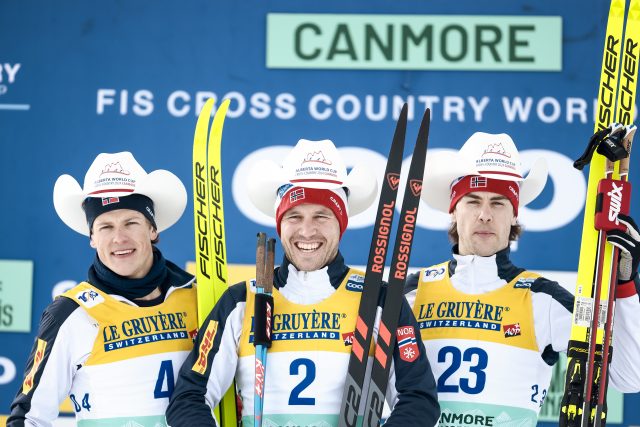
    The three Norwegian podium finishers sport their new cowboy hats Sunday. From left: Johannes Hoesflot Klaebo, Paal Golberg and Mattis Stenshagen. (Photo: NordicFocus)

    CANMORE, Alberta:  We’re three days into a six-race series of World Cup racing in North America and I’m just one guy, which means there hasn’t been time to share all the fun little stories and subplots that have been filling my notebook.

    I’m summarizing a few of the better ones here. Stay tuned for more notes and some feature stories after Tuesday’s final race in Canmore. If you have ideas for stories, tips or feedback for us, drop us a line at info@fasterskier.com.

    Canmore mayor says thanks but no thanks to nearly-naked Krüger

    Canmore is situated in the spectacular Canadian Rockies, but Alberta’s prairies start just down the highway to the east, and the events here celebrate the province’s cowboy culture with branded 10-gallon hats awarded to the podium finishers.

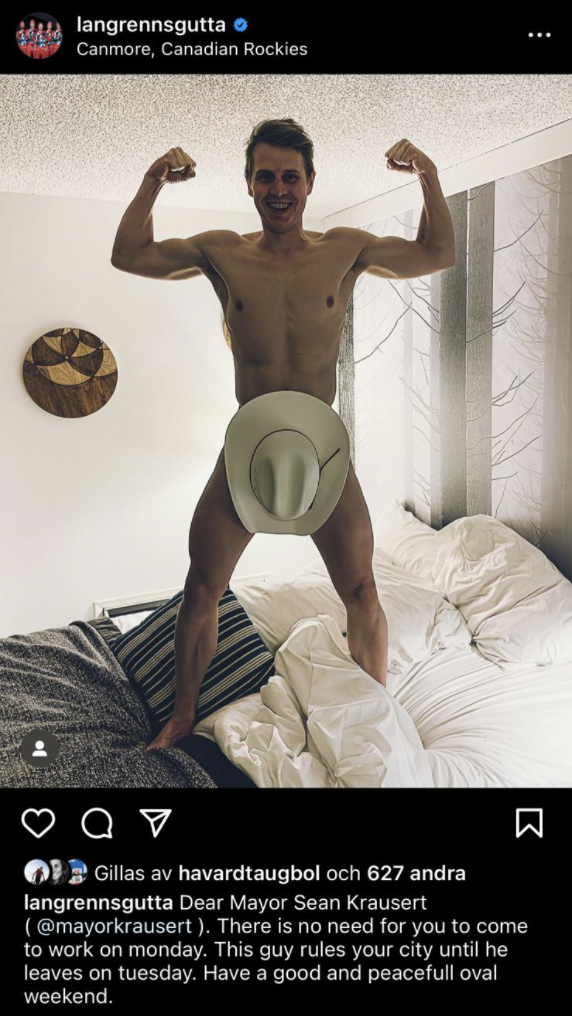
    Simen Hegstad Krüger of Norway won the first men’s race in Canmore in spectacular fashion Friday, and swiftly proceeded to defile the prize: In an Instagram post from the Norwegian team’s account later that day, he posed for a photo, naked, with only the cowboy hat preserving the image’s PG rating.

    This post from the Norwegian team needs no explanation.

    “Dear Mayor Sean Krausert,” the post said, tagging the mayor of Canmore. “There is no need for you to come to work on Monday. This guy rules your city until he leaves on Tuesday. Have a good and peaceful long weekend.”

    The next day, the post had been deleted. But after Norway swept the podium in Sunday’s men’s race, they published a new photoshopped image with five team members all posing naked with tastefully-placed hats and another offer that Krausert and his staff could have “two more days off, if you want.”

    Reached Sunday, Krausert said he was not aware of the posts, then, after I sent them to him, responded with a laugh-crying emoji.

    “Really…what can I say!!” he said. I said that he could, in fact, say whatever he wanted, to which he responded: “While I appreciate the offer, I’ll be at work on Monday so these incredible athletes can focus on skiing and enjoying Canmore.”

    Krüger said the idea for the original post came from his teammate Didrik Tønseth. “We had some fun about it, but then I figured in the morning that it is enough — maybe we can take it down,” he said, adding that no one instructed him to remove it.

    Tønseth told me, cheekily, that the Norwegian men had been failed by their “back-up crew, back in Norway,” which includes their “oldest and wisest” teammate, Sjur Røthe. The crew, Tønseth explained, is supposed to review all posts from the team’s Instagram account but didn’t because of the eight-hour time difference between Alberta and Europe.

    “It’s a lot of things we post that stop in the committee back in Norway,” Tønseth said. “Sjur is the athlete representative, but he was asleep, so it was his mistake, I think. Not ours.”

    Unfortunately for Røthe, it was too late in Norway for me to reach him for comment.

    A car crash derailed Jortberg last month. She’s back now.

    U.S. skier Lauren Jortberg is racing in Canmore just two weeks after a crash that left her with “pretty bad” whiplash and totaled the car she was driving — and she nonetheless placed 19th in Saturday’s skate sprint.

    “Honestly, I think it was for the better, looking back on it,” she said after the sprint. “I was having kind of a tough season and kind of just needed to have a little gratitude for life and everything — and have a scary situation that makes you appreciate everything more.”

    Lauren Jortberg racing earlier this year. (Photo: Nordic Focus)

    She added: “I wouldn’t recommend it, definitely. But it definitely gave me some perspective that skiing isn’t everything.”

    Jortberg, who races with the SMS T2 team in Vermont, said she was leaving a race in Craftsbury late last month and was driving on a dirt road in freezing rain when she had a head-on collision. Her car had gotten caught in a rut while she was driving around a turn.

    “It was pretty traumatic and scary,” she said.

    An ambulance came to the scene, and while Jortberg didn’t go to the hospital, she said she was suffering some “pretty bad symptoms” that stopped her from training for the next week.

    “But I feel a lot better now,” she said. “And we have a great staff here, and they’re really taking care of me.”

    Skistad fans the flames of a feud that…may not actually be much of a feud

    One of the fun ongoing subplots of the past year of racing on the World Cup has been the up-and-coming Norwegian sprinter, Kristine Stavås Skistad, poking at her Swedish rivals.

    Skistad, 25, has been the only woman to consistently puncture the dominance of the Swedish sprinters, who often put as many as three or four women in the six-person final heats on the World Cup. And when she wins, she seems to relish rubbing it in — or trying to, anyway.

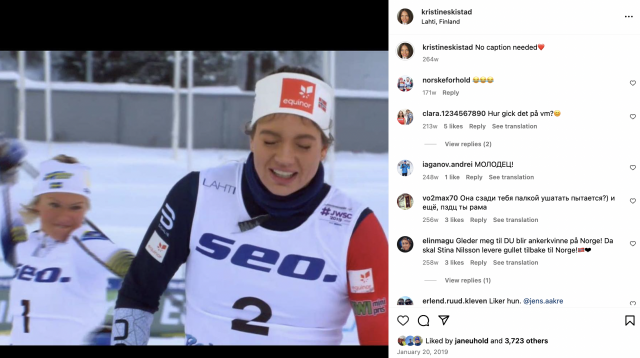
    Skistad’s ski-related snark appears to date back several years: An informed observer pointed me toward this objectively hilarious Instagram photo she posted from the World Junior Ski Championships in Finland five years ago. In it, Skistad smiles as she wins a gold medal in the sprint, while a clearly enraged Frida Karlsson of Sweden, who’s now a superstar on the World Cup, appears poised to smash her ski pole into the snow. “No caption needed,” Skistad wrote.

    No caption needed.

    In Saturday’s skate sprint, Skistad delivered not just a win but also another provocative gesture—a kiss, blown in the direction of the three Swedes who finished directly behind her.

    The Scandinavian media is delighting in what appears to be a budding rivalry: On Saturday, a Swedish television channel that was covering the Canmore races played a clip that analogized Skistad to a villainous character from the horror film “The Ring.”

    The Swedes themselves, however, appear generally unperturbed.

    “I feel like she sees us more like a rival than we really see her,” Maja Dahlqvist, one of the Swedish sprinters, told me. “We’re kind of friendly to her, and I think that maybe annoys her more. It doesn’t affect us at all—it’s not anger.”

    Johanna Hagström, another Swedish sprinter, said it’s a “little bit annoying” that Skistad is such a strong finisher. But she said the team’s read on Skistad is that she’s actually “really shy.”

    “She doesn’t speak that much—but on social media, she’s very cocky,” Hagström said. She added: “It’s really fun that she’s doing it. But I would never do that.”

    Hagström said she also thinks it’s good for the Swedish women to have other strong sprinters to compete against, and to give them motivation for summer training.

    Diggins works on saying ‘no’

    Nearly 30,000 tickets have been distributed for next weekend’s World Cup races in Minneapolis, which is setting up to be something of a homecoming celebration for Jessie Diggins, the U.S. star who grew up in Minnesota.

    Diggins is adored by fans, but the attention on her is making for an “exceedingly high” level of intensity and pressure, she told reporters after Friday’s race.

    “There’s a lot going on in my life right now. That’s the magic of having races at home is, it’s something you wanted and something I have worked for and advocated for for six years,” she said. “But at the same time, it comes with a lot of pressure and a lot of expectations and a lot of obligations for my time.”

    She added: “But that’s something I’m trying to role model well, for not just me but my teammates — like, it’s okay to be able to focus on your race, it’s okay to say no to things.”

    Saying no to things, however, is not always easy, she said.

    “It’s exceedingly difficult, and I struggle with it,” she said. “That’s something that I have to keep reminding myself is, I can’t do everything. Can’t possibly do it—it’s not possible. So we’re going to pick and choose, and kind of shoot for the happy medium.”

    I ended the interview by cheerfully pointing out that the Devon Kershaw Show, the FasterSkier podcast, is “ready for a yes” any time.

    Breakout Austrian star on doping doubts: “I get it.”

    Austrian racer Mika Vermeulen has been having a breakout season, and earned his first podium finish in Friday’s distance race.

    But Austrian cross-country racers have been implicated in doping scandals multiple times — most recently during the World Championships in Austria in 2019, where one of the country’s athletes was caught in the middle of a blood transfusion.

    Mika Vermeulen races Friday. (Photo: NordicFocus)

    Vermeulen was not implicated in that scandal and no evidence has ever emerged to cast doubt on his own performances. But I’d heard him bring up the subject on his own podcast previously, and also heard from one person in Canmore who had doubts about Vermeulen’s results.

    So I asked him, gently, what he wants people to think when he performs well, in light of the Austrian team’s history.

    “With all the shit that’s been happening on our team, and the last few years, yeah, I get it,” he said. “But the only thing I can do is keep on being good, being on my level. And I can tell you I’m not going to be caught, because I don’t do anything.”

    He added: “That’s the only thing I can do: Be on the level not just once but many and many times. And I just keep telling people I believe in myself, and I invite everyone to believe me.”

  • The Devon Kershaw Show: Davos delivers flamethrowers, snow squalls and U.S. podiums

    The Devon Kershaw Show: Davos delivers flamethrowers, snow squalls and U.S. podiums

    We’re in deep to the Tour de Ski now, after a couple of legitimately rad days of racing in Davos, Switzerland. Mikael Gunnulfsen of Norway joins us to talk about the stunning performance of Henrik Doennestad, and of course we catch you up on the latest successes of Americans Jessie Diggins and Rosie Brennan and, oh yeah, Gus Schumacher.

    Get at us at nat@fasterskier.com and devon@fasterskier.com. We’ll be back once the athletes hit the top of the Alpe Cermis.


  • The Devon Kershaw Show: Recapping a soggy, fluoro-free weekend in Trondheim

    The Devon Kershaw Show: Recapping a soggy, fluoro-free weekend in Trondheim

    Eli Brown, a member of the U.S. Ski Team’s waxing and ski service staff, joins us this week to talk about his job and the new enforcement of the rules banning fluorocarbons on the World Cup circuit. We recap another strong weekend for American athletes, along with all the hijinks that happened in Trondheim, Norway at the test event for next season’s World Championships.

    The World Cup takes a break next weekend before the Tour de Ski, but we may try to squeeze in a mailbag episode. Send us questions if you’ve got ’em. Reach us at nat@fasterskier.com and devon@fasterskier.com.

  • The Devon Kershaw Show: We’re back, baby

    The Devon Kershaw Show: We’re back, baby

    We’re off. The 2023-2024 winter kicks off with season opening races across Scandinavia, and the World Cup launches next week.

    Devon and Nat go old-school, no guests to recap a bevy of interesting results so far. Send us your comments, questions and criticisms: devon@fasterskier.com and nat@fasterskier.com. We’ll be back next week.


  • A Finnish finish: Tying a bow on the 2023 season in Lahti

    A Finnish finish: Tying a bow on the 2023 season in Lahti

    This is the end. Of the 2023 racing season. Devon and Nat go without guests and are here to take you through the last three events of the winter in Lahti, Finland. And we cover a couple of retirement announcements from U.S. skiers.

    We’re taking a little break after this but, we promise: We won’t leave you hanging for the whole off-season. Stay tuned for more regular episodes over the course of the spring and summer, and we’ll be back in a few weeks for a 2023 season recap. Tell us your favorite memories from this year — get at us at devon@fasterskier.com and nat@fasterskier.com.

  • The Devon Kershaw Show: Live from Estonia, it’s Tuesday night

    The Devon Kershaw Show: Live from Estonia, it’s Tuesday night

    Estonia put on one heck of a show at a city sprint in the nation’s capital, Tallinn, this week. We give you a full recap with the help of an on-site expert, Vahur Teppan, and break down some complaints about a new system designed to level the waxing playing field — which may not have worked.

    We’ll be back for one more recap after the Lahti Ski Games in Finland this weekend. Devon is at devon@fasterskier.com and Nat is at nat@fasterskier.com.

  • Norway’s Blink Festival: Rollerski Racing with Some Social Distance

    Norway’s Blink Festival: Rollerski Racing with Some Social Distance

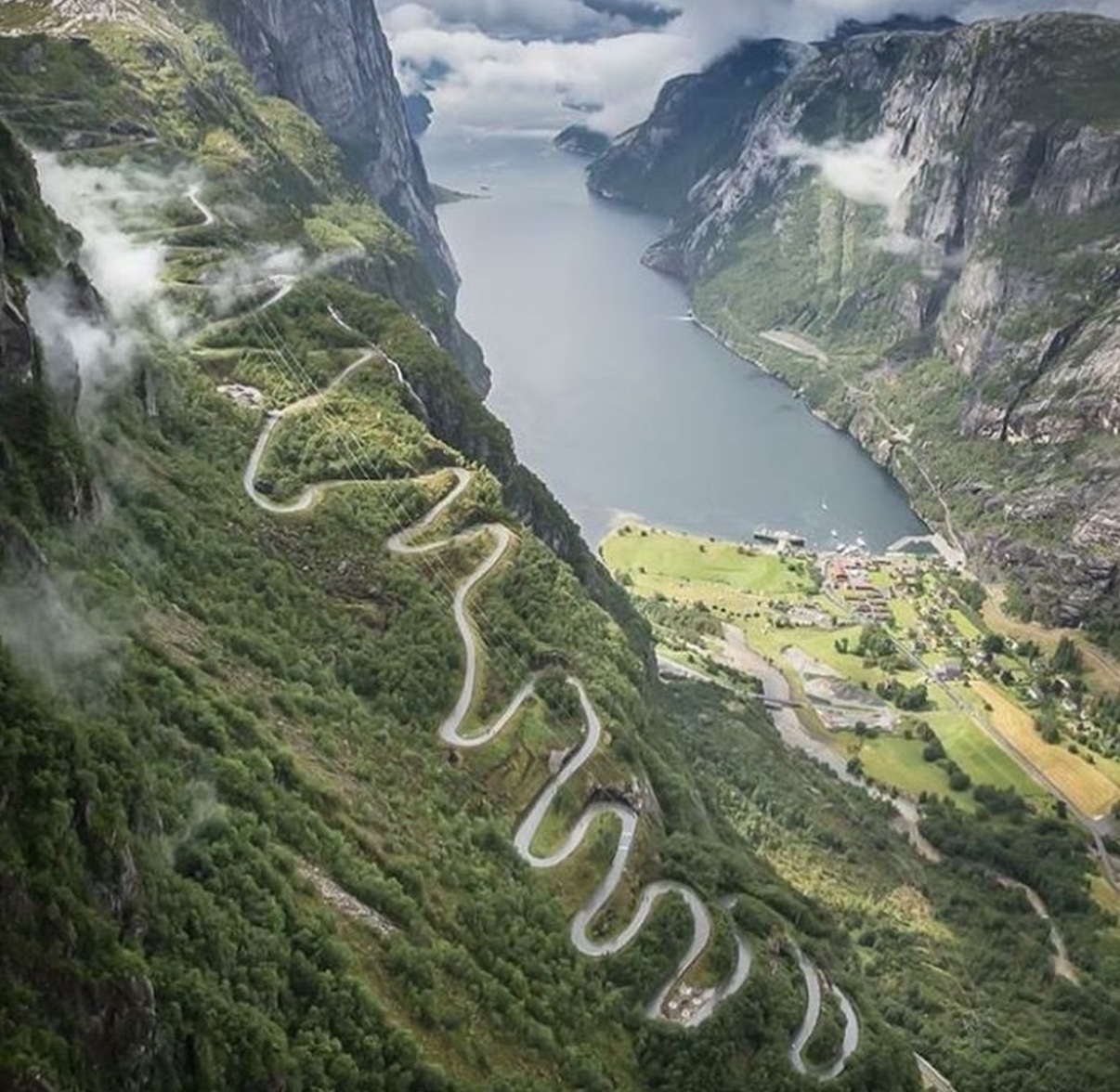
    The sinuous Lysebotn Opp rollerski course. (Photo: Blink 2020 screenshot)

    Times are what they are. Precautions are the name of the game. This year’s Blink Festival in Norway played to a reduced field and limited spectators due to COVID precautions. Some races, as will be noted, included modified race rules to limit close contact between athletes. 


    Lysebotn Opp – 06/08

    The Lysebotn Opp is perhaps the marquee event. It features lovely fjord views and a grueling 7.5-kilometer uphill skate switchbacking up a mountainside. In normal years, the Lysebotn Opp is a mass start event. This year, however, it was an individual start affair.  

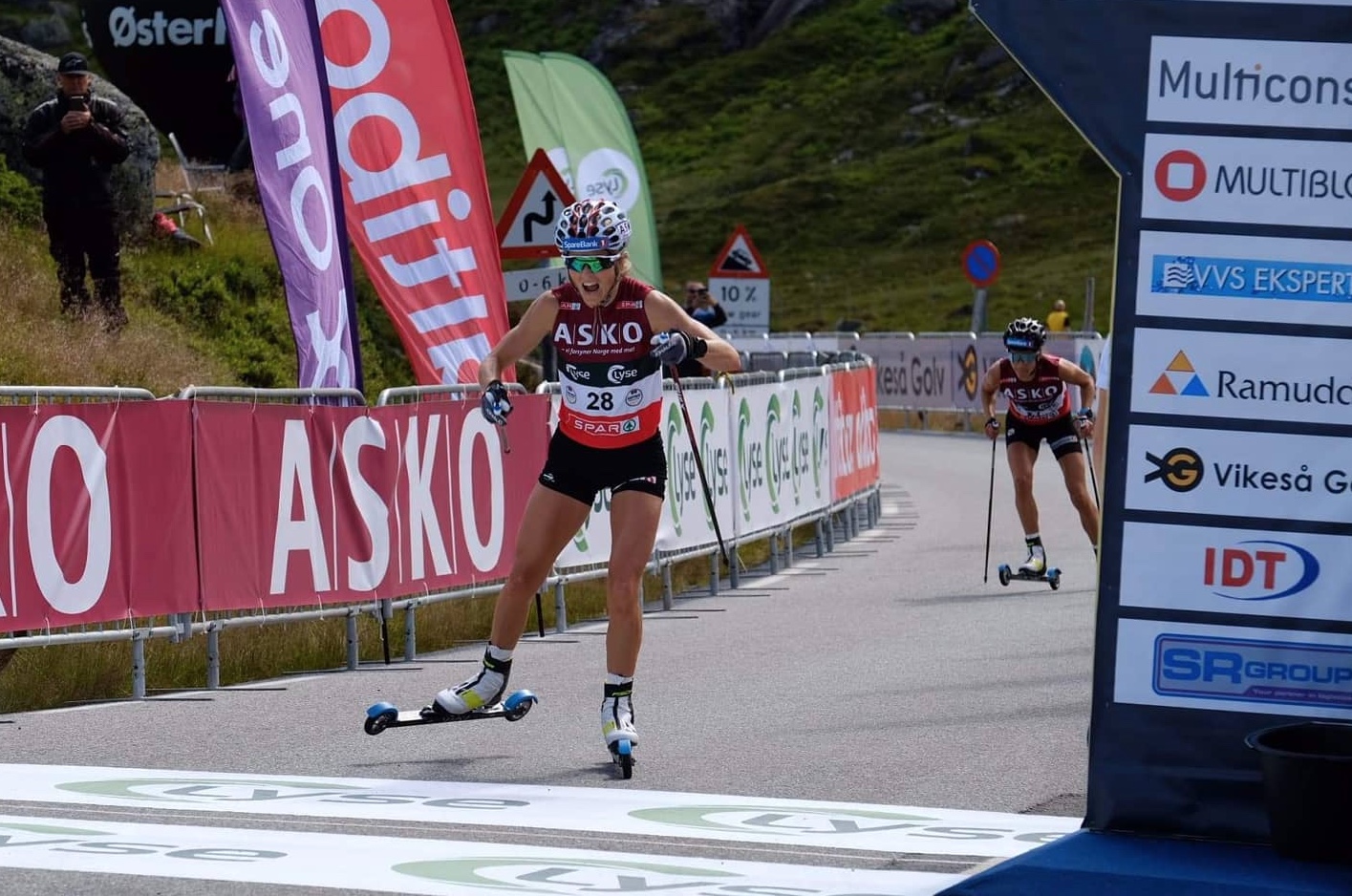
    Therese Johaug won the women’s event in 33:11 minutes. Heidi Weng placed second (+00:34), and Helene Marie Fossesholm was third (+02:20). All three skiers are from Norway with Johaug and Weng seasoned veterans with Fossesholm an upstart 19 year old relatively new to the elite level scene. Fossesholm won two individual golds at the 2020 Junior Worlds winning both the 5 k classic and the 15 k mass start skate. According to FIS, she has competed in three World Cups and notched a fifth place in last season’s 10 k mass start skate in Falun. 

    Full Women’s Lysebotn Opp Results


    For the men, Norway’s Simen Hegstad Krüger won in 29:25. Hans Christer Holund was third (+01:02), and Håvard Moseby third (+01:21). Moseby, the relative unknown on the podium is 21 and placed third in the 2020 U23 Worlds 30 k mass start skate. 

    Full men’s Lysebotn Opp Results


    Therese Johaug (bib 28) winning the 2020 Lysebotn Opp. (Photo: 2020 Blink Festival FB page)

    Skate Sprint – 07/08

    The second day of cross-country racing featured a skate sprint. For those used to larger fields and six-skier-deep heats, things looked a bit different. This was head-to-head racing, two racers per heat, as skiers advanced to the finals. Racers were required to remain in their respective lanes throughout the race which resulted in no drafting. 

    Norwegian sprinter Maiken Caspersen Falla won the day with Mathilde Skjærdalen Myhrvold placing second overall. Myhrvold lost the final by 1.4 seconds. Myhrvold is 22 years old and has raced two World Cups, both in Norway. 

    Kristine Stavås Skistad (21) placed third overall. She lost to Falla in the second semi in a photo-finish. 

    Women’s Sprint Results


    Johannes Høsflot Klæbo did as he does: win sprints. The star of the show placed first in the final, 1.5 seconds in front of second place GjøranTefre. At 25, Tefre raced nine World Cups last year with his best result an eighth place in Oberstdorf’s classic sprint. Klæbo has won the last four World Cup sprint titles. Erik Valnes placed third overall. He lost out to Tefre in the second semi by 0.1 seconds. 

    Men’s Sprint Results


    10 k / 15 k Classic – 08/08

    In the individual start 10 k classic, run on a 2.5 k closed loop, Tiril Udnes Weng won in 24:57.9 minutes. Fossesholm raced to second place, 3.9 seconds back, with Johaug in third (+12.1). 

    Women’s 10 k Classic Results


    Klæbo took the crown in the men’s 15 k classic over a field that featured some of Norway’s top distance talent. He won in 35:08.9, just 0.2 seconds ahead of Moseby, who was second overall in the Lysebotn Opp. Daniel Stock was third (+2.1). 

    Men’s 15 k Classic Results

    If you are looking for more, as in the view-from-the-comfort-of-home experience, Norwegian broadcaster NRK has archived the 2020 Blink Festival races. You can find a menu of races here.

  • Saturday Race Rundown: U.S. U20 Men Win Relay, U20 Women 4th at World Juniors (Updated)

    Saturday Race Rundown: U.S. U20 Men Win Relay, U20 Women 4th at World Juniors (Updated)

    The U20 World Juniors 4 x 5 k relay first place team from the U.S, (l-r) Johnny Hagenbuch, Ben Ogden, Luke Jager, and Gus Schumacher. (Photo: JWSC2019 / Mikaela Takala)

    2019 U23 World Ski Championships in Lahti, Finland 4 x 3 k and 4x 5 k relay

    Full U20 Men’s Race Report

    In a historic first for the U.S., the U20 men’s team won the 4 x 5-kilometer relay today in Lahti, Finland at the 2019 World Junior Ski Championships. Luke Jager skied the first classic leg for the U.S., Ben Ogden skied the second classic, Johnny Hagenbuch skied the first initial skate leg and Gus Schumacher raced the anchor leg.

    The foursome won in a time of 45:34.7 minutes, and beat second-place Russia by 3.8 seconds.

    Russia’s team was comprised of Egor Trefilov, Andrey Kuznetsov, Yaroslav Egoshin, and Alexander Terentev.

    Germany’s team of Jakob Milz, Florian Knopf, Anian Sossau, and Friedrich Moch took third finishing 6.3 seconds behind.

    For Canada, Remi Drolet , Sam Hendry, Xavier McKeever, and Thomas Stephen skied to 11th (+2:29.7).

    Nineteen teams were entered in the race.

    Men’s U20 Results

    In the 4 x 3.3 k U20 women’s race, Norway’s Kristin Austgulen Fosnaes, Astrid Stav, Helene Marie Fossesholm, and Kristine Stavås Skistad won at the line in 35:24.7 minutes.

    Russia’s Anastasia Faleeva, Kristina Kuskova, Veronika Stepanova, and Anna Grukhvina were a close second, stopping the clock 1.0 seconds back.

    Louise Lindström, Frida Karlsson, Tilde Baangman, and Lin Svahn for Sweden placed third (+33.3).

    The U.S. team of Mara McCollor, Kendall Kramer, Sydney Palmer-Leger and Novie McCabe skied to fourth place, 40.5 seconds back.

    For Canada, Anne-Marie Petitclerc, Jasmine Drolet, Anna Pryce, and Molly Miller placed 11th, 3:01.4 minutes behind.

    U20 Women’s Results

    ***

    FIS Cross Country World Cup Ulricehamn, Sweden 10/15 k freestyle

    In what is his skiing canvas, the 15 k freestyle, France’s thirty-two-year-old Maurice Manificat won his first World Cup of the season in Ulricehamn, Sweden today in 34:55.4 minutes. It was a tight race in that Norway’s Simen Hegstad Krüger Simen Hegstad Krüger who placed second finished 1.1 seconds back. Teammate Didrik Tønseth was third (+8.7).

    Canada’s Alex Harvey was the best placed North American in ninth (+31.4). Lenny Valjas skied to 57th (+2:32.1), and Bob Thompson 77th (+4:16.6).

    For the U.S., Scott Patterson finished 35th (+1:26.5), David Norris 53rd (+2:11.3), Ben Lustgarten 64th (+3:04.7).

    Men’s Results

    Norway’s Therese Johaug kept her distance win streak alive at eight wins in eight starts on the World Cup this season. She won the women’s 10 k skate race in 25:48.2 minutes, with teammate Astrid Uhrenholdt Jacobsen in second, 22.8 seconds back. Third place went to Sweden’s Ebba Andersson, 24.9 seconds behind.

    The U.S. Ski Team’s Jessie Diggins skied to fourth place (+38.3), while teammate Sadie Bjornsen was 15th (+1:25.1). Caitlin Paterson (CGRP) had her best World Cup result of the season, skiing to 23rd (+1:49.9). Rosie Brennan (APU) placed 28th (+2:03.2), and Rosie Frankowski 42nd (+2:28.0).

    Dahria Beatty was the only Canadian entered. She finished 56th (+3:54.7).

    Women’s Results

    ***

    IBU World Cup Antholz, Italy 10/12.5 k pursuit

    In the women’s 10 k pursuit, Italy’s Dorothea Wierer won in a time of 29:20.1 after skiing two penalties (1+0+0+1). Second place went to Germany’s Laura Dahlmeier, who finished 6.0 seconds after Wierer after one missed shot (0+0+1+0). Saturday’s third place went to another Italian, Lisa Vittozzi, who finished 16.2 seconds behind the winner after tying Wierer’s shooting score.

    Clare Egan led the way for the U.S., racing to 11th (+1:31.9) after skiing two penalties (0+0+0+2).

    “I’m really happy with my race today,” Egan wrote in an email. “The wind and altitude are always a challenge here, but I took my time on the range and capitalized on the fast glide of my skis to save energy on course. I made a costly and dumb mistake on my last shot but still came away with my second-best career result. I’ll take what I learned from today and go for it again tomorrow in the mass start! Can’t wait!”

    Joanna Reid was the next American to finish, placing 29th (+2:55.2) after three missed shots (1+0+0+2).

    For Canada, Rosanna Crawford finished 34th (+3:30.8) after skiing five penalties (2+1+1+1) and her teammate Megan Bankes finished 39th (+3:37.1) with five misses (1+0+3+1). Also skiing for Canada, Sarah Beaudry placed 46th (+5:07.5), also with five penalties (4+0+1+0).

    Women’s 10 k Results

    In the men’s 12.5 k pursuit, Norway’s Johannes Thingnes Bø
    won in a time of 31:33.7 after skiing three penalties (1+1+0+1). France’s Antonin Guigonnat raced to second place, 34.8 seconds behind with one missed shot (0+0+1+0). The third and final podium spot on Saturday went to France’s Quentin Fillon Maillet, who skied two penalties (1+0+0+1) and finished 40.6 seconds back from the winning time.

    Sean Doherty for the U.S. placed 47th (+4:39.1, 3+2+1+0). Jake Brown was lapped and was not given an official time.

    For Canada, Jules Burnotte skied to 54th (+5:42.8, 1+3+1+1), and Scott Gow 55th (+6:39.7, 4+0+2+3).

    Men’s 12.5 k pursuit results

    ***

    Lake Placid SuperTour Classic Sprint

    Canada’s Antoine Briand (CNEPH) was the fastest qualifier on the day in 3:14.71 minutes and won the men’s final. Dominique Moncion-Groulx (Nakkertok) placed second in the final, with Ben Saxton (SMS T2) in third.

    Saxton was the second fastest qualifier, with Oliver Hamel (CNEPH) third fastest.

    Men’s Qualification | Men’s Heats

    For the women, Sophie Caldwell (USST/SMS T2) scorched the qualifier in 3:40.44 minutes with Jessica Yeaton (APU/Australian National Team) qualifying in second (3:50.49). Dartmouth’s Katharine Ogden qualified third (3:51.79).

    Caldwell went on to win the final in 3:37.06, with Yeaton in second and Kelsey Phinney (SMS T2) in third.

    Women’s Qualification | Women’s Heats


  • Sweden’s Sundling Scores First World Cup Win; Sadie Bjornsen Podiums in Lillehammer Skate Sprint

    Sweden’s Sundling Scores First World Cup Win; Sadie Bjornsen Podiums in Lillehammer Skate Sprint

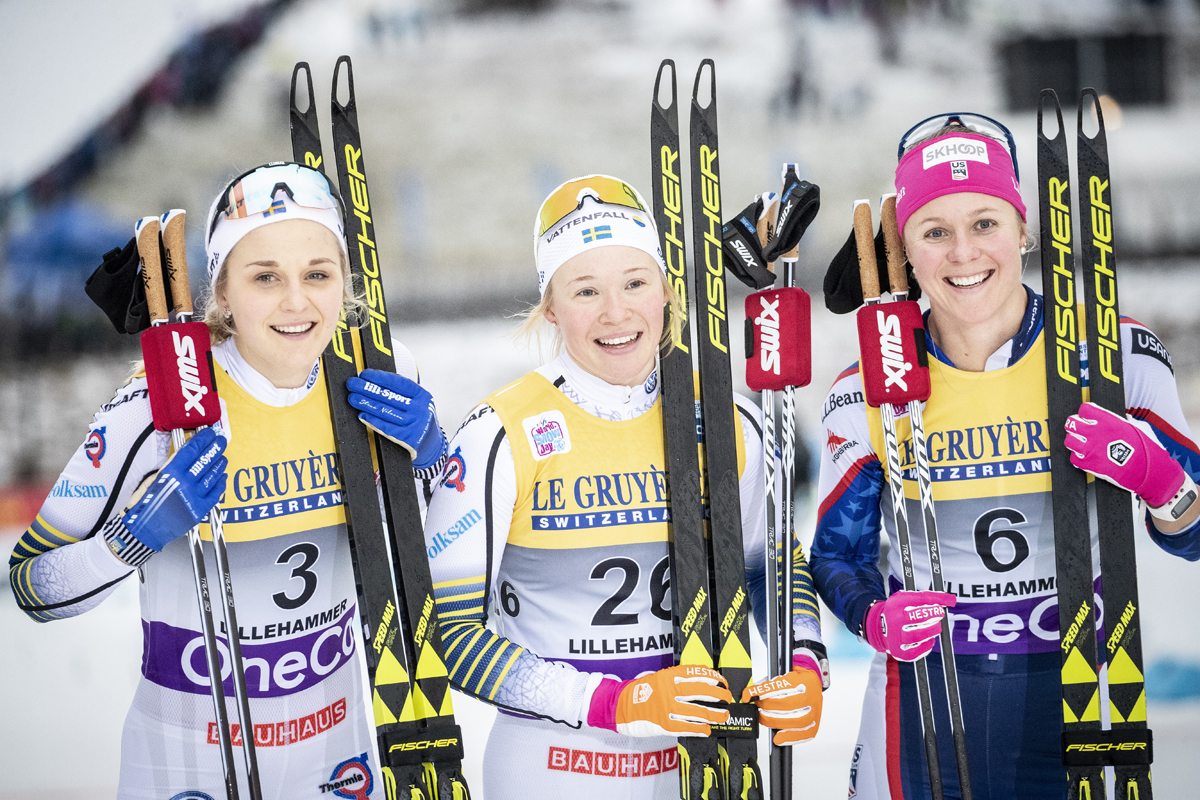
    The women’s podium from the 2018 1.3 k World Cup freestyle sprint in Lillehammer, Norway. Sweden’s Jonna Sundling (center) won, teammate Stina Nilsson (left) was second, and U.S. skier Sadie Bjornsen (right) third. (Photo: Fischer/Nordic Focus)

    With the two big climbs over 1.3-kilometer freestyle sprint course, the women’s World Cup freestyle sprint course in Lillehammer, Norway packs a quad-burning punch. With lungs then legs poaching any extra oxygen, the women’s final, which featured four of six athletes from Sweden, was a primetime show.

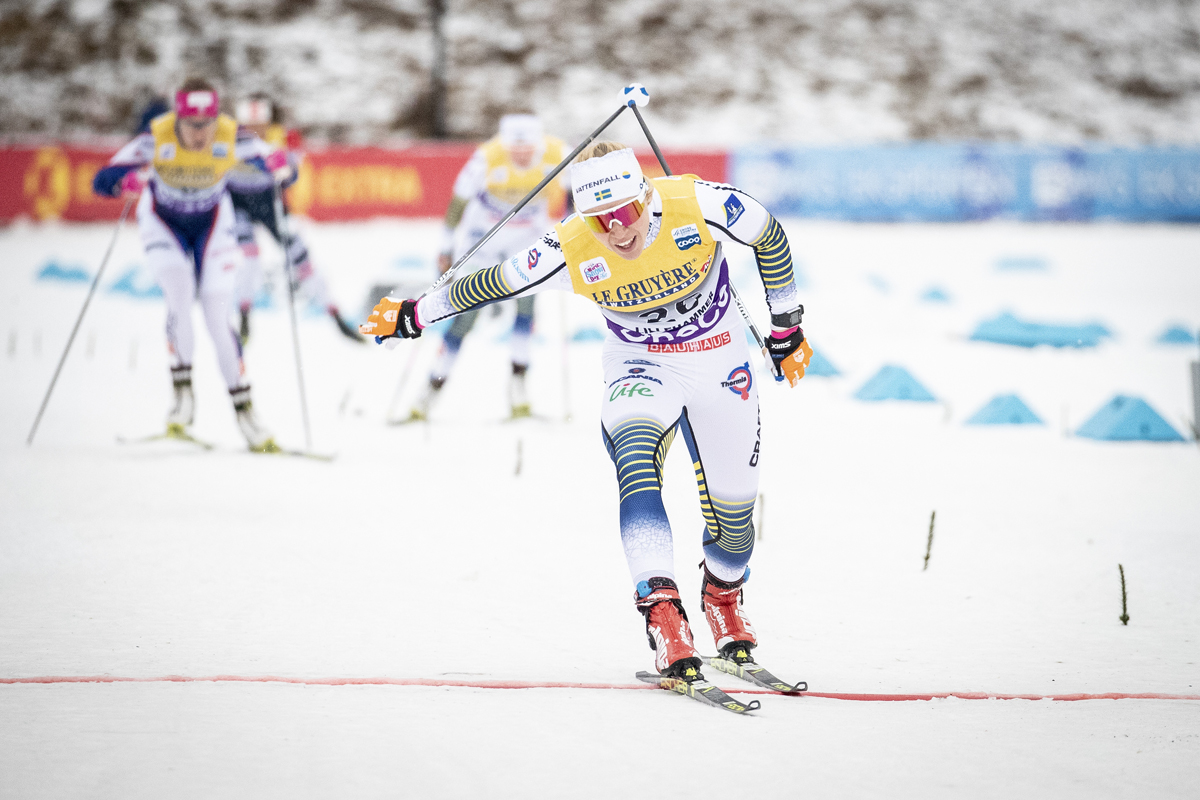
    Jonna Sundling of Sweden crossing the line first in the final of the women’s 1.3 k sprint in Lillehammer, Norway. (Photo: Fischer/Nordic Focus)

    Nilsson is a finisher, known for her closeout efforts in the finishing straight. But as she and twenty-three-year-old Sundling glided into the S-turns before the final 100 meters, Sundling’s skis looked to have a glide-advantage.

    It didn’t take long down the stretch for Sundling to pass Nilsson for her first career World Cup victory. She won in a time of 2:52.74 minutes. This was Sundling’s 29th World Cup start, and her second podium. She placed second last season in Falun’s skate sprint.

    Sundling qualified for the heats in 26th (+5.74). She advanced to the semis by winning the first heat. However, she was a lucky loser in the first semi-final to advance to the six-skier final.

    Nilsson placed second (+.34), the U.S. Ski Team’s (USST) Sadie Bjornsen was third (+3.03).

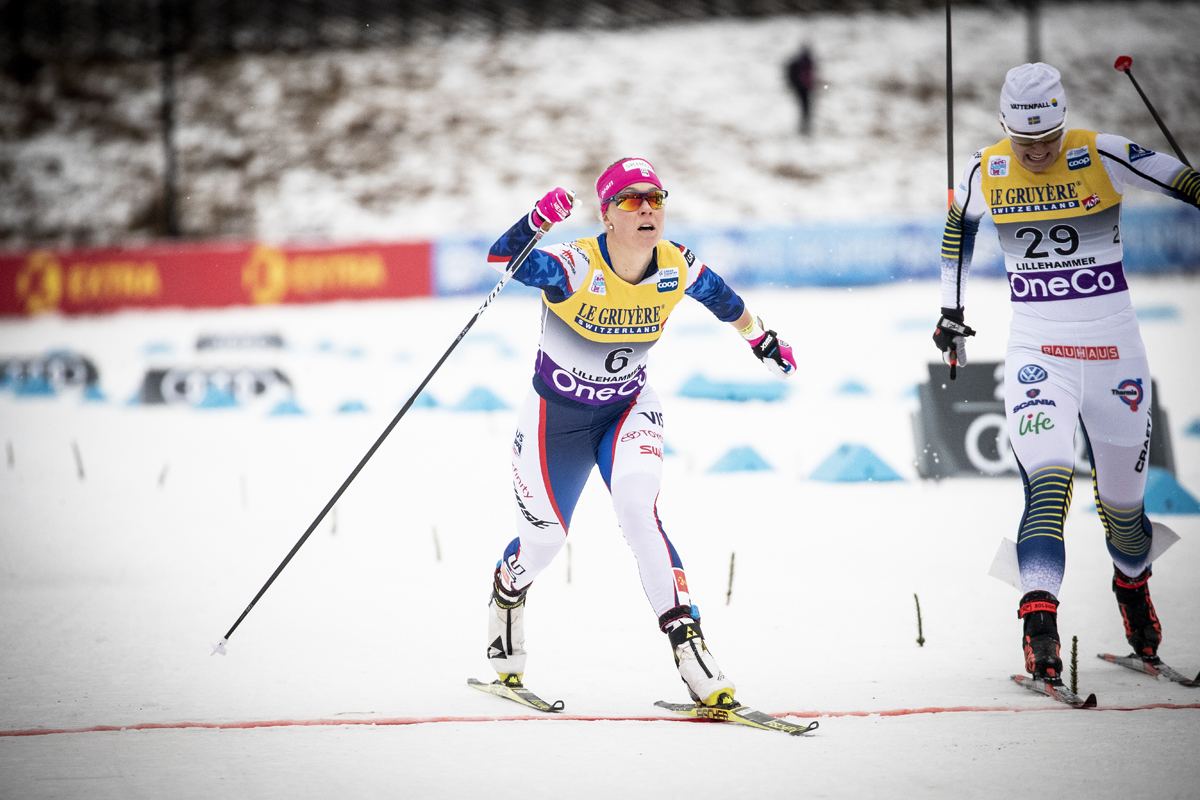
    Sadie Bjornsen of the US (bib 6) out lunges Sweden’s Ida Ingemarsdotter in the second semifinal during the 2018 Lillehammer, Norway World Cup skate sprints. (Photo: Fischer/Nordic Focus)

    For Bjornsen, she showed the early season form reminiscent of last season. During the 2017-2018 World Cup, Bjornsen posted a second place during the first weekend’s classic sprint, and a third place in the Lillehammer classic sprint the following weekend.

    This season, Bjornsen skied to an 11th place in the Ruka, Finland classic sprint and an 11th in the 10 k classic. With her near-the-front-of-the-pack skiing today, Bjornsen skied with assertiveness and confidence on her way to securing her first career World Cup skate sprint podium.

    It was Bjonrsen’s sixth career podium on the World Cup circuit.

    “I think sometimes I get easily pushed around a bit, it’s harder when your skis are not just going straight like classic,” Bjornsen said in the post-race press conference about her need to ski for position. “I was just focusing on trying to be in a position to really be in the front of the pack at the top of that climb. I kept finding some openings on the right side of the track to pass some people.”

    Bjornsen displayed keen instincts on the final climb. Even more impressive was her display of horsepower as she took a seam up the right-hand side, and began gapping fourth, fifth, and sixth place behind her.

    “Then coming into the finish, I tried to start free skating like three seconds before I wanted to because I knew that that speed would carry me across the finish,” Bjornsen said.

    Bjornsen was the fastest North American qualifier in sixth, 1.88 seconds behind the speediest qualifier, Sweden’s Hannah Falk, who stopped the clock in 2:56.43 minutes.

    Bjornsen advanced to the semis by placing second to Falk in the third heat. It was déjà vu in the second semi-final, where Bjornsen again placed second to Falk to secure a spot in the final.

    Bjornsen enters Saturday’s 10 k individual start classic in third overall for the Lillehammer three-day tour.

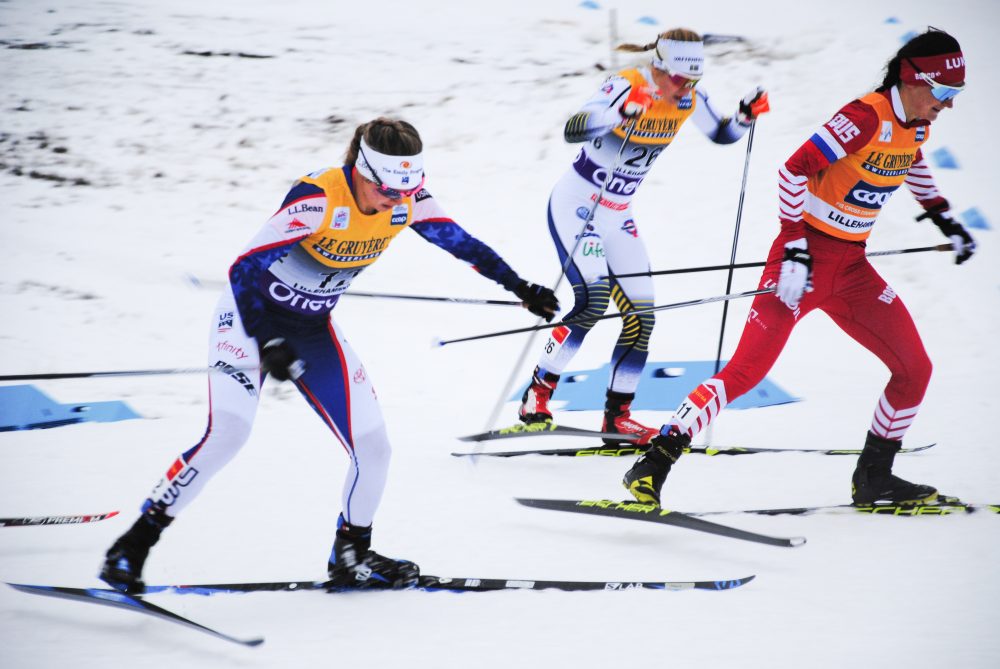
    The U.S. Ski Team’s Jessie Diggins skiing next to Russia’s Yulia Belorukova in the second heat during Lillehammer, Norway’s 1.3 k World Cup freestyle sprint. Diggins placed 17th overall.

    After qualifying ninth and 12th respectively, U.S. skiers Rosie Brennan (APU) and Jessie Diggins (USST) did not advance to the semi-finals. Diggins and Brennan raced in the second heat. Diggins placed fourth, Brennan fifth.

    Diggins finished the day in 17th, Brennan 21st.  

    Also for the U.S., Ida Sargent (USST) qualified 34th (+7.28), Kelsey Phinney (SMS T2) in 38th (+8.76), Caitlin Patterson (CGRP) 59th (+13.18), and Kaitlynn Miller (CGRP)  73rd (+20.78).

    USST athlete Sophie Caldwell did not start as she is fighting a cold.

    No Canadian women were entered.

    Racing continues tomorrow for the women with a 10 k interval start classic race.

    Women’s Qualification | Women’s Final Results

  • Friday Rundown: World Cup Cross-Country Sprint in Lillehammer, Norway

    Friday Rundown: World Cup Cross-Country Sprint in Lillehammer, Norway

    The women’s podium from the 2018 1.3 k World Cup freestyle sprint in Lillehammer, Norway. Sweden’s Jonna Sundling (center) won, teammate Stina Nilsson (left) was second, and U.S. skier Sadie Bjornsen (right) third.

    FIS Cross-Country World Cup in Lillehammer Norway: Freestyle Sprint

    Women’s Report | Men’s Report

    In Friday’s women’s 1.3-kilometer freestyle sprint in Lillehammer, Norway, the first day of three successive days of World Cup racing, the women’s sprint final was stacked with Swedes, with four of six athletes sporting the yellow, blue, and white.

    In the final, Jonna Sundling of Sweden passed teammate Stina Nilsson meters before the finish line to take the win in 2:52.74 minutes. It was Sundling’s first career individual World Cup win. Nilsson placed second (+.34), the U.S. Ski Team’s (USST) Sadie Bjornsen was third (+3.03). 

    Evelina Settlin, also of Sweden, placed fourth (+3.82), Kristine Stavås Skistad from Norway was fifth (+6.65), while the day’s fastest qualifier, Hannah Falk, finished sixth (+9.81).

    American’s Jessie Diggins and Rosie Brennan were knocked out when they placed fourth and fifth respectively in the second heat. The top-four spots in the second heat were separated by 0.42 seconds. Diggins finished the day in 17th, Brennan in 21st.  

    Sweden’s Falk won the qualifier in 2:56.43 minutes.  

    The U.S. Ski Team’s (USST) Bjornsen was the fastest North American qualifier in sixth (+1.88). Brennan qualified in ninth (+3.11), Diggins 12th (+3.66).

    Ida Sargent (USST) qualified 34th (+7.28), Kelsey Phinney (SMS T2) in 38th (+8.76), Caitlin Patterson (CGRP) 59th (+13.18), and Kaitlynn Miller (CGRP)  73rd (+20.78).

    USST athlete Sophie Caldwell did not start as she is fighting a cold.

    No Canadian women were entered

    The men raced on a slightly longer 1.6 k course. Italy’s Federico Pellegrino, known for his skate sprint flash, won the men’s final in 3:19.17 minutes. On-form Norwegian Emil Iversen was second (+0.44), while Canada’s Alex Harvey, took third (+0.68).

    Norway’s Sindre Bjørnestad Skar placed fourth overall (+0.91), with Finn Hågen Krogh racing to fifth (+1:07). Finland’s Ristomatti Juhani Hakola crossed the line in sixth (+2.43).

    Norway’s Johannes Høsflot Klæbo won the qualifier in a time of 3:07.63. Klæbo placed sixth in the first semifinal finishing over thirty seconds back after breaking a pole.

    buy vancomycin online


    Canada’s Alex Harvey and USST skier Simi Hamilton were the only North American men to qualify for the heats. Harvey qualified 17th (+7.59), Hamilton 22nd (+8.72). While Harvey eventually moved onto the final, placing third, Hamilton bowed out in the third heat. Hamilton placed fourth and was unable to advance as a lucky loser. Hamilton finished 19th overall in Friday’s sprint.

    For Canada, Andy Shields placed 60th (+14.59), Russell Kennedy (Team R.A.D.) 64th (+15.21), Julien Locke (CNST) did not start.

    The USST’s Kevin Bolger was the next best placed American in 61st (+14.63). Also for the USST, Erik Bjornsen was 63rd (+15.04), Paddy Caldwell 82nd (+19.34). David Norris (APU) placed 90th (+20.71), Scott Patterson of the USST finished in 92nd (+22.21), and Adam Martin (CGRP) 108th (+32.72).  

    Stay tuned for full race reports and you can view our Lillehammer Triple course preview here.

    Women’s Qualification | Women’s Final Results |  Men’s Qualification | Men’s Final Results

  • Skate Sprints in Beito: Klæbo and Falla Win with Challengers Right Behind

    Skate Sprints in Beito: Klæbo and Falla Win with Challengers Right Behind

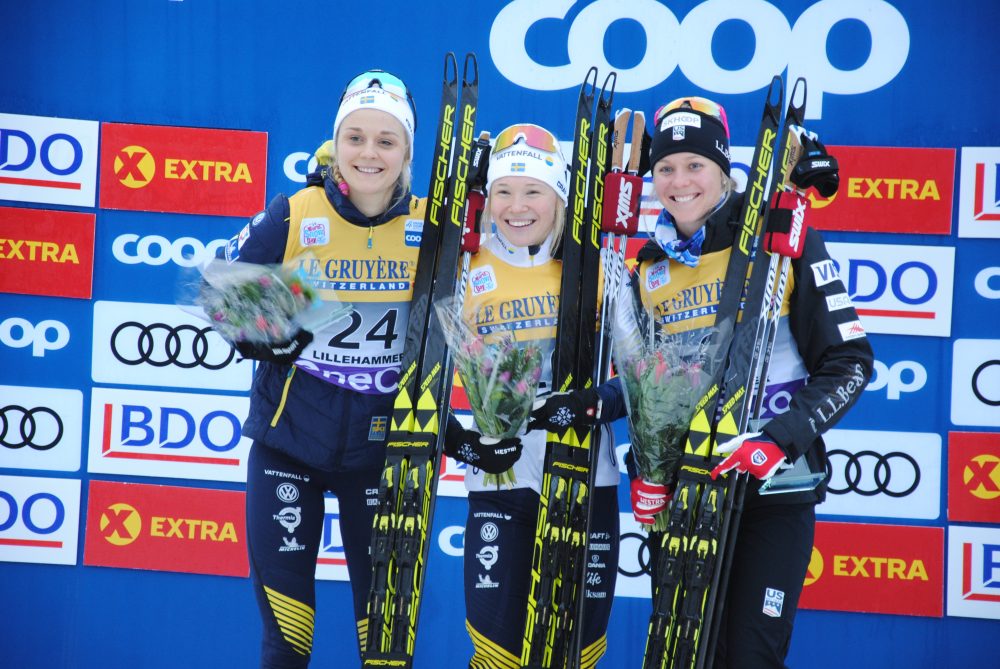
    The women’s all-Norwegian podium from the 2018 FIS Skate Sprint in Beitostølen, Norway. Maiken Caspersen Falla (center) won, Kristine Stavås Skistad placed second (left), and Lotta Udnes Weng was third (right). (Photo: Aleks Tangen)


    In a place like Norway, where the pool of cross-country athletes appears eternally deep, when you see competitors raise the bar, there’s nothing else to do but jump.

    On Saturday in Beitostølen, Norway the known knowns were self-evident: Maiken Caspersen Falla and Johannes Høsflot Klæbo took the freestyle sprint wins during the second day of FIS race competitions.

    As both athletes were overall World Cup sprint champions last season, there are no shockers there. (Klæbo has won two consecutive sprint crystal globes, Falla three.) But other skiers rose to the occasion and proved they too can jump nearly as high as Falla and Klæbo.

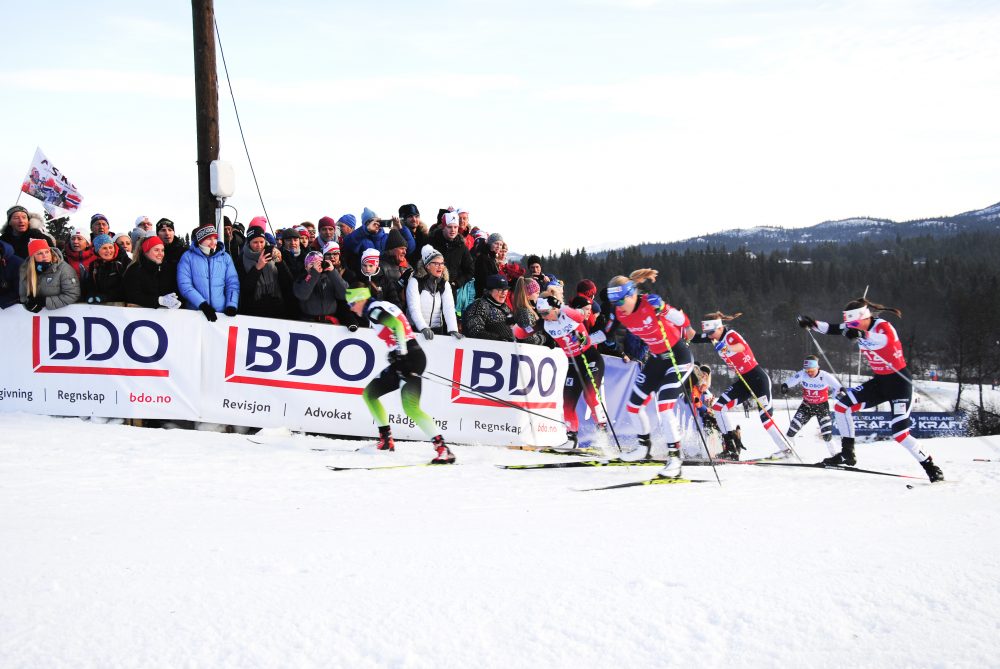
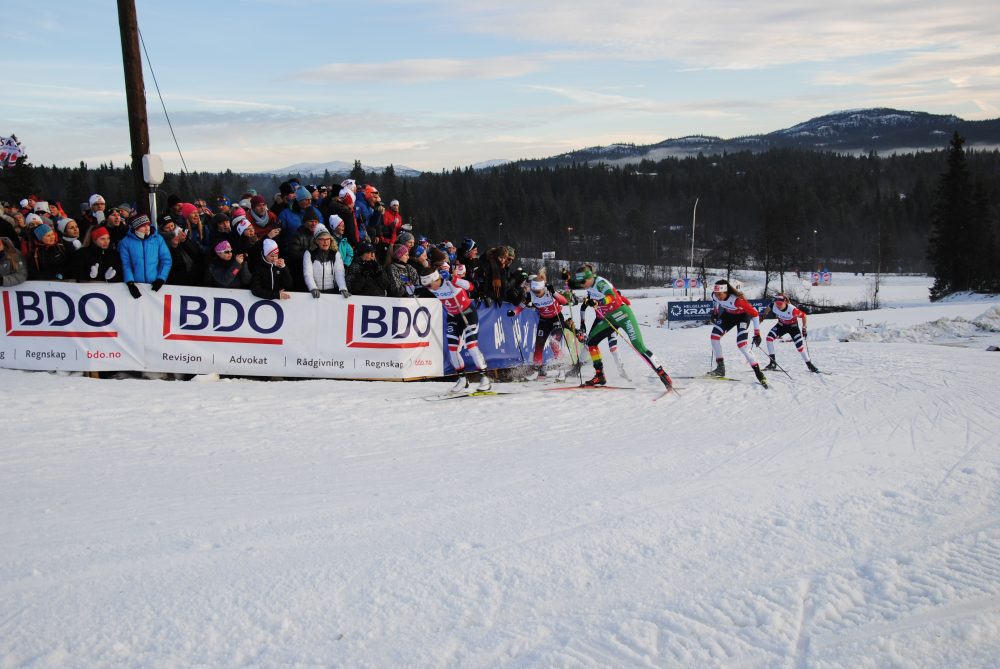
    The women’s second semifinal on course in Beitostølen, Norway during the FIS skate sprint. (Photo: Aleks Tangen)

    The women raced a 1.3 k skate sprint course with 54 women racing the qualifier. And this is where things got interesting. Nineteen-year-old junior Kristine Stavås Skistad, who has raced a single World Cup, the 2018 Drammen classic sprint in which she placed 51st, won the qualifier in 2:44.68 minutes. What is startling when scrolling through the qualification results is her birth year: 1999. The next closest Norwegian athlete in age finishing in the top-10 of qualification on Saturday was Anne Kjersti Kalvå, born in 1992.

    In last season’s World Junior Championships, Skistad placed fifth in the 5 k classic, and second in the skate sprint. So certainly she is an up and comer. But the fact that she held her own in a world-class field of Norway’s best, is a statement.

    Falla qualified in fourth (+1.63), and moved through to the finals by winning both her quarterfinal and semifinal.

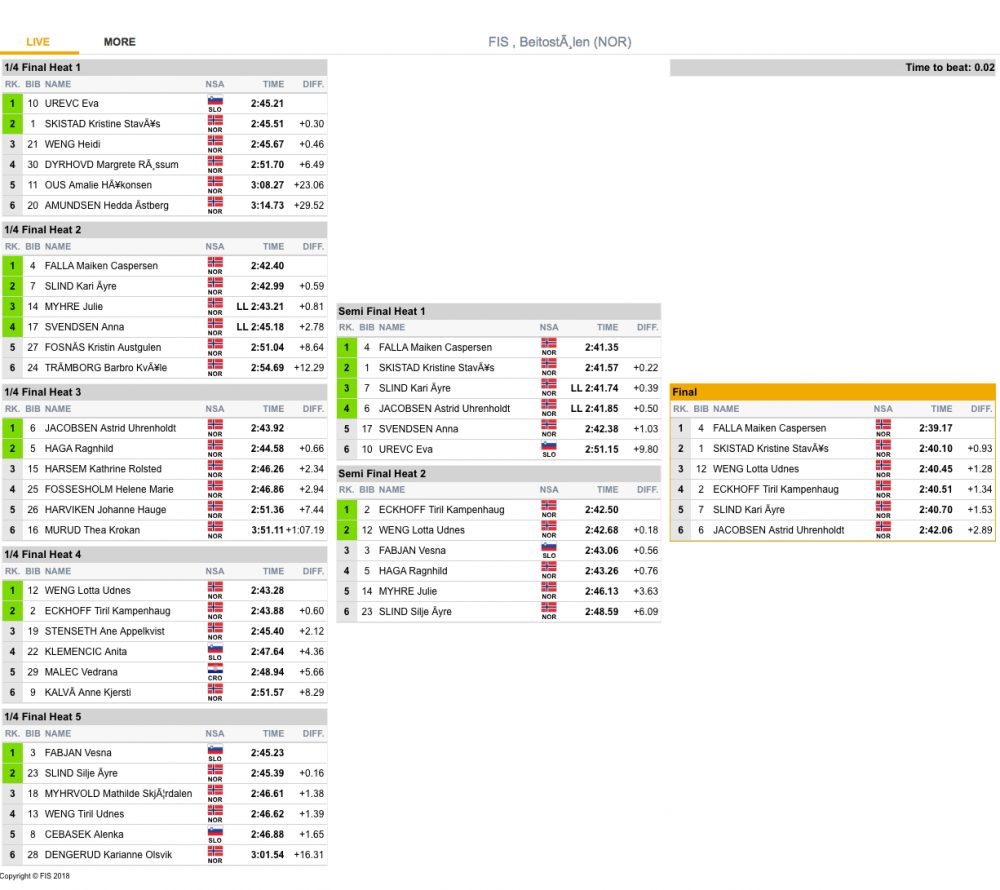
    Skistad, however, maybe played it a bit coyer. She squeaked into the semis by placing second in her heat by .30 seconds to Slovenia’s Eva Urevc. She then placed second to Falla by .22 seconds in the first semifinal. (That semi proved the faster of the two semifinals — both Kari Øyre Slind and Astrid Uhrenholdt Jacobsen advanced as lucky losers from the Falla semi.)

    Falla is Falla – a veteran with big experience and the know how to throttle the engine when it matters. She won the final in 2:39.17 minutes, a pace over five seconds faster than Skistad’s winning qualification time.

    In the all Norwegian final, Skistad placed second (+0.93),  Lotta Udnes Weng was third (+1.28) Tiril Kampenhaug Eckhoff, both a World Champs and Olympic medalist in biathlon, was fourth (+1.34), Slind fifth (+1.53), and Jacobsen sixth (+2.89).

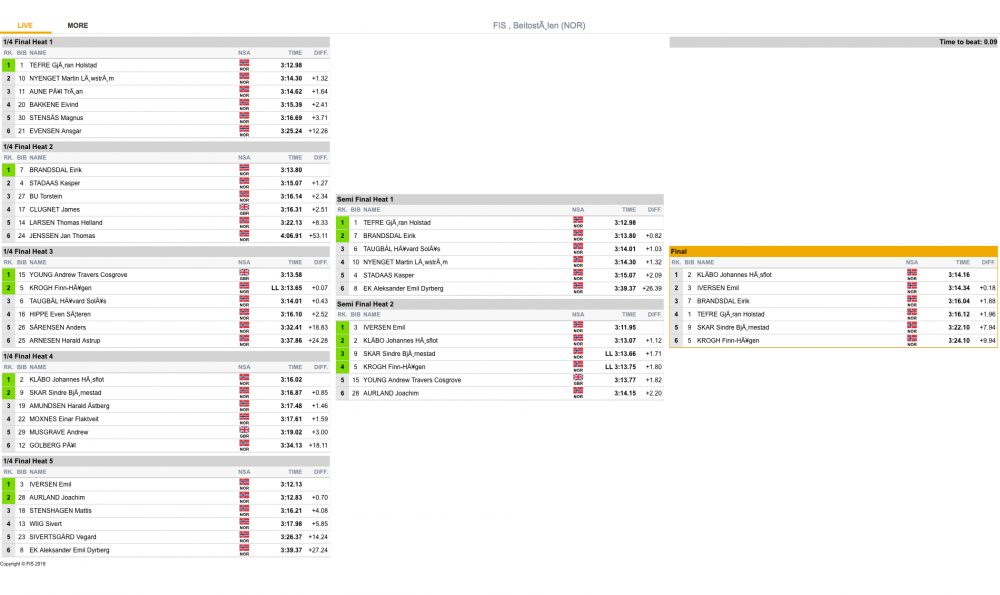
    The women’s skate sprint bracket from the second day of racing in Beitostølen, Norway (Photo: FIS Live Timing screenshot) Click the image to enlarge.


    More Klæbo and a bit of Iversen

    It is time to refresh the syntax and remember  Klæbo’s name can be used as a verb. With that in mind, Klæbo Klæboed in the men’s 1.7 k skate sprint. But like Falla on the women’s side, the twenty-two-year-old Klæbo was tested.

    Tefre Gjøran, a year older than Klæbo at 23, was the fastest qualifier, finishing in 3:12.27 minutes. Klæbo was second (+1.12), and Emil Iversen third (+1.62).

    In the end, it was Iversen, seeming like an aged vet at 27, who made life spicey for Klæbo.

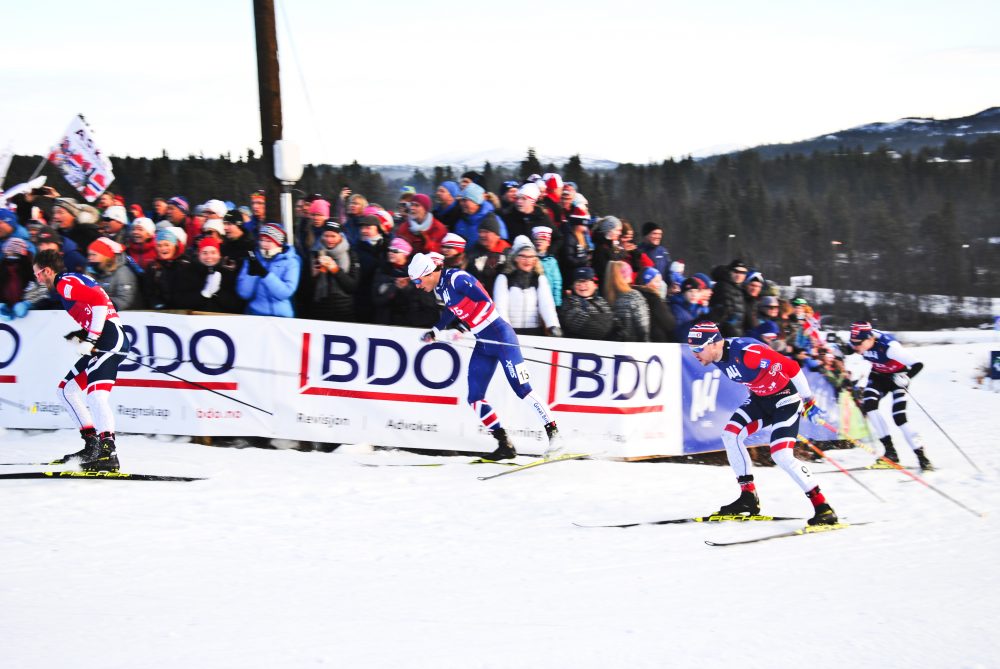
    Klæbo and Iversen advanced to the second semifinal. And it was Iversen who pushed the pace and was the catalyst for speed. Although not a massive margin, a second is still a second — but we are talking sprints here — Iversen won the second semi in 3:11.95, 1.12 seconds faster than second-place skier Klæbo.  

    “I was not good enough to fight him then,” Klæbo said to Norwegian broadcaster NRK, according to a translation, as he spoke about Iversen’s charge in the semis. “I had to be cynical and save me to the final. But Emil has a lot of effort, you saw how much he had in the finals too.”

    It was a final highlighted by a Klæbo-Iversen dual. Klæbo won in 3:14.16 outpacing perhaps a new rival this season in Iversen, by 0.18 seconds.

    In the all-Norway final, Eirik Brandsdal placed third (+1.88), Gjøran fourth (+1.96), Sindre Bjørnestad Skar fifth (+7.94), and Finn Hågen Krogh sixth (+9.94).

    Andrew Young from Great Britain raced to 10th overall in Beito’s day 2 skate sprint. This is a shot from his semifinal. (Photo: Aleks Tangen)

    Great Britain’s Andrew Young was 10th overall, James Clugnet 17th, and Andrew Musgrave 24th. They were the only non-Norwegians in the top-30.

    “Top 10 is really good, the level here is really high,” Young told FasterSkier’s reporter in Beitostølen. “I had really good skis, and I was surprised nobody else wanted to take the lead at the start so I just went for it. I tried not to use too much energy. I knew Klæbo would go fast. So I just wanted to make sure I was on his tails when he came past. I was really pleased with my skiing. I wasn’t so defensive, I wasn’t so passive, and not let the others control the race. I tried to control it and be in that spot where I wanted to be.”

    Young was passed in the final stretch by Skar and Krogh, who both advanced to the finals as lucky losers in the second semifinal.

    Canadians Russell Kennedy placed 51st, Maks Zechel 94th.

    Kennedy has skied well in the early season, with solid results at Frozen Thunder and Friday’s 15 k classic in Beitostølen.

    “It is very deep, but it makes it fun there are lots of rides and always somewhere to push,” Kennedy emailed on Saturday about his experience racing to 22nd overall in the 15 k classic yesterday. “I was very happy with that. I don’t know if surprised is the right word. Last weekend in Olos, [Finland] I had a really good skate race and a good classic race against some big names. I was excited I ended up so high up the results for sure! It was a tough day with skis and I was lucky to be on fast skis even though they were a little slick on the last laps.”

    The men’s skate sprint bracket from the second day of racing at in Beitostølen, Norway (Photo: FIS Live Timing screenshot) Click the image to enlarge.


    Racing concludes in Beitostølen tomorrow with a 10 k/ 15 k skate.

    Women’s qualification | Women’s final | Men’s qualification | Men’s final


  • Saturday Rundown: Beitostølen Freestyle Sprints; Bruksvallarna 10/15 k

    Saturday Rundown: Beitostølen Freestyle Sprints; Bruksvallarna 10/15 k

    Maiken Caspersen Falla of Norway — in the lead during the women’s final — doing what she does best: controlling a sprint and eventually taking the win in Saturday’s 1.3 k freestyle sprint in Beitostølen, Norway. (Photo: Aleks Tangen)

    Welcome to The Rundown, your quick primer of need-to-know information about the day’s racing. We’ll be updating this digest as the day goes on with additional results, photos and quotes. The Rundown is NOT a race report; stay tuned for complete race reports later today with interviews from the day’s top racers.

    ***

    FIS cross-country Beitostølen, Norway: 1.3 k freestyle sprints

    In Beitostølen on Saturday, the second day of FIS races there sent the women on 1.3-kilometer skate sprint course. Reigning World Cup overall sprint champion from Norway, Maiken Caspersen Falla, won the final in a time of 2:39.17 minutes. Falla was the fourth fastest qualifier.

    buy indocin online

    buy indocin online

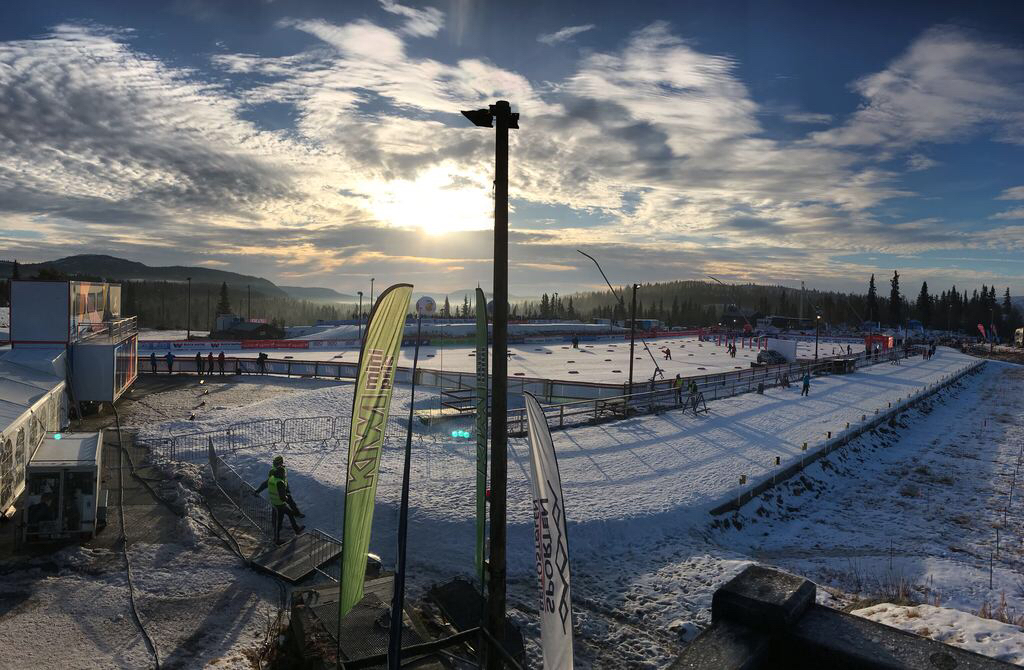
    A lovely day for a sprint in Beitostølen, Norway during Saturday’s freestyle sprint. (Photo: Aleks Tangen)

    Norwegians Kristine Stavås Skistad, the day’s fastest qualifier, placed second in the final (+0.93),  Lotta Udnes Weng was third (+1.28).

    The men’s sprint was held on a 1.7 k course with last season’s World Cup sprint champion Johannes Høsflot Klæbo (NOR) winning the final in 3:14.16 minutes. Friday’s runner-up in the 15 k classic, Emil Iversen (NOR), was second (+0.18). Also from Norway, Eirik Brandsdal placed third (+1.88).

    Great Britain’s Andrew Young was 10th overall, James Clugnet 17th, and Andrew Musgrave 24th. They were the only non-Norwegians in the top-30.

    Canadians Russell Kennedy placed 51st, Maks Zechel 94th.

    Women’s results | Men’s results

    ***

    Bruksvallarna, Sweden: 10k/15 k classic

    Saturday, Bruksvallarna hosted day two of its FIS cross-country races with men’s and women’s distances races. The women began the day with a 10 k classic event.

    Friday’s runner-up in the 5 k freestyle, thirty-one-year-old Charlotte Kalla of Sweden, won Saturday’s classic race in 27:54.1 minutes. Frida Karlsson (SWE) placed second (+25.2), Stina Nilsson (SWE) third (+38.2).

    The men skied a 15 k classic event. In that race, Sweden’s twenty-nine-year-old Calle Halfvarsson bested the 149 starters with a winning time of 37:14.6 minutes. Sweden took the next two spots on the podium, as Viktor Thorn placed second (+39.1), and Gustav Eriksson third (+1:02.5).

    Mens’ Results | Women’s Results