From the FasterSkier archive — posts syndicated from athletes’ and coaches’ own blogs between 2004 and 2012, kept online as published. Current coverage is at fasterskier.com.

Tag: Kurtis Wenzel

  • Bankes Gets Gold #2 for Canada with Perfect Shooting at IBU Junior Worlds

    Bankes Gets Gold #2 for Canada with Perfect Shooting at IBU Junior Worlds

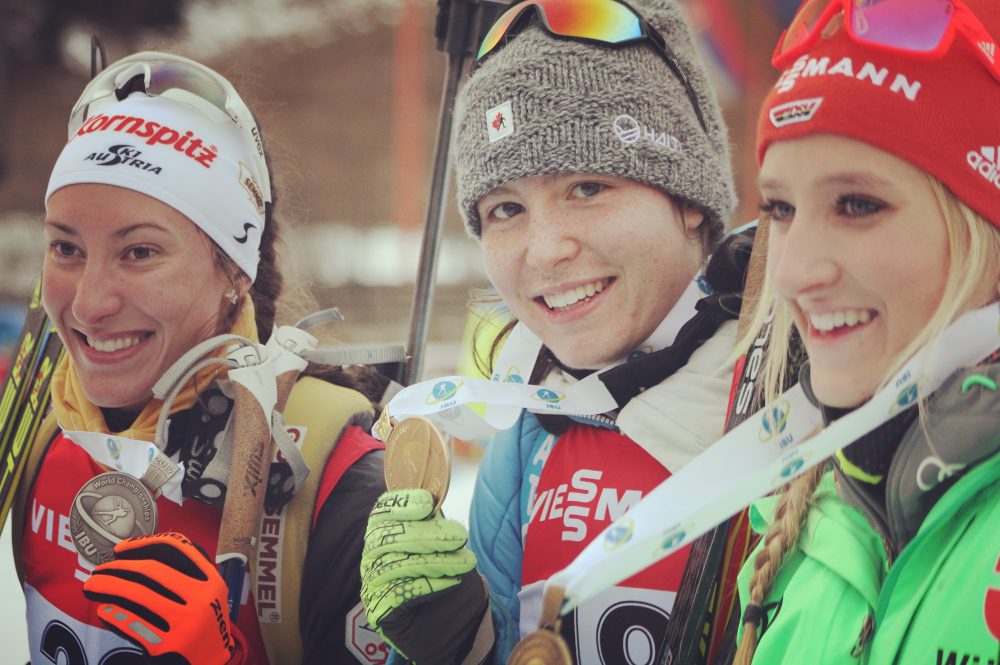
    Canada’s Megan Bankes flashes a smile and her gold medal after winning the junior women’s 12.5 k at IBU Junior World Championships on Thursday in Osrblie, Slovakia. individual podium on Thursday at IBU Junior World Championships in Osrblie, Slovakia. Joining her on the podium are Austria’s silver medalist Julia Schwaiger (l) and Germany’s bronze-medalist Anna Weidel (r). (Photo: Jacqueline Akerman)

    (Note: This article has been updated to include comments from Megan Bankes.)

    Just to review:

    • 2004: Jean-Philippe “JP” Le Guellec becomes first Canadian to win an International Biathlon Union (IBU) Youth World Championships title (in the youth men’s sprint).
    • 2009: Kurtis Wenzel becomes second Canadian to win at IBU Youth Worlds, with a gold medal in the youth men’s sprint.
    • 2012: Wenzel does it again as a junior, winning the 15-kilometer individual at IBU Junior Worlds.
    • Feb. 22, 2017: Leo Grandbois shoots a perfect 20-for-20 to become the third Canadian to be crowned a world champion at Youth/Junior Worlds, winning the youth men’s 12.5 k individual in Osrblie, Slovakia.
    • One day later: Megan Bankes repeats the 20-for-20 shooting feat in the junior women’s 12.5 k individual in Osrblie and becomes Canada’s first woman to win at Youth/Junior World Championships.

    And just like Grandbois, Bankes had never hit 20 consecutive targets without a miss in a race before. In fact, she had never cleaned a race of any length before. Doing so earned her a gold medal in her first race of her fourth Youth/Junior Worlds.
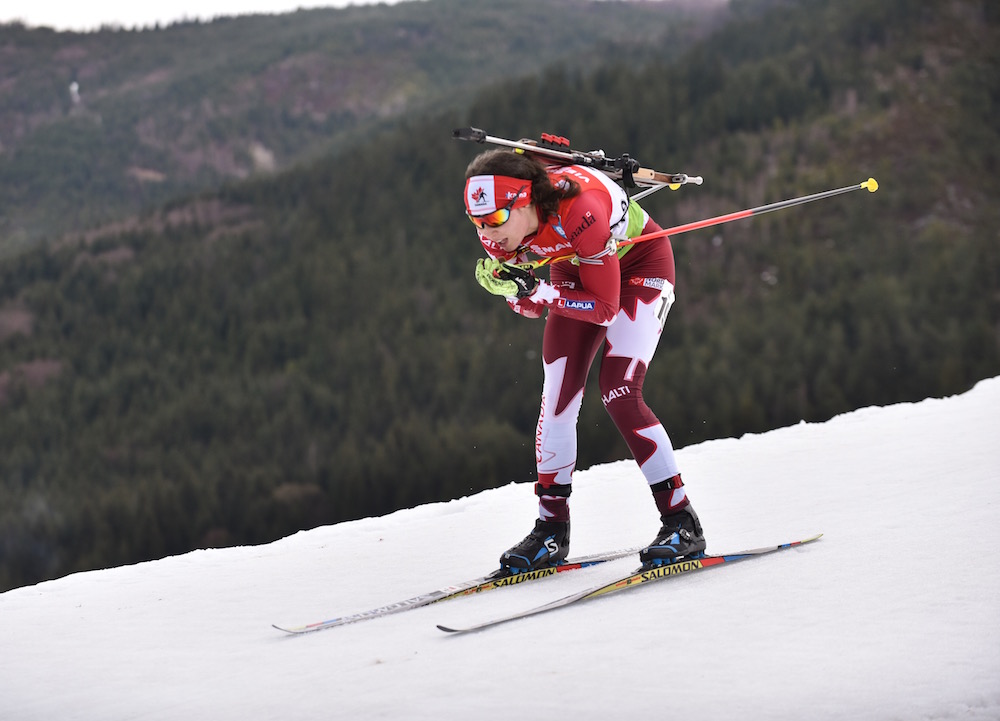
    Megan Bankes racing to an unprecedented gold for a Canadian woman in the junior women’s 12.5 k individual on Thursday at 2017 IBU Junior World Championships in Osrblie, Slovakia. (Photo: Bryan Dickson)

    “I watched Leo yesterday and gained a lot of inspiration from him,” Bankes said, according to a Biathlon Canada press release. “I saw how calm he was on the range and just felt if he can do it then I can, too. I just wanted to go out there – shoot clean and ski fast.”

    As the 19th starter in a field of nearly 70 women, the 19-year-old Bankes, who trains with the Biathlon Alberta Training Centre (BATC) in Canmore, set down the performance to beat with clean shooting and a finishing time of 37:22.0 minutes. She bumped Germany’s Anna Weidel, the 13th starter, to second place with a time that was 1 minute and 20 seconds faster. Weidel had missed just one shot — still an impressive performance in a four-stage race — in the first standing stage (0+1+0+0). Each miss adds a minute penalty to a racer’s total time.

    “I was incredibly stoked to clean my last standing, and then knew I just had to push super hard up the last 2 hills and ski smart all the way to the finish,” Bankes wrote in an email to FasterSkier. “When I crossed the finish line I was really excited, but I didn’t really think my result would hold up because there were a few girls who were skiing fast and had hit 15/15, but then when a bunch of them started missing, and I realized my position was going to hold, it was incredible.”

    Her overall course time ranked 11th, comparable with the two women she ended up sharing the podium with. Weidel was ultimately pushed to third when Austria’s Julia Schwaiger in bib 26 finished 32.1 seconds faster for silver. With one costly miss in her final standing stage (0+0+0+1), Schwaiger’s finishing time was 47.9 seconds short of gold.
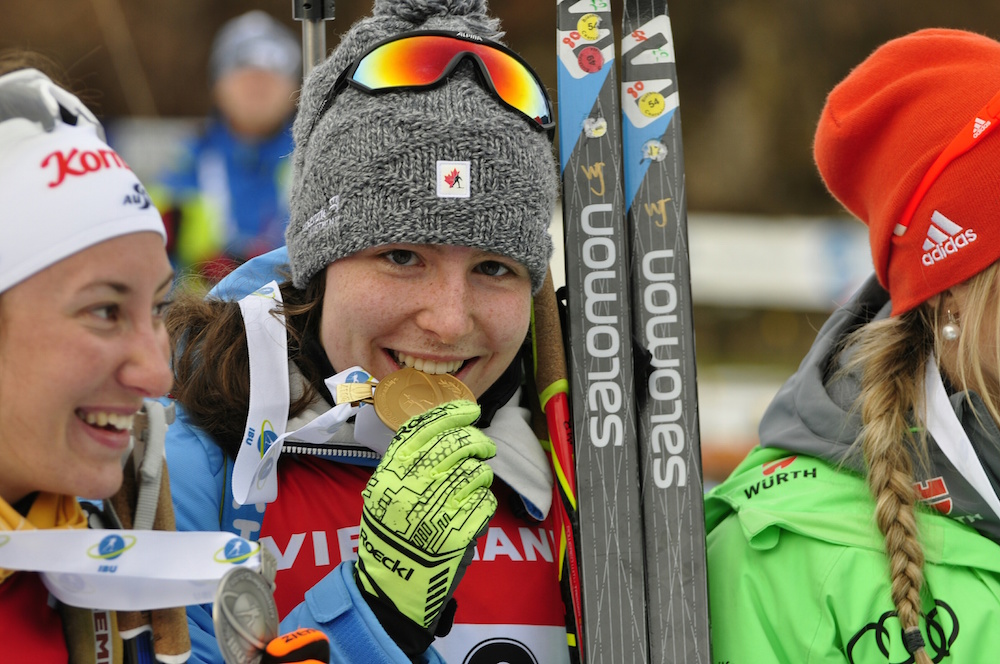
    Canada’s Megan Bankes takes a bite out of her gold medal after winning the junior women’s 12.5 k individual at 2017 IBU Junior World Championships in Osrblie, Slovakia, and becoming the first Canadian woman to do so at Biathlon Youth/Junior Worlds. (Photo: Airat Aitniakov)

    That medal went to Bankes, one of five women in the race to hit every target.

    “I shot with a lot of confidence today. It came really easy,” Bankes told Biathlon Canada.

    But, as there usually is, there was a backstory on Thursday.

    “She had a what she said was a ‘horrific’ zero,” her coach Richard Boruta explained of her pre-race target practice, in an email co-written with Canada’s trip leader/head coach Jacqueline Akerman.

    Boruta tried to calm Bankes down, assuring her that she had the self confidence to execute strong shooting.

    “My coach Richard just told me to go out pretty hard and not lose too many seconds up the first couple hills, and then settle into my race,” Bankes recalled in the email. “The range entry is pretty easy, because you’ve got a bit of downhill into it, so you can push pretty much as hard as you want (or can).”

    “Megan had been focused the whole day on the race and she new what she needed to do and was able to pull it through,” the two coaches wrote. “The trail conditions and weather have been challenging with all the rain and slush, but Megan managed to ski very tactically along the flats and paced herself well on the two major climbs in the course.”

    According to them, one of Bankes’s longtime goals had been a top eight at these championships. That changed after she broke through on the IBU Junior Cup earlier this month, placing second in the 10 k pursuit at IBU Junior European Championships in Nove Mesto, Czech Republic. After that, she visualized herself in the top five, maybe top three, in her first year as a junior at world championships. Bankes had previously notched 18th in the pursuit and 19th in the individual at last year’s Youth World Championships in Romania.

    “Junior OECH was a pretty big confidence boost, but coming into the race, I didn’t totally know what to expect,” Bankes wrote. “I knew that if I had a really good day on the range and on the course, then I could do well, and maybe podium, but I didn’t really imagine that I would hit 20/20, and win!”

    Individual-format races require solid shooting and fast skiing, just like any biathlon race, but the one-minute penalties as opposed to penalty laps put an emphasis on shooting accuracy.

    “I can’t say they have ever been my strong suit!” Bankes wrote of individual-format races. “So for me the goal was to start pretty fast on skis, stay calm in the range, and then see what happened.”

    “After I got the silver [in Nove Mesto], I knew if I shot and skied well, I could get a medal here,” she told Biathlon Canada. “It takes a long time to get to this point. I think having been here [at Youth/Junior Worlds] four times now I have the experience to do this. I have everything around me here that I need to be successful.

    “It is pretty exciting,” she added. “This is the first time I’ve shot 20 for 20. It never crossed my mind, but to be the first Canadian [woman] to win is very cool.”

    According Akerman and Boruta, they had anticipated that Grandbois and Bankes would have “a respectable chance” at a medal, along with other team members as well. But two gold medals in two days?

    “We have had good results and medals in the past, but it has been up and down with a few top athletes hitting the top 10 or reaching the podium,” they wrote. “Now we see the group as a whole rising together.”
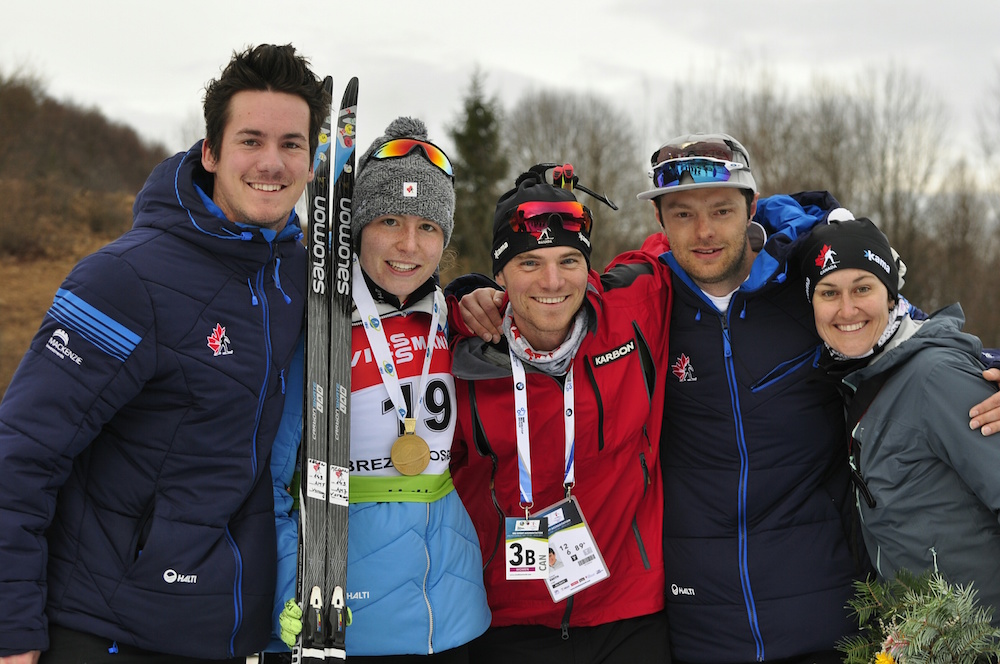
    Megan Bankes (second from l) with her Canadian support crew, including her former coach Tyson Smith (c), wax techs Andrew Chisholm (l) and Andrzej Lesnik (second from r) and Canada’s trip leader/head coach Jacqueline Akerman (r), after Bankes won the junior women’s 12.5 k individual for Canada’s second gold medal of 2017 IBU Youth/Junior World Championships in Osrblie, Slovakia. (Photo: Airat Aitniakov)

    They credited “consistent and qualified coaching support in yearly developmental stages”, and explained that Bankes started the sport with coach Iaroslav Khomiak at Foothills Nordic in Calgary. She was later coached by Tyson Smith (Nathan Smith’s brother, who is assisting the team at Youth/Junior Worlds) before joining the BATC group in Canmore in 2015.

    Last summer, Biathlon Canada launched a funded “Shooting Stars” camp, which brought national-team staff and coaches together with athletes and their coaches in Canmore. The team also added IBU Junior Cup tours to the schedule to give young athletes opportunities to experience international competition in Europe and “get to know each other before WYJCHs.”

    “My observations of this current group; they are pretty grounded, are very motivated, focused and are they are both pushing and supporting each other in all aspects of their performance,” Akerman and Boruta wrote.

    So what does two gold-medal performances mean for Canada?

    “There is now a great opportunity for an greater amount of exposure for our athletes and our sport,” the coaches wrote. “… More solid results ahead for us this week, there are other realistic opportunities within the group. The whole team, including staff are motivated and focused for that. … Of course Leo and Megan have both shown what they are capable of, and will be eager for more. Right behind those two in our Jr Women and Youth Men categories are others skilled enough to be right up there with them. Our youth women are a younger crew, but are learning and applying new skills daily, so I am excited to see some PB’s from them tomorrow. The relays also present us with exciting and realistic chances of podiums, it will continue to be an exciting week and championships!”
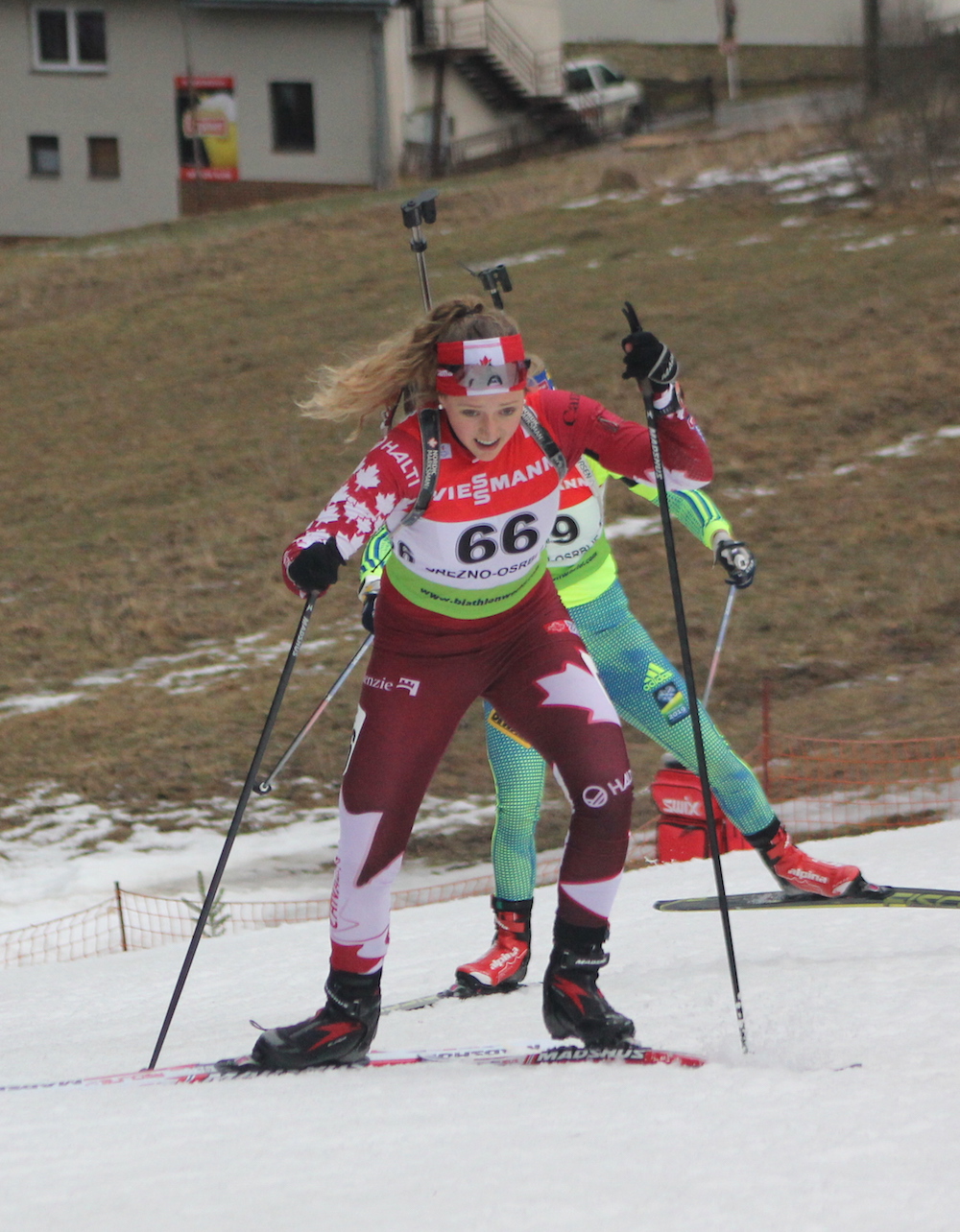
    Canada’s Emily Dickson (66) racing to 28th for her first top 30 at IBU Junior World Championships in the women’s 12.5 k individual in Osrblie, Slovakia. (Photo: Jacqueline Akerman)

    In the junior women’s race, Canada had two in the points (top 40) and one just outside with Emily Dickson in 28th (+4:21.3) with one miss (0+1+0+0). Nadia Moser finished 41st (+5:55.8) with four penalties (2+0+0+2). Charlotte Hamel did not finish.

    For the U.S., Siena Ellingson placed 50th (+7:11.5) with four penalties (0+1+2+1) and Nina Armstrong 65th (+14:15.3) with eight misses (4+1+2+1).

    Earlier in the day, the junior men raced a 15 k individual, which Norway’s Sindre Pettersen won in 40:17.2 minutes. He started 68th and cleaned three-straight stages before missing two on his last standing (0+0+0+2), but managed a 51.2-second win over Germany’s David Zobel. An early leader in bib 26, Zobel had three penalties (0+2+1+0) yet his time held up for silver despite a challenge from Russia’s late starter Nikita Lobastov (bib 84). Lobastov shot 19-for-20 (0+1+0+0) and finished just four seconds short of Zobel for third place (+55.2).

    Only one athlete in the junior men’s race cleaned: Latvia’s Ingus Deksnis in fifth.

    In his first year as a junior, Canada’s Zachari Bolduc led the North Americans in 34th (+3:44.7) with two penalties (1+0+0+1). He later told FasterSkier his goal had been a top 30, and he was 8.4 seconds short of it on Thursday.

    “I’m happy with this shooting but I was very very slow on my skis,” Bolduc wrote in an email. “The course was a mix of soft snow, ice and slush so it was not easy conditions! I hope I will have better feelings on my skis for the sprint. But, I’m happy with my race today!”

    He was followed by Canadian teammates Trevor Kiers and Jules Brunette in 54th (+5:21.6) and 55th (+5:27.4), respectively, after each shot five penalties. Pearce Hanna finished 65th (+6:38) with seven misses (1+2+2+2).

    The top American on Thursday was Cody Johnson in 50th (+5:08.3) with two penalties, both in the last stage (0+0+0+2). Cameron Christiansen followed in 72nd (+8:10.6) with six penalties (1+1+2+2), and Peter Carroll was 79th (+10:36.4) with four misses (0+3+0+1). Travis Cooper did not start.

    The youth men’s and women’s sprints are scheduled for Friday in Osrblie.

    Results: Junior women | Junior men

  • The Next Le Guellec? Grandbois Canada’s Third IBU Youth World Champ

    The Next Le Guellec? Grandbois Canada’s Third IBU Youth World Champ

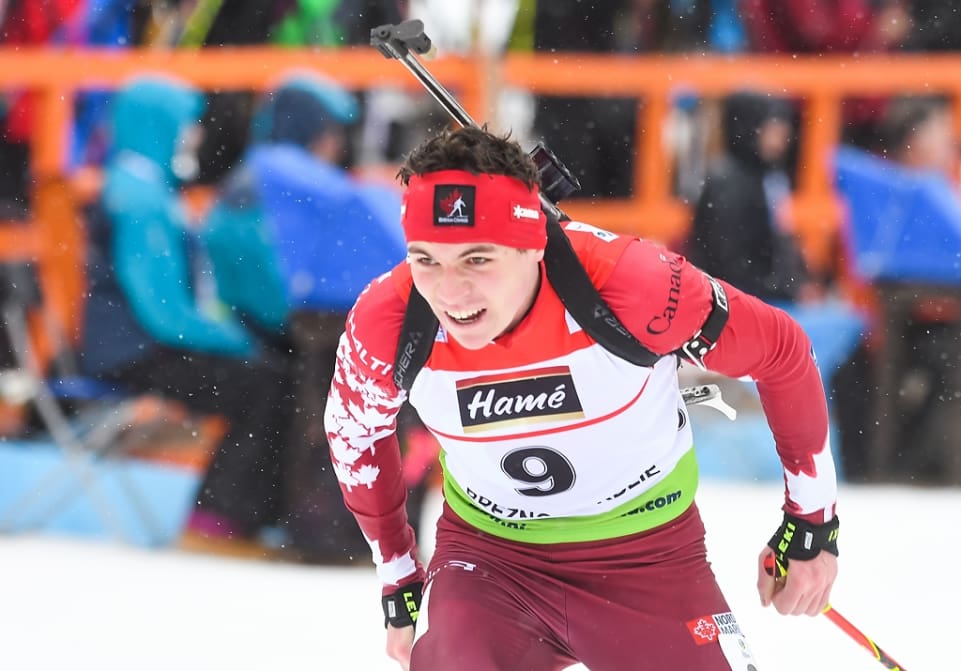
    Canada’s Leo Grandbois (Biathlon Estrie) racing to gold in his first IBU Youth World Championships race on Wednesday, the 12.5 k individual, in Brezno-Osrblie, Slovakia. He hit all of his targets for the first time in a race to win by nearly a minute and 15 seconds. In doing so, he became the third Canadian biathlete to win gold at Youth World Championships. (Photo: IBU)

    It was raining hard on Wednesday at the biathlon stadium in Brezno-Osrblie, Slovakia. Like, cats and dogs, “des grenouilles” (frogs, in French), or “junge Hunde” (puppies, in German).

    But that didn’t stop Leo Grandbois, a German-born Canadian biathlete racing at his first International Biathlon Union (IBU) Youth World Championships, from having the race of his life.

    Grandbois, 17, who was born in Munich and lived there for a year before moving to Lennoxville, Quebec, was one of four youth men named to Biathlon Canada’s Youth/Junior World Championships team. Wednesday marked his first 12.5-kilometer individual race in the youth division, and he explained after that his success derived from his focus — and his skis.

    “The range had a bit of wind and the tracks were really wet, but I had really good skis,” Grandbois wrote in an email after.

    The ninth starter out of more than 100 in the youth men’s race, Grandbois was the only one to knock down all 20 of his targets. He had never cleaned a race before, and he did it in a four-stage race. Without any one-minute penalties added to his total time (there are no penalty loops in individual races, just time penalties for each miss), he clocked the fastest time at the finish in 32:56.6 minutes. That time stood while nearly 90 others finished after him, with nobody coming within a minute of his time.

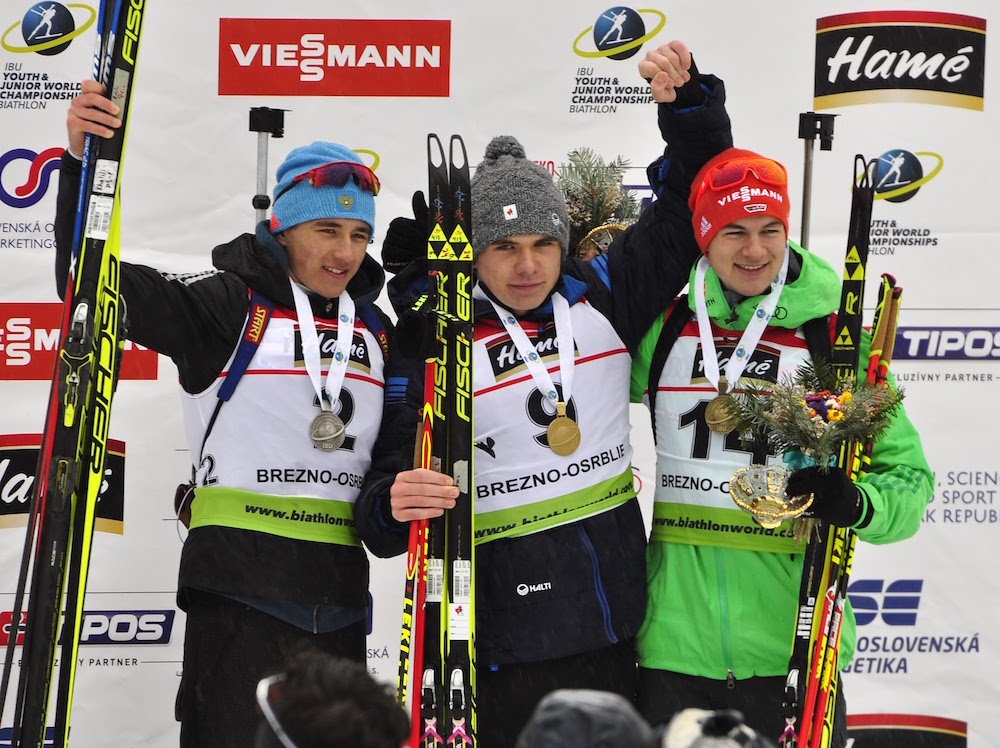
    The youth men’s 12.5 k individual podium after the first race of 2017 IBU Youth/Junior World Championships in Osrblie, Slovakia, with Canada’s Léo Grandbois in first (c), Russia’s Said Karimulla Khalili (l) in second, and Germany’s Danilo Riethmüller (r) in third. (Photo: Airat Aitniakov)

    Russia’s Said Karimulla Khalili started in bib 2 and enjoyed a brief moment as race leader, before Grandbois bested his time by 1:14.9 minutes. Khalili took the silver medal despite three penalties (1+0+1+1), and Germany’s Danilo Riethmüller captured bronze (+1:21.5) with three penalties as well (2+1+0+0). Besides Grandbois, who shot 100 percent, only one racer shot 95 percent: Italy’s Cedric Christille in fourth place (+1:44.5; 1+0+0+0).

    “I always go for the win when I race,” Grandbois wrote. “But I was aiming a top 10.”

    With the victory, Grandbois became the third Canadian to win a gold medal at Biathlon Youth World Championships, according to a Biathlon Canada press release. Kurtis Wenzel, of Calgary, is a two-time world champion: first in the 2009 youth sprint and later in the 2012 junior individual. Jean-Philippe “JP” Le Guellec, who previously coached Grandbois, started the trend by winning the 2004 Youth Worlds sprint.

    “Before I came here I looked at JP’s results on the internet, and read in the newspaper about his win in 2004,” Grandbois told Biathlon Canada. “It has always been my goal to be like him so to follow that path and do what he did is an amazing feeling.

    “The nicest message I received today was from JP,” he continued. “He told me how proud he was of me and to keep working hard. I have been smiling since I received that message.”

    And it wasn’t just the shooting that went exceptionally well for Grandbois on Wednesday; he posted the third-fastest ski time. In an email to FasterSkier, he explained that the hilly course in Osrblie suits him. “My kind of course,” he wrote.

    “Everything was perfect for me today, I was focused on the range and tried to do like at training,” he explained. “I had some great legs, too!”

    He told Biathlon Canada that he had worked on improving his shooting over the last three weeks.

    “When I went to bed last night and woke up today, I just had a good feeling I could do something great today,” he said. “I had complete focus and concentration on the range. The hard work over the last few weeks in training really worked today.”

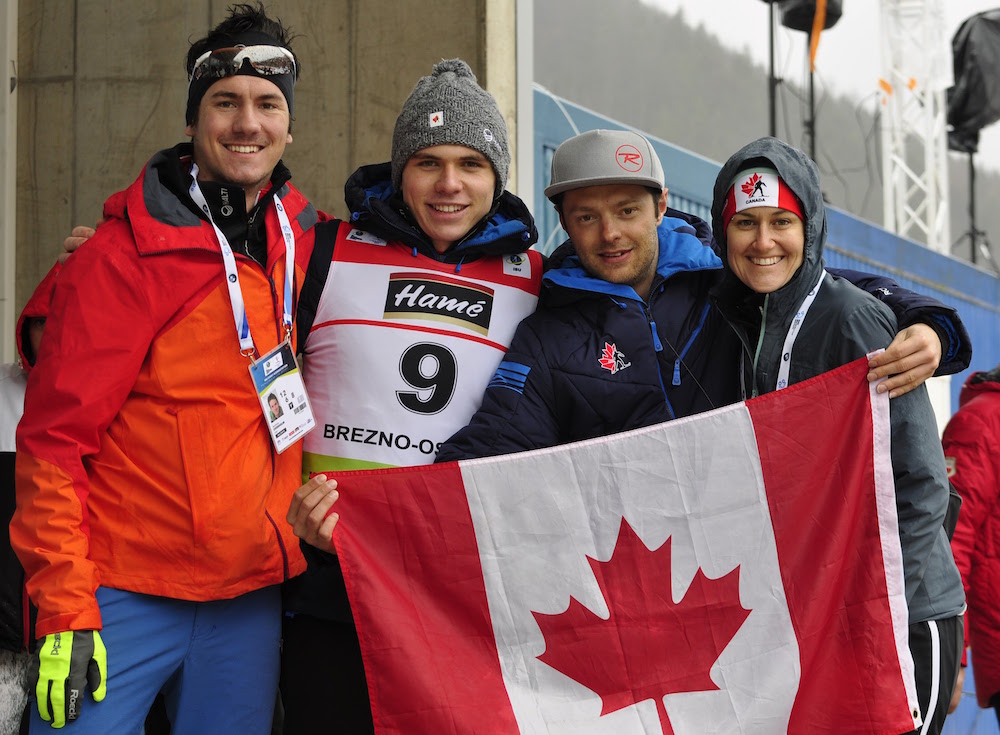
    Leo Grandbois (9) with his support crew, including wax techs Andrew Chisholm (l) and Andrzej Lesnik (second from r) and Canada’s head coach Jacqueline Akerman (r), after Grandbois won gold in the 12.5 k individual on the first race of his first IBU Youth World Championships in Osrblie, Slovakia. (Photo: Airat Aitniakov)

    In a post-race interview with Junior IBU Cup media, he thanked his supporters: “I want to thank first my coaches at home, my parents who always supported me and all the team who did a great job for the race, the skis, thank you.”

    When FasterSkier asked what this gold medal means to him, he explained it came down to all the passion and training he had put in.

    “I am probably the most happy man on earth today!” he wrote.

    Last year at Youth Olympic Games (YOG) in Lillehammer, Norway, Grandbois finished 22nd in the sprint, 25th in the pursuit and 16th in the mixed relay, a team event. At his first Youth World Championships, he said the field was bigger in comparison.

    According to Biathlon Canada High Performance Director Eric de Nys, Grandbois has been on the national team’s radar for a few years. Biathlon Canada started a Shooting Stars program this season and Grandbois was one of 16 athletes invited to “train, test and develop” with the national team.

    “Trajectory wise it identifies both a good skier and fantastic shooter under pressure,” de Nys observed of Grandbois’s performance on Wednesday. “This was Leo’s first time shooting clean and to do it a Worlds…..awesome.  Extremely happy for Leo and his support in QC.”

    Cervenka, Levins Land Top 20

    Leading the U.S. men on Wednesday was Vasek Cervenka, who has spent the better part of the last two seasons training in Nove Mesto, Czech Republic. The Boulder, Colo., native (who lives in Grand Rapids, Minn.) raced to 16th (+4:19.5) with five penalties (0+2+2+1).

    In his second Youth Worlds, his goals coming into the opening individual race had been to hit all of his targets and ski technically well. Placement-wise, he wanted a top 10.

    “The conditions were good in the morning, but a light rain started one and a half hours before the race and has continued the rest of the day,” Cervenka explained. “This made the course tricker over time as it was slowing down the skiing quite a bit. The rain also interfered with the shooting on the range.

    “I am a little disappointed today in my shooting knowing I can do better, also knowing a clean shooting would have brought me up to 2nd place,” he continued. “I felt good skiing but bonked on my last two loops.”

    After he cleaned the first prone stage, Cervenka’s time ranked third. One loop later, with two misses in the first standing stage, his split ranked 10th, which dropped to 23rd after the third stage. He recovered to 18th by the start of his last loop, and ultimately finished 16th for his best non-relay result at his second Youth Worlds. Last year at YOG, Cervenka had a previous best result of 20th in the pursuit.

    “As happy as I am with my improvements from last year to post this top 20, it still stings for me to miss a few shots too many, knowing where I could have placed if they went down,” he wrote.

    Also for the U.S., Jacob Pearson finished 49th (+7:45.3) with four misses (0+2+0+2), Alex Kilby was 75th (+9:51.1) with five penalties (1+0+1+3), and Camren Nielsen 91st (+14:36.9) with 11 misses (3+4+2+2).

    Canada’s Adam Runnalls finished 41st (+7:04.8) with eight penalties (1+2+4+1) and Thomas Hulsman was 57th (+8:19.0) with five misses (2+0+2+1). Robert Kreitz did not finish.

    Also on Wednesday, the youth women opened the championships with the 10 k individual, where American Chloe Levins raced 14th with three penalties (1+1+1+0). France’s Lou Jeanmonnot-Laurent shot 19-for-20 (0+1+0+0) to win the race in 34:00.9, and Levins finished 3:05.6 minutes off her winning time. None of the 90 women who finished the race shot clean.

    For Levins, a Middlebury student-athlete who plays collegiate golf in the fall and the spring, 14th was her best non-relay result at her third Youth Worlds.

    “Everything is possible, especially in an individual race,” she wrote in an email after. “The range is windy here in Osrblie, so good shooting is rewarded. … There’s no funny business on the track in Osrblie. It’s straight up, straight down, and flat into the range. The course demands power and strength, which I think is an advantage for me.

    “Today, it was important not to let the weather get in your way,” she added. “Sometimes it’s difficult to feel excited and fresh when it’s pouring rain, as it was today; those who shut it out of their mind are usually better off. Despite the conditions, our wax technicians prepared very good skis that moved really quickly through the saturated snow.”

    Last year at YOG, Levins broke through with a fourth place in the pursuit.

    “It is difficult to judge from one race, but the level of competition at this year’s Youth World Championships compared to last year’s Youth Olympic Games seems very similar,” she observed. “There are many familiar faces, and today there were even some repeating champions. I’m comfortable with the level of competition.”

    Moving forward to three more races in Osrblie (the sprint, pursuit and relay), Levins explained she took a lot of positives from Wednesday.

    “It’s not my best biathlon competition ever, but it’s certainly not my worst,” she wrote. “It’s a short way from the bottom to the top in this game, so I’m happy to have stayed above ground today. The result is fine, but I’m more happy to be able to say I did good work today.”

    Asked what she’s studying at Middlebury, Levins explained that she’s started pursuing neuroscience and economics “with a little bit of German for fun. My German professor loves that I have the opportunity to converse with native German speakers on a daily basis,” she wrote.

    (When Grandbois was asked if he speaks German, he replied, “Yes … but not perfect.”)

    Sharing the podium with Jeanmonnot-Laurent was Russia’s Kristina Egorova in second (+52.4) with one standing miss as well (0+1+0+0). Sweden’s Elvira Karin Öberg notched bronze (+1:16.1) with two penalties (0+0+1+1).

    Also for the U.S., Grace Gilliland finished 46th (+6:28.9) with four penalties (1+1+1+1), Amanda Kautzer was 53rd (+7:14.3) with eight misses (2+1+4+1), and Helen Wilson was 62nd (+9:00.5) with six penalties (1+2+2+1).

    Canada’s Shilo Luca Rousseau finished 54th (+7:29.9) with five misses (2+0+1+2), Frédérique Pérusse was 77th (+11:54.6) with nine penalties (1+4+1+3), and Elise Sauve 78th (+12:07.1) with seven misses (2+2+2+1).

    IBU Youth/Junior World Championships continue Thursday with the opening junior competitions: the women’s 12.5 k and men’s 15 k individual.

    Results: Youth men | Youth women

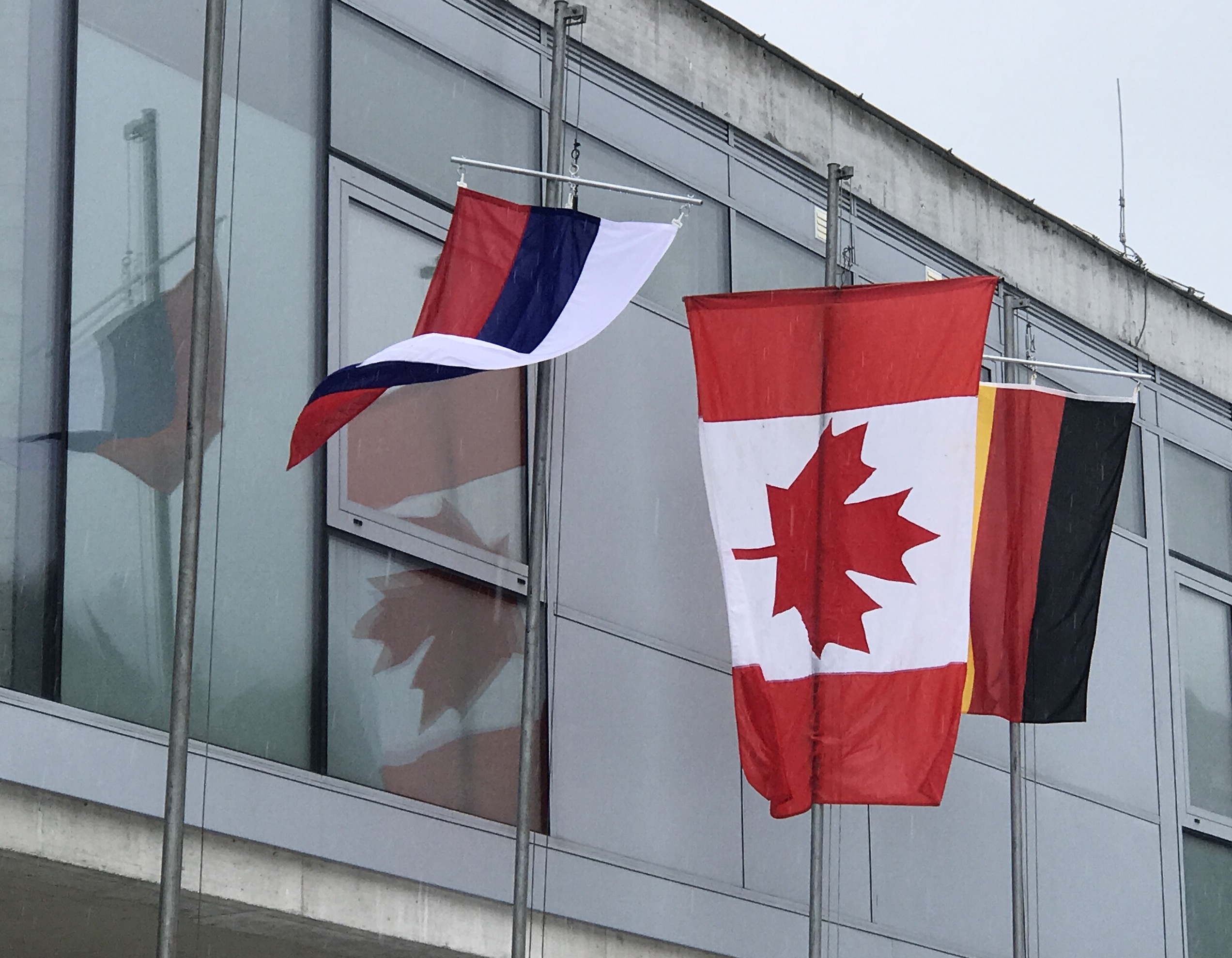
    The Canadian flag flying high above the biathlon stadium in Osrblie, Slovakia, after Leo Grandbois won the youth men’s 12.5 k individual, the first race of 2017 IBU Youth/Junior World Championships. Russia took second and Germany third. (Photo: Terri Dickson)
  • Two-Time World Youth/Junior Champion, Wenzel Calls It Quits at 22; Schultz Joins Him on the Bench

    Two-Time World Youth/Junior Champion, Wenzel Calls It Quits at 22; Schultz Joins Him on the Bench

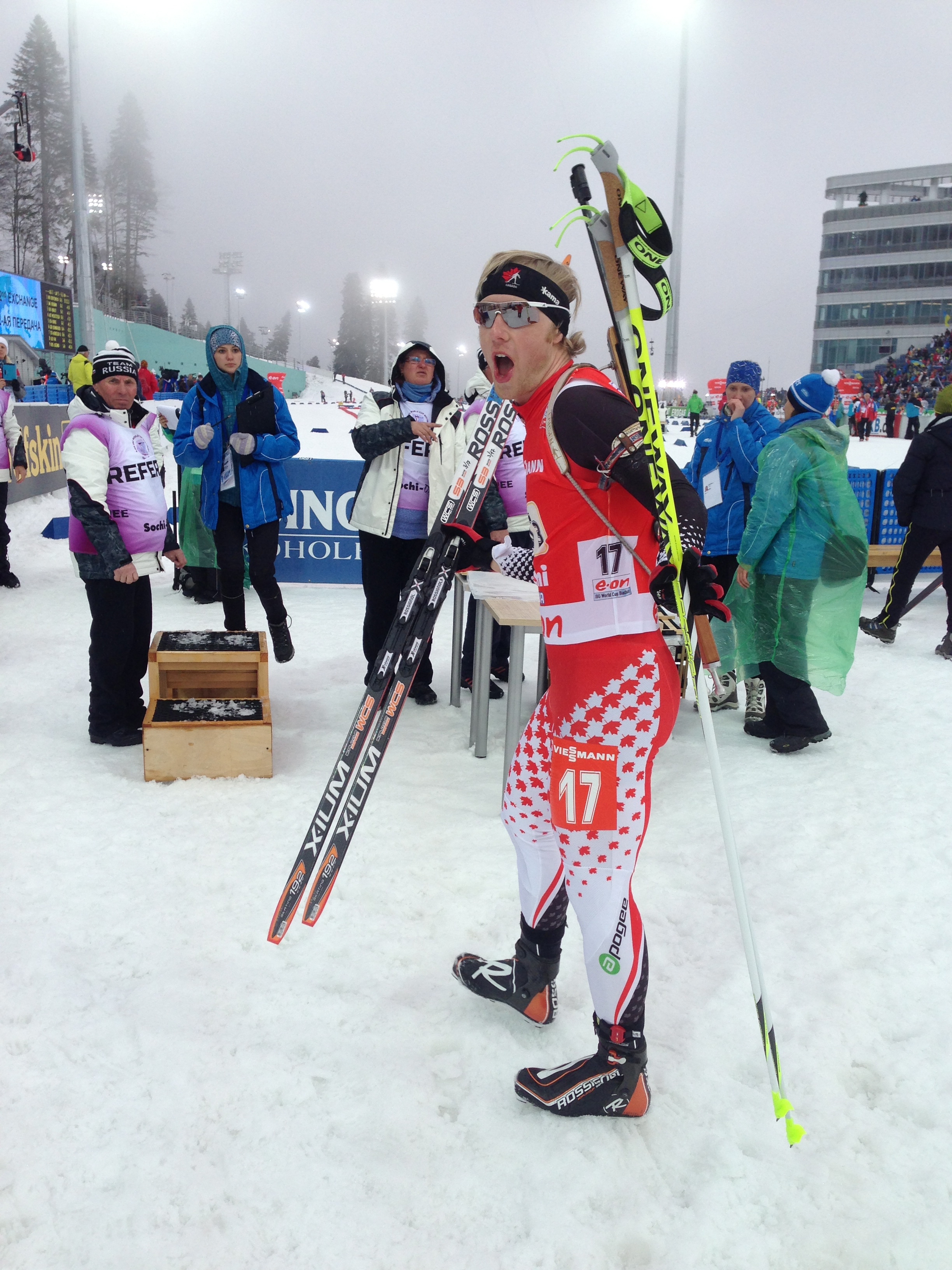
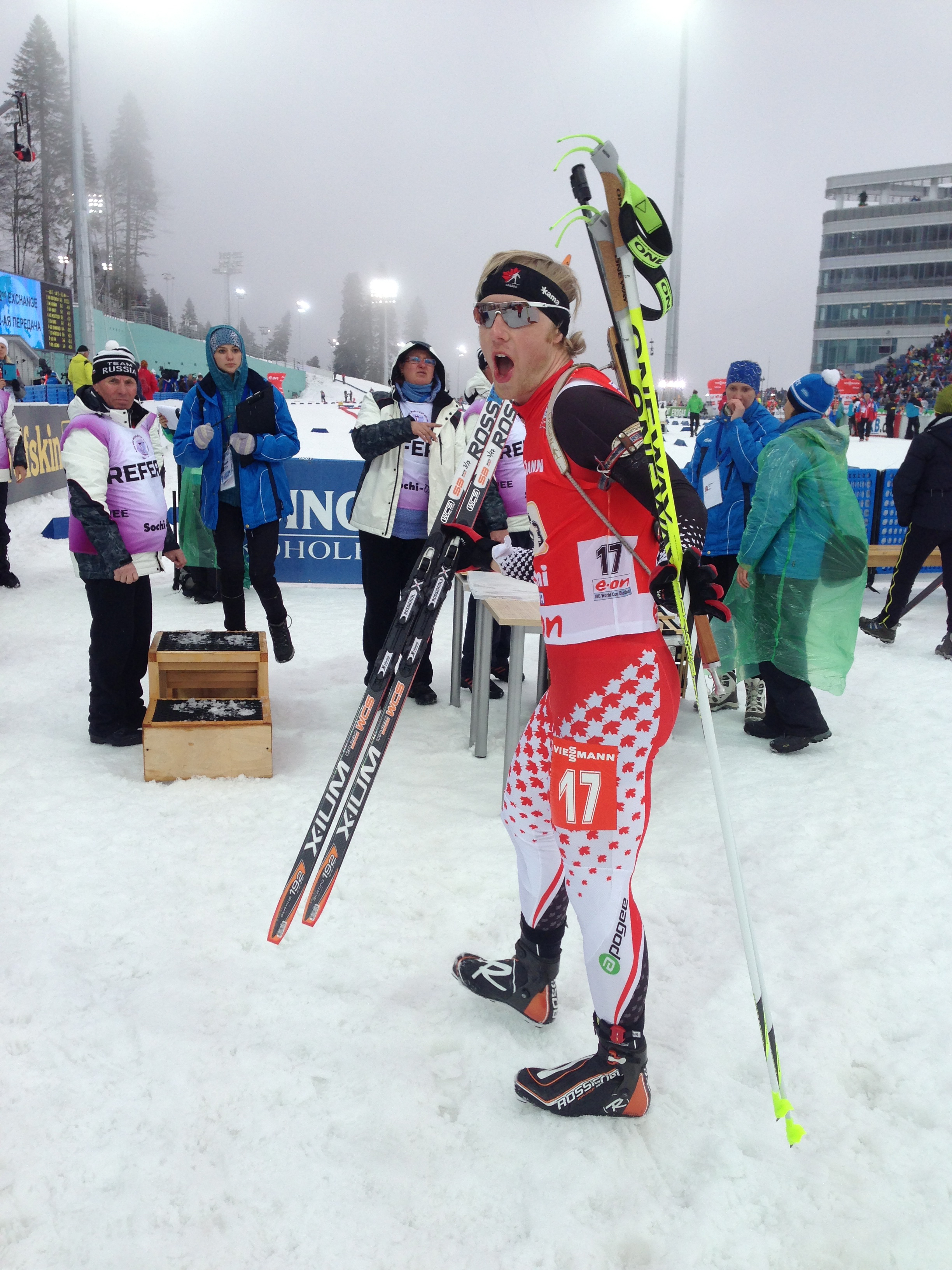
    Canadian biathlete Kurtis Wenzel after the first and only World Cup biathlon race of his career, in Sochi, Russia, in March. Courtesy photo.
    Canadian biathlete Kurtis Wenzel after the first and only World Cup biathlon race of his career, in Sochi, Russia, in March. Courtesy photo.

    Just one week ago, Canadian biathlete Kurtis Wenzel told FasterSkier that winning his first national championship was “a perfect way to end the season.”

    Hidden inside that statement, though, was a bigger one: Wenzel contacted Fasterskier yesterday to announce that he is ending his career as a biathlete. The 22-year-old had raced in his first World Cup only a month or so before.

    And he joined another national team member in calling it quits. After a difficult season where her body never really got going, Melanie Schultz also decided to hang up her skis and move on. Both were probably outside shots for the 2014 Olympics, and would have had to fight hard to unseat more seasoned World Cup veterans.

    So it’s not so much the Olympics where Canada will feel the loss, but rather what comes after – for instance, what if there’s a spate of retirements by older athletes, as often happens after a Games?

    “Athlete recruitment and athlete retention are definitely two issues we face, being such a marginal sport to start with,” World Cup winner Jean Philippe Le Guellec told FasterSkier in an e-mail.

    Upward Trajectories…

    Melanie Schultz racing in Canmore last year. Photo: Michael Potter.
    Melanie Schultz racing in Canmore last year. Photo: Michael Potter.

    Wenzel’s biathlon career was marked by ups and downs: in 2009 he won the World Youth Championships sprint, then in 2011 took the year completely off from biathlon after feeling overwhelmed. He was as surprised as anyone else when he came back to win the World Junior Championships individual race in 2012.

    The rags-to-riches-to-rags-to-riches story was certainly one of the most compelling of a 2012 Championships that also featured the first win by an athlete from the Netherlands; it was a good year for underdogs.

    “I was really excited to be racing in the international scene again and lucky I could have one of my best races so far this year at Worlds,” he said at the time.

    Yet in his first senior year, 2013 put the young Canadian back at the bottom of the heap. He did an IBU Cup tour and then, by the end of the season, had begun to climb upwards, starting the World Cup relay in Sochi, Russia and then winning the national championship pursuit. As he earned more and more start rights, it seemed like he might be able to mimic the path of Scott Gow, who finished his junior career just one year before Wenzel and was the youngest competitor to make the pursuit race at World Championships.

    So the Sochi trip could have been a preview for an Olympic bid next year, but Wenzel says he realized he no longer felt that drive.

    “I don’t actually dream of going to the Olympics anymore,” he said. “When I realized that, the decision was easy. However, I was very luckily to live out my long time fantasy of racing a World Cup in a packed stadium. I am also luckily to have had such a great support network of people to help me through my career and with this decision. I cannot thank them enough!”

    Wenzel had first considered retirement back in December, but knew he wouldn’t decide anything final until the end of the season.

    “Now I have had some time and it still feels right,” he said.

    As for Schulz, the 27-year-old struggled to find her ski speed at the beginning of the season. A few health issues had slowed her down during dryland, and when she hit the IBU Cup she couldn’t get going. Concluding that her body had just had too much training over the past few years, she spent a month relaxing in southeast Asia, hoping that the rest would help her find some energy.

    But upon returning to the sport later in the winter, Schultz still couldn’t get up to full speed.

    “After nine years of focused training and racing where I continually pushed myself to my limit and beyond, it was apparent my body and mind were saying, ‘Enough!’” Schulz wrote on her website. “Listening to my intuition, I decided it was time to hang up my skis and rifle for good and give myself a much needed and much deserved rest. I definitely have mixed feelings about my decision, as I imagine most athletes do when they retire from sport.”

    The departure comes just one year after Schultz seemed to be really making a leap in results; she was named Biathlon Canada’s Female Athlete of the Year in 2012, and also received the Ruedi Setz award for “exemplary standards of sportsmanship and significant contribution to the development of biathlon.”

    … Aren’t Enough

    Le Guellec, who is the same age as Schultz but has been involved in the sport much longer, has seen athletes come and go from the national team – mostly, go.

    But the spate of younger athletes calling it quits seems a bit new to him. For one thing, there wasn’t always such a strong cohort of older athletes to fight against for starting spots. He explained that back in 2004, both junior and senior athletes qualified to receive financial support from Sport Canada. Now, the national team is “saturated,” Le Guellec said, making it much harder for younger athletes to get paid.

    “In this day and age, we have a full flock of seniors all getting carded by Sport Canada,” he said. “So if you’re a youth, a junior and even a senior, you have to train and race on your own dime for the most part: season in, season out. When you add up the costs for a full year of training, it can’t surprise you that that can be a deal breaker after a certain time.”

    Just making it as far as Wenzel and Schultz did requires a large and diverse support network, and both said they appreciated the many people that had made their careers possible.

    “I want to say a HUGE THANK YOU to all my sponsors, coaches, teammates, support staff, family, friends and fans of my biathlon career for the last nine years,” Schultz wrote on her website. “I wouldn’t have been able to accomplish all I have without all of you!”

    Both athletes were part of Canada’s national team last season, but that’s hardly a guarantee of financial security.

    “I’m not aware of numbers for budgets and such,” Le Guellec said, “but I guess comparing our federation to a family of say 14 kids while being a single parent on welfare could be pretty spot on. They’re in a situation where they have very little money to make an entire sport run in a huge country. Their biggest challenge is, unfortunately, finding the resources to fund development squads, camps, cut costs for travel to competitions and so, and so and so on… with pennies.”

    Biathlon Canada could not be reached for comment.

    Having a significantly more robust senior national team is obviously a boon to the sport. But it’s just one reason that young athletes might look at the years ahead and begin to wonder if they can hang on for long enough to finally reach the top: Gow, Wenzel, and teammates Yolaine Oddou and Audrey Vaillancourt were unusual in their ability to translate success at the junior level to World Cup starts in just a year or two, but none spent the entire season on the top circuit.

    And while none of the debuts went badly, it’s a tough transition to make. Le Guellec thought that seeing the real level of competition might make athletes think differently about what lay in store in the coming years.

    “Having an Olympic dream is nice,” he said. “Being motivated is also nice. Resources and passion aside, I’ve seen athletes be exposed to the international field and it can be very intimidating. It doesn’t take a math degree to start adding up the work you’ll need to do in order to climb the ranks – plus this is a process that can be long. I wouldn’t say they scare off, but when you add up points 1 and 2, maybe its just a lot of work for not much in return to at least help you through it.”

    All of that is, of course, harder when you are from North America. The amount of time spent on the road is difficult for many athletes, who may not return home to see their families for months at a time.

    Wenzel confirmed that after one long tour in Europe this year, he was a bit overwhelmed.

    “The decision was spurred by a combination of my difficulty dealing with life on tour and a desire to expand the other parts of my life that were put on the back burner,” he said.

    Next Steps

    The most common thing that athletes give up is school, and that’s where Wenzel will be headed in the fall, if all goes well.

    “I will hopefully be studying economics at the University of Calgary, but I still have to apply,” he said. “I have done a couple courses at U of C before and I was accepted into the Kinesiology program, but I realized that’s not what I would like to study.”

    A few elite-level biathletes and skiers have been able to make school work, somehow, while still competing on the World Cup: Alex Harvey is in law school, Astrid Jacobsen is in medical school, Maurice Manificat is studying biology. But Wenzel knew that he couldn’t be like them, at least not with any level of success.

    “I have definitely been putting school on hold because of training,” he explained. “It would have been impossible for me to hold down my job in Calgary, go to school in Calgary and train properly in Canmore. I am also a horrible procrastinator at times so correspondance courses wouldn’t have worked for me. Honestly, this winter was the first time I really started looking forward to going to school. I think that helped make the decision for me.”

    Schultz, meanwhile, will be transitioning from part-time to full-time work as a patent agent at an intellectual property firm in Canmore.

    “I’m transitioning into the life of a non-athlete,” she wrote on her website.

    That’s never an easy transition, but Wenzel hopes to stay involved with the sport just enough not to miss it. Coaching was a possibility, he said.

    And training.

    But just “a little bit.”


  • After Trip to Test Out Sochi, First National Title is ‘Perfect Way to End Season’ for Canada’s Wenzel

    After Trip to Test Out Sochi, First National Title is ‘Perfect Way to End Season’ for Canada’s Wenzel

    Canada's Kurtis Wenzel won a gold medal at 2012 World Junior Championships; his coaches and teammates hope that he'll soon be contributing as a senior. Photo by Judy Geer.
    Canada’s Kurtis Wenzel won a gold medal at 2012 World Junior Championships; this year, his first senior national title. Photo by Judy Geer.

    After taking a year off from biathlon, coming back to win his first World Championship, and then graduating from the junior ranks, last year was a bit of a whirlwind for Canada’s Kurtis Wenzel.

    And then, he was faced by a challenge familiar to all newly-senior North American biathletes: what do you do next? With many teammates who already have World Cup or even World Championships experience and a small number of lightly-attended NorAms, it’s sometimes a challenge to find racing opportunities and stay motivated.

    Luckily, Biathlon Canada has been sending more athletes to second-tier IBU Cup races in Europe, and in February Wenzel hit the circuit, where he stayed for the next several weeks.

    Then, some good news, and the end of the season began to take off. Wenzel got the surprise call to go to Sochi, Russia, to compete in his very first World Cup – at next year’s Olympic venue. The he flew home and competed in national championships, earning his first title as a senior. Not a bad way to wrap up a season that had its downs as well as its ups – for instance when Wenzel got sick in Bansko, Bulgaria, and missed every race of Open European Championships.

    Olympic Preview

    To say that the Sochi trip was last-minute would be an understatement. It wasn’t always clear that the team would even bring four men to the venue, much less that Wenzel would be one of them.

    “I wasn’t really picked out to test the new venue, more just to secure four start sports,” Wenzel explained to FasterSkier in an interview. “Biathlon Canada received a grant for that specific reason from the Canadian Olympic Committee. Without the grant I would have had to pay my own way for two weeks in Europe just for one race, which would have been hard for me to justify. I wasn’t the first choice for the spot either: Marco Bedard turned down his spot due to some tendon problems and Nathan Smith had just got back to Canada when they found out about the grant.”

    The Canadians were trying to make it into the top 15 of the year’s Nations Cup standings, which would secure them four starting positions on the World Cup, as opposed to the three they had for men this year. Since relays count heavily in the scores, the team had secured the grant to send a full relay team to Sochi, even if Wenzel wouldn’t have a spot in any of the individual races.

    “I found out I would be coming to do the WC8 relay just before European Championships in mid-February,” Wenzel said. “I had to go on my own to Munich for five days to get my Russian visa… Sochi was my last stop on a tour that began mid January and I was feeling incredibly run down. I was sick at European Championships in Bulgaria and it was a big struggle to get myself feeling like I could race again. I actually requested they send another athlete to take my place, but it was too late to change everything at that point.”

    So in some ways, his big debut did not go as planned, at all. The whole team was feeling a little under the weather; several of the men suggested at the time that they had been much stronger early in season and their ski form was simply gone. The team failed to score points in either the individual or the sprint, and placed 15th in the relay, one spot behind Belarus. The two teams had been dueling for the top-15 position all season, and Belarus ended up getting it, leaving Canada with a three-man quota again next season.

    “I was certainly unhappy with my ski form, which is not at World Cup level at the moment,” Wenzel said. “However, my shooting was satisfactory and saved me from losing more time off the leaders… Our goal was to secure a top 15 overall World Cup ranking and I was not able to hold up my end of that.”

    The team had started out in 17th after Jean Philippe Le Guellec struggled on the shooting range; Scott Gow pulled Canada up to 13th before Gow took his turn, tagging off to Scott Perras who held 15th. Even if his skiing was below par, Wenzel held his own on the range, using a single spare round. That showed he could handle the pressure of perhaps the most stressful event on the World Cup circuit.

    “It wouldn’t say it was ‘over’ whelming for me to race in Sochi,” he joked. “I think it was just the right amount of ‘whelming’. Apparently I can keep my cool in these kinds of situations.”

    And, the 22-year-old now has a bit more experience that will surely help him in the future.

    “It was an amazing experience,” he said. “I have always wanted to race in front of big packed stands and I feel lucky I got to do it at one of the most epic venues imaginable. The venue is the biathlon temple of Russia. The trails are some of the hardest I have ever seen.”

    And just in case he gets the call for next year’s Olympics – where Canada will have four starting spots – he knows what to expect from a venue that was universally described as great, but strange.

    “There is a stark contrast between the original dwellings in Krasnaya Polyana, the new hotels and Olympic village,” Wenzel said to add his own description. “Imagine a glorious winter resort built from nothing with no history of skiing in a short time. In Russia they truly believe that if you build it, they will come. There were lots of enthusiastic fans and volunteers excited to be a part of something so big. I was glad they all got to see the home team pull through for the men’s relay.”

    On To Nationals

    Like most of the other North American national championships in the nordic disciplines, Canadian biathlon nationals – which this year doubled as North American Championships – is not attended by most World Cup athletes. But the event, held in Whistler this year as part of the Sea to Sky Festival which also included Ski Nationals, allowed Wenzel to go head to head with some of his rivals for World Cup starts.

    He wasn’t sure how things would go.

    “I was expecting bad jet lag and a repeat of the exhaustion I felt while on tour in Europe, but coming back to Canada after two months abroad really perked me up,” he said. “I wasn’t in great ski shape, but it was good enough and my shooting mentality was spot on. It was the right combination of wanting to hit targets and not worrying about it.”

    Wenzel started the series off with clean shooting, finishing second in the sprint to Smith by 59 seconds to earn a silver medal. That normally would have put him in a tough place in the pursuit, skiing alone with little chance of catching the World Cup veteran; but racing in North America is often different than in Europe, where pursuits are started based on time gaps from the sprints.

    “The pursuit was actually a special NorAm circuit start where everyone goes at 5-second intervals based off their sprint race ranking,” Wenzel explained. “This gave me hope that I could beat Nathan up until the middle of the race where he opened up a gap from skiing and shooting much faster then me.”

    But, although Wenzel didn’t know it, Smith had started early and was given a 30-second time penalty. So it was a good thing that the younger racer kept his cool, hit all 20 targets – making him 30 for 30 for the weekend – and stayed focused.

    “I was actually still very close to catching him,” Wenzel said. “He missed two at the last shooting and I was able to stay clean which put me out 10 or 15 seconds behind him without the penalty. He tried his best to open that up to 30 seconds to overcome his penalty but I held on for the win! Most of the race I was just focused on holding on to second place so it was a big surprise when I found out I won.”

    Even though it was his first year as a senior racer, it wasn’t his first time in the open class at nationals. So Wenzel had come into the weekend knowing what was possible, but also cautious and doubtful that it could happen.

    “I raced up and competed as a senior last year at nationals and earned a bronze medal,” he said. “I know I had it in me to win at Nationals, but I was surprised I pulled it out after being out of shape for so long.”

    Wenzel finished off the weekend by placing fourth, the third Canadian, in the mass start, which Smith won. He then joined forces with Smith and World Cup racer Rosanna Crawford to win the mixed relay for Alberta.

    Despite the slow ski shape, Wenzel continued on with his race season, competing in two races at ski nationals; in his year away from biathlon, he had focused on skiing, so in some ways that was a return, too. Tired, he placed 50th in the 10 k skate and 39th in the 50 k marathon.

    But of all the events in Whistler, it was unsurprisingly the national championship that stood out.

    “I have had some chances to beat Marco and Nathan this year besides nationals,” Wenzel said. “At trials for IBU Cups 6 and 7 I won against Marco in the sprint and at an Alberta cup in January I was able to beat Nathan as well. I have to say, even with the unusual circumstances, doing it at Nationals was much more satisfying! It was a perfect way to end the season.”


  • Vaillancourt, Smith Collect Mass-Start Titles at Canadian Biathlon Nationals

    Audrey Vaillancourt (Quebec) completed her set of three titles at 2013 Canadian Biathlon Championships on Tuesday with a photo-finish victory over Megan Heinicke (Biathlon BC) in the 12.5 k mass start in Whistler, B.C.

    “We both deserved to win today,” Vaillancourt wrote in an email. “I’m just glad I managed to have a better stretch.”

    Vaillancourt shot clean at Whistler Olympic Park to finish in 34:54.0. Heinicke was just 0.2 seconds behind and missed one shot (0+0+1+0).

    “Today skiing didn’t feel as good as during the weekend,” Vaillancourt wrote, “So I focused more on shooting and it worked very well; I had a perfect day on the range.”

    Vaillancourt enjoyed her first mass start of the season: “On the last lap we came out of the range together, so I knew this was going to be a really tough one,” she wrote. “We both tried to drop each other at different places on the course, but we were both dead tired and ended up together for the final sprint! It has been a photo finish for the win!”

    Corrine Malcolm (U.S. Biathlon) took third place in 36:38 (1+0+1+0), 30 seconds ahead of Julia Ransom (Biathlon BC) in fourth.

    “Today was actually the best I’ve ever shot in a race,” Malcolm wrote.  “Unfortunately I lost a little bit of time when I accidentally started to ski onto the 2km cut off on our second loop.  Luckily [Canadian biathlete] Rosanna [Crawford] saw me veer off and was able to yell to me to turn around. By the time I made it back to the right trail Julia was coming by and I was able to get in with her and ski nice and relaxed.  Julia and I stayed together until the last shooting stage where I cleaned and she missed her final shot.”

    Ransom’s time of 37:08 (2+0+1+1) was good enough for third Canadian, but shooting was perhaps not surprisingly the difference for the 20 year old who started her first Cross Country World Cup earlier this season in Canmore, Alberta.

    In the men’s 15 k mass start, Nathan Smith (Alberta/Biathlon Canada) struck back after Sunday’s starting error by dominating the day. He won by 44 seconds in 37:53 despite missing three shots (1+0+0+2) during what he described as ideal shooting conditions.

    “I missed that first shot prone and was a little concerned, but after that I felt comfortable and in control,” Smith told Biathlon Canada. “I know I didn’t win the pursuit race, but I feel like I’m in great shape and accomplished what I came here to do.”

    Marc-André Bédard (Quebec) was second in 38:37 with four misses.

    “Shooting was perfect 3 out of 4 times,” he wrote in an email.  “[I] missed 4 at my first standing!”

    Although disappointed by his shooting, that should not be a problem next week when Bédard competes at Canadian cross-country nationals. “I’m hoping to repeat or do better than my 4th at the 15 free last year!” he wrote.

    Bill Bowler took third place to lead a large American contingent with his second podium. He finished 43 seconds behind Bédard, and also had four penalties (0+1+2+1).

    “I felt good on the skis,” Bowler wrote. “Definitely better than in the races earlier this week.”

    He agreed that the conditions weren’t a problem. “It was a perfect day for racing with fast tracks,” he wrote. “The weather in Whistler can be volatile so it was nice to have sun and solid conditions.”

    Kurtis Wenzel (Alberta) grabbed the Canadian bronze with 39:31 (0+0+1+1), good for fourth overall.

    Biathlon wraps up Wednesday with the relays.  The Sea to Sky Nordic Festival continues with cross country nationals (March 23 to 29), nordic combined (March 28 to 30) and ski jumping (March 28 to 30).

    Mass-start results

  • Vaillancourt Doubles Up, Wenzel Moves Up in Canadian Nationals Biathlon Pursuit

    Vaillancourt Doubles Up, Wenzel Moves Up in Canadian Nationals Biathlon Pursuit

    Canadian biathlete Audrey Vaillancourt at the 2011 Biathlon World Juniors in Nove Mesto, Czech Republic. (Photo: Judy Geer)
    Canadian biathlete Audrey Vaillancourt at the 2011 Biathlon World Juniors in Nove Mesto, Czech Republic. (Photo: Judy Geer)

    Audrey Vaillancourt (Quebec) made it 2-for-2, winning the pursuit at 2013 Canadian Biathlon Championships at Whistler Olympic Park on Sunday. Vaillancourt started first after her Saturday sprint victory and finished first despite missing four shots (1+0+1+2) in 31:43.4 for the fastest ski time of the day.

    Vaillancourt was happy with her results, writing, “there is much more competition at nationals now that I am in the senior category, so winning the two first races is beyond my expectations.”

    The weather was a factor in the sprint, but much less so in the pursuit.  “On Saturday we had really tough conditions with the rain and wind, but for me it turned out to be an advantage, since I cleaned my race while the others had lots of trouble on the range.”

    “I felt really good on my skis all weekend,” Vaillancourt wrote. “After I came back from Europe at the beginning of March I had a couple days to rest well and get back to some good training at home, and I guess it paid off!”

    Julia Ransom (Biathlon BC) moved up to second with the second fastest ski time of 32:27.3, shooting slightly better than Vaillancourt (0+0+2+1). But in the sprint, she struggled on the range, missing six shots and placing sixth.

    “The wind had really picked up for the standing bout and I made the decision to wait for it to settle down,” Ransom wrote. “Waiting an extra few seconds is typically a safe move to make (if you hit targets). However I had waited WAY too long and missed four. Double mistake on my part.”

    Ransom was not bothered by the weather: “The weather on both days hit every point on the spectrum, but that is why I love Whistler!”

    Megan Heinicke (Biathlon BC) slipped from second to third after struggling on the range, missing seven shots. Claude Godbout (Quebec), Leysan Valiullina (Russia), and Corrine Malcom (U.S. Biathlon) rounded out the top six.

    Kurtis Wenzel (Alberta) won the men’s pursuit, shooting clean and delivering the second fastest ski time of 32:11.4. Canadian A-team member Nathan Smith (Alberta) started first after winning Saturday’s sprint, setting the fastest time of 31:53.7 while missing three shots (0+0+1+2). A starting penalty cost Smith the victory, leaving him 6.8 seconds behind Wenzel.

    “I don’t think I have ever started a pursuit in first so it was a little different today,” Smith told Biathlon Canada. “I skied conservative the whole race, but after I missed my second shot in standing, I realized I had a 30-second penalty for starting to early and I upped the pace for the final lap.”

    Raleigh Goessling (USA) used good shooting and a fast ski time of 32:53.1 to move from seventh to take the bronze. Goessling wrote that his pursuit went very well: “I shot a career best 19/20 (1,0,0,0) and skied much better than I did in the sprint.”

    Canadian B-teamer Marc André Bédard (Quebec) maintained his fourth place from the sprint, while Bill Bowler (USA) slipped to fifth after taking Saturday’s bronze.

    Complete results

  • Canada Off-Form in Sochi, But Knows What to Work On

    Canada Off-Form in Sochi, But Knows What to Work On

    Scott Gow, here competing at World Championships last month, had the best Canadian performance in Sochi.
    Scott Gow, here competing at World Championships last month, had the best Canadian performance in Sochi.

    For Canada’s biathlon team, the past weekend’s races in Sochi weren’t exactly how you might hope to baptize a new Olympic course.

    “Bummer day?? More like weekend!” Jean Philippe Le Guellec wrote in reponse to questions from FasterSkier. “There are no painful questions, just straight facts.”

    And here are the facts: Le Guellec had a pretty miserable time, finishing 77th in the individual race and 52nd in the sprint. Canada placed 15th in the relay, where Le Guellec struggled in the leadoff leg, requiring five spare rounds. The Canadian men failed to score points in any race; Scott Gow’s 49th-place result was best in the sprint, while none of the team made the top 60 in the individual.

    (Unlike Le Guellec and Perras, Gow told FasterSkier that he was “very happy” with his races, especially with clean shooting in the sprint: “My shooting let me down in the individual, but it came back into form for the next two races.”)

    The women didn’t fare much better. The high point was likely the relay, where they raced to a very respectable tenth-place finish. In the individual, Megan Heinicke didn’t start and Rosanna Crawford didn’t finish; Megan Imrie’s 57th place was better than any of the team’s results in the sprint.

    Le Guellec admitted that the team just does not have the form that earned him his first World Cup win earlier this year, or a string of career bests for Scott Perras and Crawford.

    “The weekend was a complete drag,” he said after finishing 52nd in the sprint despite clean shooting. “I don’t know where my ski shape went, but it was not with me on the skis! There’s simply nothing to add there.”

    The Quebec native added that he had been sick in Oslo, and perhaps was still recovering. He hoped that by the World Cup finale, he’d be back to skiing a bit faster.

    Perras was similarly frustrated, saying that he was “definitely not happy” with his races. He thought that the team’s yearly plan just hasn’t allowed them to be fast this late in the season.

    “I have felt decent here, but like Oslo the skiing wasn’t my best,” he wrote in an e-mail. “We trained hard and put in a high amount of high intensity early this year, and I think we came into the season all cylinders firing. I think we are just in a bit of a lag and it should get better but I might run out of time.”

    The relay, which Perras anchored, was a particularly tough pill to swallow.

    “I think there are two times this year people really wanted to be on – World Championships and the pre-Olympic World Cup,” he wrote. “But with sub par skiing and shooting I am left disappointed. I was really disappointed after the relay today that I couldn’t catch Belarus, whom we are currently in a fight with for top 15 Nations Cup.”

    With just three races to go, Canada is ranked 16th in the Nations Cup, just 42 points behind Belarus (a World Cup win is worth 60 points). Making up the margin in Khanty-Mansiysk, where racing starts on Thursday, is doable, but the team will have to find their ski legs to make it happen.

    The incentive is definitely there: currently allowed just three starters per World Cup, moving into the top 15 would mean gaining a quota spot. Having three starters is tough for a number of reasons: it’s hard to score the points needed to move up, and it often means not fielding a relay team, unless someone can be recruited from a different nearby competition.

    But among the cheerful aspects of the weekend was the fact that, at last, the Canadian men were traveling with more than a full team. In a bid to win back some points, they brought four men, with Kurtis Wenzel competing in his very first World Cup as the third leg of the relay. He acquitted himself well, using just one spare round.

    “We had to push hard to get a fourth man out here,” Le Guellec said. “Since we generally miss Oberhof, and a relay, it’s really hard for us to stay in that top 15 benchmark given the tough competition. So missing the relay here on top of that was unthinkable.”

    Plus, there was another guest: Brendan Green, who along with Le Guellec led the team last season, but has been out for more than a year with a difficult recovery from a herniated disc. Green was in no shape to race, but he came along to see the venue anyway.

    “B-man was out here to get his own glimpse of the venue and tracks,” Le Guellec said. “It was honestly overwhelming to see him on skis and really good to see him out and about!”

    The recon Green was performing serves the same purpose as the test races: to learn what to tweak in the next year of training in order to be the best at the Olympics. For Le Guellec, the course previews were both a bit intimidating, and a bit familiar.

    “I definitely have my work cut out for me given the profile of the course,” he said. “It resembles Valcartier a whole lot, but I haven’t trained at home in the winter for close to a decade. Two weeks for Christmas doesn’t count!”

    Perras, though, more or less liked the courses.

    “I like the venue – the views are amazing and I live in Canmore,” he said. “The trails are hard and I like it that way. But the downhills are a bit much. I like to see a course where you have to use your head to win and you need to be in shape, without having to worry that someone is going to take you out.”

    So perhaps being bold, brave, and a good downhiller are a few notes that the racers will tuck away to remember while they’re training.

    With specific goals to work on now that he’s seen the venue, Le Guellec won’t let the bad results keep him down for long. After all, he’s been through this before.

    “The weekend doesn’t affect my confidence for next year,” he said. “We’re in a whole other part of the season right now, so this is not how it’s going to go down next year. The same thing happened before Vancouver: it didn’t go so well at the World Cup the year before. Then 2010 rolled around.”

    He was referring, of course, to his sixth, 11th, and 13th-place performances at the last Olympics. He doesn’t see any reason that can’t happen again – or something even better.

    Perras agreed.

    “I certainly haven’t lost any motivation and feel that I know what I need to accomplish this training season to make sure next year is my best,” he wrote. “The Canadian team isn’t done with Sochi. I feel next year is going to be the peak of many of my teammates’ careers in biathlon.”


  • After Top-Ten Pursuit Results at World Juniors, Canadian Biathletes are Satisfied – And Also Hungry for More

    After Top-Ten Pursuit Results at World Juniors, Canadian Biathletes are Satisfied – And Also Hungry for More

    Julia Ransom (CAN) and Grete Gaim (EST) hug it out after their youth women's pursuit race on Sunday. Photo: Judy Geer.

    As soon as biathlon World Youth and Junior Championships ended on Sunday in Kontiolahti, Finland, the Canadian team headed for home, making for a hectic afternoon. Because of the quick turnaround time FasterSkier was unable to touch base with the athletes directly after their races, but now that they’re back on home turf – along with the medals they earned – a few of the top competitors were willing to talk about the week.

    It seemed like things couldn’t start off much better than they did for Canada, with Kurtis Wenzel winning gold in the junior men’s individual on the second day of racing. But if anything, the last day of competition just might have been better.

    Wenzel raced from a start position of 23rd up to seventh place; youth Stuart Harden made a similar move, improving from 25th to sixth; and Julia Ransom advanced from fifth to second, missing out on a second Canadian gold by just six seconds.

    In short, the pursuit races on Sunday were the culmination of a successful week for the entire squad.

    “More than anything, I enjoyed every race and am so proud of Team Canada’s performance on a whole,” Ransom told FasterSkier. “Our coaches worked incredibly hard, putting in about 15 hour days, to make everything run smoothly. The wax techs nailed the skis every race and were so fun to work with. It was a great couple of weeks.”

    Ransom’s Silver

    Ransom, near-perfect on the range. Photo: Judy Geer.

    In the first race of the morning, Ransom shot out of the start and into the lead, much to the delight of her teammates.

    “It was an exciting race, especially when I moved into first,” Rnasom said. “I tried not to think about position, but about skiing well and keeping my nerves under control! My plan was to just enjoy my last race, stay sharp and let the results take care of themselves.”

    With clean shooting, she held her lead until the final standing stage. Then, things started to get interesting.

    “I will admit that I lost a little bit of focus on my last shooting,” Ransom explained. “Hilde Fenne of Norway had come in right behind me and I was probably a little too interested on what her shooting was.”

    That slight distraction led Ransom to miss two shots, but Fenne missed several of her own. It was Grete Gaim who took the lead while Ransom and Fenne were stuck in the penalty loop; the Estonian had a two-second lead going into the final loop.

    “When I left the range, Grete was completely in my sights,” Ransom said. “I tried to make up as much ground as I could, but I think she had a little more left in the tank than I did.”

    Despite losing the lead, Ransom had no regrets about her race.

    “My goals going in were top 5 and hopefully a podium, so I am really happy with how everything went,” she said, adding, “[Gaim] is a friend of mine and a great athlete; I’m really happy for her!”

    Harden Is the Biggest Mover

    Harden on the move. Photo: Judy Geer.

    Harden, racing in the youth men’s division, could take a bit of inspiration from Ransom, but taking the lead in his race was clearly out of the question. Johannes Thingnes Bø of Norway had started with a 50-second lead based on his win in the sprint, and in the pursuit he only extended it, ending up with a two-minute victory.

    “After racing against Johannes it’s obvious he is in a league of his own,” Harden said of the top youth this week. “But once I met him is it was obvious that he’s a great character. He’s got the confidence you’d expect of an athlete of his caliber, and a it’s easy to see why he gets so much attention.”

    Since he couldn’t go for the win, Harden focused instead on making up places from his 25th-place starting position, which wasn’t exactly where he had been hoping to begin the final race of the week.

    “I knew even before arriving in Finland that the Individual and Pursuit races would be my best chance for a good result, and after my poor shooting in the Individual I really wanted to make it happen in the pursuit,” he explained to FasterSkier.

    Make it happen he did, using clean shooting to charge all the way into the top ten; he was the biggest mover in the race. Harden explained that the pursuit is a good format for him because it combines two things he’s good at: shooting, and head-to-head competition.

    “My favorite racing style is one where the first to cross the line is the winner – the intensity and pressure of the race always seems to bring out my best performances, and they’re often the most memorable,” he said. “Everything just felt so effortless on the range and the pieces fell together, I couldn’t ask for anything better.”

    The result was vindication of a sort for Harden, who made a disastrous error in a pursuit earlier this season. At the Youth Olympic Games in Innsbruck, Austria, Harden was leading the race after the final shooting stage – but he missed a penalty loop. After briefly celebrating the win at the finish line, he was assessed a two-minute penalty and bumped down to seventh.

    “My clean shooting didn’t leave a chance to miss any penalty loops,” he joked of Sunday’s effort.

    But regardless of the mistake he made in Innsbruck, the racing there prepared him well for being near the front in Kontiolahti, where he found familiar faces even though the field as a whole was slightly older.

    “I left the range on my fourth loop with Aristide [Begue], one of my main competitors both here in Finland and in Innsbruck and was able to gap him on the tracks,” Harden said. “After my final shooting bout I leapt up a few more places in the standings and found myself skiing right behind Nick Homberg, so it was essentially a rematch of the YOG pursuit for gold.”

    While it was “daunting” to be racing right up with the world’s best, Harden said that Team Canada made the task much easier.

    “I had tremendous trail side support from my wax techs, coaches and awesome teammates,” he said. “I dug deep on the major hill to hurt Nick as badly as I could and it paid off with a secure sixth place.

    As for the week as a whole, I’m greatly satisfied,” he concluded. “I knew there were some expectations of me going into these races, but I stuck to my goal of simply improving on last year’s top result (18th in the pursuit). It came down to the last race, but I met my goal and I’m going home content.”

    Wenzel Banishes the Demons – Again

    Wenzel. Photo: Judy Geer.

    The last race to go off on Sunday was the junior men’s pursuit, where as in Harden’s race the sprint winner (in this case Maxim Tsvetkov of Russia) took off and added to an already huge lead. And just like Harden, Wenzel was left looking for redemption after a sprint where he said he lost focus and got caught up in the competition around him.

    Luckily for Canada, Wenzel had plenty of inspiration to work with, and said that he was “really excited to go and rip it up” as soon as he woke up on Sunday morning. His teammates’ performances only added fuel to the fire.

    “It was really exciting seeing Julia on the podium,” Wenzel told FasterSkier. “She’s been flirting with a medal position all week and she really earned it. To do it on the last day is huge. However, I was probably more inspired by Stuart Harden’s race. He shot clean and got crazy on the last lap making up a huge number of positions. I was also inspired our awesome cheering section!”

    Wenzel quickly jumped from 23rd place into 13th after 2.5 kilometers and a single round of shooting, which he said was a conscious strategy.

    “I needed to be in the mix for the top ten early on to see my best racing, and so I could be skiing with people who were faster than me,” he said. “It wasn’t too long of a race and I couldn’t afford to be conservative. I knew I couldn’t keep up my first lap pace and I was prepared for that.”

    Wenzel’s ability to deal with pressure has been something that both he and others have questioned, thanks to a breakdown at 2010 World Juniors, but on Sunday he did just fine – helped, in part, by his unimpressive starting position, which made the race a bit more low-key.

    “I was more aggressive on the range, just getting shots off before I had time to let the competition get to me,” Wenzel explained. “I was able to ditch the pressure I felt Saturday, and although I was caught up in the race I was in control of mine. In the past, before 2010, I was the kind of guy who could lay down a fast five out of five under intense pressure. I am ecstatic that I am back to that form.”

    That was Wenzel’s main takeaway: he’s back, and it feels good.

    “Four perfect races in a week is a lot to ask for,” he said of his sprint performance. “It was hard to manage my energy and prepare for the sprint after my success Tuesday. I was still buzzing off that a bit. In the end I was just happy to be racing so well on the last day.”

    Future Stars?

    All three racers will be back next year, although Wenzel will no longer be a junior. With the burgeoning confidence gained by a World Junior title, though, Wenzel said he was ready to tackle senior racing.

    “I have finally shaken the mental shackles of my breakdown in Torsby in 2010,” he said. “I can take home the knowledge that, with my results, I can get the support I need to keep racing. In terms of the next season, I can have the knowledge that I’ve got a good thing going right now and I should be cautious about changing the formula too drastically.”

    Ransom, too, will be leaving her age group, although she’s simply moving from youth to junior racing. She’s hoping to eventually get a business degree, but that doesn’t mean she’s willing to say goodbye to biathlon.

    “I potentially have two more World Junior Championships,” she wrote. “I love biathlon and cross-country skiing, so I definitely see myself racing for quite a while. I am going to stick with both sports and see where they take me!”

    Previously: men’s WYCH pursuit report / women’s WYJC pursuit report

    Team Canada cheering on one of their own. Photo: Judy Geer.
  • Dreissigacker Cracks Top-20 in World Junior Biathlon Sprint, Wenzel Paces Canada

    Dreissigacker Cracks Top-20 in World Junior Biathlon Sprint, Wenzel Paces Canada

    Ethan Dreissigacker (USA) skied to a top-20 in the World Junior 10km Biathlon Sprint, for arguably the top international race of his career. Kurtis Wenzel (CAN) was not far behind in 23rd to lead the Canadian squad.

    The race, which determines the start order for the next event, Sunday’s 10km pursuit, was won by Russian Maxim Tsvetkov just ahead of the French duo of Florent Claude and Simon Desthieux.

    Both Tsvetkov and Claude missed a single shot, while Desthieux was perfect both time through the range to finish 7.3 seconds out of the win, with Claude two seconds faster.

    Dreissigacker, who was 53rd in the individual, was 1:28.5 off the pace, with a single penalty in standing.

    Dreissigacker on course in the sprint (Photo: Judy Geer)

    “I felt a lot better than I have in the last few days,” Dreissigacker wrote to FasterSkier in an email. “In the first couple races here I didn’t feel very good skiing, and I think I let it distract me from shooting a bit.”

    But today was different. Dreissigacker said that skiing “clicked” and that “shooting just kinda went the way it was supposed to!”

    U.S. coach Algis Shalna described Dreissigacker’s performance as a “great race,” noting that he is in good position for the pursuit. The top-10 is just over 30 seconds away.

    Dreissigacker started early, and was 6th when he crossed the line. At that point there was nothing to do but wait.

    “I was pretty excited that I held onto 20th because that was my best result at my first Junior Worlds in Ruhpolding, Germany” Dreissigacker said.

    Conditions were firm and fast, a strong contrast to the relatively soft track of earlier races.

    Wenzel was unable to match his stunning victory in the individual, but was still solid in 23rd.

    “The result wasn’t great but I am satisfied with my race,” Wenzel told FasterSkier. “It felt pretty good and my pursuit start is pretty good after today.”

    Wenzel said he was “buzzing and less focused” on the range compared to the individual.

    Wenzel on his way to 23rd place (Photo: Judy Geer)

    “I was thinking about competing with Vetle Christiansen on the range which might not have been the best,” Wenzel said.

    After the first shooting stage, Wenzel had been caught by the Norwegian Christiansen, one of the race favorites. At that point, the Canadian aimed to finish ahead.

    “I didn’t know he dropped out of contention so I thought I could be fighting for a top ten on the last lap. I had a big push to beat him in the last 300m,” Wenzel said.

    Christiansen ended up in 13th place.

    Casey Smith finished 47th and Raileigh Goessling 75th.

    Goessling struggled on the range, accruing four penalties and will not start the pursuit.

    Aaron Gillmor was 40th and Macx Davies 61st and Jasper Mackenzie 73rd for Canada.

    “Our athletes only had average shooting, which wasn’t good enough for any top results in this strong field,” Canadian coach Richard Boruta told FasterSkier.” I would say the only male athlete from our team who can be happy with today’s race is Jasper Mackenzie.”

    Results

    Chelsea Little contributed reporting.

  • Norway Sweeps World Junior Biathlon Relays; Canada’s Junior Men Are Best Shots in Field, Race to Sixth Place

    Norway Sweeps World Junior Biathlon Relays; Canada’s Junior Men Are Best Shots in Field, Race to Sixth Place

    Marion Rønning Huber crosses the finish line for Norway's 16-second victory in the junior women's relay carrying her nation's flag. Photo: Judy Geer.

    In the opening junior men’s race of biathlon’s World Youth and Junior Championships in Kontiolahti, Finland, Canada’s Kurtis Wenzel used near-perfect shooting to demolish the field and collect his second world championship title. His teammates, however, were less successful, shooting 80%, 60%, and 40%.

    “After the individual race I was a little bit down,” said Maxc Davies, who had missed 12 shots and placed 72nd.

    How things change. In Thursday’s junior 4 x 7.5 k relay, the team came together on the range and turned in the best performance in the field, using a total of four spare rounds in 80 shots and completely avoiding the penalty loop. Wenzel missed two of those four shots, while Davies and Jasper Mackenzie missed one apiece and Aaron Gilmor stayed perfect.

    Wenzel starting out the anchor leg of the relay. Photo: Judy Geer.

    The Canadians’ sharpshooting, matched with solid performances on skis, netted them sixth place in the relay and put them three and a half minutes behind the winning Norwegian team. Surprisingly, the victory was something of a landmark for Norway; despite their several overall World Cup champions in the last several years, they hadn’t won a junior men’s relay since 1977.

    The sixth-place finish was not quite as historic for Canada, although coach Richard Boruta still believed it was significant, saying “It seems that this was one of the best relay performances in a long time in this category for Canada.”

    The finish was the best for a Canadian men’s squad since Wenzel, Gillmor and Scott Gow teamed up for second place in the youth division in Canmore in 2009. The last time a junior relay team did as well was when Marc-Andre Bedard, Yannick Letailleur, Maxime Leboeuf, and Brendan Green placed third in 2007.

    “It was a very good race for the junior men,” Boruta wrote in an e-mail. “They all did their very best and there wasn’t much more that they could have done.”

    The Canadian team gives the thumbs-up at the podium ceremony. Photo: Richard Boruta.

    The hero of the day was Davies, who told FasterSkier that his scramble leg was “one of the best races I have put together on the international stage.”

    After cleaning his first stage effortlessly and then using a single spare round in standing, Davies was sitting in fourth place. A charge on the final 2.5 k loop moved him up to third, just 33 seconds behind the Russians, who were leading at the time (and ultimately finished third).

    “I was very excited to be starting the relay,” Davies said. “I’ve always loved mass starts, working through the chaotic first few kilometers and getting to shoot with all the other athletes. I was a bit nervous for the standing shooting, but to only use one spare is still a good result and I could not stop smiling after tagging Jasper Mckenzie in third position.

    “At that point I knew I had done the most that I could have, and now it was up to my teammates.”

    They didn’t let him down. First-time World Juniors competitor Mackenzie dropped the team to eighth, but was skiing in a group of other racers.

    “Jasper tried his best and it was probably one of his best races in his life,” Boruta said. He has never had before the opportunity to compete in such a strong field, and he was handling it well.”

    Ethan Dreissigacker, scramble leg for the 14th-place U.S. team. Photo: Judy Geer.

    Perfect shooting from Gillmor moved the Canadians up to sixth, a position that Wenzel was able to maintain as the anchor leg.

    Gillmor said that Davies’ success as the leadoff skier gave him an added boost.

    “I felt confident seeing how Macx had improved his position, and that also told me that the skis were running very well,” he wrote in an e-mail. “As for the podium (and even tagging off in the podium) I try to stay focused on what I can do, however it is nice knowing that if everything goes well we can fight for a podium.”

    Davies and Gillmor both said that they had spent time working with coach Martin Tremblay to improve their shooting after the individual races; Gillmor worked not only on his accuracy but also on his shooting speed, which he said had held him back in the opening race.

    For Davies, a good relay result was the perfect cure for a case of the blues after Tuesday’s frustrations.

    “I managed to regain confidence in my shooting at training on Wednesday,” he explained. With a few wise words from my coaches and some time spent pondering myself, I got around the poor first performance to bring my best out for the team event. luckily all our team managed to put together good performances to land us in sixth.”

    * * *

    Kelly Kjorlien kicking things off for the U.S. women. Photo: Judy Geer.

    The Canadian junior women didn’t have as much success on the range, using 11 spare rounds and skiing three penalty loops en route to 14th place in their 3 x 6 k relay. The finished 6:47 behind the winning Norwegian team.

    “Today was a frustrating race for our team,” anchor leg Emma Lunder wrote in an e-mail.

    But despite the poor shooting, she said that the team actually skied well, and that the performance gave made them optimistic for the upcoming sprint and pursuit races.

    “During my leg of the race I was really able to relax and let my skis glide, and at the same time found myself able to push a lot harder than during the individual,” Lunder explained. “Our wax techs did an extremely great job with the skis, and all three of us were flying on course. The relay was definitely disappointing for our team, because we knew that if we had all had regular races we could have a good result, but it was beneficial for us to do another race on this course to work out the kinks, and I think it will allow us to make some small adjustments that will help us in the races to come.”

    The U.S. men and women finished 14th and 18th.

    Results: junior men’s relay / junior women’s relay

    Canada's Emma Lodge (number eight) fighting it out in the mass start. Photo: Judy Geer.
  • After Year-Long Hiatus from Biathlon, Canada’s Wenzel Can Handle The Pressure, Picking Up Second World Junior Championship Title

    After Year-Long Hiatus from Biathlon, Canada’s Wenzel Can Handle The Pressure, Picking Up Second World Junior Championship Title

    Canada's Kurtis Wenzel atop the podium at World Junior Championships in Kontiolahti, Finland. Photo: Richard Boruta.

    Canadian biathlon has been on the upswing all year, with top-ten performances from three different athletes on the World Cup and wins and podiums on the second-tier IBU Cup circuit. At World Youth and Junior Championships in Kontiolahti, Finland, the Canadians had been hoping to continue their success, and started off well with a top-ten finish by Julia Ransom.

    But the athlete most likely to make waves was a young man who was also surrounded by the most questions. Calgary’s Kurtis Wenzel won the sprint title in the youth division in 2009, but since then, he’d basically dropped off the map in the sport of biathlon.

    “My last biathlon race before this season was at Torsby World Youth Championships [in 2010],” Wenzel told FasterSkier in an interview. “During the sprint race I broke down under the pressure of trying to repeat my performance at Youth Worlds in Canmore.”

    Wenzel’s 2010 season ended in pretty poor circumstances. After placing 17th in the individual race in Torsby, he wound up being disqualified in the sprint and didn’t compete for the rest of the year.

    Part of that, Wenzel said, was deliberate.

    Wenzel racing on Tuesday. Photo: Judy Geer.

    “My hiatus was always intended to be temporary,” he explained of the decision not to return to competition after that disastrous sprint. “I took the rest of that year off to race cross country so I could get away from biathlon to refocus and gain perspective.”

    When he tried to return to biathlon the next year, it just didn’t work. He spent 2011, too, focusing on ski racing.

    “I tried to continue with my training like normal the next year, but I had all sorts of trouble,” Wenzel said. “I felt overly tired often, and I was too shaky to shoot standing at my usual level. I made the call in the fall that I would stop shooting and train only for cross country.”

    The Canuck also had to deal with health problems; in August he was diagnosed with Graves disease, an autoimmune disorder typified by an overactive thyroid gland. Since the diagnosis, Wenzel has changed his diet and started taking medication, which he said has minimized his symptoms of shakiness, irritability, and insomnia.

    This year, Wenzel is back in a big way. In his first race at World Junior Championships – where, at age 21, he is now competing as a junior, instead of a youth – he picked up a huge 42-second victory in the 15 k individual race, beating out Marius Hol of Norway for the win.

    This time around, Wenzel isn’t taking anything for granted.

    “I was really excited to be racing in the international scene again and lucky I could have one of my best races so far this year at Worlds,” he said. “We had great skis from our wax team and good coaching support which really helped!”

    Taking a break didn’t completely relieve the pressure felt by the former champion, and he said that he’d been “nervous in the morning.” But once Wenzel hit the trails, things began coming together and he was able to settle into the familiar rhythm of racing.

    “I felt confident and comfortable, realizing quickly I was skiing within striking distance of the leaders,” Wenzel said. “I took my time on the range and never felt rushed or stressed. I was on the verge of cramping up on the last lap, so I was glad I could just hold it together.”

    A victorious Wenzel at the finish line. Photo: Judy Geer.

    Over the course of four shooting stages, with five targets each, Wenzel missed with only a single bullet. He was the best shot of the 81-man field, and in an individual race, that’s particularly important. Each missed target is penalized not with an extra loop of skiing – which typically takes 20 to 25 seconds – but a minute of added time.

    “He has always been the most talented shooter and he really showed that today,” teammate Aaron Gillmore, who finished 19th, said of Wenzel. “Honestly I was most impressed with his skiing as it was very relaxed and you could tell he was emphasizing a long glide.”

    Wenzel downplayed his shooting prowess, saying that as is so often the case in biathlon, there was a bit of chance involved.

    “The wind was tough, I was zeroing until the bitter end, but I was able to make the best of some hard winds and snow,” he said. “I also got lucky not to have any bad gusts.”

    As for the skiing, the self-imposed break from biathlon did plenty to help with that as well, and today Wenzel had the tenth-fastest ski time.

    Wenzel had made a goal of qualifying for skiing’s junior world championships in his “off-year”, but he didn’t make it. That doesn’t mean that he didn’t ski fast though; he placed 20th in the 10 k at Canadian national championships, within ten seconds of racers like Steffan Lloyd, David Greer, and Americans Glenn Randall and Matt Gelso.

    In December, he qualified seventh in the NorAm sprint at Black Jack, ahead of Graeme Killick, Dakota Blackhorse-von Jess, and Karl Nygren.

    “I had a few hints of this kind of form in December and January,” Wenzel said. “I was not in good form [mid-winter] though, so I didn’t have much in the way of expectations. I know that I always have the potential to be at the top, but you never know what’s going to happen.”

    Wenzel is also hoping that the rest of his team can grab more podium finishes, and doesn’t see himself as the only threat for victory.

    “I am feel proud too see others on our team in good form too, like Julia yesterday,” he said. “I was on the edge of my seat watching her last shooting. Our team has set a goal of taking home some medals, and it’s looking good. We have a strong team and if everyone is racing their best we can be one of the best Junior/Youth teams in the world.”

    For now, Wenzel is satisfied to savor the moment.

    “[2011] was a fun year of racing, and by the end of it I missed biathlon and was eager to shoot,” he said. “This was what I hoped my break from biathlon would achieve. I couldn’t have made it from Torsby to now without my great support network of friends, family, sponsors, coaches, team-mates and all those who contribute to our club.”

    Full results