Tag: Kussamo

  • Klæbo Commands Kuusamo Classic Sprint; Harvey 21st, Bjornsen 24th

    Klæbo Commands Kuusamo Classic Sprint; Harvey 21st, Bjornsen 24th

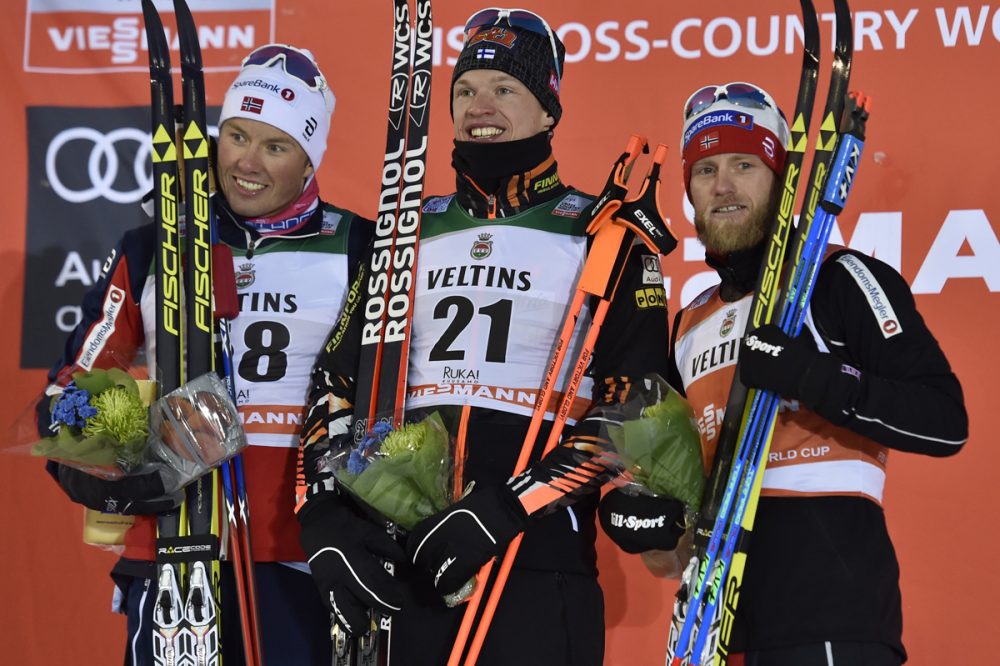
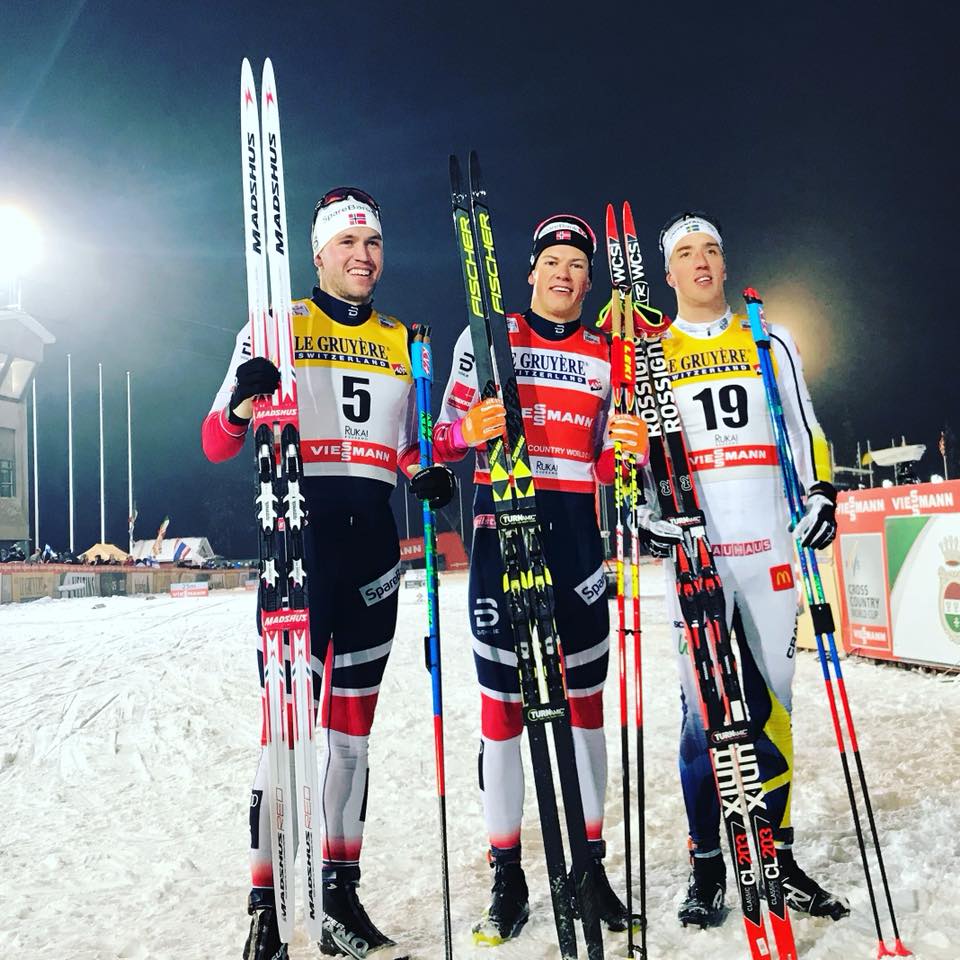
    Left to right: Norwegians Pål Golberg and Johannes Høsflot Klæbo and Sweden’s Calle Halfvarsson after placing third, first and second, respectively, in the men’s 1.4-kilometer classic sprint on Friday in Kuusamo, Finland. (Photo: FIS Cross Country/Facebook)

    There was no mistaking Norway’s Johannes Høsflot Klæbo in Friday’s 1.4-kilometer classic sprint, even with no natural light illuminating the course in Kuusamo, Finland, by the time the men’s final left the start line. The 21 year old’s distinct runner-like, high-tempo stride could be seen leading the five other men’s finalists on every climb, distinguishing him from the light fog and densely packed trees lining the course’s firmly packed tracks.

    Making his World Cup debut in the spring of 2016, Klæbo has since racked up four-regular season World Cup individual sprint podiums — of the eight World Cup sprints that he has entered — and ended last season as the men’s U23 World Cup champion as well as the overall Sprint World Cup winner, all at the age of 20.

    Last weekend at Norway’s first International Ski Federation (FIS) races of the season in Beitostølen,  Klæbo not only won the classic-sprint final, but he also topped the men’s qualifier, his quarterfinal and his semifinal.

    Klæbo repeated the feat this weekend in Kuusamo, starting first with the qualifier, clocking the fastest by 2.26 seconds over Finland’s Anssi Pentsinen in a time of 2:46.53 minutes. He then won his quarterfinal by 0.6 seconds over fellow Norwegian national-team member Pål Golberg. In his semifinal, Klæbo bested Sweden’s Calle Halfvarsson by 0.29 seconds and then, with a convincing gap on the rest of the field, crossed the finish line first in the final in 2:48.19, kick starting his 2017/2018 World Cup season with a win.

    It was not my plan to ski away so early but before the final hill I was told I had a five-minute lead so I went for it all the way to the finish,” Klæbo sai,d according to a FIS press release.

    Even before the course’s last climb, Klæbo had already set himself apart from the rest of the racers in the men’s final: Finland’s Ristomatti Hakola, Italy’s Federico Pellegrino, Sweden’s Calle Halfvarsson, and Norway’s Golberg and Sondre Turvoll Fossli. By the bottom of the first major climb he had double poled his way to a three-meter gap. 

    Klæbo already in his descent, Hakola, Golberg, Pellegrino, Fossli, and Halfvarsson crested the top of the climb in a pack and settled in for the chase. But Klæbo continued to hold them off into the second major climb, extending his gap by another two meters. As the others reached the second major climb, the race became one for second place between Halfvarsson and Goldberg. Hakola, Pellegrino and Fossli had all fallen back.

    Finishing with no one close enough to challenge him, Klæbo took the win in in 2:48.19. Goldberg crossed 1.35 seconds later for second place, while third went to Halfvarsson, 4.03 seconds after Klæbo.

    “I’m happy about the third place, but I was quite behind Klaebo,” Halfvarsson said according to a FIS press release. “I will try to catch up for the [Olympic] Games. He was impressive today.”

    Rounding out the top 10 was Finland’s Lauri Vuorinen in seventh, Russia’s Alexander Bolshunov in eighth, Switzerland’s Jovian Hediger in ninth, and Finland’s Martti Jylhä in 10th.

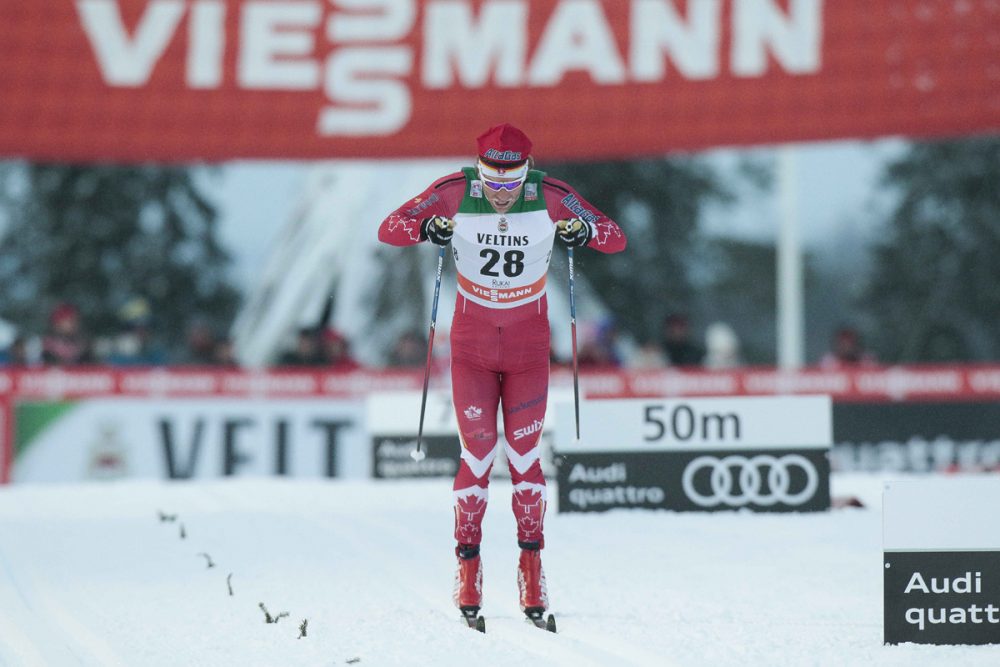
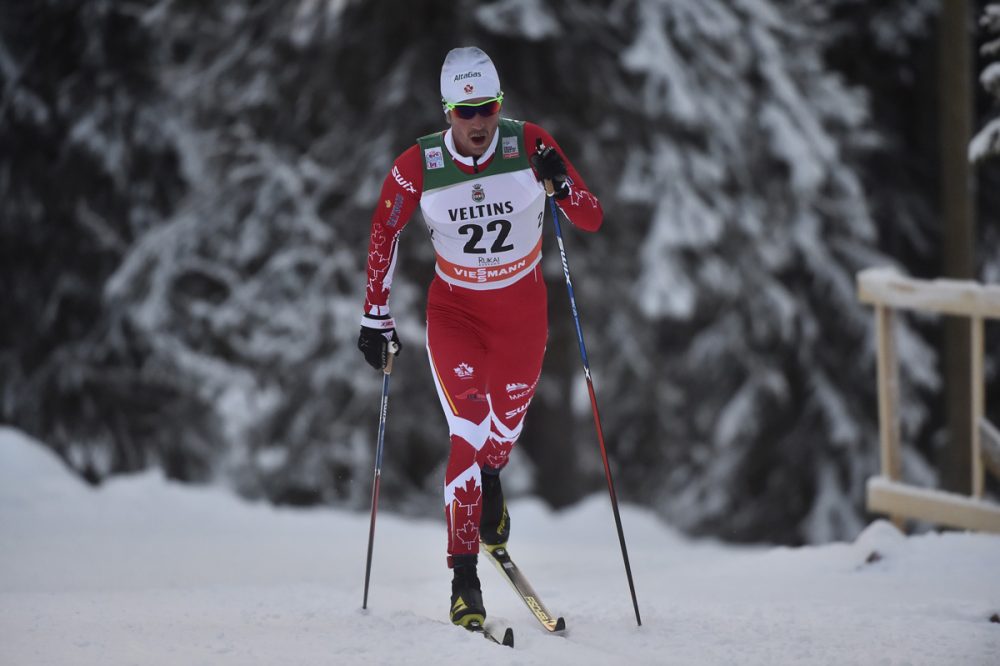
    Canada’s Alex Harvey advanced to the quarterfinals after qualifying in 13th (+6.13), the fastest North American in the preliminary round.

    The goal was to execute a solid day of racing since it’s the first time I put a bib on this year!” Harvey, of the Canadian World Cup Team, wrote in an email to FasterSkier. “I was pretty happy with my qualifier, it’s a short sprint here so 13th for me was a great start.”

    In his quarterfinal, Harvey went up against Finnish skiers Vuorinen, Iivo Niskanen, and Toni Ketelä as well as Estonia’s Marko Kilp, and Japan’s Hiroyuki Miyazawa. However, a loss in positioning before the major climb cost him a few seconds, and he finished his quarterfinal in fifth, 2.16 seconds behind Vuorinen, who won the heat in 2:47.40.

    “In the 1/4 final I did 1 or 2 mistakes that just cost me in term of positioning before the big hill,” Harvey wrote. “I felt great technically and actually pretty good physically too especially for the time of the year.”

    “Like normal the steep terrain is a bit of a weakness for me so again in the final wall I don’t think I was moving fast enough there,” Harvey continued. “The rest of the course I think I skied well.”

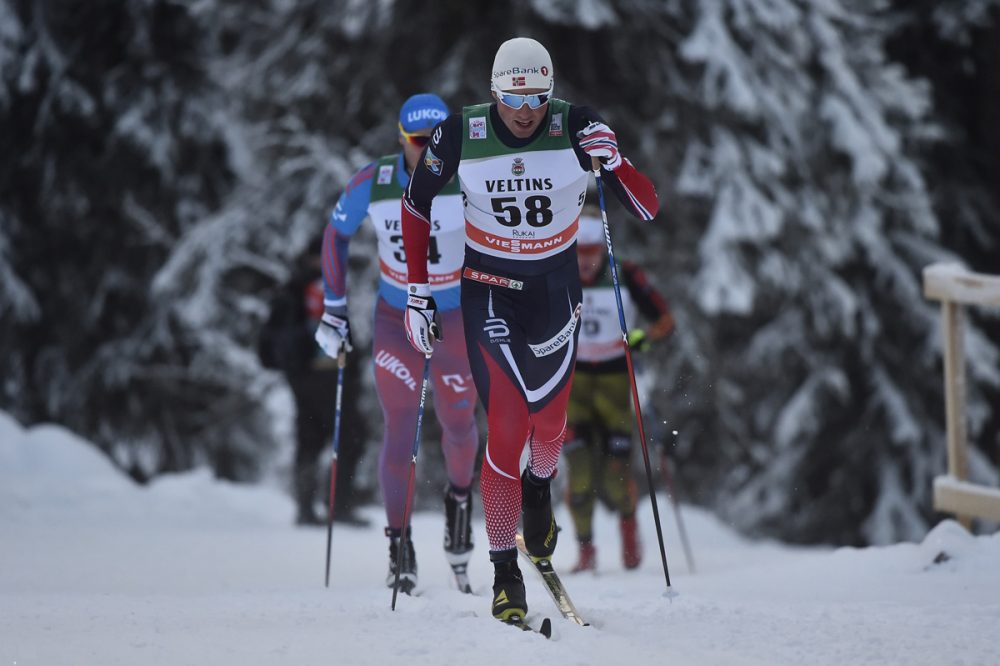
    The only other North American to qualify on Friday was Erik Bjornsen of the U.S. Ski Team (USST) in 26th (+8.71).  Racing in the same quarterfinal as Klæbo, Golberg, Finland’s Juho Mikkonen and Matias Strandvall, and Russia’s Gleb Retivykh, Bjornsen ultimately crossed in fifth, 5.12 seconds behind Klæbo.

    “We are really proud of [Erik] to qualify as strong as he did, in Scandinavia, in a classic sprint,” USST coach Matt Whitcomb said on the phone. “This is one of the hardest races of the year to do this, and it bodes really well.”

    “Talked to him between the qualification and the quarterfinals, and he was just exuding confidence and commented on how strong his double pole is feeling,” Whitcomb continued. “We saw him fire that jet in the finish stretch today. He had a really fast heat and it stressed him out a little bit, don’t know exactly what happened, but he was in the mix today and we are psyched.”

    Another USST member, Andy Newell missed qualifying by 0.38 seconds in 34th. He was 9.38 seconds off Klæbo’s top qualifying time.

    “It was frustrating to be so close and just on the outside of the qualification bubble,” Newell wrote in an email. “Just a few tenths of a second out of the top 25. I felt like I struggled today to get the right amount of glide vs kick… which is just as much on me as the tech. Grateful to be feeling healthy and looking forward to big races to come.”

    Julien Locke of Canada’s National U25 Team was the next-fastest Canadian, placing 59th (+12.07) in the qualifier. Locke finished 0.04 seconds ahead of the American Simi Hamilton (USST) in 60th (+12.13).

    “A little bit of an off day for Simi and Andy,” Whitcomb said. “For Andy on a course that is particularly good for him and he is in really good shape right now, I think he struggled with some glide.”

    Canadian World Cup Team member Len Valjas finished 63rd (+12.58). Before departing Gällivare, Sweden — where he and most of his teammate had been training and raced the opening FIS competitions — Valjas suffered a shoulder subluxation and was not “back to full health” by the time Friday’s sprint rolled around, he explained in an email.

    “I took the week really easy on the shoulder to let it recover, and gave it a try in today’s race,” Valjas wrote. “I didn’t have my normal strength in the double pole sections of today’s race. I just felt weak and couldn’t hold any speed on the flats.

    “I was happy that I was able to compete today, but I am definitely not skiing at 100%,” Valjas continued. “The shoulder is pretty sore and stiff from the qually this morning. Huge thanks to Pete Dickinson (USA physio) for taking care of me this week and helping me speed up my recovery.”

    Also competing for Canada was Knute Johnsgaard in 73rd (+12.58), Devon Kershaw in 74th (+14.01) Graeme Killick in 85th (+14.01), Jess Cockney in 95th (+18.83).

    Three additional Americans raced in the qualifier, with Scott Patterson (USST) finishing 84th (+16.14), Patrick Caldwell (USST) finishing 103rd (+21.43) and Noah Hoffman finishing in 105th (+21.85).

    Canada’s Continental Cup leader, Russell Kennedy (Team R.A.D.), who earned Period 1 World Cup start rights after ending winning last season’s overall NorAm title, did not start Friday’s sprint race.

    Results: Qualifier | Final | Ruka Triple standings (Day 1)

  • Niskanen Wins Another Ruka 15 k; Harvey 11th

    Niskanen Wins Another Ruka 15 k; Harvey 11th

    The men's 15-kilometer classic podium on Sunday Nov. 27 in Kussamo, Finland. Left to right: Norway's Emil Iversen, Finland's Iivo Niskanen, and Norwegian Martin Johnsrud Sundby. (Photo: Fischer/NordicFocus)
    The men’s 15 k classic podium at Sunday’s World Cup in Kussamo, Finland, with Finnish winner Iivo Niskanen (c), Norway’s runner-up Emil Iversen in second and Martin Johnsrud Sundby in third (r). (Photo: Fischer/NordicFocus)

    If Finland’s Iivo Niskanen has a classic race course, it’s clearly becoming the men’s 15-kilometer in Kuusamo, Finland. For the second time, Niskanen outlasted Norway’s Martin Johnsrud Sundby to take the overall title — the Finn’s first and only other World Cup win occurring in 2014 at the age of 22.

    Now, two years later at 24, Niskanen is the only male to have repeated a victory in the Ruka men’s 15 k classic individual start, an event that has taken place in Kuusamo for the past nine years.

    “I was confident when I saw the intermediate times,” Niskanen said during a post-race TV interview. “I believed that my pace is sufficient for victory.”

    Starting in bib 21, Niskanen toggled between third and fourth place for the first 3 k on Sunday, while Sweden’s Calle Halfvarsson, bib 84, took the lead until the end of lap one. With two more laps to go, the Finnish skier took over the lead, superseding not only Halfvarsson, but Norway’s Sundby and Emil Iversen as well.

    Norway's Emil Iversen during the men's 15-kilometer classic race on Sunday Nov. 27 in Kussamo, Finland. (Photo: Fischer/NordicFocus)
    Norway’s Emil Iversen en route to second in the World Cup men’s 15 k classic on Sunday in Kuusamo, Finland. (Photo: Fischer/NordicFocus)

    During the next 5 k, Iversen and Halfvarsson dueled for second place, with Iversen eventually coming out on top and taking the front position from Niskanen around the 10 k mark.

    Within another kilometer, however, Niskanan had regained control of the lead and Iversen dropped back from the Finn by a little more than eight seconds. Sundby, who had been sitting comfortably in fourth for most of the race, began to dig deeper and reeled in Iversen with less than 5 k to go.

    With less than a lap to go, Sundby made another push to surpass Niskanen, but it was too late. The Finn held him off for the rest of the final lap, and as Sundby started to lose steam, Iversen regained speed and moved back into second.

    “This was good for my head and body,” Iversen told Langrenn.com. “I felt lousy yesterday but now I’m relieved. I considered not racing at all, but it turned out pretty good and I don’t completely know why.”

    Iversen placed second overall, finishing 10.2 seconds behind Niskanen’s winning time of 35:27.6. Sundby took the final podium spot in third, 11.2 seconds out from the win.

    “I got a beating from the other two,” Sundby said, referring to Niskanen and Iversen, in a post-race TV interview. “I feel like I did a good race … sadly I wasn’t good enough to win today.”

    After leading for the first third of the race, Sweden’s Halfvarsson, who reached the podium in Saturday’s sprint final, dropped back to seventh (+21.2) by the end of the day. Within a little under 14 seconds of Halfvarsson was Canada’s Alex Harvey in 11th (+35.0).

    The top North American on the day, Harvey, a 28-year-old Canadian World Cup Team member, narrowly missed Sunday’s top 10, with 1.2 seconds separating him from 10th. He said it was still a good sign of where his classic technique is headed as he begins a new season.

    “I felt last year I never had a good classic race, a race that I felt like I skied well the whole way technically,” Harvey said on the phone, pointing out that Sunday was one race that he he did.

    Despite feeling a little worn down prior to the start of Sunday’s race –which Harvey indicated may have prevented him from racing in a top-five position — the consistency he showed on course in his skiing mechanics were a positive for the Canadian.

    “I’m still really happy with the result and not just the result itself, but also the way I was skiing,” he said.

    Canada's Devon Kershaw racing during the men's 15-kilometer classic race on Sunday Nov. 27 in Kussamo, Finland. (Photo: Fischer/NordicFocus)
    Canada’s Devon Kershaw racing to 33rd in the World Cup men’s 15 k classic on Sunday in Kuusamo, Finland. (Photo: Fischer/NordicFocus)

    After placing 25th in Saturday’s classic sprint, Harvey also explained that the weekend’s combined results were, for him, checkmarked accomplishments.

    “I didn’t put too much [weight] on the sprint, so just being able to qualify yesterday was good,” Harvey said of Saturday. “I had a bit more expectation on today’s race [with] the goal [being] to get close or at least finish in the top ten.

    “And I think that’s what I reached,” he added. “That’s mission accomplished for me, I’d say for both days.”

    After Harvey, the second top North American man on the results sheet was Devon Kershaw in 33rd (+1:23.4), finishing just outside of World Cup points — not quite where he wanted to be, but on the right track.

    “To be just outside of the points is never a great feeling,” Kershaw said, according to a Cross Country Canada press release. “[B]ut to know that I’m knocking on the door in only the first competition of a long World Cup season gives me some confidence moving forward. I’m looking forward to the next stop!”

    Following him as the first American was U.S. Ski Team (USST) B-team member Erik Bjornsen in 41st (+1:37.2). These being Bjornsen’s first races on snow, he indicated that coming into the opening World Cup competition, his greater focus was getting the feel for racing again. 

    “I only did one day of classic skiing in the 30 days leading up to coming over here,” Bjornsen wrote in an email. “I took a fairly bad rollerski crash at Soldier Hollow which left my tail end and hand in a bad spot. My goal coming into this weekend was to not get to hung up on the results. Lillehammer has always been a good venue for me so I was trying to think of Ruka as a warm-up into the season.”

    Canada’s Graeme Killick (World Cup B-team) finished 53rd (+2:12.9) and Noah Hoffman (USST B-team) was 64th (+2:42.6).

    Canada's Graeme Killick racing during the men's 15-kilometer classic race on Sunday Nov. 27 in Kussamo, Finland. (Photo: Fischer/NordicFocus)
    Canada’s Graeme Killick racing to 53rd in the World Cup men’s 15 k classic on Sunday in Kuusamo, Finland. (Photo: Fischer/NordicFocus)

    “It’s an early race on a super-tough course against athletes that have been racing for two or three weeks and we know we just came up short today,” USST Women’s Coach Matt Whitcomb said on the phone.

    Whitcomb indicated that, from his perspective, the men’s squad has had good preparation, training and fitness leading up to the opening World Cup races in Kuusamo. With goals of peaking for later World Cup competitions, such as those in the Tour de Ski and World Championships, Whitcomb explained the men’s team will continue to work into the season with the understanding that the opening races this weekend are early season races.

    “They haven’t gotten fast yet and everybody has a pretty balanced head on their shoulders,” Whitcomb said of the U.S. men who raced on Sunday.  “I think there is nothing wrong with being a little disappointed. I know they are right now but they’re also very realistic and they know that their season is about to open up.”

    When asked about Hoffman, who made a notable increase in training hours this season, Whitcomb explained that the way Hoffman absorbs his training load as he comes out of it and into the race season may impact his early season and later performances.

    “I would suggest that [Hoffman] has probably not fully absorbed that training load and good things are to come,” Whitcomb said. “I’ve already seen really nice changes in his strength level. He has spent a huge amount of time this year on general strength training and it has improved his double pole. … I think it is just going to take a couple weeks of being in Europe racing and training more normally for things to liven up.”

    The Canadian coaches could not be reached for comment.

    Results

  • Nilsson Knocks Norwegians to Second and Third in WC Opener

    Nilsson Knocks Norwegians to Second and Third in WC Opener

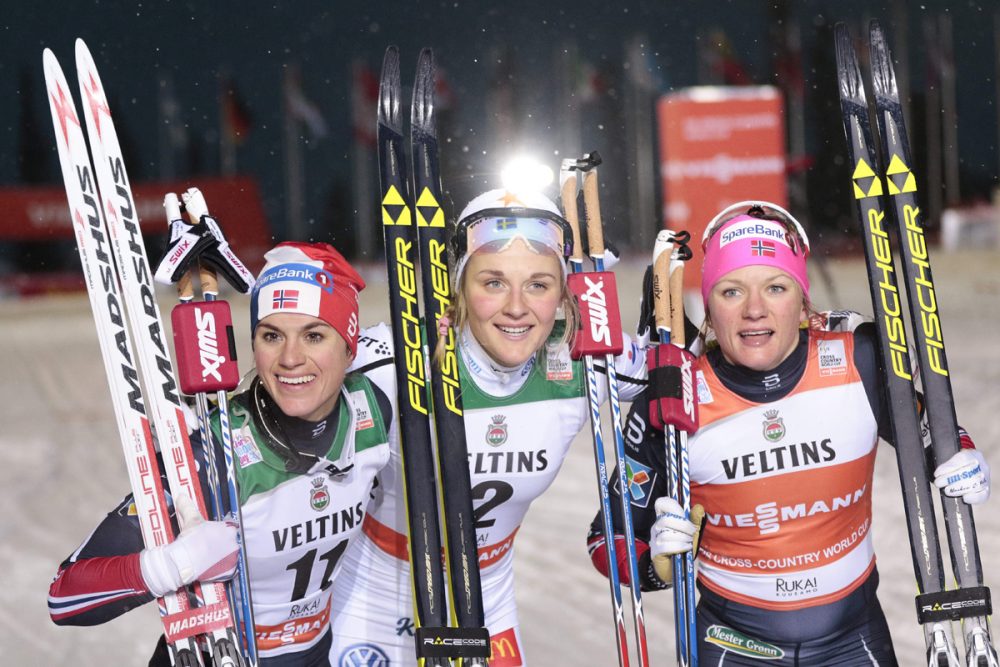
    The women's classic sprint final podium at the opening FIS races in Ruka, Finland on Saturday Nov. 26. From left to right: Heidi Weng of Norway, Sweden's Stina Nilsson, and Norwegian Maiken Caspersen. (Photo: Fischer/NordicFocus)
    The women’s classic sprint final podium at the opening World Cup races in Ruka, Finland on Saturday Nov. 26. From left to right: Heidi Weng of Norway, Sweden’s Stina Nilsson, and Norwegian Maiken Caspersen Falla. (Photo: Fischer/NordicFocus)

    Norway’s women’s team has a long history with classic racing in Kuusamo, Finland. For 15 years, International Ski Federation (FIS) Cross Country World Cup competitions have taken place on these trails, with Norway winning every classic race at the Ruka venue except two — falling to Finland’s Aino-Kaisa Saarinen in 2009 and more recently, Poland’s Justyna Kowalczyk in 2013.

    Three years later, another woman’s name has now knocked Norway’s out of first: Sweden’s Stina Nilsson.

    In the women’s 1.4-kilometer sprint final on Saturday, Nilsson battled two Norwegians –including last year’s Sprint Cup winner, Maiken Caspersen Falla — two Russians, and a Finn, for her first title ever in a classic race.

    “It feels super awesome, especially to win a classic race,” Nilsson, 23, said during a television interview.

    After qualifying second, 1.14 seconds behind the winning qualification time of 3:21.15 set by Finland’s Krista Parmakowski, Nilsson overtook the lead by the end of the first quarterfinal and held it through her semifinal and the final.

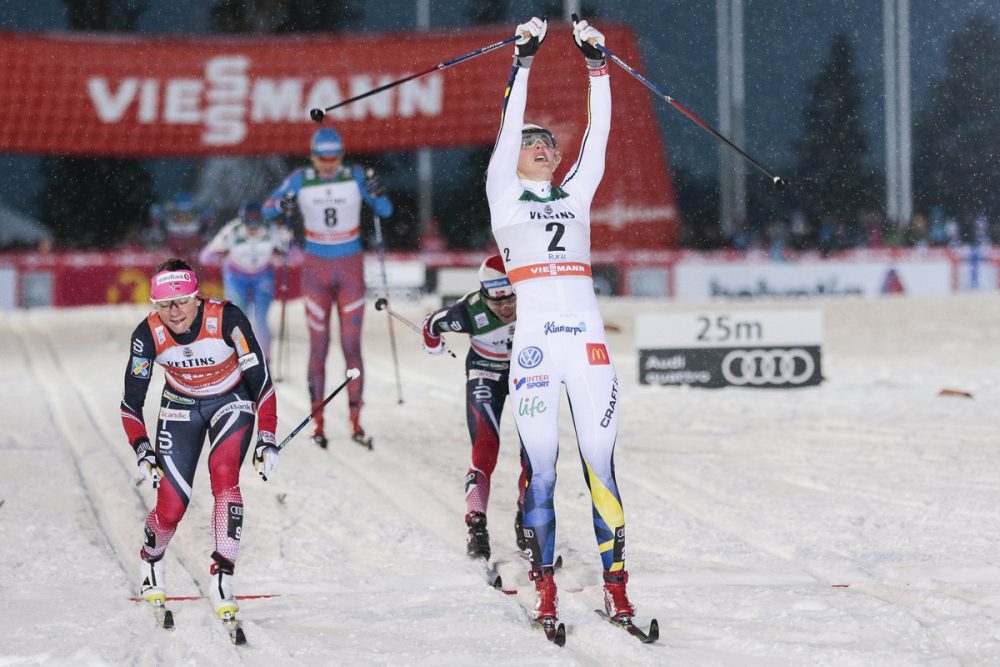
    Sweden's Stina Nilsson bib 2 racing to her first ever classic title on Saturday Nov. 26 at the pening FIS races in Ruka, Finland. Norway's Maiken Caspersen Falla (l) finished in second. (Photo: Fischer/NordicFocus)
    Sweden’s Stina Nilsson bib 2 racing to her first ever classic title on Saturday Nov. 26 at the opening World Cup races in Ruka, Finland. Norway’s Maiken Caspersen Falla (l) finished in second. (Photo: Fischer/NordicFocus)

    Nilsson and Parmakoski started the day’s rounds in the first quarterfinal one, leading Kowalczyk and another Finn, Laura Mononen, as well as Russia’s Natalia Nepryaeva and Norway’s Astrid Uhrenholdt Jacobsen off the start.

    Parmakoski pulled into the lead through the first major downhill, first major ascent and into the second major course descent. However, by the last large climb, Nilsson proved too powerful for the Finn. Within three strides, Nilsson passed Parmakoski and by the top of the hill had established enough of a gap to double pole her way safely across the finish line of her quarterfinal in first.

    In a much closer semifinal, Nilsson found herself in fourth alongside her Swedish teammate Hannah Falk for most of the heat, tightly trailing Russia’s Natalia Matveeva and Norway’s Falla all the way through the second major descent. By the bottom of the final climb, it was Matveeva in front, with Falla working to her left. Navigating to the inside, Nilsson found a second wind, eventually outlasting both the Norwegian and the Russian in the  race to the top.

    Back in the lead with 100-meters to go, Nilsson once again crossed in first, leaving the photo finish to Falla and Matveeva. Falla automatically advanced to the final after capturing second, while Matveeva earned one of the ‘Lucky Loser’ spots. Parmakoski garnered the final’s last lucky loser spot after crossing fourth in Nilsson’s semifinal. 

    Facing off against Falla once more, as well as her Norwegian teammate, Heidi Weng–the winner of the second semifinal–along with Russia’s Yulia Belorukova and Matveeva, as well as Parmakowski in the final, Nilsson took no chances off the start.

    The Swede punched the pace through the initial decent, but by the first major climb she began to lose steam. Falla challenged Nilsson on the right, while Matveeva closed in from the left. Weng hung on behind her teammate in fourth place, while Parmakoski raced in fifth and Belorukova in sixth.

    Regaining the front position from Nilsson by the second large downhill on course, the sprint leader Falla appeared to be preparing to gap herself from the group. Midway through the final climb, however, the Swede’s white suit was once more on the attack. Fading into a chase pack by the top of the climb were Falla, Weng, and Matveeva, while Nilsson blew her way back into the lead. 

    With 100 meters to go, Falla jumped in behind Nilsson. With 50 meters to go, Falla switched lanes, moving to the Swede’s right in an effort to edge by for the win. Holding on tightly her first classic title, Nilsson double poled across the finish line first in a time of 3:21.61, while Falla finished 0.17 hundreths of a second behind her in second.  

    “I’m happy about the [second] place, it was a good start to the season and it shows promise for Lillehammer– it’s fun to be on the podium already,” Falla, 26, said during a television interview.  

    Falla’s teammate Weng rounded out the podium in third, crossing 0.69 seconds off of Nilsson’s time.

    “I’m very happy, I’ve never had such a good season opener in Kusammo,” Weng, 25, said during a T.V. interview. “The conditions were challenging so we had use herringbone.”

    Other final finishers included Matveeva in fourth (+3.18), Parmakowski in fifth (+5.12) and Belorukova in sixth (+8.94).

    Four Americans Qualify; Bjornsen 17th

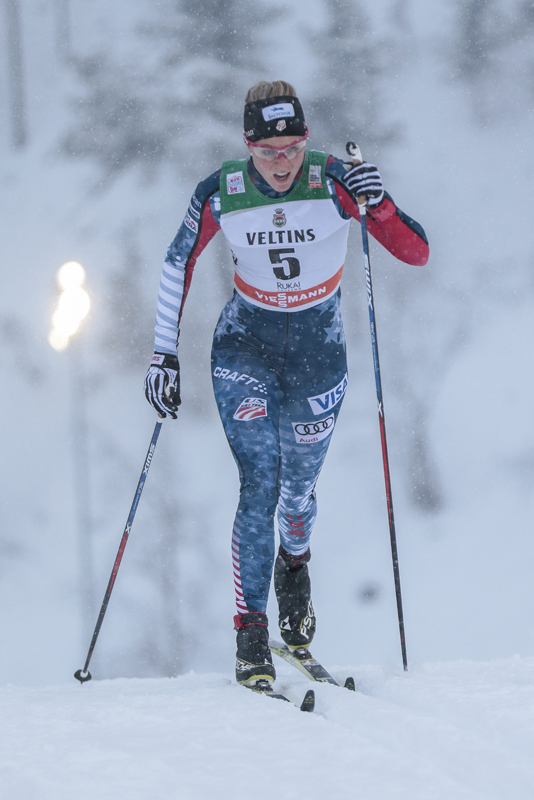
    American Sadie Bjornsen racing to a seventh place in the women's qualifier on Saturday Nov. 26 at the opening FIS races in Ruka, Finland. Bjornsen went on to finish 17th overall. (Photo: Fischer/NordicFocus)
    American/USST member Sadie Bjornsen racing to a seventh place in the women’s qualifier on Saturday Nov. 26 at the opening World Cup races in Ruka, Finland. Bjornsen went on to finish 17th overall. (Photo: Fischer/NordicFocus)

    The U.S. Ski Team (USST) saw four women qualify for the heats on Saturday, with Sadie Bjornsen leading the group after qualifying in seventh (+4.41), followed by Jessie Diggins who qualified 13th (+6.27), Ida Sargent in 23rd (+10.28) and Sophie Caldwell, who nabbed the final qualification spot, in 30th (+11.84).

    Though Bjornsen indicated that her preparation leading into the season has been different than in years past–due partly to a heel spur problem she has been nursing during the past two months, which forced her to engage in sans shoe training, such as swimming, ski erging, and heel-less biking–the 27-year-old saw Saturday’s performance as a good sign of where her training is taking her.

    “Today was only my third time classic skiing in the past months, so it was great to finally find my classic ‘feeling’ this morning just before the start,” Bjornsen wrote in an email to media outlets. “The past few days I have been nervous, and questioning myself more than normal, so today was a wonderful ‘check’.”  

    A Winthrop, Washington, native who trains with Alaska Pacific University (APU) in Anchorage, Alaska, Bjornsen decided prior to the start of the 2016/2017 season that she would hold no expectations over herself, other than to give every race she entered a good fight.

    With that in mind, she lead the start of her quarterfinal and pushed the pace early on. Following close behind her was the swiss skier Laurien Van der Graaff, Russia’s Daria Vedenina, Kerttu Niskanen of Finland, Norway’s Heidi Weng and Germany’s Sandra Ringwald.

    Bjornsen held her lead until the final climb of the course, where the powdery snow appeared to slow down her ability to keep up a high turnover in her herringbone. She was overtaken by Weng and Rigwald before the top of the climb and crossed fourth in her quarterfinal for 17th overall.

    “I had a great qualifier, and went into the heats with some confidence,” Bjornsen wrote. “The start was great, but I started to struggle on the final climb. I am missing a little bit of “high speed leg speed”, but that is something I am confident will come with using my legs again. I am looking forward to skiing more, and racing more!”

    “I believe that as a team, we will do well pretty much all year, but today we were kicking out the cobwebs a little bit.” — U.S. women’s head coach, Matt Whitcomb the USST’s sprint performance in Ruka

    The next two American finishers for the day were Sophie Caldwell in 20th overall and Ida Sargent in 23rd. Both were slated to start in the third quarterfinal, going head-to-head against some of Norway’s top competitors, including Falla and Ingvild Flugstad Østberg. Though her qualifier was not what she was looking for performance-wise, Caldwell was glad she was able to sneak into the rounds and get a bit more time racing before the day’s end.

    “In my quarterfinal I felt better, skied smarter, and made a better decision with skis than I did in the morning,” Caldwell, 26, wrote in an email. “Even though this isn’t the result I’m the most proud of, it is the best result I’ve ever had in Kuusamo and it was a good opportunity to clean out the cobwebs and get a race under my belt.”

    Sargent, who traveled to Europe a couple weeks prior to the start of the World Cup race season with her club team, the Craftsbury Green Racing Project, managed to jump into a few races in Muonio, Finland in hopes of feeling more mentally and physically prepared for the official FIS season’s start.

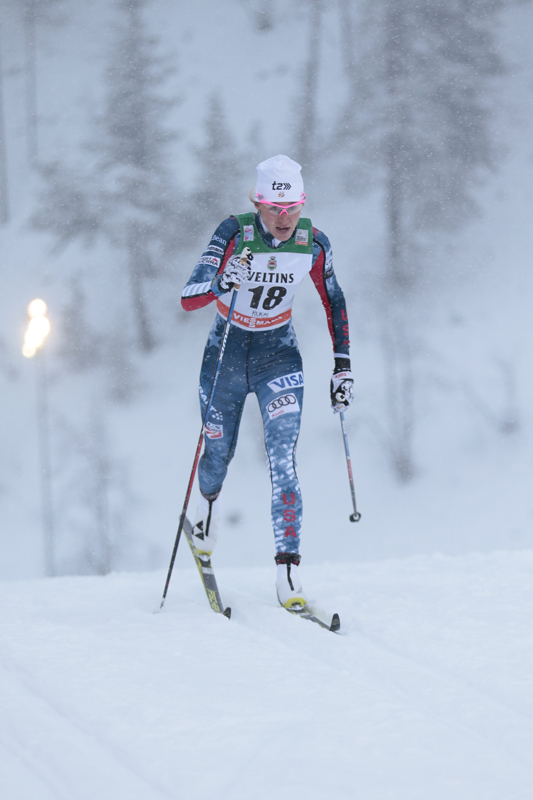
    American Sophie Caldwell racing to a 30th place in the women's qualifier on Saturday Nov. 26 at the opening FIS races in Ruka, Finland. Caldwell went on to finish 20th overall. (Photo: Fischer/NordicFocus)
    American/USST member Sophie Caldwell racing to a 30th place in the women’s qualifier on Saturday Nov. 26 at the opening World Cup races in Ruka, Finland. Caldwell went on to finish 20th overall. (Photo: Fischer/NordicFocus)

    “It has a give and take because I think having a little bit more time at home for me especially right after the Park City camp also would have been beneficial,” the 26-year-old Sargent said during a phone conversation of her decision to travel to Europe early. “It was nice to just get my feet under me and do a few warm-up races,” she added. “I think those made a big difference.”

    “Today was one of the days you had to be good at feathering [the uphills]” Sargent continued. “I’m still working on that…It was good to get the first one out of the way and go from here.”

    The final American woman to finish in Saturday’s sprint was Diggins in 26th overall. Along with a false start from Finland’s Anne Kylloenen, Diggins also dealt with a close encounter from Russia’s Polina Kovaleva at the start of her quarterfinal.

    “[Kovaleva’s] lane ended and she was going to try to move over and she tried to move over right on top of me and obviously that didn’t work,” Diggins, said during a phone conversation.

    “But I was proud of myself for not letting it rattle me and being able to shake it off and get back into the race,” Diggins added.

    Unlike previous years, Diggins did not travel to Europe for a pre-World Cup race season camp. She opted instead to spend a few extra weeks at home, meaning the opening races in Ruka would be her first on snow.

    “It was definitely pretty nerve wracking coming into the race season being like ‘OK I haven’t raced yet this year’,” Diggins said. “I mean, we’ve done time trials, but that’s not the same.”

    Though Diggins feels confident in her fitness coming into the season, the 25-year-old is ready to make changes where she feels they are necessary using Ruka as her baseline.

    “Definitely, it was really tricky conditions out there with the tracks deteriorating,” Diggins said. “But I also need to work on my technique…that’s on me and I’m not going to make any excuses for my races.”

    With four women having qualified for the heats, U.S. women’s head coach, Matt Whitcomb indicated that standout performances were not a priority for races this early in the season.

    “We always have the intention of winning the races that we race in, but there is in fact a strategy of really trying to build into this period one and to place our higher performances later in the year so that we can really smash things at World Champs,” Whitcomb said during a phone conversation. “I believe that as a team, we will do well pretty much all year, but today we were kicking out the cobwebs a little bit.”

    Results: Qualifier | Final